WO1994009024A1 - Verfahren zum alkylieren von östronderivaten - Google Patents
Verfahren zum alkylieren von östronderivaten Download PDFInfo
- Publication number
- WO1994009024A1 WO1994009024A1 PCT/EP1993/002905 EP9302905W WO9409024A1 WO 1994009024 A1 WO1994009024 A1 WO 1994009024A1 EP 9302905 W EP9302905 W EP 9302905W WO 9409024 A1 WO9409024 A1 WO 9409024A1
- Authority
- WO
- WIPO (PCT)
- Prior art keywords
- oestrone
- propyl
- derivatives
- stage
- carbonate
- Prior art date
- Legal status (The legal status is an assumption and is not a legal conclusion. Google has not performed a legal analysis and makes no representation as to the accuracy of the status listed.)
- Ceased
Links
Classifications
-
- C—CHEMISTRY; METALLURGY
- C07—ORGANIC CHEMISTRY
- C07J—STEROIDS
- C07J1/00—Normal steroids containing carbon, hydrogen, halogen or oxygen, not substituted in position 17 beta by a carbon atom, e.g. estrane, androstane
- C07J1/0051—Estrane derivatives
- C07J1/0059—Estrane derivatives substituted in position 17 by a keto group
Definitions
- Oestrone derivatives are known starting compounds for the synthesis of a large number of secondary products, for example 19-nor compounds. It is often essential to alkylate the hydroxyl groups.
- carbonic acid esters are known from the literature, these being implemented, for example, under phase transfer conditions or in the presence of phosphines or basic catalysts under more or less drastic conditions.
- the invention relates to a process for the alkylation of oestrone derivatives, which is characterized in that a 5-20, preferably 8-15% by weight suspension of the oestrone derivatives in dimethylformamide is prepared in the first stage and 1-5, preferably 2-4, therein Moles of carbonic acid diester per mole of OH groups to be alkylated and 1-10, preferably 3-7 mol% of a guanidine and / or an alkylguanidine, based on oestrone derivative, dissolved and in a second stage the oxygen contained therein is largely removed and in a third step Step, the reaction temperature is set to 100-200 ° C., preferably 130-170 ° C., by continuous heating and the reaction is carried out under the resulting system pressure within 3-36 h.
- Another object of the invention is characterized in that as dialkyl carbonates, dimethyl carbonate,
- Diethyl carbonate, di-n-propyl and di-i-propyl carbonate, di-prim. (sec. tert.) - Butyl carbonate can also be used.
- Another object of the invention is characterized in that as a catalyst guanidines themselves or with methyl, ethyl, n-propyl, i-propyl, prim. (sec. tert.) - Butyl residues can be used.
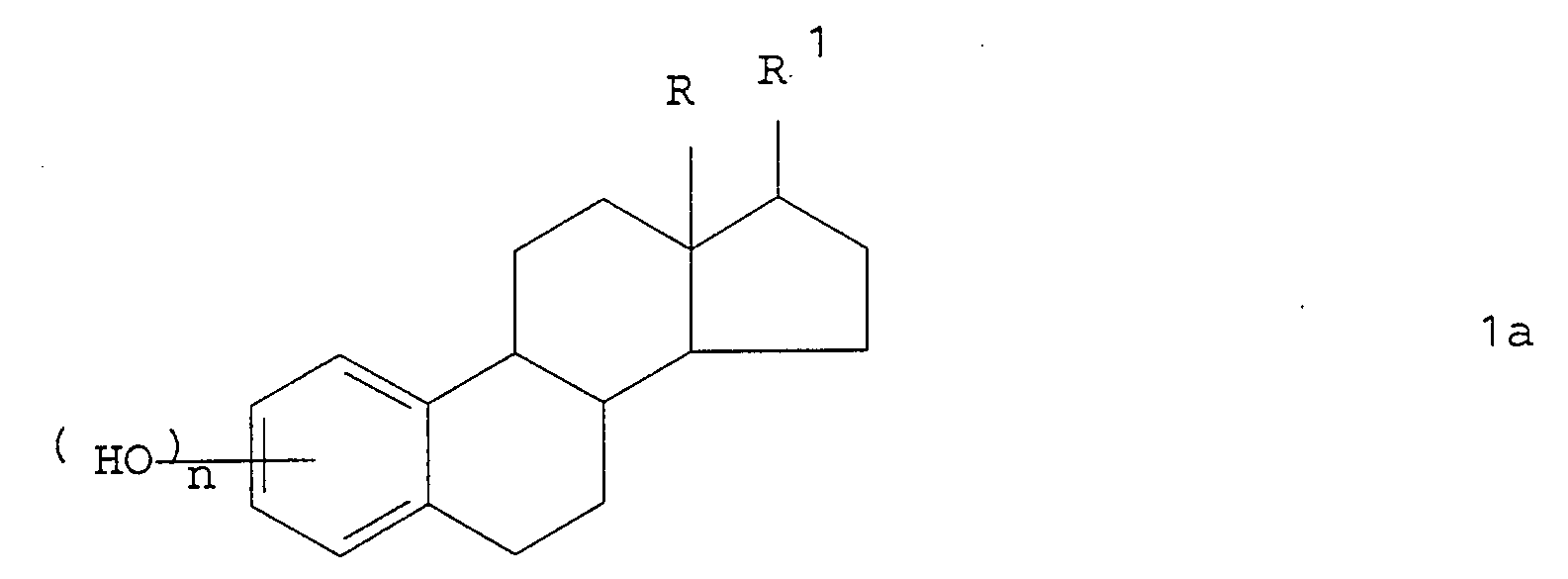
- the process according to the invention can be used to alkylate estrone derivatives of the type which, as a rule, predominantly consist of compounds of the general formula 1a
- estrone derivatives are used as a 5-20% by weight, preferably 8-15% by weight suspension in dimethylformamide.
- carbonic acid diesters of the general formula (2) are used as alkylating reagents used, wherein R 2 and R 3 yaw-chain or branched hydrocarbon radicals with 1-10 C atoms, preferably 1-4 C atoms, optionally substituted cycloaliphatic, see alicyclic, araliphatic hydrocarbon radicals with 5-10 C atoms. preferably 6-8 carbon atoms nen.
- Preferred according to the invention are dimethyl carbonic acid, diethyl carbonic acid, dipropyl carbonic acid, di-n-butyl carbonic acid and di-i-butyl carbonic acid. 1-5 moles, preferably 2-4 moles, of carbonic acid diester are used per mole of OH group of the estrone derivative to be alkylated.
- the choice of the respective hydrocarbon radicals R 2 , R 2 is determined on the one hand by the desired reaction conditions, such as system pressure (excess pressure, atmospheric pressure), reaction temperatures and reaction times, and on the other hand by the type of further synthesis stages of the etherified estrone derivative.
- the catalysts used in accordance with the invention are guanidines of the general formula (3) wherein R 4 , R 5 , R 6 , R 7 , R 8 can be hydrogen atoms or can have the meaning of R 2 , R 3 .
- radicals R 4 - R ⁇ are hydrogen atoms, these are substituted under the reaction conditions of the third stage by the radicals R 2 , R 3 of the carbonic acid diester, the pentasubstituted guanidine derivative ultimately being the catalytically active compound.
- the commercially available alkyl derivatives with a chain length of 1-4 carbon atoms are preferred, in particular the methyl and ethyl guanidines in amounts of 1- 10, preferably 3-7 mol%, based on the estrone derivative.
- the process according to the invention is advantageously carried out in a pressure reactor.
- the process can be carried out both under reflux conditions and under increased pressure.
- a 5-20% by weight, preferably 8-15% by weight suspension of the estrone derivatives in dimethylformamide is prepared and 1-5 mol, preferably 2-4 mol, of carbonic acid diester, based on OH- to be alkylated Groups and 1-10 mol%, preferably 3-7 mol%, based on the estrone derivative used, of a guanidine and / or an alkylguanidine.
- This order is not critical and can be varied according to the requirements of operational practice.
- the oxygen contained in the reaction mixture is largely removed.
- the reactor is largely dissolved in practically common processes by repeated evacuation and aeration with inert gases such as preferably nitrogen
- the reaction mixture is continuously heated to 100-200 ° C., preferably 130-170 ° C., and this temperature is maintained for 3 to 36 hours at the system pressure.
- the system pressure can be varied within wide limits and depends essentially on the type of alkylating agent and the level of the reactor.
- the inertization is maintained by blanketing with inert gas.
- reaction times are essentially dependent on the level of the chosen reaction temperature. In the range of 130-170 ° C. preferred according to the invention, in the case of estrone and dimethyl carbonate they are in the range of 3 to 24 hours.
- reaction products are worked up using the methods customary in this field.
- the prepared reaction mixture is heated to 40 ° C, a clear solution forming and then about 30 min. Inerted in an ultrasonic bath by adding nitrogen under the solvent surface.
- the solution is transferred to an autoclave and heated to 130 ° C. with stirring for 24 h.
- Example 2 was carried out analogously to Example 1, with the modification that an estrone with a content of 95% by weight was used for the alkylation.
- the desired estrone methyl ether is obtained with a content of 95% by weight with a yield of 15 g.
- Example 3
- the alkylation was carried out according to Example 3, with the modification that the oxygen contained in the reaction mixture was not removed in step 2 according to the process according to the invention, but the reaction was only carried out in a nitrogen atmosphere.
Landscapes
- Chemical & Material Sciences (AREA)
- Organic Chemistry (AREA)
- Health & Medical Sciences (AREA)
- General Health & Medical Sciences (AREA)
- Steroid Compounds (AREA)
- Low-Molecular Organic Synthesis Reactions Using Catalysts (AREA)
- Organic Low-Molecular-Weight Compounds And Preparation Thereof (AREA)
- Pharmaceuticals Containing Other Organic And Inorganic Compounds (AREA)
- Plural Heterocyclic Compounds (AREA)
Abstract
Description


Claims
Priority Applications (6)
| Application Number | Priority Date | Filing Date | Title |
|---|---|---|---|
| EP93923513A EP0665849B1 (de) | 1992-10-22 | 1993-10-21 | Verfahren zum alkylieren von östronderivaten |
| US08/424,280 US5621124A (en) | 1992-10-22 | 1993-10-21 | Process for the alkylation of estrone derivatives |
| JP6509658A JPH09505800A (ja) | 1992-10-22 | 1993-10-21 | エストロン誘導体をアルキル化する方法 |
| DE59307221T DE59307221D1 (de) | 1992-10-22 | 1993-10-21 | Verfahren zum alkylieren von östronderivaten |
| CA002147374A CA2147374A1 (en) | 1992-10-22 | 1993-10-21 | Process for the alkylation of estrone derivatives |
| GR970402876T GR3025240T3 (en) | 1992-10-22 | 1997-10-31 | Method of alkylating oestrone derivatives. |
Applications Claiming Priority (2)
| Application Number | Priority Date | Filing Date | Title |
|---|---|---|---|
| DEP4235657.1 | 1992-10-22 | ||
| DE4235657A DE4235657A1 (de) | 1992-10-22 | 1992-10-22 | Verfahren zum Alkylieren von Östronderivaten |
Publications (1)
| Publication Number | Publication Date |
|---|---|
| WO1994009024A1 true WO1994009024A1 (de) | 1994-04-28 |
Family
ID=6471086
Family Applications (1)
| Application Number | Title | Priority Date | Filing Date |
|---|---|---|---|
| PCT/EP1993/002905 Ceased WO1994009024A1 (de) | 1992-10-22 | 1993-10-21 | Verfahren zum alkylieren von östronderivaten |
Country Status (10)
| Country | Link |
|---|---|
| US (1) | US5621124A (de) |
| EP (1) | EP0665849B1 (de) |
| JP (1) | JPH09505800A (de) |
| AT (1) | ATE157371T1 (de) |
| CA (1) | CA2147374A1 (de) |
| DE (2) | DE4235657A1 (de) |
| DK (1) | DK0665849T3 (de) |
| ES (1) | ES2108882T3 (de) |
| GR (1) | GR3025240T3 (de) |
| WO (1) | WO1994009024A1 (de) |
Families Citing this family (20)
| Publication number | Priority date | Publication date | Assignee | Title |
|---|---|---|---|---|
| US5504074A (en) * | 1993-08-06 | 1996-04-02 | Children's Medical Center Corporation | Estrogenic compounds as anti-angiogenic agents |
| US20040214807A1 (en) * | 1993-08-06 | 2004-10-28 | D'amato Robert J. | Estrogenic compounds as anti-mitotic agents |
| US6908910B2 (en) * | 1993-08-06 | 2005-06-21 | The Children's Medical Center Corporation | Estrogenic compounds as anti-mitotic agents |
| US6346510B1 (en) * | 1995-10-23 | 2002-02-12 | The Children's Medical Center Corporation | Therapeutic antiangiogenic endostatin compositions |
| US5778448A (en) * | 1997-05-12 | 1998-07-14 | Maher; Thomas Henry | Assembly for attaching sunglasses to a cap |
| US20020002294A1 (en) * | 1997-09-24 | 2002-01-03 | D' Amato Robert J. | Estrogenic compounds as antiangiogenic agents |
| EP1124545B1 (de) | 1998-08-11 | 2004-12-15 | EntreMed, Inc. | Verwendung von 2-methoxyestradiol als fungizide |
| US7087592B1 (en) * | 1999-08-23 | 2006-08-08 | Entre Med, Inc. | Compositions comprising purified 2-methoxyestradiol and methods of producing same |
| US7135581B2 (en) | 2000-08-18 | 2006-11-14 | Entremed, Inc. | Antiangiogenic agents |
| US20050192258A1 (en) * | 2000-08-18 | 2005-09-01 | Agoston Gregory E. | Antiangiogenic agents |
| US6995278B2 (en) * | 2000-08-18 | 2006-02-07 | Entre Med, Inc. | Antiangiogenic agents |
| WO2003063787A2 (en) * | 2002-01-30 | 2003-08-07 | Entremed, Inc. | Non-steroidal analogs of 2-methoxyestradiol |
| EP1633367A2 (de) * | 2003-05-28 | 2006-03-15 | EntreMed, Inc. | Antiangiogene mittel |
| CA2558014A1 (en) | 2004-03-12 | 2005-09-29 | Entremed, Inc. | Antiangiogenic agents |
| US20070004689A1 (en) * | 2004-03-12 | 2007-01-04 | Agoston Gregory E | Antiangiogenic agents |
| JP2008521822A (ja) * | 2004-11-29 | 2008-06-26 | エントレメッド インコーポレイテッド | 抗血管形成剤を投与する方法、およびそれを用いて疾病を治療する方法 |
| WO2007059111A2 (en) * | 2005-11-14 | 2007-05-24 | Entremed, Inc. | Anti-angiogenic activity of 2-methoxyestradiol in combination with anti-cancer agents |
| US20070176403A1 (en) * | 2006-02-01 | 2007-08-02 | Dennis Calderone | Air adjustable seat |
| CA2646065C (en) * | 2006-03-20 | 2014-01-14 | Entremed, Inc. | Disease modifying anti-arthritic activity of 2-methoxyestradiol |
| WO2008094665A1 (en) * | 2007-01-31 | 2008-08-07 | Entremed, Inc. | Method of treating amyloidosis mediated diseases |
-
1992
- 1992-10-22 DE DE4235657A patent/DE4235657A1/de not_active Withdrawn
-
1993
- 1993-10-21 US US08/424,280 patent/US5621124A/en not_active Expired - Fee Related
- 1993-10-21 WO PCT/EP1993/002905 patent/WO1994009024A1/de not_active Ceased
- 1993-10-21 DK DK93923513.1T patent/DK0665849T3/da active
- 1993-10-21 CA CA002147374A patent/CA2147374A1/en not_active Abandoned
- 1993-10-21 AT AT93923513T patent/ATE157371T1/de not_active IP Right Cessation
- 1993-10-21 JP JP6509658A patent/JPH09505800A/ja not_active Withdrawn
- 1993-10-21 EP EP93923513A patent/EP0665849B1/de not_active Expired - Lifetime
- 1993-10-21 ES ES93923513T patent/ES2108882T3/es not_active Expired - Lifetime
- 1993-10-21 DE DE59307221T patent/DE59307221D1/de not_active Expired - Fee Related
-
1997
- 1997-10-31 GR GR970402876T patent/GR3025240T3/el unknown
Non-Patent Citations (2)
| Title |
|---|
| G. BARCELO ET AL: "Pentaalkylguanidines as Etherfication and Esterification Catalysts", TETRAHEDRON, (INCL. TETRAHEDRON REPORTS), vol. 46, no. 6, 1990, OXFORD GB, pages 1839 - 1848 * |
| M. LISSEL ET AL: "Dimethylcarbonat als Methylierungsmittel unter Phasen-Transfer-Katalytischen Bedingungen", SYNTHESIS., no. 5, May 1986 (1986-05-01), STUTTGART DE, pages 382 - 383 * |
Also Published As
| Publication number | Publication date |
|---|---|
| CA2147374A1 (en) | 1994-04-28 |
| GR3025240T3 (en) | 1998-02-27 |
| EP0665849B1 (de) | 1997-08-27 |
| ES2108882T3 (es) | 1998-01-01 |
| DE4235657A1 (de) | 1994-06-23 |
| JPH09505800A (ja) | 1997-06-10 |
| ATE157371T1 (de) | 1997-09-15 |
| DE59307221D1 (de) | 1997-10-02 |
| DK0665849T3 (da) | 1998-04-06 |
| EP0665849A1 (de) | 1995-08-09 |
| US5621124A (en) | 1997-04-15 |
Similar Documents
| Publication | Publication Date | Title |
|---|---|---|
| EP0665849B1 (de) | Verfahren zum alkylieren von östronderivaten | |
| DE102004021129A1 (de) | Verfahren zur Isolierung von hochreinem 2-Methoxypropen | |
| EP1149070B1 (de) | Verfahren zur herstellung von methylcarbazat | |
| DE3886501T2 (de) | Verfahren zur Synthese von N,N-Dialkylhydroxylaminen. | |
| EP1541541B1 (de) | Verfahren zur Herstellung alkoxyreiner Erdalkalialkoxide | |
| EP0233337B1 (de) | Verfahren zur Herstellung von Carbonylverbindungen | |
| DE3106576A1 (de) | Verfahren zur herstellung von acetalen des malonaldehyds | |
| DE3116913A1 (de) | Verfahren zur herstellung von resorcinderivaten sowie verwendung bestimmter resorcinderivate als riechstoffe | |
| DE2538310C3 (de) | Verfahren zur Herstellung von O.O-Dialkylthionophosphorsäurechloriden | |
| DE1237553B (de) | Verfahren zur Herstellung eines alpha-Chlor-acetessigsaeureamids | |
| DE102013224496A1 (de) | Verfahren zur Ruthenium-katalysierten Umvinylierung von Carbonsäuren | |
| EP0413264B1 (de) | Verfahren zur Herstellung von Chlorcarbonsäurechloriden | |
| WO2005023749A2 (de) | Verfahren zur herstellung unsymmetrischer kohlensäureester | |
| DE1272922B (de) | Verfahren zur Herstellung von 2-Alkylcyclopentan-1, 3-dionen | |
| EP0293740B1 (de) | Verfahren zur Herstellung von substituierten Lactamen | |
| EP0031044A2 (de) | Verfahren zur Herstellung von Alkaliformylessigsäureester | |
| WO2001019781A1 (de) | Verfahren zum herstellen von fettsäureamiden | |
| EP0708080A2 (de) | Verfahren zur Herstellung von N,N'-Disubstituierten p-Chinondiiminen | |
| DE1128424B (de) | Verfahren zur Herstellung von 7-Alkylthio- und 7-Alkenylthio-4-androsten-3-onen | |
| DE3008174A1 (de) | Verfahren zur herstellung von carbonsaeureestern von alkylenglykolethern | |
| DE2702372A1 (de) | Verfahren zur herstellung von n-alkylcarbamaten | |
| EP0009159B1 (de) | Verfahren zur Herstellung von Carbonsäureestern des Beta-Formyl-Crotylalkohols mittels einer Allylumlagerung | |
| DE69416830T2 (de) | Herstellung von fluor-verbindungen | |
| DE3702671C1 (en) | Process for the preparation of thiocyanatomethylthiobenzothiazole | |
| EP0555260B1 (de) | Verfahren zur herstellung von biarylen |
Legal Events
| Date | Code | Title | Description |
|---|---|---|---|
| AK | Designated states |
Kind code of ref document: A1 Designated state(s): CA JP US |
|
| AL | Designated countries for regional patents |
Kind code of ref document: A1 Designated state(s): AT BE CH DE DK ES FR GB GR IE IT LU MC NL PT SE |
|
| DFPE | Request for preliminary examination filed prior to expiration of 19th month from priority date (pct application filed before 20040101) | ||
| 121 | Ep: the epo has been informed by wipo that ep was designated in this application | ||
| WWE | Wipo information: entry into national phase |
Ref document number: 1993923513 Country of ref document: EP |
|
| WWE | Wipo information: entry into national phase |
Ref document number: 2147374 Country of ref document: CA |
|
| WWE | Wipo information: entry into national phase |
Ref document number: 08424280 Country of ref document: US |
|
| WWP | Wipo information: published in national office |
Ref document number: 1993923513 Country of ref document: EP |
|
| WWG | Wipo information: grant in national office |
Ref document number: 1993923513 Country of ref document: EP |