WO1996022341A1 - Use of alkoxylated alkanolamide together with alkoxylated alcohol as a friction-reducing agent - Google Patents
Use of alkoxylated alkanolamide together with alkoxylated alcohol as a friction-reducing agent Download PDFInfo
- Publication number
- WO1996022341A1 WO1996022341A1 PCT/EP1996/000155 EP9600155W WO9622341A1 WO 1996022341 A1 WO1996022341 A1 WO 1996022341A1 EP 9600155 W EP9600155 W EP 9600155W WO 9622341 A1 WO9622341 A1 WO 9622341A1
- Authority
- WO
- WIPO (PCT)
- Prior art keywords
- alkoxylated
- water
- alkanolamide
- carbon atoms
- alcohol
- Prior art date
- Legal status (The legal status is an assumption and is not a legal conclusion. Google has not performed a legal analysis and makes no representation as to the accuracy of the status listed.)
- Ceased
Links
Classifications
-
- C—CHEMISTRY; METALLURGY
- C10—PETROLEUM, GAS OR COKE INDUSTRIES; TECHNICAL GASES CONTAINING CARBON MONOXIDE; FUELS; LUBRICANTS; PEAT
- C10M—LUBRICATING COMPOSITIONS; USE OF CHEMICAL SUBSTANCES EITHER ALONE OR AS LUBRICATING INGREDIENTS IN A LUBRICATING COMPOSITION
- C10M173/00—Lubricating compositions containing more than 10% water
- C10M173/02—Lubricating compositions containing more than 10% water not containing mineral or fatty oils
-
- C—CHEMISTRY; METALLURGY
- C09—DYES; PAINTS; POLISHES; NATURAL RESINS; ADHESIVES; COMPOSITIONS NOT OTHERWISE PROVIDED FOR; APPLICATIONS OF MATERIALS NOT OTHERWISE PROVIDED FOR
- C09K—MATERIALS FOR MISCELLANEOUS APPLICATIONS, NOT PROVIDED FOR ELSEWHERE
- C09K3/00—Materials not provided for elsewhere
-
- C—CHEMISTRY; METALLURGY
- C10—PETROLEUM, GAS OR COKE INDUSTRIES; TECHNICAL GASES CONTAINING CARBON MONOXIDE; FUELS; LUBRICANTS; PEAT
- C10M—LUBRICATING COMPOSITIONS; USE OF CHEMICAL SUBSTANCES EITHER ALONE OR AS LUBRICATING INGREDIENTS IN A LUBRICATING COMPOSITION
- C10M2209/00—Organic macromolecular compounds containing oxygen as ingredients in lubricant compositions
- C10M2209/10—Macromolecular compoundss obtained otherwise than by reactions only involving carbon-to-carbon unsaturated bonds
- C10M2209/103—Polyethers, i.e. containing di- or higher polyoxyalkylene groups
- C10M2209/104—Polyethers, i.e. containing di- or higher polyoxyalkylene groups of alkylene oxides containing two carbon atoms only
-
- C—CHEMISTRY; METALLURGY
- C10—PETROLEUM, GAS OR COKE INDUSTRIES; TECHNICAL GASES CONTAINING CARBON MONOXIDE; FUELS; LUBRICANTS; PEAT
- C10M—LUBRICATING COMPOSITIONS; USE OF CHEMICAL SUBSTANCES EITHER ALONE OR AS LUBRICATING INGREDIENTS IN A LUBRICATING COMPOSITION
- C10M2209/00—Organic macromolecular compounds containing oxygen as ingredients in lubricant compositions
- C10M2209/10—Macromolecular compoundss obtained otherwise than by reactions only involving carbon-to-carbon unsaturated bonds
- C10M2209/103—Polyethers, i.e. containing di- or higher polyoxyalkylene groups
- C10M2209/108—Polyethers, i.e. containing di- or higher polyoxyalkylene groups etherified
-
- C—CHEMISTRY; METALLURGY
- C10—PETROLEUM, GAS OR COKE INDUSTRIES; TECHNICAL GASES CONTAINING CARBON MONOXIDE; FUELS; LUBRICANTS; PEAT
- C10M—LUBRICATING COMPOSITIONS; USE OF CHEMICAL SUBSTANCES EITHER ALONE OR AS LUBRICATING INGREDIENTS IN A LUBRICATING COMPOSITION
- C10M2215/00—Organic non-macromolecular compounds containing nitrogen as ingredients in lubricant Compositions
- C10M2215/08—Amides [having hydrocarbon substituents containing less than thirty carbon atoms]
- C10M2215/082—Amides [having hydrocarbon substituents containing less than thirty carbon atoms] containing hydroxyl groups; Alkoxylated derivatives
-
- C—CHEMISTRY; METALLURGY
- C10—PETROLEUM, GAS OR COKE INDUSTRIES; TECHNICAL GASES CONTAINING CARBON MONOXIDE; FUELS; LUBRICANTS; PEAT
- C10N—INDEXING SCHEME ASSOCIATED WITH SUBCLASS C10M RELATING TO LUBRICATING COMPOSITIONS
- C10N2030/00—Specified physical or chemical properties which is improved by the additive characterising the lubricating composition, e.g. multifunctional additives
- C10N2030/06—Oiliness; Film-strength; Anti-wear; Resistance to extreme pressure
-
- C—CHEMISTRY; METALLURGY
- C10—PETROLEUM, GAS OR COKE INDUSTRIES; TECHNICAL GASES CONTAINING CARBON MONOXIDE; FUELS; LUBRICANTS; PEAT
- C10N—INDEXING SCHEME ASSOCIATED WITH SUBCLASS C10M RELATING TO LUBRICATING COMPOSITIONS
- C10N2060/00—Chemical after-treatment of the constituents of the lubricating composition
- C10N2060/06—Chemical after-treatment of the constituents of the lubricating composition by epoxydes or oxyalkylation reactions
-
- Y—GENERAL TAGGING OF NEW TECHNOLOGICAL DEVELOPMENTS; GENERAL TAGGING OF CROSS-SECTIONAL TECHNOLOGIES SPANNING OVER SEVERAL SECTIONS OF THE IPC; TECHNICAL SUBJECTS COVERED BY FORMER USPC CROSS-REFERENCE ART COLLECTIONS [XRACs] AND DIGESTS
- Y10—TECHNICAL SUBJECTS COVERED BY FORMER USPC
- Y10T—TECHNICAL SUBJECTS COVERED BY FORMER US CLASSIFICATION
- Y10T137/00—Fluid handling
- Y10T137/0318—Processes
- Y10T137/0391—Affecting flow by the addition of material or energy
Definitions
- the present invention relates to the use of an alkoxylated alkanolamide together with an alkoxylated alcohol in a water-base system for reducing the flow resistance between a solid surface and the water-base liquid system.
- fibres or chain polymers are unable to provide this double function which, however, can be achieved with rod-shaped micelles, since the flow rate (the Reynold's number) usually is much higher in the heat exchangers than in the conduit.
- the rod-shaped micelles are distinguished by operat- ing in a fairly disorderly fashion at low Reynold's numbers (below 10 4 ) , having no or only a very slight effect on the flow resistance.
- the surface active agents most commonly used as friction-reducing additives to circulating water systems for heat or cold distribution are of the type represented by alkyltri ethyl ammonium salicylate wherein the alkyl group is a long alkyl chain which has 12-22 carbon atoms and which may either be saturated or contain one or more double bonds.
- This type of surface-active agent functions satis ⁇ factorily already at a concentration of 0.5-2 kg/m 3 , but is degraded very slowly, both aerobically and anaerobically, and further is highly toxic to marine organisms.
- H O wherein R is a hydrocarbon group having 9-23 carbon atoms, A is an alkyleneoxy group having 2-4 carbon atoms and n is 3- 12, are capable of forming long cylindrical micelles in water and thus reduce the friction in water-based system. These products are easily degradable and function excellently in deionized water especially at low tempera ⁇ tures. However, the friction-reducing effects are hampered in hard water and by the presence of high amounts of electrolytes. Further the temperature range for their opti ⁇ mal friction-reducing effect will be rather narrow, some- times as small as 10°C.
- a solution of ethoxylated fatty alcohols may have good friction-reducing properties when it is tested at a tempera ⁇ ture close to the cloud point of the solution and when the surfactant concentration is at least 5 and preferably 10 kg/m 3 .
- the combination of the alkoxylated alkanolamide and the alkoxylated alcohol has a cloud point between the highest and the lowest temperature for which the water-base system is intended.
- the crystallization temperature for the combination is suitably below the lowest temperature for which the water-base system is intended.
- the mixtures according to the invention can also tolerate hard water and electrolytes which may be added e.g. as corrosion inhibitors.
- the weight ratio between the alkoxylated alkanolamide and the alkoxylated alcohol may be varied between 10:1 and 1:10, normally between 5:1 and 1:5. Besides the structure of the two surfactant components the weight ratio will also depend significantly on the hardness and salt content of the water and the desired temperature working range for the solution.
- the total amount of the alkoxylated alkanolamide and the alkoxylated alcohol may vary within wide limits depend- ing on the conditions, but is generally 0.1-10 kg/m 3 of the water-base system.
- water-base is meant that at least 50 per cent by weight, preferably at least 90 per cent by weight, of the water-base liquid system consists of water.
- the combination of alkoxylated alkanolamide and alkoxylated alcohol is especially suited for use in water- base systems flowing in long conduits, e.g. circulating water systems for heat or cold distribution.
- the alkoxylated alcohols according to the invention preferably contain from 12 to 22 carbon atoms in the hydro ⁇ carbon group, while m preferably is from 3 to 8 and r is 2.
- the preferred alkoxylated alkanolamides for this in ⁇ vention contain 13-23 carbon atoms in the hydrocarbon group, the alkyleneoxy group has 2 carbon atoms and n is a number from 3 to 6.
- R and R x contain one and/or more double bonds.
- the alkoxylated alkanolamide can be produced by amidation of a carboxylie acid of the formula RCOOH, wherein R has the meaning stated above, with an alkanolamine of the formula NH 2 AH, wherein A has the meaning stated above, or by aminolysis of a corresponding triglyceride or methyl ester with the abovementioned alkanolamine followed by alkoxyla- tion of the resulting amide.
- the alkoxylation may be carried out in the presence of an alkaline catalyst at a temperature Of 40-180 ⁇ C.
- tertiary amine lacking protons that react with alkylene oxide, or an alkylene-oxide-quater- nised derivative of the tertiary amine at a temperature ranging from room temperature to 120°C, which results in high yields of the desired product.
- Suitable teritary amines include trimethylamine, triethylamine, tributylamine, di ⁇ methyloctylamine, tetramethylethylenediamine, dimethyl coco ⁇ nut amine, tristearyl amine, dimethyl piperazine and diaza- bicyclooctane.
- the alkoxylation may comprise ethoxylation, propoxy- lation, addition of propylene oxide in blocks, simultaneous addition of ethylene oxide and propylene oxide, or a com ⁇ bination thereof.
- the ethylene oxide conveniently amounts to at least 50 mole per cent of the added alkylene oxide. To use only ethoxylation is preferred.
- carboxylic acids of the formula RCOOH may be aliphatic, aromatic as well as cyclo-aliphatic.
- Suitable carboxylic acids include the aliphatic carboxylic acids in which the hydrocarbon part may be saturated or unsaturated, straight or branched. To use conventional fatty acids is especially preferred.
- Suitable alkoxylated alkanolamides include the following specific examples: o O
- RCNHC 2 H 4 0(A) 4 H wherein RC is derived from stearic acid, and the group A is random added from equal mole parts of ethylene oxide and propylene oxide
- the choice of chain length and degree of unsaturation is determined by the temperature range in which the alkoxy ⁇ lated alkanolamide is to operate but also by the kind and amount of the alkoxylated alcohol which will be included in the mixture and the hardness and salt content of the water which shall be used for the solution.
- a hydrophobic al ⁇ koxylated alkanolamide i.e. with a large hydrocarbon group and a low degree of alkoxylation will need a rather hydro- philic alkolylated alcohol i.e. with a short to moderate hydrocarbon group and a moderate to large alkyleneoxy group which mainly should consist of ethyleneoxy units.
- the al ⁇ koxylated alcohol may also contain two or more alkyleneoxy groups.
- the use of hard or salt water will have the same effect as making the alkoxylated alkanolamide more hydro ⁇ phobic, i.e. it creates a demand for either a higher amount of the alkoxylated alcohol or a more hydrophilic surfactant of this type.
- a convenient way to find out the right propor- tion between the alkoxylated alcohol and the alkoxylated alkanolamide is to disperse the latter in the water having the highest temperature in the planned operational tempera ⁇ ture range and then add successively a solution of the former surfactant until the dispersed alkoxylated alkanol- amide just has been solubilized.
- Suitable alkoxylated alcohols according to the in ⁇ vention are ethoxylated fatty alcohols where the alcohols have been produced from fatty acids or fatty acid esters or by hydroformulation of olefins by a so-called Oxo-process.
- the hydrocarbon group in the alcohol may be branched or un- branched, saturated or unsaturated and the choice will be determined by the temperature working range for which the final product is intended where branched or unsaturated groups are preferred for low-temperature work i.e. for cooling water.
- the water-base system may contain a number of conventional components, such as rust-preventing agents, anti-freeze, and bactericides.
- the system may also include solubilisers, such as diethylene glycol onobutyl ethers, which may affect the cloud-point of the surfactant mixture in the water-base system quite considerably.
- Measurements were carried out in a 6 m tube loop con ⁇ sisting of two straight and stainless tubes (3 m each) , one tube having an inner diameter of 8 mm and the other having an inner diameter of 10 mm. Water was pumped through the tube loop by a centrifugal pump, which was driven by a frequency-controlled motor for continuous adjustment of the flow rate, which was determined by a rotameter.
- the straight parts of the tube loop had outlets which, with the aid of valves, could in turn be connected to a differential pressure gauge whose other side was all the time connected to a reference point in the tube loop. Further, the tube loop was heat-insulated, and the suction side of the pump was connected to a thermostatically con- trolled container with a volume of 20 1, to which the return flow from the tube loop was directed.
- the examples also state the corresponding Prandtl number and Virk number.
- the former corresponds to the fric- tion factor of water only, i.e. with turbulence, and the latter corresponds to flow without turbulence, i.e. a laminar flow.
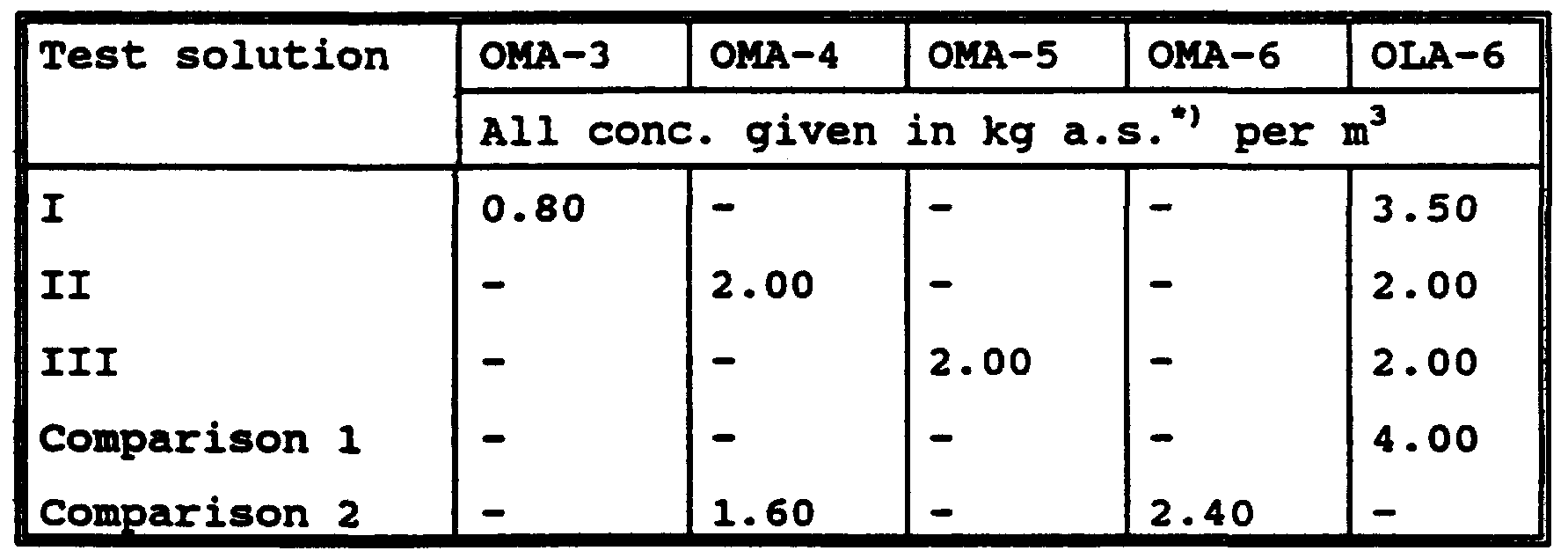
- the alkoxylated alkanolamides used in these examples were monoethanolamides of technical oleic acid to which had been added 3; 4; 5; and 6 moles of ethylene oxide. These products will in the following be called OMA-3; OMA-4 etc.
- the technical oleic acid consists of 60 per cent oleic acid, 20 per cent linoleic acid and 10 per cent linolenic acid, the rest being mainly palmitic and stearic acids.
- the water used in these examples was a hard water containing 2.2 moles Ca 2* and 1.4 moles Mg 2+ per m 3 and as a corrosion inhibitor 1.3 kg NaN0 2 , 0.35 kg NaN0 3 and 0.35 kg NaB0 2 .4 H 2 0 per 3 .
- composition of the test solutions are given in the table below:
- test results are given as the depth of the vortex formed in mm at the stirrer speed of 1400 rpm.
- the asterisk * means that the solution was turbid.
- the results of these tests indicate that the composi ⁇ tions according to the invention have a significant stabi ⁇ lizing effect on the water in immediate vicinity of a tur ⁇ bulent zone and have thus a good friction-reducing ability on water flowing in a tube, especially at low temperatures.
- the comparison tests show that the ethoxylated alcohol has only a limited friction-reducing effect at temperatures below 14 ⁇ C, while the ethoxylated ethanolamides in Compari ⁇ son II show an excellent friction-reducing effect only with ⁇ in a narrow temperature interval (8-14°C) .
Landscapes
- Chemical & Material Sciences (AREA)
- Organic Chemistry (AREA)
- Engineering & Computer Science (AREA)
- Materials Engineering (AREA)
- Chemical Kinetics & Catalysis (AREA)
- General Chemical & Material Sciences (AREA)
- Oil, Petroleum & Natural Gas (AREA)
- Organic Low-Molecular-Weight Compounds And Preparation Thereof (AREA)
- Lubricants (AREA)
- Emulsifying, Dispersing, Foam-Producing Or Wetting Agents (AREA)
- Materials Applied To Surfaces To Minimize Adherence Of Mist Or Water (AREA)
- Aftertreatments Of Artificial And Natural Stones (AREA)
Abstract
Description

Claims
Priority Applications (5)
| Application Number | Priority Date | Filing Date | Title |
|---|---|---|---|
| EP96900586A EP0804516B1 (en) | 1995-01-19 | 1996-01-09 | Use of alkoxylated alkanolamide together with alkoxylated alcohol as a friction-reducing agent |
| US08/875,186 US5979479A (en) | 1995-01-19 | 1996-01-09 | Use of alkoxylated alkanolamide together with alkoxylated alcohol as a friction-reducing agent |
| DE69600479T DE69600479T2 (en) | 1995-01-19 | 1996-01-09 | USE OF ALKOXYALKANOLAMIDE IN ADDITION TO ALKOXYAL ALCOHOL AS A FRICTION REDUCER |
| CA002206985A CA2206985C (en) | 1995-01-19 | 1996-01-09 | Use of alkoxylated alkanolamide together with alkoxylated alcohol as a friction-reducing agent |
| JP8522032A JPH11500764A (en) | 1995-01-19 | 1996-01-09 | Use of alkoxylated alkanolamides in combination with alkoxylated alcohols as friction reducers |
Applications Claiming Priority (2)
| Application Number | Priority Date | Filing Date | Title |
|---|---|---|---|
| SE9500159-0 | 1995-01-19 | ||
| SE9500159A SE502764C2 (en) | 1995-01-19 | 1995-01-19 | Use of an alkoxylated alkanolamine together with an alkoxylated alcohol as a friction reducing agent |
Publications (1)
| Publication Number | Publication Date |
|---|---|
| WO1996022341A1 true WO1996022341A1 (en) | 1996-07-25 |
Family
ID=20396864
Family Applications (1)
| Application Number | Title | Priority Date | Filing Date |
|---|---|---|---|
| PCT/EP1996/000155 Ceased WO1996022341A1 (en) | 1995-01-19 | 1996-01-09 | Use of alkoxylated alkanolamide together with alkoxylated alcohol as a friction-reducing agent |
Country Status (8)
| Country | Link |
|---|---|
| US (1) | US5979479A (en) |
| EP (1) | EP0804516B1 (en) |
| JP (1) | JPH11500764A (en) |
| CA (1) | CA2206985C (en) |
| DE (1) | DE69600479T2 (en) |
| ES (1) | ES2120282T3 (en) |
| SE (1) | SE502764C2 (en) |
| WO (1) | WO1996022341A1 (en) |
Cited By (3)
| Publication number | Priority date | Publication date | Assignee | Title |
|---|---|---|---|---|
| EP0757054A1 (en) * | 1995-07-13 | 1997-02-05 | Akzo Nobel N.V. | Polysaccharide acid amide comprising fatty alkyl group in amide |
| US6680367B1 (en) | 1995-07-20 | 2004-01-20 | Advanced Bioconcept Company | Fluorescent CRF receptor-binding peptides |
| US8119585B2 (en) * | 2005-11-30 | 2012-02-21 | Huntsman International Llc | Liquid nonionic surfactants for emulsion polymerization and other applications |
Families Citing this family (5)
| Publication number | Priority date | Publication date | Assignee | Title |
|---|---|---|---|---|
| KR100455839B1 (en) | 1999-11-26 | 2004-11-06 | 제이에프이 엔지니어링 가부시키가이샤 | Hydrate thermal storage medium and method for producing thereof, thermal storage apparatus using hydrate thermal storage medium, and hydrate cold thermal transportation medium |
| US6468956B1 (en) * | 2000-05-24 | 2002-10-22 | Huish Detergents, Inc. | Composition containing α-sulfofatty acid ester and hydrotrope and methods of making and using the same |
| WO2003102474A1 (en) * | 2002-05-31 | 2003-12-11 | Jfe Engineering Corporation | Hydrate slurry manufacturing device |
| ES2551739T3 (en) * | 2008-07-11 | 2015-11-23 | Basf Se | Composition and method to improve fuel economy of internal combustion engines with hydrocarbon fuel |
| JP7009213B2 (en) * | 2014-10-31 | 2022-02-10 | ビーエーエスエフ ソシエタス・ヨーロピア | Alkoxyylated amides, esters, and anti-wear agents in lubricant compositions |
Citations (5)
| Publication number | Priority date | Publication date | Assignee | Title |
|---|---|---|---|---|
| GB2093478A (en) * | 1981-02-20 | 1982-09-02 | Cincinnati Milacron Inc | Aqueous lubricants metal working and hydraulic fluids |
| US4427562A (en) * | 1982-05-06 | 1984-01-24 | Mobil Oil Corporation | Friction reducers for lubricants and fuels |
| DD281434A5 (en) * | 1984-12-27 | 1990-08-08 | Guben Chemiefaserwerk | WATERPROOF PRAEPARATION FOR POLYMER FAEDS |
| DD281435A5 (en) * | 1984-12-27 | 1990-08-08 | Guben Chemiefaserwerk | WATERPROOF PRAEPARATION FOR POLYMER FAEDS |
| WO1992013925A1 (en) * | 1991-01-31 | 1992-08-20 | Berol Nobel Ab | Use of alkoxylated alkanolamide as friction-reducing agent |
Family Cites Families (2)
| Publication number | Priority date | Publication date | Assignee | Title |
|---|---|---|---|---|
| US3961639A (en) * | 1973-09-10 | 1976-06-08 | The Curators Of The University Of Missouri | Methods and compositions for reducing the frictional resistance to flow of aqueous liquids |
| DE69422081T2 (en) * | 1993-04-19 | 2000-07-20 | Reckitt & Colman Inc., Wayne | General purpose detergent composition |
-
1995
- 1995-01-19 SE SE9500159A patent/SE502764C2/en not_active IP Right Cessation
-
1996
- 1996-01-09 WO PCT/EP1996/000155 patent/WO1996022341A1/en not_active Ceased
- 1996-01-09 JP JP8522032A patent/JPH11500764A/en not_active Ceased
- 1996-01-09 US US08/875,186 patent/US5979479A/en not_active Expired - Lifetime
- 1996-01-09 CA CA002206985A patent/CA2206985C/en not_active Expired - Fee Related
- 1996-01-09 ES ES96900586T patent/ES2120282T3/en not_active Expired - Lifetime
- 1996-01-09 EP EP96900586A patent/EP0804516B1/en not_active Expired - Lifetime
- 1996-01-09 DE DE69600479T patent/DE69600479T2/en not_active Expired - Lifetime
Patent Citations (5)
| Publication number | Priority date | Publication date | Assignee | Title |
|---|---|---|---|---|
| GB2093478A (en) * | 1981-02-20 | 1982-09-02 | Cincinnati Milacron Inc | Aqueous lubricants metal working and hydraulic fluids |
| US4427562A (en) * | 1982-05-06 | 1984-01-24 | Mobil Oil Corporation | Friction reducers for lubricants and fuels |
| DD281434A5 (en) * | 1984-12-27 | 1990-08-08 | Guben Chemiefaserwerk | WATERPROOF PRAEPARATION FOR POLYMER FAEDS |
| DD281435A5 (en) * | 1984-12-27 | 1990-08-08 | Guben Chemiefaserwerk | WATERPROOF PRAEPARATION FOR POLYMER FAEDS |
| WO1992013925A1 (en) * | 1991-01-31 | 1992-08-20 | Berol Nobel Ab | Use of alkoxylated alkanolamide as friction-reducing agent |
Non-Patent Citations (2)
| Title |
|---|
| DATABASE WPI Week 9102, Derwent World Patents Index; AN 91-007872, XP002004874 * |
| DATABASE WPI Week 9102, Derwent World Patents Index; AN 91-007873, XP002004873 * |
Cited By (4)
| Publication number | Priority date | Publication date | Assignee | Title |
|---|---|---|---|---|
| EP0757054A1 (en) * | 1995-07-13 | 1997-02-05 | Akzo Nobel N.V. | Polysaccharide acid amide comprising fatty alkyl group in amide |
| US6680367B1 (en) | 1995-07-20 | 2004-01-20 | Advanced Bioconcept Company | Fluorescent CRF receptor-binding peptides |
| US8119585B2 (en) * | 2005-11-30 | 2012-02-21 | Huntsman International Llc | Liquid nonionic surfactants for emulsion polymerization and other applications |
| AU2006320631B2 (en) * | 2005-11-30 | 2012-08-02 | Innospec Performance Chemicals Europe Limited | Liquid nonionic surfactants for emulsion polymerization and other applications |
Also Published As
| Publication number | Publication date |
|---|---|
| DE69600479D1 (en) | 1998-09-03 |
| SE9500159D0 (en) | 1995-01-19 |
| CA2206985A1 (en) | 1996-07-25 |
| JPH11500764A (en) | 1999-01-19 |
| SE9500159L (en) | 1996-01-08 |
| EP0804516B1 (en) | 1998-07-29 |
| EP0804516A1 (en) | 1997-11-05 |
| US5979479A (en) | 1999-11-09 |
| ES2120282T3 (en) | 1998-10-16 |
| CA2206985C (en) | 2006-01-03 |
| SE502764C2 (en) | 1996-01-08 |
| DE69600479T2 (en) | 1998-12-24 |
Similar Documents
| Publication | Publication Date | Title |
|---|---|---|
| EP0813583B1 (en) | Use of a betaine surfactant together with an anionic surfactant as a drag-reducing agent | |
| US5339855A (en) | Use of alkoxylated alkanolamide as friction-reducing agent | |
| RU2741298C2 (en) | Heat carrier composition and its application | |
| CA1180321A (en) | Water-based low foam hydraulic fluid | |
| EP0804516B1 (en) | Use of alkoxylated alkanolamide together with alkoxylated alcohol as a friction-reducing agent | |
| JP3512415B2 (en) | Base liquid | |
| EP0784658B1 (en) | Use of alkoxylated alkanolamide together with an ionic surfactant as friction-reducing agent | |
| EP0059461A1 (en) | Water-based hydraulic fluids incorporating a polyether as a lubricant and corrosion inhibitor | |
| CA2433540C (en) | Use of a zwitterionic surfactant together with an anionic ether-containing surfactant as a drag-reducing agent | |
| EP0190256B1 (en) | Oil-in-alcohol microemulsions in antifreeze | |
| JP4302500B2 (en) | Emulsion composition for heat storage material | |
| JPH0987610A (en) | Frictional resistance reducing agent for aqueous medium and method for reducing frictional resistance of aqueous medium using the reducing agent | |
| JP2001040324A (en) | Friction reducing agent for aqueous medium and method for reducing frictional resistance of aqueous medium using the reducing agent |
Legal Events
| Date | Code | Title | Description |
|---|---|---|---|
| AK | Designated states |
Kind code of ref document: A1 Designated state(s): CA JP US |
|
| AL | Designated countries for regional patents |
Kind code of ref document: A1 Designated state(s): AT BE CH DE DK ES FR GB GR IE IT LU MC NL PT SE |
|
| DFPE | Request for preliminary examination filed prior to expiration of 19th month from priority date (pct application filed before 20040101) | ||
| 121 | Ep: the epo has been informed by wipo that ep was designated in this application | ||
| ENP | Entry into the national phase |
Ref document number: 2206985 Country of ref document: CA Ref country code: CA Ref document number: 2206985 Kind code of ref document: A Format of ref document f/p: F |
|
| WWE | Wipo information: entry into national phase |
Ref document number: 1996900586 Country of ref document: EP |
|
| ENP | Entry into the national phase |
Ref country code: JP Ref document number: 1996 522032 Kind code of ref document: A Format of ref document f/p: F |
|
| WWE | Wipo information: entry into national phase |
Ref document number: 08875186 Country of ref document: US |
|
| WWP | Wipo information: published in national office |
Ref document number: 1996900586 Country of ref document: EP |
|
| WWG | Wipo information: grant in national office |
Ref document number: 1996900586 Country of ref document: EP |