WO1996028386A1 - Process for preparing precipitate of perovskite composite oxide - Google Patents
Process for preparing precipitate of perovskite composite oxide Download PDFInfo
- Publication number
- WO1996028386A1 WO1996028386A1 PCT/JP1996/000669 JP9600669W WO9628386A1 WO 1996028386 A1 WO1996028386 A1 WO 1996028386A1 JP 9600669 W JP9600669 W JP 9600669W WO 9628386 A1 WO9628386 A1 WO 9628386A1
- Authority
- WO
- WIPO (PCT)
- Prior art keywords
- metal
- solution
- precipitate
- composite oxide
- fluoride
- Prior art date
- Legal status (The legal status is an assumption and is not a legal conclusion. Google has not performed a legal analysis and makes no representation as to the accuracy of the status listed.)
- Ceased
Links
Classifications
-
- C—CHEMISTRY; METALLURGY
- C04—CEMENTS; CONCRETE; ARTIFICIAL STONE; CERAMICS; REFRACTORIES
- C04B—LIME, MAGNESIA; SLAG; CEMENTS; COMPOSITIONS THEREOF, e.g. MORTARS, CONCRETE OR LIKE BUILDING MATERIALS; ARTIFICIAL STONE; CERAMICS; REFRACTORIES; TREATMENT OF NATURAL STONE
- C04B41/00—After-treatment of mortars, concrete, artificial stone or ceramics; Treatment of natural stone
- C04B41/009—After-treatment of mortars, concrete, artificial stone or ceramics; Treatment of natural stone characterised by the material treated
-
- C—CHEMISTRY; METALLURGY
- C01—INORGANIC CHEMISTRY
- C01G—COMPOUNDS CONTAINING METALS NOT COVERED BY SUBCLASSES C01D OR C01F
- C01G15/00—Compounds of gallium, indium or thallium
-
- C—CHEMISTRY; METALLURGY
- C01—INORGANIC CHEMISTRY
- C01B—NON-METALLIC ELEMENTS; COMPOUNDS THEREOF; METALLOIDS OR COMPOUNDS THEREOF NOT COVERED BY SUBCLASS C01C
- C01B13/00—Oxygen; Ozone; Oxides or hydroxides in general
- C01B13/14—Methods for preparing oxides or hydroxides in general
- C01B13/36—Methods for preparing oxides or hydroxides in general by precipitation reactions in aqueous solutions
- C01B13/363—Mixtures of oxides or hydroxides by precipitation
-
- C—CHEMISTRY; METALLURGY
- C01—INORGANIC CHEMISTRY
- C01G—COMPOUNDS CONTAINING METALS NOT COVERED BY SUBCLASSES C01D OR C01F
- C01G23/00—Compounds of titanium
-
- C—CHEMISTRY; METALLURGY
- C01—INORGANIC CHEMISTRY
- C01G—COMPOUNDS CONTAINING METALS NOT COVERED BY SUBCLASSES C01D OR C01F
- C01G23/00—Compounds of titanium
- C01G23/003—Titanates
-
- C—CHEMISTRY; METALLURGY
- C01—INORGANIC CHEMISTRY
- C01G—COMPOUNDS CONTAINING METALS NOT COVERED BY SUBCLASSES C01D OR C01F
- C01G23/00—Compounds of titanium
- C01G23/003—Titanates
- C01G23/006—Alkaline earth titanates
-
- C—CHEMISTRY; METALLURGY
- C01—INORGANIC CHEMISTRY
- C01G—COMPOUNDS CONTAINING METALS NOT COVERED BY SUBCLASSES C01D OR C01F
- C01G25/00—Compounds of zirconium
-
- C—CHEMISTRY; METALLURGY
- C01—INORGANIC CHEMISTRY
- C01G—COMPOUNDS CONTAINING METALS NOT COVERED BY SUBCLASSES C01D OR C01F
- C01G3/00—Compounds of copper
-
- C—CHEMISTRY; METALLURGY
- C01—INORGANIC CHEMISTRY
- C01G—COMPOUNDS CONTAINING METALS NOT COVERED BY SUBCLASSES C01D OR C01F
- C01G3/00—Compounds of copper
- C01G3/006—Compounds containing copper, with or without oxygen or hydrogen, and containing two or more other elements
-
- C—CHEMISTRY; METALLURGY
- C01—INORGANIC CHEMISTRY
- C01G—COMPOUNDS CONTAINING METALS NOT COVERED BY SUBCLASSES C01D OR C01F
- C01G37/00—Compounds of chromium
-
- C—CHEMISTRY; METALLURGY
- C01—INORGANIC CHEMISTRY
- C01G—COMPOUNDS CONTAINING METALS NOT COVERED BY SUBCLASSES C01D OR C01F
- C01G45/00—Compounds of manganese
-
- C—CHEMISTRY; METALLURGY
- C01—INORGANIC CHEMISTRY
- C01G—COMPOUNDS CONTAINING METALS NOT COVERED BY SUBCLASSES C01D OR C01F
- C01G45/00—Compounds of manganese
- C01G45/12—Complex oxides containing manganese and at least one other metal element
- C01G45/1221—Manganates or manganites with trivalent manganese, tetravalent manganese or mixtures thereof
- C01G45/125—Manganates or manganites with trivalent manganese, tetravalent manganese or mixtures thereof of the type (MnO3)n-, e.g. CaMnO3
- C01G45/1264—Manganates or manganites with trivalent manganese, tetravalent manganese or mixtures thereof of the type (MnO3)n-, e.g. CaMnO3 containing rare earths, e.g. (La1-xCax)MnO3 or LaMnO3
-
- C—CHEMISTRY; METALLURGY
- C01—INORGANIC CHEMISTRY
- C01G—COMPOUNDS CONTAINING METALS NOT COVERED BY SUBCLASSES C01D OR C01F
- C01G45/00—Compounds of manganese
- C01G45/12—Complex oxides containing manganese and at least one other metal element
- C01G45/1221—Manganates or manganites with trivalent manganese, tetravalent manganese or mixtures thereof
- C01G45/1285—Manganates or manganites with trivalent manganese, tetravalent manganese or mixtures thereof of the type (Mn2O5)n-
-
- C—CHEMISTRY; METALLURGY
- C01—INORGANIC CHEMISTRY
- C01G—COMPOUNDS CONTAINING METALS NOT COVERED BY SUBCLASSES C01D OR C01F
- C01G51/00—Compounds of cobalt
- C01G51/40—Complex oxides containing cobalt and at least one other metal element
- C01G51/70—Complex oxides containing cobalt and at least one other metal element containing rare earths, e.g. LaCoO3
-
- C—CHEMISTRY; METALLURGY
- C01—INORGANIC CHEMISTRY
- C01G—COMPOUNDS CONTAINING METALS NOT COVERED BY SUBCLASSES C01D OR C01F
- C01G55/00—Compounds of ruthenium, rhodium, palladium, osmium, iridium, or platinum
-
- C—CHEMISTRY; METALLURGY
- C04—CEMENTS; CONCRETE; ARTIFICIAL STONE; CERAMICS; REFRACTORIES
- C04B—LIME, MAGNESIA; SLAG; CEMENTS; COMPOSITIONS THEREOF, e.g. MORTARS, CONCRETE OR LIKE BUILDING MATERIALS; ARTIFICIAL STONE; CERAMICS; REFRACTORIES; TREATMENT OF NATURAL STONE
- C04B41/00—After-treatment of mortars, concrete, artificial stone or ceramics; Treatment of natural stone
- C04B41/45—Coating or impregnating, e.g. injection in masonry, partial coating of green or fired ceramics, organic coating compositions for adhering together two concrete elements
- C04B41/4505—Coating or impregnating, e.g. injection in masonry, partial coating of green or fired ceramics, organic coating compositions for adhering together two concrete elements characterised by the method of application
- C04B41/455—Coating or impregnating, e.g. injection in masonry, partial coating of green or fired ceramics, organic coating compositions for adhering together two concrete elements characterised by the method of application the coating or impregnating process including a chemical conversion or reaction
-
- C—CHEMISTRY; METALLURGY
- C04—CEMENTS; CONCRETE; ARTIFICIAL STONE; CERAMICS; REFRACTORIES
- C04B—LIME, MAGNESIA; SLAG; CEMENTS; COMPOSITIONS THEREOF, e.g. MORTARS, CONCRETE OR LIKE BUILDING MATERIALS; ARTIFICIAL STONE; CERAMICS; REFRACTORIES; TREATMENT OF NATURAL STONE
- C04B41/00—After-treatment of mortars, concrete, artificial stone or ceramics; Treatment of natural stone
- C04B41/45—Coating or impregnating, e.g. injection in masonry, partial coating of green or fired ceramics, organic coating compositions for adhering together two concrete elements
- C04B41/50—Coating or impregnating, e.g. injection in masonry, partial coating of green or fired ceramics, organic coating compositions for adhering together two concrete elements with inorganic materials
- C04B41/5025—Coating or impregnating, e.g. injection in masonry, partial coating of green or fired ceramics, organic coating compositions for adhering together two concrete elements with inorganic materials with ceramic materials
- C04B41/5027—Oxide ceramics in general; Specific oxide ceramics not covered by C04B41/5029 - C04B41/5051
-
- C—CHEMISTRY; METALLURGY
- C04—CEMENTS; CONCRETE; ARTIFICIAL STONE; CERAMICS; REFRACTORIES
- C04B—LIME, MAGNESIA; SLAG; CEMENTS; COMPOSITIONS THEREOF, e.g. MORTARS, CONCRETE OR LIKE BUILDING MATERIALS; ARTIFICIAL STONE; CERAMICS; REFRACTORIES; TREATMENT OF NATURAL STONE
- C04B41/00—After-treatment of mortars, concrete, artificial stone or ceramics; Treatment of natural stone
- C04B41/45—Coating or impregnating, e.g. injection in masonry, partial coating of green or fired ceramics, organic coating compositions for adhering together two concrete elements
- C04B41/50—Coating or impregnating, e.g. injection in masonry, partial coating of green or fired ceramics, organic coating compositions for adhering together two concrete elements with inorganic materials
- C04B41/5025—Coating or impregnating, e.g. injection in masonry, partial coating of green or fired ceramics, organic coating compositions for adhering together two concrete elements with inorganic materials with ceramic materials
- C04B41/5027—Oxide ceramics in general; Specific oxide ceramics not covered by C04B41/5029 - C04B41/5051
- C04B41/5028—Manganates
-
- C—CHEMISTRY; METALLURGY
- C04—CEMENTS; CONCRETE; ARTIFICIAL STONE; CERAMICS; REFRACTORIES
- C04B—LIME, MAGNESIA; SLAG; CEMENTS; COMPOSITIONS THEREOF, e.g. MORTARS, CONCRETE OR LIKE BUILDING MATERIALS; ARTIFICIAL STONE; CERAMICS; REFRACTORIES; TREATMENT OF NATURAL STONE
- C04B41/00—After-treatment of mortars, concrete, artificial stone or ceramics; Treatment of natural stone
- C04B41/45—Coating or impregnating, e.g. injection in masonry, partial coating of green or fired ceramics, organic coating compositions for adhering together two concrete elements
- C04B41/50—Coating or impregnating, e.g. injection in masonry, partial coating of green or fired ceramics, organic coating compositions for adhering together two concrete elements with inorganic materials
- C04B41/5025—Coating or impregnating, e.g. injection in masonry, partial coating of green or fired ceramics, organic coating compositions for adhering together two concrete elements with inorganic materials with ceramic materials
- C04B41/5041—Titanium oxide or titanates
-
- C—CHEMISTRY; METALLURGY
- C04—CEMENTS; CONCRETE; ARTIFICIAL STONE; CERAMICS; REFRACTORIES
- C04B—LIME, MAGNESIA; SLAG; CEMENTS; COMPOSITIONS THEREOF, e.g. MORTARS, CONCRETE OR LIKE BUILDING MATERIALS; ARTIFICIAL STONE; CERAMICS; REFRACTORIES; TREATMENT OF NATURAL STONE
- C04B41/00—After-treatment of mortars, concrete, artificial stone or ceramics; Treatment of natural stone
- C04B41/45—Coating or impregnating, e.g. injection in masonry, partial coating of green or fired ceramics, organic coating compositions for adhering together two concrete elements
- C04B41/50—Coating or impregnating, e.g. injection in masonry, partial coating of green or fired ceramics, organic coating compositions for adhering together two concrete elements with inorganic materials
- C04B41/5025—Coating or impregnating, e.g. injection in masonry, partial coating of green or fired ceramics, organic coating compositions for adhering together two concrete elements with inorganic materials with ceramic materials
- C04B41/5045—Rare-earth oxides
-
- C—CHEMISTRY; METALLURGY
- C04—CEMENTS; CONCRETE; ARTIFICIAL STONE; CERAMICS; REFRACTORIES
- C04B—LIME, MAGNESIA; SLAG; CEMENTS; COMPOSITIONS THEREOF, e.g. MORTARS, CONCRETE OR LIKE BUILDING MATERIALS; ARTIFICIAL STONE; CERAMICS; REFRACTORIES; TREATMENT OF NATURAL STONE
- C04B41/00—After-treatment of mortars, concrete, artificial stone or ceramics; Treatment of natural stone
- C04B41/80—After-treatment of mortars, concrete, artificial stone or ceramics; Treatment of natural stone of only ceramics
- C04B41/81—Coating or impregnation
-
- C—CHEMISTRY; METALLURGY
- C04—CEMENTS; CONCRETE; ARTIFICIAL STONE; CERAMICS; REFRACTORIES
- C04B—LIME, MAGNESIA; SLAG; CEMENTS; COMPOSITIONS THEREOF, e.g. MORTARS, CONCRETE OR LIKE BUILDING MATERIALS; ARTIFICIAL STONE; CERAMICS; REFRACTORIES; TREATMENT OF NATURAL STONE
- C04B41/00—After-treatment of mortars, concrete, artificial stone or ceramics; Treatment of natural stone
- C04B41/80—After-treatment of mortars, concrete, artificial stone or ceramics; Treatment of natural stone of only ceramics
- C04B41/81—Coating or impregnation
- C04B41/85—Coating or impregnation with inorganic materials
- C04B41/87—Ceramics
-
- C—CHEMISTRY; METALLURGY
- C23—COATING METALLIC MATERIAL; COATING MATERIAL WITH METALLIC MATERIAL; CHEMICAL SURFACE TREATMENT; DIFFUSION TREATMENT OF METALLIC MATERIAL; COATING BY VACUUM EVAPORATION, BY SPUTTERING, BY ION IMPLANTATION OR BY CHEMICAL VAPOUR DEPOSITION, IN GENERAL; INHIBITING CORROSION OF METALLIC MATERIAL OR INCRUSTATION IN GENERAL
- C23C—COATING METALLIC MATERIAL; COATING MATERIAL WITH METALLIC MATERIAL; SURFACE TREATMENT OF METALLIC MATERIAL BY DIFFUSION INTO THE SURFACE, BY CHEMICAL CONVERSION OR SUBSTITUTION; COATING BY VACUUM EVAPORATION, BY SPUTTERING, BY ION IMPLANTATION OR BY CHEMICAL VAPOUR DEPOSITION, IN GENERAL
- C23C30/00—Coating with metallic material characterised only by the composition of the metallic material, i.e. not characterised by the coating process
-
- C—CHEMISTRY; METALLURGY
- C01—INORGANIC CHEMISTRY
- C01P—INDEXING SCHEME RELATING TO STRUCTURAL AND PHYSICAL ASPECTS OF SOLID INORGANIC COMPOUNDS
- C01P2002/00—Crystal-structural characteristics
- C01P2002/30—Three-dimensional structures
- C01P2002/34—Three-dimensional structures perovskite-type (ABO3)
-
- C—CHEMISTRY; METALLURGY
- C01—INORGANIC CHEMISTRY
- C01P—INDEXING SCHEME RELATING TO STRUCTURAL AND PHYSICAL ASPECTS OF SOLID INORGANIC COMPOUNDS
- C01P2002/00—Crystal-structural characteristics
- C01P2002/70—Crystal-structural characteristics defined by measured X-ray, neutron or electron diffraction data
- C01P2002/72—Crystal-structural characteristics defined by measured X-ray, neutron or electron diffraction data by d-values or two theta-values, e.g. as X-ray diagram
-
- C—CHEMISTRY; METALLURGY
- C01—INORGANIC CHEMISTRY
- C01P—INDEXING SCHEME RELATING TO STRUCTURAL AND PHYSICAL ASPECTS OF SOLID INORGANIC COMPOUNDS
- C01P2002/00—Crystal-structural characteristics
- C01P2002/70—Crystal-structural characteristics defined by measured X-ray, neutron or electron diffraction data
- C01P2002/74—Crystal-structural characteristics defined by measured X-ray, neutron or electron diffraction data by peak-intensities or a ratio thereof only
-
- C—CHEMISTRY; METALLURGY
- C01—INORGANIC CHEMISTRY
- C01P—INDEXING SCHEME RELATING TO STRUCTURAL AND PHYSICAL ASPECTS OF SOLID INORGANIC COMPOUNDS
- C01P2006/00—Physical properties of inorganic compounds
- C01P2006/60—Optical properties, e.g. expressed in CIELAB-values
-
- C—CHEMISTRY; METALLURGY
- C04—CEMENTS; CONCRETE; ARTIFICIAL STONE; CERAMICS; REFRACTORIES
- C04B—LIME, MAGNESIA; SLAG; CEMENTS; COMPOSITIONS THEREOF, e.g. MORTARS, CONCRETE OR LIKE BUILDING MATERIALS; ARTIFICIAL STONE; CERAMICS; REFRACTORIES; TREATMENT OF NATURAL STONE
- C04B2111/00—Mortars, concrete or artificial stone or mixtures to prepare them, characterised by specific function, property or use
- C04B2111/00241—Physical properties of the materials not provided for elsewhere in C04B2111/00
- C04B2111/0025—Compositions or ingredients of the compositions characterised by the crystal structure
-
- C—CHEMISTRY; METALLURGY
- C04—CEMENTS; CONCRETE; ARTIFICIAL STONE; CERAMICS; REFRACTORIES
- C04B—LIME, MAGNESIA; SLAG; CEMENTS; COMPOSITIONS THEREOF, e.g. MORTARS, CONCRETE OR LIKE BUILDING MATERIALS; ARTIFICIAL STONE; CERAMICS; REFRACTORIES; TREATMENT OF NATURAL STONE
- C04B2111/00—Mortars, concrete or artificial stone or mixtures to prepare them, characterised by specific function, property or use
- C04B2111/00474—Uses not provided for elsewhere in C04B2111/00
- C04B2111/00844—Uses not provided for elsewhere in C04B2111/00 for electronic applications
Definitions
- the present invention relates to a method for producing a precipitate of a perovskite-type composite oxide, for example, a method of forming a thin film of a perovskite-type composite oxide on the surface of a substrate, or a method of depositing the composite oxide in a liquid. More specifically, the present invention relates to a method for producing a precipitate of the composite oxide from an aqueous solution, for example, a method for forming a thin film on a substrate surface.
- Belovskite-type composite oxides especially rare earth-to-transition metal porous busites, rare-earth-to-group 3B metal perovskite and alkali earth-transition metal perovskite-type composite oxides, have high heat resistance and heat resistance. It has excellent corrosion resistance, high oxygen ionic conductivity and high electron conductivity, and some composite oxides produce superconductivity at relatively high temperatures, so fuel cell electrolytes and electrodes, oxygen sensors, oxygen enrichment Used for films, heating elements, dielectrics, magnetic materials, superconductors, etc. In addition, since it has oxidation / reduction catalytic ability, it is also used as a catalyst.
- Japanese Patent Application Laid-Open No. 5-58635 discloses that a base material is immersed in an aqueous solution containing lead ions, hexafluorotitanate and borate ions.
- a method for forming a composite oxide thin film of titanium and lead on the surface of a substrate is disclosed.
- the lead source ⁇ ⁇ ⁇ , lead acetate or lead nitrate is used.
- the obtained P b c i 3 thin film has a pi-mouthed chro-type crystal structure.
- the Re this To Berobusukai preparative P b T i 0 3 requires further 3 0 0-9 0 0 * 0 to the step of performing heat treatment.
- An object of the present invention is to form a deposit such as a thin film on a large-area substrate surface, which cannot be obtained by a conventional method of forming a perovskite-type composite oxide deposit, using a simple apparatus.
- a method for producing belovskite-type composite oxide precipitates, which can easily form deposits such as thin films on the surface of a substrate having a complicated shape, and does not require a heating step to crystallize these precipitates. It is to provide.
- the present inventor has found that a plurality of metal element fluo-metal complex compounds and / or gold fluorinated compounds constituting a target belovskite-type composite oxide are obtained.
- the present inventors have found that a fluoride ion scavenger can be added to an aqueous solution or a hydrofluoric acid solution to easily form a precipitate of a perovskite-type composite oxide, for example, a thin film on the surface of a substrate. was completed.
- the method for producing a bevelskite-type composite oxide precipitate of the present invention comprises:
- perovskite-type composite oxide means cubic (including pseudo-cubic), belovskite, tetragonal (including pseudo-tetragonal) perovskite, orthorhombic (pseudo-rhombic) ) Perovskite, hexagonal (including pseudo-hexagonal), perovskite, trigonal (including rhombohedral) Perovskite type; and a series of composite oxides having a crystal structure similar to these.
- the perovskite-type composite oxide precipitate formed by the present invention has a general formula (I):
- oxides are typically represented by M 1 M 2 0 3 , But is not limited to this, as exemplified below.
- M 1 scandium, Lee Tsu door Li Umm, lantern, Seri cormorant-time, praseodymium, neodymium, promethium, summary Umm, euro Piumu, moths de Riniumu, terbium, dysprosium, formyl ⁇ -time, erbium, tree Umm Rare earth metal atoms, such as chromium, ytterbium, and lutetium; and alkaline earth metal atoms, such as beryllium, magnesium, calcium, strontium, and norium. However, two or more kinds may exist in the same crystal. Also as part of the M 1, lithium, diisocyanato Li um, potassium, it may include alkali metals such as rubidium and cesium.
- the fluor-base complex compound used as a raw material in the present invention includes a compound represented by the general formula ( ⁇ ):
- M 1 and M 2 are the same as described above;
- A represents a hydrogen atom, an alkali metal atom, an ammonium group, or coordinating water, which may be the same or different;
- a, b, c, and d, e, and f are each a number of 1 or more, which is a number that renders the complex compound electrically neutral.
- a water-soluble acid or salt is also used in combination.
- the A hydrogen atom Noho force s; lithium, diisocyanato Li um, potassium, rubidium, alkali metal atoms, such as cesium; include and Anmoniumu group.
- M 1 and M 2 are each a metal atom constituting the intended belovskite-type composite oxide, and may be one or two or more types depending on the structure of the composite oxide.
- a and d are each independently a number of 1 or more, and when b and e are 1, they are numbers obtained by subtracting the valence of M 1 or M 2 from c and f described below, respectively.
- c is a number in which M 1 is 4 or more in a trivalent metal such as, for example, indium.
- f is also a number exceeding the valency of M 2 .
- metal fluoride of the metal M ones soluble is preferred to hydrofluoric acid, fluoride Beri Li um, magnesium fluoride, Futsui spoon calcium, fluoride scum strontium, such as barium fluoride And rare earth metal fluorides such as gadolinium fluoride.
- fluorotransition metal complex compounds and metal fluorides may be used alone or, if necessary, in two or more kinds. May be used together.
- an alkali metal fluoride such as lithium fluoride and sodium fluoride may be used.
- the fluoro transition metal complex compound represented by the general formula ( ⁇ ) and the fluoro complex compound of a Group 3B metal those corresponding to the respective valences of gold as exemplified above are used.
- a fluorochrome complex compound H 3 C r F 6, Naa C r F 6, ⁇ 3 C r F 6 , R ba C r F 6> Cs 3 C r F 6 and (NHJ 3 C . such as r F 6 is exemplified
- the Furuoro complex compounds - as part may be used N a 2 M g F 4, K 2 M g F ⁇ Furuoroaru Chikarari earth metal complex compound such as.
- soluble metal fluoride in hydrofluoric acid of the metal M 2 full Tsui human zirconium, off Tsui ⁇ hafnium, Futsui spoon manganese, cobalt fluoride, such as copper fluoride are exemplified.
- fluoro transition metal complex compounds and metal fluorides may be used alone, or two or more of them may be used in combination.
- an alkaline earth metal fluoride such as beryllium fluoride and magnesium fluoride may be used.
- Such full metal complexes and metal fluorides are present in solution in the form of the corresponding complex ion and / or ion.
- the fluorinated metal complex compound or metal fluoride used in the present invention may be produced by any production method, but is preferably a composite oxide corresponding to an intended belovskite-type composite oxide precipitate, Or treating a compound of a plurality of metals constituting the composite oxide with hydrofluoric acid
- one or more corresponding fluorometal complex compounds and / or metal fluorides can be obtained as a hydrofluoric acid solution.
- a similar reaction product system can be obtained.
- a fluoro complex compound containing both M 1 and M 2 obtained by treating a perovskite-type composite oxide with hydrofluoric acid may be used.
- the fluorometal complex compound is obtained by dissolving a hydroxide or an oxyhydroxide of the above-mentioned metal in an aqueous solution of metal hydrogen difluoride, such as ammonium hydrogen difluoride or sodium hydrogen difluoride. It may be manufactured by making it.
- the fluorinated metal complex compound varies depending on the compound, but is usually prepared in an aqueous solution having a concentration of 10 9 to 1 Omol / L, preferably 10 10 ⁇ mol / L, and used.
- an excess amount of metal oxide may be further added to make a highly concentrated solution or a saturated solution, and then an aqueous solution from which insoluble metal oxide is removed by filtration may be used.
- the total amount of the fluorometal complex and / or the metal fluoride is usually added to the hydrofluoric acid at a concentration of 0.05050% by weight, preferably 0.015% by weight.
- Seed crystals can be present in aqueous or hydrofluoric acid solutions of such fluo-metal complexes and Z or metal fluorides.
- a precipitate of the target belovskite-type composite oxide for example, the same composite oxide as the thin film is preferable, and one or more oxides constituting the composite oxide may be used.
- the seed crystal may have a different chemical composition from the target precipitate as long as it has the same or similar crystal system.
- the seed crystal is usually as small as 0.001 to 10 m, and its abundance is optional but small.
- the precipitation rate can be increased by the presence of the seed crystal. According to the findings of the present inventors, the presence of a seed crystal can form a precipitate belonging to the same crystal system as that of the seed crystal.
- the oxide powder to be the seed crystal is suspended in the above-mentioned aqueous solution of the fluorometal complex compound and / or metal fluoride or the hydrofluoric acid solution, and the oxide powder is filtered or otherwise.
- the fine crystals may be left as a seed crystal by leaving the fine crystals in a solution by a method such as using a filter paper or a filter through which the fine crystals pass.
- a seed crystal may be added and dispersed in advance. Further, both of these methods may be used in combination.
- a mixture of a similar solution with an aqueous solution or hydrofluoric acid solution Furuoro metal complex compounds Contact and / or metal fluoride having an M 1 described above, the M 2, From the fluoride ion Add or insert a fluoride scavenger that forms a stable compound
- a fluoride scavenger that forms a stable compound
- a velovskite-type composite oxide having M ′ and M 2 is precipitated.
- Such a composite oxide may be precipitated as fine crystals from the mixed solution, or the substrate may be immersed in the mixed solution and deposited on the surface in the form of a thin film or the like.
- the fluoride ion scavenger used in the present invention includes a homogeneous system which is used by being dissolved in a liquid phase, and a heterogeneous system which is a solid. Depending on the purpose, either one of these two may be used or both may be used.
- the fluoride ion scavenger is added or inserted after forming a mixture of the solution (1) and the solution (2).
- homogeneous fluoride ion scavenger examples include boric acid such as orthoboric acid and metaboric acid; sodium hydroxide and aqueous ammonia.
- orthoboric acid H m - 3 L a F m and H "- 3 M n F" (wherein, m, n is an integer of 4 or more independently) from L aM n 0 3
- capture agents are usually used in the form of an aqueous solution.
- the addition of the scavenger may be performed intermittently at one time or divided into several times, or may be performed continuously at a controlled feed rate, for example, at a constant rate.
- Heterogeneous-based fluoride ion scavengers include metals such as aluminum, titanium, iron, nickel, magnesium, copper, and zinc; ceramics such as glass; and silicon, calcium oxide, boron oxide, aluminum oxide, Other inorganic substances such as silicon dioxide and magnesium oxide are exemplified. When such a solid is added to or inserted into a solution, F_ near the solid is consumed and its concentration decreases, so that the chemical equilibrium is shifted and a belovskite-type composite oxide is precipitated. .
- a perovskite-type composite oxide precipitate for example, a thin film
- a perovskite-type composite oxide precipitate for example, a thin film
- a precipitate on the surface of the base material for example, a thin film can be partially thickened by using a combination of a homogeneous and a heterogeneous fluoride ion scavenger.
- Homogeneous fluoride ion scavengers vary depending on the type and shape of the precipitate.
- the amount of the fluoride ion scavenger is usually 10 to 100% based on the equivalent of the fluoride ion in the solution. case of forming a good film, preferably in a range of 1 0 _ 2-5 0 0%.
- the trapping agent is effectively used to form complex oxide precipitates on the substrate surface. Non-contributions may occur. Therefore, when the purpose is to form a precipitate, for example, a thin film on the surface of the substrate, it is preferable to gradually add the scavenger.
- a formed perovskite-type composite oxide precipitate As the base material, a formed perovskite-type composite oxide precipitate, for example, a wide range of materials can be used to carry a thin film or to form a multilayer structure with the precipitate, or to be protected from oxidation or the like by the formed thin film. Examples of such substances include metals, ceramics, and organic polymer materials.
- the substrate may be immersed in the solution of the metal complex complex and z or metal fluoride before, during or after the addition of the fluoride scavenger.
- a substrate that may be attacked by the system, attention must be paid to the composition of the solution, the reaction conditions, and the timing of immersion.
- a hydrofluoric acid solution is used as (1) and Z or (2)
- an additional fluoride ion scavenger may be added.
- a base material also serving as a heterogeneous fluoride ion scavenger such as aluminum or glass, may be used.
- the shape of the base material is arbitrary and is not limited to a plate shape, and a complicated shape can be used.
- the reaction temperature can be set arbitrarily as long as the system maintains the solution.
- the range of 10 to 80 is preferred.
- the reaction time is also arbitrary, and the reaction time becomes longer depending on the amount of the target precipitate and, in the case of a thin film, the thickness.
- a bevelskite-type composite oxide precipitate for example, a thin film having a thickness of 0.01 to 10 ⁇ or a coating having a thickness of more than that can be formed on the surface of the base material.
- the precipitate thus formed can be obtained as a crystallized composite oxide precipitate without a heating step such as firing, but a heating step may be provided according to the purpose. No.
- the state of precipitation on the substrate 3 ⁇ 4 surface also depends on the material of the substrate.
- PET polyethylene terephthalate
- PES polyethersulfone
- a perovskite-type composite oxide can be deposited using a simple apparatus.
- a thin film or the like can be easily formed on a large-area substrate surface or a complex-shaped substrate surface that could not be obtained by the conventional forming method. Since a heating step for crystallizing the precipitate thus obtained is not particularly required, there is no generation of strain or crack. This is particularly advantageous when forming a thin film having a large area or a complicated shape.
- a precipitate of a perovskite-type composite oxide can be obtained while maintaining the valence of the metal of the oxide used as a raw material. This is particularly advantageous when a solid solution perovskite precipitate is intended.
- the precipitate of the perovskite-type composite oxide obtained by the present invention is useful as an electrolyte or electrode of a fuel cell, an oxygen sensor, an oxygen-enriched film, a heating element, a catalyst, a dielectric, a magnetic substance, a superconductor, or the like. is there.
- the solution containing microcrystals obtained in this manner was poured into three polystyrene containers in a volume of 3 Oml, and the surface was polished in advance and ultrasonically washed in ethanol. ) by immersing the substrate as the H 3 B 0 3, 2. 5 1 0 - 3 mol ( as an aqueous solution), 5 - 0 as X 1 0- 3 mol (aq) or 8. 0 x 1 0 2 mol (as powder) was added respectively. After standing for 30 hours at 30 ° C., formation of a black thin film on the surface of the PES substrate was observed.
- the PES substrate was immersed, and as shown in Table 1, nickel mesh was placed on the substrate in containers A and B, soda-lime glass was placed on containers C and D, and containers B and in D, 8. the H 3 B 03 powder additionally 0 X 1 0 - 2 mol were added.
- Toko filtrate was applied to XRD, the thin film were both orthorhombic base Rob Sky Bok L a M n 0 3. table 1
- L a C o 0 3 powder 1 was produced in the Hare good above. O g was added, dissolve and stirred for 24 hours at 3 0 e C, reacted . The L a C o 0 3 coarse powder which remained without dissolution was removed by filtration in the same manner as the actual Example 1. Thus obtained, L a C o 0 3 fine crystals clear solution dispersed, Ri and 3 0 ml in polystyrene containers, PES substrates were soaked, H 3 B 0 3 powder 8. 1 X 1 0 - and the 2 mol added.
- 1.0 g of the powder thus obtained was added to 300 ml of a 23% aqueous HF solution, and the mixture was dissolved and reacted by stirring at 30 "C for 24 hours. the n 0 a coarse powder was removed by filtration in the same manner as in example 1.
- the n d M n 0 3 clear solution microcrystals are dispersed, 3 0 ml in Helsingborg styrene vessel DOO is, a PES substrate was soaked, H 3 B 0 3 powder 8 0 X 1 0 -.. 2 mol was ⁇ D 3 0 e and allowed to stand for 7 0 h C rollers, the substrate surface XRD confirmed that the obtained precipitates consisted of orthorhombic Besquite NdMn03 crystals, and SEM and EDX The average particle diameter of the precipitate was m, and it was confirmed that Nd and Mn were present in the precipitate.
- the powder PI.Og prepared as described above was added to 300 ml of a 23% aqueous HF solution, stirred at 30 for 24 hours to dissolve, and reacted with the aqueous HF solution.
- the coarse powder P remaining without being dissolved was removed by filtration using a membrane filter having a pore size of 0.1 m.
- the clear solution thus obtained was placed in two polystyrene containers at 3 Oml each.
- P1 in a polystyrene container and Q1 of a fine powder obtained by further pulverizing Q in the other were added and dispersed as seed crystals, respectively.
- Hitahama PES substrates H 3 B 0 3 powder 8. O xl 0 respectively - was added 2 mol. After standing at 30 ° C for 70 hours, formation of a black thin film on the surface of the PES substrate was observed in each case.
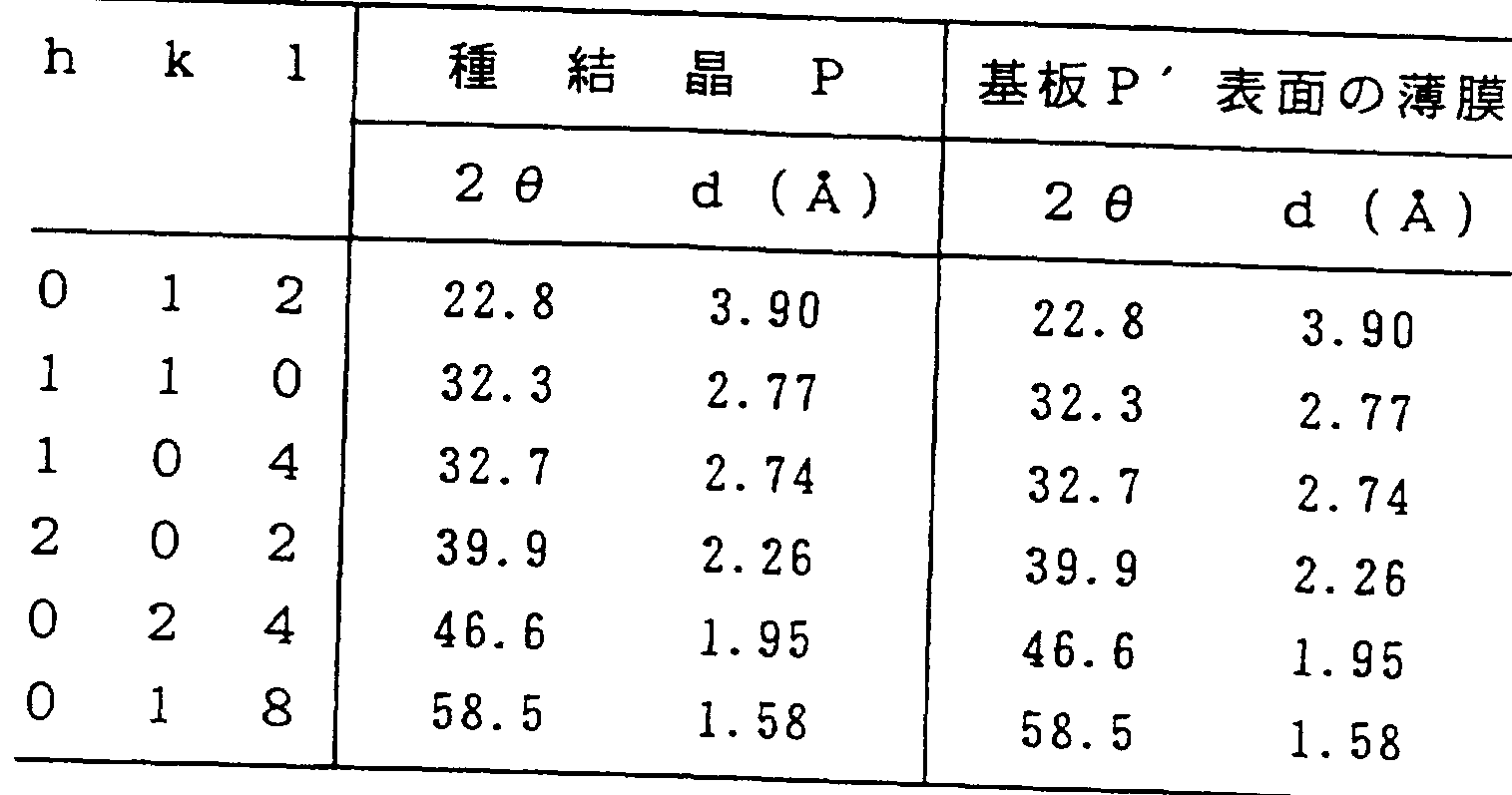
- Substrate P 'on which a thin film is formed using each seed crystal P or CL And Q ' were subjected to XRD, the XRD pattern was in good agreement with P or Q used as the seed crystal, as shown in Tables 2 and 3, respectively, depending on the crystal structure of the seed crystal, rhombohedral or formation of Bae Robusukai Bok L aM n 0 3 thin film of orthorhombic was observed.
- Example 2 In the same manner as in Example 1, by the solid phase method, to obtain a powder of L a M n 0 3 sintered body of orthorhombic. To 2 3% HF aqueous solution 1 5 0 ml, the above L a M n 0 3 sintered powder 0. 5 g was added, and 2 4 hours stirred at 3 0. Considerable powder remained dissolved. As in Example 1, the coarse powder was removed by filtration, L aM n 0 3 fine crystals clear filtrate was dispersed by 3 OML, taken in 4 polystyrene containers. This, without immersing the substrate, H 3 B 0 3 solution each 2. 5 X 1 0 "3 mol , 5. 0 1 0" 3 mol or 8. 0 1 0 "2 ⁇ 1 added, residual 1 the one without the addition of Eta 3 beta 0 a of, allowed to stand 7 0 h 3 0 ° C.
Landscapes
- Chemical & Material Sciences (AREA)
- Organic Chemistry (AREA)
- Inorganic Chemistry (AREA)
- Engineering & Computer Science (AREA)
- Ceramic Engineering (AREA)
- Materials Engineering (AREA)
- Structural Engineering (AREA)
- Life Sciences & Earth Sciences (AREA)
- General Life Sciences & Earth Sciences (AREA)
- Geology (AREA)
- Chemical Kinetics & Catalysis (AREA)
- Environmental & Geological Engineering (AREA)
- Mechanical Engineering (AREA)
- Metallurgy (AREA)
- Inorganic Compounds Of Heavy Metals (AREA)
- Oxygen, Ozone, And Oxides In General (AREA)
Description

Claims
Priority Applications (3)
| Application Number | Priority Date | Filing Date | Title |
|---|---|---|---|
| DE69614792T DE69614792T2 (de) | 1995-03-15 | 1996-03-15 | Verfahren zur herstellung eines präzipitats aus perovskitverbundoxid |
| EP96906041A EP0761601B1 (en) | 1995-03-15 | 1996-03-15 | Process for preparing precipitate of perovskite composite oxide |
| US08/737,132 US5824278A (en) | 1995-03-15 | 1996-03-15 | Process for producing perovskite type complex oxide precipitates |
Applications Claiming Priority (4)
| Application Number | Priority Date | Filing Date | Title |
|---|---|---|---|
| JP7/56346 | 1995-03-15 | ||
| JP5634695 | 1995-03-15 | ||
| JP7249866A JPH08310802A (ja) | 1995-03-15 | 1995-09-27 | ペロブスカイト型複合酸化物析出物の製造方法 |
| JP7/249866 | 1995-09-27 |
Publications (1)
| Publication Number | Publication Date |
|---|---|
| WO1996028386A1 true WO1996028386A1 (en) | 1996-09-19 |
Family
ID=26397293
Family Applications (1)
| Application Number | Title | Priority Date | Filing Date |
|---|---|---|---|
| PCT/JP1996/000669 Ceased WO1996028386A1 (en) | 1995-03-15 | 1996-03-15 | Process for preparing precipitate of perovskite composite oxide |
Country Status (7)
| Country | Link |
|---|---|
| US (1) | US5824278A (ja) |
| EP (1) | EP0761601B1 (ja) |
| JP (1) | JPH08310802A (ja) |
| KR (1) | KR100413851B1 (ja) |
| CN (1) | CN1083402C (ja) |
| DE (1) | DE69614792T2 (ja) |
| WO (1) | WO1996028386A1 (ja) |
Families Citing this family (37)
| Publication number | Priority date | Publication date | Assignee | Title |
|---|---|---|---|---|
| KR19990067518A (ko) * | 1996-09-13 | 1999-08-25 | 다께시 야오 | 산화티타늄 박막의 제조방법 및 광촉매 |
| EP0924164A3 (en) | 1997-12-18 | 2000-01-05 | Hoya Corporation | Methods for producing oxides or composites thereof |
| JP4708515B2 (ja) * | 1998-11-13 | 2011-06-22 | 日本特殊陶業株式会社 | LaGaO3系焼結体を用いた酸素透過膜 |
| JP2001110801A (ja) | 1999-10-05 | 2001-04-20 | Takeshi Yao | パターン形成方法、並びに電子素子、光学素子及び回路基板 |
| TW490439B (en) * | 1999-12-10 | 2002-06-11 | Nat Science Council | Method for preparing a barium fluorotitante (BaTiF6) powder and depositing a barium titanate (BaTiO3) thin film on a silicon wafer |
| US6541112B1 (en) * | 2000-06-07 | 2003-04-01 | Dmc2 Degussa Metals Catalysts Cerdec Ag | Rare earth manganese oxide pigments |
| DE10329626A1 (de) * | 2003-06-25 | 2005-01-20 | Itn Nanovation Gmbh | Mischmetalloxide und ihre Verwendung in CO2-Sensoren |
| KR100612570B1 (ko) * | 2004-04-21 | 2006-08-11 | 주식회사 엘지화학 | 신규 결정 구조를 갖는 금속 복합 산화물 및 이들의 이온전도체로서의 용도 |
| JP4552940B2 (ja) * | 2004-10-01 | 2010-09-29 | 株式会社村田製作所 | 透光性セラミックを用いたハイブリッドレンズ |
| JP4682321B2 (ja) * | 2005-03-17 | 2011-05-11 | 財団法人新産業創造研究機構 | 希土類含有金属酸化物構造体の製造方法 |
| CN100368304C (zh) * | 2005-10-28 | 2008-02-13 | 吉林大学 | 三重价态过渡金属氧化物及制备方法 |
| US9339641B2 (en) | 2006-01-17 | 2016-05-17 | Emkinetics, Inc. | Method and apparatus for transdermal stimulation over the palmar and plantar surfaces |
| US10786669B2 (en) | 2006-10-02 | 2020-09-29 | Emkinetics, Inc. | Method and apparatus for transdermal stimulation over the palmar and plantar surfaces |
| US7964301B2 (en) * | 2009-06-26 | 2011-06-21 | Global Energy Science, LLC (California) | Dynamic accelerated reaction batteries utilizing Taylor Vortex Flows |
| JP5105007B2 (ja) * | 2009-11-27 | 2012-12-19 | 株式会社村田製作所 | 逆シフト反応用触媒およびそれを用いた合成ガスの製造方法 |
| US8980213B2 (en) * | 2010-10-28 | 2015-03-17 | Board Of Trustees Of Northern Illinois University | Ceramic materials for gas separation and oxygen storage |
| WO2015008700A1 (en) * | 2013-07-15 | 2015-01-22 | Semiconductor Energy Laboratory Co., Ltd. | Positive electrode active material and secondary battery |
| WO2015056702A1 (ja) * | 2013-10-15 | 2015-04-23 | 住友大阪セメント株式会社 | 耐食性部材、静電チャック装置 |
| KR102099970B1 (ko) * | 2013-11-01 | 2020-04-10 | 삼성전자주식회사 | 투명 전도성 박막 |
| AU2015234231A1 (en) * | 2014-03-17 | 2016-09-22 | Monash University | Improved precipitation process for producing perovskite-based solar cells |
| CN103936082B (zh) * | 2014-04-10 | 2015-11-11 | 东北大学 | 一种钴酸钐纳米粉体的合成方法 |
| US20160016814A1 (en) * | 2014-07-16 | 2016-01-21 | Michael Pesek Marshak | Preparation of chromium(iv) oxide materials |
| JP6156446B2 (ja) * | 2014-09-29 | 2017-07-05 | 住友大阪セメント株式会社 | 耐食性部材、静電チャック用部材および耐食性部材の製造方法 |
| CN116565296A (zh) | 2016-07-05 | 2023-08-08 | 株式会社半导体能源研究所 | 锂离子二次电池 |
| US12308421B2 (en) | 2016-09-12 | 2025-05-20 | Semiconductor Energy Laboratory Co., Ltd. | Electrode and power storage device comprising graphene compound |
| CN115188931A (zh) | 2016-10-12 | 2022-10-14 | 株式会社半导体能源研究所 | 正极活性物质粒子以及正极活性物质粒子的制造方法 |
| RU2663736C2 (ru) * | 2016-11-08 | 2018-08-09 | Федеральное государственное бюджетное образовательное учреждение высшего профессионального образования "Алтайский государственный университет" | Способ получения галлата лантана LaGaO3 |
| CN110546794A (zh) | 2017-05-12 | 2019-12-06 | 株式会社半导体能源研究所 | 正极活性物质粒子 |
| KR20240023214A (ko) | 2017-05-19 | 2024-02-20 | 가부시키가이샤 한도오따이 에네루기 켄큐쇼 | 양극 활물질, 양극 활물질의 제작 방법, 및 이차 전지 |
| CN112201844A (zh) | 2017-06-26 | 2021-01-08 | 株式会社半导体能源研究所 | 正极活性物质的制造方法及二次电池 |
| JP7397792B2 (ja) | 2018-06-22 | 2023-12-13 | 株式会社半導体エネルギー研究所 | 正極活物質、正極、および二次電池、ならびに正極の作製方法 |
| RU2721700C1 (ru) * | 2019-08-20 | 2020-05-21 | федеральное государственное бюджетное образовательное учреждение высшего образования "Алтайский государственный университет" | Способ получения галлатов неодима NdGaO3, Nd5Ga3O12 и Nd4Ga2O9 |
| CN111450654B (zh) * | 2020-04-01 | 2021-03-23 | 华中科技大学 | 一种双通道高压光热催化反应装置 |
| CN111910251B (zh) * | 2020-07-07 | 2021-09-14 | 中国科学院广州地球化学研究所 | 一种R3m型BaCrO3钙钛矿及其合成方法 |
| CA3225115A1 (en) * | 2021-07-06 | 2023-01-12 | Jay Whitacre | Lithium-rich nickel manganese oxide battery cathode materials and methods |
| CN116534894B (zh) * | 2023-05-08 | 2025-12-19 | 纵坚平 | 一种具有拓扑绝缘体相变特征的nmbt基本系统单元 |
| CN117334933B (zh) * | 2023-07-21 | 2024-11-26 | 紫金矿业新能源新材料科技(长沙)有限公司 | 一种双钙钛矿材料及制备方法和可逆质子陶瓷电化学电池 |
Citations (3)
| Publication number | Priority date | Publication date | Assignee | Title |
|---|---|---|---|---|
| JPS6325223A (ja) * | 1986-07-17 | 1988-02-02 | Natl Inst For Res In Inorg Mater | セラミツク原料粉末の製造方法 |
| JPS6483670A (en) * | 1987-09-28 | 1989-03-29 | Nippon Sheet Glass Co Ltd | Production of oxide film |
| JPH01192707A (ja) * | 1988-01-25 | 1989-08-02 | Nippon Sheet Glass Co Ltd | 酸化物成形体の製造方法 |
Family Cites Families (5)
| Publication number | Priority date | Publication date | Assignee | Title |
|---|---|---|---|---|
| JPS623005A (ja) * | 1985-06-28 | 1987-01-09 | Ube Ind Ltd | 粉末分散湿式法による易焼結性ペロブスカイト原料粉末の製造法 |
| JP2872826B2 (ja) * | 1991-05-15 | 1999-03-24 | 日本板硝子株式会社 | 酸化物薄膜の製法 |
| IT1270828B (it) * | 1993-09-03 | 1997-05-13 | Chon Int Co Ltd | Processo per la sintesi di polveri ceramiche cristalline di composti di perovskite |
| US5433531A (en) * | 1993-09-21 | 1995-07-18 | Federal-Mogul Corporation | Engine bearing surface treatment |
| US5879440A (en) * | 1997-07-28 | 1999-03-09 | Hercules Incorporated | Biostable water-borne paints and processes for their preparation |
-
1995
- 1995-09-27 JP JP7249866A patent/JPH08310802A/ja active Pending
-
1996
- 1996-03-15 WO PCT/JP1996/000669 patent/WO1996028386A1/ja not_active Ceased
- 1996-03-15 US US08/737,132 patent/US5824278A/en not_active Expired - Fee Related
- 1996-03-15 CN CN96190373A patent/CN1083402C/zh not_active Expired - Fee Related
- 1996-03-15 EP EP96906041A patent/EP0761601B1/en not_active Expired - Lifetime
- 1996-03-15 DE DE69614792T patent/DE69614792T2/de not_active Expired - Fee Related
- 1996-03-15 KR KR1019960706478A patent/KR100413851B1/ko not_active Expired - Fee Related
Patent Citations (3)
| Publication number | Priority date | Publication date | Assignee | Title |
|---|---|---|---|---|
| JPS6325223A (ja) * | 1986-07-17 | 1988-02-02 | Natl Inst For Res In Inorg Mater | セラミツク原料粉末の製造方法 |
| JPS6483670A (en) * | 1987-09-28 | 1989-03-29 | Nippon Sheet Glass Co Ltd | Production of oxide film |
| JPH01192707A (ja) * | 1988-01-25 | 1989-08-02 | Nippon Sheet Glass Co Ltd | 酸化物成形体の製造方法 |
Non-Patent Citations (1)
| Title |
|---|
| See also references of EP0761601A4 * |
Also Published As
| Publication number | Publication date |
|---|---|
| KR970703282A (ko) | 1997-07-03 |
| KR100413851B1 (ko) | 2004-05-03 |
| US5824278A (en) | 1998-10-20 |
| CN1083402C (zh) | 2002-04-24 |
| EP0761601B1 (en) | 2001-08-29 |
| EP0761601A4 (en) | 1998-05-20 |
| JPH08310802A (ja) | 1996-11-26 |
| DE69614792D1 (de) | 2001-10-04 |
| DE69614792T2 (de) | 2002-05-23 |
| CN1150790A (zh) | 1997-05-28 |
| EP0761601A1 (en) | 1997-03-12 |
Similar Documents
| Publication | Publication Date | Title |
|---|---|---|
| WO1996028386A1 (en) | Process for preparing precipitate of perovskite composite oxide | |
| Rodriguez et al. | Formation of SrBi2Ta2O9: Part II. Evidence of a bismuth-deficient pyrochlore phase | |
| Modeshia et al. | Solvothermal synthesis of perovskites and pyrochlores: crystallisation of functional oxides under mild conditions | |
| JP5872555B2 (ja) | 水素化物イオンを含有するペロブスカイト型酸化物とその製造方法 | |
| WO1996028385A1 (en) | Process for preparing precipitate of metal oxide | |
| Choy et al. | Hydroxide coprecipitation route to the piezoelectric oxide Pb (Zr, Ti) O3 (PZT) | |
| Mishra et al. | Metal 2-ethylhexanoates and related compounds as useful precursors in materials science | |
| JP6456241B2 (ja) | リチウム含有複合酸化物粉末の製造方法 | |
| Yoshimura | Soft solution processing: concept and realization of direct fabrication of shaped ceramics (nano-crystals, whiskers, films, and/or patterns) in solutions without post-firing | |
| Lelievre et al. | Structure and properties of Bi2Ti2O7 pyrochlore type phase stabilized by lithium | |
| JP2002284525A (ja) | 特定の金属種に特定の配位子を配位させた金属錯体を含む溶液組成物、希土類超電導膜製造用溶液組成物、特定金属錯体の非結晶固形物、特定の金属種に特定の配位子を配位させた金属錯体を含む溶液の製造方法、希土類超電導膜製造用溶液の製造方法、及び超電導薄膜の形成方法。 | |
| JP5187654B2 (ja) | 複合金属硫化物の製造方法および複合金属硫化物焼結体の製造方法 | |
| JP3526886B2 (ja) | 複合酸化物の製造方法 | |
| US5858451A (en) | Process for production of solution-derived (Pb,La)(Nb,Sn,Zr,Ti)O3 thin films and powders | |
| Meng et al. | Synthesis and thermodynamic stability of Ba2B′ B ″O6 and Ba3B* B ″2O9 perovskites using the molten salt method | |
| Guené-Girard et al. | Liquid phase synthesis and sintering of Y3NbO7 | |
| JP3769596B2 (ja) | 金属酸化物析出物の製造方法 | |
| JP3769596B6 (ja) | 金属酸化物析出物の製造方法 | |
| Westin et al. | Solution processing of conducting dense and porous films; doped ZnO and TiO2, and perovskites | |
| Pohl et al. | Alkoxide route to La0. 5Sr0. 5CoO3 films and powders | |
| Kim | Syntheses, crystal structures, and dielectric property of oxynitride perovskites | |
| JPH1087330A (ja) | チタン酸ジルコニウム析出物の製造方法 | |
| JPWO1996028385A1 (ja) | 金属酸化物析出物の製造方法 | |
| Rao et al. | Structure, morphology, infra-red and dielectric investigations in Er+ 3 doped nano phased lithium-barium-strontium-sodium niobates | |
| WO2025050055A2 (en) | Metal oxide compounds with enhanced reactivity |
Legal Events
| Date | Code | Title | Description |
|---|---|---|---|
| WWE | Wipo information: entry into national phase |
Ref document number: 96190373.2 Country of ref document: CN |
|
| AK | Designated states |
Kind code of ref document: A1 Designated state(s): CN KR US |
|
| AL | Designated countries for regional patents |
Kind code of ref document: A1 Designated state(s): AT BE CH DE DK ES FI FR GB GR IE IT LU MC NL PT SE |
|
| WWE | Wipo information: entry into national phase |
Ref document number: 08737132 Country of ref document: US |
|
| WWE | Wipo information: entry into national phase |
Ref document number: 1019960706478 Country of ref document: KR |
|
| WWE | Wipo information: entry into national phase |
Ref document number: 1996906041 Country of ref document: EP |
|
| 121 | Ep: the epo has been informed by wipo that ep was designated in this application | ||
| WWP | Wipo information: published in national office |
Ref document number: 1996906041 Country of ref document: EP |
|
| WWG | Wipo information: grant in national office |
Ref document number: 1996906041 Country of ref document: EP |