WO1997020946A1 - Verfahren zur herstellung von optisch aktiven aminen - Google Patents
Verfahren zur herstellung von optisch aktiven aminen Download PDFInfo
- Publication number
- WO1997020946A1 WO1997020946A1 PCT/EP1996/005188 EP9605188W WO9720946A1 WO 1997020946 A1 WO1997020946 A1 WO 1997020946A1 EP 9605188 W EP9605188 W EP 9605188W WO 9720946 A1 WO9720946 A1 WO 9720946A1
- Authority
- WO
- WIPO (PCT)
- Prior art keywords
- carbon atoms
- formula
- alkyl
- atoms
- halogen
- Prior art date
- Legal status (The legal status is an assumption and is not a legal conclusion. Google has not performed a legal analysis and makes no representation as to the accuracy of the status listed.)
- Ceased
Links
- YYNIFMXPDIAWGS-UHFFFAOYSA-N CC(CCc(cc1)ccc1OC)NC(COC)=O Chemical compound CC(CCc(cc1)ccc1OC)NC(COC)=O YYNIFMXPDIAWGS-UHFFFAOYSA-N 0.000 description 1
- PINPOEWMCLFRRB-UHFFFAOYSA-N CC(c(cc1)ccc1Cl)N Chemical compound CC(c(cc1)ccc1Cl)N PINPOEWMCLFRRB-UHFFFAOYSA-N 0.000 description 1
Classifications
-
- C—CHEMISTRY; METALLURGY
- C12—BIOCHEMISTRY; BEER; SPIRITS; WINE; VINEGAR; MICROBIOLOGY; ENZYMOLOGY; MUTATION OR GENETIC ENGINEERING
- C12P—FERMENTATION OR ENZYME-USING PROCESSES TO SYNTHESISE A DESIRED CHEMICAL COMPOUND OR COMPOSITION OR TO SEPARATE OPTICAL ISOMERS FROM A RACEMIC MIXTURE
- C12P41/00—Processes using enzymes or microorganisms to separate optical isomers from a racemic mixture
- C12P41/006—Processes using enzymes or microorganisms to separate optical isomers from a racemic mixture by reactions involving C-N bonds, e.g. nitriles, amides, hydantoins, carbamates, lactames, transamination reactions, or keto group formation from racemic mixtures
- C12P41/007—Processes using enzymes or microorganisms to separate optical isomers from a racemic mixture by reactions involving C-N bonds, e.g. nitriles, amides, hydantoins, carbamates, lactames, transamination reactions, or keto group formation from racemic mixtures by reactions involving acyl derivatives of racemic amines
-
- C—CHEMISTRY; METALLURGY
- C07—ORGANIC CHEMISTRY
- C07C—ACYCLIC OR CARBOCYCLIC COMPOUNDS
- C07C235/00—Carboxylic acid amides, the carbon skeleton of the acid part being further substituted by oxygen atoms
- C07C235/02—Carboxylic acid amides, the carbon skeleton of the acid part being further substituted by oxygen atoms having carbon atoms of carboxamide groups bound to acyclic carbon atoms and singly-bound oxygen atoms bound to the same carbon skeleton
- C07C235/04—Carboxylic acid amides, the carbon skeleton of the acid part being further substituted by oxygen atoms having carbon atoms of carboxamide groups bound to acyclic carbon atoms and singly-bound oxygen atoms bound to the same carbon skeleton the carbon skeleton being acyclic and saturated
- C07C235/06—Carboxylic acid amides, the carbon skeleton of the acid part being further substituted by oxygen atoms having carbon atoms of carboxamide groups bound to acyclic carbon atoms and singly-bound oxygen atoms bound to the same carbon skeleton the carbon skeleton being acyclic and saturated having the nitrogen atoms of the carboxamide groups bound to hydrogen atoms or to acyclic carbon atoms
Definitions
- the present invention relates to a new process for the preparation of known, optically active amines which can be used as intermediates for the production of pharmaceuticals and crop protection agents.
- the invention also relates to new optically active acylated amines.
- optically active, primary and secondary amines can be prepared by first adding racemic amine to
- a disadvantage of this method is that again very long reaction times are required and, moreover, the yields are not always are satisfactory. Furthermore, the ratio of enzyme to substrate is so disadvantageous here that the process can hardly be used economically.
- R stands for optionally single to triple, identical or differently substituted aryl, but the positions of the aryl group adjacent to the point of attachment do not bear any substituents, or stands for optionally single to triple, similar or differently substituted, optionally benzanellated heteroaryl, but where the positions of the heteroaryl group adjacent to the linking point do not bear any substituents, or represent alkyl having 1 to 7 carbon atoms, haloalkyl having 1 to 7 carbon atoms and 1 to 5 halogen atoms or alkoxyalkyl having 1 to 7 carbon atoms in the alkyl part and 1 to 3 carbon atoms in the alkoxy part , and
- n 0, 1, 2 or 3
- R 1 for alkyl having 1 to 10 carbon atoms or for haloalkyl
- X represents oxygen, sulfur or an -NR group, wherein
- R 3 represents alkyl having 1 to 4 carbon atoms
- n the numbers 0, 1, 2 or 3
- R, R 2 , X, m and n have the meanings given above,
- the (R) amines are to be understood as meaning those optically active compounds of the formula (I) which have the ⁇ configuration on the asymmetrically substituted carbon atom. Accordingly, the optically active compounds of the formula (I) are to be found under (S) arms which have the (S) configuration at the chirality center. In the formulas, the asymmetrically substituted carbon atom is identified by (*) It can be described as extremely surprising that optically active amines of the formula (I *) can be prepared in high yield and very good optical purity by the process according to the invention.
- the process according to the invention has a number of advantages. Thus, it enables the production of a large number of optically active amines in high yield and excellent optical purity. It is also favorable that it is possible to work at a relatively high substrate concentration and the reaction times are short space-time yields are achieved, which are also satisfactory for practical purposes. It is also advantageous that the required biocatalyst is available in large amounts and is stable even at elevated temperature. The biocatalyst is relative to the amount of enzyme
- Candida antarctica with methoxyacetic acid methyl ester separates the resulting components and treats the (R) -enantiomer of methoxyacetic acid-l- (4-chlorophenyl) ethylamid with hydrochloric acid, the course of the process according to the invention can be illustrated by the following formula
- Formula (I) provides a general definition of the racemic amines required as starting materials when carrying out the process according to the invention
- R preferably represents optionally substituted phenyl of the formula
- R 4 , R 5 and R 6 independently of one another for hydrogen, halogen, alkyl with 1 to 4 carbon atoms, alkoxy with 1 to 4 carbon atoms, alkylthio with 1 to 4 carbon atoms, haloalkyl with 1 to 4 carbon atoms and 1 to 5 same or various halogen atoms, haloalkoxy with 1 to 4 carbon atoms and 1 to 5 identical or different halogen atoms, cyano, dialkylamino with 1 to 4 carbon atoms in each alkyl group, nitro, phenyl, phenoxy or benzyl,
- Halogen alkyl with 1 to 4 carbon atoms, haloalkyl with 1 to 4 carbon atoms and 1 to 5 identical or different halogen atoms, alkoxy with 1 to 4 carbon atoms and / or haloalkoxy with 1 to 4 carbon atoms and 1 to 5 identical or different halogen atoms Naphthyl, but the ortho positions to the carbon atom via which the naphthyl radical is bonded are unsubstituted, or
- R for optionally benzanellated heteroaryl with 5 or 6 ring members and 1 to 3 heteroatoms, such as nitrogen, oxygen and / or sulfur, in
- Heterocycle where these radicals can be substituted once to three times, in the same way or differently, by halogen, alkyl having 1 to 4 carbon atoms, alkoxy having 1 to 4 carbon atoms and / or halogenoalkyl having 1 to 4 carbon atoms, but the Linking positions adjacent to the heteroaryl group do not carry any substituents, or for straight-chain or branched alkyl having 1 to 7 carbon atoms, haloalkyl having 1 to 5 carbon atoms and 1 to 5 fluorine and / or chlorine atoms or for alkoxyalkyl having 1 to 5 carbon atoms in the
- n also preferably represents the numbers 0, 1, 2 or 3
- R for optionally substituted phenyl of the formula stands in what
- R 4 , R 5 and R 6 independently of one another for hydrogen, fluorine, chlorine, bromine, methyl, ethyl, n-propyl, isopropyl, n-butyl, iso-butyl, sec.-butyl, methoxy, ethoxy, methylthio, trichloromethyl, Trifluoromethyl, difluoromethyl, trifluoromethoxy, difluorochloromethoxy, difluoromethoxy, cyano, dimethylamino, diethylamino, nitro, phenyl, phenoxy or benzyl,
- R for optionally single to triple, similar or different by fluorine, chlorine, bromine, methyl, ethyl, n-propyl, isopropyl, n-butyl, iso-butyl, sec. -Butyl, methoxy, ethoxy, trichloromethyl, trifluoromethyl, difluoromethyl, trifluoromethoxy, difluorochloromethoxy and / or difluoromethoxy is substituted naphthyl, but the ortho positions to the carbon atom via which the naphthyl radical is bound are not substituted, or
- R stands for optionally benzanellated furyl, thienyl, pyridyl or pyrimidine, where these radicals can be substituted one to three times, in the same way or differently, by fluorine, chlorine, bromine, methyl, ethyl, n-propyl, isopropyl, n-butyl, isobutyl , sec-butyl, tert-butyl, methoxy, ethoxy, n-
- R for straight-chain or branched alkyl having 1 to 5 carbon atoms
- Haloalkyl with 1 to 5 carbon atoms and 1 to 3 fluorine and / or chlorine atoms or for alkoxyalkyl with 1 to 3 carbon atoms in the alkyl part and 1 to 3 carbon atoms in the alkoxy part and
- n stands for the numbers 0, 1 or 2.
- amines of the formula (I) are the compounds of the following formulas:
- racemic amines of the formula (I) are known or can be prepared by known methods.
- Formula (II) provides a general definition of the esters required as reaction components in carrying out the first stage of the process according to the invention
- R 1 preferably represents straight-chain alkyl having 1 to 8 carbon atoms or straight-chain haloalkyl having 1 to 4 carbon atoms and 1 to 3
- R 2 preferably represents hydrogen, straight-chain alkyl having 1 to 8 carbon atoms, straight-chain haloalkyl having 1 to 4 carbon atoms and 1 to 3 fluorine, chlorine and / or bromine atoms, or optionally one to three times, identical or different by fluorine, chlorine, bromine,
- X preferably represents oxygen or sulfur
- n preferably represents the numbers 0, 1 or 2
- Esters of the formula (II) in which are particularly preferred R 1 represents methyl, ethyl, n-propyl, n-butyl, chloromethyl, 2-chloroethyl, 2-fluoroethyl or 2,2,2-trifluoroethyl,
- R 2 for hydrogen, methyl, ethyl, n-propyl, n-butyl, chloromethyl, trifluoromethyl, 2-chloroethyl or for optionally single or double by fluorine, chlorine, bromine, amino, hydroxy, methyl, ethyl, methoxy, phenyl and / or phenoxy substituted phenyl,
- X represents oxygen or sulfur
- n stands for the numbers 1 or 2.
- esters of the formula (II) are known or can be prepared by known methods
- the biocatalyst used in carrying out the first step of the process according to the invention is lipase from Candida antarctica.
- the product commercially available under the name Novozym 435 ® is preferably usable
- the lipase can be used either natively or in a modified form, for example microencapsulated or bound to inorganic or organic carrier materials.
- carrier materials are celite, lewatite, zeolites, polysaccharides, polyamides and polystyrene resins
- Suitable diluents for carrying out the first stage of the process according to the invention are all organic solvents customary for such reactions.
- Ethers such as methyl tert-butyl ether or tert-amyl methyl ether, and also aliphatic or aromatic hydrocarbons are preferably used , such as hexane, cyclohexane or toluene, also nitriles, such as
- Acetonitrile or butyronitrile furthermore alcohols, such as tert-butanol or 3-methyl-3-pentanol, and finally also the esters used for the acylation
- the temperatures can be varied within a certain range when carrying out the first stage of the process according to the invention. In general, temperatures between 0 ° C. and 80 ° C., preferably between 10 ° C. and 60 ° C.
- the procedure is generally carried out under atmospheric pressure, if appropriate under an inert gas such as nitrogen or argon
- the first stage of the process according to the invention in general 0.6 to 10 mol, preferably 1 to 3 mol, of ester of the formula (II) are employed per mol of racemic amine of the formula (I).
- the amount of lipase can also be used can be varied within a certain range in general, 1 to 10% by weight of immobilized lipase, based on racemic amine, is used, which corresponds to an activity of 10,000 to 1 12,000 units of lipase per mole of racemic amine.
- the first stage of the process according to the invention is carried out by combining the components in any order and stirring the resulting mixture at the respective reaction temperature until the desired conversion is reached. To end the reaction, the procedure is generally such that the biocatalyst is separated off by filtration
- the mixture obtained in the first stage of the process according to the invention is worked up in the second stage by customary methods.
- the desired components are isolated by distillation, fractional crystallization, acid-base-solvent extraction or in another way.
- the reaction mixture is concentrated, the remaining residue is taken up in an organic solvent which is only slightly miscible with water, the resulting solution is treated with water and mineral acid and the phases are separated.
- the acylated (R) amine is obtained by concentrating the organic phase.
- the (S) -amine can be isolated from the aqueous phase by first treating with base, then extracting with an organic solvent which is only slightly miscible with water, drying the concentrated organic phases and concentrating - if necessary, further purification of the isolated ones Products, for example by chromatography or distillation.
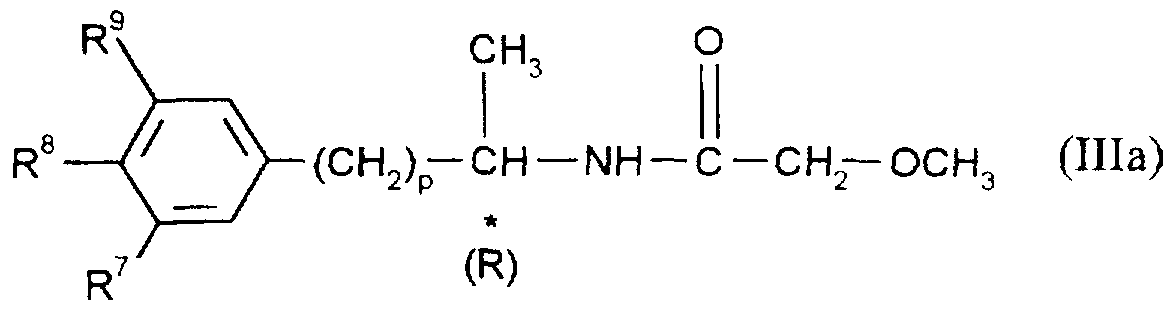
- R 8 stands for fluorine, chlorine, bromine, methyl, methoxy or methylthio
- R 7 and R 9 stand for hydrogen and p stands for the numbers 0, 1 or 2, or
- R 8 represents hydrogen
- R 7 and R 9 are methyl and p is 2,
- acylated (R) amines of the formula (purple) are the compounds of the following formulas:
- Suitable acids for carrying out the third stage of the process according to the invention are all customary strong acids.
- Mineral acids such as sulfuric acid or hydrochloric acid, can preferably be used
- Suitable bases for carrying out the third stage of the process according to the invention are all customary strong bases.
- Inorganic bases, such as sodium or potassium hydroxide, can preferably be used
- Suitable diluents for carrying out the third stage of the process according to the invention are all organic solvents and water customary for such reactions.
- Water or mixtures of water and organic solvents are preferably usable, mixtures of water and toluene being mentioned as examples
- the temperatures can be varied within a substantial range. In general, temperatures between 20 and 180 ° C., preferably between 30 and 150 ° C.
- the third stage of the process according to the invention is carried out, it is generally carried out under atmospheric pressure. However, it is also possible to work under increased or reduced pressure
- the amines of the formula (I *) which can be prepared by the process according to the invention are valuable intermediates for the preparation of pharmaceuticals or of active compounds with insecticidal, fungicidal or herbicidal properties (cf. EP-A
- the filtrate is concentrated under reduced pressure and the remaining residue is taken up in 300 ml of methylene chloride.
- the resulting solution is mixed with 100 ml of ice water and 21 ml of concentrated hydrochloric acid and stirred at room temperature for 0.2 hours. Then the phases are separated.
- the aqueous phase obtained after the above phase separation is mixed with cooling with 35 ml of concentrated aqueous sodium hydroxide solution and then extracted three times with methylene chloride.
- the combined organic phases are concentrated after drying over magnesium sulfate under reduced pressure.
- 37 g of a colorless liquid are obtained in this way according to gas chromato- 98.2% of the graphical analysis consists of the (S) -enantiomer of l- (4-chlorophenyl) ethylamine.
- the ee value is 91.8%.
- Methoxyacetic acid 1- (4-chlorophenyl) ethyl amide, 180 ml water and 67.7 g concentrated hydrochloric acid is heated under reflux for 10 hours. After cooling to room temperature, the reaction mixture is first extracted once with 100 ml of methylene chloride, then made alkaline with concentrated aqueous sodium hydroxide solution and then extracted three times with 200 ml of methylene chloride each time. The combined organic phases are dried over magnesium sulfate and then concentrated under reduced pressure Way 33, 1 g of a product which, according to gas chromatographic analysis, consists of 99.1% of the (R) -enantiomer of l- (4-chlorophenyl) ethylamine. The ee value is 95.1%
- the total yield is 95% of the Theons
- Chlo ⁇ henyl) ethylamine exists.
- the ee value is> 98%.
- a yield of 43% of theory is then calculated
- Novozym 435 ® immobilized lipase from Candida antarctica, 7300 U / g
- the stirring is continued at 40 ° C. and the progress of the reaction is checked by examining samples by gas chromatography. After 2.5 hours there is a conversion reached by 54%. At this point the reaction is stopped by filtering off the enzyme in the remaining one
- the (S) -enantiomer of l- (4-chlorophenyl) -ethylamine has an ee value of 95.6% while the (R) -enantiomer of methoxyacetic acid-1- (4-chlorophenyl) -ethylamide has a filtrate with an ee value of 95.3%
- Methyl tert-butyl ether is stirred for 3 hours at 40 ° C. Then the enzyme is filtered off. The remaining solution is mixed with 100 ml of 10% aqueous hydrochloric acid and then concentrated under reduced pressure. The residue is cooled to 0 ° C. and the resulting product Solid is filtered off and dried. 9.95 g of a product are obtained in this way, which according to Gaschromato ⁇ gram to 99.2% from the (R) -enantiomer of methoxyacetic acid- [3- (4-methoxyphenyl) - l-methyl] -propylamide exists. The yield is then calculated as 39.6% of theory. The ee value is 99%.
Landscapes
- Chemical & Material Sciences (AREA)
- Organic Chemistry (AREA)
- Zoology (AREA)
- Life Sciences & Earth Sciences (AREA)
- Engineering & Computer Science (AREA)
- Wood Science & Technology (AREA)
- Biotechnology (AREA)
- Microbiology (AREA)
- General Chemical & Material Sciences (AREA)
- Chemical Kinetics & Catalysis (AREA)
- Analytical Chemistry (AREA)
- Health & Medical Sciences (AREA)
- Biochemistry (AREA)
- Bioinformatics & Cheminformatics (AREA)
- General Engineering & Computer Science (AREA)
- General Health & Medical Sciences (AREA)
- Genetics & Genomics (AREA)
- Preparation Of Compounds By Using Micro-Organisms (AREA)
- Organic Low-Molecular-Weight Compounds And Preparation Thereof (AREA)
Abstract
Description







Claims


Priority Applications (5)
| Application Number | Priority Date | Filing Date | Title |
|---|---|---|---|
| AU28383/97A AU2838397A (en) | 1995-12-06 | 1996-11-25 | Process for the preparation of optically active amines |
| DE59608741T DE59608741D1 (de) | 1995-12-06 | 1996-11-25 | Verfahren zur herstellung von optisch aktiven aminen |
| JP52093297A JP3714964B2 (ja) | 1995-12-06 | 1996-11-25 | 光学活性アミン類の製造方法 |
| US09/077,581 US6387692B1 (en) | 1995-12-06 | 1996-11-25 | Process for the preparation of optically active amines |
| EP96939915A EP0865500B1 (de) | 1995-12-06 | 1996-11-25 | Verfahren zur herstellung von optisch aktiven aminen |
Applications Claiming Priority (4)
| Application Number | Priority Date | Filing Date | Title |
|---|---|---|---|
| DE19545466 | 1995-12-06 | ||
| DE19637336A DE19637336A1 (de) | 1995-12-06 | 1996-09-13 | Verfahren zur Herstellung von optisch aktiven Aminen |
| DE19545466.9 | 1996-09-13 | ||
| DE19637336.0 | 1996-09-13 |
Publications (1)
| Publication Number | Publication Date |
|---|---|
| WO1997020946A1 true WO1997020946A1 (de) | 1997-06-12 |
Family
ID=26020985
Family Applications (1)
| Application Number | Title | Priority Date | Filing Date |
|---|---|---|---|
| PCT/EP1996/005188 Ceased WO1997020946A1 (de) | 1995-12-06 | 1996-11-25 | Verfahren zur herstellung von optisch aktiven aminen |
Country Status (7)
| Country | Link |
|---|---|
| US (1) | US6387692B1 (de) |
| EP (1) | EP0865500B1 (de) |
| JP (2) | JP3714964B2 (de) |
| AU (1) | AU2838397A (de) |
| DE (1) | DE59608741D1 (de) |
| ES (1) | ES2172692T3 (de) |
| WO (1) | WO1997020946A1 (de) |
Cited By (4)
| Publication number | Priority date | Publication date | Assignee | Title |
|---|---|---|---|---|
| EP1451171A4 (de) * | 2001-12-06 | 2004-11-10 | Posco | Herstellung von chiralen aminen |
| US7078226B1 (en) | 1999-11-25 | 2006-07-18 | Basf Aktiengesellschaft | Method for producing optically active amines |
| EP1870475A1 (de) * | 2006-06-21 | 2007-12-26 | Evonik Degussa GmbH | Verfahren zur Herstellung optisch aktiver Amine und Amide unter Verwendung einer Hydrolase und Sulfonylessigsäureester als Acyldonor |
| US7968328B2 (en) | 2005-06-20 | 2011-06-28 | Basf Se | Method for producing optically active aminoalkylphenols |
Families Citing this family (2)
| Publication number | Priority date | Publication date | Assignee | Title |
|---|---|---|---|---|
| US8008062B2 (en) * | 2005-12-28 | 2011-08-30 | Basf Se | Production of (R)- and (S)-4-(1-aminoethyl) benzoic acid methyl ester sulfate by lipase acylation of racemic 4-(1-aminoethyl) benzoic acid methyl ester and sulfuric acid precipitation |
| JP2010222262A (ja) * | 2009-03-19 | 2010-10-07 | Idemitsu Kosan Co Ltd | アルコキシn,n−ジアルキル酢酸アミドの製造方法、及びポリマー溶液 |
Citations (2)
| Publication number | Priority date | Publication date | Assignee | Title |
|---|---|---|---|---|
| DE4332738A1 (de) * | 1993-09-25 | 1995-03-30 | Basf Ag | Racematspaltung primärer und sekundärer Amine durch Enzym-katalysierte Acylierung |
| DE19523151A1 (de) * | 1995-02-03 | 1996-08-14 | Basf Ag | Racematspaltung primärer und sekundärer heteroatomsubstituierter Amine durch Enzym-katalysierte Acylierung |
Family Cites Families (3)
| Publication number | Priority date | Publication date | Assignee | Title |
|---|---|---|---|---|
| JP3789938B2 (ja) * | 1995-02-03 | 2006-06-28 | ビーエーエスエフ アクチェンゲゼルシャフト | 酵素触媒作用アシル化による1級及び2級のヘテロ原子置換アミンのラセミ体分割 |
| DE19534208A1 (de) * | 1995-09-15 | 1997-03-20 | Basf Ag | Spaltung von optisch aktiven Amiden |
| DE19621686A1 (de) * | 1996-05-30 | 1997-12-04 | Bayer Ag | Verfahren zur Herstellung von optisch aktiven Aminen |
-
1996
- 1996-11-25 US US09/077,581 patent/US6387692B1/en not_active Expired - Fee Related
- 1996-11-25 EP EP96939915A patent/EP0865500B1/de not_active Revoked
- 1996-11-25 DE DE59608741T patent/DE59608741D1/de not_active Expired - Fee Related
- 1996-11-25 JP JP52093297A patent/JP3714964B2/ja not_active Expired - Fee Related
- 1996-11-25 AU AU28383/97A patent/AU2838397A/en not_active Abandoned
- 1996-11-25 WO PCT/EP1996/005188 patent/WO1997020946A1/de not_active Ceased
- 1996-11-25 ES ES96939915T patent/ES2172692T3/es not_active Expired - Lifetime
-
2004
- 2004-11-11 JP JP2004328205A patent/JP2005053933A/ja active Pending
Patent Citations (2)
| Publication number | Priority date | Publication date | Assignee | Title |
|---|---|---|---|---|
| DE4332738A1 (de) * | 1993-09-25 | 1995-03-30 | Basf Ag | Racematspaltung primärer und sekundärer Amine durch Enzym-katalysierte Acylierung |
| DE19523151A1 (de) * | 1995-02-03 | 1996-08-14 | Basf Ag | Racematspaltung primärer und sekundärer heteroatomsubstituierter Amine durch Enzym-katalysierte Acylierung |
Non-Patent Citations (1)
| Title |
|---|
| MANFRED T. REETZ ET AL.: "Highly efficient lipase-catalyzed kinetic resolution of chiral amines", CHIMIA, vol. 48, no. 12, December 1994 (1994-12-01), pages 570, XP000645837 * |
Cited By (7)
| Publication number | Priority date | Publication date | Assignee | Title |
|---|---|---|---|---|
| US7078226B1 (en) | 1999-11-25 | 2006-07-18 | Basf Aktiengesellschaft | Method for producing optically active amines |
| US7358396B2 (en) | 1999-11-25 | 2008-04-15 | Basf Aktiengesellschaft | Preparation of optically active amines |
| EP1451171A4 (de) * | 2001-12-06 | 2004-11-10 | Posco | Herstellung von chiralen aminen |
| US7968328B2 (en) | 2005-06-20 | 2011-06-28 | Basf Se | Method for producing optically active aminoalkylphenols |
| EP1870475A1 (de) * | 2006-06-21 | 2007-12-26 | Evonik Degussa GmbH | Verfahren zur Herstellung optisch aktiver Amine und Amide unter Verwendung einer Hydrolase und Sulfonylessigsäureester als Acyldonor |
| CN101092641B (zh) * | 2006-06-21 | 2010-09-15 | 赢创德固赛有限公司 | 通过酶拆分来制备对映体富集的胺和酰胺的方法 |
| US7824899B2 (en) | 2006-06-21 | 2010-11-02 | Evonik Degussa Gmbh | Preparation of enantiomerically enriched amines and amides by enzymatic resolution using a sulfonylacetic acid ester as acyl donor |
Also Published As
| Publication number | Publication date |
|---|---|
| JP2005053933A (ja) | 2005-03-03 |
| US6387692B1 (en) | 2002-05-14 |
| DE59608741D1 (de) | 2002-03-21 |
| EP0865500B1 (de) | 2002-02-13 |
| AU2838397A (en) | 1997-06-27 |
| EP0865500A1 (de) | 1998-09-23 |
| ES2172692T3 (es) | 2002-10-01 |
| JP2000501292A (ja) | 2000-02-08 |
| JP3714964B2 (ja) | 2005-11-09 |
Similar Documents
| Publication | Publication Date | Title |
|---|---|---|
| EP0720655B1 (de) | Racematspaltung primärer und sekundärer amine durch enzym-katalysierte acylierung | |
| DE3817956A1 (de) | Verfahren zur herstellung phosphorhaltiger l-aminosaeuren sowie ihrer ester und n-derivate | |
| WO2002002532A1 (de) | 4-alkoxy-cyclohexan-1-amino-carbonsäureester und verfahren zu ihrer herstellung | |
| EP0546566B1 (de) | Verfahren zur Herstellung von L-Phosphinothricin und seinen Derivaten | |
| DE19535762A1 (de) | Verfahren zur Racematspaltung | |
| EP0318704A2 (de) | 3-Cyano-4-phenyl-pyrrole | |
| EP0865500B1 (de) | Verfahren zur herstellung von optisch aktiven aminen | |
| DE69732772T2 (de) | Enzymatisches verfahren zur stereoselektiven herstellung von therapeutischen amiden | |
| EP0910660B1 (de) | Verfahren zur herstellung von optisch aktiven aminen | |
| EP0194521B1 (de) | Phosphorhaltige alpha-Aminonitrile und Verfahren zu ihrer Herstellung | |
| DE19955283A1 (de) | Verfahren zur enantioselektiven Gewinnung von Aminosäuren und Aminosäurederivaten unter Verwendung von Racemisierungskatalysatoren | |
| DE4142191A1 (de) | Verfahren zur herstellung von 3-alkoxy-acrylestern | |
| DE19637336A1 (de) | Verfahren zur Herstellung von optisch aktiven Aminen | |
| DE19524337C1 (de) | Verfahren zur Herstellung von beta-Amino-alpha-hydroxycarbonsäuren und deren Derivaten | |
| EP0759426B1 (de) | Verfahren zur Herstellung von optisch aktiven 1-Aryl-alkylaminen | |
| WO1997028271A1 (de) | Verfahren zur herstellung von optisch aktiven aminen | |
| DE19725802A1 (de) | Verfahren zur Herstellung von (S)- oder (R)-3,3,3-trifluor-2-hydroxy-2-methylpropionsäure | |
| DE69610549T2 (de) | Neue carbamatverbindungen die eine thiocarbamoylgruppe enthalten und verfahren zu ihrer herstellung | |
| EP0812363A1 (de) | Verfahren zur herstellung von optisch aktiven aminen | |
| EP0303947A2 (de) | Verfahren zur enzymatischen Herstellung optisch aktiver phosphorhaltiger funktioneller Essigsäurederivate | |
| DE102004062640B4 (de) | Verfahren zur Synthese 2-arylsubstituierter beta-Aminosäurederivate | |
| EP1969129B1 (de) | Verfahren zur herstellung von (r)- und (s)-4-(1-aminomethyl)benzoesäuremethylester-sulfat aus racemischem 4-(1-amin0ethyl)benzoesäuremethylester | |
| WO1999009200A1 (de) | Verfahren zur racematspaltung von cis- und trans- pyrrolopiperidin | |
| EP3507274A1 (de) | Verfahren zur herstellung chiraler aminonitrile | |
| EP0759425A2 (de) | Verfahren zur Herstellung von optisch aktiven 1-Aryl-alkylaminen |
Legal Events
| Date | Code | Title | Description |
|---|---|---|---|
| AK | Designated states |
Kind code of ref document: A1 Designated state(s): AU BB BG BR BY CA CN CZ HU IL JP KR KZ LK MX NO NZ PL RO RU SK TR UA US |
|
| AL | Designated countries for regional patents |
Kind code of ref document: A1 Designated state(s): AT BE CH DE DK ES FI FR GB GR IE IT LU MC NL PT SE BF BJ CF CG CI CM GA GN ML MR NE SN TD TG |
|
| DFPE | Request for preliminary examination filed prior to expiration of 19th month from priority date (pct application filed before 20040101) | ||
| 121 | Ep: the epo has been informed by wipo that ep was designated in this application | ||
| WWE | Wipo information: entry into national phase |
Ref document number: 1996939915 Country of ref document: EP |
|
| WWE | Wipo information: entry into national phase |
Ref document number: 09077581 Country of ref document: US |
|
| ENP | Entry into the national phase |
Ref country code: JP Ref document number: 1997 520932 Kind code of ref document: A Format of ref document f/p: F |
|
| WWP | Wipo information: published in national office |
Ref document number: 1996939915 Country of ref document: EP |
|
| WWG | Wipo information: grant in national office |
Ref document number: 1996939915 Country of ref document: EP |