WO1998007717A1 - PROCESS FOR PREPARING 2-(10,11-DIHYDRO-10-OXODIBENZO[b,f]THIEPIN-2-YL)PROPIONIC ACID AND INTERMEDIATES THEREFOR - Google Patents
PROCESS FOR PREPARING 2-(10,11-DIHYDRO-10-OXODIBENZO[b,f]THIEPIN-2-YL)PROPIONIC ACID AND INTERMEDIATES THEREFOR Download PDFInfo
- Publication number
- WO1998007717A1 WO1998007717A1 PCT/JP1997/002922 JP9702922W WO9807717A1 WO 1998007717 A1 WO1998007717 A1 WO 1998007717A1 JP 9702922 W JP9702922 W JP 9702922W WO 9807717 A1 WO9807717 A1 WO 9807717A1
- Authority
- WO
- WIPO (PCT)
- Prior art keywords
- acid
- carbon atoms
- group
- salt
- alkyl
- Prior art date
- Legal status (The legal status is an assumption and is not a legal conclusion. Google has not performed a legal analysis and makes no representation as to the accuracy of the status listed.)
- Ceased
Links
Classifications
-
- C—CHEMISTRY; METALLURGY
- C07—ORGANIC CHEMISTRY
- C07D—HETEROCYCLIC COMPOUNDS
- C07D337/00—Heterocyclic compounds containing rings of more than six members having one sulfur atom as the only ring hetero atom
- C07D337/02—Seven-membered rings
- C07D337/06—Seven-membered rings condensed with carbocyclic rings or ring systems
- C07D337/10—Seven-membered rings condensed with carbocyclic rings or ring systems condensed with two six-membered rings
- C07D337/14—[b,f]-condensed
Definitions
- the present invention relates to a novel method for producing zaltobutophene, that is, [2- (10,11-dihydro-10-oxodibenzo [b, f] chevin-12-yl) brobionic acid].
- the present invention also relates to novel intermediate compounds that can be used to advantage in the production of Zaltov-mouth fen.
- Zanoretobrofen is known as a drug having an excellent anti-inflammatory action and 0 ⁇ action.
- a method for producing zaltoprofen exhibiting such excellent pharmacological action 5- (histanoethyl) -12-phenylthiophenenyl acetate, as described in JP-A-55-53282, is used. The compound is decomposed and converted to 5-((1-cyanoethyl) -12-phenylthiophenenyl diacid, followed by ring closure of this compound and amidation of the cyano group, and then amide group of the obtained compound.
- a method for performing hydrolysis of glycerol There has been known a method for performing hydrolysis of glycerol.
- Japanese Patent Application Laid-Open No. 63-29790 discloses that 2-methyl 2-propenyl-2-phenylthiophenylate is reacted with an orthoformate and zinc metal or zinc oxalate to give 2- (3-methoxycarbonylmethyl-4-phenylthio)
- a method is described in which methyl (Ophenyl) propionate is obtained and used as a raw material to obtain Zaltobu fen.
- An object of the present invention is to provide a novel method for producing Zartov Mouth Fen different from the previously known method for producing Zartov Mouth Feng.
- the present invention provides a new method for producing zaltoprofen that is more practical than the zaltoprofen production method from » considering the economics such as raw material availability, handling, and yield.
- the purpose is to provide.
- the present invention relates to 2- (4-carboxymethyl-4-phenylthiophene) brobionic acid by diazotizing 2- (4-amino-3-carboxymethylphenyl) brobionic acid or a salt thereof and converting the diazotized compound into a thiophenole. Alternatively, the product is formed and then the product is applied to a closed core. 21- (10,11-dihydro-10-oxodibenzo [b, f] chevin-12-yl) brobionic acid Production method [Production method 1].
- the present invention provides 2- (4-amino-3-carboxymethylphenyl) brobionic acid or a salt thereof, which is diazotized and then converted to a halogenating agent to obtain 2- (4-aminopropyl-3-halogenophenyl) brobion.
- An acid or a salt thereof is formed, and this product is converted into a thiophenol to obtain 2- (3-carboxylic acid-4-phenylthiophenyl) brobionic acid or a salt thereof.
- a method for producing 2- (10,11-dihydro-10-oxodibenzo [b, f] chevin-12-yl) brobionic acid is also described in [Method 2].
- the present invention provides diazotizing 2- (4-amino-3-carboxymethylphenyl) brobionic acid or a salt thereof, followed by reaction with thiosalicylic acid to obtain 2- [3-potoxymethyl-4-1 (2-potoxymethyl). Nilthio) phenyl]
- the formation of robionic acid or a salt thereof, followed by esterification of the product yields 2- [3- (lower) alkoxycarbonylmethyl-4-1 (2- (lower) alkoxycarbonylphenylthio) [Phenyl] brobionic acid (lower) alkyl ester, and then the ester is closed to form a 2- (10,11-one dihydro-111- (lower) alkoxyl-propanol-1 10-oxodibenzo [b, f 2- (10,11-dihydro-10-oxodibenzo [chevin-12-yl) brobionic acid (lower) alkyl ester is formed, followed by hydrolysis and decarbox
- the present invention also provides 2- (4-carboxymethyl-4-halogenoff) by diazotizing 2- (4-amino-3-carboxymethylphenyl) propionic acid or a salt thereof and then subjecting it to a halogenating agent.
- Enyl) brobionic acid or a salt thereof is formed, and then this product is co-reacted with thiosalicylic acid to give 2- [3-potoxymethyl-41- (2-carboxyphenylthio) phenyl] brobionic acid or a salt thereof.
- R 1 is a cyano group, a carboxyl group, a carbamoyl group, an alkyl carbonyl group having 2 to 7 carbon atoms, an alkoxycarbonyl group having 2 to 7 carbon atoms, and a carbonyl group having 2 to 7 carbon atoms.
- R 2 , R 3 and R 4 each independently represent a hydrogen atom, a ⁇ A methylmalonic acid derivative represented by an alkyl group having up to 6 or an aralkyl group having 6 to 12 carbon atoms and an aryl group having 6 to 12 carbon atoms).
- 2- (3-potassyl propyloxy-412-trophenyl) After obtaining brobionic acid or its salt, it is obtained through this.
- the methylmalonic acid derivative represented by (A) is then subjected to hydrolysis' decarburization 3 ⁇ 4S ⁇ to give 2- (3-carboxymethyl-141-trophenyl) brobionic acid or The salt is formed and then obtained through the product.
- a methylmalonic acid derivative represented by the above formula (II) is obtained by sequentially subjecting 2,4 dihalogenonitrobenzene to a methylmalonic acid diester and an ester acetate derivative to obtain a methylmalonic acid derivative represented by the above formula (II). By subjecting it to hydrolysis and decarboxylation, 2- (3-carboxymethyl-412-trophenyl) brobionic acid or a salt thereof is produced, and then this product is obtained.
- the present invention also provides 2- (3-carboxymethyl-4-halogenophenyl) propionic acid or a salt thereof by SiS with thiophenol to give 2- (3-potency propyloxymethyl-4-phenylthiophenyl) propionic acid or The production of 2- (10,11-dihydro-10-oxodibenzo [b, f] chevin-12-yl) brobionic acid, wherein the salt is formed and the product is then closed. There is also a method [Formulation 5].
- the present invention also describes the reaction of 2- (3-potassium phenyloxyphenyl) brobionic acid or its salt with thiosalicylic acid to form 2- [3-potassium phenyloxymethyl- 4-halogenophenyl).
- Phenyl] brobionic acid or a salt thereof is produced, and then the product is esterified to give a 2- [3- (lower) alkoxyl-propylmethyl-41- (2- (lower) alkoxycarbonylphenylthio) [Phenyl] brobionic acid (lower) alkyl ester, and then this ester is closed to form a 2- (10,11-dihydro-11- (lower) alkoxyl-po-nitro- 10-oxodibenzo [b, f] chevin-12 —Yl)
- the present invention provides the following 2- (10,11-dihydro-10-year-old oxodibenzo [b, f] chevin-12-yl) useful as an intermediate in the method for producing probionic acid.
- 2- (10,11-dihydro-10-year-old oxodibenzo [b, f] chevin-12-yl) useful as an intermediate in the method for producing probionic acid.
- X is, N0 2, NH 2, halogen atom or a group represented by the following formula:
- R 7 represents a hydrogen atom, an alkyl group having 1 to 6 carbon atoms, an aryl group having 6 to 12 carbon atoms, or an aralkyl group having 7 to 18 carbon atoms.
- 6 and 1 ⁇ independently represent a hydrogen atom, an alkyl group having 1 to 6 carbon atoms, an aryl group having 6 to 12 carbon atoms, or an aralkyl group having 7 to 8 carbon atoms. is there.
- alkoxy means alkoxy having 1 to 6 carbon atoms, and alkyl is carbon This means alkyl with 1 to 6 atoms).
- the present invention also provides a compound represented by the following formula (D), which is useful as an intermediate material in the above-mentioned process for producing 2- (10,11 dihydro-10-hydroxydibenzo [b, f] chevin-12-yl) propionic acid.
- D a compound represented by the following formula (D)
- Y is N0 2 or represents NH 2
- R 1 is, Xia Roh force Rupokishiru group Karupamoiru alkyl carbonylation Le group -C 2-7 carbon atoms 2-7 Represents an aryloxycarbonyl group having 7 to 13 carbon atoms or an aralkyloxycarbonyl group having 8 to 19 carbon atoms
- R 2 , R 3 and R 4 represent Each independently represents a hydrogen atom, an alkyl having 1 to 6 carbon atoms, an aralkyl group having 6 to 12 carbon atoms, or a carbon atom modification 7 to: an aralkyl group of L 8).
- An example of the compound represented by the above formula (E) is 2- (10,11-dihydro-111-alkoxyl-propanol-1 10-year-old oxodibenzo [b,:]
- the production method 1 of Zaltobu fen comprises the steps of: diazotizing 2- (4-amino-3-potoxymethylphenyl) probionic acid or a salt thereof and reacting it with thiophenol to give 2- (3-carboxymethyl-4 (1) phenylthiophenyl) forming brobionic acid or a salt thereof, and subjecting the product to a ring closure reaction.
- This production method 1 can be represented by the following reaction scheme 1.
- processed I ⁇ object to Jiazo agent e.g., sodium nitrite, sulfuric 3 ⁇ 4 ⁇ containing nitrosyl, nitrosyl chloride
- the thiophenol is allowed to act on the product (diazo compound) at 0 to 100 ° C, for example, in a salt solution (eg, in an aqueous solution of sodium hydroxide or potassium hydroxide).
- a salt solution e.g, in an aqueous solution of sodium hydroxide or potassium hydroxide.
- the above-mentioned 2- (3-carboxymethyl-4-phenylthiophenyl) probionic acid or a salt thereof is a known compound ⁇ .
- a ring closure reaction is caused in the presence of a condensing agent to obtain
- the method for producing Zaltobu fen is described in, for example, Japanese Patent Publication No. 11-199793.
- the condensing agent sulfuric acid, polyphosphoric acid, polyphosphate and the like can be used, and the reaction is usually 0 to 150. Performed in the temperature range of C.
- the manufacturing method 2 of Zaltobu fen according to the present invention involves diazotizing 2- (4-amino-3-potassium phenylphenyl) propionic acid or a salt thereof, and then reacting with a halogenating agent.
- 2- (4-Amino-3-carboxymethylphenyl) Probionic acid or a salt thereof (eg, disodium salt) is diazotized in the same manner as in the above-mentioned production method 1, and the product (diazo compound) is converted into 10-100.
- halogenating agent eg, potassium iodide, copper chloride (I), copper bromide (I), copper iodide (I), or hydrobromic acid (usually in the presence of copper powder)
- the desired 2- (3-carboxymethyl-4-halogenophenyl) brobionic acid or a salt thereof can be obtained by the action.
- the above 2- (3-carboxymethyl-4-halogenophenyl) brobionic acid or its salt can be prepared under basic conditions (eg, potassium hydroxide, potassium carbonate), polar solvent (eg, DMSO, DMF, water) In the catalyst (eg, potassium iodide, copper powder, ⁇ salt) 25-120.
- the catalyst eg, potassium iodide, copper powder, ⁇ salt
- the production method 3 of zaltoprofen of the present invention comprises the steps of diazotizing 2- (4-amino-3-carboxymethylphenyl) probionic acid or a salt thereof, and then forming a core of 2- [3-carboxymethyl-1-propionic acid with thiosalicylic acid.
- 2- (4-Amino-3-carboxymethylphenyl) brobionic acid or a salt thereof is diazotized in the same manner as in the production method 1, and the product (diazo compound) is converted into a diazo compound preferably under a base : I 00.
- the desired 2- [3-potoxymethyl-41- (2-carboxyphenylthio) phenyl] brobionic acid or a salt thereof can be obtained.
- This esterification can be carried out using a lower alcohol (eg, an alcohol having 1 to 6 carbon atoms such as methanol, ethanol, n-propanol, isopropanol), or other esterifying agents (eg, methyl orthoformate, (Ethyl ethyl orthoformate), a method using both of them in combination, and the like.
- a mineral acid such as sulfuric acid or hydrochloric acid, an organic acid such as aromatic sulfonic acid, or a Lewis acid such as boron trifluoride etherate is added in an amount of at least a touch. It is preferable to make the reaction i3 ⁇ 4t.
- alkali metals eg, sodium metal
- alkali metal alcoholates eg, potassium tert-butoxide, sodium methoxide
- alkali metal hydride compounds eg, sodium hydride
- sodium methylsulfinylmethide e.g. sodium hydride
- solvent benzene, toluene, xylene, dimethyl ether, dimethyl sulfoxide and the like are used.
- Reaction ⁇ & ⁇ is selected from the range of 0 ° C. to the boiling point of the solvent used.
- the hydrolysis and decarboxylation proceed without isolation of intermediates. That is, the above-mentioned alkyl ester as a raw material is added to an aqueous solution of hydrochloric acid or an aqueous solution of sulfuric acid (optionally, a lower fatty acid such as acetic acid or brobionic acid is used as a mixture), and this is added to the boiling point of the solvent from 5 ° C. Heat to reaction ag in the tag range up to the desired hydrolysis and decarboxylation reactions.
- the production method 4 of zaltoprofen of the present invention comprises the steps of diazotizing 2- (4-amino-3-carboxymethylphenyl) probionic acid or a salt thereof, and then forming a core with a halogenating agent to obtain 2- (3-carboxymethyl-4-).
- Halogenophenyl) bu-Bionic acid or a salt thereof is formed, and this product is reacted with thiosalicylic acid to give 2- [3-carboxymethyl-41- (2-carboxyphenylthio) phenyl] brobionic acid.
- This production can be performed using the method described in Yuki's Production Method 2.
- This production can be performed using the method described in Production Method 3.
- This production can be carried out using the method described in Production Method 3.
- This production can be carried out using the method described in Production Method 3.
- the 2- (4-amino-3-potoxymethylphenyl) brobionic acid or a salt thereof used as a starting material for the above-mentioned various methods for producing zaltobrophene is a novel compound as described above.
- the compound can be produced by using a known compound as a starting material by the following method.
- 2- (3-halogeno 4-1-2 trophenyl) -2-methylmalonic acid diester halogeno is fluoro, chloro, bromo, etc.
- malonic acid dialkyl ester such as dimethyl malonate, malonic acid and carbon
- esters with aliphatic alcohols having 1 to 6 atoms acetoacetates (eg, methyl acetoacetate, ethyl acetoacetate), or cyano esters (eg, methyl cyanoacetate, ethyl cyanoacetate)
- acetoacetates eg, methyl acetoacetate, ethyl acetoacetate
- cyano esters eg, methyl cyanoacetate, ethyl cyanoacetate
- reaction temperature is usually selected from the range of 5 CTC to the boiling point of the reaction solvent (preferably 70 C or higher).
- 2- (3-Chloro-412-trophenyl) -12-methylmalonic acid which is a typical example of a dialkyl 2- (3-halogeno-412-trophenyl) -methylmalonate that can be used in this reaction Jetil is described in the official gazette of Japanese Patent Publication No. 47-45764 and is well known.
- This compound can be obtained by subjecting the methylmalonic acid derivative represented by the formula (A) obtained in the above 1) to hydrolysis and decarboxylation.
- the hydrolysis reaction and the decarboxylation reaction can be simultaneously or simultaneously performed by heating and refluxing the reaction solution in an aqueous acetic acid solution using concentrated sulfuric acid as a catalyst.
- This compound ⁇ ! Can be obtained by converting the 2- (3-carboxymethyl-142-trophenyl) propionic acid or salt obtained in 2) above under a basic condition (eg, sodium hydroxide, potassium hydroxide, lithium hydroxide). , In an aqueous solution of an alkaline compound such as sodium carbonate).
- a basic condition eg, sodium hydroxide, potassium hydroxide, lithium hydroxide.
- an alkaline compound such as sodium carbonate
- Examples of the salt of 2- (4-amino-13-carboxymethylphenyl) brobionic acid include a sodium salt, a dipotassium salt and a dilithium salt.
- the reduction reaction can be performed, for example, by reacting hydrogen gas in the presence of palladium Z carbon.
- 2,4-Dihalogenonitrobenzene which is a known compound, is subjected to a second reaction between methyl malonate ester (eg, dialkyl methyl malonate) and the above-mentioned acetic ester derivative to obtain the above-mentioned formula (A).
- methyl malonate ester eg, dialkyl methyl malonate
- acetic ester derivative e.g, 2-(2-carboxymethyl-412-trophenyl) probionic acid or a salt thereof.
- This process can be represented by Reaction Scheme 6 below.
- a 2,4-dihalogenonitrobenzene (halogeno is used for the port and bromo, etc.) is reacted with methylmalonate diester (eg, dialkyl methylmalonate such as getyl methylmalonate) and the above-mentioned acetate derivative. .
- methylmalonate diester eg, dialkyl methylmalonate such as getyl methylmalonate
- This reaction can be usually performed using the method described in the above IBSi method (1) 1).
- This production can be carried out using the method described in the above production method (1).
- This production can be carried out using the method described in the above production method (1).
- methylmalonic acid derivative represented by the above formula (A) is transferred.
- a methylmalonic acid derivative represented by the formula (B) is then subjecting the derivative to hydrolysis and decarboxylation. This process can be represented by Reaction Scheme 7 below.
- This core can be obtained, for example, by reacting a methylmalonic acid derivative represented by the formula (A) with hydrogen gas at -10 to 1 oo ° c in the presence of palladium / carbon. .
- This hydrolysis and decarboxylation S can be carried out in the same manner as in the hydrolysis reaction and decarboxylation SJIS of the methylmalonic acid derivative of the formula (A) described in the above-mentioned method (1).
- the reaction mixture was poured into 1N fiber (30 mL) and extracted twice with getyl ether.
- the ether layers were combined, washed with water and then with a saturated aqueous sodium chloride solution, and washed with sodium ⁇ sulfate.
- dimethyl malonate (5.28 g, 40 mmol), tert-butoxy Mix potassium (4.48 g, 40 mmol) and anhydrous N, N-dimethylformamide (20 mL), 90. C was stirred for 10 minutes. After cooling to room temperature, the above reaction solution was added and the mixture was stirred at 90 C for 4 hours. The reaction mixture was poured into a mixture of 2N hydrochloric acid (40 mL) and ice, and extracted twice with ethyl ether. The ether layers were combined, washed with water and then with a saturated aqueous solution of sodium chloride, and dried using anhydrous sodium SS ⁇ . After drying, the solvent was distilled off under JEE to obtain 7.70 g of a dark brown oil.
- the 2- [3-cyano (ethoxycarbonyl) methyl-14-nitrophenyl] 12-brobionic acid (110 mg, 0.36 mmol) obtained in the above (2) was dissolved in acetic acid (0.4 mL), and the solution was dissolved in water (0.4 mL). (0.36 mL) and concentrated sulfuric acid (0.04 mL) were added, and the mixture was heated and passed for 4 hours. The mixture was diluted with water and extracted with ethyl acetate. The ethyl persulfate layer was washed with water and then with a saturated aqueous solution of sodium chloride, and dried over anhydrous sodium sulfate.
- Example 10 Production of 2- (3-caproloxymethyl-4-phenylthiophenyl) propionic acid (I) S5S Dissolve 2- (4-amino-3-potoxymethylphenyl) propionic acid disodium salt (53 mg, 0.2 mmol) obtained in Example 7 in 2N hydrochloric acid (0.5 mL). The mixture was stirred under ice-cooling, sodium nitrite (14 mg, 0.2 mmol) was added, and the mixture was stirred under ice-cooling for 30 minutes.
- the saturated sodium bicarbonate aqueous solution layer was acidified with concentrated hydrochloric acid, extracted with ethyl acetate, washed with water and then with a saturated sodium chloride aqueous solution, and dried using anhydrous sodium sulfate. Then, the solvent was distilled off under 3 ⁇ 43 ⁇ 4E to obtain 47 lmg of a red oily substance.
- Aqueous solution (23.65 g) of 2- (4-amino-1-carboxymethylphenyl) brobionic acid 'ninatridium salt (1.07 g, 4.00 mmol) and sodium hydroxide (142 mg, 3.55 mmol) was cooled to 3 ° C, hydrochloric acid (36%, 3.9 mL, 47 mmol) and sodium nitrite (0.29 g, 4.1 mmol) were added, and the mixture was stirred at 3 to 5 ° C for 5 minutes. Next, copper (I) chloride (95% by weight, 1.25 g, 12 mmol) was added to the obtained ⁇ liquid, and The mixture was stirred at C for 20 minutes and then at 25 ° C for 1 hour. Note that these SiSs were performed in an argon gas atmosphere.
- the obtained organic layer (ethyl acetate solution) was extracted with a saturated aqueous solution of sodium hydrogen carbonate, washed with ethyl acetate, and then the aqueous solution of sodium hydrogen carbonate was made acidic again with hydrochloric acid and extracted with ethyl acetate.
- the ethyl acetate layer was washed with an aqueous sodium chloride solution, dried over magnesium sulfate, and then dried to obtain a residue.
- the 2- (3-carboxymethyl-14-nitrophenyl) propionic acid (1.52 g, 6.0 mmol) obtained in Example 2 was dissolved in IN aqueous sodium hydroxide solution (12 mL), and 10% palladium / carbon was added. (0.03 g), and the mixture was stirred under a hydrogen atmosphere at room temperature for 41 hours. The insoluble matter was separated and washed with water. The combined filtrate and washings were stirred with ice cooling, acidified with concentrated hydrochloric acid (2.5 mL), and sodium nitrite (0.42 g, 6.1 mmol) was added. Stirred at C for 30 minutes.
- the obtained diazonium solution was prepared by dissolving thiosalicylic acid (1.39 g, 9.0 mmol) in 4N aqueous sodium hydroxide (12 mL) 5 to L5. C was added dropwise over 2 minutes. After completion of the dropwise addition, the mixture was stirred at room temperature for 1 hour and subsequently at 95 eC for 1 hour.
- the reaction mixture was acidified with hydrochloric acid and extracted three times with ethyl acetate. The ethyl acetate layers were combined, washed with water and then with a saturated aqueous sodium chloride solution, and finally dried over anhydrous sodium sulfate. Then, the solvent was distilled off under reduced pressure to obtain 2.98 g of a brown solid.
- Dissolve 2- (4-amino-3-potoxymethylphenyl) propionic acid Disodium salt (134 mg, 0.5 mmol) obtained in Example 8 in 2N hydrochloric acid (1.5 mL) and add ice While stirring under cooling, sodium nitrite (35 mg, 0.5 mmol) was added. The mixture was stirred with C for 81 minutes. A solution obtained by dissolving thiosalicylic acid (154 mg, 1.0 mmol) in a 4N aqueous sodium hydroxide solution (2 mL) was added dropwise to the resulting diazodium solution. After completion of the dropwise addition, the mixture was stirred at room temperature for 1 hour and subsequently at 95 ° C for 1 hour.
- the reaction mixture was acidified with 2N hydrochloric acid and extracted with ethyl acetate.
- the ethyl acetate layer was washed with water, then with a saturated aqueous solution of sodium chloride, and finally dried with anhydrous sodium sulfate. Then, the solvent was distilled off under reduced pressure to obtain 230 mg of a brown solid. This solid was suspended in ethyl acetate, and 70 mg of insoluble matter was filtered off.
Landscapes
- Chemical & Material Sciences (AREA)
- Organic Chemistry (AREA)
- Organic Low-Molecular-Weight Compounds And Preparation Thereof (AREA)
- Heterocyclic Compounds Containing Sulfur Atoms (AREA)
- Nitrogen- Or Sulfur-Containing Heterocyclic Ring Compounds With Rings Of Six Or More Members (AREA)
- Feed For Specific Animals (AREA)
- Pharmaceuticals Containing Other Organic And Inorganic Compounds (AREA)
- Acyclic And Carbocyclic Compounds In Medicinal Compositions (AREA)
Abstract
Description
明 細 害 Harm
2 - ( 1 0, 1 1ージヒドロー 1 0—ォキソジベンゾ [b , f ] チェビン一 2— ィル) プロビオン酸の製造方法、 及びその中間体化合物 園分野:! 2- (10,11 dihydro-10-oxodibenzo [b, f] chevin-12-yl) Probionic acid production method and intermediate compound thereof
本発明は、 ザルトブ口フェン、 即ち、 [2— ( 1 0 , 1 1—ジヒドロー 1 0— ォキゾジベンゾ [b, f ] チェビン一 2—ィル) ブロビオン酸] の新規な製造方 法に関する。 本発明はまた、 ザルトブ口フェンの製造に有利に利用することので きる新規な中間体化合物にも関する。 TECHNICAL FIELD The present invention relates to a novel method for producing zaltobutophene, that is, [2- (10,11-dihydro-10-oxodibenzo [b, f] chevin-12-yl) brobionic acid]. The present invention also relates to novel intermediate compounds that can be used to advantage in the production of Zaltov-mouth fen.
I:背景技術:! I: Background technology:!
ザノレトブロフエンは優れた抗炎症作用と 0 ^作用を有する医薬品として知られ ている。 このような優れた薬理作用を示すザルトプロフェンの製造法としては、 特開昭 5 5— 53282号公報に記載されているような、 5— (ひーシァノエチ ル) 一 2—フエ二ルチオフエニル酢酸ェチルを加水分解して、 5— (ひ一シァノ ェチル) 一 2—フエ二ルチオフエニル齚酸に変え、 次いでこの化合物の閉環とシ ァノ基のアミド化とを行ない、 次いで、 得られた化^のアミド基の加水分解を 行なう方法が知られていた。 Zanoretobrofen is known as a drug having an excellent anti-inflammatory action and 0 ^ action. As a method for producing zaltoprofen exhibiting such excellent pharmacological action, 5- (histanoethyl) -12-phenylthiophenenyl acetate, as described in JP-A-55-53282, is used. The compound is decomposed and converted to 5-((1-cyanoethyl) -12-phenylthiophenenyl diacid, followed by ring closure of this compound and amidation of the cyano group, and then amide group of the obtained compound There has been known a method for performing hydrolysis of glycerol.
また、 上記の製法の改良方法として、 特開昭 57— 1 06678号公報に記載 されているような、 5— (ひーシァノエチル) 一2—フエ二ルチオフエニル酢酸 ェチルを加水分解して、 2— (3—力ルポキシメチルー 4一フエ二ルチオフエ二 ル) ブロビオン酸に変え、 次いでこの化合物を縮合剤の存在下で閉環させる方法 も知られている。 Further, as an improved method of the above-mentioned production method, as described in JP-A-57-106678, 5- (hcyanoethyl) 1-2-phenylthiophenenyl acetate is hydrolyzed to give 2- ( It is also known to convert the compound to brobionic acid and then to close the compound in the presence of a condensing agent.
—方、 ハロケタール化^ lを出発原料としてザルトプロフェンを製造する方法 も知られている (特閧昭 62— 292780号公報、 特開昭 6 3— 1 07 5 6号 公報) 。 さらに、 特開昭 63— 297 0号公報には、 5—プロピオ二ルー 2—フ ェニルチオフェニル醉酸メチルにオルトギ酸エステルと金属亜鉛あるいはハ口ゲ ン化亜 ΙΘを反応させて、 2— (3—メトキシカルポ二ルメチルー 4ーフヱニルチ オフェニル) プロビオン酸メチルを得て、 これを原料としてザルトブ口フェンを 得る製法が記載されている。 On the other hand, a method for producing zaltoprofen using haloketalized ^ l as a starting material is also known (Japanese Patent Application Laid-Open No. 62-292780, Japanese Patent Application Laid-Open No. 63-107566). Further, Japanese Patent Application Laid-Open No. 63-29790 discloses that 2-methyl 2-propenyl-2-phenylthiophenylate is reacted with an orthoformate and zinc metal or zinc oxalate to give 2- (3-methoxycarbonylmethyl-4-phenylthio) A method is described in which methyl (Ophenyl) propionate is obtained and used as a raw material to obtain Zaltobu fen.
このように、 ザルトブ口フェンの製法としては、 これまでに種々の製法が知ら れているが、 原料の入手や取り扱い性、 そして収率などの経済性を考慮すると、 これらの製法は必ずしも充分満足できる製法ではなかった。 As described above, various methods for producing Zaltov Mouth Fen have been known so far, but considering the availability of raw materials, the ease of handling, and the economics such as yield, these methods are not necessarily satisfactory. It was not a feasible manufacturing method.
[発明の開示] [Disclosure of the Invention]
本発明は、 これまでに知られているザルトブ口フエンの製法とは異なる新規の ザルトブ口フェンの製造方法を ^することを目的とする。 An object of the present invention is to provide a novel method for producing Zartov Mouth Fen different from the previously known method for producing Zartov Mouth Feng.
本発明は、 特に、 原料の入手や取り扱い性、 そして収率などの経済性を考慮し た総合的な ^^から、 »のザルトプロフエンの製法と比較して実用性 れる ザルトブロフエンの新規な製造方法を提供することを目的とする。 In particular, the present invention provides a new method for producing zaltoprofen that is more practical than the zaltoprofen production method from », considering the economics such as raw material availability, handling, and yield. The purpose is to provide.
本発明は、 2— (4一アミノー 3—カルボキシメチルフエニル) ブロビオン酸 もしくはその塩をジァゾ化した後、 チォフエノーリレと させることによって、 2 - ( 3—カルボキシメチルー 4一フエ二ルチオフエニル) ブロビオン酸もしく はそ を生成させ、 次いでこの生成物を閉^芯に付すことを とする、 2 一 (1 0, 1 1ージヒドロー 1 0—ォキソジベンゾ [b , f ] チェビン一 2—ィ ル) ブロビオン酸の製造方法 [製法 1 ] にある。 The present invention relates to 2- (4-carboxymethyl-4-phenylthiophene) brobionic acid by diazotizing 2- (4-amino-3-carboxymethylphenyl) brobionic acid or a salt thereof and converting the diazotized compound into a thiophenole. Alternatively, the product is formed and then the product is applied to a closed core. 21- (10,11-dihydro-10-oxodibenzo [b, f] chevin-12-yl) brobionic acid Production method [Production method 1].
本発明は、 2— (4一アミノー 3—カルボキシメチルフエニル) ブロビオン酸 もしくはその塩をジァゾ化した後、 ハロゲン化剤と させることによって、 2 一 (3—力ルポキシメチルー 4ーハロゲノフエニル) ブロビオン酸もしくはその 塩を生成させ、 この生成物をチォフエノールと させて、 2— (3—力ルポキ シメチルー 4ーフェニルチオフェニル) ブロビオン酸もしくはその塩を得た後、 この生成物を閉^^に付すことを赚とする、 2— ( 1 0, 1 1ージヒドロー 1 0—ォキソジベンゾ [b, f ] チェビン一 2—ィル) ブロビオン酸の製造方法 [製法 2 ] にもある。 The present invention provides 2- (4-amino-3-carboxymethylphenyl) brobionic acid or a salt thereof, which is diazotized and then converted to a halogenating agent to obtain 2- (4-aminopropyl-3-halogenophenyl) brobion. An acid or a salt thereof is formed, and this product is converted into a thiophenol to obtain 2- (3-carboxylic acid-4-phenylthiophenyl) brobionic acid or a salt thereof. A method for producing 2- (10,11-dihydro-10-oxodibenzo [b, f] chevin-12-yl) brobionic acid is also described in [Method 2].
本発明は、 2— (4一アミノー 3—カルボキシメチルフエニル) ブロビオン酸 もしくはその塩をジァゾ化した後、 チォサリチル酸と反応させることにより、 2 一 [3—力ルポキシメチルー 4一 (2—力ルポキシフエ二ルチオ) フエニル] ブ ロビオン酸もしくはその塩を生成させ、 次にこの生成物をエステル化することに より、 2— [3— (低級) アルコキシカルボ二ルメチルー 4一 (2 - (低級) ァ ルコキシカルボニルフエ二ルチオ) フエニル] ブロビオン酸 (低級) アルキルェ ステルとし、 次にこのエステルを閉環させることによって、 2— (1 0, 1 1一 ジヒドロー 1 1一 (低級) アルコキシ力ルポ二ルー 1 0—ォキソジベンゾ [b, f ] チェビン一 2—ィル) ブロビオン酸 (低級) アルキルエステルを生成させ、 次いで生成物を加水分解し、 脱炭酸することを とする、 2— ( 1 0 , 1 1— ジヒドロー 1 0—ォキソジベンゾ [b , f ] チェビン一 2—ィル) ブロビオン酸 の製造方法 [製法 3] にもある。 The present invention provides diazotizing 2- (4-amino-3-carboxymethylphenyl) brobionic acid or a salt thereof, followed by reaction with thiosalicylic acid to obtain 2- [3-potoxymethyl-4-1 (2-potoxymethyl). Nilthio) phenyl] The formation of robionic acid or a salt thereof, followed by esterification of the product, yields 2- [3- (lower) alkoxycarbonylmethyl-4-1 (2- (lower) alkoxycarbonylphenylthio) [Phenyl] brobionic acid (lower) alkyl ester, and then the ester is closed to form a 2- (10,11-one dihydro-111- (lower) alkoxyl-propanol-1 10-oxodibenzo [b, f 2- (10,11-dihydro-10-oxodibenzo [chevin-12-yl) brobionic acid (lower) alkyl ester is formed, followed by hydrolysis and decarboxylation of the product. b, f] Chevin-1-2-yl) Production method of brobionic acid [Production method 3].
本発明はまた、 2— (4一アミノー 3—カルボキシメチルフエニル) プロピオ ン酸もしくはその塩をジァゾ化した後、 ハロゲン化剤と ^させることにより 2 - (3—カルボキシメチルー 4ーハロゲノフエニル) ブロビオン酸もしくはその 塩を生成させ、 次いでこの生成物をチォサリチル酸と ¾芯させることにより、 2 一 [3—力ルポキシメチルー 4一 (2—カルボキシフエ二ルチオ) フエニル] ブ ロビオン酸もしくはその塩を^させ、 次いでこの生成物をエステル化すること により.、 2 - [3- (低級) アルコキシ力ルポ二ルメチルー 4— ( 2 - (低級) アルコキシカルボニルフエ二ルチオ) フエニル] ブロビオン酸 (低級) アルキル エステルとし、 次にこのエステルを閉環させることにより、 2— ( 1 0, 1 1一 ジヒドロー 1 1一 (低級) アルコキシカルボ二ルー 1 0—ォキソジベンゾ [b, f ] チェビン一 2—ィル) プロビオン酸 (低級) アルキルエステルを生成させ、 次いでこの竿成物を加水分解し、 脱炭酸することを^とする、 2— (1 0 , 1 1ージヒドロー 1 0—才キソジベンゾ [b, チェビン一 2—ィル) ブロピオ ン酸の製造方法 [製法 4] にもある。 The present invention also provides 2- (4-carboxymethyl-4-halogenoff) by diazotizing 2- (4-amino-3-carboxymethylphenyl) propionic acid or a salt thereof and then subjecting it to a halogenating agent. Enyl) brobionic acid or a salt thereof is formed, and then this product is co-reacted with thiosalicylic acid to give 2- [3-potoxymethyl-41- (2-carboxyphenylthio) phenyl] brobionic acid or a salt thereof. And then esterifying the product to give 2-, [3- (lower) alkoxycarbonyl-methyl-4- (2- (lower) alkoxycarbonylphenylthio) phenyl] brobionic acid (lower) An alkyl ester is formed, and then the ester is closed to form a 2- (10,11-dihydro-11- (lower) alkoxy ester. Bonilou 10-oxodibenzo [b, f] chevin-12-yl) Propionic acid (lower) alkyl ester is formed, and then this rod is hydrolyzed and decarboxylated. — (10,11 dihydro-10-year-old dibenzodibenzo [b, chevin-12-yl)) A method for the production of propionic acid [Production method 4].
上記の各製法の出発物質である、 2— (4一アミノー 3—カルボキシメチルフ ェニル) ブロビオン酸もしくはその塩は^知られていない新規物質であるが、 下記のような様々な方法で製造することが可能である。 2- (4-Amino-3-carboxymethylphenyl) brobionic acid or its salt, which is the starting material for each of the above processes, is a novel substance that has not been known. It is possible.
1 ) 2 - ( 3—力ルポキシメチルー 4—ニトロフエニル) ブロビオン酸もしく はその塩の通元により得る。 1) 2- (3-potoxymethyl-4-nitrophenyl) obtained from brobionic acid or a salt thereof.
2 ) 下記式 (A) :

(上記の式 (A) において、 R 1は、 シァノ基、 カルボキシル基、 力ルバモイル 基 炭素原子数 2〜 7のアルキル力ルポニル 炭素原子数 2〜7のアルコキシ カルボニル基、 原子数 7〜 1 3のァリールォキシカルボニル基 または炭素 原子数 8〜1 9のァラルキルォキシカルボ二ル基を表わし、 そして R2、 R3及び R4は、 それそれ独立に、 水素原子、 ^^原子数 〜 6のアルキル基 または炭 素原子数 6〜 1 2のァリール基 織原子数 7〜 1 8のァラルキル基を表わす) で表わされるメチルマロン酸誘導体を加水分解 · 酸反応に付すことによつ て、 2— (3—力ルポキシメチルー 4一二トロフエニル) ブロビオン酸もしくは その塩を得た後、 これを通元して得る。 (In the above formula (A), R 1 is a cyano group, a carboxyl group, a carbamoyl group, an alkyl carbonyl group having 2 to 7 carbon atoms, an alkoxycarbonyl group having 2 to 7 carbon atoms, and a carbonyl group having 2 to 7 carbon atoms. Represents an aryloxycarbonyl group or an aralkyloxycarbonyl group having 8 to 19 carbon atoms, and R 2 , R 3 and R 4 each independently represent a hydrogen atom, a ^^ A methylmalonic acid derivative represented by an alkyl group having up to 6 or an aralkyl group having 6 to 12 carbon atoms and an aryl group having 6 to 12 carbon atoms). , 2- (3-potassyl propyloxy-412-trophenyl) After obtaining brobionic acid or its salt, it is obtained through this.
3 ) ..醉酸エステル誘導体と 2— (3—ハロゲノー 4一二トロフエニル) 一2— メチルマロン酸ジアルキルエステル [= 2— (3—ハロゲノー 4一二トロフエ二 ル) 一 2—メチルプロパンニ酸ジアルキルエステル] とを反応させて、 上記の式 3) .. Drunk ester derivative and 2- (3-halogeno 4-1-2 trophenyl) dialkyl methyl malonate [= 2- (3-halogeno 4-1-2 trophenyl) 1-2-methyl propanic acid Dialkyl ester] with the above formula
(A) で表わされるメチルマロン酸誘導体を得た後、 次いでこのメチルマロン酸 誘導体を加水分解 '脱炭 ¾S ^に付すことにより、 2— (3—カルボキシメチル 一 4一二トロフエニル) ブロビオン酸もしくはその塩を生成させ、 次にこの生成 物を通元して得る。 After obtaining the methylmalonic acid derivative represented by (A), the methylmalonic acid derivative is then subjected to hydrolysis' decarburization ¾S ^ to give 2- (3-carboxymethyl-141-trophenyl) brobionic acid or The salt is formed and then obtained through the product.
4) 2, 4ージハロゲノニトロベンゼンにメチルマロン酸ジエステルと酢酸ェ ステル誘導体とを順次 させて、 上記式 (Α) で表わされるメチルマロン酸誘 導体を得た後、 次いでこのメチルマロン酸誘導体を加水分解 ·脱炭酸反応に付す ことにより、 2— (3—カルボキシメチルー 4一二トロフエニル) ブロビオン酸 もしくはその塩を生成させ、 次にこの生成物を通元して得る。 4) A methylmalonic acid derivative represented by the above formula (II) is obtained by sequentially subjecting 2,4 dihalogenonitrobenzene to a methylmalonic acid diester and an ester acetate derivative to obtain a methylmalonic acid derivative represented by the above formula (II). By subjecting it to hydrolysis and decarboxylation, 2- (3-carboxymethyl-412-trophenyl) brobionic acid or a salt thereof is produced, and then this product is obtained.
5 ) 上記式 (Α) で表わされるメチルマロン酸誘導体を通元することにより、 下記式 (Β) :
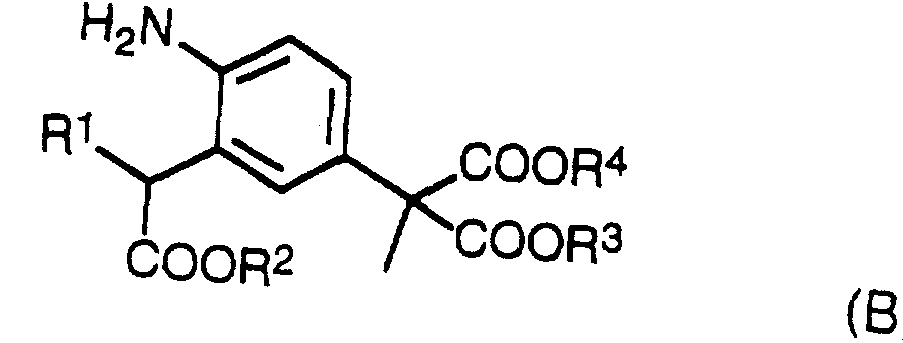
(上記の式 (B) において、 II1、 R2、 R3及び R 4は前記と同じ意味を表わす) で表わされるメチルマロン酸誘導体に変換し、 次いでこの誘導体を加水分解 · ^s^に付すことによって得る。 (In the above formula (B), II 1 , R 2 , R 3 and R 4 have the same meanings as described above), and then the derivative is hydrolyzed into ^ s ^ Obtained by attaching.
本発明は又、 2— (3—カルボキシメチルー 4ーハロゲノフエニル) ブロピオ ン酸もしくはその塩をチォフエノールと SiSさせることによって、 2— (3—力 ルポキシメチルー 4一フエ二ルチオフェニル) プロピオン酸もしくはその塩を生 成させた後、 この生成物を閉¾^、に付すことを とする、 2— (10, 11 ージヒドロー 10—ォキソジベンゾ [b, f ] チェビン一 2—ィル) ブロビオン 酸の製造方法 [製法 5] にもある。 The present invention also provides 2- (3-carboxymethyl-4-halogenophenyl) propionic acid or a salt thereof by SiS with thiophenol to give 2- (3-potency propyloxymethyl-4-phenylthiophenyl) propionic acid or The production of 2- (10,11-dihydro-10-oxodibenzo [b, f] chevin-12-yl) brobionic acid, wherein the salt is formed and the product is then closed. There is also a method [Formulation 5].
本 .明はまた、 2— (3—力ルポキシメチルー 4ーハロゲノフエニル) ブロビ オン酸もしくはその塩をチォサリチル酸と ¾5させることにより、 2— [3—力 ルポキシメチルー 4一 (2—カルボキシフエ二ルチオ) フエニル] ブロビオン酸 もしくはその塩を生成させ、 次いでこの生成物をエステル化することにより、 2 一 [3— (低級) アルコキシ力ルポ二ルメチルー 4一 (2- (低級) アルコキシ カルポニルフエ二ルチオ) フエニル] ブロビオン酸 (低級) アルキルエステルと し、 次にこのエステルを閉環させることにより 2— (10, 11—ジヒドロー 1 1一 (低級) アルコキシ ルポ二ルー 10—ォキソジベンゾ [b, f ] チェビン 一 2—ィル) ブロビオン酸 (低級) アルキルエステルを生成させ、 次いでこの生 成物を加水分解し、 脱炭酸することを とする、 2— (10, 11ージヒドロ —10—才キソジベンゾ [b, f ] チェビン一 2—ィル) プロビオン酸の製造方 法 [製法 6] にもある。 The present invention also describes the reaction of 2- (3-potassium phenyloxyphenyl) brobionic acid or its salt with thiosalicylic acid to form 2- [3-potassium phenyloxymethyl- 4-halogenophenyl). ) Phenyl] brobionic acid or a salt thereof is produced, and then the product is esterified to give a 2- [3- (lower) alkoxyl-propylmethyl-41- (2- (lower) alkoxycarbonylphenylthio) [Phenyl] brobionic acid (lower) alkyl ester, and then this ester is closed to form a 2- (10,11-dihydro-11- (lower) alkoxyl-po-nitro- 10-oxodibenzo [b, f] chevin-12 —Yl) The formation of (lower) alkyl esters of brobionic acid, followed by hydrolysis and decarboxylation of this product. There is also a method for producing 2- (10,11-dihydro-10-year-old dioxodibenzo [b, f] chevin-12-yl) propionic acid [Production method 6].
本発明は、 上記の 2— (10, 11—ジヒドロー 10—才キソジペンゾ [b, f] チェビン一 2—ィル) プロビオン酸の製造方法の中間原料として有用な下記 式 (c) で表わされる化合物: The present invention provides the following 2- (10,11-dihydro-10-year-old oxodibenzo [b, f] chevin-12-yl) useful as an intermediate in the method for producing probionic acid. Compound represented by formula (c):

(上記の式 (C) において、 Xは、 N02、 NH2、 ハロゲン原子、 もしくは下記 式で表わされる基: (In the above formula (C), X is, N0 2, NH 2, halogen atom or a group represented by the following formula:

(上記の式で R7は、 水素原子、 炭素原子数 1〜6のアルキル基、 炭素原子数 6 〜1 2のァリール基 もしくは^原子数 7〜 1 8のァラルキル基を表わす) を 表わし、 1¾6及び1^は、 それぞれ独立に、 水素原子、 炭素原子数 1〜 6のアルキ ル基 炭素原子数 6〜 1 2のァリール もしくは炭素原子数 7〜: I 8のァラル キル基を表わす) にもある。 (In the above formula, R 7 represents a hydrogen atom, an alkyl group having 1 to 6 carbon atoms, an aryl group having 6 to 12 carbon atoms, or an aralkyl group having 7 to 18 carbon atoms.) 6 and 1 ^ independently represent a hydrogen atom, an alkyl group having 1 to 6 carbon atoms, an aryl group having 6 to 12 carbon atoms, or an aralkyl group having 7 to 8 carbon atoms. is there.
上記の式 (C) で表わされる化^の例としては、 下記の化^^を挙げること ができる。 As an example of the compound represented by the above formula (C), the following compound can be given.
a) 2 - ( 3—カルボキシメチルー 4一二トロフエニル) プロビオン酸、 その アルキルエステル (アルキルは炭素原子数が 1〜6のアルキルである) 、 もしく はその塩。 a) 2- (3-carboxymethyl-412-trophenyl) propionic acid, its alkyl ester (alkyl is alkyl having 1 to 6 carbon atoms), or its salt.
b) 2 - (4一アミノー 3—力ルポキシメチルフエニル) ブロビオン酸、 そ のアルキルエステル (アルキルは炭素原子数が 1〜 6のアルキルである) 、 もし くはその塩。 b) 2- (4-amino-3-potoxymethylphenyl) brobionic acid, its alkyl ester (alkyl is an alkyl having 1 to 6 carbon atoms) or a salt thereof.
c ) 2 - [3—力ルポキシメチルー 4一 (2—力ルポキシフエ二ルチオ) フエ ニル] ブロビオン酸、 そのアルキルエステル (アルキルは炭素原子数が 1〜 6の アルキルである) 、 もしくはその塩。 c) 2-[3-Ripoxymethyl-4-1 (2-Ripoxyphenylthio) phenyl] brobionic acid, its alkyl ester (alkyl has 1 to 6 carbon atoms) Alkyl) or a salt thereof.
d) 2— (3—カルボキシメチル一 4ーハロゲノフエニル) ブロビオン酸、 そ のアルキルエステル (アルキルは炭素原子数が 1〜 6のアルキルである) 、 もし くはその塩。 d) 2- (3-carboxymethyl-1-halogenophenyl) brobionic acid, its alkyl ester (alkyl is alkyl having 1 to 6 carbon atoms), or a salt thereof.
e ) 2 - [3—アルコキシカルボ二ルメチルー 4一 (2—アルコキシカルボ二 ルフエ二ルチオ) フエニル] ブロビオン酸のアルキルエステル (アルコキシは炭 素原子数 1〜6のアルコキシを意味し、 そしてアルキルは炭素原子数 1〜 6のァ ルキルを意味する) 。 e) 2- [3-alkoxycarbonylmethyl-4-1 (2-alkoxycarbonylphenylthio) phenyl] alkyl ester of brobionic acid (alkoxy means alkoxy having 1 to 6 carbon atoms, and alkyl is carbon This means alkyl with 1 to 6 atoms).
本発明はまた、 上記の 2— (1 0, 1 1ージヒドロー 1 0—才キソジベンゾ [b, f ] チェビン一 2—ィル) プロビオン酸の製造方法の中間原料として有用 な下記式 (D) で表わされる化合物: The present invention also provides a compound represented by the following formula (D), which is useful as an intermediate material in the above-mentioned process for producing 2- (10,11 dihydro-10-hydroxydibenzo [b, f] chevin-12-yl) propionic acid. Compounds represented:

(上記の式 (D) において、 Yは、 N02、 または NH2を表わし; R 1は、 シァ ノ 力ルポキシル基 カルパモイル基 炭素原子数 2〜 7のアルキルカルボ二 ル基 炭素原子数 2〜7のアルコキシカルボニル基 炭素原子数 7〜1 3のァリ ールォキシカルボニル基 または炭素原子数 8〜 1 9のァラルキルォキシカルボ 二ル基を表わし;そして R2、 R3及び R4は、 それぞれ独立に、 水素原子、 炭素 原子数 1〜6のアルキル 炭素原子数 6〜1 2のァリール基、 もしくは炭素原 改7〜: L 8のァラルキル基を表わす) にもある。 (In the above formula (D), Y is N0 2 or represents NH 2,; R 1 is, Xia Roh force Rupokishiru group Karupamoiru alkyl carbonylation Le group -C 2-7 carbon atoms 2-7 Represents an aryloxycarbonyl group having 7 to 13 carbon atoms or an aralkyloxycarbonyl group having 8 to 19 carbon atoms; and R 2 , R 3 and R 4 represent Each independently represents a hydrogen atom, an alkyl having 1 to 6 carbon atoms, an aralkyl group having 6 to 12 carbon atoms, or a carbon atom modification 7 to: an aralkyl group of L 8).
上記の式 (D) で表わされる化^の例としては、 下記の化 ^を挙げること ができる。 As an example of the compound represented by the above formula (D), the following compound ^ can be given.
a) 2— [3—ビス (アルコキシ力ルポニル) メチルー 4一二トロフエニル] 一 2—メチルマロン酸ジアルキルエステル (アルコキシは、 炭素原子数 1〜6の アルコキシを意味し、 アルキルは炭素原子数 1〜6のアルキルを意味する) 。 b) 2 - [3— [ (アルコキシカルボニル) シァノメチル] 一 4一二トロフエ ニル] 一 2—メチルマロン酸ジアルキルエステル (アルコキシは、 炭素原子数 1 〜 6のアルコキシを意味し、 そしてアルキルは炭索原子数 1〜 6のアルキルを意 味する) 。 a) 2- [3-bis (alkoxyl-proponyl) methyl-4,2-trophenyl] dialkyl 2-methylmalonic acid (alkoxy means alkoxy having 1 to 6 carbon atoms, alkyl means 1 to 6 carbon atoms) 6 means alkyl). b) 2- [3-[((alkoxycarbonyl) cyanomethyl] 1-412 trophenyl] dialkyl 2-methylmalonic acid ester (alkoxy means alkoxy with 1 to 6 carbon atoms, and alkyl is charcoal It means alkyl having 1 to 6 atoms).
c ) 2— [3— [ァセチル (アルコキシカルボニル) メチル]一 4—ニトロフ ェニル] 一 2—メチルマロン酸ジアルキルエステル (アルコキシは、 炭素原子数 1〜6のアルコキシを意味し、 そしてアルキルは炭素原子数 1〜6のアルキルを 意味する) 。 c) 2- [3- [Acetyl (alkoxycarbonyl) methyl] -14-nitrophenyl] 1-2-methylmalonic acid dialkyl ester (alkoxy means alkoxy having 1 to 6 carbon atoms, and alkyl means carbon atom Means number 1 to 6 alkyl).
d) 2 - [4一アミノー 3—ビス (アルコキシ力ルポニル) メチルフエニル] 一 2—メチルマロン酸ジアルキルエステル (アルコキシは、 炭素原子数 1〜6の アルコキシを意味し、 アルキルは炭素原子数 1〜6のアルキルを意味する) 。 本発明はまた、 上記の 2— (1 0 , 1 1—ジヒドロー 1 0—才キゾジベンゾ [b , f ]チェビン一 2—ィル) プロビオン酸の製造方法の中間原料として有用 な下記式 (E) で表わされる化合物: d) 2- [4-Amino-3-bis (alkoxyalkenyl) methylphenyl] dialkyl 2-methylmalonate (Alkoxy means alkoxy having 1 to 6 carbon atoms, alkyl means 1 to 6 carbon atoms) Means alkyl). The present invention also provides the following formula (E), which is useful as an intermediate material in the above-mentioned process for producing 2- (10,11-dihydro-10-chlorodibenzo [b, f] chevin-12-yl) probionic acid. Compound represented by:

(上記式 (E) において、 RB及び Reはそれぞれ独立に、 水素原子、 炭素原子 数 1〜6のアルキル基、 炭素原¾¾6〜: 1 2のァリール基、 もしくは炭素原子数 7〜 1 8のァラルキル基を表わす) にもある。 In (the above formula (E), in each of R B and R e independently, a hydrogen atom, an alkyl group having 1 to 6 carbon atoms, TansoHara ¾¾6~: 1 2 of Ariru group or number of carbon atoms 7-1 8, Represents an aralkyl group).
上記式 (E ) で表わされる化^!の例としては、 2— (1 0, 1 1—ジヒドロ 一 1 1一アルコキシ力ルポ二ルー 1 0—才キソジベンゾ [b , : ] チェビン一 2 一ィル) ブロビオン酸アルキルエステル (アルコキシは炭素原子数 1〜6のアル コキシを意味し、 そしてアルキルは炭素原子数 1〜 6のアルキルを意味する) を あげることができる。 [発明を実施するための最良の形態] An example of the compound represented by the above formula (E) is 2- (10,11-dihydro-111-alkoxyl-propanol-1 10-year-old oxodibenzo [b,:] B) Alkyl brobionates (alkoxy means alkoxy with 1 to 6 carbon atoms and alkyl means alkyl with 1 to 6 carbon atoms). [Best Mode for Carrying Out the Invention]
次に、 本発明のザルトプロフェン、 即ち、 2— ( 1 0, 1 1ージヒドロー 1 0 一才キソジベンゾ [ b, f ] チェビン一 2—ィル)ブロビオン酸の製造方法につ いて詳しく説明する。 Next, the method for producing zaltoprofen of the present invention, that is, 2- (10,11-dihydro-10-one-year-old oxodibenzo [b, f] chevin-12-yl) brobionic acid will be described in detail.
( 1 ) 製法 1 (1) Manufacturing method 1
本発明のザルトブ口フェンの製法 1は、 2— (4一アミノー 3—力ルポキシメ チルフエニル) プロビオン酸もしくはその塩をジァゾ化した後、 チォフエノール と反応させることによって、 2— (3—カルボキシメチルー 4一フヱニルチオフ ェニル) ブロビオン酸もしくはその塩を生成させ、 次いでこの生成物を閉環反応 に付すことを特徴とする。 この製法 1は、 下記の反応スキーム 1によって表わす ことができる。 The production method 1 of Zaltobu fen according to the present invention comprises the steps of: diazotizing 2- (4-amino-3-potoxymethylphenyl) probionic acid or a salt thereof and reacting it with thiophenol to give 2- (3-carboxymethyl-4 (1) phenylthiophenyl) forming brobionic acid or a salt thereof, and subjecting the product to a ring closure reaction. This production method 1 can be represented by the following reaction scheme 1.
[反 ¾スキーム 1 ] [Reaction Scheme 1]

1 ) 2 - ( 3—カルボキシメチルー 4一フエ二ルチオフエニル) ブロビオン酸 もしくはその塩の 1) 2- (3-carboxymethyl-4-phenylthiophenyl) brobionic acid or its salt
2 - ( 4一アミノー 3—力ルポキシメチルフエニル) ブロビオン酸もしくはそ の塩 (例、 ニナトリウム塩、 二カリウム塩、 二リチウム塩) を、 例えば、 塩酸酸 性下で、 ジァゾ化剤で処理することによりジァゾ化し、 その生成物 (ジァゾ化合 物) を溶媒中でチォフエノールと 芯させることにより得ることができる。 ジァ ゾ化反応は、 例えば酸性 (塩酸酸性もしくは硫酸酸性、 酢酸酸性) 条件下にて、2- (4-amino-3-potoxymethylphenyl) brobionic acid or a salt thereof (eg, disodium salt, dipotassium salt, dilithium salt), for example, with hydrochloric acid It can be obtained by diazotization by treatment, and the product (diazo compound) being cored with thiophenol in a solvent. Jia The zonation reaction is carried out under acidic conditions
— 1 0°C〜2 0eCで、 処理対象ィ匕合物にジァゾ化剤 (例、 亜硝酸ナトリウム、 硫 ¾ζ素ニトロシル、 塩化ニトロシル) を作用させることにより行なう。 そして、 その生成物 (ジァゾ化合物) に、 たとえば、 塩 ¾ ^件下 (例、 水酸化ナトリウ ムもしくは水酸化カリウムの水溶液中) にて、 0〜1 0 0°Cでチオフエノ一ルを 作用させることにより、 目的の 2— (3—力ルポキシメチルー 4一フエ二ルチオ フエニル) プロビオン酸もしくはその塩を得ることができる。 - 1 0 ° C~2 0 e C, processed I匕合object to Jiazo agent (e.g., sodium nitrite, sulfuric ¾ζ containing nitrosyl, nitrosyl chloride) carried out by the action of. Then, the thiophenol is allowed to act on the product (diazo compound) at 0 to 100 ° C, for example, in a salt solution (eg, in an aqueous solution of sodium hydroxide or potassium hydroxide). As a result, the desired 2- (3-caproloxymethyl-4-phenylthiophenyl) propionic acid or a salt thereof can be obtained.
2 ) ザルトブ口フェンの製造 2) Manufacture of Zaltov Mouth Fen
上記の 2— (3—カルボキシメチルー 4一フエ二ルチオフエニル) プロビオン 酸もしくはその塩は公知化^ であり、 この化^!を原料とし、 縮合剤の存在下 で閉環反応を起こさせることによって、 ザルトブ口フェンを製造する方法は、 例 えば、 特公平 1一 2 9 7 9 3号公報などに記載されている。 縮合剤としては、 硫 酸、 ボリリン酸、 ポリリン酸エステルなどが利用でき、 反応は通常 0〜1 5 0。C の温度範囲で行なわれる。 The above-mentioned 2- (3-carboxymethyl-4-phenylthiophenyl) probionic acid or a salt thereof is a known compound ^. By using this compound ^! As a raw material, a ring closure reaction is caused in the presence of a condensing agent to obtain The method for producing Zaltobu fen is described in, for example, Japanese Patent Publication No. 11-199793. As the condensing agent, sulfuric acid, polyphosphoric acid, polyphosphate and the like can be used, and the reaction is usually 0 to 150. Performed in the temperature range of C.
( 2 ) 製法 2及び製法 5 (2) Manufacturing method 2 and manufacturing method 5
本^明のザルトブ口フェンの製法 2は、 2— (4一アミノー 3—力ルポキシメ チルフエニル) ブロピオン酸もしくはその塩をジァゾ化した後、 ハロゲン化剤と The manufacturing method 2 of Zaltobu fen according to the present invention involves diazotizing 2- (4-amino-3-potassium phenylphenyl) propionic acid or a salt thereof, and then reacting with a halogenating agent.
^させることによって、 2— (3—カルボキシメチル一 4ーハロゲノフエニル) プロビオン酸もしくはその塩を^ ¾させ、 この生成物をチォフエノールと反応さ せて、 2— (3—力ルポキシメチルー 4一フエ二ルチオフエニル) ブロビオン酸 もしくはその塩を得た後、 この生成物を閉環反応に付すことを■とする。 この 製法 2は、 下記の反応スキーム 2 (スキーム中の「H a l—」は、 ハロゲノ基を 意味する) によって表わすことができる。 Then, 2- (3-carboxymethyl-14-halogenophenyl) probionic acid or a salt thereof is allowed to react, and the product is reacted with thiophenol to give 2- (3-dioxypropyloxymethyl 4-phenylene). (2). After obtaining brovionic acid or a salt thereof, this product is subjected to a ring closure reaction. This production method 2 can be represented by the following reaction scheme 2 (“H a1 —” in the scheme means a halogeno group).
なお、 2— (3—カルボキシメチルー 4—ハロゲノフエニル) ブロビオン酸も しくはその塩をチォフエノールと反応させて、 2— (3—カルボキシメチル一 4 一フエ二ルチオフエニル) ブロビオン酸もしくはその塩を得た後、 この生成物を 閉環反応に付してザルトプロフェンを製造する方法が、 製法 5に相当する。 [反) ¾スキーム 2] In addition, 2- (3-carboxymethyl-4-halogenophenyl) brobionic acid or a salt thereof was reacted with thiophenol to obtain 2- (3-carboxymethyl-14-phenylthiophenenyl) brobionic acid or a salt thereof. Thereafter, a method of subjecting this product to a ring closure reaction to produce zaltoprofen corresponds to Production Method 5. [Anti] ¾Scheme 2]

1) 2- (3—カルボキシメチルー 4—ハロゲノフエニル) プロビオン酸もし くはその塩の製造 1) Production of 2- (3-carboxymethyl-4-halogenophenyl) probionic acid or its salt
2— (4一アミノー 3—カルボキシメチルフエニル) プロビオン酸もしくはそ の塩 (例、 ニナトリウム塩) を、 上記の製法 1の場合と同様にジァゾ化し、 その 生成物 (ジァゾ化合物) に、 ー10〜100。(にて、 ハロゲン化剤 (例、 ヨウ化 カリウム、 塩化銅 (I)、 臭化銅 (I)、 ヨウ化銅 (I)、 あるいは臭化水素酸 (通常は銅粉の存在下) ) を作用させることによって、 目的の 2— (3—カルボ キシメチルー 4ーハロゲノフエニル) ブロビオン酸もしくはその塩を得ることが できる。 2- (4-Amino-3-carboxymethylphenyl) Probionic acid or a salt thereof (eg, disodium salt) is diazotized in the same manner as in the above-mentioned production method 1, and the product (diazo compound) is converted into 10-100. (In the above, halogenating agent (eg, potassium iodide, copper chloride (I), copper bromide (I), copper iodide (I), or hydrobromic acid (usually in the presence of copper powder)) The desired 2- (3-carboxymethyl-4-halogenophenyl) brobionic acid or a salt thereof can be obtained by the action.
2) 2— (3—カルボキシメチルー 4—フエ二ルチオフエニル) プロピオン酸 もしくはその塩の製造 2) Production of 2- (3-carboxymethyl-4-phenylthiophenyl) propionic acid or its salt
上記の 2— (3—カルボキシメチルー 4ーハロゲノフエニル) ブロビオン酸も しくはその塩を塩基性条件下 (例、 水酸化カリウム、 炭酸カリウム) 、 極性溶媒 (例、 DMSO、 DMF、 水) 中で、 触媒 (例、 ヨウ化カリウム、 銅粉、 鋦塩) を添加し、 25〜120。Cでチォフエノールと させることにより、 目的の 2 一 (3—カルボキシメチル一4—フエ二ルチオフエニル) プロビオン酸もしくは その塩を得ることができる。 The above 2- (3-carboxymethyl-4-halogenophenyl) brobionic acid or its salt can be prepared under basic conditions (eg, potassium hydroxide, potassium carbonate), polar solvent (eg, DMSO, DMF, water) In the catalyst (eg, potassium iodide, copper powder, 鋦 salt) 25-120. By converting the compound to thiophenol with C, the desired 2- (3-carboxymethyl-14-phenylthiophenyl) propionic acid or a salt thereof can be obtained.
3) ザルトブ口フェンの製造 3) Manufacture of Zaltov Mouth Fen
上記の製法 1に言 3載の方法が利用できる。 The method described in the above method 3 can be used.
(3) 製法 3 (3) Manufacturing method 3
本発明のザルトプロフェンの製法 3は、 2— (4一アミノー 3—カルボキシメ チルフエニル) プロビオン酸もしくはその塩をジァゾ化した後、 チォサリチル酸 と^ i芯させることにより、 2— [3—カルボキシメチル一 4一 (2—力ルポキシ フエ二ルチオ) フエニル] ブロビオン酸もしくはその塩を生成させ、 次にこの生 成物をエステル化することにより、 2— [3— (低級) アルコキシ力ルポニルメ チルー 4— (2- (低級) アルコキシカルポニルフエ二ルチオ) フエニル] プロ ビオン酸 (低級) アルキルエステルとし、 次にこのエステルを閉環させることに よって、 2— (10, 11ージヒドロ一 11一 (低級) アルコキシ力ルポニル一 10—才キゾジベンゾ [b, f ] チェピン一 2—ィル) ブロピオン酸 (低級) ァ ルキルエステルを生成させ、 次いで生成物を加水分解し、 脱炭酸することを とする。 この製法 3は、 下記の スキーム 3によって表わすことができる。 The production method 3 of zaltoprofen of the present invention comprises the steps of diazotizing 2- (4-amino-3-carboxymethylphenyl) probionic acid or a salt thereof, and then forming a core of 2- [3-carboxymethyl-1-propionic acid with thiosalicylic acid. 4- (2-Capoxy phenylthio) phenyl] Brobionic acid or a salt thereof is formed, and then the product is esterified to give 2- [3- (lower) alkoxy carbonyl compound 4- ( 2- (Lower) alkoxycarbonylphenylthio) phenyl] Probionic acid (lower) alkyl ester and then ring-closing this ester to give 2- (10,11 dihydro-1-11-1 (lower) alkoxyl 1-10-year-old quinodibenzo [b, f] chepin-12-yl) Propyl (lower) alkyl propyl ester It was hydrolyzed, and the decarboxylation. This production method 3 can be represented by the following scheme 3.
[反 スキーム 3] [Anti-Scheme 3]


1 ) 2 - [ 3—カルボキシメチルー 4一 (2—カルボキシフエ二ルチオ) フエ ニル] プロピオン酸もしくはその塩の製造 1) Production of 2- [3-carboxymethyl-4-1 (2-carboxyphenylthio) phenyl] propionic acid or a salt thereof
2— (4ーァミノ _ 3—カルボキシメチルフエニル) ブロビオン酸もしくはそ の塩を、 製法 1の場合と同様にしてジァゾ化し、 その生成物 (ジァゾ化合物) を 好ましくは塩基^件下で、 0〜: I 0 0。Cにてチォサリチル酸と反応させること により、 目的の 2— [ 3—力ルポキシメチルー 4一 (2—カルボキシフエニルチ ォ) フエニル] ブロビオン酸もしくはその塩を得ることができる。 2- (4-Amino-3-carboxymethylphenyl) brobionic acid or a salt thereof is diazotized in the same manner as in the production method 1, and the product (diazo compound) is converted into a diazo compound preferably under a base : I 00. By reacting with thiosalicylic acid at C, the desired 2- [3-potoxymethyl-41- (2-carboxyphenylthio) phenyl] brobionic acid or a salt thereof can be obtained.
2 ) 2— [ 3 - (低級) アルコキシカルボ二ルメチルー 4一 ( 2 - (低級) ァ ルコキシカルボニルフエ二ルチオ) フエニル] ブロビオン酸 (低級) アルキルェ ステルの製造 2) 2 -— [3- (Lower) alkoxycarbonylmethyl-41- (2- (lower) alkoxycarbonylphenylthio) phenyl] Production of Brobionic Acid (Lower) Alkylester
このエステル化は、 低級アルコール (例、 メタノール、 エタノール、 n—ブロ パノール、 イソブロパノールなどの炭素原子数 1〜6のアルコール) を用いる方 法、 その他のエステル化剤 (例、 オルトギ酸メチル、 オルトギ酸ェチル) を用い る方法、 これらの両方を併用する方法などを利用して行なうことができる。 そし て、 このエステル化反応の実施に際しては、 硫酸、 塩酸などの鉱酸、 芳香族スル ホン酸などの有機酸、 あるいは三フヅ化ホウ素エーテラートなどのルイス酸を触 以上の量で添加して、 反応を i¾tさせることが好ましい。 This esterification can be carried out using a lower alcohol (eg, an alcohol having 1 to 6 carbon atoms such as methanol, ethanol, n-propanol, isopropanol), or other esterifying agents (eg, methyl orthoformate, (Ethyl ethyl orthoformate), a method using both of them in combination, and the like. In carrying out the esterification reaction, a mineral acid such as sulfuric acid or hydrochloric acid, an organic acid such as aromatic sulfonic acid, or a Lewis acid such as boron trifluoride etherate is added in an amount of at least a touch. It is preferable to make the reaction i¾t.
3 ) 2 - [ 3 - (低級) アルコキシカルボ二ルメチルー 4一 (2— (低級) アルコキシカルボニルフエ二ルチオ) フエニル] ブロビオン酸の低級アルキルェ ステルを閉環させることによる 2— (1 0, 1 1ージヒドロー 1 1一 (低級) ァ ルコキシカルボ二ルー 1 0—才キゾジベンゾ [ b, f ] チェピン一 2—ィル) ブ ロビオン酸 (低級) アルキルエステルの製造 この閉環反応は、 ディークマン反応として知られる反応に該当し、 被処理化合 物に溶媒中にて塩基を接触させることにより^する。 塩基としては、 アルカリ 金属 (金属ナトリウムなど) 、 アルカリ金属のアルコラート (t e r t—ブトキ シカリウム、 ナトリウムメトキシドなど) 、 水素化アルカリ金属化合物 (水素化 ナトリウムなど) 、 メチルスルフィ二ルメチドナトリウムなどの化合物が用いら れる。 溶媒としては、 ベンゼン、 トルエン、 キシレン、 ジェチルェ一テル、 ジメ チルスルホキシドなどが用いられる。 反応 ί&¾は、 0°Cから用いる溶媒の沸点ま での範囲から選ばれる。 3) 2- [10- (lower) alkoxycarbonylmethyl-4-1 (2- (lower) alkoxycarbonylphenylthio) phenyl] 2- (10,11-dihydro-) by closing the lower alkyl ester of brobionic acid 1 1 1 1 (Lower) alkoxycarbone 10 0-year-old quinodibenzo [b, f] cepin-12-yl) Production of brobionic acid (lower) alkyl esters This ring closure reaction corresponds to a reaction known as the Diekmann reaction, and is carried out by bringing a base into contact with the compound to be treated in a solvent. As the base, compounds such as alkali metals (eg, sodium metal), alkali metal alcoholates (eg, potassium tert-butoxide, sodium methoxide), alkali metal hydride compounds (eg, sodium hydride), and sodium methylsulfinylmethide are used. It is required. As the solvent, benzene, toluene, xylene, dimethyl ether, dimethyl sulfoxide and the like are used. Reaction ί & ί is selected from the range of 0 ° C. to the boiling point of the solvent used.
4) 2— (1 0, 1 1ージヒドロー 1 1一 (低級) アルコキシカルボ二ルー 1 0—ォキソジベンゾ [b, : ]チェビン一 2—ィル) ブロピオン酸の低級アル キルエステルの加水分解と脱炭酸によるザルトプロフエンの製造 4) 2- (10,11 dihydro-111- (lower) alkoxycarboyl 10-oxodibenzo [b,:] chevin-12-yl) Hydrolysis and decarboxylation of lower alkyl ester of propionic acid Production of zaltoprofen
この加水分解 と脱炭酸反応とは、 中間体を単離することなく進行する。 す なわち、 原料の上記アルキルエステルを、 塩酸水溶液あるいは硫酸水溶液 (所望 により、 酢酸あるいはブロビオン酸などの低級脂肪酸を混合して用いる) に添カロ して、 これを 5 o°cから溶媒の沸点までの tag範囲の反応agまで加熱して、 目 的の加水分解反応と脱炭酸反応を進行させる。 The hydrolysis and decarboxylation proceed without isolation of intermediates. That is, the above-mentioned alkyl ester as a raw material is added to an aqueous solution of hydrochloric acid or an aqueous solution of sulfuric acid (optionally, a lower fatty acid such as acetic acid or brobionic acid is used as a mixture), and this is added to the boiling point of the solvent from 5 ° C. Heat to reaction ag in the tag range up to the desired hydrolysis and decarboxylation reactions.
(4) 製法 4及び製法 6 (4) Manufacturing method 4 and manufacturing method 6
本発明のザルトプロフェンの製法 4は、 2— (4一アミノー 3—カルボキシメ チルフエニル) プロビオン酸もしくはその塩をジァゾ化した後、 ハロゲン化剤と 芯させることにより 2— (3—カルボキシメチルー 4ーハロゲノフエニル) ブ 口ビオン酸もしくはその塩を生成させ、 次いでこの生成物をチォサリチル酸と反 応させることにより、 2— [3—カルボキシメチルー 4一 (2—カルポキシフエ 二ルチオ) フエニル] ブロビオン酸もしくはその塩を生成させ、 次いでこの生成 物をエステル化することによって、 2 _ [3— (低級) アルコキシカルボニルメ チルー 4一 ( 2 - (低級) アルコキシカルボニルフエ二ルチオ) フエニル] プロ ビオン酸 (低級) アルキルエステルとし、 次にこのエステルを閉環させることに よって、 2— (1 0 , 1 1—ジヒドロー 1 1一 (低級) アルコキシ力ルポ二ルー 1 0—才キゾジベンゾ [ b, f ] チェビン一 2—ィル) ブロビオン酸 (低級) ァ ルキルエステルを生成させ、 次いでこの生成物を加水分解し、 脱炭酸することを とする。 この製法 4は下記 スキーム 4によって表わすことができる。 なお、 上記の 2— ( 3—カルボキシメチルー 4一八ロゲノフエニル) プロピオ ン酸もしくはその塩を出発原料として、 それ以降、 上記製法 4の工程を行なって ザルトブ口フェンを製造する方法が、 製法 6に相当する。 The production method 4 of zaltoprofen of the present invention comprises the steps of diazotizing 2- (4-amino-3-carboxymethylphenyl) probionic acid or a salt thereof, and then forming a core with a halogenating agent to obtain 2- (3-carboxymethyl-4-). Halogenophenyl) bu-Bionic acid or a salt thereof is formed, and this product is reacted with thiosalicylic acid to give 2- [3-carboxymethyl-41- (2-carboxyphenylthio) phenyl] brobionic acid. Alternatively, by forming a salt thereof and then esterifying this product, 2_ [3- (lower) alkoxycarbonylmethyl-41- (2- (lower) alkoxycarbonylphenylthio) phenyl] propionic acid ( By lowering the alkyl ester and then closing the ring, 2- (10,11-di) Draw 1 1 1 (lower) alkoxyl force 10 10-year-old quinodibenzo [b, f] chevin-12-yl) brobionic acid (lower) alkyl ester is formed, which is then hydrolyzed, To decarbonate And This production method 4 can be represented by the following scheme 4. The above-mentioned method of producing zaltobu-mouth phen by using 2- (3-carboxymethyl-4,18-logenophenyl) propionic acid or a salt thereof as a starting material and thereafter performing the above-mentioned production method 4 is described in production method 6. Is equivalent to
[反 ¾スキーム 4 ] [Reaction Scheme 4]

1 ) 2— (3—カルボキシメチルー 4ーハロゲノフエニル) ブロビオン酸もし くはその塩の製造 1) 2- (3-carboxymethyl-4-halogenophenyl) production of brobionic acid or its salt
この製造は、 雄己の製法 2に記載した方法を利用して することができる。 This production can be performed using the method described in Yuki's Production Method 2.
2 ) 2 - [3—カルボキシメチルー 4一 (2—力ルポキシフエ二ルチオ) フエ ニル] ブロピオン酸もしくはその塩の製造 2) Production of 2- [3-carboxymethyl-41- (2-potoxyphenylthio) phenyl] propionic acid or a salt thereof
上記の 2— (3—カルボキシメチルー 4ーハロゲノフエニル) ブロビオン酸も しくはその塩とチォサリチル酸とを、 塩基^件下 (例、 水酸化カリウム、 炭酸 カリウム) 、 極性溶媒 (例、 DMSO、 DMF、 水) 中で、 触媒(例、 ヨウ化力 リウム、 銅粉、 銅塩) を添加し、 25〜: I 20°Cで反応させることによって得る ことができる。 The above 2- (3-carboxymethyl-4-halogenophenyl) brobionic acid or its salt and thiosalicylic acid are combined with a base (eg, potassium hydroxide, carbonate Potassium) and a polar solvent (eg, DMSO, DMF, water), add a catalyst (eg, lithium iodide, copper powder, copper salt) and react at 25 ~: 20 ° C Can be.
3) 2- [3- (低級) アルコキシカルボ二ルメチルー 4一 (2- (低級) ァ ルコキシカルボニルフエ二ルチオ) フエニル] プロビオン酸 (低級) アルキルェ ステルの製造 3) Production of 2- [3- (lower) alkoxycarbonylmethyl-4-1 (2- (lower) alkoxycarbonylphenylthio) phenyl] propionic acid (lower) alkylester
この製造は、 製法 3に記載の方法を利用して s rることができる。 This production can be performed using the method described in Production Method 3.
4) 2- [3— (低級) アルコキシ力ルポニルメチル— 4一 (2— (低級) アルコキシカルボニルフエ二ルチオ) フエニル] ブロビオン酸の低級アルキルェ ステルを閉環させることによる 2— (10, 11—ジヒドロ一 11— (低級) ァ ルコキシカルボ二ルー 10—ォキソジベンゾ [b, f ] チェビン一 2—ィル) ブ ロビオン酸 (低級) アルキルエステルの製造 4) 2- [3- (lower) alkoxyl-proponylmethyl-4-1 (2- (lower) alkoxycarbonylphenylthio) phenyl] 2- (10,11-dihydromono) by closing the lower alkyl ester of brobionic acid Production of 11- (lower) alkoxycarbonyl 10-oxodibenzo [b, f] chevin-12-yl) brobionic acid (lower) alkyl esters
この製造は、 製法 3に記載の方法を利用して実施することができる。 This production can be carried out using the method described in Production Method 3.
5) 2— (10, 11ージヒドロ一 11— (低級) アルコキシ力ルポ二ルー 10—ォキソジベンゾ [b, f ] チェビン一 2—ィル) プロビオン酸の低級アル キルエステルの加水分解と脱炭酸によるザルトブロフエンの製造 5) 2- (10,11 dihydro-1 11- (lower) alkoxyl 10-oxodibenzo [b, f] chevin-12-yl) Zaltobrophene by hydrolysis and decarboxylation of lower alkyl ester of propionic acid Manufacturing of
この製造は、 製法 3に記載の方法を利用して »することができる。 This production can be carried out using the method described in Production Method 3.
上記のザルトブロフエンの各種の製造方法の出発原料として用いた 2— ( 4一 アミノー 3—力ルポキシメチルフエニル) ブロビオン酸もしくはその塩は、 前述 のように、 新規化合物であるが、 この化合物は、 公知化合物を出発原料として下 記のような方法を利用して製造することができる。 The 2- (4-amino-3-potoxymethylphenyl) brobionic acid or a salt thereof used as a starting material for the above-mentioned various methods for producing zaltobrophene is a novel compound as described above. The compound can be produced by using a known compound as a starting material by the following method.
(1) 2— (4—アミノー 3—カルボキシメチルフエニル) ブロビオン酸もしく はその塩の製法 ( 1 ) (1) Preparation of 2- (4-amino-3-carboxymethylphenyl) brobionic acid or its salt (1)
2— (3—ハロゲノー 4一二トロフエニル) ー2—メチルマロン酸ジエステル に酢酸エステル誘導体 [—般式: R1— CH2— COOR2 (R1と R2は ΙΐίΒ己と同 義) で表わせる化合物で、 その例としては、 マロン酸ジアルキルエステル、 ァセ ト酢酸エステル、 シァノ酢酸エステルがある] を反応させて、 前記式 (Α) で表 わされるメチルマロン酸誘導体を得た後、 次いでこのメチルマ口ン酸誘導体を加 水分解'脱炭酸 SiT、に付すことにより、 2— (3—カルボキシメチルー 4一二ト 口フエニル) ブロビオン酸もしくはその塩を生成させ、 次にこの生成物を還元し て得る。 この製法は、 下記の反応スキーム 5によって表わすことができる。 2- (3-halogeno 4-1-2 trophenyl) -2-methylmalonic acid diester and acetic acid ester derivative [General formula: R 1 — CH 2 — COOR 2 (R 1 and R 2 are synonymous with self) Dialkyl malonate, acetoacetate, and cyanoacetate] to obtain a methylmalonic acid derivative represented by the above formula (Α). Then, the methyl malonic acid derivative is subjected to hydrolysis and decarboxylation SiT to give 2- (3-carboxymethyl-412). Mouth phenyl) Produces brobionic acid or a salt thereof, and then reduces this product. This process can be represented by Reaction Scheme 5 below.
[反^スキーム 5 ][Anti ^ Scheme 5]

1 ) lift己式 (A) で表わされるメチルマロン酸誘導体の製造 1) Lift Methylmalonic acid derivative represented by formula (A)
2 - ( 3—ハロゲノー 4一二トロフエニル) ー2—メチルマロン酸ジエステル (ハロゲノは、 フルォロ、 クロ口、 ブロモなどである) と、 マロン酸ジアルキル エステル (マロン酸ジメチルのような、 マロン酸と炭素原子数 1〜6の脂肪族ァ ルコールとのエステル) 、 ァセト酢酸エステル (例、 ァセト酢酸メチル、 ァセト 酢酸ェチル) 、 あるいはシァノ胙酸エステル (例、 シァノ酢酸メチル、 シァノ酢 酸ェチル) などのような酢酸エステル誘導体とを 芯させて得ることができる。 2- (3-halogeno 4-1-2 trophenyl) -2-methylmalonic acid diester (halogeno is fluoro, chloro, bromo, etc.) and malonic acid dialkyl ester (such as dimethyl malonate, malonic acid and carbon Such as esters with aliphatic alcohols having 1 to 6 atoms), acetoacetates (eg, methyl acetoacetate, ethyl acetoacetate), or cyano esters (eg, methyl cyanoacetate, ethyl cyanoacetate) And an acetic acid ester derivative.
、は、 t e r t—ブトキシカリウム、 水素化ナトリウムなどの塩基性化^ lの 存在下、 無水ジメチルホルムアミドのような無水の有機溶媒中で、 かつ窒素雰囲 気中などのような不活性ガス雰囲気にて行なうことが好ましい。 反応温度は、 通 常、 5 CTC〜反応溶媒の沸点の範囲 (好ましくは 7 0。C以上) から選ばれる。 こ の反応で用いることのできる 2— (3—ハロゲノー 4一二トロフエニル) 一 2— メチルマロン酸ジアルキルエステルの代表例である、 2— (3—クロロー 4一二 トロフエニル) 一 2—メチルマロン酸ジェチルは、 特公昭 4 7— 4 5 7 4 6号公 報に記載されており、 公知である。 2 ) 2— (3—力ルポキシメチルー 4一二トロフエニル) ブロビオン酸もしく はその塩の製造 , In an organic solvent such as anhydrous dimethylformamide in the presence of a basified salt such as potassium tert-butoxide or sodium hydride, and in an inert gas atmosphere such as a nitrogen atmosphere. It is preferable to carry out. The reaction temperature is usually selected from the range of 5 CTC to the boiling point of the reaction solvent (preferably 70 C or higher). 2- (3-Chloro-412-trophenyl) -12-methylmalonic acid, which is a typical example of a dialkyl 2- (3-halogeno-412-trophenyl) -methylmalonate that can be used in this reaction Jetil is described in the official gazette of Japanese Patent Publication No. 47-45764 and is well known. 2) Preparation of 2- (3-caproloxymethyl-412-trophenyl) brobionic acid or its salt
この化合物は、 上記 1 ) で得られた前記式 (A) で表わされるメチルマロン酸 誘導体を加水分解反応と脱炭酸 に付すことにより得ることができる。 この加 水分解反応と脱炭酸反応は、 たとえば、 酢酸水溶液中で、 濃硫酸を触媒として用 いて、 反応溶液を加熱還流させることにより、 同時に、 あるいは^的に!^す ることができる。 This compound can be obtained by subjecting the methylmalonic acid derivative represented by the formula (A) obtained in the above 1) to hydrolysis and decarboxylation. The hydrolysis reaction and the decarboxylation reaction can be simultaneously or simultaneously performed by heating and refluxing the reaction solution in an aqueous acetic acid solution using concentrated sulfuric acid as a catalyst.
3 ) 2— (4一アミノー 3—カルボキシメチルフエニル) ブロピオン酸もしく はその塩の製造 3) Production of 2- (4-amino-3-carboxymethylphenyl) propionic acid or its salt
この化^!は、 上記 2 ) で得られた 2— (3—カルボキシメチル一 4一二トロ フエニル) プロビオン酸もしくは塩を、 塩基 件下 (例、 水酸化ナトリウム、 水酸化カリウム、 水酸化リチウム、 炭酸ナトリウムなどのようなアルカリ性化合 物の水溶液中) で通元することにより得ることができる。 この 2— (4—ァミノ 一 3—カルボキシメチルフエニル) ブロビオン酸の塩の例としては、 ニナトリゥ ム塩、 二カリウム塩、 二リチウム塩などを挙げることができる。還元反応は、 た とえば、 パラジゥム Z炭素の存在のもとに水素ガスを作用させることにより行な うことができる。 This compound ^! Can be obtained by converting the 2- (3-carboxymethyl-142-trophenyl) propionic acid or salt obtained in 2) above under a basic condition (eg, sodium hydroxide, potassium hydroxide, lithium hydroxide). , In an aqueous solution of an alkaline compound such as sodium carbonate). Examples of the salt of 2- (4-amino-13-carboxymethylphenyl) brobionic acid include a sodium salt, a dipotassium salt and a dilithium salt. The reduction reaction can be performed, for example, by reacting hydrogen gas in the presence of palladium Z carbon.
( 2 ) 2 - ( 4一アミノー 3—カルボキシメチルフエニル) ブロピオン酸もしく はその塩の製法 (2 ) (2) Preparation of 2- (4-amino-3-carboxymethylphenyl) propionic acid or a salt thereof (2)
公知化合 ·¾!である 2 , 4—ジハロゲノニトロベンゼンにメチルマロン酸ジエス テル (例、 メチルマロン酸ジアルキル) と上記のような酢酸エステル誘導体とを 頫次反応させて、 前記式 (A) で表わされるメチルマロン酸誘導体を得た後、 こ のメチルマロン酸誘導体を加水分解 ·脱炭酸 に付すことにより、 2— (3— カルボキシメチルー 4一二トロフエニル) プロビオン酸もしくはその塩を生成さ せ、 次にこの生成物を通元して得る。 この製法は、 下記の反応スキーム 6によつ て表わすことができる。 [反^スキーム 6] 2,4-Dihalogenonitrobenzene, which is a known compound, is subjected to a second reaction between methyl malonate ester (eg, dialkyl methyl malonate) and the above-mentioned acetic ester derivative to obtain the above-mentioned formula (A). After obtaining the methylmalonic acid derivative represented, the methylmalonic acid derivative is subjected to hydrolysis and decarboxylation to produce 2- (3-carboxymethyl-412-trophenyl) probionic acid or a salt thereof. , Then obtained through this product. This process can be represented by Reaction Scheme 6 below. [Anti-Scheme 6]

1 ) . ^ (A)で表わされるメチルマロン酸誘導体の製造 1). Production of methylmalonic acid derivative represented by ^ (A)
2, 4—ジハロゲノニトロベンゼン (ハロゲノは、 クロ口、 ブロモなど) にメ チルマロン酸ジエステル (例、 メチルマロン酸ジェチルのようなメチルマロン酸 ジアルキル) と上記のような酢酸エステル誘導体とを順次反応させる。 この反応 は通常、 上 IBSi法 (1)の 1)に記載の方法を利用して^することができる。 A 2,4-dihalogenonitrobenzene (halogeno is used for the port and bromo, etc.) is reacted with methylmalonate diester (eg, dialkyl methylmalonate such as getyl methylmalonate) and the above-mentioned acetate derivative. . This reaction can be usually performed using the method described in the above IBSi method (1) 1).
2) 2- (3—カルボキシメチルー 4一二トロフエニル) ブロビオン酸もしく はその塩の製造 2) Preparation of 2- (3-carboxymethyl-412-trophenyl) brobionic acid or its salt
この製造は、 上記製法 (1)に記載の方法を利用して実施することができる。 This production can be carried out using the method described in the above production method (1).
3) 2— (4一アミノー 3—カルボキシメチルフエニル) ブロピオン酸もしく はその塩の製造 3) Preparation of 2- (4-amino-3-carboxymethylphenyl) propionic acid or its salt
この製造は、 上記製法 (1)に記載の方法を利用して実施することができる。 This production can be carried out using the method described in the above production method (1).
(3) 2— (4一アミノー 3—カルボキシメチルフエニル) ブロビオン酸もしく はその塩の製法 (3) (3) Preparation of 2- (4-amino-3-carboxymethylphenyl) brobionic acid or its salt (3)
前記の式 (A)で表わされるメチルマロン酸誘導体を先ず通元することによつ て、 前記式 (B) で表わされるメチルマロン酸誘導体に変換し、.次いでこの誘導 体を加水分解 '脱炭酸反応に付す方法ことによって得る。 この製法は、 下記の反 応スキーム 7によって表わすことができる。 First, the methylmalonic acid derivative represented by the above formula (A) is transferred. To a methylmalonic acid derivative represented by the formula (B), and then subjecting the derivative to hydrolysis and decarboxylation. This process can be represented by Reaction Scheme 7 below.

1) 式 (A) で表わされるメチルマロン酸誘導体の還元による式 (B) のメチ ルマロン酸誘導体の製造 1) Production of methylmalonic acid derivative of formula (B) by reduction of methylmalonic acid derivative of formula (A)
この邋元 芯は、 たとえば、 式 (A) で表わされるメチルマロン酸誘導体を、 - 10〜1 oo°cで、 パラジウム/炭素の存在下に水素ガスを作用させることに より実施することができる。 This core can be obtained, for example, by reacting a methylmalonic acid derivative represented by the formula (A) with hydrogen gas at -10 to 1 oo ° c in the presence of palladium / carbon. .
2) 式 (B) のメチルマロン酸誘導体の加水分解 '脱炭酸 2) Hydrolysis of methylmalonic acid derivative of formula (B) 'Decarboxylation
この加水分解 '脱炭酸 ¾Sは、 前言 法 (1) に記載の式 (A) のメチルマロ ン酸誘導体の加水分解反応及び脱炭酸 SJISと同様にして することができる。 This hydrolysis and decarboxylation S can be carried out in the same manner as in the hydrolysis reaction and decarboxylation SJIS of the methylmalonic acid derivative of the formula (A) described in the above-mentioned method (1).
[産業上の利用可能性] [Industrial applicability]
本発明の製法を利用することにより、 2— (10, 11ージヒドロー 10—才 キソジペンゾ [b, f ] チェビン一 2—ィル) ブロビオン酸、 即ち、 ザルトプロ フェンを比較的入手し易 、原料から比較的高レ、収率で製造することができる。 [実施例 1] 2- (3—カルポキシメチルー 4一二トロフエニル) ブロビオン酸 の製造 ( I ) By using the production method of the present invention, 2- (10,11-dihydro-10-year-old xodibenzo [b, f] chevin-12-yl) brobionic acid, that is, zaltoprofen, is relatively easy to obtain and compared with raw materials. It can be manufactured with high yield and yield. [Example 1] Production of 2- (3-carboxymethyl-412-trophenyl) brobionic acid (I)
(1) 2- [3—ビス (メトキシカルボニル) メチルー 4—ニトロフヱニル] 一 2—メチルマ口ン酸ジェチルの ¾M (1) ¾M of getyl 2- [3-bis (methoxycarbonyl) methyl-4-nitrophenyl] -2-methylmamate
マロン酸ジメチル (4. 04g, 30. 6ミリモル) 、 tert—ブトキシカ リウム (3. 43g, 30. 6ミリモル) 及び無水 N, N—ジメチルホルムアミ ド (15mL) を混合し、 窒素雰囲気下、 90°Cで 10分間攪拌した。 この混合 物を室温まで冷却したのち、 これに、 2— (3—クロロー 4一二トロフエニル) 一 2—メチルマロン酸ジェチル (5. 04g, 15. 3ミリモル) (特公昭 47 一 45746号公報に記載されている方法により合成したもの) を無水 N, N- ジメチルホルムアミド (15mL) に溶解させた溶液を加え、 90。Cで 3時間攪 拌した。 この反応混 ^を 1N繊 (30mL) に注ぎ、 ジェチルエーテルで二 回抽出した。 エーテル層を合わせ、 水、 次に飽和塩化ナトリウム水溶液で洗い、 τΚ硫酸ナトリウムで した。 溶媒を 下にて留去して黄色油状物 7. 97 gを得た後、 これをシリカゲル (16g) に吸着させ、 中圧シリカゲルカラムク 口マトグラフィーに付した。 酢酸ェチル /へキサン =1 3 (^比) の混合溶 媒で溶出することによって、 標題化^/を黄色油状物として 4. 33g (収率: 66. 7%) 得た。 A mixture of dimethyl malonate (4.04 g, 30.6 mmol), tert-butoxide (3.43 g, 30.6 mmol) and anhydrous N, N-dimethylformamide (15 mL) was mixed under a nitrogen atmosphere. Stirred at ° C for 10 minutes. After the mixture was cooled to room temperature, it was added with 2- (3-chloro-412-trophenyl) -12-methylmalonate getyl (5.04 g, 15.3 mmol) (JP-B-47-45746). A solution of (synthesized according to the method described) in anhydrous N, N-dimethylformamide (15 mL) was added, and 90. The mixture was stirred with C for 3 hours. The reaction mixture was poured into 1N fiber (30 mL) and extracted twice with getyl ether. The ether layers were combined, washed with water and then with a saturated aqueous sodium chloride solution, and washed with sodium τΚsulfate. The solvent was distilled off under reduced pressure to obtain 7.97 g of a yellow oil, which was adsorbed on silica gel (16 g) and subjected to medium pressure silica gel column chromatography. Elution with a mixed solvent of ethyl acetate / hexane = 13 (^ ratio) gave 4.33 g (yield: 66.7%) of the title ^ / as a yellow oil.
XH-NMR (CDC13) δ : X H-NMR (CDC1 3) δ:
1. 27 (6Η, t, J = 7Hz) 1.27 (6Η, t, J = 7Hz)
1. 88 (3H, s) 1.88 (3H, s)
3. 80 (6H, s) 3.80 (6H, s)
4. 24 (2H, q, J = 7Hz) 4.24 (2H, q, J = 7Hz)
4. 25 (2H, q, J = 7Hz) 4.25 (2H, q, J = 7Hz)
5. 35 (1H, s) 5.35 (1H, s)
7. 55 (1H, dd, J = 2Hz, 8Hz) 7.55 (1H, dd, J = 2Hz, 8Hz)
7. 57 (1H, d, J = 2Hz) 7.57 (1H, d, J = 2Hz)
8. 05 (1H, d, J = 8Hz) 8.05 (1H, d, J = 8Hz)
(2) 2- (3—力ルポキシメチルー 4一二トロフエニル) ブロビオン酸の製造 上記 (1)で得た 2— [3—ビス (メトキシカルボニル) メチル一4—ニトロ フエニル] —2—メチルマロン酸ジェチル (4. 13g, 9. 71ミリモル) を 舴酸 (40mL) に溶解させ、 水 (16mL) と濃硫酸 (4mL) とを加えて、 15時間加熱通流させた。 酢酸を減圧下で留去し、 残渣にトルエンを加えた後、 ¾¾E下にて した。析出する結晶を濂取し、 水で洗浄して、 標題化 を淡褐 色結晶として 2. 06g得た。 次いで、 滅液と洗液とを合わせ、 これを酢酸ェチ ルで抽出した。 酢酸ェチル層を水、 次いで飽和塩化ナトリウム水溶液で洗い、 無 水硫酸ナトリウムで乾燥した。 次に溶媒を ¾¾JE下で留去して、 標題化^ lを黄色 結晶として 0. 32g得た。 標題化合物の収量の合計は 2. 38g (収率: 96. 8%)であった。 (2) Production of 2- (3-caproloxymethyl-412-trophenyl) brobionic acid The 2- [3-bis (methoxycarbonyl) methyl-1-nitrophenyl] -2-ethylmalonate getyl (4.13 g, 9.71 mmol) obtained in (1) above was dissolved in sulfuric acid (40 mL). , Water (16 mL) and concentrated sulfuric acid (4 mL) were added, and the mixture was passed under heating for 15 hours. The acetic acid was distilled off under reduced pressure, toluene was added to the residue, and the mixture was dried under ¾¾E. The precipitated crystals were collected and washed with water to give 2.06 g of the title compound as pale brown crystals. Subsequently, the sterilized liquid and the washing liquid were combined, and this was extracted with ethyl acetate. The ethyl acetate layer was washed with water and then with a saturated aqueous solution of sodium chloride and dried over anhydrous sodium sulfate. Then, the solvent was distilled off under ¾¾JE to obtain 0.32 g of the title compound as yellow crystals. The total yield of the title compound was 2.38 g (yield: 96.8%).
融点: 169〜171eC (酢酸ェチルとへキサンからの再結晶品)Melting point: 169-171 e C (recrystallized from ethyl acetate and hexane)
—画 R (CD3 OD) δ : —Image R (CD 3 OD) δ:
1. 51 (3Η, d, J = 7Hz) 1.51 (3Η, d, J = 7Hz)
3. 86 (1H, q, J = 7Hz) 3.86 (1H, q, J = 7Hz)
4. 04 (2H, s) 4. 04 (2H, s)
.7. 42 (1H, d, J = 2Hz) .7. 42 (1H, d, J = 2Hz)
7. 49 (1H, dd, J = 2Hz, 8Hz) 7.49 (1H, dd, J = 2Hz, 8Hz)
8. 09 (1H, d, J = 8Hz) 8.09 (1H, d, J = 8Hz)
IR v max (KB r) c m— 1: IR v max (KB r) cm— 1 :
2980, 1700, 1610, 1585, 1515, 1450, 2980, 1700, 1610, 1585, 1515, 1450,
1430, 1340, 1300, 1250, 1230, 930. 1430, 1340, 1300, 1250, 1230, 930.
[実施例 2] 2— (3—カルボキシメチルー 4一二トロフエニル) ブロピオン酸 の製造 (II) Example 2 Production of 2- (3-carboxymethyl-412-trophenyl) propionic acid (II)
2, 4ージクロロニトロベンゼン (3. 84g, 20ミリモル) とメチルマロ ン酸ジェチル (5. 23g, 30ミリモル) とを無水 N, N—ジメチルホルムァ ミド (20mL) に溶解させた後、 氷冷しながら、 攪拌下にて t ert—ブトキ シカリウム (3. 37g, 30ミリモル) を加え、 氷冷下で 5分、 続いて室温で 18時間挽拌した。 Dissolve 2,4-dichloronitrobenzene (3.84 g, 20 mmol) and getyl methylmalonate (5.23 g, 30 mmol) in anhydrous N, N-dimethylformamide (20 mL) and cool on ice. While stirring, potassium t-butoxy (3.37 g, 30 mmol) was added under stirring, and the mixture was stirred under ice-cooling for 5 minutes and then at room temperature for 18 hours.
別に、 マロン酸ジメチル (5. 28g, 40ミリモル) 、 t ert—ブトキシ カリウム (4. 48g, 40ミリモル) 、 及び無水 N, N—ジメチルホルムアミ ド (20mL) を混合し、 90。Cで 10分間挽拌した。 これを室温まで冷却した のち、 上記の前記の反応液を加えて、 90 Cで 4時間挽拌した。 この反応混合物 を、 2N塩酸 (40mL) と氷との混合物に注ぎ、 ェチルエーテルで二回抽出し た。 エーテル層を合わせて、 水、 次いで飽和塩化ナトリウム水溶液で洗い、 無水 SS^ナトリウムを用いて乾燥した。 乾燥後、 溶媒を JEE下で留去して、 暗褐色油 状物 7. 70gを得た。 Separately, dimethyl malonate (5.28 g, 40 mmol), tert-butoxy Mix potassium (4.48 g, 40 mmol) and anhydrous N, N-dimethylformamide (20 mL), 90. C was stirred for 10 minutes. After cooling to room temperature, the above reaction solution was added and the mixture was stirred at 90 C for 4 hours. The reaction mixture was poured into a mixture of 2N hydrochloric acid (40 mL) and ice, and extracted twice with ethyl ether. The ether layers were combined, washed with water and then with a saturated aqueous solution of sodium chloride, and dried using anhydrous sodium SS ^. After drying, the solvent was distilled off under JEE to obtain 7.70 g of a dark brown oil.
上記の方法で得た粗 2— [3—ビス (メトキシカルボニル) メチル一4一二ト 口フエニル] 一 2—メチルマロン酸ジェチルを酢酸 (80mL) に溶解させ、 次 いで水 (32mL)および濃硫酸 (8mL) を加え、 14時間加熱還流させた。 酢酸を ¾¾E下で留去し、 残渣を水で希釈したのち、 酢酸ェチルで抽出した。 酢酸 ェチル層を水、 次いで飽和塩化ナトリウム水溶液で洗い、 無水碰ナトリウムを 用いて乾燥した。 溶媒を減圧下で留去して、 暗褐色結晶 3. 50gを得た。 この 結晶をクロ口ホルムで洗浄することにより、 標題化^を褐色結晶として 2. 2 IS (収率: 4. 8%)得た。 Dissolve the crude 2- [3-bis (methoxycarbonyl) methyl-14-nitrophenyl] -methyl 2-methylmalonate obtained in the above method in acetic acid (80 mL), then add water (32 mL) and concentrate. Sulfuric acid (8 mL) was added, and the mixture was refluxed for 14 hours. Acetic acid was distilled off under ¾¾E, and the residue was diluted with water and extracted with ethyl acetate. The ethyl acetate layer was washed with water and then with a saturated aqueous solution of sodium chloride, and dried using anhydrous sodium hydroxide. The solvent was distilled off under reduced pressure to obtain 3.50 g of dark brown crystals. The crystals were washed with chloroform to give 2.2 IS (yield: 4.8%) of the title ^ as brown crystals.
例 3] 2- (3—カルボキシメチルー 4一二トロフエニル) ブロビオン酸 の製造 (III) Example 3] Production of 2- (3-carboxymethyl-4,2-trophenyl) brobionic acid (III)
(1) 2— [3— [ァセチル (メトキシカルボニル) メチル] 一 4一二トロフエ ニル] 一 2—メチルマロン酸ジェチルの製造 (1) Preparation of 2- [3- [acetyl (methoxycarbonyl) methyl] 1-412-trophenyl] -ethyl 2-methylmalonate
2- (3—クロロー 4一二トロフエニル) 一 2—メチルマロン酸ジェチル (1. 0g, 3. 03ミリモル) のジメチルスルホキシド (DMSO : 3mL) 溶液に、 炭酸カリウム (1. 25g, 9. 09ミリモル) とァセト酢酸メチル (0. 99 mL, 9. 0ミリモル) を加え、 70。Cで 6時間挽拌した。 その反応混合物を室 温に冷却した後、 希塩酸で中和し、 次いで酢酸ェチルを用いて生成物を抽出し、 その有機層を飽和塩化ナトリウム水溶液で洗浄し、 硫酸マグネシウムを用いて乾 燥した後、 し、 得られた残留物をシリカゲルカラムクロマトグラフィー (ヮ コ一ゲル C一 300、 和光純薬工業株式会社製、 トルエン/酢酸ェチル = 100 /4、 職比) により精製し、 標題化合物を黄色油状物として 0. 64g (収率 : 52%)得た。 - NMR (CDCla) δ: To a solution of 2- (3-chloro-412-trophenyl) -ethyl 2-methylmalonate (1.0 g, 3.03 mmol) in dimethyl sulfoxide (DMSO: 3 mL) was added potassium carbonate (1.25 g, 9.09 mmol). ) And methyl acetoacetate (0.99 mL, 9.0 mmol). C was stirred for 6 hours. The reaction mixture was cooled to room temperature, neutralized with dilute hydrochloric acid, and the product was extracted with ethyl acetate.The organic layer was washed with a saturated aqueous solution of sodium chloride and dried over magnesium sulfate. Then, the obtained residue was purified by silica gel column chromatography (ヮ Kogel C-300, manufactured by Wako Pure Chemical Industries, Ltd., toluene / ethyl acetate = 100/4, trade ratio), and the title compound was yellow. 0.64 g (yield: 52%) was obtained as an oil. -NMR (CDCla) δ:
1. 15〜; L. 35 (6H, m) 1. 15 ~; L. 35 (6H, m)
1. 87 (3H, s) 1.87 (3H, s)
1. 89 (3H, s) 1.89 (3H, s)
3. 63 (3H, s) 3.63 (3H, s)
4. 18〜4. 30 (4H, m) 4.18 to 4.30 (4H, m)
7. 32 (1H, s) 7.32 (1H, s)
7. 48 (1H, d, J = 9Hz) 7.48 (1H, d, J = 9Hz)
7. 99 (1H, d, J = 9Hz) 7.99 (1H, d, J = 9Hz)
12. 92 (1H, s) 12.92 (1H, s)
CI -MASS (m/e) : 410 (M+ 1 ) , 378, 336 CI -MASS (m / e): 410 (M + 1), 378, 336
(2) 2— (3—カルボキシメチルー 4一二トロフエニル) プロピオン酸の製造 上記 (1)で得られた 2— [3— [ァセチル (メトキシカルボニル) メチル] —4一二トロフエニル] 一 2—メチルマロン酸ジェチル (50. 9mg, 0. 1 24ミリモル) をメタノール (lmL) に溶解し、 2M水酸化ナトリウム水溶液 (1. 5mL, 3ミリモル) を加えて、 室温で 15時間授拌した。 その反応液に 6M塩酸 (lmL, 6ミリモル) を加え、 60。Cで 3時間挽拌し、 その 、液を したのち、 酢酸ェチルで抽出し、 有 を 塩化ナトリウム水溶液で洗浄 し、 硫酸マグネシウムで乾燥した。 乾燥した有^!を して得られた残留物を シリカゲルカラムクロマトグラフィー (ヮコ一ゲル C一 200、 和光純薬工業株 式会機、 へキサン/酢酸ェチル /酢酸 =7/3/1、 職比) を用いて精製し て、 標題化^を 20. 3mg (収率: 65%)得た。 (2) Production of 2- (3-carboxymethyl-4,2-trophenyl) propionic acid 2- [3- [acetyl (methoxycarbonyl) methyl] —4-12-trophenyl] obtained in (1) above Getyl methylmalonate (50.9 mg, 0.124 mmol) was dissolved in methanol (1 mL), a 2M aqueous sodium hydroxide solution (1.5 mL, 3 mmol) was added, and the mixture was stirred at room temperature for 15 hours. 6M hydrochloric acid (lmL, 6mmol) was added to the reaction solution. After stirring for 3 hours with C, the solution was separated, extracted with ethyl acetate, and washed with an aqueous sodium chloride solution and dried over magnesium sulfate. The residue obtained from the drying was dried by silica gel column chromatography (Co-gel C-200, Wako Pure Chemical Industries, Ltd., hexane / ethyl acetate / acetic acid = 7/3/1, Purification using) gave 20.3 mg (yield: 65%) of the entitled ^.
例 4] 2— (3—カルボキシメチルー 4一二トロフエ: ±ル) ブロビオン酸 の製造 (IV) Example 4] Production of 2- (3-carboxymethyl-412-trophe: ±) brobionic acid (IV)
(1) 2— [3— [シァノ (エトキシカルボニル) メチル] ー4一二卜口フエ二 ル]—2—メチルマロン酸ジェチルの製造 (1) Manufacture of 2- [3- [cyano (ethoxycarbonyl) methyl] -4-212-phenyl] -2-ethylmethylmalonate
2- (3—クロロー 4一二トロフエニル) 一 2—メチルマロン酸ジェチル (1 19mg, 0. 36ミリモル) 、 シァノ酌酸ェチル (8 lmg, 0. 72ミリモ ル) 、 粉末炭酸カリウム (119mg, 0. 86ミリモル) 、 およびジメチルス ルホキシド (ImL) を混合し、 80。Cで 2時間 31拌した。 室温まで冷却後、 水 を加え、 ジェチルエーテルで洗浄した。 水層を 6N塩酸で酸性とし、 ジェチルェ 一テルを用いて抽出した。 エーテル層を、 水、 次いで飽和塩化ナトリウム水溶液 で洗い、 無水硫酸ナトリウムで した。 溶媒を留去して、 標題化合物を黄色油 状物として 133mg (収率: 92%) 得た。 2- (3-Chloro-412-trophenyl) getyl 2-methylmalonate (119 mg, 0.36 mmol), ethyl ethyl cyanoate (8 lmg, 0.72 mmol), powdered potassium carbonate (119 mg, 0 86 mmol), and dimethyls Mix with rufoxide (ImL), 80. The mixture was stirred with C for 31 hours. After cooling to room temperature, water was added and washed with getyl ether. The aqueous layer was acidified with 6N hydrochloric acid, and extracted using getyl ether. The ether layer was washed with water, then with a saturated aqueous sodium chloride solution, and dried over anhydrous sodium sulfate. The solvent was distilled off to obtain 133 mg (yield: 92%) of the title compound as a yellow oil.
^-NMR (CDC13) 6 : ^ -NMR (CDC1 3) 6:
1. 28 (3H, t, J = 7Hz) 1.28 (3H, t, J = 7Hz)
1. 28 (3H, t, J = 7Hz) 1.28 (3H, t, J = 7Hz)
1. 33 (3H, t, J = 7Hz) 1.33 (3H, t, J = 7Hz)
1. 92 (3H, s) 1.92 (3H, s)
4. 2〜4. 4 (6H, m) 4.2 to 4.4 (6H, m)
5. 69 (1H, s) 5. 69 (1H, s)
7. 66 (1H, dd, J = 2Hz, 9Hz) 7.66 (1H, dd, J = 2Hz, 9Hz)
7. 82 (1H, d, J = 2Hz) 7.82 (1H, d, J = 2Hz)
8. 20 (1H, d, J = 9Hz) 8.20 (1H, d, J = 9Hz)
(2) 2- [3—シァノ (エトキシカルポニル) メチルー 4一二トロフエニル] 一 2—プロビオン酸の製造 (2) Production of 2- [3-cyano (ethoxycarbonyl) methyl-412-trophenyl] -12-propionic acid
上記 (1) の方法と同様な方法で得られた 2— [3- [シァノ (エトキシカル ポニル) メチル] —4一二トロフエニル] 一 2—メチルマロン酸ジェチル (16 3mg, 0. 4ミリモル) をジメチルスルホキシド (1. 5mL) に溶解し、 4 N水酸化ナトリウム水溶液 (1. 5mL) を加え、 室温で 40時間撹拌した。 こ の反応混^を 2 N塩酸を加えて酸性として、 トルエンで抽出した。 トルエン層 を、 水、 次いで IS¾塩化ナトリウム水溶液で洗い、 無水硫酸ナトリウムで乾燥し た。 溶媒を ¾Ε下留去して、 標題化合物を黄色油状物として 112mg (収率: 92%)得た。 2- [3- [Cyano (ethoxycarponyl) methyl] -41-2trophenyl] -12-methylmalonate getyl (163 mg, 0.4 mmol) obtained by the same method as in the above (1) was obtained. It was dissolved in dimethyl sulfoxide (1.5 mL), 4 N aqueous sodium hydroxide solution (1.5 mL) was added, and the mixture was stirred at room temperature for 40 hours. The reaction mixture was acidified with 2N hydrochloric acid, and extracted with toluene. The toluene layer was washed with water and then with an aqueous solution of IS¾sodium chloride, and dried over anhydrous sodium sulfate. The solvent was distilled off under reduced pressure to obtain 112 mg (yield: 92%) of the title compound as a yellow oil.
^-NMR (CDCla) δ: ^ -NMR (CDCla) δ:
1. 33 (3Η, t, J = 7Hz) 1.33 (3Η, t, J = 7Hz)
1. 60 (3H, d, J = 7Hz) 1.60 (3H, d, J = 7Hz)
3. 91 (1H, q, J = 7Hz) , 4. 31 (2H, q, J = 7Hz) 3.91 (1H, q, J = 7Hz) , 4.31 (2H, q, J = 7Hz)
5. 65, 5. 66 (1H, sx2) 5.65, 5.66 (1H, sx2)
7. 60 (1H, dd, J=lHz, 8Hz) 7.60 (1H, dd, J = lHz, 8Hz)
7. 69 (1H, d, J=lHz) 7.69 (1H, d, J = lHz)
8. 21 (1H, d, J = 8Hz) 8.21 (1H, d, J = 8Hz)
(3) 2— (3—シァノメチル一4一二トロフエニル) —2—プロビオン酸の製 造 (3) Production of 2- (3-cyanomethyl-141-trophenyl) -2-propionic acid
上記 (2) で得られた 2— [3—シァノ (エトキシカルボニル) メチル一4一 ニトロフエニル] 一 2 _ブロビオン酸 (110mg, 0. 36ミリモル) を酢酸 (0. 4mL) に溶解し、 水 (0. 36mL) と濃硫酸 (0. 04mL) とを加 え、 4時間加熱通流した。 この 混 を、 水で希釈し、 酢酸ェチルで抽出し た。 酔酸ェチル層を、 水、 次いで飽和塩化ナトリウム水溶液で洗い、 無水硫酸ナ トリウムで した。 溶媒を E下留去して、 ¾ ^色油状物を得て、 これをシリ 力ゲルに吸着させたのち、 シリカゲルカラムクロマトグラフィーに付した。 酢酸 /クロ口ホルム (1/100、 比) の混合溶媒で溶出して、 標題化^!を白 色結畢として、 61mg (収率: 72%, ^ i 55〜59。C) 得た。 The 2- [3-cyano (ethoxycarbonyl) methyl-14-nitrophenyl] 12-brobionic acid (110 mg, 0.36 mmol) obtained in the above (2) was dissolved in acetic acid (0.4 mL), and the solution was dissolved in water (0.4 mL). (0.36 mL) and concentrated sulfuric acid (0.04 mL) were added, and the mixture was heated and passed for 4 hours. The mixture was diluted with water and extracted with ethyl acetate. The ethyl persulfate layer was washed with water and then with a saturated aqueous solution of sodium chloride, and dried over anhydrous sodium sulfate. The solvent was distilled off under E to obtain a blue oily substance, which was adsorbed on a silica gel and subjected to silica gel column chromatography. Elution with a mixed solvent of acetic acid / chloroform (1/100, ratio) gave 61 mg (yield: 72%, ^ i 55-59.C) of the title ^! As a white solid.
'H-NMR (CDCla) δ: 'H-NMR (CDCla) δ:
1. 60 (3Η, d, J = 7Hz) 1.60 (3Η, d, J = 7Hz)
3. 90 (1H, q, J = 7Hz) 3.90 (1H, q, J = 7Hz)
4. 21 (2H, s) 4.21 (2H, s)
7. 52 (1H, dd, J = 2Hz, 9Hz) 7.52 (1H, dd, J = 2Hz, 9Hz)
7. 65 (1H, d, J = 2Hz) 7.65 (1H, d, J = 2Hz)
8. 18 (1H, d, J = 9Hz) 8.18 (1H, d, J = 9Hz)
IR v max (KB r) cm-1: IR v max (KB r) cm -1 :
3000, 2260, 1720, 1615, 1590, 1530, 1420, 1340. 3000, 2260, 1720, 1615, 1590, 1530, 1420, 1340.
(4) 2— (3—カルボキシメチルー 4一二トロフエニル) ブロビオン酸の製造 上記 (3) で得られた 2— (3—シァノメチルー 4一二トロフエニル) 一 2— プロビオン酸 (14mg, 0. 06ミリモル) を酢酸 (0. 3mL) に溶解し、 水 (0. 27mL) と濃硫酸 (0. 03mL) とを加え、 24時間加熱通流させ た。 この反応混^ fを水で希釈して、 酢酸ェチルで抽出した。 酢酸ェチル層を、 水、 次いで飽和塩化ナトリウム水溶液で洗い、 無水硫酸ナトリウムで乾燥した。 (4) Production of 2- (3-carboxymethyl-412-trophenyl) brobionic acid 2- (3-cyanomethyl-412-trophenyl) -1-2-propionic acid obtained in the above (3) (14 mg, 0.06) Mmol) in acetic acid (0.3 mL) Water (0.27 mL) and concentrated sulfuric acid (0.03 mL) were added, and the mixture was heated and passed for 24 hours. The reaction mixture was diluted with water and extracted with ethyl acetate. The ethyl acetate layer was washed with water, then with a saturated aqueous solution of sodium chloride, and dried over anhydrous sodium sulfate.
を 下留去し、 残留物をトルエンに溶解させた後、 減圧下 ¾ίΙして標題化 合物を褐色結晶として 13 mg (収率: 85%)得た。 融点: 169〜: L71°C (酢酸ェチルとへキサンからの再結晶品) Was distilled off under reduced pressure, and the residue was dissolved in toluene. Then, under reduced pressure, 13 mg (yield: 85%) of the title compound was obtained as brown crystals. Melting point: 169 ~: L71 ° C (Recrystallized product from ethyl acetate and hexane)
[^例 5] 2— (3—力ルポキシメチルー 4一二トロフエニル) プロビオン酸 の製造 (V) [^ Example 5] Production of 2- (3-potoxymethyl-412-trophenyl) propionic acid (V)
60%水素化ナトリウム (1. 04g, 26ミリモル) を無水ジメチルスルホ キシド (10mL)に想濁させ、 水冷攪拌下、 メチルマロン酸ジェチル (5. 0 mL, 29ミリモル) を 2分間かけて滴下した後、 この混合物を 60〜: 100 C にて 30分間攪拌した。 得られた均一溶液に、 2, 4ージクロロニトロベンゼン (3. 84g, 20ミリモル) を無水ジメチルスルホキシド (4mL) に溶解し た溶液を水冷撹拌下 5分間かけて滴下した後、 5 CTCで 2時間撹拌した。 この反 応混^にシァノ酢酸ェチル (5. 3mL, 50ミリモル) 、 及び粉末炭酸カリ ゥム (13. 8g, 100ミリモル) を加え、 70。Cで 2時間援拌した。 この反 応液に氷冷攪拌下、 3N塩酸 (70mL) を加え、 次いでトルエンで抽出した。 このトルエン層を、 20%炭酸カリウム水溶液 (14mL)、 水、 2N塩酸 (5 mL)、 水、 次いで飽和塩化ナトリウム水溶液で洗い、 無水硫酸ナトリウムで乾 燥した。 溶媒を E下留去して橙色油状物 (12. Og) を得て、 さらに 90°C で真空留去して、 粗 2— [3- [シァノ (エトキシカルボニル) メチル] 一 4— ニトロフエニル] 一 2—メチルマロン酸ジェチルを、 橙色油状物として 8. 5g 得た。 この粗体を醉酸 (30mL)に溶解させ、 水 (24mL) と濃硫酸 (6m L) とを加えて、 60時間加熱通流させた。 上層の無色油状物を分液で除去し、 酢酸を ¾¾ΕΕ下留去した。 残留物をトルエンに溶解して E下∞する操作を二回 行ない、 その残留物に水 (20mL) とクロ口ホルム (10mL) とを加えた。 不溶物を濂別し、 ¾液に、 別に Si^した 2— (3—力ルポキシメチルー 4一二ト 口フエニル) プロビオン酸の結晶を少量添加した。析出した結晶を攄取し、 水で 三回、 クロ口ホルム、 次いでへキサンで洗い、 風乾後、 真空乾燥して標題化合物 を淡褐色粉末として 2. 20g (収率: 43%) 得た。 60% sodium hydride (1.04 g, 26 mmol) was suspended in anhydrous dimethyl sulfoxide (10 mL), and getyl methylmalonate (5.0 mL, 29 mmol) was added dropwise over 2 minutes while stirring with water cooling. Thereafter, the mixture was stirred at 60-: 100 C for 30 minutes. A solution of 2,4-dichloronitrobenzene (3.84 g, 20 mmol) dissolved in anhydrous dimethylsulfoxide (4 mL) was added dropwise to the resulting homogeneous solution over 5 minutes while stirring with water cooling, and then 2 hours at 5 CTC. Stirred. Ethyl cyanoacetate (5.3 mL, 50 mmol) and powdered potassium carbonate (13.8 g, 100 mmol) were added to the reaction mixture, and then added. The mixture was stirred with C for 2 hours. To this reaction solution, 3N hydrochloric acid (70 mL) was added under ice-cooling and stirring, and then extracted with toluene. The toluene layer was washed with a 20% aqueous potassium carbonate solution (14 mL), water, 2N hydrochloric acid (5 mL), water, and then a saturated aqueous sodium chloride solution, and dried over anhydrous sodium sulfate. The solvent was evaporated under E to give an orange oil (12. Og), which was further evaporated in vacuo at 90 ° C to give crude 2- [3- [cyano (ethoxycarbonyl) methyl] -14-nitrophenyl] 8.5 g of ethyl 2-methylmalonate was obtained as an orange oil. This crude product was dissolved in drunk acid (30 mL), water (24 mL) and concentrated sulfuric acid (6 mL) were added, and the mixture was passed under heating for 60 hours. The upper colorless oil was removed by liquid separation, and acetic acid was distilled off under reduced pressure. An operation of dissolving the residue in toluene and lowering E was performed twice, and water (20 mL) and chloroform (10 mL) were added to the residue. The insoluble matter was separated, and a small amount of crystals of 2- (3-potassium propyloxy) 4-propionate, which had been separated into Si ^, was added to the solution. The precipitated crystals were collected, washed three times with water, washed with chloroform, then with hexane, air-dried, and dried in vacuo to give the title compound. Was obtained as a light brown powder in an amount of 2.20 g (yield: 43%).
[¾M例 6] 2- (3—カルボキシメチルー 4一二トロフエニル) ブロビオン酸 の製造 (VI) [¾M Example 6] Production of 2- (3-carboxymethyl-4,2-trophenyl) brobionic acid (VI)
¾JS例 5の方法と同様の方法で得られた 2— [3- [シァノ (エトキシカルボ ニル) メチル] 一 4一二トロフエニル] —2—メチルマロン酸ジェチル (406 mg, 1ミリモル) を酢酸 (ImL) に溶解し、 水(0. 9mL) と濃硫酸 (0. ImL) とを加えて、 36時間加熱還流させた。 この反応物を水で希釈し、 次い で酢酸ェチルで抽出した。 酢酸ェチル層を、 水、 次いで飽和塩化ナトリウム水溶 液で洗い、 無水薩ナトリウムで乾燥した。 溶媒を 下留去し、 標題化合物を 褐色結晶として 189mg (収率: 75%) 得た。 ジ ェ Jethyl (406 mg, 1 mmol) obtained from 2- [3- [cyano (ethoxycarbonyl) methyl] 1-412-trophenyl] -2-methylmalonate (406 mg, 1 mmol) obtained in the same manner as that of JS Example 5 was converted to acetic acid ( ImL), water (0.9 mL) and concentrated sulfuric acid (0.1 mL) were added, and the mixture was refluxed for 36 hours. The reaction was diluted with water and then extracted with ethyl acetate. The ethyl acetate layer was washed with water, then with a saturated aqueous solution of sodium chloride, and dried over anhydrous sodium sulfate. The solvent was distilled off under reduced pressure to obtain 189 mg (yield: 75%) of the title compound as brown crystals.
[実施例 7] 2- (4—アミノー 3—カルポキシメチルフエニル) ブロビオン酸 'ニナトリウム塩の製造 (I) Example 7 Production of 2- (4-amino-3-carboxymethylphenyl) brobionic acid 'disodium salt (I)
^例 1で得られた 2— (3—カルボキシメチルー 4一二トロフエニル) プロ ピオン酸 (50mg, 0. 2ミリモル) を 0. 5N水酸化ナトリウム水溶液 (0. 8mL) に溶解させ、 10%パラジウム/炭素 (10mg) を加えて、 水素雰囲 気下、.室温で 18時間攪拌した。 不溶物を濂別し、 據液を flE下で體し、 標題 化^ を無 油状物として 55mg (収率:理 IWi)得た。 ^ Dissolve 2- (3-carboxymethyl-4,2-trophenyl) propionic acid (50 mg, 0.2 mmol) obtained in Example 1 in 0.5N aqueous sodium hydroxide solution (0.8 mL) and add 10% Palladium / carbon (10 mg) was added, and the mixture was stirred at room temperature under a hydrogen atmosphere for 18 hours. The insoluble material was filtered off, and the resulting solution was dried under flE to obtain 55 mg of the title compound as an oil-free substance (yield: IWi).
^-NMR (D2 Ο) δ: ^ -NMR (D 2 Ο) δ:
1. 37 (3Η, d, J = 7Hz) 1.37 (3Η, d, J = 7Hz)
3. 45 (2H, s) 3.45 (2H, s)
3. 54 (1H, q, J = 7Hz) 3.54 (1H, q, J = 7Hz)
6. 83 (1H, d, J = 8Hz) 6.83 (1H, d, J = 8Hz)
7. 0〜7· 1 (2H, m) 7. 0 to 7 · 1 (2H, m)
[実施例 8] 2— (4ーァミノ一 3—カルボキシメチルフエニル) ブロビオン酸 [Example 8] 2- (4-amino-3-carboxymethylphenyl) brobionic acid
'ニナトリウム塩の製造 (II) '' Production of disodium salt (II)
^IS例 1で得られた 2— (3—力ルポキシメチルー 4一二トロフエニル) プロ ビオン酸 (760mg, 3ミリモル) を 1N水酸化ナトリウム水溶液 (6mL) に溶解させ、 10%パラジウム/炭素 (15mg) を加えて、 水素雰囲気下、 窒 温で 18時間 ft拌した。 不溶物を濂別し、 濂液を ¾¾H下で « して褐色結晶を得 た。 この結晶を、 エタノール、 次いでへキサンで洗浄して標題化合物を白色結晶 として 734mg (収率: 91. 7%)得た。 ^ Dissolve 2- (3-caproloxymethyl-412-trophenyl) propionic acid (760 mg, 3 mmol) obtained in Example 1 in 1N aqueous sodium hydroxide solution (6 mL), and add 10% palladium / carbon (15 mg). Was added and the mixture was stirred for 18 hours at a nitrogen temperature in a hydrogen atmosphere. The insoluble matter is separated, and the brown solution is obtained by removing the insoluble matter under ¾¾H. Was. The crystals were washed with ethanol and then with hexane to give 734 mg (yield: 91.7%) of the title compound as white crystals.
融点: 160〜163。C Melting point: 160-163. C
XH-NMR (D2 0) δ: XH-NMR (D 20 ) δ:
1. 37 (3Η, d, J = 7Hz) 1.37 (3Η, d, J = 7Hz)
3. 45 (2H, s) 3.45 (2H, s)
3. 54 (1H, q, J = 7Hz) 3.54 (1H, q, J = 7Hz)
6. 83 (1H, d, J = 8Hz) 6.83 (1H, d, J = 8Hz)
7. 0〜7. 1 (2H, m) 7.0 to 7.1 (2H, m)
IR v max (KB r ) cm-1: IR v max (KB r) cm -1 :
3400, 1560, 1400. 3400, 1560, 1400.
例 9] 2— [4一アミノー 3—ビス (メトキシカルボニル) メチルフエ二 ル]一 2—メチルマロン酸ジェチルの製造 Example 9] Preparation of getyl 2- [4-amino-3-bis (methoxycarbonyl) methylphenyl] -12-methylmalonate
mi (ι)で得た 2— [3—ビス (メトキシカルボニル) メチルー 4一二 トロフエニル] 一 2—メチルマロン酸ジェチル (30mg, 0. 07ミリモル) をエタノール (ImL) に溶解し、 10%パラジウム/炭素 (2. 5mg) を加 え、 水素雰囲気下、 室温で 3. 5時間攪拌した。次に、 不溶物を濾過し、 濾液を ff下騰して、 標題化^!を白色結晶として 28 mg (収率:定量) 得た。 融点: 91〜92。C (酢酸ェチルとへキサンからの再結晶品) Dissolve 2- (3-bis (methoxycarbonyl) methyl-41-2 trophenyl) tert-methyl-2-methylmalonate (30 mg, 0.07 mmol) obtained in mi (ι) in ethanol (ImL) and add 10% palladium / Carbon (2.5 mg) was added, and the mixture was stirred under a hydrogen atmosphere at room temperature for 3.5 hours. Next, the insolubles were filtered off, and the filtrate was raised by ff to obtain 28 mg (yield: quantitative) of the entitled ^! As white crystals. Melting point: 91-92. C (recrystallized product from ethyl acetate and hexane)
^-NMR (CDCI3) δ: ^ -NMR (CDCI3) δ:
1. 24 (6H, t, J = 7Hz) 1.24 (6H, t, J = 7Hz)
1. 82 (3H, s) 1.82 (3H, s)
3. 75 (6H, s) 3.75 (6H, s)
4. 21 (4H, q, J = 7Hz) 4.21 (4H, q, J = 7Hz)
4. 63 (1H, s) 4.63 (1H, s)
6. 68 (1H, d, J = 8Hz) 6.68 (1H, d, J = 8Hz)
7. 1〜7. 2 (2H, m) 7.1 to 7.2 (2H, m)
[実施例 10] 2- (3—力ルポキシメチルー 4一フエ二ルチオフエニル) プロ ピオン酸の製造 (I) ¾5S例 7で得られた 2— (4一アミノー 3—力ルポキシメチルフエニル) ブロ ピオン酸 .ニナトリウム塩 (53mg, 0. 2ミリモル) を、 2N塩酸 (0. 5 mL)に溶解させ、 氷冷下で携拌し、 亜硝酸ナトリウム (14mg, 0. 2ミリ モル) を加え、 氷冷下で 30分間援拌した。 これを酢酸ナトリウム ^和水溶液 で中和したのち、 これに、 チォフエノール (0. 02mL, 0. 2ミリモル) を 6N水酸化ナトリウム水溶液 (0. lmL) に溶解させたものを加え、 室温で 2 時間攪拌した。 この反応混合物を 2 N塩酸で酸性としたのち、 酢酸ェチルで抽出 した。 酢酸ェチル層を飽和炭 ^τΚ素ナトリウム水溶液で抽出し、 この水層を 6N 塩酸で酸性とし、 改めて酢酸ェチルで抽出した。 この酢酸ェチル層を、 水、 次い で飽和塩化ナトリウム水溶液で洗ったのち、 無水硫酸ナトリゥムを用いて乾燥し た。 溶媒を ¾¾H下留去して、 標題化^を 28mg (収率: 45%)得た。 [Example 10] Production of 2- (3-caproloxymethyl-4-phenylthiophenyl) propionic acid (I) S5S Dissolve 2- (4-amino-3-potoxymethylphenyl) propionic acid disodium salt (53 mg, 0.2 mmol) obtained in Example 7 in 2N hydrochloric acid (0.5 mL). The mixture was stirred under ice-cooling, sodium nitrite (14 mg, 0.2 mmol) was added, and the mixture was stirred under ice-cooling for 30 minutes. This was neutralized with aqueous sodium acetate solution, and a solution prepared by dissolving thiophenol (0.02 mL, 0.2 mmol) in a 6N aqueous sodium hydroxide solution (0.1 mL) was added. Stirred. The reaction mixture was acidified with 2N hydrochloric acid and extracted with ethyl acetate. The ethyl acetate layer was extracted with an aqueous solution of saturated carbon ^ τΚ sodium, the aqueous layer was acidified with 6N hydrochloric acid, and extracted again with ethyl acetate. The ethyl acetate layer was washed with water and then with a saturated aqueous solution of sodium chloride, and then dried using anhydrous sodium sulfate. The solvent was distilled off under ¾¾H to give 28 mg of the title ^ (yield: 45%).
[HM例 11] 2- (3—力ルポキシメチルー 4一フエ二ルチオフエニル) プロ ビオン酸の製造 (II) [HM Example 11] Production of 2- (3-caproloxymethyl-4-phenylthiophenyl) propionic acid (II)
^例 2で得られた 2— (3—カルボキシメチルー 4一二トロフエニル) プロ ビオン酸 (504mg, 1. 99ミリモル) を 0. 5 N水酸化ナトリウム水溶液 (8mL) に溶解し、 10%パラジウム/炭素 (50mg) を加え、 水素雰囲気 下で、 室温にて 19時間攙拌した。 不溶物を 別し、 水 (8mL)で洗浄した。 ^ Dissolve 2- (3-carboxymethyl-4,2-trophenyl) propionic acid (504 mg, 1.99 mmol) obtained in Example 2 in 0.5 N aqueous sodium hydroxide (8 mL) and add 10% palladium / Carbon (50 mg) was added, and the mixture was stirred under a hydrogen atmosphere at room temperature for 19 hours. The insolubles were separated and washed with water (8 mL).
¾1液と洗液とを合わせ、 氷冷しながら撹拌して、 澳塩酸 (lmL)で酸性とし、 亜硝酸ナトリウム (138mg, 2ミリモル) を加え、 次いで 4〜5。Cで 30分 P攪拌した。 これを酢酸ナトリウム^和水溶液で中和したのち、 これにチオフ ェノール (0. 25mL, 2. 4ミリモル) を 4 N水酸化ナトリウム水溶液 (2 mL)に溶解したものを加え、 室温で 1時間、 続いて 95。Cで 1時間攪拌した。 この反応混合物を濃塩酸で酸性とし、 酢酸ェチルで抽出した。 舴酸ェチル層を水 で洗い、 飽和炭酸水素ナトリウム水溶液で抽出した。 次に、 飽和炭酸水素ナトリ ゥム水溶液層を濃塩酸で酸性とし、 酢酸ェチルで抽出し、 水、 次いで飽和塩化ナ トリウム水溶液で洗い、 無水硫酸ナトリウムを用いて乾燥した。 そして、 溶媒を ¾¾E下で留去して、 赤色油状物 47 lmgを得た。 この油状物を中圧シリカゲル カラムクロマトグラフィーに付して、 メタノール/クロ口ホルム = 1/40 (体 積比) の混合溶媒で溶出させ、 標題化^!を白色結晶として 265mg (収率: 42. 1%)得た。 融点: 143〜; L45。C 液 Combine solution 1 and washing solution, stir while cooling on ice, acidify with hydrochloric acid (lmL), add sodium nitrite (138mg, 2mmol), then 4-5. The mixture was stirred with C for 30 minutes. This was neutralized with aqueous sodium acetate solution, and a solution of thiophenol (0.25 mL, 2.4 mmol) dissolved in 4 N aqueous sodium hydroxide (2 mL) was added thereto. Then 95. The mixture was stirred at C for 1 hour. The reaction mixture was acidified with concentrated hydrochloric acid and extracted with ethyl acetate. The ethyl acetate layer was washed with water and extracted with a saturated aqueous solution of sodium hydrogen carbonate. Next, the saturated sodium bicarbonate aqueous solution layer was acidified with concentrated hydrochloric acid, extracted with ethyl acetate, washed with water and then with a saturated sodium chloride aqueous solution, and dried using anhydrous sodium sulfate. Then, the solvent was distilled off under ¾¾E to obtain 47 lmg of a red oily substance. The oily product was subjected to medium pressure silica gel column chromatography, and eluted with a mixed solvent of methanol / chloroform = 1/40 (volume ratio) to give 265 mg of the entitled ^! As white crystals (yield: 42.1%). Melting point: 143-; L45. C
[Hffi例 12] 2- (3—カルボキシメチルー 4一ョ一ドフエニル) プロビオン 酸の製造 ( I ) [Hffi Example 12] Production of 2- (3-carboxymethyl-4-iodophenyl) propionic acid (I)
2- (4一アミノー 3—カルボキシメチルフエニル) プロビオン酸'ニナトリ ゥム塩 (802mg, 3. 00ミリモル) と水酸化ナトリウム (107mg, 2. 68ミリモル) との水溶液 (16. 05g) を 4。Cにまで冷却し、 6M (12N) 硫酸 (1. 5mL)及び亜硝酸ナトリウム (0. 23g, 3. 3ミリモル) を加 えて、 4分間 3〜5eCで撹拌した。 次に、 得られた反応液にヨウ化カリウム (1. 49g, 9. 0ミリモル) を添加し、 4。Cで 20分間、 次いで 25。Cで 16時間 撹拌した。 なお、 これらの反応は、 アルゴンガス雰囲気下で した。 An aqueous solution (16.05 g) of 2- (4-amino-3-carboxymethylphenyl) propionic acid'ninatridium salt (802 mg, 3.00 mmol) and sodium hydroxide (107 mg, 2.68 mmol) was added to 4 . Cooling to and C, was stirred 6M (12N) sulfuric acid (1. 5 mL) and sodium nitrite (0. 23 g, 3. 3 mmol) pressurized forte, in 4 minutes 3 to 5 e C. Next, potassium iodide (1.49 g, 9.0 mmol) was added to the obtained reaction solution. 20 min at C, then 25. The mixture was stirred at C for 16 hours. These reactions were performed in an argon gas atmosphere.
上記の反応液を酢酸ェチルで抽出し、 有機層 (酢酸ェチル溶液) を硫酸マグネ シゥムで乾燥したのち、 その有機層を HPLC (高速液体クロマトグラフィー) で分析したところ、 2— (3—カルボキシメチルー 4一ョードフエニル) ブロビ オン酸が 196mg (0. 59ミリモル、 収率: 20%)含まれていることが判 明した。 この有 を して得た残留物をシリ力ゲル力ラムクロマトグラフィ 一(ヮコ一ゲル C— 200、 和光純薬工業株式会社製、 へキサン Z醉酸ェチル / 酢酸 =7/3 1、 比) により精製し、 標題化合物を結晶として得た。 The above reaction mixture was extracted with ethyl acetate, the organic layer (ethyl acetate solution) was dried over magnesium sulfate, and the organic layer was analyzed by HPLC (high performance liquid chromatography). It was found that 196 mg (0.59 mmol, yield: 20%) of roubionic acid) brobionic acid was contained. The residue obtained from this extraction was subjected to gel chromatography on silica gel (C-200, manufactured by Wako Pure Chemical Industries, Ltd., hexane Z ethyl ethyl acetate / acetic acid = 7/31, ratio). The title compound was obtained as crystals.
'H-NMR (CDs OD) δ : 'H-NMR (CDs OD) δ:
1. 44 (3Η, d, J = 7Hz) 1.44 (3Η, d, J = 7Hz)
3. 68 (1H, q, J = 7Hz) 3.68 (1H, q, J = 7Hz)
3. 78 (2H, s) 3.78 (2H, s)
6. 97 (1H, dd, J = 2Hz, 8Hz) 6.97 (1H, dd, J = 2Hz, 8Hz)
7. 30 (1H, d, J = 2Hz) 7.30 (1H, d, J = 2Hz)
7. 79 (1H, d, J = 8Hz) 7.79 (1H, d, J = 8Hz)
EI - MASS (m/e) : EI-MASS (m / e):
334 (M) , 289, 207 334 (M), 289, 207
[実施例 13] 2- (3—カルボキシメチルー 4一ョードフエニル) ブロビオン 酸の製造 (II) Example 13 Production of 2- (3-carboxymethyl-4-iodophenyl) brobionic acid (II)
ヨウ化カリウムに代えてヨウ化銅 (I) (99重量%、 1. 73g, 9. 0ミ リモル) を用いた以外は ^例 12と同様にして、 標題化合物を 151mg (0. 45ミリモル、 収率: 15%) を含有する酢酸ェチル溶液 (有機層) を得た。 そ して、 この有 を 例 12と同様に処理して標題化^!の精製品を得た。 Instead of potassium iodide, copper (I) iodide (99% by weight, 1.73 g, 9.0 ) In the same manner as in Example 12, except that a solution of ethyl acetate (organic layer) containing 151 mg (0.45 mmol, yield: 15%) of the title compound was obtained. This was processed in the same manner as in Example 12 to obtain a purified product with the title ^ !.
例 14] 2— [4一プロモー 3— (カルボキシメチル) フエニル] ブロビ オン酸の製造 Example 14] Production of 2- [4-promo 3- (carboxymethyl) phenyl] brobionic acid
2- (4一アミノー 3—力ルポキシメチルフエニル) プロビオン酸 .ニナトリ ゥム塩 (1. 07g, 4. 00ミリモル) と水酸化ナトリウム (142mg, 3, 55ミリモル) の水溶液 (23. 65g) を 3。Cまで冷却し、 臭化水素酸 (47 %, 4. OmL、 34ミリモル) 及び亜硝酸ナトリウム (0. 29g, 4. 1ミ リモル) を加えて、 5分間 3〜5 で«拌した。 次いで、 得られた^ S液を、 臭 化銅 (I) (99重 i%, 0. 87g, 6. 0ミリモル) と臭化水素酸 (47%, 2. 5mL, 22ミリモル) との混合物に氷冷しながら 7分間かけて滴下し、 3 。Cで 1時間、 次いで 25。Cで 1時間提拌した。 なお、 これらの は、 アルゴン ガス雰囲気下で実施した。 Aqueous solution of 23.65 g of 2- (4-amino-3-potoxymethylphenyl) propionic acid.ninadium salt (1.07 g, 4.00 mmol) and sodium hydroxide (142 mg, 3,55 mmol) ) To 3. After cooling to C, hydrobromic acid (47%, 4. OmL, 34 mmol) and sodium nitrite (0.29 g, 4.1 mmol) were added, and the mixture was stirred at 3 to 5 for 5 minutes. Then, the obtained ^ S solution was mixed with copper (I) bromide (99% i%, 0.87 g, 6.0 mmol) and hydrobromic acid (47%, 2.5 mL, 22 mmol). 2. Add dropwise over 7 minutes while cooling with ice. 1 hour at C, then 25. Stirred with C for 1 hour. These steps were performed in an argon gas atmosphere.
上記の反応液を酢酸ェチルで抽出し、 有機層 (酢酸ェチル溶液) を硫酸マグネ シゥムで乾燥したのち、 その有機層を HPLC (高速液体クロマトグラフィー) で分析したところ、 2— [4一プロモー 3— (カルボキシメチル) フエニル] ブ ロビオン酸が 1. 02g (3. 56ミリモル、 収率: 89%) 含まれていること が判明した。 この有 を «6Sして得た残留物をシリカゲルカラムクロマトグラ フィ一 (ヮコ一ゲル C一 200、 和光純薬工業株式会社製、 へキサン/酢酸ェチ ル /酢酸 =7/3/1、 比) により精製し、 標題化^/を結晶として得た。 The above reaction mixture was extracted with ethyl acetate, the organic layer (ethyl acetate solution) was dried over magnesium sulfate, and the organic layer was analyzed by HPLC (high performance liquid chromatography). — (Carboxymethyl) phenyl] brobionic acid was found to contain 1.02 g (3.56 mmol, yield: 89%). The residue obtained by 66S separation of this residue was subjected to silica gel column chromatography (Co-gel C-200, manufactured by Wako Pure Chemical Industries, Ltd., hexane / ethyl acetate / acetic acid = 7/3/1). , Ratio) to give the title compound ^ / as crystals.
一 NMR (CD3 OD) 6 : NMR (CD 3 OD) 6:
1. 5 (3H, d, J = 7Hz) 1.5 (3H, d, J = 7Hz)
3. 70 (1H, q, J = 7Hz) 3.70 (1H, q, J = 7Hz)
3. 78 (2H, s) 3.78 (2H, s)
7. 15 (1H, dd, J = 2Hz, 8Hz) 7.15 (1H, dd, J = 2Hz, 8Hz)
7. 31 (1H, d, J = 2Hz) 7.31 (1H, d, J = 2Hz)
7. 53 (1H, d, J = 8Hz) 7.53 (1H, d, J = 8Hz)
EI— MASS (m/e) : 288 (M+2) , 286, 207 EI—MASS (m / e): 288 (M + 2), 286, 207
[実施例 15] 2— (3—力ルポキシメチルー 4一クロ口フエニル) ブロビオン 酸の製造 [Example 15] Production of 2- (3-carboxylic acid 4-cyclophenyl) brobionic acid
2- (4ーァミノ一 3—カルボキシメチルフエニル) ブロビオン酸'ニナトリ ゥム塩 (1. 07g, 4. 00ミリモル) と水酸化ナトリウム (142mg, 3. 55ミリモル) との水溶液 (23. 65g) を 3°Cまで冷却し、 塩酸 (36%, 3. 9mL, 47ミリモル) 及び亜硝酸ナトリウム (0. 29g, 4. 1ミリモ ル) を加えて、 5分間 3〜5°Cで攪拌した。 次いで、 得'られた βίδ液に塩化銅 (I) (95重量%, 1. 25g, 12ミリモル) を添加し、 3。Cで 20分間、 次いで 25 °Cで 1時間援拌した。 なお、 これらの SiSは、 アルゴンガス雰囲気下 で実施した。 Aqueous solution (23.65 g) of 2- (4-amino-1-carboxymethylphenyl) brobionic acid 'ninatridium salt (1.07 g, 4.00 mmol) and sodium hydroxide (142 mg, 3.55 mmol) Was cooled to 3 ° C, hydrochloric acid (36%, 3.9 mL, 47 mmol) and sodium nitrite (0.29 g, 4.1 mmol) were added, and the mixture was stirred at 3 to 5 ° C for 5 minutes. Next, copper (I) chloride (95% by weight, 1.25 g, 12 mmol) was added to the obtained βίδ liquid, and The mixture was stirred at C for 20 minutes and then at 25 ° C for 1 hour. Note that these SiSs were performed in an argon gas atmosphere.
上記の反応液を鲊酸ェチルで抽出し、 有機層 (酢酸ェチル溶液) を硫酸マグネ シゥムで乾燥したのち、 «ggして得た残留物をシリカゲルカラムクロマトグラフ ィー (ヮコ一ゲル C一 200、 和光純菜工業株式会社製、 へキサン/舴酸ェチル

一 NMR (CD3 OD) δ: NMR (CD 3 OD) δ:
1. 45 (3H, d, J = 7Hz) 1.45 (3H, d, J = 7Hz)
3. 71 (1H, q, J = 7Hz) 3.71 (1H, q, J = 7Hz)
3. 75 (2H, s) 3.75 (2H, s)
7. 1〜7. 4 (3H, m) 7.1 to 7.4 (3H, m)
EI - MASS (m/e) : EI-MASS (m / e):
242 (M) , 197, 163 242 (M), 197, 163
[実施例 16〕 2— (3—カルボキシメチルー 4一フエ二ルチオフエニル) プロ ビオン酸の製造 (III) Example 16 Production of 2- (3-carboxymethyl-4-phenylthiophenyl) propionic acid (III)
予めハイドロサルフアイトナトリウム 2 Omgを添加して酸素を除いた 0. 3 M水酸化力リゥム水溶液 1 OmLに、 実施例 12の方法と同様の方法によって得 た 2— (3—カルボキシメチルー 4一ョードフエニル) プロビオン酸 (203m S, 0. 607ミリモル) とチォフエノール (95重量%, 94mg, 0. 81 ミリモル) とを混合し、 銅粉 20mgを添加して、 19時間加熱還流させた (温 度:約 100。C) o この反応液を冷却し、 塩酸で酸性にしたのち、 酢酸ェチルで 抽出し、 得られた有機層 (酢酸ェチル溶液) を飽和炭酸水素ナトリウム水溶液で 抽出し、 酢酸ェチルで洗浄した後、 その炭酸水素ナトリウム水溶液を再び塩酸で 酸性とし、 酢酸ェチルで抽出した。 この酢酸ェチル層を塩ィ匕ナトリウム水溶液で 洗浄し、 硫酸マグネシウムで乾燥した後、 これを して残留物を得た。 この残 留物をシリカゲルカラムクロマトグラフィー (ヮコ一ゲル C-200、 和光純薬 工業株式会社製、 へキサン Z酢酸ェチル /酢酸 =7/3Zl、 体稜比) により精 製し、 標題化合物を 133mg (0. 420ミリモル、 収率: 69%)得た。 2 Omg of sodium hydrosulfite was previously added to remove oxygen, and 1 OmL of a 0.3 M aqueous hydroxide aqueous solution was obtained in the same manner as in Example 12 to obtain 2- (3-carboxymethyl-4-1). Phodophenyl) Probionic acid (203m S, 0.607 mmol) and thiophenol (95% by weight, 94mg, 0.81) 20 mg of copper powder was added, and the mixture was heated under reflux for 19 hours (temperature: about 100.C). O The reaction solution was cooled, acidified with hydrochloric acid, and extracted with ethyl acetate. The obtained organic layer (ethyl acetate solution) was extracted with a saturated aqueous solution of sodium hydrogen carbonate, washed with ethyl acetate, and then the aqueous solution of sodium hydrogen carbonate was made acidic again with hydrochloric acid and extracted with ethyl acetate. The ethyl acetate layer was washed with an aqueous sodium chloride solution, dried over magnesium sulfate, and then dried to obtain a residue. The residue was purified by silica gel column chromatography (Co-gel C-200, manufactured by Wako Pure Chemical Industries, Ltd., hexane Z ethyl acetate / acetic acid = 7 / 3Zl, body ratio) to give the title compound. 133 mg (0.420 mmol, yield: 69%) were obtained.
[実施例 17] 2— (3—カルボキシメチル一 4一フエ二ルチオフエニル) プロ ピオン酸の製造 (IV) Example 17 Production of 2- (3-carboxymethyl-1-phenylthiophene) propionic acid (IV)
例 12の方法と同様な方法で得た 2— (3—カルボキシメチルー 4—ョー ドフエニル) ブロビオン酸 (202mg, 0. 605ミリモル) 、 炭酸カリウム 2- (3-carboxymethyl-4-iodophenyl) brobionic acid (202 mg, 0.605 mmol) obtained by the same method as in Example 12, potassium carbonate
(380mg, 2. 8ミリモル) 、 N, N—ジメチルホルムアミド (DMF、 1 OmL)、 そしてチォフエノール (95重量%, 92mg, 0. 79ミリモル) を混 し、 銅粉 2 Omgを添加した後、 19時間加熱通流させた ( : 115 °C) o この反応液を冷却し、 塩酸で酸性にしたのち、 酢酸ェチルで抽出し、 得ら れた有機層 (酢酸ェチル溶液) を塩化ナトリウム水溶液で洗浄し、 硫酸マグネシ ゥムで乾燥した後、 これを して残留物を得た。 この残留物をシリカゲルカラ ムクロマトグラフィー (ヮコ一ゲル C_200、 和光純薬工業株式会社製、 へキ サン//酢酸ェチル /酢酸 =7/3/1、 髓比) により精製し、 標題化^!を 9 4mg (0. 30ミリモル、 収率: 49%)得た。 (380 mg, 2.8 mmol), N, N-dimethylformamide (DMF, 1 OmL), and thiophenol (95 wt%, 92 mg, 0.79 mmol), and after adding 2 Omg of copper powder, The reaction solution was cooled, acidified with hydrochloric acid, extracted with ethyl acetate, and the obtained organic layer (ethyl acetate solution) was washed with an aqueous sodium chloride solution. After drying over magnesium sulfate, the residue was obtained. The residue was purified by silica gel column chromatography (Co-gel C_200, manufactured by Wako Pure Chemical Industries, Ltd., hexane // ethyl acetate / acetic acid = 7/3/1, pulp ratio), and the title was obtained ^ Was obtained in an amount of 94 mg (0.30 mmol, yield: 49%).
例 18] 2- (10, 11—ジヒドロー 10—才キソジベンゾ [b, f ] チェビン一 2—ィル) プロビオン酸 {ザルトブ口フェン } の製造 Example 18] Production of 2- (10,11-dihydro-10-year-old dioxobenzo [b, f] chevin-12-yl) probionic acid
¾6¾例 10の方法と同様な方法で得た 2— (3—カルボキシメチルー 4一フエ 二ルチオフエニル) ブロビオン酸 (174mg, 0. 55ミリモル) とボリリン 酸 (3. 5g) とを混合して、 60〜70。Cで 3時間撹拌した。 この反応混合物 に冷水を加え、 舴酸ェチルで抽出した。 酢酸ェチル層を、 水、 次いで飽和塩化ナ トリウム水溶液で洗い、 その後、 無水硫酸ナトリウムで乾燥した。 溶媒を 下 留去して、 褐色結晶を得て、 これをベンゼン一へキサンより再結晶し、 標題化合 物を微黄色結晶として、 123mg (収率: 75%) 得た。{6} 2- (3-Carboxymethyl-4-phenylthiophenyl) brobionic acid (174 mg, 0.55 mmol) obtained in the same manner as in Example 10 was mixed with boric acid (3.5 g). 60-70. The mixture was stirred at C for 3 hours. Cold water was added to the reaction mixture, and extracted with ethyl acetate. The ethyl acetate layer was washed with water and then with a saturated aqueous solution of sodium chloride, and then dried over anhydrous sodium sulfate. Solvent down Evaporation gave brown crystals, which were recrystallized from benzene-hexane to give 123 mg (yield: 75%) of the title compound as pale yellow crystals.
J^: 130. 5-131. 5。C J ^: 130. 5-131. C
^-NMR (CDCla) δ: ^ -NMR (CDCla) δ:
1. 49 (3Η, d, J = 7Hz) 1.49 (3Η, d, J = 7Hz)
3. 73 (1H, q, J = 7Hz) 3.73 (1H, q, J = 7Hz)
4. 36 (2H, s) 4.36 (2H, s)
7. 16 (1H, dd, J = 2Hz, 8Hz) 7.16 (1H, dd, J = 2Hz, 8Hz)
7. 3〜7. 5 (3H, m) 7.3 to 7.5 (3H, m)
7. 5〜7. 6 (2H, m) 7.5 to 7.6 (2H, m)
8. 19 (1H, dd, J=lHz, 8Hz) 8.19 (1H, dd, J = lHz, 8Hz)
i mi9i 2- [3—カルボキシメチルー 4— (2—カルボキシフエニルチ ォ) フエニル] ブロビオン酸の製造 (I) i mi9i Production of 2- [3-carboxymethyl-4- (2-carboxyphenylthio) phenyl] brobionic acid (I)
例 2で得られた 2— (3—カルボキシメチル一 4—ニトロフエニル) プロ ビオン酸 (1. 52g, 6. 0ミリモル) を IN水酸化ナトリウム水溶液 (12 mL) に溶解させ、 10%パラジウム/炭素 (0. 03g) を加え、 水素雰囲気 下で、 室温にて 41時間挽拌した。 不溶物を濂別し、 水で洗浄した。 濾液と洗液 とを合わせ、 氷冷しながら撮拌して、 濃塩酸 (2. 5mL) で酸性とし、 亜硝酸 ナトリウム (0. 42g, 6. 1ミリモル) を加え、 5。Cで 30分間攪拌した。 得られたジァゾニゥム ¾k溶液に、 チォサリチル酸 (1. 39g, 9. 0ミリモ ル) を 4N水酸化ナトリウム水 (12mL) に溶解したものを 5〜; L 5。Cで 2分間かけて滴下した。 滴下が完了した後、 室温で 1時間、 続いて 95eCで 1時 間撹拌した。 この反応混 を澳塩酸で酸性とし、 酢酸ェチルで三回抽出した。 舴酸ェチル層を一緒にし、 これを水、 次いで飽和塩化ナトリウム水溶液で洗い、 最後に無水硫酸ナトリウムを用いて乾燥した。 そして溶媒を減圧下で留去して、 褐色固形物 2. 98 gを得た。 この固形物を酢酸ェチル中に想濁したのち、 不溶 物 0. 90gを ¾8別した。 この流液にシリカゲル (4. 2s) を加え、 減圧下で m 次いで中圧シリカゲルカラムクロマトグラフィーに付し、 酢酸/クロ口 ホルム =1/10 比) の混合溶媒で溶出させ、 標題化合物を黄色結晶とし て 0. 30g得た。 The 2- (3-carboxymethyl-14-nitrophenyl) propionic acid (1.52 g, 6.0 mmol) obtained in Example 2 was dissolved in IN aqueous sodium hydroxide solution (12 mL), and 10% palladium / carbon was added. (0.03 g), and the mixture was stirred under a hydrogen atmosphere at room temperature for 41 hours. The insoluble matter was separated and washed with water. The combined filtrate and washings were stirred with ice cooling, acidified with concentrated hydrochloric acid (2.5 mL), and sodium nitrite (0.42 g, 6.1 mmol) was added. Stirred at C for 30 minutes. The obtained diazonium solution was prepared by dissolving thiosalicylic acid (1.39 g, 9.0 mmol) in 4N aqueous sodium hydroxide (12 mL) 5 to L5. C was added dropwise over 2 minutes. After completion of the dropwise addition, the mixture was stirred at room temperature for 1 hour and subsequently at 95 eC for 1 hour. The reaction mixture was acidified with hydrochloric acid and extracted three times with ethyl acetate. The ethyl acetate layers were combined, washed with water and then with a saturated aqueous sodium chloride solution, and finally dried over anhydrous sodium sulfate. Then, the solvent was distilled off under reduced pressure to obtain 2.98 g of a brown solid. After this solid matter was suspended in ethyl acetate, 0.90 g of insoluble matter was separated by ¾8. Silica gel (4.2 s) was added to this stream, and the mixture was subjected to medium pressure silica gel column chromatography under reduced pressure, and eluted with a mixed solvent of acetic acid / chloroform / form = 1/10 ratio to elute the title compound in yellow. As a crystal 0.30 g was obtained.
融点: 229〜232。C Melting point: 229-232. C
^-NMR (CD3 OD) δ : ^ -NMR (CD 3 OD) δ:
1. 51 (3H, d, J = 7Hz) 1.51 (3H, d, J = 7Hz)
3. 76 (2H, s) 3.76 (2H, s)
3. 79 (1H, q, J = 7Hz) 3.79 (1H, q, J = 7Hz)
6. 67 (1H, dd, J=lHz, 8Hz) 6.67 (1H, dd, J = lHz, 8Hz)
7. 14 (1H, ddd, J=lHz, 7Hz, 8Hz) 7.14 (1H, ddd, J = lHz, 7Hz, 8Hz)
7. 24 (1H, ddd, J = 2Hz, 7Hz, 8Hz) 7.24 (1H, ddd, J = 2Hz, 7Hz, 8Hz)
7. 34 (1H, dd, J = 2Hz, 8Hz) 7.34 (1H, dd, J = 2Hz, 8Hz)
7. 44 (1H, d, J = 2Hz) 7.44 (1H, d, J = 2Hz)
7. 52 (1H, d, J = 8Hz) 7.52 (1H, d, J = 8Hz)
7. 99 (1H, dd, J = 2Hz, 8Hz) 7.99 (1H, dd, J = 2Hz, 8Hz)
IR v max (KB r ) cm—1: IR v max (KB r) cm— 1 :
2980, 1700, 1465, 1410, 1310, 1255, 2980, 1700, 1465, 1410, 1310, 1255,
1230, 750 1230, 750
[実施例 20] 2- [3—カルボキシメチルー 4一 (2—力ルポキシフエニルチ ォ) フヱニル] ブロビオン酸の製造 (II) [Example 20] Production of 2- [3-carboxymethyl-41- (2-potoxyphenylthio) phenyl] brobionic acid (II)
例 8で得られた 2— (4—アミノー 3—力ルポキシメチルフエニル) プロ ビオン酸.ニナトリウム塩(134mg, 0. 5ミリモル) を、 2N塩酸 (1. 5mL) に溶解させ、 氷冷下で捷拌しながら、 亜硝酸ナトリウム (35mg, 0. 5ミリモル) を加えて、 5。Cで 30分間 81拌した。 得られたジァゾ二ゥム^溶 液に、 チォサリチル酸 (154mg, 1. 0ミリモル) を 4N水酸化ナトリウム 水溶液 (2mL)に溶解したものを滴下した。 滴下完了後、 室温で 1時間、 続い て 95°Cで 1時間攪拌した。 この反応混合物を 2N塩酸で酸性とし、 酢酸ェチル で抽出した。 酢酸ェチル層を水、 次に飽和塩化ナトリウム水溶液で洗い、 最後に 無水硫酸ナトリウムを用いて乾燥した。 そして溶媒を減圧下で留去し、 褐色固形 物 230mgを得た。 この固形物を酢酸ェチル中に想濁し、 不溶物 70mgを濂 別した。 この據液にシリカゲル (0. 4g) を加え、 i¾JE下で し、 次に中圧 シリカゲルカラムクロマトグラフィーに付し、 酢酸/クロ口ホルム = 1/10 (体積比) の混合溶媒で溶出させ、 標題化合物を白色結晶として 24mg得た。 Dissolve 2- (4-amino-3-potoxymethylphenyl) propionic acid. Disodium salt (134 mg, 0.5 mmol) obtained in Example 8 in 2N hydrochloric acid (1.5 mL) and add ice While stirring under cooling, sodium nitrite (35 mg, 0.5 mmol) was added. The mixture was stirred with C for 81 minutes. A solution obtained by dissolving thiosalicylic acid (154 mg, 1.0 mmol) in a 4N aqueous sodium hydroxide solution (2 mL) was added dropwise to the resulting diazodium solution. After completion of the dropwise addition, the mixture was stirred at room temperature for 1 hour and subsequently at 95 ° C for 1 hour. The reaction mixture was acidified with 2N hydrochloric acid and extracted with ethyl acetate. The ethyl acetate layer was washed with water, then with a saturated aqueous solution of sodium chloride, and finally dried with anhydrous sodium sulfate. Then, the solvent was distilled off under reduced pressure to obtain 230 mg of a brown solid. This solid was suspended in ethyl acetate, and 70 mg of insoluble matter was filtered off. Silica gel (0.4 g) was added to the base solution, and the solution was removed under i¾JE. The residue was subjected to silica gel column chromatography, and eluted with a mixed solvent of acetic acid / chloroform = 1/10 (volume ratio) to obtain 24 mg of the title compound as white crystals.
[実施例 21] 2- [3—メトキシカルボ二ルメチルー 4一 (2—メトキシカル ポニルフエ二ルチオ) フエニル] ブロビオン酸メチルの製造 Example 21 Production of Methyl 2- [3-methoxycarbonylmethyl-41- (2-methoxycarbonylphenylthio) phenyl] brobionate
例 19で得られた 2— [3—力ルポキシメチル一 4一 (2—力ルポキシフ ェニルチオ) フエニル] プロビオン酸 (72mg, 0. 2ミリモル) 、 メタノー ル (0. 8mL)、 オルトギ酸メチル (0. 2mL)、 そして濃硫酸 (0. 05 mL) を混合し、 6時間加熱還流した。 この反応混合物を水で希釈したのち、 ジ ェチルエーテルで抽出した。 エーテル層を飽和炭酸水素ナトリウム水溶液、 次い で飽和塩化ナトリウム水溶液で洗い、 無水硫酸ナトリウムにて ¾ ^した。 溶媒を 下で留去して標題化^;を無色油状物として 78m g得た。 2- [3-Ripoxymethyl-1- (2-phenyloxyphenylthio) phenyl] propionic acid (72 mg, 0.2 mmol) obtained in Example 19, methanol (0.8 mL), methyl orthoformate (0.8 mL) 2 mL) and concentrated sulfuric acid (0.05 mL) were mixed and heated under reflux for 6 hours. The reaction mixture was diluted with water and extracted with dimethyl ether. The ether layer was washed with a saturated aqueous solution of sodium hydrogen carbonate and then with a saturated aqueous solution of sodium chloride, and washed with anhydrous sodium sulfate. The solvent was distilled off under reduced pressure to obtain 78 mg of the title ^; as a colorless oil.
一画 R (CDCla ) δ : One stroke R (CDCla) δ:
1. 55 (3H, d, J = 7Hz) 1.55 (3H, d, J = 7Hz)
3. 54 (3H, s) 3.54 (3H, s)
3. 71 (3H, s) 3.71 (3H, s)
3. 78 (1H, q, J = 7Hz) 3.78 (1H, q, J = 7Hz)
3. 81 (2H, s) 3.81 (2H, s)
3. 95 (3H, s) 3.95 (3H, s)
6. 65 (1H, d, J = 8Hz) 6.65 (1H, d, J = 8Hz)
7. 11 (1H, dd, J = 7Hz, 8Hz) 7.11 (1H, dd, J = 7Hz, 8Hz)
7. 22 (1H, dd, J = 7Hz, 8Hz) 7.22 (1H, dd, J = 7Hz, 8Hz)
7. 29 (1H, dd, J = 2Hz, 8Hz) 7.29 (1H, dd, J = 2Hz, 8Hz)
7. 36 (1H, d, J = 2Hz) 7.36 (1H, d, J = 2Hz)
7. 55 (1H, d, J = 8Hz) 7.55 (1H, d, J = 8Hz)
7. 98 (1H, d, J = 8Hz) 7.98 (1H, d, J = 8Hz)
[ ¾1例22] 2— (10, 11ージヒドロー 11ーメトキシカルボ二ルー 10 ーォキソジベンゾ [b, f ] チェビン一 2—ィル) ブロビオン酸メチルの製造 [¾1 Example 22] 2- (10,11-dihydro-11-methoxycarbonyl-10-oxodibenzo [b, f] chevin-12-yl) Production of methyl brobionate
^例 21で得られた 2— [3—メトキシカルボ二ルメチルー 4一 (2—メト キシカルボニルフエ二ルチオ) フエニル] ブロビオン酸メチル (78mg, 0. 19ミリモル) 、 トルエン (lmL)、 及び t ert—ブトキシカリウム (43 mg, 0. 38ミリモル) を混合し、 室温で 16時間携拌した。 この反応混合物 に 2N塩酸を加え、 酢酸ェチルで抽出し、 飽和塩化ナトリウム水溶液で洗い、 無 水硫酸ナトリゥムで した。 ^物から溶媒を 下で留去して淡黄色油状物 78mgを得て、 これを中圧シリカゲルカラムクロマトグラフィーに付し、 酢酸 ェチルノへキサン =1ノ4 (体稜比) の混合溶媒で溶出させ、 標題化合物を無色 油状物 (1 : 1のジァステレオマー混^ l) として 21 mg得た。 下記の NMR スペクトルデータは 1: 1ジァステレオマー混合物のデータである。 ^ Methyl 2- [3-methoxycarbonylmethyl-41- (2-methoxycarbonylphenylthio) phenyl] brobionate obtained in Example 21 (78 mg, 0.1% 19 mmol), toluene (1 mL), and tert-butoxypotassium (43 mg, 0.38 mmol) were mixed and stirred at room temperature for 16 hours. 2N Hydrochloric acid was added to the reaction mixture, extracted with ethyl acetate, washed with a saturated aqueous sodium chloride solution, and dried with anhydrous sodium sulfate. The solvent was distilled off under reduced pressure to obtain 78 mg of a pale yellow oily substance, which was subjected to medium-pressure silica gel column chromatography, and eluted with a mixed solvent of ethyl ethyl hexane = 1-4 (body ratio). This gave 21 mg of the title compound as a colorless oil (mixture of 1: 1 diastereomers). The following NMR spectrum data is for a 1: 1 diastereomeric mixture.
一 NMR (CDCla ) δ: One NMR (CDCla) δ:
1. 4 (3Η, d, J = 7Hz) 1.4 (3Η, d, J = 7Hz)
1. 44 (3H, d, J = 7Hz) 1.44 (3H, d, J = 7Hz)
3. 63 (3H, s) 3. 63 (3H, s)
3. 63 (3H, s) 3. 63 (3H, s)
3. 66 (1HX2, q, J = 7Hz) 3.66 (1HX2, q, J = 7Hz)
3. 84 (3H, s) 3.84 (3H, s)
.3. 85 (3H, s) .3. 85 (3H, s)
7. 1〜マ. 4 (8H, m) 7.1 1 to 4 (8H, m)
7. 4〜7. 6 (4H, m) 7.4 to 7.6 (4H, m)
7. Ί〜Ί . 8 (2H, m) 7. Ί ~ Ί. 8 (2H, m)
13. 77 (1H, s) 13. 77 (1H, s)
13. 77 (1H, s) 13. 77 (1H, s)
[ 例23] 2— (10, 11ージヒドロ一 10—才キソジベンゾ [b, f ] チェビン一 2—ィル) ブロピオン酸の製造 [Example 23] 2- (10,11-dihydro-1-10-year-old dibenzodibenzo [b, f] chevin-12-yl) Production of Bropionic Acid
^例 22において得られた 2— (10, 11ージヒドロー 11—メトキシカ ルポ二ルー 10—ォキソジベンゾ [b, f ] チェビン一 2—ィル) ブロビオン酸 メチル (18mg, 0. 040ミリモル) 、 酢酸 (0. 3mL)、 そして 6 N塩 酸 (0. 3mL) を混合し、 2時間加熱通流した。 この反応混^ lに水を加え、 齚酸ェチルで抽出し、 水、 次いで飽和塩化ナトリウム水溶液で洗い、 無水硫酸ナ トリウムで乾燥した。 乾燥物の溶媒を減圧下で留去し、 残渣をトルエンに溶解さ せたのち、 Jiff下で して標題化合物を白色結晶として 14mg得た。^ Methyl 2- (10,11-dihydro-11-methoxycarbonyl- 10-oxodibenzo [b, f] chevin-12-yl) obtained in Example 22 methyl brobionate (18 mg, 0.040 mmol), acetic acid (0 .3 mL) and 6 N hydrochloric acid (0.3 mL) were mixed and heated for 2 hours. Water was added to the reaction mixture, extracted with ethyl acetate, washed with water and then with a saturated aqueous solution of sodium chloride, and dried over anhydrous sodium sulfate. The solvent of the dried product is distilled off under reduced pressure, and the residue is dissolved in toluene. After that, 14 mg of the title compound was obtained as white crystals under Jiff.
^: 130. 5〜: L 31. 5°C ^: 130. 5 ~: L 31.5 ° C
^-NMR (CDC13 ) δ: ^ -NMR (CDC1 3) δ:
1. 9 (3H, d, J = 7Hz) 1.9 (3H, d, J = 7Hz)
3. 73 (1H, q, J = 7Hz) 3.73 (1H, q, J = 7Hz)
4. 36 (2H, s) 4.36 (2H, s)
7. 16 (1H, dd, J = 2Hz, 8Hz) 7.16 (1H, dd, J = 2Hz, 8Hz)
7. 3〜7. 5 (3H, m) 7.3 to 7.5 (3H, m)
7. 5〜7. 6 (2H, m) 7.5 to 7.6 (2H, m)
8. 19 (1H, dd, J二 1Hz, 8Hz) 8.19 (1H, dd, J2 1Hz, 8Hz)
[実施例 24] 2— [3—力ルポキシメチルー 4— (2—力ルポキシフエニルチ ォ) フエニル] プロビオン酸の製造 (III) [Example 24] Production of 2- [3-capoxymethyl-4- (2-capoxyphenylthio) phenyl] propionic acid (III)
予めハイドロサルフアイトナトリウム 15mgを添加して酸素を除いた 0. 2 MTk酸化カリウム水溶液 5mLに、 例 12で得られた 2— (3—カルボキシ メチルー 4—ョードフエニル) ブロピオン酸 (40. 7 g, 0. 122ミリモ ル) と.チォサリチル酸 (37. 3mg, 0. 242ミリモル) とを混合し、 銅粉 10mgを添加して、 20時間加熱通流させた ( :約100°0 。 この反応 液を冷却し、 塩酸で酸性にしたのち、 酢酸ェチルで抽出し、 得られた有 (酢 酸ェチル溶液) を塩化ナトリウム水溶液で洗浄し、 硫酸マグネシウムで乾燥した 後、 これを して残留物を得た。 この残留物をシリカゲルカラムクロマトグラ フィー (ヮコ一ゲル C一 200、 和光純薬工業株式会社製、 へキサン/酢酸ェチ ル /酢酸 =7/3/1、 體比) により精製し、 標題化合物を 40· 6mg (0. 084ミリモル、 収率: 69%)得た。 To 5 mL of 0.2 MTk aqueous potassium oxide solution to which oxygen was removed by adding 15 mg of sodium hydrosulfite in advance, 2- (3-carboxymethyl-4-iodophenyl) propionic acid obtained in Example 12 (40.7 g, 0 122 mmol) and thiosalicylic acid (37.3 mg, 0.242 mmol) were mixed, 10 mg of copper powder was added, and the mixture was heated and passed for 20 hours (: about 100 ° C. After cooling, acidifying with hydrochloric acid, extracting with ethyl acetate, the obtained acetic acid (ethyl acetate solution) was washed with aqueous sodium chloride solution, dried over magnesium sulfate, and then dried to obtain a residue. The residue was purified by silica gel column chromatography (Co-gel C-200, manufactured by Wako Pure Chemical Industries, Ltd., hexane / ethyl acetate / acetic acid = 7/3/1, volume ratio). 40.6 mg (0.084 mmol, yield: 69) of the title compound %)Obtained.
Claims


Priority Applications (5)
| Application Number | Priority Date | Filing Date | Title |
|---|---|---|---|
| AT97936857T ATE233751T1 (en) | 1996-08-22 | 1997-08-22 | METHOD FOR THE PRODUCTION AND INTERMEDIATE PRODUCT OF 2-(10,11-DIHYDRO-10-OXODIBENZO(B,F)THIEPIN-2-YL - PROPIONIC ACID |
| US09/242,483 US6111115A (en) | 1996-08-22 | 1997-08-22 | Preparation of 2-(10,11-dihydro-10-oxodibenzo-[b,f]thiepin-2-yl) propionic acid |
| AU39524/97A AU3952497A (en) | 1996-08-22 | 1997-08-22 | Process for preparing 2-(10,11-dihydro-10-oxodibenzo{b,f}thiepin-2-yl)propionic acid and intermediates therefor |
| EP97936857A EP0922704B1 (en) | 1996-08-22 | 1997-08-22 | PROCESS FOR PREPARING 2-(10,11-DIHYDRO-10-OXODIBENZO b,f]THIEPIN-2-YL)PROPIONIC ACID AND INTERMEDIATES THEREFOR |
| DE69719516T DE69719516T2 (en) | 1996-08-22 | 1997-08-22 | METHOD FOR THE PRODUCTION AND INTERMEDIATE OF 2- (10,11-DIHYDRO-10-OXODIBENZO [B, F] THIEPIN-2-YL) -PROPIONIC ACID |
Applications Claiming Priority (4)
| Application Number | Priority Date | Filing Date | Title |
|---|---|---|---|
| JP8/241088 | 1996-08-22 | ||
| JP24108896 | 1996-08-22 | ||
| JP35279996 | 1996-12-12 | ||
| JP8/352799 | 1996-12-12 |
Publications (1)
| Publication Number | Publication Date |
|---|---|
| WO1998007717A1 true WO1998007717A1 (en) | 1998-02-26 |
Family
ID=26535084
Family Applications (1)
| Application Number | Title | Priority Date | Filing Date |
|---|---|---|---|
| PCT/JP1997/002922 Ceased WO1998007717A1 (en) | 1996-08-22 | 1997-08-22 | PROCESS FOR PREPARING 2-(10,11-DIHYDRO-10-OXODIBENZO[b,f]THIEPIN-2-YL)PROPIONIC ACID AND INTERMEDIATES THEREFOR |
Country Status (11)
| Country | Link |
|---|---|
| US (1) | US6111115A (en) |
| EP (1) | EP0922704B1 (en) |
| JP (1) | JP3493288B2 (en) |
| KR (1) | KR100471707B1 (en) |
| CN (1) | CN1095840C (en) |
| AT (1) | ATE233751T1 (en) |
| AU (1) | AU3952497A (en) |
| DE (1) | DE69719516T2 (en) |
| ID (1) | ID18068A (en) |
| MY (1) | MY118773A (en) |
| WO (1) | WO1998007717A1 (en) |
Families Citing this family (7)
| Publication number | Priority date | Publication date | Assignee | Title |
|---|---|---|---|---|
| EP1026153A1 (en) * | 1997-07-18 | 2000-08-09 | Nippon Suisan Kaisha, Ltd. | NOVEL PROCESS FOR PRODUCING DIBENZO[b,f]THIEPINE DERIVATIVES |
| WO2000069845A1 (en) * | 1999-05-18 | 2000-11-23 | Takeda Chemical Industries, Ltd. | Processes for the preparation of 2,3-dihydrothiepine derivatives |
| KR101219504B1 (en) | 2005-08-24 | 2013-01-14 | 코오롱생명과학 주식회사 | The Preparation Method of Dibenzothiepin Derivatives |
| CN1319964C (en) * | 2005-08-31 | 2007-06-06 | 四川大学 | Preparation of 10,11-dihydrodibenzo[b,f] cyproheptadine-10-ketone compound |
| JP2007119352A (en) * | 2005-10-25 | 2007-05-17 | Ube Ind Ltd | Process for the preparation of 2-aryl or heteroaryl acetic acid compounds |
| CN100415714C (en) * | 2005-12-20 | 2008-09-03 | 常州市康瑞化工有限公司 | Preparing process of 5-propionyl-2-thiophenyl phenylacetate |
| KR100898099B1 (en) | 2007-05-28 | 2009-05-15 | 주식회사 엔지켐 | Preparation method of zaltoprofen |
Citations (3)
| Publication number | Priority date | Publication date | Assignee | Title |
|---|---|---|---|---|
| JPS5553282A (en) * | 1978-10-17 | 1980-04-18 | Nippon Chemiphar Co Ltd | Dibenzothiepin derivative and its preparation |
| JPS6229780A (en) * | 1985-07-31 | 1987-02-07 | Tech Res Assoc Openair Coal Min Mach | Control device for engine-driven oil hydraulic pump |
| JPS6310756A (en) * | 1986-07-02 | 1988-01-18 | Nippon Chemiphar Co Ltd | Production of 5-(1-carboxyethyl)-2-phenylthiophenylacetic acid |
Family Cites Families (2)
| Publication number | Priority date | Publication date | Assignee | Title |
|---|---|---|---|---|
| US4891433A (en) * | 1986-06-10 | 1990-01-02 | Nippon Chemiphar Co., Ltd. | Process for the preparation of dibenzothiepin derivative |
| DE3778896D1 (en) * | 1987-09-30 | 1992-06-11 | Nippon Chemiphar Co | METHOD FOR PRODUCING DIBENZOTHIEPINE DERIVATIVES. |
-
1997
- 1997-08-22 JP JP24030697A patent/JP3493288B2/en not_active Expired - Fee Related
- 1997-08-22 US US09/242,483 patent/US6111115A/en not_active Expired - Fee Related
- 1997-08-22 KR KR10-1999-700138610-1999-7001386A patent/KR100471707B1/en not_active Expired - Fee Related
- 1997-08-22 CN CN97198953A patent/CN1095840C/en not_active Expired - Fee Related
- 1997-08-22 EP EP97936857A patent/EP0922704B1/en not_active Expired - Lifetime
- 1997-08-22 AT AT97936857T patent/ATE233751T1/en not_active IP Right Cessation
- 1997-08-22 AU AU39524/97A patent/AU3952497A/en not_active Abandoned
- 1997-08-22 DE DE69719516T patent/DE69719516T2/en not_active Expired - Fee Related
- 1997-08-22 MY MYPI97003880A patent/MY118773A/en unknown
- 1997-08-22 WO PCT/JP1997/002922 patent/WO1998007717A1/en not_active Ceased
- 1997-08-22 ID IDP972931A patent/ID18068A/en unknown
Patent Citations (3)
| Publication number | Priority date | Publication date | Assignee | Title |
|---|---|---|---|---|
| JPS5553282A (en) * | 1978-10-17 | 1980-04-18 | Nippon Chemiphar Co Ltd | Dibenzothiepin derivative and its preparation |
| JPS6229780A (en) * | 1985-07-31 | 1987-02-07 | Tech Res Assoc Openair Coal Min Mach | Control device for engine-driven oil hydraulic pump |
| JPS6310756A (en) * | 1986-07-02 | 1988-01-18 | Nippon Chemiphar Co Ltd | Production of 5-(1-carboxyethyl)-2-phenylthiophenylacetic acid |
Also Published As
| Publication number | Publication date |
|---|---|
| ATE233751T1 (en) | 2003-03-15 |
| ID18068A (en) | 1998-02-26 |
| DE69719516D1 (en) | 2003-04-10 |
| AU3952497A (en) | 1998-03-06 |
| JP3493288B2 (en) | 2004-02-03 |
| EP0922704B1 (en) | 2003-03-05 |
| US6111115A (en) | 2000-08-29 |
| MY118773A (en) | 2005-01-31 |
| CN1234030A (en) | 1999-11-03 |
| KR100471707B1 (en) | 2005-03-07 |
| EP0922704A1 (en) | 1999-06-16 |
| DE69719516T2 (en) | 2003-09-25 |
| EP0922704A4 (en) | 2002-01-02 |
| JPH10226683A (en) | 1998-08-25 |
| CN1095840C (en) | 2002-12-11 |
| KR20000068251A (en) | 2000-11-25 |
Similar Documents
| Publication | Publication Date | Title |
|---|---|---|
| CN1307171C (en) | Benzopyrans and benzothiopyrans, pharmaceutical compositions containing them and process for their preparation | |
| US8227511B2 (en) | Substituted chromanol derivatives and their use | |
| CA1127177A (en) | Phenylacetic acid derivatives | |
| NO800796L (en) | PROCEDURE FOR THE PREPARATION OF THERAPEUTICALLY EFFECTIVE CHROMONDERIVATIVES | |
| WO2008035379A2 (en) | Process for and intermediates of leukotriene antagonists | |
| US3829453A (en) | Octahydroanthracene-2-aminoacetic acids and esters and mixed anhydrides thereof | |
| US3509184A (en) | Anthracyclidine-acetic acid derivatives | |
| JP3493288B2 (en) | Method for producing 2- (10,11-dihydro-10-oxodibenzo [b, f] thiepin-2-yl) propionic acid and intermediate compound thereof | |
| JP2020520974A (en) | Method for preparing substituted phenylacetic acid derivative | |
| EP1387822B1 (en) | 2-[4-(2,2,-dihalocyclopropyl)phenoxy]-alkanoic acids and esters thereof production process | |
| NO323397B1 (en) | Process for the preparation of quinolylacrylonitrile and intermediates therefor | |
| JP4290847B2 (en) | Method for purifying polyprenyl compounds | |
| Apple et al. | 2-Aminobenzaldehydes from quinolinium salts and alkaline hydrogen peroxide | |
| HU187811B (en) | Process for preparing 6-/lower/-alkoxy-5-/trifluoro-methyl/-1-naphthaline-carboxylic acid | |
| JP3869531B2 (en) | Production method of biphenyl derivatives | |
| US4891433A (en) | Process for the preparation of dibenzothiepin derivative | |
| NO137597B (en) | XANTONE DERIVATIVES FOR USE AS INTERMEDIATE PREPARATIONS | |
| NO744352L (en) | ||
| JP2549997B2 (en) | New haloketal compound | |
| NO179948B (en) | New isobutyl-substituted methanesulfonyl-quinolylmethoxyphenyl-cycloalkylacetic acid amides and their use | |
| JP2001158774A (en) | Method for producing 6-trifluoromethylnicotinic acids | |
| JP3982645B2 (en) | Intermediate for the production of N-substituted dioxothiazolidylbenzamide derivatives | |
| US4259512A (en) | Method of synthesis for a chemical precursor to strigol | |
| KR20030031433A (en) | A process for preparing beta- ketoester compound | |
| JPH0778033B2 (en) | 2,4,5-Trifluoro-3-hydroxybenzoic acid and method for producing the same |
Legal Events
| Date | Code | Title | Description |
|---|---|---|---|
| WWE | Wipo information: entry into national phase |
Ref document number: 97198953.2 Country of ref document: CN |
|
| AK | Designated states |
Kind code of ref document: A1 Designated state(s): AL AU BA BB BG BR CA CN CU CZ EE GE HU IL IS KR LC LK LR LT LV MG MK MN MX NO NZ PL RO SG SI SK SL TR TT UA US UZ VN YU AM AZ BY KG KZ MD RU TJ TM |
|
| AL | Designated countries for regional patents |
Kind code of ref document: A1 Designated state(s): GH KE LS MW SD SZ UG ZW AT BE CH DE DK ES FI FR GB GR IE IT LU MC NL PT SE BF BJ CF CG CI CM GA GN ML MR NE SN TD TG |
|
| DFPE | Request for preliminary examination filed prior to expiration of 19th month from priority date (pct application filed before 20040101) | ||
| 121 | Ep: the epo has been informed by wipo that ep was designated in this application | ||
| WWE | Wipo information: entry into national phase |
Ref document number: 1199900105 Country of ref document: VN |
|
| WWE | Wipo information: entry into national phase |
Ref document number: 09242483 Country of ref document: US |
|
| WWE | Wipo information: entry into national phase |
Ref document number: 1997936857 Country of ref document: EP |
|
| WWE | Wipo information: entry into national phase |
Ref document number: 1019997001386 Country of ref document: KR |
|
| WWP | Wipo information: published in national office |
Ref document number: 1997936857 Country of ref document: EP |
|
| NENP | Non-entry into the national phase |
Ref country code: CA |
|
| WWP | Wipo information: published in national office |
Ref document number: 1019997001386 Country of ref document: KR |
|
| WWG | Wipo information: grant in national office |
Ref document number: 1997936857 Country of ref document: EP |
|
| WWG | Wipo information: grant in national office |
Ref document number: 1019997001386 Country of ref document: KR |