WO1998020005A1 - Aryloxypropanolamine derivatives, method of preparation and applications thereof - Google Patents
Aryloxypropanolamine derivatives, method of preparation and applications thereof Download PDFInfo
- Publication number
- WO1998020005A1 WO1998020005A1 PCT/FR1997/001963 FR9701963W WO9820005A1 WO 1998020005 A1 WO1998020005 A1 WO 1998020005A1 FR 9701963 W FR9701963 W FR 9701963W WO 9820005 A1 WO9820005 A1 WO 9820005A1
- Authority
- WO
- WIPO (PCT)
- Prior art keywords
- formula
- group
- compounds
- hydrogen atom
- substituted
- Prior art date
- Legal status (The legal status is an assumption and is not a legal conclusion. Google has not performed a legal analysis and makes no representation as to the accuracy of the status listed.)
- Ceased
Links
Classifications
-
- C—CHEMISTRY; METALLURGY
- C07—ORGANIC CHEMISTRY
- C07C—ACYCLIC OR CARBOCYCLIC COMPOUNDS
- C07C217/00—Compounds containing amino and etherified hydroxy groups bound to the same carbon skeleton
- C07C217/02—Compounds containing amino and etherified hydroxy groups bound to the same carbon skeleton having etherified hydroxy groups and amino groups bound to acyclic carbon atoms of the same carbon skeleton
- C07C217/04—Compounds containing amino and etherified hydroxy groups bound to the same carbon skeleton having etherified hydroxy groups and amino groups bound to acyclic carbon atoms of the same carbon skeleton the carbon skeleton being acyclic and saturated
- C07C217/28—Compounds containing amino and etherified hydroxy groups bound to the same carbon skeleton having etherified hydroxy groups and amino groups bound to acyclic carbon atoms of the same carbon skeleton the carbon skeleton being acyclic and saturated having one amino group and at least two singly-bound oxygen atoms, with at least one being part of an etherified hydroxy group, bound to the carbon skeleton, e.g. ethers of polyhydroxy amines
- C07C217/30—Compounds containing amino and etherified hydroxy groups bound to the same carbon skeleton having etherified hydroxy groups and amino groups bound to acyclic carbon atoms of the same carbon skeleton the carbon skeleton being acyclic and saturated having one amino group and at least two singly-bound oxygen atoms, with at least one being part of an etherified hydroxy group, bound to the carbon skeleton, e.g. ethers of polyhydroxy amines having the oxygen atom of at least one of the etherified hydroxy groups further bound to a carbon atom of a six-membered aromatic ring
-
- A—HUMAN NECESSITIES
- A23—FOODS OR FOODSTUFFS; TREATMENT THEREOF, NOT COVERED BY OTHER CLASSES
- A23K—FODDER
- A23K20/00—Accessory food factors for animal feeding-stuffs
- A23K20/10—Organic substances
- A23K20/111—Aromatic compounds
-
- A—HUMAN NECESSITIES
- A23—FOODS OR FOODSTUFFS; TREATMENT THEREOF, NOT COVERED BY OTHER CLASSES
- A23K—FODDER
- A23K20/00—Accessory food factors for animal feeding-stuffs
- A23K20/10—Organic substances
- A23K20/116—Heterocyclic compounds
-
- A—HUMAN NECESSITIES
- A61—MEDICAL OR VETERINARY SCIENCE; HYGIENE
- A61P—SPECIFIC THERAPEUTIC ACTIVITY OF CHEMICAL COMPOUNDS OR MEDICINAL PREPARATIONS
- A61P3/00—Drugs for disorders of the metabolism
-
- A—HUMAN NECESSITIES
- A61—MEDICAL OR VETERINARY SCIENCE; HYGIENE
- A61P—SPECIFIC THERAPEUTIC ACTIVITY OF CHEMICAL COMPOUNDS OR MEDICINAL PREPARATIONS
- A61P3/00—Drugs for disorders of the metabolism
- A61P3/04—Anorexiants; Antiobesity agents
-
- A—HUMAN NECESSITIES
- A61—MEDICAL OR VETERINARY SCIENCE; HYGIENE
- A61P—SPECIFIC THERAPEUTIC ACTIVITY OF CHEMICAL COMPOUNDS OR MEDICINAL PREPARATIONS
- A61P3/00—Drugs for disorders of the metabolism
- A61P3/08—Drugs for disorders of the metabolism for glucose homeostasis
- A61P3/10—Drugs for disorders of the metabolism for glucose homeostasis for hyperglycaemia, e.g. antidiabetics
-
- C—CHEMISTRY; METALLURGY
- C07—ORGANIC CHEMISTRY
- C07C—ACYCLIC OR CARBOCYCLIC COMPOUNDS
- C07C217/00—Compounds containing amino and etherified hydroxy groups bound to the same carbon skeleton
- C07C217/54—Compounds containing amino and etherified hydroxy groups bound to the same carbon skeleton having etherified hydroxy groups bound to carbon atoms of at least one six-membered aromatic ring and amino groups bound to acyclic carbon atoms or to carbon atoms of rings other than six-membered aromatic rings of the same carbon skeleton
- C07C217/56—Compounds containing amino and etherified hydroxy groups bound to the same carbon skeleton having etherified hydroxy groups bound to carbon atoms of at least one six-membered aromatic ring and amino groups bound to acyclic carbon atoms or to carbon atoms of rings other than six-membered aromatic rings of the same carbon skeleton with amino groups linked to the six-membered aromatic ring, or to the condensed ring system containing that ring, by carbon chains not further substituted by singly-bound oxygen atoms
- C07C217/58—Compounds containing amino and etherified hydroxy groups bound to the same carbon skeleton having etherified hydroxy groups bound to carbon atoms of at least one six-membered aromatic ring and amino groups bound to acyclic carbon atoms or to carbon atoms of rings other than six-membered aromatic rings of the same carbon skeleton with amino groups linked to the six-membered aromatic ring, or to the condensed ring system containing that ring, by carbon chains not further substituted by singly-bound oxygen atoms with amino groups and the six-membered aromatic ring, or the condensed ring system containing that ring, bound to the same carbon atom of the carbon chain
-
- C—CHEMISTRY; METALLURGY
- C07—ORGANIC CHEMISTRY
- C07C—ACYCLIC OR CARBOCYCLIC COMPOUNDS
- C07C217/00—Compounds containing amino and etherified hydroxy groups bound to the same carbon skeleton
- C07C217/78—Compounds containing amino and etherified hydroxy groups bound to the same carbon skeleton having amino groups and etherified hydroxy groups bound to carbon atoms of six-membered aromatic rings of the same carbon skeleton
- C07C217/80—Compounds containing amino and etherified hydroxy groups bound to the same carbon skeleton having amino groups and etherified hydroxy groups bound to carbon atoms of six-membered aromatic rings of the same carbon skeleton having amino groups and etherified hydroxy groups bound to carbon atoms of non-condensed six-membered aromatic rings
- C07C217/82—Compounds containing amino and etherified hydroxy groups bound to the same carbon skeleton having amino groups and etherified hydroxy groups bound to carbon atoms of six-membered aromatic rings of the same carbon skeleton having amino groups and etherified hydroxy groups bound to carbon atoms of non-condensed six-membered aromatic rings of the same non-condensed six-membered aromatic ring
- C07C217/84—Compounds containing amino and etherified hydroxy groups bound to the same carbon skeleton having amino groups and etherified hydroxy groups bound to carbon atoms of six-membered aromatic rings of the same carbon skeleton having amino groups and etherified hydroxy groups bound to carbon atoms of non-condensed six-membered aromatic rings of the same non-condensed six-membered aromatic ring the oxygen atom of at least one of the etherified hydroxy groups being further bound to an acyclic carbon atom
-
- C—CHEMISTRY; METALLURGY
- C07—ORGANIC CHEMISTRY
- C07D—HETEROCYCLIC COMPOUNDS
- C07D317/00—Heterocyclic compounds containing five-membered rings having two oxygen atoms as the only ring hetero atoms
- C07D317/08—Heterocyclic compounds containing five-membered rings having two oxygen atoms as the only ring hetero atoms having the hetero atoms in positions 1 and 3
- C07D317/44—Heterocyclic compounds containing five-membered rings having two oxygen atoms as the only ring hetero atoms having the hetero atoms in positions 1 and 3 ortho- or peri-condensed with carbocyclic rings or ring systems
- C07D317/46—Heterocyclic compounds containing five-membered rings having two oxygen atoms as the only ring hetero atoms having the hetero atoms in positions 1 and 3 ortho- or peri-condensed with carbocyclic rings or ring systems condensed with one six-membered ring
- C07D317/48—Methylenedioxybenzenes or hydrogenated methylenedioxybenzenes, unsubstituted on the hetero ring
- C07D317/50—Methylenedioxybenzenes or hydrogenated methylenedioxybenzenes, unsubstituted on the hetero ring with only hydrogen atoms, hydrocarbon or substituted hydrocarbon radicals, directly attached to atoms of the carbocyclic ring
- C07D317/58—Radicals substituted by nitrogen atoms
-
- C—CHEMISTRY; METALLURGY
- C07—ORGANIC CHEMISTRY
- C07D—HETEROCYCLIC COMPOUNDS
- C07D317/00—Heterocyclic compounds containing five-membered rings having two oxygen atoms as the only ring hetero atoms
- C07D317/08—Heterocyclic compounds containing five-membered rings having two oxygen atoms as the only ring hetero atoms having the hetero atoms in positions 1 and 3
- C07D317/44—Heterocyclic compounds containing five-membered rings having two oxygen atoms as the only ring hetero atoms having the hetero atoms in positions 1 and 3 ortho- or peri-condensed with carbocyclic rings or ring systems
- C07D317/46—Heterocyclic compounds containing five-membered rings having two oxygen atoms as the only ring hetero atoms having the hetero atoms in positions 1 and 3 ortho- or peri-condensed with carbocyclic rings or ring systems condensed with one six-membered ring
- C07D317/48—Methylenedioxybenzenes or hydrogenated methylenedioxybenzenes, unsubstituted on the hetero ring
- C07D317/62—Methylenedioxybenzenes or hydrogenated methylenedioxybenzenes, unsubstituted on the hetero ring with hetero atoms or with carbon atoms having three bonds to hetero atoms with at the most one bond to halogen, e.g. ester or nitrile radicals, directly attached to atoms of the carbocyclic ring
- C07D317/66—Nitrogen atoms not forming part of a nitro radical
Definitions
- the present invention relates to aryloxypropanolamine derivatives having at least one anti-diabetic and anti-obesity activity as well as their preparation methods and their applications in particular as medicaments in human and veterinary medicine and as animal food additive.
- type I insulin-dependent diabetes
- type II or insulin-independent diabetes which often occurs with normal or even slightly elevated levels.
- insulin and which appears to be the result of an inability of the tissues to respond appropriately to the presence of insulin, due to metabolic abnormalities in the production and use of glucose; such abnormalities prevent the maintenance of physiological blood glucose levels; this results in hyperglycemia.
- type II diabetics are also obese.
- the usual methods of treating type II diabetes and obesity include, in addition to special diets, the use of ⁇ -adrenergic agents and more particularly the use of ⁇ 3-adrenergic agents (agonists), which stimulate the lipolysis.
- Compounds that stimulate ⁇ 3-adrenergic receptors also exhibit anti-obesity activity. In addition, they exhibit hypoglycemic (anti-hyperglycemic) and anti-diabetic activity, but the mechanism of this effect does not seem to be known.
- Rj and R 2 identical or different, represent a hydrogen atom or a lower alkyl group, which are considered to have, in addition anti-diabetic activity, anti-obesity activity, activity on intestinal hypermotility disorders, on depression and stress, on regulation of intraocular pressure, hypertriglyceridemia, hypercholesterolemia, atherosclerosis and cardiovascular illnesses.
- the abovementioned compounds have the major drawback of not being selective with respect to the ⁇ 3-adrenergic receptor; they can therefore exhibit activity with respect to the ⁇ 1 and / or ⁇ 2 adrenergic receptors; in particular, the broad spectrum of activity of the compounds described in US Patent 5,488,064 can lead to unfavorable side effects at the respiratory and / or cardiac level.
- a compound which selectively stimulates the ⁇ 3 -adrenergic receptors that is to say which has little or no ⁇ 1 or ⁇ 2 effects, will have the desired antidiabetic and / or anti-obesity activity, without the side effects linked to concomitant stimulation ⁇ 1 (increased heart rate) or ⁇ 2 (muscle tremors).
- the selectivity of such compounds can be determined by carrying out binding studies on bovine CHO-K1 ⁇ 3 cells, carried out according to the protocol described in Eur. J. Biochem., 1995, 23Q, 350-358 (F. Pietri-Rouxel et al.); the products are tested at a maximum concentration of 10 ⁇ Molar on whole cells, for their ability to stimulate an accumulation of cAMP (agonist) or to inhibit the accumulation stimulated by a concentration (10 nM) of isoproterenol (antagonist).
- R substituent of the phenyl group, in position 2, 3 or 4 represents a hydrogen atom, a halogen atom or one of the following groups: hydroxyl, lower C -C alkyl, in particular chosen from methyl, ethyl groups , propyl, isopropyl, butyl, tert-butyl; C 1 -C 10 alkyloxy and in particular methoxy; benzyloxy; nitro; cyano; trifluoromethyl; amino optionally substituted (mono or di-substituted) by 1 or 2 lower alkyl radicals, as specified above, R represents one of the following groups: -CH -, -CH -CH -, -CH (CH) - CH -,
- R and R are independently selected from the group consisting of a hydrogen atom or a hydroxymethyl group, (ii) a 3 and / or 4-substituted phenyl radical, in accordance with the following formula II
- R 5 represents a hydrogen atom or a linear or branched lower C -C alkyl radical, x is an integer between 1 and 3 y is 0 or 1,
- a condensed polycyclic hydrocarbon comprising at least two condensed rings and chosen from the following units: indene, indacene, naphthalene, azulene, biphenylene, acenaphthylene, fluorene, phenalene, phenanthrene, anthracene, (iv) a cyclic hydrocarbon system, optionally bridged , and constituting a cycloalkane comprising 1, 2 or 3 rings, optionally comprising substituents chosen from methyl, ethyl, isopropyl, propyl, butyl, tert-butyl groups, the main ring comprising 5 or 6 members.
- cycloalkane with a ring means a cyclopentane or a cyclohexane; by two-ring cycloalkane, terpenes and by three-ring cycloalkane, especially adamantanes.
- the compounds of formula (I) also include the pharmacologically acceptable salts of these derivatives as well as all of the optical isomers and their components or mixtures of diastereoisomers.
- the basic products according to the present invention can be salified by the usual mineral acids and also by the organic acids commonly used as tartaric, maleic, malonic, fumaric, succinic, methanesulphonic, ethenesulphonic, hydroxyethanesulphonic.
- the acid derivatives can be salified with pharmacologically acceptable mineral bases such as alkaline or alkaline-earth agents, or with non-toxic organic bases such as aliphatic amines, amino alcohols or the like.
- R 1 represents a hydrogen atom or a para methoxy group
- Ri represents a hydrogen atom
- R t represents a hydrogen atom
- Ri represents a hydrogen atom, a 4-0 methyl, a 3 -OH, a trifluoromethyl group
- R 2 represents a bond, or one of the following groups: -CH - or - CH 2 -CH 2 - and
- Q represents a fluorene group or a cyclic hydrocarbon system, for example a cyclohexyl, an adamantyl-1 group or an adamantyl- group
- the compounds of formula (I) can be prepared by reaction of a phenoxyepoxypropane compound of formula III
- Certain compounds of formula (III) are commercially accessible; otherwise they can be prepared by reaction of a phenol suitably chosen as to the identity of R, with an epichlorohydrin or an epibromohydrin, preferably in the presence of a halogen acceptor in a polar solvent. If the nature of the substituent R makes it sensitive to this condensation reaction, it is preferable to protect it before the reaction, according to a suitable technique as described for example in "Protective Group in Organic Synthesis, 2nd, Ed., TW Greeneand PGM Wuts , John Wiley and sons, New York, 1991 ". Certain compounds according to formula (IV) are commercial; others can be prepared by different methods, including the one shown below, as regards the product of formula (I) in which Q represents a group according to formula (II).
- the compounds of formula (I) have a particularly interesting agonist activity on ⁇ 3 adrenergic receptors: they have, in particular, an interesting action on thermogenesis and can therefore be used in the treatment of obesity or in disorders of metabolic functioning . They can, moreover, in certain cases also, modify the catabolism of fats and be used in animal breeding, improving the production of muscles at the expense of fats.
- a preparation containing at least one product corresponding to formula (I) according to the invention can be administered to animals, including humans, suffering from diabetes, obesity or dysregulation of the intestinal motility.
- the products according to the invention are preferably administered orally or sublingually, but other routes of administration can also be used (intranasal, transdermal, parenteral routes such as subcutaneous, intravenous, intraperitoneal).
- routes of administration can also be used (intranasal, transdermal, parenteral routes such as subcutaneous, intravenous, intraperitoneal).
- the doses administered vary, depending on the case, from 0.1 to 100 mg / kg bodyweight, preferably from 1 to 10 mg / kg bodyweight.
- the compounds according to formula (I) can be administered in combination with ⁇ 1 or ⁇ 2 adrenergic products.
- these products are administered in doses of 1 to 10 mg / kg of body weight; in the case of administration to the animal of the clean pharmaceutical forms can be used according to the species and includes in particular the solutions to spread on the body of the animal (solution to spread manually, solution to spread by spraying etc.) .
- the compounds of the present invention are formulated into tablets, capsules, capsules or syrup intended for oral administration. These gelatin capsules, capsules and tablets may contain excipients usually used in formulations.
- compositions such as adjuvants or binders such as starches, gums, gelatin as well as adjuvants such as calcium phosphate, disintegrants such as corn starch or alginic acids, a lubricant such as magnesium stearate, sweetening agents or flavorings.
- the solutions or suspensions can be prepared in an aqueous or non-aqueous medium by the addition of pharmacologically compatible solvents.
- pharmacologically compatible solvents are glycols, polyglycols, propylene glycols, polyglycol ether, DMSO and ethanol.
- the unit dose of between 1 and 500 mg of compound of formula (I) is mixed with an excipient suitable for the form produced; solvent, diluent, excipient, preservative, sweetener, fragrance.
- the amount of active ingredient present in each unit dose is such that it can be administered one or more times during the day.
- Formulations with programmed release can also be prepared to obtain a lasting effect over time, making it possible to space out treatment intakes.
- the epoxide is dissolved in DMF containing an equivalent of amine and heated overnight to 80 ° C. After cooling, the solvent is removed in vacuo and the oily residue is chromatographed on a column of silica gel using a mixture of solvents and recrystallized as indicated in Table I.
- Example 2 Analogously to that of Example 1, the compounds according to Example 2 are prepared from a commercial epoxide.
Landscapes
- Chemical & Material Sciences (AREA)
- Organic Chemistry (AREA)
- Health & Medical Sciences (AREA)
- Life Sciences & Earth Sciences (AREA)
- Diabetes (AREA)
- Engineering & Computer Science (AREA)
- Polymers & Plastics (AREA)
- Pharmacology & Pharmacy (AREA)
- Public Health (AREA)
- Chemical Kinetics & Catalysis (AREA)
- General Chemical & Material Sciences (AREA)
- Medicinal Chemistry (AREA)
- Nuclear Medicine, Radiotherapy & Molecular Imaging (AREA)
- Hematology (AREA)
- Bioinformatics & Cheminformatics (AREA)
- Veterinary Medicine (AREA)
- Animal Behavior & Ethology (AREA)
- General Health & Medical Sciences (AREA)
- Obesity (AREA)
- Animal Husbandry (AREA)
- Zoology (AREA)
- Food Science & Technology (AREA)
- Endocrinology (AREA)
- Child & Adolescent Psychology (AREA)
- Emergency Medicine (AREA)
- Acyclic And Carbocyclic Compounds In Medicinal Compositions (AREA)
- Organic Low-Molecular-Weight Compounds And Preparation Thereof (AREA)
- Pharmaceuticals Containing Other Organic And Inorganic Compounds (AREA)
- Heterocyclic Compounds That Contain Two Or More Ring Oxygen Atoms (AREA)
- Heterocyclic Carbon Compounds Containing A Hetero Ring Having Nitrogen And Oxygen As The Only Ring Hetero Atoms (AREA)
Abstract
Description
DERIVES ARYLOXYPROPANOLAMINES, LEUR PROCEDE DE PREPARATION ET LEURS APPLICATIONSARYLOXYPROPANOLAMINE DERIVATIVES, THEIR PREPARATION PROCESS AND THEIR APPLICATIONS
La présente invention est relative à des dérivés aryloxypropanol- amines possédant au moins une activité anti-diabétique et anti-obésité ainsi qu'à leurs procédés de préparation et à leurs applications notamment comme médicaments en médecine humaine et vétérinaire et comme additif alimentaire animal.The present invention relates to aryloxypropanolamine derivatives having at least one anti-diabetic and anti-obesity activity as well as their preparation methods and their applications in particular as medicaments in human and veterinary medicine and as animal food additive.
Il existe deux formes majeures de diabète : le diabète de type I, insulino-dépendant, qui résulte d'une déficience complète en insuline et le diabète de type II ou insulino-indépendant, qui apparaît souvent en présence de taux normaux ou même légèrement élevés d'insuline et qui semble être le résultat d'une incapacité des tissus à répondre de manière appropriée à la présence d'insuline, due à des anomalies métaboliques dans la production et l'utilisation du glucose ; de telles anomalies empêchent le maintien d'un taux de glucose sanguin physiologique ; il en résulte une hyperglycémie. La plupart des diabétiques de type II sont également obèses. Les méthodes habituelles de traitement du diabète de type II et de l'obésité comprennent, outre des régimes particuliers, l'utilisation d'agents β- adrénergiques et plus particulièrement l'utilisation d'agents β3-adrénergiques (agonistes), qui stimulent la lipolyse.There are two major forms of diabetes: type I, insulin-dependent diabetes, which results from complete insulin deficiency, and type II or insulin-independent diabetes, which often occurs with normal or even slightly elevated levels. insulin and which appears to be the result of an inability of the tissues to respond appropriately to the presence of insulin, due to metabolic abnormalities in the production and use of glucose; such abnormalities prevent the maintenance of physiological blood glucose levels; this results in hyperglycemia. Most type II diabetics are also obese. The usual methods of treating type II diabetes and obesity include, in addition to special diets, the use of β-adrenergic agents and more particularly the use of β3-adrenergic agents (agonists), which stimulate the lipolysis.
Les composés qui stimulent les récepteurs β3-adrénergiques présen- tent également une activité anti-obésité. De plus, ils présentent une activité hypo- glycémique (anti-hyperglycémique) et anti-diabétique, mais le mécanisme de cet effet ne semble pas connu.Compounds that stimulate β3-adrenergic receptors also exhibit anti-obesity activity. In addition, they exhibit hypoglycemic (anti-hyperglycemic) and anti-diabetic activity, but the mechanism of this effect does not seem to be known.
Parmi les produits présentant une activité β3-adrénergique, on peut citer : - des phényléthanolamines (Brevet US 4,478,849 au nom d'Ainsworth et al. ; Brevet US 5,106,867 au nom de Bloom et al. ; article publié dans Drugs Fut. 1993, 18(6) 541), qui sont considérés comme ayant une activité antiobésité, anti-diabétique et anti-hyperglycémique ;Among the products exhibiting β3-adrenergic activity, there may be mentioned: - phenylethanolamines (US Patent 4,478,849 in the name of Ainsworth et al.; US Patent 5,106,867 in the name of Bloom et al.; Article published in Drugs Fut. 1993, 18 (6) 541), which are considered to have anti-obesity, anti-diabetic and anti-hyperglycemic activity;
- des phénoxypropanolamines substituées à l'azote par des groupes éthers du type aryloxyalkyl (Brevets européens 0 210 849 et 0 254 532), qui sont considérées comme ayant essentiellement une activité anti-obésité ; des phénoxy- propanolamines substituées par un phénylsulfonamide, relié au groupe aminé par l'un des groupes suivants : -CH2-, CH2-CH2-, CH=CH ou CH O- (Brevet européen 0 611- phenoxypropanolamines substituted for nitrogen by ether groups of the aryloxyalkyl type (European patents 0 210 849 and 0 254 532), which are considered to have essentially anti-obesity activity; phenoxy- propanolamines substituted by a phenylsulfonamide, linked to the amino group by one of the following groups: -CH 2 -, CH 2 -CH 2 -, CH = CH or CH O- (European patent 0 611
003), qui sont considérées comme ayant une activité dans le traitement du diabète de type II, de l'obésité et en tant qu'agents antidépresseurs ; des phénoxypropanolamines substituées par un groupe l,3-benzodioxole-2,2-acide dicarboxylique (Brevet US 5,488,064), relié au groupe aminé par le groupe suivant :003), which are considered to have activity in the treatment of type II diabetes, obesity and as antidepressant agents; phenoxypropanolamines substituted by a 1,3-benzodioxole-2,2-dicarboxylic acid group (US Patent 5,488,064), linked to the amino group by the following group:
RK ,R2 R K, R 2
— C— (CH2)m-B—- C— (CH 2 ) mB—
, dans lequel B est une liaison ou un atome d'oxygène, m est égal à 1 ou à 2, Rj et R2 identiques ou différents, représentent un atome d'hydrogène ou un groupe alkyle inférieur, qui sont considérées comme ayant, outre une activité anti-diabétique, une activité anti-obésité, une activité sur les désordres de l'hypermotilité intestinale, sur la dépression et le stress, sur la régulation de la pression intraoculaire, l'hypertriglycéridémie, l'hypercholestérolémie, l'athérosclérose et les maladies cardiovasculaires., in which B is a bond or an oxygen atom, m is equal to 1 or 2, Rj and R 2 identical or different, represent a hydrogen atom or a lower alkyl group, which are considered to have, in addition anti-diabetic activity, anti-obesity activity, activity on intestinal hypermotility disorders, on depression and stress, on regulation of intraocular pressure, hypertriglyceridemia, hypercholesterolemia, atherosclerosis and cardiovascular illnesses.
En conséquence, les composés précités ont l'inconvénient majeur de ne pas être sélectifs vis-à-vis du récepteur β3-adrénergique ; ils peuvent donc présenter une activité vis-à-vis des récepteurs β 1 et/ou β2 adrénergiques ; en particulier, le large spectre d'activité des composés décrits dans le Brevet US 5,488,064 peut conduire à des effets secondaires défavorables au niveau respiratoire et/ou cardiaque.Consequently, the abovementioned compounds have the major drawback of not being selective with respect to the β3-adrenergic receptor; they can therefore exhibit activity with respect to the β 1 and / or β2 adrenergic receptors; in particular, the broad spectrum of activity of the compounds described in US Patent 5,488,064 can lead to unfavorable side effects at the respiratory and / or cardiac level.
En conséquence, la Demanderesse s'est donné pour but de pourvoir à des composés présentant une activité β3-adrénergique sélective, qui répondent mieux aux besoins de la pratique que les composés de l'art antérieur.Consequently, the Applicant has set itself the goal of providing compounds exhibiting a selective β3-adrenergic activity, which better meet the needs of the practice than the compounds of the prior art.
En effet, un composé qui stimule de manière sélective les récepteurs β3 -adrénergiques, c'est-à-dire qui a peu ou pas d'effets βl ou β2, aura l'activité antidiabétique et/ou anti-obésité recherchée, sans les effets indésirables liés à une stimula- tion concomitante βl (augmentation de la fréquence cardiaque) ou β2 (tremblements musculaires).Indeed, a compound which selectively stimulates the β3 -adrenergic receptors, that is to say which has little or no β1 or β2 effects, will have the desired antidiabetic and / or anti-obesity activity, without the side effects linked to concomitant stimulation β1 (increased heart rate) or β2 (muscle tremors).
La sélectivité de tels composés peut être déterminée en effectuant des études de liaison sur des cellules CHO-K1 β3 bovin, réalisées selon le protocole décrit dans Eur. J. Biochem., 1995, 23Q, 350-358 (F. Pietri-Rouxel et al.) ; les produits sont testés à une concentration maximale de 10 μMolaire sur les cellules entières, pour leur capacité à stimuler une accumulation d'AMPc (agoniste) ou à inhiber l'accumulation stimulée par une concentration (10 nM) d'isoprotérénol (antagoniste).The selectivity of such compounds can be determined by carrying out binding studies on bovine CHO-K1 β3 cells, carried out according to the protocol described in Eur. J. Biochem., 1995, 23Q, 350-358 (F. Pietri-Rouxel et al.); the products are tested at a maximum concentration of 10 μMolar on whole cells, for their ability to stimulate an accumulation of cAMP (agonist) or to inhibit the accumulation stimulated by a concentration (10 nM) of isoproterenol (antagonist).
La présente invention a pour objet des composés qui répondent à la formule générale I suivante :The subject of the present invention is compounds which correspond to the following general formula I:
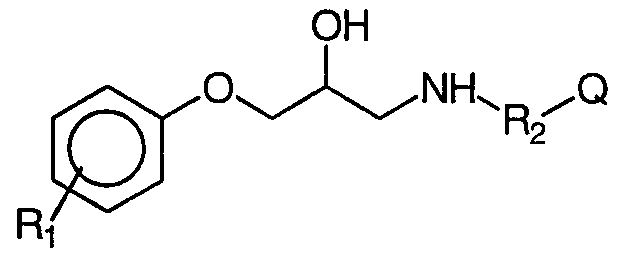
R substituant du groupe phényle, en position 2, 3 ou 4, représente un atome d'hydrogène, un atome d'halogène ou l'un des groupes suivants : hydroxyle, alkyle inférieur en C -C notamment choisi parmi les groupes méthyle, éthyle, propyle, isopropyle, butyle, tertiobutyle ; alkyloxy en CrC10 et notamment méthoxy ; benzyloxy ; nitro ; cyano ; trifluorométhyle ; amino éventuellement substitué (mono ou di-substitué) par 1 ou 2 radicaux alkyles inférieurs, tels que précisés ci-dessus, R représente l'un des groupes suivants : -CH -, -CH -CH -, -CH(CH )-CH -,R substituent of the phenyl group, in position 2, 3 or 4, represents a hydrogen atom, a halogen atom or one of the following groups: hydroxyl, lower C -C alkyl, in particular chosen from methyl, ethyl groups , propyl, isopropyl, butyl, tert-butyl; C 1 -C 10 alkyloxy and in particular methoxy; benzyloxy; nitro; cyano; trifluoromethyl; amino optionally substituted (mono or di-substituted) by 1 or 2 lower alkyl radicals, as specified above, R represents one of the following groups: -CH -, -CH -CH -, -CH (CH) - CH -,
-C(CH3)=CH-, -C(CH3)2-CH2- ou une liaison ; Q représente :-C (CH 3 ) = CH-, -C (CH 3 ) 2 -CH 2 - or a bond; Q represents:
(i) un radical phényle 3,4-disubstitué alkylene dioxy déterminant avec le radical phényle, un motif benzodioxane non substitué, un motif benzodioxol non substitué, ou un motif benzodioxol 2-substitué par deux radicaux R et R conformément à la formule suivante :(i) a 3,4-disubstituted phenylene alkylene dioxy radical determining with the phenyl radical, an unsubstituted benzodioxane unit, an unsubstituted benzodioxol unit, or a 2-substituted benzodioxol unit with two radicals R and R in accordance with the following formula:


R5 représente un atome d'hydrogène ou un radical alkyle inférieur en C -C , linéaire ou ramifié, x est un nombre entier compris entre 1 et 3 y est 0 ou 1,R 5 represents a hydrogen atom or a linear or branched lower C -C alkyl radical, x is an integer between 1 and 3 y is 0 or 1,
(iii) un hydrocarbure polycyclique condensé comprenant au moins deux cycles condensés et choisis parmi les motifs suivants : indène, indacène, naphtalène, azulène, biphénylène, acénaphtylène, fluorène, phénalène, phénanthrène, anthracène, (iv) un système hydrocarboné cyclique, éventuellement ponté, et constituant un cycloalkane comprenant 1, 2 ou 3 cycles, comportant éventuellement des substituants choisis parmi les groupes méthyle, éthyle, isopropyle, propyle, butyle, tertiobutyle, le cycle principal comportant 5 ou 6 chaînons.(iii) a condensed polycyclic hydrocarbon comprising at least two condensed rings and chosen from the following units: indene, indacene, naphthalene, azulene, biphenylene, acenaphthylene, fluorene, phenalene, phenanthrene, anthracene, (iv) a cyclic hydrocarbon system, optionally bridged , and constituting a cycloalkane comprising 1, 2 or 3 rings, optionally comprising substituents chosen from methyl, ethyl, isopropyl, propyl, butyl, tert-butyl groups, the main ring comprising 5 or 6 members.
A titre d'exemple, on entend par cycloalkane à un cycle, un cyclo- pentane ou un cyclohexane ; par cycloalkane à deux cycles, les terpènes et par cyclo- alkane à trois cycles, notamment les adamantanes.By way of example, the term “cycloalkane with a ring” means a cyclopentane or a cyclohexane; by two-ring cycloalkane, terpenes and by three-ring cycloalkane, especially adamantanes.
Les composés de formule (I) comprennent également les sels phar- macologiquement acceptables de ces dérivés ainsi que l'ensemble des isomères optiques et leurs composants ou mélanges de diastéréoisomères. Les produits basiques selon la présente invention peuvent être salifiés par les acides minéraux habituels et également par les acides organiques couramment employés comme tartrique, maléique, malo- nique, fumarique, succinique, méthanesulfonique, éthènesulfonique, hydroxyéthane- sulfonique. Les dérivés à caractère acide peuvent être salifiés par les bases minérales pharmacologiquement acceptables comme les agents alcalins ou alcalino-terreux, ou par les bases organiques non toxiques comme les aminés aliphatiques, les aminoalcools ou analogues.The compounds of formula (I) also include the pharmacologically acceptable salts of these derivatives as well as all of the optical isomers and their components or mixtures of diastereoisomers. The basic products according to the present invention can be salified by the usual mineral acids and also by the organic acids commonly used as tartaric, maleic, malonic, fumaric, succinic, methanesulphonic, ethenesulphonic, hydroxyethanesulphonic. The acid derivatives can be salified with pharmacologically acceptable mineral bases such as alkaline or alkaline-earth agents, or with non-toxic organic bases such as aliphatic amines, amino alcohols or the like.
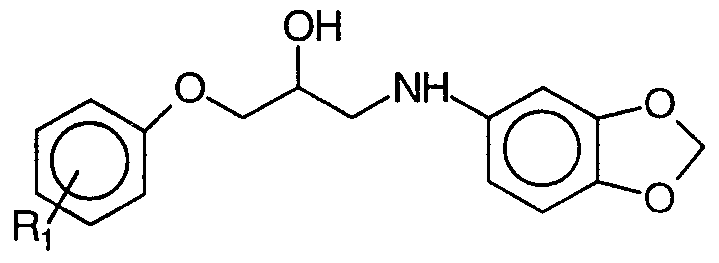
Parmi les composés de formule (I) préférés, on peut citer :Among the preferred compounds of formula (I), there may be mentioned:
- les composés comprenant un benzodioxol non substitué :- compounds comprising an unsubstituted benzodioxol:
=> répondant à la formule suivante :


- le composé répondant à la formule suivante :- the compound corresponding to the following formula:

- les composés dans lesquels : Ri représente un atome d'hydrogène, un 4-0 méthyle, un 3 -OH, un groupe trifluorométhyle,- the compounds in which: Ri represents a hydrogen atom, a 4-0 methyl, a 3 -OH, a trifluoromethyl group,
R2 représente une liaison, ou l'un des groupes suivants : -CH - ou - CH2-CH2- etR 2 represents a bond, or one of the following groups: -CH - or - CH 2 -CH 2 - and
Q représente un groupe fluorène ou un système hydrocarboné cyclique, par exemple un cyclohexyle, un groupe adamantyl- 1 ou un groupe adamantyl- Les composés de formule (I) peuvent être préparés par réaction - d'un composé phénoxyépoxypropane de formule IIIQ represents a fluorene group or a cyclic hydrocarbon system, for example a cyclohexyl, an adamantyl-1 group or an adamantyl- group The compounds of formula (I) can be prepared by reaction of a phenoxyepoxypropane compound of formula III

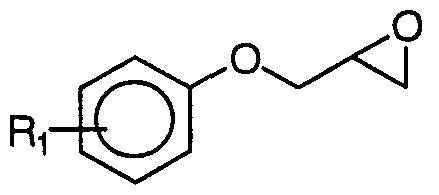
(formule III), dans laquelle R a la signification ci-dessus, avec(formula III), in which R has the above meaning, with
- une aminé primaire répondant à la formule (IV)- a primary amine corresponding to formula (IV)
/R2 -/ R2 -
(formule IV) dans laquelle R et Q ont les significations ci-dessus.(formula IV) in which R and Q have the above meanings.
Certains composés de formule (III) sont accessibles commercialement ; sinon ils peuvent être préparés par réaction d'un phénol convenablement choisi quant à l'identité de R , avec une épichlorhydrine ou une épibromhydrine, en présence d'un accepteur d'halogène dans un solvant polaire, de préférence. Si la nature du substituant R le rend sensible à cette réaction de condensation, il est préférable de le protéger avant la réaction, selon une technique adaptée comme décrit par exemple dans "Protective Group in Organic Synthesis, 2nd, Ed., T.W. Greeneand P.G.M. Wuts, John Wiley and sons, New York, 1991". Certains composés selon la formule (IV) sont commerciaux ; d'autres peuvent être préparés par différentes méthodes, dont celle représentée ci-après, pour ce qui concerne le produit de formule (I) dans laquelle Q représente un groupement selon la formule (II).Certain compounds of formula (III) are commercially accessible; otherwise they can be prepared by reaction of a phenol suitably chosen as to the identity of R, with an epichlorohydrin or an epibromohydrin, preferably in the presence of a halogen acceptor in a polar solvent. If the nature of the substituent R makes it sensitive to this condensation reaction, it is preferable to protect it before the reaction, according to a suitable technique as described for example in "Protective Group in Organic Synthesis, 2nd, Ed., TW Greeneand PGM Wuts , John Wiley and sons, New York, 1991 ". Certain compounds according to formula (IV) are commercial; others can be prepared by different methods, including the one shown below, as regards the product of formula (I) in which Q represents a group according to formula (II).
Le procédé de préparation est illustré au schéma 1 ci-après.The preparation process is illustrated in diagram 1 below.

Z = CN ou N02 R - f Bu ou Et n = 0 ou ^ Le traitement du nitrophénol (ou du cyanophénol) 14 avec du tert- butylbromoacétate et du carbonate de potassium anhydre dans de l'acétone donne le produit 15 qui est soumis à une hydrogénation en présence de Pd/C(10 %) et qui conduit à l'aminé 16 (schéma 1). Lorsque Z est un groupe cyano, la réduction catalytique en présence de Pd/C produit des dérivés mono- et dibenzylamine.Z = CN or N0 2 R - f Bu or Et n = 0 or ^ Treatment of nitrophenol (or cyanophenol) 14 with tert-butylbromoacetate and anhydrous potassium carbonate in acetone gives product 15 which is subjected to hydrogenation in the presence of Pd / C (10%) and which leads to amine 16 (diagram 1). When Z is a cyano group, the catalytic reduction in the presence of Pd / C produces mono- and dibenzylamine derivatives.
Les intermédiaires de formule (III) et de formule (IV) NH -R -Q sont couplés par chauffage (sous forme brut ou en solution dans un solvant polaire tel que le diméthylformamide anhydre), pendant 12 à 14 heures, à une température comprise entre 70 et 100°C, pour fournir des composés de formule (I). Certains composés de for- mule (I) sont obtenus avec une ou deux fonctions esters, qui réagissent respectivement avec HC1 6N à 80°C pendant 12 heures et avec NaOH IN à température ambiante pendant 12 à 48 heures, pour obtenir le sel d'acide carboxylique comme illustré au schéma 2 :The intermediates of formula (III) and of formula (IV) NH -R -Q are coupled by heating (in crude form or in solution in a polar solvent such as anhydrous dimethylformamide), for 12 to 14 hours, at a temperature included between 70 and 100 ° C, to provide compounds of formula (I). Certain compounds of formula (I) are obtained with one or two ester functions, which react respectively with HCl 6N at 80 ° C for 12 hours and with NaOH IN at room temperature for 12 to 48 hours, to obtain the salt of carboxylic acid as illustrated in diagram 2:
Schéma 2Diagram 2
sonhis

Ces composés peuvent être employés en alimentation animale pour éviter un engraissement non fructueux des animaux et favoriser, au contraire, l'accroissement de la masse musculaire. Leur activité β3 se manifestant essentiellement sur le muscle lisse, la modération de la contraction intestinale ne se fait donc pas au détriment d'un effet cardio-vasculaire.These compounds can be used in animal nutrition to avoid an unsuccessful fattening of animals and to favor, on the contrary, the increase in muscle mass. Their β3 activity being manifested mainly on smooth muscle, the moderation of the intestinal contraction is therefore not to the detriment of a cardiovascular effect.
Une préparation contenant au moins un produit répondant à la formule (I) selon l'invention peut être administrée à l'animal, dont l'homme, atteint de dia- bète, d'obésité ou de dérèglement de la motilité intestinale.A preparation containing at least one product corresponding to formula (I) according to the invention can be administered to animals, including humans, suffering from diabetes, obesity or dysregulation of the intestinal motility.
Les produits selon l'invention sont administrés de préférence par voie orale ou sublinguale, mais d'autres voies d'administration peuvent aussi bien être utilisées (voies intranasale, transdermale, parentérale telles que sous-cutanée, intraveineuse, intrapéritonéale). Les doses administrées, varient, selon le cas, de 0, 1 à 100 mg/kg de poids vif, de préférence de 1 à 10 mg/kg de poids vif.The products according to the invention are preferably administered orally or sublingually, but other routes of administration can also be used (intranasal, transdermal, parenteral routes such as subcutaneous, intravenous, intraperitoneal). The doses administered vary, depending on the case, from 0.1 to 100 mg / kg bodyweight, preferably from 1 to 10 mg / kg bodyweight.
Si nécessaire, les composés selon la formule (I) peuvent être administrés en combinaison avec des produits βl ou β2 adrénergiques.If necessary, the compounds according to formula (I) can be administered in combination with β1 or β2 adrenergic products.
Dans le traitement de l'obésité, éventuellement associé à un traite- ment du diabète, ces produits sont administrés à des doses de 1 à 10 mg/kg de poids corporel ; dans le cas de l'administration à l'animal des formes pharmaceutiques propres peuvent être employées suivant l'espèce et comporte notamment les solutions à étaler sur le corps de l'animal (solution à étaler manuellement, solution à étaler par vaporisation etc.). Les composés de la présente invention sont formulés en comprimés, capsules, gélules ou sirop destinés à l'administration par voie orale. Ces formes gélules, capsules, comprimés peuvent contenir des excipients habituellement utilisés en formu- lation pharmaceutique tels que des adjuvants ou liants comme des amidons, des gommes, de la gélatine ainsi que des adjuvants comme le phosphate de calcium, des délitants comme l'amidon de maïs ou les acides alginiques, un lubrifiant comme le stéarate de magnésium, des agents édulcorants ou des arômes. Les solutions ou suspensions peuvent être préparées en milieu aqueux ou non aqueux par l'addition de solvants pharmacologiquement compatibles. Parmi ceux-ci, les glycols, polyglycols, propylène- glycols, éther de polyglycol, DMSO et éthanol.In the treatment of obesity, possibly combined with a treatment for diabetes, these products are administered in doses of 1 to 10 mg / kg of body weight; in the case of administration to the animal of the clean pharmaceutical forms can be used according to the species and includes in particular the solutions to spread on the body of the animal (solution to spread manually, solution to spread by spraying etc.) . The compounds of the present invention are formulated into tablets, capsules, capsules or syrup intended for oral administration. These gelatin capsules, capsules and tablets may contain excipients usually used in formulations. Pharmaceutical lation such as adjuvants or binders such as starches, gums, gelatin as well as adjuvants such as calcium phosphate, disintegrants such as corn starch or alginic acids, a lubricant such as magnesium stearate, sweetening agents or flavorings. The solutions or suspensions can be prepared in an aqueous or non-aqueous medium by the addition of pharmacologically compatible solvents. Among these are glycols, polyglycols, propylene glycols, polyglycol ether, DMSO and ethanol.
Ils peuvent également être formulés en suspension ou solution stérile destinée à l'administration parentérale ou intranasale ou encore être présentés en patch transdermique. La dose unitaire comprise entre 1 et 500 mg de composé de formule (I) est mélangée avec un excipient adapté à la forme réalisée ; solvant, diluant, excipient, conservateur, édulcorant, parfum. La quantité de principe actif présent dans chaque dose unitaire est telle qu'elle puisse être administrée une ou plusieurs fois dans la journée. Des formulations à relargage programmé peuvent être également préparées pour obtenir un effet durable dans le temps permettant d'espacer les prises de traitement.They can also be formulated in sterile suspension or solution intended for parenteral or intranasal administration or even be presented in transdermal patch. The unit dose of between 1 and 500 mg of compound of formula (I) is mixed with an excipient suitable for the form produced; solvent, diluent, excipient, preservative, sweetener, fragrance. The amount of active ingredient present in each unit dose is such that it can be administered one or more times during the day. Formulations with programmed release can also be prepared to obtain a lasting effect over time, making it possible to space out treatment intakes.
Les exemples cités illustrent le contenu de l'invention sans en limiter la portée aux seuls exemples décrits.The examples cited illustrate the content of the invention without limiting its scope to the examples described only.
EXEMPLE 1EXAMPLE 1

36,6 g (332,40 mmoles) de résorcinol et 42 g (331,78 mmoles) de benzylchlorure sont mis à reflux pendant une nuit sous agitation, en présence de 46,6 g de K CO dans 250 ml de Me CO sec. Le mélange est refroidi, filtré et évaporé. Le résidu obtenu est dilué dans 500 ml d'eau et extrait à l'éthanol. La couche organique est lavée avec NaOH aqueux à 10 % et extraite à l'éthanol. L'huile de couleur rouge obtenue est distillée à l'aide d'un "appareil de distillation Kugelrohr" pour obtenir 18 g de m-PhCH2OC6H4OH, bJ5 240-245°C (litt. bn 202-210°C). Une solution de 3,3 g (16,5 mmoles) de m-PhCH 2 OC 6 H 4 OH dans 50 ml de DMF est traitée avec 0,8 ^ ( x16,5 mmoles) d'hydrure de sodium et le mélange est agité pendant 15 minutes. Après l'addition de 13,75 ml (16,5 mmoles) d'épichlorhydrine, le mélange est agité à 60°C pendant une heure jusqu'à complète alkylation. Le réactif en excès et le solvant sont évaporés sous pression réduite et le résidu est réparti entre les deux phases suivantes : de l'éthy- lacétate et de l'eau. La phase organique fournit l'époxyde, qui est utilisé sans autre purification.36.6 g (332.40 mmol) of resorcinol and 42 g (331.78 mmol) of benzylchloride are refluxed overnight with stirring, in the presence of 46.6 g of K CO in 250 ml of dry Me CO . The mixture is cooled, filtered and evaporated. The residue obtained is diluted in 500 ml of water and extracted with ethanol. The organic layer is washed with 10% aqueous NaOH and extracted with ethanol. The red oil obtained is distilled using a "Kugelrohr distillation apparatus" to obtain 18 g of m-PhCH 2 OC 6 H 4 OH, b J5 240-245 ° C (litt. B n 202 -210 ° C). A solution of 3.3 g (16.5 mmol) of m-PhCH 2 OC 6 H 4 OH in 50 ml of DMF is treated with 0.8 ^ ( x 16.5 mmol) of sodium hydride and the mixture is stirred for 15 minutes. After the addition of 13.75 ml (16.5 mmol) of epichlorohydrin, the mixture is stirred at 60 ° C for one hour until complete alkylation. The excess reagent and the solvent are evaporated under reduced pressure and the residue is distributed between the following two phases: ethylacetate and water. The organic phase provides the epoxide, which is used without further purification.
L'époxyde est dissous dans du DMF contenant un équivalent d'aminé et chauffé une nuit à 80°C. Après refroidissement, le solvant est éliminé sous vide et le résidu huileux est chromatographié sur une colonne de gel de silice en utilisant un mélange de solvants et recristallisé comme indiqué au Tableau I.The epoxide is dissolved in DMF containing an equivalent of amine and heated overnight to 80 ° C. After cooling, the solvent is removed in vacuo and the oily residue is chromatographed on a column of silica gel using a mixture of solvents and recrystallized as indicated in Table I.
TABLEAU ITABLE I
Données chimiques des composés IChemical data of compounds I
Composé Rdt % Solvant Pt de fusion de °C cristallisationCompound Yield% Solvent Melting point of ° C crystallization
lia H 67 MeOH 102-103

Ile m-Cl 62 MeOH 128-129Ile m-Cl 62 MeOH 128-129
Ild p-Cl 74 EtOH 98-99Ild p-Cl 74 EtOH 98-99
Ile m-OH 62 CH 3CN 230-231Ile m-OH 62 CH 3CN 230-231
Ilf m-NO 2 47 MeOH 129-130 iig m-CN 55 MeOH 138-139Ilf m-NO 2 47 MeOH 129-130 iig m-CN 55 MeOH 138-139
Ilh m-CF 3 39 MeOH 121-122Ilh m-CF 3 39 MeOH 121-122
Les spectres RMN de H (δ) des composés selon l'exemple 1 sont illustrés ci-après :The NMR spectra of H (δ) of the compounds according to Example 1 are illustrated below:
Composé la (base libre), δ (ppm) : 2,59 (m, 2H), 3,62 (s, 2H), 3,90 (m, 3H), 5,95 (s, 2H), 6,78 (m, 2H Ar), 6,90 (m, 4H Ar), 7,26 (dt, 2H Ar, J = 7,73, 1,02 Hz). Composé lb (base libre), δ (ppm) : 2,52 (m, 2H), 3,61 (s, 2H), 3,68 (s, 3H), 3,83 (m, 3H), 4,88 (b, NH), 5,95 (s, 2H), 6,75 (dd, IH Ar, J = 8,0, 1,38 Hz), 6,81 (d, IH Ar, JCompound (free base), δ (ppm): 2.59 (m, 2H), 3.62 (s, 2H), 3.90 (m, 3H), 5.95 (s, 2H), 6, 78 (m, 2H Ar), 6.90 (m, 4H Ar), 7.26 (dt, 2H Ar, J = 7.73, 1.02 Hz). Compound lb (free base), δ (ppm): 2.52 (m, 2H), 3.61 (s, 2H), 3.68 (s, 3H), 3.83 (m, 3H), 4.88 (b, NH), 5.95 (s, 2H), 6.75 (dd, IH Ar, J = 8.0, 1.38 Hz), 6.81 (d, IH Ar , J
= 8,0 Hz), 6,83 (s, 4H), 6,89 (d, IH Ar, J = 1,1 Hz).= 8.0 Hz), 6.83 (s, 4H), 6.89 (d, IH Ar, J = 1.1 Hz).
Composé le (maléate), δ (ppm) : 2,90 (dd, IH, J = 13,56, 9,40 Hz), 3,07 (dd, IH, J =Compound (maleate), δ (ppm): 2.90 (dd, IH, J = 13.56, 9.40 Hz), 3.07 (dd, IH, J =
12,59, 2,94 Hz), 3,97 (d, 2H, J = 5,07 Hz), 4, 10 (s, 2H), 4, 12 (m, IH), 6,01 (s, 2H), 6,04 (s, 2H), 6,90 (dd, IH Ar, J = 8,31, 2,14 Hz), 7,00 (m, 4H Ar), 7,09 (s, IH Ar),12.59, 2.94 Hz), 3.97 (d, 2H, J = 5.07 Hz), 4, 10 (s, 2H), 4, 12 (m, IH), 6.01 (s, 2H), 6.04 (s, 2H), 6.90 (dd, IH Ar, J = 8.31, 2.14 Hz), 7.00 (m, 4H Ar), 7.09 (s, IH Ar),
7,31 (t, IH Ar, J = 8,42 Hz).7.31 (t, IH Ar, J = 8.42 Hz).
Composé ld (maléate), δ (ppm) : 2,90 (dd, IH, J = 12,63, 9,20 Hz), 3,08 (dd, IH, J =Compound ld (maleate), δ (ppm): 2.90 (dd, IH, J = 12.63, 9.20 Hz), 3.08 (dd, IH, J =
12,67, 3,18 Hz), 3,93 (d, 2H, J = 5,18 Hz), 4,10 (s, 2H), 4,12 (m,2H), 6,03 (s, 2H),12.67, 3.18 Hz), 3.93 (d, 2H, J = 5.18 Hz), 4.10 (s, 2H), 4.12 (m, 2H), 6.03 (s, 2H),
6,04 (s, 2H), 6,95 (m, 4H Ar), 7,09 (s, IH), 7,34 (d, 2H, J = 8,99 Hz). Composé le (base libre), δ (ppm) : 2,85 (dd, IH, J = 12,47, 8,89 Hz), 3,04 (dd, IH, J6.04 (s, 2H), 6.95 (m, 4H Ar), 7.09 (s, 1H), 7.34 (d, 2H, J = 8.99 Hz). Composed on (free base), δ (ppm): 2.85 (dd, IH, J = 12.47, 8.89 Hz), 3.04 (dd, IH, J
= 12,63, 3,02 Hz), 3,93 (d, 2H, J = 5, 18 Hz), 4,07 (s, 2H), 4,23 (m, IH), 5,85 (m, IH= 12.63, 3.02 Hz), 3.93 (d, 2H, J = 5.18 Hz), 4.07 (s, 2H), 4.23 (m, IH), 5.85 (m , IH
Ar), 6,03 (s, 2H), 6,53 (m, 2H Ar), 6,92 (d, IH Ar, J = 8,0 Hz), 7,02 (dd, IH Ar, J =Ar), 6.03 (s, 2H), 6.53 (m, 2H Ar), 6.92 (d, IH Ar, J = 8.0 Hz), 7.02 (dd, IH Ar, J =
8,0, 1,58 Hz), 7,19 (m, 2H Ar).8.0, 1.58 Hz), 7.19 (m, 2H Ar).
Composé lf (base libre), δ (ppm) : 2,58 (t, 2H, J = 5,64 Hz), 3,62 (s, 2H), 3,89 (m, IH), 3,97 (dd, IH, J = 15,59, 5,98 Hz), 4,11 (dd, IH, J - 15,14, 4,0 Hz), 4,99 (b, IH),Compound lf (free base), δ (ppm): 2.58 (t, 2H, J = 5.64 Hz), 3.62 (s, 2H), 3.89 (m, IH), 3.97 ( dd, IH, J = 15.59, 5.98 Hz), 4.11 (dd, IH, J - 15.14, 4.0 Hz), 4.99 (b, IH),
5,94 (s, 2H), 6,78 (m, 2H), 6,89 (s, IH), 7,39 (ddd, IH, J = 8,29, 2,47, 0,95 Hz), 7,555.94 (s, 2H), 6.78 (m, 2H), 6.89 (s, IH), 7.39 (ddd, IH, J = 8.29, 2.47, 0.95 Hz) , 7.55
(dd, IH, J = 6,93, 1,05 Hz).(dd, 1H, J = 6.93, 1.05 Hz).
Composé lg (base libre), δ (ppm) : 2,55 (m, 2H), 3,61 (s, 2H), 3,89-4,05 (m, 3H),Compound lg (free base), δ (ppm): 2.55 (m, 2H), 3.61 (s, 2H), 3.89-4.05 (m, 3H),
4,97 (s, IH), 5,95 (s, 2H), 6,72-6,78 (m, 2H), 6,88 (s, IH), 7,24-7,50 (m, 4H). Composé lh (base libre), δ (ppm) : 2,58 (m, 2H), 3,61 (s, 2H), 3,90-4,05 (m, 3H),4.97 (s, IH), 5.95 (s, 2H), 6.72-6.78 (m, 2H), 6.88 (s, IH), 7.24-7.50 (m, 4H). Compound lh (free base), δ (ppm): 2.58 (m, 2H), 3.61 (s, 2H), 3.90-4.05 (m, 3H),
4,97 (s, IH), 5,94 (s, 2H), 6,72-6,78 (m, 2H), 6,89 (s, IH), 7,20-7,27 (m, 3H), 7,49 (t,4.97 (s, 1H), 5.94 (s, 2H), 6.72-6.78 (m, 2H), 6.89 (s, 1H), 7.20-7.27 (m, 3H), 7.49 (t,
IH, J = 7,69 Hz).1H, J = 7.69 Hz).
EXEMPLE 2EXAMPLE 2

De manière analogue à celle de l'Exemple 1, les composés selon l'exemple 2 sont préparés à partir d'un époxyde du commerce.Analogously to that of Example 1, the compounds according to Example 2 are prepared from a commercial epoxide.
Les propriétés chimiques et les spectres RMN de ces produits sont illustrés ci-après : TABLEAU HThe chemical properties and NMR spectra of these products are illustrated below: TABLE H
Données chimiques des composés selon l'exemple 2Chemical data of the compounds according to Example 2
Composé Rt Rdt. % Solvant Pt de fusion °C 2a H 45 EtOAc/cyclohex (2/8) 80 - 81Compound R t Rdt. % Solvent Melting point ° C 2a H 45 EtOAc / cyclohex (2/8) 80 - 81
2b p-OMe 65 Et2O/cyclohex 80 - 812b p-OMe 65 Et 2 O / cyclohex 80 - 81
i Spectres RMN H (δ) des composés 2i H (δ) NMR spectra of compounds 2
Composé 2a (base libre), δ (ppm) : 3,22 (dd, IH, J = 12,77, 7,02 Hz), 3,37 (dd, IH, J = 12,76, 4,21 Hz), 4,05 (m, 2H), 4,22 (m, IH), 5,86 (s, 2H), 6, 11 (dd, IH Ar, J = 8,26, 2,27 Hz), 6,32 (d, IH Ar, J = 2,25 Hz), 6,66 (d, IH Ar, J = 8,26 Hz), 6,96 (m, 3H, Ar), 7,30 (m, 2H, Ar).Compound 2a (free base), δ (ppm): 3.22 (dd, IH, J = 12.77, 7.02 Hz), 3.37 (dd, IH, J = 12.76, 4.21 Hz ), 4.05 (m, 2H), 4.22 (m, IH), 5.86 (s, 2H), 6, 11 (dd, IH Ar, J = 8.26, 2.27 Hz), 6.32 (d, IH Ar, J = 2.25 Hz), 6.66 (d, IH Ar, J = 8.26 Hz), 6.96 (m, 3H, Ar), 7.30 (m , 2H, Ar).
Composé 2b (base libre), δ (ppm) : 3,21 (dd, IH, J = 12,75, 7,07 Hz), 3,35 (dd, IH, J = 12,73, 4,22 Hz), 3,78 (s, 3H), 3,97 (dd, IH, J = 9,55, 6,06 Hz), 4,03 (dd, IH, J = 11,49, 6,18 Hz), 4,20 (m, IH), 5,86 (s, 2H), 6, 11 (dd, IH Ar, J = 8,31, 2,34 Hz), 6,31 (d, IH Ar, J - 2,30 Hz), 6,66 (d, IH Ar, J = 8,28 Hz), 6,85 (s, 4H Ar).Compound 2b (free base), δ (ppm): 3.21 (dd, IH, J = 12.75, 7.07 Hz), 3.35 (dd, IH, J = 12.73, 4.22 Hz ), 3.78 (s, 3H), 3.97 (dd, IH, J = 9.55, 6.06 Hz), 4.03 (dd, IH, J = 11.49, 6.18 Hz) , 4.20 (m, IH), 5.86 (s, 2H), 6, 11 (dd, IH Ar, J = 8.31, 2.34 Hz), 6.31 (d, IH Ar, J - 2.30 Hz), 6.66 (d, IH Ar, J = 8.28 Hz), 6.85 (s, 4H Ar).
EXEMPLE 3EXAMPLE 3

Un mélange de 3 g (21,56 mmoles) de 3-nitro-phénol, 4,3 g (22 mmoles) de tert-butylbromoacétate, 3,2 g de carbonate de potassium anhydre et 50 ml d'acétone est agité une nuit à température ambiante. Le mélange est filtré, lavé à l'acé- tone et aussi bien le filtrat que le produit de lavage sont évaporés jusqu'à l'obtention d'une huile jaune. L'huile est purifiée sur colonne de chromatographié de gel de silice, éluée avec un mélange EtOAc/cyclohexane (50/50) pour obtenir 5 g (92 %) de tert- butyl-3-nitrophénoxyacétate (huile incolore). On ajoute à une solution de 4,8 g (18,95 mmoles) de tert-butyl-3-nitrophénoxyacétate dans 20 ml d'éthanol, 2 g de Pd/C (10 %) et le mélange est hydrogéné une nuit à une atmosphère. Le catalyseur est éliminé par filtration. Le solvant est évaporé pour obtenir 3,38 g (80 %) de tert-butyl-3-amido- phénoxyacétate, qui est chromatographié sur une colonne de gel de silice en utilisant comme éluant un mélange EtOAc/cyclohexane (50/50). Un mélange de l'aminé obtenue (0,5 g, 2,24 mmoles) et de l,2-époxy-3-phénoxypropane est chauffé à 70°C pendant une nuit. Après refroidissement, le produit est lavé avec de l'éthanol et le précipité est filtré pour donner 0,6 g de tert-butyl ester. 0,6 g de cet ester et 15 ml d'HCl 6N sont mélangés une nuit à 80°C. Le solvant est évaporé et le résidu est lavé avec un mélange EtOH, CH CN puis recristallisé à partir du CH CN pour donner 0,36 g de sel dont les i caractéristiques sont les suivantes : point de fusion 138-139°C ; RMN de H (DMSO- d6) δ 3,82 (m, 2H), 3,96 (m, 4H), 4,06 (m, IH), 4,72 (s, 2H), 6,88-7,00 (m, 5H Ar), 7,24-7,45 (m, 4H Ar) . EXEMPLE 4A mixture of 3 g (21.56 mmol) of 3-nitro-phenol, 4.3 g (22 mmol) of tert-butylbromoacetate, 3.2 g of anhydrous potassium carbonate and 50 ml of acetone is stirred overnight at room temperature. The mixture is filtered, washed with acetone and both the filtrate and the washing product are evaporated until a yellow oil is obtained. The oil is purified on a column of silica gel chromatographed, eluted with an EtOAc / cyclohexane mixture (50/50) to obtain 5 g (92%) of tert-butyl-3-nitrophenoxyacetate (colorless oil). To a solution of 4.8 g (18.95 mmol) of tert-butyl-3-nitrophenoxyacetate in 20 ml of ethanol, 2 g of Pd / C (10%) are added and the mixture is hydrogenated overnight at atmosphere. The catalyst is removed by filtration. The solvent is evaporated to obtain 3.38 g (80%) of tert-butyl-3-amidophenoxyacetate, which is chromatographed on a column of silica gel using an EtOAc / cyclohexane mixture (50/50) as eluent. A mixture of the amine obtained (0.5 g, 2.24 mmol) and 1,2-epoxy-3-phenoxypropane is heated at 70 ° C overnight. After cooling, the product is washed with ethanol and the precipitate is filtered to give 0.6 g of tert-butyl ester. 0.6 g of this ester and 15 ml of 6N HCl are mixed overnight at 80 ° C. The solvent is evaporated off and the residue is washed with an EtOH, CH CN mixture and then recrystallized from CH CN to give 0.36 g of salt, the characteristics of which are as follows: melting point 138-139 ° C; H NMR (DMSO- d 6 ) δ 3.82 (m, 2H), 3.96 (m, 4H), 4.06 (m, 1H), 4.72 (s, 2H), 6.88- 7.00 (m, 5H Ar), 7.24-7.45 (m, 4H Ar). EXAMPLE 4

Acide 4-[(3-phénoxy-2-hydroxypropyl)amidométhyl]phén-oxyacétique, sel d'hydrochlorure (Rt = H)4 - [(3-phenoxy-2-hydroxypropyl) amidomethyl] phen-oxyacetic acid, hydrochloride salt (R t = H)
Un mélange de 22,16 g (0,186 mole) de 4-cyanophénol, 32,07 g (0,192 mole) d'éthylbromoacétate, 27,6 g (0,199 mole) de K2CO, et d'acétone (250 ml) est agité à température ambiante pendant 12 heures. Après filtration, le solvant est évaporé sous vide et le résidu réparti entre une phase organique (éthylacétate) et une phase aqueuse (eau). La couche organique est séchée (MgSO ) et concentrée sous vide pour donner 36,42 g (95 %) d'éthyl-4-cyanophénoxy-acétate (solide blanc, point de fusion : 49-50°C.A mixture of 22.16 g (0.186 mole) of 4-cyanophenol, 32.07 g (0.192 mole) of ethylbromoacetate, 27.6 g (0.199 mole) of K 2 CO, and acetone (250 ml) is stirred at room temperature for 12 hours. After filtration, the solvent is evaporated in vacuo and the residue distributed between an organic phase (ethyl acetate) and an aqueous phase (water). The organic layer is dried (MgSO) and concentrated in vacuo to give 36.42 g (95%) of ethyl-4-cyanophenoxy-acetate (white solid, melting point: 49-50 ° C.
On ajoute 1,5 g de Pd/C (10 %) à une solution de l'ester obtenu (4,1 g, 20 mmoles) dans de l'éthanol (80 ml) et le mélange est hydrogéné sous une pression de 50 bars à température ambiante pendant 16 heures. Le catalyseur est éliminé par filtration (Célite ) et le filtrat est concentré sous vide, pour donner un mélange de 38 % de dérivé monobenzylamine et de 42 % de dérivé dibenzylamine, qui est chromatographié sur gel de silice en utilisant comme éluant, un mélange EtOAc/MeOH : (8/2). 0,4 g (1,9 mmole) d'aminé 16 (n = 1 et R = Et) est dissous dans du DMF (5 ml) contenant un équivalent (0,3 g, 2 mmoles) de (±)-l,2-époxy-3-phénoxy- propane et chauffé une nuit à 80°C. Après refroidissement, le solvant est éliminé sous vide et le résidu huileux est trituré avec Et O, filtré et lavé avec EtOH et MeOH pour donner 0,25 g (37 %) d'acide éthyl-4-[3-phénoxy-2-hydroxypropyl)amido- méthyljphénoxyacétique, un ester sous la forme d'un solide blanc, de point de fusion : 120°C, qui est hydrolyse avec HC1 6N, comme précisé à l'Exemple 3, pour donner le dérivé recherché, sous la forme d'un solide blanc.1.5 g of Pd / C (10%) are added to a solution of the ester obtained (4.1 g, 20 mmol) in ethanol (80 ml) and the mixture is hydrogenated under a pressure of 50 bars at room temperature for 16 hours. The catalyst is removed by filtration (Celite) and the filtrate is concentrated under vacuum, to give a mixture of 38% of monobenzylamine derivative and 42% of dibenzylamine derivative, which is chromatographed on silica gel using an EtOAc mixture as eluent. / MeOH: (8/2). 0.4 g (1.9 mmol) of amine 16 (n = 1 and R = Et) is dissolved in DMF (5 ml) containing an equivalent (0.3 g, 2 mmol) of (±) -1 , 2-epoxy-3-phenoxy-propane and heated overnight at 80 ° C. After cooling, the solvent is removed in vacuo and the oily residue is triturated with Et O, filtered and washed with EtOH and MeOH to give 0.25 g (37%) of ethyl-4- [3-phenoxy-2- acid hydroxypropyl) amidomethyljphenoxyacetic, an ester in the form of a white solid, of melting point: 120 ° C., which is hydrolyzed with HCl 6N, as specified in Example 3, to give the desired derivative, in the form of a solid white.
D'autres composés sont préparés selon la technique décrite dans l'Exemple 1 et présentent les caractéristiques ci-dessous : Other compounds are prepared according to the technique described in Example 1 and have the characteristics below:

Composé 5a (maléate), δ (ppm) : 3,17 (dd, IH, J = 11,97, 5,21 Hz), 3,31 (dd, IH, J =Compound 5a (maleate), δ (ppm): 3.17 (dd, IH, J = 11.97, 5.21 Hz), 3.31 (dd, IH, J =
12,0, 4,9 Hz), 3,74 (s, 2H), 4,01 (m, 3H), 6,25 (s, 2H), 6,68 (dd, IH Ar, J = 8,27, 2,06 Hz), 6,88 (m, 4H Ar), 7,10 (m, IH Ar), 7,27 (m, 3H Ar), 7,43 (d, IH Ar, J = 7, 16 Hz),12.0, 4.9 Hz), 3.74 (s, 2H), 4.01 (m, 3H), 6.25 (s, 2H), 6.68 (dd, IH Ar, J = 8, 27, 2.06 Hz), 6.88 (m, 4H Ar), 7.10 (m, IH Ar), 7.27 (m, 3H Ar), 7.43 (d, IH Ar, J = 7 , 16 Hz),
7,58 (m, 2H Ar).7.58 (m, 2H Ar).
Composé 5b (base libre), δ (ppm) : 3,16 (m, IH), 3,30 (m, IH), 3,69 (s, 3H), 3,73 (s,Compound 5b (free base), δ (ppm): 3.16 (m, 1H), 3.30 (m, 1H), 3.69 (s, 3H), 3.73 (s,
2H), 3,90 (m, 3H), 5,16 (d, IH, J = 4,84 Hz), 5,72 (t, IH NH, J = 5,79 Hz), 6,66 (dd,2H), 3.90 (m, 3H), 5.16 (d, IH, J = 4.84 Hz), 5.72 (t, IH NH, J = 5.79 Hz), 6.66 (dd ,
IH, J - 8,27, 2,01 Hz), 6,89 (m, 5H Ar), 7,10 (dt, IH Ar, J = 7,36, 1,09 Hz), 7,25 (dt, IH Ar, J = 7,43, 0,8 Hz), 7,42 (d, IH, J = 7,26 Hz), 7,54 (d, IH Ar, J = 8,27 Hz), 7,60IH, J - 8.27, 2.01 Hz), 6.89 (m, 5H Ar), 7.10 (dt, IH Ar, J = 7.36, 1.09 Hz), 7.25 (dt , IH Ar, J = 7.43, 0.8 Hz), 7.42 (d, IH, J = 7.26 Hz), 7.54 (d, IH Ar, J = 8.27 Hz), 7 .60
(d, lH Ar, J = 7,14 Hz).(d, 1H Ar, J = 7.14 Hz).
Composé 5c (maléate), δ (ppm) : 3,58 (m, 2H), 3,94 (m, 4H), 4, 11 (m, IH), 6, 17 (s,Compound 5c (maleate), δ (ppm): 3.58 (m, 2H), 3.94 (m, 4H), 4, 11 (m, 1H), 6, 17 (s,
2H), 6,37 (s, IH Ar), 6,56 (d, 2H, J = 7,96 Hz), 6,81 (d, IH Ar, J = 7,58 Hz), 6,97-2H), 6.37 (s, IH Ar), 6.56 (d, 2H, J = 7.96 Hz), 6.81 (d, IH Ar, J = 7.58 Hz), 6.97-
7,23 (m, 4H Ar), 7,42 (m, IH Ar), 7,57 (m, 2H Ar). Composé 6a (HCl), δ (ppm) : 3,54 (m, 2H), 3,85 (m, 3H), 4,15 (m, IH), 5,64 (s, IH);7.23 (m, 4H Ar), 7.42 (m, 1H Ar), 7.57 (m, 2H Ar). Compound 6a (HCl), δ (ppm): 3.54 (m, 2H), 3.85 (m, 3H), 4.15 (m, 1H), 5.64 (s, 1H);
6,75-6,92 (m, 4H Ar), 7,17-7,25 (m, 2H), 7,38-7,56 (m, 4H Ar), 7,96 (m, 2H Ar),6.75-6.92 (m, 4H Ar), 7.17-7.25 (m, 2H), 7.38-7.56 (m, 4H Ar), 7.96 (m, 2H Ar) ,
8,14 (m, lH Ar).8.14 (m, 1H Ar).
Composé 7 (HCl), δ (ppm) : 1,61 (m, 5H), 1,91 (m, 6H), 2,10 (m, 4H), 2,94 (m, IH),Compound 7 (HCl), δ (ppm): 1.61 (m, 5H), 1.91 (m, 6H), 2.10 (m, 4H), 2.94 (m, 1H),
3,12 (m, IH), 3,99 (dd, 2H, J = 5,08 Hz), 4,22 (m, IH), 6,90-6,97 (m, 3H Ar), 7,29 (t, 2H Ar, J = 8,29 Hz).3.12 (m, IH), 3.99 (dd, 2H, J = 5.08 Hz), 4.22 (m, IH), 6.90-6.97 (m, 3H Ar), 7, 29 (t, 2H Ar, J = 8.29 Hz).
Composé 8 (HCl), δ (ppm) : 1,59-1,92 (m, 10H), 2,41 (m, 4H), 3,62 (m, 3H), 4,03Compound 8 (HCl), δ (ppm): 1.59-1.92 (m, 10H), 2.41 (m, 4H), 3.62 (m, 3H), 4.03
(m, 2H), 4,56 (m, IH), 6,92-6,99 (m, 3H Ar), 7,29 (t, 2H Ar, J - 7,31 Hz).(m, 2H), 4.56 (m, 1H), 6.92-6.99 (m, 3H Ar), 7.29 (t, 2H Ar, J - 7.31 Hz).
Ainsi que cela ressort de ce qui précède, l'invention ne se limite nullement à ceux de ses modes de mise en oeuvre, de réalisation et d'application qui viennent d'être décrits de façon plus explicite ; elle en embrasse au contraire toutes les variantes qui peuvent venir à l'esprit du technicien en la matière, sans s'écarter du cadre, ni de la portée, de la présente invention. As is apparent from the above, the invention is in no way limited to those of its modes of implementation, embodiment and application which have just been described more explicitly; on the contrary, it embraces all the variants which may come to the mind of the technician in the matter, without departing from the framework, or the scope, of the present invention.
Claims
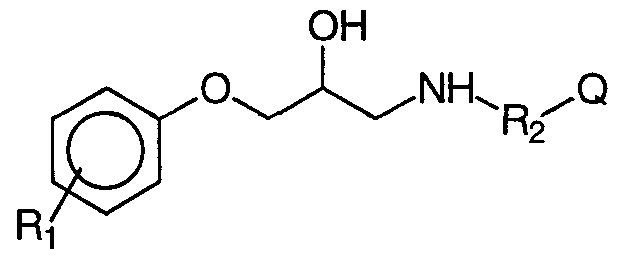



Priority Applications (6)
| Application Number | Priority Date | Filing Date | Title |
|---|---|---|---|
| EP97913236A EP0937063B1 (en) | 1996-11-05 | 1997-11-03 | Aryloxypropanolamine derivatives, method of preparation and applications thereof |
| AU50565/98A AU734276C (en) | 1996-11-05 | 1997-11-03 | Aryloxypropanolamine derivatives, method of preparation and applications thereof |
| DE69711911T DE69711911T2 (en) | 1996-11-05 | 1997-11-03 | ARYLOXYPROPANOLAMINE DERIVATIVES, METHOD FOR THE PRODUCTION THEREOF AND THEIR USE |
| CA2270581A CA2270581C (en) | 1996-11-05 | 1997-11-03 | Aryloxypropanolamine derivatives, method of preparation and applications thereof |
| JP52109598A JP4014643B2 (en) | 1996-11-05 | 1997-11-03 | Aryloxypropanolamine derivative, production method thereof and use thereof |
| US10/336,001 US6890955B2 (en) | 1996-11-05 | 2003-01-03 | Aryloxypropanolamine derivatives, method of preparation and applications thereof |
Applications Claiming Priority (2)
| Application Number | Priority Date | Filing Date | Title |
|---|---|---|---|
| FR9613438A FR2755439B1 (en) | 1996-11-05 | 1996-11-05 | ARYLOXYPROPANOLAMINE DERIVATIVES, THEIR PREPARATION PROCESS AND THEIR APPLICATIONS |
| FR96/13438 | 1996-11-05 |
Related Child Applications (2)
| Application Number | Title | Priority Date | Filing Date |
|---|---|---|---|
| US09297604 A-371-Of-International | 1997-11-03 | ||
| US09/934,487 Continuation US20020019440A1 (en) | 1996-11-05 | 2001-08-23 | Aryloxypropanolamine derivatives, method of preparation and applications thereof |
Publications (1)
| Publication Number | Publication Date |
|---|---|
| WO1998020005A1 true WO1998020005A1 (en) | 1998-05-14 |
Family
ID=9497315
Family Applications (1)
| Application Number | Title | Priority Date | Filing Date |
|---|---|---|---|
| PCT/FR1997/001963 Ceased WO1998020005A1 (en) | 1996-11-05 | 1997-11-03 | Aryloxypropanolamine derivatives, method of preparation and applications thereof |
Country Status (8)
| Country | Link |
|---|---|
| EP (1) | EP0937063B1 (en) |
| JP (1) | JP4014643B2 (en) |
| AU (1) | AU734276C (en) |
| CA (1) | CA2270581C (en) |
| DE (1) | DE69711911T2 (en) |
| ES (1) | ES2175378T3 (en) |
| FR (1) | FR2755439B1 (en) |
| WO (1) | WO1998020005A1 (en) |
Cited By (6)
| Publication number | Priority date | Publication date | Assignee | Title |
|---|---|---|---|---|
| WO2001035947A3 (en) * | 1999-11-15 | 2001-11-22 | Lilly Co Eli | Treating wasting syndromes with aryloxy propanolamines |
| EP1741446A2 (en) | 2000-01-21 | 2007-01-10 | Novartis AG | Combinations comprising dipeptidylpeptidase-IV inhibitors and antidiabetic agents |
| WO2007033266A2 (en) | 2005-09-14 | 2007-03-22 | Takeda Pharmaceutical Company Limited | Dipeptidyl peptidase inhibitors for treating diabetis |
| US7718646B2 (en) | 2000-11-30 | 2010-05-18 | Sanofi-Aventis | Cyclohexyl(alkyl)propanolamines, preparation method and pharmaceutical compositions containing same |
| WO2011041293A1 (en) | 2009-09-30 | 2011-04-07 | Takeda Pharmaceutical Company Limited | Pyrazolo [1, 5-a] pyrimidine derivatives as apoptosis signal-regulating kinase 1 inhibitors |
| WO2011097079A1 (en) | 2010-02-03 | 2011-08-11 | Takeda Pharmaceutical Company Limited | Apoptosis signal-regulating kinase 1 inhibitors |
Families Citing this family (1)
| Publication number | Priority date | Publication date | Assignee | Title |
|---|---|---|---|---|
| CN111699189B (en) * | 2017-12-06 | 2025-02-18 | 艾尼纳制药公司 | Beta-3 adrenergic receptor modulators useful for treating or preventing heart failure and disorders associated therewith |
Citations (2)
| Publication number | Priority date | Publication date | Assignee | Title |
|---|---|---|---|---|
| EP0300290A1 (en) * | 1987-07-21 | 1989-01-25 | F. Hoffmann-La Roche Ag | Phenoxypropanol amines |
| EP0714883A1 (en) * | 1994-12-02 | 1996-06-05 | Bristol-Myers Squibb Company | Aryloxypropanolamine beta 3 adrenergic agonists |
-
1996
- 1996-11-05 FR FR9613438A patent/FR2755439B1/en not_active Expired - Fee Related
-
1997
- 1997-11-03 CA CA2270581A patent/CA2270581C/en not_active Expired - Fee Related
- 1997-11-03 ES ES97913236T patent/ES2175378T3/en not_active Expired - Lifetime
- 1997-11-03 DE DE69711911T patent/DE69711911T2/en not_active Expired - Lifetime
- 1997-11-03 EP EP97913236A patent/EP0937063B1/en not_active Expired - Lifetime
- 1997-11-03 AU AU50565/98A patent/AU734276C/en not_active Ceased
- 1997-11-03 JP JP52109598A patent/JP4014643B2/en not_active Expired - Fee Related
- 1997-11-03 WO PCT/FR1997/001963 patent/WO1998020005A1/en not_active Ceased
Patent Citations (2)
| Publication number | Priority date | Publication date | Assignee | Title |
|---|---|---|---|---|
| EP0300290A1 (en) * | 1987-07-21 | 1989-01-25 | F. Hoffmann-La Roche Ag | Phenoxypropanol amines |
| EP0714883A1 (en) * | 1994-12-02 | 1996-06-05 | Bristol-Myers Squibb Company | Aryloxypropanolamine beta 3 adrenergic agonists |
Cited By (7)
| Publication number | Priority date | Publication date | Assignee | Title |
|---|---|---|---|---|
| WO2001035947A3 (en) * | 1999-11-15 | 2001-11-22 | Lilly Co Eli | Treating wasting syndromes with aryloxy propanolamines |
| EP1741446A2 (en) | 2000-01-21 | 2007-01-10 | Novartis AG | Combinations comprising dipeptidylpeptidase-IV inhibitors and antidiabetic agents |
| EP1743655A1 (en) | 2000-01-21 | 2007-01-17 | Novartis AG | Combinations comprising dipeptidylpeptidase-IV inhibitors and antidiabetic agents |
| US7718646B2 (en) | 2000-11-30 | 2010-05-18 | Sanofi-Aventis | Cyclohexyl(alkyl)propanolamines, preparation method and pharmaceutical compositions containing same |
| WO2007033266A2 (en) | 2005-09-14 | 2007-03-22 | Takeda Pharmaceutical Company Limited | Dipeptidyl peptidase inhibitors for treating diabetis |
| WO2011041293A1 (en) | 2009-09-30 | 2011-04-07 | Takeda Pharmaceutical Company Limited | Pyrazolo [1, 5-a] pyrimidine derivatives as apoptosis signal-regulating kinase 1 inhibitors |
| WO2011097079A1 (en) | 2010-02-03 | 2011-08-11 | Takeda Pharmaceutical Company Limited | Apoptosis signal-regulating kinase 1 inhibitors |
Also Published As
| Publication number | Publication date |
|---|---|
| DE69711911T2 (en) | 2002-11-21 |
| AU734276C (en) | 2008-01-03 |
| EP0937063A1 (en) | 1999-08-25 |
| JP2001503753A (en) | 2001-03-21 |
| DE69711911D1 (en) | 2002-05-16 |
| ES2175378T3 (en) | 2002-11-16 |
| FR2755439A1 (en) | 1998-05-07 |
| FR2755439B1 (en) | 1998-12-24 |
| JP4014643B2 (en) | 2007-11-28 |
| EP0937063B1 (en) | 2002-04-10 |
| AU5056598A (en) | 1998-05-29 |
| AU734276B2 (en) | 2001-06-07 |
| CA2270581A1 (en) | 1998-05-14 |
| CA2270581C (en) | 2010-01-26 |
Similar Documents
| Publication | Publication Date | Title |
|---|---|---|
| EP0101381B1 (en) | Anorexic trifluoromethyl phenyl tetrahydropyridines, process for their preparation and pharmaceutical compositions containing them | |
| EP0110781B1 (en) | Substituted (amino-2-ethyl)-6-benzoxazolinones, their preparation and a pharmaceutical composition containing them | |
| FR2533924A1 (en) | NOVEL 4- (1H-INDOL-3-YL) A-METHYL PIPERIDINE-1-ETHANOL DERIVATIVES, THEIR SALTS, THE PREPARATION PROCESS, THE MEDICINAL APPLICATION AND THE COMPOSITIONS COMPRISING THE SAME | |
| FR2479825A1 (en) | BENZODIOXAN 1,4 METHOXY-2 PROPANOLAMINES, THEIR PREPARATION AND THEIR USE AS MEDICAMENTS | |
| EP0937063B1 (en) | Aryloxypropanolamine derivatives, method of preparation and applications thereof | |
| EP0049203A1 (en) | Benzoxazolinones substituted in the 6-position by an amino-alcohol or amino-ketone chain, their preparation and their therapeutic use | |
| EP0060179A1 (en) | Pharmaceutical compositions having anorectic activity | |
| FR2641276A1 (en) | BENZENE DERIVATIVES, THEIR PREPARATION AND PHARMACEUTICAL COMPOSITIONS CONTAINING THE SAME | |
| FR2547822A1 (en) | SUBSTITUTED ACYLPIPERAZINOQUINAZOLINES USEFUL AS MEDICAMENTS AND PROCESS FOR THEIR PREPARATION | |
| EP0008259A1 (en) | Piperidyl-benzimidazolinone derivatives, processes for their preparation and pharmaceutical compositions containing them | |
| US20030158259A1 (en) | Aryloxypropanolamine derivatives, method of preparation and applications thereof | |
| EP0183577B1 (en) | Thiadiazole derivatives active on the central nervous system, process for their preparation and pharmaceutical compositions containing them | |
| MC2105A1 (en) | TETRAHYDRONAPHTALENE DERIVATIVES | |
| FR2458548A1 (en) | SUBSTITUTED FURRAN-2-CARBOXYLIC ACID ANILIDES, THEIR PREPARATION AND THEIR THERAPEUTIC USES | |
| EP0061406B1 (en) | Benzamido-alkyl-hydroxamic-acid derivatives, preparation thereof and therapeutical composition | |
| EP0061379B1 (en) | Pyridine derivatives, their preparation and their use in therapeutic preparations | |
| FR2571965A1 (en) | DRUGS BASED ON NOVEL 4 H-DIOXINO- (4,5-C) -PYRIDINE DERIVATIVES. | |
| EP0103503A2 (en) | N-substituted amides, their salts, process for their preparation and pharmaceutical compositions containing them | |
| EP0097546A1 (en) | Benzhydrylsulfinyl ethyl amines, process for their preparation and their use in therapy | |
| EP0157762B1 (en) | New substituted piperidinoguanidines, preparation process and pharmaceutical compositions containing them | |
| EP0002638A1 (en) | Addition salts of substituted aralkylamins and therapeutic composition containing them | |
| EP0078735B1 (en) | Derivatives of the 3-amino-1-heteroaryloxy-2-propanol class, their use in therapy and a process for their preparation | |
| EP0106860A1 (en) | NOVEL CARBOXAMIDOGUANIDINES, PROCESS FOR OBTAINING SAME AND PHARMACEUTICAL COMPOSITIONS CONTAINING SAME. | |
| EP0384812A1 (en) | 5-Trifluoromethoxy-2-aminobenzimidazole, process for its preparation and medicaments containing same | |
| BE844928A (en) | NEW DERIVATIVES OF INDOLE, THEIR PREPARATION AND THEIR APPLICATION AS MEDICINAL PRODUCTS |
Legal Events
| Date | Code | Title | Description |
|---|---|---|---|
| AK | Designated states |
Kind code of ref document: A1 Designated state(s): AU BR CA JP MX US |
|
| AL | Designated countries for regional patents |
Kind code of ref document: A1 Designated state(s): AT BE CH DE DK ES FI FR GB GR IE IT LU MC NL PT SE |
|
| DFPE | Request for preliminary examination filed prior to expiration of 19th month from priority date (pct application filed before 20040101) | ||
| 121 | Ep: the epo has been informed by wipo that ep was designated in this application | ||
| WWE | Wipo information: entry into national phase |
Ref document number: 50565/98 Country of ref document: AU |
|
| ENP | Entry into the national phase |
Ref document number: 2270581 Country of ref document: CA Ref country code: CA Ref document number: 2270581 Kind code of ref document: A Format of ref document f/p: F |
|
| ENP | Entry into the national phase |
Ref country code: JP Ref document number: 1998 521095 Kind code of ref document: A Format of ref document f/p: F |
|
| WWE | Wipo information: entry into national phase |
Ref document number: 09297604 Country of ref document: US |
|
| WWE | Wipo information: entry into national phase |
Ref document number: 1997913236 Country of ref document: EP |
|
| WWP | Wipo information: published in national office |
Ref document number: 1997913236 Country of ref document: EP |
|
| WWG | Wipo information: grant in national office |
Ref document number: 50565/98 Country of ref document: AU |
|
| WWG | Wipo information: grant in national office |
Ref document number: 1997913236 Country of ref document: EP |