WO1998023583A1 - Conjugated nitrile derivatives, liquid crystal compounds, and liquid crystal display elements - Google Patents

Conjugated nitrile derivatives, liquid crystal compounds, and liquid crystal display elements Download PDF

Info

Publication number
WO1998023583A1
WO1998023583A1 PCT/JP1997/004328 JP9704328W WO9823583A1 WO 1998023583 A1 WO1998023583 A1 WO 1998023583A1 JP 9704328 W JP9704328 W JP 9704328W WO 9823583 A1 WO9823583 A1 WO 9823583A1
Authority
WO
WIPO (PCT)
Prior art keywords
derivative according
nitrile derivative
ring
liquid crystal
group
Prior art date
Legal status (The legal status is an assumption and is not a legal conclusion. Google has not performed a legal analysis and makes no representation as to the accuracy of the status listed.)
Ceased
Application number
PCT/JP1997/004328
Other languages
English (en)
French (fr)
Inventor
Atsuko Fujita
Norio Tamura
Shuichi Matsui
Kazutoshi Miyazawa
Hiroyuki Takeuchi
Yasuhiro Kubo
Husayuki Takeshita
Etsuo Nakagawa
Current Assignee (The listed assignees may be inaccurate. Google has not performed a legal analysis and makes no representation or warranty as to the accuracy of the list.)
JNC Corp
Original Assignee
Chisso Corp
Priority date (The priority date is an assumption and is not a legal conclusion. Google has not performed a legal analysis and makes no representation as to the accuracy of the date listed.)
Filing date
Publication date
Application filed by Chisso Corp filed Critical Chisso Corp
Priority to US09/319,025 priority Critical patent/US6149838A/en
Priority to EP97913456A priority patent/EP0947501A1/en
Publication of WO1998023583A1 publication Critical patent/WO1998023583A1/ja
Anticipated expiration legal-status Critical
Ceased legal-status Critical Current

Links

Classifications

    • CCHEMISTRY; METALLURGY
    • C07ORGANIC CHEMISTRY
    • C07DHETEROCYCLIC COMPOUNDS
    • C07D239/00Heterocyclic compounds containing 1,3-diazine or hydrogenated 1,3-diazine rings
    • C07D239/02Heterocyclic compounds containing 1,3-diazine or hydrogenated 1,3-diazine rings not condensed with other rings
    • C07D239/24Heterocyclic compounds containing 1,3-diazine or hydrogenated 1,3-diazine rings not condensed with other rings having three or more double bonds between ring members or between ring members and non-ring members
    • C07D239/26Heterocyclic compounds containing 1,3-diazine or hydrogenated 1,3-diazine rings not condensed with other rings having three or more double bonds between ring members or between ring members and non-ring members with only hydrogen atoms, hydrocarbon or substituted hydrocarbon radicals, directly attached to ring carbon atoms
    • CCHEMISTRY; METALLURGY
    • C07ORGANIC CHEMISTRY
    • C07CACYCLIC OR CARBOCYCLIC COMPOUNDS
    • C07C255/00Carboxylic acid nitriles
    • C07C255/01Carboxylic acid nitriles having cyano groups bound to acyclic carbon atoms
    • C07C255/31Carboxylic acid nitriles having cyano groups bound to acyclic carbon atoms having cyano groups bound to acyclic carbon atoms of a carbon skeleton containing rings other than six-membered aromatic rings
    • CCHEMISTRY; METALLURGY
    • C07ORGANIC CHEMISTRY
    • C07CACYCLIC OR CARBOCYCLIC COMPOUNDS
    • C07C255/00Carboxylic acid nitriles
    • C07C255/01Carboxylic acid nitriles having cyano groups bound to acyclic carbon atoms
    • C07C255/32Carboxylic acid nitriles having cyano groups bound to acyclic carbon atoms having cyano groups bound to acyclic carbon atoms of a carbon skeleton containing at least one six-membered aromatic ring
    • C07C255/34Carboxylic acid nitriles having cyano groups bound to acyclic carbon atoms having cyano groups bound to acyclic carbon atoms of a carbon skeleton containing at least one six-membered aromatic ring with cyano groups linked to the six-membered aromatic ring, or to the condensed ring system containing that ring, by unsaturated carbon chains
    • CCHEMISTRY; METALLURGY
    • C07ORGANIC CHEMISTRY
    • C07CACYCLIC OR CARBOCYCLIC COMPOUNDS
    • C07C255/00Carboxylic acid nitriles
    • C07C255/01Carboxylic acid nitriles having cyano groups bound to acyclic carbon atoms
    • C07C255/32Carboxylic acid nitriles having cyano groups bound to acyclic carbon atoms having cyano groups bound to acyclic carbon atoms of a carbon skeleton containing at least one six-membered aromatic ring
    • C07C255/35Carboxylic acid nitriles having cyano groups bound to acyclic carbon atoms having cyano groups bound to acyclic carbon atoms of a carbon skeleton containing at least one six-membered aromatic ring the carbon skeleton being further substituted by halogen atoms, or by nitro or nitroso groups
    • CCHEMISTRY; METALLURGY
    • C07ORGANIC CHEMISTRY
    • C07CACYCLIC OR CARBOCYCLIC COMPOUNDS
    • C07C255/00Carboxylic acid nitriles
    • C07C255/01Carboxylic acid nitriles having cyano groups bound to acyclic carbon atoms
    • C07C255/32Carboxylic acid nitriles having cyano groups bound to acyclic carbon atoms having cyano groups bound to acyclic carbon atoms of a carbon skeleton containing at least one six-membered aromatic ring
    • C07C255/37Carboxylic acid nitriles having cyano groups bound to acyclic carbon atoms having cyano groups bound to acyclic carbon atoms of a carbon skeleton containing at least one six-membered aromatic ring the carbon skeleton being further substituted by etherified hydroxy groups
    • CCHEMISTRY; METALLURGY
    • C07ORGANIC CHEMISTRY
    • C07CACYCLIC OR CARBOCYCLIC COMPOUNDS
    • C07C255/00Carboxylic acid nitriles
    • C07C255/01Carboxylic acid nitriles having cyano groups bound to acyclic carbon atoms
    • C07C255/32Carboxylic acid nitriles having cyano groups bound to acyclic carbon atoms having cyano groups bound to acyclic carbon atoms of a carbon skeleton containing at least one six-membered aromatic ring
    • C07C255/38Carboxylic acid nitriles having cyano groups bound to acyclic carbon atoms having cyano groups bound to acyclic carbon atoms of a carbon skeleton containing at least one six-membered aromatic ring the carbon skeleton being further substituted by esterified hydroxy groups
    • CCHEMISTRY; METALLURGY
    • C07ORGANIC CHEMISTRY
    • C07DHETEROCYCLIC COMPOUNDS
    • C07D319/00Heterocyclic compounds containing six-membered rings having two oxygen atoms as the only ring hetero atoms
    • C07D319/041,3-Dioxanes; Hydrogenated 1,3-dioxanes
    • C07D319/061,3-Dioxanes; Hydrogenated 1,3-dioxanes not condensed with other rings
    • CCHEMISTRY; METALLURGY
    • C09DYES; PAINTS; POLISHES; NATURAL RESINS; ADHESIVES; COMPOSITIONS NOT OTHERWISE PROVIDED FOR; APPLICATIONS OF MATERIALS NOT OTHERWISE PROVIDED FOR
    • C09KMATERIALS FOR MISCELLANEOUS APPLICATIONS, NOT PROVIDED FOR ELSEWHERE
    • C09K19/00Liquid crystal materials
    • C09K19/04Liquid crystal materials characterised by the chemical structure of the liquid crystal components, e.g. by a specific unit
    • CCHEMISTRY; METALLURGY
    • C09DYES; PAINTS; POLISHES; NATURAL RESINS; ADHESIVES; COMPOSITIONS NOT OTHERWISE PROVIDED FOR; APPLICATIONS OF MATERIALS NOT OTHERWISE PROVIDED FOR
    • C09KMATERIALS FOR MISCELLANEOUS APPLICATIONS, NOT PROVIDED FOR ELSEWHERE
    • C09K19/00Liquid crystal materials
    • C09K19/04Liquid crystal materials characterised by the chemical structure of the liquid crystal components, e.g. by a specific unit
    • C09K19/06Non-steroidal liquid crystal compounds
    • C09K19/08Non-steroidal liquid crystal compounds containing at least two non-condensed rings
    • C09K19/30Non-steroidal liquid crystal compounds containing at least two non-condensed rings containing saturated or unsaturated non-aromatic rings, e.g. cyclohexane rings
    • C09K19/3001Cyclohexane rings
    • CCHEMISTRY; METALLURGY
    • C09DYES; PAINTS; POLISHES; NATURAL RESINS; ADHESIVES; COMPOSITIONS NOT OTHERWISE PROVIDED FOR; APPLICATIONS OF MATERIALS NOT OTHERWISE PROVIDED FOR
    • C09KMATERIALS FOR MISCELLANEOUS APPLICATIONS, NOT PROVIDED FOR ELSEWHERE
    • C09K19/00Liquid crystal materials
    • C09K19/04Liquid crystal materials characterised by the chemical structure of the liquid crystal components, e.g. by a specific unit
    • C09K19/06Non-steroidal liquid crystal compounds
    • C09K19/08Non-steroidal liquid crystal compounds containing at least two non-condensed rings
    • C09K19/30Non-steroidal liquid crystal compounds containing at least two non-condensed rings containing saturated or unsaturated non-aromatic rings, e.g. cyclohexane rings
    • C09K19/3001Cyclohexane rings
    • C09K19/3003Compounds containing at least two rings in which the different rings are directly linked (covalent bond)
    • CCHEMISTRY; METALLURGY
    • C09DYES; PAINTS; POLISHES; NATURAL RESINS; ADHESIVES; COMPOSITIONS NOT OTHERWISE PROVIDED FOR; APPLICATIONS OF MATERIALS NOT OTHERWISE PROVIDED FOR
    • C09KMATERIALS FOR MISCELLANEOUS APPLICATIONS, NOT PROVIDED FOR ELSEWHERE
    • C09K19/00Liquid crystal materials
    • C09K19/04Liquid crystal materials characterised by the chemical structure of the liquid crystal components, e.g. by a specific unit
    • C09K19/06Non-steroidal liquid crystal compounds
    • C09K19/08Non-steroidal liquid crystal compounds containing at least two non-condensed rings
    • C09K19/30Non-steroidal liquid crystal compounds containing at least two non-condensed rings containing saturated or unsaturated non-aromatic rings, e.g. cyclohexane rings
    • C09K19/3001Cyclohexane rings
    • C09K19/3028Cyclohexane rings in which at least two rings are linked by a carbon chain containing carbon to carbon single bonds
    • CCHEMISTRY; METALLURGY
    • C09DYES; PAINTS; POLISHES; NATURAL RESINS; ADHESIVES; COMPOSITIONS NOT OTHERWISE PROVIDED FOR; APPLICATIONS OF MATERIALS NOT OTHERWISE PROVIDED FOR
    • C09KMATERIALS FOR MISCELLANEOUS APPLICATIONS, NOT PROVIDED FOR ELSEWHERE
    • C09K19/00Liquid crystal materials
    • C09K19/04Liquid crystal materials characterised by the chemical structure of the liquid crystal components, e.g. by a specific unit
    • C09K19/06Non-steroidal liquid crystal compounds
    • C09K19/08Non-steroidal liquid crystal compounds containing at least two non-condensed rings
    • C09K19/30Non-steroidal liquid crystal compounds containing at least two non-condensed rings containing saturated or unsaturated non-aromatic rings, e.g. cyclohexane rings
    • C09K19/3001Cyclohexane rings
    • C09K19/3048Cyclohexane rings in which at least two rings are linked by a carbon chain containing carbon to carbon double bonds
    • CCHEMISTRY; METALLURGY
    • C09DYES; PAINTS; POLISHES; NATURAL RESINS; ADHESIVES; COMPOSITIONS NOT OTHERWISE PROVIDED FOR; APPLICATIONS OF MATERIALS NOT OTHERWISE PROVIDED FOR
    • C09KMATERIALS FOR MISCELLANEOUS APPLICATIONS, NOT PROVIDED FOR ELSEWHERE
    • C09K19/00Liquid crystal materials
    • C09K19/04Liquid crystal materials characterised by the chemical structure of the liquid crystal components, e.g. by a specific unit
    • C09K19/06Non-steroidal liquid crystal compounds
    • C09K19/08Non-steroidal liquid crystal compounds containing at least two non-condensed rings
    • C09K19/30Non-steroidal liquid crystal compounds containing at least two non-condensed rings containing saturated or unsaturated non-aromatic rings, e.g. cyclohexane rings
    • C09K19/3001Cyclohexane rings
    • C09K19/3059Cyclohexane rings in which at least two rings are linked by a carbon chain containing carbon to carbon triple bonds
    • CCHEMISTRY; METALLURGY
    • C09DYES; PAINTS; POLISHES; NATURAL RESINS; ADHESIVES; COMPOSITIONS NOT OTHERWISE PROVIDED FOR; APPLICATIONS OF MATERIALS NOT OTHERWISE PROVIDED FOR
    • C09KMATERIALS FOR MISCELLANEOUS APPLICATIONS, NOT PROVIDED FOR ELSEWHERE
    • C09K19/00Liquid crystal materials
    • C09K19/04Liquid crystal materials characterised by the chemical structure of the liquid crystal components, e.g. by a specific unit
    • C09K19/42Mixtures of liquid crystal compounds covered by two or more of the preceding groups C09K19/06 - C09K19/40
    • CCHEMISTRY; METALLURGY
    • C09DYES; PAINTS; POLISHES; NATURAL RESINS; ADHESIVES; COMPOSITIONS NOT OTHERWISE PROVIDED FOR; APPLICATIONS OF MATERIALS NOT OTHERWISE PROVIDED FOR
    • C09KMATERIALS FOR MISCELLANEOUS APPLICATIONS, NOT PROVIDED FOR ELSEWHERE
    • C09K19/00Liquid crystal materials
    • C09K19/04Liquid crystal materials characterised by the chemical structure of the liquid crystal components, e.g. by a specific unit
    • C09K19/42Mixtures of liquid crystal compounds covered by two or more of the preceding groups C09K19/06 - C09K19/40
    • C09K19/44Mixtures of liquid crystal compounds covered by two or more of the preceding groups C09K19/06 - C09K19/40 containing compounds with benzene rings directly linked
    • CCHEMISTRY; METALLURGY
    • C09DYES; PAINTS; POLISHES; NATURAL RESINS; ADHESIVES; COMPOSITIONS NOT OTHERWISE PROVIDED FOR; APPLICATIONS OF MATERIALS NOT OTHERWISE PROVIDED FOR
    • C09KMATERIALS FOR MISCELLANEOUS APPLICATIONS, NOT PROVIDED FOR ELSEWHERE
    • C09K19/00Liquid crystal materials
    • C09K19/04Liquid crystal materials characterised by the chemical structure of the liquid crystal components, e.g. by a specific unit
    • C09K19/42Mixtures of liquid crystal compounds covered by two or more of the preceding groups C09K19/06 - C09K19/40
    • C09K19/46Mixtures of liquid crystal compounds covered by two or more of the preceding groups C09K19/06 - C09K19/40 containing esters
    • CCHEMISTRY; METALLURGY
    • C07ORGANIC CHEMISTRY
    • C07CACYCLIC OR CARBOCYCLIC COMPOUNDS
    • C07C2601/00Systems containing only non-condensed rings
    • C07C2601/06Systems containing only non-condensed rings with a five-membered ring
    • C07C2601/08Systems containing only non-condensed rings with a five-membered ring the ring being saturated
    • CCHEMISTRY; METALLURGY
    • C07ORGANIC CHEMISTRY
    • C07CACYCLIC OR CARBOCYCLIC COMPOUNDS
    • C07C2601/00Systems containing only non-condensed rings
    • C07C2601/12Systems containing only non-condensed rings with a six-membered ring
    • C07C2601/14The ring being saturated
    • CCHEMISTRY; METALLURGY
    • C09DYES; PAINTS; POLISHES; NATURAL RESINS; ADHESIVES; COMPOSITIONS NOT OTHERWISE PROVIDED FOR; APPLICATIONS OF MATERIALS NOT OTHERWISE PROVIDED FOR
    • C09KMATERIALS FOR MISCELLANEOUS APPLICATIONS, NOT PROVIDED FOR ELSEWHERE
    • C09K19/00Liquid crystal materials
    • C09K19/04Liquid crystal materials characterised by the chemical structure of the liquid crystal components, e.g. by a specific unit
    • C09K2019/0444Liquid crystal materials characterised by the chemical structure of the liquid crystal components, e.g. by a specific unit characterized by a linking chain between rings or ring systems, a bridging chain between extensive mesogenic moieties or an end chain group
    • C09K2019/0448Liquid crystal materials characterised by the chemical structure of the liquid crystal components, e.g. by a specific unit characterized by a linking chain between rings or ring systems, a bridging chain between extensive mesogenic moieties or an end chain group the end chain group being a polymerizable end group, e.g. -Sp-P or acrylate
    • CCHEMISTRY; METALLURGY
    • C09DYES; PAINTS; POLISHES; NATURAL RESINS; ADHESIVES; COMPOSITIONS NOT OTHERWISE PROVIDED FOR; APPLICATIONS OF MATERIALS NOT OTHERWISE PROVIDED FOR
    • C09KMATERIALS FOR MISCELLANEOUS APPLICATIONS, NOT PROVIDED FOR ELSEWHERE
    • C09K19/00Liquid crystal materials
    • C09K19/04Liquid crystal materials characterised by the chemical structure of the liquid crystal components, e.g. by a specific unit
    • C09K2019/0444Liquid crystal materials characterised by the chemical structure of the liquid crystal components, e.g. by a specific unit characterized by a linking chain between rings or ring systems, a bridging chain between extensive mesogenic moieties or an end chain group
    • C09K2019/0451Liquid crystal materials characterised by the chemical structure of the liquid crystal components, e.g. by a specific unit characterized by a linking chain between rings or ring systems, a bridging chain between extensive mesogenic moieties or an end chain group the end chain group being a CH3CH=CHCH2CH2- chain
    • CCHEMISTRY; METALLURGY
    • C09DYES; PAINTS; POLISHES; NATURAL RESINS; ADHESIVES; COMPOSITIONS NOT OTHERWISE PROVIDED FOR; APPLICATIONS OF MATERIALS NOT OTHERWISE PROVIDED FOR
    • C09KMATERIALS FOR MISCELLANEOUS APPLICATIONS, NOT PROVIDED FOR ELSEWHERE
    • C09K19/00Liquid crystal materials
    • C09K19/04Liquid crystal materials characterised by the chemical structure of the liquid crystal components, e.g. by a specific unit
    • C09K2019/0488Liquid crystal materials characterised by the chemical structure of the liquid crystal components, e.g. by a specific unit characterized by a special bonding
    • C09K2019/0496Liquid crystal materials characterised by the chemical structure of the liquid crystal components, e.g. by a specific unit characterized by a special bonding the special bonding being a specific pi-conjugated group

Definitions

  • the present invention relates to a liquid crystal compound and a liquid crystal composition, and more particularly, a conjugated nitrile derivative of a liquid crystal compound suitable as a component of the liquid crystal composition, a liquid crystal composition containing the same, and a liquid crystal formed using the liquid crystal composition. It relates to a display element.
  • the liquid crystal display device utilizes the optical (refractive index) anisotropy and dielectric anisotropy of the liquid crystal compound. Twisted nematic (TN) type, super twisted according to the electro-optic effect from the viewpoint of the display method Nematic (STN) type, dynamic scattering (DS) type, guest-host (GH) type, DAP type, etc.
  • driving method static driving method, time-division driving method, active matrix driving method and Two-frequency drive systems and the like are known.
  • the liquid crystal material used for the liquid crystal display element is required to exhibit a liquid crystal phase in a wide temperature range and to be stable against heat, light, moisture, air, electric field, electromagnetic radiation, and the like.
  • liquid crystal compounds cannot meet all of these requirements, and at present, a mixture of a plurality of types, and in some cases, 20 or more types of liquid crystal compounds is used. Therefore, these liquid crystal compounds must exhibit good compatibility with each other, and in particular, recently, display devices are often used in harsh environments such as cryogenic temperatures. It became so.
  • the refractive index anisotropy is as follows. It is necessary to increase the value ( ⁇ ⁇ ) (use a liquid crystal compound having a large ⁇ ⁇ as a component). In other words, other characteristics required for display elements One of the reasons is to maintain a good display contrast and a wide viewing angle.To achieve this, the product of ⁇ and d, ⁇ ⁇ d, must be kept at a constant value. It is necessary to increase ⁇ when ⁇ is reduced as described above.
  • an ethynylene group may be introduced into the liquid crystal molecule, and the ethynylene group may be substituted with an electron-withdrawing group such as CN, Cl, or the like.
  • an electron-withdrawing group such as CN, Cl, or the like.
  • R represents an alkyl group.
  • An object of the present invention is to solve the above-mentioned drawbacks of the prior art, to have a sufficiently large ⁇ , a large ⁇ , excellent compatibility with other liquid crystal compounds, low viscosity and chemically and physically stable.
  • Another object of the present invention is to provide a novel conjugated nitrile derivative of a liquid crystal compound, a liquid crystal composition containing the same, and a liquid crystal display device formed using the composition.
  • the present inventors have conducted intensive studies in order to achieve the above object, and have found that a known liquid crystal compound
  • the present inventors have found a compound having a novel structure having improved properties as compared with a product, and have completed the present invention.
  • rings A 2 , A 3 and A 4 are each independently 1,4-cyclohexylene, and one or two hydrogen atoms on the ring may be substituted with a fluorine atom 1,4 -Phenylene-1,3-dioxane-2,5-diyl or pyrimidine-2,5-diyl;
  • B, B 2 and B 3 each independently represent a covalent bond, 1,2-ethylene
  • G represents a 2-ethenylene, 1,2-ethynylene, oxymethylene, methyleneoxy, carbonyloxy or 1,4-butylene group
  • G represents a group represented by the formula (2), (3) or (4)
  • R is an alkyl group having 1 to 10 carbon atoms, a fluoroalkyl group having 1 to 10 carbon atoms, a halogen atom or a cyano group, and is adjacent to the alkyl group or the fluoroalkyl group.
  • One or more unmatched methylene or fluoromethylene groups may be substituted with an oxygen atom or a 1,2-ethenylene group, and m, n and p are each independently 0 or 1.
  • Each element constituting the compound may include those selected from their isotopes.
  • conjugated nitrile derivative according to the A 4 may be one or two hydrogen atoms on the ring is optionally substituted with fluorine atom 1 is 4- Fuweniren ring (1 5).
  • a 4 may be one or two hydrogen atoms on the ring is optionally substituted with fluorine atoms 1, 4 - conjugated nitrile derivative according to full a two lens ring (20).
  • (2 5) conjugated nitrile derivative according to A 4 may be 1-2 hydrogen atoms on the ring is optionally substituted with fluorine atoms 1, 4 full two lens ring (23).
  • a 4 may have 1 to 2 hydrogen atoms on the ring optionally substituted with a fluorine atom
  • a 4 is 1 to 2 hydrogen atoms on the ring may be substituted by fluorine atoms,
  • a liquid crystal composition comprising at least one conjugated nitrile derivative according to any one of (1) to (37).
  • the first component contains at least one kind of the conjugated nitrile derivative according to any one of (1) to (37), and the second component has the general formula (5), (6) or
  • R 3 , YL, L 2 , and Z 2 may be the same or different from each other in each formula, and R 3 is an alkyl group having 1 to 10 carbon atoms, and In the group, one or more non-adjacent methylene groups may be replaced by an oxygen atom or -CH-CH-, and any hydrogen atom may be replaced by a fluorine atom.
  • Ring B is trans-1,4-cyclohexylene, 1,3-dioxane-2,5-diyl or 1,4-phenylene in which a hydrogen atom on the ring may be substituted by a fluorine atom;
  • C is transformer-1.4-sik R-hexylene or 1,4-phenylene in which a hydrogen atom on a ring may be substituted by a fluorine atom
  • each element constituting them may include those
  • the first component contains at least one kind of the conjugated nitrile derivative according to any one of (1) to (37), and the second component has the general formula (8) and / or (9) R 4 "E (z: (8)
  • R 4 and R 6 each independently represent an alkyl group having 1 to 10 carbon atoms.
  • At least one conjugated nitrile derivative according to any one of (1) to (37) is contained, and as the second component, the general formulas (5) and (6) ) And at least one compound selected from the group consisting of (7), and a third component represented by the general formula (10), (11) or (12)
  • R 6 , R 7 , I, J and K may be the same or different from each other in each formula, and R 6 and R 7 are each independently an alkyl group having 1 to 10 carbon atoms.
  • R 6 and R 7 are each independently an alkyl group having 1 to 10 carbon atoms.
  • I, J and K each independently represent trans-1,4-cyclohexylene, pyrimidine-2,5-diyl or 1.4-phenylene in which a hydrogen atom on the ring may be substituted by a fluorine atom;
  • Z 4 and Z 6 are each independently, - C ⁇ C -, - C00_, -CH2CH2-, -. CH-CH- or indicating a shared bond in compounds of the formula, each element thereof constituting them And may include at least one compound selected from the group consisting of: Characteristic liquid crystal composition.
  • liquid crystal composition according to any one of (38) to (43), further comprising an optically active compound.
  • a liquid crystal display device comprising the liquid crystal composition according to any one of (38) to (44).
  • the conjugated nitrile derivative which is the liquid crystal compound of the present invention is represented by the general formula (1) as described above, and among them, the compounds represented by the formulas (1-a) to (1-n) are particularly preferable. Examples can be given.
  • Each of these compounds of the present invention shows a large ⁇ , has a low viscosity, has excellent compatibility with other liquid crystal compounds, and is chemically and physically stable.
  • the compounds represented by the formulas (1-k) to (1-n) have a higher clearing point, and can be used as a component in preparing a liquid crystal composition having a high liquid crystal maximum temperature.
  • liquid crystal compounds of the present invention represented by the general formula (1) of the present invention necessarily show a liquid crystal phase, but all have good compatibility with other liquid crystal compounds.
  • the nematic phase temperature range is not significantly reduced or reduced, so that even if it does not show a liquid crystal phase itself, it is useful as a component of a liquid crystal composition.
  • the liquid crystal composition according to the present invention comprises at least one liquid crystal compound represented by the general formula (1) as a first component.
  • the content be 0.1 to 99.9% by weight based on the weight of the liquid crystal composition in order to exhibit excellent characteristics.
  • the liquid crystal composition of the present invention may be composed of only the above-mentioned first component.
  • the second component is selected from the group consisting of the general formulas (5), (6) and (7) as described above.
  • a mixture of at least one compound (referred to as component II) and / or at least one compound selected from the group consisting of formulas (8) and (9) (referred to as component 2B)
  • a mixture of at least one compound selected from the group consisting of general formulas (10), (11) and (12) as the third component, and an optically active component as another component.
  • Known compounds can also be mixed for the purpose of adjusting the compound, the threshold voltage, the liquid crystal phase temperature range, ⁇ , ⁇ , viscosity, and the like.
  • preferred examples of the compound included in the general formula (5) include the following formulas (5-1) to (5-9), and preferred examples of the compound included in the general formula (6) include the following formulas:
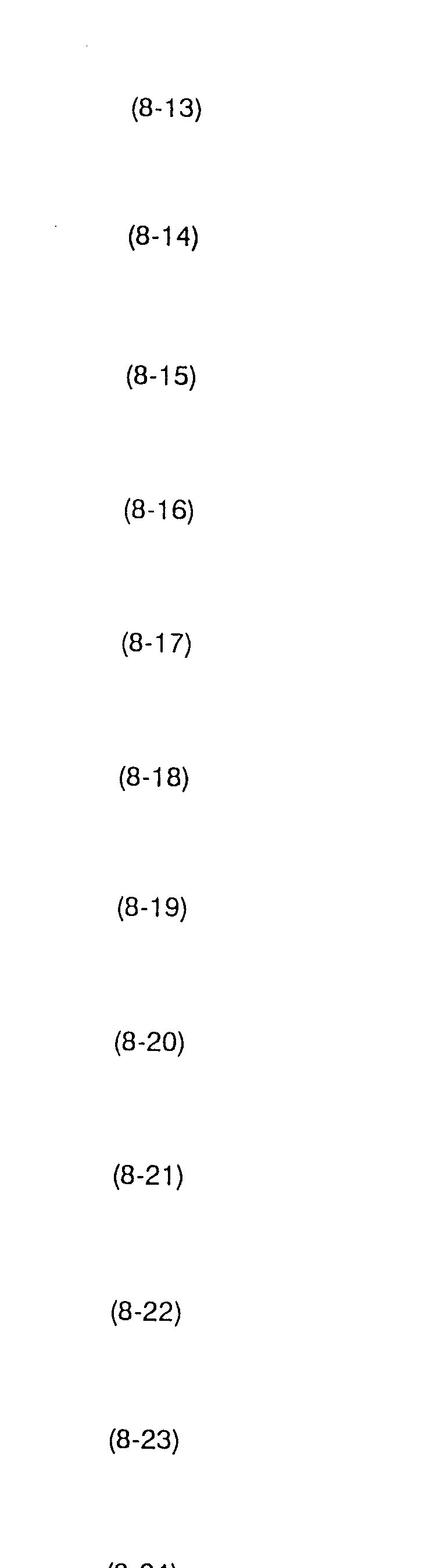
  • Preferable examples of the compounds included in (61-1) to (6-69) and the general formula (7) are those represented by the formula (7- ) To (7-24).
  • All of the compounds represented by the general formulas (5) to (7) show a positive ⁇ £, are extremely excellent in thermal stability and chemical stability, and particularly have a high voltage holding ratio (resistivity). This is an indispensable compound when preparing a liquid crystal composition for TFT (AM-LCD) that requires high reliability (high value).
  • the amount of the compound used is suitably in the range of 1 to 9.9% by weight, preferably 10 to 97% by weight, based on the total weight of the liquid crystal composition. %, More preferably 40 to 95% by weight.
  • the compounds represented by the formulas (10) to (12) may be further contained for the purpose of adjusting the viscosity.
  • the compounds represented by the above general formulas (5) to (7) can be used for preparing a liquid crystal composition for an STN display method or a TN display method, but this compound is a threshold of the liquid crystal composition. Since the effect of reducing the value voltage is relatively small, the amount used is preferably 50% by weight or less based on the total weight of the liquid crystal composition.
  • preferred examples of the compound included in the general formula (8) include formulas (81-1) to (8-40), and preferred examples of the compound included in the general formula (9) include formula ( Compounds represented by 9-1) to (9-3) can be exemplified.
  • These compounds represented by the general formula (8) or (9) are all ⁇ £ that value is large in the positive, c in particular used for the purpose of lowering threshold voltage of liquid crystal composition, ⁇ It is also used for adjusting the n and increasing the nematic range, such as increasing the clearing point, and for improving the steepness of liquid crystal compositions for STN and TN display systems. It is an indispensable compound when preparing a liquid crystal composition for a display system or a TN display system.
  • This compound can lower the threshold voltage of the liquid crystal composition as the amount used increases, but increases the viscosity. Therefore, as long as the viscosity of the liquid crystal composition satisfies the required characteristics, it is more advantageous to use a large amount of the liquid crystal composition for low voltage driving.
  • the amount used is in the range of 0.1 to 99.9% by weight based on the total weight of the liquid crystal composition. It is preferably from 10 to 97% by weight, more preferably from 40 to 95% by weight.
  • preferred examples of the compound included in the general formula (10) include preferred formulas (10-1) to (10-11) and preferred examples of the compound included in the general formula (11).
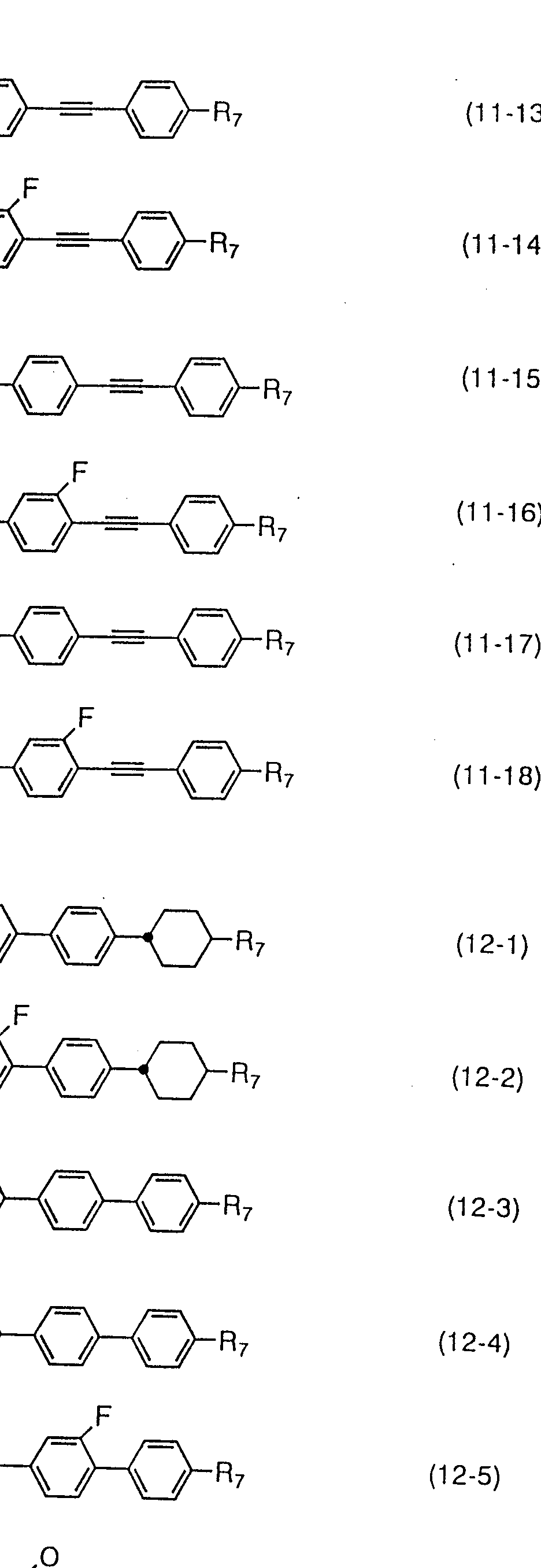
  • Formulas (11-1) to (11-18), and preferred examples of compounds included in the general formula (12) are represented by formulas (12-1) to (12-6) Each compound can be listed o
  • All of the compounds of the general formulas (10) to (12) are compounds having a small absolute value of ⁇ .
  • the compound of the general formula (10) is mainly used for adjusting the viscosity of the liquid crystal composition.
  • the compounds of the general formulas (11) and (12) are used for the purpose of adjusting the muta ⁇ , and for the purpose of widening the nematic range such as increasing the clearing point, and for the purpose of adjusting the ⁇ .
  • This compound increases the threshold of the liquid crystal composition and the value voltage as the amount of the compound is increased, but decreases the viscosity on the other hand. Therefore, as long as the threshold voltage of the liquid crystal composition satisfies the required value, the larger the amount used, the better.
  • the above-mentioned amount is suitably not more than 40% by weight, preferably not more than 35% by weight, based on the total weight of the liquid crystal composition.
  • the use amount is preferably 70% by weight or less, and more preferably 60% by weight, based on the total weight of the liquid crystal composition. It is as follows.
  • the optically active compound is generally used in a special case, for example, except for a liquid crystal composition for an optically compensated birefringence (OCB) mode. It is added to adjust and prevent reverse twist.
  • OBC optically compensated birefringence
  • This optically active compound is widely selected from known ones as long as the above-mentioned object is achieved, but preferably includes the following optically active compounds represented by (Op-1) to (0 ⁇ -8). it can.
  • the twist pitch (pitch) length of the liquid crystal composition # 1 is adjusted.
  • the pitch length of this twist is in the range of 40 to 200 zm if the liquid crystal composition is for TFT or TN, in the range of 60 to 20 m for STN, and bistable TN ( If it is for the Bi stable TN) mode, it is preferable to adjust each in the range of 1.5 to 4 / m.
  • two or more optically active compounds may be added for the purpose of adjusting the temperature dependence of the pitch length.
  • the liquid crystal composition provided according to the present invention is generally prepared by a method known per se, for example, a method in which various components are mutually dissolved at a high temperature.
  • a dichroic dye such as merosyanine, styryl, azo, azomethine, azoxy, quinophthalone, anthraquinone, or tetrazine is added during the preparation, a guest host (GH) mode can be obtained. It can also be used as a liquid crystal composition.
  • the liquid crystal composition according to the present invention is a polymer typified by NCAP prepared by microencapsulating nematic liquid crystal and polymer network liquid crystal display device (PNLCD) prepared by introducing a three-dimensional network polymer into liquid crystal. It can be used as a liquid crystal composition for birefringence control (ECB) mode ⁇ dynamic confusion (DS) mode, including those for dispersion type liquid crystal display devices (PDL CD).
  • composition examples 1 to 46 can be shown as examples.
  • the compounds are indicated according to the rules shown in Table 1 below, and the groups shown in the respective columns of the left terminal group, the bonding group, the ring structure, and the right terminal group are shown in the symbol columns.
  • trans-1,4-cyclohexylene and the hydrogen atom on the trans, trans-bicyclohexane-4,4'-diyl group are replaced by isotope deuterium atoms.
  • the characteristic data of the composition examples are T N1 (nematic-isotropic liquid transition temperature or clearing point), T MP (crystallization temperature), ⁇ (viscosity: measurement temperature 20.0 ° C), ⁇ ( Refractive index anisotropy value: measurement temperature 25.0 ° C), ⁇ (dielectric anisotropy value: measurement temperature 25.0 ° C), V th (threshold voltage: measurement temperature 25.0 ° C) ° C) and P (pitch: measurement temperature 25.0 ° C).
  • a liquid crystal composition having the following compound content was prepared.
  • V th 2.2 1 V
  • a liquid crystal composition having the following compound content was prepared.
  • V th 2.14 V
  • a liquid crystal composition having the following compound content was prepared.
  • V th 1.12 V
  • a liquid crystal composition having the following compound content was prepared.
  • a liquid crystal composition having the following compound content was prepared.
  • a liquid crystal composition having the following compound content was prepared.
  • a liquid crystal composition having the following compound content was prepared.
  • F-BHH-VTC No. 90
  • a liquid crystal composition having the following compound content was prepared.
  • a liquid crystal composition having the following compound content was prepared.
  • a liquid crystal composition having the following compound content was prepared.
  • composition example 1 A liquid crystal composition having the following compound content was prepared (
  • a liquid crystal composition having the following compound content was prepared.
  • V2 V-HB-C 1 2.0%
  • a liquid crystal composition having the following compound content was prepared.
  • V-HB-TTC (No. 6 4) 50%
  • a liquid crystal composition having the following compound content was prepared.
  • a liquid crystal composition having the following compound content was prepared.
  • a liquid crystal composition having the following compound content was prepared.
  • optically active compound represented by the above formula (Op-8) was added to 100 parts by weight of the primary composition, to obtain a secondary composition, and the characteristics of the secondary composition were determined. At that time, it was as follows.
  • a liquid crystal composition having the following compound content was prepared.
  • a liquid crystal composition having the following compound content was prepared.
  • a liquid crystal composition having the following compound content was prepared.
  • a liquid crystal composition having the following compound content was prepared.
  • a liquid crystal composition having the following compound content was prepared.
  • a liquid crystal composition having the following compound content was prepared.
  • a liquid crystal composition having the following compound content was prepared.
  • a liquid crystal composition having the following compound content was prepared.
  • a liquid crystal composition having the following compound content was prepared.
  • N 0.1 0.1 6 1 0
  • V th 1.70V
  • a liquid crystal composition having the following compound content was prepared.
  • V th 1.5 7 V
  • a liquid crystal composition having the following compound content was prepared.
  • Composition example 30 A liquid crystal composition having the following compound content was prepared.
  • V th 1.80 V
  • a liquid crystal composition having the following compound content was prepared.
  • V-HB-TVC (No. 25 2) 8.0%
  • V lh 0.82 V
  • a liquid crystal composition having the following compound content was prepared.
  • a liquid crystal composition having the following compound content was prepared.
  • a liquid crystal composition having the following compound content was prepared.
  • V 2 -HB-TVC No. 2 5 3
  • composition 3-HHB-380% 3 -H2 BTB-230% 2 -PyBH-340% 3 -PyBB-230% was the street ⁇
  • V th 1.68 V
  • a liquid crystal composition having the following compound content was prepared.c
  • V-HB-TVC (No. 25 2) 70%
  • ⁇ N 1 ⁇ ⁇ . ⁇ C
  • V th 2.28 V
  • a liquid crystal composition having the following compound content was prepared.
  • V 2 -HB-TVC No. 253 5.0%
  • V th 0.88 V
  • a liquid crystal composition having the following compound content was prepared.
  • V th 1.61 V
  • a liquid crystal composition having the following compound content was prepared.
  • a liquid crystal composition having the following compound content was prepared.
  • a liquid crystal composition having the following compound content was prepared.
  • V th 2.05 V
  • optically active compound represented by the formula (Op-8) described above was added to 100 parts by weight of the primary composition to obtain a secondary composition, and the characteristics of the secondary composition were determined. It was as follows.
  • a liquid crystal composition having the following compound content was prepared.
  • V th 2.5 9 V
  • a liquid crystal composition having the following compound content was prepared.
  • V th 1.3 2V
  • a liquid crystal composition having the following compound content was prepared.
  • V 2.5 mPas
  • V th 206 V
  • composition example 4 4 C where the liquid crystal composition was prepared consisting of compounds content below
  • V I ⁇ . 4 m ⁇ a ⁇ s
  • a liquid crystal composition having the following compound content was prepared.
  • V th 1.58 V
  • a liquid crystal composition having the following compound content was prepared.
  • V-HB-TVC (No. 252) 3.0% 5 -H2 B-TVC (No. 250) 3.0%
  • the compound represented by the general formula (1) of the present invention can be prepared by a known general organic synthesis method.
  • G is a group represented by the above formula (3) or (4), and the ring A 4 may be substituted with a fluorine atom 1,4-phenylene or pyrimidine-2, Preparation of compounds that are groups other than 5-diyl:
  • aldehyde (17) is synthesized, and this is converted into a general formula by the method (a) or (b) below.
  • the halide represented by (18) can be easily prepared.
  • the resulting halide (18) is combined with 2-methyl-3-butyn-2-ol and a cupper in a suitable solvent in the presence of a transition metal complex catalyst and an optional cocatalyst.
  • the compound represented by the general formula (19) can be easily obtained by a ring reaction (see the literature described in (b) above).
  • the complex catalyst examples include zero- or divalent palladium complexes such as dichlorobistriphenylphosphine palladium, tetrakistriphenylphosphine palladium, palladium acetate, and carash complex.
  • the amount of the complex catalyst used is not necessarily uniform because it depends on the reactivity of the substrate, etc., but is generally in the range of 0.1 to 20 mol% with respect to the halide (18). It is preferably between 0.5 and 5 mol% because side reactions are less likely to occur.
  • Examples of the co-catalyst include copper salts such as copper iodide and copper bromide, and their use is preferred for increasing the yield of compound (19).
  • Examples of the most suitable solvent include getylamine.
  • a polar solvent such as triethylamine, pyridine, pyrrolidine, morpholine or dimethylformamide, or a mixed solvent of these solvents and another solvent is used. It can also be used.
  • the reaction temperature may be in the range of ⁇ 40 ° C. to the boiling point of the solvent used.However, a temperature in the range of 0 ° C. to the boiling point of the solvent is used to maintain good activity of the complex catalyst and increase the conversion. It is preferable because it can be maintained.
  • a temperature in the range of 0 ° C. to the boiling point of the solvent is used to maintain good activity of the complex catalyst and increase the conversion. It is preferable because it can be maintained.
  • the reactive species of the complex catalyst is unstable with respect to air, moisture and the like, it is preferable to carry out this reaction in an inert gas in order to cope with this.
  • the compound (19) obtained above is treated in a suitable solvent with a base such as hydroxylated lithium, whereby it is easily deprotected and the compound represented by the general formula (20) is obtained.
  • a base such as hydroxylated lithium
  • n-BuLi n-butyllithium
  • a halogen such as iodine or bromine acts.
  • the compound (1) can be isolated by post-treating the reaction solution according to a conventional method and further subjecting the reaction solution to a purification operation such as distillation, recrystallization or column chromatography.
  • G is a group represented by the above formula (3) or (4), and A 4 is 1,4-phenylene or pyrimidine-2, which may be substituted with a fluorine atom.
  • a 4 is 1,4-phenylene or pyrimidine-2, which may be substituted with a fluorine atom.
  • Preparation of compounds that are 5-diyl groups The compound is represented by the general formula (22) by performing a coupling reaction with a halide (18) in the same manner as described above except that (trimethylsilyl) acetylene is used instead of 2-methyl-3-butyn-2-ol.
  • a compound corresponding to the general formula (20) can be easily obtained by obtaining a compound and deprotecting the compound with fluoride in a solvent such as DMF. This compound can be converted to the compound of the general formula (1) of the present invention in the same manner as described above.
  • a known ethynylene derivative represented by the general formula (23) is converted to 1,2-dihalogenoethylene in a non-protonic polar solvent or a basic solvent in the presence of a transition metal catalyst (for example, palladium dichlorobistriphenylphosphine).
  • a transition metal catalyst for example, palladium dichlorobistriphenylphosphine.
  • a vinyl halide derivative represented by the general formula (24) which is reacted with a metal cyanide such as copper cyanide in a suitable polar solvent, for example, N-methylpyrrolidone (NMP).
  • NMP N-methylpyrrolidone
  • X-CH CH-X, PdCl 2 (PPh 3 ) 2, Cu [R ⁇ (A 1 -B i A 2 -B 2 ) i A3-B3) F -A 4 - ⁇ - ⁇ _ x (24 )
  • C indicates a crystal
  • N indicates a nematic phase
  • S indicates a smectic phase
  • I indicates an isotropic liquid phase
  • the unit of the phase transition temperature is all.
  • Trans-4- (trans-4-pentylcyclohexyl) -1- (2-E-bromovinyl) cyclohexane (66 ol), 2-methyl-3-butyn-2-ol (132 ol) Pyrrolidine was added dropwise to a mixture of dichloromouth bis-refrenylphosphine palladium (2.0 mmol) and copper iodide (7.4 mmol), and the mixture was stirred at room temperature under an argon atmosphere at room temperature. An aqueous solution of ammonium chloride was added to the reaction solution, and extracted twice with toluene.
  • This compound (58 mmol) and powdered potassium hydroxide (0.36 mol) were refluxed in toluene for 2 hours. After cooling, 3N hydrochloric acid was added until the pH reached 1, and then the organic layer was separated. The aqueous layer was further extracted with toluene, combined with the previous organic layer, and washed with a saturated aqueous solution of sodium hydrogen carbonate. After drying over anhydrous magnesium sulfate, the mixture was filtered, and the solvent was distilled off under reduced pressure.
  • trans-4- (trans-4-propylcyclohexyl) -1- (4-cyano-1,3-butadiyn-1-yl) cyclohexane (compound No. 56) was synthesized.
  • trans-4- (trans-4- (trans-4-propylcyclohexyl) cyclohexyl) -1- (4-cyano-1-E-butene-3-yne- 1-yl) cyclohexane (compound No. 84) was synthesized.
  • Getylamine was added to and suspended in palladium dichlorobistriphenylphosphine and copper iodide, and 1,2-dichloroethylene was added with stirring, followed by stirring for 15 minutes.
  • To the reaction mixture was added dropwise a solution of 1-ethynyl-4- (2-((trans-14-propylcyclohexyl)) ethylbenzene in getylamine, and the mixture was further stirred at room temperature for 3 hours. and extracted with toluene.
  • This compound and copper cyanide were dissolved in N-methylpyrrolidone, and the mixture was stirred under reflux for 3 hours. After the reaction was completed, a 6 N hydrochloric acid solution of ferrous chloride was added to the solution, and the mixture was further stirred for 30 minutes. This solution was filtered through celite (filtering agent) to remove insolubles, and then extracted with toluene. The organic layer was washed with water, dried over anhydrous magnesium sulfate, and concentrated under reduced pressure to obtain a brown oil. This was isolated and purified using silica gel column chromatography to obtain the title compound.
  • This compound and copper cyanide were dissolved in N-methylpyrrolidone, and the mixture was stirred under reflux for 3 hours. After the reaction was completed, a 6 N hydrochloric acid solution of ferrous chloride was added to the solution, and the mixture was further stirred for 30 minutes. This solution was filtered through celite (a filtering agent) to remove insolubles, and then extracted with toluene. The organic layer was washed with water, dried over anhydrous magnesium sulfate, and concentrated under reduced pressure to obtain a brown oil. This was isolated and purified using silica gel column chromatography to obtain the title compound.
  • V ⁇ 2 ⁇ ⁇ ⁇ LZZ V ( s HD E HO 92
  • Example 1 2 (Use example 1)
  • Nematic liquid crystal composition (hereinafter sometimes referred to as liquid crystal composition A 1): 24% by weight of 4- (trans-4-propylcyclohexyl) benzonitrile
  • trans-4- (trans-4-pentylcyclohexyl) -t- (4-cyano-t-E-butene-3-in-1) obtained in Example 1 was added to 85% by weight of the liquid crystal composition A1.
  • -Yl) cyclohexane (Compound No. 34) was mixed at 15% by weight to prepare a liquid crystal composition B1, and the physical properties were measured. The results were as follows.
  • This composition was left in a freezer at ⁇ 20 ° C. for 30 days, but neither precipitation of crystals nor development of a smectic phase was observed.
  • Example 2 4- (trans-4-propylcyclohexyl) -1- (4-cyano-1,3-butanediyn-1-yl) benzene obtained in Example 2 (
  • a liquid crystal composition B2 was prepared in the same manner as in Example 12 except that the compound No. 62) was used, and the physical properties were measured. The results were as follows.
  • C the threshold voltage at a cell thickness 9 ⁇ M (V th): 1.60V, ⁇ ⁇ : 12.1, ⁇ : 0.177, ⁇ 20: 25.6mPa-s 0
  • This composition was left in a freezer at ⁇ 20 ° C. for 30 days, but neither precipitation of crystals nor development of a smectic phase was observed.
  • Example 14 (Example 3)
  • a liquid crystal composition B3 was prepared in the same manner as in Example 12, except that the compound of No. 246 was used instead of the compound of No. 34. This composition was allowed to stand in a freezer at ⁇ 20 ° C. for 30 days, but neither precipitation of crystals nor development of a smectic phase was observed.
  • Table 2 shows other comparative compounds represented by formulas (b), (c) and (d) in which the right terminal CN group of the above compound (a) is replaced with C 1, CHF 2 or CF 3 , respectively.
  • the properties of the known compounds as well as the compound No. 34 used in Example 12 as a compound of the present invention, the compound No. 62 used in Example 13 and the compound No. 246 used in Example 14 are also their physical properties. The values are shown together.
  • No. 34, No. 62 and No. 246 of the compound examples of the present invention show that the temperature range in which the compound takes a nematic phase is compared with the comparative compounds represented by formulas (a) to (d).
  • are equal (comparison between the compound of No. 34 and the compound represented by the formula (a)) or very large (compared to the compound of No.
  • ⁇ ⁇ is larger than that of the compound represented by the formula (a) showing the largest value among the comparative compounds.
  • the viscosity (? 2 Q) of the compound of the present invention is larger than that of the comparative compound. However, if the viscosity is at this level, the viscosity of the liquid crystal composition can be considerably increased even if the compound of the present invention is used as a component. There is no increase and there is no particular problem in practical use.
  • the compound of the present invention since the compound of the present invention exhibits a large ⁇ , the thickness of the liquid crystal cell can be reduced by using the compound as a component of the liquid crystal composition. A liquid crystal composition with improved response speed and steepness can be obtained. Furthermore, when the compound of the present invention is used as a component of a liquid crystal composition, it exhibits excellent low-temperature compatibility, and does not itself decompose or react with other components, and is chemically and physically. It is stable to see.
  • the liquid crystal compound of the present invention has a sufficiently large ⁇ , a large diameter, excellent compatibility with other liquid crystal compounds, low viscosity, and a chemically and physically stable novel liquid crystal. Compound.
  • liquid crystal composition having improved response speed and steepness to a change in an electric field and a liquid crystal display using the composition are provided.
  • An element can be provided.

Landscapes

  • Chemical & Material Sciences (AREA)
  • Organic Chemistry (AREA)
  • Crystallography & Structural Chemistry (AREA)
  • Engineering & Computer Science (AREA)
  • Materials Engineering (AREA)
  • Liquid Crystal Substances (AREA)

Description

明 細 書
共役二トリル誘導体、 液晶組成物および液晶表示素子 技術分野
本発明は、 液晶性化合物および液晶組成物に関し、 さらに詳しくは液晶組成物 の成分として好適な液晶性化合物の共役二トリル誘導体、 これを含む液晶組成物 およびこの液晶組成物を用いて構成した液晶表示素子に関する。
背景技術
液晶表示素子は液晶性化合物の持つ光学 (屈折率) 異方性や誘電率異方性を利 用したものであり、 表示方式面から見て電気光学効果別にねじれネマチック(TN) 型、 超ねじれネマチック(STN)型、 動的散乱 (DS)型、 ゲスト ·ホスト(GH)型、 DAP 型等のものが、 また駆動方式面からはスタティック駆動方式、 時分割駆動方式、 ァクティブマトリックス駆動方式および 2周波駆動方式等のものがそれぞれ知ら れている。 該液晶表示素子に用いられる液晶物質には、 広い温度範囲で液晶相を 示し、 熱、 光、 水分、 空気、 電場および電磁放射等に対して安定であることが要 求されている。
しかし、 現在のところ単一の化合物ではこのような要請を全て満たすことがで きないため、 複数種類、 場合により 2 0種類以上もの液晶性化合物を混合して用 いているのが現状であり、 従ってこれらの液晶性化合物には互いに良好な相溶性 を示すこと、 特に最近では表示装置が極低温等の過酷な環境下で使用される場合 も多いので、 低温での相溶性の向上が要求されるようになった。
また高品質な表示素子への需要が増大するのに伴い、 電場の変化に対する応答 速度や急峻性を向上させた液晶組成物への要求が高まっており、 これを満たすた めより低粘性で誘電率異方性値が大きい液晶材料を液晶成分として用いることが が求められている。
液晶組成物の応答速度を向上させるためには、 上記に加え液晶セルの厚み ( d ) を小さく (薄く) することも有効である力^ この場合には以下の理由により その屈折率異方性値 (Δ η ) を大きくすること (大きな Δ ηの液晶性化合物を成 分として用いること) が必要である。 すなわち、 表示素子に要求される他の特性 の一つに良好な表示コントラス卜と広視野角を保つことがあるが、 これを達成す るためには Δηと dの積 Δη · dを一定の値に保つ必要があり、 このことから d を上記に従い小さくすると Δηを大きくする必要があるからである。
大きな Δηの液晶性化合物を創製するには、 例えばその液晶分子中にェチニレ ン基を導入すればよいが、 該ェチ二レン基を、 置換基として電子吸引性基、 例え ば CN、 Cl、 CHF2または CF3を持つものとすることにより、 誘電率異方性値 (Δ ε) についてもその値が大きな化合物となしうることが式 ( 1 3) で表される化 合物 (特公平 3-29051号公報) や式 ( 1 4) 〜 ( 1 6) で表される化合物 (DE402 7458号公報および W090- 13610号公報) により知られている。
-=-CN (13)
Figure imgf000004_0001
W // -≡-CHF2 (15)
Figure imgf000004_0002
(式中 Rはアルキル基を表す。 )
しかしながら、 式 ( 1 3) で表される化合物についてはその電気的特性につい て該特公平 3- 29051号公報中に何らの開示がなく、 また式 ( 1 4) 〜 ( 1 6) で 表される化合物は、 液晶温度範囲が狭い上 Δηと Δ εが共に十分大きな値を示す ものとは言えない。
本発明の目的は、 前記した従来技術の欠点を解消し、 十分大きな Δηを持ち、 Δ εが大きく、 他の液晶性化合物との相溶性に優れ、 低粘性でかつ化学的および 物理的に安定な新規液晶性化合物の共役二トリル誘導体、 これを含む液晶組成物、 およびこの組成物を用いて構成した液晶表示素子を提供することにある。
発明の開示
本発明者らは、 上記目的を達成するため鋭意検討した結果、 公知の液晶性化合 物に比較して改善された特性を有する新規構造の化合物を見いだし、 本発明を完 成するに至った。
本願で特許請求される発明は以下の通りである。
( 1 ) 一般式 ( 1 )
Figure imgf000005_0001
(式中、 環 Α A2, A3および A4はそれぞれ独立して 1,4-シクロへキシレン、 環上の 1〜 2個の水素原子がフッ素原子で置換されていてもよい 1, 4-フヱニレン- 1,3-ジォキサン- 2,5-ジィルまたはピリ ミジン- 2, 5-ジィルを示し、 B,、 B2、 B 3はそれぞれ独立して共有結合、 1,2-エチレン、 1,2-ェテニレン、 1,2-ェチニレ ン、 ォキシメチレン、 メチレンォキシ、 カルボニルォキシまたは 1,4-ブチレン基 を示し、 Gは式 (2) 、 (3) または (4)
~V-~_ (3)
二 二 (4) を示し、 Rは炭素数 1〜1 0のアルキル基、 炭素数 1〜1 0のフルォロアルキル 基、 ハロゲン原子またはシァノ基を示すが、 該アルキル基またはフルォロアルキ ル基中の相隣合わない 1つ以上のメチレン基またはフルォロメチレン基は酸素原 子または 1,2-ェテニレン基で置換されていてもよく、 m、 nおよび pはそれぞれ 独立して 0または 1である。 化合物を構成する各元素はそれらの同位体から選ば れるものを含んでもよい。 ) で表される共役二トリル誘導体。
(2) m=n = p.= 0である (1) に記載の共役二トリル誘導体。
(3) m = n = 0、 p= lである (1) に記載の共役二トリル誘導体。
(4) m= 0, n = p= lである (1) に記載の共役二トリル誘導体。
(5) m = n = p= lである (1) に記載の共役二トリル誘導体。
(6) Gが式 (2) で示される基である (3) に記載の共役二トリル誘導体。 (7) A4が 1,4-シクロへキシレンである ( 6) に記載の共役二トリル誘導体。 ( 8 ) A4が環上の 1〜 2個の水素原子がフッ素原子で置換されていてもよい 1, 4 -フ 二レン環である (6) に記載の共役二トリル誘導体。
(9) A3が 1,4-シクロへキシレンかつ B3が共有結合である (7) に記載の共役 二トリル誘導体。
( 1 0) G力式 (3) で示される基である (3) に記載の共役二トリル誘導体。
( 1 1 ) A4が 1,4-シクロへキシレンである ( 1 0) に記載の共役二トリル誘導 体。
( 1 2) A4が環上の 1〜2個の水素原子がフッ素原子で置換されていてもよい 1, 4 -フエ二レン環である ( 1 0) に記載の共役二トリル誘導体。
( 1 3) A3が 1,4-シクロへキシレンかつ B3が共有結合である ( 1 1 ) に記載の 共役二トリル誘導体。
( 1 4) A3が 1,4-シクロへキシレンかつ B3が共有結合である ( 1 2) に記載の 共役二卜リル誘導体。
( 1 5) Gが式 (4) で示される基である (3) に記載の共役二トリル誘導体。
( 1 6) A4が 1,4-シクロへキシレンである ( 1 5) に記載の共役二トリル誘導 体。
( 1 7) A4が環上の 1〜2個の水素原子がフッ素原子で置換されていてもよい 1, 4-フヱニレン環である ( 1 5) に記載の共役二トリル誘導体。
( 1 8) A3が 1,4-シクロへキシレンかつ B3が共有結合である ( 1 6) に記載の 共役二トリル誘導体。
( 1 9) A3が 1,4 -シクロへキシレンかつ B3が共有結合である ( 1 7) に記載の 共役二トリル誘導体。
(20) Gが式 (2) で示される基である (4) に記載の共役二トリル誘導体。 (2 1 ) A4が 1,4-シクロへキシレンである (20) に記載の共役二トリル誘導 体。
(22) A4が環上の 1〜2個の水素原子がフッ素原子で置換されていてもよい 1, 4 -フ 二レン環である (20) に記載の共役二トリル誘導体。
(23) Gが式 (3) で示される基である (4) に記載の共役ニトリル誘導体。 (24) A4が 1,4-シクロへキシレンである (2 3) に記載の共役二トリル誘導 体。
(2 5) A4が環上の 1〜 2個の水素原子がフッ素原子で置換されていてもよい 1, 4-フ 二レン環である (23) に記載の共役二トリル誘導体。
(2 6) Gが式 (4) で示される基である (4) に記載の共役二トリル誘導体。 (27) A4が 1,4-シクロへキシレンである (2 6) に記載の共役二トリル誘導 体。
(28) A4が環上の 1〜 2個の水素原子がフッ素原子で置換されていてもよい 1, 4-フヱニレン環である (2 6) に記載の共役二トリル誘導体。
(29) Gが式 (2) で示される基である (5) に記載の共役二トリル誘導体。 ( 3 0) A4が 1,4-シクロへキシレンである (2 9) に記載の共役ニトリル誘導 体。
(3 1 ) A4が環上の 1〜2個の水素原子がフッ素原子で置換されていてもよい 1,
4-フヱニレン環である (2 9〉 に記載め共役二トリル誘導体。
(3 2) Gが式 (3) で示される基である (5) に記載の共役二トリル誘導体。 (3 3) A4が 1,4-シクロへキシレンである (32) に記載の共役二トリル誘導 体。
(34) A4が環上の 1〜2個の水素原子がフッ素原子で置換されていてもよい 1,
4 -フヱ二レン環である (32) に記載の共役二トリル誘導体。
(3 5) Gが式 (4) で示される基である (5) に記載の共役二トリル誘導体。 (3 6) A4が 1, 4-シクロへキシレンである (3 5) に記載の共役ニトリル誘導 体。
(37) A4が環上の 1〜2個の水素原子がフッ素原子で置換されていてもよい 1, 4 -フヱニレン環である (3 5) に記載の共役二トリル誘導体。
(3 8) ( 1 ) 〜 ( 37 ) の何れか 1項に記載の共役二トリル誘導体を少なくと も 1種類含むことを特徴とする液晶組成物。
(3 9) 第 1成分として ( 1 ) 〜 (3 7) の何れか 1項に記載の共役二トリル誘 導体を少なくとも 1種類含有し、 第 2成分として一般式 (5) 、 (6) および
Figure imgf000008_0001
(各式中、 R3、 Y L,, L2、 および Z2は各式間で同一または互いに異な つていてもよく、 R3は炭素数 1〜 1 0のアルキル基であって、 該アルキル基中、 相隣合わない一つ以上のメチレン基は酸素原子または- CH-CH-で置換されてもよ く、 また任意の水素原子はフ,ッ素原子で置換されてもよい。 はフッ素原子、 塩素原子、 0CF3、 0CF2H、 CF3、 CP2H、 CFH2、 0CF2CF2Hまたは 0CF2CPHCF3を示し、 L,および L2は各々独立して水素原子またはフッ素原子を示し、 および Z2は 各々独立して 1,2-エチレン基、 1,4-ブチレン基、 - C00-、 -CF2O-, -0CF2-、 - CH=C H-または共有結合を示し、 環 Bはトランス- 1,4-シクロへキシレン、 1,3-ジォキ サン -2, 5-ジィルまたは環上の水素原子がフッ素原子で置換されてもよい 1 , 4-フ ェニレンを示し、 環 Cはトランス- 1.4-シクロへキシレンまたは環上の水素原子 がフッ素原子で置換されてもよい 1,4-フヱニレンを示す。 各式の化合物において、 それらを構成する各元素はそれらの同位体から選ばれるものを含んでもよい。 ) からなる群から選択される化合物を少なく とも 1種類含有することを特徴とする 液晶組成物。
(4 0) 第 1成分として ( 1 ) 〜 ( 3 7) の何れか 1項に記載の共役二トリル誘 導体を少なくとも 1種類含有し、 第 2成分として一般式 (8) および または ( 9) R4" E ( z: (8)
Figure imgf000009_0001
(各式中、 R4および R6は各々独立して炭素数 1〜 1 0のアルキル基を示すが、 該アルキル基中、 相隣合わない一つ以上のメチレン基は酸素原子または- CH=CH- で置換されてもよく、 また任意の水素原子はフッ素原子で置換されてもよい。 Y 2は- CN基または- C≡C- CNを示し、 環 Eはトランス- 1,4-シクロへキシレン、 1,4- フエ二レン、 1,3-ジォキサン- 2, 5-ジィルまたはピリ ミジン- 2, 5-ジィルを示し、 環 Gはトランス- 1,4-シクロへキシレン、 環上の水素原子がフッ素原子で置換さ れてもよい 1,4-フエ二レンまたはピリ ミジン- 2.5-ジィルを示し、 環 Hはトラン ス- 1,4-シクロへキシレンま は 1,4 -ラエ二レンを示し、 Z3は 1,2-エチレン基、 -C00-または共有結合を示し、 L3、 L4および L5は各々独立して水素原子または フッ素原子を示し、 b、 cおよび dは各々独立して 0または 1である。 各式の化 合物において、 それらを構成する各元素はそれらの同位体から選ばれるものを含 んでもよい。 ) から選択される化合物を少なく とも 1種類含有することを特徴と する液晶組成物。
(4 1 ) 第 1成分として、 ( 1 ) 〜 ( 3 7) の何れか 1項に記載の共役二トリル 誘導体を少なく とも 1種類含有し、 第 2成分として前記一般式 (5) 、 ( 6) お よび (7) からなる群から選択される化合物を少なく とも 1種類含有し、 第 3成 分として一般式 ( 1 0) 、 ( 1 1 ) および ( 1 2)
Figure imgf000010_0001
R6+ Z4 ト Z5"(K R7 (11)
Figure imgf000010_0002
(各式中、 R6、 R7、 I、 Jおよび Kは各式間で同一または互いに異なっていて もよく、 R6および R7は各々独立して炭素数 1〜 1 0のアルキル基であって、 該 アルキル基中、 相隣合わない一つ以上のメチレン基は酸素原子または- CH=CH -で 置換されてもよく、 また任意の水素原午はフッ素原子で置換されてもよい。 I、 Jおよび Kは各々独立して、 トランス- 1,4-シクロへキンレン、 ピリ ミジン- 2,5- ジィルまたは環上の水素原子がフッ素原子で置換されてもよい 1.4-フヱニレンを 示し、 Z4および Z6は各々独立して、 - C≡C -、 - C00_、 -CH2CH2-, - CH-CH-又は共 有結合を示す。 各式の化合物において、 それらを構成する各元素はそれらの同位 体から選ばれるものを含んでもよい。 ) からなる群から選択される化合物を少な くとも 1種含有することを特徴とする液晶組成物。
(4 2) 第 1成分として、 ( 1 ) 〜(3 7) の何れか 1項に記載の化合物を少な くとも 1種類含有し、 第 2成分として前記一般式 (8) および または ( 9) か ら選択される化合物を少なくとも 1種類含有し、 前記一般式 ( 1 0) 、 ( 1 1 ) および ( 1 2) からなる群から選択される化合物を少なく とも 1種含有すること を特徴とする液晶組成物。
(4 3) 第 1成分として、 ( 1 ) 〜(37) の何れか 1項に記載の化合物を少な くとも 1種含有し、 第 2成分の一部分として、 前記一般式 (5) 、 ( 6) および
(7) からなる群から選択される化合物を少なくとも 1種類含有し、 第 2成分の 他の部分として、 前記一般式 (8) および/または ( 9) から選択される化合物 を少なくとも 1種類含有し、 第 3成分として前記一般式 ( 1 0) 、 ( 1 1 ) およ び ( 1 2) からなる群から選択される化合物を少なくとも 1種類含有することを 特徴とする液晶組成物。
(4 4) 光学活性化合物をさらに含有することからなる (3 8) 〜 (4 3) の何 れか 1項に記載の液晶組成物。
( 4 5 ) ( 3 8 ) 〜 (44) の何れか 1項に記載の液晶組成物を用いて構成した 液晶表示素子。
本発明の液晶性化合物である共役二トリル誘導体は前記した通り一般式 ( 1 ) で表されるが、 そのうちでも特に式 (1- a) 〜 (1- n) で表される化合物群を好適 例として挙げることができる。
Figure imgf000012_0001
一 (F) 一 (F) 一 (F)
(1-1)
Figure imgf000012_0002
(各式中、 Rと Gは前記と同一の意味を示す。 )
これらの本発明化合物は、 何れも大きな Δηを示す上、 粘性が低く、 他の液晶 性化合物との相溶性に優れかつ化学的および物理的に安定である。 そして特に式 (1 - k) 〜 (1- n) で表される化合物はさらに透明点が高いので、 液晶上限温度が 高い液晶組成物を調製するに当たりその成分として使用することができる。
また、 式 (1-e) から (1- n) で表される化合物、 特に (1- e) 、 (1- j)、 (1 - k) 、 (1-1) および (1- m) で表される化合物は極めて大きな Δηを持つので非 常に有用である。
なお、 本発明の一般式 ( 1 ) で表される本発明の液晶性化合物はその全てが液 晶相を示すとは限らないが、 何れも他の液晶性化合物との相溶性が良く、 また他 の液晶性化合物と混合した場合にそのネマチック相温度範囲を著しく低下または 縮小させることはないので、 それ自身は液晶相を示さないものであっても液晶組 成物の成分として有用である。
本発明に係る液晶組成物は、 第 1成分として一般式 ( 1 ) で表される液晶性化 合物を少なくとも 1種類含有することからなる。
その含有量は、 液晶組成物の重量に基ずき 0. 1〜9 9. 9重量%とすること が優良な特性を発現するために必要である。
本発明の液晶組成物は上記第 1成分のみでもよいが、 これに加え、 第 2成分と して既述参照の一般式 (5) 、 (6) および (7) からなる群から選択される少 なくとも 1種類の化合物 (第 2 Α成分と称する) および または一般式 (8) お よび (9) からなる群から選択される少なくとも 1種類の化合物 (第 2B成分と 称する) を混合したものや、 これらに第 3成分として一般式 ( 1 0) 、 ( 1 1 ) および ( 1 2) からなる群から選択される少なくとも 1種類の化合物を混合した ものが好ましく、 さらにその他の成分として光学活性化合物や、 しきい値電圧、 液晶相温度範囲、 Δη、 Δ εおよび粘度等を調整する目的で公知の化合物を混合 することもできる。
上記第 2 Α成分のうち、 一般式 (5) に含まれる化合物の好適例として次の式 (5— 1 ) 〜 (5— 9) 、 一般式 (6) に含まれる化合物の好適例として式 (6 一 1 )〜(6— 6 9) 、 一般式 (7) に含まれる化合物の好適例として式 (7— ) 〜 (7— 24) で表される化合物をそれぞれ挙げることができる。
Figure imgf000014_0001
Figure imgf000015_0001
Figure imgf000015_0002
) (92
Figure imgf000016_0001
isさ6/-73M1.
Figure imgf000017_0001
Figure imgf000017_0002
()ε99-
Figure imgf000018_0001
Figure imgf000018_0002
o
) (89 -
Figure imgf000019_0001
Figure imgf000020_0001
Z£P0IL6driLDd 6T
Figure imgf000021_0001
SZ£ 0IL6d£/lDd
Figure imgf000022_0001
Z£P0/L6dr/lDd (各式中、 R3、 は前記と同一の意味を表す。 )
これらの一般式 (5) 〜 ( 7) で表される化合物は何れも Δ £が正を示し、 熱 安定性や化学的安定性に非常に優れており、 特に電圧保持率が高い (比抵抗値が 大きい) といった高信頼性が要求される TFT(AM-LCD)用の液晶組成物を調製する 場合には不可欠な化合物である。
該化合物の使用量は、 TFT用の液晶組成物を調製する場合、 液晶組成物の全重 量に対して 1〜9 9. 9重量%の範囲が適するが、 好ましくは 1 0〜9 7重量%、 より好ましくは 4 0~9 5重量%である。 その際には、 式 ( 1 0) 〜 ( 1 2) で 表される化合物を粘度調整の目的でさらに含有してもよい。
上記の一般式 (5) 〜 (7) で表される化合物は STN表示方式や TN表示方式用 の液晶組成物を調製する場合に使用することができるが、 この化合物は液晶組成 物のしきい値電圧を小さくする効果が相対的に少ないので、 その使用量は液晶組 成物の全重量に対して 5 0重量%以下とすることが好ましい。
次に、 2B成分のうち、 一般式 (8) に含まれる化合物の好適例として式 (8 一 1 ) 〜 (8— 4 0) 、 一般式 (9) に含まれる化合物の好適例として式 ( 9— 1 ) 〜 ( 9— 3) で表される化合物をそれぞれ挙げることができる。
Figure imgf000024_0001
Figure imgf000024_0002
Figure imgf000024_0003
(2)18.- Sさ一/卜 6fc7I3¾
S£ £SZ/ OAV一
Figure imgf000025_0001
Figure imgf000025_0002
Figure imgf000026_0001
Figure imgf000027_0001
()837- (各式中、 R4、 Y2および R5は前記と同一の意味を示す。 )
これらの一般式 (8) または ( 9) で表される化合物は、 いずれも△ £が正で その値が大きく、 特に液晶組成物のしきい値電圧を小さくする目的で用いられる c また、 厶 nの調整や、 透明点を高くする等のネマチックレンジを広げる目的を 初め、 STN表示方式や TN表示方式用の液晶組成物の急峻性を改良する目的にも使 用されるもので、 特に STN表示方式や TN表示方式用の液晶組成物を調製する場合 には不可欠な化合物である。
この化合物は、 その使用量を増加させるに従い液晶組成物のしきい値電圧を小 さくできるが、 一方で粘度の上昇を来す。 従って、 液晶組成物の粘度が要求特性 を満足する限り、 その使用量は多量である方が低電圧駆動上有利である。
このような事情から、 STN表示方式または TN表示方式用の液晶組成物を調製す る場合、 上記の使用量は液晶組成物の全重量に対して 0. 1〜9 9. 9重量%の 範囲が適するが、 好ましくは 1 0〜9 7重量%、 より好ましくは 4 0〜9 5重量 %である。
前記第 3成分のうち、 一般式 ( 1 0) に含まれる化合物の好適例として式 ( 1 0— 1 ) 〜 ( 1 0— 1 1 ) 、 一般式 ( 1 1 ) に含まれる化合物の好適例として式 ( 1 1 — 1 ) 〜 ( 1 1一 1 8) 、 一般式 ( 1 2) に含まれる化合物の好適例とし て式 ( 1 2— 1 ) 〜 ( 1 2— 6) で表される化合物をそれぞれ挙げることができ る o
Figure imgf000029_0001
R 5飞 //~^~^% "R7 (10-10)
R 6" / 7 (10-11)
Figure imgf000030_0001
CD
82囊
Figure imgf000031_0001
Figure imgf000031_0002
(式中 R6及び R7は前記と同一の意味を示す。 )
これらの一般式 ( 1 0) 〜 ( 1 2) の化合物は、 いずれも Δ εの絶対値が小さ い化合物であり、 それらのうち一般式 ( 1 0) の化合物は主として液晶組成物の 粘度調整または厶 ηの調節の目的に、 また一般式 ( 1 1 ) および ( 1 2) の化合 物は透明点を高くする等のネマチックレンジを広げる目的や Δηの調節目的で使 用 れる。
この化合物は、 その使用量を増加させるに従レ、液晶組成物のしきレ、値電圧を大 きくするが、 一方で粘度を減少させる。 従って、 液晶組成物のしきい値電圧が要 求値を満足する限り、 その使用量は多量な程望ましい。
このような事情から、 TFT用の液晶組成物を調製する場合、 上記の使用量は液 晶組成物の全重量に対して 4 0重量%以下が適し、 好ましくは 3 5重量%以下で あ
一方、 STN表示方式または ΤΝ表示方式用の液晶組成物を調製する場合には、 上 記の使用量は液晶組成物の全重量に対して 7 0重量%以下が適し、 好ましくは 6 0重量%以下である。
次に、 その他の成分のうち、 光学活性化合物は特別な場合、 例えば OCB (Optic ally Compensated Birefringence) モード用液晶組成物の場合を除き、 一般に 液晶組成物のらせん構造を誘起して必要なねじれ角を調節し、 逆ねじれ (revers e twist) を防ぐ目的で添加される。
この光学活性化合物は、 上記目的が達成される限り公知のものから広く選択さ れるが、 好ましくは以下の(Op- 1)〜(0ρ- 8)で表される光学活性化合物を挙げるこ とができる。
Figure imgf000033_0001
Figure imgf000033_0002
) (ρώ〇
これらの光学活性化合物を添加することにより、 液晶組成 ¾1はねじれのピッチ (pi tch) 長が調整される。 このねじれのピッチ長は、 液晶組成物が TFT用や TN用 のものであれば 40〜200 z mの範囲に、 STN用のものであれば 60〜20〃mの範囲に、 また双安定 TN (Bi stable TN) モード用のものであれば 1. 5〜4 / mの範囲にそれぞ れ調節することが好ましい。 なおその際、 ピッチ長の温度依存性を調節する目的 で 2種類以上の光学活性化合物を添加してもよい。
本発明に従い提供される液晶組成物は、 それ自体慣用な方法、 例えば種々の成 分を高温度下で相互に溶解させる方法等により一般に調製される。
また、 該調製時にメロシァニン系、 スチリル系、 ァゾ系、 ァゾメチン系、 ァゾ キシ系、 キノフタロン系、 アントラキノン系またはテトラジン系等の二色性色素 を添加すれば、 ゲストホスト (GH) モード用の液晶組成物として使用することも できる。 本発明に係る液晶組成物は、 ネマチック液晶をマイクロカプセル化して 作製した NCAPや、 液晶中に三次元網目状高分子を導入して作製したポリマーネッ トワーク液晶表示素子 (PNLCD) に代表されるポリマー分散型液晶表示素子 (PDL CD) 用を始め、 複屈折制御 (ECB) モードゃ動的錯乱 (DS) モード用の液晶組成 物としても使用できる。
このようにして本発明のネマチック液晶組成物は調製されるが、 その例として 以下の組成例 1〜46を示すことができる。
なお、 各組成物例中において、 化合物の表示は下記表 1に示す取り決めに従い 、 左末端基、 結合基、 環構造および右末端基の各欄に示された基を記号の欄に示 されたそれに対応させることにより行い、 またトランス一 1 , 4—シクロへキシ レンとトランス, トランス一ビシクロへキサン— 4 , 4 ' —ジィル基上の水素原 子が同位体の重水素原子により置換される場合の表示は、 上記の各基をそれぞれ 式 (6 0 ) および (6 1 ) で表すとき、 環上の水素原子 L K L 2、 L 3、 L 4 、 L 5、 L 6、 L 7および L 8のうちの任意のものが順次対応する重水素原子 1 D、 2 D、 3 D、 4 D、 5 D、 6 D、 7 Dおよび 8 Dから選ばれるものに置換さ れるものとし、 置換後の重水素原子のみを抽出して記号 [ I D , 〜8 D ] により 示した。
本発明化合物に付した化合物 N 0 . は後述の実施例中に示されるそれと同一で あり、 化合物の含有量は特に規定の無い限り重量 を意味する。
また、 組成物例の特性データは、 TN1 (ネマチック—等方性液体転移温度また は透明点) 、 TMP (結晶化温度) 、 η (粘度:測定温度 20. 0°C) 、 Δη (屈 折率異方性値:測定温度 2 5. 0 °C) 、 Δ ε (誘電率異方性値:測定温度 25. 0°C) 、 Vth (しきい値電圧:測定温度 25. 0°C) および P (ピッチ:測定温 度 25. 0 °C) により示した。
Figure imgf000035_0001
Figure imgf000035_0002
表 1 記号を用いた化合物の表記方法
Figure imgf000036_0001
1 ) 左末端基 R 記号 3) 結合基 一 記号 ηη2π+1― n― -C2H4- 2 nn2n+lO— ηθ—
4 ^n"2n+ 1 O -mh2m― nOm—
CH2=CH— V— —— coo- E CH2=CHCnH2n ~ Vn—— — cョ c— T -nH2n+ 1 CH= ^HCmn2;i - nVm— — CH=CH— V
Cn¾n+iCH- CHCmH2mCH= CHCkH2k- nVmVk- F- F— 一 CF20— CF20 NC- C一 —— OCF2—— OCF2 FC„H2n- Fn—
rV-CnH2n-|― FFn——
2) 環構造 4Ai>~, 4A 言己"^ 4) 右末端基 一 X 記号
-F - F
B
-CI - CL -CN - C
B(F)
-CF3 -CF3
-OCF3 - 0CF3 B(2F,3F) -OCF2H - OCF2H
-OCF2CF2H - OCF2CF2H B(F,F) - CnH2n+| - n
-OCnH2n+1 ■On
H COOCH3 EMe
- CnH2„CH=CH2 n V - CmH2mCH=CHCnH2n+ 1 - mVn
Py
- mVnF
G -CH=CF2 . VFF
-C„H2nCH=CF2 nVFF Ch - OC-CN TC
-C≡C-CH=CH-CN TVC -CH=CH-C≡C-CN VTC
- OC— C≡C-CN TTC
5 ) 表記例
例 1 3— H2B(F F)B(F)— F
Figure imgf000036_0002
例 2 3-HB(F)TB-2
F
C,H7 0>-C≡C-<0>-C2H5 組成例 1
下記の化合物含量からなる液晶組成物を調製した
3 -HB-TTC (No. 6 2) 1 0 0 %
1 V 2 - B E B (F, F) C 5 0 %
3 -HB-C 1 5 0 %
1 - BTB- 3 5 0 %
2 - BTB- 1 1 0 0 %
3 - HH- 4 1 1 0 %
3 -HHB- 1 1 1 0 % 3 -HHB- 3 9, 0 % 3 -H 2 BTB- 2 4. 0 % 3 -H 2 BTB- 3 4. 0 % 3 -H 2 BTB- 4 4. 0 % 3 -HB (F) TB- 2 6. 0 % 3 -HB (F) TB- 3 6. 0 % この組成物の特性を求めたところ、 以下の通りであった。
TN.= 1 0 4. 7。C
7? = 1 4. 6 m P a · s
Δ n = 0. 1 9 0
Δ ε = 7. 0
Vth= 2. 2 1 V
また、 上記の一次組成物 1 0 0重量部に既述の式 (Op— 4) で表される光学 活性化合物 0. 8重量部を加えて二次組成物を得、 このものの特性を求めたとこ ろ以下の通りであった。
P= 1 1. 2 nm
組成例 2
下記の化合物含量からなる液晶組成物を調製した。
5 -HH-VTC (No. 3 4) 5. 0 %
V 2 -HB-C 1 2. 0 % 1 V 2 -HB-C 1 2 0 % 3 -HB-C 1 0 0 %
3— H [ I D, 2 D, 3 D] B-C 9 0 % 3 -HB (F) 一 C 5 0 %
2 - BTB- 1 2 0%
3 - HH- 4 8 0 %
3 -HH-VFF 6, 0 %
2 - H [ 1 D, 2 D, 3 D] HB-C 3, 0 %
3 - HHB-C 6. 0 %
3 -HB (F) TB- 2 8 , 0 % 3 -H 2 BTB- 2 5. 0 % 3 -H 2 BTB- 3 5. 0 % 3 -H 2 BTB- 4 4. 0 % この組成物の特性を求めたところ、 以下の通りであった。
Figure imgf000038_0001
7? = 1 8. 1 m P a · s
Δ n = 0. 1 5 8
Δ ε = 8. 5
Vth= 2. 1 4 V
組成例 3
下記の化合物含量からなる液晶組成物を調製した。
3 -HH-TTC (No. 5 8) 5. 0 % V-HB-TTC (No. 6 4) 5. 0 %
30 1 -BEB (F) 一 C 1 0. 0 %
401 -BEB (F) — C 1 3. 0 %
501 -BEB (F) - C 1 3. 0 %
2 -HHB (F) - C 1 5. 0 %
3 -HHB (F) — C 1 5. 0 %
3 -HB (F) TB- 2 4. 0 % 3 -HB (F) TB- 3 4. 0 % 3 -HB (F) TB - 4 4. 0 % 3 -HHB- 1 8. 0 % 3 -HHB-01 4. 0 % この組成物の特性を求めたところ、 以下の通りであった <
TN1= 1 1 0. 4°C
7? = 8 5. 5 m P a · s
Δη= 0. 1 75
厶 ε = 2 7. 8
Vth= 1. 1 2V
組成例 4
下記の化合物含量からなる液晶組成物を調製した。
3 -HPy-TTC (No. 6 7) 3 0 % 5 -Py B-F 4 0 % 3 -PyB (F) 一 F 4 0 %
2 - BB-C 5 0 % 4 -BB-C 4 0 %
5 - BB-C 5 0 %
2 - P y B - 2 2 0 %
3 - P y B - 2 2, 0 %
4一 P y B - 2 2, 0 %
6 - P y B-05 3, 0 % 6 -Py B-06 3. 0 % 6 -PyB-07 3. 0 %
3 - Py BB-F 6. 0 %
4 - Py BB-F 6. 0 %
5 - Py BB-F 6. 0 % 3 -HHB- 1 6. 0 %
3 -HHB- 3 8. 0 % 2 -H 2 BTB- 2 4. 0 %
2 -H 2 BTB- 3 4. 0 %
2 - H 2 BTB- 4 5. 0 %
3 - H 2 BTB - 2 5. 0 % 3 -H 2 BTB- 3 5. 0%
3 -H 2 BTB- 4 5. 0 % 組成例 5
下記の化合物含量からなる液晶組成物を調製した。
3 -HHH-VTC (No. 8 4) 3. 0 % 3 -GB-C 1 0. 0 %
4 -GB-C 1 0. 0 %
2 -BEB-C 1 2. 0%
3 - BE B-C 4. 0 %
3 - P y B (F) - F 6. 0 % 3 -HE B-04 8. 0 %
4 - HEB-02 6. 0 %
5 -HEB-01 6. 0 % 3 -HEB-02 5. 0 % 5 -HE B-02 4. 0 % 5 -HEB- 5 5. 0 %
4 -HEB- 5 5. 0 % 10-BEB- 2 4. 0 % 3 -HHB- 1 3. 0 % 3 -HHEBB-C 3. 0 % 3 -HBEBB-C 3. 0 %
5 -HBEBB-C 3. 0 % 組成例 6
下記の化合物含量からなる液晶組成物を調製した。
C-BHH-VTC (No. 8 9) 2. 0 % 3 - HB-C 1 8 0 % 7 -HB-C 3 0 %
101 -HB-C 1 0 0 % 3 -HB (F) — C 1 0 0 %
2 - PyB - 2 2 0 % 3 - P y B - 2 2 0 %
4 - PyB- 2 2 0 %
1〇 1 -HH- 3 7 0 % 2 - BTB— 01 7, 0 %
3 - HHB- 1 7, 0 % 3 -HHB-F 4 , 0 %
3 -HHB-01 4. 0 % 3 -HHB- 3 6. 0 % 3 -H2 BTB- 2 3. 0 % 3 -H2 BTB - 3 3. 0 %
2— Py BH - 3 4. 0 % 3 -PyBH- 3 3. 0 %
3 - PyBB - 2 3. 0 % 組成例 7
下記の化合物含量からなる液晶組成物を調製した。
F-BHH-VTC (No. 9 0) 3. 0 % 201 -BEB (F) - C 5. 0 % 301 -BEB (F) 一 C 1 2. 0 % 501 -BEB (F) - C 4. 0 % 1 V2 -BEB (F, F) C 1 0. 0 % 3 - HH - EMe 1 0. 0 % 3 -HB-02 1 8. 0 % 7 -HEB-F 2. 0 % 3 -HHEB-F 2. 0 % 5 -HHEB-F 2. 0 % 3 -HBEB-F 4. 0 % 201 -HBEB (F) 一 C 2. 0 % 3 -HB (F) EB (F) — C 2. 0 % 3 -HBEB (F, F) 一 C 2. 0 %
3 -HHB-F 4. 0 % 3 -HHB-01 4. 0 % 3 -HHB- 3 1 0. 0 %
3 - HEBEB-F 2. 0 % 3 -HEBEB- 1 2. 0 % 組成例 8
下記の化合物含量からなる液晶組成物を調製した。
3 -HB 2 B-VTC (No. 1 2 1 ) 3. 0 % 5 -BEB (F) - C 5. 0 % V-HB-C 1 1. 0 % 5 -Py B-C 6. 0 %
4 - BB- 3 1 1. 0 %
3 - HH - 2 V 1 0. 0 %
5 - HH-V 1 1. 0 % V-HHB- 1 7. 0 %
V2 -HHB- 1 1 5. 0% 3 -HHB- 1 6. 0 % 1 V 2 -HBB- 2 1 0. 0 % 3 -HHEBH- 3 5. 0 % 組成例 9
下記の化合物含量からなる液晶組成物を調製した。
3 -HEHB-TTC (No. 1 5 6) 2. 0 % 201 - BEB (F) 一 C 5. 0 % 301 -BEB (F) 一 C 1 2. 0 % 501 -BEB (F) 一 C 4 0 % 1 V 2 -BEB (F, F) - C 1 6 0 % 3一 HB— 02 1 0 0 % 3 -HH- 4 3 0 % 3 -HHB-F 3 0% 3 -HHB- 1 8 0 % 3 - HHB— 01 4 0 % 3—HBEB - F 4 0 % 3 -HHEB-F 6 0 % 5 -HHEB-F 6 0 % 3 -H 2 BTB- 2 4 0 % 3 -H 2 BTB- 3 4 0 % 3 -H2 BTB- 4 4 0 % 3 -HB (F) TB - 2 5 0 % 組成例 1 0
下記の化合物含量からなる液晶組成物を調製した。
3 -HVHB-TTC (No. 1 5 1 ) 3 0 %
2 - BEB-C 1 2 0 %
3 - BEB-C 4 0 %
4 - BEB-C 6 0 % 3 -HB-C 25 0 %
3 - HEB-04 1 2 0 %
4 - HEB-02 8 0 %
5 - HEB-01 8 0 ^ 3 -HEB-02 6 0 % 5 -HEB-02 5 0 % 3 -HHB- 1 0 %
3 -HHB-01 0 % 組成例 1 1 下記の化合物含量からなる液晶組成物を調製した (
3 -HBTB-TTC (No 1 74) 3 0 % 2 -BEB-C 1 0 0 % 5 -BB-C 1 2 0 % ' 7 -BB-C 0 %
1 - BTB- 3 0 %
2 - BTB - 1 7 0 %
1 O-BEB- 2 1 0 0 % 1 O-BEB- 5 1 2 0 %
2 - HHB- 1 4 0 %
3 - HHB-F 4 0 % 3 -HHB- 1 7 0 %
3—HHB - 01 4 0 % 3 - HHB - 3 1 3, 0 % 組成例 1 2
下記の化合物含量からなる液晶組成物を調製した
3 -GHB-TTC (No. 1 4 2) 2. 0 %
1 V2 -BEB (F, F) C 8. 0 %
3 -HB-C 1 0. 0 %
V2 V-HB-C 1 2. 0 %
V2 V-HH- 3 1 9. 0 %
3 -HB-02 4. 0 %
3 -HHB- 1 1 0. 0 %
3 -HHB- 3 1 5. 0 %
3 -HB (F) TB- 2 4. 0 %
3 -HB (F) TB- 3 4. 0 %
3 -H2 BTB- 2 4. 0 %
3 -H 2 BTB- 3 4. 0 %
3 -H 2 BTB- 4 4. 0 % 組成例 1 3
下記の化合物含量からなる液晶組成物を調製した
3 -HB-TTC (No. 6 2) 5 0 %
5 -HH-VTC (No. 3 4 ) 5 0 % 3 -HH-TTC (No. 5 9 ) 5 0 %
V-HB-TTC (No. 6 4 ) 5 0 %
5 - BTB (F) TB- 3 1 0 0%
V 2 -HB -TC 1 0 0 %
3 -HB-TC 5 0 % 5 -HB - C 7, 0 %
5 - B B - C 3 , 0 %
2 - BTB- 1 5 , 0 %
2 - BTB - 0 1 5 , 0 %
3 - HH - 4 5. 0 % 3 -HHB - 1 1 0. 0 %
3 -HHB- 3 1 1. 0 %
3 -H 2 BTB- 2 3. 0 %
3 -H 2 BTB - 3 3. 0 %
3 -HB (F) TB- 2 3. 0 % この組成物の特性を求めたところ、 以下の通りであった。
Figure imgf000045_0001
7? = 1 8. 7mP a · s
厶 n = 0. 238
Δ ε = 5. 8
V,H= 2. 5 8 V
組成例 1 4
下記の化合物含量からなる液晶組成物を調製した。
3 -HB 2 BB-TTC (No. 2 3 1 ) 2. 0 %
1 V 2 - B E B (F, F) — C 6. 0 % 3 -HB - C 1 8. 0 %
2 - BTB - 1 1 0. 0 %
5 -HH-VFF 3 0. 0 %
1 - BHH-VFF 8. 0 % 1 -BHH- 2 VFF 1 1. 0 %
3 -H 2 BTB- 2 5. 0 %
3 -H2 BTB- 3 4. 0 %
3 -H 2 BTB- 4 4. 0 %
3 -HHB- 1 2. 0 % 組成例 1 5
下記の化合物含量からなる液晶組成物を調製した。
3 -HP y -TTC (No. 6 7) 2 0 %
2 - HB-C 5 0 %
3 - HB-C 1 2 0 % 3 - HB - 02 1 5 0 %
2 - BTB- 1 3 0 % 3 - HHB - 1 8 0 %
3 - HHB-F 4 0 %
3 - HHB -〇 1 5 0 % 3 -HHB- 3 1 2. 0 %
3 -HHEB-F 4. 0 % 5 -HHEB-F 4. 0 %
2 -HHB (F) 一 F 7. 0 %
3 -HHB (F) -F 7. 0 % 5 -HHB (F) -F 7. 0 %
3 -HHB (F, F) - F 5. 0 % 組成例 1 6
下記の化合物含量からなる液晶組成物を調製した。
3 -HB -TTC (No. 6 2) 5. 0 % V-HB-TTC (No. 6 4) 5 0 %
2 -HHB (F) - F 1 7 0 %
3 -HHB (F) - F 1 7 0 % 5—HHB (F) - F 1 6 0 %
2— H2HB (F) 一 F 1 0 0 %
3 - H2HB (F) 一 F 5 0 %
2 - HBB (F) — F 6, 0 %
3 - HBB (F) — F 6, 0 % 5 -HBB (F) - F 1 3, 0 % この組成物の特性を求めたところ、 以下の通りであった。
Figure imgf000047_0001
77 = 2 6. 6 mP a · s
Δη = 0. 1 27
Δ ε = 5. 9
V,h= 1. 8 7V
また、 上記の一次組成物 1 0 0重量部に既述の式 (Op - 8) で表される光学 活性化合物 0. 3重量部を加えて二次組成物を得、 このものの特性を求めたとこ ろ以下の通りであった。
77. 4 um
組成例 1 7
下記の化合物含量からなる液晶組成物を調製した。
5 -HH-VTC (No. 34) 3 0 % V-HB-VTC (No. 3 9) 3 0 % 7 -HB (F) 一 F 5 0 % 5 -H2 B (F) -F 5 0 % 3 -HB-02 1 0 0 % 3 -HH- 4 2 0 % 3 -HH [5 D, 6 D, 7D] 一 4 3 0 % 2 -HHB (F) -F 1 0. 0 % 3 - HHB (F) - F 1 0. 0 %
5 -HH [5D, 6D, 7D] B (F) - F 1 0. 0 % 3 -H 2 HB (F) 一 F 5. 0 % 2-HBB (F) - F 3. 0 % 3 -HBB (F) — F 3. 0 %
2- H2BB (F) — F 5. 0 % 3 -H2 BB (F) 一 F 6. 0 % 3 - HHB - 1 8. 0 %
3 - HHB— 01 5. 0 % 3 -HHB- 3 4. 0 % この組成物の特性を求めたところ、 以下の通りであった。
95. 4。C
7? = 1 7. 7mP a · s
Δη = 0. 1 00
Δ ε = 3. 4
V,h= 2. 52V
組成例 1 8
下記の化合物含量からなる液晶組成物を調製した。
3 -HB-TTC (No. 62) 8. 0 % 3 -HH-TTC (No. 58) 8. 0 % 7 -HB (F, F) - F 3. 0 % 3 -HB-02 7. 0 %
2 -HHB (F) 一 F 1 0. 0 %
3 -HHB (F) — F 1 0. 0 % 5 -HHB (F) 一 F 1 0. 0 %
2 -HBB (F) - F 9. 0 %
3 -HBB (F) - F 9. 0 %
2 - HBB-F 4. 0 %
3 - HBB-F 4. 0 % 5 -HB B - F 3. 0 %
3 -HBB (F, F) - F 5. 0 %
5 -HBB (F, F) - F 1 0. 0 % この組成物の特性を求めたところ、 以下の通りであった。
Figure imgf000049_0001
7? = 22. 8 mP a · s
Δη = 0. 1 5 1
Δ ε = 6. 5
V,h= 1. 56V
組成例 1 9
下記の化合物含量からなる液晶組成物を調製した。
3 -HHH- VTC (No. 84) 2 0 %
7 -HB (F, F) -F 3 0 %
3 -H2HB (F, F) — F 1 0 0 %
4 -H2HB (F, F) — F 1 0 0 %
5 -H2HB (F, F) — F 1 0 0 %
3 -HHB (F, F) 一 F 5. 0 %
4 -HHB (F, F) - F 5. 0 % 3-HH2B (F, F) F 1 5. 0 %
5 -HH 2 B (F, F) - F 1 0. 0 %
3 -HBB (F, F) — F 1 2. 0 % 5 -HBB (F, F) - F 1 2. 0 % 3-HBCF20B (F, F) 一 F 6. 0 % 組成例 20
下記の化合物含量からなる液晶組成物を調製した。
C-BHH-VTC (No. 89) 2 0 %
7 -HB (F, F) - F 5 0 % 3-H2HB (F, F) - F 1 2 0 %
4 -H 2 HB (F, F) 一 F 1 0 0 % 3 -HHB (F, F) — F 1 0. 0 %
4 -HHB (F, F) - F 5. 0 % 3 -HBB (F, F) - F 1 0. 0 %
3 -HHEB (F, F) — F 1 0. 0 %
4 -HHEB (F, F) - F 3. 0 %
5 -HHEB (F, F) - F 3. 0 % 2— HBEB (F, F) — F 3. 0 % 3 -HBEB (F, F) - F 3. 0 % 5 -HBEB (F, F) 一 F 3. 0 % 3 - HGB (F, F) - F 1 5. 0 %
3 -HHB B (F, F) - F 6. 0 % 組成例 2 1
下記の化合物含量からなる液晶組成物を調製した c
F-BHH-VTC (No. 9 0) 2. 0 % 3 - HB— CL 1 0. 0 % 5 - HB - CL 4. 0% 7— HB— CL 4. 0 % 1〇 1一 HH - 5 5. 0 %
2 - HBB (F) 一 F 8. 0 %
3 - HB B (F) - F 8. 0 % 5 -HBB (F) 一 F 1 2. 0 %
4一 HHB— CL 8. 0 %
5一 HHB - CL 8. 0 %
3 -H2HB (F) -CL 4. 0 % 3 -HB B (F, F) - F 1 0. 0 % 5 -H2 BB (F, F) - F 9. 0 % 3 -HB (F) VB- 2 4. 0 % 3一 HB (F) VB- 3 4. 0 % 組成例 22 下記の化合物含量からなる液晶組成物を調製した c
3 -HB 2 B-VTC (No. 1 2 1 ) 3. 0 % 3 -HHB (F, F) -F 9. 0 %
3 -H2HB (F, F) — F 8. 0 %
4 -H2HB (F, F) - F 8. 0 %
5 -H2HB (F, F) - F 8. 0 % 3 -HB B (F, F) 一 F 1 8. 0 % 5 -HB B (F, F) - F 20. 0 % 3 -H 2 B B (F, F) — F 1 0. 0 % 5 -HHBB (F, F) -F 3. 0 % 5 -HHEBB-F 2. 0 % 3— HH2 BB (F, F) 一 F 3. 0 % 1〇 1 -HBBH- 4 4. 0 %
1〇 1 -HBBH- 5 4. 0 % 組成例 2 3
下記の化合物含量からなる液晶組成物を調製した。
3 -HEHB-TTC (No. 1 5 6) 2. 0 %
5 - HB-F 1 2. 0 %
6 - HB-F 9. 0 %
7 - HB-F 7. 0 %
2 - HHB-OCF 3 7. 0 %
3 - HHB-OCF 3 7. 0 %
4 - HHB-OCF 3 5. 0 %
5 - HHB-OCF 3 5. 0 %
3 -HH 2 B-OCF 3 4. 0 %
5 -HH 2 B-OCF 3 4. 0 %
3 -HHB (F, F) -OCF 3 5. 0 %
3— HBB (F) 一 F 1 0. 0 %
5—HBB (F) 一 F 1 0. 0 % 3 -HH2 B (F) - F 3. 0 % 3— HB (F) BH— 3 3. 0 % 5 -HBBH- 3 3. 0 %
3 -HHB (F, F) -〇CF 2H 4. 0 % 組成例 24
下記の化合物含量からなる液晶組成物を調製した。
3 -HVHB-TTC (No. 1 5 1) 2. 0 %
5 -H 4 HB (F, F) — F 7. 0 %
5 -H4HB-OCF 3 1 5. 0 %
3-H4HB (F, F) -CF 3 8. 0 %
5 -H4HB (F, F) -CF 3 1 0. 0 %
3 -HB-CL 6. 0 %
5 -HB-CL 4. 0 %
2— H 2 B B (F) — F 5. 0 %
3 -H2 BB (F) - F 8. 0 %
5 -HVHB (F, F) — F 5. 0 % 3 - HHB - OCF 3 5. 0 % 3 -H2HB-OCF 3 5. 0 % V - HHB (F) 一 F 5. 0 % 3一 HHB (F) - F 5. 0 % 5 -HHEB-OCF 3 2. 0 % 3-HBEB (F, F) — F 5. 0 % 5 -HH-V2 F 3. 0 % 組成例 25
下記の化合物含量からなる液晶組成物を調製した。
3 -HBTB-TTC (No. 1 74) 2. 0 %
2 - HHB (F) F 2. 0 %
3 -HHB (F) - F 2. 0 % 5 -HHB (F) 一 F 2. 0 % 2-HBB (F) - F 6. 0 % 3 -HB B (F) — F 6. 0 % 5一 HBB (F) — F 1 0. 0 % 2-H2BB (F) - F 9. 0 % 3 -H2 BB (F) - F 9. 0 % 3 -HBB (F, F) - F 23. 0 % 5 -HBB (F, F) - F 1 9. 0 % 1〇 1一 HBBH - 4 5. 0 % 1〇 1 -HBBH- 5 5. 0 % この一次組成物 1 00重量部に既述の式 (Op - 5) で表される光学活性化合 物 0. 25重量部を加えて二次組成物を得、 このものの特性を求めたところ以下 の通りであった。
P = 77. 4 m
組成例 26
下記の化合物含量からなる液晶組成物を調製した。
3 -GHB-TTC (No. 142) 2 0 %
5 -HB-CL 1 2 0 %
3 -HH- 4 7 0 %
3 -HB-02 20 0 % 3 -H2HB (F, F) - F 8 0 %
3 -HHB (F, F) — F 6 0 %
3 -HBB (F, F) - F 6 0 %
2 - HHB (F) - F 5 0 %
3 -HHB (F) 一 F 5 0 % 5 - HHB (F) - F 5 0 %
2-H2HB (F) - F 2 0 % 3 -H 2 HB (F) 一 F 1 0 % 5 -H2HB (F) 一 F 2 0 % 3 -HHB B (F, F) — F 4 0 % 3 -HBCF 20B-OCF 3 4 0 % 5 -HBCF 20B (F, F) - CF 3 4 0 % 3 -HHB- 1 3 0 % 3 -HHB-01 4 0 % 組成例 27
下記の化合物含量からなる液晶組成物を調製した。
3 -H2 B-TVC (No 24 9 ) 1 5 0 %
3 -HB-C 2 0 0 %
5 -HB-C 3 1 0 %
7 -HB-C 2 1 0 %
5 -HBB-C 1 3 0 % この組成物の特性を求めたところ、 以下の通りであった
TN.= 84. 4。C
Figure imgf000054_0001
7? = 3 0. 5 mP a · s
厶 n= 0. 1 6 1 0
Δ ε = 1 1. 3
Vth= 1. 70V
組成例 28
下記の化合物含量からなる液晶組成物を調製した。
2 -HB-TVC (No 24 6) 1 5 0 %
3 -HB-C 2 0 0 %
5 -HB-C 3 1 0 %
7 -HB-C 2 1 0 %
5 -HB B-C 1 3 0 % この組成物の特性を求めたところ、 以下の通りであった
Figure imgf000054_0002
7? = 3 0. 4 mP a · s Δ n = 0. 1 6 2
Δ ε = 1 1. 8
Vth= 1. 5 7V
組成例 2 9
下記の化合物含量からなる液晶組成物を調製した。
3 -H2 B-TVC (No. 24 9 ) 1 1. 0 %
1 V 2 -BEB (F, F) — C 5. 0 %
3 -HB-C 20. 0 %
1 - BTB- 3 5. 0 % 2 -BTB- 1 1 0. 0%
3 -HH- 4 1 1. %
3 -HHB- 1 1 1. 0%
3 -HHB- 3 9. 0% 3 -H 2 BTB- 2 4. 0% 3 -H 2 BTB- 3 4. 0%
3 -H2 BTB- 4 4. 0 %
3 -HB (F) TB- 2 6. 0% この組成物の特性を求めたところ、 以下の通りであった。
9 5. 3。C
TMP< - 3 0。C
7?= 1 7. 2 m P a ■ s
Δη = 0. 1 74
Α ε = Ί . 8
Vth- 1. 9 1 V
また、 上記の一次組成物 1 0 0重量部に既述の式 (〇p- 4)で表される光学活 性化合物を 0. 8部を加えて二次組成物を得、 このものの特性を求めたところ以 下の通りであった。
P= 1 1. 5 rn
組成例 3 0 下記の化合物含量からなる液晶組成物を調製した。
2 -HB-TVC (No. 24 6 ) 1 1. 0 % V 2 -HB-C 1 2. 0 %
1 V 2 -HB-C 1 2. 0 % 3 -HB-C 1 0. 0 %
3 -H [ 1 D, 2D, 3D] - C 9. 0 % 3 -HB (F) - C 5. 0 %
2 - BTB - 1 2. 0 %
3 - HH - 4 8. 0 % 3 -HH-VFF 6. 0 %
2 - H [ I D, 2 D, 3 D] HB - C 3. 0 %
3 - HHB-C 6. 0 %
3 - HB (F) TB- 2 8. 0 %
3 - H 2 BTB - 2 5. 0 % 3 -H 2 BTB- 3 3. 0 % この組成物の特性を求めたところ、 以下の通りであった。
Figure imgf000056_0001
7? = 1 9. 9 mP a · s
Δ n = 0. 1 6 6
Δ ε = 9. 6
Vth= 1. 8 0 V
組成例 3 1
下記の化合物含量からなる液晶組成物を調製した。
V-HB-TVC (No. 2 5 2 ) 8. 0 %
20 1 -BEB (F) - C 5. 0 %
30 1 -BEB (F) — C 1 5. 0 %
40 1 -BEB (F) — C 1 3. 0 %
50 1 -BEB (F) — C 1 3. 0 % 2 -HHB (F) - C 1 5 0 %
3 -HHB (F) 一 C 1 5 0 %
3 -HB (F) TB- 2 4 0 % 3 -HHB- 1 8 0 % 3一 HHB— 01 4 0 % この組成物の特性を求めたところ、 以下の通りであった
TN1= 8 9. 2。C
TMp< 一 3 0。C
77 = 8 9. 1 mP a · s
Δη= 0. 1 5 7
Δ ε = 32. 3
Vlh= 0. 8 2 V
組成例 32
下記の化合物含量からなる液晶組成物を調製した。
2 -HB-TVC (No. 24 6) 1 0 0 %
5 -H2 B-TVC (No. 25 0) 1 0 0 % 5 -Py B-F 4 0 %
3 - PyB (F) 一 F 4 0 %
2 - BB-C 5 0 %
4 - BB-C 4 0 %
5 - BB-C 5 0 %
2 - P y B - 2 2 0 %
3 - Py B- 2 2 0 % 4一 P y B - 2 2 0 %
6 - Py B-05 3 0 % 6 -Py B-06 3 0 % 6 -Py B-07 3 0 % 6 -Py B-08 3 0 % 3 -Py BB-F 6 0 % 4 - Py BB-F 6. 0 %
5 - Py BB-F 6. 0 % 3 -HHB- 1 6. 0 %
3 -HHB- 3 8. 0 % 2 -H 2 BTB- 2 4. 0 % 2 -H 2 BTB- 3 4. 0 % この組成物の特性を求めたところ、 以下の通りであった (
Figure imgf000058_0001
7? = 4 0. 6 mP a · s
Δη = 0. 2 1 3
Δ ε = 9. 5
Figure imgf000058_0002
組成例 3 3
下記の化合物含量からなる液晶組成物を調製した。
3 -HB-TVC (No. 24 7 ) 1 0. 0 %
3 - D B - C 1 0. 0 %
4 - DB-C 1 0. 0 %
2 - BEB-C 1 2. 0 %
3 - BEB-C 4. 0 % 3 -Py B (F) - F 6. 0 %
3 - HEB-04 8. 0 %
4 - HE B-02 6. 0 %
3 - HEB-02 5. 0 %
5 - HEB- 5 5. 0 %
4 - HEB- 5 5. 0 %
10-BEB- 2 4. 0 % 3 -HHB- 1 6. 0% 3 -HHEBB-C 3. 0 % 3 -HBEB B-C 3. 0 % 5 -HBEBB-C 3. 0 % この組成物の特性を求めたところ、 以下の通りであった c
7 7. 9。C
7? = 4 2. 6 mP a · s
Δη = 0. 1 4 4
Δ ε = 1 3. 0
Figure imgf000059_0001
組成例 3 4
下記の化合物含量からなる液晶組成物を調製した。
V 2 -HB-TVC (No. 2 5 3 ) 6 0 % 3 -HB-C 1 8 0 % 7 -HB-C 3 0 % 1〇 1 -HB-C 1 0 0 % 3 -HB (F) -C 1 0 0 %
2 - P y B- 2 2 0 %
3 - P y B- 2 2 0 %
4一 P y B - 2 2 0 %
101 一 HH - 3 0 %
2 - BTB-01 0 % 3 - HHB - 1 0 %
3一 HHB - F 4 0 % 3一 HHB -〇 1 4 0 %
3 - HHB- 3 8 0 % 3 -H 2 BTB- 2 3 0 % 2 - P y BH- 3 4 0 % 3 -P y BB- 2 3 0 % の組成物の特性を求めたところ、 以下の通りであった <
1 N 1 = 7 8. 2 77 = 1 8. 8 m P a ■ s
Δ n = 0. 1 44
Δ ε = 8. 9
Vth= 1. 6 8 V
組成例 3 5
下記の化合物含量からなる液晶組成物を調製した c
V-HB-TVC (No. 25 2 ) 7 0 %
5 -BEB (F) - C 5 0 %
V-HB- C 1 1 0 % 5 -Py B-C 6 0 %
4一 BB - 3 1 1 0 %
3 - HH - 2 V 1 0 0 %
5 -HH-V 5 0 %
V 2 V-HH- 3 6 0 % V-HHB- 1 7 0 %
V 2 - HHB - 1 1 5. 0 %
3 -HHB- 1 9. 0 %
1 V 2 -HB B- 2 3 0 %
3 - HHEBH - 3 5 0 % この組成物の特性を求めたところ、 以下の通りであった
ί N 1 = ΰ ^ . ϋ C
7? = 1 7. 0 mP a · s
厶 n = 0. 1 23
厶 £ = 5. 8
Vth= 2. 2 8 V
組成例 3 6
下記の化合物含量からなる液晶組成物を調製した。
3 -H2 B-TVC (No. 24 9 ) 1 0. 0 % 2 -HB-TVC (No. 24 6 ) 1 0. 0 % V-HB-TVC (No. 252 ) 5. 0 %
V 2 -HB-TVC (No. 253 ) 5. 0 %
201 -BEB (F) - C 5. 0 %
301 -BEB (F) - C 1 2. 0 % 501 - BEB (F) - C 4. 0 %
1 V2-BEB (F, F) - C 1 6. 0 %
3 -HB-02 6. 0 %
3 - HH - 4 3. 0 %
3 -HHB-F 3. 0 % 3 -HHB- 1 3. 0 %
3一 HHB—〇 1 4. 0 %
3 -HBEB-F 4. 0 %
3 -HHEB-F 3. 0 %
3 -H 2 BTB- 2 4. 0 % 3 -HB (F) TB- 2 3. 0 % この組成物の特性を求めたところ、 以下の通りであった。
TN'= 93. 3。C
7? = 49. 1 mP a · s
Δη= 0. 1 89
Δ ε = 32. 2
Vth= 0. 88 V
組成例 37
下記の化合物含量からなる液晶組成物を調製した。
2 -HB-TVC (No. 246 ) 6. 0 % V-HB-TVC (No. 252 ) 7. 0 %
2 - BEB - C 1 0. 0 % 5 -BB-C 1 2. 0 % 7-BB-C 7. 0 % 1 -BTB- 3 7. 0 % 2 - BTB - 1 1 0. 0 %
1 0- B E B- 2 1 0. 0 % 1 O-BEB- 5 1 2. 0 %
2 - HHB- 1 4. 0 %
3 - HHB-F 4. 0 % 3 -HHB- 1 7. 0 %
3一 HHB - 01 4. 0 % この組成物の特性を求めたところ、 以下の通りであった c
TNI = 6 5. 8 °C
7? = 2 3. 6 mP a · s
Δη= 0. 1 8 5
厶 ε = 8. 5
Vth= 1. 6 1 V
組成例 3 8
下記の化合物含量からなる液晶組成物を調製した。
3 -HB-TVC (No. 24 7) 5 0 %
5 -BTB (F) TB- 3 1 0 0 %
V 2 -HB-TC 1 0 0 %
3 -HB-TC 1 0 0 %
3 -HB-C 1 0 0 %
5 -HB-C 7 0 %
5 -BB-C 3 0 %
2 -BTB- 1 1 0 0 %
2 - BTB-01 5 0 %
3 -HH- 4 3 0 %
3—HHB— 1 1 0 0 %
3 - HHB- 3 1 1 0 %
3 -H 2 BTB- 2 3 0 % 3— HB (F) TB- 2 3 0 %
6 o この組成物の特性を求めたところ、 以下の通りであつた c
Figure imgf000063_0001
7? = 1 5. 7 m P a · s
Δη = 0. 2 1 3
Δ ε = 7. 4
V,h= 2. 0 0 V
組成例 3 9
下記の化合物含量からなる液晶組成物を調製した。
2 -HB-TVC (No. 24 6 ) 1 0 0 % 1 V2 -BEB (F, F) - C 6 0 % 3 -HB-C 1 8 0 % 2 - BTB- 1 8 0 % 5 -HH-VFF 3 0 0 %
1 -BHH-VFF 8 0 % 1 -BHH- 2 VFF 1 1 0 %
3 -H 2 BTB- 2 5 0 % 3 -HHB- 1 4 0 % この組成物の特性を求めたところ、 以下の通りであった。
8 1. 3。C
7? = 1 4. 9 m P a · s
Δ n = 0. 1 35
厶 ε = 8. 0
Figure imgf000063_0002
組成例 4 0
下記の化合物含量からなる液晶組成物を調製した。
2 -HB-TVC (No. 224 ) 8 0 %
3 -HB-TVC (No. 24 7 ) 5 0 %
2 - HHB (F) -F 1 7 0 %
3 -HHB (F) — F 1 7 0 % 5 -HHB (F) - F 1 6. 0 %
2 - H 2HB (F) -F 1 0 0 %
3 - H2 HB (F) 一 F 5 0 % 5 -H 2HB (F) -F 1 0 0 % 2 -HBB (F) 一 F 6 0 %
3 -HBB (F) — F 6 0 % この組成物の特性を求めたところ、 以下の通りであった。
Figure imgf000064_0001
7? = 2 8. 5 mP a · s
Δη = 0. 1 1 6
Δ ε = 6. 1
Vth= 2. 0 5 V
また、 上記の一次組成物 1 0 0重量部に既述の式 (Op- 8)で表される光学活 性化合物を 0. 3部を加えて二次組成物を得、 このものの特性を求めたところ以 下の通りであった。
P= 8 2鋒
組成例 4 1
下記の化合物含量からなる液晶組成物を調製した。
3 -H 2 B-TVC (No. 2 4 9 ) 6. 0 % 7 -HB (F) 一 F 5. 0 %
5 -H 2 B (F) — F 5. 0%
3 -HB -02 1 0. 0%
3 -HH- 4 2. 0 %
3 -HH [5 D, 6 D, 7 D] - 4 3. 0 % 2 -HHB (F) - F 1 0. 0 %
3 -HHB (F) -F 1 0. 0 %
5 -HH [5 D, 6 D, 7 D] B (F) -F 1 0. 0 %
3 -H 2HB (F) - F 5. 0 %
2— HBB (F) -F 3. 0 % 3 -HB B (F) - F 3. 0 %
2 -H 2 B B (F) 一 F 5. 0 %
3 -H 2 B B (F) 一 F 6. 0 % 3 -HHB - 1 8. 0 %
3 -HHB-0 1 5. 0 % 3 -HHB - 3 4. 0 % この組成物の特性を求めたところ、 以下の通りであった C
Figure imgf000065_0001
7?= 1 9. 4mPa * s
厶 n = 0. 1 0 9
Δ ε = 3. 8
Vth= 2. 5 9 V
組成例 4 2
下記の化合物含量からなる液晶組成物を調製した。
3 -HB-TVC (No 2 4 7) 1 0. 0 % 7 -HB (F, F) -F 5. 0 %
3 -H 2 HB (F, F) — F 1 2. 0 %
4 -H 2 HB (F, F) - F 1 0. 0 % 4 -HHB (F, F) - F 5. 0 % 3 -HB B (F, F) — F 1 0. 0 %
3 -HHE B (F, F) - F 1 0. 0 %
4 -HHE B (F, F) - F 3. 0 %
5 -HHE B (F, F) - F 3. 0 % 2 -HB E B (F, F) - F 3. 0 % 3 -HB E B (F, F) - F 5. 0 % 5 -HB E B (F, F) - F 3. 0 % 3 -HGB (F, F) — F 1 5. 0 % 3 -HHB B (F, F) 一 F 6. 0 % この組成物の特性を求めたところ、 以下の通りであった c TNI= 8 1. 2°C
77 = 3 6. 6 mP a · s
Δη = 0. 1 07
Δ ε = 1 3. 5
Vth= 1. 3 2V
組成例 4 3
下記の化合物含量からなる液晶組成物を調製した。
3 -H2 B-TVC (No. 24 9 ) 7 0 %
2 - HB-TVC (No. 24 6 ) 7 0 %
3 - HB-CL 1 0 0 % 5 -HB-CL 4 0 % 7 -HB-CL 4 0 %
1〇 1一 HH - 5 5 0 % 2 -HBB (F) — F 8 0 % 3— HBB (F) - F 8 0%
4 - HHB-CL 8 0 %
5 - HHB-CL 8 0 %
3 -H2HB (F) -CL 4 0 % 3 - HBB (F, F) - F 1 0 0 % 5 -H2 BB (F, F) 一 F 9 0 % 3一 HB (F) VB- 2 4 0 % 3— HB (F) VB- 3 4 0 % の組成物の特性を求めたところ、 以下の通りであった。
Figure imgf000066_0001
V = 2 . 5 m P a · s
Δ n = 0 1 5 3
厶 e = 6 0
Vth= 2 0 6 V
組成例 4 4 下記の化合物含量からなる液晶組成物を調製した c
3 -H 2 B-TVC (No. 24 9 ) 5 0 % 2 -HB-TVC (No. 24 6 ) 5 0 %
5 - HB-F 1 2 0 %
6 - HB-F 9 0 %
7 - HB-F 7 0 %
2 - HHB-OCF 3 7 0 %
3 - HHB-OCF 3 7 0 %
4 - HHB-OCF 3 0 %
5 - HHB-OCF 3 5 0 %
3 - HH 2 B-OCF 3 4 0 %
5 -HH 2 B-OCF 3 4 0 %
3 -HHB (F, F) -OCF 3 5 0 %
3 - HBB (F) - F 1 0 0 %
3 -HH2 B (F) - F 3 0 %
3一 HB (F) BH - 3 3 0 %
5 -HBBH- 3 3 0 %
3 -HHB (F, F) -OCF 2H 4 0 % この組成物の特性を求めたところ、 以下の通りであった
TN,= 9 1. 0°C
V = I Ί . 4 m Ρ a · s
厶 n = 0. 1 0 9
Δ ε = 5. 5
V,h= 2. 2 0 V
組成例 4 5
下記の化合物含量からなる液晶組成物を調製した。
3 -H2 B-TVC (No 2 4 9 ) 5. 0 % 3 -HB-TVC (No 2 4 7 ) 5. 0 % 5— H 4 HB (F, F) — F 7. 0 % 5 -H4 HB-OCF 3 1 5 0 % 3—H4HB (F, F) — CF 3 8 0 % 5 - H4HB (F, F) — CF 3 1 0 0 % 3 -HB-CL 6 0 % 5 -HB-CL 4 0 %
2 - H2 BB (F) - F 5 0 %
5 -HVHB (F, F) — F 5 0 %
3 - HHB-OCF 3 5 0 %
3 - H2HB -〇CF 3 5 0 % V-HHB (F) 一 F 5 0 %
3 -HHB (F) - F 5 0 %
5 -HHEB-OCF 3 2 0 %
3 -HBEB (F, F) — F 5 0 %
5 -HH-V 2 F 3 0 % この組成物の特性を求めたところ、 以下の通りであった。
Figure imgf000068_0001
7? = 27. 3 m P a · s
Δη= 0. 1 1 2
Δ ε = 9. 2
Vth= 1. 5 8 V
組成例 4 6
下記の化合物含量からなる液晶組成物を調製した。
2 -HB-TVC (No. 24 6 ) 4. 0 %
V-HB-TVC (No. 252 ) 3. 0 % 5 -H 2 B-TVC (No. 2 5 0 ) 3. 0 %
2 - HHB (F) 一 F 2. 0 %
3 -HHB (F) 一 F 2. 0 % 5 -HHB (F) -F 2. 0 % 2— HBB (F) 一 F 6. 0 % 3 - HB B (F) - F 6. 0 %
2 -H 2 BB (F) -F 9. 0 %
3 -H 2 BB (F) -F 9. 0 % 3 - HB B (F, F) — F 2 5. 0 % 5—HBB (F, F) — F 1 9. 096 1〇 1 -HBBH- 4 5. 0 % 1〇 1 -HBBH- 5 5. 0 % この組成物の特性を求めたところ、 以下の通りであった。
TN. 1 0 1. 1 °C
7? = 3 7. 9 mP a · s
Δη = 0. 1 5 3
厶 ε = 8. 2
Figure imgf000069_0001
本発明の一般式 ( 1 ) で表される化合物は、 公知の一般的な有機合成法によつ て調製することができる。
一般式 ( 1 ) において、 Gが前記の式 (3) または (4) で表される基であり、 かつ環 A4がフッ素原子で置換されてもよい 1,4-フヱニレンまたはピリミジン- 2, 5-ジィル以外の基である化合物の製造:
新実験化学講座 vol. 14, pp 633 (1977) 等に記載のある方法に従ってアルデ ヒド ( 1 7) を合成し、 これを下記 (a) または (b) の方法に基づき変換する ことにより一般式 ( 1 8) で表されるハロゲン化物を容易に調製することができ る。
(a) G!が 1, 2 -ェテニレンの場合には、 新実験化学講座 vol. 14, pp 633 (197 7) および Organic Reactions, vol. 14, pp 270 (1965)等に記載のある方法。
(b) G,が 1,2-ェチニレンの場合には、 Tetrahedron Lett., vol. 37, 2763, 1996 および Preparative Acetylenic Chemistry, second edition, ELSEVIER ( 1988)に記載のある方法。
生成したハロゲン化物 ( 1 8) は、 これを遷移金属錯体触媒と必要により加え られる助触媒の存在下、 適当な溶媒中で 2-メチル -3-ブチン- 2-オールとカップ リング反応させることにより一般式 ( 1 9) で表される化合物を容易に得ること ができる (上記 (b) に記載の文献参照) 。
上記錯体触媒の例として、 ジクロロビストリフエニルフォスフィ ンパラジウム 、 テトラキストリフエニルフォスフィンパラジウム、 酢酸パラジウムまたはカラ シュ錯体等の 0価または 2価のパラジウム錯体を挙げることができる。 該錯体触 媒の使用量は基質の反応性などに依存するので必ずしも一様ではないが、 一般に ハロゲン化物 ( 1 8) に対し 0.1〜20モル%の範囲が適し、 特に転化時間が短い 上に副反応が起こりにく くなることから 0.5〜5モル%の間が好ましい。
また、 助触媒の例としてはヨウ化銅や臭化銅等の銅塩を挙げることができるが 、 これらの使用は化合物 ( 1 9) の収率を上げる上で好ましい。
使用溶媒のうち最も適するものの例として一般にジェチルァミ ンを挙げること ができるが、 トリェチルァミン、 ピリジン、 ピロリジン、 モルホリンもしくはジ メチルホル厶ァミ ド等の極性溶媒またはこれらの溶媒と他の溶媒との混合溶媒を 用いることもできる。
反応温度は- 40°Cから使用溶媒の沸点までの領域でよいが、 特に 0°C〜溶媒の沸 点までの間の温度とすることが錯体触媒の活性を良好に保ちかつ転化率を高く維 持できることからが好ましい。 なお、 上記の反応においては錯体触媒の反応活性 種が空気や水分等に対し不安定であるため、 このことへの対応として該反応はこ れを不活性ガス中で行うことが好ましい。
上記により得られた化合物 ( 1 9) は、 前記の Preparative Acetylenic Chem istry, second edition, ELSEVIER (1988)に記載の方法に従って処理され、 本発 明の一般式 ( 1 ) で表される化合物へと導かれる。
すなわち、 上記により得られた化合物 ( 1 9) は適当な溶媒中で水酸化力リウ 厶等の塩基により処理されるが、 これにより容易に脱保護され、 一般式 (20) で表される化合物に変換される。 この化合物 (2 0) にテトラヒ ドロフラン (TH F) 等の非プロトン性溶媒中で n-ブチルリチウム (n— B u L i ) 等の塩基を作 用させ、 次いでヨウ素や臭素等のハロゲンを作用させることにより一般式 (2 1 ) で表されるハロゲン化物を合成することができる。 このハロゲン化物 (2 1 ) に、 必要によりリチウムブロミ ド等の触媒を加えた THFまたは N,N-ジメチル ホルムアミ ド (DMF) 等の溶媒中シアン化銅を作用させることにより、 本発明の 一股式 ( 1 ) に含まれる化合物例を得ることができる。
なお、 上記の反応に続き、 反応液を常法に従い後処理し、 さらに蒸留、 再結晶 またはカラムクロマトグラフィ一等の精製操作に付すことによつて該化合物 ( 1) を単離することができる。
R— (-A-B, -)^ (Α22)7 (Α3-Β3— A4- CHO (17)
R- Af B ^A? - Ba^Af B3^"A4— G广 X (18)
H 二 C(CH3)2QH, PdCI2 (PPh3)2 R— (-A-B1 -)^ (A2-B2)7 -(A3-B3)—A4-G1 = C(CH3)2OH (19)
KOH
R-{-A-B1-yA2-B2)T (A3-B3)— A4-Gr -H (20) n-BuLi, X
R ~tAi-Bi-yA2-B2)Tr(A3-B3-)— A4-G, -X (21)
CuCN, LiBr
(1)
(式中、 R、 A,、 A2、 A3、 A4、 B,、 B2、 B3、 G、 m、 n、 pは前記と同 一の意味を示し、 Gは前記の式 (3) または (4) で表される基を示し、 Xはハ ロゲン原子を示す。 )
一般式 ( 1 ) において、 Gが前記の式 (3) または (4) で表される基であり、 かつ A4がフッ素原子で置換されてもよい 1,4-フヱニレンまたはピリ ミジン- 2,5 - ジィル基である化合物の製造: 2 -メチル -3-ブチン- 2 -オールに替え (トリメチルシリル) アセチレンを用いる 以外は前記と同様にしてハロゲン化物 ( 1 8) とのカップリング反応を行うこと により一般式 (22) で表される化合物を得、 これを DMF等の溶媒中、 フッ化力 リウムにより脱保護することにより前記一般式 (20) に相当する化合物を容易 に得ることができる。 この化合物は前記と同様にして本発明の一般式 ( 1 ) の化 合物例に変換できる。
(18)
H- -SiMe3, PdCI2 (PPh3)2
Figure imgf000072_0001
KF
(20)
(式中、 R、 A,、 A2、 A3、 A4、 Bi, B2、 B3、 G、 m、 n、 pは上記と同 一の意味を示し、 Gは前記の式 (3) または (4) で表される基を示す。 ) 一般式 ( 1 ) において、 Gが前記の式 (2) で表される基である化合物の製 造:
公知の一般式 (23) で表されるェチニレン誘導体を非プロ トン性極性溶媒ま たは塩基性溶媒中、 遷移金属触媒 (例えばパラジウムジクロ口ビストリフヱニル ホスフィン) の存在下に 1 , 2—ジハロゲノエチレンと反応させて一般式 (2 4) で表されるハロゲン化ビニル誘導体に変換し、 これを適当な極性溶媒、 例え ば N—メチルピロリ ドン (NMP) 中でシアン化銅のごとき金属シアン化物と反 応させることにより、 本発明の一般式 ( 1 ) で表される化合物を得ることができ る o
Figure imgf000073_0001
X-CH=CH-X,PdCl2(PPh3)2,Cu[ R~(A1-Bi A2-B2)i A3-B3)F-A4-^--^_x (24)
CuCN,NMP
(1)
(式中、 R、 A,、 A2、 A3、 A4、 B,、 B2、 B3、 G、 m、 n、 pは上記と同 一の意味をを示す。 )
発明を実施するための最良の形態
以下、 実施例により本発明をさらに詳細に説明するが、 本発明はこれらの実施 例により何ら制限されるものではない。
なお、 各実施例中において、 Cは結晶、 Nはネマチック相、 Sはスメクチック 相、 Iは等方性液体相を示し、 相転移温度の単位は全ててである。
実施例 1
トランス -4- (トランス- 4-ペンチルシクロへキシル)-1- (4-シァノ -1-E -プテン- 3- イン- 1-ィル)シクロへキサン (一般式 ( 1 ) において、 Rがペンチル基、 m = n = 0、 ρ= ι、 A3および A4が共に 1,4-シクロへキシレン基、 B3が共有結合、 Gが式 (3) で表される基である化合物 (No. 34) ) の製造
トランス- 4- (トランス -4-ペンチルシクロへキシル)-1- (2- E-ブロモビニル)シ クロへキサン (66隱 ol) 、 2-メチル -3-ブチン- 2 -オール (132隱 ol) 、 ジクロ 口ビスト リフエニルフォスフィ ンパラジウム (2.0 mmol) およびヨウ化銅 (7.4 mmol) の混合物にピロリジンを滴下し、 アルゴン雰囲気下、 室温で一晚撹拌した。 反応溶液に塩化アンモニゥム水溶液を加え、 トルエンで 2回抽出した。 得られ た有機層を食塩水で洗浄した後無水硫酸マグネシウムで乾燥させ、 ろ過後溶媒を 減圧下留去した。 残さをカラムクロマトグラフィー (シリカゲル/トルエン :齚 酸ェチル = 1 0 : 1) により精製しトランス- 4- (トランス- 4-ペンチルシクロへ キシル) -卜(5-ヒドロキシ -5, 5-ジメチル - 1-E-ぺンテン- 3-ィン-卜ィル)シクロへ キサンの無色結晶を得た。 (収率 92%) 。
この化合物 (58 mmol) と粉状にした水酸化カリウム (0. 36 mol) をトルエン 中で 2時間還流させた。 冷却後 3N塩酸を pH=l になるまで加え、 次いで有機層 を分離した。 水層をトルエンでさらに抽出し、 先の有機層と合わせ、 飽和炭酸水 素ナトリゥム水溶液で洗浄した。 無水硫酸マグネシウムで乾燥させた後ろ過し、 溶媒を減圧下留去した。 残さをカラムクロマトグラフィー (シリカゲル/ヘプ夕 ン) および再結晶 (エタノール) により精製し、 トランス- 4- (トランス- 4-ペン チルシクロへキシル)- 1- (1-E-ブテン- 3-ィン -1-ィル)シクロへキサンの無色結晶を 得た。 (収率 54%) 。
この化合物 (34 隨 ol) の THF溶液に- 60°Cで n-ブチルリチウム THF溶液 (38 m mol) を加え、 さらに 1時間撹拌した。 その後ヨウ素 (38 mmol) の THF溶液を- 30 以下で加え、 反応混合物の温度が 0でになるまで放置した。 反応溶液に塩化 アンモニゥム水溶液を加え、 トルエンで 2回抽出した後、 この有機層をチォ硫酸 ナトリウム水溶液および食塩水で洗浄した。 有機層を無水硫酸マグネシウムによ り乾燥させ、 ろ過後溶媒を減圧留去してトランス- 4- (トランス -4-ぺンチルシク 口へキシル)- 1-(4-ョード- 1- E-ブテン- 3-ィン- 1-ィル)シクロへキサンを得た。 (収 率 92%) 。 未精製のこの化合物 (31 mmol) 、 シアン化銅 (39 mmol) および臭 化リチウム (11 mmol) を THF中 6時間還流させた。 冷却後、 反応混合物を 10%塩 化鉄(I I)水溶液に注ぎ、 この溶液をトルエンで 2回抽出した。 有機層を食塩水で 洗浄後、 無水硫酸マグネシウムで乾燥させ、 ろ過後溶媒を減圧留去した。 残さを カラムクロマトグラフィー (シリカゲル/ヘプタン) および再結晶 (ヘプタン ) により精製し、 目的とするトランス- 4- (トランス- 4-ペンチルシクロへキシル) - 1-(4-シァノ -卜 E-プテン- 3-ィン 1-ィル)シクロへキサンの無色結晶を得た。 (収率 57%) 。
MS ; m/e=311 (M+) o 相転移点 C - 42. 8 -Ν· 212 (dec. 〉170) · Ι
この化合物および各段階の化合物の各種スぺク トルデータはそれらの構造をよ く支持した。
実施例 2 4-(トランス- 4-プロビルシクロへキシル)-1- (4-シァノ -1, 3-ブタジィン- 1-ィ ル)ベンゼン (一般式 ( 1 ) において、 Rがプロピル基、 m = n = 0、 ρ = 1、 Α 3が 1, 4-シクロへキシレン基、 Α 4が 1, 4-フエ二レン基、 Β 3が共有結合、 Gが 式 (4 ) で表される基である化合物 (N o . 62) ) の製造
ジクロロビストリフエニルフォスフィンパラジウム (4. 2 mmol) およびヨウ化 銅 (0. 64 画 ol) の混合物にジェチルアミンを加え、 アルゴン雰囲気下、 室温で 3 0分間撹拌した。 そこに 4- (トランス- 4-プロビルシクロへキシル)-1-(2-ョ一 ドエチニル)ベンゼン (0. 12 mol) を加えさらに室温で 1 5分間撹拌した。 この 反応混合物に(トリメチルシリル)アセチレン (0. 14 mol) を加え、 室温でー晚撹 拌した。 反応終了後水を加え、 トルエンで 2回抽出した後、 得られた有機層を 水で洗浄した後無水硫酸マグネシゥムにより乾燥させ、 ろ過後溶媒を減圧留去し た。 残さをカラムクロマトグラフィー (シリカゲル/ヘプタン) および再結晶 (エタノール) により精製し、 4- (トランス- 4-プロビルシクロへキシル)-1-(4- トリメチルシリル- 1, 3-ブ夕ジィン -1 -ィル)ベンゼンの無色結晶を得た。 (収率 2 4%) o
この化合物 (26 腿 ol) にフッ化カリウム (59 mol) を加え DMF中、 室温で 4時 間撹拌した。 冷却後水を加え、 ヘプタンで 2回抽出した後、 得られた有機層を無 水硫酸マグネシウムで乾燥させ、 ろ過後溶媒を減圧下留去して 4- (トランス- 4 -プ 口ビルシクロへキシル)-1- (1, 3-ブ夕ジィン -1-ィル)ベンゼンを得た。 (収率 67 %) 。
未精製のこの化合物 (16 匪 ol) の THF溶液に- 60でで n-ブチルリチウム THF溶 液 (18 隱 ol) を加え、 さらに 1時間撹拌した。 その後ヨウ素 (18 mmol) の THF 溶液を- 30°C以下で加え、 反応混合物の温度が 0 °Cになるまで放置した。 反応溶 液に塩化アンモニゥム水溶液を加え、 トルエンで 2回抽出した後、 得られた有機 層をチォ硫酸ナトリゥム水溶液および食塩水で洗浄した後無水硫酸マグネシウム により乾燥させ、 ろ過後溶媒を減圧下留去して 4- (トランス. -4-プロビルシクロへ キシル)-1-(4-ョード -1, 3-ブ夕ジイン- 1-ィル)ベンゼンを得た。 (収率 100%) o 未精製のこの化合物 (16 mmol) 、 シアン化銅 (20 mmol) および臭化リチウム (5. 9 隱 ol) を THF中で 5時間還流させた。 冷却後、 反応混合物を 10%塩化鉄(I I )水溶液に注ぎ、 この溶液をトルエンで 2回抽出し、 得られた有機層を食塩水で 洗浄後無水硫酸マグネシウムで乾燥させ、 ろ過後溶媒を減圧下留去した。 残さを カラムクロマトグラフィー (シリカゲル/ヘプタン→ヘプタン : トルエン = 5 :
1 ) および再結晶 (ヘプタン) により精製して 4- (トランス- 4-プロビルシクロへ キシル)-1-(4-シァノ -1, 3-ブタジィン- 1-ィル)ベンゼンの淡黄色結晶を得た。
(収率 78%) 。 MS ;
Figure imgf000076_0001
相転移点 C' 71. 3 ·Ν· dec. >150 · Ι。 ' この化合物および各段階の化合物の各種スぺク トルデー夕はそれらの構造をよ く支持した。
実施例 3
実施例 1の方法に準じてトランス -4-(トランス -4-プロビルシクロへキシル)-1 -(4-シァノ -1, 3-ブタジイン- 1-ィル)シクロへキサン (化合物 N o . 56) を合成 した。
実施例 4
実施例 2の方法に準じて 4- (トランス- 4-ェテニルシクロへキシル)-1-(4-シァ ノ -1, 3-ブタジイン- 1-ィル)ベンゼン (化合物 N o . 64) を合成した。
実施例 5
実施例 1の方法に準じてトランス- 4- (トランス- 4- (トランス- 4-プロピルシク 口へキシル)シクロへキシル)- 1-(4-シァノ - 1- E-ブテン- 3-ィン- 1-ィル)シクロへキ サン (化合物 N o . 84) を合成した。
実施例 6
実施例 1の方法に準じてトランス -4- (トランス- 4-(4-フルオロフヱニル)シク 口へキシル) - 1-(4-シァノ -1 - E-プテン- 3-ィン- 1-ィル)シク口へキサン (化合物 N 0 . 90) を合成した。
実施例 7
実施例 2の方法に準じて 4- (トランス -4-(2-B-(トランス 4-プロビルシクロへキ シル)ェテニレン- 1-ィル)シクロへキシル)-1- (4-シァノ -1, 3-ブ夕ジィン- 1 -ィ ル)ベンゼン (化合物 N o . 151) を合成した。
実施例 8
実施例 2の方法に準じて 4- (トランス- 4-プロビルシクロへキシル)-4' -(4-シァ ノ- 1.3-ブタジイン- 1-ィル)トラン (化合物 No. 174) を合成した。 実施例 9
実施例 2の方法に準じて 4- (4- (トランス -4-プロピルシクロへキシル)フヱネチ ル) -4' -(4-シァノ -1,3-ブ夕ジイン- 1-ィル)ビフエニル (化合物 No. 198) を合 成した。
上記実施例 1〜9に準じ次の化合物 No. l〜No. 24 4を製造することが できる。
なお、 下記には実施例 1〜9で得られた化合物についても再掲した。
m = n = p = 0
R A4 G No. R A4 G
CH o- 飞、 18 Co 2HΠ5 ~ グ
C2H5 -<Q- 19 n-C3H7 - _J—
Figure imgf000078_0001
w- -O
CH '3, "AN // 9ャ
Figure imgf000079_0001
—— Or εΗ〇
_Γ~\ _ Hs〇-u
Ν-、\ - 。 -u OP HsO-u Iセ HeO-u 0ャ
Figure imgf000079_0002
"V. // W 一 -o 飞
Figure imgf000079_0003
cg εν y "ON
I. = d Ό = u = in
SZ£P IL6d£/lDd
Figure imgf000080_0001
-ο -HQK- "HSつ- U 65
Figure imgf000080_0002
-D Or ON
Figure imgf000080_0003
"V =-9 a ΌΝ
1. = d Ό = u = αι
SZ£PO/L6d£/10d
Figure imgf000081_0001
m = n = 0, p = 1
No. R A, A4 G
Figure imgf000082_0001
T 8
1
Figure imgf000083_0001
^ o o SU Η2ύ〇 o o Ή0 Z8
Θ "V εν ¾ 2v y "ON
L = d = u 'o = 山
SZ£P0/L6drilD m = 0, π = p = 1
No. R Aつ A4 G
98 n-C3H7 - - ~ ~ OCH2 -^j
Figure imgf000084_0001
104 C2H5 ~^ ~ -^. ~^ ~ Or
Figure imgf000084_0002
O 98/23583
m = 0, n = p = 1
No. R A, B, A. Bつ A4 G
Figure imgf000085_0001
Figure imgf000085_0002
Figure imgf000085_0003
o O ェ 3コHC -
Figure imgf000086_0001
O 98/23583
m = 0, n = p = 1
No. R A A, B, A4 G
Figure imgf000087_0001
Figure imgf000088_0001
19
Figure imgf000089_0001
—— — ( V- zHeO-u 361
Figure imgf000089_0002
一 -o 一 — ~ εΗ。 8ΐ
Figure imgf000089_0003
〇 ¾ ev
= d = u =山
SZ£P0/L6d£/lDd
Figure imgf000090_0001
Θ Ea εν 6a zv l9 lv H ON
[. = d = u = LU
SZ£P0/L6i£llDd m = n = p = 1
No. R A, B, A, A4 G
Figure imgf000091_0001
m = n = p = 1
No. R A2 B, A, A4 G
Figure imgf000092_0001
Figure imgf000092_0002
実施例 1 0
1 一 ( 4 ーシァノー 1—ブチン一 3—ェン一 1 —ィル) 一 4— ( 2 — (トラン スー 4—プロビルシクロへキシル) ェチルベンゼン (化合物 N 0 . 2 5 0 ) の製 造
パラジウムジクロロビストリフエニルホスフィンおよびヨウ化銅にジェチルァ ミンを加えて懸濁させ、 撹拌しながら 1,2-ジクロロエチレンを加えて 15分撹拌し た。 反応液に 1 一ェチニルー 4— ( 2 — (トランス一 4 一プロビルシクロへキシ ル) ェチルベンゼンのジェチルァミン溶液を滴下し、 さらに室温下に 3時間撹拌 した。 反応終了後、 溶液に水を加え、 トルエンで抽出した。 得られた有機層を水 洗した後、 無水硫酸マグネシウムで乾燥し、 減圧下に濃縮して褐色油状物を得た c これをシリ力ゲルカラムクロマトグラフィ一を用いて精製した後、 エタノール から再結晶して 1一 (4 一クロロー 1 ーブチン一 3 —ェンー 1 —ィル) 一 4— ( 2 — (トランス— 4 一プロビルシクロへキシル) ェチルベンゼンの白色結晶を 得た。
この化合物およびシアン化銅を N—メチルピロリ ドンに溶解し、 加熱還流下 3 時間撹拌した。 反応終了後、 溶液に塩化第一鉄の 6 N塩酸溶液を加え、 さらに 3 0分撹拌した。 この溶液をセライ ト (濾過剤) を通して濾過し、 未溶物を除去し た後トルエンで抽出した。 有機層を水洗した後、 無水硫酸マグネシウムで乾燥し 、 減圧下に濃縮して褐色油状物を得た。 これをシリカゲルカラムクロマトグラフ ィ一を用いて単離精製し表題化合物を得た。
C · 43. 6 N · 147. 3 I
実施例 1 1
1 一 ( 4—シァノー 1 —ブチン一 3—ェン一 1 —ィル) 一 4 — (トランス一 4 ービニルシクロへキシル) ベンゼン (化合物 N o . 2 5 2 ) の製造
パラジゥムジクロ πビストリフエニルホスフィンおよびヨウ化銅にジェチルァミ ンを加えて懸濁させ、 撹拌しながら 1, 2-ジクロロエチレンを加えて 15分撹拌した c 反応液に 1 ーェチニル— 4 一 (トランス一 4 —ビニルシクロへキシル) ベンゼ ンのジェチルァミ ン溶液を滴下し、 さらに室温下に 3時間撹拌した。 反応終了後、 溶液に水を加え、 トルエンで抽出した。 得られた有機層を水洗した後、 無水硫酸 マグネシウムで乾燥し、 減圧下に濃縮して褐色油状物を得た。 これをシリカゲル カラムクロマトグラフィ一を用いて精製した後、 ェ夕ノールから再結晶して 1 — ( 4—クロロー 1 ーブチン一 3—ェンー 1一ィル) 一 4— (トランス一 4—ビニ ルシクロへキシル) ベンゼンの白色結晶を得た。
この化合物およびシアン化銅を N—メチルピロリ ドンに溶解し、 加熱還流下 3 時間撹拌した。 反応終了後、 溶液に塩化第一鉄の 6 N塩酸溶液を加え、 さらに 3 0分撹拌した。 この溶液をセライト (濾過剤) を通して濾過し、 未溶物を除去し た後トルエンで抽出した。 有機層を水洗した後、 無水硫酸マグネシウムで乾燥し 、 減圧下に濃縮して褐色油状物を得た。 これをシリカゲルカラムクロマトグラフ ィ一を用いて単離精製し表題化合物を得た。
実施例 1 0および 1 1の記載を基に、 下記の化合物 N o . 2 4 5〜N o . 3 5 4 を製造することができる。
なお、 下記には実施例 1 0および 1 1で得られた化合物についても再掲した。
m=1,n=p=0
No. Ai A4 G
Figure imgf000095_0001
m=l ,n=p=0
No. Ai A4 G
255 CH3
F 一 _
Figure imgf000096_0001
o 一 _
/=\ /=\
一 t
258 CH3OCH2 o - O 一 _
259 n-C3H7 o - O 一 _
260 n-CgHn Q - O 一
261 n-C7H15 Q - Q 一
262 CH2=CH Q - O 一
263 CH2=CH-(CH2)2
Q - O 一 1
264 CH2FCH2CH=CH
Q - O 一 l
S6
飞 一
Figure imgf000097_0001
spHC -HC^Hつ ZLZ
Figure imgf000097_0002
飞 一 slHzO-u Z
Figure imgf000097_0003
飞 一 ζΗεつ- u 692
2ΗΟΟεΗΟ 892
2ΗΟεΗΟ L9Z
2ΗΟεΗΟ 992 飞 一 εΗΟ 992
Figure imgf000097_0004
〇 "V 19 y •ON
0=d=U'[.=LU
SZ£PO/L6d£/lDd m=1 ,n=p=0
No. Al A4 G
0
275 CH3 Q 0 -
0
276 CH3CH2 o o- 277 CH3CH2 o o—
278 CH3OCH2 (^ o- 279 n-C3H7 Q
280 n-C5H ) O 0 00000000F
281 n-C7H O
282 CH2=CH <^J
283 CH2=CH-(CH2)2 O
284 CH2FCH2CH=CH ◦
9β .6
飞 一 - 〇 - o HO=H02HOd2HO fr6S
- 〇 - 〇 3(eHD)-HO=2HD Β62
Ζ6Ζ
Figure imgf000099_0001
飞 一 - 〇 - 〇 slHzO-u 16Ζ 飞 一
Figure imgf000099_0002
- 〇 - 〇 "Hsつ- u 062 飞 一 〇 - 〇 - 〇 ΗεΟ-υ 682 飞 一 - 〇 - 〇 2Η0ΟεΗ0 982 飞 一 - 〇 - o 2ΗΟεΗΟ L Z 飞 一 - 〇 - 〇 2ΗΟεΗΟ 982
Figure imgf000099_0003
飞 一 Ο - ο - 〇 982
〇 LV ϋ ·。Ν
0=d'i.=u=LU
SZ QIL6d£ll3d m=n=1 ,p=0
No. A^ Aつ B2 A4 G
0〇0
000
Figure imgf000100_0001
302 CH2=CH 〇 i 1 303 CH2=CH-(CH2)2 O 1
304 CH2FCH2CH=CH ◦ 飞 1
Figure imgf000101_0001
001
飞 一 〇 H0=H0sH0l2H0
飞 一 つ ΖΖΖ 飞 ― ΖΖΖ 飞 一
飞 ―
02ε
6LE 飞 一 8ΐ.ε 飞 一
ιιζ 飞 一
9ΐ 飞 -
Figure imgf000102_0001
〇 "V 2e ϋ ·。Ν
0=d'[.=u=LU
£SS£Z/S6
SZ£P0/L6d£/L3d OAV TOT
ooooooo 〇 oo
_ HO=H02HOJ2HO _J spHつ) -HO=sH εεε _J HO=sHO ^εε ΐ·εε
O uHsO-u οεε _J H¾-u 63ε _J 2HOOeHO 82
"V < 2ΗΟεΗΟ LZZ "V ( sHDEHO 92
Θ ζ9
0=d' =u=山
SZ£V0IL6d£/13d m=n=p=1
No. R A B! A2 B2 A3 B3 A4 G
Figure imgf000104_0001
339 n-C3H7 Q 〇 o. o O 1 340 n-CgHn O 弋- Q O 1 341 n-C7H15 O 〇 " Q O
342 CH2=CH O 〇 飞- O Q F 一 343 CH2=CH-(CH2)2 O O
344 CH2FCH2CH=CH ◦ O
m=n=p=1
No. A2 B2 A3 B3 A4 G
Figure imgf000105_0001
実施例 1 2 (使用例 1 )
ネマチック液晶組成物 (以下、 液晶組成物 A 1 と称することがある) : 4 -(トランス- 4-プロビルシクロへキシル)ベンゾニトリル 24重量%
4 -(トランス -4-ペンチルシクロへキシル)ベンゾニトリル
4- (トランス- 4-ヘプチルシクロへキシル)ベンゾニトリル
4-(トランス -4-プロピルフエニル)ベンゾニトリル 15重量% は以下の特性を有する。
透明点 (Cp) : 71.7° セル厚9 111でのしきぃ値電圧 (¥111) : 1.78V、 Δ ε : 11.0、 Δη : 0.137、 20°Cにおける粘度 (τ?20) : 27.0mPa-so
この液晶組成物 A 1の 85重量%に実施例 1で得られたトランス- 4- (トランス- 4 - ペンチルシクロへキシル) -卜(4-シァノ -卜 E-ブテン - 3 -ィン- 1-ィル)シクロへキサン (化合物 No. 34) を 15重量 %混合して液晶組成物 B 1を調製し、 その物性値を 測定したところ以下の通りであつた。
透明点 (Cp) : 90.0°C、 セル厚 でのしきい値電圧 (Vth) : 1.73V、 Δ ε :11.2. 厶 η:0.145、 τ? 20:27.4mPa-s0
また、 この組成物を- 20°Cのフリーザー中に 30日間放置したが、 結晶の析出お よびス'メクチック相の発現はともに認められなかった。
実施例 1 3 (使用例 2)
No. 34の化合物に替え、 実施例 2で得られる 4- (トランス- 4-プロビルシクロ へキシル)-1- (4-シァノ -1,3-ブ夕ジイン- 1-ィル)ベンゼン (化合物 No. 62) を 用いる以外は実施例 1 2と同様にして液晶組成物 B 2を調製し、 その物性値を測 定したところ以下の通りであつた。
透明点 (Cp) : 88.4。C、 セル厚 9〃mでのしきい値電圧 (Vth) : 1.60V、 △ ε :12.1、 Δη:0.177、 η 20:25.6mPa-s0
また、 この組成物を- 20°Cのフリ一ザ一中に 30日間放置したが、 結晶の析出お よびスメクチック相の発現はともに認められなかった。
実施例 1 4 (使用例 3)
No. 34の化合物に替え、 No. 246の化合物を用いる以外は実施例 1 2と同 様にして液晶組成物 B 3を調製した。 この組成物を- 20°Cのフリ一ザ一中に 30日間放置したが、 結晶の析出およびス メクチック相の発現はともに認められなかった。
比較例 1
本発明の比較化合物として、 既述の式 ( 1 3) で表される化合物において Rが ペンチル基である化合物 (a) を実際に合成し、 その物性値を上記実施例と同様 にして測定したところ下記表 2に示す通りであつた。
該表 2には、 他の比較化合物例として上記化合物 (a) の右末端 CN基が C 1 、 CHF2または CF3に置き換わった式 (b) 、 (c) および (d) でそれぞれ 表される公知化合物並びに本発明化合物例として前記実施例 1 2で用いた化合物 No. 34、 実施例 1 3で用いた化合物 No. 62および実施例 1 4で用いた化合物 No. 246についてもそれらの物性値を合わせ示した。
なお、 各物性値のうち、 Δ ε、 Δηおよび 7? 2。は外揷値を示し、 また式 (a) 〜 (d) で表される公知化合物の物性値は文献記載のものから転記した。
[表 2】
化合物 相転移温度 Δ ε 厶 η η 2 0 ( m P a . s )
N
N
Figure imgf000108_0001
(c) C5H11 CHF2 37(·Ν·34)·Ι 7.8 0.148
(d) CsHn ≡— CF3 C'108'Ι 0.169
表 2に示す結果から、 本発明化合物例の No. 34、 No. 62および No. 246 は、 式 (a) 〜 (d) で表される比較化合物に比べ、 ネマチック相をとる温度範 囲については同等か (No. 62の化合物と式 (a) で表される化合物との比較) または非常に広く (No. 34の化合物と式 (a) 〜 (d) で表される化合物との 比較) 、 Δη については同等か (No. 34の化合物と式 (a) で表される化合物 との比較) または非常に大きく (No. 62の化合物と式 (a) 〜 (d) で表され る化合物との比較) 、 また Δ εについては比較化合物中で最大の値を示す式 ( a) で表される化合物のそれより大きいことが判る。 なお、 粘度 ( ? 2Q) につい ては本発明化合物例の方が比較化合物より大きな値を示すが、 この程度の粘度で あれば本発明化合物を成分として用いても液晶組成物の粘度をさほど増加させる ことはなく、 実用上特に問題となることはない。
このように、 本発明の化合物は、 大きな Δηを示すのでこれを液晶組成物の成 分として用いることにより液晶セルの厚みを薄くでき、 また Δ εについても大き な値を示すので電場の変化に対する応答速度や急峻性を向上させた液晶組成物を 得ることができる。 さらに、 本発明の化合物を液晶組成物の成分として用いた場 合、 優れた低温相溶性を示す上、 自身が分解したり他の成分と反応したりするこ とはなく、 化学的および物理的に見て安定である。
以上説明した通り、 本発明の液晶性化合物は、 十分大きな Δηを持ち、 厶どが 大きく、 他の液晶性化合物との相溶性に優れ、 低粘性でかつ化学的および物理的 に安定な新規液晶性化合物である。
産業上の利用可能性
従って、 本発明の液晶性化合物を液晶組成物の構成成分として用いることによ り、 特に電場の変化に対する応答速度や急峻性を向上させた液晶組成物および該 組成物を用レ、た液晶表示素子を提供することができる。

Claims

請求の範囲
1. -般式 ( 1 )
Figure imgf000110_0001
(式中、 環 A,, A2, A3および A4はそれぞれ独立して 1,4-シクロへキシレン、 環上の 1〜 2個の水素原子がフッ素原子で置換されていてもよい 1, 4-フヱニレン、 1,3-ジォキサン- 2,5-ジィルまたはピリ ミジン- 2,5-ジィルを表示し、 B,、 B2、 B aはそれぞれ独立して共有結合、 1,2-エチレン、 1,2 -エテュレン、 1,2-ェチニ レン、 ォキシメチレン、 メチレンォキシ、 カルボニルォキシまたは 1,4-ブチレン 基を示し、 Gは式 (2) 、 (3) または (4)
(2)
1
(3)
(4) を示し、 Rは炭素数 1〜 1 0のアルキル基、 炭素数 1〜1 0のフルォロアルキル 基、 ハロゲン原子またはシァノ基を示すが、 該アルキル基またはフルォロアルキ ル基中の相隣合わない 1つ以上のメチレン基またはフルォロメチレン基は酸素原 子または 1,2-ェテニレン基で置換されていてもよく、 m、 nおよび pはそれぞれ 独立して 0または 1である。 化合物を構成する各元素はそれらの同位体から選ば れるものを含んでもよい。 ) で表される共役二トリル誘導体。
2. m = n = p = 0である請求の範囲 1に記載の共役二トリル誘導体。
3. m=n= 0、 p二 1である請求の範囲 1に記載の共役二トリル誘導体。
4. m= 0、 n = p= 1である請求の範囲 1に記載の共役二トリル誘導体。
5. m=n = p= 1である請求の範囲 1に記載の共役二トリル誘導体。
6. G力式 (2) で示される基である請求の範囲 3に記載の共役二トリル誘導体。
7. A4が 1, 4-シク口へキシレンである請求の範囲 6に記載の共役二トリル誘導 体。
8. A4が環上の 1〜2個の水素原子がフッ素原子で置換されていてもよい 1,4- フエニレン環である請求の範囲 6に記載の共役二トリル誘導体。
9. 八3が1, 4-シクロへキシレンかつ B 3が共有結合である請求の範囲 7に記載の 共役二トリル誘導体。
1 0. Gが式 (3) で示される基である請求の範囲 3に記載の共役二トリル誘導 体。
1 1. が 1, 4-シクロへキシレンである請求の範囲 1 0に記載の共役二トリル 誘導体。
1 2. A4が環上の 1〜2個の水素原子がフッ素原子で置換されていてもよい 1,4 -フヱ二レン環である請求の範囲 1 0に記載の共役二トリル誘導体。
1 3. A3が 1,4-シクロへキシレンかつ B3が共有結合である請求の範囲 1 1に記 載の共役二トリル誘導体。
1 4. A 3が 1,4-シクロへキシレンかつ B 3が共有結合である請求の範囲 1 2に記 載の共役二トリル誘導体。
1 5. Gが式 (4) で示される基である請求の範囲 3に記載の共役二トリル誘導 体。
1 6. A4が 1,4-シクロへキシレンである請求の範囲 1 5に記載の共役二トリル 誘導体。
1 7. A4が環上の 1〜2個の水素原子がフッ素原子で置換されていてもよい 1,4 -フヱニレン環である請求の範囲 1 5に記載の共役二トリル誘導体。
1 8. A3が 1,4-シクロへキシレンかつ B3が共有結合である請求の範囲 1 6に記 載の共役二トリル誘導体。
1 9. A 3が 1,4-シクロへキシレンかつ B 3が共有結合である請求の範囲 1 7に記 載の共役二トリル誘導体。
2 0. Gが式 (2) で示される基である請求の範囲 4に記載の共役二トリル誘導 体。
2 1. A4が 1,4-シクロへキシレンである請求の範囲 2 0に記載の共役二トリル 誘導体。
2 2. A4が環上の 1〜2個の水素原子がフッ素原子で置換されていてもよい 1,4 -フエ二レン環である請求の範囲 2 0に記載の共役ニトリル誘導体。
2 3. Gが式 (3) で示される基である請求の範囲 4に記載の共役二トリル誘導 体。
2 4. A 4が 1,4-シクロへキシレンである請求の範囲 2 3に記載の共役ニト リル誘導体。
2 5. A4が環上の 1〜 2個の水素原子がフッ素原子で置換されていてもよい 1,4 -フヱ二レン環である請求の範囲 2 3に記載の共役ニトリル誘導体。
2 6. Gが式 (4) で示される基である請求の範囲 4に記載の共役二トリル誘導 体。
2 7. A4が 1,4-シクロへキシレンである請求の範囲 2 6に記載の共役ニト リル誘導体。
2 8. A4が環上の 1〜2個の水素原子がフッ素原子で置換されていてもよい 1,4 -フヱニレン環である請求の範囲 2 6に記載の共役ニトリル誘導体。
2 9. Gが式 (2) で示される基である請求の範囲 5に記載の共役二トリル誘導 体。
3 0. A4が 1,4-シクロへキシレンである請求の範囲 2 9に記載の共役ニト リル誘導体。
3 1. A4が環上の 1〜2個の水素原子がフッ素原子で置換されていてもよい 1, 4 -フヱニレン環である請求の範囲 2 9に記載の共役ニトリル誘導体。
3 2. Gが式 (3) で示される基である請求の範囲 5に記載の共役二トリル誘導 体。
3 3. A4が 1,4-シクロへキシレンである請求の範囲 3 2に記載の共役ニト リル誘導体。
3 4. A 4が環上の 1〜 2個の水素原子がフッ素原子で置換されていてもよい 1, 4 -フ ニレン環である請求の範囲 3 2に記載の共役二トリル誘導体。
3 5. Gが式 (4) で示される基である請求の範囲 5に記載の共役二トリル誘導 体。
3 6. A4が 1,4-シクロへキシレンである請求の範囲 3 5に記載の共役ニト リル誘導体。
3 7. A4が環上の 1〜 2個の水素原子がフッ素原子で置換されていてもよい 1,4 -フヱニレン環である請求の範囲 3 5に記載の共役二トリル誘導体。
3 8. 請求の範囲 1〜 3 7の何れか 1項に記載の共役二トリル誘導体を少なくと も 1種類含むことを特徴とする液晶組成物。
3 9. 第 1成分として請求の範囲 1〜 3 7の何れか 1項に記載の共役二トリル誘 導体を少なくとも 1種類含有し、 第 2成分として一般式 (5) 、 ( 6) および (7)
Figure imgf000113_0001
(各式中、 R3、 Y L,. L2、 および Z2は各式間で同一または互いに異な つていてもよく、 R3は炭素数 1〜1 0のアルキル基であって、 該アルキル基中、 相隣合わない一^ ^以上のメチレン基は酸素原子または- CH=CH-で置換されてもょ く、 また任意の水素原子はフッ素原子で置換されてもよい。 Y,はフッ素原子、 塩素原子、 0CF3、 0CF2H、 CF3、 CF2H、 CFH2、 0CF2CF2Hまたは 0CF2CFHCF3を示し、 L ,および L 2は各々独立して水素原子またはフッ素原子を示し、 Z ,および Z 2は 各々独立して 1,2-エチレン基、 1,4-ブチレン基、 -C00 -、 - CF20-、 -0CF2-、 -CH=C H-または共有結合を示し、 環 Bはトランス- 1,4-シクロへキシレン、 1,3-ジォキ サン -2, 5-ジィルまたは環上の水素原子がフッ素原子で置換されてもよい 1, 4 -フ ヱ二レンを示し、 環 Cはトランス- 1,4-シクロへキシレンまたは環上の水素原子 がフッ素原子で置換されてもよい 1,4-フエ二レンを示す。 各式の化合物において、 それらを構成する各元素はそれらの同位体から選ばれるものを含んでもよい。 ) からなる群から選択される化合物を少なくとも 1種類含有することを特徴とする 液晶組成物。
4 0. 第 1成分として請求の範囲 1〜 3 7の何れか 1項に記載の共役二トリル誘 導体を少なくとも 1種類含有し、 第 2成分として一般式 ( 8) および または ( 9)
Figure imgf000114_0001
(各式中、 R4および R5は各々独立して炭素数 1〜 1 0のアルキル基を示すが、 該アルキル基中、 相隣合わない一つ以上のメチレン基は酸素原子または- CH-CH - で置換されてもよく、 また任意の水素原子はフッ素原子で置換されてもよい。 Y 2は- CN基または- C≡C- CNを示し、 環 Eはトランス- 1,4-シクロへキシレン、 1,4- フエ二レン、 1,3-ジォキサン- 2,5-ジィルまたはピリ ミジン- 2.5-ジィルを示し、 環 Gはトランス -1, 4-シクロへキシレン、 環上の水素原子がフッ素原子で置換さ れてもよい 1,4-フヱニレンまたはピリ ミジン- 2, 5-ジィルを示し、 環 Hはトラン ス -1,4-シクロへキシレンまたは 1, 4-フヱニレンを示し、 Z 3は 1,2-エチレン基、 - C00-または共有結合を示し、 L3、 L4および L5は各々独立して水素原子または フッ素原子を示し、 b、 cおよび dは各々独立して 0または 1である。 各式の化 合物において、 それらを構成する各元素はそれらの同位体から選ばれるものを含 んでもよい。 ) から選択される化合物を少なく とも 1種類含有することを特徴と する液晶組成物。
4 1. 第 1成分として、 請求の範囲 1〜 3 7の何れか 1項に記載の共役二トリル 誘導体を少なく とも 1種類含有し、 第 2成分として一般式 (5) 、 ( 6) および (7)
Figure imgf000114_0002
(各式中、 R3、 Y L2、 Z,および Z2は各式間で同一または互いに異な つていてもよく、 R3は炭素数 1〜1 0のアルキル基であって、 該アルキル基中、 相隣合わなレ、一つ以上のメチレン基は酸素原子または - CH=CH-で置換されてもよ く、 また任意の水素原子はフッ素原子で置換されてもよい。 Y,はフッ素原子、 塩素原子、 0CF3、 0CF2H、 CF3、 CF2H、 CFH2、 0CF2CF2Hまたは 0CF2CFHCF3を示し、 および L 2は各々独立して水素原子またはフッ素原子を示し、 2,ぉょぴ22は 各々独立して 1,2-エチレン基、 1,4-ブチレン基、 - C00-、 _CF20-、 - 0CF2-、 - CH=C H -または共有結合を示し、 環 Bはトランス- 1,4-シクロへキシレン、 1,3-ジォキ サン -2, 5-ジィルまたは環上の水素原子がフッ素原子で置換されてもよい 1 , 4-フ ェニレンを示し、 環 Cはトランス- 1,4-シクロへキシレンまたは環上の水素原子 がフッ素原子で置換されてもよい 1, 4-フヱニレンを示す。 各式の化合物において、 それらを構成する各元素はそれらの同位体から選ばれるものを含んでもよい。 ) からなる群から選択される化合物を少なくとも 1種類含有し、 第 3成分として一 般式 ( 1 0) 、 ( 1 1 ) および ( 1 2)
R6+I"~Z4寸 Jト z5— R7 (10)
Figure imgf000115_0001
Figure imgf000115_0002
(各式中、 R6、 R7、 1、 Jおよび Kは各式間で同一または互いに異なっていて もよく、 R6および R7は各々独立して炭素数 1〜 1 0のアルキル基であって、 該 アルキル基中、 相隣合わない一つ以上のメチレン基は酸素原子または- CH=CH-で 置換されてもよく、 また任意の水素原子はフッ素原子で置換されてもよい。 I、 Jおよび Kは各々独立して、 トランス- 1,4-シクロへキシレン、 ピリ ミジン- 2,5- ジィルまたは環上の水素原子がフッ素原子で置換されてもよい 1,4-フヱニレンを 示し、 Z4および Z5は各々独立して、 - Cョ C -、 - C00-、 - CH2CH2-、 - CH=CH-又は共 有結合を示す。 各式の化合物において、 それらを構成する各元素はそれらの同位 体から選ばれるものを含んでもよい。 ) からなる群から選択される化合物を少な くとも 1種含有することを特徴とする液晶組成物。
4 2. 第 1成分として、 請求の範囲 1〜 3 7の何れか 1項に記載の化合物を少な くとも 1種類含有し、 第 2成分として請求の範囲 4 0に記載の一般式 (8) およ び/または ( 9) から選択される化合物を少なくとも 1種類含有し、 第 3成分と して請求の範囲 4 1に記載の一般式 ( 1 0) 、 ( 1 1 ) および ( 1 2) からなる 群から選択される化合物を少なくとも 1種含有することを特徴とする液晶組成物。
4 3. 第 1成分として、 請求の範囲 1〜3 7の何れか 1項に記載の化合物を少な くとも 1種含有し、 第 2成分の一部分として、 請求の範囲 3 9に記載の一般式 (5) 、 ( 6) および (7) からなる群から選択される化合物を少なくとも 1種 類含有し、 第 2成分の他の部分として、 請求の範囲 4 0に記載の一般式 (8) お よび Zまたは (9) から選択される化合物を少なくとも 1種類含有し、 第 3成分 として請求の範囲 4 1に記載の一般式 ( 1 0) 、 ( 1 1 ) および ( 1 2) からな る群から選択される化合物を少なくとも 1種類含有することを特徴とする液晶組成 物。
4 4. 光学活性化合物をさらに含有することからなる請求の範囲 3 8〜4 3の何 れか 1項に記載の液晶組成物。
4 5. 請求の範囲 3 8〜4 4の何れか 1項に記載の液晶組成物を用いて構成した 液晶表示素子。
PCT/JP1997/004328 1996-11-28 1997-11-27 Conjugated nitrile derivatives, liquid crystal compounds, and liquid crystal display elements Ceased WO1998023583A1 (en)

Priority Applications (2)

Application Number Priority Date Filing Date Title
US09/319,025 US6149838A (en) 1996-11-28 1997-11-27 Conjugated nitrile derivative, liquid crystal composition, and liquid crystal display elements
EP97913456A EP0947501A1 (en) 1996-11-28 1997-11-27 Conjugated nitrile derivatives, liquid crystal compounds, and liquid crystal display elements

Applications Claiming Priority (4)

Application Number Priority Date Filing Date Title
JP8/332771 1996-11-28
JP33277196 1996-11-28
JP34663696 1996-12-10
JP8/346636 1996-12-10

Publications (1)

Publication Number Publication Date
WO1998023583A1 true WO1998023583A1 (en) 1998-06-04

Family

ID=26574294

Family Applications (1)

Application Number Title Priority Date Filing Date
PCT/JP1997/004328 Ceased WO1998023583A1 (en) 1996-11-28 1997-11-27 Conjugated nitrile derivatives, liquid crystal compounds, and liquid crystal display elements

Country Status (3)

Country Link
US (1) US6149838A (ja)
EP (1) EP0947501A1 (ja)
WO (1) WO1998023583A1 (ja)

Cited By (1)

* Cited by examiner, † Cited by third party
Publication number Priority date Publication date Assignee Title
JP2002053860A (ja) * 2000-05-31 2002-02-19 Asahi Denka Kogyo Kk 液晶組成物

Families Citing this family (1)

* Cited by examiner, † Cited by third party
Publication number Priority date Publication date Assignee Title
US10752838B2 (en) * 2015-07-02 2020-08-25 Dic Corporation Liquid crystal composition and liquid crystal display device using the same

Citations (7)

* Cited by examiner, † Cited by third party
Publication number Priority date Publication date Assignee Title
JPS5770851A (en) * 1980-10-21 1982-05-01 Asahi Glass Co Ltd Cinnamoyl nitrile
JPS59139353A (ja) * 1983-01-28 1984-08-10 Chisso Corp 大きい正の誘電異方性値を持つ液晶物質
JPS6019756A (ja) * 1983-07-14 1985-01-31 Chisso Corp プロピオ−ルニトリル類
JPS60169455A (ja) * 1984-02-13 1985-09-02 Mitsubishi Chem Ind Ltd プロピンニトリル誘導体
JPH06239825A (ja) * 1993-02-16 1994-08-30 Takeda Chem Ind Ltd 4−(4−置換アリール)−3−ブチン−1−エン−1,1−ジシアナイド誘導体、それらの製造法および該誘導体を含む液晶組成物
JPH07330636A (ja) * 1994-06-03 1995-12-19 Sumitomo Chem Co Ltd トラン系化合物、その製造法およびそれを有効成分とする液晶組成物
JPH08283226A (ja) * 1995-04-14 1996-10-29 Chisso Corp アクリロニトリル誘導体、液晶組成物および液晶表示素子

Family Cites Families (6)

* Cited by examiner, † Cited by third party
Publication number Priority date Publication date Assignee Title
JP2526282B2 (ja) * 1989-01-06 1996-08-21 チッソ株式会社 大きな屈折率異方性を有する新規な液晶化合物
TW253905B (ja) * 1992-11-10 1995-08-11 Chisso Corp
KR100311921B1 (ko) * 1993-10-13 2002-10-31 스미또모 가가꾸 고오교오 가부시끼가이샤 톨란화합물,그의제조방법,이화합물을유효성분으로하는액정조성물및이액정조성물을사용하여이루어진액정소자
JPH08259474A (ja) * 1995-03-23 1996-10-08 Chisso Corp 共役炭素鎖を有する液晶性化合物および液晶組成物
GB2306479B (en) * 1995-10-31 1999-05-26 Shinetsu Chemical Co A silacyclohexane compound a process for producing the same and a liquid crystal composition comprising the same
JPH10245349A (ja) * 1997-02-28 1998-09-14 Chisso Corp 不飽和炭化水素基を有する液晶性化合物、液晶組成物および液晶表示素子

Patent Citations (7)

* Cited by examiner, † Cited by third party
Publication number Priority date Publication date Assignee Title
JPS5770851A (en) * 1980-10-21 1982-05-01 Asahi Glass Co Ltd Cinnamoyl nitrile
JPS59139353A (ja) * 1983-01-28 1984-08-10 Chisso Corp 大きい正の誘電異方性値を持つ液晶物質
JPS6019756A (ja) * 1983-07-14 1985-01-31 Chisso Corp プロピオ−ルニトリル類
JPS60169455A (ja) * 1984-02-13 1985-09-02 Mitsubishi Chem Ind Ltd プロピンニトリル誘導体
JPH06239825A (ja) * 1993-02-16 1994-08-30 Takeda Chem Ind Ltd 4−(4−置換アリール)−3−ブチン−1−エン−1,1−ジシアナイド誘導体、それらの製造法および該誘導体を含む液晶組成物
JPH07330636A (ja) * 1994-06-03 1995-12-19 Sumitomo Chem Co Ltd トラン系化合物、その製造法およびそれを有効成分とする液晶組成物
JPH08283226A (ja) * 1995-04-14 1996-10-29 Chisso Corp アクリロニトリル誘導体、液晶組成物および液晶表示素子

Cited By (1)

* Cited by examiner, † Cited by third party
Publication number Priority date Publication date Assignee Title
JP2002053860A (ja) * 2000-05-31 2002-02-19 Asahi Denka Kogyo Kk 液晶組成物

Also Published As

Publication number Publication date
US6149838A (en) 2000-11-21
EP0947501A1 (en) 1999-10-06

Similar Documents

Publication Publication Date Title
US6174457B1 (en) Compound having alkadienyl group as side chain, and liquid crystal composition using same
JP3231333B2 (ja) 液晶性化合物、この液晶性化合物を含有する液晶組成物、及び液晶組成物を用いた液晶表示素子
JP3287288B2 (ja) ポリハロアルキルエーテル誘導体とそれらを含む液晶組成物及び液晶表示素子
US6458433B1 (en) Difluorophenyl derivatives, liquid-crystal compounds, and liquid-crystal composition
EP1245660B1 (en) Liquid crystal compounds having bis(trifluoromethyl)phenyl rings, liquid crystal compositions and liquid crystal display devices
JP5145753B2 (ja) フルオロイソプロピル基を側鎖として有する化合物およびこれを用いた液晶組成物
JPH1081679A (ja) フェニルジオキサン誘導体、液晶組成物および液晶表示素子
JPWO1997036847A1 (ja) 液晶性化合物、この液晶性化合物を含有する液晶組成物、及び液晶組成物を用いた液晶表示素子
KR20000064514A (ko) 비스알케닐유도체,액정화합물및액정조성물
JPH1129557A (ja) ピリミジン誘導体、これを含む液晶組成物およびこれを用いた液晶表示素子
JPH10139778A (ja) フルオロアルキル基を有するジオキサン誘導体、液晶組成物および液晶表示素子
JP4492206B2 (ja) パーフルオロプロペニルを有する化合物、液晶組成物および液晶表示素子
JP4098368B2 (ja) ビシクロ〔1.1.1〕ペンタン構造を有する液晶性化合物、液晶組成物及び液晶表示素子
EP1072593A1 (en) Liquid crystalline compound having piperidine ring, liquid crystal composition and liquid crystal display element
JP4513351B2 (ja) 結合基にフッ素化されたアルキル基を有する液晶性化合物、液晶組成物および液晶表示素子
JPH0952851A (ja) アルケニルシクロヘキサン誘導体および液晶組成物
EP1352886B1 (en) Liquid crystal compound having hydrogen as a terminal group, composition comprising the compound, and liquid crystal display element comprising the composition
US6248260B1 (en) Liquid-crystal compounds having fluorinated alkyl groups, liquid-crystal composition, and liquid-crystal display element
EP0884296A1 (en) Fluoroalkenyl derivatives and liquid crystal compositions
JP3498965B2 (ja) アクリロニトリル誘導体、液晶組成物および液晶表示素子
JP2000191653A (ja) フラン環を有する液晶性化合物、液晶組成物及び液晶表示素子
JP3669058B2 (ja) アルケニルシクロヘキサン誘導体、液晶組成物および液晶表示素子
EP1674550B1 (en) Liquid crystal compound having chroman ring, liquid crystal composition comprising the compound and liquid crystal display device comprising the composition
JP2000504308A (ja) エキソメチレン部位を持つ液晶性化合物およびそれを含む液晶組成物
JPH09323944A (ja) 結合基に不飽和結合を有する液晶性化合物、液晶組成物および液晶表示素子

Legal Events

Date Code Title Description
AK Designated states

Kind code of ref document: A1

Designated state(s): JP US

AL Designated countries for regional patents

Kind code of ref document: A1

Designated state(s): AT BE CH DE DK ES FI FR GB GR IE IT LU MC NL PT SE

DFPE Request for preliminary examination filed prior to expiration of 19th month from priority date (pct application filed before 20040101)
121 Ep: the epo has been informed by wipo that ep was designated in this application
WWE Wipo information: entry into national phase

Ref document number: 09319025

Country of ref document: US

WWE Wipo information: entry into national phase

Ref document number: 1997913456

Country of ref document: EP

WWP Wipo information: published in national office

Ref document number: 1997913456

Country of ref document: EP

WWW Wipo information: withdrawn in national office

Ref document number: 1997913456

Country of ref document: EP