WO1998055444A1 - Itaconate derivatives used for a component of a polymer - Google Patents
Itaconate derivatives used for a component of a polymer Download PDFInfo
- Publication number
- WO1998055444A1 WO1998055444A1 PCT/CN1998/000095 CN9800095W WO9855444A1 WO 1998055444 A1 WO1998055444 A1 WO 1998055444A1 CN 9800095 W CN9800095 W CN 9800095W WO 9855444 A1 WO9855444 A1 WO 9855444A1
- Authority
- WO
- WIPO (PCT)
- Prior art keywords
- group
- lower alkyl
- hydrogen atom
- alkyl group
- copolymer
- Prior art date
- Legal status (The legal status is an assumption and is not a legal conclusion. Google has not performed a legal analysis and makes no representation as to the accuracy of the status listed.)
- Ceased
Links
Classifications
-
- C—CHEMISTRY; METALLURGY
- C07—ORGANIC CHEMISTRY
- C07D—HETEROCYCLIC COMPOUNDS
- C07D207/00—Heterocyclic compounds containing five-membered rings not condensed with other rings, with one nitrogen atom as the only ring hetero atom
- C07D207/02—Heterocyclic compounds containing five-membered rings not condensed with other rings, with one nitrogen atom as the only ring hetero atom with only hydrogen or carbon atoms directly attached to the ring nitrogen atom
- C07D207/18—Heterocyclic compounds containing five-membered rings not condensed with other rings, with one nitrogen atom as the only ring hetero atom with only hydrogen or carbon atoms directly attached to the ring nitrogen atom having one double bond between ring members or between a ring member and a non-ring member
- C07D207/22—Heterocyclic compounds containing five-membered rings not condensed with other rings, with one nitrogen atom as the only ring hetero atom with only hydrogen or carbon atoms directly attached to the ring nitrogen atom having one double bond between ring members or between a ring member and a non-ring member with hetero atoms or with carbon atoms having three bonds to hetero atoms with at the most one bond to halogen, e.g. ester or nitrile radicals, directly attached to ring carbon atoms
- C07D207/24—Oxygen or sulfur atoms
- C07D207/26—2-Pyrrolidones
- C07D207/263—2-Pyrrolidones with only hydrogen atoms or radicals containing only hydrogen and carbon atoms directly attached to other ring carbon atoms
- C07D207/27—2-Pyrrolidones with only hydrogen atoms or radicals containing only hydrogen and carbon atoms directly attached to other ring carbon atoms with substituted hydrocarbon radicals directly attached to the ring nitrogen atom
-
- C—CHEMISTRY; METALLURGY
- C08—ORGANIC MACROMOLECULAR COMPOUNDS; THEIR PREPARATION OR CHEMICAL WORKING-UP; COMPOSITIONS BASED THEREON
- C08F—MACROMOLECULAR COMPOUNDS OBTAINED BY REACTIONS ONLY INVOLVING CARBON-TO-CARBON UNSATURATED BONDS
- C08F22/00—Homopolymers and copolymers of compounds having one or more unsaturated aliphatic radicals each having only one carbon-to-carbon double bond, and at least one being terminated by a carboxyl radical and containing at least one other carboxyl radical in the molecule; Salts, anhydrides, esters, amides, imides or nitriles thereof
- C08F22/10—Esters
- C08F22/12—Esters of phenols or saturated alcohols
- C08F22/22—Esters containing nitrogen
-
- C—CHEMISTRY; METALLURGY
- C08—ORGANIC MACROMOLECULAR COMPOUNDS; THEIR PREPARATION OR CHEMICAL WORKING-UP; COMPOSITIONS BASED THEREON
- C08J—WORKING-UP; GENERAL PROCESSES OF COMPOUNDING; AFTER-TREATMENT NOT COVERED BY SUBCLASSES C08B, C08C, C08F, C08G or C08H
- C08J7/00—Chemical treatment or coating of shaped articles made of macromolecular substances
- C08J7/04—Coating
- C08J7/06—Coating with compositions not containing macromolecular substances
Definitions
- Itaconic acid derivative used as a polymer component provides a novel itaconic acid derivative used as a constituent component of a polymer, and also provides a copolymer containing the novel itaconic acid derivative as a constituent component, And an ophthalmic wafer formed from the copolymer, in particular, a foldable intraocular wafer [hereinafter referred to as a 'foldable intraocular wafer (fol dab le IOL)') which can be folded into the eye.
- a foldable intraocular wafer hereinafter referred to as a 'foldable intraocular wafer (fol dab le IOL)'
- the main object of the present invention is to create a polymer containing the itaconic acid derivative as a constituent, and to develop the polymer for use in an ophthalmic wafer, especially as a raw material for a foldable intraocular wafer.
- the intraocular chip (I0L) was inserted in place of the crystalline lens removed during cataract surgery. Since its first use in transplantation in 1949, various studies have been performed on its raw materials. The surgical method has also undergone major changes. As the surgical method progresses, the characteristics required for the intraocular wafer (I0L) have also changed. Recently, phacoemulsification is also widely used for the extraction of turbid crystals. In addition, the incision wound can be made very small. For this reason, the characteristics required for the inserted intraocular wafer (I0L) are also changing.
- IOL intraocular wafer
- polymethylmethacrylate silicone resins
- acryl-based resins etc.
- Copolymers such as hydroxyethyl methacrylate and methyl methacrylate are also being used.
- ultraviolet absorbents containing hydroxybenzophenazine and hydroxybenzylbenzotriazole are often used to further improve biocompatibility and prevent cells.
- the surface of the intraocular lens (IOL) is coated with polysaccharides such as heparin during actual use.
- the itaconic acid derivative of the present invention is characterized by having a pyrrolidone group, and there has been no report on a polymer composed of it.
- a polymer containing a pyrrolidone group-containing monomer as a constituent is described below, and a technique focusing on a polymer intended for application to an ophthalmic wafer is described below.
- These existing technologies include a polymer containing an acrylic monomer having a pyrrolidone group as a component. Examples thereof include a copolymer of methacryloyloxyethyl-2-pyrrolidine and acrylic acid (Japanese Patent Laid-Open No.
- the present invention is directed to the development of raw materials for ophthalmic wafers, more specifically, foldable intraocular wafers.
- it is necessary to consider refractive index, tensile strength, recovery speed, etc. .
- refractive index tensile strength, recovery speed, etc.
- the thickness of the intraocular lens (I0L) will be increased. If the refractive index is too high, the aberration of the peripheral part will become too large. Therefore, it is necessary to have a suitable refractive index. Specifically, the range of 1. 4-1. 6 is appropriate.
- the foldable intraocular chip is inserted with tweezers, so it must be resistant to this operation. Tensile strength. In addition, it is also an important factor that no scratches remain on the surface of the intraocular wafer (IOL) after operation with tweezers.
- IOL intraocular wafer
- the foldable intraocular chip must be restored to its original shape after being inserted into the capsule.
- the recovery speed also varies depending on the hope and ability of the surgeon, but in general, as the recovery speed becomes faster, there is a possibility of mechanical damage to surrounding tissues. On the other hand, as the recovery speed is slow, the possibility of adverse effects on surrounding tissues increases as the operation time becomes longer. Therefore, the foldable intraocular chip requires a proper recovery speed.
- the present inventors have considered the above-mentioned problems in combination, and studied materials that can be more suitable for the purpose of a foldable intraocular wafer.
- itaconic acid which has two carboxyl groups
- a series of novel itaconic acid derivatives with pyrrolidone groups were successfully synthesized first.
- various useful derivatives can be produced depending on the purpose.
- These itaconic acid derivatives were then used as one of the monomers, and various polymer preparation studies were conducted.
- the itaconic acid derivatives can be used as suitable monomers, and the obtained polymer,
- the itaconic acid derivatives can be used as suitable monomers, and the obtained polymer,
- it can be a particularly excellent raw material for a foldable intraocular wafer.
- the present invention is composed of the following four constitutions.
- R 1 represents a hydrogen atom, a lower alkyl group, or a lower alkyl benzyl group, and the benzene ring of the lower alkyl benzyl group may be substituted with a lower alkyl group.
- R 2 represents a hydrogen atom or a lower alkyl group.
- A represents a lower alkylene group Alkyl The same.
- R 3 represents a hydrogen atom or a lower alkyl group, and represents a lower alkylene group.
- the alkylene group may be substituted with a hydroxyl group, and may have an oxygen atom in the alkylene chain.
- R 1 represents a hydrogen atom, a lower alkyl group, or a benzyl lower alkyl group, and the wrong ring of the benzyl lower alkyl group may be substituted with a lower alkyl group.
- R 2 represents a hydrogen atom or a lower alkyl group.
- A represents a lower alkylene Alkanes Base. The following are the same.
- R e represents a hydrogen atom or a lower alkyl group
- 11 8 represents a lower alkyl group. The same applies hereinafter.
- a lower alkyl group means a linear or branched alkyl group such as a methyl group, an ethyl group, a propyl isopropyl group, a butyl group, an isobutyl group, or a hexyl group having 1-6 carbon atoms.
- Alkylene means -CH 2 -,-(CH 2 ) 2 -,-(CH 2 ) a -,-CH (CHa) -CH 2 -,-(CH 2 ) 4- -(CH 2 ) ⁇ -etc. straight or branched chain alkylene.
- a diester can also be formed.
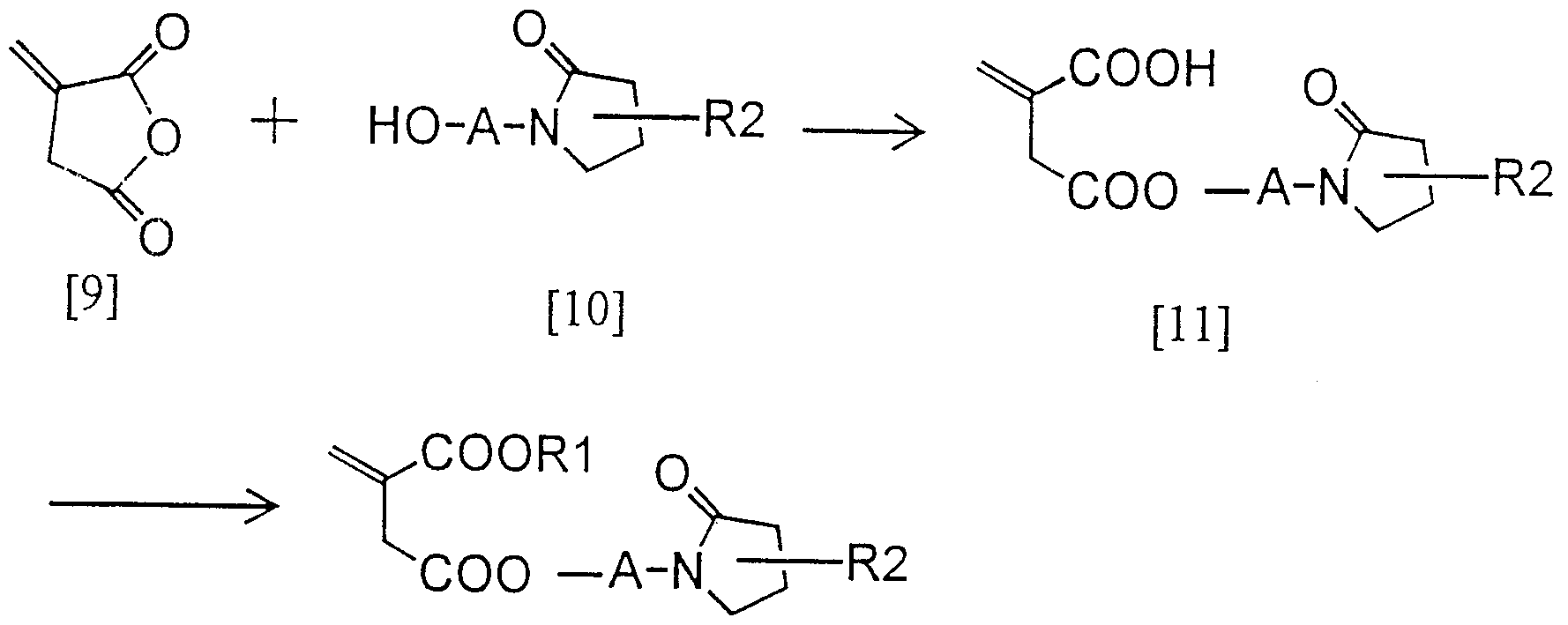
- the method is to react alcohols [12] in itaconic anhydride to obtain monoesters [13], and then use thionyl chloride to form acid chlorides [14], and then perform the reaction with pyrrolidone derivatives [10]
- a method of reacting to obtain a diester can be partially hydrolyzed by a conventional method as required, and desired monoesters can also be obtained.
- This method is a method of reacting itaconic acid [?] With alcohols [12] to obtain monoesters [13], followed by the same method as in b) to obtain diesters.
- This method is a method of first synthesizing a diester [16], for example, in formic acid, heating the diester in the presence of p-toluenesulfonic acid to form a monoester [18], and then obtaining the diester in the same manner as in b).
- ⁇ is preferably methyl, propyl, butyl, benzyl or benzyl
- R 2 is preferably a hydrogen atom
- A is-(CH 2 ) 2 -better.
- Suitable compounds include the following compounds.
- the above-mentioned novel itaconic acid derivative is suitable for use as a polymer composition, as shown in the following 3) and 4), especially as a foldable eye with a copolymer of an acrylic monomer ester
- the raw material of the wafer is suitable.
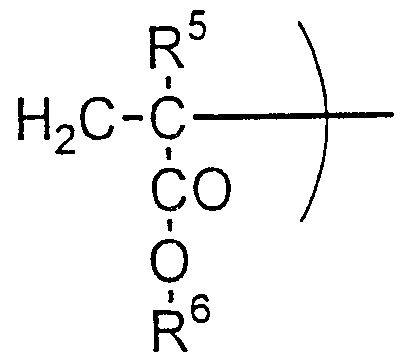
- the copolymer represented by the repeating unit is as follows
- Suitable examples of the above-specified groups include R 3 is a hydrogen atom or a methyl group, and ⁇ is-(CHJ a ⁇ R 1 is a hydrogen atom, methyl, propyl, butyl, benzyl, or phenethyl R 2 is a hydrogen atom, A is _ (CH 2 ) 2- , R e is a hydrogen atom or a methyl group, and 1 ⁇ is a methyl group.
- a copolymer a combination of these groups is suitable.
- R 3 is methyl, is-(CH 2 ) 2- , R 1 is a hydrogen atom, methyl or phenethyl, R 2 is a hydrogen atom, A is-(CH 2 ) 2- , and 11 8 is methyl , Is a combination of methyl.
- the monomer components are mixed, and a copolymer is prepared by using potassium persulfate, ammonium persulfate, benzophenone, or methacryl fluorenyloxyhydroxydibenzone as a polymerization initiator.
- oxydiisobutyronitrile is the most versatile, but this method does not obtain satisfactory mechanical strength as a raw material of a foldable intraocular wafer that is the object of the present application.
- the present inventors have also conducted in-depth research on polymerization initiators. As a result, they have also found that potassium persulfate, ammonium persodium acid, benzophenone, or methacryloyloxybenzyl bream is used as the polymerization initiator.
- the obtained copolymer can satisfy the mechanical strength of the foldable intraocular wafer raw material.
- the molecular weight (viscosity average molecular weight) of the copolymer of the present invention may be 10,000 or more.
- the molecular weight of the copolymer does not have much influence on the characteristics of the copolymer. It is not an important solid, but it has an influence on the strength of the copolymer.
- the molecular weight and strength are roughly linearly proportional to about 10,000 or less, but above 10,000 or more, the strength is also roughly at its maximum, close to a fixed value. Therefore, the required strength cannot be achieved below 10,000, and there is a problem in the strength as a foldable intraocular wafer.
- a suitable molecular weight range for the copolymer is 10,000 to 100,000, and the molecular weight of the copolymer obtained as an example described later is also in this range.
- composition of the present invention by appropriately selecting the ratio of each composition, the refractive index, tensile strength, recovery speed, etc. can be set as desired.
- the ratio of [6] can make the recovery speed fast and increase the tensile strength, but it tends to decrease the refractive index.
- a desired foldable intraocular wafer material can be obtained.
- the appropriate component ratio is as described above. If the composition ratio is adjusted appropriately, the refractive index can be obtained from 1.4 to 1.6, the recovery speed is not too fast or too slow, that is, 3 to 6 seconds, and the tensile strength can be sufficiently durable.
- the strength of the tweezer operation is the foldable intraocular chip above the actual insertion (expanded) l O p B i.
- the intraocular wafer (I 0L) formed by the copolymer of the present invention does not leave any scratches even after operation using tweezers.
- the recovery speed is controlled according to the surgeon's wishes as described above, so it can be set at 3-6 seconds (2 seconds).
- the copolymer of the present invention is hydrophilic.
- the hydrophilic foldable intraocular chip can be circulated and stored in a dry state. It can be expanded and inserted with distilled ice before use.
- the degree of hydrophilicity can be estimated from the moisture content, but it affects the biocompatibility, softness, and the like of the foldable intraocular wafer.
- the water content can be selected by selecting the ratio of each component. For example, increasing the ratio of component [3] and increasing the ratio of component [4] or [5] can increase the water content, and increasing the ratio of component [6] can reduce the water content.
- the moisture content is preferably 25-50%.
- the copolymer of the present invention may also undergo intermolecular cross-linking, and its strength and water absorption may be adjusted by cross-linking.
- the cross-linking agent include diacrylate-based or bisacrylamide-based crosslinkers. Specific examples include ethylene glycol dimethacrylate, diethylene glycol dimethacrylate, or N,
- ⁇ '-methylenebisacrylamide When a large amount of a cross-linking agent is used, the polymer becomes hard, the recovery speed becomes faster, and on the contrary, it becomes brittle. As the amount used, it is 0.01 to 2. 0, and preferably a ratio of 0.1 to 1. 0, relative to the weight of the polymer.
- an ultraviolet absorbent may be appropriately contained.
- a method of mixing an ultraviolet absorber a method generally used in practice
- a method of chemically combining an ultraviolet absorber with a copolymer the ultraviolet absorbent itself also becomes a monomer component forming a copolymer.
- This method can be used in the invention.
- the ultraviolet absorber does not precipitate from the intraocular wafer (I0L).
- the type of the ultraviolet absorber is not particularly limited as long as it can be used in an intraocular lens (I0L), but examples are exemplified by the use of benzophenazine and benzotriazole-based ultraviolet absorbers or Their acrylic derivatives, specifically, hydroxybenzyl ketone and hydroxyphenyl dibenzyl bream or their acrylic derivatives such as 4-methacryloxy-2-hydroxybenzophenone are suitable .
- the copolymer of the present invention has free hydroxyl groups at the ends, so it can interact with polysaccharide
- the compounds are covalently bonded, so that there is no problem of so-called coating peeling.
- the covalent bond can be formed very easily, and it can be accomplished by, for example, treating with divinylsulfone.
- polysaccharides heparin or hyaluronan or a salt thereof (sodium salt, potassium salt, etc.) is suitable.
- the present invention provides some flexible raw materials for the intraocular wafer (I0L).
- the soft intraocular wafer (I0L) when the operation is clamped with tweezers, the traces caused by the tweezers remain to be completely Recovery often takes time.
- the copolymer of the present invention is excellent in resilience and can solve these problems.
- the conventional silicone intraocular chip (I0L) chip Occurrence of turbidity often impairs transparency, and causes small degeneration or cracks in the surrounding area, which may cause some damage to the visual field.
- the copolymer of the present invention no such turbidity was seen, transparency was maintained, and peripheral denaturation and cracking did not occur.
- the copolymer of the present invention can easily obtain a foldable intraocular wafer that satisfies the shape used in practice. This forming can be performed by a known method.
- the copolymer of the present invention is particularly suitable for a foldable intraocular wafer, but its sexual shield can also be applied. For soft-contact wafers.
- Example 1
- Boiling point 140 ⁇ 150'C / 0.2ffiBiHg
- ⁇ -NR ( ⁇ , ppm, CDCl 8 ): 6.34 (B, lH), 5.76 (s, 1H), 4.31 (t, 2H), 3.70 (B, 2H), 3.60 (t, 2H), 3.48 (t , 2H), 3.35 (s, 2H), 2.39 (t, 2H), 2.05 (ffl, 2H)
- ⁇ -NR ( ⁇ , ppm, CDC1 8 ): 7.29-7.19 (ffl, 5H), 6.32 (s, 1H), 5.70 (e, 1H), 4.29 (ffl, 4H), 3.56 (t, 2H), 3.43 (t, 2H), 3.32 (8, 2H), 2.93 (t, 2H), 2.37 (t, 2H), 2.01 (m, 2H)
- ⁇ -NR ( ⁇ , ⁇ , CDC Is): 6.33 (s, lH), 5.75 (a, 1H), 4.31 (t, 2H), 4.10 (t, 2H), 3.60 (t, 2H), 3.48 (t , 2H), 3.34 (s, 2H), 2.39 (t, 2H), 2.04 (in, 2H), 1.61 (m, 2H), 1.37 (in, 2H), 0.93 (t, 3H)
- HEMA- PyEI-MMA HEMA-4- PyEI-A, HEMA-4-PEPyEI-MMA,
- HE A-PyEI-MA HEMA-MPyEI-A
- HEMA-4-MPyEI -MA HEMA-4-PEPyEI- A
- HEA-PyEI-M A HEA- PyEI -MMA
- HEA-4- PyEI-M A HEA-4-PEPyEI-M Ao
- the above abbreviations indicate the following compounds (the same applies hereinafter).
- Moisture content The sliced copolymer flakes were immersed in water (0'C, 2 days or more), after the water content reached an equilibrium state, the water adhering to the surface was wiped off, and the weight was measured as ⁇ . The sample was dehydrated at 60 ° C. for 48 hours under reduced pressure, and the weight in a dry state was measured as W 2 .
- Refractive index Measured with an Abbe refractometer.
- Tensile strength The YQ-Z-7 measuring device was used to measure at a tensile speed of 12 cm / fflin. The unit is expressed in pounds per square inch (pei), "wet” means the sheet is swelled with water to reach equilibrium, and “dry” means the sheet is in a dry state.
- Example 6 In the operation of Example 6, 1.0% by weight of ethylene glycol dimethacrylate (EGMA) was added to the mixture before polymerization, and then the same operation as in Example was performed to obtain a crosslinked Copolymers and flakes made of them.
- EGMA ethylene glycol dimethacrylate
- Example 10 Synthesis of a UV-absorbing agent-containing copolymer and production of a sheet made of the same.
- 0.8- 1. 53 ⁇ 4 (weight) of 4-methyl was added to the mixture before polymerization.
- Acryloyloxy-2-benzophenone (MAHBP) was subjected to the same operation as in Example 6 to obtain a covalent bond-containing copolymer containing an ultraviolet absorber and a sheet composed of the copolymer.
- MAHBP Acryloyloxy-2-benzophenone
- the copolymer sheet prepared in Example 6 was immersed in an aqueous heparin solution (5%) for 24 hours, and then left in the air for 1 hour.
- the sheet was immersed in a sodium carbonate buffer solution (pH11) containing diethyleneiodic acid (0.1%) for 2 hours, washed with a phosphate buffer solution, and then thoroughly washed with water.
- Sheets can be made by covalently bonding heparin to a hydroxyl group.
- the fluorene molecule contains a hydroxyl group, it can absorb water after forming a copolymer
- the surface can be easily modified with polysaccharides, and is bound by covalent bonds so as not to detach;
Landscapes
- Chemical & Material Sciences (AREA)
- Organic Chemistry (AREA)
- Chemical Kinetics & Catalysis (AREA)
- Medicinal Chemistry (AREA)
- Polymers & Plastics (AREA)
- Health & Medical Sciences (AREA)
- Addition Polymer Or Copolymer, Post-Treatments, Or Chemical Modifications (AREA)
- Organic Low-Molecular-Weight Compounds And Preparation Thereof (AREA)
- Hydrogenated Pyridines (AREA)
- Pyrrole Compounds (AREA)
- Prostheses (AREA)
- Materials For Medical Uses (AREA)
- Eyeglasses (AREA)
Description




Claims


Priority Applications (3)
| Application Number | Priority Date | Filing Date | Title |
|---|---|---|---|
| US09/445,282 US6268511B1 (en) | 1997-06-05 | 1998-06-05 | Itaconate derivatives used for a component of a polymer |
| JP50123199A JP2002502395A (ja) | 1997-06-05 | 1998-06-05 | ポリマー成分として有用な新規イタコン酸誘導体 |
| EP98925386A EP0987247A4 (en) | 1997-06-05 | 1998-06-05 | ITACONATE DERIVATIVES AND THEIR USE AS COMPONENTS IN A POLYMER |
Applications Claiming Priority (2)
| Application Number | Priority Date | Filing Date | Title |
|---|---|---|---|
| CN97112170.2 | 1997-06-05 | ||
| CN97112170A CN1089754C (zh) | 1997-06-05 | 1997-06-05 | 用作聚合物成分的衣康酸衍生物 |
Publications (1)
| Publication Number | Publication Date |
|---|---|
| WO1998055444A1 true WO1998055444A1 (en) | 1998-12-10 |
Family
ID=5172114
Family Applications (1)
| Application Number | Title | Priority Date | Filing Date |
|---|---|---|---|
| PCT/CN1998/000095 Ceased WO1998055444A1 (en) | 1997-06-05 | 1998-06-05 | Itaconate derivatives used for a component of a polymer |
Country Status (5)
| Country | Link |
|---|---|
| US (1) | US6268511B1 (zh) |
| EP (1) | EP0987247A4 (zh) |
| JP (1) | JP2002502395A (zh) |
| CN (1) | CN1089754C (zh) |
| WO (1) | WO1998055444A1 (zh) |
Families Citing this family (3)
| Publication number | Priority date | Publication date | Assignee | Title |
|---|---|---|---|---|
| US7048912B2 (en) * | 2003-06-13 | 2006-05-23 | Isp Investments Inc. | Polymeric delivery and release systems for oral care actives |
| EP2501728B1 (en) * | 2009-11-20 | 2015-01-07 | Isp Investments Inc. | Alkyl lactam ester polymers, and uses thereof |
| JP2019502776A (ja) * | 2015-11-20 | 2019-01-31 | アイエスピー インヴェストメンツ エルエルシー | ラクタム部分を有する増殖性ポリマー |
Citations (4)
| Publication number | Priority date | Publication date | Assignee | Title |
|---|---|---|---|---|
| EP0072067A1 (en) * | 1981-08-07 | 1983-02-16 | THE PROCTER & GAMBLE COMPANY | 4-Vinyl-2-methylene butanedioic acid compounds |
| JPH0580279A (ja) * | 1991-09-24 | 1993-04-02 | Seiko Epson Corp | ソフトコンタクトレンズ |
| JPH06123862A (ja) * | 1992-10-09 | 1994-05-06 | Tokyo Keikaku:Kk | ソフトコンタクトレンズ |
| CN1152584A (zh) * | 1995-12-22 | 1997-06-25 | 参天制药株式会社 | 三组份新的共聚物及由其制成的眼用晶片 |
Family Cites Families (5)
| Publication number | Priority date | Publication date | Assignee | Title |
|---|---|---|---|---|
| US4123407A (en) | 1976-11-26 | 1978-10-31 | American Optical Corporation | Hydrophilic contact lens |
| ES2102352T3 (es) | 1988-02-26 | 1997-08-01 | Ciba Geigy Ag | Una lente de contacto humectable, flexible, permeable al oxigeno, hinchable y que contiene unidades de espina dorsal de polioxialquileno y uso de la misma. |
| CS270345B1 (en) | 1988-06-08 | 1990-06-13 | Vacik Jiri | Hydrophilic transparent cross-linked copolymer and method of its production |
| JPH0428705A (ja) | 1990-05-23 | 1992-01-31 | Terumo Corp | 医療用ヒドロゲル |
| JPH05150197A (ja) | 1991-12-02 | 1993-06-18 | Seiko Epson Corp | ソフトコンタクトレンズ |
-
1997
- 1997-06-05 CN CN97112170A patent/CN1089754C/zh not_active Expired - Fee Related
-
1998
- 1998-06-05 JP JP50123199A patent/JP2002502395A/ja not_active Ceased
- 1998-06-05 EP EP98925386A patent/EP0987247A4/en not_active Withdrawn
- 1998-06-05 WO PCT/CN1998/000095 patent/WO1998055444A1/zh not_active Ceased
- 1998-06-05 US US09/445,282 patent/US6268511B1/en not_active Expired - Fee Related
Patent Citations (4)
| Publication number | Priority date | Publication date | Assignee | Title |
|---|---|---|---|---|
| EP0072067A1 (en) * | 1981-08-07 | 1983-02-16 | THE PROCTER & GAMBLE COMPANY | 4-Vinyl-2-methylene butanedioic acid compounds |
| JPH0580279A (ja) * | 1991-09-24 | 1993-04-02 | Seiko Epson Corp | ソフトコンタクトレンズ |
| JPH06123862A (ja) * | 1992-10-09 | 1994-05-06 | Tokyo Keikaku:Kk | ソフトコンタクトレンズ |
| CN1152584A (zh) * | 1995-12-22 | 1997-06-25 | 参天制药株式会社 | 三组份新的共聚物及由其制成的眼用晶片 |
Also Published As
| Publication number | Publication date |
|---|---|
| US6268511B1 (en) | 2001-07-31 |
| CN1089754C (zh) | 2002-08-28 |
| CN1201788A (zh) | 1998-12-16 |
| JP2002502395A (ja) | 2002-01-22 |
| EP0987247A4 (en) | 2001-02-07 |
| EP0987247A1 (en) | 2000-03-22 |
Similar Documents
| Publication | Publication Date | Title |
|---|---|---|
| JP2001519445A (ja) | 4成分系共重合体及びその共重合体からなる眼用レンズ | |
| JP4330268B2 (ja) | 新規な生体模倣ヒドロゲル材料 | |
| US6132462A (en) | Copolymers formed from three components and intraocular lenses made thereof | |
| TWI435915B (zh) | 含有吸收紫外光(uv)及短波長可見光二者的發色團之眼科鏡體材料(一) | |
| AU754155B2 (en) | Polymerizable hydrophilic ultraviolet light absorbing monomers | |
| US4640941A (en) | Hydrogels containing siloxane comonomers | |
| CN110300744A (zh) | 用于光学活性器件的化合物 | |
| CN110382473A (zh) | 用于光学活性装置的疏水化合物 | |
| JP3371114B2 (ja) | 3成分系新規共重合体およびその共重合体からなる眼用レンズ | |
| ES2676743T3 (es) | Materiales acrílicos oftálmicos con alto índice de refracción y resplandor minimizado | |
| CN101595419B (zh) | 包含含羧基甜菜碱酯单体的聚合物的水凝胶接触透镜 | |
| JP4975920B2 (ja) | 親水性生体医学組成物 | |
| CA2391817C (en) | Biomedical compositions | |
| JP7299647B2 (ja) | 高分子化合物、高分子化合物の製造方法、接着剤組成物、硬化物、接着剤組成物の製造方法および接着力の調整方法 | |
| PT93577A (pt) | Processo para a preparacao de hidrogeles baseados em monomeros de alcoois de acucar | |
| JP2002502395A (ja) | ポリマー成分として有用な新規イタコン酸誘導体 | |
| JPH09179073A (ja) | 3成分系新規共重合体およびその共重合体からなる眼用レンズ | |
| CN1084344C (zh) | 三组份新的共聚物及由其制成的眼用晶片 | |
| CS270345B1 (en) | Hydrophilic transparent cross-linked copolymer and method of its production | |
| JP2000107277A (ja) | 眼内レンズ | |
| TWI844480B (zh) | 含有磷酸膽鹼基之乙烯系單體 | |
| JP2026503620A (ja) | 屈折率およびアッベ数の高い眼科用デバイス | |
| AU780010C (en) | Biomedical compositions | |
| JP2002520456A (ja) | コンタクトレンズ材料 | |
| AU6140500A (en) | Hydrophilic biomedical compositions |
Legal Events
| Date | Code | Title | Description |
|---|---|---|---|
| AK | Designated states |
Kind code of ref document: A1 Designated state(s): CA JP KR NO US |
|
| AL | Designated countries for regional patents |
Kind code of ref document: A1 Designated state(s): AT BE CH CY DE DK ES FI FR GB GR IE IT LU MC NL PT SE |
|
| DFPE | Request for preliminary examination filed prior to expiration of 19th month from priority date (pct application filed before 20040101) | ||
| 121 | Ep: the epo has been informed by wipo that ep was designated in this application | ||
| ENP | Entry into the national phase |
Ref country code: JP Ref document number: 1999 501231 Kind code of ref document: A Format of ref document f/p: F |
|
| WWE | Wipo information: entry into national phase |
Ref document number: 09445282 Country of ref document: US |
|
| WWE | Wipo information: entry into national phase |
Ref document number: 1998925386 Country of ref document: EP |
|
| WWP | Wipo information: published in national office |
Ref document number: 1998925386 Country of ref document: EP |
|
| NENP | Non-entry into the national phase |
Ref country code: CA |
|
| WWW | Wipo information: withdrawn in national office |
Ref document number: 1998925386 Country of ref document: EP |