WO1999005139A1 - 2-[pyrazolyl- und triazolyl-3'-oxymethylen]-phenyl-isoxazolone, -triazolone und -tetrazolone als pestizide und fungizide - Google Patents
2-[pyrazolyl- und triazolyl-3'-oxymethylen]-phenyl-isoxazolone, -triazolone und -tetrazolone als pestizide und fungizide Download PDFInfo
- Publication number
- WO1999005139A1 WO1999005139A1 PCT/EP1998/004096 EP9804096W WO9905139A1 WO 1999005139 A1 WO1999005139 A1 WO 1999005139A1 EP 9804096 W EP9804096 W EP 9804096W WO 9905139 A1 WO9905139 A1 WO 9905139A1
- Authority
- WO
- WIPO (PCT)
- Prior art keywords
- formula
- alkyl
- compounds
- alkoxy
- hydrogen
- Prior art date
- Legal status (The legal status is an assumption and is not a legal conclusion. Google has not performed a legal analysis and makes no representation as to the accuracy of the status listed.)
- Ceased
Links
Classifications
-
- A—HUMAN NECESSITIES
- A01—AGRICULTURE; FORESTRY; ANIMAL HUSBANDRY; HUNTING; TRAPPING; FISHING
- A01N—PRESERVATION OF BODIES OF HUMANS OR ANIMALS OR PLANTS OR PARTS THEREOF; BIOCIDES, e.g. AS DISINFECTANTS, AS PESTICIDES OR AS HERBICIDES; PEST REPELLANTS OR ATTRACTANTS; PLANT GROWTH REGULATORS
- A01N43/00—Biocides, pest repellants or attractants, or plant growth regulators containing heterocyclic compounds
- A01N43/72—Biocides, pest repellants or attractants, or plant growth regulators containing heterocyclic compounds having rings with nitrogen atoms and oxygen or sulfur atoms as ring hetero atoms
- A01N43/80—Biocides, pest repellants or attractants, or plant growth regulators containing heterocyclic compounds having rings with nitrogen atoms and oxygen or sulfur atoms as ring hetero atoms five-membered rings with one nitrogen atom and either one oxygen atom or one sulfur atom in positions 1,2
-
- A—HUMAN NECESSITIES
- A01—AGRICULTURE; FORESTRY; ANIMAL HUSBANDRY; HUNTING; TRAPPING; FISHING
- A01N—PRESERVATION OF BODIES OF HUMANS OR ANIMALS OR PLANTS OR PARTS THEREOF; BIOCIDES, e.g. AS DISINFECTANTS, AS PESTICIDES OR AS HERBICIDES; PEST REPELLANTS OR ATTRACTANTS; PLANT GROWTH REGULATORS
- A01N43/00—Biocides, pest repellants or attractants, or plant growth regulators containing heterocyclic compounds
- A01N43/64—Biocides, pest repellants or attractants, or plant growth regulators containing heterocyclic compounds having rings with three nitrogen atoms as the only ring hetero atoms
- A01N43/647—Triazoles; Hydrogenated triazoles
- A01N43/653—1,2,4-Triazoles; Hydrogenated 1,2,4-triazoles
-
- C—CHEMISTRY; METALLURGY
- C07—ORGANIC CHEMISTRY
- C07D—HETEROCYCLIC COMPOUNDS
- C07D249/00—Heterocyclic compounds containing five-membered rings having three nitrogen atoms as the only ring hetero atoms
- C07D249/02—Heterocyclic compounds containing five-membered rings having three nitrogen atoms as the only ring hetero atoms not condensed with other rings
- C07D249/08—1,2,4-Triazoles; Hydrogenated 1,2,4-triazoles
- C07D249/10—1,2,4-Triazoles; Hydrogenated 1,2,4-triazoles with hetero atoms or with carbon atoms having three bonds to hetero atoms with at the most one bond to halogen, e.g. ester or nitrile radicals, directly attached to ring carbon atoms
- C07D249/12—Oxygen or sulfur atoms
Definitions
- the present invention relates to 2- [pyrazolyl- and triazolyl- 3 '-oxymethylene] -phenyl-isoxazolones, -triazolones and -tetrazolones 0 of the formula I.
- R a for hydrogen, halogen, -CC 4 alkyl or -CC 4 ⁇ alkoxy
- R b represents C 1 -C 4 alkyl
- R represents hydrogen, halogen or -CC 4 alkyl
- Bridge which contains three to four members from the group of 3 or 4 carbon atoms, 2 to 3 carbon atoms and 1 or 2 nitrogen, oxygen and / or sulfur atoms, this bridge together with the ring to which it is bonded a partially unsaturated or can form aromatic residue;
- R 2 is hydrogen, nitro, cyano, halogen, C ⁇ -C4-alkyl, C ⁇ -C4-haloalkyl, Ci ⁇ -alkoxy, C 4 alkylthio or C ⁇ -C 4 alkoxycarbonyl;
- R 3 if necessary subst. -C 6 alkyl, optionally subst. C 3 -C 6 cycloalkyl, optionally subst. Aryl or optionally subst. Hetaryl.
- the invention also relates to processes for the preparation of these compounds, compositions containing them and their use for controlling animal pests or harmful fungi.
- the present invention was based on compounds with improved activity as an object.
- WO-A 96/01258 in the isoxazolone, triazolone or tetrazolone residue on the phenyl ring and of those from WO-A 95/14009, WO-A 96/36229, WO-A 96/38425, WO-A 97 / 05120 and WO-A 97/02255 known compounds in the oxyethylene-pyrazolyl or triazolyl group on the phenyl ring.
- the compounds of the formula I have an opposite on the known compounds increased effectiveness against harmful fungi and animal pests.
- the compounds of the formula I per se can be analogous to those in WO-A 95/14009, WO-A 96/01256, WO-A 96/01258, WO-A 96/36229, WO-A 96/38425, WO-A 97 / 05120 or WO-A 97/02255 can be obtained.
- the compounds I can be obtained in various ways, it being irrelevant for the synthesis whether the group X or the pyrazolyl or triazolyl grouping is built up first.
- the designation X # for the radical X, or a suitable precursor of this radical and E # for the pyrazylyl or triazolyl grouping, or a suitable precursor for this, is therefore used in the following reaction descriptions.
- Those compounds I are obtained, for example, by converting a benzyl derivative of the formula II # into the corresponding phenyl derivative of the formula V # in the presence of a base with a 3-hydroxypyrazole or triazole of the formula III.
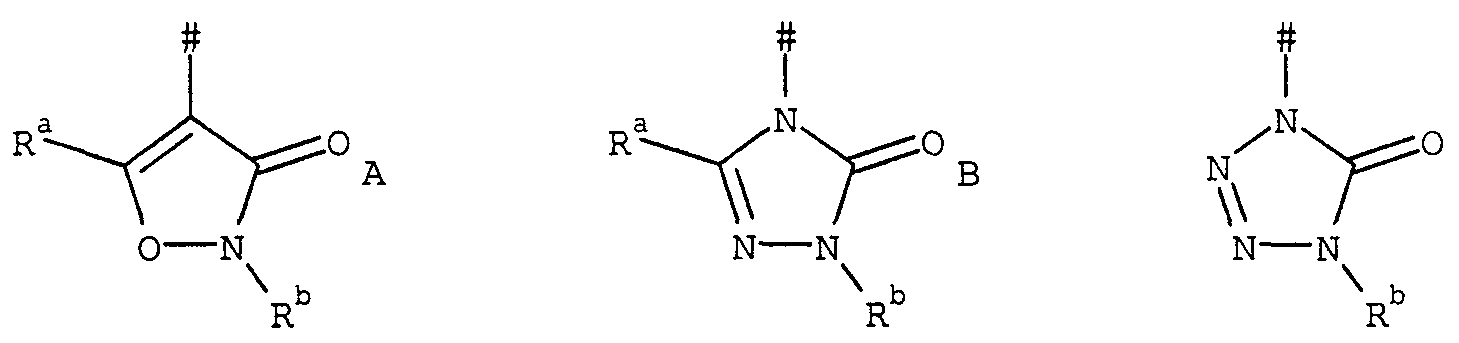
- the radical X # in the formula V # represents a group A, B or C
- the phenyl compounds of the formula V # correspond to those of the formula I.
- L in formula II means a nucleophilically exchangeable group, for example halogen (e.g. chlorine, bromine and iodine), or an alkyl or aryl sulfonate (e.g. methyl sulfonate, trifluoromethyl sulfonate, phenyl sulfonate and 4-methylphenyl sulfonate).
- halogen e.g. chlorine, bromine and iodine
- alkyl or aryl sulfonate e.g. methyl sulfonate, trifluoromethyl sulfonate, phenyl sulfonate and 4-methylphenyl sulfonate.
- the etherification of the compounds II # and III is usually carried out at temperatures from 0 ° C. to 80 ° C., preferably at 20 ° C. to 60 ° C.
- Suitable solvents are aromatic hydrocarbons such as toluene, o-, m- and p-xylene, halogenated hydrocarbons such as methylene chloride, chloroform and chlorobenzene, ethers such as diethyl ether, diisopropyl ether, tert. -Butyl methyl ether, dioxane, anisole and tetrahydrofuran, nitriles such as acetonitrile and propionitrile, alcohols such as methanol, ethanol, n-propanol, i-propanol, n-butanol * and tert.
- aromatic hydrocarbons such as toluene, o-, m- and p-xylene
- halogenated hydrocarbons such as methylene chloride, chloroform and chlorobenzene
- ethers such as diethyl ether, diisopropyl ether, tert.
- ketones such as acetone and methyl ethyl ketone and dimethyl sulfoxide, dimethylformamide, dimethylacetamide, 1,3-dirne - thylimidazolidin-2-one and 1, 2-dimethyltetrahydro-2 (1H) pyrimidine, preferably methylene chloride, acetone, toluene, methyl tert . -butyl ether and dimethylformamide. Mixtures of the solvents mentioned can also be used.
- Suitable bases are, generally, inorganic compounds such as alkali - metal and alkaline earth metal (eg lithium hydroxide, sodium hydroxide, potassium hydroxide and calcium hydroxide), alkaline earth metal oxides Alkalime ⁇ tallow and (for example, lithium oxide, sodium oxide, calcium oxide and magnesium oxide), alkali metal and alkaline earth metal hydrides (eg lithium hydride, sodium , Potassium hydride and calcium hydride), alkali metal amides (for example lithium amide, sodium amide and potassium amide), alkali metal and alkaline earth metal carbonates (for example lithium carbonate and calcium carbonate) and alkali metal hydrogen carbonates (for example sodium hydrogen carbonate), organometallic compounds, in particular alkali metal alkyls (for example such as methyl - lithium, butyll ), Alkyl magnesium halides (eg methyl magnesium chloride) and alkali metal and alkaline earth metal alcoholates (eg sodium methoxide, sodium ethanolate, potassium
- reaction may be advantageous for the reaction to add a catalytic amount of a crown ether (e.g. 18-crown-6 or 15-crown-5).
- a catalytic amount of a crown ether e.g. 18-crown-6 or 15-crown-5.
- the reaction can also be carried out in two-phase systems consisting of a solution of alkali or alkaline earth metal hydroxides or carbonates in water and an organic phase (for example aromatic and / or halogenated hydrocarbons).
- transfer catalysts as phase this purpose include for example ammonium Halo - halides and tetrafluoroborates (eg Benzyltriethylammoniumchlo- chloride, Benzyltributylammoniumbro id, tetrabutylammonium, He xadecyltrimethylammoniumbromid or Terabutylammoniumtetrafluoro- borate) and phosphonium (eg tetrabutylphosphonium chloride and tetraphenylphosphonium bromide) into consideration. It may be advantageous for the reaction to first react the 3-hydroxypyrazole with the base into the corresponding hydroxylate, which is then reacted with the benzyl derivative.
- benzyl compounds II # required for the preparation of the compounds I are known from the literature [cf. WO-A 95/14009; WO-A 96/36229; WO-A 97/02255]. They can be obtained by the following synthetic route:
- the reduction of the nitro group of IIa ' # can be carried out under generally customary conditions, preferably by catalytic hydrogenation, by reduction with iron, tin or zinc in the presence of an acid, by reduction with alkali metals in the presence of a base or by enzyme-catalyzed Reduction [cf. Houben-Weyl, Vol. IV / lc, 4th ed., Pp. 506ff., Thieme Verlag Stuttgart and New York (1980); ibid. Vol. IV / ld, 4th ed., p. 473ff. (1981); Heterocycles, vol. 31, p. 2201 (1990)]
- Nitrobenzene derivatives of the formula IIa ' # are z. T. known from the literature [cf. WO-A 93/15046; WO-A 95/14009] or can be prepared according to the literature cited.
- reaction of IIa # with phosgene or a phosgene equivalent such as, for example, di- or triphosgene or phenyl chloroformate, is usually carried out at temperatures from -10 ° C. to 30 250 ° C., preferably 10 ° C. to 110 ° C., in an inert organic Solvents in the presence of a base or a catalyst [cf. Chem. Ber., Vol. 72, p. 457 (1972); Che. Soc. Rev., Vol. 3,
- “shark” represents a halogen atom, such as chlorine or bromine.
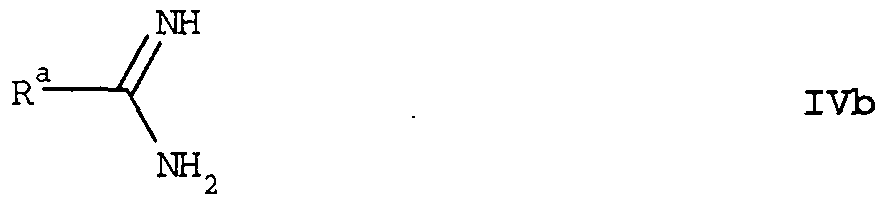
- benzyl compounds IIB * required for the preparation of the compounds IB in which R a is alkyl or alkoxy are also known from the literature [cf. WO-A 96/36229] or are analogous to the literature [cf. J. Org. Chem., Vol. 43 (1978) p. 936]. They can be obtained by reacting the carbamates of the formula IIc # with amidines IVb or orthoesters IVc:
- the reaction of the isocyanates IIb # with with azides IVd usually takes place at temperatures from -10 ° C. to 200 ° C., preferably 20 ° C. to 140 ° C., in an inert organic solvent, if appropriate in the presence of a base or an acid [cf. J. Org. Chem., Vol. 45, p. 5130 (1980); J. Am. Chem. Soc, Vol. 81, p. 3076 (1959); Tetrahedron, Vol. 31, p. 765 (1975); J. Org. Chem., Vol. 38, p. 675 (1973)].
- M stands for a cation from the group of alkali or alkaline earth metals, trialkylsilyl or alkyl. Trimethylsilyl azide is preferably used.
- the alkylation of the tetrazolinones IIe # to IIC * usually takes place at temperatures from -20 ° C. to 180 ° C., preferably 20 ° C. to 120 ° C., in an inert organic solvent in the presence of a base [cf. Synth. Commun., Vol. 18, p. 2011 (1988); J. Chem. Soc. Chem. Commun., P. 735 (1987)].
- alkylating agents examples include alkyl halides, alkyl sulfonates, alkyl p-toluenesulfonates, alkyl trifluoromethanesulfonates, alcohols, dialkyl ethers or alkyl p-bromophenyl sulfonates, in particular methyl iodide or dimethyl sulfate.
- E * in the formulas IIA #, IIB # or IIC stands for the pyrazole or triazole grouping, the compounds IIA # , IIB or IIC # correspond to the compounds IA, IB or IC.
- the group X is particularly preferably set up at the stage of the compounds IIa ' # or IIb # in which E # is hydrogen or the pyrazole or triazole grouping.
- 3-hydroxypyrazole purple are also known from the literature or can be prepared by the methods described there [J. Heterocycl. Chem. 30., 49 (1993), Chem. Ber. 102, 1318
- the 3-hydroxypyrazoles purple are particularly advantageously obtained by the processes described in WO-A 97/03969 and DE No. 19 652 516.0.
- 3-Hydroxytriazole Illb are also known from the literature or can be prepared by the methods described there [Chem. Ber. 56, 1794 (1923); DE-A 21 50 169; DE-A 22 00 436; US-A 4,433,148; J. Med. Chem. 3_3, 2772 (1990); Synthesis 1987, 986; DE-A 22 60 015; DE-A 24 17 970].
- reaction mixtures are worked up in a conventional manner, e.g. by mixing with water, separating the phases and, if necessary, purifying the crude products by chromatography.
- the intermediate and end products fall partly in the form of colorless or slightly brownish, viscous oils, which are freed from volatile components or cleaned under reduced pressure and at a moderately elevated temperature. If the intermediate and end products are obtained as solids, they can also be purified by recrystallization or digesting.
- the compounds I can contain acidic or basic centers and accordingly form acid addition products or base addition products or salts.
- Acids for acid addition products include Mineral acids (eg hydrohalic acids such as hydrochloric acid and hydrobromic acid, phosphoric acid, sulfuric acid, nitric acid), organic acids (eg formic acid, acetic acid, oxalic acid, malonic acid, lactic acid, malic acid, succinic acid, tartaric acid, citric acid, salicylic acid, p-toluenesulfonic acid) ) or other proton acidic compounds (eg saccharin).
- Bases for base addition products include Oxides, hydroxides, carbonates or hydrogen carbonates of alkali metals or alkaline earth metals (e.g. potassium or sodium hydroxide or carbonate) or ammonium compounds (e.g. ammonium hydroxide).
- Halogen fluorine, chlorine, bromine and iodine
- Alkyl saturated, straight-chain or branched hydrocarbon radicals with 1 to 4 or 6 carbon atoms, e.g. Methyl, ethyl, propyl, 1-methylethyl, butyl, 1-methylpropyl, 2-methylpropyl and 1, 1-dimethylethyl;
- Haloalkyl straight-chain or branched alkyl groups with 1 to 4 carbon atoms (as mentioned above), these groups being able to partially or completely replace the hydrogen atoms by halogen atoms as mentioned above, for example C 1 -C 2 -haloalkyl such as chloromethyl, dichloromethyl, trichloromethyl, fluoromethyl , Difluoromethyl, trifluoromethyl, chlorofluoromethyl, dichlorofluoromethyl, chlorodifluoromethyl, 1-fluoroethyl, 2-fluoroethyl, 2, 2-difluoroethyl, 2, 2, 2-trifluoroethyl, 2-chloro-2-fluoroethyl, 2-chloro-2 , 2-difluoroethyl, 2, 2-dichloro-2-fluoroethyl, 2, 2, 2-trichloroethyl and pentafluoroethyl;
- Alkylcarbonyl straight-chain or branched alkyl groups, the - particular having 1 to 10 carbon atoms (as mentioned ge ⁇ Nannt) which are connected via a carbonyl group (-CO-) to the backbone ⁇ ge;
- Alkoxy straight-chain or branched alkyl groups with 1 to 4 carbon atoms (as mentioned above) which are bonded to the skeleton via an oxygen atom (-0-);
- Alkoxycarbonyl straight-chain or branched alkoxy groups with 1 to 4 carbon atoms (as mentioned above) which are bonded to the skeleton via a carbonyl group (-C0-);
- Alkylthio straight-chain or branched alkyl groups with 1 to 4 carbon atoms (as mentioned above) which are bonded to the skeleton via a sulfur atom (-S-);
- Cycloalkyl monocyclic, saturated hydrocarbon groups with 3 to 6 carbon ring members, such as cyclopropyl, cyclobutyl, cyclopentyl and cyclohexyl;
- Aryl a mono- to trinuclear aromatic ring system containing 6 to 14 carbon ring members, e.g. Phenyl, naphthyl and anthracenyl;
- Hetaryl 5- or 6-membered heteroaromatics, e.g.
- 5-ring heteroaryl groups which, in addition to carbon atoms, contain one to four nitrogen atoms or one to three nitrogen atoms and one sulfur or oxygen tom may contain as ring members, for example 2-furyl, 3-furyl, 2-thienyl, 3-thienyl, 2-pyrrolyl, 3-pyrrolyl, 3-isoxazolyl, 4-isoxazolyl, 5-isoxazolyl, 3-isothiazolyl, 4-isothiazolyl, 5-isothiazolyl, 3- Pyrazolyl, 4-pyrazolyl, 5-pyrazolyl, 2-0xazolyl, 4-oxazolyl, 5-oxazolyl, 2-thiazolyl, 4-thiazolyl, 5-thiazolyl, 2-imidazolyl, 4-imidazolyl, 1, 2, 4-oxadiazole 3-yl, 1,2,
- 5-membered heteroaryl groups which ferrous ben carbon atoms one to four nitrogen atoms' or a tome to three nitrogen and one sulfur or oxygen atom as May contain ring members, and in which two adjacent carbon ring members or a nitrogen and an adjacent carbon ring member can be bridged by a buta-1, 3-diene-1, 4-diyl - group; 5-membered heteroaryl bonded via nitrogen, containing one to four nitrogen atoms, or 5-membered heteroaryl, bonded via nitrogen, containing one to three nitrogen atoms: 5-ring heteroaryl groups which, in addition to carbon atoms, contain one to four nitrogen atoms or one to three nitrogen atoms as ring members can contain, and in which two adjacent carbon ring members or an embroidery Substance and an adjacent carbon ring member can be bridged by a buta-1, 3-diene-1, 4-diy
- alkyl, alkenyl and alkynyl groups can be partially or completely halogenated (ie the hydrogen atoms of these groups can be partially or completely replaced by the same or different halogen atoms as above called (preferably fluorine, chlorine and bromine, especially fluorine and chlorine) can be replaced and / or one to three, in particular one, of the following radicals:
- mono- or binuclear aromatic ring system which may, besides carbon atoms one to four nitrogen atoms or one or two nitrogen atoms and one oxygen or sulfur atom or an oxygen or sulfur atom as ring members ⁇ (as mentioned above) which is directly or can be bonded to the substituents via an oxygen atom (-0-), a sulfur atom (-S-) or an amino group (-NR a -), ie aryl radicals such as phenyl and naphthyl, preferably phenyl or 1- or 2-naphthyl, and Hetaryl radicals, for example 5-ring heteroaromatics containing one to three nitrogen atoms and / or an oxygen or sulfur atom such as 2-furyl, 3-furyl, 2-thienyl, 3-thienyl, 1-pyrrolyl, 2-pyrrolyl, 3-pyrrolyl , 3-isoxazolyl, 4-isoxazolyl, 5-isoxazolyl,
- heteroaromatics containing one to four nitrogen atoms as heteroatoms such as 2-pyridinyl, 3-pyridinyl, 4-pyridinyl, 3-pyridazinyl, 4-pyridazinyl, 2-pyrimidinyl, 4-pyrimidinyl, 5-pyrimidinyl, 2-pyrazinyl , 1, 3, 5-triazin-2-yl, 1, 2, 4-triazin-3-yl and 1, 2, 4, 5-tetrazin-3-yl, in particular 2-pyridinyl, 3-pyridinyl, 4- Pyridinyl, 2-pyrimidinyl, 4-pyrimidinyl, 2-pyrazinyl and 4-pyridazinyl.
- cyclic (saturated, unsaturated or aromatic) groups can be partially or completely halogenated [ie the hydrogen atoms of these groups can be partially or completely by identical or different halogen atoms as mentioned above (preferably fluorine, chlorine or bromine, in particular fluorine or chlorine in particular) can be replaced] and / or can carry one to four (in particular one to three) of the following radicals: cyano, nitro, hydroxy, amino, carboxyl, aminocarbonyl , Alkyl, haloalkyl, alkenyl, haloalkenyl, alkenyloxy, haloalkenyloxy, alkynyl, haloalkynyl, alkynyloxy, haloalkynyloxy, alkoxy, halogenalkoxy, alkylthio, haloalkylthio, alkylamino, dialkylamino, alkyl
- cycloalkyl cycloalkoxy, cycloalkylthio, cycloalkylamino, cycloalkyl-N-alkylamino, heterocyclyl, heterocyclyloxy, heterocycliclthio, heterocyclylamino or heterocyclyl-N-alkylamino, preferably the cyclic systems 3 to 12, 2 to 8 ring groups, 3 to 12, the cyclic systems 3 to 12 ring members, in particular 3 to 6 ring members and the alkyl groups in these radicals preferably containing 1 to 6 carbon atoms, particularly 1 to 4 carbon atoms ent ⁇ hold;
- the aryl radicals preferably- Contain 6 to 10 ring members, in particular 6 ring members (phenyl), the hetaryl residues in particular contain 5 or 6 ring members and the alkyl groups in these residues preferably contain 1 to 6 carbon atoms, in particular 1 to 4 carbon atoms and / or one or
- Li NOR iv [where R 111 is hydrogen, alkyl, cycloalkyl and aryl and R iv is alkyl, alkenyl, haloalkenyl, alkynyl and arylalkyl (the alkyl groups mentioned preferably containing 1 to 6 carbon atoms, in particular 1 to 4 carbon atoms , said cycloalkyl groups, alkenyl groups and alkynyl groups preferably contain 3 to 8, in particular 3 to 6, carbon atoms) and aryl, in particular phenyl, which is unsubstituted or can be substituted by customary groups] or
- R v is hydrogen, hydroxy, Ci-Cg-alkyl, C 2 -C 5 alkenyl, C -Cg alkynyl, C ⁇ -C 6 alkoxy, C 2 -C 5 - Alkenyloxy, C 2 -C 6 -alkynyloxy, -C-C 6 -alkoxy-C ⁇ -C 5 -alkyl, C] _- Cg-alkoxy-
- R vi is hydrogen, Ci-Cg-alkyl, C 2 -Cg-alkenyl, C -Cg-alkynyl, C -Cg-cycloalkyl, C -Cg-cycloalkenyl, aryl , aryl-Ci-Cg-alkyl, hetaryl and hetaryl-Ci Cg-alkyl and D is a direct bond, oxygen or nitrogen, wherein the nitrogen-called one of the Ge at R vi ⁇ may carry groups], and / or which two adjacent C atoms of the cyclic Sy ⁇ steme a C -Cs alkylene, C -C 5 ⁇ alkenylene, oxy-C 2 -C 4 alkylene, oxy-C ⁇ -C 3 alkyleneoxy, oxy-C 2 -C 4 -alkenylene, oxy-C 2 -C 4 -alkenylene, oxy-C 2 -C 4 -alken
- Compounds IA are preferred in view of their biological action.
- R 3 is phenyl or benzyl, where the phenyl radical can be partially or completely halogenated and / or
- two adjacent C atoms of the phenyl ring can be connected via an oxy-C 1 -C alkoxy bridge or an oxy-C ⁇ -C haloalkoxy bridge,
- R 3 is pyridyl
- the pyridyl ring may be halogenated dig partially full text or ⁇ and / or can carry one to three of the following re- ste: cyano, nitro, C ⁇ -C 4 alkyl , C ⁇ -C 2 haloalkyl, C 1 -C 4 -alkoxy, C 2 -haloalkoxy, C 3 -CG-cycloalkyl, C ⁇ -C4 ⁇ alkyl carbonyl or C ⁇ -C 4 -alkoxycarbonyl.
- compounds I are preferred in which R b represents hydrogen.
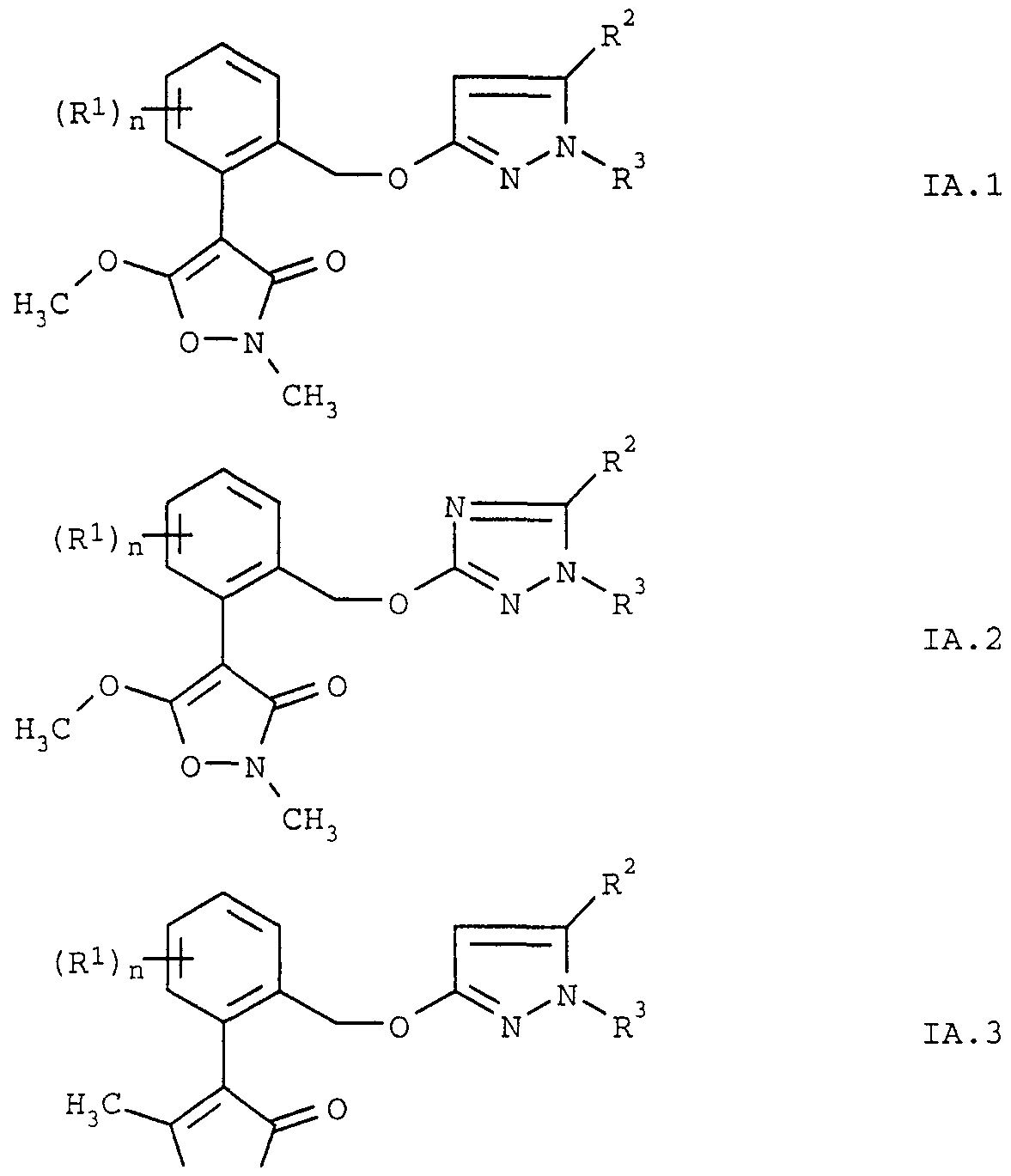
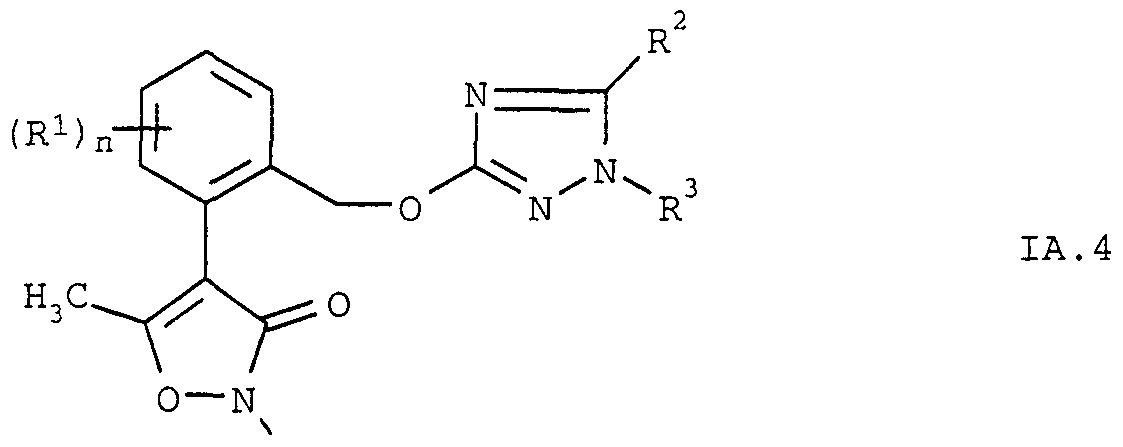
- compounds IA.l, IA.2, IA.3 and IA.4 are particularly preferred in which (R ⁇ n for hydrogen, 6-chlorine or 6-methyl, R 2 for hydrogen or methyl and R 3 for optionally cyclohexyl, benzyl, phenyl, pyridyl or pyrazinyl substituted by halogen or C 1 -C 4 haloalkyl.
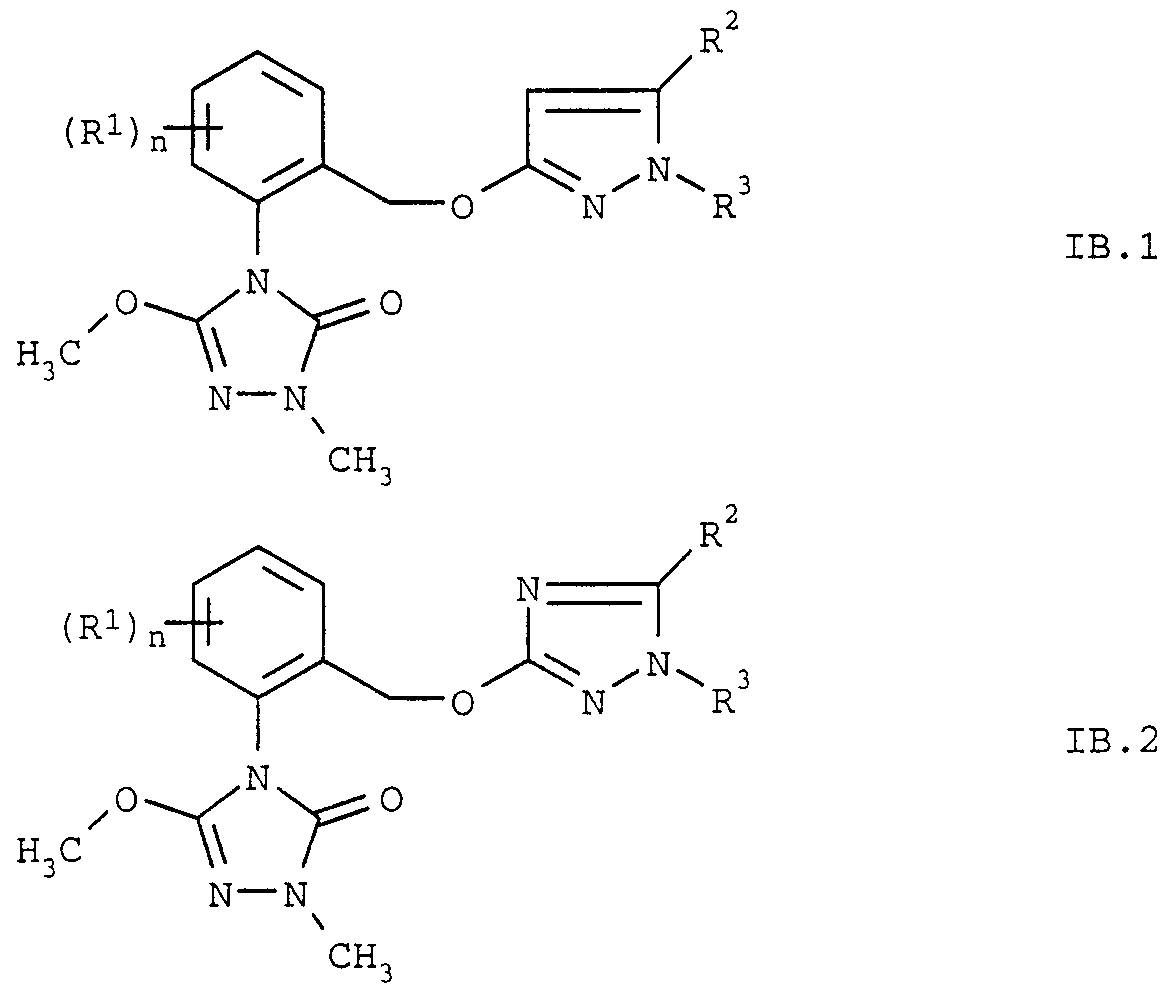
- compounds IB.l, IB.2, IB.3 and IB.4 are particularly preferred in which (R 1 ⁇ for hydrogen, 6-chlorine or 6-methyl, R 2 for hydrogen or methyl and R 3 for possibly cyclohexyl, benzyl, phenyl, pyridyl or pyrazinyl which is substituted by halogen or C 1 -C 4 -haloalkyl.
- the particularly preferred embodiments of the intermediates with respect to the variables correspond to those of the groups or residues A, B, C, Y, R a , R b , (R 1 ) n / R 2 and R 3 of the formula I.
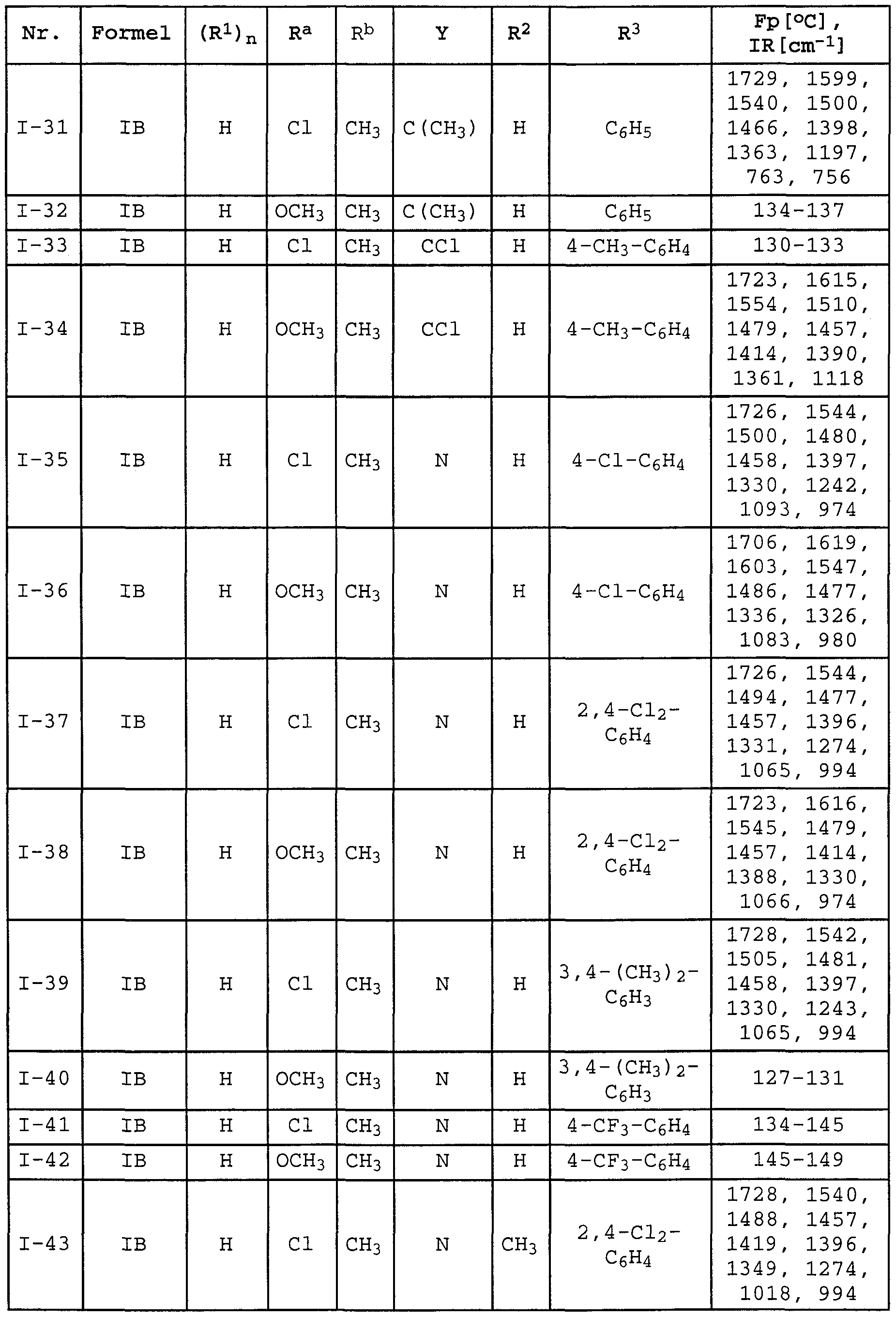
- the compounds I compiled in the tables below are preferred.
- the groups mentioned for a substituent in the tables also represent a particularly preferred embodiment of the substituent in question, regardless of the combination in which they are mentioned.
- the compounds I are suitable as fungicides. They are characterized by excellent activity against a broad spectrum of phytopathogenic fungi, in particular from the class of the Ascomycetes, Deu tero yceten, Phycomycetes and Basidiomycetes. Some of them are systemically effective and can be used in plant protection as leaf and soil fungicides.
- Botrytis cinerea (gray mold) on strawberries, vegetables, ornamental plants and vines, • Cercospora arachidicola on peanuts,
- Erysiphe graminis (powdery mildew) on cereals, Fusarium and Verticillium species on various plants, • Helminthosporium species on cereals,
- the compounds I are also suitable for combating harmful fungi such as Paecilomyces variotii in the protection of materials (e.g. wood, paper, dispersions for painting, fibers or fabrics) and in the protection of stored products.
- harmful fungi such as Paecilomyces variotii in the protection of materials (e.g. wood, paper, dispersions for painting, fibers or fabrics) and in the protection of stored products.
- the compounds I are used by treating the fungi or the plants, seeds, materials or the soil to be protected against fungal attack with a fungicidally active amount of the active compound. Fabrics treated. The application can take place both before and after the infection of the materials, plants or seeds by the fungi.
- the fungicidal compositions generally contain between 0.1 and 95, preferably between 0.5 and 90% by weight of active ingredient.
- the application rates in crop protection are between 0.01 and 2.0 kg of active ingredient per ha.
- active ingredients of from 0.001 to 0.1 g, preferably 0.01 to 0.05 g, are required per kg of seed.
- the amount of active ingredient applied depends on the type of application and the desired effect. Usual application rates in material protection are, for example, 0.001 g to 2 kg, preferably 0.005 g to 1 kg of active ingredient per cubic meter of treated material.
- the compounds of the formula I are also suitable for effectively combating animal pests from the class of the insects, arachnids and nematodes. They can be used in crop protection as well as in the hygiene, storage protection and veterinary sectors to control animal pests. They are particularly suitable for controlling the following animal pests: • Insects from the order of the butterflies (Lepidoptera), for example Agrotis ypsilon, Agrotis segetum, Alabama argilla- cea, Anticarsia gemmatalis, Argyresthia conjugella, Autographa gamma, Bupalus piniarius, Cacoecia murinana, Capua reticulana , Cheimatobia bru ata, Choristoneura fumiferana, Choristoneura occidentalis, Cirphis unipuncta, Cydia pomonella, Dendrolimus pini, Diaphania nitidalis, Diatraea grandiosella, Earias insulan
- Beetles (Coleoptera), e.g. Agrilus sinuatus, Agriotes lineatus, Agriotes obscurus, Amphimallus solstitialis, Anisandrus dispar, Anthonomus grandis, Anthonomus pomorum, Atomaria linearis, Blastophagus piniperda, Blitophaga undata, Bruchus rufimanus, Bruechus pisorum, Bruchus lentisu- losa, Byiscus , Cerotoma trifurcata, Ceuthorrhynchus assimilis, Ceuthorr- hynchus napi, Chaetocnema tibialis, Conoderus vespertinus, Crioceris asparagi, Diabrotica longicornis, Diabrotica 12-punc- tata, Diabrotica virgiferisisobutisis, histobis, histobellisis, epilachnis, varilobinisis, epilach
- Two-winged e.g. Aedes aegypti, Aedes vexans, Anas - trepha ludens, Anopheles maculipennis, Ceratitis capitata,
- Chrysomya bezziana Chrysomya hominivorax, Chrysomya macella- ria, Contarinia sorghicola, Cordylobia anthropophaga, Culex pi- piens, Dacus cucurbitae, Dacus oleae, Dasineura brassicae, Fan- nia canicularis, Gasterophilus intestinalis, glipidisisisisodisisisodisis, glossina misplantis, glossina metrisis, feminine equilibrium, glossina morphisis, glossina misplantis, glossina misoblus Hylemyia platura, Hypoderma lineata, Liriomyza sativae, Liriomyza trifolii, Lucilia caprina, Lucilia cuprina, Lucilia sericata, Lycoria pectoralis, Mayetiola destructor, Musca domestica, Muscina stabulans, Oestrus ovi
- Thrips e.g. Frankliniella fusca, Frankliniella occidentalis, Frankliniella tritici, Scirtothrips citri, Thrips oryzae, Thrips palmi and Thrips tabaci,
- Hymenoptera for example Athalia rosae, Atta cephalotes, Atta sexdens, Atta texana, Hoplocampa minuta, Hoplocampa testudinea, Monomoriu pharaonis, Solenopsis geminata and Solenopsis invicta, • Bedbugs (Heteroptera), for example Acrostusum leucopar, bliss , Cyrtopeltis notatus, Dysdercus cingulatus, Dysdercus inter edius, Eurygaster integriceps, Euschistus impictiventris, Leptoglossus phyllopus, Lygus lineolaris, Lygus pratensis, Nezara viridula, Piesma quadrata, Solubea insularis and Thyanta perditor,
- Plant suckers e.g. Acyrthosiphon onobrychis, Adelges laricis, Aphidula nasturtii, Aphis fabae, Aphis pomi, Aphis sambuci, Brachycaudus cardui, Brevicoryne brassicae, Ce-rosipha gossypii, Dreyfusia nordmannianae, Dreyfusia picisacumaumolaisolapiaaciaacolaicausolaapiaolapiaacolaicausolaapiaolabiaapiaaciosaapiaaciaiaabiaapiaaciaaciaapiaaciaapiaaciaapiaaciaapiaaciaapiaaciaapiaaciaapiaapiaaciaapiaapiaapiaapiaapiaapiaapiaapiaapiaapiaapiaapiaapiaapiaapiaapiaapiaapiaapiaapiaapiaapiaapiaapiaapiaapiaapia
- Termites e.g. Calotermes flavicollis, Leucotermes flavipes, Reticulitermes lucifugus and Termes natalensis,
- Straight wing aircraft e.g. Acheta domestica, Blatta orien- talis, Blattella germanica, Forficula auricularia, Gryllotalpa gryllotalpa, Locusta migratoria, Melanoplus bivittatus, Melano- plus femur-rubrum, Melanoplus mexicanus, Melanoplus sanguini- pes, Melanoplus spretus, Nomadascocata americanana, Pericascacerana america, Schistocerca peregrina, Stauronotus maroccanus and Tachycines asynamorus, • Arachnoidea such as arachnids (Acarina), eg Amblyomma america- num, Amblyomma variegatum, Argas persicus, Boophilus annulatus, Boophilus decoloratus, Boophilus microplus, Brevipalpus phoeni- cis,
- Nematodes such as root-bile nematodes, eg Meloidogyne hapla, Meloidogyne incognita, Meloidogyne javanica, cyst-forming nematodes, eg Globodera rostochiensis, Heterodera avenae, Heterodera glycines, Heterodera schachtii, Heterodera trifolius, longica-lutula, stock- lumenaluct, leaf- and leaf-leaf , Ditylenchus dipsaci, Heliocotylenchus mul- ticinctus, Longidorus elongatus, Radopholus similis, Rotylen- chus robustus, Trichodorus primitivus, Tylenchorhynchus clay- toni, Tylenchorhynchus dubius, Pratylenchus neglectus, Pratansatuschatychatychatychaty
- the compounds I can be converted into the usual formulations, e.g. Solutions, emulsions, suspensions, dusts, powders, pastes and granules.
- the form of application depends on the respective purpose; in any case, it should ensure a fine and uniform distribution of the compound according to the invention.
- the formulations are prepared in a known manner, e.g. by stretching the active ingredient with solvents and / or carriers, if desired using emulsifier and dispersants, where in the case of water as diluent other organic solvents can also be used as auxiliary solvents.
- auxiliaries solvents such as aromatics (e.g. xylene), chlorinated aromatics (e.g. chlorobenzenes), paraffins (e.g. petroleum fractions), alcohols (e.g. methanol, butanol), ketones (e.g. cyclohexanone), amines (e.g. Ethanolamine, dimethylformamide) and water;
- Carriers such as natural stone powder (e.g.
- Emulsifiers such as non-ionic and anionic emulsifiers (e.g. polyoxyethylene fatty alcohol ethers, alkyl sulfonates and aryl sulfonates) and dispersants such as lignin sulfite liquors and methyl cellulose.
- non-ionic and anionic emulsifiers e.g. polyoxyethylene fatty alcohol ethers, alkyl sulfonates and aryl sulfonates
- dispersants such as lignin sulfite liquors and methyl cellulose.
- Mineral oil fractions of medium to high boiling point such as kerosene or diesel oil, are also used to produce directly sprayable solutions, emulsions, pastes or oil dispersions Coal tar oils as well as oils of vegetable or animal origin, aliphatic, cyclic and aromatic hydrocarbons, e.g.
- benzene toluene, xylene, paraffin, tetrahydronaphthalene, alkylated naphthalenes or their derivatives, methanol, ethanol, propanol, butanol, chloroform, carbon tetrachloride, cyclohexanol, cyclohexanone, Chlorobenzene, isophorone, strongly polar solvents, for example dimethylformamide, dimethyl sulfoxide, N-methylpyrrolidone, water, into consideration.
- Powders, materials for broadcasting and dusts can be prepared by mixing or grinding the active substances together with a solid carrier.
- Granules e.g. Coating, impregnation and homogeneous granules can be produced by binding the active ingredients to solid carriers.
- Solid carriers are e.g. Mineral soils, such as silica gel, silicas, silica gels, silicates, talc, kaolin, Attaclay, limestone, lime, chalk, bolus, loess, clay, dolomite, diatomaceous earth, calcium and magnesium sulfate, magnesium oxide, ground plastics, fertilizers such as e.g. Ammonium sulfate, ammonium phosphate, ammonium nitrate, ureas and vegetable products, such as cereal flour, tree bark, wood and nutshell flour, cellulose powder and other solid carriers.
- Mineral soils such as silica gel, silicas, silica gels, silicates, talc, kaolin, Attaclay, limestone, lime, chalk, bolus, loess, clay, do
- the formulations generally contain between 0.01 and 95% by weight, preferably between 0.1 and 90% by weight, of the active ingredient.
- the active ingredients are used in a purity of 90% to 100%, preferably 95% to 100% (according to the NMR spectrum).
- V. 80 parts by weight of a compound according to the invention are mixed with 3 parts by weight of the sodium salt of dusobutylnaphthalm-al-phasulfonic acid, 10 parts by weight of the sodium salt of a lignosulfonic acid from a sulphate liquor and 7 parts by weight of powdered silica gel well mixed and ground in a hammer mill (active ingredient content 80% by weight).
- the active ingredients as such in the form of their formulations or the use forms prepared therefrom, for example in the form of directly sprayable solutions, powders, suspensions or dispersions, emulsions, old dispersions, pastes, dusting agents, scattering agents, granules by spraying, atomizing, dusting, ver sprinkle or pour.
- the application forms depend entirely on the purposes; in any case, they should ensure the finest possible distribution of the active compounds according to the invention.
- Aqueous application forms can be prepared from emulsion concentrates, pastes or wettable powders (wettable powders, oil dispersions) by adding water.
- emulsions, pastes or oil dispersions the substances as such or dissolved in an oil or solvent, by means of wetting, adhesive,
- Dispersants or emulsifiers can be homogenized in water. However, it is also possible to prepare concentrates composed of an active substance, wetting agents, adhesives, dispersants or emulsifiers and possibly solvents or oil, which are suitable for dilution with water.
- the active substance concentrations in the ready-to-use preparations can be varied over a wide range. In general, they are between 0.0001 and 10%, preferably between 0.01 and 1%.
- the active ingredients can also be used with great success in the ultra-low-volume process (ULV), it being possible to apply formulations with more than 95% by weight of active ingredient or even the active ingredient without additives.
- UUV ultra-low-volume process
- Oils of various types, herbicides, fungicides, other pesticides, bactericides can be added to the active ingredients, if appropriate also only immediately before use (tank mix). These agents can be added to the agents according to the invention in a weight ratio of 1:10 to 10: 1.
- the agents according to the invention can also be present in the use form as fungicides together with other active ingredients, which e.g. with herbicides, insecticides, growth regulators, fungicides or even with fertilizers. Mixing the compounds I or the compositions containing them in the use form as fungicides with other fungicides results in an enlargement of the fungicidal spectrum of action in many cases.
- fungicides with which the compounds according to the invention can be used together is intended to explain, but not to limit, the possible combinations: • Sulfur, dithiocarbamates and their derivatives, such as ferridimethyldithiocarbamate, zinc dimethyldithiocarbamate, zinc ethylene bisdithiocarbamate, manganese ethylene bisdithanocarbamate ethylenediamine bis-dithiocarbamate, tetramethylthiuram disulfide, Ammonia complex of zinc (N, N-ethylene-bis-dithiocarbamate), ammonia complex of zinc (N, N '-propylene-bis-dithiocarbamate), zinc (N, N' -propylene-bis-dithiocarbamate), N, N 'polypropylene bis (thiocarbamoyl) disulfide; Nitroderivate, such as dinitro- (1-methylheptyl) phenylcrotonate, 2-sec
- Heterocyclic substances such as 2-heptadecyl-2-imidazoline acetate, 2,4-dichloro-6- (o-chloroanilino) -s-triazine, 0.0-diethyl-phthalimidophosphonothioate, 5-amino-l- [ bis- (dimethylamino-no) -phosphinyl] -3-phenyl-l, 2, 4-triazole, 2, 3-dicyano-l, 4-di-thioanthraquinone, 2-thio-l, 3-dithiolo [4, 5 -b] Quinoxaline, 1- (butylcarbamoyl) -2-benzimidazole-carbamic acid methyl ester, 2-methoxycarbonylamino-benzimidazole, 2- (furyl- (2)) -benzimidazole, 2- (thiazolyl- (4)) -benzimidazole, N. - (1, 1, 2, 2-t
- Strobilurins such as methyl-E-methoxyimino- [ ⁇ - (o-tolyloxy) -o-tolyl] acetate, methyl-E-2- ⁇ 2- [6- (2-cyanophenoxy) pyrimidin-4-yl- oxy] -phenyl ⁇ -3-methoxyacrylate, methyl-E-methoxyimino- [ ⁇ - (2-phenoxyphenyl)] acetamide, methyl-E-methoxyimino- [ ⁇ - (2, 5-dimethylphenoxy) -o-tolyl ] acetamide,
- Anilinopyrimidines such as N- (4, 6-dimethylpyrimidin-2-yl) aniline, N- [4-methyl-6- (1-propynyl) pyrimidin-2-yl] aniline, N- [4-Me- thyl-6-cyclopropyl-pyrimidin-2-yl] aniline,
- Phenylpyrroles such as 4- (2,2-difluoro-1,3-benzodioxol-4-yl) pyrrole-3-carbonitrile,
- Cinnamic acid amides such as 3- (4-chlorophenyl) -3- (3, 4-dimethoxyphenyl) acrylic morpholide,
- fungicides such as dodecylguanidine acetate, 3- [3- (3, 5-dimethyl-2-oxycyclohexyl) -2-hydroxyethyl] glutarimide,
- Butyl ether (MTBE) extracted, then the combined organic phases were washed with water and dried. After distilling off the solvent and chromatography on silica gel (cyclohexane / MTBE 1: 1), 1.8 g of the title compound were obtained in the form of pale yellow crystals with mp 89-93 ° C.
- the active compounds were prepared separately or together as a 10% emulsion in a mixture of 63% by weight cyclohexanone and 27% by weight emulsifier and diluted with water in accordance with the desired concentration.
- Leaves of potted vines of the "Müller-Thurgau" variety were sprayed to runoff point with aqueous preparation of active compound, which was prepared with a stock solution of 10% active compound, 63% cyclohexanone and 27% emulsifier.
- the plants were placed in the greenhouse for 7 days after the spray coating had dried on. Only then were the leaves inoculated with an aqueous suspension of zoospores from Plasmopara vi ticola.
- the vines were then placed for 48 hours in a steam-saturated chamber at 24 ° C and then for 5 days in a greenhouse at temperatures between 20 and 30 ° C. After this time, the plants were again placed in a moist chamber for 16 hours in order to accelerate the sporangium carrier outbreak.
- Leaves of rice seedlings of the "Tai-Nong 67" variety grown in pots were sprayed to runoff point with aqueous preparation of active compound. The following day, the plants were inoculated into an aqueous spore suspension of Pyricularia oryzae. The test plants were then placed in climatic chambers at 22-24 ° C and 95-99% relative humidity for 6 days. The extent of the development of the infestation on the leaves was then determined visually.
- the active ingredients were a. as a 0.1% solution in acetone or b. as a 10% emulsion in a mixture of 70% by weight cyclohexanone, 20% by weight Nekanil® LN (Lutensol® AP6, wetting agent with emulsifying and dispersing action based on ethoxylated alkylphenols) and 10% by weight Wettol® EM (non-ionic emulsifier based on ethoxylated castor oil) prepared and with the desired concentration with acetone in the case of a. or with water in the case of b. diluted.
- Nekanil® LN Litensol® AP6, wetting agent with emulsifying and dispersing action based on ethoxylated alkylphenols
- Wettol® EM non-ionic emulsifier based on ethoxylated castor oil
Landscapes
- Life Sciences & Earth Sciences (AREA)
- Organic Chemistry (AREA)
- Chemical & Material Sciences (AREA)
- Health & Medical Sciences (AREA)
- Environmental Sciences (AREA)
- Engineering & Computer Science (AREA)
- Dentistry (AREA)
- General Health & Medical Sciences (AREA)
- Wood Science & Technology (AREA)
- Zoology (AREA)
- Plant Pathology (AREA)
- Pest Control & Pesticides (AREA)
- Agronomy & Crop Science (AREA)
- Agricultural Chemicals And Associated Chemicals (AREA)
- Nitrogen Condensed Heterocyclic Rings (AREA)
- Plural Heterocyclic Compounds (AREA)
- Heterocyclic Carbon Compounds Containing A Hetero Ring Having Nitrogen And Oxygen As The Only Ring Hetero Atoms (AREA)
Abstract
Description










Claims





Priority Applications (10)
| Application Number | Priority Date | Filing Date | Title |
|---|---|---|---|
| US09/462,647 US7056941B1 (en) | 1997-07-21 | 1998-07-02 | 2-[pyrazolyl and triazolyl-3′-oxymethylene]-phenyl-isoxazolones, triazolones and tetrazolones as pesticides and fungicides |
| SK41-2000A SK412000A3 (en) | 1997-07-21 | 1998-07-02 | 2-[pyrazolyl- and triazolyl-3'-oxymethylene]-phenyl-isoxazolones, -triazolones and -tetrazolones as pesticides and fungicides |
| CA002296729A CA2296729A1 (en) | 1997-07-21 | 1998-07-02 | 2-[pyrazolyl and triazolyl-3'-oxymethylene]-phenyl-isoxazolones, triazolones and tetrazolones as pesticides and fungicides |
| EP98940117A EP1000058A1 (de) | 1997-07-21 | 1998-07-02 | 2- pyrazolyl- und triazolyl-3'-oxymethylen]-phenyl-isoxazolone, -triazolone und -tetrazolone als pestizide und fungizide |
| AU88550/98A AU8855098A (en) | 1997-07-21 | 1998-07-02 | 2-{pyrazolyl and triazolyl-3'-oxymethylene}-phenyl-isoxazolones, triazolones andtetrazolones as pesticides and fungicides |
| IL13399798A IL133997A (en) | 1997-07-21 | 1998-07-02 | 2-[pyrazolyl- and triazolyl-3'-oxymethylene] phenylisoxazolones, -triazolones and -tetrazolones, their preparation and compositions comprising them |
| EA200000089A EA200000089A1 (ru) | 1997-07-21 | 1998-07-02 | 2-[пиразолил- и триазолил-3'-оксиметилен]фенилизоксазолоны, -триазолоны и -тетразолоны в качестве пестицидов и фунгицидов |
| JP2000504135A JP2001510840A (ja) | 1997-07-21 | 1998-07-02 | 2−[ピラゾリル−及びトリアゾリル−3’−オキシメチレン]フェニル−イソオキサゾロン、−トリアゾロン及び−テトラゾロン、その製造並びにその使用 |
| PL98338429A PL338429A1 (en) | 1997-07-21 | 1998-07-02 | 2-[pyrazoyl-and triazolyl-3' -oksymethylene] phenylisoxazolones, -triazolones and -tetrazolones |
| BR9810770-4A BR9810770A (pt) | 1997-07-21 | 1998-07-02 | Composto, processo para preparar os mesmos, composição adequada para controlar pestes de animais ou fungos nocivos, uso dos compostos, e processos para controlar fungos nocivos e para controlar pestes de animais |
Applications Claiming Priority (2)
| Application Number | Priority Date | Filing Date | Title |
|---|---|---|---|
| DE19731153A DE19731153A1 (de) | 1997-07-21 | 1997-07-21 | 2-(Pyrazolyl- und Triazolyl-3'-oxymethylen)-phenyl-isoxazolone und -triazolone, Verfahren zu ihrer Herstellung und ihre Verwendung |
| DE19731153.9 | 1997-07-21 |
Publications (1)
| Publication Number | Publication Date |
|---|---|
| WO1999005139A1 true WO1999005139A1 (de) | 1999-02-04 |
Family
ID=7836330
Family Applications (1)
| Application Number | Title | Priority Date | Filing Date |
|---|---|---|---|
| PCT/EP1998/004096 Ceased WO1999005139A1 (de) | 1997-07-21 | 1998-07-02 | 2-[pyrazolyl- und triazolyl-3'-oxymethylen]-phenyl-isoxazolone, -triazolone und -tetrazolone als pestizide und fungizide |
Country Status (14)
| Country | Link |
|---|---|
| US (1) | US7056941B1 (de) |
| EP (1) | EP1000058A1 (de) |
| JP (1) | JP2001510840A (de) |
| AU (1) | AU8855098A (de) |
| BR (1) | BR9810770A (de) |
| CA (1) | CA2296729A1 (de) |
| DE (1) | DE19731153A1 (de) |
| EA (1) | EA200000089A1 (de) |
| HU (1) | HUP0002894A3 (de) |
| IL (1) | IL133997A (de) |
| PL (1) | PL338429A1 (de) |
| SK (1) | SK412000A3 (de) |
| WO (1) | WO1999005139A1 (de) |
| ZA (1) | ZA986421B (de) |
Cited By (11)
| Publication number | Priority date | Publication date | Assignee | Title |
|---|---|---|---|---|
| US6489487B1 (en) | 1998-08-03 | 2002-12-03 | Sumitomo Chemical Company, Limited | Triazolone derivatives, use thereof, and intermediates therefor |
| WO2013162077A1 (en) * | 2012-04-27 | 2013-10-31 | Sumitomo Chemical Company, Limited | Tetrazolinone compounds and its use |
| WO2013162072A1 (en) | 2012-04-27 | 2013-10-31 | Sumitomo Chemical Company, Limited | Tetrazolinone compounds and its use as pesticides |
| WO2015012245A1 (ja) | 2013-07-22 | 2015-01-29 | 住友化学株式会社 | 植物病害防除組成物およびその用途 |
| WO2015012244A1 (ja) | 2013-07-22 | 2015-01-29 | 住友化学株式会社 | 植物病害防除組成物およびその用途 |
| WO2015012243A1 (ja) | 2013-07-22 | 2015-01-29 | 住友化学株式会社 | 植物病害防除組成物およびその用途 |
| WO2015016335A1 (ja) | 2013-07-31 | 2015-02-05 | 住友化学株式会社 | テトラゾリノン化合物及びその用途 |
| WO2015041360A1 (ja) * | 2013-09-20 | 2015-03-26 | 住友化学株式会社 | テトラゾリノン化合物及びその用途 |
| WO2015046480A1 (ja) * | 2013-09-25 | 2015-04-02 | 住友化学株式会社 | テトラゾリノン化合物及びその用途 |
| WO2015056806A1 (ja) * | 2013-10-17 | 2015-04-23 | 住友化学株式会社 | テトラゾリノン化合物及びその用途 |
| US10080365B2 (en) | 2011-12-21 | 2018-09-25 | Basf Se | Use of strobilurin type compounds for combating phytopathogenic fungi resistant to Qo inhibitors |
Families Citing this family (12)
| Publication number | Priority date | Publication date | Assignee | Title |
|---|---|---|---|---|
| GB9924692D0 (en) | 1999-10-20 | 1999-12-22 | Hoechst Schering Agrevo Gmbh | Wood treatment |
| CN103387542B (zh) * | 2012-05-10 | 2016-01-20 | 中国中化股份有限公司 | 取代吡唑醚类化合物的制备方法 |
| US9560850B2 (en) | 2012-12-27 | 2017-02-07 | Sumitomo Chemical Company, Limited | Tetrazolinone compound and use thereof |
| US20140275565A1 (en) * | 2013-03-13 | 2014-09-18 | Dow Agrosciences Llc | Process for the preparation of certain triaryl rhamnose carbamates |
| CN103275009A (zh) * | 2013-06-13 | 2013-09-04 | 南京工业大学 | 一种含芳基甲氧基丙烯酸酯的氯代吡唑类化合物、制备方法及用途 |
| EP3020715B1 (de) * | 2013-07-12 | 2021-06-16 | Sumitomo Chemical Company Limited | Tetrazolinonverbindung und verwendung davon |
| WO2015050039A1 (ja) * | 2013-10-02 | 2015-04-09 | 住友化学株式会社 | 植物病害防除組成物およびその用途 |
| WO2015050040A1 (ja) * | 2013-10-02 | 2015-04-09 | 住友化学株式会社 | 植物病害防除組成物およびその用途 |
| WO2015056811A1 (ja) * | 2013-10-17 | 2015-04-23 | 住友化学株式会社 | テトラゾリノン化合物及びその用途 |
| EP3061756B1 (de) | 2013-10-25 | 2018-11-14 | Sumitomo Chemical Company, Limited | Tetrazolinonverbindung und verwendung davon |
| JP6624053B2 (ja) * | 2014-03-28 | 2019-12-25 | 住友化学株式会社 | テトラゾリノン化合物及びその用途 |
| MX2017001103A (es) * | 2014-07-31 | 2017-04-27 | Merck Patent Gmbh | Derivados de indolizina que son aplicables a enfermedades neurodegenerativas. |
Citations (8)
| Publication number | Priority date | Publication date | Assignee | Title |
|---|---|---|---|---|
| WO1995014009A1 (en) * | 1993-11-19 | 1995-05-26 | E.I. Du Pont De Nemours And Company | Fungicidal cyclic amides |
| WO1995029896A1 (de) * | 1994-05-03 | 1995-11-09 | Basf Aktiengesellschaft | Alpha-(pyrazol-3-yl)-oxymethylen-phenylbutensäuremethylester und ihre verwendung zur bekämpfung von schadpilzen oder tierischen schädlingen |
| WO1996001258A1 (de) * | 1994-07-06 | 1996-01-18 | Basf Aktiengesellschaft | 2-(1',2',4'-triazol-3'yloxymethylen)-anilide und ihre verwendung als schädlingsbekämpfungsmittel |
| WO1996001256A1 (de) * | 1994-07-06 | 1996-01-18 | Basf Aktiengesellschaft | 2-[(dihydro)pyrazolyl-3'-oxymethylen]-anilide als schädlingsbekämpfungsmittel und fungizide |
| WO1996035690A1 (de) * | 1995-05-09 | 1996-11-14 | Basf Aktiengesellschaft | PYRAZOLO-[1,5a]-PYRIMIDINE, VERFAHREN ZU IHRER HERSTELLUNG UND IHRE VERWENDUNG |
| WO1996036229A1 (en) * | 1995-05-17 | 1996-11-21 | E.I. Du Pont De Nemours And Company | Fungicidal cyclic amides |
| WO1996038425A1 (en) * | 1995-05-29 | 1996-12-05 | Sumitomo Chemical Company, Limited | Triazolone derivatives, use thereof, and intermediates for the preparation thereof |
| WO1997005120A1 (en) * | 1995-07-26 | 1997-02-13 | Sumitomo Chemical Company, Limited | Triazolone derivatives, use of the same and intermediates in the production of the same |
Family Cites Families (3)
| Publication number | Priority date | Publication date | Assignee | Title |
|---|---|---|---|---|
| NZ246603A (en) | 1992-01-29 | 1996-10-28 | Basf Ag | Carbamate derivatives and fungicidal compositions thereof |
| KR19990028696A (ko) | 1995-05-24 | 1999-04-15 | 더블류. 하링, 지. 보이롤 | 트리아졸린 및 이속사졸린 비스-옥심 유도체 및 이들의 살충제로서의 용도 |
| FR2773155B1 (fr) * | 1997-12-29 | 2000-01-28 | Rhone Poulenc Agrochimie | Nouveaux composes fongicides |
-
1997
- 1997-07-21 DE DE19731153A patent/DE19731153A1/de not_active Withdrawn
-
1998
- 1998-07-02 AU AU88550/98A patent/AU8855098A/en not_active Abandoned
- 1998-07-02 PL PL98338429A patent/PL338429A1/xx unknown
- 1998-07-02 JP JP2000504135A patent/JP2001510840A/ja not_active Withdrawn
- 1998-07-02 CA CA002296729A patent/CA2296729A1/en not_active Abandoned
- 1998-07-02 EP EP98940117A patent/EP1000058A1/de not_active Withdrawn
- 1998-07-02 US US09/462,647 patent/US7056941B1/en not_active Expired - Fee Related
- 1998-07-02 BR BR9810770-4A patent/BR9810770A/pt not_active IP Right Cessation
- 1998-07-02 EA EA200000089A patent/EA200000089A1/ru unknown
- 1998-07-02 WO PCT/EP1998/004096 patent/WO1999005139A1/de not_active Ceased
- 1998-07-02 IL IL13399798A patent/IL133997A/xx not_active IP Right Cessation
- 1998-07-02 SK SK41-2000A patent/SK412000A3/sk unknown
- 1998-07-02 HU HU0002894A patent/HUP0002894A3/hu unknown
- 1998-07-20 ZA ZA9806421A patent/ZA986421B/xx unknown
Patent Citations (8)
| Publication number | Priority date | Publication date | Assignee | Title |
|---|---|---|---|---|
| WO1995014009A1 (en) * | 1993-11-19 | 1995-05-26 | E.I. Du Pont De Nemours And Company | Fungicidal cyclic amides |
| WO1995029896A1 (de) * | 1994-05-03 | 1995-11-09 | Basf Aktiengesellschaft | Alpha-(pyrazol-3-yl)-oxymethylen-phenylbutensäuremethylester und ihre verwendung zur bekämpfung von schadpilzen oder tierischen schädlingen |
| WO1996001258A1 (de) * | 1994-07-06 | 1996-01-18 | Basf Aktiengesellschaft | 2-(1',2',4'-triazol-3'yloxymethylen)-anilide und ihre verwendung als schädlingsbekämpfungsmittel |
| WO1996001256A1 (de) * | 1994-07-06 | 1996-01-18 | Basf Aktiengesellschaft | 2-[(dihydro)pyrazolyl-3'-oxymethylen]-anilide als schädlingsbekämpfungsmittel und fungizide |
| WO1996035690A1 (de) * | 1995-05-09 | 1996-11-14 | Basf Aktiengesellschaft | PYRAZOLO-[1,5a]-PYRIMIDINE, VERFAHREN ZU IHRER HERSTELLUNG UND IHRE VERWENDUNG |
| WO1996036229A1 (en) * | 1995-05-17 | 1996-11-21 | E.I. Du Pont De Nemours And Company | Fungicidal cyclic amides |
| WO1996038425A1 (en) * | 1995-05-29 | 1996-12-05 | Sumitomo Chemical Company, Limited | Triazolone derivatives, use thereof, and intermediates for the preparation thereof |
| WO1997005120A1 (en) * | 1995-07-26 | 1997-02-13 | Sumitomo Chemical Company, Limited | Triazolone derivatives, use of the same and intermediates in the production of the same |
Cited By (30)
| Publication number | Priority date | Publication date | Assignee | Title |
|---|---|---|---|---|
| US6489487B1 (en) | 1998-08-03 | 2002-12-03 | Sumitomo Chemical Company, Limited | Triazolone derivatives, use thereof, and intermediates therefor |
| US10080365B2 (en) | 2011-12-21 | 2018-09-25 | Basf Se | Use of strobilurin type compounds for combating phytopathogenic fungi resistant to Qo inhibitors |
| WO2013162077A1 (en) * | 2012-04-27 | 2013-10-31 | Sumitomo Chemical Company, Limited | Tetrazolinone compounds and its use |
| WO2013162072A1 (en) | 2012-04-27 | 2013-10-31 | Sumitomo Chemical Company, Limited | Tetrazolinone compounds and its use as pesticides |
| CN104271571A (zh) * | 2012-04-27 | 2015-01-07 | 住友化学株式会社 | 四唑啉酮化合物及其用途 |
| KR20150008863A (ko) | 2012-04-27 | 2015-01-23 | 스미또모 가가꾸 가부시키가이샤 | 테트라졸리논 화합물 및 이의 살충제로서의 용도 |
| CN104271571B (zh) * | 2012-04-27 | 2017-07-07 | 住友化学株式会社 | 四唑啉酮化合物及其用途 |
| US9565856B2 (en) | 2012-04-27 | 2017-02-14 | Sumitomo Chemical Company, Limited | Tetrazolinone compounds and its use as pesticides |
| AU2013253325B2 (en) * | 2012-04-27 | 2017-02-02 | Sumitomo Chemical Company, Limited | Tetrazolinone compounds and its use as pesticides |
| JP2016128511A (ja) * | 2012-04-27 | 2016-07-14 | 住友化学株式会社 | テトラゾリノン化合物及びその用途 |
| US9380782B2 (en) | 2012-04-27 | 2016-07-05 | Sumitomo Chemical Company, Limited | Tetrazolinone compounds and its use |
| KR20160033206A (ko) | 2013-07-22 | 2016-03-25 | 스미또모 가가꾸 가부시끼가이샤 | 식물 병해 방제 조성물 및 그 용도 |
| US9655364B2 (en) | 2013-07-22 | 2017-05-23 | Sumitomo Chemical Company, Limited | Plant disease control composition and its use |
| KR20160033207A (ko) | 2013-07-22 | 2016-03-25 | 스미또모 가가꾸 가부시끼가이샤 | 식물 병해 방제 조성물 및 그 용도 |
| WO2015012245A1 (ja) | 2013-07-22 | 2015-01-29 | 住友化学株式会社 | 植物病害防除組成物およびその用途 |
| KR20160033208A (ko) | 2013-07-22 | 2016-03-25 | 스미또모 가가꾸 가부시끼가이샤 | 식물 병해 방제 조성물 및 그 용도 |
| US9781931B2 (en) | 2013-07-22 | 2017-10-10 | Sumitomo Chemical Company, Limited | Plant disease control composition and its use |
| US9781932B2 (en) | 2013-07-22 | 2017-10-10 | Sumitomo Chemical Company, Limited | Plant disease control composition and its use |
| WO2015012244A1 (ja) | 2013-07-22 | 2015-01-29 | 住友化学株式会社 | 植物病害防除組成物およびその用途 |
| WO2015012243A1 (ja) | 2013-07-22 | 2015-01-29 | 住友化学株式会社 | 植物病害防除組成物およびその用途 |
| JPWO2015016335A1 (ja) * | 2013-07-31 | 2017-03-02 | 住友化学株式会社 | テトラゾリノン化合物及びその用途 |
| EP3029038A4 (de) * | 2013-07-31 | 2017-03-08 | Sumitomo Chemical Company Limited | Tetrazolinonverbindung und verwendung davon |
| CN105408322A (zh) * | 2013-07-31 | 2016-03-16 | 住友化学株式会社 | 四唑啉酮化合物及其用途 |
| WO2015016335A1 (ja) | 2013-07-31 | 2015-02-05 | 住友化学株式会社 | テトラゾリノン化合物及びその用途 |
| US9781933B2 (en) | 2013-07-31 | 2017-10-10 | Sumitomo Chemical Company, Limited | Tetrazolinone compound and use thereof |
| CN105408322B (zh) * | 2013-07-31 | 2019-04-19 | 住友化学株式会社 | 四唑啉酮化合物及其用途 |
| WO2015041360A1 (ja) * | 2013-09-20 | 2015-03-26 | 住友化学株式会社 | テトラゾリノン化合物及びその用途 |
| WO2015046480A1 (ja) * | 2013-09-25 | 2015-04-02 | 住友化学株式会社 | テトラゾリノン化合物及びその用途 |
| WO2015056806A1 (ja) * | 2013-10-17 | 2015-04-23 | 住友化学株式会社 | テトラゾリノン化合物及びその用途 |
| US10085450B2 (en) | 2013-10-17 | 2018-10-02 | Sumitomo Chemical Company, Limited | Tetrazolinone compound and use thereof |
Also Published As
| Publication number | Publication date |
|---|---|
| BR9810770A (pt) | 2000-08-15 |
| CA2296729A1 (en) | 1999-02-04 |
| HUP0002894A2 (hu) | 2001-01-29 |
| DE19731153A1 (de) | 1999-01-28 |
| IL133997A (en) | 2003-02-12 |
| SK412000A3 (en) | 2000-07-11 |
| ZA986421B (en) | 2000-01-20 |
| IL133997A0 (en) | 2001-04-30 |
| EA200000089A1 (ru) | 2000-08-28 |
| US7056941B1 (en) | 2006-06-06 |
| PL338429A1 (en) | 2000-11-06 |
| EP1000058A1 (de) | 2000-05-17 |
| AU8855098A (en) | 1999-02-16 |
| JP2001510840A (ja) | 2001-08-07 |
| HUP0002894A3 (en) | 2001-02-28 |
Similar Documents
| Publication | Publication Date | Title |
|---|---|---|
| EP1000058A1 (de) | 2- pyrazolyl- und triazolyl-3'-oxymethylen]-phenyl-isoxazolone, -triazolone und -tetrazolone als pestizide und fungizide | |
| EP0873316A1 (de) | 2-(o- pyrimidin-4-yl]methylenoxy)phenylessigsäure-derivate und ihre verwendung zur bekämpfung von schadpilzen und tierischen schädlingen | |
| EP1172362A1 (de) | Azadioxacycloalkene und ihre Verwendung zur Bekämpfung von Schadpilzen und tierischen Schädlingen | |
| EP0975616B1 (de) | Substituierte benzyloxyimino-verbindungen | |
| EP0988293B1 (de) | Bisiminosubstituierte phenylverbindungen und ihre verwendung als schädlingsbekämpfungsmittel | |
| EP0812317B1 (de) | Pestizide und fungizide 2-[2-(hetaryloxymethylen)phenyl]-crotonate | |
| EP1140926B1 (de) | Azadioxacycloalkene und ihre verwendung zur bekämpfung von schadpilzen und tierischen schädlingen | |
| EP0967867B1 (de) | Hydroximsäurehalogenide, verfahren zu ihrer herstellung und ihre verwendung | |
| EP0971884B1 (de) | Phenylketiminooxybenzylverbindungen, verfahren zu ihrer herstellung und ihre verwendung | |
| DE19732846A1 (de) | Bisiminosubstituierte Phenylverbindungen | |
| EP0873333B1 (de) | Phenylbenzylether, verfahren zu ihrer herstellung und ihre verwendung als schädlingsbekämpfungsmittel und fungizid | |
| EP1121348B1 (de) | Azadioxacycloalkene derivate, verfahren zu deren herstellung sowie deren verwendung als fungizide und schädlingsbekämpfungsmittel | |
| EP1054883B1 (de) | 2-(pyrazolyloxy)-pyridin-3-ylessigsäure-derivate, sie enthaltende mittel und ihre verwendung zur bekämpfung von schadpilzen und tierischen schädlingen | |
| EP1027334A1 (de) | Substituierte 2-(2'-pyridyloxy)phenylessigsäureamide als fungizide und pestizide | |
| WO2002094793A1 (de) | Acylierte 4-aminopyrazole | |
| EP1077953A2 (de) | Bisoximetherderivate, zwischenprodukte und verwendung zur bekämpfung von schadpilzen und tierischen schädlingen | |
| EP1228050A1 (de) | Azadioxacycloalkene | |
| DE19822576A1 (de) | Heteroarylsubstituierte Benzylphenylether, Verfahren zu ihrer Herstellung und ihre Verwendung zur Bekämpfung von Schadpilzen und tierischen Schädlingen |
Legal Events
| Date | Code | Title | Description |
|---|---|---|---|
| WWE | Wipo information: entry into national phase |
Ref document number: 133997 Country of ref document: IL |
|
| AK | Designated states |
Kind code of ref document: A1 Designated state(s): AL AU BG BR BY CA CN CZ GE HU ID IL JP KR KZ LT LV MX NO NZ PL RO RU SG SI SK TR UA US |
|
| AL | Designated countries for regional patents |
Kind code of ref document: A1 Designated state(s): AM AZ BY KG KZ MD RU TJ TM AT BE CH CY DE DK ES FI FR GB GR IE IT LU MC NL PT SE |
|
| DFPE | Request for preliminary examination filed prior to expiration of 19th month from priority date (pct application filed before 20040101) | ||
| 121 | Ep: the epo has been informed by wipo that ep was designated in this application | ||
| WWE | Wipo information: entry into national phase |
Ref document number: 1998940117 Country of ref document: EP Ref document number: 09462647 Country of ref document: US |
|
| WWE | Wipo information: entry into national phase |
Ref document number: 412000 Country of ref document: SK |
|
| WWE | Wipo information: entry into national phase |
Ref document number: PA/a/2000/000538 Country of ref document: MX |
|
| ENP | Entry into the national phase |
Ref document number: 2296729 Country of ref document: CA Ref document number: 2296729 Country of ref document: CA Kind code of ref document: A |
|
| WWE | Wipo information: entry into national phase |
Ref document number: PV2000-194 Country of ref document: CZ |
|
| NENP | Non-entry into the national phase |
Ref country code: KR |
|
| WWE | Wipo information: entry into national phase |
Ref document number: 200000089 Country of ref document: EA |
|
| WWP | Wipo information: published in national office |
Ref document number: PV2000-194 Country of ref document: CZ Ref document number: 1998940117 Country of ref document: EP |
|
| WWR | Wipo information: refused in national office |
Ref document number: PV2000-194 Country of ref document: CZ |
|
| WWW | Wipo information: withdrawn in national office |
Ref document number: 1998940117 Country of ref document: EP |