WO1999010322A1 - Composes bi-aromatiques relies par un radical heteroethynylene et compositions pharmaceutiques et cosmetiques les contenant - Google Patents

Composes bi-aromatiques relies par un radical heteroethynylene et compositions pharmaceutiques et cosmetiques les contenant Download PDF

Info

Publication number
WO1999010322A1
WO1999010322A1 PCT/FR1998/001835 FR9801835W WO9910322A1 WO 1999010322 A1 WO1999010322 A1 WO 1999010322A1 FR 9801835 W FR9801835 W FR 9801835W WO 9910322 A1 WO9910322 A1 WO 9910322A1
Authority
WO
WIPO (PCT)
Prior art keywords
tetramethyl
tetrahydronaphthalen
tetrahydro
ylselanylethynyl
naphthalen
Prior art date
Legal status (The legal status is an assumption and is not a legal conclusion. Google has not performed a legal analysis and makes no representation as to the accuracy of the status listed.)
Ceased
Application number
PCT/FR1998/001835
Other languages
English (en)
Other versions
WO1999010322B1 (fr
Inventor
Jean-Michel Bernardon
Philippe Diaz
Current Assignee (The listed assignees may be inaccurate. Google has not performed a legal analysis and makes no representation or warranty as to the accuracy of the list.)
Galderma Research and Development SNC
Original Assignee
Galderma Research and Development SNC
Priority date (The priority date is an assumption and is not a legal conclusion. Google has not performed a legal analysis and makes no representation as to the accuracy of the date listed.)
Filing date
Publication date
Priority to DK98942768T priority Critical patent/DK0952975T3/da
Priority to CA002268796A priority patent/CA2268796C/fr
Priority to KR10-1999-7003283A priority patent/KR100399992B1/ko
Priority to AT98942768T priority patent/ATE220393T1/de
Priority to EP98942768A priority patent/EP0952975B1/fr
Priority to JP1999514011A priority patent/JP3631499B6/ja
Priority to NZ335083A priority patent/NZ335083A/xx
Priority to PL98332964A priority patent/PL332964A1/xx
Priority to AU90782/98A priority patent/AU737628B2/en
Priority to BR9806193-3A priority patent/BR9806193A/pt
Priority to DE69806465T priority patent/DE69806465T2/de
Priority to US09/269,977 priority patent/US6201019B1/en
Application filed by Galderma Research and Development SNC filed Critical Galderma Research and Development SNC
Priority to IL12935998A priority patent/IL129359A0/xx
Publication of WO1999010322A1 publication Critical patent/WO1999010322A1/fr
Publication of WO1999010322B1 publication Critical patent/WO1999010322B1/fr
Priority to NO991867A priority patent/NO991867L/no
Anticipated expiration legal-status Critical
Priority to US09/768,496 priority patent/US6441010B2/en
Ceased legal-status Critical Current

Links

Classifications

    • A—HUMAN NECESSITIES
    • A61—MEDICAL OR VETERINARY SCIENCE; HYGIENE
    • A61K—PREPARATIONS FOR MEDICAL, DENTAL OR TOILETRY PURPOSES
    • A61K8/00—Cosmetics or similar toiletry preparations
    • A61K8/18—Cosmetics or similar toiletry preparations characterised by the composition
    • A61K8/30—Cosmetics or similar toiletry preparations characterised by the composition containing organic compounds
    • A61K8/33—Cosmetics or similar toiletry preparations characterised by the composition containing organic compounds containing oxygen
    • A61K8/36—Carboxylic acids; Salts or anhydrides thereof
    • A61K8/368—Carboxylic acids; Salts or anhydrides thereof with carboxyl groups directly bound to carbon atoms of aromatic rings
    • A—HUMAN NECESSITIES
    • A61—MEDICAL OR VETERINARY SCIENCE; HYGIENE
    • A61K—PREPARATIONS FOR MEDICAL, DENTAL OR TOILETRY PURPOSES
    • A61K8/00—Cosmetics or similar toiletry preparations
    • A61K8/18—Cosmetics or similar toiletry preparations characterised by the composition
    • A61K8/19—Cosmetics or similar toiletry preparations characterised by the composition containing inorganic ingredients
    • A—HUMAN NECESSITIES
    • A61—MEDICAL OR VETERINARY SCIENCE; HYGIENE
    • A61K—PREPARATIONS FOR MEDICAL, DENTAL OR TOILETRY PURPOSES
    • A61K8/00—Cosmetics or similar toiletry preparations
    • A61K8/18—Cosmetics or similar toiletry preparations characterised by the composition
    • A61K8/30—Cosmetics or similar toiletry preparations characterised by the composition containing organic compounds
    • A61K8/33—Cosmetics or similar toiletry preparations characterised by the composition containing organic compounds containing oxygen
    • A61K8/37—Esters of carboxylic acids
    • A—HUMAN NECESSITIES
    • A61—MEDICAL OR VETERINARY SCIENCE; HYGIENE
    • A61K—PREPARATIONS FOR MEDICAL, DENTAL OR TOILETRY PURPOSES
    • A61K8/00—Cosmetics or similar toiletry preparations
    • A61K8/18—Cosmetics or similar toiletry preparations characterised by the composition
    • A61K8/30—Cosmetics or similar toiletry preparations characterised by the composition containing organic compounds
    • A61K8/46—Cosmetics or similar toiletry preparations characterised by the composition containing organic compounds containing sulfur
    • A—HUMAN NECESSITIES
    • A61—MEDICAL OR VETERINARY SCIENCE; HYGIENE
    • A61K—PREPARATIONS FOR MEDICAL, DENTAL OR TOILETRY PURPOSES
    • A61K8/00—Cosmetics or similar toiletry preparations
    • A61K8/18—Cosmetics or similar toiletry preparations characterised by the composition
    • A61K8/30—Cosmetics or similar toiletry preparations characterised by the composition containing organic compounds
    • A61K8/49—Cosmetics or similar toiletry preparations characterised by the composition containing organic compounds containing heterocyclic compounds
    • A61K8/4906—Cosmetics or similar toiletry preparations characterised by the composition containing organic compounds containing heterocyclic compounds with one nitrogen as the only hetero atom
    • A61K8/4913—Cosmetics or similar toiletry preparations characterised by the composition containing organic compounds containing heterocyclic compounds with one nitrogen as the only hetero atom having five membered rings, e.g. pyrrolidone carboxylic acid
    • A—HUMAN NECESSITIES
    • A61—MEDICAL OR VETERINARY SCIENCE; HYGIENE
    • A61K—PREPARATIONS FOR MEDICAL, DENTAL OR TOILETRY PURPOSES
    • A61K8/00—Cosmetics or similar toiletry preparations
    • A61K8/18—Cosmetics or similar toiletry preparations characterised by the composition
    • A61K8/30—Cosmetics or similar toiletry preparations characterised by the composition containing organic compounds
    • A61K8/58—Cosmetics or similar toiletry preparations characterised by the composition containing organic compounds containing atoms other than carbon, hydrogen, halogen, oxygen, nitrogen, sulfur or phosphorus
    • A—HUMAN NECESSITIES
    • A61—MEDICAL OR VETERINARY SCIENCE; HYGIENE
    • A61P—SPECIFIC THERAPEUTIC ACTIVITY OF CHEMICAL COMPOUNDS OR MEDICINAL PREPARATIONS
    • A61P17/00—Drugs for dermatological disorders
    • A—HUMAN NECESSITIES
    • A61—MEDICAL OR VETERINARY SCIENCE; HYGIENE
    • A61P—SPECIFIC THERAPEUTIC ACTIVITY OF CHEMICAL COMPOUNDS OR MEDICINAL PREPARATIONS
    • A61P17/00—Drugs for dermatological disorders
    • A61P17/06—Antipsoriatics
    • A—HUMAN NECESSITIES
    • A61—MEDICAL OR VETERINARY SCIENCE; HYGIENE
    • A61P—SPECIFIC THERAPEUTIC ACTIVITY OF CHEMICAL COMPOUNDS OR MEDICINAL PREPARATIONS
    • A61P17/00—Drugs for dermatological disorders
    • A61P17/10—Anti-acne agents
    • A—HUMAN NECESSITIES
    • A61—MEDICAL OR VETERINARY SCIENCE; HYGIENE
    • A61P—SPECIFIC THERAPEUTIC ACTIVITY OF CHEMICAL COMPOUNDS OR MEDICINAL PREPARATIONS
    • A61P19/00—Drugs for skeletal disorders
    • A61P19/02—Drugs for skeletal disorders for joint disorders, e.g. arthritis, arthrosis
    • A—HUMAN NECESSITIES
    • A61—MEDICAL OR VETERINARY SCIENCE; HYGIENE
    • A61P—SPECIFIC THERAPEUTIC ACTIVITY OF CHEMICAL COMPOUNDS OR MEDICINAL PREPARATIONS
    • A61P35/00—Antineoplastic agents
    • A—HUMAN NECESSITIES
    • A61—MEDICAL OR VETERINARY SCIENCE; HYGIENE
    • A61P—SPECIFIC THERAPEUTIC ACTIVITY OF CHEMICAL COMPOUNDS OR MEDICINAL PREPARATIONS
    • A61P9/00—Drugs for disorders of the cardiovascular system
    • A61P9/10—Drugs for disorders of the cardiovascular system for treating ischaemic or atherosclerotic diseases, e.g. antianginal drugs, coronary vasodilators, drugs for myocardial infarction, retinopathy, cerebrovascula insufficiency, renal arteriosclerosis
    • A—HUMAN NECESSITIES
    • A61—MEDICAL OR VETERINARY SCIENCE; HYGIENE
    • A61Q—SPECIFIC USE OF COSMETICS OR SIMILAR TOILETRY PREPARATIONS
    • A61Q19/00—Preparations for care of the skin
    • C—CHEMISTRY; METALLURGY
    • C07—ORGANIC CHEMISTRY
    • C07C—ACYCLIC OR CARBOCYCLIC COMPOUNDS
    • C07C317/00—Sulfones; Sulfoxides
    • C07C317/44—Sulfones; Sulfoxides having sulfone or sulfoxide groups and carboxyl groups bound to the same carbon skeleton
    • C—CHEMISTRY; METALLURGY
    • C07—ORGANIC CHEMISTRY
    • C07C—ACYCLIC OR CARBOCYCLIC COMPOUNDS
    • C07C323/00—Thiols, sulfides, hydropolysulfides or polysulfides substituted by halogen, oxygen or nitrogen atoms, or by sulfur atoms not being part of thio groups
    • C07C323/50—Thiols, sulfides, hydropolysulfides or polysulfides substituted by halogen, oxygen or nitrogen atoms, or by sulfur atoms not being part of thio groups containing thio groups and carboxyl groups bound to the same carbon skeleton
    • C07C323/51—Thiols, sulfides, hydropolysulfides or polysulfides substituted by halogen, oxygen or nitrogen atoms, or by sulfur atoms not being part of thio groups containing thio groups and carboxyl groups bound to the same carbon skeleton having the sulfur atoms of the thio groups bound to acyclic carbon atoms of the carbon skeleton
    • C07C323/56—Thiols, sulfides, hydropolysulfides or polysulfides substituted by halogen, oxygen or nitrogen atoms, or by sulfur atoms not being part of thio groups containing thio groups and carboxyl groups bound to the same carbon skeleton having the sulfur atoms of the thio groups bound to acyclic carbon atoms of the carbon skeleton the carbon skeleton containing six-membered aromatic rings
    • C—CHEMISTRY; METALLURGY
    • C07—ORGANIC CHEMISTRY
    • C07C—ACYCLIC OR CARBOCYCLIC COMPOUNDS
    • C07C323/00—Thiols, sulfides, hydropolysulfides or polysulfides substituted by halogen, oxygen or nitrogen atoms, or by sulfur atoms not being part of thio groups
    • C07C323/50—Thiols, sulfides, hydropolysulfides or polysulfides substituted by halogen, oxygen or nitrogen atoms, or by sulfur atoms not being part of thio groups containing thio groups and carboxyl groups bound to the same carbon skeleton
    • C07C323/62—Thiols, sulfides, hydropolysulfides or polysulfides substituted by halogen, oxygen or nitrogen atoms, or by sulfur atoms not being part of thio groups containing thio groups and carboxyl groups bound to the same carbon skeleton having the sulfur atom of at least one of the thio groups bound to a carbon atom of a six-membered aromatic ring of the carbon skeleton
    • C—CHEMISTRY; METALLURGY
    • C07—ORGANIC CHEMISTRY
    • C07C—ACYCLIC OR CARBOCYCLIC COMPOUNDS
    • C07C391/00—Compounds containing selenium
    • C07C391/02—Compounds containing selenium having selenium atoms bound to carbon atoms of six-membered aromatic rings
    • C—CHEMISTRY; METALLURGY
    • C07—ORGANIC CHEMISTRY
    • C07D—HETEROCYCLIC COMPOUNDS
    • C07D213/00—Heterocyclic compounds containing six-membered rings, not condensed with other rings, with one nitrogen atom as the only ring hetero atom and three or more double bonds between ring members or between ring members and non-ring members
    • C07D213/02—Heterocyclic compounds containing six-membered rings, not condensed with other rings, with one nitrogen atom as the only ring hetero atom and three or more double bonds between ring members or between ring members and non-ring members having three double bonds between ring members or between ring members and non-ring members
    • C07D213/04—Heterocyclic compounds containing six-membered rings, not condensed with other rings, with one nitrogen atom as the only ring hetero atom and three or more double bonds between ring members or between ring members and non-ring members having three double bonds between ring members or between ring members and non-ring members having no bond between the ring nitrogen atom and a non-ring member or having only hydrogen or carbon atoms directly attached to the ring nitrogen atom
    • C07D213/60—Heterocyclic compounds containing six-membered rings, not condensed with other rings, with one nitrogen atom as the only ring hetero atom and three or more double bonds between ring members or between ring members and non-ring members having three double bonds between ring members or between ring members and non-ring members having no bond between the ring nitrogen atom and a non-ring member or having only hydrogen or carbon atoms directly attached to the ring nitrogen atom with hetero atoms or with carbon atoms having three bonds to hetero atoms with at the most one bond to halogen, e.g. ester or nitrile radicals, directly attached to ring carbon atoms
    • C07D213/78—Carbon atoms having three bonds to hetero atoms, with at the most one bond to halogen, e.g. ester or nitrile radicals
    • C07D213/79—Acids; Esters
    • C—CHEMISTRY; METALLURGY
    • C07—ORGANIC CHEMISTRY
    • C07D—HETEROCYCLIC COMPOUNDS
    • C07D213/00—Heterocyclic compounds containing six-membered rings, not condensed with other rings, with one nitrogen atom as the only ring hetero atom and three or more double bonds between ring members or between ring members and non-ring members
    • C07D213/02—Heterocyclic compounds containing six-membered rings, not condensed with other rings, with one nitrogen atom as the only ring hetero atom and three or more double bonds between ring members or between ring members and non-ring members having three double bonds between ring members or between ring members and non-ring members
    • C07D213/04—Heterocyclic compounds containing six-membered rings, not condensed with other rings, with one nitrogen atom as the only ring hetero atom and three or more double bonds between ring members or between ring members and non-ring members having three double bonds between ring members or between ring members and non-ring members having no bond between the ring nitrogen atom and a non-ring member or having only hydrogen or carbon atoms directly attached to the ring nitrogen atom
    • C07D213/60—Heterocyclic compounds containing six-membered rings, not condensed with other rings, with one nitrogen atom as the only ring hetero atom and three or more double bonds between ring members or between ring members and non-ring members having three double bonds between ring members or between ring members and non-ring members having no bond between the ring nitrogen atom and a non-ring member or having only hydrogen or carbon atoms directly attached to the ring nitrogen atom with hetero atoms or with carbon atoms having three bonds to hetero atoms with at the most one bond to halogen, e.g. ester or nitrile radicals, directly attached to ring carbon atoms
    • C07D213/78—Carbon atoms having three bonds to hetero atoms, with at the most one bond to halogen, e.g. ester or nitrile radicals
    • C07D213/79—Acids; Esters
    • C07D213/80—Acids; Esters in position 3
    • C—CHEMISTRY; METALLURGY
    • C07—ORGANIC CHEMISTRY
    • C07D—HETEROCYCLIC COMPOUNDS
    • C07D213/00—Heterocyclic compounds containing six-membered rings, not condensed with other rings, with one nitrogen atom as the only ring hetero atom and three or more double bonds between ring members or between ring members and non-ring members
    • C07D213/02—Heterocyclic compounds containing six-membered rings, not condensed with other rings, with one nitrogen atom as the only ring hetero atom and three or more double bonds between ring members or between ring members and non-ring members having three double bonds between ring members or between ring members and non-ring members
    • C07D213/04—Heterocyclic compounds containing six-membered rings, not condensed with other rings, with one nitrogen atom as the only ring hetero atom and three or more double bonds between ring members or between ring members and non-ring members having three double bonds between ring members or between ring members and non-ring members having no bond between the ring nitrogen atom and a non-ring member or having only hydrogen or carbon atoms directly attached to the ring nitrogen atom
    • C07D213/60—Heterocyclic compounds containing six-membered rings, not condensed with other rings, with one nitrogen atom as the only ring hetero atom and three or more double bonds between ring members or between ring members and non-ring members having three double bonds between ring members or between ring members and non-ring members having no bond between the ring nitrogen atom and a non-ring member or having only hydrogen or carbon atoms directly attached to the ring nitrogen atom with hetero atoms or with carbon atoms having three bonds to hetero atoms with at the most one bond to halogen, e.g. ester or nitrile radicals, directly attached to ring carbon atoms
    • C07D213/78—Carbon atoms having three bonds to hetero atoms, with at the most one bond to halogen, e.g. ester or nitrile radicals
    • C07D213/81—Amides; Imides
    • C07D213/82—Amides; Imides in position 3
    • A—HUMAN NECESSITIES
    • A61—MEDICAL OR VETERINARY SCIENCE; HYGIENE
    • A61Q—SPECIFIC USE OF COSMETICS OR SIMILAR TOILETRY PREPARATIONS
    • A61Q19/00—Preparations for care of the skin
    • A61Q19/08—Anti-ageing preparations
    • C—CHEMISTRY; METALLURGY
    • C07—ORGANIC CHEMISTRY
    • C07C—ACYCLIC OR CARBOCYCLIC COMPOUNDS
    • C07C2602/00—Systems containing two condensed rings
    • C07C2602/02—Systems containing two condensed rings the rings having only two atoms in common
    • C07C2602/04—One of the condensed rings being a six-membered aromatic ring
    • C07C2602/10—One of the condensed rings being a six-membered aromatic ring the other ring being six-membered, e.g. tetraline

Definitions

  • Bi-aromatic compounds linked by a heteroethynylene radical and pharmaceutical and cosmetic compositions containing them.
  • the invention relates, as new and useful industrial products, to bi-aromatic compounds whose aromatic rings are linked by a divalent heteroethynylene radical. It also relates to the use of these new compounds in pharmaceutical compositions intended for use in human or veterinary medicine, or even in cosmetic compositions.
  • the compounds according to the invention have a marked activity in the fields of cell differentiation and proliferation and find applications more particularly in the topical and systemic treatment of dermatological conditions linked to a disorder of keratinization, dermatological conditions (or other ) with an inflammatory and / or immunoallergenic component, and dermal or epidermal proliferations, whether benign or malignant.
  • These compounds can also be used in the treatment of degenerative diseases of connective tissue, to fight against aging of the skin, whether photoinduced or chronological, and to treat scarring disorders. They also find an application in the ophthalmological field, in particular in the treatment of corneopathies.
  • the compounds according to the invention can also be used in cosmetic compositions for body and hair hygiene.
  • Bi-aromatic compounds the aromatic rings of which are linked by a divalent propynylene bond, have already been described in EP-661 258 as active substances in pharmaceutical or cosmetic compositions.
  • Ar is a divalent aromatic radical optionally substituted by a radical R 5 or heteroaromatic radical optionally substituted by a radical R 6 when the heteroatom is nitrogen,
  • Ri represents H, -CH 3 , -CH 2 0R 6 , -OR 6 / -C0R 7 or -S (0) t R 9 , t being 0, 1 or 2,
  • R 2 and R 3 represent H, C ⁇ -C 20 alkyl, -OR 6 or -SR 6 , or R 2 and R 3 taken together form a 5 or 6-membered ring optionally substituted by methyl groups and / or possibly interrupted by an oxygen or sulfur atom,
  • R and R 5 represent H, halogen, lower alkyl or -OR 6 ,
  • R 6 represents H, lower alkyl or -COR 9 ,
  • R 7 represents H, lower alkyl, -N ⁇ or -OR 8 /
  • R ⁇ represents H, alkyl, linear or branched, in C ⁇ -C 20 , alkenyl, mono- or polyhydroxyalkyl, aryl or aralkyl optionally substituted or a residue of sugar or amino acid or peptide, R 9 represents lower alkyl,
  • R and R ' represent H, lower alkyl, mono or polyhydroxyalkyl, optionally substituted aryl or a residue of sugar, amino acid or peptide or R and R' taken together form a heterocycle, and X represents a divalent radical which, from right to left or vice versa, has the formula:
  • Ru representing -OR 6 , or R 10 and Ru taken together form an oxo radical ( 0), and the salts of said compounds of formula above when R 1 represents a carboxylic acid function and the optical and geometric isomers of these said compounds.
  • the compounds according to the present invention are essentially distinguished by the fact that the radical X or divalent propynylene radical has been replaced by a divalent heteroethynylene radical.
  • Ar represents a radical chosen from formulas (a) to
  • Z being O or S, or NR 6 ,
  • Ri represents a halogen atom -CH 3 , -CH 2 -OR 7 , -OR 7 , -COR 8 , or a polyether radical
  • R 2 and R 3 identical or different, represent H, al- ' kyle, linear or branched, C ⁇ -C 20 , cycloalkyl C 3 -C ⁇ 2 , -OR 7 or
  • R 2 and R 3 being alkyl, linear or branched, in C ⁇ -C 20 , or cycloalkyl in C3-C10, or R 2 and R 3 , taken together form a cycle with 5 or 6 chai- nons, optionally substituted by at least one methyl and / or optionally interrupted by a heteroatom chosen from O or S,
  • R 4 and R 5 represents H, a halogen atom, alkyl, linear or branched, C ⁇ -C 20 , -OR 7 , or a polyether radical,
  • R 6 represents H, alkyl, linear or branched in Ci-Cio or
  • R 7 represents H, alkyl, linear or branched C 1 -C 10 or
  • R 8 represents H, alkyl, linear or branched in C ⁇ -C 10 ,
  • R 9 represents alkyl, linear or branched in C 1 -C 10
  • Rio represents H, alkyl, linear or branched in C ⁇ -C 20 , mono- or polyhydroxyalkyl, allyl, aryl or aralkyl optionally substituted or a sugar residue
  • r ' and r " which are identical or different, represent H, C 1 -C 10 alkyl, mono- or polyhydroxyalkyl, optionally substituted aryl, an amino acid or peptide residue, or taken together with the nitrogen atom, form a heterocycle
  • X represents a divalent radical which has the formula from right to left or vice versa:
  • the compounds according to the invention are in the form of a salt, it is preferably a salt of an alkali metal. flax or alkaline earth, or even zinc or an organic amine.
  • C 1 -C 0 alkyl is preferably understood to mean the methyl, ethyl, isopropyl, butyl, tert-butyl, hexyl, 2-ethyl-hexyl or octyl radicals.
  • alkyl linear or branched, at CC 20 , is meant in particular the methyl, ethyl, propyl, 2-ethyl-hexyl, octyl, dodecyl, hexadecyl and octadecyl radicals.
  • C 3 -C 12 cycloalkyl radical is meant a mono or polycyclic radical, in particular cyclopropyl, cyclopentyl, cyclohexyl, 1-methylcyclohexyl or 1-adamantyl radicals.
  • polyether radical is meant a radical having from 2 to 5 carbon atoms interrupted by at least two oxygen atoms such as the methoxymethoxy, methoxyethoxy and methoxyethoxymethoxy radicals.
  • monohydroxyalkyl is meant a radical preferably having 2 or 3 carbon atoms, in particular a 2-hydroxyethyl, 2-hydroxypropyl or 3-hydroxypropyl radical.
  • polyhydroxyalkyl means a radical preferably having 3 to 6 carbon atoms and from 2 to 5 hydroxyl groups such as the 2, 3-dihydroxypropyl, 2, 3, 4-trihydroxybuty- le, 2, 3, 4 radicals. , 5-tetrahydroxypentyle or the rest of pentaerythritol.
  • aryl is preferably meant a phenyl radical optionally substituted with at least one halogen atom, a hydroxyl or a nitro function.
  • aralkyl is preferably meant the benzyl or phenethyl radical optionally substituted by at least one halogen atom, a hydroxyl or a nitro function.
  • sugar residue is meant a residue derived in particular from glucose, galactose or mannose, or alternatively from glucuronic acid.
  • amino acid residue is meant in particular a residue derived from lysine, glycine or aspartic acid, and by peptide residue is meant more particularly a residue of dipeptides or tripeptides resulting from the combination of acids amines.
  • heterocycle preferably means a piperidino, morpholino, pyrrolidino or piperazino radical, optionally substituted in position 4 by a lower C ⁇ -C 6 alkyl or a mono- or polyhydroxyalkyl as defined above.
  • R 4 and / or R 5 represents a halogen atom, it is preferably a fluorine, chlorine or bromine atom.
  • the compounds according to the invention correspond to the following general formula:
  • Ar ' represents a radical of formula
  • Rii / R 1 2 R_3 and R i4, identical or different, represent H or -CH 3, and n is 1 or 2.
  • W represents O or S
  • R 4 , Rn, R ⁇ 2 , Ar 'and X being as defined above in formulas (I) and (II).
  • R 4 , Ar 'and X are as defined above in formulas (I) to (III), and at least one of the radicals R' 2 and / or R ' 3 represents a mono- or polycyclic cycloalkyl radical in C 5 -C ⁇ 0 , the other representing one of the meanings given for R 2 or R 3 .
  • ethyl 6- (3,5,5,8,8-pentamethyl-5,6,7,8-tetrahydro-naphthalen-2-ylsélanyléthynyl) -nicotinate
  • - 6- (3, 5, 5, 8, 8-pentamethyl-5, 6, 7, 8-tetrahydronaphthalen-2-ylselanylethynyl) -nicotinic acid
  • the present invention also relates to the processes for preparing the compounds of formula (I) above according to the reaction schemes given in Tables A and B.
  • X represents the divalent radical , namely the compounds of formula (la)
  • the starting product is the compound of formula (1) which, in the presence of a base such as potassium or sodium hydride, is then coupled with trichlorethylene.
  • the dichloroethylene product obtained of formula (2) is then subjected to the action of a lithiated base such as butyllithium in a solvent such as THF to yield the acetylene compound of formula (3_).
  • lithium acetylide of formula (5_) is prepared from the aromatic or heteroaromatic acetylenic compound (_), in the presence of a lithiated derivative such as butyllithium in a solvent such as THF . From the lithium acetylide (5_) which is not isolated, coupling is carried out with the compound of formula (6) in a solvent such as THF and the compounds of formula (the ) with Y ⁇ oxygen.
  • the starting product is an aromatic or heteroaromatic compound of formula (), which in the presence of a base such as potassium or sodium hydride in a solvent such as THF is then coupled with trichloroethy - lene.
  • the dichloroethylene product obtained (8_) is then subjected to the action of a lithiated base such as butyllithium in THF to yield the oxoacetylene compound of formula (9).
  • K aryl halide
  • the starting product is an aromatic acetylene compound of formula (Yl) which is transformed into a lithiated derivative in the presence of butyllithium for example in a solvent such as THF.
  • the acetylene lithiated derivative (12) which is not isolated, is then coupled with an aromatic or heteroaromatic compound of formula (33), the coupling reaction being carried out in a solvent such as THF.
  • the compounds of formula (Ie) with Y ⁇ oxygen are thus obtained by this synthetic route.
  • radical R 1 represents -COOH
  • these are prepared by protecting the carboxylic acid function with a protective group of the alkyl type.
  • R x is -CON
  • the compounds can be obtained r "by transformation of the corresponding acid into acid chloride, for example with thionyl chloride and then reaction with ammonia or an appropriate amine.
  • a subject of the present invention is also, as a medicament, the compounds of formula (I) as defined above.
  • the compounds of general formula (I) exhibit an agonist or antagonist activity with respect to the expression of one or more biological markers in the mouse differentiation test (F9) of mouse embryonic teratocarcinoma (Skin) Pharmacol. 3, pp. 256-267, 1990) and / or on the differentiation of human keratinocytes in vitro (Skin Pharmacol. 3 p. 70-85, 1990).
  • F9 mouse embryonic teratocarcinoma
  • human keratinocytes in vitro Skin Pharmacol. 3 p. 70-85, 1990.
  • These aforementioned tests show the activities of the compounds in the fields of differentiation and proliferation. Activities can also be measured in cell transactivation tests using RAR recombinant receptors according to the B.A. method Bernard et al., Biochemical and Biophysical Research Communication, vol. 186, 977-983, 1992.
  • the compounds according to the invention can be advantageously used in combination with other compounds with retinoid activity, with vitamins D or their derivatives, with corticosteroids, with anti-free radicals , ⁇ -hydroxy or ⁇ -keto acids or their derivatives or even with ion channel blockers.
  • vitamins D or their derivatives is meant, for example, the derivatives of vitamin D2 or D3 and in particular 1,25-dihydroxyvitamin D3.
  • free radicals means, for example, ⁇ -tocopherol, Super Oxide Dismutase or SOD, Ubiquinol or certain metal chelators.
  • ⁇ -hydroxy or ⁇ -keto acids or their derivatives is meant for example lactic acid, malic acid, citric acid, glycolic acid, mandelic acid, tartaric acid, acid glyceric or ascorbic acid or their salts, amides or esters.
  • ion channel blockers is meant for example Minoxidil (2,4-diamino-6-piperidino-pyrimidine-3-oxide) and its derivatives.
  • a subject of the present invention is also pharmaceutical compositions containing at least one compound of formula (I) as defined above, one of its optical or geometric isomers or one of its salts.
  • compositions are intended in particular for the treatment of the aforementioned conditions, and are characterized by the fact that they contain a pharmaceutically acceptable carrier and compatible with the chosen mode of administration, at least one compound of formula (I), one of its optical or geometric isomers or one of its salts.
  • a pharmaceutically acceptable carrier and compatible with the chosen mode of administration, at least one compound of formula (I), one of its optical or geometric isomers or one of its salts.
  • the administration of the compounds according to the invention can be carried out by enteral, parenteral, topical or ocular route.
  • the compositions may be in the form of tablets, capsules, dragees, syrups, suspensions, solutions, powders, granules, emulsions, microspheres or nanospheres or lipid or polymeric vesicles allowing controlled release.
  • the compositions may be in the form of solutions or suspensions for infusion or for injection.
  • the compounds according to the invention are generally administered at a daily dose of approximately 0.01 mg / kg to 100 mg / kg in body weight, and this in the proportion of 1 to 3 doses.
  • the pharmaceutical compositions based on the compounds according to the invention are more particularly intended for the treatment of the skin and mucous membranes and can then be in the form of ointments, creams, milks, ointments, powders, soaked swabs, solutions, gels, sprays, lotions or suspensions. They can also be in the form of microspheres or nanospheres or lipid or polymeric vesicles or of polymeric patches and of hydrogels allowing a controlled release of the active principle.
  • These topical compositions can moreover be presented either in anhydrous form or in an aqueous form, depending on the clinical indication. By eye, these are mainly eye drops.
  • compositions for topical or ocular use contain at least one compound of formula (I) as defined above, or one of its optical or geometric isomers or one of its salts, at a concentration preferably between 0.001% and 5% by weight relative to the total weight of the composition.
  • the compounds of formula (I) according to the invention also find application in the cosmetic field, in particular bind in body and hair hygiene and in particular for the treatment of acne prone skin, for hair regrowth, 1 anti-fall, to fight against the oily appearance of the skin or hair, in the protection against harmful aspects of the sun or in the treatment of physiologically dry skin, to prevent and / or to fight against photoinduced or chronological aging.
  • the compounds according to the invention can moreover be advantageously used in combination with other compounds with activity of retinoid type, with vitamins D or their derivatives, with corticosteroids, with anti-free radicals. , ⁇ -hydroxy or ⁇ -keto acids or their derivatives, or alternatively with ion channel blockers, all of these latter compounds being as defined above.
  • the present invention therefore also relates to a cosmetic composition which is characterized in that it contains in a cosmetically acceptable carrier, at least one compound of formula (I) as defined above or one of its optical isomers or geometrical or one of its salts, said cosmetic composition possibly being in the form of a cream, a milk, a lotion, a gel, microspheres or nanospheres or lipid vesicles or polymeric, soap or shampoo.
  • the concentration of compound of formula (I) in the cosmetic compositions according to the invention is advantageously between 0.001% and 3% by weight relative to the total weight of the composition.
  • the pharmaceutical and cosmetic compositions according to the invention can also contain inert or even pharmacodynamically or cosmetically active additives or combinations of these additives and in particular: wetting agents, depigmenting agents such as hydroquinone, azelaic acid, caffeic acid or kojic acid; emollients; hydrating agents such as glycerol, PEG 400, thiamorpholinone and its derivatives or even urea; antiseborrhoeic agents or anti-acne drugs, such as S-carboxymethylcysteine, S-benzylcysteamine, their salts or their derivatives, or benzoyl peroxide; antibiotics such as erythromycin and its esters, neomycin, clindamysine and its esters, tetracyclines; antifungal agents such as ketokonazole or polymethylen-4,5 isothiazolidones-3; agents promoting hair regrowth, such as Minoxidil (2, -diamin
  • compositions according to the invention may also contain flavor-enhancing agents, preserving agents such as esters of parahydroxybenzoic acid, stabilizing agents, humidity-regulating agents, pH-regulating agents, agents osmotic pressure modifiers, emulsifying agents, UV-A and UV-B filters, antioxidants such as ⁇ -tocopherol, butylhydroxyanisole or butylhydroxytoluene.
  • the ethereal phase is decanted, washed with water, dried over magnesium sulfate, and evaporated.
  • the residue obtained is purified by chromatography on a silica column, by elution with dichloromethane. After evaporation of the solvents, 23 g (100%) of the expected derivative are collected in the form of a colorless oil.
  • Lithium hydroxide (440 mg) is added to a solution of methyl 4- (5.5, 8, 8-tetramethyl-5, 6,7, 8-tetrahydro-naphthalen-2-ylselanylethynyl) -benzoate (740 mg, 1.74 mmol) obtained in Example 4, in 15 ml of THF and 2 ml of a water / methanol mixture (1/1). The reaction medium is heated for 8 hours at reflux. It is then poured onto an ethyl ether / water mixture, acidified to pH 1 with a solution of concentrated hydrochloric acid and extracted with ethyl ether.
  • Example 1 Analogously to Example 1 (b), by reacting the product obtained according to Example 8 (b) in 50 ml of methanol and with potassium carbonate for 15 h at room temperature and after purification on a silica column (dichloromethane 20 - heptane 80), 840 mg (24%) of the expected product are obtained in the form of a yellow oil.
  • EXAMPLE 17 ethyl (3, 5, 5, 8, 8-pentamethyl-5, 6, 7, 8-tetrahydronaphthalen-2-ylselanylethynyl) -nicotinate
  • EXAMPLE 25 methyl 4- (5,5, 8, 8-tetramethyl-5, 6, 7, 8-tetrahydro-naphthalen-2-ylethynylsulfanyl) -benzoate
  • EXAMPLE 27 Ethyl 4- (4-hydroxy-5, 5.8, 8-tetramethyl-5, 6.7, 8-tetrahydronaphthalen-2-ylselanylethynyl) -benzoate
  • Example 4 Analogously to Example 4 (b), after reaction of 1 g (1.5 mmol) of 4-methoxymethoxy-5,5,8,8-tetramethyl-5,7,7,8-tetrahydro-naphthalen- 2-diselenide in THF, with bromine (0.092 ml, 1.78 mmol) is added copper iodide and ethyl 4-trimethyllsilylethynylbenzoate (644 mg; 2.8 mmol) in DMF at 80 ° C for 15h. After purification on a silica column (dichloromethane 20 - heptane 80), 420 mg (31%) of the expected derivative are obtained in the form of a yellow oil.
  • RM ⁇ H / CDCIS 1.17 (q, 6H); 1.31 (m, 9H); 1.49 to 1.57 (m, 4H); 3.38 (s, 3H); 4.25 (q, 2H); 5.10 (s, 2H); 7.08 (d, 1H) 7.14 (d, 1H); 7.41 (d, 2H); 7.88 (d, 2H).
  • the product is purified on a silica column (dichloromethane
  • the compound of example 1 can be replaced by the same amount of a compound of examples
  • the compound of example 2 can be replaced by the same amount of a compound of the examples
  • the compound of example 1 can be replaced by the same amount of a compound of examples 4, 16, 22, 27 or 32.
  • the compound of example 2 can be replaced by the same amount of a compound of examples 5, 9, 12, 19, 24 and 32.
  • the F9 cells of mouse embryonic teratocarcinoma differentiate into endodermal cells. This differentiation is characterized by the secretion into the culture medium of the plasminogen activator.
  • the activity of the product is expressed by the value of AC5 Q representing the concentration of the test product which produces half the maximum amount of secreted plasminogen activator.
  • n 0 if Y is oxygen
  • n 0 if Y is oxygen

Landscapes

  • Chemical & Material Sciences (AREA)
  • Organic Chemistry (AREA)
  • Health & Medical Sciences (AREA)
  • Life Sciences & Earth Sciences (AREA)
  • Veterinary Medicine (AREA)
  • Public Health (AREA)
  • General Health & Medical Sciences (AREA)
  • Animal Behavior & Ethology (AREA)
  • Epidemiology (AREA)
  • Birds (AREA)
  • Chemical Kinetics & Catalysis (AREA)
  • Bioinformatics & Cheminformatics (AREA)
  • Medicinal Chemistry (AREA)
  • Pharmacology & Pharmacy (AREA)
  • General Chemical & Material Sciences (AREA)
  • Nuclear Medicine, Radiotherapy & Molecular Imaging (AREA)
  • Engineering & Computer Science (AREA)
  • Dermatology (AREA)
  • Emergency Medicine (AREA)
  • Inorganic Chemistry (AREA)
  • Cardiology (AREA)
  • Urology & Nephrology (AREA)
  • Vascular Medicine (AREA)
  • Immunology (AREA)
  • Orthopedic Medicine & Surgery (AREA)
  • Rheumatology (AREA)
  • Physical Education & Sports Medicine (AREA)
  • Heart & Thoracic Surgery (AREA)
  • Pharmaceuticals Containing Other Organic And Inorganic Compounds (AREA)
  • Cosmetics (AREA)
  • Acyclic And Carbocyclic Compounds In Medicinal Compositions (AREA)
  • Organic Low-Molecular-Weight Compounds And Preparation Thereof (AREA)
  • Pyridine Compounds (AREA)

Abstract

Composés de formule (I), dans laquelle: Ar représente un radical choisi parmi les formules (a) à (c) suivantes. Z étant O ou S, ou N-R6; R1 représente notamment un atome d'halogène, -CH3, ou carboxyle; R2 et R3 représentent notamment H, alkyle, cycloalkyle; ou R2 et R3, pris ensemble forment un cycle à 5 ou 6 chaînons; R4 et R5 représentent notamment H ou un atome d'halogène; R6 représente notamment H ou alkyle; X représente un radical -Y-C=C-, Y représentant O, S(O)n ou Se(O)n'; n étant 0, 1 ou 2; et les sels des composés de formule (I). Ces composés sont utilisables notamment dans le traitement des affections dermatologiques liées à un désordre de la kératinisation, et pour lutter contre le vieillissement de la peau.

Description

Composés bi-aromatiques reliés par un radical hétéroéthynylène et compositions pharmaceutiques et cosmétiques les contenant.
L'invention concerne, à titre de produits industriels nouveaux et utiles, des composés bi-aromatiques dont les noyaux aromatiques sont reliés par un radical divalent hétéroéthynylène. Elle concerne également l'utilisation de ces nouveaux composés dans des compositions pharmaceutiques destinées à un usage en médecine humaine ou vétérinaire, ou bien encore dans des composi- tions cosmétiques.
Les composés selon l'invention ont une activité marquée dans les domaines de la différenciation et de la prolifération cellulaire et trouvent des applications plus particulièrement dans le traitement topique et systémique des affections dermatologiques liées à un désordre de la kératinisation, des affections dermatologiques (ou autres) à composante inflammatoire et/ou immunoaller- gique, et des proliférations dermiques ou épidermiques qu'elles soient bénignes ou malignes. Ces composés peuvent en outre être utilisés dans le traitement des maladies de dégénérescence du tis- su conjonctif, pour lutter contre le vieillissement de la peau, qu'il soit photoinduit ou chronologique, et traiter les troubles de la cicatrisation. Ils trouvent par ailleurs une application dans le domaine ophtalmologique, notamment dans le traitement des cornéopathies . On peut également utiliser les composés selon l'invention dans des compositions cosmétiques pour l'hygiène corporelle et capillaire.
Il a déjà été décrit dans l'EP-661 258 des composés bi- aromatiques dont les noyaux aromatiques sont reliés par une liai- son divalente propynylène, en tant que substances actives dans des compositions pharmaceutiques ou cosmétiques.
Les composés selon l'EP-661 258 répondent à la formule générale suivante :
Figure imgf000004_0001
dans laquelle :
Ar est un radical divalent aromatique éventuellement substitué par un radical R5 ou heteroaromatique éventuellement substitué par un radical R6 lorsque 1 ' hétéroatome est l'azote,
Ri représente H, -CH3, -CH20R6, -OR6/ -C0R7 ou -S(0)tR9, t étant 0, 1 ou 2,
R2 et R3 représentent H, alkyle en Cι-C20, -OR6 ou -SR6, ou R2 et R3 pris ensemble forment un cycle à 5 ou 6 chaî- nons éventuellement substitué par des groupes methyles et/ou éventuellement interrompu par un atome d'oxygène ou de soufre,
R et R5 représentent H, un halogène, alkyle inférieur ou -OR6,
R6 représente H, alkyle inférieur ou -COR9,
R7 représente H, alkyle inférieur, -N^ ou -OR8/
Rβ représente H, alkyle, linéaire ou ramifié, en Cι-C20, alkenyle, mono- ou polyhydroxyalkyle, aryle ou aralkyle éventuellement substitué ou un reste de sucre ou d'aminoacide ou de pep- tide, R9 représente alkyle inférieur,
R et R' représentent H, alkyle inférieur, mono ou polyhydroxyalkyle, aryle éventuellement substitué ou un reste de sucre, d'aminoacide ou de peptide ou R et R' pris ensemble forment un hé- térocycle, et X représente un radical divalent qui, de droite à gauche ou inversement, a pour formule :
Figure imgf000004_0002
dans laquelle Rio représente H, alkyle inférieur ou -OR6,
Ru représentant -OR6, ou R10 et Ru pris ensemble forment un radical oxo (=0) , et les sels desdits composés de formule ci-dessus lorsque Ri représente une fonction acide carboxylique et les isomères optiques et géométriques de ces dits composés.
Les composés selon la présente invention, par rapport à ceux de l'EP-661 258, se distinguent essentiellement par le fait que le radical X ou radical divalent propynylene a été remplacé par un radical divalent hétéroéthynylène.
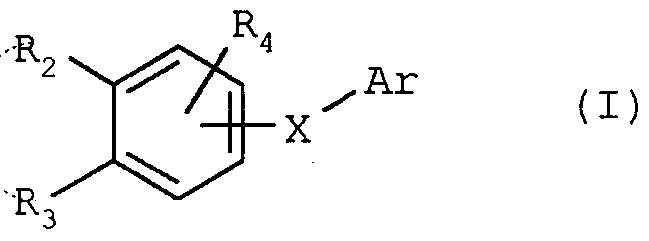
On a en effet constaté de façon inattendue et surprenante que cette modification de structure permettait d'en augmenter de façon significative les propriétés pharmaceutiques et cosmétiques et en outre d'en diminuer certains effets secondaires. La présente invention a donc pour objet de nouveaux composés qui peuvent être représentés par la formule générale suivante :
Figure imgf000005_0001
dans laquelle : Ar représente un radical choisi parmi les formules (a) à
(c) suivantes :
Figure imgf000005_0002
Z étant O ou S, ou N-R6,
Ri représente un atome d'halogène -CH3, -CH2-OR7, -OR7, -COR8, ou un radical polyéther,
R2 et R3, identiques ou différents, représentent H, al-' kyle, linéaire ou ramifié, en Cι-C20, cycloalkyle en C3-Cι2, -OR7 ou
-SR7, l'un au moins de R2 et R3 étant alkyle, linéaire ou ramifié, en Cι-C20, ou cycloalkyle en C3-C10, ou R2 et R3, pris ensemble forment un cycle à 5 ou 6 chai- nons, éventuellement substitué par au moins un méthyle et/ou éventuellement interrompu par un hétéroatome choisi parmi O ou S,
R4 et R5 représente H, un atome d'halogène, alkyle, linéaire ou ramifié, en Cι-C20, -OR7, ou un radical polyéther,
R6 représente H, alkyle, linéaire ou ramifié en Ci-Cio ou
-OCOR9,
R7 représente H, alkyle, linéaire ou ramifié en C1-C10 ou
-CORg,
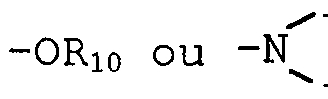
R8 représente H, alkyle, linéaire ou ramifié en Cι-C10,
-OR10 ou -N , ^r"
R9 représente alkyle, linéaire ou ramifié en C1-C10, Rio représente H, alkyle, linéaire ou ramifié en Cι-C20, mono- ou polyhydroxyalkyle, allyle, aryle ou aralkyle éventuellement substitué ou un reste de sucre, r' et r", identiques ou différents, représentent H, alkyle en C1-C10, mono- ou polyhydroxyalkyle, aryle éventuellement substitué, un reste d'aminoacide ou de peptide, ou pris ensemble avec l'atome d'azote, forment un hétérocycle,
X représente un radical divalent qui de droite à gauche ou inversement a pour formule :
Figure imgf000006_0001
dans laquelle :
Y représente O, S(0)n ou Se(0)nι, n et n' étant 0, 1 ou 2, sous réserve que lorsque n=2 et Ar est un radical de formule (a) ci-dessus dans laquelle Rι=-CH3 et Rs=H, alors l'un au moins des radicaux R2 ou R3 est différent de -CH3, et les sels des composés de formule (I) lorsque Ri représente une fonction acide carboxylique ainsi que les isomères optiques desdits composés de formule (I) .
Lorsque les composés selon l'invention se présentent sous forme d'un sel, il s'agit de préférence d'un sel d'un métal alca- lin ou alcalino-terreux, ou encore de zinc ou d'une aminé organique.
Selon la présente invention, on entend par alkyle en C1-C0, de préférence les radicaux méthyle, éthyle, isopropyle, bu- tyle, tertiobutyle, hexyle, 2-éthyl-hexyle ou octyle.
Par alkyle, linéaire ou ramifié, en C-C20, on entend notamment les radicaux méthyle, éthyle, propyle, 2-éthyl-hexyle, octyle, dodécyle, hexadécyle et octadécyle.
Par radical cycloalkyle en C3-C12 on entend un radical mono ou polycyclique notamment les radicaux cyclopropyle, cyclopentyle, cyclohexyle, 1-méthylcyclohexyle ou 1-adamantyle .
Par radical polyéther, on entend un radical ayant de 2 à 5 atomes de carbone interrompu par au moins deux atomes d'oxygène tels que les radicaux méthoxyméthoxy, méthoxyéthoxy et méthoxy- éthoxyméthoxy.
Par monohydroxyalkyle, on entend un radical ayant de préférence 2 ou 3 atomes de carbone, notamment un radical 2- hydroxyéthyle, 2-hydroxypropyle ou 3-hydroxypropyle .
Par polyhydroxyalkyle, on entend un radical ayant de pré- férence 3 à 6 atomes de carbone et de 2 à 5 groupes hydroxyles tels que les radicaux 2, 3-dihydroxypropyle, 2, 3, 4-trihydroxybuty- le, 2, 3, 4, 5-tétrahydroxypentyle ou le reste du pentaérythritol .
Par aryle, on entend de préférence un radical phényle éventuellement substitué par au moins un atome d'halogène, un hy- droxyle ou une fonction nitro.
Par aralkyle, on entend de préférence le radical benzyle ou phénéthyle éventuellement substitué par au moins un atome d'halogène, un hydroxyle ou une fonction nitro.
Par reste de sucre, on entend un reste dérivant notamment du glucose, du galactose ou du mannose, ou bien encore de l'acide glucuronique .
Par reste d'aminoacide, on entend notamment un reste dérivant de la lysine, de la glycine ou de l'acide aspartique, et par reste de peptide on entend plus particulièrement un reste de dipeptides ou de tripeptides résultant de la combinaison d'acides aminés .
Par hétérocycle, on entend de préférence un radical pipé- ridino, morpholino, pyrrolidino ou pipérazino, éventuellement substitué en position 4 par un alkyle inférieur en Cι-C6 ou un mono- ou polyhydroxyalkyle tels que définis ci-dessus.
Lorsque Ri, R4 et/ou R5 représente un atome d'halogène, celui-ci est de préférence un atome de fluor, de chlore ou de brome.
Selon une première forme de réalisation préférée, les composés selon l'invention répondent à la formule générale suivante :
Figure imgf000008_0001
dans laquelle :
Ar' représente un radical de formule
Figure imgf000008_0002
Ri, R4, R5 et X étant tels que définis ci-dessus pour la formule (I),
Rii/ R12 R_3 et Ri4, identiques ou différents représentent H ou -CH3, et n est 1 ou 2.
Selon une deuxième forme préférée, les composés selon 1 ' invention répondent à la formule suivante :
Figure imgf000008_0003
dans laquelle :
W représente O ou S,
R4, Rn, Rι2, Ar' et X étant tels que définis ci-dessus dans les formules (I) et (II) .
Enfin, selon une troisième forme préférée, les composés selon l'invention répondent à la formule suivante :
Figure imgf000009_0001
dans laquelle :
R4, Ar' et X sont tels que définis ci-dessus dans les formules (I) à (III), et l'un au moins des radicaux R'2 et/ou R'3 représente un radical cycloalkyle mono- ou polycyclique en C5-Cι0, l'autre repré- sentant l'une des significations données pour R2 ou R3.
Parmi les composés des formules (I) à (IV) ci-dessus selon la présente invention, on peut notamment citer les suivants :
- 4- (5, 5, 8, 8-tétraméthyl-5, 6,7, 8-tétrahydronaphtalèn-2- ylsulfanyléthynyl)benzoate de méthyle, - acide 4- (5, 5, 8, 8-tétraméthyl-5, 6, 7, 8-tétrahydronaphta- lèn-2-ylsulfanyléthynyl)benzoïque,
- 4- (5, 5, 8, 8-tétraméthyl-5, 6,7, 8-tétrahydronaphtalèn-2- ylsulfonyléthynyl)benzoate de méthyle,
- 4- (5, 5, 8,8-tétraméthyl-5, 6,7, 8-tétrahydro-naphtalèn-2- yloxyéthynyl) -benzoate de méthyle,
- acide 4- (5, 5, 8, 8-tétraméthyl-5, 6, 7, 8-tétrahydro- naphtalèn-2-yloxyéthynyl ) -benzoïque,
- 4- (5, 5, 8, 8-tétraméthyl-5, 6, 7, 8-tétrahydro-naphtalèn-2- ylsulfanyléthynyl) -benzoate de méthyle, - acide 4- (5,5, 8, 8-tétraméthyl-5, 6, 7, 8-tétrahydro- naphtalèn-2-ylsulfanyléthynyl) -benzoïque,
- - (5 , 5 , 8 , 8-tétraméthyl-5 ,6,7,8-tétrahydro-naphtalèn-2- ylsulfonyléthynyl) -benzoate de méthyle,
- acide 4- (5, 5, 8, 8-tétraméthyl-5, 6, 7, 8-tétrahydro- naphtalèn-2-ylsulfonyléthynyl) -benzoïque,
- 4- (5 , 5 , 8 , 8-tétraméthyl-5 ,6,7, 8-tétrahydro-naphtalèn-2- ylsulfinyléthynyl) -benzoate de méthyle, - acide 4- (5, 5, 8, 8-tétraméthyl-5, 6, 7, 8-tétrahydro- naphtalèn-2-ylsulfinyléthynyl) -benzoïque,
- 4- (5 , 5 , 8 , 8-tétraméthyl-5 ,6,7, 8-tétrahydro-naphtalèn-2- ylsélanyléthynyl) -benzoate de méthyle, - acide 4- (5, 5, 8, 8-tétraméthyl-5, 6, 7, 8-tétrahydro- naphtalèn-2-ylsélanyléthynyl) -benzoïque,
- 2-hydroxy-4- (5,5,8, 8-tétraméthyl-5, 6, 7, 8-tétrahydro- naphtalèn-2-ylsélanyléthynyl) -benzoate de méthyle,
- acide 2-hydroxy-4- (5, 5, 8, 8-tétraméthyl-5, 6,7, 8- tétrahydro-naphtalèn-2-ylselanylethynyl) -benzoïque,
- 6- (4-méthoxyméthoxy-phényléthynylsélanyl) -1, 1,4,4- tétraméthyl-1,2, 3, 4-tétrahydro-naphtalène,
- 6- (5, 5, 8, 8-tétraméthyl-5, 6, 7, 8-tétrahydro-naphtalèn-2- ylsélanyléthynyl ) -nicotinate d ' éthyle, - acide 6- (5, 5, 8, 8-tétraméthyl-5, 6, 7, 8-tétrahydro- naphtalèn-2-ylsélanyléthynyl) -nicotinique,
- N- (4-hydroxy-phényl) -4- (5,5,8, 8-tétraméthyl-5, 6,7,8- tétrahydro-naphtalèn-2-ylsélanyléthynyl) -benzamide,
- 5- (5, 5, 8,8-tétraméthyl-5, 6,7, 8-tétrahydro-naphtalèn-2- ylselanylethynyl) -pyridine-2-carboxylate de méthyle,
- 2- (4-chloro-phénylsélanyléthynyl) -5, 5, 8, 8-tétraméthyl- 5,6,7, 8-tétrahydro-naphtalène,
- 4-(3,5,5,8, 8-pentaméthyl-5, 6,7, 8-tétrahydro-naphtalèn- 2-ylselanylethynyl) -benzoate de méthyle, - acide 4- (3,5, 5, 8, 8-pentaméthyl-5, 6,7, 8-tétrahydro- naphtalèn-2-ylsélanyléthynyl ) -benzoïque,
- 2-hydroxy-4- (3,5,5,8, 8-pentaméthyl-5, 6,7, 8-tétrahydro- naphtalèn-2-ylsélanyléthynyl) -benzoate de méthyle,
- acide 2-hydroxy-4- (3, 5, 5, 8, 8-pentaméthyl-5, 6,7, 8- tétrahydro-naphtalèn-2-ylselanylethynyl) -benzoïque,
- 6- (3, 5,5,8, 8-pentaméthyl-5, 6, 7, 8-tétrahydro-naphtalèn- 2-ylsélanyléthynyl ) -nicotinate d ' éthyle, - acide 6- (3, 5 , 5, 8, 8-pentaméthyl-5, 6, 7, 8-tétrahydro- naphtalèn-2-ylsélanyléthynyl) -nicotinique,
- N- (4-hydroxy-phényl) -6- (3,5,5,8, 8-pentaméthyl-5, 6,7,8- tétrahydro-naphtalèn-2-ylselanylethynyl) -nicotinamide, - N-butyl-6- (3, 5, 5,8, 8-pentaméthyl-5, 6, 7, 8-tétrahydro- naphtalèn-2-ylsélanyléthynyl ) -nicotinamide ,
- morpholin-4-yl-[6- (3,5, 5,8, 8-pentaméthyl-5, 6,7,8- tétrahydro-naphtalèn-2-ylselanylethynyl) -pyridin-3-yl] -methanone,
- 5- (3, 5, 5, 8, 8-pentaméthyl-5, 6, 7, 8-tétrahydro-naphtalèn- 2-ylsélanyléthynyl) -pyridine-2-carboxylate de méthyle,
- acide 5- (3, 5, 5, 8, 8-pentaméthyl-5, 6, 7, 8-tétrahydro- naphtalèn-2-ylsélanyléthynyl) -pyridine-2-carboxylique,
- [4- (5, 5, 8, 8-tétraméthyl-5, 6, 7, 8-tétrahydro-naphtalèn-2- ylsélanyléthynyl)-phényl] -méthanol, - 4- (5, 5, 8, 8-tétraméthyl-5, 6, 7, 8-tétrahydro-naphtalèn-2- yléthynylsulfanyl) -benzoate de méthyle,
- 4- (5, 5, 8, 8-tétraméthyl-5, 6,7, 8-tétrahydro-naphtalèn-2- yléthynylsulfonyl) -benzoate de méthyle,
- 4- (5, 5, 8, 8-tétraméthyl-5, 6, 7, 8-tétrahydro-naphtalèn-2- yléthynylsulfinyl) -benzoate de méthyle,
- acide 4- (5, 5, 8, 8-tétraméthyl-5, 6, 7, 8-tétrahydro- naphtalèn-2-yléthynylsulfanyl) -benzoïque,
- acide 4- (5, 5, 8, 8-tétraméthyl-5, 6, 7, 8-tétrahydro- naphtalèn-2-yléthynylsulfonyl) -benzoïque, - acide 4- (5, 5, 8, 8-tétraméthyl-5, 6, 7, 8-tétrahydro- naphtalèn-2-yléthynylsulfinyl) -benzoïque,
- 4-(3,5,5,8, 8-pentaméthyl-5, 6,7, 8-tétrahydro-naphtalèn- 2-ylsélanyléthynyl) -phénol,
- 4- (4-hydroxy-5, 5, 8, 8-tétraméthyl-5, 6, 7, 8-tétrahydro- naphtalèn-2-ylsélanyléthynyl) -benzoate d' éthyle,
- 4- (4-méthoxyméthoxy-5, 5, 8, 8-tétraméthyl-5, 6,7,8- tétrahydro-naphtalèn-2-ylselanylethynyl) -benzoate d' éthyle, - acide 4- (4-méthoxyméthoxy-5, 5, 8, 8-tétraméthyl-5, 6, 7, 8- tétrahydro-naphtalèn-2-ylselanylethynyl) -benzoïque,
- acide 4- (4-pentyloxy-5, 5, 8, 8-tétraméthyl-5, 6, 7, 8- tétrahydro-naphtalèn-2-ylsélanyléthynyl) -benzoïque, - 4- (3-méthoxyméthoxy-5, 5, 8, 8-tétraméthyl-5, 6, 7, 8- tétrahydro-naphtalèn-2-ylselanylethynyl) -benzoate d' éthyle,
- 4- (3-méthoxyéthoxyméthoxy-5, 5,8, 8-tétraméthyl-5, 6,7,8- tétrahydro-naphtalèn-2-ylselanylethynyl) -benzoate d' éthyle,
- acide 4- (3-méthoxyéthoxyméthoxy-5, 5, 8, 8-tétraméthyl- 5, 6, 7, 8-tétrahydro-naphtalèn-2-ylsélanyléthynyl) -benzoïque,
- acide 4- (3-méthoxyméthoxy-5, 5, 8, 8-tétraméthyl-5, 6, 7, 8- tétrahydro-naphtalèn-2-ylselanylethynyl) -benzoïque,
- 4- (3-pentyloxy-5, 5,8, 8-tétraméthyl-5, 6, 7, 8-tétrahydro- naphtalèn-2-ylsélanyléthynyl ) -benzoate d' éthyle, - acide 4- (3-pentyloxy-5, 5, 8, 8-tétraméthyl-5, 6, 7, 8- tétrahydro-naphtalèn-2-ylselanylethynyl) -benzoïque,
- [4- (5, 5,8, 8-tétraméthyl-5, 6, 7, 8-tétrahydro-naphtalèn-2- ylsélanyléthynyl ) -phényl] -carbaldéhyde ,
- 4- (4, 4-diméthyl-thiochroman-8-ylsélanyléthynyl) - benzoate de méthyle,
- acide 4- (4, 4-diméthyl-thiochroman-8-ylsélanyléthynyl) - benzoïque,
- 4- (5,5, 8, 8-tétraméthyl-5, 6,7, 8-tétrahydro-naphtalèn-8- ylsélanyléthynyl) -benzoate de méthyle, - acide 4- (5, 5, 8, 8-tétraméthyl-5, 6, 7, 8-tétrahydro- naphtalèn-8-ylsélanyléthynyl) -benzoïque,
- 4- [3- (1-adamantyl) -4-méthoxyphényl) -1- ylsélanyléthynyl] -benzoate de méthyle,
- acide 4- [3- (1-adamantyl) -4-méthoxyphényl) -1- ylselanylethynyl] -benzoïque,
- 4- [4- (1-adamantyl) -3-méthoxyphényl) -1- ylsélanyléthynyl] -benzoate de méthyle, et - acide 4- [4- (1-adamantyl) -3-méthoxyphényl) -1- ylsélanyléthynyl] -benzoïque.
La présente invention a également pour objet les procédés de préparation des composés de formule (I) ci-dessus selon les schémas réactionnels donnés aux Tableaux A et B.
En se référant au Tableau A, les composés de formule (I),
dans lesquels X représente le radical divalent
Figure imgf000013_0001
, à savoir les composés de formule (la), peuvent être obtenus selon deux voies de synthèse différentes selon que Y = oxygène ou Y ≠ oxy- gène .
Lorsque X = oxygène, le produit de départ est le composé de formule (1) qui en présence d'une base telle que l'hydrure de potassium ou de sodium, est ensuite couplé avec du trichloroéthy- lène. Le produit dichloroéthylénique obtenu de formule ( 2 ) est en- suite soumis à l'action d'une base lithiée telle que le butyllithium dans un solvant tel que le THF pour conduire au composé acétylénique de formule (3_) . Ce dernier est alors couplé avec un halogénure d' aryle ou un halogénure d'hétéroaryle de préférence un dérivé iodé, en présence d'un catalyseur au palladium pour con- duire aux composés de formule (lia) avec Y = oxygène.
Lorsque Y ≠ oxygène, on prépare tout d'abord l'acétylure de lithium de formule (5_) à partir du composé acétylénique aromatique ou heteroaromatique (_) , en présence d'un dérivé lithié tel que le butyllithium dans un solvant tel le THF. A partir de l'acé- tylure de lithium (5_) qui n'est pas isolé, on réalise un couplage avec le composé de formule ( 6) dans un solvant tel que le THF et l'on obtient les composés de formule (la) avec Y ≠ oxygène.
A partir de ces derniers composés de formule (la) dans lesquels Y = S ou Se, il est possible d'accéder aux dérivés oxydés par oxydation à l'aide d'un agent oxydant tel que l'acide méta- chloroperbenzoïque (AmCPB) ou le periodate de sodium.
En se référant maintenant au Tableau B, les composés de formule (I) dans lesquels X représente un radical αivalent
Figure imgf000014_0001
, à savoir les composés de formule (le), peuvent être également obtenus selon deux voies de synthèse différentes selon que Y = oxygène ou Y ≠ oxygène.
Lorsque Y = oxygène, le produit de départ est un composé aromatique ou heteroaromatique de formule ( ) , qui en présence d'une base telle que l'hydrure de potassium ou de sodium dans un solvant tel que le THF est ensuite couplé avec le trichloroéthy- lène. Le produit obtenu dichloroéthylénique (8_) est ensuite soumis à l'action d'une base lithiée telle que le butyllithium dans le THF pour conduire au composé oxoacetylenique de formule ( 9 ) . Ce dernier est alors couplé avec un halogénure d' aryle (K)) , de préférence un dérivé iodé, en présence d'un catalyseur au palladium pour conduire aux composés de formule (le) avec Y = oxygène.
Lorsque Y ≠ oxygène, le produit de départ est un composé acétylénique aromatique de formule ( Yl ) qui est transformé en dérivé lithié en présence de butyllithium par exemple dans un solvant tel que le THF. Le dérivé lithié acétylénique (12) qui n'est pas isolé, est alors couplé avec un composé aromatique ou heteroaromatique de formule (33) , la réaction de couplage étant effectuée dans un solvant tel que le THF. On obtient ainsi par cette voie de synthèse les composés de formule (le) avec Y ≠ oxygène.
A partir de ces derniers composés de formule (le) dans lesquels Y = S ou Se, il est également possible d'obtenir les dérivés oxydés par oxydation à l'aide d'un agent oxydant tel que l'acide métachloroperbenzoïque (AmCPB) ou le periodate de sodium.
Lorsque dans les composés selon l'invention le radical Ri représente -COOH, ceux-ci sont préparés en protégeant la fonction acide carboxylique par un groupe protecteur du type alkyle.
Par saponification de la fonction ester en présence d'une base telle que l'hydroxyde de sodium ou de lithium dans un solvant alcoolique ou dans le THF, on obtient alors les acides libres correspondants. Lorsque Ri est -OH, les composés peuvent être obtenus à partir de l'acide correspondant par réduction en présence d'hy- drure tel que l'hydrure de bore.
Lorsque Rx est -CH=0, les composés peuvent être obtenus par oxydation des alcools correspondants à l'aide d'oxyde de manganèse ou de dichromate de pyridinium.
Lorsque Rx est -CON les composes peuvent être obtenus r" par transformation de l'acide correspondant en chlorure d'acide par exemple avec du chlorure de thionyle puis réaction avec 1 ' am- moniaque ou une aminé appropriée .
La présente invention a également pour objet à titre de médicament les composés de formule (I) telle que définie ci- dessus .
Les composés de formule générale (I) présentent une acti- vite agoniste ou antagoniste vis-à-vis de l'expression d'un ou plusieurs marqueurs biologiques dans le test de différenciation des cellules (F9) de tératocarcinome embryonnaire de la souris (Skin Pharmacol. 3, p. 256-267, 1990) et/ou sur la différenciation des kératinocytes humains in vitro (Skin Pharmacol. 3 p. 70-85, 1990). Ces tests susmentionnés montrent les activités des composés dans les domaines de la différenciation et de la prolifération. Les activités peuvent aussi être mesurées dans des tests de trans- activation cellulaire à l'aide de récepteurs recombinants RARs selon la méthode B.A. Bernard et al., Biochemical and Biophysical Research Communication, vol. 186, 977-983, 1992.
Les composés selon l'invention conviennent particulièrement bien dans les domaines des traitements suivants :
1) pour traiter les affections dermatologiques liées à un désordre de la kératinisation portant sur la différenciation et sur la prolifération notamment pour traiter les acnés vulgaires, comédoniennes, polymorphes, rosacées, les acnés nodulokystiques, conglobata, les acnés séniles, les acnés secondaires telles que l'acné solaire, médicamenteuse ou professionnelle,
2) pour traiter d'autres types de troubles de la kérati- nisation, notamment les ichtyoses, les états ichtyosiformes, la maladie de Darrier, les kératodermies palmoplantaires, les leuco- plasies et les états leucoplasiformes, le lichen cutané ou muqueux (buccal) , 3) pour traiter d'autres affections dermatologiques liées à un trouble de la kératinisation avec une composante inflammatoire et/ou immuno-allergique et notamment toutes les formes de psoriasis qu'il soit cutané, muqueux ou unguéal, et même le rhumatisme psoriatique, ou encore l'atopie cutanée telle que l'ec- zéma, ou l'atopie respiratoire ou encore l'hypertrophie gingivale ; les composés peuvent également être utilisés dans certaines affections inflammatoires ne présentant pas de trouble de la kératinisation,
4) pour traiter toutes les proliférations dermiques ou épidermiques qu'elles soient bénignes ou malignes, qu'elles soient ou non d'origine virale telles que verrues vulgaires, les verrues planes et 1 ' épidermodysplasie verruciforme, les papillomatoses orales ou florides et les proliférations pouvant être induites par les ultra-violets notamment dans le cas des épithélioma baso et spinocellulaires,
5) pour traiter d'autres désordres dermatologiques tels que les dermatoses bulleuses et les maladies du collagène,
6) pour traiter certains troubles ophtalmologiques, notamment les cornéopathies, 7) pour réparer ou lutter contre le vieillissement de la peau, qu'il soit photoinduit ou chronologique ou pour réduire les pigmentations et les kératoses actiniques, ou toutes pathologies associées au vieillissement chronologique ou actinique,
8) pour prévenir ou guérir les stigmates de l'atrophie épidermique et/ou dermique induite par les corticosteroïdes locaux ou systémiques, ou toute autre forme d'atrophie cutanée,
9) pour prévenir ou traiter les troubles de la cicatrisation ou pour prévenir ou pour réparer les vergetures,
10) pour lutter contre les troubles de la fonction séba- cée tels que 1 'hyperséborrhée de l'acné ou la séborrhée simple, 11) pour traiter ou prévenir des états cancéreux ou précancéreux,
12) pour traiter les affections inflammatoires telles que 1 ' arthrite, 13) pour traiter toute affection d'origine virale au niveau cutané ou général,
14) pour prévenir ou traiter l'alopécie,
15) pour traiter les affections dermatologiques ou générales à composante immunologique, et 16) pour traiter les affections du système cardiovascu- laire telles que l'artériosclérose.
Dans les domaines thérapeutiques mentionnés ci-dessus, les composés selon l'invention peuvent être avantageusement employés en combinaison avec d'autres composés à activité de type rétinoïde, avec les vitamines D ou leurs dérivés, avec des corticosteroïdes, avec des anti-radicaux libres, des α-hydroxy ou α-cétoacides ou leurs dérivés ou bien encore avec des bloqueurs de canaux ioniques. Par vitamines D ou leurs dérivés, on entend par exemple les dérivés de la vitamine D2 ou D3 et en particulier la 1, 25-dihydroxyvitamine D3. Par anti-radicaux libres, on entend par exemple l' α-tocophérol, la Super Oxyde Dismutase ou SOD, l'Ubiqui- nol ou certains chélatants de métaux. Par α-hydroxy ou α-céto acides ou leurs dérivés, on entend par exemple l'acide lactique, l'acide malique, l'acide citrique, l'acide glycolique, l'acide mandelique, l'acide tartrique, l'acide glycerique ou l'acide ascorbique ou leurs sels, amides ou esters. Enfin, par bloqueurs de canaux ioniques, on entend par exemple le Minoxidil (2 , 4-diamino-6-pipéridino-pyrimidine-3-oxyde) et ses dérivés.
La présente invention a également pour objet des composi- tions pharmaceutiques contenant au moins un composé de formule (I) telle que définie ci-dessus, l'un de ses isomères optiques ou géométriques ou un de ses sels.
Les compositions pharmaceutiques sont destinées notamment au traitement des affections susmentionnées, et sont caractérisées par le fait qu'elles contiennent un support pharmaceutiquement acceptable et compatible avec le mode d'administration retenu, au moins un composé de formule (I), l'un de ses isomères optiques ou géométriques ou un de ses sels. L'administration des composés selon l'invention peut être effectuée par voie entérale, parentérale, topique ou oculaire.
Par voie entérale, les compositions peuvent se présenter sous forme de comprimés, de gélules, de dragées, de sirops, de suspensions, de solutions, de poudres, de granulés, d'émulsions, de microsphères ou de nanosphères ou de vésicules lipidiques ou polymériques permettant une libération contrôlée. Par voie parentérale, les compositions peuvent se présenter sous forme de solutions ou de suspensions pour perfusion ou pour injection.
Les composés selon l'invention sont généralement adminis- très à une dose journalière d'environ 0,01 mg/kg à 100 mg/kg en poids corporel, et ceci à raison de 1 à 3 prises.
Par voie topique, les compositions pharmaceutiques à base des composés selon l'invention sont plus particulièrement destinées au traitement de la peau et des muqueuses et peuvent alors se présenter sous forme d'onguents, de crèmes, de laits, de pommades, de poudres, de tampons imbibés, de solutions, de gels, de sprays, de lotions ou de suspensions. Elles peuvent également se présenter sous forme de microsphères ou nanosphères ou vésicules lipidiques ou polymériques ou de patches polymériques et d' hydrogels permet- tant une libération contrôlée du principe actif. Ces compositions par voie topique peuvent par ailleurs se présenter soit sous forme anhydre, soit sous une forme aqueuse, selon l'indication clinique. Par voie oculaire, ce sont principalement des collyres. Ces compositions à usage topique ou oculaire contiennent au moins un composé de formule (I) telle que définie ci-dessus, ou l'un de ses isomères optiques ou géométriques ou encore l'un de ses sels, à une concentration de préférence comprise entre 0,001 % et 5 % en poids par rapport au poids total de la composition.
Les composés de formule (I) selon l'invention trouvent également une application dans le domaine cosmétique, en particu- lier dans l'hygiène corporelle et capillaire et notamment pour le traitement des peaux à tendance acnéique, pour la repousse des cheveux, 1 'anti-chute, pour lutter contre l'aspect gras de la peau ou des cheveux, dans la protection contre les aspects néfastes du soleil ou dans le traitement des peaux physiologiquement sèches, pour prévenir et/ou pour lutter contre le vieillissement photoinduit ou chronologique.
Dans le domaine cosmétique, les composés selon l'invention peuvent par ailleurs être avantageusement employés en combi- naison avec d'autres composés à activité de type rétinoïde, avec les vitamines D ou leurs dérivés, avec des corticosteroïdes, avec des anti-radicaux libres, des α-hydroxy ou α-céto acides ou leurs dérivés, ou bien encore avec des bloqueurs de canaux ioniques tous ces derniers composés étant tels que définis ci-dessus. La présente invention a donc également pour objet une composition cosmétique qui est caractérisée par le fait qu'elle contient dans un support cosmetiquement acceptable, au moins un composé de formule (I) telle que définie ci-dessus ou l'un de ses isomères optiques ou géométriques ou l'un de ses sels, ladite com- position cosmétique pouvant notamment se présenter sous forme d'une crème, d'un lait, d'une lotion, d'un gel, de microsphères ou de nanosphères ou de vésicules lipidiques ou polymériques, d'un savon ou d'un shampooing.
La concentration en composé de formule (I) dans les com- positions cosmétiques selon l'invention est avantageusement comprise entre 0,001 % et 3 % en poids par rapport au poids total de la composition.
Les compositions pharmaceutiques et cosmétiques selon l'invention peuvent en outre contenir des additifs inertes ou même pharmacodynamiquement ou cosmetiquement actifs ou des combinaisons de ces additifs et notamment : des agents mouillants, des agents dépigmentants tels que 1 'hydroquinone, l'acide azélaïque, l'acide caféique ou l'acide kojique ; des émollients ; des agents hydratants comme le glycérol, le PEG 400, la thiamorpholinone et ses dérivés ou bien encore l'urée ; des agents antiséborrhéiques ou antiacnéiques, tels que la S-carboxyméthylcystéine, la S-benzyl- cystéamine, leurs sels ou leurs dérivés, ou le peroxyde de ben- zoyle ; des antibiotiques comme 1 ' érythromycine et ses esters, la néomycine, la clindamysine et ses esters, les tétracyclines ; des agents antifongiques tels que le ketokonazole ou les polyméthy- lène-4,5 isothiazolidones-3 ; des agents favorisant la repousse des cheveux, comme le Minoxidil (2, -diamino-6-pipéridino-pyrimi- dine-3-oxyde) et ses dérivés, le Diazoxide (7-chloro 3-méthyl 1, 2, 4-benzothiadiazine 1,1-dioxyde) et le Phénytoïn (5, 4-diphényl- imidazolidine 2,4-dione) ; des agents anti-inflammatoires non sté- roïdiens ; des caroténoïdes et, notamment le β-carotène ; des agents anti-psoriatiques tels que l'anthraline et ses dérivés ; et enfin les acides eicosa-5, 8, 11, 14-tétraynoïque et eicosa-5, 8, 11- trynoïque, leurs esters et amides. Les compositions selon l'invention peuvent également contenir des agents d'amélioration de la saveur, des agents conservateurs tels que les esters de l'acide parahydroxybenzoïque, des agents stabilisants, des agents régulateurs d'humidité, des agents régulateurs de pH, des agents modificateurs de pression osmotique, des agents emulsionnants, des filtres UV-A et UV-B, des antioxydants tels que 1 'α-tocophérol, le butylhydroxyanisole ou le butyl- hydroxytoluène .
On va maintenant donner à titre d'illustration et sans aucun caractère limitatif, plusieurs exemples de préparation des composés actifs de formule (I) selon l'invention, ainsi que diverses formulations pharmaceutiques et cosmétiques à base de ces composés . EXEMPLES
EXEMPLE 1 : 4- (5, 5, 8, 8-tétraméthyl-5, 6, 7, 8-tétrahydronaphtalèn- 2-ylsulfanyléthynyl)benzoate de méthyle
(a) 4-triméthylsilyléthynylbenzoate de méthyle
Dans on tricol, on introduit 21,5 g (0,1 mole) de 4-bromoben- zoate de méthyle, 300 ml de triéthylamine et un mélange de 200 mg d'acétate de palladium et de 400 mg de triphénylphos- phine. On ajoute ensuite 20 g (0,204 mole) de triméthylsilyl- acétylène, puis chauffe progressivement à 90°C durant 1 heure et laisse à cette température pendant 5 heures. On refroidit alors le milieu réactionnel, filtre le sel et évapore. On reprend le résidu avec 200 ml d'acide chlorhydrique (5 %) et 400 ml d'éther éthylique. On décante la phase éthérée, lave à l'eau, sèche sur sulfate de magnésium, et évapore. Le résidu obtenu est purifié par chromatographie sur colonne de silice, par élution avec du dichloromethane. Après evaporation des solvants, on recueille 23 g (100 %) du dérivé attendu sous forme d'une huile incolore.
(b) 4-éthynylbenzoate de méthyle
Dans un tricol, on introduit 38,33 g (226 mmoles) du produit précédemment obtenu dans 300 ml de methanol. On ajoute ensuite 125 g de carbonate de potassium et le milieu est agité durant 48 heures à température ambiante. Le solvant est évaporé et le résidu obtenu est purifié par chromatographie sur colonne de silice, par élution avec du dichloromethane. Après evaporation des solvants, on reprend le résidu dans l'heptane, et re- cueille, après filtration, 32 g (100 %) du dérivé attendu sous forme d'un solide jaune paille.
(c) 4- (5,5,8,8-tétraméthyl-5, 6, 7,8-tétrahydronaphtalèn- 2-ylsufanyléthynyl) benzoate de méthyle Une solution de butyllithium 2,5 M dans l'hexane (20 mmoles, 8,1 ml) est ajoutée à une solution de 4-éth uyïbenzoate de mé- thyle (3 g, 18,7 mmoles) dans le THF (300 ml) à -78°C. La température est maintenue 45 minutes, puis remontée à -40GC. On ajoute alors à cette température une solution de 5,6,7,8- tétrahydro-5,5, 8, 8-tétraméthylnaphtalèn-2-disulfure (J. Med. 5 Chem. 1995, 38, 3171) (16,5 g, 37,4 mmoles) dans du THF (60 ml) . Le mélange réactionnel est ensuite agité 1 heure à 0°C, puis versé sur un mélange d'éther éthylique et d'une solution saturée en chlorure d'ammonium. La phase organique est lavée 2 fois à l'eau, séchée sur sulfate de magnésium anhydre 0 et concentrée à 1 ' évaporateur rotatif sous vide à 40°C. Après chromatographie sur colonne de silice à l'aide d'un mélange d'heptane-chlorure de méthylène (60/40) on obtient, après evaporation, 1, 9 g d'un solide blanc (27 %) .
1H (CDC13) : 1,28 (6H, s), 1,30 (6H, s), 1,69 (4H, s), 3,92 15 (3H, s), 7,25 à 7,31 (2H Ar, m), 7,42 (1H Ar, d, J=2Hz) , 7,50 (1H Ar, d, J=7,5Hz), 8,00 (1H Ar, d, J=7,5Hz).
13C (CDCI3) : 32,25 (CH3) , 34,60 (C) , 35,02 (C) , 35,36 (CH2), 52,68 (OCH3), 81,26 (C), 96,96 (C) , 124,82 (CH Ar) , 125,56 (CH Ar) , 128,29 (C Ar), 128,37 (CH Ar) , 128,85 (C Ar) , 129,88 0 (C Ar) , 130,04 (2 CH Ar) , 131,29 (2 CH Ar) , 144,66 (C Ar) , 146,88 (C Ar), 166,95 (COO) .
EXEMPLE 2 : acide 4- (5, 5, 8, 8-tétraméthyl-5, 6, 7, 8-tétrahydro- naphtalèn-2-ylsulfanyléthynyl) benzoïque 5
Une solution de 4- (5,5, 8, 8-tétraméthyl-5, 6, 7, 8-tétrahydro- naphtalèn-2-ylsulfanyléthynyl) benzoate de méthyle (590 mg,
1,6 mmoles) et d'hydroxyde de lithium (383 mg, 9,3 mmoles) dans du THF est chauffée à reflux 24 heures. Le mélange réac-
30 tionnel est versé sur un mélange Et20/eau, acidifié à pH 1 par une solution d'acide chlorhydrique concentré, et extrait une fois à l'éther éthylique. Après décantation, la phase organique est lavée deux fois à l'eau, séchée sur sulfate de magnésium et concentrée à 1 ' évaporateur rotatif sous vide à 40°C.
3.5 Le solide obtenu est cristallisé dans l'heptane et l'on ob- tient 440 mg (77 %) d'un solide blanc. PF (point de fusion) = 193, 5°C.
RMN δ ppm :
1H (CDC13) : 1,28 (6H, s), 1,30 (6H, s), 1,69 (4H, s), 7,29 à 7,32 (2H Ar, m), 7,42 (1H Ar, d, J=2Hz) , 7,53 (1H Ar, d, J=8,5Hz), 8,08 (1H Ar, d, J=8,5Hz).
13C (CDC13) : 31,44 (CH3), 33,80 (C) , 34,22 (C) , 34,54 (CH2), 81,30 (C), 100,01 (C), 124,06 (CH Ar) , 124,81 (CH Ar), 127,59 (CH Ar), 127,94 (C Ar) , 128,46 (C Ar) , 129,87 (2 CH Ar), 130,49 (2 CH Ar) , 143,93 (C Ar) , 146,12 (C Ar) , 171,06 (COO) .
EXEMPLE 3 : - (5, 5 , 8 , 8-tétraméthyl-5 ,6,7,8-tétrahydronaphtalèn- 2-ylsulfonyléthynyl) benzoate de méthyle
Une solution d'acide meta perbenzoïque (700 mg) dans du CHCl3 (12 ml) est additionnée goutte à goutte, à 0°C sur une solution du produit de l'exemple 1 (500 mg, 1,3 mmoles) dans 6 ml de CHC13. Après 1 heure d'agitation, le mélange est concentré à 1 ' évaporateur rotatif sous vide. Après chromatographie sur colonne de silice avec un mélange heptane-chlorure de méthylène (30/70) on obtient 280 mg d'un solide blanc (52 %) . iH (CDCI3) : 1,32 (6H, s), 1,34 (6H, s), 1,73 (4H, s), 3,93 (3H, s), 7,51 (2H Ar, d, J=8,3Hz), 7,60 (2H Ar, d, J=8,5Hz), 7,78 (1H Ar, dd, Jl=8,5Hz, J2=2Hz) , 7,98 à 8,05 (3H Ar, m). 13C (CDC13) : 31,63 (CH3) , 31,73 (CH3), 34,58 (CH2) , 34,64
(CH2), 34,85 (C), 34,98 (C), 52,52 (CH3) , 87,77 (C) , 90,99 (C), 122,61 (C Ar), 124,35 (CH Ar) , 125,99 (CH Ar) , 128,04 (CH Ar), 129,68 (CH Ar) , 132,44 (C Ar), 132,69 (CH Ar) , 138,37 (C Ar), 146,89 (C Ar), 152,50 (C Ar), 165,83 (COO). EXEMPLE 4 : 4- (5, 5, 8, 8-tétraméthyl-5 , 6, 7 , 8-tétrahydro-naphtalèn- 2-ylsélanyléthynyl) -benzoate de méthyle
(a) 5, 6, 7 , 8-tétrahydro-5 ,5 ,8 ,8-tétraméthylnaphtalèn-2-disélénide Une solution de tert-butyllithium 1,7 M dans du pentane (37,4 mmol, 22 ml) est additionnée à une solution de 2-bromo- 5, 6,7, 8-tétrahydro-5,5, 8,8-tétraméthylnaphtalène (4,22 g, 15,8 mmol) dans le THF (100 ml) à -78°C en 10 min. Le mélange est agité à 0°C 30 min. Le sélénium (1,33 g, 16,8 mmol) est addi- tionné en 2 fois. Le mélange est agité à 0°C 15 min, puis à température ambiante 30 min. Une solution d'HCl IN (40 ml) est additionnée, puis le mélange réactionnel est traité par de l' éther éthylique. La phase organique est lavée 2 fois à l'eau, séchée sur sulfate de magnésium anhydre et concentrée à l' évaporateur rotatif sous vide à 40°C. 10 ml d' éthanol et 50 mg de soude sont additionnés à l'huile obtenue. Le mélange est agité vigoureusement quelques minutes, puis est concentré à l' évaporateur rotatif sous vide à 40°C. Le solide obtenu est filtré sur silice (élution heptane) puis cristallisé dans un mélange éthanol / éther. On obtient après filtration 2,9 g (69 %) d'un solide orange.
RMN !H (CDC13) : 1,21 (6H, s), 1,25 (6H, s), 1,65 (4H, s), 7,20 (1H Ar, d, J=8,25 Hz), 7,38 (1H Ar, dd ,J=1,9 Hz, J=8,25 Hz), 7,51 (1H Ar, d, J=l,9 Hz).
(b) 4- (5,5,8, 8-tétraméthyl-5, 6, 7 , 8-tétrahydro-naphtalèn- 2 -ylselanylethynyl) -benzoate de méthyle
Du brome (0,15 ml, 2,9 mmol), est additionné à une solution de 5,6,7, 8-tétrahydro-5, 5,8, 8-tétraméthylnaphtalèn-2-disélénide (1,5 g, 2,8 mmol) dans du THF (3 ml). Le mélange est agité à température ambiante 2 h, puis le solvant est éliminé. De l'iodure de cuivre (2,15 g, 11,3 mmol), du -éthynyl-benzoate de méthyle (810 mg, 5 mmol) obtenu selon l'Exemple 1 (b) , et du DMF (15 ml), sont additionnés. Le mélange réactionnel est agi- té à température ambiante 3 h puis il est traité par de l' éther éthylique et une solution d'ammoniaque. La phase organique est lavée deux fois à l' eau, séchée sur sulfate de magnésium anhydre et concentrée à l' évaporateur rotatif sous vide à 40°C. Le résidu est recristallisé dans de l'heptane et l'on obtient après filtration 1,8 g (75 %) d'une poudre blanche. PF=90-1°C. RMN *H (CDC13) : 1,28 (6H, s), 1,30 (6H, s), 1,69 (4H, s),
3,92 (3H, s), 7,29 (1H Ar, d, J=8,3 Hz), 7,36 (1H Ar, dd, J=l,9 Hz, J=8,3 Hz), 7,48 à 7,53 (3H Ar, m), 7,98 (2H Ar, d, J=8,5Hz).
EXEMPLE 5 : Acide 4- (5 , 5 , 8 , 8-tétraméthyl-5 ,6,7, 8-tétrahydro- naphtalèn-2-ylsélanyléthynyl ) -benzoïque
De l'hydroxyde de lithium (440 mg) , est additionné à une solution de 4- (5,5, 8, 8-tétraméthyl-5, 6,7, 8-tétrahydro-naphtalèn-2- ylsélanyléthynyl) -benzoate de méthyle (740 mg, 1,74 mmol) obtenu à l'exemple 4, dans 15 ml de THF et 2 ml d'un mélange eau / methanol (1/1) . Le milieu réactionnel est chauffé 8 h à re- flux. Il est ensuite versé sur un mélange éther éthylique / eau, acidifié à pH 1 par une solution d' acide chlorhydrique concentré et extrait à l' éther éthylique. Après décantation, la phase organique est lavée deux fois à l'eau, séchée sur sulfate de magnésium anhydre et concentrée à l' évaporateur ro- tatif sous vide à 40°C. Le résidu est recristallisé dans de l'heptane. Après filtration, on obtient 615 mg (86 %) d'une poudre blanche. PF=182°C.
RMN H (CDCI3) : 1,28 (6H, s), 1,30 (6H, s), 1,69 (4H, s), 7,29 (1H Ar, d, J=8,3 Hz), 7,36 (1H Ar, dd , J=l,9 Hz, J=8,3 Hz), 7,52 à 7,55 (3H Ar, m), 8,07 (2H Ar, d, J=8,5Hz). EXEMPLE 6 : 2-hydroxy-4- (5, 5, 8, 8-tétraméthyl-5, 6, 7, 8-tétrahydro- naphtalèn-2-ylsélanyléthynyl) -benzoate de méthyle
(a) 4-triméthylsilanyléthynyl-2-hydroxy-benzoate de méthyle De manière analogue à l'exemple l(a), à partir de 4,00 g (14,4 mmoles) de 4-iodo-2-hydroxy-benzoate de méthyle, on obtient 3,07 g (86%) du composé attendu, sous la forme d'une huile orangée. RMN !H (CDC13) : 0,06 (s, 9H) , 3,75 (s, 3H) , 6,76 (dd, 1H, J = 8,2 / 1,5 Hz), 6,87 (d, 1H, J = 1,4 Hz), 7,56 (d, 1H, J = 8,2 Hz), 10,53 (s, 1H) .
(b) 4-éthynyl-2-hydroxy-benzoate de méthyle
On mélange dans un tricol de 500 ml, 3,07 g (12,4 mmol) de 4- triméthylsilanyléthynyl-2-hydroxy-benzoate de méthyle avec 50 ml de THF, et on ajoute, goutte à goutte, 13,7 ml d'une solution de fluorure de tétrabutylammonium (1 M / THF) . Le milieu réactionnel est agité lh à température ambiante puis est versé dans l'eau et extrait à l' éther éthylique. Après décanta- tion, la phase organique est séchée sur sulfate de magnésium et concentrée.
On obtient 2,48 g (100%) d'une poudre beige. PF= 62°C. RMN xn (CDCI3) : 3,21 (s, 1H) , 3,96 (s, 3H) , 6,98 (dd, 1H, J =
8,2 / 1,5 Hz), 7,10 (d, 1H, J = 1,3 Hz), 7,78 (d, 1H, J = 8,2 Hz), 10,76 (s, 1H) .
(c) 2-hydroxy-4- (5 , 5 , 8 , 8 -tétraméthyl-5 , 6, 7 , 8-tétrahydro-naphtalèn- 2 -ylselanylethynyl) -benzoate de méthyle
De manière analogue à l'exemple (b) , après réaction de 1,5 g (2,8 mmol) de 5, 6, 7, 8-tétrahydro-5, 5, 8, 8-tétraméthyl-naphta- lèn-2-disélénide dans 2 ml de THF, avec du brome (0,15 ml, 2,9 mmol), on additionne de l' iodure de cuivre (2,15 g ; 11,3 mmol), du 4-éthynyl-2-hydroxy-benzoate de méthyle (890 mg ; 5 mmol) dans 10 ml de DMF. Après purification sur colonne de si- lice (dichloromethane 10 - Heptane 90), on obtient 2,15 g (97%) du dérivé ester attendu sous forme de solide jaune. PF=
70°C.
RMN H (CDC13) : l,28(d,12H) ; l,69(s,4H) ; 3,95(s,3H) ;
6,94(dd,lH) ; 7,04(d,lH) ; 7,26 à 7,37(m,2H) ; 7,51(d,lH) ; 7,77 (d,lH) ; 10,77(s,lH).
RMN 13C (CDC13) : 31,8 ; 4*CH3/ 34,2 ; Cq/ 34,6 ; Cq/ 34,9 2*CH2/ 52,4 ; CH3/ 75,1 ; Cq/ 101,6 ; Cq/ 111,9 ; Cq/ 119,7 CH/ 121,9 ; CH/ 124,5 ; Cq/ 127,0 ; CH/ 127,8 ; CH/ 128,1 CH/ 129,9 ; CH/ 130,4 ; Cq/ 144,7 ; C/ 146,7 ; Cq/ 161,2 ; Cq/ 170,1 ; Cq.
EXEMPLE 7 : Acide 2-hydroxy-4- (5,5,8, 8-tétraméthyl-5 ,6,7,8- tétrahydro-naphtalèn-2-ylselanylethynyl) -benzoïque
Une solution de 2-hydroxy-4- (5, 5, 8, 8-tétraméthyl-5, 6,7, 8- tétrahydro-naphtalèn-2-ylsélanyléthynyl) -benzoate de méthyle (1,2 g ; 2,72 mmol) obtenu à l'exemple 6(c) et de la soude (1,5 g ; 37,5 mmol) dans 20 ml de THF est chauffée 24h à reflux. Le mélange réactionnel est, ensuite, versé sur un mé- lange acétate d' éthyle / eau, acidifié à pH 1 par une solution d'acide chlorhydrique concentré, et extrait une fois à l'acétate d' éthyle. Après décantation, la phase organique est lavée deux fois à l'eau, séchée sur sulfate de magnésium et concentrée à 1 ' évaporateur rotatif sous vide à 40°C. On obtient 1 g (86%) d'un solide jaune. PF=170°C.
RMN ^(DMSO) : 1,28 (m, 12H) ; l,68(s,4H) ; 6,95(d,lH) 7,03(s,lH) ; 7,25 à 7,37 (m,2H) ; 7,51(s,lH) ; 7.83(d,lH). RMN 13C (DMSO) : 31,8 ; 4*CH3/ 34,2 ; Cq/ 34,6 ; Cq/ 34,9 2*CH2/ 76,0 ; Cq/ 101,5 ; Cq/ 119,7 ; CH/ 122,1 ; CH/ 124,4 Cq/ 127,1 ; CH/ 127,9 ; CH/ 128,2 ; CH/ 130,9 ; CH/ 131,4 Cq/ 144,7 ; Cq/ 146,7 ; Cq/ 161,6 ; Cq/ 174,2 ; Cq. EXEMPLE 8 : 6- (4-méthoxyméthoxy-phényléthynylsélanyl) -1, 1, 4, 4- tétraméthyl-1, 2,3, 4-tétrahydro-naphtalène
(a) 1 -iodo-4-méthoxyméthoxy-benzène A une suspension d'hydrure de sodium 75% (872 mg ; 27,25 mmol) dans 20 ml de diméthylformamide, on ajoute 5 g (22,7 mmol) de 4-iodo-phénol. Le mélange est agité 30 minutes à température ambiante puis, 2,59 ml (34,1 mmol) de chlorure de méthoxymé- thyle sont additionnés. La solution est agitée 2h puis le mi- lieu est versé dans un mélange acétate d' éthyle / eau. Après décantation, la phase organique est lavée deux fois à l'eau, séchée sur sulfate de magnésium et concentrée à 1 ' évaporateur rotatif sous vide à 40°C. On obtient 5,74 g (96 %) d'une huile incolore. RMN 1H(CDC13) : 3,45(s,3H) ; 5,13(s,2H) ; 6,80(d, 2H) 7,55(d,2H)
RMN 13C (CDC13) : 56,0 ; CH3/ 84,3 ; Cq/ 94,3 ; CH2/ 118,4 ; 2*CH/ 138,2 ; 2*CH/ 157,0 ; Cq
(b) l-triméthylsilyléthynyl-4-méthoxyméthoxy-benzène
Dans un tricol, on introduit 5,74 g (21,7 mmol) de l-iodo-4- méthoxyméthoxy-benzène, 100 ml de triéthylamine et un mélange de 1,53 g (2,18 mmol) de dichloro-bis- (triphénylphosphine) - palladium et de 831 mg (4,37 mmol) d' iodure de cuivre. On ajoute, ensuite, 6,14 ml (43,5 mmol) de triméthylsilylacéty- lène et le milieu est agité 48h à température ambiante. Il est, alors, versé dans un mélange eau / acétate d' éthyle. La phase organique est lavée deux fois à l'eau et, après décantation, elle est séchée sur sulfate de magnésium et concentrée.
(c) 1 -éthynyl -4 -méthoxyméthoxy-benzène
De manière analogue à l'exemple l(b), par réaction du produit obtenu selon l'exemple 8(b) dans 50 ml de methanol et avec du carbonate de potassium pendant 15h à température ambiante et après purification sur colonne de silice (dichloromethane 20 - heptane 80), on obtient 840 mg (24%) du produit attendu sous forme d'une huile jaune.
RMN 1H (CDC13) : 3,00(s,lH) ; 3,46(s,3H) ; 5,17(s,2H) ; 6,97(d,2H) ; 7,42(d,2H) . RMN 13C (CDC13) : 56,1 ; CH3/ 76,1 ; Cq/ 83,5 ; CH/ 94,2 ; CH2/ 115,4 ; Cq/ 116,1 ; CH/ 133,6 ; CH/ 157,6 ; Cq.
(d) 6- ( 4-méthoxyméthoxy-phényléthynylsélanyl ) -1, 1 , 4 , 4-tétraméthyl- 1 ,2,3, 4-tétrahydro-naphtalène De manière analogue à l'exemple 4 (b) , après réaction de 1,3 g
(2,44 mmol) de 5, 6, 7, 8-tétrahydro-5, 5, 8, 8-tétraméthylnaphta- lèn-2-disélénide dans 2 ml de THF, avec du brome (0,13 ml,
2,5 mmol), on additionne de l' iodure de cuivre (1,86 g ; 9,8 mmol), du l-éthynyl-4-méthoxyméthoxy-benzène (713 mg ; 4,4 mmol) dans 10 ml de DMF. Après purification sur colonne de silice (dichloromethane 20 - Heptane 80), on obtient 1,7 g (90%) du dérivé attendu sous forme d'une huile jaune. RMN H (CDC13) : 1,27 (m, 12H) ; l,67(s,4H) ; 3,47(s,3H) ; 5,18(s,2H) ; 6,98(dd,2H) ; 7,01 à 7,51(m,5H). RMN 13C (CDC13) : 31,8 ; 4*CH3/ 34,1 ; Cq/ 34,5 ; Cq/ 34,9 ; 2*CH2/ 56,1 ; CH3/ 68,3 ; Cq/ 77,5 ; Cq/ 102,0 ; Cq/ 116,1 ; 2*Ch/ 116,7 ; Cq/ 125,3 ; Cq/ 133,3 ; 2*CH/ 144,2 ; Cq/ 146,5 ; Cq/ 157,4 ; Cq.
EXEMPLE 9 : Acide 6- (5 , 5 , 8 , 8-tétraméthyl-5 ,6,7, 8-tétrahydro- naphtalèn-2-ylsélanyléthynyl ) -nicotinique
(a) 6-triméthylsilyléthynyl-pyridine-3-carboxylate d ' éthyle
De manière analogue à l'exemple l(a), à partir de 4 g (14,4 mmol) de 6-iodo-pyridine-3-carboxylate de méthyle, on obtient 3,29 g (92%) du composé attendu, sous la forme d'une poudre beige. PF= 55°C. RMN l-H (CDC13) δ 0,10 (s, 9H), 1,22 (t, 2H, J = 7,1 Hz), 4,23
(q, 3H, J= 7,1 Hz), 7,33 (d, 1H, J = 8,2 Hz), 8,06 (dd, 1H, J = 8,1 / 2,1 Hz), 8,97 (d, 1H, <J=-2,1 Hz). (b) 6-éthynyl-nicotinate d' éthyle
De manière analogue à l'exemple 6(b), à partir de 3,29 g (13,3 mmoles) de 6-triméthylsilyléthynyl-nicotinate d' éthyle, on obtient 1,00 g (43%) du composé attendu, sous forme de paillettes beiges. PF=35°C. RMN !H (CDCI3) δ 1,42 (t, 3H, J = 7,1 Hz), 3,33 (s, IH) , 4,42
(q, 2H, J = 7,2 Hz), 7,56 (d, IH, J = 8,1 Hz), 8,28 (dd, IH, J = 8,1 / 2,1 Hz), 9,18 (d, IH, J= 2,0 Hz).
(c) 6- (5,5,8 , 8-tétraméthy 1-5, 6, 7 , 8-tétrahydro-naphtalèn-2- ylsélanyléthynyl) -nicotinate d ' éthyle
De manière analogue à l'exemple 4 (b) , après réaction de 1,84 g (3,4 mmol) de 5, 6, 7, 8-tétrahydro-5, 5, 8, 8-tétraméthylnaphtalèn- 2-disélénide dans 2 ml de THF, avec du brome (0,18 ml, 3,49 mmol), on additionne de l' iodure de cuivre (2,64 g ; 13,9 mmol), du 6-éthynyl-nicotinate d'éthyle (lg ; 5,7 mmol) dans 10 ml de DMF. On obtient 1,95 g (78%) du dérivé attendu sous forme d'une huile brune. RMN *H (CDC13) : 1,28 à 1,30 (m, 12H) ; l,40(t,3H) ; l,69(s,4H); 4,41(q,2H) ; 7,12 à 7,59(m,4H) ; 8,24(dd,lH) ; 9,16(d,lH).
(d) Acide 6- (5,5 ,8 , 8-tétraméthyl-5 , 6, 7 , 8-tétrahydro-naphtalèn-2- ylsélanyléthynyl) -nicotinique De manière analogue à l'exemple 7, par réaction de 600 mg (1,36 mmol) de 6- (5, 5, 8, 8-tétraméthyl-5, 6, 7, 8-tétrahydro- naphtalèn-2-ylsélanyléthynyl) -nicotinate d'éthyle dans 30 ml de THF et avec 1 g de soude, on obtient, après trituration dans l'heptane, 200 mg (36%) du composé attendu sous forme d'un solide jaune. PF=128°C.
RMN 1H (CDC13) : 1,27 à 1,30 (m, 12H) ; l,68(s,4H) ; 7,26 à 7,52(m,5H) ; 8,32(d,lH) ; 9,26(s,lH)
RMN 13C (CDC13) : 31,8 ; 4*CH3/ 34,2 ; Cq/ 34,6 ; Cq/ 34,8 CH2/ 34,9 ; CH2/ 78,6 ; Cq/ 101,4 ; Cq/ 123,6 ; Cq/ 123,8 Cq/ 125,8 ; CH/ 127,8 ; CH/ 128,4 ; CH/ 128,5 ; CH/ 137,9 CH/ 145,1 ; Cq/ 146,8 ; Cq/ 147,0 ; Cq/ 151,5 ; CH/ 169,0 ; Cq.
EXEMPLE 10 : N- (4-hydroxy-phényl) -4- (5,5, 8, 8-tétraméthyl-5, 6, 7, 8- tétrahydro-naphtalèn-2-ylsélanyléthynyl) -benzamide
Une solution de 250 mg (0,63 mmol) de l'acide 4- (5, 5,8, 8- tétraméthyl-5, 6, 7, 8-tétrahydro-naphtalèn-2-ylsélanyléthy-nyl) - benzoïque obtenu à l'exemple 5, de 169 mg (1,25 mmol) de 1- hydroxybenzotriazole, de 240 mg (1,25 mmol) de l-(3- diméthylaminopropyl) -3-éthylcarbodiimide (EDC) et de 82 mg (0,75 mmol) de 4-aminophénol dans 20 ml de THF, est agitée à température ambiante pendant 15h. On ajoute, alors, de l'eau et de l'acétate d'éthyle. Après agitation et décantation, la phase aqueuse est extraite avec de l'acétate d'éthyle. Les phases organiques sont, alors, réunies et lavées avec de l'eau et séchées sur sulfate de magnésium et concentrées à l' évaporateur rotatif sous vide à 40°C. Le produit est purifié sur colonne de silice (acétate d'éthyle 20 - heptane 80) . On ob- tient 200 mg (65 %) d'un solide blanc. PF=202°C.
RMN *H (DMSO) : 1,23 (s, 6H) ; 1,25 (s, 6H) ; 1,64 (s, 4H); 6,72 à 6,76 (d, 2H) ; 7,39 (c, IH) ; 7,51 à 7,55 (d, 2H) ; 7,59 à 7,61 (d, 2H) ; 7,64 à 7,67 (d, 2H) ; 7,95 à 7,98 (d, 2H) ; 9,28 (s, IH) ; 10,10 (s, IH) .
EXEMPLE 11 : 5- (5, 5, 8, 8-tétraméthyl-5, 6, 7, 8-tétrahydro-naphtalèn- 2-ylselanylethynyl) -pyridine-2-carboxylate de méthyle
(a) 5-triméthylsilyléthynyl-pyridine-2-carboxylate de méthyle De manière analogue à l'exemple l(a), à partir de 7 g (26,6 mmol) de 5-iodo-pyridine-2-carboxylate de méthyle, on obtient 4,25 g (68%) du composé attendu sous forme d'une poudre orangée. PF= 45°C. RMN !H (CDCI3) δ 0,28 (s, 9H) , 4,01 (s, 3H) , 7,87 (dd, IH, J -
8,1 / 2,0 Hz), 8,08 (d, IH, J = 8,1 Hz), 8,77 (d, IH, J = 1,3 Hz) .
(b) 5-éthynyl-pyridine-2-carboxylate de méthyle
De manière analogue à l'exemple 6(b), à partir de 2,25 g (9,6 mmol) de 5-triméthylsilyléthynyl-pyridine-2-carboxylate de méthyle, on obtient 380 mg (24%) du composé attendu sous forme d'une poudre jaune. PF= 40-5°C. RMN 1H(CDC13) δ 3,40 (s, IH) , 4,02 (s, 3H) , 7,93 (dd, IH, J =
8,1 / 2,0 Hz), 8,12 (d, IH, J = 8,1 Hz), 8,83 (d, IH, J = 1,9 Hz) .
(c) 5- (5,5,8,8-tétraméthyl-5,6, 7 , 8 -tétrahydro-naphtalèn- 2 -ylselanylethynyl) -pyridine-2-carboxylate de méthyle
De manière analogue à l'exemple 4(b), après réaction de 918 mg (1,73 mmol) de 5, 6,7, 8-tétrahydro-5, 5, 8, 8-tétraméthyl- naphtalèn-2-disélénide dans 2 ml de THF, avec du brome (0,092 ml, 1,78 mmol), on additionne de l'iodure de cuivre (1,62 g ; 8,5 mmol), du 5-éthynyl-pyridine-2-carboxylate de méthyle (500 mg ; 3,1 mmol) dans 10 ml de DMF. Après trituration dans l'heptane, on obtient 420 mg (32%) du dérivé attendu sous forme d'un solide jaune. PF= 75°C. RMN XH (CDC13) : 1,28 à l,29(d,12H) ; l,69(s,4H) ; 4,02(s,3H); 7,27 à 7,37(m,2H) ; 7,54(d,lH) ; 7,84(dd,lH) ; 8,ll(d,lH) ; 8,77(s,lH) .
RMN 13C (CDC13) : 31,7 ; 4*CH3/ 34,2 ; Cq/ 34,6 ; Cq/ 34,8 2*CH2/ 53,0 ; CH3/ 79,2 ; Cq/ 98,3 ; Cq/ 123,9 ; 2*Cq/ 124,5 CH/ 127,4 ; CH/ 128,2 ; CH/ 128,3 ; CH/ 138,7 ; CH/ 145,1 Cq/ 145,8 ; Cq/ 146,9 ; Cq/ 151,6 ; CH/ 165,2 ; Cq. EXEMPLE 12 : 2- (4-chloro-phénylsélanyléthynyl) -5, 5, 8, 8- tétraméthyl-5, 6,7, 8-tétrahydro-naphtalène
De manière analogue à l'exemple 4 (b) , après réaction de 2 g (5,25 mmol) de bis- (4-chlorophényl)-disélénide dans 5 ml de THF, avec du brome (0,266 ml, 5,15 mmol), on additionne de l'iodure de cuivre (4,11 g ; 21,6 mmol), du 6-éthynyl-l, 1, 4, 4- tétraméthyl-1,2,3, 4-tétrahydro-naphtalène (2,18 g (10 mmol) (décrit dans la demande EP 0 661 258 Al) dans 20 ml de DMF, et après purification sur colonne de silice (heptane) , on obtient 1,85 g (45%) du dérivé attendu sous forme d'une huile incolore.
RMN !H (CDC13) : 1.28(s,12H) ; 1.68(s,4H) ; 7.26 à 7.30(m,4H) ; 7.46 à 7.52(m,3H).
EXEMPLE 13 : 4- (3, 5, 5, 8, 8-pentaméthyl-5, 6, 7, 8-tétrahydro- naphtalèn-2-ylsélanyléthynyl) -benzoate de méthyle
(a) 5, 6, 7 , 8-tétrahydro-3 , 5 , 5 , 8 , 8~pentaméthylnaphtalène-2-disélénide De manière analogue à l'exemple (a), par réaction de 4,4 g
(15,8 mmol) de 2-bromo- (5, 6, 7, 8-tétrahydro-3, 5,5, 8, 8-pentamé- thylnaphtalène) , avec 22 ml de tert-butyllithium et du sélénium (1,33 g, 16,8 mmol) dans 100 ml de THF, on obtient 3,26 g
(74%) du dérivé sélénié attendu sous forme d'un solide jaune. (PF=126°C) .
RMN *H (CDC13) : 1,14 (6H, s), 1,23 (6H, s), 1,61 (4H, s), 2,35 (3H, s), 7,05 (IH Ar, s), 7,55 (IH Ar, s).
(b) 4- (3,5,5,8,8-pentaméthyl-5, 6, 7 ,8-tétrahydro-naphtalèn- 2-ylsélanyléthynyl) -benzoate de méthyle
De manière analogue à l'exemple (b) , après réaction de 1,5 g (2,75 mmol) de 5, 6,7, 8-tétrahydro-3, 5,5, 8, 8-pentaméthylnaphta- lèn-2-disélénide dans 5 ml de THF, avec du brome (0,15 ml, 2,9 mmol), on additionne de l'iodure de cuivre (2,1 g ; 11,05 mmol), du 4-éthynylbenzoate de méthyle (790 mg ; 4,94 mmol) dans 20 ml de DMF, et après trituration dans l'heptane, on ob- tient 1,57 g (70%) du dérivé attendu sous forme d'un solide blanc. PF=104°C.
RMN !H (CDC13) : 1,27 à 1,29 (m, 12H) ; l,68(s,4H) ; 2,36(s,3H); 3,91(s,3H) ; 7,12(s,lH) ; 7,50(d,2H) ; 7,73(s,lH) 8,00(d,2H).
RMN 13C (CDC13) : 21,4 ; CH3/ 32,3 ; 2*CH3/ 32,4 ; 2*CH3/ 34,5 ; Cq/ 34,8 ; Cq/ 35,5 ; 2*CH2/ 52,7 ; CH3/ 75,0 ; Cq/ 102,2 ; Cq/ 125,9 ; Cq/ 128,5 ; Cq/ 129,1 ; 2*CH/ 129,8 ; Cq/ 130,1 ; 2*CH/ 131,5 ; 2*CH/ 134,9 ; Cq/ 144,7 ; Cq/ 145,3 ; Cq/ 167,0 ; Cq.
EXEMPLE 14 : Acide 4- (3, 5 , 5 , 8 , 8-pentaméthyl-5 ,6,7, 8-tétrahydro- naphtalèn-2-ylsélanyléthynyl) -benzoïque
De manière analogue à l'exemple 7, par réaction de 1,35 g (3,07 mmol) de 4- (3, 5, 5, 8, 8-pentaméthyl-5, 6, 1 , 8-tétrahydro- naphtalèn-2-ylsélanyléthynyl) -benzoate de méthyle dans 20 ml de THF et avec 3 g de soude, on obtient, après trituration dans l'heptane, 1,05 g (80%) du composé attendu sous forme d'un solide blanc. PF=240°C.
RMN *H (CDC13) : 1,27 à 1,30 (m, 12H) ; l,68(s,4H) ; 2,35(s,3H); 7,13(s,lH) ; 7,50(d,2H) ; 7,71(s,lH) ; 8,00(d,2H). RMN 13C (CDC13) : 20,5 ; CH3/ 31,5 ; 4*CH3/ 33,6 ; Cq/ 33,9 ; Cq / 34,6 ; 2*CH2/ 73,6 ; Cq/ 101,6 ; Cq/ 125,0 ; Cq/ 127,1 ; Cq/ 127,9 ; CH/ 128,3 ; CH/ 129,4 ; 2*CH/ 130,5 ; 2*CH/ 133,8 ; Cq/ 143,9 ; 2*Cq/ 144,5 ; Cq/ 167,5 ; Cq.
EXEMPLE 15 : 2-hydroxy-4- (3, 5, 5, 8, 8-pentaméthyl-5, 6, 7, 8-tétrahy- dronaphtalèn-2-ylselanylethynyl) -benzoate de méthyle
De manière analogue à l'exemple (b) , après réaction de 1 g
(1,78 mmol) de 5, 6,7, 8-tétrahydro-3, 5,5, 8, 8-pentaméthylnaphta- lèn-2-disélénide dans 5 ml de THF, avec du brome (0,092 ml,
1,78 mmol), on additionne de l'iodure de cuivre (1,36 g ; 7,15 mmol), du 4-éthynyl-2-hydroxy-benzoate de méthyle (566 mg ; 3,2 mmol) obtenu selon l'exemple 6(b) dans 10 ml de DMF, et après trituration dans l'heptane, on obtient 715 mg (49%) du dérivé attendu sous forme d'un solide marron. PF=102°C. RMN *H (CDC13) : l,20(s,6H) ; l,23(s,6H) ; l,60(s,4H) ; 2,28 (s,3H) ; 3,87(s,3H) ; 6,87(dd,lH) ; 6,97(d,lH) 7,04(s,lH) ; 7,64(s,lH) ; 7,71(d,lH) ; 10,70(s,lH). RMN 13C (CDC13) :20,7 ; CH3/ 31,7 ; 4*CH3/ 33,8 ; Cq/ 34,1 Cq/ 34,8 ; 2*CH2/ 74,9 ; Cq/ 101,4 ; Cq/ 111,7 ; Cq/ 119,4 CH/ 121,6 ; CH/ 125,1 ; Cq/ 128,4 ; 2*CH/ 129,7 ; CH/ 130,3 Cq/ 134,2 ; Cq/ 144,1 ; Cq/ 144,7 ; Cq/ 161,1 ; Cq/ 169,9 Cq.
EXEMPLE 16 : Acide 2-hydroxy-4- (3, 5, 5, 8, 8-pentaméthyl-5, 6,7,8- tétrahydronaphtalèn-2-ylsélanyléthynyl) -benzoïque
De manière analogue à l'exemple 7, par réaction de 500 mg (1,1 mmol) de 2-hydroxy-4- (3,5, 5, 8, 8-pentaméthyl-5, 6,7, 8-tétrahy- dronaphtalèn-2-ylsélanyléthynyl) -benzoate de méthyle dans 20 ml de THF et avec 500 mg de soude, on obtient 464 mg (99%) du composé attendu sous forme d'un solide marron. PF= 248°C.
RMN *H (CDC13+DMSO) : 0,89(s,6H) ; 0,92(s,6H) ; l,30(s,4H); l,96(s,3H) ; 6,55(dd,lH) ; 6,60(s,lH) ; 7,31(s,lH)
7,43(d,lH) ; 10, 96 (sb, IH) .
RMN 13C (CDC13+DMSO) : 20,6 ; CH3/ 31,6 ; 4*CH3/ 34,0 ; Cq/ 34,6 ; Cq/ 34,7 ; 2*CH2/ 74,1 ; Cq/ 101,6 ; Cq/ 112,5 ; Cq/
118,9 ; CH/ 121,3 ; CH/ 125,0 ; Cq/ 128,0 ; CH/ 128,3 ; CH/
129,6 ; Cq/ 130,4 ; CH/ 133,9 ; Cq/ 144,0 ; Cq/ 144,5 ; Cq/
161,4 ; Cq/ 171,9 ; Cq.
EXEMPLE 17 : 6- (3, 5, 5, 8, 8-pentaméthyl-5, 6, 7, 8-tétrahydro- naphtalèn-2-ylsélanyléthynyl ) -nicotinate d' éthyle
De manière analogue à l'exemple 4 (b) , après réaction de 1 g
(1,78 mmol) de 5, 6,7, 8-tétrahydro-3, 5,5, 8, 8-pentaméthylnaph- talèn-2-disélénide dans 5 ml de THF, avec du brome (0,092 ml. 1,78 mmol), on additionne de l'iodure de cuivre (1,36 g ; 7,15 mmol), du 6-éthynyl-nicotinate d'éthyle (463 mg ; 2,64 mmol) dans 10 ml de DMF, on obtient 1,06 g (88%) du dérivé attendu sous forme d'un solide marron. PF=95°C. RMN *H (CDC13) : l,20(s,6H) ; 1,24 (s, 6H) ; l,34(t,3H) ; l,61(s,3H) ; 4,33(q,2H) ; 7,07 (s, IH) ; 7,38(d,lH) 7,67(s,lH); 8,17(dd, IH) ; 9,08(d,lH).
RMN 13C (CDC13) : 13,9 ; CH3/ 20,9 ; CH3/ 31,5 ; 4*CH3/ 33,7 Cq/ 34,0 ; Cq/ 34,6 ; 2*CH2/ 61,2 ; CH2/ 77,2 ; Cq/ 101,2 Cq/ 124,2 ; Cq/ 124,3 ; Cq/ 125,2 ; CH/ 128,4 ; CH/ 129,4 CH/ 134,8 ; Cq/ 136,8 ; Cq/ 144,0 ; Cq/ 145,1 ; Cq/ 146,3 Cq/ 150,8 ; CH/ 164,5 ; Cq.
EXEMPLE 18 : Acide 6- (3, 5, 5, 8, 8-pentaméthyl-5, 6, 7, 8-tétrahydro- naphtalèn-2-ylsélanyléthynyl) -nicotinique
De manière analogue à l'exemple 7, par réaction de 800 mg (1,73 mmol) de 6- (3, 5, 5, 8, 8-pentaméthyl-5, 6, 7, 8-tétrahydro- naphtalèn-2-ylsélanyléthynyl) -nicotinate d'éthyle dans 20 ml de THF et avec 800 mg de soude, on obtient, après purification sur colonne de silice (acétate d'éthyle), 135 mg (19%) du composé attendu sous forme d'un solide jaune. PF=185°C. RMN *H (CDC13) : l,27(s,6H) ; l,31(s,6H) ; l,68(s,4H) ; 2,40(s,3H) ; 7,15(s,lH) ; 7,26(s,lH) ; 7,49(d,lH) 7,74(s,lH) ; 8,32(d,lH) ; 9,25(s,lH).
RMN 13C (CDC13) : 21,7 ; CH3/ 32,2 ; 4*CH3/ 34,5 ; Cq/ 34,7 ; Cq/ 35,3 ; 2*CH2/ 78,9 ; Cq/ 101,7 ; Cq/ 124,0 ; Cq/ 124,9 ; Cq/ 126,1 ; CH/ 129,1 ; CH/ 130,2 ; CH/ 135,6 ; Cq/ 1382 ; CH/ 144,8 ; Cq/ 145,9 ; Cq/ 147,6 ; Cq/ 152,0 ; CH/ 169,5 ; Cq. EXEMPLE 19 : N- (4-hydroxy-phényl) -6- (3, 5, 5, 8, 8-pentaméthyl-
5, 6, 7, 8-tétrahydro-naphtalèn-2-ylselanylethynyl) - nicotinamide
De manière analogue à l'exemple 10, par réaction de 300 mg (0,72 mmol) de l'acide 6-(3, 5, 5, 8, 8-pentaméthyl-5, 6, 7, 8- tétrahydro-naphtalèn-2-ylsélanyléthynyl)-nicotinique avec 194 mg (1,45 mmol) de 1-hydroxybenzotriazole, 300 mg (1,45 mmol) de 1, 3-dicyclohexylcarbodiimide et 95 mg (0,87 mmol) de 4- aminophenol dans 20 ml de THF. Après purification sur colonne de silice (acétate d'éthyle 20 - heptane 80), on obtient 20 mg (6%) d'un solide jaune. PF= 172°C.
RMN *H (DMSO) : 1,17 à l,19(m,12H) ; l,56(s,4H) ; 2,27(s,3H) ; 6,68(d,2H) ; 7,21(s,lH) ; 7,46(d,2H) ; 7,58(d,lH) 7,64(s,lH); 8,22(dd,lH) ; 8, 99 (s, IH) 9, 30 (s, IH) ; 10,2(s,lH).
RMN 13C (DMSO) : 31,6 ; 4*CH3/ 33,5 ; CH2/ 33,8 ; CH2/ 34,0 ; Cq/ 34,5,Cq/ 47,6 ; CH3/ 74,9 ; Cq/ 102,0 ; Cq/ 115,2 ; 2*CH/
122.3 ; 2*CH/ 124,4 ; Cq/ 125,9 ; CH/ 128,7 ; CH/ 128,9 ; CH/
130.4 ; Cq/ 134,8 ; Cq/ 136,1 ; CH/ 144,0 ; Cq/ 144,1 ; Cq/ 145,1 ; Cq/ 149,3 ; Cq/ 154,1 ; Cq/ 156,8 ; Cq.
EXEMPLE 20 : N-butyl-6- (3,5, 5, 8, 8-pentaméthyl-5, 6, 7, 8-tétrahydro- naphtalèn-2-ylsélanyléthynyl) -nicotinamide
De manière analogue à l'exemple 10, on fait réagir 300 mg (0,72 mmol) de l'acide 6- (3, 5, 5, 8, 8-pentaméthyl-5, 6, 7, 8- tétrahydro-naphtalèn-2-ylsélanyléthynyl)-nicotinique avec 194 mg (1,45 mmol) de 1-hydroxybenzotriazole, 300 mg (1,45 mmol) de 1, 3-dicyclohexylcarbodiimide et 63,5 mg (0,87 mmol) de bu- tylamine dans 20 ml de THF. Après purification sur colonne de silice (acétate d'éthyle 20 - heptane 80), on obtient 60 mg (17%) d'un solide jaune. PF= 172°C.
RMN *H (CDC13) : 0,97(t,3H) ; 1,27 à 1,37 (m, 12H) ; 1,37 à l,46(m,4H) ; l,68(s,4H) ; 2,39(s,3H) ; 3,47(q,2H) 6 , 13 (m, lH) ; 7 , 14 (s , lH) ; 7 , 46 (d, IH ) ; 7 , 74 ; ( s , IH ) 8 , 07 (dd, IH ) ; 8 , 87 (s , lH) .
RMN 13C (CDC13) : 13,8 ; CH3/ 20,2 ; CH2/ 21,2 ; CH3/ 31,7
4*CH3/ 34,0 ; Cq/ 34,3 ; Cq/ 35,0 ; 2*CH2/ 40,0 ; CH2/ 76,2
Cq/ 101,2 ; Cq/ 124,7 ; Cq/ 126,0 ; CH/ 128,7 ; CH/ 129,7
CH/ ; CH/ 35,1 ; Cq/ 135,3 ; CH/ 144,3 ; Cq/ 145,4 ; Cq/ 145,5 ; Cq/ ; Cq.
EXEMPLE 21 : Morpholin-4-yl- [6- (3, 5, 5, 8, 8-pentaméthyl-5, 6,7, 8- tétrahydro-naphtalèn-2-ylsélanyléthynyl) -pyridin-3- yl3 -methanone
De manière analogue à l'exemple 10, on fait réagir 300 mg (0,72 mmol) de l'acide 6- (3, 5, 5, 8, 8-pentaméthyl-5, 6, 7, 8- tétrahydro-naphtalèn-2-ylsélanyléthynyl)-nicotinique avec 194 mg (1,45 mmol) de 1-hydroxybenzotriazole, 300 mg (1,45 mmol) de 1, 3-dicyclohexylcarbodiimide et 75,7 mg (0,87 mmol) de mor- pholine dans 20 ml de THF. Après purification sur colonne de silice (acétate d'éthyle 20 - heptane 80), on obtient 60 mg (17%) d'une huile incolore.
RMN *H (CDC13) : 1,27 à 1,32 (m, 12H) ; l,68(s,4H) ; 2,39(s,3H); 3,81(sbr,8H) ; 7,13(s,lH) ; 7,45(d,lH) ; 7,71 à 7,75(m,2H) ; 8,61(d,lH) . RMN 13C (CDC13) : 21,2 ; CH3/ 31,8 ; 4*CH3/ 34,1 ; Cq/ 34,3 Cq/ 35,0 ; 2*CH2/ 66,8 ; 4*CH2/ 75,5 ; Cq/ 101,1 ; Cq/ 124,7 Cq/ 126,0 ; CH/ 128,7 ; CH/ 129,4 ; Cq/ 129,7 ; CH/ 135,1 Cq/ 135,5 ; CH/ 144,3 ; Cq/ 144,5 ; Cq/ 145,4 ; Cq/ 148,3 CH/ 167,4 ; Cq
EXEMPLE 22 : 5- (3, 5, 5, 8, 8-pentaméthyl-5, 6,7, 8-tétrahydro- naphtalèn-2-ylsélanyléthynyl) -pyridine-2-carboxylate de méthyle
De manière analogue à l'exemple 4(b), après réaction de 945 mg (1,68 mmol) de 5, 6, 7, 8-tétrahydro-3, 5, 5, 8, 8-pentaméthylnaphta- lèn-2-disélénide dans 5 ml de THF, avec du brome (0,092 ml, 1,78 mmol), on additionne de l'iodure de cuivre (1,32 g ; 6,95 mmol), du 5-éthynyl-pyridine-2-carboxylate de méthyle (500 mg; 3,1 mmol) dans 10 ml de DMF, après trituration dans l'heptane, on obtient 1 g (73%) du dérivé attendu sous forme d'un solide jaune. PF= 52°C.
RMN XH (CDC13) : 1,27 à 1,29 (m, 12H) ; l,68(s,4H) ; 2,37(s,3H); 4,02(s,3H) ; 7,14(s,lH) ; 7,71(s,lH) ; 7,85(dd,lH) 8,02(s,lH) ; 8,ll(d,lH). RMN 13C (CDC13) : 20,7 ; CH3/ 31,5 ; 2*CH3/ 31,6 ; 2*CH3/
33,7 ; Cq/ 34,0 ; Cq/ 34,6 ; 2*CH2/ 52,7 ; CH3/ 78,9 ; Cq/ 98,1 ; Cq/ 123,7 ; Cq/ 124,2 ; CH/ 124,5 ; Cq/ 128,4 ; CH/ 128,5 ; CH/ 134,3 ; Cq/ 138,3 ; CH/ 144,0 ; Cq/ 144,9 ; Cq/ 145,5 ; Cq/ 151,2 ; CH/ 162,2 ; Cq.
EXEMPLE 23 : Acide 5- (3, 5, 5, 8, 8-pentaméthyl-5, 6, 7, 8-tétrahydro- naphtalèn-2-ylsélanyléthynyl) -pyridine-2-carboxylique
De manière analogue à l'exemple 7, par réaction de 800 mg (1,73 mmol) de 5- (3, 5, 5, 8, 8-pentaméthyl-5, 6, 7, 8-tétrahydro- naphtalèn-2-ylsélanyléthynyl)-pyridine-2-carboxylate de méthyle dans 20 ml de THF et avec 2 g de soude, on obtient, après trituration dans l'heptane, 580 mg (75%) du composé attendu sous forme d'un solide blanc. PF=164°C. RMN lE (CDC13) : l,28(s,6H) ; l,30(s,6H) ; l,69(s,4H) ; 2,39(s,3H) ; 7,16(s,lH) ; 7,69(s,lH) ; 7,93(d,lH) 8,17(dbr,lH) ; 8, 66(sbr, IH) .
RMN 13C (CDC13) : 21,2 ; CH3/ 31,8 ; 2*CH3/ 3,9 ; 2*CH3/ 34,1 ; Cq/ 34,3 ; Cq/ 34,9 ; 2*CH2/ 124,6 ; Cq/ 128,8 ; CH/ 129,3 ; CH/ 134,9 ; Cq/ 139,8 ; CH/ 144,4 ; 2*Cq/ 145,5 ; 2*Cq. EXEMPLE 24 : [4- (5, 5, 8, 8-tétraméthyl-5, 6, 7, 8-tétrahydro-naphtalèn- 2-ylsélanyléthynyl) -phényl] -methanol
Une solution 1M d' hydrure de diisobutylaluminium dans le to- luène (4 ml, 4 mmol) est additionnée à 0°C, goutte à goutte à une solution de 4- (5, 5, 8, 8-tétraméthyl -5, 6, 7, 8-tétrahydro- naphtalèn-2-ylsélanyléthynyl) -benzoate de méthyle obtenu selon l'exemple 4 (750 mg, 1,8 mmol) dans du toluène (20 ml). La solution est agitée 4h à 0°C, puis traité par une solution de tartrate double de sodium et potassium filtrée et reprise dans un mélange d' éther éthylique et d'eau. La phase organique est lavée à l' eau, séchée sur sulfate de magnésium et concentrée à 1 ' évaporateur rotatif sous vide à 40°C. On obtient 418 mg (60 %) d'une huile incolore. RMN !H (CDC13) : 1,26 (s, 6H) , 1,28 (s, 6H) , 1,76 (s, 4H) ,
4,67 (s, 2H), 7,24 à 7,37 (m, 4H), 7,46 (d, 2H, J ≈ 8,2 Hz), 7,52 (d, IH, J = 1,9 Hz) .
EXEMPLE 25 : 4- (5,5, 8, 8-tétraméthyl-5, 6, 7, 8-tétrahydro-naphtalèn- 2-yléthynylsulfanyl) -benzoate de méthyle
De manière analogue à l'exemple l(c), par réaction de 234 mg (1,1 mmol) de 6-éthynyl-l, 1, 4, 4-tétraméthyl-l, 2, 3, 4-tétrahy- dronaphtalène dans 5 ml de THF, avec du butyllithium 2,5 M (0,4 ml, 1 mmol) et du 2, 2' -dithiobis (benzoate de méthyle) (267 mg ; 0,8 mmol), on obtient, après purification sur colonne de silice (dichloromethane 30 - heptane 70), le dérivé attendu sous forme d'un solide blanc.
RMN λU (CDCI3) : 1,28 (6H, s), 1,29 (6H, s), 1,69 (4H, s), 3,91 (3H, s), 7,30 (2H Ar, s), 7,49 à 7,54 (3H Ar, m), 8,0 (2H Ar, d, J=6,9Hz). EXEMPLE 26 : 4- (3, 5 , 5, 8 , 8-pentaméthyl-5 ,6,7, 8-tétrahydro- naphtalèn-2-ylsélanyléthynyl) -phénol
(a) Acétate de 4-triméthylsilyléthynyl-phényle De manière analogue à l'exemple l(a), à partir de 4,63 g (17,7 mmol) d'acétate de 4-iodophényle, on obtient 3,72 g (90%) du composé attendu sous forme d'une poudre jaune. PF= 45°C. RM^H/CDCIS : 0,05 (s ; 9H) ; 2,10(s,3H) ; 6,84(dt,2H) ; 7,28(dt,2H) . RMN 13C/CDC13 : 0,00 ; 2*CH3/ 21,2 ; CH3/ 94,4 ; Cq/ 104,3 ; Cq/ 120,9 ; Cq/ 121,2 ; 2*CH/ 133,2 ; 2*CH/ 150,7 ; Cq/ 169,1 ; Cq.
(b) Acétate de 4- (5 ,5 ,8 ,8 -tétraméthyl-5 , 6, 7 ,8-tétrahydro-naphtalèn- 2 -ylselanylethynyl ) -phényle
De manière analogue à l'exemple 4(b), après réaction de 1,39 g (2,4 mmol) de 5, 5, 8, 8-tétraméthyl-5, 6, 7, 8-tétrahydro- naphtalèn-2-disélénide dans le THF, avec du brome (0,22 ml, 4,3 mmol), on additionne de l'iodure de cuivre (1,82 g, 9,6 mmol) et de l'acétate de 4-trimethyllsilylethynyl-phényl ester (1 g ; 4,3 mmol) dans le DMF à 80°C pendant 15h, après purification sur colonne de silice (dichloromethane 20 - heptane 80), on obtient 220 mg (16%) du dérivé attendu sous forme d'une huile jaune. RMN^-H/CDCIS : l,19(d,12H) ; l,59(s,4H) ; 2,22(s,3H)
2,26(s,3H) ; 6,97 à 7,02(m,3H) ; 7,39 à 7,42(dd,2H) ; 7,65(s,lH) .
RMN 13C/CDC13 : 19,2 ; CH3/ 19,5 ; CH3/ 30,3 ; 4*CH3/ 32,4 ; Cq/ 32,7 ; Cq/ 33,4 ; CH2/ 33,5 ; CH2/ 68,7 ; Cq/ 99,9 ; Cq/ 119,5 ; Cq/ 120,1 ; 2*CH/ 124,2 ; Cq/ 126,7 ; CH/ 126,9 ; CH/ 131,0 ; 2*CH/ 133,0 ; Cq/ 142,5 ; Cq/ 143,5 ; Cq/ 138,0 ; Cq/ 167,5 ; Cq. (c) 4- (3,5,5,8,8-pentaméthyl-5, 6, 7 ,8-tétrahydro-naphtalèn- 2 -ylselanylethynyl) -phénol
Un mélange d'acétate de 4- (5,5, 8, 8-tétraméthyl-5, 6, 7, 8- tétrahydro-naphtalèn-2-ylsélanyléthynyl)-phényle (500 mg, 1,1 mmol) de carbonate de potassium (160 mg, 1,1 mmol) dans le methanol (20 ml) est agité 24 h à température ambiante puis est traité par de l' éther éthylique et de l'eau. La phase organique est lavée deux fois à l'eau, séchée sur sulfate de magnésium anhydre et concentrée à l' évaporateur rotatif sous vide à 40°C. Le produit est purifié sur colonne de silice (Acétate d'éthyle 20 - heptane 80). On obtient 300 mg (66%) d'une huile claire.
RMN1H/CDC13 : 1,25 à ll,27(m,12H) ; l,66(s,4H) ; 2,35(s,3H) ; 6,77 (d,2H) ; 7,09(s,lH) ; 7,38(dd,2H) ; 7,73(s,lH). RMN 13C/CDC13 : 20,3 ; CH3/ 31,4 ; 4*CH3/ 33,6 ; 2*Cq/ 34,6 ; 2*CH2/ 67,2 ; Cq/ 103,7 ; Cq/ 115,3 ; Cq/ 115,6 ; 2*CH/ 127,7 ; Cq/ 128,5 ; 2*CH/ 133,0 ; 2*CH/ 133,6 ; Cq/ 143,6 ; Cq/ 143,9 ; Cq/ 156,0 ; Cq.
EXEMPLE 27 : 4- (4-hydroxy-5, 5,8, 8-tétraméthyl-5 ,6,7, 8-tétrahydro- naphtalèn-2-ylsélanyléthynyl) -benzoate d' éthyle
De manière analogue à l'exemple 4(b), après réaction de 1 g (1,5 mmol) de 4-méthoxyméthoxy-5, 5, 8, 8-tétraméthyl-5, 6, 7, 8- tétrahydro-naphtalèn-2-disélénide dans le THF, avec du brome (0,092 ml, 1,78 mmol), on additionne de l'iodure de cuivre et du 4-trimethyllsilyléthynylbenzoate d'éthyle (644 mg ; 2,8 mmol) dans le DMF à 80°C pendant 15h. Après purification sur colonne de silice (dichloromethane 20 - heptane 80), on ob- tient 220 mg (16%) du dérivé attendu sous forme d'une huile jaune.
RM^H/CDCIS : l,29(s,6H) ; 1,37 à 1,43 (m, 9H) ; l,65(q,4H) ; 4,39(q,2H) ; 5,72(s,lH) ; 7,26(s,lH) ; 7,43(s,lH) 7,55(d,2H) ; 8,03(d,2H). EXEMPLE 28 : 4- (4-méthoxyméthoxy-5, 5, 8, 8-tétraméthyl-5, 6,7,8- tétrahydro-naphtalèn-2-ylsélanyléthynyl) -benzoate d' éthyle
De manière analogue à l'exemple 4(b), après réaction de 1 g (1,5 mmol) de 4-méthoxyméthoxy-5,5,8, 8-tétraméthyl-5, 6,7, 8- tétrahydro-naphtalèn-2-disélénide dans le THF, avec du brome (0,092 ml, 1,78 mmol) on additionne de l'iodure de cuivre et du 4-triméthyllsilyléthynylbenzoate d'éthyle (644 mg ; 2,8 mmol) dans le DMF à 80°C pendant 15h. Après purification sur colonne de silice (dichloromethane 20 - heptane 80), on obtient 420 mg (31%) du dérivé attendu sous forme d'une huile jaune . RM^H/CDCIS : l,17(q,6H) ; 1, 31 (m, 9H) ; 1,49 à l,57(m,4H) ; 3,38(s,3H) ; 4,25(q,2H) ; 5,10(s,2H) ; 7,08(d,lH) 7,14(d,lH) ; 7,41(d,2H) ; 7,88(d,2H).
EXEMPLE 29 : Acide 4- (4-méthoxyméthoxy-5, 5, 8, 8-tétraméthyl-
5, 6, 7, 8-tétrahydro-naphtalèn-2-ylselanylethynyl) - benzoïque
De manière analogue à l'exemple 7, par réaction de 300 mg de 4- (4-méthoxyméthoxy-5, 5, 8, 8-tétraméthyl-5, 6,7, 8-tétrahy- dronaphtalèn-2-ylselanylethynyl) -benzoate d'éthyle ester dans 30 ml de THF et avec 500 mg de soude, on obtient, après trituration dans l'heptane, le composé attendu sous forme d'un solide blanc.
RM^H/CDCIS : 1,28 (s,6H) ; 1,39 (s,6H) ; 1,66 (m, 2H) ; 3,51 (s, 3H) ; 5,23 (s, 2H) ; 7,19 (d, IH, J=l,8 Hz) ; 7,25 (d, IH, J=l,8 Hz) ; 7,56 (d,2H, J=8,5 Hz) ; 8,06 (d,2H, J=8,5Hz).
EXEMPLE 30 : [4- (5, 5, 8, 8-tétraméthyl-5, 6,7, 8-tétrahydro-naphtalèn- 2-ylselanylethynyl) -phényl] -carbaldéhyde
Un mélange de [4- (5, 5, 8, 8-tétraméthyl-5, 6, 7, 8-tétrahydro- naphtalèn-2-ylsélanyl éthynyl) -phényl] -methanol obtenu à l'exemple 24 (280 mg, 0,7 mmol) et de dichromate de pyridinium (526 mg, 1,4 mmol) dans le dichloromethane (10ml) est agité à température ambiante 4h. Après filtration sur silice et concentration à l' évaporateur rotatif sous vide à 40°C, on ob- tient 173 mg (63%) du produit attendu sous forme d'une huile jaune . RMN XH (CDC13) : 1,28 (s, 6H) , 1,30 (s, 6H) , 1,70 (s, 4H) ,
4,67 (s, 2H), 7,23 (IH Ar , d, J=8,3Hz), 7,29 (IH Ar, dd, J=l,9 Hz, J = 8,3 Hz), 7,52 à 7, 59 (3H Ar, m) , 7,84 (IH Ar, d, J=6,7 Hz), 9,99 (.H, s).
EXEMPLE 31 : 4- (4, -diméthyl-thiochroman-8-ylselanylethynyl) - benzoate de méthyle
(a) 2-bromo-l- (3-méthylbut-2-ènylthio) benzène
Dans un tricol, on introduit 19,30 g (102,0 mmoles) de 2- bromothiophénol, 160 ml de DMF et 15,50 g (112,0 mmoles) de carbonate de potassium. On ajoute goutte à goutte 13 ml (112,0 mmoles) de l-bromo-3-méthyl-2-butène et agite à la température ambiante pendant deux heures. On verse le milieu réactionnel dans l'eau, extrait avec de l'acétate d'éthyle, décante la phase organique, lave à l'eau, sèche sur sulfate de magnésium, évapore. On recueille 26,00 g (99%) du composé attendu, sous la forme d'une huile orangée. *H NMR (CDC13) d 1,65 (s, 3H) , 1,73 (s, 3H) , 3,56 (d, 2H, J = 7,7 Hz), 5,32 (td, IH, J = 7,7 / 1,4 Hz), 6,96 à 7,06 (m, IH), 7,22 à 7,26 (m, 2H), 7,52 (d, IH, J = 7,7 Hz).
(b) 4 , 4-diméthyl-8-bromothiochromane Dans un tricol, on introduit 26,00 g (102,0 mmoles) de 2- bromo-l-(3-méthylbut-2-ènylthio) benzène, 180 ml de toluène et 23,20 g (122,0 mmoles) d'acide para-toluène sulfonique. On chauffe à reflux pendant quatre heures et évapore le milieu réactionnel à sec. On reprend par une solution aqueuse d'hy- drogénocarbonate de sodium, extrait avec de l'acétate d'éthyle, décante la phase organique, sèche sur sulfate de magnésium, évapore. Le résidu obtenu est purifié par chromatographie sur colonne de silice, élue avec de l'heptane. On recueille 20,00 g (76%) du composé attendu, sous la forme d'une huile orangée.
XH NMR (CDC13) d 1,33 (s, 6H) , 1,94 (t, 2H, J = 6,0 Hz), 3,04 (t, 2H, J - 6,1 Hz), 6,89 (t, IH, J = 7,9 Hz), 7,34 (d, 2H, J = 7, 9 Hz) .
(c) 4, 4-diméthyl-thiochroman-8-disélénide
Un cristal d'iode, du magnésium (208 mg, 8,56 mmol) et quelques gouttes d'une solution de 4, -diméthyl-8-bromothio- chromane (2g, 7,78 mmol) dans l' éther éthylique (15ml) sont chauffés jusqu'à l'amorçage de l'organomagnésien. Le reste de la solution est alors additionnée goutte à goutte. Le milieu réactionnel est chauffé 2h, puis le sélénium (615 mg, 7,78 mmol) est additionné à température ambiante. L'agitation est poursuivie 30 mn puis, une solution d'HCl IN est additionnée. Le mélange réactionnel est traité par de l' éther éthylique. La phase organique est lavée 2 fois à l'eau, séchée sur sulfate de magnésium anhydre et concentrée à l' évaporateur rotatif sous vide à 40°C. De l' éthanol et de l'hydroxyde de sodium sont additionnés à l'huile obtenue. Le mélange est agité vigoureusement quelques minutes, puis est concentré à l' évaporateur rotatif sous vide à 40°C.
Le produit est purifié sur colonne de silice (dichloromethane
20 - heptane 80) .
On obtient 300 mg (15%) d'un solide blanc.
RMN ^-H (CDC13) : 1,33 (6H, s), 1,96 (2H, m), 3,09 (2H, m), 6,93 (IH Ar, t, J=7,8 Hz), 7,26 (IH Ar, dd, J=7,8 Hz, J=l,3 Hz), 7,47 (IH Ar, dd, J=7,8 Hz, J=l,3 Hz).
(d) 4- (4, 4-diméthyl-thiochroman-8-ylsélanyléthynyl) -benzoate de méthyle De manière analogue à l ' exemple 4 (b) , après réaction de 300 mg ( 1 , 9 mmol) de 4 , 4-diméthyl-thiochroman-8-disélénide dans 2 ml de THF, avec du brome (0,117 ml, 2,2 mmol), on additionne de l'iodure de cuivre (780 mg), du 4-éthynyl-benzoate de méthyle (562 mg ; 3,5 mmol) dans 20 ml de DMF, et après purification sur colonne de silice (dichloromethane 20 - heptane 80), on obtient le dérivé attendu sous forme d'un solide jaune. RMN *H (CDC13) : 1,35 (6H, s), 1,97 (2H, m), 3,10 (2H, m), 3,93 (3H, s), 7,07 (IH Ar, t, J=7,8 Hz), 7,31 (IH Ar, dd, J=7,8 Hz, J=l,3 Hz), 7,55 (2H Ar, d, J=8,5 Hz), 7,59 (IH Ar, dd, J=7,8 Hz, J=l,3 Hz), 8, 00 (2H Ar, d, J=8,5 Hz).
EXEMPLE 32 : Acide 4- (5, 5, 8, 8-tétraméthyl-5, 6, 7, 8-tétrahydro- naphtalèn-2-yléthynylsulfanyl) -benzoïque
De manière analogue à l'exemple 2, par réaction du 4- (5, 5,8,8- tétraméthyl-5, 6, 7, 8-tétrahydro-naphtalèn-2-yléthynylsulfanyl) - benzoate de méthyle dans le THF, on obtient, après cristallisation dans l'heptane, le dérivé attendu sous forme d'un solide blanc.
RMN 1H (CDCI3) : 1,28 (6H, s), 1,29 (6H, s), 1,70 (4H, s), 7,30 (2H Ar, s), 7,43 à 7,50 (3H Ar, t) , 7,99 (2H Ar, d, J=7,5Hz) .
EXEMPLES DE FORMULATION
EXEMPLE 1 :
On décrit ci-après diverses formulations pharmaceutiques et cosmétiques à base des composés selon l'invention.
A - VOIE ORAUE
(a) Comprimé de 0,2 g
- Composé de l'exemple 1 10,001 g
- Amidon 0, 114 g - Phosphate bicalcique 0 , 020 g
- Silice 0 , 020 g - Lactose 0, 030 g
- Talc 0, 010 g
- Stéarate de magnésium 0,005 g
Dans cet exemple, le composé de l'exemple 1 peut être remplacé par la même quantité d'un composé des exemples
4, 6, 11, 13 ou 15.
(b) Suspension buvable en ampoules de 5 ml
- Composé de l'exemple 3 20,001 g - Glycérine 0,500 g
- Sorbitol à 70 % 0,500 g
- Saccharinate de sodium 0,010 g
- p-hydroxybenzoate de méthyle 0,040 g
- Arôme qs - Eau purifiée q. s .p 5 ml
(c) Comprimé de 0, 8 g
- Composé de l'exemple 2 0,500 g
- Amidon prégélatinisé 0,100 g - Cellulose microcristalline 0,115 g
- Lactose 0, 075 g
- Stéarate de magnésium 0,010 g
Dans cet exemple, le composé de l'exemple 2 peut être remplacé par la même quantité d'un composé des exemples
6, 11, 14 ou 28.
(d) Suspension buvable en ampoules de 10 ml
- Composé de l'exemple 3 0,200 g - Glycérine 1,000 g
- Sorbitol à 70 % 1,000 g
- Saccharinate de sodium 0,010 g
- p-hydroxybenzoate de méthyle 0,080 g
- Arôme qs - Eau purifiée q.s.p 10 ml B - VOIE TOPIQUE
(a) Onguent
- Composé de l'exemple 2 20,020 g - Myristate d'isopropyle 81,700 g
- Huile de vaseline fluide 9,100 g
- Silice ("Aérosil 200" vendue par Degussa) 9,180 g
(b) Onguent - Composé de l'exemple 1 0,300 g
- Vaseline blanche codex 100 g
(c) Crème eau-dans-1 'huile non ionique
- Composé de l'exemple 1 0,100 g - Mélange d'alcools de lanoline émulsifs, de cires et d'huiles ("Eucérine anhydre" vendu par BDF) 39,900 g
- p-hydroxybenzoate de méthyle 0,075 g
- p-hydroxybenzoate de propyle 0,075 g - Eau déminéralisée stérile q.s.p 100 g
Dans cet exemple, le composé de l'exemple 1 peut être remplacé par la même quantité d'un composé des exemples 4, 16, 22, 27 ou 32.
(d) Lotion
- Composé de l'exemple 3 0,100 g
- Polyéthylène glycol (PEG 400) 69,900 g
- Ethanol à 95 % 30,000 g
(e) Onguent hydrophobe
- Composé de l'exemple 1 0,300 g
- Myristate d'isopropyle 36,400 g
- Huile de silicone ("Rhodorsil 47V300" vendu par Rhône-Poulenc) 36,400 g - Cire d'abeille 13,600 g
- Huile de silicone ("Abil 300.000 est" vendu par Goldschmidt) 100 g
(f) Crème huile-dans-l 'eau non ionique
- Composé de l'exemple 2 1,000 g
- Alcool cétylique 4,000 g
- Monostéarate de glycérol 2,500 g
- Stéarate de PEG 502,500 g - Beurre de karité 9,200 g
- Propylène glyco 12,000 g
- p-hydroxybenzoate de méthyle 0,075 g
- p-hydroxybenzoate de propyle 0,075 g
- Eau déminéralisée stérile 100 g
Dans cet exemple, le composé de l'exemple 2 peut être remplacé par la même quantité d'un composé des exemples 5, 9, 12, 19, 24 et 32.
TEST D'ACTIVITE
Résultats de tests de différentiation des cellules (F9) de teratocarcinome embryonnaire de souris pour identifier des molécules agonistes RARs tels que décrits dans Skin Pharmacol. 3, p.256-267, 1990.
Après traitement par les composés des exemples cités dans le tableau suivant, les cellules F9 de teratocarcinome embryonaire de souris se différencient en cellules endodermiques . Cette différenciation est caractérisée par la sécrétion dans le milieu de culture de l'activateur du plasminogène.
L'activité du produit est exprimée par la valeur d'AC5Q représentant la concentration du produit testé qui produit la moitié de la quantité maximale d'activateur de plasminogène sécrété.
Figure imgf000050_0001
Ces résultats indiquent que les composés des exemples 1, 2, 4, 5, 16 et 18 sont des composés agonistes RARs. TABLEAU A
Figure imgf000051_0001
Figure imgf000051_0002
Figure imgf000051_0003
n=0 si Y est oxygène
TABLEAU B
Figure imgf000052_0001
(7) (8) (9) (10)
CuCl, Et2 NH Pd (II)
Figure imgf000052_0002
n=0 si Y est oxygène

Claims

REVENDICATIONS
1. Composés bi-aromatiques reliés par une liaison hétéroéthynylène, caractérisés en ce qu'ils répondent à la formule générale (I) suivante :
Figure imgf000053_0001
dans laquelle :
Ar représente un radical choisi parmi les formules (a) à (c) suivantes :
Figure imgf000053_0002
Z étant O ou S, ou N-R6,
Ri représente un atome d'halogène, -CH3, -CH2-OR7, -OR7, -CORθ, ou un radical polyéther,
R2 et R3, identiques ou différents, représentent H, alkyle, linéaire ou ramifié, en Cι-C2o, cycloalkyle en C3-Cι2, -OR7 ou -SR7, l'un au moins de R2 et R3 étant alkyle, linéaire ou ramifié, en C!-C2o, ou cycloalkyle en C3-Cι0, ou
R2 et R3, pris ensemble forment un cycle à 5 ou 6 chaînons, éventuellement substitué par au moins un méthyle et/ou éventuellement interrompu par un hétéroatome choisi parmi O ou S,
R4 et R5 représentent H, un atome d'halogène, alkyle, linéaire ou ramifié, en Cι-C2o, ~OR7, ou un radical polyéther,
R6 représente H, alkyle, linéaire ou ramifié en Cx-Cio ou -OCOR9,
R7 représente H, alkyle, linéaire ou ramifié en C1.-C10 ou -CORg,
R8 représente H, alkyle, linéaire ou ramifié en C1-C10, r'
Figure imgf000053_0003
R9 représente alkyle, linéaire ou ramifié en Ci-Cio, Rio représente H, alkyle, linéaire ou ramifié en Cχ~ C20, mono- ou polyhydroxyalkyle, allyle, aryle ou aralkyle éventuellement substitué ou un reste de sucre, r' et r", identiques ou différents, représentent H, alkyle en Cι-Cι0, mono- ou polyhydroxyalkyle, aryle éventuellement substitué, un reste d'aminoacide ou de peptide, ou pris ensemble avec l'atome d'azote, forment un hétérocycle,
X représente un radical divalent qui de droite à gauche ou inversement a pour formule :
/
/ dans laquelle :
Y représente O, S(0)n ou Se(0)nι, n et n' étant 0, 1 ou 2, sous réserve que lorsque n=2 et Ar est un radical de formule (a) ci-dessus dans laquelle Rι=-CH3 et Rs=H, alors l'un au moins des radicaux R2 ou R3 est différent de -CH3, et les sels des composés de formule (I) lorsque Ri représente une fonction acide carboxylique ainsi que les isomères optiques desdits composés de formule (I) .
2. Composés selon la revendication 1, caractérisés en ce qu'ils se présentent sous forme d'un sel d'un métal alcalin ou al- calino-terreux, ou encore de zinc ou d'une aminé organique.
3. Composés selon l'une des revendications 1 ou 2, caractérisés en ce que le radical alkyle en Cι-Cχo est choisi dans le groupe constitué par les radicaux méthyle, éthyle, isopropyle, bu- tyle, tertiobutyle, hexyle, 2-éthyl-hexyle ou octyle.
4. Composés selon l'une quelconque des revendications précédentes, caractérisés en ce que le radical alkyle, linéaire ou ramifié, en CX-C20, est choisi dans le groupe constitué par les ra- dicaux méthyle, éthyle, propyle, 2-éthyl-hexyle, octyle, dodecyle, hexadécyle et octadécyle.
5. Composés selon l'une quelconque des revendications précédentes, caractérisés en ce que le radical cycloalkyle en C3-C12 est choisi dans le groupe constitué par les radicaux cyclo- propyle, cyclopentyle, cyclohexyle, 1-méthylcyclohexyle ou 1-adamantyle.
6. Composés selon l'une quelconque des revendications précédentes, caractérisé en ce que le radical polyéther est choisi dans le groupe constitué par les radicaux méthoxyméthoxy, méthoxy- éthoxy et méthoxyéthoxyméthoxy.
7. Composés selon l'une quelconque des revendications précédentes, caractérisés en ce que le radical monohydroxyalkyle est choisi dans le groupe constitué par les radicaux 2-hydroxyéthyle, 2-hydroxypropyle ou 3-hydroxypropyle .
8. Composés selon l'une quelconque des revendications précédentes, caractérisés en ce que le radical polyhydroxyalkyle est choisi dans le groupe constitué par les radicaux 2,3- dihydroxypropyle, 2, 3, 4-trihydroxybutyle, 2, 3, 4, 5-tétrahydroxy- pentyle ou le reste du pentaérythritol.
9. Composés selon l'une quelconque des revendications précédentes, caractérisés en ce que le radical aryle est un radical phényle éventuellement substitué par au moins un atome d'halogène, un hydroxyle ou une fonction nitro.
10. Composés selon l'une quelconque des revendications précédentes, caractérisés en ce que le radical aralkyle est choisi dans le groupe constitué par les radicaux benzyle ou phénéthyle éventuellement substitué par au moins un atome d'halogène, un hydroxyle ou une fonction nitro.
11. Composés selon l'une quelconque des revendications précédentes, caractérisés en ce que le reste de sucre est choisi dans le groupe constitué par les restes de glucose, de galactose, de mannose ou d'acide glucuronique .
12. Composés selon l'une quelconque des revendications précédentes, caractérisés en ce que le reste d'aminoacide est choisi dans le groupe constitué par les restes dérivant de la ly- sine, de la glycine ou de l'acide aspartique.
13. Composés selon l'une quelconque des revendications précédentes, caractérisés en ce que le radical hétérocyclique est choisi dans le groupe constitué par les radicaux pipéridino, mor- pholino, pyrrolidino ou pipérazino, éventuellement substitué en position 4 par un alkyle en Cι-C6 ou un mono- ou polyhydroxyalkyle.
14. Composés selon l'une quelconque des revendications précédentes, caractérisés en ce que l'atome d'halogène est choisi dans le groupe constitué par le fluor, le chlore et le brome.
15. Composés selon l'une quelconque des revendications précédentes, caractérisés par le fait qu'ils répondent à la formule générale suivante :
Figure imgf000056_0001
dans laquelle :
Ar' représente un radical de formule :
Figure imgf000056_0002
Ri, R4, R5 et X étant tels que définis à la revendication 1,
R11, Rι2, R13 et Ru, identiques ou différents représentent H ou -CH3, et n est 1 ou 2.
16. Composés selon l'une quelconque des revendications 1 à 14, caractérisés en ce qu'ils répondent à la formule générale suivante :
Figure imgf000056_0003
dans laquelle :
W représente O ou S, R4, Rn, R12, Ar' et X étant tels que définis à la revendication 15.
17. Composés selon l'une quelconque des revendications 1 à 14, caractérisés en ce qu'ils répondent à la formule générale suivante :
Figure imgf000057_0001
dans laquelle :
R4, Ar' et X étant tels que définis à la revendication 15, et l'un au moins des radicaux R'2 et/ou R'3 représente un radical cycloalkyle mono- ou polycyclique en C5-C10, l'autre représentant l'une des significations données pour R2 et R3 tels que définis à la revendication 1.
18. Composés selon l'une quelconque des revendications précédentes, caractérisés en ce qu'ils sont pris dans le groupe constitué par :
- 4- (5, 5, 8, 8-tétraméthyl-5, 6,7, 8-tétrahydronaphta- lèn-2-ylsulfanyléthynyl) benzoate de méthyle,
- acide 4- (5, 5, 8, 8-tétraméthyl-5, 6,7, 8-tétrahydro- naphtalèn-2-ylsulfanyléthynyl) benzoïque, - 4-(5,5,8,8-tétraméthyl-5,6,7,8-tétrahydronaphta- lèn-2-ylsulfonyléthynyl) benzoate de méthyle,
- 4-(5,5,8,8-tétraméthyl-5,6,7,8-tétrahydro- naphtalèn-2-yloxyéthynyl) -benzoate de méthyle,
- acide 4- (5,5,8, 8-tétraméthyl-5, 6,7, 8-tétrahydro- naphtalèn-2-yloxyéthynyl) -benzoïque,
- 4- (5, 5 ,8, 8-tétraméthyl-5 ,6,7,8-tétrahydro- naphtalèn-2-iylsulfanyléthynyl) -benzoate de méthyle,
- acide 4- (5,5, 8, 8-tétraméthyl-5, 6, 7, 8-tétrahydro- naphtalèn-2-ylsulfanyléthynyl) -benzoïque, - 4-(5,5,8,8-tétraméthyl-5,6,7,8-tétrahydro- naphtalèn-2-ylsulfonyléthynyl) -benzoate de méthyle, - acide 4- (5,5, 8, 8-tétraméthyl-5, 6, 7, 8-tétrahydro- naphtalèn-2-ylsulfonyléthynyl) -benzoïque,
- 4-(5,5,8,8-tétraméthyl-5,6,7,8-tétrahydro- naphtalèn-2-ylsulfinyléthynyl) -benzoate de méthyle, - acide 4- (5,5, 8, 8-tétraméthyl-5, 6,7, 8-tétrahydro- naphtalèn-2-ylsulfinyléthynyl) -benzoïque,
- 4- (5, 5, 8 , 8-tétraméthyl-5,6,7, 8-tétrahydro- naphtalèn-2-ylsélanyléthynyl) -benzoate de méthyle,
- acide 4- (5,5, 8, 8-tétraméthyl-5, 6,7, 8-tétrahydro- naphtalèn-2-ylsélanyléthynyl) -benzoïque,
- 2-hydroxy-4- (5,5,8, 8-tétraméthyl-5,6,7,8- tétrahydro-naphtalèn-2-ylsélanyléthynyl) -benzoate de méthyle,
- acide 2-hydroxy-4- (5,5,8, 8-tétraméthyl-5, 6,7,8- tétrahydro-naphtalèn-2-ylselanylethynyl) -benzoïque, - 6- (4-méthoxyméthoxy-phényléthynylsélanyl) -1, 1,4,4- tétraméthyl-1, 2,3, 4-tétrahydro-naphtalène,
- 6- (5 , 5, 8 , 8-tétraméthyl-5 ,6,7, 8-tétrahydro- naphtalèn-2-ylsélanyléthynyl) -nicotinate d'éthyle,
- acide 6- (5,5,8, 8-tétraméthyl-5 , 6,7, 8-1etrahydro- naphtalèn-2-ylsélanyléthynyl) -nicotinique,
- N- (4-hydroxy-phényl) -4- (5, 5, 8, 8-tétraméthyl- 5,6,7, 8-tétrahydro-naphtalèn-2-ylselanylethynyl) -benzamide,
- 5-(5,5,8,8-tétraméthyl-5,6,7,8-tétrahydro- naphtalèn-2-ylsélanyléthynyl)-pyridine-2-carboxylate de méthyle, - 2-(4-chloro-phénylsélanyléthynyl)-5,5,8,8- tétraméthyl-5, 6,7, 8-tétrahydro-naphtalène,
- 4-(3,5,5,8, 8-pentaméthyl-5,6,7,8-tétrahydro- naphtalèn-2-ylsélanyléthynyl) -benzoate de méthyle,
- acide 4- (3,5,5, 8, 8-pentaméthyl-5, 6,7, 8-tétrahydro- naphtalèn-2-ylsélanyléthynyl) -benzoïque,
- 2-hydroxy-4-(3,5,5,8,8-pentaméthyl-5, 6,7,8- tétrahydro-naphtalèn-2-ylsélanyléthynyl) -benzoate de méthyle, - acide 2-hydroxy-4- (3, 5, 5, 8, 8-pentaméthyl-5, 6, 7, 8- tétrahydro-naphtalèn-2-ylsélanyléthynyl) -benzoïque,
- 6- (3,5,5,8,8-pentaméthyl-5, 6,7, 8-tétrahydro- naphtalèn-2-ylsélanyléthynyl) -nicotinate d'éthyle, - acide 6- (3,5,5, 8, 8-pentaméthyl-5, 6,7, 8-tétrahydro- naphtalèn-2-ylsélanyléthynyl)-nicotinique,
- N- (4-hydroxy-phényl) -6- (3, 5, 5, 8, 8-pentaméthyl- 5, 6, 7, 8-tétrahydro-naphtalèn-2-ylsélanyléthynyl) -nicotinamide,
- N-butyl-6- (3, 5, 5, 8, 8-pentaméthyl-5, 6, 7, 8- tétrahydro-naphtalèn-2-ylsélanyléthynyl) -nicotinamide,
- morpholin-4-yl-[6- (3,5, 5, 8, 8-pentaméthyl-5, 6,7, 8- tétrahydro-naphtalèn-2-ylselanylethynyl) -pyridin-3-yl] -methanone,
- 5-(3,5,5,8,8-pentaméthyl-5, 6, 7, 8-tétrahydro- naphtalèn-2-ylsélanyléthynyl) -pyridine-2-carboxylate de méthyle, - acide 5- (3,5,5, 8, 8-pentaméthyl-5, 6, 7, 8-tétrahydro- naphtalèn-2-ylsélanyléthynyl) -pyridine-2-carboxylique,
- [ - (5, 5, 8, 8-tétraméthyl-5,6,7, 8-tétrahydro- naphtalèn-2-ylsélanyléthynyl) -phényl] -methanol,
- 4- (5, 5, 8, 8-tétraméthyl-5, 6,7, 8-tétrahydro- naphtalèn-2-yléthynylsulfanyl) -benzoate de méthyle,
- 4-(5,5,8,8-tétraméthyl-5,6,7,8-tétrahydro- naphtalèn-2-yléthynylsulfonyl) -benzoate de méthyle,
- 4-(5,5,8,8-tétraméthyl-5,6,7,8-tétrahydro- naphtalèn-2-yléthynylsulfinyl) -benzoate de méthyle, - acide 4- (5,5,8, 8-tétraméthyl-5, 6,7, 8-tétrahydro- naphtalèn-2-yléthynylsulfanyl) -benzoïque,
- acide 4- (5,5, 8, 8-tétraméthyl-5, 6,7, 8-tétrahydro- naphtalèn-2-yléthynylsulfonyl) -benzoïque,
- acide 4- (5,5, 8, 8-tétraméthyl-5, 6,7, 8-tétrahydro- naphtalèn-2-yléthynylsulfinyl) -benzoïque,
- 4-(3,5,5,8, 8-pentaméthyl-5, 6,7, 8-tétrahydro- naphtalèn-2-ylsélanyléthynyl) -phénol, - 4- (4-hydroxy-5,5,8, 8-tétraméthyl-5 ,6,7,8- tétrahydro-naphtalèn-2-ylselanylethynyl) -benzoate d' éthyle,
- 4- (4-méthoxyméthoxy-5, 5, 8, 8-tétraméthyl-5, 6,7, 8- tétrahydro-naphtalèn-2-ylsélanyléthynyl) -benzoate d' éthyle, - acide 4- (4-méthoxyméthoxy-5, 5, 8, 8-tétraméthyl-
5,6,7, 8-tétrahydro-naphtalèn-2-ylsélanyléthynyl) -benzoïque,
- acide 4- (4-pentyloxy-5,5, 8,8-tétraméthyl-5, 6, 7, 8- tétrahydro-naphtalèn-2-ylselanylethynyl) -benzoïque,
- 4-(3-méthoxyméthoxy-5,5, 8, 8-tétraméthyl-5, 6,7, 8- tétrahydro-naphtalèn-2-ylselanylethynyl) -benzoate d'éthyle,
- 4- (3-méthoxyéthoxyméthoxy-5, 5,8, 8-tétraméthyl- 5,6,7, 8-tétrahydro-naphtalèn-2-ylsélanyléthynyl) -benzoate d' éthyle,
- acide 4- (3-méthoxyéthoxyméthoxy-5, 5, 8, 8- tétraméthyl-5, 6, 7, 8-tétrahydro-naphtalèn-2-ylsélanyléthynyl) - benzoïque,
- acide 4- (3-méthoxyméthoxy-5, 5, 8, 8-tétraméthyl- 5, 6, 7, 8-tétrahydro-naphtalèn-2-ylsélanyléthynyl) -benzoïque,
- 4-(3-pentyloxy-5,5,8,8-tétraméthyl-5, 6,7,8- tétrahydro-naphtalèn-2-ylsélanyléthynyl) -benzoate d'éthyle,
- acide 4- (3-pentyloxy-5,5,8, 8-tétraméthyl-5, 6,7, 8- tétrahydro-naphtalèn-2-ylsélanyléthynyl) -benzoïque,
- [4- (5, 5, 8, 8-tétraméthyl-5, 6,7, 8-tétrahydro- naphtalèn-2-ylsélanyléthynyl) -phényl] -carbaldéhyde, - 4- (4, -diméthyl-thiochroman-8-ylsélanyléthynyl)- benzoate de méthyle,
- acide 4- (4, 4-diméthyl-thiochroman-8- ylsélanyléthynyl) -benzoïque,
- 4- (5 , 5 , 8 , 8-tétraméthyl-5 ,6,7, 8-tétrahydro- naphtalèn-8-ylsélanyléthynyl) -benzoate de méthyle,
- acide 4- (5,5,8, 8-tétraméthyl-5, 6,7, 8-tétrahydro- naphtalèn-8-ylsélanyléthynyl) -benzoïque. - 4- [3- (1-adamantyl) -4-méthoxyphényl) -1- ylsélanyléthynyl] -benzoate de méthyle,
- acide 4- [3- (1-adamantyl) -4-méthoxyphényl) -1- ylsélanyléthynyl] -benzoïque, - 4-[4-(l-adamantyl)-3-méthoxyphényl)-l- ylsélanyléthynyl] -benzoate de méthyle, et
- acide 4- [4-(l-adamantyl) -3-méthoxyphényl) -1- ylsélanyléthynyl] -benzoïque.
19. Composés selon l'une quelconque des revendications précédentes pour une utilisation comme médicament.
20. Composés selon la revendication 19 pour une utilisation comme médicament destiné au traitement des affections dermatologiques, des affections dermatologiques à composante inflammatoire et/ou immuno-allergique du type rhumatismale ou res- piratoire, des affections cardio-vasculaires et des troubles ophtalmologiques.
21. Utilisation de l'un au moins des composés tels que définis selon l'une quelconque des revendications 1 à 18 pour la préparation d'un médicament destiné au traitement des affections dermatologiques, des affections dermatologiques à composante inflammatoire et/ou immuno-allergique du type rhumatismale ou respiratoire, des affections cardio-vasculaires et des troubles ophtalmologiques .
22. Composition pharmaceutique, caractérisée par le fait qu'elle comprend, dans un support pharmaceutiquement acceptable, au moins un composé tel que défini selon l'une quelconque des revendications 1 à 18.
23. Composition selon la revendication 22, caractérisée en ce que la concentration en au moins un composé selon l'une des revendications 1 à 18 est comprise entre 0,001 % et 5 % en poids par rapport au poids total de la composition.
24. Composition cosmétique, caractérisée en ce qu'elle contient, dans un support cosmetiquement acceptable, au moins un composé tel que défini selon l'une quelconque des revendications 1 à 18.
25. Composition selon la revendication 24, caractérisée en ce que la concentration en au moins un composé selon l'une quelconque des revendications 1 à 18 est comprise entre 0,001 et 3 % en poids par rapport au poids total de la composition.
26. Utilisation d'une composition cosmétique telle que définie selon l'une quelconque des revendications 23 ou 25 pour l'hygiène corporelle ou capillaire.
PCT/FR1998/001835 1997-08-21 1998-08-21 Composes bi-aromatiques relies par un radical heteroethynylene et compositions pharmaceutiques et cosmetiques les contenant Ceased WO1999010322A1 (fr)

Priority Applications (15)

Application Number Priority Date Filing Date Title
CA002268796A CA2268796C (fr) 1997-08-21 1998-08-21 Composes bi-aromatiques relies par un radical heteroethynylene et compositions pharmaceutiques et cosmetiques les contenant
KR10-1999-7003283A KR100399992B1 (ko) 1997-08-21 1998-08-21 헤테로에티닐렌 라디칼을 통해서 연결된 두 개의 방향족고리를 가지는 화합물 및 이를 함유하는 제약학적 및 화장용 조성물
AT98942768T ATE220393T1 (de) 1997-08-21 1998-08-21 Eine heteroethynylen-brücke enthaltende bi- aromatische verbindungen und diese enthaltende pharmazeutische und kosmetische zusammensetzungen
EP98942768A EP0952975B1 (fr) 1997-08-21 1998-08-21 Composes bi-aromatiques relies par un radical heteroethynylene et compositions pharmaceutiques et cosmetiques les contenant
JP1999514011A JP3631499B6 (ja) 1997-08-21 1998-08-21 ヘテロエチニレン基を介して結合した二芳香族化合物、及びそれを含む医薬及び化粧用組成物
NZ335083A NZ335083A (en) 1997-08-21 1998-08-21 a phenyl or tetrahydronaphthyl group linked via a heteroethynylene radical to phenyl, pyridinyl, furyl, thienyl or pyrrolyl derivative and medicaments and cosmetic compositions
PL98332964A PL332964A1 (en) 1997-08-21 1998-08-21 Bo-aromatic compound coupled ny intermediation of heteroethylene group and pharmaceutic and cosmetic containing such compounds
BR9806193-3A BR9806193A (pt) 1997-08-21 1998-08-21 Composição bi-aromáticos ligados por um radical heteroetinileno e composições farmacêuticas e cosméticas que os contêm
AU90782/98A AU737628B2 (en) 1997-08-21 1998-08-21 Bi-aromatic compounds linked via a heteroethynylene radical, and pharmaceutical and cosmetic compositions containing them
DK98942768T DK0952975T3 (da) 1997-08-21 1998-08-21 Biaromatiske forbindelser forbundet af en heteroethynylengruppe og farmaceutiske og kosmetiske præparater indeholdende disse forbindelser
US09/269,977 US6201019B1 (en) 1997-08-21 1998-08-21 Bi-aromatic compounds bound by a heteroethynylene radical and pharmaceutical and cosmetic compositions containing same
DE69806465T DE69806465T2 (de) 1997-08-21 1998-08-21 Eine heteroethynylen-brücke enthaltende bi-aromatische verbindungen und diese enthaltende pharmazeutische und kosmetische zusammensetzungen
IL12935998A IL129359A0 (en) 1997-08-21 1998-09-21 Bi-aromatic compounds bound by a heteroethynylene radical and pharmaceutical and cosmetic compositions containing same
NO991867A NO991867L (no) 1997-08-21 1999-04-19 Biaromatiske forbindelser bundet via et heteroetynylenradikal, og farmas°ytiske og kosmetiske sammensetninger inneholdende dem
US09/768,496 US6441010B2 (en) 1997-08-21 2001-01-25 Bi-aromatic compounds linked via a heteroethynylene radical, and pharmaceutical and cosmetic compositions containing them

Applications Claiming Priority (2)

Application Number Priority Date Filing Date Title
FR9710554A FR2767526B1 (fr) 1997-08-21 1997-08-21 Composes bi-aromatiques relies par un radical heteroethynylene et compositions pharmaceutiques et cosmetiques les contenant
FR97/10554 1997-08-21

Related Child Applications (1)

Application Number Title Priority Date Filing Date
US09/768,496 Division US6441010B2 (en) 1919-08-21 2001-01-25 Bi-aromatic compounds linked via a heteroethynylene radical, and pharmaceutical and cosmetic compositions containing them

Publications (2)

Publication Number Publication Date
WO1999010322A1 true WO1999010322A1 (fr) 1999-03-04
WO1999010322B1 WO1999010322B1 (fr) 1999-04-08

Family

ID=9510427

Family Applications (1)

Application Number Title Priority Date Filing Date
PCT/FR1998/001835 Ceased WO1999010322A1 (fr) 1997-08-21 1998-08-21 Composes bi-aromatiques relies par un radical heteroethynylene et compositions pharmaceutiques et cosmetiques les contenant

Country Status (21)

Country Link
US (2) US6201019B1 (fr)
EP (1) EP0952975B1 (fr)
KR (1) KR100399992B1 (fr)
CN (1) CN1184200C (fr)
AT (1) ATE220393T1 (fr)
AU (1) AU737628B2 (fr)
BR (1) BR9806193A (fr)
CA (1) CA2268796C (fr)
DE (1) DE69806465T2 (fr)
DK (1) DK0952975T3 (fr)
ES (1) ES2179529T3 (fr)
FR (1) FR2767526B1 (fr)
ID (1) ID21353A (fr)
IL (1) IL129359A0 (fr)
NO (1) NO991867L (fr)
NZ (1) NZ335083A (fr)
PL (1) PL332964A1 (fr)
PT (1) PT952975E (fr)
RU (1) RU2185373C2 (fr)
TR (1) TR199900872T1 (fr)
WO (1) WO1999010322A1 (fr)

Cited By (7)

* Cited by examiner, † Cited by third party
Publication number Priority date Publication date Assignee Title
WO2001056711A1 (fr) 2000-02-03 2001-08-09 Sunyx Surface Nanotechnologies Gmbh Conduite comportant une paroi interieure ultraphobe
US7196089B2 (en) 2003-01-29 2007-03-27 Asterand Uk Limited EP4 receptor antagonists
US7417068B2 (en) 2003-10-16 2008-08-26 Asterand Uk Limited EP4 receptor antagonists
WO2009156675A2 (fr) 2008-05-30 2009-12-30 Galderma Research & Development Nouvelles compositions dépigmentantes sous forme d'une composition anhydre sans vaseline et sans élastomère comprenant un dérivé phénolique solubilisé et un rétinoïde
EP2460561A1 (fr) 2006-12-21 2012-06-06 Galderma Research & Development Emulsion comprenant au moins un retinoide et du péroxyde de benzoyle
EP2460562A1 (fr) 2006-12-21 2012-06-06 Galderma Research & Development Gel creme comprenant au moins un retinoide et du péroxyde de benzoyle
FR2993562A1 (fr) * 2012-07-23 2014-01-24 Galderma Res & Dev Nouveaux composes inhibiteurs selectifs du cyp26a1 utiles dans le traitement de pathologies.

Families Citing this family (4)

* Cited by examiner, † Cited by third party
Publication number Priority date Publication date Assignee Title
FR2767526B1 (fr) 1997-08-21 2002-10-04 Galderma Rech Dermatologique Composes bi-aromatiques relies par un radical heteroethynylene et compositions pharmaceutiques et cosmetiques les contenant
US6818666B2 (en) * 1919-08-21 2004-11-16 Galderma Research & Development Bi-aromatic compounds linked via a heteroethylene radical, and pharmaceutical and cosmetic compositions using them
EP1609460A1 (fr) * 2004-06-24 2005-12-28 The Procter & Gamble Company Compositions de soin pour la peau comprenant un corps gras ayant un domaine de fusion de 21-40 C
RU2753863C2 (ru) 2016-02-03 2021-08-24 Галдерма Ресерч Энд Девелопмент Новые биароматические соединения пропинила, фармацевтические и косметические композиции, их содержащие, и их применение

Citations (2)

* Cited by examiner, † Cited by third party
Publication number Priority date Publication date Assignee Title
DE2130483A1 (de) * 1970-06-20 1972-02-24 Konishiroku Photo Ind Fotografische,gelatinehaltige Beschichtungsmasse
EP0661258A1 (fr) * 1993-12-15 1995-07-05 Centre International De Recherches Dermatologiques Galderma, ( Cird Galderma) Nouveaux composés propynyl bi-aromatiques, compositions pharmaceutiques et cosmétiques les contenant et utilisations

Family Cites Families (3)

* Cited by examiner, † Cited by third party
Publication number Priority date Publication date Assignee Title
FR2767526B1 (fr) 1997-08-21 2002-10-04 Galderma Rech Dermatologique Composes bi-aromatiques relies par un radical heteroethynylene et compositions pharmaceutiques et cosmetiques les contenant
IT1230859B (it) * 1989-06-05 1991-11-08 Corvi Camillo Spa 2 alchinilfenoli sostituiti ad azione anti infiammatoria, procedimento per la loro preparazione e composizioni farmaceutiche che li contengono.
CA2051501C (fr) * 1990-09-20 2004-02-17 Robert J. Dinerstein 1-phenyl-3-phenyl-2-propyne-1-ones comme inhibiteurs de l'assimilation du calcium

Patent Citations (2)

* Cited by examiner, † Cited by third party
Publication number Priority date Publication date Assignee Title
DE2130483A1 (de) * 1970-06-20 1972-02-24 Konishiroku Photo Ind Fotografische,gelatinehaltige Beschichtungsmasse
EP0661258A1 (fr) * 1993-12-15 1995-07-05 Centre International De Recherches Dermatologiques Galderma, ( Cird Galderma) Nouveaux composés propynyl bi-aromatiques, compositions pharmaceutiques et cosmétiques les contenant et utilisations

Non-Patent Citations (6)

* Cited by examiner, † Cited by third party
Title
DATABASE CHEMABS CHEMICAL ABSTRACTS SERVICE, COLUMBUS, OHIO, US; XP002087917 *
DATABASE CHEMABS CHEMICAL ABSTRACTS SERVICE, COLUMBUS, OHIO, US; XP002087918 *
H.SUZUKI ET AL, TETRAHEDRON LETT., vol. 37, no. 21, 1996, pages 3717 - 3720, XP004029241 *
K.-L. YU ET AL, BIOORG. MED. CHEM. LETT., vol. 6, no. 23, 1996, pages 2865 - 2870, XP002057399 *
P. BELTRAME ET AL, J. CHEM. SOC., PERKIN TRANS. 2, no. 1, 1973, pages 63 - 66 *
V.Z. LATYPOVA ET AL, ZH. OBSHCH. KHIM., vol. 54, no. 4, 1984, pages 848 - 851 *

Cited By (14)

* Cited by examiner, † Cited by third party
Publication number Priority date Publication date Assignee Title
WO2001056711A1 (fr) 2000-02-03 2001-08-09 Sunyx Surface Nanotechnologies Gmbh Conduite comportant une paroi interieure ultraphobe
US7858644B2 (en) 2003-01-29 2010-12-28 Asterand Uk Limited EP4 receptor antagonists
US7196089B2 (en) 2003-01-29 2007-03-27 Asterand Uk Limited EP4 receptor antagonists
US7507754B2 (en) 2003-01-29 2009-03-24 Asterand Uk Limited EP4 receptor antagonists
US7528157B2 (en) 2003-01-29 2009-05-05 Asterand Uk Limited EP4 receptor antagonists
US7417068B2 (en) 2003-10-16 2008-08-26 Asterand Uk Limited EP4 receptor antagonists
US7569602B2 (en) 2003-10-16 2009-08-04 Asterand Uk Limited Furan derivatives as EP4 receptor antagonists
EP2460562A1 (fr) 2006-12-21 2012-06-06 Galderma Research & Development Gel creme comprenant au moins un retinoide et du péroxyde de benzoyle
EP2460561A1 (fr) 2006-12-21 2012-06-06 Galderma Research & Development Emulsion comprenant au moins un retinoide et du péroxyde de benzoyle
EP3025763A1 (fr) 2006-12-21 2016-06-01 Galderma Research & Development Gel creme comprenant au moins un retinoide et du peroxyde de benzoyle
WO2009156675A2 (fr) 2008-05-30 2009-12-30 Galderma Research & Development Nouvelles compositions dépigmentantes sous forme d'une composition anhydre sans vaseline et sans élastomère comprenant un dérivé phénolique solubilisé et un rétinoïde
FR2993562A1 (fr) * 2012-07-23 2014-01-24 Galderma Res & Dev Nouveaux composes inhibiteurs selectifs du cyp26a1 utiles dans le traitement de pathologies.
WO2014016507A1 (fr) * 2012-07-23 2014-01-30 Galderma Research & Development Nouveaux composes inhibiteurs selectifs du cyp26a1 utiles dans des compositions cosmétiques et pharmaceutiques
US9408793B2 (en) 2012-07-23 2016-08-09 Galderma Research & Development Selective compounds inhibiting CYP26A1 useful in cosmetic and pharmaceutical compositions

Also Published As

Publication number Publication date
US6441010B2 (en) 2002-08-27
DK0952975T3 (da) 2002-10-28
PL332964A1 (en) 1999-10-25
PT952975E (pt) 2002-11-29
DE69806465T2 (de) 2003-02-27
RU2185373C2 (ru) 2002-07-20
ES2179529T3 (es) 2003-01-16
US6201019B1 (en) 2001-03-13
AU737628B2 (en) 2001-08-23
NZ335083A (en) 2000-04-28
BR9806193A (pt) 1999-11-16
ID21353A (id) 1999-05-27
US20010056105A1 (en) 2001-12-27
WO1999010322B1 (fr) 1999-04-08
AU9078298A (en) 1999-03-16
CN1236359A (zh) 1999-11-24
FR2767526A1 (fr) 1999-02-26
CA2268796C (fr) 2006-03-14
KR20000068772A (ko) 2000-11-25
TR199900872T1 (xx) 2000-02-21
KR100399992B1 (ko) 2003-09-29
ATE220393T1 (de) 2002-07-15
JP2000516968A (ja) 2000-12-19
DE69806465D1 (de) 2002-08-14
CN1184200C (zh) 2005-01-12
EP0952975B1 (fr) 2002-07-10
IL129359A0 (en) 2000-02-17
JP3631499B2 (ja) 2005-03-23
NO991867D0 (no) 1999-04-19
CA2268796A1 (fr) 1999-03-04
EP0952975A1 (fr) 1999-11-03
FR2767526B1 (fr) 2002-10-04
NO991867L (no) 1999-06-21

Similar Documents

Publication Publication Date Title
EP0850909B1 (fr) Composés stilbéniques à groupement adamantyl, compositions les contenant et utilisations
EP0661258B1 (fr) Nouveaux composés propynyl bi-aromatiques, compositions pharmaceutiques et cosmétiques les contenant et utilisations
EP0679628B1 (fr) Composés polyéniques, compositions pharmaceutiques et cosmétiques les contenant et utilisations
FR2763588A1 (fr) Composes triaromatiques, compositions les contenant et utilisations
CA2191790C (fr) Composes biaromatiques portant un groupement adamantyl en para, compositions pharmaceutiques et cosmetiques les contenant et utilisations de ces compositions
EP0679630B1 (fr) Composés bicycliques-aromatiques, compositions pharmaceutiques et cosmétiques les contenant et utilisations
FR2746101A1 (fr) Composes bicycliques-aromatiques
EP0832057B1 (fr) Composes propynyl ou dienyl biaromatiques
FR2776657A1 (fr) Composes bicycliques-aromatiques et leur utilisation en medecine humaine ou veterinaire ainsi qu&#39;en cosmetologie
EP0661260B1 (fr) Nouveaux composés bi-aromatiques dérivés d&#39;amide, compositions pharmaceutiques et cosmétiques les contenant et utilisations
EP0977749B1 (fr) Composes bi-aromatiques et compositions pharmaceutiques et cosmetiques les contenant
EP0816352B1 (fr) Nouveaux composés biaryles hétérocycliques et leur utilisation en médecine humaine ou vétérinaire ainsi qu&#39;en cosmétique
EP0658553B1 (fr) Composés aromatiques polycycliques, compositions pharmaceutiques et cosmétiques les contenant et utilisations
EP0901462A1 (fr) Composes biaromatiques, compositions les contenant et utilisations
EP0728739B1 (fr) Composés bi-aromatiques dérivés d&#39;amide, compositions pharmaceutiques et cosmétiques les contenant et utilisations
EP0952975B1 (fr) Composes bi-aromatiques relies par un radical heteroethynylene et compositions pharmaceutiques et cosmetiques les contenant
CA2334843C (fr) Composes diarylselenures et leur utilisation en medecine humaine ou veterinaire ainsi qu&#39;en cosmetologie
EP0986537B1 (fr) Nouveaux composes heteroethynylenes et compositions pharmaceutiques et cosmetiques les contenant
FR2863266A1 (fr) NOUVEAUX LIGANDS ACTIVATEURS DES RECEPTEURS RARs, UTILISATION EN MEDECINES HUMAINE AINSI QU&#39;EN COSMETIQUE
EP0963981A1 (fr) Composés biaryles hétérocycliques aromatiques, compositions pharmaceutiques et cosmétiques les contenant et utilisations

Legal Events

Date Code Title Description
WWE Wipo information: entry into national phase

Ref document number: 98801173.5

Country of ref document: CN

AK Designated states

Kind code of ref document: A1

Designated state(s): AL AM AT AU AZ BA BB BG BR BY CA CH CN CU CZ DE DK EE ES FI GB GE GH GM HR HU ID IL IS JP KE KG KP KR KZ LC LK LR LS LT LU LV MD MG MK MN MW MX NO NZ PL PT RO RU SD SE SG SI SK SL TJ TM TR TT UA UG US UZ VN YU ZW

AL Designated countries for regional patents

Kind code of ref document: A1

Designated state(s): GH GM KE LS MW SD SZ UG ZW AM AZ BY KG KZ MD RU TJ TM AT BE CH CY DE DK ES FI FR GB GR IE IT LU MC NL PT SE BF BJ CF CG CI CM GA GN GW ML MR NE SN TD TG

AK Designated states

Kind code of ref document: B1

Designated state(s): AL AM AT AU AZ BA BB BG BR BY CA CH CN CU CZ DE DK EE ES FI GB GE GH GM HR HU ID IL IS JP KE KG KP KR KZ LC LK LR LS LT LU LV MD MG MK MN MW MX NO NZ PL PT RO RU SD SE SG SI SK SL TJ TM TR TT UA UG US UZ VN YU ZW

AL Designated countries for regional patents

Kind code of ref document: B1

Designated state(s): GH GM KE LS MW SD SZ UG ZW AM AZ BY KG KZ MD RU TJ TM AT BE CH CY DE DK ES FI FR GB GR IE IT LU MC NL PT SE BF BJ CF CG CI CM GA GN GW ML MR NE SN TD TG

WWE Wipo information: entry into national phase

Ref document number: 09269977

Country of ref document: US

Ref document number: 335083

Country of ref document: NZ

ENP Entry into the national phase

Ref document number: 2268796

Country of ref document: CA

Ref document number: 2268796

Country of ref document: CA

Kind code of ref document: A

WWE Wipo information: entry into national phase

Ref document number: 1019997003283

Country of ref document: KR

WWE Wipo information: entry into national phase

Ref document number: 1199900302

Country of ref document: VN

WWE Wipo information: entry into national phase

Ref document number: 90782/98

Country of ref document: AU

Ref document number: PA/a/1999/003663

Country of ref document: MX

ENP Entry into the national phase

Ref document number: 1999 514011

Country of ref document: JP

Kind code of ref document: A

WWE Wipo information: entry into national phase

Ref document number: 1999/00872

Country of ref document: TR

WWE Wipo information: entry into national phase

Ref document number: 1998942768

Country of ref document: EP

121 Ep: the epo has been informed by wipo that ep was designated in this application
WWP Wipo information: published in national office

Ref document number: 1998942768

Country of ref document: EP

REG Reference to national code

Ref country code: DE

Ref legal event code: 8642

WWP Wipo information: published in national office

Ref document number: 1019997003283

Country of ref document: KR

WWG Wipo information: grant in national office

Ref document number: 90782/98

Country of ref document: AU

WWG Wipo information: grant in national office

Ref document number: 1998942768

Country of ref document: EP

WWG Wipo information: grant in national office

Ref document number: 1019997003283

Country of ref document: KR