WO1999026986A1 - PROCESS FOR THE PREPARATION OF POLYPROPYLENE-b-POLY(ETHYLENE-co-PROPYLENE) - Google Patents
PROCESS FOR THE PREPARATION OF POLYPROPYLENE-b-POLY(ETHYLENE-co-PROPYLENE) Download PDFInfo
- Publication number
- WO1999026986A1 WO1999026986A1 PCT/JP1998/005229 JP9805229W WO9926986A1 WO 1999026986 A1 WO1999026986 A1 WO 1999026986A1 JP 9805229 W JP9805229 W JP 9805229W WO 9926986 A1 WO9926986 A1 WO 9926986A1
- Authority
- WO
- WIPO (PCT)
- Prior art keywords
- ethylene
- propylene
- polypropylene
- poly
- polymerization
- Prior art date
- Legal status (The legal status is an assumption and is not a legal conclusion. Google has not performed a legal analysis and makes no representation as to the accuracy of the status listed.)
- Ceased
Links
Classifications
-
- C—CHEMISTRY; METALLURGY
- C08—ORGANIC MACROMOLECULAR COMPOUNDS; THEIR PREPARATION OR CHEMICAL WORKING-UP; COMPOSITIONS BASED THEREON
- C08F—MACROMOLECULAR COMPOUNDS OBTAINED BY REACTIONS ONLY INVOLVING CARBON-TO-CARBON UNSATURATED BONDS
- C08F297/00—Macromolecular compounds obtained by successively polymerising different monomer systems using a catalyst of the ionic or coordination type without deactivating the intermediate polymer
- C08F297/06—Macromolecular compounds obtained by successively polymerising different monomer systems using a catalyst of the ionic or coordination type without deactivating the intermediate polymer using a catalyst of the coordination type
- C08F297/08—Macromolecular compounds obtained by successively polymerising different monomer systems using a catalyst of the ionic or coordination type without deactivating the intermediate polymer using a catalyst of the coordination type polymerising mono-olefins
- C08F297/083—Macromolecular compounds obtained by successively polymerising different monomer systems using a catalyst of the ionic or coordination type without deactivating the intermediate polymer using a catalyst of the coordination type polymerising mono-olefins the monomers being ethylene or propylene
-
- C—CHEMISTRY; METALLURGY
- C08—ORGANIC MACROMOLECULAR COMPOUNDS; THEIR PREPARATION OR CHEMICAL WORKING-UP; COMPOSITIONS BASED THEREON
- C08F—MACROMOLECULAR COMPOUNDS OBTAINED BY REACTIONS ONLY INVOLVING CARBON-TO-CARBON UNSATURATED BONDS
- C08F210/00—Copolymers of unsaturated aliphatic hydrocarbons having only one carbon-to-carbon double bond
- C08F210/16—Copolymers of ethene with alpha-alkenes, e.g. EP rubbers
Definitions
- the present invention relates to a method for producing a block copolymer having a chemical bond between a polypropylene segment and a poly (ethylene-co-propylene) segment. More specifically, a solid catalyst component, at least one or more organometallic compounds, and if necessary, an electron donating compound (for example, a silicon compound, a heterocyclic compound having nitrogen as a hetero atom, etc.) are used for the catalyst. If necessary, the solid catalyst component is brought into contact with the organometallic compound in advance to polymerize the polypropylene segment and form a poly (ethylene-co-propylene) segment at the end of the polypropylene segment.
- a solid catalyst component at least one or more organometallic compounds, and if necessary, an electron donating compound (for example, a silicon compound, a heterocyclic compound having nitrogen as a hetero atom, etc.) are used for the catalyst. If necessary, the solid catalyst component is brought into contact with the organometallic compound in advance to polymerize the polypropy
- the resulting block copolymer has excellent impact resistance and is useful as a molding material, a compatibilizer between crystalline polyolefin and amorphous polyolefin, and a modifier for polyolefin such as polypropylene or polyethylene.
- Polyolefins such as polypropylene and polyethylene are consumed in large quantities because of their excellent physical properties (mechanical strength, heat resistance, chemical resistance, electrical insulation, etc.), workability, and low cost.
- polypropylene has relatively high rigidity, but is inferior in impact strength.
- amorphous poly (ethylene-ethylene) having excellent impact strength is used.
- Co-propylene has been used to improve its properties.
- Conventional block-type copolymers consist of a matrix of polypropylene and a poly (ethylene-co-polymer). -Propylene) is phase-separated, causing whitening due to separation between the matrix and the domain upon impact, and subsequent deterioration in physical properties.
- block copolymers of polypropylene and poly (ethylene-co-propylene) have been known as one grade of polypropylene.
- polypropylene is first placed in the first polymerization tank for 30 minutes to several hours. It is manufactured using a two-stage polymerization method in which poly (ethylene-Co-propylene) is synthesized in a second polymerization tank over 30 minutes to several hours.
- the block copolymer obtained by this method is in a state in which propylene and poly (ethylene-co-propylene) are not chemically bonded to each other and are pre-mixed in micro- Therefore, it is not a block copolymer as defined by polymer chemistry, and therefore, the desired properties were not always sufficiently obtained.
- JP-A-8-923338 and JP-A-9-87334 disclose that a polypropylene catalyst and a poly (ethylene-co-propylene) catalyst can be used, respectively, using a zigzag catalyst or a meta-mouth catalyst.
- polypropylene and poly (ethylene-co-propylene) have a chemical bond using a tubular polymerization reactor.
- a method for making a true block copolymer is disclosed.
- the polypropylene-b-poly (ethylene-co-propylene), which is a true block copolymer in which polypropylene and poly (ethylene-co-propylene) are chemically bonded according to the above invention, has various properties such as whitening property and impact strength. The problem is improved and a material with excellent properties is obtained.
- the obtained polypropylene-b-poly (ethylene-co-propylene) has a low molecular weight, it is necessary to improve the molecular weight in order to improve various physical properties such as mechanical strength and heat resistance and processability. Required.
- the yield of the obtained polypropylene-b-poly (ethylene-c0-propylene) is low, and a considerable amount of inorganic substances remains in the polymer, resulting in a decrease in polymer quality, for example, a decrease in moldability. , And fish eyes.
- the obtained polymer-b-poly (ethylene-co-propylene) has a normal heptane extraction rate of 20% by weight. / 0 , the resulting polymer dissolves in the polymerization solvent, and the polymers adhere to each other and adhere to the wall of the polymerization vessel.It is difficult to control the polymerization temperature. There was a possibility that a problem such as device blockage might occur.
- the polymerization is performed at a polymerization pressure of 3 atm or less, the production efficiency decreases.
- an object of the present invention is to provide a poly (ethylene-co-propylene) segment which is a true block copolymer in which a polypropylene segment and a poly (ethylene-co-propylene) segment are chemically bonded. To reduce the amount of residual inorganic substances.
- Another object of the present invention is to produce a true proc copolymer having a weight average molecular weight of 100,000 or more.
- Still another object of the present invention is to produce a product having a normal heptane extraction ratio of not more than 20% by weight and without adhering to a wall. Disclosure of the invention
- the present inventor studied various methods for producing a true block copolymer chemically bonded to polypropylene and poly (ethylene-c.-propylene) force S.
- the solid catalyst component consisting of a solid catalyst component pre-activated by previously contacting (also referred to as pre-contact) the catalyst component comprising (2) at least one or more organometallic compounds is used.
- Ethylene and propylene are copolymerized at the polymerization end of polypropylene within the polymerization time that hardly occurs, resulting in highly active and efficient
- the inventors have found that pyrene-b-poly (ethylene-co-propylene) was obtained and that the residual amount of inorganic substances in the obtained block copolymer could be reduced, thereby completing the present invention.
- the first of the present invention is (1) a solid catalyst component comprising titanium and halogen, or titanium, magnesium and halogen, and
- a polypropylene segment is polymerized, and a poly (ethylene-c.-propylene) segment is polymerized at the end of the polypropylene segment.
- a method for producing (ethylene-c0-propylene) is provided.
- a second aspect of the present invention is: (1) a solid catalyst component comprising titanium and halogen, or titanium, magnesium and halogen,
- R1 is a hydrocarbon group having 1 to 6 carbon atoms
- R2, R3, R4, and R5 are hydrogen or a hydrocarbon group having 1 to 6 carbon atoms
- at least one of R2 and R3 and at least one of R4 and R5 is R2 and R3 or R4 and R5 may be linked to each other to form a ring
- R6 is hydrogen or an alkyl or alkyloxy group having 1 to 6 carbon atoms
- R7 is hydrogen or carbon.
- poly (ethylene-co-propylene) segment polymerized at the end of the polypropylene segment in the presence of an olefin polymerization catalyst comprising polypropylene-b-poly (ethylene- c 0-propylene).
- the third aspect of the present invention is to provide (3) a solid catalyst component in the presence of an electron donating compound.
- a method for producing polypropylene-b-poly (ethylene-co-propylene) according to the second aspect of the present invention which comprises contacting an organometallic compound in advance.
- a fourth aspect of the present invention is: (1) a solid catalyst component comprising titanium and halogen, or titanium, magnesium and halogen,
- a fifth aspect of the present invention is the polypropylene-b-poly (ethylene-co-propylene) according to the fourth aspect of the present invention, wherein (1) a solid catalyst component and (2) an organometallic compound are brought into contact in advance. ) Is provided.
- a sixth aspect of the present invention is that the organometallic compound is composed of two or more different organometallic compounds R n A 1 C 13-n (where R is an alkyl group having 1 to 20 carbon atoms, an aryl group, or Three To 20 cycloalkyl groups, and n is an integer of 1 to 3 or a half integer.
- the present invention also provides a method for producing polypropylene-b-poly (ethylene-C0-propylene) according to any one of the first to fifth aspects of the present invention.
- a seventh aspect of the present invention is to polymerize a polypropylene segment in a polymerization zone a using a tubular continuous polymerization reactor having a polymerization zone a and a polymerization zone b downstream of the polymerization zone a.
- b) A method for producing polypropylene-b-poly (ethylene-co-propylene) according to any one of the first to sixth aspects of the present invention, wherein the poly (ethylene-co-propylene) segment is polymerized. I will provide a.
- An eighth aspect of the present invention is the polypropylene-b-poly (7) according to the seventh aspect of the present invention, wherein the residence time in the polymerization zone a and the polymerization zone b is each 0.01 to 15 minutes.
- a method for producing ethylene-c ⁇ -propylene is provided.
- a ninth aspect of the present invention is the method for producing polypropylene-b-poly (ethylene-co-propylene) according to the seventh aspect of the present invention, wherein the reaction in the tubular continuous polymerization reactor is carried out in a Braduff mouth. I will provide a.
- a tenth aspect of the present invention is the method for producing polypropylene-b-poly (ethylene-co-propylene) according to any one of claims 1 to 9, wherein the weight-average molecular weight is 100,000 or more. Provide a way.
- the eleventh aspect of the present invention is that the extraction ratio of normal heptane is 20 weight. / 0 or less, and a method for producing polypropylene_b-poly (ethylene-co-propylene) according to any one of claims 1 to 9.
- a twelfth aspect of the present invention is the polypropylene-b-poly (ethylene-co) according to any one of claims 1 to 9, wherein the content of the inorganic substance due to the catalyst is 100 ppm or less.
- -Propylene -Brief description of drawings
- FIG. 1 is a flow sheet showing the polymerization method of the present invention.
- a polypropylene portion (a portion indicated by polypropylene) in a block copolymer represented by polypropylene-b-poly (ethylene-co-propylene) is referred to as a polypropylene segment, and a copolymer portion (a poly (ethylene-co-propylene)).
- the portion indicated by (c 0 -propylene) is referred to as a poly (ethylene-c 0 -propylene) segment.
- the conventional propylene homopolymer is called polypropylene, and the ethylene-propylene copolymer is called poly (ethylene-co-propylene).
- poly (ethylene - c o - propylene) segments be proc copolymer also filed a random copolymer, both may be mixed.
- polypropylene-b-poly (ethylene-co-propylene) a true block copolymer in which a polypropylene segment and a poly (ethylene-C 0 -propylene) segment are chemically bonded (covalently bonded) is referred to as polypropylene-b-poly (ethylene-co-propylene).
- polypropylene-b-poly ethylene-co-propylene
- polypropylene-b-poly ethylene-Co-propylene
- polypropylene-b-poly ethylene-Co-propylene
- polypropylene-b-poly ethylene-CO-propylene
- polypropylene-b-poly (ethylene-CO-propylene) it usually refers to the entire resulting polymer.
- the polypropylene-b-poly (ethylene-co-propylene) obtained in the present invention has excellent impact resistance and is used as a molding material.
- a compatibilizer for crystalline polyolefin and amorphous polyolefin Shows useful properties as a modifier for polyolefins such as polypropylene and polyethylene.
- the structure of the polypropylene segment is preferably one having a high degree of crystalline isotacticity, but is not necessarily limited thereto.
- polypropylene and / or poly (ethylene-co-propylene) can coexist by controlling the polymerization conditions.
- the length and ratio of each of the polypropylene segment and the poly (ethylene-co-propylene) segment, and the ethylene content in the poly (ethylene-co-propylene) segment are determined within the range of desired physical properties. You can choose.
- a catalyst for producing polypropylene-b-poly ethylene-co-propylene
- a solid catalyst component comprising titanium and halogen, or titanium, magnesium and halogen
- a olefin polymerization catalyst consisting of an organometallic compound and, if necessary, (3) an electron donating compound.
- solid catalyst component (1) for example, various catalysts such as a catalyst in which titanium tetrachloride is supported on magnesium chloride and a titanium trichloride catalyst can be used.
- R n A 1 C l 3 — n (where R is an alkyl group having 1 to 20 carbon atoms, an aryl group, or a cycloalkyl group having 3 to 20 carbon atoms) , Preferably 1 to 8 alkyl groups, n is an integer of 1 to 3 or a half integer, and a half integer is preferably 1.5 (sesqui).
- triethyl aluminum tri-n-propylaluminum, tri-n-butylaluminum, tri-n-hexylaluminum, tri-n-octylanoleminium, tri-iso-butylaluminum
- Trialkyl aluminum such as tricyclopentinole aluminum and tricyclohexyl aluminum
- dialkyl such as dimethyl aluminum chloride, getyl aluminum chloride, di-n-butyl aluminum chloride, and di-iso butyl aluminum chloride
- Aluminum halide ethyl aluminum sesquique mouth lid
- alkyl aluminum dihalides such as ethyl dimethyl dichloride.
- organometallic compound (2) two or more different kinds of the above-mentioned organometallic compounds can be used.
- triethylaluminum and Jefferies Chill aluminum chloride Li de, tri - i s o-butylaluminum and Jefferies Chill aluminum chloride Li de, mixed use of Toryechiruarumi two ⁇ beam and E chill sesquichloride click port Li de two different organometallic compounds of such It is preferable to use a mixture of three different organometallic compounds such as triethylaluminum and tri-iso-butylaluminum and ethylaluminum chloride.
- the ratio of two or more different organometallic compounds is 1 to 99 mol for each component. / 0, preferably 1 0-9 0 mole 0/0, more preferably 2 0-8 0 mole 0/0, particularly preferably 3 0-7 0 mol. / 0 . However, the total of two or more different organometallic compounds is 100 mol%.
- the electron donating compound (3) is also called a donor, and specific examples include the following organic silicon compounds, the following heterocyclic compounds, ethers, esters, and mixtures thereof.
- Examples of the organic silicon compound include R n Si (OR ′) 4 -n (where R and R ′ are the same or different hydrocarbon groups having 1 to 10 carbon atoms, and n is an integer of 1 to 3). ) Can be used.
- organosilicon compound represented by the above general formula as a substituent, a methyl group, an ethyl group, a vinyl group, an n-propyl group, an iso-propyl group, an aryl group, an n-butyl group, an iso-butyl group, sec Monobutyl group, tert-butyl group, various pentyl groups, cyclopentyl group, various hexyl groups, cyclohexyl groups, various heptyl groups, cycloheptyl groups, various octyl groups, cyclooctyl groups, various nonyl groups, Examples include a chrononyl group, various decyl groups, a cyclodecyl group, a phenyl group, various substituted phenyl groups, and the like.
- Substituents OR include methoxy, ethoxy, vinyloxy, n-propo Xy, iso-propoxy, aryloxy, n-butoxy, iso-butoxy, sec-butoxy, various pentoxy, cyclopentoxy, various hexoxy, cyclohexyloxy, various heptoxy, Examples include a cycloheptoxy group, various ethoxy groups, a cyclooxy group, various nonyloxy groups, a cyclononyloxy group, various decyloxy groups, a cyclodecyloxy group, a phenyloxy group, and various substituted phenyloxy groups.
- trimethyl methoxy silane trimethyl ethoxy silane, dimethyl dimethyl silane, dimethyl ethoxy silane, diisopropyl dimethoxy silane, dinormal propyl dimethoxy silane, diisobutyl dimethyl silane, di normal butyl dimethoxy silane, diphenyl dimethoxy silane, methyl
- Examples include phenyldimethoxysilane, cyclohexylmethyldimethoxysilane, methyl / retrimethoxysilane, phenyltrimethoxysilane, vinyltrimethoxysilane, and butyltrimethoxysilane.
- heterocyclic compound a heterocyclic compound represented by the above general formula (1) and having nitrogen as a hetero atom is used.
- the nitrogen atom may be substituted with hydrogen as R6 or a substituent such as an alkyl group or an alkyloxy group having 1 to 6 carbon atoms.
- R 1 is a hydrocarbon group having 1 to 6 carbon atoms and forms a heterocyclic ring.
- R2, R3, R4, and R5 are hydrogen or a hydrocarbon group having 1 to 6 carbon atoms; at least one of R2 and R3 is a hydrocarbon group; and at least one of R4 and R5 is a hydrocarbon group. It is a hydrogen group.
- R2 and R3 or R4 and R5 may be linked to each other to form a ring.
- the heterocyclic ring may be substituted by a substituent R 7.
- R 7 is hydrogen, an alkyl group having 1 to 6 carbon atoms, or an alkyloxy group.
- a compound having a skeleton represented by the following general formula (2) can be exemplified.
- R2, R3, R4, R5 are hydrogen or a hydrocarbon group having 1 to 6 carbon atoms
- At least one of R2 and R3 and R4 and R5 is a hydrocarbon group, and R2 and R
- R 6 is hydrogen or an alkyl group or alkyloxy group having 1 to 6 carbon atoms
- R 7 is hydrogen, an alkyl group or alkyloxy group having 1 to 6 carbon atoms.
- the amount of the electron-donating compound to be added to the solid catalyst can be, for example, the molar ratio of the electron-donating compound ZT i in the range of 0.05 to 200. , Regardless of whether the total amount is added during the contact treatment or
- the weight of the electron-donating compound added during the pretreatment and / or polymerization is determined by the electron-donating atom or group M in the electron-donating compound (for example, a heterocyclic ring containing Si and nitrogen in an organic silicon compound).
- the molar ratio (VIZT i) between N) of the compound and T i contained in the solid catalyst component is 0.05 to 200, preferably 0.5 to 100.
- the ratio of the electron donating compound ⁇ i should be accurately referred to as a molar / gram atomic ratio, but is referred to as a molar ratio for convenience.
- the A 1 / T i ratio, S i / T i ratio, N / T i ratio, and the like should also be referred to as the gram atomic ratio, but are referred to as the molar ratio for convenience.
- the electron donating compound (3) may not be added when the polypropylene segment is polymerized, but may be added when the poly (ethylene-C0-propylene) segment is polymerized.
- the solid catalyst component (1) and the organometallic compound (2) may or may not be subjected to a contact treatment in advance.
- the poly (ethylene-c0-propylene) segment is polymerized.
- the remaining electron-donating compound (3) can also be added during the bonding and polymerization.
- the addition of the electron-donating compound (3) is carried out when the solid catalyst component and the organometallic compound are brought into contact in advance.
- the contact treatment can be carried out in the presence of an electron-donating compound (3), or can be added after the solid catalyst component is brought into contact with the organometallic compound.
- the polypropylene segment can be polymerized in the presence of such a solid catalyst component (1), an organometallic compound (2) and an electron donating compound (3).
- the electron-donating compound (3) may be a mixture, and a different type may be used when polymerizing a polypropylene segment and when polymerizing a poly (ethylene-co-propylene) segment. it can.
- zirconium, hafnium, cobalt, nickel, vanadium and these compounds can be added.
- the solid catalyst component (1) and the organometallic compound (2) may or may not be subjected to contact treatment in advance. -First, a case where the solid catalyst component and the organometallic compound are brought into contact before use in polymerization will be described. Pretreatment method
- the solid catalyst component and the organometallic compound have a molar ratio (A 1 / ⁇ i ratio) of T i in the solid catalyst component to A 1 in the alkyl aluminum which is the organometallic compound is 0.1 to 200, preferably Used to be 1 to 50.
- the solid catalyst component and the organometallic compound are contacted in advance, they are mixed and contacted so that the A 1 ZTi ratio becomes 0.1 to 200, preferably 1 to 50 as described above.
- the molar ratio of T i to the total A 1 in the solid catalyst component is in the above range (1).
- a part, preferably the whole, of the solid catalyst component is contact-treated with a part or the whole of the organometallic compound used as a promoter.
- the remainder is added to the polymerization system alone or mixed with the raw material monomers.
- alkyl aluminum When two or more types of alkyl aluminum are used, all types may be mixed and contacted, or some types may be mixed and contacted.
- the contact between the solid catalyst component and the organometallic compound may be performed by mixing the solid catalyst component with a liquid organometallic compound, but preferably, at least one of the solid catalyst component and the organometallic compound is a polymerization inert solvent.
- a suspension solution or a homogeneous solution is prepared by using the mixture, and both can be mixed and carried out.
- the polymerization-inactive solvent the below-mentioned polymerization solvents can be used.
- a mixing tank with a stirrer, a line mixer, a vibrating stirrer, an ultrasonic stirrer, a pulverizer and the like can be used.
- the temperature is 0 to 100: preferably 5 to 70 ° C
- the time is 0.05 to 48 hours, preferably 0.3 to 24 hours
- the pressure is ⁇ .
- Pressure, normal pressure, or pressurization may be used, and there is no particular limitation.
- the contact atmosphere is not particularly limited as long as the catalyst is deactivated so that the catalyst can be deactivated.
- the atmosphere is preferably an inert gas atmosphere such as dry high-purity nitrogen.
- the electron donating compound may be added at the time of contact, or may be added without contact at the time of the contact. 1), the organometallic compound (2) and Z or ethylene, propylene, ethylene-propylene-mixed raw material or the like.
- the electron donating compound (3) is composed of the solid catalyst component (1), the organometallic compound (2) and Z or a mixed material of ethylene, propylene and ethylene-propylene (instead of the mixed material). With only ethylene, a mixture of unreacted propylene and ethylene is formed in the reactor.
- FIG. 1 is an illustration of the polymerization method.
- A, B, C, and D are vessels, and a and b show polymerization regions of a tubular continuous polymerization reactor.
- the tube-type continuous polymerization reactor may be any as long as the reaction raw materials are supplied, the reaction is carried out, and the reaction mass is discharged out of the reactor within the residence time described later.
- the diameter ratio and the like are not particularly limited.
- the reaction in the tubular continuous polymerization reactor is preferably a plug flow type, and a baffle or the like is provided in the reaction tube within a range in which the reaction is performed within the residence time and the reaction mass is discharged out of the reactor. It is possible to improve the stirring effect by means of the present invention, and the present invention includes these forms in a plug flow-like expression.
- Vessel A is filled with a solid catalyst component, an organic metal, for example, an alkyl aluminum, or a catalyst component preliminarily contact-treated with them, an electron-donating compound, and a solvent.
- a solid catalyst component for example, an organic metal, for example, an alkyl aluminum, or a catalyst component preliminarily contact-treated with them, an electron-donating compound, and a solvent.
- container A contains the solid catalyst component, 2 A mixture of two or more kinds of organic metals, or a catalyst component preliminarily subjected to a contact treatment with them, and an electron-donating compound and a solvent are added if necessary.
- the molar ratio (A 1 ZT i ratio) of T i in the container A and the total A 1 in the containers A and B is 0.1 to 200, preferably 1 to 50 as described above. Used to be.
- Container B is charged with an alkylaluminum and a solvent to dissolve propylene, but an electron-donating compound can be added if necessary.
- the amount of alkylaluminum is not particularly limited, but the alkylaluminum in the container B is expressed by an A1 / Ti molar ratio (A1 / Ti ratio) with respect to Ti in the container A. 11, 000 times, preferably 30 to 500 times.
- Container C is filled with a solvent to dissolve ethylene or a mixture of ethylene and propylene, but an electron-donating compound can be added if necessary. In particular, the electron-donating compound can be added only when polymerizing the copolymer segment.
- the effluent of container A and the effluent of container B are combined, and the polypropylene segment is polymerized in polymerization region a.
- the effluent of the container C is introduced into the polymerization zone b.
- a poly (ethylene-co-propylene) segment is chemically bonded to the end of the polypropylene segment synthesized in the polymerization region a.
- the effluent from the polymerization zone b is led to the container D containing alcohol, and the polymerization is stopped. Thereafter, the solvent, alcohol and the like are separated from the reaction mass, and the obtained solid block copolymer is washed and dried to obtain the desired polypropylene-b-poly (ethylene-c.-propylene).
- the composition of the block copolymer is determined by the length of the polymerization zone a or b and the flow rate of the effluent (ie, the polymerization reaction time), the amount of propylene dissolved in the container B and / or the amount of ethylene or the mixture of ethylene and propylene dissolved in the container C. Can be controlled by changing.
- the block chain length of each segment can be changed by changing the polymerization time of each segment. it can.
- a vessel C ′ (not shown) containing a hydrocarbon solvent such as toluene is provided between the reaction mass and the vessel D in the downstream of the polymerization zone b and up to the vessel D so that the catalyst activity of the polymer is maintained.
- the remaining propylene and Z or ethylene monomer are separated, and a new polymerization zone c (not shown) is provided downstream of the vessel D, and the obtained raw polypropylene-b-poly (ethylene-c0-propylene)
- a polypropylene segment can be further polymerized, or a poly (ethylene-co-propylene) segment can be polymerized following the polypropylene segment.
- a poly (ethylene-co-propylene) segment having a further different composition can be polymerized at the end of the obtained raw polypropylene-b-poly (ethylene-C0-propylene).
- the homopolymer polymerization step and the copolymer polymerization step can be repeated twice or more, and the polymerization time for the repetition can be extended (about 1 to 2 hours). It is also possible to change the copolymer composition.
- the solvent is not particularly limited, and hydrocarbons such as toluene, xylene, hexane, and heptane, and low-boiling hydrocarbons such as liquefied propylene, liquefied propane, and liquefied isobutane are used, but are particularly limited. Not something.
- gas phase polymerization can be performed without using a solvent.
- the polymerization temperature of polypropylene-b-poly is ⁇ 20 ° C. to 200 ° C., preferably 0 to 70 ° C.
- the polymerization pressure is preferably 1 to 40 atm. Is from 3 to 30 atm
- the polymerization time is from 0.02 to 30 minutes, preferably from 0.3 to 2 minutes, but is not particularly limited.
- the residence time for polymerization is 0 in the area where the polypropylene segment is polymerized (a in Fig. 1). 0.1 seconds to 15 minutes, preferably 0.15 seconds to 2.5 minutes.
- the residence time for polymerization is The time is between 0.01 seconds and 15 minutes, preferably between 0.15 seconds and 2.5 minutes.
- polypropylene-b-poly (ethylene-c0-propylene) it is necessary to increase the degree of polymerization of the polypropylene segment and to increase the degree of polymerization of Z or poly (ethylene-C0-propylene) segment. There is a way to do that.
- the amount of the electron donating compound (3) used as an external donor with respect to Ti is such that the molar ratio of M / d is 1 to 0.05 to 200, preferably 0.5 to: 100. Inside, increasing the amount of external donor increases the molecular weight.
- the weight-average molecular weight of the obtained propylene-b-poly ranges from 100,000 to 600,000, and You can get something between 500,000 and 500,000. If the weight average molecular weight is 100,000 or more, the mechanical strength is sufficient. However, if it exceeds 600,000, the fluidity at the time of melting is poor and the processability is reduced.
- the normal heptane extraction rate can be reduced by lowering the polymerization temperature.
- Polypropylene segments and poly (ethylene _ c o - propylene) True polypropylene segments and has a chemical bond - b - poly (ethylene - c 0 - propylene) that is generated, the present inventor discloses The extraction was performed by extracting various polymers obtained using the normal heptane room temperature extraction method described in JP-A-8-92338. That is, the polypropylene-b-poly obtained in the present invention
- the weight average molecular weight (Mw) of the obtained polypropylene-b-poly (ethylene-co-propylene) was measured by GPC.
- IR infrared absorption
- the ethylene content (EL: weight./.) Of a part of the copolymer is calculated by the following formula.
- the CO content (% by weight) is represented by the polymerization amount of the copolymer part X 100Z (the polymerization amount of the polypropylene part + the polymerization amount of the copolymer part).)
- the poly (ethylene-co-propylene) segment content was calculated from the value obtained by recovering the entire block copolymer from the polypropylene part generated in the polymerization tube a (with homopolymerization of polypropylene as the control under the same conditions). Calculated by subtracting).
- the CO content is determined by measuring the latent heat of fusion of the polypropylene segment per unit weight of the sample. It can also be obtained by comparison with the latent heat of fusion of pyrene alone (113 J / g).
- the calibration curve differs depending on the total ethylene content and the type of polymer, as in the above measurement of the total ethylene content, a larger number of calibration curves are provided for each range of the total ethylene content and for each type of polymerization.
- the method for measuring the latent heat of fusion of the polypropylene segment is as follows.
- the temperature was raised to 200 ° C in 10 ° CZ minutes and maintained for 10 minutes.Then, the temperature was lowered to 110 ° C in 10 minutes and held for 10 minutes. After keeping the history constant, the temperature was raised to 200 ° C in 10 ° CZ minutes to obtain a melting curve, and the peak at a temperature of 130 ° C to 75 ° C was defined as the latent heat of fusion of the polypropylene segment. did.
- the normal heptane extraction rate of the resulting polypropylene-b-poly was determined by extracting 0.6 g of the dry powder of the product with normal heptane 5 O m 1 under normal pressure for 24 hours under normal pressure. One extraction was performed, and the result was determined as the weight% of the extract relative to the extraction raw material powder.
- Vessel A was made of stainless steel with a water jacket of 3 liter capacity
- vessel B was made of stainless steel with a water jacket of 3 liter capacity
- vessel C was made of stainless steel with a water jacket of 3 liter capacity
- vessel D Is made of stainless steel with 10 liter capacity water jacket.
- Example I-1 Pretreatment: 1 liter of toluene in container A, titanium-supported chlorine-containing magnesium catalyst (abbreviated as Ti-supported Mg catalyst) 35 g (“THC-C catalyst” manufactured by Toho Titanium Co., Ltd., and so on) ), Containing 3 ml of triethyl aluminum / Little toluene solution 3 Oml (6 Ommo 1) (manufactured by Tosoh Axazo Co., Ltd.), and rotating at 750 rpm using a stirrer, Premixing contact was made at 30 ° C for 3 minutes. The A 1 / T i molar ratio at this time is 3.
- Container B contains 200 ml of toluene, 2 ml of 1 mol of triethylaluminum in toluene and 240 ml (480 mmo1) of toluene solution and 300 g of propylene (7.1 mol 1)
- container C contains 90 ml of toluene.
- Om 1 15 g (0.5 mo 1) of ethylene and 35 g (0.8 mo 1) of propylene were contained, and the temperature of containers B and C was kept at 30 ° C.
- Vessel D contained 5 liters of Pirqualol at the outlet, and the temperature was kept at 15 ° C.
- the temperature of the polymerization zones a and b is kept at 25 ° C, and the vessels A to C are pressurized with nitrogen so that the residence time of the reaction mass in each zone is 0.3 seconds, and the polymerization is performed. (that of the solid catalyst, similarly. or less) of the container a catalyst was a complete the polymerization at the time when allowed to 2 0 8-2 5 8 runoff.
- the reaction mass was withdrawn from the vessel D, and 35% hydrochloric acid solution (10 Om1) was added thereto. The mixture was stirred for 24 hours, and the resulting polymer was filtered. After washing with ion-exchanged water three times, the solution was filtered and dried under reduced pressure at 60 ° C. for 8 hours to obtain 19.5 g of a target block copolymer powder.
- the weight average molecular weight of the obtained block polymer powder was 94,000.
- the remaining inorganic substance in the obtained block polymer powder is 90 weight parts per million (ppmi, wtppm).
- a blank mixture (polypropylene (obtained by polymerizing propylene in container B only in the polymerization zone a)): 40 wt%, poly (ethylene-co-propylene) (ethylene and propylene in container C)
- Example I-11 A1 / 1i ratio at the time of pretreatment! The same operation as in Example I-11 was carried out except that the test was carried out in the same manner as in Example 1 except that the triethylaluminum 2 mo 1 Z little toluene solution in the container B was contained at 260 ml (520 mmol).
- the yield of the obtained block copolymer was 17.6 g, and the poly (ethylene-Co-propylene) content was 68.8 wt% N
- the ethylene content was 31.9 wt% per second
- the catalyst had a catalytic activity of 1.4 g / g-catalyst and a normal heptane extraction ratio of 26 wt%.
- the weight average molecular weight of the obtained block polymer powder was 86,000.
- Example I-1 the same operation as in Example I-1 was carried out except that the A 1 / ⁇ i ratio at the time of the pretreatment was set to 30 and the container B did not contain triethyl aluminum.
- the yield of the obtained block copolymer was 15.6 g
- Poly (ethylene-co-propylene) content is 68 ⁇ 0 wt%
- ethylene content is 32.0 wt%.
- catalytic activity per second was 1.2 g / g-catalyst
- normal heptane extraction rate was 25 wt%.
- the weight average molecular weight of the obtained block polymer powder was 90,000.
- Example I-1 the same operation was performed except that polymerization was performed by pressurizing with nitrogen so that the residence time in each of the polymerization regions a and b was 0.4 second.
- the yield of the obtained block copolymer was 27.3 g
- the poly (ethylene-co-propylene) content was 75.4 wt%
- the ethylene content was 27.O wt%
- the The catalyst activity was 1.5 g / g-catalyst
- the normal heptane extraction rate was 25 wt%.
- Example I-11 The same operation was performed as in Example I-11, except that the polymerization temperatures of the polymerization regions a and b were each set to 50 ° C.
- the yield of the obtained block copolymer was 20.9 g
- the poly (ethylene-Co_propylene) content was 74.7 wt%
- the ethylene content was 42.4 wt%
- the catalytic activity per second was 1.5 g / g-catalyst
- normal heptane extraction rate was 28 wt%.
- Example I-11 The same operation was performed as in Example I-11, except that the polymerization temperature was changed to 20 ° C.
- the resulting yield of block copolymer one 1 8. 6 g, at this time poly (ethylene - c 0 - propylene) content 73. 4 wt% s ethylene content of 4 9. 1 wt%, Interview seconds those have enough of The catalytic activity is 1.2 g / g -catalyst, and normal heptane extraction rate is 20 wt. / 0 .
- [Comparative Example 1] No external donor used, no contact beforehand)
- Container A 1 liter of toluene, 35 g of Ti-supported Mg catalyst and 1 g of propylene
- container B contains 50 Om 1 of toluene, 270 ml of triethyl aluminum 2mo 1 / liter toluene solution (manufactured by Tohoku Soxazo Co., Ltd.) and 150 g of propylene (3. 6 mo 1)
- container C contains 900 m1 of toluene, 15 g of ethylene (0.5 mo 1) and 35 g of propylene (0.8 mol 1)
- the temperature of containers B and C Was kept at 30 ° C.
- Vessel D contained 5 liters of isopropyl alcohol, and the temperature was kept at 15 ° C.
- Example I-11 The same operation as in Example I-11 was performed as described above.
- the yield of the obtained block copolymer was 2.2 g, and the poly (ethylene-c0-propylene) content at this time was
- the ethylene content was 23.9 wt%
- the weight average molecular weight was 92,000
- the catalytic activity per second was 0.15 g / g-catalyst
- the normal heptane extraction rate was 25 wt%.
- Container A contains 1 liter of toluene and 35 g of Ti-supported Mg catalyst
- container B contains 200 ml of toluene and 2 ml of Trietino aluminum aluminum.
- Container C contains 90 Om 1 of toluene and 15 g (0.5 mo
- Vessel D contained 5 liters of isopropyl alcohol, and the temperature was kept at 15 ° C.
- the temperature of the polymerization zones a and b is kept at 25 ° C, and the pressure of the vessels A to C is increased with nitrogen so that the residence time of the reaction mass in each zone becomes 0.3 seconds, and the polymerization is started.
- the polymerization was terminated when 20 g to 25 g of the catalyst in Container A was discharged.
- the yield of the obtained block copolymer was 2.0 g, the poly (ethylene-co-propylene) content was 63.7 wt%, the ethylene content was 24.6 wt%, and the weight average molecular weight was 8
- the catalytic activity per 9, 000 and 1 second was 0.15 g / g-catalyst, and the extraction ratio of normal heptane was 25 wt%.
- the remaining inorganic substance in the obtained block polymer powder was 392 weight ppm.
- Table 1 shows the results of the above Examples and Comparative Examples.
- Pretreatment 1 liter of toluene, 1 ml of triethylaluminum 2 mo1 / liter toluene solution 15 ml (manufactured by Tosso Axo Co., Ltd.), getyl aluminum dimethyl chloride 2 mo1 Z little toluene solution 15 in container A m 1 (manufactured by Tosso Axo Co., Ltd.) and then 3.5 g (0.02 mol) of diisopropyldimethoxysilane (manufactured by Chisso) as an organic silicon compound; 35 g of the catalyst was accommodated, and mixed and contacted in advance at 30 ° C. for 3 minutes. At this time, the molar ratio of A 1 ZT i is 3, and the molar ratio of S i / T i is 1.
- Container B contains 200 ml of toluene, 2 ml of triethylaluminum, 1 ml of toluene solution, 1 ml of toluene solution, 2 ml of getyl aluminum chloride, 20 ml of 1 litter solution of toluene, and 300 g (7.1 mol) of propylene.
- Container C contains 900 m1 of toluene, 15 g (0.5 mo1) of ethylene and 35 g (0.8 mo1) of propylene, and keeps the temperature of containers B and C at 30 ° C. and c in addition, the container D houses the isopropyl alcohol 1 0 Li Tsu torr, the temperature was maintained at 1 5 ° C.
- the temperatures of the polymerization zones a and b are kept at 25 ° C, and the vessels A to C are pressurized with nitrogen so that the residence time of the reaction mass in each zone becomes 0.3 seconds, and the polymerization is carried out.
- the polymerization was terminated when 20 g to 25 g of the catalyst was discharged.
- Example 11-1 was carried out in the same manner as in Example 11-1, except that container 2 contained 2 ml of triethylaluminum / 240 ml of a toluene solution of little toluene. Table 2 shows the results.
- Example II-1 The procedure was performed in the same manner as in Example II-1 except that container B contained 240 ml of a 2 liter toluene solution of getyl aluminum chloride. Table 2 shows the results.
- Example ⁇ -5 (No external donor added, no contact between solid catalyst and organic metal beforehand)
- container A 3.6 mol of propylene was added, and diisopropyldimethoxysilane (external donor) was added.
- the procedure was performed in the same manner as in Example II-1 except that the solid catalyst was not brought into contact with the organic metal in advance, the organic metal in Container A was added to Container B, and propylene was stored in Container B at 3.6 mol.
- Table 2c The results are shown in Table 2c
- Example II-1 As in Example II-1 except that diisopropyldimethoxysilane (external donor) was not added to container A, the solid catalyst was not brought into contact with the organic metal in advance, and the organic metal of container A was added to container B. went. Table 2 shows the results. Table 2
- Example II-4 even when there is an electron donating compound (external donor) and there is no preliminary contact, it is better to use two different organic metals. The activity is greatly improved and the mineral content is reduced.
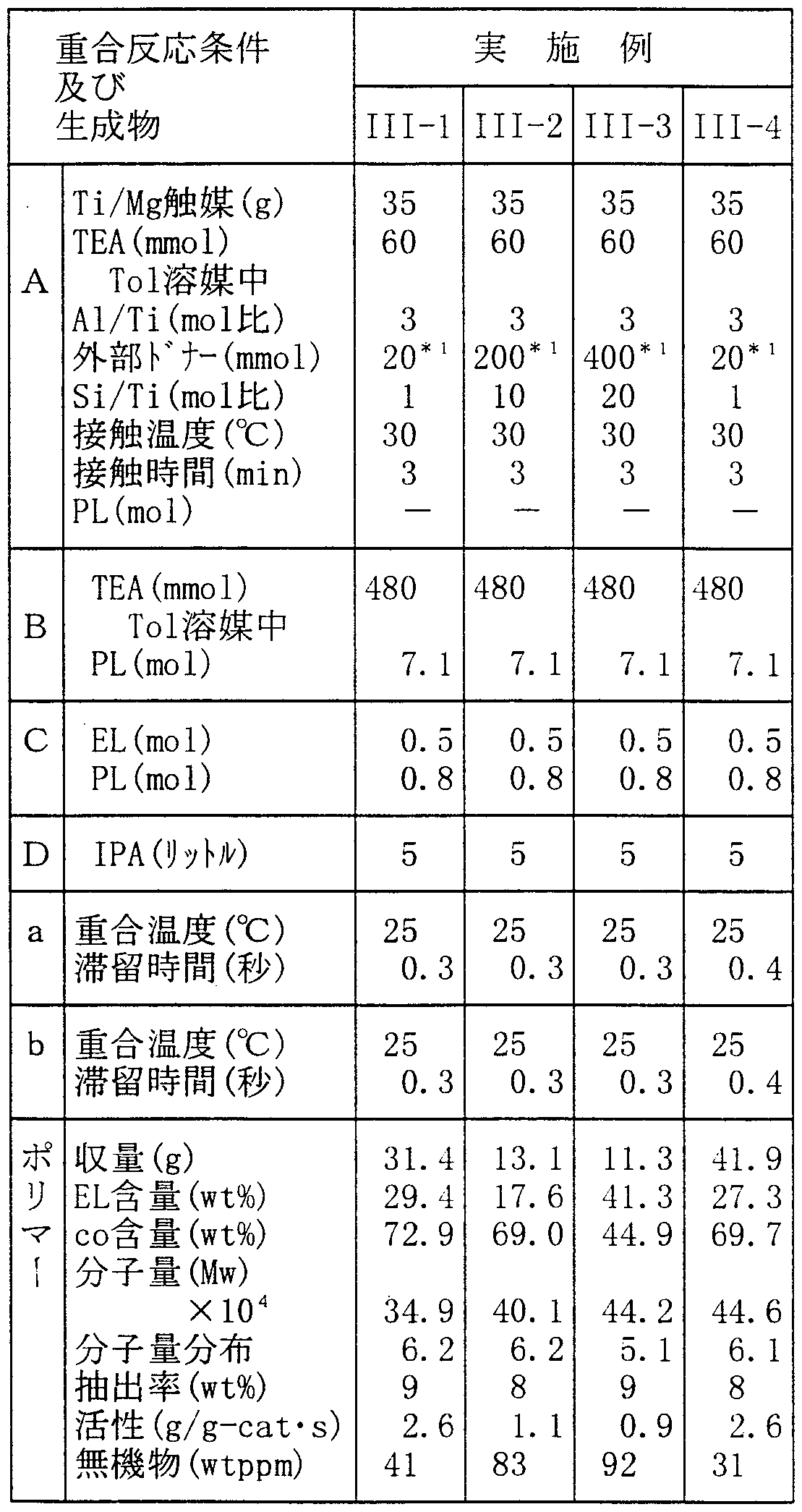
- Example III-1 (The solid catalyst and the organic metal are pre-contacted in the presence of an external donor)
- Pretreatment In container A, 1 liter of toluene, 2 mol of triethylaluminum / 3 Om 1 of toluene solution (manufactured by Toso-Axazo Co., Ltd.), and 3.5 g of diisopropyldimethoxysilane as an organic gay compound (0.0 g) 2 mo 1) (manufactured by Chisso Corporation), containing 35 g of a Ti-supported Mg catalyst, and 3 (pre-mixed contact with TC for 3 minutes.
- the molar ratio of A 1 ZT i was 3, The S i ZT i molar ratio is 1.
- Vessel B contains 20 Om 1 of toluene, 240 ml of 2 ml of triethylaluminum in toluene and 300 g (7.1 mol) of propylene, and vessel C
- the container contained 9 O Oml of toluene, 15 g (0.5 mol) of ethylene and 35 g (0.8 mol) of propylene, and the temperature of containers B and C was kept at 30 ° C.
- Vessel D contained 5 liters of isopropyl alcohol, and the temperature was kept at 15 ° C.
- the temperature of the polymerization zones a and b is maintained at 25 ° C,
- the vessels A to C were pressurized with nitrogen so that the residence time of the reaction mass became 0.3 second, and polymerization was carried out.
- 20 to 25 g of the catalyst in the vessel A was discharged, the polymerization was terminated.
- the product is extracted from the container D, and 10 Om 1 of a 35% hydrochloric acid solution is added.
- the resulting polymer is filtered, washed three times with 1 liter of isopropyl alcohol, then three times with 1 liter of ion-exchanged water, filtered, and dried under reduced pressure at 60 ° C for 8 hours to obtain the desired product 31.4 g of a block copolymer powder was obtained.
- the weight average molecular weight of the obtained block copolymer was 349,000, the molecular weight distribution was 6.2, the copolymer content was 72.9 wt%, the ethylene content was 29.4 wt%, and the normal heptane extraction rate was 9 wt. . / 0 , and there was no adhesion to the wall of the reactor and no blockage.
- the catalytic activity per second of the obtained block copolymer is
- Example III-1 The same operation as in Example III-1 was performed except that the addition amount of diisopropyldimethoxysilane was 35 g (0.2 mol) and the Si / Ti molar ratio was 10.
- the yield of the obtained block copolymer was 13.3 lg, the copolymer content at this time was 69. Owt%, the ethylene content was 17.6 wt%, the weight average molecular weight was 401, 000, and the molecular weight was The distribution was 6.2, the normal hebutane extraction rate was 8 wt%, and no adhesion or clogging of the reactor wall occurred.
- Example III-4 The same operation as in Example III-1 was performed except that the addition amount of diisopropyldimethoxysilane was 70 g (0.4 mo 1) and the molar ratio S i / T i was 20.
- the molecular weight distribution was 5.1 and the normal heptane extraction rate was 9 wt%. No adhesion to the wall and no blockage occurred.
- Example III-4 Example III-4
- Example III-1 The procedure was performed in the same manner as in Example III-1, except that the residence time in the reaction areas a and b was set to 0.4 second.
- the yield of the obtained block copolymer was 41.9 g, the copolymer content was 69.7 wt%, the ethylene content was 27.3 wt%, and the weight average molecular weight of the obtained block copolymer was Was 446,000, the molecular weight distribution was 6.1, and the normal heptane extraction rate was 8 wt%.
- Example II-1 The same operation as in Example II-1 was performed except that 0.02 mol of diisobutyldimethoxysilane was added instead of diisopropyldimethoxysilane.
- the yield of the obtained block copolymer was 25.lg, the copolymer content was 76.2 wt%, the ethylene content was 32.5 wt%, and the catalyst activity per second was 2. It was 0 g / g-catalyst.
- Example III-1 The same operation as in Example III-1 was performed except that 0.02 mol of cyclohexylmethyldimethoxysilane was added instead of diisopropyldimethoxysilane.
- the yield of the obtained block copolymer was 22.4 g, and the copolymer content was 77.2 wt. /.
- the ethylene content was 30.4 wt%, and the catalyst activity per second was 1.8 g / g-catalyst.
- the yield of the obtained block copolymer was 20.2 g, and the copolymer content was 70.0 wt. /.
- the ethylene content is 27 73 WT. /.
- the catalyst activity per second was 1.7 g / g-catalyst.
- Example III-1 The same operation as in Example III-1 was performed except that 0.02 mol of diphenyldimethoxysilane was added instead of diisopropyldimethoxysilane.
- the yield of the obtained block copolymer was 20.lg, the copolymer content at this time was 68.7 wt%, the ethylene content was 28.lwt%, and the catalyst activity per second was 1.7 g / 'g-catalyst.
- Container A 1 liter of toluene, 35 g of Ti-supported Mg catalyst, 3.5 g (0.02 mo1) of diisopropyldimethoxysilane (manufactured by Chisso Corporation) as an organosilicon compound, and propylene Holds 150 g (3.6 mo 1)
- Container B contains Tonolen 500 ml, triethylaluminum 2 mo 1 Z litno toluene solution
- Example III-10 (Pre-contact, add external donor at the time of polymerization of the copolymer part) Pre-treatment> In container A, 1 liter of toluene, 2 mol of triethyl aluminum / little toluene solution 3 Om 1 (Toso 35 g of a Ti-supported Mg catalyst, and mixed and contacted in advance at 30 ° C. for 3 minutes. The A 1 ZT i molar ratio at this time is 3.
- Container B contains 20 ml of toluene and 240 ml of triethylaluminum 2 mol / liter toluene solution and 300 g (7.l mol) of propylene
- container C contains 900 ml of toluene and organic cake.
- 3.5 g (0.02 mo 1) of diisopropyl dimethoxysilane (manufactured by Chisso Corporation), 15 g (0.5 mo 1) of ethylene and 35 g (0.8 mo 1) of propylene were used as elemental compounds. It was accommodated so that the S i ZT i molar ratio was 1.
- Vessel D contained 5 liters of isopropyl alcohol, and the temperature was kept at 15 ° C.
- the temperature of the polymerization zones a and b was kept at 25 ° C, and the reactors A to C were pressurized with nitrogen so that the residence time of the reaction mass in each zone was 0.3 seconds, and the polymerization was performed.
- the polymerization was terminated when 20 g to 25 g of the catalyst was discharged.
- the product is extracted from the container D, 10 Om 1 of a 35% hydrochloric acid solution is added thereto, and the mixture is stirred for 24 hours.
- the resulting polymer is filtered, three times with 1 liter of isopropyl alcohol, and then with 1 liter of ion. After washing three times with exchanged water, the mixture was filtered and dried under reduced pressure at 60 ° C. for 8 hours to obtain 23.4 g of a powder of the target block copolymer.
- the copolymer content was 69.3 wt%, and the ethylene content was 31.5 wt%.
- the catalytic activity per second of the obtained block copolymer was 1.8 g- / g-catalyst.
- Container B contains 200 ml of toluene, 2 mo 1 of triethylaluminum / 24 Om 1 of a toluene solution, 3.5 g of diisopropyldimethoxysilane as an organic silicon compound (0.02 mo 1 ) (Manufactured by Chisso Corporation) and 300 g of propylene (7.1 mo 1), and the S i / ⁇ i molar ratio was set to 1.
- Container C contained 9 ° 0 m 1 of toluene, 15 g (0.5 m o 1) of ethylene, and 35 g (0.8 m o 1) of propylene.
- the temperature of vessels B and C was kept at 30 ° C.
- Vessel D contained 5 liters of isopropyl alcohol, and the temperature was kept at 15 ° C.
- the product was taken out of the container D, 35% hydrochloric acid solution (10 Om1) was added, and the mixture was stirred for 24 hours.
- the resulting polymer was filtered, and 3 times with 1 liter of isopropyl alcohol. It was then washed three times with 1 liter of ion-exchanged water, filtered, and filtered. C. for 8 hours under reduced pressure to obtain 24.4 g of the target block copolymer powder.
- the copolymer content was 73.8 wt% and the ethylene content was 32.2 wt%.
- the catalytic activity per second of the obtained block copolymer was 2.0 g / g-catalyst.
- Example IV-1 (The solid catalyst is pre-contacted with the organic metal in the presence of an external donor)
- Container B contains 200 m of toluene, 240 ml of 2 ml of 1 ml of triethylaluminum toluene solution and 300 g of propylene (7.1 mol), and container C contains 900 ml of toluene and 15 ml of ethylene. g (0.5 mo 1) and 35 g (0.8 mo 1) of propylene. Kept the same.
- Vessel D contained 5 liters of isopropyl alcohol, and the temperature was kept at 15 ° C.
- the temperatures of the polymerization zones a and b are kept at 25 ° C, and the vessels A to C are pressurized with nitrogen so that the residence time of the reaction mass in each zone becomes 0.3 seconds, and the polymerization is carried out.
- the polymerization was terminated when 20 g to 25 g of the catalyst was discharged.
- the product is taken out of the vessel D, 10 Om1 of a 35% hydrochloric acid solution is added, and the mixture is stirred for 24 hours.
- the resulting polymer is filtered, 3 times with 1 liter of isopropyl alcohol, and then 1 liter of ions. After washing three times with exchanged water, the mixture was filtered and dried under reduced pressure at 60 ° C. for 8 hours to obtain 23.6 g of the target block copolymer powder.
- the copolymer content was 77.5 wt%
- the ethylene content was 37.6 wt%
- the weight average molecular weight was 159,000
- the molecular weight distribution was 4.0.
- the catalytic activity per second of the obtained block copolymer was 1.9 g / g-catalyst.
- the yield of the obtained block copolymer was 21.2 g, the copolymer content was 75.7 wt%, the ethylene content was 35.7 wt%, and the catalyst activity per second was 1.7 g / g-catalyst.
- Example IV-1 The same operation as in Example IV-1 was performed except that the addition amount of 2, 2, 6, 6-tetramethylpiperidine was 28 g (0.2 mol), and the N / Ti molar ratio was 10. .
- the yield of the obtained block copolymer was 7.4 g, the copolymer content was 81.9 wt%, the ethylene content was 42.7 wt%, and the weight average molecular weight of the obtained block copolymer was 192 , 000 and the molecular weight distribution was 4.1.
- Example IV-1 The same operation as in Example IV-1 was performed except that the addition amount of 2, 2, 6, 6-tetramethylpiperidine was 56 g (0.4 mol), and the N / Ti ratio was 20.
- the yield of the obtained block copolymer was 6.2 g, the copolymer content at this time was 79.7 wt%, the ethylene content was 39.7 wt%, and the weight average molecular weight of the obtained block copolymer was The molecular weight distribution was 21 1,000, and the molecular weight distribution was 4.5.
- Example IV-1 polymerization temperature and residence time as in Example IV-1.
- the yield of the obtained block copolymer was 3.5 g, and the copolymer content was 74.
- Example IV-6 Pre-contact, add external donor during polymerization of copolymer part
- the A1 / Ti molar ratio at this time is 3.
- Container B contains 20 Om of toluene, 240 ml of 2 mol of triethylaluminum litter / leen solution and 300 g of propylene (7.1 mol 1), and 90 g of toluene and 90 m of complex
- 2,2,6,6-tetramethylpiperidine 2.8 g (0.02mo1) (manufactured by Tokyo Chemical Industry Co., Ltd.), ethylene 15g (0.5mo1) and propylene 35 g (0.8 mo 1), and the NZT i molar ratio was set to 1.
- the temperature of vessels B and C was kept at 30 ° C.
- Vessel D contained 5 liters of isopropyl alcohol, and the temperature was kept at 15 ° C.
- the temperature of the polymerization areas a and b is kept at 25 ° C, and the vessels A to C are pressurized with nitrogen so that the residence time of the reaction mass in each area becomes 0.3 seconds, and polymerization is performed.
- the polymerization was terminated when 20 g to 25 g of the catalyst in container A had flowed out.
- the product is taken out of the container D, 10 Om1 of a 35% hydrochloric acid solution is added thereto, and the mixture is stirred for 24 hours.
- the resulting polymer is filtered, three times with one liter of isopropyl alcohol, and then one liter. After washing with ion-exchanged water three times, the mixture was filtered and dried under reduced pressure at 60 ° C. for 8 hours to obtain 20.6 g of the desired block copolymer powder.
- the copolymer content was 75.3 wt%, and the ethylene content was 35.3 wt%.
- the catalytic activity per second of the obtained block copolymer was 1.6 g / g-catalyst.
- Example IV-1 The procedure was performed in the same manner as in Example IV-1 except that the residence time in the reaction areas a and b was set to 0.4 second.
- the yield of the obtained block copolymer was 31.6 g, the copolymer content was 77.7 wt%, the ethylene content was 38.3 wt%, and the weight average molecular weight of the obtained block copolymer was 208 , 000 and the molecular weight distribution was 4.3.
- Table 4 summarizes the above results.
- the present invention has excellent whitening properties and impact resistance, is useful as a compatibilizer between crystalline polyolefin and amorphous polyolefin, a modifier for polyolefin such as polypropylene or polyethylene, and a molding material.
- Polypropylene-b-poly (ethylene-Co-propylene) having a molecular weight of 0000 or more can be produced efficiently and with little residual inorganic material. Therefore, the obtained product is less likely to deteriorate in quality, and when molded, a good molded product such as a film with little fish eyes can be obtained.
- polypropylene-b-poly (ethylene-c0-propylene) having a normal heptane extraction rate of not more than 20 wt% can be obtained, and can be efficiently produced without causing adhesion and clogging on the polymerization vessel wall. .
Landscapes
- Chemical & Material Sciences (AREA)
- Inorganic Chemistry (AREA)
- Health & Medical Sciences (AREA)
- Chemical Kinetics & Catalysis (AREA)
- Medicinal Chemistry (AREA)
- Polymers & Plastics (AREA)
- Organic Chemistry (AREA)
- Transition And Organic Metals Composition Catalysts For Addition Polymerization (AREA)
- Graft Or Block Polymers (AREA)
Description




Claims

Priority Applications (6)
| Application Number | Priority Date | Filing Date | Title |
|---|---|---|---|
| CA002311543A CA2311543C (en) | 1997-11-21 | 1998-11-20 | Process for the preparation of polypropylene-b-poly(ethylene-co-propylene) |
| DE69830923T DE69830923D1 (de) | 1997-11-21 | 1998-11-20 | Verfahren zur herstellung von polypropylen-b-poly(ethylen-co-propylen) |
| EP98954764A EP1033376B1 (en) | 1997-11-21 | 1998-11-20 | PROCESS FOR THE PREPARATION OF POLYPROPYLENE-B-POLY(ETHYLENE-co-PROPYLENE) |
| US09/554,762 US6657020B1 (en) | 1997-11-21 | 1998-11-20 | Process for the preparation of polypropylene-b-poly(ethylene-co-propylene) |
| KR1020007005548A KR100545514B1 (ko) | 1997-11-21 | 1998-11-20 | 폴리프로필렌-b-폴리(에틸렌-co-프로필렌)의 제조방법 |
| JP2000522141A JP3962544B2 (ja) | 1997-11-21 | 1998-11-20 | ポリプロピレン−b−ポリ(エチレン−co−プロピレン)の製造方法 |
Applications Claiming Priority (16)
| Application Number | Priority Date | Filing Date | Title |
|---|---|---|---|
| JP33661397 | 1997-11-21 | ||
| JP9/336613 | 1997-11-21 | ||
| JP10/54356 | 1998-02-19 | ||
| JP10/54357 | 1998-02-19 | ||
| JP5435698 | 1998-02-19 | ||
| JP5435798 | 1998-02-19 | ||
| JP10/80458 | 1998-03-12 | ||
| JP10/80456 | 1998-03-12 | ||
| JP8045898 | 1998-03-12 | ||
| JP10/80457 | 1998-03-12 | ||
| JP8045798 | 1998-03-12 | ||
| JP8045698 | 1998-03-12 | ||
| JP10/240921 | 1998-08-26 | ||
| JP24092198 | 1998-08-26 | ||
| JP24307898 | 1998-08-28 | ||
| JP10/243078 | 1998-08-28 |
Publications (1)
| Publication Number | Publication Date |
|---|---|
| WO1999026986A1 true WO1999026986A1 (en) | 1999-06-03 |
Family
ID=27572436
Family Applications (1)
| Application Number | Title | Priority Date | Filing Date |
|---|---|---|---|
| PCT/JP1998/005229 Ceased WO1999026986A1 (en) | 1997-11-21 | 1998-11-20 | PROCESS FOR THE PREPARATION OF POLYPROPYLENE-b-POLY(ETHYLENE-co-PROPYLENE) |
Country Status (7)
| Country | Link |
|---|---|
| US (1) | US6657020B1 (ja) |
| EP (1) | EP1033376B1 (ja) |
| JP (1) | JP3962544B2 (ja) |
| KR (1) | KR100545514B1 (ja) |
| CA (1) | CA2311543C (ja) |
| DE (1) | DE69830923D1 (ja) |
| WO (1) | WO1999026986A1 (ja) |
Cited By (3)
| Publication number | Priority date | Publication date | Assignee | Title |
|---|---|---|---|---|
| EP1162219A4 (en) * | 1998-10-19 | 2004-08-11 | Chisso Petrochemical Corp | PROPEN / ETHEN COPOLYMERS, tarnish-resistant PROPYLENE POLYMERS FOR MOLD MOLDING, ELASTOMERS AND MOLDED ITEMS MADE THEREOF |
| WO2008072791A1 (ja) * | 2006-12-15 | 2008-06-19 | Sumitomo Chemical Company, Limited | プロピレン系ブロック共重合体 |
| WO2011004696A1 (ja) | 2009-07-08 | 2011-01-13 | チッソ株式会社 | 積層エレクトレット不織布を用いたエアーフィルター材 |
Families Citing this family (1)
| Publication number | Priority date | Publication date | Assignee | Title |
|---|---|---|---|---|
| WO2014128715A2 (en) * | 2013-02-19 | 2014-08-28 | Reliance Industries Limited | An improved magnesium dichloride supported titanium catalyst composition for polyolefin polymerization |
Citations (5)
| Publication number | Priority date | Publication date | Assignee | Title |
|---|---|---|---|---|
| JPS58187413A (ja) * | 1982-04-17 | 1983-11-01 | バスフ アクチエンゲゼルシヤフト | ブロツク共重合物型のプロピレン−エチレン重合物の製法 |
| JPH06136073A (ja) * | 1992-10-27 | 1994-05-17 | Ube Ind Ltd | プロピレンブロック共重合体の製造方法 |
| JPH06136072A (ja) * | 1992-10-27 | 1994-05-17 | Ube Ind Ltd | プロピレンブロック共重合体の製造方法 |
| JPH07157525A (ja) * | 1993-12-10 | 1995-06-20 | Ube Ind Ltd | プロピレンブロック共重合体の製造方法 |
| JPH08169924A (ja) * | 1994-12-20 | 1996-07-02 | Ube Ind Ltd | プロピレンブロック共重合体及びその製造方法 |
Family Cites Families (6)
| Publication number | Priority date | Publication date | Assignee | Title |
|---|---|---|---|---|
| NL285400A (ja) | 1957-07-01 | |||
| DE3331877A1 (de) | 1983-09-03 | 1985-03-21 | Hoechst Ag, 6230 Frankfurt | Verfahren zur herstellung einer polypropylen-formmasse |
| US4740551A (en) * | 1986-06-18 | 1988-04-26 | Shell Oil Company | Multistage copolymerization process |
| DE3827565A1 (de) * | 1988-08-13 | 1990-02-15 | Basf Ag | Verfahren zum herstellen von propylen-ethylen-polymerisaten vom typ der sogenannten "schlagzaehmodifizierten polypropylene" |
| JP3275223B2 (ja) * | 1994-09-22 | 2002-04-15 | 科学技術振興事業団 | ポリプロピレン−b−ポリ(エチレン−co−プロピレン)とその製造方法 |
| JPH0987343A (ja) | 1995-09-19 | 1997-03-31 | Res Dev Corp Of Japan | オレフィン系ブロックコポリマー、ポリオレフィン材料及びこれらの製造方法 |
-
1998
- 1998-11-20 CA CA002311543A patent/CA2311543C/en not_active Expired - Fee Related
- 1998-11-20 KR KR1020007005548A patent/KR100545514B1/ko not_active Expired - Fee Related
- 1998-11-20 WO PCT/JP1998/005229 patent/WO1999026986A1/ja not_active Ceased
- 1998-11-20 DE DE69830923T patent/DE69830923D1/de not_active Expired - Lifetime
- 1998-11-20 EP EP98954764A patent/EP1033376B1/en not_active Expired - Lifetime
- 1998-11-20 US US09/554,762 patent/US6657020B1/en not_active Expired - Fee Related
- 1998-11-20 JP JP2000522141A patent/JP3962544B2/ja not_active Expired - Fee Related
Patent Citations (5)
| Publication number | Priority date | Publication date | Assignee | Title |
|---|---|---|---|---|
| JPS58187413A (ja) * | 1982-04-17 | 1983-11-01 | バスフ アクチエンゲゼルシヤフト | ブロツク共重合物型のプロピレン−エチレン重合物の製法 |
| JPH06136073A (ja) * | 1992-10-27 | 1994-05-17 | Ube Ind Ltd | プロピレンブロック共重合体の製造方法 |
| JPH06136072A (ja) * | 1992-10-27 | 1994-05-17 | Ube Ind Ltd | プロピレンブロック共重合体の製造方法 |
| JPH07157525A (ja) * | 1993-12-10 | 1995-06-20 | Ube Ind Ltd | プロピレンブロック共重合体の製造方法 |
| JPH08169924A (ja) * | 1994-12-20 | 1996-07-02 | Ube Ind Ltd | プロピレンブロック共重合体及びその製造方法 |
Non-Patent Citations (1)
| Title |
|---|
| See also references of EP1033376A4 * |
Cited By (4)
| Publication number | Priority date | Publication date | Assignee | Title |
|---|---|---|---|---|
| EP1162219A4 (en) * | 1998-10-19 | 2004-08-11 | Chisso Petrochemical Corp | PROPEN / ETHEN COPOLYMERS, tarnish-resistant PROPYLENE POLYMERS FOR MOLD MOLDING, ELASTOMERS AND MOLDED ITEMS MADE THEREOF |
| WO2008072791A1 (ja) * | 2006-12-15 | 2008-06-19 | Sumitomo Chemical Company, Limited | プロピレン系ブロック共重合体 |
| JP2008150470A (ja) * | 2006-12-15 | 2008-07-03 | Sumitomo Chemical Co Ltd | プロピレン系ブロック共重合体 |
| WO2011004696A1 (ja) | 2009-07-08 | 2011-01-13 | チッソ株式会社 | 積層エレクトレット不織布を用いたエアーフィルター材 |
Also Published As
| Publication number | Publication date |
|---|---|
| EP1033376A1 (en) | 2000-09-06 |
| EP1033376B1 (en) | 2005-07-20 |
| KR20010032332A (ko) | 2001-04-16 |
| US6657020B1 (en) | 2003-12-02 |
| CA2311543C (en) | 2008-02-05 |
| EP1033376A4 (en) | 2002-07-31 |
| DE69830923D1 (de) | 2005-08-25 |
| JP3962544B2 (ja) | 2007-08-22 |
| KR100545514B1 (ko) | 2006-01-24 |
| CA2311543A1 (en) | 1999-06-03 |
Similar Documents
| Publication | Publication Date | Title |
|---|---|---|
| CN102171262B (zh) | 用动态运行反应器制备丙烯共聚物 | |
| NO153609B (no) | Polymerisasjonskatalysator. | |
| KR20020019910A (ko) | 고강성 프로필렌 중합체 및 그것의 제조방법 | |
| KR101742714B1 (ko) | 프로필렌 중합체의 제조 방법 | |
| WO2013039152A1 (ja) | 末端二重結合含有ポリオレフィンとその製造方法 | |
| US7618913B2 (en) | Highly active alpha-olefin copolymerization catalyst system | |
| CN116615477A (zh) | 基于1,3-二烯和乙烯的嵌段聚合物的合成 | |
| Cuomo et al. | Olefin polymerization catalyzed by amide vanadium (IV) complexes: The stereo‐and regiochemistry of propylene insertion | |
| JP7071763B2 (ja) | 対称型ポリオレフィンブロック共重合体およびその製造方法 | |
| JP3962544B2 (ja) | ポリプロピレン−b−ポリ(エチレン−co−プロピレン)の製造方法 | |
| JPWO1999026986A1 (ja) | ポリプロピレン−b−ポリ(エチレン−co−プロピレン)の製造方法 | |
| CN101809043A (zh) | 包括预聚合步骤的制备高度透明的聚丙烯的方法 | |
| JP4240870B2 (ja) | プロピレン−エチレンランダム共重合体及びその製造方法 | |
| JP2000336130A (ja) | プロピレン・エチレンブロックコポリマー及びその製造方法 | |
| WO2023171435A1 (ja) | オレフィン類重合用触媒、オレフィン類重合体の製造方法及びプロピレン単独重合体 | |
| JP2000154222A (ja) | ポリプロピレン−b−ポリ(エチレン−co−プロピレン)の製造方法 | |
| EP0576413B1 (en) | Electron donors for improved olefin polymerization | |
| JP3385687B2 (ja) | プロピレンブロック共重合体の製造方法 | |
| TW200427713A (en) | Polymerization of olefins using a ziegler-natta catalyst system having an external electron donor | |
| JP7772471B2 (ja) | ポリ乳酸重合体の製造方法 | |
| AU3280700A (en) | Propylene copolymers containing styrene units | |
| JP2553246B2 (ja) | プロピレンエチレン共重合体の製造方法 | |
| JP3322703B2 (ja) | 末端修飾ポリオレフィン | |
| JP3697011B2 (ja) | プロピレン重合体 | |
| Yu et al. | Synthesis of Hyperbranched Polyisoprene by Isoprene/Dimethyl‐di‐2, 4‐Pentadieneyl‐(E, E)‐Silane Copolymerization Catalyzed with Half‐Sandwich Scandium Complex |
Legal Events
| Date | Code | Title | Description |
|---|---|---|---|
| AK | Designated states |
Kind code of ref document: A1 Designated state(s): CA JP KR US |
|
| AL | Designated countries for regional patents |
Kind code of ref document: A1 Designated state(s): DE FR GB IT |
|
| DFPE | Request for preliminary examination filed prior to expiration of 19th month from priority date (pct application filed before 20040101) | ||
| 121 | Ep: the epo has been informed by wipo that ep was designated in this application | ||
| ENP | Entry into the national phase |
Ref document number: 2311543 Country of ref document: CA Ref country code: CA Ref document number: 2311543 Kind code of ref document: A Format of ref document f/p: F |
|
| WWE | Wipo information: entry into national phase |
Ref document number: 1020007005548 Country of ref document: KR |
|
| WWE | Wipo information: entry into national phase |
Ref document number: 1998954764 Country of ref document: EP |
|
| WWE | Wipo information: entry into national phase |
Ref document number: 09554762 Country of ref document: US |
|
| WWP | Wipo information: published in national office |
Ref document number: 1998954764 Country of ref document: EP |
|
| WWP | Wipo information: published in national office |
Ref document number: 1020007005548 Country of ref document: KR |
|
| WWG | Wipo information: grant in national office |
Ref document number: 1998954764 Country of ref document: EP |
|
| WWG | Wipo information: grant in national office |
Ref document number: 1020007005548 Country of ref document: KR |