WO1999044972A1 - Polymerization-inhibiting composition, polymerization inhibitor and method for inhibiting polymerization - Google Patents
Polymerization-inhibiting composition, polymerization inhibitor and method for inhibiting polymerization Download PDFInfo
- Publication number
- WO1999044972A1 WO1999044972A1 PCT/JP1999/001017 JP9901017W WO9944972A1 WO 1999044972 A1 WO1999044972 A1 WO 1999044972A1 JP 9901017 W JP9901017 W JP 9901017W WO 9944972 A1 WO9944972 A1 WO 9944972A1
- Authority
- WO
- WIPO (PCT)
- Prior art keywords
- compound
- formula
- polymerization
- group
- organic group
- Prior art date
- Legal status (The legal status is an assumption and is not a legal conclusion. Google has not performed a legal analysis and makes no representation as to the accuracy of the status listed.)
- Ceased
Links
Classifications
-
- C—CHEMISTRY; METALLURGY
- C07—ORGANIC CHEMISTRY
- C07C—ACYCLIC OR CARBOCYCLIC COMPOUNDS
- C07C11/00—Aliphatic unsaturated hydrocarbons
- C07C11/12—Alkadienes
- C07C11/173—Alkadienes with five carbon atoms
- C07C11/18—Isoprene
-
- C—CHEMISTRY; METALLURGY
- C09—DYES; PAINTS; POLISHES; NATURAL RESINS; ADHESIVES; COMPOSITIONS NOT OTHERWISE PROVIDED FOR; APPLICATIONS OF MATERIALS NOT OTHERWISE PROVIDED FOR
- C09K—MATERIALS FOR MISCELLANEOUS APPLICATIONS, NOT PROVIDED FOR ELSEWHERE
- C09K15/00—Anti-oxidant compositions; Compositions inhibiting chemical change
- C09K15/04—Anti-oxidant compositions; Compositions inhibiting chemical change containing organic compounds
- C09K15/30—Anti-oxidant compositions; Compositions inhibiting chemical change containing organic compounds containing heterocyclic ring with at least one nitrogen atom as ring member
-
- C—CHEMISTRY; METALLURGY
- C07—ORGANIC CHEMISTRY
- C07C—ACYCLIC OR CARBOCYCLIC COMPOUNDS
- C07C7/00—Purification; Separation; Use of additives
- C07C7/20—Use of additives, e.g. for stabilisation
-
- C—CHEMISTRY; METALLURGY
- C09—DYES; PAINTS; POLISHES; NATURAL RESINS; ADHESIVES; COMPOSITIONS NOT OTHERWISE PROVIDED FOR; APPLICATIONS OF MATERIALS NOT OTHERWISE PROVIDED FOR
- C09K—MATERIALS FOR MISCELLANEOUS APPLICATIONS, NOT PROVIDED FOR ELSEWHERE
- C09K15/00—Anti-oxidant compositions; Compositions inhibiting chemical change
- C09K15/04—Anti-oxidant compositions; Compositions inhibiting chemical change containing organic compounds
- C09K15/20—Anti-oxidant compositions; Compositions inhibiting chemical change containing organic compounds containing nitrogen and oxygen
Definitions
- the present invention relates to a technique for preventing the polymerization of monomers such as conjugated gens, aromatic biels, ethylenically unsaturated nitriles, and alpha-refined olefins.
- Polymerization-inhibiting composition to prevent undesired premature polymerization during various stages of production, refining, storage, transportation, blending, use, etc. of hydrocarbon mixtures containing monomers, polymerization prevention And a method for preventing polymerization.
- Monomers such as conjugated gens, aromatic vinyls, ethylenically unsaturated nitriles, and alpha-refined olefins are too early in various stages of their production, purification, storage, transport, formulation, and use. Easy to polymerize. Premature polymerization results in monomer polymer contamination, increased viscosity, gelling, and loss of reactivity. In addition, premature polymerization can contaminate heat exchangers, storage vessels, transfer lines, pumps, and distillation equipment with polymers, causing problems such as increased cleaning costs, reduced production efficiency, and material loss. The problems associated with such early polymerization will be described more specifically by taking a conjugated-gen purification step as an example.
- Conjugated genes hydrocarbon mixtures containing conjugated genes (eg, C4 and C5 hydrocarbon fractions), unsaturated olefinic hydrocarbon mixtures containing conjugated genes (after gas and liquid cracking operations)
- Contained monomer mixtures include, for example, distillation, extractive distillation, extraction, countercurrent extraction, hydrotreatment, hydrorefining, heat treatment, and other similar treatments During preheating before treatment, or during storage, transfer, processing, etc., polymerization of conjugated gens and copolymerization of Z or conjugated gens with other copolymerizable unsaturated compounds are likely to occur.
- a polymerization reaction is likely to occur, and a solvent-soluble polymer or a cross-linked solvent-insoluble polymer is generated.
- Solvent-soluble polymers also known as rubbery polymers, contaminate equipment such as extractive distillation towers, distillation towers, heat exchangers and piping.
- the crosslinked solvent-insoluble polymer is a porous insoluble polymer, and is called a popcorn polymer because of its appearance.
- This pop copolymer is particularly undesirable because it self-propagates in the presence of conjugated jen vapors and liquids, not only clogging the device rapidly, but also being extremely difficult to remove and control.
- popcorn polymer grows exponentially, using it as a seed. Since the popcorn polymer is a tough crosslinked polymer, it is insoluble in known solvents and does not melt when heated. Therefore, there is no effective method of removing popcorn polymers other than cleaning by mechanical means. For cleaning, the equipment must be temporarily stopped and dismantled, and the polymer deposits must be removed mechanically, which is time-consuming and economically disadvantageous.
- N dialkylhydroxylamine and its oxalate [bis (getylhydroxylamine) oxalate] are used as polymerization inhibitors.
- Oxalate can be obtained by reacting N, N-dialkylhydroxylamine with oxalic acid.
- oxalic acid has a problem of corroding the extractive distillation column. The oxalate alone does not have a sufficient polymerization inhibitory effect.
- Japanese Patent Application Laid-Open No. 4-189810 discloses that an epoxidizing agent is allowed to act on a (meth) acrylate mixture having a cyclohexenyl group in an ester portion to form a cyclohexenyl ring.
- an epoxidizing agent is allowed to act on a (meth) acrylate mixture having a cyclohexenyl group in an ester portion to form a cyclohexenyl ring.
- molecular oxygen-containing gas [Group A] with hydrodoquinone, hydrodoquinone monomethyl ether, p-methoxyphenyl, phenothiazine, piperidine, etc.
- Group B A method of coexisting with a phosphorus-containing compound such as phosphoric acid or potassium phosphate is disclosed.
- An object of the present invention is to produce a monomer or a monomer mixture such as a conjugated diene, an aromatic vinyl, an ethylenically unsaturated nitrile, or a chiseki refine, a hydrocarbon mixture containing the monomer, and the like.
- An object of the present invention is to provide a polymerization inhibitor and a polymerization prevention method for preventing undesired premature polymerization from occurring in various working steps such as purification, storage, transportation, blending, and use.
- Another object of the present invention is to provide an anti-polymerization composition containing the monomer and a polymerization inhibitor.
- an object of the present invention is to treat and store conjugated gens, conjugated gen-containing hydrocarbon mixtures, conjugated gen-containing unsaturated olefin-based hydrocarbon mixtures, conjugated gen-containing monomer mixtures, and the like.
- a polymerization inhibitor for preventing (co) polymerization of a conjugated gen at a high level a polymerization preventing method, and a polymerization preventive composition containing a polymerization inhibitor and a conjugated gen. It is in.
- the present inventors have conducted intensive studies to overcome the problems of the prior art, and as a result, as a polymerization inhibitor, a compound having a NO radical ( ⁇ ⁇ ) in a molecule and a precursor capable of forming a ⁇ radical
- a polymerization inhibitor a compound having a NO radical ( ⁇ ⁇ ) in a molecule and a precursor capable of forming a ⁇ radical
- a combination of at least one compound selected from the group consisting of compounds and a phosphorus-containing compound is extremely effective in preventing premature polymerization of various monomers such as conjugated gens. was found.
- the polymerization inhibitor of the present invention can be used, for example, by conducting a distillation operation including extractive distillation from a hydrocarbon mixture containing a conjugated diene to obtain a purified conjugated diene.
- a distillation operation including extractive distillation from a hydrocarbon mixture containing a conjugated diene to obtain a purified conjugated diene.
- the polymerization inhibitor of the present invention is extremely effective not only for a hydrocarbon mixture containing a large amount of conjugated gen, but also for a hydrocarbon mixture containing a small amount of conjugated gen.
- the polymerization inhibitor of the present invention is also effective in preventing the polymerization of monomers such as aromatic vinyl, ethylenically unsaturated nitrile and ⁇ -olefin. The present invention has been completed based on these findings.
- a polymerization inhibitory composition having a weight ratio to the phosphorus-containing compound (b) of from 1:10 to 100: 1 is provided.
- the present invention provides a polymerization inhibitor of at least one monomer (c) selected from the group consisting of nitrile and ⁇ -olefin.
- FIG. 1 is a flow chart showing a distillation process including an extractive distillation process for obtaining purified 1,3-butadiene from a C 4 hydrocarbon fraction.
- the polymerization prevention technology of the present invention can be applied to conjugated gens, aromatic vinyls, ethylenically unsaturated nitriles, and ⁇ -olefin refining.
- Conjugates include 1,3-butadiene, isoprene, chloroprene, and the like.
- the aromatic vinyl include styrene, vinyl toluene, ⁇ -methylstyrene, and the like.
- ethylenically unsaturated nitriles include acrylonitrile and methyl chloronitrile.
- ⁇ -olefins include ethylene, propylene, 1-butene, 1-pentene, 1-hexene, 1-heptene, 1-octene and the like.
- the polymerization inhibitor of the present invention is used in a method for producing a purified conjugated gen which separates a conjugated gen by performing a distillation operation including extractive distillation from a hydrocarbon mixture containing a conjugated gen. It is particularly effective in suppressing the formation of polymers.
- the conjugated gen is described in detail below.
- examples of the conjugated diene include 1,3-butadiene, isoprene, and chloroprene.
- the inhibitors are suitable for conjugated gens or mixtures containing conjugated gens.
- examples of the mixture containing a conjugated diene include a hydrocarbon mixture containing a conjugated diene, an unsaturated olefin-based hydrocarbon mixture containing a conjugated diene, and a monomer mixture containing a conjugated diene.
- the hydrocarbon mixture containing a conjugated gen is a mixture of various hydrocarbons containing at least one kind of a conjugated gen.
- the hydrocarbon mixture containing a conjugated gen used as a starting material for the separation and production of the purified conjugated gen is not particularly limited, but is typically a C5 hydrocarbon fraction containing isoprene, 1, 3 — Petroleum fractions such as C4 hydrocarbon fractions containing butadiene can be mentioned.
- the C5 hydrocarbon fraction is a by-product of the steam cracking of hydrocarbons and other high-temperature processes to produce ethylene.
- the C5 hydrocarbon fraction typically has a boiling range of 25-70 ° C and contains various C5 hydrocarbons with different degrees of saturation, as well as certain C4 hydrocarbons and May contain C6 hydrocarbons.
- C 5 hydrocarbon fractions generally include n-pentane, isopentane, 1-pentene, 2-methyl-1- 1-butene, trans-2-pentene, cis-1-pentene, 2-methyl-2-butene, Includes isoprene, trans-1,3-pentagen, cis-1,3-pentadiene, 1,4-pentadiene, 2-butyne, isopropenylacetylene, isopropylacetylene, cyclopentane, cyclopentene, cyclopentene, etc. It has been.
- C4 hydrocarbon fractions such as naphtha cracked oils generally include propane, propylene, isobutene, arene, n-butane, isobutene, 1-butene, trans-1-butene, cis-2-butene, 1,3— pig It contains various hydrocarbons, such as benzene, methylacetylene, 1,2-butadiene, and vinylacetylene.
- olefinic hydrocarbons such as ethylene, propylene, butene, butadiene, and mixtures thereof after gas and liquid cracking operations.
- Unsaturated unsaturated hydrocarbon mixtures. Ethylene, propylene, butene, butadiene, etc. are separated and recovered from these unsaturated olefinic hydrocarbon mixtures by operations such as hydrogenation, distillation, and extraction.
- Examples of the monomer mixture containing a conjugated diene include a monomer mixture for producing a synthetic rubber such as SBR.
- the polymerization inhibitor of the present invention can be applied to a liquid mixture containing a conjugated diene other than those described above.
- the polymerization inhibitor of the present invention is used in a process of separating and purifying a conjugated gen by performing a distillation operation including an extractive distillation from a hydrocarbon mixture containing a conjugated gen, such as a popcorn polymer or a rubbery polymer in the extractive distillation step. It is particularly suitable for suppressing generation. Therefore, the extractive distillation will be described below in detail.
- the distillation operation including extractive distillation may be a single extractive distillation operation or a combination of multiple extractive distillation operations.However, when a hydrocarbon mixture containing various types of hydrocarbons is used as a starting material, the extractive distillation operation and A distillation operation using a boiling point difference (a fractional distillation operation) may be combined.
- Examples of the distillation operation including extractive distillation include, for example, isoprene having a higher purity than the C5 hydrocarbon mixture described in JP-A-47-41323.
- a method for recovering len can be mentioned. More specifically, the publication discloses that (1) extractive distillation of a C 5 hydrocarbon mixture as a raw material in the presence of a N-alkyl-substituted lower fatty acid amide solvent containing a polymerization inhibitor to obtain a compound having a lower solubility than isoprene; (2) Next, distilling off hydrocarbons more soluble than the extracted isoprene and isoprene to remove most of cyclopentene and hydrocarbons having a higher boiling point than isoprene, 3) Further, the obtained fraction is subjected to extractive distillation in the presence of the above-mentioned solvent to remove the remaining easily soluble hydrocarbons such as cyclopentene gen and isopropenylacetylene.
- a method for recovering high-purity isoprene is described, in which the solvent before circulation is released under reduced pressure at a release temperature of 140 or less.
- This publication discloses a flow chart of the recovery method, which is incorporated by reference for the description of the present invention.
- FIG. 1 As a method for producing (recovering) purified 1,3-butadiene from a C 4 hydrocarbon fraction containing 1,3-butadiene by a distillation operation including extractive distillation, the method shown in FIG. 1 can be exemplified. However, in FIG. 1, for example, a reboiler, a condenser, a heat exchanger, a cooler, a pump, a circulation circuit in each distillation column, and the like are omitted in order to simply show the entire distillation process.
- the gasified C4 hydrocarbon fraction is supplied to the middle stage of the first extractive distillation column A from the pipe 21, while the extraction solvent such as N, N-dimethylformamide is supplied to the pipe.
- the first stage of extractive distillation is performed by supplying from 45.
- hydrocarbons with lower solubility in the extraction solvent than 1,3-butadiene propane, propylene, isobutene, arene, n-butane, isobutene, 1-butene, trans — 2—butene , Cis-12-butene
- the main components of rough rice are Butenes.
- the gas from the top is condensed by the condenser, and a part of the liquid is returned to the top by reflux.
- the pressure in the first distillation column is usually 1 to 15 atm, and the bottom temperature is usually 100 to 180 ° C.
- the number of stages of the extractive distillation column can be set as appropriate, but when using a C4 hydrocarbon fraction, it is usually about 100 to 300, and in most cases about 200.
- the bottom of the first distillation column A contains 1,3-butadiene and hydrocarbons with higher solubility in extraction solvents than 1,3-butene (methyl acetylene, 1,2-butadiene, vinyl acetylene, etc.)
- the extract is taken out and supplied to the upper part of the pre-diffusion tower B via the pipe 23.
- hydrocarbons are partially released from the solvent, and are sent directly to the second distillation tower E via the pipe 24.
- the bottom liquid of the pre-dissociation tower B is supplied to the top of the first stripping tower C via the pipe 25, and the hydrocarbon is released from the solvent.
- the solvent from the bottom of the first stripping tower is cooled in the heat exchanger and circulated to the first extractive distillation column A.
- the hydrocarbon vapor from the top of the first stripping tower is led to the compressor D via pipes 26 and 27, compressed there, and then passed through the pipe 28 to the column of the second extractive distillation column E. Supplied to the bottom.
- the pre-diffusion tower B and the first stripping tower C can be operated under the condition that the pressure in the tower is usually 1 to 2 atm and the tower bottom temperature is the boiling point of the solvent at that pressure.
- the second extractive distillation column E is mainly supplied with hydrocarbons having higher solubility in the extraction solvent than 1,3-butadiene and 1,3-butadiene.
- the extraction solvent is supplied via a pipe 37 to a point several steps below the top of the second extraction distillation column E.
- the vapor at the top of the second extractive distillation column is 1,3-butadiene containing a trace amount of impurities, which is refluxed by a condenser.
- the remaining part is passed through a pipe 29 to the first fractional distillation column H.
- the liquid mainly composed of the solvent at the bottom of the distillation column E is first sent to the butadiene recovery tower F via the pipe 33, and then sent to the second stripping tower G via the pipe 34, where the remaining hydrocarbon Is released from the solvent.
- the solvent from the bottom of the second stripping tower G is cooled by heat exchange and returned to the first extractive distillation tower A and the second extractive distillation tower E via the pipe 36.
- the vapor at the top of the stripping tower G is refluxed by the condenser, and the uncondensed gas is discharged from the pipe 35 to the fuel gas system.
- the operating conditions of the second extractive distillation column and the second stripper are the same as the operating conditions of the first extractive distillation column and the first stripper, respectively.
- the stream at the bottom of the second fractional distillation column I is waste liquid.
- the operating conditions for each fractional distillation column are such that the column pressure is 1 to 15 atm and the column temperature is the boiling point at that pressure.
- the number of stages in the distillation column can be set as appropriate. However, when a C4 hydrocarbon fraction is used, it is usually 50 to 200 stages, and in many cases about 100 stages.
- the extraction solvent is sent to the solvent purification tower J, and the solvent that has been washed and purified is refluxed to the extraction distillation tower via the pipe 44, and the water and waste liquid are passed through the pipe 40, and the water is discharged from the pipe 41.
- the waste liquid is discharged from the pipe 43.
- the conjugated diene is derived from the C5 hydrocarbon fraction and the C4 hydrocarbon fraction.
- (1) two-stage extractive distillation process with the aim of removing hardly soluble hydrocarbons and easily soluble hydrocarbons, and (2) between the two-stage extractive distillation process or the final process In general, a distillation process is used which is appropriately combined with a fractional distillation process utilizing a two-stage boiling point difference.
- the extraction solvent is a solvent that can dissolve and extract conjugated genes, and is commonly used in the technical field related to the extraction and distillation of conjugated compounds such as amide compounds, N-methylpyrrolidone, acetonitrile, and N-formylmorpholine. Various solvents are used. Among these extraction solvents, amide compounds are preferred.
- amide compound examples include formamide, N, N-dimethylformamide, acetoamide, N-ethylacetamide, N, N-dimethylacetamide, N-chloroacetamide, N— Bromoacetamide, diacetamide, triacetamide, propionamide, butylamide, isobutylamide, norrelamide, isovaleramide, hexaneamide, heptane amide, octaneamide, decanamiso, acrylamide Acetoamide, dichloroacetamide, trichloroacetamide, glycolamide, lactamide, pyruvamide, cyanoacetamide, 2-cyano-2-nitroacetoamide, oxamide, malonamide, succinamide De, adipamide, marami , D - evening belt Lami de, N, and the like N- Jimechiruase tons acetate Ami de.
- N, N-dimethylformamide (DMF) is particularly preferred
- Extraction solvents other than those described above include, for example, acetone, methylethyl ketone, dioxane, isoprene cyclic sulfone, acetonitrile, alcohol, glycol, N-methyloldamine, N-e Tyrsuccinic acid imide, N-methylpyrrolidone, hydroxyxethylpyridone, N-methyl-5-methylpyrrolidone, 2-heptenone, morpholin, N-formylmorpholin, N-methylmorpholin-1-one, sulfolane, Methyl carbitol, tetrahydrofuran, aniline, N-methyloxazolidone, N-methylimidazole, N, N'-dimethylimidazolin-2-one, methylcyanoacetate, ethylacetate acetate, ethyl acetate, dimalonate malonate
- Examples thereof include butyl ester, propylene carbonate, methyl carbit
- the extraction solvent is used in an amount of usually 100 to 1,000 parts by weight, preferably 200 to 800 parts by weight, per 100 parts by weight of the hydrocarbon mixture containing the conjugated diene. is there.
- the extraction solvent is supplied into the extraction distillation column (column) from a position above the supply position of the hydrocarbon mixture in the column.
- At least one compound (a) selected from the group consisting of a compound having NO radical in the molecule and a precursor compound capable of forming an N radical Use a polymerization inhibitor consisting of a combination with the phosphorus-containing compound (b).
- the compound (a) includes an inorganic compound and an organic compound, and specific examples thereof include the following various compounds.
- N, N-dialkylhydroxylamine represented by the formula (I) R R,
- R i and R 2 are each independently a linear, branched or cyclic alkyl group having 1 to 10 carbon atoms.
- the alkyl group preferably has 1 to 6 carbon atoms.
- Examples of the alkyl group include a methyl group, an ethyl group, a propyl group, an isopropyl group, a butyl group, a pentyl group, and a cyclohexyl group.
- N, N-dialkylhydroxylamine, N, N-getylhydroxylamine (DEHA) is preferable.
- This nitroxyl compound (also referred to as N-nitroxyl or nitroxide) is a free radical having an unpaired electron, and is represented by the following formula ( ⁇ ).
- EI, E 2, E 3 and E 4 is preferably a methyl group.
- the nitroxyl compound include, for example, 4-hydroxy 2, 2, 6, 6-Tetramethylpiperidine-1-oxyl, 4_oxo_2,2,6,6—Tetramethylpiperidine-1—oxyl, 4-benzoyloxy-1,2,2,6,6—Tetramethylpiperidine-1— Oxil, 3 — carbamoyl-2, 2, 5, 5 — tetramethyl-pyrrolidin — 1-oxyl, N— (1 — cyxyl _ 2, 2, 6, 6 — tetramethylpiperidine 1 4-yl-1 ⁇ 1-force Prolactam, 3 — Oxil _ 2,
- the hydroxylamine compound is a precursor compound which forms an N 2 O radical (free radical) in situ in a system to which a polymerization inhibitor has been added, and is represented by the following formula (II).
- E i, E 2, E 3 and E4 each independently represent an organic group
- T is 5 or 6 Represents an organic group necessary to form a member ring.
- EI, E 2, E 3 and E 4 is preferably a methyl group.
- Hidden Roxylamine compounds include, for example, 1,4-dihydroxy-1,2,2,6,6-tetramethylpiperidine, 4-benzoyloxy-1-hydroxy-1,2,2,6,6-tetramethylpiperidine, di (1 -Hydroxy-2,2,6,6-tetramethylpiperidin-1-yl) sebacate or N- (1-hydroxy-2,2,6,6-tetramethylpiperidin-1-yl) -1 ⁇ -force prolactam and the like.
- Nitrogen oxides having stable free radicals include, for example, di-t Examples include mono-butyl di-oxide, piperidinyl-l-l-oxy compound, pyrrolidine-l-loxy compound, and pyrrol- l-l-loxy compound.
- Examples of the above-mentioned piperidinyl- 1 -oxy compound include, for example, 4 -hydroxy- 1, 2,2,6,6-tetramethylpiperidino- 1 -oxy, 4 -oxo_ 2, 2,6,6 -tetra Methylpiperidino-1-oxy and 2,2,6,6-tetramethylpiperidino-1-oxy.
- Precursor compounds that form stable free radicals in situ include, for example, nitrone, nitroso, thioketone, benzoquinone, and hydroxylamine. Nitrosofenyl hydroxylamine and its ammonium salt are also exemplified.
- Such a reactant is described, for example, in the above-mentioned oxalate of N, N-dialkylhydroxylamine [bis (getylhydroxylamine) oxalate], and Japanese Patent Publication No. 41-17458.
- N, N-di-lower alkylhydroxylamine salts of carboxylic acids or polycarboxylic acids can be mentioned.
- Examples of the lower alkyl group of N, N-di-lower alkylhydroxylamine include a methyl group, an ethyl group, a propyl group, an isopropyl group, a butyl group, and a hexyl group.
- Examples of the organic acid include oxalic acid, lactic acid, tartaric acid, citric acid, lingic acid, malonic acid, succinic acid, glutaric acid, adipic acid, pimelic acid, sebacic acid, and azelaic acid.
- N, N-di-lower alkylhydroxylamine salts include getyl hydroxyxammonium muqenate, bis (ethylhydroxyloxyammonium) tartrate, bis (getyl hydroxyxylammonium) adipate And bis-dibutyl-hydroxylamine sebacate.
- N (1—Hydroxy-2,2,6,6—Tetramethylpiperidine-14-yl) as disclosed in the publication 4—2 883 0 2 2,2,6,6-tetramethylpiperidine-14-yl) Baget, 1-hydroxy-2,2,6,6-tetramethylpiperidine-14-ylbenzoate, 1-hydroxy-12,2,6,6-tetramethylpiperidine-14-ylacrylate N-OH compounds such as can be used.
- E l, E 2, E 3 and E 4 represent an organic group independently, X is a divalent linking group Represents.
- E i, E 2, E 3 and E4 each independently represent an organic group, and X is a divalent linking group Represents.
- E i, E 2, E 3 and E 4 are preferably methyl groups.
- Preferred examples of such a compound include the following formula (VI)
- Nitrites such as nitrous acid Na Application Benefits um (N a N_ ⁇ 2) is in situ with the addition of polymerization inhibitor, an inorganic compound precursor to form a NO radical in situ.
- Sodium nitrite is particularly effective when used in combination with inorganic phosphorus-containing compounds such as sodium dihydrogen phosphate described later, phosphate ester surfactants, and tris (noerphenyl) phosphite. is there.
- the compounds (1) ′ (6) may partially overlap each other.
- Many of the above compounds are known as an early polymerization inhibitor of various monomers. However, the study results of the present inventors have revealed that these compounds are not sufficient as polymerization inhibitors for various monomers such as conjugated gens.
- the present invention is characterized in that the compound (a) as described above is used in combination with the phosphorus-containing compound (b).
- Examples of the phosphorus-containing compound (b) include, but are not limited to, (1) phosphoric acid, phosphonic acid, phosphinic acid, diphosphonic acid, hypophosphoric acid, diphosphoric acid, tripolyphosphoric acid, and metallinic acid
- the following compounds can be exemplified as the phosphorus-containing compound.
- Phosphonic acid (phosphorous acid) Phosphonic acid is a dibasic acid having a PH bond and having an oxidation number of 3 (left formula). The existence of a tautomer (right formula) is also considered.
- OH OH phosphinic acid is a monobasic acid of phosphorus with an oxidation number of 1 (left formula). The existence of an isomer (right formula) is also considered.
- R includes not only a hydrocarbon group such as an alkyl group, a phenyl group and an alkylphenyl group, but also a hydrophobic group such as an alkylphenyl group, a polyethylene oxide group and an alkylphenyl polyethylene oxide group. This applies to the following compounds.
- Trialkyl phosphate Other than the above, there are, for example, phosphonate esters such as dimethyl phosphonate, getyl phosphonate triethyl phosphonate, triisopropyl phosphonate, and triphenyl phosphonate; esters of various phosphoric acid compounds such as metal phosphate.
- phosphonate esters such as dimethyl phosphonate, getyl phosphonate triethyl phosphonate, triisopropyl phosphonate, and triphenyl phosphonate
- esters of various phosphoric acid compounds such as metal phosphate.
- Phosphonate is a phosphorus-containing compound represented by the following formulas (12) to (14).
- esterified product of the phosphoric acid compound include, for example, a compound represented by the formula (15) -o) ⁇ / ( ⁇ -C 6 H 5 )
- Tris (nonylphenyl) phosphite represented by (C 9 H 19 -C E 3 ⁇ 4-0) P (16) is exemplified.
- esterified product of a phosphoric acid compound having a hydrophobic group include various phosphoric acid ester surfactants, and among them, the phosphoric acid ester surfactants generally used as anti-oxidants.
- the agent is It is particularly preferable because it has a combination of the inhibitory effect and anti-reflection effect of a top cone polymer or a rubbery polymer.
- Specific examples of such a phosphate ester surfactant include:
- Rl is an alkyl group having usually 7 to 18, usually 8 to 9 carbon atoms, and n is an average number of moles added, usually 1 to 18, often 2 to 8 It is. ]
- Rl is an alkyl group having usually 7 to 18, usually 8 to 9 carbon atoms, and n is an average number of moles added, usually 1 to 18, usually 2 to 8 It is. ]
- a dialkyl hydrogen phosphate represented by the formula:
- Rl usually has the number of carbon atoms? ⁇ 18, often 8-9 alkyl groups, n is the average number of moles added, usually 1-18, often 2-6. m is an integer of 1 to 3. ]
- Acid ester surfactants include, for example, polyoxyethylene nonylphenyl ether phosphate,
- a mixture of phosphoric esters represented by the following (eg, manufactured by Kao, Latemul P—909),
- n 2 to 6.
- M is an alkali metal such as Na or K, or an ammonium group. The same applies to the following equations.
- Phosphoric acid tertiary salt Specific examples of the phosphoric acid second salt include, for example, sodium dihydrogen phosphate (dihydrogen phosphate Na) represented by the formula (25). Alkali metal salts or ammonium salts of various phosphoric acid compounds other than those described above can also be used. Also, a mixed salt in which an alkali metal and an ammonium group are bonded to the same phosphoric acid compound can be used.
- Examples of the metal salts or ammonium salts of phosphate compounds include potassium phosphate, ammonium hydrogen phosphate, potassium pyrophosphate, sodium pyrophosphate, potassium tripolyphosphate, and potassium phosphate. Tripoli And sodium phosphate.
- R includes an alkyl group, a phenyl group, an alkylphenyl group, a hydrophobic group as described above, and the like, and M includes an alkali metal and an ammonium group.
- Equation (30) A dipotassium monoalkyl phosphate represented by the formula:
- this compound also include potassium 2-pyrethylhexyl ester and sodium 2-pyrylhexyl ester.
- Triphenylphosphine [(C 6 H 6 ) 3 P] and triethyl phosphine [(C 2 H 5 ) 3 P] represented by (R) 3 P (32) are exemplified.
- R Hexaalkylphosphorus triamide represented by the following formula can be used. In the formula, when R is a methyl group, it is hexamethylphosphorus triamide.
- the phosphorus-containing compound used in the present invention is preferably a phosphoric acid compound, an alkali metal salt or an ammonium salt of the phosphoric acid compound, tris (nonylphenyl) phosphite, or hexamethylphosphorus triamide.
- a phosphoric acid compound, an alkali metal salt or an ammonium salt of the phosphoric acid compound is preferable.
- the compound (a) and the phosphorus-containing compound (b) used in combination as polymerization inhibitors in the present invention are both stable, have excellent solubility in hydrocarbon mixtures and extraction solvents, and are often liquids. Therefore, handling is good.
- the polymerization inhibitor of the present invention is excellent in corrosion resistance, and can suppress the formation of a popcorn polymer due to iron in addition to the fact that the device is hardly corroded.
- the weight ratio of the compound (a) to the phosphorus-containing compound (b) is 1:10 to 100: 1, preferably 1 ::! To 80: 1, more preferably 1: 2 to 70: 1. : 1.
- Use of compound (a) and phosphorus-containing compound (b) If the ratio is out of the above range, it will be difficult to obtain a synergistic effect between the two.
- the polymerization inhibitor of the present invention is used in a process of separating and purifying a conjugated gen from a hydrocarbon mixture containing a conjugated gen, for example, (1) containing a conjugated gen to be supplied to extractive distillation
- a hydrocarbon mixture for example, (1) containing a conjugated gen to be supplied to extractive distillation
- the polymerization inhibitor is continuously supplied from the inlet or outlet of the condenser at the side of the extractive distillation column above the extractive solvent supply stage of the extractive distillation column (first extractive distillation column), or at the top of the extractive distillation column. Is preferred.
- the polymerization inhibitor can be supplied to the second extractive distillation column and other fractional distillation columns as required.
- a supply method a method in which a predetermined amount of a polymerization inhibitor is dissolved in a hydrocarbon mixture or an extraction solvent is sprayed or dropped.
- the polymerization inhibitor of the present invention can be used by adding it to a monomer, a monomer mixture, a hydrocarbon mixture containing a monomer, or the like. Further, the polymerization inhibitor of the present invention may be added after mixing the compound (a) and the compound (b), or the compound (a) and the compound (b) may be added separately.
- the polymerization inhibitor of the present invention is used in an amount sufficient to prevent premature polymerization.
- the amount is usually 0.1 to 2,000 p.o. based on the total weight of the hydrocarbon mixture containing the conjugated gen and the extraction solvent. pm, preferably 50 to 1, OOO ppm. If a large amount of oxygen is present in the system during extractive distillation, a polymer will be formed on the condenser and adhere to it, fouling the equipment.
- the concentration of oxygen in the gaseous phase coming out of the top of the extractive distillation column is usually 1 to 300 ppm, preferably 5 to 20 ppm. It is preferable to adjust the concentration to be O ppm, more preferably about 5 to 100 ppm, for example, by adding an oxygen scavenger to the extraction solvent.
- the polymerization inhibitor of the present invention is also suitably used in a process of recovering an olefinic hydrocarbon compound such as ethylene, propylene, butene, butadiene, and a mixture thereof after a gas and liquid decomposition operation. be able to.
- the organic feed stream containing an olefinic compound selected from ethylene, propylene, butene, butadiene, and a mixture thereof, and another unsaturated olefinic hydrocarbon compound is mixed with the olefinic compound.
- the polymerization inhibitor of the present invention is used by adding it to the organic feed stream in the process of separating into a tower top stream and a bottom stream containing another unsaturated olefinic hydrocarbon compound.
- the proportion of the polymerization inhibitor used in the present invention is usually selected from the range of 0.1 to 2,000 ppm based on the weight of the organic feed stream.
- the polymerization inhibitor of the present invention may be used by adding it to a monomer or a monomer mixture such as conjugated gen, aromatic vinyl, ethylenically unsaturated ditolyl, and ⁇ -olefin. Can be. Also in this case, the proportion of the polymerization inhibitor to be used is generally selected from the range of 0 :! to 2,000 ppm based on the weight of the monomer or the monomer mixture.
- polymerization inhibitor of the present invention In using the polymerization inhibitor of the present invention, other polymerization inhibitors, chain transfer agents, oxygen scavengers and the like can be used as long as the object of the present invention is not impaired.
- the polymerization inhibitor of the present invention can be used by mixing both, but can also be separately added to the various systems as described above.
- N, N-getylhydroxylamine (DEHA) was used.
- phosphorus-containing compound (b) the following formula (20) which is a phosphoric ester-based surfactant (an antioxidant) is used.
- R Carii9 ⁇ An ester mixture represented by C2H-(Latemul P-909, manufactured by Kao) was used. 480 ppm of each component of the polymerization inhibitor was added three times every 8 hours.
- Example 2 The reaction was carried out in the same manner as in Example 1 except that the types and the amounts of the polymerization inhibitors shown in Table 1 were changed. However, in Comparative Example 2, 2.5% furfural was added first. In Comparative Examples 3 and 4, 480 ppm of each component was added three times every 8 hours. Table 1 shows the results.
- Example 1 DEHA / phosphorus-containing compound (480 ppm / times each) 0.07 0.25 0.32 0.0 Comparative Example 1 None 1.00 0.08 1.08 1.5 Comparative Example 2 Furfural (2.5 % / System) 0.32 0.16 0.48 3.0 Comparative Example 3 DEHA (480 ⁇ / times) 0.70 0.11 0.81 0.0 Comparative Example 4 DEHA / oxalic acid (1: 2IDO1) (480ppra / times) 0.06 0.27 0.33 25.5
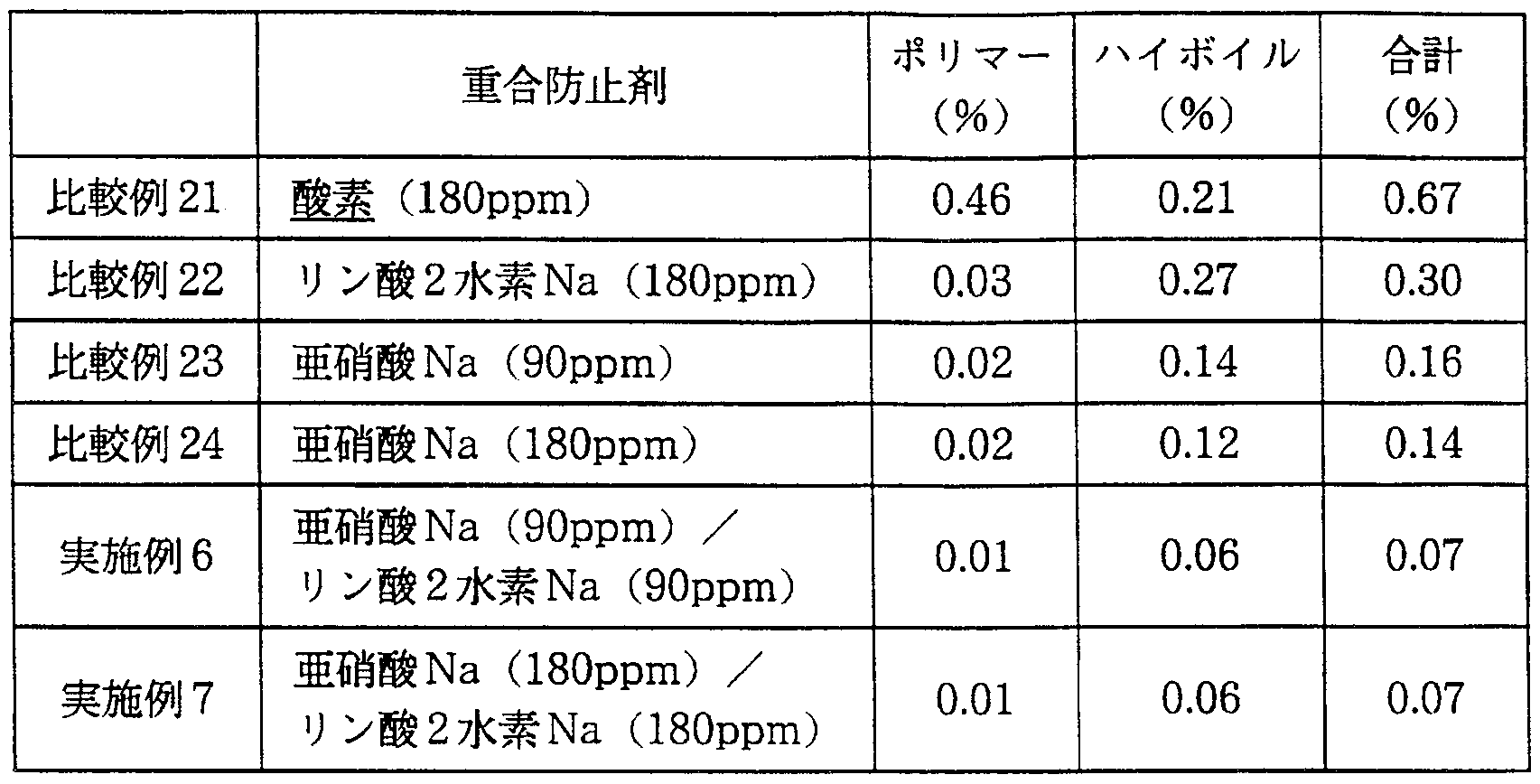
- Example 6 The same operation as in Example 6 was performed, except that the type and the amount of the polymerization inhibitor were changed as shown in Table 3. However, in Comparative Example 21, only oxygen was added without adding the polymerization inhibitor. Also, in Comparative Examples 22 to 24 and Example 7, as in Example 6, 180 ppm of oxygen was added. Table 3 shows the results. Table 3
- Example 8 The same operation as in Example 8 was carried out except that the type and the amount of the polymerization inhibitor were changed as shown in Table 4. However, in Comparative Example 25, polymerization prevention Only oxygen was added without adding a terminator. Also, in Comparative Example 26, as in Example 8, oxygen at 180 ppm was added. Table 4 shows the results. Table 4
- Example 9 The same operation as in Example 9 was performed, except that the type and the amount of the polymerization inhibitor were changed as shown in Table 5. However, in Comparative Example 27, only oxygen was added without adding the polymerization inhibitor. In Comparative Example 28, Also, as in Example 9, 180 ppm of oxygen was added. Table 5 shows the results. Table 5
- Example 6 The operation was performed in the same manner as in Example 10 except that the type and the amount of the polymerization inhibitor were changed as shown in Table 6. However, in Comparative Example 29, only oxygen was added without adding the polymerization inhibitor. Comparative examples 30 to 32 Also, in Example 11, as in Example 10, oxygen at 180 ppm was added. Table 6 shows the results. Table 6
- Example 12 The same operation as in Example 12 was performed, except that the type and the amount of the polymerization inhibitor were changed as shown in Table 7. However, in Comparative Example 33, only oxygen was added without adding the polymerization inhibitor. Also, in Comparative Examples 34 to 35, 180 ppm of oxygen was added as in Example 12. Table 7 shows the results.
- Example 13 was carried out in the same manner as in Example 13 except that sodium dihydrogen phosphate was replaced with Berex RP (sesquipolyoxyethylene-2-ethylhexyl phosphate) manufactured by Kao Corporation. The results are shown in Table 8 c [Example 15]
- Example 13 was carried out in the same manner as in Example 13 except that tris (nonylphenyl) phosphite was used instead of sodium dihydrogen phosphate. Table 8 shows the results.
- Example 13 was carried out in the same manner as in Example 13 except that only oxygen was added without using a polymerization inhibitor. Table 8 shows the results.
- Example 13 was carried out in the same manner as in Example 13 except that sodium nitrite 180 ppm was added as a polymerization inhibitor. Table 8 shows the results. Table 8
- Example 15 0.01 0.07 0.08 Tris (zonyl phenyl) phosphine (180 ppm)
- the compound (a) and the phosphorus-containing compound (b) were used in combination as the polymerization inhibitor (Examples 13 to 15), and Comparative Examples 36 to 37 were used. It can be seen that the polymerization of isoprene was remarkably suppressed as compared with the results of the above.
- Example 47 Comparative Example 47-None None-0.09 0.08 0.17 Comparative Example 48 180-None 0.57 0.08 0.65 Comparative Example 49 180 180 None 0.14 0.07 0.21
- Example 22 180 180 Hexamethylphosphorus triamit '180 0.00 0.02 0.02
- Example 23 180 180 Triethylphosphine 180 0.01 0.04 0.05
- Example 24 180 180 Trifinylphosphine 180 0.06 0.05 0.11
- Example 25 180 180 Trimethyl phosphonate 180 0.06 0.06 0.12
- the styrene purified above was taken out and charged into an ampoule. At this time, 50 ppm of N, N-getylhydroxylamine (DEHA) and 50 ppm of dihydrogen phosphate Na were added. The atmosphere was an air atmosphere. After reacting at 120 ° C. for 1 hour, it was dried and the amount of high boil was measured. Table 11 shows the results.
- HTPO 4-hydroxy-1,2,2,6,6-tetramethylpiperidine-1-oxyl (Hakuto, PS 7300 P)
- BOTS Bis (1—oxyl 2,2,6,6-tetramethylbiperidine—4-yl) sebacate (Shibageigy, CiB A54 15)
- a monomer or a monomer mixture such as a conjugated diene, an aromatic vinyl, an ethylenically unsaturated nitrile, or an ⁇ -olefin, a hydrocarbon mixture containing the monomer, or the like.
- Polymerization inhibitors to prevent undesired premature polymerization at various stages of work such as purification, storage, transportation, blending and use, and polymerization prevention methods, and polymerization prevention containing monomers and polymerization inhibitors
- a composition is provided.
- the polymerization inhibitor of the present invention is a method for producing a purified conjugated gen which separates a conjugated gen by performing a distillation operation including extractive distillation from a hydrocarbon mixture containing a conjugated gen. It is particularly effective in suppressing generation.
Landscapes
- Chemical & Material Sciences (AREA)
- Organic Chemistry (AREA)
- Engineering & Computer Science (AREA)
- Materials Engineering (AREA)
- Analytical Chemistry (AREA)
- Oil, Petroleum & Natural Gas (AREA)
- Water Supply & Treatment (AREA)
- Polymerisation Methods In General (AREA)
- Organic Low-Molecular-Weight Compounds And Preparation Thereof (AREA)
Description




Claims


Priority Applications (4)
| Application Number | Priority Date | Filing Date | Title |
|---|---|---|---|
| KR1020007009728A KR20010034553A (ko) | 1998-03-03 | 1999-03-03 | 중합 방지성 조성물, 중합 방지제 및 중합 방지 방법 |
| JP2000534521A JP4238962B2 (ja) | 1998-03-03 | 1999-03-03 | 重合防止性組成物、重合防止剤、及び重合防止方法 |
| US09/623,377 US6770222B1 (en) | 1998-03-03 | 1999-03-03 | Polymerization-inhibiting composition, polymerization inhibitor and method for inhibiting polymerization |
| EP99907850A EP1061059A4 (en) | 1998-03-03 | 1999-03-03 | POLYMERIZATION INHIBITING COMPOSITION, POLYMERIZATION INHIBITOR AND METHOD FOR INHIBITING POLYMERIZATION |
Applications Claiming Priority (4)
| Application Number | Priority Date | Filing Date | Title |
|---|---|---|---|
| JP6787298 | 1998-03-03 | ||
| JP10/67872 | 1998-03-03 | ||
| JP10/292987 | 1998-09-30 | ||
| JP29298798 | 1998-09-30 |
Publications (1)
| Publication Number | Publication Date |
|---|---|
| WO1999044972A1 true WO1999044972A1 (en) | 1999-09-10 |
Family
ID=26409077
Family Applications (1)
| Application Number | Title | Priority Date | Filing Date |
|---|---|---|---|
| PCT/JP1999/001017 Ceased WO1999044972A1 (en) | 1998-03-03 | 1999-03-03 | Polymerization-inhibiting composition, polymerization inhibitor and method for inhibiting polymerization |
Country Status (7)
| Country | Link |
|---|---|
| US (1) | US6770222B1 (ja) |
| EP (1) | EP1061059A4 (ja) |
| JP (1) | JP4238962B2 (ja) |
| KR (1) | KR20010034553A (ja) |
| CN (1) | CN1210237C (ja) |
| ID (1) | ID26028A (ja) |
| WO (1) | WO1999044972A1 (ja) |
Cited By (10)
| Publication number | Priority date | Publication date | Assignee | Title |
|---|---|---|---|---|
| WO2000061701A1 (fr) * | 1999-04-08 | 2000-10-19 | Nippon Zeon Co., Ltd. | Agent antigelifiant pour melange d'hydrocarbures contenant un diene conjugue et procede de prevention d'encrassement d'appareil pour separer et purifier ledit melange |
| WO2001014428A1 (de) * | 1999-08-19 | 2001-03-01 | Basf Aktiengesellschaft | Polymerisationsverfahren |
| JP2004526796A (ja) * | 2001-04-30 | 2004-09-02 | ベイカー ヒューズ インコーポレイテッド | ポプコーンポリマーの成長阻止 |
| WO2006078123A1 (en) * | 2005-01-18 | 2006-07-27 | Yeochun Ncc Co., Ltd. | Polymerization inhibitor for 1,3-butadiene and a method of inhibiting polymerization of 1,3-butadiene by imputing thereof |
| JP2008189569A (ja) * | 2007-02-02 | 2008-08-21 | Hakuto Co Ltd | 共役ジエン化合物の重合抑制剤組成物および重合抑制方法 |
| JP2010090060A (ja) * | 2008-10-08 | 2010-04-22 | Kohjin Co Ltd | アルケニルオキサゾリン |
| JP2010515073A (ja) * | 2007-01-09 | 2010-05-06 | トータル・ペトロケミカルズ・リサーチ・フエリユイ | 望ましくない内部歪を有するポリマーの形成を音響分析によってモニターする方法 |
| WO2013084443A1 (ja) * | 2011-12-09 | 2013-06-13 | 伯東株式会社 | 安定化された4-オキソ-2,2,6,6-テトラメチルピペリジン-1-オキシル含有組成物、ビニル化合物の重合禁止剤組成物、及びこれを用いたビニル化合物の重合禁止方法 |
| JP2014037376A (ja) * | 2012-08-16 | 2014-02-27 | Katayama Chem Works Co Ltd | ビニル芳香族モノマーの重合を抑制するための組成物 |
| JP2015229645A (ja) * | 2014-06-04 | 2015-12-21 | 伯東株式会社 | 重合禁止効果の長期安定性が改善されたピペリジン−1−オキシル類含有重合禁止剤組成物及びそれを用いた重合禁止方法 |
Families Citing this family (11)
| Publication number | Priority date | Publication date | Assignee | Title |
|---|---|---|---|---|
| EP1236742A1 (en) | 2001-02-28 | 2002-09-04 | Bayer Ag | Controlled free-radical polymerization products using new control agents |
| US7790001B2 (en) * | 2006-04-17 | 2010-09-07 | Sd Lizenzverwertungsgesellschaft Mbh & Co. Kg | Method of corrosion prevention |
| CN106574005B (zh) | 2014-08-14 | 2020-07-21 | 罗门哈斯公司 | 具有可释放气体的聚合物 |
| WO2016025549A1 (en) * | 2014-08-14 | 2016-02-18 | Rohm And Haas Company | Polymerization process |
| US9884951B2 (en) | 2014-10-14 | 2018-02-06 | Ecolab Usa Inc. | Reducing polymer fouling and agglomeration in acrylate/methacrylate processes |
| US9914701B2 (en) | 2015-03-18 | 2018-03-13 | Ecolab Usa Inc. | Use of stable lipophilic hydroxylamine compounds for inhibiting polymerization of vinyl monomers |
| US9957209B2 (en) | 2015-03-31 | 2018-05-01 | Ecolab Usa Inc. | Use of quinone methides as antipolymerants for vinylic monomers |
| TWI624480B (zh) | 2015-04-20 | 2018-05-21 | 藝康美國公司 | 供不飽和單體用作防污劑之受阻對苯二酚 |
| WO2017081611A1 (en) | 2015-11-12 | 2017-05-18 | Sabic Global Technologies B.V. | Methods for using nitric oxide to inhibit popcorn polymerization during butadiene processing |
| TWI880966B (zh) * | 2019-10-11 | 2025-04-21 | 美商藝康美國公司 | 醌甲基化物及銨鹽抗聚合劑組合物及方法 |
| EP4067400A4 (en) * | 2019-11-29 | 2023-05-03 | Mitsubishi Chemical Corporation | UV-CURRABLE INK FOR WATER-BASED INK-JET PRINTING, UV-CURRABLE COMPOSITION FOR WATER-BASED INK-JET PRINTING AND PRINTED PRODUCTS |
Citations (2)
| Publication number | Priority date | Publication date | Assignee | Title |
|---|---|---|---|---|
| JPH05202256A (ja) * | 1992-01-28 | 1993-08-10 | Japan Synthetic Rubber Co Ltd | 安定化方法および共重合体の製造方法 |
| JPH09316026A (ja) * | 1996-05-27 | 1997-12-09 | Mitsubishi Chem Corp | (メタ)アクリル酸及びそのエステルの重合防止方法 |
Family Cites Families (14)
| Publication number | Priority date | Publication date | Assignee | Title |
|---|---|---|---|---|
| US3371124A (en) | 1965-04-26 | 1968-02-27 | Pennsalt Chemicals Corp | Inhibiting popcorn polymer formation |
| US3818079A (en) * | 1970-07-07 | 1974-06-18 | Japanese Geon Co Ltd | Method of preventing the polymerization of unsaturated carboxylic acid |
| JPS50112304A (ja) | 1974-02-26 | 1975-09-03 | ||
| SU1310384A1 (ru) * | 1976-02-20 | 1987-05-15 | Институт Химической Физики Ан Ссср | Способ получени метакриловой кислоты |
| DE3569514D1 (en) | 1984-03-22 | 1989-05-24 | Ciba Geigy Ag | Process for the preparation of nitroxyls of sterically hindered amines |
| US5155148A (en) * | 1989-09-25 | 1992-10-13 | The Goodyear Tire & Rubber Company | Ester derivatives from p-hydroxydiphenylamine |
| JPH0426639A (ja) | 1990-05-18 | 1992-01-29 | Daicel Chem Ind Ltd | 2―シクロヘキセン―1―オールの光学分割方法 |
| DE69108626T2 (de) | 1990-07-20 | 1995-08-24 | Ciba Geigy Ag | Stabilisierte Monomerenzusammensetzungen. |
| KR100193146B1 (ko) | 1990-07-20 | 1999-06-15 | 월터 클리웨인, 한스-피터 위트린 | 안정화된 단량체 조성물 |
| DE69112735T2 (de) | 1990-07-20 | 1996-02-22 | Ciba Geigy Ag | Stabilisierte Monomerenzusammensetzungen. |
| EP0467851A1 (en) | 1990-07-20 | 1992-01-22 | Ciba-Geigy Ag | Stabilized monomer compositions |
| JP2941044B2 (ja) | 1990-11-22 | 1999-08-25 | ダイセル化学工業株式会社 | 新規な(ナタ)アクリレート化合物およびその製造方法 |
| TW294658B (ja) * | 1994-06-02 | 1997-01-01 | Nippon Catalytic Chem Ind | |
| CZ290225B6 (cs) * | 1996-05-27 | 2002-06-12 | Mitsubishi Chemical Corporation | Způsob inhibice polymerace kyseliny (meth)akrylové a jejich esterů |
-
1999
- 1999-03-03 CN CNB998035602A patent/CN1210237C/zh not_active Expired - Fee Related
- 1999-03-03 ID IDW20001995A patent/ID26028A/id unknown
- 1999-03-03 EP EP99907850A patent/EP1061059A4/en not_active Withdrawn
- 1999-03-03 JP JP2000534521A patent/JP4238962B2/ja not_active Expired - Fee Related
- 1999-03-03 KR KR1020007009728A patent/KR20010034553A/ko not_active Ceased
- 1999-03-03 US US09/623,377 patent/US6770222B1/en not_active Expired - Fee Related
- 1999-03-03 WO PCT/JP1999/001017 patent/WO1999044972A1/ja not_active Ceased
Patent Citations (2)
| Publication number | Priority date | Publication date | Assignee | Title |
|---|---|---|---|---|
| JPH05202256A (ja) * | 1992-01-28 | 1993-08-10 | Japan Synthetic Rubber Co Ltd | 安定化方法および共重合体の製造方法 |
| JPH09316026A (ja) * | 1996-05-27 | 1997-12-09 | Mitsubishi Chem Corp | (メタ)アクリル酸及びそのエステルの重合防止方法 |
Non-Patent Citations (1)
| Title |
|---|
| See also references of EP1061059A4 * |
Cited By (11)
| Publication number | Priority date | Publication date | Assignee | Title |
|---|---|---|---|---|
| WO2000061701A1 (fr) * | 1999-04-08 | 2000-10-19 | Nippon Zeon Co., Ltd. | Agent antigelifiant pour melange d'hydrocarbures contenant un diene conjugue et procede de prevention d'encrassement d'appareil pour separer et purifier ledit melange |
| US6841061B1 (en) | 1999-04-08 | 2005-01-11 | Zeon Corporation | Antigelling agent for hydrocarbon mixture containing conjugated diene and method of preventing clogging of apparatus for separating and purifying the mixture |
| WO2001014428A1 (de) * | 1999-08-19 | 2001-03-01 | Basf Aktiengesellschaft | Polymerisationsverfahren |
| JP2004526796A (ja) * | 2001-04-30 | 2004-09-02 | ベイカー ヒューズ インコーポレイテッド | ポプコーンポリマーの成長阻止 |
| WO2006078123A1 (en) * | 2005-01-18 | 2006-07-27 | Yeochun Ncc Co., Ltd. | Polymerization inhibitor for 1,3-butadiene and a method of inhibiting polymerization of 1,3-butadiene by imputing thereof |
| JP2010515073A (ja) * | 2007-01-09 | 2010-05-06 | トータル・ペトロケミカルズ・リサーチ・フエリユイ | 望ましくない内部歪を有するポリマーの形成を音響分析によってモニターする方法 |
| JP2008189569A (ja) * | 2007-02-02 | 2008-08-21 | Hakuto Co Ltd | 共役ジエン化合物の重合抑制剤組成物および重合抑制方法 |
| JP2010090060A (ja) * | 2008-10-08 | 2010-04-22 | Kohjin Co Ltd | アルケニルオキサゾリン |
| WO2013084443A1 (ja) * | 2011-12-09 | 2013-06-13 | 伯東株式会社 | 安定化された4-オキソ-2,2,6,6-テトラメチルピペリジン-1-オキシル含有組成物、ビニル化合物の重合禁止剤組成物、及びこれを用いたビニル化合物の重合禁止方法 |
| JP2014037376A (ja) * | 2012-08-16 | 2014-02-27 | Katayama Chem Works Co Ltd | ビニル芳香族モノマーの重合を抑制するための組成物 |
| JP2015229645A (ja) * | 2014-06-04 | 2015-12-21 | 伯東株式会社 | 重合禁止効果の長期安定性が改善されたピペリジン−1−オキシル類含有重合禁止剤組成物及びそれを用いた重合禁止方法 |
Also Published As
| Publication number | Publication date |
|---|---|
| CN1291967A (zh) | 2001-04-18 |
| ID26028A (id) | 2000-11-16 |
| KR20010034553A (ko) | 2001-04-25 |
| CN1210237C (zh) | 2005-07-13 |
| US6770222B1 (en) | 2004-08-03 |
| EP1061059A1 (en) | 2000-12-20 |
| JP4238962B2 (ja) | 2009-03-18 |
| EP1061059A4 (en) | 2004-12-22 |
Similar Documents
| Publication | Publication Date | Title |
|---|---|---|
| JP4238962B2 (ja) | 重合防止性組成物、重合防止剤、及び重合防止方法 | |
| JPWO1999044972A1 (ja) | 重合防止性組成物、重合防止剤、及び重合防止方法 | |
| JP4627884B2 (ja) | オレフィンを含む安定化された組成物 | |
| US20120056128A1 (en) | Stabilised Composititions Comprising Olefins | |
| KR20170133359A (ko) | 지방족 카르복실산의 tert-부틸 에스테르의 제조 | |
| KR100542782B1 (ko) | 정제 공액디엔의 제조방법 | |
| JP2004527632A (ja) | ビニルモノマーの重合を抑制する方法及び組成物 | |
| JP4824038B2 (ja) | 1,3−ブタジエンの重合防止剤及びこれを投入する1,3−ブタジエンの重合防止方法 | |
| CN114752412A (zh) | 在工艺水中抑制聚合的方法 | |
| CN103958647B (zh) | 提供气态经纯化的c4粗馏分作为进料流用于使用选择性溶剂的萃取蒸馏工艺的方法 | |
| JP4238948B2 (ja) | 共役ジエンを含有する炭化水素混合物の分離精製装置の詰まりを防止する方法。 | |
| US4002554A (en) | Process of minimizing or preventing fouling | |
| JP2022031354A (ja) | モノマーの重合を制御及び抑制する組成物並びにその使用及び調製の方法 | |
| WO2003031377A1 (en) | Method of separating/purifying conjugated diene and separation/purification apparatus | |
| JP7036039B2 (ja) | 重合体の製造方法および製造装置 | |
| KR100646123B1 (ko) | 비닐 단량체의 파울링 억제 방법 | |
| JP2006199736A (ja) | オレフィン類の重合抑制方法 | |
| JP3956592B2 (ja) | 共役ジエン類の分離精製方法および分離精製装置 | |
| JPS5924138B2 (ja) | 汚れ防止剤 | |
| NO172348B (no) | Fremgangsmaate hvor en organisk raastoffstroem inneholdende en eller flere umettede, olefiniske hydrokarboner separeres | |
| WO1999047478A1 (en) | Process for producing purified 1,2-butadiene |
Legal Events
| Date | Code | Title | Description |
|---|---|---|---|
| WWE | Wipo information: entry into national phase |
Ref document number: 99803560.2 Country of ref document: CN |
|
| AK | Designated states |
Kind code of ref document: A1 Designated state(s): CN ID JP KR US |
|
| AL | Designated countries for regional patents |
Kind code of ref document: A1 Designated state(s): AT BE CH CY DE DK ES FI FR GB GR IE IT LU MC NL PT SE |
|
| DFPE | Request for preliminary examination filed prior to expiration of 19th month from priority date (pct application filed before 20040101) | ||
| 121 | Ep: the epo has been informed by wipo that ep was designated in this application | ||
| WWE | Wipo information: entry into national phase |
Ref document number: 09623377 Country of ref document: US |
|
| WWE | Wipo information: entry into national phase |
Ref document number: 1020007009728 Country of ref document: KR |
|
| WWE | Wipo information: entry into national phase |
Ref document number: 1999907850 Country of ref document: EP |
|
| WWP | Wipo information: published in national office |
Ref document number: 1999907850 Country of ref document: EP |
|
| WWP | Wipo information: published in national office |
Ref document number: 1020007009728 Country of ref document: KR |
|
| WWR | Wipo information: refused in national office |
Ref document number: 1020007009728 Country of ref document: KR |