WO1999060077A1 - Hydrocarbon liquid formulation - Google Patents
Hydrocarbon liquid formulation Download PDFInfo
- Publication number
- WO1999060077A1 WO1999060077A1 PCT/GB1999/001523 GB9901523W WO9960077A1 WO 1999060077 A1 WO1999060077 A1 WO 1999060077A1 GB 9901523 W GB9901523 W GB 9901523W WO 9960077 A1 WO9960077 A1 WO 9960077A1
- Authority
- WO
- WIPO (PCT)
- Prior art keywords
- liquid
- stabiliser
- aliphatic hydrocarbon
- agent
- hydrocarbon
- Prior art date
- Legal status (The legal status is an assumption and is not a legal conclusion. Google has not performed a legal analysis and makes no representation as to the accuracy of the status listed.)
- Ceased
Links
- 0 C*C=C[C@](C)N(C)C Chemical compound C*C=C[C@](C)N(C)C 0.000 description 3
Classifications
-
- C—CHEMISTRY; METALLURGY
- C10—PETROLEUM, GAS OR COKE INDUSTRIES; TECHNICAL GASES CONTAINING CARBON MONOXIDE; FUELS; LUBRICANTS; PEAT
- C10L—FUELS NOT OTHERWISE PROVIDED FOR; NATURAL GAS; SYNTHETIC NATURAL GAS OBTAINED BY PROCESSES NOT COVERED BY SUBCLASSES C10G OR C10K; LIQUIFIED PETROLEUM GAS; USE OF ADDITIVES TO FUELS OR FIRES; FIRE-LIGHTERS
- C10L1/00—Liquid carbonaceous fuels
- C10L1/10—Liquid carbonaceous fuels containing additives
- C10L1/14—Organic compounds
-
- C—CHEMISTRY; METALLURGY
- C10—PETROLEUM, GAS OR COKE INDUSTRIES; TECHNICAL GASES CONTAINING CARBON MONOXIDE; FUELS; LUBRICANTS; PEAT
- C10L—FUELS NOT OTHERWISE PROVIDED FOR; NATURAL GAS; SYNTHETIC NATURAL GAS OBTAINED BY PROCESSES NOT COVERED BY SUBCLASSES C10G OR C10K; LIQUIFIED PETROLEUM GAS; USE OF ADDITIVES TO FUELS OR FIRES; FIRE-LIGHTERS
- C10L1/00—Liquid carbonaceous fuels
- C10L1/10—Liquid carbonaceous fuels containing additives
- C10L1/14—Organic compounds
- C10L1/18—Organic compounds containing oxygen
- C10L1/182—Organic compounds containing oxygen containing hydroxy groups; Salts thereof
- C10L1/1822—Organic compounds containing oxygen containing hydroxy groups; Salts thereof hydroxy group directly attached to (cyclo)aliphatic carbon atoms
- C10L1/1824—Organic compounds containing oxygen containing hydroxy groups; Salts thereof hydroxy group directly attached to (cyclo)aliphatic carbon atoms mono-hydroxy
-
- C—CHEMISTRY; METALLURGY
- C10—PETROLEUM, GAS OR COKE INDUSTRIES; TECHNICAL GASES CONTAINING CARBON MONOXIDE; FUELS; LUBRICANTS; PEAT
- C10L—FUELS NOT OTHERWISE PROVIDED FOR; NATURAL GAS; SYNTHETIC NATURAL GAS OBTAINED BY PROCESSES NOT COVERED BY SUBCLASSES C10G OR C10K; LIQUIFIED PETROLEUM GAS; USE OF ADDITIVES TO FUELS OR FIRES; FIRE-LIGHTERS
- C10L1/00—Liquid carbonaceous fuels
- C10L1/10—Liquid carbonaceous fuels containing additives
- C10L1/14—Organic compounds
- C10L1/18—Organic compounds containing oxygen
- C10L1/185—Ethers; Acetals; Ketals; Aldehydes; Ketones
- C10L1/1852—Ethers; Acetals; Ketals; Orthoesters
-
- C—CHEMISTRY; METALLURGY
- C10—PETROLEUM, GAS OR COKE INDUSTRIES; TECHNICAL GASES CONTAINING CARBON MONOXIDE; FUELS; LUBRICANTS; PEAT
- C10L—FUELS NOT OTHERWISE PROVIDED FOR; NATURAL GAS; SYNTHETIC NATURAL GAS OBTAINED BY PROCESSES NOT COVERED BY SUBCLASSES C10G OR C10K; LIQUIFIED PETROLEUM GAS; USE OF ADDITIVES TO FUELS OR FIRES; FIRE-LIGHTERS
- C10L1/00—Liquid carbonaceous fuels
- C10L1/10—Liquid carbonaceous fuels containing additives
- C10L1/14—Organic compounds
- C10L1/18—Organic compounds containing oxygen
- C10L1/185—Ethers; Acetals; Ketals; Aldehydes; Ketones
- C10L1/1857—Aldehydes; Ketones
-
- C—CHEMISTRY; METALLURGY
- C10—PETROLEUM, GAS OR COKE INDUSTRIES; TECHNICAL GASES CONTAINING CARBON MONOXIDE; FUELS; LUBRICANTS; PEAT
- C10L—FUELS NOT OTHERWISE PROVIDED FOR; NATURAL GAS; SYNTHETIC NATURAL GAS OBTAINED BY PROCESSES NOT COVERED BY SUBCLASSES C10G OR C10K; LIQUIFIED PETROLEUM GAS; USE OF ADDITIVES TO FUELS OR FIRES; FIRE-LIGHTERS
- C10L1/00—Liquid carbonaceous fuels
- C10L1/10—Liquid carbonaceous fuels containing additives
- C10L1/14—Organic compounds
- C10L1/18—Organic compounds containing oxygen
- C10L1/19—Esters ester radical containing compounds; ester ethers; carbonic acid esters
-
- C—CHEMISTRY; METALLURGY
- C10—PETROLEUM, GAS OR COKE INDUSTRIES; TECHNICAL GASES CONTAINING CARBON MONOXIDE; FUELS; LUBRICANTS; PEAT
- C10L—FUELS NOT OTHERWISE PROVIDED FOR; NATURAL GAS; SYNTHETIC NATURAL GAS OBTAINED BY PROCESSES NOT COVERED BY SUBCLASSES C10G OR C10K; LIQUIFIED PETROLEUM GAS; USE OF ADDITIVES TO FUELS OR FIRES; FIRE-LIGHTERS
- C10L1/00—Liquid carbonaceous fuels
- C10L1/10—Liquid carbonaceous fuels containing additives
- C10L1/14—Organic compounds
- C10L1/18—Organic compounds containing oxygen
- C10L1/19—Esters ester radical containing compounds; ester ethers; carbonic acid esters
- C10L1/191—Esters ester radical containing compounds; ester ethers; carbonic acid esters of di- or polyhydroxyalcohols
-
- C—CHEMISTRY; METALLURGY
- C10—PETROLEUM, GAS OR COKE INDUSTRIES; TECHNICAL GASES CONTAINING CARBON MONOXIDE; FUELS; LUBRICANTS; PEAT
- C10L—FUELS NOT OTHERWISE PROVIDED FOR; NATURAL GAS; SYNTHETIC NATURAL GAS OBTAINED BY PROCESSES NOT COVERED BY SUBCLASSES C10G OR C10K; LIQUIFIED PETROLEUM GAS; USE OF ADDITIVES TO FUELS OR FIRES; FIRE-LIGHTERS
- C10L1/00—Liquid carbonaceous fuels
- C10L1/10—Liquid carbonaceous fuels containing additives
- C10L1/14—Organic compounds
- C10L1/22—Organic compounds containing nitrogen
- C10L1/222—Organic compounds containing nitrogen containing at least one carbon-to-nitrogen single bond
- C10L1/224—Amides; Imides carboxylic acid amides, imides
Definitions
- This invention relates to a denaturant formulation suitable for discouraging the ingestion of hydrocarbon liquids particularly paraffinic liquids such as lamp oil, white spirit, kerosene and other hydrocarbon solvents.
- Liquid hydrocarbons are widely used for various technical purposes and are often available for household purposes, where unguarded use or storage may present risks to children and domestic animals who may confuse them with potable liquids. This is especially so in third world countries where near starving children will consume virtually any liquid in their desperation to quench a thirst.
- the inadvertent consumption of such liquids by vulnerable individuals is also a high risk because they are available as essentially colourless transparent liquids which are visually indistinguishable from water.
- the physiological damage arising from deliberate or inadvertent consumption of these liquids is serious and may be fatal.
- Aversive agents are known which impart a highly bitter taste to substances when mixed therewith. These cause such a bitter taste if an attempt is made to swallow the substance that the substance is rejected immediately, which usually avoids absorption or ingestion of amounts having any lasting harmful effect.
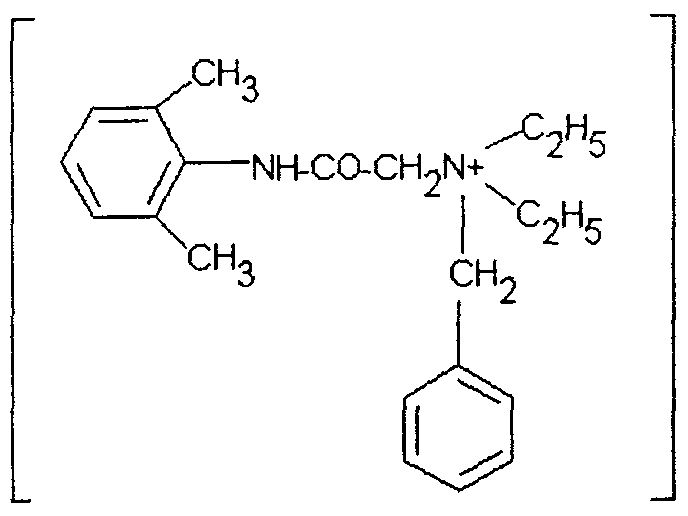
- Denatonium benzoate otherwise known as lignocaine benzyl benzoate is cited in the Guinness Book of Records as the most bitter substance known to man, and its preparation and properties are described in GB-A-955 309. It is available commercially under the Registered Trade Mark “BITREX” .
- Other denatonium salts are known in the literature.
- Denatonium saccharide is a bittering agent analogous to denatonium benzoate and is described in US-A-4 652 577.
- Liquid hydrocarbons of the type of concern here are predominantly organic liquids of an aliphatic character (alkanes) and mainly recognisable as of the liquid paraffin type but the invention is not restricted to a particular petroleum distillate fraction commonly called paraffin oil.
- the problem may be explained more generally by an understanding that aliphatic liquids are useful because of their relative chemical inertness. This, for example, makes white spirit useful as a diluent in enamel paints or as a cleaning liquid for removal of certain paints from surfaces without chemically attacking the surface.
- This predictable non-reactive character and stability whilst providing desirable properties for marketing products based on such liquids, also presents a problem when seeking to include a denaturant or aversive agent therein.
- denatonium benzoate is extremely insoluble in apolar liquids. Therefore even though that denaturant would exhibit an acceptable level of aversive activity at concentrations as low as 10 ppm it has not proved possible to introduce it directly to liquid hydrocarbons and maintain a satisfactory level of concentration therein for a sufficient period of time even to satisfy a typical shelf life before eventual use. As cited in GB-B-2 212 814, the denaturant does not form a stable solution in kerosine or the like liquids and tends to migrate rapidly to the container walls.
- this objective is achievable by utilising a stabiliser in the form of a co- solvent which is at least miscible with the target hydrocarbon but insoluble in water and has sufficient affinity with the selected aversion agent (preferably denatonium benzoate) to permit introduction of effective amounts thereof to the target hydrocarbon with satisfactory stability of the final formulation.
- a stabiliser in the form of a co- solvent which is at least miscible with the target hydrocarbon but insoluble in water and has sufficient affinity with the selected aversion agent (preferably denatonium benzoate) to permit introduction of effective amounts thereof to the target hydrocarbon with satisfactory stability of the final formulation.
- Suitable co-solvents for the purposes of the invention include certain aliphatic or alicyclic alkanols, including diols and diol mono-ethers, esters, and mixtures thereof.
- a preliminary screening test to confirm or determine suitability of a co-solvent from amongst these classes of solvents would include determining if the solvent under consideration is miscible with the hydrocarbon to be denatured and if it is also capable of dissolving the desired denaturant at a satisfactory level, say 0.1%. Preliminary work suggests that substituted alkanols would be acceptable.
- a method for rendering a liquid hydrocarbon unpalatable with an aversive agent having poor solubility in said liquid hydrocarbon comprising selecting a stabiliser in the form of a co-solvent from amongst aliphatic or alicyclic alkanols and diols, optionally substituted, with ester, ether, ketonic, alicyclic and/or aromatic groups, singularly or as mixtures, said co-solvent being miscible with the liquid hydrocarbon to be denatured and being a solvent in which the aversive agent is soluble, dissolving the aversive agent in the co-solvent and introducing an effective amount of the solution into the liquid hydrocarbon.
- Preferred stabilisers include diols and diol mono-ethers, esters, and mixtures thereof particularly branched chain lower secondary alkanol esters of lower fatty acids, especially those formed using a secondary diol.
- An especially suitable co-solvent is 2 , 2 , 4-trimethylpentan-l , 3-diol-monoisobutanoate (CAS-Nr.: 25265-77-4, C ⁇ 2 H 24 0 3 ) which proved to be uniquely suitable for the purpose of the invention.
- Alkanols which have not been derivatised have also been observed to be useful for the purposes of the invention with varying degrees of stability.
- aliphatic or alicyclic alkanols i.e. C 2 -C 20 and above such as 1-butanol and isopropanol
- a base oil to be denatured is selected, a preferred denaturant such as the aversive agent denatonium benzoate is provided, a stabilising co-solvent therefor is selected from amongst alkanols and aliphatic esters of the aforesaid type, the denaturant is introduced to the co-solvent and dissolved therein e.g. by stirring or similar agitation, to provide a doping medium and thereafter an amount of said doping medium sufficient to have an aversive organoleptic effect is added to the base oil to denature same.
- a preferred denaturant such as the aversive agent denatonium benzoate
- a stabilising co-solvent therefor is selected from amongst alkanols and aliphatic esters of the aforesaid type
- Table I The successful co-solvent in Table I is commercially available under the trade mark TEXANOL® from Eastman Chemical Company (USA) .
Landscapes
- Chemical & Material Sciences (AREA)
- Oil, Petroleum & Natural Gas (AREA)
- Engineering & Computer Science (AREA)
- Chemical Kinetics & Catalysis (AREA)
- General Chemical & Material Sciences (AREA)
- Organic Chemistry (AREA)
- Organic Low-Molecular-Weight Compounds And Preparation Thereof (AREA)
- Fats And Perfumes (AREA)
- Detergent Compositions (AREA)
Abstract
Description


Claims




Priority Applications (5)
| Application Number | Priority Date | Filing Date | Title |
|---|---|---|---|
| EP99922304A EP1080165B1 (en) | 1998-05-15 | 1999-05-13 | Hydrocarbon liquid formulation |
| AU39411/99A AU745819B2 (en) | 1998-05-15 | 1999-05-13 | Hydrocarbon liquid formulation |
| DE1999614323 DE69914323T2 (en) | 1998-05-15 | 1999-05-13 | HYDROCARBON LIQUID FORMULATION |
| JP2000549686A JP2002515536A (en) | 1998-05-15 | 1999-05-13 | Hydrocarbon liquid formulation |
| GB0030498A GB2354255B (en) | 1998-05-15 | 1999-05-13 | Hydrocarbon liquid formulation |
Applications Claiming Priority (2)
| Application Number | Priority Date | Filing Date | Title |
|---|---|---|---|
| GBGB9810408.6A GB9810408D0 (en) | 1998-05-15 | 1998-05-15 | Hydrocarbon liquid formulation |
| GB9810408.6 | 1998-05-15 |
Publications (1)
| Publication Number | Publication Date |
|---|---|
| WO1999060077A1 true WO1999060077A1 (en) | 1999-11-25 |
Family
ID=10832084
Family Applications (1)
| Application Number | Title | Priority Date | Filing Date |
|---|---|---|---|
| PCT/GB1999/001523 Ceased WO1999060077A1 (en) | 1998-05-15 | 1999-05-13 | Hydrocarbon liquid formulation |
Country Status (9)
| Country | Link |
|---|---|
| EP (1) | EP1080165B1 (en) |
| JP (1) | JP2002515536A (en) |
| AR (1) | AR015299A1 (en) |
| AU (1) | AU745819B2 (en) |
| DE (1) | DE69914323T2 (en) |
| ES (1) | ES2213368T3 (en) |
| GB (2) | GB9810408D0 (en) |
| WO (1) | WO1999060077A1 (en) |
| ZA (1) | ZA200006574B (en) |
Citations (7)
| Publication number | Priority date | Publication date | Assignee | Title |
|---|---|---|---|---|
| GB866605A (en) * | 1960-02-27 | 1961-04-26 | T & H Smith Ltd | Denaturing of potable alcoholic liquids |
| GB955309A (en) * | 1959-11-20 | 1964-04-15 | Edinburgh Pharmaceutical Ind L | New quaternary salts and compositions containing them |
| US4005038A (en) * | 1974-04-15 | 1977-01-25 | Peerless Paint And Varnish Corporation | Paint composition containing denatonium benzoate or lignocaine benzyl octanoate with a latex resin binder for application over old paint films to prevent ingestion of poisons therefrom |
| US4084939A (en) * | 1976-12-22 | 1978-04-18 | Colgate-Palmolive Company | Audibly burning gelled alcohol |
| EP0318262A1 (en) * | 1987-11-24 | 1989-05-31 | Glaxo Group Limited | Compositions |
| DE19605162C1 (en) * | 1996-02-13 | 1997-09-18 | Elf Oil Deutschland Gmbh | Synthetic lubricating oil and its use |
| EP0884377A2 (en) * | 1997-06-09 | 1998-12-16 | Shell Internationale Researchmaatschappij B.V. | Liquefied petroleum gas composition |
Family Cites Families (4)
| Publication number | Priority date | Publication date | Assignee | Title |
|---|---|---|---|---|
| JP2668420B2 (en) * | 1988-11-07 | 1997-10-27 | 新高化学工業株式会社 | Solid fuel with accidental eating prevention performance |
| JP3724043B2 (en) * | 1995-03-30 | 2005-12-07 | ぺんてる株式会社 | Drawing material composition |
| AU6799996A (en) * | 1996-05-29 | 1997-12-04 | Sunkyong Industries Co., Ltd. | Gaseous compositions containing a bittering agent |
| GB9624070D0 (en) * | 1996-11-20 | 1997-01-08 | Rolls Royce Plc | Control system for a ducted fan gas turbine engine |
-
1998
- 1998-05-15 GB GBGB9810408.6A patent/GB9810408D0/en not_active Ceased
-
1999
- 1999-05-13 ES ES99922304T patent/ES2213368T3/en not_active Expired - Lifetime
- 1999-05-13 JP JP2000549686A patent/JP2002515536A/en active Pending
- 1999-05-13 WO PCT/GB1999/001523 patent/WO1999060077A1/en not_active Ceased
- 1999-05-13 AR ARP990102260 patent/AR015299A1/en unknown
- 1999-05-13 AU AU39411/99A patent/AU745819B2/en not_active Ceased
- 1999-05-13 EP EP99922304A patent/EP1080165B1/en not_active Expired - Lifetime
- 1999-05-13 DE DE1999614323 patent/DE69914323T2/en not_active Expired - Fee Related
- 1999-05-13 GB GB0030498A patent/GB2354255B/en not_active Expired - Fee Related
-
2000
- 2000-11-13 ZA ZA200006574A patent/ZA200006574B/en unknown
Patent Citations (7)
| Publication number | Priority date | Publication date | Assignee | Title |
|---|---|---|---|---|
| GB955309A (en) * | 1959-11-20 | 1964-04-15 | Edinburgh Pharmaceutical Ind L | New quaternary salts and compositions containing them |
| GB866605A (en) * | 1960-02-27 | 1961-04-26 | T & H Smith Ltd | Denaturing of potable alcoholic liquids |
| US4005038A (en) * | 1974-04-15 | 1977-01-25 | Peerless Paint And Varnish Corporation | Paint composition containing denatonium benzoate or lignocaine benzyl octanoate with a latex resin binder for application over old paint films to prevent ingestion of poisons therefrom |
| US4084939A (en) * | 1976-12-22 | 1978-04-18 | Colgate-Palmolive Company | Audibly burning gelled alcohol |
| EP0318262A1 (en) * | 1987-11-24 | 1989-05-31 | Glaxo Group Limited | Compositions |
| DE19605162C1 (en) * | 1996-02-13 | 1997-09-18 | Elf Oil Deutschland Gmbh | Synthetic lubricating oil and its use |
| EP0884377A2 (en) * | 1997-06-09 | 1998-12-16 | Shell Internationale Researchmaatschappij B.V. | Liquefied petroleum gas composition |
Also Published As
| Publication number | Publication date |
|---|---|
| DE69914323T2 (en) | 2004-11-18 |
| EP1080165B1 (en) | 2004-01-21 |
| GB2354255A8 (en) | 2003-08-07 |
| AU3941199A (en) | 1999-12-06 |
| AR015299A1 (en) | 2001-04-18 |
| GB0030498D0 (en) | 2001-01-31 |
| JP2002515536A (en) | 2002-05-28 |
| ES2213368T3 (en) | 2004-08-16 |
| ZA200006574B (en) | 2001-10-15 |
| GB2354255B (en) | 2002-10-23 |
| GB2354255A (en) | 2001-03-21 |
| GB9810408D0 (en) | 1998-07-15 |
| EP1080165A1 (en) | 2001-03-07 |
| DE69914323D1 (en) | 2004-02-26 |
| AU745819B2 (en) | 2002-04-11 |
Similar Documents
| Publication | Publication Date | Title |
|---|---|---|
| JP5856467B2 (en) | Improved fuel additive formulations and methods of use | |
| US4565548A (en) | Motor fuel composition | |
| Baharuddin et al. | Development, formulation and optimization of a novel biocompatible ionic liquids dispersant for the effective oil spill remediation | |
| US4744796A (en) | Microemulsion fuel system | |
| TW390905B (en) | Platinum metal fuel additive for water-containing fuels | |
| RU2141996C1 (en) | Multiphase emulsion and method of preparation of such emulsion | |
| JPH01236298A (en) | Composition | |
| US7868048B2 (en) | Heavy oil emulsion stabilizers containing saccharide based emulsion stabilizer | |
| US4708720A (en) | Protection of hydrocarbons against the action of microorganisms | |
| KR19980080508A (en) | Natural Surfactants with Amine and Ethoxylated Alcohols | |
| EP1274819B1 (en) | Anti-static additive compositions for hydrocarbon fuels | |
| JP4870905B2 (en) | Diesel fuel emulsion | |
| US6139775A (en) | Compositions and methods for treating hydrocarbon materials | |
| US5945026A (en) | Composition and methods for firefighting hydrocarbon fires | |
| WO2000036055A1 (en) | Fuel composition | |
| US8177960B2 (en) | Asphaltene-stabilising molecules having a tetrapyrrolic ring | |
| EP1080165B1 (en) | Hydrocarbon liquid formulation | |
| US6083288A (en) | Fuel stabilizers | |
| DE69731547T2 (en) | COMPOSITIONS AND METHODS OF DISPERSING AND BIODIVERSITY OF EXPIRED OIL AND FUEL | |
| NO137482B (en) | PREPARATION FOR DISPERGER OF OIL SEALS. | |
| NO315548B1 (en) | Process for treating an aqueous environment contaminated by hydrocarbons, as well as demulsifying and dispersing mixture based on polyglycol esters | |
| US3431209A (en) | Solvent degreasing,self-emulsifying cleaning composition | |
| US2287567A (en) | Composition of matter and process of using the same | |
| JPS62288699A (en) | Drycleaning detergent composition | |
| US1959317A (en) | Distillate petroleum product and method of treating the same |
Legal Events
| Date | Code | Title | Description |
|---|---|---|---|
| AK | Designated states |
Kind code of ref document: A1 Designated state(s): AE AL AM AT AU AZ BA BB BG BR BY CA CH CN CU CZ DE DK EE ES FI GB GD GE GH GM HR HU ID IL IN IS JP KE KG KP KR KZ LC LK LR LS LT LU LV MD MG MK MN MW MX NO NZ PL PT RO RU SD SE SG SI SK SL TJ TM TR TT UA UG US UZ VN YU ZA ZW |
|
| AL | Designated countries for regional patents |
Kind code of ref document: A1 Designated state(s): GH GM KE LS MW SD SL SZ UG ZW AM AZ BY KG KZ MD RU TJ TM AT BE CH CY DE DK ES FI FR GB GR IE IT LU MC NL PT SE BF BJ CF CG CI CM GA GN GW ML MR NE SN TD TG |
|
| 121 | Ep: the epo has been informed by wipo that ep was designated in this application | ||
| DFPE | Request for preliminary examination filed prior to expiration of 19th month from priority date (pct application filed before 20040101) | ||
| WWE | Wipo information: entry into national phase |
Ref document number: 2000/06574 Country of ref document: ZA Ref document number: 200006574 Country of ref document: ZA |
|
| NENP | Non-entry into the national phase |
Ref country code: KR |
|
| WWE | Wipo information: entry into national phase |
Ref document number: IN/PCT/2000/00333/DE Country of ref document: IN |
|
| ENP | Entry into the national phase |
Ref document number: 200030498 Country of ref document: GB Kind code of ref document: A |
|
| WWE | Wipo information: entry into national phase |
Ref document number: 1999922304 Country of ref document: EP |
|
| WWE | Wipo information: entry into national phase |
Ref document number: 39411/99 Country of ref document: AU |
|
| WWP | Wipo information: published in national office |
Ref document number: 1999922304 Country of ref document: EP |
|
| REG | Reference to national code |
Ref country code: DE Ref legal event code: 8642 |
|
| WWE | Wipo information: entry into national phase |
Ref document number: 09700202 Country of ref document: US |
|
| WWG | Wipo information: grant in national office |
Ref document number: 39411/99 Country of ref document: AU |
|
| WWG | Wipo information: grant in national office |
Ref document number: 1999922304 Country of ref document: EP |