WO1999061402A1 - Verfahren zur herstellung von cyclopentanon - Google Patents
Verfahren zur herstellung von cyclopentanon Download PDFInfo
- Publication number
- WO1999061402A1 WO1999061402A1 PCT/EP1999/003194 EP9903194W WO9961402A1 WO 1999061402 A1 WO1999061402 A1 WO 1999061402A1 EP 9903194 W EP9903194 W EP 9903194W WO 9961402 A1 WO9961402 A1 WO 9961402A1
- Authority
- WO
- WIPO (PCT)
- Prior art keywords
- oxide
- adipic acid
- weight
- catalysts
- formula
- Prior art date
- Legal status (The legal status is an assumption and is not a legal conclusion. Google has not performed a legal analysis and makes no representation as to the accuracy of the status listed.)
- Ceased
Links
Classifications
-
- C—CHEMISTRY; METALLURGY
- C07—ORGANIC CHEMISTRY
- C07C—ACYCLIC OR CARBOCYCLIC COMPOUNDS
- C07C49/00—Ketones; Ketenes; Dimeric ketenes; Ketonic chelates
- C07C49/29—Saturated compounds containing keto groups bound to rings
- C07C49/297—Saturated compounds containing keto groups bound to rings to a five-membered ring
-
- B—PERFORMING OPERATIONS; TRANSPORTING
- B01—PHYSICAL OR CHEMICAL PROCESSES OR APPARATUS IN GENERAL
- B01J—CHEMICAL OR PHYSICAL PROCESSES, e.g. CATALYSIS OR COLLOID CHEMISTRY; THEIR RELEVANT APPARATUS
- B01J23/00—Catalysts comprising metals or metal oxides or hydroxides, not provided for in group B01J21/00
- B01J23/10—Catalysts comprising metals or metal oxides or hydroxides, not provided for in group B01J21/00 of rare earths
-
- C—CHEMISTRY; METALLURGY
- C07—ORGANIC CHEMISTRY
- C07C—ACYCLIC OR CARBOCYCLIC COMPOUNDS
- C07C45/00—Preparation of compounds having >C = O groups bound only to carbon or hydrogen atoms; Preparation of chelates of such compounds
- C07C45/45—Preparation of compounds having >C = O groups bound only to carbon or hydrogen atoms; Preparation of chelates of such compounds by condensation
- C07C45/48—Preparation of compounds having >C = O groups bound only to carbon or hydrogen atoms; Preparation of chelates of such compounds by condensation involving decarboxylation
Definitions
- the invention relates to an improved process for the preparation of cyclopentanone by reacting adipic acid esters over oxidized fixed bed catalysts in the gas phase.
- Manganese, copper, iron, nickels and cobalt called.
- the oxides of manganese, cadmium and sodium are particularly preferred.
- Suitable catalyst supports are Al 2 O 3 , Si0 2 and activated carbon.
- the reaction is carried out at 350 to 600 ° C, preferably 400 to 475 ° C. The work is done without adding water and without carrier gas.
- dimethyl 2,5-dimethyladipate is reacted at 435 to 465 ° C. over a Mn0 2 / Al 2 0 3 catalyst.
- CdO / Al 2 ⁇ 3 , Na 2 0 / Al 2 0 3 and Zn0 / Al 2 0 3 are used in the temperature range from 375 to 502 ° C. No information is given on the 2, 5 -dirnethylcyclopentanone yields.
- Solid oxidic catalysts are used as catalysts. These are, for example, oxides of elements from main groups I to V, subgroups I to VIII of the periodic system of elements or oxides of rare earth metals or mixtures of the oxides mentioned.
- alkaline earth oxides such as magnesium oxide, calcium oxide, barium oxide, furthermore boron trioxide, aluminum oxide, silicon dioxide, for example in the form of silica gel, diatomaceous earth, or quartz, furthermore tin dioxide, bismuth oxide, copper oxide, zinc oxide, lanthanum oxide, titanium dioxide, zirconium dioxide, vanadium oxides, chromium oxides, molybdenum oxides , Tungsten oxides, manganese oxides, iron oxides, cerium oxides, neodymium oxides or mixtures of such oxides are suitable.
- the catalysts can also be modified by adding additives such as acids (for example phosphoric acid) or bases (for example sodium hydroxide).
- acids for example phosphoric acid
- bases for example sodium hydroxide.
- Magnesium oxide, boron trioxide, aluminum oxide, silicon dioxide, zinc oxide, titanium dioxide or the like are preferred Mixtures, of which aluminum oxide catalysts are particularly suitable.
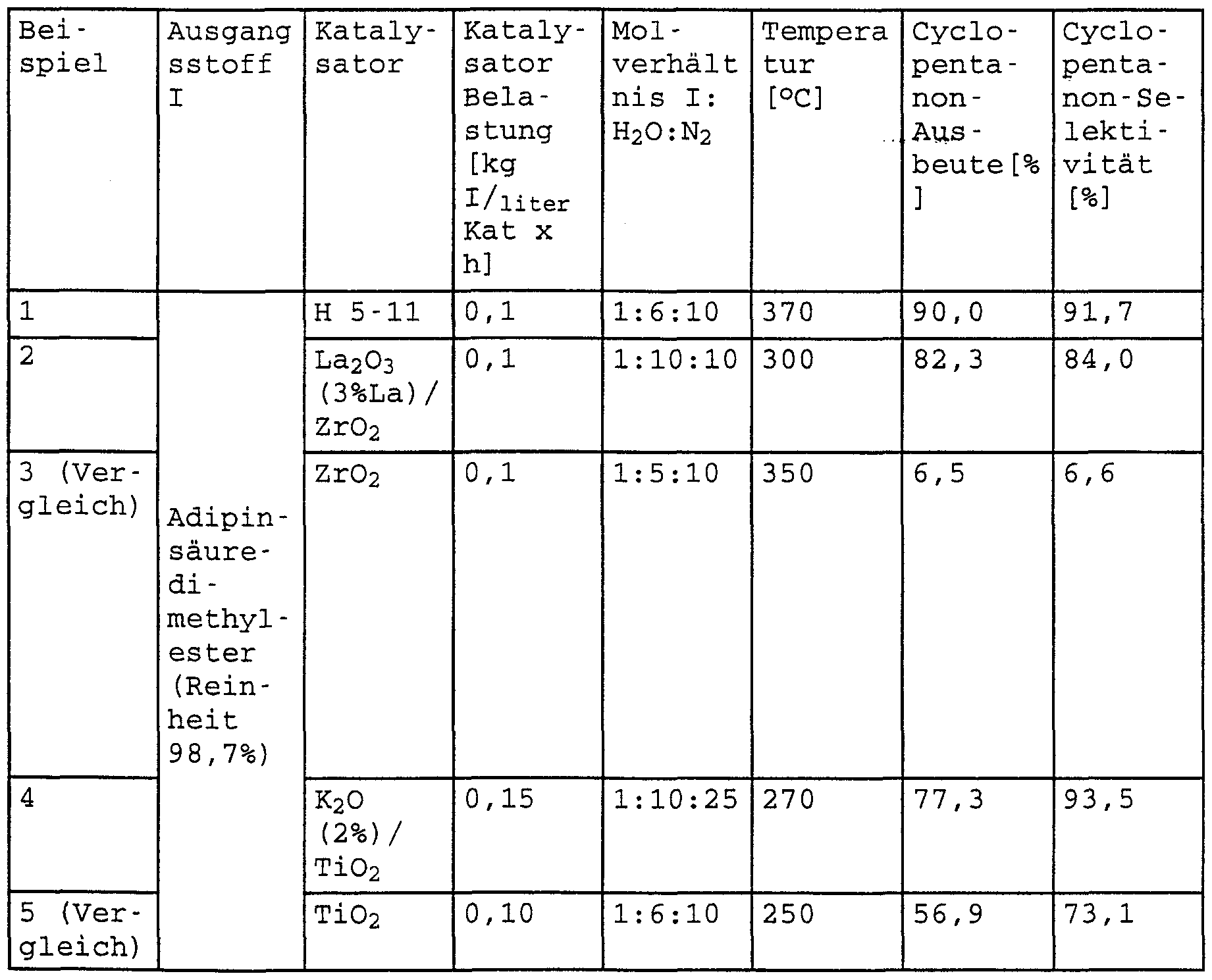
- Example 2.1 adipic acid dimethyl ester at 340 ° C on ⁇ -aluminum oxide in a fixed bed with 88% selectivity (yield 74%), in Example 2.7 at 400 ° C on Li 2 0 (13.5%) / MgO with 91% selectivity (Yield 62%) converted to cyclopentanone.
- This object is achieved by a process for preparing cyclopentanone by reacting adipic esters having a content of the starting material of adipic acid of greater than 95%, preferably above 97 percent as ⁇ -.%, And particular from 98.5 to 100 wt -.%, Of the formula
- R x and R are alkyl radicals having 1 to 12 carbon atoms, cycloalkyl radicals having 5 or 6 carbon atoms, aralkyl or aryl radicals and R 2 can additionally be hydrogen, in the presence of oxidic catalysts, the reaction in the gas phase in the presence of Water, a carrier gas and a) 0.01 to 10% by weight of at least one metal oxide, selected from the first and second main groups of the periodic table or the group of rare earth metals on titanium dioxide or zirconium dioxide as catalyst supports or
- the reaction can be carried out not only in the gas phase but also less advantageously in the liquid phase, if appropriate also with the use of diluents.
- diluents e.g. Suitable solvents which are completely or largely inert under the reaction conditions, e.g. Ethers such as dioxane or tetrahydrofuran.
- esters of formula I required as starting materials are aliphatic, cycloaliphatic or aromatic mono- or diesters of adipic acid.
- the following radicals R 1 and R may be mentioned by way of example: methyl, ethyl, propyl, isopropyl, butyl, isobutyl, tert-butyl, hexyl, nonyl, dodecyl, cyclopentyl, cyclohexyl, phenyl or benzyl radicals.
- the methyl radical is particularly preferred.
- esters can be used as starting materials: dimethyl adipate, monomethyl adipate, diethyl adipate, dibutyl adipate, dicyclohexyl adipate, dibenzyl adipate, monoethyl adipate.
- adipic diesters which can still contain small amounts of 6-hydroxycaproic acid esters, such as those e.g. can be obtained by the processes described in DE-A 19 607 954, small amounts of further compounds such as caprolactone, 6-alkoxycaproic acid esters, glutaric acid diesters, 5-hydroxyvaleric acid esters, 2 -oxocaproic acid esters, 1, 2-cyclohexanediols, valerolactone, unsaturated adipic acid diesters such as e.g.
- Dihydromuconic acid diesters 3-hydroxypentanoic acid esters, 4-oxopentanoic acid esters and 5-oxohexanoic acid esters may be present.
- these compounds generally do not impair the reaction according to the invention, nor do they lead to losses in product quality after purification by distillation.
- the content of the total of the impurities is 0.01 to 4.5% by weight, in particular 0.1 to 3% by weight (based on adipic acid diester).
- the molar ratio of ester (I) to water is advantageously 1: 0.05 to 1:30, in particular 1: 0.1 to 1:15.
- esters (I) may also be advantageous to use additional alcohols such as e.g. Add methanol, ethanol, n-butanol, i-propanol, n-propanol. It is advantageous to choose alcohols on which the esters (I) are based.
- the molar ratios of ester (I) to alcohol correspond to the ratios mentioned for the addition of water.
- the catalysts (a) used are metal oxides of the first and second main groups of the periodic table or the group of rare earth metals on titanium dioxide or zirconium dioxide as catalyst supports.
- metal oxides examples include sodium oxide, lithium oxide, potassium oxide, calcium oxide, magnesium oxide, latan oxide, cerium oxide, praseodymium oxide and neodymium oxide.
- Sodium oxide, potassium oxide and lanthanum oxide are particularly preferred.
- the amount of metal oxide on the catalyst support is 0.01 to 10% by weight, preferably 0.1 to 5% by weight. -%, particularly preferably 0.1 to 3 wt .-% metal oxide.
- the titanium oxide has a surface area of 20 to 200m 2 / g and consists mainly of anatase.
- the preparation of such catalysts is described in EP-A 352 674.
- Metal oxides of the second main group of the periodic table are used as catalyst (b) on zinc oxide as catalyst support.
- metal oxides examples include magnesium oxide, calcium oxide, strontium oxide and barium oxide. Magnesium oxide and calcium oxide are particularly preferred.
- the amount of metal oxide on the catalyst support is 1 to 50% by weight.
- the reaction in the presence of the catalysts (a) takes place at temperatures of 220 to 350 ° C., preferably 230 to 330 ° C., particularly preferably 250 to 310 ° C., that of the catalysts (b) at 300 to 450 ° C, preferably 330 to 420 ° C, particularly preferably at 350 to 400 ° C.
- the reaction is carried out under atmospheric pressure. However, it is also possible to use slightly reduced or slightly increased pressure, e.g. up to 20 bar.
- the catalyst loading is generally from 0.01 to 40, preferably 0.1 to 20 g of ester (I) per gram of catalyst and hour.
- the preferred reaction in the gas phase is carried out, for example, by passing a mixture of ester (I) and water into an evaporator and from there with a carrier gas at the desired temperature over the fixed bed catalyst.
- the reaction mixture is condensed and fractionally distilled to obtain cyclopentanone .
- Unreacted ester (I) is separated off and returned to the cyclopentanone synthesis stage.
- the percentages for the characterization of the catalysts mean percentages by weight.
Landscapes
- Chemical & Material Sciences (AREA)
- Organic Chemistry (AREA)
- Engineering & Computer Science (AREA)
- Materials Engineering (AREA)
- Chemical Kinetics & Catalysis (AREA)
- Organic Low-Molecular-Weight Compounds And Preparation Thereof (AREA)
- Low-Molecular Organic Synthesis Reactions Using Catalysts (AREA)
Abstract
Description
Claims
Priority Applications (5)
| Application Number | Priority Date | Filing Date | Title |
|---|---|---|---|
| US09/700,365 US6429339B1 (en) | 1998-05-28 | 1999-05-10 | Method for producing cyclopentanone |
| KR1020007013330A KR20010043860A (ko) | 1998-05-28 | 1999-05-10 | 시클로펜타논의 제조 방법 |
| DE59907204T DE59907204D1 (de) | 1998-05-28 | 1999-05-10 | Verfahren zur herstellung von cyclopentanon |
| JP2000550814A JP2002516301A (ja) | 1998-05-28 | 1999-05-10 | シクロペンタノンの製造方法 |
| EP99924923A EP1084096B1 (de) | 1998-05-28 | 1999-05-10 | Verfahren zur herstellung von cyclopentanon |
Applications Claiming Priority (2)
| Application Number | Priority Date | Filing Date | Title |
|---|---|---|---|
| DE19823835A DE19823835A1 (de) | 1998-05-28 | 1998-05-28 | Verfahren zur Herstellung von Cyclopentanon |
| DE19823835.5 | 1998-05-28 |
Publications (1)
| Publication Number | Publication Date |
|---|---|
| WO1999061402A1 true WO1999061402A1 (de) | 1999-12-02 |
Family
ID=7869162
Family Applications (1)
| Application Number | Title | Priority Date | Filing Date |
|---|---|---|---|
| PCT/EP1999/003194 Ceased WO1999061402A1 (de) | 1998-05-28 | 1999-05-10 | Verfahren zur herstellung von cyclopentanon |
Country Status (6)
| Country | Link |
|---|---|
| US (1) | US6429339B1 (de) |
| EP (1) | EP1084096B1 (de) |
| JP (1) | JP2002516301A (de) |
| KR (1) | KR20010043860A (de) |
| DE (2) | DE19823835A1 (de) |
| WO (1) | WO1999061402A1 (de) |
Cited By (1)
| Publication number | Priority date | Publication date | Assignee | Title |
|---|---|---|---|---|
| WO2004076396A1 (de) * | 2003-02-26 | 2004-09-10 | Basf Aktiengesellschaft | Verfahren zur herstellung und reinigung von cyclopentanon |
Families Citing this family (3)
| Publication number | Priority date | Publication date | Assignee | Title |
|---|---|---|---|---|
| JP2009509729A (ja) * | 2005-09-23 | 2009-03-12 | イーストマン ケミカル カンパニー | カルボン酸の混合物からの混成ケトンの製造に選択的な触媒 |
| WO2018204036A1 (en) * | 2017-05-03 | 2018-11-08 | Exxonmobil Chemical Patents Inc. | Process for conversion of acyclic c5 compounds to cyclic c5 compounds and formulated catalyst compositions used therein |
| US10611705B2 (en) | 2017-05-03 | 2020-04-07 | Exxonmobil Chemical Patents Inc. | Process for conversion of acyclic C5 compounds to cyclic C5 compounds and formulated catalyst compositions used therein |
Citations (2)
| Publication number | Priority date | Publication date | Assignee | Title |
|---|---|---|---|---|
| EP0251111A2 (de) * | 1986-07-01 | 1988-01-07 | BASF Aktiengesellschaft | Verfahren zur Herstellung zyklischer Ketone |
| DE3638005A1 (de) * | 1986-11-07 | 1988-05-11 | Basf Ag | Verfahren zur herstellung von cyclopentanon |
Family Cites Families (2)
| Publication number | Priority date | Publication date | Assignee | Title |
|---|---|---|---|---|
| US2863923A (en) | 1955-10-20 | 1958-12-09 | Rohm & Haas | Process for the preparation of 2, 5-dimethylcyclopentanone |
| US4048244A (en) * | 1974-12-20 | 1977-09-13 | Uop Inc. | Dehydrogenation method using sulfided nonacidic multimetallic catalyst |
-
1998
- 1998-05-28 DE DE19823835A patent/DE19823835A1/de not_active Withdrawn
-
1999
- 1999-05-10 EP EP99924923A patent/EP1084096B1/de not_active Expired - Lifetime
- 1999-05-10 DE DE59907204T patent/DE59907204D1/de not_active Expired - Lifetime
- 1999-05-10 WO PCT/EP1999/003194 patent/WO1999061402A1/de not_active Ceased
- 1999-05-10 KR KR1020007013330A patent/KR20010043860A/ko not_active Withdrawn
- 1999-05-10 US US09/700,365 patent/US6429339B1/en not_active Expired - Fee Related
- 1999-05-10 JP JP2000550814A patent/JP2002516301A/ja not_active Withdrawn
Patent Citations (2)
| Publication number | Priority date | Publication date | Assignee | Title |
|---|---|---|---|---|
| EP0251111A2 (de) * | 1986-07-01 | 1988-01-07 | BASF Aktiengesellschaft | Verfahren zur Herstellung zyklischer Ketone |
| DE3638005A1 (de) * | 1986-11-07 | 1988-05-11 | Basf Ag | Verfahren zur herstellung von cyclopentanon |
Cited By (1)
| Publication number | Priority date | Publication date | Assignee | Title |
|---|---|---|---|---|
| WO2004076396A1 (de) * | 2003-02-26 | 2004-09-10 | Basf Aktiengesellschaft | Verfahren zur herstellung und reinigung von cyclopentanon |
Also Published As
| Publication number | Publication date |
|---|---|
| US6429339B1 (en) | 2002-08-06 |
| KR20010043860A (ko) | 2001-05-25 |
| DE59907204D1 (de) | 2003-11-06 |
| DE19823835A1 (de) | 1999-12-02 |
| EP1084096B1 (de) | 2003-10-01 |
| JP2002516301A (ja) | 2002-06-04 |
| EP1084096A1 (de) | 2001-03-21 |
Similar Documents
| Publication | Publication Date | Title |
|---|---|---|
| DE3027890A1 (de) | Hydrierkatalysatoren fuer die herstellung von propandiolen und verfahren zur herstellung von propandiolen mit solchen katalysatoren | |
| DE19750532A1 (de) | Verfahren zur Herstellung von 1,6-Hexandiol und 6-Hydroxycapronsäure bzw. deren Estern | |
| EP1042259A1 (de) | Verfahren zur herstellung von 1,6-hexandiol | |
| EP0815097A1 (de) | Verfahren zur herstellung von 1,4-butandiol und tetrahydrofuran aus furan | |
| EP0251111B1 (de) | Verfahren zur Herstellung zyklischer Ketone | |
| EP0238003B1 (de) | Verfahren zur Herstellung von 4-Pentensäureestern | |
| EP1084096B1 (de) | Verfahren zur herstellung von cyclopentanon | |
| EP1422212A1 (de) | Verfahren zur Herstellung von Cyclopentenonen | |
| EP0295552B1 (de) | Verfahren zur Herstellung von Pentensäureestern | |
| EP0476400B1 (de) | Verfahren zur Abtrennung von Cyclohexen aus Gemischen mit Benzol und Cyclohexan | |
| DE2437983C3 (de) | Verfahren zur Herstellung von Resorcinen | |
| EP0026367B1 (de) | Verfahren zur Herstellung von cis-2,6-Dimethylmorpholin | |
| EP0278211B1 (de) | Verfahren zur Herstellung von p-substituierten o-Benzylphenolen | |
| EP0777639B1 (de) | Verfahren zur herstellung von aromatischen aldehyden | |
| DE3609138A1 (de) | Verfahren zur herstellung von alkencarbonsaeureestern | |
| EP0211205B1 (de) | Verfahren zur Herstellung von 2-Methyl-2-alkenalen | |
| EP0297447B1 (de) | Verfahren zur Herstellung von 2-Cyclopentenonen | |
| EP0305913B1 (de) | Verfahren zur Herstellung von Dien-1-olen, 9-Hydroxydodec-10-enyl-1-tert.-butylether und seine Verwendung als Zwischenprodukt zur Synthese von 8,10-Dodecadienol | |
| EP0946480B1 (de) | Verfahren zur herstellung von carbonylverbindungen | |
| DE1960941A1 (de) | Verfahren zur Herstellung von Methylcyclohexenen | |
| DE3015803C2 (de) | Verfahren zur Herstellung von 3,5-Dimethylphenol aus Aceton | |
| EP0136549A1 (de) | Verfahren zur Herstellung von Alkylchloriden aus Alkohol-Ethergemischen, die bei der Celluloseveretherung entstehen | |
| DE4033259A1 (de) | Verfahren zur herstellung von 2-pyrrolidinonen | |
| EP0573763A2 (de) | Verfahren zur Herstellung von Hydroxypivalinsäureestern | |
| EP1015408A1 (de) | Verfahren zur herstellung von cyclopentanon und cyclopenten-1-carbonsäure und deren estern |
Legal Events
| Date | Code | Title | Description |
|---|---|---|---|
| AK | Designated states |
Kind code of ref document: A1 Designated state(s): JP KR US |
|
| AL | Designated countries for regional patents |
Kind code of ref document: A1 Designated state(s): AT BE CH CY DE DK ES FI FR GB GR IE IT LU MC NL PT SE |
|
| DFPE | Request for preliminary examination filed prior to expiration of 19th month from priority date (pct application filed before 20040101) | ||
| 121 | Ep: the epo has been informed by wipo that ep was designated in this application | ||
| WWE | Wipo information: entry into national phase |
Ref document number: 1999924923 Country of ref document: EP |
|
| WWE | Wipo information: entry into national phase |
Ref document number: 09700365 Country of ref document: US |
|
| WWE | Wipo information: entry into national phase |
Ref document number: 1020007013330 Country of ref document: KR |
|
| WWP | Wipo information: published in national office |
Ref document number: 1999924923 Country of ref document: EP |
|
| WWP | Wipo information: published in national office |
Ref document number: 1020007013330 Country of ref document: KR |
|
| WWG | Wipo information: grant in national office |
Ref document number: 1999924923 Country of ref document: EP |
|
| WWW | Wipo information: withdrawn in national office |
Ref document number: 1020007013330 Country of ref document: KR |