WO2000000030A1 - Flammwidrige formmassen enthaltend polycarbonat und pfropfpolymerisate - Google Patents
Flammwidrige formmassen enthaltend polycarbonat und pfropfpolymerisate Download PDFInfo
- Publication number
- WO2000000030A1 WO2000000030A1 PCT/EP1999/004058 EP9904058W WO0000030A1 WO 2000000030 A1 WO2000000030 A1 WO 2000000030A1 EP 9904058 W EP9904058 W EP 9904058W WO 0000030 A1 WO0000030 A1 WO 0000030A1
- Authority
- WO
- WIPO (PCT)
- Prior art keywords
- weight
- parts
- molding compositions
- compositions according
- graft
- Prior art date
- Legal status (The legal status is an assumption and is not a legal conclusion. Google has not performed a legal analysis and makes no representation as to the accuracy of the status listed.)
- Ceased
Links
Classifications
-
- C—CHEMISTRY; METALLURGY
- C09—DYES; PAINTS; POLISHES; NATURAL RESINS; ADHESIVES; COMPOSITIONS NOT OTHERWISE PROVIDED FOR; APPLICATIONS OF MATERIALS NOT OTHERWISE PROVIDED FOR
- C09K—MATERIALS FOR MISCELLANEOUS APPLICATIONS, NOT PROVIDED FOR ELSEWHERE
- C09K21/00—Fireproofing materials
- C09K21/14—Macromolecular materials
-
- C—CHEMISTRY; METALLURGY
- C08—ORGANIC MACROMOLECULAR COMPOUNDS; THEIR PREPARATION OR CHEMICAL WORKING-UP; COMPOSITIONS BASED THEREON
- C08J—WORKING-UP; GENERAL PROCESSES OF COMPOUNDING; AFTER-TREATMENT NOT COVERED BY SUBCLASSES C08B, C08C, C08F, C08G or C08H
- C08J5/00—Manufacture of articles or shaped materials containing macromolecular substances
-
- C—CHEMISTRY; METALLURGY
- C08—ORGANIC MACROMOLECULAR COMPOUNDS; THEIR PREPARATION OR CHEMICAL WORKING-UP; COMPOSITIONS BASED THEREON
- C08K—Use of inorganic or non-macromolecular organic substances as compounding ingredients
- C08K5/00—Use of organic ingredients
- C08K5/49—Phosphorus-containing compounds
- C08K5/5399—Phosphorus bound to nitrogen
-
- C—CHEMISTRY; METALLURGY
- C08—ORGANIC MACROMOLECULAR COMPOUNDS; THEIR PREPARATION OR CHEMICAL WORKING-UP; COMPOSITIONS BASED THEREON
- C08L—COMPOSITIONS OF MACROMOLECULAR COMPOUNDS
- C08L23/00—Compositions of homopolymers or copolymers of unsaturated aliphatic hydrocarbons having only one carbon-to-carbon double bond; Compositions of derivatives of such polymers
- C08L23/26—Compositions of homopolymers or copolymers of unsaturated aliphatic hydrocarbons having only one carbon-to-carbon double bond; Compositions of derivatives of such polymers modified by chemical after-treatment
- C08L23/28—Compositions of homopolymers or copolymers of unsaturated aliphatic hydrocarbons having only one carbon-to-carbon double bond; Compositions of derivatives of such polymers modified by chemical after-treatment by reaction with halogens or halogen-containing compounds
-
- C—CHEMISTRY; METALLURGY
- C08—ORGANIC MACROMOLECULAR COMPOUNDS; THEIR PREPARATION OR CHEMICAL WORKING-UP; COMPOSITIONS BASED THEREON
- C08L—COMPOSITIONS OF MACROMOLECULAR COMPOUNDS
- C08L51/00—Compositions of graft polymers in which the grafted component is obtained by reactions only involving carbon-to-carbon unsaturated bonds; Compositions of derivatives of such polymers
- C08L51/04—Compositions of graft polymers in which the grafted component is obtained by reactions only involving carbon-to-carbon unsaturated bonds; Compositions of derivatives of such polymers grafted on to rubbers
-
- C—CHEMISTRY; METALLURGY
- C08—ORGANIC MACROMOLECULAR COMPOUNDS; THEIR PREPARATION OR CHEMICAL WORKING-UP; COMPOSITIONS BASED THEREON
- C08L—COMPOSITIONS OF MACROMOLECULAR COMPOUNDS
- C08L55/00—Compositions of homopolymers or copolymers, obtained by polymerisation reactions only involving carbon-to-carbon unsaturated bonds, not provided for in groups C08L23/00 - C08L53/00
- C08L55/02—ABS [Acrylonitrile-Butadiene-Styrene] polymers
-
- C—CHEMISTRY; METALLURGY
- C08—ORGANIC MACROMOLECULAR COMPOUNDS; THEIR PREPARATION OR CHEMICAL WORKING-UP; COMPOSITIONS BASED THEREON
- C08L—COMPOSITIONS OF MACROMOLECULAR COMPOUNDS
- C08L69/00—Compositions of polycarbonates; Compositions of derivatives of polycarbonates
-
- C—CHEMISTRY; METALLURGY
- C08—ORGANIC MACROMOLECULAR COMPOUNDS; THEIR PREPARATION OR CHEMICAL WORKING-UP; COMPOSITIONS BASED THEREON
- C08L—COMPOSITIONS OF MACROMOLECULAR COMPOUNDS
- C08L69/00—Compositions of polycarbonates; Compositions of derivatives of polycarbonates
- C08L69/005—Polyester-carbonates
-
- C—CHEMISTRY; METALLURGY
- C08—ORGANIC MACROMOLECULAR COMPOUNDS; THEIR PREPARATION OR CHEMICAL WORKING-UP; COMPOSITIONS BASED THEREON
- C08J—WORKING-UP; GENERAL PROCESSES OF COMPOUNDING; AFTER-TREATMENT NOT COVERED BY SUBCLASSES C08B, C08C, C08F, C08G or C08H
- C08J2300/00—Characterised by the use of unspecified polymers
- C08J2300/22—Thermoplastic resins
-
- C—CHEMISTRY; METALLURGY
- C08—ORGANIC MACROMOLECULAR COMPOUNDS; THEIR PREPARATION OR CHEMICAL WORKING-UP; COMPOSITIONS BASED THEREON
- C08L—COMPOSITIONS OF MACROMOLECULAR COMPOUNDS
- C08L2205/00—Polymer mixtures characterised by other features
- C08L2205/03—Polymer mixtures characterised by other features containing three or more polymers in a blend
-
- C—CHEMISTRY; METALLURGY
- C08—ORGANIC MACROMOLECULAR COMPOUNDS; THEIR PREPARATION OR CHEMICAL WORKING-UP; COMPOSITIONS BASED THEREON
- C08L—COMPOSITIONS OF MACROMOLECULAR COMPOUNDS
- C08L2666/00—Composition of polymers characterized by a further compound in the blend, being organic macromolecular compounds, natural resins, waxes or and bituminous materials, non-macromolecular organic substances, inorganic substances or characterized by their function in the composition
- C08L2666/02—Organic macromolecular compounds, natural resins, waxes or and bituminous materials
Definitions
- the present invention relates to molding compositions based on phosphazenes based on polycarbonate and graft polymers selected from the group of silicone,
- EP (D) M and acrylate rubbers as a graft base which have excellent flame retardancy and very good mechanical properties such as resistance to stress cracking or impact strength.
- DE-A 196 16 968 describes polymerizable phosphazene derivatives, processes for their preparation and their use as curable binders for lacquers, coatings. Fillers, fillers, adhesives, molded parts or foils described.
- WO 97/400 92 describes flame-retardant molding compositions made from thermoplastic polymers and unsubstituted phosphazenes (type PN nx H j . ,,).
- EP-A 728 811 describes a thermoplastic mixture consisting of aromatic polycarbonate, graft copolymer based on dienes, copolymer and phosphazenes. what good flame retardancy, impact resistance and
- the object of the present invention is to provide polycarbonate molding compositions with excellent flame resistance and excellent mechanical properties such as notched impact strength and stress crack resistance.
- Property spectrum is particularly required for applications in the field of data technology, such as for housings for monitors, printers, printers, copiers, etc.
- molding compositions based on polycarbonate and graft polymers are selected from the group consisting of silicone, EP (D) M and Acrylate rubbers containing phosphazenes that have the desired properties.
- the invention therefore relates to thermoplastic molding compositions
- thermoplastic polymer selected from the group consisting of vinyl (co) polymers and polyalkylene terephthalates and
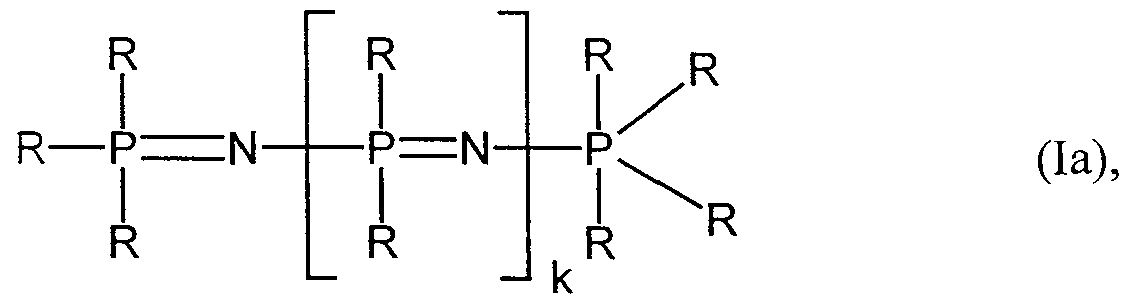
- R is the same or different, and R represents amino, in each case optionally halogenated, preferably halogenated with fluorine C to C 8 - alkyl, or C to C 8 - alkoxy, each optionally substituted by alkyl, preferably C 1 -C4- alkyl, and / or halogen, preferably chlorine and / or bromine, substituted C 5 - to Cg-cycloalkyl, Cg to C 20 aryl, preferably phenyl or naphthyl, C 6 to C2 ⁇ aryloxy, preferably phenoxy, naphthyloxy, or C 7 - to -C 2 aralkyl, preferably phenyl-C j -C4-alkyl,
- k for 0 or a number from 1 to 15, preferably for a number from 1 to
- the invention preferably relates to thermoplastic molding compositions
- thermoplastic polymer selected from the group of vinyl co) polymers and polyalkylene terephthalates
- R is the same or different and represents amino, in each case optionally halogenated, preferably with fluorine halogenated C, - to Cg alkyl, or C to C 8 - alkoxy, each optionally substituted by alkyl, preferably C1-C 4 - alkyl, and / or Halogen, preferably chlorine and / or bromine, substituted C5 to Cg cycloalkyl, C5 to C20 aryl, preferably phenyl or naphthyl, C 6 to C 2 o-aryloxy, preferably phenoxy, naphthyloxy, or C 7 to C 1 2- aralkyl, preferably phenyl -CC 4 -alkyl,
- Aromatic polycarbonates and / or aromatic polyester carbonates according to component A which are suitable according to the invention are known from the literature or can be prepared by processes known from the literature (for the preparation of aromatic polycarbonates see, for example, Schnell, "Chemistry and Physics of Polycarbonates", Interscience Publishers, 1964 and DE-AS 1 495 626, DE-OS 2 232 877, DE-OS 2 703 376, DE-OS 2 714 544. DE-OS 3 000 610, DE-OS 3 832 396; for the production of aromatic polyester carbonates e.g. DE-OS 3 077 934).
- aromatic polycarbonates takes place e.g. B. by reacting diphenols with carbonic acid halides, preferably phosgene and / or with aromatic dicarboxylic acid dihalides, preferably benzenedicarboxylic acid dihalogenides, according to the phase interface method, optionally using chain terminators, for example monophenols and optionally using trifunctional or more than trifunctional branching agents, for example triphenols Tetraphenols.
- carbonic acid halides preferably phosgene and / or with aromatic dicarboxylic acid dihalides, preferably benzenedicarboxylic acid dihalogenides
- Diphenols for the preparation of the aromatic polycarbonates and / or aromatic polyester carbonates are preferably those of the formula (III)
- A is a single bond, C 1 -C 5 alkylene, C 2 -C 5 alkylidene, C 5 -C 6 cycloalkylidene, -O-, -SO-, -CO-, -S-, -SO 2 - , Cg-C ⁇ aryls, to which further aromatic rings optionally containing heteroatoms can be condensed,
- B each preferably methyl, halogen, preferably chlorine and / or bromine
- R 7 and R 8 can be selected individually for each X 1 , independently of one another hydrogen or Ci-Cg-alkyl, preferably hydrogen, methyl or ethyl,
- m is an integer from 4 to 7, preferably 4 or 5, with the proviso that at least one atom X 1 , R 7 and R 8 are simultaneously alkyl.
- Preferred diphenols are hydroquinone, resorcinol, dihydroxydiphenols, bis- (hydroxyphenyl) -C] -C 5 -alkanes, bis- (hydroxyphenyl) -C 5 -6-cycloalkanes, bis- (hydroxyphenyl) ethers, bis- (hydroxyphenyl) - sulfoxides, bis (hydroxyphenyl) ketones, bis (hydroxyphenyl) sulfones and ⁇ , ⁇ -bis (hydroxyphenyl) diisopropyl benzenes and their core-brominated and / or core-chlorinated derivatives.
- diphenols are 4,4'-dihydroxydiphenyl, bisphenol-A, 2,4-bis (4-hydroxyphenyl) -2-methylbutane, 1,1-bis (4-hydroxyphenyl) cyclohexane, 1,1-bis- (4-hydroxyphenyl) -3.3.5-trimethylcyclohexane, 4,4'-dihydroxydiphenyl sulfide,
- 4,4'-dihydroxydiphenyl sulfone and their di- and tetrabrominated or chlorinated derivatives such as 2,2-bis (3-chloro-4-hydroxyphenyl) propane, 2,2-bis (3,5-dichloro-4 -hydroxyphenyl) propane or 2,2-bis (3,5-dibromo-4-hydroxyphenyl) propane.
- 2,2-bis (4-hydroxyphenyl) propane (bisphenol-A) is particularly preferred.
- the diphenols can be used individually or as any mixtures.
- the diphenols are known from the literature or can be obtained by processes known from the literature.
- Suitable chain terminators for the production of the thermoplastic, aromatic polycarbonates are, for example, phenol, p-chlorophenol, p-tert-butylphenol or 2,4,6-tribromophenol, but also long-chain alkylphenols, such as 4- (1,3-tetramethylbutyl) -phenol according to DE-OS 2 842 005 or monoalkylphenol or dialkylphenols with a total of 8 to 20 carbon atoms in the alkyl substituents, such as 3,5-di-tert-butylphenol, p-iso-octylphenol, p-tert.
- alkylphenols such as 4- (1,3-tetramethylbutyl) -phenol according to DE-OS 2 842 005 or monoalkylphenol or dialkylphenols with a total of 8 to 20 carbon atoms in the alkyl substituents, such as 3,5-di-tert-butylphenol, p-iso-oct
- thermoplastic, aromatic polycarbonates have average weight-average molecular weights (M w , measured, for example, by means of an ultracentrifuge or scattered light measurement) of 10,000 to 200,000, preferably 20,000 to 80,000.
- thermoplastic, aromatic polycarbonates can be branched in a known manner, preferably by incorporating 0.05 to 2.0 mol%, based on the sum of the diphenols used, of trifunctional or more than trifunctional compounds, for example those with three and more phenolic see groups.
- copolycarbonates Both homopolycarbonates and copolycarbonates are suitable.
- 1 to 25% by weight, preferably 2.5 to 25% by weight (based on the total amount of diphenols to be used) of polydiorganosiloxanes with hydroxy-aryloxy end groups can also be used. These are known (see, for example, US Pat. No. 3,419,634) or can be produced by processes known from the literature.
- the production of polydiorganosiloxane-containing copolycarbonates is e.g. B. described in DE-OS 3 334 782.
- preferred polycarbonates are polystyrene-co-styrene-co-styrene-co-styrene-co-styrene-co-styrene-co-styrene-co-styrene-co-styrene-co-styrene-co-styrene-co-styrene-co-styrene-co-styrene-styrene-styrene-styrene-styrene-styrene-styrene-styrene-styrene-styrene-styrene-styrene-styrene-styrene-styrene-styrene-styrene-styrene-styrene-styrene-styrene-styrene-styrene-styrene
- Aromatic dicarboxylic acid dihalides for the production of aromatic polyester carbonates are preferably the diacid dichlorides of isophthalic acid, terephthalic acid, diphenyl ether-4,4'-dicarboxylic acid and naphthalene-2,6-dicarboxylic acid.
- a carbonic acid halide preferably phosgene, is additionally used as a bifunctional acid derivative.
- Suitable chain terminators for the production of aromatic polyester com- men in addition to the monophenols already mentioned, nor their Chlorkohlenklareester and the acid chlorides of aromatic monocarboxylic acids, which are optionally substituted by C, -C; may be substituted alkyl groups or by halogen atoms, and aliphatic C 2 -C 22 -monocarboxylic acid chlorides into consideration.
- the amount of chain terminators is in each case 0.1 to 10 mol%, based on moles of diphenols in the case of the phenolic chain terminators and on moles of dicarboxylic acid dichlorides in the case of monocarboxylic acid chloride chain terminators.
- the aromatic polyester carbonates can also contain aromatic hydroxycarboxylic acids.
- the aromatic polyester carbonates can be linear or branched in a known manner (see also DE-OS 2 940 024 and DE-OS 3 007 934).
- 3- or polyfunctional carboxylic acid chlorides such as trimesic acid trichloride, cyanuric acid trichloride, 3,3 '-, 4,4'-benzophenonetetracarboxylic acid tetrachloride, 1, 4,5,8-naphthalenetetracarboxylic acid tetrachloride or pyromellitic acid tetrachloride
- branching agents in amounts of 0.01 up to 1.0 mol% (based on the dicarboxylic acid dichlorides used) or 3- or polyfunctional phenols, such as phloroglucin, 4,6-dimethyl-2,4,6-tri- (4-hydroxyphenyl) -hepten-2 , 4,4-dimethyl-2,4-6-tri- (4-hydroxyphenyl) heptane, 1,3,5-tri- (4-hydroxyphenyl) benzene, 1,1,1-tri- (4- hydroxyphenyl) ethane, tri-
- the proportion of carbonate structural units in the thermoplastic, aromatic polyester carbonates can vary as desired.
- the proportion of carbonate groups is preferably up to 100 mol%, in particular up to 80 mol%, particularly preferably up to 50 mol%, based on the sum of ester groups and carbonate groups.
- Both the ester and the carbonate content of the aromatic polyester carbonates can be present in the form of blocks or randomly distributed in the polycondensate.
- the relative solution viscosity ( ⁇ rel ) of the aromatic polycarbonates and polyester carbonates is in the range from 1.18 to 1.4, preferably from 1.22 to 1.3 (measured on
- thermoplastic, aromatic polycarbonates and polyester carbonates can be used alone or in any mixture with one another.
- Component B comprises one or more rubber-elastic graft polymers selected from the group consisting of silicone, acrylate and
- EP (D) M rubbers as a graft base.
- Component B preferably comprises one or more graft polymers of
- the graft base B.2 generally has an average particle size (d 50 value) of 0.05 to 5 ⁇ m, preferably 0.10 to 0.5 ⁇ m, particularly preferably 0.20 to 0.40 ⁇ m.
- Monomers B.l are preferably mixtures of
- B.l.2 1 to 50, preferably 40 to 20 parts by weight of vinyl cyanide (unsaturated
- Nitriles such as acrylonitrile and methacrylonitrile) and / or (meth) acrylic acid (C, - C 8 ) alkyl esters (such as methyl methacrylate, n-butyl acrylate, t-butyl acrylate) and / or derivatives (such as anhydrides and imides) of unsaturated carboxylic acids
- Preferred monomers B.l.l are selected from at least one of the monomers styrene, ⁇ -methylstyrene and methyl methacrylate
- preferred monomers B.l.2 are selected from at least one of the monomers acrylonitrile, maleic anhydride and methyl methacrylate.
- Silicone rubbers B.2 suitable according to the invention consist predominantly of structural units
- R 1! and R 12 can be the same or different, and are C j -Cg alkyl or cycloalkyl or Cg-C ⁇ aryl.
- Preferred silicone rubbers B.2 are particulate with an average particle diameter d 5Q of 0.09 to 1 ⁇ m, preferably 0.09 to 0.4 ⁇ m and a gel content of more than 70% by weight, in particular 73 to 98% by weight and are available from
- Preferred silicone rubbers B.2 contain at least 80 mol% of methyl groups as organic residues.
- the end group is generally a diorganyl hydroxyl siloxy unit. preferably a dimethylhydroxysiloxy unit.
- Preferred silanes 1) to 4) for the production of the silicone rubbers B.2 contain chlorine as halogen substituents.
- silicone rubber B.2 does not necessarily have to be produced from the halogen compounds 1) to 4).
- silicone rubbers B.2 of the same structure consist of silanes with other hydrolyzable groups, e.g. Ci-Cg-alkoxy groups, or have been prepared from cyclic suloxane oligomers, are included.
- Silicone graft rubbers are mentioned as a particularly preferred component B.2. These can be produced, for example, using a three-stage process.
- the silicone rubbers obtained are graft-active
- Vinyl and mercapto groups have been radical graft-polymerized with vinyl monomers (or mixtures).
- mixtures of cyclic siloxane oligomers such as octamethylcyclotetrasiloxane and tetramethyltetravinylcyclotetrasiloxane in an emulsion are preferably cationically polymerized in a ring-opening manner.
- the silicone rubbers are particulate as an emulsion.
- GB-PS 1 024 014 it is particularly preferred to work with alkylbenzenesulfonic acids which are both catalytically active and act as emulsifiers.
- Polymerization neutralizes the acid.
- alkylbenzenesulfonic acids n-alkylsulfonic acids can also be used. It is also possible to use co-emulsifiers in addition to the sulfonic acid.
- Emulsifiers are particularly suitable salts of n-alkyl or alkylbenzenesulfonic acids.
- Nonionic co-emulsifiers are polyoxyethylene derivatives of fatty alcohols and fatty acids. Examples are POE (3) lauryl alcohol, POE (20) oleyl alcohol, POE (7) nonyl alcohol or POE ( ⁇ ) stearate. (The notation POE (number) alcohol means that one molecule .... alcohol has so many units
- Ethylene oxide has been added as correspond to the number.
- POE stands for polyethylene oxide. The number is an average.
- crosslinking and grafting groups (vinyl and mercapto groups, cf. organic residues ⁇ and ⁇ ) can be inserted into the silicone rubber by using appropriate siloxane oligomers.
- siloxane oligomers such are, for example, tetramethyl tetra vinylcyclotetrasiloxane, or ⁇ -mercaptopropylmethyldimethoxysiloxane or its hydrolyzate.
- oligomers e.g. Octamethylcyclotetrasiloxane, added in the desired amount in the second stage.
- Adequate crosslinking of the silicone rubber can already be achieved if the residues ⁇ and ⁇ react with one another in the emulsion polymerization, so that the addition of an external crosslinking agent can be unnecessary.
- a crosslinking silane can be added in the second reaction step to increase the degree of crosslinking of the silicone rubber.
- Branches and cross-links can be achieved by adding e.g. Tetraethoxysilane or a silane of the formula
- X is a hydrolyzable group, in particular an alkoxy or halogen radical
- y is an organic residue
- Preferred Siiane y-SiX 3 are methyltrimethoxysilane and phenyltrimethoxysilane.
- the gel content is determined at 25 ° C. in acetone (cf. DE-AS 2 521 288, SP. 6, lines 17 to 37).
- the silicone rubbers according to the invention it is at least 70%, preferably 73 to 98% by weight.
- Grafted silicone rubbers B can be produced by radical graft polymerization, for example analogously to DE-PS 2 421 288.
- the graft monomers can be graft-polymerized in the presence of the silicone rubber, in particular at 40 to 90 ° C.
- the graft polymerization can be carried out in
- Suspension, dispersion or emulsion can be carried out. Continuous or discontinuous emulsion polymerization is preferred. This graft polymerization is carried out using radical initiators (e.g. peroxides, azo compounds, hydroperoxides, persulfates, perphosphates) and, if appropriate, using anionic emulsifiers, e.g. Carboxonium salts, sulfonic acid salts or organic sulfates. Graft polymers with high graft yields are formed, i.e. a large proportion of the polymer of the graft monomers is chemically bound to the silicone rubber. The silicone rubber has graft-active residues, so that special measures for heavy grafting are unnecessary.
- radical initiators e.g. peroxides, azo compounds, hydroperoxides, persulfates, perphosphates
- anionic emulsifiers e.g. Carboxonium salts, sulfonic acid salts or
- the grafted silicone rubbers can be prepared by graft-polymerizing 5 to 95 parts by weight, preferably 20 to 80 parts by weight, of a vinyl monomer or a vinyl monomer mixture to 5 to 95, preferably 20 to 80 parts by weight of silicone rubber.
- a particularly preferred vinyl monomer is styrene or methyl methacrylate.
- Suitable vinyl monomer mixtures consist of 50 to 95 parts by weight of styrene. ⁇ -methylstyrene (or other alkyl- or halogen-core-substituted styrenes) or methyl methacrylate on the one hand and from 5 to 50 parts by weight of acrylonitrile, methacrylonitrile, acrylic acid-C i -C j 8 -alkyl ester, methacrylic acid-C j - C j 6 alkyl ester, maleic anhydride or substituted maleimides on the other hand.
- vinyl monomers can additionally in smaller amounts acrylate of primary or secondary aliphatic C 2 -C Q alcohols, preferably n-butyl acrylate or acrylic or Methylacryl Tarklander of tert-butanol, preferably t-butyl acrylate, to be present.
- a particularly preferred monomer mixture is 30 to 40 parts by weight of ⁇ -methylstyrene, 52 to 62 parts by weight of methyl methacrylate and 4 to
- the thus grafted silicone rubbers can be worked up in a known manner, e.g. by coagulation of the latices with electrolytes (salts, acids or mixtures thereof) and subsequent cleaning and drying.
- grafted silicone rubber In the production of the grafted silicone rubbers, free polymers or copolymers of the graft monomers forming the graft shell are generally also formed to a certain extent in addition to the actual graft copolymer.
- grafted silicone rubber is the product obtained by polymerizing the graft monomers in the presence of the silicone rubber, that is to say strictly speaking, generally a mixture of graft copolymer and free (co) polymer of the graft monomers.
- Graft polymers based on acrylate are preferably made of
- the acrylate rubbers (a) are preferably polymers made from acrylic acid alkyl esters, optionally with up to 40% by weight, based on (a), of other polymerizable, ethylenically unsaturated monomers.
- acrylic acid esters include C j -Cg alkyl esters, for example methyl, ethyl, butyl, n-octyl and 2-ethylhexyl esters; Halogen alkyl esters, preferably halogen C 8 -C 8 alkyl esters, such as chloroethyl acrylate, and mixtures of these monomers.
- Monomers with more than one polymerizable double bond can be copolymerized for crosslinking.
- Preferred examples of crosslinking monomers are esters of unsaturated monocarboxylic acids with 3 to 8 C atoms and unsaturated monohydric alcohols with 3 to 12 C atoms, or saturated polyols with 2 to 4 OH groups and 2 to 20 C atoms, e.g. Ethylene glycol dimethacrylate, allyl methacrylate; polyunsaturated heterocyclic compounds, e.g. Trivinyl and
- Triallyl cyanurate polyfunctional vinyl compounds, such as di- and trivinylbenzenes; but also triallyl phosphate and diallyl phthalate.
- Preferred crosslinking monomers are allyl methacrylate, ethylene glycol dimethacrylate, diallyl phthalate and heterocyclic compounds which have at least 3 ethylenically unsaturated groups.
- crosslinking monomers are the cyclic monomers triallyl cyanurate, triallyl isocyanurate, triacryloylhexahydro-s-triazine and triallylbenzenes.
- the amount of the crosslinked monomers is preferably 0.02 to 5, in particular 0.05 to 2% by weight, based on the rubber base.
- Preferred "other" polymerizable, ethylenically unsaturated monomers which, in addition to the acrylic esters, can optionally be used to prepare the graft base B.2 are, for. B. acrylonitrile, styrene, ⁇ -methylstyrene, acrylamides, vinyl-C, -
- Graft base B.2 are emulsion polymers which have a gel content of at least 60% by weight.
- the acrylate-based polymers are generally known, can be prepared by known processes (e.g. EP-A 244 857) or are commercially available products.
- the gel content of the graft base is determined at 25 ° C. in a suitable solvent (M. Hoffmann, H. Krömer, R. Kuhn, Polymeranalytik I and II, Georg Thieme-Verlag. Stuttgart 1977).
- the average particle size d 50 is the diameter above and below which 50% by weight of the particles lie. It can be determined by means of ultracentrifuge measurement (W. Scholtan. H. Lange, Kolloid, Z. and Z. Polymer 250 (1972), 782-1796).
- the EP (D) M graft base used is at least one copolymer or terpolymer containing ethylene and propylene with only a small number of double bonds (cf. EP-A 163 411, EP-A 244 857).
- EP (D) M rubbers those are used which have a glass transition temperature in the
- the rubbers have only a small number of double bonds, i.e. less than 20 double bonds per 1000 carbon atoms, in particular 3 to 10 double bonds per 1000 carbon atoms.
- Examples of such rubbers are copolymers consisting of ethylene-propylene and ethylene-propylene terpolymers. The latter are obtained by polymerizing at least
- ethylene at least 30 wt .-% propylene and 0.5 to 15 wt .-% of a non-conjugated diolefinic component.
- Diolefins with at least 5 carbon atoms such as 5-ethylidene norborne ⁇ , are generally used as the ter component.
- Dicyclopentadiene, 2,2,1-dicyclopentadiene and 1,4-hexadiene are used.
- polyalkylene amers such as polypentenamer, polyoctenamer,
- EPDM rubbers ethylene-propylene copolymers and the ethylene-propylene terpolymers
- the EP (D) M-based graft polymer can be prepared by various methods.
- radical initiators such as azo compounds or peroxides at higher temperatures
- the methods of DE-AS 23 02 014 and DE-OS 25 33 991 may be mentioned as examples. It is also possible to work in suspension as described in US Pat. No. 4,202,948.
- Component C comprises one or more thermoplastic vinyl (co) polymers C.l and / or polyalkylene terephthalates C.2.
- Suitable as vinyl (co) polymers Cl are polymers of at least one monomer from the group of the vinyl aromatics, vinyl cyanides (unsaturated nitriles), (meth) acrylic acid (C r C 8 ) alkyl esters, unsaturated carboxylic acids and derivatives (such as anhydrides and imides) unsaturated carboxylic acids.
- (Co) polymers of are particularly suitable
- vinyl aromatics and / or nucleus-substituted vinyl aromatics such as, for example, styrene, ⁇ -methylstyrene, p-methylisyrene, p-chlorostyrene
- C r C g methacrylic acid alkyl esters such as methyl methacrylate, ethyl methacrylate
- vinyl cyanides unsaturated nitriles
- acrylic acid C r C 8 alkyl esters
- unsaturated carboxylic acids such as maleic acid
- derivatives such as anhydrides and imides
- the (co) polymers C.1 are resinous, thermoplastic and rubber-free.
- the copolymer of C.1.1 styrene and C.1.2 acrylonitrile is particularly preferred.
- the (co) polymers according to Cl are known and can be prepared by radical polymerization, in particular by emulsion, suspension, solution or bulk polymerization.
- the (co) polymers preferably have molecular weights M w (weight average, determined by light scattering or sedimentation) between 15,000 and 200,000.
- (Co) polymers according to component C.l often arise as by-products in the graft polymerization of component B, especially when large amounts of monomers B.l are grafted onto small amounts of rubber B.2.
- the amount of C.1 which may also be used according to the invention does not include these by-products of the graft polymerization of B.
- the polyalkylene terephthalates of component C.2 are reaction products made from aromatic dicarboxylic acids or their reactive derivatives, such as dimethyl esters or anhydrides, and aliphatic, cycloaliphatic or araliphatic diols and mixtures of these reaction products.
- Preferred polyalkylene terephthalates contain at least 80% by weight, preferably at least 90% by weight, based on the dicarboxylic acid component terephthalic acid. residues and at least 80 wt .-%, preferably at least 90 mol%, based on the diol component ethylene glycol and / or 1,4-butanediol residues.
- the preferred polyalkylene terephthalates can contain up to 20 mol%. preferably contain up to 10 mol%, residues of other aromatic or cycloaliphatic dicarboxylic acids with 8 to 14 carbon atoms or aliphatic dicarboxylic acids with 4 to 12 carbon atoms, such as e.g. Residues of phthalic acid, isophthalic acid. Naphthalene-2,6-dicarboxylic acid, 4,4'-diphenyldicarboxylic acid, succinic acid, adipic acid, sebacic acid, azelaic acid, cyclohexane-diacetic acid.
- the preferred polyalkylene terephthalates can contain up to 20 mol%, preferably up to 10 mol%, other aliphatic diols with 3 to 12 carbon atoms or cycloaliphatic diols with 6 to 21 Contain carbon atoms, e.g. Residues of 1,3-propanediol, 2-ethyl-1,3-propanediol, 3, neopentylglycol, 1,5-pentanediol. 1,6-hexanediol, 1,4-cyclohexane-dimethanol, 2,4-3-ethylpentanediol,
- the polyalkylene terephthalates can be prepared by incorporating relatively small amounts of trihydric or tetravalent alcohols or 3- or 4-basic carboxylic acids, e.g. according to DE-OS 1 900 270 and US Pat. No. 3,692,744.
- preferred branching agents are trimesic acid, trimellitic acid, trimethylolethane and propane and
- polyalkylene terephthalates which have been prepared solely from terephthalic acid and its reactive derivatives (for example its dialkyl esters) and ethylene glycol and / or 1,4-butanediol, and mixtures of these polyalkylene terephthalates.
- Mixtures of polyalkylene terephthalates contain 1 to 50% by weight, preferably 1 to 30% by weight, polyethylene terephthalate and 50 to 99% by weight, preferably 70 to 99% by weight.
- Polybutylene terephthalate are examples of polyethylene terephthalate.
- the polyalkylene terephthalates preferably used generally have an intrinsic viscosity of 0.4 to 1.5 dl / g, preferably 0.5 to 1.2 dl / g, measured in phenol / o-dichlorobenzene (1: 1 parts by weight) at 25 ° C. in the Ubbelohde viscometer.
- the polyalkylene terephthalates can be prepared by known methods (see e.g.
- Phosphazenes according to component D which are used according to the present invention, are linear phosphazenes according to formula (Ia) or cyclic phosphazenes according to formula (Ib)
- Examples include:
- Phenoxyphosphazene is preferred.
- the phosphazenes can be used alone or as a mixture.
- the radical R can always be the same or 2 or more radicals in the formulas (Ia) and (Ib) can be different.
- the fluorinated polyolefins E are of high molecular weight and have glass transition temperatures of above -30 ° C., generally above 100 ° C., fluorine contents, preferably from 65 to 76%, in particular from 70 to 76% by weight, average particle diameter d 50 of 0, 05 to 1,000, preferably 0.08 to 20 ⁇ m.
- the fluorinated polyolefins F have a density of 1.2 to 2.3 g / cm 3 .
- Preferred fluorinated polyolefins F are polytetrafluoroethylene, polyvinylidene fluoride, tetrafluoroethylene (hexafluoropropylene and ethylene / tetrafluoroethylene copolymers.
- the fluorinated polyolefins are known (cf. "Vinyl and Related Polymers” from Schildknecht, John Wiley & Sons, Inc., New York, 1962, pages 484-494; "Fluoropolymers” by Wall, Wiley-Interscience, John Wiley & Sons, Inc., New York, volume 13, 1970, pages 623-654; "Modern Plastics Encyclopedia", 1970-1971, volume 47 , No. 10 A, October
- They can be prepared by known processes, for example by polymerizing tetrafluoroethylene in an aqueous medium with a free radical-forming catalyst, for example sodium, potassium or ammonium peroxydisulfate at pressures from 7 to 71 kg / cm 2 and at temperatures from 0 to 200 ° C, preferably at temperatures from 20 to 100 ° C. (See U.S. Patent 2,393,967 for more details).
- a free radical-forming catalyst for example sodium, potassium or ammonium peroxydisulfate
- the density of these materials can be between 1.2 and 2.3 g / cm 3 , the average particle size between 0.5 and 1000 ⁇ m.
- Fluorinated polyolefins E preferred according to the invention are tetrafluoroethylene polymers having average particle diameters of 0.05 to 20 ⁇ m, preferably 0.08 to 10 ⁇ m, and a density of 1.2 to 1.9 g / cm 3 and are preferably in the form of a coagulated mixture of Emulsions of the tetrafluoroethylene polymer E with emulsions of the graft polymer used.
- Suitable fluorinated polyolefins E that can be used in powder form are tetrafluoroethylene polymers with average particle diameters of 100 to 1,000 ⁇ m and densities of 2.0 g / cm 3 to 2.3 g / cm 3 .
- an aqueous emulsion (latex) of a graft polymer B is first mixed with a finely divided emulsion of a tetraethylene polymer E;
- Suitable tetrafluoroethylene polymer emulsions usually have solids contents of 30 to 70% by weight, in particular 50 to 60% by weight, preferably 30 to 35% by weight.
- the equilibrium ratio of graft polymer to tetrafluoroethylene polymer E in the emulsion mixture is 95: 5 to 60:40.
- the emulsion mixture is then coagulated in a known manner, for example by spray drying, Freeze drying or coagulation by adding inorganic or organic salts, acids, bases or organic, water-miscible solvents, such as alcohols, ketones, preferably at temperatures from 20 to 150 ° C, in particular from 50 to 100 ° C. If necessary, drying can be carried out at 50 to 200 ° C., preferably 70 to 100 ° C.
- Suitable tetrafluoroethylene polymer emulsions are commercially available products and are offered, for example, by DuPont as Teflon® 30 N.
- the molding compositions according to the invention can contain at least one of the customary additives, such as lubricants and mold release agents, nucleating agents, antistatic agents, stabilizers and dyes and pigments.
- customary additives such as lubricants and mold release agents, nucleating agents, antistatic agents, stabilizers and dyes and pigments.
- the molding compositions according to the invention can contain up to 35% by weight, based on the total molding composition, of a further flame retardant which may have a synergistic action.
- a further flame retardant which may have a synergistic action.
- other flame retardants are organic phosphorus compounds such as triphenyl phosphate or m-phenylene bis (diphenyl phosphate), organic halogen compounds such as decabromobisphenyl ether, tetrabromobisphenol, inorganic halogen compounds such as ammonium bromide, nitrogen compounds such as melamine, melamine formaldehyde resins, inorganic
- Hydroxide compounds such as Mg, Al hydroxide, inorganic compounds such as antimony oxides. Barium metaborate, hydroxoantimonate, zirconium oxide, zirconium hydroxide, molybdenum oxide. Ammonium molybdate, zinc borate, ammonium borate, barium metaborate, talc, silicate, silicon oxide and tin oxide and siloxane compounds.
- the molding compositions according to the invention containing components A to E and optionally other known additives such as stabilizers, dyes, pigments, lubricants and mold release agents, nucleating agents and antistatic agents are prepared by mixing the respective constituents in a known manner and at temperatures from 200 ° C. to 300 ° C in common units such as internal kneaders,
- Extruders and twin-screw extruders melt-compounded and melt-extruded, wherein component E is preferably used in the form of the coagulated mixture already mentioned.
- the individual constituents can be mixed in a known manner both successively and simultaneously, both at about 20 ° C. (room temperature) and at a higher temperature.
- the invention therefore also relates to a process for producing the molding compositions.
- thermoplastic molding compositions according to the invention are suitable for the production of moldings of any kind, in particular those with increased requirements for resistance to breakage and chemical resistance.
- moldings of the present invention can be used for the production of moldings of any kind.
- moldings can be produced by injection molding.
- moldings that can be produced are: Housing parts of all types, e.g. for household appliances such as juicers, coffee machines, mixers, for office machines such as monitors, printers, copiers or cover plates for the construction sector and parts for the motor vehicle sector. They can also be used in the field of electrical engineering because they have very good electrical properties.
- molding compositions according to the invention can be used, for example, to produce the following shaped articles or molded parts:
- FR Rail vehicles
- hubcaps housings for electrical transformers containing small transformers
- housings for devices for disseminating and transmitting information housings and claddings for medical purposes
- massagers and housings therefor toy vehicles for children
- flat wall elements housings for safety devices
- rear spoilers heat-insulated Transport- Containers
- device for keeping or supplying small animals molded parts for sanitary and bathing equipment, cover grilles for ventilation openings, molded parts for garden and tool sheds, housings for garden tools.
- Another form of processing is the production of shaped bodies by
- Another object of the present invention is therefore also the use of the molding compositions according to the invention for the production of moldings of any kind, preferably those mentioned above, and the moldings from the inventive ones
- 38.4 parts by weight of octamethylcyclotetrasiloxane, 1.2 parts by weight of tetramethyltetravinylcyclotetrasiloxane and 1 part by weight of mercaptopropylmethyldimethoxysilane are stirred together.
- 0.5 part by weight of dodecylbenzenesulfonic acid is added, then 58.4 parts by weight of water are added within one hour. It is stirred intensively.
- the pre-emulsion is homogenized twice at 200 bar using a high-pressure emulsifying machine. A further 0.5 part by weight of dodecylbenzenesulfonic acid is added.
- the emulsion is stirred at 85 ° C for 2 hours and then at 20 ° C for 36 hours. Is neutralized with the help of 5n-NaOH. The result is a stable emulsion with a solids content of approximately 36% by weight.
- the polymer has a gel content of 82% by weight, measured in toluene; the average particle diameter d 50 is 300 nm.
- Solution 1 540 parts by weight of styrene and
- Solution 2 375 parts by weight of water
- the mixture is then polymerized at 65 ° C. within 6 hours.
- the result is a latex with a solids content of approx. 33% by weight.
- Styrene / acrylonitrile copolymer with a styrene / acrylonitrile weight ratio of 72:28 and an intrinsic viscosity of 0.55 dl / g (measurement in dimethylformamide at 20 ° C).
- Tetrafluoroethylene polymer as a coagulated mixture of a SAN graft polymer emulsion (SAN graft polymer of 40 parts by weight of a copolymer of styrene and acrylonitrile in a ratio of 73:27 to 60 parts by weight
- Parts of particulate crosslinked polybutadiene rubber (average particle diameter d50 0.28 ⁇ m) produced by emulsion polymerization) in water and a tetrafiuoroethylene polymer emulsion in water.
- the weight ratio of graft polymer to tetrafluoroethylene polymer E in the mixture is 90% by weight to 10% by weight.
- the tetrafluoroethylene polymer emulsion has one
- the emulsion of the tetrafluoroethylene polymer (Teflon 30 N from DuPont) is mixed with the emulsion of the SAN graft polymer and stabilized with 1.8% by weight, based on polymer solids, of phenolic antioxidants.
- Teflon 30 N from DuPont
- the emulsion of the tetrafluoroethylene polymer (Teflon 30 N from DuPont) is mixed with the emulsion of the SAN graft polymer and stabilized with 1.8% by weight, based on polymer solids, of phenolic antioxidants.
- MgSO 4 magnesium sulphate
- acetic acid at pH 4
- the components are mixed on a 3-1 kneader.
- the moldings are produced on an Arburg 270 E injection molding machine at 260 ° C.
- the heat resistance according to Vicat B is determined in accordance with DIN 53 460 (ISO 306) on rods measuring 80 x 10 x 4 mm.
- the stress crack behavior was investigated on rods measuring 80 x 10 x 4 mm, processing temperature 260 ° C. A was used as the test medium
- test specimens were pre-stretched using a circular arch template (pre-stretching in percent) and stored in the test medium at room temperature. The stress cracking behavior was assessed via the cracking or breaking depending on the pre-stretch in the test medium.
- the molding compositions according to the invention are distinguished by a favorable combination of properties of flame retardancy and mechanical properties.
- the rubber bases changed compared to the prior art (diene rubber) significantly improve notched impact strength and ESC behavior, which can be regarded as a measure of the chemical resistance.
- the molding compositions according to the invention resist breakage considerably longer, which can be decisive for critical applications (parts with complicated geometries).
Landscapes
- Chemical & Material Sciences (AREA)
- Organic Chemistry (AREA)
- Health & Medical Sciences (AREA)
- Chemical Kinetics & Catalysis (AREA)
- Medicinal Chemistry (AREA)
- Polymers & Plastics (AREA)
- Engineering & Computer Science (AREA)
- Materials Engineering (AREA)
- Manufacturing & Machinery (AREA)
- General Chemical & Material Sciences (AREA)
- Compositions Of Macromolecular Compounds (AREA)
- Fireproofing Substances (AREA)
- Manufacture Of Macromolecular Shaped Articles (AREA)
Abstract
Description




Claims


Priority Applications (8)
| Application Number | Priority Date | Filing Date | Title |
|---|---|---|---|
| AU45123/99A AU4512399A (en) | 1998-06-26 | 1999-06-12 | Herbicidal mixtures exhibiting a synergistic effect |
| HK02100800.8A HK1039256A1 (zh) | 1998-06-26 | 1999-06-12 | 具有增效作用的除草混合物 |
| JP2000556624A JP4246392B2 (ja) | 1998-06-26 | 1999-06-12 | 防炎性の熱可塑性成形組成物 |
| EP99927965A EP1196498B1 (de) | 1998-06-26 | 1999-06-12 | Flammwidrige formmassen enthaltend polycarbonat und pfropfpolymerisate |
| BR9912222-7A BR9912222A (pt) | 1998-06-26 | 1999-06-12 | Materiais de moldagem resistentes à chama contendo policarbonato e polìmeros de enxerto |
| DE59911210T DE59911210D1 (de) | 1998-06-26 | 1999-06-12 | Flammwidrige formmassen enthaltend polycarbonat und pfropfpolymerisate |
| US09/720,334 US6433082B1 (en) | 1998-06-26 | 1999-06-12 | Herbicidal mixtures exhibiting a synergistics effect |
| CA002335958A CA2335958A1 (en) | 1998-06-26 | 1999-06-12 | Flame-resistant moulding compositions comprising polycarbonate and graft polymers |
Applications Claiming Priority (2)
| Application Number | Priority Date | Filing Date | Title |
|---|---|---|---|
| DE19828539A DE19828539A1 (de) | 1998-06-26 | 1998-06-26 | Flammwidrige Formmassen enthaltend Polycarbonat und Pfropfpolymerisate |
| DE19828539.6 | 1998-06-26 |
Publications (2)
| Publication Number | Publication Date |
|---|---|
| WO2000000030A1 true WO2000000030A1 (de) | 2000-01-06 |
| WO2000000030A9 WO2000000030A9 (de) | 2001-06-14 |
Family
ID=7872127
Family Applications (1)
| Application Number | Title | Priority Date | Filing Date |
|---|---|---|---|
| PCT/EP1999/004058 Ceased WO2000000030A1 (de) | 1998-06-26 | 1999-06-12 | Flammwidrige formmassen enthaltend polycarbonat und pfropfpolymerisate |
Country Status (12)
| Country | Link |
|---|---|
| US (1) | US6433082B1 (de) |
| EP (1) | EP1196498B1 (de) |
| JP (1) | JP4246392B2 (de) |
| KR (1) | KR100584072B1 (de) |
| CN (1) | CN1198870C (de) |
| AR (1) | AR016997A1 (de) |
| AU (1) | AU4512399A (de) |
| BR (1) | BR9912222A (de) |
| CA (1) | CA2335958A1 (de) |
| DE (2) | DE19828539A1 (de) |
| HK (1) | HK1039256A1 (de) |
| WO (1) | WO2000000030A1 (de) |
Cited By (5)
| Publication number | Priority date | Publication date | Assignee | Title |
|---|---|---|---|---|
| JP2002322478A (ja) * | 2001-04-24 | 2002-11-08 | Chemiprokasei Kaisha Ltd | 難燃剤、それを含む難燃性樹脂組成物および成形品 |
| EP1500682A4 (de) * | 2002-04-30 | 2006-09-27 | Kaneka Corp | Polyorganosiloxan enthaltende pfropfcopolymerzusammensetzung |
| WO2013177497A1 (en) * | 2012-05-24 | 2013-11-28 | Sabic Innovative Plastics Ip B.V. | Flame retardant polycarbonate compositions, methods of manufacture thereof and articles comprising the same |
| US9637634B2 (en) | 2012-12-07 | 2017-05-02 | Covestro Deutschland Ag | Flame-retardant polycarbonate molding materials V |
| EP3828236A1 (de) | 2019-11-27 | 2021-06-02 | Covestro Intellectual Property GmbH & Co. KG | Flammgeschützter polycarbonat-polyester blend |
Families Citing this family (14)
| Publication number | Priority date | Publication date | Assignee | Title |
|---|---|---|---|---|
| DE19941823A1 (de) | 1999-09-02 | 2001-03-08 | Bayer Ag | Flammwidrige Polycarbonat-Blends |
| EP1167448A3 (de) * | 2000-06-28 | 2002-05-15 | Idemitsu Petrochemical Co., Ltd. | Polyestercarbonatharz-Zusammensetzung und geformter Gegenstand |
| KR100431020B1 (ko) * | 2001-04-30 | 2004-05-10 | 제일모직주식회사 | 난연성 폴리카보네이트계 열가소성 수지 조성물 |
| KR100422778B1 (ko) * | 2001-09-03 | 2004-03-12 | 제일모직주식회사 | 난연성 열가소성 수지조성물 |
| KR100427531B1 (ko) * | 2001-09-13 | 2004-04-30 | 제일모직주식회사 | 난연성 열가소성 수지 조성물 |
| DE10152318A1 (de) * | 2001-10-26 | 2003-05-08 | Bayer Ag | Schlagzähmodifizierte flammwidrig ausgerüstete Polycarbonat-Formmassen |
| WO2006030951A1 (ja) * | 2004-09-17 | 2006-03-23 | Toray Industries, Inc. | 樹脂組成物ならびにそれからなる成形品 |
| JP2008274365A (ja) * | 2007-05-01 | 2008-11-13 | Shin Etsu Chem Co Ltd | Si含有膜形成材料、Si含有膜及びその製造方法、並びに半導体デバイス |
| US9023922B2 (en) | 2012-05-24 | 2015-05-05 | Sabic Global Technologies B.V. | Flame retardant compositions, articles comprising the same and methods of manufacture thereof |
| JP6345687B2 (ja) * | 2012-12-07 | 2018-06-20 | コベストロ、ドイチュラント、アクチエンゲゼルシャフトCovestro Deutschland Ag | 難燃性ポリカーボネート成形組成物vi |
| MX2015007083A (es) | 2012-12-07 | 2015-09-28 | Bayer Materialscience Ag | Composiciones de moldeo de policarbonato retardantes de llama i. |
| EP2928954A1 (de) | 2012-12-07 | 2015-10-14 | Bayer Materialscience AG | Flammgeschützte polycarbonatformmassen ii |
| MX2022014287A (es) | 2020-05-13 | 2022-12-07 | Covestro Deutschland Ag | Composicion de policarbonato retardante de llama. |
| CN113969049A (zh) * | 2021-12-13 | 2022-01-25 | 重庆华众新型材料有限公司 | 一种耐溶剂应力开裂的pc合金制备方法 |
Citations (5)
| Publication number | Priority date | Publication date | Assignee | Title |
|---|---|---|---|---|
| FR2374376A1 (fr) * | 1976-12-16 | 1978-07-13 | Gen Electric | Compositions de polycarbonate plastifiees au moyen d'un phosphazene |
| EP0393454A2 (de) * | 1989-04-21 | 1990-10-24 | Bayer Ag | Wärmeformbeständige Polycarbonat-Formmassen |
| JPH07292233A (ja) * | 1994-04-27 | 1995-11-07 | Denki Kagaku Kogyo Kk | 難燃性樹脂組成物 |
| EP0728811A2 (de) * | 1995-02-27 | 1996-08-28 | Mitsubishi Chemical Corporation | Hammhemmende thermoplastische Harzzusammensetzung |
| DE19650563A1 (de) * | 1996-12-05 | 1998-06-10 | Basf Ag | Flammwidrige thermoplastische Formmassen |
Family Cites Families (7)
| Publication number | Priority date | Publication date | Assignee | Title |
|---|---|---|---|---|
| JPH06211610A (ja) | 1993-04-01 | 1994-08-02 | Ishihara Sangyo Kaisha Ltd | 水田除草用組成物及び錠剤 |
| TR199700844T1 (xx) | 1995-02-24 | 1998-01-21 | Basf Aktiengesellschaft | Pirazolil-Benzoil T�revleri. |
| WO1997023135A1 (fr) | 1995-12-25 | 1997-07-03 | Idemitsu Kosan Co., Ltd. | Composition herbicide |
| DE19615230A1 (de) | 1996-04-18 | 1997-10-23 | Basf Ag | Flammgeschützte thermoplastische Formmassen |
| ATE264856T1 (de) | 1996-04-26 | 2004-05-15 | Nippon Soda Co | Heterocyclisch substituierte benzolderivate und herbizide |
| DE19616968A1 (de) | 1996-04-27 | 1997-11-06 | Daimler Benz Ag | Polymerisierbares Phosphazenderivat, Verfahren zu dessen Herstellung und dessen Verwendung |
| WO1998028981A1 (en) | 1996-12-27 | 1998-07-09 | Nippon Soda Co., Ltd. | Herbicidal composition |
-
1998
- 1998-06-26 DE DE19828539A patent/DE19828539A1/de not_active Withdrawn
-
1999
- 1999-06-12 AU AU45123/99A patent/AU4512399A/en not_active Abandoned
- 1999-06-12 CN CNB998079286A patent/CN1198870C/zh not_active Expired - Lifetime
- 1999-06-12 CA CA002335958A patent/CA2335958A1/en not_active Abandoned
- 1999-06-12 WO PCT/EP1999/004058 patent/WO2000000030A1/de not_active Ceased
- 1999-06-12 US US09/720,334 patent/US6433082B1/en not_active Expired - Lifetime
- 1999-06-12 BR BR9912222-7A patent/BR9912222A/pt not_active IP Right Cessation
- 1999-06-12 EP EP99927965A patent/EP1196498B1/de not_active Expired - Lifetime
- 1999-06-12 HK HK02100800.8A patent/HK1039256A1/zh unknown
- 1999-06-12 DE DE59911210T patent/DE59911210D1/de not_active Expired - Lifetime
- 1999-06-12 JP JP2000556624A patent/JP4246392B2/ja not_active Expired - Fee Related
- 1999-06-12 KR KR1020007014747A patent/KR100584072B1/ko not_active Expired - Lifetime
- 1999-06-25 AR ARP990103072A patent/AR016997A1/es not_active Application Discontinuation
Patent Citations (5)
| Publication number | Priority date | Publication date | Assignee | Title |
|---|---|---|---|---|
| FR2374376A1 (fr) * | 1976-12-16 | 1978-07-13 | Gen Electric | Compositions de polycarbonate plastifiees au moyen d'un phosphazene |
| EP0393454A2 (de) * | 1989-04-21 | 1990-10-24 | Bayer Ag | Wärmeformbeständige Polycarbonat-Formmassen |
| JPH07292233A (ja) * | 1994-04-27 | 1995-11-07 | Denki Kagaku Kogyo Kk | 難燃性樹脂組成物 |
| EP0728811A2 (de) * | 1995-02-27 | 1996-08-28 | Mitsubishi Chemical Corporation | Hammhemmende thermoplastische Harzzusammensetzung |
| DE19650563A1 (de) * | 1996-12-05 | 1998-06-10 | Basf Ag | Flammwidrige thermoplastische Formmassen |
Non-Patent Citations (1)
| Title |
|---|
| PATENT ABSTRACTS OF JAPAN vol. 1996, no. 03 29 March 1996 (1996-03-29) * |
Cited By (6)
| Publication number | Priority date | Publication date | Assignee | Title |
|---|---|---|---|---|
| JP2002322478A (ja) * | 2001-04-24 | 2002-11-08 | Chemiprokasei Kaisha Ltd | 難燃剤、それを含む難燃性樹脂組成物および成形品 |
| EP1500682A4 (de) * | 2002-04-30 | 2006-09-27 | Kaneka Corp | Polyorganosiloxan enthaltende pfropfcopolymerzusammensetzung |
| WO2013177497A1 (en) * | 2012-05-24 | 2013-11-28 | Sabic Innovative Plastics Ip B.V. | Flame retardant polycarbonate compositions, methods of manufacture thereof and articles comprising the same |
| US9637634B2 (en) | 2012-12-07 | 2017-05-02 | Covestro Deutschland Ag | Flame-retardant polycarbonate molding materials V |
| EP3828236A1 (de) | 2019-11-27 | 2021-06-02 | Covestro Intellectual Property GmbH & Co. KG | Flammgeschützter polycarbonat-polyester blend |
| WO2021105008A1 (de) | 2019-11-27 | 2021-06-03 | Covestro Intellectual Property Gmbh & Co. Kg | Flammgeschützter polycarbonat-polyester blend |
Also Published As
| Publication number | Publication date |
|---|---|
| JP4246392B2 (ja) | 2009-04-02 |
| AU4512399A (en) | 2000-01-17 |
| JP2002519444A (ja) | 2002-07-02 |
| EP1196498A1 (de) | 2002-04-17 |
| AR016997A1 (es) | 2001-08-01 |
| US6433082B1 (en) | 2002-08-13 |
| CN1307447A (zh) | 2001-08-08 |
| HK1039256A1 (zh) | 2002-04-19 |
| EP1196498B1 (de) | 2004-12-01 |
| BR9912222A (pt) | 2001-04-24 |
| KR20010071594A (ko) | 2001-07-28 |
| KR100584072B1 (ko) | 2006-05-29 |
| DE19828539A1 (de) | 1999-12-30 |
| CN1198870C (zh) | 2005-04-27 |
| CA2335958A1 (en) | 2000-01-06 |
| DE59911210D1 (de) | 2005-01-05 |
| WO2000000030A9 (de) | 2001-06-14 |
Similar Documents
| Publication | Publication Date | Title |
|---|---|---|
| EP1095100B1 (de) | Flammwidrige polycarbonat/abs-formmassen | |
| EP1095099B1 (de) | Flammwidrige polycarbonat-abs-formmassen | |
| EP1095097B1 (de) | Flammwidrige polycarbonat-abs-formmassen | |
| EP1196498B1 (de) | Flammwidrige formmassen enthaltend polycarbonat und pfropfpolymerisate | |
| EP1228136A1 (de) | Flammwidrige polycarbonat-abs-blends | |
| DE10213431A1 (de) | Schlagzähmodifizierte Polymer-Zusammensetzung | |
| DE10152318A1 (de) | Schlagzähmodifizierte flammwidrig ausgerüstete Polycarbonat-Formmassen | |
| EP2928953A1 (de) | Flammgeschützte polycarbonatformmassen vi | |
| EP1165680A1 (de) | Flammwidrige, schlagzähmodifizierte polycarbonat-formmassen | |
| EP1019452A1 (de) | Polycarbonat-abs-formmassen | |
| WO2002100948A1 (de) | Schlagzähmodifizierte polymer-zusammensetzung | |
| EP2609153B1 (de) | SCHLAGZÄHMODIFIZIERTE POLYESTER/POLYCARBONAT-ZUSAMMENSETZUNGEN MIT VERBESSERTER REIßDEHNUNG | |
| EP1309655A1 (de) | Flammwidrige polycarbonat-zusammensetzungen | |
| WO2003027165A1 (de) | Schlagzähmodifizierte polycarbonat-zusammensetzung | |
| EP1228145B1 (de) | Flammwidrige polycarbonat-blends | |
| DE19914137A1 (de) | Flammwidrige mit Pfropfpolymerisat modifizierte Polycarbonat-Formmassen | |
| EP1355988A1 (de) | Polycarbonat-zusammensetzungen mit reduziertem eisengehalt | |
| EP1373408A1 (de) | Flammwidrige polycarbonat-zusammensetzungen mit erhöhter chemikalienbeständigkeit | |
| EP1151035A1 (de) | Flammwidrige wärmeformbeständige polycarbonat-abs-formmassen | |
| EP1095098A1 (de) | Flammwidrige polycarbonat/abs-formmassen | |
| EP1499678A1 (de) | Thermoplastische zusammensetzungen mit verbesserter tieftemperaturzähigkeit | |
| DE19941827A1 (de) | Flammwidrige Polycarbonat-Blends | |
| DE10224616A1 (de) | Schlagzähmodidizierte Polycarbonat-Zusammensetzung |
Legal Events
| Date | Code | Title | Description |
|---|---|---|---|
| WWE | Wipo information: entry into national phase |
Ref document number: 99807928.6 Country of ref document: CN |
|
| AK | Designated states |
Kind code of ref document: A1 Designated state(s): AE AL AM AT AU AZ BA BB BG BR BY CA CH CN CU CZ DE DK EE ES FI GB GD GE GH GM HR HU ID IL IN IS JP KE KG KP KR KZ LC LK LR LS LT LU LV MD MG MK MN MW MX NO NZ PL PT RO RU SD SE SG SI SK SL TJ TM TR TT UA UG US UZ VN YU ZA ZW |
|
| AL | Designated countries for regional patents |
Kind code of ref document: A1 Designated state(s): GH GM KE LS MW SD SL SZ UG ZW AM AZ BY KG KZ MD RU TJ TM AT BE CH CY DE DK ES FI FR GB GR IE IT LU MC NL PT SE BF BJ CF CG CI CM GA GN GW ML MR NE SN TD TG |
|
| DFPE | Request for preliminary examination filed prior to expiration of 19th month from priority date (pct application filed before 20040101) | ||
| 121 | Ep: the epo has been informed by wipo that ep was designated in this application | ||
| WWE | Wipo information: entry into national phase |
Ref document number: 1999927965 Country of ref document: EP |
|
| WWE | Wipo information: entry into national phase |
Ref document number: IN/PCT/2000/00750/MU Country of ref document: IN |
|
| WWE | Wipo information: entry into national phase |
Ref document number: PA/a/2000/012910 Country of ref document: MX |
|
| ENP | Entry into the national phase |
Ref document number: 2335958 Country of ref document: CA |
|
| WWE | Wipo information: entry into national phase |
Ref document number: 1020007014747 Country of ref document: KR |
|
| WWE | Wipo information: entry into national phase |
Ref document number: 09720334 Country of ref document: US |
|
| AK | Designated states |
Kind code of ref document: C2 Designated state(s): AE AL AM AT AU AZ BA BB BG BR BY CA CH CN CU CZ DE DK EE ES FI GB GD GE GH GM HR HU ID IL IN IS JP KE KG KP KR KZ LC LK LR LS LT LU LV MD MG MK MN MW MX NO NZ PL PT RO RU SD SE SG SI SK SL TJ TM TR TT UA UG US UZ VN YU ZA ZW |
|
| AL | Designated countries for regional patents |
Kind code of ref document: C2 Designated state(s): GH GM KE LS MW SD SL SZ UG ZW AM AZ BY KG KZ MD RU TJ TM AT BE CH CY DE DK ES FI FR GB GR IE IT LU MC NL PT SE BF BJ CF CG CI CM GA GN GW ML MR NE SN TD TG |
|
| COP | Corrected version of pamphlet |
Free format text: PUBLISHED INTERNATIONAL SEARCH REPORT, REPLACED BY CORRECT INTERNATIONAL SEARCH REPORT (WITH AN UPDATED VERSION OF THE PAMPHLET FRONT PAGE) |
|
| WWP | Wipo information: published in national office |
Ref document number: 1020007014747 Country of ref document: KR |
|
| REG | Reference to national code |
Ref country code: DE Ref legal event code: 8642 |
|
| NENP | Non-entry into the national phase |
Ref country code: CA |
|
| WWP | Wipo information: published in national office |
Ref document number: 1999927965 Country of ref document: EP |
|
| WWG | Wipo information: grant in national office |
Ref document number: 1999927965 Country of ref document: EP |
|
| WWG | Wipo information: grant in national office |
Ref document number: 1020007014747 Country of ref document: KR |