WO2000003706A1 - Composition therapeutique a base de flavonoïdes destinee a etre utilisee dans le traitement des tumeurs par des agents cytotoxiques - Google Patents
Composition therapeutique a base de flavonoïdes destinee a etre utilisee dans le traitement des tumeurs par des agents cytotoxiques Download PDFInfo
- Publication number
- WO2000003706A1 WO2000003706A1 PCT/FR1999/001714 FR9901714W WO0003706A1 WO 2000003706 A1 WO2000003706 A1 WO 2000003706A1 FR 9901714 W FR9901714 W FR 9901714W WO 0003706 A1 WO0003706 A1 WO 0003706A1
- Authority
- WO
- WIPO (PCT)
- Prior art keywords
- treatment
- group
- protocol
- oncol
- clin
- Prior art date
- Legal status (The legal status is an assumption and is not a legal conclusion. Google has not performed a legal analysis and makes no representation as to the accuracy of the status listed.)
- Ceased
Links
- 0 C*C(C(C1*C1)Oc1c(*)c(*)c(*)c(*)c11)C1=O Chemical compound C*C(C(C1*C1)Oc1c(*)c(*)c(*)c(*)c11)C1=O 0.000 description 1
Classifications
-
- A—HUMAN NECESSITIES
- A61—MEDICAL OR VETERINARY SCIENCE; HYGIENE
- A61K—PREPARATIONS FOR MEDICAL, DENTAL OR TOILETRY PURPOSES
- A61K31/00—Medicinal preparations containing organic active ingredients
- A61K31/70—Carbohydrates; Sugars; Derivatives thereof
- A61K31/7042—Compounds having saccharide radicals and heterocyclic rings
- A61K31/7048—Compounds having saccharide radicals and heterocyclic rings having oxygen as a ring hetero atom, e.g. leucoglucosan, hesperidin, erythromycin, nystatin, digitoxin or digoxin
-
- A—HUMAN NECESSITIES
- A61—MEDICAL OR VETERINARY SCIENCE; HYGIENE
- A61K—PREPARATIONS FOR MEDICAL, DENTAL OR TOILETRY PURPOSES
- A61K31/00—Medicinal preparations containing organic active ingredients
- A61K31/33—Heterocyclic compounds
- A61K31/335—Heterocyclic compounds having oxygen as the only ring hetero atom, e.g. fungichromin
- A61K31/35—Heterocyclic compounds having oxygen as the only ring hetero atom, e.g. fungichromin having six-membered rings with one oxygen as the only ring hetero atom
- A61K31/352—Heterocyclic compounds having oxygen as the only ring hetero atom, e.g. fungichromin having six-membered rings with one oxygen as the only ring hetero atom condensed with carbocyclic rings, e.g. methantheline
-
- A—HUMAN NECESSITIES
- A61—MEDICAL OR VETERINARY SCIENCE; HYGIENE
- A61K—PREPARATIONS FOR MEDICAL, DENTAL OR TOILETRY PURPOSES
- A61K31/00—Medicinal preparations containing organic active ingredients
- A61K31/33—Heterocyclic compounds
- A61K31/335—Heterocyclic compounds having oxygen as the only ring hetero atom, e.g. fungichromin
- A61K31/35—Heterocyclic compounds having oxygen as the only ring hetero atom, e.g. fungichromin having six-membered rings with one oxygen as the only ring hetero atom
-
- A—HUMAN NECESSITIES
- A61—MEDICAL OR VETERINARY SCIENCE; HYGIENE
- A61K—PREPARATIONS FOR MEDICAL, DENTAL OR TOILETRY PURPOSES
- A61K31/00—Medicinal preparations containing organic active ingredients
- A61K31/70—Carbohydrates; Sugars; Derivatives thereof
-
- A—HUMAN NECESSITIES
- A61—MEDICAL OR VETERINARY SCIENCE; HYGIENE
- A61K—PREPARATIONS FOR MEDICAL, DENTAL OR TOILETRY PURPOSES
- A61K45/00—Medicinal preparations containing active ingredients not provided for in groups A61K31/00 - A61K41/00
- A61K45/06—Mixtures of active ingredients without chemical characterisation, e.g. antiphlogistics and cardiaca
-
- A—HUMAN NECESSITIES
- A61—MEDICAL OR VETERINARY SCIENCE; HYGIENE
- A61P—SPECIFIC THERAPEUTIC ACTIVITY OF CHEMICAL COMPOUNDS OR MEDICINAL PREPARATIONS
- A61P35/00—Antineoplastic agents
-
- A—HUMAN NECESSITIES
- A61—MEDICAL OR VETERINARY SCIENCE; HYGIENE
- A61P—SPECIFIC THERAPEUTIC ACTIVITY OF CHEMICAL COMPOUNDS OR MEDICINAL PREPARATIONS
- A61P43/00—Drugs for specific purposes, not provided for in groups A61P1/00-A61P41/00
Definitions
- composition based on flavonoids for use in the treatment of tumors with cytotoxic agents
- the present invention relates to the use of flavonoid type compounds in the treatment of cancers with cytotoxic agents.
- Cancer is a disorder of the somatic genes in which genetic dysfunctions are amplified as the tumor process progresses from the precancerous lesion to that of malignant transformation, the cancerous tumor becoming metastatic and often resistant to drugs. cytotoxic.
- the inventors are interested in a different approach.
- the objective sought was to make the population of tumor cells more sensitive to the benchmark anticancer treatments in order to achieve a double benefit: 1) increase the cytotoxic activity therefore the efficiency and
- a subject of the present invention is therefore the use in the treatment of cancers with at least one antitumor chosen from cytotoxic agents, of a compound having an activity on the proliferation of clonogenic cells, chosen from flavonoids and in particular the compounds of formula :
- - R ,, R 2 , R 3 and R 4 are chosen independently of one another from H, OH, an aikoxy group in C, -C 4 , a group -OCOR 7 , R 7 being an alkyl group in C 1 -C 4 , at least one of the substituents R ,, R 2 , R 3 or R 4 being other than H and R 2 and R 3 can together form a methylenedioxy group, - R 5 is chosen from H, OH , a C 1 -C 4 aikoxy group, and an O-glycosyl group,
- R 6 is chosen from a cyclohexyl group, a phenyl group and a phenyl group 1 to 3 times substituted by groups chosen from H, OH and a C 1 -C 4 alkoxy group,
- Cytotoxic agents can be used at their usual dose and in this case their effectiveness is improved, or at lower doses given the increase in their anti-tumor efficacy.
- the subject of the present invention is also a composition having an activity on the proliferation of clonogenic cells by interfering with the generation of clonogenic cells, either by stimulation of proliferation and recruitment, or by inhibition of proliferation, comprising a therapeutically effective amount of a flavonoid and in particular of a compound of formula I chosen from the compounds of formula:
- R - R ,, R 2 , R 3 and R 4 are chosen independently of one another from H, OH, an aikoxy group at 0, -0 4 , a group -OCOR 7 , R 7 being an alkyl group in 0, -0 4 , at least one of the substituents R ,, R 2 , R 3 or R 4 being other than H and R 2 and R 3 which can together form a methylenedioxy group,
- R 5 is chosen from H, OH, an aikoxy group at 0, -0 4 and an O-glycosyl group,
- - R ⁇ is chosen from a cyclohexyl group, a phenyl group and a phenyl group 1 to 3 times substituted by groups chosen from H, OH and an aikoxy group at 0, -0 4 ,
- the present invention also relates to the use of a flavonoid and in particular of a compound of formula I as defined above, for the manufacture of a medicament intended to interfere (by induction or inhibition) with the generation of clonogenic cells in tumors when treated with at least one cytotoxic agent.
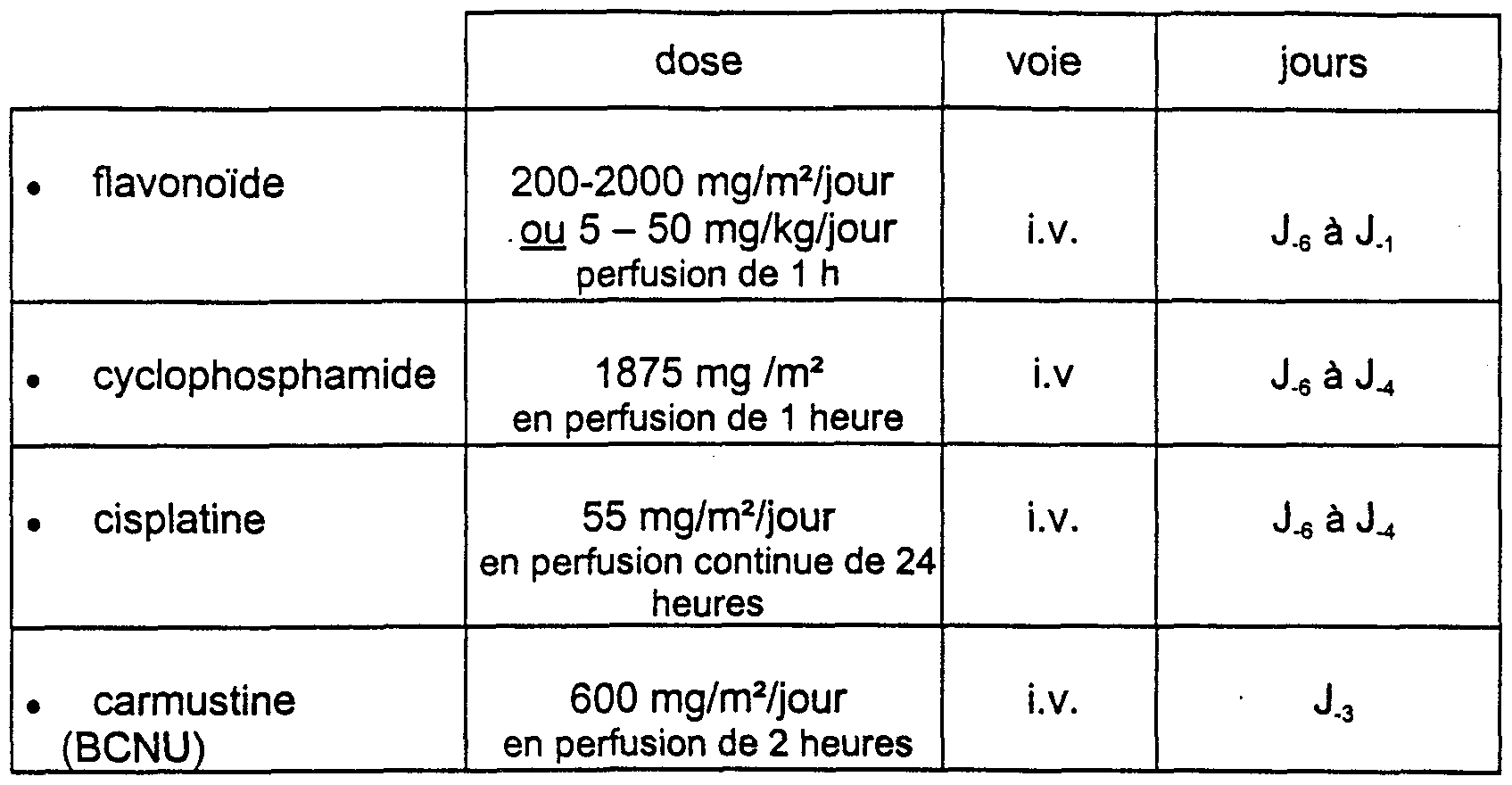
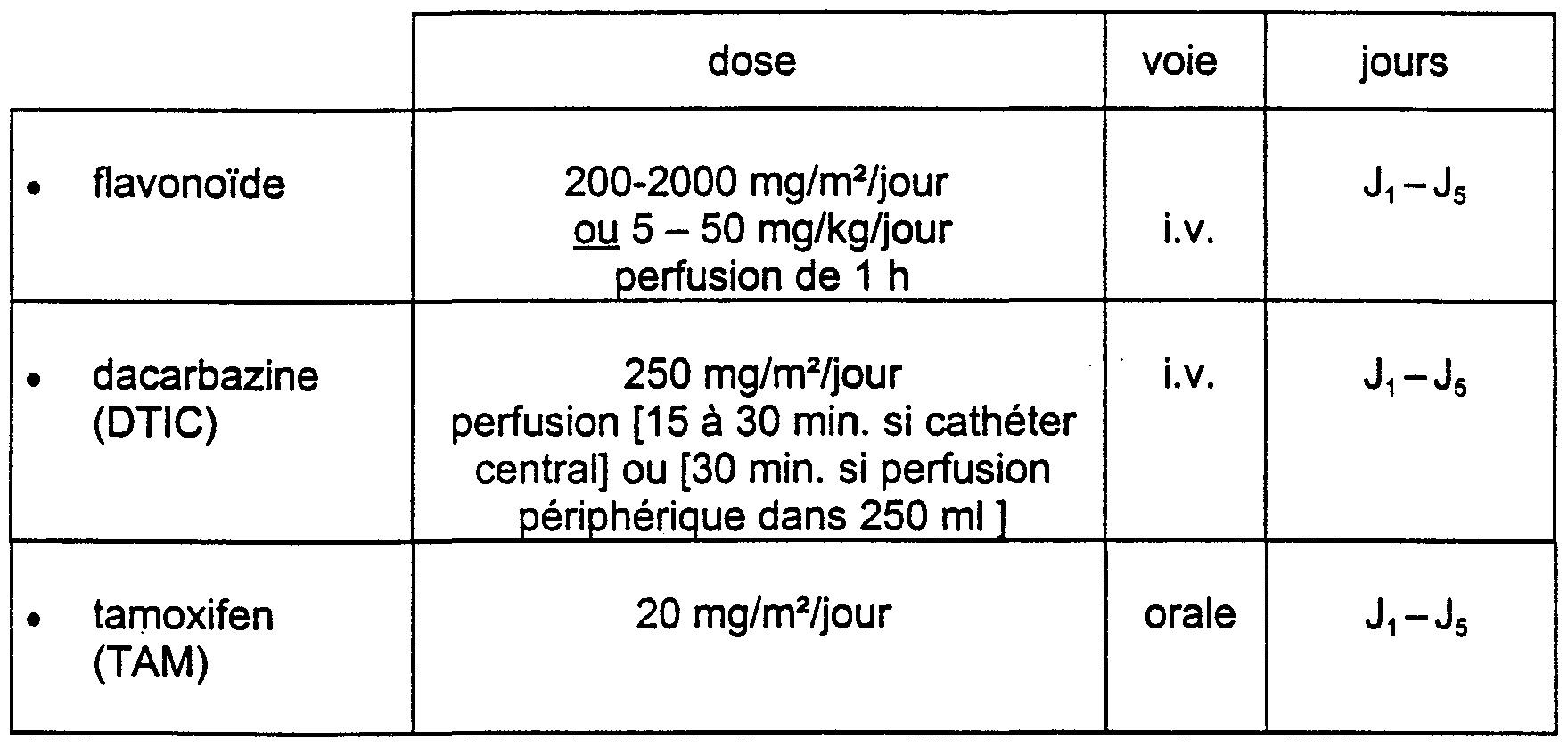
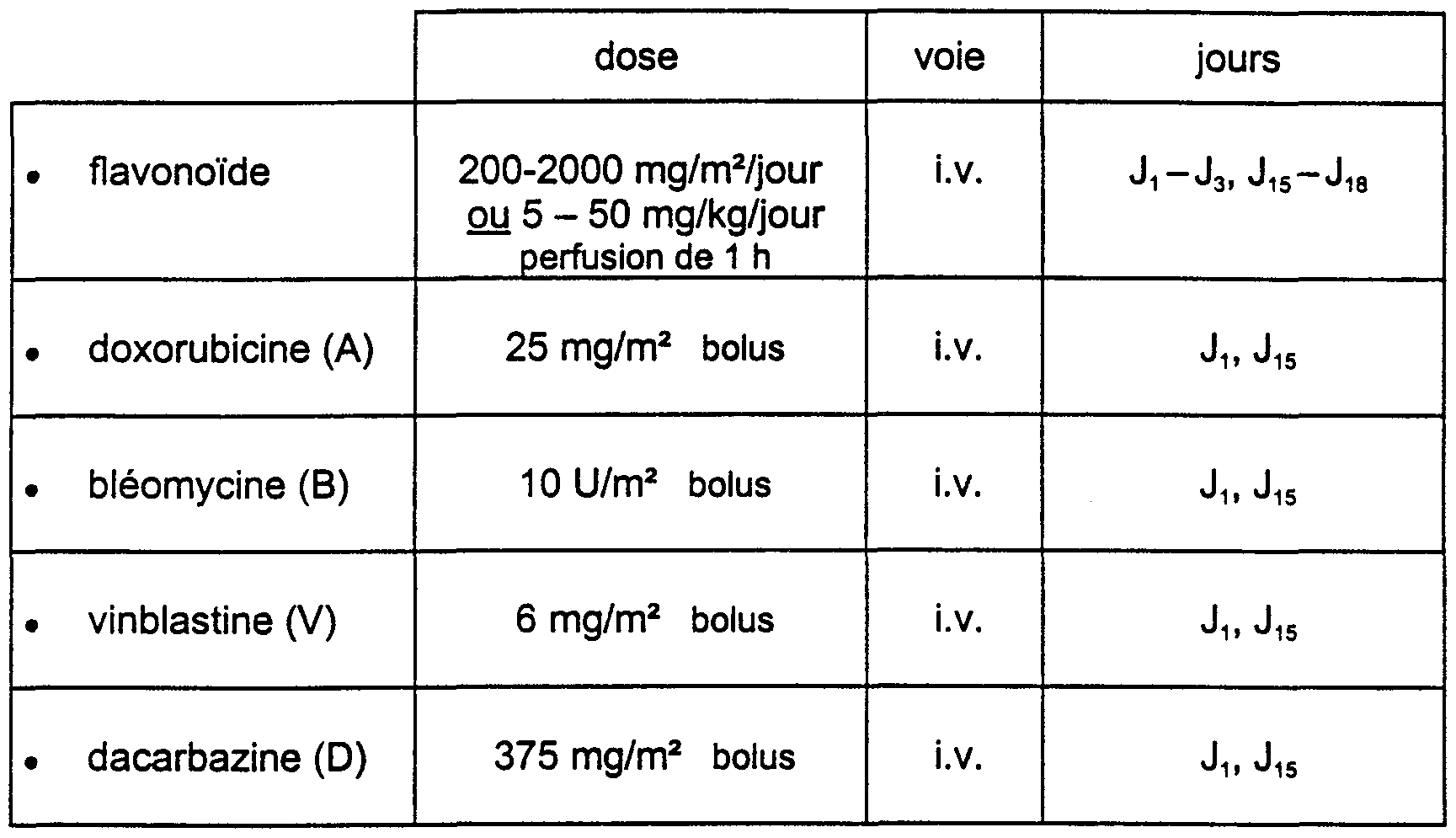
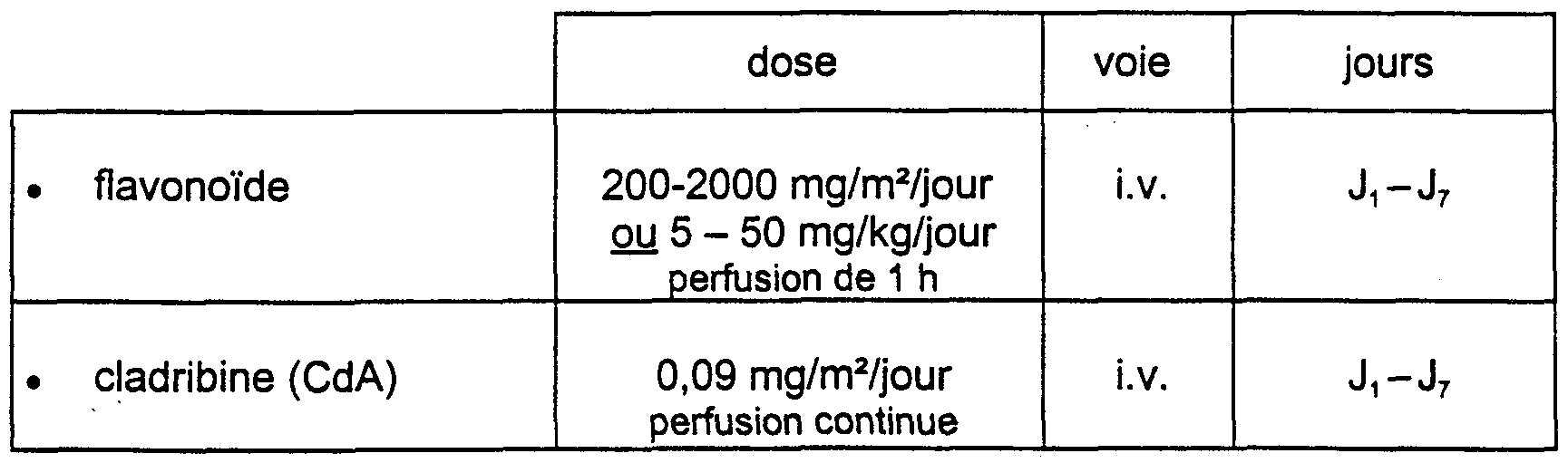
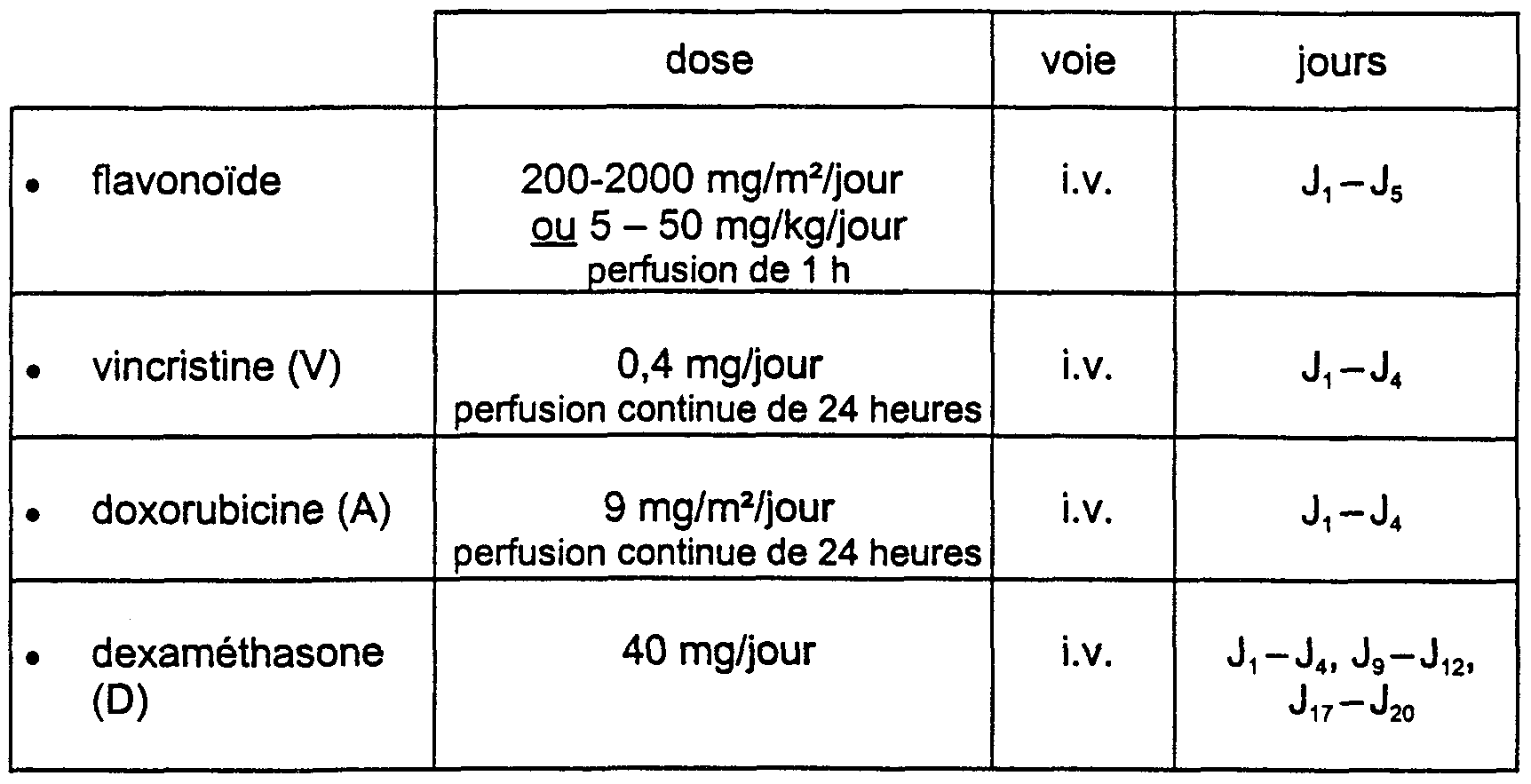
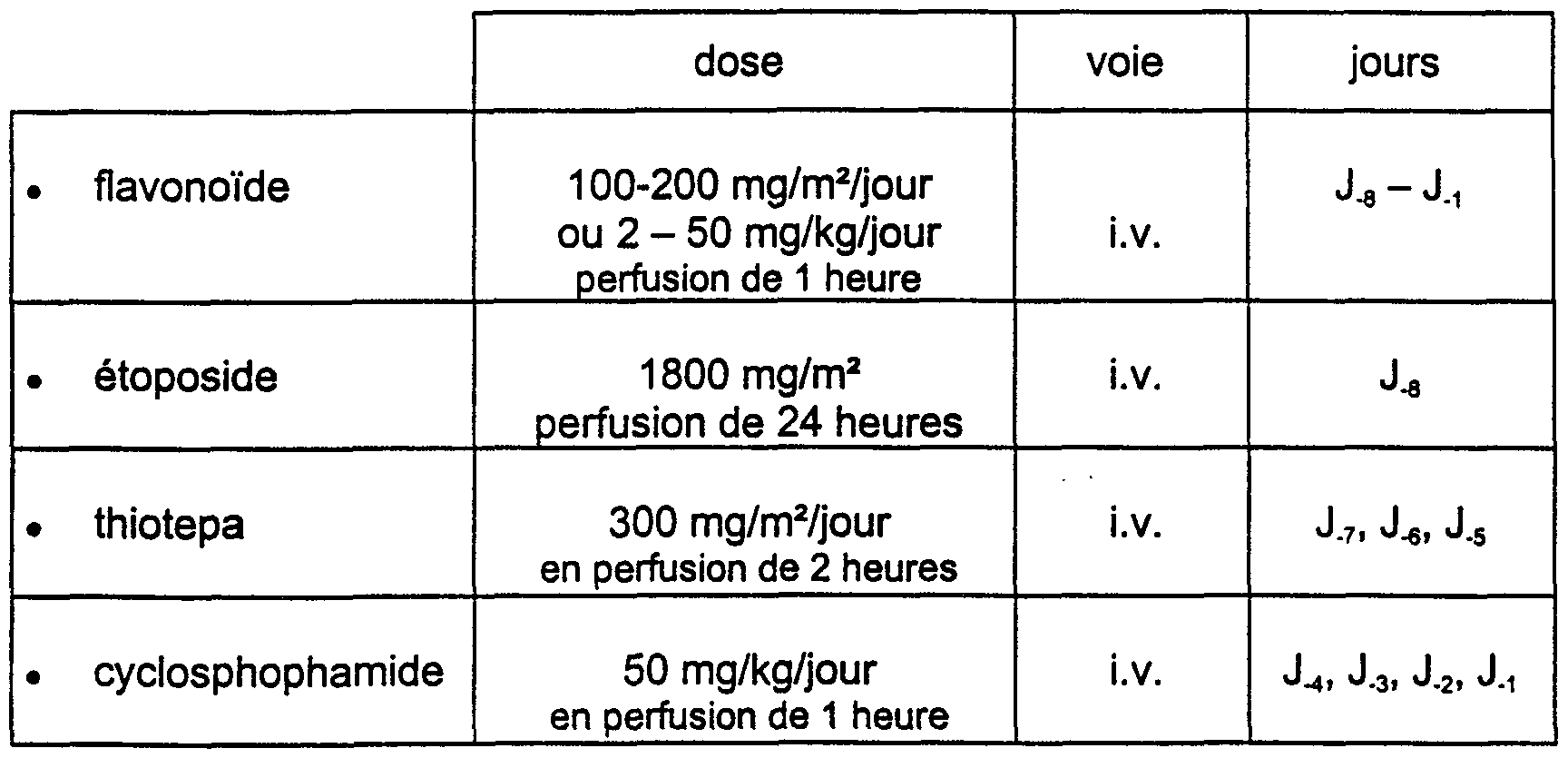
- the flavonoids and in particular the compounds of formula I can be administered at the start of the chemotherapeutic treatments either at once or over several days at the start of these treatments (for example for 5 to 7 days) and, depending on the chemotherapy protocol, at the start of each treatment cycle (for example for 2 to 5 days) during each course.
- the compounds of formula I are advantageously administered by infusion (generally in 1 to 3 hours) at doses of 5 to 50 mg / kg / day or 200 to 2000 mg / m 2 / day.
- the flavonoids In order to obtain maximum effect on the production of clonogenic cells, the flavonoids must be administered in such a way that the tissue concentrations obtained are the highest that can be envisaged.
- the intravenous route is to be preferred using: - ready-to-use infusion solutions (bags, vials ”) intended to be administered as such by intravenous infusion using an infusion line and according to the recommended rate:
- lyocs for oral or pertingual absorption
- instant or delayed release tablets for oral solutions, suspensions, granules, capsules, etc.
- the compounds of formula (I) are for the majority of compounds of natural origin or are derivatives of compounds of natural origin. As examples we can cite:
- flavones such as: - quercetin,
- Flavones are the preferred compounds.
- the cytotoxic agents can be chosen from: i) intercalating agents, in particular daunorubicin, epirubicin, idarubicin, zorubicin, adarubicin, pirarubicin, acridin, mitoxanthrone, actinomycin D, eptilinium acetate; ii) alkylating agents chosen from platinum derivatives (cisplatin, carboplatin, oxaliplatin); iii) a compound chosen from other groups of alkylating agents: - cyclophosphamide, ifosfamide, chlormetrine, melphalan, chlorambucil, estramustine, - busulfan, mitomycin C,
- BCNU carmustine
- CCNU lamelonine
- fotemustine fotemustine
- streptozotocin
- -ethylene-imines altretamine, triethylene-thiophosphoramide, iv) a compound chosen from other groups of anti-metabolic agents:
- - antipurics purinethol, thioguanine, pentostatin, cladribine
- vinca-alkaloids disorganizing the mitotic spindle: vincristine, vinblastine, vinguerine, navelbine
- - topoisomerase I inhibitors inducing DNA breaks topotecan, irinotecan, vi) a splitting agent, fragmenting DNA, such as bleomycin, vii) one of the following compounds; plicamycin, Asparaginase, mitoguazone, dacarbazine, viii) an anti-cancer progestin steroid: medroxy-progesterone, megestrol, ix) an anti-cancer estrogenic steroid: diethylstilbestrol; tetrasodium fosfestrol, x) an anti-estrogen: tamoxifen, droloxifene, raloxifene, amino-gluthetimide, xi) a steroid antiandrogen (ex cyproterone) or a nonsteroidal antiandrogen (flutamide, nilutamide).
- the compounds of formula I can be combined with any treatment with major cytotoxic agents used in multidrug chemotherapy for
- mitomycin C - anti-metabolites such as methotrexate, 5-FU, Ara-C, capecitabine
- vinca alkaloids vincristine, vinblastine, vindesine, navelbine
- taxoids paclitaxel, docetaxel
- epipodophyllotoxin derivatives etoposide, teniposide
- topoisomerase I inhibitors topotecan, irinotecan.
- the compounds of formula I can be combined with treatments by the major cytotoxic agents used in oncohematology for the treatment of blood cancers: - Hodgkin's disease: cyclophosphamide, mechlorethamine, chlorambucil, melphalan, ifosfamide, etoposide, doxorubicin, daunorubicin;
- methotrexate methotrexate, 6-mercaptopurine, cytarabine, vinblastine, vincristine, doxorubicin, daunorubicin, L-asparaginase;
- a cell is considered clonogenic if it has the capacity to proliferate and to give rise to a cell colony.
- the “human tumor stem cells” or “human tumor stem cells” are the cells which are at the origin of the neoplastic cells which constitute a given tumor. These tumor stem cells are responsible for the recurrence processes observable after surgical resection of the primary tumors and are also responsible for the formation of metastases. At the level of a tumor or a tumor cell line, these clonogenic stem cells differ from other cells of the tumor or of the neoplastic cell line considered, by the fact that they retain their capacity to proliferate in the absence of any solid support.
- the tumor cells are cultured on a semi-solid support constituted by agar. Only cells which do not require solid support for their growth (ie very tumorigenic cells called “anchorage-independent cells” by Ml Dawson et al., Cancer Res. 1995; 55: 4446-4451; also called clonogenic cells with reference to “clonal growth”) are capable of growing on such an agar-based support. Indeed, on such a medium, normal cells - which are growing in "adherent mode" (“anchorage- dependent cells” according to the terminology of M.l. Dawson) - like for example fibroblasts, do not survive.
- the tumor cell lines studied are maintained in culture in 25 cm 2 falcon dishes. They are then trypsinized and the cells well dissociated from each other. The percentage of living cells is determined after staining with trypan blue.
- a cell suspension at a concentration of 5.10 4 to 15.10 4 cells / ml (depending on the cell type considered) is prepared in a 0.3% agar solution. Then, 200 ⁇ l of this suspension are seeded in 35 mm diameter petri dishes, in which are deposited 3 ml of a base layer consisting of a 0.5% agar solution. The 200 ⁇ l of cell suspension are in turn covered with 1.8 ml of an upper layer consisting of a 0.3% agar solution.
- the dishes are then placed in an incubator at 37 ° C, 5% CO 2 and 70% humidity until treatment. The latter is carried out approximately 1 to 2 hours after sowing.
- the compounds to be tested are prepared at a concentration 100 times greater than the desired concentration and 50 ⁇ l of these treating solutions are deposited on the upper layer of agar of the corresponding boxes. In the present study, the final concentration of the test products is 10 "5, 10" 7 and 10 "9 M. The boxes are then held 21 days in the incubator.
- the dishes are treated by depositing on the upper layer 100 ⁇ l of a solution of MTT (bromide of 3- (4,5-dimethylthiazol-2-yl) -2,5-diphenyltetrazolinium at 1 mg / ml prepared with RPMI 1640 medium for 3 h at 37 ° C. After this time, the cell colonies are fixed by adding 2 m / formalin per dish.
- MTT bromide of 3- (4,5-dimethylthiazol-2-yl) -2,5-diphenyltetrazolinium
- quercetin is capable of partially inhibiting the proliferation of clonogenic cells within the tumor, that is to say inducing a significant reduction in the number of colonies of these cells compared to to that obtained in the control condition (from 20% to 50%), and therefore contributes to making the tumors from which they originate more sensitive to conventional treatment with cytotoxic agents.
- the principle of the MTT test is based on the mitochondrial reduction by the metabolically active living cells of the MTT product (3- (4,5-dimethylthiazol-2- yl) -2,5 diphenyltetrazolium bromide) yellow in color blue, formazan.
- the quantity of formazan thus obtained is directly proportional to the quantity of living cells present in the culture well (s). This quantity of formazan is measured by spectrophotometry.
- the cell lines are maintained in monolayer culture at 37 ° C. in closed-cap culture dishes containing MEM 25 MM HEPES base medium (Minimum Essential Medium). This environment is well suited to the growth of a range various diploid or primary mammalian cells. This medium is then added:
- the 12 human cancer cell lines that were used were obtained from the American Type Culture Collection (ATCC, Rockville, MD, USA). These 12 cell lines are:
- the intensity of the blue coloration therefore resulting from the transformation of the yellow MTT product into blue formazan by the cells still alive at the end of the experiment is quantified by spectrophotometry using a device of the DYNATECH IMMUNOASSAY SYSTEM type at the lengths d wave of 570 nm and 630 nm corresponding respectively to the wavelengths of maximum absorbance of formazan and to the background noise.
- Software integrated into the spectrophotometer calculates the average values of optical density as well as the values of standard deviation (Dev. Std.) And standard error on the mean (ESM).
- the results of the average optical density expressed as a percentage relative to the average optical density measured in the control condition (posed equal to 100%), will be given in Table II, obtained - by way of example nonlimiting - with a flavonoid: quercetin, on the 5 tumor cell lines U-373MG,
- quercetin has a weak anti-tumor power.
- This product non-cytotoxic, induced an inhibition of overall proliferation of these cell lines only at a concentration of 10- 5 M and this inhibition does not exceed 20%. At the other concentrations tested, only a few marginal effects can be highlighted.
- the evaluation of the maximum tolerated dose was carried out in B6D2F1 / Jico mice aged 4 to 6 weeks.
- the compounds were administered intraperitoneally at increasing doses ranging from 2.5 to 160 mg / kg.
- the value of the DMT (expressed in mg / kg) is determined from the observation of the survival rate of the animals over a period of 14 days after a single administration of the product considered. The weight evolution of the animals is also monitored during this period.
- the value of the DMT is greater than 160 mg / kg
- the value of the DMT is assimilated to 160 mg / kg by default. Quercetin is associated by default with a DMT equal to 160 mg / kg. This result underlines that the products belonging to the family of flavonoids do not have direct toxicity and can be used at high tissue concentrations, therefore at high dosages.
- each cycle is repeated every 21 days and the treatment includes 6 cycles.
- the course of treatment may include repeating this 4-week cycle.
- the treatment including the repetition of this cycle every 21 days.
- each cycle is repeated every 28 days and the treatment has 6 cycles.
- each cycle is repeated every 28 days until the diagnosis of a new progression of the disease.
- this treatment is to be repeated every 28 days until the diagnosis of disease progression.
- the treatment has two cycles spaced 21 days apart and then requires an evaluation.
- Flavonoid infusions can also be used to treat metastatic breast cancer when a taxoid is used, for example:
- This cycle is repeated every 21 days until a new progression of the disease is diagnosed.
- This cycle is repeated every 21 days for a cure of 2 cycles or until the onset of disease progression.
- the treatment comprising two cycles, spaced 28 days apart.
- paclitaxel protocol flavonoids can be added to the paclitaxel protocol as described by W.P. Me Guire et al. (Ann. Intern. Med. 1989; 111: 273 - 279):
- the treatment comprising two of these cycles, spaced 28 days apart (with evaluation at the end).
- flavonoids can be added to the second-line protocol, based on topotecan: the treatment comprising two cycles, spaced 21 days apart (with evaluation at the end)
- flavonoids may be associated with the protocol described by H. Takamizawa et al. (Semin. Surg. Oncol. 1987; 3: 36-44):
- the flavonoids can also be associated with the CAV (or VAC) protocol according to the following scheme: the treatment including the repetition of this cycle every 21 days.
- the treatment including the repetition of this cycle every 21 or 28 days.
- - flavonoids can also be associated with testicular cancer protocols: the treatment comprising 3 cycles, at the rate of 1 cycle every 21 days.
- flavonoids can be associated with the CISCA2 protocol (also called PAC)
- ABVD protocol the cure comprising 1 to 6 cycles repeated at the rate of 1 cycle every 4 weeks.
- the treatment comprising two cycles, at the rate of 1 cycle every 3 weeks.
- Flavonoids can be introduced into a protocol such as the protocol CYVADIC: according to HM Pinedo et al. (Cancer 1984; 53: 1825)
- the cure comprising 4 cycles, at the rate of 1 cycle every 21 or 28 days.
- flavonoids can be introduced into the protocol described by M. J. Wilkinson et al. (Cancer 1993; 71: 3601-3604):
- the treatment comprising two cycles spaced 28 days apart.
- nephroblastoma flavonoids can be introduced into the DAVE protocol:
- EAP protocol (after P. Preusser et al., J. Clin. Oncol. 1989; 7: 1310):
- the treatment first comprising two cycles, spaced 28 days apart.
- this protocol or its variant epirubicin replacing doxorubicin may be used according to the following scheme:
- the flavonoids can be introduced into the FU-Levamizole adjuvant treatment protocol for colorectal cancer (after C.G. Moertel et al., N. Eng. J. Med. 1990; 322: 352):
- the bolus treatment with 5-FU being repeated each week after the induction phase D, - D 5 , for .52 weeks; that by a flavonoid being repeated at the same rate, the day of the 5-FU bolus and then the following 2 days.
- the treatment comprising two cycles, spaced 42 days apart.
- the treatment comprising two cycles repeated 28 days apart before evaluating the effects.
- the treatment comprising two cycles repeated every 28 days.
- flavonoids can be associated with gemcitabine treatment, according to the protocol of M. Moore et al. (Proc. Am. Soc. Clin. Oncol. 1995; 14: 473):
- Acute lymphoblastic leukemia 1.1. Acute lymphoblastic leukemia:
- Flavonoids can be added to Linker's protocols - Induction Chemotherapy and Consolidation Chemotherapy. (see C.A. Linker et al. Blood 1987; 69: 1242-1248 and C.A. Linker et al. Blood 1991; 78: 2814-2822) according to the following diagrams:
- the flavonoids can be added to the cytotoxics of this polychemotherapy protocol (D. Hoeizer et al., Blood 1984; 64: 38-47, D. Hoeizer et al., Blood 1988; 71: 123-131) according to the following scheme: i) induction chemotherapy / Phase 1:
- Phase 2 of the induction can be carried out as follows:
- the flavonoids can be added, according to the diagram below, to the treatment incorporating the standard dose of cytarabine previously described by R.O. Dilleman et al. (Blood, 1991; 78: 2520-2526), Z.A. Arlin et al. (Leukemia 1990; 4: 177-183) and P.H. Wiernik et al. (Blood 1992; 79: 313-319):
- This induction cycle incorporates the administration of high-dose cytarabine according to the following scheme:
- This protocol includes an autologous bone marrow transplant (performed on day D 0 ):
- the flavonoids can be added to the HU-Mith treatment, described by C.A. Koller et al. (N. Engl. J. med. 1986; 315: 1433-1438):
- the flavonoids can be added to the "pulsed chlorambucil" combinations as described by E. Kimby et al. (Leuk. Lymphoma 1991; 5 (SuppI.) 93-96) and by the FCGCLL (Blood 1990; 75: 1422-1425):
- Flavonoids can be incorporated into the multidrug protocols used conventionally for the treatment of Hodgkin's lymphoma:
- the cure comprising 6 to 8 cycles, at the rate of 1 cycle every 28 days.
- the MOPP protocol must be alternated with the ABVD protocol (see ⁇ 3.1.1) every 28 days and the treatment includes 6 cycles:
- the treatment comprising 3 cycles at the rate of 1 cycle every 28 days.
- the treatment comprising 6 cycles, at the rate of 1 cycle every 28 days.
- the treatment includes 8 to 10 cycles, one cycle every 28 days.
- each cycle is repeated every 28 days; for cladribine, each cycle is repeated every 35 days. .2.2. intermediate malignancy grade
- Mitoxantrone can be used to replace (CNOP protocol) doxorubicin in patients over 60 years of age (dose: 12 mg / m 2 bolus i; v. On day D1 of each cycle).
- the cure by the CHOP or CNOP protocol includes 6 to 8 cycles at the rate of 1 cycle every 21 days.
- This treatment protocol is spread over 12 weeks and corresponds to 1 cycle.
- the treatment comprising 10 cycles, at the rate of 1 cycle every 21 days.
- the cure comprising 6 to 8 cycles, at the rate of 1 cycle every 14 days.
- the treatment comprising 6 cycles, at the rate of 1 cycle every 28 days.
- Non-Hodgkin's lymphoma Burkitt's lymphoma, small cell lymphoma, lymphoblastic lymphoma.
- VCAP or VBAP protocol according to SE Salmon et al. (J. Clin. Oncol. 1983; 1: 453-461) VCAP protocol:
- VBAP protocol cyclophosphamide is replaced by carmustine (BCNU), the rest being identical:
- Flavonoids can also be incorporated into polychemotherapy protocols for the treatment of pediatric tumors in order to improve antitumor efficacy while reducing the severity of side effects thanks to the action on the recruitment and mobilization of clonogenic cells and the possibility of reducing active doses.
- Ewing's sarcoma Primary neuroectodermal tumor
- Flavonoids can be introduced into the VCR-Doxo-CY-1fos-Mesna-E protocol (ED Bergert et al., J. Clin. Oncol. 1990; 8: 1514 - 1524; WH Meyer et al., J. Clin. Oncol. 1992; 10: 1737 - 1742):
- the treatment includes 6 to 10 of these cycles depending on the initial severity of the sarcoma and the amplitude of the response.
- Flavonoids can be added to the recommended protocols (PS Gaynon et al., J. Clin. Oncol., 1993, 11, 2234-2242; J. Pullen et al., J. Clin. Oncol. 1993; 11: 2234-2242 ; J. Pullen et al., J. Clin. Oncol. 1993; 11: 839 -849; VJ Land et al., J. Clin. Oncol. 1994; 12: 1939 -1945): depending on the result of the examination of the bone marrow, the transition to the consolidation phase takes place on day D 28 of the treatment protocol.
- Flavonoids can be introduced into the maintenance protocol (PS Gaynon et al., J. Clin. Oncol. 1993; 11: 2234-2242; J. Pullen et al., J. Clin. Oncol. 1993; 11: 839 - 849; VJ Land et al., J. Clin. Oncol. 1994; 12: 1939 -1945) according to the following scheme: 37 Acute myeloid leukemia in children
- Flavonoids are added to the induction and consolidation / maintenance protocols according to the following schemes:
- Flavonoids can be added to the MOPP-ABVD protocol according to EA Gehan et al. (Cancer 1990; 65: 1429-1437), SP Hunger et al. (J. Clin. Oncol. 1994; 12: 2160-2166) and MM Hudson et al. (J. Clin. Oncol. 1993; 11: 100-108):
- This cycle must be repeated 6 times at the rate of 1 cycle every 8 weeks, the treatment comprising 6 cycles.
- Flavonoids may also be associated with induction chemotherapy protocols (AT Meadows et al., J. Clin. Oncol. 1989; 7: 92 - 99 - C. Patte et al., Med. Ped. Oncol. 1992; 20 : 105 - 113 and A. Reiter et al., J. Clin. Oncol. 1995; 13: 359 - 372) and maintenance chemotherapy:
- the evaluation of the therapeutic response is made after 9 weeks in order to decide on the attitude: surgical resection, radiotherapy or new chemotherapy.
- Flavonoids can be added to the Doxo-Pt-Mtx-Lcv protocol as described by M. Hudson et al. (J. Clin. Oncol. 1990; 8: 1988 - 1997), PA Meyers (J. Clin. Oncol. 1992; 10: 5 - 15), and HCV Bramwell et al. (J. Clin. Oncol. 1992; 10: 1579-1591):
- Vcr-Dact-CY-Mesna protocol H. Maurer et al., Cancer 1993; 71: 1904 - 1922 and LR Mandell et al., Oncology 1993; 7: 71 - 83
- the Vcr-Dact-CY-Mesna protocol may include the iv infusion of flavonoids depending on the following diagram:
Landscapes
- Health & Medical Sciences (AREA)
- Life Sciences & Earth Sciences (AREA)
- Veterinary Medicine (AREA)
- Chemical & Material Sciences (AREA)
- Medicinal Chemistry (AREA)
- Pharmacology & Pharmacy (AREA)
- Animal Behavior & Ethology (AREA)
- General Health & Medical Sciences (AREA)
- Public Health (AREA)
- Epidemiology (AREA)
- Chemical Kinetics & Catalysis (AREA)
- General Chemical & Material Sciences (AREA)
- Nuclear Medicine, Radiotherapy & Molecular Imaging (AREA)
- Organic Chemistry (AREA)
- Molecular Biology (AREA)
- Engineering & Computer Science (AREA)
- Bioinformatics & Cheminformatics (AREA)
- Pharmaceuticals Containing Other Organic And Inorganic Compounds (AREA)
- Pyrane Compounds (AREA)
Abstract
Description












Claims


Priority Applications (8)
| Application Number | Priority Date | Filing Date | Title |
|---|---|---|---|
| BR9912816-0A BR9912816A (pt) | 1998-07-15 | 1999-07-13 | Composição terapêutica à base de flavonóides, tencionada para uso no tratamento de tumores por agentes citotóxicos |
| JP2000559841A JP2002520356A (ja) | 1998-07-15 | 1999-07-13 | 細胞毒性剤による腫瘍の処理への使用が意図された、フラボノイドに基づく治療組成物 |
| EA200100140A EA200100140A1 (ru) | 1998-07-15 | 1999-07-13 | Терапевтическая композиция на основе флавоноидов для применения в лечении опухолей цитотоксическими агентами |
| IL14058899A IL140588A0 (en) | 1998-07-15 | 1999-07-13 | Therapeutic composition based on flavonoids intended to be used in the treatment of tumours by cytotoxic agents |
| EP99931342A EP1096930A1 (fr) | 1998-07-15 | 1999-07-13 | Composition therapeutique a base de flavono des destinee a etre utilisee dans le traitement des tumeurs par des agents cytotoxiques |
| KR1020017000478A KR20020003349A (ko) | 1998-07-15 | 1999-07-13 | 세포독성물질을 이용한 종양의 치료에 사용되는플라보노이드류를 기초로한 치료 조성물 |
| CA002337179A CA2337179A1 (fr) | 1998-07-15 | 1999-07-13 | Composition therapeutique a base de flavonoides, destinee a etre utilisee dans le traitement des tumeurs par des agents cytotoxiques |
| AU47890/99A AU4789099A (en) | 1998-07-15 | 1999-07-13 | Therapeutic composition based on flavonoids for use in the treatment of tumours with cytotoxic agents |
Applications Claiming Priority (2)
| Application Number | Priority Date | Filing Date | Title |
|---|---|---|---|
| FR9809058A FR2781153B1 (fr) | 1998-07-15 | 1998-07-15 | Composition therapeutique a base de flavonoides destinee a etre utilisee dans le traitement des tumeurs par des agents cytotoxiques |
| FR98/09058 | 1998-07-15 |
Publications (1)
| Publication Number | Publication Date |
|---|---|
| WO2000003706A1 true WO2000003706A1 (fr) | 2000-01-27 |
Family
ID=9528648
Family Applications (1)
| Application Number | Title | Priority Date | Filing Date |
|---|---|---|---|
| PCT/FR1999/001714 Ceased WO2000003706A1 (fr) | 1998-07-15 | 1999-07-13 | Composition therapeutique a base de flavonoïdes destinee a etre utilisee dans le traitement des tumeurs par des agents cytotoxiques |
Country Status (12)
| Country | Link |
|---|---|
| EP (1) | EP1096930A1 (fr) |
| JP (1) | JP2002520356A (fr) |
| KR (1) | KR20020003349A (fr) |
| CN (1) | CN1139384C (fr) |
| AU (1) | AU4789099A (fr) |
| BR (1) | BR9912816A (fr) |
| CA (1) | CA2337179A1 (fr) |
| EA (1) | EA200100140A1 (fr) |
| FR (1) | FR2781153B1 (fr) |
| IL (1) | IL140588A0 (fr) |
| WO (1) | WO2000003706A1 (fr) |
| ZA (1) | ZA200100239B (fr) |
Cited By (3)
| Publication number | Priority date | Publication date | Assignee | Title |
|---|---|---|---|---|
| WO2002069949A3 (fr) * | 2001-03-06 | 2003-06-05 | Patrick T Prendergast | Polytherapie pour la reduction de la toxicite d'agents chimiotherapeutiques |
| WO2003075943A3 (fr) * | 2002-03-06 | 2004-04-22 | Sophie Chen Ph D | Compositions d'extrait botanique et procedes d'utilisation |
| EP1808172A3 (fr) * | 2002-03-06 | 2010-05-26 | Activephyto Technologies Limited | Compostions à base d'extraits botaniques et procédés d'utilisation |
Families Citing this family (8)
| Publication number | Priority date | Publication date | Assignee | Title |
|---|---|---|---|---|
| US20030229136A1 (en) | 2002-04-18 | 2003-12-11 | Nurulain Zaveri | Novel flavanoids as chemotherapeutic, chemopreventive, and antiangiogenic agents |
| CN1679539A (zh) * | 2005-01-20 | 2005-10-12 | 吴一心 | 抗肿瘤的协同药物组合物 |
| CA2600797A1 (fr) * | 2005-03-11 | 2006-09-21 | The Regents Of The University Of Michigan | Inhibiteurs de chromen-4-one des elements anti-apoptotiques de la famille bcl-2 et utilisations |
| GB0808974D0 (en) * | 2008-05-16 | 2008-06-25 | Veritron Ltd | Plant extract and its therapeutic use |
| US9808477B2 (en) * | 2015-07-29 | 2017-11-07 | Macau University Of Science And Technology | Use of nobiletin in cancer treatment |
| US9808439B2 (en) * | 2015-07-29 | 2017-11-07 | Macau University Of Science And Technology | Use of tangeretin in cancer treatment |
| JP6775226B2 (ja) * | 2016-06-30 | 2020-10-28 | 国立大学法人広島大学 | 抗癌剤作用増強物質およびそれを備えた抗癌剤キット |
| CN106562954A (zh) * | 2016-11-11 | 2017-04-19 | 黄冈师范学院 | (去甲基)多甲氧基黄酮联合紫杉醇类药物在制备治疗非小细胞肺癌的药物上的应用 |
Citations (11)
| Publication number | Priority date | Publication date | Assignee | Title |
|---|---|---|---|---|
| JPS5946217A (ja) * | 1982-09-09 | 1984-03-15 | Rikagaku Kenkyusho | 制癌剤 |
| JPS5959627A (ja) * | 1982-09-27 | 1984-04-05 | Tatsuo Miyoshi | 制癌剤 |
| JPS60199817A (ja) * | 1984-03-23 | 1985-10-09 | Rikagaku Kenkyusho | 制癌剤 |
| JPS632925A (ja) * | 1986-06-23 | 1988-01-07 | Nippon Kayaku Co Ltd | Cキナ−ゼ阻害剤および抗腫瘍剤 |
| EP0352147A2 (fr) * | 1988-06-23 | 1990-01-24 | Abraxas Bio Labs S.A. | Utilisation de la Naringine, de la Naringénine ou leurs dérivés pour faire une composition pharmaceutique anticancéreuse |
| JPH04103529A (ja) * | 1990-08-24 | 1992-04-06 | Tatsuo Miyoshi | 制癌剤 |
| JPH04103532A (ja) * | 1990-08-24 | 1992-04-06 | Tatsuo Miyoshi | 制癌剤 |
| JPH0570348A (ja) * | 1991-09-14 | 1993-03-23 | Kureha Chem Ind Co Ltd | 多剤耐性抑制剤 |
| EP0642793A1 (fr) * | 1992-05-11 | 1995-03-15 | TSUMURA & CO. | Inducteur de l'apoptose |
| WO1996031206A2 (fr) * | 1995-04-07 | 1996-10-10 | Warner-Lambert Company | Flavones et coumarines utilisees en tant qu'agents dans le traitement de l'atherosclerose |
| DE29719198U1 (de) * | 1997-10-29 | 1998-04-23 | Deutsches Institut für Ernährungsforschung Potsdam-Rehbrücke, 14558 Bergholz-Rehbrücke | Flavono/Flavonoid-Zubereitung |
-
1998
- 1998-07-15 FR FR9809058A patent/FR2781153B1/fr not_active Expired - Fee Related
-
1999
- 1999-07-13 CA CA002337179A patent/CA2337179A1/fr not_active Abandoned
- 1999-07-13 WO PCT/FR1999/001714 patent/WO2000003706A1/fr not_active Ceased
- 1999-07-13 KR KR1020017000478A patent/KR20020003349A/ko not_active Withdrawn
- 1999-07-13 AU AU47890/99A patent/AU4789099A/en not_active Abandoned
- 1999-07-13 CN CNB998098353A patent/CN1139384C/zh not_active Expired - Fee Related
- 1999-07-13 EA EA200100140A patent/EA200100140A1/ru unknown
- 1999-07-13 IL IL14058899A patent/IL140588A0/xx unknown
- 1999-07-13 JP JP2000559841A patent/JP2002520356A/ja active Pending
- 1999-07-13 BR BR9912816-0A patent/BR9912816A/pt not_active IP Right Cessation
- 1999-07-13 EP EP99931342A patent/EP1096930A1/fr not_active Withdrawn
-
2001
- 2001-01-09 ZA ZA200100239A patent/ZA200100239B/en unknown
Patent Citations (11)
| Publication number | Priority date | Publication date | Assignee | Title |
|---|---|---|---|---|
| JPS5946217A (ja) * | 1982-09-09 | 1984-03-15 | Rikagaku Kenkyusho | 制癌剤 |
| JPS5959627A (ja) * | 1982-09-27 | 1984-04-05 | Tatsuo Miyoshi | 制癌剤 |
| JPS60199817A (ja) * | 1984-03-23 | 1985-10-09 | Rikagaku Kenkyusho | 制癌剤 |
| JPS632925A (ja) * | 1986-06-23 | 1988-01-07 | Nippon Kayaku Co Ltd | Cキナ−ゼ阻害剤および抗腫瘍剤 |
| EP0352147A2 (fr) * | 1988-06-23 | 1990-01-24 | Abraxas Bio Labs S.A. | Utilisation de la Naringine, de la Naringénine ou leurs dérivés pour faire une composition pharmaceutique anticancéreuse |
| JPH04103529A (ja) * | 1990-08-24 | 1992-04-06 | Tatsuo Miyoshi | 制癌剤 |
| JPH04103532A (ja) * | 1990-08-24 | 1992-04-06 | Tatsuo Miyoshi | 制癌剤 |
| JPH0570348A (ja) * | 1991-09-14 | 1993-03-23 | Kureha Chem Ind Co Ltd | 多剤耐性抑制剤 |
| EP0642793A1 (fr) * | 1992-05-11 | 1995-03-15 | TSUMURA & CO. | Inducteur de l'apoptose |
| WO1996031206A2 (fr) * | 1995-04-07 | 1996-10-10 | Warner-Lambert Company | Flavones et coumarines utilisees en tant qu'agents dans le traitement de l'atherosclerose |
| DE29719198U1 (de) * | 1997-10-29 | 1998-04-23 | Deutsches Institut für Ernährungsforschung Potsdam-Rehbrücke, 14558 Bergholz-Rehbrücke | Flavono/Flavonoid-Zubereitung |
Non-Patent Citations (12)
| Title |
|---|
| BRACKE M E ET AL: "CITRUS FLAVONOID EFFECT ON TUMOR INVASION AND METASTASIS THE CITRUS FLAVONOID TANGERETIN MAY INHIBIT THE PROCESSES THAT SHORTEN THE LIFE EXPECTANCY OF TUMOR-BEARING PATIENTS", FOOD TECHNOLOGY, vol. 48, no. 11, 1 November 1994 (1994-11-01), pages 121 - 124, XP000483355 * |
| BRANDI M L: "FLAVONOIDS: BIOCHEMICAL EFFECTS AND THERAPEUTIC APPLICATIONS", BONE AND MINERAL, vol. 19, no. SUPPL, October 1992 (1992-10-01), pages S03 - S14, XP000671435 * |
| KONOSHIMA T ET AL: "STUDIES ON INHIBITORS OF SKIN TUMOR PROMOTION (IV)1,2) INHIBITORY EFFECTS OF FLAVONOIDS ON EPSTEIN-BARR VIRUS ACTIVATION (1)", NATURAL MEDICINES (SHOYAKUGAKU ZASSHI), vol. 42, no. 4, 1988, pages 343 - 346, XP000601362 * |
| KONOSHIMA T ET AL: "STUDIES ON INHIBITORS OF SKIN TUMOR PROMOTION (V) INHIBITORY EFFECTS OF FLAVONOIDS ON EPSTEIN-BARR VIRUS ACTIVATION. II", JAPANESE JOURNAL OF PHARMACOGNOSY (SHOYAKUGAKU ZASSHI), vol. 43, no. 2, 1989, pages 135 - 141, XP002037231 * |
| MIDDLETON E ET AL: "POTENTIAL HEALTH-PROMOTING PROPERTIES OF CITRUS FLAVONOIDS SEVERAL HEALTH-PROMOTING EFFECTS HAVE BEEN ASCRIBED TO THE FLAVONOIDS ON THE BASIS OF IN-VITRO AND ANIMAL STUDIES", FOOD TECHNOLOGY, vol. 48, no. 11, 1 November 1994 (1994-11-01), pages 115 - 119, XP000483354 * |
| PATENT ABSTRACTS OF JAPAN vol. 10, no. 56 (C - 331) 6 March 1986 (1986-03-06) * |
| PATENT ABSTRACTS OF JAPAN vol. 12, no. 202 (C - 503) 10 June 1988 (1988-06-10) * |
| PATENT ABSTRACTS OF JAPAN vol. 16, no. 342 (C - 0966) 24 July 1992 (1992-07-24) * |
| PATENT ABSTRACTS OF JAPAN vol. 17, no. 391 (C - 1087) 22 July 1993 (1993-07-22) * |
| PATENT ABSTRACTS OF JAPAN vol. 8, no. 134 (C - 230) 21 June 1984 (1984-06-21) * |
| PATENT ABSTRACTS OF JAPAN vol. 8, no. 156 (C - 234) 19 July 1984 (1984-07-19) * |
| SCHWARTZ A ET AL: "COMPARISON OF THE EFFECTS OF QUERCETIN WITH THOSE OF OTHER FLAVONOIDS ON THE GENERATION AND EFFECTOR FUNCTION OF CYTOTOXIC T LYMPHOCYTES", IMMUNOPHARMACOLOGY, vol. 7, no. 2, April 1984 (1984-04-01), pages 115 - 126, XP002065678 * |
Cited By (3)
| Publication number | Priority date | Publication date | Assignee | Title |
|---|---|---|---|---|
| WO2002069949A3 (fr) * | 2001-03-06 | 2003-06-05 | Patrick T Prendergast | Polytherapie pour la reduction de la toxicite d'agents chimiotherapeutiques |
| WO2003075943A3 (fr) * | 2002-03-06 | 2004-04-22 | Sophie Chen Ph D | Compositions d'extrait botanique et procedes d'utilisation |
| EP1808172A3 (fr) * | 2002-03-06 | 2010-05-26 | Activephyto Technologies Limited | Compostions à base d'extraits botaniques et procédés d'utilisation |
Also Published As
| Publication number | Publication date |
|---|---|
| ZA200100239B (en) | 2002-01-09 |
| EP1096930A1 (fr) | 2001-05-09 |
| FR2781153B1 (fr) | 2001-08-03 |
| EA200100140A1 (ru) | 2001-06-25 |
| KR20020003349A (ko) | 2002-01-12 |
| CN1139384C (zh) | 2004-02-25 |
| CN1313765A (zh) | 2001-09-19 |
| JP2002520356A (ja) | 2002-07-09 |
| BR9912816A (pt) | 2001-05-08 |
| FR2781153A1 (fr) | 2000-01-21 |
| IL140588A0 (en) | 2002-02-10 |
| CA2337179A1 (fr) | 2000-01-27 |
| AU4789099A (en) | 2000-02-07 |
Similar Documents
| Publication | Publication Date | Title |
|---|---|---|
| EP1097138B1 (fr) | Compositions pharmaceutiques comprenant des 2-quinolones | |
| CA2149055C (fr) | Compositions antitumorales contenant des derives du taxane | |
| DE60216139T2 (de) | Arylharnstoff-verbindungen in kombination mit anderen zytostatisch oder zytotoxisch wirksamen stoffen zur behandlung menschlicher krebserkrankungen | |
| AU2002311985B2 (en) | Methods for inhibiting angiogenesis | |
| WO2000003707A1 (fr) | Composition therapeutique a base d'isoflavonoïdes destinee a etre utilisee dans le traitement des tumeurs par des agents cytotoxiques | |
| WO2000003706A1 (fr) | Composition therapeutique a base de flavonoïdes destinee a etre utilisee dans le traitement des tumeurs par des agents cytotoxiques | |
| HUE035101T2 (hu) | Ráksejtek célzása nanorészecskék alkalmazásával | |
| KR101128953B1 (ko) | 산삼 또는 인삼을 포함한 인삼류의 형성층 유래 식물줄기세포주를 유효성분으로 함유하는 암의 예방 또는 치료용 조성물 | |
| EP0352147A2 (fr) | Utilisation de la Naringine, de la Naringénine ou leurs dérivés pour faire une composition pharmaceutique anticancéreuse | |
| ES2279157T3 (es) | Extracto con actividad antitumoral y antivenenosa. | |
| Olawale et al. | The therapeutic value of alstonine: An updated review | |
| EP1202971A2 (fr) | Compositions pharmaceutiques comprenant des 4-quinolones pour le traitement des cancers | |
| CN100546593C (zh) | 一种从野山参中制备有抗癌活性的纯化提取物的方法及含有其的组合物 | |
| CN101098692B (zh) | 分离自calomeria amaranthoides的治疗性化合物 | |
| WO2010136705A1 (fr) | COMPOSITION PHARMACEUTIQUE ANTITUMORALE COMPRENANT UN INHIBITEUR DE Cdks ET UN INHIBITEUR DE LA CROISSANCE CELLULAIRE | |
| JP2011225510A (ja) | 新規な抗腫瘍剤 | |
| CN111773388B (zh) | A-失碳-5α雄甾烷化合物类药物与抗癌药物的联合应用 | |
| CN102485735A (zh) | 6-果糖氨-4-芳胺基喹唑啉衍生物及其用途 | |
| MXPA01000389A (en) | Therapeutic composition based on flavonoids for use in the treatment of tumours with cytotoxic agents | |
| CN101579328A (zh) | 康普立停的用途 | |
| Wolf et al. | Treatment options for small cell lung cancer | |
| CN118236327A (zh) | 一种共递送阿霉素-双氢青蒿素偶联前药/tepp-46纳米脂质体、其制备方法和应用 | |
| MXPA01000387A (en) | Therapeutic composition based on flavonoids for use in the treatment of tumours with cytotoxic agents | |
| TW202506163A (zh) | 香蕉萃取物在提高癌細胞對抗癌藥物的敏感性上的用途 | |
| KR20100128294A (ko) | 세포증식 억제 조성물 |
Legal Events
| Date | Code | Title | Description |
|---|---|---|---|
| WWE | Wipo information: entry into national phase |
Ref document number: 99809835.3 Country of ref document: CN |
|
| AK | Designated states |
Kind code of ref document: A1 Designated state(s): AE AL AM AT AU AZ BA BB BG BR BY CA CH CN CU CZ DE DK EE ES FI GB GD GE GH GM HR HU ID IL IN IS JP KE KG KP KR KZ LC LK LR LS LT LU LV MD MG MK MN MW MX NO NZ PL PT RO RU SD SE SG SI SK SL TJ TM TR TT UA UG US UZ VN YU ZA ZW |
|
| AL | Designated countries for regional patents |
Kind code of ref document: A1 Designated state(s): GH GM KE LS MW SD SL SZ UG ZW AM AZ BY KG KZ MD RU TJ TM AT BE CH CY DE DK ES FI FR GB GR IE IT LU MC NL PT SE BF BJ CF CG CI CM GA GN GW ML MR NE SN TD TG |
|
| 121 | Ep: the epo has been informed by wipo that ep was designated in this application | ||
| DFPE | Request for preliminary examination filed prior to expiration of 19th month from priority date (pct application filed before 20040101) | ||
| WWE | Wipo information: entry into national phase |
Ref document number: 140588 Country of ref document: IL |
|
| WWE | Wipo information: entry into national phase |
Ref document number: 1999931342 Country of ref document: EP |
|
| WWE | Wipo information: entry into national phase |
Ref document number: 2001/00239 Country of ref document: ZA Ref document number: 47890/99 Country of ref document: AU Ref document number: 200100239 Country of ref document: ZA |
|
| ENP | Entry into the national phase |
Ref document number: 2337179 Country of ref document: CA |
|
| WWE | Wipo information: entry into national phase |
Ref document number: PA/a/2001/000387 Country of ref document: MX Ref document number: 1020017000478 Country of ref document: KR |
|
| WWE | Wipo information: entry into national phase |
Ref document number: 09743676 Country of ref document: US |
|
| ENP | Entry into the national phase |
Ref document number: 2000 559841 Country of ref document: JP Kind code of ref document: A |
|
| WWE | Wipo information: entry into national phase |
Ref document number: 200100140 Country of ref document: EA |
|
| WWP | Wipo information: published in national office |
Ref document number: 1999931342 Country of ref document: EP |
|
| REG | Reference to national code |
Ref country code: DE Ref legal event code: 8642 |
|
| WWP | Wipo information: published in national office |
Ref document number: 1020017000478 Country of ref document: KR |
|
| WWW | Wipo information: withdrawn in national office |
Ref document number: 1999931342 Country of ref document: EP |
|
| WWW | Wipo information: withdrawn in national office |
Ref document number: 1020017000478 Country of ref document: KR |