WO2000064894A1 - 5-pyridyl-1,3-azole compounds, process for producing the same and use thereof - Google Patents
5-pyridyl-1,3-azole compounds, process for producing the same and use thereof Download PDFInfo
- Publication number
- WO2000064894A1 WO2000064894A1 PCT/JP2000/002575 JP0002575W WO0064894A1 WO 2000064894 A1 WO2000064894 A1 WO 2000064894A1 JP 0002575 W JP0002575 W JP 0002575W WO 0064894 A1 WO0064894 A1 WO 0064894A1
- Authority
- WO
- WIPO (PCT)
- Prior art keywords
- group
- substituent
- pyridyl
- methylphenyl
- thiazol
- Prior art date
- Legal status (The legal status is an assumption and is not a legal conclusion. Google has not performed a legal analysis and makes no representation as to the accuracy of the status listed.)
- Ceased
Links
- 0 CC=C(C=CC=C=*)C(NC(*1)=SC(c2ccnc(NC(c3cccnc3)=*=C)c2)=C1c(cc1)ccc1OC)=O Chemical compound CC=C(C=CC=C=*)C(NC(*1)=SC(c2ccnc(NC(c3cccnc3)=*=C)c2)=C1c(cc1)ccc1OC)=O 0.000 description 2
- JSQXFAVHGBQIKE-UHFFFAOYSA-N COc(cc1)ccc1-c1c(-c2ccc(C=C)c(NC(c3ccccc3)=O)c2)[s]c(N)n1 Chemical compound COc(cc1)ccc1-c1c(-c2ccc(C=C)c(NC(c3ccccc3)=O)c2)[s]c(N)n1 JSQXFAVHGBQIKE-UHFFFAOYSA-N 0.000 description 1
Classifications
-
- C—CHEMISTRY; METALLURGY
- C07—ORGANIC CHEMISTRY
- C07D—HETEROCYCLIC COMPOUNDS
- C07D417/00—Heterocyclic compounds containing two or more hetero rings, at least one ring having nitrogen and sulfur atoms as the only ring hetero atoms, not provided for by group C07D415/00
- C07D417/14—Heterocyclic compounds containing two or more hetero rings, at least one ring having nitrogen and sulfur atoms as the only ring hetero atoms, not provided for by group C07D415/00 containing three or more hetero rings
-
- A—HUMAN NECESSITIES
- A61—MEDICAL OR VETERINARY SCIENCE; HYGIENE
- A61K—PREPARATIONS FOR MEDICAL, DENTAL OR TOILETRY PURPOSES
- A61K31/00—Medicinal preparations containing organic active ingredients
- A61K31/33—Heterocyclic compounds
- A61K31/395—Heterocyclic compounds having nitrogen as a ring hetero atom, e.g. guanethidine or rifamycins
- A61K31/435—Heterocyclic compounds having nitrogen as a ring hetero atom, e.g. guanethidine or rifamycins having six-membered rings with one nitrogen as the only ring hetero atom
- A61K31/44—Non condensed pyridines; Hydrogenated derivatives thereof
- A61K31/4427—Non condensed pyridines; Hydrogenated derivatives thereof containing further heterocyclic ring systems
- A61K31/4439—Non condensed pyridines; Hydrogenated derivatives thereof containing further heterocyclic ring systems containing a five-membered ring with nitrogen as a ring hetero atom, e.g. omeprazole
-
- A—HUMAN NECESSITIES
- A61—MEDICAL OR VETERINARY SCIENCE; HYGIENE
- A61P—SPECIFIC THERAPEUTIC ACTIVITY OF CHEMICAL COMPOUNDS OR MEDICINAL PREPARATIONS
- A61P1/00—Drugs for disorders of the alimentary tract or the digestive system
-
- A—HUMAN NECESSITIES
- A61—MEDICAL OR VETERINARY SCIENCE; HYGIENE
- A61P—SPECIFIC THERAPEUTIC ACTIVITY OF CHEMICAL COMPOUNDS OR MEDICINAL PREPARATIONS
- A61P11/00—Drugs for disorders of the respiratory system
- A61P11/06—Antiasthmatics
-
- A—HUMAN NECESSITIES
- A61—MEDICAL OR VETERINARY SCIENCE; HYGIENE
- A61P—SPECIFIC THERAPEUTIC ACTIVITY OF CHEMICAL COMPOUNDS OR MEDICINAL PREPARATIONS
- A61P17/00—Drugs for dermatological disorders
- A61P17/06—Antipsoriatics
-
- A—HUMAN NECESSITIES
- A61—MEDICAL OR VETERINARY SCIENCE; HYGIENE
- A61P—SPECIFIC THERAPEUTIC ACTIVITY OF CHEMICAL COMPOUNDS OR MEDICINAL PREPARATIONS
- A61P19/00—Drugs for skeletal disorders
- A61P19/02—Drugs for skeletal disorders for joint disorders, e.g. arthritis, arthrosis
-
- A—HUMAN NECESSITIES
- A61—MEDICAL OR VETERINARY SCIENCE; HYGIENE
- A61P—SPECIFIC THERAPEUTIC ACTIVITY OF CHEMICAL COMPOUNDS OR MEDICINAL PREPARATIONS
- A61P25/00—Drugs for disorders of the nervous system
-
- A—HUMAN NECESSITIES
- A61—MEDICAL OR VETERINARY SCIENCE; HYGIENE
- A61P—SPECIFIC THERAPEUTIC ACTIVITY OF CHEMICAL COMPOUNDS OR MEDICINAL PREPARATIONS
- A61P25/00—Drugs for disorders of the nervous system
- A61P25/14—Drugs for disorders of the nervous system for treating abnormal movements, e.g. chorea, dyskinesia
- A61P25/16—Anti-Parkinson drugs
-
- A—HUMAN NECESSITIES
- A61—MEDICAL OR VETERINARY SCIENCE; HYGIENE
- A61P—SPECIFIC THERAPEUTIC ACTIVITY OF CHEMICAL COMPOUNDS OR MEDICINAL PREPARATIONS
- A61P25/00—Drugs for disorders of the nervous system
- A61P25/28—Drugs for disorders of the nervous system for treating neurodegenerative disorders of the central nervous system, e.g. nootropic agents, cognition enhancers, drugs for treating Alzheimer's disease or other forms of dementia
-
- A—HUMAN NECESSITIES
- A61—MEDICAL OR VETERINARY SCIENCE; HYGIENE
- A61P—SPECIFIC THERAPEUTIC ACTIVITY OF CHEMICAL COMPOUNDS OR MEDICINAL PREPARATIONS
- A61P29/00—Non-central analgesic, antipyretic or antiinflammatory agents, e.g. antirheumatic agents; Non-steroidal antiinflammatory drugs [NSAID]
-
- A—HUMAN NECESSITIES
- A61—MEDICAL OR VETERINARY SCIENCE; HYGIENE
- A61P—SPECIFIC THERAPEUTIC ACTIVITY OF CHEMICAL COMPOUNDS OR MEDICINAL PREPARATIONS
- A61P3/00—Drugs for disorders of the metabolism
-
- A—HUMAN NECESSITIES
- A61—MEDICAL OR VETERINARY SCIENCE; HYGIENE
- A61P—SPECIFIC THERAPEUTIC ACTIVITY OF CHEMICAL COMPOUNDS OR MEDICINAL PREPARATIONS
- A61P3/00—Drugs for disorders of the metabolism
- A61P3/08—Drugs for disorders of the metabolism for glucose homeostasis
- A61P3/10—Drugs for disorders of the metabolism for glucose homeostasis for hyperglycaemia, e.g. antidiabetics
-
- A—HUMAN NECESSITIES
- A61—MEDICAL OR VETERINARY SCIENCE; HYGIENE
- A61P—SPECIFIC THERAPEUTIC ACTIVITY OF CHEMICAL COMPOUNDS OR MEDICINAL PREPARATIONS
- A61P31/00—Antiinfectives, i.e. antibiotics, antiseptics, chemotherapeutics
-
- A—HUMAN NECESSITIES
- A61—MEDICAL OR VETERINARY SCIENCE; HYGIENE
- A61P—SPECIFIC THERAPEUTIC ACTIVITY OF CHEMICAL COMPOUNDS OR MEDICINAL PREPARATIONS
- A61P31/00—Antiinfectives, i.e. antibiotics, antiseptics, chemotherapeutics
- A61P31/12—Antivirals
-
- A—HUMAN NECESSITIES
- A61—MEDICAL OR VETERINARY SCIENCE; HYGIENE
- A61P—SPECIFIC THERAPEUTIC ACTIVITY OF CHEMICAL COMPOUNDS OR MEDICINAL PREPARATIONS
- A61P37/00—Drugs for immunological or allergic disorders
- A61P37/08—Antiallergic agents
-
- A—HUMAN NECESSITIES
- A61—MEDICAL OR VETERINARY SCIENCE; HYGIENE
- A61P—SPECIFIC THERAPEUTIC ACTIVITY OF CHEMICAL COMPOUNDS OR MEDICINAL PREPARATIONS
- A61P43/00—Drugs for specific purposes, not provided for in groups A61P1/00-A61P41/00
-
- A—HUMAN NECESSITIES
- A61—MEDICAL OR VETERINARY SCIENCE; HYGIENE
- A61P—SPECIFIC THERAPEUTIC ACTIVITY OF CHEMICAL COMPOUNDS OR MEDICINAL PREPARATIONS
- A61P7/00—Drugs for disorders of the blood or the extracellular fluid
-
- A—HUMAN NECESSITIES
- A61—MEDICAL OR VETERINARY SCIENCE; HYGIENE
- A61P—SPECIFIC THERAPEUTIC ACTIVITY OF CHEMICAL COMPOUNDS OR MEDICINAL PREPARATIONS
- A61P9/00—Drugs for disorders of the cardiovascular system
-
- A—HUMAN NECESSITIES
- A61—MEDICAL OR VETERINARY SCIENCE; HYGIENE
- A61P—SPECIFIC THERAPEUTIC ACTIVITY OF CHEMICAL COMPOUNDS OR MEDICINAL PREPARATIONS
- A61P9/00—Drugs for disorders of the cardiovascular system
- A61P9/10—Drugs for disorders of the cardiovascular system for treating ischaemic or atherosclerotic diseases, e.g. antianginal drugs, coronary vasodilators, drugs for myocardial infarction, retinopathy, cerebrovascula insufficiency, renal arteriosclerosis
-
- C—CHEMISTRY; METALLURGY
- C07—ORGANIC CHEMISTRY
- C07D—HETEROCYCLIC COMPOUNDS
- C07D417/00—Heterocyclic compounds containing two or more hetero rings, at least one ring having nitrogen and sulfur atoms as the only ring hetero atoms, not provided for by group C07D415/00
- C07D417/02—Heterocyclic compounds containing two or more hetero rings, at least one ring having nitrogen and sulfur atoms as the only ring hetero atoms, not provided for by group C07D415/00 containing two hetero rings
- C07D417/04—Heterocyclic compounds containing two or more hetero rings, at least one ring having nitrogen and sulfur atoms as the only ring hetero atoms, not provided for by group C07D415/00 containing two hetero rings directly linked by a ring-member-to-ring-member bond
Definitions
- the present invention has excellent pharmaceutical effect, in particular adenosine A 3 receptor antagonism, p 38M AP kinase inhibitory action, TN F- novel 5-pyridyl one 1 having a non-producing inhibitory action and the like, 3 Azoru compounds, their preparation And a pharmaceutical composition.
- the subtype of adenosine receptor can have A 2a, A 2b and A 3 are known.
- Adenosine shows an airway constriction reaction in asthmatics, while theophylline, a therapeutic agent for asthma, shows adenosine antagonism.
- cytokines such as TNF-hi (tumor necrosis factor-1 ⁇ ) and IL-1 (interleukin-1) are released by various cells such as monocytes or macophage in response to infection and other cellular stresses.
- Biological material produced Ko j,
- Inhibition of p38 MAP kinase may be a therapeutic agent for inflammatory diseases (Stein, B., Anders on, D., Annual Reportin Medicine Chemistry, Bristol, JA ( Ed.), Ad emic Press, 31, 289-298, 1996).
- WO 97 Z 33879 also has the formula
- R contains hydrogen, chlorine, bromine, fluorine, iodine, hydroxy, 4- alkyl, a compound represented by (34 alkoxy or (: represents a 4- alkyl-propyloxy) or a salt thereof) adenosine A 3 receptor antagonists, and more specifically
- imidazole derivatives are disclosed in JP-A-7-50317 (WO 93Z14081), and oxazole derivatives are disclosed in JP-A-9-505055 (WO 95 13067). Respectively.
- R 1 is a cycloalkyl group, a cyclic amino group, an amino group which may have one or two lower alkyl, phenyl, acetyl, or lower alkoxyl phenylacetyl as a substituent, a hydroxyl, a substituent, An alkyl group optionally having a carbonyl or a lower alkoxycarbonyl or a phenyl group optionally having a carboxyl, 2-carboxyethenyl or 2-hydroxypropyl-1-probenyl group as a substituent, R 2 is a pyridyl group which may have a lower alkyl as a substituent, and R 3 is a phenyl which may have a lower alkoxy, a lower alkyl, a hydroxyl, a halogen or a methylenedioxy as a substituent. Shows a radical. 1,3-thiazole derivative or a salt thereof (JP-A-60-58
- R 1 represents an alkyl group, an alkenyl group, an aryl group, an aralkyl group, a cycloalkyl group, a heterocyclic group having carbon as a bond or an amino group which may have a substituent
- 2 represents a pyridyl group which may be substituted by an alkyl group
- R 3 represents a phenyl group which may have a substituent.
- R 1 represents an alkyl group, an alkenyl group, an aryl group, an aralkyl group, a cycloalkyl group, a heterocyclic group having carbon as a bond or an amino group which may have a substituent
- 2 represents a pyridyl group which may be substituted with an alkyl group
- R 3 represents an aryl group which may have a substituent.
- a 1,3-thiazole derivative or a salt thereof (US Pat. No. 4,612,321).
- X represents an oxygen atom or a sulfur atom which may be oxidized.
- N- is substituted with 4-pyridyl at the 5-position of the ring represented by the formula, and further has a side chain containing an aromatic group at the 2-position of the pyridyl group.
- Formula (I) which may be oxidized
- R 1 represents a hydrogen atom, a hydrocarbon group which may have a substituent, a heterocyclic group which may have a substituent, an amino group or an acyl group which may have a substituent.
- R 2 is an aromatic group which may have a substituent,
- R 3 represents a hydrogen atom, a pyridyl group which may have a substituent or an aromatic hydrocarbon group which may have a substituent,
- X is an oxygen atom or a sulfur atom which may be oxidized
- Y is a bond, an oxygen atom, a sulfur atom which may be oxidized, or a formula NR 4 (wherein R 4 represents a hydrogen atom, a hydrocarbon group which may have a substituent, or an acyl group). And Z represent a bond or a divalent chain hydrocarbon group which may have a substituent.
- R 1 represents a hydrogen atom, a hydrocarbon group which may have a substituent, a heterocyclic group which may have a substituent, an amino group or an acyl group which may have a substituent.
- R 2 is an aromatic group which may have a substituent,
- R 3 has a hydrogen atom, an optionally substituted pyridyl group or an optionally substituted substituent; Aromatic hydrocarbon group which may be
- X is an oxygen atom or a sulfur atom which may be oxidized
- Y represents a bond, an oxygen atom, a sulfur atom which may be oxidized, or a formula NR 4 wherein R 4 represents a hydrogen atom, a hydrocarbon group which may have a substituent or an acyl group. And Z represent a bond or a divalent linear hydrocarbon group which may have a substituent. ] Or a salt thereof,
- n 0 or 1
- the other symbols have the same meanings as described in the item (1), or the compound according to the item (1), which is a salt thereof,
- R 1 is (i) a hydrogen atom
- C 6 14 Ariru optionally halogenated alkoxy, 6 alkoxy - carbonylation Lou CI- 6 alkoxy, hydroxy, C 6 _ 14 Ariruokishi, C 7 16 Ararukiruokishi, mercapto, optionally halogenated ⁇ alkylthio , C 6 _ 14 Ariruchio, C 7 _ 16 Ararukiruchio, amino, mono- Arukiruamino, mono one C 6 _ 14 Ariruamino, G.
- 5- to 10-membered aromatic heterocyclic group containing 1 to 4 selected 1 or 2 hetero atoms, sulfo, sulfamoyl, sulfinamoyl and Group consisting Rufuenamoiru may have a substituent Ru is selected from (substituent group A),
- Substituents 1 to 4 heteroatoms which may have a substituent selected from Group A, other than carbon atoms and are selected from nitrogen, sulfur and oxygen atoms. 5 to 14 membered heterocyclic group, including
- R 5 is a hydrogen atom
- a substituent may have a substituent selected from group A — 6 alkyl group, C 2 — 6 alkenyl group, C 2 _ 6 alkynyl group, C 3 - 6 cycloalkyl group, C 6 _ i 4 ⁇ Li Ichiru group or C 7 _ i 6 Ararukiru group or 3 a substituent
- A A 5- or 14-membered group which may have a substituent selected from the group and contains 1 to 4 one or two heteroatoms selected from nitrogen, sulfur and oxygen atoms in addition to carbon atoms a heterocyclic group
- the R 6 is a hydrogen atom or a ( ⁇ _ 6 alkyl group
- R 7 may have a substituent selected from 1 substituents ⁇ group -.
- an amino group (the amino group, 1 substituent A alkyl group which may have a substituent selected from the group, C 2 6 alkenyl, C 2 6 alkynyl group, C 3 6 cyclo alkyl group , C 6 _ 14 7 aryl group or a C 7 16 Ararukiru group, 2 may have a substituent group selected from the substituent group a, the nitrogen atom in addition to carbon atom, 1 or selected from a sulfur atom and an oxygen atom A 5- to 14-membered heterocyclic group containing 1 to 4 heteroatoms, 3 an acyl group shown in (iv) above and 4 a substituent which may have a substituent selected from group A May have a substituent selected from the group consisting of Ci 6 alkylidene groups), or
- a 5- to 7-membered non-aromatic which may contain one to four heteroatoms selected from nitrogen, sulfur and oxygen atoms.
- cyclic amino group this cyclic amino group, C ⁇ e alkyl, C 6 _ 14 ⁇ Li - Le, alkyl Ichiriki Ruponiru, a substituent selected from the group consisting of 5- to 10-membered aromatic heterocyclic group and O Kiso May be included;
- R 2 may be a C 6 _ 14 monocyclic or condensed polycyclic aromatic hydrocarbon group which may have a substituent selected from 1 substituent A, or a substituent selected from 2 substituent A
- a 5- to 14-membered aromatic heterocyclic group containing 1 to 4 1 or 2 heteroatoms selected from a nitrogen atom, a sulfur atom and an oxygen atom in addition to the carbon atom which may have:
- R 3 represents (1) a hydrogen atom, (2) a pyridyl group optionally having a substituent selected from the group of substituents A, or (3) a C 6 14 monocyclic ring optionally having a substituent selected from the group of substituents A A formula or fused polycyclic aromatic hydrocarbon group;
- X is 0, S, SO or 5_Rei 2;
- Y is a bond, 0, S, S ⁇ , SO 2 or the formula NR 4 (wherein R 4 is a 1hydrogen atom, and 2 a substituent which may have a substituent selected from the group A ( ⁇ -6 alkyl group, C 2 _ 6 alkenyl, C 2 - 6 alkynyl group, C 3 - 6 cycloalkyl group, C 6 - 14 Ari Le group or C 7 _ i 6 Ararukiru group or 3 Ashiru shown in the above (iv) Represents a group)
- Z represents a bond or may have a substituent group selected from the substituent group A C have i 5 alkylene group, C 2 - first shows a 16 Aruke two alkylene group or C 2 ⁇ 6 alkynylene group (1) term Or a compound according to item (3),
- the compound according to the above (1) which is an amino group,
- R 5" is 1 selected from 1 C 6 _ 14 7 aryl group or 2 a nitrogen atom in addition to carbon atoms, a sulfur atom and an oxygen atom Or a 5- to 14-membered heterocyclic group containing 1 to 4 heteroatoms
- an amino group optionally having 1 or 2 acyl groups represented by the formula (1) A compound of
- the R 2 is a good C 6 _ 14 Ariru group which may have a substituent (1) Kouki mounting compound,
- R 2 is a C 6_ 14 aryl group optionally substituted with a halogen atom or — 6 alkoxy, or one or two hetero atoms selected from a nitrogen atom, a sulfur atom and an oxygen atom in addition to a carbon atom.
- a compound according to item (1) which is a 5- to 14-membered aromatic heterocyclic group containing 1 to 4, (10) R 2 is C 6 14 Ariru group or a nitrogen atom in addition to carbon atoms, a sulfur atom ⁇ beauty one or two 5- including four to 1 heteroatoms of 14-membered heterocyclic group selected from an oxygen atom
- R 3 is optionally C 6 optionally having a substituent - first a 14 7 aryl group (1) The compound according to claim,
- R 3 is one or two (::: first (1 alkyl or C 6 optionally substituted alkoxy C 6 14 Ariru group) The compound according to claim,
- R 2 is optionally substituted by a halogen atom or a Ci e alkoxy C 6 ⁇
- R 3 is one or two alkyl or - 6 may be alkoxy substituted C 6 - 14 Ariru group;
- X is a sulfur atom
- Y is an oxygen atom, an optionally oxidized sulfur atom or a group represented by the formula NR 4 ′ (R ′ represents a d- 6 alkyl group);
- R 2 is ⁇ 6 - 14 Ariru group or a nitrogen atom in addition to carbon atoms, an aromatic heterocyclic group having 5 to include four, 1 to heteroatom one or two of the selected sulfur atom and an oxygen atom 14 members;
- R 3 is optionally substituted with one or two alkyl or 6 alkoxy C 6 - 14 Ariru group
- X is a sulfur atom; Y is ⁇ , NH or S; Z is a bond or Okiso may have a CI_ 6 first (1) an alkylene group
- Ha 1 represents a halogen atom, and other symbols have the same meanings as described in Item (1)].
- R 1 has the same meaning as described in item (1)] or a salt thereof.
- each symbol has the same meaning as described in the above item (1) or a salt thereof, the method for producing the compound described in the item (1),
- a pharmaceutical composition comprising the compound according to (1) or a prodrug thereof.
- composition according to (25) which is a prophylactic / therapeutic agent for asthma or allergic disease
- composition according to (25) which is a prophylactic / therapeutic agent for cerebral edema, cerebrovascular disorder or head injury,
- composition according to (25) which is a p38 MAP kinase inhibitor
- composition according to (25) which is a TNF- ⁇ production inhibitor
- R ′ is a hydrogen atom, a hydrocarbon group which may have a substituent, a heterocyclic group which may have a substituent, an amino group or an acyl group which may have a substituent.
- R 2 is an aromatic group which may have a substituent,
- R 3 represents a hydrogen atom, a pyridyl group which may have a substituent or an aromatic hydrocarbon group which may have a substituent,
- X is an oxygen atom or a sulfur atom which may be oxidized
- Y represents a bond, an oxygen atom, a sulfur atom which may be oxidized, or a formula NR 4 wherein R 4 represents a hydrogen atom, a hydrocarbon group which may have a substituent or an acyl group. And Z represent a bond or a divalent linear hydrocarbon group which may have a substituent.
- R ′ is a hydrogen atom, a hydrocarbon group which may have a substituent, A heterocyclic group which may be substituted, an amino group or an acyl group which may have a substituent, R 2 represents an aromatic group which may have a substituent,
- R 3 represents a hydrogen atom, a pyridyl group which may have a substituent or an aromatic hydrocarbon group which may have a substituent,
- X represents an oxygen atom or an oxidized ⁇ sulfur atom
- Y represents a bond, an oxygen atom, a sulfur atom which may be oxidized, or a formula NR 4 wherein R 4 represents a hydrogen atom, a hydrocarbon group which may have a substituent or an acyl group. And Z represent a bond or a divalent linear hydrocarbon group which may have a substituent.
- a method of inhibiting P38MAP kinase which comprises administering an effective amount of a compound represented by the formula (I) or a salt thereof or a prodrug thereof,
- R 1 represents a hydrogen atom, a hydrocarbon group which may have a substituent, a heterocyclic group which may have a substituent, an amino group or an acyl group which may have a substituent.
- R 2 is an aromatic group which may have a substituent,
- R 3 represents a hydrogen atom, a pyridyl group which may have a substituent or an aromatic hydrocarbon group which may have a substituent,
- X is an oxygen atom or a sulfur atom which may be oxidized
- Y represents a bond, an oxygen atom, a sulfur atom which may be oxidized, or a formula NR 4 wherein R 4 represents a hydrogen atom, a hydrocarbon group which may have a substituent or an acyl group. And Z represent a bond or a divalent linear hydrocarbon group which may have a substituent.
- R 1 represents a hydrogen atom, a hydrocarbon group which may have a substituent, a heterocyclic group which may have a substituent, an amino group or an acyl group which may have a substituent.
- R 2 is an aromatic group which may have a substituent,
- R 3 represents a hydrogen atom, a pyridyl group which may have a substituent or an aromatic hydrocarbon group which may have a substituent,
- X is an oxygen atom or a sulfur atom which may be oxidized
- Y represents a bond, an oxygen atom, a sulfur atom which may be oxidized, or a formula NR 4 wherein R 4 represents a hydrogen atom, a hydrocarbon group which may have a substituent or an acyl group.
- Z represent a bond or a divalent linear hydrocarbon group which may have a substituent.
- an allergic disease, inflammation, Addison's disease, autoimmune hemolytic anemia, Crohn's disease, psoriasis, rheumatism, cerebral hemorrhage brain characterized by administering an effective amount of a compound represented by the formula (I) or a salt thereof or a prodrug thereof.
- R 1 represents a hydrogen atom, a hydrocarbon group which may have a substituent, a heterocyclic group which may have a substituent, an amino group or an acyl group which may have a substituent.
- R 2 is an aromatic group which may have a substituent,
- R 3 represents a hydrogen atom, a pyridyl group which may have a substituent or an aromatic hydrocarbon group which may have a substituent,
- X is an oxygen atom or a sulfur atom which may be oxidized
- Y represents a bond, an oxygen atom, a sulfur atom which may be oxidized, or a formula NR 4 wherein R 4 represents a hydrogen atom, a hydrocarbon group which may have a substituent or an acyl group. And Z represent a bond or a divalent linear hydrocarbon group which may have a substituent.
- R 1 represents a hydrogen atom, a hydrocarbon group which may have a substituent, a heterocyclic group which may have a substituent, an amino group or an acyl group which may have a substituent.
- R 2 is an aromatic group which may have a substituent,
- R 3 represents a hydrogen atom, a pyridyl group which may have a substituent or an aromatic hydrocarbon group which may have a substituent,
- X is an oxygen atom or a sulfur atom which may be oxidized
- Y represents a bond, an oxygen atom, a sulfur atom which may be oxidized, or a formula NR 4 wherein R 4 represents a hydrogen atom, a hydrocarbon group which may have a substituent or an acyl group. And Z represent a bond or a divalent linear hydrocarbon group which may have a substituent.
- R ′ is a hydrogen atom, a hydrocarbon group which may have a substituent, a heterocyclic group which may have a substituent, an amino group or an acyl group which may have a substituent.
- R 2 is an aromatic group which may have a substituent,
- R 3 represents a hydrogen atom, a pyridyl group which may have a substituent or an aromatic hydrocarbon group which may have a substituent,
- X is an oxygen atom or a sulfur atom which may be oxidized
- Y represents a bond, an oxygen atom, a sulfur atom which may be oxidized, or a formula NR 4 wherein R 4 represents a hydrogen atom, a hydrocarbon group which may have a substituent or an acyl group. And Z represent a bond or a divalent linear hydrocarbon group which may have a substituent.
- R 1 represents a hydrogen atom, a hydrocarbon group which may have a substituent, a heterocyclic group which may have a substituent, an amino group or an acyl group which may have a substituent.
- R 2 is an aromatic group which may have a substituent,
- R 3 represents a hydrogen atom, a pyridyl group which may have a substituent or an aromatic hydrocarbon group which may have a substituent,
- X is an oxygen atom or a sulfur atom which may be oxidized
- Y represents a bond, an oxygen atom, a sulfur atom which may be oxidized, or a formula NR 4 wherein R 4 represents a hydrogen atom, a hydrocarbon group which may have a substituent or an acyl group. And Z represent a bond or a divalent linear hydrocarbon group which may have a substituent. ] Or a salt thereof or a prodrug thereof.
- R 1 is 6 alkylsulfonyl two Le may have a group C 6 - 14
- Ariru first (1) is a group A compound according to claim,
- R 5 is a compound of the (7) above, wherein a phenyl group or a pyridyl group.
- R 2 is have a have C 6 _ 14 optionally Ariru group or substituent a substituent (1) which is a 5- to 14-membered aromatic heterocyclic group containing 1 to 4 heteroatoms selected from nitrogen, sulfur and oxygen atoms in addition to carbon atoms which may be The compound described,
- R 3 is one or two ⁇ -. 6 alkyl or ( ⁇ _ 6 first (1 alkoxy is optionally substituted phenyl group) relates to compounds according to claim DETAILED for carrying out the Form
- R 1 is a hydrogen atom, a hydrocarbon group which may have a substituent, a heterocyclic group which may have a substituent, an amino group or an acyl group which may have a substituent Is shown.
- examples of the “hydrocarbon group” of the “hydrocarbon group which may have a substituent” represented by R 5 include, for example, a linear or cyclic hydrocarbon group (eg, alkyl, alkenyl, alkynyl) , Cycloalkyl, aryl, aralkyl and the like). Among them, a chain or cyclic hydrocarbon group having 1 to 16 carbon atoms is preferred.
- alkyl for example, alkyl (for example, methyl, ethyl, propyl, isopropyl, butyl, isobutyl, sec-butyl, tert-butyl, pentyl, hexyl, etc.) and the like are preferable, and particularly d- 3 alkyl (for example, Methyl, ethyl, propyl, isopropyl) are preferred.
- C 2 - 6 alkenyl e.g., vinyl, ⁇ Li Le, isopropenyl, 1 _ butenyl, 2-butenyl, 3-butenyl, 2-methylcarbamoyl Lou 2 _ propenyl, 1-methyl-2 —Propenyl, 2-methyl-1-probenyl, etc.
- alkynyl for example, C 2 _ 6 alkynyl (eg, ethynyl, propargyl, 1-butynyl, 2-butynyl, 3-butynyl, 1-hexynyl, etc.) and the like are preferable.
- Cycloalkyl for example, C 3 - 6 cycloalkyl (e.g., consequent opening, cyclobutyl, cyclopentyl, cyclohexyl, etc. cyclohexylene) or the like is not preferable.
- Ariru for example, C 6 - 14 Ariru (e.g., phenyl, -1-naphthyl, 2 _ naphthyl, 2-Bifue two Lil, 3 Bifue two Lil, 4- Bifue two Ryl, 2-anthryl, etc.) and the like.
- aralkyl examples include 6 aralkyl (for example, benzyl, phenyl, diphenylmethyl, 1-naphthylmethyl, 2-naphthylmethyl, 2,2-diphenylethyl, 3-phenylpropyl, 4-phenylbutyl, 5-phenylbutyl). And the like.
- Examples of the “substituent” of the “optionally substituted hydrocarbon group” represented by R 5 include, for example, oxo, a halogen atom (eg, fluorine, chlorine, bromine, iodine, etc.), C alkylenedioxy, and the like.
- a halogen atom eg, fluorine, chlorine, bromine, iodine, etc.
- halogenated may CI- e alkyl, optionally halogenated optionally C 2 _ 6 alkenyl, Karupokishi C 2 - 6 alkenyl (e.g., 2- power Lupo Kisheparu, 2- force Rupokishi 2 Mechiruearticulu etc.), optionally C 2 may be halogenated - 6 alkynyl, Nono halogenated which may be C 3 - 6 cycloalkyl Le, C 6 - 14 Ariru (e.g., Phenyl, 1-naphthyl, 2-naphthyl, 2-biphenylyl, 3-biphenylyl, 4-biphenylyl, 2-anthryl, etc.), even if halogenated There alkoxy, ( ⁇ alkoxy - Power Ruponiru - C i_ 6 alkoxy (e.g., Phenyl, 1-naphthyl, 2-naphthyl, 2-
- the “hydrocarbon group” may have, for example, 1 to 5, preferably 1 to 3 of the above substituents at substitutable positions, and when the number of substituents is 2 or more, each of the May be the same or different.
- optionally halogenated alkyl examples include, for example, an alkyl optionally having 1 to 5, preferably 1 to 3 halogen atoms (eg, fluorine, chlorine, bromine, iodine, etc.) (Eg, methyl, ethyl, propyl, isopropyl, butyl, isobutyl, sec-butyl, tert-butyl, pentyl, hexyl, etc.).
- halogen atoms eg, fluorine, chlorine, bromine, iodine, etc.
- Specific examples include methyl, chloromethyl, difluoromethyl, trichloromethyl, trifluoromethyl, ethyl, 2-bromoethyl, 2,2,2-trifluoroethyl, pentafluoroethyl, propyl, 3,3 , 3_Trifluoropropyl, isopropyl, butyl, 4,4,4-trifluorobutyl, isobutyl, sec-butyl, tertbutyl, pentyl, isobentyl, neopentyl, 5,5,5-trifluoropentyl, Hexyl, 6, 6,6-Triflurohexyl and the like.
- C 2 _ 6 alkenyl optionally means, for example, 1 to 5, have preferably have 1 to 3 halogen atoms (e.g., fluorine, chlorine, a bromine, iodine) and good C 2 _ 6 alkenyl optionally (eg, vinyl, Purobe two Le, isopropenyl, 2-butene one 1 one I le, 4-pentenoic - 1-I le, hexene one to 5-1 one I le) And the like.
- halogen atoms e.g., fluorine, chlorine, a bromine, iodine
- good C 2 _ 6 alkenyl optionally eg, vinyl, Purobe two Le, isopropenyl, 2-butene one 1 one I le, 4-pentenoic - 1-I le, hexene one to 5-1 one I le
- halogenated C 2 _ 6 optionally Arukieru for example 1 to 5, have preferably have 1 to 3 halogen atoms (e.g., fluorine, chlorine, a bromine, iodine) and good C 2 even - 6 alkynyl (e.g., 2-butyne - 1 _ I le, 4 one pentyne - 1-I le, relaxin one 1-I le, etc. to 5), and the like.
- halogen atoms e.g., fluorine, chlorine, a bromine, iodine
- good C 2 even - 6 alkynyl e.g., 2-butyne - 1 _ I le, 4 one pentyne - 1-I le, relaxin one 1-I le, etc. to 5
- the "optionally halogenated good c 3 - 6 cycloalkyl” includes, 1 For example to 5, preferably 1 to 3 halogen atoms have (e.g., fluorine, chlorine, bromine, iodine) and which may be C 3 _ 6 cycloalkyl, and the like (eg, Shikuropuro pills, cyclobutyl, cyclopentyl, cyclohexyl, etc. cyclohexylene).
- 1 to 3 halogen atoms have (e.g., fluorine, chlorine, bromine, iodine) and which may be C 3 _ 6 cycloalkyl, and the like (eg, Shikuropuro pills, cyclobutyl, cyclopentyl, cyclohexyl, etc. cyclohexylene).
- cyclopropyl cyclobutyl, cyclopentyl, cyclohexyl, 4,4-dichlorocyclohexyl, 2,2,3,3-tetrafluorocyclopentyl, 4-chlorocyclohexyl and the like.
- the “optionally halogenated-8 alkoxy” may have, for example, 1 to 5, preferably 1 to 3 halogen atoms (eg, fluorine, chlorine, bromine, iodine, etc.).
- Good Ci- 8 alkoxy eg, methoxy, ethoxy, propoxy, isopropoxy, butoxy, isobutoxy, sec-butoxy, pentyloxy, hexyloxy, etc.
- D-6 alkylthio (eg, methylthio, etc.) which may have 1 to 5, preferably 1 to 3 halogen atoms (eg, fluorine, chlorine, bromine, iodine, etc.)
- Specific examples include methylthio, difluoromethylthio, trifluoromethylthio, ethylthio, propylthio, isopropylthio, butylthio, 4,4,4-trifluorobutylthio, pentylthio, hexylthio and the like.
- Examples of the “5- to 7-membered saturated cyclic amino” of the “optionally substituted 5- to 7-membered saturated cyclic amino” include, for example, a nitrogen atom, a sulfur atom in addition to one nitrogen atom and a carbon atom.
- a 5- to 7-membered saturated cyclic amino which may contain 1 or 4 heteroatoms selected from atoms and oxygen atoms, for example, pyrrolidine-1-yl , Piperidino, piperazine-1-yl, morpholino, thiomorpholino, hexahydroazepine-1-yl and the like.
- Examples of the “substituent” of the “optionally substituted 5- to 7-membered saturated cyclic amino” include C 6 alkyl (eg, methyl, ethyl, propyl, isopropyl, butyl, isobutyl, sec-butyl). butyl, t er Bok butyl, hexyl, etc.
- C 6 _ 1 4 Ariru e.g., phenyl, 1 one-naphthyl, 2 _ naphthyl, 2-Bifue two Lil, 3 Bifue two Lil, 4 Bifue two lil , 2-anthryl, etc.
- C- 6 alkenyl monopropionyl eg, acetyl, propionyl, etc.
- 5- to 10-membered aromatic heterocyclic group eg, 2-Chenyl, 3-Chenyl, 2-Pyridyl, 3 —Pyridyl, 4-pyridyl, 2 _quinolyl, 3 —quinolyl, 4-quinolinyl, 5-quinolyl, 8 —quinolyl, 1-isoquinolyl, 3 —isoquinolyl, 4-isoquinolyl, 5 —isoquinolyl, 1-indolyl 2-Indolyl, 3-Indolyl, 2-Benzothiazolyl
- R 5 of the "optionally substituted heterocyclic group” as the "heterocyclic group” for example, nitrogen atom in addition to carbon atoms, one or two species selected from a sulfur atom and an oxygen atom 5- to 14-membered (monocyclic, bicyclic or tricyclic) heterocycle containing 1 to 4 heteroatoms, preferably (i) 5- to 14-membered (preferably 5- to 10-membered, particularly preferably 5 to 6 members) Aromatic heterocycle, (ii) 5 to 10 members (preferred) Or a (5- or 6-membered) non-aromatic heterocyclic ring or a monovalent group formed by removing any one hydrogen atom from a (H i) 7- to 10-membered bridged heterocyclic ring.
- heterocyclic group for example, nitrogen atom in addition to carbon atoms, one or two species selected from a sulfur atom and an oxygen atom 5- to 14-membered (monocyclic, bicyclic or tricyclic) heterocycle containing 1 to
- Examples of the above “5- to 14-membered (preferably 5- to 10-membered) aromatic heterocycle” include thiophene, benzo [b] thiophene, benzo [b] furan, benzimidazole, benzoxazole, Benzothiazole, benzisothiazole, naphtho [2,3-b] thiophene, furan, pyrrol, imidazole, pyrazole, pyridine, pyrazine, pyrimidine, pyridazine, indole, isoindole, 1H-indazole, purine, 4 H-Quinolidine, isoquinoline, quinoline, fumarazine, naphthyridine, quinoxaline, quinazoline, cinnoline, carbazole, 3-hydroxylporin, phenanthridine, acridine, phenazine, thiazole, isothiazol, phenothiazine
- Examples of the above “5- to 10-membered non-aromatic heterocycle” include pyrrolidine, imidazoline, virazolidine, pyrazoline, piperidine, piperazine, morpholin, thiomorpholine, dioxazole, oxaziazoline, thiadiazoline, triazoline, and thiadiazole. And dithiazole.
- Examples of the “7- to 10-membered bridged heterocyclic ring” include quinuclidine, 7-azabicyclo [2.2.1] heptane, and the like.
- heterocyclic group is preferably a 5- to 14-membered (preferably 1 to 4 heteroatom selected from a nitrogen atom, a sulfur atom and an oxygen atom, in addition to a carbon atom, preferably containing 1 to 4 heteroatoms). Is a 5- to 10-membered) (monocyclic or bicyclic) heterocyclic group.
- One in drill 2—Indolyl, 3—Indolyl, 2-Benzothiazolyl, 2-benzo [b] Chenyl, 3-benzo [b] Chenyl, 2-Venzo [b] furanyl, 3—Benzo [b] furanyl, etc.
- Group heterocyclic groups such as 1-pyrrolidinyl, 2-pyrrolidinyl, 3-pyrrolidinyl, 2-imidazolinyl, 4-imidazolinyl, 2-birazolidinyl, 3-birazolidinyl, 4-pyrazolidinyl, piperidino, 2-piperidyl, 3-pipidinyl
- Non-aromatic heterocyclic groups such as lysyl, 4-piperidyl, 1-piperazinyl, 2-piperazinyl, morpholino and thiomorpholino.
- a 5- or 6-membered heterocyclic group containing 1 to 3 hetero atoms selected from a nitrogen atom, a sulfur atom and an oxygen atom in addition to a carbon atom is more preferable.
- heterocyclic group may have, for example, 1 to 5, preferably 1 to 3 of the above substituents at substitutable positions, and when the number of substituents is 2 or more, May be the same or different.
- R 6 - Represented by R 6 - as "( ⁇ alkyl", for example, methyl, Echiru, propyl, isopropyl, butyl, isobutyl, sec- butyl, ter t-butyl, pentyl, hexyl, and the like to..
- ( ⁇ alkyl) for example, methyl, Echiru, propyl, isopropyl, butyl, isobutyl, sec- butyl, ter t-butyl, pentyl, hexyl, and the like to.
- substituted hydrocarbon group which may have a” and “an optionally substituted heterocyclic group” represented by R 7, for example, a “substituent represented by R 5 An optionally substituted hydrocarbon group "and an" optionally substituted heterocyclic group " Are listed.
- substituted hydrocarbon group which may have a” and “an optionally substituted heterocyclic group” represented by R 1 for example, a “substituent represented by R 5 A hydrocarbon group which may be substituted "and a" heterocyclic group which may have a substituent ".
- Examples of the “optionally substituted amino group” represented by R i include (1) an amino group optionally having one or two substituents and (2) an amino group having a substituent. And a cyclic amino group.
- Examples of the “substituent” of the “amino group optionally having one or two substituents” in the above (1) include, for example, a hydrocarbon group optionally having a substituent, And an optionally substituted heterocyclic group, an acyl group and an optionally substituted alkylidene group.
- the “optionally substituted hydrocarbon group” and the “optionally substituted heterocyclic group” include the “optionally substituted hydrocarbon group” represented by R 5 above. And the same as those described for the "hydrogen group” and the "heterocyclic group optionally having substituent (s)", respectively.
- alkylidene group of the “alkylidene group optionally having substituent (s)
- an alkylidene group eg, methylidene, ethylidene, propylidene, etc.
- substituents for example, an alkylidene group (eg, methylidene, ethylidene, propylidene, etc.) and the like can be mentioned.
- the "substituent" of the "alkylidene group optionally having a substituent” the "substituent” of the "optionally substituted hydrocarbon group” represented by R 5 1-5, preferably 1-3.
- the “cyclic amino group” of the “cyclic amino group optionally having substituent (s)” in the above (2) is selected from a nitrogen atom, a sulfur atom and an oxygen atom in addition to one nitrogen atom and a carbon atom.
- a 5- to 7-membered non-aromatic cyclic amino group which may contain 1 to 4 heteroatoms of 1 or 2 types, and specific examples thereof include pyrrolidine-1-yl, piperidino, pyridine Razine-111, morpholino, thiomorpholino, Hexahydroazepine—11-yl, imidazolidin-11-yl, 2,3-dihydro 1H—imidazole-11-yl, tetrahydro-1 (2H) —pyrimidinyl, 3,6-dihydro—1 (2H ) -Pyrimidinyl, 3,4-dihydro-1 (2H) -pyrimidinyl and the like.
- Examples of the “substituent” of the “optionally substituted cyclic amino” include, for example, the “substituent” of the “optionally substituted hydrocarbon group” represented by R 5 above.
- One to three of the same substituents as the “substituent” in the “optionally substituted 5- to 7-membered saturated cyclic amino group” described above may be mentioned.
- 5- to 7-membered non-aromatic cyclic amino group having one oxo include 2-oxoimidazolidinyl, 2-oxo-2,3-dihydro-1H-imidazole-11-yl , 2-oxotetrahydro-1 (2H) -pyrimidinyl, 2-oxo-1,3-dihydro-1 (2H) -pyrimidinyl, 2-oxo-1,3,4-dihydro-1 (2H) -pyrimidinyl, 2- Oxopyrrolidine 1-yl, 2-year-old oxopiperidino, 2-year-old oxopiperazine 1-1-yl, 3-year-old oxopiperazine 1-1-yl, 2-oxo-1 2,3,4,5,6,7 Hexahydroazepine-11-yl and the like.
- R ′ an amino group which may have a substituent, an aryl group which may have a substituent, an alkyl group which may have a substituent and the like are preferable.
- the "optionally substituted Ariru group” for example - 6 alkylthio, C 6 - 14 ⁇ Li one Lucio, (: I 6 alkylsulfinyl, c 6 one 14 ⁇ reel alkylsulfinyl, alkylsulfonyl, C 6 _ 14 ⁇ Li one Rusuruhoni Le and, 1 to substituents selected from such Karupokishi optionally having five C 6 - 14 Ariru group (preferably phenyl, etc.), and the like.
- the "optionally substituted alkyl group” for example ⁇ mouth Gen atoms, alkoxy, hydroxy, carboxy and C ⁇ - substituted with 1 selected from 6 alkoxy one carbonyl, etc. to three substituents C 6 alkyl groups which may be substituted (eg, methyl, ethyl, propyl, isopropyl, butyl, isobutyl, sec-butyl, tert-butyl, etc.) are preferred, and d- 3 alkyl groups such as methyl, ethyl, etc. are particularly preferred. preferable.
- C 6 alkyl groups which may be substituted
- d- 3 alkyl groups such as methyl, ethyl, etc. are particularly preferred. preferable.
- R 2 represents an aromatic group which may have a substituent.
- Examples of the “aromatic group” of the “aromatic group optionally having substituent (s)” for R 2 include an aromatic hydrocarbon group and an aromatic heterocyclic group.
- aromatic hydrocarbon group examples include a monocyclic or condensed polycyclic (bi- or tricyclic) aromatic hydrocarbon group having 6 to 14 carbon atoms. Specific examples include phenyl, 1-naphthyl, 2-naphthyl, 2-biphenylyl,
- the "aromatic heterocyclic group” includes a nitrogen atom, a sulfur atom and an acid other than a carbon atom.
- 5- to 14-membered preferably 5- to 10-membered
- Examples of the above “5- to 14-membered (preferably 5- to 10-membered) aromatic heterocycle” include, for example, thiophene, benzo [b] thiophene, benzo [b] furan, benzimidazole, and benzoxazole.
- the ⁇ aromatic heterocyclic group '' is preferably a 5- to 14-membered group containing preferably 1 to 4 heteroatoms selected from nitrogen, sulfur and oxygen atoms in addition to carbon atoms.
- 5- to 10-membered (monocyclic or bicyclic) aromatic heterocyclic group and the like specifically, for example, 2-phenyl, 3-phenyl, 2-phenyl, 3-furyl, 2-furyl Pyridyl, 3-pyridyl, 4-pyridyl, 2-quinolyl, 3-quinolyl, 4-quinolyl, 5-quinolyl, 8-quinolinyl, 1-isoquinolyl, 3-isoquinolyl, 4-isoquinolyl, 5-isoquinolyl, pyrazinyl , 2-pyrimidinyl, 4-pyrimidinyl, 3-pyrrolyl, 2-imidazolyl, 3-pyridazinyl, 3-isothiazolyl, 3-isoxazolyl, 1-indolel, 2-in
- substituents of the “aromatic group which may have a substituent” for example, the “substituent” of the “hydrocarbon group which may have a substituent” represented by the aforementioned R 5 the same as And 1 to 5, preferably 1 to 3.
- R 5 the same as And 1 to 5, preferably 1 to 3.
- each substituent may be the same or different.
- the R 2, or (1) may have a substituent group C 6 _ 1 4 Ariru group or (2) a nitrogen atom in addition may have a substituent group having a carbon atom, a sulfur atom and an oxygen atom
- a 5- to 14-membered aromatic heterocyclic group containing 1 to 4 heteroatoms selected from 1 to 2 is preferable, and among them, (1) a halogen atom (eg, a chlorine atom, a fluorine atom) or C i - e alkoxy (e.g., methoxy) optionally substituted by c 6
- Ariru group e.g., phenyl group, naphthyl group
- a nitrogen atom in addition to carbon atoms 5 to include four, 1 to heteroatom one or two of the selected sulfur atom and an oxygen atom
- 4-membered aromatic heterocyclic group eg, 5- or 6-membered aromatic containing 1 to 2 hetero atoms selected from nitrogen, sulfur, and oxygen atoms in addition to carbon atoms such as pyridyl group and chenyl group
- a phenyl group and a pyridyl group e.g., phenyl group, naphthyl group
- a nitrogen atom in addition to carbon atoms 5 to include four, 1 to heteroatom one or two of the selected sulfur atom and an oxygen atom
- 4-membered aromatic heterocyclic group eg, 5- or 6-membered aromatic containing 1 to 2 hetero atoms selected from nitrogen, sulfur, and oxygen atoms in addition to carbon atoms such as pyridyl
- R 3 represents a hydrogen atom, a pyridyl group which may have a substituent, or an aromatic hydrocarbon group which may have a substituent.
- the ⁇ pyridyl group '' may have, for example, 1 to 5, preferably 1 to 3 of the above substituents at substitutable positions, and when the number of substituents is 2 or more, each substituent They may be the same or different. Further, a nitrogen atom in the ring of the “pyridyl group” may be N-oxidized.
- aromatic coal hydrocarbon group is represented by R 3, it may have a "substituent represented by the R 2 And the like as the "aromatic hydrocarbon group" of the "aromatic group”, and preferably, for example, phenyl, 1-naphthyl, 2-naphthyl, 2-biphenylyl, 3-biphenylyl, 4-biphenyl two Lil, and 2-anthryl C 6 - 1 4 Ariru like, further preferably rather is C 6 _ 1 0 Ariru like (e.g.
- R 3 represents a ⁇ optionally substituted
- the “substituent” of the “aromatic hydrocarbon group” include the same substituents as the above-mentioned “optionally substituted aromatic group” for R 2 .
- a good C 6 _ 14 Ariru group is preferred which may have a substituent, 1 or 2 ⁇ 6 alkyl optionally the name or (e.g., methyl, etc. Echiru) or ⁇ -alkoxy (e.g., methoxy, good C 6 optionally substituted by ethoxy, etc.) - is preferable, 14 Ariru group, especially 1 or 2 alkyl or C physician 6 alkoxy optionally substituted phenyl group (e.g., 3-methoxyphenyl, 2-methylphenyl, 2,4-dimethylphenyl, etc.) are preferred.
- X represents an oxygen atom or a sulfur atom which may be oxidized.
- the “optionally oxidized sulfur atom” represented by X includes s, so, and so 2 .
- X is preferably an optionally oxidized sulfur atom. More preferably, it is S.
- Y is a bond, an oxygen atom, a sulfur atom which may be oxidized, or a formula NR 4 (wherein R 4 is a hydrogen atom, a hydrocarbon group which may have a substituent or an acyl group, Is shown).
- Examples of the “optionally oxidized sulfur atom” represented by Y include s, so, and so 2 .
- Examples of the “optionally substituted hydrocarbon group” represented by R 4 include the same as the aforementioned “optionally substituted hydrocarbon group” represented by R 5 above. are, among others, methyl, Ci 6 alkyl group such as Echiru, particularly Flip Bok 3 alkyl group such as methyl preferred.
- Y is preferably an oxygen atom, a sulfur atom which may be oxidized, a group represented by the formula NR 4 (wherein R 4 has the same meaning as described above), etc.
- Z represents a bond or a divalent chain hydrocarbon group which may have a substituent.
- Examples of the “divalent chain hydrocarbon group” of the “divalent chain hydrocarbon group which may have a substituent” represented by Z include an alkylene group (eg, methylene, ethylene, propylene, butylene) , pentamethylene, to Kisamechiren, heptene evening methylene, Okutamechiren like, preferably C ⁇ - 6 alkylene, etc.), C 2 _ 16 Al Keniren group (e.g.
- substituted represented by “2 may have a substituent divalent chain hydrocarbon group” in the Z, for example, may have a “substituent represented by R 5 carbonized And the same as the “substituent” for the “hydrogen group”.
- the Z, 3 alkyl (e.g., methyl), substituted lower alkylene group which may have a substituent such as Okiso (e.g., methylene, ethylene, C WINCH 6 alkylene group such as propylene, in particular an alkylene group) is preferable, Among them, they may have oxo — a 6-alkylene group (eg, an alkylene group such as methylene, ethylene and propylene, particularly methylene) is preferable.
- Z is one CH 2 —,-(CH 2 ) 2 —,-(CH 2 ) 3 —,
- the nitrogen atom in compound (I) may be N-oxidized.
- the symbols in the formula are as defined above.
- the nitrogen atom as a constituent atom of the 4-pyridyl group which is substituted at the 5-position of the ring represented by the formula (I) may be oxidized, and the compound (I) may be, for example, a compound represented by the formula
- n 0 or 1
- the other symbols have the same meanings as described above.
- the compound (I) for example, the following compounds (A) to (F) are preferably used.
- R 1 is an amino group which may have a substituent
- R 2 is an optionally substituted C 6 _ 14 Ariru group
- R 3 is optionally substituted C 6 4 Ariru group
- X is a sulfur atom
- Y is (wherein, R 4 is as defined above) an oxygen atom or the formula NR 4 have a group or (and) Z is a substituted group represented by Compound (I), which is a lower alkylene group.
- (B) is (i) Ji Bok 6 alkyl group (e.g., methyl, Echiru, propyl, C Bok 4 alkyl group such as butyl),
- alkylthio e.g., methylthio
- d alkylsulfonyl e.g., methylsulfonyl
- eight androgenic atom e.g., chlorine atom, fluorine atom
- R 5' is 1 - 6 alkyl group (e.g., Flip alkyl group such as methyl), 2 C 6 14 Ariru group (e.g., phenyl group) Or 3 a 5- to 14-membered heterocyclic group containing 1 to 4 1 or 2 heteroatoms selected from nitrogen, sulfur and oxygen atoms other than carbon atoms (eg, other than carbon atoms such as pyridyl groups)
- R 2 may be substituted with a halogen atom (eg, chlorine atom, fluorine atom) or alkoxy (eg, methoxy) C 6 _ 14 aryl group (eg, phenyl group, naphthyl group), or nitrogen other than carbon atom Atom, sulfur atom and oxygen atom 5- to 14-membered aromatic heterocyclic group containing 1 to 4 heteroatoms of 1 or 2 types (e.g., nitrogen, sulfur and oxygen atoms other than carbon atoms such as pyridyl group and chenyl group) 5 or 6 membered containing 1 or 2 heteroatoms selected
- a halogen atom eg, chlorine atom, fluorine atom
- alkoxy eg, methoxy
- C 6 _ 14 aryl group eg, phenyl group, naphthyl group
- nitrogen other than carbon atom Atom sulfur atom and oxygen atom 5- to 14-membered aromatic heterocyclic group containing 1 to 4 heteroatom
- X is a sulfur atom
- Y is an oxygen atom, an optionally oxidized sulfur atom, or a group represented by the formula NR 4 ′ (R 4 ′ is a hydrogen atom or a 6 alkyl group) (particularly, an oxygen atom, S SO 2 NHN (CH 3 ) );
- Bok 6 alkyl alkylene group which may have a (e.g., ⁇ Bok 3 alkyl such as methyl) (in particular, an alkylene group) or a bond, compound (I)
- R 2 is a C 6 _ 14 7 reel group (eg, a phenyl group) or a carbon atom and contains 1 to 4 heteroatoms selected from nitrogen, sulfur and oxygen atoms, and 1 to 4 heteroatoms 5 to 14
- Aromatic heterocyclic group eg, a 5- or 6-membered aromatic heterocyclic group containing one or two heteroatoms selected from a nitrogen atom, a sulfur atom and an oxygen atom in addition to a carbon atom such as a pyridyl group
- X is a sulfur atom; Y is 0, NH or S;
- Examples of the salt of compound (I) include a metal salt, an ammonium salt, a salt with an organic base, a salt with an inorganic acid, a salt with an organic acid, and a salt with a basic or acidic amino acid.
- the metal salt include alkali metal salts such as sodium salt and potassium salt; alkaline earth metal salts such as calcium salt, magnesium salt and barium salt; and aluminum salt.
- Preferred examples of the salt with an organic base include, for example, trimethylamine, triethylamine, pyridine, picoline, 2,6-lutidine, ethanolamine, diethanolamine, triethanolamine, cyclohexylamine, dicyclohexylamine, ⁇ , ⁇ '—dibenzylethyle And salts with n-diamine and the like.
- Preferable examples of the salt with an inorganic acid include, for example, salts with hydrochloric acid, hydrobromic acid, nitric acid, sulfuric acid, phosphoric acid and the like.
- Preferred examples of the salt with an organic acid include, for example, formic acid, acetic acid, trifluoroacetic acid, phthalic acid, fumaric acid, oxalic acid, tartaric acid, maleic acid, citric acid, succinic acid, malic acid, methanesulfonic acid, benzenesulfone Acids and salts with P-toluenesulfonic acid and the like.
- Preferred examples of the salt with a basic amino acid include, for example, salts with arginine, lysine, orditin and the like.
- Preferred examples of the salt with an acidic amino acid include, for example, salts with aspartic acid, glutamic acid, etc. Salts.
- an inorganic salt such as an alkali metal salt (eg, sodium salt, potassium salt, etc.) or an alkaline earth metal salt (eg, calcium salt, magnesium salt, barium salt, etc.) , Ammonium salts, etc.
- an inorganic salt such as an alkali metal salt (eg, sodium salt, potassium salt, etc.) or an alkaline earth metal salt (eg, calcium salt, magnesium salt, barium salt, etc.) , Ammonium salts, etc.
- salts with inorganic acids such as hydrochloric acid, hydrobromic acid, nitric acid, sulfuric acid, phosphoric acid, or acetic acid, phthalic acid, fumaric acid
- organic acids such as oxalic acid, tartaric acid, maleic acid, citric acid, succinic acid, methanesulfonic acid and P-toluenesulfonic acid.
- the production method of compound (I) is described below.
- Compound (I) can be obtained by a method represented by the following reaction formulas 1, 2, 4 and 5, or a method analogous thereto.
- Compound (IV) is obtained by condensing compound (II) and compound (II) in the presence of a base.
- the amount of compound (III) to be used is about 0.5 to about 3 mol, preferably about 0.8 to about 2 mol, per 1 mol of compound (III).
- the amount of the base to be used is about 1 to about 30 mol, preferably about 1 to about 10 mol, per 1 mol of compound (II).
- base examples include basic salts such as sodium carbonate, potassium carbonate, cesium carbonate, and sodium acetate; and inorganic salts such as sodium hydroxide and potassium hydroxide.
- Bases pyridines, aromatic amines such as lutidine, etc., triethylamine, trippyramine, triptylamine, cyclohexyldimethylamine, 4-dimethylaminopyridine, N, N-dimethylaniline, N-methylbiperidine, N- Tertiary amines such as methylpyrrolidine and N-methylmorpholine, alkali metal hydrides such as sodium hydride and potassium hydride, sodium amide, lithium diisopropylamide, and lithium hexamethyldisilazide Examples include metal amides, metal alkoxides such as sodium methoxide, sodium ethoxide, and potassium tert-butoxide.
- This reaction is advantageously performed without a solvent or in the presence of a solvent inert to the reaction.
- the solvent is not particularly limited as long as the reaction proceeds.
- halogenated hydrocarbons aliphatic hydrocarbons, aromatic hydrocarbons, ethers, amides, alcohols, water, or these two kinds The above mixtures and the like are used.
- the reaction temperature is usually about -5 to about 200 ° C, preferably about 5 to about 150 ° C.
- the reaction time is generally about 5 minutes to about 72 hours, preferably about 0.5 to about 20 hours.
- the product can be used in the next reaction as a reaction solution or as a crude product, but it can also be isolated from the reaction mixture according to a conventional method, and can be easily separated by separation means such as recrystallization, distillation, or chromatography. Can be purified.
- Compound (VI) is obtained by treating compound (IV) with a base and then condensing compound (V).
- L represents a leaving group.
- the "leaving group” represented by L eg if 1 6 alkoxy (eg, methoxy, ethoxy, etc.), 2 di--C ⁇ 6 alkyl Amino (eg, Jimechiruamino, Jechiruamino like), 3 N- C 6 - 1 0 Ariru one N- alkylamino (e.g., N- phenyl - N- Mechiruamino like), 4 C 6 - 1 0 Ariru and (or) C ⁇ - 3 not may be substituted with alkyl to 7-membered cyclic amino ( examples, pyrrolidino, morpholino, methyl aziridine - 1 Iru etc.) 5 N-C i-6 alkyl -N-.
- the “leaving group” represented by is, for example, hydroxy, a halogen atom (eg, fluorine, chlorine, bromine, iodine, etc.), ha Alkylsulfonyloxy (eg, methanesulfonyloxy, benzenesulfonyloxy, trichloromethanesulfonyloxy, etc.) which may be hydrogenated, and may have a substituent.
- Optionally substituted C 6 - 1 0 ⁇ Li one Le sulfonyl O carboxymethyl is set to, for example 6 alkyl, ( ⁇ _ 6 alkoxy and to 1 substituent selected from nitro three chromatic good C 6 0 ⁇ reel sulfonyl O carboxymethyl also be (e.g., full E sulfonyl sulfonyl O carboxymethyl, naphthylsulfonyl O carboxymethyl, etc.) and the like, and specific examples, benzenesulfonyl O carboxymethyl, m- nitrobenzenesulfonyl two Ruoki Shi , P-toluenesulfonyloxy and the like.
- the amount of the base to be used is about 0.8 to about 3 mol, preferably about 1 to about 1.2 mol, per 1 mol of compound (IV).
- base examples include metal amides such as sodium amide, lithium diisopropylamide, and lithium hexamethyldisilazide.
- This reaction is advantageously performed without a solvent or in the presence of a solvent inert to the reaction.
- the solvent is not particularly limited as long as the reaction proceeds.
- aliphatic hydrocarbons, aromatic hydrocarbons, ethers, or a mixture of two or more thereof are used.
- the reaction temperature is usually about -78 to about 60 ° C, preferably about 178 to about 20 ° C.
- the reaction time is generally about 5 minutes to about 24 hours, preferably about 0.5 to about 3 hours.
- the product can be used in the next reaction as a reaction solution or as a crude product. Can be purified.
- Compound (VII) can be obtained by treating compound (VI) with a halogen or a metal halide. This reaction is carried out, if desired, in the presence of a base or a basic salt.
- the amount of the halogen or metal halide to be used is about 1 to about 5 mol, preferably about 1 to about 2 mol, per 1 mol of compound (VI).
- halogens include bromine, chlorine, iodine and the like.
- metal halide examples include copper halides such as copper bromide (11) and copper (II) chloride.
- the amount of the base to be used is about 1 to about 30 mol, preferably about 1 to about 10 mol, per 1 mol of compound (VI).
- base examples include inorganic bases such as sodium hydroxide, potassium hydroxide, and lithium hydroxide; basic salts such as sodium carbonate, potassium carbonate, cesium carbonate, and sodium hydrogencarbonate; and aromatic compounds such as pyridine and lutidine.
- Triamines triethylamine, 'tripropylamine, tributylamine, cyclohexyldimethylamine, 4-dimethylaminopyridine, N, N-dimethylaniline, N-methylbiperidine, N-methylpyrrolidine, N_methylmorpholine And other tertiary amines.
- This reaction is advantageously performed without a solvent or in the presence of a solvent inert to the reaction.
- the solvent is not particularly limited as long as the reaction proceeds. Examples thereof include ethers, esters, aromatic hydrocarbons, aliphatic hydrocarbons, amides, halogenated hydrocarbons, nitriles, and sulfoxides. And organic acids, aromatic amines or a mixture of two or more thereof.
- the reaction temperature is about -20 to about 150 ° C, preferably about 0 to about 100 ° C.
- the reaction time is generally about 5 minutes to about 24 hours, preferably about 10 minutes to about 5 hours.
- the product can be used in the next reaction as a reaction solution or as a crude product, but it can also be isolated from the reaction mixture according to a conventional method, and can be easily separated by separation means such as recrystallization, distillation, or chromatography. Can be purified.
- Compound (la) can be obtained by condensing compound (VII) with compound (VIII). This reaction is carried out in the presence of a base, if desired.
- Hal represents a halogen
- the amount of compound (VI II) to be used is about 0.5 to about 0.5 mol per 1 mol of compound (VI I). It is 3 moles, preferably about 0.8 to about 2 moles.
- the amount of the base to be used is about 1 to about 30 mol, preferably about 1 to about 10 mol, per 1 mol of compound (VII).
- base examples include alkali metals such as sodium hydroxide, potassium hydroxide and lithium hydroxide, basic salts such as sodium carbonate, potassium carbonate, cesium carbonate and sodium hydrogen carbonate, and aromatic compounds such as pyridine and lutidine.
- Triamines such as triamines, triethylamine, tripropylamine, triptylamine, cyclohexyldimethylamine, 4-dimethylaminopyridine, N, N-dimethylaniline, N-methylbiperidine, N-methylpyrrolidine, N-methylmorpholine, etc. Secondary amines and the like.
- This reaction is advantageously performed without a solvent or in the presence of a solvent inert to the reaction.
- the solvent is not particularly limited as long as the reaction proceeds, for example, halogenated hydrocarbons, aliphatic hydrocarbons, aromatic hydrocarbons, ethers, amides, alcohols, nitriles or A mixture of two or more of these is used.
- the reaction temperature is about -5 to about 200 ° C, preferably about 5 to about 150 ° C.
- the reaction time is generally about 5 minutes to about 72 hours, preferably about 0.5 to about 30 hours.
- the product can be used in the next reaction as a reaction solution or as a crude product. Can be purified.
- Compound (IX) can be obtained by treating compound (la) with an acid.
- the amount of the acid to be used is about 1 to about 100 mol, preferably about 1 to about 30 mol, per 1 mol of compound (la).
- the “acid” for example, mineral acids such as hydrochloric acid, hydrobromic acid, sulfuric acid and the like, and organic acids such as acetic acid, propionic acid and trifluoroacetic acid are used.
- This reaction is performed in the presence of a solvent inert to the reaction.
- the solvent is not particularly limited as long as the reaction proceeds.
- water, a mixture of water and amides, a mixture of water and alcohols, and the like are used.
- the reaction temperature is usually about 20 to about 200 ° (preferably, about 60 to about 15 °). 0 ° C.
- the reaction time is usually about 30 minutes to about 72 hours, preferably about 1 to about 30 hours.
- the product can be used in the next reaction as a reaction solution or as a crude product. Can be purified.
- Compound (X) is obtained by treating compound (IX) with a halogenating agent.
- the amount of the halogenating agent to be used is about 1 to about 10 mol, preferably about 1 to about 5 mol, per 1 mol of compound (IX).
- halogenating agent examples include thionyl chloride, phosphorus pentachloride, oxychlorinated chlorin and the like.
- This reaction is advantageously performed without a solvent or in the presence of a solvent inert to the reaction.
- the solvent is not particularly limited as long as the reaction proceeds.
- the solvent include ethers, aromatic hydrocarbons, aliphatic hydrocarbons, amides, halogenated hydrocarbons, nitriles, sulfoxides, and organic solvents. Acids, aromatic amines or a mixture of two or more thereof are used.
- the reaction temperature is about 120 to 150 ° C, preferably about 0 to 100 ° C.
- the reaction time is generally 5 minutes to 24 hours, preferably 10 minutes to 5 hours.
- the product can be used in the next reaction as a reaction solution or as a crude product, but it can also be isolated from the reaction mixture according to a conventional method, and can be easily separated by separation means such as recrystallization, distillation, or chromatography. Can be purified.
- Compound (lb) is obtained by condensing compound (X) with compound (XI). This reaction is carried out in the presence of a base, if desired.
- the amount of the base to be used is about 0.8 to about 30 mol, preferably about 1 to about 10 mol, per 1 mol of compound (X).
- the “base” includes, for example, basic salts such as sodium carbonate, potassium carbonate and cesium carbonate; inorganic bases such as sodium hydroxide and potassium hydroxide; aromatic amines such as pyridin and lutidine; Propylamine, triptylamine, cyclohexyldimethylamine, 4-dimethylaminopyri Tertiary amines such as gin, N, N-dimethylaniline, N-methylbiperidine, N-methylpyrrolidin, N-methylmorpholine, alkali metal hydrides such as sodium hydride, lithium hydride, sodium amide; Metal amides such as lithium diisopropylamide and lithium hexamethyldisilazide; and metal alkoxides such as sodium methoxide, sodium ethoxide and potassium tert-butoxide.
- basic salts such as sodium carbonate, potassium carbonate and cesium carbonate
- inorganic bases such as sodium hydroxide and potassium hydrox
- This reaction is advantageously performed without a solvent or in the presence of a solvent inert to the reaction.
- the solvent is not particularly limited as long as the reaction proceeds.
- aliphatic hydrocarbons, aromatic hydrocarbons, ethers, or a mixture of two or more thereof are used.
- the reaction temperature is usually about -78 to about 200 ° C, preferably about room temperature to about 170 ° C.
- the reaction time is generally about 5 minutes to about 72 hours, preferably about 0.5 to about 24 hours.
- the product can be used in the next reaction as a reaction solution or as a crude product, but it can also be isolated from the reaction mixture according to a conventional method, and can be easily separated by separation means such as recrystallization, distillation, or chromatography. Can be purified.
- Compound (XIV) can be obtained by treating compound (II) with a base and then condensing compound (V).
- the amount of the base to be used is about 0.8 to about 5 mol, preferably about 2 to about 2.5 mol, per 1 mol of compound ( ⁇ ).
- alkyl lithiums such as ⁇ -butyl lithium and metal amides such as sodium amide, lithium diisopropylamide, lithium hexamethyldisilazide and the like are used.
- This reaction is advantageously carried out without a solvent or in the presence of a solvent inert to the reaction.
- the solvent is not particularly limited as long as the reaction proceeds.
- aliphatic hydrocarbons Aromatic hydrocarbons, ethers or a mixture of two or more of these.
- the reaction temperature is usually about 178 to about 60 ° C, preferably about 178 to about 20 ° C.
- the reaction time is usually about 5 minutes to about 24 hours, preferably about 0.5 to about 3 hours.
- the product can be used in the next reaction as a reaction solution or as a crude product, but it can also be isolated from the reaction mixture according to a conventional method, and can be easily separated by separation means such as recrystallization, distillation, or chromatography. Can be purified.
- Compound (XV) can be obtained by treating compound (XIV) with a halogen or a metal halide. This reaction is carried out in the presence of a base or a basic salt, if desired.
- the amount of the halogen or metal halide to be used is about 1 to about 5 mol, preferably about 1 to about 2 mol, per 1 mol of compound (XIV).
- halogens examples include bromine, chlorine, iodine and the like.
- metal halide examples include copper halides such as copper (II) bromide and copper (II) chloride.
- the amount of the base to be used is about 1 to about 10 mol, preferably about 1 to about 3 mol, per 1 mol of compound (XIV).
- base examples include alkali metals such as sodium hydroxide, potassium hydroxide, and lithium hydroxide; basic salts such as sodium carbonate, potassium carbonate, cesium acid, sodium hydrogen carbonate, and sodium acetate; pyridine; Aromatic amines such as lutidine, triethylamine, tripropylamine, tributylamine, cyclohexyldimethylamine, 4-dimethylaminopyridine, N, N-dimethylaniline, N-methylbiperidine, N-methylpyrrolidine, N Tertiary amines such as methyl morpholine;
- alkali metals such as sodium hydroxide, potassium hydroxide, and lithium hydroxide
- basic salts such as sodium carbonate, potassium carbonate, cesium acid, sodium hydrogen carbonate, and sodium acetate
- pyridine Aromatic amines such as lutidine, triethylamine, tripropylamine, tributylamine, cyclohexyldimethyl
- This reaction is advantageously performed without a solvent or in the presence of a solvent inert to the reaction.
- the solvent is not particularly limited as long as the reaction proceeds. Examples thereof include ethers, esters, aromatic hydrocarbons, aliphatic hydrocarbons, amides, octogenated hydrocarbons, nitriles, and sulfoxides. , Organic acids, aromatic amines or these A mixture of two or more kinds is used.
- the reaction temperature is about -20 to about 150 ° C, preferably about 0 to about 100 ° C.
- the reaction time is generally about 5 minutes to about 24 hours, preferably about 10 minutes to about 5 hours.
- the product can be used in the next reaction as a reaction solution or as a crude product. Can be purified.
- Compound (XVI) can be obtained by condensing compound (XV) with compound (VIII). This reaction is carried out in the presence of a base, if desired.
- Hal represents a halogen
- the amount of compound (VIII) to be used is about 0.5 to about 3 mol, preferably about 0.8 to about 2 mol, per 1 mol of compound (XV).
- the amount of the base to be used is about 1 to about 30 mol, preferably about 1 to about 10 mol, per 1 mol of compound (XV).
- base examples include basic salts such as sodium carbonate, potassium carbonate, cesium carbonate, sodium hydrogen carbonate, and sodium acetate; aromatic amines such as pyridine and lutidine; triethylamine; tripropylamine; tributylamine; Tertiary amines such as cyclohexyldimethylamine, 4-dimethylaminopyridine, N, N-dimethylaniline, N-methylbiperidine, N-methylpyrrolidine, N_methylmorpholine and the like.
- This reaction is advantageously performed without a solvent or in the presence of a solvent inert to the reaction.
- the solvent is not particularly limited as long as the reaction proceeds. Examples thereof include halogenated hydrocarbons, aliphatic hydrocarbons, aromatic hydrocarbons, ethers, amides, alcohols, nitriles, and the like. Mixtures of more than one species are used.
- the reaction temperature is about -5 to about 200 ° C, preferably about 5 to about 150 ° C.
- the reaction time is generally about 5 minutes to about 72 hours, preferably about 0.5 to about 72 hours. 30 hours.
- the product can be used in the next reaction as a reaction solution or as a crude product, but it can also be isolated from the reaction mixture according to a conventional method, and can be easily separated by separation means such as recrystallization, distillation, or chromatography. Can be purified.
- Compound (XVI I) can be obtained by deprotecting compound (XVI) using an acid or a base.
- the amount of the acid and the base to be used is about 0.1 to about 50 mol, preferably about 1 to about 20 mol, per 1 mol of compound (XVI).
- Examples of the “acid” include mineral acids such as hydrochloric acid, hydrobromic acid and sulfuric acid, Lewis acids such as boron trichloride and boron tribromide, a combination use of Lewis acid with thiols or sulfides, and trifluoroacetic acid.
- Organic acids such as toluene-sulfonic acid and the like are used.
- base examples include metal hydroxides such as sodium hydroxide, potassium hydroxide and barium hydroxide, basic salts such as sodium carbonate and potassium carbonate, sodium methoxide, sodium ethoxide and potassium tert- Metal alkoxides such as butoxide and organic bases such as triethylamine, imidazole and formamidine are used.
- metal hydroxides such as sodium hydroxide, potassium hydroxide and barium hydroxide
- basic salts such as sodium carbonate and potassium carbonate
- sodium methoxide, sodium ethoxide and potassium tert- Metal alkoxides such as butoxide and organic bases such as triethylamine, imidazole and formamidine are used.
- This reaction is advantageously performed without a solvent or in the presence of a solvent inert to the reaction.
- the solvent is not particularly limited as long as the reaction proceeds.For example, alcohols, ethers, aromatic hydrocarbons, aliphatic hydrocarbons, octogenized hydrocarbons, sulfoxides, water, or two or more of these solvents And the like are used.
- the reaction time is generally about 10 minutes to about 50 hours, preferably about 30 minutes to about 12 hours.
- the reaction temperature is usually about 0 to about 200 ° C., preferably about 20 to about 120.
- Compound (Ic) can be obtained by condensing compound (XVI I) and compound (XVI I I) in the presence of a base, if desired.
- the amount of compound (XVI II) to be used is about 0.8 to about 5 mol, preferably about 1 to about 3 mol, per 1 mol of compound (XVI I).
- the amount of the base to be used is about 0.1 to about 3 mol, per 1 mol of compound (XVI I), Preferably it is from about 0.3 to about 1.2 mol.
- base examples include basic salts such as sodium carbonate, potassium carbonate, cesium carbonate and sodium acetate; inorganic bases such as sodium hydroxide and potassium hydroxide; aromatic amines such as pyridine and lutidine; triethylamine; Trip tertiary amines such as pyramine, triptylamine, cyclohexyldimethylamine, 4-dimethylaminopyridine, N, N-dimethylaniline, N-methylbiperidine, N-methylpyrrolidine, N-methylmorpholine, Alkali metal hydrides such as sodium hydride and potassium hydride; metal amides such as sodium amide, lithium diisopropylamide and lithium hexamethyldisilazide; sodium methoxide, sodium ethoxide, potassium tert -Metal alkoxides such as butoxide Etc. The.
- This reaction is advantageously performed without a solvent or in the presence of a solvent inert to the reaction.
- the solvent is not particularly limited as long as the reaction proceeds.
- aliphatic hydrocarbons, aromatic hydrocarbons, ethers, or a mixture of two or more thereof are used.
- the reaction temperature is usually about -78 to about 100 ° C, preferably about -78 to about 70.
- the reaction time is generally about 5 minutes to about 24 hours, preferably about 0.5 to about 20 hours.
- the product can be used in the next reaction as a reaction solution or as a crude product, but it can also be isolated from the reaction mixture according to a conventional method, and can be easily separated by separation means such as recrystallization, distillation, or chromatography. Can be purified. Thereafter, if desired, a compound in which R 4 is other than a hydrogen atom can be synthesized by performing alkylation, acylation, or the like.
- Compound (XX) can be obtained by condensing compound (XIX) with an amine represented by formula R 6 6 .
- R 6 represents the “optionally substituted amino” represented by the aforementioned R 1 .
- R 5 represents alkoxy.
- alkoxy include 6- alkoxy such as methoxy, ethoxy, propoxy, isopropoxy, and butoxy.
- the amount of the “amines” to be used is about 1 to about 30 mol, preferably about 1 to about 10 mol, per 1 mol of compound (XIX).
- This reaction is advantageously performed without a solvent or in the presence of a solvent inert to the reaction.
- the solvent is not particularly limited as long as the reaction proceeds.
- halogenated hydrocarbons aliphatic hydrocarbons, aromatic hydrocarbons, ethers, amides, alcohols, nitriles, ketones Alternatively, a mixture of two or more of these may be used.
- the reaction temperature is about -5 to about 200 ° C, preferably about 5 to about 120.
- the reaction time is generally about 5 minutes to about 72 hours, preferably about 0.5 to about 30 hours.
- the product can be used in the next reaction as a reaction solution or as a crude product. Can be purified.
- Compound (VIII) is obtained by hydrolyzing compound (XX) using an acid or a base.
- the amount of the acid and the base to be used is about 0.1 to about 50 mol, preferably about 1 to about 20 mol, respectively, per 1 mol of compound (XX).
- Examples of the “acid” include mineral acids such as hydrochloric acid, hydrobromic acid and sulfuric acid, Lewis acids such as boron trichloride and boron tribromide, a combination use of a Lewis acid with thiols or sulfides, trifluoroacetic acid, Organic acids such as P-toluenesulfonic acid are used.
- base examples include metal hydroxides such as sodium hydroxide, potassium hydroxide and barium hydroxide; basic salts such as sodium carbonate, potassium carbonate and sodium acetate; sodium methoxide; sodium ethoxide; Metal alkoxides such as potassium tert-butoxide, and organic bases such as triethylamine, imidazole, and formamidine are used.
- metal hydroxides such as sodium hydroxide, potassium hydroxide and barium hydroxide
- basic salts such as sodium carbonate, potassium carbonate and sodium acetate
- sodium methoxide sodium ethoxide
- Metal alkoxides such as potassium tert-butoxide
- organic bases such as triethylamine, imidazole, and formamidine are used.
- This reaction is advantageously performed without a solvent or in the presence of a solvent inert to the reaction.
- the solvent is not particularly limited as long as the reaction proceeds, for example, alcohols, ethers, aromatic hydrocarbons, aliphatic hydrocarbons, halogenated hydrocarbons, sulfoxides, water, or a mixture of two or more of these A mixture or the like is used.
- the reaction time is generally about 10 minutes to about 50 hours, preferably about 30 minutes to about 12 hours.
- the reaction temperature is usually about 0 to about 200 ° C, preferably about 20 to about 120 ° C.
- Compound (VIII) can also be obtained by treating compound (XXI) with hydrogen sulfide in the presence of a base.
- the amount of hydrogen sulfide to be used is about 1 mol-about 30 mol per 1 mol of compound (XXI).
- the amount of the base to be used is about 1 to about 30 mol, preferably about 1 to about 10 mol, per 1 mol of compound (XXI).
- Examples of the “base” include aromatic amines such as pyridine and lutidine, triethylamine, tripropylamine, triptylamine, cyclohexyldimethylamine, 4-dimethylaminopyridine, N, N-dimethylaniline, N— Tertiary amines such as methylpiperidine, N-methylpyrrolidine, and N-methylmorpholine; and ammonia.
- aromatic amines such as pyridine and lutidine, triethylamine, tripropylamine, triptylamine, cyclohexyldimethylamine, 4-dimethylaminopyridine, N, N-dimethylaniline, N— Tertiary amines such as methylpiperidine, N-methylpyrrolidine, and N-methylmorpholine; and ammonia.
- This reaction is advantageously performed without a solvent or in the presence of a solvent inert to the reaction.
- the solvent is not particularly limited as long as the
- reaction temperature is usually about 120 to about 80 ° C, preferably about 110 to about 30 ° C.
- reaction time is usually about 5 minutes to about 72 hours, preferably about 0.5 to about 30 hours.
- the product can be used in the next reaction as a reaction solution or as a crude product, but it can also be isolated from the reaction mixture according to a conventional method, and can be easily separated by separation means such as recrystallization, distillation, or chromatography. Can be purified.
- Compound (VIII) can also be obtained by treating compound (XXII) with phosphorus pentasulfide or Lawesson's reagent.
- the amount of the phosphorus pentasulfide or Lawesson reagent to be used is about 0.5 to about 10 mol, preferably about 0.5 to about 3 mol, per 1 mol of compound (II).
- This reaction is advantageously performed without a solvent or in the presence of a solvent inert to the reaction.
- the solvent is not particularly limited as long as the reaction proceeds.
- ethers, aromatic hydrocarbons, aliphatic hydrocarbons, halogenated hydrocarbons, or a mixture of two or more of these are used.
- the reaction time is generally about 10 minutes to about 50 hours, preferably about 30 minutes to about 12 hours.
- the reaction temperature is usually about 0 to about 150 ° C, preferably about 20 to about 120 ° C.
- the product (VI II) can be used as is in the reaction solution or as a crude product in the next reaction. It can be easily purified by means.
- compound (I) including compounds (la), (lb), and (Ic)
- the corresponding amine compound may be subjected to a known acylation reaction to give the desired product. it can.
- a compound in which R 1 is an optionally substituted acylamino can be obtained by reacting the corresponding 2-thiazolamine with an acylating agent if desired. It is obtained by reacting in the presence of a group or an acid.
- the amount of the acylating agent to be used is about 1 to about 5 mol, preferably about 1 to about 2 mol, per 1 mol of the corresponding 2-thiazolamine.
- acylating agent examples include a carboxylic acid corresponding to the desired acyl group or a reactive derivative thereof (eg, acid halide, acid anhydride, ester, etc.).
- the amount of the base or acid to be used is about 0.8 to about 5 mol, preferably about 1 to about 2 mol, per 1 mol of the corresponding 2-thiazolamine.
- base examples include triethylamine, pyridine, 4-dimethylaminopyridine and the like.
- Examples of the “acid” include methanesulfonic acid, p-toluenesulfonic acid, and camphorsulfonic acid.
- This reaction is advantageously performed without a solvent or in the presence of a solvent inert to the reaction.
- the solvent is not particularly limited as long as the reaction proceeds. Examples thereof include ethers, aromatic hydrocarbons, aliphatic hydrocarbons, amides, halogenated hydrocarbons, nitrils, sulfoxides, and aromatics. Amines or a mixture of two or more thereof are used.
- the reaction temperature is about 120 to about 150 ° C, preferably about 0 to about 10 Ot :.
- the reaction time is generally about 5 minutes to about 24 hours, preferably about 10 minutes to about 5 hours.
- the product can be used in the next reaction as a reaction solution or as a crude product, but it can also be isolated from the reaction mixture according to a conventional method, and can be easily separated by separation means such as recrystallization, distillation, or chromatography. Can be purified.
- Compound (Id) can also be obtained by the method shown in Reaction Scheme 4 or a method analogous thereto.
- Compound (Id) is obtained by treating compound (I) with an organic peracid.
- the amount of the organic peracid to be used is about 0.8 to about 10 mol, preferably about 1 to about 3 mol, per 1 mol of compound (I).
- organic peracid examples include peracetic acid, pertrifluoroacetic acid, perbenzoic acid, and the like.
- This reaction is advantageously carried out without a solvent or in the presence of a solvent inert to the reaction.
- the solvent is not particularly limited as long as the reaction proceeds, for example, halogenated hydrocarbons, aliphatic hydrocarbons, aromatic hydrocarbons, organic acids, ethers, amides, sulfoxides, alcohols, Nitriles, ketones or a mixture of two or more thereof are used.
- the reaction temperature is not about 120 to about 130 ° C, preferably not about 0 to about 100.
- the reaction time is generally about 5 minutes to about 72 hours, preferably about 0.5 to about 12 hours.
- Compound (Id) can also be obtained by treating compound (I) with hydrogen peroxide or an alkyl hydroperoxide, if desired, in the presence of a base, acid or metal oxide.
- the amount of hydrogen peroxide or alkyl hydroperoxide to be used is about 0.8 to about 10 mol, preferably about 1 to about 3 mol, per 1 mol of compound (I).
- alkyl hydroperoxide examples include tert-butyl hydroperoxide, cumene hydroperoxide and the like.
- the amount of the base, acid or metal oxide to be used is about 0.1 to about 30 mol, preferably about 0.8 to about 5 mol, per 1 mol of compound (I).
- base examples include inorganic salts such as sodium hydroxide and potassium hydroxide, and basic salts such as sodium carbonate, potassium carbonate and sodium acetate. I can do it.
- acids examples include mineral acids such as hydrochloric acid, sulfuric acid and perchloric acid, Lewis acids such as boron trifluoride, aluminum chloride and titanium tetrachloride, and organic acids such as formic acid and acetic acid.
- metal oxide for example, vanadium oxide (V 2 ⁇ 5) tetroxide O scan Miumu (Os 0 4), tungsten oxide (W0 3), molybdenum oxide (MO0 3), selenium dioxide (S e0 2 ), Chromium oxide (Cr 3 ) and the like.
- This reaction is advantageously carried out without a solvent or in the presence of a solvent inert to the reaction.
- the solvent is not particularly limited as long as the reaction proceeds, for example, halogenated hydrocarbons, aliphatic hydrocarbons, aromatic hydrocarbons, organic acids, ethers, amides, sulfoxides, alcohols, Nitriles, ketones or a mixture of two or more thereof are used.
- the reaction temperature is about 12 Ot: to about 130 ° C, preferably about 0 ° C to about 10 Ot :.
- the reaction time is generally about 5 minutes to about 72 hours, preferably about 0.5 to about 12 hours.
- the product can be used in the next reaction as a reaction solution or as a crude product, but it can also be isolated according to a conventional method and easily purified by separation means such as recrystallization, distillation, or chromatography. Can be.
- Compound (XXI) can be obtained by deprotecting compound (XIV) using an acid or a base.
- the amount of the acid and base to be used is about 0.1 to about 50 mol, preferably about 1 to about 20 mol, per 1 mol of compound (XIV), respectively.
- Examples of the “acid” include mineral acids such as hydrochloric acid, hydrobromic acid and sulfuric acid, Lewis acids such as boron trichloride and boron tribromide, a combination use of a Lewis acid with thiols or zulphides, and trifluoroacetic acid.
- Organic acids such as p-toluenesulfonic acid and the like are used.
- base examples include metal hydroxides such as sodium hydroxide, potassium hydroxide and barium hydroxide, basic salts such as sodium carbonate and potassium carbonate, sodium methoxide, sodium ethoxide, potassium Metal alkoxides such as tert-butoxide, and organic bases such as triethylamine, imidazole, and formamidine are used.
- metal hydroxides such as sodium hydroxide, potassium hydroxide and barium hydroxide
- basic salts such as sodium carbonate and potassium carbonate
- sodium methoxide sodium ethoxide
- potassium Metal alkoxides such as tert-butoxide
- organic bases such as triethylamine, imidazole, and formamidine are used.
- This reaction is advantageously performed in the absence of a solvent or in the presence of a solvent inert to the reaction.
- the solvent is not particularly limited as long as the reaction proceeds. Examples thereof include alcohols, ethers, and aromatic hydrocarbons. , Aliphatic hydrocarbons, octogenated hydrocarbons, sulfoxides, water, or a mixture of two or more of these.
- the reaction time is generally about 10 minutes to about 50 hours, preferably about 30 minutes to about 12 hours.
- the reaction temperature is usually about 0 to about 200 ° C, preferably about 20 to about 120 ° C.
- the product can be used in the next reaction as a reaction solution or as a crude product, but it can also be isolated from the reaction mixture according to a conventional method, and can be easily separated by separation means such as recrystallization, distillation, or chromatography. Can be purified.
- Compound (XXIV) can be obtained by condensing compound (XXIII) and compound (XVIII) in the presence of a base, if desired.
- the amount of compound (XVI II) to be used is about 0.8 to about 5 mol, preferably about 1 to about 3 mol, per 1 mol of compound ( ⁇ II).
- the amount of the base to be used is about 0.1 to about 3 mol, preferably about 0.3 to about 1.2 mol, per 1 mol of compound (XXI I).
- base examples include basic salts such as sodium carbonate, potassium carbonate, cesium carbonate and sodium acetate; inorganic bases such as sodium hydroxide and potassium hydroxide; aromatic amines such as pyridine and lutidine; triethylamine; Tertiary amines such as trippyramine, tributylamine, cyclohexyldimethylamine, 4-dimethylaminopyridine, N, N-dimethylaniline, N-methylbiperidine, N_methylpyrrolidine, N-methylmorpholine
- Alkali metal hydrides such as sodium hydride, potassium hydride, etc.
- metal amides such as sodium amide, lithium diisopropylamide, lithium hexamethyldisilazide, sodium methoxide, sodium ethoxide, potassium ter Metal alkoxy such as t-butoxidekind, and the like.
- This reaction is advantageously performed without a solvent or in the presence of a solvent inert to the reaction.
- the solvent is not particularly limited as long as the reaction proceeds.
- aliphatic hydrocarbons, aromatic hydrocarbons, ethers, water, or a mixture of two or more thereof are used.
- the reaction temperature is usually about 178 to about 100 ° C, preferably about 178 to about 70 ° C.
- the reaction time is generally about 5 minutes to about 24 hours, preferably about 0.5 to about 20 hours.
- the product can be used in the next reaction as a reaction solution or as a crude product, but it can also be isolated from the reaction mixture according to a conventional method, and can be easily separated by separation means such as recrystallization, distillation, or chromatography. Can be purified.
- Compound (XXV) can be obtained by treating compound (XXIV) with a halogen or a metal halide. This reaction is carried out in the presence of a base or a basic salt, if desired.
- the amount of the halogen or metal halide to be used is about 1 to about 5 mol, preferably about 1 to about 2 mol, per 1 mol of compound (XXIV).
- halogens examples include bromine, chlorine, iodine and the like.
- metal halide examples include copper halides such as copper (II) bromide and copper (II) chloride.
- the amount of the base to be used is about 1 to about 10 mol, preferably about 1 to about 3 mol, per 1 mol of compound (XXIV).
- base examples include alkali metals such as sodium hydroxide, potassium hydroxide and lithium hydroxide, basic salts such as sodium carbonate, potassium carbonate, cesium carbonate, sodium hydrogencarbonate and atrium acetate, pyridine and lutidine Aromatic amines such as triethylamine, tripropylamine, tributylamine, cyclohexyldimethylamine, 4-dimethylaminopyridine, N, N-dimethylaniline, N-methylpiperidine, N-methylpyrrolidine, N Tertiary amines such as _methyl morpholine;
- alkali metals such as sodium hydroxide, potassium hydroxide and lithium hydroxide
- basic salts such as sodium carbonate, potassium carbonate, cesium carbonate, sodium hydrogencarbonate and atrium acetate
- Aromatic amines such as triethylamine, tripropylamine, tributylamine, cyclohexyldimethylamine, 4-dimethylamino
- This reaction is advantageously performed without a solvent or in the presence of a solvent inert to the reaction.
- the solvent is not particularly limited as long as the reaction proceeds. Examples thereof include ethers, esters, aromatic hydrocarbons, aliphatic hydrocarbons, amides, halogenated hydrocarbons, nitriles, and sulfoxides. And organic acids, aromatic amines or a mixture of two or more thereof.
- the reaction temperature is about 120 to about 150 ° C, preferably about 0 to about 100.
- the reaction time is generally about 5 minutes to about 24 hours, preferably about 10 minutes to about 5 hours.
- the product can be used in the next reaction as a reaction solution or as a crude product. However, it can be isolated from the reaction mixture according to a conventional method, and can be easily purified by separation means such as recrystallization, distillation, and chromatography.
- Compound (Ic) is obtained by condensing compound (XXV) with compound (VIII). This reaction is carried out in the presence of a base, if desired.
- Ha represents a halogen
- the amount of compound (VIII) to be used is about 0.5 to about 3.0 mol, preferably about 0.8 to about 2 mol, per 1 mol of compound (XXV).
- the amount of the base to be used is about 1 to about 30 mol, preferably about 1 to about 10 mol, per 1 mol of compound (XXV).
- base examples include basic salts such as sodium carbonate, potassium carbonate, cesium carbonate, sodium hydrogen carbonate, and sodium acetate; aromatic amines such as pyridine and lutidine; triethylamine; tripropylamine; tributylamine; And tertiary amines such as cyclohexyldimethylamine, 4-dimethylaminopyridine, N, N-dimethylaniline, N-methylpiperidine, N-methylpyrrolidine and N-methylmorpholine.
- basic salts such as sodium carbonate, potassium carbonate, cesium carbonate, sodium hydrogen carbonate, and sodium acetate
- aromatic amines such as pyridine and lutidine
- triethylamine tripropylamine
- tributylamine tributylamine
- tertiary amines such as cyclohexyldimethylamine, 4-dimethylaminopyridine, N, N-dimethylaniline, N-methylpiperidine
- This reaction is advantageously performed without a solvent or in the presence of a solvent inert to the reaction.
- the solvent is not particularly limited as long as the reaction proceeds. Examples thereof include halogenated hydrocarbons, aliphatic hydrocarbons, aromatic hydrocarbons, ethers, amides, alcohols, nitriles, and the like. Mixtures of more than one species are used.
- the reaction temperature is about 15 to about 200 ° C, preferably about 5 to about 150.
- the reaction time is generally about 5 minutes to about 72 hours, preferably about 0.5 to about 30 hours.
- the product can be used in the next reaction as a reaction solution or as a crude product, but it can also be isolated from the reaction mixture according to a conventional method, and can be easily separated by separation means such as recrystallization, distillation, or chromatography. Can be purified. Thereafter, if desired, a compound in which R 4 is other than a hydrogen atom can be synthesized by performing alkylation, acylation, or the like.
- Hal.Hal ' Halogen
- Compound (XXVI I) can be obtained by treating compound (XXVI) with a base and then condensing compound (V).
- Hal ' represents a halogen atom such as fluorine, chlorine, bromine, and iodine.
- the amount of the base to be used is about 0.8 to about 5 mol, preferably about 1 to about 1.2 mol, per 1 mol of compound (XXVI).
- base examples include alkyllithiums such as n-butyllithium, and metal amides such as sodium amide, lithium diisopropylamide, and lithium hexamethyldisilazide.
- This reaction is advantageously performed without a solvent or in the presence of a solvent inert to the reaction.
- the solvent is not particularly limited as long as the reaction proceeds.
- aliphatic hydrocarbons, aromatic hydrocarbons, ethers, or a mixture of two or more thereof are used.
- the reaction temperature is usually about -78 to about 60 ° C, preferably about 178 to about 20 ° C.
- the reaction time is generally about 5 minutes to about 24 hours, preferably about 0.5 to about 3 hours.
- the product can be used in the next reaction as a reaction solution or as a crude product, but it can also be isolated from the reaction mixture according to a conventional method, and can be easily separated by separation means such as recrystallization, distillation, or chromatography. Can be purified.
- Compound (XXVI II) can be obtained by treating compound (XXVI I) with a halogen or a metal octogenide. This reaction is carried out in the presence of a base or a basic salt, if desired.
- Hal ' represents a halogen atom such as fluorine, chlorine, bromine and iodine.
- the amount of the halogen or metal halide to be used is about 1 to about 5 mol, preferably about 1 to about 2 mol, per 1 mol of compound (XXVI I).
- halogens examples include bromine, chlorine, iodine and the like.
- metal halide examples include copper halides such as copper bromide ( ⁇ ) and copper chloride (II).
- the amount of the base to be used is about 1 to about 10 mol, preferably about 1 to about 3 mol, per 1 mol of compound (XXVI I).
- base examples include alkali metals such as sodium hydroxide, potassium hydroxide and lithium hydroxide, basic salts such as sodium carbonate, potassium carbonate, cesium carbonate, sodium hydrogencarbonate and sodium acetate, pyridine and lutidine.
- Aromatic amines such as triethylamine, tripropylamine, tributylamine, cyclohexyldimethylamine, 4-dimethylaminopyridine, N, N-dimethylaniline, N-methylbiperidine, N-methylpyrrolidine, N- Tertiary amines such as methyl morpholine and the like can be mentioned.
- This reaction is advantageously performed without a solvent or in the presence of a solvent inert to the reaction.
- the solvent is not particularly limited as long as the reaction proceeds. Examples thereof include ethers, esters, aromatic hydrocarbons, aliphatic hydrocarbons, amides, octogenated hydrocarbons, nitriles, and sulfoxides. , Organic acids, aromatic amines or a mixture of two or more of these.
- the reaction temperature is from about 120 to about 150 ° C, preferably from about 0 to about 100.
- the reaction time is generally about 5 minutes to about 24 hours, preferably about 10 minutes to about 5 hours.
- the product can be used in the next reaction as a reaction solution or as a crude product, but it can also be isolated from the reaction mixture according to a conventional method, and is recrystallized, distilled, It can be easily purified by separation means such as chromatography.
- Compound (X) can also be obtained by condensing compound (XXVIII) with compound (VIII). This reaction is carried out in the presence of a base, if desired.
- Hal and Hal ' represent a halogen atom such as fluorine, chlorine, bromine, and iodine.
- the amount of compound (VIII) to be used is about 0.5 to about 3 mol, preferably about 0.8 to about 2 mol, per 1 mol of compound (XXVIII).
- the amount of the base to be used is about 1 to about 30 mol, preferably about 1 to about 10 mol, per 1 mol of compound (XXVIII).
- base examples include basic salts such as sodium carbonate, potassium carbonate, cesium carbonate, sodium hydrogen carbonate, and sodium acetate; aromatic amines such as pyridine and lutidine; triethylamine; tripropylamine; tributylamine; Tertiary amines such as cyclohexyldimethylamine, 4-dimethylaminopyridine, N, N-dimethylaniline, N-methylbiperidine, N-methylpyrrolidine, N-methylmorpholine and the like.
- This reaction is advantageously performed without a solvent or in the presence of a solvent inert to the reaction.
- the solvent is not particularly limited as long as the reaction proceeds. Examples thereof include halogenated hydrocarbons, aliphatic hydrocarbons, aromatic hydrocarbons, ethers, amides, alcohols, nitriles, and the like. Mixtures of more than one species are used.
- the reaction temperature is about -5 to about 200, preferably about 5 to about 150.
- the reaction time is generally about 5 minutes to about 72 hours, preferably about 0.5 to about 30 hours.
- the product can be used in the next reaction as a reaction solution or as a crude product, but it can also be isolated from the reaction mixture according to a conventional method, and can be easily separated by separation means such as recrystallization, distillation, or chromatography. Can be purified.
- amino-protecting group examples include formyl or an optionally substituted alkyl monopropionyl (eg, acetyl, propionyl, etc.), phenylcarbonyl, alkoxy-carbonyl (eg, methoxycarbonyl, ethoxycarbonyl) Etc.), phenyloxycarponyl, c 7 _ 1 () aralkyl carbonyl monocarbonyl (for example, benzyloxycarbonyl), trityl, phthaloyl and the like.
- alkyl monopropionyl eg, acetyl, propionyl, etc.
- phenylcarbonyl alkoxy-carbonyl (eg, methoxycarbonyl, ethoxycarbonyl) Etc.)
- phenyloxycarponyl e 7 _ 1 () aralkyl carbonyl monocarbonyl (for example, benzyloxycarbonyl), trityl,
- halogen atoms eg, fluorine, chlorine, bromine, iodine, etc.
- alkyl-carbonyls eg, acetyl, propionyl, valeryl, etc.
- nitro etc.
- Examples of the protecting group for carbonyl are, for example, C alkyl optionally having a substituent (eg, methyl, ethyl, propyl, isopropyl, butyl, tert-butyl, etc.), phenyl, trityl, silyl, etc. .
- substituents examples include halogen atom (e.g., fluorine, chlorine, bromine, iodine), formyl, ⁇ bets 6 alkyl - Karuponiru (e.g., Asechiru, propionyl, Petit Rukaruponiru etc.), nitro, C i _ 6 alkyl (Eg, methyl, ethyl, tert-butyl, etc.), C 6 —.
- Aryl eg, phenyl, naphthyl, etc. is used, and the number of substituents is 1 to 3.
- Examples of the hydroxy-protecting group include, for example, C ⁇ 6 alkyl which may have a substituent (eg, methyl, ethyl, propyl, isopropyl, butyl, tert-butyl, etc.), phenyl, aralkyl (eg, benzyl, etc.) , Formyl, alkyl monopropionyl (eg, acetyl, propionyl, etc.), phenyloxycarbonyl, C 7 -aralkyloxymonocarbonyl (eg, benzyloxycarbonyl, etc.), tetrahydroviranyl, tetrahydrofuranyl, silyl Are used.
- C ⁇ 6 alkyl which may have a substituent (eg, methyl, ethyl, propyl, isopropyl, butyl, tert-butyl, etc.), phenyl, aralkyl (eg,
- substituents include a halogen atom (eg, fluorine, chlorine, bromine, iodine, etc.), alkyl (eg, methyl, ethyl, tert-butyl, etc.), C 7 -aralkyl (eg, benzyl, etc.), C 6 — 1 () aryl (eg, phenyl, naphthyl, etc.), nitro, etc. are used, and the number of substituents is 1 to 4.
- halogen atom eg, fluorine, chlorine, bromine, iodine, etc.
- alkyl eg, methyl, ethyl, tert-butyl, etc.
- C 7 -aralkyl eg, benzyl, etc.
- C 6 — 1 () aryl (eg, phenyl, naphthyl, etc.), nitro, etc. are used, and the number of substituents is 1 to 4.
- a method for removing the protecting group a method known per se or a method analogous thereto is used. For example, a method of treating with an acid, a base, ultraviolet light, hydrazine, phenylhydrazine, sodium N-methyldithiorubbamate, tetrabutylammonium fluoride, palladium acetate or the like, or a reduction reaction is used.
- a known deprotection reaction, acylation reaction, alkylation reaction, hydrogenation reaction, oxidation reaction, reduction reaction, carbon chain extension reaction, substituent exchange reaction may be used alone or in combination.
- Compound (I) can be synthesized by combining two or more. For these reactions, for example, the methods described in New Experimental Chemistry Lectures 14, 15 and 1977 (Maruzen Publishing) are used. Examples of the “alcohols” include methanol, ethanol, propanol, isopropanol, tert-butanol and the like.
- ethers examples include getyl ether, diisopropyl ether, diphenyl ether, tetrahydrofuran, dioxane, 1,2-dimethoxyethane, and the like.
- halogenated hydrocarbons examples include dichloromethane, chloroform, 1,2-dichloroethane, and carbon tetrachloride.
- aliphatic hydrocarbons examples include hexane, pentane, cyclohexane and the like.
- aromatic hydrocarbons examples include benzene, toluene, xylene, and benzene.
- aromatic amines examples include pyridine, lutidine, quinoline and the like.
- amides examples include N, N-dimethylformamide, N, N-dimethylacetoamide, hexamethylphosphoric triamide and the like.
- ketones examples include acetone and methylethyl ketone.
- sulfoxides examples include dimethyl sulfoxide.
- nitrile examples include: acetonitrile, propionitrile And the like.
- organic acids examples include acetic acid, propionic acid, trifluoroacetic acid and the like.
- the desired product When the desired product is obtained in a free state by the above reaction, it may be converted to a salt according to a conventional method, and when obtained as a salt, it may be converted to a free form or another salt according to a conventional method. Can also.
- the compound (I) thus obtained can be isolated and purified from the reaction solution by a known method such as phase transfer, concentration, solvent extraction, fractionation, crystallization, recrystallization, chromatography and the like.
- the compound (I), (la), (lb), (Ic) or (Id) is present as a conjugated isomer (configuration isomer), diastereomer, conformer or the like, if desired, Each can be isolated by the above-mentioned separation and purification means.
- the compound (I), (la), (lb), (Ic) or (Id) is a racemate, it can be separated into S-form and R-form by ordinary optical resolution means. .
- Compounds (I), (la), (lb), (Ic) and (Id) may be hydrates or non-hydrates.
- Compound (I) may be labeled with an isotope (eg, 3 H, 14 C, 35 S) or the like.
- an isotope eg, 3 H, 14 C, 35 S
- a prodrug of compound (I) is a compound that is converted into compound (I) by a reaction with an enzyme or stomach acid under physiological conditions in a living body, that is, a compound (I) which is enzymatically oxidized, reduced, hydrolyzed, etc. Or a compound that undergoes hydrolysis or the like by stomach acid or the like to change to compound (I).
- the prodrug of the compound (I) may be a compound in which the amino group of the compound (I) is acylated, alkylated, or phosphorylated (eg, the amino group of the compound (I) is eicosanoylated, alanylated, pentyla).
- Minocarbonylation (5-methyl-2-oxo-1,3-dioxylene-41-yl) methoxycarbonylation, tetrahydrofuranylation, pyrrolidylmethylation, bivaloyloxymethylation, tert-butylated compound
- the hydroxyl group of compound (I) is acylated, alkylated, phosphorylated, or borated (eg, the hydroxyl group of compound (I) is acetylated, palmitoylated, propanoylated, pivaloyylated, succinyl, etc.)
- the carboxyl group of compound (I) has been esterified or amidated
- the propyloxyl group of compound (I) is an ethyl ester Esterification, phenylesterification, carboxymethylesterification, dimethylaminomethylesterification, pivaloyloxymethylesterification, ethoxycarponyloxy
- the prodrug of compound (I) can be prepared under the physiological conditions described in Hirokawa Shoten 1990, “Development of Pharmaceuticals,” Vol. 7, Molecular Design, pp. 163 to 198, under physiological conditions. , (Lb), (Ic) or (Id).
- Compound (I) of the present invention adenosine receptor, in particular shows high parent sum against A 3 receptors, also has low toxicity, and, because fewer side effects, are useful as a safe medicament.
- the pharmaceutical composition of the present invention containing compound (I) is excellent for mammals (for example, mice, rats, hamsters, rabbits, cats, dogs, dogs, higgs, monkeys, humans, etc.).
- adenosine eight 3 receptor indicates antagonism, (oral) absorption, (metabolism) is also excellent in stability and the like, adenosine a 3 receptor-related diseases, such as asthma, allergic diseases, inflammation, Addison's disease (Addison's disease ), Autoimmune hemolytic anemia, Crohn's disease, psoriasis, rheumatism, central nervous system disorders (for example, cerebrovascular disorders such as cerebral hemorrhage and cerebral infarction, head trauma, spinal cord injury, cerebral edema, multiple sclerosis) Disease), neurodegenerative diseases (eg, Alzheimer's disease, Parkinson's disease, amyotrophic lateral sclerosis (ALS)), diabetes and the like.
- mammals for example, mice, rats, hamsters, rabbit
- the compound (I) of the present invention also exhibits excellent P38 MAP kinase inhibitory action and TNF- ⁇ inhibitory action (TNF- ⁇ production inhibitory action, TNF- ⁇ action inhibitory action), and is also useful as a safe drug based on this action. It is.
- the pharmaceutical composition of the present invention containing compound (I) can be used in mammals (for example, mice, rats, hams, puppies, cats, dogs, dogs, higgins, monkeys, humans, etc.).
- mammals for example, mice, rats, hams, puppies, cats, dogs, dogs, higgins, monkeys, humans, etc.
- ⁇ 38 ⁇ kinase-related diseases and TNF-resin-related diseases such as arthritis (eg, rheumatoid arthritis, osteoarthritis, rheumatoid spondylitis, gouty arthritis, synovitis), toxicemia (eg, Sepsis, septic shock, endotoxic shock, gram-negative sepsis, toxic shock syndrome), inflammatory bowel disease (eg, Crohn's disease, ulcerative colitis), inflammatory lung disease (eg, chronic pneumonia, silicosis, Pulmonary sarcoidosis, pulmonary tuberculosis) or cachexia (eg, cachexia due to
- compositions of the present invention containing compound (I) have low toxicity and can be used as such or in a pharmacologically acceptable manner according to the means known per se generally used in the production of pharmaceutical preparations.
- pharmaceuticals such as tablets (including sugar-coated tablets and film-coated tablets), powders, granules, capsules, (including soft capsules), liquids, injections, suppositories, and sustained-release preparations. It can be safely administered orally or parenterally (eg, topically, rectally, intravenously, etc.).
- the content of the present invention preparation of the compound (I), c the dosage is about 0.01 to about 1 00% by weight of the total formulation, administration subject, administration route, varies according to the disease and the like, adenosine Alpha 3 As a receptor antagonist, for example, for an asthmatic patient (body weight about 6 O kg), as an oral preparation, about 0.1 to about 30 mg / kg body weight per day as an active ingredient (compound (I)), preferably About 1 to 20 mg / kg body weight may be administered in one or several doses a day.
- Pharmacologically acceptable carriers that may be used in the production of the preparation of the present invention include various organic or inorganic carrier substances commonly used as preparation materials, such as excipients, lubricants, and the like in solid preparations.
- Examples thereof include a binder and a disintegrant, or a solvent, a dissolution aid, a suspending agent, a tonicity agent, a buffer, and a soothing agent in a liquid preparation. Further, if necessary, usual additives such as preservatives, antioxidants, coloring agents, sweeteners, adsorbents, and wetting agents can be used in appropriate amounts.
- Excipients include, for example, lactose, sucrose, D-mannitol, starch, corn starch, crystalline cellulose, light caffeic anhydride and the like.
- lubricant examples include magnesium stearate, calcium stearate, talc, colloidal silica and the like.
- binder examples include crystalline cellulose, sucrose, D_mannitol, dextrin, hydroxypropylcellulose, hydroxypropylmethylcellulose, polyvinylpyrrolidone, starch, sucrose, gelatin, methylcellulose, carboxymethylcellulose sodium and the like.
- disintegrant examples include starch, carboxymethylcellulose, calcium carboxymethylcellulose, sodium carboxymethyl starch, L-hydroxypropylcell mouth, and the like.
- solvent examples include water for injection, alcohol, propylene glycol, Mackerel gall, sesame oil, corn oil, olive oil and the like.
- solubilizer examples include polyethylene glycol, propylene glycol, D-mannyl], benzyl benzoate, ethanol, trisaminomethane, cholesterol, triethanolamine, sodium carbonate, sodium citrate and the like.
- suspending agent examples include surfactants such as stearyltriethanolamine, sodium lauryl sulfate, laurylaminopropionic acid, lecithin, benzalkonium chloride, benzethonium chloride, glyceryl monostearate; and the like; for example, polyvinyl alcohol, polyvinylpyrrolidone, Examples include hydrophilic polymers such as sodium carboxymethylcellulose, methylcellulose, hydroxymethylcellulose, hydroxyethylcellulose, and hydroxypropylcellulose. It is.
- tonicity agent examples include glucose, D-sorbitol, sodium chloride, glycerin, D-mannitol and the like.
- buffers such as phosphate, acetate, carbonate, and citrate.
- Examples of the soothing agent include benzyl alcohol and the like.
- preservatives include paraoxybenzoic acid esters, chlorobutanol, benzyl alcohol, phenethyl alcohol, dehydroacetic acid, sorbic acid and the like.
- antioxidants examples include sulfite, ascorbic acid, ⁇ _tocopherol and the like.
- the present invention will be further described in detail with reference to the following Reference Examples, Examples, Formulation Examples and Experimental Examples, but these Examples are merely examples, and do not limit the present invention. The range may be changed without departing from the range.
- Root temperature in the following Reference Examples and Examples usually indicates about 10 ° C. to about 35 ° C. “%” Indicates percent by weight unless otherwise specified. However, the yield shows mol / mol%.
- the residue was dissolved in a mixed solvent of tetrahydrofuran (150 mL) and methanol (40 mL), and a 1N aqueous sodium hydroxide solution (50 mL) was added. The mixture was stirred at room temperature for 3 hours. The reaction mixture was concentrated, water (100 mL) was added, and the mixture was neutralized with 2N hydrochloric acid and a saturated aqueous solution of sodium hydrogen carbonate. The mixture was extracted with ethyl acetate, and the organic layer was washed with saturated saline. Dried over magnesium sulfate, filtered, Concentrated. The residue was purified by silica gel column chromatography (hexane-ethyl acetate, 2: 1) to obtain 6.4 g (19 mmol, yield 70%) of the title compound.
- Reference compound 18-1 4- [2-ethyl-4- (3-methylphenyl) -1,3-thiazol-5-yl] -2-pyridylamine
- Boiling point 82-86 (lOkPa).
- a solution of diisopropylamine (44 mL, 0.31 mol) in anhydrous tetrahydrofuran (300 mL) was cooled to -78 ° C.
- a 1.6 M n-butyllithium hexane solution 190 mL, 0.31 mol
- Reference Example 26 the following Reference Example Compound 27 was synthesized using N- (3-methoxybenzoyl) propyleneimine instead of N- (3-methylbenzoyl) propyleneimine.
- Example 9 instead of N- [4- [2-amino-4- (3,5-dimethylphenyl) -1,3-thiazol-5-yl] -2-pyridyl] benzamide, Using N- [4- [2-amino-4- (3,5-dimethylphenyl) -1,3-thiazol-5-yl] -2pyridyl] -N-benzylamine, the following example Compound 10 was synthesized.
- Example compound 10 N- [5- (2-benzylamino-4-pyridyl) -4- (3,5-dimethylphenyl) -1,3-thiazol-2-yl] acetamide
- Example 4 the following example compound 11 was synthesized using N-methylthiourea instead of thiourea.
- Example compound 11 N- [4- [4- (4-methoxyphenyl) -2-methylamino-1,3- Thiazolyl-5-yl] -2-pyridyl] benzamide
- Example 4 instead of 2- (2-benzoylamino-4-pyridyl) -tri (4-methoxyphenyl) ethanone, N- [4- [2- (3-methylphenyl) -2-oxodiol]-
- Example Compound 12 was synthesized using 2-pyridyl] benzamide.
- Example compound 12 N- [4- [2-amino-4- (3-methylphenyl) -1,3-thiazol-5-yl] -2-pyridyl] benzamide
- Example 14 4- [2- (4-fluorophenyl) -4- (3-methylphenyl) -1, 3-thiazol-5-yl] -2-pyridylamine was replaced with 4- [4 -(4-Methoxyphenyl) -2-methyl-1,3-thiazol-5-yl] -2-pyridylamine, 4- [2-ethyl-4- (3-methylphenyl) -1,3- Thiazole-5-yl] -2-pyridylamine, 4- [4- (3-methylphenyl) -2-propyl-1,3-thiazol-5-yl] -2-pyridylamine, 4_ [2-butyl- 4- (3-methylphenyl) -1,3-thiazol-5-yl] -2-pyridylamine, 4_ [2- (2-methylphenyl) -4- (3-methylphenyl) -1,3- Thiazolyl-5-yl] -2-pyridylamine and 4- [
- Example compound 15-1 N- [4- [4- (4-methoxyphenyl) -2-methyl-1,3-thiazol-5-yl] -2-pyridyl] phenylacetamide
- Example compound 15-2 N- [4- [2-ethyl-4- (3-methylphenyl) -1, 3-thiazol-5-yl] -2-pyridyl] phenylacetate Amide
- Example compound 15-3 N- [4- [4- (3-methylphenyl) -2-propyl-1,3-thiazol-5-yl] -2-pyridyl] phenylacetamide
- Example compound 15-4 N- [4- [2-butyl-4- (3-methylphenyl) -1,3-thiazol-5-yl] -2-pyridyl ⁇ phenylacetamide
- Example compound 15-5 N- [4- [2- (2-chlorophenyl) -4- (3-methylphenyl) -1,3-thiazol-5-yl] -2-pyridyl] Enylacetamide
- Example compound 1 5-6 N- [4- [4- (3-methylphenyl) -2- (4-methylthiophenyl) -1,3-thiazol-5-yl] -2-pyridyl] Enylacetamide melting point 205-206 ° (:.
- Example 14 and 15 instead of phenylacetyl chloride, benzoyl chloride, 3-phenylpropionyl chloride, 3- (4-methoxyphenyl) chloride, pionyl, 3- (4-fluorophenyl chloride) were used.
- propionyl 4-phenylbutyryl chloride, 5-phenylvaleryl chloride, 2-thiophenecarbonyl chloride and 2-naphthoyl chloride, the following Example Compound 16— :! ⁇ 16-18 were synthesized.
- Example compound 16-2 N- [4- [2-ethyl-4- (3-methylphenyl) -1,3-thiazol-5-yl] -2-pyridyl] -3-phenylpropionamide
- Example compound 16-3 N- [4- [2-Ethyl-4- (3-methylphenyl) -1,3-thiazol-5-yl] -2-pyridyl] -3- (4-methoxy phenyl) propionamide mp 137- 138 D C.
- Example compound 16-4 N_ [4- [2-ethyl-4- (3-methylphenyl) -l, 3-thiazol-5-yl] -2-pyridyl] -3- (4 -Fluorophenyl) propionamide melting point 116-117 ° C.
- Example compound 16-6 N- [4- [2-ethyl-4- (3-methylphenyl) -l, 3-thiazol-5-yl] -2-pyridyl] -4-phenylbutyramide
- Example compound 16-6 N- [4- [2-ethyl-4- (3-methylphenyl) -1, 3-thiazol-5-yl] -2-pyridyl] -5-phenylvaleramide
- Example compound 16-7 N- [4- [4- (3-methylphenyl) -2-propyl-1,3- Thiazole-5-yl] -2-pyridyl] benzamide
- Example compound 16-8 N- [4- [4- (3-methylphenyl) -2-propyl-1,3-thiazol-5-yl] -2-pyridyl] _3-phenylpropionamide
- Example compound 16-9 N- [4- [2-butyl-4- (3-methylphenyl)-1,3-thiazol-5-yl] -2-pyridyl] benzamide
- Example compound 16-11 N- [4- [2- (4-fluorophenyl) -4- (3-methylphenyl) -1,3-thiazol-5-yl] -2-pyridyl] benzamide
- Example compound 16-12 N- [4- [2- (4-fluorophenyl) -4- (3-methylphenyl) -1,3-thiazol-5-yl] -2-pyridyl] -3- Phenylpropiona S
- Example compound 16-13 N- [4- [2- (2-chlorophenyl) -4- (3-methylphenyl) -1,3-thiazol-5-yl] -2-pyridyl] Benzamide
- Example compound 16-14 N- [4- [2- (2-chlorophenyl) -4- (3-methylphenyl) -1,3-thiazol-5-yl] -2-pyridyl] -3-phenylpropionamide '
- Example compound 16--15 N- [4- [4- (3-methylphenyl) -2- (4-methylthiophenyl) -1,3-thiazol-5-yl] -2-pyridyl] benzamide
- Example compound 16--17 N- [4- [4- (3-methylphenyl) -1- (4-methylthiophenyl) -1,3-thiazol-5-yl] -2-pyridyl] -2 -Thiofencarpoxamide;
- Example compound 16-18 N- [4- [4- (3-methylphenyl) -2- (4-methylthiophenyl) -1,3-thiazol-5-yl] -2-pyridyl] -2 -Naphthamide with melting point 184-186.
- Example 17 instead of N- [4- [2-ethyl-4- (3-methylphenyl) -1,3-thiazol-5-yl] -2-pyridyl] phenylacetamide Using N- [4- [2-ethyl-4- (3-methylphenyl) -1,3-thiazol-5-yl] -2-pyridyl] -3-phenylpropionamide, Example compound 18 was synthesized.
- Example compound 18 N- [4- [2-ethyl-4- (3-methylphenyl) -1,3-thiazo-l-5-yl] -2-pyridyl] -N-methyl-3-phenyl Enylpropionamide
- N- [4- [2-amino-4- (3,5-dimethylphenyl) -1,3-thiazol-5-yl] -2-pyridyl] instead of benzamide N- [4- [4- (4-methoxyphenyl) -2-methyl-1,3-thiazolyl-5-yl] -2-pyridyl] benzamide, N- [4- [2-- Ethyl-4- (3-methylphenyl) -1,3-thiazol-5-yl] -2-pyridyl] benzamide, N- [4- [2-ethyl-4- (3-methylphenyl) -1,3] -Thiazo-l-5-yl] -2-pyridyl] phenylacetamide, N- [4- [2-ethyl-4- (3-methylphenyl) -1,3-thiazolyl-5-y 2-pyridyl] -3-phenylpropionamide, N- [4- [4-
- Example compound 19-1 N-benzyl [4- [4- (4-methoxyphenyl) -2-methyl-1,3-thiazolyl-5-yl] -2-pyridyl] amine
- Example compound 191-2 N-benzyl-N- [4- [2-ethyl-4- (3-methylphenyl)-1,3-thiapur-5-yl] -2-pyridyl] amine
- Example compound 1 9-1 N- [4- [2-Ethyl-4- (3-methylphenyl) -1,3-thiazol-5-yl] -2-pyridyl] -N- (2-phenylethyl) ) Amin
- Example compound 19-9 N- [4- [2-ethyl-4- (3-methylphenyl) -1,3-thiazol-5-yl] -2-pyridyl] -N- (3-phenyl Enylpropyl) amine
- Example compound 1915 N-benzyl-N- [4- [4- (3-methylphenyl) -2-propylpyr-1,3-thiazol-5-yl] -2-pyridyl] amine
- Example compound 1919-6 N- [4- [4- (3-methylphenyl) -2-propyl-1,3-thiazol-5-yl] -2-pyridyl] -N- (2- Phenylethyl) Amin
- Example Compound 19- 7 N- [4- [4- (3- methylphenyl) - 2-propyl - 1, 3 - thiazole Ichiru - 5 I] -2- pyridyl] -v tau - (3- Phenylpropyl) amine
- Example compound 1918 N-benzyl-N- [4- [2-butyl-4- (3-methylphenyl) -1,3-thiazolyl-5-yl] -2-pyridyl] amine
- Example compound 1 9-9 N- [4- [2-butyl-4- (3-methylphenyl) -1,3-thio Azoyl-5-yl] -2-pyridyl] -N- (2-phenylethyl) amine
- Example compound 199-10 N- [4- [2-butyl-4- (3-methylphenyl) -1,3-thiazolyl-5-yl] -2-pyridyl] _N- (3- Phenylpropyl) amine
- Example compound 1 9-12 N- [4- [2- (4-fluorophenyl) -4- (3-methylphenyl) -1,3-thiazolyl-5-yl] -2-pyridyl] -N- (2-phenylethyl) amine
- Example compound 199-13 N- [4- [2- (4-fluorophenyl) -4- (3-methylphenyl) -1,3-thiazol-5-yl] -2-pyridyl]- N- (3-phenylpropyl) amine
- Example compound 1 9-14 N-benzyl-N- [4- [2- (2-methylphenyl) -4- (3-methylphenyl) -1,3-thiazol-5-yl] -2- Pyridyl] amine Melting point 84-86.
- Example compound 199-15 N- [4- [2- (2-chlorophenyl) -4- (3-methylphenyl) -1,3-thiazol-5-yl] -2-pyridyl] -N- (2-phenylethyl) ⁇ , melting point 113-114 ° C.
- Example compound 19--17 N-benzyl-N- [4- [4- (3-methylphenyl) -1- (4-methylthiophenenyl) -1,3-thiazol-5-yl] -2 -Pyridyl] amine Melting point 134-136 ° C.
- Example compound 199-18 N- [4- [4- (3-methylphenyl) -2- (4-methylthiophenyl) -1,3-thiazolyl-5-yl] -2-pyridyl] -N- (2-phenylethyl) amine
- Example compound 199-19 N- [4- [4- (3-methylphenyl) -1- (4-methylthiophenyl) -1,3-thiazol-5-yl] -2-pyridyl] -N- (3-phenylpropyl) amine
- Example compound 191-20 N- [4- [4- (3-methylphenyl) -2- (4-methylthiophenyl) -1,3-thiazol-5-yl] -2-pyridyl] -N -(2-Naphthylmethyl) amine
- Example compound 21-1 N- [4- [4- (3-methylphenyl) -1-] (4-methylsulfonylphenyl) -1,3-thiazol-5-yl] -2-pyridyl] phenyla Cetamide with melting point 244-245.
- Example compound 21-2 N- [4- [4- (3-methylphenyl) -1- (4-methylsulfonylphenyl) -1,3-thiazolyl-5-yl] -2-pyridyl]- 3-phenylpropionamide
- Example compound 21-3 N- [4- [4- (3-methylphenyl) -2- (4-methylsulfur) Honylphenyl) -1,3-thiazol-5-yl] -2-pyridyl] -2-thiophencarboxamide
- Example compound 21-4 N- [4- [4- (3-methylphenyl) -2- (4-metersulfonylphenyl) _1,3-thiazol-5-yl] -2-pyridyl] -2-naphthamide 231-233 ° C.
- Example compound 21-5 N-benzyl-N- [4- [4- (3-methylphenyl) -2- (4-methylsulfonylphenyl) -1,3-thiazol-5-yl]- 2-pyridyl] amine Melting point 148-150 ° C.
- Example compound 21-6 N- [4- [4- (3-methylphenyl) -2- (4-methylsulfonylphenyl) -1,3-thiazolyl-5-yl] -2-pyridyl] -N -(3-phenyl lip)
- Example compound 21-7 N- [4- [4- (3-methylphenyl) -2- (4-methylsulfonylphenyl) -1,3-thiazol-5-yl] -2-pyridyl] -N- (2-naphthylmethyl) amine
- Example 22 instead of benzylamine, 4-methoxybenzylamine, 3-Methoxybenzylamine, 2-methoxybenzylamine, 4-chlorobenzylamine, 3-chlorobenzylamine, (R) -tophenylethylamine, (S) -tophenylethylamine And N-benzyl-N-methylamine, respectively, using the following Example compound 23- :! ⁇ 2 3-8 were synthesized.
- Example Compound 2 3 1 - [4- [2 - Amino - 4- (3-methylphenyl) - 1, 3-inch Azoru 5 I] -2- pyridyl] - tau - (4-methoxybenzyl ) Amin
- Example compound 23-3--2 N- [4- [2-amino-4- (3-methylphenyl) -1,3-thiazol-5-yl] -2-pyridyl] -N- (3-methoxy Benzyl) amine
- Example compound 23-3 N- [4- [2-Amino-4- (3-methylphenyl) -1,3-thiazol-5-yl] -2-pyridyl] -N- (2-methoxy Benzyl) amine
- Example compound 23-4 N- [4- [2-amino-4- (3-methylphenyl) -1, 3-thiazol-5-yl] -2-pyridyl] -N- (4-chloro Mouth benzyl) amine
- Example compound 23-5 N- [4- [2-amino-4- (3-methylphenyl) -1,3-thiazol-5-yl] -2-pyridyl] -N- ( 3-Chlorobenzyl) amine
- Example compound 23-6 (R) [4- [2-Amino-4- (3-methylphenyl) -l, 3-thiazol-5-yl] -2-pyridyl] -N- (triphenylethyl) Amine mp 94-98 ° C.
- Example compound 23-7 (S) [4- [2-amino-4- (3-methylphenyl) -1, 3-thiazol-5-yl] -2-pyridyl] -N- (triphenylethyl) Amine Melting point 93-96 ° (:.
- Example compound 23-8 N- [4- [2-Amino-4- (3-methylphenyl) -l, 3-thiazol-5-yl] -2-pyridyl] benzyl-N-methylamine
- Example 2 4 According to Example 22, instead of [5- (2-fluoro-4--4-pyridyl) -4- (3-methylphenyl) -1,3-thiazol-2-yl] amine, [5- (2 -Fluoro-4--4-pyridyl) -4- (3-methoxyphenyl) -1,3-thiazol-2-yl] amine was used to synthesize the following example compound 22.
- Example compound 24 N- [4- [2-amino-4- (3-methoxyphenyl) -1, 3-thiazol-5-yl] -2-pyridyl] -N-benzylamine
- Example 22 instead of [5- (2-fluoro-4-pyridyl) -4- (3-methylphenyl) -1,3-thiazol-2-yl] amine, 5- (2 -Fluoro-4-pyridyl)-4- (3-methylphenyl) -2- (4-methylsulfonylphenyl) -1,3-thiazole, instead of benzylamine, 2-phenylethylamine, Using Fluorobenzylamine, N-benzyl-N-methylamine, N-methyl-2-phenylethylamine and 2-Chenylmethylamine, respectively, the following Example Compound 25-1- 2 5-5 was synthesized.
- Example compound 25-1 N- [4- [4- (3-methylphenyl) -2- (4-methylsulfonylphenyl) -1,3-thiazol-5-yl] -2-pyridyl] -N- (2-phenylethyl) amine
- Example compound 25-2 N- (4-fluorobenzyl) -N- [4- [4- (3-methylphenyl) -2- (4-methylsulfonylphenyl) -1,3-thiazole-5- Yl] -2-pyridyl] amine
- Example compound 25-3 N-benzyl-N-methyl-N- [4- [4- (3-methylphenyl) -2- (4-methylsulfonylphenyl) -1,3-thiazole-5 -Yl] -2-pyridyl] amin
- Example compound 25-4 N-methyl-N- [4- [4- (3-methylphenyl) -1- (4-methylsulfonylphenyl) -1, 3-thiazole-5-yl] -2 -Pyridyl] -N- (2- Phenylethyl) Amin
- Example compound 25-5 N- [4- [4- (3-methylphenyl) -2- (4-methylsulfonylphenyl) -1,3-thiazol-5-yl] -2-pyridyl] -N- ( 2-Chenylmethyl) amine
- Example compound R 2 Y Melting point I ° C
Landscapes
- Health & Medical Sciences (AREA)
- Chemical & Material Sciences (AREA)
- Organic Chemistry (AREA)
- Life Sciences & Earth Sciences (AREA)
- Public Health (AREA)
- Pharmacology & Pharmacy (AREA)
- Veterinary Medicine (AREA)
- Animal Behavior & Ethology (AREA)
- Medicinal Chemistry (AREA)
- General Health & Medical Sciences (AREA)
- Nuclear Medicine, Radiotherapy & Molecular Imaging (AREA)
- General Chemical & Material Sciences (AREA)
- Engineering & Computer Science (AREA)
- Bioinformatics & Cheminformatics (AREA)
- Chemical Kinetics & Catalysis (AREA)
- Biomedical Technology (AREA)
- Diabetes (AREA)
- Neurosurgery (AREA)
- Neurology (AREA)
- Pulmonology (AREA)
- Hematology (AREA)
- Rheumatology (AREA)
- Immunology (AREA)
- Obesity (AREA)
- Cardiology (AREA)
- Oncology (AREA)
- Communicable Diseases (AREA)
- Heart & Thoracic Surgery (AREA)
- Endocrinology (AREA)
- Hospice & Palliative Care (AREA)
- Psychiatry (AREA)
- Emergency Medicine (AREA)
- Urology & Nephrology (AREA)
- Virology (AREA)
- Vascular Medicine (AREA)
- Pain & Pain Management (AREA)
- Psychology (AREA)
- Orthopedic Medicine & Surgery (AREA)
- Physical Education & Sports Medicine (AREA)
- Dermatology (AREA)
Description


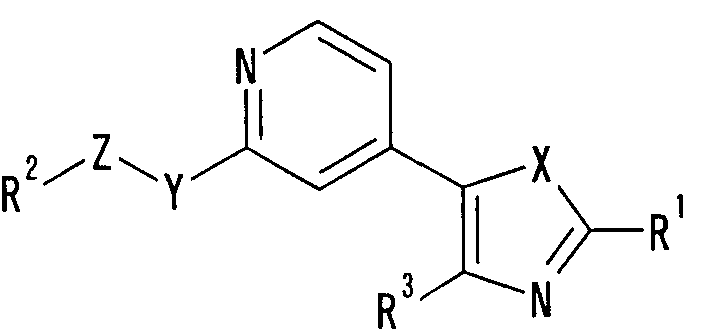


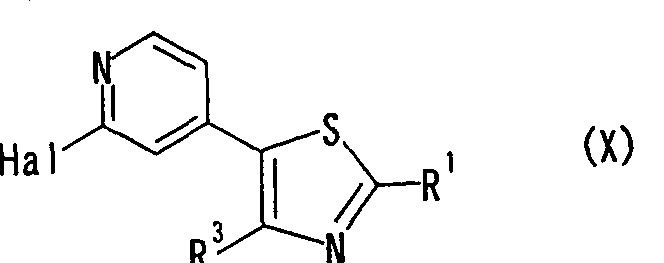


Claims


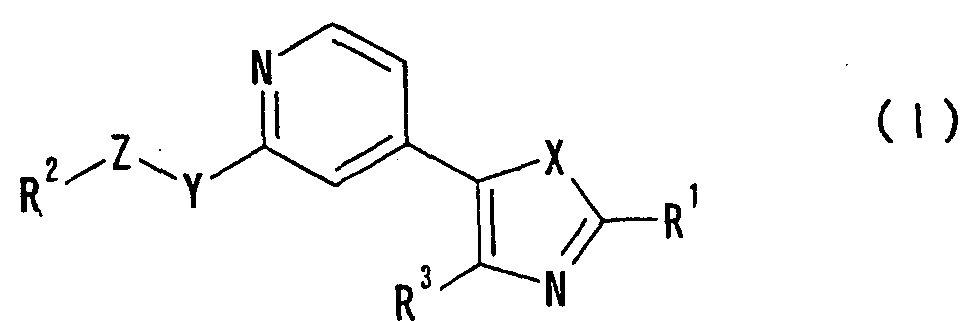

Priority Applications (22)
| Application Number | Priority Date | Filing Date | Title |
|---|---|---|---|
| IL14610500A IL146105A (en) | 1999-04-23 | 2000-04-20 | 5-pyridyl-1, 3-azole compounds, process for producing the same and use therefor |
| KR10-2001-7013493A KR100449215B1 (ko) | 1999-04-23 | 2000-04-20 | 5-피리딜-1,3-아졸 화합물, 이의 제조 방법 및 이의 용도 |
| MXPA01010675A MXPA01010675A (es) | 1999-04-23 | 2000-04-20 | Compuestos de 5-piridil-1, 3-azol, proceso para su produccion y uso de los mismos. |
| EP00917375A EP1180518B1 (en) | 1999-04-23 | 2000-04-20 | 5-pyridyl-1,3-azole compounds, process for producing the same and use thereof |
| SK1495-2001A SK286666B6 (sk) | 1999-04-23 | 2000-04-20 | 5-Pyridyl-1,3-azolové zlúčeniny, spôsob výroby a použitia |
| CA002370264A CA2370264A1 (en) | 1999-04-23 | 2000-04-20 | 5-pyridyl-1,3-azole compounds, process for producing the same and use thereof |
| SI200030940T SI1180518T1 (sl) | 1999-04-23 | 2000-04-20 | 5-piridil-1,3-azolne spojine, postopek za njihovo pripravo in njihova uporaba |
| AU38401/00A AU765473B2 (en) | 1999-04-23 | 2000-04-20 | 5-pyridyl-1,3-azole compounds, process for producing the same and use thereof |
| HK02105924.8A HK1044338B (en) | 1999-04-23 | 2000-04-20 | 5-pyridyl-1, 3-azole compounds, process for producing the same and use thereof |
| BR0009952-0A BR0009952A (pt) | 1999-04-23 | 2000-04-20 | Composto, pró-droga, processo para produzir um composto, composição farmacêutica, método para antagonizar um receptor de adenosina a3, para inibir a p38 map quinase e a produção de tnf-alfa e para prevenir ou tratar doenças, e uso de um composto |
| NZ515215A NZ515215A (en) | 1999-04-23 | 2000-04-20 | 5-pyridyl-1,3-azole compounds, process for producing the same and use thereof |
| HU0203766A HUP0203766A3 (en) | 1999-04-23 | 2000-04-20 | 5-pyridyl-1,3-azole compounds, process for producing the same and use thereof and pharmaceutical compositions containing them |
| US09/959,356 US7101899B1 (en) | 1999-04-23 | 2000-04-20 | 5-pyridyl-1,3-azole compounds, process for producing the same and use thereof |
| DE60033028T DE60033028T2 (de) | 1999-04-23 | 2000-04-20 | 5-pyridyl-1,3-azol-derivate, verfahren zu ihrer herstellung und ihre verwendung |
| DK00917375T DK1180518T3 (da) | 1999-04-23 | 2000-04-20 | 5-pyridyl-1,3-azolforbindelser, fremgangsmåde til fremstilling deraf og anvendelse deraf |
| ARP000105544A AR030033A1 (es) | 2000-04-20 | 2000-10-20 | Compuestos de 5-piridil-1,3-azol opcionalmente oxidado, profarmaco del mismo, procedimiento para producir dicho compuesto, composicion farmaceutica que lo comprende y uso del compuesto para preparar dicha composicion |
| MYPI20004966A MY126736A (en) | 1999-04-23 | 2000-10-20 | 5-pyridyl-1,3-azole compounds, process for producing the same and use thereof |
| TW089122035A TWI220900B (en) | 2000-04-20 | 2000-10-20 | 5-pyridyl-1,3-azole compounds, their production and use |
| NO20015156A NO320588B1 (no) | 1999-04-23 | 2001-10-22 | 5-pyridyl-1,3-azolforbindelser, fremgangsmate for fremstilling av disse, farmasoytisk preparat omfattende disse og anvendelse av disse. |
| US11/354,897 US7276527B2 (en) | 1999-04-23 | 2006-02-16 | 5-pyridyl-1,3-azole compounds, process for producing the same and use thereof |
| CY20071100148T CY1105981T1 (el) | 1999-04-23 | 2007-02-02 | Ενωσεις 5-πυριδυλ-1,3-αζολιου, μεθοδοι παρασκευης αυτων και χρηση αυτων |
| US11/896,072 US20090048307A1 (en) | 1999-04-23 | 2007-08-29 | 5-pyridyl-1, 3-azole compounds, process for producing the same and use there of |
Applications Claiming Priority (4)
| Application Number | Priority Date | Filing Date | Title |
|---|---|---|---|
| JP11668699 | 1999-04-23 | ||
| JP11/116686 | 1999-04-23 | ||
| JP11/224650 | 1999-08-06 | ||
| JP22465099 | 1999-08-06 |
Related Child Applications (2)
| Application Number | Title | Priority Date | Filing Date |
|---|---|---|---|
| US09959356 A-371-Of-International | 2000-04-20 | ||
| US11/354,897 Continuation US7276527B2 (en) | 1999-04-23 | 2006-02-16 | 5-pyridyl-1,3-azole compounds, process for producing the same and use thereof |
Publications (1)
| Publication Number | Publication Date |
|---|---|
| WO2000064894A1 true WO2000064894A1 (en) | 2000-11-02 |
Family
ID=26454974
Family Applications (1)
| Application Number | Title | Priority Date | Filing Date |
|---|---|---|---|
| PCT/JP2000/002575 Ceased WO2000064894A1 (en) | 1999-04-23 | 2000-04-20 | 5-pyridyl-1,3-azole compounds, process for producing the same and use thereof |
Country Status (24)
| Country | Link |
|---|---|
| US (3) | US7101899B1 (ja) |
| EP (1) | EP1180518B1 (ja) |
| KR (2) | KR100558123B1 (ja) |
| CN (1) | CN1156471C (ja) |
| AU (1) | AU765473B2 (ja) |
| BR (1) | BR0009952A (ja) |
| CA (1) | CA2370264A1 (ja) |
| CZ (1) | CZ300709B6 (ja) |
| DE (1) | DE60033028T2 (ja) |
| DK (1) | DK1180518T3 (ja) |
| ES (1) | ES2275500T3 (ja) |
| HK (1) | HK1044338B (ja) |
| HU (1) | HUP0203766A3 (ja) |
| IL (1) | IL146105A (ja) |
| MX (1) | MXPA01010675A (ja) |
| MY (1) | MY126736A (ja) |
| NO (1) | NO320588B1 (ja) |
| NZ (1) | NZ515215A (ja) |
| PL (1) | PL351148A1 (ja) |
| PT (1) | PT1180518E (ja) |
| RU (1) | RU2237062C2 (ja) |
| SI (1) | SI1180518T1 (ja) |
| SK (1) | SK286666B6 (ja) |
| WO (1) | WO2000064894A1 (ja) |
Cited By (25)
| Publication number | Priority date | Publication date | Assignee | Title |
|---|---|---|---|---|
| WO2001030778A1 (en) * | 1999-10-27 | 2001-05-03 | Novartis Ag | Thiazole and imidazo [4,5-b] pyridine compounds and their pharmaceutical use |
| WO2002051442A1 (en) * | 2000-12-26 | 2002-07-04 | Takeda Chemical Industries, Ltd. | Concomitant drugs |
| WO2002062792A1 (en) * | 2001-02-02 | 2002-08-15 | Takeda Chemical Industries, Ltd. | Jnk inhibitor |
| WO2002100433A1 (fr) * | 2001-06-11 | 2002-12-19 | Takeda Chemical Industries, Ltd. | Compositions medicinales |
| WO2003035638A1 (en) * | 2001-10-22 | 2003-05-01 | Tanabe Seiyaku Co., Ltd. | 4-imidazolin-2-one compounds |
| WO2002093164A3 (en) * | 2001-05-16 | 2003-09-04 | Axxima Pharmaceuticals Ag | Pyridylpyrimidine derivatives as effective compounds against prion diseases |
| WO2003037311A3 (en) * | 2001-10-29 | 2003-10-16 | Uniroyal Chem Co Inc | Method for treating retroviral infections |
| WO2006051826A1 (ja) * | 2004-11-10 | 2006-05-18 | Ono Pharmaceutical Co., Ltd. | 含窒素複素環化合物およびその医薬用途 |
| US7067537B2 (en) | 2000-12-08 | 2006-06-27 | Takeda Pharmaceutical Company Limited | Substituted thiazole derivatives bearing 3-pyridyl groups, process for preparing the same and use thereof |
| US7101899B1 (en) * | 1999-04-23 | 2006-09-05 | Takeda Pharmaceutical Company Limited | 5-pyridyl-1,3-azole compounds, process for producing the same and use thereof |
| US7122666B2 (en) | 1999-07-21 | 2006-10-17 | Sankyo Company, Limited | Heteroaryl-substituted pyrrole derivatives, their preparation and their therapeutic uses |
| WO2006137658A1 (en) * | 2005-06-20 | 2006-12-28 | Dongbu Hitek Co., Ltd. | New substituted 1,3-thiazole derivatives or pharmaceutically acceptable salts thereof having immunosuppression and inflammation inhibitory acitivity, intermediate compounds or pharmaceutically acceptable salts thereof, a process for the preparation thereof, and pharmaceutical composition comprising the same |
| WO2007040208A1 (ja) * | 2005-10-03 | 2007-04-12 | Ono Pharmaceutical Co., Ltd. | 含窒素複素環化合物およびその医薬用途 |
| WO2007049820A1 (ja) | 2005-10-28 | 2007-05-03 | Takeda Pharmaceutical Company Limited | 複素環アミド化合物及びその用途 |
| JPWO2005063743A1 (ja) * | 2003-12-26 | 2007-07-19 | 協和醗酵工業株式会社 | チアゾール誘導体 |
| WO2008001929A1 (en) | 2006-06-28 | 2008-01-03 | Aska Pharmaceutical Co., Ltd. | Treatment agent for inflammatory bowel disease |
| WO2008023462A1 (en) | 2006-08-21 | 2008-02-28 | Next21 K.K. | Bone model, bone filler and process for producing bone filler |
| WO2008099615A1 (ja) | 2007-02-16 | 2008-08-21 | Aska Pharmaceutical Co., Ltd. | 微粒子油性懸濁液を含む医薬組成物 |
| WO2008133102A1 (ja) | 2007-04-20 | 2008-11-06 | Daido Chemical Corporation | 新規乾式固体分散体用基剤、該基剤を含有する固体分散体及び該分散体を含有する組成物 |
| US7495018B2 (en) * | 2000-03-30 | 2009-02-24 | Takeda Pharmaceutical Company Limited | Substituted 1,3-thiazole compounds, their production and use |
| EP2198710A1 (de) | 2008-12-19 | 2010-06-23 | Bayer CropScience AG | Verwendung von 5-Pyridin-4yl-(1,3)Thiazole zur Bekämpfung phytopathogener Pilze |
| WO2011105534A1 (ja) | 2010-02-26 | 2011-09-01 | 日新化成株式会社 | 硬カプセルおよびその製造方法 |
| WO2014050910A1 (ja) | 2012-09-26 | 2014-04-03 | 武田薬品工業株式会社 | 固体粒子の製造方法 |
| EP3238711A1 (en) | 2016-04-26 | 2017-11-01 | The Nippon Synthetic Chemical Industry Co., Ltd. | Base for solid dispersion, production method for solid dispersion using same, and solid dispersion |
| US11452713B2 (en) | 2016-02-29 | 2022-09-27 | University Of Florida Research Foundation, Incorporated | Chemotherapeutic methods for treating low-proliferative disseminated tumor cells |
Families Citing this family (26)
| Publication number | Priority date | Publication date | Assignee | Title |
|---|---|---|---|---|
| KR100745307B1 (ko) | 2001-05-31 | 2007-08-01 | 사노피-아벤티스 | 아미노퀴놀린 유도체 및 아데노신 a3 리간드로서의 이의 용도 |
| US7473695B2 (en) | 2001-10-22 | 2009-01-06 | Mitsubishi Tanabe Pharma Corporation | 4-imidazolin-2-one compounds |
| US20060063782A1 (en) * | 2002-07-03 | 2006-03-23 | Murray Christopher W | 3-Hetero arylmethoxy ! pyridines and their analogues as p38 map kinase inhibitors |
| CA2491895C (en) | 2002-07-09 | 2011-01-18 | Vertex Pharmaceuticals Incorporated | Inhibitors of c-jun n-terminal kinases (jnk) and other protein kinases |
| HRP20050168A2 (en) | 2002-08-23 | 2005-10-31 | Rigel Pharmaceuticals | Pyridyl substituted heterocycles useful for treating or preventing hcv infection |
| TW200519106A (en) * | 2003-05-02 | 2005-06-16 | Novartis Ag | Organic compounds |
| US7326790B2 (en) | 2003-05-02 | 2008-02-05 | Rigel Pharmaceuticals, Inc. | Diphenylisoxazole compounds and hydro isomers thereof |
| US7410979B2 (en) | 2003-11-19 | 2008-08-12 | Rigel Pharmaceuticals, Inc. | Synergistically effective combinations of dihaloacetamide compounds and interferon or ribavirin against HCV infections |
| US7514434B2 (en) | 2004-02-23 | 2009-04-07 | Rigel Pharmaceuticals, Inc. | Heterocyclic compounds having an oxadiazole moiety and hydro isomers thereof |
| NZ549003A (en) * | 2004-03-05 | 2009-07-31 | Taisho Pharmaceutical Co Ltd | Thiazole derivative as an ALK5 inhibitor |
| JP2007223903A (ja) * | 2004-07-09 | 2007-09-06 | Takeda Chem Ind Ltd | 新規な固体分散体およびその製造方法 |
| CA2606106A1 (en) | 2005-05-02 | 2007-03-08 | Rigel Pharmaceuticals, Inc. | Heterocyclic anti-viral compounds comprising metabolizable moieties and their uses |
| US7494519B2 (en) * | 2005-07-28 | 2009-02-24 | 3M Innovative Properties Company | Abrasive agglomerate polishing method |
| DK1921077T3 (en) | 2005-08-02 | 2017-10-23 | Kyowa Hakko Kirin Co Ltd | Means for treating and / or preventing sleep disorders |
| WO2007022415A2 (en) * | 2005-08-18 | 2007-02-22 | Pharmacopeia, Inc. | Substituted 2-aminothiazoles for treating neurodegenerative diseases |
| JPWO2007083522A1 (ja) * | 2006-01-18 | 2009-06-11 | 株式会社ネクスト21 | 医療用ゲル形成組成物,その組成物の投与デバイス及び薬剤放出制御担体 |
| CN103288817A (zh) * | 2013-07-02 | 2013-09-11 | 天津理工大学 | 一种基于1,3,4-噻二唑和1,3,4-噁二唑的希夫碱衍生物及其制备方法和应用 |
| ES2578363B1 (es) | 2015-01-22 | 2017-01-31 | Palobiofarma, S.L. | Moduladores de los receptores A3 de adenosina |
| KR101851972B1 (ko) | 2015-10-21 | 2018-06-11 | 주식회사 제이아이바이오팜 | 청호, 구절초, 애엽, 인진호, 괴각, 대계, 및 목향을 포함하는 한약 추출물이 함유된 탈모개선 및 탈모방지용 복합조성물 및 그 제조방법 |
| ES2676535B1 (es) | 2017-01-20 | 2019-04-29 | Palobiofarma Sl | Moduladores de los receptores a3 de adenosina |
| CN108017584B (zh) * | 2017-06-20 | 2021-03-23 | 南开大学 | A3腺苷受体的小分子拮抗剂 |
| CN109293652B (zh) * | 2017-07-24 | 2021-10-22 | 四川科伦博泰生物医药股份有限公司 | 一种取代的噻唑衍生物及其用途 |
| US10342786B2 (en) | 2017-10-05 | 2019-07-09 | Fulcrum Therapeutics, Inc. | P38 kinase inhibitors reduce DUX4 and downstream gene expression for the treatment of FSHD |
| WO2019071147A1 (en) | 2017-10-05 | 2019-04-11 | Fulcrum Therapeutics, Inc. | INHIBITORS OF KINASE P38 REDUCING EXPRESSION OF DUX4 GENE AND DOWNSTREAM GENES FOR THE TREATMENT OF FSHD |
| TW202112368A (zh) | 2019-06-13 | 2021-04-01 | 荷蘭商法西歐知識產權股份有限公司 | 用於治療有關dux4表現之疾病的抑制劑組合 |
| CN119015281A (zh) * | 2023-05-25 | 2024-11-26 | 中国医学科学院药物研究所 | 一种苯甲酰胺类化合物防治恶性肿瘤恶病质的用途 |
Citations (3)
| Publication number | Priority date | Publication date | Assignee | Title |
|---|---|---|---|---|
| WO1997012876A1 (en) * | 1995-10-06 | 1997-04-10 | Merck & Co., Inc. | Substituted imidazoles having anti-cancer and cytokine inhibitory activity |
| WO1998014191A1 (en) * | 1996-09-30 | 1998-04-09 | Otsuka Pharmaceutical Co., Ltd. | Agent for inhibition of cytokine production and agent for inhibition of cell adhesion |
| WO1999021555A2 (en) * | 1997-10-27 | 1999-05-06 | Takeda Chemical Industries, Ltd. | Adenosine a3 receptor antagonists |
Family Cites Families (7)
| Publication number | Priority date | Publication date | Assignee | Title |
|---|---|---|---|---|
| DE3486009T2 (de) | 1983-09-09 | 1993-04-15 | Takeda Chemical Industries Ltd | 5-pyridyl-1,3-thiazol-derivate, ihre herstellung und anwendung. |
| JPH0570446A (ja) | 1991-09-13 | 1993-03-23 | Taisho Pharmaceut Co Ltd | N−チアゾリルスルホンアミド誘導体 |
| US5684439A (en) * | 1995-10-10 | 1997-11-04 | Motorola, Inc. | Half wave ceramic filter with open circuit at both ends |
| GB9713726D0 (en) * | 1997-06-30 | 1997-09-03 | Ciba Geigy Ag | Organic compounds |
| WO2000064894A1 (en) * | 1999-04-23 | 2000-11-02 | Takeda Chemical Industries, Ltd. | 5-pyridyl-1,3-azole compounds, process for producing the same and use thereof |
| US20040097555A1 (en) * | 2000-12-26 | 2004-05-20 | Shinegori Ohkawa | Concomitant drugs |
| CA2450400A1 (en) * | 2001-06-11 | 2002-12-19 | Takeda Chemical Industries, Ltd. | Medicinal compositions |
-
2000
- 2000-04-20 WO PCT/JP2000/002575 patent/WO2000064894A1/ja not_active Ceased
- 2000-04-20 SK SK1495-2001A patent/SK286666B6/sk not_active IP Right Cessation
- 2000-04-20 RU RU2001131556/04A patent/RU2237062C2/ru active
- 2000-04-20 PL PL00351148A patent/PL351148A1/xx not_active Application Discontinuation
- 2000-04-20 MX MXPA01010675A patent/MXPA01010675A/es active IP Right Grant
- 2000-04-20 DE DE60033028T patent/DE60033028T2/de not_active Expired - Fee Related
- 2000-04-20 BR BR0009952-0A patent/BR0009952A/pt not_active Application Discontinuation
- 2000-04-20 HU HU0203766A patent/HUP0203766A3/hu unknown
- 2000-04-20 CA CA002370264A patent/CA2370264A1/en not_active Abandoned
- 2000-04-20 AU AU38401/00A patent/AU765473B2/en not_active Ceased
- 2000-04-20 NZ NZ515215A patent/NZ515215A/en unknown
- 2000-04-20 HK HK02105924.8A patent/HK1044338B/en not_active IP Right Cessation
- 2000-04-20 PT PT00917375T patent/PT1180518E/pt unknown
- 2000-04-20 KR KR1020027008313A patent/KR100558123B1/ko not_active Expired - Fee Related
- 2000-04-20 CZ CZ20013805A patent/CZ300709B6/cs not_active IP Right Cessation
- 2000-04-20 US US09/959,356 patent/US7101899B1/en not_active Expired - Fee Related
- 2000-04-20 SI SI200030940T patent/SI1180518T1/sl unknown
- 2000-04-20 IL IL14610500A patent/IL146105A/xx unknown
- 2000-04-20 KR KR10-2001-7013493A patent/KR100449215B1/ko not_active Expired - Fee Related
- 2000-04-20 EP EP00917375A patent/EP1180518B1/en not_active Expired - Lifetime
- 2000-04-20 DK DK00917375T patent/DK1180518T3/da active
- 2000-04-20 CN CNB008085498A patent/CN1156471C/zh not_active Expired - Fee Related
- 2000-04-20 ES ES00917375T patent/ES2275500T3/es not_active Expired - Lifetime
- 2000-10-20 MY MYPI20004966A patent/MY126736A/en unknown
-
2001
- 2001-10-22 NO NO20015156A patent/NO320588B1/no not_active IP Right Cessation
-
2006
- 2006-02-16 US US11/354,897 patent/US7276527B2/en not_active Expired - Fee Related
-
2007
- 2007-08-29 US US11/896,072 patent/US20090048307A1/en not_active Abandoned
Patent Citations (3)
| Publication number | Priority date | Publication date | Assignee | Title |
|---|---|---|---|---|
| WO1997012876A1 (en) * | 1995-10-06 | 1997-04-10 | Merck & Co., Inc. | Substituted imidazoles having anti-cancer and cytokine inhibitory activity |
| WO1998014191A1 (en) * | 1996-09-30 | 1998-04-09 | Otsuka Pharmaceutical Co., Ltd. | Agent for inhibition of cytokine production and agent for inhibition of cell adhesion |
| WO1999021555A2 (en) * | 1997-10-27 | 1999-05-06 | Takeda Chemical Industries, Ltd. | Adenosine a3 receptor antagonists |
Non-Patent Citations (1)
| Title |
|---|
| See also references of EP1180518A4 * |
Cited By (36)
| Publication number | Priority date | Publication date | Assignee | Title |
|---|---|---|---|---|
| US7101899B1 (en) * | 1999-04-23 | 2006-09-05 | Takeda Pharmaceutical Company Limited | 5-pyridyl-1,3-azole compounds, process for producing the same and use thereof |
| US7276527B2 (en) | 1999-04-23 | 2007-10-02 | Takeda Pharmaceutical Company Limited | 5-pyridyl-1,3-azole compounds, process for producing the same and use thereof |
| US7122666B2 (en) | 1999-07-21 | 2006-10-17 | Sankyo Company, Limited | Heteroaryl-substituted pyrrole derivatives, their preparation and their therapeutic uses |
| US6891039B2 (en) | 1999-10-27 | 2005-05-10 | Novartis Ag | Imidazo [4,5-B] pyridine compounds and their pharmaceuticals use |
| WO2001030778A1 (en) * | 1999-10-27 | 2001-05-03 | Novartis Ag | Thiazole and imidazo [4,5-b] pyridine compounds and their pharmaceutical use |
| US6608072B1 (en) | 1999-10-27 | 2003-08-19 | Novartis Ag | Thiazole compounds and their pharmaceutical use |
| US7495018B2 (en) * | 2000-03-30 | 2009-02-24 | Takeda Pharmaceutical Company Limited | Substituted 1,3-thiazole compounds, their production and use |
| US7067537B2 (en) | 2000-12-08 | 2006-06-27 | Takeda Pharmaceutical Company Limited | Substituted thiazole derivatives bearing 3-pyridyl groups, process for preparing the same and use thereof |
| WO2002051442A1 (en) * | 2000-12-26 | 2002-07-04 | Takeda Chemical Industries, Ltd. | Concomitant drugs |
| WO2002062792A1 (en) * | 2001-02-02 | 2002-08-15 | Takeda Chemical Industries, Ltd. | Jnk inhibitor |
| US7199124B2 (en) | 2001-02-02 | 2007-04-03 | Takeda Pharmaceutical Company Limited | JNK inhibitor |
| WO2002093164A3 (en) * | 2001-05-16 | 2003-09-04 | Axxima Pharmaceuticals Ag | Pyridylpyrimidine derivatives as effective compounds against prion diseases |
| EP1721609A3 (en) * | 2001-05-16 | 2007-01-31 | GPC Biotech AG | Pyridylpyrimidine derivatives as effective compounds against prion diseases |
| WO2002100433A1 (fr) * | 2001-06-11 | 2002-12-19 | Takeda Chemical Industries, Ltd. | Compositions medicinales |
| WO2003035638A1 (en) * | 2001-10-22 | 2003-05-01 | Tanabe Seiyaku Co., Ltd. | 4-imidazolin-2-one compounds |
| WO2003037311A3 (en) * | 2001-10-29 | 2003-10-16 | Uniroyal Chem Co Inc | Method for treating retroviral infections |
| JPWO2005063743A1 (ja) * | 2003-12-26 | 2007-07-19 | 協和醗酵工業株式会社 | チアゾール誘導体 |
| WO2006051826A1 (ja) * | 2004-11-10 | 2006-05-18 | Ono Pharmaceutical Co., Ltd. | 含窒素複素環化合物およびその医薬用途 |
| US7713998B2 (en) | 2004-11-10 | 2010-05-11 | Ono Pharmaceutical Co., Ltd. | Nitrogenous heterocyclic compound and pharmaceutical use thereof |
| JP4973191B2 (ja) * | 2004-11-10 | 2012-07-11 | 小野薬品工業株式会社 | 含窒素複素環化合物およびその医薬用途 |
| JPWO2006051826A1 (ja) * | 2004-11-10 | 2008-05-29 | 小野薬品工業株式会社 | 含窒素複素環化合物およびその医薬用途 |
| WO2006137658A1 (en) * | 2005-06-20 | 2006-12-28 | Dongbu Hitek Co., Ltd. | New substituted 1,3-thiazole derivatives or pharmaceutically acceptable salts thereof having immunosuppression and inflammation inhibitory acitivity, intermediate compounds or pharmaceutically acceptable salts thereof, a process for the preparation thereof, and pharmaceutical composition comprising the same |
| WO2007040208A1 (ja) * | 2005-10-03 | 2007-04-12 | Ono Pharmaceutical Co., Ltd. | 含窒素複素環化合物およびその医薬用途 |
| JP5119924B2 (ja) * | 2005-10-03 | 2013-01-16 | 小野薬品工業株式会社 | 含窒素複素環化合物およびその医薬用途 |
| US7968572B2 (en) | 2005-10-03 | 2011-06-28 | Ono Pharmaceuticals Co., Ltd. | Nitrogen-containing heterocyclic compound and pharmaceutical application thereof |
| WO2007049820A1 (ja) | 2005-10-28 | 2007-05-03 | Takeda Pharmaceutical Company Limited | 複素環アミド化合物及びその用途 |
| WO2008001929A1 (en) | 2006-06-28 | 2008-01-03 | Aska Pharmaceutical Co., Ltd. | Treatment agent for inflammatory bowel disease |
| WO2008023462A1 (en) | 2006-08-21 | 2008-02-28 | Next21 K.K. | Bone model, bone filler and process for producing bone filler |
| WO2008099615A1 (ja) | 2007-02-16 | 2008-08-21 | Aska Pharmaceutical Co., Ltd. | 微粒子油性懸濁液を含む医薬組成物 |
| US8309138B2 (en) | 2007-02-16 | 2012-11-13 | Aska Pharmaceutical Co., Ltd. | Pharmaceutical composition comprising microparticle oily suspension |
| WO2008133102A1 (ja) | 2007-04-20 | 2008-11-06 | Daido Chemical Corporation | 新規乾式固体分散体用基剤、該基剤を含有する固体分散体及び該分散体を含有する組成物 |
| EP2198710A1 (de) | 2008-12-19 | 2010-06-23 | Bayer CropScience AG | Verwendung von 5-Pyridin-4yl-(1,3)Thiazole zur Bekämpfung phytopathogener Pilze |
| WO2011105534A1 (ja) | 2010-02-26 | 2011-09-01 | 日新化成株式会社 | 硬カプセルおよびその製造方法 |
| WO2014050910A1 (ja) | 2012-09-26 | 2014-04-03 | 武田薬品工業株式会社 | 固体粒子の製造方法 |
| US11452713B2 (en) | 2016-02-29 | 2022-09-27 | University Of Florida Research Foundation, Incorporated | Chemotherapeutic methods for treating low-proliferative disseminated tumor cells |
| EP3238711A1 (en) | 2016-04-26 | 2017-11-01 | The Nippon Synthetic Chemical Industry Co., Ltd. | Base for solid dispersion, production method for solid dispersion using same, and solid dispersion |
Also Published As
Similar Documents
| Publication | Publication Date | Title |
|---|---|---|
| WO2000064894A1 (en) | 5-pyridyl-1,3-azole compounds, process for producing the same and use thereof | |
| JP4120586B2 (ja) | 2−アシルアミノチアゾール誘導体又はその塩 | |
| WO2001010865A1 (en) | p38MAP KINASE INHIBITORS | |
| JPH11193281A (ja) | アデノシンa3受容体拮抗剤およびチアゾール化合物 | |
| WO2001074811A2 (en) | Substituted 1,3-thiazole compounds, their production and use | |
| WO2002062792A9 (fr) | Inhibiteur de jnk | |
| CZ228892A3 (en) | Thiourea derivative and pharmaceutical preparation comprising thereof | |
| JP2001114690A (ja) | p38MAPキナーゼ阻害剤 | |
| JP3333774B2 (ja) | 5−ピリジル−1,3−アゾール化合物、その製造法及び用途 | |
| JP4310079B2 (ja) | 5−ピリジル−1,3−アゾール化合物、その製造法及び用途 | |
| TWI220900B (en) | 5-pyridyl-1,3-azole compounds, their production and use | |
| JPWO2000064894A1 (ja) | 5−ピリジル−1,3−アゾール化合物、その製造法および用途 | |
| ZA200108996B (en) | 5-pyridyl-1,3-azole compounds, process for producing the same and use thereof. | |
| WO2000044756A1 (en) | Thiazolopyrimidine compounds, process for the preparation of the same and uses thereof | |
| WO1995034543A1 (fr) | Derive de thiazoline |
Legal Events
| Date | Code | Title | Description |
|---|---|---|---|
| WWE | Wipo information: entry into national phase |
Ref document number: 00808549.8 Country of ref document: CN |
|
| AK | Designated states |
Kind code of ref document: A1 Designated state(s): AE AG AL AM AU AZ BA BB BG BR BY CA CN CR CU CZ DM DZ EE GD GE HR HU ID IL IN IS JP KG KR KZ LC LK LR LT LV MA MD MG MK MN MX NO NZ PL RO RU SG SI SK TJ TM TR TT UA US UZ VN YU ZA |
|
| AL | Designated countries for regional patents |
Kind code of ref document: A1 Designated state(s): GH GM KE LS MW SD SL SZ TZ UG ZW AM AZ BY KG KZ MD RU TJ TM AT BE CH CY DE DK ES FI FR GB GR IE IT LU MC NL PT SE BF BJ CF CG CI CM GA GN GW ML MR NE SN TD TG |
|
| DFPE | Request for preliminary examination filed prior to expiration of 19th month from priority date (pct application filed before 20040101) | ||
| 121 | Ep: the epo has been informed by wipo that ep was designated in this application | ||
| WWE | Wipo information: entry into national phase |
Ref document number: 14952001 Country of ref document: SK |
|
| ENP | Entry into the national phase |
Ref document number: 2370264 Country of ref document: CA Ref document number: 2370264 Country of ref document: CA Kind code of ref document: A |
|
| WWE | Wipo information: entry into national phase |
Ref document number: PV2001-3805 Country of ref document: CZ Ref document number: 1020017013493 Country of ref document: KR Ref document number: PA/a/2001/010675 Country of ref document: MX |
|
| WWE | Wipo information: entry into national phase |
Ref document number: 38401/00 Country of ref document: AU |
|
| WWE | Wipo information: entry into national phase |
Ref document number: 2001/08996 Country of ref document: ZA Ref document number: 200108996 Country of ref document: ZA |
|
| WWE | Wipo information: entry into national phase |
Ref document number: 515215 Country of ref document: NZ |
|
| WWE | Wipo information: entry into national phase |
Ref document number: 2000917375 Country of ref document: EP |
|
| WWP | Wipo information: published in national office |
Ref document number: 1020017013493 Country of ref document: KR |
|
| ENP | Entry into the national phase |
Ref document number: 2002 959356 Country of ref document: US Date of ref document: 20020202 Kind code of ref document: A |
|
| WWE | Wipo information: entry into national phase |
Ref document number: 09959356 Country of ref document: US |
|
| WWP | Wipo information: published in national office |
Ref document number: 2000917375 Country of ref document: EP |
|
| WWP | Wipo information: published in national office |
Ref document number: PV2001-3805 Country of ref document: CZ |
|
| NENP | Non-entry into the national phase |
Ref country code: JP |
|
| WWG | Wipo information: grant in national office |
Ref document number: 38401/00 Country of ref document: AU |
|
| WWG | Wipo information: grant in national office |
Ref document number: 1020017013493 Country of ref document: KR |
|
| WWG | Wipo information: grant in national office |
Ref document number: 2000917375 Country of ref document: EP |