WO2000077108A1 - Anaerobic adhesive composition - Google Patents
Anaerobic adhesive composition Download PDFInfo
- Publication number
- WO2000077108A1 WO2000077108A1 PCT/KR1999/000285 KR9900285W WO0077108A1 WO 2000077108 A1 WO2000077108 A1 WO 2000077108A1 KR 9900285 W KR9900285 W KR 9900285W WO 0077108 A1 WO0077108 A1 WO 0077108A1
- Authority
- WO
- WIPO (PCT)
- Prior art keywords
- adhesive composition
- anaerobic adhesive
- acid
- metha
- oligomers
- Prior art date
- Legal status (The legal status is an assumption and is not a legal conclusion. Google has not performed a legal analysis and makes no representation as to the accuracy of the status listed.)
- Ceased
Links
Classifications
-
- C—CHEMISTRY; METALLURGY
- C09—DYES; PAINTS; POLISHES; NATURAL RESINS; ADHESIVES; COMPOSITIONS NOT OTHERWISE PROVIDED FOR; APPLICATIONS OF MATERIALS NOT OTHERWISE PROVIDED FOR
- C09J—ADHESIVES; NON-MECHANICAL ASPECTS OF ADHESIVE PROCESSES IN GENERAL; ADHESIVE PROCESSES NOT PROVIDED FOR ELSEWHERE; USE OF MATERIALS AS ADHESIVES
- C09J4/00—Adhesives based on organic non-macromolecular compounds having at least one polymerisable carbon-to-carbon unsaturated bond ; adhesives, based on monomers of macromolecular compounds of groups C09J183/00 - C09J183/16
Definitions
- the present invention relates to an anaerobic adhesive composition and more particularly, to the anaerobic adhesive composition which blends a difunctional carboxylic acid, expressed by the following formula I, to the anaerobic adhesive composition comprising monomers, oligomers, inhibitors, oxidizers, reducers and thickening agents, showing some useful characteristics; a)the rapid velocity in a hardening reaction, b)the good stability in long-term storage, and c)the break-loose torque which is sufficiently applied in the assembly of bolt-nuts, precision apparatuses or electric/ electronic parts:
- the anaerobic adhesive composition of common type was prepared by chemicals such as monomers, oligomers, inhibitors, peroxide- typed oxidizers(e.g., hydrogen peroxide and cumene hydroperoxide) and reducers(e.g., amines and imides) as disclosed in the following conventional methods[European Patent Appln. No. 446,144(1991), 443,916(1991); 499,483(1992); and Japanese Patent Kokai No. Pyeong2-187,401].
- chemicals such as monomers, oligomers, inhibitors, peroxide- typed oxidizers(e.g., hydrogen peroxide and cumene hydroperoxide) and reducers(e.g., amines and imides) as disclosed in the following conventional methods[European Patent Appln. No. 446,144(1991), 443,916(1991); 499,483(1992); and Japanese Patent Kokai No. Pyeong2-187,401].
- an oxidizer and a reducer were used together m the preparation of anaerobic adhesive composition, as described in the following methods: Hung. Telies Hu 44, 280(1988) as a method using a complex alkaline solution, US Patent No. 4,731,146 as a method using a copper compound, and closed German Patent No. 3,611,307 as a method using a phosphate compound, etc.
- the anaerobic adhesive composition in its initial development stage was prepared in such a method that an inhibitor was added to a mixture of monomers and oligomers: the oligomers are derived from multi-functional (metha)acrylates (Japanese Patent Kokai No. Sho43-6545, Sho44-852). Then, the inhibitor was used as a scavenger for radicals which can spontaneously generate in the state of preparation or storage.
- Japanese Patent Kokai No. Sho46-3160, Sho57-83572 and Pyeong6-66308 disclosed the anaerobic adhesive composition containing acrylic acid, methacrylic acid or thiosalicylic acid in order to increase its break-loose torque.
- glycerol dimethacrylate esterified by succinic acid anhydride was used as a component of the anaerobic adhesive composition, as described by closed German Patent No. 3,527,717.
- Japanese Patent Kokai No. Sho62-184,076 disclosed that methylsulfamic acid was added to the anaerobic adhesive composition, but it brought about corrosion on the surface of metallic materials.
- an anaerobic adhesive composition when used to assemble parts into a complete whole, the enhancement of adhesive force as well as workability is powerfully required toward higher productivity.
- a reducer containing the groups like imides, mercaptos or amines is concurrently used with a peroxide-typed initiator, where it is very important to select a useful reducer/ oxidizer catalyst.
- the anaerobic adhesive composition is very unstable under its coexistence and can be easily initiated by radicals spontaneously produced between them. Although it is extremely difficult that a hardening reaction in progress is stopped or controlled the reaction in storage at room temperature was generally controlled by the addition of inhibitor above-mentioned. Therefore, it is previously added to a mixture of monomers and oligomers in the preparation of anaerobic adhesive composition.
- the anaerobic adhesive composition always requires access to the proper regulation of physical properties like strength and flexibility by way of the enhancement of both the rapid velocity in hardening and the stability in storage.
- a difunctional carboxylic acid is essentially added to an anaerobic adhesive composition in this invention.
- An object of this invention is to provide the anaerobic adhesive composition with the stability in storage as well as the rapid hardening in fastening by mixing the difunctional carboxylic acid, where the anaerobic adhesive composition as a product shows useful break-loose torque.
- This invention relates to an anaerobic adhesive composition which blends 0.0001 - 10 parts in weight of a difunctional carboxylic acid, expressed by the following formula I, in proportion to 100 parts in weight of a mixture of monomers and oligomers, to the anaerobic adhesive composition comprising monomers, oligomers, inhibitors, oxidizers, reducers and thickening agents:
- the anaerobic adhesive composition applicable to prevent a bolt which is jointed nuts from releasing requires the rapid hardening in fastening as well as the stability in storage, thereby enhancing its break-loose torque and workability.
- the difunctional carboxylic acid expressed by formula I is largely mixed to a mixture of monomers and oligomers.
- Table 1 in this invention the values of pK a (acid dissociation constant) of aliphatic difunctional carboxylic acids gradually increased with increasing the values of n above-mentioned, and then slightly decreased with increasing the values of n above 2. Then, the values of pK ⁇ in non-aliphatic difunctional carboxylic acids were less than those of aliphatic difunctional carboxylic acids.
- pKj was the lowest value in various difunctional carboxylic acids.
- the anaerobic adhesive composition containing a difunctional carboxylic acid brings about a rapid hardening reaction as well as the stability in storage: as the value of n gradually increases, the acidity of difunctional carboxylic acid decreases.
- the break-loose torque of the anaerobic adhesive composition also increases with shortening the hardening time, and then its molecular weight grows bigger.
- n is limited as an integer in the range of 2-10 according to this invention, and then the difunctional carboxylic acid is in the range of 1-5 of pKa.
- carboxylic acid scarcely give any effects on the acidity of an oxidizer like cumene hydroperoxide, the stability in storage of the anaerobic adhesive composition gets better.
- the anaerobic adhesive composition showed useful break-loose torque caused by a rapid hardening reaction in the presence of difunctional carboxylic acid. When a bolt and a nut are jointed, the small quantity of air solubilized in the anaerobic adhesive composition is excluded, and at the same time a hardening reaction is initiated. The reaction proceeds of itself under the condition.
- anaerobic adhesive composition of this invention In the preparation of anaerobic adhesive composition of this invention, first of all, monomers, oligomers and inhibitors are mixed and agitated under oxygen atmosphere. Subsequently, each of reducers and oxidizers is added to the mixture, followed by the addition of difunctional carboxylic acid. Thereafter, in order to increase the viscosity of the anaerobic adhesive composition, polyethylene resin(particle size: belowlO ⁇ ) and fumed silica(particle size: below 5 ⁇ ) as thickening agents are added.
- Monomers used in this invention are one or more selected from ethyleneglycol di(metha)acrylate, diethyleneglycol di(metha)acrylate, triethyleneglycol di(metha)acrylate, tetraethyleneglycol di(metha)acrylate, trimethylolpropane tri(metha)acrylate, styrene, chlorostyrene, vinyltoluene, a- methylstyrene, vinylacetate, methylacrylate, ethylacrylate, butylacrylate and methy lmethacry late .
- oligomers used in this invention are one or more selected from mono or poly(metha)acrylate oligomer of bisphenolic compound, a , ⁇ -diacryloyl-(bisethyleneglycol)-phthalate and a , ⁇ - tetraacryloyl-(bistrimethylolpropane)-tetrahydrophthalate, and the acrylic oligomers containing aliphatic and aromatic urethane groups or poly ether groups.
- a difunctional carboxylic acid represented by formula I is used in this invention.
- the difunctional carboxylic acid is one or more selected from malonic acid, succinic acid, adipic acid, itaconic acid, pimelic acid, terephthalic acid and decanoic acid.
- the quantity of difunctional carboxylic acid can be blended within 0.0001-10 parts in weight in proportion to 100 parts in weight of a mixture of monomers and oligomers. If the amount is less than 0.0001 part in weight, the promotion of a hardening reaction may be negligible, but may be possible in the quantity more than 10 parts in weight: the storage stability of the anaerobic adhesive composition may be lowered, so that the composition of the carboxylic acid should be properly controlled within above range.
- an inhibitor is one or more selected from hydroquinone, methylhydroquinone, hydroquinone monomethylether, naphthoquinone, penanthraquinone, anthraquinone, sebenzoquinone, catechol, t-butylcatechol, 2,6-t-butyl-4-methylphenol, phenothiazine, picric acid phenothiazine and hydroxydiphenylamine.
- a metal ion chelating agent is used one or more selected from ethylenediamine tetraacetic acid and its salt.
- the quantity of inhibitor can be added 0.0001-3 parts in weight in proportion to 100 parts in weight of a mixture of monomers and oligomers. If the quantity is less than 0.0001 part in weight, the effect of inhibition may be insufficient, finally lowering the stability in storage, but in the quantity more than 3 parts in weight, the break-loose torque may be lowered, as the hardening time lengthened.
- an oxidizer is one or more selected from t-burylhydroperoxide, cumenhydroperoxide, di-t-butylhydroperoxide, methylethylketoneperoxide, dicumylperoxide, 2 ⁇ -di ⁇ ethylhexyl-2 ⁇ -dihydroperoxide, d ⁇ sopropylbenzene hydroperoxide, t-butylbenzoate and t-butylperoxyacetate.
- a reducer is one or more selected from phenyl- a -naphthylamine, N,N'- dimethy 1-p-toluidine, N, N'-dimethy laniline, triethy lenetetramine, diethylenetriamine, tri-N-butylamine, o-benzoic sulfimide, acetylthiourea, ethylene thiourea and 2-mercaptobenzothiazole.
- An initiator is used as the form combined one or more.
- the quantity of initiator can be added 0.001-10 parts in weight in proportion to 100 parts in weight of a mixture of monomers and oligomers. If the quantity is less than 0.001 part in weight, the effect of initiation is insufficient, but in the quantity more than 10 parts in weight, the storage stability of the anaerobic adhesive composition may be lowered, so that the composition of the initiator should be properly controlled within above range.
- anaerobic adhesive compositions containing difuctional carboxylic acids were prepared and briefly estimated: it was found that the anaerobic adhesive composition without a difunctional carboxylic acid exhibited longer hardening time and less break-loose torque, whereas the anaerobic adhesive composition with it exhibited a hardening time less than 15 min. and the break-loose torque after 24 hr was also very useful.
- the anaerobic adhesive composition (Table 2a, run ® ⁇ 12) was prepared as follows. That is, lOg of ethyleneglycol dimethacrylate, lOg of ' 2-hydroxyethyl methacrylate and lOg of tetraetyleneglycol dimethacrylate as components of monomers and oligomers were added to a reactor with reflux condenser and agitated at 120rpm under 120cc/min of oxygen flow. Then, 0.05g of hydroquinone methylether as an inhibitor was added and agitated for lOmins, followed by the addition of 3g of cumene hydroperoxide as an oxidizer.
- Viscosity the value is measured by RVDVI+ viscometer.
- An anaerobic adhesive composition was prepared in the same methods as described in Examples ⁇ l-13.
- CD examples; ® : comparative examples; M ⁇ : ethyleneglycol dimethacrylate; M 2 : 2-hydroxyethyl methacrylate; M 3 : tetraethyleneglycol dimethacrylate; M 4 : urethaneacrylate (Aronics M-1100, Dong-A Synthetic Industrial Co., Japan); HQ : hydroquinone methylether; QH : cumene hydroperoxide; A t : o-benzoic sulfimide; A 2 : N,N'-dimethyl-p-toluidine; A 3 : titanium dioxide; CA X : oxalic acid; CA 2 : adipic acid; each of CA j and CA 2 : calculated by mol concentration; Tj : polyethylene powder(5 ⁇ m of average diameter); T 2 : fumed silica(5 ⁇ m of average diameter).
- ⁇ and ® represent examples and comparative ones, respectively.
- anaerobic adhesive compositions using an hardening promoter without difunctional carboxylic acid groups (comparative examples ⁇ l-7); the anaerobic adhesive compositions using titanium dioxide as an auxiliary oxidizer(comparative examples ⁇ 4,5); the anaerobic adhesive composition using oxalic acid (comparative example ⁇ 7); the anaerobic adhesive compositions containing an excessive quantity of reducer and oxidizer as an initiator(comparative examples ⁇ 8,9); the anaerobic adhesive composition using an excessive quantity of urethaneacrylate(comparative example ⁇ 9); the anaerobic adhesive composition containing an excessive quantity of cumene hydroperoxide(comparative example ⁇ 10); the anaerobic adhesive composition using an insufficient quantity of difunctional carboxylic acid(comparative example ⁇ 11) showed relatively longer hardening time and less break-loose torque.
- the anaerobic adhesive composition using an excessive quantity of difunctional carboxylic acid or fumed silica(comparative examples ⁇ -12-14) showed the increase of acidity in solution, followed by the poor stability in storage. Also, the anaerobic adhesive composition containing an excessive quantity of thickening agent (comparative example ⁇ 15) showed a great difficulty in mixing. On the other hand, comparative examples ⁇ 4 , 5, 8-15 showed the poor stability in storage.
- the break-loose torque of anaerobic adhesive compositions using a thickening agent was better than that without a thickening agent (examples ® ⁇ 1-11).
- the anaerobic adhesive composition comprising monomers, oligomers, inhibitors, oxidizers, reducers and thickening agents in the presence of difunctional carboxylic acid exhibited the rapid velocity in a hardening reaction, the good stability in storage, and the good strength in break-loose torque.
- the anaerobic adhesive composition according to this invention is applicable to the fastening between a bolt and a nut, and the assembly of precision apparatuses and electric/ electronic parts.
Landscapes
- Chemical & Material Sciences (AREA)
- Organic Chemistry (AREA)
- Adhesives Or Adhesive Processes (AREA)
Abstract
The present invention relates to an anaerobic adhesive composition and more particularly, to the anaerobic adhesive composition which blends a difunctional carboxylic acid, expressed by formula (I), to the anaerobic adhesive composition comprising monomers, oligomers, inhibitors, oxidizers, reducers and thickening agents, showing some useful physical properties; a) the rapid velocity in a hardening reaction, b) the good stability in long-term storage, and c) the break-loose torque which is sufficiently applied in the assembly of bolt-nuts, precision apparatuses and electric/electronic parts, wherein R is (CH2)n or CH2C(=CH2) and n is an integer in the range of 2 to 10.
Description
ANAEROBIC ADHESIVE COMPOSITION
BACKGROUND OF THE INVENTION Field of the Invention The present invention relates to an anaerobic adhesive composition and more particularly, to the anaerobic adhesive composition which blends a difunctional carboxylic acid, expressed by the following formula I, to the anaerobic adhesive composition comprising monomers, oligomers, inhibitors, oxidizers, reducers and thickening agents, showing some useful characteristics; a)the rapid velocity in a hardening reaction, b)the good stability in long-term storage, and c)the break-loose torque which is sufficiently applied in the assembly of bolt-nuts, precision apparatuses or electric/ electronic parts:
O O
II II I
HO— C— R— C— OH
wherein R is (CH2)n or CH2C(=CH2) and n is an integer in the range of 2 to 10.
Description of the Related Art
For the enhancement of hardening velocity within the scope of an anaerobic adhesive composition not to have a poor effect on the stability during long-term storage, the anaerobic adhesive composition of common type was prepared by chemicals such as monomers, oligomers, inhibitors, peroxide- typed oxidizers(e.g., hydrogen peroxide and cumene hydroperoxide) and reducers(e.g., amines and imides) as disclosed in the following conventional methods[European Patent Appln. No. 446,144(1991), 443,916(1991); 499,483(1992); and Japanese Patent Kokai No. Pyeong2-187,401]. Also, an oxidizer and a reducer were used together m the preparation of anaerobic adhesive composition, as described in the following methods: Hung. Telies Hu 44, 280(1988) as a method using a complex alkaline solution, US Patent No.
4,731,146 as a method using a copper compound, and closed German Patent No. 3,611,307 as a method using a phosphate compound, etc.
In order to improve the stability in storage, the anaerobic adhesive composition in its initial development stage was prepared in such a method that an inhibitor was added to a mixture of monomers and oligomers: the oligomers are derived from multi-functional (metha)acrylates (Japanese Patent Kokai No. Sho43-6545, Sho44-852). Then, the inhibitor was used as a scavenger for radicals which can spontaneously generate in the state of preparation or storage. Japanese Patent Kokai No. Sho46-3160, Sho57-83572 and Pyeong6-66308 disclosed the anaerobic adhesive composition containing acrylic acid, methacrylic acid or thiosalicylic acid in order to increase its break-loose torque.
Japanese Patent Kokai No. Sho52-39694 and Sho57-83572 reported that organic phosphates were added to the anaerobic adhesive composition so as to improve both its break-loose torque and the stability in storage.
Closed German Patent No. 3,611,307 also reported that methylenediphosphonic acid was added to the anaerobic adhesive composition in order to increase its break-loose torque.
To improve the stability in storage, glycerol dimethacrylate esterified by succinic acid anhydride was used as a component of the anaerobic adhesive composition, as described by closed German Patent No. 3,527,717.
In addition, in order to increase its break-loose torque, Japanese Patent Kokai No. Sho62-184,076 disclosed that methylsulfamic acid was added to the anaerobic adhesive composition, but it brought about corrosion on the surface of metallic materials.
Further, when an anaerobic adhesive composition is used to assemble parts into a complete whole, the enhancement of adhesive force as well as workability is powerfully required toward higher productivity. In the anaerobic
adhesive composition, a reducer containing the groups like imides, mercaptos or amines is concurrently used with a peroxide-typed initiator, where it is very important to select a useful reducer/ oxidizer catalyst.
As above-mentioned, in the case that an oxidizer and a reducer existing in the same vessel, the anaerobic adhesive composition is very unstable under its coexistence and can be easily initiated by radicals spontaneously produced between them. Although it is extremely difficult that a hardening reaction in progress is stopped or controlled the reaction in storage at room temperature was generally controlled by the addition of inhibitor above-mentioned. Therefore, it is previously added to a mixture of monomers and oligomers in the preparation of anaerobic adhesive composition.
For more application, the anaerobic adhesive composition always requires access to the proper regulation of physical properties like strength and flexibility by way of the enhancement of both the rapid velocity in hardening and the stability in storage.
SUMMARY OF THE INVENTION
To be free from the above-mentioned shortcomings, a difunctional carboxylic acid is essentially added to an anaerobic adhesive composition in this invention.
An object of this invention is to provide the anaerobic adhesive composition with the stability in storage as well as the rapid hardening in fastening by mixing the difunctional carboxylic acid, where the anaerobic adhesive composition as a product shows useful break-loose torque.
Detailed Description of the Invention
This invention relates to an anaerobic adhesive composition which blends 0.0001 - 10 parts in weight of a difunctional carboxylic acid, expressed by
the following formula I, in proportion to 100 parts in weight of a mixture of monomers and oligomers, to the anaerobic adhesive composition comprising monomers, oligomers, inhibitors, oxidizers, reducers and thickening agents:
O O II II I
HO— C— R— C— OH
wherein R is (CH2)n or CH2C(=CH2), and n is an integer in the range of 2 to 10.
This invention explains in more detail as follows:
The anaerobic adhesive composition applicable to prevent a bolt which is jointed nuts from releasing requires the rapid hardening in fastening as well as the stability in storage, thereby enhancing its break-loose torque and workability.
In this invention, the difunctional carboxylic acid expressed by formula I is largely mixed to a mixture of monomers and oligomers. In Table 1 in this invention, the values of pKa(acid dissociation constant) of aliphatic difunctional carboxylic acids gradually increased with increasing the values of n above-mentioned, and then slightly decreased with increasing the values of n above 2. Then, the values of pKα in non-aliphatic difunctional carboxylic acids were less than those of aliphatic difunctional carboxylic acids. Especially, when the value of nwas at zero, pKj was the lowest value in various difunctional carboxylic acids.
In relation to this, the anaerobic adhesive composition containing a difunctional carboxylic acid brings about a rapid hardening reaction as well as the stability in storage: as the value of n gradually increases, the acidity of difunctional carboxylic acid decreases. The break-loose torque of the anaerobic adhesive composition also increases with shortening the hardening time, and then its molecular weight grows bigger.
From the observation for above tendency, the value of n is limited as an
integer in the range of 2-10 according to this invention, and then the difunctional carboxylic acid is in the range of 1-5 of pKa. Under such condition, since the carboxylic acid scarcely give any effects on the acidity of an oxidizer like cumene hydroperoxide, the stability in storage of the anaerobic adhesive composition gets better. The anaerobic adhesive composition showed useful break-loose torque caused by a rapid hardening reaction in the presence of difunctional carboxylic acid. When a bolt and a nut are jointed, the small quantity of air solubilized in the anaerobic adhesive composition is excluded, and at the same time a hardening reaction is initiated. The reaction proceeds of itself under the condition.
In the preparation of anaerobic adhesive composition of this invention, first of all, monomers, oligomers and inhibitors are mixed and agitated under oxygen atmosphere. Subsequently, each of reducers and oxidizers is added to the mixture, followed by the addition of difunctional carboxylic acid. Thereafter, in order to increase the viscosity of the anaerobic adhesive composition, polyethylene resin(particle size: belowlO μ ) and fumed silica(particle size: below 5 μ ) as thickening agents are added.
Monomers used in this invention are one or more selected from ethyleneglycol di(metha)acrylate, diethyleneglycol di(metha)acrylate, triethyleneglycol di(metha)acrylate, tetraethyleneglycol di(metha)acrylate, trimethylolpropane tri(metha)acrylate, styrene, chlorostyrene, vinyltoluene, a- methylstyrene, vinylacetate, methylacrylate, ethylacrylate, butylacrylate and methy lmethacry late .
Besides above monomers, oligomers used in this invention are one or more selected from mono or poly(metha)acrylate oligomer of bisphenolic compound, a , ω -diacryloyl-(bisethyleneglycol)-phthalate and a , ω - tetraacryloyl-(bistrimethylolpropane)-tetrahydrophthalate, and the acrylic oligomers containing aliphatic and aromatic urethane groups or poly ether groups.
In order to get the enhancement of adhesive force through a rapid hardening reaction, a difunctional carboxylic acid, represented by formula I is used in this invention. The difunctional carboxylic acid is one or more selected from malonic acid, succinic acid, adipic acid, itaconic acid, pimelic acid, terephthalic acid and decanoic acid.
The quantity of difunctional carboxylic acid can be blended within 0.0001-10 parts in weight in proportion to 100 parts in weight of a mixture of monomers and oligomers. If the amount is less than 0.0001 part in weight, the promotion of a hardening reaction may be negligible, but may be possible in the quantity more than 10 parts in weight: the storage stability of the anaerobic adhesive composition may be lowered, so that the composition of the carboxylic acid should be properly controlled within above range.
According to this invention, an inhibitor is one or more selected from hydroquinone, methylhydroquinone, hydroquinone monomethylether, naphthoquinone, penanthraquinone, anthraquinone, sebenzoquinone, catechol, t-butylcatechol, 2,6-t-butyl-4-methylphenol, phenothiazine, picric acid phenothiazine and hydroxydiphenylamine. In addition, a metal ion chelating agent is used one or more selected from ethylenediamine tetraacetic acid and its salt. The quantity of inhibitor can be added 0.0001-3 parts in weight in proportion to 100 parts in weight of a mixture of monomers and oligomers. If the quantity is less than 0.0001 part in weight, the effect of inhibition may be insufficient, finally lowering the stability in storage, but in the quantity more than 3 parts in weight, the break-loose torque may be lowered, as the hardening time lengthened.
According to this invention, the combination of oxidizer/ reducer as an initiator is used. An oxidizer is one or more selected from t-burylhydroperoxide, cumenhydroperoxide, di-t-butylhydroperoxide, methylethylketoneperoxide,
dicumylperoxide, 2^-diπιethylhexyl-2^-dihydroperoxide, dϋsopropylbenzene hydroperoxide, t-butylbenzoate and t-butylperoxyacetate.
A reducer is one or more selected from phenyl- a -naphthylamine, N,N'- dimethy 1-p-toluidine, N, N'-dimethy laniline, triethy lenetetramine, diethylenetriamine, tri-N-butylamine, o-benzoic sulfimide, acetylthiourea, ethylene thiourea and 2-mercaptobenzothiazole.
An initiator is used as the form combined one or more. The quantity of initiator can be added 0.001-10 parts in weight in proportion to 100 parts in weight of a mixture of monomers and oligomers. If the quantity is less than 0.001 part in weight, the effect of initiation is insufficient, but in the quantity more than 10 parts in weight, the storage stability of the anaerobic adhesive composition may be lowered, so that the composition of the initiator should be properly controlled within above range.
Further features and advantages will be apparent from the following examples containing some Tables. The following examples illustrate the ways in which the principle of this invention has been applied, but are not to be construed as limiting its scope.
Table 1. Anaerobic adhesive compositions blended difunctional carboxylic acids.

* John A. Dean, Handbook of Organic Chemistry, Section 8, McGRAW-HILL, New York,
1987; Section 8, pp.8-2~8-55. ** The observation whether the viscosity increases or not; not noticed: O, noticed: X .
Examples Φ~l-13:
By separate experiments as shown in Table 1 above-mentioned, anaerobic adhesive compositions containing difuctional carboxylic acids were prepared and briefly estimated: it was found that the anaerobic adhesive composition without a difunctional carboxylic acid exhibited longer hardening time and less break-loose torque, whereas the anaerobic adhesive composition
with it exhibited a hardening time less than 15 min. and the break-loose torque after 24 hr was also very useful.
In relation to this, the anaerobic adhesive composition (Table 2a, run ®~12) was prepared as follows. That is, lOg of ethyleneglycol dimethacrylate, lOg of '2-hydroxyethyl methacrylate and lOg of tetraetyleneglycol dimethacrylate as components of monomers and oligomers were added to a reactor with reflux condenser and agitated at 120rpm under 120cc/min of oxygen flow. Then, 0.05g of hydroquinone methylether as an inhibitor was added and agitated for lOmins, followed by the addition of 3g of cumene hydroperoxide as an oxidizer.
Thereafter, 0.15g of o-benzoic sufimide and 0.40g of N,N'-dimethyl-p- toluidine as reducers were added and then sufficiently agitated. Finally,
1.46g(0.010 mol) of adipic acid (cf. run 5 of Table 1) and 3.30g of polyethylene powder(5 μ ) were added and further agitated for 20min, consequently preparing an anaerobic adhesive composition of this invention.
In addition, some physical properties of the anaerobic adhesive composition were measured as follows:
(1) Hardening time (min): after a part of bolt(l/4 inch of diameter, 3 inch of length) made by stainless steel is coated, a nut made by stainless steel as a counter part is loosely jointed on its coated surface at 25 °C . A hardening time based on the earliest time until the nut is not moved by fingers is measured.
(2) Break-loose torque(kg-cm): the bolt-nut was fastened at 25 °C, and left to postcure at 25 °C for 24 hrs. The test was performed by using a torque wrench.
(3) Stability in storage: the anaerobic adhesive composition which a hardening reaction in a bath at 80 °C didn't happen in 10 days was required.
(4) Viscosity: the value is measured by RVDVI+ viscometer.
Comparative Examples (D~l-15:
An anaerobic adhesive composition was prepared in the same methods
as described in Examples Φ~l-13.

CD : examples; ® : comparative examples; Mα : ethyleneglycol dimethacrylate; M2 : 2-hydroxyethyl methacrylate; M3 : tetraethyleneglycol dimethacrylate; M4 : urethaneacrylate (Aronics M-1100, Dong-A Synthetic Industrial Co., Japan); HQ : hydroquinone methylether; QH : cumene hydroperoxide; At : o-benzoic sulfimide; A2 : N,N'-dimethyl-p-toluidine; A3 : titanium dioxide; CAX : oxalic acid; CA2 : adipic acid; each of CAj and CA2 :
calculated by mol concentration; Tj : polyethylene powder(5 μm of average diameter); T2 : fumed silica(5 μm of average diameter).
Table 2b*. Physical properties of anaerobic adhesive compositions.
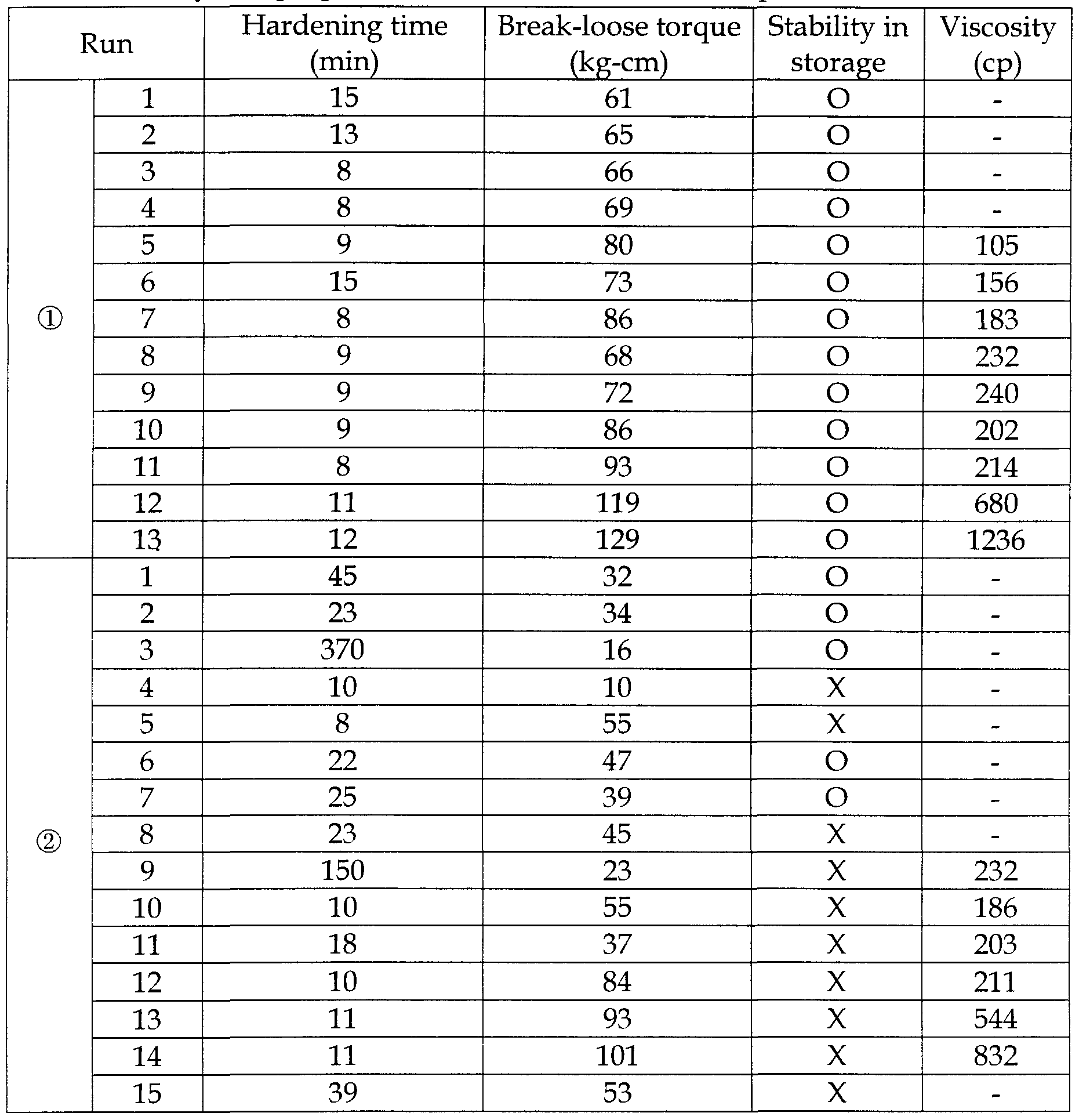
Φ and ® represent examples and comparative ones, respectively.
As shown in Table 2b, anaerobic adhesive compositions using an hardening promoter without difunctional carboxylic acid groups(comparative examples ~l-7); the anaerobic adhesive compositions using titanium dioxide as an auxiliary oxidizer(comparative examples ©~4,5); the anaerobic adhesive
composition using oxalic acid (comparative example ©~7); the anaerobic adhesive compositions containing an excessive quantity of reducer and oxidizer as an initiator(comparative examples ©~8,9); the anaerobic adhesive composition using an excessive quantity of urethaneacrylate(comparative example ©~9); the anaerobic adhesive composition containing an excessive quantity of cumene hydroperoxide(comparative example ©~10); the anaerobic adhesive composition using an insufficient quantity of difunctional carboxylic acid(comparative example ©~11) showed relatively longer hardening time and less break-loose torque. By separate samples, the anaerobic adhesive composition using an excessive quantity of difunctional carboxylic acid or fumed silica(comparative examples ©-12-14) showed the increase of acidity in solution, followed by the poor stability in storage. Also, the anaerobic adhesive composition containing an excessive quantity of thickening agent (comparative example ©~15) showed a great difficulty in mixing. On the other hand, comparative examples ©~4 , 5, 8-15 showed the poor stability in storage.
Especially, referring to the examples Φ-l-13 of this invention, it was found that the break-loose torque of anaerobic adhesive compositions using a thickening agent (examples ®~12,13) was better than that without a thickening agent (examples ®~1-11). As above-mentioned, the anaerobic adhesive composition comprising monomers, oligomers, inhibitors, oxidizers, reducers and thickening agents in the presence of difunctional carboxylic acid exhibited the rapid velocity in a hardening reaction, the good stability in storage, and the good strength in break-loose torque. In this context, the anaerobic adhesive composition according to this invention is applicable to the fastening between a bolt and a nut, and the assembly of precision apparatuses and electric/ electronic parts.
Claims
1. An anaerobic adhesive composition comprising monomers, oligomers, inhibitors, oxidizers, reducers and thickening agents which blends 0.0001 - 10 parts in weight of a difunctional carboxylic acid, expressed by the following formula I, in proportion to 100 parts in weight of a mixture of monomers and oligomers:
O O
I I I I I
HO— C— R— C— OH
wherein R is (CH2)n or CH2C(=CH2) and n is an integer of 2 to 10.
2. The anaerobic adhesive composition according to claim 1, wherein the difunctional carboxylic acid is one or more selected from malonic acid, succinic acid, adipic acid, itaconic acid, pimelic acid, terephthalic acid and decanoic acid.
3. The anaerobic adhesive composition according to claim 1, wherein the monomers are one or more selected from ethyleneglycol di(metha) aery late, diethyleneglycol di(metha)acrylate, triethyleneglycol di(metha) aery late, tetraethyleneglycol di(metha)acrylate, trimethylolpropane tri(metha)acrylate, styrene, chlorostyrene, vinyltoluene, a -methylstyrene, vinylacetate, methylacrylate, ethylacrylate, butylacrylate and methylmethacrylate.
4. The anaerobic adhesive composition according to claim 1, wherein the oligomers are one or more selected from mono or poly-(metha)acrylate oligomer of bisphenolic compound containing a , ω -diacryloyl- (bisethyleneglycol)-phthalate and a , ω -tetraacryloyl-(bistrimethylolpropane)- tetrahydrophthalate, and acrylic oligomers having aliphatic/ aromatic urethane groups and polyether groups.
5. The anaerobic adhesive composition according to claim 1, wherein the inhibitors are one or more selected from hydroquinone, methylhydroquinone, hydroquinonemonomethylether, naphthoquinone, penanthraquinone, anthraquinone, sebenzoquinone, catechol, t-butylcatechol, 2,6-t-butyl-4- methylphenol, phenothiazine, picric acid phenothiazine and hydroxydiphenylamine.
6. The anaerobic adhesive composition according to claim 1, wherein the oxidizers are one or more selected from t-butylhydroperoxide, cumenehydroperoxide, di-t-butylhydroperoxide, methylethylketoneperoxide, dicumylperoxide, 2,5-dimethylhexyl-2,5-dihydroperoxide, diisopropylbenzendhydroperoxide, t-butylbenzoate and t-butylperoxy acetate.
7. The anaerobic adhesive composition according to claim 1, wherein the reducers are one or more selected from phenyl- a -naphthylamine, N,N'- dimethyl-p-toluidine, N,N'-dimethylaniline, triethylenetetramine, diethylenetriamine, tri-N-butylamine, o-benzoic sufimide, benzoic acid sulfimide, acetylthiourea, ethylene thiourea and 2-mercaptobenzothiazole.
Priority Applications (1)
| Application Number | Priority Date | Filing Date | Title |
|---|---|---|---|
| PCT/KR1999/000285 WO2000077108A1 (en) | 1999-06-10 | 1999-06-10 | Anaerobic adhesive composition |
Applications Claiming Priority (1)
| Application Number | Priority Date | Filing Date | Title |
|---|---|---|---|
| PCT/KR1999/000285 WO2000077108A1 (en) | 1999-06-10 | 1999-06-10 | Anaerobic adhesive composition |
Publications (1)
| Publication Number | Publication Date |
|---|---|
| WO2000077108A1 true WO2000077108A1 (en) | 2000-12-21 |
Family
ID=19570857
Family Applications (1)
| Application Number | Title | Priority Date | Filing Date |
|---|---|---|---|
| PCT/KR1999/000285 Ceased WO2000077108A1 (en) | 1999-06-10 | 1999-06-10 | Anaerobic adhesive composition |
Country Status (1)
| Country | Link |
|---|---|
| WO (1) | WO2000077108A1 (en) |
Cited By (3)
| Publication number | Priority date | Publication date | Assignee | Title |
|---|---|---|---|---|
| US7595352B2 (en) * | 2003-11-24 | 2009-09-29 | Samsung Electronics Co., Ltd. | Photo-curable adhesive composition, optical pick-up device using the same, and optical recording/reproducing drive including the optical pick-up device |
| US10968310B1 (en) | 2015-04-28 | 2021-04-06 | Adhesive R&D, Inc. | Polymerizable materials, anaerobically curable compositions, and related methods and products |
| CN117965112A (en) * | 2024-04-01 | 2024-05-03 | 广东粤港澳大湾区黄埔材料研究院 | High-temperature-resistant anaerobic adhesive and application method thereof |
Citations (2)
| Publication number | Priority date | Publication date | Assignee | Title |
|---|---|---|---|---|
| JPS6210179A (en) * | 1985-07-09 | 1987-01-19 | Nippon Shokubai Kagaku Kogyo Co Ltd | Anaerobic adhesive composition |
| DD290776A7 (en) * | 1988-10-17 | 1991-06-13 | Kolloidchemie Gmbh,De | ACRYLATKLEBSTOFFSYSTEM |
-
1999
- 1999-06-10 WO PCT/KR1999/000285 patent/WO2000077108A1/en not_active Ceased
Patent Citations (2)
| Publication number | Priority date | Publication date | Assignee | Title |
|---|---|---|---|---|
| JPS6210179A (en) * | 1985-07-09 | 1987-01-19 | Nippon Shokubai Kagaku Kogyo Co Ltd | Anaerobic adhesive composition |
| DD290776A7 (en) * | 1988-10-17 | 1991-06-13 | Kolloidchemie Gmbh,De | ACRYLATKLEBSTOFFSYSTEM |
Non-Patent Citations (1)
| Title |
|---|
| Database WPI, Derwent Publications Ltd., London, GB, DW198708, Acc. No. 1987-053881, & JP 62 010 179 A (JAPC) 19.01.1987 * |
Cited By (5)
| Publication number | Priority date | Publication date | Assignee | Title |
|---|---|---|---|---|
| US7595352B2 (en) * | 2003-11-24 | 2009-09-29 | Samsung Electronics Co., Ltd. | Photo-curable adhesive composition, optical pick-up device using the same, and optical recording/reproducing drive including the optical pick-up device |
| US10968310B1 (en) | 2015-04-28 | 2021-04-06 | Adhesive R&D, Inc. | Polymerizable materials, anaerobically curable compositions, and related methods and products |
| US12024586B2 (en) | 2015-04-28 | 2024-07-02 | Adhesive R&D, Inc. | Polymerizable materials, anaerobically curable compositions, and related methods and products |
| CN117965112A (en) * | 2024-04-01 | 2024-05-03 | 广东粤港澳大湾区黄埔材料研究院 | High-temperature-resistant anaerobic adhesive and application method thereof |
| CN117965112B (en) * | 2024-04-01 | 2024-06-11 | 广东粤港澳大湾区黄埔材料研究院 | High temperature resistant anaerobic adhesive and its use method |
Similar Documents
| Publication | Publication Date | Title |
|---|---|---|
| US4731146A (en) | Adhesion promoting primer activator for anaerobic compositions | |
| EP1256615B1 (en) | Two-part structural adhesive having long working time | |
| US8865794B2 (en) | Anaerobic adhesive compositions having microencapsulated metal ions | |
| US3317465A (en) | Combination catalyst-inhibitor for betahydroxy carboxylic esters | |
| CN103172800B (en) | unsaturated polyester resin or vinyl ester resin compositions | |
| US7776963B2 (en) | Acrylic adhesives for metal bonding applications | |
| EP0450081B1 (en) | Adhesive composition | |
| JP2857471B2 (en) | Curable resin composition | |
| US4038475A (en) | Highly stable anaerobic compositions | |
| JPS5953311B2 (en) | Adhesive composition with excellent storage stability | |
| EP0941261B1 (en) | Composition | |
| US4245077A (en) | Stabilized acid-containing anaerobic compositions | |
| KR100247732B1 (en) | Anaerobic adhesive composition | |
| CN119859493A (en) | Redox initiation system for acrylic adhesives | |
| WO2024128006A1 (en) | Radical-polymerizable composition | |
| JP3221829B2 (en) | Two-component acrylic adhesive | |
| JPH0617009A (en) | Anaerobic hardening composition | |
| JP3345785B2 (en) | Acrylic heat-resistant adhesive composition | |
| JP3553510B2 (en) | Resin composition for electrical insulation | |
| Novák | Inhibitors for unsaturated polyesters and varnishes prepared from them | |
| JPH0365364B2 (en) | ||
| JPS61145267A (en) | Adhesive composition | |
| JPH05171060A (en) | Low odor solventless coil impregnated varnish | |
| JPH0633020A (en) | Adhesive composition | |
| JPH08188747A (en) | Fast curable adhesive composition |
Legal Events
| Date | Code | Title | Description |
|---|---|---|---|
| AK | Designated states |
Kind code of ref document: A1 Designated state(s): JP US |
|
| DFPE | Request for preliminary examination filed prior to expiration of 19th month from priority date (pct application filed before 20040101) | ||
| WWE | Wipo information: entry into national phase |
Ref document number: 10009343 Country of ref document: US |