WO2000077291A1 - Verfahren zum färben und aufhellen synthetischer und cellulosischer fasern - Google Patents
Verfahren zum färben und aufhellen synthetischer und cellulosischer fasern Download PDFInfo
- Publication number
- WO2000077291A1 WO2000077291A1 PCT/EP2000/005041 EP0005041W WO0077291A1 WO 2000077291 A1 WO2000077291 A1 WO 2000077291A1 EP 0005041 W EP0005041 W EP 0005041W WO 0077291 A1 WO0077291 A1 WO 0077291A1
- Authority
- WO
- WIPO (PCT)
- Prior art keywords
- fibers
- fiber
- brightener
- preparation
- alkyl
- Prior art date
- Legal status (The legal status is an assumption and is not a legal conclusion. Google has not performed a legal analysis and makes no representation as to the accuracy of the status listed.)
- Ceased
Links
Classifications
-
- D—TEXTILES; PAPER
- D06—TREATMENT OF TEXTILES OR THE LIKE; LAUNDERING; FLEXIBLE MATERIALS NOT OTHERWISE PROVIDED FOR
- D06P—DYEING OR PRINTING TEXTILES; DYEING LEATHER, FURS OR SOLID MACROMOLECULAR SUBSTANCES IN ANY FORM
- D06P1/00—General processes of dyeing or printing textiles, or general processes of dyeing leather, furs, or solid macromolecular substances in any form, classified according to the dyes, pigments, or auxiliary substances employed
- D06P1/0036—Dyeing and sizing in one process
-
- D—TEXTILES; PAPER
- D01—NATURAL OR MAN-MADE THREADS OR FIBRES; SPINNING
- D01F—CHEMICAL FEATURES IN THE MANUFACTURE OF ARTIFICIAL FILAMENTS, THREADS, FIBRES, BRISTLES OR RIBBONS; APPARATUS SPECIALLY ADAPTED FOR THE MANUFACTURE OF CARBON FILAMENTS
- D01F1/00—General methods for the manufacture of artificial filaments or the like
- D01F1/02—Addition of substances to the spinning solution or to the melt
- D01F1/06—Dyes
-
- D—TEXTILES; PAPER
- D06—TREATMENT OF TEXTILES OR THE LIKE; LAUNDERING; FLEXIBLE MATERIALS NOT OTHERWISE PROVIDED FOR
- D06L—DRY-CLEANING, WASHING OR BLEACHING FIBRES, FILAMENTS, THREADS, YARNS, FABRICS, FEATHERS OR MADE-UP FIBROUS GOODS; BLEACHING LEATHER OR FURS
- D06L4/00—Bleaching fibres, filaments, threads, yarns, fabrics, feathers or made-up fibrous goods; Bleaching leather or furs
- D06L4/60—Optical bleaching or brightening
- D06L4/657—Optical bleaching or brightening combined with other treatments, e.g. finishing, bleaching, softening, dyeing or pigment printing
-
- D—TEXTILES; PAPER
- D06—TREATMENT OF TEXTILES OR THE LIKE; LAUNDERING; FLEXIBLE MATERIALS NOT OTHERWISE PROVIDED FOR
- D06L—DRY-CLEANING, WASHING OR BLEACHING FIBRES, FILAMENTS, THREADS, YARNS, FABRICS, FEATHERS OR MADE-UP FIBROUS GOODS; BLEACHING LEATHER OR FURS
- D06L4/00—Bleaching fibres, filaments, threads, yarns, fabrics, feathers or made-up fibrous goods; Bleaching leather or furs
- D06L4/60—Optical bleaching or brightening
- D06L4/679—Fixing treatments in optical brightening, e.g. heating, steaming or acid shock
-
- D—TEXTILES; PAPER
- D06—TREATMENT OF TEXTILES OR THE LIKE; LAUNDERING; FLEXIBLE MATERIALS NOT OTHERWISE PROVIDED FOR
- D06M—TREATMENT, NOT PROVIDED FOR ELSEWHERE IN CLASS D06, OF FIBRES, THREADS, YARNS, FABRICS, FEATHERS OR FIBROUS GOODS MADE FROM SUCH MATERIALS
- D06M7/00—Treating fibres, threads, yarns, fabrics, or fibrous goods made of other substances with subsequent freeing of the treated goods from the treating medium, e.g. swelling, e.g. polyolefins
-
- D—TEXTILES; PAPER
- D06—TREATMENT OF TEXTILES OR THE LIKE; LAUNDERING; FLEXIBLE MATERIALS NOT OTHERWISE PROVIDED FOR
- D06M—TREATMENT, NOT PROVIDED FOR ELSEWHERE IN CLASS D06, OF FIBRES, THREADS, YARNS, FABRICS, FEATHERS OR FIBROUS GOODS MADE FROM SUCH MATERIALS
- D06M2200/00—Functionality of the treatment composition and/or properties imparted to the textile material
- D06M2200/40—Reduced friction resistance, lubricant properties; Sizing compositions
Definitions
- the present invention relates to a continuous process for dyeing and lightening synthetic or celio fibers, and the fibers thus produced. Dyes and / or optical brighteners are applied to the fiber directly during the spinning process in combination with fiber preparation agents.
- the dyeing and optical brightening of filaments and staple fibers is mainly practiced in three ways.
- the optical brightener or the dye is added during polymer production or generally before the fiber is spun.
- the addition before spinning is often carried out using a masterbatch, i. H. a multiple concentrate of the brightener or dye in polyester. 1 - 20% brightener or dye settings are used, which then by
- the brightener or dye can be pre-dissolved in a monomer component and then the polymerization process can be carried out.
- PAN polyacrylonitrile
- the brightener or dye is dissolved together with the polymer in an aprotic polar solvent (e.g. in DMF, DMSO, DMA or DMC).
- an aprotic polar solvent e.g. in DMF, DMSO, DMA or DMC.
- the dissolved mass is spun through nozzles into a hot air chamber, whereby the solvent evaporates.
- the lightening or dyeing of fabrics or knitted fabrics made from filaments or staple fibers is carried out in the so-called block thermosol process or exhaust process.
- the textile fabric is predominantly used with a diluted, brightener or dye-containing dispersion, emulsion or solution, squeezed between rollers and heated to 160 to 220 ° C for 40 - 15 seconds to fix the brightener or dye.
- the optical brightener or dye is applied to the fiber from an aqueous medium at a ratio of about 1: 5 to about 1:40 at 90 to 130 ° C. Filaments and staple fibers can also be lightened directly using the same process.
- DD-104 325 describes a process for lightening polyester which is characterized in that immediately after the shaping process, i.e. Spinning and solidification process, the fiber structure obtained is treated with a dispersion of optical brighteners in water, if appropriate in combination with hydrophilic liquids or preparation agents, and the spinning material is subjected to storage in containers for several hours before being drawn into the fiber raw material.
- the textile lightening processes are costly and time-consuming processes with high water and energy consumption, and corresponding economic and ecological disadvantages. Furthermore, in order to achieve appealing white effects, high amounts of brightener are also used, since the brightener has to penetrate deep into the fiber in order to achieve good fastness properties. Indications for the amounts of brightener used are 100 to 300 ppm in the spinning mass process, while in the textile lightening process between 100 to
- 1500 ppm optical brightener can be used in its active form (i.e. 100%).
- the invention thus relates to a process for the continuous lightening or dyeing of synthetic fibers or Celiosis fibers by one optical brightener or a dye and a fiber preparation agent in contact with the fibers to be lightened or dyed, and then heating these fibers to a temperature of at least 100 ° C.
- Another object of the invention are colored or, in preferred
- Embodiment lightened fibers that can be produced by this method.
- the fibers of the invention carry dyes or optical brighteners only in a limited area near the fiber surface, but not in the fiber core.
- the fibers are therefore not thoroughly interspersed with dye or optical brighteners, but rather they comprise a colored or lightened part on the outside and a non-colored or barely colored or lightened part in the core.
- the latter is also referred to as a weak fluorescence core.
- the low-fluorescence core has a diameter of 10 to 90, particularly preferably 30 to 80, in particular 50 to 75% of the fiber diameter.
- the low-fluorescence core contains at most 30, particularly preferably at most 0.1 to 10% by weight of the total amount of optical brightener on the fiber.
- Preferred synthetic fibers are polyester fibers, polyacrylonitrile fibers (PAN), and
- PA Polyamide fibers
- PU polyurethane fibers
- PU polypropylene fibers
- viscose fibers and mixtures of these fibers with each other.
- Fiber preparation agents are an indispensable aid in the production of synthetic or cellulosic fibers. It is about
- the fiber preparation system is applied to the surface of the fiber using various methods, the most important of which are as follows:
- Neat Oil applications When applied as an aqueous emulsion, this is usually done at ambient temperature. Depending on the viscosity of the preparation used, Neat Oil applications require application temperatures of approx. 50 - 60 ° C. In the further course of the fiber processing process, the preparation on the fiber is partially exposed to significantly higher temperatures. Stretching processes always take place above the glass point, usually approx. 140 - 160 ° C for polyester. Highly drawn filaments often even go to processing temperatures just below the melting point of polyester, i.e. to approx. 250 to 260 ° C. Modern high-temperature heaters in texturing expose the fiber material to temperatures of 550 ° C and above for a short time.
- the properties of the fiber preparation system are predominantly dominated by the first three compound classes a) - c).
- Additives such as Corrosion inhibitors often play a subordinate role, but are indispensable from case to case. The aim is often to control the entire requirement profile using as few components as possible.
- Lubricants are substances that control the tribological properties of the fiber preparation system. The main thing is the friction between the capillaries (so-called thread-thread adhesion or
- Thread closure and the adjustment of the friction on different metallic machine parts (thread-metal friction).
- Other materials are also used in fiber production (especially when texturing POY filaments) such as Polyurethane, ceramic materials and plastic straps (such as so-called “Murata belts”).
- the lubricants were mainly based on paraffinic mineral oils, so-called highly purified "white oils”. Silicone oils are also often used here.
- synthetic esters have recently been increasingly used (predominantly based on natural ones
- organic compounds containing sulfo groups such as e.g. sulfonated oils and
- the acid groups remaining on the sulfur atom are at least partially neutralized with lye (e.g. NaOH).
- emulsifiers are often used to produce homogeneous mixtures of the two classes of substances. This applies both to the application of fiber preparations as an aqueous emulsion and in bulk (so-called "Neat Oil application").
- surfactants and their preparations can be used as emulsifiers. These are e.g.
- Oxalkylation products of fatty acids, fatty acid amides, fatty alcohols, fatty amines or alkylphenols can also be used.
- the number of emulsifiers available is arbitrarily large. When selecting the corresponding substances, however, it must be taken into account that the emulsifier must "match" its lubricating properties, i.e. its effect is not impaired, but may even be supported. The emulsifier must neither influence the fiber material nor contact materials such as Change texturing or friction discs chemically or mechanically (e.g. by swelling). For these and many other reasons, alkoxylation products as enumerated above have largely become established today. It should be noted that the antistatic substances mentioned in group b) can also have emulsifying properties.
- these temperatures are between 100 and 220 ° C., preferably between 130 and 200 ° C., very particularly preferably 190 ° C.
- the fiber material can be exposed for a short time at temperatures of 550 ° C and higher, with exposure times in the 1/10 second range and below.
- Preferred temperatures for polypropylene are 160-280 ° C, for polyamide 130-170 ° C.
- thermosetting of PES brighteners requires fixing times of 15 to 40 seconds at temperatures of 160 to 220 ° C to fix the brightener in the fiber.
- Concentrations of, for example, 35 ppm brightener or dye (with respect to active substance) effects can be achieved which are conventional Process can only be achieved with a multiple of this amount of brightener or dye.
- optical brighteners or dyes for synthetic fibers are suitable as optical brighteners or dyes.
- these products can be provided with dispersants or, in the case of water- or solvent-soluble products, added to the preparation in dissolved form.
- the composition of the dispersing agent is not critical, but it must not cause any precipitations or separations with the preparation system.
- the commercially available dispersion brighteners or water or solvent-soluble types meet these requirements.
- Suitable optical brighteners or dyes for the process according to the invention are nonionic polyester brighteners or dyes, anionic PA or viscose brighteners or dyes or cationic polyacrylonitrile brighteners or dyes.
- Nonionic brighteners or dyes can produce excellent white effects on polyamide or polyolefin fibers.
- the optical brighteners or dyes can be used alone or in mixtures, and synergistic effects can also occur. Brighteners or are suitable for the process according to the invention without restriction
- Nonionic brighteners of formulas (1) - (8) are nonionic brighteners of formulas (1) - (8):
- the CN groups may be the same or different in the o, m, p position;
- R 9 is hydrogen or alkoxy, Rio alkoxy and Rn alkyl, alkoxyalkyl or dialkylaminoalkyl;
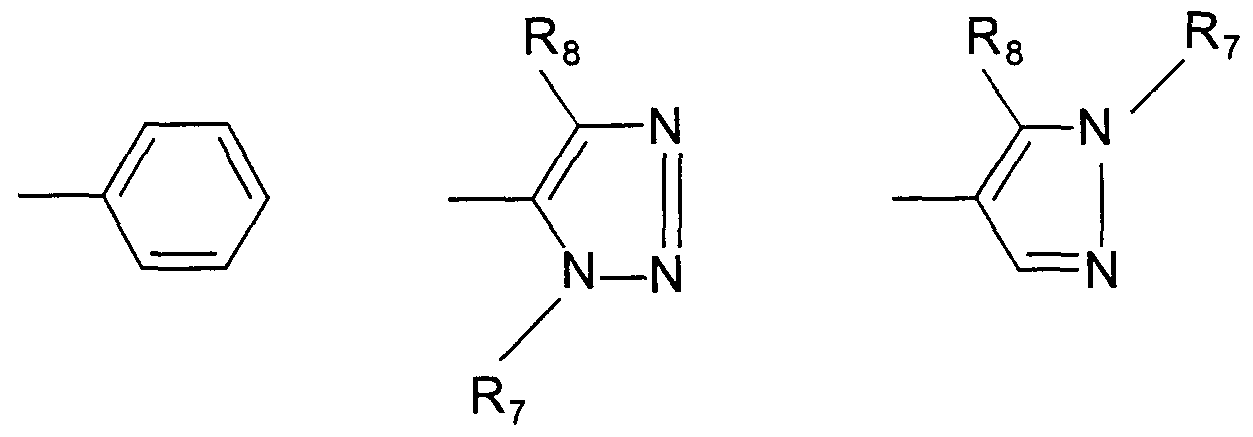
- R 12 phenyl or the group of the formula:
- R 13 is one of the groups of the formulas:
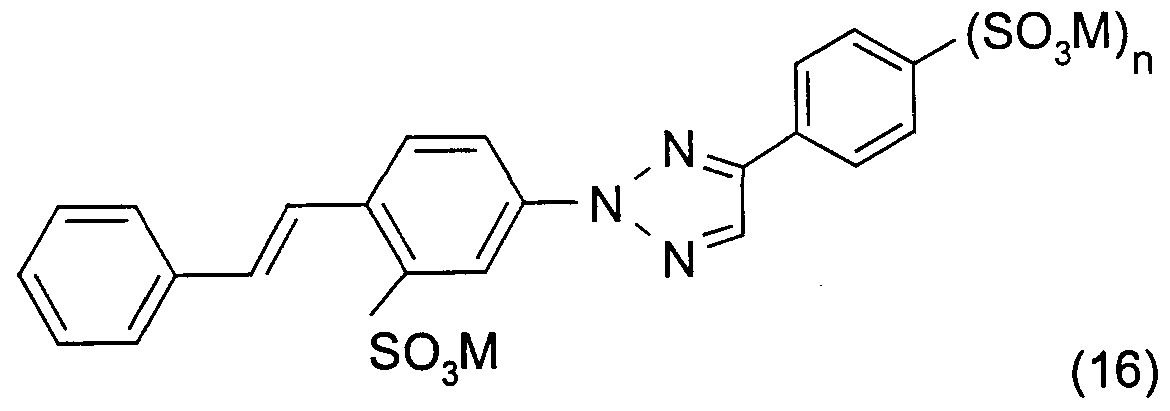
- Anionic brighteners which are particularly suitable for polyamide and viscose, correspond to formulas (9) to (23b):
- R 15 and R 15 ' which may be the same or different, are hydrogen, (CC 4 ) alkyl or phenyl;
- Ar 3 and Ar 4 independently of one another are phenyl, diphenyl or naphthyl radicals, the further substituents such as hydroxyl, (-CC 6 ) -alkyl-, (Ci-C ⁇ J-alkoxy, halogen, hydroxyalkyl, amino, alkylamino -, Acylamino, carboxyl, alkoxylcarbonyl, sulfonic acid, sulfonic acid ester, alkylsulfonyl, arylsulfonyl, sulfonyl and sulfonamide groups;
- R 16 is halogen or (-CC 6 ) alkyl
- n 0 or 1
- n 0 or 1
- Nonionic brighteners for polyamides correspond to formulas 23a, 23b or formulas 1-8.
- the cationic optical brighteners are compounds of formulas with a pyrazoline basic structure, which are in the salt form, that is to say acid addition salts.
- Suitable acids for this are those that have colorless anions, such as. B. CrC 3 alkanoates, CrC4 alkane phosphates, C1-C4 alkanesulfonates, C 2 -C 3 hydroxyalkanoates, alkanesulfonates, phosphite, sulfamide, halides, methosulfate, p-toluenesulfonate, preferably those which have good water solubilities.
- This also includes compounds of the formulas (24) to (30): wherein Ar 5 and Ar 6 are independently substituted or unsubstituted aryl and R 19 is hydrogen, CrC 4 alkyl or phenyl.
- Ar 7 and Ar 8 independently of one another are phenyl, diphenyl or naphthyl radicals which represent further substituents such as hydroxy, CrC ⁇ -alkyl, C 1 -C 6 -alkoxy, halogen, hydroxyalkyl, amino, alkylamino, acylamino, carboxyl , Alkoxycarbonyl, sulfonic acid, sulfonic acid ester, alkylsulfonyl, sulfonyl and sulfonamide groups, and R 19 has the above meaning.
- R 2 o is hydrogen, halogen or CrC ⁇ -alkyl
- R 21 is a substituted or unsubstituted CrC ⁇ -alkoxycarbonyl, -CC 6 -alkanesulfonyl, sulfonamide or sulfonic acid group
- m 0; 1 ; 2 or 3 mean and R 19 has the above meaning.
- R 22 is substituted or unsubstituted Ci-C ⁇ -alkylene, CrC 6 - alkylene-O ⁇ CrCeJ-alkylene ⁇ CrCe alkylene-CONH ⁇ Ci-CeV alkylene, (C ⁇ -C 6 ) - alkylene-CONH- (CrC 6 ) - Alkylene, -NH- (C 2 -C 4 ) alkylene or (C 2 -C 4 ) -hydroxyalkylene- NH-
- pyrazoline brighteners are the compounds of the following formula:
- A represents a 4-chlorophenyl group and R 26 represents a group of the following formulas: -NH 2 , -C 2 H4N (CH 3 ) 2 , -CH 2 CHCH 3 N (CH3) 2, -C 2 H 4 OC 2 H4N ( CH3) 2,
- R 2 6 is a group of the formula -C 2 H 4 N (CH 3 ) 2, (CH 2 ) x -OCOR 2 7 or (CH 2 ) x-OCOR 28 , x is a number from 1 to 4, R 2 C C ⁇ , preferably C 1 -C 3 -alkyl or Ci-C ⁇ -, preferably CC 3 -hydroxyalkyl, R 28 is hydrogen or -CC 6 -, preferably CrC 3 alkyl.
- Ci-C ⁇ alkyl radicals are unbranched and branched alkyl radicals, such as the methyl, ethyl, propyl, butyl, pentyl and hexyl radical. The same applies to the -C 8 alkoxy groups and for the -C 6 alkylene groups.
- benzimidazole-benzofuran derivatives or benzimidazole-benzoxazole derivatives of the general formula:
- R 32 can be hydrogen, halogen or CH 2 COOH
- R 33 can be hydrogen, phenyl, COO- (CrC 4 ) -alkyl or a group of the following formula:
- R 3 , R 38 and R 39 independently of one another are hydrogen, C 1 -C 4 -alkyl or phenyl.
- the use concentrations of optical brighteners can surprisingly be very low. In relation to the preparation mixture, clear whitening effects can be achieved with 0.01% commercial brightener mixtures or 0.001% active substance.
- the example describes the preparation of a polyester yarn with a
- the preparation is made up of 75 parts of Afilan V 4657 (as Afilan ® V 4657 30%
- the dispersed brightener mixture consists of 4.9% of the brightener of the formula:
- the total mixture thus obtained is applied by the following method: the thread is drawn off from a bobbin with preparation-free polyester yarn (as described above) at a constant speed of 70 m / min. The thread is passed over a total length of 15 cm through an immersion bath which contains 400 g of the mixture described above.
- the thread wetted in this way is passed between contact surfaces and squeezed off.
- the yarn is passed several times over a godet heated to 190 ° C. in such a way that the total contact time is 4 seconds.
- the yarn is then wound up and fed to the white effect determination and the analysis of the brightener content.
- the amount of brightener determined on the fiber by dissolving and UV spectrometry is 35 ppm.
- the whiteness effect achieved - determined according to the Whole / Semolina method - is 161 whiteness units.
- the white effects are washable and show a lightfastness of 6 - 7 (according to DIN 54004).
- the running properties and coefficients of friction of the fiber do not affect further processing.
- Example 2 In comparison to Example 1, a lightening was carried out in the polyester spinning mass. The brightener is added in the polycondensation stage.
- the temperature is increased every 15 minutes by 10 ° C. to 230-235 ° C. and kept at this level until all of the methanol has been distilled off.
- This process is supplemented by increasing the temperature to 250-270 ° C. under a vacuum of at least 0.013 mbar, the stirrer speed being kept constant at 180 rpm. After the desired viscosity is reached, the heating system is removed and the piston, which is blown up during cooling, is protected accordingly.
- the polyester mass is broken hydraulically and ground after CO 2 cooling.
- the material is dried for 5 hours at 120 ° C. and spun.
- Example 2 The procedure is as in Example 1. However, a dispersed brightener mixture is used, each consisting of 1% of the brightener of the formula:
- optical brightener mixture 75 ppm.
- the measured degrees of whiteness according to Ganz / Grie touch are 158.
- the brightening effects are washable and a lightfastness of 5 - 6 (DIN 54004) is obtained.
- the fiber contains 160 ppm of the optical brightener.
- the polyester yarn used in Example 1 is lightened at 130 ° C. for 45 min in a bath with a liquor ratio of 1:20 with 0.08% (160 ppm) of the brightener from Example 5 in such a way that the brightener practically quantitative from the bath the fiber is drawn. After rinsing and drying, a whiteness after whole / semolina of 153 is achieved.
- a commercially available flat yarn preparation for polyester and nylon filaments (Afilan 4097) is diluted with water to an active content of 10%.
- Preparation-free polyamide 6 with a titer of 220 f 40 is used.
- the application is carried out as described in Example 1, but the godet temperature is reduced to 150 ° C.
- the pH of the application bath is in the neutral range.
- the amount of brightener applied to the fiber is 217 ppm of active substance with a very good white effect. Similar effects are obtained at pH 5.5.
- the amount of brightener absorbed by the fiber is 120 ppm of active substance.
- Example 1 is used. However, 10 parts of the disperse dye Foron® Brillantviolettt S-3RL are added to the preparation mixture. A uniformly brilliant violet-colored fiber is obtained. The coloration is washable.
- Example 10 is used.
- Afilan AP and Afilan GD are mixed in a ratio of 1: 2 and the mixture is diluted with water so that a 10% emulsion is obtained.
- a preparation-free polyacrylic fiber with a titer 330 f 100 is selected as the fiber material.
- the godet temperature is 120 ° C.
- the application is otherwise as described in Example 1, the liquor absorption about 100%.
- Example 12 The preparation mixture described in Example 1 is mixed with 1.0 g of the dye Nylosan ® Blue FL 150 instead of the brightener and adjusted to pH 5.4 with 10% acetic acid with stirring. Otherwise the procedure is as in Example 7. An intensely blue-colored fiber with good fastness properties is obtained.
- Example 12 The preparation mixture described in Example 1 is mixed with 1.0 g of the dye Nylosan ® Blue FL 150 instead of the brightener and adjusted to pH 5.4 with 10% acetic acid with stirring. Otherwise the procedure is as in Example 7. An intensely blue-colored fiber with good fastness properties is obtained.
- Example 12 An intensely blue-colored fiber with good fastness properties is obtained.
- Example 2 The procedure is as described in Example 1, but unsplit, washed viscose fiber, dtex 200, is used. A 10% stock preparation from the commercially available products Leomin HSG-R and Leomin WG in a ratio of 60:40 is used as the preparation agent. which contains 5% of the optical brightener Leukophor BMB liquid. (Medium affinity DAS derivative) The contact time on the godet is 4 seconds at 120 ° C. A whiteness increase of 40 whiteness units according to the formula of Ganz is achieved.
Landscapes
- Engineering & Computer Science (AREA)
- Textile Engineering (AREA)
- Manufacturing & Machinery (AREA)
- Chemical & Material Sciences (AREA)
- Chemical Kinetics & Catalysis (AREA)
- General Chemical & Material Sciences (AREA)
- Treatments For Attaching Organic Compounds To Fibrous Goods (AREA)
- Coloring (AREA)
Abstract
Description









Claims
Priority Applications (3)
| Application Number | Priority Date | Filing Date | Title |
|---|---|---|---|
| MXPA01012688A MXPA01012688A (es) | 1999-06-10 | 2000-06-02 | Metodo para tenir y abrillantar fibras sinteticas y de celulosa. |
| EP00952969A EP1192310A1 (de) | 1999-06-10 | 2000-06-02 | Verfahren zum färben und aufhellen synthetischer und cellulosischer fasern |
| BR0011730-7A BR0011730A (pt) | 1999-06-10 | 2000-06-02 | Processo para tingir e branquear fibras sintéticas e celulósicas |
Applications Claiming Priority (4)
| Application Number | Priority Date | Filing Date | Title |
|---|---|---|---|
| DE19926356A DE19926356A1 (de) | 1999-06-10 | 1999-06-10 | Verfahren zum Färben und Aufhellen synthetischer und cellulosischer Fasern |
| DE19926356.6 | 1999-06-10 | ||
| DE2000105016 DE10005016A1 (de) | 2000-02-04 | 2000-02-04 | Verfahren zum Färben und Aufhellen synthetischer und cellulosischer Fasern |
| DE10005016.6 | 2000-02-04 |
Publications (1)
| Publication Number | Publication Date |
|---|---|
| WO2000077291A1 true WO2000077291A1 (de) | 2000-12-21 |
Family
ID=26004202
Family Applications (1)
| Application Number | Title | Priority Date | Filing Date |
|---|---|---|---|
| PCT/EP2000/005041 Ceased WO2000077291A1 (de) | 1999-06-10 | 2000-06-02 | Verfahren zum färben und aufhellen synthetischer und cellulosischer fasern |
Country Status (4)
| Country | Link |
|---|---|
| EP (1) | EP1192310A1 (de) |
| BR (1) | BR0011730A (de) |
| MX (1) | MXPA01012688A (de) |
| WO (1) | WO2000077291A1 (de) |
Cited By (1)
| Publication number | Priority date | Publication date | Assignee | Title |
|---|---|---|---|---|
| WO2004022837A1 (de) * | 2002-08-14 | 2004-03-18 | Clariant Gmbh | Verfahren zum aufhellen synthetischer fasern und kunststoffe mit granulierten optischen aufhellern |
Citations (7)
| Publication number | Priority date | Publication date | Assignee | Title |
|---|---|---|---|---|
| GB975814A (en) * | 1960-01-12 | 1964-11-18 | Hoechst Ag | Process for producing stretched filaments of aromatic polyesters of high molecular weight |
| GB1150168A (en) * | 1966-06-02 | 1969-04-30 | Ciba Ltd | Process for the Continuous Dyeing of Warp Yarn in a Sizing Bath |
| FR2086434A1 (en) * | 1970-04-29 | 1971-12-31 | Silva Cardona Carlos | Dyeing fabrics without use of water |
| FR2274726A1 (fr) * | 1974-06-11 | 1976-01-09 | Silva Cardona Carlos | Procede de teinture sans effluents et machine pour sa realisation |
| US4583987A (en) * | 1985-01-04 | 1986-04-22 | Kurz Juergen | Method for dyeing and lubricating sewing threads in a single bath and suited compositions for finishing |
| WO1998028482A1 (en) * | 1996-12-20 | 1998-07-02 | Threlkeld James O | Bonded sewing thread |
| WO1998048100A1 (es) * | 1997-04-18 | 1998-10-29 | Clariant International Ltd | Procedimiento para la tintura y acabado simultaneo de hilos de coser |
-
2000
- 2000-06-02 WO PCT/EP2000/005041 patent/WO2000077291A1/de not_active Ceased
- 2000-06-02 MX MXPA01012688A patent/MXPA01012688A/es not_active Application Discontinuation
- 2000-06-02 EP EP00952969A patent/EP1192310A1/de not_active Withdrawn
- 2000-06-02 BR BR0011730-7A patent/BR0011730A/pt not_active IP Right Cessation
Patent Citations (7)
| Publication number | Priority date | Publication date | Assignee | Title |
|---|---|---|---|---|
| GB975814A (en) * | 1960-01-12 | 1964-11-18 | Hoechst Ag | Process for producing stretched filaments of aromatic polyesters of high molecular weight |
| GB1150168A (en) * | 1966-06-02 | 1969-04-30 | Ciba Ltd | Process for the Continuous Dyeing of Warp Yarn in a Sizing Bath |
| FR2086434A1 (en) * | 1970-04-29 | 1971-12-31 | Silva Cardona Carlos | Dyeing fabrics without use of water |
| FR2274726A1 (fr) * | 1974-06-11 | 1976-01-09 | Silva Cardona Carlos | Procede de teinture sans effluents et machine pour sa realisation |
| US4583987A (en) * | 1985-01-04 | 1986-04-22 | Kurz Juergen | Method for dyeing and lubricating sewing threads in a single bath and suited compositions for finishing |
| WO1998028482A1 (en) * | 1996-12-20 | 1998-07-02 | Threlkeld James O | Bonded sewing thread |
| WO1998048100A1 (es) * | 1997-04-18 | 1998-10-29 | Clariant International Ltd | Procedimiento para la tintura y acabado simultaneo de hilos de coser |
Non-Patent Citations (1)
| Title |
|---|
| DATABASE WPI Section Ch Derwent World Patents Index; Class A87, AN 1971-40088S, XP002152773 * |
Cited By (2)
| Publication number | Priority date | Publication date | Assignee | Title |
|---|---|---|---|---|
| WO2004022837A1 (de) * | 2002-08-14 | 2004-03-18 | Clariant Gmbh | Verfahren zum aufhellen synthetischer fasern und kunststoffe mit granulierten optischen aufhellern |
| CN1327078C (zh) * | 2002-08-14 | 2007-07-18 | 科莱恩产品(德国)有限公司 | 采用粒状荧光增白剂增白合成纤维和塑料的方法 |
Also Published As
| Publication number | Publication date |
|---|---|
| MXPA01012688A (es) | 2002-06-04 |
| EP1192310A1 (de) | 2002-04-03 |
| BR0011730A (pt) | 2002-03-26 |
Similar Documents
| Publication | Publication Date | Title |
|---|---|---|
| DE2802243C2 (de) | ||
| EP0583446B1 (de) | Wachsdispersionen, deren herstellung und verwendung | |
| DE3500168C2 (de) | ||
| DE10220380A1 (de) | Polyethylennaphthalat-Faser mit hoher Festigkeit | |
| DE19805104A1 (de) | Beschichtungsmittel für Fasern | |
| DE2660126C2 (de) | Verwendung eines copolymeren Reaktionsproduktes als Dispergiermittel | |
| EP0023026B1 (de) | Mischungen von optischen Aufhellern und deren Verwendung | |
| DE19732109A1 (de) | Mischungen von optischen Aufhellern | |
| EP1192310A1 (de) | Verfahren zum färben und aufhellen synthetischer und cellulosischer fasern | |
| DE19926356A1 (de) | Verfahren zum Färben und Aufhellen synthetischer und cellulosischer Fasern | |
| DE3027479A1 (de) | Mischungen von optischen aufhellern und deren verwendung | |
| DE10005016A1 (de) | Verfahren zum Färben und Aufhellen synthetischer und cellulosischer Fasern | |
| US2298432A (en) | Lubrication and fugitive tinting of synthetic yarns | |
| DE2256835C3 (de) | Verfahren zum Präparieren von Synthesefäden | |
| DE2304221A1 (de) | Oel und dessen verwendung beim verspinnen von synthetischen stapelfasern | |
| CH616709A5 (en) | Process for spin-dyeing polymers or copolymers of acrylonitrile | |
| EP0035694A1 (de) | Mischungen von optischen Aufhellern | |
| DE1959632A1 (de) | Verfahren zur Herstellung von Mischpolyestern | |
| DE1594855C3 (de) | ||
| DE69422125T2 (de) | Dispersionsfarbstoffmischung und Verfahren zum Färben von hydrophoben Fasern | |
| EP0076971B1 (de) | Verfahren zur Herstellung schwer entflammbarer Formkörper aus Polymeren | |
| DE3732378A1 (de) | Praeparationsmittel fuer stapelfasern aus synthetischen polymeren | |
| DE10015174A1 (de) | Stabile wäßrige Polymeremulsionen, ihre Herstellung und Verwendung | |
| DE3706362A1 (de) | Glaettemittel fuer textilfasermaterialien | |
| DE2555896B2 (de) | Sekundäre Ätheraminacetate Verfahren zu deren Herstellung und deren Verwendung als Präparationsmittel für Synthesefasern |
Legal Events
| Date | Code | Title | Description |
|---|---|---|---|
| AK | Designated states |
Kind code of ref document: A1 Designated state(s): BR CN ID IN JP MX TR |
|
| AL | Designated countries for regional patents |
Kind code of ref document: A1 Designated state(s): AT BE CH CY DE DK ES FI FR GB GR IE IT LU MC NL PT SE |
|
| 121 | Ep: the epo has been informed by wipo that ep was designated in this application | ||
| DFPE | Request for preliminary examination filed prior to expiration of 19th month from priority date (pct application filed before 20040101) | ||
| WWE | Wipo information: entry into national phase |
Ref document number: 2000952969 Country of ref document: EP |
|
| WWE | Wipo information: entry into national phase |
Ref document number: PA/a/2001/012688 Country of ref document: MX |
|
| WWP | Wipo information: published in national office |
Ref document number: 2000952969 Country of ref document: EP |
|
| WWW | Wipo information: withdrawn in national office |
Ref document number: 2000952969 Country of ref document: EP |
|
| NENP | Non-entry into the national phase |
Ref country code: JP |