WO2001010844A1 - DERIVES D'ACIDE φ-AMINO-α-HYDROXYCARBOXYLIQUE POSSEDANT UN ANTAGONISME αvβ3 D'INTEGRINE - Google Patents
DERIVES D'ACIDE φ-AMINO-α-HYDROXYCARBOXYLIQUE POSSEDANT UN ANTAGONISME αvβ3 D'INTEGRINE Download PDFInfo
- Publication number
- WO2001010844A1 WO2001010844A1 PCT/JP2000/005177 JP0005177W WO0110844A1 WO 2001010844 A1 WO2001010844 A1 WO 2001010844A1 JP 0005177 W JP0005177 W JP 0005177W WO 0110844 A1 WO0110844 A1 WO 0110844A1
- Authority
- WO
- WIPO (PCT)
- Prior art keywords
- group
- alkyl
- alkyl group
- alkoxy
- amino
- Prior art date
- Legal status (The legal status is an assumption and is not a legal conclusion. Google has not performed a legal analysis and makes no representation as to the accuracy of the status listed.)
- Ceased
Links
Classifications
-
- C—CHEMISTRY; METALLURGY
- C07—ORGANIC CHEMISTRY
- C07D—HETEROCYCLIC COMPOUNDS
- C07D239/00—Heterocyclic compounds containing 1,3-diazine or hydrogenated 1,3-diazine rings
- C07D239/02—Heterocyclic compounds containing 1,3-diazine or hydrogenated 1,3-diazine rings not condensed with other rings
- C07D239/24—Heterocyclic compounds containing 1,3-diazine or hydrogenated 1,3-diazine rings not condensed with other rings having three or more double bonds between ring members or between ring members and non-ring members
- C07D239/28—Heterocyclic compounds containing 1,3-diazine or hydrogenated 1,3-diazine rings not condensed with other rings having three or more double bonds between ring members or between ring members and non-ring members with hetero atoms or with carbon atoms having three bonds to hetero atoms with at the most one bond to halogen, directly attached to ring carbon atoms
- C07D239/32—One oxygen, sulfur or nitrogen atom
- C07D239/42—One nitrogen atom
-
- A—HUMAN NECESSITIES
- A61—MEDICAL OR VETERINARY SCIENCE; HYGIENE
- A61P—SPECIFIC THERAPEUTIC ACTIVITY OF CHEMICAL COMPOUNDS OR MEDICINAL PREPARATIONS
- A61P7/00—Drugs for disorders of the blood or the extracellular fluid
- A61P7/02—Antithrombotic agents; Anticoagulants; Platelet aggregation inhibitors
-
- A—HUMAN NECESSITIES
- A61—MEDICAL OR VETERINARY SCIENCE; HYGIENE
- A61P—SPECIFIC THERAPEUTIC ACTIVITY OF CHEMICAL COMPOUNDS OR MEDICINAL PREPARATIONS
- A61P9/00—Drugs for disorders of the cardiovascular system
-
- A—HUMAN NECESSITIES
- A61—MEDICAL OR VETERINARY SCIENCE; HYGIENE
- A61P—SPECIFIC THERAPEUTIC ACTIVITY OF CHEMICAL COMPOUNDS OR MEDICINAL PREPARATIONS
- A61P9/00—Drugs for disorders of the cardiovascular system
- A61P9/10—Drugs for disorders of the cardiovascular system for treating ischaemic or atherosclerotic diseases, e.g. antianginal drugs, coronary vasodilators, drugs for myocardial infarction, retinopathy, cerebrovascula insufficiency, renal arteriosclerosis
Definitions
- the present invention relates to integrin v? (3) A novel ⁇ -amino-hydroxyhydroxycarboxylic acid derivative having an antagonistic action, and a pharmaceutical composition containing at least one of these as an active ingredient.
- Integrins which are glycoprotein receptors involved in cell adhesion and penetrating the cell membrane, are not only involved in wound healing, hemostasis, phagocytosis, biological defense, cytoskeleton construction, but also themselves. It has been shown to be a signaling molecule (Cell, 69, 11, (1992)). Therefore, organic chemistry related to integrins has come into the spotlight in recent years, both in terms of medicinal chemistry, as well as molecular and cell biology.
- Integrin binds to various ligands while dynamically and intricately changing its conformation, and it is being understood that integrin transmits a signal in and out of the cell in both directions (Junichi Takagi et al. 50th Japan Society for Cell Biology, S5-l, 1997). In recent years, TA Springer of Harvard Medical School predicted that some integrin activated had a propeller structure, and that ligand binding was performed on the top surface of the propeller (Pro Natl. Acad. Sci. USA, 94, 65, 1997).
- Integurinhi V 5 3 many types of extracellular matrix, i.e. vitro-nectin, Fuiburino one Gen, fibronectin, Osuteoponchin, thrombospondin spondin, von Willebrand factor, and deeply involved ligand such as such as a biological function or development of the disease collagen It is very interesting as a drug discovery target because it binds to and forms a complex (DN & P, 10, 456 , 1997).
- human v- 3 is highly expressed in B cells, macrophages, monocytes, smooth muscle, and activated endothelial cells.
- Matahi 3 is not strongly expressed in quiescent endothelial cells, in the course of growth Contact and invasion, i.e.
- angiogenesis are known to be highly activated in wound healing and inflammatory sites. Furthermore, it has been observed that in various types of cancer cells, the expression frequency of spermatid 3 is correlated with an increase in cancer invasion. Meanwhile US Sukuribusu Institute group using the model of the baboons, the medium when the ischemic reperfusion experimentally cerebral artery, microvascular Nihi v 5 3 Konbiyu evening that express newly - by the video imaging techniques (Y. Okada et al., Am. J. Pathol., 149, 37, (1996)).
- integrin v- 3 antagonists from their chemical structures can be classified into antibodies, small peptides and their analogs, and small organic compounds. Both antagonists are structurally closely related to the sequence of the tripeptide RGD (arginine-glycine-aspartate), which is thought to be essential for its recognition when the ligand binds.
- Low-molecular peptide antagonists include disintegrin derived from snake venom, as well as cyclic peptides. One of them, GpenGRGDSPCA, inhibits smooth muscle migration and integrin v? It has been reported that blocking 3 actually reduces the intimal thickening of the egret (ET Choi et al., J. Vase.
- Antagonists have not been reported to date.
- the present inventors have found that a group of derivatives have strong integrin v-3 antagonism.
- the present inventors have also found that a group of derivatives have strong GP Ilb / IIIa antagonism and human platelet aggregation inhibitory action.
- the present inventors further concluded that these derivatives have excellent water solubility and almost no pharmacological action directly related to integrin. I found nothing.
- An object of the present invention is to provide a compound having an integrin v- 3 antagonistic action, a GP Ilb / IIIa antagonistic action, and / or a human platelet aggregation inhibitory action, and having excellent water solubility.
- the present invention also relates to a therapeutic agent for a disease mediated by integrin, and a disease selected from diseases in which GP Ilb / I Ila antagonism and / or platelet aggregation inhibitory activity is therapeutically effective, and a platelet aggregation inhibitor. Its purpose is to provide.
- the compound according to the invention is a compound of formula (I) or a pharmaceutically acceptable salt or solvate thereof.
- A is a saturated or unsaturated 5- to 7-membered heterocyclic group containing two nitrogen atoms (this heterocyclic group is condensed with another saturated or unsaturated 5- to 7-membered carbocyclic or heterocyclic group).
- the heterocyclic group and the bicyclic group may form a cyclic group, and the heterocyclic group and the bicyclic group may be a C 6 alkyl group, an amino group, a C alkoxy group, a d- 6 alkoxycarbonyl group, or an aralkyl group.
- alkyl group, amino group, C-alkoxy group, d-alkoxycarbonyl group and aralkyl group are Ci-alkyl group, C-alkoxy group, d-alkoxycarbonyl group, aralkyl group, amino group, hydroxyl group, or halogen atom. May be substituted by)) or
- I 1, R 2, and R 3 may be the same or different, a hydrogen atom, an alkyl group, C 2 - 6 alkenyl group, C 2 - 6 alkynyl group, Ararukiru group or, Represents a nitrile group, or R 1 and R 2 together form a group (CH 2 ) i- (i represents 4 or 5) or a group (CH 2 ) 2-0- (CH 2 ) may form 2-, - 6 alkyl group, C 2 6 alkenyl, C 2 - 6 alkynyl group, and Araruki Le group, an alkyl group, d-6 alkoxy group, an alkoxycarbonyl group, ⁇ aralkyl Group, amino group, hydroxyl group, or halogen atom)
- D is a bond,> NR 4 (R 4 is a hydrogen atom or a CH alkyl group (this alkyl group is a phenyl group optionally substituted by a -6 alkoxy group, a d-6 alkyl group, a C 6 alkoxy group, an alkoxycarbonyl Group, aralkyl group, amino group, hydroxyl group, or halogen atom)),> CR 5 R 6 (R 4 is a hydrogen atom or a CH alkyl group (this alkyl group is a phenyl group optionally substituted by a -6 alkoxy group, a d-6 alkyl group, a C 6 alkoxy group, an alkoxycarbonyl Group, aralkyl group, amino group, hydroxyl group, or halogen atom)),> CR 5 R 6 (R 4 is a hydrogen atom or a CH alkyl group (this alkyl group is a phenyl group optionally substituted by a -6
- R 5 and R 6 are each a hydrogen atom or C! - 6 alkyl group (the alkyl group C -! 6 ⁇ alkoxy a phenyl group which may be substituted by a group, alkyl group, alkoxy group, d-6 alkoxycarbonyl group, Ararukiru group, an amino group, a hydroxyl group, also Represents an optionally substituted halogen atom)), represents 1 0— or 1 S—,
- X and Z may be the same or different and represent either CH or N;
- R 7 represents a C! -6 alkyl group, ( ⁇ 6 alkoxy group, halogen atom, amino group, nitro group, hydroxyl group, oxygen atom, or cyano group;
- C! -6 alkyl group and Ci-6 alkoxy group May be substituted with a C6 alkyl group, Ci-6 alkoxy group, C, -6 alkoxycarbonyl group, aralkyl group, amino group, hydroxyl group, or halogen atom.
- R 8 is, d-6 alkyl group, C, - 6 alkoxy group, a halogen atom, one or two
- Ci-6 represents an amino group, a nitro group, a hydroxyl group, an oxygen atom, or a cyano group which may be substituted by an alkyl group
- the 6 alkyl group and the d-6 alkoxy group include an alkyl group, an alkoxy group, a C, -6 alkoxycarbonyl group, aralkyl group, amino group, hydroxyl group, or halogen atom
- R 9 is a hydrogen atom, C -e alkyl group, C 2 6 alkenyl, C 2 -! Represents a 6 alkynyl or Ararukiru group,, C -! 6 alkyl, C 2 - 6 alkenyl group, C 2 - 6 Arukini Le group and Ararukiru group C,> - 6 alkyl group, C -! 6 alkoxy group, CI- 6 an alkoxy carbonyl group, Ararukiru group, an amino group, a hydroxyl group or may be substitution by halogen atoms, ,
- J represents a bond or an alkylene group having 1 to 3 carbon atoms, and the alkylene group is substituted with an alkyl group, a Ci- 6 alkoxy group, a C alkoxycarbonyl group, an aralkyl group, an amino group, a hydroxyl group, or a halogen atom.
- R 1C is a hydrogen atom, an alkyl group, C 2 - 6 alkenyl group, C 2 6 alkynyl group, a Ararukiru group or Ashiru group,, d-6 alkyl groups, C 2 - 6 alkenyl group, C 2-6 alkynyl
- the group, aralkyl group, and acryl group may be substituted by d-6 alkyl group, 0, -67 alkoxy group, alkoxycarbonyl group, aralkyl group, amino group, hydroxyl group, or halogen atom,
- R 11 represents a hydrogen atom, C WINCH 6 alkyl group or Ararukiru group,, d 6 alkyl Le group and Ararukiru groups ⁇ I 6 alkyl groups, C physician 6 alkoxy group, - 6 alkoxy carbonyl group, Ararukiru group, amino Group, hydroxyl group, or halogen atom,
- n an integer of 0 to 5
- n an integer of 0 to 4
- p represents an integer of 1 to 3
- q represents an integer of 1 to 3.
- the compounds according to the invention is useful as a therapeutic agent for diseases mediated by Integurinhi V / 5 3.
- 6 alkyl j as a group or part of a group - word 6 alkoxy "group is a linear, branched or cyclic having 1 to 6 carbon atoms, and good Mashiku 1 ⁇ ⁇ ⁇ ⁇ 4 means alkyl and alkoxy.
- C 2 - 6 alkenyl and “C
- 2 one 6 alkynyl refers to the group linear, branched or cyclic 2-6 carbon atoms, preferably 2 to 4, means the alkenyl and alkynyl.
- 6- alkyl examples include methyl, ethyl, n-propyl, isopropyl, cyclopropyl, cyclobutylmethyl, n-butyl, i_butyl, s-butyl, t-butyl, n-pentyl, cyclopentyl, n-to Xyl and cyclohexyl.
- alkoxy examples include methoxy, ethoxy, n-propoxy, i-propoxy, n-butoxy, i-butoxy, s-butoxy, t-butoxy.
- saturated or unsaturated 5- to 7-membered heterocyclic ring refers to a 5- to 7-membered heterocyclic ring containing at least one heteroatom selected from an oxygen atom, a nitrogen atom, and a sulfur atom. And preferably a 5- to 7-membered heterocyclic ring containing one nitrogen atom, and more preferably a 5- or 6-membered heterocyclic ring containing one nitrogen atom.
- the hetero atom means an oxygen atom, a nitrogen atom, and a sulfur atom.
- saturated or unsaturated 5- to 7-membered heterocyclic groups include pyrimidyl, 1,4,5,6-tetrahydropyrimidyl, imidazolyl, tetrahydro- [1,3] diazepinyl, and imimidyl. And a dazolidinyl group.
- a saturated or unsaturated heterocyclic group may be condensed with another saturated or unsaturated heterocyclic ring to form a bicyclic ring.
- Examples of such a condensed cyclic group include a benzimidazolyl group, a naphthyl group And an azabenzimidazolyl group (eg, an imidazo [4,5-b] pyridyl group).
- Examples of the aralkyl group include a benzyl group and a phenethyl group.
- the halogen atom means a fluorine atom, a chlorine atom, a bromine atom and an iodine atom.
- Preferred combinations of X and Z include when X represents CH and Z represents N, and when X and Z both represent N.
- X preferably represents N, more preferably X represents N and Z represents N.
- X preferably represents CH, more preferably X represents CH, Z represents N.
- X is preferably Table Table, more preferably X is N a N, Z represents N.
- X preferably represents CH, more preferably X represents CH, and Z represents N.
- X preferably represents CH, more preferably X represents CH and Z represents N.
- D preferably represents a bond or a> NR 4.
- the bicyclic heterocyclic group represented by A is preferably a 9- or 10-membered heterocyclic group, more preferably a 9- or 10-membered heterocyclic group containing 2 or 3 nitrogen atoms. it can.
- A preferably represents the following groups.
- Het represents a saturated or unsaturated 5- to 7-membered heterocyclic group containing two nitrogen atoms, and this heterocyclic group is condensed with another saturated or unsaturated 5- to 7-membered carbocyclic or heterocyclic ring. May form a bicyclic group.
- the heterocyclic group and the bicyclic group may be a C 6 alkyl group, an amino group, a d-6 alkoxy group, a C 6 alkoxycarbonyl group, or an aralkyl group (this alkyl group, an amino group, d-6 alkoxy group, CI- 6 alkoxycarbonyl alkylsulfonyl group and Ararukiru group C doctor 6 alkyl group, d-6 alkoxy group, C] 6 alkoxy May be replaced by a carbonyl group, an aralkyl group, an amino group, a hydroxyl group, or a halogen atom).
- R 21 and R 23 may be the same or different and represent a hydrogen atom, a d 6 alkyl group, a C 6 alkenyl group, or an aralkyl group;
- R 22 represents a hydrogen atom or a C 6 alkyl group, or
- Kiichi CHR 24 CH 2 CH 2 - ( R 24 is d- alkyl group, a halogen atom or ⁇ amino group, the alkyl group C doctor 6 alkyl group, C 6 alkoxy group, C WINCH 6 alkoxide aryloxycarbonyl Or an amino group, an aralkyl group, an amino group, a hydroxyl group, or a halogen atom, and the amino group is substituted by a C 6 alkyl group, a Ci- 6 alkoxy group, a Ci alkoxy carbonyl group, or an aralkyl group.
- CH 2 CHR 24 CH 2 — (R 24 has the same meaning as described above)
- R 22 may represent a single bond between R 21 and the nitrogen atom to which it is attached)
- one or more hydrogen atoms in the following moieties may be substituted by R 7 .
- n 0, R 8 does not exist.
- n 2 or more, two or more hydrogen atoms of the phenylene moiety are substituted by R 8, but the substituents may be the same or different.
- n is preferably an integer from 0 to 2.
- J preferably represents an optionally substituted methylene or ethylene chain.
- R 9 preferably represents a hydrogen atom, a d- 6 alkyl group (preferably methyl, propyl, cyclopropylmethyl), or an aralkyl group (preferably benzyl or phenethyl).
- H 1Q is preferably a hydrogen atom, d-6 alkyl group or an Ashiru group, d one alkyl group and Ashiru group, is C> -! 6 alkyl groups, C -6 alkoxy groups, C] - 6 Al It may be substituted by a oxycarbonyl group, an aralkyl group, an amino group, or a hydroxyl group.
- R 11 preferably represents a hydrogen atom, an unsubstituted C 6 alkyl group, or an unsubstituted aralkyl group.
- Preferred compounds of the formula (I) include:
- A is the following group:
- D represents a bond or> NR 4 ;
- X represents N or CH
- n each represent an integer of 0 or 1
- R 7 is an optionally substituted 6 alkyl group, a halogen atom, or an oxygen atom,
- R 8 represents a halogen atom, a nitro group, an optionally substituted amino group, a cyano group, an optionally substituted Ci-6 alkyl group, or an optionally substituted Ci—S alkoxy group,
- R 9 is a hydrogen atom, an optionally substituted ( ⁇ - represents an alkyl group or an optionally substituted good I Ararukiru group,
- J represents a methylene chain or an ethylene chain which may be substituted
- R '° is a good hydrogen atom, optionally substituted C, - 6 alkyl group, but it may also be substituted C 2 - 6 alkenyl group, an optionally substituted Ararukiru group, or optionally substituted Represents a good acyl group,
- R 11 represents a hydrogen atom, an optionally substituted C 6 alkyl group, or an optionally substituted aralkyl group, p and q represent 1 or 2 respectively
- Preferred compounds of the compound of formula (I) also include
- A is the following group:
- R 21 and R 23 are both hydrogen atoms, or R 21 and R 23 are taken together and H2CH2Cri2
- R 22 represents a hydrogen atom or a C 6 alkyl group which may be substituted
- D represents a bond or> NR 4 ,
- X represents CH or N
- n 0 or 1
- R 7 is a Cl- 6 alkyl group
- R 8 is a halogen atom
- a 6 alkenyl group or an optionally substituted Ararukiru group,, - R 9 is a hydrogen atom, may be substituted d-6 alkyl group, an optionally substituted have good C 3
- J is an optionally substituted methylene chain or ethylene chain
- R 1G is hydrogen, may be substituted d-6 alkyl group, optionally substituted C 3 - 6 alkenyl, optionally substituted Ararukiru group which may or optionally substituted Ashiru group,
- R 11 is a hydrogen atom, an optionally substituted 6 alkyl group, or an optionally substituted aralkyl group,
- (2S) acetoxy-1 3— [4— ⁇ 4— (1,4,5,6-tetrahydropyrimidine-12-ylamino) bidiridine-1-yl ⁇ benzoylamino] propionic acid, (2S) 1 t-butoxy 4— [4-1 ⁇ 4-1 (pyrimidine 1-2-ylamino) piperidine 1 1-yl ⁇ benzoylamino] butyric acid t-butyl ester,
- the compound according to the present invention can be a pharmacologically acceptable salt thereof.
- Such salts include non-toxic salts, but preferred salts include hydrochlorides, hydrobromides, hydrohalides such as hydroiodide, nitrates, perchlorates, and sulfates.
- Inorganic salts such as phosphates, lower alkyl sulfonates such as methanesulfonate, trifluoromethanesulfonate, ethanesulfonate, and salts such as benzenesulfonate and p-toluenesulfonate.
- Organic acid salts such as sulfonate, fumarate, succinate, citrate, tartrate, oxalate, maleate and amino acid salts such as glutamate, aspartate, sodium salt
- Alkali metal or alkaline earth metal salts such as potassium salts or calcium salts
- organic aluminum salts such as pyridine salts, triethylamine salts, etc. It can be mentioned.
- the compound according to the present invention may be a solvate thereof (for example, a hydrate, an alcoholate such as methanol or ethanol, or an ether solvate such as tetrahydrofuran).
- a solvate thereof for example, a hydrate, an alcoholate such as methanol or ethanol, or an ether solvate such as tetrahydrofuran.
- a condensing agent such as dicyclohexylcarbodiimide, diisopropyl carbodiimide, or 1-ethyl-3_ (3-dimethylaminopropyl) carbodiimid hydrochloride is used alone or in combination with these condensing agents.
- the agent can be used in combination with N-hydroxysuccinimide, 1-hydroxybenzotriazole, and the like.
- benzotriazole-11-yloxytri (dimethylamino) phosphoniumhexafluorophosphato can be used alone in the presence of a base.
- reaction solvent in the dehydration condensation reaction examples include dimethylformamide, dioxane, tetrahydrofuran, and methylene chloride.
- Dimethylformamide or a mixed solvent of dimethylformamide and methylene chloride is preferred.
- the reaction can be carried out in the range of 0 to 80 ° C, preferably 0 to 50 ° C.
- a tertiary amine such as diisoprovirethylamine, monomethylmorpholine, dimethylaminoviridine, and triethylamine can be added as an organic base to improve the yield. It is preferable to add 2 to 5 equivalents of monomethylmorpholine or disoprovirethylamine.
- the reaction proceeds without adding these organic bases. From the viewpoint of the yield, it is preferable to add an organic base.
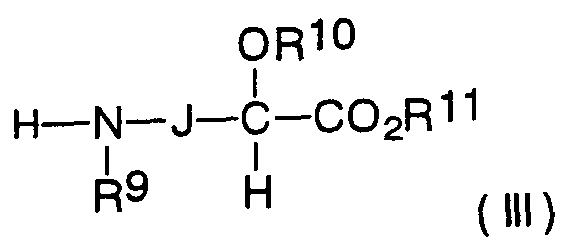
- R 1G , R and J have the same meaning as defined in formula (I), to produce a compound of formula (V) wherein R 9 is a hydrogen atom it can.
- an alkyl group, an alkenyl group, or an aralkyl group can be introduced into R 9 through a further reductive amination reaction.
- Alkyl group located in R 9, the introduction of alkenyl or Ararukiru group, is not necessarily made only with respect to the compound of formula (IV) in Scheme. That is, the introduction of the alkyl, alkenyl, or aralkyl group located at R 9 may be made to the compound of formula (V) in the scheme.
- the reaction can be carried out according to the production example of Example 49 of W099 / 52872.
- the amine of formula (III) used in step 1 can be synthesized from known materials available on the market, usually in one or two steps. That is, the corresponding carboxylic acid ester can be obtained by treating ⁇ -amino- ⁇ -hydroxycarboxylic acid with isobutene under appropriate reaction conditions, for example, in the presence of sulfuric acid. If necessary, hydroxyl groups may be protected. Specifically, as ⁇ -amino monohydroxycarboxylic acid, 3-amino-1 (2S) -hydroxypropionic acid (L-isoserine) or 4-amino- (2S) -hydroxybutyric acid ( ⁇ ) Can be used.
- Examples of the carboxyl-protecting group include lower alkyl esters, aralkyl esters, and the like. Examples include ethyl esters, t-butyl esters, and benzyl esters. Zhydryl ester and the like can be used.
- benzhydryl esterification of 3-amino- (2S) -hydroxypropionic acid or 4-amino- (2S) -hydroxybutyric acid proceeds with no problem in yield.
- the yield is improved by converting the amino group into an acid salt, for example, p-toluenesulfonic acid salt.
- the reaction solvent is not particularly limited.
- diphenyl diazomethane can be preferably used.
- step 2 the carboxylic acid ester moiety (one C00R 11 ) of the compound of the formula (IV) can be converted into a free carboxyl group, if necessary, to produce the compound of the formula (V).
- the carboxylate moiety of the compound of formula (IV) can be converted into the desired free radical group by known methods, for example, by alkali hydrolysis, acid hydrolysis, or acid decomposition.
- the deesterification reaction may be achieved by a novel method, and the method is not limited or limited.
- Compounds of formula (IV) is a Integurinhi v? 3-en-Yugo two strings and / or GP I lb / IIIa en evening agonist capable themselves orally. Therefore, the step of converting the carboxylic acid ester to a free carboxyl group is not always necessary.
- a compound in which A is an optionally substituted pyrimidine ring can be reduced to the corresponding tetrahydropyrimidine, if necessary.
- the reduction can be performed according to a conventional method. For example, catalytic reduction using palladium carbon, ruthenium carbon, rhodium carbon, palladium oxide, platinum oxide, ruthenium oxide, platinum rhodium oxide complex, aluminum rhodium complex, Raney nickel, palladium black, etc. as a catalyst Often, sodium metal or lithium metal may be reacted in liquid ammonia.
- the reaction may be carried out in an acidic solvent, for example, in acetic acid with hydrochloric acid, in the presence of palladium carbon, at normal pressure or under pressure with hydrogen.
- a compound of formula (II) wherein D in Scheme 1 is> NR 4 is a compound of formula (VI):
- D is> represents NR 4,: R 3 2 represents a protecting group of the Amino group, R 33 is C, - 6 alkyl or Ararukiru, X, R ⁇ R 8, p, q are Same as the content defined above)
- Can be prepared by introducing a group A into the free primary amine of The N—C bond between the compound of formula (VI) and the group A can be used to convert the compound of formula (VI) to 2-bromopyrimidine, modified or substituted, Presence of reagents such as benzoimidazole or 2-methylthio-12-imidazoline and reaction solvents such as dimethylformamide, dimethylsulfoxide, sulfolane, pyridine or methanol (preferably dimethylformamide) It can be formed by reacting in the temperature range of 50 to 170 ° C., preferably 60 to 140 ° C. below.
- Reagents that can be used in this step are not limited to those listed here. Instead, as a result, the carbon atom bonded to the two nitrogen atoms may form a single bond with the nitrogen atom of the primary amine bonded to the carbon atom of the piperidine derivative.
- the type of substrate and the reaction conditions it is also possible to react with zero-valent palladium, phosphine ligand, and base to form an N—C bond.
- An N—C bond can also be formed by the method described in Tetrahedron 51 (2), 353, 1995. The reaction can be carried out, for example, according to the production examples of intermediates 26, 27, 29, and 39 of WO99 / 52887.
- an organic base such as diisoprovirethylamine, N-methylmorpholine, dimethylaminoviridine or triethylamine as an acid scavenger. It is preferred to add 2 to 10 equivalents of diisoprovirethylamine.
- a group A can be introduced after the conventional or reductive alkylation to the primary amino group of the compound of the formula (VI), or after the group A is introduced.
- the N-alkylation of a higher amino group can also produce a compound of the formula (II) having a substituent introduced into R 4 .
- the reaction can be carried out according to the production example of Intermediate 30 of WO99 / 52887.
- the compound of formula (VI) is a compound of formula (IX):
- azo compound examples include 1,1,1- (azodicarbonyl) -1-dibiperidine, acetyldicarboxylate, and 1,1, -azobis (N, N-dimethylformamide). 1 'One (azodicarbonyl) dipiperidine.
- Compounds of formula (VI) may also substitute a hydroxyl group of a compound of formula (IX) with a leaving group, for example, a sulfonyloxy group such as methyl sulfonyloxy group or a halogen atom such as bromine atom.
- a leaving group for example, a sulfonyloxy group such as methyl sulfonyloxy group or a halogen atom such as bromine atom.
- the compound can be produced by converting and then reacting with sodium azide, or by reacting hydrozide with an azo compound to convert to an azide group and then reducing the azide group.
- the reaction can be carried out, for example, according to the production examples of intermediates 35, 36, 41, 42, 43, 47, 48, 49, 58 of WO 99/52872.
- the compound of the formula (II) in which D is -0- in Scheme 1 corresponds to a basic atomic group having an alkylsulfonyl group with respect to the hydroxyl group of the compound of the formula (IX), that is, a group A.
- This reaction can be carried out, for example, according to the conditions described in JP-A-5-97818 and EP 468766 A1.
- the compound of the formula (II) wherein D in the scheme 1 is —S— is obtained by halogenating the hydroxyl group of the compound of the formula (IX), and a basic atomic group having one SH group with respect to the halogen atom, that is,
- the compound corresponding to group A can be produced by reacting
- the reaction between the halogen atom and the SH group is carried out, for example, according to the conditions described in Res. Lab. John Co., Ltd., Japan Chem. Pharma. Bull. (1977), 25 (10), 2624-37. Can be implemented.
- R 33 is C -! Give 6 alkyl or benzoic acid ester in a compound of the formula R 33 is a hydrogen atom (VI) of the formula (VI) representing the Ararukiru, then with a compound of formula ( ⁇ )
- the compound of formula (VII) can be produced by amide bond. Specifically, a dehydrocondensation reaction of an amine of the formula (m) with a free carboxyl group of a compound of the formula (VI) in which R 33 is a hydrogen atom obtained by alkali hydrolysis by a conventional method is carried out. By this, the compound of the formula (VI I) can be produced (Step 3).
- Compound R 3 2 of formula (VII) represents a protecting group of the Amino group.
- Examples of the protecting group for the amino group include an Fmoc group (9-fluorenylmethoxycarbonyl group), a tert-butyloxycarbonyl group, a benzyloxycarbonyl group, and a £ -methoxybenzyloxycarbonyl group. Or a tert-butyloxycarbonyl group.
- the compound of the formula (V) can be produced by converting the carboxylic acid ester moiety into a free carboxy group (step 4).
- the reaction can be carried out according to the intermediates 20, 21 and 22 of WO 99/5282 7 and the preparations of Examples 21 and 22.
- the compound of the formula (I) in which X represents N and Z represents CH can be produced from 4-bromobenzyl alcohol having a protected hydroxy group according to the method described in WO94 / 121181. Specifically, lithiated 4-bromobenzyl alcohol (having a protected hydroxyl group) is reacted with 1Boc-4-piperidone to obtain a phenylbiperidine derivative, and the generated hydroxyl group is reductively removed. Then, the protected hydroxyl group is deprotected, the deprotected hydroxyl group is esterified, and the Boc group is removed, whereby a phenylbiperidine derivative corresponding to the formula (IX) can be produced. From this phenylbiperidine derivative, a compound of the formula (I) in which X represents N and Z represents CH can be produced according to Scheme 1.
- the compound of the present invention can be efficiently synthesized by building-block synthesis. That is, the raw materials for producing Intermediates 1, 2, 3, 4, and 5 are L-isoserine or AHBA, which are commercially available semi-synthetic aminoglycoside antibiotics, such as isepamicin or alcohol. Since it is a raw material for the raw material, its efficient production method and purification method have already been established. Therefore, the production method according to the present invention is advantageous in that it is constituted by reliable steps. The production method according to the present invention is also advantageous in that the synthetic route is versatile.
- L-isoserine or AHBA which are commercially available semi-synthetic aminoglycoside antibiotics, such as isepamicin or alcohol. Since it is a raw material for the raw material, its efficient production method and purification method have already been established. Therefore, the production method according to the present invention is advantageous in that it is constituted by reliable steps. The production method according to the present invention is also advantageous in that the synthetic route is versatile.
- C-terminal side of the position of the compounds according to the invention is a hydroxyl group or a protected or modified hydroxyl group
- Fei-position sulfonamide de type have been reported as low molecular Integurinhi 3 3 antagonists so far And its reactivity are different.
- various reactions under severe reaction conditions are carried out. For example, it can be carried out after deprotection of R 31 of the compound represented by the formula (VII) in the flow chart.
- an amide bond is first formed as shown in Scheme 1, and the optionally substituted pyrimidine ring of the compound of the formula (V) is reduced.
- the amide bond formation reaction is carried out. May be.
- the compounds according to the invention have a strong integrin v- 3 3 -antagonism as described in pharmacological test 1.
- the compounds according to the invention can be used for the treatment of diseases mediated by integrin v- 3 .
- Integrin v-3 is associated with cardiovascular disease (eg, acute myocardial infarction, intravascular J ⁇ thickening, restenosis after PTCA / stent surgery, unstable angina pectoris, arteriopathy, PTCA / stent surgery)
- Angina arteriosclerosis (especially atheroma) Atherosclerosis)
- diseases related to angiogenesis eg, diabetic retinopathy, diabetic vascular complications, vascular transplantation
- cerebrovascular disease eg, cerebral infarction
- cancer eg, solid cancer
- Metastasis immune disease (eg, arthritis, especially rheumatoid arthritis), bone disease (eg, osteoporosis, hypercalcemia, periodontitis, hyperparathyroidis
- the compounds according to the invention also have a GP Ilb / IIIa antagonism and a human platelet aggregation inhibitory action, as described in Pharmacological Test Example 2. Therefore, the compounds according to the present invention can be used for the treatment of diseases in which GP Ilb / II Ia antagonism and human platelet aggregation inhibitory effect are therapeutically effective.
- the compounds according to the invention are useful for the treatment of thromboembolism and thromboembolism during and after thrombolysis treatment, and after coronary and other artery angioplasty and coronary artery bypass surgery. It can be used to improve peripheral blood flow and suppress blood coagulation during extracorporeal circulation.
- the compounds according to the invention can furthermore be used for the treatment of thrombotic thrombocytopenic purpura, hemolytic uremic syndrome (modern medicine, 29, (11), 2753, (1997)).
- the compounds according to the invention have strong integrins? (3 ) It had the property of having an antagonistic effect and being highly water-soluble.
- the compounds according to the invention are advantageous in that they are suitable for intravenous infusion during the acute phase and for intravenous infusion during the acute phase, as well as for administration by eye drops.
- the compounds according to the invention side-effects, i.e., it is also advantageous pharmacological effects not directly related with Integurinhi v 3 3 little.
- the compound according to the present invention and its pharmacologically acceptable salts and solvates can be administered by injection or parenteral administration (for example, inhalation, nasal, ophthalmic, subcutaneous, intravenous, intravenous, intramuscular, intramuscular, Rectal administration and transdermal administration), and is formulated as various drugs suitable for oral or parenteral administration, and used for humans and non-human animals.
- parenteral administration for example, inhalation, nasal, ophthalmic, subcutaneous, intravenous, intravenous, intramuscular, intramuscular, Rectal administration and transdermal administration
- the compound according to the present invention can be used, for example, in tablets, capsules, chewables, granules, powders, pills, fine granules, troches, syrups, emulsions, suspensions, solutions
- Preparations such as oral preparations, inhalants, nasal solutions, ophthalmic solutions, patches, injections, intravenous injections, intramuscular injections, intravenous drip injections, rectal injections, oily suppositories, water-soluble suppositories Agents, ointments It can be formulated into any formulation such as a suitable coating agent.
- Liquid preparations such as injections and drops, are provided as a powdered pharmaceutical composition, for example, in lyophilized form, which is dissolved or suspended in water or other suitable vehicle (eg, saline, dextrose infusion, buffer, etc.) at the time of use. It may be used turbid.
- suitable vehicle eg, saline, dextrose infusion, buffer, etc.
- These various formulations contain commonly used excipients, extenders, binders, wetting agents, disintegrants, surfactants, lubricants, dispersants, buffers, preservatives, solubilizers, preservatives It can be produced by a conventional method using a flavoring agent, a soothing agent, a stabilizer, and the like.
- Non-toxic additives that can be used include, for example, lactose, fructose, glucose, starch, gelatin, magnesium carbonate, synthetic magnesium silicate, talc, magnesium stearate, methylcellulose, carboxymethylcellulose or a salt thereof, gum arabic, o Include leaven oil, propylene glycol, polyethylene glycol, syrup, petrolatum, glycerin, ethanol, citric acid, sodium chloride, sodium sulfite, sodium phosphate, ascorbic acid, and cyclodextrins.
- the content of the compound of the present invention in a drug varies depending on its dosage form, but it is usually 1.0 to 100% by weight, preferably 1.0 to 60% by weight in the total composition.
- the dosage and the number of administrations of the medicament of the present invention are not particularly limited, but the appropriate dosage and the number of administrations are determined according to various conditions such as the purpose of treatment or prevention, the type of disease, the age, weight, and symptoms of the patient. You can do it.
- the dosage for treatment and prevention of heart disease etc. is appropriately determined in consideration of the usage, the patient's age, gender, degree of symptoms, etc., but is usually about 0.1 to 200 mg per adult per day.
- the dose is preferably about 5 to 400 mg, which can be administered once a day, or several times, or once a few days.
- Example 1 (2S) -Hydroxy-3- [4- ⁇ 4- (pyrimidin-2-yl) pirazin-1-yl ⁇ -benzoylamino 1-propionic acid t-butyl ester 4- ⁇ 4- (Pyrimidine-1-yl) piperazine-1-yl ⁇ 32.1 mg of benzoic acid (W099 / 38849) was added with 5.0 m of dimethylformamide, dissolved and added to the mixture. 24.0 mg of cellulose and 0.060 ml of N-methylmorpholine were sequentially added.
- the compound of Example 5 could also be produced by subjecting the compound of Example 3 to similar reaction conditions.
- Example 8 (2S) —t-butoxy—4-1 “4- ⁇ 4— (pyrimidine-1-ylamino) piperidin-1-yl ⁇ benzoylamino] butyric acid t-butyl ester 4- ⁇ 4 -(Pyrimidine-2-ylamino) piperidine-1-yl ⁇ Benzoic acid 128 mg and benzotriazole-1-yloxytri (dimethylamino) phosphonium hexafluorophosphate 285 mg in dimethylformamide 5.3 ml and chloride After adding and dissolving 5.3 ml of methylene, 0.11 ml of diisoprovirethylamine was reacted for 2 hours at room temperature, while dissolving 5.3 ml of methylene chloride in 90.5 mg of the intermediate 4 and dissolving it.
- Example 1 3— [3-Fluoro-1-41- (pyrimidine-2-ylamino) piperidine-1-1-fur ⁇ benzoylamino] -1- (2S) -hydroxypropionic acid benzhydryl ester
- Example 12 (2S) —t-butoxy-3 -— “3-fluoro-4- ⁇ 4- (pyrimidine-1-2-ylamino) piperidine-11-yl ⁇ benzoylamino, propionic acid-t-butyl ester 3-Fluoro-4- ⁇ 4- (pyrimidine-1-ylamino) biperidine-11-yl ⁇ benzoic acid 100 mg and benzotriazole-1-yloxytri (dimethylamino) phosphoniumhexafluorophosphato 210 mg To this was added 4.2 ml of dimethylformamide and 4.2 m of methylene chloride, and 0.083 m of diisopropylethylamine was added.
- Example 13 3— “3-Fluoro-4- ⁇ 4- (pyrimidine-2-ylamino) piperidine-1-yl ⁇ benzoylamino] -1- (2S) -hydroxypropion m
- the compound of Example 13 could also be produced by subjecting the compound of Example 11 to similar reaction conditions.
- the absorbance at 415 nm was measured using a microplate reader (Corona electric, MTP32). (Standard: 675 nra). The total binding was determined by the absorbance obtained by reacting 50 ml of TBS-Tween instead of the test substance. Non-specific binding (100% inhibition) was performed using 50 ml of TBS-Tween containing 2 x 10 " 3 M RGDS. The absorbance was determined by the following equation.
- Inhibition rate (%) 100-(absorbance in the presence of test substance-non-specific binding) / (total binding-non-specific binding) X 100
- IOo values were determined from the logarithm of each concentration of the test substance and the linear regression line of (100—inhibition rate) / log of inhibition rate.
- the integrin 3 antagonism of the compounds of Examples 6 and 14 was 23 nM and 2.8 nM, respectively.
- Pharmacological test example 2 GP Ilb / II Ia antagonism and human platelet aggregation inhibitory action
Landscapes
- Health & Medical Sciences (AREA)
- Chemical & Material Sciences (AREA)
- Organic Chemistry (AREA)
- Engineering & Computer Science (AREA)
- Bioinformatics & Cheminformatics (AREA)
- Animal Behavior & Ethology (AREA)
- Life Sciences & Earth Sciences (AREA)
- Veterinary Medicine (AREA)
- Chemical Kinetics & Catalysis (AREA)
- General Chemical & Material Sciences (AREA)
- Medicinal Chemistry (AREA)
- Nuclear Medicine, Radiotherapy & Molecular Imaging (AREA)
- Public Health (AREA)
- Pharmacology & Pharmacy (AREA)
- General Health & Medical Sciences (AREA)
- Heart & Thoracic Surgery (AREA)
- Cardiology (AREA)
- Urology & Nephrology (AREA)
- Vascular Medicine (AREA)
- Diabetes (AREA)
- Hematology (AREA)
- Pharmaceuticals Containing Other Organic And Inorganic Compounds (AREA)
- Plural Heterocyclic Compounds (AREA)
Description


Claims


Priority Applications (3)
| Application Number | Priority Date | Filing Date | Title |
|---|---|---|---|
| US10/048,914 US6750219B1 (en) | 1999-08-05 | 2000-08-02 | Ω-amino-α-hydroxycarboxylic acid derivatives having integrin ανβ3 antagonistic activity |
| AU63169/00A AU6316900A (en) | 1999-08-05 | 2000-08-02 | Omega-amino-alpha-hydroxycarboxylic acid derivatives having integrin alphavbeta3antagonism |
| EP00949959A EP1209152A4 (en) | 1999-08-05 | 2000-08-02 | OMEGA-AMINO-ALPHA-HYDROXY-CARBONIC ACID DERIVATIVES WITH AN INTEGRIN ALPHA V BETA ANTAGONISM |
Applications Claiming Priority (2)
| Application Number | Priority Date | Filing Date | Title |
|---|---|---|---|
| JP11/222098 | 1999-08-05 | ||
| JP22209899 | 1999-08-05 |
Publications (1)
| Publication Number | Publication Date |
|---|---|
| WO2001010844A1 true WO2001010844A1 (fr) | 2001-02-15 |
Family
ID=16777114
Family Applications (1)
| Application Number | Title | Priority Date | Filing Date |
|---|---|---|---|
| PCT/JP2000/005177 Ceased WO2001010844A1 (fr) | 1999-08-05 | 2000-08-02 | DERIVES D'ACIDE φ-AMINO-α-HYDROXYCARBOXYLIQUE POSSEDANT UN ANTAGONISME αvβ3 D'INTEGRINE |
Country Status (4)
| Country | Link |
|---|---|
| US (1) | US6750219B1 (ja) |
| EP (1) | EP1209152A4 (ja) |
| AU (1) | AU6316900A (ja) |
| WO (1) | WO2001010844A1 (ja) |
Families Citing this family (1)
| Publication number | Priority date | Publication date | Assignee | Title |
|---|---|---|---|---|
| US8093246B2 (en) * | 2006-12-14 | 2012-01-10 | Lexicon Pharmaceuticals, Inc. | O-linked pyrimidin-4-amine-based compounds, compositions comprising them, and methods of their use to treat cancer |
Citations (2)
| Publication number | Priority date | Publication date | Assignee | Title |
|---|---|---|---|---|
| WO1999050249A2 (en) * | 1998-04-01 | 1999-10-07 | Du Pont Pharmaceuticals Company | Pyrimidines and triazines as integrin antagonists |
| WO1999052872A1 (en) * | 1998-04-09 | 1999-10-21 | Meiji Seika Kaisha, Ltd. | AMINOPIPERIDINE DERIVATIVES AS INTEGRIN αvβ3 ANTAGONISTS |
Family Cites Families (35)
| Publication number | Priority date | Publication date | Assignee | Title |
|---|---|---|---|---|
| US5262385A (en) | 1990-07-24 | 1993-11-16 | Mitsubishi Petrochemical Co., Ltd. | Halogen-containing compounds, herbicidal composition containing the same as an active ingredient, and intermediary compounds therefor |
| JPH0597818A (ja) | 1991-10-01 | 1993-04-20 | Mitsubishi Petrochem Co Ltd | 新規なピリミジン誘導体およびそれを有効成分とする除草剤 |
| US5594004A (en) | 1993-03-17 | 1997-01-14 | Meiji Seika Kabushiki Kaisha | Compound with platelet aggregation inhibitor activity |
| CA2190870A1 (en) | 1994-05-27 | 1995-12-07 | George D. Hartman | Compounds for inhibiting osteoclast-mediated bone resorption |
| IL118325A0 (en) | 1995-05-25 | 1996-10-31 | Pont Merck And Pharmaceutical | Integrin receptor antagonists and pharmaceutical compositions containing them |
| ES2197950T3 (es) | 1995-06-29 | 2004-01-16 | Smithkline Beecham Corporation | Antagonistas del receptor de la integrina. |
| CZ293323B6 (cs) | 1995-08-30 | 2004-04-14 | G. D. Searle & Co. | Meta-guanidinové, močovinové, thiomočovinové nebo azacyklické deriváty aminobenzoové kyseliny jako antagonisty integrinů |
| AU1345697A (en) | 1995-12-22 | 1997-07-17 | Du Pont Merck Pharmaceutical Company, The | Novel integrin receptor antagonists |
| DE19548709A1 (de) | 1995-12-23 | 1997-07-03 | Merck Patent Gmbh | Tyrosinderivate |
| JP2000502354A (ja) | 1995-12-29 | 2000-02-29 | スミスクライン・ビーチャム・コーポレイション | ビトロネクチン受容体アンタゴニスト |
| ZA9610853B (en) | 1995-12-29 | 1998-04-06 | Smithkline Beecham Corp | Processes and intermediates for preparing pharmaceuticals. |
| WO1997026250A1 (en) | 1996-01-16 | 1997-07-24 | Merck & Co., Inc. | Integrin receptor antagonists |
| EP0888344A1 (en) | 1996-03-15 | 1999-01-07 | The Du Pont Merck Pharmaceutical Company | Spirocycle integrin inhibitors |
| ES2171768T3 (es) | 1996-03-20 | 2002-09-16 | Hoechst Ag | Inhibidores de la resorcion osea y antagonistas de receptores de vitronectina. |
| WO1997036862A1 (en) | 1996-03-29 | 1997-10-09 | G.D. Searle & Co. | META-SUBSTITUTED PHENYLENE DERIVATIVES AND THEIR USE AS ALPHAvBETA3 INTEGRIN ANTAGONISTS OR INHIBITORS |
| DK0894084T3 (da) | 1996-03-29 | 2002-10-14 | Searle & Co | Kanelsyrederivater og deres anvendelse som integrinantagonister |
| PT891325E (pt) | 1996-03-29 | 2002-07-31 | Searle & Co | Derivados do acido fenilpropanoico para-substituido como antagonistas de integrina |
| EP0889875B1 (en) | 1996-03-29 | 2001-06-20 | G.D. Searle & Co. | Cyclopropyl alkanoic acid derivatives |
| DE69705829T2 (de) | 1996-03-29 | 2002-04-04 | G.D. Searle & Co., Chicago | Meta-substituierte phenylsulphonamidderivate |
| CA2251017A1 (en) | 1996-04-10 | 1997-10-16 | Mark E. Duggan | .alpha.v.beta.3 antagonists |
| DE19629816A1 (de) | 1996-07-24 | 1998-01-29 | Hoechst Ag | Neue Cycloalkyl-Derivate als Inhibitoren der Knochenresorption und Vitronectinrezeptor-Antagonisten |
| DE19629817A1 (de) | 1996-07-24 | 1998-01-29 | Hoechst Ag | Neue Imino-Derivate als Inhibitoren der Knochenresorption und Vitronectinrezeptor-Antagonisten |
| WO1998008840A1 (en) | 1996-08-29 | 1998-03-05 | Merck & Co., Inc. | Integrin antagonists |
| ATE236626T1 (de) | 1996-10-30 | 2003-04-15 | Merck & Co Inc | Integrin antagonist |
| CA2272090A1 (en) | 1996-12-09 | 1998-06-18 | Matthew J. Fisher | Integrin antagonists |
| DE19653646A1 (de) | 1996-12-20 | 1998-06-25 | Hoechst Ag | Substituierte Purinderivate, Verfahren zu deren Herstellung, sie enthaltende Mittel und deren Verwendung |
| CO4920232A1 (es) | 1997-01-08 | 2000-05-29 | Smithkline Beecham Corp | Acidos aceticos dibenzo [a,d] cicloheptano con actividad antagonista del receptor de vitronectin |
| AU729869B2 (en) | 1997-01-17 | 2001-02-15 | Merck & Co., Inc. | Integrin antagonists |
| DE19705450A1 (de) | 1997-02-13 | 1998-08-20 | Merck Patent Gmbh | Bicyclische aromatische Aminosäuren |
| WO1998043962A1 (en) | 1997-03-28 | 1998-10-08 | Du Pont Pharmaceuticals Company | Heterocyclic integrin inhibitor prodrugs |
| WO1998046220A1 (en) | 1997-04-14 | 1998-10-22 | Merck & Co., Inc. | Combination therapy for the prevention and treatment of osteoporosis |
| GB2327672A (en) | 1997-07-23 | 1999-02-03 | Merck & Co Inc | 4-(1,2,3,4-Tetrahydro-1,8-naphthyridin-7-yl)butanoyl-glycyl-3(S)-quinolin-3-yl-beta-alanine |
| GB2327609A (en) | 1997-07-23 | 1999-02-03 | Merck & Co Inc | A method for eliciting an avß5 or dual avß3/avß5 antagonizing effect |
| EP1000031A4 (en) | 1997-07-25 | 2001-08-16 | Smithkline Beecham Corp | VITRONECTIN RECEPTOR ANTAGONISTS |
| EP1057818A4 (en) | 1998-01-30 | 2003-01-29 | Meiji Seika Kaisha | PHENYLPIPERAZINE DERIVATIVES AS ANTAGONISTS OF INTEGRIN ALPHAvBETA3 |
-
2000
- 2000-08-02 EP EP00949959A patent/EP1209152A4/en not_active Withdrawn
- 2000-08-02 US US10/048,914 patent/US6750219B1/en not_active Expired - Fee Related
- 2000-08-02 WO PCT/JP2000/005177 patent/WO2001010844A1/ja not_active Ceased
- 2000-08-02 AU AU63169/00A patent/AU6316900A/en not_active Abandoned
Patent Citations (2)
| Publication number | Priority date | Publication date | Assignee | Title |
|---|---|---|---|---|
| WO1999050249A2 (en) * | 1998-04-01 | 1999-10-07 | Du Pont Pharmaceuticals Company | Pyrimidines and triazines as integrin antagonists |
| WO1999052872A1 (en) * | 1998-04-09 | 1999-10-21 | Meiji Seika Kaisha, Ltd. | AMINOPIPERIDINE DERIVATIVES AS INTEGRIN αvβ3 ANTAGONISTS |
Non-Patent Citations (3)
| Title |
|---|
| KEENAN R.M. ET AL.: "Benzimidazole derivatives as arginine mimetics in 1,4-benzodiazepine nonpeptide vitronectin receptor (alpha v beta 3) antagonists", BIOORGANIC & MEDICINAL CHEMISTRY LETTERS, vol. 8, no. 22, 1998, pages 3165 - 3170, XP002933332 * |
| KEENAN R.M. ET AL.: "Discovery of potent nonpeptide vitronectin receptor (alpha v beta 3) antagonists", JOURNAL OF MEDICINAL CHEMISTRY, vol. 40, no. 15, 1997, pages 2289 - 2292, XP002933333 * |
| See also references of EP1209152A4 * |
Also Published As
| Publication number | Publication date |
|---|---|
| EP1209152A4 (en) | 2003-03-12 |
| AU6316900A (en) | 2001-03-05 |
| US6750219B1 (en) | 2004-06-15 |
| EP1209152A1 (en) | 2002-05-29 |
Similar Documents
| Publication | Publication Date | Title |
|---|---|---|
| JP6527148B2 (ja) | 二環式阻害薬 | |
| JP2005535702A (ja) | 新規化合物 | |
| CA2251017A1 (en) | .alpha.v.beta.3 antagonists | |
| ES2381591T3 (es) | Derivados de aminopiperidina como antagonistas de integrina alfa v beta 3 | |
| CN102209718A (zh) | 氨基甲酸酯化合物或其盐 | |
| JPWO1999052872A1 (ja) | インテグリンαVβ3拮抗剤としてのアミノピペリジン誘導体 | |
| WO2001027090A1 (fr) | DERIVES D'ACIDE BENZOIQUE A SUBSTITUTION m PRESENTANT UN ANTAGONISME CONTRE L'INTEGRINE αvβ¿3? | |
| CN106660968A (zh) | 吡唑衍生物及其作为大麻素受体介体的用途 | |
| WO2005123697A1 (ja) | キナゾリン誘導体 | |
| US7176199B2 (en) | Aryl-substituted alicyclic compound and medical composition comprising the same | |
| CN103491777B (zh) | 组织蛋白酶c抑制剂 | |
| US20050059669A1 (en) | M-substituted benzoic acid derivatives having integrin alpha v beta 3 antagonistic activity | |
| TW403745B (en) | Novel substituted -amidinobenzene derivative and pharmaceutical compositions thereof | |
| US6750219B1 (en) | Ω-amino-α-hydroxycarboxylic acid derivatives having integrin ανβ3 antagonistic activity | |
| WO2003066624A1 (en) | Pyrimidinonesulfamoylureas as integrin ligands | |
| JPWO2001010844A1 (ja) | インテグリンαvβ3拮抗作用を有するω−アミノ−α−ヒドロキシカルボン酸誘導体 | |
| AU781747B2 (en) | 3-aminopiperidine derivatives as integrin alphavbeta3 antagonists | |
| JPWO2001027090A1 (ja) | インテグリンαvβ3拮抗作用を有するメタ置換安息香酸誘導体 | |
| JPWO2001027082A1 (ja) | インテグリンαvβ3拮抗剤としての3−アミノピペリジン誘導体 | |
| NZ614540B2 (en) | Cathepsin c inhibitors | |
| JPWO1999038849A1 (ja) | インテグリンαVβ3拮抗剤としてのフェニルピペラジン誘導体 | |
| MXPA00009806A (en) | AMINOPIPERIDINE DERIVATIVES AS INTEGRIN&agr;v | |
| JPWO2001054726A1 (ja) | インテグリンαvβ3拮抗物質を含んでなる再灌流障害治療剤 |
Legal Events
| Date | Code | Title | Description |
|---|---|---|---|
| AK | Designated states |
Kind code of ref document: A1 Designated state(s): AE AG AL AM AT AU AZ BA BB BG BR BY BZ CA CH CN CR CU CZ DE DK DM DZ EE ES FI GB GD GE GH GM HR HU ID IL IN IS JP KE KG KP KR KZ LC LK LR LS LT LU LV MA MD MG MK MN MW MX MZ NO NZ PL PT RO RU SD SE SG SI SK SL TJ TM TR TT TZ UA UG US UZ VN YU ZA ZW |
|
| AL | Designated countries for regional patents |
Kind code of ref document: A1 Designated state(s): GH GM KE LS MW MZ SD SL SZ TZ UG ZW AM AZ BY KG KZ MD RU TJ TM AT BE CH CY DE DK ES FI FR GB GR IE IT LU MC NL PT SE BF BJ CF CG CI CM GA GN GW ML MR NE SN TD TG |
|
| 121 | Ep: the epo has been informed by wipo that ep was designated in this application | ||
| DFPE | Request for preliminary examination filed prior to expiration of 19th month from priority date (pct application filed before 20040101) | ||
| ENP | Entry into the national phase |
Ref country code: JP Ref document number: 2001 515310 Kind code of ref document: A Format of ref document f/p: F |
|
| WWE | Wipo information: entry into national phase |
Ref document number: 10048914 Country of ref document: US |
|
| WWE | Wipo information: entry into national phase |
Ref document number: 2000949959 Country of ref document: EP |
|
| WWP | Wipo information: published in national office |
Ref document number: 2000949959 Country of ref document: EP |
|
| REG | Reference to national code |
Ref country code: DE Ref legal event code: 8642 |
|
| WWW | Wipo information: withdrawn in national office |
Ref document number: 2000949959 Country of ref document: EP |