WO2001019836A1 - Phosphonic acid derivatives having carboxypeptidase b inhibitory activity - Google Patents
Phosphonic acid derivatives having carboxypeptidase b inhibitory activity Download PDFInfo
- Publication number
- WO2001019836A1 WO2001019836A1 PCT/JP2000/006248 JP0006248W WO0119836A1 WO 2001019836 A1 WO2001019836 A1 WO 2001019836A1 JP 0006248 W JP0006248 W JP 0006248W WO 0119836 A1 WO0119836 A1 WO 0119836A1
- Authority
- WO
- WIPO (PCT)
- Prior art keywords
- group
- amino
- oxy
- methyl
- substituted
- Prior art date
- Legal status (The legal status is an assumption and is not a legal conclusion. Google has not performed a legal analysis and makes no representation as to the accuracy of the status listed.)
- Ceased
Links
Classifications
-
- C—CHEMISTRY; METALLURGY
- C07—ORGANIC CHEMISTRY
- C07F—ACYCLIC, CARBOCYCLIC OR HETEROCYCLIC COMPOUNDS CONTAINING ELEMENTS OTHER THAN CARBON, HYDROGEN, HALOGEN, OXYGEN, NITROGEN, SULFUR, SELENIUM OR TELLURIUM
- C07F9/00—Compounds containing elements of Groups 5 or 15 of the Periodic Table
- C07F9/02—Phosphorus compounds
- C07F9/28—Phosphorus compounds with one or more P—C bonds
- C07F9/30—Phosphinic acids [R2P(=O)(OH)]; Thiophosphinic acids ; [R2P(=X1)(X2H) (X1, X2 are each independently O, S or Se)]
-
- C—CHEMISTRY; METALLURGY
- C07—ORGANIC CHEMISTRY
- C07F—ACYCLIC, CARBOCYCLIC OR HETEROCYCLIC COMPOUNDS CONTAINING ELEMENTS OTHER THAN CARBON, HYDROGEN, HALOGEN, OXYGEN, NITROGEN, SULFUR, SELENIUM OR TELLURIUM
- C07F9/00—Compounds containing elements of Groups 5 or 15 of the Periodic Table
- C07F9/02—Phosphorus compounds
- C07F9/547—Heterocyclic compounds, e.g. containing phosphorus as a ring hetero atom
- C07F9/655—Heterocyclic compounds, e.g. containing phosphorus as a ring hetero atom having oxygen atoms, with or without sulfur, selenium, or tellurium atoms, as the only ring hetero atoms
- C07F9/6552—Heterocyclic compounds, e.g. containing phosphorus as a ring hetero atom having oxygen atoms, with or without sulfur, selenium, or tellurium atoms, as the only ring hetero atoms the oxygen atom being part of a six-membered ring
-
- A—HUMAN NECESSITIES
- A61—MEDICAL OR VETERINARY SCIENCE; HYGIENE
- A61P—SPECIFIC THERAPEUTIC ACTIVITY OF CHEMICAL COMPOUNDS OR MEDICINAL PREPARATIONS
- A61P43/00—Drugs for specific purposes, not provided for in groups A61P1/00-A61P41/00
-
- A—HUMAN NECESSITIES
- A61—MEDICAL OR VETERINARY SCIENCE; HYGIENE
- A61P—SPECIFIC THERAPEUTIC ACTIVITY OF CHEMICAL COMPOUNDS OR MEDICINAL PREPARATIONS
- A61P7/00—Drugs for disorders of the blood or the extracellular fluid
- A61P7/02—Antithrombotic agents; Anticoagulants; Platelet aggregation inhibitors
-
- C—CHEMISTRY; METALLURGY
- C07—ORGANIC CHEMISTRY
- C07F—ACYCLIC, CARBOCYCLIC OR HETEROCYCLIC COMPOUNDS CONTAINING ELEMENTS OTHER THAN CARBON, HYDROGEN, HALOGEN, OXYGEN, NITROGEN, SULFUR, SELENIUM OR TELLURIUM
- C07F9/00—Compounds containing elements of Groups 5 or 15 of the Periodic Table
- C07F9/02—Phosphorus compounds
- C07F9/28—Phosphorus compounds with one or more P—C bonds
- C07F9/38—Phosphonic acids [RP(=O)(OH)2]; Thiophosphonic acids ; [RP(=X1)(X2H)2(X1, X2 are each independently O, S or Se)]
- C07F9/40—Esters thereof
- C07F9/4003—Esters thereof the acid moiety containing a substituent or a structure which is considered as characteristic
- C07F9/4006—Esters of acyclic acids which can have further substituents on alkyl
-
- C—CHEMISTRY; METALLURGY
- C07—ORGANIC CHEMISTRY
- C07F—ACYCLIC, CARBOCYCLIC OR HETEROCYCLIC COMPOUNDS CONTAINING ELEMENTS OTHER THAN CARBON, HYDROGEN, HALOGEN, OXYGEN, NITROGEN, SULFUR, SELENIUM OR TELLURIUM
- C07F9/00—Compounds containing elements of Groups 5 or 15 of the Periodic Table
- C07F9/02—Phosphorus compounds
- C07F9/28—Phosphorus compounds with one or more P—C bonds
- C07F9/38—Phosphonic acids [RP(=O)(OH)2]; Thiophosphonic acids ; [RP(=X1)(X2H)2(X1, X2 are each independently O, S or Se)]
- C07F9/40—Esters thereof
- C07F9/4003—Esters thereof the acid moiety containing a substituent or a structure which is considered as characteristic
- C07F9/4018—Esters of cycloaliphatic acids
-
- C—CHEMISTRY; METALLURGY
- C07—ORGANIC CHEMISTRY
- C07F—ACYCLIC, CARBOCYCLIC OR HETEROCYCLIC COMPOUNDS CONTAINING ELEMENTS OTHER THAN CARBON, HYDROGEN, HALOGEN, OXYGEN, NITROGEN, SULFUR, SELENIUM OR TELLURIUM
- C07F9/00—Compounds containing elements of Groups 5 or 15 of the Periodic Table
- C07F9/02—Phosphorus compounds
- C07F9/28—Phosphorus compounds with one or more P—C bonds
- C07F9/38—Phosphonic acids [RP(=O)(OH)2]; Thiophosphonic acids ; [RP(=X1)(X2H)2(X1, X2 are each independently O, S or Se)]
- C07F9/40—Esters thereof
- C07F9/4071—Esters thereof the ester moiety containing a substituent or a structure which is considered as characteristic
- C07F9/4075—Esters with hydroxyalkyl compounds
-
- C—CHEMISTRY; METALLURGY
- C07—ORGANIC CHEMISTRY
- C07F—ACYCLIC, CARBOCYCLIC OR HETEROCYCLIC COMPOUNDS CONTAINING ELEMENTS OTHER THAN CARBON, HYDROGEN, HALOGEN, OXYGEN, NITROGEN, SULFUR, SELENIUM OR TELLURIUM
- C07F9/00—Compounds containing elements of Groups 5 or 15 of the Periodic Table
- C07F9/02—Phosphorus compounds
- C07F9/547—Heterocyclic compounds, e.g. containing phosphorus as a ring hetero atom
- C07F9/553—Heterocyclic compounds, e.g. containing phosphorus as a ring hetero atom having one nitrogen atom as the only ring hetero atom
- C07F9/576—Six-membered rings
- C07F9/58—Pyridine rings
-
- C—CHEMISTRY; METALLURGY
- C07—ORGANIC CHEMISTRY
- C07F—ACYCLIC, CARBOCYCLIC OR HETEROCYCLIC COMPOUNDS CONTAINING ELEMENTS OTHER THAN CARBON, HYDROGEN, HALOGEN, OXYGEN, NITROGEN, SULFUR, SELENIUM OR TELLURIUM
- C07F9/00—Compounds containing elements of Groups 5 or 15 of the Periodic Table
- C07F9/02—Phosphorus compounds
- C07F9/547—Heterocyclic compounds, e.g. containing phosphorus as a ring hetero atom
- C07F9/553—Heterocyclic compounds, e.g. containing phosphorus as a ring hetero atom having one nitrogen atom as the only ring hetero atom
- C07F9/576—Six-membered rings
- C07F9/59—Hydrogenated pyridine rings
-
- C—CHEMISTRY; METALLURGY
- C07—ORGANIC CHEMISTRY
- C07F—ACYCLIC, CARBOCYCLIC OR HETEROCYCLIC COMPOUNDS CONTAINING ELEMENTS OTHER THAN CARBON, HYDROGEN, HALOGEN, OXYGEN, NITROGEN, SULFUR, SELENIUM OR TELLURIUM
- C07F9/00—Compounds containing elements of Groups 5 or 15 of the Periodic Table
- C07F9/02—Phosphorus compounds
- C07F9/547—Heterocyclic compounds, e.g. containing phosphorus as a ring hetero atom
- C07F9/6527—Heterocyclic compounds, e.g. containing phosphorus as a ring hetero atom having nitrogen and oxygen atoms as the only ring hetero atoms
- C07F9/6533—Six-membered rings
Definitions
- the present invention relates to a phosphonic acid derivative compound having a carboxypeptidase B inhibitory activity, various thrombosis containing at least one of them as an active ingredient, diseases caused by vascular disorders, and organ disorders caused by reduced fibrinolysis. It relates to a pharmaceutical composition effective for treatment and prevention.
- Antithrombotic therapy is broadly divided into anticoagulant therapy, antiplatelet therapy and thrombolytic therapy.
- thrombolytic therapy is a therapy that dissolves the formed thrombus itself.
- anticoagulant therapy which prevents the generation and progression of secondary thrombi, is regarded as a rational therapy as a therapeutic agent for thrombosis rather than anticoagulant therapy.
- enzymatic agents such as perokinase and plasminogen activator are used clinically as thrombolytic agents, and they have been effective in clinical settings as one of the treatments for patients with thrombosis.
- plasminogen activator which is currently used as a thrombolytic agent in clinical settings, has a thrombolytic effect in the acute phase after thrombus formation, but has a safety and half-life such as bleeding side effects. In terms of kinetics, such as the shortness of the treatment, clinical treatment satisfaction is not high. Disclosure of the invention
- the present inventors conducted a search for a compound having plasma carboxypeptidase B inhibitory activity in order to find a safer thrombolytic agent, and found that the phosphonate derivative has strong carboxypeptidase B inhibitory activity. I found something.
- R 1 represents a hydrogen atom, an alkyl group, a substituted alkyl group, an alkoxy group, a substituted alkoxy group, an amino group, a substituted amino group, a carbocyclic group, a substituted carbocyclic group, a heterocyclic group, or a substituted heterocyclic ring Represents a group,
- R 2 and R 3 are each independently the same or different and each represents a hydrogen atom, an alkyl group, a substituted alkyl group, an alkoxy group, a substituted alkoxy group, an amino group, a substituted amino group, a carbocyclic group, a substituted carbocyclic group, Represents a cyclic group, or a substituted heterocyclic group, or X may represent 1 CH 2 —, 1 0 —, or 1 NH—, together with the carbon atom to which it is attached, to form a 5- to 7-membered carbocyclic ring;
- A is the following group (II)
- R 7 and R 8 are independently the same or different, and each represents a hydrogen atom, an alkyl group, an acyl group, an alkoxycarbonyl group, an aryloxycarbonyl group, a carbamoyl group, Or an amidino group,
- R 9 and R 1 are each independently the same or different and each represents a hydrogen atom, a halogen atom, a hydroxyl group, a phenyl group, an alkyl group, an alkoxy group, an aryloxy group, an acyl group, a carboxyl group, an alkoxycarbonyl group, Rubamoyl group, substituted carbamoyl group, amino group, substituted amino group, nitro group, 1 SR 11 group (R 11 represents an alkyl group, phenyl group, or substituted phenyl group), 1 S ⁇ R 12 group (R 12 is ⁇ alkyl group, phenyl group, substituted phenyl group, an alkoxy group, Ariruokishi group, ⁇ amino group or a substituted amino group represents a,) or single S0 2 R 13 group (R 13 is an alkyl group, phenyl group, Represents a substituted phenyl group, an alkoxy group, an aryloxy group,
- n an integer from 1 to 8
- (C) m — represents a saturated or unsaturated carbon chain] or a group represented by the following group (III)
- R 7 and R 8 are each independently the same or different and each represents a hydrogen atom, Represents a alkyl group, an acyl group, an alkoxycarbonyl group, an aryloxycarbonyl group, a rubamoyl group, a substituent rubamoyl group, or an amidino group;
- R 2 4, R 2 5, R 2 6 and R 2 7 are each independently the same or different and each represents a hydrogen atom, a halogen atom, a hydroxyl group, an alkyl group, an amino group or a substituted amino group,
- p and Q each independently represent an integer from 0 to 2
- B represents a carbocyclic group, a substituted carbocyclic group, a heterocyclic group, or a substituted heterocyclic group], or
- R 2fl represents a hydrogen atom, an alkyl group, an acyl group, an alkoxycarbonyl group, a rubamoyl group, an alkyl rubamoyl group, or an amidino group,
- R 2 8 and R 2 9 are the same or different and each independently represent a hydrogen atom, a halogen atom, a hydroxyl group, an alkyl group, an amino group or alkylamino group,
- n and o each independently represent an integer from 0 to 5
- r each independently represents an integer from 0 to 4,
- Y represents C H or a nitrogen atom
- R 7 and R 8 are independently the same or different, and each independently represents a hydrogen atom, an alkyl group, an acyl group, an alkoxycarbonyl group, an aryloxycarbonyl group, a carbamoyl group, a substituent rubamoyl group, Or represents an amidino group,
- R 3Q , R 31 , R 32 , and R 33 each independently represent the same or different and represent a hydrogen atom, a halogen atom, a hydroxyl group, an alkyl group, an oxo group, an amino group, or an alkylamino group;
- s represents an integer from 0 to 3
- t represents an integer from 1 to 3
- V stands for _0_ or —NH—]
- E represents a hydrogen atom or represents one CH 2 CH 2 — and together with A represents a piperidine ring group or an N-substituted piperidine ring group]
- a compound selected from the group consisting of the compound represented by the above general formula (I), a pharmacologically acceptable salt thereof, a hydrate thereof, and a solvate thereof is contained as an active ingredient.
- a medicament in the form of a pharmaceutical composition comprising a pharmacologically acceptable carrier together with the above substance as an active ingredient. These medicaments are useful for treating and / or preventing thrombotic diseases.
- the present invention also provides a carboxypeptidase containing as an active ingredient a substance selected from the group consisting of the above general formula (I) and a pharmacologically acceptable salt thereof, and a hydrate and a solvate thereof.
- a B inhibitor is provided.
- a substance selected from the group consisting of the above general formula (I) and a pharmacologically acceptable salt thereof, and a hydrate and a solvate thereof for the production of the above medicament is provided.
- a method for treating and preventing or preventing thrombotic diseases comprising the above general formula (I) and a pharmacologically acceptable salt thereof, and hydrates and solvates thereof.
- a method comprising the step of administering to a mammal, including a human, a therapeutically and / or prophylactically effective amount of a substance selected from the group.
- an alkyl group or an alkyl group constituting a part of a substituent is C 1 unless otherwise specified.
- Alkyl group represented by methyl, ethyl, n-propyl, n-butyl, n-pentyl, n-hexyl, n-heptyl, n-octyl, etc.
- Branched alkyl groups such as isopropyl group, s-butyl group, t-butyl group, 2-pentyl group, 3-pentyl group and 1,1-dimethylpropyl group: cyclopropyl group, cyclobutyl group
- a cyclic alkyl group such as a cyclopentyl group, a cyclopentyl group, a cyclohexyl group or a cycloheptyl group; or a linear or branched alkyl group such as a cyclopropylmethyl group, a cyclopropylethyl group or a cyclobutylmethyl group and a cyclic alkyl group.
- alkyl group which is a combination with an alkyl group.
- the number of double bonds contained in the alkenyl moiety is not particularly limited.
- the alkenyl moiety may be straight-chain, branched, cyclic, or a combination thereof. They may be any of them, and are preferably linear or branched.
- the double bond contained in the alkenyl moiety may be in either Z configuration or E configuration.
- an acyl group or an acyl group that forms a part of a substituent is a formyl group, a linear or branched chain.
- Alkylcarbonyl group, ⁇ of C 7 1 5 Lal Kill Cal Poni group means a group selected from the group consisting of cycloalkyl group of C 4 _ 7, for example, a formyl group, Asechiru group, a propionyl group, butene group, Benzoiru group and pivaloyl group And preferably an acetyl group.
- the halogen atom means a fluorine atom, a chlorine atom, a bromine atom, and an iodine atom (preferably, a fluorine atom and a chlorine atom).
- an aryl group or an aryl group constituting a part of a substituent is, unless otherwise specified, a 6 to 14 group such as phenyl, 1-naphthyl, 2-naphthyl, biphenyl, 2-anthrylnaphthyl, etc.
- a 6 to 14 group such as phenyl, 1-naphthyl, 2-naphthyl, biphenyl, 2-anthrylnaphthyl, etc.
- An aromatic ring is, unless otherwise specified, a 6 to 14 group such as phenyl, 1-naphthyl, 2-naphthyl, biphenyl, 2-anthrylnaphthyl, etc.
- a heterocyclic ring is a 5- to 14-membered member containing 1 to 4 (preferably 1 to 3) heteroatoms selected from oxygen, nitrogen and sulfur atoms in addition to carbon atoms.
- 5- to 10-membered (monocyclic to tricyclic, preferably monocyclic to bicyclic) hetero ring, for example, furan ring, pyrrole ring, pyrrolidine ring, pyrazole ring, imidazole ring Oxazole ring, thiazole ring, triazole ring, pyran ring, pyridine ring, piperidine ring, dioxane ring, morpholine ring, pyridazine ring, pyrimidine ring, pyrazine ring, piperazine ring, triazine ring and the like.
- Examples thereof include an imidazole ring, a triazole ring, a pyridine ring, a piperidine ring, a pyrimidine ring, a pyrazine ring and a piperazine ring.
- the heterocyclic group or the heterocyclic group constituting a part of the substituent means the above-mentioned heterocyclic residue.
- the carbocycle preferably means a saturated or unsaturated 5- to 7-membered ring, for example, a cyclopropane ring, a cyclobutane ring, a cyclopentane ring, a cyclopentyl ring, a cyclohexane ring, a cycloheptane ring, a benzene ring And the like.
- Notation is an alkylene group a methylene group that is defined in Katsuko is bonded to the m-chain, the m R 9 and R 10 are each a methylene group present one each to the m methylene groups And are independent and may be the same or different.
- the above notation should not be interpreted as m repetitions of the same methylene group.
- the alkyl group represented by RR 2 or R 3 , or the alkyl group present on the substituent represented by R 1 , RK or R 3 is preferably an alkyl group, more preferably c, a _ 6 alkyl group, more preferably a C 4 alkyl group.
- the alkyl group represented by RR 2 or R 3 is a cyclic alkyl group, it is preferably a C 3 _ 7 cycloalkyl group, for example, cyclobutyryl, cyclobutyl, cyclohexyl, cycloheptyl and the like.
- One or more hydrogen atoms on the alkyl group represented by R 2 or R 3 may be substituted, and examples of the substituent include a hydroxyl group, a phenyl group, a substituted phenyl group, a no, a logene atom, an alkoxy group, Substituted alkoxy, acyl, carboxyl, alkoxycarbonyl, aryloxycarbonyl, rubamoyl, substitutional rubamoyl, amino, substituted amino, nitro, oxo, carbocyclic, substituted carbocyclic group, a heterocyclic group, a substituted heterocyclic group, one SR 4 group (R 4 is an alkyl group, examples of Hue alkenyl group or a substituted phenyl group (the substituent,, C Bok 4 alkyl group, Cj_ 4 represents an an alkoxy group)), -.
- R 5 is an alkyl group, phenyl group, examples of the substituent phenyl group (the substituent, C, 4 alkyl group, such as C Bok 4 alkoxy group), Alkoxy group, an amino group or an alkylamino group) or - S0 2 R 6 group (R 6 represents an alkyl group, phenyl group, examples of the substituent phenyl group (the substituent, CM alkyl group, such as CM alkoxy group) , An alkoxy group, an amino group, or an alkylamino group).
- Preferred substituents include a hydroxyl group, a phenyl group, a (hydroxy, halogen atom, alkoxy, and amino) substituted phenyl group, a halogen atom, an alkoxy group, an acyl group (for example, an acetyl group), a carboxyl group, an amino group, and an oxo group. And heterocyclic groups.
- Substituent on alkyl group Is not particularly limited, and when two or more substituents are present on the alkyl group, they may be the same or different.
- R 1 R 2 or an alkoxy group represented by R 3, or R 1, R 2 or alkoxy groups present on a substituent represented by R 3, is preferably a C alkoxy group, more preferably C, a _ 6 alkoxy group, more preferably a C Bok 5 alkoxy group.
- One or more hydrogen atoms on the alkoxy group represented by R 1 , R 2 or R 3 may be substituted, and examples of the substituent include a hydroxyl group, a phenyl group, a substituted phenyl group, a halogen atom, and an alkoxy group.
- R 23 is an alkyl group, phenyl group, is an example of a substituted phenyl group (the substituent, C, _ 4 alkyl group, such as CM alkoxy group), an alkoxy group, an amino group or an alkylamino group), etc. Is mentioned.
- Preferred substituents include a phenyl group.
- the position of the substituent on the alkoxy group is not particularly limited. When two or more substituents exist on the alkoxy group, they may be the same or different.
- one or two hydrogen atoms of the amino group represented by RR 2 or R 3 may be substituted, and when two hydrogen atoms are substituted, the substituents may be the same. It may be different.
- the substituent include an alkyl group, an alkenyl group, an acyl group, an acylalkyl group, an alkoxycarbonyl group, an alkoxycarbonylalkyl group, an arylalkyloxycarbonyl group, an alkylsulfonyl group, an alkylsulfonylalkyl group, and an arylalkyl group. Sulfonyl group, arylsulfonyl al And a kill group.
- Examples of the substituted amino group include a methylamino group, an ethylamino group, an n-propylamino group, an iso-propylamino group, an arylamino group, a phenylamino group, a benzylamino group, a cyclohexylamino group, a dimethylamino group, and an arylmethylamino group.
- arylcyclohexylamino formylamino, acetylamino, benzoylamino, pivaloylamino, acetylmethylamino, phthaloylamino, methoxycarbonylamino, iso-propoxycarbonylamino, methoxycarbonylmethylamino, Benzyloxy propylonylamino group, methylsulfonylamino group, phenylsulfonylamino group, benzenesulfonylamino group, methyl (methylsulfonyl) amino group, preferably methylamine Amino group, Ariruamino group, Asechiruamino group, Mechirusuru Honiruamino group, Jimechiruamino group, ⁇ Lil methyl ⁇ amino group, include Benzoiruamino group.
- the carbon ring represented by RR 2 or R 3 and the carbon ring represented by the carbon atom to which R 2 and R 3 are bonded are a halogen atom, an alkyl group, an alkoxy group, It may be substituted with an oxo group, an acyl group, a carbamoyl group, an amino group, or a substituted amino group, and specific examples include an 11- (3,5-dioxo) cyclohexyl group .
- the hetero ring represented by R 1 , R 2 or R 3 is substituted by an alkyl group, an alkoxy group, an oxo group, an acyl group, a carbamoyl group, an amino group or a substituted amino group. May be.
- the group or atom represented by X is preferably an oxygen atom.
- the group represented by R 7 or R 8 is a hydrogen atom, an alkyl group, an acyl group, an alkoxycarbonyl group (for example, , methoxycarbonyl group, ethoxycarbonyl group, i so one propoxycarbonyl group, such as t one-butoxycarbonyl group), Ariruokishi carbonyl group (e.g., such as phenoxyethanol carbonyl group), a force Rubamoiru group, Al kill force Rubamoiru group (e.g., Methylcarbamoyl group, ethylcarbamoyl group, An N, N-dimethylcarbamoyl group, an N, N'-dimethylcarbamoyl group, etc., an arylalkyl group (e
- the group represented by the rule 9 or 1 ⁇ 1 () is a hydrogen atom, a halogen atom, a hydroxyl group, a phenyl group, an alkyl group, an alkoxy group, an aryloxy group (for example, Phenoxy group), acyl group, carboxyl group, alkoxycarbonyl group (eg, methoxycarbonyl group, isopropoxycarbonyl group, etc.), carbamoyl group, alkyl carbamoyl group (eg, methylcarbamoyl group, N, N— A dimethylcarbamoyl group, an alkenylcarbamoyl group (for example, an arylcarbamoyl group), an amino group, an alkylamino group (for example, a methylamino group, an ethylamino group, a dimethylamino group, and the like), an alkenylamino
- Benzoiruamino group Ashiruarukirua amino group (e.g., such as ⁇ cetyl methyl ⁇ amino group), an alkoxycarbonyl ⁇ amino group (e.g., methoxycarbonyl ⁇ amino group), a nitro group
- one SR 1 1 group ⁇ R 1 1 is an alkyl group, phenyl group or substituted phenyl group (examples of the substituent, such as alkyl or CH alkoxy group) ⁇
- one S oR 12 group ⁇ R 12 represents an alkyl group, phenyl group, substituted Phenyl group (examples of substituents include C 4 alkyl group or C 1 ⁇ ) alkoxy group, etc., alkoxy group (eg, methoxy group, n-propoxy group, etc.), aryloxy group (eg, phenoxy group, etc.) , an amino group or aralkyl Kiruamino group, (e.g.,
- R 13 is an alkyl group, a phenyl group, a substituted phenyl group (eg, an alkyl group or a C 1 alkoxy group, etc.), an alkoxy group (eg, a methoxy group, an n-propoxy group, etc.), an aryloxy group Group (for example, a phenoxy group), an amino group, or an alkylamino group (for example, a methylamino group, a dimethylamino group, etc.) ⁇ , and is preferably a hydrogen atom, a fluorine atom, or a chlorine atom. And hydrogen, a methyl group, an ethyl group and an acetyl group.
- the integer represented by m is preferably 2 to 6, more preferably 4 or 5.
- the group represented by R 24 , R 2S , R 26 or R 27 is a hydrogen atom, a halogen atom, a hydroxyl group, an alkyl group, an amino group, or a substituted amino group (Examples of the substituent include ( 4 ) alkyl group.
- the carbocycle represented by B is preferably a cyclohexane ring
- one or more hydrogen atoms on the carbon ring represented by B may be substituted, and examples of the substituent include a hydroxyl group, a halogen atom, a phenyl group, an alkyl group, an alkoxy group, Aryloxy group (for example, phenoxy group, etc.), acyl group (for example, formyl group, acetyl group, benzoyl group, etc.), carboxyl group, alkoxycarbonyl group, carbamoyl group, alkyl group Group (eg, methylcarbamoyl group, N, N_dimethylcarbamoyl group, etc.), alkenylcarbamoyl group (eg, arylcarbamoyl group, etc.), amino group, alkylamino group (eg, methylamino group, ethyla
- substituents are an alkyl group or an alkoxy group.
- —S OR 15 group ⁇ R 15 is an alkyl group, a phenyl group or a substituted phenyl group (an example of the substituent is an alkyl group or a C M alkoxy group.
- an alkoxy group, amino 'amino group or an alkylamino group e.g., Mechiruamino group, Jimechiruamino group
- a S_ ⁇ Z R 16 group ⁇ R 16 represents an alkyl group, phenyl group or substituted phenyl group (substituted Examples of the group include a C 1 alkyl group or a ⁇ 3-4 alkoxy group), an alcohol A xy group, an amino group or an alkylamino group (eg, a methylamino group, a dimethylamino group, etc.) ⁇ , preferably a hydrogen atom, a fluorine atom, a chlorine atom, a methyl group, an ethyl group, an acetyl group, a carbamoyl group, Carboxyl group and nitro group.
- the hetero ring represented by B is preferably an imidazole ring, a triazole ring, a pyridine ring, a pyridin ring, a pyrimidine ring, a pyrazine ring, or a pyrazine. It is a ring.
- One or more hydrogen atoms on the heterocycle represented by B may be substituted, and examples of the substituent include a hydroxyl group, a halogen atom, a phenyl group, an alkyl group, an alkoxy group, an aryloxy group, (for example, pheno group).
- Xy group acryl group (eg, formyl group, acetyl group, benzoyl group, etc.), carboxyl group, alkoxycarbonyl group, carbamoyl group, alkylcarbamoyl group (eg, methylcarbamoyl group, N, N-dimethyl group) A carbamoyl group), an alkenylcarbamoyl group (eg, an arylcarbamoyl group), an amino group, an alkylamino group (eg, a methylamino group, an ethylamino group, a dimethylamino group, etc.), an acylamino group (eg, an acetylamino group, formylamino group, Benzoylamino group, etc.) Silalkylamino group (eg, acetylmethylamino group, etc.), alkoxycarbonylamino group (eg, methoxycarbonylamino group
- Ruamino group) ⁇ or a S_ ⁇ 2 R 19 group ⁇ R 19 represents an alkyl group, phenylene Rumotoma other substituent phenyl group (examples of the substituent, such as C I alkyl group or a C M an alkoxy group), an alkoxy group, an amino group or Alkylamino group (e.g., methylamino group, etc. Jimechiruamino group) ⁇ and the like, preferably a hydrogen atom, fluorine atom, chlorine atom, methyl group, Echiru group, Asechiru group, forces Rubamoiru group, carbo Xyl group and nitro group.
- the group represented by R 2Q includes a hydrogen atom, an alkyl group, an acyl group, an alkoxycarbonyl group, a carbamoyl group, an alkyl labamoyl group (for example, a methylcarbamoyl group Etc.) or an amidino group, preferably a hydrogen atom or an amidino group.
- examples of the group represented by R 28 or R 29 include a hydrogen atom, a halogen atom, a hydroxyl group, an alkyl group, an amino group, an alkylamino group, and the like. Is a hydrogen atom.
- the group or atom represented by Y is preferably CH.
- the integers represented by n or o are preferably both 2.
- the integer represented by r is preferably 2.
- the group represented by R 3Q , R 31 , R 32 , or R 33 includes a hydrogen atom, a halogen atom, a hydroxyl group, an alkyl group, an amino group, and an oxo group. And an alkylamino group, and preferably a hydrogen atom, an alkyl group, or an oxo group.
- the groups or atoms represented by V are preferably unique.
- the integer represented by s or t is preferably 1 or 2.
- the N-substituent of the piperidine ring represented by E and A together includes a hydrogen atom, an alkyl group, a substituted alkyl group (examples of the substituent include a hydroxyl group, a halogen atom, An amino group, an alkylamino group, an acylamino group, an alkoxycarbonylamino group, a carbamoylamino group, a guanidino group, an oxo group, an amidino group, etc.), an acyl group, or an amidino group.
- examples of the substituent of the substituted phenyl group which may be a substituent of the alkyl group or the alkoxy group represented by RR 2 or R 3 include a hydroxyl group, a halogen atom, and a phenyl group. , alkyl group (e.g., C, - etc.
- alkoxy group e.g., C M alkoxy group
- Ashiru group e.g., formyl group, Asechiru group, a propionyl group, butenyl group, Benzoiru group, a Pibaroiru group
- Carboxyl group, alkoxycarbonyl group eg, C 4 alkoxycarbonyl group, etc.
- arylalkyloxycarbonyl group eg, benzyloxycarbonyl group, etc.
- aryloxycarbonyl group phenoxycarbonyl group, etc.
- Etc. amino group, alkylamino group (for example, CM alkylamino group, Amino group, cyclohexylamino group, etc., alkenylamino group (eg, arylamino group, arylmethylamino group, arylcyclohexylamino group, etc.), arylamino group (eg, phenylamino group (e
- R 3 represents an alkyl group or substituent that the alkoxy group have Preferably, they are a methoxy group and an iso-propoxy group.
- R 3 is an alkyl group or an alkoxy group represented by a substituent which may be possessed, C 2 _ 5 alkoxycarbonyl group, Examples include a benzyloxycarbonyl group and a phenoxycarbonyl group, preferably a methoxycarbonyl group and an iso-propoxycarbonyl group.
- examples of the substituent rubamoyl group which is a substituent which the alkyl group or the alkoxy group represented by RR 2 or R 3 may have include an N— (C M alkyl) force rubamoyl group;
- Examples include an N, N-di (C 1 alkyl) -powered rubamoyl group and an N, N′-di (C I- alkyl) -powered rubamoyl group, preferably a methylcarbamoyl group and an N, N-dimethylcarbamoyl group.
- examples of the substituted amino group which is a substituent which the alkyl group or the alkoxy group represented by R 1 , R 2 or R 3 may have include an alkylamino group (for example, a methylamino group, Ethylamino, n-propylamino, iso-propylamino, cyclohexylamino, dimethylamino, etc., alkenylamino (eg, arylamino, arylmethylamino, arylcyclohexylamino, etc.), arylamino (For example, a phenylamino group, etc.), an arylalkylamino group (for example, a benzylamino group, etc.), an acylamino group (for example, a formylamino group, an acetylamino group, a benzoylamino group, a pivaloylamino group, a phthaloyla
- a preferable compound group includes compounds wherein X is -o-.
- Another preferred group of compounds include those wherein A is group (II).
- Another preferred compound group is a compound in which E is —CH 2 CH 2 — and forms a piperidine ring group or an N-substituted piperidine ring together with A.
- R 1 is an alkyl group, a substituted alkyl group, an alkoxy group, a substituted alkoxy group, a phenyl group, a substituted phenyl group, or a heterocyclic group
- R 2 and R 3 are each independently Same or different, and is a hydrogen atom, an alkyl group, a substituted alkyl group, a phenyl group, or a heterocyclic group, or forms a 5- to 7-membered carbocycle together with the carbon atom to which they are bonded
- X is —0—
- A is a group (II)
- E is a hydrogen atom
- E is —CH 2 CH 2 — and together with A
- R 1 is an alkyl group, a substituted alkyl group, an alkoxy group, a substituted alkoxy group, a phenyl group, a substituted phenyl group, or a heterocyclic group
- R 2 and R 3 are each independently A hydrogen atom, an alkyl group, a substituted alkyl group, a phenyl group, or a heterocyclic group, or a 5- to 7-membered carbon atom together with the carbon atom to which they are bonded.
- X is —CH 2 —, — O—, or —NH—
- A is (a) R 7 and R 8 are each independently the same or different and are each a hydrogen atom
- R 9 and R IQ are each independently the same or different and are a hydrogen atom or an alkyl group
- m is an integer of 1 to 8
- — (C) m _ is a saturated carbon
- R 7 and R 8 are both hydrogen atoms
- R 2 R 25 , R 26 and R 27 are each independently the same or different and are each a hydrogen atom Or an alkyl group, wherein p and Q are each independently an integer from 0 to 2, and are 1 (C) p— and 1 (C).
- R is independently a single bond or a saturated carbon chain, and B is a carbocyclic group, or a group (III); or (c) R 2Q is a hydrogen atom, R 28 and R 29 is each independently the same or different and is a hydrogen atom or an alkyl group; n and o are each independently an integer of 0 to 5; r is each independently an integer of 0 to 4 And (C) f is each independently a single bond or a saturated carbon chain and Y is CH (IV); or (d) R 7 and R 8 are both hydrogen atoms R 3 ( , R 31 , R 32 , and R 33 are each independently the same or different and are a hydrogen atom, an alkyl group, or an oxo group, s is an integer of 0 to 3, and t is Is an integer of 1 to 3, and — (C) s— and one (C) t are each independently a single bond or a saturated carbon chain.
- V is —O—
- a group (XIV) E is a hydrogen atom, or E is —CH 2 CH 2 —, and together with A, a piperidine ring group or an N-substituted piperidine It is a compound that forms a ring.
- R 1 is an alkyl group, a substituted alkyl group, an alkoxy group, a substituted alkoxy group, a phenyl group, a substituted phenyl group, or a heterocyclic group
- R 2 and R 3 are each independently A hydrogen atom, an alkyl group, a substituted alkyl group, a phenyl group, or a heterocyclic group, or a 5- to 7-membered carbon atom together with the carbon atom to which they are bonded.
- X is —O—
- A is (a) R 7 and R 8 are each independently the same or different and are a hydrogen atom, a carbamoyl group, or an amidino group; 9 and R 1 G are each independently the same or different and are a hydrogen atom or an alkyl group, m is an integer of 1 to 8, and one (C) m — is a saturated carbon chain (II ) Or (b) R 7 and R 8 are both hydrogen atoms, and R 3 () , R 31 , R 32 , and R 33 are each independently the same or different and are each a hydrogen atom, an alkyl group, or an oxo group S is an integer from 0 to 3, t is an integer from 1 to 3, and one (C) s — and one (C) t are each independently a single bond or a saturated carbon chain.
- R 1 is an alkyl group or a phenylalkyl group
- R 2 and R 3 are each independently the same or different alkyl groups
- X is —O—
- A is A group (II) wherein R 7 and R 8 are each independently the same or different and are each a hydrogen atom, a carbamoyl group or an amidino group, and R 9 and R lfl are each independently The same or different, a hydrogen atom or an alkyl group
- m is an integer of 1 to 8
- — (C) m — is a saturated carbon chain
- E is a hydrogen atom.
- the compound represented by the above formula (I) may have one or more asymmetric carbons, and exists as a stereoisomer (optical isomer or diastereomer) based on the asymmetric carbon. May be.
- any mixture of stereoisomers, racemates, and the like are all included in the scope of the present invention, and any of those substances may be used as an active ingredient of the medicament of the present invention.
- the compound represented by the above formula (I) has an olefinic double bond, it may be present as a geometric isomer of either Z-form or E-form, or a mixture thereof. These are all included in the scope of the present invention, and a pure form of a geometric isomer or a mixture thereof may be used as an active ingredient of the medicament of the present invention.
- the following synthesis method (I), synthesis method (11), or synthesis method (III) can be manufactured.
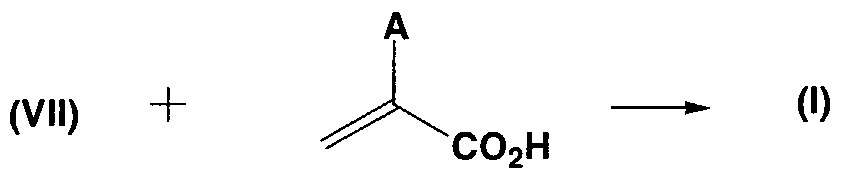
- X is -CH2- and E is a hydrogen atom, it can be produced by the following synthesis method (IV), synthesis method (V), synthesis method (VI) or synthesis method (VII). it can.
- synthesis method (VI ) Or synthesis method (VII).
- the method for producing the compound of the present invention is not limited to these.
- the amino group defined herein includes the amino group on the piperidine ring formed by E together with A.
- the imino group and the carboxyl group are protected as necessary. Is also good.
- a usual protecting group can be used, and preferably, in the case of an amino group or an imino group, a methoxycarbonyl group, a tert-butyloxycarbonyl group, a benzyloxycarbonyl group, or a methoxybenzyloxycarbonyl group is used.
- W represents an oxygen atom or mono-NH
- Z represents a hydrogen atom, a hydroxyl group or an alkoxy group. .
- the compound of the formula (VII) can be synthesized according to the method described in Tetrahedron Lett., 7333 (1991), U.S. Pat. Specifically, equation (V) The compound of formula (VI) and the compound of formula (VI) are subjected to a dehydration method such as ⁇ , ⁇ '-dicyclohexylcarpoimide (DCC), benzotriazo-l-oxytrisdimethylaminophosphonium tetrafluorophosphate ( ⁇ ), etc.
- a dehydration method such as ⁇ , ⁇ '-dicyclohexylcarpoimide (DCC), benzotriazo-l-oxytrisdimethylaminophosphonium tetrafluorophosphate ( ⁇ ), etc.
- amine of the formula (VI) As the amine of the formula (VI), a commercially available compound may be used, but Synthesis, 370 (1998), Liebigs. Ann. Chein., 861 (1988), J. Chem. Soc. Perkin trans. 1, 2845. (1984) and the like.
- Z is a hydrogen atom in the compound of the formula (VII)
- it can be converted to a hydroxyl group by a usual oxidation reaction at this stage, and this hydroxyl group may be converted to an alkoxy group if necessary.
- the compound of the formula (VII) and the compound of the formula (VIII) are converted to N- (dimethylaminopropyl) _N, —ethylcarbodiimide hydrochloride, N, N′-dicyclohexylcarbodiimide (DCC), benzotriazo Dehydration method of mono-oxytris-dimethylaminophosphonium tetrafluorophosphate (BOP), etc., acid halide method using thionyl chloride, oxalyl chloride, phosphorous oxychloride, etc., pivaloyl chloride, chloroformate Using a mixed acid anhydride method using an ester or the like, in a solvent that does not participate in the reaction, the reaction time is 0.5 to 72 hours, preferably 2 to 24 hours, and the reaction temperature is 178 to 100, Preferably, the condensation is carried out at 0 ° C to 30 ° C.
- a deprotection reaction may be performed. If Z is a hydrogen atom, an oxidation reaction may be performed by a usual method following the condensation reaction, and then a deprotection reaction may be performed if necessary. And synthesizing a compound in which X in the formula (I) is an oxygen atom or 1 NH— Can be. Synthesis method (II)
- Z is a hydrogen atom in the compound of the formula (IX), it can be converted to a hydroxyl group by a usual oxidation reaction at this stage, and this hydroxyl group may be converted to an alkoxy group as needed.
- the condensation reaction of the compound of the formula (V) and the compound of the formula (IX) can be carried out according to the method shown in the above-mentioned synthesis method (I). After the condensation reaction, if necessary, a deprotection reaction is carried out.
- Z is a hydrogen atom
- an oxidation reaction is carried out by a usual method following a condensation reaction, and then, if necessary, by a deprotection reaction, whereby X in the formula (I) is converted to an oxygen atom or one NH— Can be synthesized.
- the compound of the formula (VIII) is added to 2-chloro-1,4 ⁇ -1,3,2-benzodioxaphosphorin-1-one, 2-chloro-1,3,2-dioxaphospho
- the reaction time is 0.5 to 72 hours, preferably 2 to 24 hours, in a solvent that does not participate in the reaction with a phosphorylating agent such as orchid, 2-cyanoethyl ⁇ , ⁇ , diisopropylpropylphosphoramide or phosphorus trichloride.
- Z in the formula (X) is a hydroxyl group
- the compound of the formula (X) in which Z is an alkoxy group can be obtained by performing esterification by a conventional method.
- the compound of the formula (IX) can be synthesized according to a method such as Tetrahedron Lett., 5457 (1996). Specifically, the compound of the formula (X) and the compound of the formula (XI) can be used as such or under ultrasound or in the presence of a Lewis acid such as boron trifluoride, titanium chloride, tin chloride or yttrium triflate. Do not take part in the reaction In a solvent, the reaction time is 0.5 to 72 hours, preferably 2 to 24 hours, and the reaction temperature is 1 to 78 ° C to 100 ° C, preferably 1 to 30 to 6 Ot, if necessary.
- a Lewis acid such as boron trifluoride, titanium chloride, tin chloride or yttrium triflate.
- the reaction time is 0.5 to 72 hours, preferably 2 to 24 hours
- the reaction temperature is 1 to 78 ° C to 100 ° C, preferably 1 to 30 to 6 Ot, if necessary.
- R ⁇ R 2 , R 3 and A represent the same meaning as described above, and Z represents a hydrogen atom.
- the compound of the formula (VII) can be synthesized by the method shown in the above-mentioned synthesis method (I).
- the reaction time is 0.5 hours to 72 hours, preferably 2 hours to 24 hours, and the reaction temperature is 1 78 ° C to 100 ° C, preferably 0 ° ( This is a method in which Michael addition reaction is performed at ⁇ 50 ° C. After Michael addition reaction, deprotection reaction may be required if necessary.
- a compound in which X in the formula (I) is —CH 2 — and E is a hydrogen atom can be synthesized.
- the compound of the formula (XII) can be synthesized according to the method described in L Med. Chem., 2461 (1994) and the like. Synthesis method (V)
- the condensation reaction of the compound of the formula (V) and the compound of the formula (XIII) can be carried out according to the method shown in the above-mentioned synthesis method (I). After the condensation reaction, a deprotection reaction may be carried out if necessary. Thus, a compound in which X in the formula (I) is —CH 2 — and E is a hydrogen atom can be synthesized. Synthesis method (VI)
- RR 2 , R 3 and A represent the same meaning as described above, and E represents a hydrogen atom or one CH 2 CH 2 —.
- a with A represents a piperidine ring group or an N-substituted piperidine ring group, and Z represents a hydrogen atom.
- the compound of the formula (VII) can be synthesized by the method shown in the above synthesis method (I).
- the compound of formula (XVI) can be synthesized according to the method described in J. Med. Cem., 2461 (1994) and the like.
- the condensation reaction between the formula (VII) and the formula (XVI) can be carried out according to the method described in Bioorg. Med. Chem. Lett., 1629 (1996). Specifically, the hydroxyl group in the formula (XVI) is activated with trifluoromethanesulfonic anhydride, methanesulfonyl chloride, toluenesulfonyl chloride or the like, or is substituted with a halogen atom by a usual method, and The compound of formula (VII) is activated or esterified as necessary with a silyl group or the like to increase the reactivity of the compound of formula (VII), and then, if necessary, in a solvent that does not participate in the reaction or in the absence of a solvent.
- a base such as triethylamine, diisopropylethylamine, pyridine, lutidine, potassium carbonate, sodium hydrogencarbonate, sodium hydride, lithium diisopropylamide, etc. is allowed to coexist, and the reaction time is 0.5 to 72 hours, preferably 2 hours to The reaction is carried out for 24 hours at a reaction temperature of 1 to 78 ° C to 100 ° C, preferably 1 to 78X: to 60 ° C.
- a compound of the formula (I) wherein X is a carbon atom can be synthesized.
- R ′, R 2 , R 3 and A have the same meaning as described above, E represents a hydrogen atom or one CH 2 CH 2 —, and together with A, a piperidine ring group or N— Z represents a substituted piperidine ring group, and Z represents a hydrogen atom.
- the compound of the formula (XVII) can be synthesized according to the method shown in the above-mentioned synthesis method (VI).
- the condensation reaction of the compound of the formula (V) and the compound of the formula (XVII) can be carried out according to the method shown in the above-mentioned synthesis method (I). After the condensation reaction, if necessary, a deprotection reaction is carried out.
- a compound of the formula (I) wherein X is —CH 2 — can be synthesized.
- Non-toxic salts that are chemically acceptable include, for example, alkali metals such as sodium, potassium and calcium salts, or hydrogen halides such as alkaline earth metal salts and hydrochlorides, nitrates, sulfates and phosphoric acids
- Inorganic acid salts such as salts, sulfonic acid salts such as methanesulfonic acid and benzenesulfonic acid, organic acid salts such as fumaric acid, succinic acid, citric acid, oxalic acid or maleic acid, and amino acid salts such as glutamic acid and aspartic acid And the like.
- the compounds of formula (I) according to the invention may also be present as hydrates or solvates.
- Preferred solvates include ethanol solvates. All salts, hydrates, and solvates of the compound of the formula (I) are included in the scope of the present invention.
- the compounds of the formula (I) according to the invention have a thrombolytic effect by inhibiting carboxypeptidase B in human plasma. Therefore, the substance selected from the group consisting of the compound of the formula (I) according to the present invention and a pharmacologically acceptable salt thereof, and a hydrate and a solvate thereof are selected from the group consisting of myocardial infarction, cerebral infarction and stenosis.
- Heart disease pulmonary embolism, chronic arterial occlusion, acute arterial thrombosis, embolism, vasculitis syndrome, diabetic gangrene, thrombophlebitis, deep venous thrombosis, thrombotic thrombocytopenic purpura
- thrombotic diseases such as disseminated intravascular coagulation, antiphospholipid antibody syndrome, and diabetes, hyperlipidemia, and inflammation, which have been pointed out as a tendency to thrombosis associated with decreased in vivo fibrinolysis It is useful as Z or a prophylactic active ingredient.
- the compound of the formula (I) according to the present invention and a pharmacologically acceptable salt thereof, and a substance selected from the group consisting of hydrates and solvates thereof are carboxypeptidase B inhibitors.
- carboxypeptidase B inhibitors Is effective as Further, as the carboxypeptidase B inhibitor according to the present invention, the above substances can be used alone as they are, and for example, they can also be used as reagents for enzymes.
- the compounds of the formula U) according to the invention and the pharmaceutically acceptable salts thereof, as well as the substances selected from the group consisting of their hydrates and their solvates, may themselves be used as medicaments.
- the medicament of the present invention is preferably Provided as a pharmaceutical composition containing a pharmacologically acceptable carrier, and can be administered to humans or humans by any of oral or parenteral (eg, intravenous, intramuscular, subcutaneous, rectal, transdermal, etc.) administration routes It can be administered to non-human animals.
- the pharmaceutical composition may be combined with two or more of the above substances.
- a pharmaceutical composition comprising as an active ingredient a compound of the formula (I) according to the present invention and a pharmacologically acceptable salt thereof, and a hydrate and a solvate thereof, is selected from the group consisting of: It can be manufactured as an appropriate dosage form depending on the route. Specifically, injections, intravenous or intramuscular injections, infusions, inhalants, transdermal absorbents, transmucosal absorbents, rectal administrations, oily suppositories, aqueous suppositories, etc. It can be prepared as a formulation for parenteral administration or any formulation for oral administration such as capsules, tablets, granules, powders, pills, fine granules, troches and the like.
- one or more solid or liquid carriers suitable for administration to humans and non-human animals can be used.
- the solid carrier include starch, lactose, crystalline cellulose, calcium carbonate, and the like.
- the liquid carrier include physiological saline, ethanol, and the like.
- Non-toxic carriers that can be used include, for example, lactose, fructose, glucose, starch, gelatin, magnesium carbonate, synthetic magnesium silicate, talc, magnesium stearate, methylcellulose or its salts, gum arabic, polyethylene glycol, syrup , Petrolatum, ethanol, propylene glycol, citric acid, sodium chloride, sodium sulfite, sodium phosphate and the like.
- the content of the compound of the formula (I) according to the present invention and a pharmacologically acceptable salt thereof, and a compound selected from the group consisting of hydrates and solvates thereof, contained in the pharmaceutical composition Will vary depending on the dosage form, but will usually be based on the total weight of the composition. It is about 1% to 70% by weight, preferably about 5% to 50% by weight.
- the dosage is determined as appropriate in consideration of the usage, patient age, gender, degree of symptoms, etc.For the treatment of thrombotic diseases, usually about 0.1 mg to 1000 mg per adult per day, It is preferably 1 mg to 30 Omg, which can be administered once or several times a day.
- Example 1 (S) -6-amino-2-(((R) -1- (benzyloxycarbonylylamino) ethyl) (hydroxyphosphinoyl) oxy) hexanoic acid
- Methyl (methoxyphosphinyl) oxy-6- (tert-butoxycarponylamino) hexanoate (9.7 mg, 13%) was obtained. This compound was used for the next reaction after confirming its molecular weight.
- Example 7 (S) -5-amino-2-((2-methyl-1- (3-phenylpropanoylamino) propyl) (hydroxyphosphinyl) oxy) pentanoic acid (S) in Example 2 (b) ) — 6-benzyloxycarbonylamino-2-benzylhydroxyhexanoate was replaced by (S) —5-benzyloxycarbonylnylamino-2-benzylhydroxypentanoate, according to the method of Example 2.
- Example 11 1 (S) —4-amino-2-((2-methyl-11- (3-phenylpropanoylamino) propyl) (hydroxyphosphinoyl) ) (Oxy) butanoic acid (S) —4-benzyloxycarbonylamino-2-amino instead of (S) -6-benzyloxycarbonylamino-2-benzyl-2-hydroxyhexanoate in Example 2 (b).
- Example 14 (S) —6-amino-1 2-(((1- (3-phenylpropanoylamino) cyclohexyl) (hydroxyphosphinoyl) oxy) hexanoic acid Starting from cyclohexanone According to the method of Example 20, the title compound (S) -6-amino-2-(((1- (3-phenylpropanolylamino) cyclohexyl) (hydroxyphosphinoyl) oxy) Obtained.
- Example 26 (S) -6-amino-2-((2-methyl-1- (3-phenylpropanoylamino) propyl) (hydroxyphosphinoyl) oxy) Xanane
- the title compound (S) -6-amino-2-((2-methyl-1 1) was prepared according to the method of Example 24, using 3-phenylbutanoic acid instead of 4-phenylbutanoic acid in (f) of Example 24.
- 1- (3-Phenylpropanoylamino) propyl) (hydroxyphosphinyl) oxy) hexanoic acid was obtained.
- the spectrum data of the obtained compound showed the same values as in Example 2.
- Example 27 (S) 17-amino-1 2-((11- (3-phenylpropanoylamino) cyclopentyl) (hydroxyphosphino (Yl) oxy) heptanoic acid Instead of (S) -6-benzyloxycarbonylamino-2-benzylbenzylhexanoate in (b) of Example 2, (S) -7-benzyloxycarbonylamino-2 —Using benzyl hydroxyheptanoate and 1-aminocyclopentylphosphinic acid obtained in (b) of Example 20, according to the method of Example 2 to give the title compound (S) —7-amino-2- ((1— (3-Phenylpropanoylamino) cyclopentyl) (hydroxyphosphinyl) oxy) heptanoic acid was obtained.
- Example 28 (R) -17-amino-1 2-((1- (3-phenylpropanoylamino) cyclopentyl) (hydroxyphosphino (Yl) oxy) heptanoic acid (R) -7-benzyloxycarbonylamino-2 in place of (S) -6-benzyloxycarbonylamino-2-hydroxyhexanoate in Example 2 (b) —Using benzyl hydroxyheptanoate and 1-aminocyclopentylphosphinic acid obtained in (b) of Example 20 according to the method of Example 2, the title compound (R) —7-amino-2-— ((1— (3-Phenylpropanoylamino) cyclopentyl) (hydroxyphosphinyl) oxy) heptanoic acid was obtained.
- Example 31 1— (trans- (4-aminomethylcyclohexyl)) — 1- (2-methyl-1- (1R) — (TS PMS (m / z): 45 5 (M ++ 1). 3-Phenylpropanoylamino) propyl (hydroxy phosphinyl) oxy) acetic acid
- Example 33 8-Amino-2- (2-methyl- (1R) _ (3_phenylpropanoylamino) propyl (hydroxyphosphinyl) oxy) octanoic acid Amino-2-methylphosphine in (a) of Example 2 (1R) -Amino-2-methylphosphinic acid was used in place of the acid, and instead of (S) -6-benzyloxycarbonylamino-2-benzylhydroxyhexanoate in Example 2 (b).
- Example 42 (A) of Example 42 was repeated, except that N-benzyloxycarbonyl-D-phenylalanine was used in place of N-benzyloxycarbonyl-L-phenylalanine.
- Example 42 phenylpropanolylamino 1) 2-Methylpropyl) (Hydroxoxyphosphinyl) Oxy) Hexanoic acid (5: 2 diastereomeric mixture) I got
- Example 46 benzoic acid was used in place of 2,4-difluorobenzoic acid, and the title compound (S) —6-amino-2-((1—benzoylamino) was used according to the method of Example 46.
- Example 42 4-methoxyphenylacetic acid was used in place of N-benzyloxycarbonyl-L-phenylalanine. According to the method of Example 42, the title compound (S) -6 _Amino-2 _ ((1- (4-methoxyphenyl) acetylamino-2-methylpropyl) (hydroxyphosphinyl) oxy) hexanoic acid (4: 1 diastereomeric mixture) was obtained.
- Example 43 In (a) of Example 43, n-heptanoyl chloride was used in place of phenylacetyl chloride, and the title compound (S) -6-amino-1- () was prepared according to the method of Example 43. 1-Heptanoylamino-1-methylpropyl) (hydroxyphosphinyl) oxy) hexanoic acid (4: 5 diastereomer mixture) was obtained. !
- Example 51 (S) —6-amino-1 2-((1- (2-amino-2-phenylphenylcetylamino) —2-methylpropyl) (hydroxy Phosphinyl) oxy)
- Example 42 (a) 2-pyridylacetic acid hydrochloride was used in place of N-benzyloxycarbonyl-L-phenylalanine, and the title compound (S) -6-amino was prepared according to the method of Example 42.
- — 2 ((2-Methyl_1 _ ((pyridine-2-yl) acetylamino) propyl) (hydroxyphosphinyl) oxy) hexanoic acid (1: 5 diastereomeric mixture) was obtained.
- Example 53 (S) _6-amino-2 _ ((1- (4-methoxybenzoylamino) -1-methylpropyl) ( Hydroxyphosphinyl) oxy) hexanoic acid
- 4-methoxybenzoic acid was used in place of 2,4-difluorobenzoic acid, and the title compound (S ) — 6-amino 2-((1- (4-methoxybenzoylamino) -1-methylpropyl) (hydroxyphosphinyl) oxy) hexanoic acid (5: 1 diastereomeric mixture) ) Got.
- Example 43 In (a) of Example 43, n-dodecanoyl chloride was used in place of phenylacetyl chloride, and the title compound (S) -6-amino-1 2— was prepared according to the method of Example 43. ((1-Dodecanylamino-1-methylpropyl) (hydroxyphosphinyl) oxy) hexanoic acid (1: 1 mixture of diastereomers) was obtained.
- Example 43 In (a) of Example 43, acetyl chloride was used in place of phenylacetyl chloride, and the title compound (S) —2-((1-acetylamino-2-methylpropyl) was used according to the method of Example 43. ) (Hydroxyphosphinyl) oxy) 1-6-aminohexanoic acid (1: 3 diastereomeric mixture) was obtained.
- the product was purified by 4: 1) to give 3- (4-nitrophenyl) ethyl acrylate (1.27 g, 86%).
- Example 59 (S) 16-amino-2-((2-methyl-1- (trifluoromethylcetylamino) propyl) (hydroxyphosphinoyl) Hexanoic acid
- the title compound (S) -6-amino was prepared in the same manner as in Example 43 except that trifluoroacetic anhydride was used in place of phenylacetyl chloride in (a) of Example 43.
- One 2-((2-methyl-11- (trifluoroacetylamino) propyl) (hydroxyphosphinoyl) oxy) hexanoic acid (1: 6 diastereomeric mixture) was obtained.
- Example 64 (S) — 6-amino_2 — ((2-methyl-1-(3,4,5-trimethoxybenzoylamino)) Propyl) (hydroxyphosphinyl) oxy)
- Example 43 (a) 3,4,5-trimethoxybenzoyl chloride was used in place of phenylacetyl chloride. According to the method, the title compound (S) — 6-amino-1 2- ((2-methyl-1- (3,4,5-trimethoxybenzoylamino) propyl) (hydroxyphosphinyl) oxy) Hexanoic acid (1: 1 mixture of diastereomers) was obtained.
- Example 61 In (a) of 1, the same procedure as in Example 61 was repeated except that monobenzyl succinate was used in place of 4-oxohexanoic acid, and the title compound (S) _6-amino-21-((1— ( 3-Capoxypropanoylamino-1-2-methylpropyl) (hydroxyphosphinyl) oxy) hexanoic acid (1: 1 diastereomeric mixture) was obtained.
- Example 66 (S) _6-amino-1 2-((2-methyl-1- (pyridine-12-carbonylamino) propyl) (hydroxyphosphinoyl) Le) Oxy) Hexane
- Example 61 In (a) of 1), picolinic acid was used in place of 5-oxohexanoic acid, and the title compound (S) —6-amino-2-((2-methyl-1 1- (pyridine-12-carbonylamino) propyl) (hydroxyphosphinyl) oxy) hexanoic acid (4: 5 diastereomeric mixture) was obtained.
- Example 43 4-morpholinecarbonyl chloride was used in place of phenylacetyl chloride, and the title compound (S) -6-amino-2-((2- Methyl-1- (morpholine-4-carbonylamino) propyl) (hydroxyphosphinyl) oxy) hexanoic acid (a mixture of 3: 4 diastereo) was obtained.
- Example 22 The title compound 7-amino-2-((2-methyl-butanol) was prepared in the same manner as in Example 22 except that 4-amino-1-pentanol in Example 22 (a) was replaced with 5-amino-pentanol.
- 1- (3-Phenylpropanoylamino) propyl) hydroxyphosphinoyl) methylheptanoic acid (1: 3 diastereomeric mixture) was obtained.
- the carboxypeptidase B inhibitory activity of the compound of the present invention was measured according to the method described in Thromb. Haemost. 371 (1998) as follows.
- thrombomodulin solution persimmon lung-derived American Diagnostia inc, product number # 237
- proC PB 201 buffer A 0.1% Lubrol, 0.1% BSA, 0.15M chloride It was dissolved at a concentration of 300 ng Zm1 in 50 mM Tris-hydrochloric acid buffer containing sodium (pH 7.4). Add 201 and treat at 25 ° C for 3 minutes.
- thrombin (thrombin: derived from human plasma) Sigma, product number T 8885 in buffer B: 0.1% BSA, 0.15M NaC and 3 uZm 1 in 5 OmM Tris-HCl buffer (pH 7.4) containing 1 OmM calcium chloride It was activated by adding 20 / X1 and further treating at 25 ° C for 30 minutes (* 1).
- A is the absorbance without the addition of the test substance
- B is the absorbance with the addition of the test substance (500 nM)
- the absorbances with the inactivating enzymes are A 'and B', respectively.
- the inhibitory activity of carboxypeptidase B is Was calculated as the inhibition rate from the equation.
- Inhibition rate (%) [1 — ⁇ ( ⁇ - ⁇ ′) / (A—A ′) ⁇ ] ⁇ 100
- the above formula was calculated based on the measurement results of the above test for the compound of the present invention.
- Table 1 shows the results of the carboxypeptidase B inhibition rate.
- Example 19 The compound of Example 19 according to the present invention was dissolved in physiological saline, and administered intravenously to six 5-week-old ICR male mice. At a dose of 1 gZkg of the compound of Example 19, no patient died and no serious toxicity was observed.
- Example 19 The compound of Example 19 (25 g) according to the present invention (25 g) was dissolved in water for injection (450 ml), and sodium hydroxide (1.6 g) was added to make up to 500 ml with water for injection.
- the filtrate that had been subjected to aseptic filtration was poured into vials in a volume of 1.0 ml. This was freeze-dried by a conventional method to obtain a freeze-dried vial preparation containing the compound of Example 19 (50 mg).
- the resulting formulation is dissolved in physiological saline and administered intravenously.
- the solution can be formulated in physiological saline (100 ml) or the like and administered by intravenous drip.
- Example 19 The compound of Example 19 (5 g) according to the present invention (5 g) was dissolved in water for injection (450 ml), and disodium hydrogen phosphate (2.6 g) was added to make up to 500 ml with water for injection.
- the filtrate that had been subjected to aseptic filtration was poured into vials 1.0 ml each. This was freeze-dried by a conventional method to obtain a freeze-dried vial preparation containing the compound of Example 19 (10 mg).
- the obtained preparation can be dissolved in physiological saline and administered intravenously, or the solution can be formulated in physiological saline (100 ml) and administered intravenously.
Landscapes
- Chemical & Material Sciences (AREA)
- Organic Chemistry (AREA)
- Health & Medical Sciences (AREA)
- General Health & Medical Sciences (AREA)
- Life Sciences & Earth Sciences (AREA)
- Biochemistry (AREA)
- Molecular Biology (AREA)
- Engineering & Computer Science (AREA)
- Animal Behavior & Ethology (AREA)
- Nuclear Medicine, Radiotherapy & Molecular Imaging (AREA)
- Chemical Kinetics & Catalysis (AREA)
- Bioinformatics & Cheminformatics (AREA)
- General Chemical & Material Sciences (AREA)
- Medicinal Chemistry (AREA)
- Public Health (AREA)
- Pharmacology & Pharmacy (AREA)
- Veterinary Medicine (AREA)
- Diabetes (AREA)
- Hematology (AREA)
- Pharmaceuticals Containing Other Organic And Inorganic Compounds (AREA)
- Detergent Compositions (AREA)
- Enzymes And Modification Thereof (AREA)
Description








Claims


Priority Applications (9)
| Application Number | Priority Date | Filing Date | Title |
|---|---|---|---|
| CA002381801A CA2381801C (en) | 1999-09-14 | 2000-09-13 | Phosphonic acid derivative having inhibitory activity against carboxypeptidase b |
| AT00960970T ATE239741T1 (de) | 1999-09-14 | 2000-09-13 | Derivate der phosphonsäure zur inhibierung von carboxypeptidase b |
| EP00960970A EP1152004B1 (en) | 1999-09-14 | 2000-09-13 | Phosphonic acid derivatives having carboxypeptidase B inhibitory action |
| BR0014615-3A BR0014615A (pt) | 1999-09-14 | 2000-09-13 | Derivado de ácido fosfÈnico que apresenta atividade inibidora contra carboxipeptidase b |
| JP2001523413A JP3400798B2 (ja) | 1999-09-14 | 2000-09-13 | カルボキシペプチダーゼb阻害活性を有するホスホン酸誘導体 |
| US09/926,125 US6576627B1 (en) | 1999-09-14 | 2000-09-13 | Phosphonic acid derivatives having carboxypeptidase b inhibitory activity |
| DE60002558T DE60002558T2 (de) | 1999-09-14 | 2000-09-13 | Derivate der Phosphonsäure zur Inhibierung von Carboxypeptidase B |
| MXPA02002671A MXPA02002671A (es) | 1999-09-14 | 2000-09-13 | Derivado de acido fosfonico que tiene actividad inhibidora contra la carboxipeptidasa b. |
| AU73112/00A AU780542B2 (en) | 1999-09-14 | 2000-09-13 | Phosphonic acid derivatives having carboxypeptidase B inhibitory activity |
Applications Claiming Priority (4)
| Application Number | Priority Date | Filing Date | Title |
|---|---|---|---|
| JP26099399 | 1999-09-14 | ||
| JP11/260993 | 1999-09-14 | ||
| JP2000/84145 | 2000-03-24 | ||
| JP2000084145 | 2000-03-24 |
Related Child Applications (2)
| Application Number | Title | Priority Date | Filing Date |
|---|---|---|---|
| US09/926,125 A-371-Of-International US6576627B1 (en) | 1999-09-14 | 2000-09-13 | Phosphonic acid derivatives having carboxypeptidase b inhibitory activity |
| US10/265,400 Continuation US6737416B2 (en) | 1999-09-14 | 2002-10-07 | Phosphonic acid derivative having inhibitory activity against carboxypeptidase B |
Publications (1)
| Publication Number | Publication Date |
|---|---|
| WO2001019836A1 true WO2001019836A1 (en) | 2001-03-22 |
Family
ID=26544854
Family Applications (1)
| Application Number | Title | Priority Date | Filing Date |
|---|---|---|---|
| PCT/JP2000/006248 Ceased WO2001019836A1 (en) | 1999-09-14 | 2000-09-13 | Phosphonic acid derivatives having carboxypeptidase b inhibitory activity |
Country Status (14)
| Country | Link |
|---|---|
| US (2) | US6576627B1 (ja) |
| EP (2) | EP1174434A1 (ja) |
| JP (1) | JP3400798B2 (ja) |
| KR (1) | KR100681632B1 (ja) |
| CN (1) | CN1187360C (ja) |
| AT (1) | ATE239741T1 (ja) |
| AU (1) | AU780542B2 (ja) |
| BR (1) | BR0014615A (ja) |
| CA (1) | CA2381801C (ja) |
| DE (1) | DE60002558T2 (ja) |
| ES (1) | ES2202171T3 (ja) |
| MX (1) | MXPA02002671A (ja) |
| TW (1) | TWI223651B (ja) |
| WO (1) | WO2001019836A1 (ja) |
Cited By (4)
| Publication number | Priority date | Publication date | Assignee | Title |
|---|---|---|---|---|
| US6713496B2 (en) | 2002-01-22 | 2004-03-30 | Pfizer Inc | 3-(imidazolyl)-2-alkoxypropanoic acids |
| US6759426B2 (en) | 2002-01-22 | 2004-07-06 | Pfizer Inc | 3-(Imidazolyl)-2-aminopropanoic acids |
| US7375121B2 (en) | 2001-09-28 | 2008-05-20 | Astrazeneca Ab | Chemical compounds |
| WO2010050525A1 (ja) | 2008-10-29 | 2010-05-06 | 大正製薬株式会社 | TAFIa阻害活性を有する化合物 |
Families Citing this family (9)
| Publication number | Priority date | Publication date | Assignee | Title |
|---|---|---|---|---|
| SE9901572D0 (sv) * | 1999-05-03 | 1999-05-03 | Astra Ab | New compounds |
| JP4472997B2 (ja) * | 2002-03-21 | 2010-06-02 | バイエル・シエーリング・ファーマ アクチエンゲゼルシャフト | 血漿カルボキシペプチダーゼbインヒビター |
| EP1380290A1 (en) | 2002-07-09 | 2004-01-14 | Universitair Medisch Centrum Utrecht | Cross-beta structure pathway and its therapeutic relevance |
| JPWO2004035594A1 (ja) * | 2002-10-01 | 2006-02-16 | 明治製菓株式会社 | カルボキシペプチダーゼb阻害剤の製造用中間体 |
| CA2615028A1 (en) | 2005-07-13 | 2007-01-18 | Crossbeta Biosciences B.V. | Cross-.beta. structure binding compounds |
| US8114832B2 (en) | 2005-07-13 | 2012-02-14 | Crossbeta Biosciences B.V. | Method for detecting and/or removing a protein comprising a cross-beta structure from a pharmaceutical composition |
| US7833660B1 (en) | 2006-09-07 | 2010-11-16 | The United States Of America As Represented By The Secretary Of The Army | Fluorohaloborate salts, synthesis and use thereof |
| US7820323B1 (en) | 2006-09-07 | 2010-10-26 | The United States Of America As Represented By The Secretary Of The Army | Metal borate synthesis process |
| BR112013000925A2 (pt) | 2010-07-15 | 2020-12-01 | Bayer Intellectual Property Gmbh | compostos heterocíclicos como pesticidas |
Citations (3)
| Publication number | Priority date | Publication date | Assignee | Title |
|---|---|---|---|---|
| EP0282219A1 (en) * | 1987-03-03 | 1988-09-14 | Mitsubishi Chemical Industries Limited | Aminoethylphosphinic acid derivatives |
| US5030732A (en) * | 1988-03-03 | 1991-07-09 | Merck & Co., Inc. | Aminoethylphosphinic acid derivatives |
| WO2000066550A1 (en) * | 1999-05-03 | 2000-11-09 | Astrazeneca Ab | New compounds |
Family Cites Families (9)
| Publication number | Priority date | Publication date | Assignee | Title |
|---|---|---|---|---|
| DE212739C (ja) | ||||
| US4452791A (en) | 1982-03-15 | 1984-06-05 | E. R. Squibb & Sons, Inc. | Aminoalkyl and related substituted phosphinic acid angiotensin converting enzyme inhibitors |
| US4560680A (en) | 1982-03-15 | 1985-12-24 | E. R. Squibb & Sons, Inc. | Aminoalkyl and related substituted phosphinic acid angiotensin converting enzyme inhibitors |
| US4616005A (en) | 1982-06-23 | 1986-10-07 | E. R. Squibb & Sons, Inc. | Phosphonyl hydroxyacyl amino acid derivatives as antihypertensives |
| US6159958A (en) | 1997-08-14 | 2000-12-12 | The United States Of America As Represented By The Secretary Of The Army | Treatment or prophylaxis of retinal pathology and spinal cord injury |
| US6121252A (en) | 1998-03-30 | 2000-09-19 | Guilford Pharmaceuticals Inc. | Phosphinic acid derivatives |
| US6444657B1 (en) * | 1998-12-31 | 2002-09-03 | Guilford Pharmaceuticals Inc. | Methods for treating certain diseases using naaladase inhibitors |
| SE9901573D0 (sv) | 1999-05-03 | 1999-05-03 | Astra Ab | New compounds |
| AR023819A1 (es) | 1999-05-03 | 2002-09-04 | Astrazeneca Ab | FORMULACIoN FARMACEUTICA, KIT DE PARTES Y UTILIZACION DE DICHA FORMULACION |
-
2000
- 2000-09-13 CN CNB008127913A patent/CN1187360C/zh not_active Expired - Fee Related
- 2000-09-13 AT AT00960970T patent/ATE239741T1/de not_active IP Right Cessation
- 2000-09-13 KR KR1020027003321A patent/KR100681632B1/ko not_active Expired - Fee Related
- 2000-09-13 US US09/926,125 patent/US6576627B1/en not_active Expired - Fee Related
- 2000-09-13 ES ES00960970T patent/ES2202171T3/es not_active Expired - Lifetime
- 2000-09-13 BR BR0014615-3A patent/BR0014615A/pt not_active IP Right Cessation
- 2000-09-13 EP EP01125712A patent/EP1174434A1/en not_active Withdrawn
- 2000-09-13 CA CA002381801A patent/CA2381801C/en not_active Expired - Fee Related
- 2000-09-13 WO PCT/JP2000/006248 patent/WO2001019836A1/ja not_active Ceased
- 2000-09-13 MX MXPA02002671A patent/MXPA02002671A/es active IP Right Grant
- 2000-09-13 EP EP00960970A patent/EP1152004B1/en not_active Expired - Lifetime
- 2000-09-13 AU AU73112/00A patent/AU780542B2/en not_active Ceased
- 2000-09-13 JP JP2001523413A patent/JP3400798B2/ja not_active Expired - Fee Related
- 2000-09-13 DE DE60002558T patent/DE60002558T2/de not_active Expired - Lifetime
- 2000-09-14 TW TW089118781A patent/TWI223651B/zh not_active IP Right Cessation
-
2002
- 2002-10-07 US US10/265,400 patent/US6737416B2/en not_active Expired - Fee Related
Patent Citations (3)
| Publication number | Priority date | Publication date | Assignee | Title |
|---|---|---|---|---|
| EP0282219A1 (en) * | 1987-03-03 | 1988-09-14 | Mitsubishi Chemical Industries Limited | Aminoethylphosphinic acid derivatives |
| US5030732A (en) * | 1988-03-03 | 1991-07-09 | Merck & Co., Inc. | Aminoethylphosphinic acid derivatives |
| WO2000066550A1 (en) * | 1999-05-03 | 2000-11-09 | Astrazeneca Ab | New compounds |
Cited By (4)
| Publication number | Priority date | Publication date | Assignee | Title |
|---|---|---|---|---|
| US7375121B2 (en) | 2001-09-28 | 2008-05-20 | Astrazeneca Ab | Chemical compounds |
| US6713496B2 (en) | 2002-01-22 | 2004-03-30 | Pfizer Inc | 3-(imidazolyl)-2-alkoxypropanoic acids |
| US6759426B2 (en) | 2002-01-22 | 2004-07-06 | Pfizer Inc | 3-(Imidazolyl)-2-aminopropanoic acids |
| WO2010050525A1 (ja) | 2008-10-29 | 2010-05-06 | 大正製薬株式会社 | TAFIa阻害活性を有する化合物 |
Also Published As
| Publication number | Publication date |
|---|---|
| ATE239741T1 (de) | 2003-05-15 |
| DE60002558D1 (de) | 2003-06-12 |
| US6737416B2 (en) | 2004-05-18 |
| EP1152004A1 (en) | 2001-11-07 |
| MXPA02002671A (es) | 2002-07-30 |
| EP1174434A1 (en) | 2002-01-23 |
| DE60002558T2 (de) | 2004-04-08 |
| ES2202171T3 (es) | 2004-04-01 |
| CA2381801C (en) | 2009-12-08 |
| BR0014615A (pt) | 2002-06-18 |
| CN1187360C (zh) | 2005-02-02 |
| AU780542B2 (en) | 2005-03-24 |
| CA2381801A1 (en) | 2001-03-22 |
| KR100681632B1 (ko) | 2007-02-09 |
| KR20020026268A (ko) | 2002-04-06 |
| EP1152004A4 (en) | 2002-01-23 |
| JP3400798B2 (ja) | 2003-04-28 |
| US6576627B1 (en) | 2003-06-10 |
| CN1373766A (zh) | 2002-10-09 |
| TWI223651B (en) | 2004-11-11 |
| EP1152004B1 (en) | 2003-05-07 |
| AU7311200A (en) | 2001-04-17 |
| US20030119787A1 (en) | 2003-06-26 |
Similar Documents
| Publication | Publication Date | Title |
|---|---|---|
| JP4171702B2 (ja) | 新規α−アミノ−N−(ジアミノホスフィニル)ラクタム誘導体 | |
| EP0012845B1 (en) | Tetrahydroisoquinoline compounds, process for preparing same and pharmaceutical compositions containing them | |
| US5510510A (en) | Inhibitors of farnesyl protein transferase | |
| JP3400798B2 (ja) | カルボキシペプチダーゼb阻害活性を有するホスホン酸誘導体 | |
| JPH08509992A (ja) | ナフタレンホスホン酸のウレイド誘導体およびそれらの製造法 | |
| JPWO2001019836A1 (ja) | カルボキシペプチダーゼb阻害活性を有するホスホン酸誘導体 | |
| AU2009263076B2 (en) | New heterocyclic carboxamides for use as thrombin inhibitors | |
| WO1999011640A1 (en) | Epoxysuccinamide derivatives | |
| GB2310207A (en) | Antiviral ureido derivatives of substituted heterocyclic compounds | |
| CA1328113C (en) | Process for the manufacture of novel unsaturated amino acid compounds | |
| WO1996030354A1 (en) | Epoxysuccinic acid derivatives | |
| MXPA04009125A (es) | Inhibidores de carboxipeptidasa b plasmatica. | |
| KR100305128B1 (ko) | 항암제로서의파르네실:단백질트랜스퍼라제억제제 | |
| HUP0202379A2 (hu) | Új vegyületek, eljárás előállításukra és a vegyületeket tartalmazó gyógyszerkészítmények | |
| EP0185079A1 (ja) | ||
| JPH0617307B2 (ja) | 抗腫瘍剤 | |
| JP2002201196A (ja) | カルボキシペプチダーゼb阻害活性を有するホスホン酸誘導体 | |
| JPH1017549A (ja) | 二環性芳香族アミジン誘導体 | |
| IL95729A (en) | 4-Transformed acids-2-aminoalk-3-lobes and pharmaceutical preparations containing them | |
| JP4446145B2 (ja) | ベンズアミジン誘導体 | |
| JP3048698B2 (ja) | アミジノ基置換芳香族化合物及びその塩 | |
| WO1995003278A1 (en) | Pyrrolidine derivative or pharmaceutically acceptable salt thereof | |
| JPH08208637A (ja) | プロスタグランジンi型化合物、その中間体、それらの製造方法及び血小板凝集抑制剤 | |
| JPWO2001042254A1 (ja) | ベンズアミジン誘導体 | |
| JP3193703B2 (ja) | アミジノ基置換芳香族化合物の製造中間体 |
Legal Events
| Date | Code | Title | Description |
|---|---|---|---|
| WWE | Wipo information: entry into national phase |
Ref document number: 142064 Country of ref document: IL |
|
| AK | Designated states |
Kind code of ref document: A1 Designated state(s): AE AG AL AM AT AU AZ BA BB BG BR BY BZ CA CH CN CR CU CZ DE DK DM DZ EE ES FI GB GD GE GH GM HR HU ID IL IN IS JP KE KG KR KZ LC LK LR LS LT LU LV MA MD MG MK MN MW MX MZ NO NZ PL PT RO RU SD SE SG SI SK SL TJ TM TR TT TZ UA UG US UZ VN YU ZA ZW |
|
| AL | Designated countries for regional patents |
Kind code of ref document: A1 Designated state(s): GH GM KE LS MW MZ SD SL SZ TZ UG ZW AM AZ BY KG KZ MD RU TJ TM AT BE CH CY DE DK ES FI FR GB GR IE IT LU MC NL PT SE BF BJ CF CG CI CM GA GN GW ML MR NE SN TD TG |
|
| DFPE | Request for preliminary examination filed prior to expiration of 19th month from priority date (pct application filed before 20040101) | ||
| 121 | Ep: the epo has been informed by wipo that ep was designated in this application | ||
| ENP | Entry into the national phase |
Ref document number: 2001 523413 Country of ref document: JP Kind code of ref document: A |
|
| WWE | Wipo information: entry into national phase |
Ref document number: 2000960970 Country of ref document: EP |
|
| WWP | Wipo information: published in national office |
Ref document number: 2000960970 Country of ref document: EP |
|
| WWE | Wipo information: entry into national phase |
Ref document number: 09926125 Country of ref document: US |
|
| WWE | Wipo information: entry into national phase |
Ref document number: 73112/00 Country of ref document: AU |
|
| WWE | Wipo information: entry into national phase |
Ref document number: 2381801 Country of ref document: CA |
|
| WWE | Wipo information: entry into national phase |
Ref document number: PA/a/2002/002671 Country of ref document: MX Ref document number: 008127913 Country of ref document: CN |
|
| WWE | Wipo information: entry into national phase |
Ref document number: 1020027003321 Country of ref document: KR |
|
| WWP | Wipo information: published in national office |
Ref document number: 1020027003321 Country of ref document: KR |
|
| REG | Reference to national code |
Ref country code: DE Ref legal event code: 8642 |
|
| WWG | Wipo information: grant in national office |
Ref document number: 2000960970 Country of ref document: EP |
|
| WWG | Wipo information: grant in national office |
Ref document number: 73112/00 Country of ref document: AU |
|
| WWG | Wipo information: grant in national office |
Ref document number: 1020027003321 Country of ref document: KR |