WO2001035740A2 - Selektive herbizide auf basis von 2,6-disubstituierten pyridin-derivaten - Google Patents

Selektive herbizide auf basis von 2,6-disubstituierten pyridin-derivaten Download PDF

Info

Publication number
WO2001035740A2
WO2001035740A2 PCT/EP2000/010917 EP0010917W WO0135740A2 WO 2001035740 A2 WO2001035740 A2 WO 2001035740A2 EP 0010917 W EP0010917 W EP 0010917W WO 0135740 A2 WO0135740 A2 WO 0135740A2
Authority
WO
WIPO (PCT)
Prior art keywords
methyl
chloro
ethyl
phenyl
urea
Prior art date
Legal status (The legal status is an assumption and is not a legal conclusion. Google has not performed a legal analysis and makes no representation as to the accuracy of the status listed.)
Ceased
Application number
PCT/EP2000/010917
Other languages
English (en)
French (fr)
Other versions
WO2001035740A3 (de
Inventor
Arndt Wellmann
Dieter Feucht
Mathias Kremer
Birgit Krauskopf
Peter Dahmen
Current Assignee (The listed assignees may be inaccurate. Google has not performed a legal analysis and makes no representation or warranty as to the accuracy of the list.)
Bayer AG
Original Assignee
Bayer AG
Priority date (The priority date is an assumption and is not a legal conclusion. Google has not performed a legal analysis and makes no representation as to the accuracy of the date listed.)
Filing date
Publication date
Priority claimed from DE19960778A external-priority patent/DE19960778A1/de
Priority to UA2002064926A priority Critical patent/UA73334C2/uk
Priority to HU0301968A priority patent/HUP0301968A3/hu
Priority to AU10287/01A priority patent/AU775959B2/en
Priority to PL00362894A priority patent/PL362894A1/xx
Priority to US10/130,387 priority patent/US6849578B1/en
Application filed by Bayer AG filed Critical Bayer AG
Priority to EP00971424A priority patent/EP1351571A2/de
Priority to CA002390564A priority patent/CA2390564A1/en
Priority to BR0015668-0A priority patent/BR0015668A/pt
Publication of WO2001035740A2 publication Critical patent/WO2001035740A2/de
Anticipated expiration legal-status Critical
Publication of WO2001035740A3 publication Critical patent/WO2001035740A3/de
Ceased legal-status Critical Current

Links

Classifications

    • AHUMAN NECESSITIES
    • A01AGRICULTURE; FORESTRY; ANIMAL HUSBANDRY; HUNTING; TRAPPING; FISHING
    • A01NPRESERVATION OF BODIES OF HUMANS OR ANIMALS OR PLANTS OR PARTS THEREOF; BIOCIDES, e.g. AS DISINFECTANTS, AS PESTICIDES OR AS HERBICIDES; PEST REPELLANTS OR ATTRACTANTS; PLANT GROWTH REGULATORS
    • A01N43/00Biocides, pest repellants or attractants, or plant growth regulators containing heterocyclic compounds
    • A01N43/48Biocides, pest repellants or attractants, or plant growth regulators containing heterocyclic compounds having rings with two nitrogen atoms as the only ring hetero atoms
    • A01N43/561,2-Diazoles; Hydrogenated 1,2-diazoles
    • AHUMAN NECESSITIES
    • A01AGRICULTURE; FORESTRY; ANIMAL HUSBANDRY; HUNTING; TRAPPING; FISHING
    • A01NPRESERVATION OF BODIES OF HUMANS OR ANIMALS OR PLANTS OR PARTS THEREOF; BIOCIDES, e.g. AS DISINFECTANTS, AS PESTICIDES OR AS HERBICIDES; PEST REPELLANTS OR ATTRACTANTS; PLANT GROWTH REGULATORS
    • A01N43/00Biocides, pest repellants or attractants, or plant growth regulators containing heterocyclic compounds
    • A01N43/34Biocides, pest repellants or attractants, or plant growth regulators containing heterocyclic compounds having rings with one nitrogen atom as the only ring hetero atom
    • A01N43/40Biocides, pest repellants or attractants, or plant growth regulators containing heterocyclic compounds having rings with one nitrogen atom as the only ring hetero atom six-membered rings

Definitions

  • the invention relates to new herbicidal, synergistic active substance combinations which consist of known 2,6-disubstituted pyridine derivatives on the one hand and known, herbicidally active compounds and / or safeners on the other hand and which can be used with particularly good success for selective weed control in various crops.
  • 2,6-disubstituted pyridine derivatives are the subject of broad-spectrum herbicides
  • the 2,6-disubstituted pyridine derivatives when used together with known herbicidally active compounds, when used together with the compounds (safeners / antidots) improving the crop plant tolerance described below, prevent the crop plants from being damaged very well and can be used particularly advantageously as a broadly effective combination preparation for the selective control of weeds in crops of useful plants, for example cereals.
  • the invention relates to selective herbicidal compositions, characterized by an effective content of an active ingredient combination comprising
  • R 1 for an optionally mono- or polysubstituted by halogen and / or Ci-C -haloalkyl substituted 5 to 6-membered heterocycle containing 1 to 3 nitrogen atoms or for an optionally mono- or polysubstituted by halogen and / or -C-C3-haloalkyl substituted phenyl radical,
  • R 2 represents a phenoxy radical optionally substituted by halogen and / or C j -C 3 haloalkyl
  • R 3 represents a hydrogen atom or methyl
  • W represents oxygen or the group -CO-NH-
  • Chloro-2-methylphenoxy) propanoic acid (mecoprop), 3-dichloroacetyl-2,2,5-trimethyl-oxazolidine (R-29148) and 2,4-dichloro-phenoxyacetic acid (2,4-D) and its derivatives
  • R 1 preferably represents a pyrazolyl radical which is optionally mono- or polysubstituted by trifluoromethyl and methyl or an optionally mono- or polysubstituted by fluorine.
  • R 2 preferably represents an optionally halogen- and / or C1-C3-
  • Haloalkyl substituted phenoxy
  • R 3 preferably represents a hydrogen atom or methyl.
  • W preferably represents oxygen or the group -CO-NH-.
  • compositions which are characterized by comprising an active ingredient combination
  • active compounds of group 2 one or more compounds from a second group of herbicides which contains the active compounds mentioned above under (b) (“active compounds of group 2”), wherein the compound from group (b) is not flufenacet if the compound (a) 2- (3,4-difluoropheneoxy) -4-methyl-6- (l-methyl-3-trifluoromethylpyrazol-5-yl ) -pyridine,
  • compositions which comprise picolinafen as a compound of the active ingredients of group 1.
  • the active compound combinations defined above from the 2,6-disubstituted pyridine derivatives of the formula (I) and the above-mentioned active compounds from group 2, if appropriate in combination with active compounds from groups 3 and 4, with very good useful plant Compatibility has a particularly high herbicidal activity and can be used in various crops, in particular in wheat, but also in rice, corn and barley for selective weed control.
  • the new active ingredient combinations are well tolerated in many crops, and the new active ingredient combinations also combat weeds that are otherwise difficult to control.
  • the new active ingredient combinations thus represent a valuable addition to the selective herbicides.
  • active substances of group 3 in combination with one or more of the active substances of the group mentioned above 2 with very good crop tolerance, have a particularly high herbicidal activity and in different Cultures, especially in cereals and maize, especially wheat, but also in soy, potatoes and rice can be used for selective weed control.
  • Safeners or antidots which are capable of antagonizing the damaging effect of a herbicide on the cultivated plants, are particularly suitable for the group 3 active substances listed above, the damaging effect of compounds of the formula (I), in combination with one or more of the abovementioned Active substances of group 2, to almost completely cancel the cultivated plants without impairing the herbicidal activity against the weeds.
  • the active compound combinations according to the invention can be used, for example, in the following plants: Dicotyledon weeds of the genera: Sinapis, Lepidium, Galium, Stellaria, Matricaria, Anthemis, Galinsoga, Chenopodium, Urtica, Senecio, Amaranthus, Portulaca, Xanthium, Convolvulus, Ipomoea, Polygonum, Sesbania, Ambrosia, Cirsium, Carduippum, Sonuanum , Rotala, Lindernia, Lamium, Veronica, Abutilon, Emex, Datura, Viola, Galeopsis, Papaver, Centaurea, Trifolium, Ranunculus, Taraxacum.
  • plants and parts of plants can be treated.
  • Plants are understood here to mean all plants and plant populations, such as desired and undesired wild plants or cultivated plants (including naturally occurring cultivated plants).
  • Cultivated plants can be plants which can be obtained by conventional breeding and optimization methods or by biotechnological and genetic engineering methods or combinations of these methods, including the transgenic plants and including the plant cultivars which can or cannot be protected by plant breeders' rights.
  • Plant parts are to be understood to mean all above-ground and underground parts and organs of plants, such as shoots, leaves, flowers and roots, examples being leaves, needles, stems, stems, flowers, fruiting bodies, fruits and seeds, and roots, tubers and rhizomes.
  • the plant parts also include crops and vegetative and generative propagation material, for example cuttings, tubers, rhizomes, offshoots and seeds.
  • the treatment of the plants and parts of plants with the active compounds according to the invention is carried out directly or by acting on their surroundings, living space or storage space using the customary treatment methods, e.g. by dipping, spraying,
  • the synergistic effect of the active compound combinations according to the invention is particularly pronounced at certain concentration ratios. However, they can
  • Weight ratios of the active ingredients in the active ingredient combinations can be varied in relatively large ranges.
  • 1 to 1 part by weight of active compound of the formula (I) accounts for 0.01 to 1000 parts by weight, preferably 0.05 to 500 parts by weight and particularly preferably 0.1 to 100 parts by weight of active compound of group 2.
  • the advantageous effect of the compatibility of cultivated plants of the active compound combinations according to the invention is likewise particularly pronounced at certain concentration ratios.
  • the weight ratios of the active ingredients in the active ingredient combinations can be varied within relatively large ranges. In general, 1 part by weight of active compound of the formula (I), its salts or its
  • the active substance combinations can be converted into the customary formulations, such as solutions, emulsions, wettable powders, suspensions, powders, dusts, pastes, soluble powders, granules, suspension emulsion concentrates, active substance-impregnated natural and synthetic substances and very fine encapsulations in polymeric substances.
  • formulations are prepared in a known manner, e.g. B. by mixing the active ingredients with extenders, ie liquid solvents and / or solid carriers, optionally using surface-active agents, ie emulsifiers and / or dispersants and / or foam-generating agents.
  • organic solvents can also be used as auxiliary solvents.
  • auxiliary solvents e.g. organic solvents.
  • aromatics such as xylene, toluene, or alkylnaphthalenes
  • chlorinated aromatics and chlorinated aliphatic hydrocarbons such as chlorobenzenes
  • Chloroethylene or methylene chloride Chloroethylene or methylene chloride, aliphatic hydrocarbons such as cyclohexane or paraffins, e.g. Petroleum fractions, mineral and vegetable oils, alcohols such as butanol or glycol and their ethers and esters, ketones such as acetone, methyl ethyl ketone, methyl isobutyl ketone or cyclohexanone, strongly polar solvents such as dimethylformamide and dimethyl sulfoxide, and water.
  • aliphatic hydrocarbons such as cyclohexane or paraffins, e.g. Petroleum fractions, mineral and vegetable oils, alcohols such as butanol or glycol and their ethers and esters, ketones such as acetone, methyl ethyl ketone, methyl isobutyl ketone or cyclohexanone, strongly polar solvents such as dimethylformamide and dimethyl sulfoxide, and water
  • ammonium salts and natural rock powders such as kaolins, clays, talc, chalk, quartz, attapulgite, montmorillonite or diatomaceous earth and synthetic rock powders such as highly disperse silica, aluminum oxide and silicates, as solid carriers for granules are possible: e.g.
  • emulsifying and / or foam-generating agents are possible: for example nonionic and anionic African emulsifiers, such as polyoxyethylene fatty acid esters, polyoxyethylene fatty alcohol ethers, for example alkylaryl polyglycol ethers, alkyl sulfonates, alkyl sulfates, aryl sulfonates and protein hydrolyzates; Possible dispersing agents are, for example, lignin sulfite leaching and methyl cellulose.
  • Haffstofffeld such as carboxymethyl cellulose, natural and synthetic powdery, granular or latex-shaped polymers, such as gum arabic, polyvinyl alcohol, polyvinyl acetate, and natural phospholipids such as cephalins and lecithins and synthetic phospholipids can be used in the formulations.
  • Other additives can be mineral and vegetable oils.
  • Dyes such as inorganic pigments, e.g. Iron oxide, titanium oxide, ferrocyan blue and organic dyes such as alizarin, azo and metal phthalocyanine dyes and trace nutrients such as salts of iron, manganese, boron, copper, cobalt, molybdenum and zinc can be used.
  • the formulations generally contain between 0.1 and 95 percent by weight of active ingredients, including the safing active ingredients, preferably between 0.5 and 90%.
  • the active compound combinations according to the invention are generally used in the form of finished formulations.
  • the active ingredients contained in the active ingredient combinations can also be mixed in individual formulations during use, i.e. be used in the form of tank mixes.
  • the new combinations of active ingredients can also be used in a mixture with other known herbicides, ready-to-use formulations or tank mixes being possible.
  • a mixture with other known active compounds such as fungicides, insecticides, acaricides, nematicides, bird repellants, growth agents, plant nutrients and agents which improve soil structure, is also possible.
  • mineral-based or vegetable oils such as the commercial preparation "Oleo DuPont HE"
  • ammonium salts such as ammonium sulfate or ammonium rhodanide that are compatible with plants as additional additives in the formulations.
  • the new active substance combinations can be used as such, in the form of their formulations or in the use forms prepared therefrom by further dilution, such as ready-to-use solutions, suspensions, emulsions, powders, pastes and granules. They are used in the usual way, e.g. by pouring, spraying, spraying, dusting or scattering.
  • the active compound combinations according to the invention can be applied before and after emergence of the plants, that is to say in the pre-emergence and post-emergence process. They can also be worked into the soil before sowing.
  • Herbicides always have a synergistic effect if the herbicidal activity of the active ingredient combination is greater than that of the individual active ingredients applied.
  • the effect of the combination is super-additive, that is, it shows a synergistic effect.
  • Test plants are grown under controlled conditions (temperature and light conditions) in the greenhouse. When a plant height of 5 to 15 cm is reached, the plants are sprayed with the test solution. The concentration of the spray liquor is chosen so that the desired amounts of active compound are applied in 500 l of water / ha.
  • the planters After spraying, the planters are placed in the greenhouse under constant light and temperature conditions.
  • the degree of damage to the cultivated plants is rated in% damage in comparison to the development of the untreated control.
  • Active ingredient preparation the active ingredients were formulated as 70 WG (70% w / w water-dispersible powder) or 75 WG (75% w / w water-dispersible powder) and suspended in water. The spray liquor was then applied in the usual amount of water.
  • the herbicidal activity was assessed visually approximately 8-10 weeks after application of the spray mixture. It means:

Landscapes

  • Life Sciences & Earth Sciences (AREA)
  • Agronomy & Crop Science (AREA)
  • Pest Control & Pesticides (AREA)
  • Plant Pathology (AREA)
  • Health & Medical Sciences (AREA)
  • Engineering & Computer Science (AREA)
  • Dentistry (AREA)
  • General Health & Medical Sciences (AREA)
  • Wood Science & Technology (AREA)
  • Zoology (AREA)
  • Environmental Sciences (AREA)
  • Agricultural Chemicals And Associated Chemicals (AREA)
  • Plural Heterocyclic Compounds (AREA)

Abstract

Die Erfindung betrifft neue herbizide, synergistische Wirkstoffkombinationen, die aus bekannten 2,6-disubstituierten Pyridin-Derivaten einerseits und bekannten, herbizid wirksamen Verbindungen andererseits sowie gegebenenfalls zusätzlich Safenern bestehen und mit besonders gutem Erfolg zur selektiven Unkrautbekämpfung in verschiedenen Nutzpflanzenkulturen, insbesondere Getreide, verwendet werden können.

Description

Selektive Herbizide auf Basis von 2,6-disubstituierten Pyridin-Derivaten
Die Erfindung betrifft neue herbizide, synergistische Wirkstoffkombinationen, die aus bekannten 2,6-disubstituierten Pyridin-Derivaten einerseits und bekannten, herbizid wirksamen Verbindungen und/oder Safenern andererseits bestehen und mit besonders gutem Erfolg zur selektiven Unkrautbekämpfung in verschiedenen Nutzpflanzenkulturen verwendet werden können.
2,6-disubstituierte Pyridin-Derivate sind als breit wirksame Herbizide Gegenstand einer
Reihe von Patentanmeldungen (vgl. EP-A 447 004, WO-A 94/22833). Die bekannten Pyridin-Derivate weisen jedoch eine Reihe von Wirkungslücken auf. Die Verträglichkeit dieser Verbindungen gegenüber Kulturpflanzen ist ebenfalls nicht unter allen Bedingungen ganz zufriedenstellend.
Überraschenderweise wurde nun gefunden, dass eine Reihe von bekannten Wirkstoffen aus der Reihe der 2,6-disubstituierten Pyridin-Derivate bei gemeinsamer Anwendung mit bekannten herbizid wirksamen Verbindungen aus verschiedenen Stoffklassen ausgesprochen synergistische Effekte hinsichtlich der Wirkung gegen Unkräuter zeigen und besonders vorteilhaft als breit wirksame Kombinationspräparate zur selektiven Bekämpfung von Unkräutern in Nutzpflanzenkulturen, wie z.B. Weizen, verwendet werden können.
Überraschenderweise wurde ebenfalls gefunden, dass die 2,6-disubstituierten Pyridin- Derivate alleine oder zusammen mit bekannten herbizid wirksamen Verbindungen bei gemeinsamer Anwendung mit den im weiteren beschriebenen, die Kulturpflanzenver- träglichkeit verbessernden Verbindungen (Safenern/Antidots) ausgesprochen gut die Schädigung der Kulturpflanzen verhindern und besonders vorteilhaft als breit wirksames Kombinationspräparat zur selektiven Bekämpfung von Unkräutern in Nutz- pflanzenkulturen, z.B. Getreide, verwendet werden können. Gegenstand der Erfindung sind selektiv-herbizide Mittel, gekennzeichnet durch einen wirksamen Gehalt an einer Wirkstoffkombination umfassend
(a) zumindest ein 2,6-disubstituiertes Pyridin-Derivat der allgemeinen Formel (I)
Figure imgf000003_0001
in welcher
R1 für einen gegebenenfalls einfach oder mehrfach durch Halogen- und/oder Ci-C -Halogenalkyl substituierten 5 bis 6 gliedrigen Hetero- zyklus enthaltend 1 bis 3 Stickstoffatome oder für ein gegebenenfalls einfach oder mehrfach durch Halogen- und/oder Cι-C3-Halogenalkyl substituierten Phenylrest steht,
R2 für einen gegebenenfalls durch Halogen- und/oder Cj-C3-Halogenalkyl substituierten Phenoxyrest steht,
R3 für ein Wasserstoffatom oder Methyl steht, und
W für Sauerstoff oder die Gruppe -CO-NH- steht,
(„Wirkstoffe der Gruppe 1")
und
(b) eine oder mehrere Verbindungen aus einer zweiten Gruppe von Herbiziden, welche die nachstehend genannten Wirkstoffe enthält: (5-Trifluormethyl-l,3,4-thiadiazol-2-yl-oxy)-essigsäure-N-isopropyl-N-(4- fluorphenyl)-amid (flufenacet, DE-A-38 21 600), 2-(2-Methoxycarbonyl- phenylsulfonylaminocarbonyl)-4-methyl-5-n-propoxy-2,4-dihydro-3H-l,2,4- triazol-3-on oder das Natriumsalz dieser Verbindung (propoxycarbazone- sodium, EP-A-507 171), 2-(2-Trifluormethoxy-phenylsulfonylaminocarbo- nyl)-4-methyl-5-methoxy-2,4-dihydro-3H-l,2,4-triazol-3-on oder das Natriumsalz dieser Verbindung (flucarbazone-sodium, EP-A-507 171), N- (3,4-Dichloφhenyl)propanamid (propanil, DE-A 1039779), N-2-Benzothia- zolyl-N,N'-dimethylharnstoff (methabenzthiazuron, GB-A 1085430), 4- Amino-6-( 1 , 1 -dimethylethyl)-3-(methylthio)- 1 ,2,4-triazin-5(4H)-on (metri- buzin, DE-A 1795784), 4-(2-Chlorphenyl)-N-cyclohexyl-N-ethyl-4,5- dihydro-5-oxo-lH-tetrazol-l-carboxamid (fentrazamide, EP-A 612735), 4- Amino-3-methyl-6-phenyl-l,2,4-triazin-5(4H)-on (metamitron, DE-A 2138031), 2-(2-Benzothiazolyloxy)-N-methyl-N-phenylacetamid (mefenacet, DE-A 2822155), 4-Amino-6-(l,l-dimethylethyl)-3-(ethylthio)-l,2,4-triazin-
5(4H)-on (ethiozin, DE-A 1542873) oder 1-Methylethyl 5-[4-brom-l-methyl- 5-(trifluormethyl)-lH-pyrazol-3-yl]-2-chloro-4-fluorobenzoat (fluazolate, WO-A 9206962)
(„Wirkstoffe der Gruppe 2"),
sowie gegebenenfalls
(c) zusätzlich zumindest eine die Kultuφflanzenverträglichkeit verbessernde Verbindung aus der folgenden Gruppe von Verbindungen:
α-(l ,3-Dioxolan-2-yl-methoximino)-phenylacetonitril (Oxabetrinil), α-(Cya- nomethoximino)-phenylacetonitril (Cyometrinil), 4-Chlor-N-(l ,3-dioxolan-2- yl-methoxy)-α-trifluor-acetophenonoxim (Fluxofenim), 4,6-Dichlor-2-phenyl- pyrimidin (Fenclorim), 4-Dichloracetyl-3,4-dihydro-3-methyl-2H-l,4-benz- oxazin (Benoxacor), 5-Chlor-chinoxalin-8-oxy-essigsäure-( 1 -methyl-hexyl- ester) (Cloquintocet), 2,2-Dichlor-N-(2-oxo-2-(2-propenylamino)-ethyl)-N- (2-propenyl)-acetamid (DKA-24), 1 ,8-Naphthalinsäureanhydrid, l-(2,4-Di- chlor-phenyl)-5-trichlormethyl-lH-l,2,4-triazol-3-carbonsäure-ethylester (Fenchlorazol-ethyl), 2-Chlor-4-trifluormethyl-thiazol-5-carbonsäure-phenyl- methylester (Flurazole), 3-Dichloracetyl-5-(2-furanyl)-2,2-dimethyl-oxazoli- din (Furilazole, MON- 13900), 4-Dichloracetyl-l-oxa-4-aza-spiro[4.5]-decan (AD-67), 2-Dichlormethyl-2-methyl-l,3-dioxolan (MG-191), 2,2-Dichlor-N- ( 1 ,3-dioxolan-2-yl-methyl)-N-(2-propenyl)-acetamid (PPG- 1292), 2,2-Di- chlor-N,N-di-2-propenyl-acetamid (Dichlormid), N-(4-Methyl-phenyl)-N'-(l - methyl-l-phenyl-ethyl)-harnstoff (Dymron), 1-Dichloracetyl-hexahydro-
3,3,8a-trimethylpyrrolo[ 1 ,2-a]-pyrimidin-6(2H)-on (BAS- 145138), N-(2- Methoxy-benzoyl)-4-(methylaminocarbonylamino)-benzolsulfonamid, Ethyl- 4,5-dihydro-5,5-diphenyl-3-isoxazolcarboxylat (Isoxadifen-ethyl), Diethyl-1 - (2,4-dichloφhenyl)-4,5-dihydro-5-methyl-lH-pyrazol-3,5-dicarboxylat (Me- fenpyr-diethyl), (4-Chlor-2-methyl-phenoxy)-essigsäure (MCPA), (+-)-2-(4-
Chlor-2-methylphenoxy)propansäure (Mecoprop), 3-Dichloracetyl-2,2,5-tri- methyl-oxazolidin (R-29148) und 2,4-Dichloφhenoxyessigsäure (2,4-D) und dessen Derivate
("Wirkstoffe der Gruppe 3"),
sowie gegebenenfalls
(d) zusätzlich eine oder mehrere Verbindungen aus einer dritten Gruppe von Herbiziden, welche die nachstehend genannten Wirkstoffe enthält:
2-Chlor-N-(ethoxymethyl)-N-(2-ethyl-6-methyl-phenyl)-acetamid (Aceto- chlor), 5-(2-Chlor-4-trifluormethyl-phenoxy)-2-nitro-benzoesäure-Natrium- salz (Acifluorfen-sodium), 2-Chlor-6-nitro-3-phenoxy-benzenamin (Aclonifen), 2-Chlor-N-(methoxymethyl)-N-(2,6-diethyl-phenyl)-acetamid
(Alachlor), N-Ethyl-N'-i-propyl-6-methylthio-l,3,5-triazin-2,4-diamin (Ametryn), 4-Amino-N-(l,l-Dimethyl-ethyl)-4,5-dihydro-3-(l-methyl-ethyl)- 5-oxo- 1 H- 1 ,2,4-triazol- 1 -carboxamid (Amicarbazone), N-(4,6-Dimethoxy- pyrimidin-2-yl)-N'-(N-methyl-N-methylsulfonyl-sulfamoyl)-harnstoff (Amidosulfuron), lH-l,2,4-Triazol-3-amin (Amitrole), 6-Chlor-4-ethylamino- 2-isopropylamino-l,3,5-triazin (Atrazin), 2-[2,4-Dichlor-5-(2-propinyloxy)- phenyl]-5,6,7,8-tetrahydro-l,2,4-triazolo-[4,3-a]-pyridin-3(2H)-on (Azafen- idin), N-(4,6-Dimethoxy-pyrimidin-2-yl)-N' -[ 1 -methyl-4-(2-methyl-2H- tetrazol-5-yl)-lH-pyrazol-5-ylsulfonyl]-harnstoff (Azimsulfuron), N-Benzyl- 2-(4-fluor-3-trifluormethyl-phenoxy)-butanamid (Beflubutamid), 4-Chlor-2- oxo-3(2H)-benzthiazolessigsäure (Benazolin), N-Butyl-N-ethyl-2,6-dinitro-4- trifluormethyl-benzenamin (Benfluralin), N-(4,6-Dimethoxy-pyrimidin-2-yl)- N' -(2-methoxycarbonyl-phenylmethylsulfonyl)-harnstoff (Bensulfuron), 2-[2- [4-(3 ,6-Dihydro-3-methyl-2,6-dioxo-4-trifluormethyl- 1 (2H)-pyrimidinyl- phenoxy]methyl]-5-ethyl-phenoxy-propansäure-methylester (Benzfendizone), 3-(2-Chlor-4-methylsulfonyl-benzoyl)-4-phenylthio-bicyclo-[3.2.1]-oct-3-en-
2-on (Benzobicyclon), Ethyl N-benzoyl-N-(3,4-dichlor-phenyl)-DL-alaninat (Benzoylprop-ethyl), 3-i-Propyl-lH-2,l,3-benzothiadiazin-4(3H)-on
(Bentazon), Methyl-5-(2,4-dichlor-phenoxy)-2-nitro-benzoat (Bifenox), 2,6- Bis-(4,6-dimethoxy-pyrimidin-2-yl-oxy)-benzoesäure-Natriumsalz (Bispyri- bac-sodium), 2-Brom-3,3-dimethyl-N-(l-methyl-l-phenyl-ethyl)-butanamid
(Bromobutide), 3,5-Dibrom-4-hydroxy-benzaldehyd-O-(2,4-dinitro-phenyl)- oxim (Bromofenoxim), 3,5-Dibrom-4-hydroxy-benzonitril (Bromoxynil), N- Butoxymethyl-2-chlor-N-(2,6-diethyl-phenyl)-acetamid (Butachlor), 2-Chlor- 5-(3,6-dihydro-3-methyl-2,6-dioxo-4-trifluormethyl-l(2H)-pyrimidinyl)-ben- zoesäure-[ 1 , 1 -dimethyl-2-oxo-2-(2-propenyloxy)]-ethylester (Butafenacil- allyl), 2-(l-Ethoximino-propyl)-3-hydroxy-5-[2,4,6-trimethyl-3-(l-oxo- butyl)-phenyl]-2-cyclohexen-l-on (Butroxydim), S-Ethyl-bis-(2-methyl- propyl)-thiocarbamat (Butylate), N,N-Diethyl-3-(2,4,6-trimethyl-phenyl- sul fonyl)- 1 H- 1 ,2,4-triazol- 1 -carboxamid (Cafenstrole), 2- [ 1 -[(3 -Chlor-2- propenyl)-oxy-imino]-propyl]-3-hydroxy-5-(tetrahydro-2H-pyran-4-yl)-2- cyclohexen-1-on (Caloxydim, Tepraloxydim), 2-(4-Chlor-2-fluor-5-(2-chlor- 2-ethoxycarbonyl-ethyl)-phenyl)-4-difluormethyl-5-methyl-2,4-dihydro-3H- l,2,4-triazol-3-on (Carfentrazone-ethyl), 2,4-Dichlor-l-(3-methoxy-4-nitro- phenoxy)-benzol (Chlomethoxyfen), 3-Amino-2,5-dichlor-benzoesäure (Chloramben), N-(4-Chlor-6-methoxy-pyrimidin-2-yl)-N'-(2-ethoxycarbonyl- phenylsulfonyl)-harnstoff (Chlorimuron-ethyl), l,3,5-Trichlor-2-(4-nitro- phenoxy)-benzol (Chlornitrofen), N-(4-Methoxy-6-methyl-l,3,5-triazin-2-yl)- N'-(2-chlor-phenylsulfonyl)-harnsto f (Chlorsulfuron), N'-(3-Chlor-4-methyl- ρhenyl)-N,N-dimethyl-harnstoff (Chlortoluron), 2-Chlor-3-[2-chlor-5- (l,3,4,5,6,7-hexahydro-l,3-dioxo-2H-isoindol-2-yl)-phenyl]-2-propansäure- ethylester (Cinidon-ethyl), N-(4,6-Dimethoxy-l,3,5-triazin-2-yl)-N'-(2-(2- methoxy-ethoxy)-phenylsulfonyl)-harnsto f (Cinosulfuron), 2-[ 1 -[2-(4-Chlor- phenoxy)-propoxyamino]butyl]-5-(tetrahydro-2H-thiopyran-3-yl)-l,3-cyclo- hexandion (Clefoxydim), (E,E)-(+)-2-[l-[[(3-Chlor-2-propenyl)-oxy]-imino]- ρropyl]-3-hydroxy-2-cyclohexen-l-on (Clethodim), (R)-(2-Propinyl)-2-[4-(5- chlor-3-fluor-pyridin-2-yl-oxy)-phenoxy-propanoat (Clodinafop-propargyl),
3,6-Dichlor-pyridin-2-carbonsäure (Clopyralid), Methyl-3-chloro-2-[(5-eth- oxy-7-fluor[l,2,4]triazolo[l,5-c]pyrimidin-2-yl-sulfonyl)-amino]-benzoat (Cloransulam-methyl), 2-Chlor-4-ethylamino-6-( 1 -cyano- 1 -methyl-ethyl- amino)-l ,3,5-triazin (Cyanazine), N-(4,6-Dimethoxy-pyrimidin-2-yl)-N'-(2- cyclopropylcarbonyl-phenylsulfonyl)-harnstoff (Cyclosulfamuron), 2-(l-
Ethoximinobutyl)-3-hydroxy-5-(tetrahydro-2H-thiopyran-3-yl)-2-cyclohexen- 1 -on (Cycloxydim), (R)-2-[4-(4-Cyano-2-fluor-phenoxy)-phenoxy]-propan- säure-butylester (Cyhalofop-butyl), 2,4-Dichlor-phenoxyessigsäure (2,4-D), 3,6-Dichlor-2-methoxy-benzoesäure (Dicamba), (R)-2-(2,4-Dichlor-phen- oxy)-propansäure (Dichloφrop-P), Methyl-2-[4-(2,4-dichlor-phenoxy)-phen- oxy]-propanoat (Diclofop-methyl), N-(2,6-Dichlor-phenyl)-5-ethoxy-7-fluor- [l,2,4]-triazolo-[l,5-c]-pyrimidin-2-sulfonamid (Diclosulam), 1 ,2-Dimethyl- 3,5-diphenyl-lH-pyrazolium-methylsulfat (Difenzoquat), N-(2,4-Difluor- phenyl)-2-(3-trifluormethyl-phenoxy)-pyridin-3-carboxamid (Diflufenican), 2-[l-[(3,5 -Difluor-phenyl)-amino-carbony 1-hydrazono] -ethyl] -pyridin-3 - carbonsäure (Diflufenzopyr), S-( 1 -Methyl- 1 -phenyl-ethyl)- 1 -piperidin-carbo- thioat (Dimepiperate), (S-) 2-Chlor-N-(2,4-dimethyl-3-thienyl)-N-(2- methoxy-l-methyl-ethyl)-acetamid (S-) (Dimethenamid), 2-Amino-4-(l- fluor- 1 -methyl-ethyl)-6-( 1 -methyl-2-(3 ,5 -dimethyl-phenoxy)-ethylamino)- 1 ,3 ,5 -triazin (Dimexy flam), N3 ,N3 -Diethyl-2,4-dmitro-6-trifluormethyl- 1,3- diamino-benzol (Dinitramine), 6,7-Dihydro-dipyrido[l,2-a:2',r-c]pyrazin- diium (Diquat), S,S-Dimethyl-2-difluormethyl-4-i-butyl-6-trifluormethyl- pyridin-3 ,5 -dicarbothioat (Dithiopyr), N' -(3 ,4-Dichlor-phenyl)-N,N-di- methyl-harnstoff (Diuron), 2-[2-(3-Chlor-phenyl)-oxiranylmethyl]-2-ethyl- lH-inden-l,3(2H)-dion (Epropodan), S-Ethyl-dipropylthiocarbamat (EPTC), S-(Phenylmethyl)-N-ethyl-N-(l ,2-dimethyl-propyl)-thiocarbamat (Espro- carb), N-Ethyl-N-(2-methyl-2-propenyl)-2,6-dinitro-4-trifluormethyl-benzen- amin (Ethalfluralin), (S)-(2-Ethoxy- 1 -methyl-2-oxoethyl)-2-chlor-5-(2-chlor- 4-trifluormethyl-phenoxy)-benzoat (Ethoxyfen), N-(4,6-Dimethoxy- pyrimidin-2-yl)-N'-(2-ethoxy-phenoxysulfonyl)-harnstoff (Ethoxysulfuron), (R)-Ethyl-2-[4-(6-chlor-benzoxazol-2-yl-oxy)-phenoxy]-propanoat (Fenoxa- prop-(P)-ethyl), 4-(2-Chlor-phenyl)-N-cyclohexyl-N-ethyl-4,5-dihydro-5- oxo- 1 H-tetrazol- 1 -carboxamid (Fentrazamide), Isopropyl-N-benzoyl-N-(3- chlor-4-fluro-phenyl)-DL-alaninat (Flamprop-isopropyl), Isopropyl-N- benzoyl-N-(3-chlor-4-fluro-phenyl)-L-alaninat (Flamprop-isopropyl-L), Methyl-N-benzoyl-N-(3-chlor-4-fluor-phenoxy)-DL-alaninat (Flamprop- methyl), N-(2,6-Difluor-phenyl)-8-fluor-5-methoxy-[l,2,4]-triazolo-[l,5-c]- pyrimidin-2-sulfonamid (Florasulam), (R)-2-[4-(5-Trifluormethyl-pyridin-2- yl-oxy)-phenoxy]-propansäure-butylester (Fluazifop, -butyl, -P-butyl), 5-(4- Brom- 1 -methyl-5 -trifluormethyl- 1 H-pyrazol-3 -yl)-2-chlor-4-fluor-benzoe- säure-i-propylester (Fluazolate), 4,5-Dihydro-3-methoxy-4-methyl-5-oxo-N-
[(2-trifluormethoxy-phenyl)-sulfonyl]-l-H-l,2,4-triazol-l-carboxamid- Natriumsalz (Flucarbazone-sodium), N-(4-Fluor-phenyl)-N-i-propyl-2-(5- trifluormethyl- 1 ,3,4-thiadiazol-2-yl-oxy)-acetamid (Flufenacet), N-(2,6-Di- fluor-phenyl)-5-methyl-l,2,4-triazolo[l,5-a]-pyrimidin-2-sulfonamid (Flu- metsulam), Pentyl-[2-chlor-4-fluor-5-(l,3,4,5,6,7-hexahydro-l,3-dioxo-2H- isoindol-2-yl)-phenoxy]-acetat (Flumiclorac-pentyl), 2-[7-Fluor-3,4-dihydro- 3-oxo-4-(2-propinyl)-2H-l,4-benzoxazin-6-yl]-4,5,6,7-tetrahydro-lH-iso- indol- 1 ,3 -dion (Flumioxazin), 2-[4-Chlor-2-fluor-5 - [( 1 -methyl-2-propinyl)- oxy]-phenyl]-4,5,6,7-tetrahydro-lH-isoindol-l,3(2H)-dion (Flumipropyn), 3- Chlor-4-chlormethyl-l-(3-trifluoπnethyl-phenyl)-2-pyrrolidinon (Fluoro- chloridone), 5-(2-Chlor-4-trifluormethyl-phenoxy)-2-nitro-benzoesäure- ethoxycarbonylmethylester (Fluoroglycofen-ethyl), l-(4-Chlor-3-(2,2,3,3,3- pentafluor-propoxymethyl)-phenyl)-5-phenyl-lH-l,2,4-triazol-3-carboxamid (Flupoxam), l-Isopropyl-2-chlor-5-(3,6-dihydro-3-methyl-2,6-dioxo-4-tri- fluormethyl-l(2H)-pyrimidyl)-benzoat (Flupropacil), N-(4,6-Dimethoxy- pyrimidin-2-yl)-N'-(3-methoxycarbonyl-6-trifluormethyl-pyridin-2-yl-sul- fonyl)-harnstoff-Natriumsalz (Flupyrsulfuron-methyl-sodium), 9-Hydroxy- 9H-fluoren-9-carbonsäure (Flurenol), (4-Amino-3,5-dichlor-6-fluor-pyridin- 2-yl-oxy)-essigsäure (-2-butoxy- 1 -methyl-ethylester, - 1 -methyl-heptylester) (Fluroxypyr, -butoxypropyl, -meptyl), 5-Methylamino-2-phenyl-4-(3-trifluor- methyl-phenyl)-3(2H)-furanon (Flurtamone), Methyl-[(2-chlor-4-fluor-5-
(tetrahydro-3-oxo-lH,3H-[l,3,4]-thiadiazolo-[3,4-a]-pyridazin-l-yliden)- amino-phenyl]-thio-acetat (Fluthiacet-methyl), 5-(2-Chlor-4-trifluormethyl- phenoxy)-N-methylsulfonyl-2-nitro-benzamid (Fomesafen), 2-[[[[(4,6-Di- methoxy-2-pyrimidinyl)-amino]-carbonyl]-amino]-sulfonyl]-4-formylamino- N,N-dimethyl-benzamid (Foramsulfuron), 2-Amino-4-(hydroxymethylphos- phinyl)-butansäure (-ammoniumsalz) (Glufosinate (-ammonium)), N-Phos- phonomethyl-glycin (-isopropylammmoniumsalz), (Glyphosate, -isopropyl- ammonium), (R)-2-[4-(3-Chlor-5-trifluormethyl-pyridin-2-yl-oxy)-phenoxy]- propansäure (-methylester, -2-ethoxy-ethylester, -butylester) (Haloxyfop, - methyl, -P-methyl, -ethoxyethyl, -butyl), 3-Cyclohexyl-6-dimethylamino-l- methyl-l,3,5-triazin-2,4(lH,3H)-dion (Hexazinone), Methyl-2-(4,5-dihydro- 4-methyl-4-isopropyl-5-oxo- 1 H-imidazol-2-yl)-4-methyl-benzoat (Imaza- methabenz-methyl), 2-(4,5-Dihydro-4-methyl-4-isopropyl-5-oxo-lH-imid- azol-2-yl)-5-methyl-pyridin-3-carbonsäure (Imazamethapyr), 2-(4,5-Dihydro- 4-methyl-4-isopropyl-5-oxo-lH-imidazol-2-yl)-5-methoxymethyl-pyridin-3- carbonsäure (Imazamox), 2-(4,5-Dihydro-4-methyl-4-isopropyl-5-oxo-lH- imidazol-2-yl)-chinolin-3-carbonsäure (Imazaquin), 2-(4,5-Dihydro-4-methyl- 4-i-propyl-5-oxo-lH-imidazol-2-yl)-5-ethyl-pyridin-3-carbonsäure (Imazetha- pyr), N-(4,6-Dimethoxy-pyrimidin-2-yl)-N'-(2-chlor-imidazo[l,2-a]-pyridin- 3-yl-sulfonyl)-harnstoff (Imazosulfuron), N-(4-Methoxy-6-methyl-l ,3,5- triazin-2-yl)-N'-(5-iod-2-methoxycarbonyl-phenylsulfonyl)-harnstoff-
Natriumsalz (lodosulfuron-methyl-sodium), 4-Hydroxy-3,5-diiod-benzonitril (Ioxynil), N,N-Dimethyl-N'-(4-isopropyl-phenyl)-harnstoff (Isoproturon), N- (3-(l-Ethyl-l-methyl-propyl)-isoxazol-5-yl)-2,6-dimethoxy-benzamid (Isoxa- ben), (4-Chlor-2-methylsulfonyl-phenyl)-(5-cyclopropyl-isoxazol-4-yl)- methanon (Isoxachlortole), (5-Cyclopropyl-isoxazol-4-yl)-(2-methylsulfonyl-
4-trifluormethyl-phenyl)-methanon (Isoxaflutole), 2-[2-[4-[3,5-Dichlor-2- pyridinyl)-oxy]-phenoxy]-l-oxo-propyl]-isoxazolidin (Isoxapyrifop), (2-Eth- oxy-l-methyl-2-oxo-ethyl)-5-(2-chlor-4-trifluormethyl-phenoxy)-2-nitro- benzoat (Lactofen), N'-(3,4-dichlor-phenyl)-N-methoxy-N-methyl-harnstoff (Linuron), (4-Chlor-2-methyl-phenoxy)-essigsäure (MCPA), 2-(4-Chlor-2- methyl-phenoxy)-propionsäure (Mecoprop), 2-(2-Benzthiazolyloxy)-N- methyl-N-phenyl-acetamid (Mefenacet), 2-(4-Methylsulfonyl-2-nitro- benzoyl)-l ,3-cyclohexandion (Mesotrione), 4-Amino-3-methyl-6-phenyl- 1 ,2,4-triazin-5(4H)-on (Metamitron), 2-Chlor-N-(2,6-dimethyl-phenyl)-N- (lH-pyrazol-l-yl-methyl)-acetamid (Metazachlor), N'-(4-(3,4-Dihydro-2- methoxy-2,4,4-trimethyl-2H-l-benzopyran-7-yl-oxy)-phenyl)-N-methoxy-N- methyl-harnstoff (Metobenzuron), N'-(4-Brom-phenyl)-N-methoxy-N- methylharnstoff (Metobromuron), (S)-2-Chlor-N-(2-ethyl-6-methyl-phenyl)- N-(2-methoxy-l-methyl-ethyl)-acet-amid (Metolachlor, S-Metolachlor), N- (2,6-Dichlor-3-methyl-phenyl)-5,7-dimethoxy-l,2,4-triazolo[l,5-a]- pyrimidin-2-sulfonamid (Metosulam), N'-(3-Chlor-4-methoxy-phenyl)-N,N- dimethyl-harnstoff (Metoxuron), 4-Amino-6-tert-butyl-3-methylthio- 1 ,2,4- triazin-5(4H)-on (Metribuzin), N-(4-Methoxy-6-methyl-l ,3,5-triazin-2-yl)- N'-(2-methoxycarbonyl-phenylsulfonyl)-harnstoff (Metsulfüron-methyl), S- Ethyl-hexahydro-lH-azepin-1-carbothioat (Molinate), 2-(2-Naphthyloxy)-N- phenyl-propanamid (Naproanilide), N-Butyl-N'-(3,4-dichlor-phenyl)-N- methyl-harnstoff (Neburon), N-(4,6-Dimethoxy-pyrimidin-2-yl)-N'-(3-di- methylcarbamoyl-pyridin-2-yl-sulfonyl)-harnstoff (Nicosulfuron), S-(2- Chlor-benzyl)-N,N-diethyl-thiocarbamat (Orbencarb), 4-Dipropylamino-3,5- dinitro-benzensulfonamid (Oryzalin), 3-[2,4-Dichlor-5-(2-propinyloxy)- phenyl]-5-(t-butyl)-l,3,4-oxadiazol-2(3H)-on (Oxadiargyl), 3-[2,4-Dichlor-5-
(l-methyl-ethoxy)-phenyl]-5-(t-butyl)-l,3,4-oxadiazol-2(3H)-on (Oxadiazon), N-(4,6-Dimethyl-pyrimidin-2-yl)-N'-(2-oxetan-3-yl-oxycarbonyl-phenylsul- fonyl)-harnstoff (Oxasulfuron), 3-[l-(3,5-Dichlor-phenyl)-l-i-propyl]-2,3-di- hydro-6-methyl-5-phenyl-4H-l,3-oxazin-4-on (Oxaziclomefone), 2-Chlor-l- (3-ethoxy-4-nitro-phenoxy)-4-trifluormethyl-benzen (Oxyfluorfen), 1,1 '-Di- methyl-4,4 ' -bipyridinium (Paraquat), 1 - Amino-N-( 1 -ethyl-propyl)-3 ,4-di- methyl-2,6-dinitro-benzol (Pendimethalin), 4-(t-Butyl)-N-(l-ethyl-propyl)- 2,6-dinitro-benzenamin (Pendralin), 4-Amino-3,5,6-trichlor-pyridin-2-carbon- säure (Picloram), 2-Chlor-N-(2,6-diethyl-phenyl)-N-(2-propoxy-ethyl)-acet- amid (Pretilachlor), N-(4,6-Bis-difluormethoxy-pyrimidin-2-yl)-N'-(2- methoxycarbonyl-phenylsulfonyl)-harnstoff (Primisulfuron-methyl), 1 -Chlor- N-[2-chlor-4-fluor-5-[(6S,7aR)-6-fluor-tetrahydro-l,3-dioxo-lH-pyrrolo[l,2- c]imidazol-2(3H)-yl]-phenyl]-methansulfonamid (Profluazol), 2-Chlor-N-iso- propyl-N-phenyl-acetamid (Propachlor), N-(3 ,4-Dichlor-phenyl)-propanamid (Propanil), (R)-[2-[[(l-Methyl-ethyliden)-amino]-oxy]-ethyl]-2-[4-(6-chlor-2- chinoxalinyloxy)-phenoxy]-propanoat (Propaquizafop), 2-Chlor-N-(2-ethyl-6- methyl-phenyl)-N-[(l-methyl-ethoxy)-methyl]-acetamid (Propisochlor), 2- [[[(4,5-Dihydro-4-methyl-5-oxo-3-propoxy-lH-l,2,4-triazol-l-yl)-carbonyl]- amino]-sulfonyl]-benzoesäure-methylester-Natriumsalz (Propoxycarbazone- sodium), S-Phenylmethyl-N,N-dipropyl-thiocarbamat (Prosulfocarb), N-(4-
Methoxy-6-methyl-l,3,5-triazin-2-yl)-N'-(2-(3,3,3-trifluor-propyl)-phenyl- sulfonyl)-harnstoff (Prosulfuron), Ethyl-[2-Chlor-5-(4-chlor-5-difluor- methoxy- 1 -methyl- 1 H-pyrazol-3-yl)-4-fluor-phenoxy]-acetat (Pyraflufen- ethyl), l-(3-Chlor-4,5,6,7-tetrahydro-pyrazolo[l,5-a]pyridin-2-yl)-5-(methyl- 2-propinylamino)-lH-pyrazol-4-carbonitril (Pyrazogyl), 4-(2,4-Dichlor- benzoyl)- 1 ,3-dimethyl-5-(4-methyl-phenylsulfonyloxy)-pyrazol (Pyrazolate), 4-(2,4-Dichlor-benzoyl)-l,3-dimethyl-5-(phenylcarbonylmethoxy)-pyrazol (Pyrazoxy fen), N-(4,6-Dimethoxy-pyrimidin-2-yl)-N'-(4-ethoxycarbonyl- 1 - methyl-pyrazol-5-yl-sulfonyl)-harnstoff (Pyrazosulfuron-ethyl), Diphenyl- methanon-O-[2,6-bis-(4,6-dimethoxy-pyrimidin-2-yl-oxy)-benzoyl]-oxim (Pyribenzoxim), 6-Chlor-3-phenyl-4-pyridazinol (Pyridafol), O-(6-Chlor-3- phenyl-pyridazin-4-yl)-S-octyl-thiocarbonat (Pyridate), 6-Chlor-3-phenyl- pyridazin-4-ol (Pyridatol), 7-[(4,6-Dimethoxy-2-pyrimidinyl)-thio]-3-methyl- 1 (3H)-isobenzofuranon (Pyriftalid), 2-(4,6-Dimethoxy-pyrimidin-2-yl-oxy)- benzoesäure-methylester (Pyriminobac-methyl), 2-Chlor-6-(4,6-dimethoxy- pyrimidin-2-ylthio)-benzoesäure-Natriumsalz (Pyrithiobac-sodium), 3,7-Di- chlor-chinolin-8-carbonsäure (Quinchlorac), 7-Chlor-3-methyl-chinolin-8- carbonsäure (Quinmerac), 2-[4-(6-Chlor-2-chinoxalinyloxy)-phenoxy]- propansäure (-ethylester, -tetrahydro-2-furanyl-methylester) (Quizalofop, -ethyl, -P-ethyl, -P-tefuryl), N-(4,6-Dimethoxy-pyrimidin-2-yl)-N'-(3-ethyl- sulfonyl-pyridin-2-yl-sulfonyl)-harnstoff (Rimsulfüron), 2-(l-Ethoximino- butyl)-5-(2-ethylthiopropyl)-3-hydroxy-2-cyclohexen-l-on (Sethoxydim), 6- Chlor-2,4-bis-ethylamino-l ,3,5-triazin (Simazin), 2-(2-Chlor-4-methyl- sulfonyl-benzoyl)-cyclohexan-l,3-dion (Sulcotrione), 2-(2,4-Dichlor-5- methylsulfonylamino-phenyl)-4-difluormethyl-5-methyl-2,4-dihydro-3H- l ,2,4-triazol-3-on (Sulfentrazone), N-Phosphonomethyl-glycin-trimethyl- sulfonium (Sulfosate), N-(4,6-Dimethoxy-pyrimidin-2-yl)-N'-(2-ethyl- sulfonyl)-imidazo[l ,2-a]pyridin-3-sulfonamid (Sulfosulfuron), 6-Chlor-4- ethylamino-2-tert-butylamino- 1 ,3 ,5-triazin (Terbuthylazine), 2-tert-Butyl- amino-4-ethylamino-6-methylthio-l,3,5-triazin (Terbutryn), 2-Chlor-N-(2,6- dimethyl-phenyl)-N-(3-methoxy-2-thienyl-methyl)-acetamid (Thenylchlor),
2-Difluormethyl-5-(4,5-dihydro-thiazol-2-yl)-4-(2-methyl-propyl)-6-trifluor- methyl-pyridin-3-carbonsäure-methylester (Thiazopyr), 6-(6,7-Dihydro-6,6- dimethyl-3H,5H-pyrrolo[2, 1 -c]- 1 ,2,4-thiadiazol-3-ylidenamino)-7-fluor-4-(2- propinyl)-2H-l ,4-benzoxazin-3(4H)-on (Thidiazimin), N-(4-Methoxy-6- methyl- 1 ,3,5-triazin-2-yl)-N'-(2-methoxycarbonyl-thien-3-yl-sulfonyl)-harn- stoff (Thifensulfuron-methyl), 2-(Ethoximino-propyl)-3-hydroxy-5-(2,4,6-tri- methyl-phenyl)-2-cyclohexen-l-on (Tralkoxydim), S-(2,3,3-Trichlor-2- propenyl)-diisopropylcarbamothioat (Triallate), N-(4-Methoxy-6-methyl- l,3,5-triazin-2-yl)-N'-[2-(2-chlor-ethoxy)-phenylsulfonyl]-harnstoff (Triasulf- uron), N-Methyl-N-(4-methoxy-6-methyl-l,3,5-triazin-2-yl)-N'-(2-methoxy- carbonyl-phenylsulfonyl)-harnstoff (Tribenuron-methyl), (3,5,6-Trichlor)- pyridin-2-yl-oxy-essigsäure (Triclopyr), 2-(3,5-Dichlor-phenyl)-2-(2,2,2-tri- chlor-ethyl)-oxiran (Tridiphane), N-[[(4,6-Dimethoxy-2-pyrimidinyl)-amino]- carbonyl]-3-(2,2,2-trifluor-ethoxy)-2-pyridinsulfonamid-Natriumsalz (Tri- floxysulfuron), l-Amino-2,6-dinitro-N,N-dipropyl-4-trifluormethyl-benzol (Trifluralin), N-[4-Dimethylamino-6-(2,2,2-trifluor-ethoxy)-l,3,5-triazin-2- yl]-N'-(2-methoxycarbonyl-phenylsulfonyl)-harnstoff (Triflusulfuron- methyl), N-(4-Methoxy-6-trifluormethoxy- 1 ,3,5-triazin-2-yl)-N'-(2-trifluor- methyl-phenylsulfonyl)-harnstoff (Tritosulfüron), N-[[(4,6-Dimethoxy-2- pyrimidinyl)-amino]-carbonyl]-3-(N-methyl-N-methylsulfonyl-amino)-2- pyridinsulfonamid (vgl. WO-A-92/10660), 2-[[[[(4,6-Dimethoxy-2-pyri- midinyl)-amino]-carbonyl]-amino]-sulfonyl]-4-[[(methylsulfonyl)-amino]- methylj-benzoesäure-methylester (vgl. DE-A-4335297), 4-[4,5-Dihydro-4- methyl-5-oxo-(3-trifluormethyl)- 1 H- 1 ,2,4-triazol- 1 -yl]-2-[(ethylsulfonyl)- amino]-5-fluor-benzencarbothioamid (vgl. WO-A-95/30661)
("Wirkstoffe der Gruppe 4"),
wobei die Verbindung unter (b) nicht für Flufenacet steht, wenn die Verbindung unter (a) 2-(3,4-Difluoφhenoxy)-4-methyl-6-(l-methyl-3-trifluor- methylpyrazol-5-yl)-pyridin ist.
Bevorzugte Substituenten der in der vorstehend gezeigten Formel (I) aufgeführten Reste werden im folgenden erläutert. R1 steht bevorzugt für einen gegebenenfalls einfach oder mehrfach durch Trifluor- methyl und Methyl substituierten Pyrazolylrest oder für ein gegebenenfalls einfach oder mehrfach durch Fluor substituierten Phenylrest.
R2 steht bevorzugt für einen gegebenenfalls durch Halogen- und/oder C1-C3-
Halogenalkyl substituierten Phenoxyrest.
R3 steht bevorzugt für ein Wasserstoffatom oder Methyl.
W steht bevorzugt für Sauerstoff oder die Gruppe -CO-NH-.
Als Mischungskomponenten aus den Wirkstoffen der Gruppe 3 werden besonders hervorgehoben:
5-Chlor-chinoxalin-8-oxy-essigsäure-(l-methylhexylester) (Cloquintocet), l-(2,4-Di- chlor-phenyl)-5-trichlormethyl- 1 H- 1 ,2,4-triazol-3-carbonsäure-ethylester (Fenchlora- zol-ethyl), Ethyl-4,5-dihydro-5,5-diphenyl-3-isoxazolcarboxylat (Isoxadifen-ethyl), Diethyl-l-(2,4-dichlθφhenyl)-4,5-dihydro-5-methyl-lH-pyrazol-3,5-dicarboxylat (Mefenpyr-diethyl) und 2,4-Dichloφhenoxyessigsäure (2,4-D) und dessen Derivate.
Wie beschrieben kann die Wirkung der oben beschrieben Kombinationen gegebenenfalls durch den Zusatz einer Verbindung aus der dritten Gruppe von Herbiziden ("Wirkstoffe der Gruppe 4") noch in ihren Eigenschaften verbessert werden. Als Mischungskomponenten aus der "Wirkstoffe der Gruppe 4" werden besonders hervorgehoben:
4-Amino-N-(l , 1 -Dimethyl-ethyl)-4,5-dihydro-3-(l -methyl-ethyl)-5-oxo- 1H- 1 ,2,4-tri- azol-1 -carboxamid (Amicarbazone), N-(4,6-Dimethoxy-pyrimidin-2-yl)-N'-(N- methyl-N-methylsulfonyl-sulfamoyl)-harnstoff (Amidosulfuron), N-Benzyl-2-(4- fluor-3-trifluormethyl-phenoxy)-butanamid (Beflubutamid), 3-i-Propyl-lH-2,l,3- benzothiadiazin-4(3H)-on (Bentazon), Methyl-5-(2,4-dichlor-phenoxy)-2-nitro- benzoat (Bifenox), 2,6-Bis-(4,6-dimethoxy-pyrimidin-2-yl-oxy)-benzoesäure- Natriumsalz (Bispyribac-sodium), 3,5-Dibrom-4-hydroxy-benzonitril (Bromoxynil), 2-Chlor-5-(3,6-dihydro-3-methyl-2,6-dioxo-4-trifluormethyl-l(2H)-pyrimidinyl)- benzoesäure-[ 1 , 1 -dimethyl-2-oxo-2-(2-propenyloxy)]-ethylester (Butafenacil-allyl), 2-(4-Chlor-2-fluor-5-(2-chlor-2-ethoxycarbonyl-ethyl)-phenyl)-4-difluormethyl-5- methyl-2,4-dihydro-3H-l ,2,4-triazol-3-on (Carfentrazone-ethyl), N-(4-Methoxy-6- methyl-l,3,5-triazin-2-yl)-N'-(2-chlor-phenylsulfonyl)-harnstoff (Chlorsulfuron), N'- (3-Chlor-4-methyl-phenyl)-N,N-dimethyl-harnstoff (Chlortoluron), 2-Chlor-3-[2- chlor-5-(l,3,4,5,6,7-hexahydro-l,3-dioxo-2H-isoindol-2-yl)-phenyl]-2-propansäure- ethylester (Cinidon-ethyl), (R)-(2-Propinyl)-2-[4-(5-chlor-3-fluor-pyridin-2-yl-oxy)- phenoxy-propanoat (Clodinafop-propargyl), 3,6-Dichlor-pyridin-2-carbonsäure (Clo- pyralid), 2-Chlor-4-ethylamino-6-(l -cyano-1 -methyl-ethylamino)-l ,3,5-triazin
(Cyanazine), N-(4,6-Dimethoxy-pyrimidin-2-yl)-N'-(2-cyclopropylcarbonyl-phenyl- sulfonyl)-harnstoff (Cyclosulfamuron), 2,4-Dichlor-phenoxyessigsäure (2,4-D), 3,6- Dichlor-2-methoxy-benzoesäure (Dicamba), (R)-2-(2,4-Dichlor-phenoxy)-propan- säure (Dichloφrop-P), Methyl-2-[4-(2,4-dichlor-phenoxy)-phenoxy]-propanoat (Di- clofop-methyl), l,2-Dimethyl-3,5-diphenyl-lH-pyrazolium-methylsulfat (Difenzoquat), (S)-(2-Ethoxy-l-methyl-2-oxoethyl)-2-chlor-5-(2-chlor-4-trifluormethyl-phen- oxy)-benzoat (Ethoxyfen), N-(4,6-Dimethoxy-pyrimidin-2-yl)-N'-(2-ethoxy-phen- oxysulfonyl)-harnstoff (Ethoxysulfuron), (R)-Ethyl-2-[4-(6-chlor-benzoxazol-2-yl- oxy)-phenoxy] -propanoat (Fenoxaprop-(P)-ethyl), 4-(2-Chlor-phenyl)-N-cyclohexyl- N-ethyl-4,5-dihydro-5-oxo-lH-tetrazol-l -carboxamid (Fentrazamide), Isopropyl-N- benzoyl-N-(3-chlor-4-fluro-phenyl)-DL-alaninat (Flamprop-isopropyl), Isopropyl-N- benzoyl-N-(3-chlor-4-fluro-phenyl)-L-alaninat (Flamprop-isopropyl-L), Methyl -N- benzoyl-N-(3-chlor-4-fluor-phenoxy)-DL-alaninat (Flamprop-methyl), N-(2,6-
Difluor-phenyl)-8-fluor-5-methoxy-[l,2,4]-triazolo-[l,5-c]-pyrimidin-2-sulfonamid (Florasulam), 5-(4-Brom-l-methyl-5-trifluormethyl-lH-pyrazol-3-yl)-2-chlor-4- fluor-benzoesäure-i-propylester (Fluazolate), 4,5-Dihydro-3-methoxy-4-methyl-5- oxo-N-[(2-trifluormethoxy-phenyl)-sulfonyl]- 1 -H- 1 ,2,4-triazol- 1 -carboxamid- Natriumsalz (Flucarbazone-sodium), N-(4-Fluor-phenyl)-N-i-propyl-2-(5-trifluor- methyl- 1 ,3,4-thiadiazol-2-yl-oxy)-acetamid (Flufenacet), N-(2,6-Difluor-phenyl)-5- methyl- 1 ,2,4-triazolo[ 1 ,5-a]-pyrimidin-2-sulfonamid (Flumetsulam), 5-(2-Chlor-4- trifluoπnethyl-phenoxy)-2-nitro-benzoesäure-ethoxycarbonylmethylester (Fluoro- glycofen-ethyl), l-(4-Chlor-3-(2,2,3,3,3-pentafluor-propoxymethyl)-phenyl)-5- phenyl-lH-l,2,4-triazol-3-carboxamid (Flupoxam), N-(4,6-Dimethoxy-pyrimidin-2- yl)-N'-(3-methoxycarbonyl-6-trifluormethyl-pyridin-2-yl-sulfonyl)-harnstoff-
Natriumsalz (Flupyrsulfuron-methyl-sodium), 9-Hydroxy-9H-fluoren-9-carbonsäure (Flurenol), (4-Amino-3,5-dichlor-6-fluor-pyridin-2-yl-oxy)-essigsäure (-2-butoxy-l- methyl-ethylester, -1 -methyl-heptylester) (Fluroxypyr, -butoxypropyl, -meptyl), 5- Methylamino-2-phenyl-4-(3-trifluormethyl-phenyl)-3(2H)-furanon (Flurtamone), 2- Amino-4-(hydroxymethylphosphinyl)-butansäure (-ammoniumsalz) (Glufosinate (- ammonium)), N-Phosphonomethyl-glycin (-isopropylammmoniumsalz), (Glyphosate, -isopropylammonium), Methyl-2-(4,5-dihydro-4-methyl-4-isopropyl-5-oxo- lH-imidazol-2-yl)-4-methyl-benzoat (Imazamethabenz-methyl), 2-(4,5-Dihydro-4- methyl-4-isopropyl-5-oxo-lH-imidazol-2-yl)-5-methoxymethyl-pyridin-3-carbon- säure (Imazamox), 2-(4,5-Dihydro-4-methyl-4-i-propyl-5-oxo-lH-imidazol-2-yl)-5- ethyl-pyridin-3 -carbonsäure (Imazethapyr), N-(4-Methoxy-6-methyl-l ,3,5-triazin-2- yl)-N'-(5-iod-2-methoxycarbonyl-phenylsulfonyl)-harnstoff-Natriumsalz (lodosulfuron-methyl-sodium), 4-Hydroxy-3,5-diiod-benzonitril (Ioxynil), N,N-Dimethyl- N'-(4-isopropyl-phenyl)-harnstoff (Isoproturon), N-(3-(l -Ethyl- 1-methyl-propyl)- isoxazol-5-yl)-2,6-dimethoxy-benzamid (Isoxaben), (4-Chlor-2-methyl-phenoxy)- essigsäure (MCPA), 2-(4-Chlor-2-methyl-phenoxy)-propionsäure (Mecoprop), 2-(2- Benzthiazolyloxy)-N-methyl-N-phenyl-acetamid (Mefenacet), 4-Amino-3-methyl-6- phenyl-1 ,2,4-triazin-5(4H)-on (Metamitron), N-(2,6-Dichlor-3-methyl-phenyl)-5,7- dimethoxy-l,2,4-triazolo[l,5-a]-pyrimidin-2-sulfonamid (Metosulam), 4-Amino-6- tert-butyl-3-methylthio-l,2,4-triazin-5(4H)-on (Metribuzin), N-(4-Methoxy-6- methyl-l,3,5-triazin-2-yl)-N'-(2-methoxycarbonyl-phenylsulfonyl)-harnstoff (Met- sulfuron-methyl), l-Amino-N-(l-ethyl-propyl)-3,4-dimethyl-2,6-dinitro-benzol (Pen- dimethalin), N-(3,4-Dichlor-phenyl)-propanamid (Propanil), 2-[[[(4,5-Dihydro-4- methyl-5 -oxo-3 -propoxy- 1 H- 1 ,2,4-triazol- 1 -yl)-carbonyl] -amino] -sulfonyl]-benzoe- säure-methylester-Natriumsalz (Propoxycarbazone-sodium), S-Phenylmethyl-N,N- dipropyl-thiocarbamat (Prosulfocarb), Ethyl-[2-Chlor-5-(4-chlor-5-difluormethoxy- 1 -methyl- 1 H-pyrazol-3-yl)-4-fluor-phenoxy]-acetat (Pyraflufen-ethyl), 7-Chlor-3- methyl-chinolin-8-carbonsäure (Quinmerac), N-Phosphonomethyl-glycin-trimethyl- sulfonium (Sulfosate), N-(4,6-Dimethoxy-pyrimidin-2-yl)-N'-(2-ethylsulfonyl)-imid- azo[l,2-a]pyridin-3-sulfonamid (Sulfosulfuron), 2-tert-Butylamino-4-ethylamino-6- methylthio-l,3,5-triazin (Terbutryn), N-(4-Methoxy-6-methyl-l,3,5-triazin-2-yl)-N'-
(2-methoxycarbonyl-thien-3-yl-sulfonyl)-harnstoff (Thifensulfuron-methyl), 2- (Ethoximino-propyl)-3-hydroxy-5-(2,4,6-trimethyl-phenyl)-2-cyclohexen-l-on (Tral- koxydim), S-(2,3,3-Trichlor-2-propenyl)-diisopropylcarbamothioat (Triallate), N-(4- Methoxy-6-methyl-l,3,5-triazin-2-yl)-N'-[2-(2-chlor-ethoxy)-phenylsulfonyl]-harn- stoff (Triasulfuron), N-Methyl-N-(4-methoxy-6-methyl-l,3,5-triazin-2-yl)-N'-(2- methoxycarbonyl-phenylsulfonyl)-harnstoff (Tribenuron-methyl), N-[[(4,6-Di- methoxy-2-pyrimidinyl)-amino]-carbonyl]-3-(2,2,2-trifluor-ethoxy)-2-pyridinsulfon- amid-Natriumsalz (Trifloxysulfuron), 1 - Amino-2,6-dinitro-N,N-dipropyl-4-trifluor- methyl-benzol (Trifluralin), N-(4-Methoxy-6-trifluormethoxy- 1 ,3,5-triazin-2-yl)-N'- (2-trifluormethyl-phenylsulfonyl)-harnstoff (Tritosulfuron)
Erfindungsgemäß ganz besonders bevorzugt sind selektiv-herbizide Mittel, die gekennzeichnet sind durch einen Gehalt an einer Wirkstoffkombination umfassend
a) N-(4-Fluoφhenyl)-6-[3-(trifluormethyl)phenoxy]-2-pyridinecarboxamid (pico- linafen) oder 2-(3,4-Difluoφhenoxy)-4-methyl-6-(l-methyl-3-trifluormethyl- pyrazol-5-yl)-pyridin
und
b) eine oder mehrere Verbindungen aus einer zweiten Gruppe von Herbiziden, welche die vorstehend unter (b) genannten Wirkstoffe („Wirkstoffe der Gruppe 2") enthält, wobei die Verbindung aus der Gruppe (b) nicht für Flufenacet steht, wenn die Verbindung (a) 2-(3,4-Difluoφhenoxy)-4-methyl-6-(l-methyl-3-trifluor- methylpyrazol-5-yl)-pyridin ist,
sowie gegebenenfalls
c) zumindest eine der vorstehend genannten, die Kultuφflanzenverträglichkeit verbessernden Verbindungen der Wirkstoffe der Gruppe 3, wobei solche Verbindungen bevorzugt sind, die vorstehend hervorgehoben wurden.
Erfindungsgemäß am meisten bevorzugt sind die selektiv-herbiziden Mittel, die als Verbindung der Wirkstoffe der Gruppe 1 Picolinafen enthalten.
Hervorzuheben sind außerdem selektiv-herbizide Mittel, die gekennzeichnet sind durch einen Gehalt an einer Wirkstoffkombination umfassend
(a) Picolinafen und
(b) (5-Trifluoιmethyl-l,3,4-thiadiazol-2-yl-oxy)-essigsäure-N-isopropyl-N-(4- fluoφhenyl)-amid (flufenacet) und
(c) gegebenenfalls eine oder mehrere Verbindungen aus der Gruppe 2,6-Bis-(4,6- dimethoxy-pyrimidin-2-yl-oxy)-benzoesäure-Natriumsalz (Bispyribac- sodium), N-(2,6-Difluor-phenyl)-8-fluor-5-methoxy-[l,2,4]-triazolo-[l,5-c]- pyrimidin-2-sulfonamid (Florasulam), N-(4,6-Dimethoxy-pyrimidin-2-yl)-N'-
(3-methoxycarbonyl-6-trifluormethyl-pyridin-2-yl-sulfonyl)-harnstoff- Natriumsalz (Flupyrsulfuron-methyl-sodium), N,N-Dimethyl-N'-(4-iso- propyl-phenyl)-harnstoff (Isoproturon), N-(2,6-Dichlor-3-methyl-phenyl)-5,7- dimethoxy- 1 ,2,4-triazolo[ 1 ,5-a]-pyrimidin-2-sulfonamid (Metosulam), 1 - Amino-N-( 1 -ethyl-propyl)-3,4-dimethyl-2,6-dinitro-benzol (Pendimethalin) und Ethyl-[2-Chlor-5-(4-chlor-5-difluormethoxy-l-methyl-lH-pyrazol-3-yl)- 4-fluor-phenoxy] -acetat (Pyraflufen-ethyl) .
Hervorzuheben sind auch selektiv-herbizide Mittel, die gekennzeichnet sind durch einen Gehalt an einer Wirkstoffkombination umfassend
(a) Picolinafen und
(b) 2-(2-Methoxycarbonyl-phenylsulfonylaminocarbonyl)-4-methyl-5-n- propoxy-2,4-dihydro-3H-l,2,4-triazol-3-on oder das Natriumsalz dieser
Verbindung (propoxycarbazone-sodium) und
(c) gegebenenfalls eine oder mehrere Verbindungen aus der Gruppe N-(4,6-Di- methoxy-pyrimidin-2-yl)-N'-(N-methyl-N-methylsulfonyl-sulfamoyl)-harn- Stoff (Amidosulfuron), 2,6-Bis-(4,6-dimethoxy-pyrimidin-2-yl-oxy)-benzoe- säure-Natriumsalz (Bispyribac-sodium), 2-(4-Chlor-2-fluor-5-(2-chlor-2- ethoxycarbonyl-ethyl)-phenyl)-4-difluormethyl-5-methyl-2,4-dihydro-3H- l,2,4-triazol-3-on (Carfentrazone-ethyl), 2-Chlor-3-[2-chlor-5-(l,3,4,5,6,7- hexahydro-l,3-dioxo-2H-isoindol-2-yl)-phenyl]-2-propansäure-ethylester (Cinidon-ethyl), 2-Chlor-4-ethylamino-6-( 1 -cyano- 1 -methyl-ethylamino)-
1,3,5-triazin (Cyanazine), 2,4-Dichlor-phenoxyessigsäure (2,4-D), (R)-2-(2,4- Dichlor-phenoxy)-propansäure (Dichloφrop-P), N-(2,6-Difluor-phenyl)-8- fluor-5-methoxy-[ 1 ,2,4]-triazolo-[ 1 ,5-c]-pyrimidin-2-sulfonamid (Flora- sulam), N-(4-Fluor-phenyl)-N-i-propyl-2-(5-trifluormethyl-l,3,4-thiadiazol-2- yl-oxy)-acetamid (Flufenacet), N-(4,6-Dimethoxy-pyrimidin-2-yl)-N'-(3- methoxycarbonyl-6-trifluormethyl-pyridin-2-yl-sulfonyl)-harnstoff-Natrium- salz (Flupyrsulfuron-methyl-sodium), (4-Amino-3,5-dichlor-6-fluor-pyridin- 2-yl-oxy)-essigsäure (-2-butoxy- 1 -methyl-ethylester, - 1 -methyl-heptylester) (Fluroxypyr, -butoxypropyl, -meptyl), N-(4-Methoxy-6-methyl-l,3,5-triazin- 2-yl)-N'-(5-iod-2-methoxycarbonyl-phenylsulfonyl)-harnstoff-Natriumsalz
(lodosulfuron-methyl-sodium), N,N-Dimethyl-N'-(4-isopropyl-phenyl)-harn- stoff (Isoproturon), 2-(4-Chlor-2-methyl-phenoxy)-propionsäure (Mecoprop), N-(2,6-Dichlor-3-methyl-phenyl)-5,7-dimethoxy-l,2,4-triazolo[l,5-a]- pyrimidin-2-sulfonamid (Metosulam), 4-Amino-6-tert-butyl-3-methylthio- l,2,4-triazin-5(4H)-on (Metribuzin), N-(4-Methoxy-6-methyl-l,3,5-triazin-2- yl)-N'-(2-methoxycarbonyl-phenylsulfonyl)-harnstoff (Metsulfuron-methyl), l-Amino-N-(l-ethyl-propyl)-3,4-dimethyl-2,6-dinitro-benzol (Pendimeth- alin), N-(4-Methoxy-6-methyl- 1 ,3,5-triazin-2-yl)-N'-(2-methoxycarbonyl- thien-3-yl-sulfonyl)-harnstoff (Thifensulfuron-mefhyl), N-Methyl-N-(4- methoxy-6-methyl-l,3,5-triazin-2-yl)-N'-(2-methoxycarbonyl-phenyl- sulfonyl)-harnstoff (Tribenuron-methyl), N-[[(4,6-Dimethoxy-2-pyrimidinyl)- amino]-carbonyl]-3-(2,2,2-trifluor-ethoxy)-2-pyridinsulfonamid-Natriumsalz (Trifloxysulfuron), N-(4-Methoxy-6-trifluormethoxy-l,3,5-triazin-2-yl)-N'- (2-trifluormethyl-phenylsulfonyl)-harnstoff (Tritosulfüron).
Hervorzuheben sind auch selektiv-herbizide Mittel, die gekennzeichnet sind durch einen Gehalt an einer Wirkstoffkombination umfassend
(a) Picolinafen und
(b) 2-(2-Trifluormethoxy-phenylsulfonylaminocarbonyl)-4-methyl-5-methoxy-
2,4-dihydro-3H-l,2,4-triazol-3-on oder das Natriumsalz dieser Verbindung (flucarbazone-sodium) und
(c) gegebenenfalls eine oder mehrere Verbindungen aus der Gruppe 2,6-Bis-(4,6- dimethoxy-pyrimidin-2-yl-oxy)-benzoesäure-Natriumsalz (Bispyribac- sodium), 3,5-Dibrom-4-hydroxy-benzonitril (Bromoxynil), 2-(4-Chlor-2- fluor-5-(2-chlor-2-ethoxycarbonyl-ethyl)-phenyl)-4-difluormethyl-5-methyl- 2,4-dihydro-3H- 1 ,2,4-triazol-3-on (Carfentrazone-ethyl), 2-Chlor-3-[2-chlor- 5-(l,3,4,5,6,7-hexahydro-l,3-dioxo-2H-isoindol-2-yl)-phenyl]-2-propansäure- ethylester (Cinidon-ethyl), (R)-(2-Proρinyl)-2-[4-(5-chlor-3-fluor-pyridin-2- yl-oxy)-phenoxy-propanoat (Clodinafop-propargyl), 3 ,6-Dichlor-pyridin-2- carbonsäure (Clopyralid), 2,4-Dichlor-phenoxyessigsäure (2,4-D), 3,6- Dichlor-2-methoxy-benzoesäure (Dicamba), (R)-Ethyl-2-[4-(6-chlor-benzox- azol-2-yl-oxy)-phenoxy]-propanoat (Fenoxaprop-(P)-ethyl), N-(2,6-Difluor- phenyl)-8-fluor-5-methoxy-[l,2,4]-triazolo-[l,5-c]-pyrimidin-2-sulfonamid (Florasulam), N-(4-Fluor-phenyl)-N-i-propyl-2-(5-trifluormethyl-l,3,4-thiadi- azol-2-yl-oxy)-acetamid (Flufenacet), N-(4,6-Dimethoxy-pyrimidin-2-yl)-N'- (3-methoxycarbonyl-6-trifluormethyl-pyridin-2-yl-sulfonyl)-harnstoff- Natriumsalz (Flupyrsulfuron-methyl-sodium), (4-Amino-3,5-dichlor-6-fluor- pyridin-2-yl-oxy)-essigsäure (-2-butoxy- 1 -methyl-ethylester, - 1 -methyl- heptylester) (Fluroxypyr, -butoxypropyl, -meptyl), Methyl-2-(4,5-dihydro-4- methyl-4-isopropyl-5-oxo-lH-imidazol-2-yl)-4-methyl-benzoat (Imazametha- benz-methyl), 2-(4,5-Dihydro-4-methyl-4-isopropyl-5-oxo-lH-imidazol-2- yl)-5-methoxymethyl-pyridin-3 -carbonsäure (Imazamox), N-(4-Methoxy-6- methyl-l,3,5-triazin-2-yl)-N'-(5-iod-2-methoxycarbonyl-phenylsulfonyl)- harnstoff-Natriumsalz (lodosulfuron-methyl-sodium), N,N-Dimethyl-N'-(4- isopropyl-phenyl)-harnstoff(Isoproturon), (4-Chlor-2-methyl-phenoxy)-essig- säure (MCPA), 2-(4-Chlor-2-methyl-phenoxy)-propionsäure (Mecoprop), N- (2,6-Dichlor-3-methyl-phenyl)-5,7-dimethoxy-l,2,4-triazolo[l,5-a]- pyrimidin-2-sulfonamid (Metosulam), 4-Amino-6-tert-butyl-3-methylthio- l,2,4-triazin-5(4H)-on (Metribuzin), N-(4-Methoxy-6-methyl-l,3,5-triazin-2- yl)-N'-(2-methoxycarbonyl-phenylsulfonyl)-harnstoff (Metsulfuron-methyl), l-Amino-N-(l-ethyl-propyl)-3,4-dimethyl-2,6-dinitro-benzol (Pendimeth- alin), 2-[[[(4,5-Dihydro-4-methyl-5-oxo-3-propoxy-lH-l,2,4-triazol-l-yl)- carbonyl]-amino]-sulfonyl]-benzoesäure-methylester-Natriumsalz (Propoxy- carbazone-sodium), Ethyl-[2-Chlor-5-(4-chlor-5-difluormethoxy- 1 -methyl-
1 H-pyrazol-3-yl)-4-fluor-phenoxy]-acetat (Pyraflufen-ethyl), N-(4,6-Di- methoxy-pyrimidin-2-yl)-N'-(2-ethylsulfonyl)-imidazo[l,2-a]pyridin-3- sulfonamid (Sulfosulfuron), N-(4-Methoxy-6-methyl-l,3,5-triazin-2-yl)-N'- (2-methoxycarbonyl-thien-3-yl-sulfonyl)-harnstoff (Thifensulfuron-methyl), 2-(Ethoximino-propyl)-3-hydroxy-5-(2,4,6-trimethyl-phenyl)-2-cyclohexen-
1 -on (Tralkoxydim), S-(2,3,3-Trichlor-2-propenyl)-diisopropylcarbamothioat (Triallate), N-Methyl-N-(4-methoxy-6-methyl-l,3,5-triazin-2-yl)-N'-(2-meth- oxycarbonyl-phenylsulfonyl)-harnstoff (Tribenuron-methyl), N-[[(4,6-Di- methoxy-2-pyrimidinyl)-amino]-carbonyl]-3-(2,2,2-trifluor-ethoxy)-2- pyridinsulfonamid-Natriumsalz (Trifloxysulfuron), N-(4-Methoxy-6-trifluor- methoxy- 1 ,3,5-triazin-2-yl)-N'-(2-trifluormethyl-phenylsulfonyl)-harnstoff
(Tritosulfuron).
Es wurde nun überraschend gefunden, dass die oben definierten Wirkstoffkombinationen aus den 2,6-disubstituierten Pyridin-Derivaten der Formel (I) und den oben angeführten Wirkstoffen der Gruppe 2 gegebenenfalls in Kombination mit Wirkstoffen der Gruppe 3 und 4, bei sehr guter Nutzpflanzen- Verträglichkeit eine besonders hohe herbizide Wirksamkeit aufweisen und in verschiedenen Kulturen, insbesondere in Weizen, daneben aber auch in Reis, Mais und Gerste zur selektiven Unkrautbekämpfung verwendet werden können.
Überraschenderweise ist die herbizide Wirksamkeit der erfindungsgemäßen Wirkstoffkombinationen aus Verbindungen der oben aufgeführten Gruppen 1 und 2 erheblich höher als die Summe der Wirkungen der einzelnen Wirkstoffe.
Es liegt somit ein nicht vorhersehbarer synergistischer Effekt vor und nicht nur eine
Wirkungsergänzung. Die neuen Wirkstoffkombinationen sind in vielen Kulturen gut verträglich, wobei die neuen Wirkstoffkombinationen auch sonst schwer bekämpfbare Unkräuter gut bekämpfen. Die neuen Wirkstoffkombinationen stellen somit eine wertvolle Bereicherung der Selektivherbizide dar.
Es wurde außerdem überraschend gefunden, dass die oben definierten Wirkstoffkombinationen aus 2,6-disubstituierten Pyridin-Derivaten der Formel (I) und einem Safener/Antidot ("Wirkstoffe der Gruppe 3") in Kombination mit einem oder mehreren der oben angeführten Wirkstoffe der Gruppe 2 bei sehr guter Nutzpflanzen- Verträglich- keit eine besonders hohe herbizide Wirksamkeit aufweisen und in verschiedenen Kulturen, insbesondere in Getreide und Mais, vor allem Weizen, aber auch in Soja, Kartoffeln und Reis zur selektiven Unkrautbekämpfung verwendet werden können.
Überraschenderweise wurde zudem gefunden, dass auch die herbizidwirksame Sub- stanz 2,4-Dichlorophenoxy-essigsäure (2,4-D) und ihre Derivate die oben beschriebene
Safeneraufgabe übernehmen können.
Die Verbindungen Diethyl- 1 -(2,4-dichlorophenyl)-4,5-dihydro-5-methyl- 1 H-pyrazole- 3,5-dicarboxylate (Mefenpyr-diethyl), (l-Methylhexyl)-[(5-chloro-8-quinolinyl)oxy]- acetate (Cloquintocet-mexyl) und Ethyl- l-(2,4-dichlorophenyl)-5-(trichloromethyl)- lH-l,2,4-triazole-3-carboxylate (Fenchlorazole-ethyl) sind in den folgenden Patentanmeldungen beschrieben: DE-A-39 39 503, EP- A-191 736 bzw. DE-A-35 25 205. 2,4-D ist ein bekanntes Herbizid.
Als überraschend ist weiterhin anzusehen, dass aus einer Vielzahl von bekannten
Safenern oder Antidots, die befähigt sind, die schädigende Wirkung eines Herbizids auf die Kultuφflanzen zu antagonisieren, gerade die oben aufgeführten Wirkstoffe der Gruppe 3 geeignet sind, die schädigende Wirkung von Verbindungen der Formel (I), in Kombination mit einem oder mehreren der oben angeführten Wirkstoffe der Gruppe 2, auf die Kultuφflanzen annähernd vollständig aufzuheben, ohne dabei die herbizide Wirksamkeit gegenüber den Unkräutern zu beeinträchtigen.
Hervorgehoben sei hierbei die besonders vorteilhafte Wirkung der besonders bevorzugten Kombinationspartner von den Wirkstoffen der Gruppe 3, insbesondere hin- sichtlich der Schonung von Getreidepflanzen, wie z.B. Reis, Weizen, Gerste und
Roggen, als Kultuφflanzen.
Die erfindungsgemäßen Wirkstoffkombinationen können z.B. bei den folgenden Pflanzen verwendet werden: Dikotyle Unkräuter der Gattungen: Sinapis, Lepidium, Galium, Stellaria, Matricaria, Anthemis, Galinsoga, Chenopodium, Urtica, Senecio, Amaranthus, Portulaca, Xanthium, Convolvulus, Ipomoea, Polygonum, Sesbania, Ambrosia, Cirsium, Carduus, Sonchus, Solanum, Rorippa, Rotala, Lindernia, Lamium, Veronica, Abutilon, Emex, Datura, Viola, Galeopsis, Papaver, Centaurea, Trifolium, Ranunculus, Taraxacum.
Dikotyle Kulturen der Gattungen: Gossypium, Glycine, Beta, Daucus, Phaseolus, Pisum, Solanum, Linum, Ipomoea, Vicia, Nicotiana, Lycopersicon, Arachis, Brassica, Lactuca, Cucumis, Cuburbita.
Monokotyle Unkräuter der Gattungen: Echinochloa, Setaria, Panicum, Digitaria, Phleum, Poa, Festuca, Eleusine, Brachiaria, Lolium, Bromus, Avena, Cyperus, Sorghum, Agropyron, Cynodon, Monochoria, Fimbristylis, Sagittaria, Eleocharis, Sciφus, Paspalum, Ischaemum, Sphenoclea, Dactyloctenium, Agrostis, Alopecurus, Apera, Phalaris.
Monokotyle Kulturen der Gattungen: Oryza, Zea, Triticum, Hordeum, Avena, Seeale, Sorghum, Panicum, Saccharum, Ananas, Asparagus, Allium.
Die Verwendung der erfindungsgemäßen Wirkstoffkombinationen ist jedoch keineswegs auf diese Gattungen beschränkt, sondern erstreckt sich in gleicher Weise auch auf andere Pflanzen.
Erfindungsgemäß können alle Pflanzen und Pflanzenteile behandelt werden. Unter Pflanzen werden hierbei alle Pflanzen und Pflanzenpopulationen verstanden, wie erwünschte und unerwünschte Wildpflanzen oder Kultuφflanzen (einschließlich natürlich vorkommender Kultuφflanzen). Kultuφflanzen können Pflanzen sein, die durch konventionelle Züchtungs- und Optimierungsmethoden oder durch biotechnologische und gentechnologische Methoden oder Kombinationen dieser Methoden erhalten werden können, einschließlich der transgenen Pflanzen und einschließlich der durch Sortenschutzrechte schützbaren oder nicht schützbaren Pflanzensorten. Unter Pflanzenteilen sollen alle oberirdischen und unterirdischen Teile und Organe der Pflanzen, wie Spross, Blatt, Blüte und Wurzel verstanden werden, wobei beispielhaft Blätter, Nadeln, Stengel, Stämme, Blüten, Fruchtköφer, Früchte und Samen sowie Wurzeln, Knollen und Rhizome aufgeführt werden. Zu den Pflanzenteilen gehört auch Erntegut sowie vegetatives und generatives Vermehrungsmaterial, beispielsweise Stecklinge, Knollen, Rhizome, Ableger und Samen.
Die erfindungsgemäße Behandlung der Pflanzen und Pflanzenteile mit den Wirkstoffen erfolgt direkt oder durch Einwirkung auf deren Umgebung, Lebensraum oder Lagerraum nach den üblichen Behandlungsmethoden, z.B. durch Tauchen, Sprühen,
Verdampfen, Vernebeln, Streuen, Aufstreichen und bei Vermehrungsmaterial, insbesondere bei Samen, weiterhin durch ein- oder mehrschichtiges Umhüllen.
Der synergistische Effekt der erfindungsgemäßen Wirkstoffkombinationen ist bei be- stimmten Konzentrationsverhältnissen besonders stark ausgeprägt. Jedoch können die
Gewichtsverhältnisse der Wirkstoffe in den Wirkstoffkombinationen in relativ großen Bereichen variiert werden. Im allgemeinen entfallen auf 1 Gewichtsteil Wirkstoff der Formel (I) 0,01 bis 1000 Gewichtsteile, vorzugsweise 0,05 bis 500 Gewichtsteile und besonders bevorzugt 0,1 bis 100 Gewichtsteile Wirkstoff der Gruppe 2.
Der vorteilhafte Effekt der Kultuφflanzenverträglichkeit der erfindungsgemäßen Wirk- stoffkombinationen ist bei bestimmten Konzentrationsverhältnissen ebenfalls besonders stark ausgeprägt. Jedoch können die Gewichtsverhältnisse der Wirkstoffe in den Wirkstoffkombinationen in relativ großen Bereichen variiert werden. Im allgemeinen entfallen auf 1 Gewichtsteil Wirkstoff der Formel (I), seinen Salzen oder dessen
Mischungen mit Wirkstoffen der Gruppe 2 0,001 bis 1000 Gewichtsteile, vorzugsweise 0,01 bis 100 Gewichtsteile und besonders bevorzugt 0,1 bis 10 Gewichtsteile einer der oben unter (c) genannten, die Kultuφflanzen Verträglichkeit verbessernden Verbindungen (Antidots/Safener). Die Wirkstoffkombinationen können in die üblichen Formulierungen übergeführt werden, wie Lösungen, Emulsionen, Spritzpulver, Suspensionen, Pulver, Stäubemittel, Pasten, lösliche Pulver, Granulate, Suspensions-Emulsions-Konzentrate, Wirkstoffimprägnierte Natur- und synthetische Stoffe sowie Feinstverkapselungen in polymeren Stoffen.
Diese Formulierungen werden in bekannter Weise hergestellt, z. B. durch Vermischen der Wirkstoffe mit Streckmitteln, also flüssigen Lösungsmitteln und/oder festen Trägerstoffen, gegebenenfalls unter Verwendung von oberflächenaktiven Mitteln, also Emulgiermitteln und/oder Dispergiermitteln und/oder schaumerzeugenden Mitteln.
Im Falle der Benutzung von Wasser als Streckmittel können z.B. auch organische Lösungsmittel als Hilfslösungsmittel verwendet werden. Als flüssige Lösungsmittel kommen im wesentlichen in Frage: Aromaten, wie Xylol, Toluol, oder Alkylnaphthaline, chlorierte Aromaten und chlorierte aliphatische Kohlenwasserstoffe, wie Chlorbenzole,
Chlorethylene oder Methylenchlorid, aliphatische Kohlenwasserstoffe, wie Cyclohexan oder Paraffine, z.B. Erdölfraktionen, mineralische und pflanzliche Öle, Alkohole, wie Butanol oder Glykol sowie deren Ether und Ester, Ketone wie Aceton, Methyl- ethylketon, Methylisobutylketon oder Cyclohexanon, stark polare Lösungsmittel, wie Dimethylformamid und Dimethylsulfoxid, sowie Wasser.
Als feste Trägerstoffe kommen in Frage:
z.B. Ammoniumsalze und natürliche Gesteinsmehle, wie Kaoline, Tonerden, Talkum, Kreide, Quarz, Attapulgit, Montmorillonit oder Diatomeenerde und synthetische Gesteinsmehle, wie hochdisperse Kieselsäure, Aluminiumoxid und Silikate, als feste Trägerstoffe für Granulate kommen in Frage: z.B. gebrochene und fraktionierte natürliche Gesteine wie Calcit, Marmor, Bims, Sepiolith, Dolomit sowie synthetische Granulate aus anorganischen und organischen Mehlen sowie Granulate aus organischem Material wie Sägemehl, Kokosnussschalen, Maiskolben und Tabakstengeln; als Emulgier- und/oder schaumerzeugende Mittel kommen in Frage: z.B. nichtionogene und anio- nische Emulgatoren, wie Polyoxyethylen-Fettsäure-Ester, Polyoxyethylen-Fettalkohol- Ether, z.B. Alkylarylpolyglykolether, Alkylsulfonate, Alkylsulfate, Arylsulfonate sowie Eiweißhydrolysate; als Dispergiermittel kommen in Frage: z.B. Lignin-Sulfitab- laugen und Methylcellulose.
Es können in den Formulierungen Haffmittel wie Carboxymethylcellulose, natürliche und synthetische pulvrige, körnige oder latexformige Polymere verwendet werden, wie Gummiarabicum, Polyvinylalkohol, Polyvinylacetat, sowie natürliche Phospholipide, wie Kephaline und Lecithine und synthetische Phospholipide. Weitere Additive können mineralische und vegetabile Öle sein.
Es können Farbstoffe wie anorganische Pigmente, z.B. Eisenoxid, Titanoxid, Ferro- cyanblau und organische Farbstoffe, wie Alizarin-, Azo- und Metallphthalocyaninfarb- stoffe und Spurennährstoffe wie Salze von Eisen, Mangan, Bor, Kupfer, Kobalt, Molybdän und Zink verwendet werden.
Die Formulierungen enthalten im allgemeinen zwischen 0,1 und 95 Gewichtsprozent an Wirkstoffen einschließlich der safenden Wirkstoffe, vorzugsweise zwischen 0,5 und 90 %.
Die erfindungsgemäßen Wirkstoffkombinationen werden im allgemeinen in Form von Fertigformulierungen zur Anwendung gebracht. Die in den Wirkstoffkombinationen enthaltenen Wirkstoffe können aber auch in Einzelformulierungen bei der Anwendung gemischt, d.h. in Form von Tankmischungen zur Anwendung gebracht werden.
Die neuen Wirkstoffkombinationen können als solche oder in ihren Formulierungen weiterhin auch in Mischung mit anderen bekannten Herbiziden Verwendung finden, wobei wiederum Fertigformulierungen oder Tankmischungen möglich sind. Auch eine Mischung mit anderen bekannten Wirkstoffen, wie Fungiziden, Insektiziden, Akari- ziden, Nematiziden, Schutzstoffen gegen Vogelfraß, Wuchsstoffen, Pflanzennährstoffen und Bodenstrukturverbesserungsmitteln ist möglich. Für bestimmte Anwendungs- zwecke, insbesondere im Nachauflauf-Verfahren, kann es ferner vorteilhaft sein, in die Formulierungen als weitere Zusatzstoffe pflanzenverträgliche mineralische oder vegetabilische Öle (z.B. das Handelspräparat "Oleo DuPont HE") oder Ammoniumsalze wie z.B. Ammoniumsulfat oder Ammoniumrhodanid aufzunehmen.
Die neuen Wirkstoffkombinationen können als solche, in Form ihrer Formulierungen oder der daraus durch weiteres Verdünnen bereiteten Anwendungsformen, wie gebrauchsfertige Lösungen, Suspensionen, Emulsionen, Pulver, Pasten und Granulate angewandt werden. Die Anwendung geschieht in üblicher Weise, z.B. durch Gießen, Spritzen, Sprühen, Stäuben oder Streuen.
Die erfindungsgemäßen Wirkstoffkombinationen können vor und nach dem Auflaufen der Pflanzen appliziert werden, also im Vorauflauf und Nachauflauf- Verfahren. Sie können auch vor der Saat in den Boden eingearbeitet werden.
Ein synergistischer Effekt liegt bei Herbiziden immer dann vor, wenn die herbizide Wirkung der Wirkstoffkombination größer ist als die der einzelnen applizierten Wirkstoffe.
Die zu erwartende Wirkung für eine gegebene Kombination zweier Herbizide kann wie folgt berechnet werden (vgl. COLBY, S.R.: "Calculating synergistic and antagonistic responses of herbicide combinations", Weeds 15, Seiten 20 - 22, 1967):
Wenn X = % Schädigung durch Herbizid A (Wirkstoff der Formel I) bei p kg/ha Aufwandmenge
und Y = % Schädigung durch Herbizid B (Wirkstoff der Formel
II) bei q kg/ha Aufwandmenge
und E = die erwartete Schädigung der Herbizide A und B bei p und q kg/ha Aufwandmenge, dann ist E = X + Y - (X * Y/100).
Ist die tatsächliche Schädigung größer als berechnet, so ist die Kombination in ihrer Wirkung überadditiv, das heißt, sie zeigt einen synergistischen Effekt.
Anwendungsbeispiele:
Es wurden übliche Formulierungen der involvierten Wirkstoffe benutzt. Propoxycarbazone-sodium wurde als 70 WG, Flufenacet als 60 WG und Picolinafen als 75 WG Formulierung eingesetzt . Aus den Wirkstoffen wurde eine wässrige Spritzbrühe mit 0,1 % des Additivs Renex-36 hergestellt.
Beispiel A
Post-emergence/Gewächshaus
Testpflanzen werden unter kontrollierten Bedingungen (Temperatur- und Lichtverhältnisse) im Gewächshaus herangezogen. Bei Erreichen einer Pflanzenhöhe von 5 bis 15 cm werden die Pflanzen mit der Testlösung besprüht. Die Konzentration der Spritzbrühe wird so gewählt, dass in 500 1 Wasser/ha die jeweils gewünschten Wirkstoffmengen ausgebracht werden.
Nach der Spritzanwendung werden die Pflanzgefäße im Gewächshaus bei konstanten Licht- und Temperaturbedingungen untergebracht.
Nach ca. 3 Wochen wird der Schädigungsgrad der Kultuφflanzen bonitiert in % Schädigung im Vergleich zur Entwicklung der unbehandelten Kontrolle.
Es bedeuten: 0 % = keine Schädigung (wie unbehandelte Kontrolle)
100 % = totale Vernichtung/Schädigung
Wirkstoffe, Aufwandmengen, Testpflanzen und Resultate gehen aus den nachfolgenden Tabellen hervor, wobei die in den Tabellen verwendeten Bezeichnungen die folgende Bedeutung haben: a.i. = active ingredient = Wirkstoff Tabelle A-l
Figure imgf000031_0001
Werte errechnet nach Colby
Tabelle A-2
Figure imgf000031_0002
* Werte errechnet nach Colby Tabelle A-3
Figure imgf000032_0001
* Werte errechnet nach Colby
Tabelle A-4
Figure imgf000032_0002
Werte errechnet nach Colby Tabelle A-5
Figure imgf000033_0001
Werte errechnet nach Colby
Tabelle A-6
Figure imgf000033_0002
* Werte errechnet nach Colby Tabelle A-7
Figure imgf000034_0001
Tabelle A-8
Figure imgf000034_0002
Tabelle A-9
Figure imgf000035_0001
Beispiel B
Feldversuche
Getreide
Nachauflauf Frühjahr
Zur Untersuchung eines möglichen Synergismus wurden die Verbindungen Picolinafen und Propoxycarbazone-sodium unter Freilandbedingungen in Getreide gegen wirtschaftlich bedeutende Ungräser geprüft. Die Anlage der Klein- parzellenversuche erfolgte auf Anbauflächen der landwirtschaftlichen Praxis. Es wurden Flächen mit gutem Unkrautbesatz ausgewählt.
Die Applikation der Wirkstoffe erfolgte im Nachauflauf Frühjahr flächig im Spritzverfahren mit mittlerer Tropfengröße. Zur Herstellung einer zweckmäßigen
Wirkstoffzubereitung wurden die Wirkstoffe als 70 WG (70 % w/w wasserdispergierbares Pulver) bzw. 75 WG (75 % w/w wasserdispergierbares Pulver) formuliert und in Wasser suspendiert. Anschließend wurde die Spritzbrühe in der praxisüblichen Wasseraufwandmenge ausgebracht.
Die herbizide Wirksamkeit wurde ca. 8 - 10 Wochen nach Applikation der Spritzbrühe visuell bonitiert. Es bedeuten:
0 % = Keine herbizide Wirkung, 100 % = totale Vernichtung der Kultur bzw. der Unkräuter.
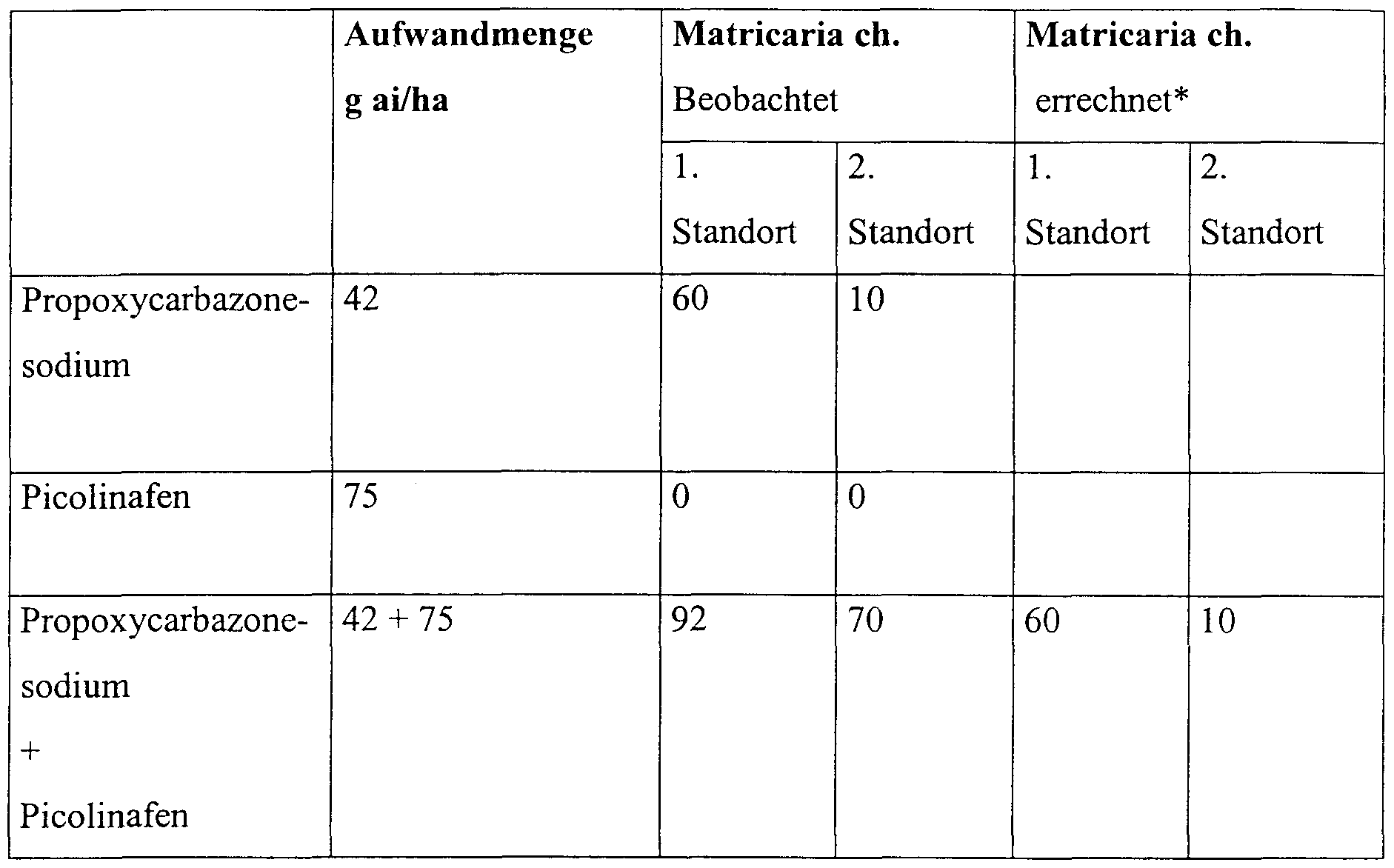
Die Wirkstoffmischungen zeigten in diesem Versuch einen deutlich ausgeprägten Synergismus in der Wirkung gegen verschiedene Unkräuter. Die Wirkung lag deutlich über dem nach der Colby-Formel (COLBY 1967) für die Mischung zu erwartenden Wert (siehe die folgenden Tabellen). Tabelle B-l:
Figure imgf000037_0001
Tabelle B-2:
Figure imgf000037_0002
Tabelle B-3:
Figure imgf000038_0001
Tabelle B-4:
Figure imgf000038_0002
Tabelle B-5:
Figure imgf000039_0001
Tabelle B-6:
Figure imgf000039_0002
Tabelle B-7:
Figure imgf000040_0001

Claims

Patentansprüche
1. Herbizide Mittel, gekennzeichnet durch einen wirksamen Gehalt an einer Wirk- stoffkombination umfassend
(a) zumindest ein 2,6-disubstituiertes Pyridin-Derivat der allgemeinen Formel (I)
Figure imgf000041_0001
in welcher
R1 für einen gegebenenfalls einfach oder mehrfach durch Halogen- und/oder Ci-Cß-Halogenalkyl substituierten 5 bis 6 gliedrigen Hetero- zyklus enthaltend 1 bis 3 Stickstoffatome oder für ein gegebenenfalls einfach oder mehrfach durch Halogen- und/oder Cι-C3-Halogenalkyl substituierten Phenylrest steht,
R2 für einen gegebenenfalls durch Halogen- und/oder Cι-C3-Halogenalkyl substituierten Phenoxyrest steht,
R3 für ein Wasserstoffatom oder Methyl steht, und
W für Sauerstoff oder die Gruppe -CO-NH- steht,
(„Wirkstoffe der Gruppe 1")
und (b) eine oder mehrere Verbindungen aus einer zweiten Gruppe von Herbiziden, welche die nachstehend genannten Wirkstoffe enthält:
(5-Trifluormethyl-l,3,4-thiadiazol-2-yl-oxy)-essigsäure-N-isopropyl-N-(4- fluoφhenyl)-amid (flufenacet), 2-(2-Methoxycarbonyl-phenylsulfonylamino- carbonyl)-4-methyl-5-n-propoxy-2,4-dihydro-3H-l,2,4-triazol-3-on oder das Natriumsalz dieser Verbindung (propoxycarbazone-sodium), 2-(2-Trifluor- methoxy-phenylsulfonylaminocarbonyl)-4-methyl-5-methoxy-2,4-dihydro- 3H-l,2,4-triazol-3-on oder das Natriumsalz dieser Verbindung (flucarbazone- sodium), N-(3,4-Dichloφhenyl)propanamid (propanil), N-2-Benzothiazolyl-
N,N'-dimethylharnstoff (methabenzthiazuron), 4-Amino-6-( 1 , 1 -dimethyl- ethyl)-3-(methylthio)- 1 ,2,4-triazin-5(4H)-on (metribuzin), 4-(2-Chloφhenyl)- N-cyclohexyl-N-ethyl-4,5-dihydro-5-oxo-lH-tetrazol-l -carboxamid (fentraz- amide), 4-Amino-3-methyl-6-phenyl-l,2,4-triazin-5(4H)-on (metamitron), 2- (2-Benzothiazolyloxy)-N-methyl-N-phenylacetamid (mefenacet), 4-Amino-6-
(l,l-dimethylethyl)-3-(ethylthio)-l,2,4-triazin-5(4H)-on (ethiozin) oder 1- Methylethyl 5-[4-brom-l-methyl-5-(trifluormethyl)-lH-pyrazol-3-yl]-2- chloro-4-fluorobenzoat (fluazolate)
(„Wirkstoffe der Gruppe 2"),
sowie gegebenenfalls
(c) zusätzlich zumindest eine die Kultuφflanzenverträglichkeit verbessernde Verbindung aus der folgenden Gruppe von Verbindungen:
α-(l,3-Dioxolan-2-yl-methoximino)-phenylacetonitril (Oxabetrinil), α-(Cya- nomethoximino)-phenylacetonitril (Cyometrinil), 4-Chlor-N-( 1 ,3-dioxolan-2- yl-methoxy)-α-trifluor-acetophenonoxim (Fluxofenim), 4,6-Dichlor-2-phenyl- pyrimidin (Fenclorim), 4-Dichloracetyl-3,4-dihydro-3-methyl-2H-l,4-benz- oxazin (Benoxacor), 5-Chlor-chinoxalin-8-oxy-essigsäure-( 1 -methyl-hexyl- ester) (Cloquintocet), 2,2-Dichlor-N-(2-oxo-2-(2-propenylamino)-ethyl)-N- (2-propenyl)-acetamid (DKA-24), 1,8-Naphthalinsäureanhydrid, l-(2,4-Di- chlor-phenyl)-5-trichlormethyl-lH-l,2,4-triazol-3-carbonsäure-ethylester (Fenchlorazol-ethyl), 2-Chlor-4-trifluormethyl-thiazol-5-carbonsäure-phenyl- methylester (Flurazole), 3-Dichloracetyl-5-(2-furanyl)-2,2-dimethyl-oxazoli- din (Furilazole, MON-13900), 4-Dichloracetyl-l-oxa-4-aza-spiro[4.5]-decan (AD-67), 2-Dichlormethyl-2-methyl-l,3-dioxolan (MG-191), 2,2-Dichlor-N- (1 ,3-dioxolan-2-yl-methyl)-N-(2-propenyl)-acetamid (PPG- 1292), 2,2-Di- chlor-N,N-di-2-propenyl-acetamid (Dichlormid), N-(4-Methyl-phenyl)-N'-( 1 - methyl-l-phenyl-ethyl)-harnstoff (Dymron), 1-Dichloracetyl-hexahydro-
3 ,3,8a-trimethylpyrrolo[ 1 ,2-a]-pyrimidin-6(2H)-on (BAS- 145138), N-(2- Methoxy-benzoyl)-4-(methylaminocarbonylamino)-benzolsulfonamid, Ethyl- 4,5-dihydro-5,5-diphenyl-3-isoxazolcarboxylat (Isoxadifen-ethyl), Diethyl- 1 - (2,4-dichloφhenyl)-4,5-dihydro-5-methyl-lH-pyrazol-3,5-dicarboxylat (Me- fenpyr-diethyl), (4-Chlor-2-methyl-phenoxy)-essigsäure (MCPA), (+-)-2-(4-
Chlor-2-methylphenoxy)propansäure (Mecoprop), 3-Dichloracetyl-2,2,5-tri- methyl-oxazolidin (R-29148) und 2,4-Dichloφhenoxyessigsäure (2,4-D) und dessen Derivate
("Wirkstoffe der Gruppe 3"),
sowie gegebenenfalls
(d) eine oder mehrere Verbindungen aus einer dritten Gruppe von Herbiziden, welche die nachstehend genannten Wirkstoffe enthält:
2-Chlor-N-(ethoxymethyl)-N-(2-ethyl-6-methyl-phenyl)-acetamid (Aceto- chlor), 5-(2-Chlor-4-trifluormethyl-phenoxy)-2-nitro-benzoesäure-Natrium- salz (Acifluorfen-sodium), 2-Chlor-6-nitro-3-phenoxy-benzenamin (Aclonifen), 2-Chlor-N-(methoxymethyl)-N-(2,6-diethyl-phenyl)-acetamid
(Alachlor), N-Ethyl-N'-i-propyl-6-methylthio-l,3,5-triazin-2,4-diamin (Ametryn), 4-Amino-N-( 1 , 1 -Dimethyl-ethyl)-4,5-dihydro-3-(l -methyl-ethyl)- 5-oxo- 1 H- 1 ,2,4-triazol- 1 -carboxamid (Amicarbazone), N-(4,6-Dimethoxy- pyrimidin-2-yl)-N'-(N-methyl-N-methylsulfonyl-sulfamoyl)-harnstoff (Amidosulfuron), lH-l,2,4-Triazol-3-amin (Amitrole), 6-Chlor-4-ethylamino- 2-isopropylamino-l,3,5-triazin (Atrazin), 2-[2,4-Dichlor-5-(2-propinyloxy)- phenyl]-5,6,7,8-tetrahydro-l,2,4-triazolo-[4,3-a]-pyridin-3(2H)-on (Azafen- idin), N-(4,6-Dimethoxy-pyrimidin-2-yl)-N'-[ 1 -methyl-4-(2-methyl-2H- tetrazol-5-yl)- 1 H-pyrazol-5-ylsulfonyl]-harnstoff (Azimsulf ron), N-Benzyl- 2-(4-fluor-3-trifluormethyl-phenoxy)-butanamid (Beflubutamid), 4-Chlor-2- oxo-3(2H)-benzthiazolessigsäure (Benazolin), N-Butyl-N-ethyl-2,6-dinitro-4- trifluormethyl-benzenamin (Benfluralin), N-(4,6-Dimethoxy-pyrimidin-2-yl)- N'-(2-methoxycarbonyl-phenylmethylsulfonyl)-harnstoff (Bensulfuron), 2-[2- [4-(3,6-Dihydro-3-methyl-2,6-dioxo-4-trifluormethyl-l(2H)-pyrimidinyl- phenoxy]methyl]-5-ethyl-phenoxy-propansäure-methylester (Benzfendizone), 3-(2-Chlor-4-methylsulfonyl-benzoyl)-4-phenylthio-bicyclo-[3.2. l]-oct-3-en-
2-on (Benzobicyclon), Ethyl N-benzoyl-N-(3,4-dichlor-phenyl)-DL-alaninat (Benzoylprop-ethyl), 3-i-Propyl-lH-2,l,3-benzothiadiazin-4(3H)-on
(Bentazon), Methyl-5-(2,4-dichlor-phenoxy)-2-nitro-benzoat (Bifenox), 2,6- Bis-(4,6-dimethoxy-pyrimidin-2-yl-oxy)-benzoesäure-Natriumsalz (Bispyri- bac-sodium), 2-Brom-3,3-dimethyl-N-(l-methyl-l-phenyl-ethyl)-butanamid
(Bromobutide), 3,5-Dibrom-4-hydroxy-benzaldehyd-O-(2,4-dinitro-phenyl)- oxim (Bromofenoxim), 3,5-Dibrom-4-hydroxy-benzonitril (Bromoxynil), N- Butoxymethyl-2-chlor-N-(2,6-diethyl-phenyl)-acetamid (Butachlor), 2-Chlor- 5-(3,6-dihydro-3-methyl-2,6-dioxo-4-trifluormethyl-l(2H)-pyrimidinyl)-ben- zoesäure-[ 1 , 1 -dimethyl-2-oxo-2-(2-propenyloxy)]-ethylester (Butafenacil- allyl), 2-(l-Ethoximino-propyl)-3-hydroxy-5-[2,4,6-trimethyl-3-(l-oxo- butyl)-phenyl]-2-cyclohexen-l-on (Butroxydim), S-Ethyl-bis-(2-methyl- propyl)-fhiocarbamat (Butylate), N,N-Diethyl-3-(2,4,6-trimethyl-phenyl- sulfonyl)- 1 H- 1 ,2,4-triazol- 1 -carboxamid (Cafenstrole), 2-[ 1 -[(3-Chlor-2- propenyl)-oxy-imino]-propyl]-3-hydroxy-5-(tetrahydro-2H-pyran-4-yl)-2- cyclohexen-1-on (Caloxydim, Tepraloxydim), 2-(4-Chlor-2-fluor-5-(2-chlor- 2-ethoxycarbonyl-ethyl)-phenyl)-4-difluormethyl-5-methyl-2,4-dihydro-3H- l,2,4-triazol-3-on (Carfentrazone-ethyl), 2,4-Dichlor-l-(3-methoxy-4-nitro- phenoxy)-benzol (Chlomethoxyfen), 3-Amino-2,5-dichlor-benzoesäure (Chloramben), N-(4-Chlor-6-methoxy-pyrimidin-2-yl)-N'-(2-ethoxycarbonyl- phenylsulfonyl)-harnstoff (Chlorimuron-ethyl), l,3,5-Trichlor-2-(4-nitro- phenoxy)-benzol (Chlornitrofen), N-(4-Methoxy-6-methyl- 1 ,3,5-triazin-2-yl)- N'-(2-chlor-phenylsulfonyl)-harnstoff (Chlorsulfuron), N'-(3-Chlor-4-methyl- phenyl)-N,N-dimethyl-harnstoff (Chlortoluron), 2-Chlor-3-[2-chlor-5- (1, 3,4,5, 6,7-hexahydro-l,3-dioxo-2H-isoindol-2-yl)-phenyl]-2-propansäure- ethylester (Cinidon-ethyl), N-(4,6-Dimethoxy-l,3,5-triazin-2-yl)-N'-(2-(2- methoxy-ethoxy)-phenylsulfonyl)-harnstoff (Cinosulfuron), 2-[ 1 -[2-(4-Chlor- phenoxy)-propoxyamino]butyl]-5-(tetrahydro-2H-thiopyran-3-yl)-l,3-cyclo- hexandion (Clefoxydim), (E,E)-(+)-2-[l-[[(3-Chlor-2-propenyl)-oxy]-imino]- propyl]-3-hydroxy-2-cyclohexen-l -on (Clethodim), (R)-(2-Propinyl)-2-[4-(5- chlor-3-fluor-pyridin-2-yl-oxy)-phenoxy-propanoat (Clodinafop-propargyl),
3,6-Dichlor-pyridin-2-carbonsäure (Clopyralid), Methyl-3-chloro-2-[(5-eth- oxy-7-fluor[l,2,4]triazolo[l,5-c]pyrimidin-2-yl-sulfonyl)-amino]-benzoat (Cloransulam-methyl), 2-Chlor-4-ethylamino-6-( 1 -cyano- 1 -me hyl-ethyl- amino)-l,3,5-triazin (Cyanazine), N-(4,6-Dimethoxy-pyrimidin-2-yl)-N'-(2- cyclopropylcarbonyl-phenylsulfonyl)-harnstoff (Cyclosulfamuron), 2-(l-
Ethoximinobutyl)-3-hydroxy-5-(tetrahydro-2H-thiopyran-3-yl)-2-cyclohexen- 1 -on (Cycloxydim), (R)-2-[4-(4-Cyano-2-fluor-phenoxy)-phenoxy]-propan- säure-butylester (Cyhalofop-butyl), 2,4-Dichlor-phenoxyessigsäure (2,4-D), 3,6-Dichlor-2-methoxy-benzoesäure (Dicamba), (R)-2-(2,4-Dichlor-phen- oxy)-propansäure (Dichloφrop-P), Methyl-2-[4-(2,4-dichlor-phenoxy)-phen- oxy]-propanoat (Diclofop-methyl), N-(2,6-Dichlor-phenyl)-5-ethoxy-7-fluor- [l,2,4]-triazolo-[l,5-c]-pyrimidin-2-sulfonamid (Diclosulam), 1 ,2-Dimethyl- 3,5-diphenyl-lH-pyrazolium-methylsulfat (Difenzoquat), N-(2,4-Difluor- phenyl)-2-(3-trifluormethyl-phenoxy)-pyridin-3-carboxamid (Diflufenican), 2-[ 1 -[(3,5-Difluor-phenyl)-amino-carbonyl-hydrazono]-ethyl]-pyridin-3- carbonsäure (Diflufenzopyr), S-( 1 -Methyl- 1 -phenyl-ethyl)- 1 -piperidin-carbo- thioat (Dimepiperate), (S-) 2-Chlor-N-(2,4-dimethyl-3-thienyl)-N-(2- methoxy-l-methyl-ethyl)-acetamid (S-) (Dimethenamid), 2-Amino-4-(l- fluor- 1 -methyl-ethyl)-6-( 1 -methyl-2-(3 ,5-dimethyl-phenoxy)-ethylamino)- 1,3,5-triazin (Dimexyflam), N3,N3-Diethyl-2,4-dinitro-6-trifluormethyl-l,3- diamino-benzol (Dini tramine), 6,7-Dihydro-dip)τido[l,2-a:2',r-c]pyrazin- diium (Diquat), S,S-Dimethyl-2-difluormethyl-4-i-butyl-6-trifluormethyl- pyridin-3,5-dicarbothioat (Dithiopyr), N'-(3,4-Dichlor-phenyl)-N,N-di- methyl-harnsto f (Diuron), 2-[2-(3-Chlor-phenyl)-oxiranylmethyl]-2-ethyl- lH-inden-l,3(2H)-dion (Epropodan), S-Ethyl-dipropylthiocarbamat (EPTC), S-(Phenylmethyl)-N-ethyl-N-(l ,2-dimethyl-propyl)-thiocarbamat (Espro- carb), N-Ethyl-N-(2-methyl-2-propenyl)-2,6-dinitro-4-trifluormethyl-benzen- amin (Ethalfluralin), (S)-(2-Ethoxy- 1 -methyl-2-oxoethyl)-2-chlor-5-(2-chlor- 4-trifluormethyl-phenoxy)-benzoat (Ethoxyfen), N-(4,6-Dimethoxy- pyrimidin-2-yl)-N'-(2-ethoxy-phenoxysulfonyl)-hamstoff (Ethoxysulfuron), (R)-Ethyl-2-[4-(6-chlor-benzoxazol-2-yl-oxy)-phenoxy]-propanoat (Fenoxa- prop-(P)-ethyl), 4-(2-Chlor-phenyl)-N-cyclohexyl-N-ethyl-4,5-dihydro-5- oxo-lH-tetrazol-1 -carboxamid (Fentrazamide), Isopropyl-N-benzoyl-N-(3- chlor-4-fluro-phenyl)-DL-alaninat (Flamprop-isopropyl), Isopropyl-N- benzoyl-N-(3-chlor-4-fluro-phenyl)-L-alaninat (Flamprop-isopropyl-L), Methyl-N-benzoyl-N-(3-chlor-4-fluor-phenoxy)-DL-alaninat (Flamprop- methyl), N-(2,6-Difluor-phenyl)-8-fluor-5-methoxy-[l,2,4]-triazolo-[l,5-c]- pyrimidin-2-sulfonamid (Florasulam), (R)-2-[4-(5-Trifluormethyl-pyridin-2- yl-oxy)-phenoxy]-propansäure-butylester (Fluazifop, -butyl, -P-butyl), 5-(4- Brom- 1 -methyl-5-trifluormethyl- 1 H-pyrazol-3-yl)-2-chlor-4-fluor-benzoe- säure-i-propylester (Fluazolate), 4,5-Dihydro-3-methoxy-4-methyl-5-oxo-N-
[(2-trifluormethoxy-phenyl)-sulfonyl]- 1 -H- 1 ,2,4-triazol- 1 -carboxamid- Natriumsalz (Flucarbazone-sodium), N-(4-Fluor-phenyl)-N-i-propyl-2-(5- trifluormethyl- 1 ,3,4-thiadiazol-2-yl-oxy)-acetamid (Flufenacet), N-(2,6-Di- fluor-phenyl)-5-methyl-l,2,4-triazolo[l,5-a]-pyrimidin-2-sulfonamid (Flu- metsulam), Pentyl-[2-chlor-4-fluor-5-(l,3,4,5,6,7-hexahydro-l,3-dioxo-2H- isoindol-2-yl)-phenoxy]-acetat (Flumiclorac-pentyl), 2-[7-Fluor-3,4-dihydro- 3-oxo-4-(2-propinyl)-2H-l,4-benzoxazin-6-yl]-4,5,6,7-tetrahydro-lH-iso- indol-l,3-dion (Flumioxazin), 2-[4-Chlor-2-fluor-5-[(l-methyl-2-propinyl)- oxy]-phenyl]-4,5,6,7-tetrahydro-lH-isoindol-l,3(2H)-dion (Flumipropyn), 3- Chlor-4-chlormethyl- 1 -(3-trifluormethyl-phenyl)-2-pyrrolidinon (Fluoro- chloridone), 5-(2-Chlor-4-trifluormethyl-phenoxy)-2-nitro-benzoesäure- ethoxycarbonylmethylester (Fluoroglycofen-ethyl), l-(4-Chlor-3-(2,2,3,3,3- pentafluor-propoxymethyl)-phenyl)-5-phenyl-lH-l,2,4-triazol-3-carboxamid (Flupoxam), l-Isopropyl-2-chlor-5-(3,6-dihydro-3-methyl-2,6-dioxo-4-tri- fluormethyl-l(2H)-pyrimidyl)-benzoat (Flupropacil), N-(4,6-Dimethoxy- pyrimidin-2-yl)-N'-(3-methoxycarbonyl-6-trifluormethyl-pyridin-2-yl-sul- fonyl)-harnstoff-Natriumsalz (Flupyrsulfuron-methyl-sodium), 9-Hydroxy- 9H-fluoren-9-carbonsäure (Flurenol), (4-Amino-3,5-dichlor-6-fluor-pyridin- 2-yl-oxy)-essigsäure (-2-butoxy- 1 -methyl-ethylester, - 1 -methyl-heptylester) (Fluroxypyr, -butoxypropyl, -meptyl), 5-Methylamino-2-phenyl-4-(3-trifluor- methyl-phenyl)-3(2H)-furanon (Flurtamone), Methyl-[(2-chlor-4-fluor-5-
(tetrahydro-3-oxo-lH,3H-[l,3,4]-thiadiazolo-[3,4-a]-pyridazin-l-yliden)- amino-phenyl]-thio-acetat (Fluthiacet-methyl), 5-(2-Chlor-4-trifluormethyl- phenoxy)-N-methylsulfonyl-2-nitro-benzamid (Fomesafen), 2-[[[[(4,6-Di- methoxy-2-pyrimidinyl)-amino]-carbonyl]-amino]-sulfonyl]-4-formylamino- N,N-dimethyl-benzamid (Foramsulfuron), 2-Amino-4-(hydroxymethylphos- phinyl)-butansäure (-ammoniumsalz) (Glufosinate (-ammonium)), N-Phos- phonomethyl-glycin (-isopropylammmoniumsalz), (Glyphosate, -isopropyl- ammonium), (R)-2-[4-(3-Chlor-5-trifluormethyl-pyridin-2-yl-oxy)-phenoxy]- propansäure (-methylester, -2-ethoxy-ethylester, -butylester) (Haloxyfop, - methyl, -P-methyl, -ethoxyethyl, -butyl), 3-Cyclohexyl-6-dimethylamino-l- methyl-l,3,5-triazin-2,4(lH,3H)-dion (Hexazinone), Methyl-2-(4,5-dihydro- 4-methyl-4-isopropyl-5-oxo-lH-imidazol-2-yl)-4-methyl-benzoat (Imaza- methabenz-methyl), 2-(4,5-Dihydro-4-methyl-4-isopropyl-5-oxo-lH-imid- azol-2-yl)-5-methyl-pyridin-3-carbonsäure (Imazamethapyr), 2-(4,5-Dihydro- 4-methyl-4-isopropyl-5-oxo-lH-imidazol-2-yl)-5-methoxymethyl-pyridin-3- carbonsäure (Imazamox), 2-(4,5-Dihydro-4-methyl-4-isopropyl-5-oxo-lH- imidazol-2-yl)-chinolin-3-carbonsäure (Imazaquin), 2-(4,5-Dihydro-4-methyl- 4-i-propyl-5-oxo-lH-imidazol-2-yl)-5-ethyl-pyridin-3-carbonsäure (Imazetha- pyr), N-(4,6-Dimethoxy-pyrimidin-2-yl)-N'-(2-chlor-imidazo[ 1 ,2-a]-pyridin- 3-yl-sulfonyl)-harnstoff (Imazosulfuron), N-(4-Methoxy-6-methyl- 1 ,3,5- triazin-2-yl)-N'-(5-iod-2-methoxycarbonyl-phenylsulfonyl)-harnstoff-
Natriumsalz (lodosulfuron-methyl-sodium), 4-Hydroxy-3,5-diiod-benzonitril (Ioxynil), N,N-Dimethyl-N'-(4-isopropyl-phenyl)-harnstoff (Isoproturon), N- (3-( 1 -Ethyl- 1 -methyl-propyl)-isoxazol-5-yl)-2,6-dimethoxy-benzamid (Isoxa- ben), (4-Chlor-2-methylsulfonyl-phenyl)-(5-cyclopropyl-isoxazol-4-yl)- methanon (Isoxachlortole), (5-Cyclopropyl-isoxazol-4-yl)-(2-methylsulfonyl-
4-trifluormethyl-phenyl)-methanon (Isoxaflutole), 2-[2-[4-[3,5-Dichlor-2- pyridinyl)-oxy]-phenoxy]-l-oxo-propyl]-isoxazolidin (Isoxapyrifop), (2-Eth- oxy-l-methyl-2-oxo-ethyl)-5-(2-chlor-4-trifluormethyl-phenoxy)-2-nitro- benzoat (Lactofen), N'-(3,4-dichlor-phenyl)-N-methoxy-N-methyl-harnstoff (Linuron), (4-Chlor-2-methyl-phenoxy)-essigsäure (MCPA), 2-(4-Chlor-2- methyl-phenoxy)-propionsäure (Mecoprop), 2-(2-Benzthiazolyloxy)-N- methyl-N-phenyl-acetamid (Mefenacet), 2-(4-Methylsulfonyl-2-nitro- benzoyl)- 1 ,3-cyclohexandion (Mesotrione), 4-Amino-3-methyl-6-phenyl- 1 ,2,4-triazin-5(4H)-on (Metamitron), 2-Chlor-N-(2,6-dimethyl-phenyl)-N- (lH-pyrazol-l-yl-methyl)-acetamid (Metazachlor), N'-(4-(3,4-Dihydro-2- methoxy-2,4,4-trimethyl-2H-l-benzopyran-7-yl-oxy)-phenyl)-N-methoxy-N- methyl-harnstoff (Metobenzuron), N'-(4-Brom-phenyl)-N-methoxy-N- methylharnstoff (Metobromuron), (S)-2-Chlor-N-(2-ethyl-6-methyl-phenyl)- N-(2-methoxy-l-methyl-ethyl)-acet-amid (Metolachlor, S-Metolachlor), N- (2,6-Dichlor-3-methyl-phenyl)-5,7-dimethoxy-l,2,4-triazolo[l,5-a]- pyrimidin-2-sulfonamid (Metosulam), N'-(3-Chlor-4-methoxy-phenyl)-N,N- dimethyl-harnstoff (Metoxuron), 4- Amino-6-ten-butyl-3 -methylthio- 1 ,2,4- triazin-5(4H)-on (Metribuzin), N-(4-Methoxy-6-methyl-l,3,5-triazin-2-yl)- N'-(2-methoxycarbonyl-phenylsulfonyl)-harnstoff (Metsulfuron-methyl), S- Ethyl-hexahydro-lH-azepin-1-carbothioat (Molinate), 2-(2-Naphthyloxy)-N- phenyl-propanamid (Naproanilide), N-Butyl-N'-(3 ,4-dichlor-phenyl)-N- methyl-harnstoff (Neburon), N-(4,6-Dimethoxy-pyrimidin-2-yl)-N'-(3-di- methylcarbamoyl-pyridin-2-yl-sulfonyl)-harnstoff (Nicosulfüron), S-(2- Chlor-benzyl)-N,N-diethyl-thiocarbamat (Orbencarb), 4-Dipropylamino-3,5- dinitro-benzensulfonamid (Oryzalin), 3-[2,4-Dichlor-5-(2-propinyloxy)- phenyl]-5-(t-butyl)-l,3,4-oxadiazol-2(3H)-on (Oxadiargyl), 3-[2,4-Dichlor-5-
(l-methyl-ethoxy)-phenyl]-5-(t-butyl)-l,3,4-oxadiazol-2(3H)-on (Oxadiazon), N-(4,6-Dimethyl-pyrimidin-2-yl)-N'-(2-oxetan-3-yl-oxycarbonyl-phenylsul- fonyl)-harnstoff (Oxasulfuron), 3-[ 1 -(3,5-Dichlor-phenyl)- 1 -i-propyl]-2,3-di- hydro-6-methyl-5-phenyl-4H-l ,3-oxazin-4-on (Oxaziclomefone), 2-Chlor-l - (3-ethoxy-4-nitro-phenoxy)-4-trifluormethyl-benzen (Oxyfluorfen), l,l'-Di- methyl-4,4'-bipyridinium (Paraquat), 1 -Amino-N-(l -ethyl-propyl)-3,4-di- methyl-2,6-dinitro-benzol (Pendimethalin), 4-(t-Butyl)-N-(l -ethyl-propyl)- 2,6-dinitro-benzenamin (Pendralin), 4-Amino-3,5,6-trichlor-pyridin-2-carbon- säure (Picloram), 2-Chlor-N-(2,6-diethyl-phenyl)-N-(2-propoxy-ethyl)-acet- amid (Pretilachlor), N-(4,6-Bis-difluormethoxy-pyrimidin-2-yl)-N'-(2- methoxycarbonyl-phenylsulfonyl)-harnstoff (Primisulfüron-methyl), 1 -Chlor- N-[2-chlor-4-fluor-5-[(6S,7aR)-6-fluor-tetrahydro- 1 ,3-dioxo- 1 H-pyrrolo[ 1 ,2- c]imidazol-2(3H)-yl]-phenyl]-methansulfonamid (Profluazol), 2-Chlor-N-iso- propyl-N-phenyl-acetamid (Propachlor), N-(3,4-Dichlor-phenyl)-propanamid (Propanil), (R)-[2-[[(l-Methyl-ethyliden)-amino]-oxy]-ethyl]-2-[4-(6-chlor-2- chinoxalinyloxy)-phenoxy]-propanoat (Propaquizafop), 2-Chlor-N-(2-ethyl-6- methyl-phenyl)-N-[( 1 -methyl-ethoxy)-methyl]-acetamid (Propisochlor), 2- [[[(4,5-Dihydro-4-methyl-5-oxo-3-propoxy-lH-l,2,4-triazol-l-yl)-carbonyl]- amino]-sulfonyl]-benzoesäure-methylester-Natriumsalz (Propoxycarbazone- sodium), S-Phenylmethyl-N,N-dipropyl-thiocarbamat (Prosulfocarb), N-(4-
Methoxy-6-methyl-l,3,5-triazin-2-yl)-N'-(2-(3,3,3-trifluor-propyl)-phenyl- sulfonyl)-harnstoff (Prosulfuron), Ethyl-[2-Chlor-5-(4-chlor-5-difluor- methoxy-l-methyl-lH-pyrazol-3-yl)-4-fluor-phenoxy]-acetat (Pyraflufen- ethyl), l-(3-Chlor-4,5,6,7-tetrahydro-pyrazolo[ 1 ,5-a]pyridin-2-yl)-5-(methyl- 2-propinylamino)-lH-pyrazol-4-carbonitril (Pyrazogyl), 4-(2,4-Dichlor- benzoyl)- 1 ,3-dimethyl-5-(4-methyl-phenylsulfonyloxy)-pyrazol (Pyrazolate), 4-(2,4-Dichlor-benzoyl)-l,3-dimethyl-5-(phenylcarbonylmethoxy)-pyrazol (Pyrazoxyfen), N-(4,6-Dimethoxy-pyrimidin-2-yl)-N'-(4-ethoxycarbonyl- 1 - methyl-pyrazol-5-yl-sulfonyl)-harnstoff (Pyrazosulfuron-ethyl), Diphenyl- methanon-O-[2,6-bis-(4,6-dimethoxy-pyrimidin-2-yl-oxy)-benzoyl]-oxim (Pyribenzoxim), 6-Chlor-3-phenyl-4-pyridazinol (Pyridafol), O-(6-Chlor-3- phenyl-pyridazin-4-yl)-S-octyl-thiocarbonat (Pyridate), 6-Chlor-3-phenyl- pyridazin-4-ol (Pyridatol), 7-[(4,6-Dimethoxy-2-pyrimidinyl)-thio]-3-methyl- 1 (3H)-isobenzoftιranon (Pyriftalid), 2-(4,6-Dimethoxy-pyrimidin-2-yl-oxy)- benzoesäure-methylester (Pyriminobac-methyl), 2-Chlor-6-(4,6-dimethoxy- ρyrimidin-2-ylthio)-benzoesäure-Natriumsalz (Pyrithiobac-sodium), 3,7-Di- chlor-chinolin-8-carbonsäure (Quinchlorac), 7-Chlor-3-methyl-chinolin-8- carbonsäure (Quinmerac), 2-[4-(6-Chlor-2-chinoxalinyloxy)-phenoxy]- propansäure (-ethylester, -tetrahydro-2-füranyl-methylester) (Quizalofop, -ethyl, -P-ethyl, -P-tefuryl), N-(4,6-Dimethoxy-pyrimidin-2-yl)-N'-(3-ethyl- sulfonyl-pyridin-2-yl-sulfonyl)-harnsto f (Rimsulfuron), 2-(l-Ethoximino- butyl)-5-(2-ethylthiopropyl)-3-hydroxy-2-cyclohexen-l-on (Sethoxydim), 6- Chlor-2,4-bis-ethylamino-l,3,5-triazin (Simazin), 2-(2-Chlor-4-methyl- sulfonyl-benzoyl)-cyclohexan-l ,3-dion (Sulcotrione), 2-(2,4-Dichlor-5- methylsulfonylamino-phenyl)-4-difluormethyl-5-methyl-2,4-dihydro-3H- l,2,4-triazol-3-on (Sulfentrazone), N-Phosphonomethyl-glycin-trimethyl- sulfonium (Sulfosate), N-(4,6-Dimethoxy-pyrimidin-2-yl)-N'-(2-ethyl- sulfonyl)-imidazo[ 1 ,2-a]pyridin-3-sulfonamid (Sulfosulfuron), 6-Chlor-4- ethylamino-2-tert-butylamino- 1 ,3,5-triazin (Terbuthylazine), 2-tert-Butyl- amino-4-ethylamino-6-methylthio- 1 ,3,5-triazin (Terbutryn), 2-Chlor-N-(2,6- dimethyl-phenyl)-N-(3-methoxy-2-thienyl-methyl)-acetamid (Thenylchlor),
2-Difluormethyl-5-(4,5-dihydro-thiazol-2-yl)-4-(2-methyl-propyl)-6-trifluor- methyl-pyridin-3-carbonsäure-methylester (Thiazopyr), 6-(6,7-Dihydro-6,6- dimethyl-3H,5H-pyrrolo[2,l-c]-l,2,4-thiadiazol-3-ylidenamino)-7-fluor-4-(2- propinyl)-2H-l ,4-benzoxazin-3(4H)-on (Thidiazimin), N-(4-Methoxy-6- methyl-l,3,5-triazin-2-yl)-N'-(2-methoxycarbonyl-thien-3-yl-sulfonyl)-harn- stoff (Thifensulfuron-methyl), 2-(Ethoximino-propyl)-3-hydroxy-5-(2,4,6-tri- methyl-phenyl)-2-cyclohexen-l-on (Tralkoxydim), S-(2,3,3-Trichlor-2- propenyl)-diisopropylcarbamothioat (Triallate), N-(4-Methoxy-6-methyl- l,3,5-triazin-2-yl)-N'-[2-(2-chlor-ethoxy)-phenylsulfonyl]-harnstoff (Triasulf- uron), N-Methyl-N-(4-methoxy-6-methyl- 1 ,3,5-triazin-2-yl)-N'-(2-methoxy- carbonyl-phenylsulfonyl)-harnstoff (Tribenuron-methyl), (3,5,6-Trichlor)- pyridin-2-yl-oxy-essigsäure (Triclopyr), 2-(3,5-Dichlor-phenyl)-2-(2,2,2-tri- chlor-ethyl)-oxiran (Tridiphane), N-[[(4,6-Dimethoxy-2-pyrimidinyl)-amino]- carbonyl]-3-(2,2,2-trifluor-ethoxy)-2-pyridinsulfonamid-Natriumsalz (Trifloxysulfuron), l-Amino-2,6-dinitro-N,N-dipropyl-4-trifluormethyl-benzol (Trifluralin), N-[4-Dimethylamino-6-(2,2,2-trifluor-ethoxy)-l,3,5-triazin-2- yl]-N'-(2-methoxycarbonyl-phenylsulfonyl)-harnstoff (Triflusulfuron- methyl), N-(4-Methoxy-6-trifluormethoxy- 1 ,3,5-triazin-2-yl)-N'-(2-trifluor- methyl-phenylsulfonyl)-harnstoff (Tritosulfuron), N-[[(4,6-Dimethoxy-2- pyrimidinyl)-amino]-carbonyl]-3-(N-methyl-N-methylsulfonyl-amino)-2- pyridinsulfonamid, 2-[[[[(4,6-Dimethoxy-2-pyrimidinyl)-amino]-carbonyl]- amino]-sulfonyl]-4-[[(methylsulfonyl)-amino]methyl]-benzoesäure-methyl- ester, 4-[4,5-Dihydro-4-methyl-5-oxo-(3-trifluormethyl)-lH-l,2,4-triazol-l- yl]-2-[(ethylsulfonyl)amino]-5-fluor-benzencarbothioamid
("Wirkstoffe der Gruppe 4"),
wobei die Verbindung unter (b) nicht für Flufenacet steht, wenn die unter (a) 2-(3,4-Difluoφhenoxy)-4-methyl-6-(l-methyl-3-trifluormethylpyrazol-5-yl)- pyridin ist.
2. Herbizide Mittel gemäß Anspruch 1, dadurch gekennzeichnet, dass sie als Wirkstoff der Gruppe 1 ein 2,6-disubstituiertes Pyridin-Derivat der allgemeinen Formel (I) enthalten,
in welcher R1 für einen gegebenenfalls durch Trifluormethyl und Methyl substituierten Pyrazolylrest oder für ein gegebenenfalls einfach oder mehrfach durch Fluor substituierten Phenylrest steht,
R2 für einen gegebenenfalls durch Halogen- und oder Cj-C3-Halogenalkyl substituierten Phenoxyrest steht,
R3 für ein Wasserstoffatom oder Methyl steht, und
W für Sauerstoff oder die Gruppe -CO-NH- steht.
3. Herbizide Mittel gemäß Anspruch 1, dadurch gekennzeichnet, dass sie als Wirkstoffe der Gruppe 1
N-(4-Fluoφhenyl)-6-[3-(trifluormethyl)phenoxy]-2-pyridinecarboxamid
(picolinafen) oder 2-(3 ,4-Difluoφhenoxy)-4-methyl-6-( 1 -methyl-3 -trifluor- methylpyrazol-5-yl)-ρyridin enthalten.
4. Herbizide Mittel gemäß einem der Ansprüche 1 bis 3, dadurch gekenn- zeichnet, dass sie als Wirkstoff der Gruppe 3 zumindest eine die Kulturpflanzen-Verträglichkeit verbessernde Verbindung aus der folgenden Gruppe von Verbindungen enthalten:
5-Chlor-chinoxalin-8-oxy-essigsäure-(l-methylhexylester) (Cloquintocet), 1- (2,4-Dichlor-phenyl)-5-trichlormethyl- 1 H- 1 ,2,4-triazol-3-carbonsäure-ethyl- ester (Fenchlorazol-ethyl), Ethyl-4,5-dihydro-5,5-diphenyl-3-isoxazolcarb- oxylat (Isoxadifen-ethyl), Diethyl-l-(2,4-dichloφhenyl)-4,5-dihydro-5-me- thyl-lH-pyrazol-3,5-dicarboxylat (Mefenpyr-diethyl) und 2,4-Dichlor- phenoxyessigsäure (2,4-D) und dessen Derivate.
5. Herbizide Mittel gemäß Anspruch 1, dadurch gekennzeichnet, dass sie
als Wirkstoff der Gruppe 1 Picolinafen und
als Wirkstoff der Gruppe 2 (5-Trifluormethyl-l,3,4-thiadiazol-2-yl-oxy)- essigsäure-N-isopropyl-N-(4-fluoφhenyl)-amid (flufenacet) und
gegebenenfalls als weiteren Wirkstoff oder weitere Wirkstoffe eine oder mehrere Verbindungen aus der Gruppe 2,6-Bis-(4,6-dimethoxy-pyrimidin-2- yl-oxy)-benzoesäure-Natriumsalz (Bispyribac-sodium), N-(2,6-Difluor- phenyl)-8-fluor-5-methoxy-[l,2,4]-triazolo-[l,5-c]-pyrimidin-2-sulfonamid
(Florasulam), N-(4,6-Dimethoxy-pyrimidin-2-yl)-N'-(3-methoxycarbonyl-6- trifluormethyl-pyridin-2-yl-sulfonyl)-harnstoff-Natriumsalz (Flupyrsulfüron- methyl-sodium), N,N-Dimethyl-N'-(4-isopropyl-phenyl)-harnstoff (Isoprot- uron), N-(2,6-Dichlor-3-methyl-phenyl)-5,7-dimethoxy-l,2,4-triazolo[l,5-a]- pyrimidin-2-sulfonamid (Metosulam), 1 -Amino-N-( 1 -ethyl-propyl)-3,4-di- methyl-2,6-dinitro-benzol (Pendimethalin) und Ethyl-[2-Chlor-5-(4-chlor-5- difluormethoxy-l-methyl-lH-pyrazol-3-yl)-4-fluor-phenoxy]-acetat (Pyraflu- fen-ethyl) enthalten.
6. Herbizide Mittel gemäß Anspruch 1, dadurch gekennzeichnet, dass sie
als Wirkstoff der Gruppe 1 Picolinafen und
als Wirkstoff der Gruppe 2 2-(2-Methoxycarbonyl-phenylsulfonylamino- carbonyl)-4-methyl-5-n-propoxy-2,4-dihydro-3H- 1 ,2,4-triazol-3-on oder das Natriumsalz dieser Verbindung (propoxycarbazone-sodium) und
gegebenenfalls als weiteren Wirkstoff oder weitere Wirkstoffe eine oder mehrere Verbindungen aus der Gruppe N-(4,6-Dimethoxy-pyrimidin-2-yl)- N'-(N-methyl-N-methylsulfonyl-sulfamoyl)-harnstoff (Amidosulfuron), 2,6- Bis-(4,6-dimethoxy-pyrimidin-2-yl-oxy)-benzoesäure-Natriumsalz (Bispyribac-sodium), 2-(4-Chlor-2-fluor-5-(2-chlor-2-ethoxycarbonyl-ethyl)-phenyl)- 4-difluormethyl-5-methyl-2,4-dihydro-3H-l,2,4-triazol-3-on (Carfentrazone- ethyl), 2-Chlor-3 -[2-chlor-5-( 1 ,3 ,4,5 ,6,7-hexahydro- 1 ,3 -dioxo-2H-isoindol-2- yl)-phenyl]-2-propansäure-ethylester (Cinidon-ethyl), 2-Chlor-4-ethylamino- 6-( 1 -cyano- 1 -methyl-ethylamino)- 1 ,3,5-triazin (Cyanazine), 2,4-Dichlor- phenoxyessigsäure (2,4-D), (R)-2-(2,4-Dichlor-phenoxy)-propansäure (Di- chloφrop-P), N-(2,6-Difluor-phenyl)-8-fluor-5-methoxy-[l ,2,4]-triazolo-[l ,5- c]-pyrimidin-2-sulfonamid (Florasulam), N-(4-Fluor-phenyl)-N-i-propyl-2-(5- trifluormethyl- 1 ,3,4-thiadiazol-2-yl-oxy)-acetamid (Flufenacet), N-(4,6-Di- methoxy-pyrimidin-2-yl)-N'-(3-methoxycarbonyl-6-trifluormethyl-pyridin-2- yl-sulfonyl)-harnstoff-Natriumsalz (Flupyrsulfuron-methyl-sodium), (4- Amino-3,5-dichlor-6-fluor-pyridin-2-yl-oxy)-essigsäure (-2-butoxy-l-methyl- ethylester, -1 -methyl-heptylester) (Fluroxypyr, -butoxypropyl, -meptyl), N-
(4-Methoxy-6-methyl-l,3,5-triazin-2-yl)-N'-(5-iod-2-methoxycarbonyl- phenylsulfonyl)-harnstoff-Natriumsalz (lodosulfuron-methyl-sodium), N,N- Dimethyl-N'-(4-isopropyl-phenyl)-harnstoff (Isoproturon), 2-(4-Chlor-2- methyl-phenoxy)-propionsäure (Mecoprop), N-(2,6-Dichlor-3-methyl- phenyl)-5,7-dimethoxy-l,2,4-triazolo[l,5-a]-pyrimidin-2-sulfonamid (Meto- sulam), 4-Amino-6-tert-butyl-3-methylthio- 1 ,2,4-triazin-5(4H)-on (Metri- buzin), N-(4-Methoxy-6-methyl-l,3,5-triazin-2-yl)-N'-(2-methoxycarbonyl- phenylsulfonyl)-harnstoff (Metsulfuron-methyl), 1 -Amino-N-( 1 -ethyl- propyl)-3,4-dimethyl-2,6-dinitro-benzol (Pendimethalin), N-(4-Methoxy-6- methyl- 1 ,3,5-triazin-2-yl)-N'-(2-methoxycarbonyl-thien-3-yl-sulfonyl)-harn- stoff (Thifensulfuron-methyl), N-Methyl-N-(4-methoxy-6-methyl- 1 ,3,5- triazin-2-yl)-N'-(2-methoxycarbonyl-phenylsulfonyl)-harnstoff (Tribenuron- methyl), N-[[(4,6-Dimethoxy-2-pyrimidinyl)-amino]-carbonyl]-3-(2,2,2-tri- fluor-ethoxy)-2-pyridinsulfonamid-Natriumsalz (Trifloxysulfuron), N-(4- Methoxy-6-trifluormethoxy-l,3,5-triazin-2-yl)-N'-(2-trifluormethyl-phenyl- sulfonyl)-harnstoff (Tritosulfuron) enthalten. Herbizide Mittel gemäß Anspruch 1, dadurch gekennzeichnet, dass sie
als Wirkstoff der Gruppe 1 Picolinafen und
als Wirkstoff der Gruppe 2 2-(2-Trifluormethoxy-phenylsulfonylaminocarbo- nyl)-4-methyl-5-methoxy-2,4-dihydro-3H- 1 ,2,4-triazol-3-on oder das Natriumsalz dieser Verbindung (flucarbazone-sodium) und
gegebenenfalls als weiteren Wirkstoff oder weitere Wirkstoffe eine oder mehrere Verbindungen aus der Gruppe 2,6-Bis-(4,6-dimethoxy-pyrimidin-2- yl-oxy)-benzoesäure-Natriumsalz (Bispyribac-sodium), 3,5-Dibrom-4- hydroxy-benzonitril (Bromoxynil), 2-(4-Chlor-2-fluor-5-(2-chlor-2-ethoxy- carbonyl-ethyl)-phenyl)-4-difluormethyl-5-methyl-2,4-dihydro-3H-l,2,4- triazol-3-on (Carfentrazone-ethyl), 2-Chlor-3-[2-chlor-5-(l,3,4,5,6,7-hexa- hydro- 1 ,3-dioxo-2H-isoindol-2-yl)-phenyl]-2-propansäure-ethylester (Cini- don-ethyl), (R)-(2-Propinyl)-2-[4-(5-chlor-3-fluor-pyridin-2-yl-oxy)-phen- oxy-propanoat (Clodinafop-propargyl), 3,6-Dichlor-pyridin-2-carbonsäure (Clopyralid), 2,4-Dichlor-phenoxyessigsäure (2,4-D), 3,6-Dichlor-2-methoxy- benzoesäure (Dicamba), (R)-Ethyl-2-[4-(6-chlor-benzoxazol-2-yl-oxy)- phenoxyj-propanoat (Fenoxaprop-(P)-ethyl), N-(2,6-Difluor-phenyl)-8-fluor- 5-methoxy-[l,2,4]-triazolo-[l,5-c]-pyrimidin-2-sulfonamid (Florasulam), N- (4-Fluor-phenyl)-N-i-propyl-2-(5-trifluormethyl-l,3,4-thiadiazol-2-yl-oxy)- acetamid (Flufenacet), N-(4,6-Dimethoxy-pyrimidin-2-yl)-N'-(3-methoxy- carbonyl-6-trifluormethyl-pyridin-2-yl-sulfonyl)-harnstoff-Natriumsalz (Flupyrsulfuron-methyl-sodium), (4-Amino-3,5-dichlor-6-fluor-pyridin-2-yl- oxy)-essigsäure (-2-butoxy-l -methyl-ethylester, -1 -methyl-heptylester) (Flur- oxypyr, -butoxypropyl, -meptyl), Methyl-2-(4,5-dihydro-4-methyl-4-iso- propyl-5-oxo- 1 H-imidazol-2-yl)-4-methyl-benzoat (Imazamethabenz- methyl), 2-(4,5-Dihydro-4-methyl-4-isopropyl-5-oxo-lH-imidazol-2-yl)-5- methoxymethyl-pyridin-3-carbonsäure (Imazamox), N-(4-Methoxy-6-methyl- l,3,5-triazin-2-yl)-N'-(5-iod-2-methoxycarbonyl-phenylsulfonyl)-harnstoff- Natriumsalz (lodosulfuron-methyl-sodium), N,N-Dimethyl-N'-(4-isopropyl- phenyl)-harnstoff (Isopro turon), (4-Chlor-2-methyl-phenoxy)-essigsäure (MCPA), 2-(4-Chlor-2-methyl-phenoxy)-propionsäure (Mecoprop), N-(2,6- Dichlor-3-methyl-phenyl)-5,
7-dimethoxy-l,2,4-triazolo[l,5-a]-pyrimidin-2- sulfonamid (Metosulam), 4-Amino-6-tert-butyl-3-methylthio-l ,2,4-triazin- 5(4H)-on (Metribuzin), N-(4-Methoxy-6-methyl-l,3,5-triazin-2-yl)-N'-(2- methoxycarbonyl-phenylsulfonyl)-harnstoff (Metsulfuron-methyl), 1 -Amino- N-(l-ethyl-propyl)-3,4-dimethyl-2,6-dinitro-benzol (Pendimethalin), 2- [[[(4,5-Dihydro-4-methyl-5-oxo-3-propoxy-lH-l,2,4-triazol-l-yl)-carbonyl]- amino]-sulfonyl]-benzoesäure-methylester-Natriumsalz (Propoxycarbazone- sodium), Ethyl-[2-Chlor-5-(4-chlor-5-difluormethoxy-l-methyl-lH-pyrazol- 3-yl)-4-fluor-phenoxy]-acetat (Pyraflufen-ethyl), N-(4,6-Dimethoxy-pyrimi- din-2-yl)-N'-(2-ethylsulfonyl)-imidazo[ 1 ,2-a]pyridin-3-sulfonamid (Sulfo- sulfuron), N-(4-Methoxy-6-methyl-l,3,5-triazin-2-yl)-N'-(2-methoxycarbo- nyl-thien-3-yl-sulfonyl)-harnstoff (Thifensulfuron-methyl), 2-(Ethoximino- propyl)-3-hydroxy-5-(2,4,6-trimethyl-phenyl)-2-cyclohexen- 1 -on (Tralkoxydim), S-(2,3,3-Trichlor-2-propenyl)-diisopropylcarbamothioat (Triallate), N- Methyl-N-(4-methoxy-6-methyl-l,3,5-triazin-2-yl)-N'-(2-methoxycarbonyl- phenylsulfonyl)-harnstoff (Tribenuron-methyl), N-[[(4,6-Dimethoxy-2-pyri- midinyl)-amino]-carbonyl]-3-(2,2,2-trifluor-ethoxy)-2-pyridinsulfonamid- Natriumsalz (Trifloxysulfuron), N-(4-Methoxy-6-trifluormethoxy-l,3,5- triazin-2-yl)-N'-(2-trifluormethyl-phenylsulfonyl)-harnstoff (Tritosulfuron) enthalten.
8. Verwendung eines Mittels gemäß einem der Ansprüche 1 bis 7 zur Bekämpfung von unerwünschten Pflanzen.
9. Verfahren zur Bekämpfung von unerwünschten Pflanzen, dadurch gekenn- zeichnet, dass man Mittel gemäß einem der Ansprüche 1 bis 7 auf die unerwünschten Pflanzen und/oder ihren Lebensraum einwirken lässt.
0. Verfahren zur Herstellung eines herbiziden Mittels, dadurch gekennzeichnet, dass man ein Mittel gemäß einem der Ansprüche 1 bis 7 mit oberflächenaktiven Mitteln und/oder Streckmitteln vermischt.
PCT/EP2000/010917 1999-11-17 2000-11-06 Selektive herbizide auf basis von 2,6-disubstituierten pyridin-derivaten Ceased WO2001035740A2 (de)

Priority Applications (8)

Application Number Priority Date Filing Date Title
UA2002064926A UA73334C2 (en) 1999-11-17 2000-06-11 Herbicidal agent on the basis of 2,6-disubstituted pyridine derivatives
BR0015668-0A BR0015668A (pt) 1999-11-17 2000-11-06 Herbicidas seletivos a base de derivados de 2,6-piridina dissubstituìda"
AU10287/01A AU775959B2 (en) 1999-11-17 2000-11-06 Selective herbicides based upon 2,6-disubstituted pyridine derivatives
PL00362894A PL362894A1 (en) 1999-11-17 2000-11-06 Selective herbicides based upon 2,6-disubstituted pyridine derivatives
US10/130,387 US6849578B1 (en) 1999-11-17 2000-11-06 Selective herbicides based on 2,6-disubstituted pyridine derivatives
HU0301968A HUP0301968A3 (en) 1999-11-17 2000-11-06 Selective and synergistic herbicide compositions containing 2,6-disubstituted pyridine derivatives, preparation and use thereof
EP00971424A EP1351571A2 (de) 1999-11-17 2000-11-06 Selektive herbizide auf basis von 2,6-disubstituierten pyridin-derivaten
CA002390564A CA2390564A1 (en) 1999-11-17 2000-11-06 Selective herbicides based on 2,6-disubstituted pyridine derivatives

Applications Claiming Priority (4)

Application Number Priority Date Filing Date Title
DE19955128 1999-11-17
DE19955128.6 1999-11-17
DE19960778.8 1999-12-16
DE19960778A DE19960778A1 (de) 1999-11-17 1999-12-16 Selektive Herbizide auf Basis von 2,6-disubstituierten Pyridin-Derivaten

Publications (2)

Publication Number Publication Date
WO2001035740A2 true WO2001035740A2 (de) 2001-05-25
WO2001035740A3 WO2001035740A3 (de) 2003-07-17

Family

ID=26055558

Family Applications (1)

Application Number Title Priority Date Filing Date
PCT/EP2000/010917 Ceased WO2001035740A2 (de) 1999-11-17 2000-11-06 Selektive herbizide auf basis von 2,6-disubstituierten pyridin-derivaten

Country Status (12)

Country Link
US (1) US6849578B1 (de)
EP (1) EP1351571A2 (de)
CN (1) CN1278607C (de)
AR (1) AR026500A1 (de)
AU (1) AU775959B2 (de)
BR (1) BR0015668A (de)
CA (1) CA2390564A1 (de)
CZ (1) CZ20021693A3 (de)
HU (1) HUP0301968A3 (de)
PL (1) PL362894A1 (de)
RU (1) RU2260948C2 (de)
WO (1) WO2001035740A2 (de)

Cited By (20)

* Cited by examiner, † Cited by third party
Publication number Priority date Publication date Assignee Title
WO2001074157A3 (en) * 2000-04-04 2002-07-18 Basf Aktiengesellschaft Synergistic herbicidal mixtures
WO2002060256A1 (en) * 2001-01-31 2002-08-08 Bayer Cropscience Gmbh Method of safening crops using isoxazoline carboxylates
WO2003000058A1 (de) * 2001-06-21 2003-01-03 Bayer Cropscience Ag Selektive herbizide auf basis von pyrimidin-derivaten
WO2002060255A3 (en) * 2001-01-31 2003-01-09 Bayer Cropscience Gmbh Herbicide-safener combination based on isoxozoline carboxylate safeners
WO2003009684A3 (de) * 2001-07-21 2004-03-25 Bayer Crop Science Gmbh Herbizid-kombinationen mit speziellen sulfonylharnstoffen
WO2004081129A2 (de) 2003-03-13 2004-09-23 Basf Aktiengesellschaft Picolinafen enthaltende herbizide mischungen
US7674750B2 (en) * 2003-03-13 2010-03-09 Basf Aktiengesellschaft Synergistically acting herbicidal mixtures
EP2191719A1 (de) * 2008-11-29 2010-06-02 Bayer CropScience AG Herbizid-Safener-Kombination
EP2210492A1 (de) * 2008-11-29 2010-07-28 Bayer CropScience AG Herbizid-Safener-Kombination
US8586504B2 (en) 2003-04-22 2013-11-19 Monsanto Technology Llc Herbicidal compositions containing glyphosate and a pyridine analog
CN103749476A (zh) * 2013-12-26 2014-04-30 广东中迅农科股份有限公司 一种含有双草醚和精噁唑禾草灵的除草组合物
WO2014095702A1 (de) * 2012-12-18 2014-06-26 Bayer Cropscience Ag Herbizide mittel enthaltend tri-allate
WO2014095639A1 (de) * 2012-12-18 2014-06-26 Bayer Cropscience Ag Herbizide mittel enthaltend aclonifen
CN104365617A (zh) * 2014-11-17 2015-02-25 安徽丰乐农化有限责任公司 一种玉米苗后除草剂组合物
WO2015086605A1 (de) * 2013-12-11 2015-06-18 Bayer Cropscience Ag Herbizide mittel enthaltend flufenacet, picolinafen und metribuzin
WO2015086603A1 (de) * 2013-12-11 2015-06-18 Bayer Cropscience Ag Herbizide mittel enthaltend flufenacet, picolinafen und pendimethalin
US10285404B2 (en) 2013-02-27 2019-05-14 Monsanto Technology Llc Glyphosate composition for dicamba tank mixtures with improved volatility
US10334849B2 (en) 2011-10-26 2019-07-02 Monsanto Technology Llc Salts of carboxylic acid herbicides
US10499646B2 (en) 2004-03-10 2019-12-10 Monsanto Technology Llc Herbicidal compositions containing N-phosphonomethyl glycine and an auxin herbicide
US10736322B2 (en) 2012-06-04 2020-08-11 Monsanto Technology Llc Aqueous concentrated herbicidal compositions containing glyphosate salts and dicamba salts

Families Citing this family (26)

* Cited by examiner, † Cited by third party
Publication number Priority date Publication date Assignee Title
GB0114198D0 (en) * 2001-06-11 2001-08-01 Syngenta Ltd Herbicidal composition
DE10143083A1 (de) * 2001-09-03 2003-03-20 Bayer Cropscience Ag Selektive Herbizide auf Basis von substituierten Arylsulfonylaminocarbonyltriazolinonen und Safenern
WO2003082012A1 (en) * 2002-04-03 2003-10-09 Syngenta Participations Ag Herbicidal composition comprising phenylpropynyloxypyridine compounds
CN101395164A (zh) * 2006-01-10 2009-03-25 罗伊·J·于 N-(膦酰基烷基)-氨基酸、其衍生物和组合物以及使用方法
CN101077075B (zh) * 2006-05-26 2012-02-01 赵成章 适用于禾本科臭草属植物的高浓度除草剂
US20090215625A1 (en) * 2008-01-07 2009-08-27 Auburn University Combinations of Herbicides and Safeners
CA2714065A1 (en) * 2008-02-05 2009-08-13 Arysta Lifescience North America, Llc Solid formulation of low melting active compound
AU2009214972A1 (en) * 2008-02-12 2009-08-20 Arysta Lifescience North America, Llc Method of controlling unwanted vegetation
DK2337452T3 (en) 2008-07-03 2014-12-15 Monsanto Technology Llc COMBINATION OF derivatized SACCHARIDSURFAKTANTER AND ETHERAMINOXIDSURFAKTANTER AS HERBICIDADJUVANTER
CN102027940B (zh) * 2009-09-28 2013-09-18 南京华洲药业有限公司 一种含吡氟草胺与精恶唑禾草灵的除草组合物及其应用
CN102027960B (zh) * 2009-09-28 2013-01-23 南京华洲药业有限公司 一种含毒莠定与异丙隆的除草组合物及其应用
CN102027923B (zh) * 2009-09-28 2013-01-23 南京华洲药业有限公司 一种含毒莠定与二甲戊乐灵的增效除草组合物及其应用
CN102027924B (zh) * 2009-09-28 2013-01-23 南京华洲药业有限公司 一种含毒莠定与麦草畏的除草组合物
RU2438310C1 (ru) * 2010-06-30 2012-01-10 Государственное учреждение "Научно-исследовательский технологический институт гербицидов и регуляторов роста растений с опытно-экспериментальным производством Академии наук Республики Башкортостан" Гербицидная композиция
RU2444191C1 (ru) * 2010-07-15 2012-03-10 Государственное учреждение "Научно-исследовательский технологический институт гербицидов и регуляторов роста растений с опытно-экспериментальным производством Академии наук Республики Башкортостан" Гербицидный состав
CN102150668B (zh) * 2010-12-07 2013-09-04 北京颖泰嘉和生物科技有限公司 一种除草剂组合物及其制剂和应用
CN103459386B (zh) * 2011-03-15 2016-06-22 拜耳知识产权有限责任公司 N-(1,2,5-噁二唑-3-基)吡啶甲酰胺及其作为除草剂的用途
RU2492648C1 (ru) * 2012-05-17 2013-09-20 Закрытое акционерное общество Фирма "Август" Гербицидная композиция и способ борьбы с нежелательной растительностью
CN102715164B (zh) * 2012-07-09 2013-11-13 山东潍坊润丰化工有限公司 一种含mcpa与二氯吡啶酸的除草组合物及其制备方法和应用
CN102718700B (zh) * 2012-07-10 2016-03-23 南开大学 3,5,6-三氯-2-吡啶氧乙酸衍生物制备及应用研究
CN105519533A (zh) * 2014-09-28 2016-04-27 南京华洲药业有限公司 一种含炔草酯与氟吡草胺的复合除草组合物及其应用
CN104604870B (zh) * 2015-02-13 2017-03-29 江苏省农用激素工程技术研究中心有限公司 含二氯喹啉酸和二氯吡啶酸的农药组合物及其应用
CN105613503B (zh) * 2016-01-29 2018-01-30 东北农业大学 一种用于禾本科作物田的除草剂及其用途
CN105949179A (zh) * 2016-07-06 2016-09-21 河北农业大学 一类含呋喃的嘧啶联吡唑甲酰胺类衍生物及其制备方法和用途
EP3395172A1 (de) * 2017-04-25 2018-10-31 Rotam Agrochem International Company Limited Verfahren zur kontrolle des wachstums von pds-toleranten pflanzen
CN107445975B (zh) * 2017-07-20 2019-05-17 陕西科技大学 吲哚酮螺二氢硫代吡喃类化合物及其盐、制备方法和应用

Family Cites Families (38)

* Cited by examiner, † Cited by third party
Publication number Priority date Publication date Assignee Title
DE1542789C3 (de) 1965-09-18 1978-05-18 Bayer Ag, 5090 Leverkusen Selektive Unkrautbekämpfung
US4036632A (en) 1966-04-16 1977-07-19 Bayer Aktiengesellschaft Herbicidal agents
DE1542873C3 (de) 1966-04-16 1978-07-13 Bayer Ag, 5090 Leverkusen Herbizides Mittel auf Basis von 4-Amino-1,2,4-triazin-5-onen
CH495110A (de) 1966-04-16 1970-08-31 Bayer Ag Herbizides Mittel
US3966715A (en) 1966-04-16 1976-06-29 Bayer Aktiengesellschaft Herbicidal agents
BE786840A (fr) 1971-07-29 1973-01-29 Bayer Ag Procede de preparation de 1,2,4-triazine -5-ones
CA1013960A (en) 1972-03-10 1977-07-19 Hercules Incorporated Herbicidal composition for grassy and broadleaf weeds
CA1257608A (en) 1972-03-10 1989-07-18 Anthony B. Clayton Certain n-phenyl amines and their use as herbicides
EP0005501B1 (de) 1978-05-20 1981-11-25 Bayer Ag Heteroaryl-oxyessigsäureamide, Verfahren zu ihrer Herstellung und ihre Verwendung als Herbizide
EP0112799A1 (de) * 1982-12-06 1984-07-04 Ciba-Geigy Ag Herbizides Mittel zur selektiven Unkrautbekämpfung in Getreide
DE3525205A1 (de) 1984-09-11 1986-03-20 Hoechst Ag, 6230 Frankfurt Pflanzenschuetzende mittel auf basis von 1,2,4-triazolderivaten sowie neue derivate des 1,2,4-triazols
DE3680212D1 (de) 1985-02-14 1991-08-22 Ciba Geigy Ag Verwendung von chinolinderivaten zum schuetzen von kulturpflanzen.
NZ225473A (en) 1987-08-10 1990-02-26 Ishihara Sangyo Kaisha Herbicidal compositions containing sulphonylurea derivatives and known herbicides
US5541337A (en) 1989-04-13 1996-07-30 Bayer Aktiengesellschaft Substituted 5-alkoxy-1,2,4-triazol-3-(thi)ones
DE3821600A1 (de) 1988-06-27 1989-12-28 Bayer Ag Heteroaryloxyessigsaeure-n-isopropylanilide
US5190576A (en) 1989-06-13 1993-03-02 Rhone-Poulenc Agrochimie Herbicidal combination based on bromoxynil or one of its derivatives
US5700758A (en) 1989-11-30 1997-12-23 Hoechst Aktiengesellschaft Pyrazolines for protecting crop plants against herbicides
GB9005965D0 (en) * 1990-03-16 1990-05-09 Shell Int Research Herbicidal carboxamide derivatives
US5281571A (en) 1990-10-18 1994-01-25 Monsanto Company Herbicidal benzoxazinone- and benzothiazinone-substituted pyrazoles
US5534486A (en) 1991-04-04 1996-07-09 Bayer Aktiengesellschaft Herbicidal sulphonylaminocarbonyl triazolinones having substituents bonded via oxygen
GB9118871D0 (en) 1991-09-04 1991-10-23 Rhone Poulenc Agriculture Herbicidal compositions
US6017851A (en) 1992-05-06 2000-01-25 Novartis Corp. Synergistic composition and process for selective weed control
DE4223465A1 (de) * 1992-07-16 1994-01-20 Bayer Ag Herbizide Mittel auf Basis von Heteroaryloxyacetamiden
CN1074646C (zh) * 1992-10-06 2001-11-14 国际壳牌研究有限公司 除草剂混合物
IL109104A (en) 1993-03-26 1998-08-16 Shell Int Research History of pyridine from wool - 2,6 Preparation and use as herbicides containing them
DE4335297A1 (de) 1993-10-15 1995-04-20 Hoechst Schering Agrevo Gmbh Phenylsulfonylharnstoffe, Verfahren zu ihrer Herstellung und ihre Verwendung als Herbizide und Pflanzenwachstumsregulatoren
PT758324E (pt) 1994-05-04 2005-07-29 Bayer Cropscience Ag Tiocarboxilamidas aromaticas substituidas e sua utilizacao como herbicidas
DE19546751B4 (de) * 1994-12-23 2005-02-17 Bayer Cropscience Ag Selektive Herbizide auf Basis von Heteroaryloxy-acetamiden
US5849758A (en) 1995-05-30 1998-12-15 American Cyanamid Company Herbicidal 2, 6-disubstituted pyridines and 2, 4-disubstituted pyrimidines
CZ290330B6 (cs) 1995-01-26 2002-07-17 American Cyanamid Company 2,6-Disubstituované pyridinové a 2,4-disubstituované pyrimidinové deriváty, způsob a meziprodukty pro jejich výrobu, jejich pouľití a herbicidní prostředky na jejich bázi a způsob potlačování růstu neľádoucích rostlin
US6008161A (en) 1995-05-30 1999-12-28 American Cyanamid Company Herbicidal 2-(hetero)aryloxy-6-arylpyridines and 2-aryl-4-(hetero) aryloxypyrimidines
DE19728568B4 (de) * 1996-07-17 2007-06-14 Bayer Cropscience Ag Herbizide Mittel auf Basis von (5-Trifluormethyl-1,3,4-thiadiazol-2-yl-oxy)-essigsäure-N-isopropyl-N-(4fluorphenyl)-amid
JP2000516218A (ja) 1996-07-30 2000-12-05 アメリカン・サイアナミド・カンパニー 除草剤用の三置換ピリジン化合物
JPH11513043A (ja) * 1996-07-30 1999-11-09 アメリカン・サイアナミド・カンパニー 除草剤混合物
DE19634701A1 (de) * 1996-08-28 1998-03-05 Bayer Ag Herbizide Mittel auf Basis von 4-Brom-l-methyl-5-trifluormethyl-3-(2-fluor-4-chlor-5-isopropoxycarbonsylphenyl)pyrazol
FR2753450B1 (fr) 1996-09-19 1999-01-15 American Cyanamid Co Heteroaryloxypyridines herbicides
US5985796A (en) 1998-01-22 1999-11-16 American Cyanamid Company Herbicidal mixtures
CN1679396A (zh) * 2000-04-04 2005-10-12 巴斯福股份公司 增效除草混合物

Cited By (40)

* Cited by examiner, † Cited by third party
Publication number Priority date Publication date Assignee Title
KR100732095B1 (ko) * 2000-04-04 2007-06-27 바스프 악티엔게젤샤프트 상승적 제초제 혼합물
US6645911B2 (en) 2000-04-04 2003-11-11 Basf Aktiengesellschaft Synergistic herbicidal mixtures
WO2001074157A3 (en) * 2000-04-04 2002-07-18 Basf Aktiengesellschaft Synergistic herbicidal mixtures
KR100736312B1 (ko) * 2000-04-04 2007-07-06 바스프 악티엔게젤샤프트 상승적 제초제 혼합물
WO2002060256A1 (en) * 2001-01-31 2002-08-08 Bayer Cropscience Gmbh Method of safening crops using isoxazoline carboxylates
WO2002060255A3 (en) * 2001-01-31 2003-01-09 Bayer Cropscience Gmbh Herbicide-safener combination based on isoxozoline carboxylate safeners
US7098169B2 (en) 2001-01-31 2006-08-29 Bayer Cropscience Gmbh Herbicide-safener combination based on isoxazoline carboxylate safeners
WO2003000058A1 (de) * 2001-06-21 2003-01-03 Bayer Cropscience Ag Selektive herbizide auf basis von pyrimidin-derivaten
WO2003009684A3 (de) * 2001-07-21 2004-03-25 Bayer Crop Science Gmbh Herbizid-kombinationen mit speziellen sulfonylharnstoffen
EP2258189A3 (de) * 2003-03-13 2012-06-06 Basf Se Picolinafen enthaltende herbizide Mischungen
EP2258188A3 (de) * 2003-03-13 2012-06-06 Basf Se Picolinafen enthaltende herbizide Mischungen
EA009959B1 (ru) * 2003-03-13 2008-04-28 Басф Акциенгезельшафт Гербицидные смеси
US7674750B2 (en) * 2003-03-13 2010-03-09 Basf Aktiengesellschaft Synergistically acting herbicidal mixtures
WO2004081129A3 (de) * 2003-03-13 2005-03-31 Basf Ag Picolinafen enthaltende herbizide mischungen
EP2258186A3 (de) * 2003-03-13 2012-06-06 Basf Se Picolinafen enthaltende herbizide Mischungen
WO2004081129A2 (de) 2003-03-13 2004-09-23 Basf Aktiengesellschaft Picolinafen enthaltende herbizide mischungen
EP2258187A3 (de) * 2003-03-13 2012-06-06 Basf Se Picolinafen enthaltende herbizide Mischungen
US8586504B2 (en) 2003-04-22 2013-11-19 Monsanto Technology Llc Herbicidal compositions containing glyphosate and a pyridine analog
US11864558B2 (en) 2004-03-10 2024-01-09 Monsanto Technology Llc Herbicidal compositions containing N-phosphonomethyl glycine and an auxin herbicide
US10499646B2 (en) 2004-03-10 2019-12-10 Monsanto Technology Llc Herbicidal compositions containing N-phosphonomethyl glycine and an auxin herbicide
CN102300459A (zh) * 2008-11-29 2011-12-28 拜尔农作物科学股份公司 除草剂-安全剂结合物
WO2010060581A3 (de) * 2008-11-29 2011-09-15 Bayer Cropscience Ag Herbizid-safener-kombination
WO2010060579A3 (de) * 2008-11-29 2010-07-29 Bayer Cropscience Ag Herbizid-safener-kombination
EP2210492A1 (de) * 2008-11-29 2010-07-28 Bayer CropScience AG Herbizid-Safener-Kombination
EP2939540A1 (de) 2008-11-29 2015-11-04 Bayer Intellectual Property GmbH Herbizid-safener-kombination
EP2191719A1 (de) * 2008-11-29 2010-06-02 Bayer CropScience AG Herbizid-Safener-Kombination
EP2939541A1 (de) 2008-11-29 2015-11-04 Bayer Intellectual Property GmbH Herbizid-safener-kombination
US10334849B2 (en) 2011-10-26 2019-07-02 Monsanto Technology Llc Salts of carboxylic acid herbicides
US10736322B2 (en) 2012-06-04 2020-08-11 Monsanto Technology Llc Aqueous concentrated herbicidal compositions containing glyphosate salts and dicamba salts
WO2014095702A1 (de) * 2012-12-18 2014-06-26 Bayer Cropscience Ag Herbizide mittel enthaltend tri-allate
WO2014095639A1 (de) * 2012-12-18 2014-06-26 Bayer Cropscience Ag Herbizide mittel enthaltend aclonifen
US10285404B2 (en) 2013-02-27 2019-05-14 Monsanto Technology Llc Glyphosate composition for dicamba tank mixtures with improved volatility
US11399544B2 (en) 2013-02-27 2022-08-02 Monsanto Technology Llc Glyphosate composition for dicamba tank mixtures with improved volatility
US12458027B2 (en) 2013-02-27 2025-11-04 Monsanto Technology Llc Glyphosate composition for dicamba tank mixtures with improved volatility
WO2015086603A1 (de) * 2013-12-11 2015-06-18 Bayer Cropscience Ag Herbizide mittel enthaltend flufenacet, picolinafen und pendimethalin
WO2015086605A1 (de) * 2013-12-11 2015-06-18 Bayer Cropscience Ag Herbizide mittel enthaltend flufenacet, picolinafen und metribuzin
CN103749476B (zh) * 2013-12-26 2016-05-18 广东中迅农科股份有限公司 一种含有双草醚和精噁唑禾草灵的除草组合物
CN103749476A (zh) * 2013-12-26 2014-04-30 广东中迅农科股份有限公司 一种含有双草醚和精噁唑禾草灵的除草组合物
CN104365617B (zh) * 2014-11-17 2016-01-27 安徽丰乐农化有限责任公司 一种玉米苗后除草剂组合物
CN104365617A (zh) * 2014-11-17 2015-02-25 安徽丰乐农化有限责任公司 一种玉米苗后除草剂组合物

Also Published As

Publication number Publication date
US6849578B1 (en) 2005-02-01
PL362894A1 (en) 2004-11-02
CZ20021693A3 (cs) 2002-08-14
HUP0301968A2 (hu) 2003-09-29
AU775959B2 (en) 2004-08-19
CA2390564A1 (en) 2001-05-25
RU2002116230A (ru) 2004-01-20
HUP0301968A3 (en) 2004-06-28
CN1487789A (zh) 2004-04-07
AR026500A1 (es) 2003-02-12
RU2260948C2 (ru) 2005-09-27
BR0015668A (pt) 2002-07-23
AU1028701A (en) 2001-05-30
CN1278607C (zh) 2006-10-11
WO2001035740A3 (de) 2003-07-17
EP1351571A2 (de) 2003-10-15

Similar Documents

Publication Publication Date Title
EP1351571A2 (de) Selektive herbizide auf basis von 2,6-disubstituierten pyridin-derivaten
EP1233672A2 (de) Synergistische herbizide wirkstoffkombinationen
DE19958381A1 (de) Herbizide auf Basis von N-Aryl-uracilen
US6841517B1 (en) Selective herbicides on basis of N-aryl-triazoline(thi)ones
EP1221844A2 (de) Selektive herbizide auf basis von pyrimidin-derivaten
DE10146591A1 (de) Herbizide auf Basis von substituierten Thien-3-yl-sulfonylamino(thio)carbonyl-triazolin(thi)onen
EP1453377A1 (de) Herbizide auf basis von substituierten carbonsäureaniliden
WO2003000058A1 (de) Selektive herbizide auf basis von pyrimidin-derivaten
US7202196B2 (en) Selective herbicide comprising a tetrazolinone derivative
EP1423005A1 (de) Herbizide mischungen auf basis von substituierten arylketonen
EP1423009A2 (de) Herbizide auf basis von substituierten arylketonen
DE19960918A1 (de) Synergistische herbizide Wirkstoffkombinationen
DE19960778A1 (de) Selektive Herbizide auf Basis von 2,6-disubstituierten Pyridin-Derivaten
DE19962017A1 (de) Selektive Herbizide auf Basis von N-Aryl-triazolin(thi)onen

Legal Events

Date Code Title Description
AK Designated states

Kind code of ref document: A2

Designated state(s): AE AG AL AM AT AU AZ BA BB BG BR BY BZ CA CH CN CR CU CZ DE DK DM DZ EE ES FI GB GD GE GH GM HR HU ID IL IN IS JP KE KG KP KR KZ LC LK LR LS LT LU LV MA MD MG MK MN MW MX MZ NO NZ PL PT RO RU SD SE SG SI SK SL TJ TM TR TT TZ UA UG US UZ VN YU ZA ZW

AL Designated countries for regional patents

Kind code of ref document: A2

Designated state(s): GH GM KE LS MW MZ SD SL SZ TZ UG ZW AM AZ BY KG KZ MD RU TJ TM AT BE CH CY DE DK ES FI FR GB GR IE IT LU MC NL PT SE TR BF BJ CF CG CI CM GA GN GW ML MR NE SN TD TG

DFPE Request for preliminary examination filed prior to expiration of 19th month from priority date (pct application filed before 20040101)
121 Ep: the epo has been informed by wipo that ep was designated in this application
WWE Wipo information: entry into national phase

Ref document number: 2000971424

Country of ref document: EP

WWE Wipo information: entry into national phase

Ref document number: 2002/02889

Country of ref document: ZA

Ref document number: 200202889

Country of ref document: ZA

WWE Wipo information: entry into national phase

Ref document number: 10130387

Country of ref document: US

Ref document number: 2390564

Country of ref document: CA

WWE Wipo information: entry into national phase

Ref document number: PV2002-1693

Country of ref document: CZ

WWE Wipo information: entry into national phase

Ref document number: 10287/01

Country of ref document: AU

WWE Wipo information: entry into national phase

Ref document number: 008159009

Country of ref document: CN

ENP Entry into the national phase

Ref country code: RU

Ref document number: 2002 2002116230

Kind code of ref document: A

Format of ref document f/p: F

WWP Wipo information: published in national office

Ref document number: PV2002-1693

Country of ref document: CZ

REG Reference to national code

Ref country code: DE

Ref legal event code: 8642

WWP Wipo information: published in national office

Ref document number: 2000971424

Country of ref document: EP

WWG Wipo information: grant in national office

Ref document number: 10287/01

Country of ref document: AU