WO2002012252A1 - Photostable, silylated benzotriazole uv absorbers and compositions stabilized therewith - Google Patents

Photostable, silylated benzotriazole uv absorbers and compositions stabilized therewith Download PDF

Info

Publication number
WO2002012252A1
WO2002012252A1 PCT/EP2001/008663 EP0108663W WO0212252A1 WO 2002012252 A1 WO2002012252 A1 WO 2002012252A1 EP 0108663 W EP0108663 W EP 0108663W WO 0212252 A1 WO0212252 A1 WO 0212252A1
Authority
WO
WIPO (PCT)
Prior art keywords
carbon atoms
alkyl
phenyl
tert
hydroxy
Prior art date
Legal status (The legal status is an assumption and is not a legal conclusion. Google has not performed a legal analysis and makes no representation as to the accuracy of the status listed.)
Ceased
Application number
PCT/EP2001/008663
Other languages
French (fr)
Inventor
Ramanathan Ravichandran
Joseph Suhadolnik
Mervin Gale Wood
Rong Xiong
Current Assignee (The listed assignees may be inaccurate. Google has not performed a legal analysis and makes no representation or warranty as to the accuracy of the list.)
BASF Schweiz AG
Original Assignee
Ciba Spezialitaetenchemie Holding AG
Ciba SC Holding AG
Priority date (The priority date is an assumption and is not a legal conclusion. Google has not performed a legal analysis and makes no representation as to the accuracy of the date listed.)
Filing date
Publication date
Application filed by Ciba Spezialitaetenchemie Holding AG, Ciba SC Holding AG filed Critical Ciba Spezialitaetenchemie Holding AG
Priority to JP2002518227A priority Critical patent/JP4912561B2/en
Priority to EP01974090A priority patent/EP1305320B1/en
Priority to AU2001293708A priority patent/AU2001293708A1/en
Priority to DE60120178T priority patent/DE60120178T2/en
Priority to KR10-2003-7001515A priority patent/KR20030022347A/en
Publication of WO2002012252A1 publication Critical patent/WO2002012252A1/en
Anticipated expiration legal-status Critical
Ceased legal-status Critical Current

Links

Classifications

    • CCHEMISTRY; METALLURGY
    • C07ORGANIC CHEMISTRY
    • C07FACYCLIC, CARBOCYCLIC OR HETEROCYCLIC COMPOUNDS CONTAINING ELEMENTS OTHER THAN CARBON, HYDROGEN, HALOGEN, OXYGEN, NITROGEN, SULFUR, SELENIUM OR TELLURIUM
    • C07F7/00Compounds containing elements of Groups 4 or 14 of the Periodic Table
    • C07F7/02Silicon compounds
    • C07F7/08Compounds having one or more C—Si linkages
    • C07F7/0803Compounds with Si-C or Si-Si linkages
    • C07F7/081Compounds with Si-C or Si-Si linkages comprising at least one atom selected from the elements N, O, halogen, S, Se or Te
    • C07F7/0812Compounds with Si-C or Si-Si linkages comprising at least one atom selected from the elements N, O, halogen, S, Se or Te comprising a heterocyclic ring
    • CCHEMISTRY; METALLURGY
    • C07ORGANIC CHEMISTRY
    • C07FACYCLIC, CARBOCYCLIC OR HETEROCYCLIC COMPOUNDS CONTAINING ELEMENTS OTHER THAN CARBON, HYDROGEN, HALOGEN, OXYGEN, NITROGEN, SULFUR, SELENIUM OR TELLURIUM
    • C07F7/00Compounds containing elements of Groups 4 or 14 of the Periodic Table
    • C07F7/02Silicon compounds
    • C07F7/08Compounds having one or more C—Si linkages
    • C07F7/18Compounds having one or more C—Si linkages as well as one or more C—O—Si linkages
    • CCHEMISTRY; METALLURGY
    • C07ORGANIC CHEMISTRY
    • C07DHETEROCYCLIC COMPOUNDS
    • C07D249/00Heterocyclic compounds containing five-membered rings having three nitrogen atoms as the only ring hetero atoms
    • C07D249/16Heterocyclic compounds containing five-membered rings having three nitrogen atoms as the only ring hetero atoms condensed with carbocyclic rings or ring systems
    • C07D249/18Benzotriazoles
    • C07D249/20Benzotriazoles with aryl radicals directly attached in position 2
    • CCHEMISTRY; METALLURGY
    • C07ORGANIC CHEMISTRY
    • C07FACYCLIC, CARBOCYCLIC OR HETEROCYCLIC COMPOUNDS CONTAINING ELEMENTS OTHER THAN CARBON, HYDROGEN, HALOGEN, OXYGEN, NITROGEN, SULFUR, SELENIUM OR TELLURIUM
    • C07F7/00Compounds containing elements of Groups 4 or 14 of the Periodic Table
    • C07F7/02Silicon compounds
    • C07F7/08Compounds having one or more C—Si linkages
    • C07F7/18Compounds having one or more C—Si linkages as well as one or more C—O—Si linkages
    • C07F7/1804Compounds having Si-O-C linkages
    • CCHEMISTRY; METALLURGY
    • C08ORGANIC MACROMOLECULAR COMPOUNDS; THEIR PREPARATION OR CHEMICAL WORKING-UP; COMPOSITIONS BASED THEREON
    • C08KUse of inorganic or non-macromolecular organic substances as compounding ingredients
    • C08K5/00Use of organic ingredients
    • C08K5/16Nitrogen-containing compounds
    • C08K5/34Heterocyclic compounds having nitrogen in the ring
    • C08K5/3467Heterocyclic compounds having nitrogen in the ring having more than two nitrogen atoms in the ring
    • C08K5/3472Five-membered rings
    • C08K5/3475Five-membered rings condensed with carbocyclic rings
    • CCHEMISTRY; METALLURGY
    • C08ORGANIC MACROMOLECULAR COMPOUNDS; THEIR PREPARATION OR CHEMICAL WORKING-UP; COMPOSITIONS BASED THEREON
    • C08KUse of inorganic or non-macromolecular organic substances as compounding ingredients
    • C08K5/00Use of organic ingredients
    • C08K5/54Silicon-containing compounds
    • C08K5/544Silicon-containing compounds containing nitrogen
    • C08K5/5477Silicon-containing compounds containing nitrogen containing nitrogen in a heterocyclic ring

Definitions

  • the instant invention pertains to photostable, silylated benzotriazole UV absorbers and compositions stabilized therewith.
  • These benzotriazole compounds are novel and exhibit enhanced durability due to the incorporation of electron withdrawing moieties at the 5- position of the benzo ring.
  • the polymer compositions containing said benzotriazoles are advantageously stabilized, especially high performance coatings such as organopoly- siloxanes.
  • the instant compounds are red-shifted and show increased absorption in the 350- 400 nm region of the UV spectrum.
  • United States Patent Nos. 5,391 ,795 and 5,679,820 describe the preparation and use of silylated benzophenone UV absorbers.
  • United States Patent No. 5,391 ,795 compares these silylated benzophenone UV absorbers with one example of a silylated benzotriazole UV absorber which is 2- ⁇ 2-hydroxy-5-[3-(3-triethoxysilyl)propylcarbamoyloxy]propylphenyl ⁇ - 2H-benzotriazole.
  • This silylated benzotriazole compound contains neither a bulky substituent ortho to the hydroxy group in the phenyl ring nor an electron withdrawing group at the 5- position of the benzo ring.
  • United States Patent No. 4,373,061 teaches the use of silicone coatings for unprimed plastic substrates and coated articles.
  • the silicone coating contains a UV absorbing organic group attached to silicon by carbon-silicon bonds.
  • the UV absorber is a silylated hydroxy- benzophenone.
  • United States Patent No. 4,322,455 describes a process for producing an ultraviolet radiation stabilized polymeric article which contains on the surface of said article a UV absorbing composition.
  • the UV absorber may be generically any of the known types of compounds such as benzophenones, benzotriazole, cyanoacrylates or benzylidene malonates.
  • the only benzotriazole disclosed is 2-(2-hydroxy-5-tert-octylphenyl)-2H- benzotriazole.
  • U.S. Pat. No. 6,166,2108 demonstrates the value of having such substitution at the 3- position of the phenyl ring by a bulky group and at the 5-position of the benzo ring by an electron withdrawing moiety. All the instant compounds have an electron withdrawing moiety at the 5-position of the benzo ring. When there is a bulky substituent at the 3-position of the phenyl ring, particularly an ⁇ -cumyl group, the photostability of the benzotriazole is particularly enhanced. j
  • the first object of this invention is to provide for new monomeric benzotriazole UV absorbers which contain silicon moieties.
  • Another object of this invention is to provide silicone/siloxane hardcoat or softcoat resin compositions containing said benzotriazole UV absorbers which can be added to or copolymerized into such hardcoat or softcoat resins.
  • Still another object of the invention is to provide for articles which contain the silicone/siloxane hardcoat or softcoat composition as a screening layer in a laminate composition, such as over polycarbonate.
  • Another object of the 1 invention is to provide automotive coating compositions in which the instant compounds are melamine/siloxane crosslinked structures.
  • Still another object of the invention is to provide for polymer compositions where the instant compounds are used in conjunction with silylated hindered amines including inter alia N-hydrocarbyloxy and N-hydroxyalkyloxy substituted hindered amines.
  • Still another object of the invention is to provide for silicone/siloxane hardcoat or softcoat compositions containing post-added other advanced benzotriazoles which do not contain silicon moieties and with or without the concomitant presence of hindered amines, N- hydrocarbyloxy- or N-hydroxyalkyloxy-substituted hindered amines.
  • the instant invention pertains to benzotriazole compounds of formula I or II
  • G, and G 6 are independently hydrogen or halogen
  • G 2 and G 7 are independently cyano, perfluoroalkyl of 1 to 12 carbon atoms, fluoro, chloro, -CO-G 3 , -COOG 3 , -CONHG 3 , -CON(G 3 ) 2 , E 3 SO-, E 3 SO 2 -, -PO(C 6 H 5 ) 2 ,
  • G 7 is also hydrogen; or G 2 may also be hydrogen when E., is a group of formula (IV) or (V);
  • X, and T 2 are independently alkylene of 1 to 18 carbon atoms, preferably alkylene of 2 or 3 carbon atoms, or alkylene-phenylene-alkylene of 8 to 20 carbon atoms;
  • R T and R 2 are independently alkyl of 1 to 18 carbon atoms, cycloalkyl of 5 to 12 carbon atoms, aryl of 6 to 10 carbon atoms or phenylalkyl of 7 to 20 carbon atoms, preferably alkyl of 1 to 6 carbon atoms or phenyl;
  • n O, 1, 2 or 3;
  • X is -O-, -NE 4 - or -NH-;
  • G 3 is hydrogen, straight or branched chain alkyl of 1 to 24 carbon atoms, straight or branched chain alkenyl of 2 to 18 carbon atoms, cycloalkyl of 5 to 12 carbon atoms, phenylalkyl of 7 to 15 carbon atoms, phenyl, or said phenyl or said phenylalkyl substituted on the phenyl ring by 1 to 4 alkyl of 1 to 4 carbon atoms;
  • E is hydrogen, straight or branched chain alkyl of 1 to 24 carbon atoms, straight or branched chain alkenyl of 2 to 24 carbon atoms, cycloalkyl of 5 to 12 carbon atoms, phenylalkyl of 7 to 15 carbon atoms, phenyl, or said phenyl or said phenylalkyl substituted on the phenyl ring by 1 to 4 alkyl of 1 to 4 carbon atoms or by one or more of the following groups -TrS OR ⁇ R ⁇ -., -TrX-CO-X-T S OR ⁇ R ⁇ -, -T 1 -CO-X-T 2 -Si(OR 2 ) n (R 1 ) 3 .
  • E is alkyl of 1 to 24 carbon atoms substituted by one or two hydroxy groups; E 2 and E 9 are independently hydrogen, straight or branched alkyl chain of 1 to 24 carbon ⁇ atoms, straight or branched chain alkenyl of 2 to 18 carbon atoms, cycloalkyl of 5 to 12 carbon atoms, phenylalkyl of 7 to 15 carbon atoms, phenyl, or said phenyl or said phenylalkyl substituted on the phenyl ring by one to three alkyl of 1 to 4 carbon atoms or by one or more of the following groups -T 1 -Si(OR 2 ) n (R 1 ) 3 .
  • E 2 and E 9 are independently said alkyl of 1 to 24 carbon atoms or said alkenyl of 2 to 18 carbon atoms substituted by one or more -OH, -OCOEn, -OE 4 , -NCO, -NH 2 , -NHCOEn, -NHE 4 or -N(E 4 ) 2 , or mixtures thereof, where E 4 is straight or branched chain alkyl of 1 to 24 carbon atoms; or said alkyl or said alkenyl interrupted by one or more -O-, -NH- or -NE 4 - groups or mixtures thereof and which can be unsubstituted or substituted by one or more -OH, -
  • E,, E 2 and E 9 are also independently -T 1 -Si(OR 2 ) n (R 1 ) 3 . n , -T 1 -X-CO-X-T 2 -Si(OR 2 ) n (R 1 ) 3 . n or -T 1 -CO-X-T 2 -Si(OR 2 ) ⁇ (R 1 ) 3 . n ;
  • En is hydrogen, straight or branched chain alkyl of 1 to 18 carbon atoms, straight or branched chain alkenyl of 2 to 18 carbon atoms, cycloalkyl of 5 to 12 carbon atoms, aryl of 6 to 14 carbon atoms or phenylalkyl of 7 to 15 carbon atoms;
  • L is alkylene of 1 to 12 carbon atoms, alkylidene of 2 to 12 carbon atoms, benzylidene, p-xylylene, cycloalkylidene of 5 to 12 carbon atoms or ⁇ . ⁇ . ⁇ '. ⁇ '-tetramethyl-m-xylylene;
  • E 3 is alkyl of 1 to 20 carbon atoms, said alkyl substituted by alkoxycarbonyl of 2 to 9 carbon atoms, hydroxyalkyl of 2 to 20 carbon atoms, alkenyl of 3 to 18 carbon atoms, cycloalkyl of 5 to 12 carbon atoms, phenylalkyl of 7 to 15 carbon atoms, aryl of 6 to 10 carbon atoms or said aryl substituted by one or two alkyl of 1 to 4 carbon atoms or 1 ,1 ,2,2- tetrahydroperfluoroalkyl where the perfluoroalkyl moiety is of 6 to 16 carbon atoms,
  • E 5 and E 8 are independently the same as E 2 ; or E 5 and E a are independently hydrogen, -X-E L -X-CO-Ea, -X-CO-XL
  • T., and T 2 are independently alkylene of 1 to 18 carbon atoms or alkylene-phenylene- alkylene of 8 to 20 carbon atoms, and R, and R 2 are independently alkyl of 1 to 18 carbon atoms, cycloalkyl of 5 to 12 carbon atoms, aryl of 6 to 10 carbon atoms or phenylalkyl of 7 to 20 carbon atoms, preferably alkyl of 1 to 3 carbon atoms or phenyl, and n is 0, 1 , 2 or 3.
  • Halogen is fluoro, bromo, chloro or iodo, preferably fluoro or chloro.
  • alkyl radicals in the various substituents may be linear or branched.
  • alkyl containing 1 to 24 carbon atoms are methyl, ethyl, propyl, isopropyl, butyl, 2-butyl, isobutyl, t- butyl, pentyl, 2-pentyl, hexyl, heptyl, octyl, 2-ethylhexyl, t-octyl, nonyl, decyl, undecyl, dodecyl, tridecyl, tetradecyl, hexadecyl, octadecyl and eicosyl.
  • Alkenyl with 2 to 24 carbon atoms is a linear or branched radical as for example propenyl, 2- butenyl, 3-butenyl, isobutenyl, n-2,4-pentadienyl, 3-methyl-2-butenyl, n-2-octenyl, n-2- dodecenyl, iso-dodecenyl, oleyl, n-2-octadecenyl oder n-4-octadecenyl.
  • Preferred is alkenyl with 3 bis 12, particularly preferred with 3 to 6 carbon atoms.
  • Alkinyl with 3 to 18 is a linear or branched radical as for example propinyl
  • alkinyl with 3 to 12, particularly preferred with 3 to 6 carbon atoms.
  • hydroxy substituted alkyl examples are hydroxy propyl, hydroxy butyl or hydroxy hexyl.
  • halogen substituted alkyl examples include dichloropropyl, monobromobutyl or trichlorohexyl.
  • C 2 -C 18 alkyl interrupted by at least one O atom is for example -CH 2 -CH 2 -O-CH 2 -CH 3 , -CH 2 - CH 2 -O-CH 3 - or -CH 2 -CH 2 -O-CH 2 -CH 2 -CH 2 -O-CH 2 -CH 3 -. It is preferably derived from polyethlene glycol.
  • a general description is -((CH 2 ) a -O) b -H/CH 3 , wherein a is a number from 1 to 6 and b is a number from 2 to 10.
  • C 2 -C 18 alkyl interrupted by at least one NE 4 group may be generally described as -((CH 2 ) a - NE 4 ) b -H/CH 3 , wherein a, b and E 4 are as defined above.
  • C 5 -C 12 cycloalkyl is typically, cyclopentyl, methylcyclopentyl, dimethylcyclopentyl, cyclohexyl, methylcyclohexyl or trimethylcyclohexyl.
  • C 6 -C 10 aryl is for example phenyl or naphthyl, but also comprised are C C 4 alkyl substituted phenyl, CrC 4 alkoxy substituted phenyl, hydroxy, halogen or nitro substituted phenyl.
  • alkyl substituted phenyl are ethylbenzene, toluene, xylene and its isomers, mesitylene or isopropylbenzene.
  • Halogen substituted phenyl is for example dichlorobenzene or bromotoluene.
  • Alkoxy substituents are typically methoxy, ethoxy, propoxy or butoxy and their corresponding isomers.
  • Aralkyl is preferably phenylalkyl. Particularly preferred is C 7 -C 9 phenylalkyl which is benzyl, phenylethyl or phenylpropyl.
  • Perfluoralkyl is for example trifluormethyl, perfluorethyl, perfluorpropyl, perfluorbutyl, perfluorhexyl; preferred is trifluormethyl.
  • the new benzotriazole is a compound of formula IA or HA
  • G-, and G 6 are hydrogen
  • G 2 and G 7 are independently cyano, CF 3 -, fluoro, -CO-G 3 or E 3 SO 2 -, or G 7 is also hydrogen,
  • G 3 is straight or branched chain alkyl of 1 to 24 carbon atoms, straight or branched chain alkenyl of 2 to 18 carbon atoms, cycloalkyl of 5 to 12 carbon atoms, phenylalkyl of 7 to 15 carbon atoms, phenyl, or said phenyl or said phenylalkyl substituted on the phenyl ring by 1 to 4 alkyl of 1 to 4 carbon atoms,
  • Ei is phenylalkyl of 7 to 15 carbon atoms, phenyl, or said phenyl or said phenylalkyl substituted on the phenyl ring by 1 to 4 alkyl of 1 to 4 carbon atoms,
  • E 2 and E 9 are independently straight or branched alkyl chain of 1 to 24 carbon atoms, straight or branched chain alkenyl of 2 to 18 carbon atoms, cycloalkyl of 5 to 12 carbon atoms, phenylalkyl of 7 to 15 carbon atoms, phenyl, or said phenyl or said phenylalkyl substituted on the phenyl ring by 1 to 3 alkyl of 1 to 4 carbon atoms; or E 2 is said alkyl of 1 to 24 carbon atoms or said alkenyl of 2 to 18 carbon atoms substituted by one or more -OH, - OCOEn, -OE 4 , -NCO, -NH 2 , -NHCOEêt, -NHE 4 or -N(E 4 ) 2 , or mixtures thereof, where E 4 is straight or branched chain alkyl of 1 to 24 carbon atoms; or said alkyl or said alkenyl interrupted by one or more -O
  • En is hydrogen, straight or branched chain alkyl of 1 to 18 carbon atoms, straight or branched chain alkenyl of 2 to 18 carbon atoms, cycloalkyl of 5 to 12 carbon atoms, aryl of 6 to 14 carbon atoms or phenylalkyl of 7 to 15 carbon atoms;
  • E 3 is alkyl of 1 to 20 carbon atoms, hydroxyalkyl of 2 to 20 carbon atoms, alkenyl of 3 to 18 carbon atoms, cycloalkyl of 5 to 12 carbon atoms, phenylalkyl of 7 to 15 carbon atoms, aryl of 6 to 10 carbon atoms or said aryl substituted by one or two alkyl of 1 to 4 carbon atoms or 1 ,1 ,2,2-tetrahydroperfluoroalkyl where the perfluoroalkyl moiety is of 6 to 16 carbon atoms;
  • L is methylene
  • G is hydrogen
  • G 2 is CF,-, fluoro or E,SO,
  • E is hydrogen or straight or branched alkyl of 2 to 24 carbon atoms
  • E 3 is straight or branched chain alkyl of 1 to 7 carbon atoms, with the proviso that E 2 contains a group -T 1 -Si(OR 2 ) ⁇ (R 1 ) 3 . ⁇ , -X-X-CO-X-T 2 - Si(OR 2 ) n (R 1 ) 3 . n , -T 1 -CO-X-T 2 -Si(OR 2 ) n (R 1 ) 3 . n , -X-T 1 -Si(OR 2 ) n (R 1 ) 3 .
  • T, and T 2 are independently alkylene of 2 or 3 carbon atoms, and R., and R 2 are independently alkyl of 1 to 6 carbon atoms or phenyl, and n is 0, 1 , 2 or 3.
  • X, and T 2 are independently alkylene of 2 or 3 carbon atoms.
  • R, and R 2 are independently alkyl of 1 to 6 carbon atoms or phenyl.
  • the compound of formula I is N-(2-aminoethyl)-2-aminoethyl-N-(2-aminoethyl)-2-aminoethyl-N-(2-aminoethyl)-2-aminoethyl-N-(2-aminoethyl)-2-aminoethyl-N-(2-aminoethyl)-2-aminoethyl
  • the instant invention also pertains to a composition stabilized against light-induced degradation which comprises, (a) an organic material subject to light-induced degradation, and
  • the organic material is a natural, semi-synthetic or synthetic polymer, especially a thermoplastic polymer.
  • polymers which can be stabilized include
  • Polymers of monoolefins and diolefins for example polypropylene, polyisobutylene, polybut-1-ene, poly-4-methylpent-1-ene, polyisoprene or polybutadiene, as well as polymers of cycloolefins, for instance of cyclopentene or norbomene, polyethylene (which optionally can be crosslinked), for example high density polyethylene (HDPE), low density polyethylene (LDPE), linear low density polyethylene (LLDPE), branched low density polyethylene (BLDPE).
  • HDPE high density polyethylene
  • LDPE low density polyethylene
  • LLDPE linear low density polyethylene
  • BLDPE branched low density polyethylene
  • Polyolefins i.e. the polymers of monoolefins exemplified in the preceding paragraph, preferably polyethylene and polypropylene, can be prepared by different, and especially by the following, methods:
  • a catalyst that normally contains one or more than one metal of groups IVb, Vb, Vlb or VIII of the Periodic Table.
  • These metals usually have one or more than one ligand, typically oxides, halides, alcoholates, esters, ethers, amines, alkyls, alkenyls and/or aryls that may be either ⁇ - or ⁇ -coordinated.
  • These metal complexes may be in the free form or fixed on substrates, typically on activated magnesium chloride, titanium(lll) chloride, alumina or silicon oxide.
  • These catalysts may be soluble or insoluble in the polymerisation medium.
  • the catalysts can be used by themselves in the polymerisation or further activators may be used, typically metal alkyls, metal hydrides, metal alkyl halides, metal alkyl oxides or metal alkyloxanes, said metals being elements of groups la, Ha and/or Ilia of the Periodic Table.
  • the activators may be modified conveniently with further ester, ether, amine or silyl ether groups.
  • These catalyst systems are usually termed Phillips, Standard Oil Indiana, Ziegler (-Natta), TNZ (DuPont), metallocene or single site catalysts (SSC).
  • Copolymers of monoolefins and diolefins with each other or with other vinyl monomers for example ethylene/propylene copolymers, linear low density polyethylene (LLDPE) and mixtures thereof with low density polyethylene (LDPE), propyiene/but-1-ene copolymers, propylene/isobutylene copolymers, ethylene/but-1-ene copolymers, ethylene/hexene copolymers, ethylene/methylpentene copolymers, ethylene/heptene copolymers, ethylene/octene copolymers, propylene/butadiene copolymers, isobutylene/isoprene copolymers, ethylene/alkyl acrylate copolymers, ethylene/alkyl methacrylate copolymers, ethylene/vinyl acetate copolymers and their copolymers with carbon monoxide or ethylene/acrylic acid copolymers and their salts (iono
  • Hydrocarbon resins for example C 5 -C 9
  • hydrogenated modifications thereof e.g. tackifiers
  • mixtures of polyalkylenes and starch
  • Polystyrene poly(p-methylstyrene), poly( ⁇ -methy!styrene).
  • Copolymers of styrene or ⁇ -methylstyrene with dienes or acrylic derivatives for example styrene/butadiene, styrene/acrylonitrile, styrene/alkyl methacrylate, styrene/butadiene/alkyl acrylate, styrene/butadiene/alkyl methacrylate, styrene/maleic anhydride, styrene/- acrylonitrile/methyl acrylate; mixtures of high impact strength of styrene copolymers and another polymer, for example a polyacrylate, a diene polymer or an ethylene/propylene/diene terpolymer; and block copolymers of styrene such as styrene/butadiene/styrene, styrene/isoprene/styrene, styrene/
  • Graft copolymers of styrene or ⁇ -methylstyrene for example styrene on polybutadiene, styrene on polybutadiene-styrene or polybutadiene-acrylonitrile copolymers; styrene and acrylonitrile (or methacrylonitrile) on polybutadiene; styrene, acrylonitrile and methyl methacrylate on polybutadiene; styrene and maleic anhydride on polybutadiene; styrene, acrylonitrile and maleic anhydride or maleimide on polybutadiene; styrene and maleimide on polybutadiene; styrene and alkyl acrylates or methacrylates on polybutadiene; styrene and acrylonitrile on ethylene/propylene/diene terpolymers; styrene and acrylon
  • Halogen-containing polymers such as polychloroprene, chlorinated rubbers, chlorinated or sulfochlorinated polyethylene, copolymers of ethylene and chlorinated ethylene, epichloro- hydrin homo- and copolymers, especially polymers of halogen-containing vinyl compounds, for example polyvinyl chloride, polyvinylidene chloride, polyvinyl fluoride, polyvinylidene fluoride, as well as copolymers thereof such as vinyl chloride/vinylidene chloride, vinyl chloride/vinyl acetate or vinylidene chloride/vinyl acetate copolymers.
  • Polymers derived from ⁇ , ⁇ -unsaturated acids and derivatives thereof such as polyacry- lates and polymethacrylates; polymethyl methacrylates, polyacrylamides and polyacryloni- triles, impact-modified with butyl acrylate.
  • Copolymers of the monomers mentioned under 9) with each other or with other unsaturated monomers for example acrylonitrile/ butadiene copolymers, acrylonitrile/alkyl acrylate copolymers, acrylonitrile/alkoxyalkyl acrylate or acrylonitrile/vinyl halide copolymers or acrylonitrile/ alkyl methacrylate/butadiene terpolymers.
  • Polymers derived from unsaturated alcohols and amines or the acyl derivatives or acetals thereof for example polyvinyl alcohol, polyvinyl acetate, polyvinyl stearate, polyvinyl benzoate, polyvinyl maleate, polyvinyl butyral, polyallyl phthalate or polyallyl melamine; as well as their copolymers with olefins mentioned in 1) above.
  • Polyacetals such as polyoxymethylene and those polyoxymethylenes which contain ethylene oxide as a comonomer; polyacetals modified with thermoplastic polyurethanes, acrylates or MBS.
  • Polyamides and copolyamides derived from diamines and dicarboxylic acids and/or from aminocarboxylic acids or the corresponding lactams for example polyamide 4, polyamide 6, polyamide 6/6, 6/10, 6/9, 6/12, 4/6, 12/12, polyamide 11, polyamide 12, aromatic polyamides starting from m-xylene diamine and adipic acid; polyamides prepared from hexa- methylenediamine and isophthalic or/and terephthalic acid and with or without an elastomer as modifier, for example poly-2,4,4,-trimethylhexamethylene terephthaiamide or poly-m- phenylene isophthalamide; and also block copolymers of the aforementioned polyamides with polyolefins, olefin copolymers, ionomers or chemically bonded or grafted elastomers; or with polyethers, e.g. with polyethylene glycol, polypropylene glycol or poly
  • Polyesters derived from dicarboxylic acids and diols and/or from hydroxycarboxylic acids or the corresponding lactones for example polyethylene terephthalate, polybutylene tereph- thalate, poly-1 ,4-dimethylolcyclohexane terephthalate and polyhydroxybenzoates, as well as block copolyether esters derived from hydroxyl-terminated polyethers; and also polyesters modified with polycarbonates or MBS.
  • Unsaturated polyester resins derived from copolyesters of saturated and unsaturated dicarboxylic acids with polyhydric alcohols and vinyl compounds as crosslinking agents, and also halogen-containing modifications thereof of low flammability.
  • Crosslinkable acrylic resins derived from substituted acrylates for example epoxy acrylates, urethane acrylates or polyester acrylates.
  • Crosslinked epoxy resins derived from polyepoxides, for example from bisglycidyl ethers or from cycloaliphatic diepoxides.
  • Natural polymers such as cellulose, rubber, gelatin and chemically modified homologous derivatives thereof, for example cellulose acetates, cellulose propionates and cellulose butyrates, or the cellulose ethers such as methyl cellulose; as well as rosins and their derivatives.
  • Blends of the aforementioned polymers for example PP/EPDM, Polyamide/- EPDM orABS, PVC/EVA, PVC/ABS, PVC/MBS, PC/ABS, PBTP/ABS, PC/ASA, PC/PBT, PVC/CPE, PVC/acrylates, POM/thermoplastic PUR, PC/thermoplastic PUR, POM/acrylate, POM/MBS, PPO/HIPS, PPO/PA 6.6 and copolymers, PA/HDPE, PA/PP, PA/PPO.
  • Naturally occurring and synthetic organic materials which are pure monomeric compounds or mixtures of such compounds, for example mineral oils, animal and vegetable fats, oil and waxes, or oils, fats and waxes based on synthetic esters (e.g. phthalates, adipates, phosphates or trimellitates) and also mixtures of synthetic esters with mineral oils in any weight ratios, typically those used as spinning compositions, as well as aqueous emulsions of such materials.
  • synthetic esters e.g. phthalates, adipates, phosphates or trimellitates
  • Aqueous emulsions of natural or synthetic rubber e.g. natural latex or latices of carboxy- lated styrene/butadiene copolymers.
  • Polysiloxanes such as the soft, hydrophilic polysiloxanes described, for example, in U.S. Patent No. 4,259,467; and the hard polyorganosiloxanes described, for example, in U.S. Patent No. 4,355,147.
  • Polyketimines in combination with unsaturated acrylic polyacetoacetate resins or with unsaturated acrylic resins include the urethane acrylates, polyether acrylates, vinyl or acryl copolymers with pendant unsaturated groups and the acrylated melamines.
  • the polyketimines are prepared from polyamines and ketones in the presence of an acid catalyst.
  • Radiation curable compositions containing ethylenically unsaturated monomers or oligomers and a polyunsaturated aliphatic oligomer.
  • Epoxymelamine resins such as light-stable epoxy resins crosslinked by an epoxy functional coetherified high solids melamine resin such as LSE-4103 (Monsanto).
  • the polymer is is a thermoplastic polymer, in particular a polyolefin or polycarbonate, especially polyethylene or polypropylene; most especially polypropylene; or the polymer is a styrenic, ABS, a nylon, a polyester such as poly(ethylene terephthalate) or poly(butylene terephthalate), a polyurethane, an acrylate, a rubber modified styrenic, poly(vinyl chloride), poly(vinyl butyral), polyacetal (polyoxymethylene), polyethylene naphthalenedicarboxylate), or other blends or copolymers such as poly(ethylene/1 ,4-cyclo- hexylenedimethylene terephthalate) PETG or an ionomer.
  • a thermoplastic polymer in particular a polyolefin or polycarbonate, especially polyethylene or polypropylene; most especially polypropylene; or the polymer is a styrenic, ABS, a nylon
  • composition wherein the polymer is a polyolef ⁇ n or polycarbonate.
  • the polymer is a siloxane coating as a screening layer over polycarbonate.
  • the organic material is a resin selected from the group consisting of a thermoset acrylic melamine resin, an acrylic urethane resin, an epoxy carboxy resin, a silane modified acrylic melamine, an acrylic resin with carbamate pendant groups crosslinked with melamine or an acrylic polyol resin crosslinked with melamine containing carbamate groups.
  • the resin is a thermoset acrylic melamine resin or an acrylic urethane resin.
  • the organic material of component (a) is a acrylosilane coating useful in organosilicone hardcoats or softcoats for automotive applications such as GENIVA (DuPont) coatings or for multilayered compositions.
  • the organic material is a recording material.
  • the recording materials according to the invention are suitable for pressure-sensitive copying systems, photocopying systems using microcapsules, heat-sensitive copying systems, photographic materials and ink jet printing.
  • the recording materials according to the invention are distinguished by an unexpected improvement in quality, especially with regard to the fastness to light.
  • the recording materials according to the invention have the construction known for the particular use. They consist of a customary carrier, for example, paper or plastic film, which has been coated with one or more layers. Depending on the type of material, these layers contain the appropriate necessary components, in the case of photographic materials, for example, silver halide emulsions, dye couplers, dyes and the like.
  • Material particularly suitable for ink jet printing has a layer particularly absorptive for ink on a customary carrier.
  • Uneoated paper can also be employed for ink jet printing. In this case the paper acts at the same time as the carrier material and as the ink-absorbent layer. Suitable material for ink jet printing is, for example, described in United States Patent No. 5,073,448 which is incorporated herein by reference.
  • the recording material can also be transparent as, for example, in the case of projection films.
  • the compounds of formula I or II can be incorporated into the carder material as early as the production of the latter, in the production of paper, for example, being added to the paper pulp.
  • a second method of application is to spray the carder material with an aqueous solution of compounds of formula I or II or to add the compounds to the coating composition.
  • Coating compositions intended for transparent recording materials suitable for projection cannot contain any particles which scatter light, such as pigments and fillers.
  • the dye-binding coating composition can contain a number of other additives, for example, antioxidants, light stabilizers (including also UV absorbers which do not fall under the scope of the UV absorbers of this invention), viscosity improvers, fluorescent brighteners, biocides and/or antistatic agents.
  • antioxidants for example, antioxidants, light stabilizers (including also UV absorbers which do not fall under the scope of the UV absorbers of this invention), viscosity improvers, fluorescent brighteners, biocides and/or antistatic agents.
  • the coating composition is usually prepared as follows: the water-soluble components, for example, the binder, are dissolved in water and stirred together; the solid components, for example, fillers and other additives already described, are dispersed in this aqueous medium; and disperison is advantageously carried out by means of devices, for example, ultrasonic systems, turbine stirrers, homogenizers, colloid mills, bead mills, sand mills, high-speed stirrers and the like.
  • the compounds of formula I or II can be easily incorporated into the coating composition.
  • the recording material according to this invention preferably contains 1 to 5000 mg/m 2 , in particular 50-1200 mg/m 2 , of a compound of formula I.
  • the recording materials according to the invention embrace a wide field.
  • the compounds of formula I or II can, for example, be employed in pressure-sensitive copying systems. They can be introduced either into the paper in order to protect the microencapsulated dye precursors there from light, or into the binder of the developer layer in order to protect the dyes formed there.
  • Photocopying systems using light-sensitive microcapsules which are developed by means of pressure are described in United States Patent Nos. 4,416,966; 4,483,912; 4,352,200; 4,535,050; 4,535,463; 4,551,407; 4,562,137 and 4,608,330; and also in EP-A 139,479; EP-A 162,664; EP-A 164,931; EP-A 237,024; EP-A 237,025 and EP-A 260,129.
  • the compounds can be put into the dye-receiving layer.
  • the compounds can, however, also be put into the donor layer in order to protect the color formers from light.
  • Photographic materials which can be stabilized are photographic dyes and layers containing such dyes or precursors thereof, for example, photographic paper and films. Suitable materials are, for example, described in United States Patent No. 5,364,749 which is incorporated herein by reference.
  • the compounds of formula I or II act here as a UV filter against electrostatic flashes.
  • couplers and dyes are also protected against photochemical decomposition.
  • the instant compounds can be used for all types of color photographic materials. For example, they can be employed for color paper, color reversal paper, direct-positive color material, color negative film, color positive film, color reversal film and the like. They are preferably used inter alia for photographic color material which contains a reversal substrate or form positives.
  • Color-photographic recording materials usually contain, on a support, a blue-sensitive and/or a green-sensitive and/or a red-sensitive silver halide emulsion layer and, if desired, a protection layer, with the instant compounds being, preferably, either in the green-sensitive or the red-sensitive layer or in a layer between the green-sensitive and the red-sensitive layer or in a layer on top of the silver halide emulsion layers.
  • the compounds of formula I or II can also be employed in recording materials based on the principles of photopolymerization, photoplasticization or the rupture of microcapsules, or in cases where heat-sensitive and light-sensitive diazonium salts, leuko dyes having an oxidizing agent or dye lactones having Lewis acids are used.
  • the instant compounds can be employed in recording materials for dye diffusion transfer printing, thermal wax transfer printing and non-matrix printing and for use with electrostatic, electrographic, electrophoretic, magnetographic and laser-electrophotographic printers and pen-plotters.
  • recording materials for dye diffusion transfer printing are preferred, for example, as described in EP-A 507,734.
  • the instant compounds can also be employed in inks, preferably for ink jet printing, for example, as described in United States Patent No. 5,098,477 which is incorporated herein by reference.
  • the compounds of this invention exhibit superior hydrolytic stability, handling and storage stability as well as good resistance to extractability when present in a stabilized composition.
  • the methodology to make the instant compounds is described in the prior art.
  • the intermediates needed to make the instant compounds are largely items of commerce.
  • the compounds of the present invention are employed in from about 0.01 to about 5% by weight of the stabilized composition, although this will vary with the particular substrate and application.
  • An advantageous range is from about 0.05 to about 3%, and especially 0.05 to about 1%.
  • some high performance films or in UV absorbing layers of laminates such as those produced by coextrusion may contain from 5-15% by weight of the instant compounds. Concentrations of 5-10% by weight are typical in certain coextrusion applications.
  • the stabilizers of the instant invention may readily be incorporated into the organic polymers by conventional techniques, at any convenient stage prior to the manufacture of shaped articles therefrom.
  • the stabilizer may be mixed with the polymer in dry powder form, or a suspension or emulsion of the stabilizer may be mixed with a solution, suspension, or emulsion of the polymer.
  • the resulting stabilized polymer compositions of the invention may optionally also contain from about 0.01 to about 5%, preferably from about r
  • Alkylated monophenols for example,
  • esters of ⁇ -(3,5-di-tert-butyl-4-hvdroxyphenyl)-propionic acid with monohydric or polyhydric alcohols for example,
  • esters of ⁇ -(5-tert-butyl-4-hvdroxy-3-methylphenyl)-propionic acid with monohydric or polyhydric alcohols for example, methanol diethylene glycol octadecanol triethylene glycol
  • Diarylamines for example, diphenylamine, N-phenyl-1-naphthylamine, N-(4-tert-octylphenyl)-1-naphthylamine, 4,4'-di- tert-octyl-diphenylamine, reaction product of N-phenylbenzylamine and 2,4,4- trimethylpentene, reaction product of diphenylamine and 2,4,4-trimethylpentene, reaction product of N-phenyl-1-naphthylamine and 2,4,4-trimethylpentene.
  • Esters of optionally substituted benzoic acids for example, phenyl salicylate, 4-tert- butylphenyl salicylate, octylphenyl salicylate, dibenzoylresorcinol, bis-(4-tert-butylbenzoyl)- resorcinol, benzoylresorcinol, 3,5-di-tert-butyl-4-hydroxybenzoic acid 2,4-di-tert-butylphenyl ester and 3,5-di-tert-butyl-4-hydroxybenzoic acid hexadecyl ester.
  • benzoylresorcinol 3,5-di-tert-butyl-4-hydroxybenzoic acid 2,4-di-tert-butylphenyl ester and 3,5-di-tert-butyl-4-hydroxybenzoic acid hexadecyl ester.
  • Acrylates for example, ⁇ -cyano- ⁇ , ⁇ -diphenylacrylic acid ethyl ester or isooctyi ester, ⁇ - carbomethoxy-cinnamic acid methyl ester, ⁇ -cyano- ⁇ -methyl-p-methoxy-cinnamic acid methyl ester or butyl ester, ⁇ -carbomethoxy-p-methoxy-cinnamic acid methyl ester, N-( ⁇ - carbomethoxy- ⁇ -cyanovinyl)-2-methyl-indoline.
  • Nickel compounds for example, nickel complexes of 2,2'-thio-bis-[4-(1, 1,3,3- tetramethylbutyl)-phenol], such as the 1:1 or 1:2 complex, optionally with additional ligands such as n-butylamine, triethanolamine or N-cyclohexyl-diethanolamine, nickel dibutyldithiocarbamate, nickel salts of 4-hydroxy-3,5-di-tert-butylbenzyIphosphonic acid monoalkyl esters, such as of the methyl, ethyl or butyl ester, nickel complexes of ketoximes such as of 2-hydroxy-4-methyl-phenyl undecyl ketoxime, nickel complexes of 1-phenyl-4- lauroyl-5-hydroxy-pyrazole, optionally with additional ligands.
  • additional ligands such as n-butylamine, triethanolamine or N-cyclohexyl-diethanolamine, nickel dibutyldithioc
  • Sterically hindered amines for example bis-(2,2,6,6-tetramethylpiperidyl) sebacate, bis- (1,2,2,6,6-pentamethyipiperidyl) sebacate, n-butyl-3,5-di-tert.butyl-4-hydroxybenzyl malonic acid bis-(1,2,2,6,6-pentanemethylpiperidyl)ester, condensation product of 1-hydroxyethyl- 2,2,6,6-tetramethyl-4-hydroxypiperidine and succinic acid, condensation product of N,N'- (2,2,6,6-tetramethylpiperidyl)-hexamethylenediamine and 4-tert-octylamino-2,6-dichloro-s- triazine, tris-(2,2,6,6-tetramethylpiperidyl)-nitrilotriacetate, tetrakis-(2,2,6,6-tetramethyl-4- piperidyl) 1,2,
  • Oxalic acid diamides for example, 4,4'-di-octyloxy-oxanilide, 2,2'-di-octyloxy-5,5'-di-tert- butyl-oxanilide, 2,2'-di-dodecyloxy-5,5'-di-tert-butyl-oxanilide, 2-ethoxy-2'-ethyl-oxanilide, N,N'-bis (3-dimethylaminopropyl)-oxalamide, 2-ethoxy-5-tert-butyl-2'-ethyloxanilide and its mixture with 2-ethoxy-2'-ethyl-5,4'-di-tert-butyloxanilide and mixtures of ortho- and para- methoxy- as well as of o- and p-ethoxy-disubstituted oxanilides.
  • Metal deactivators for example, N,N'-diphenyloxalic acid diamide, N-salicylal-N'-salicyloyl- hydrazine, N,N'-bis-salicyloylhydrazine, N,N'-bis-(3,5-di-tert-butyl-4-hydroxyphenylpropionyl)- hydrazine, 3-salicyloylamino-1 ,2,4-triazole, bis-benzylidene-oxalic acid dihydrazide.
  • Phosphites and phosphonites for example, triphenyl phosphite, diphenylalkyl phosphites, phenyldialkyl phosphites, tri-(nonylphenyl) phosphite, trilauryl phosphite, trioctadecyl phosphite, di-stearyl-pentaerythritol diphosphite, tris-(2,4-di-tert-butylphenyl) phosphite, di- isodecylpentaerythritol diphosphite, di-(2,4,6-tri-tert-butylphenyl)-pentaerythritol diphosphite, di-(2,4-di-tert-butyl-6-methylphenyl)-pentaerythritol diphosphite, di-(2,4-di-tert-butyl-6-
  • esters of ⁇ -thiodipropionic acid for example the lauryl, stearyl, myristyl or tridecyl esters, mercapto-benzimidazole or the zinc salt of 2-mercaptobenzimidazole, zinc dibutyl-dithiocarbamate, dioctadecyl disulfide, pentaerythritol tetrakis-( ⁇ -dodecylmercapto)-propionate.
  • esters of ⁇ -thiodipropionic acid for example the lauryl, stearyl, myristyl or tridecyl esters, mercapto-benzimidazole or the zinc salt of 2-mercaptobenzimidazole, zinc dibutyl-dithiocarbamate, dioctadecyl disulfide, pentaerythritol tetrakis-( ⁇ -dodecylmercapto)-propionat
  • Hydroxylamines for example, N,N-dibenzylhydroxylamine, N,N-diethylhydroxylamine, N,N-dioctylhydroxylamine, N,N-dilaurylhydroxylamine, N,N-ditetradecylhydroxylamine, N,N- dihexadecylhydroxylamine, N,N-dioctadecylhydroxylamine, N-hexadecyl-N-octadecyl- hydroxylamine, N-heptadecyl-N-octadecylhydroxylamine, N,N-dialkylhydroxylamine derived from hydrogenated tallow amine.
  • Nitrones for example, N-benzyl-alpha-phenyl nitrone, N-ethyl-alpha-methyl nitrone, N- octyl-alpha-heptyl nitrone, N-lauryl-alpha-undecyl nitrone, N-tetradecy
  • Polyamide stabilizers for example copper salts in combination with iodides and/or phosphorus compounds and salts of divalent manganese.
  • Basic co-stabilizers for example, melamine, polyvinylpyrrolidone, dicyandiamide, triallyl cyanurate, urea derivatives, hydrazine derivatives, amines, polyamides, polyurethanes, alkali metal salts and alkaline earth metal salts of higher fatty acids for example Ca stearate, Zn stearate, Mg stearate, Na ricinoleate and K palmitate, antimony pyrocatecholate or zinc pyrocatecholate.
  • Basic co-stabilizers for example, melamine, polyvinylpyrrolidone, dicyandiamide, triallyl cyanurate, urea derivatives, hydrazine derivatives, amines, polyamides, polyurethanes, alkali metal salts and alkaline earth metal salts of higher fatty acids for example Ca stearate, Zn stearate, Mg stearate, Na ricinoleate and K
  • Nucleating agents for example, 4-tert-butyl-benzoic acid, adipic acid, diphenylacetic acid.
  • Fillers and reinforcing agents for example, calcium carbonate, silicates, glass fibers, asbestos, talc, kaolin, mica, barium sulfate, metal oxides and hydroxides, carbon black, graphite. ⁇
  • additives for example, plasticizers, lubricants, emulsifiers, pigments, optical brighteners, flameproofing agents, anti-static agents, blowing agents and thiosynergists such as dilauryl thiodipropionate or distearyl thiodipropionate.
  • Benzofuranones and indolinones for example those disclosed in US-A-4325863, US-A- 4338244 or US-A-5175312, or 3-[4-(2-acetoxyethoxy)phenyl]-5,7-di-tert-butyl-benzofuran-2- one, 5,7-di-tert-butyl-3-[4-(2-stearoyloxyethoxy)phenyl]benzofuran-2-one, 3,3'-bis[5,7-di-tert- butyl-3-(4-[2-hydroxyethoxy]phenyl)benzofuran-2-one], 5,7-di-tert-butyl-3-(4-ethoxyphenyl)- benzofuran-2-one, 3-(4-acetoxy-3,5-dimethylphenyl)-5,7-di-tert-butyl-benzofuran-2-one, 3- (3,5-dimethyl-4-pivaloy
  • compositions comprise, in addition to components (a) and (b) further additives, in particular phenolic antioxidants, light stabilizers or processing stabilizers.
  • Particularly preferred additives are phenolic antioxidants (item 1 of the list), sterically hindered amines (item 2.6 of the list), phosphites and phosphonites (item 4 of the list), UV absorbers (item 2 of the list) and peroxide-destroying compounds (item 5 of the list).
  • stabilizers which are also particularly preferred are benzofuran-2- ones, such as described, for example, in US-A-4325 863, US-A-4,338244 or US-A- 5175312.
  • the phenolic antioxidant of particular interest is selected from the group consisting of n- octadecyl 3,5-di-tert-butyl-4-hydroxyhydrocinnamate, neopentanetetrayl tetrakis(3,5-di-tert- butyl-4-hydroxyhydrocinammate), di-n-octadecyl 3,5-di-tert-butyl-4- hydroxybenzylphosphonate, 1,3,5-tris(3,5-di-tert-butyl-4-hydroxybenzyl)isocyanurate, thiodiethylene bis(3,5-di-tert-butyl-4-hydroxyhydrocinnamate), 1,3,5-trimethyl-2,4,6-tris(3,5-di- tert-butyl-4-hydroxybenzyl)benzene, 3,6-dioxaoctamethylene bis(3-methyl-5-tert-butyl-4- hydroxyhydro
  • a most preferred phenolic antioxidant is neopentanetetrayl tetrakis(3,5-di-tert-butyl-4- hydroxyhydrocinnamate), n-octadecyl 3,5-di-tert-butyl-4-hydroxyhydrocinnamate, 1,3,5-tri- methyl-2,4,6-tris(3,5-di-tert-butyl-4-hydroxybenzyl)benzene, 1,3,5-tris(3,5 ⁇ di-tert-butyi-4- hydroxybenzyl)isocyanurate, 2,6-di-tert-butyl-p-cresol or 2,2'-ethylidene-bis(4,6-di-tert- butylphenol).
  • the hindered amine compound of particular interest is selected from the group consisting of bis(2,2,6,6-tetramethylpiperidin-4-yl) sebacate, bis(1 ,2,2,6,6-pentamethylpiperidin-4-yl) sebacate, di(1,2,2,6,6-pentamethylpiperidin-4-yl) (3,5-di-tert-butyl-4-hydroxybenzyl)butylmalonate, 4-benzoyl-2,2,6,6-tetramethylpiperidine, 4-stearyIoxy-2,2,6,6-tetramethylpiperidine, 3-n-octyl- 7,7,9,9-tetramethyl-1,3,8-triaza-spiro[4.5]decane-2,4-dio ne, , — tris(2,2,6,6-tetramethylpiperidin-4-yl) nitrilotriacetate,
  • a most preferred hindered amine compound is bis(2,2,6,6-tetramethylpiperidin-4-yl) sebacate, bis(1,2,2,6,6-pentamethylpiperidin-4-yl) sebacate, di(1, 2,2,6,6- pentamethylpiperidin-4-yl) (3,5-di-tert-butyl-4-hydroxybenzyl)butylmaIonate, the polycondensation product of 1-(2-hydroxyethyl)-2,2,6,6-tetramethyl-4-hydroxypiperidine and succinic acid, the polycondensation product of 2,4-dichloro-6-tert-octylamino-s-triazine and 4,4 , -hexamethylenebis(amino-2,2,6,6-tetramethylpiperidine), N,N ⁇ N",N , "-tetrakis[(4,6- bis(butyl-(1 ,2,2,6,6-pentamethylpiperidin-4-
  • the instant composition can additionally contain another UV absorber selected from the group consisting of the benzotriazoles, s-triazines, the oxanilides, the hydroxybenzophenones, benzoates and the ⁇ -cyanoacrylates. (Anspruch 12)
  • the instant composition may additionally contain an effective stabilizing amount of at least one other 2-hydroxyphenyl-2H-benzotriazole; a tris-aryl-s-triazine; or a hindered amine or mixtures thereof.
  • the 2-hydroxyphenyl-2H-benzotriazole is selected from the group consisting of
  • the tris-aryl-s-triazine is selected from the group consisting of 2,4-bis(2,4-dimethylphenyl)-6-(2-hydroxy-4-octyloxyphenyl)-s-triazine; 2,4-diphenyl-6-(2-hydroxy-4-hexyloxyphenyl)-s-triazine; and 2,4-bis(2,4-dimethylphenyl)-6-[2-hydroxy-4-(3-do-/tri-decyloxy-2-hydroxypropoxy)- phenyl]-s-triazine.
  • the alkyd resin lacquers which can be stabilized against the action of light and moisture in accordance with the instant invention are the conventional stoving lacquers which are used in particular for coating automobiles (automobile finishing lacquers), for example lacquers based on alkyd/melamine resins and alkyd/acrylic/melamine resins (see H. Wagner and H. F. Sarx, "Lackkunstharze” (1977), pages 99-123).
  • Other crosslinking agents include glycouril resins, blocked isocyanates or epoxy resins. ⁇ —
  • the lacquers stabilized in accordance with the invention are suitable both for metal finish coatings and solid shade finishes, especially in the case of retouching finishes, as well as various coil coating applications.
  • the lacquers stabilized in accordance with the invention are preferably applied in the conventional manner by two methods, either by the single-coat method or by the two-coat method. In the latter method, the pigment-containing base coat is applied first and then a covering coat of clear lacquer over it.
  • the compounds of the present invention are applicable for use in non-acid catalyzed thermoset resins such as epoxy, epoxy-polyester, vinyl, alkyd, acrylic and polyester resins, optionally modified with silicon, isocyanates or isocyanurates.
  • the epoxy and epoxy-polyester resins are crosslinked with conventional crosslinkers such as acids, acid anhydrides, amines and the like.
  • the epoxide may be utilized as the crosslinking agent for various acrylic or polyester resin systems that have been modified by the presence of reactive groups on the backbone structure.
  • the compounds of the instant invention can be incorporated in the clear coat or both in the clear coat and in the pigmented base coat.
  • Powder coating composition can be prepared by reacting glycidyl methacrylate with selected alcohol components.
  • the instant benzotriazoles are made by conventional methods for preparing such compounds.
  • the usual procedure involves the diazotization of a substituted o-nitroaniline followed by coupling the resultant diazonium salt with a substituted phenol and reduction of the azobenzene intermediate to the corresponding desired benzotriazole.
  • the starting materials for these benzotriazoles are largely items of commerce or can be prepared by normal methods of organic synthesis.
  • a 1000 ml flask is charged with 20 g of sodium hydroxide, 40 ml of water, 42.1 g of the monoazo adduct prepared in part b. and 400 ml of ethanol.
  • the mixture is warmed to 80°C and 27 g of formamidine sulfinic acid is added in portions with stirring. After 1.5 hours, the solution is cooled to room temperature and 100 ml of water are added.
  • the pH is adjusted to pH 7 with concentrated hydrochloric acid.
  • the ethanol is removed under vacuum and the water layer is extracted with methylene chloride. The solvent is then evaporated in vacuo and the residue is purified by chromatography (silica gel, heptane:tolunen 9:1) and crystallized from ethanol.
  • the title compound is obtained in a yield of 5.6 g as a pale yellow solid melting at 119-121°C.
  • the O-allyl compound (14.2 g) as prepared above is charged to a reactor and heated to 190-195°C and held at that temperature for five hours. Flash column chromatography with silica gel and ethyl acetate/heptane solvent as eluent to give the title compound in 12.2 g yield as a yellow oil.
  • the monoazo intermediate (84 g, 0.19 mol), xylenes (116 g, 1.08 mol), diethylamine (100 g, 1.4 mol) and 5% palladium on charcoal (0.5 g, 50% assay) are charged to a reactor. Hydrazine (27.4 g, 0.56 mol) is dripped in over a two-hour period at a temperature range of 15-45°C. After the addition is complete, the temperature is raised to 80°C and held there for three hours. The reaction is judged complete by thin layer chromatography. The catalyst is removed by filtration and the solvent removed in vacuo to yield 36 grams of the product. After recrystallization from methanol, the title compound is obtained as light yellow needles melting at 105-107°C.
  • the title compound is prepared by reacting the allyl compound of Example 7 with triethoxysilane according to the procedure of Example 4.
  • E 5 is hydrogen
  • G, and E s are both hydrogen.
  • Examples 43-46 these materials are prepared by a method analogous to the method of Example 5b of Unites States Patent No. 5,185,445 where the appropriate substituted benzotriazole is dissolved in toluene and is heated to 100°C with the hydroxy- substituted alkyl-silane or alkyl-siloxane in the presence of dibutyltin oxide for form the title compound.
  • the compounds are made by a method analogous to that of Example 6 of United States Patent No. 5,185,445 where a suspension of the appropriate benzotriazole starting material and 3-chloropropyl diethoxymethylsilane or related silane and potassium carbonate in anhydrous N,N-dimethylacetamide is heated to 100°C to yield the desired compounds.
  • Example 53 the appropriate intermediate benzotriazole is made by the procedure of Example 10. The intermediate is then hydrosilylated with diethoxymethylsilane using the experimental conditions of Example 4 to give the desired compound.
  • the compounds of Examples 54-58 are prepared in several steps.
  • the first intermediate benzotriazole is made by the method of Example 1 , but instead of using 2- ⁇ - cumyl-4-tert-octylphenol, the Michael adduct of resorcinol and methyl acrylate is used to give the desired compound.
  • the second intermediate is then made by reacting the first intermediate benzotriazole with ⁇ -methylstyrene in the presence of p-toluenesulfonic acid.
  • the next intermediate compound is prepared by reacting the second intermediate in a manner analogous to Example 30 of British 2,319,035A.
  • the next intermediate is made by reacting the last intermediate benzotriazole with allyl alcohol in the presence of toluene solvent.
  • the allyl substituted benzotriazole is reacted with diethoxymethylsilane using the conditions of Example 4.
  • the compounds of Examples 59-62 are also prepared in several steps.
  • the first intermediate is made by a method analogous to that of Example 3.
  • this intermediate benzotriazole is hydroboration conditions as described by Brown in "Boranes in Organic Chemistry", Georgia University Press, Ithaca, NY 1972; and by J. March in "Advanced Organic Chemistry", 2nd Edition, McGraw-Hill, New York, 1977, page 718.
  • This intermediate is reacted by the procedure of Example 10 by reacting the 2-(3-hydroxypropyl) substituted benzotriazole with allyl isocyanate.
  • the title compound is prepared by the allyl urethane intermediate by reaction with diethoxymethylsilane according to the method of Example 4.
  • E 5 is hydrogen; q is 0 and r, s and t are each 1. When q, r, s and/or t equal 0, this indicates a direct bond.
  • E 5 is hydrogen; q and t are each 1 ; R 1 is methyl; R 2 is ethyl; G, is hydrogen; and n is 2.
  • ** denotes phenyl-SO 2 -.
  • G. is hydrogen; T 3 is ethylene; T 4 is trimethylene; q is 0; r, s and t are each 1 ; R ⁇ is methyl; and R 2 is ethyl.
  • E 5 is hydrogen; X ⁇ is -O-; X 2 is -NH-; q, r, s and t are each 1; n is 2; R ⁇ is methyl; R 2 is ethyl; and G ⁇ is hydrogen.
  • Examples 62-75 For Examples 62-75, the appropriate substituted benzotriazole are prepared according to the general methods of Example 29 of British 2,319,035A and instant Example 54. The intermediate is reacted with allyl bromide dissolved in ethanol in the presence of potassium hydroxide and potassium iodide. In the case of Example 66, 6-bromohex-1-ene is substituted for allyl bromide. The unsaturated intermediate formed is hydrosilylated with the appropriate substituted silane using the conditions of Example 4.
  • R is methyl and R 2 is ethyl; and G, is hydrogen except for compound 64 where G 1 is fluoro.
  • Examples 76-92 For Examples 76-85, these compounds are prepared by essentially the same synthetic scheme. A typical synthesis for the compound of Example 77 is outlined below.
  • Examples 93-106 Since the compounds of Examples 96-106 are prepared by essentially the same synthetic route, the preparation of the compound of Example 98 is outlined below.
  • At least one of G 2 , G 7 , E 2 or E 9 contain a group A or group B.
  • A is -T 1 -[X] q -[CO] r -[X 2 ] s -[T 2 ],-Si(OR 2 ) n (R 1 ) 3 , n .
  • B is -CO-X-T 1 -[OCO-NH-T 2 ] J -Si(OR 2 ) n (R 1 ) 3 . n where j is 0 or 1.
  • G, and G 6 are each hydrogen; X, is trimethylene; R, is methyl; R 2 is ethyl; q, r, s and t are each 0; and L is methylene.
  • G-, and G 6 are each hydrogen; T, is ethylene; T 2 is trimethylene; R, is methyl; R 2 is ethyl; r, s and t are each 1; and L is methylene.
  • Example 99 X 2 is -O-; and q is 0; in Example 100, X is -O- and X 2 is -NH-, and q is 1; in Example 101, X is -NH- and X 2 is -O-, and q is 1 ; in Example 102, X 2 is -O-, and q is 0.
  • Gi and G 6 are each hydrogen; X, and T 2 are each trimethylene; X is - NH-; Ri is methyl; R 2 is ethyl; j is 1 and L is methylene.
  • G, and G 6 are each hydrogen; T, is trimethylene; X is -O-; R is methyl; R 2 is ethyl; j is 0 and L is methylene.
  • This allyl-substituted hydroxybenzophenone compound is prepared according to Example 2 of U.S. Pat. No. 5,391,795.
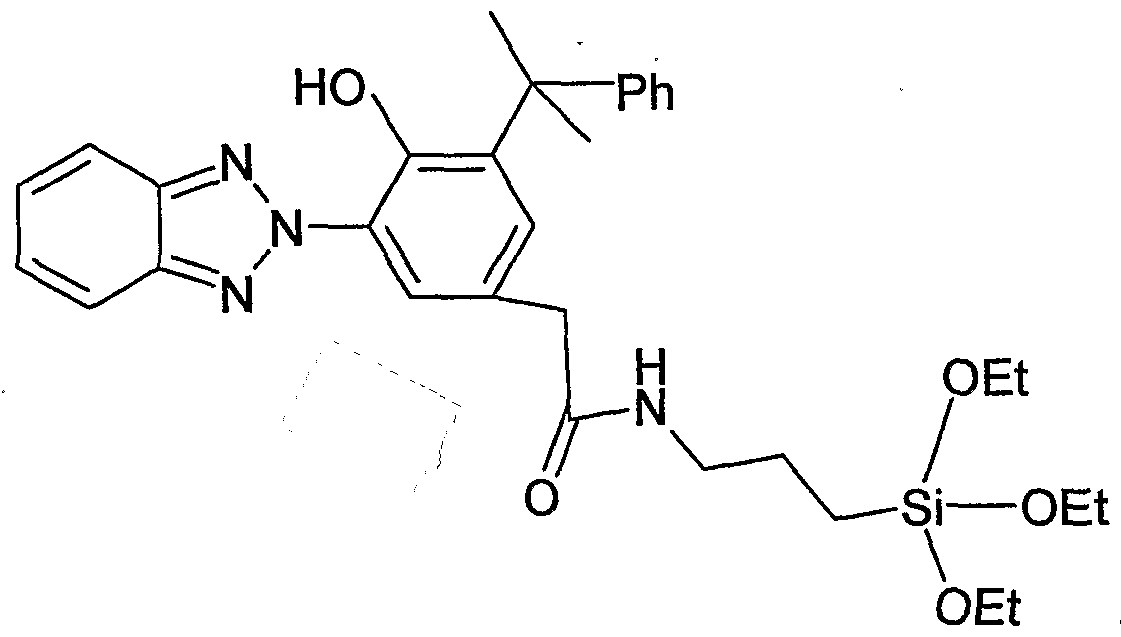
  • the resultant solution is added to an addition funnel and is added to a solution of H 2 N(CH 2 ) 3 Si(OEt) 3 (3.88g, 0.0175 mol), toluene (50 g, 0.54 mol) and triethylamine (100g, 0.98 mol) at ambient temperature. After addition is complete (ca. 30 minutes), the slurry is heated to 75°C for 90 minutes. The salt is filtered and the solvents are distilled off. The resulting oil is chromatographed on silica gel with ethyl acetate/heptane (1:1) as the eluent. The desired product is obtained as a light yellow solid (6.4 g); mp 90-95°C.
  • Methyl 3-(2H-benzotriazol-2-yl)-4-hydroxyhydrocinnamate (12 g, 0.04 mol), HO(CH 2 ) 2 Si(CH 3 ) 3 (5 g, 0.042 mol), dibutyl tin oxide (3.7 g, 0.015 mol), and toluene (54 g, 0.59 mol) are added to a reaction flask and heated to 100°C After 17 hours, the solvent is distilled off and the resulting oil is chromatographed on silica gel with heptane/ethyl acetate (9:1) as the eluent. The desired product is obtained (12 g) as a white solid; mp 73-75 ⁇ C.
  • the title compound is prepared by the procedure of Example 3 of United States Patent No. 5,391 ,795 using 5-trifluoromethyl-2-(2-hydroxy-3-aIlyl-5-tert-octyl-phenyl)-2H-benzo- triazole prepared in Example 3 above, Karstedt's catalyst (complex of divinyl-tetramethyl- disiloxane with platinum) and triethoxysilane. It is isolated as a viscous yellow oil.
  • this compound is prepared as a yellow viscous oil.
  • this compound is prepared as a yellow viscous oil.
  • this compound is prepared as a light yellow solid; mp 106-116°C.
  • this compound is prepared as a light yellow solid; mp 138-141 °C.
  • this compound is prepared as a light yellow solid; mp 143-146°C.
  • this compound is prepared as a yellow solid; mp 123-130°C.
  • thermoset acrylic clear coat is prepared by mixing an experimental acrylic polyol resin and hexamethoxymethylmelamine (Resimene ® 747, Monsanto) at a solids ratio of 60/40.
  • the dodecylbenzene sulfonic acid catalyst (Nacure ® 5225; King Industries) is added at 0.70 % by weight.
  • a flow aid Modaflow ® (Monsanto) is added at 0.25 % by weight to form a model acrylic melamine resin system.
  • the model clear coat is reduced with xylene to a viscosity of 26-27 second using a Zahn #2 cup and applied via a conventional air spray at 50 psi (3.5 Kg/cm 2 ) over a 1" x 3" (2.54 x 7.62 cm) quartz slide. Cure is achieved by baking the slide for 30 minutes at 260°F (127°C).
  • the clear coat is stabilized with 1% by weight of a hindered amine light stabilizer bis-(1-octyloxy-2,2,6,6-tetramethylpiperidin-4-yl) sebacate, Tinuvin ® 123 (Ciba).
  • the various test UV absorbers are incorporated at about 5 mmol% by weight in the clear coat.
  • the film thickness on the quartz slides range from 1.15 to 1.41 mils (0.029 to 0.036 mm).
  • the films on the quartz slides are weathered according to the following conditions in Xenon Arc Weather-Ometer with a controlled irradiance at 6500 W, using inner quartz and outer borosilicate S-type filter.
  • the irradiation cycle is as follows: 40 minutes of straight irradiation with no water spray, followed by 20 minutes of light plus front spray, followed by 60 minutes of light irradiation and finally by 60 minutes dart plus rear spray (condensation).
  • the setting is at 0.55 W/m 2 at 340 nm, 1.98 kJ/hour.
  • the black panel temperature is controlled at 70+2 °C.
  • the relative humidity in the light cycle is in the range of 50-55% and in the dark cycle 100%.
  • the absorbance of the long wavelength UV band as a function of Xenon arc weathering hours are recorded.
  • UV spectra are measured initially and after weathering at regular intervals.
  • the UV spectrophotometer measures absorbance linearly up to 5.5 absorbance units using a reference beam attenuation technique.
  • test compounds are incorporated into a high solid thermoset acrylic melamine resin at a concentration of 3% by weight to give equal molar concentrations of the test UV absorber in equal film thickness. The test samples are exposed for 1461 hours respectively.
  • Tinuvin ® 928 (3.0%) 1.98 1.62 0.36 ,
  • Tinuvin ® 928 is 2-(2-hydroxy-3- ⁇ -cumyl-5-t-octylphenyl)-2H-benzotriazole (Ciba).
  • Uvinul ® 3049 is 4,4'dimethoxy-2,2'-dihydroxybenzophenone (BASF). This Example displays the general superiority of hydroxyphenylbenzotriazole UV absorbers that contain alpha cumyl groups vs. benzophenone UV absorbers.
  • UV Absorption Spectra The benzotriazoles differ by their substitution in the 5-position of the benzo ring.
  • the UV absorption spectra are measured in ethyl acetate at approximately 20 mg/L concentration.
  • the instant compounds are clearly red-shifted as compared to the compound having only hydrogen at the benzo ring 5 position.
  • UV absorption spectra are measured in ethyl acetate at approximately 20 mg/L concentration.
  • the instant compounds are clearly red-shifted as compared to the compounds disclosed in U.S. Pat. No. 5,391 ,795.
  • UV Absorption Spectra The benzotriazoles differ by their substitution in the 5-position of the benzo ring.
  • the UV absorption spectra are measured in ethyl acetate at approximately 20 mg/L concentration.
  • the instant compounds are clearly red-shifted as compared to the compound having only hydrogen at the benzo ring 5 position.
  • Additives according to the present invention are incorporated into a silica resin solution according to application Example 8, yielding a silicone hardcoat solution with 5% by weight silylated ultraviolet absorbing agent based on solids.
  • the solution is applied to a glass slide.
  • the coatings are exposed to UV light by passing them five times under two 300 watt/inch medium pressure mercury lamps using a conveyor moving at about 25 ft/min.
  • the silicone hardcoats prepared containing silylated addtives of the present invention exhibit excellent resistance to abrasion (Taber abrasion test); and microcracking resistance and low haze upon UV exposure.
  • the samples are also exposed in an Atlas Ci35a WeatherOmeter at 0.77 W/m 2 irradiance at 340 nm with Type S borosilicate inner and outer filters.
  • the lamp runs in a cycle of 160 minutes light at 45 °C dry bulb temperature and 50% relative humidity (ca. 65 °C black panel temperature) and 20 minutes dark. The last 15 minutes of the dark cycle is with a front and back side water spray. Under these conditions, the samples accumulate 2700 kJ/m 2 at 340 nm in 1100 hours of exposure. This is approximately equivalent to one year Florida exposure.
  • the samples are mounted on the standard sample holders with spring clips.
  • the silicone hardcoats prepared containing silylated addtives of the present invention exhibit excellent microcracking resistance and low haze upon UV exposure in a WeatherOmeter.
  • Bisphenol-A based polycarbonate panels are primed with polymethylmethacrylate and are flow coated with a silicone hardcoat prepared according to application Example 5.
  • the coated samples are baked for 90 minutes at 100° C yielding polycarbonate coatings with an optically clear 5 micron silicone hardcoat.
  • the present compositions also perform especially well in WeaterOmeter exposure as in application Example 5. Appiication Example 7
  • colloidal Silicone Coatings 0.5 g of the present silylated additives are added to 50 g of silica resin (condensed methyl trimethoxy silane/aqueous colloidal silica resin at approximately 20% solids in an alcohol solvent) to produce a mixture. The mixture is stirred overnight and passed through a 0.30 micron filter yielding a silicone hardcoat solution with 5 pph silylated ultraviolet absorbing agent based on solids. The solution is applied to both glass slides and polycarbonate panels as above.
  • silica resin condensed methyl trimethoxy silane/aqueous colloidal silica resin at approximately 20% solids in an alcohol solvent
  • the silicone hardcoats prepared containing silylated addtives of the present invention exhibit excellent resistance to abrasion (Taber abrasion test); and microcracking resistance and low haze upon UV exposure.
  • the present compositions also perform especially well in WeaterOmeter exposure as in application Example 5.
  • silylated additives of the present invention may crosslinked or reacted into any type of commercially available siloxane automotive clear coats, for example coatings as described in U.S. Pat. Nos. 5,932,667, 5,182,174 and 6,080,816, the relevant disclosures of which are hereby incorporated by reference.
  • the present additives likewise may be crosslinked or reacted into siloxane coatings as described in U.S. Pat. Nos. 4,373,061, 5,391 ,795, 5,679,820, the relevant disclosures of which are also hereby incorporated by reference.
  • Silicone coatings are prepared with methyl trimethoxy silane and 2.5% by weight of the additives of the table below.
  • the aqueous acidic coating compositions are applied by spin-coating to 1.5" diameter quartz discs under conditions which result in a dry film thickness of 2 microns. All discs are allowed to flash at room temperature for 20-30 minutes, then one i
  • Thermal permanence of the test compounds is determined by using Beer's Law equation relating absorbance directly to concentration. It is assumed that in the ambient cured coating, all UVA is retained, and has not volatilized. Therefore, the amount of a compound lost by volatilization under these baking conditions is determined either by comparison of the absorbance from the ambient cured and oven cured coating applied at the same film thickness in the case of reactable UV absorbers or by extraction of non-reactable UV absorbers and comparison of the amount of UV absorber extracted from the ambient- cured and oven cured samples. Results are below.
  • Coatings are prepared and coated on quartz discs as in application Example 8. After oven cure at 125°C for 60 minutes, absorbance scans are run from 250 nm to 450 nm. If two absorbance peaks are present, the peak at longer wavelength is recorded in location (nm). Long wavelength spectra coverage is also recorded by obtaining absorbance values at 375 nm. Results are below. Peak Absorbance Absorbance
  • the compounds of the present invention give a significantly broader spectral coverage than the benzoyl resorcinol compounds.
  • Coatings are prepared and coated on glass plates as in application Example 8. After ambient cure for 1 day, the coatings are removed from the glass substrate. Approximately 5 mg of the coating are weighed into a 10 ml volumetric flask, which is filled to mark with tetrahydrofuran (THF). After sonication for 60 minutes, the solution is filtered, then diluted to a known volume with THF. The amount of UVA extracted is determined by comparing the absorbance of the THF solution with absorbance of known standards. The percent reacted into the coating is calculated from the difference between the amount of UVA remaining in the coating after bake and the amount extracted. Results are found below.
  • Coatings are prepared and coated on quartz discs as in application Example 8. After ambient cure for 1 week, CILAB L*,a*,b* values are obtained using a MacBeth Coloreye spectrophotometer. D65 illuminant, observer angle 10° with specular component included are used. Color readings are obtained on coated discs in reflectance mode with white tile standard as backing. Results are found below.
  • Coatings prepared with additives of the present invention are clear, have no haze, and have good color.

Landscapes

  • Chemical & Material Sciences (AREA)
  • Organic Chemistry (AREA)
  • Health & Medical Sciences (AREA)
  • Chemical Kinetics & Catalysis (AREA)
  • Medicinal Chemistry (AREA)
  • Polymers & Plastics (AREA)
  • Compositions Of Macromolecular Compounds (AREA)
  • Paints Or Removers (AREA)
  • Paper (AREA)

Abstract

The invention pertains to photostable, silylated benzotriazole compounds of formula (I) or wherein at least one of E1, E2, E5, E8, E9, G2 and G7 is a silylated group and G2 and/or G7 is an electron withdrawing moiety. The compounds are both photostable and particularly compatible in high performance coatings such as organopolysiloxanes.

Description

PHOTOSTABLE. SILYLATED BENZOTRIAZOLE UV ABSORBERS AND COMPOSITIONS STABILIZED THEREWITH The instant invention pertains to photostable, silylated benzotriazole UV absorbers and compositions stabilized therewith. These benzotriazole compounds are novel and exhibit enhanced durability due to the incorporation of electron withdrawing moieties at the 5- position of the benzo ring. The polymer compositions containing said benzotriazoles are advantageously stabilized, especially high performance coatings such as organopoly- siloxanes. The instant compounds are red-shifted and show increased absorption in the 350- 400 nm region of the UV spectrum.
United States Patent No. 4,859,759 describes in the most generic manner siloxane compounds containing at least one benzotriazole and one hindered amine substituent covalently coupled to a silicon atom. This reference does not supply any specific exemplification of such structures. The particular structures of the instant invention are neither disclosed nor suggested by this reference.
United States Patent Nos. 5,707,690 and 5,756,793 disclose the use of silylated benzophenones for the protective coatings for wood. EP 675,108 B1 describes thioether substituted benzophenone UV absorbers which may also contain silylated substituents.
United States Patent Nos. 5,185,445 and 5,837,792 describe polysiloxane light stabilizers which contain pendant hydroxyphenyl-diaryl-s-triazine moieties.
United States Patent Nos. 5,219,905; 5,321 ,066; 5,418,267; 5,463,058 and 5,578,665 disclose hindered amines containing siloxane and other silyl moieties as stabilizers.
United States Patent Nos. 5,391 ,795 and 5,679,820 describe the preparation and use of silylated benzophenone UV absorbers. United States Patent No. 5,391 ,795 compares these silylated benzophenone UV absorbers with one example of a silylated benzotriazole UV absorber which is 2-{2-hydroxy-5-[3-(3-triethoxysilyl)propylcarbamoyloxy]propylphenyl}- 2H-benzotriazole. This silylated benzotriazole compound contains neither a bulky substituent ortho to the hydroxy group in the phenyl ring nor an electron withdrawing group at the 5- position of the benzo ring. Both of these two substitution patterns are shown to be particulary efficacious in enhancing long term photostability of the benzotriazoles. The electron withdrawing group at the 5-position^of the benzo ring allows for the red-shifting of the UV spectrum of the benzotriazoles.
United States Patent No. 4,373,061 teaches the use of silicone coatings for unprimed plastic substrates and coated articles. The silicone coating contains a UV absorbing organic group attached to silicon by carbon-silicon bonds. The UV absorber is a silylated hydroxy- benzophenone.
United States Patent No. 4,322,455 describes a process for producing an ultraviolet radiation stabilized polymeric article which contains on the surface of said article a UV absorbing composition. The UV absorber may be generically any of the known types of compounds such as benzophenones, benzotriazole, cyanoacrylates or benzylidene malonates. The only benzotriazole disclosed is 2-(2-hydroxy-5-tert-octylphenyl)-2H- benzotriazole.
U.S. Pat. No. 6,166,218, demonstrates the value of having such substitution at the 3- position of the phenyl ring by a bulky group and at the 5-position of the benzo ring by an electron withdrawing moiety. All the instant compounds have an electron withdrawing moiety at the 5-position of the benzo ring. When there is a bulky substituent at the 3-position of the phenyl ring, particularly an α-cumyl group, the photostability of the benzotriazole is particularly enhanced. j
The first object of this invention is to provide for new monomeric benzotriazole UV absorbers which contain silicon moieties.
Another object of this invention is to provide silicone/siloxane hardcoat or softcoat resin compositions containing said benzotriazole UV absorbers which can be added to or copolymerized into such hardcoat or softcoat resins.
Still another object of the invention is to provide for articles which contain the silicone/siloxane hardcoat or softcoat composition as a screening layer in a laminate composition, such as over polycarbonate. Another object of the1 invention is to provide automotive coating compositions in which the instant compounds are melamine/siloxane crosslinked structures.
Still another object of the invention is to provide for polymer compositions where the instant compounds are used in conjunction with silylated hindered amines including inter alia N-hydrocarbyloxy and N-hydroxyalkyloxy substituted hindered amines.
Still another object of the invention is to provide for silicone/siloxane hardcoat or softcoat compositions containing post-added other advanced benzotriazoles which do not contain silicon moieties and with or without the concomitant presence of hindered amines, N- hydrocarbyloxy- or N-hydroxyalkyloxy-substituted hindered amines.
The instant invention pertains to benzotriazole compounds of formula I or II
Figure imgf000004_0001
wherein
G, and G6 are independently hydrogen or halogen;
G2 and G7 are independently cyano, perfluoroalkyl of 1 to 12 carbon atoms, fluoro, chloro, -CO-G3, -COOG3, -CONHG3, -CON(G3)2, E3SO-, E3SO2-, -PO(C6H5)2,
Figure imgf000005_0001
-CO-X-T1-O-CO-NH-T2-Si(OR2)n(R1)3.n or -CO-X-T1-Si(OR2)n(R1)3.n ; or G7 is also hydrogen; or G2 may also be hydrogen when E., is a group of formula (IV) or (V);
X, and T2 are independently alkylene of 1 to 18 carbon atoms, preferably alkylene of 2 or 3 carbon atoms, or alkylene-phenylene-alkylene of 8 to 20 carbon atoms;
RT and R2 are independently alkyl of 1 to 18 carbon atoms, cycloalkyl of 5 to 12 carbon atoms, aryl of 6 to 10 carbon atoms or phenylalkyl of 7 to 20 carbon atoms, preferably alkyl of 1 to 6 carbon atoms or phenyl;
n is O, 1, 2 or 3;
X is -O-, -NE4- or -NH-;
G3 is hydrogen, straight or branched chain alkyl of 1 to 24 carbon atoms, straight or branched chain alkenyl of 2 to 18 carbon atoms, cycloalkyl of 5 to 12 carbon atoms, phenylalkyl of 7 to 15 carbon atoms, phenyl, or said phenyl or said phenylalkyl substituted on the phenyl ring by 1 to 4 alkyl of 1 to 4 carbon atoms;
E, is hydrogen, straight or branched chain alkyl of 1 to 24 carbon atoms, straight or branched chain alkenyl of 2 to 24 carbon atoms, cycloalkyl of 5 to 12 carbon atoms, phenylalkyl of 7 to 15 carbon atoms, phenyl, or said phenyl or said phenylalkyl substituted on the phenyl ring by 1 to 4 alkyl of 1 to 4 carbon atoms or by one or more of the following groups -TrS OR^R^-., -TrX-CO-X-T S OR^R^-, -T1-CO-X-T2-Si(OR2)n(R1)3.n, -X-Tr
Figure imgf000005_0002
or -X-T1-X-CO-X-T2-Si(OR2)n(R1)3.n; or E, is alkyl of 1 to 24 carbon atoms substituted by one or two hydroxy groups; E2 and E9 are independently hydrogen, straight or branched alkyl chain of 1 to 24 carbon^atoms, straight or branched chain alkenyl of 2 to 18 carbon atoms, cycloalkyl of 5 to 12 carbon atoms, phenylalkyl of 7 to 15 carbon atoms, phenyl, or said phenyl or said phenylalkyl substituted on the phenyl ring by one to three alkyl of 1 to 4 carbon atoms or by one or more of the following groups -T1-Si(OR2)n(R1)3.π, -T X-CO-X-Tz-S OR^tR^,,, -Tr COX-TrS ORaMR,)^, -X-X-SKOR^R^n or -X-T X-CO-X-TrS OR^R^; or E2 and E9 are independently said alkyl of 1 to 24 carbon atoms or said alkenyl of 2 to 18 carbon atoms substituted by one or more -OH, -OCOEn, -OE4, -NCO, -NH2, -NHCOEn, -NHE4or -N(E4)2, or mixtures thereof, where E4 is straight or branched chain alkyl of 1 to 24 carbon atoms; or said alkyl or said alkenyl interrupted by one or more -O-, -NH- or -NE4- groups or mixtures thereof and which can be unsubstituted or substituted by one or more -OH, -OE4 or -NH2 groups or mixtures thereof; or
E,, E2 and E9 are also independently -T1-Si(OR2)n(R1)3.n, -T1-X-CO-X-T2-Si(OR2)n(R1)3.n or -T1-CO-X-T2-Si(OR2)π(R1)3.n;
En is hydrogen, straight or branched chain alkyl of 1 to 18 carbon atoms, straight or branched chain alkenyl of 2 to 18 carbon atoms, cycloalkyl of 5 to 12 carbon atoms, aryl of 6 to 14 carbon atoms or phenylalkyl of 7 to 15 carbon atoms;
L is alkylene of 1 to 12 carbon atoms, alkylidene of 2 to 12 carbon atoms, benzylidene, p-xylylene, cycloalkylidene of 5 to 12 carbon atoms or α.α.α'.α'-tetramethyl-m-xylylene;
E3 is alkyl of 1 to 20 carbon atoms, said alkyl substituted by alkoxycarbonyl of 2 to 9 carbon atoms, hydroxyalkyl of 2 to 20 carbon atoms, alkenyl of 3 to 18 carbon atoms, cycloalkyl of 5 to 12 carbon atoms, phenylalkyl of 7 to 15 carbon atoms, aryl of 6 to 10 carbon atoms or said aryl substituted by one or two alkyl of 1 to 4 carbon atoms or 1 ,1 ,2,2- tetrahydroperfluoroalkyl where the perfluoroalkyl moiety is of 6 to 16 carbon atoms,
E5 and E8 are independently the same as E2; or E5 and Ea are independently hydrogen, -X-EL -X-CO-Ea, -X-CO-XL
Figure imgf000006_0001
X^s -NH-I-U or -X-Ea; with the proviso that at least one of G2, G7, E1( E2, Es, E8 and E9 contains a group -Tr Si(OR2)n(R1)3.π, -T X-CO-X-T S OR^R^, -T1-CO-X-T2-Si(OR2)n(R1)3,, -X-Tr S OR^R^ or -X-T X-CO-X-T S OR^CR^; where T., and T2 are independently alkylene of 1 to 18 carbon atoms or alkylene-phenylene- alkylene of 8 to 20 carbon atoms, and R, and R2 are independently alkyl of 1 to 18 carbon atoms, cycloalkyl of 5 to 12 carbon atoms, aryl of 6 to 10 carbon atoms or phenylalkyl of 7 to 20 carbon atoms, preferably alkyl of 1 to 3 carbon atoms or phenyl, and n is 0, 1 , 2 or 3.
Halogen is fluoro, bromo, chloro or iodo, preferably fluoro or chloro.
The alkyl radicals in the various substituents may be linear or branched. Examples of alkyl containing 1 to 24 carbon atoms are methyl, ethyl, propyl, isopropyl, butyl, 2-butyl, isobutyl, t- butyl, pentyl, 2-pentyl, hexyl, heptyl, octyl, 2-ethylhexyl, t-octyl, nonyl, decyl, undecyl, dodecyl, tridecyl, tetradecyl, hexadecyl, octadecyl and eicosyl.
Alkenyl with 2 to 24 carbon atoms is a linear or branched radical as for example propenyl, 2- butenyl, 3-butenyl, isobutenyl, n-2,4-pentadienyl, 3-methyl-2-butenyl, n-2-octenyl, n-2- dodecenyl, iso-dodecenyl, oleyl, n-2-octadecenyl oder n-4-octadecenyl. Preferred is alkenyl with 3 bis 12, particularly preferred with 3 to 6 carbon atoms.
Alkinyl with 3 to 18 is a linear or branched radical as for example propinyl
( — CH2-C≡Ξ≡CH ), 2-butinyI, 3-butinyl, n-2-octinyl, oder n-2-octadecinyl. Preferred is alkinyl with 3 to 12, particularly preferred with 3 to 6 carbon atoms.
Examples for hydroxy substituted alkyl are hydroxy propyl, hydroxy butyl or hydroxy hexyl. i I
Examples for halogen substituted alkyl are dichloropropyl, monobromobutyl or trichlorohexyl.
C2-C18alkyl interrupted by at least one O atom is for example -CH2-CH2-O-CH2-CH3, -CH2- CH2-O-CH3- or -CH2-CH2-O-CH2-CH2-CH2-O-CH2-CH3-. It is preferably derived from polyethlene glycol. A general description is -((CH2)a-O)b-H/CH3, wherein a is a number from 1 to 6 and b is a number from 2 to 10.
C2-C18alkyl interrupted by at least one NE4 group may be generally described as -((CH2)a- NE4)b-H/CH3, wherein a, b and E4 are as defined above.
C5-C12cycloalkyl is typically, cyclopentyl, methylcyclopentyl, dimethylcyclopentyl, cyclohexyl, methylcyclohexyl or trimethylcyclohexyl.
C6-C10 aryl is for example phenyl or naphthyl, but also comprised are C C4alkyl substituted phenyl, CrC4alkoxy substituted phenyl, hydroxy, halogen or nitro substituted phenyl. Examples for alkyl substituted phenyl are ethylbenzene, toluene, xylene and its isomers, mesitylene or isopropylbenzene. Halogen substituted phenyl is for example dichlorobenzene or bromotoluene.
Alkoxy substituents are typically methoxy, ethoxy, propoxy or butoxy and their corresponding isomers.
Aralkyl is preferably phenylalkyl. Particularly preferred is C7-C9phenylalkyl which is benzyl, phenylethyl or phenylpropyl.
Perfluoralkyl is for example trifluormethyl, perfluorethyl, perfluorpropyl, perfluorbutyl, perfluorhexyl; preferred is trifluormethyl.
Preferably, the new benzotriazole is a compound of formula IA or HA
Figure imgf000008_0001
Figure imgf000009_0001
wherein
G-, and G6 are hydrogen,
G2 and G7 are independently cyano, CF3-, fluoro, -CO-G3or E3SO2-, or G7 is also hydrogen,
G3 is straight or branched chain alkyl of 1 to 24 carbon atoms, straight or branched chain alkenyl of 2 to 18 carbon atoms, cycloalkyl of 5 to 12 carbon atoms, phenylalkyl of 7 to 15 carbon atoms, phenyl, or said phenyl or said phenylalkyl substituted on the phenyl ring by 1 to 4 alkyl of 1 to 4 carbon atoms,
Ei is phenylalkyl of 7 to 15 carbon atoms, phenyl, or said phenyl or said phenylalkyl substituted on the phenyl ring by 1 to 4 alkyl of 1 to 4 carbon atoms,
E2 and E9 are independently straight or branched alkyl chain of 1 to 24 carbon atoms, straight or branched chain alkenyl of 2 to 18 carbon atoms, cycloalkyl of 5 to 12 carbon atoms, phenylalkyl of 7 to 15 carbon atoms, phenyl, or said phenyl or said phenylalkyl substituted on the phenyl ring by 1 to 3 alkyl of 1 to 4 carbon atoms; or E2 is said alkyl of 1 to 24 carbon atoms or said alkenyl of 2 to 18 carbon atoms substituted by one or more -OH, - OCOEn, -OE4, -NCO, -NH2, -NHCOE„, -NHE4 or -N(E4)2, or mixtures thereof, where E4 is straight or branched chain alkyl of 1 to 24 carbon atoms; or said alkyl or said alkenyl interrupted by one or more -O-, -NH- or -NE4- groups or mixtures thereof and which can be unsubstituted or substituted by one or more -OH, -OE4 or -NH2 groups or mixtures thereof;
En is hydrogen, straight or branched chain alkyl of 1 to 18 carbon atoms, straight or branched chain alkenyl of 2 to 18 carbon atoms, cycloalkyl of 5 to 12 carbon atoms, aryl of 6 to 14 carbon atoms or phenylalkyl of 7 to 15 carbon atoms; E3 is alkyl of 1 to 20 carbon atoms, hydroxyalkyl of 2 to 20 carbon atoms, alkenyl of 3 to 18 carbon atoms, cycloalkyl of 5 to 12 carbon atoms, phenylalkyl of 7 to 15 carbon atoms, aryl of 6 to 10 carbon atoms or said aryl substituted by one or two alkyl of 1 to 4 carbon atoms or 1 ,1 ,2,2-tetrahydroperfluoroalkyl where the perfluoroalkyl moiety is of 6 to 16 carbon atoms;
L is methylene; and
with the proviso that at least one of
Figure imgf000010_0001
- TrX-CO-X-T SKORaUR,) ,, -TrCO-X-T S OR^R^n, -X-TrSi(OR2)n(R1)3,n or -X-TrX-
CO-X-T2-Si(OR2)n(R1)3.n; where T, and T2 are independently alkylene of 2 or 3 carbon atoms, and R, and R2 are independently alkyl of 1 to 6 carbon atoms or phenyl, and n is 0, 1 , 2 or 3.
Another preferred embodiment of the instant invention is a compound of formula IA
Figure imgf000010_0002
wherein
G, is hydrogen,
G2 is CF,-, fluoro or E,SO,
E, is hydrogen or straight or branched alkyl of 2 to 24 carbon atoms,
E2 is as defined above, and
E3 is straight or branched chain alkyl of 1 to 7 carbon atoms, with the proviso that E2 contains a group -T1-Si(OR2)π(R1)3.π, -X-X-CO-X-T2- Si(OR2)n(R1)3.n, -T1-CO-X-T2-Si(OR2)n(R1)3.n, -X-T1-Si(OR2)n(R1)3.n or -X-TrX-CO-X-T2- Si(OR2)n(Rι)3-n; where T, and T2 are independently alkylene of 2 or 3 carbon atoms, and R., and R2 are independently alkyl of 1 to 6 carbon atoms or phenyl, and n is 0, 1 , 2 or 3.
Preferably X, and T2 are independently alkylene of 2 or 3 carbon atoms. Preferably R, and R2 are independently alkyl of 1 to 6 carbon atoms or phenyl.
Preferably, the compound of formula I is
(a) 5-trifluoromethyl-2-[2-hydroxy-3-(3-triethoxysilyl)propyl-5-tert-octylphenyl]-2H- benzotriazole;
(b) 5-trifluoromethyl-2-{2-hydroxy-3-tert-butyl-5-[3-(3-triethyoxysilyl)propyl carbamoyl- oxy)propyl]phenyl}-2H-benzotriazole;
(c) 5-trifluoromethyl-2-{2-hydroxy-3-tert-butyl-5-[2-(3-triethyoxysiIyl)propylcarbamoyl- oxy)ethyl]phenyl}-2H-benzotriazole;
(d) 5-trifluoromethyl-2-{2-hydroxy-5-[2-(3-triethyoxysilyl)propyl-carbamoyloxy)ethyl]- phenyl}-2H-benzotriazole;
(e) 5-trifluoromethyl-2-{2-hydroxy-3-α-cumyl-5-[2-(3-triethyoxysilyl)propylcarbamoyl- oxy)ethyl]phenyl}-2H-benzotriazole;
(f) 5-trifluoromethyl-2-{2-hydroxy-3-tert-butyl-5-[2-(3-(diethoxymethylsilyl)propylamino- carbonylethyl]phenyl}-2H-benzotriazole;
(g) 5-phenylsulfonyl-2-{2-hydroxy-3-tert-butyl-5-[3-(2-ethoxydimethylsilyl)ethyl carbonyloxy)propyl]phenyl}-2H-benzotriazole;
(h) 5-n-butylsulfonyl-2-{2-hydroxy-3-tert-butyl-5-[2-(3-ethoxydimethylsilyl)propyl- oxycarbonyl)ethyl]phenyl}-2H-benzotriazole;
(i) 5-trifluoromethyl-2-[2-hydroxy-3-(ethoxydimethylsilyl)propyl-5-tert-octylphenyl]-2H- benzotriazole; j
G) 5-trifluoromethyl-2-[2-hydroxy-3-(trimethylsilyl)propyl-5-tert-butylphenyl]-2H-benzo- triazole;
(k) 5-[3-(diethoxyethylsilyl)propoxycarbonyl]-2-(2-hydroxy-3-α-cumyl-5-tert-octyl- phenyl)-2H-benzotriazole; or (I) 5-[3-(diethoxyethylsilyl)propylaminocarbonyl]-2-(2-hydroxy-3-α-cumyl-5-tert-octyl- phenyl)-2H-benzotriazole.
(m)
Figure imgf000012_0001
(n)
Figure imgf000012_0002
(o)
Figure imgf000012_0003
(P)
Figure imgf000013_0001
(q)
Figure imgf000013_0002
(r)
Figure imgf000013_0003
(s)
Figure imgf000014_0001
(t)
Figure imgf000014_0002
(u)
Figure imgf000014_0003
The instant invention also pertains to a composition stabilized against light-induced degradation which comprises, (a) an organic material subject to light-induced degradation, and
(b) an effective stabilizing amount of a compound of formula I or II.
Preferably, the organic material is a natural, semi-synthetic or synthetic polymer, especially a thermoplastic polymer.
In general polymers which can be stabilized include
1. Polymers of monoolefins and diolefins, for example polypropylene, polyisobutylene, polybut-1-ene, poly-4-methylpent-1-ene, polyisoprene or polybutadiene, as well as polymers of cycloolefins, for instance of cyclopentene or norbomene, polyethylene (which optionally can be crosslinked), for example high density polyethylene (HDPE), low density polyethylene (LDPE), linear low density polyethylene (LLDPE), branched low density polyethylene (BLDPE).
Polyolefins, i.e. the polymers of monoolefins exemplified in the preceding paragraph, preferably polyethylene and polypropylene, can be prepared by different, and especially by the following, methods:
a) radical polymerisation (normally under high pressure and at elevated temperature).
b) catalytic polymerisation using a catalyst that normally contains one or more than one metal of groups IVb, Vb, Vlb or VIII of the Periodic Table. These metals usually have one or more than one ligand, typically oxides, halides, alcoholates, esters, ethers, amines, alkyls, alkenyls and/or aryls that may be either π- or σ-coordinated. These metal complexes may be in the free form or fixed on substrates, typically on activated magnesium chloride, titanium(lll) chloride, alumina or silicon oxide. These catalysts may be soluble or insoluble in the polymerisation medium. The catalysts can be used by themselves in the polymerisation or further activators may be used, typically metal alkyls, metal hydrides, metal alkyl halides, metal alkyl oxides or metal alkyloxanes, said metals being elements of groups la, Ha and/or Ilia of the Periodic Table. The activators may be modified conveniently with further ester, ether, amine or silyl ether groups. These catalyst systems are usually termed Phillips, Standard Oil Indiana, Ziegler (-Natta), TNZ (DuPont), metallocene or single site catalysts (SSC).
2. Mixtures of the polymers mentioned under 1), for example mixtures of polypropylene with polyisobutylene, polypropylene with polyethylene (for example PP/HDPE, PP/LDPE) and mixtures of different types of polyethylene (for example LDPE/HDPE).
3. Copolymers of monoolefins and diolefins with each other or with other vinyl monomers, for example ethylene/propylene copolymers, linear low density polyethylene (LLDPE) and mixtures thereof with low density polyethylene (LDPE), propyiene/but-1-ene copolymers, propylene/isobutylene copolymers, ethylene/but-1-ene copolymers, ethylene/hexene copolymers, ethylene/methylpentene copolymers, ethylene/heptene copolymers, ethylene/octene copolymers, propylene/butadiene copolymers, isobutylene/isoprene copolymers, ethylene/alkyl acrylate copolymers, ethylene/alkyl methacrylate copolymers, ethylene/vinyl acetate copolymers and their copolymers with carbon monoxide or ethylene/acrylic acid copolymers and their salts (ionomers) as well as terpolymers of ethylene with propylene and a diene such as hexadiene, dicyclopentadiene or ethylidene-norbornene; and mixtures of such copolymers with one another and with polymers mentioned in 1) above, for example polypropylene/ethylene-propylene copolymers, LDPE/ethylene-vinyl acetate copolymers (EVA), LDPE/ethylene-acrylic acid copolymers (EAA), LLDPE EVA, LLDPE/EAA and alternating or random polyalkylene/carbon monoxide copolymers and mixtures thereof with other polymers, for example polyamides.
4. Hydrocarbon resins (for example C5-C9) including hydrogenated modifications thereof (e.g. tackifiers) and mixtures of polyalkylenes and starch.
5. Polystyrene, poly(p-methylstyrene), poly(α-methy!styrene).
6. Copolymers of styrene or α-methylstyrene with dienes or acrylic derivatives, for example styrene/butadiene, styrene/acrylonitrile, styrene/alkyl methacrylate, styrene/butadiene/alkyl acrylate, styrene/butadiene/alkyl methacrylate, styrene/maleic anhydride, styrene/- acrylonitrile/methyl acrylate; mixtures of high impact strength of styrene copolymers and another polymer, for example a polyacrylate, a diene polymer or an ethylene/propylene/diene terpolymer; and block copolymers of styrene such as styrene/butadiene/styrene, styrene/isoprene/styrene, styrene/ethylene/butylene/styrene or styrene/ethylene/propylene/ styrene.
7. Graft copolymers of styrene or α-methylstyrene, for example styrene on polybutadiene, styrene on polybutadiene-styrene or polybutadiene-acrylonitrile copolymers; styrene and acrylonitrile (or methacrylonitrile) on polybutadiene; styrene, acrylonitrile and methyl methacrylate on polybutadiene; styrene and maleic anhydride on polybutadiene; styrene, acrylonitrile and maleic anhydride or maleimide on polybutadiene; styrene and maleimide on polybutadiene; styrene and alkyl acrylates or methacrylates on polybutadiene; styrene and acrylonitrile on ethylene/propylene/diene terpolymers; styrene and acrylonitrile on polyalkyl acrylates or polyalkyl methacrylates, styrene and acrylonitrile on acrylate/butadiene copolymers, as well as mixtures thereof with the copolymers listed under 6), for example the copolymer mixtures known as ABS, MBS, ASA or AES polymers.
8. Halogen-containing polymers such as polychloroprene, chlorinated rubbers, chlorinated or sulfochlorinated polyethylene, copolymers of ethylene and chlorinated ethylene, epichloro- hydrin homo- and copolymers, especially polymers of halogen-containing vinyl compounds, for example polyvinyl chloride, polyvinylidene chloride, polyvinyl fluoride, polyvinylidene fluoride, as well as copolymers thereof such as vinyl chloride/vinylidene chloride, vinyl chloride/vinyl acetate or vinylidene chloride/vinyl acetate copolymers.
9. Polymers derived from α,β-unsaturated acids and derivatives thereof such as polyacry- lates and polymethacrylates; polymethyl methacrylates, polyacrylamides and polyacryloni- triles, impact-modified with butyl acrylate.
10. Copolymers of the monomers mentioned under 9) with each other or with other unsaturated monomers, for example acrylonitrile/ butadiene copolymers, acrylonitrile/alkyl acrylate copolymers, acrylonitrile/alkoxyalkyl acrylate or acrylonitrile/vinyl halide copolymers or acrylonitrile/ alkyl methacrylate/butadiene terpolymers.
11. Polymers derived from unsaturated alcohols and amines or the acyl derivatives or acetals thereof, for example polyvinyl alcohol, polyvinyl acetate, polyvinyl stearate, polyvinyl benzoate, polyvinyl maleate, polyvinyl butyral, polyallyl phthalate or polyallyl melamine; as well as their copolymers with olefins mentioned in 1) above.
12. Homopolymers and copolymers of cyclic ethers such as polyalkylene glycols, polyethylene oxide, polypropylene oxide or copolymers thereof with bisglycidyl ethers.
13. Polyacetals such as polyoxymethylene and those polyoxymethylenes which contain ethylene oxide as a comonomer; polyacetals modified with thermoplastic polyurethanes, acrylates or MBS.
14. Polyphenylene oxides and sulfides, and mixtures of polyphenylene oxides with styrene polymers or polyamides.
15. Polyurethanes derived from hydroxyl-terminated polyethers, polyesters or polybuta- dienes on the one hand and aliphatic or aromatic polyisocyanates on the other, as well as precursors thereof.
16. Polyamides and copolyamides derived from diamines and dicarboxylic acids and/or from aminocarboxylic acids or the corresponding lactams, for example polyamide 4, polyamide 6, polyamide 6/6, 6/10, 6/9, 6/12, 4/6, 12/12, polyamide 11, polyamide 12, aromatic polyamides starting from m-xylene diamine and adipic acid; polyamides prepared from hexa- methylenediamine and isophthalic or/and terephthalic acid and with or without an elastomer as modifier, for example poly-2,4,4,-trimethylhexamethylene terephthaiamide or poly-m- phenylene isophthalamide; and also block copolymers of the aforementioned polyamides with polyolefins, olefin copolymers, ionomers or chemically bonded or grafted elastomers; or with polyethers, e.g. with polyethylene glycol, polypropylene glycol or polytetramethylene glycol; as well as polyamides or copolyamides modified with EPDM or ABS; and polyamides condensed during processing (RIM polyamide systems).
17. Polyureas, polyimides, polyamide-imides and polybenzimidazoles.
18. Polyesters derived from dicarboxylic acids and diols and/or from hydroxycarboxylic acids or the corresponding lactones, for example polyethylene terephthalate, polybutylene tereph- thalate, poly-1 ,4-dimethylolcyclohexane terephthalate and polyhydroxybenzoates, as well as block copolyether esters derived from hydroxyl-terminated polyethers; and also polyesters modified with polycarbonates or MBS.
19. Polycarbonates and polyester carbonates.
20. Polysulfones, polyether sulfones and polyether ketones.
21. Crosslinked polymers derived from aldehydes on the one hand and phenols, ureas and melamines on the other hand, such as phenol/formaldehyde resins, urea/formaldehyde resins and melamine/formaldehyde resins.
22. Drying and non-drying alkyd resins.
23. Unsaturated polyester resins derived from copolyesters of saturated and unsaturated dicarboxylic acids with polyhydric alcohols and vinyl compounds as crosslinking agents, and also halogen-containing modifications thereof of low flammability.
24. Crosslinkable acrylic resins derived from substituted acrylates, for example epoxy acrylates, urethane acrylates or polyester acrylates.
25. Alkyd resins, polyester resins and acrylate resins crosslinked with melamine resins, urea resins, polyisocyanates or epoxy resins.
26. Crosslinked epoxy resins derived from polyepoxides, for example from bisglycidyl ethers or from cycloaliphatic diepoxides.
27. Natural polymers such as cellulose, rubber, gelatin and chemically modified homologous derivatives thereof, for example cellulose acetates, cellulose propionates and cellulose butyrates, or the cellulose ethers such as methyl cellulose; as well as rosins and their derivatives. 28. Blends of the aforementioned polymers (polyblends), for example PP/EPDM, Polyamide/- EPDM orABS, PVC/EVA, PVC/ABS, PVC/MBS, PC/ABS, PBTP/ABS, PC/ASA, PC/PBT, PVC/CPE, PVC/acrylates, POM/thermoplastic PUR, PC/thermoplastic PUR, POM/acrylate, POM/MBS, PPO/HIPS, PPO/PA 6.6 and copolymers, PA/HDPE, PA/PP, PA/PPO.
29. Naturally occurring and synthetic organic materials which are pure monomeric compounds or mixtures of such compounds, for example mineral oils, animal and vegetable fats, oil and waxes, or oils, fats and waxes based on synthetic esters (e.g. phthalates, adipates, phosphates or trimellitates) and also mixtures of synthetic esters with mineral oils in any weight ratios, typically those used as spinning compositions, as well as aqueous emulsions of such materials.
30. Aqueous emulsions of natural or synthetic rubber, e.g. natural latex or latices of carboxy- lated styrene/butadiene copolymers.
31. Polysiloxanes such as the soft, hydrophilic polysiloxanes described, for example, in U.S. Patent No. 4,259,467; and the hard polyorganosiloxanes described, for example, in U.S. Patent No. 4,355,147.
32. Polyketimines in combination with unsaturated acrylic polyacetoacetate resins or with unsaturated acrylic resins. The unsaturated acrylic resins include the urethane acrylates, polyether acrylates, vinyl or acryl copolymers with pendant unsaturated groups and the acrylated melamines. The polyketimines are prepared from polyamines and ketones in the presence of an acid catalyst.
33. Radiation curable compositions containing ethylenically unsaturated monomers or oligomers and a polyunsaturated aliphatic oligomer.
34. Epoxymelamine resins such as light-stable epoxy resins crosslinked by an epoxy functional coetherified high solids melamine resin such as LSE-4103 (Monsanto).
Preferably, the polymer is is a thermoplastic polymer, in particular a polyolefin or polycarbonate, especially polyethylene or polypropylene; most especially polypropylene; or the polymer is a styrenic, ABS, a nylon, a polyester such as poly(ethylene terephthalate) or poly(butylene terephthalate), a polyurethane, an acrylate, a rubber modified styrenic, poly(vinyl chloride), poly(vinyl butyral), polyacetal (polyoxymethylene), polyethylene naphthalenedicarboxylate), or other blends or copolymers such as poly(ethylene/1 ,4-cyclo- hexylenedimethylene terephthalate) PETG or an ionomer.
More preferred is a composition wherein the polymer, is a polyolefϊn or polycarbonate.
Most especially, the polymer is a siloxane coating as a screening layer over polycarbonate.
In another preferred embodiment of the instant invention, the organic material is a resin selected from the group consisting of a thermoset acrylic melamine resin, an acrylic urethane resin, an epoxy carboxy resin, a silane modified acrylic melamine, an acrylic resin with carbamate pendant groups crosslinked with melamine or an acrylic polyol resin crosslinked with melamine containing carbamate groups.
Such automotive coatings are described in WO 92/20726; WO 92/05225 and by H. Furakawa et al., Progress in Organic Coatings, 24, 81-99 (1994) which describe the curing and properties of acrylosilane coatings.
Most preferably, the resin is a thermoset acrylic melamine resin or an acrylic urethane resin.
In another preferred embodiment of the invention the organic material of component (a) is a acrylosilane coating useful in organosilicone hardcoats or softcoats for automotive applications such as GENIVA (DuPont) coatings or for multilayered compositions.
In yet another preferred embodiment of the instant invention, the organic material is a recording material. The recording materials according to the invention are suitable for pressure-sensitive copying systems, photocopying systems using microcapsules, heat-sensitive copying systems, photographic materials and ink jet printing.
The recording materials according to the invention are distinguished by an unexpected improvement in quality, especially with regard to the fastness to light.
The recording materials according to the invention have the construction known for the particular use. They consist of a customary carrier, for example, paper or plastic film, which has been coated with one or more layers. Depending on the type of material, these layers contain the appropriate necessary components, in the case of photographic materials, for example, silver halide emulsions, dye couplers, dyes and the like. Material particularly suitable for ink jet printing has a layer particularly absorptive for ink on a customary carrier. Uneoated paper can also be employed for ink jet printing. In this case the paper acts at the same time as the carrier material and as the ink-absorbent layer. Suitable material for ink jet printing is, for example, described in United States Patent No. 5,073,448 which is incorporated herein by reference.
The recording material can also be transparent as, for example, in the case of projection films.
The compounds of formula I or II can be incorporated into the carder material as early as the production of the latter, in the production of paper, for example, being added to the paper pulp. A second method of application is to spray the carder material with an aqueous solution of compounds of formula I or II or to add the compounds to the coating composition.
Coating compositions intended for transparent recording materials suitable for projection cannot contain any particles which scatter light, such as pigments and fillers.
The dye-binding coating composition can contain a number of other additives, for example, antioxidants, light stabilizers (including also UV absorbers which do not fall under the scope of the UV absorbers of this invention), viscosity improvers, fluorescent brighteners, biocides and/or antistatic agents. i The coating composition is usually prepared as follows: the water-soluble components, for example, the binder, are dissolved in water and stirred together; the solid components, for example, fillers and other additives already described, are dispersed in this aqueous medium; and disperison is advantageously carried out by means of devices, for example, ultrasonic systems, turbine stirrers, homogenizers, colloid mills, bead mills, sand mills, high-speed stirrers and the like. The compounds of formula I or II can be easily incorporated into the coating composition.
The recording material according to this invention preferably contains 1 to 5000 mg/m2, in particular 50-1200 mg/m2, of a compound of formula I.
As already mentioned, the recording materials according to the invention embrace a wide field. The compounds of formula I or II can, for example, be employed in pressure- sensitive copying systems. They can be introduced either into the paper in order to protect the microencapsulated dye precursors there from light, or into the binder of the developer layer in order to protect the dyes formed there.
Photocopying systems using light-sensitive microcapsules which are developed by means of pressure are described in United States Patent Nos. 4,416,966; 4,483,912; 4,352,200; 4,535,050; 4,535,463; 4,551,407; 4,562,137 and 4,608,330; and also in EP-A 139,479; EP-A 162,664; EP-A 164,931; EP-A 237,024; EP-A 237,025 and EP-A 260,129. In all these systems, the compounds can be put into the dye-receiving layer. The compounds can, however, also be put into the donor layer in order to protect the color formers from light.
Photographic materials which can be stabilized are photographic dyes and layers containing such dyes or precursors thereof, for example, photographic paper and films. Suitable materials are, for example, described in United States Patent No. 5,364,749 which is incorporated herein by reference. The compounds of formula I or II act here as a UV filter against electrostatic flashes. In color photographic materials, couplers and dyes are also protected against photochemical decomposition. The instant compounds can be used for all types of color photographic materials. For example, they can be employed for color paper, color reversal paper, direct-positive color material, color negative film, color positive film, color reversal film and the like. They are preferably used inter alia for photographic color material which contains a reversal substrate or form positives.
Color-photographic recording materials usually contain, on a support, a blue-sensitive and/or a green-sensitive and/or a red-sensitive silver halide emulsion layer and, if desired, a protection layer, with the instant compounds being, preferably, either in the green-sensitive or the red-sensitive layer or in a layer between the green-sensitive and the red-sensitive layer or in a layer on top of the silver halide emulsion layers.
The compounds of formula I or II can also be employed in recording materials based on the principles of photopolymerization, photoplasticization or the rupture of microcapsules, or in cases where heat-sensitive and light-sensitive diazonium salts, leuko dyes having an oxidizing agent or dye lactones having Lewis acids are used.
Furthermore, the instant compounds can be employed in recording materials for dye diffusion transfer printing, thermal wax transfer printing and non-matrix printing and for use with electrostatic, electrographic, electrophoretic, magnetographic and laser-electrophotographic printers and pen-plotters. Of the above, recording materials for dye diffusion transfer printing are preferred, for example, as described in EP-A 507,734.
The instant compounds can also be employed in inks, preferably for ink jet printing, for example, as described in United States Patent No. 5,098,477 which is incorporated herein by reference.
The compounds of this invention exhibit superior hydrolytic stability, handling and storage stability as well as good resistance to extractability when present in a stabilized composition.
The methodology to make the instant compounds is described in the prior art. The intermediates needed to make the instant compounds are largely items of commerce. ln general, the compounds of the present invention are employed in from about 0.01 to about 5% by weight of the stabilized composition, although this will vary with the particular substrate and application. An advantageous range is from about 0.05 to about 3%, and especially 0.05 to about 1%. However, some high performance films or in UV absorbing layers of laminates such as those produced by coextrusion may contain from 5-15% by weight of the instant compounds. Concentrations of 5-10% by weight are typical in certain coextrusion applications.
The stabilizers of the instant invention may readily be incorporated into the organic polymers by conventional techniques, at any convenient stage prior to the manufacture of shaped articles therefrom. For example, the stabilizer may be mixed with the polymer in dry powder form, or a suspension or emulsion of the stabilizer may be mixed with a solution, suspension, or emulsion of the polymer. The resulting stabilized polymer compositions of the invention may optionally also contain from about 0.01 to about 5%, preferably from about r
0.025 to about 2%, and especially from about 0.1 to about 1% by weight of various — <~ - i conventional additives, such as the materials listed below, or mixtures thereof. I
1. Antioxidants
1.1. Alkylated monophenols, for example,
2, 6-di-tert-butyl-4-methylphenol
2-tert-butyl-4,6-dimethylphenol
2,6-di-tert-butyl-4-ethylphenol
2,6-di-tert-butyl-4-n-butylphenol
2,6-di-tert-butyl-4-i-butylphenol
2,6-di-cyclopentyl-4-methylphenol
2-(α-methylcyclohexyl)-4,6-dimethylphenol
2,6-di-octadecyl-4-methylphenol
2,4,6-tri-cyclohexylphenol
2,6-di-tert-butyl-4-methoxymethylphenol 1.2. Alkylated hvdroquinones, for example,
2,6-di-tert-butyl-4-methoxyphenol 2,5-di-tert-butyl-hydroquinone 2,5-di-tert-amyl-hydroquinone 2,6-diphenyl-4-octadecyloxyphenol
1.3. Hydroxylated thiodiphenyl ethers, for example,
2,2'-thio-bis-(6-tert-butyl-4-methylphenol) 2,2'-thio-bis-(4-octylphenol) 4,4'-thio-bis-(6-tert-butyl-3-methylphenol) 4,4'-thio-bis-(6-tert-butyl-2-methylphenol)
1.4. Alkylidene-bisphenols. for example,
2,2'-methylene-bis-(6-tert-butyl-4-methylphenol)
2,2'-methylene-bis-(6-tert-butyl-4-ethylphenol)
2,2'-methylene-bis-[4-methyl-6-(α-methylcyclohexyl)-phenol]
2,2'-methylene-bis-(4-methyl-6-cyclohexylphenol)
2,2'-methylene-bis-(6-nonyl-4-methylphenol)
2,2'-methylene-bis-[6-(α-methylbenzyl)-4-nonylphenol]
2,2'-methylene-bis-[6-(α,α-dimethylbenzyl)-4-nonylphenol]
2,2'-methylene-bis-(4,6-di-tert-butylphenol)
2,2'-ethylidene-bis-(4,6-di-tert-butylphenol)
2,2'-ethylidene-bis-(6-tert-butyl-4-isobutylphenol)
4,4'-methylene-bis-(2,6-di-tert-butylphenol)
4,4'-methylene-bis-(6-tert-butyI-2-methylphenol)
1 ,1 -bis-(5-tert-butyl-4-hydroxy-2-methylphenyl)-butane
2,6-di-(3-tert-butyl-5-methyl-2-hydroxybenzyl)-4-methylphenol
1 ,1 ,3-tris-(5-tert-butyl-4-hydroxy-2-methylphenyl)-butane
1,1-bis-(5-tert-butyl-4-hydroxy-2-methylphenyl)-3-n-dodecylmercaptobutane ethyleneglycol bis-[3,3-bis-(3'-tert-butyl-4'-hydroxyphenyl)-butyrate] di-(3-tert-butyl-4-hydroxy-5-methylphenyl)-dicyclopentadiene
\ di-[2-(3'-tert-butyl-2,-hydroxy-5'-methyl-benzyl)-6-tert-butyl-4-methylphenyl] terephthalate.
1.5. Benzyl compounds, for example,
1,3,5-tri-(3,5-di-tert-butyl-4-hydroxybenzyl)-2,4,6-trimethylbenzene di-(3,5-di-tert-butyl-4-hydroxybenzyl) sulfide 3,5-di-tert-butyl-4-hydroxybenzyl-mercapto-acetic acid isooctyl ester bis-(4-tert-butyl-3-hydroxy-2,6-dimethylbenzyl)dithiol terephthalate 1 ,3,5-tris-(3,5-di-tert-butyl-4-hydroxybenzyl) isocyanurate 1,3,5-tris-(4-tert-butyl-3-hydroxy-2,6-dimethylbenzyl) isocyanurate 3,5-di-tert-butyl-4-hydroxybenzyl-phosphoric acid dioctadecyl ester 3,5-di-tert-butyl-4-hydroxybenzyl-phosphoric acid monoethyl ester, calcium-salt
1.6. Acylaminophenols, for example,
4-hydroxy-lauric acid anilide 4-hydroxy-stearic acid anilide
2,4-bis-octylmercapto-6-(3,5-tert-butyl-4-hydroxyanilino)-s-triazine octyl-N-(3,5-di-tert-butyl-4-hydroxyphenyl)-carbamate
1.7. Esters of β-(3,5-di-tert-butyl-4-hvdroxyphenyl)-propionic acid with monohydric or polyhydric alcohols, for example,
methanol diethylene glycol octadecanol triethylene glycol
1 ,6-hexanediol pentaerythritol neopentyl glycol tris-hydroxyethyl isocyanurate thiodiethylene glycol di-hydroxyethyl oxalic acid diamide triethanolamine triisopropanolamine
18. Esters of β-(5-tert-butyl-4-hvdroxy-3-methylphenyl)-propionic acid with monohydric or polyhydric alcohols, for example, methanol diethylene glycol octadecanol triethylene glycol
1 ,6-hexanediol pentaerythritol neopentyl glycol tris-hydroxy ethyl isocyanurate thiodiethylene glycol di-hydroxyethyl oxalic acid diamide triethanolamine triisopropanolamine
1.9. Amides of β-(3,5-di-tert-butyl-4-hydroxyphenv0-propionic acid for example,
N,N'-di-(3,5-di-tert-butyl-4-hydroxyphenylpropionyl)-hexamethylenediamine
N,N,-di-(3,5-di-tert-butyl-4-hydroxyphenylpropionyl)-trimethylenediamine
N,N'-di-(3,5-di-tert-butyl-4-hydroxyphenylpropionyl)-hydrazine
1.10 Diarylamines. for example, diphenylamine, N-phenyl-1-naphthylamine, N-(4-tert-octylphenyl)-1-naphthylamine, 4,4'-di- tert-octyl-diphenylamine, reaction product of N-phenylbenzylamine and 2,4,4- trimethylpentene, reaction product of diphenylamine and 2,4,4-trimethylpentene, reaction product of N-phenyl-1-naphthylamine and 2,4,4-trimethylpentene.
2. UV absorbers and light stabilizers
2.1. 2-(2'-Hydroxyphenyl)-benzotriazoles, for example, the 5'-methyl-, S'.S'-di-tert-butyl-, 5'- tert-butyl-, 5'-(1 ,1 ,3,3-tetramethylbutyl)-, δ-chloro-S'.δ'-di-tert-butyl-, 5-chloro-3'-tert-butyl-5'- methyl-, 3'-sec-butyl-5'-tert-butyl-, 4'-octoxy, 3',5'-di-tert-amyl-, 3',5'-bis-(α,α-dimethylbenzyl), 3,-tert-butyl-5'-(2-(omega-hydroxy-octa-(ethyleneoxy)carbonyl-ethyl)-, 3'-dodecyl-5'-methyl-, and 3,-tert-butyl-5'-(2-octyloxycarbonyl)ethyl-, and dodecylated-5'-methyl derivatives.
2.2. 2-Hydroxy-benzophenones, for example, the 4-hydroxy-, 4-methoxy-, 4-octoxy, 4- decyloxy-, 4-dodecyloxy-, 4-benzyloxy, 4,2',4'-trihydroxy- and 2'-hydroxy-4,4'-dimethoxy derivatives. 2.3. Esters of optionally substituted benzoic acids for example, phenyl salicylate, 4-tert- butylphenyl salicylate, octylphenyl salicylate, dibenzoylresorcinol, bis-(4-tert-butylbenzoyl)- resorcinol, benzoylresorcinol, 3,5-di-tert-butyl-4-hydroxybenzoic acid 2,4-di-tert-butylphenyl ester and 3,5-di-tert-butyl-4-hydroxybenzoic acid hexadecyl ester.
2.4. Acrylates. for example, α-cyano-β,β-diphenylacrylic acid ethyl ester or isooctyi ester, α- carbomethoxy-cinnamic acid methyl ester, α-cyano-β-methyl-p-methoxy-cinnamic acid methyl ester or butyl ester, α-carbomethoxy-p-methoxy-cinnamic acid methyl ester, N-(β- carbomethoxy-β-cyanovinyl)-2-methyl-indoline.
2.5. Nickel compounds, for example, nickel complexes of 2,2'-thio-bis-[4-(1, 1,3,3- tetramethylbutyl)-phenol], such as the 1:1 or 1:2 complex, optionally with additional ligands such as n-butylamine, triethanolamine or N-cyclohexyl-diethanolamine, nickel dibutyldithiocarbamate, nickel salts of 4-hydroxy-3,5-di-tert-butylbenzyIphosphonic acid monoalkyl esters, such as of the methyl, ethyl or butyl ester, nickel complexes of ketoximes such as of 2-hydroxy-4-methyl-phenyl undecyl ketoxime, nickel complexes of 1-phenyl-4- lauroyl-5-hydroxy-pyrazole, optionally with additional ligands.
2.6. Sterically hindered amines, for example bis-(2,2,6,6-tetramethylpiperidyl) sebacate, bis- (1,2,2,6,6-pentamethyipiperidyl) sebacate, n-butyl-3,5-di-tert.butyl-4-hydroxybenzyl malonic acid bis-(1,2,2,6,6-pentanemethylpiperidyl)ester, condensation product of 1-hydroxyethyl- 2,2,6,6-tetramethyl-4-hydroxypiperidine and succinic acid, condensation product of N,N'- (2,2,6,6-tetramethylpiperidyl)-hexamethylenediamine and 4-tert-octylamino-2,6-dichloro-s- triazine, tris-(2,2,6,6-tetramethylpiperidyl)-nitrilotriacetate, tetrakis-(2,2,6,6-tetramethyl-4- piperidyl) 1,2,3,4-butanetetracarboxylate, 1 ,1'(1,2-ethanediyl)-bis-(3,3,5,5- tetramethylpiperazinone), bis(1-octyloxy-2,2,6,6-tetramethylpiperidin-4-yl) sebacate.
2.7. Oxalic acid diamides, for example, 4,4'-di-octyloxy-oxanilide, 2,2'-di-octyloxy-5,5'-di-tert- butyl-oxanilide, 2,2'-di-dodecyloxy-5,5'-di-tert-butyl-oxanilide, 2-ethoxy-2'-ethyl-oxanilide, N,N'-bis (3-dimethylaminopropyl)-oxalamide, 2-ethoxy-5-tert-butyl-2'-ethyloxanilide and its mixture with 2-ethoxy-2'-ethyl-5,4'-di-tert-butyloxanilide and mixtures of ortho- and para- methoxy- as well as of o- and p-ethoxy-disubstituted oxanilides. 2.8. Hydroxypheny-s-triazines. for example 2,6-bis-(2,4-dimethylphenyl)-4-(2-hydroxy-4- octyloxyphenyl)-s-triazine; 2,6-bis-(2,4-dimethylphenyl)-4-(2,4-dihydroxyphenyl)-s-triazine; 2,4-bis(2,4-dihydroxyphenyl)-6-(4-chlorophenyl)-s-triazine; 2,4-bis[2-hydroxy-4-(2-hydroxy- ethoxy)phenyl]-6-(4-chlorophenyl)-s-triazine; 2,4-bis[2-hydroxy-4-(2-hydroxy-4-(2-hydroxy- ethoxy)phenyl]-6-(2,4-dimethylphenyl)-s-triazine; 2,4-bis[2-hydroxy-4-(2-hydroxyethoxy)- phenyl]-6-(4-bromophenyl)-s-triazine; 2,4-bis[2-hydroxy-4-(2-acetoxyethoxy)phenyl]-6-(4- chlorophenyl)-s-triazine, 2,4-bis(2,4-dihydroxyphenyl)-6-(2,4-dimethylphenyl)-s-triazine.
3. Metal deactivators, for example, N,N'-diphenyloxalic acid diamide, N-salicylal-N'-salicyloyl- hydrazine, N,N'-bis-salicyloylhydrazine, N,N'-bis-(3,5-di-tert-butyl-4-hydroxyphenylpropionyl)- hydrazine, 3-salicyloylamino-1 ,2,4-triazole, bis-benzylidene-oxalic acid dihydrazide.
4. Phosphites and phosphonites, for example, triphenyl phosphite, diphenylalkyl phosphites, phenyldialkyl phosphites, tri-(nonylphenyl) phosphite, trilauryl phosphite, trioctadecyl phosphite, di-stearyl-pentaerythritol diphosphite, tris-(2,4-di-tert-butylphenyl) phosphite, di- isodecylpentaerythritol diphosphite, di-(2,4,6-tri-tert-butylphenyl)-pentaerythritol diphosphite, di-(2,4-di-tert-butyl-6-methylphenyl)-pentaerythritol diphosphite, di-(2,4-di-tert- butylphenyl)pentaerythritol diphosphite, tristearyl-sorbitol triphosphite, tetrakis-(2,4-di-tert- butylphenyl) 4,4'-diphenylylenediphosphonite.
5. Compounds which destroy peroxide, for example, esters of β-thiodipropionic acid, for example the lauryl, stearyl, myristyl or tridecyl esters, mercapto-benzimidazole or the zinc salt of 2-mercaptobenzimidazole, zinc dibutyl-dithiocarbamate, dioctadecyl disulfide, pentaerythritol tetrakis-(β-dodecylmercapto)-propionate.
6. Hydroxylamines, for example, N,N-dibenzylhydroxylamine, N,N-diethylhydroxylamine, N,N-dioctylhydroxylamine, N,N-dilaurylhydroxylamine, N,N-ditetradecylhydroxylamine, N,N- dihexadecylhydroxylamine, N,N-dioctadecylhydroxylamine, N-hexadecyl-N-octadecyl- hydroxylamine, N-heptadecyl-N-octadecylhydroxylamine, N,N-dialkylhydroxylamine derived from hydrogenated tallow amine.
7. Nitrones, for example, N-benzyl-alpha-phenyl nitrone, N-ethyl-alpha-methyl nitrone, N- octyl-alpha-heptyl nitrone, N-lauryl-alpha-undecyl nitrone, N-tetradecy|-alpha-tridecyl nitrone, N-hexadecyl-alpha-pentadecyl nitrone, N-octadecyl-alpha-heptadecylnitrone, N-hexadecyl- alpha-heptadecyi nitrone, N-octadecyl-alpha-pentadecyl nitrone, N-heptadecyl-alpha- heptadecyl nitrone, N-octadecyl-alpha-hexadecyl nitrone, nitrone derived from N,N- dialkylhydroxylamine derived from hydrogenated tallow amine.
8. Polyamide stabilizers, for example copper salts in combination with iodides and/or phosphorus compounds and salts of divalent manganese.
9. Basic co-stabilizers, for example, melamine, polyvinylpyrrolidone, dicyandiamide, triallyl cyanurate, urea derivatives, hydrazine derivatives, amines, polyamides, polyurethanes, alkali metal salts and alkaline earth metal salts of higher fatty acids for example Ca stearate, Zn stearate, Mg stearate, Na ricinoleate and K palmitate, antimony pyrocatecholate or zinc pyrocatecholate.
10. Nucleating agents, for example, 4-tert-butyl-benzoic acid, adipic acid, diphenylacetic acid.
11. Fillers and reinforcing agents, for example, calcium carbonate, silicates, glass fibers, asbestos, talc, kaolin, mica, barium sulfate, metal oxides and hydroxides, carbon black, graphite. ι
12. Other additives, for example, plasticizers, lubricants, emulsifiers, pigments, optical brighteners, flameproofing agents, anti-static agents, blowing agents and thiosynergists such as dilauryl thiodipropionate or distearyl thiodipropionate.
13. Benzofuranones and indolinones, for example those disclosed in US-A-4325863, US-A- 4338244 or US-A-5175312, or 3-[4-(2-acetoxyethoxy)phenyl]-5,7-di-tert-butyl-benzofuran-2- one, 5,7-di-tert-butyl-3-[4-(2-stearoyloxyethoxy)phenyl]benzofuran-2-one, 3,3'-bis[5,7-di-tert- butyl-3-(4-[2-hydroxyethoxy]phenyl)benzofuran-2-one], 5,7-di-tert-butyl-3-(4-ethoxyphenyl)- benzofuran-2-one, 3-(4-acetoxy-3,5-dimethylphenyl)-5,7-di-tert-butyl-benzofuran-2-one, 3- (3,5-dimethyl-4-pivaloyloxyphenyl)-5,7-di-tert-butyl-benzofuran-2-one. The co-stabilizers, with the exception of the benzofuranones listed under 13, are added for example in concentrations of 0.01 to 10%, relative to the total weight of the material to be stabilized.
Further preferred compositions comprise, in addition to components (a) and (b) further additives, in particular phenolic antioxidants, light stabilizers or processing stabilizers.
Particularly preferred additives are phenolic antioxidants (item 1 of the list), sterically hindered amines (item 2.6 of the list), phosphites and phosphonites (item 4 of the list), UV absorbers (item 2 of the list) and peroxide-destroying compounds (item 5 of the list).
Additional additives (stabilizers) which are also particularly preferred are benzofuran-2- ones, such as described, for example, in US-A-4325 863, US-A-4,338244 or US-A- 5175312.
The phenolic antioxidant of particular interest is selected from the group consisting of n- octadecyl 3,5-di-tert-butyl-4-hydroxyhydrocinnamate, neopentanetetrayl tetrakis(3,5-di-tert- butyl-4-hydroxyhydrocinammate), di-n-octadecyl 3,5-di-tert-butyl-4- hydroxybenzylphosphonate, 1,3,5-tris(3,5-di-tert-butyl-4-hydroxybenzyl)isocyanurate, thiodiethylene bis(3,5-di-tert-butyl-4-hydroxyhydrocinnamate), 1,3,5-trimethyl-2,4,6-tris(3,5-di- tert-butyl-4-hydroxybenzyl)benzene, 3,6-dioxaoctamethylene bis(3-methyl-5-tert-butyl-4- hydroxyhydrocinnamate), 2,6-di-tert-butyl-p-cresol, 2,2'-ethylidene-bis(4,6-di-tert- butylphenol), 1 ,3,5-tris(2,6-dimethyl-4-tert-butyl-3-hydroxybenzyl)isocynurate, 1,1 ,3,-tris(2- methyl-4-hydroxy-5-tert-butylphenyl)butane, 1 , 3, 5-tris[2-(3, 5-d i-tert-buty I-4- hydroxyhydrocinnamoyloxy)ethyl]isocyanur ate, 3,5-di-(3,5-di-tert-butyl-4- hydroxybenzyl)mesitol, hexamethylene bis(3,5-di-tert-butyl-4-hydroxyhydrocinnamate), 1- (3,5-di-tert-butyl-4-hydroxyanilino)-3,5-di(octylthio)-s-triazine, N,N'-hexamethylene-bis(3,5-di- tert-butyl-4-hydroxyhydrocinnamamide), calcium bis(ethyl 3,5-di-tert-butyl-4-hydroxybenzyl- phosphonate), ethylene bis[3,3-di(3-tert-butyl-4-hydroxyphenyl)butyrate], octyl 3,5-di-tert- butyl-4-hydroxybenzylmercaptoacetate, bis(3,5-di-tert-butyl-4- hydroxyhydrocinnamoyl)hydrazide, and N,N'-bis[2-(3,5-di-tert-butyl-4- hydroxyhydrocinnamoyloxy)-ethyl]-oxamide. A most preferred phenolic antioxidant is neopentanetetrayl tetrakis(3,5-di-tert-butyl-4- hydroxyhydrocinnamate), n-octadecyl 3,5-di-tert-butyl-4-hydroxyhydrocinnamate, 1,3,5-tri- methyl-2,4,6-tris(3,5-di-tert-butyl-4-hydroxybenzyl)benzene, 1,3,5-tris(3,5~di-tert-butyi-4- hydroxybenzyl)isocyanurate, 2,6-di-tert-butyl-p-cresol or 2,2'-ethylidene-bis(4,6-di-tert- butylphenol).
The hindered amine compound of particular interest is selected from the group consisting of bis(2,2,6,6-tetramethylpiperidin-4-yl) sebacate, bis(1 ,2,2,6,6-pentamethylpiperidin-4-yl) sebacate, di(1,2,2,6,6-pentamethylpiperidin-4-yl) (3,5-di-tert-butyl-4-hydroxybenzyl)butylmalonate, 4-benzoyl-2,2,6,6-tetramethylpiperidine, 4-stearyIoxy-2,2,6,6-tetramethylpiperidine, 3-n-octyl- 7,7,9,9-tetramethyl-1,3,8-triaza-spiro[4.5]decane-2,4-dio ne, , — tris(2,2,6,6-tetramethylpiperidin-4-yl) nitrilotriacetate,
1,2-bis(2,2,6,6-tetramethyl-3-oxopiperazin-4-yl)ethane, 2,2,4,4-tetramethyl-7-oxa-3,20-diaza- 21-oxodispiro[5.1.11.2] heneicosane, polycondensation product of 2,4-dichloro-6-tert- octylamino-s-triazine and 4,4'-hexamethylenebis(amino-2,2,6,6-tetramethylpiperidine), polycondensation product of 1-(2-hydroxyethyl)-2,2,6,6-tetramethyl-4-hydroxypiperidine and succinic acid, polycondensation product of 4,4'-hexamethylenebis-(amino-2,2,6,6-tetra- methylpiperidine) and 1,2-dibromoethane, tetrakis(2,2,6,6-tetramethylpiperidin-4-yl) 1,2,3,4-butanetetracarboxylate, tetrakis(1 ,2,2,6,6-pentamethylpiperidin-4-yl) 1 ,2,3,4-butanetetracarboxylate, polycondensation product of 2,4-dichloro-6-morpholino-s-triazine and 4,4'- hexamethylenebis(amino-2,2,6,6-tetramethylpiperidine), N,N',N",N,"-tetrakis[(4,6-bis(butyl- 1 ,2,2,6,6-pentamethylpiperidin-4-yl)-amino-s-triazin-2-y l]-1 , 10-diamino-4,7-diazadecane, mixed [2,2,6,6-tetramethylpiperidin-4-yl^^^',^-tetramethyl-3,9-(2,4,8 ,10-tetraoxaspiro[5.53- undecane) diethyl] 1 ,2,3,4-butanetetracarboxylate, mixed [1 ^^.θ.θ-pentamethylpiperidin^-yl/β.β.β'.β'-tetramethyl-S.Θ-^ ,8,10- I tetraoxaspiro[5.5]undecane)diethyl] 1 ,2,3,4-butanetetracarboxylate, octamethylene bis(2,2,6,6-tetramethylpiperidin-4-carboxylate),
4,4'-ethylenebis(2,2,6,6-tetramethylpiperazin-3-one), N-2,2,6,6-tetramethylpiperidin-4-yl-n- dodecylsuccinimide, N-1 ,2,2,6,6-pentamethylpiperidin-4-yl-n-dodecyIsuccinimide, N-1-acetyl- 2,2,6,6-tetramethylpiperidin-4-yln-dodecylsuccinimide, 1-acetyl3-dodecyl-7,7,9,9-tetramethyl- 1,3,8-triazaspiro[4.5]decane-2,4-dione, di-(1-octyloxy-2,2,6,6-tetramethylpiperidin-4-yl) sebacate, di-(1-cyclohexyloxy-2,2,6,6-tetramethylpiperidin-4-yl) succinate, 1 -octyloxy-2, 2,6,6- tetramethyl-4-hydroxy-piperidine, poly-{[6-tert-octylamino-s-triazin-2,4-diyl][2-(1- cyclohexyloxy-2,2,6,6-tetramethylpiperidin-4-yl)imino-hexamethylene-[4-(1-cyclohexyloxy- 2,2,6,6-tetramethylpiperidin-4-yl)imino], 2,4,6-tris[N-(1-cyclohexyloxy-2,2,6,6-tetramethyl- piperidin-4-yl)-n-butylamino]-s-triazine, and 1 -(2-hydroxy-2-ethylpropoxy-4-octadecanoyloxy- 2,2,6,6-tetramethylpiperidine.
A most preferred hindered amine compound is bis(2,2,6,6-tetramethylpiperidin-4-yl) sebacate, bis(1,2,2,6,6-pentamethylpiperidin-4-yl) sebacate, di(1, 2,2,6,6- pentamethylpiperidin-4-yl) (3,5-di-tert-butyl-4-hydroxybenzyl)butylmaIonate, the polycondensation product of 1-(2-hydroxyethyl)-2,2,6,6-tetramethyl-4-hydroxypiperidine and succinic acid, the polycondensation product of 2,4-dichloro-6-tert-octylamino-s-triazine and 4,4,-hexamethylenebis(amino-2,2,6,6-tetramethylpiperidine), N,N\N",N,"-tetrakis[(4,6- bis(butyl-(1 ,2,2,6,6-pentamethylpiperidin-4-yl)amino)- s-triazine-2-yl]-1 , 10-diamino-4,7- diazadecane. di-(1-octy!oxy-2,2,6,6-tetramethylpiperidin-4-yl) sebacate, di-(1-cyclohexyloxy- 2,2,6,6-tetramethylpiperidin-4-yl) succinate, 1-octyloxy-2,2,6,6-tetramethyl-4-hydroxy- piperidine, poly-{[6-tert-octylamino-s-triazin-2,4-diyl][2-(1-cyclohexyloxy-2,2,6,6-tetramethyl- piperidin-4-yl)imino-hexamethylene-[4-(1-cyclohexyloxy-2,2,6,6-tetramethylpiperidin-4- yl)imino], 2,4,6-tris[N-(1-cyclohexyloxy-2,2,6,6-tetramethylpiperidin-4-yl)-n-butylamino]-s- triazine, or 1 -(2-hydroxy-2-ethylpropoxy-4-octadecanoyloxy-2,2,6,6-tetramethylpiperidine.
The instant composition can additionally contain another UV absorber selected from the group consisting of the benzotriazoles, s-triazines, the oxanilides, the hydroxybenzophenones, benzoates and the α-cyanoacrylates. (Anspruch 12)
Particularly, the instant composition may additionally contain an effective stabilizing amount of at least one other 2-hydroxyphenyl-2H-benzotriazole; a tris-aryl-s-triazine; or a hindered amine or mixtures thereof.
Preferably, the 2-hydroxyphenyl-2H-benzotriazole is selected from the group consisting of
2-(2-hydroxy-3,5-di-tert-amylphenyl)-2H-benzotriazole; 2-[2-hydroxy-3,5-di(α,α-dimethylbenzyl)phenyl]-2H-benzotriazole; 2-[2-hydroxy-3-( , -dimethyIbenzyl)-5-tert-octylphenyl]-2H-benzotriazole;
2-{2-hydroxy-3-tert-butyl-5-[2-(omega-hydroxy-octa(ethyleneoxy)carbonyl)ethyl]- phenyl}-2H-benzotriazole;
5-chloro-2-(2-hydroxy-3,5-di-tert-butylphenyl)-2H-benzotriazole;
5-chloro-2-(2-hydroxy-3-tert-butyl-5-methylphenyl)-2H-benzotriazole;
2-(2-hydroxy-5-tert-octylphenyI)-2H-benzotriazole;
2-{2-hydroxy-3-tert-butyl-5-[2-(octyloxy)carbonyl)ethyl]phenyl}-2H- benzotriazole;
5-trifluoromethyl-2-(2-hydroxy-3-α-cumyl-5-tert-octylphenyl)-2H-benzotriazole;
5-trifluoromethyl-2-(2-hydroxy-5-tert-octylphenyl)-2H-benzotriazole;
5-trifluoromethyl-2-(2-hydroxy-3,5-di-tert-octylphenyl)-2H-benzotriazole;
2,2'-methylene-bis[6-(5-trifluoromethyl-2H-benzotriazol-2-yl)-4-tert-octylphenol]; methylene-2-[4-tert-octyl-6-(2H-benzotriazol-2-yI)phenol]2'-[4-tert-octyl-6-(5-trifluoro- methyl-2H-benzotriazol-2-yl)phenol];
3-(5-trifluoromethyl-2H-benzotriazol-2-yl)-5-tert-butyl-4-hydroxyhydrocinnamic acid; methyl 3-(5-trifluoromethyl-2H-benzotriazol-2-yl)-5-tert-butyl-4-hydroxy hydrocinnamate; isooctyi 3-(5-trifluoromethyl-2H-benzotriazol-2-yl)-5-tert-butyl-4-hydroxy- hydrocinnamate;
5-trifluoromethyl-2-[2-hydroxy-5-(3-hydroxypropyl)phenyl]-2H-benzotriazole;
5-trifluoromethyl-2-[2-hydroxy-5-(3-acryloyloxypropyl)phenyl]-2H-benzotriazole;
5-trifluoromethyl-2-[2-hydroxy-5-(3-methacryloyloxypropyl)phenyl]-2H-benzotriazole;
5-trifluoromethyl-2-[2-hydroxy-5-(3-acrylylaminopropyl)phenyl]-2H-benzotriazole;
5-trifluoromethyl-2-[2-hydroxy-5-(3-methacrylylaminopropyl)phenyl]-2H-benzo triazole;
5-trifluoromethyl-2-(2-hydroxy-3-α-cumyl-5-tert-butylphenyl)-2H-benzotriazole;
5-trifluoromethyl-2-(2-hydroxy-3-α-cumyl-5-nonylphenyl)-2H-benzotriazole;
5-trifluoromethyl-2-[2-hydroxy-3-α-cumyl-5-(2-hydroxyethyl)phenyl]-2H-benzo triazole;
5-trifluoromethyl-2-[2-hydroxy-3-α-cumyI-5-(3-hydroxypropyl)phenyl]-2H-benzo triazole;
5-trifluoromethyl-2-(2-hydroxy-3,5-ditert-amylphenyl)-2H-benzotriazole;
5-trifluoromethyl-2-(2-hydroxy-3,5-ditert-butylphenyl)-2H-benzotriazole;
5-trifluoromethyl-2-(2-hydroxy-3-dodecyl-5-methylphenyl)-2H-benzotriazole; 5-trifluoromethyl-2-[2-hydroxy-3-tert-butyl-5-(3-hydroxypropyl)phenyl)-2H-benzo- triazole;
5-trifluoromethyl-2-[2-hydroxy-3-tert-butyl-5-(2-hydroxyethyl)phenyl]-2H-benzo triazole;
5-trifluoromethyl-2-[2-hydroxy-5-(2-hydroxyethyl)phenyl]-2H-benzotriazole;
5-trifluoromethyl-2-(2-hydroxy-3,5-di-α-cumylphenyl)-2H-benzotriazole;
5-fluoro-2-(2-hydroxy-3,5-di-α-cumylphenyl)-2H-benzotriazole;
5-butylsulfonyl-2-(2-hydroxy-3,5-di-α-cumylphenyl)-2H-benzotriazole;
5-butylsulfonyl-2-(2-hydroxy-3,5-di-tert-butylphenyl)-2H-benzotriazole; and
5-butylsulfonyl-2-(2-hydroxy-3,5-di-tert-octylphenyl)-2H-benzotriazole.
Preferably, the tris-aryl-s-triazine is selected from the group consisting of 2,4-bis(2,4-dimethylphenyl)-6-(2-hydroxy-4-octyloxyphenyl)-s-triazine; 2,4-diphenyl-6-(2-hydroxy-4-hexyloxyphenyl)-s-triazine; and 2,4-bis(2,4-dimethylphenyl)-6-[2-hydroxy-4-(3-do-/tri-decyloxy-2-hydroxypropoxy)- phenyl]-s-triazine.
The alkyd resin lacquers which can be stabilized against the action of light and moisture in accordance with the instant invention are the conventional stoving lacquers which are used in particular for coating automobiles (automobile finishing lacquers), for example lacquers based on alkyd/melamine resins and alkyd/acrylic/melamine resins (see H. Wagner and H. F. Sarx, "Lackkunstharze" (1977), pages 99-123). Other crosslinking agents include glycouril resins, blocked isocyanates or epoxy resins. ~ —
The lacquers stabilized in accordance with the invention are suitable both for metal finish coatings and solid shade finishes, especially in the case of retouching finishes, as well as various coil coating applications. The lacquers stabilized in accordance with the invention are preferably applied in the conventional manner by two methods, either by the single-coat method or by the two-coat method. In the latter method, the pigment-containing base coat is applied first and then a covering coat of clear lacquer over it.
It is also to be noted that the compounds of the present invention are applicable for use in non-acid catalyzed thermoset resins such as epoxy, epoxy-polyester, vinyl, alkyd, acrylic and polyester resins, optionally modified with silicon, isocyanates or isocyanurates. The epoxy and epoxy-polyester resins are crosslinked with conventional crosslinkers such as acids, acid anhydrides, amines and the like. Correspondingly, the epoxide may be utilized as the crosslinking agent for various acrylic or polyester resin systems that have been modified by the presence of reactive groups on the backbone structure.
When used in two-coat finishes, the compounds of the instant invention can be incorporated in the clear coat or both in the clear coat and in the pigmented base coat.
When water-soluble, water miscible or water dispersible coating are desired ammonium salts of acid groups present in the resin are formed. Powder coating composition can be prepared by reacting glycidyl methacrylate with selected alcohol components.
The instant benzotriazoles are made by conventional methods for preparing such compounds. The usual procedure involves the diazotization of a substituted o-nitroaniline followed by coupling the resultant diazonium salt with a substituted phenol and reduction of the azobenzene intermediate to the corresponding desired benzotriazole. The starting materials for these benzotriazoles are largely items of commerce or can be prepared by normal methods of organic synthesis.
While the instant benzotriazoles with their enhanced durability are particularly suited for automotive coating applications, it is contemplated that they will also be especially useful in other applications where their enhanced durability is required such as in solar films and the like.
The following examples are meant for illustrative purposes only.
Example 1
5-Trifluoromethyl-2-(2-hydroxy-3-α-cumyl-5-tert-octylphenyl)-2H-benzotriazole
a. Diazotization of 4-amino-3-nitro-benzotrifluoride To a 500 ml 3-necked flask, equipped with a mechanical stirrer, are added 41.2 g of 4- amino-3-nitro-benzotrifluoride, 52 ml of concentrated hydrochloride acid and 100 ml of distilled water. The stirred solution is cooled to 5°C and 17.3 g of sodium nitrite dissolved in 50 ml of water are added. The solution is stirred at 0 to 5°C for two hours, then filtered and stored at -10°C.
b. Monoazo adduct
To a 1000 ml flask, fitted with a mechanical stirrer, are added 40 g of sodium hydroxide dissolved in 200 ml of methanol and 32.4 g of 2-α-cumyl-4-tert-octylphenol in 50 ml of xylene. The solution is cooled to 5°C and the diazo solution of 4-amino-nitro-benzotrifluoride prepared in part a. is added at 0 to 5°C over a two-hour period. Then 100 ml of xylene: are added and the organic layer is washed with water, aqueous hydrochloride acid, water, aqueous sodium bicarbonate solution and finally water. The solvent is removed under reduced pressure and the residue is purified by chromatography (silica gel, heptane.ethyl acetate 95:5) to yield 42.1 g of the adduct product as a dark red paste.
c. Reduction of the monoazo adduct
A 1000 ml flask is charged with 20 g of sodium hydroxide, 40 ml of water, 42.1 g of the monoazo adduct prepared in part b. and 400 ml of ethanol. The mixture is warmed to 80°C and 27 g of formamidine sulfinic acid is added in portions with stirring. After 1.5 hours, the solution is cooled to room temperature and 100 ml of water are added. The pH is adjusted to pH 7 with concentrated hydrochloric acid. The ethanol is removed under vacuum and the water layer is extracted with methylene chloride. The solvent is then evaporated in vacuo and the residue is purified by chromatography (silica gel, heptane:tolunen 9:1) and crystallized from ethanol. The title compound is obtained in a yield of 5.6 g as a pale yellow solid melting at 119-121°C.
Example 2 , l
5-Trifluoromethyl-2-(2-hydroxy- 5-tert-octylphenyl)-2H-benzotriazole The title compound is prepared according to general procedure of Example 1 the diazo compound of 4-amino-3-nitrobenzotrifluoride and 4-tert-octylpheno|\ and which is purified by chromatography on silica gel. Recrystallization of the product from either heptane or methanol yields the title compound as a near white solid melting at 80-81 °C.
Example 3
5-Trifluoromethyl-2-(2-hydroxy-3-allyl-5-tert-octyl- phenyl)-2H-benzotriazole The compound prepared in Example 2 (13.01 g, 0.033 mol), potassium hydroxide (2.37 g, 0.036 mol) and ethanol (60 mL) are charged to a reactor and stirred at ambient temperature for two hours. Allyl bromide (4.84 g, 0.039 mol) and potassium iodide (0.34 g, 0.002 mol) are added to the reaction mixture which is heated to 85°C. After holding at 85°C for 4.5 hours, the solvent is removed and replaced with 100 mL of heptane. The mixture is washed thrice with 40 mL of water. The solvent is then removed to yield 14.2 g of the corresponding O-allyl ether as an off-white solid.
Analysis:
1Hnmr (CDCI3): δ 0.78 (s, 9H), 1.41 (s, 6H), 1.77 (s, 2H), 4.60-4.65 (d, 2H), 5.16-5.34 (m. 2H), 5.86-6.00 (m, 1H), 7.06-7.11 (d, 1 H), 7.49-7.54 (dd, 1H), 7.61-7.67 (m, 2H), 8.08- 8.12 (d, 1H), 8.35 (s, 1H)
The O-allyl compound (14.2 g) as prepared above is charged to a reactor and heated to 190-195°C and held at that temperature for five hours. Flash column chromatography with silica gel and ethyl acetate/heptane solvent as eluent to give the title compound in 12.2 g yield as a yellow oil.
Analysis:
Mass spectrometry: 432 (M+H);
1Hnmr (CDCI3): δ 0.78 (s, 9H), 1.46 (s, 6H), 1.81 (s, 2H), 3.53-3.64 (d, 2H), 5.06-5.20 (m, 2H), 6.02-6.18 (m, 1 H), 7.29-7.34 (d, 1H), 7.66-7.72 (dd, 1H), 8.05-8.12 (d, 1 H), 8.29- 8.35 (m, 2H), 11.17 (s, 1 H) Example 4
5-Trifluoromethyl-2-[2-hydroxy-3-(3-triethoxysilyl)propyl- 5-tert-octylphenyl]-2H-benzotriazole The title compound is prepared by the procedure of Example 3 of United States Patent No. 5,391 ,795 using 5-trifluoromethyl-2-(2-hydroxy-3-allyl-5-tert-octyl-phenyl)-2H-benzo- triazole prepared in Example 3 above, Karstedt's catalyst (complex of divinyl-tetramethyl- disiloxane with platinum) and triethoxysilane. It is isolated as a viscous yellow oil.
29Si NMR (CDCI3, 500 MHz, Cr(AcAc)2): -44.78 ppm.
1H NMR (CDCI3, 500 MHz): δ 11.50 (s, 1H), 8.32 (d, 1H), 8.27 (d, 1H), 8.09 (d, 1H), 7.69 (dd,
1H), 7.31 (d, 1H), 3.83 (q, 6H), 2.83 (t, 2H), 1.84 (quintet, 2H), 1.80 (s, 2H), 1.45 (s, 6H), 1.22
(t, 9H), 0.78 (s, 9H), 0.76 (t, 2H).
19F NMR (CDCI3, 500 MHz, CF3COOH): -68.88 ppm.
Example 5
Methyl 3-(Trifluoromethyl-2H-benzotriazol-2-yl)- 5-tert-butyl-4-hydroxyhydrocinnamate The general procedure of Example 1 , parts a and b, is followed to prepare the unisolated, solid, monoazo intermediate of the title compound from 62.5 g of 4-amino-3-nitro- benzotrifluoride (= 4-trifluoromethyl-o-nitroaniline).
The monoazo intermediate (84 g, 0.19 mol), xylenes (116 g, 1.08 mol), diethylamine (100 g, 1.4 mol) and 5% palladium on charcoal (0.5 g, 50% assay) are charged to a reactor. Hydrazine (27.4 g, 0.56 mol) is dripped in over a two-hour period at a temperature range of 15-45°C. After the addition is complete, the temperature is raised to 80°C and held there for three hours. The reaction is judged complete by thin layer chromatography. The catalyst is removed by filtration and the solvent removed in vacuo to yield 36 grams of the product. After recrystallization from methanol, the title compound is obtained as light yellow needles melting at 105-107°C.
Analysis:
Mass spectrometry: 422 (M+H);
1Hnmr (CDCI3): δ 1.51 (s, 9H), 2.71 (t, 2H), 3.02 (t, 2H), 3.71 (s, 3H), 7.26 (d, 1H), 7.69 (dd, 1H), 8.07 (d, 1H), 8.17 (d, 1H), 11.55 (s, 1H)
Example 6
5-Trifluoromethyl-2-[2-hydroxy-3-tert-butyl- 5-(3-hydroxypropyl)phenyl]-2H-benzotriazole The title compound is prepared by reacting the ester compound of Example 5 with lithium aluminum hydride according to the procedure of Example 19 of U.S. Patent No. 5,280,124. The title compound is obtained in 80% yield as a solid melting at 90-91 °C.
Analysis: Hnmr (CDCI3): δ 1.51 (s, 9H), 1.95 (m, 2H), 2.75 (t, 2H), 3.75 (t, 2H), 7.26 (d, 1H), 7.65 (dd, 1H), 8.05 (d, 1H), 8.14 (d, 1H), 8.26 (s, 1 H)
Example 7
5-Trifluoromethyl-2-[2-hydroxy-3-tert-butyl-5-(3-allyl- carbamoyloxy)propylphenyl]-2H-benzotriazole The title compound is prepared by reacting a stoichiometric amount of the compound prepared in Example 6 with allyl isocyanate. Example 8
5-Trifluoromethyl-2-{2-hydroxy-3-tert-butyl-
5-[3-(3-triethyoxysilyl)propyl- carbamoyIoxy)propyl]phenyl}-2H-benzotriazole
The title compound is prepared by reacting the allyl compound of Example 7 with triethoxysilane according to the procedure of Example 4.
Example 9
5-Trifluoromethyl-2-[2-hydroxy-3-tert-butyl- 5-(2-hydroxyethyl)phenyl]-2H-benzotriazole When using the general procedure of Example 1 the 2-α-cumyl-4-tert-octylphenol is replaced by 2-tert-butyl-4-(2-hydroxyethyl)phenol, the title compound is prepared.
Example 10
5-Trifluoromethyl-2-[2-hydroxy-3-tert-butyl- 5-(2-allylcarbamoyloxy)ethylphenyl]-2H-benzotriazole The title compound is prepared by the reaction of a stoichiometric amount of the compound prepared in Example 9 with allyl isocyanate.
Example 11
5-Trifluoromethyl-2-{2-hydroxy-3-tert-butyl- 5-[2-(3-triethyoxysilyl)propyl- carbamoyloxy)ethyl]phenyl}-2H-benzotriazole The title compound is prepared by the reaction of the compound prepared in Example 10 with triethoxysilane according to the procedure of Example 4. Example 12
5-Trifluoromethyl-2-[2-hydroxy- 5-(2-hydroxyethyl)phenyl]-2H-benzotriazole When using the general procedure of Example 1 , the 2-α-cumyl-4-tert-octylphenol is replaced by 4-(2-hydroxyethyl)phenol, the title compound is prepared.
Example 13
5-Trifluoromethyl-2-[2-hydroxy- 5-(2-allylcarbamoyloxy)ethylphenyl]-2H-benzotriazole The title compound is prepared by the reaction of a stoichiometric amount of the compound prepared in Example 12 with allyl isocyanate.
Example 14
5-Trifluoromethyl-2-{2-hydroxy- 5-[2-(3-triethyoxysilyl)propyl- carbamoyloxy)ethyl]phenyl}-2H-benzotriazole The title compound is prepared by the reaction of the compound prepared in Example 13 with triethoxysilane according to the procedure of Example 4.
Example 15
5-Trifluoromethyl-2-[2-hydroxy-3-α-cumyl- 5-(2-hydroxyethyl)phenyl]-2H-benzotriazole When using the general procedure of Example 1 the 2-α-cumyl-4-tert-octylphenol is replaced by 2-α-cumyl-4-(2-hydroxyethyl)phenol, the title compound is prepared. Example 16
5-Trifluoromethyl-2-[2-hydroxy-3-α-cumyl- 5-(2-allylcarbamoyloxy)ethylphenyl]-2H-benzotriazole The title compound is prepared by the reaction of a stoichiometric amount of the compound prepared in Example 15 with allyl isocyanate.
Example 17
5-Trifluoromethyl-2-{2-hydroxy-3-α-cumyl- 5-[2-(3-triethyoxysilyl)propyl- carbamoyloxy)ethyl]phenyl}-2H-benzotriazole The title compound is prepared by the reaction of the compound prepared in Example 16 with triethoxysilane according to the procedure of Example 4.
Example 18
5-Trifluoromethyl-2-[2-hydroxy- } ~ —
3-(3-diethoxymethylsilyl)propyl- 5-tert-octylphenyl]-2H-benzotriazole The title compound is prepared by the procedure of Example 1 of United States Patent No. 5,679,820 using 5-trifluoromethyl-2-(2-hydroxy-3-allyl-5-tert-octyl-phenyl)-2H-benzo- triazole prepared in Example 3 above, Karstedt's catalyst (complex of divinyl-tetramethyl- disiloxane with platinum) and diethoxymethylsilane.
Quite analogously to the compounds listed in the tables below, one can start with triphenylsilane, tribenzylsilane, other trialkylsilanes, trialkoxysilanes, dialkoxyalkylsilanes, alkoxydialkylsilanes, and the similar silane intermediates to prepare the corresponding silylated benzotriazole compounds. Examples 19-42
Using the reaction conditions similar to those described in Example 18, compounds of formula III are prepared:
Figure imgf000045_0001
Example _G,_ G, JE_2_ _Bi_ -B2
19 H CF3 α-cumyl methyl ethyl
20 Cl CF3 α-cumyl methyl ethyl
21 F CF3 dodecyl methyl ethyl
22 F F methyl methyl ethyl
23 Cl Cl tert-octyl methyl ethyl
24 F Cl dodecyl methyl ethyl
For each of the compounds of Examples 19-24, E5 is hydrogen.
Example _G_2_ E3 E2 R1 _R2
25 E3SO2 ethyl tert-butyl methyl ethyl
26 E3SO2 n-butyl tert-octyl n-butyl ethyl
27 E3SO2 n-butyl dodecyl methyl phenyl
28 E3SO2 ** tert-butyl hexyl hexyl
29 E3SO2 phenyl methyl methyl ethyl
30 E3SO2 dodecyl tert-butyl methyl ethyl
31 -PO(C6H5)2 - tert-butyl methyl ethyl ** is CH3OCO-CH,CH2-
For each of the compounds of Examples 25-31 , G, and E5are both hydrogen.
Example G7 _Bι _β2
32 -COOG3 methyl α-cumyl methyl ethyl
33 -COOG3 cyclohexyl methyl methyl ethyl
34 -COOG3 dodecyl α-cumyl methyl ethyl
35 -CONHG3 hexyl CH2CH2OH methyl ethyl
36 -CON(G3)2 butyl methyl methyl ethyl
37 phthalimido - octyl methyl ethyl
For each of the compounds of Examples 32-37, G, and Es are both hydrogen.
Example _G_2_ _Rι_ R, 38 CF3 dodecyl methoxy methyl ethyl
39 CF3 butyl octoxy methyl ethyl
40 CF3 octyl NH-CO-CH, methyl ethyl
41 CF3 methyl NHCO-octyl methyl ethyl
42 CF3 dodecyl NH-CH3 methyl ethyl For each of the compounds of Examples 38-42, G is hydrogen.
Examples 43-61
For Examples 43-46, these materials are prepared by a method analogous to the method of Example 5b of Unites States Patent No. 5,185,445 where the appropriate substituted benzotriazole is dissolved in toluene and is heated to 100°C with the hydroxy- substituted alkyl-silane or alkyl-siloxane in the presence of dibutyltin oxide for form the title compound.
For Examples 47-48, these materials are prepared where the appropriate substituted benzotriazole is added to the reaction flask alone with the amino-substituted alkyl-silane or alkyl-siloxane and heated to 120°C. A slight vacuum is applied to facilitate removal of the methanol by-product to give the title compound.
For Examples 49-52, the compounds are made by a method analogous to that of Example 6 of United States Patent No. 5,185,445 where a suspension of the appropriate benzotriazole starting material and 3-chloropropyl diethoxymethylsilane or related silane and potassium carbonate in anhydrous N,N-dimethylacetamide is heated to 100°C to yield the desired compounds.
For Example 53, the appropriate intermediate benzotriazole is made by the procedure of Example 10. The intermediate is then hydrosilylated with diethoxymethylsilane using the experimental conditions of Example 4 to give the desired compound.
The compounds of Examples 54-58 are prepared in several steps. The first intermediate benzotriazole is made by the method of Example 1 , but instead of using 2-α- cumyl-4-tert-octylphenol, the Michael adduct of resorcinol and methyl acrylate is used to give the desired compound. The second intermediate is then made by reacting the first intermediate benzotriazole with α-methylstyrene in the presence of p-toluenesulfonic acid. The next intermediate compound is prepared by reacting the second intermediate in a manner analogous to Example 30 of British 2,319,035A. The next intermediate is made by reacting the last intermediate benzotriazole with allyl alcohol in the presence of toluene solvent. Finally, the allyl substituted benzotriazole is reacted with diethoxymethylsilane using the conditions of Example 4.
The compounds of Examples 59-62 are also prepared in several steps. The first intermediate is made by a method analogous to that of Example 3. In the next step this intermediate benzotriazole is hydroboration conditions as described by Brown in "Boranes in Organic Chemistry", Cornell University Press, Ithaca, NY 1972; and by J. March in "Advanced Organic Chemistry", 2nd Edition, McGraw-Hill, New York, 1977, page 718. This intermediate is reacted by the procedure of Example 10 by reacting the 2-(3-hydroxypropyl) substituted benzotriazole with allyl isocyanate. The title compound is prepared by the allyl urethane intermediate by reaction with diethoxymethylsilane according to the method of Example 4.
Following the general methods described above, compounds of formula (IV) or (V) are prepared. >
Figure imgf000049_0001
Εx jG.,_ _G_2 J≡L T, / TA _Bι- -B2
43 H CF3 Cu (CH2)2/(CH2)3 -O- 3 Me Et
44 H CF3 Cu (CH2)2/(CH2)3 -O- 2 Me Et
45 H CF3 Cu (CH2)2/(CH2)3 -O- 1 Me Et
46 H CF3 Cu (CH2)2/(CH2)3 -O- 0 Me Et 47 H CF3 tBu (CH2)2/(CH2)4 -NH- 1 Me Me
48 Cl Cl tBu (CH2)2/(CH2)3 -NH- 2 Me Et
*ln the compounds of Examples 43-58, tBu is tert-butyl, Cu is α-cumyl, Et is ethyl and Me is methyl.
In each of compounds 43-48, E5 is hydrogen; q is 0 and r, s and t are each 1. When q, r, s and/or t equal 0, this indicates a direct bond.
*Ex_ _G 2 J , Ta / TΛ Xι_ > X _s
49 F tBu (CH2 (CH2)3 -O- - 0 0
50 ** Cu (CH2)3/ (CH2)3 -O- - 0 0
51 ** tBu (CH2 (CH2)3 -O- -- 0 0
52 ** tBu (CH2)3/ (CH2)3 -NH- - 0 0
53 CN tBu (CH2)2/ (CH2)3 -O- -NH- 1 1 !
*ln the compounds of Examples 49-53, tBu is tert-butyl and Cu is α-cumyl.
In compound 50, ** denotes butyl-SO2-; in compound 51, ** denotes phenyl-SO2-; and in compound 52, ** denotes dodecyl-SO2-.
In each of compounds 49-53, E5 is hydrogen; q and t are each 1 ; R1 is methyl; R2 is ethyl; G, is hydrogen; and n is 2.
Example JS^. _E,_ JΞ&_ " J2
54 CF3 α-cumyl methoxy -O- 2
55 CF3 α-cumyl octyloxy -O- 1 56 CF3 t-butyl NHCOCH3 -NH- 2
57 ** α-cumyl NHCOC8H17 -NH- 1
58 COOCH3 α-cumyl hydrogen -NH- 2
In compound 57, ** denotes phenyl-SO2-.
In each of compounds 54-58, G., is hydrogen; T3 is ethylene; T4 is trimethylene; q is 0; r, s and t are each 1 ; R^ is methyl; and R2 is ethyl.
Figure imgf000051_0001
Example _G^ T4
59 α-cumyl (CH2)3 (CH2)3
60 H CF3 methyl (CH2)3 (CH2)3
61 H CFa t-octyl (CH2)3 (CH2)3
In each of compounds 59-61, E5 is hydrogen; X^ is -O-; X2 is -NH-; q, r, s and t are each 1; n is 2; R^ is methyl; R2 is ethyl; and G^ is hydrogen.
Examples 62-75 For Examples 62-75, the appropriate substituted benzotriazole are prepared according to the general methods of Example 29 of British 2,319,035A and instant Example 54. The intermediate is reacted with allyl bromide dissolved in ethanol in the presence of potassium hydroxide and potassium iodide. In the case of Example 66, 6-bromohex-1-ene is substituted for allyl bromide. The unsaturated intermediate formed is hydrosilylated with the appropriate substituted silane using the conditions of Example 4.
Following the general method described above, compounds of formula VI are prepared.
Figure imgf000052_0001
Εx 3_2_ _Eι JEJ. [3_/ T4. q. X
62 F Cu Me CH2y . -O-
63 Cl tBu tOc cH2y.
64 Cl Do Me CH2y- o -o-
65 CF3 Cu tBu cH2y- o -o-
66 CF3 tBu tBu CH2 -o-
67 CF3 Cu tBu CH2 .
68 Cu tBu CH2)3/ - o o 2 -o-
69 tBu Do CH2)3/ - o o 2 -o-
70 Cu Me CH2y- o o 1 -o-
71 Cu tBu CH2)3/ - o o 2 -o-
72 CF3 Cu Me CH2)3/ (CH2)3 1 1 2 -O-
73 CF3 tBu Do (CH2)3/
(CH2)3 1 1 1 -O-
74 CF3 Cu Me (CH2y - 0 0 2 -NH-
75 CF3 tBu tBu (CH2)3/
(CH2)3 1 1 2 -NH-
*tBu is tert-butyl, Cu is α-cumyl, Do is dodecyl, Me is methyl and tOc is tert-octyl.
For each of the compounds of Examples 62 to 75, R is methyl and R2 is ethyl; and G, is hydrogen except for compound 64 where G1 is fluoro.
For compound 68, ** denotes phenyl-SO2-; for compound 69 ** denotes n-butyl-SO2-; and for compound 70, ** denotes dodecyl-SO2-.
For compound 71 , *** denotes (C6H5)2PO-.
Examples 76-92 For Examples 76-85, these compounds are prepared by essentially the same synthetic scheme. A typical synthesis for the compound of Example 77 is outlined below.
5-Carbomethoxy-2-(2-hydroxy-3-α-cumyl-5-tert-octylphenyl)-2H-benzotriazole, synthesized as seen in Example 36 of British 2,319,035A, is transesterified with excess 1,4- butanediol in the presence of p-toluenesulfonic acid. This intermediate is reacted with allyl isocyanate according to the method of Example 10. The title compound is prepared with the allyl urethane substituted benzotriazole intermediate prepared above with diethoxymethylsilane using the conditions of instant Example 4. For Examples 86-92, these compounds are prepared similarly to those for Examples 76-85. The intermediate needed is prepared as described above for Example 77 except that the transesterification is carried out with allyl alcohol instead of butylene glycol.
Following the general method described above, compounds of formula VII are prepared.
(VII)
Figure imgf000054_0001
Εx JΞ,_ J≡2 T3 3 1 I 1. Bι_ £ n X1
76 Cu Me H (CH2)2/(CH2)3 Me Et 3 -O-
77 Cu tOc H (CH2)4/(CH2)3 Me Et 2 -O-
78 tBu tBu H (CH2)6/(CH2)6 Me Et 2 -NH-
79 Cu Cu H (CH2)3/(CH2)3 Me Bu 0 -O-
80 Cu Cu OCH3(CH2)3/(CH2)3 Me Et 1 -O-
81 Cu Cu OOc (CH2)3/(CH2)3 Me Et 2 -NH-
82 Do Do NHCOOc (CH2)4/(CH2)3 Me Et 1 -O-
83 Cu tOc NHCOMe (CH2)4/(CH2)3 Me Et 2 -O- 84 Cu tBu NHCOMe (CH2)4/(CH2)3 Et Et 3 -NH-
85 Cu Do H (CH2)4/(CH2)3 He Bu 2 -O-
*Bu is butyl, tBu is tert-butyl, Cu is α-cumyl, Do is dodecyl, Et is ethyl, He is hexyl, Me is methyl, Oc is octyl and tOc is tert-octyl.
For each of the compounds of Examples 76 to 85, j is 1.
*Ex JΞ^ J≡2 _§s Jg_ _R2_ _Rt_ n X
86 Cu tOc H (CH2)3 Me Et 2 -O-
87 tBu tBu H (CH2)3 Me Et 3 -NH-
88 Cu Me H (CH2)6 Bu Bu 1 -O-
89 Cu Cu OCH3(CH2)3 Me Et 2 -O-
90 Cu Cu OC8H17 (CH2)3 Me Et 2 -O-
91 Cu Cu NHCOOc (CH2)3 Me Et 1 -O-
92 H H NHCOOc (CH2)3 Me Et 0 -O-
*Bu is butyl, tBu is tert-butyl, Cu is α-cumyl, Et is ethyl, Me is methyl, Oc is octyl and tOc is tert-octyl. j
For each of the compounds of Examples 86 to 92, j is 0 and there is no T4 moiety.
Examples 93-106 Since the compounds of Examples 96-106 are prepared by essentially the same synthetic route, the preparation of the compound of Example 98 is outlined below.
Using the Mannich base type conditions as outlined in copending application Serial No. 09/234,880 at Examples 34-35, the Mannich base of 2-(2-hydroxy-5-methylphenyl)-2H- benzotriazole is reacted with methyl 3-(5-trifluoromethyl-2H-benzotriazol-2-yl)-4-hydroxy- hydrocinnamate to form a ester substituted bis-benzotriazole intermediate. This ester intermediate product is reduced with lithium aluminum hydride to form the corresponding alcohol substituted benzotriazole according to the procedure of Example 19 of United States Patent No. 5,280,124. The hydroxyalkyl intermediate form is transformed into the corresponding alkene by refluxing with phosphorus tribromide in pyridine. similar procedures are taught by G. I. Samokhvalov et al., Proc. Acad. Sci. USSR,_84, 1179 (1952) and J. Gen. Chem. USSR, 26, 3111 (1956). The allyl substituted bis-benzotriazole formed is then silylated according to the procedure of Example 4 with diethoxymethylsilane.
Following the general method described above, compounds of formula VIII are prepared.
Figure imgf000056_0001
At least one of G2, G7, E2 or E9 contain a group A or group B. A is -T1-[X]q-[CO]r-[X2]s-[T2],-Si(OR2)n(R1)3,n. B is -CO-X-T1-[OCO-NH-T2]J-Si(OR2)n(R1)3.n where j is 0 or 1.
Example G, G7 E, Efl
93 CF3 CF3 A A
94 C6H5SO2 C6HsSO2 A A 95 C4H9SO2 C4H9SO2 A A
96 Cl Cl
97
98 CF, H A CH,
In Examples 93-98, G, and G6 are each hydrogen; X, is trimethylene; R, is methyl; R2 is ethyl; q, r, s and t are each 0; and L is methylene.
Example* G? G7_ E^. E§_ _n
99 C6H5SO2 H A tOc 2
100 CN H A tBu 0
101 CH3COO H A Do 1
102 H H Me A 2
103 H Cl Me A 3 '< _
*ln the compounds of Examples 99-103, tBu is tert-butyl, Do is dodecyl; Me is methyl and tOc is tert-octyl.
In Examples 99-103, G-, and G6 are each hydrogen; T, is ethylene; T2is trimethylene; R, is methyl; R2 is ethyl; r, s and t are each 1; and L is methylene. ~ ~ ~ ~ ~ ~ ~ι
In Example 99, X2 is -O-; and q is 0; in Example 100, X is -O- and X2 is -NH-, and q is 1; in Example 101, X is -NH- and X2 is -O-, and q is 1 ; in Example 102, X2 is -O-, and q is 0. Example* G, G7_ E^ E§_ _n
104 Cl H B Me 2 -
105 B Cl Me Me 2
106 B H tOc tOc 0
*ln the compounds of Examples 104-106, Me is methyl and tOc is tert-octyl.
In Example 104, Gi is chloro; G6 is hydrogen; T, is trimethylene; X is -O-; R, and R2 are each butyl; j is 0 and L is methylene.
In Example 105, Gi and G6 are each hydrogen; X, and T2are each trimethylene; X is - NH-; Ri is methyl; R2 is ethyl; j is 1 and L is methylene.
In Example 106, G, and G6 are each hydrogen; T, is trimethylene; X is -O-; R is methyl; R2 is ethyl; j is 0 and L is methylene.
Comparative Example 1
Figure imgf000058_0001
This hydroxybenzophenone compound is prepared according to Example 1 of U.S. Pat. No. 5,391,795. U.S. Pat. No. 5,391,795 is incorporated herein by reference. Comparative Example 2
Figure imgf000059_0001
This allyl-substituted hydroxybenzophenone compound is prepared according to Example 2 of U.S. Pat. No. 5,391,795.
Comparative Example 3
Figure imgf000059_0002
This triethoxysilylpropyl-substituted hydroxybenzophenone comound is prepared according to Example 3 of U.S. Pat. No. 5,391,795.
Comparative Example 4
Figure imgf000060_0001
3-(2H-Benzotrazol-2-yl)-5-t-butyl-4-hydroxyhydrocinnamic acid (5g, 0.0146 mol), toluene (100g, 1.08 mol), thionyl chloride (2.55 g, 0.0209 mol) and DMF (0.1 g, 0.0014 mol) are added to a reaction flask and heated to 90°C. After 30 minutes, the excess thionyl chloride and 50 g of toluene are distilled away. The resultant solution is added to an addition funnel and is added to a solution of H2N(CH2)3Si(OEt)3 (3.88g, 0.0175 mol), toluene (50 g, 0.54 mol) and triethylamine (100g, 0.98 mol) at ambient temperature. After addition is complete (ca. 30 minutes), the slurry is heated to 75°C for 90 minutes. The salt is filtered and the solvents are distilled off. The resulting oil is chromatographed on silica gel with ethyl acetate/heptane (1:1) as the eluent. The desired product is obtained as a light yellow solid (6.4 g); mp 90-95°C.
1H NMR (500 MHz, CDCI3): 511.80 (s, 1H), 8.15 (d, 1H), 7.94(m, 2H), 7.49(m, 2H), 7.22(d, 1H), 5.73 (broad t, 1H), 3.80 (q, 6H), 3.27 (q, 2H), 3.02 (t, 2H), 2.52(t, 2H), 1.61 (quintet, 2H), 1.50 (s, 9H), 1.21 (t, 9H), 0.60 (t, 2H).
29Si NMR (500 MHz, CDCI3) Cr(AcAc)2): -45.4 ppm.
Mass spec: M/Z = 542 Comparative Example 5
Figure imgf000061_0001
Methyl 3-(2H-benzotriazol-2-yl)-4-hydroxyhydrocinnamate (12 g, 0.04 mol), HO(CH2)2Si(CH3)3 (5 g, 0.042 mol), dibutyl tin oxide (3.7 g, 0.015 mol), and toluene (54 g, 0.59 mol) are added to a reaction flask and heated to 100°C After 17 hours, the solvent is distilled off and the resulting oil is chromatographed on silica gel with heptane/ethyl acetate (9:1) as the eluent. The desired product is obtained (12 g) as a white solid; mp 73-75αC.
29 Si NMR (500 MHz, CDCI3, Cr(AcAc)2): 0.15 ppm.
1H NMR (500 MHz, CDCI3): δ 11.20 (s, 1H), 8.25 (d, 1H), 7.94 (m, 2H), 7.49 (m, 2H), 7.25 (d, 1H), 7.15 (d, 1H), 4.20 (t, 2H), 3.00 (t, 2H), 2.65 (t, 2H), 1.00 (t, 2H), 0.15 (s, 9H).
Mass spec: 382 (M-H).
Comparative Example 6
Figure imgf000062_0001
Following the procedure of Comparative Example 5, with appropriate starting materials, this compound is prepared as a light yellow solid; mp 35-44°C.
29 Si NMR (500 MHz, CDCI3, Cr(AcAc)2): 2.50 ppm.
Η NMR (500 MHz, CDCI3): δ 11.20 (s, 1 H), 8.20 (d, 1H), 7.94 (m, 2H), 7.48 (m, 2H), 7.19 (d,
1H), 4.20 (t, 2H), 2.78 (t, 2H), 2.35 (m, 2H), 2.05 (m, 2H), 1.55 (s, 9H), 0.91 (t, 2H), 0.10 (s,
9H).
Mass spec: 452 (M-H).
Comparative Example 7
Figure imgf000062_0002
Following the procedure of instant Comparative Example 4, with appropriate starting materials, this compound is prepared as a white solid; mp 128-138°C.
29 S. i NMR (CDCI3, 500 MHz, Cr(AcAc)2): -45.44 ppm.
1H NMR (CDCI3, 500 MHz): δ 11.18 (s, 1H), 8.26 (d, 1H), 7.94 (m, 2H), 7.49 (m, 2H), 7.21 (dd, H), 7.12 (d, 1 H), 5.72 (broad, 1 H), 3.79 (q, 6H), 3.25 (q, 2H), 3.03 (t, 2H), 2.52 (t, 2H), 1.59 (quintet, 2H), 1.21 (t, 9H), 0.58 (t, 2H).
Mass spec: 897 (M-H).
Example 107
5-Trifluoromethyl-2-[2-hydroxy-3-(3-triethoxysilyl)propyl- 5-tert-octylphenyl]-2H-benzotriazole
Figure imgf000063_0001
The title compound is prepared by the procedure of Example 3 of United States Patent No. 5,391 ,795 using 5-trifluoromethyl-2-(2-hydroxy-3-aIlyl-5-tert-octyl-phenyl)-2H-benzo- triazole prepared in Example 3 above, Karstedt's catalyst (complex of divinyl-tetramethyl- disiloxane with platinum) and triethoxysilane. It is isolated as a viscous yellow oil.
29 S. i NMR (CDCI3l 500 MHz, Cr(AcAc)2): -44.78 ppm. 1H NMR (CDCI3, 500 MHz): δ 11.50 (s, 1H), 8.32 (d, 1H), 8.27 (d, 1H), 8.09 (d, 1H), 7.69 (dd, 1H), 7.31 (d, 1H), 3.83 (q, 6H), 2.83 (t, 2H), 1.84 (quintet, 2H), 1.80 (s, 2H), 1.45 (s, 6H), 1.22 (t, 9H), 0.78 (s, 9H), 0.76 (t, 2H).
19 F NMR (CDCI3, 500 MHz, CF3COOH): -68.88 ppm.
Example 108
Figure imgf000064_0001
Following the procedure of instant Examples 3 and 4, with appropriate starting materials, this compound is prepared as a yellow viscous oil.
29. Si NMR (CDCI3, 500 MHz, Cr(AcAc)2): -44.7 ppm.
1H NMR (CDCI3, 500 MHz): δ 11.51 (s, 1H), 8.30 (d, 1H), 8.25 (d, 1H), 8.09 (d, 1H), 7.69 (dd, 1H), 7.31 (d, 1H), 3.81 (q, 6H), 2.83 (t, 2H), 1.85 (quintet, 2H), 1.25 (t, 9H), 0.78 (s, 9H), 0.76 (t, 2H).
19| F NMR (CDCIs, 500 MHz, CF3COOH): -68.8 ppm. Example 109
Figure imgf000065_0001
Following the procedures of instant Examples 3 and 4, with appropriate starting materials, this compound is prepared as a yellow viscous oil.
29 S, i NMR (CDCI3, 500 MHz, Cr(AcAc)2): -44.82 ppm.
1H NMR (CDCI3, 500 MHz): δ 11.40 (s, 1H), 8.73 (d, 1H), 8.25 (d, 1H), 8.03 (d, 1H), 8.00 (m, 2H), 7.91 (dd, 1H), 7.61-7.55 (m, 3H), 7.32 (d, 1H), 3.83 (q, 6H), 2.83 (t, 2H), 1.83 (quintet, 2H), 1.39 (s, 9H), 1.23 (t, 9H), 0.76 (t, 2H).
Example 110
Figure imgf000065_0002
Following the procedure of instant Comparative Example 4, with appropriate starting materials, this compound is prepared as a light yellow solid; mp 106-116°C.
29Si NMR (CDCI3, 500 MHz, Cr(AcAc)2): -45.57 ppm.
1H NMR (CDCI3, 500 MHz): δ 11.56 (s, 1H), 8.28 (d, 1H), 7,84 (m, 2H), 7.49 (d, 1H), 7.45 (m, 2H), 7.28-7.18 (m, 5H), 5.76 (broad, 1H), 3.77 (q, 6H), 3.68 (s, 2H), 3.30 (t, 2H), 1.62 (quintet, 2H), 1.18 (t, 9H), 0.61 (t, 2H).
Mass spec: 589 (M-H).
Example 111
Figure imgf000066_0001
Following the procedure of instant Comparative Example 4, with appropriate starting materials, this compound is prepared as a light yellow solid; mp 138-141 °C.
29 Si NMR (CDCI3, 500 MHz, Cr(AcAc)2): -45.46 ppm.
1H NMR (CDCl3, 500 MHz): δ 11.56 (s, 1H), 8.12 (d, 1H), 7.94 (d, 1H), 7.88 (d, 1H), 7.44 (dd, 1H), 7.24 (d, 1H), 5.72 (broad, 1H), 3.80 (q, 6H), 3.27 (t, 2H), 3.02 (t, 2H), 2.52 (t, 2H), 1.62 (quartet, 2H), 1.50 (s, 9H), 1.22 (t, 9H), 0.61 (t, 2H).
Mass spec: 575 (M-H). Example 112
Figure imgf000067_0001
Following the procedure of instant Comparative Example 4, with appropriate starting materials, this compound is prepared as a light yellow solid; mp 143-146°C.
29 Si NMR (CDCI3) 500 MHz, Cr(AcAc)2): -45.5 ppm.
1H NMR (CDCI3, 500 MHz): δ 11.53 (s, 1H), 8.29 (d, 1H), 8.16 (d, 1H), 8.06 (d, 1H), 7.68 (dd, 1H), 7.27 (d, 1H), 5.76 (broad, 1H), 3.80 (q, 6H), 3.27 (q, 2H), 3.03 (t, 2H), 2.53 (t, 2H), 1.62 (quintet, 2H), 1.50 (s, 9H), 1.21 (t, 9H), 0.61 (t, 2H).
19i F NMR (CDCI3, 500 MHz, CF3COOH): -68.9 ppm.
Mass spec: M/Z = 610.
Example 113
Figure imgf000068_0001
Following the procedure of instant Comparative Example 4, with appropriate starting materials, this compound is prepared as a yellow solid; mp 123-130°C.
29 S. i NMR (CDCI3, 500 MHz, Cr(AcAc)2): -45.45 ppm.
Η NMR (CDCI3, 500 MHz): δ 11.43 (s, 1H), 8.71 (d, 1H), 8.13 (d, 1H), 8.03 (d, 3H), 7.90 (dd, 1H), 7.61 (t, 1H), 7.55 (t, 2H), 5.76 (broad, 1H), 3.80 (q, 2H), 3.20 (q, 2H), 3.01 (t, 2H), 2.51 (t, 2H), 1.61 (quintet, 2H), 1.48 (s, 9H), 1.20 (t, 9H) 0.60 (t, 2H).
Mass spec: 681 (M-H).
Example 114
Figure imgf000068_0002
Following the procedure of Comparative Example 5, with appropriate starting materials, this compound is prepared as a light yellow solid; mp: 55-61 °C.
29 S, i NMR (CDCI3, 500 MHz, Cr(AcAc)2): 0.21 ppm.
1H NMR (CDCI3, 500 MHz): δ 11.56 (s, 1H), 8.36 (d, 1H), 8.21 (d, 1H), 8.11 (d, 1H), 7.71 (d, 1H), 7.27 (d, 1H), 4.24 (q, 2H), 3.01 (t, 2H), 2.69 (t, 2H), 1.55 (s, 9H), 1.01 (t, 2H), 0.15 (s, 9H).
Mass spec: 506 (M-H)
Example 115
Figure imgf000069_0001
Following the procedure of Comparative Example 4, with appropriate starting materials, this compound is prepared as a yellow viscous oil.
Η NMR (CDCIa, 500 MHz): δ 11.15 (s, 1H), 8.40 (d, 1H), 8.35 (d, 1H), 7.91 (d, 1H), 7.62 (d, 1H), 7.36 (d, 1H), 7.30-7.15 (m, 4H), 6.65 (broad, 1H), 3.85 (q, 6H), 3.50 (t, 2H), 1.80 (s, 6H), 1.65 (m, 2H), 1.55 (s, 9H), 1.25 (t, 9H), 0.63 (t, 2H). Application Example 1
Automotive Coatings Compositons To ascertain the effect on thermal durability and loss rate from a high solids thermoset acrylic coating composition containing an instant benzotriazole UV absorber, the following tests are carried out.
A high solids thermoset acrylic clear coat is prepared by mixing an experimental acrylic polyol resin and hexamethoxymethylmelamine (Resimene® 747, Monsanto) at a solids ratio of 60/40. The dodecylbenzene sulfonic acid catalyst (Nacure® 5225; King Industries) is added at 0.70 % by weight. A flow aid Modaflow® (Monsanto) is added at 0.25 % by weight to form a model acrylic melamine resin system.
The model clear coat is reduced with xylene to a viscosity of 26-27 second using a Zahn #2 cup and applied via a conventional air spray at 50 psi (3.5 Kg/cm2) over a 1" x 3" (2.54 x 7.62 cm) quartz slide. Cure is achieved by baking the slide for 30 minutes at 260°F (127°C). The clear coat is stabilized with 1% by weight of a hindered amine light stabilizer bis-(1-octyloxy-2,2,6,6-tetramethylpiperidin-4-yl) sebacate, Tinuvin® 123 (Ciba). The various test UV absorbers are incorporated at about 5 mmol% by weight in the clear coat. The film thickness on the quartz slides range from 1.15 to 1.41 mils (0.029 to 0.036 mm).
The films on the quartz slides are weathered according to the following conditions in Xenon Arc Weather-Ometer with a controlled irradiance at 6500 W, using inner quartz and outer borosilicate S-type filter. The irradiation cycle is as follows: 40 minutes of straight irradiation with no water spray, followed by 20 minutes of light plus front spray, followed by 60 minutes of light irradiation and finally by 60 minutes dart plus rear spray (condensation). The setting is at 0.55 W/m2 at 340 nm, 1.98 kJ/hour. In the light cycle the black panel temperature is controlled at 70+2 °C. The relative humidity in the light cycle is in the range of 50-55% and in the dark cycle 100%. The absorbance of the long wavelength UV band as a function of Xenon arc weathering hours are recorded.
To follow the loss of UV absorbers from the clear coats, UV spectra are measured initially and after weathering at regular intervals. The UV spectrophotometer measures absorbance linearly up to 5.5 absorbance units using a reference beam attenuation technique.
It is assumed that the degradation products from the UV absorber do not contribute to the UV spectrum. This is tested by following the ratio of absorbance of the band at about 300 nm and the band at about 340 nm. The ratio does not change upon weathering the sample. This suggests that the UV spectrum of the weathered films correspond to the amount of UV absorber remaining in the film with very little if any contribution to the spectrum by photodegradants.
Representative test compounds are incorporated into a high solid thermoset acrylic melamine resin at a concentration of 3% by weight to give equal molar concentrations of the test UV absorber in equal film thickness. The test samples are exposed for 1461 hours respectively.
Compound Units of Absorbance Units of Absorbance Units of Abs. Initial Final Loss
Uvinul® 3049 (1.86%) 2.26 0 2.26
Comparative Ex. 1 (2.95%) 6.38 0 _ . 6.38
Tinuvin® 928 (3.0%) 1.98 1.62 0.36 ,
Tinuvin® 928 is 2-(2-hydroxy-3-α-cumyl-5-t-octylphenyl)-2H-benzotriazole (Ciba). Uvinul® 3049 is 4,4'dimethoxy-2,2'-dihydroxybenzophenone (BASF). This Example displays the general superiority of hydroxyphenylbenzotriazole UV absorbers that contain alpha cumyl groups vs. benzophenone UV absorbers.
Application Example 2
UV Absorption Spectra The benzotriazoles differ by their substitution in the 5-position of the benzo ring. The UV absorption spectra are measured in ethyl acetate at approximately 20 mg/L concentration. The instant compounds are clearly red-shifted as compared to the compound having only hydrogen at the benzo ring 5 position.
Compound λmax (nm) absorbance at 375 nm
Comparative Ex. 5 338 0.09
Comparative Ex. 6 342 0.20
Instant Ex. 114 351 0.32
Application Example 3
UV Absorption Spectra
The UV absorption spectra are measured in ethyl acetate at approximately 20 mg/L concentration. The instant compounds are clearly red-shifted as compared to the compounds disclosed in U.S. Pat. No. 5,391 ,795.
Compound λmax (nm) absorbance at 375 nm
Comparative Ex. 1 329 0.02
Comparative Ex. 2 284 0.03
Comparative Ex. 3 285 0.01
Instant Ex. 107 349 0.36
Instant Ex. 109 347 0.28 Application Example 4
UV Absorption Spectra The benzotriazoles differ by their substitution in the 5-position of the benzo ring. The UV absorption spectra are measured in ethyl acetate at approximately 20 mg/L concentration. The instant compounds are clearly red-shifted as compared to the compound having only hydrogen at the benzo ring 5 position.
Compound λmax (nm) absorbance at 375 nm
Comparative Ex. 7 341 0.08
Comparative Ex. 4 343 0.15
Instant Ex. 111 349 0.36
Instant Ex. 112 351 0.29
Instant Ex. 113 360 0.46
Instant Ex. 115 350 0.23
Application Example 5
Silicone Coatings over Solid Substrate
Additives according to the present invention are incorporated into a silica resin solution according to application Example 8, yielding a silicone hardcoat solution with 5% by weight silylated ultraviolet absorbing agent based on solids. The solution is applied to a glass slide. Subsequent to solvent evaporation and baking at 100° C for 1 hour, an optically clear silicone hardcoat is formed on the glass. The coatings are exposed to UV light by passing them five times under two 300 watt/inch medium pressure mercury lamps using a conveyor moving at about 25 ft/min.
The silicone hardcoats prepared containing silylated addtives of the present invention, in particular compounds of Examples 107-115, exhibit excellent resistance to abrasion (Taber abrasion test); and microcracking resistance and low haze upon UV exposure.
The samples are also exposed in an Atlas Ci35a WeatherOmeter at 0.77 W/m2 irradiance at 340 nm with Type S borosilicate inner and outer filters. The lamp runs in a cycle of 160 minutes light at 45 °C dry bulb temperature and 50% relative humidity (ca. 65 °C black panel temperature) and 20 minutes dark. The last 15 minutes of the dark cycle is with a front and back side water spray. Under these conditions, the samples accumulate 2700 kJ/m2 at 340 nm in 1100 hours of exposure. This is approximately equivalent to one year Florida exposure. The samples are mounted on the standard sample holders with spring clips.
The silicone hardcoats prepared containing silylated addtives of the present invention, in particular compounds of Examples 107-115, exhibit excellent microcracking resistance and low haze upon UV exposure in a WeatherOmeter.
Application Example 6
Silicone Coatings over Polycarbonate
Bisphenol-A based polycarbonate panels are primed with polymethylmethacrylate and are flow coated with a silicone hardcoat prepared according to application Example 5. The coated samples are baked for 90 minutes at 100° C yielding polycarbonate coatings with an optically clear 5 micron silicone hardcoat. The silicone hardcoats prepared containing silylated addtives of the present invention, in particular compounds of Examples 107-115, exhibit excellent resistance to abrasion (Taber abrasion test); and microcracking resistance and low haze upon UV exposure. The present compositions also perform especially well in WeaterOmeter exposure as in application Example 5. Appiication Example 7
Colloidal Silicone Coatings 0.5 g of the present silylated additives are added to 50 g of silica resin (condensed methyl trimethoxy silane/aqueous colloidal silica resin at approximately 20% solids in an alcohol solvent) to produce a mixture. The mixture is stirred overnight and passed through a 0.30 micron filter yielding a silicone hardcoat solution with 5 pph silylated ultraviolet absorbing agent based on solids. The solution is applied to both glass slides and polycarbonate panels as above.
The silicone hardcoats prepared containing silylated addtives of the present invention, in particular compounds of Examples 107-115, exhibit excellent resistance to abrasion (Taber abrasion test); and microcracking resistance and low haze upon UV exposure. The present compositions also perform especially well in WeaterOmeter exposure as in application Example 5.
The silylated additives of the present invention may crosslinked or reacted into any type of commercially available siloxane automotive clear coats, for example coatings as described in U.S. Pat. Nos. 5,932,667, 5,182,174 and 6,080,816, the relevant disclosures of which are hereby incorporated by reference. The present additives likewise may be crosslinked or reacted into siloxane coatings as described in U.S. Pat. Nos. 4,373,061, 5,391 ,795, 5,679,820, the relevant disclosures of which are also hereby incorporated by reference.
Application Example 8
Thermal Permanence in Polymeric Coatings
Silicone coatings are prepared with methyl trimethoxy silane and 2.5% by weight of the additives of the table below. The aqueous acidic coating compositions are applied by spin-coating to 1.5" diameter quartz discs under conditions which result in a dry film thickness of 2 microns. All discs are allowed to flash at room temperature for 20-30 minutes, then one i
1 set of discs is baked at 125°C for 60 minutes while another set is allowed to dry at room temperature at least overnight.
Thermal permanence of the test compounds is determined by using Beer's Law equation relating absorbance directly to concentration. It is assumed that in the ambient cured coating, all UVA is retained, and has not volatilized. Therefore, the amount of a compound lost by volatilization under these baking conditions is determined either by comparison of the absorbance from the ambient cured and oven cured coating applied at the same film thickness in the case of reactable UV absorbers or by extraction of non-reactable UV absorbers and comparison of the amount of UV absorber extracted from the ambient- cured and oven cured samples. Results are below.
Percent UVA Compound Lost
Xinuvin® 384 5.6%
Present Example 112 negligible
It is seen that the reactable compounds of the present invention are retained to a significantly high degree.
Application Example 9
Absorbance Wavelength Coverage in Polysiloxanes
Coatings are prepared and coated on quartz discs as in application Example 8. After oven cure at 125°C for 60 minutes, absorbance scans are run from 250 nm to 450 nm. If two absorbance peaks are present, the peak at longer wavelength is recorded in location (nm). Long wavelength spectra coverage is also recorded by obtaining absorbance values at 375 nm. Results are below. Peak Absorbance Absorbance
Compound Wavelength (nm) at 375 nm
Comparative Example 3 287 (nm) 0.013
Comparative Example 4 343 (nm) 0.155
Present Example 112 353 (nm) 0.216
It can be seen that the compounds of the present invention give a significantly broader spectral coverage than the benzoyl resorcinol compounds.
Application Example 10
Reactability
Coatings are prepared and coated on glass plates as in application Example 8. After ambient cure for 1 day, the coatings are removed from the glass substrate. Approximately 5 mg of the coating are weighed into a 10 ml volumetric flask, which is filled to mark with tetrahydrofuran (THF). After sonication for 60 minutes, the solution is filtered, then diluted to a known volume with THF. The amount of UVA extracted is determined by comparing the absorbance of the THF solution with absorbance of known standards. The percent reacted into the coating is calculated from the difference between the amount of UVA remaining in the coating after bake and the amount extracted. Results are found below.
Percent
Compound Extracted
Tinuvin® 384 89% Tinuvin® 928 97% Comparative Example 4 5.0% Instant Example 112 4.6%
It is seen that the compounds of the present invention are successfully reacted into the coating.
Application Example 11
Color
Coatings are prepared and coated on quartz discs as in application Example 8. After ambient cure for 1 week, CILAB L*,a*,b* values are obtained using a MacBeth Coloreye spectrophotometer. D65 illuminant, observer angle 10° with specular component included are used. Color readings are obtained on coated discs in reflectance mode with white tile standard as backing. Results are found below.
Compound Yl
Comparative Example 3 2.14
Instant Example 112 2.07
Coatings prepared with additives of the present invention are clear, have no haze, and have good color.

Claims

WHAT IS CLAIMED IS:
1. A compound of formula I or II
Figure imgf000079_0001
wherein
Gi and G6 are independently hydrogen or halogen;
G2 and G7 are independently cyano, perfluoroalkyl of 1 to 12 carbon atoms, fluoro, chloro, -CO-G3, -COOG3, -CONHG3, -CON(G3)2, E3SO-, E3SO2-, -PO(C6H5)2,
Figure imgf000079_0002
Figure imgf000079_0003
or -CO-X-TrSi(OR2)n(Rι)3.n ; or G7 is also hydrogen; or G2 may also be hydrogen when E1 is a group of formula (IV) or (V); and X2 are independently alkylene of 1 to 18 carbon atoms or alkylene-phenylene- alkylene of 8 to 20 carbon atoms; \ )
Ri and R2 are independently alkyl of 1 to 18 carbon atoms, cycloalkyl of 5 to 12 carbon atoms, aryl of 6 to 10 carbon atoms or phenylalkyl of 7 to 20 carbon atoms;
n is O, 1, 2 or 3;
X is -O-, -NE4- or -NH-;
G3 is hydrogen, straight or branched chain alkyl of 1 to 24 carbon atoms, straight or branched chain alkenyl of 2 to 18 carbon atoms, cycloalkyl of 5 to 12 carbon atoms, phenylalkyl of 7 to 15 carbon atoms, phenyl, or said phenyl or said phenylalkyl substituted on the phenyl ring by 1 to 4 alkyl of 1 to 4 carbon atoms;
Ei is hydrogen, straight or branched chain alkyl of 1 to 24 carbon atoms, straight or branched chain alkenyl of 2 to 24 carbon atoms, cycloalkyl of 5 to 12 carbon atoms, phenylalkyl of 7 to 15 carbon atoms, phenyl, or said phenyl or said phenylalkyl substituted on the phenyl ring by 1 to 4 alkyl of 1 to 4 carbon atoms or by one or more of the following groups -TrSi(OR2)n(Rι)3.n, -T1-X-CO-X-T2-Si(OR2)n(R1)3.n, -X1-CO-X-X2-Si(OR2)n(R1)3.n, -X-Tr Si(OR2)n(Rι)3.n or -X-Tι-X-CO-X-T2-Si(OR2)n(R1)3.n; or E, is alkyl of 1 to 24 carbon atoms substituted by one or two hydroxy groups;
or E, is a group of formula (IV) or (V)
Figure imgf000080_0001
Figure imgf000081_0001
where
E27 and E28 are independently alkyl of 1 to 18 carbon atoms, or cycloalkyl of 5 to 12 carbon atoms;
E22, E23, E24, E25 and E26 are independently hydrogen, halogen, straight or branched alkyl of 1 to 18 carbon atoms, alkenyl of 2 to 18 carbon atoms, said alkyl or said alkenyl substituted by one or more halogen, -OCOEn, -OE4, -NCO, -NHCOEn or -NE7E8, or mixtures thereof, where E4 is straight or branched chain alkyl of 1 to 24 carbon atoms or straight or branched chain alkenyl of 2 to 18 carbon atoms; or said alkyl or said alkenyl interrupted by one or more -O-, -NH- or -NE4- groups or mixtures thereof and which can be unsubstituted or substituted by one or more -OH, -OE4 or -NH2, or mixtures thereof; or
E22, E23, E2 , E25 and E26 are independently phenyl, -OH, -OCOEn, -OE29, -NCO, - NHCOEn or -NE7E8, cyano, nitro, perfluoroalkyl of 1 to 12 carbon atoms, -COG3, -COOG3, - CON(G3)2, -CONHG3, E3S-, E3SO-, E3SO2-, -P(O)(C6H5)2, -P(O))OG3)2, -SO2-XrE29;
Figure imgf000081_0002
E29 is straight or branched chain alkyl of 1 to 24 carbon atoms, straight or branched chain alkenyl of 2 to 18 carbon atoms, said alkyl or said alkenyl substituted by one or more OH, -OCOEn, -OE4, -NCO, -NHCOE„, -NE7E8, phthalimido,
Figure imgf000081_0003
or mixtures thereof, where E4 is straight or branched chain alkyl of 1 to 24 carbon atoms or alkenyl of 2 to 18 carbon atoms; or said^alkyl or said alkenyl interrupted by one or more -O-, - NH- or -NE4- groups or mixtures thereof and which can be unsubstituted or substituted by one or more -OH, -OE4 or -NH2, or mixtures thereof; or E29 is phenyl or phenylalkyl of 7 to 15 carbon atoms, or said phenyl or said phenylalkyl substituted by one to three alkyl groups of 1 to 4 carbon atoms;
E2 and E9 are independently hydrogen, straight or branched alkyl chain of 1 to 24 carbon atoms, straight or branched chain alkenyl of 2 to 18 carbon atoms, cycloalkyl of 5 to 12 carbon atoms, phenylalkyl of 7 to 15 carbon atoms, phenyl, or said phenyl or said phenylalkyl substituted on the phenyl ring by one to three alkyl of 1 to 4 carbon atoms or by one or more of the following groups -Tι-Si(OR2)n(Rι)3.π, -Tι-X-CO-X-T2-Si(OR2)n(R1)3.n, -Tr CO-X- SKORaMR,)^, -X-Ti-Si(OR2)n(Riyn or -X- rX-CO-X- rSKOR^tR,)^; or E2 and E9 are independently said alkyl of 1 to 24 carbon atoms or said alkenyl of 2 to 18 carbon atoms substituted by one or more -OH, -OCOEn, -OE4, -NCO, -NH2, -NHCOEn, -NHE4or -N(E4)2, or mixtures thereof, where E4 is straight or branched chain alkyl of 1 to 24 carbon atoms; or said alkyl or said alkenyl interrupted by one or more -O-, -NH- or -NE4- groups or mixtures thereof and which can be unsubstituted or substituted by one or more -OH, -OE4 or -NH2 groups or mixtures thereof; or
Eι, E2 and E9 are also independently -T1-Si(OR2)n(Rι)3.n, -Tι-X-CO-X-T2-Si(OR2)n(Rι)3.n or -T1-CO-X-T2-Si(OR2)n(Rι)3.π;
En is hydrogen, straight or branched chain alkyl of 1 to 18 carbon atoms, straight or branched chain alkenyl of 2 to 18 carbon atoms, cycloalkyl of 5 to 12 carbon atoms, aryl of 6 to 14 carbon atoms or phenylalkyl of 7 to 15 carbon atoms;
L is alkylene of 1 to 12 carbon atoms, alkylidene of 2 to 12 carbon atoms, benzylidene, p-xylylene, cycloalkylidene of 5 to 12 carbon atoms or α,α,α',α'-tetramethyl-m-xylylene;
E3 is alkyl of 1 to 20 carbon atoms, said alkyl substituted by alkoxycarbonyl of 2 to 9 carbon atoms, hydroxyalkyl of 2 to 20 carbon atoms, alkenyl of 3 to 18 carbon atoms, cycloalkyl of 5 to 12 carbon atoms, phenylalkyl of 7 to 15 carbon atoms, aryl of 6 to 10 carbon atoms or said aryl substituted by one or two alkyl of 1 to 4 carbon atoms or 1 , 1 ,2,2- tetrahydroperfluoroalkyl where the perfluoroalkyl moiety is of 6 to 16 carbon atoms,
E5 and E8 are independently the same as E2; or E5 and E3 are independently hydrogen, -X-Eι, -X-CO-E2, -X-CO-XL -X-XrSi(OR2)n(R1)3.n or -X-TrX-CO-X-T2-Si(OR2)n(Rι)3.n;
Xι is -NH-E4 or -X-E2;
with the proviso that at least one of G2, E„ E2 and E5 contains a group -TrSi(OR2)n(Rι)3. n , -T1-X-CO-X-T2-Si(OR2)n(R1)3.n or -X1-CO-X-X Si(OR2)n(R1)3 l; where , and T2 are independently alkylene of 1 to 18 carbon atoms or alkylene-phenylene-alkylene of 8 to 20 carbon atoms, and Ri and R2 are independently alkyl of 1 to 18 carbon atoms, cycloalkyl of 5 to 12 carbon atoms, aryl of 6 to 10 carbon atoms or phenylalkyl of 7 to 20 carbon atoms, and n is 0, 1 , 2 or 3.
2. A compound according to claim 1 of formula IA or HA
Figure imgf000083_0001
Figure imgf000083_0002
wherein
Gi and G6 are hydrogen, G2 and G7 are independently cyano, CF3-, fluoro, -CO-G3or E3SO2-, or G7 is also hydrogen,
G3 is straight or branched chain alkyl of 1 to 24 carbon atoms, straight or branched chain alkenyl of 2 to 18 carbon atoms, cycloalkyl of 5 to 12 carbon atoms, phenylalkyl of 7 to 15 carbon atoms, phenyl, or said phenyl or said phenylalkyl substituted on the phenyl ring by 1 to 4 alkyl of 1 to 4 carbon atoms,
E, is phenylalkyl of 7 to 15 carbon atoms, phenyl, or said phenyl or said phenylalkyl substituted on the phenyl ring by 1 to 4 alkyl of 1 to 4 carbon atoms,
E2 and E9 are independently straight or branched alkyl chain of 1 to 24 carbon atoms, straight or branched chain alkenyl of 2 to 18 carbon atoms, cycloalkyl of 5 to 12 carbon atoms, phenylalkyl of 7 to 15 carbon atoms, phenyl, or said phenyl or said phenylalkyl substituted on the phenyl ring by 1 to 3 alkyl of 1 to 4 carbon atoms; or E2 is said alkyl of 1 to 24 carbon atoms or said alkenyl of 2 to 18 carbon atoms substituted by one or more -OH, - OCOE11, -OE4, -NCO, -NH2, -NHCOEn, -NHE4 or -N(E4)2, or mixtures thereof, where E4 is straight or branched chain alkyl of 1 to 24 carbon atoms; or said alkyl or said alkenyl interrupted by one or more -O-, -NH- or -NE4- groups or mixtures thereof and which can be unsubstituted or substituted by one or more -OH, -OE4 or -NH2 groups or mixtures thereof;
En is hydrogen, straight or branched chain alkyl of 1 to 18 carbon atoms, straight or branched chain alkenyl of 2 to 18 carbon atoms, cycloalkyl of 5 to 12 carbon atoms, aryl of 6 to 14 carbon atoms or phenylalkyl of 7 to 15 carbon atoms;
E3 is alkyl of 1 to 20 carbon atoms, hydroxyalkyl of 2 to 20 carbon atoms, alkenyl of 3 to 18 carbon atoms, cycloalkyl of 5 to 12 carbon atoms, phenylalkyl of 7 to 15 carbon atoms, aryl of 6 to 10 carbon atoms or said aryl substituted by one or two alkyl of 1 to 4 carbon atoms or 1 ,1 ,2,2-tetrahydroperfluoroalkyl where the perfluoroalkyl moiety is of 6 to 16 carbon atoms;
L is methylene; with the1 proviso that at least one of E1( E2 and E9 contains a group -T1-Si(OR2)π(R1)3.n, TrX-CO-X-T2-Si(OR2)n(R1)3.n, -T1-CO-X-T2-Si(OR2)n(R1)3.n, -X-T1-Si(OR2)n(R1)3,n or -X-TrX- CO-X-ηrS OR^R^; where T, and T2 are independently alkylene of 2 or 3 carbon atoms, and R, and R2 are independently alkyl of 1 to 6 carbon atoms or phenyl, and n is 0, 1 , 2 or 3.
3. A compound according to claim 1 of formula IA
compound of formula IA
Figure imgf000085_0001
wherein
Gi is hydrogen,
G2 is CF3-, fluoro or E3SO2-,
Ei is hydrogen or straight or branched alkyl of 2 to 24 carbon atoms,
E2 is as defined above, and
E3 is straight or branched chain alkyl of 1 to 7 carbon atoms,
with the proviso that E2 contains a group -T1-Si(OR2)n(Rι)3-n. -T X-CO-X-T2- Si(OR2)n(R1)3.n, -X1-CO-X-T2-Si(OR2)n(R1)3.n, -X-T Si(OR2)n(Rι)3-n or -X-TrX-CO-X-T2- Si(OR2)π(R1)3.n; where Tn and T2 are independently alkylene of 2 or 3 carbon atoms, and R, and R2 are independently alkyl of 1 to 6 carbon atoms or phenyl, and n is 0, 1 , 2 or 3.
4. A compound according to claim 1 wherein T., and X2 are independently alkylene of 2 or 3 carbon atoms.
5. A compound according to claim 1 wherein Ri and R2 are independently alkyl of 1 to 6 carbon atoms or phenyl.
J
6. A compound of formula I according to claim 1 which is j i i (a) 5-trifluoromethyl-2-[2-hydroxy-3-(3-triethoxysilyl)propyl-5-tert-octylphenyl]-2H- ! benzotriazole;
(b) 5-trifluoromethyl-2-{2-hydroxy-3-tert-butyl-5-[3-(3-triethyoxysilyl)propyl carbamoyl- oxy)propyl]phenyl}-2H-benzotriazole;
(c) 5-trifluoromethyl-2-{2-hydroxy-3-tert-butyl-5-[2-(3-triethyoxysilyl)propylcarbamoyl- oxy)ethyl]phenyl}-2H-benzotriazole;
(d) 5-trifluoromethyl-2-{2-hydroxy-5-[2-(3-triethyoxysilyl)propyl-carbamoyloxy)ethyl]- phenyl}-2 H-benzotriazole;
(e) 5-trifluoromethyl-2-{2-hydroxy-3-α-cumyl-5-[2-(3-triethyoxysilyl)propylcarbamoyl- oxy)ethyl]phenyl}-2H-benzotriazole;
(f) 5-trifluoromethyl-2-{2-hydroxy-3-tert-butyl-5-[2-(3-(diethoxymethylsilyl)propylamino- carbonylethyl]phenyl}-2H-benzotriazole;
(g) 5-phenylsulfonyl-2-{2-hydroxy-3-tert-butyl-5-[3-(2-ethoxydimethylsilyl)ethyl carbonyloxy)propyl]phenyl}-2H-benzotriazole;
(h) 5-n-butylsulfonyl-2-{2-hydroxy-3-tert-butyl-5-[2-(3-ethoxydimethylsilyl)propyl- oxycarbonyl)ethyljphenyl}-2H-benzotriazole;
(i) 5-trifluoromethyl-2-[2-hydroxy-3-(ethoxydimethylsilyl)propyl-5-tert-octylphenyl]-2H- benzotriazole;
(j) 5-trifluoromethyl-2-[2-hydroxy-3-(trimethylsilyl)propyl-5-tert-butylphenyl]-2H-benzo- triazole;
(k) 5-[3-(diethoxyethylsilyl)propoxycarbonyl]-2-(2-hydroxy-3-α-cumyl-5-tert-octyl- phenyl)-2H-benzotriazole; or (I) 5-[3-(diethoxyethylsilyl)propylaminocarbonyl]-2-(2-hydroxy-3-α-cumyl-5-tert-octyl- phenyl)-2H-benzotriazole.
(m)
Figure imgf000087_0001
(n)
Figure imgf000087_0002
(0)
Figure imgf000088_0001
(P)
Figure imgf000088_0002
(q)
Figure imgf000089_0001
(r)
Figure imgf000089_0002
(β)
Figure imgf000090_0001
(t)
Figure imgf000090_0002
(u)
Figure imgf000090_0003
7. A composition stabilized against light-induced degradation which comprises
(a) an organic material subject to light-induced degradation, and
(b) an effective stabilizing amount of a compound of formula I or II according to claim 1.
8. A composition according to claim 7 wherein component (a) is a natural, semi- synthetic or synthetic polymer.
9. A composition according to claim 8 wherein the polymer is polypropylene; or the polymer is a styrenic, ABS, a nylon, a polyester such as poly(ethylene terephthalate) or poly(butylene terephthalate), a polyurethane, an acrylate, a rubber modified styrenic, poly(vinyl chloride), poly(vinyl butyral), polyacetal (polyoxymethylene), poly(ethylene naphthalenedicarboxylate), or other blends or copolymers such as poly(ethylene/1 ,4-cyclo- hexylenedimethylene terephthalate) PEXG or an ionomer.
10. A composition stabilized against light-induced degradation according to claim 7 which comprises an ultraviolet light screening layer over a solid substrate, wherein the screening layer comprises a silicone coating.
11. A composition according to claim 8 wherein the polymer is a siloxane coating as a screening layer over polycarbonate.
12. A composition according to claim 7 wherein the organic material of component (a) is a resin selected from the group consisting of a thermoset acrylic melamine resin, an acrylic urethane resin, an epoxy carboxy resin, a silane modified acrylic melamine, an acrylic resin with carbamate pendant groups crosslinked with melamine or an acrylic polyol resin crosslinked with melamine containing carbamate groups.
13. A composition according to claim 7 wherein the organic material of component (a) is a acrylosilane coating useful in organosilicone hardcoats or softcoats for automotive applications or for multilayered compositions.
14. A composition according to claim 7 which additionally contains as coadditive another UV absorber selected from the group consisting of the benzotriazoles, s-triazines, the oxanilides, the hydroxybenzophenones, benzoates and α-cyanoacrylates.
/
15. A composition according to claim 7 which additionally contains as coadditive a phenolic antioxidant and/or a sterically hindered amine.
PCT/EP2001/008663 2000-08-03 2001-07-26 Photostable, silylated benzotriazole uv absorbers and compositions stabilized therewith Ceased WO2002012252A1 (en)

Priority Applications (5)

Application Number Priority Date Filing Date Title
JP2002518227A JP4912561B2 (en) 2000-08-03 2001-07-26 Photostable silylated benzotriazole UV absorber and composition stabilized thereby
EP01974090A EP1305320B1 (en) 2000-08-03 2001-07-26 Photostable, silylated benzotriazole uv absorbers and compositions stabilized therewith
AU2001293708A AU2001293708A1 (en) 2000-08-03 2001-07-26 Photostable, silylated benzotriazole uv absorbers and compositions stabilized therewith
DE60120178T DE60120178T2 (en) 2000-08-03 2001-07-26 PHOTOSTABILE, SILYLATED BENZOTRIAZOLE UV ABSORBERS AND COMPOSITIONS STABILIZED THEREOF
KR10-2003-7001515A KR20030022347A (en) 2000-08-03 2001-07-26 Photostable, silylated benzotriazole UV absorbers and compositions stabilized therewith

Applications Claiming Priority (4)

Application Number Priority Date Filing Date Title
US22278300P 2000-08-03 2000-08-03
US60/222,783 2000-08-03
US30304801P 2001-07-05 2001-07-05
US60/303,048 2001-07-05

Publications (1)

Publication Number Publication Date
WO2002012252A1 true WO2002012252A1 (en) 2002-02-14

Family

ID=26917137

Family Applications (1)

Application Number Title Priority Date Filing Date
PCT/EP2001/008663 Ceased WO2002012252A1 (en) 2000-08-03 2001-07-26 Photostable, silylated benzotriazole uv absorbers and compositions stabilized therewith

Country Status (9)

Country Link
US (1) US6677392B2 (en)
EP (1) EP1305320B1 (en)
JP (1) JP4912561B2 (en)
KR (1) KR20030022347A (en)
AT (1) ATE327997T1 (en)
AU (1) AU2001293708A1 (en)
DE (1) DE60120178T2 (en)
TW (1) TW548303B (en)
WO (1) WO2002012252A1 (en)

Cited By (4)

* Cited by examiner, † Cited by third party
Publication number Priority date Publication date Assignee Title
WO2009097252A1 (en) * 2008-01-28 2009-08-06 The Government Of The United States Of America, As Represented By The Secretary Of The Navy Divinylsilane-terminated aromatic ether-aromatic ketone-containing compounds
US9085692B1 (en) 2014-02-25 2015-07-21 The Government Of The United States Of America, As Represented By The Secretary Of The Navy Synthesis of oligomeric divinyldialkylsilane containing compositions
EP3707191A1 (en) * 2017-11-10 2020-09-16 Merck Patent GmbH Organic semiconducting compounds
EP3960831A4 (en) * 2019-04-26 2023-01-11 Miyoshi Oil & Fat Co., Ltd. ULTRAVIOLET ABSORBER WITH EXCELLENT HEAT RESISTANCE AND EXCELLENT WAVELENGTH ABSORPTION

Families Citing this family (30)

* Cited by examiner, † Cited by third party
Publication number Priority date Publication date Assignee Title
KR20040075866A (en) * 2001-11-15 2004-08-30 허니웰 인터내셔날 인코포레이티드 Spin-on anti-reflective coating for photolithography
JP3829933B2 (en) * 2002-05-16 2006-10-04 信越化学工業株式会社 Flame retardant silicone composition
US20040185269A1 (en) * 2003-03-18 2004-09-23 Loper Scott W. Scratch and mar resistant low VOC coating composition
MXPA05011847A (en) * 2003-05-06 2006-01-26 Ciba Sc Holding Ag Photo-cured and stabilized coatings.
US8053159B2 (en) * 2003-11-18 2011-11-08 Honeywell International Inc. Antireflective coatings for via fill and photolithography applications and methods of preparation thereof
JP2005343969A (en) * 2004-06-01 2005-12-15 Showa Techno Coat Kk Ultraviolet light-shading coating
US7642303B2 (en) * 2004-10-15 2010-01-05 Shakely Thomas L Thermoplastic articles for packaging UV sensitive materials, processes for the articles production and use and novel UV absorbers
US7364672B2 (en) * 2004-12-06 2008-04-29 Arlon, Inc. Low loss prepregs, compositions useful for the preparation thereof and uses therefor
JP4595061B2 (en) * 2005-03-24 2010-12-08 東レ・モノフィラメント株式会社 Polyamide staples for industrial fabrics and industrial fabrics
JP4595060B2 (en) * 2005-03-24 2010-12-08 東レ・モノフィラメント株式会社 Polyamide monofilament for industrial fabric and industrial fabric
JP2007231099A (en) * 2006-02-28 2007-09-13 Fujifilm Corp Dispersion
US20080009211A1 (en) * 2006-07-07 2008-01-10 Matthew Raymond Himes Assemblies useful for the preparation of electronic components and methods for making same
WO2008010421A1 (en) * 2006-07-21 2008-01-24 Konica Minolta Opto, Inc. Optical film, process for producing the same, polarizing plate and liquid crystal display device
JP5190650B2 (en) * 2007-02-14 2013-04-24 シプロ化成株式会社 Benzotriazole derivative compounds
US8642246B2 (en) * 2007-02-26 2014-02-04 Honeywell International Inc. Compositions, coatings and films for tri-layer patterning applications and methods of preparation thereof
US8557877B2 (en) 2009-06-10 2013-10-15 Honeywell International Inc. Anti-reflective coatings for optically transparent substrates
JP5907588B2 (en) * 2011-04-04 2016-04-26 関西ペイント株式会社 Silsesquioxane compound and coating composition containing the same
US8864898B2 (en) 2011-05-31 2014-10-21 Honeywell International Inc. Coating formulations for optical elements
JP6145407B2 (en) * 2011-11-18 2017-06-14 株式会社Adeka Novel compound and carrier carrying the novel compound
JP5910478B2 (en) * 2012-12-07 2016-04-27 信越化学工業株式会社 Coating composition for resin
BR112017010492B1 (en) 2014-11-20 2022-04-26 Cytec Industries Inc Stabilizing composition, masterbatch concentrate, and article of manufacture
JP6803842B2 (en) 2015-04-13 2020-12-23 ハネウェル・インターナショナル・インコーポレーテッドHoneywell International Inc. Polysiloxane formulations and coatings for optoelectronic applications
WO2017007672A1 (en) 2015-07-07 2017-01-12 3M Innovative Properties Company Substituted benzotriazole phenols
CN108463487B (en) 2016-01-12 2020-11-27 富士胶片株式会社 Composition, film, glass product, compound, high-purity composition, method for producing compound, and method for producing film
EP3578599A1 (en) 2018-06-08 2019-12-11 Cytec Industries Inc. Granular stabilizer compositions for use in polymer resins and methods of making same
CN111548659A (en) * 2020-06-01 2020-08-18 烟台布莱特光电材料有限公司 Novel UV cured substance and MINI LED fluorescent film prepared from same
WO2024083872A1 (en) 2022-10-18 2024-04-25 Cytec Industries Inc. Synergistic stabilizer compositions and methods for using same for protecting organic materials from uv light and thermal degradation
TWI832549B (en) 2022-11-11 2024-02-11 財團法人工業技術研究院 Core-shell particle and lithium ion battery
WO2025056330A1 (en) 2023-09-13 2025-03-20 Cytec Industries Inc. Stabilized polymer compositions with improved color resistance
CN121451351A (en) * 2026-01-06 2026-02-03 石狮市益盛化纤织造有限公司 Preparation method of ultraviolet-yellowing-resistant textile fiber cloth

Citations (3)

* Cited by examiner, † Cited by third party
Publication number Priority date Publication date Assignee Title
US4373060A (en) * 1980-05-30 1983-02-08 General Electric Company Silicone coating for unprimed plastic substrate and coated articles
US4439494A (en) * 1982-03-01 1984-03-27 General Electric Company Silyl-polyacrylates for polycarbonate substrates
EP0732361A1 (en) * 1995-03-13 1996-09-18 Nippon Oil Co., Ltd. Ultraviolet absorber and coating material

Family Cites Families (20)

* Cited by examiner, † Cited by third party
Publication number Priority date Publication date Assignee Title
US4316033A (en) * 1980-05-30 1982-02-16 General Electric Company Alkoxysilylbenzotriazoles
US4373061A (en) 1980-05-30 1983-02-08 General Electric Company Silicone coating for unprimed plastic substrate and coated articles
US4322455A (en) 1980-09-15 1982-03-30 General Electric Company Process for producing an ultraviolet radiation stabilized polymeric article
JPH0730251B2 (en) * 1987-10-09 1995-04-05 旭電化工業株式会社 Polymer material composition with improved light resistance
US4859759A (en) 1988-04-14 1989-08-22 Kimberly-Clark Corporation Siloxane containing benzotriazolyl/tetraalkylpiperidyl substituent
IT1243409B (en) 1990-12-17 1994-06-10 Ciba Geigy Spa PIPERIDINE COMPOUNDS CONTAINING SILENIC GROUPS SUITABLE FOR USE AS STABILIZERS FOR ORGANIC MATERIALS
DE59205197D1 (en) 1991-03-05 1996-03-14 Ciba Geigy Ag Silylated 2- (2-hydroxyphenyl) -4,6-diaryl-1,3,5-triazines
JPH06115270A (en) * 1992-10-01 1994-04-26 Fuji Photo Film Co Ltd Heat transfer image receiving material
IT1270870B (en) 1993-03-11 1997-05-13 Ciba Geigy Ag POLYMETYLIPEPERIDINE COMPOUNDS CONTAINING SILANIC GROUPS SUITABLE FOR USE AS STABILIZERS FOR ORGANIC MATERIALS
DE59510278D1 (en) 1994-02-10 2002-08-22 Ciba Sc Holding Ag Wood preservative
US5391795A (en) 1994-02-18 1995-02-21 General Electric Company Silylated agents useful for absorbing ultraviolet light
US6576797B1 (en) 1994-03-31 2003-06-10 Ciba Specialty Chemicals Corporation Thioether substituted hydroxybenzophenones and stabilized compositions
FR2726561B1 (en) * 1994-11-08 1996-12-13 Oreal NOVEL SOLAR FILTERS, PHOTOPROTECTIVE COSMETIC COMPOSITIONS CONTAINING THEM AND USES THEREOF
TW325490B (en) 1995-06-23 1998-01-21 Ciba Sc Holding Ag Polysiloxane light stabilizers
DE69617688T2 (en) 1995-07-03 2002-08-22 Ciba Speciality Chemicals Holding Inc., Basel Compositions of synthetic polymers and a polysilane derivative.
JP3752010B2 (en) * 1995-07-04 2006-03-08 新日本石油株式会社 Light control element
US6166218A (en) 1996-11-07 2000-12-26 Ciba Specialty Chemicals Corporation Benzotriazole UV absorbers having enhanced durability
US5679820A (en) 1996-12-16 1997-10-21 General Electric Company Silylated ultraviolet light absorbers having resistance to humidity
JPH10219231A (en) * 1997-01-31 1998-08-18 Nippon Oil Co Ltd Manufacturing method of UV absorbing material
JP4092525B2 (en) * 2000-02-04 2008-05-28 信越化学工業株式会社 Coating agent composition, coating method and coated article

Patent Citations (3)

* Cited by examiner, † Cited by third party
Publication number Priority date Publication date Assignee Title
US4373060A (en) * 1980-05-30 1983-02-08 General Electric Company Silicone coating for unprimed plastic substrate and coated articles
US4439494A (en) * 1982-03-01 1984-03-27 General Electric Company Silyl-polyacrylates for polycarbonate substrates
EP0732361A1 (en) * 1995-03-13 1996-09-18 Nippon Oil Co., Ltd. Ultraviolet absorber and coating material

Cited By (7)

* Cited by examiner, † Cited by third party
Publication number Priority date Publication date Assignee Title
WO2009097252A1 (en) * 2008-01-28 2009-08-06 The Government Of The United States Of America, As Represented By The Secretary Of The Navy Divinylsilane-terminated aromatic ether-aromatic ketone-containing compounds
US7772355B2 (en) 2008-01-28 2010-08-10 The United States Of America As Represented By The Secretary Of The Navy Divinylsilane-terminated aromatic ether-aromatic ketone-containing compounds
US9085692B1 (en) 2014-02-25 2015-07-21 The Government Of The United States Of America, As Represented By The Secretary Of The Navy Synthesis of oligomeric divinyldialkylsilane containing compositions
EP3707191A1 (en) * 2017-11-10 2020-09-16 Merck Patent GmbH Organic semiconducting compounds
US12101992B2 (en) 2017-11-10 2024-09-24 Raynergy Tek Incorporation Organic semiconducting compounds
EP3960831A4 (en) * 2019-04-26 2023-01-11 Miyoshi Oil & Fat Co., Ltd. ULTRAVIOLET ABSORBER WITH EXCELLENT HEAT RESISTANCE AND EXCELLENT WAVELENGTH ABSORPTION
US12252474B2 (en) 2019-04-26 2025-03-18 Miyoshi Oil & Fat Co., Ltd. Ultraviolet absorber having excellent heat resistance and long-wavelength absorption

Also Published As

Publication number Publication date
DE60120178D1 (en) 2006-07-06
JP4912561B2 (en) 2012-04-11
JP2004505984A (en) 2004-02-26
DE60120178T2 (en) 2007-04-26
ATE327997T1 (en) 2006-06-15
EP1305320A1 (en) 2003-05-02
EP1305320B1 (en) 2006-05-31
TW548303B (en) 2003-08-21
US6677392B2 (en) 2004-01-13
KR20030022347A (en) 2003-03-15
US20020115753A1 (en) 2002-08-22
AU2001293708A1 (en) 2002-02-18

Similar Documents

Publication Publication Date Title
EP1305320B1 (en) Photostable, silylated benzotriazole uv absorbers and compositions stabilized therewith
US6262151B1 (en) Benzotriazole UV absorbers having enhanced durability
US6451887B1 (en) Benzotriazoles containing α-cumyl groups substituted by heteroatoms and compositions stabilized therewith
US5977219A (en) Benzotriazole UV absorbers having enhanced durability
US6392056B1 (en) 2H-benzotriazole UV absorders substituted with 1,1-diphenylalkyl groups and compositions stabilized therewith
AU727301B2 (en) Benzotriazole UV absorbers having enhanced durability
US6846929B2 (en) Benzotriazole/hals molecular combinations and compositions stabilized therewith
US6245915B1 (en) Asymmetrical bisbenzotriazoles substituted by a perfluoroalkyl moiety
US7166659B2 (en) Substituted 5-aryl-2-(2-hydroxyphenyl)-2H-benzotriazole UV absorbers, compositions stabilized therewith and process for preparation thereof
US6387992B1 (en) Substituted 5-heteroaryl-2-(2-hydroxyphenyl)-2h-benzotriazole UV absorbers, a process for preparation thereof and compositions stabilized therewith
MXPA00000732A (en) Benzotriazole uv absorbers having enhanced durability
MXPA97008572A (en) High durabili uv benzotriazolicos absorbers

Legal Events

Date Code Title Description
AK Designated states

Kind code of ref document: A1

Designated state(s): AE AG AL AM AT AU AZ BA BB BG BR BY BZ CA CH CN CO CR CU CZ DE DK DM DZ EC EE ES FI GB GD GE GH GM HR HU ID IL IN IS JP KE KG KP KR KZ LC LK LR LS LT LU LV MA MD MG MK MN MW MX MZ NO NZ PL PT RO RU SD SE SG SI SK SL TJ TM TR TT TZ UA UG UZ VN YU ZA ZW

AL Designated countries for regional patents

Kind code of ref document: A1

Designated state(s): GH GM KE LS MW MZ SD SL SZ TZ UG ZW AM AZ BY KG KZ MD RU TJ TM AT BE CH CY DE DK ES FI FR GB GR IE IT LU MC NL PT SE TR BF BJ CF CG CI CM GA GN GQ GW ML MR NE SN TD TG

DFPE Request for preliminary examination filed prior to expiration of 19th month from priority date (pct application filed before 20040101)
121 Ep: the epo has been informed by wipo that ep was designated in this application
WWE Wipo information: entry into national phase

Ref document number: 2001974090

Country of ref document: EP

WWE Wipo information: entry into national phase

Ref document number: 2002518227

Country of ref document: JP

WWE Wipo information: entry into national phase

Ref document number: 1020037001515

Country of ref document: KR

WWP Wipo information: published in national office

Ref document number: 1020037001515

Country of ref document: KR

WWP Wipo information: published in national office

Ref document number: 2001974090

Country of ref document: EP

REG Reference to national code

Ref country code: DE

Ref legal event code: 8642

WWG Wipo information: grant in national office

Ref document number: 2001974090

Country of ref document: EP