WO2002064568A1 - Pyridine matrix metalloproteinase inhibitors - Google Patents

Pyridine matrix metalloproteinase inhibitors Download PDF

Info

Publication number
WO2002064568A1
WO2002064568A1 PCT/IB2002/000345 IB0200345W WO02064568A1 WO 2002064568 A1 WO2002064568 A1 WO 2002064568A1 IB 0200345 W IB0200345 W IB 0200345W WO 02064568 A1 WO02064568 A1 WO 02064568A1
Authority
WO
WIPO (PCT)
Prior art keywords
pyridine
dicarboxylic acid
acid bis
amide
benzylamide
Prior art date
Legal status (The legal status is an assumption and is not a legal conclusion. Google has not performed a legal analysis and makes no representation as to the accuracy of the status listed.)
Ceased
Application number
PCT/IB2002/000345
Other languages
French (fr)
Inventor
Nicole Chantel Barvian
David Thomas Connor
Patrick Michael O'brien
Daniel Fred Ortwine
William Chester Patt
Kevon Ray Shuler
Michael William Wilson
Current Assignee (The listed assignees may be inaccurate. Google has not performed a legal analysis and makes no representation or warranty as to the accuracy of the list.)
Warner Lambert Co LLC
Original Assignee
Warner Lambert Co LLC
Priority date (The priority date is an assumption and is not a legal conclusion. Google has not performed a legal analysis and makes no representation as to the accuracy of the date listed.)
Filing date
Publication date
Priority to PL02365098A priority Critical patent/PL365098A1/en
Priority to DE60219286T priority patent/DE60219286T2/en
Priority to EA200300763A priority patent/EA200300763A1/en
Priority to MXPA03006204A priority patent/MXPA03006204A/en
Priority to CA002434982A priority patent/CA2434982A1/en
Priority to APAP/P/2003/002840A priority patent/AP2003002840A0/en
Priority to IL15691202A priority patent/IL156912A0/en
Priority to EP02716263A priority patent/EP1362033B1/en
Priority to BR0207863-5A priority patent/BR0207863A/en
Priority to JP2002564501A priority patent/JP4249981B2/en
Priority to KR10-2003-7010682A priority patent/KR20030075196A/en
Priority to HU0303152A priority patent/HUP0303152A2/en
Application filed by Warner Lambert Co LLC filed Critical Warner Lambert Co LLC
Priority to SK1002-2003A priority patent/SK10022003A3/en
Priority to EEP200300391A priority patent/EE200300391A/en
Publication of WO2002064568A1 publication Critical patent/WO2002064568A1/en
Priority to IS6871A priority patent/IS6871A/en
Priority to NO20033570A priority patent/NO20033570L/en
Anticipated expiration legal-status Critical
Ceased legal-status Critical Current

Links

Classifications

    • CCHEMISTRY; METALLURGY
    • C07ORGANIC CHEMISTRY
    • C07DHETEROCYCLIC COMPOUNDS
    • C07D213/00Heterocyclic compounds containing six-membered rings, not condensed with other rings, with one nitrogen atom as the only ring hetero atom and three or more double bonds between ring members or between ring members and non-ring members
    • C07D213/02Heterocyclic compounds containing six-membered rings, not condensed with other rings, with one nitrogen atom as the only ring hetero atom and three or more double bonds between ring members or between ring members and non-ring members having three double bonds between ring members or between ring members and non-ring members
    • C07D213/04Heterocyclic compounds containing six-membered rings, not condensed with other rings, with one nitrogen atom as the only ring hetero atom and three or more double bonds between ring members or between ring members and non-ring members having three double bonds between ring members or between ring members and non-ring members having no bond between the ring nitrogen atom and a non-ring member or having only hydrogen or carbon atoms directly attached to the ring nitrogen atom
    • C07D213/60Heterocyclic compounds containing six-membered rings, not condensed with other rings, with one nitrogen atom as the only ring hetero atom and three or more double bonds between ring members or between ring members and non-ring members having three double bonds between ring members or between ring members and non-ring members having no bond between the ring nitrogen atom and a non-ring member or having only hydrogen or carbon atoms directly attached to the ring nitrogen atom with hetero atoms or with carbon atoms having three bonds to hetero atoms with at the most one bond to halogen, e.g. ester or nitrile radicals, directly attached to ring carbon atoms
    • C07D213/78Carbon atoms having three bonds to hetero atoms, with at the most one bond to halogen, e.g. ester or nitrile radicals
    • C07D213/79Acids; Esters
    • C07D213/80Acids; Esters in position 3
    • AHUMAN NECESSITIES
    • A61MEDICAL OR VETERINARY SCIENCE; HYGIENE
    • A61KPREPARATIONS FOR MEDICAL, DENTAL OR TOILETRY PURPOSES
    • A61K31/00Medicinal preparations containing organic active ingredients
    • A61K31/33Heterocyclic compounds
    • A61K31/395Heterocyclic compounds having nitrogen as a ring hetero atom, e.g. guanethidine or rifamycins
    • A61K31/435Heterocyclic compounds having nitrogen as a ring hetero atom, e.g. guanethidine or rifamycins having six-membered rings with one nitrogen as the only ring hetero atom
    • A61K31/44Non condensed pyridines; Hydrogenated derivatives thereof
    • AHUMAN NECESSITIES
    • A61MEDICAL OR VETERINARY SCIENCE; HYGIENE
    • A61PSPECIFIC THERAPEUTIC ACTIVITY OF CHEMICAL COMPOUNDS OR MEDICINAL PREPARATIONS
    • A61P19/00Drugs for skeletal disorders
    • AHUMAN NECESSITIES
    • A61MEDICAL OR VETERINARY SCIENCE; HYGIENE
    • A61PSPECIFIC THERAPEUTIC ACTIVITY OF CHEMICAL COMPOUNDS OR MEDICINAL PREPARATIONS
    • A61P19/00Drugs for skeletal disorders
    • A61P19/02Drugs for skeletal disorders for joint disorders, e.g. arthritis, arthrosis
    • AHUMAN NECESSITIES
    • A61MEDICAL OR VETERINARY SCIENCE; HYGIENE
    • A61PSPECIFIC THERAPEUTIC ACTIVITY OF CHEMICAL COMPOUNDS OR MEDICINAL PREPARATIONS
    • A61P29/00Non-central analgesic, antipyretic or antiinflammatory agents, e.g. antirheumatic agents; Non-steroidal antiinflammatory drugs [NSAID]
    • AHUMAN NECESSITIES
    • A61MEDICAL OR VETERINARY SCIENCE; HYGIENE
    • A61PSPECIFIC THERAPEUTIC ACTIVITY OF CHEMICAL COMPOUNDS OR MEDICINAL PREPARATIONS
    • A61P35/00Antineoplastic agents
    • AHUMAN NECESSITIES
    • A61MEDICAL OR VETERINARY SCIENCE; HYGIENE
    • A61PSPECIFIC THERAPEUTIC ACTIVITY OF CHEMICAL COMPOUNDS OR MEDICINAL PREPARATIONS
    • A61P43/00Drugs for specific purposes, not provided for in groups A61P1/00-A61P41/00
    • AHUMAN NECESSITIES
    • A61MEDICAL OR VETERINARY SCIENCE; HYGIENE
    • A61PSPECIFIC THERAPEUTIC ACTIVITY OF CHEMICAL COMPOUNDS OR MEDICINAL PREPARATIONS
    • A61P9/00Drugs for disorders of the cardiovascular system
    • AHUMAN NECESSITIES
    • A61MEDICAL OR VETERINARY SCIENCE; HYGIENE
    • A61PSPECIFIC THERAPEUTIC ACTIVITY OF CHEMICAL COMPOUNDS OR MEDICINAL PREPARATIONS
    • A61P9/00Drugs for disorders of the cardiovascular system
    • A61P9/04Inotropic agents, i.e. stimulants of cardiac contraction; Drugs for heart failure
    • CCHEMISTRY; METALLURGY
    • C07ORGANIC CHEMISTRY
    • C07DHETEROCYCLIC COMPOUNDS
    • C07D213/00Heterocyclic compounds containing six-membered rings, not condensed with other rings, with one nitrogen atom as the only ring hetero atom and three or more double bonds between ring members or between ring members and non-ring members
    • C07D213/02Heterocyclic compounds containing six-membered rings, not condensed with other rings, with one nitrogen atom as the only ring hetero atom and three or more double bonds between ring members or between ring members and non-ring members having three double bonds between ring members or between ring members and non-ring members
    • C07D213/04Heterocyclic compounds containing six-membered rings, not condensed with other rings, with one nitrogen atom as the only ring hetero atom and three or more double bonds between ring members or between ring members and non-ring members having three double bonds between ring members or between ring members and non-ring members having no bond between the ring nitrogen atom and a non-ring member or having only hydrogen or carbon atoms directly attached to the ring nitrogen atom
    • C07D213/60Heterocyclic compounds containing six-membered rings, not condensed with other rings, with one nitrogen atom as the only ring hetero atom and three or more double bonds between ring members or between ring members and non-ring members having three double bonds between ring members or between ring members and non-ring members having no bond between the ring nitrogen atom and a non-ring member or having only hydrogen or carbon atoms directly attached to the ring nitrogen atom with hetero atoms or with carbon atoms having three bonds to hetero atoms with at the most one bond to halogen, e.g. ester or nitrile radicals, directly attached to ring carbon atoms
    • C07D213/78Carbon atoms having three bonds to hetero atoms, with at the most one bond to halogen, e.g. ester or nitrile radicals
    • C07D213/81Amides; Imides
    • CCHEMISTRY; METALLURGY
    • C07ORGANIC CHEMISTRY
    • C07DHETEROCYCLIC COMPOUNDS
    • C07D213/00Heterocyclic compounds containing six-membered rings, not condensed with other rings, with one nitrogen atom as the only ring hetero atom and three or more double bonds between ring members or between ring members and non-ring members
    • C07D213/02Heterocyclic compounds containing six-membered rings, not condensed with other rings, with one nitrogen atom as the only ring hetero atom and three or more double bonds between ring members or between ring members and non-ring members having three double bonds between ring members or between ring members and non-ring members
    • C07D213/04Heterocyclic compounds containing six-membered rings, not condensed with other rings, with one nitrogen atom as the only ring hetero atom and three or more double bonds between ring members or between ring members and non-ring members having three double bonds between ring members or between ring members and non-ring members having no bond between the ring nitrogen atom and a non-ring member or having only hydrogen or carbon atoms directly attached to the ring nitrogen atom
    • C07D213/60Heterocyclic compounds containing six-membered rings, not condensed with other rings, with one nitrogen atom as the only ring hetero atom and three or more double bonds between ring members or between ring members and non-ring members having three double bonds between ring members or between ring members and non-ring members having no bond between the ring nitrogen atom and a non-ring member or having only hydrogen or carbon atoms directly attached to the ring nitrogen atom with hetero atoms or with carbon atoms having three bonds to hetero atoms with at the most one bond to halogen, e.g. ester or nitrile radicals, directly attached to ring carbon atoms
    • C07D213/78Carbon atoms having three bonds to hetero atoms, with at the most one bond to halogen, e.g. ester or nitrile radicals
    • C07D213/81Amides; Imides
    • C07D213/82Amides; Imides in position 3
    • CCHEMISTRY; METALLURGY
    • C07ORGANIC CHEMISTRY
    • C07DHETEROCYCLIC COMPOUNDS
    • C07D231/00Heterocyclic compounds containing 1,2-diazole or hydrogenated 1,2-diazole rings
    • C07D231/02Heterocyclic compounds containing 1,2-diazole or hydrogenated 1,2-diazole rings not condensed with other rings
    • C07D231/10Heterocyclic compounds containing 1,2-diazole or hydrogenated 1,2-diazole rings not condensed with other rings having two or three double bonds between ring members or between ring members and non-ring members
    • C07D231/12Heterocyclic compounds containing 1,2-diazole or hydrogenated 1,2-diazole rings not condensed with other rings having two or three double bonds between ring members or between ring members and non-ring members with only hydrogen atoms, hydrocarbon or substituted hydrocarbon radicals, directly attached to ring carbon atoms
    • CCHEMISTRY; METALLURGY
    • C07ORGANIC CHEMISTRY
    • C07DHETEROCYCLIC COMPOUNDS
    • C07D233/00Heterocyclic compounds containing 1,3-diazole or hydrogenated 1,3-diazole rings, not condensed with other rings
    • C07D233/54Heterocyclic compounds containing 1,3-diazole or hydrogenated 1,3-diazole rings, not condensed with other rings having two double bonds between ring members or between ring members and non-ring members
    • C07D233/56Heterocyclic compounds containing 1,3-diazole or hydrogenated 1,3-diazole rings, not condensed with other rings having two double bonds between ring members or between ring members and non-ring members with only hydrogen atoms or radicals containing only hydrogen and carbon atoms, attached to ring carbon atoms
    • CCHEMISTRY; METALLURGY
    • C07ORGANIC CHEMISTRY
    • C07DHETEROCYCLIC COMPOUNDS
    • C07D249/00Heterocyclic compounds containing five-membered rings having three nitrogen atoms as the only ring hetero atoms
    • C07D249/02Heterocyclic compounds containing five-membered rings having three nitrogen atoms as the only ring hetero atoms not condensed with other rings
    • C07D249/081,2,4-Triazoles; Hydrogenated 1,2,4-triazoles
    • CCHEMISTRY; METALLURGY
    • C07ORGANIC CHEMISTRY
    • C07DHETEROCYCLIC COMPOUNDS
    • C07D401/00Heterocyclic compounds containing two or more hetero rings, having nitrogen atoms as the only ring hetero atoms, at least one ring being a six-membered ring with only one nitrogen atom
    • C07D401/14Heterocyclic compounds containing two or more hetero rings, having nitrogen atoms as the only ring hetero atoms, at least one ring being a six-membered ring with only one nitrogen atom containing three or more hetero rings
    • CCHEMISTRY; METALLURGY
    • C07ORGANIC CHEMISTRY
    • C07DHETEROCYCLIC COMPOUNDS
    • C07D405/00Heterocyclic compounds containing both one or more hetero rings having oxygen atoms as the only ring hetero atoms, and one or more rings having nitrogen as the only ring hetero atom
    • C07D405/14Heterocyclic compounds containing both one or more hetero rings having oxygen atoms as the only ring hetero atoms, and one or more rings having nitrogen as the only ring hetero atom containing three or more hetero rings
    • CCHEMISTRY; METALLURGY
    • C07ORGANIC CHEMISTRY
    • C07DHETEROCYCLIC COMPOUNDS
    • C07D409/00Heterocyclic compounds containing two or more hetero rings, at least one ring having sulfur atoms as the only ring hetero atoms
    • C07D409/14Heterocyclic compounds containing two or more hetero rings, at least one ring having sulfur atoms as the only ring hetero atoms containing three or more hetero rings

Definitions

  • This invention relates to pyridine derivatives that inhibit matrix metalloproteinase enzymes and thus are useful for treating diseases resulting from tissue breakdown such as heart disease, multiple sclerosis, osteo- and rheumatoid arthritis, atherosclerosis, and osteoporosis.
  • Matrix metalloproteinases (sometimes referred to as MMPs) are naturally occurring enzymes found in most mammals. Over-expression and activation of MMPs or an imbalance between MMPs and inhibitors of MMPs have been suggested as factors in the pathogenesis of diseases characterized by the breakdown of extracellular matrix or connective tissues.
  • Stromelysin-1 and gelatinase A are members of the matrix metalloproteinases (MMP) family. Other members include fibroblast collagenase (MMP-1), neutrophil collagenase (MMP-8), gelatinase B (92 kDa gelatinase)
  • MMP-9 stromelysin-2
  • MMP-11 stromelysin-3
  • MMP-7 matrilysin
  • MMP-13 TNF-alpha converting enzyme
  • TACE TNF-alpha converting enzyme
  • potent inhibitors such as peptide hydroxamates and thiol-containing peptides.
  • Peptide hydroxamates and the natural endogenous inhibitors of MMPs have been used successfully to treat animal models of cancer and inflammation.
  • MMP inhibitors have also been used to prevent and treat congestive heart failure and other cardiovascular diseases, United States Patent No. 5,948,780.
  • MMP inhibitors A major limitation on the use of currently known MMP inhibitors is their lack of specificity for any particular enzyme. Recent data has established that specific MMP enzymes are associated with some diseases, but have no apparent effect on other diseases. The MMPs are generally categorized based on their substrate specificity; indeed, the collagenase subfamily of MMP-1, MMP-8, and MMP-13 selectively cleave native interstitial collagens, and thus are associated only with diseases linked to such interstitial collagen tissue. This is evidenced by the recent discovery that MMP-13 alone is overexpressed in breast carcinoma, while MMP-1 alone is overexpressed in papillary carcinoma (see Chen et al., J. Am. Chem. Soc, 2000;122:9648-9654).
  • An object of this invention is to provide a group of selective MMP-13 inhibitor compounds characterized as being isophthalic acid derivatives.
  • This invention provides a method for inhibiting matrix metalloproteinase enzymes, and especially MMP-13, using a pyridine compound.
  • the invention is more particularly directed to a method for inhibiting MMP enzymes comprising administering to a host an MMP inhibiting amount of a compound defined by
  • R! and R ⁇ independently are hydrogen, halo, hydroxy, Ci-C ⁇ alkyl,
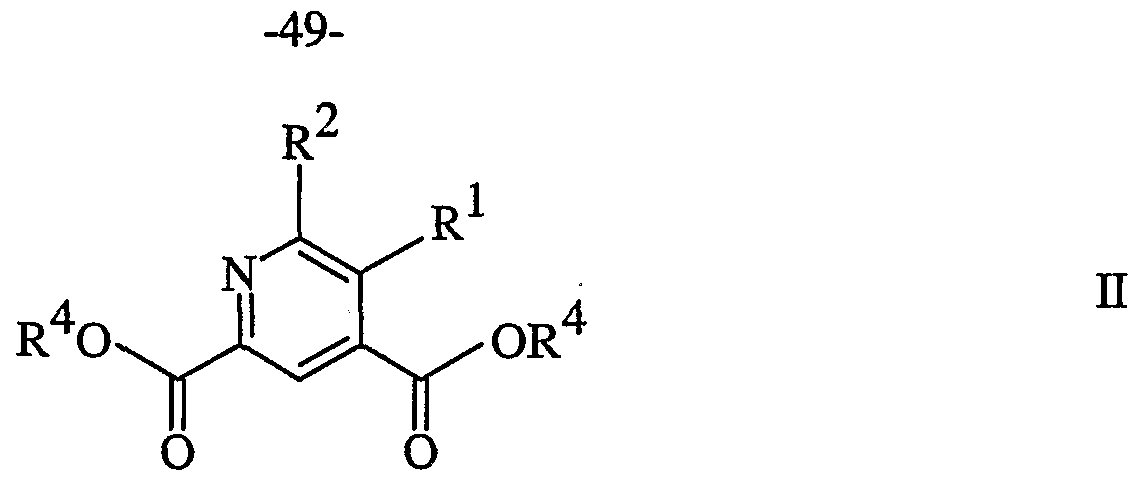
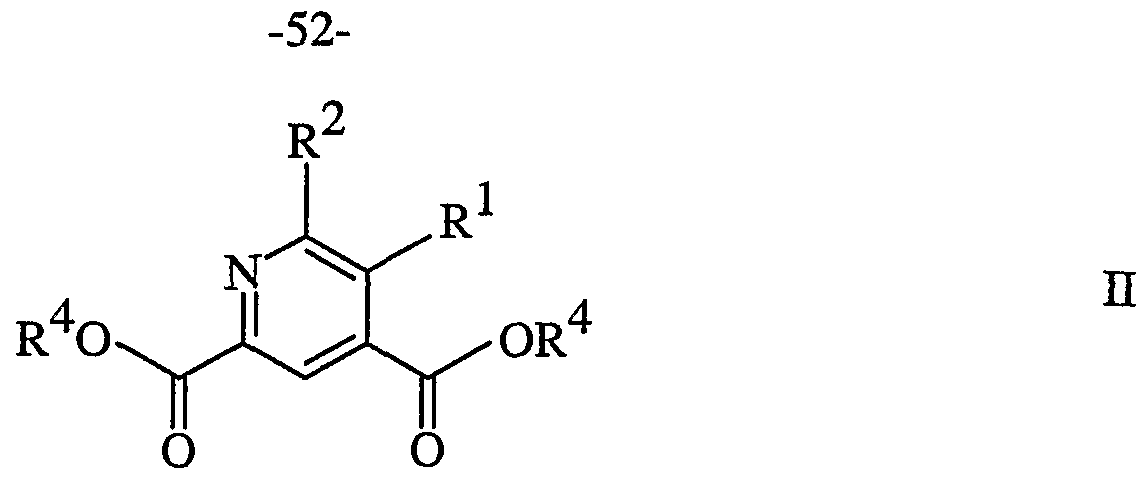
  • a preferred method of inhibiting MMP enzymes in a host comprises administering a compound of Formula II or a pharmaceutically acceptable salt thereof, wherein R and R ⁇ are as defined above, and each R 4 independently is as defined above.
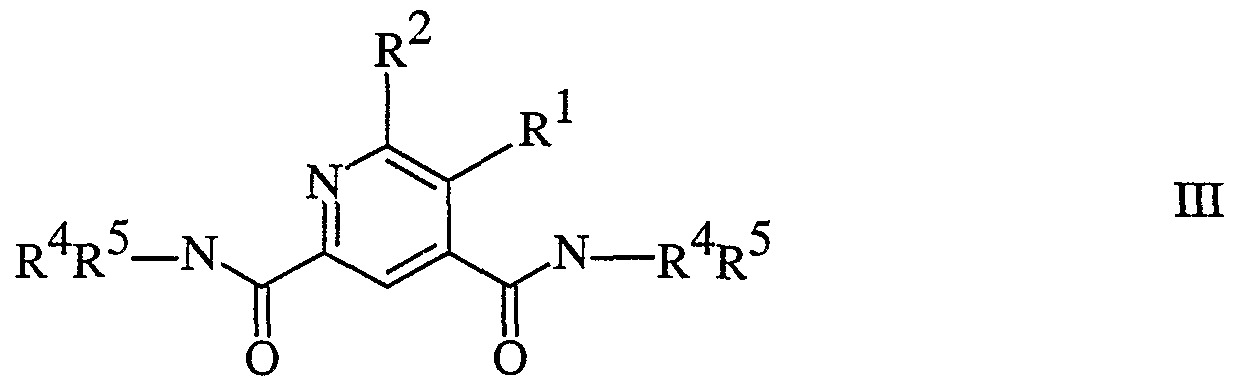
  • Another preferred method for inhibiting MMP enzymes comprises administering a compound of Formula HI
  • An especially preferred method comprises administering MMP inhibitors having Formula IV
  • n, R , and R2 are as defined above, and R6, R ; R8 ? an d R9 independently are hydrogen, halo, Ci-Cg alkyl, Ci -Cg alkoxy, nitro, or NH2.
  • Still another preferred method comprises administering an MMP inhibitor of Formula V or a pharmaceutically acceptable salt thereof, wherein n, R 1 , and R ⁇ are as defined above, and each Ar independently is aryl or Het, wherein aryl is phenyl or substituted phenyl, and Het is an unsubstituted or substituted heteroaryl group.
  • Preferred compounds are amides of Formula I wherein one or both of A and B is NR 4 R5. More preferred invention compounds are selected from: Pyridine-3,5-dicarboxylic acid, (4-chloro-benzylamide), [(1,3- benzodioxol-5-ylmethyl)-amide] ;
  • Pyridine -2,4-dicarboxylic acid bis-indan-1-ylamide Pyridine -2,4-dicarboxylic acid bis-indan-1-ylamide, Pyridine -2,4-dicarboxylic acid bis-(3,4-dichloro-benzylamide), Pyridine -2,4-dicarboxylic acid bis-[(2-ethoxy-ethyl)-amide], Pyridine- -2,4-dicarboxylic acid bis- ⁇ [2-(4-bromo-phenyl)-ethyl]-amide ⁇ , Pyridine- -2,4-dicarboxylic acid bis-[(2-pyridin-2-yl-ethyl)-amide], Pyridine- -2,4-dicarboxylic acid bis-[(2-thiophen-2-yl-ethyl)-amide], Pyridine-2,4-dicarboxylic acid bis- ⁇ [2-(5-methoxy-lH-indol-3
  • a further embodiment of this invention is a pharmaceutical composition, comprising a compound of Formula I, or a pharmaceutically acceptable salt thereof, admixed with a pharmaceutically acceptable carrier, excipient, or diluent.
  • Preferred compositions comprise a compound of Formula ⁇ , HI, IV, or V, or a pharmaceutically acceptable salt thereof.
  • a more preferred composition comprises a compound selected from:
  • Pyridine-2,4-dicarboxylic acid bis-indan-1-ylamide Pyridine-2,4-dicarboxylic acid bis-indan-1-ylamide, Pyridine-2,4-dicarboxylic acid bis-(3,4-dichloro-benzylamide), Pyridine-2,4-dicarboxylic acid bis-[(2-ethoxy-ethyl)-amide], Pyridine-2,4-dicarboxylic acid bis- ⁇ [2-(4-bromo-phenyl)-ethyl]-amide ⁇ ,
  • a further embodiment is a method for treating a disease mediated by an MMP-13 enzyme, comprising administering to a patient suffering from such a disease an effective amount of a compound of Formula I, or a pharmaceutically acceptable salt thereof.
  • a preferred method utilizes a compound of Formula I, or a pharmaceutically acceptable salt thereof, wherein one or both of A and B is
  • a further preferred method of treatment according to this invention is treatment of a disease selected from cancer, especially breast carcinoma, inflammation, and heart failure, comprising administering a compound of Formula I, or a pharmaceutically acceptable salt thereof.
  • Specific diseases to be treated according to this invention include osteoarthritis and rheumatoid arthritis.
  • a further embodiment is use of a compound of Formula I, or a pharmaceutically acceptable salt thereof, in the manufacture of a medicament for the treatment of a disease mediated by an MMP-13 enzyme.
  • Preferred is use of a compound of Formula I, or a pharmaceutically acceptable salt thereof, wherein one or both of A and B is NR 4 R5, wherein R 4 and R ⁇ are as defined above.
  • Also preferred is use of a compound of Formula ⁇ , HI, IV, or V, or a pharmaceutically acceptable salt thereof.
  • R* to R ⁇ include "Cj-C ⁇ alkyl” groups. These are straight and branched carbon chains having from 1 to 6 carbon atoms. Examples of such alkyl groups include methyl, ethyl, isopropyl, tert-butyl, neopentyl, and n-hexyl.
  • the alkyl groups can be substituted if desired, for instance with groups such as hydroxy, amino, alkyl, aryl, and dialkylamino, halo, trifluoromethyl, carboxy, nitro, and cyano.
  • Alkenyl means straight and branched hydrocarbon radicals having from 2 to 6 carbon atoms and one double bond and includes ethenyl, 3-buten-l-yl, 2-ethenylbutyl, 3-hexen-l-yl, and the like.
  • Alkynyl means straight and branched hydrocarbon radicals having from 2 to 6 carbon atoms and one triple bond and includes ethynyl, 3-butyn-l-yl, propynyl, 2-butyn-l-yl, 3-pentyn-l-yl, and the like.
  • Cycloalkyl means a monocyclic or polycyclic hydrocarbyl group such as cyclopropyl, cycloheptyl, cyclooctyl, cyclodecyl, cyclobutyl, adamantyl, norpinanyl, decalinyl, norbornyl, cyclohexyl, and cyclopentyl. Such groups can be substituted with groups such as hydroxy, keto, and the like. Cycloalkyl groups can also be fused by two points of attachment to other groups such as aryl and heteroaryl groups. Also included are rings in which 1 to 3 heteroatoms replace carbons.
  • heterocyclyl means a cycloalkyl group also bearing at least one heteroatom selected from O, S, or NR ⁇ , examples being oxiranyl, pyrrolidinyl, piperidyl, tetrahydropyran, and morpholine.
  • alkoxy refers to the alkyl groups mentioned above bound through oxygen, examples of which include methoxy, ethoxy, isopropoxy, tert-butoxy, and the like.
  • alkoxy refers to polyethers such as -O-(CH2)2 _ O-OH3, and the like.
  • acyl means an R group that is an alkyl or aryl (Ar) group bonded through a carbonyl group, i.e., R-C(O)-, where R is alkyl or aryl.
  • acyl includes a Ci-C ⁇ alkanoyl, including substituted alkanoyl, wherein the alkyl portion can be substituted by NR 4 R5 or a carboxylic or heterocyclic group.
  • Typical acyl groups include acetyl, benzoyl, isonicotinoyl, and the like.
  • alkyl, alkenyl, alkoxy, and alkynyl groups described above are optionally substituted, preferably by 1 to 3 groups selected from NR 4 R5, phenyl, substituted phenyl, naphthyl, thio Ci-C ⁇ alkyl, C ⁇ -Cg alkoxy, hydroxy, carboxy, Ci-C6 alkoxycarbonyl, acyl, halo, nitrile, cycloalkyl, and a 5- or 6-membered carbocyclic ring or heterocyclic ring having 1 or 2 heteroatoms selected from nitrogen, substituted nitrogen, oxygen, and sulfur.
  • "Substituted nitrogen” means nitrogen bearing C ⁇ -C alkyl or (CH2) n Ph where n is 1, 2, or 3.
  • substituted alkyl groups include 2-aminoethyl, acetylmethyl, pentachloroethyl, trifluoromethyl, 2-diethylaminoethyl, 2-dimethylaminopropyl, ethoxycarbonylmethyl, 3-phenylbutyl, methanylsulfanylmethyl, methoxymethyl, 3-hydroxypentyl, 2-carboxybutyl, 4-chlorobutyl, 3-cyclopropylpropyl, pentafluoroethyl, 3-morpholinopropyl, piperazinylmethyl, 4-benzoylbutyl, and 2-(4-methylpiperazinyl)ethyl.
  • substituted alkynyl groups include 2-methoxyethynyl,
  • Typical substituted alkoxy groups include aminomethoxy, acetoxymethoxy, trifluoromethoxy, 2-diethylaminoethoxy,
  • substituted alkyl, alkenyl, and alkynyl groups include dimethylaminomethyl, carboxymethyl, 4-dimethylamino-3-buten-l-yl, 5-ethylmethylamino-3-pentyn-l-yl, 4-morpholinobutyl, 4-tetrahydropyrinidylbutyl, 3-imidazolidin-l-ylpropyl, 4-tetrahydrothiazol-
  • Heteroaryl (Het) groups have from 4 to 9 ring atoms, from 1 to 4 of which are independently selected from the group consisting of O, S, and N.
  • Preferred heteroaryl groups have 1 or 2 heteroatoms in a 5- or 6-membered aromatic ring.
  • Mono- and bicyclic aromatic ring systems are included in the definition of aryl and heteroaryl.
  • Preferred substituent groups include alkyl, alkoxy, aryloxy, halo, amino, alkylamino, dialkylamino, CN, CF3, thioalkyl, acyl and hydroxy.
  • Typical aryl and heteroaryl groups include phenyl, 3-chlorophenyl, 2,6-dibromophenyl, pyridyl, 3-methylpyridyl, benzothienyl, 2,4,6-tribromophenyl,
  • Preferred Ar groups are phenyl and phenyl substituted by 1, 2, or 3 groups independently selected from the group consisting of alkyl, alkoxy, thio, thioalkyl, halo, hydroxy, -COOR 7 , trifluoromethyl, nitro, amino of the formula -NR 4 R 5 , and T(CH2) m QR 4 or T(CH2) m CO2R 4 wherein m is 1 to 6, T is O, S, NR 4 N(O)R 4 , NR 4 R 6 Y, or CR R 5 , Q is O, S, NR 5 , N(O)R 5 , or NR 5 R 6 Y wherein
  • R 4 and R 5 are as described above, and R ⁇ is hydrogen, alkyl, or substituted alkyl, for example, methyl, trichloroethyl, diphenylmethyl, and the like.
  • the alkyl and alkoxy groups can be substituted as defined above.
  • typical groups are carboxyalkyl, alkoxycarbonylalkyl, hydroxyalkyl, hydroxyalkoxy, and alkoxyalkyl.
  • Typical substituted aryl groups include 2,6-dichlorophenyl, 3-hydroxyphenyl, 1,3-benzodioxolyl, 4-dimethylaminophenyl, 2,4,6-triethoxyphenyl, 3-cyanophenyl, 4-methylthiophenyl, and 3,5-dinitrophenyl.
  • Examples of NR 4 R 5 groups include amino, methylamino, di-isopropylamino, acetyl amino, propionyl amino, 3-aminopropyl amino, 3-ethylaminobutyl amino, 3-di-n-propylamino-propyl amino, 4-diethylaminobutyl amino, and 3-carboxypropionyl amino.
  • R 4 and R 5 can be taken together with the nitrogen to which they are attached to form a ring having 3 to 7 carbon atoms and 1, 2, or 3 heteroatoms selected from the group consisting of nitrogen, substituted nitrogen, oxygen, and sulfur.
  • Examples of such cyclic NR 4 R 5 groups include pyrrolidinyl, piperazinyl, 4-methylpiperazinyl, 4-benzylpiperazinyl, pyridinyl, piperidinyl, pyrazinyl, morpholinyl, and the like.
  • Halo includes fluoro, chloro, bromo, and iodo.
  • patient means a mammal.
  • Preferred patients include humans, cats, dogs, cows, horses, pigs, and sheep.
  • animal means a mammal.
  • Preferred animals are include humans, rats, mice, guinea pigs, rabbits, monkeys, cats, dogs, cows, horses, pigs, and sheep.
  • terapéuticaally effective amount and “effective amount” are synonymous unless otherwise indicated, and mean an amount of a compound of the present invention that is sufficient to improve the condition, disease, or disorder being treated. Determination of a therapeutically effective amount, as well as other factors related to effective administration of a compound of the present invention to a patient in need of treatment, including dosage forms, routes of administration, and frequency of dosing, may depend upon the particulars of the condition that is encountered, including the patient and condition being treated, the severity of the condition in a particular patient, the particular compound being employed, the particular route of administration being employed, the frequency of dosing, and the particular formulation being employed. Determination of a therapeutically effective treatment regimen for a patient is within the level of ordinary skill in the medical or veterinarian arts. In clinical use, an effective amount may be the amount that is recommended by the U.S. Food and Drug Administration, or an equivalent foreign agency.
  • admixed or "in admixture” means the ingredients so mixed comprise either a heterogeneous or homogeneous mixture. Preferred is a homogeneous mixture.
  • pharmaceutical preparation and “preparation” are synonymous unless otherwise indicated, and include the formulation of the active compound with encapsulating material as a carrier providing a capsule in which the active component, with or without other carriers, is surrounded by a carrier, which is thus in association with it. Similarly, cachets and lozenges are included. Pharmaceutical preparations are fully described below.
  • anticancer effective amount means an amount of invention compound, or a pharmaceutically acceptable salt thereof, sufficient to inhibit, halt, or cause regression of the cancer being treated in a particular patient or patient population.
  • an anticancer effective amount can be determined experimentally in a laboratory or clinical setting, or may be the amount required by the guidelines of the United States Food and Drug Administration, or equivalent foreign agency, for the particular cancer and patient being treated.
  • MMP-13 inhibiting amount means an amount of invention compound, or a pharmaceutically acceptable salt thereof, sufficient to inhibit an enzyme matrix metalloproteinase-13, including a truncated form thereof, including a catalytic domain thereof, in a particular animal or animal population.
  • an MMP-13 inhibiting amount can be determined experimentally in a laboratory or clinical setting, or may be the amount required by the guidelines of the United States Food and Drug
  • the matrix metalloproteinases include the following enzymes: MMP-1, also known as interstitial collagenase, collagenase- 1, or fibroblast-type collagenase; MMP-2, also known as gelatinase A or 72 kDa Type IV collagenase; MMP-3, also known as stromelysin or stromelysin-1; MMP-7, also known as matrilysin or PUMP-1; MMP-8, also known as collagenase-2, neutrophil collagenase, or polymorphonuclear-type ("PMN-type") collagenase; MMP-9, also known as gelatinase B or 92 kDa Type IV collagenase; MMP-10, also known as stromelysin-2; MMP-11, also known as stromelysin-3; MMP-12, also known as metalloelastase;
  • MMP-1 also known as interstitial collagenase, collagenase- 1, or fibroblast-type collagena
  • MMP-13 also known as collagenase-3;
  • MMP-14 also known as membrane-type (“MT") 1-MMP or MT1-MMP
  • MMP-15 also known as MT2-MMP
  • MMP-16 also known as MT3-MMP
  • MMP-17 also known as MT4-MMP
  • MMP-18 MMP-18; and MMP-19.
  • Other MMPs are known, including MMP-26, which is also known as matrilysin-2.
  • One aspect of the present invention is a compound of Formula I, or a pharmaceutically acceptable salt thereof, that is a selective inhibitor of the enzyme MMP-13.
  • a selective inhibitor of MMP-13 as used in the present invention, is a compound that is >5 times more potent in vitro versus MMP-13 than versus at least one other matrix metalloproteinase enzyme such as, for example, MMP-1, MMP-2, MMP-3, MMP-7, MMP-8, MMP-9, or MMP-14, or versus tumor necrosis factor alpha convertase ("TACE").
  • a preferred aspect of the present invention is a compound that is a selective inhibitors of MMP-13 versus MMP-1.
  • Still other aspects of the present invention are compounds of Formula I, or a pharmaceutically acceptable salt thereof, that are selective inhibitors of MMP-13 versus 2, 3, 4, 5, 6, or 7 other MMP enzymes, or versus TACE and 1, 2, 3, 4, 5, 6, or 7 other MMP enzymes.
  • Other aspects of the present invention are compounds of Formula I, or a pharmaceutically acceptable salt thereof, that are >10 times,
  • IC50 means the concentration of test compound required to inhibit activity of a biological target, such as a receptor or enzyme, by 50%.
  • catalytic domain means the domain containing a catalytic zinc cation of the MMP enzyme, wherein the MMP enzyme contains 2 or more domains.
  • a catalytic domain includes truncated forms thereof that retain at least some of the catalytic activity of MMP-13 or MMP-13CD.
  • the collagenases, of which MMP-13 is a member have been reported to contain a signal peptide domain, a propeptide domain, a catalytic domain, and a hemopexin- like domain (Ye Qi-Zhuang, Hupe D., Johnson L., Current Medicinal Chemistry, 1996;3:407-418).
  • a method for inhibiting MMP-13 includes methods of inhibiting full length MMP-13, truncated forms thereof that retain catalytic activity, including forms that contain the catalytic domain of MMP-13, as well as the catalytic domain of MMP-13 alone, and truncated forms of the catalytic domain of MMP-13 that retain at least some catalytic activity.
  • the compounds to be used in the present invention can exist in unsolvated forms as well as solvated forms, including hydrated forms.
  • the solvated forms, including hydrated forms are equivalent to unsolvated forms and are intended to be encompassed within the scope of the present invention.
  • the compounds of Formula I may have chiral centers, and thus can exist as racemic mixtures and individual enantiomers. All such isomeric forms can be used in the method of this invention and are provided as new compounds.
  • the compounds of the invention are capable of further forming both pharmaceutically acceptable formulations comprising salts, including but not limited to acid addition and/or base salts, solvents and N-oxides of a compound of the invention.
  • This invention also provides pharmaceutical formulations comprising a compound of the invention together with a pharmaceutically acceptable carrier, diluent, or excipient therefor. All of these forms can be used in the method of the present invention.
  • Pharmaceutically acceptable acid addition salts of the compounds of the invention include salts derived form inorganic acids such as hydrochloric, nitric, phosphoric, sulfuric, hydrobromic, hydriodic, phosphorus, and the like, as well as the salts derived from organic acids, such as aliphatic mono- and dicarboxylic acids, phenyl-substituted alkanoic acids, hydroxy alkanoic acids, alkanedioic acids, aromatic acids, aliphatic and aromatic sulfonic acids, etc.
  • inorganic acids such as hydrochloric, nitric, phosphoric, sulfuric, hydrobromic, hydriodic, phosphorus, and the like
  • organic acids such as aliphatic mono- and dicarboxylic acids, phenyl-substituted alkanoic acids, hydroxy alkanoic acids, alkanedioic acids, aromatic acids, aliphatic and aromatic sulfonic acids, etc.
  • Such salts thus include sulfate, pyrosulfate, bisulfate, sulfite, bisulfite, nitrate, phosphate, monohydrogenphosphate, dihydrogenphosphate, metaphosphate, pyrophosphate, chloride, bromide, iodide, acetate, propionate, caprylate, isobutyrate, oxalate, malonate, succinate, suberate, sebacate, fumarate, maleate, mandelate, benzoate, chlorobenzoate, methylbenzoate, dinitrobenzoate, phthalate, benzenesulfonate, toluenesulfonate, phenylacetate, citrate, lactate, maleate, tartrate, methanesulfonate, and the like.
  • salts of amino acids such as arginate, gluconate, galacturonate, and the like; see, for example, Berge et al., "Pharmaceutical Salts,” J. of Pharmaceutical Science, 1977;66:1-19.
  • the acid addition salts of the basic compounds are prepared by contacting the free base form with a sufficient amount of the desired acid to produce the salt in the conventional manner.
  • the free base form may be regenerated by contacting the salt form with a base, and isolating the free base in the conventional manner.
  • the free base forms differ from their respective salt forms somewhat in certain physical properties such as solubility in polar solvents, but otherwise the salts are equivalent to their respective free base for purposes of the present invention.
  • Pharmaceutically acceptable base addition salts are formed with metals or amines, such as alkali and alkaline earth metal hydroxides, or of organic amines. Examples of metals used as cations are sodium, potassium, magnesium, calcium, and the like.
  • Suitable amines are N.N'-dibenzylethylenediamine, chloroprocaine, choline, diethanolamine, ethylenediamine, N-methylglucamine, and procaine; see, for example, Berge et al., supra., 1977.
  • the base addition salts of acidic compounds are prepared by contacting the free acid form with a sufficient amount of the desired base to produce the salt in the conventional manner.
  • the free acid form may be regenerated by contacting the salt form with an acid and isolating the free acid in a conventional manner.
  • the free acid forms differ from their respective salt forms somewhat in certain physical properties such as solubility in polar solvents, but otherwise the salts are equivalent to their respective free acid for purposes of the present invention.
  • the compounds of the present invention can be formulated and administered in a wide variety of oral and parenteral dosage forms, including transdermal and rectal administration. All that is required is that an MMP inhibitor be administered to a mammal suffering from a disease in an effective amount, which is that amount required to cause an improvement in the disease and/or the symptoms associated with such disease. It will be recognized to those skilled in the art that the following dosage forms may comprise as the active component, either a compound of the invention or a corresponding pharmaceutically acceptable salt or solvate of a compound of the invention.
  • the invention compounds are prepared by methods well known to those skilled in the art of organic chemistry. The compounds of the invention are prepared utilizing commercially available starting materials, or reactants that are readily prepared by standard organic synthetic techniques.
  • the first step in Scheme 1 comprises reacting a diacid with a chlorinating reagent such as thionyl chloride or oxalyl chloride in a nonprotic solvent such as dichloromethane (DCM) to give the diacid chloride.
  • a chlorinating reagent such as thionyl chloride or oxalyl chloride
  • a nonprotic solvent such as dichloromethane (DCM)
  • This acid chloride can then be reacted with an amine, NHR 4 R 5 , in excess or with an organic base such as triethylamine, to give a bis-amide of Formula I.
  • the acid chloride can be reacted with an alcohol, R 4 OH, in a nonprotic solvent such as dichloromethane along with an organic or inorganic base such as triethylamine or potassium carbonate to give a bis-ester of Formula I.
  • the bis-ester can in some circumstances be reacted with an amine, NHR R 5 , at elevated temperatures to give a bis-amide of Formula I.
  • the diacid can also be reacted with an alkyl halide in a nonprotic solvent containing an organic or inorganic base to give a bis-ester of Formula I.
  • a third sequence involves the reaction of the diacid with hydroxybenzotriazole, HOBt, and dicyclohexylcarbodiimide, DCC, and an amine, NHR 4 R 5 , in a solvent such as dimethylformamide, DMF, or dichloromethane to give a bis-amide of Formula I.
  • Compounds of Formula I have also been synthesized using combinatorial techniques, Scheme 2.
  • the diacid chloride is bound to a resin such as Marshall resin to give a bound acid chloride.
  • This is then reacted with an amine, NHR R 5 , in the presence of triethylamine in a solvent such as DCM to give a resin-bound amide.
  • the resin is then cleaved by reaction with an amine, NHR 4 R 5 , in dioxane in the presence of an organic base to give a bis-amide of Formula I, wherein each
  • Examples 2-9 were prepared by following the same general procedure detailed in Example 1.
  • the resin tube was capped and carefully secured in a wrist shaker, and inverted for 36 hours. After 36 hours, a slight darkening of the resin was noted.
  • the reaction solvent was drained and the resin washed three times with DCM (200 mL) and two times with diethyl ether (200 mL).
  • the resin was dried in vacuo for 24 hours. Loading was determined both by weight gain and by total chloride determination. (Nitrogen content showed ⁇ 0.05% N and therefore the absence of TEA-C1). Typical loading was 1.1 mmol/g.
  • a Miniblock resin loader was calibrated for each resin used in the protocol. The weight in milligram of resin added per well was recorded, and the number of millimoles per well of isophthalic acid dichloride was calculated. Using this calibration and the loading for each resin, 0.15 mmol of resin-bound isophthalic acid dichloride was distributed to each reaction tube. The valve was then closed on the block.
  • An "A” amine set (NHR 4 R 5 ) was diluted to 0.5 M in DCM.
  • a 0.2-M solution of TEA in DCM (1.5 mL per reaction) was prepared.
  • a 0.2-M solution of TEA in dioxane was also prepared (1.5 mL per reaction).
  • a "B" amine set (NHR 4 R 5 ) was diluted to 0.5 M in DCM.
  • a 0.2-M solution of TEA in DCM (1.5 mL per reaction) was prepared.
  • a 0.2-M solution of TEA in dioxane was also prepared (1.5 mL per reaction).
  • a "B" amine set (NHR 4 R 5 ) was diluted to 0.5 M in DCM.
  • a 0.2-M solution of TEA in DCM (1.5 mL per reaction) was prepared.
  • a 0.2-M solution of TEA in dioxane was also prepared (1.5 mL per reaction).
  • the TEA/dioxane solution (1.5 mL) was added to each reaction tube.
  • the appropriate "B" amine solution 300 ⁇ L, 1.05 eq was distributed.
  • the reaction block was shaken for 72 hours, then placed on a filtration station with a labeled collection block, and drained. The valve was closed and 2 mL DCM was added. The reaction block was shaken for 2 minutes, then drained into collection tubes.
  • the products in the tubes may be identified by loop mass spectrometry after first evaporating the DCM from the MS samples.
  • the invention compounds of Formula I have been evaluated in standard assays for their ability to inhibit the catalytic activity of various MMP enzymes.
  • the assays used to evaluate the biological activity of the invention compounds are well known and routinely used by those skilled in the study of MMP inhibitors and their use to treat clinical conditions.
  • the assays measure the amount by which a test compound reduces the hydrolysis of a thiopeptolide substrate catalyzed by a matrix metalloproteinase enzyme. Such assays are described in detail by Ye et al., in Biochemistry,
  • Thiopeptolide substrates show virtually no decomposition or hydrolysis at or below neutral pH in the absence of a matrix metalloproteinase enzyme.
  • a typical thiopeptolide substrate commonly utilized for assays is Ac-Pro-Leu-Gly- thioester-Leu-Leu-Gly-OEt.
  • a 100- ⁇ L assay mixture will contain 50 mM of N-2- hydroxyethylpiperazine-N'-2-ethanesulfonic acid buffer ("HEPES”) at pH 7.0, 10 mM CaCl2, 100 ⁇ M thiopeptolide substrate, and 1 mM 5,5'-dithio-bis-(2-nitro- benzoic acid) (DTNB).
  • the thiopeptolide substrate concentration may be varied from, for example, 10 to 800 ⁇ M to obtain Km and Kcat values. The change in absorbance at 405 nm is monitored on a Thermo Max microplate reader
  • Tables 1 and 2 summarize the results for their ability to inhibit various matrix metalloproteinase enzymes. The results are summarized in Tables 1 and 2 below. Table 1 below presents inhibitory activity for compounds from various classes. Table 2 summarizes the data for the compounds that were prepared according to the combinatorial protocol described in Example 14. In the tables, MMP-1 refers to full-length interstitial collagenase; MMP-3 refers to the catalytic domain of stromelysin-1; MMP-13 refers to the catalytic domain of collagenase 3. Test compounds were evaluated at various concentrations to determine their respective IC50 values. In Tables 1 and 2, the IC50 values are the nanomolar and micromolar concentrations, respectively, of compound required to cause a 50% inhibition of the hydrolytic activity of the respective enzyme. TABLE 1
  • the invention compounds of the invention are potent inhibitors of MMP enzymes and are especially useful due to their selective inhibition of MMP-13. Because of this potent and selective inhibitory activity, the invention compounds are especially useful to treat diseases mediated by the MMP enzymes, and particularly those mediated by MMP-13.
  • Administration of an invention compound of Formula I, or a pharmaceutically acceptable salt thereof, to a mammal to treat the diseases mediated by MMP enzymes is preferably, although not necessarily, accomplished by administering the compound, or the salt thereof, in a pharmaceutical dosage form.
  • the compounds of the present invention can be prepared and administered in a wide variety of oral and parenteral dosage forms.
  • the compounds of the present invention can be administered by injection, that is, intravenously, intramuscularly, intracutaneously, subcutaneously, intraduodenally, or intraperitoneally.
  • the compounds of the present invention can be administered by inhalation, for example, intranasally.
  • the compounds of the present invention can be administered transdermally.
  • the following dosage forms may comprise as the active component, either a compound of Formula I or a corresponding pharmaceutically acceptable salt of a compound of Formula I.
  • the active compound generally is present in a concentration of about 5% to about 95% by weight of the formulation.
  • pharmaceutically acceptable carriers can be either solid or liquid.
  • Solid form preparations include powders, tablets, pills, capsules, cachets, suppositories, and dispersible granules.
  • a solid carrier can be one or more substances that may also act as diluents, flavoring agents, solubilizers, lubricants, suspending agents, binders, preservatives, tablet disintegrating agents, or an encapsulating material.
  • the carrier is a finely divided solid that is in a mixture with the finely divided active component.
  • the active component is mixed with the carrier having the necessary binding properties in suitable proportions and compacted in the shape and size desired.
  • the powders and tablets preferably contain from 5% or 10% to about 70% of the active compound.
  • Suitable carriers are magnesium carbonate, magnesium stearate, talc, sugar, lactose, pectin, dextrin, starch, gelatin, tragacanth, methylcellulose, sodium carboxymethylcellulose, a low melting wax, cocoa butter, and the like.
  • the term "preparation" is intended to include the formulation of the active compound with encapsulating material as a carrier providing a capsule in which the active component, with or without other carriers, is surrounded by a carrier, which is thus in association with it.
  • cachets and lozenges are included. Tablets, powders, capsules, pills, cachets, and lozenges can be used as solid dosage forms suitable for oral administration.
  • a low melting wax such as a mixture of fatty acid glycerides or cocoa butter
  • the active component is dispersed homogeneously therein, as by stirring.
  • the molten homogenous mixture is then poured into convenient sized molds, allowed to cool, and thereby to solidify.
  • Liquid form preparations include solutions, suspensions, and emulsions, for example, water or water propylene glycol solutions.
  • liquid preparations can be formulated in solution in aqueous polyethylene glycol solution.
  • Aqueous solutions suitable for oral use can be prepared by dissolving the active component in water and adding suitable colorants, flavors, stabilizing, and thickening agents as desired.
  • Aqueous suspensions suitable for oral use can be made by dispersing the finely divided active component in water with viscous material, such as natural or synthetic gums, resins, methylcellulose, sodium carboxymethylcellulose, and other well-known suspending agents.
  • viscous material such as natural or synthetic gums, resins, methylcellulose, sodium carboxymethylcellulose, and other well-known suspending agents.
  • solid form preparations that are intended to be converted, shortly before use, to liquid form preparations for oral administration.
  • liquid forms include solutions, suspensions, and emulsions.
  • These preparations may contain, in addition to the active component, colorants, flavors, stabilizers, buffers, artificial and natural sweeteners, dispersants, thickeners, solubilizing agents, and the like.
  • the pharmaceutical preparation is preferably in unit dosage form.
  • the preparation is subdivided into unit doses containing appropriate quantities of the active component.
  • the unit dosage form can be a packaged preparation, the package containing discrete quantities of preparation, such as packeted tablets, capsules, and powders in vials or ampoules.
  • the unit dosage form can be a capsule, tablet, cachet, or lozenge itself, or it can be the appropriate number of any of these in packaged form.
  • the quantity of active component in a unit dose preparation may be varied or adjusted from 1 to 1000 mg, preferably 10 to 100 mg according to the particular application and the potency of the active component.
  • the composition can, if desired, also contain other compatible therapeutic agents.
  • the compounds utilized in the pharmaceutical method of this invention are administered at a dose that is effective to inhibit the hydrolytic activity of one or more matrix metalloproteinase enzymes.
  • the initial dosage of about 1 mg/kg to about 100 mg/kg daily will be effective.
  • a daily dose range of about 25 mg kg to about 75 mg/kg is preferred.
  • the dosages may be varied depending upon the requirements of the patient, the severity of the condition being treated, and the compound being employed. Determination of the proper dosage for a particular situation is within the skill of the art. Generally, treatment is initiated with smaller dosages that are less than the optimum dose of the compound. Thereafter, the dosage is increased by small increments until the optimum effect under the circumstance is reached.
  • the total daily dosage may be divided and administered in portions during the day if desired.
  • Typical dosages will be from about 0.1 mg kg to about 500 mg/kg, and ideally about 25 mg/kg to about 250 mg kg, such that it will be an amount that is effective to treat the particular disease being prevented or controlled.
  • the pyridine amide of Example 1, lactose, and cornstarch (for mix) are blended to uniformity.
  • the cornstarch (for paste) is suspended in 200 mL of water and heated with stirring to form a paste.
  • the paste is used to granulate the mixed powders.
  • the wet granules are passed through a No. 8 hand screen and dried at 80°C.
  • the dry granules are lubricated with the 1% magnesium stearate and pressed into a tablet.
  • Such tablets can be administered to a human from one to four times a day for treatment of atherosclerosis and arthritis.
  • the sorbitol solution is added to 40 mL of distilled water, and the pyridine amide of Example 4 is dissolved therein.
  • the saccharin, sodium benzoate, flavor, and dye are added and dissolved.
  • the volume is adjusted to 100 mL with distilled water.
  • Each milliliter of syrup contains 4 mg of invention compound.
  • the compounds of the invention are useful as agents for the treatment of multiple sclerosis. They are also useful as agents for the treatment of atherosclerotic plaque rupture, restenosis, periodontal disease, corneal ulceration, treatment of burns, decubital ulcers, wound repair, heart failure, cancer metastasis, tumor angiogenesis, arthritis, and other inflammatory disorders dependent upon tissue invasion by leukocytes.

Landscapes

  • Chemical & Material Sciences (AREA)
  • Organic Chemistry (AREA)
  • Health & Medical Sciences (AREA)
  • Veterinary Medicine (AREA)
  • Public Health (AREA)
  • General Health & Medical Sciences (AREA)
  • Animal Behavior & Ethology (AREA)
  • Life Sciences & Earth Sciences (AREA)
  • Medicinal Chemistry (AREA)
  • Pharmacology & Pharmacy (AREA)
  • Chemical Kinetics & Catalysis (AREA)
  • General Chemical & Material Sciences (AREA)
  • Nuclear Medicine, Radiotherapy & Molecular Imaging (AREA)
  • Bioinformatics & Cheminformatics (AREA)
  • Engineering & Computer Science (AREA)
  • Cardiology (AREA)
  • Rheumatology (AREA)
  • Heart & Thoracic Surgery (AREA)
  • Physical Education & Sports Medicine (AREA)
  • Hospice & Palliative Care (AREA)
  • Immunology (AREA)
  • Orthopedic Medicine & Surgery (AREA)
  • Pain & Pain Management (AREA)
  • Epidemiology (AREA)
  • Pharmaceuticals Containing Other Organic And Inorganic Compounds (AREA)
  • Pyridine Compounds (AREA)

Abstract

Selective MMP-13 inhibitors are pyridine derivatives of the formula (I) or a pharmaceutically acceptable salt thereof, wherein: R?1 and R2¿ independently are hydrogen, halo, hydroxy, C¿1?-C6 alkyl, C1-C6 alkoxy, C2-C6 alkenyl, C2-C6 alkynyl, NO2, NR?4R5¿, CN, or CF¿3?; E is independently O or S; A and B independently are OR?4 or NR4R5; R4 and R5¿ independently are H, C¿1?-C6 alkyl, C2-C6 alkenyl, C2-C6 alkynyl, (CH2)n aryl, (CH2)n cycloalkyl, (CH2)n heteroaryl, or R?4 and R5¿ when taken together with the nitrogen to which they are attached complete a 3- to 8-membered ring containing carbon atoms and optionally containing a heteroatom selected from O, S, or NH, and optionally substituted or unsubstituted; n is 0 to 6.

Description

PYRIDINE MATRIX METALLOPROTEINASE INHIBITORS
FIELD OF THE INVENTION
This invention relates to pyridine derivatives that inhibit matrix metalloproteinase enzymes and thus are useful for treating diseases resulting from tissue breakdown such as heart disease, multiple sclerosis, osteo- and rheumatoid arthritis, atherosclerosis, and osteoporosis.
BACKGROUND OF THE INVENTION
Matrix metalloproteinases (sometimes referred to as MMPs) are naturally occurring enzymes found in most mammals. Over-expression and activation of MMPs or an imbalance between MMPs and inhibitors of MMPs have been suggested as factors in the pathogenesis of diseases characterized by the breakdown of extracellular matrix or connective tissues.
Stromelysin-1 and gelatinase A are members of the matrix metalloproteinases (MMP) family. Other members include fibroblast collagenase (MMP-1), neutrophil collagenase (MMP-8), gelatinase B (92 kDa gelatinase)
(MMP-9), stromelysin-2 (MMP-10), stromelysin-3 (MMP-11), matrilysin (MMP-7), collagenase 3 (MMP-13); TNF-alpha converting enzyme (TACE), and other newly discovered membrane-associated matrix metalloproteinases (Sato H., Takino T., Okada Y., Cao J., Shinagawa A., Yamamoto E., and Seiki M., Nature, 1994;370:61-65). These enzymes have been implicated with a number of diseases which result from breakdown of connective tissue, including such diseases as rheumatoid arthritis, osteoarthritis, osteoporosis, periodontitis, multiple sclerosis, gingivitis, corneal epidermal and gastric ulceration, atherosclerosis, neointimal proliferation which leads to restenosis and ischemic heart failure, and tumor metastasis. A method for preventing and treating these and other diseases is now recognized to be by inhibiting matrix metalloproteinase enzymes, thereby curtailing and/or eliminating the breakdown of connective tissues that results in the disease states. There is a catalytic zinc domain in matrix metalloproteinases that is typically the focal point for inhibitor design. The modification of substrates by introducing zinc-chelating groups has generated potent inhibitors such as peptide hydroxamates and thiol-containing peptides. Peptide hydroxamates and the natural endogenous inhibitors of MMPs (TIMPs) have been used successfully to treat animal models of cancer and inflammation. MMP inhibitors have also been used to prevent and treat congestive heart failure and other cardiovascular diseases, United States Patent No. 5,948,780.
A major limitation on the use of currently known MMP inhibitors is their lack of specificity for any particular enzyme. Recent data has established that specific MMP enzymes are associated with some diseases, but have no apparent effect on other diseases. The MMPs are generally categorized based on their substrate specificity; indeed, the collagenase subfamily of MMP-1, MMP-8, and MMP-13 selectively cleave native interstitial collagens, and thus are associated only with diseases linked to such interstitial collagen tissue. This is evidenced by the recent discovery that MMP-13 alone is overexpressed in breast carcinoma, while MMP-1 alone is overexpressed in papillary carcinoma (see Chen et al., J. Am. Chem. Soc, 2000;122:9648-9654).
There appears to be few selective inhibitors of MMP-13 reported. A compound named WAY- 170523 has been reported by Chen et al., supra., 2000, and a few other compounds are reported in PCT International Application Publication Number WO 01/63244 Al, as allegedly selective inhibitors of MMP- 13. Further, United States Patent Number 6,008,243 discloses inhibitors of MMP- 13. However, no selective or nonselective inhibitor of MMP-13 has been approved and marketed for the treatment of any disease in any mammal.
Accordingly, the need continues to find new low molecular weight compounds that are potent and selective MMP inhibitors, and that have an acceptable therapeutic index of toxicity/potency to make them amenable for use clinically in the prevention and treatment of the associated disease states. An object of this invention is to provide a group of selective MMP-13 inhibitor compounds characterized as being isophthalic acid derivatives. SUMMARY OF THE INVENTION
This invention provides a method for inhibiting matrix metalloproteinase enzymes, and especially MMP-13, using a pyridine compound. The invention is more particularly directed to a method for inhibiting MMP enzymes comprising administering to a host an MMP inhibiting amount of a compound defined by
Formula I
Figure imgf000004_0001
or a pharmaceutically acceptable salt thereof, wherein: R! and R^ independently are hydrogen, halo, hydroxy, Ci-Cβ alkyl,
Ci-Cβ alkoxy, C2-C6 alkenyl, C2-C6 alkynyl, NO2, NR4R5, CN, or CF3; E is independently O or S; A and B independently are OR4 or NR4R5; R4 and R^ independently are H, Ci-Cβ alkyl, C2-Cg alkenyl, C2-Cg alkynyl, (CH2)n aryl, (CH2)n cycloalkyl, (CH2)n heteroaryl, or R4 and R5 when taken together with the nitrogen to which they are attached complete a 3- to 8-membered ring, containing carbon atoms and optionally containing a heteroatom selected from O, S, or NH, and optionally substituted or unsubstituted; n is an integer from 0 to 6.
A preferred method of inhibiting MMP enzymes in a host comprises administering a compound of Formula II
Figure imgf000005_0001
or a pharmaceutically acceptable salt thereof, wherein R and R^ are as defined above, and each R4 independently is as defined above. Another preferred method for inhibiting MMP enzymes comprises administering a compound of Formula HI
Figure imgf000005_0002
or a pharmaceutically acceptable salt thereof, wherein Rl and R^ are as defined above, and each R4 and R^ independently are as defined above. An especially preferred method comprises administering MMP inhibitors having Formula IV
Figure imgf000005_0003
or a pharmaceutically acceptable salt thereof, wherein n, R , and R2 are as defined above, and R6, R ; R8? and R9 independently are hydrogen, halo, Ci-Cg alkyl, Ci -Cg alkoxy, nitro, or NH2.
Still another preferred method comprises administering an MMP inhibitor of Formula V
Figure imgf000006_0001
or a pharmaceutically acceptable salt thereof, wherein n, R1, and R^ are as defined above, and each Ar independently is aryl or Het, wherein aryl is phenyl or substituted phenyl, and Het is an unsubstituted or substituted heteroaryl group.
Compounds of Formulas I, π, 133, IV, and V are provided as a further embodiment of this invention. Preferred compounds are amides of Formula I wherein one or both of A and B is NR4R5. More preferred invention compounds are selected from: Pyridine-3,5-dicarboxylic acid, (4-chloro-benzylamide), [(1,3- benzodioxol-5-ylmethyl)-amide] ;
Pyridine-3,5-dicarboxylic acid, (4-carboxy-benzylamide), [(1,3- benzodioxol-5-ylmethyl)-amide] ;
Pyridine-3,5-dicarboxylic acid, (4-carboxy-benzylamide), (4-methoxy- benzylamide);
Pyridine-3,5-dicarboxylic acid, (4-carboxy-benzylamide), (3-methoxy- benzylamide);
Pyridine-3,5-dicarboxylic acid, (4-carbomethoxy-benzylamide), (3- methoxy-benzylamide) ; Pyridine-3,5-dicarboxylic acid, (4-carboxy-benzylamide), (3- pyridylmethylamide);
Pyridine-3,5-dicarboxylic acid, (4-carboxy-benzylamide), (3- thiophenemethylamide);
Pyridine-3,5-dicarboxylic acid, (2,l,3-benzothiadiazol-5-ylmethyl) amide, [(l,3-benzodioxol-5-ylmethyl)-amide];
Pyridine-3,5-dicarboxylic acid, (2,l,3-benzooxadiazol-5-ylmethyl) amide, [(1 ,3-benzodioxol-5-ylmethyl)-amide] ; Pyridine-3,5-dicarboxylic acid, (2,l,3-benzothiadiazol-5-ylmethyl) amide,
(4-methoxy-benzylamide) ;
Pyridine-3,5-dicarboxylic acid, (2,l,3-benzothiadiazol-5-ylmethyl) amide,
(3-methoxy-benzylamide); Pyridine-3,5-dicarboxylic acid bis-(l,3-benzodioxol-5-ylmethyl) ester;
2-Methoxy-pyridine-3,5-dicarboxylic acid bis-[(l,3-benzodioxol-5- ylmethyl)-amide];
2-Ethoxy-pyridine-3,5-dicarboxylic acid bis-[(l,3-benzodioxol-5- ylmethyl)-amide] ; 2-Amino-pyridine-3,5-dicarboxylic acid bis-[(l,3-benzodioxol-5- ylmethyl)-amide]; and
2-Oxo-l,2-dihydro-pyridine-3,5-dicarboxylic acid bis-benzylamide, 2-Methoxy-pyridine-3,5-dicarboxylic acid bis-benzylamide, (3,5-Bis-benzylcarbamoyl-pyridin-2-yloxy)-acetic acid tert-butyl ester, (3,5-Bis-benzylcarbamoyl-pyridin-2-yloxy)-acetic acid,
Pyridine-2,4-dicarboxylic acid bis-(3-methoxy-benzylamide), Pyridine-2,4-dicarboxylic acid bis-[(l,3-benzodioxol-5-ylmethyl)-amide], Pyridine-2,4-dicarboxylic acid bis-(2,4-dimethoxy-benzylamide), Pyridine-2,4-dicarboxylic acid bis-(4-chloro-benzylamide), Pyridine-2,4-dicarboxylic acid bis-benzylamide,
Pyridine-2,4-dicarboxylic acid bis-[(naphthalen-l-ylmethyl)-amide], Pyridine-2,4-dicarboxylic acid bis-[(2-p-tolyl-ethyl)-amide], Pyridine-2,4-dicarboxylic acid bis-(4-methoxy-benzylamide), Pyridine-2,4-dicarboxylic acid bis-(3-fluoro-benzylamide), Pyridine-2,4-dicarboxylic acid bis-(benzyl-ethyl-amide),
Pyridine-2,4-dicarboxylic acid bis-{ [2-(3,4-dimethoxy-phenyl)-ethyl]- amide},
Pyridine-2,4-dicarboxylic acid bis-{ [2-(2-phenoxy-phenyl)-ethyl] -amide}, Pyridine-2,4-dicarboxylic acid bis-[(4-phenyl-butyl)-amide], Pyridine-2,4-dicarboxylic acid bis-{ [2-(4-methoxy-phenyl)-ethyl]-amide},
Pyridine-2,4-dicarboxylic acid bis-{ [2-(2-fluoro-phenyl)-ethyl]-amide}, Pyridine-2,4-dicarboxylic acid bis-{ [2-(3-chloro-phenyl)-ethyl]-amide}, Pyridine-2,4-dicarboxylic acid bis-{ [2-(2,4-dimethyl-phenyl)-ethyl]- amide},
Pyridine-2,4-dicarboxylic acid bis-[(2-o-tolyl-ethyl)-amide], Pyridine-2,4-dicarboxylic acid bis- { [2-(4-ethyl-phenyl)-ethyl] -amide}, Pyridine-2,4-dicarboxylic acid bis-[(2-phenyl-propyl)-amide],
Pyridine-2,4-dicarboxylic acid bis-[(l,2-diphenyl-ethyl)-amide], Pyridine-2,4-dicarboxylic acid bis-(2,4-dichloro-benzylamide), Pyridine-2,4-dicarboxylic acid bis-[(biphenyl-2-ylmethyl)-amide], Pyridine-2,4-dicarboxylic acid bis-(3,4,5-trimethoxy-benzylamide), Pyridine-2,4-dicarboxylic acid bis-(3-chloro-benzylamide),
Pyridine-2,4-dicarboxylic acid bis-(3,5-dimethoxy-benzylamide), Pyridine-2,4-dicarboxylic acid bis-(3,4-dimethoxy-benzylamide), Pyridine-2,4-dicarboxylic acid bis-(ethyl-pyridin-4-ylmethyl-amide), Pyridine-2,4-dicarboxylic acid bis-[(2-pyridin-4-yl-ethyl)-amide], Pyridine-2,4-dicarboxylic acid bis-[(2-pyridin-3-yl-ethyl)-amide],
Pyridine-2,4-dicarboxylic acid bis-{ [2-(4-chloro-phenyl)-ethyl]-amide}, Pyridine-2,4-dicarboxylic acid bis-[(pyridin-4-ylmethyl)-amide], Pyridine-2,4-dicarboxylic acid bis-(3,5-bis-trifluoromethyl-benzylamide), Pyridine-2,4-dicarboxylic acid bis-(2,3-dimethoxy-benzylamide), Pyridine-2,4-dicarboxylic acid bis-(3-trifluoromethyl-benzylamide),
Pyridine-2,4-dicarboxylic acid bis-(2-trifluoromethoxy-benzylamide), Pyridine-2,4-dicarboxylic acid bis-(3-difluoromethoxy-benzylamide), Pyridine-2,4-dicarboxylic acid bis-(2-difluoromethoxy-benzylamide), Pyridine-2,4-dicarboxylic acid bis-(4-fluoro-3-trifluoromethyl- benzylamide),
Pyridine-2,4-dicarboxylic acid bis-(2-methoxy-benzylamide), Pyridine-2,4-dicarboxylic acid bis-{ [2-(3-ethoxy-phenyl)-ethyl]-amide}, Pyridine-2,4-dicarboxylic acid bis-(3-chloro-4-fluoro-benzylamide), Pyridine-2,4-dicarboxylic acid bis-(2,4-difluoro-benzylamide), Pyridine-2,4-dicarboxylic acid bis-(4-amino-benzylamide),
Pyridine-2,4-dicarboxylic acid bis-(2-methyl-benzylamide), Pyridine-2,4-dicarboxylic acid bis-{ [bis-(4-methoxy-phenyl)-methyl]- amide}, Pyridine ■2,4-dicarboxylic acid bis-[(3,3-diphenyl-propyl)-amide], Pyridine ■2,4-dicarboxylic acid bis- [(l-methyl-3-phenyl-propyl)-amide], Pyridine- •2,4-dicarboxylic acid bis-[(3,4-dimethoxy-phenyl)-amide], Pyridine •2,4-dicarboxylic acid bis-(2-fluoro-benzylamide), Pyridine •2,4-dicarboxylic acid bis- [(3-imidazol- 1 -yl-propyl)-amide] , Pyridine •2,4-dicarboxylic acid bis-(2-chloro-benzylamide), Pyridine •2,4-dicarboxylic acid bis-(2-trifluoromethyl-benzylamide), Pyridine- 2,4-dicarboxylic acid bis-(4-methyl-benzylamide), Pyridine •2,4-dicarboxylic acid bis- { [2-(3-methoxy-phenyl)-ethyl]-amide } , Pyridine 2,4-dicarbόxylic acid bis-[(l-phenyl-ethyl)-amide], Pyridine- •2,4-dicarboxylic acid bis-[(pyridin-3-ylmethyl)-amide], Pyridine- ■2,4-dicarboxylic acid bis-[(4-ethoxy-phenyl)-amide], Pyridine 2,4-dicarboxylic acid bis-(phenethyl-amide), Pyridine •2,4-dicarboxylic acid bis-[(thiophen-2-ylmethyl)-amide], Pyridine 2,4-dicarboxylic acid bis-(4-trifluoromethyl-benzylamide), Pyridine- ■2,4-dicarboxylic acid bis- [(5-methyl-furan-2-ylmethyl)-amide] , Pyridine •2,4-dicarboxylic acid bis-{ [l-(4-fluoro-phenyl)-ethyl]-amide}, Pyridine •2,4-dicarboxylic acid bis-(2-amino-benzylamide), Pyridine- 2,4-dicarboxylic acid bis-[(l-naphthalen-l-yl-ethyl)-amide], Pyridine •2,4-dicarboxylic acid bis-{ [2-(4-hydroxy-phenyl)-ethyl]-amide}, Pyridine 2,4-dicarboxylic acid bis-(3-trifluoromethoxy-benzylamide), Pyridine •2,4-dicarboxylic acid bis-{ [l-(3-methoxy-phenyl)-ethyl]-amide}, Pyridine 2,4-dicarboxylic acid bis- [(1 -phenyl -propyl)-amide] , Pyridine 2,4-dicarboxylic acid bis-{ [2-(2-methoxy-phenyl)-ethyl]-amide}, Pyridine 2,4-dicarboxylic acid bis-{ [2-(3-trifluoromethyl-phenyl)-ethyl]- amide},
Pyridine -2,4-dicarboxylic acid bis-indan-1-ylamide, Pyridine -2,4-dicarboxylic acid bis-indan-1-ylamide, Pyridine -2,4-dicarboxylic acid bis-(3,4-dichloro-benzylamide), Pyridine -2,4-dicarboxylic acid bis-[(2-ethoxy-ethyl)-amide], Pyridine- -2,4-dicarboxylic acid bis-{[2-(4-bromo-phenyl)-ethyl]-amide}, Pyridine- -2,4-dicarboxylic acid bis-[(2-pyridin-2-yl-ethyl)-amide], Pyridine- -2,4-dicarboxylic acid bis-[(2-thiophen-2-yl-ethyl)-amide], Pyridine-2,4-dicarboxylic acid bis-{ [2-(5-methoxy-lH-indol-3-yl)-ethyl]- amide),
Pyridine-2,4-dicarboxylic acid bis-{[2-(lH-indol-3-yl)-ethyl]-amide},; and
Pyridine-2,4-dicarboxylic acid bis-(3,5-dichloro-benzylamide). A further embodiment of this invention is a pharmaceutical composition, comprising a compound of Formula I, or a pharmaceutically acceptable salt thereof, admixed with a pharmaceutically acceptable carrier, excipient, or diluent. Preferred compositions comprise a compound of Formula π, HI, IV, or V, or a pharmaceutically acceptable salt thereof. A more preferred composition comprises a compound selected from:
Pyridine-3,5-dicarboxylic acid, (4-chloro-benzylamide), [(1,3- benzodioxol-5-ylmethyl)-amide] ;
Pyridme-3,5-dicarboxylic acid, (4-carboxy-benzylamide), [(1,3- benzodioxol-5-ylmethyl)-amide] ; Pyridine-3,5-dicarboxylic acid, (4-carboxy-benzylamide), (4-methoxy- benzylamide);
Pyridine-3,5-dicarboxylic acid, (4-carboxy-benzylamide), (3-methoxy- benzylamide);
Pyridine-3,5-dicarboxylic acid, (4-carbomethoxy-benzylamide), (3- methoxy-benzylamide);
Pyridine-3,5-dicarboxylic acid, (4-carboxy-benzylamide), (3- pyridylmethylamide) ;
Pyridine-3,5-dicarboxylic acid, (4-carboxy-benzylamide), (3- thiophenemethylamide) ; Pyridine-3,5-dicarboxylic acid, (2,l,3-benzothiadiazol-5-ylmethyl) amide,
[( 1 ,3-benzodioxol-5-ylmethyl)-amide] ;
Pyridine-3,5-dicarboxylic acid, (2,l,3-benzooxadiazol-5-ylmethyl) amide, [(1 ,3-benzodioxol-5-ylmethyl)-amide] ;
Pyridine-3,5-dicarboxylic acid, (2,l,3-benzothiadiazol-5-ylmethyl) amide, (4-methoxy-benzylamide);
Pyridine-3,5-dicarboxylic acid, (2,l,3-benzothiadiazol-5-ylmethyl) amide, (3-methoxy-benzylamide);
Pyridine-3,5-dicarboxylic acid bis-(l,3-benzodioxol-5-ylmethyl) ester; 2-Methoxy-pyridine-3,5-dicarboxylic acid bis-[(l,3-benzodioxol-5- ylmethyl)-amide];
2-Ethoxy-pyridine-3,5-dicarboxylic acid bis-[(l,3-benzodioxol-5- ylmethyl)-amide] ; 2-Amino-pyridine-3,5-dicarboxylic acid bis-[(l,3-benzodioxol-5- ylmethyl)-amide]; and
2-Oxo-l,2-dihydro-pyridine-3,5-dicarboxylic acid bis-benzylamide, 2-Methoxy-pyridine-3,5-dicarboxylic acid bis-benzylamide, (3,5-Bis-benzylcarbamoyl-pyridin-2-yloxy)-acetic acid tert-butyl ester, (3,5-Bis-benzylcarbamoyl-pyridin-2-yloxy)-acetic acid,
Pyridine-2,4-dicarboxylic acid bis-(3-methoxy-benzylamide), Pyridine-2,4-dicarboxylic acid bis-[(l,3-benzodioxol-5-ylmethyl)-amide], Pyridine-2,4-dicarboxylic acid bis-(2,4-dimethoxy-benzylamide), Pyridine-2,4-dicarboxylic acid bis-(4-chloro-benzylamide), Pyridine-2,4-dicarboxylic acid bis-benzylamide,
Pyridine-2,4-dicarboxylic acid bis-[(naphthalen-l-ylmethyl)-amide], Pyridine-2,4-dicarboxylic acid bis-[(2-p-tolyl-ethyl)-amide], Pyridine-2,4-dicarboxylic acid bis-(4-methoxy-benzylamide), Pyridine-2,4-dicarboxylic acid bis-(3-fluoro-benzylamide), Pyridine-2,4-dicarboxylic acid bis-(benzyl-ethyl-amide),
Pyridine-2,4-dicarboxylic acid bis-{ [2-(3,4-dimethoxy-phenyl)-ethyl]- amide},
Pyridine-2,4-dicarboxylic acid bis-{ [2-(2-phenoxy-phenyl)-ethyl]-amide}, Pyridine-2,4-dicarboxylic acid bis-[(4-phenyl-butyl)-amide], Pyridine-2,4-dicarboxylic acid bis- { [2-(4-methoxy-phenyl)-ethyl]-amide } ,
Pyridine-2,4-dicarboxylic acid bis-{ [2-(2-fluoro-phenyl)-ethyl]-amide}, Pyridine-2,4-dicarboxylic acid bis-{ [2-(3-chloro-phenyl)-ethyl]-amide}, Pyridine-2,4-dicarboxylic acid bis-{ [2-(2,4-dimethyl-phenyl)-ethyl]- amide}, Pyridine-2,4-dicarboxylic acid bis-[(2-o-tolyl-ethyl)-amide],
Pyridine-2,4-dicarboxylic acid bis-{ [2-(4-ethyl-phenyl)-ethyl]-amide}, Pyridine-2,4-dicarboxylic acid bis-[(2-phenyl-propyl)-amide], Pyridine-2,4-dicarboxylic acid bis-[(l,2-diphenyl-ethyl)-amide], Pyridine-2,4-dicarboxylic acid bis-(2,4-dichloro-benzylamide), Pyridine-2,4-dicarboxylic acid bis-[(biphenyl-2-ylmethyl)-amide], Pyridine-2,4-dicarboxylic acid bis-(3,4,5-trimethoxy-benzylamide), Pyridine-2,4-dicarboxylic acid bis-(3-chloro-benzylamide), Pyridine-2,4-dicarboxylic acid bis-(3,5-dimethoxy-benzylamide),
Pyridine-2,4-dicarboxylic acid bis-(3,4-dimethoxy-benzylamide), Pyridine-2,4-dicarboxylic acid bis-(ethyl-pyridin-4-ylmethyl-amide), Pyridine-2,4-dicarboxylic acid bis-[(2-pyridin-4-yl-ethyl)-amide], Pyridine-2,4-dicarboxylic acid bis-[(2-pyridin-3-yl-ethyl)-amide], Pyridine-2,4-dicarboxylic acid bis- { [2-(4-chloro-phenyl)-ethyl]-amide } ,
Pyridine-2,4-dicarboxylic acid bis-[(pyridin-4-ylmethyl)-amide], Pyridine-2,4-dicarboxylic acid bis-(3,5-bis-trifluoromethyl-benzylamide), Pyridine-2,4-dicarboxylic acid bis-(2,3-dimethoxy-benzylamide), Pyridine-2,4-dicarboxylic acid bis-(3-trifluoromethyl-benzylamide), Pyridine-2,4-dicarboxylic acid bis-(2-trifluoromethoxy-benzylamide),
Pyridine-2,4-dicarboxylic acid bis-(3-difluoromethoxy-benzylamide), Pyridine-2,4-dicarboxylic acid bis-(2-difluoromethoxy-benzylamide), Pyridine-2,4-dicarboxylic acid bis-(4-fluoro-3-trifluoromethyl- benzylamide), Pyridine-2,4-dicarboxylic acid bis-(2-methoxy-benzylamide),
Pyridine-2,4-dicarboxylic acid bis-{ [2-(3-ethoxy-phenyl)-ethyl]-amide}, Pyridine-2,4-dicarboxylic acid bis-(3-chloro-4-fluoro-benzylamide), Pyridine-2,4-dicarboxylic acid bis-(2,4-difluoro-benzylamide), Pyridine-2,4-dicarboxylic acid bis-(4-amino-benzylamide), Pyridine-2,4-dicarboxylic acid bis-(2-methyl-benzylamide),
Pyridine-2,4-dicarboxylic acid bis-{ [bis-(4-methoxy-phenyl)-methyl]- amide},
Pyridine-2,4-dicarboxylic acid bis-[(3,3-diphenyl-propyl)-amide], Pyridine-2,4-dicarboxylic acid bis-[(l-methyl-3-phenyl-propyl)-amide], Pyridine-2,4-dicarboxylic acid bis-[(3,4-dimethoxy-phenyl)-amide],
Pyridine-2,4-dicarboxylic acid bis-(2-fluoro-benzylamide), Pyridine-2,4-dicarboxylic acid bis-[(3-imidazol-l-yl-propyl)-amide], Pyridine-2,4-dicarboxylic acid bis-(2-chloro-benzylamide), Pyridine-2,4-dicarboxylic acid bis-(2-trifluoromethyl-benzylamide), Pyridine-2,4-dicarboxylic acid bis-(4-methyl-benzylamide), Pyridine-2,4-dicarboxylic acid bis-{ [2-(3-methoxy-phenyl)-ethyl]-amide}, Pyridine-2,4-dicarboxylic acid bis-[(l-phenyl-ethyl)-amide], Pyridine-2,4-dicarboxylic acid bis-[(pyridin-3-ylmethyl)-amide],
Pyridine-2,4-dicarboxylic acid bis-[(4-ethoxy-phenyl)-amide], Pyridine-2,4-dicarboxylic acid bis-(phenethyl-amide), Pyridine-2,4-dicarboxylic acid bis-[(thiophen-2-ylmethyl)-amide], Pyridine-2,4-dicarboxylic acid bis-(4-trifluoromethyl-benzylamide), Pyridine-2,4-dicarboxylic acid bis-[(5-methyl-furan-2-ylmethyl)-amide],
Pyridine-2,4-dicarboxylic acid bis-{ [l-(4-fluoro-phenyl)-ethyl]-amide}, Pyridine-2,4-dicarboxylic acid bis-(2-amino-benzylamide), Pyridine-2,4-dicarboxylic acid bis-[(l-naphthalen-l-yl-ethyl)-amide], Pyridine-2,4-dicarboxylic acid bis-{ [2-(4-hydroxy-phenyl)-ethyl]-amide}, Pyridine-2,4-dicarboxylic acid bis-(3-trifluoromethoxy-benzylamide),
Pyridine-2,4-dicarboxylic acid bis-{ [l-(3-methoxy-phenyl)-ethyl]-amide}, Pyridine-2,4-dicarboxylic acid bis-[(l-phenyl-propyl)-amide], Pyridine-2,4-dicarboxylic acid bis-{ [2-(2-methoxy-phenyl)-ethyl]-amide}, Pyridine-2,4-dicarboxylic acid bis-{ [2-(3-trifluoromethyl-phenyl)-ethyl]- amide},
Pyridine-2,4-dicarboxylic acid bis-indan-1-ylamide, Pyridine-2,4-dicarboxylic acid bis-indan-1-ylamide, Pyridine-2,4-dicarboxylic acid bis-(3,4-dichloro-benzylamide), Pyridine-2,4-dicarboxylic acid bis-[(2-ethoxy-ethyl)-amide], Pyridine-2,4-dicarboxylic acid bis- { [2-(4-bromo-phenyl)-ethyl]-amide } ,
Pyridine-2,4-dicarboxylic acid bis-[(2-pyridin-2-yl-ethyl)-amide], Pyridine-2,4-dicarboxylic acid bis-[(2-thiophen-2-yl-ethyl)-amide], Pyridine-2,4-dicarboxylic acid bis-{ [2-(5-methoxy-lH-indol-3-yl)-ethyl]- amide), Pyridine-2,4-dicarboxylic acid bis-{ [2-(lH-indol-3-yl)-ethyl]-amide},; and
Pyridine-2,4-dicarboxylic acid bis-(3,5-dichloro-benzylamide). A further embodiment is a method for treating a disease mediated by an MMP-13 enzyme, comprising administering to a patient suffering from such a disease an effective amount of a compound of Formula I, or a pharmaceutically acceptable salt thereof. A preferred method utilizes a compound of Formula I, or a pharmaceutically acceptable salt thereof, wherein one or both of A and B is
NR4R5. A further preferred method of treatment according to this invention is treatment of a disease selected from cancer, especially breast carcinoma, inflammation, and heart failure, comprising administering a compound of Formula I, or a pharmaceutically acceptable salt thereof. Specific diseases to be treated according to this invention include osteoarthritis and rheumatoid arthritis. A further embodiment is use of a compound of Formula I, or a pharmaceutically acceptable salt thereof, in the manufacture of a medicament for the treatment of a disease mediated by an MMP-13 enzyme. Preferred is use of a compound of Formula I, or a pharmaceutically acceptable salt thereof, wherein one or both of A and B is NR4R5, wherein R4 and R^ are as defined above. Also preferred is use of a compound of Formula π, HI, IV, or V, or a pharmaceutically acceptable salt thereof.
DETAILED DESCRIPTION OF THE INVENTION
The compounds to be used in the method of inhibiting MMP enzymes provided by this invention are those defined by Formula I. In Formula I, R* to R^ include "Cj-Cβ alkyl" groups. These are straight and branched carbon chains having from 1 to 6 carbon atoms. Examples of such alkyl groups include methyl, ethyl, isopropyl, tert-butyl, neopentyl, and n-hexyl. The alkyl groups can be substituted if desired, for instance with groups such as hydroxy, amino, alkyl, aryl, and dialkylamino, halo, trifluoromethyl, carboxy, nitro, and cyano.
"Alkenyl" means straight and branched hydrocarbon radicals having from 2 to 6 carbon atoms and one double bond and includes ethenyl, 3-buten-l-yl, 2-ethenylbutyl, 3-hexen-l-yl, and the like. "Alkynyl" means straight and branched hydrocarbon radicals having from 2 to 6 carbon atoms and one triple bond and includes ethynyl, 3-butyn-l-yl, propynyl, 2-butyn-l-yl, 3-pentyn-l-yl, and the like.
"Cycloalkyl" means a monocyclic or polycyclic hydrocarbyl group such as cyclopropyl, cycloheptyl, cyclooctyl, cyclodecyl, cyclobutyl, adamantyl, norpinanyl, decalinyl, norbornyl, cyclohexyl, and cyclopentyl. Such groups can be substituted with groups such as hydroxy, keto, and the like. Cycloalkyl groups can also be fused by two points of attachment to other groups such as aryl and heteroaryl groups. Also included are rings in which 1 to 3 heteroatoms replace carbons. Such groups are termed "heterocyclyl," which means a cycloalkyl group also bearing at least one heteroatom selected from O, S, or NR^, examples being oxiranyl, pyrrolidinyl, piperidyl, tetrahydropyran, and morpholine.
"Alkoxy" refers to the alkyl groups mentioned above bound through oxygen, examples of which include methoxy, ethoxy, isopropoxy, tert-butoxy, and the like. In addition, alkoxy refers to polyethers such as -O-(CH2)2_O-OH3, and the like.
"Acyl" means an R group that is an alkyl or aryl (Ar) group bonded through a carbonyl group, i.e., R-C(O)-, where R is alkyl or aryl. For example, acyl includes a Ci-Cβ alkanoyl, including substituted alkanoyl, wherein the alkyl portion can be substituted by NR4R5 or a carboxylic or heterocyclic group.
Typical acyl groups include acetyl, benzoyl, isonicotinoyl, and the like.
The alkyl, alkenyl, alkoxy, and alkynyl groups described above are optionally substituted, preferably by 1 to 3 groups selected from NR4R5, phenyl, substituted phenyl, naphthyl, thio Ci-Cβ alkyl, C^-Cg alkoxy, hydroxy, carboxy, Ci-C6 alkoxycarbonyl, acyl, halo, nitrile, cycloalkyl, and a 5- or 6-membered carbocyclic ring or heterocyclic ring having 1 or 2 heteroatoms selected from nitrogen, substituted nitrogen, oxygen, and sulfur. "Substituted nitrogen" means nitrogen bearing C\-C alkyl or (CH2)nPh where n is 1, 2, or 3. Perhalo and polyhalo substitution is also embraced. Examples of substituted alkyl groups include 2-aminoethyl, acetylmethyl, pentachloroethyl, trifluoromethyl, 2-diethylaminoethyl, 2-dimethylaminopropyl, ethoxycarbonylmethyl, 3-phenylbutyl, methanylsulfanylmethyl, methoxymethyl, 3-hydroxypentyl, 2-carboxybutyl, 4-chlorobutyl, 3-cyclopropylpropyl, pentafluoroethyl, 3-morpholinopropyl, piperazinylmethyl, 4-benzoylbutyl, and 2-(4-methylpiperazinyl)ethyl. Examples of substituted alkynyl groups include 2-methoxyethynyl,
2-benzoylethylyl, 2-ethylsulfanyethynyl, 4-(l-piperazinyl)-3-(butynyl), 3-phenyl- 5-hexynyl, 3-diethylamino-3-butynyl, 4-chloro-3-butynyl, 4-cyclobutyl- 4-hexenyl, and the like.
Typical substituted alkoxy groups include aminomethoxy, acetoxymethoxy, trifluoromethoxy, 2-diethylaminoethoxy,
2-ethoxycarbonylethoxy, 3-hydroxypropoxy, 6-carboxhexyloxy, and the like.
Further, examples of substituted alkyl, alkenyl, and alkynyl groups include dimethylaminomethyl, carboxymethyl, 4-dimethylamino-3-buten-l-yl, 5-ethylmethylamino-3-pentyn-l-yl, 4-morpholinobutyl, 4-tetrahydropyrinidylbutyl, 3-imidazolidin-l-ylpropyl, 4-tetrahydrothiazol-
3-yl-butyl, phenylmethyl, 3-chlorophenylmethyl, and the like.
The terms "Ar" and "aryl" refer to unsubstituted and substituted aromatic groups. Heteroaryl (Het) groups have from 4 to 9 ring atoms, from 1 to 4 of which are independently selected from the group consisting of O, S, and N. Preferred heteroaryl groups have 1 or 2 heteroatoms in a 5- or 6-membered aromatic ring.
Mono- and bicyclic aromatic ring systems are included in the definition of aryl and heteroaryl. Preferred substituent groups include alkyl, alkoxy, aryloxy, halo, amino, alkylamino, dialkylamino, CN, CF3, thioalkyl, acyl and hydroxy. Typical aryl and heteroaryl groups include phenyl, 3-chlorophenyl, 2,6-dibromophenyl, pyridyl, 3-methylpyridyl, benzothienyl, 2,4,6-tribromophenyl,
4-ethylbenzothienyl, furanyl, 3,4-diethylfuranyl, naphthyl, 4,7-dichloronaphthyl, morpholinyl, indolyl, benzotriazolyl, indazolyl, pyrrole, pyrazole, imidazole, thiazole, methylenedioxyphenyl, benzo-2,l,3-thiadiazole, benzo-2,l,3-oxadiazole, and the like. Preferred Ar groups are phenyl and phenyl substituted by 1, 2, or 3 groups independently selected from the group consisting of alkyl, alkoxy, thio, thioalkyl, halo, hydroxy, -COOR7, trifluoromethyl, nitro, amino of the formula -NR4R5, and T(CH2)mQR4 or T(CH2)mCO2R4 wherein m is 1 to 6, T is O, S, NR4 N(O)R4, NR4R6Y, or CR R5, Q is O, S, NR5, N(O)R5, or NR5R6Y wherein
R4 and R5 are as described above, and R^ is hydrogen, alkyl, or substituted alkyl, for example, methyl, trichloroethyl, diphenylmethyl, and the like. The alkyl and alkoxy groups can be substituted as defined above. For example, typical groups are carboxyalkyl, alkoxycarbonylalkyl, hydroxyalkyl, hydroxyalkoxy, and alkoxyalkyl. Typical substituted aryl groups include 2,6-dichlorophenyl, 3-hydroxyphenyl, 1,3-benzodioxolyl, 4-dimethylaminophenyl, 2,4,6-triethoxyphenyl, 3-cyanophenyl, 4-methylthiophenyl, and 3,5-dinitrophenyl. Examples of NR4R5 groups include amino, methylamino, di-isopropylamino, acetyl amino, propionyl amino, 3-aminopropyl amino, 3-ethylaminobutyl amino, 3-di-n-propylamino-propyl amino, 4-diethylaminobutyl amino, and 3-carboxypropionyl amino. R4 and R5 can be taken together with the nitrogen to which they are attached to form a ring having 3 to 7 carbon atoms and 1, 2, or 3 heteroatoms selected from the group consisting of nitrogen, substituted nitrogen, oxygen, and sulfur. Examples of such cyclic NR4R5 groups include pyrrolidinyl, piperazinyl, 4-methylpiperazinyl, 4-benzylpiperazinyl, pyridinyl, piperidinyl, pyrazinyl, morpholinyl, and the like.
"Halo" includes fluoro, chloro, bromo, and iodo. The term "comprising", which is synonymous with the terms "including",
"containing", or "characterized by", is inclusive or open-ended, and does not exclude additional, unrecited elements or method steps from the scope of the invention that is described following the term.
The phrase "consisting of, is closed-ended, and excludes any element, step, or ingredient not specified in the description of the invention that follows the phrase.
The phrase "consisting essentially of limits the scope of the invention that follows to the specified elements, steps, or ingredients, and those further elements, steps, or ingredients that do not materially affect the basic and novel characteristics of the invention.
The term "patient" means a mammal. Preferred patients include humans, cats, dogs, cows, horses, pigs, and sheep. The term "animal" means a mammal. Preferred animals are include humans, rats, mice, guinea pigs, rabbits, monkeys, cats, dogs, cows, horses, pigs, and sheep.
The phrases "therapeutically effective amount" and "effective amount" are synonymous unless otherwise indicated, and mean an amount of a compound of the present invention that is sufficient to improve the condition, disease, or disorder being treated. Determination of a therapeutically effective amount, as well as other factors related to effective administration of a compound of the present invention to a patient in need of treatment, including dosage forms, routes of administration, and frequency of dosing, may depend upon the particulars of the condition that is encountered, including the patient and condition being treated, the severity of the condition in a particular patient, the particular compound being employed, the particular route of administration being employed, the frequency of dosing, and the particular formulation being employed. Determination of a therapeutically effective treatment regimen for a patient is within the level of ordinary skill in the medical or veterinarian arts. In clinical use, an effective amount may be the amount that is recommended by the U.S. Food and Drug Administration, or an equivalent foreign agency.
The phrase "admixed" or "in admixture" means the ingredients so mixed comprise either a heterogeneous or homogeneous mixture. Preferred is a homogeneous mixture.
The phrases "pharmaceutical preparation" and "preparation" are synonymous unless otherwise indicated, and include the formulation of the active compound with encapsulating material as a carrier providing a capsule in which the active component, with or without other carriers, is surrounded by a carrier, which is thus in association with it. Similarly, cachets and lozenges are included. Pharmaceutical preparations are fully described below.
The phrase "anticancer effective amount" means an amount of invention compound, or a pharmaceutically acceptable salt thereof, sufficient to inhibit, halt, or cause regression of the cancer being treated in a particular patient or patient population. For example in humans or other mammals, an anticancer effective amount can be determined experimentally in a laboratory or clinical setting, or may be the amount required by the guidelines of the United States Food and Drug Administration, or equivalent foreign agency, for the particular cancer and patient being treated.
The phrase "MMP-13 inhibiting amount" means an amount of invention compound, or a pharmaceutically acceptable salt thereof, sufficient to inhibit an enzyme matrix metalloproteinase-13, including a truncated form thereof, including a catalytic domain thereof, in a particular animal or animal population. For example in a human or other mammal, an MMP-13 inhibiting amount can be determined experimentally in a laboratory or clinical setting, or may be the amount required by the guidelines of the United States Food and Drug
Administration, or equivalent foreign agency, for the particular MMP-13 enzyme and patient being treated.
It should be appreciated that the matrix metalloproteinases include the following enzymes: MMP-1, also known as interstitial collagenase, collagenase- 1, or fibroblast-type collagenase; MMP-2, also known as gelatinase A or 72 kDa Type IV collagenase; MMP-3, also known as stromelysin or stromelysin-1; MMP-7, also known as matrilysin or PUMP-1; MMP-8, also known as collagenase-2, neutrophil collagenase, or polymorphonuclear-type ("PMN-type") collagenase; MMP-9, also known as gelatinase B or 92 kDa Type IV collagenase; MMP-10, also known as stromelysin-2; MMP-11, also known as stromelysin-3; MMP-12, also known as metalloelastase;
MMP-13, also known as collagenase-3;
MMP-14, also known as membrane-type ("MT") 1-MMP or MT1-MMP; MMP-15, also known as MT2-MMP; MMP-16, also known as MT3-MMP; MMP-17, also known as MT4-MMP;
MMP-18; and MMP-19. Other MMPs are known, including MMP-26, which is also known as matrilysin-2.
One aspect of the present invention is a compound of Formula I, or a pharmaceutically acceptable salt thereof, that is a selective inhibitor of the enzyme MMP-13. A selective inhibitor of MMP-13, as used in the present invention, is a compound that is >5 times more potent in vitro versus MMP-13 than versus at least one other matrix metalloproteinase enzyme such as, for example, MMP-1, MMP-2, MMP-3, MMP-7, MMP-8, MMP-9, or MMP-14, or versus tumor necrosis factor alpha convertase ("TACE"). A preferred aspect of the present invention is a compound that is a selective inhibitors of MMP-13 versus MMP-1.
Still other aspects of the present invention are compounds of Formula I, or a pharmaceutically acceptable salt thereof, that are selective inhibitors of MMP-13 versus 2, 3, 4, 5, 6, or 7 other MMP enzymes, or versus TACE and 1, 2, 3, 4, 5, 6, or 7 other MMP enzymes. Other aspects of the present invention are compounds of Formula I, or a pharmaceutically acceptable salt thereof, that are >10 times,
>20 times, >50 times, >100 times, or ≥IOOO times more potent versus MMP-13 than versus at least one of any other MMP enzyme or TACE.
It should be appreciated that determination of proper dosage forms, dosage amounts, and routes of administration, is within the level of ordinary skill in the pharmaceutical and medical arts, and is described below.
The term "IC50" means the concentration of test compound required to inhibit activity of a biological target, such as a receptor or enzyme, by 50%.
The phrase "catalytic domain" means the domain containing a catalytic zinc cation of the MMP enzyme, wherein the MMP enzyme contains 2 or more domains. A catalytic domain includes truncated forms thereof that retain at least some of the catalytic activity of MMP-13 or MMP-13CD. For example, the collagenases, of which MMP-13 is a member, have been reported to contain a signal peptide domain, a propeptide domain, a catalytic domain, and a hemopexin- like domain (Ye Qi-Zhuang, Hupe D., Johnson L., Current Medicinal Chemistry, 1996;3:407-418).
The phrase "a method for inhibiting MMP-13" includes methods of inhibiting full length MMP-13, truncated forms thereof that retain catalytic activity, including forms that contain the catalytic domain of MMP-13, as well as the catalytic domain of MMP-13 alone, and truncated forms of the catalytic domain of MMP-13 that retain at least some catalytic activity.
It should be appreciated that it has been shown previously (Ye Qi-Zhuang, et al., 1996, supra) that inhibitor activity against a catalytic domain of an MMP is predictive of the inhibitor activity against the respective full-length enzyme.
The compounds to be used in the present invention can exist in unsolvated forms as well as solvated forms, including hydrated forms. In general, the solvated forms, including hydrated forms, are equivalent to unsolvated forms and are intended to be encompassed within the scope of the present invention.
The compounds of Formula I may have chiral centers, and thus can exist as racemic mixtures and individual enantiomers. All such isomeric forms can be used in the method of this invention and are provided as new compounds. The compounds of the invention are capable of further forming both pharmaceutically acceptable formulations comprising salts, including but not limited to acid addition and/or base salts, solvents and N-oxides of a compound of the invention. This invention also provides pharmaceutical formulations comprising a compound of the invention together with a pharmaceutically acceptable carrier, diluent, or excipient therefor. All of these forms can be used in the method of the present invention.
Pharmaceutically acceptable acid addition salts of the compounds of the invention include salts derived form inorganic acids such as hydrochloric, nitric, phosphoric, sulfuric, hydrobromic, hydriodic, phosphorus, and the like, as well as the salts derived from organic acids, such as aliphatic mono- and dicarboxylic acids, phenyl-substituted alkanoic acids, hydroxy alkanoic acids, alkanedioic acids, aromatic acids, aliphatic and aromatic sulfonic acids, etc. Such salts thus include sulfate, pyrosulfate, bisulfate, sulfite, bisulfite, nitrate, phosphate, monohydrogenphosphate, dihydrogenphosphate, metaphosphate, pyrophosphate, chloride, bromide, iodide, acetate, propionate, caprylate, isobutyrate, oxalate, malonate, succinate, suberate, sebacate, fumarate, maleate, mandelate, benzoate, chlorobenzoate, methylbenzoate, dinitrobenzoate, phthalate, benzenesulfonate, toluenesulfonate, phenylacetate, citrate, lactate, maleate, tartrate, methanesulfonate, and the like. Also contemplated are the salts of amino acids such as arginate, gluconate, galacturonate, and the like; see, for example, Berge et al., "Pharmaceutical Salts," J. of Pharmaceutical Science, 1977;66:1-19.
The acid addition salts of the basic compounds are prepared by contacting the free base form with a sufficient amount of the desired acid to produce the salt in the conventional manner. The free base form may be regenerated by contacting the salt form with a base, and isolating the free base in the conventional manner. The free base forms differ from their respective salt forms somewhat in certain physical properties such as solubility in polar solvents, but otherwise the salts are equivalent to their respective free base for purposes of the present invention. Pharmaceutically acceptable base addition salts are formed with metals or amines, such as alkali and alkaline earth metal hydroxides, or of organic amines. Examples of metals used as cations are sodium, potassium, magnesium, calcium, and the like. Examples of suitable amines are N.N'-dibenzylethylenediamine, chloroprocaine, choline, diethanolamine, ethylenediamine, N-methylglucamine, and procaine; see, for example, Berge et al., supra., 1977.
The base addition salts of acidic compounds are prepared by contacting the free acid form with a sufficient amount of the desired base to produce the salt in the conventional manner. The free acid form may be regenerated by contacting the salt form with an acid and isolating the free acid in a conventional manner. The free acid forms differ from their respective salt forms somewhat in certain physical properties such as solubility in polar solvents, but otherwise the salts are equivalent to their respective free acid for purposes of the present invention.
The compounds of the present invention can be formulated and administered in a wide variety of oral and parenteral dosage forms, including transdermal and rectal administration. All that is required is that an MMP inhibitor be administered to a mammal suffering from a disease in an effective amount, which is that amount required to cause an improvement in the disease and/or the symptoms associated with such disease. It will be recognized to those skilled in the art that the following dosage forms may comprise as the active component, either a compound of the invention or a corresponding pharmaceutically acceptable salt or solvate of a compound of the invention. The invention compounds are prepared by methods well known to those skilled in the art of organic chemistry. The compounds of the invention are prepared utilizing commercially available starting materials, or reactants that are readily prepared by standard organic synthetic techniques. A typical synthesis of the invention compounds of Formula I is shown in Scheme 1 below. The first step in Scheme 1 comprises reacting a diacid with a chlorinating reagent such as thionyl chloride or oxalyl chloride in a nonprotic solvent such as dichloromethane (DCM) to give the diacid chloride. This acid chloride can then be reacted with an amine, NHR4R5, in excess or with an organic base such as triethylamine, to give a bis-amide of Formula I. Alternately, the acid chloride can be reacted with an alcohol, R4OH, in a nonprotic solvent such as dichloromethane along with an organic or inorganic base such as triethylamine or potassium carbonate to give a bis-ester of Formula I. The bis-ester can in some circumstances be reacted with an amine, NHR R5, at elevated temperatures to give a bis-amide of Formula I. The diacid can also be reacted with an alkyl halide in a nonprotic solvent containing an organic or inorganic base to give a bis-ester of Formula I. A third sequence involves the reaction of the diacid with hydroxybenzotriazole, HOBt, and dicyclohexylcarbodiimide, DCC, and an amine, NHR4R5, in a solvent such as dimethylformamide, DMF, or dichloromethane to give a bis-amide of Formula I. Compounds of Formula I have also been synthesized using combinatorial techniques, Scheme 2. The diacid chloride is bound to a resin such as Marshall resin to give a bound acid chloride. This is then reacted with an amine, NHR R5, in the presence of triethylamine in a solvent such as DCM to give a resin-bound amide. The resin is then cleaved by reaction with an amine, NHR4R5, in dioxane in the presence of an organic base to give a bis-amide of Formula I, wherein each
R4 and R5 independently are as defined above. Scheme 1
HOBt,DCC,NHR4R5
Figure imgf000024_0001
Scheme 2
Figure imgf000025_0001
The following detailed examples further illustrate the synthesis of typical invention compounds of Formula I. The examples are representative only, and are not to be construed as limiting the invention in any respect.
EXAMPLE 1
Pyridine-2,4-dicarboxylic acid bis-(3-methoxy-benzylamide)
To a solution of 2,4-pyridinedicarboxylic acid (1.0 g, 6.0 mmol) in methylene chloride (40 mL) was added 1-hydroxybenzotriazole hydrate (HOBt) (2.03 g, 15 mmol), 3-methoxy-benzyl amine (1.53 mL, 12.0 mmol) and l-(3- dimethylaminopropyl)-3-ethylcarbodiimide hydrochloride (EDAC) (2.88 g, 15 mmol). The solution was stirred for 24 hours at room temperature and then evaporated at reduced pressure to give an oil. The oil was partitioned between hot ethyl acetate and hot water. The organic phase was then washed with saturated sodium bicarbonate, water, and finally brine. The organic phase was dried over magnesium sulfate and evaporated at reduced pressure to give an orange oil. This was purified by MPLC chromatography using silica gel and 1:1, hexane:ethyl acetate. The oil fractions shown by thin layer chromatography (tic) to contain the major product were combined, and the solvent was removed by evaporation under reduced pressure to give 1.85 g (76%) of the titled compound as a clear oil. MS: M+l = 406.1; Microanalysis (C23H23N3O4): Calculated (Calc'd):
C = 68.13, H = 5.97, N = 10.36. Found: C = 68.05, H = 5.97, N = 10.23.
Examples 2-9 were prepared by following the same general procedure detailed in Example 1.
EXAMPLE 2 Pyridine-3,5-dicarboxylic acid bis-(4-chloro-benzylamide); mp 224-225°C.
EXAMPLE 3 Pyridine-3,5-dicarboxylic acid bis-(3-chloro-benzylamide); mp 185-186°C. EXAMPLE 4 2-Methoxy-pyridine-3,5-dicarboxylic acid bis-[(l,3-benzodioxoI-5-ylmethyl)- amide]; MS: M+1 = 464.1; Microanalysis (C24H2j.N3O7-O.52 H2O): Calcd:
C = 60.97, H = 4.70, N = 8.89. Found: C = 60.92, H = 4.33, N = 8.83.
EXAMPLE 5
Pyridine-3,5-dicarboxylic acid bis-(l,3-benzodioxol-5-ylmethyl) ester; mp 113-114°C.
EXAMPLE 6 Pyridine-3,5-dicarboxylic acid bis-(4-methoxy-benzylamide); mp 224-225°C.
EXAMPLE 7
Pyridine-3,5-dicarboxylic acid bis-[(l,3-benzodioxol-5-ylmethyl)-amide]; mp 194-195°C.
EXAMPLE 8 Pyridine-2,4-dicarboxylic acid bis-[(l,3-benzodioxol-5-ylmethyl)-amide]; MS: M+1 = 434.1; Microanalysis (C23H19N3O6-1.06 H2O): Calcd: C = 61.05,
H = 4.70, N = 9.29. Found: C = 61.01, H = 4.64, N = 9.39.
EXAMPLE 9 Pyridine-3,5-dicarboxylic acid bis-(4-fluoro-benzylamide); mp 216-218°C.
EXAMPLE 10
2-Oxo-l,2-dihydro-pyridine-3,5-dicarboxylic acid bis-benzylamide
Figure imgf000027_0001
(a) 5-Benzylcarbamoyl-6-hydroxy-nicotinic acid
Figure imgf000028_0001
To a suspension of 5-Benzylcarbamoyl-6-hydroxy-nicotinic acid methyl ester in methanol (20ml) was added 5.2 ml (5.2 mmol) IN NaOH. The mixture was heated to 50 °C and stirred overnight. Additional IN NaOH was added (8.0 ml, 8.0 mmol). The mixture was heated to reflux for 6 hours. The mixture was allowed to cool and was stirred overnight. Methanol was removed by concentrating at reduced pressure. The resulting residue was dissolved in H2O and extracted with diethyl ether. The aqueous layer was acidified with 1M HC1 and filtered. The solid product was washed with water and dried at reduced pressure overnight at 55 °C. 1.2 g (85% yield). MS: m/z (APCI, AP+) 373.0 [M-f. CHN Analysis: Calcd: C, 61.76; H, 4.44; N, 10.29. Found: C, 61.41; H, 4.42; N, 9.98.
(b) 5-Benzylcarbamoyl-6-hydroxy-nicotinic acid methyl ester
Figure imgf000028_0002
To a mixture of 2-hydroxy-pyridine-3,5-dicarboxylic acid 5-methyl ester, l-(3-dimethylaminopropyl)-3-ethylcarbodiimide hydrochloride (EDAC HC1 0.49g, 2.6 mmol),l-hydroxybenzotriazole hydrate (HOBT 0.35 g, 2.6 mmol), in dimethylformamide (10 ml) was added benzylamine 0.27 g (2.6 mmol). The mixture was stirred overnight at room temperature. Water was added (20 ml), and the mixture was filtered. The solid product was slurried in hot ethyl acetate to give 0.17g (28% yield) of the title compound. MS: m/z (APCI, AP+) 287 [M]+. CHN Analysis: C15H14N2O4 0.47 H2O; Calcd: C, 61.12; H, 5.11; N, 9.50. Found: C,
61.17; H, 4.81; N, 9.71.
(c) 2-Hydroxy-pyridine-3,5-dicarboxylic acid 5-methyl ester NΛOH
To a suspension of 5.23 g (24.0 mmol) of 5- bromo-2-hydroxy-nicotinic acid in 100 ml methanol in a 300 cubic centimeter (cc) Teflon-gasketed stainless steal reactor was added triethyl amine (16.6 ml), followed by palladium acetate
(0.75 g , 3.31 mmol) and diphenylphosphino propane (DPPP, 2.13 g , 5.1 mmol). The reactor was flushed with carbon monoxide then pressurized to 500 psi. The mixture was maintained at 100 °C for 39.5 hours. The mixture was then cooled to room temperature, and the reaction mixture was filtered using methanol as the eluent. The filtrate was concentrated at reduced pressure. The residue was partitioned between ethyl acetate and saturated aqueous sodium bicarbonate. The organic layer was extracted once again with saturated aqueous sodium bicarbonate. The combined aqueous layers were acidified using concentrated HC1. The resulting solid was filtered, washed two times with water, slurried in hot ethyl acetate, and filtered. The product was dried overnight in a vacuum oven at 55 °C. 2.8 g 59% yield. MS: m/z (APCI, AP+) 198 [M]+ . CHN Analysis: Calcd: C, 48.74; H, 3.58; N, 7.10. Found: C, 48.99; H, 3.45; N, 7.35.
(d) 5- Bromo-2-hydroxy-nicotinic acid
Figure imgf000029_0001
To a suspension of 5.0 g (35.9 mmol) of 2-hydroxy-nicotinic acid in 30 ml acetic acid was added dropwise 7.5 g (46.7 mmol) bromine. The mixture was maintained at 70 -80 °C overnight. The mixture was cooled and the acetic acid was removed under reduced pressure. Water (100ml) was added and the product was filtered and washed with water (3 x 100 ml). The solid was dried in a vacuum oven at 65 °C for 48 hours to provide 6.1 g (78% yield) of the title compound. MS: m/z (APCI, AP+) 219.0 [M]+. CHN Analysis: Calcd: C, 33.06; H, 1.85; N, 6.42. Found: C, 32.91; H, 1.78; N, 6.23.
(e) 2-oxo-l,2-dihydro-pyridine-3,5-dicarboxylic acid bis-benzylamide To a suspension of 5-benzylcarbamoyl-6-hydroxy-nicotinic acid 1.0 (3.67 mmol),
EDAC HC1 0.84g (4.4 mmol), HOBT 0.59 g (4.4 mmol), in dimethylformamide (20 mL) was added benzylamine 0.47 g (4.4 mmol). The mixture was stirred overnight at room temperature. Water (20 mL) was added, and the reaction mixture was filtered. The solid product was then slurried in hot ethyl acetate. 1.1 g (81% yield). MS: m/z (APCI, AP+) 362.2 [M]+. CHN Analysis: Calcd: C,
69.79; H, 5.30; N, 11.63. Found: C, 69.49; H, 5.38; N, 11.64.
EXAMPLE 11 2-Methoxy-pyridine-3,5-dicarboxylic acid bis-benzylamide
Figure imgf000030_0001
To a solution of 0.5 g (1.4 mmol) 2-Oxo-l,2-dihydro-pyridine-3,5- dicarboxylic acid bis-benzylamide in 10 mL of N,N-dimethylformamide (DMF) was added 0.25g (1.9 mmol) diisopropylethylamine amine followed by 0.19 g (1.4 mmol) iodomethane. The resulting mixture was stirred overnight at room temperature. The reaction mixture was diluted with water and extracted with ethyl acetate (2 x 20 mL). The combined organic extracts were washed with saturated aqueous NaCl solution, and dried over MgSO4. The product was crystallized from ethyl acetate, providing 0.24 g (46% yield) of the title compound. MS: m z (APCI, AP+) 376.3 [M]+. CHN Analysis: Calcd: C, 70.38; H, 5.64; N, 11.19.
Found: C, 70.05; H, 5.49; N, 10.89.
EXAMPLE 12 (3,5-Bis-benzylcarbamoyl-pyridin-2-yloxy)-acetic acid tert-butyl ester
Figure imgf000031_0001
To a solution of 0.5 g (1.4 mmol) 2-Oxo-l,2-dihydro-pyridine-3,5- dicarboxylic acid bis-benzylamide in 10 mL DMF was added 0.25g (1.9 mmol) diisopropylethylamine followed by 0.27 g (1.4 mmol) tert-butyl bromo acetate .
The resulting mixture was stirred overnight at room temperature, then diluted with water and extracted with ethyl acetate (2 x 20 ml). The combined organic extracts were washed with saturated aqueous NaCl solution, and dried over MgSO . The product was crystallized from ethyl acetate to provide 0.37 g (56% yield) of the title compound. MS: m/z (APCI, AP+) 476.3 [M]+. CHN Analysis: Calcd: C,
68.20; H, 6.15; N, 8.84. Found: C, 67.81; H, 6.18; N, 8.69.
EXAMPLE 13 (3,5-Bis-benzylcarbamoyl-pyridin-2-yloxy)-acetic acid
Figure imgf000031_0002
A solution of 0.25g (0.53 mmol) (3,5-Bis-benzylcarbamoyl-pyridin-2- yloxy)-acetic acid tert-butyl ester in 10ml 50% trifluoroacetic acid in CHC13 was stirred for 3 hours at room temperature. The reaction mixture was then concentrated at reduced pressure to obtain a solid. The solid was slurried in ethyl acetate, filtered, washed with ethyl acetate, and then dried at 55 °C at reduced pressure overnight. 0.15 g (68% yield) of the title compound. MS: m/z (APCI, AP+) 420 [M]+. CHN Analysis: Calcd: C, 65.86; H, 5.05; N, 10.02. Found: C, 65.73; H, 5.08; N, 9.86. EXAMPLE 14 General procedures to prepare invention compounds in the combinatorial array
Resin Loading Marshall resin (15.2 g, 21.25 mmol) was swollen in dichloromethane
(DCM) (300 mL) in a 500-mL resin tube. This process was slightly exothermic, and caused the DCM to nearly boil. Once the mixture cooled, the tube was capped, and agitated slowly for 5 minutes, with frequent venting. The DCM was then decanted. This wash was repeated two additional times. The resin was then resuspended in DCM (300 mL) and triethylamine (TEA) (3.2 g, 32 mmol, 1.5 eq) was added slowly. The resulting mixture was swirled for 5 minutes, then isophthalic acid dichloride (17.2 g, 85 mmol, 4 eq) was added in one portion. The resin tube was capped and carefully secured in a wrist shaker, and inverted for 36 hours. After 36 hours, a slight darkening of the resin was noted. The reaction solvent was drained and the resin washed three times with DCM (200 mL) and two times with diethyl ether (200 mL). The resin was dried in vacuo for 24 hours. Loading was determined both by weight gain and by total chloride determination. (Nitrogen content showed <0.05% N and therefore the absence of TEA-C1). Typical loading was 1.1 mmol/g.
Resin Distribution
A Miniblock resin loader was calibrated for each resin used in the protocol. The weight in milligram of resin added per well was recorded, and the number of millimoles per well of isophthalic acid dichloride was calculated. Using this calibration and the loading for each resin, 0.15 mmol of resin-bound isophthalic acid dichloride was distributed to each reaction tube. The valve was then closed on the block.
Amine Solution Preparation
An "A" amine set (NHR4R5) was diluted to 0.5 M in DCM. A 0.2-M solution of TEA in DCM (1.5 mL per reaction) was prepared. A 0.2-M solution of TEA in dioxane was also prepared (1.5 mL per reaction). A "B" amine set
(NHR R5) was diluted to 0.5 M in dioxane.
Addition of Amine "A" The TEA solution in DCM (1.5 mL) containing was added to each reaction tube. Next, using the Miniblock Map as a guide, the appropriate "A" amine solution (315 μL, 1.05 eq) was added. The block was shaken for 24 hours, then placed on a filtration station without a collection block and drained. The valve was closed, and 2 mL DCM was added. The block was shaken for 2 minutes, and again drained. The reaction block was stored under vacuum prior to use.
Addition of Amine "B" and Resin Cleavage:
The TEA/dioxane solution (1.5 mL) was added to each reaction tube. Next, using the Miniblock Map as a guide, the appropriate "B" amine solution (300 μL, 1.05 eq) was distributed. The reaction block was shaken for 72 hours, then placed on a filtration station with a labeled collection block, and drained. The valve was closed and 2 mL DCM was added. The reaction block was shaken for 2 minutes, then drained into collection tubes.
Analysis
The products in the tubes may be identified by loop mass spectrometry after first evaporating the DCM from the MS samples.
Concentrate Concentrate the crude samples in the Genevac.
The following compounds of Examples 14.1 tol4.80, the structures of which were confirmed by mass spectrometry, were prepared according to the above-described combinatorial synthesis protocol.
14.1 Pyridine-2,4-dicarboxylic acid bis-(3-methoxy-benzylamide) APCI (MS+1) 406.452. 14.2 Pyridine-2,4-dicarboxylic acid bis-[(l,3-benzodioxol-5-ylmethyl)-amide], APCI-(MS+1) 434.418.
14.3 Pyridine-2,4-dicarboxylic acid bis-(2,4-dimethoxy-benzylamide) APCI- (MS+1) 466.503. 14.4 Pyridine-2,4-dicarboxylic acid bis-(4-chloro-benzylamide) APCI-(MS+1)
415.29.
14.5 Pyridine-2,4-dicarboxylic acid bis-benzylamide APCI-(MS+1) 346.4.
14.6 Pyridine-2,4-dicarboxylic acid bis-[(naphthalen-l-ylmethyl)-amide], APCI-(MS+1) 446.52. 14.7 Pyridine-2,4-dicarboxylic acid bis-[(2-p-tolyl-ethyl)-amide], APCI-
(MS+1) 402.507.
14.8 Pyridine-2,4-dicarboxylic acid bis-(4-methoxy-benzylamide) APCI- (MS+1) 406.452.
14.9 Pyridine-2,4-dicarboxylic acid bis-(3-fluoro-benzylamide) APCI-(MS+1) 382.38.
14.10 Pyridine-2,4-dicarboxylic acid bis-(benzyl-ethyl-amide) APCI-(MS+1) 402.507.
14.11 Pyridine-2,4-dicarboxylic acid bis- { [2-(3,4-dimethoxy-phenyl)-ethyl]- amide},, APCI-(MS+1) 494.557. 14.12 Pyridine-2,4-dicarboxylic acid bis-{[2-(2-phenoxy-phenyl)-ethyl]-amide}„
APCI-(MS+1) 558.647.
14.13 Pyridine-2,4-dicarboxylic acid bis-[(4-phenyl-butyl)-amide] , APCI- (MS+1) 430.561.
14.14 Pyridine-2,4-dicarboxylic acid bis- { [2-(4-methoxy-phenyl)-ethyl]-amide } „ APCI-(MS+1) 434.505.
14.15 Pyridine-2,4-dicarboxylic acid bis- { [2-(2-fluoro-phenyl)-ethyl]-amide } , APCI-(MS+1) 410.434.
14.16 Pyridine-2,4-dicarboxylic acid bis-{ [2-(3-chloro-phenyl)-ethyl]-amide}, APCI-(MS+1) 443.344. 14.17 Pyridine-2,4-dicarboxylic acid bis- { [2-(2,4-dimethyl-phenyl)-ethyl]- amide}, APCI-(MS+1) 430.561. 14.18 Pyridine-2,4-dicarboxylic acid bis-[(2-o-tolyl-ethyl)-amide], APCI- (MS+1) 402.507. 14.19 Pyridine-2,4-dicarboxylic acid bis- { [2-(4-ethyl-phenyl)-ethyl] -amide}, APCI-(MS+1) 430.561.
14.20 Pyridine-2,4-dicarboxylic acid bis-[(2-phenyl-propyl)-amide], APCI- (MS+1) 402.507. 14.21 Pyridine-2,4-dicarboxylic acid bis-[(l,2-diphenyl-ethyl)-amide], APCI-
(MS+1) 526.649.
14.22 Pyridine-2,4-dicarboxylic acid bis-(2,4-dichloro-benzylamide), APCI- (MS+1) 484.181.
14.23 Pyridine-2,4-dicarboxylic acid bis-[(biphenyl-2-ylmethyl)-amide], APCI- (MS+1) 498.595.
14.24 Pyridine-2,4-dicarboxylic acid bis-(3,4,5-trimethoxy-benzylamide), APCI- (MS+1) 526.555.
14.25 Pyridine-2,4-dicarboxylic acid bis-(3-chloro-benzylamide), APCI-(MS+1) 415.29. 14.26 Pyridine-2,4-dicarboxylic acid bis-(3,5-dimethoxy-benzylamide), APCI-
(MS+1) 466.503.
14.27 Pyridine-2,4-dicarboxylic acid bis-(3,4-dimethoxy-benzylamide), APCI- (MS+1) 466.503.
14.28 Pyridine-2,4-dicarboxylic acid bis-(ethyl-pyridin-4-ylmethyl-amide), APCI-(MS+1) 404.483.
14.29 Pyridine-2,4-dicarboxylic acid bis-[(2-pyridin-4-yl-ethyl)-amide], APCI- (MS+1) 376.43.
14.30 Pyridine-2,4-dicarboxylic acid bis-[(2-pyridin-3-yl-ethyl)-amide], APCI- (MS+1) 376.43. 14.31 Pyridine-2,4-dicarboxylic acid bis- {[2-(4-chloro-phenyl)-ethyl]-amide},
APCI-(MS+1) 443.344.
14.32 Pyridine-2,4-dicarboxylic acid bis-[(pyridin-4-ylmethyl)-amide], APCI- (MS+1) 348.376.
14.33 Pyridine-2,4-dicarboxylic acid bis-(3,5-bis-trifluoromethyl-benzylamide), APCI-(MS+1) 618.389.
14.34 Pyridine-2,4-dicarboxylic acid bis-(2,3-dimethoxy-benzylamide), APCI- (MS+1) 466.503. 14.35 Pyridine-2,4-dicarboxylic acid bis-(3-tιifluoromethyl-benzylamide), APCI-(MS+1) 482.394.
14.36 Pyridine-2,4-dicarboxylic acid bis-(2-trifluoromethoxy-benzylamide), APCI-(MS+1) 514.392. 14.37 Pyridine-2,4-dicarboxylic acid bis-(3-difluoromethoxy-benzylamide),
APCI-(MS+1) 478.412.
14.38 Pyridine-2,4-dicarboxylic acid bis-(2-difluoromethoxy-benzylamide), APCI-(MS+1) 478.412.
14.39 Pyridine-2,4-dicarboxylic acid bis-(4-fluoro-3-trifluoromethyl- benzylamide), APCI-(MS+1) 518.375.
14.40 Pyridine-2,4-dicarboxylic acid bis-(2-methoxy-benzylamide), APCI- (MS+1) 406.452.
14.41 Pyridine-2,4-dicarboxylic acid bis-{ [2-(3-ethoxy-phenyl)-ethyl]-amide}, APCI-(MS+1) 462.559. 14.42 Pyridine-2,4-dicarboxylic acid bis-(3-chloro-4-fluoro-benzylamide),
APCI-(MS+1) 451.27.
14.43 Pyridine-2,4-dicarboxylic acid bis-(2,4-difluoro-benzylamide), APCI- (MS+1) 418.361.
14.44 Pyridine-2,4-dicarboxylic acid bis-(4-amino-benzylamide), APCI-(MS+1) 376.43.
14.45 Pyridine-2,4-dicarboxylic acid bis-(2-methyl-benzylamide), APCI-(MS+1) 374.454.
14.46 Pyridine-2,4-dicarboxylic acid bis-{ [bis-(4-methoxy-phenyl)-methyl]- amide}, APCI-(MS+1) 618.698. 14.47 Pyridine-2,4-dicarboxylic acid bis-[(3,3-diphenyl-propyl)-amide], APCI-
(MS+1) 554.702.
14.48 Pyridine-2,4-dicarboxylic acid bis-[(l-methyl-3-phenyl-propyl)-amide], APCI-(MS+1) 430.561.
14.49 Pyridine-2,4-dicarboxylic acid bis-[(3,4-dimethoxy-phenyl)-amide], APCI- (MS+1) 438.45.
14.50 Pyridine-2,4-dicarboxylic acid bis-(2-fluoro-benzylamide), APCI-(MS+1) 382.38. 14.51 Pyridine-2,4-dicarboxylic acid bis-[(3-imidazol-l-yl-propyl)-amide], APCI-(MS+1) 382.438.
14.52 Pyridine-2,4-dicarboxylic acid bis-(2-chloro-benzylamide), APCI-(MS+1) 415.29. 14.53 Pyridine-2,4-dicarboxylic acid bis-(2-trifluoromethyl-benzylamide),
APCI-(MS+1) 482.394.
14.54 Pyridine-2,4-dicarboxylic acid bis-(4-methyl-benzylamide), APCI-(MS+1) 374.454.
14.55 Pyridine-2,4-dicarboxylic acid bis-{ [2-(3-methoxy-phenyl)-ethyl]-amide} , APCI-(MS+1) 434.505.
14.56 Pyridine-2,4-dicarboxylic acid bis-[(l-phenyl-ethyl)-amide], APCI- (MS+1) 374.454.
14.57 Pyridine-2,4-dicarboxylic acid bis-[(pyridin-3-ylmethyl)-amide], APCI- (MS+1) 348.376. 14.58 Pyridine-2,4-dicarboxylic acid bis-[(4-ethoxy-phenyl)-amide], APCI-
(MS+1) 406.452.
14.59 Pyridine-2,4-dicarboxylic acid bis-(phenethyl-amide), APCI-(MS+1) 374.454.
14.60 Pyridine-2,4-dicarboxylic acid bis-[(thiophen-2-ylmethyl)-amide], APCI- (MS+1) 358.456.
14.61 Pyridine-2,4-dicarboxylic acid bis-(4-trifluoromethyl-benzylamide), APCI-(MS+1) 482.394.
14.62 Pyridine-2,4-dicarboxylic acid bis-[(5-methyl-furan-2-ylmethyl)-amide], APCI-(MS+1) 354.376. 14.63 Pyridine-2,4-dicarboxylic acid bis-{[l-(4-fluoro-phenyl)-ethyl]-amide},
APCI-(MS+1) 410.434.
14.64 Pyridine-2,4-dicarboxylic acid bis-(2-amino-benzylamide), APCI-(MS+1) 376.43.
14.65 Pyridine-2,4-dicarboxylic acid bis-[(l-naphthalen-l-yl-ethyl)-amide], APCI-(MS+1) 474.573.
14.66 Pyridine-2,4-dicarboxylic acid bis- { [2-(4-hydroxy-phenyl)-ethyl]-amide } , APCI-(MS+1) 406.452. 14.67 Pyridine-2,4-dicarboxylic acid bis-(3-trifluoromethoxy-benzylamide), APCI-(MS+1) 514.392.
14.68 Pyridine-2,4-dicarboxylic acid bis- { [ l-(3-methoxy-phenyl)-ethyl]-amide } , APCI-(MS+1) 434.505. 14.69 Pyridine-2,4-dicarboxylic acid bis-[(l-phenyl-propyl)-amide], APCI-
(MS+1) 402.507.
14.70 Pyridine-2,4-dicarboxylic acid bis-{ [2-(2-methoxy-phenyl)-ethyl]-amide } , APCI-(MS+1) 434.505.
14.71 Pyridine-2,4-dicarboxylic acid bis-{ [2-(3-trifluoromethyl-phenyl)-ethyl]- amide}, APCI-(MS+1) 510.448.
14.72 Pyridine-2,4-dicarboxylic acid bis-indan-1-ylamide APCI-(MS+1) 398.476.
14.73 Pyridine-2,4-dicarboxylic acid bis-indan-1-ylamide APCI-(MS+1) 398.476.Pyridine-2,4-dicarboxylic acid bis-(3,4-dichloro-benzylamide), APCI-(MS+1) 484.18.
14.74 Pyridine-2,4-dicarboxylic acid bis-[(2-ethoxy-ethyl)-amide], APCI- (MS+1) 310.364.
14.75 Pyridine-2,4-dicarboxylic acid bis-{ [2-(4-bromo-phenyl)-ethyl]-amide}, APCI-(MS+1) 532.246. 14.76 Pyridine-2,4-dicarboxylic acid bis-[(2-pyridin-2-yl-ethyl)-amide], APCI-
(MS+1) 376.43.
14.77 Pyridine-2,4-dicarboxylic acid bis-[(2-thiophen-2-yl-ethyl)-amide], APCI- (MS+1) 386.51.
14.78 Pyridine-2,4-dicarboxylic acid bis-{ [2-(5-methoxy-lH-indol-3-yl)-ethyl]- amide}, APCI-(MS+1) 512.579.
14.79 Pyridine-2,4-dicarboxylic acid bis-{ [2-(lH-indol-3-yl)-ethyl]-amide}, APCI-(MS+1) 452.527.
14.80 Pyridine-2,4-dicarboxylic acid bis-(3,5-dichloro-benzylamide), APCI- (MS+1) 484.18.
The invention compounds of Formula I have been evaluated in standard assays for their ability to inhibit the catalytic activity of various MMP enzymes. The assays used to evaluate the biological activity of the invention compounds are well known and routinely used by those skilled in the study of MMP inhibitors and their use to treat clinical conditions.
The assays measure the amount by which a test compound reduces the hydrolysis of a thiopeptolide substrate catalyzed by a matrix metalloproteinase enzyme. Such assays are described in detail by Ye et al., in Biochemistry,
1992;31 (45): 11231-11235, which is incorporated herein by reference.
Thiopeptolide substrates show virtually no decomposition or hydrolysis at or below neutral pH in the absence of a matrix metalloproteinase enzyme. A typical thiopeptolide substrate commonly utilized for assays is Ac-Pro-Leu-Gly- thioester-Leu-Leu-Gly-OEt. A 100-μL assay mixture will contain 50 mM of N-2- hydroxyethylpiperazine-N'-2-ethanesulfonic acid buffer ("HEPES") at pH 7.0, 10 mM CaCl2, 100 μM thiopeptolide substrate, and 1 mM 5,5'-dithio-bis-(2-nitro- benzoic acid) (DTNB). The thiopeptolide substrate concentration may be varied from, for example, 10 to 800 μM to obtain Km and Kcat values. The change in absorbance at 405 nm is monitored on a Thermo Max microplate reader
(Molecular Devices, Menlo Park, CA) at room temperature (22°C). The calculation of the amount of hydrolysis of the thiopeptolide substrate is based on E412 = 13600 M"l cm"l for the DTNB-derived product 3-carboxy-
4-nitrothiophenoxide. Assays are carried out with and without matrix metalloproteinase inhibitor compounds, and the amount of hydrolysis is compared for a determination of inhibitory activity of the test compounds.
Representative compounds have been evaluated for their ability to inhibit various matrix metalloproteinase enzymes. The results are summarized in Tables 1 and 2 below. Table 1 below presents inhibitory activity for compounds from various classes. Table 2 summarizes the data for the compounds that were prepared according to the combinatorial protocol described in Example 14. In the tables, MMP-1 refers to full-length interstitial collagenase; MMP-3 refers to the catalytic domain of stromelysin-1; MMP-13 refers to the catalytic domain of collagenase 3. Test compounds were evaluated at various concentrations to determine their respective IC50 values. In Tables 1 and 2, the IC50 values are the nanomolar and micromolar concentrations, respectively, of compound required to cause a 50% inhibition of the hydrolytic activity of the respective enzyme. TABLE 1
Example No. MMP-1 MMP-3 MMP-13
IC50 (nM) IC50 (nM) IC50 (nM)
1 Nt Nt 35
2 Nt Nt 100,000
3 Nt Nt 30,000
4 Nt Nt 230
5 Nt Nt 470
6 Nt Nt 8,700
7 30,000 100,000 2,300
8 Nt Nt 14
9 Nt Nt 100,000
Nt = Not tested.
TABLE 2 Compound by Example Number With Corresponding IC50 Data
Example No. MMP-13
IC50 CD/Human (μM) 0.038
14.2 0.033
14.3 100
14.4 0.3
14.5 0.29
14.6 30
14.7 100
14.8 0.13
14.9 0.18
14.10 100
14.11 100
14.12 30
14.13 100 Table 2 (cont'd) Compound by Example Number With Corresponding IC50 Data
Example No. IC50 CD/
Human (μM)
14.14 ΪOO
14.15 100
14.16 100
14.17 100
14.18 100
14.19 30
14.20 100
14.21 30
14.22 30
14.23 30
14.24 100
14.25 0.074
14.26 100
14.27 100
14.28 100
14.29 100
14.30 100
14.31 100
14.32 2
14.33 100
14.34 100
14.35 0.31
14.36 100
14.37 0.26
14.38 100
14.39 0.28
14.40 100
14.41 100 Table 2 (cont'd) Compound by Example Number With Corresponding IC50 Data
Example No. IC50 CD/
Human (μM)
14.42 θ J4
14.43 100
14.44 70
14.45 100
14.46 30
14.47 30
14.48 100
14.49 100
14.50 84
14.51 100
14.52 100
14.53 100
14.54 1.5
14.55 100
14.56 100
14.57 34
14.58 100
14.59 100
14.60 13
14.61 30
14.62 88
14.63 100
14.64 100
14.65 30
14.66 30
14.67 4
14.68 100
14.69 100 Table 2 (cont'd) Compound by Example Number With Corresponding IC50 Data Example No. IC50 CD/
Human (μM)
14.71 ΪOO
14.72 100
14.73 0.44
14.74 100
14.75 100
14.76 100
14.77 100
14.78 30
14.79 30
14.80 30
The foregoing data establish that the invention compounds of the invention are potent inhibitors of MMP enzymes and are especially useful due to their selective inhibition of MMP-13. Because of this potent and selective inhibitory activity, the invention compounds are especially useful to treat diseases mediated by the MMP enzymes, and particularly those mediated by MMP-13.
Administration of an invention compound of Formula I, or a pharmaceutically acceptable salt thereof, to a mammal to treat the diseases mediated by MMP enzymes is preferably, although not necessarily, accomplished by administering the compound, or the salt thereof, in a pharmaceutical dosage form.
The compounds of the present invention can be prepared and administered in a wide variety of oral and parenteral dosage forms. Thus, the compounds of the present invention can be administered by injection, that is, intravenously, intramuscularly, intracutaneously, subcutaneously, intraduodenally, or intraperitoneally. Also, the compounds of the present invention can be administered by inhalation, for example, intranasally. Additionally, the compounds of the present invention can be administered transdermally. It will be obvious to those skilled in the art that the following dosage forms may comprise as the active component, either a compound of Formula I or a corresponding pharmaceutically acceptable salt of a compound of Formula I. The active compound generally is present in a concentration of about 5% to about 95% by weight of the formulation.
For preparing pharmaceutical compositions from the compounds of the present invention, pharmaceutically acceptable carriers can be either solid or liquid. Solid form preparations include powders, tablets, pills, capsules, cachets, suppositories, and dispersible granules. A solid carrier can be one or more substances that may also act as diluents, flavoring agents, solubilizers, lubricants, suspending agents, binders, preservatives, tablet disintegrating agents, or an encapsulating material.
In powders, the carrier is a finely divided solid that is in a mixture with the finely divided active component. In tablets, the active component is mixed with the carrier having the necessary binding properties in suitable proportions and compacted in the shape and size desired.
The powders and tablets preferably contain from 5% or 10% to about 70% of the active compound. Suitable carriers are magnesium carbonate, magnesium stearate, talc, sugar, lactose, pectin, dextrin, starch, gelatin, tragacanth, methylcellulose, sodium carboxymethylcellulose, a low melting wax, cocoa butter, and the like. The term "preparation" is intended to include the formulation of the active compound with encapsulating material as a carrier providing a capsule in which the active component, with or without other carriers, is surrounded by a carrier, which is thus in association with it. Similarly, cachets and lozenges are included. Tablets, powders, capsules, pills, cachets, and lozenges can be used as solid dosage forms suitable for oral administration.
For preparing suppositories, a low melting wax, such as a mixture of fatty acid glycerides or cocoa butter, is first melted and the active component is dispersed homogeneously therein, as by stirring. The molten homogenous mixture is then poured into convenient sized molds, allowed to cool, and thereby to solidify. Liquid form preparations include solutions, suspensions, and emulsions, for example, water or water propylene glycol solutions. For parenteral injection, liquid preparations can be formulated in solution in aqueous polyethylene glycol solution. Aqueous solutions suitable for oral use can be prepared by dissolving the active component in water and adding suitable colorants, flavors, stabilizing, and thickening agents as desired.
Aqueous suspensions suitable for oral use can be made by dispersing the finely divided active component in water with viscous material, such as natural or synthetic gums, resins, methylcellulose, sodium carboxymethylcellulose, and other well-known suspending agents.
Also included are solid form preparations that are intended to be converted, shortly before use, to liquid form preparations for oral administration. Such liquid forms include solutions, suspensions, and emulsions. These preparations may contain, in addition to the active component, colorants, flavors, stabilizers, buffers, artificial and natural sweeteners, dispersants, thickeners, solubilizing agents, and the like.
The pharmaceutical preparation is preferably in unit dosage form. In such form, the preparation is subdivided into unit doses containing appropriate quantities of the active component. The unit dosage form can be a packaged preparation, the package containing discrete quantities of preparation, such as packeted tablets, capsules, and powders in vials or ampoules. Also, the unit dosage form can be a capsule, tablet, cachet, or lozenge itself, or it can be the appropriate number of any of these in packaged form. The quantity of active component in a unit dose preparation may be varied or adjusted from 1 to 1000 mg, preferably 10 to 100 mg according to the particular application and the potency of the active component. The composition can, if desired, also contain other compatible therapeutic agents.
In therapeutic use as agents to inhibit a matrix metalloproteinase enzyme for the treatment of atherosclerotic plaque rupture, aortic aneurism, heart failure, restenosis, periodontal disease, corneal ulceration, cancer metastasis, tumor angiogenesis, arthritis, or other autoimmune or inflammatory disorders dependent upon breakdown of connective tissue, the compounds utilized in the pharmaceutical method of this invention are administered at a dose that is effective to inhibit the hydrolytic activity of one or more matrix metalloproteinase enzymes. The initial dosage of about 1 mg/kg to about 100 mg/kg daily will be effective. A daily dose range of about 25 mg kg to about 75 mg/kg is preferred. The dosages, however, may be varied depending upon the requirements of the patient, the severity of the condition being treated, and the compound being employed. Determination of the proper dosage for a particular situation is within the skill of the art. Generally, treatment is initiated with smaller dosages that are less than the optimum dose of the compound. Thereafter, the dosage is increased by small increments until the optimum effect under the circumstance is reached.
For convenience, the total daily dosage may be divided and administered in portions during the day if desired. Typical dosages will be from about 0.1 mg kg to about 500 mg/kg, and ideally about 25 mg/kg to about 250 mg kg, such that it will be an amount that is effective to treat the particular disease being prevented or controlled.
The following examples illustrate typical pharmaceutical compositions provided by the invention.
Composition Example 1
Tablet Formulation
Ingredient Amount (mg) Compound of Example 1 25
Lactose 50
Cornstarch (for mix) 10
Cornstarch (paste) 10
Magnesium stearate (1%) 5
Total 100
The pyridine amide of Example 1, lactose, and cornstarch (for mix) are blended to uniformity. The cornstarch (for paste) is suspended in 200 mL of water and heated with stirring to form a paste. The paste is used to granulate the mixed powders. The wet granules are passed through a No. 8 hand screen and dried at 80°C. The dry granules are lubricated with the 1% magnesium stearate and pressed into a tablet. Such tablets can be administered to a human from one to four times a day for treatment of atherosclerosis and arthritis.
Composition Example 2 Preparation for Oral Solution
Ingredient Amount
Compound of Example 4 400 mg
Sorbitol solution (70% N.F.) 40 mL
Sodium benzoate 20 mg
Saccharin 5 mg
Red dye 10 mg
Cherry flavor 20 mg
Distilled water q.s. 100 mL
The sorbitol solution is added to 40 mL of distilled water, and the pyridine amide of Example 4 is dissolved therein. The saccharin, sodium benzoate, flavor, and dye are added and dissolved. The volume is adjusted to 100 mL with distilled water. Each milliliter of syrup contains 4 mg of invention compound.
Composition Example 3
Parenteral Solution
In a solution of 700 mL of propylene glycol and 200 mL of water for injection is suspended 20 g of the compound of Example 9. After suspension is complete, the pH is adjusted to 6.5 with IN sodium hydroxide, and the volume is made up to 1000 mL with water for injection. The formulation is sterilized, filled into 5.0-mL ampoules each containing 2.0 mL, and sealed under nitrogen.
As matrix metalloproteinase inhibitors, the compounds of the invention are useful as agents for the treatment of multiple sclerosis. They are also useful as agents for the treatment of atherosclerotic plaque rupture, restenosis, periodontal disease, corneal ulceration, treatment of burns, decubital ulcers, wound repair, heart failure, cancer metastasis, tumor angiogenesis, arthritis, and other inflammatory disorders dependent upon tissue invasion by leukocytes.

Claims

CLAIMSWhat is claimed is:
1. A method for inhibiting matrix metalloproteinase enzymes in a mammal comprising administering an MMP inhibiting amount of a compound of Formula I
Figure imgf000049_0001
or a pharmaceutically acceptable salt thereof, wherein:
R! and R^ independently are hydrogen, halo, hydroxy, C^-Cg alkyl, Ci -C6 alkoxy, C2-C6 alkenyl, C2-C6 alkynyl, NO2, NR R5, CN, or CF3; E is independently O or S; A and B independently are OR4 or NR R5; R4 and R^ independently are H, Cj-Cg alkyl, C2-C6 alkenyl, C2-C6 alkynyl, (CH2)n aryl, (CH2)n cycloalkyl, (CH2)n heteroaryl, or R4 and R5 when taken together with the nitrogen to which they are attached complete a 3- to 8-membered ring containing carbon atoms and optionally containing a heteroatom selected from O, S, or NH, and optionally substituted or unsubstituted; n is an integer from 0 to 6.
2- A method for inhibiting matrix metalloproteinase enzymes in a mammal comprising administering an MMP inhibiting amount of a compound of Formula II
Figure imgf000050_0001
or a pharmaceutically acceptable salt thereof, wherein Rl and R^ independently are hydrogen, halo, hydroxy, Cx-Cg alkyl, Cχ-C6 alkoxy, C2-C6 alkenyl, C2-C6 alkynyl, NO2, NR4R5, CN, or CF3; and each R4 is independently H, C^-Cg alkyl, C2-Cg alkenyl, C2-Cg alkynyl, (CH2)n aryl, (CH2)n cycloalkyl, (CH2)n heteroaryl; or
A method for inhibiting matrix metalloproteinase enzymes in a mammal comprising administering an MMP inhibiting amount of a compound of Formula HI
Figure imgf000050_0002
or a pharmaceutically acceptable salt thereof, wherein R and R2 independently are hydrogen, halo, hydroxy, Cj-Cg alkyl, Cι -C6 alkoxy, C2-C6 alkenyl, C -C6 alkynyl, NO2, NR R5, CN, or CF3;
R4 and R5 independently are H, Cχ-C6 alkyl, C2-C6 alkenyl, C2-C6 alkynyl, (CH2)n aryl, (CH2)n cycloalkyl, (CH2)n heteroaryl, wherein each CH2 is optionally substituted by one or more Cj-Cg alkyl, or R4 and R^ when taken together with the nitrogen to which they are attached complete a 3- to 8-membered ring containing carbon atoms and optionally containing a heteroatom selected from O, S, or NH, and optionally substituted or unsubstituted; or
A method for inhibiting matrix metalloproteinase enzymes in a mammal comprising administering an MMP inhibiting amount of a compound of Formula IV
Figure imgf000051_0001
or a pharmaceutically acceptable salt thereof, wherein n is 0 to 6;
R! and R^ independently are hydrogen, halo, hydroxy, Cj-Cg alkyl, Cι -C6 alkoxy, C2-C6 alkenyl, C2-C6 alkynyl, NO2, NR4R5, CN, or CF3; and R \ R7, R8, and R^ independently are hydrogen, halo, Cx-Cβ alkyl, Cχ-C6 alkoxy, nitro, or NH2; or
A method for inhibiting matrix metalloproteinase enzymes in a mammal comprising administering an MMP inhibiting amount of a compound of Formula V
Figure imgf000051_0002
or a pharmaceutically acceptable salt thereof, wherein n is 0 to 6;
R! and R^ independently are hydrogen, halo, hydroxy, Cj-Cg alkyl, Cχ-C6 alkoxy, C -C6 alkenyl, C2-C6 alkynyl, NO2, NR4R5, CN, or CF3; R3 is H or Cχ-C6 alkyl;
Each Ar is independently aryl or Het, wherein aryl is phenyl or substituted phenyl;
Het is an unsubstituted or substituted heteroaryl group.
3. A compound of Formula I
Figure imgf000052_0001
or a pharmaceutically acceptable salt thereof, wherein
R! and R^ independently are hydrogen, halo, hydroxy, Cχ-C6 alkyl, Ci -CQ- alkoxy, C2-C6 alkenyl, C2-C6 alkynyl, NO2, NR4R5, CN, or CF3; E is independently O or S; A and B independently are OR4 or NR4R5; R4 and R^ independently are H, C^-Cg alkyl, C2-Cg alkenyl, C2-C6 alkynyl, (CH2)n aryl, (CH2)n cycloalkyl, (CH2)n heteroaryl, or R4 and R^ when taken together with the nitrogen to which they are attached complete a 3- to 8-membered ring containing carbon atoms and optionally containing a heteroatom selected from O, S, or NH, and optionally substituted or unsubstituted; n is an integer from 0 to 6.
4. A compound of Formula II
Figure imgf000053_0001
or a pharmaceutically acceptable salt thereof, wherein Rl and R^ independently are hydrogen, halo, hydroxy, Cj-Cg alkyl, C^-Cg alkoxy, C2-Cg alkenyl, C2-C6 alkynyl, NO2,
NR4R5, CN, or CF3; and each R4 is independently H, Cj-Cβ alkyl, C2-Cg alkenyl, C2-Cg alkynyl, (CH2)n aryl, (CH2)n cycloalkyl, (CH2)n heteroaryl; or
A compound of Formula El
Figure imgf000053_0002
or a pharmaceutically acceptable salt thereof, wherein Rl and R^ independently are hydrogen, halo, hydroxy, Cj-Cg alkyl, C^-Cg alkoxy, C2-C6 alkenyl, C2-C6 alkynyl, NO2, NR4R5, CN, or CF3;
R4 and R5 independently are H, Cχ-C6 alkyl, C2-Cg alkenyl, C2-C6 alkynyl, (CH2)n aryl, (CH2)n cycloalkyl, (CH2)n heteroaryl, wherein each CH2 is optionally substituted by one or more Cj-Cβ alkyl, or R4 and R^ when taken together with the nitrogen to which they are attached complete a 3- to 8-membered ring containing carbon atoms and optionally containing a heteroatom selected from O, S, or NH, and optionally substituted or unsubstituted; or A compound of Formula IV
Figure imgf000054_0001
or a pharmaceutically acceptable salt thereof, wherein n is 0 to 6;
R1 and R2 independently are hydrogen, halo, hydroxy, Cχ-C6 alkyl, Cι -C6 alkoxy, C2-C6 alkenyl, C2-C6 alkynyl, NO2, NR4R5, CN, or CF3; and R6, R7; R85 ^d R9 independently are hydrogen, halo, Cj-Cg alkyl, Cx-Cg alkoxy, nitro, or NH2; or
A compound of Formula V
Figure imgf000054_0002
or a pharmaceutically acceptable salt thereof, wherein n is 0 to 6;
R! and R^ independently are hydrogen, halo, hydroxy, Cχ-C6 alkyl,
Cx-Cg alkoxy, C2-C6 alkenyl, C2-C6 alkynyl, NO2, NR4R5, CN, or CF3;
R3 is H or Ci-Cg alkyl;
Each Ar is independently aryl or Het, wherein aryl is phenyl or substituted phenyl;
Het is an unsubstituted or substituted heteroaryl group.
A compound selected from:
Pyridine-2,4-dicarboxylic acid bis-(3-methoxy-benzylamide); Pyridine-3,5-dicarboxylic acid bis-(4-chloro-benzylamide); Pyridine-3,5-dicarboxylic acid bis-(3-chloro-benzylamide); 2-Methoxy-pyridine-3,5-dicarboxylic acid bis-[(l,3-benzodioxol-5- ylmethyl)-amide] ; Pyridine-3,5-dicarboxylic acid bis-(l,3-benzodioxol-5-ylmethyl) ester;
Pyridine-3,5-dicarboxylic acid bis-(4-methoxy-benzylamide); Pyridine-3,5-dicarboxylic acid bis-[(l,3-benzodioxol-5-ylmethyl)- amide]; Pyridine-2,4-dicarboxylic acid bis-[(l,3-benzodioxol-5-ylmethyl)- amide];
Pyridine-3,5-dicarboxylic acid bis-(4-fluoro-benzylamide); Pyridine-3,5-dicarboxylic acid, (4-chloro-benzylamide), [(1,3- benzodioxol-5-ylmethyl)-amide] ; Pyridine-3,5-dicarboxylic acid, (4-carboxy-benzylamide), [(1,3- benzodioxol-5-ylmethyl)-amide] ;
Pyridine-3,5-dicarboxylic acid, (4-carboxy-benzylamide), (4- methoxy-benzylamide) ;
Pyridine-3,5-dicarboxylic acid, (4-carboxy-benzylamide), (3- methoxy-benzylamide);
Pyridine-3,5-dicarboxylic acid, (4-carbomethoxy-benzylamide), (3- methoxy-benzylamide) ;
Pyridine-3,5-dicarboxylic acid, (4-carboxy-benzylamide), (3- pyridylmethylamide); Pyridine-3,5-dicarboxylic acid, (4-carboxy-benzylamide), (3- thiophenemethylamide) ;
Pyridine-3,5-dicarboxylic acid, (2,l,3-benzothiadiazol-5-ylmethyl) amide, [(l,3-benzodioxol-5-ylmethyl)-amide];
Pyridine-3,5-dicarboxylic acid, (2,l,3-benzooxadiazol-5-ylmethyl) amide, [(l,3-benzodioxol-5-ylmethyl)-amide];
Pyridine-3,5-dicarboxylic acid, (2,l,3-benzothiadiazol-5-ylmethyl) amide, (4-methoxy-benzylamide); Pyridine-3,5-dicarboxylic acid, (2,l,3-benzothiadiazol-5-ylmethyl) amide, (3-methoxy-benzylamide);
Pyridine-3,5-dicarboxylic acid bis-(l,3-benzodioxol-5-ylmethyl) ester;
2-Methoxy-pyridine-3,5-dicarboxylic acid bis-[(l,3-benzodioxol-5- ylmethyl)-amide];
2-Ethoxy-pyridine-3,5-dicarboxylic acid bis-[(l,3-benzodioxol-5- ylmethyl)-amide];
2-Oxo-l,2-dihydro-pyridine-3,5-dicarboxylic acid bis- benzylamide;
2-Methoxy-pyridine-3,5-dicarboxylic acid bis-benzylamide;
(3,5-Bis-benzylcarbamoyl-pyridin-2-yloxy)-acetic acid tert-butyl ester;
(3,5-Bis-benzylcarbamoyl-pyridin-2-yloxy)-acetic acid;
Pyridine-2,4-dicarboxylic acid bis- 3 -methoxy-benzylamide) ; Pyridine-2,4-dicarboxylic acid bis- (1 ,3-benzodioxol-5-ylmethyl)- amide];
Pyridine-2,4-dicarboxylic acid bis- 2,4-dimethoxy-benzylamide); Pyridine-2,4-dicarboxylic acid bis- 4-chloro-benzylamide) ;
Pyridine-2,4-dicarboxylic acid bis-benzylamide;
Pyridine-2,4-dicarboxylic acid bis- (naphthalen- 1 -ylmethyl)- amide];
Pyridine-2,4-dicarboxylic acid bis- (2-p-tolyl-ethyl)-amide] ; Pyridine-2,4-dicarboxylic acid bis- 4-methoxy-benzylamide) ; Pyridine-2,4-dicarboxylic acid bis- 3-fluoro-benzylamide); Pyridine-2,4-dicarboxylic acid bis- benzyl-ethyl-amide); Pyridine-2,4-dicarboxylic acid bis- [2-(3,4-dimethoxy-phenyl)- ethyl]-amide};
Pyridine-2,4-dicarboxylic acid bis- [2-(2-phenoxy-phenyl)-ethyl] - amide};
Pyridine-2,4-dicarboxylic acid bis- (4-phenyl-butyl)-amide] ; Pyridine-2,4-dicarboxylic acid bis- [2-(4-methoxy-phenyl)-ethyl] - amide}; Pyridine-2,4-dicarboxylic acid bis- { [2-(2-fluoro-phenyl)-ethyl]- amide};
Pyridine-2,4-dicarboxylic acid bis- { [2-(3-chloro-ρhenyl)-ethyl]- amide};
Pyridine-2,4-dicarboxylic acid bis- { [2-(2,4-dimethyl-phenyl)- ethyl]-amide};
Pyridine-2,4-dicarboxylic acid bis- [(2-o-tolyl-ethyl)-amide] ;
Pyridine-2,4-dicarboxylic acid bis- { [2-(4-ethyl-ρhenyl)-ethyl]- amide};
Pyridine-2,4-dicarboxylic acid bis- [(2-phenyl-propyl)-amide] ;
Pyridine-2,4-dicarboxylic acid bis- [(1 ,2-diphenyl-ethyl)-amide] ;
Pyridine-2,4-dicarboxylic acid bis- (2,4-dichloro-benzylamide);
Pyridine-2,4-dicarboxylic acid bis- [(biphenyl-2-ylmethyl)-amide] ;
Pyridine-2,4-dicarboxylic acid bis- (3,4,5-trimethoxy-benzylamide);
Pyridine-2,4-dicarboxylic acid bis- (3-chloro-benzylamide);
Pyridine-2,4-dicarboxylic acid bis- (3 ,5-dimethoxy-benzylamide) ;
Pyridine-2,4-dicarboxylic acid bis- (3 ,4-dimethoxy-benzylamide);
Pyridine-2,4-dicarboxylic acid bis- (ethyl-pyridin-4-ylmethyl- amide);
Pyridine-2,4-dicarboxylic acid bis- [(2-pyridin-4-yl-ethyl)-amide] ;
Pyridine-2,4-dicarboxylic acid bis- [(2-pyridin-3-yl-ethyl)-amide] ;
Pyridine-2,4-dicarboxylic acid bis- { [2-(4-chloro-phenyl)-ethyl]- amide};
Pyridine-2,4-dicarboxylic acid bis- [(pyridin-4-ylmethyl)-amide] ;
Pyridine-2,4-dicarboxylic acid bis- (3 ,5-bis-trifluoromethyl- benzylamide);
Pyridine-2,4-dicarboxylic acid bis- (2,3-dimethoxy-benzylamide);
Pyridine-2,4-dicarboxylic acid bis- (3-trifluoromethyl- benzylamide);
Pyridine-2,4-dicarboxylic acid bis- (2-trifluoromethoxy- benzylamide);
Pyridine-2,4-dicarboxylic acid bis- (3-difluoromethoxy- benzylamide); Pyridine-2,4 •dicarboxylic acid bis- 2-difluoromethoxy- benzylamide);
Pyridine-2,4 -dicarboxylic acid bis- 4-fl.uoro-3-trifluoromethyl- benzylamide);
Pyridine-2,4 ■dicarboxylic acid bis- 2-methoxy-benzylamide) ; Pyridine-2,4 •dicarboxylic acid bis- [2-(3-ethoxy-phenyl)-ethyl]- amide};
Pyridine-2,4 •dicarboxylic acid bis- 3-chloro-4-fluoro- benzylamide);
Pyridine-2,4 •dicarboxylic acid bis- 2,4-difluoro-benzylamide) ; Pyridine-2,4 dicarboxylic acid bis- 4-amino-benzylamide) ; Pyridine-2,4 dicarboxylic acid bis- 2-methyl-benzylamide) ; Pyridine-2,4 ■dicarboxylic acid bis- [bis-(4-methoxy-phenyl)- methyl] -amide};
Pyridine-2,4 dicarboxylic acid bis- (3,3-diphenyl-propyl)-amide] ; Pyridine-2,4 •dicarboxylic acid bis- ( 1 -methyl-3-phenyl-propyl)- amide];
Pyridine-2,4 -dicarboxylic acid bis- (3 ,4-dimethoxy-phenyl)- amide];
Pyridine-2,4 •dicarboxylic acid bis- 2-fluoro-benzylamide); Pyridine-2,4 dicarboxylic acid bis- (3-imidazol- 1-yl-propyl)- amide];
Pyridine-2,4 dicarboxylic acid bis- 2-chloro-benzylamide) ; Pyridine-2,4 ■dicarboxylic acid bis- 2-trifluoromethyl- benzylamide);
Pyridine-2,4 ■dicarboxylic acid bis- 4-methyl-benzylamide); Pyridine-2,4 dicarboxylic acid bis- [2-(3-methoxy-phenyl)-ethyl]- amide};
Pyridine-2,4 dicarboxylic acid bis- (l-phenyl-ethyl)-amide] ;
Pyridine-2,4 •dicarboxylic acid bis- (pyridin-3-ylmethyl)-amide] ; Pyridine-2,4- dicarboxylic acid bis- (4-ethoxy-phenyl)-amide] ; Pyridine-2,4 dicarboxylic acid bis- phenethyl-amide); Pyridine-2,4 dicarboxylic acid bis- (thiophen-2-ylmethyl)-amide] ; Pyridine-2,4-dicarboxylic acid bis- (4-trifluoromethyl- benzylamide);
Pyridine -2,4 -dicarboxylic acid bis- [(5-methyl-furan-2-ylmethyl)- amide];
Pyridine -2,4 -dicarboxylic acid bis- { [l-(4-fluoro-phenyl)-ethyl]- amide};
Pyridine -2,4 -dicarboxylic acid bis- (2-amino-benzylamide) ;
Pyridine -2,4 -dicarboxylic acid bis- [( 1 -naphthalen- 1 -yl-ethyl)- amide]; -
Pyridine -2,4 -dicarboxylic acid bis- { [2-(4-hydroxy-phenyl)-ethyl]- amide};
Pyridine -2,4 -dicarboxylic acid bis- (3-trifluoromethoxy- benzylamide);
Pyridine -2,4 -dicarboxylic acid bis- { [l-(3-methoxy-phenyl)-ethyl]- amide};
Pyridine -2,4 -dicarboxylic acid bis- [(1 -phenyl-propyl)-amide] ;
Pyridine -2,4- -dicarboxylic acid bis- { [2-(2-methoxy-phenyl)-ethyl]- amide};
Pyridine -2,4 -dicarboxylic acid bis- { [2-(3-trifluoromethyl-phenyl)- ethyl]-amide};
Pyridine -2,4 -dicarboxylic acid bis-indan-1-ylamide;
Pyridine -2,4 -dicarboxylic acid bis- (3 ,4-dichloro-benzylamide);
Pyridine -2,4- -dicarboxylic acid bis- [(2-ethoxy-ethyl)-amide] ;
Pyridine -2,4 -dicarboxylic acid bis- { [2-(4-bromo-phenyl)-ethyl]- amide};
Pyridine -2,4 -dicarboxylic acid bis- [(2-pyridin-2-yl-ethyl)-amide] ;
Pyridine -2,4 -dicarboxylic acid bis- [(2-thiophen-2-yl-ethyl)-amide] ;
Pyridine -2,4 -dicarboxylic acid bis- { [2-(5-methoxy-lH-indol-3-yl)- ethyl]-amide};
Pyridine -2,4 -dicarboxylic acid bis- { [2-(lH-indol-3-yl)-ethyl]- amide};
Pyridine -2,4- -dicarboxylic acid bis- (3,5-dichloro-benzylamide); and 2-Amino-pyridine-3,
5-dicarboxylic acid bis-[(l ,3-benzodioxol-5 ylmethyl)-amide] .
6. A pharmaceutical composition, comprising a compound of Formula I, or a pharmaceutically acceptable salt thereof, together with a pharmaceutically acceptable carrier, diluent, or excipient.
7. A pharmaceutical composition, comprising a compound of Formula II, or a pharmaceutically acceptable salt thereof, together with a pharmaceutically acceptable carrier, diluent, or excipient; or
A pharmaceutical composition, comprising a compound of Formula HI, or a pharmaceutically acceptable salt thereof, together with a pharmaceutically acceptable carrier, diluent, or excipient;
A pharmaceutical composition, comprising a compound of Formula TV, or a pharmaceutically acceptable salt thereof, together with a pharmaceutically acceptable carrier, diluent, or excipient; or
A pharmaceutical composition, comprising a compound of Formula V, or a pharmaceutically acceptable salt thereof, together with a pharmaceutically acceptable carrier, diluent, or excipient.
8. A pharmaceutical composition, comprising a compound of Claim 5, or a pharmaceutically acceptable salt thereof, together with a pharmaceutically acceptable carrier, diluent, or excipient.
9. A method for inhibiting an MMP-13 enzyme in an animal, comprising administering to the animal in need thereof an MMP-13 inhibiting amount of a compound of Formula I, or a pharmaceutically acceptable salt thereof.
10. A method for treating cancer, comprising administering to a patient having cancer and in need of treatment an anticancer effective amount of a compound of Formula I, or a pharmaceutically acceptable salt thereof; or
A method for treating osteoarthritis, comprising administering to a patient in need of treatment an effective amount of a compound of Formula I, or a pharmaceutically acceptable salt thereof; or
A method for treating rheumatoid arthritis, comprising administering to a patient in need of treatment an effective amount of a compound of Formula I, or a pharmaceutically acceptable salt thereof; or
A method for treating inflammation, comprising administering to a patient in need of treatment an effective amount of a compound of Formula I, or a pharmaceutically acceptable salt thereof; or
A method for treating heart failure, comprising administering to a patient in need of treatment an effective amount of a compound of Formula I, or a pharmaceutically acceptable salt thereof.
11. Use of a compound of Formula I, or a pharmaceutically acceptable salt thereof, in the manufacture of a medicament for the treatment of a disease mediated by an MMP-13 enzyme; or
Use of a compound of Formula π, or a pharmaceutically acceptable salt thereof, in the manufacture of a medicament for the treatment of a disease mediated by an MMP-13 enzyme; or
Use of a compound of Formula HI, or a pharmaceutically acceptable salt thereof, in the manufacture of a medicament for the treatment of a disease mediated by an MMP-13 enzyme; or Use of a compound of Formula IV, or a pharmaceutically acceptable salt thereof, in the manufacture of a medicament for the treatment of a disease mediated by an MMP-13 enzyme; or
Use of a compound of Formula V, or a pharmaceutically acceptable salt thereof, in the manufacture of a medicament for the treatment of a disease mediated by an MMP-13 enzyme.
PCT/IB2002/000345 2001-02-14 2002-02-04 Pyridine matrix metalloproteinase inhibitors Ceased WO2002064568A1 (en)

Priority Applications (16)

Application Number Priority Date Filing Date Title
DE60219286T DE60219286T2 (en) 2001-02-14 2002-02-04 Pyridine derivatives as matrix metalloproteinase inhibitors
EA200300763A EA200300763A1 (en) 2001-02-14 2002-02-04 PYRIDINE INHIBITORS OF MATRIX METALLOPROTEINASES
MXPA03006204A MXPA03006204A (en) 2001-02-14 2002-02-04 Pyridine matrix metalloproteinase inhibitors.
CA002434982A CA2434982A1 (en) 2001-02-14 2002-02-04 Pyridine matrix metalloproteinase inhibitors
APAP/P/2003/002840A AP2003002840A0 (en) 2001-02-14 2002-02-04 Pyridine matrix metalloproteinase inhibitors
IL15691202A IL156912A0 (en) 2001-02-14 2002-02-04 Pyridine matrix metalloproteinase inhibitors
EP02716263A EP1362033B1 (en) 2001-02-14 2002-02-04 Pyridine matrix metalloproteinase inhibitors
JP2002564501A JP4249981B2 (en) 2001-02-14 2002-02-04 Pyridine matrix metalloproteinase inhibitor
BR0207863-5A BR0207863A (en) 2001-02-14 2002-02-04 Pyridine Inhibitors of Matrix Metalloproteinases
PL02365098A PL365098A1 (en) 2001-02-14 2002-02-04 Pyridine matrix metalloproteinase inhibitors
HU0303152A HUP0303152A2 (en) 2001-02-14 2002-02-04 Pyridine matrix metalloproteinase inhibitors and pharmaceutical compositions containing them
KR10-2003-7010682A KR20030075196A (en) 2001-02-14 2002-02-04 Pyridine matrix metalloproteinase inhibitors
SK1002-2003A SK10022003A3 (en) 2001-02-14 2002-02-04 Pyridine matrix metalloproteinase inhibitors
EEP200300391A EE200300391A (en) 2001-02-14 2002-02-04 Pyridine matrix metalloproteinase inhibitors
IS6871A IS6871A (en) 2001-02-14 2003-07-10 Pyridine matrix metal proteinase inhibits
NO20033570A NO20033570L (en) 2001-02-14 2003-08-12 Pyridine matrix metalloproteinase inhibitors

Applications Claiming Priority (2)

Application Number Priority Date Filing Date Title
US26878101P 2001-02-14 2001-02-14
US60/268,781 2001-02-14

Publications (1)

Publication Number Publication Date
WO2002064568A1 true WO2002064568A1 (en) 2002-08-22

Family

ID=23024446

Family Applications (1)

Application Number Title Priority Date Filing Date
PCT/IB2002/000345 Ceased WO2002064568A1 (en) 2001-02-14 2002-02-04 Pyridine matrix metalloproteinase inhibitors

Country Status (36)

Country Link
US (2) US6881743B2 (en)
EP (1) EP1362033B1 (en)
JP (1) JP4249981B2 (en)
KR (1) KR20030075196A (en)
CN (1) CN1537101A (en)
AP (1) AP2003002840A0 (en)
AR (1) AR035936A1 (en)
AT (1) ATE358667T1 (en)
BG (1) BG108089A (en)
BR (1) BR0207863A (en)
CA (1) CA2434982A1 (en)
CR (1) CR7048A (en)
CZ (1) CZ20032143A3 (en)
DE (1) DE60219286T2 (en)
DO (1) DOP2002000332A (en)
EA (1) EA200300763A1 (en)
EC (1) ECSP034691A (en)
EE (1) EE200300391A (en)
ES (1) ES2283540T3 (en)
GT (1) GT200200014A (en)
HN (2) HN2002000025A (en)
HU (1) HUP0303152A2 (en)
IL (1) IL156912A0 (en)
IS (1) IS6871A (en)
MA (1) MA26989A1 (en)
MX (1) MXPA03006204A (en)
NO (1) NO20033570L (en)
OA (1) OA12544A (en)
PA (1) PA8538201A1 (en)
PE (1) PE20020995A1 (en)
PL (1) PL365098A1 (en)
SK (1) SK10022003A3 (en)
TN (1) TNSN02012A1 (en)
UY (1) UY27167A1 (en)
WO (1) WO2002064568A1 (en)
ZA (1) ZA200306041B (en)

Cited By (32)

* Cited by examiner, † Cited by third party
Publication number Priority date Publication date Assignee Title
WO2003049738A1 (en) * 2001-12-08 2003-06-19 Aventis Pharma Deutschland Gmbh Use of pyridine-2,4-dicarboxylic acid diamides and of pyrimidine-4,6-dicarboxylic acid diamides for selective collagenase inhibition
WO2004007024A1 (en) * 2002-07-17 2004-01-22 Warner-Lambert Company Llc Combination of an allosteric inhibitor of matrix metalloproteinase-13 with a selective inhibitor of cyclooxygenase-2 that is not celecoxib or valdecoxib
WO2004006913A1 (en) * 2002-07-17 2004-01-22 Warner-Lambert Company Llc Combination of an allosteric inhibitor of matrix metalloproteinase-13 with celecoxib or valdecoxib
WO2004014892A1 (en) * 2002-08-13 2004-02-19 Warner-Lambert Company Llc Monocyclic derivatives as matrix metalloproteinase inhibitors
WO2004041788A1 (en) * 2002-11-02 2004-05-21 Aventis Pharma Deutschland Gmbh Novel pyrimidine-4,6-dicarboxamides for the selective inhibition of collagenases
US6747147B2 (en) 2002-03-08 2004-06-08 Warner-Lambert Company Oxo-azabicyclic compounds
US6828326B2 (en) 2002-08-13 2004-12-07 Warner-Lambert Company Pyrimidinone fused bicyclic metalloproteinase inhibitors
US6849648B2 (en) 2001-10-12 2005-02-01 Warner-Lambert Company Phenylene alkyne matrix metalloproteinase inhibitors
US6869958B2 (en) 2002-08-13 2005-03-22 Warner-Lambert Company Fused tetrahydropyridine derivatives as matrix metalloproteinase inhibitors
US6894057B2 (en) 2002-03-08 2005-05-17 Warner-Lambert Company Oxo-azabicyclic compounds
US6908917B2 (en) 2002-08-13 2005-06-21 Warner-Lambert Company Chromone derivatives as matrix metalloproteinase inhibitors
US6924276B2 (en) 2001-09-10 2005-08-02 Warner-Lambert Company Diacid-substituted heteroaryl derivatives as matrix metalloproteinase inhibitors
US6933298B2 (en) 2001-12-08 2005-08-23 Aventis Pharma Deutschland Gmbh Pyridine-2,4-dicarboxylic acid diamides and pyrimidine-4,6-dicarboxylic acid diamides and the use thereof for selectively inhibiting collagenases
US6936616B2 (en) 2001-02-14 2005-08-30 Warner-Lambert Company Pyrimidine matrix metalloproteinase inhibitors
US6949651B2 (en) 2002-08-13 2005-09-27 Warner-Lambert Company Fused bicyclic metalloproteinase inhibitors
US6962922B2 (en) 2001-10-12 2005-11-08 Warner-Lambert Company Llc Alkynylated quinazoline compounds
US6974822B2 (en) 2002-08-13 2005-12-13 Warner-Lambert Company Llc 3-isoquinolinone derivatives as matrix metalloproteinase inhibitors
US6977261B2 (en) 2002-08-13 2005-12-20 Warner-Lambert Company Llc Azaisoquinoline derivatives as matrix metalloproteinase inhibitors
US7160893B2 (en) 2002-08-13 2007-01-09 Warner-Lambert Company Pyrimidine-2,4-dione derivatives as matrix metalloproteinase inhibitors
US7179822B2 (en) 2002-08-13 2007-02-20 Warner-Lambert Company Hetero biaryl derivatives as matrix metalloproteinase inhibitors
US7214712B2 (en) 2001-02-14 2007-05-08 Warner-Lambert Company Isophthalic acid derivatives as matrix metalloproteinase inhibitors
WO2008002671A3 (en) * 2006-06-29 2008-03-27 Alantos Pharm Holding Metalloprotease inhibitors
US7432281B2 (en) 2003-10-07 2008-10-07 Renovis, Inc. Amide derivatives as ion-channel ligands and pharmaceutical compositions and methods of using the same
US7576099B2 (en) 2005-02-28 2009-08-18 Renovis, Inc. Amide derivatives as ion-channel ligands and pharmaceutical compositions and methods of using the same
WO2012080221A1 (en) * 2010-12-13 2012-06-21 Katholieke Universiteit Leuven, K.U. Leuven R&D New compounds for the treatment of neurodegenerative diseases
US8835441B2 (en) 2005-05-20 2014-09-16 Amgen Inc. Heterobicyclic metalloprotease inhibitors
US20150105456A1 (en) 2007-03-08 2015-04-16 The Board Of Trustees Of The Leland Stanford Junior University Mitochondrial Aldehyde Dehydrogenase-2 Modulators and Methods of Use Thereof
US9345693B2 (en) 2008-09-08 2016-05-24 The Board of Trustees-Leland Stanford Junior University Modulators of aldehyde dehydrogenase activity and methods of use thereof
US9370506B2 (en) 2008-10-28 2016-06-21 The Board Of Trustees Of The Leland Stanford Junior University Modulators of aldehyde dehydrogenase and methods of use thereof
US9670162B2 (en) 2013-03-14 2017-06-06 The Board Of Trustees Of The Leland Stanford Junio Mitochondrial aldehyde dehyrogenase-2 modulators and methods of use thereof
US10457659B2 (en) 2011-04-29 2019-10-29 The Board Of Trustees Of The Leland Stanford Junior University Compositions and methods for increasing proliferation of adult salivary stem cells
WO2020249956A1 (en) * 2019-06-12 2020-12-17 Enterprise Therapeutics Limited Modulators of tmem16a for treating respiratory disease

Families Citing this family (17)

* Cited by examiner, † Cited by third party
Publication number Priority date Publication date Assignee Title
US20040006077A1 (en) * 2002-06-25 2004-01-08 Bernard Gaudilliere Thiazine and oxazine derivatives as MMP-13 inhibitors
AU2003281169A1 (en) * 2002-07-17 2004-02-02 Warner-Lambert Company Llc Combination of an allosteric carboxylic inhibitor of matrix metalloproteinase-13 with celecoxib or valdecoxib
BR0312708A (en) * 2002-07-17 2005-04-26 Warner Lambert Co Combination of a matrix allosteric alkaline metalloproteinase-13 inhibitor with celecoxib or valdecoxib
BR0313727A (en) * 2002-08-13 2005-07-12 Warner Lambert Co Isoquinoline derivatives as matrix metalloproteinase inhibitors
AU2003249477A1 (en) * 2002-08-13 2004-02-25 Warner-Lambert Company Llc Heterobicylcic metalloproteinase inhibitors
AU2003250482A1 (en) * 2002-08-13 2004-02-25 Warner-Lambert Company Llc Phthalimide derivatives as matrix metalloproteinase inhibitors
AU2003249535A1 (en) * 2002-08-13 2004-02-25 Warner-Lambert Company Llc 1,6-fused uracil derivatives as matrix metalloproteinase inhibitors
WO2004014869A2 (en) * 2002-08-13 2004-02-19 Warner-Lambert Company Llc 5,6-fused 3,4-dihydropyrimidine-2-one derivatives as matrix metalloproteinase inhibitors
AU2003249539A1 (en) * 2002-08-13 2004-02-25 Warner-Lambert Company Llc Cyclic compounds containing zinc binding groups as matrix metalloproteinase inhibitors
AU2003253165A1 (en) * 2002-08-13 2004-02-25 Warner-Lambert Company Llc Pyrimidine fused bicyclic metalloproteinase inhibitors
US20040142950A1 (en) * 2003-01-17 2004-07-22 Bunker Amy Mae Amide and ester matrix metalloproteinase inhibitors
US20060247231A1 (en) * 2003-12-18 2006-11-02 Warner-Lambert Company Llc Amide and ester matrix metalloproteinase inhibitors
BR122015015718B1 (en) 2004-01-28 2016-05-10 Mitsui Chemicals Inc amide derivatives
JP5657201B2 (en) * 2008-09-30 2015-01-21 サンメディカル株式会社 Dental composition having enzyme inhibitory action or enzyme inhibitory action and antibacterial action
TWI405565B (en) * 2009-04-01 2013-08-21 Colgate Palmolive Co Anti bone-loss and anti attachment-loss effects of an oral composition
JP6885968B2 (en) * 2016-05-24 2021-06-16 グラクソスミスクライン、インテレクチュアル、プロパティー、(ナンバー2)、リミテッドGlaxosmithkline Intellectual Property (No.2) Limited Pyridine dicarboxamide derivative as a bromodomain inhibitor
GB201703282D0 (en) * 2017-03-01 2017-04-12 Glaxosmithkline Intellectual Property (No 2) Ltd Compounds

Citations (3)

* Cited by examiner, † Cited by third party
Publication number Priority date Publication date Assignee Title
DE1149356B (en) * 1955-03-24 1963-05-30 Bayer Ag Process for the preparation of N-substituted thiosaeuramides
WO1992020676A1 (en) * 1991-05-22 1992-11-26 Pfizer Inc. Substituted 3-aminoquinuclidines
US6008243A (en) * 1996-10-24 1999-12-28 Agouron Pharmaceuticals, Inc. Metalloproteinase inhibitors, pharmaceutical compositions containing them, and their use

Family Cites Families (30)

* Cited by examiner, † Cited by third party
Publication number Priority date Publication date Assignee Title
US4971986A (en) * 1988-03-25 1990-11-20 Ciba-Geigy Corporation Arylhydrazones useful as SAMDC inhibitors
US5219847A (en) * 1989-06-12 1993-06-15 Shiseido Company, Ltd. Antipruritic composition
US5425289A (en) * 1993-10-21 1995-06-20 Snap-On Incorporated Bung tool
DE3924093A1 (en) * 1989-07-20 1991-02-07 Hoechst Ag N, N'-BIS (ALKOXY-ALKYL) -PYRIDINE-2,4-DICARBONESAUREDIAMIDES, METHOD FOR THE PRODUCTION AND USE THEREOF
DE3931432A1 (en) * 1989-09-21 1991-04-04 Hoechst Ag PYRIMIDIN-4,6-DICARBONSAEUREDIAMIDE, METHOD FOR THE PRODUCTION AND USE THEREOF AND MEDICINAL PRODUCTS BASED ON THESE COMPOUNDS
DE4020570A1 (en) * 1990-06-28 1992-01-02 Hoechst Ag 2,4- AND 2,5-SUBSTITUTED PYRIDINE-N-OXIDES, METHOD FOR THE PRODUCTION AND USE THEREOF
US5260323A (en) * 1990-06-28 1993-11-09 Hoechst Aktiengesellschaft 2,4- and 2,5-substituted pyridine-N-oxides, processes for their preparation and their use
US5716965A (en) * 1991-05-22 1998-02-10 Pfizer Inc. Substituted 3-aminoquinuclidines
EP0541042A1 (en) * 1991-11-05 1993-05-12 Hoechst Aktiengesellschaft 2,4- and 2,5-pyridine-dicarboxylic acid derivatives, process for their preparation and their use
WO1998021207A1 (en) * 1996-11-12 1998-05-22 Byk Gulden Lomberg Chemische Fabrik Gmbh (2,3-dihydrobenzofuranyl)-thiazoles as phosphodiesterase inhibitors
KR20000057444A (en) 1996-12-09 2000-09-15 로즈 암스트롱, 크리스틴 에이. 트러트웨인 Method for treating and preventing heart failure and ventricular dilatation
JPH11199512A (en) 1997-10-24 1999-07-27 Pfizer Prod Inc Use of mmp-13 selective inhibitor for the treatment of arthrosis deformans and other mmp-mediated disease
UA59453C2 (en) 1998-08-12 2003-09-15 Пфайзер Продактс Інк. HYDROXYPIPECOLATE HYDROXAMIC ACID DERIVATIVES AS matrix metalloproteinase inhibitors
US6307049B1 (en) * 1998-09-30 2001-10-23 The Procter & Gamble Co. Heterocyclic 2-substituted ketoamides
US6300341B1 (en) * 1998-09-30 2001-10-09 The Procter & Gamble Co. 2-substituted heterocyclic sulfonamides
CA2368703A1 (en) * 1999-03-31 2000-10-12 Basf Aktiengesellschaft Substituted aniline compounds
PA8498701A1 (en) 1999-08-12 2002-08-26 Pfizer Prod Inc PYRIMIDINE-2,4,6-METALOPROTEINASE INHIBITING TRIONES
US6307490B1 (en) * 1999-09-30 2001-10-23 The Engineering Consortium, Inc. Digital to analog converter trim apparatus and method
US6934639B1 (en) 2000-02-25 2005-08-23 Wyeth Methods for designing agents that interact with MMP-13
EP1138680A1 (en) 2000-03-29 2001-10-04 Pfizer Products Inc. Gem substituted sulfonyl hydroxamic acids as MMP inhibitors
US6916846B2 (en) * 2000-05-12 2005-07-12 Merck & Co. Inc. Coumermycin analogs as chemical dimerizers of chimeric proteins
IL154946A0 (en) 2000-10-26 2003-10-31 Pfizer Prod Inc Pyrimidine-2,4,6-trione metalloproteinase inhibitors
BR0114913A (en) 2000-10-26 2003-07-01 Pfizer Prod Inc Spiro-pyrimidine-2,4,6-trione metalloproteinase inhibitors
PA8539301A1 (en) 2001-02-14 2002-09-30 Warner Lambert Co INHIBITORS OF THE METALOPROTEINASE OF THE MATRIX
EP1368323B1 (en) 2001-02-14 2010-06-30 Warner-Lambert Company LLC Pyrimidine matrix metalloproteinase inhibitors
DOP2002000333A (en) 2001-02-14 2002-09-30 Warner Lambert Co DERIVATIVES OF ISOFTALIC ACID AS INHIBITORS OF METALOPROTEINASES OF THE MATRIX
US6924276B2 (en) * 2001-09-10 2005-08-02 Warner-Lambert Company Diacid-substituted heteroaryl derivatives as matrix metalloproteinase inhibitors
US6933298B2 (en) * 2001-12-08 2005-08-23 Aventis Pharma Deutschland Gmbh Pyridine-2,4-dicarboxylic acid diamides and pyrimidine-4,6-dicarboxylic acid diamides and the use thereof for selectively inhibiting collagenases
DE10160357A1 (en) 2001-12-08 2003-06-18 Aventis Pharma Gmbh Use of pyridine-2,4-dicarboxylic acid diamides and pyrimidine-4,6-dicarboxylic acid diamides for the selective inhibition of collagenases
US20050004111A1 (en) * 2003-01-03 2005-01-06 Aventis Pharma Deutschland Gmbh Selective MMP-13 inhibitors

Patent Citations (3)

* Cited by examiner, † Cited by third party
Publication number Priority date Publication date Assignee Title
DE1149356B (en) * 1955-03-24 1963-05-30 Bayer Ag Process for the preparation of N-substituted thiosaeuramides
WO1992020676A1 (en) * 1991-05-22 1992-11-26 Pfizer Inc. Substituted 3-aminoquinuclidines
US6008243A (en) * 1996-10-24 1999-12-28 Agouron Pharmaceuticals, Inc. Metalloproteinase inhibitors, pharmaceutical compositions containing them, and their use

Non-Patent Citations (11)

* Cited by examiner, † Cited by third party
Title
BIOL. AKTIVN. SOEDIN., ACAD. NAUK SSSR, 1965, pages 42 - 46 *
CESK. FARM. (1985), 34(10), 430-6 *
CHEMICAL ABSTRACTS, vol. 55, no. 11, 29 May 1961, Columbus, Ohio, US; abstract no. 10440b, S. MASAYOSHI: "solubilizing agents. V. Pyridinecarboxamides" column 10440; XP002202691 *
CHEMICAL ABSTRACTS, vol. 61, no. 6, 14 September 1964, Columbus, Ohio, US; abstract no. 6987c, GUY QUEGUINER ET AL.: "prepn of pyridinedicarboxaldehydes" column 6987; XP002202689 *
CHEMICAL ABSTRACTS, vol. 64, no. 5, 28 February 1966, Columbus, Ohio, US; abstract no. 6607g, T.P. SYCHEVA ET AL.: "compounds with potential antitubercular activity" column 6607; XP002202690 *
COMPTE. REND., vol. 258, no. 24, 1964, pages 5903 - 5906 *
DATABASE CA [online] CHEMICAL ABSTRACTS SERVICE, COLUMBUS, OHIO, US; VINSOVA, J. ET AL: "Antituberculotics. XXXVII. Preparation of the functional derivatives of 6-methyl-2-pyridinecarboxylic acid substituted in position 4 and its 1-oxides", XP002202692, retrieved from STN Database accession no. 105:226286 *
HANAUSKE-ABEL, H. M. ET AL: "Pyrroloquinoline quinone and molecules mimicking its functional domains. Modulators of connective tissue formation?", FEBS LETTERS., vol. 214, no. 2, - 1987, ELSEVIER SCIENCE PUBLISHERS, AMSTERDAM., NL, pages 236 - 243, XP002202687, ISSN: 0014-5793 *
MILTON J ET AL: "Biaryl acids: novel non-nucleoside inhibitors of HIV reverse transcriptase types 1 and 2", BIOORGANIC & MEDICINAL CHEMISTRY LETTERS, OXFORD, GB, vol. 8, no. 19, 6 October 1998 (1998-10-06), pages 2623 - 2628, XP004139590, ISSN: 0960-894X *
RATEB, LATIF ET AL: "synthesis of heterocyclic compds. from.delta.-unsatd 1,3-dioxo esters - (II).alpha.-substituted styrylpyrazole- and styrylisoxazolecarboxylic esters, (III) ethyl 3-cyano-6-styryl-2-pyridone-4-carboxylates and their degradation products", JOURNAL OF THE CHEMICAL SOCIETY., 1960, CHEMICAL SOCIETY. LETCHWORTH., GB, pages 1430 - 1434, XP002202688, ISSN: 0368-1769 *
YAKUGAKU ZASSHI, vol. 80, 1960, pages 1713 - 1719 *

Cited By (47)

* Cited by examiner, † Cited by third party
Publication number Priority date Publication date Assignee Title
US6936616B2 (en) 2001-02-14 2005-08-30 Warner-Lambert Company Pyrimidine matrix metalloproteinase inhibitors
US7214712B2 (en) 2001-02-14 2007-05-08 Warner-Lambert Company Isophthalic acid derivatives as matrix metalloproteinase inhibitors
US6924276B2 (en) 2001-09-10 2005-08-02 Warner-Lambert Company Diacid-substituted heteroaryl derivatives as matrix metalloproteinase inhibitors
US6962922B2 (en) 2001-10-12 2005-11-08 Warner-Lambert Company Llc Alkynylated quinazoline compounds
US6849648B2 (en) 2001-10-12 2005-02-01 Warner-Lambert Company Phenylene alkyne matrix metalloproteinase inhibitors
US6933298B2 (en) 2001-12-08 2005-08-23 Aventis Pharma Deutschland Gmbh Pyridine-2,4-dicarboxylic acid diamides and pyrimidine-4,6-dicarboxylic acid diamides and the use thereof for selectively inhibiting collagenases
AU2002358535B2 (en) * 2001-12-08 2007-05-10 Sanofi-Aventis Deutschland Gmbh Use of pyridine-2,4-dicarboxylic acid diamides and of pyrimidine-4,6-dicarboxylic acid diamides for selective collagenase inhibition
WO2003049738A1 (en) * 2001-12-08 2003-06-19 Aventis Pharma Deutschland Gmbh Use of pyridine-2,4-dicarboxylic acid diamides and of pyrimidine-4,6-dicarboxylic acid diamides for selective collagenase inhibition
US6747147B2 (en) 2002-03-08 2004-06-08 Warner-Lambert Company Oxo-azabicyclic compounds
US6894057B2 (en) 2002-03-08 2005-05-17 Warner-Lambert Company Oxo-azabicyclic compounds
WO2004007024A1 (en) * 2002-07-17 2004-01-22 Warner-Lambert Company Llc Combination of an allosteric inhibitor of matrix metalloproteinase-13 with a selective inhibitor of cyclooxygenase-2 that is not celecoxib or valdecoxib
WO2004006913A1 (en) * 2002-07-17 2004-01-22 Warner-Lambert Company Llc Combination of an allosteric inhibitor of matrix metalloproteinase-13 with celecoxib or valdecoxib
US6977261B2 (en) 2002-08-13 2005-12-20 Warner-Lambert Company Llc Azaisoquinoline derivatives as matrix metalloproteinase inhibitors
US6908917B2 (en) 2002-08-13 2005-06-21 Warner-Lambert Company Chromone derivatives as matrix metalloproteinase inhibitors
US6949651B2 (en) 2002-08-13 2005-09-27 Warner-Lambert Company Fused bicyclic metalloproteinase inhibitors
WO2004014892A1 (en) * 2002-08-13 2004-02-19 Warner-Lambert Company Llc Monocyclic derivatives as matrix metalloproteinase inhibitors
US6974822B2 (en) 2002-08-13 2005-12-13 Warner-Lambert Company Llc 3-isoquinolinone derivatives as matrix metalloproteinase inhibitors
US6828326B2 (en) 2002-08-13 2004-12-07 Warner-Lambert Company Pyrimidinone fused bicyclic metalloproteinase inhibitors
US6869958B2 (en) 2002-08-13 2005-03-22 Warner-Lambert Company Fused tetrahydropyridine derivatives as matrix metalloproteinase inhibitors
US7132424B2 (en) 2002-08-13 2006-11-07 Warner-Lambert Company Llc Monocyclic derivatives as matrix metalloproteinase inhibitors
US7160893B2 (en) 2002-08-13 2007-01-09 Warner-Lambert Company Pyrimidine-2,4-dione derivatives as matrix metalloproteinase inhibitors
US7179822B2 (en) 2002-08-13 2007-02-20 Warner-Lambert Company Hetero biaryl derivatives as matrix metalloproteinase inhibitors
JP2006513158A (en) * 2002-11-02 2006-04-20 サノフィ−アベンティス・ドイチュラント・ゲゼルシャフト・ミット・ベシュレンクテル・ハフツング Novel pyrimidine-4,6-dicarboxylic acid diamide that selectively inhibits collagenase
RU2344129C2 (en) * 2002-11-02 2009-01-20 Санофи-Авентис Дойчланд Гмбх New diamides pyrimidin-4,6 of dicarboxylic acid for selective inhibition of collagenases
WO2004041788A1 (en) * 2002-11-02 2004-05-21 Aventis Pharma Deutschland Gmbh Novel pyrimidine-4,6-dicarboxamides for the selective inhibition of collagenases
HRP20050382B1 (en) * 2002-11-02 2013-09-30 Sanofi-Aventis Deutschland Gmbh NEW PYRIMIDINE-4,6-DICARBOXAMIDES FOR SELECTIVE INHIBITION OF COLLAGENASES
US7432281B2 (en) 2003-10-07 2008-10-07 Renovis, Inc. Amide derivatives as ion-channel ligands and pharmaceutical compositions and methods of using the same
US7576099B2 (en) 2005-02-28 2009-08-18 Renovis, Inc. Amide derivatives as ion-channel ligands and pharmaceutical compositions and methods of using the same
US8835441B2 (en) 2005-05-20 2014-09-16 Amgen Inc. Heterobicyclic metalloprotease inhibitors
WO2008002671A3 (en) * 2006-06-29 2008-03-27 Alantos Pharm Holding Metalloprotease inhibitors
US20150105456A1 (en) 2007-03-08 2015-04-16 The Board Of Trustees Of The Leland Stanford Junior University Mitochondrial Aldehyde Dehydrogenase-2 Modulators and Methods of Use Thereof
US9315484B2 (en) 2007-03-08 2016-04-19 The Board of Trustees—Leland Stanford Junior University Mitochondrial aldehyde dehydrogenase-2 modulators and methods of use thereof
US9102651B2 (en) 2007-03-08 2015-08-11 The Board of Trustees-Leland Stanford Junior University Mitochondrial aldehyde dehydrogenase-2 modulators and methods of use thereof
US9345693B2 (en) 2008-09-08 2016-05-24 The Board of Trustees-Leland Stanford Junior University Modulators of aldehyde dehydrogenase activity and methods of use thereof
US9370506B2 (en) 2008-10-28 2016-06-21 The Board Of Trustees Of The Leland Stanford Junior University Modulators of aldehyde dehydrogenase and methods of use thereof
US9266832B2 (en) 2010-12-13 2016-02-23 Katholieke Universiteit Levun Compounds for the treatment of neurodegenerative diseases
CN103261156A (en) * 2010-12-13 2013-08-21 鲁汶天主教大学研究开发部 New compounds for the treatment of neurodegenerative diseases
WO2012080221A1 (en) * 2010-12-13 2012-06-21 Katholieke Universiteit Leuven, K.U. Leuven R&D New compounds for the treatment of neurodegenerative diseases
CN103261156B (en) * 2010-12-13 2016-12-28 鲁汶天主教大学研究开发部 For treating the noval chemical compound of neurodegenerative disease
JP2013544872A (en) * 2010-12-13 2013-12-19 カソリック ユニヴェルシテイト ルーヴェン,ケー.ユー. ルーヴェン アール アンド ディー Novel compounds for the treatment of neurodegenerative diseases
US10457659B2 (en) 2011-04-29 2019-10-29 The Board Of Trustees Of The Leland Stanford Junior University Compositions and methods for increasing proliferation of adult salivary stem cells
US9670162B2 (en) 2013-03-14 2017-06-06 The Board Of Trustees Of The Leland Stanford Junio Mitochondrial aldehyde dehyrogenase-2 modulators and methods of use thereof
US10227304B2 (en) 2013-03-14 2019-03-12 The Board Of Trustees Of The Leland Stanford Junior University Mitochondrial aldehyde dehydrogenase-2 modulators and methods of use thereof
WO2020249956A1 (en) * 2019-06-12 2020-12-17 Enterprise Therapeutics Limited Modulators of tmem16a for treating respiratory disease
CN114269433A (en) * 2019-06-12 2022-04-01 Tmem16A有限公司 Modulators of TMEM16A for the treatment of respiratory diseases
CN114269433B (en) * 2019-06-12 2024-08-02 Tmem16A有限公司 Modulators of TMEM16A for the treatment of respiratory diseases
US12415793B2 (en) 2019-06-12 2025-09-16 Tmem16A Limited Modulators of TMEM16A for treating respiratory disease

Also Published As

Publication number Publication date
DE60219286D1 (en) 2007-05-16
ATE358667T1 (en) 2007-04-15
CZ20032143A3 (en) 2003-11-12
SK10022003A3 (en) 2004-06-08
US20040209922A1 (en) 2004-10-21
IL156912A0 (en) 2004-02-08
CN1537101A (en) 2004-10-13
DE60219286T2 (en) 2008-01-03
UY27167A1 (en) 2002-09-30
ECSP034691A (en) 2003-08-29
TNSN02012A1 (en) 2005-12-23
PL365098A1 (en) 2004-12-27
HUP0303152A2 (en) 2003-12-29
DOP2002000332A (en) 2002-08-30
PA8538201A1 (en) 2003-06-30
EP1362033B1 (en) 2007-04-04
AR035936A1 (en) 2004-07-28
US20020161000A1 (en) 2002-10-31
EA200300763A1 (en) 2004-02-26
ES2283540T3 (en) 2007-11-01
NO20033570D0 (en) 2003-08-12
HN2002000028A (en) 2002-04-22
IS6871A (en) 2003-07-10
MA26989A1 (en) 2004-12-20
EP1362033A1 (en) 2003-11-19
KR20030075196A (en) 2003-09-22
CA2434982A1 (en) 2002-08-22
BR0207863A (en) 2004-04-27
HN2002000025A (en) 2002-04-22
NO20033570L (en) 2003-08-12
EE200300391A (en) 2003-12-15
MXPA03006204A (en) 2004-12-03
JP2004529878A (en) 2004-09-30
PE20020995A1 (en) 2002-11-01
ZA200306041B (en) 2004-11-05
JP4249981B2 (en) 2009-04-08
US7015237B2 (en) 2006-03-21
OA12544A (en) 2006-06-05
AP2003002840A0 (en) 2003-09-30
BG108089A (en) 2005-01-31
CR7048A (en) 2004-04-22
US6881743B2 (en) 2005-04-19
GT200200014A (en) 2002-11-15

Similar Documents

Publication Publication Date Title
EP1362033B1 (en) Pyridine matrix metalloproteinase inhibitors
CA2433772C (en) Pyrimidine matrix metalloproteinase inhibitors
US6995151B2 (en) Isophthalic acid derivatives as matrix metalloproteinase inhibitors
US6849648B2 (en) Phenylene alkyne matrix metalloproteinase inhibitors
US6686355B2 (en) Biphenyl sulfonamides useful as matrix metalloproteinase inhibitors
US6559142B2 (en) Sulfonamide matrix metalloproteinase inhibitors
AU2002226642A1 (en) Pyridine matrix metalloproteinase inhibitors
US6555535B2 (en) Tricyclic biphenyl sulfonamide matrix metalloproteinase inhibitors

Legal Events

Date Code Title Description
AK Designated states

Kind code of ref document: A1

Designated state(s): AE AG AL AM AT AU AZ BA BB BG BR BY BZ CA CH CN CO CR CU CZ DE DK DM DZ EC EE ES FI GB GD GE GH GM HR HU ID IL IN IS JP KE KG KP KR KZ LC LK LR LS LT LU LV MA MD MG MK MN MW MX MZ NO NZ OM PH PL PT RO RU SD SE SG SI SK SL TJ TM TR TT TZ UA UG US UZ VN YU ZA ZW

AL Designated countries for regional patents

Kind code of ref document: A1

Designated state(s): GH GM KE LS MW MZ SD SL SZ TZ UG ZM ZW AM AZ BY KG KZ MD RU TJ TM AT BE CH CY DE DK ES FI FR GB GR IE IT LU MC NL PT SE TR BF BJ CF CG CI CM GA GN GQ GW ML MR NE SN TD TG

DFPE Request for preliminary examination filed prior to expiration of 19th month from priority date (pct application filed before 20040101)
121 Ep: the epo has been informed by wipo that ep was designated in this application
WWE Wipo information: entry into national phase

Ref document number: 1-2003-500706

Country of ref document: PH

WWE Wipo information: entry into national phase

Ref document number: 685/MUMNP/2003

Country of ref document: IN

WWE Wipo information: entry into national phase

Ref document number: PA/a/2003/006204

Country of ref document: MX

WWE Wipo information: entry into national phase

Ref document number: 156912

Country of ref document: IL

WWE Wipo information: entry into national phase

Ref document number: 2434982

Country of ref document: CA

WWE Wipo information: entry into national phase

Ref document number: P20030587A

Country of ref document: HR

WWE Wipo information: entry into national phase

Ref document number: 2002716263

Country of ref document: EP

WWE Wipo information: entry into national phase

Ref document number: 200300763

Country of ref document: EA

WWE Wipo information: entry into national phase

Ref document number: 2003/06041

Country of ref document: ZA

Ref document number: 527387

Country of ref document: NZ

Ref document number: 200306041

Country of ref document: ZA

WWE Wipo information: entry into national phase

Ref document number: PV2003-2143

Country of ref document: CZ

WWE Wipo information: entry into national phase

Ref document number: 10022003

Country of ref document: SK

WWE Wipo information: entry into national phase

Ref document number: 2002226642

Country of ref document: AU

Ref document number: 1200300703

Country of ref document: VN

Ref document number: P-639/03

Country of ref document: YU

ENP Entry into the national phase

Ref document number: 10808902

Country of ref document: BG

Kind code of ref document: A

WWE Wipo information: entry into national phase

Ref document number: 1020037010682

Country of ref document: KR

Ref document number: 2002564501

Country of ref document: JP

Ref document number: 028049454

Country of ref document: CN

WWE Wipo information: entry into national phase

Ref document number: AP/P/2003/002840

Country of ref document: AP

Ref document number: 5237

Country of ref document: GE

WWP Wipo information: published in national office

Ref document number: 1020037010682

Country of ref document: KR

WWP Wipo information: published in national office

Ref document number: PV2003-2143

Country of ref document: CZ

WWP Wipo information: published in national office

Ref document number: 2002716263

Country of ref document: EP

REG Reference to national code

Ref country code: DE

Ref legal event code: 8642

WWR Wipo information: refused in national office

Ref document number: 1020037010682

Country of ref document: KR

WWG Wipo information: grant in national office

Ref document number: 2002716263

Country of ref document: EP