WO2002096551A1 - Auflösbare nano- und mikrokapseln, verfahren zu ihrer herstellung sowie ihre verwendung - Google Patents

Auflösbare nano- und mikrokapseln, verfahren zu ihrer herstellung sowie ihre verwendung Download PDF

Info

Publication number
WO2002096551A1
WO2002096551A1 PCT/EP2002/006001 EP0206001W WO02096551A1 WO 2002096551 A1 WO2002096551 A1 WO 2002096551A1 EP 0206001 W EP0206001 W EP 0206001W WO 02096551 A1 WO02096551 A1 WO 02096551A1
Authority
WO
WIPO (PCT)
Prior art keywords
capsules
capsules according
polyampholytes
polymers
nanocapsules
Prior art date
Legal status (The legal status is an assumption and is not a legal conclusion. Google has not performed a legal analysis and makes no representation as to the accuracy of the status listed.)
Ceased
Application number
PCT/EP2002/006001
Other languages
English (en)
French (fr)
Inventor
Steffen Panzner
Current Assignee (The listed assignees may be inaccurate. Google has not performed a legal analysis and makes no representation or warranty as to the accuracy of the list.)
Novosom AG
Original Assignee
Novosom AG
Priority date (The priority date is an assumption and is not a legal conclusion. Google has not performed a legal analysis and makes no representation as to the accuracy of the date listed.)
Filing date
Publication date
Family has litigation
First worldwide family litigation filed litigation Critical https://patents.darts-ip.com/?family=7687420&utm_source=google_patent&utm_medium=platform_link&utm_campaign=public_patent_search&patent=WO2002096551(A1) "Global patent litigation dataset” by Darts-ip is licensed under a Creative Commons Attribution 4.0 International License.
Application filed by Novosom AG filed Critical Novosom AG
Priority to DE50210030T priority Critical patent/DE50210030D1/de
Priority to EP02740675A priority patent/EP1397200B1/de
Publication of WO2002096551A1 publication Critical patent/WO2002096551A1/de
Anticipated expiration legal-status Critical
Ceased legal-status Critical Current

Links

Classifications

    • AHUMAN NECESSITIES
    • A61MEDICAL OR VETERINARY SCIENCE; HYGIENE
    • A61KPREPARATIONS FOR MEDICAL, DENTAL OR TOILETRY PURPOSES
    • A61K9/00Medicinal preparations characterised by special physical form
    • A61K9/48Preparations in capsules, e.g. of gelatin, of chocolate
    • A61K9/50Microcapsules having a gas, liquid or semi-solid filling; Solid microparticles or pellets surrounded by a distinct coating layer, e.g. coated microspheres, coated drug crystals
    • A61K9/51Nanocapsules; Nanoparticles
    • A61K9/5107Excipients; Inactive ingredients
    • A61K9/513Organic macromolecular compounds; Dendrimers
    • A61K9/5161Polysaccharides, e.g. alginate, chitosan, cellulose derivatives; Cyclodextrin
    • AHUMAN NECESSITIES
    • A61MEDICAL OR VETERINARY SCIENCE; HYGIENE
    • A61KPREPARATIONS FOR MEDICAL, DENTAL OR TOILETRY PURPOSES
    • A61K8/00Cosmetics or similar toiletry preparations
    • A61K8/02Cosmetics or similar toiletry preparations characterised by special physical form
    • A61K8/11Encapsulated compositions
    • AHUMAN NECESSITIES
    • A61MEDICAL OR VETERINARY SCIENCE; HYGIENE
    • A61KPREPARATIONS FOR MEDICAL, DENTAL OR TOILETRY PURPOSES
    • A61K9/00Medicinal preparations characterised by special physical form
    • A61K9/10Dispersions; Emulsions
    • A61K9/127Synthetic bilayered vehicles, e.g. liposomes or liposomes with cholesterol as the only non-phosphatidyl surfactant
    • A61K9/1271Non-conventional liposomes, e.g. PEGylated liposomes or liposomes coated or grafted with polymers
    • AHUMAN NECESSITIES
    • A61MEDICAL OR VETERINARY SCIENCE; HYGIENE
    • A61KPREPARATIONS FOR MEDICAL, DENTAL OR TOILETRY PURPOSES
    • A61K9/00Medicinal preparations characterised by special physical form
    • A61K9/48Preparations in capsules, e.g. of gelatin, of chocolate
    • A61K9/50Microcapsules having a gas, liquid or semi-solid filling; Solid microparticles or pellets surrounded by a distinct coating layer, e.g. coated microspheres, coated drug crystals
    • A61K9/51Nanocapsules; Nanoparticles
    • A61K9/5107Excipients; Inactive ingredients
    • A61K9/513Organic macromolecular compounds; Dendrimers
    • A61K9/5169Proteins, e.g. albumin, gelatin
    • AHUMAN NECESSITIES
    • A61MEDICAL OR VETERINARY SCIENCE; HYGIENE
    • A61QSPECIFIC USE OF COSMETICS OR SIMILAR TOILETRY PREPARATIONS
    • A61Q19/00Preparations for care of the skin
    • BPERFORMING OPERATIONS; TRANSPORTING
    • B01PHYSICAL OR CHEMICAL PROCESSES OR APPARATUS IN GENERAL
    • B01JCHEMICAL OR PHYSICAL PROCESSES, e.g. CATALYSIS OR COLLOID CHEMISTRY; THEIR RELEVANT APPARATUS
    • B01J13/00Colloid chemistry, e.g. the production of colloidal materials or their solutions, not otherwise provided for; Making microcapsules or microballoons
    • B01J13/02Making microcapsules or microballoons
    • CCHEMISTRY; METALLURGY
    • C11ANIMAL OR VEGETABLE OILS, FATS, FATTY SUBSTANCES OR WAXES; FATTY ACIDS THEREFROM; DETERGENTS; CANDLES
    • C11DDETERGENT COMPOSITIONS; USE OF SINGLE SUBSTANCES AS DETERGENTS; SOAP OR SOAP-MAKING; RESIN SOAPS; RECOVERY OF GLYCEROL
    • C11D17/00Detergent materials or soaps characterised by their shape or physical properties
    • C11D17/0039Coated compositions or coated components in the compositions, (micro)capsules
    • CCHEMISTRY; METALLURGY
    • C11ANIMAL OR VEGETABLE OILS, FATS, FATTY SUBSTANCES OR WAXES; FATTY ACIDS THEREFROM; DETERGENTS; CANDLES
    • C11DDETERGENT COMPOSITIONS; USE OF SINGLE SUBSTANCES AS DETERGENTS; SOAP OR SOAP-MAKING; RESIN SOAPS; RECOVERY OF GLYCEROL
    • C11D3/00Other compounding ingredients of detergent compositions covered in group C11D1/00
    • C11D3/16Organic compounds
    • C11D3/38Products with no well-defined composition, e.g. natural products
    • C11D3/386Preparations containing enzymes, e.g. protease or amylase
    • C11D3/38672Granulated or coated enzymes
    • AHUMAN NECESSITIES
    • A61MEDICAL OR VETERINARY SCIENCE; HYGIENE
    • A61KPREPARATIONS FOR MEDICAL, DENTAL OR TOILETRY PURPOSES
    • A61K2800/00Properties of cosmetic compositions or active ingredients thereof or formulation aids used therein and process related aspects
    • A61K2800/40Chemical, physico-chemical or functional or structural properties of particular ingredients
    • A61K2800/41Particular ingredients further characterized by their size
    • A61K2800/413Nanosized, i.e. having sizes below 100 nm
    • AHUMAN NECESSITIES
    • A61MEDICAL OR VETERINARY SCIENCE; HYGIENE
    • A61KPREPARATIONS FOR MEDICAL, DENTAL OR TOILETRY PURPOSES
    • A61K9/00Medicinal preparations characterised by special physical form
    • A61K9/48Preparations in capsules, e.g. of gelatin, of chocolate
    • A61K9/50Microcapsules having a gas, liquid or semi-solid filling; Solid microparticles or pellets surrounded by a distinct coating layer, e.g. coated microspheres, coated drug crystals
    • A61K9/5005Wall or coating material
    • A61K9/5021Organic macromolecular compounds
    • A61K9/5026Organic macromolecular compounds obtained by reactions only involving carbon-to-carbon unsaturated bonds, e.g. polyvinyl pyrrolidone, poly(meth)acrylates
    • AHUMAN NECESSITIES
    • A61MEDICAL OR VETERINARY SCIENCE; HYGIENE
    • A61KPREPARATIONS FOR MEDICAL, DENTAL OR TOILETRY PURPOSES
    • A61K9/00Medicinal preparations characterised by special physical form
    • A61K9/48Preparations in capsules, e.g. of gelatin, of chocolate
    • A61K9/50Microcapsules having a gas, liquid or semi-solid filling; Solid microparticles or pellets surrounded by a distinct coating layer, e.g. coated microspheres, coated drug crystals
    • A61K9/5005Wall or coating material
    • A61K9/5021Organic macromolecular compounds
    • A61K9/5036Polysaccharides, e.g. gums, alginate; Cyclodextrin
    • AHUMAN NECESSITIES
    • A61MEDICAL OR VETERINARY SCIENCE; HYGIENE
    • A61KPREPARATIONS FOR MEDICAL, DENTAL OR TOILETRY PURPOSES
    • A61K9/00Medicinal preparations characterised by special physical form
    • A61K9/48Preparations in capsules, e.g. of gelatin, of chocolate
    • A61K9/50Microcapsules having a gas, liquid or semi-solid filling; Solid microparticles or pellets surrounded by a distinct coating layer, e.g. coated microspheres, coated drug crystals
    • A61K9/5005Wall or coating material
    • A61K9/5021Organic macromolecular compounds
    • A61K9/5052Proteins, e.g. albumin

Definitions

  • the invention relates to dissolvable nano and micro capsules, processes for their preparation and the use of the nano and micro capsules for packaging and releasing active substances.
  • Nanocapsules made of polymers can be produced by various methods, the production of the nanocapsules also determining their characteristics, such as stability or dissolution behavior.
  • characteristics such as stability or dissolution behavior.
  • template-based production methods are known in which already existing particles such as latexes, liposomes or emulsions are coated with an inherently stable coating layer. Such particles are disclosed in DE 198 12 083, WO 00/28972, WO 01/64330, DE 100 01 172 or WO 00/03797.
  • the structures described are characterized by ease of manufacture, storage stability and physiological applicability, which results in their use in biochemical and pharmaceutical applications.
  • the concept applies that the applied coating layers protect the template or change its surface, for example in order to achieve an extended biological half-life.
  • Active ingredients can be located inside the structure or can be part of the cladding layers.
  • the stability of the cladding layers is extremely high due to the large number of bonds present.
  • DE 198 12 083 also discloses preservation of the cladding layers Calcination of the template at 500 ° C or after dissolution of the template by strong acids
  • WO 00/03797 shows the stability of the structures under different pH conditions and ionic strengths.
  • the object of the invention was therefore to provide stable nanocapsules which can be easily dissolved.
  • the invention solves this technical problem by the provision of dissolvable nano- or microcapsules, comprising a colloidal template in aqueous solution and complementarily charged polymers on the template, at least one of the polymers being a polyampholyte, which changes or changes due to a change in pH is reloadable.
  • the nanocapsules according to the invention are stable and can be dissolved by slight changes in the pH environment. They are therefore particularly well suited to transport active substances and selectively release them again. It was found that, despite the very stable structure of the capsules, the components can still be reloaded and the capsules then disintegrate.
  • polyelectrolytes are understood as meaning water-soluble compounds which have a large number of ionically charged groups under the reaction conditions, in particular at the pH used. Depending on the type of dissociable group, these polyelectrolytes can be safely classified as polyacids or polybases.
  • Polyacids include polyvinylsulfuric acid, polystyrene sulfonic acid, polyacrylic acid, alginic acid, pectin, heparin, dextran sulfate, nucleic acids, polyglutamic acid, polymaleic acid and others, such as copolymers of uncharged and acid-bearing monomers.
  • polybases examples include chitosan, polyethyleneimine, polyallylamine, polylysine, polyarginine, polyquaternium and others.
  • Further polyelectrolytes are known to the person skilled in the art, for example from WO 00/28972 or WO 00/03797, which are included in the disclosure content of the invention. These documents also describe some suitable methods for the deposition of the polyelectrolytes.
  • the nanocapsules can be produced, for example, in such a way that one or more polyampholytes are part of the coating layer.
  • the polyampholytes are used in one of their two defined charge states, as a polyanion or polycation.
  • the nanocapsules can then be dissolved, for example, by discharging or by switching to the other charge state of the ampholyte.
  • the nanocapsules according to the invention are e.g. prepared by i) presenting a colloidal template in aqueous solution with a specific pH and ii) depositing complementarily charged polymers on the template, at least one of the polymers being a polyampholyte.
  • the nanocapsules can be dissolved by changing the pH so that the polyampholyte is discharged or recharged.
  • the production and storage of the nanocapsules therefore takes place at a specific pH value and the dissolution takes place at a changed pH value, the isoelectric point of the polyampholyte being between the two pH values.
  • complementarily charged polymer layers are applied to the template at a specific pH, so that preferably any number - but at least two - of successively differently charged layers on the template available. It is of course also possible for a coacervate structure to be present.
  • a change in the pH value causes the polyampholyte to be recharged or discharged, so that polymer layers that are no longer complementarily charged are sometimes present. For example, it is possible through the change in pH that layers with the same charge are present. These equally charged layers repel each other, which leads to the polymer layers breaking apart and subsequently to the nanocapsules or microcapsules being dissolved. This process is detailed in Example 1.
  • liposomal nanocapsules are produced using serum albumin.
  • the albumin is present as a polycation and can interact with the anionic heparin ⁇ .
  • Stable capsules can be built up with several layers of the polymers. However, if the pH of the medium is increased to 7, these capsules disintegrate very quickly. This mechanism allows a number of applications.
  • Suitable colloidal templates according to i) are inorganic or organic micro- and nanoparticles which are colloidally dissolved in aqueous media.
  • This group includes, in particular, microparticles of a size of less than 10 ⁇ m and more than 20 nm, preferably less than 5 ⁇ m and more than 50 nm and particularly preferably less than 1 ⁇ m and more than 70 nm.
  • Particularly suitable templates are organic particles such as polymer Latexes, but also cells or cell components.
  • the templates are crystals, in particular poorly water-soluble crystals or crystals, the surface of which can be modified with charge carriers.
  • Suitable templates are also liposomes or ⁇ l / water emulsions or water / oil / water double emulsions.
  • the production of the nano or microcapsules on these templates is known to the person skilled in the art, the various production methods are particularly advantageous for specific use.
  • Liposomes, o / w emulsions and w / o / w emulsions, but also crystals as preferred templates are distinguished by the fact that they can be removed from the structures very easily, for example by the action of detergents or solubilizers. With the help of this template, hollow bodies can therefore advantageously be produced on the micro or nanometer scale.
  • the charge of these templates can advantageously be varied very easily by varying the composition.
  • Suitable components include charged amphipathic compounds that can be embedded in the boundary layer.
  • the advantageous compounds therefore include natural or synthetic phospholipids and their derivatives, in particular phosphatidylserine, phosphatidylglycerol or phosphatidic acid, but also sphingolipids, ceramides, tetraether lipids or other ether lipids and charged derivatives of cholesterol such as cholesterol sulfate, cholesterol hemisuccinate, dirnethylaminoethyl carbamate
  • the compounds advantageously include alkyl or alkenyl carboxylic acids, sulfonic acids (lauryl sulfate), amines, ammonium salts (cetylammonium bromide), dialkyl amines or ammonium compounds such as DOTAP or DOTIM, phosphoric acid esters with long-chain alcohols (cetyl phosphate) and other membrane-forming or membrane-forming membranes loaded connections.
  • Uncharged membrane components such as phosphatidylcholine, phosphatidylethanolamine, a-tocopherol, cholesterol and others can also be used as membrane-forming components, especially if liposomal templates are present.
  • Advantageous proportions in liposomal templates are in particular between 10 and 50% for sterol-like charge carriers and above 10% for charge carriers based on phospholipids.
  • o / w emulsions and the w / o / w emulsions those forms are particularly preferred which have a high proportion of charged emulsifiers.
  • the proportion of charged emulsifiers is advantageously above 10% of the total quantity of emulsifier, particularly advantageously above 30% of this quantity.
  • polyampholytes and / or polyelectrolytes are deposited on the templates. This deposition is preferably arranged in layers, so that complementarily charged layers follow one another directly. Any number however, at least two of these layers can be deposited on the surface of the template.
  • an essential feature of the invention is the incorporation of one or more polyampholytes into such nanocapsules.
  • Polyampholytes are those water-soluble polymers that contain both acidic and basic groups. Depending on the pH of the medium and the type and number of ionogenic groups, these molecules can be present as polyanions, as externally uncharged species or as polycations. In contrast to polyacids or polybases, polyampholytes have an isoelectric point at which their net charge is zero.
  • the capsules comprise at least one protein as polyampholytes.
  • the proteins comprise albumins, hemoglobins, myoglobins, antibodies, Proteases, protease inhibitors, lipases, esterases, amylases, dehydrogenases, collagens, fibrinogens, protein A, protein G, lectins and / or histones.
  • Other suitable compounds are peptides, heteropolymers from amino acids, comprising a large number of histidines, aspartic acids or glutamic acids, or acylated protamines.
  • polyampholytes can also be produced by subsequent modification of existing polymers, for example by partially aminating a dextran sulfate or an alginic acid or by partially carboxylating, sulfating or phosphorylating a chitosan or polyallylamine.
  • polyampholytes can be classified according to their charge characteristics at different pH values. This charge function is described by equation [1].
  • the capsules have at least one polyampholyte with an isoelectric point between 4 and 9.
  • Preferred polyampholytes are those with an isoelectric point between 4 and 9.
  • they comprise at least one class of functional groups whose pK is between 4 and 9.
  • Preferred anionic groups are carboxyl groups.
  • the preferred cations are nitrogen bases, for example piperazines, imidazoles and morpholines or thiomorpholines, purines or pyrimidines and amines on aromatic systems.
  • Preferred molecular fragments are those that occur in biological systems, for example 4-imidazoles (histamine), 2-, 6- or 9-purines
  • Pyrimidines (uraciles, thymines, cytosines, uridines, thymidines,
  • Cytidines or pyridine-3-carboxylic acids (nicotinic acid esters or amides).
  • Nitrogen bases with preferred pKa values also arise through single or multiple substitution of the nitrogen atom with Niederalkanhydr ⁇ xylen, such as hydroxymethyl or hydroxyethyl groups.
  • Suitable organic bases from this group are, for example, aminopropanediols, triethanolamines, tris (hydroxymethyl) methylamines, bis (hydroxymethyl) methylamines, tris (hydroxyethyl) methylamines, bis (hydroxyethyl) methylamines or the correspondingly substituted ethylamines.
  • Particularly preferred polyampholytes contain both anionic and cationic charge carriers from the groups mentioned above. Polyampholytes in which the pK values of the charge carriers are not more than 3 units apart are further preferred. Polyampholytes in which the pK values of the charge carriers are not more than 2 units apart are very particularly preferred.
  • the polyampholytes comprise ethylenically unsaturated structural units.
  • Polyampholytes can exist as statistical linear copolymers in which anionic and cationic groups alternate with one another in an irregular manner.
  • further specialized polymers can be used for carrying out the invention, which comprise a large number of identical zwitterionic structural units.
  • the polyampholytes comprise zwitterionic structural units of acryl-substituted Hisitidinen, diaminobenzoic acids, Imidazoldicarbonklaren; Maleic acid monoimidazoles, morpholines, thiomorpholines; the itaconic acid monoimidazoles, morpholines, thiomorpholines; of aconitic acid monoimidazoles, morpholines, thiomorpholines and / or piperazines.
  • the following table shows particularly preferred designs for structural units composed of ethylenically unsaturated monomers:
  • the radical R1 can be hydrogen, methyl, ethyl, propyl, isopropyl, hydroxymethyl, hydroxyethyl, hydroxypropyl or hydroxyisopropyl.
  • Crotonic acid can also be used instead of acrylic acid.
  • R1 N- (acrylamido) diaminobenzoic acids.
  • R2 is independently hydrogen, methyl ,. Ethyl, propyl, Isopropyl, hydroxymethyl, hydroxyethyl, hydroxypropyl or hydroxyisopropyl or a combination of these residues.
  • Monomers comprising acrylic acid and imidazole (4, 5) dicarboxylic acid.
  • the radical R1 can be hydrogen, methyl, ethyl, propyl, isopropyl, hydroxymethyl, hydroxyethyl, hydroxypropyl or hydroxyisopropyl.
  • Crotonic acid can also be used instead of acrylic acid.
  • the two functional elements are connected to each other via a spacer.
  • X and Y are preferably, independently of one another, nitrogen or oxygen, the alkyl chain lying between the two heteroatoms has 0 to 8 C atoms and is linear or branched or closed cyclically and may contain further hydroxyl functions.
  • the spacer can also be a polyethylene glycol.
  • the radical R3 can be hydrogen, methyl, ethyl, propyl, isopropyl, hydroxymethyl, hydroxyethyl, hydroxypropyl or hydroxyisopropyl.
  • the radical R3 can also comprise a further carboxylic acid function, in particular aconitic acid can be used instead of maleic acid.
  • X is oxygen or nitrogen
  • the alkyl chain between X and the cationic radical has 0 to 8 C atoms and is linear or branched or closed cyclically and may contain further hydroxyl functions.
  • n can also be a polyethylene glycol.
  • Itaconic acid monoimidazoles or morpholines or thiomorpholines Itaconic acid monoimidazoles or morpholines or thiomorpholines.
  • X is oxygen or nitrogen
  • the alkyl chain between X and the cationic radical has 0 to 8 C atoms and is linear or branched or cyclically closed and can contain further hydroxyl functions.
  • n can also be a polyethylene glycol.
  • Aconitic acid monopiperazines is oxygen or nitrogen, the alkyl chain between X and the piperazine has 0 to 8 C atoms and is linear or branched or cyclically closed and can contain further hydroxyl functions.
  • n can also be a polyethylene glycol.
  • the piperazine can be further substituted at the N 'position, in particular with a methyl, ethyl, propyl, isopropyl, hydroxymethyl, hydroxyethyl, hydroxypropyl or hydroxyisopropyl radical.
  • Polymers comprising the structural units mentioned can arise both from polymerization of the monomers shown here and also as graft polymers from precursors.
  • Suitable precursors are, for example, poly (old maleic anhydride / ethylene) or also poly (acrylic anhydride) or poly (acryloyl chloride), from which the corresponding esters or amides are easily accessible.
  • the polyampholytes can contain further, in particular nonionic, monomers.
  • Particularly preferred embodiments are: statistical or alternating copolymers of the acrylates or crotonates with acrylamide. alternating copolymers of maleates, itaconates or aconites with ethylene or butadiene.
  • the polymers made from ethylenically unsaturated monomers are not biodegradable, at least in their backbone. If these polymers are to be brought into the body in pharmaceutical applications, their accumulation can only be prevented by excretion.
  • Such polymers preferably have a molecular weight of less than 100 kDa, particularly preferably less than 30 kDa. Molar masses of more than 10 kDa are advantageous for their functionality in the construction of polyelectrolyte multilayers.
  • Biodegradable polymers are accessible from the poly sugars.
  • the modification of at least 20% up to 80% of the carboxyl groups of an alginate by cationic components with a pK in the range between 4 and 9 is advantageous.
  • Suitable charge carriers are mentioned above.
  • n alginic acid denotes nitrogen or oxygen
  • n is an alkyl chain with 0 to 8 C atoms and is linear or branched or cyclically closed and can contain further hydroxyl functions.
  • () n can also be a polyethylene glycol.
  • Morpholine, thiomorpholine, diamino benzoic acid or piperazine are available. Amino esters of alginic acid.
  • n is an alkyl chain with 0 to 8 C atoms and is linear or branched or cyclically closed and can have other hydroxyl functions contain.
  • n can also be a polyethylene glycol.
  • () n can also be a polyethylene glycol.
  • () n can also be a polyethylene glycol.
  • Morpholine, thiomorpholine, diamino benzoic acid or piperazine are available. reduced ship bases from aminoimidazole and oxidized dextrans.
  • R5 can be hydrogen,
  • n is an alkyl chain with 0 to 8 C atoms and is linear or branched or closed cyclically and may contain further hydroxyl functions.
  • n can also be a polyethylene glycol.
  • () n can also be a polyethylene glycol.
  • () n can also be a polyethylene glycol.
  • Morpholine, thiomorpholine, diamino benzoic acid or piperazine are available.
  • the invention can also be advantageously implemented by using carboxylated polyethyleneimines.
  • carboxylated polyethyleneimines These derivatives are obtainable by reacting the polyethyleneimines with halocarboxylic acids, for example chloroacetic acid, ethylenically unsaturated carboxylic acids, for example acrylic acid, methacrylic acid, crotonic acid, maleic acid, itconic acid, aconitic acid, or with acid chlorides or anhydrides, for example maleic anhydride, itaconic anhydride, aconitic anhydride
  • halocarboxylic acids for example chloroacetic acid, ethylenically unsaturated carboxylic acids, for example acrylic acid, methacrylic acid, crotonic acid, maleic acid, itconic acid, aconitic acid, or with acid chlorides or anhydrides, for example maleic anhydride, itaconic anhydride, aconitic anhydride
  • the polyampholytes include modified alginic acids, dextrans, starches, glycogens, polyglycerols, guar gums or pectins, these being at least one substituent of the imidazoles, morpholines, thiomorpholines, piperazines, histidines and / or diaminobenzoic acids.
  • the invention also relates to the use of the nano- or microcapsules for packaging and releasing active substances.
  • the person skilled in the art knows which isoelectric point the polyampholyte must have for this and how to set it.
  • nanocapsules they are used for an oral transfer system.
  • the active off-carrying system is produced and stored at the slightly acidic pH value described above. Solutions with this pH can be taken up orally without any problems and pass the acidic stomach contents in a stable form. When the duodenum is reached, the solution is neutralized so that the outer layers disintegrate and release the template.
  • the liposomes can be designed by a person skilled in the art in such a way that they are impervious to pH fluctuations in the external medium and thereby protect the active substance from attack by gastric acid. Such liposomes have been developed, for example, for the remote loading of active substances and are known in the prior art. After the outer covering layer has been thrown off, the lipid membrane in turn represents a last barrier for the release of an enclosed active ingredient. However, a final release from the liposomes is given by the activity of the phospholipases present in the intestine and by the bile juice.
  • liposomes Another way of transporting active substances is to use relatively fusogenic liposomes, which release their active substance directly into cells of the mucosa.
  • liposomes are known to the person skilled in the art and contain larger proportions of phosphatidylethanolamine and / or cationic lipids. These liposomes can be brought into the intestine with envelopes comprising polyampholytes and then release the active ingredient directly into the cells of the intestinal wall. In this In this case, any contact of the active ingredient with the digestive system is avoided.
  • the switchable nanocapsules are used for the rectal administration of active substances.
  • the actual active ingredient carriers such as liposomes or emulsions can be stabilized in administration forms that can be administered rectally, such as suppositories, during production and storage.
  • a further advantageous application of the teaching according to the invention can be produced with the oppositely charged combination of anionic protein - albumin or collagen at pH> 6, hemoglobin at pH> 7.5 - and a polycation such as chitosan, polylysine or polyallylamine.
  • Such nanocapsules are sensitive to acidic milieus and can be used to release active substances during endocytosis, inside tumors or in skin sweat.
  • Liposomes or double emulsions in particular are unstable in the current formulations and release the enclosed active ingredient during the storage of the product. Nanocapsulation of these structures can be carried out using polyampholytes in such a way that the actual active substance carriers are stabilized during storage, but are again encapsulated on the skin.
  • detergent enzymes which comprise proteases and / or subtilisin.
  • nanocapsules are produced from subtilisin and a polycation such as polyallylamine, polyquaternium, polyvinylpyridine, cationic starch or similar compounds.
  • the protease as an active ingredient is part of the coating layer, and removable and ecologically harmless structures such as liposomes or emulsions are used as templates. Due to the very small size of the structures, there is no optical clouding of the product.
  • Another advantage is the simultaneous use of other detergent enzymes, such as cellulases or lipases. Such combinations cannot be produced with conventional formulations, since free protease leads to the rapid degradation of the other enzymes.
  • the nanocapsules according to the invention have several advantages over the known nanocapsules.
  • Known nanocapsules have so far been made of water-soluble polymers, regardless of their template, which are held together by ionic interactions.
  • the presence of a large number of interacting groups on the polymers used is essential for their structure.
  • the crosslinking that occurs during construction creates a high stability of the overall structure, which leads to extremely high stability of the nanocapsules and prevents the release of the enclosed substances.
  • a particular advantage of using polyampholytes for building nanocapsules is that these capsules reappear under simple conditions can be resolved. As a result, these nanocapsules, in particular their shell structure, can be used as a versatile packaging and release system.
  • Liposomal nanocapsules made of albumin and heparin
  • the polymers are dissolved in the concentrations of 1 g / ml and 5 mg / ml in buffer (10 mM sodium acetate, pH 4).
  • the liposomes are diluted in buffer (10 mM sodium acetate, pH 4) to a lipid concentration of 0.2 mM.
  • Appropriate amounts of the two polymers are successively mixed into 50 ml of these diluted liposomes.
  • the amount of polymer used in each case binds sufficiently completely to the particle surface, so that no cleaning steps have to be interposed.
  • 100 ⁇ l of the suspension are then neutralized by adding 100 ⁇ l HEPES buffer (200mM, pH7.5), the sample is then filtered through a filter with a width of 0.1 ⁇ m.
  • the enzymatic activity can be demonstrated in the filtrate. This is not the case if the suspension to be filtered has a pH of less than 5.
  • Liposomal nanocapsules made from subtilisin and polyallylamine
  • Liposomes with a composition of 40 mol% cholesteryl hemisuccinate and 60 mol% soy lecithin are produced as above by extrusion.
  • Subtilisin comes with a
  • the liposomes are diluted in water to a concentration of 0.2mM.
  • the amounts of polymer listed below are added to the liposomes in succession with rapid stirring:
  • the layer-by-layer deposition of the polymer can be followed by measurements of the zeta potential.
  • 100 ⁇ l of the suspension are then neutralized by adding 100 ⁇ l phosphate buffer (100 mm, pH 6.5), the sample is then filtered through a filter with a width of 0.1 ⁇ m.
  • the enzymatic activity can be demonstrated in the filtrate. This is not the case if the suspension to be filtered has a pH of more than 9.
  • poly (alt-ethylene / maleic anhydride), 100kDa are dissolved in 100ml dry dioxane.
  • 50 ml of a solution of 60 mmol of 2-aminoethylmorpholine in dioxane is slowly added.
  • the solution is stirred at 50 ° C. for 2 hours and concentrated to 50 ml on a rotary evaporator.
  • 500 ml of water are added to the product and the pH is adjusted to 7.
  • Dioxane and excess ammoethylmorpholm are removed by ultrafiltration, the polymer is concentrated to 100 ml and then lyophilized.
  • dextran 70kDa
  • 100ml buffer 10mM HEPES, 150mM NaCl pH 8.0
  • 50 mmol of L-histidine and 20 mmol of sodium periodate are added in succession to the solution with stirring, and the mixture is stirred at 60 ° C. for 5 hours.
  • the pH is kept in a range between 7 and 8.

Landscapes

  • Health & Medical Sciences (AREA)
  • Chemical & Material Sciences (AREA)
  • Life Sciences & Earth Sciences (AREA)
  • Engineering & Computer Science (AREA)
  • General Health & Medical Sciences (AREA)
  • Animal Behavior & Ethology (AREA)
  • Public Health (AREA)
  • Veterinary Medicine (AREA)
  • Organic Chemistry (AREA)
  • Epidemiology (AREA)
  • Bioinformatics & Cheminformatics (AREA)
  • Pharmacology & Pharmacy (AREA)
  • Medicinal Chemistry (AREA)
  • Chemical Kinetics & Catalysis (AREA)
  • Nanotechnology (AREA)
  • Optics & Photonics (AREA)
  • Dispersion Chemistry (AREA)
  • Physics & Mathematics (AREA)
  • Biomedical Technology (AREA)
  • Oil, Petroleum & Natural Gas (AREA)
  • Wood Science & Technology (AREA)
  • Birds (AREA)
  • Dermatology (AREA)
  • Manufacturing Of Micro-Capsules (AREA)
  • Medicinal Preparation (AREA)

Abstract

Die Erfindung betrifft schnell auflösbare Nano- und Mikrokapseln, Verfahren zu ihrer Herstellung sowie die Verwendung der Nano- und Mikrokapseln in Diagnostik und Therapie. Es werden auflösbare Nano- oder Mikrokapseln vorgeschlagen, die ein kolloidales Templat in wässriger Lösung und komplementär geladene Polymere auf dem Templat umfassen, wobei mindestens eines der Polymere ein Polyampholyt ist, welcher durch eine pH-Wertänderung ent- oder umladbar ist.

Description

Auflösbare Nano- und Mikrokapseln, Verfahren zu ihrer Herstellung sowie ihre Verwendung
Die Erfindung betrifft auflösbare Nano- und Mikrokapseln, Verfahren zu ihrer Herstellung sowie die Verwendung der Nano- und Mikrokapseln zur Verpackung und Freisetzung von Wirkstoffen.
Bekannte Nanokapseln aus Polymeren können nach verschiedenen Verfahren hergestellt werden, wobei die Herstellung der Nanokapseln ihre Charakteristik - wie Stabilität, oder Auflöseverhalten - mit bestimmt. So sind beispielsweise mehrere templatbasierte Herstellungsmethoden bekannt, bei denen bereits vorhandene Partikel wie Latizes, Liposomen oder Emulsionen mit einer in sich stabilen Hüllschicht überzogen werden. Solche Partikel werden in der DE 198 12 083, WO 00/28972, WO 01/64330, DE 100 01 172 oder WO 00/03797 offenbart .
Die beschriebenen Strukturen zeichnen sich durch einfache Herstellbarkeit, Lagerstabilität und physiologische Anwendbarkeit aus, woraus ihr Einsatz bei biochemischen und pharmazeutischen Anwendungen resultiert . Für eine Reihe von Anwendungen, insbesondere im Bereich des Advanced Drug Delivery, gilt das Konzept, das die aufgebrachten Hüllsσhichten das Templat schützen oder dessen Oberfläche verändern, etwa um eine verlängerte biologische Halbwertszeit zu erreichen. Wirkstoffe können sich dabei im Innern der Struktur befinden oder Bestandteile der Hüllschichten sein.
Die Stabilität der Hüllschichten ist wegen der Vielzahl der vorhandenen Bindungen extrem hoch. So offenbart die DE 198 12 083 einen Erhalt der Hüllschichten auch nach Calcinierung des Templats bei 500°C oder nach Auflösung des Templats durch starke Säuren, in der WO 00/03797 ist die Stabilität der Strukturen unter verschiedenen pH-Bedingungen und Ionenstärken gezeigt.
So wünschenswert die hohe Stabilität der Hüllstrukturen für eine Lagerung und für den Transport der Wirkstoffe ist, so nachteilig ist diese Stabilität, wenn die Wirkstoffe am Wirkort schnell und effektiv freigesetzt werden sollen. Derzeit sind keine stabilen Nanokapseln - oder Verfahren zu ihrer Herstellung - bekannt, die sich trotz ihrer Stabilität einfach und schnell auflösen. Dies ist nachteilig, da die für verschiedene klinische oder forschungsrelevante Anwendungen zahlreiche stabile Nanökapslen benötigt werden, die sich unter definierten Bedingungen gut und schnell auflösen.
Aufgabe der Erfindung war es daher, leicht auflösbare stabile Nanokapseln bereitzustellen.
Die Erfindung löst dieses technische Problem durch die Bereitstellung von auflösbaren Nano- oder Mikrokapseln, umfassend ein kolloidales Templat in wässriger Lösung und komplementär geladene Polymere auf dem Templat, wobei mindestens eines der Polymere ein Polyampholyt ist, welcher durch eine pH-Wert Änderung ent- oder umladbar ist.
Es wurde überraschend gefunden, dass die erfindungsgemäßen Nanokapseln, stabil sind und sich durch geringe Änderungen des pH-Milieus auflösen lassen. Sie sind daher besonders gut geeignet, Wirkstoffe zu transportieren und selektiv wieder freizusetzen. Es wurde also gefunden, dass trotz des sehr stabilen Aufbaus der Kapseln immer noch eine Umladung der Komponenten stattfinden kann und die Kapseln danach zerfallen.
Unter Polyelektrolyten versteht man im Sinne der Erfindung wasserlösliche Verbindungen, die unter den Reaktionsbedingungen, insbesondere bei dem benutzten pH-Wert eine Vielzahl ionisch geladener Gruppen besitzen. Je nach Art der dissoziierbaren Gruppe kann man diese Polylelektrolyte sicher als Polysäuren oder Polybasen klassifizieren. Polysäuren sind etwa Polyvinylschwefelsäure, Polystyrensulfonsäure, Polyacrylsäure, Alginsäure, Pektin, Heparin, Dextransulfat, Nukleinsäuren, Polyglutaminsäure, Polymaleinsäure und andere mehr, etwa Copolymere aus ungeladenen und säuretragenden Monomeren. Polybasen sind beispielsweise Chitosan, Polyethylenimin, Polyallylamin, Polylysin, Polyarginin, Polyquaternium und andere mehr. Weitere Polyelektrolyte sind dem Fachmann z.B. aus der WO 00/28972 oder WO 00/03797 bekannt, die in den Offenbarungsgehalt der Erfindung mit aufgenommen sind. Diese Schriften beschreiben auch einige geeignete Methoden zur Abscheidung der Polyelektrolyte .
Die Nanokapseln können beispielsweise so hergestellt werden, dass ein oder mehrere Polyampholyte Bestandteil der Hüllschicht sind. Dazu werden die Polyampholyte in einem ihrer zwei definierten Ladungszust nde, als Polyanion oder Polykation, verwendet. Die Auflösung der Nanokapseln kann dann beispielsweise durch Entladung oder den Übergang zum jeweils anderen Ladungszustand des Ampholyts erreicht werden.
Die Voraussage des bei einem bestimmten pH-Wert zu erwartenden Ladungszustandes des Gesamtmoleküls z und die Lage des isoelektrische Punktes kann mit folgender Gleichung [1] berechnet werden:
z= ∑ ni * ((qi-l) + (10(pKi-pH)/(l+10(pKi-pH>))) [1]
Darin ist
Z die absolute Anzahl der Ladungen an einem Polymermolekül ni die Anzahl der funktioneilen Gruppen mit einem dazugehörigen pKi und qi die absolute Ladung der einzelnen ionischen Gruppe unterhalb ihres pK (Bsp. Carboxyl =0, einfache Stickstoffbase = 1, Phosphatgruppe der zweiten Dissoziationsstufe = -1 etc.) Für Proteine ist dieser Wert in vielen Fällen tabellarisch erfasst oder aus Datenbanken, etwa der SWISS-Prot, zu ermitteln. Die Polyampholyte können je nach ihrem Ladungszustand wie die entsprechenden Polyelektrolyte verwendet werden.
Die erfindungemäßen Nanokapseln werden z.B. hergestellt, indem i) ein kolloidales Templat in wäßriger Lösung mit einem bestimmten pH-Wert vorgelegt und ii) komplementär geladene Polymere auf dem Templat abgeschieden werden, wobei mindestens eines der Polymere ein Polyampholyt ist.
Die Nanokapseln können nach ihrer Herstellung aufgelöst werden, indem sich eine pH-Wert-Änderung so vollzieht, dass eine Entladung oder Umladung des Polyampholyten erfolgt . Die Herstellung und Lagerung der Nanokapseln erfolgt also bei einem bestimmten pH-Wert und die Auflösung bei einem veränderten pH-Wert, wobei der isoelektrische Punkt des Polyampholyten zwischen den beiden pH-Werten liegt.
Bei der Herstellung der Kapseln werden jeweils komplementär geladene Polymerschichten, wobei mindestens ein Polymer ein Polyampholyt ist, bei einem bestimmten pH-Wert auf das Templat aufgebracht, so dass bevorzugt jeweils eine beliebige Anzahl - aber mindestens zwei - direkt aufeinanderfolgende unterschiedlich geladene Schichten auf dem Templat vorliegen. Es ist selbstverständlich auch möglich, dass eine Struktur eines Coazervates vorliegt . Durch eine Änderung des pH-Wertes kommt es zu einer Um- oder Entladung des Polyampholyten, so dass zum Teil nicht mehr komplementär geladene Polymerschichten vorliegen. Beispielsweise ist es durch die pH-Wert Änderung möglich, dass gleich geladene Schichten vorliegen. Diese gleich geladenen Schichten stoßen sich einander ab, was zu einem Auseinanderbrechen der Polymerschichten und folgend zu einer Auflösung der Nano- oder Mikrokapseln führt . Dieser Prozess ist im Beispiel 1 näher ausgeführt. Hier werden liposomale Nanokapseln unter Verwendung von Serumalbumin hergestellt . Bei dem benutzten pH-Wert von 4 liegt das Albumin als Polykation vor und kann mit dem anionischen Heparin wechselwirkeή . Es lassen sich stabile Kapseln mit mehreren Schichten der Polymere aufbauen. Wird der pH-Wert des Mediums jedoch auf 7 erhöht, so zerfallen diese Kapseln sehr schnell. Dieser Mechanismus erlaubt eine Reihe von Anwendungen.
Geeignete kolloidale Template nach i) sind anorganische oder organische Mikro- und Nanopartikel, die kolloidal gelöst in wäßrigen Medien vorliegen. Diese Gruppe umfasst insbesondere Mikropartikel einer Größe von weniger als 10 μm und mehr als 20 nm, bevorzugt weniger 5 μm und mehr als 50 nm und besonders bevorzugt weniger als 1 um und mehr als 70 nm. Besonders geeignete Template sind organische Partikel wie etwa Polymer- Latizes, aber auch Zellen oder Zellbestandteile.
In einer vorteilhaften Ausführungsform sind die Template Kristalle, insbesondere schwer wasserlösliche Kristalle oder Kristalle, deren Oberfläche mit Ladungsträgern modifiziert sein kann. Geeignete Template sind weiterhin Liposomen oder δl/Wasser-Emulsionen oder Wasser/Öl/Wasser-Doppelemulsionen. Die Herstellung der Nano- oder Mikrokapseln auf diesen Templaten ist dem Fachmann bekannt, die verschiedenen Herstellungsmethoden sind insbesondere für spezifische Verwendung vorteilhaft. Liposomen, o/w-Emulsionen und w/o/w- Emulsionen, aber auch Kristalle als bevorzugte Template zeichnen sich dadurch aus, dass sie sehr leicht, etwa durch Einwirkung von Detergenzien oder Lösungsvermittlern aus den Strukturen zu entfernen sind. Mit Hilfe dieser Template können daher mit Vorteil Hohlkörper im Mikro- oder Nanometermassstab gefertigt werden. Weiterhin kann vorteilhafter weise die Ladung dieser Template sehr leicht durch Variation der Zusammensetzung variiert werden.
Unter Berücksichtigung dieser Gesichtspunkte sind ganz besonders vorteilhaft solche Liposomen und Emulsionen, die einen hohen Anteil geladener Membranbestandteile besitzen. Geeignete Komponenten sind unter anderem geladene amphipatische Verbindungen, die sich in die Grenzschicht einlagern können. Zu den vorteilhaften Verbindungen gehören daher natürliche oder synthetische Phospholipide und deren Derivate, insbesondere Phosphatidylserin, Phosphatidylglycerol oder Phosphatidsäure, aber auch Sphingolipide, Ceramide, Tetraetherlipide oder andere Etherlipide sowie geladene Derivate des Cholesterols wie Cholesterolsulfat , Cholesterolhemisuccinat , Dirnethylaminoethylcarbamoyl-
Cholesterol und andere dieser Verbindungen. Zu den Verbindungen: gehören mit Vorteil weiterhin Alkyl- oder Alkenyl- carbonsäuren, -sulfonsäuren (Laurylsulfat) , -amine, - ammoniumsalze (Cetylammoniumbromid) , Dialkylamine oder ammoniumverbindungen wie DOTAP oder DOTIM, Phosphorsäureester mit langkettigen Alkoholen (Cetylphosphat) und weitere membranbildende oder membranständige geladene Verbindungen. Ungeladene Membranbestandteile wie Phosphatidylcholin, Phosphatidylethanolamin, a-Tocopherol, Cholesterol und andere mehr können zusätzlich als membranbildende Komponenten verwendet werden, insbesondere wenn liposomale Template vorliegen.
Vorteilhafte Anteile bei liposomalen Templaten liegen insbesondere zwischen 10 und 50% für sterolartige Ladungsträger und oberhalb von 10% für Ladungsträger auf der Basis von Phospholipiden. Unter den o/w-Emulsionen und den w/o/w-Emulsionen sind solche Formen besonders bevorzugt, die einen hohen Anteil geladener Emulgatoren aufweisen. So liegt vorteilhaft der Anteil geladener Emulgatoren oberhalb 10% der Gesamtemulgatormenge, besonders vorteilhaft oberhalb 30% dieser Menge.
Nach der Bereitstellung des Templats in wäßriger Suspension werden Polyampholyte und/oder Polyelektrolyte auf den Templaten abgeschieden. Diese Abscheidung erfolgt bevorzugt schichtweise geordnet, so dass komplementär geladene Schichten unmittelbar aufeinander folgen. Eine beliebige Anzahl, mindestens aber zwei dieser Schichten können auf der Oberfläche der Template abgeschieden werden. Ein erfindungswesentliche Merkmal ist nach ii) der Einbau von einem oder mehreren Polyampholyten in solche Nanokapseln. Polyampholyte sind solche wasserlöslichen Polymere, die sowohl saure als auch basische Gruppen enthalten. Je nach pH-Wert des Mediums und Art und Anzahl der ionogenen Gruppen können diese Moleküle als Polyanion, als nach aussen ungeladene Spezies oder als Polykation vorliegen. Polyampholyte haben im Unterschied zu Polysäuren oder Polybasen einen isoelektrischen Punkt, bei dem ihre Nettoladung Null ist.
Wasserlösliche Polyampholyte und Verfahren zu ihrer Herstellung sind in den folgenden Offenbarungen beschrieben; US 3,929,743: synthetische lineare (Co-) Polymere umfassend Carboxylgruppen, die nach der Polymerisation teilweise iminiert werden; US 4,522,708 und WO 034581A1: synthetische lineare Copolymere aus einer Acrylsäure, Acrylamid und Dimethyl- oder Diethyldiallyl-ammoniumhalogenid; US 4,959,163: Synthetische lineare Copolymere aus einfach geladenen oder ungeladenen monoolefinisehen Monomeren und einem zwitterionischen monoolefinischen Monomer; US 5,132,285: graft-Copolymere aus Stärke und zwitterionischen Monomeren oder kationischen/anionischen Monomerpaaren; JP 8157501: N- Carboxyacylchitosan durch Umsetzung von Chitosan und Bernsteinsäureanhydrid oder Pthalsäureanhydrid; US 3,673,171: modifizierte amphotere Stärke mit basischen und sauren Gruppen und WO 00/39176, die die Herstellung von hydrophilen Polyampholyten, umfassend eine große Zahl möglicher anionischer oder kationischer Monomere, beschreibt, wobei die kationischen Monomere bevorzugt im Überschuss eingesetzt werden.
In einer bevorzugten Ausführungsform der Erfindung umfassen die Kapseln als Polyampholyte mindestens ein Proteine.
In einer besonders bevorzugten Ausführungsform umfassen die Proteine Albumine, Hämoglobine, Myoglobine, Antikörper, Proteasen, Proteaseinhibitoren, Lipasen, Esterasen, Amylasen, Dehydrogenasen Kollagene, Fibrinogene, Protein A, Protein G, Lektine und/oder Histone . Weitere geeignete Verbindungen sind Peptide, Heteropolymere aus Aminosäuren, umfassend eine Vielzahl von Histidinen, Asparaginsäuren oder Glutaminsäuren, oder acylierte Protamine .
Polyampholyte lassen sich aber auch durch nachträgliche Modifikation bestehender Polymere herstellen, etwa indem ein Dextransulfat oder eine Alginsäure partiell aminiert werden oder indem ein Chitosan oder Polyallylamin partiell carboxyliert, sulfatiert oder phosphoryliert wird.
Polyampholyte können unabhängig von ihrer chemischen Natur nach ihrer Ladungscharakteristik bei verschiedenen pH-Werten eingeteilt werden. Diese Ladungsfunktion wird durch die Gleichung [1] beschrieben.
In einer bevorzugten Ausführungsform der Erfindung weisen die Kapseln mindestens ein Polyampholyt einem isoelektrischen Punkt zwischen 4 und 9 auf . Bevorzugte Polyampholyte sind solche mit einem isoelektrischen Punkt zwischen 4 und 9. Sie umfassen in jedem Fall mindestens eine Klasse funktioneller Gruppen, deren pK zwischen 4 und 9 liegt. Bevorzugte anionische Gruppen sind Carboxylgruppen. Ihrer chemischen Natur nach sind die bevorzugten Kationen Stickstoffbasen wie beispielsweise Piperazine, Imidazole und Morpholine oder Thiomorpholine, Purine oder Pyrimidine sowie Amine an aromatischen Systemen. Bevorzugt sind solche Molekülfragmente, wie sie in biologischen Systemen vorkommen, also beispielsweise 4-Imidazole (Histamin) , 2-, 6- oder 9- Purine
(Adenine, Guanine , Adenosine oder Guanosine) , 1-, 2- oder 4-
Pyrimidine (Uracile, Thymine, Cytosine, Uridine, Thymidine,
Cytidine) oder auch Pyridin-3-carbonsäuren (Nicotinsäureester oder -amide) .
Stickstoffbasen mit bevorzugten pKa-Werten entstehen auch durch einfache oder mehrfache Substitution des Stickstoffatoms mit Niederalkanhydrσxylen, etwa Hydroxymethyl- oder Hydroxyethylgruppen. Geeignete organische Basen aus dieser Gruppe sind beispielsweise Aminopropandiole, Triethanolamine, Tris- (hydroxymethyl)methylamine, Bis- (hydroxymethyl) methylamine, Tris- (hydroxyethyl)met ylamine, Bis- (hydroxyethyl)methylamine oder die entsprechend substituierten Ethylamine .
Besonders bevorzugte Polyampholyte enthalten sowohl anionische als auch kationische Ladungsträger aus den oben genannten Gruppen. Weiter bevorzugt sind Polyampholyte, bei denen die pK-Werte der Ladungsträger nicht mehr als 3 Einheiten auseinander liegen. Ganz besonders bevorzugt sind Polyampholyte, bei denen die pK-Werte der Ladungsträger nicht mehr als 2 Einheiten auseinander liegen.
Zusätzlich können weitere Funktionen auf solchen Polymeren vorhanden sein, so etwa ionische Gruppen mit einem pK-Wert außerhalb des genannten Bereiches oder nichtionische polare Gruppen wie Hydroxylfunktionen oder Amidgruppen zur Erhöhung der Wasserlöslichkeit. Die oben beschriebenen funktionellen Gruppen sind jedoch notwendig für die Funktion des Ampholyten im bevorzugten pH-Bereich.
In einer weiteren bevorzugten Ausführungsform umfassen die Polyampholyte ethylenisch ungesättigten Struktureinheiten. Polyampholyte können als statistische lineare Copolymere vorliegen, bei denen anionische und kationische Gruppen einander unregelmässig abwechseln. Mit Vorteil können für die Ausführung der Erfindung weitere spezialisierte Polymere verwendet werden, die eine Vielzahl identischer zwitterionischer Struktureinheiten umfassen.
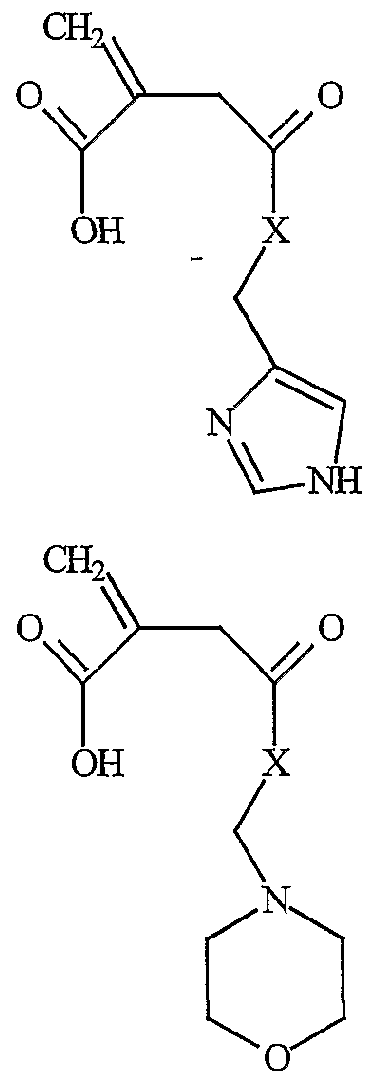
In einer besonders bevorzugten Ausführungsform der Erfindung ' umfassen die Polyampholyte zwitterionische Struktureinheiten aus acrylsubstituierten Hisitidinen, Diaminobenzoesäuren, Imidazoldicarbonsäuren; Maleinsäuremonoimidazolen, - morpholinen, -thiomorpholinen; der Itaconsäuremonoimidazole, - morpholine, -thiomorpholine; der Aconitsäuremonoimidazole, morpholine, -thiomorpholine und/oder -piperazine. Die folgende Tabelle gibt besonders bevorzugte Ausführungen für Struktureinheiten aus ethylenisch ungesättigten Monomeren wieder :
Acrylamido-Histidine . Der Rest Rl kann Wasserstoff, Methyl, Ethyl, Propyl, Isopropyl, Hydroxymethyl, Hydroxyethyl , Hydroxypropyl oder Hydroxyisopropyl sein. Anstelle der Acrylsäure kann sinngemäss auch Crotonsäure stehen.
N- (Acrylamido) -Diaminobenzoesäuren. Für den Rest Rl und die ethylenisch ungesättigte Gruppe gelten die oben gemachten Ausführungen. R2 ist unabhängig davon Wasserstoff, Methyl,. Ethyl, Propyl,
Figure imgf000011_0001
Isopropyl, Hydroxymethyl, Hydroxyethyl, Hydroxypropyl oder Hydroxyisopropyl oder eine Kombination dieser Reste.
Monomere umfassend Acrylsäure und Imidazol- (4, 5) -dicarbonsäure . Der Rest Rl kann Wasserstoff, Methyl, Ethyl, Propyl, Isopropyl, Hydroxymethyl, Hydroxyethyl, Hydroxypropyl oder Hydroxyisopropyl sein. Anstelle der Acrylsäure kann sinngemäss auch Crotonsäure stehen.
Die beiden funktionellen Elemente sind
Figure imgf000011_0002
über einen Spacer miteinander verbunden. X und Y sind bevorzugt unabhängig voneinander Stickstoff oder Sauerstoff, die zwischen den beiden Heteroatomen liegende Alkylkette hat 0 bis 8 C-Atome und ist linear oder verzweigt oder zyklisch geschlossen und kann weitere Hydroxylfunktionen enthalten. Der Spacer kann auch ein Polyethylenglykol sein.
Maleinsäuremonoimidazole oder -morpholine oder -thiomorpholine. Der Rest R3 kann Wasserstoff, Methyl, Ethyl, Propyl, Isopropyl, Hydroxymethyl, Hydroxyethyl, Hydroxypropyl oder Hydroxyisopropyl sein. Der Rest R3 kann auch eine weitere Carbonsäurefunktion umfassen, insbesondere kann anstelle der Maleisäure Aconitsäure stehen.
X ist Sauerstoff oder Stickstoff, die zwischen X und dem kationischen Rest liegende Alkylkette hat 0 bis 8 C-Atome und ist linear oder verzweigt oder
Figure imgf000012_0001
zyklisch geschlossen und kann weitere Hydroxylfunktionen enthalten. ( )n kann auch ein Polyethylenglykol sein.
Itaconsäuremonoimidazole oder -morpholine oder -thiomorpholine.
X ist Sauerstoff oder Stickstoff, die zwischen X und dem kationischen Rest liegende Alkylkette hat 0 bis 8 C-Atome und ist linear oder verzweigt oder zyklisch geschlossen und kann weitere Hydroxylfunktionen enthalten. ( )n kann auch ein Polyethylenglykol sein.
Figure imgf000012_0002
Aconitsäuremonopiperazine . X ist Sauerstoff oder Stickstoff, die zwischen X und dem Piperazin liegende Alkylkette hat 0 bis 8 C-Atome und ist linear oder verzweigt oder zyklisch geschlossen und kann weitere Hydroxylfunktionen enthalten. ( )n kann auch ein Polyethylenglykol sein.
Figure imgf000013_0001
Das Piperazin kann an der N' -Position weiter substituiert sein, insbesondere mit einem Methyl, Ethyl, Propyl, Isopropyl, Hydroxymethyl, Hydroxyethyl, Hydroxypropyl oder Hydroxy-isopropylrest .
Additionsprodukt aus Aminoethylpiperazin und Poly- (alt-Maleinsäure/Butadien) . Anstelle des Piperazins können auch Morpholin, Thiomorpholin oder Imidazol stehen.
Figure imgf000013_0002
Polymere, umfassend die genannten Struktureinheiten können sowohl durch Polymerisation der hier gezeigten Monomere entstehen, aber auch als graft-Polymere aus Vorläufern. Geeignete Precursoren sind etwa Poly- (alt-Maleinsäure- anhydrid/Ethylen) oder auch Poly- (acrylsäureanhydrid) oder Poly- (acryloylchlorid) , aus denen leicht die entsprechenden Ester oder Amide zugänglich sind.
Die Polyampholyte können weitere, insbesondere nichtionische Monomere enthalten. Besonders bevorzugte Ausführungsformen sind: statistische oder alternierende Copolymerisate der Acrylate oder Crotonate mit Acrylamid. alternierende Copolymerisate der Maleate, Itaconate oder Aconitate mit Ethylen oder Butadien.
Die Polymere aus ethylenisch ungesättigten Monomeren sind zumindest in ihrem Rückgrat nicht biologisch abbaubar. Sollen diese Polymere bei pharmazeutischen Anwendungen in den Körper gebracht werden, so ist deren Akkumulation nur durch Ausscheidung zu verhindern. Solche Polymere haben bevorzugt eine Molmasse von weniger als 100 kDa, besonders bevorzugt weniger als 30 kDa. Für ihre Funktionaliatt beim Aufbau von Polyelektrolytmultischichten sind Molmassen von mehr als 10 kDa vorteilhaft .
Biologisch abbaubare Polymere sind aus den Polyzuckern zugänglich. Vorteilhaft ist die Modifizierung von mindestens 20% bis zu 80% der Carboxylgruppen eines Alginats durch kationische Komponenten mit einem pK im Bereich zwischen 4 und 9. Geeignete Ladungsträger sind oben genannt.
Die folgende Tabelle gibt vorteilhafte Ausführungen für bevorzugte Strukturelemente in Polyzuckern.
Amide oder Ester der
)n Alginsäure . X bedeutet Stickstoff oder Sauerstoff, ( ) n ist eine Alkylkette mit 0 bis 8 C-Atomen und ist linear oder verzweigt oder zyklisch geschlossen
Figure imgf000014_0001
und kann weitere Hydroxylfunktionen enthalten. ( )n kann auch ein Polyethylenglykol sein. Als kationische Gruppe kann insbesondere auch
Morpholin, Thiomorpholin, Diaminobenzoesäure oder Piperazin stehen. Aminoester der Alginsäure .
( )n ist eine Alkylkette mit 0 bis 8 C-Atomen und ist linear oder verzweigt oder zyklisch geschlossen und kann weitere Hydroxylfunktionen
Figure imgf000015_0001
enthalten.
( ) n kann auch ein Polyethylenglykol sein. Als kationische Gruppe kann insbesondere auch
Morpholin, Thiomorpholin, Diaminobenzoesäure oder Piperazin stehen. reduzierte Schiffbasen aus Aminoimidazol und oxidierten Dextranen. R5 kann Wasserstoff,
Hydroxymethyl oder eine Carbonsäure sein .
( )n ist eine Alkylkette mit 0 bis 8 C-Atomen und ist linear oder verzweigt
Figure imgf000015_0002
oder zyklisch geschlossen und kann weitere Hydroxylfunktionen enthalten.
( ) n kann auch ein Polyethylenglykol sein. Als kationische Gruppe kann insbesondere auch
Morpholin, Thiomorpholin, Diaminobenzoesäure oder Piperazin stehen.
Figure imgf000016_0001
Die Erfindung lässt sich mit Vorteil auch durch den Einsatz von carboxylierten Polyethyleniminen realisieren. Diese Derivate sind durch Umsetzung der Polyethylenimine mit Halogencarbonsäuren, beipsielsweise Chloressigsäure, ethylenisch ungesättigten Carbonsäuren, beipsielsweise Acrylsäure, Methacrylsäure, Crotonsäure, Maleinsäure, Itconsäure, Aconitsäure, oder mit Säurechloriden oder anhydriden zugänglich beispielsweise Maleinsäureanhydrid, Itaconsäureanhydrid, Aconitsäureanhydrid,
Ethylendiaminoessigsäuredianhydrid.
In einer weiteren bevorzugten Ausführungsform umfassssen die Polyampholyte modifizierte Alginsäuren, Dextrane, Stärken, Glykogenen, Polyglycerolen, Guar Gummis oder Pektine sind, wobei diese mindestens einen Substituenten der Imidazole, Morpholine, Thiomorpholine, Piperazine, Histidine und/oder Diaminobenzoesäuren.
Die Erfindung betrifft auch die Verwendung der Nano- oder Mikrokapseln zur Verpackung und Freisetzung von Wirkstoffen.
In einer bevorzugten Ausführungsform werden die Kapseln zur oralen Wirkstoffapplikation verwendet, wobei eine Polymerhülle einen solchen pH-Wert aufweist, dass die Kapseln bei einem pH- Wert >=7 zerfallen. Dem Fachmann ist bekannt, welchen isoelektrischen Punkt der Polyampholyt hierzu aufweisen muss und wie dieser eingestellt werden kann. In einer vorteilhaften Verwendung solcher Nanokapseln werden diese für ein orales Transfersystem verwendet . Dabei erfolgt die Herstellung und Lagerung des wirks offtragenden Systems bei dem oben beschriebenen leicht sauren pH-Wert. Lösungen mit diesem pH sind problemlos oral aufnehmbar und passieren den sauren Mageninhalt in einer stabilen Form. Mit dem Erreichen des Zwölffingerdarms erfolgt eine Neutralisierung der Lösung, damit zerfallen die Hüllschichten und geben das Templat frei.
Besonders bevorzugt kann dieses System auf Basis von liposomalen Templaten verwendet werden. Die Liposomen können vom Fachmann so ausgeführt werden, dass sie dicht gegenüber pH-Schwankungen des Aussenmediums sind und dadurch den Wirkstoff vor dem Angriff der Magensäure schützen. Solche Liposomen sind beispielsweise für das remote-loading von Wirkstoffen entwickelt worden und im Stand der Technik bekannt. Nach dem Abwerfen der äußeren Hüllschicht stellt die Lipidmembran ihrerseits eine letzte Barriere für die Freisetzung eines eingeschlossenen Wirkstoffs dar. Eine letztliche Freisetzung aus den Liposomen ist aber durch die Aktivität der im Darm vorhandenen Phospholipasen und durch den Gallensaft gegeben.
In einer weiteren bevorzugten Ausführungsform werden die Kapseln zum Transport von Wirkstoffen in Zellen und/oder in Tumorgewebe verwendet, wobei die Kapseln bei einem pH-Wert <=7 zerfallen.
Eine weitere Möglichkeit des Transports von Wirkstoffen besteht in der Nutzung relativ fusogener Liposomen, die ihren Wirkstoff direkt in Zellen der Mucosa abgeben. Solche Liposomen sind dem Fachmann bekannt und enthalten größere Anteile von Phosphatidylethanolamin und/oder kationische Lipide. Diese Liposomen können mit Hüllen, umfassend Polyampholyte, bis in den Darm gebracht werden und geben dann den Wirkstoff direkt in die Zellen der Darmwand ab. In diesem Fall wird jeglicher Kontakt des Wirkstoffes mit dem Verdauungsapparat vermieden.
In einer weiteren vorteilhaften Verwendung der Erfindung werden die schaltbaren Nanokapseln zur rektalen Applikation von Wirkstoffen eingesetzt . Hier können die eigentlichen Wirkstoffträger wie Liposomen oder Emulsionen in rektal gut applizierbaren Darreichungsformen wie beispielsweise Suppositorien bei der Herstellung und Lagerung stabilisiert werden.
Eine weitere vorteilhafte Anwendung der erfinderischen Lehre lässt sich mit der gegensätzlich geladenen Kombination aus anionischem Protein - Albumin oder Kollagen bei pH >6, Hämoglobin bei pH>7.5 - und einem Polykation wie beispielsweise Chitosan, Polylysin oder Polyallylamin herstellen. Solche Nanokapseln sind sensitiv gegenüber sauren Milieus und können bei der Freisetzung von Wirkstoffen während der Endozytose, im Innern von Tumoren oder im Hautschweiss verwendet werden .
In einer besonders bevorzugten Ausführungsform werden die Kapseln zur Freisetzung von Wirkstoffen auf der Haut und/oder für kosmetische Zwecke, wobei die Kapseln bei einem pH-Wert <=7 zerfallen.
Eine weitere vorteilhafte Verwendung betrifft die Stabilisierung von Liposomen oder Emulsionen oder Doppelemulsionen in kosmetischen und pharmazeutischen Cremes oder Salben. Insbesondere Liposomen oder Doppelemulsionen sind in den gängigen Formulierungen instabil und geben den eingeschlossenen Wirkstoff schon während der Lagerung des Produktes frei . Eine Nanoverkapselung dieser Strukturen kann unter Verwendung von Polyampholyten so ausgeführt werden, dass die eigentlichen Wirkstoffträger während der Lagerung stabilisiert werden, aber auf der Haut wieder entkapselt vorliegen. In einer weiteren bevorzugten Ausführungsform werden die Kapseln zur Verkapselung und Freisetzung von Waschmittelenzymen verwendet, wobei die Kapseln bei einem pH- Wert <=9 zerfallen. Konzentrierte Flüssigwaschmittel haben einen pH-Wert zwischen 9 und 11, der beim Verdünnen in die Waschlδsung auf Werte um 8 sinkt. Unter diesen Bedingungen verringert sich die Ladung der verwendeten Proteasen erheblich und die Kapseln lösen sich mit der Verdünnung vollständig auf .
Besonders bevorzugt ist es, Waschmittelenzyme zu verwenden, die Proteasen und/oder Subtilisin umfassen. In dieser vorteilhaften Anwendungsform werden Nanokapseln aus Subtilisin und einem Polykation wie etwa Polyallylamin, Polyquaternium, Polyvinylpyridin, kationischer Stärke oder ähnlichen Verbindungen hergestellt. Die Protease als Wirkstoff ist in diesem Fall Bestandteil der Hüllschicht, als Templat werden entfernbare und ökologisch unbedenkliche Strukturen wie Liposomen oder Emulsionen eingesetzt. Durch die sehr geringe Größe der Strukturen tritt optisch keine Trübung des Produkts auf. Ein weiterer Vorteil ist durch den gleichzeitig möglichen Einsatz von anderen Waschmittelenzymen, wie etwa Zellulasen oder Lipasen gegeben. Solche Kombinationen sind mit konventionellen Formulierungen nicht herstellbar, da freie Protease zum schnellen Abbau der anderen Enzyme führt.
Die er indungsgemäßen Nanokapseln weisen gegenüber den bekannten Nanokapseln mehrere Vorteile auf . Bekannte Nanokapseln bestehen bisher unabhängig von ihrem Templat aus wasserlöslichen Polymeren, die durch ionische Wechselwirkungen zusammengehalten werden. Wesentlich für ihre Struktur ist das Vorhandensein einer Vielzahl von wechselwirkenden Gruppen an den verwendeten Polymeren. Durch die beim Aufbau stattfindende Vernetzung wird eine hohe Stabilität der Gesamtstruktur erzeugt, was zu einer extrem hohe Stabilität der Nanokapseln führt und die Freisetzung der eingeschlossenen Substanzen verhindert. Ein besonderer Vorteil der Verwendung von Polyampholyten für den Aufbau von Nanokapseln besteht darin, dass diese Kapseln unter einfachen Bedingungen wieder aufgelöst werden können. Dadurch sind diese Nanokapseln, insbesondere deren Hüllstruktur, als ein vielseitig nutzbares Verpackungs- und Freisetzungssystem nutzbar.
Weitere vorteilhafte Ausgestaltungsformen ergeben sich aus der Besehreibung.
Im folgenden soll die Erfindung anhand von Ausführungεbeispielen veranschaulicht werden, ohne die Erfindung darauf einzuschränken.
Beispiel 1
Liposomale Nanokapseln aus Albumin und Heparin
Herstellung der Liposomen
20 mol-% Dipalmitoylphosphatidylcholin und 80 mol-% Dipalmitoyl-phosphatidylglycerol werden in Isopropanol gelöst und unter Vakuum bis zur Trockene eingedampft. Der Lipidfilm wird anschließend in soviel Puffer (lOmM Hepes, 150mM NaCl pH7,5) rehydratisiert, dass eine Lipidkonzentration von 25mM erreicht wird. Die Suspension wird mindestens einmal eingefroren, bei 50°C wieder aufgetaut und dann mehrmals durch isopore Polykarbonatmembranen mit einer Porengröße von 200nm gedrückt .
Beschichtung mit Albumin und Heparin und Analyse der
Strukturen
Die Polymere werden in den Konzentrationen von l g/ml und 5mg/ml in Puffer (lOmM Natriumacetat , pH4) gelöst. Die Liposomen werden in Puffer (lOmM Natriumacetat, pH4) auf eine Lipidkonzentration von 0,2mM verdünnt. Zu 50ml dieser verdünnten Liposomen werden nacheinander geeignete Mengen der beiden Polymere (siehe Tabelle) zugemischt. Die jeweils eingesetzte Menge Polymer bindet hinreichend vollständig an die Partikeloberfläche, so dass keine Reinigungsschritte zwischengeschaltet werden müssen. Schicht (S) mg Polymer/mg Lipid
Sl BSA 1,00
S2 Heparin 0,33
S3 BSA 4,75
S4 Heparin 1,59
S5 BSA 12,66
S6 Heparin 4,22
lOOμl der Suspension werden anschließend durch Zugabe von lOOμl HEPES-Puffer (200mM, pH7.5) neutralisiert, die Probe wird dann durch ein Filter der Weite 0,lμm filtriert. Die enzymatische Aktivität kann im Filtrat nachgewiesen werden. Das ist nicht der Fall, wenn die zu filtrierende Suspension einen pH-Wert von weniger als 5 aufweist.
Beispiel 2
Liposomale Nanokapseln aus Subtilisin und Polyallylamin
Liposomen mit einer Zusammensetzung aus 40 Mol-% Cholesterylhemiεuccinat und 60 Mol-% Soja-Lecithin werden wie oben durch Extrusion hergestellt . Subtilisin wird mit einer
Konzentration von 5mg/ml und Polyallyamin mit einer
Konzentration von lmg/ml in Puffer (lOOmM Natriumcarbonat, pH
10.0) gelöst. Die Liposomen werden in Wasser auf eine Konzentration von 0.2mM verdünnt. Die unten aufgeführten Mengen Polymer werden nacheinander unter schnellem Rühren zu den Liposomen gegeben:
51 Polyallyamin 80μg/mg Lipid
52 Subtilisin 220μg/mg Lipid S3 Polyallylamin 150μg/mg Lipid
54 Subtilisin 840μg/mg Lipid
55 Polyallyamin 230μg/mg Lipid.
Die schichtweise Abscheidung des Polymers kann durch Messungen des Zetapotentials verfolgt werden.
lOOμl der Suspension werden anschließend durch Zugabe von lOOμl Phosphatpuffer (lOOmM, pH6.5) neutralisiert, die Probe wird dann durch ein Filter der Weite 0,lμm filtriert. Die enzymatische Aktivität kann im Filtrat nachgewiesen werden. Das ist nicht der Fall, wenn die zu filtrierende Suspension einen pH-Wert von mehr als 9 aufweist.
Beispiel 3
Synthese eines Polyampholyten 1
5g Poly- (alt-ethylene/maleic anhydride) , lOOkDa, werden in 100ml trockenem Dioxan gelöst. Dazu wird langsam 50ml einer Lösung von 60mMol 2-Aminoethylmorpholin in Dioxan gegeben. Die Lösung wird 2 Stunden bei 50°C gerührt und am Rotationsverdampfer auf 50ml eingeengt. Dem Produkt werden 500ml Wasser zugesetzt und der pH-Wert wird auf 7 eingestellt. Dioxan und überschüssiges Ammoethylmorpholm werden durch Ultrafiltration entfernt, das Polymer wird auf 100ml eingeengt und anschließend lyophilisiert .
Beispiel 4
Synthese eines Polyampholyten 2
2g Dextran (70kDa) werden in 100ml Puffer (lOmM HEPES, 150mM NaCl pH 8,0) gelöst. Zur Lösung werden unter Rühren nacheinander 50mMol L-Histidin und 20mMol Natriumperiodat gegeben, es wird 5 Stunden bei 60°C gerührt. Dabei wird der pH-Wert in einem Bereich zwischen 7 und 8 gehalten.
Nach dem Abkühlen werden 50mMol Natriumborhydrid zugegeben , die Mischung wird dann über Nacht weiter gerührt . Die Reinigung des Polymers erfolgt wie oben durch Ultrafiltration, zur Lagerung wird das Produkt lyophilisiert.

Claims

Patentansprüche
Auflösbare Nano- oder Mikrokapseln, umfassend ein kolloidales Templat in wassriger Lösung und komplementär geladene Polymere auf dem Templat, wobei mindestens eines der Polymere ein Polyampholyt ist, welcher durch eine pH- Wertänderung ent- oder umladbar ist.
2. Kapseln nach Anspruch 1, dadurch gekennzeichnet, dass das Templat ein Liposom, eine Öl- in Wasser- Emulsion, eine Wasser/Öl/Wasser-Doppelemulsion, einen anorganischen und/oder organischen Kristall umfasst .
3. Kapseln nach Anspruch 1 oder 2 , dadurch gekennzeichnet, dass die Differenz der pK-Werte von mindestens zwei Ladungsträgern der Polyampholyte nicht mehr als 3 Einheiten umfasst, besonders bevorzugt nicht mehr als 2 Einheiten.
4. Kapseln nach einem der Ansprüche 1 bis 3, dadurch gekennzeichnet, dass mindestens ein Polyampholyt einen isoelektrischen Punkt zwischen 4 und 9 aufweist.
5. Kapseln nach einem der Ansprüche 1 bis 4, dadurch gekennzeichnet, das die Polyampholyte Proteine umfassen.
Kapseln nach einem der Ansprüche 1 bis 5, dadurch gekennzeichnet, dass die Proteine Albumine, Hämoglobine, Myoglobine, Antikörper, Proteasen, Proteaseinhibitoren, Lipasen, Esterasen, Amylasen, Dehydrogenasen Kollagene, Fibrinogene, Protein A, Protein G, Lektine und/oder Histone umfassen.
7. Kapseln nach einem der Ansprüche 1 bis 6, dadurch gekennzeichnet, dass die Polyampholyte ethylenisch ungesättigten Struktureinheiten umfassen.
8. Kapseln nach einem der Ansprüche 1 bis 7, dadurch gekennzeichnet, dass die Polyampholyte zwitterionische Struktureinheiten aus acrylsubstituierten Hisitidinen, Diaminobenzoesäuren, Imidazoldicarbonsäuren; Maleinsäuremonoimidazolen, - morpholinen, -thiomorpholinen; der Itaconsäuremonoimidazole, -morpholine, -thiomorpholine; der Aconitsäuremonoimidazole, -morpholine, -thiomorpholine oder -piperazine umfassen.
9. Kapseln nach einem der Ansprüche 1 bis 8, dadurch gekennzeichnet, dass die Polyampholyte modifizierte Alginsäuren, Dextrane, Stärken, Glykogenen, Polyglycerolen, Guar Gummis oder Pektine sind, wobei diese mindestens einen Substituenten der Imidazole, Morpholine, Thiomorpholine, Piperazine, Histidine und/oder Diaminobenzoesäuren umfassen.
lo. Verfahren zur Herstellung von Nano- oder Mikrokapseln nach einem der Ansprüche 1 bis 9 in dem ein kolloidales Templat in wäßriger Lösung von Polymeren umhüllt wird, dadurch gekennzeichnet, dass die Polymere komplementär geladen und mindestens ein Polymer ein Polyampholyt ist .
11. Verwendung der Nano- oder Mikrokapseln nach einem der Ansprüche 1 bis 9 zur Verpackung und Freisetzung von Wirkstoffen.
12. Verwendung der Kapseln nach Anspruch 11 zur oralen Wirkstoffapplikation, dadurch gekennzeichnet, dass die Kapseln bei einem pH-Wert >=7 zerfallen.
13. Verwendung der Kapseln nach Anspruch 11 zum Transport von Wirkstoffen in Zellen und/oder in Tumorgewebe, dadurch gekennzeichnet, dass die Kapseln bei einem pH-Wert <=7 zerfallen.
14. Verwendung der Kapseln nach Anspruch 11 zur Freisetzung von Wirkstoffen auf der Haut und/oder für kosmetische Zwecke, dadurch gekennzeichnet, dass die Kapseln bei einem pH-Wert <=7 zerfallen.
15. Verwendung der Kapseln nach Anspruch 11 zur Verkapselung und Freisetzung von Waschmittelenzymen, dadurch gekennzeichnet, dass die Kapseln bei einem pH-Wert <=9 zerfallen.
16. Verwendung der Kapseln nach Anspruch 14, dadurch gekennzeichnet, das die Waschmittelenzyme Proteasen und/oder Subtilisin umfassen.
PCT/EP2002/006001 2001-05-31 2002-05-31 Auflösbare nano- und mikrokapseln, verfahren zu ihrer herstellung sowie ihre verwendung Ceased WO2002096551A1 (de)

Priority Applications (2)

Application Number Priority Date Filing Date Title
DE50210030T DE50210030D1 (de) 2001-05-31 2002-05-31 Auflösbare nano- und mikrokapseln, verfahren zu ihrer herstellung sowie ihre verwendung
EP02740675A EP1397200B1 (de) 2001-05-31 2002-05-31 Auflösbare nano- und mikrokapseln, verfahren zu ihrer herstellung sowie ihre verwendung

Applications Claiming Priority (2)

Application Number Priority Date Filing Date Title
DE10127526.9 2001-05-31
DE10127526A DE10127526A1 (de) 2001-05-31 2001-05-31 Verfahren zur Herstellung und Auflösung von Nano- und Mikrokapseln

Publications (1)

Publication Number Publication Date
WO2002096551A1 true WO2002096551A1 (de) 2002-12-05

Family

ID=7687420

Family Applications (1)

Application Number Title Priority Date Filing Date
PCT/EP2002/006001 Ceased WO2002096551A1 (de) 2001-05-31 2002-05-31 Auflösbare nano- und mikrokapseln, verfahren zu ihrer herstellung sowie ihre verwendung

Country Status (4)

Country Link
EP (1) EP1397200B1 (de)
AT (1) ATE360475T1 (de)
DE (2) DE10127526A1 (de)
WO (1) WO2002096551A1 (de)

Cited By (23)

* Cited by examiner, † Cited by third party
Publication number Priority date Publication date Assignee Title
WO2003043729A1 (de) * 2001-11-18 2003-05-30 Novosom Ag Nano- und mikrokapseln umfassend reaktivpolymere und verfahren zur herstellung dieser
EP1386959A1 (de) * 2002-07-31 2004-02-04 Rohm and Haas Zusammensetzungen mit ausgelöster Freisetzung
EP1549352A4 (de) * 2002-05-06 2005-07-27 Nucleonics Inc Verfahren zur abgabe von nukleinsäuren
US7153818B2 (en) 2000-07-28 2006-12-26 Henkel Kgaa Amylolytic enzyme extracted from bacillus sp. A 7-7 (DSM 12368) and washing and cleaning agents containing this novel amylolytic enzyme
WO2008084093A3 (en) * 2007-01-11 2009-01-08 Novozymes As Particles comprising active compounds
WO2008091228A3 (en) * 2007-01-24 2009-04-02 Univ Singapore Reverse phase layer-by-layer encapsulation of highly water soluble materials
WO2009082817A1 (en) 2007-12-27 2009-07-09 Protiva Biotherapeutics, Inc. Silencing of polo-like kinase expression using interfering rna
WO2009129319A2 (en) 2008-04-15 2009-10-22 Protiva Biotherapeutics, Inc. Silencing of csn5 gene expression using interfering rna
WO2010003934A1 (en) 2008-07-07 2010-01-14 Basf Se Enzyme composition comprising enzyme containing polymer particles
WO2009133071A3 (en) * 2008-04-30 2010-03-18 Consorzio Per Il Centro Di Biomedicina Molecolare Scrl Polyelectrolyte with positive net charge for use as medicament and diagnostic for cancer
EP2395012A2 (de) 2005-11-02 2011-12-14 Protiva Biotherapeutics Inc. Modifizierte siRNA-Moleküle und Verwendungen davon
WO2011160062A2 (en) 2010-06-17 2011-12-22 The Usa As Represented By The Secretary, National Institutes Of Health Compositions and methods for treating inflammatory conditions
WO2013075132A1 (en) 2011-11-17 2013-05-23 The United States Of America, As Represented By The Secretary, Department Of Health & Human Services Therapeutic rna switches compositions and methods of use
WO2013124327A1 (en) 2012-02-21 2013-08-29 Institut National De La Sante Et De La Recherche Medicale (Inserm) Tim receptors as virus entry cofactors
WO2013124324A1 (en) 2012-02-21 2013-08-29 Institut National De La Sante Et De La Recherche Medicale (Inserm) Tam receptors as virus entry cofactors
WO2014016152A1 (en) 2012-07-27 2014-01-30 Institut National De La Sante Et De La Recherche Medicale Cd147 as receptor for pilus-mediated adhesion of meningococci to vascular endothelia
US9035039B2 (en) 2011-12-22 2015-05-19 Protiva Biotherapeutics, Inc. Compositions and methods for silencing SMAD4
WO2016054421A1 (en) 2014-10-02 2016-04-07 Protiva Biotherapeutics, Inc Compositions and methods for silencing hepatitis b virus gene expression
WO2016197132A1 (en) 2015-06-04 2016-12-08 Protiva Biotherapeutics Inc. Treating hepatitis b virus infection using crispr
WO2017019891A2 (en) 2015-07-29 2017-02-02 Protiva Biotherapeutics, Inc. Compositions and methods for silencing hepatitis b virus gene expression
WO2019101882A1 (en) 2017-11-23 2019-05-31 INSERM (Institut National de la Santé et de la Recherche Médicale) New method for treating dengue virus infection
CN110573244A (zh) * 2017-04-28 2019-12-13 奇华顿股份有限公司 有机化合物中或与之相关的改进
EP4653462A2 (de) 2016-08-22 2025-11-26 Arbutus Biopharma Corporation Anti-pd-1-antikörper oder fragmente davon zur behandlung von hepatitis b

Families Citing this family (3)

* Cited by examiner, † Cited by third party
Publication number Priority date Publication date Assignee Title
DE102007027850A1 (de) * 2007-06-13 2008-12-24 Beiersdorf Ag Transparente kosmetische Formulierungen
KR20160098294A (ko) 2013-12-13 2016-08-18 레스토시, 엘엘씨 박탈성 모발 보유 촉진 제제
SG11201609241QA (en) 2014-05-16 2016-12-29 Restorsea Llc Biphasic cosmetic

Citations (4)

* Cited by examiner, † Cited by third party
Publication number Priority date Publication date Assignee Title
EP0681834A1 (de) * 1994-05-05 1995-11-15 Jürgen SCHREZENMEIR Mikrokapsel sowie Verfahren und Vorrichtung zu ihrer Herstellung
DE19810965A1 (de) * 1998-03-13 1999-09-16 Aventis Res & Tech Gmbh & Co Nanopartikel, Verfahren zu ihrer Herstellung und ihre Verwendung
WO2002009864A1 (de) * 2000-08-02 2002-02-07 MAX-PLANCK-Gesellschaft zur Förderung der Wissenschaften e.V. Verkapselung von flüssigen templatpartikeln
WO2002031092A2 (de) * 2000-10-11 2002-04-18 Henkel Kommanditgesellschaft Auf Aktien Verfahren zum einbringen von parfümölen in wasch- und reinigungsmittel oder kosmetika

Family Cites Families (2)

* Cited by examiner, † Cited by third party
Publication number Priority date Publication date Assignee Title
DE19907552A1 (de) * 1999-02-22 2000-08-31 Max Planck Gesellschaft Polyelektrolythüllen auf biologischen Templaten
DE10037707A1 (de) * 2000-08-02 2002-02-14 Max Planck Gesellschaft Polyelektrolytkapselherstellung durch Oberflächenpräzipitation

Patent Citations (4)

* Cited by examiner, † Cited by third party
Publication number Priority date Publication date Assignee Title
EP0681834A1 (de) * 1994-05-05 1995-11-15 Jürgen SCHREZENMEIR Mikrokapsel sowie Verfahren und Vorrichtung zu ihrer Herstellung
DE19810965A1 (de) * 1998-03-13 1999-09-16 Aventis Res & Tech Gmbh & Co Nanopartikel, Verfahren zu ihrer Herstellung und ihre Verwendung
WO2002009864A1 (de) * 2000-08-02 2002-02-07 MAX-PLANCK-Gesellschaft zur Förderung der Wissenschaften e.V. Verkapselung von flüssigen templatpartikeln
WO2002031092A2 (de) * 2000-10-11 2002-04-18 Henkel Kommanditgesellschaft Auf Aktien Verfahren zum einbringen von parfümölen in wasch- und reinigungsmittel oder kosmetika

Non-Patent Citations (2)

* Cited by examiner, † Cited by third party
Title
MEYENBURG S ET AL: "Fibrin encapsulated liposomes as protein delivery system - Studies on the in vitro release behavior", JOURNAL OF CONTROLLED RELEASE, ELSEVIER SCIENCE PUBLISHERS B.V. AMSTERDAM, NL, vol. 69, no. 1, 3 October 2000 (2000-10-03), pages 159 - 168, XP004217542, ISSN: 0168-3659 *
WEN S ET AL: "Microcapsules through polymer complexation - Part 3: encapsulation and culture of human Burkitt lymphoma cells in vitro", BIOMATERIALS, ELSEVIER SCIENCE PUBLISHERS BV., BARKING, GB, vol. 16, no. 4, 1995, pages 325 - 335, XP004033057, ISSN: 0142-9612 *

Cited By (28)

* Cited by examiner, † Cited by third party
Publication number Priority date Publication date Assignee Title
US7153818B2 (en) 2000-07-28 2006-12-26 Henkel Kgaa Amylolytic enzyme extracted from bacillus sp. A 7-7 (DSM 12368) and washing and cleaning agents containing this novel amylolytic enzyme
WO2003043729A1 (de) * 2001-11-18 2003-05-30 Novosom Ag Nano- und mikrokapseln umfassend reaktivpolymere und verfahren zur herstellung dieser
EP2298358A1 (de) * 2002-05-06 2011-03-23 Alnylam Pharmaceuticals Inc. Methoden zum Nukleinsäuren-Transfer
EP1549352A4 (de) * 2002-05-06 2005-07-27 Nucleonics Inc Verfahren zur abgabe von nukleinsäuren
EP1386959A1 (de) * 2002-07-31 2004-02-04 Rohm and Haas Zusammensetzungen mit ausgelöster Freisetzung
EP2395012A2 (de) 2005-11-02 2011-12-14 Protiva Biotherapeutics Inc. Modifizierte siRNA-Moleküle und Verwendungen davon
WO2008084093A3 (en) * 2007-01-11 2009-01-08 Novozymes As Particles comprising active compounds
US9499773B2 (en) 2007-01-11 2016-11-22 Novozymes A/S Enzyme particles comprising a vinyl pyrrolidone/vinyl acetate copolymer
WO2008091228A3 (en) * 2007-01-24 2009-04-02 Univ Singapore Reverse phase layer-by-layer encapsulation of highly water soluble materials
WO2009082817A1 (en) 2007-12-27 2009-07-09 Protiva Biotherapeutics, Inc. Silencing of polo-like kinase expression using interfering rna
WO2009129319A2 (en) 2008-04-15 2009-10-22 Protiva Biotherapeutics, Inc. Silencing of csn5 gene expression using interfering rna
EP2770057A1 (de) 2008-04-15 2014-08-27 Protiva Biotherapeutics Inc. Stilllegung von CSN5-Genexpression mittels interferierender RNA
WO2009133071A3 (en) * 2008-04-30 2010-03-18 Consorzio Per Il Centro Di Biomedicina Molecolare Scrl Polyelectrolyte with positive net charge for use as medicament and diagnostic for cancer
US9029310B2 (en) 2008-07-07 2015-05-12 Basf Se Enzyme composition comprising enzyme containing polymer particles
WO2010003934A1 (en) 2008-07-07 2010-01-14 Basf Se Enzyme composition comprising enzyme containing polymer particles
WO2011160062A2 (en) 2010-06-17 2011-12-22 The Usa As Represented By The Secretary, National Institutes Of Health Compositions and methods for treating inflammatory conditions
WO2013075132A1 (en) 2011-11-17 2013-05-23 The United States Of America, As Represented By The Secretary, Department Of Health & Human Services Therapeutic rna switches compositions and methods of use
US9035039B2 (en) 2011-12-22 2015-05-19 Protiva Biotherapeutics, Inc. Compositions and methods for silencing SMAD4
WO2013124324A1 (en) 2012-02-21 2013-08-29 Institut National De La Sante Et De La Recherche Medicale (Inserm) Tam receptors as virus entry cofactors
WO2013124327A1 (en) 2012-02-21 2013-08-29 Institut National De La Sante Et De La Recherche Medicale (Inserm) Tim receptors as virus entry cofactors
WO2014016152A1 (en) 2012-07-27 2014-01-30 Institut National De La Sante Et De La Recherche Medicale Cd147 as receptor for pilus-mediated adhesion of meningococci to vascular endothelia
WO2016054421A1 (en) 2014-10-02 2016-04-07 Protiva Biotherapeutics, Inc Compositions and methods for silencing hepatitis b virus gene expression
WO2016197132A1 (en) 2015-06-04 2016-12-08 Protiva Biotherapeutics Inc. Treating hepatitis b virus infection using crispr
WO2017019891A2 (en) 2015-07-29 2017-02-02 Protiva Biotherapeutics, Inc. Compositions and methods for silencing hepatitis b virus gene expression
EP4653462A2 (de) 2016-08-22 2025-11-26 Arbutus Biopharma Corporation Anti-pd-1-antikörper oder fragmente davon zur behandlung von hepatitis b
CN110573244A (zh) * 2017-04-28 2019-12-13 奇华顿股份有限公司 有机化合物中或与之相关的改进
CN110573244B (zh) * 2017-04-28 2022-04-01 奇华顿股份有限公司 有机化合物中或与之相关的改进
WO2019101882A1 (en) 2017-11-23 2019-05-31 INSERM (Institut National de la Santé et de la Recherche Médicale) New method for treating dengue virus infection

Also Published As

Publication number Publication date
ATE360475T1 (de) 2007-05-15
DE50210030D1 (de) 2007-06-06
EP1397200A1 (de) 2004-03-17
EP1397200B1 (de) 2007-04-25
DE10127526A1 (de) 2002-12-12

Similar Documents

Publication Publication Date Title
EP1397200B1 (de) Auflösbare nano- und mikrokapseln, verfahren zu ihrer herstellung sowie ihre verwendung
EP1363601B1 (de) Amphotere liposomen und verwendung dieser
EP1289642B2 (de) Nanokapseln mit einer polyelektrolythülle
Nishimura et al. Substrate-sorting nanoreactors based on permeable peptide polymer vesicles and hybrid liposomes with synthetic macromolecular channels
Bramer et al. Pharmaceutical applications for catanionic mixtures
DE69927841T2 (de) Partikel auf polyaminosäure(n)basis sowie deren herstellungsverfahren
EP1131053B1 (de) Nanokapseln und verfahren zur herstellung dieser
DE69609222T2 (de) Partikel auf Polyaminosäure(n)basis zur Verwendung als Wirkstoffträger sowie deren Herstellungsverfahren
EP1061904A1 (de) Nanopartikel, verfahren zu ihrer herstellung und ihre verwendung
US20080031937A1 (en) Amphoteric liposomes and their use
HU184714B (en) Process for the purification of lyposoma suspensions
RU2465009C2 (ru) Комплекс нуклеиновой кислоты и композиция для доставки нуклеиновой кислоты
DE69219561T2 (de) Biologisch abbaubarer partikelförmiger vektor und syntheseverfahren
WO2003043729A1 (de) Nano- und mikrokapseln umfassend reaktivpolymere und verfahren zur herstellung dieser
CN101479384B (zh) 核酸导入用组合物
CN109843851A (zh) pH响应型脂质
JP2005247967A (ja) 高分子電解質複合体およびその製造方法
JPWO2005092389A1 (ja) 複合粒子および被覆複合粒子
DE10223078B4 (de) Polyampholyte und Verwendung als Polyelektrolytmultischichten
Moulik et al. An Overview of Coacervates: The Special Disperse State of Amphiphilic and Polymeric Materials in Solution. Colloids Interfaces 2022, 6, 45
EP3115039B1 (de) Verfahren zum herstellen einer fusionsmischung zur übertragung eines geladenen moleküls in und/oder durch eine lipidmembran
WO2012049159A1 (de) Zusammensetzung zur behandlung von krebs mit kontrollierter freisetzung des wirkstoffs
Kotcha The Study and Characterization of the Nano-encapsulation of Clotrimazole Into N-phthanoyl Chitosan-g-mPEG Self Assembly

Legal Events

Date Code Title Description
AK Designated states

Kind code of ref document: A1

Designated state(s): AE AG AL AM AT AU AZ BA BB BG BR BY BZ CA CH CN CO CR CU CZ DE DK DM DZ EC EE ES FI GB GD GE GH GM HR HU ID IL IN IS JP KE KG KP KR KZ LC LK LR LS LT LU LV MA MD MG MK MN MW MX MZ NO NZ OM PH PL PT RO RU SD SE SG SI SK SL TJ TM TN TR TT TZ UA UG US UZ VN YU ZA ZM ZW

AL Designated countries for regional patents

Kind code of ref document: A1

Designated state(s): GH GM KE LS MW MZ SD SL SZ TZ UG ZM ZW AM AZ BY KG KZ MD RU TJ TM AT BE CH CY DE DK ES FI FR GB GR IE IT LU MC NL PT SE TR BF BJ CF CG CI CM GA GN GQ GW ML MR NE SN TD TG

121 Ep: the epo has been informed by wipo that ep was designated in this application
DFPE Request for preliminary examination filed prior to expiration of 19th month from priority date (pct application filed before 20040101)
WWE Wipo information: entry into national phase

Ref document number: 2002740675

Country of ref document: EP

WWP Wipo information: published in national office

Ref document number: 2002740675

Country of ref document: EP

REG Reference to national code

Ref country code: DE

Ref legal event code: 8642

NENP Non-entry into the national phase

Ref country code: JP

WWW Wipo information: withdrawn in national office

Country of ref document: JP

WWG Wipo information: grant in national office

Ref document number: 2002740675

Country of ref document: EP