WO2003013281A1 - Process for producing fermented fish food - Google Patents
Process for producing fermented fish food Download PDFInfo
- Publication number
- WO2003013281A1 WO2003013281A1 PCT/JP2002/007951 JP0207951W WO03013281A1 WO 2003013281 A1 WO2003013281 A1 WO 2003013281A1 JP 0207951 W JP0207951 W JP 0207951W WO 03013281 A1 WO03013281 A1 WO 03013281A1
- Authority
- WO
- WIPO (PCT)
- Prior art keywords
- lactic acid
- producing
- fish
- fermented
- salt
- Prior art date
- Legal status (The legal status is an assumption and is not a legal conclusion. Google has not performed a legal analysis and makes no representation as to the accuracy of the status listed.)
- Ceased
Links
Classifications
-
- A—HUMAN NECESSITIES
- A23—FOODS OR FOODSTUFFS; TREATMENT THEREOF, NOT COVERED BY OTHER CLASSES
- A23B—PRESERVATION OF FOODS, FOODSTUFFS OR NON-ALCOHOLIC BEVERAGES; CHEMICAL RIPENING OF FRUIT OR VEGETABLES
- A23B4/00—Preservation of meat, sausages, fish or fish products
- A23B4/044—Smoking; Smoking devices
-
- A—HUMAN NECESSITIES
- A23—FOODS OR FOODSTUFFS; TREATMENT THEREOF, NOT COVERED BY OTHER CLASSES
- A23B—PRESERVATION OF FOODS, FOODSTUFFS OR NON-ALCOHOLIC BEVERAGES; CHEMICAL RIPENING OF FRUIT OR VEGETABLES
- A23B4/00—Preservation of meat, sausages, fish or fish products
- A23B4/005—Preserving by heating
-
- A—HUMAN NECESSITIES
- A23—FOODS OR FOODSTUFFS; TREATMENT THEREOF, NOT COVERED BY OTHER CLASSES
- A23B—PRESERVATION OF FOODS, FOODSTUFFS OR NON-ALCOHOLIC BEVERAGES; CHEMICAL RIPENING OF FRUIT OR VEGETABLES
- A23B4/00—Preservation of meat, sausages, fish or fish products
- A23B4/02—Preserving by means of inorganic salts
- A23B4/023—Preserving by means of inorganic salts by kitchen salt or mixtures thereof with inorganic or organic compounds
- A23B4/0235—Preserving by means of inorganic salts by kitchen salt or mixtures thereof with inorganic or organic compounds with organic compounds or biochemical products
-
- A—HUMAN NECESSITIES
- A23—FOODS OR FOODSTUFFS; TREATMENT THEREOF, NOT COVERED BY OTHER CLASSES
- A23B—PRESERVATION OF FOODS, FOODSTUFFS OR NON-ALCOHOLIC BEVERAGES; CHEMICAL RIPENING OF FRUIT OR VEGETABLES
- A23B4/00—Preservation of meat, sausages, fish or fish products
- A23B4/03—Drying; Subsequent reconstitution
-
- A—HUMAN NECESSITIES
- A23—FOODS OR FOODSTUFFS; TREATMENT THEREOF, NOT COVERED BY OTHER CLASSES
- A23B—PRESERVATION OF FOODS, FOODSTUFFS OR NON-ALCOHOLIC BEVERAGES; CHEMICAL RIPENING OF FRUIT OR VEGETABLES
- A23B4/00—Preservation of meat, sausages, fish or fish products
- A23B4/12—Preserving with acids; Acid fermentation
-
- A—HUMAN NECESSITIES
- A23—FOODS OR FOODSTUFFS; TREATMENT THEREOF, NOT COVERED BY OTHER CLASSES
- A23B—PRESERVATION OF FOODS, FOODSTUFFS OR NON-ALCOHOLIC BEVERAGES; CHEMICAL RIPENING OF FRUIT OR VEGETABLES
- A23B4/00—Preservation of meat, sausages, fish or fish products
- A23B4/14—Preserving with chemicals not covered by groups A23B4/02 or A23B4/12
- A23B4/18—Preserving with chemicals not covered by groups A23B4/02 or A23B4/12 in the form of liquids or solids
- A23B4/20—Organic compounds; Microorganisms; Enzymes
- A23B4/22—Microorganisms; Enzymes; Antibiotics
-
- A—HUMAN NECESSITIES
- A23—FOODS OR FOODSTUFFS; TREATMENT THEREOF, NOT COVERED BY OTHER CLASSES
- A23L—FOODS, FOODSTUFFS OR NON-ALCOHOLIC BEVERAGES, NOT OTHERWISE PROVIDED FOR; PREPARATION OR TREATMENT THEREOF
- A23L17/00—Food-from-the-sea products; Fish products; Fish meal; Fish-egg substitutes; Preparation or treatment thereof
-
- A—HUMAN NECESSITIES
- A23—FOODS OR FOODSTUFFS; TREATMENT THEREOF, NOT COVERED BY OTHER CLASSES
- A23L—FOODS, FOODSTUFFS OR NON-ALCOHOLIC BEVERAGES, NOT OTHERWISE PROVIDED FOR; PREPARATION OR TREATMENT THEREOF
- A23L17/00—Food-from-the-sea products; Fish products; Fish meal; Fish-egg substitutes; Preparation or treatment thereof
- A23L17/40—Shell-fish
-
- A—HUMAN NECESSITIES
- A23—FOODS OR FOODSTUFFS; TREATMENT THEREOF, NOT COVERED BY OTHER CLASSES
- A23L—FOODS, FOODSTUFFS OR NON-ALCOHOLIC BEVERAGES, NOT OTHERWISE PROVIDED FOR; PREPARATION OR TREATMENT THEREOF
- A23L17/00—Food-from-the-sea products; Fish products; Fish meal; Fish-egg substitutes; Preparation or treatment thereof
- A23L17/50—Molluscs
-
- A—HUMAN NECESSITIES
- A23—FOODS OR FOODSTUFFS; TREATMENT THEREOF, NOT COVERED BY OTHER CLASSES
- A23L—FOODS, FOODSTUFFS OR NON-ALCOHOLIC BEVERAGES, NOT OTHERWISE PROVIDED FOR; PREPARATION OR TREATMENT THEREOF
- A23L17/00—Food-from-the-sea products; Fish products; Fish meal; Fish-egg substitutes; Preparation or treatment thereof
- A23L17/65—Addition of, or treatment with, microorganisms or enzymes
-
- A—HUMAN NECESSITIES
- A23—FOODS OR FOODSTUFFS; TREATMENT THEREOF, NOT COVERED BY OTHER CLASSES
- A23V—INDEXING SCHEME RELATING TO FOODS, FOODSTUFFS OR NON-ALCOHOLIC BEVERAGES AND LACTIC OR PROPIONIC ACID BACTERIA USED IN FOODSTUFFS OR FOOD PREPARATION
- A23V2400/00—Lactic or propionic acid bacteria
- A23V2400/11—Lactobacillus
- A23V2400/179—Sakei
-
- A—HUMAN NECESSITIES
- A23—FOODS OR FOODSTUFFS; TREATMENT THEREOF, NOT COVERED BY OTHER CLASSES
- A23V—INDEXING SCHEME RELATING TO FOODS, FOODSTUFFS OR NON-ALCOHOLIC BEVERAGES AND LACTIC OR PROPIONIC ACID BACTERIA USED IN FOODSTUFFS OR FOOD PREPARATION
- A23V2400/00—Lactic or propionic acid bacteria
- A23V2400/31—Leuconostoc
-
- A—HUMAN NECESSITIES
- A23—FOODS OR FOODSTUFFS; TREATMENT THEREOF, NOT COVERED BY OTHER CLASSES
- A23V—INDEXING SCHEME RELATING TO FOODS, FOODSTUFFS OR NON-ALCOHOLIC BEVERAGES AND LACTIC OR PROPIONIC ACID BACTERIA USED IN FOODSTUFFS OR FOOD PREPARATION
- A23V2400/00—Lactic or propionic acid bacteria
- A23V2400/41—Pediococcus
Definitions
- the present invention relates to a method for producing a processed fishery product using fish and shellfish as a raw material, and more particularly to a processed fishery product therefor.
- An object of the present invention is to provide a novel fermented fish meat food having a unique taste and flavor imparted by lactic acid fermentation using fish meat as a raw material and having a meat-like texture.
- the gist of the present invention is to provide a method for producing a processed marine product, wherein lactic acid fermentation of fish and shellfish is carried out by using lactic acid bacteria having fermentation at a temperature of 10 ° C. or lower and having salt resistance and antibacterial properties.
- Lactic acid bacteria that are fermented at 1 o ° c or less and have salt-tolerant antibacterial properties are the group consisting of Leuconostoc, Lactobacillus, Lactococcus, and Pediococcus. Lactobacillus belonging to the genus selected from the group consisting of genus Leuconostoc, Lactobacillus, Lactobaci l lus, Lactococcus and Lactococcus.
- the lactic acid bacterium belonging to the genus Lactobacillus is Lactobacillus sake
- the present invention relates to a lactic acid bacterium having a salt-tolerant antibacterial property that is fermented at 10 ° C or less when lactic acid fermentation of fish and shellfish is performed.
- This is a method for producing a processed marine product, characterized by using a lactic acid bacterium belonging to Lactobacillus sake.
- the lactic acid bacterium belonging to Rata tobacillus salmon (Lactobacillus sake) is Lactobacillus sake D—1001 (Sekiken-Kyokai No. 1178), and the present invention relates to fish and shellfish.
- Lactobacillus sake D-1001 as a lactic acid bacterium that is fermented at a temperature of 10 ° C or less and has salt-tolerant antibacterial properties when fermented with acetic acid.
- No. 08 is a method for producing processed fishery products.
- the present invention relates to a method of performing a salt treatment step before, simultaneously with, or after a lactic acid fermentation step.
- the present invention is characterized in that, when lactic acid fermentation of fish and shellfish is performed, a salt treatment step is performed before, simultaneously with, or after the lactic acid fermentation step, and has a salt-resistant antibacterial property by fermenting at 1 ° C or less.
- a lactic acid bacterium more specifically a lactic acid bacterium belonging to the genus selected from the group consisting of the genus Leuconostoc, the genus Lactobacillus, the genus Lactococcus and the genus Pediococcus, preferably Lactobacillus salmon, more preferably D-1001 (No. 117708), preferably fermented at 10 ° C or lower, followed by smoking and drying
- This is a method for producing a processed seafood product that has been subjected to salt treatment.
- the present invention is characterized in that a heating step is provided after the lactic acid fermentation step, and the present invention provides a lactic acid bacterium having fermentation at 1 ° C or lower and having salt resistance and antibacterial properties when lactic acid fermentation of fish and shellfish is performed.
- a heating step is provided after the lactic acid fermentation step, and the present invention provides a lactic acid bacterium having fermentation at 1 ° C or lower and having salt resistance and antibacterial properties when lactic acid fermentation of fish and shellfish is performed.
- Leukonostuk In the genus Leukonostuk
- a process for producing a heat-processed marine processed product which comprises performing a salt treatment step before, simultaneously with, or after the fermentation step, and performing smoking and drying after the lactic acid fermentation step.
- the seafood is characterized in that the meat portion of the raw seafood is used as it is or in a minced form. Use the meat part as is or minced, and use lactic acid bacteria that are fermented at 1 o ° C or less and have salt and antibacterial properties, more specifically Leuconostoc spp.
- the present invention provides a marine product manufactured by the above-described method of the present invention.
- the raw material of seafood is mixed with salt and lactic acid bacteria that have been cultured and grown in advance, and lactic acid fermentation is performed at a low temperature of 1 o ° c or less, and smoke is applied. Then, by drying while controlling the temperature and humidity, a fermented fish meat food having a taste and flavor derived from lactic acid fermentation and a meat-like texture can be obtained.
- the raw material used is a marine product, the rate of spoilage is higher than that of livestock meat, and if the temperature is not low, an unpleasant odor or an unpleasant taste may be generated. Therefore, the lactic acid bacteria used are preferably low-temperature lactic acid bacteria that grow at low temperatures.
- This lactic acid bacterium can be of any genus if it is a low temperature lactic acid bacterium. That is, Leuconostoc, Lactobacillus Lactococcus, and Pediococcus can be used, among which relatively low acid productivity and salt tolerance Lactopatil, a low-temperature lactic acid bacterium with antibacterial properties Su salmon (Lactobaci llus sake) is preferred. In addition, it is possible to newly separate and use the food from microorganisms belonging to each of these genera. Lactobacillus salmon (which is salt-tolerant, antibacterial and capable of growing at low temperatures to prevent the generation of odors due to rot and oxidation due to microbial contamination and to enhance the taste and flavor at the same time.
- Lactobacillus salmon which is salt-tolerant, antibacterial and capable of growing at low temperatures to prevent the generation of odors due to rot and oxidation due to microbial contamination and to enhance the taste and flavor at the same time.
- Lata tobacillus salmon (Lactobaci l lus sake) D _ 1001 Bacteria No. 1 1178) is more preferred.
- This rata tobatinoles' salmon (Lactobacillus sake) D—1001 (Sekiken-Kyo-Kai No. 11780) has the following mycological properties.
- ⁇ Generates acid from xenoylose, manoletoose, mannose, funolectose, galactose, sucrose, cellobiose, ratatoose, dextrin, gnoreconate, salicin, trehalose, melibiose, and reportose. Sorbitol, sorbose, mannitol, meletitol, raffinose, no production of acid from rhamnose.
- the fish and shellfish used as a raw material for producing the fermented marine product used in the present invention may be any fish and shellfish, such as hoki, salmon, aji, tuna, bonito, cod, squid, octopus, shrimp, and krill.
- salt, auxiliary materials, and lactic acid bacteria previously cultured and grown are added and mixed, and kept at a low temperature of 1 ° C or less. Then, smoke and dry. In the meantime, lactic acid fermentation progresses, and slow drying occurs, resulting in a fermented fish meat food with a taste and flavor derived from lactic acid fermentation and a meat-like texture.
- the marine fermented food of the present invention is produced by adding lactic acid bacteria cultured in advance together with salt to fish and shellfish meat and subjecting them to lactic acid fermentation, followed by a dry ripening step.
- the number of general bacteria is 103 or less.
- the general method for producing the fermented marine food of the present invention is as described below.
- the raw fish and shellfish may be raw or frozen, but it is preferable to handle them carefully to avoid microbial contamination as much as possible. Use the edible part of raw fish and shellfish as is or mince.
- the lactic acid bacterium to be used is cultivated beforehand to about 109 / g. Mix lactic acid bacteria with salt and auxiliary materials.
- the seafood is minced, mix as it is. If the seafood is a fillet, use a syringe or the like to inject or soak the fish meat. After casing these, put them in a shallow container with good air permeability and ferment at a temperature of 10 ° C or less and a humidity of 40% to 95% for 1 day to 2 weeks. Keeping the temperature below 1 o ° c has the technical significance of preventing the growth of various bacteria, adjusting fermentation and maintaining humidity.
- the fermented food produced through this process had a taste and flavor derived from lactic acid fermentation and a unique umami and body derived from seafood, and exhibited a meat-like texture.
- This food has excellent preservability due to antibacterial substances produced by lactic acid bacteria, and can be stored at room temperature, chilled or frozen depending on the degree of drying and water activity.
- the processed fishery products requiring salt treatment include salt shakes represented by salted salmon, salted fish and shellfish, and products obtained by processing them into flakes.
- a general method for producing a lactic acid-fermented salmon flake of the present invention is as follows. First, the raw fish and shellfish may be raw or frozen, but are used in a thawed state.
- Lactic acid-fermented fish and shellfish meat has enhanced antibacterial properties due to antibacterial components derived from lactic acid bacteria, and has excellent properties, such as the ability of lactic acid to retain water and the acidic proteases to act appropriately when acidified. It becomes seafood meat. This effect is particularly remarkable in salted fish that is hardened by salting and in salted fish products. Action
- the fermented marine product of the present invention is a salt-tolerant, antibacterial, and low-temperature lactic acid bacterium, Lactobacillus-salmon (Lactobacil lus sake) D—1001 to prevent microbial contamination and enhance taste and flavor. It is important to use (Shin-Keken Bacteria No. 1178) and fish and shellfish as the main raw material. Furthermore, lactic acid fermentation by lactic acid bacteria and smoke with controlled temperature and humidity Smoke and drying promote lactic acid fermentation and cause slow drying, resulting in a fermented fish meat food with lactic acid fermentation-derived taste, flavor, and meat-like texture. A fermented marine product is obtained.
- salt shaking and salting which tend to be hardened by salt treatment, increase the water retentivity of the processed seafood meat that is salted, and provide a soft meat.
- Example 1 Example 1
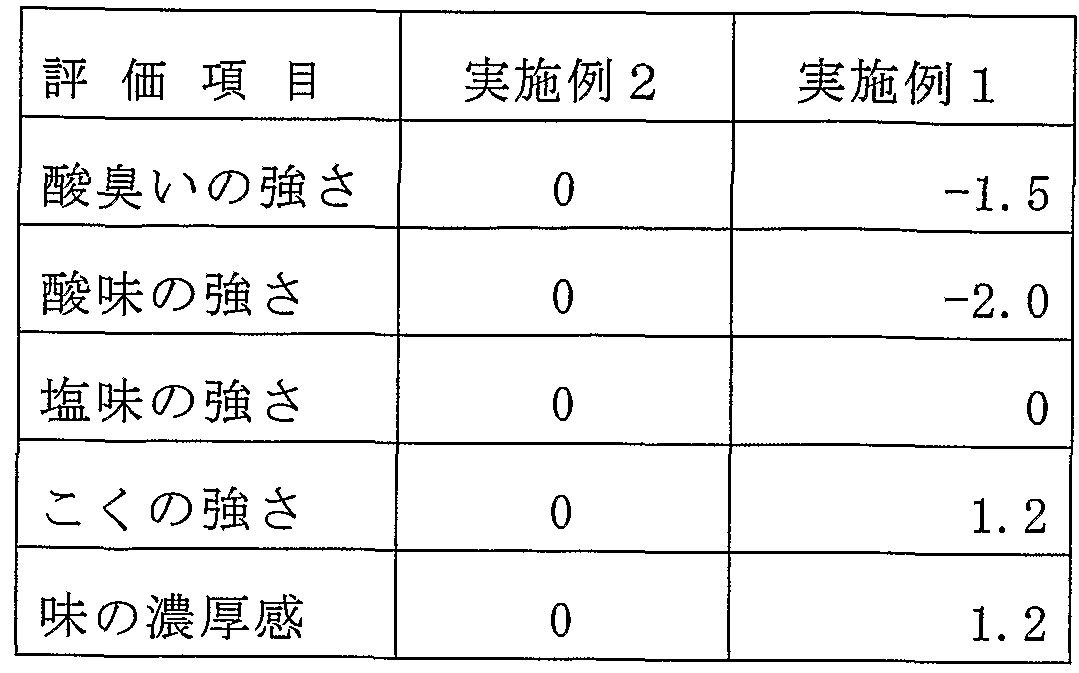
- Example 2 using the fishery fermented sausages obtained in Example 1 and Example 2 using a well-trained sensory evaluation panel 15 people, the sample of Example 1 was evaluated when the evaluation of the sample of Example 2 was 0. Was evaluated by the rank method of 1 to 4 + 4. The results are shown in Table 2.
- Example 1 was prepared using ratatobacillus salmon D_ 1001 strain.
- Example 1 was also prepared using ratatobacillus plantarum JCM1149 strain. In Example 2, sufficient growth of lactic acid bacteria was observed. Further, Example 2 using ratatobacillus plantarum JCM11149, which has a high acid productivity, exhibited a faster decrease in pH. Table 2
- Example 2 the fermented seafood sausage prepared in Example 1 has a weaker acid smell and acidity than those prepared in Example 2.
- Example 3 Example 3
- lactic acid bacteria having salt resistance and antibacterial properties which can grow at low temperatures, act on fish and shellfish, and produce lactic acid fermented, smoked, and dried to obtain a fermented marine product having a reduced sourness, It is a processed marine product with a good texture and a good flavor.
- salted fish products that tend to be hardened due to salt treatment, and have a high water retention property and are processed fish products that have a soft texture can be obtained.
Landscapes
- Life Sciences & Earth Sciences (AREA)
- Engineering & Computer Science (AREA)
- Chemical & Material Sciences (AREA)
- Food Science & Technology (AREA)
- Zoology (AREA)
- Polymers & Plastics (AREA)
- Wood Science & Technology (AREA)
- Health & Medical Sciences (AREA)
- Nutrition Science (AREA)
- Marine Sciences & Fisheries (AREA)
- Chemical Kinetics & Catalysis (AREA)
- General Chemical & Material Sciences (AREA)
- Microbiology (AREA)
- Inorganic Chemistry (AREA)
- Meat, Egg Or Seafood Products (AREA)
Description

Claims
Priority Applications (4)
| Application Number | Priority Date | Filing Date | Title |
|---|---|---|---|
| JP2003518306A JP4248395B2 (ja) | 2001-08-06 | 2002-08-05 | 水産発酵食品の製造方法 |
| EP02755814A EP1415547A4 (en) | 2001-08-06 | 2002-08-05 | PROCESS FOR PRODUCING FERMENTED FISH FOOD |
| US10/485,860 US6884455B2 (en) | 2001-08-06 | 2002-08-05 | Process for producing fermented fish food |
| NO20040184A NO20040184L (no) | 2001-08-06 | 2004-01-16 | Fremgangsmate for a fremstille gjaeret sjomat |
Applications Claiming Priority (2)
| Application Number | Priority Date | Filing Date | Title |
|---|---|---|---|
| JP2001-238004 | 2001-08-06 | ||
| JP2001238004A JP4243442B2 (ja) | 2001-08-06 | 2001-08-06 | 水産発酵食品の製造方法 |
Publications (1)
| Publication Number | Publication Date |
|---|---|
| WO2003013281A1 true WO2003013281A1 (en) | 2003-02-20 |
Family
ID=19068997
Family Applications (1)
| Application Number | Title | Priority Date | Filing Date |
|---|---|---|---|
| PCT/JP2002/007951 Ceased WO2003013281A1 (en) | 2001-08-06 | 2002-08-05 | Process for producing fermented fish food |
Country Status (5)
| Country | Link |
|---|---|
| US (1) | US6884455B2 (ja) |
| EP (1) | EP1415547A4 (ja) |
| JP (2) | JP4243442B2 (ja) |
| NO (1) | NO20040184L (ja) |
| WO (1) | WO2003013281A1 (ja) |
Cited By (4)
| Publication number | Priority date | Publication date | Assignee | Title |
|---|---|---|---|---|
| US6440208B1 (en) | 2000-11-06 | 2002-08-27 | Engelhard Corporation | Alloy color effect materials and production thereof |
| CN107318951A (zh) * | 2017-08-07 | 2017-11-07 | 江苏省农业科学院 | 一种预调理鮰鱼片的保鲜方法 |
| CN110876459A (zh) * | 2019-12-16 | 2020-03-13 | 湖南文理学院 | 一种酸辣鱼罐头 |
| CN113383915A (zh) * | 2021-06-28 | 2021-09-14 | 集美大学 | 一种发酵鱼产品及其制备方法 |
Families Citing this family (20)
| Publication number | Priority date | Publication date | Assignee | Title |
|---|---|---|---|---|
| US20050249846A1 (en) * | 2004-02-19 | 2005-11-10 | Evans Jeffrey C | Trehalose and suppression of off-flavor notes |
| CN101442911A (zh) * | 2006-01-24 | 2009-05-27 | 弗杰尔和弗佐德马特有限公司 | 用于处理肉的、含有糖和盐的组合物 |
| JP5354635B2 (ja) * | 2006-02-16 | 2013-11-27 | 林兼産業株式会社 | 魚肉または魚肉由来タンパク質の乳酸発酵物、その製造方法、ならびにこの乳酸発酵物を含む食品および健康食品 |
| JP5044769B2 (ja) * | 2006-03-10 | 2012-10-10 | 秋田県 | 乳酸菌ラクトバシラス・サケイ株、飲料製造方法、食品製造方法、漬け床製造方法、製パン改質原料製造方法 |
| US20090087516A1 (en) * | 2007-10-01 | 2009-04-02 | Mark Tilsen | Dried meat product and method for making same |
| WO2011040820A1 (en) * | 2009-09-30 | 2011-04-07 | Fjell & Fjord Mat As | Lactic acid bacteria suitable for producing partly fermented meat and a process for producing partly fermented meat by establishing conditions suitable for the proliferation of such lactic acid bacteria |
| KR101337512B1 (ko) | 2010-07-30 | 2013-12-06 | 주식회사 웰빙엘에스 | 식물성유산균 및 소금으로 발효숙성시키는 것을 특징으로 하는 발효명란 |
| RU2494652C2 (ru) * | 2011-12-28 | 2013-10-10 | Федеральное государственное бюджетное образовательное учреждение высшего профессионального образования "Астраханский государственный технический университет" (ФГБОУ ВПО АГТУ) | Способ получения промытого фарша из пресноводных рыб |
| CN103932269A (zh) * | 2013-01-23 | 2014-07-23 | 大连海洋大学 | 一种发酵螠蛏即食产品的制备方法 |
| CN104642499B (zh) * | 2015-03-24 | 2017-11-07 | 福建岳海水产食品有限公司 | 一种低温发酵风味大黄鱼及其制备方法 |
| EP3342291B1 (en) * | 2015-08-27 | 2019-04-03 | Panasonic Intellectual Property Management Co., Ltd. | Smoking device |
| CN106261964B (zh) * | 2016-08-16 | 2020-12-22 | 武汉市农业科学院 | 一种湖北风味发酵鳜鱼的生产方法 |
| CN107668576A (zh) * | 2017-11-19 | 2018-02-09 | 山东明鑫集团有限公司 | 一种即食比目鱼食品的制造方法 |
| WO2019241511A1 (en) * | 2018-06-15 | 2019-12-19 | Texas Tech University System | High-moisture, all-natural, shelf-stable food product |
| CN109329775A (zh) * | 2018-08-08 | 2019-02-15 | 中国计量大学 | 一种乳酸菌-膳食纤维鱼糕及制备方法 |
| CN110024937A (zh) * | 2019-04-18 | 2019-07-19 | 大连工业大学 | 一种发酵鱼骨粉的制作方法 |
| CN110584028A (zh) * | 2019-07-29 | 2019-12-20 | 湖北良信达食品有限公司 | 一种臭鳜鱼制作工艺 |
| CN110447848A (zh) * | 2019-08-31 | 2019-11-15 | 贵州大学 | 一种冰温贮藏低盐发酵酸鱼的方法 |
| CN110506786A (zh) * | 2019-09-17 | 2019-11-29 | 四川农业大学 | 一种低盐腊鱼及其快速制备方法 |
| CN114403382B (zh) * | 2022-01-18 | 2023-12-01 | 江南大学 | 一种基于阶段控温低盐低酸性发酵鱼制品的加工方法 |
Citations (3)
| Publication number | Priority date | Publication date | Assignee | Title |
|---|---|---|---|---|
| JPS6135765A (ja) * | 1984-07-28 | 1986-02-20 | Nakai Soichiro | 魚肉の摺身の乳酸菌を混和した加工法 |
| JPH0716079A (ja) * | 1993-06-30 | 1995-01-20 | Kozo Asano | 水産発酵ゲル化食品およびその製造法 |
| JPH08116928A (ja) * | 1994-10-25 | 1996-05-14 | Kozo Asano | 水産発酵食品およびその製造法 |
Family Cites Families (22)
| Publication number | Priority date | Publication date | Assignee | Title |
|---|---|---|---|---|
| US3814817A (en) * | 1970-07-06 | 1974-06-04 | Merck & Co Inc | Process for curing dry and semi-dry sausages |
| US3937814A (en) * | 1971-09-13 | 1976-02-10 | Dirigo Corporation | Compositions for safe extension of storage life of foods |
| GB1483339A (en) * | 1973-10-18 | 1977-08-17 | Mars Ltd | Solid proteinaceous food product |
| US4013797A (en) * | 1975-12-10 | 1977-03-22 | Microlife Technics, Inc. | Bacterial compositions and process for fermentation of meat therewith |
| JPS54105270A (en) | 1978-02-01 | 1979-08-18 | Kibun Kk | Production of frozen meat of shark meat |
| DE3502063A1 (de) * | 1985-01-23 | 1986-07-24 | Karl Müller & Co, 7000 Stuttgart | Verfahren zum herstellen von rohgepoekeltem fleisch in stueckform |
| US5413960A (en) * | 1987-05-01 | 1995-05-09 | Biogaia Ab | Antibiotic reuterin |
| JPH022315A (ja) | 1988-03-29 | 1990-01-08 | Mitsubishi Kasei Corp | 魚肉タンパク質の冷凍変性防止剤 |
| US5827552A (en) * | 1988-11-22 | 1998-10-27 | Gist-Brocades B.V. | Production of fermented food products |
| JPH03280862A (ja) * | 1990-03-29 | 1991-12-11 | Sanei Touka Kk | 水産練製品及びその製造方法 |
| JP2940302B2 (ja) * | 1992-05-08 | 1999-08-25 | サンスター株式会社 | 水産加工食品およびその製造法 |
| JPH0767587A (ja) | 1993-09-04 | 1995-03-14 | Katayama:Kk | 蛋白食品素材の製造方法及びその方法によって得られた蛋白食品素材及びそれを用いた蛋白食品 |
| JPH07135927A (ja) | 1993-11-19 | 1995-05-30 | Takeda Chem Ind Ltd | トレハロースを含有するタンパク質冷凍変性防止剤、トレハロースを含有するすり身およびその製造法 |
| KR960706297A (ko) | 1994-10-06 | 1996-12-09 | 카타야마 시즈카 | 표백하지 않은 반죽상의 단백질 식품소재의 제조방법 및 그 방법에 의해 얻어지는 단백질 식품소재 및 그를 이용한 단백식품(production method for unbleached paste-form protein-based food ingredient. protein-based food ingredient obtained from this method and protein-based food using the ingredient) |
| ATE155653T1 (de) * | 1995-10-24 | 1997-08-15 | Nestle Sa | Rekonstituiertes fleisch |
| JP3681210B2 (ja) * | 1996-01-19 | 2005-08-10 | 日本水産株式会社 | 濃厚で風味の改良された魚醤油の製造法およびその製造法で得られた濃厚で風味の改良された魚醤油 |
| JPH09313133A (ja) | 1996-05-31 | 1997-12-09 | Kao Corp | 水産練り製品の品質改良剤、及びそれを含有する冷凍魚肉すり身並びに水産練り製品 |
| PT842612E (pt) * | 1996-11-06 | 2001-06-29 | Nestle Sa | Incorporacao de gordura |
| JP2000262252A (ja) | 1999-01-11 | 2000-09-26 | Aoba Kasei Kk | タンパク質変性抑制剤、冷凍変性が抑制された擂潰食肉およびその製造方法ならびに練り製品の製造方法 |
| SE525797C2 (sv) * | 1999-03-10 | 2005-04-26 | Timberjan Ab | Medel och förfarande för bekämpning av sjukdomstillstånd i matsmältningsapparaten, förfarande för framställning av och användning av ett preparat som ett sådant medel, samt djufoder och förfarande för framställning av ett djurfoder |
| NO20005850L (no) * | 2000-11-20 | 2002-05-21 | Tine Biomarin As | Fremgangsmåte for konservering av spekeprodukt av marint råstoff |
| TWI243646B (en) * | 2003-04-18 | 2005-11-21 | Nugen Bioscience Taiwan Co Ltd | Novel lactic acid bacteria and bacteriocin thereof, and method for processing fish and legume foodstuffs using the same and the products obtained |
-
2001
- 2001-08-06 JP JP2001238004A patent/JP4243442B2/ja not_active Expired - Fee Related
-
2002
- 2002-08-05 WO PCT/JP2002/007951 patent/WO2003013281A1/ja not_active Ceased
- 2002-08-05 JP JP2003518306A patent/JP4248395B2/ja not_active Expired - Fee Related
- 2002-08-05 US US10/485,860 patent/US6884455B2/en not_active Expired - Fee Related
- 2002-08-05 EP EP02755814A patent/EP1415547A4/en not_active Withdrawn
-
2004
- 2004-01-16 NO NO20040184A patent/NO20040184L/no not_active Application Discontinuation
Patent Citations (3)
| Publication number | Priority date | Publication date | Assignee | Title |
|---|---|---|---|---|
| JPS6135765A (ja) * | 1984-07-28 | 1986-02-20 | Nakai Soichiro | 魚肉の摺身の乳酸菌を混和した加工法 |
| JPH0716079A (ja) * | 1993-06-30 | 1995-01-20 | Kozo Asano | 水産発酵ゲル化食品およびその製造法 |
| JPH08116928A (ja) * | 1994-10-25 | 1996-05-14 | Kozo Asano | 水産発酵食品およびその製造法 |
Non-Patent Citations (4)
| Title |
|---|
| HAGA S., NIPPON SHOKUHIN KOGYO GAKKAISHI, vol. 41, no. 11, 1994, pages 797 - 802, XP002956185 * |
| HWANG J.W. ET AL.: "Preparation of fermented sausages from underutilized fish and meat sources", J. FOOD PROCESS. PRESERV., vol. 13, no. 3, 1989, pages 187 - 200, XP002956186 * |
| KATO T., NIPPON SHOKUHIN KOGYO GAKKAISHI, vol. 41, no. 2, 1994, pages 108 - 115, XP002956184 * |
| See also references of EP1415547A4 * |
Cited By (4)
| Publication number | Priority date | Publication date | Assignee | Title |
|---|---|---|---|---|
| US6440208B1 (en) | 2000-11-06 | 2002-08-27 | Engelhard Corporation | Alloy color effect materials and production thereof |
| CN107318951A (zh) * | 2017-08-07 | 2017-11-07 | 江苏省农业科学院 | 一种预调理鮰鱼片的保鲜方法 |
| CN110876459A (zh) * | 2019-12-16 | 2020-03-13 | 湖南文理学院 | 一种酸辣鱼罐头 |
| CN113383915A (zh) * | 2021-06-28 | 2021-09-14 | 集美大学 | 一种发酵鱼产品及其制备方法 |
Also Published As
| Publication number | Publication date |
|---|---|
| US6884455B2 (en) | 2005-04-26 |
| US20040185164A1 (en) | 2004-09-23 |
| JP4248395B2 (ja) | 2009-04-02 |
| JPWO2003013281A1 (ja) | 2004-11-25 |
| NO20040184L (no) | 2004-03-01 |
| JP2004229502A (ja) | 2004-08-19 |
| EP1415547A1 (en) | 2004-05-06 |
| JP4243442B2 (ja) | 2009-03-25 |
| EP1415547A4 (en) | 2005-10-26 |
Similar Documents
| Publication | Publication Date | Title |
|---|---|---|
| JP4248395B2 (ja) | 水産発酵食品の製造方法 | |
| CN100563468C (zh) | 利用微生物发酵改善鱼糜灌肠产品风味的加工方法 | |
| CA2690586C (en) | Method and composition for preparing cured meat products | |
| CN103284225B (zh) | 一种微生物混合发酵快速腌制鱼肉的方法 | |
| CN100455212C (zh) | 一种利用微生物混合发酵剂制作鱼肉发酵香肠的方法 | |
| CN102038219B (zh) | 一种鲊鱼的加工方法 | |
| CN102499386A (zh) | 一种混合菌种联合发酵生产低值鱼肉香肠的方法 | |
| JP4041850B2 (ja) | 低温で良好な生育を示し、ナイシンを高生産する糖質資化性に優れγ−アミノ酪酸を生産する新規乳酸菌およびγ−アミノ酪酸高生産法と酒類の火落ち防止技術等への利用 | |
| JP4236087B2 (ja) | 抗菌作用および抗酸化作用を有する乳酸菌培養液で処理された魚介類 | |
| CN101099575A (zh) | 一种发酵马肉制品及其制备方法 | |
| KR102132127B1 (ko) | 보이차 추출액을 이용한 어패류 비린내 제거방법 및 이 방법으로 제조된 어패류 가공식품 | |
| CN109645377A (zh) | 一种咸干鲅鱼及其制备方法 | |
| JP4523836B2 (ja) | 食品の製造方法及び該製造方法によって得られた食品 | |
| KR20210025312A (ko) | 돈육의 이취제거와 육질연화를 위한 유산균, 효소 및 향채를 포함한 염지액 및 이의 제조방법 | |
| JPH04234963A (ja) | 畜肉加工製品の製造方法 | |
| CN115381054A (zh) | 一种具有溏心鲍鱼风味鲜鲍鱼的保鲜加工方法 | |
| KR102334858B1 (ko) | 보존기간이 연장된 반건조 생선 및 그 제조방법 | |
| Parvathy et al. | Drying and salting of fish | |
| WO2011040820A1 (en) | Lactic acid bacteria suitable for producing partly fermented meat and a process for producing partly fermented meat by establishing conditions suitable for the proliferation of such lactic acid bacteria | |
| JP3652248B2 (ja) | 発酵調味料 | |
| KR101815262B1 (ko) | 연체류의 육질 개선을 위한 가공방법 | |
| KR20210049364A (ko) | 천연효소를 이용한 숙성 및 발효에 의한 육가공 방법 | |
| KR100848471B1 (ko) | 해양심층수를 이용한 과메기 제조방법 | |
| JP4888664B2 (ja) | 鰻の蒲焼の製造方法、これによる鰻の蒲焼、並びにこれに使用する浸漬調味液及び鰻の蒲焼用のつけ焼きタレ | |
| JPH05308895A (ja) | 水産加工食品およびその製造法 |
Legal Events
| Date | Code | Title | Description |
|---|---|---|---|
| AK | Designated states |
Kind code of ref document: A1 Designated state(s): CN JP NO US Kind code of ref document: A1 Designated state(s): CN JP NO |
|
| AL | Designated countries for regional patents |
Kind code of ref document: A1 Designated state(s): AT BE BG CH CY CZ DE DK EE ES FR GB GR IE IT LU MC NL PT SE SK TR Kind code of ref document: A1 Designated state(s): AT BE BG CH CY CZ DE DK EE ES FI FR GB GR IE IT LU MC NL PT SE SK TR |
|
| DFPE | Request for preliminary examination filed prior to expiration of 19th month from priority date (pct application filed before 20040101) | ||
| 121 | Ep: the epo has been informed by wipo that ep was designated in this application | ||
| WWE | Wipo information: entry into national phase |
Ref document number: 2002755814 Country of ref document: EP |
|
| WWE | Wipo information: entry into national phase |
Ref document number: 2003518306 Country of ref document: JP |
|
| WWE | Wipo information: entry into national phase |
Ref document number: 10485860 Country of ref document: US |
|
| WWP | Wipo information: published in national office |
Ref document number: 2002755814 Country of ref document: EP |
|
| WWW | Wipo information: withdrawn in national office |
Ref document number: 2002755814 Country of ref document: EP |