WO2003088676A1 - Procede et dispositif de conversion de donnees video - Google Patents
Procede et dispositif de conversion de donnees video Download PDFInfo
- Publication number
- WO2003088676A1 WO2003088676A1 PCT/JP2003/004529 JP0304529W WO03088676A1 WO 2003088676 A1 WO2003088676 A1 WO 2003088676A1 JP 0304529 W JP0304529 W JP 0304529W WO 03088676 A1 WO03088676 A1 WO 03088676A1
- Authority
- WO
- WIPO (PCT)
- Prior art keywords
- video
- motion vector
- coding
- unit
- mpeg
- Prior art date
- Legal status (The legal status is an assumption and is not a legal conclusion. Google has not performed a legal analysis and makes no representation as to the accuracy of the status listed.)
- Ceased
Links
Classifications
-
- H—ELECTRICITY
- H04—ELECTRIC COMMUNICATION TECHNIQUE
- H04N—PICTORIAL COMMUNICATION, e.g. TELEVISION
- H04N19/00—Methods or arrangements for coding, decoding, compressing or decompressing digital video signals
- H04N19/50—Methods or arrangements for coding, decoding, compressing or decompressing digital video signals using predictive coding
- H04N19/59—Methods or arrangements for coding, decoding, compressing or decompressing digital video signals using predictive coding involving spatial sub-sampling or interpolation, e.g. alteration of picture size or resolution
-
- H—ELECTRICITY
- H04—ELECTRIC COMMUNICATION TECHNIQUE
- H04N—PICTORIAL COMMUNICATION, e.g. TELEVISION
- H04N19/00—Methods or arrangements for coding, decoding, compressing or decompressing digital video signals
- H04N19/10—Methods or arrangements for coding, decoding, compressing or decompressing digital video signals using adaptive coding
- H04N19/102—Methods or arrangements for coding, decoding, compressing or decompressing digital video signals using adaptive coding characterised by the element, parameter or selection affected or controlled by the adaptive coding
- H04N19/103—Selection of coding mode or of prediction mode
- H04N19/107—Selection of coding mode or of prediction mode between spatial and temporal predictive coding, e.g. picture refresh
-
- H—ELECTRICITY
- H04—ELECTRIC COMMUNICATION TECHNIQUE
- H04N—PICTORIAL COMMUNICATION, e.g. TELEVISION
- H04N19/00—Methods or arrangements for coding, decoding, compressing or decompressing digital video signals
- H04N19/10—Methods or arrangements for coding, decoding, compressing or decompressing digital video signals using adaptive coding
- H04N19/102—Methods or arrangements for coding, decoding, compressing or decompressing digital video signals using adaptive coding characterised by the element, parameter or selection affected or controlled by the adaptive coding
- H04N19/132—Sampling, masking or truncation of coding units, e.g. adaptive resampling, frame skipping, frame interpolation or high-frequency transform coefficient masking
-
- H—ELECTRICITY
- H04—ELECTRIC COMMUNICATION TECHNIQUE
- H04N—PICTORIAL COMMUNICATION, e.g. TELEVISION
- H04N19/00—Methods or arrangements for coding, decoding, compressing or decompressing digital video signals
- H04N19/10—Methods or arrangements for coding, decoding, compressing or decompressing digital video signals using adaptive coding
- H04N19/134—Methods or arrangements for coding, decoding, compressing or decompressing digital video signals using adaptive coding characterised by the element, parameter or criterion affecting or controlling the adaptive coding
- H04N19/136—Incoming video signal characteristics or properties
- H04N19/137—Motion inside a coding unit, e.g. average field, frame or block difference
- H04N19/139—Analysis of motion vectors, e.g. their magnitude, direction, variance or reliability
-
- H—ELECTRICITY
- H04—ELECTRIC COMMUNICATION TECHNIQUE
- H04N—PICTORIAL COMMUNICATION, e.g. TELEVISION
- H04N19/00—Methods or arrangements for coding, decoding, compressing or decompressing digital video signals
- H04N19/10—Methods or arrangements for coding, decoding, compressing or decompressing digital video signals using adaptive coding
- H04N19/134—Methods or arrangements for coding, decoding, compressing or decompressing digital video signals using adaptive coding characterised by the element, parameter or criterion affecting or controlling the adaptive coding
- H04N19/146—Data rate or code amount at the encoder output
- H04N19/147—Data rate or code amount at the encoder output according to rate distortion criteria
-
- H—ELECTRICITY
- H04—ELECTRIC COMMUNICATION TECHNIQUE
- H04N—PICTORIAL COMMUNICATION, e.g. TELEVISION
- H04N19/00—Methods or arrangements for coding, decoding, compressing or decompressing digital video signals
- H04N19/10—Methods or arrangements for coding, decoding, compressing or decompressing digital video signals using adaptive coding
- H04N19/134—Methods or arrangements for coding, decoding, compressing or decompressing digital video signals using adaptive coding characterised by the element, parameter or criterion affecting or controlling the adaptive coding
- H04N19/157—Assigned coding mode, i.e. the coding mode being predefined or preselected to be further used for selection of another element or parameter
- H04N19/159—Prediction type, e.g. intra-frame, inter-frame or bidirectional frame prediction
-
- H—ELECTRICITY
- H04—ELECTRIC COMMUNICATION TECHNIQUE
- H04N—PICTORIAL COMMUNICATION, e.g. TELEVISION
- H04N19/00—Methods or arrangements for coding, decoding, compressing or decompressing digital video signals
- H04N19/10—Methods or arrangements for coding, decoding, compressing or decompressing digital video signals using adaptive coding
- H04N19/134—Methods or arrangements for coding, decoding, compressing or decompressing digital video signals using adaptive coding characterised by the element, parameter or criterion affecting or controlling the adaptive coding
- H04N19/157—Assigned coding mode, i.e. the coding mode being predefined or preselected to be further used for selection of another element or parameter
- H04N19/16—Assigned coding mode, i.e. the coding mode being predefined or preselected to be further used for selection of another element or parameter for a given display mode, e.g. for interlaced or progressive display mode
-
- H—ELECTRICITY
- H04—ELECTRIC COMMUNICATION TECHNIQUE
- H04N—PICTORIAL COMMUNICATION, e.g. TELEVISION
- H04N19/00—Methods or arrangements for coding, decoding, compressing or decompressing digital video signals
- H04N19/10—Methods or arrangements for coding, decoding, compressing or decompressing digital video signals using adaptive coding
- H04N19/169—Methods or arrangements for coding, decoding, compressing or decompressing digital video signals using adaptive coding characterised by the coding unit, i.e. the structural portion or semantic portion of the video signal being the object or the subject of the adaptive coding
- H04N19/17—Methods or arrangements for coding, decoding, compressing or decompressing digital video signals using adaptive coding characterised by the coding unit, i.e. the structural portion or semantic portion of the video signal being the object or the subject of the adaptive coding the unit being an image region, e.g. an object
- H04N19/172—Methods or arrangements for coding, decoding, compressing or decompressing digital video signals using adaptive coding characterised by the coding unit, i.e. the structural portion or semantic portion of the video signal being the object or the subject of the adaptive coding the unit being an image region, e.g. an object the region being a picture, frame or field
-
- H—ELECTRICITY
- H04—ELECTRIC COMMUNICATION TECHNIQUE
- H04N—PICTORIAL COMMUNICATION, e.g. TELEVISION
- H04N19/00—Methods or arrangements for coding, decoding, compressing or decompressing digital video signals
- H04N19/10—Methods or arrangements for coding, decoding, compressing or decompressing digital video signals using adaptive coding
- H04N19/189—Methods or arrangements for coding, decoding, compressing or decompressing digital video signals using adaptive coding characterised by the adaptation method, adaptation tool or adaptation type used for the adaptive coding
- H04N19/19—Methods or arrangements for coding, decoding, compressing or decompressing digital video signals using adaptive coding characterised by the adaptation method, adaptation tool or adaptation type used for the adaptive coding using optimisation based on Lagrange multipliers
-
- H—ELECTRICITY
- H04—ELECTRIC COMMUNICATION TECHNIQUE
- H04N—PICTORIAL COMMUNICATION, e.g. TELEVISION
- H04N19/00—Methods or arrangements for coding, decoding, compressing or decompressing digital video signals
- H04N19/40—Methods or arrangements for coding, decoding, compressing or decompressing digital video signals using video transcoding, i.e. partial or full decoding of a coded input stream followed by re-encoding of the decoded output stream
-
- H—ELECTRICITY
- H04—ELECTRIC COMMUNICATION TECHNIQUE
- H04N—PICTORIAL COMMUNICATION, e.g. TELEVISION
- H04N19/00—Methods or arrangements for coding, decoding, compressing or decompressing digital video signals
- H04N19/50—Methods or arrangements for coding, decoding, compressing or decompressing digital video signals using predictive coding
- H04N19/503—Methods or arrangements for coding, decoding, compressing or decompressing digital video signals using predictive coding involving temporal prediction
- H04N19/51—Motion estimation or motion compensation
-
- H—ELECTRICITY
- H04—ELECTRIC COMMUNICATION TECHNIQUE
- H04N—PICTORIAL COMMUNICATION, e.g. TELEVISION
- H04N19/00—Methods or arrangements for coding, decoding, compressing or decompressing digital video signals
- H04N19/50—Methods or arrangements for coding, decoding, compressing or decompressing digital video signals using predictive coding
- H04N19/503—Methods or arrangements for coding, decoding, compressing or decompressing digital video signals using predictive coding involving temporal prediction
- H04N19/51—Motion estimation or motion compensation
- H04N19/513—Processing of motion vectors
-
- H—ELECTRICITY
- H04—ELECTRIC COMMUNICATION TECHNIQUE
- H04N—PICTORIAL COMMUNICATION, e.g. TELEVISION
- H04N19/00—Methods or arrangements for coding, decoding, compressing or decompressing digital video signals
- H04N19/50—Methods or arrangements for coding, decoding, compressing or decompressing digital video signals using predictive coding
- H04N19/587—Methods or arrangements for coding, decoding, compressing or decompressing digital video signals using predictive coding involving temporal sub-sampling or interpolation, e.g. decimation or subsequent interpolation of pictures in a video sequence
-
- H—ELECTRICITY
- H04—ELECTRIC COMMUNICATION TECHNIQUE
- H04N—PICTORIAL COMMUNICATION, e.g. TELEVISION
- H04N19/00—Methods or arrangements for coding, decoding, compressing or decompressing digital video signals
- H04N19/60—Methods or arrangements for coding, decoding, compressing or decompressing digital video signals using transform coding
- H04N19/61—Methods or arrangements for coding, decoding, compressing or decompressing digital video signals using transform coding in combination with predictive coding
Definitions
- Patent Document 3 Patent Document 3
- the present invention has been made in view of the above-mentioned problems of the related art, and by specifying a novel GPCR protein, a nucleic acid encoding the protein, and a site where the gene of the present invention is expressed, It is an object of the present invention to provide a new use of the gene expressed specifically in the ⁇ position and a protein encoded thereby.
- the present inventors have conducted intensive studies in order to solve the above-mentioned problems, and as a result, have found a novel protein having an amino acid sequence different from that of the proteins described in Patent Documents 2 and 3 and the protein.
- the present inventors have found nucleic acids to be encoded from mice and humans, and found that such nucleic acids are expressed in specific cells, thereby completing the present invention.
- the present inventors first searched for a novel GPCR sequence (GenBank Accession No. 5) described in Biochemical and Bior> hysicaII Research Communication (vol.268, No.553-561) for the purpose of searching for a novel GPCR candidate gene.
- a similarity search was performed using AB 030198).
- partial sequences of AA 168673 and AA 791779 were found, and the new candidate GPCR gene was named "BG8".
- AA164122 (IMAGE: 607331 manufactured by KURABO) as a probe as an I MAGE clone, and Video data conversion apparatus and video data conversion method
- the present invention relates to a video light data conversion device and a video data conversion method for performing various conversions of video compression data in accordance with various international standard video compression / decompression methods. Fine
- broadcasting such as digital broadcasting (satellite, terrestrial broadcasting, and cable), DVD, video CD, Internet, Mopile, etc. ⁇ MPEG and ITU-TH.
- International standard video coding systems such as 26x are used.
- the video format compressed by these encoding methods can be used in different formats such as supported encoding methods, transmission bit rate, spatial resolution (frame size), and time resolution (frame rate).
- standard video coding methods such as MPEG and ITU-T H.26x consistently reduce signal redundancy in the time direction by motion compensation prediction (MC), and discrete cosine transform (Discrete Cosine Transform). Since the signal redundancy in the spatial direction is based on DCT), the syntax of the encoded data is common to some extent.
- MC motion compensation prediction
- Discrete Cosine Transform discrete cosine transform
- the four macroblock areas in the input MPEG-2 stream correspond to the one macroblock area in MPEG-4 encoding. This is a problem of estimating the motion vector after resolution conversion from the original maximum four motion vectors, and many studies have been reported so far. For example, B. Shen et al., "Adaptive Motion- Vector Resampling ior Compressed Video Downsampling", IEEE Transactions on Circuits And Systems for Video Technology, vol.9, no. Reported a method in which a large motion vector is weighted heavily and the weighted average of the four motion vectors is calculated.
- this method determines the value of the motion vector to be converted based on the activity value based on the prediction residual signal in the input compressed data as a criterion.
- the present invention has been made to solve the above-described problems, and has been made in consideration of the above-described problems. It is an object of the present invention to obtain an apparatus and a video data conversion method. Disclosure of the invention
- the video data conversion device divides each frame of a video signal into predetermined partial regions, and selects a coding parameter such as a motion vector in units of the first video to perform coding.
- the second video coding method which receives video coded data according to the coding method as an input, divides each frame of the video signal into predetermined partial regions, and selects coding parameters for each unit to perform coding. It performs conversion into video encoded data, and performs a conversion from a motion vector, which is an encoding parameter of a predetermined partial area unit in the first video encoding system, to a motion vector in the second video encoding system.
- a motion vector mapping unit that generates a motion vector candidate to be used in a unit of a predetermined partial area; and a motion vector candidate among the motion vector candidates in the generated second video coding scheme.
- Vector candidate In the second video coding method, a prediction error evaluation value for evaluating prediction efficiency in the case of using a motion vector and a value for evaluating a motion vector code amount by using the motion vector candidate are used.
- FIG. 1 is a configuration diagram showing a video transcoder (video data-to-evening conversion device) according to Embodiment 1 of the present invention.
- FIG. 2 is a flowchart showing motion vector mapping and coding mode determination processing in the video transcoder.
- FIG. 3 is an explanatory diagram showing a transcoding unit with resolution conversion.
- FIG. 4 is an explanatory diagram illustrating types of motion prediction modes in MPEG-2 video encoding.
- FIG. 5 is a block diagram showing a video transcoder (video data conversion apparatus) according to Embodiment 2 of the present invention.
- FIG. 6 is a flowchart showing the motion vector mapping and coding mode determination processing in the video transcoder.
- FIG. 7 is an explanatory diagram showing the monitoring operation of the MPEG-2 encoding mode by the encoding mode estimating unit 8.
- FIG. 8 is an explanatory diagram showing the monitoring operation of the MPEG-2 motion vector by the motion vector mapping unit 7.
- Embodiment 1 5 In the first embodiment, a description will be given of a video transcoder which receives MPEG-2 video data and outputs MPEG-4 video data whose spatial resolution has been downsampled to half the length and width.
- MPEG-4 is an encoding method conforming to the MPEG-4 simple profile.
- FIG. 1 is a configuration diagram showing a video transcoder (video data-to-evening conversion device) according to Embodiment 1 of the present invention.
- an MPEG-2 decoder unit 2 is an MPEG-2 compliant coding system. Then, the input compressed data 1 is input and the decoded image 5 is generated from the input compressed data 1.
- the variable-length decoding unit 2A performs the syntax analysis of the input compressed data 1 according to the MPEG-2 standard, and encodes the prediction residual signal coded data 2B, the coding mode information 3, and the motion vector. Generate 4.
- the inverse quantization unit 2C performs inverse quantization of the prediction residual signal coded data 2B generated by the variable length decoding unit 2A, and the inverse DCT unit 2D performs the prediction residual after inverse quantization. Reverse for difference signal coded data! ) Perform CT and output the predicted residual signal decoded value 2E.
- the motion compensation unit 2F generates a predicted image 2I based on the motion vector information 4 generated by the variable length decoding unit 2A and the reference image data 2H stored in the frame memory 2G. I do.
- the adder 2J adds the predicted residual signal decoded value 2E output from the inverse DCT unit 2D and the predicted image 21 generated by the motion compensation unit 2F to generate a decoded image 5. . Note that the decoded image 5 is stored in the frame memory 2G as reference image data 2H.
- the resolution conversion section 6 converts the resolution of the decoded image 5 generated by the MPEG-2 decoder section 2 to a resolution of 1/2 size in the vertical and horizontal directions in the pixel area.
- the motion vector mapping unit 7 converts the motion vector information 4 generated by the variable-length decoding unit 2A into motion vector mapping information 11 1 (a motion vector map) usable for MPEG-4 encoding.
- the coding mode estimator 8 encodes the MPEG-4 from the coding mode information 3 generated by the variable length decoder 2A.
- the coding mode setting information 12 to be used in step 6 is determined.
- the MPEG-encoder 10 encodes the decoded image 9 whose resolution has been converted by the resolution converter 6 in MPEG-4.
- the motion compensator 10A generates a predicted image 10C according to the motion vector mapping information 11 and the reference image data stored in the frame memory 10M.
- the subtractor 10 P calculates the difference between the input signal 9, which is a decoded image whose resolution has been converted by the resolution converter 6, and the predicted image 10 C generated by the motion compensator 10 A. Generates a prediction residual signal.
- the encoding parameter overnight judgment unit 10B determines the encoding mode / motion vector to be used for encoding for each MPEG-4 macro block according to the encoding mode setting information 12 and the like. .
- the DCT section 10D is generated by the subtractor 10P when the encoding mode determined by the encoding parameter decision section 10B is the INTER mode or the INTEMV mode. Perform DCT on the prediction residual signal, and perform DCT on input signal 9 when the coding mode is INTRA mode.
- the quantization unit 10E quantizes the output signal of the DCT unit 10D.
- the inverse quantization unit 10 F inversely quantizes the output signal of the quantization unit 10 E, and the inverse DCT unit 10 G performs inverse DCT on the output signal of the inverse quantization unit 10 F to perform prediction residual. Outputs the signal decoding value 1 0 H.
- the adder 10Q adds the predicted residual signal decoded value 10H output from the inverse DCT unit 10G and the predicted image 10C generated by the motion compensation unit 10A.
- the addition result 10I is stored in the frame memory 10M for use in the MC of the subsequent frames.
- the variable length coding unit 10J arranges the output signal of the quantization unit 10E in the format of the MPEG-4 video stream.
- the encoding control unit 10L controls the encoding mode determination unit 10B, the quantization unit 10E, the inverse quantization unit 10F, and the like.
- the variable-length decoding unit 2A of the MPEG-2 decoder unit 2 performs a syntax analysis of the input compressed data 1 in accordance with the MPEG-2 standard, and outputs a prediction residual signal coded data 2B and a coding model. Then, it generates the command information 3 and the motion vector information 4.
- the inverse quantization unit 2C Upon receiving the encoded prediction residual signal data 2B from the variable length decoding unit 2A, the inverse quantization unit 2C performs inverse quantization on the encoded prediction residual signal data 2B.
- the inverse DCT unit 2D When the inverse DCT unit 2D receives the inversely quantized prediction residual signal coded data from the inverse quantization unit 2C, the inverse DCT unit 2D performs inverse DCT on the predicted residual signal encoded data to perform the prediction residual signal Output decrypted value 2E.
- the motion compensation unit 2F Upon receiving the motion vector information 4 from the variable-length decoding unit 2A, the motion compensation unit 2F converts the motion vector information 4 and the reference image data 2H stored in the frame memory 2G into two. Therefore, a predicted image 2 I is generated. It is assumed that the motion vector information 4 includes, in addition to the motion vector value, all information related to the MC, such as a flag indicating whether the frame prediction or the field prediction is used.
- the adder 2J adds the predicted image 2I and the predicted residual signal decoded value 2E output from the inverse DCT unit 2D to add the predicted image 2I. Generate the decoded image 5. Note that the decoded image 5 is stored in the frame memory 2G as a reference image data 2H in order to use for subsequent frame motion compensation.
- the MPEG-2 decoded image 5 generated by the MPEG-2 decoder unit 2 is input to a resolution conversion unit 6 as a spatial resolution conversion unit.
- the resolution conversion unit 6 determines the pixel-to-pixel By performing the subtraction, the resolution of the MPEG-2 decoded image 5 is reduced to, for example, a spatial resolution of 1/2 length and width. This result is the input signal 9 to the MPEG-4 encoder unit 10.
- an encoding pattern that inserts two B frames between I (intra) or P (unidirectionally predicted) frames is often used.
- all B frames are thinned out.
- the frame rate can be reduced to 1/3.
- one (intra) frame of MPEG-2 is left as one (intra) frame of MPEG-4, and similarly, a P (one-way prediction) frame of MPEG-2 is used. Shall be converted as P (unidirectional prediction) frame even in MPEG-4.
- Figure 2 shows the motion vector mapping and coding in the video transcoder.
- 9 is a flowchart illustrating a conversion mode determination process.
- FIG. 3 is an explanatory diagram showing a transcoding unit with resolution conversion.
- MPEG-4 one or four motion vectors are assigned to a macro block.
- mapping motion vectors as shown in FIG. 3 (A)
- Fig. 3 (B) When converting four MPEG-2 motion vectors to one MPEG-4 motion vector, and as shown in Fig. 3 (B), four MPEG-2 motion vectors convert four MPEG-4 motion vectors to four MPEG-2 motion vectors.
- -4 There are two ways to convert to motion vector.
- the coding mode estimating unit 8 examines the state of the coding mode distribution in the 2 ⁇ 2 macroblock of MPEG-2 shown in FIG. If all four macroblocks are in INTRA mode, and if all four macroblocks are in SKIP mode, the encoding mode after conversion to be used in MPEG-4 encoding is mandatory. INTRA and SK IP. In this case, all the motion vectors are set to zero, and the subsequent steps are skipped.
- the INTRA mode is a mode in which coding is performed within a frame without using motion estimation
- the SK IP mode is a mode in which image data at the same position in a reference image is copied as it is. This is the mode in which encoded information is not transmitted.
- the optimal MPEG-4 encoding mode among the possible MPE G-4 encoding modes is determined again according to the process following step 2).
- the coding mode setting information 12 output from the coding mode estimating unit 8 indicates that the INTRA mode, the SK IP mode, or the INTER mode may be forced. Includes three case options. 2) Selection of motion vector candidates
- the MPEG-2 motion vector for 2 ⁇ 2 macroblocks output from the variable length decoding unit 2A of the MPEG-2 decoder unit 2 is used.
- the motion vector candidates to be used in the MPEG-4 encoder unit 10 are determined from the motion vector.
- MPEG-2 supports compression coding of an interlace signal, and has two structures: frame structure coding using a frame as a coding unit and field structure coding using a field as a coding unit. One of the three encoding modes can be selected.
- a macroblock consisting of 16 ⁇ 16 pixels is formed in the frame image region, and in the field structure coding, the macroblock is formed in the field image region.
- a frame is defined as a set of image fields that combine a top field (the field that forms the top line) and a bottom field (the field that forms the bottom line) in a comb. Therefore, the macroblock in the field structure coding has an area covering the vertical direction twice as large as the macroblock in the frame image area.
- FIG. 4 is an explanatory diagram for explaining types of motion prediction modes in MPEG-2 video encoding.
- 11 Fig. 4 (A) shows the motion prediction mode that can be used when encoding the frame structure
- Fig. 4 (B) shows the motion prediction mode that can be used when encoding the field structure.
- frame prediction predicts a macro block consisting of frame images in one trajectories-out vector v fr.
- prediction is performed for individual field regions of a macroblock composed of a frame image using individual motion vectors v tf and v bf .
- one field vector V generates the first prediction image from the same field position (refer to the top field for the top field prediction).
- the vector V was scaled based on the distance between the fields, and the A second predicted image is generated by the motion vector to which the vector dniv is added, and the average of the first and second predicted images is used as the predicted image of each field.
- field prediction predicts a macroblock composed of a field image with one motion vector v f ⁇ .
- the 16x8 prediction divides a macroblock consisting of a field image into two upper and lower 16x8 areas, and predicts them using individual motion vectors V fi , upper and Vn. ⁇ Er. I do.
- prediction is performed by applying the rules for frame structure coding to the field.
- the motion vector mapping unit 7 generates a motion vector for MPEG-4 encoding corresponding to the above-described MPEG-2 motion prediction mode.
- a motion vector used for MPEG-4 encoding is selected according to the following procedure.
- the motion vector defined in the unit of MPEG-2 macroblock is downscaled to the scale of the motion vector after resolution conversion according to the nature of the prediction, and the MPE G-2 2X2 Four motion vectors corresponding to the macroblock area are uniquely determined, and those motion vectors are set as motion vector candidates for the MPE G-4 INTER4V mode.
- the I NTER4V mode divides a macroblock area consisting of 16 x 16 pixels, which can be defined by a frame image area, into four 8x8 pixel blocks, and predicts each with a separate motion vector This is the mode.
- the case shown in Fig. 3 (B) is applicable.
- select motion vector candidates for INTER4V mode based on the following rules.
- a motion vector obtained by dividing the motion vector v fr by half in the horizontal and vertical directions is taken as a candidate.
- a motion vector obtained by halving the top field motion vector v tf in the horizontal direction is a candidate.
- a candidate motion vector is obtained by halving the average value of the motion vector V and ⁇ + dmv for the top field in the horizontal direction.
- the motion vector obtained by dividing the motion vector v fi by 1/2 in the horizontal direction and 1/4 in the vertical direction is a candidate. 13
- the motion vector obtained by halving the average value of the motion vector V and ⁇ + dmv in the horizontal direction and 1/2 in the vertical direction is considered as a candidate.
- the INTER mode is a mode in which a macroblock area consisting of 16 x 16 pixels defined in the frame image area is predicted by one motion vector.
- the case of (A) in Fig. 3 corresponds to this case.
- the motion vector candidates for INTER and INTER4V selected in the above 1-1) and 1-2) are input to the MPEG-4 encoder unit 10 as motion vector mapping information 11.
- motion vector candidates to be used in MPEG-4 INTER and INTER4V are selected.Therefore, among the remaining encoding modes, INTRA mode or SKIP mode, Select the mode with the highest coding efficiency. As a result, the final coding mode and motion vector are determined. This process is executed by the encoding parameter overnight determination unit 10B.
- the E m, SKIP, INTER with respect to the INTER4V mode, for example, sum of absolute differences between the input signal 9, the prediction image candidates obtained from the motion compensation unit 1 OA using the motion vector v n And so on.
- the motion vector v m is zero and R vm is also zero.
- the average value of the luminance signal in the macro block of the input signal 9 is regarded as the predicted image candidate as the INTRA mode E ffl ,
- the absolute sum of the subtracted differences can be used.
- E n is not only the luminance signal, color difference components (Cb, Cr components) may be configured to define in consideration of.
- the Cb and Cr components in the 8 pixel region correspond to each other.
- the average value (DC component) of 8 ⁇ 8 regions of Cb and Cr is calculated using the above INTRA model. Similar to the case of the luminance component of the input signal 9, it can be considered as a predicted image candidate, and can be configured to take into account the sum of absolute differences obtained by subtracting the average value from each of the Cb and Cr components of the input signal 9. As a result, it is possible to evaluate a motion vector in consideration of not only the similarity of the luminance pattern but also the similarity of the color, and it is possible to suppress deterioration due to a color shift that is visually noticeable.
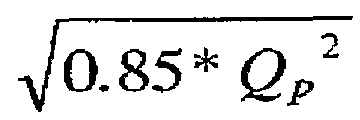
- the code amount R "are hand zero motion vector, since the DCT coefficients to be encoded increases, the weight o:. Keep changing the weights of the evaluation of pre-E n by ffl This Accordingly, it is possible to perform a mode determination in consideration of the added amount of the DCT coefficient code amount of the INTRA mode in a pseudo manner.
- the weighting evaluation for E n is not multiplication weights m, may be realized by adding the offset value 0 n.
- Qp is the quantization step parameter of the Mac to be encoded.
- m is defined as the count and the above process is described in the form of m loop processing. If it is judged from the coding mode setting information 12 output from the coding mode estimating unit 8 that the INTER mode has an evaluation value, m and the cost evaluation value min_J are initialized and processing is performed. Start (step ST3).
- step ST5 the average value of the luminance values in the macro block is calculated (step ST5). Otherwise, get the predicted picture candidate by using the motion compensator 1 0 B using the motion vector v m determined from the motion vector mapping information 1 1 (step ST6). From the result of step ST5 or step ST6, the sum of absolute differences between the result and the luminance signal of the encoding target macroblock represented by the input signal 9 is calculated, and the cost is calculated using the sum ⁇ ⁇ ⁇ as described above ( Step ST7). In steps ST8 and ST9, the candidate is updated to the mode m with the minimum cost, m is incremented in step ST10, and the above processing is continued until the loop ends in step ST11.
- the optimal mode selection is performed for all possible encoding modes. In addition, it is possible to select the associated motion vector.
- the motion vector and coding mode to be used for MPEG-4 encoding can be determined collectively using the same criteria. it can.
- the motion vector extracted from the input compressed data 1 is reused in the MPEG-4 encoder 10 by reusing the motion vector information and the encoding mode information.
- the vector mapping information 11 and the encoding mode setting information 12 are input and used for encoding the input signal 9 which is an MPEG-2 decoded image after resolution conversion. These pieces of information are used by the coding parameter overnight determination unit 10B to determine the coding mode and the motion vector used for coding for each MPEG-4 macroblock unit.
- the motion compensation unit 10A generates a predicted image 10C, and calculates a difference from the input signal 9 to generate a predicted residual signal.
- a predicted image 10C is passed through the DCT section 10D and the quantization section 10E, and are arranged in the form of an MPEG-4 video stream by the variable length coding section 10J.
- the quantized prediction residual signal is returned to the prediction residual signal decoded value 10 H through the inverse quantization unit 10 F and the inverse DCT unit 10 G, and is added to the prediction image 10 C. Stored in frame memory 10M for use in MC of subsequent frames.
- variable-length coding unit 10J includes therein a prediction process for AC and DC components and a scanning process for run-length coding of DCT coefficients.
- the coding control unit 10L performs coding based on the buffer occupancy 10K. Control.
- a macro program is grouped in plurals in raster scan order, and the dependency on the surrounding image area in the frame is cut off to recover quickly from errors.
- the determined quantization step parameter 10 N is input to the quantization unit 10 E and the inverse quantization unit 10 F, and is also input to the encoding parameter overnight determination unit 10 B for the above calculation. Is done.
- the motion in the MPEG-2 data is performed by the transcoder that performs the conversion operation from the MPEG-2 video data to the MPEG-4 video data.
- the optimal coding mode and motion vector in MPEG-4 coding are determined while reusing the information of the vector and coding mode, so the transcoding video quality can be reduced with a small amount of calculation. Can be improved.
- the motion vector detection processing with a large computational load is simplified, so that the video transcoding from MPEG-2 to MPEG-4 is more efficient than the conventional simple motion vector reuse method.
- the quality of the teaching can be improved.
- the process of determining the quantization step parameter (Qp) 10N in the encoding control unit 10L, or the frame or video packet can be further improved by closely coordinating the macroblock and other setting units with the MPEG-2 motion vector and coding mode information reuse policy described in (3) above. You.
- the MPEG-4 Simple Profile is assumed, but the transcoder of this configuration is compatible with the MPEG-4 Advanced Simple File and the movement described in Annex F in ITU-TH.263. It can be applied to any multi-mode encoding method conforming to the MPEG-4 Simple Profile, such as the case where the prediction option is saboted. 19
- the resolution conversion unit 6 functions not only as a spatial resolution conversion unit but also as a time resolution conversion unit, and the time resolution (frame rate) by thinning out the P frames to which the effect of motion prediction propagates.
- the resolution conversion unit 6 may function as a spatial resolution conversion unit and a time resolution conversion unit, or may function only as a time resolution conversion unit without functioning as a spatial resolution conversion unit.
- FIG. 5 is a configuration diagram showing a video transcoder (video data conversion apparatus) according to Embodiment 2 of the present invention. Note that the configuration of the transcoder of the second embodiment is the same as the internal configuration of the transcoder of the first embodiment shown in FIG. 1, and the operations of the resolution conversion unit 6 and the motion vector mapping unit ⁇ Since the operation is different from the first embodiment, the operation different from the first embodiment will be described in detail.
- the MPEG-2 decoded image 5 is reduced to a vertical and horizontal spatial resolution of 1/2 in the resolution conversion unit 6 by pixel thinning based on a predetermined downsampled fill. Further, based on the encoded frame instruction information 13 notified from the MPEG-4 encoder unit 10, the input frame rate of the input signal 9 to the MPEG-4 encoder unit 10 is controlled.
- the description of the first embodiment is given.
- the P frame depends on the instruction of the encoded frame instruction information 13 It is also configured to perform thinning of 20 m.
- the encoded frame instruction information 13 indicates the encoded frame value
- the MPE G-4 encoder unit 10 When the encoding is performed at the variable frame rate, the display time information of the frame to be encoded or the offset information of the number of frames from the immediately preceding MPEG-4 encoded frame is shown.
- This process is performed in cooperation with the motion vector mapping unit 7, the coding mode estimation unit 8, and the coding parameter overnight judgment unit 10B that is a component of the MPEG-4 encoder unit 10 in Fig. 5. Performed by
- FIG. 6 is a flowchart showing a motion vector mapping and a coding mode determination process in the video transcoder.
- the encoding mode estimating unit 8 examines the distribution of the encoding mode in the 2 ⁇ 2 macroblock of MPEG-2 shown in FIG.
- FIG. 7 is an explanatory diagram showing the monitoring operation of the MPEG-2 encoding mode by the encoding mode estimating unit 8.
- step ST12 and ST13 Monitor the MPEG-2 encoding mode (steps ST12 and ST13). If all four macroblocks of MPEG-2 are in INTRA mode at least once, the converted encoding mode to be used in MPEG-4 encoding is forced to INTRA mode.
- the frames starting from the frame immediately before MPEG-4 encoding and ending with the frame currently encoding are processed.
- the encoding mode to be used in MPEG-4 encoding is forced to be SK IP.
- monitoring of the MPEG-2 encoding mode during frame thinning shall be performed only for P frames, and I-frames shall be MPEG-4 encoded without thinning as I frames. Reset the monitoring of the MPEG-2 encoding mode (steps ST14 and ST15). If INTRA or SK IP is compulsory, the motion vector shall be set to all zeros and the subsequent steps shall be skipped.
- the encoding mode setting information 12 output from the encoding mode estimating unit 8 includes three cases, in which there is a possibility of forcibly INTM, forcibly SK IP, or INTER mode. Choices are output (Step ST0) As a result, only in cases where it is determined that the possibility of the INTER mode is considered, the possible MPEG-4 encoding mode The optimum mode is determined again in terms of the coding efficiency.
- the MPEG-2 motion vector is monitored during the frame decimation from the frame targeted for MPEG-4 encoding to the frame currently targeted for encoding (steps ST12 and ST13). From the MPEG-2 motion vector obtained as a result of monitoring, a candidate motion vector used in the MPEG-4 encoder unit 10 is determined.
- This process is performed in the motion vector mapping unit 7. Based on the result of 1) above, this process considers, in principle, the case where the SK IP mode or the INTER mode occurs as the MPEG-2 encoding mode during frame thinning. . Therefore, the following rules are applied.
- the motion vector candidate of the encoding target macroblock is calculated by the following equation using the motion vector of the macroblock existing at the same spatial position of the frame to be thinned out as a result of the frame rate conversion. It is obtained by accumulating more.
- V G4 5 (-MPEG2
- v MPEG4 is the motion vector candidate of the macroblock to be MPEG-4 encoded
- k is the frame count that is thinned out as a result of the frame rate conversion, and is the motion vector scale according to the resolution.
- Ring v k MPEG2 represents the motion vector of MPEG-2 corresponding to the macro block area for MPEG-4 encoding.
- MPEG4 there are two types of MPEG4 , INTER and INTER4V. As described in 2-2) of the first embodiment, first, a motion vector candidate of INTEMV is obtained, and then an INTER motion vector candidate is obtained. Is determined.
- Step ST1, ST2 Rule 2: S (v k MPEG2) is frame-off accompanying Lee pointer race coding - taking into account the differences in Le Dobeku torr, 2-1 in the first embodiment) of 23 Perform the scaling process according to the rules.
- motion vector candidates to be used for MPEG-4 I NTER and I NTER4V were selected.Therefore, the remaining encoding modes were most likely to be encoded among INTRA and SK IP. Select an efficient mode (steps ST3 to ST11). As a result, the final encoding mode and motion vector are determined.
- This process is executed by the encoding parameter overnight determination unit 10B.
- the processing in the encoding parameter overnight determination unit 10B conforms to 3) of the first embodiment.
- a reference image used for motion prediction a locally decoded image of an MPEG-4 encoded frame is used immediately before the frame currently being encoded.
- all codes that can be used in MPEG-4 encoding can be used for transcoding that executes time resolution (frame rate conversion) with P frame decimation. It is possible to select the optimal mode and the associated motion vector for the optimization mode.
- the motion vector detection processing with a large computational load is simplified, so that it is compared with the conventional simple motion vector reuse method.
- Video transcoding quality from MPEG-2 to MPEG-4 can be improved.
- the transcoder of this configuration uses the MPEG-4 Advanced Simple Applicable to all multi-mode encoding methods conforming to the MPEG-4 Simple Profile, such as the case where 24 files and motion prediction options described in Annex F in ITU-T I.263 are used.
- the present invention is applicable to general transcoding for MC + DCT video coding.
- the video data conversion device and the video data conversion method according to the present invention require a small amount of computation when performing various conversions of video compression data conforming to various international standard video compression / decompression methods. Suitable for those who need to improve the lance code image quality.
Landscapes
- Engineering & Computer Science (AREA)
- Multimedia (AREA)
- Signal Processing (AREA)
- Compression Or Coding Systems Of Tv Signals (AREA)
- Compression, Expansion, Code Conversion, And Decoders (AREA)
- Color Television Systems (AREA)
- Television Systems (AREA)
Description
Claims
Priority Applications (3)
| Application Number | Priority Date | Filing Date | Title |
|---|---|---|---|
| KR20047016448A KR100719647B1 (ko) | 2002-04-16 | 2003-04-09 | 영상 데이터 변환 장치 및 영상 데이터 변환 방법 |
| EP03746441A EP1475971A4 (en) | 2002-04-16 | 2003-04-09 | VIDEO DATA IMPLEMENTATION DEVICE AND VIDEO DATA IMPLEMENTING PROCESS |
| US10/501,897 US7526027B2 (en) | 2002-04-16 | 2003-04-09 | Video data converter and video data converting method |
Applications Claiming Priority (2)
| Application Number | Priority Date | Filing Date | Title |
|---|---|---|---|
| JP2002112860A JP4193406B2 (ja) | 2002-04-16 | 2002-04-16 | 映像データ変換装置および映像データ変換方法 |
| JP2002-112860 | 2002-04-16 |
Publications (1)
| Publication Number | Publication Date |
|---|---|
| WO2003088676A1 true WO2003088676A1 (fr) | 2003-10-23 |
Family
ID=29243335
Family Applications (1)
| Application Number | Title | Priority Date | Filing Date |
|---|---|---|---|
| PCT/JP2003/004529 Ceased WO2003088676A1 (fr) | 2002-04-16 | 2003-04-09 | Procede et dispositif de conversion de donnees video |
Country Status (6)
| Country | Link |
|---|---|
| US (1) | US7526027B2 (ja) |
| EP (1) | EP1475971A4 (ja) |
| JP (1) | JP4193406B2 (ja) |
| KR (1) | KR100719647B1 (ja) |
| CN (1) | CN100353769C (ja) |
| WO (1) | WO2003088676A1 (ja) |
Cited By (1)
| Publication number | Priority date | Publication date | Assignee | Title |
|---|---|---|---|---|
| CN102281448A (zh) * | 2005-07-22 | 2011-12-14 | 三菱电机株式会社 | 图像编码装置及方法、图像解码装置及方法 |
Families Citing this family (67)
| Publication number | Priority date | Publication date | Assignee | Title |
|---|---|---|---|---|
| HUP0301368A3 (en) * | 2003-05-20 | 2005-09-28 | Amt Advanced Multimedia Techno | Method and equipment for compressing motion picture data |
| JP4470431B2 (ja) * | 2003-10-01 | 2010-06-02 | ソニー株式会社 | データ処理装置およびその方法 |
| US7483577B2 (en) * | 2004-03-02 | 2009-01-27 | Mitsubishi Electric Research Laboratories, Inc. | System and method for joint de-interlacing and down-sampling using adaptive frame and field filtering |
| US20050201469A1 (en) * | 2004-03-11 | 2005-09-15 | John Sievers | Method and apparatus for improving the average image refresh rate in a compressed video bitstream |
| KR101196429B1 (ko) * | 2004-03-12 | 2012-11-01 | 삼성전자주식회사 | 동영상 트랜스코딩 방법 및 그 장치, 이에 사용되는움직임 벡터 보간방법 |
| US20050232497A1 (en) * | 2004-04-15 | 2005-10-20 | Microsoft Corporation | High-fidelity transcoding |
| KR100681252B1 (ko) * | 2004-10-02 | 2007-02-09 | 삼성전자주식회사 | 트랜스코딩을 위해 출력 매크로블록 모드와 출력움직임벡터를 추정하는 방법 및 이를 이용한 트랜스코더 |
| JP5046335B2 (ja) * | 2004-11-04 | 2012-10-10 | トムソン ライセンシング | ビデオ符号器におけるbフレームの高速モード決定のための方法および装置 |
| EP1662799A3 (en) * | 2004-11-30 | 2012-05-30 | Humax Co., Ltd. | Video down-sampling transcoding method and device |
| EP1662800A1 (en) * | 2004-11-30 | 2006-05-31 | Humax Co., Ltd. | Image down-sampling transcoding method and device |
| KR100718468B1 (ko) | 2004-11-30 | 2007-05-16 | 주식회사 휴맥스 | 영상 축소 트랜스 코딩 방법 및 장치 |
| US7933335B2 (en) | 2004-11-30 | 2011-04-26 | Panasonic Corporation | Moving picture conversion apparatus |
| KR100718467B1 (ko) | 2004-11-30 | 2007-05-16 | 주식회사 휴맥스 | 영상 축소 트랜스코딩 방법 및 장치 |
| KR101147744B1 (ko) * | 2005-02-22 | 2012-05-25 | 엘지전자 주식회사 | 비디오 트랜스 코딩 방법 및 장치와 이를 이용한 pvr |
| JP4604805B2 (ja) * | 2005-04-12 | 2011-01-05 | Kddi株式会社 | ビデオ情報変換装置及びプログラム |
| JP4682102B2 (ja) * | 2005-09-02 | 2011-05-11 | キヤノン株式会社 | 画像符号化装置及び画像符号化方法 |
| JP4600997B2 (ja) * | 2005-11-08 | 2010-12-22 | Kddi株式会社 | 符号化方式変換装置 |
| KR100801974B1 (ko) | 2005-12-08 | 2008-02-12 | 한국전자통신연구원 | 저비용 움직임 추정 장치 및 움직임 추정 방법 |
| US7944965B2 (en) * | 2005-12-19 | 2011-05-17 | Seiko Epson Corporation | Transform domain based distortion cost estimation |
| JP2007228400A (ja) * | 2006-02-24 | 2007-09-06 | Mitsubishi Electric Corp | 動画像変換装置 |
| TW200743386A (en) * | 2006-04-27 | 2007-11-16 | Koninkl Philips Electronics Nv | Method and apparatus for encoding/transcoding and decoding |
| EP2026585A4 (en) * | 2006-05-24 | 2016-08-31 | Panasonic Ip Man Co Ltd | IMAGE ENCODING DEVICE AND METHOD, AND IMAGE ENCODING INTEGRATED CIRCUIT |
| TWI348651B (en) * | 2006-06-09 | 2011-09-11 | Via Tech Inc | A system for reducing bandwidth requirements for transferring graphics data and its related method |
| JP4245026B2 (ja) | 2006-09-20 | 2009-03-25 | 株式会社豊田中央研究所 | 被覆膜の除膜方法および被覆部材の再生方法 |
| JP2008109637A (ja) * | 2006-09-25 | 2008-05-08 | Toshiba Corp | 動画像符号化装置及びその方法 |
| FR2907989B1 (fr) * | 2006-10-27 | 2009-01-16 | Actimagine Sarl | Procede et dispositif d'optimisation de la compression d'un flux video |
| JP4882948B2 (ja) * | 2007-10-04 | 2012-02-22 | ソニー株式会社 | 画像処理装置および方法、並びにプログラム |
| US8098732B2 (en) * | 2007-10-10 | 2012-01-17 | Sony Corporation | System for and method of transcoding video sequences from a first format to a second format |
| US8457958B2 (en) * | 2007-11-09 | 2013-06-04 | Microsoft Corporation | Audio transcoder using encoder-generated side information to transcode to target bit-rate |
| KR101377527B1 (ko) | 2008-10-14 | 2014-03-25 | 에스케이 텔레콤주식회사 | 복수 개의 참조 픽처의 움직임 벡터 부호화/복호화 방법 및장치와 그를 이용한 영상 부호화/복호화 장치 및 방법 |
| US8396114B2 (en) * | 2009-01-29 | 2013-03-12 | Microsoft Corporation | Multiple bit rate video encoding using variable bit rate and dynamic resolution for adaptive video streaming |
| US8311115B2 (en) * | 2009-01-29 | 2012-11-13 | Microsoft Corporation | Video encoding using previously calculated motion information |
| US8270473B2 (en) * | 2009-06-12 | 2012-09-18 | Microsoft Corporation | Motion based dynamic resolution multiple bit rate video encoding |
| JP5378939B2 (ja) * | 2009-10-02 | 2013-12-25 | 日立コンシューマエレクトロニクス株式会社 | 画像符号化方法、画像復号化方法、画像符号化装置、及び画像復号化装置、並びにプログラム |
| US20110142129A1 (en) * | 2009-12-11 | 2011-06-16 | General Instrument Corporation | Mpeg video resolution reduction system |
| EP2355511A1 (en) * | 2009-12-21 | 2011-08-10 | Alcatel Lucent | Method and arrangement for jointly encoding a plurality of video streams |
| US8559519B2 (en) * | 2010-01-08 | 2013-10-15 | Blackberry Limited | Method and device for video encoding using predicted residuals |
| US8358698B2 (en) * | 2010-01-08 | 2013-01-22 | Research In Motion Limited | Method and device for motion vector estimation in video transcoding using full-resolution residuals |
| US20110170608A1 (en) * | 2010-01-08 | 2011-07-14 | Xun Shi | Method and device for video transcoding using quad-tree based mode selection |
| US8315310B2 (en) * | 2010-01-08 | 2012-11-20 | Research In Motion Limited | Method and device for motion vector prediction in video transcoding using full resolution residuals |
| US8340188B2 (en) * | 2010-01-08 | 2012-12-25 | Research In Motion Limited | Method and device for motion vector estimation in video transcoding using union of search areas |
| US9819358B2 (en) * | 2010-02-19 | 2017-11-14 | Skype | Entropy encoding based on observed frequency |
| US9078009B2 (en) * | 2010-02-19 | 2015-07-07 | Skype | Data compression for video utilizing non-translational motion information |
| US9609342B2 (en) * | 2010-02-19 | 2017-03-28 | Skype | Compression for frames of a video signal using selected candidate blocks |
| US9313526B2 (en) * | 2010-02-19 | 2016-04-12 | Skype | Data compression for video |
| US8681873B2 (en) * | 2010-02-19 | 2014-03-25 | Skype | Data compression for video |
| US9369736B2 (en) | 2010-04-05 | 2016-06-14 | Samsung Electronics Co., Ltd. | Low complexity entropy-encoding/decoding method and apparatus |
| WO2011126282A2 (en) | 2010-04-05 | 2011-10-13 | Samsung Electronics Co., Ltd. | Method and apparatus for encoding video by using transformation index, and method and apparatus for decoding video by using transformation index |
| US9049450B2 (en) | 2010-04-05 | 2015-06-02 | Samsung Electronics Co., Ltd. | Method and apparatus for encoding video based on internal bit depth increment, and method and apparatus for decoding video based on internal bit depth increment |
| KR20110112168A (ko) * | 2010-04-05 | 2011-10-12 | 삼성전자주식회사 | 내부 비트뎁스 확장에 기반한 비디오 부호화 방법 및 그 장치, 내부 비트뎁스 확장에 기반한 비디오 복호화 방법 및 그 장치 |
| JP5368631B2 (ja) | 2010-04-08 | 2013-12-18 | 株式会社東芝 | 画像符号化方法、装置、及びプログラム |
| US8705616B2 (en) | 2010-06-11 | 2014-04-22 | Microsoft Corporation | Parallel multiple bitrate video encoding to reduce latency and dependences between groups of pictures |
| CN101964910B (zh) * | 2010-08-20 | 2012-08-22 | 华中科技大学 | 基于码率型转码辅助的视频空间分辨率转换方法 |
| US8755438B2 (en) * | 2010-11-29 | 2014-06-17 | Ecole De Technologie Superieure | Method and system for selectively performing multiple video transcoding operations |
| US9749657B2 (en) | 2011-01-21 | 2017-08-29 | Sharp Kabushiki Kaisha | Buffer compression for motion vector competition |
| US20120275502A1 (en) * | 2011-04-26 | 2012-11-01 | Fang-Yi Hsieh | Apparatus for dynamically adjusting video decoding complexity, and associated method |
| US9591318B2 (en) | 2011-09-16 | 2017-03-07 | Microsoft Technology Licensing, Llc | Multi-layer encoding and decoding |
| US11089343B2 (en) | 2012-01-11 | 2021-08-10 | Microsoft Technology Licensing, Llc | Capability advertisement, configuration and control for video coding and decoding |
| JP6421426B2 (ja) | 2014-03-26 | 2018-11-14 | 沖電気工業株式会社 | 符号化方式変換装置及びプログラム |
| JP6291971B2 (ja) * | 2014-03-31 | 2018-03-14 | 富士通株式会社 | 符号化装置、符号化方法及び符号化プログラム |
| KR102647887B1 (ko) * | 2014-10-31 | 2024-03-14 | 삼성전자주식회사 | 움직임 벡터 부복호화 방법 및 장치 |
| US10462459B2 (en) * | 2016-04-14 | 2019-10-29 | Mediatek Inc. | Non-local adaptive loop filter |
| JP6574148B2 (ja) * | 2016-07-13 | 2019-09-11 | Kddi株式会社 | トランスコードシステム、トランスコード方法、コンピュータ可読記録媒体および符号化装置 |
| JP6977422B2 (ja) | 2017-09-13 | 2021-12-08 | 株式会社Jvcケンウッド | トランスコード装置、トランスコード方法及びトランスコードプログラム |
| US10764603B2 (en) | 2018-12-31 | 2020-09-01 | Alibaba Group Holding Limited | Resolution-adaptive video coding |
| EP4451668A3 (en) * | 2019-04-24 | 2024-11-20 | Nevermind Capital LLC | Methods and apparatus for encoding, communicating and/or using images |
| US12167006B2 (en) | 2019-07-09 | 2024-12-10 | Alibaba Group Holding Limited | Resolution-adaptive video coding |
Citations (6)
| Publication number | Priority date | Publication date | Assignee | Title |
|---|---|---|---|---|
| JPH09322176A (ja) * | 1995-12-20 | 1997-12-12 | Sanyo Electric Co Ltd | 符号化モード選択方法、動画像符号化装置、符号化方法、記録方法、及び伝送方法 |
| JPH10191350A (ja) * | 1996-12-13 | 1998-07-21 | Sgs Thomson Microelectron Sa | 運動量を推定するための方法およびデバイス |
| JPH10336672A (ja) * | 1997-05-30 | 1998-12-18 | Oki Electric Ind Co Ltd | 符号化方式変換装置およびその動きベクトル検出方法 |
| JP2000312363A (ja) * | 1999-02-25 | 2000-11-07 | Matsushita Electric Ind Co Ltd | 動画像符号化方式の変換方法及びその装置 |
| JP2001525638A (ja) * | 1997-11-27 | 2001-12-11 | ブリティッシュ・テレコミュニケーションズ・パブリック・リミテッド・カンパニー | トランスコーディング |
| JP2002010267A (ja) * | 2000-06-26 | 2002-01-11 | Sony Corp | 動きベクトル変換装置及び方法 |
Family Cites Families (15)
| Publication number | Priority date | Publication date | Assignee | Title |
|---|---|---|---|---|
| JPH06105299A (ja) | 1992-09-22 | 1994-04-15 | Casio Comput Co Ltd | 動画像圧縮装置 |
| ATE176747T1 (de) * | 1993-03-26 | 1999-02-15 | British Telecomm | Transkoder |
| NL9301358A (nl) * | 1993-08-04 | 1995-03-01 | Nederland Ptt | Transcodeerinrichting. |
| JPH07264597A (ja) | 1994-03-18 | 1995-10-13 | Nippon Telegr & Teleph Corp <Ntt> | 動き補償方法 |
| DE4416967A1 (de) * | 1994-05-13 | 1995-11-16 | Thomson Brandt Gmbh | Verfahren und Vorrichtung zur Transcodierung von Bitströmen mit Videodaten |
| JP3778960B2 (ja) | 1994-06-29 | 2006-05-24 | 株式会社東芝 | 動画像符号化方法及び装置 |
| JP3058028B2 (ja) | 1994-10-31 | 2000-07-04 | 三菱電機株式会社 | 画像符号化データ再符号化装置 |
| JPH09322173A (ja) | 1996-05-27 | 1997-12-12 | Nippon Telegr & Teleph Corp <Ntt> | 動画像テロップ抽出方法及び装置 |
| JP3150627B2 (ja) | 1996-10-04 | 2001-03-26 | 日本電信電話株式会社 | 復号信号の再符号化方法 |
| JPH11243551A (ja) | 1997-12-25 | 1999-09-07 | Mitsubishi Electric Corp | 動き補償装置と動画像符号化装置及び方法 |
| US6058143A (en) * | 1998-02-20 | 2000-05-02 | Thomson Licensing S.A. | Motion vector extrapolation for transcoding video sequences |
| JP3855522B2 (ja) * | 1999-02-23 | 2006-12-13 | 松下電器産業株式会社 | 動画変換装置 |
| US6625211B1 (en) * | 1999-02-25 | 2003-09-23 | Matsushita Electric Industrial Co., Ltd. | Method and apparatus for transforming moving picture coding system |
| JP2001268579A (ja) | 2000-03-23 | 2001-09-28 | Sanyo Electric Co Ltd | 動画像再符号化装置 |
| US6647061B1 (en) * | 2000-06-09 | 2003-11-11 | General Instrument Corporation | Video size conversion and transcoding from MPEG-2 to MPEG-4 |
-
2002
- 2002-04-16 JP JP2002112860A patent/JP4193406B2/ja not_active Expired - Fee Related
-
2003
- 2003-04-09 KR KR20047016448A patent/KR100719647B1/ko not_active Expired - Fee Related
- 2003-04-09 CN CNB038055872A patent/CN100353769C/zh not_active Expired - Fee Related
- 2003-04-09 WO PCT/JP2003/004529 patent/WO2003088676A1/ja not_active Ceased
- 2003-04-09 EP EP03746441A patent/EP1475971A4/en not_active Withdrawn
- 2003-04-09 US US10/501,897 patent/US7526027B2/en not_active Expired - Fee Related
Patent Citations (6)
| Publication number | Priority date | Publication date | Assignee | Title |
|---|---|---|---|---|
| JPH09322176A (ja) * | 1995-12-20 | 1997-12-12 | Sanyo Electric Co Ltd | 符号化モード選択方法、動画像符号化装置、符号化方法、記録方法、及び伝送方法 |
| JPH10191350A (ja) * | 1996-12-13 | 1998-07-21 | Sgs Thomson Microelectron Sa | 運動量を推定するための方法およびデバイス |
| JPH10336672A (ja) * | 1997-05-30 | 1998-12-18 | Oki Electric Ind Co Ltd | 符号化方式変換装置およびその動きベクトル検出方法 |
| JP2001525638A (ja) * | 1997-11-27 | 2001-12-11 | ブリティッシュ・テレコミュニケーションズ・パブリック・リミテッド・カンパニー | トランスコーディング |
| JP2000312363A (ja) * | 1999-02-25 | 2000-11-07 | Matsushita Electric Ind Co Ltd | 動画像符号化方式の変換方法及びその装置 |
| JP2002010267A (ja) * | 2000-06-26 | 2002-01-11 | Sony Corp | 動きベクトル変換装置及び方法 |
Cited By (1)
| Publication number | Priority date | Publication date | Assignee | Title |
|---|---|---|---|---|
| CN102281448A (zh) * | 2005-07-22 | 2011-12-14 | 三菱电机株式会社 | 图像编码装置及方法、图像解码装置及方法 |
Also Published As
| Publication number | Publication date |
|---|---|
| JP4193406B2 (ja) | 2008-12-10 |
| EP1475971A1 (en) | 2004-11-10 |
| KR100719647B1 (ko) | 2007-05-17 |
| US20050041740A1 (en) | 2005-02-24 |
| US7526027B2 (en) | 2009-04-28 |
| KR20040105872A (ko) | 2004-12-16 |
| EP1475971A4 (en) | 2010-03-03 |
| CN1640149A (zh) | 2005-07-13 |
| CN100353769C (zh) | 2007-12-05 |
| JP2003309851A (ja) | 2003-10-31 |
Similar Documents
| Publication | Publication Date | Title |
|---|---|---|
| WO2003088676A1 (fr) | Procede et dispositif de conversion de donnees video | |
| CN100566426C (zh) | 视频编码/解码的方法和设备 | |
| WO2010137323A1 (ja) | 映像符号化装置、映像復号装置、映像符号化方法、および映像復号方法 | |
| JP2010016454A (ja) | 画像符号化装置および方法、画像復号装置および方法、並びにプログラム | |
| KR20110008653A (ko) | 움직임 벡터 예측 방법과 이를 이용한 영상 부호화/복호화 장치 및 방법 | |
| CN102415098A (zh) | 图像处理设备和方法 | |
| KR100755107B1 (ko) | 화상 부호 열 변환 장치 및 화상 부호 열 변환을 위한 방법 및 프로그램을 기록한 기록매체 | |
| JP2005203905A (ja) | 画像符号化装置、画像符号化方法並びに画像符号化プログラム | |
| JP3866624B2 (ja) | 動画像符号化方法,動画像復号方法,動画像符号化装置および動画像復号装置 | |
| EP1628487A2 (en) | Method and apparatus for estimating motion | |
| JP5649296B2 (ja) | 画像符号化装置 | |
| JP2002152752A (ja) | 画像情報変換装置及び方法 | |
| US20070133689A1 (en) | Low-cost motion estimation apparatus and method thereof | |
| JP2009284058A (ja) | 動画像符号化装置 | |
| KR100899658B1 (ko) | 고속 동작을 위한 mpeg2/h.264 디지털 비디오트랜스코딩 시스템 및 방법 | |
| JP4438749B2 (ja) | 符号化装置、符号化方法およびプログラム | |
| JP2005532716A (ja) | 動画像符号化装置及び方法 | |
| JP2009206911A (ja) | 動画像変換装置 | |
| JP2008004984A (ja) | 画像理装置および方法、プログラム、並びに記録媒体 | |
| JP2020102798A (ja) | 動画像符号化装置、イントラリフレッシュ制御装置およびそれらのプログラム | |
| JP2007036725A (ja) | 符号化装置 | |
| JP2007228400A (ja) | 動画像変換装置 | |
| JP2005184495A (ja) | 動画像符号化装置およびその方法 | |
| KR20070051294A (ko) | 움직임 추정을 위한 방법 및 장치 | |
| KR20160087206A (ko) | 영상 트랜스코더 및 트랜스코딩 방법 |
Legal Events
| Date | Code | Title | Description |
|---|---|---|---|
| AK | Designated states |
Kind code of ref document: A1 Designated state(s): CN KR US |
|
| AL | Designated countries for regional patents |
Kind code of ref document: A1 Designated state(s): AT BE BG CH CY CZ DE DK EE ES FI FR GB GR HU IE IT LU MC NL PT RO SE SI SK TR |
|
| 121 | Ep: the epo has been informed by wipo that ep was designated in this application | ||
| WWE | Wipo information: entry into national phase |
Ref document number: 10501897 Country of ref document: US |
|
| WWE | Wipo information: entry into national phase |
Ref document number: 2003746441 Country of ref document: EP |
|
| WWE | Wipo information: entry into national phase |
Ref document number: 20038055872 Country of ref document: CN |
|
| WWE | Wipo information: entry into national phase |
Ref document number: 1020047016448 Country of ref document: KR |
|
| WWP | Wipo information: published in national office |
Ref document number: 2003746441 Country of ref document: EP |
|
| WWP | Wipo information: published in national office |
Ref document number: 1020047016448 Country of ref document: KR |