WO2003100522A1 - Photosensitive resin composition and method for preparing heat-resistant resin film - Google Patents
Photosensitive resin composition and method for preparing heat-resistant resin film Download PDFInfo
- Publication number
- WO2003100522A1 WO2003100522A1 PCT/JP2003/006654 JP0306654W WO03100522A1 WO 2003100522 A1 WO2003100522 A1 WO 2003100522A1 JP 0306654 W JP0306654 W JP 0306654W WO 03100522 A1 WO03100522 A1 WO 03100522A1
- Authority
- WO
- WIPO (PCT)
- Prior art keywords
- photosensitive resin
- group
- resin film
- acid
- resin composition
- Prior art date
- Legal status (The legal status is an assumption and is not a legal conclusion. Google has not performed a legal analysis and makes no representation as to the accuracy of the status listed.)
- Ceased
Links
Classifications
-
- G—PHYSICS
- G03—PHOTOGRAPHY; CINEMATOGRAPHY; ANALOGOUS TECHNIQUES USING WAVES OTHER THAN OPTICAL WAVES; ELECTROGRAPHY; HOLOGRAPHY
- G03F—PHOTOMECHANICAL PRODUCTION OF TEXTURED OR PATTERNED SURFACES, e.g. FOR PRINTING, FOR PROCESSING OF SEMICONDUCTOR DEVICES; MATERIALS THEREFOR; ORIGINALS THEREFOR; APPARATUS SPECIALLY ADAPTED THEREFOR
- G03F7/00—Photomechanical, e.g. photolithographic, production of textured or patterned surfaces, e.g. printing surfaces; Materials therefor, e.g. comprising photoresists; Apparatus specially adapted therefor
- G03F7/004—Photosensitive materials
- G03F7/0048—Photosensitive materials characterised by the solvents or agents facilitating spreading, e.g. tensio-active agents
-
- G—PHYSICS
- G03—PHOTOGRAPHY; CINEMATOGRAPHY; ANALOGOUS TECHNIQUES USING WAVES OTHER THAN OPTICAL WAVES; ELECTROGRAPHY; HOLOGRAPHY
- G03F—PHOTOMECHANICAL PRODUCTION OF TEXTURED OR PATTERNED SURFACES, e.g. FOR PRINTING, FOR PROCESSING OF SEMICONDUCTOR DEVICES; MATERIALS THEREFOR; ORIGINALS THEREFOR; APPARATUS SPECIALLY ADAPTED THEREFOR
- G03F7/00—Photomechanical, e.g. photolithographic, production of textured or patterned surfaces, e.g. printing surfaces; Materials therefor, e.g. comprising photoresists; Apparatus specially adapted therefor
- G03F7/004—Photosensitive materials
- G03F7/027—Non-macromolecular photopolymerisable compounds having carbon-to-carbon double bonds, e.g. ethylenic compounds
- G03F7/032—Non-macromolecular photopolymerisable compounds having carbon-to-carbon double bonds, e.g. ethylenic compounds with binders
- G03F7/037—Non-macromolecular photopolymerisable compounds having carbon-to-carbon double bonds, e.g. ethylenic compounds with binders the binders being polyamides or polyimides
-
- G—PHYSICS
- G03—PHOTOGRAPHY; CINEMATOGRAPHY; ANALOGOUS TECHNIQUES USING WAVES OTHER THAN OPTICAL WAVES; ELECTROGRAPHY; HOLOGRAPHY
- G03F—PHOTOMECHANICAL PRODUCTION OF TEXTURED OR PATTERNED SURFACES, e.g. FOR PRINTING, FOR PROCESSING OF SEMICONDUCTOR DEVICES; MATERIALS THEREFOR; ORIGINALS THEREFOR; APPARATUS SPECIALLY ADAPTED THEREFOR
- G03F7/00—Photomechanical, e.g. photolithographic, production of textured or patterned surfaces, e.g. printing surfaces; Materials therefor, e.g. comprising photoresists; Apparatus specially adapted therefor
- G03F7/004—Photosensitive materials
- G03F7/022—Quinonediazides
- G03F7/023—Macromolecular quinonediazides; Macromolecular additives, e.g. binders
- G03F7/0233—Macromolecular quinonediazides; Macromolecular additives, e.g. binders characterised by the polymeric binders or the macromolecular additives other than the macromolecular quinonediazides
-
- H—ELECTRICITY
- H10—SEMICONDUCTOR DEVICES; ELECTRIC SOLID-STATE DEVICES NOT OTHERWISE PROVIDED FOR
- H10K—ORGANIC ELECTRIC SOLID-STATE DEVICES
- H10K50/00—Organic light-emitting devices
- H10K50/80—Constructional details
- H10K50/84—Passivation; Containers; Encapsulations
- H10K50/844—Encapsulations
-
- H—ELECTRICITY
- H10—SEMICONDUCTOR DEVICES; ELECTRIC SOLID-STATE DEVICES NOT OTHERWISE PROVIDED FOR
- H10K—ORGANIC ELECTRIC SOLID-STATE DEVICES
- H10K59/00—Integrated devices, or assemblies of multiple devices, comprising at least one organic light-emitting element covered by group H10K50/00
- H10K59/10—OLED displays
- H10K59/17—Passive-matrix OLED displays
- H10K59/173—Passive-matrix OLED displays comprising banks or shadow masks
Definitions
- Patent application title Method for producing photosensitive resin composition and heat-resistant resin film
- the present invention relates to a photosensitive resin composition and a method for producing a heat-resistant resin film suitable for an insulating layer of an organic electroluminescent device, a surface protective film of a semiconductor element, an interlayer insulating film, and the like.
- LCD Liquid crystal displays
- ECD electrochromic display
- PDP plasma display panels
- electroluminescent displays have recently attracted attention as light-emitting flat panel displays.
- E L D organic electroluminescent devices, in particular, have been actively researched and developed because of their high brightness and the ability to produce full-color displays.
- the insulating layer can be patterned without using a photoresist, so that the complexity of the process and the poor yield can be suppressed.
- the conventional method for manufacturing an insulating layer has a problem in that transfer marks are formed on the insulating layer and the product quality is degraded.
- the transfer mark means that the shape of the object close to or in contact with the object to be heated is This is what remains as unevenness that can be visually confirmed on the object to be heated.
- the object to be heated when heating the object to be heated in which the resin composition is applied to a supporting substrate such as a glass substrate by a hot plate method and drying the object, the object to be heated is held on a jig such as a proxy pin, and is then transferred from the hot plate.
- the object to be heated is heated by the radiant heat transfer.
- a transfer mark often appears at a portion in contact with the proxy pin.
- the generated transfer marks have an adverse effect on subsequent processes such as exposure and development, and eventually cause problems such as loss of uniformity of the thickness of the insulating layer after curing.
- polyimide and / or polyimide precursor resin which are widely used as an insulating layer, often exhibit transfer marks.
- Japanese Patent Application Laid-Open No. H8-2366431 discloses that a second hot plate that can be raised and lowered is provided, and the second hot plate comes into contact with the entire surface of a substrate to be heated to reduce a local temperature gradient.
- a soothing method has been proposed.
- a synthetic resin such as polyimide resin is used as a proxy pin material, and A method has been proposed in which the contact area of the object to be heated is reduced to 0.08 to 0.2 mm 2 , or the thermal conductivity is reduced by using a proxy pin structure as a pipe-like structure.
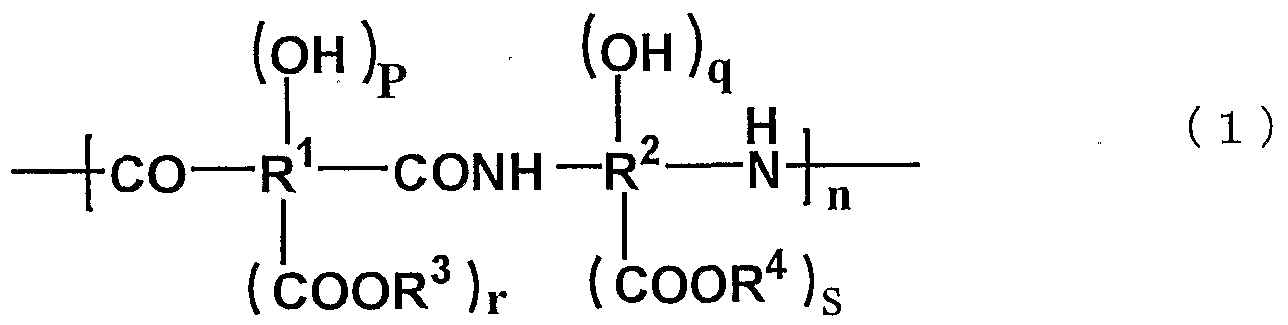
- the present invention provides (a) a resin having a structure represented by the general formula (1), (b) a photosensitive agent, and (c) a boiling point at atmospheric pressure of 100 ° C. or higher and 140 ° C.
- a photosensitive resin composition containing an organic solvent of C or less, and wherein the content of the component (c) is 50% by weight or more and 100% by weight or less based on the total amount of the organic solvent.
- R 1 is a divalent to octavalent organic group having two or more carbon atoms
- R 2 is a divalent to hexavalent organic group having two or more carbon atoms
- R 3 and R 4 are It may be the same or different, and represents a hydrogen atom or an organic group having 1 to 20 carbon atoms, where n is in the range of 5 to 1000 and p and q are each in the range of 0 to 4. , R and s are each in the range from 0 to 2. p + q> 0.
- the present invention provides a step of applying the photosensitive resin composition on a substrate to form a photosensitive resin film, a step of drying the photosensitive resin film, a step of exposing the photosensitive resin film, A method for producing a heat-resistant resin film, comprising a step of developing the photosensitive resin film thus formed and a step of performing a heat treatment.
- the present invention provides a step of applying the above-mentioned photosensitive resin composition on a substrate on which a first electrode is formed to form a photosensitive resin film, and drying, exposing, developing and heating the photosensitive resin film. Forming an insulating layer, forming a light-emitting layer, and forming a second electrode.
- the present invention includes an organic electroluminescent device having a heat-resistant resin film obtained by the above-described manufacturing method and an electronic component having the heat-resistant resin film as a surface protective film or an interlayer insulating film.
- FIG. 1 is a cross-sectional view when the insulating layer has a rectangular shape.
- FIG. 2 is a cross-sectional view when the insulating layer has a forward tapered shape.
- FIG. 3 is a schematic view showing an application step by a slit die coating method.
- FIG. 4 is a cross-sectional view showing a drying step by a hot plate method.
- Figure 5 is a schematic diagram of a proxy pin.
- the resin selected from the resins having the structure represented by the general formula (1) is hereinafter referred to as a component (a).
- the component (a) can be a polymer having an imido ring, an oxazole ring, or another cyclic structure by heating or an appropriate catalyst. By having a ring structure, heat resistance and solvent resistance are dramatically improved.
- As the component (a), it has excellent heat resistance and exhibits excellent properties as an insulating layer of an organic electroluminescent device, or a surface protective film or an interlayer insulating film of a semiconductor device. Therefore, a polyimide precursor or a polybenzoxazole precursor is used.
- the body is preferred.
- the component (a) is a heat-resistant resin precursor, and the heat-resistant resin is obtained by heating the component (a).
- the heat-resistant resin is a polymer having an imido ring, an oxazole ring, or another cyclic structure such as a polyimide resin or a polybenzoxazole resin.
- RL represents an acid dianhydride residue and is a divalent to octavalent organic group having two or more carbon atoms.
- R 1 is preferably a trivalent or tetravalent organic group having an aromatic ring or an aliphatic ring and having 0 to 2 hydroxyl groups and having 6 to 30 carbon atoms.
- R 2 represents a diamine residue and is a divalent to hexavalent organic group having two or more carbon atoms.
- R 2 preferably has an aromatic ring from the viewpoint of heat resistance of the obtained polymer.
- R 3 and R 4 in the general formula (1) may be the same or different, and a hydrogen atom Alternatively, it represents an organic group having 120 carbon atoms. When the carbon number of R 3 and R 4 exceeds 20, it becomes difficult to dissolve in a developer.
- the organic group having 120 carbon atoms an alkyl group or an organic group having a carbon-carbon unsaturated double bond is particularly preferable.
- r and s each independently range from 0 to 2.
- R 3 and R 4 are preferably a hydrogen atom or an alkyl group.
- R 3 and R 4 are preferably alkyl groups from the viewpoint of stability of the photosensitive resin composition, but are preferably hydrogen atoms from the viewpoint of solubility in a developing solution.
- a hydrogen atom and an alkyl group may be mixed.
- Specific examples of the alkyl group include, but are not limited to, a methyl group, an ethyl group, an ⁇ -propyl group, an isopropyl group, a t-butyl group, an II-butyl group, an isobutyl group, and an n-xyl group.
- R 3 and R 4 preferably contain at least one or more alkyl groups having up to 116 carbon atoms, and the others are preferably hydrogen atoms.
- the dissolution rate in the developing solution changes, so that a photosensitive resin composition having an appropriate dissolution rate can be obtained by this adjustment.
- Preferred range surface, 1 0 mol of R 3 and R 4. /. ⁇ 90 mol. / 0 is a hydrogen atom.
- R 3 and R 4 are preferably an organic group having a carbon-carbon unsaturated double bond. Having a carbon-carbon unsaturated double bond is preferred because crosslinking is promoted during exposure, photosensitivity is improved, and the strength of the obtained resin is also increased.
- the organic group having a carbon-carbon unsaturated double bond include methyl acrylate, ethyl acrylate, propyl acrylate, methyl methacrylate, ethyl methacrylate, and propyl methacrylate. It is not limited to these.
- the component (a) has a hydroxyl group. Due to the presence of this hydroxyl group, the component (a) has a solubility in an organic solvent having a boiling point of 100 ° C. or more and 140 ° C. or less under atmospheric pressure, that is, the component (c) described below. Better than resin without group '. Further, it is also preferable in that development can be performed with an aqueous alkali solution. In particular, it is more preferable that the hydroxyl group is a phenolic hydroxyl group from the viewpoint of solubility in an aqueous alkali solution.
- n represents the number of repetitions of the structural unit, and is preferably in the range of 5 to 1000.
- the lower limit of n is more preferably 10 or more.
- the upper limit of n is more preferably 1,000,000 or less. If n is too small, the pattern shape, resolution, developability, heat resistance, and the like are likely to deteriorate. If n is too large, developability and sensitivity tend to deteriorate.
- the value of n is determined by measuring the weight average molecular weight of the component (a) in terms of polystyrene using gel permeation chromatography, and determining the obtained weight average molecular weight by the structural unit 1 constituting the component (a). It is determined by dividing by the molecular weight per unit.
- the preferable weight average molecular weight of the resin as the component (a) is from 3,000 to 100,000, more preferably from 5 to 100, as measured in terms of polystyrene using gel permeation chromatography. , 0 0 0 to 5 0, 0 0 0.
- the resin represented by the general formula (1) is synthesized using a known method. For example, a method of reacting a tetracarboxylic dianhydride with a diamine compound at a low temperature, a method of reacting a tetracarboxylic dianhydride with a diamine compound at a low temperature, a diester obtained by tetracarboxylic dianhydride and an alcohol, Then, a method of reacting diamine with a condensing agent, a method of obtaining a ester with tetracarboxylic dianhydride and an alcohol, and then converting the remaining dicarboxylic acid into an acid chloride and reacting with diamine are used. And can be synthesized.
- the terminal blocking agent reacts with the terminal of the component (a).
- a monoamine, an acid anhydride, a monocarboxylic acid, a monoacid chloride compound, a monoactive ester compound and the like can be used.
- the reaction with the terminal blocking agent is preferred in that the number of repeating structural units of the component (a), that is, the molecular weight, can be controlled within a preferable range.
- various organic groups can be introduced as a terminal group by reacting a terminal blocking agent with the terminal of the component (a).
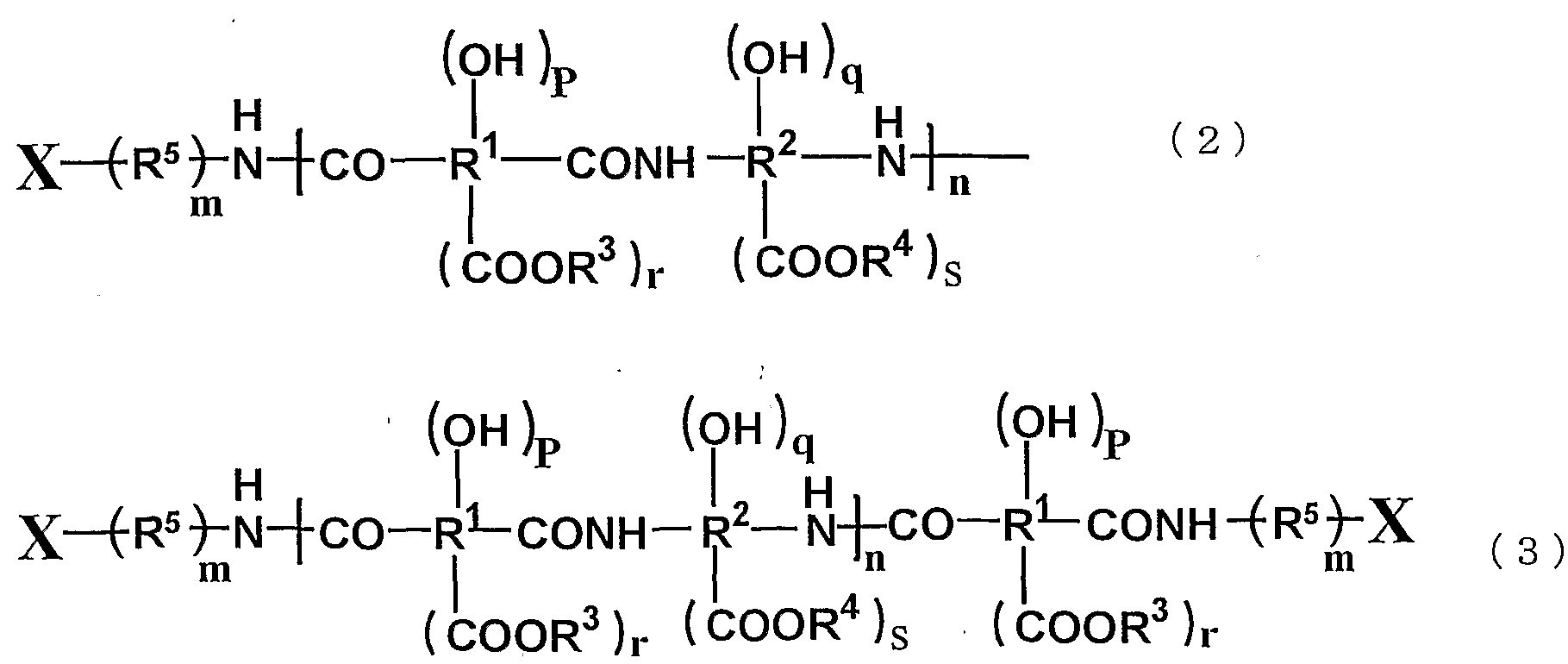
- a resin selected from the resins having the structures represented by the general formulas (2) to (5) is preferable.
- R 5 is a divalent organic group
- X and Y are a carboxyl group, a phenolic hydroxyl group, and a sulfone, respectively.
- One or more selected from the group consisting of a hydrocarbon group having 1 to 10 carbon atoms containing at least one acid group, thiol group and unsaturated hydrocarbon group, nitro group, methylol group, ester group, and hydroxyalkynyl group Represents an organic group having a substituent, ranging from mttO to 10)
- the component (a) is a component (c) described later, that is, the boiling point at atmospheric pressure is 100 ° C. or more and 140 ° C. or less. Further improves the solubility in organic solvents.
- —NH— (R 5 ) ra —X in the general formulas (2) and (3) is a component derived from a primary monoamine which is a terminal blocking agent.
- One NH— (R 5 ) ra —X is preferably a group represented by the following general formula (6).
- one CO— (R 5 ) m —Y represents an acid anhydride, a monocarboxylic acid, a monoacid chloride compound or a mono-active compound as a terminal sealant. It is a component derived from an ester compound.
- One CO— (R 5 ) m —Y is preferably a group represented by the following general formula (7) and / or the following general formula (8).
- R 5 in the general formula (6) to (8), _ CR 8 R 9 - shows a more divalent group selected - one CH 2 ⁇ first and one CH 2 S0 2.
- R 9 and R ia each represent a monovalent group selected from a hydrogen atom, a hydroxyl group, a hydroxyl group and a hydrocarbon group having 1 to 10 carbon atoms.
- R 8 represents a monovalent group selected from a hydrogen atom and a hydrocarbon group having 1 to 10 carbon atoms.
- a hydrogen atom or a hydrocarbon group having 1 to 4 carbon atoms is preferable, and a hydrogen atom, a methyl group or a t-butyl group is particularly preferable.
- R 6 and R 7 are a hydrocarbon group having at least one hydrogen atom, a hydroxyl group, a carboxyl group, a sulfonic acid group, a thiol group, or an unsaturated hydrocarbon group and having 1 to 10 carbon atoms. , Nitro group, methylol group, ester group, hydroxyalkynyl group And at least one substituent selected from hydrocarbon groups from 1 to 10.
- Ai ⁇ A 3 is a their respective carbon atom or a nitrogen atom.
- m ranges from 0 to 10 and preferably ranges from 0 to 4. 1 is 0 or 1, preferably 0. i is 0 or 1, and preferably 0. j ranges from 1 to 3, preferably from 1 to 2.
- the terminal blocking agent introduced into the polymer can be easily detected by the following method.
- a polymer with a terminal blocking agent introduced is dissolved in an acidic solution and decomposed into an amine component and an acid anhydride component, which are constituent units of the polymer, and this is measured by gas chromatography (GC) or NMR measurement
- GC gas chromatography
- NMR nuclear magnetic resonance
- the polymeric component terminal blocking agent is introduced directly in the pyrolysis gas chromatography (P GC) and Akagaisupeku Torr and C 13 NMR spectrum measurement, easily detectable It is.
- the component (a) may have a fluorine atom in the structure.
- a fluorine atom By having a fluorine atom, the number of polar sites increases, and the solubility for the component (c) is dramatically improved.
- the water repellency is appropriately brought out at the interface of the film, so that the penetration of the interface can be suppressed.
- the fluorine atom content is 20 weight. If the ratio exceeds / 0 , it is not preferable because the solubility in an aqueous alkali solution is reduced, the organic solvent resistance of the polymer having a cyclic structure by heat treatment is reduced, and the solubility in fuming nitric acid is reduced. As described above, it is preferable that the fluorine atom is contained at 20% by weight or less.
- 'in order to improve the adhesion to the substrate it may be copolymerized aliphatic groups with a siloxane structure in the R ⁇ R 2 without compromising the heat resistance.
- bis- (3-aminopropyl) tetramethyldisiloxane, bis (p-amino-phenyl) octamethylpentasiloxane, etc. as a diamine component is 1 to 10 mol based on the total amine component. . / 0 copolymers and the like.
- acid dianhydride used in the present invention which have no hydroxyl group include: pyromellitic dianhydride, 3,3 ′, 4,4′-biphenyltetracarboxylic dianhydride , 2,3,3 ', 4'-Biphenyltetracarboxylic dianhydride, 2,2', 3,3'-Biphenyltetracarboxylic dianhydride, 3,3 ', 4,4'-Benzo Phenonetetracarboxylic dianhydride, 2,2 ', 3,3'-benzophenonetetracanolevonic dianhydride, 2,2-bis (3,4-dicarboxyphenyl) propanni anhydride, 2,2-bis (2,3-dicarboxyphenyl) propane dianhydride, 1,1-bis (3,4-dicarboxyphenyl) ethaneni anhydride, 1,1-bis
- (3,4-dicarboxyphenyl) propane dianhydride 2,2-bis (2,3-dicarboxyphenyl) propane dianhydride, 1,1-bis (3,4-dicarboxy) (Ciphenyl) ethaneni anhydride, 1,1,1-bis (2,3-dicanoleboxyphenole) ethaneni anhydride, bis (3,4-dicanoleboxyphenole) methane dianhydride, bis (2 , 3-Dicarboxyphenyl) methane dianhydride, bis (3,4-dicarboxyphenyl) sulfone dianhydride, bis (3,4-dicanolethoxyphenyl) ether anhydride, 2, 2- Bis (4- (4-aminophenoxy) phenyl) propane.
- preferred compounds include those having the structures shown below.
- diamine used in the present invention include 3,4′-diaminodiphenyl ether, 4,4 ′ diaminodiphenyl ether, and 3,4′-diaminodiphenyl ether as examples of diamine having no hydroxyl group.
- hydroxyl groups examples include 2,2-bis [4-
- the monoamine used in the sealant include 5-amino-1-hydroxyquinoline, 4-amino-8-hydroxyquinoline, 1-hydroxy-8-aminononaphthalene, and 1-hydroxyaminoquinone.
- 5-amino-1-8-hydroxyquinoline 1-hydroxy-7-aminonaphthalene, 1-hydroxy-1-6-aminonaphthalene, 1-hydroxy-5-aminonaphthalene, 1--amino Droxoxy 4—Aminonaphthalene, 2—Hydroxy 7—Aminonaphthalene, 2—Hydroxy 6—Ami Nonaphthalene, 2—Hyd Moxa 5—Aminonaphthalene, 1 —Norboxoxy 1—7 Minonaphthalene, 1-strength norboxoxy-6-aminonaphthalene, 1-strength norlevoxy-1 5—ami-nonaphthalene, 2—strength-noreboxy-1 7—amminonaphthalene, 2—strength-norboxoxy-16-amminonaphthalene, 2-carboxy 5-amino phthalene, 2-amino benzoic acid, 3-amino benzoic acid, 4-amino
- Specific examples of the compounds selected from acid anhydrides, monocarboxylic acids, monoacid chloride compounds and monoactive ester compounds used as the terminal blocking agent include none.
- Aqueous phthalic acid, maleic anhydride, nadic acid, cyclohexanedicarboxylic anhydride, 3-acid anhydrides such as hydroxyphthalic anhydride, 2-carboxyphenol, 3 phenolic phenol, 4-phenolic Xyphenol, 2 carboxythiophenol, 3 carboxythiophenol, 4 phenolic phenol, 1-hydroxyl 8 cholesterol phenol, 1-hydroxyl 7- 1-Hydroxynaphthalene, 1-Hydroxy 6—Hydroxynaphthylene, 1-Hydroxy 5—Hydroxy-N-boxynaphthalene, 1-Hydroxy 4—Hydroxy-naphoxynaphthalene, 1-Hydroxy 1-3—Power / Repoxynaphthalene, 1-hydroxy-2
- acid anhydrides such as phthalic anhydride, maleic anhydride, nadic acid, cyclohexanedicarboxylic anhydride, 3-hydroxyphthalic anhydride, 3-carboxyphenol, and 4-hydroxyphenolic anhydride Nore, (3) Noreboxyofenoeno, (4) Noreboxyofenoeno, (1) Hydroxy 7 (1) Noreboxinaphthalene, (1) Hydroxy-6-carboxynaphthalene, (1) Hydroxy5 _Power Noreoxynaphthalene, 1-Mercapto 7-Power Noreboxinaphthalene, 1-Mercapto 6 Power Noreboxinaphthalene, 1-Menolecapto-5-Power Noreboxinaphthalene, 3-Power Norreoxybenzenesnolephonic acid, 4- Power Noreboxybenzenesnolephonic acid, 3-Ethynyl benzoic acid, 4-Ethyl benzoic acid, 3, 4-Jetinyl benzoic acid, 3 Mono
- the introduction ratio of the monoamine used in the terminal blocking agent is preferably in the range of 0.1 to 60 mol%, particularly preferably 5 to 50 mol%, based on all the amine components. / 0 .
- the introduction ratio of a compound selected from an acid anhydride, a monocarboxylic acid, a monoacid chloride compound and a monoactive ester compound used as a terminal blocking agent is 0.1 to 0.1 relative to the diamine component.
- the range is preferably from 100 to 100 mol%, particularly preferably from 5 to 90 mol%.
- the resin component contained in the photosensitive resin composition of the present invention may be composed of only a resin having a structure represented by the general formula (1), or may be a copolymer containing another structural unit. Alternatively, it may be a blend with another resin. At this time, it is preferable that the composition contains 50 mol% or more of the structural unit represented by the general formula (1).
- the type and amount of the structural units used for copolymerization or blending are preferably selected within a range that does not impair the heat resistance of the heat-resistant resin film obtained by the final heat treatment.
- the component (b) of the present invention is a photosensitive agent.
- the photosensitive agent either a positive photosensitive agent or a negative photosensitive agent can be used.
- a quinonediazide compound is preferable.
- the quinonediazide compound is a photosensitizer that imparts positive-type photosensitivity to the resin composition.
- the resin composition has positive photosensitivity, the radiation effective intensity of the exposed part inside the coating film gradually decreases from the surface of the coating film toward the bottom during patterning, and a gentle forward tapered cross section It is preferable because an insulating layer having a shape can be easily formed.
- the insulating layer when forming an insulating layer of an organic electroluminescent device, unless the insulating layer has a gentle forward tapered cross-sectional shape, as shown in FIG. And the second electrode may become thin or break at the boundary of the insulating layer. Such defects result in defects such as uneven brightness of the organic electroluminescent device.
- the insulating layer has a gentle forward tapered cross-sectional shape, the thin film layer and the second electrode provided on the insulating layer will be at the boundary of the insulating layer. Does not become thin or break. Therefore, a positive photosensitive resin composition is particularly preferable for forming an insulating layer of an organic electroluminescent device.
- an esterified quinonediazide compound is preferable, and a compound in which naphthoquinonediazidosulfonic acid is ester-bonded to a compound having a phenolic hydroxyl group is more preferable.
- Compounds having a phenolic hydroxyl group used here include Bis-Z, BisP—EZ, TekP—4HBPA, TrisP—HAP, TrisP—PA, and TrisP— PHBA, BisO CHP—Z, BisP—MZ, BisP—PZ, BisP—IPZ, BisOCP—IPZ, BisP—CP, BisRS—2P, BisRS _ 3 P, Bis P—OCH P, Methylene tris p—CR, Methylene tetrar p—CR, B is RS—26X, B is— PFP—PC (trade name, manufactured by Honshu Chemical Industry Co., Ltd.), BIR—OC, BIP—PC, BIR—PC, BIR—PTBP, BIR—P CHP, BIP -BI OC-F, 4 PC, BIR-BIPC-F, TE P-BIP-A (trade name, manufactured by Asahi Organic Materials Industry Co., Ltd.), naphthol, tetrahydrido
- Such a naphthoquinonediazide compound is preferred because of its high sensitivity to i-line (365 nm), h-line (405 nm) and g-line (436 nm) of a mercury lamp. Further, when the molecular weight of the naphthoquinonediazide compound used in the present invention is 100 or more, since the naphthoquinonediazide compound is not sufficiently thermally decomposed in the subsequent heat treatment, the heat resistance of the obtained film decreases, There is a possibility that problems such as a decrease in adhesion and a decrease in adhesion may occur. From such a viewpoint, the preferable molecular weight of the naphthoquinonediazide compound is from 300 to 100,000. More preferably, it is 350 to 800. The amount of the naphthoquinonediazide compound to be added is preferably 1 to 50 parts by weight based on 100 parts by weight of the polymer.
- the compound having a phenolic hydroxyl group may be added without esterification with naphthoquinonediazide for the purpose of capturing the reversibility of the photosensitive heat-resistant precursor composition.
- the compound having a phenolic hydroxyl group By adding the compound having a phenolic hydroxyl group, the obtained resin composition hardly dissolves in an alkali developing solution before exposure, and easily dissolves in an alkali developing solution upon exposure. The development is easy in a short and short time.
- the amount of the compound having a phenolic hydroxyl group to be added is preferably 1 to 50 parts by weight, more preferably 3 to 40 parts by weight, based on 100 parts by weight of the polymer.
- a photoinitiator is preferred as a photosensitizer that imparts negative photosensitivity to the resin composition.
- the photoinitiator include N-phenylethanolanol, N-phenyl Aromatic amines such as luglycine and Michler's ketone; cyclic oxime compounds represented by 3-phenyl-5-isoxoxazoline; 1-phenylpropanedione-1- ( ⁇ -ethoxycarbonyl) oxime Linear oxime compounds, benzophenones, benzophenone derivatives such as methyl o-benzoylbenzoate, dipentinoleketone, and fluorenone; and thioxanthone derivatives such as thioxanthone, 2-methylthioxanthone, and 2-isopropylthioxanthone. It is not limited to.
- a photosensitizer may be used in combination with the photoinitiator.
- Preferred sensitizers include aromatic monoazides such as azidoanthraquinone and azidobenzalacetophenone; coumarin compounds such as 3,3'-carbonylbis (getylaminocoumarin); benzantrone and phenanthrenequinone Examples thereof include those generally used for photocurable resins such as aromatic ketones.
- it may be preferably used as long as it is used as a charge transfer agent for electrophotography.
- the addition amount of the photoinitiator and the sensitizer is preferably from 0.01 to 30 parts by weight, more preferably from 0.1 to 20 parts by weight, based on 100 parts by weight of the polymer. Care must be taken if the ratio is out of this range, because the photosensitivity is lowered and the mechanical properties of the polymer are lowered.
- These photoinitiators and sensitizers can be used alone or in combination of two or more.
- a compound having a carbon-carbon double bond may be added for further improving the photosensitive performance.
- Such compounds include, for example, 1,6-hexanediol diacrylate, neopentynoleglycorone oleate acrylate, ethylene glycol diole acrylate, polyethylene glycol diacrylate having an added mole number of 2 to 20, Pentaeri scan Li Bok Rujiaku Li rate, Jipentaeri scan Li Tonorejiaku Li rate, tetramethyl port one Le tetra ⁇ click Li rate, Mechirenbisuaku Riruami de and above ⁇ click Li rate or corresponding methacrylates, c there is Metaku Riruami de like These compounds are preferably added in the range of 1 to 30 parts by weight based on 100 parts by weight of the polymer.
- the component (c) in the present invention is an organic solvent having a boiling point at atmospheric pressure of 100 ° C. or more and 140 ° C. or less.
- C If the boiling point of the component is less than 100 ° C, When applying by the coating method, the solvent evaporates too much, and the poor solubility of the resin of component (a) causes solids to precipitate out on the coating die and cause foreign matter. Also, there is a problem that streak-like uneven thickness appears in the coating film and so-called streaking tends to occur. On the other hand, if the boiling point of component (c) exceeds 140 ° C., the volatility of the solvent becomes insufficient, and transfer marks are likely to occur in the heating and drying step, which is not preferable.
- the ratio of the component (c) to the total amount of the organic solvent used in the present invention was 50% by weight. / 0 or more 100 weight. / 0 % or less, more preferably 60% by weight or more and 100% by weight or less, further preferably 70% by weight or more and 100% by weight or less.
- the use of such a solvent is preferable because a high-quality insulating layer without transfer marks or streaks can be obtained.
- a solvent that dissolves the resin of the component (a) of the present invention is preferable. More specifically, anolexylene glycol monoalkyl ethers such as ethylene glycol monomethyl enoate ether, ethylene glycol quinone monoethyl enoate, propylene glycol quinone monomethyno oleate, propylene glycol monoalkyl ethers, propyl acetate Alkyl acetates such as butyl acetate, isobutyl acetate, acetyl acetate, methyl propyl ketone, methyl butyl ketone, methyl isobutyl ketone, ketones such as cyclopentanone, butyl alcohol, isobutyl alcohol, pentanole, 4-methylinone 2--Anolecols such as pent
- the remaining amount excluding the component (c) is 0% by weight or more and less than 50% by weight, preferably 0% by weight or more and less than 30% by weight.
- a solvent having a boiling point higher than 140 ° C. or a solvent having a boiling point lower than 100 ° C. may be used.
- a solvent having a boiling point higher than 140 ° C. is preferable. Since the high-boiling solvent hardly evaporates in the heating and drying step, when a small amount of the high-boiling solvent is added, a small amount of the solvent remains in the obtained photosensitive resin film. Therefore, subsequent pattern processing Is preferable because the development of the photosensitive resin film becomes easy. Further, a polar solvent is preferred from the viewpoint of the solubility of the component (a).
- Examples include N-methyl-2-pyrrolidone, N-cyclohexynole-1-pyrrolidone, N, N-dimethinoleformamide, N, N-dimethylacetamide, dimethylsulfoxide, Examples include 7-butyrolactone, 3-methyl-3-methoxybutyl acetate, diacetone alcohol, ethyl lactate, and butyl lactate. These may be used alone or as a mixture.
- the amount of the solvent having a boiling point higher than 140 ° C. is preferably from 0% by weight to 50% by weight based on the total amount of the organic solvent. If the amount of the solvent having a boiling point higher than 140 ° C. exceeds 50% by weight, transfer marks are apt to occur in the heating and drying step, which is not preferable.
- a solvent having a boiling point of less than 100 ° C. is not preferable because the coating property is deteriorated when the coating is performed by a slit die coating method. weight. If it is in the range of / 0 or less, it can be added. If the amount of the solvent having a boiling point of less than 100 ° C. exceeds 30% by weight, streaking or the like tends to occur in application by the slit die coating method, which is not preferable.
- the above-mentioned surfactant propylene glycol monomethyl ether acetate, ethylene glycol cornolemonoethyl ether acetate, and the like for the purpose of improving the wettability between the photosensitive resin composition and the substrate;
- Esters such as methoxybutyl acetate, alcohols such as 3-methyl-2-butanol and 3-methyl-3-methoxybutanol, ketones such as cyclohexanone, and ethers such as tetrahydrofuran and dioxane. 50% by weight in all solvents. /. Below, more preferably 30 weight. /. You may mix in the following ranges.
- inorganic particles such as silicon dioxide and titanium dioxide, or powder of polyimide can also be added.
- silane coupling agents titanium chelating agents, etc. can be added to the varnish of the photosensitive resin composition at 0.5 to 10% by weight. .
- a silane coupling agent such as methylmethacryloxydimethoxysilane, 3-aminopropyltrimethoxysilane, etc.
- a titanium chelating agent or an aluminum chelating agent may be added to the polymer in the varnish. . 0 It is preferable to add 0.5 to 10% by weight.
- the organic solvent used in the present invention can be easily detected by, for example, 1 H-NMR measurement of the photosensitive resin composition.
- the solvent component ratio can be estimated from the peak intensity ratio of the obtained 1 H-NMR spectrum.
- the coupling agent should be isopropanol, ethanol, methanol, water, tetrahydrofuran, propylene glycol mono methinooleate enolacetate, propylene glycol monomethineoleate enoate, propylene glycol ethyl acetate, adipic acid. 0.5 to 20 weight in solvents such as getyl. / 0 Apply the dissolved solution on the substrate by spin coating, slit die coating, bar coating, dip coating or spray coating. In some cases, the temperature between 50 ° C. and 300 ° C. is then applied to promote the reaction between the substrate and the above-mentioned force-printing agent. Next, a method for forming a heat-resistant resin film pattern using the photosensitive resin composition of the present invention will be described.
- a photosensitive resin composition is applied on a substrate.
- the material of the substrate in the present invention may be, for example, an electrode metal provided on the surface, such as a silicon wafer, ceramics, gallium arsenide, metal, glass, semiconductor, metal oxide insulating film, silicon nitride, or polymer film. Any material that can be used.
- glass is used.
- the material of the glass is not particularly limited.Alkaline zinc borosilicate glass, sodium borosilicate glass, soda lime glass, low alkali borosilicate glass, barium borosilicate glass, borosilicate glass, aluminokeic acid Glass, fused silica glass, synthetic silica glass, etc. are used.
- ions eluted from the glass is small, soda-lime glass with a Bariako one bets such as free Al force Rigarasu and S i 0 2 are preferably used.
- the thickness of the substrate is preferably at least 0.1 mm, more preferably at least 0.5 mm, as long as it has a sufficient thickness to maintain the mechanical strength.
- the coating method includes a slit die coating method, a spin coating method, a spray coating method, a roll coating method, and a bar coating method. These methods are used alone or in combination.
- the photosensitive heat-resistant resin composition of the present invention is most effective in the slit die coating method.
- the slit die coating method is advantageous in cost reduction because coating can be performed with a small amount of a coating solution.
- the amount of the coating solution required for the slit die coating method is, for example, about 1/5 to 1 / 1 ⁇ as compared with the spin coating method.
- the slit die coating method has a problem that defects such as transfer marks and streaks are easily generated.
- the use of the photosensitive resin composition of the present invention does not cause defects such as transfer marks and streaking even when applied by a slit die coating method.
- the thickness of the coating varies depending on the coating method, the solid concentration of the composition, the viscosity, and the like. However, the coating is usually applied so that the thickness after drying is from 1 to 100 m. Preferably, the film thickness after drying is 0.3 to 20 m.
- the substrate coated with the photosensitive resin composition is dried to obtain a photosensitive resin film.
- This process is also called pre-beta. Use a hot plate, oven, infrared rays, vacuum chamber, etc. for drying.
- the object to be heated is heated directly on the plate or on a jig such as a proxy pin provided on the plate.
- the material of the proxy pin include metal materials such as aluminum and stainless steel, and synthetic resins such as polyimide resin and teflon, and any material of the proxy pin may be used.
- the height of the proxy pin, the size of the substrate, the kind of the resin film is heated body but vary depending Objectives of heating, for example, 3 0 0 X 3 5 0 mm X 0. Of 7 mm 3 glass substrate
- the height of the proxy pin is preferably about 2 to 12 mm.
- the heating temperature varies depending on the type and purpose of the object to be heated, and it is preferable to perform the heating from room temperature to 180 degrees for 1 minute to several hours.
- the photosensitive resin composition film is irradiated with an actinic ray through a mask having a desired pattern, and is exposed.
- Actinic rays used for exposure include ultraviolet rays, visible rays, electron beams, and X-rays.
- a resin film having a desired pattern is formed by removing an exposed portion in the case of a positive type and a non-exposed portion in the case of a negative type using a developer.
- developer for both positive and negative types, aqueous solutions of tetramethylammonium, jetanolamine, ethylethylaminoethanol, sodium hydroxide, lithium hydroxide, sodium carbonate, potassium carbonate, Alkylation properties such as triethylamine, getylamine, methylamine, dimethylamine, dimethylaminoethyl acetate, dimethylaminoethanol, dimethinoleaminoethynolemethacrylate, cyclohexinoleamine, ethylenediamine, hexamethylenediamine, etc.
- alkaline aqueous solutions may be added to N-methyl-2-pyrrolidone, N, N-dimethylformamide, N, N-dimethylacetamide, dimethylsulfoxide, ⁇ -butyrolactone, dimethylacrylamide, etc.
- Polar solvents methanol, ethanolanol, isopropanol, etc., enolecols, ethylenolate, propylene glycol cornole monomethinoleate enoreacetate, etc., cyclopentanone, cyclohexanone, isoptinole ketone, methyl
- ketones such as noreisobutino reketone, etc. individually or in combination of several types.
- rinsing treatment may be performed by adding alcohols such as ethanol and isopropyl alcohol, esters such as ethyl lactate and propylene glycol monomethyl ether acetate to water.
- a temperature of 130 ° C. to 500 ° C. is applied to convert the resin film into a heat-resistant resin film.
- This process is also called post bake.
- This heat treatment is carried out for 5 minutes to 5 hours while increasing the temperature stepwise or continuously.
- heat treatment is performed at 130 degrees, 2000 degrees, and 350 degrees for 30 minutes each.
- the temperature may be raised linearly from room temperature to 250 ° C. over 2 hours, or linearly from room temperature to 400 ° C. over 2 hours.
- the heat-resistant resin film formed by the photosensitive resin composition of the present invention includes a passivation film of a semiconductor, a surface protective film or an interlayer insulating film of an electronic component such as a semiconductor element, an insulating layer of an organic electroluminescent element, and the like. It is suitable for use.
- a photosensitive resin composition (hereinafter referred to as varnish) was applied onto a glass substrate on which the ITO was patterned so that the film thickness after drying was 1.5 ⁇ m.
- the coating speed was 3 mZ.
- the spin coating method was used, the number of revolutions was 100 rpm at 10 rpm for 10 seconds.
- the glass substrate was held at 5.0 mm above the hot plate with proxy pins at 120 ° C. By heating and drying for 0 minutes, a photosensitive resin film was obtained.
- FIG. 3 is a schematic view showing an application step by the slit die coating method.
- FIG. 4 is a cross-sectional view showing the drying process by the hot plate method.
- FIG. 5 is a schematic diagram of the proxy pin used in the drying step shown in FIG.
- the material used was "SUS304A" which is a stainless steel material.
- the evaluation of the photosensitive resin film obtained by the above method was performed by visually observing transfer marks and streaks on the dried substrate by reflection from a fluorescent lamp.
- the boiling points of the organic solvents used in the examples and comparative examples of the present invention are described in "CRC Han dbook of Chemistry and Physics "and” Aldrich H and book of Fine Chemical and Laboratory and Equipment ".
- the boiling point of an organic solvent not described in a known document can be measured by using a commercially available boiling point measuring device.
- An example is FP81HT / FP81C (Mettler, manufactured by Toledo K.K.).
- the weight average molecular weight of the resin used as the component (a) of the present invention was measured using a commercially available gel permeation chromatography apparatus.
- a calibration curve was prepared using standard polystyrene having a known weight average molecular weight in advance, and the molecular weight was analyzed using the calibration curve.
- GP CModel 150 manufactured by Waters Co., Ltd.
- columns were TSK-GEL ⁇ 250 and TSK-GEL ⁇ 400,000 (manufactured by Tosoichi Co., Ltd.)
- the measurement was performed using ⁇ -methyl-2-pyrrolidone at a flow rate of 0.4 ml / min.
- This precipitate was dissolved in 200 ml of y-butyrolactone, 3 g of 5% palladium-carbon was added, and the mixture was vigorously stirred. A balloon filled with hydrogen gas was attached here, stirring was continued at room temperature until the hydrogen gas balloon did not shrink any more, and stirring was continued for another 2 hours with the hydrogen gas balloon attached. After completion of the stirring, the palladium compound was removed by filtration, and the solution was concentrated to a half volume with a rotary evaporator. Ethanol was added thereto and recrystallization was performed to obtain crystals of the diamine compound (b).
- Tris P—PA (trade name, manufactured by Honshu Chemical Industry Co., Ltd.) under a dry nitrogen stream 2 1.
- Tris P-HAP (trade name, manufactured by Honshu Chemical Industry Co., Ltd.), 1
- the obtained varnish W1 was applied by a slit die coating method on a glass substrate on which ITO was patterned according to the above-described method for producing a photosensitive resin film. Then After drying using a hot plate, the presence or absence of transfer marks and the presence of streaks were evaluated.
- the obtained varnish W2 was applied by a slit die coating method onto a glass substrate on which ITO was patterned according to the above-described method for producing a photosensitive resin film. Then, it was dried using a hot plate, and the presence or absence of transfer marks and the presence or absence of streaking were evaluated.
- the hydroxyl-containing acid anhydride (a) 12.01 g (0.02 monole) obtained in Synthesis Example 1 was converted to N-methyl-12-pyrrolidone (NMP) 100 g.
- NMP N-methyl-12-pyrrolidone
- 4.84 g (0.008 mol) of the hydroxyl-containing diamine (c) obtained in Synthesis Example 3 and 1.94 g of the hydroxyl-containing diamine (d) obtained in Synthesis Example 4 (0. (0.08 mol) was added together with 5 g of NMP, and reacted at 20 ° C. for 1 hour, and then reacted at 50 ° C. for 2 hours.
- the obtained varnish W3 was applied by a slit die coating method on a glass substrate on which an ITO had been patterned in accordance with the above-described method for producing a photosensitive resin film. Then, it was dried using a hot plate, and the presence or absence of transfer marks and the presence or absence of streaking were evaluated.
- the obtained varnish W4 was applied by a slit die coating method on a glass substrate on which an IT was patterned according to the above-described method for producing a photosensitive resin film. Then, it was dried using a hot plate, and the presence or absence of transfer marks and the presence or absence of streaking were evaluated.
- the obtained bus W5 was applied on a glass substrate on which ITO was patterned by a slit die coating method. Then, it was dried using a hot plate, and the presence or absence of transfer marks and the presence or absence of streaking were evaluated.
- 50 g (0.0002 mol), 3-aminophenol as terminal blocking agent 0.44 g (0.0004 monole) of Nore was dissolved in 50 g of N-methinole-1-pyrrolidone (NMP).
- NMP N-methinole-1-pyrrolidone
- 6.2 g (0.02 mol) of bis (3,4-dicarboxyphenyl) ether dianhydride was added together with 14 g of NMP, and the reaction was carried out at 20 for 1 hour. . The reaction was performed at C for 4 hours.
- the obtained varnish W6 was applied by a slit die coating method onto a glass substrate on which ITO had been patterned according to the above-described method for producing a photosensitive resin film. Then, it was dried using a hot plate, and the presence or absence of transfer marks and the presence or absence of streaking were evaluated.
- NMP N-methinolay 2-pyrrolidone
- 6.2 g (0.02 monole) of bis (3,4-dicarboxyphenyl) ether anhydride is added together with 14 g of NMP, and the mixture is reacted at 20 for 1 hour. For 2 hours.
- the obtained varnish W7 was applied by a slit die coating method on a glass substrate on which ITO was patterned according to the above-described method for producing a photosensitive resin film. Then, it was dried using a hot plate, and the presence or absence of transfer marks and the presence or absence of streaking were evaluated.
- the obtained varnish W8 was applied to the glass substrate on which the ITO was patterned by a slit die coating method in accordance with the above-described method for producing a photosensitive resin film. Then, it was dried using a hot plate, and the presence or absence of transfer marks and the presence or absence of streaks were evaluated. '
- the obtained varnish W9 was applied by a slit die coating method onto a glass substrate on which ITO was packaged according to the above-mentioned method for producing a photosensitive resin film. Then, it was dried using a hot plate, and the presence or absence of transfer marks and the presence or absence of streaking were evaluated.
- the obtained varnish W10 was applied by a slit die coating method onto a glass substrate on which ITO was patterned according to the above-described method for producing a photosensitive resin film. Next, it was dried using a hot plate and evaluated for the presence of transfer marks and the presence of streaks.
- the 2 3 9. 6 g (0. 0 8 moles), is the system after the dropped c dripping so as not to exceed 1 0 ° C, followed by stirring at room temperature for 6 hours. After the reaction, the solution was poured into water 21 and the precipitated resin (Resin K) was collected by filtration. Resin K was dried in a vacuum dryer at 80 ° C for 20 hours.
- Resin K 10 g thus obtained, naphthoquinonediazide obtained in Synthesis Example 7 Mixed solvent of 2.2 g of compound (g) and 0.3 g of butyltrimethoxysilane in 25 g of methylpyruketone (boiling point: 102 ° C) and 25 g of ⁇ -butyrolactone (boiling point: 204 ° C) To obtain a varnish Wl1 of a photosensitive polyimide precursor composition.
- the obtained varnish W11 was applied by a slit die coating method on a glass substrate on which ITO was patterned according to the above-described method for producing a photosensitive resin film. Next, it was dried using a hot plate and evaluated for the presence of transfer marks and the presence of streaks.
- the obtained varnish W12 was applied on a glass substrate on which ITO was patterned by a slit die coating method in accordance with the above-mentioned method for producing a photosensitive resin film. Next, it is dried using a hot plate, and the presence or absence of transfer marks and the presence of streaking are checked. evaluated. ,
- the varnish Wl obtained in Example 1 was applied to a glass substrate on which ITO was patterned by a spin coating method in accordance with the above-described method for producing a photosensitive resin film. The rotation was performed at 1000 rpm for 10 seconds. Then, it was dried using a hot plate, and the presence or absence of transfer traces and the presence or absence of streaks were evaluated.
- the varnish W7 obtained in Example 7 was applied to a glass substrate on which ITO was patterned by a slit-die coating method according to the above-described method for forming a photosensitive resin film, and then was applied by a spin coating method. Rotated. The rotation was performed at 1200 rpm for 6 seconds. Then, drying was performed using a hot plate, and the presence or absence of transfer marks and the presence or absence of streaking were evaluated.
- the photosensitive polyimide precursor resin film obtained in Example 1 was exposed to UV through a photomask having a shape covering the edge of the first electrode. After the exposure, development was performed by dissolving only the exposed portion with a 2.38% TMAH aqueous solution, and rinsing with pure water. Subsequently, the photosensitive polyimide precursor resin film was cured by heating at 230 ° C. for 30 minutes in a nitrogen atmosphere during clean opening to obtain a polyimide insulating layer. The thickness of the insulating layer was about 1 / im. The insulating layer is formed so as to cover the edge of the first electrode, and an opening having a width of 70 / zm and a length of 250 ⁇ m is provided in the center to expose the first electrode. The cross section of the insulating layer had a gentle forward taper.
- a hole transport layer, light emitting layer and c hole transport layer of the aluminum layer are sequentially formed as the second electrode Was deposited over the entire effective area of the substrate.
- the light emitting layer was formed by using a shadow mask and patterning it on the stripe-shaped first electrode.
- the second electrode was formed by patterning in a stripe shape so as to be orthogonal to the first electrode.
- the obtained substrate was taken out of the vapor deposition machine and sealed by bonding with a sealing glass plate using an ultraviolet-curable epoxy resin. Thus, a simple matrix type color organic electroluminescent device was manufactured.
- a simple matrix color organic film was prepared in the same manner as in Example 15 except that the photosensitive polyimide precursor resin film obtained in Example 2 was used and the curing conditions were set at 230 ° C. for 60 minutes. An electroluminescent device was manufactured. When this display device was driven line-sequentially, no luminance unevenness was observed and good display characteristics were obtained.
- a simple matrix type color was obtained in the same manner as in Example 15 except that the photosensitive polyimide precursor resin film obtained in Example 3 was used and the curing conditions were set at 230 ° C. for 30 minutes.
- An electroluminescent device was manufactured. When this display device was driven line-sequentially, no luminance unevenness was observed and good display characteristics were obtained.
- a simple matrix type color was obtained in the same manner as in Example 15 except that the photosensitive polyimide precursor resin film obtained in Example 4 was used and the curing conditions were set at 250 ° C. for 30 minutes.
- An electroluminescent device was manufactured. When this display device was driven line-sequentially, no luminance unevenness was observed and good display characteristics were obtained.
- a simple matrix type color was obtained in the same manner as in Example 15 except that the photosensitive polyimide precursor resin film obtained in Example 5 was used and the curing conditions were set at 230 ° C. for 30 minutes.
- An electroluminescent device was manufactured. When this display device was driven line-sequentially, no luminance unevenness was observed and good display characteristics were obtained.
- a simple matrix color organic film was prepared in the same manner as in Example 15 except that the photosensitive polyimide precursor resin film obtained in Example 6 was used and the curing conditions were set at 200 ° C. for 60 minutes. An electroluminescent device was manufactured. When this display device was driven line-sequentially, no luminance unevenness was observed and good display characteristics were obtained.
- Example 2 1 A simple matrix type color was obtained in the same manner as in Example 15 except that the photosensitive polyimide precursor resin film obtained in Example 7 was used and the curing conditions were set at 350 ° C. for 30 minutes. An electroluminescent device was manufactured. When this display device was driven line-sequentially, no luminance unevenness was observed and good display characteristics were obtained.
- a simple matrix type color was obtained in the same manner as in Example 15 except that the photosensitive polyimide precursor resin film obtained in Example 8 was used and the curing conditions were set at 200 ° C. for 30 minutes.
- An organic electroluminescent device was manufactured. When this display device was driven line-sequentially, no luminance unevenness was observed and good display characteristics were obtained.
- a simple matrix type color was obtained in the same manner as in Example 15 except that the photosensitive polyimide precursor resin film obtained in Example 9 was used and the curing conditions were set at 30 ° C. for 30 minutes.
- An organic electroluminescent device was manufactured. When this display device was driven line-sequentially, no luminance unevenness was observed and good display characteristics were obtained.
- Example 5 was repeated except that the solvent used for preparing the varnish was changed to a mixed solvent of 15 g of butyl acetate (boiling point: 126 ° C) and 35 g of ⁇ -butyrolactone (boiling point: 204 ° C).
- a photosensitive polyimide precursor resin film was formed on a glass substrate on which the ITO was patterned, and the presence or absence of transfer traces and the presence or absence of streaks were evaluated.
- the solvent used for preparing the varnish was 15 g of propylene daricol monomethyl ether (boiling point: 118-119 ° C), 30 g of ⁇ -petit mouth lactone and ethyl acetate (boiling point: 154 ° C) 5 Except that the mixed solvent was changed to g, the same procedure as in Example 6 was carried out to form a photosensitive polyimide precursor resin film on a glass substrate on which ITO was patterned, with or without transfer marks and with or without streaking. Was evaluated.
- Example 7 was repeated except that the solvent used for preparing the varnish was changed to a mixed solvent of 17 g of butyl lactate (boiling point: 185-187 ° C) and 33 g of ⁇ -butyrolactone.
- a photosensitive polyimide precursor resin film was formed on a glass substrate on which ITO was patterned, and the presence or absence of transfer marks and the presence of stripes were evaluated.
- a light-sensitive polyimide precursor resin film was formed on a glass substrate patterned with IT ⁇ in the same manner as in Example 8, and the presence or absence of transfer marks and the presence or absence of streaks were evaluated.
- Example 9 The same procedure as in Example 9 was carried out except that the solvent used for preparing the varnish was changed to a mixed solvent of 10 g of ethyl lactate (boiling point: 154 ° C) and 40 g of NMP (boiling point: 202 ° C). Then, a photosensitive polyimide precursor resin film was formed on a glass substrate on which ITO was patterned, and the presence or absence of transfer marks and the presence or absence of streaks were evaluated. Comparative Example 9
- a varnish was prepared in the same manner as in Example 10 except that the solvent used for preparing the varnish was changed to 50 g of ⁇ -butyrolactone (boiling point: 204 ° C.). A resin precursor film was formed, and the presence or absence of transfer traces and the presence or absence of streaking were evaluated.
- the solvent used for preparing the varnish was changed to a mixed solution of 30 g of propylene dalicol monomethyl ether (boiling point: 118-119 ° C) and 20 g of ethylene glycol dimethyl ether (boiling point: 85 ° C).
- a photosensitive polyimide precursor resin film was formed on a glass substrate on which ITO was patterned, and the presence or absence of transfer marks and the presence or absence of streaking were evaluated.
- Example 5 The same procedure as in Example 5 was carried out except that the solvent used for preparing the varnish was changed to a mixed solvent of 35 g of methyl ethyl ketone (boiling point: 80 ° C) and 15 g of r-butyrolactone (boiling point: 204 ° C). Then, a photosensitive polyimide precursor resin film was formed on a glass substrate on which the ITO was patterned, and the presence or absence of transfer traces and the presence or absence of streaks were evaluated.
- Table 1 shows the monomer compositions of the resins A to L, and Table 2 shows the evaluation results of Examples 1 to 14 and Comparative Examples 1 to 11.
- Table 1 shows the monomer compositions of the resins A to L, and Table 2 shows the evaluation results of Examples 1 to 14 and Comparative Examples 1 to 11.
- p, q, r, and s are shown as average values for those using multiple components.
- Resin molar ratio (acid component: amine component: terminal blocking agent) R3 R4
- the photosensitive resin composition which does not generate defects, such as a transfer mark and a streak, can be supplied.
- defects such as transfer marks and streaking can be prevented without the need for modification of the apparatus.
- the photosensitive resin composition of the present invention is used, high-quality electronic parts and organic electroluminescent devices can be supplied.
Landscapes
- Physics & Mathematics (AREA)
- Spectroscopy & Molecular Physics (AREA)
- General Physics & Mathematics (AREA)
- Optics & Photonics (AREA)
- Materials For Photolithography (AREA)
- Macromolecular Compounds Obtained By Forming Nitrogen-Containing Linkages In General (AREA)
Description


Claims

Priority Applications (3)
| Application Number | Priority Date | Filing Date | Title |
|---|---|---|---|
| KR1020047019188A KR100943375B1 (ko) | 2002-05-29 | 2003-05-28 | 감광성 수지 조성물 및 내열성 수지막의 제조 방법 |
| EP03733112.1A EP1508837B1 (en) | 2002-05-29 | 2003-05-28 | Photosensitive resin composition and method for preparing heat-resistant resin film |
| US10/514,812 US7214455B2 (en) | 2002-05-29 | 2003-05-28 | Photosensitive resin composition and process for producing heat-resistant resin film |
Applications Claiming Priority (2)
| Application Number | Priority Date | Filing Date | Title |
|---|---|---|---|
| JP2002-155460 | 2002-05-29 | ||
| JP2002155460 | 2002-05-29 |
Publications (1)
| Publication Number | Publication Date |
|---|---|
| WO2003100522A1 true WO2003100522A1 (en) | 2003-12-04 |
Family
ID=29561419
Family Applications (1)
| Application Number | Title | Priority Date | Filing Date |
|---|---|---|---|
| PCT/JP2003/006654 Ceased WO2003100522A1 (en) | 2002-05-29 | 2003-05-28 | Photosensitive resin composition and method for preparing heat-resistant resin film |
Country Status (6)
| Country | Link |
|---|---|
| US (1) | US7214455B2 (ja) |
| EP (1) | EP1508837B1 (ja) |
| KR (1) | KR100943375B1 (ja) |
| CN (1) | CN100480855C (ja) |
| TW (1) | TWI288296B (ja) |
| WO (1) | WO2003100522A1 (ja) |
Cited By (1)
| Publication number | Priority date | Publication date | Assignee | Title |
|---|---|---|---|---|
| WO2024150597A1 (ja) * | 2023-01-10 | 2024-07-18 | Jnc株式会社 | 熱硬化性樹脂組成物、硬化膜、基板および電子部品 |
Families Citing this family (20)
| Publication number | Priority date | Publication date | Assignee | Title |
|---|---|---|---|---|
| EP2381308B1 (en) * | 2003-06-23 | 2015-07-29 | Sumitomo Bakelite Co., Ltd. | Positive-working photosensitive resin composition, method for producing pattern-formed resin film, semiconductor device, display device, and method for producing the semiconductor device and the display device |
| CN101833244B (zh) * | 2003-10-28 | 2012-07-04 | 住友电木株式会社 | 正型感光性树脂组合物、树脂膜的制造方法、半导体装置和显示元件及其制造方法 |
| MY146083A (en) * | 2007-02-19 | 2012-06-29 | Sumitomo Bakelite Co | Photosensitive resin composition, cured film, protective film, insulating film, semiconductor device and display device using the same |
| WO2009014113A1 (ja) * | 2007-07-26 | 2009-01-29 | Sumitomo Bakelite Company Limited | スプレー塗布用ポジ型感光性樹脂組成物、それを用いた硬化膜の形成方法、硬化膜および半導体装置 |
| US9782949B2 (en) | 2008-05-30 | 2017-10-10 | Corning Incorporated | Glass laminated articles and layered articles |
| KR101023089B1 (ko) * | 2008-09-29 | 2011-03-24 | 제일모직주식회사 | 포지티브형 감광성 수지 조성물 |
| SG195576A1 (en) * | 2008-10-20 | 2013-12-30 | Sumitomo Bakelite Co | Positive photosensitive resin composition for spray coating and method for producing through electrode using same |
| KR101227280B1 (ko) * | 2009-09-10 | 2013-01-28 | 도레이 카부시키가이샤 | 감광성 수지 조성물 및 감광성 수지막의 제조방법 |
| KR101333704B1 (ko) * | 2009-12-29 | 2013-11-27 | 제일모직주식회사 | 포지티브형 감광성 수지 조성물 |
| KR101186675B1 (ko) * | 2010-01-22 | 2012-09-27 | 금호석유화학 주식회사 | 포지티브형 감광성 조성물 |
| KR101400192B1 (ko) | 2010-12-31 | 2014-05-27 | 제일모직 주식회사 | 포지티브형 감광성 수지 조성물, 이를 사용하여 제조된 감광성 수지막 및 상기 감광성 수지막을 포함하는 반도체 소자 |
| US8886106B2 (en) | 2011-03-02 | 2014-11-11 | Konica Minolta Business Technologies, Inc. | Intermediate transfer belt and method for producing the same |
| CN110147031A (zh) * | 2012-12-20 | 2019-08-20 | 东丽株式会社 | 感光性树脂组合物、耐热性树脂膜的制造方法及显示装置 |
| KR101728820B1 (ko) | 2013-12-12 | 2017-04-20 | 제일모직 주식회사 | 포지티브형 감광성 수지 조성물, 감광성 수지막, 및 표시 소자 |
| CN104332394B (zh) * | 2014-10-20 | 2017-04-19 | 深圳市华星光电技术有限公司 | 一种柔性衬底基板的制作方法 |
| CN107428935B (zh) * | 2015-03-27 | 2019-04-02 | 东丽株式会社 | 二胺化合物、使用其的耐热性树脂或耐热性树脂前体 |
| TWI638907B (zh) | 2017-08-03 | 2018-10-21 | 國立高雄大學 | 具金屬防腐蝕能力的自組裝溶液及其製備方法 |
| CN114196015A (zh) * | 2021-12-13 | 2022-03-18 | 吉林奥来德光电材料股份有限公司 | 一种光敏聚酰亚胺树脂前体及制备方法、光敏聚酰亚胺树脂前体组合物、光敏聚酰亚胺膜 |
| CN114539524B (zh) * | 2022-01-11 | 2023-12-26 | 吉林奥来德光电材料股份有限公司 | 感光树脂前体聚合物、感光树脂组合物浆料及其应用 |
| CN116836384B (zh) | 2023-04-11 | 2026-01-27 | 上海交通大学 | 一种用于黑色矩阵的聚合物、其制备方法及应用 |
Citations (11)
| Publication number | Priority date | Publication date | Assignee | Title |
|---|---|---|---|---|
| JPS6024545A (ja) * | 1983-07-21 | 1985-02-07 | Japan Synthetic Rubber Co Ltd | ポジ型感光性樹脂組成物 |
| US5240819A (en) | 1986-10-02 | 1993-08-31 | Hoechst Celanese Corporation | Polyamide containing the hexafluoroisopropylidene group and process of using to form a positive image |
| US5376499A (en) | 1991-05-07 | 1994-12-27 | Siemens Aktiengesellschaft | Highly heat-resistant positive resists comprising end-capped hydroxypolyamides |
| JPH08292557A (ja) * | 1995-04-21 | 1996-11-05 | Konica Corp | 感光性平版印刷版及びその製造方法 |
| JPH10312054A (ja) * | 1997-05-14 | 1998-11-24 | Konica Corp | 感光性平版印刷版及び感光性平版印刷版の製造方法 |
| JPH11100503A (ja) * | 1997-07-14 | 1999-04-13 | Toray Ind Inc | 感光性ポリイミド前駆体組成物 |
| EP0910128A2 (de) | 1997-10-15 | 1999-04-21 | Siemens Aktiengesellschaft | Herstellung von organischen elektrolumineszierenden Bauteilen |
| JPH11119417A (ja) * | 1997-10-15 | 1999-04-30 | Konica Corp | 感光性平版印刷版の製造方法 |
| JP2000298341A (ja) * | 1999-04-14 | 2000-10-24 | Toray Ind Inc | ポジ型感光性樹脂前駆体組成物 |
| JP2001092138A (ja) * | 1999-07-22 | 2001-04-06 | Asahi Kasei Corp | ポジ型感光性樹脂組成物 |
| JP2002116541A (ja) * | 2000-10-04 | 2002-04-19 | Nissan Chem Ind Ltd | ポジ型感光性ポリイミド樹脂組成物 |
Family Cites Families (14)
| Publication number | Priority date | Publication date | Assignee | Title |
|---|---|---|---|---|
| US5021320A (en) * | 1986-10-02 | 1991-06-04 | Hoechst Celanese Corporation | Polyamide containing the hexafluoroisopropylidene group with O-quinone diazide in positive working photoresist |
| DE59010552D1 (de) * | 1990-03-29 | 1996-12-05 | Siemens Ag | Hochwärmebeständige Negativresists und Verfahren zur Herstellung hochwärmebeständiger Reliefstrukturen |
| US5302489A (en) * | 1991-10-29 | 1994-04-12 | E. I. Du Pont De Nemours And Company | Positive photoresist compositions containing base polymer which is substantially insoluble at pH between 7 and 10, quinonediazide acid generator and silanol solubility enhancer |
| TW283163B (ja) | 1993-08-19 | 1996-08-11 | Nissan Chemical Ind Ltd | |
| CA2137477C (en) * | 1993-12-24 | 2002-05-07 | Hideaki Oka | Polyamide and polyamide composition |
| JP2658953B2 (ja) | 1995-02-24 | 1997-09-30 | 日本電気株式会社 | レジストベーキング装置 |
| TW502135B (en) * | 1996-05-13 | 2002-09-11 | Sumitomo Bakelite Co | Positive type photosensitive resin composition and process for preparing polybenzoxazole resin film by using the same |
| KR20010071149A (ko) * | 1998-04-15 | 2001-07-28 | 야마모토 카즈모토 | 포지티브 레지스트 조성물 |
| US6143467A (en) * | 1998-10-01 | 2000-11-07 | Arch Specialty Chemicals, Inc. | Photosensitive polybenzoxazole precursor compositions |
| US6177225B1 (en) * | 1998-10-01 | 2001-01-23 | Arch Specialty Chemicals, Inc. | Photosensitive resin compositions |
| JP2001139806A (ja) * | 1999-11-16 | 2001-05-22 | Toray Ind Inc | 耐熱性感光性樹脂組成物 |
| JP4982927B2 (ja) * | 2000-06-28 | 2012-07-25 | 東レ株式会社 | 表示装置 |
| JP2002040223A (ja) | 2000-07-24 | 2002-02-06 | Toray Ind Inc | 被加熱体保持部材およびそれを用いた加熱炉 |
| JP4665333B2 (ja) | 2000-11-27 | 2011-04-06 | 東レ株式会社 | ポジ型感光性樹脂前駆体組成物 |
-
2003
- 2003-05-28 WO PCT/JP2003/006654 patent/WO2003100522A1/ja not_active Ceased
- 2003-05-28 KR KR1020047019188A patent/KR100943375B1/ko not_active Expired - Lifetime
- 2003-05-28 EP EP03733112.1A patent/EP1508837B1/en not_active Expired - Lifetime
- 2003-05-28 CN CNB038121026A patent/CN100480855C/zh not_active Expired - Lifetime
- 2003-05-28 TW TW092114325A patent/TWI288296B/zh not_active IP Right Cessation
- 2003-05-28 US US10/514,812 patent/US7214455B2/en not_active Expired - Lifetime
Patent Citations (11)
| Publication number | Priority date | Publication date | Assignee | Title |
|---|---|---|---|---|
| JPS6024545A (ja) * | 1983-07-21 | 1985-02-07 | Japan Synthetic Rubber Co Ltd | ポジ型感光性樹脂組成物 |
| US5240819A (en) | 1986-10-02 | 1993-08-31 | Hoechst Celanese Corporation | Polyamide containing the hexafluoroisopropylidene group and process of using to form a positive image |
| US5376499A (en) | 1991-05-07 | 1994-12-27 | Siemens Aktiengesellschaft | Highly heat-resistant positive resists comprising end-capped hydroxypolyamides |
| JPH08292557A (ja) * | 1995-04-21 | 1996-11-05 | Konica Corp | 感光性平版印刷版及びその製造方法 |
| JPH10312054A (ja) * | 1997-05-14 | 1998-11-24 | Konica Corp | 感光性平版印刷版及び感光性平版印刷版の製造方法 |
| JPH11100503A (ja) * | 1997-07-14 | 1999-04-13 | Toray Ind Inc | 感光性ポリイミド前駆体組成物 |
| EP0910128A2 (de) | 1997-10-15 | 1999-04-21 | Siemens Aktiengesellschaft | Herstellung von organischen elektrolumineszierenden Bauteilen |
| JPH11119417A (ja) * | 1997-10-15 | 1999-04-30 | Konica Corp | 感光性平版印刷版の製造方法 |
| JP2000298341A (ja) * | 1999-04-14 | 2000-10-24 | Toray Ind Inc | ポジ型感光性樹脂前駆体組成物 |
| JP2001092138A (ja) * | 1999-07-22 | 2001-04-06 | Asahi Kasei Corp | ポジ型感光性樹脂組成物 |
| JP2002116541A (ja) * | 2000-10-04 | 2002-04-19 | Nissan Chem Ind Ltd | ポジ型感光性ポリイミド樹脂組成物 |
Non-Patent Citations (1)
| Title |
|---|
| See also references of EP1508837A4 |
Cited By (1)
| Publication number | Priority date | Publication date | Assignee | Title |
|---|---|---|---|---|
| WO2024150597A1 (ja) * | 2023-01-10 | 2024-07-18 | Jnc株式会社 | 熱硬化性樹脂組成物、硬化膜、基板および電子部品 |
Also Published As
| Publication number | Publication date |
|---|---|
| CN100480855C (zh) | 2009-04-22 |
| US7214455B2 (en) | 2007-05-08 |
| TWI288296B (en) | 2007-10-11 |
| KR20050012758A (ko) | 2005-02-02 |
| CN1656427A (zh) | 2005-08-17 |
| EP1508837B1 (en) | 2014-10-15 |
| US20050202337A1 (en) | 2005-09-15 |
| EP1508837A1 (en) | 2005-02-23 |
| KR100943375B1 (ko) | 2010-02-18 |
| EP1508837A4 (en) | 2009-11-04 |
| TW200413851A (en) | 2004-08-01 |
Similar Documents
| Publication | Publication Date | Title |
|---|---|---|
| JP4665333B2 (ja) | ポジ型感光性樹脂前駆体組成物 | |
| JP5632676B2 (ja) | アルカリ可溶性重合体、それを含む感光性樹脂組成物、及びその用途 | |
| JP4333219B2 (ja) | 感光性樹脂組成物および耐熱性樹脂膜の製造方法 | |
| KR100943375B1 (ko) | 감광성 수지 조성물 및 내열성 수지막의 제조 방법 | |
| JP4082041B2 (ja) | ポジ型感光性樹脂前駆体組成物及びそれを用いた電子部品ならびに表示装置 | |
| US20090202794A1 (en) | Positive photosensitive resin composition | |
| JP2009020246A (ja) | 感光性樹脂組成物、これを用いた絶縁性樹脂パターンの製造方法および有機電界発光素子 | |
| JP4337481B2 (ja) | ネガ型感光性樹脂前駆体組成物およびそれを用いた電子部品ならびに表示装置 | |
| WO2002069041A1 (en) | Precursor composition for positive photosensitive resin and display made with the same | |
| JP4360168B2 (ja) | ポジ型感光性樹脂組成物 | |
| WO2002001922A1 (en) | Display | |
| WO2009145153A1 (ja) | 感光性樹脂組成物 | |
| KR101249605B1 (ko) | 감광성 수지 조성물, 경화 릴리프 패턴의 제조 방법 및 반도체 장치 | |
| US20150219991A1 (en) | Positive-type photosensitive resin composition | |
| JP2023177343A (ja) | 感光性組成物及びその製造方法、硬化物及びその製造方法、表示素子並びにポリイミド | |
| JP5562585B2 (ja) | 感光性樹脂組成物 | |
| JP4677687B2 (ja) | ポジ型感光性樹脂前駆体組成物 | |
| KR20080049140A (ko) | 포지티브형 감광성 수지 조성물 | |
| JP5715440B2 (ja) | アルカリ可溶性重合体、それを含む感光性樹脂組成物、及びその用途 | |
| JP4292765B2 (ja) | ポジ型感光性樹脂前駆体組成物およびそれを用いた半導体用電子部品ならびに有機電界発光素子用表示装置 | |
| JP2005309032A (ja) | ポジ型感光性樹脂組成物 | |
| JP2006126354A (ja) | 感光性樹脂組成物及びパターン形成樹脂層の製造方法、並びに該感光性樹脂組成物を含む半導体装置及び表示素子 | |
| JP5167352B2 (ja) | 感光性樹脂組成物 | |
| TW202336096A (zh) | 感光性樹脂組成物、硬化物、有機電致發光顯示裝置及顯示裝置 | |
| JP5111223B2 (ja) | ネガ型感光性樹脂組成物 |
Legal Events
| Date | Code | Title | Description |
|---|---|---|---|
| AK | Designated states |
Kind code of ref document: A1 Designated state(s): CN KR US |
|
| AL | Designated countries for regional patents |
Kind code of ref document: A1 Designated state(s): AT BE BG CH CY CZ DE DK EE ES FI FR GB GR HU IE IT LU MC NL PT RO SE SI SK TR |
|
| 121 | Ep: the epo has been informed by wipo that ep was designated in this application | ||
| WWE | Wipo information: entry into national phase |
Ref document number: 2003733112 Country of ref document: EP |
|
| WWE | Wipo information: entry into national phase |
Ref document number: 10514812 Country of ref document: US |
|
| WWE | Wipo information: entry into national phase |
Ref document number: 20038121026 Country of ref document: CN Ref document number: 1020047019188 Country of ref document: KR |
|
| WWP | Wipo information: published in national office |
Ref document number: 1020047019188 Country of ref document: KR |
|
| WWP | Wipo information: published in national office |
Ref document number: 2003733112 Country of ref document: EP |