WO2003101426A2 - Emulsions simples et multiples destinees a la detoxication de l'organisme ou de surfaces - Google Patents
Emulsions simples et multiples destinees a la detoxication de l'organisme ou de surfaces Download PDFInfo
- Publication number
- WO2003101426A2 WO2003101426A2 PCT/FR2003/001674 FR0301674W WO03101426A2 WO 2003101426 A2 WO2003101426 A2 WO 2003101426A2 FR 0301674 W FR0301674 W FR 0301674W WO 03101426 A2 WO03101426 A2 WO 03101426A2
- Authority
- WO
- WIPO (PCT)
- Prior art keywords
- approximately
- aqueous phase
- organic phase
- extractant
- mass
- Prior art date
- Legal status (The legal status is an assumption and is not a legal conclusion. Google has not performed a legal analysis and makes no representation as to the accuracy of the status listed.)
- Ceased
Links
Classifications
-
- A—HUMAN NECESSITIES
- A61—MEDICAL OR VETERINARY SCIENCE; HYGIENE
- A61K—PREPARATIONS FOR MEDICAL, DENTAL OR TOILETRY PURPOSES
- A61K9/00—Medicinal preparations characterised by special physical form
- A61K9/10—Dispersions; Emulsions
- A61K9/107—Emulsions ; Emulsion preconcentrates; Micelles
- A61K9/113—Multiple emulsions, e.g. oil-in-water-in-oil
-
- A—HUMAN NECESSITIES
- A61—MEDICAL OR VETERINARY SCIENCE; HYGIENE
- A61K—PREPARATIONS FOR MEDICAL, DENTAL OR TOILETRY PURPOSES
- A61K9/00—Medicinal preparations characterised by special physical form
- A61K9/10—Dispersions; Emulsions
- A61K9/107—Emulsions ; Emulsion preconcentrates; Micelles
-
- A—HUMAN NECESSITIES
- A61—MEDICAL OR VETERINARY SCIENCE; HYGIENE
- A61P—SPECIFIC THERAPEUTIC ACTIVITY OF CHEMICAL COMPOUNDS OR MEDICINAL PREPARATIONS
- A61P43/00—Drugs for specific purposes, not provided for in groups A61P1/00-A61P41/00
Definitions
- the subject of the invention is new simple water-in-oil emulsions, or multiple water-in-oil-in-water emulsions, and their use for detoxifying the body or surfaces.
- Acute intoxication represents, at the start of this millennium, one of the main causes of hospitalization in developed countries and death of individuals under the age of thirty in developing countries.
- the invention makes it possible to provide an original and effective alternative in the essential treatments intended for industrial, military emergencies, hospital, domestic and environmental.
- the invention aims to allow the treatment of oral poisoning which originates from the ingestion of pharmaceutical and non-pharmaceutical products, but also skin intoxication of domestic, industrial or military origin.
- the present invention aims to use very stable emulsions due to the presence in these emulsions of polymeric surfactants.
- the present invention relates to the use of single or multiple emulsions comprising in their organic phase one or more extracting compounds capable, when said emulsions are brought into contact with a medium, also designated external medium, either biological such as gastric liquid, skin or blood, either artificial or metallic or plastic surfaces, to extract from said medium specific toxic molecules capable of binding to said or said extractants, for the preparation of pharmaceutical compositions intended for the prevention or treatment of intoxication by oral, topical or parenteral, or for detoxifying surfaces by simple application to the aforementioned surfaces.
- a medium also designated external medium, either biological such as gastric liquid, skin or blood, either artificial or metallic or plastic surfaces
- the present invention relates to the use as mentioned above, of simple water in oil emulsions, or multiple water in hujle in water emulsions, the internal aqueous phase of which comprises one or more de-extracting compounds, trapping the toxic molecules extracted from the external medium .
- extracting compound is meant a molecule which will react chemically with the complex formed by the toxic molecule and the extractant, which on the one hand makes it possible to regenerate the extractant, and on the other hand, to trap the molecule toxic.
- the present invention also relates to the abovementioned use, characterized in that the extractant is chosen from:
- - amino derivatives such as primary, secondary or tertiary amines or quaternary ammonium salts, comprising one or more carbon chains each comprising around 1 to 18 carbon atoms, in particular trioctylamine or trilaurylamine, when the toxic molecule to be eliminated has an acid or anionic character,
- organic acids such as organophosphorus acids, thiophosphorus acids, carboxylic acids, comprising one or more carbon chains each comprising from approximately 1 to 18 carbon atoms, when the toxic molecule to be eliminated has a basic or cationic character
- the solvating molecules such as alcohols, organophosphates, phosphine oxides, organosulfides or sulfoxides, comprising one or more carbon chains each comprising about 1 to 18 carbon atoms, when the toxic molecule to be eliminated has a neutral character.
- molecule having an acid character designates in the broad sense a - Lewis acid (electron acceptor) such as a weak acid, in particular acetic acid, lactic acid, citric acid, acetylsalicylic acid or hydrocyanic acid.
- a - Lewis acid electron acceptor
- molecule having an anionic character designates an aqueous anion such as for example cyanide, fluoride or chloride ions, or anionic metal complexes such as for example FeC-U " or AuCLf-
- molecule having a basic character designates in the broad sense a Lewis base (electron donor) having for example a nitrogen atom (protonable) such as Toxin, urea, ammonia, quinine or amphetamines, or having a sulfur atom (protonable) such as for example the sulfide ion or the sulfite ion.
- molecule having a cationic character designates an aqueous cation such as for example the ammonium ion or the metal cations.
- molecule having a neutral character designates a molecule having no marked electron exchange properties, such as for example alcohols (ethanol), ketones, ethers, paracetamol, etc.
- a preferred organophosphorus acid, among the extractants, is di-2-ethylhexylphosphoric acid.
- octanol or decanol are preferably used as extractants.
- the present invention relates to the use as defined above, characterized in that the deextractant is chosen from: - bases such as NaOH, KOH, Na 2 CO 3 , when the toxic molecule to be eliminated has an acid or anionic character,
- oxidoreductive or complexing character such as chromium (VI) salts, thiourea, ethylene diamine tetracetic acid, chlorinated or fluorinated derivatives, ascorbic acid, when the toxic molecule to be eliminated has a neutral character.
- compounds with an oxidoreducing or complexing character designates compounds capable of reducing or oxidizing the toxic agent or of forming with it a lipophobic complex.
- the invention relates to the use of simple water-in-oil emulsions comprising:
- One or more extractants as defined above, the mass fraction of the extractant (s) relative to the organic phase being between approximately 0.1 and approximately 20%,
- One or more ether-bonded lipophilic surfactants such as al-kyldimethicone copolyols, or amine-bonded surfactants such as long chain condensed polyamines, or sorbitan or glycol esters, the mass fraction of the lipophilic surfactant (s) relative to the organic phase being between approximately 0.5 and approximately 20%,
- hydrocarbons such as liquid paraffins, perhydrosqualene or silicones or synthetic esters
- an internal aqueous phase containing one or more deextractants as defined above, and optionally an additive such as an electrolyte or a sugar, the mass ratio of the internal aqueous phase relative to the emulsion being between approximately 1 and about 80%, preferably between about 20% and about 70%.
- the invention relates to the use of multiple water-in-oil-in-water emulsions comprising: an external aqueous phase containing one or more hydrophilic surfactants with ether bond such as copolymers of ethylene oxide and propylene oxide, oxyethylenated fatty alcohols, or hydrophilic surfactants with ester bond such as polyoxyethylenated sorbitan esters , the mass fraction of these surfactants relative to the external aqueous phase being between approximately 0.1 and approximately 10%.
- hydrophilic surfactants with ether bond such as copolymers of ethylene oxide and propylene oxide, oxyethylenated fatty alcohols, or hydrophilic surfactants with ester bond such as polyoxyethylenated sorbitan esters
- One or more extractants as defined above, the mass fraction of the extractant (s) relative to the organic phase being between approximately 0.1 and approximately 20%,
- one or more lipophilic surfactants with ether bond such as alkyldimethicone copolyols, or with amino bond such as condensed polyamines with long chains, or sorbitan or glycol esters, the mass fraction of the lipophilic surfactant (s) relative to the phase organic being between approximately 0.5 and approximately 20%,
- hydrocarbons such as liquid paraffins, perhydrosqualene or silicones or synthetic esters
- the invention relates to the use as mentioned above, of single or multiple emulsions, for the detoxification of acid molecules, such as acetylsalicylic acid, characterized in that the extractant is a tertiary amine, in particular trioctylamine or trilaurylamine, and in that the deextractant is sodium hydroxide NaOH.
- the invention relates to the use as mentioned above, of simple water-in-oil emulsions, for the detoxification of acid molecules, such as acetylsalicylic acid, comprising:
- Cetyldimethicone copolyol as lipophilic surfactant at a rate of approximately 1 to approximately 10% by mass relative to the external organic phase
- an internal aqueous phase containing, as deextractant, sodium hydroxide, at a concentration such that the pH is greater than or equal to 13, the mass ratio between the aqueous phase and the total emulsion being between approximately 10% and approximately 70%, and preferably equal to about 50%.
- the invention relates to the use as mentioned above, of multiple water-in-oil-in-water emulsions, for the detoxification of acid molecules, such as acetylsalicylic acid, comprising:
- Cetyldimethicone copolyol as lipophilic surfactant at a rate of approximately 1 to approximately 10% by mass relative to the total mass of the organic phase,
- an internal aqueous phase containing, assupplementaryextractant, soda, at a concentration such that the pH is greater than or equal to 13, and magnesium sulfate, from about 2 to about 6% 'by weight relative to the total mass of the internal aqueous phase, the mass ratio between the internal aqueous phase and the organic phase being between approximately 25% and approximately 200%, and preferably equal to approximately 100%, and the mass ratio between the phase external aqueous and the primary single emulsion being between approximately 10% and approximately 90%, and preferably equal to approximately 25%.
- the invention relates to the use as mentioned above, of single or multiple emulsions, for the detoxification of -composites of very weak acid-base character, such as paracetamol, characterized in that the extractant used is a long-chain alcohol, in particular octanol, and in that the deextractant is NaOH.
- the invention relates to the use as mentioned above, of simple water in oil emulsions comprising:
- a polyamine condensed on succinic acid substituted with a polyisobutene chain such as ECA 4360, as lipophilic surfactant, in a proportion of approximately 1 to approximately 10% by mass relative to the external organic phase ,
- an internal aqueous phase containing, as a de-extractant, sodium hydroxide at a concentration such that the pH is greater than 13, the mass ratio between the aqueous phase and the total emulsion being between approximately 10% and approximately 70%, and preferably equal to about 50%.
- the invention relates to the use as mentioned above, of single or multiple emulsions, for the detoxification of compounds such as zopiclone ND , characterized in that the extractant used is an acid long-chain organothiophosphorus, in particular di-ethylhexyl-monothiophosphinic acid (Cyanex 302), and in that the deextractant is hydrochloric acid.
- the extractant used is an acid long-chain organothiophosphorus, in particular di-ethylhexyl-monothiophosphinic acid (Cyanex 302), and in that the deextractant is hydrochloric acid.
- the invention relates to the use as mentioned above, of simple water in oil emulsions comprising:
- ECA 4360 as lipophilic surfactant, at a rate of approximately 1 to approximately 10% by mass relative to the organic phase
- the present invention relates more particularly to the use of single or multiple emulsions as defined above, for the preparation of compositions intended for the decontamination of surfaces.
- the present invention more particularly relates to the use of single or multiple emulsions as defined above, for the preparation of pharmaceutical compositions intended for the prevention or treatment of intoxication by oral, topical or parenteral route.
- the present invention also relates to the use of single or multiple emulsions as defined above, for the preparation of medical devices intended for the prevention or treatment of intoxication by oral, topical or parenteral route.
- the present invention also relates to a pharmaceutical composition characterized in that it comprises a single or multiple emulsion as defined above, where appropriate in combination with a pharmaceutically acceptable vehicle.
- An advantageous pharmaceutical composition according to the invention is characterized in that it is in a form which can be administered by the oral route, single or repeated, in particular at a rate of approximately 10 to approximately 500 g.
- An advantageous pharmaceutical composition according to the invention is characterized in that it is in a form which can be administered topically, in particular at a rate of approximately 2 to approximately 50 mg / cm 2 of skin.
- An advantageous pharmaceutical composition according to the invention is characterized in that it is in a form which can be used for the parenteral route by an extracorporeal circulation, in particular at a rate of approximately 500 to approximately 1000 g.
- the present invention also relates to any multiple water-in-oil-in-water emulsion comprising in its organic phase one or more extracting compounds as defined above.
- the invention relates to any multiple emulsion as defined above, comprising in its organic phase one or more lipophilic surfactants as defined above.
- An advantageous multiple emulsion of the present invention comprises in its internal aqueous phase one or more deextracting compounds as defined above, and optional additives such as electrolytes or sugars.
- the preferred electrolytes are sodium chloride or magnesium sulfate.
- the preferred sugars are glucose or sucrose.
- An advantageous multiple emulsion of the present invention comprises in its external aqueous phase one or more hydrophilic surfactants as defined above.
- an external aqueous phase containing one or more hydrophilic ether-surfactants such as copolymers of ethylene oxide and propylene oxide, oxyethylenated fatty alcohols, or hydrophilic surfactants with ester bond such as polyoxyethylenated sorbitan esters , the mass fraction of these surfactants relative to the external aqueous phase being between approximately 0.1 and approximately 10%.
- hydrophilic ether-surfactants such as copolymers of ethylene oxide and propylene oxide, oxyethylenated fatty alcohols, or hydrophilic surfactants with ester bond such as polyoxyethylenated sorbitan esters
- One or more extractants as defined above, the mass fraction of the extractant (s) relative to the organic phase being between approximately 0.1 and approximately 20%,
- one or more lipophilic surfactants with ether bond such as alkyldimethicone copolyols, or with amino bond such as condensed polyamines with long chains, or sorbitan or glycol esters, the mass fraction of the lipophilic surfactant (s) relative to the phase organic being between approximately 0.5 and approximately 20%,
- hydrocarbons such as liquid paraffins, perhydrosqualene or silicones or synthetic esters
- the present invention also relates to a multiple emulsion as defined above, for the detoxification of acid molecules, such as acetylsalicylic acid, comprising:
- Cetyldimethicone copolyol as lipophilic surfactant at a rate of approximately 1 to approximately 10% by mass relative to the total mass of the organic phase,
- an internal aqueous phase containing, as a de-extractant, sodium hydroxide, at a concentration such that the pH is greater than or equal to 13, and magnesium sulphate, at a rate of approximately 2 to approximately 6% by mass relative to total mass of the internal aqueous phase, the mass ratio between the internal aqueous phase and the organic phase being between approximately 25% and approximately 200%, and preferably equal to approximately 100%, and the mass ratio between the external aqueous phase and the primary single emulsion being between approximately 10% and approximately 90%, and preferably equal to approximately 25%.
- the principle of the extraction of toxic molecules by an emulsified system (water in oil emulsion or water in oil in water emulsion) consists of:
- system I a simple water in oil emulsion
- system II a multiple water in oil in water emulsion
- a simple water-in-oil emulsion is prepared.
- This simple emulsion is stabilized by a lipophilic surfactant of low HLB (Hydrophilic / Lipophilic Balance) and contains fine droplets of internal aqueous phase with a diameter of 0.5 to 1 ⁇ m. It is presented as a relatively viscous milk.
- HLB Hydrophilic / Lipophilic Balance
- the toxic compound will pass through the organic solution to be collected and trapped in the droplets of internal aqueous phase.
- the originality and the efficiency of the process of the present invention are based on two particularly important aspects: the presence in the organic solution of a molecule (transporter or extractant) capable of helping the transport of the toxic compound in this phase and the presence in the internal aqueous phase of a trapping agent (de-extractant) which destroys the toxic-transporter complex and reacts with the latter to transform it into a very lipophobic species.
- a trapping agent de-extractant
- Acetylsalicylic acid will be denoted HA for the sake of simplification.
- the transporter is a long chain tertiary amine (R 3 N), a molecule with a weak basic character, which is very slightly soluble in water.
- the R 3 .NHA molecule is much more lipophilic than HA and therefore facilitates its solubilization in the organic phase.
- the trapping agent introduced into the internal aqueous phase is sodium hydroxide.
- the following chemical reaction takes place:
- Such a chemical system is also valid for other toxic molecules with an acidic character.
- organic acids such as lactic acid, ascorbic acid or citric acid
- mineral acids such as hydrochloric acid, nitric acid.
- sulfuric acid, hydrofluoric acid or hydrocyanic acid such as sulfuric acid, hydrofluoric acid or hydrocyanic acid.
- Primary, secondary and tertiary amines can be used as the carrier, provided they have one or more long carbon chains (to minimize their solubility in water). However, tertiary amines are the most effective because they are the most basic.
- the internal aqueous solution is a basic solution, consisting of a strong base like soda or potash or a weak base like sodium carbonate or potassium carbonate.
- strong bases are the most effective.
- trioctylamine C 8 H 1 ) 3 N or trilaurylamine (C 12 H 25 ) 3 N
- emulsions are prepared containing the following components:
- NaOH of different concentrations 50% (thereafter, all percentages represent mass ratios)
- TLA trilaurylamine
- the optimum content of the surfactant is therefore of the order of 3 to 5% of Abil.
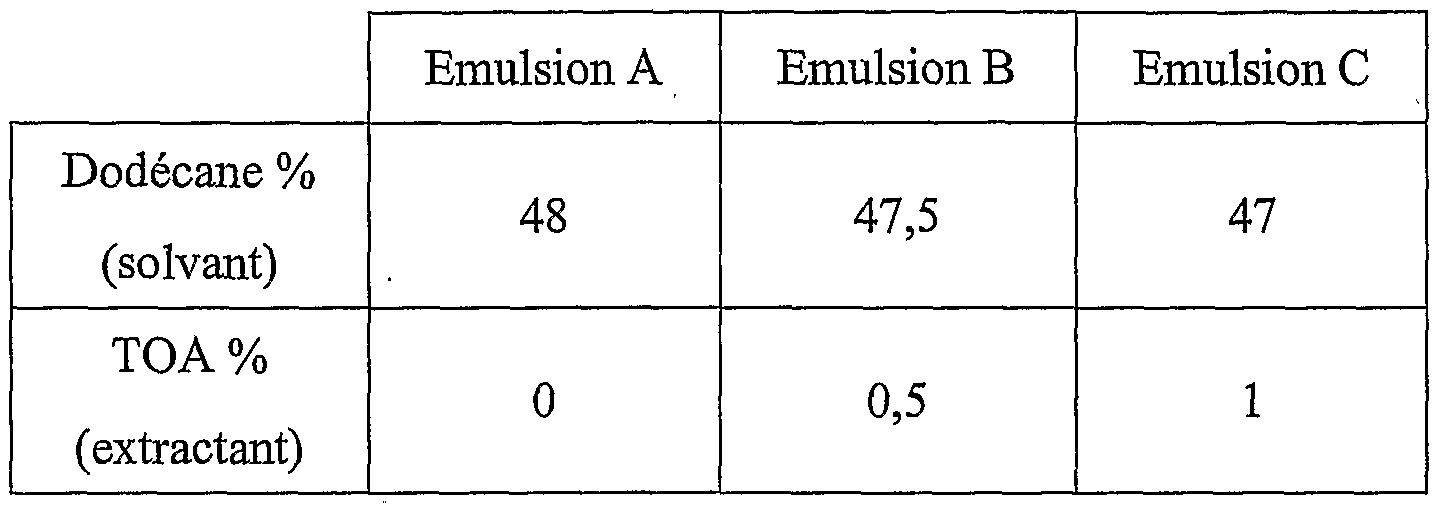
- the following emulsions, containing trioctylamine (TOA) are prepared:
- composition of the emulsion prepared is as follows Dodecane: 47.1% TOA: 0.9% ABIL: 2% NaOH 0.1 mol.L "1 : 50% The extraction percentages obtained are as follows
- Arlatone F127G copolymer of ethylene oxide and propylene oxide
- the primary emulsion is prepared by heating the internal aqueous phase and the organic phase to 70-80 ° C using a water bath.
- the aqueous phase is incorporated into the oily phase with vigorous stirring at 3000 rpm using a Rayneri centripetal turbine for 30 minutes.
- the primary emulsion is slowly introduced into the external aqueous phase.
- This second emulsification is carried out by the same turbine with stirring of 500 rpm.
- the duration of agitation depends on the formulation and can vary from 5 to 45 minutes.
- solvating transporter for very weak acid-base toxic molecules (alcohol, glycol; paracetamol for example), a solvating transporter and an internal aqueous phase capable of reacting with the toxic agent to trap it in a lipophobic form (oxidant, strong base) will be considered. ..).
- Symmetrical systems are envisaged for extracting toxic substances of a basic nature by using as carrier a acid organic molecule (organophosphorus acid, carboxylic acid) very poorly soluble in water; the internal aqueous solution will be an acid solution.
- a acid organic molecule organic molecule (organophosphorus acid, carboxylic acid) very poorly soluble in water; the internal aqueous solution will be an acid solution.
Landscapes
- Health & Medical Sciences (AREA)
- Chemical & Material Sciences (AREA)
- Public Health (AREA)
- Veterinary Medicine (AREA)
- Medicinal Chemistry (AREA)
- Pharmacology & Pharmacy (AREA)
- Life Sciences & Earth Sciences (AREA)
- Animal Behavior & Ethology (AREA)
- General Health & Medical Sciences (AREA)
- Epidemiology (AREA)
- Dispersion Chemistry (AREA)
- Oil, Petroleum & Natural Gas (AREA)
- Engineering & Computer Science (AREA)
- Bioinformatics & Cheminformatics (AREA)
- Chemical Kinetics & Catalysis (AREA)
- General Chemical & Material Sciences (AREA)
- Nuclear Medicine, Radiotherapy & Molecular Imaging (AREA)
- Organic Chemistry (AREA)
- Medicinal Preparation (AREA)
- Pharmaceuticals Containing Other Organic And Inorganic Compounds (AREA)
- Colloid Chemistry (AREA)
- Detergent Compositions (AREA)
Abstract
Description



Claims
Priority Applications (3)
| Application Number | Priority Date | Filing Date | Title |
|---|---|---|---|
| US10/516,914 US20050244438A1 (en) | 2002-06-04 | 2003-06-04 | Simple and multiple emulsions for decontamination of an organism or surfaces |
| EP03756050A EP1513501A2 (fr) | 2002-06-04 | 2003-06-04 | Emulsions simples et multiples destinees a la detoxication de l'organisme ou de surfaces |
| AU2003255635A AU2003255635A1 (en) | 2002-06-04 | 2003-06-04 | Simple and multiple emulsions for decontamination of an organism or surfaces |
Applications Claiming Priority (2)
| Application Number | Priority Date | Filing Date | Title |
|---|---|---|---|
| FR02/06849 | 2002-06-04 | ||
| FR0206849A FR2840218B1 (fr) | 2002-06-04 | 2002-06-04 | Emulsions simples et multiples destinees a la detoxication de l'organisme ou de surfaces |
Publications (2)
| Publication Number | Publication Date |
|---|---|
| WO2003101426A2 true WO2003101426A2 (fr) | 2003-12-11 |
| WO2003101426A3 WO2003101426A3 (fr) | 2004-04-08 |
Family
ID=29558949
Family Applications (1)
| Application Number | Title | Priority Date | Filing Date |
|---|---|---|---|
| PCT/FR2003/001674 Ceased WO2003101426A2 (fr) | 2002-06-04 | 2003-06-04 | Emulsions simples et multiples destinees a la detoxication de l'organisme ou de surfaces |
Country Status (5)
| Country | Link |
|---|---|
| US (1) | US20050244438A1 (fr) |
| EP (1) | EP1513501A2 (fr) |
| AU (1) | AU2003255635A1 (fr) |
| FR (1) | FR2840218B1 (fr) |
| WO (1) | WO2003101426A2 (fr) |
Cited By (1)
| Publication number | Priority date | Publication date | Assignee | Title |
|---|---|---|---|---|
| WO2005056103A1 (fr) * | 2003-12-10 | 2005-06-23 | Acrux Dds Pty Ltd | Methode de traitement d'un effet indesirable suite a la liberation d'un medicament au niveau transdermique ou topique |
Families Citing this family (1)
| Publication number | Priority date | Publication date | Assignee | Title |
|---|---|---|---|---|
| CN103558242B (zh) * | 2013-11-14 | 2016-01-20 | 河南理工大学 | 水体中颗粒态有机磷的提取及测定方法 |
Family Cites Families (10)
| Publication number | Priority date | Publication date | Assignee | Title |
|---|---|---|---|---|
| US3934007A (en) * | 1973-06-25 | 1976-01-20 | American Cyanamid Company | Method of removing toxic substances from the intestinal tract by the use of a surfactant and a sorbent |
| CA1045976A (fr) * | 1974-05-02 | 1979-01-09 | William J. Asher | Medicament sous forme de membrane liquide encapsulee et utilisation |
| US4259318A (en) * | 1978-03-02 | 1981-03-31 | University Of Houston, Central Campus | Poison ivy relief composition |
| FR2419730A1 (fr) * | 1978-03-13 | 1979-10-12 | Armines | Procede d'epuration selective par membranes liquides en emulsion |
| US4191812A (en) * | 1978-09-19 | 1980-03-04 | Rohm And Haas Company | Ion exchange process involving emulsion ion exchange resins |
| US4806354A (en) * | 1984-04-06 | 1989-02-21 | Green James P | Health food composition |
| EP0236883B1 (fr) * | 1986-03-06 | 1992-06-03 | Odenwaldwerke Rittersbach GmbH Fahrzeugbau und Katastrophenschutzsysteme | Dispositif pour obtenir une émulsion désintoxaquée pour des agents de guerre chimique |
| DE3638625A1 (de) * | 1986-11-12 | 1988-05-26 | Bundesrep Deutschland | Entgiftungs-emulsion sowie verfahren, vorrichtung und erfolgskontrolle zur herstellung der emulsion |
| FR2761607A1 (fr) * | 1997-04-04 | 1998-10-09 | Boots Co Plc | Composition dermatologique pour le traitement des symptomes de vieillissement de la peau |
| ATE444735T1 (de) * | 2001-03-21 | 2009-10-15 | Madash Llc | Thermisch reversible wasser-in-öl-in-wasser- emulsionen |
-
2002
- 2002-06-04 FR FR0206849A patent/FR2840218B1/fr not_active Expired - Fee Related
-
2003
- 2003-06-04 WO PCT/FR2003/001674 patent/WO2003101426A2/fr not_active Ceased
- 2003-06-04 EP EP03756050A patent/EP1513501A2/fr not_active Withdrawn
- 2003-06-04 US US10/516,914 patent/US20050244438A1/en not_active Abandoned
- 2003-06-04 AU AU2003255635A patent/AU2003255635A1/en not_active Abandoned
Cited By (1)
| Publication number | Priority date | Publication date | Assignee | Title |
|---|---|---|---|---|
| WO2005056103A1 (fr) * | 2003-12-10 | 2005-06-23 | Acrux Dds Pty Ltd | Methode de traitement d'un effet indesirable suite a la liberation d'un medicament au niveau transdermique ou topique |
Also Published As
| Publication number | Publication date |
|---|---|
| EP1513501A2 (fr) | 2005-03-16 |
| AU2003255635A8 (en) | 2003-12-19 |
| FR2840218B1 (fr) | 2004-08-13 |
| FR2840218A1 (fr) | 2003-12-05 |
| AU2003255635A1 (en) | 2003-12-19 |
| WO2003101426A3 (fr) | 2004-04-08 |
| US20050244438A1 (en) | 2005-11-03 |
Similar Documents
| Publication | Publication Date | Title |
|---|---|---|
| EP0670715B1 (fr) | Composition administrable par voie orale apte a former une microemulsion | |
| FR2808685A1 (fr) | Compositions pharmaceutiques pour administration transdermique d'agents anti-inflammatoires | |
| WO1996033697A1 (fr) | Formulation auto-emulsionnable formant une emulsion huile dans l'eau | |
| CA2682250A1 (fr) | Complexes d'ibuprofene, de cyclodextrines et d'agents ternaires, et leurs utilisations en pharmaceutique | |
| MC1297A1 (fr) | Composition aqueuse | |
| EP0063149A1 (fr) | Microemulsions aqueuses de fluorocarbures indefiniment stables a une temperature donnee, procede d'obtention et applications. | |
| FR2914188A1 (fr) | Nouvelle composition a base d'oxime de cholest-4-en-3-one | |
| FR2665635A1 (fr) | Composition pharmaceutique fluide a base d'un complexe metallique et son procede de preparation. | |
| CN1899272A (zh) | 还原型辅酶q水溶液的稳定组合物 | |
| WO1995017453A1 (fr) | Film d'elastomere, son procede de preparation et ses applications | |
| WO2003101426A2 (fr) | Emulsions simples et multiples destinees a la detoxication de l'organisme ou de surfaces | |
| FR2480603A1 (fr) | Composition pharmaceutique pour administration par voie orale contenant de la cytidine-diphosphocholine | |
| WO2002083178A1 (fr) | Composition pharmaceutique a base de macrolides pour application locale en ophtalmologie | |
| WO1987006130A1 (fr) | Comprimes a matrice | |
| EP2317990A2 (fr) | Forme orale microparticulaire utile pour la liberation modifiee de nanoparticules | |
| FR2465480A1 (fr) | Composition pharmaceutique contenant de la l-carnitine pour le traitement des hyperlipidemies et des hyperlipoproteines | |
| WO2018087364A1 (fr) | Système biphasique aqueux liquide ionique-acide | |
| LU85812A1 (fr) | Forme dosee d'etoposide a usage oral | |
| EP0920320A2 (fr) | Composition pharmaceutique injectable contenant l'acide ursodesoxycholique ou l'acide tauroursodesoxycholique, une base forte et du trometamol | |
| EP0726760A1 (fr) | Formulation auto-emulsionnable formant une huile dans eau | |
| WO2017077070A1 (fr) | Complexes entre des polymères blocs et des ions comme agents de contraste pour l'imagerie medicale | |
| CN1594304A (zh) | 用环糊精及其衍生物包合7、8-二羟基香豆素的制备方法 | |
| Ong et al. | Solubilization of poorly water-soluble drugs through partition/association equilibrium: Thermodynamic insights using isothermal titration calorimetry | |
| FR2517542A1 (fr) | Medicament pour l'amelioration du metabolisme lipidique | |
| WO2003055528A2 (fr) | Composes amphiphiles a usage pharmaceutique ou cosmetique |
Legal Events
| Date | Code | Title | Description |
|---|---|---|---|
| AK | Designated states |
Kind code of ref document: A2 Designated state(s): AE AG AL AM AT AU AZ BA BB BG BR BY BZ CA CH CN CO CR CU CZ DE DK DM DZ EC EE ES FI GB GD GE GH GM HR HU ID IL IN IS JP KE KG KP KR KZ LC LK LR LS LT LU LV MA MD MG MK MN MW MX MZ NO NZ OM PH PL PT RO RU SD SE SG SK SL TJ TM TN TR TT TZ UA UG US UZ VN YU ZA ZM ZW |
|
| AL | Designated countries for regional patents |
Kind code of ref document: A2 Designated state(s): GH GM KE LS MW MZ SD SL SZ TZ UG ZM ZW AM AZ BY KG KZ MD RU TJ TM AT BE BG CH CY CZ DE DK EE ES FI FR GB GR HU IE IT LU MC NL PT RO SE SI SK TR BF BJ CF CG CI CM GA GN GQ GW ML MR NE SN TD TG |
|
| 121 | Ep: the epo has been informed by wipo that ep was designated in this application | ||
| WWE | Wipo information: entry into national phase |
Ref document number: 2003756050 Country of ref document: EP |
|
| WWP | Wipo information: published in national office |
Ref document number: 2003756050 Country of ref document: EP |
|
| WWE | Wipo information: entry into national phase |
Ref document number: 10516914 Country of ref document: US |
|
| NENP | Non-entry into the national phase |
Ref country code: JP |
|
| WWW | Wipo information: withdrawn in national office |
Country of ref document: JP |