WO2003102117A1 - Lubricating oil additive composition for internal combustion engine - Google Patents
Lubricating oil additive composition for internal combustion engine Download PDFInfo
- Publication number
- WO2003102117A1 WO2003102117A1 PCT/JP2003/006837 JP0306837W WO03102117A1 WO 2003102117 A1 WO2003102117 A1 WO 2003102117A1 JP 0306837 W JP0306837 W JP 0306837W WO 03102117 A1 WO03102117 A1 WO 03102117A1
- Authority
- WO
- WIPO (PCT)
- Prior art keywords
- lubricating oil
- internal combustion
- acid
- combustion engine
- group
- Prior art date
- Legal status (The legal status is an assumption and is not a legal conclusion. Google has not performed a legal analysis and makes no representation as to the accuracy of the status listed.)
- Ceased
Links
Classifications
-
- C—CHEMISTRY; METALLURGY
- C07—ORGANIC CHEMISTRY
- C07D—HETEROCYCLIC COMPOUNDS
- C07D207/00—Heterocyclic compounds containing five-membered rings not condensed with other rings, with one nitrogen atom as the only ring hetero atom
- C07D207/02—Heterocyclic compounds containing five-membered rings not condensed with other rings, with one nitrogen atom as the only ring hetero atom with only hydrogen or carbon atoms directly attached to the ring nitrogen atom
- C07D207/30—Heterocyclic compounds containing five-membered rings not condensed with other rings, with one nitrogen atom as the only ring hetero atom with only hydrogen or carbon atoms directly attached to the ring nitrogen atom having two double bonds between ring members or between ring members and non-ring members
- C07D207/34—Heterocyclic compounds containing five-membered rings not condensed with other rings, with one nitrogen atom as the only ring hetero atom with only hydrogen or carbon atoms directly attached to the ring nitrogen atom having two double bonds between ring members or between ring members and non-ring members with hetero atoms or with carbon atoms having three bonds to hetero atoms with at the most one bond to halogen, e.g. ester or nitrile radicals, directly attached to ring carbon atoms
- C07D207/36—Oxygen or sulfur atoms
- C07D207/40—2,5-Pyrrolidine-diones
- C07D207/404—2,5-Pyrrolidine-diones with only hydrogen atoms or radicals containing only hydrogen and carbon atoms directly attached to other ring carbon atoms, e.g. succinimide
- C07D207/408—Radicals containing only hydrogen and carbon atoms attached to ring carbon atoms
- C07D207/412—Acyclic radicals containing more than six carbon atoms
-
- C—CHEMISTRY; METALLURGY
- C10—PETROLEUM, GAS OR COKE INDUSTRIES; TECHNICAL GASES CONTAINING CARBON MONOXIDE; FUELS; LUBRICANTS; PEAT
- C10M—LUBRICATING COMPOSITIONS; USE OF CHEMICAL SUBSTANCES EITHER ALONE OR AS LUBRICATING INGREDIENTS IN A LUBRICATING COMPOSITION
- C10M133/00—Lubricating compositions characterised by the additive being an organic non-macromolecular compound containing nitrogen
- C10M133/02—Lubricating compositions characterised by the additive being an organic non-macromolecular compound containing nitrogen having a carbon chain of less than 30 atoms
- C10M133/16—Amides; Imides
-
- C—CHEMISTRY; METALLURGY
- C10—PETROLEUM, GAS OR COKE INDUSTRIES; TECHNICAL GASES CONTAINING CARBON MONOXIDE; FUELS; LUBRICANTS; PEAT
- C10M—LUBRICATING COMPOSITIONS; USE OF CHEMICAL SUBSTANCES EITHER ALONE OR AS LUBRICATING INGREDIENTS IN A LUBRICATING COMPOSITION
- C10M133/00—Lubricating compositions characterised by the additive being an organic non-macromolecular compound containing nitrogen
- C10M133/52—Lubricating compositions characterised by the additive being an organic non-macromolecular compound containing nitrogen having a carbon chain of 30 or more atoms
- C10M133/56—Amides; Imides
-
- C—CHEMISTRY; METALLURGY
- C10—PETROLEUM, GAS OR COKE INDUSTRIES; TECHNICAL GASES CONTAINING CARBON MONOXIDE; FUELS; LUBRICANTS; PEAT
- C10M—LUBRICATING COMPOSITIONS; USE OF CHEMICAL SUBSTANCES EITHER ALONE OR AS LUBRICATING INGREDIENTS IN A LUBRICATING COMPOSITION
- C10M141/00—Lubricating compositions characterised by the additive being a mixture of two or more compounds covered by more than one of the main groups C10M125/00 - C10M139/00, each of these compounds being essential
- C10M141/06—Lubricating compositions characterised by the additive being a mixture of two or more compounds covered by more than one of the main groups C10M125/00 - C10M139/00, each of these compounds being essential at least one of them being an organic nitrogen-containing compound
-
- C—CHEMISTRY; METALLURGY
- C10—PETROLEUM, GAS OR COKE INDUSTRIES; TECHNICAL GASES CONTAINING CARBON MONOXIDE; FUELS; LUBRICANTS; PEAT
- C10M—LUBRICATING COMPOSITIONS; USE OF CHEMICAL SUBSTANCES EITHER ALONE OR AS LUBRICATING INGREDIENTS IN A LUBRICATING COMPOSITION
- C10M141/00—Lubricating compositions characterised by the additive being a mixture of two or more compounds covered by more than one of the main groups C10M125/00 - C10M139/00, each of these compounds being essential
- C10M141/12—Lubricating compositions characterised by the additive being a mixture of two or more compounds covered by more than one of the main groups C10M125/00 - C10M139/00, each of these compounds being essential at least one of them being an organic compound containing atoms of elements not provided for in groups C10M141/02 - C10M141/10
-
- C—CHEMISTRY; METALLURGY
- C10—PETROLEUM, GAS OR COKE INDUSTRIES; TECHNICAL GASES CONTAINING CARBON MONOXIDE; FUELS; LUBRICANTS; PEAT
- C10M—LUBRICATING COMPOSITIONS; USE OF CHEMICAL SUBSTANCES EITHER ALONE OR AS LUBRICATING INGREDIENTS IN A LUBRICATING COMPOSITION
- C10M2203/00—Organic non-macromolecular hydrocarbon compounds and hydrocarbon fractions as ingredients in lubricant compositions
- C10M2203/10—Petroleum or coal fractions, e.g. tars, solvents, bitumen
- C10M2203/1006—Petroleum or coal fractions, e.g. tars, solvents, bitumen used as base material
-
- C—CHEMISTRY; METALLURGY
- C10—PETROLEUM, GAS OR COKE INDUSTRIES; TECHNICAL GASES CONTAINING CARBON MONOXIDE; FUELS; LUBRICANTS; PEAT
- C10M—LUBRICATING COMPOSITIONS; USE OF CHEMICAL SUBSTANCES EITHER ALONE OR AS LUBRICATING INGREDIENTS IN A LUBRICATING COMPOSITION
- C10M2207/00—Organic non-macromolecular hydrocarbon compounds containing hydrogen, carbon and oxygen as ingredients in lubricant compositions
- C10M2207/28—Esters
- C10M2207/284—Esters of aromatic monocarboxylic acids
-
- C—CHEMISTRY; METALLURGY
- C10—PETROLEUM, GAS OR COKE INDUSTRIES; TECHNICAL GASES CONTAINING CARBON MONOXIDE; FUELS; LUBRICANTS; PEAT
- C10M—LUBRICATING COMPOSITIONS; USE OF CHEMICAL SUBSTANCES EITHER ALONE OR AS LUBRICATING INGREDIENTS IN A LUBRICATING COMPOSITION
- C10M2207/00—Organic non-macromolecular hydrocarbon compounds containing hydrogen, carbon and oxygen as ingredients in lubricant compositions
- C10M2207/28—Esters
- C10M2207/285—Esters of aromatic polycarboxylic acids
-
- C—CHEMISTRY; METALLURGY
- C10—PETROLEUM, GAS OR COKE INDUSTRIES; TECHNICAL GASES CONTAINING CARBON MONOXIDE; FUELS; LUBRICANTS; PEAT
- C10M—LUBRICATING COMPOSITIONS; USE OF CHEMICAL SUBSTANCES EITHER ALONE OR AS LUBRICATING INGREDIENTS IN A LUBRICATING COMPOSITION
- C10M2207/00—Organic non-macromolecular hydrocarbon compounds containing hydrogen, carbon and oxygen as ingredients in lubricant compositions
- C10M2207/28—Esters
- C10M2207/287—Partial esters
- C10M2207/289—Partial esters containing free hydroxy groups
-
- C—CHEMISTRY; METALLURGY
- C10—PETROLEUM, GAS OR COKE INDUSTRIES; TECHNICAL GASES CONTAINING CARBON MONOXIDE; FUELS; LUBRICANTS; PEAT
- C10M—LUBRICATING COMPOSITIONS; USE OF CHEMICAL SUBSTANCES EITHER ALONE OR AS LUBRICATING INGREDIENTS IN A LUBRICATING COMPOSITION
- C10M2207/00—Organic non-macromolecular hydrocarbon compounds containing hydrogen, carbon and oxygen as ingredients in lubricant compositions
- C10M2207/28—Esters
- C10M2207/30—Complex esters, i.e. compounds containing at leasst three esterified carboxyl groups and derived from the combination of at least three different types of the following five types of compounds: monohydroxyl compounds, polyhydroxy xompounds, monocarboxylic acids, polycarboxylic acids or hydroxy carboxylic acids
-
- C—CHEMISTRY; METALLURGY
- C10—PETROLEUM, GAS OR COKE INDUSTRIES; TECHNICAL GASES CONTAINING CARBON MONOXIDE; FUELS; LUBRICANTS; PEAT
- C10M—LUBRICATING COMPOSITIONS; USE OF CHEMICAL SUBSTANCES EITHER ALONE OR AS LUBRICATING INGREDIENTS IN A LUBRICATING COMPOSITION
- C10M2215/00—Organic non-macromolecular compounds containing nitrogen as ingredients in lubricant Compositions
- C10M2215/086—Imides [having hydrocarbon substituents containing less than thirty carbon atoms]
-
- C—CHEMISTRY; METALLURGY
- C10—PETROLEUM, GAS OR COKE INDUSTRIES; TECHNICAL GASES CONTAINING CARBON MONOXIDE; FUELS; LUBRICANTS; PEAT
- C10M—LUBRICATING COMPOSITIONS; USE OF CHEMICAL SUBSTANCES EITHER ALONE OR AS LUBRICATING INGREDIENTS IN A LUBRICATING COMPOSITION
- C10M2215/00—Organic non-macromolecular compounds containing nitrogen as ingredients in lubricant Compositions
- C10M2215/22—Heterocyclic nitrogen compounds
- C10M2215/221—Six-membered rings containing nitrogen and carbon only
-
- C—CHEMISTRY; METALLURGY
- C10—PETROLEUM, GAS OR COKE INDUSTRIES; TECHNICAL GASES CONTAINING CARBON MONOXIDE; FUELS; LUBRICANTS; PEAT
- C10M—LUBRICATING COMPOSITIONS; USE OF CHEMICAL SUBSTANCES EITHER ALONE OR AS LUBRICATING INGREDIENTS IN A LUBRICATING COMPOSITION
- C10M2215/00—Organic non-macromolecular compounds containing nitrogen as ingredients in lubricant Compositions
- C10M2215/24—Organic non-macromolecular compounds containing nitrogen as ingredients in lubricant Compositions having hydrocarbon substituents containing thirty or more carbon atoms, e.g. nitrogen derivatives of substituted succinic acid
- C10M2215/28—Amides; Imides
-
- C—CHEMISTRY; METALLURGY
- C10—PETROLEUM, GAS OR COKE INDUSTRIES; TECHNICAL GASES CONTAINING CARBON MONOXIDE; FUELS; LUBRICANTS; PEAT
- C10N—INDEXING SCHEME ASSOCIATED WITH SUBCLASS C10M RELATING TO LUBRICATING COMPOSITIONS
- C10N2030/00—Specified physical or chemical properties which is improved by the additive characterising the lubricating composition, e.g. multifunctional additives
- C10N2030/04—Detergent property or dispersant property
-
- C—CHEMISTRY; METALLURGY
- C10—PETROLEUM, GAS OR COKE INDUSTRIES; TECHNICAL GASES CONTAINING CARBON MONOXIDE; FUELS; LUBRICANTS; PEAT
- C10N—INDEXING SCHEME ASSOCIATED WITH SUBCLASS C10M RELATING TO LUBRICATING COMPOSITIONS
- C10N2030/00—Specified physical or chemical properties which is improved by the additive characterising the lubricating composition, e.g. multifunctional additives
- C10N2030/08—Resistance to extreme temperature
-
- C—CHEMISTRY; METALLURGY
- C10—PETROLEUM, GAS OR COKE INDUSTRIES; TECHNICAL GASES CONTAINING CARBON MONOXIDE; FUELS; LUBRICANTS; PEAT
- C10N—INDEXING SCHEME ASSOCIATED WITH SUBCLASS C10M RELATING TO LUBRICATING COMPOSITIONS
- C10N2030/00—Specified physical or chemical properties which is improved by the additive characterising the lubricating composition, e.g. multifunctional additives
- C10N2030/38—Catalyst protection, e.g. in exhaust gas converters
-
- C—CHEMISTRY; METALLURGY
- C10—PETROLEUM, GAS OR COKE INDUSTRIES; TECHNICAL GASES CONTAINING CARBON MONOXIDE; FUELS; LUBRICANTS; PEAT
- C10N—INDEXING SCHEME ASSOCIATED WITH SUBCLASS C10M RELATING TO LUBRICATING COMPOSITIONS
- C10N2030/00—Specified physical or chemical properties which is improved by the additive characterising the lubricating composition, e.g. multifunctional additives
- C10N2030/40—Low content or no content compositions
- C10N2030/45—Ash-less or low ash content
-
- C—CHEMISTRY; METALLURGY
- C10—PETROLEUM, GAS OR COKE INDUSTRIES; TECHNICAL GASES CONTAINING CARBON MONOXIDE; FUELS; LUBRICANTS; PEAT
- C10N—INDEXING SCHEME ASSOCIATED WITH SUBCLASS C10M RELATING TO LUBRICATING COMPOSITIONS
- C10N2030/00—Specified physical or chemical properties which is improved by the additive characterising the lubricating composition, e.g. multifunctional additives
- C10N2030/50—Emission or smoke controlling properties
-
- C—CHEMISTRY; METALLURGY
- C10—PETROLEUM, GAS OR COKE INDUSTRIES; TECHNICAL GASES CONTAINING CARBON MONOXIDE; FUELS; LUBRICANTS; PEAT
- C10N—INDEXING SCHEME ASSOCIATED WITH SUBCLASS C10M RELATING TO LUBRICATING COMPOSITIONS
- C10N2030/00—Specified physical or chemical properties which is improved by the additive characterising the lubricating composition, e.g. multifunctional additives
- C10N2030/52—Base number [TBN]
-
- C—CHEMISTRY; METALLURGY
- C10—PETROLEUM, GAS OR COKE INDUSTRIES; TECHNICAL GASES CONTAINING CARBON MONOXIDE; FUELS; LUBRICANTS; PEAT
- C10N—INDEXING SCHEME ASSOCIATED WITH SUBCLASS C10M RELATING TO LUBRICATING COMPOSITIONS
- C10N2040/00—Specified use or application for which the lubricating composition is intended
- C10N2040/25—Internal-combustion engines
-
- C—CHEMISTRY; METALLURGY
- C10—PETROLEUM, GAS OR COKE INDUSTRIES; TECHNICAL GASES CONTAINING CARBON MONOXIDE; FUELS; LUBRICANTS; PEAT
- C10N—INDEXING SCHEME ASSOCIATED WITH SUBCLASS C10M RELATING TO LUBRICATING COMPOSITIONS
- C10N2040/00—Specified use or application for which the lubricating composition is intended
- C10N2040/25—Internal-combustion engines
- C10N2040/252—Diesel engines
-
- C—CHEMISTRY; METALLURGY
- C10—PETROLEUM, GAS OR COKE INDUSTRIES; TECHNICAL GASES CONTAINING CARBON MONOXIDE; FUELS; LUBRICANTS; PEAT
- C10N—INDEXING SCHEME ASSOCIATED WITH SUBCLASS C10M RELATING TO LUBRICATING COMPOSITIONS
- C10N2040/00—Specified use or application for which the lubricating composition is intended
- C10N2040/25—Internal-combustion engines
- C10N2040/252—Diesel engines
- C10N2040/253—Small diesel engines
-
- C—CHEMISTRY; METALLURGY
- C10—PETROLEUM, GAS OR COKE INDUSTRIES; TECHNICAL GASES CONTAINING CARBON MONOXIDE; FUELS; LUBRICANTS; PEAT
- C10N—INDEXING SCHEME ASSOCIATED WITH SUBCLASS C10M RELATING TO LUBRICATING COMPOSITIONS
- C10N2060/00—Chemical after-treatment of the constituents of the lubricating composition
- C10N2060/12—Chemical after-treatment of the constituents of the lubricating composition by phosphorus or a compound containing phosphorus, e.g. PxSy
-
- C—CHEMISTRY; METALLURGY
- C10—PETROLEUM, GAS OR COKE INDUSTRIES; TECHNICAL GASES CONTAINING CARBON MONOXIDE; FUELS; LUBRICANTS; PEAT
- C10N—INDEXING SCHEME ASSOCIATED WITH SUBCLASS C10M RELATING TO LUBRICATING COMPOSITIONS
- C10N2060/00—Chemical after-treatment of the constituents of the lubricating composition
- C10N2060/14—Chemical after-treatment of the constituents of the lubricating composition by boron or a compound containing boron
Definitions
- the present invention relates to a lubricating oil additive composition for an internal combustion engine and a lubricating oil composition for an internal combustion engine obtained by blending the same.
- These lubricating oil compositions for internal combustion engines have excellent high-temperature detergency and heat resistance, and have low ash content, such as particulate emissions (hereinafter referred to as PM) traps, unburned fuel, and oxidation catalysts that oxidize lubricating oil.
- PM particulate emissions
- lubricating oils for internal combustion engines particularly lubricating oils for diesel engines, have used a combination of a metal and an ashless as a detergent and dispersant, and generally include an alkali metal or an alkali metal as a metal.
- Earth metal sulfonates, phenates, salicylates, phosphonates and their overbased products are used. '
- the present invention has been made under the above circumstances, and an internal combustion engine capable of preparing a lubricating oil composition for an internal combustion engine capable of improving a base number without impairing the performance of an exhaust gas treatment device such as a PM trap and an oxidation catalyst. It is an object of the present invention to provide a lubricating oil additive for internal combustion engines, a lubricating oil additive composition for internal combustion engines, and a lubricating oil composition for internal combustion engines containing the same.
- the present inventors have found that by adjusting the molecular weight and nitrogen content of an alkenyl or alkyl succinic acid imid compound and a boride thereof, a lubricating oil composition for an internal combustion engine capable of improving the base number can be obtained. It is completed.
- the gist of the present invention is as follows.
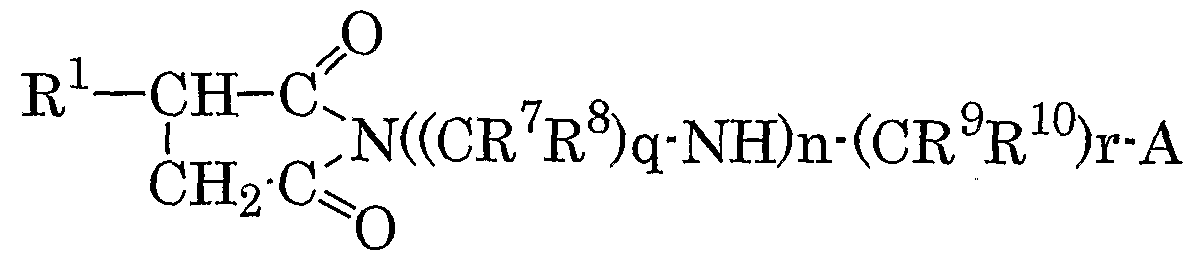
- R 1 is an alkyl group or an alkyl group having 6 to 30 carbon atoms
- R 7 , R 8 , R 9 and R 1 are each independently hydrogen or a phenol group having 1 to 3 carbon atoms
- q is 2
- n is an integer of 0 to 3
- r is an integer of 2 to 4
- A represents an amino group or an N-piperazyl group.
- a lubricating oil additive composition for an internal combustion engine comprising:
- the lubricating oil additive composition for an internal combustion engine according to the above item 2 which comprises a succinic acid imide compound wherein q and r in the general formula (1) are each 2 or a boride thereof.
- the lubricating oil additive composition for an internal combustion engine according to the above item 3 which comprises an succinic acid imid compound having 10 to 20 carbon atoms of R 1 in the general formula (1) or a boride thereof. object.
- a lubricating oil additive composition for an internal combustion engine comprising (A) the succinic acid imid compound or boride thereof according to any of the above (1) to (4), and (B) a substituted hydroxy aromatic ester derivative. object.
- the substituted hydroxy aromatic ester derivative is represented by the following general formula (2)
- R 2 and R 3 each represent an organic group having 6 or more carbon atoms, and they may be the same or different, and a, b, c, d, and e each represent l ⁇ a ⁇ 3, 1 ⁇ b ⁇ 3, 0 ⁇ c ⁇ 3, 1 ⁇ d ⁇ 3, 1 ⁇ e ⁇ 3, 3 ⁇ (a + b + e) and I (c + d) ⁇ 5 Is shown. Further, when R 2 and R 3 are multiple. Multiple R 2 and R 3 may be the same or different in each. ]
- f, g, h, i, j, k and m are .0 ⁇ f ⁇ 3, 0 ⁇ g ⁇ 3, 1 ⁇ (f + g) ⁇ 3, 0 ⁇ h ⁇ 4, 0 ⁇ i ⁇ 3, 1 ⁇ (h + i) ⁇ 6, 0 ⁇ (f + h) ⁇ 4, 0 ⁇ (g + i + m) ⁇ 4, Integers satisfying the relations 0 ⁇ j ⁇ 3, 1 ⁇ k ⁇ 3, 1 ⁇ m ⁇ 3, 3 ⁇ (f + g + h + i + m) ⁇ 8 and I (j + k) ⁇ 5.
- R 1 represents an alkenyl group or an alkyl group having 6 to 30 carbon atoms, and may be linear or branched. If the carbon number is smaller than 6, the succinic acid imide compound may not be sufficiently dissolved in the lubricating base oil, etc., and if the carbon number is larger than 30, a compound having a high base number cannot be obtained. May be.
- the preferred number of carbon atoms is 10 to 20.
- a decyl group examples include a decyl group, a decenyl group, a dodecyl group, a dodecenyl group, a tetradecyl group, a tetradecenyl group, a hexadecyl group, a hexadecenyl group, an octadecinole group, an octadecenyl group, Examples include an eicosyl group and an eicosell group.
- R 7 , R 8 , R 9 and R 1 Q are each independently hydrogen or carbon
- R 3 is an alkyl group, and both R 7 and R 8 are hydrogen.If one of them is a methyl group, one of R 9 and R 1 ° is hydrogen. It is preferably a methyl group, and particularly preferably, all of R 7 , R 8 , R 9 and R 1 ° are hydrogen.
- ⁇ N is an integer of 0 to 3; The polarity of the metal compound becomes too large and it does not dissolve sufficiently in lubricating base oils.
- polyamine as a raw material for adjusting n examples include, for example, ethylenediamine, propanediamine, butanediamine, N-methyl1-1,31-1 Alkylene diamines such as propane diamine, N, N-dimethyl-1,3-propane diamine, polyalkylene polyamines such as diethylene triamine, triethylene tetramin, and tetraethylene pentamine, and aminoethyl piperazine; As described above, polyalkylenepolyamines having a cyclic alkyleneamine and the like can be mentioned ( q and r are integers of 2 to 4).
- the method for producing the succinic acid imide compound is not particularly limited.
- the succinic acid compound can be suitably produced by the following method.
- (a) alkenyl or 'alkyl succinic acid or alkenyl or alkyl succinic anhydride and (b) the polyamine in a molar ratio of (a) :( b) l: 10-; LO: l It is obtained by reacting in a ratio, preferably in a ratio of 1: 2 to 2: 1.
- the reaction temperature is preferably 140 to 200 ° C.
- the reaction pressure is preferably 0.1 to 1 MPa (G)
- the reaction time is preferably 1 to 10 hours. .
- Solvents are not required, but may be used.
- the solvent is preferably one having a boiling point of 140 to 150 ° C., including toluene and xylene.
- the concentration of the raw material is not particularly limited, and may be up to the saturation solubility, but is preferably 0.1 to 10 mol liter.
- the (c) boron-containing compound is added to the succinic acid imid compound obtained as described above. It is obtained by reacting the product with the polyamine at a molar ratio of 1: 0.01 to 10 and preferably at a ratio of 1: 0.
- the boron compound (c) include boron oxide, boron halide: boric acid, boric anhydride, and boric acid ester.
- the reaction with (c) is carried out at about 50-250 ° C, preferably at 100-200 ° C.
- a solvent for example, an organic solvent such as a hydrocarbon oil may be used.
- the above succinic acid imid compound or boride thereof has a base number (hydrochloric acid method) of 5 Omg KOH / g or more and functions as a detergent and dispersant.
- the boride [component (A)] can be used as one component of a lubricating oil additive composition for an internal combustion engine.
- Preferable examples of the lubricating oil additive composition for an internal combustion engine include a composition of the component (B) with a substituted hydroxy aromatic ester derivative.
- the substituted hydroxy aromatic ester derivative Is not particularly limited, but preferably includes a compound represented by the general formula (2) or (3).
- the substituted hydroxy aromatic ester derivative will be described in detail. It is at least one compound selected from the substituted hydroxyaromatic carboxylic acid ester derivatives represented by the general formula (2) or (3).
- R 2 , R 3 , R 4 , R 5 and R 6 each represent an organic group having 6 or more carbon atoms.
- the organic group having 6 or more carbon atoms is preferably a hydrocarbon group having 6 to 100 carbon atoms, more preferably a hydrocarbon group having 8 to 20 carbon atoms.
- Examples of the hydrocarbon group include an alkyl group, an alkyl group, a cycloalkyl group, a cycloalkenyl group and an aralkyl group.
- R 2 , R 3 , R 4 , R 5 and R 6 are substantially linear hydrocarbons. It is preferably a group. R 2 and R 3 may be the same or different, and R 4 , R 5 and R 6 may be the same or different.
- a, b, c, d, and e are 1 ⁇ a ⁇ 3, 1 ⁇ b ⁇ 3, 0 ⁇ c ⁇ 3, 1 ⁇ d ⁇ 3, 1 ⁇ e ⁇ 3, Integers satisfying the relations 3 ⁇ (a + b + e) ⁇ 6 and I (c + d) ⁇ 5.
- b is 2 or 3
- a plurality of R 2 may be the same or different
- d is 2 or 3
- a plurality of R 3 may be the same or different.
- ⁇ , g, h, i, j, k, and m are 0 ⁇ f3, 0 ⁇ g ⁇ 3, 1 ⁇ (f + g) ⁇ 3,
- R 5 may be the same or different.
- k is 2 or 3
- a plurality of R 6 may be the same or different.
- Specific examples of the substituted hydroxy aromatic carboxylic acid ester derivative represented by the general formula (2) include (hexyl hydroxybenzoic acid) hexyl phenyl ester and (hexyl hydroxy benzoic acid).
- Decylphenyl ester (octylhydroxybenzoic acid) octylphenyl ester, (nonylhydroxybenzoic acid, carboxylic acid) nojulpheel ester, (noelhydroxyloxybenzoic acid) hexadecylpheninolete Stenole, (dodecylhydroxybenzoic acid) noelphen -Ester: (dodecyl hydroxybenzoic acid) dodecyl fuyl ester, (dodecyl hydroxy benzoic acid) hexadecyl phenyl ester, (hexadecyl hydroxy benzoic acid) hexyl fuyl ester, (hexadecyl hydroxy benzoic acid) dodeci Phenyl ester, (hexadecyl hydroxybenzoic acid) Hexadecyl phenyl ester, (eicosylhydroxybenzoic acid)
- Hexadecylphenyl ester (eicosyldihydroxybenzoic acid) Eicosylfurester, (mixed alkylalkylhydroxybenzoic acid with 11 to 15 carbon atoms) Mixed alkylphenyl ester with 11 to 15 carbon atoms, (Long-chain alkyl (e.g., poly Group derived from decene, group derived from polybutene having a weight average molecular weight of 400 or more] dihydroxybenzoic acid) dodecylphenyl-ester, (long-chain alkyl [eg, derived from polydecene having 30 or more carbon atoms] Group, group derived from polybutene having a weight-average molecular weight of 400 or more] dihydroxybenzoic acid) long-chain alkyl [for example, a group derived from polydecene having 30 or more carbon atoms, a poly- group having a weight-average molecular weight of 400 or more] Groups
- substituted hydroxyaromatic carbonate derivative represented by the general formula (3) examples include (hexylhydroxynaphthenic acid) hexinolef enoleestenol, and (hexy / lehydroxynaphate).
- Toxic acid Hexadesi / Refeninoleestenole, (Noninolehydroxynaphthenic acid) Noninolefenedinole ester, (Dodecinoleic droxinaphtoic acid) Dodecinolefenic acid / (ester) Enoleester, (dodecinolehydroxynaphthoic acid) Eicosinolepheninoleestenole, (eicosinoledroxyhydroxy-phthalic acid) Eicosylphele ester, (mixture of 11 to 15 carbon atoms Alkylhydroxynaphthenic acid) Carbon number 11 to 1 1 5 Mixed alkyl phenyl Diester, (long-chain alkyl [for example, a group derived from polydecene having 30 or more carbon atoms, a group derived from polybutene having a weight-average molecular weight of 400 or more] hydroxynaphthoic acid) dodecyl
- Dodecyl phenyl ester (long-chain alkyl [eg, a group derived from polydecene having 30 or more carbon atoms, weight average molecular weight of 400 or more) Group derived from polybutene) dihydroxylnaphthoic acid) long-chain alkyl [for example, a group derived from polydecene having 30 or more carbon atoms, a group derived from polybutene having a weight average molecular weight of 400 or more]
- Norestenore (Hexinolegidroxynaphthenic acid) Dodecinolehydroxypheneolenoate, (Octyldihydroxynaphthenic acid) Dodeci / Lehydroxyfeline estenole, (Dodecyldihydroxynaphthenic acid) Hexadecinoleic hydroxyde-noreestenolate, (hexadecidoxydoxynaphthenate) Hexadec
- R 4 , R 5 , R 6 , h, k and m are the same as above, p represents 0, 1 or 2, the sum of h and p is 1 to 6, h and m are The sum of p is 2 to 7.
- the compound represented by is more preferable.
- the component (B) may be one kind of the compound represented by the general formula (2), or two or more kinds. You may. Further, it may be composed of one kind of the compound represented by the general formula (3), or may be composed of two or more kinds. Furthermore, it may be composed of one or more compounds represented by the general formula (2) and one or more compounds represented by the general formula (3).
- the mixing ratio of the component (A) and the component (B) is 1:99 to 99: 1 by mass ratio, preferably 10:90.
- these additives are blended with a lubricating base oil, such as a mineral oil or a synthetic oil, in a ratio of 0.1 to 50% by mass to prepare a lubricating oil composition for an internal combustion engine.
- a lubricating base oil such as a mineral oil or a synthetic oil
- Mineral oil and synthetic oil used as a lubricating base oil are not particularly limited as long as they are generally used as a base oil for internal combustion engine lubricating oils. There is preferably one in the range of 2 ⁇ 3 5 mm 2, s, which is in the range of 3 ⁇ 2 5 mm 2 / s is more preferable. If the kinematic viscosity of the base oil is higher than 35 mm 2 / s, the fuel efficiency may deteriorate.On the other hand, if the kinematic viscosity of the base oil is lower than 2 mm 2 / s, the lubricating performance decreases and the evaporation rate is high, and the oil consumption increases. May increase, which is not preferable.
- the pour point which is an index of the low-temperature fluidity of the base oil, is not particularly limited, but is usually preferably 10 ° C. or lower.
- Mineral oils include, for example, paraffinic mineral oil, naphthenic mineral oil, intermediate mineral oil, and the like. Examples include eutral oil, heavy neutral oil, and bright stock.
- synthetic oils include, for example, polyolefin, ⁇ -olefin copolymer, polybutene, alkylbenzene, and polyallester. And dibasic acid esters, polyhydric alcohol esters, polyoxyalkylene glycols, polyoxyalkylene glycol esters, and polyoxyalkylene glycol ethers. The above can be used in combination, and the mineral oil and the synthetic oil can be used together. Seen fit to use You may.
- the lubricating oil composition for an internal combustion engine of the present invention includes an antioxidant, an antiwear agent, other detergents and dispersants, and a viscosity index improver which are usually added to a lubricating oil within a range that does not impair the effect of the succinic imid compound. , Pour point improvers and other additives may be added.
- Example 1 aminoethylpiperazine was used instead of DETA.
- the reaction was carried out in the same manner as in Example 1, except that a mixture of 6.5 g (0.05 mol) of AEP and 5.2 g (0.05 mol) of DETA was used instead of DETA.
- the yield of the obtained hexadeceel succinate imide was 57 g, and the base number was 93 mg KOHZ g.
- Example 4 in place of DDSA, 355.2 g (0.1 monole) of octadecel succinic anhydride (ODSA) and a mineral oil equivalent to 150 euros 18.5 The reaction was carried out in the same manner except that g (equivalent to about 30% by mass in the final product) was used. The yield of the obtained octadecenyl succinic acid imide was 59 g, and the base number was 89 mg KOHZ g. [Example 6]
- Example 1 N instead of DETA, N-dimethyl one 1, 3 -. Purono ⁇ 0 Njia Mi emissions (di M e PDA) 1 0 is 2 g (. 0 1 mole) was used instead, likewise The reaction was performed. The yield of hexadeseni / resuccinic acid and imide obtained was 56 g, and the base number was 95 mg KO HZ g.
- a lubricating oil composition was prepared by blending 10% by mass of the succinic acid imide compound obtained in Examples 1 to 8 with the mineral oil of the 500 euthanal fraction. The performance of this lubricating oil composition was evaluated by a hot tube test. Table 2 shows the results.
- a lubricating oil composition was prepared by mixing 10% by mass of the boronated succinic imide compound obtained in Examples 9 to 16 with the mineral oil of the 500 neutral fraction. The performance of this lubricating oil composition was evaluated by a hot tube test. Table 4 shows the results.
- the reaction was carried out in the same manner as in Comparative Example 1, except that 7 g (0.068 mol) of diethylenetriamine (DETA) was used instead of DETA.
- the yield of the obtained polybutenylsuccinic acid imide was 151 g, and the base number was 33 mg KOH / g.
- the reaction was carried out in the same manner as in Comparative Example 1, except that 8.8 g (0.068 mol) of aminoethylpiperazine (AEP) was used instead of DETA.
- AEP aminoethylpiperazine
- the yield of the obtained polybutenylsuccinic acid imide was 151 g, and the base number was 3 lmg K ⁇ H / g.
- Table 1 shows the properties of the products obtained in Comparative Examples 1 to 4.
- the lubricating oil composition was prepared by blending the mineral oil of the 500 neutral fraction with the polybutenyl succinic acid imide (10 mass% / 0 ) obtained in Comparative Examples 1-3. The performance of this lubricating oil composition was evaluated by a hot tube test. Table 2 shows the results.
- the hot tube test was performed as follows.
- Example 11 Hexane: ethylene / ethylethylene triene: 88 30 71.0 72.2 11.4 5.7 1.
- Example 12 Example 12 ;; No ethyl thiene / ethylene triamine:; 30 30 1.4 1.4 71.8 11.0 7.0 1.
- Example 13 Example 13
- Example 14 Hexane * Sen 13—Pharmamin 30 61 1.6 78.1 12.5 4.7 0.
- Example 15 Hexate 'Sene N-methyl-1,3-globan'amine 30 63 1.4 78.0 12.3 4.6 0.
- Example 16 Hexate * Sen ⁇ , ⁇ —S'methyl-1,3, -F. Loha. Ns'amine 30 92 1.3 78.1 12.2 4.5 0.
- Example 1 (mgKOH / g) Example 1 Example 1 5 3.6 Example 18 Example 2 5 3.8 Example 19 Example 3 5 3.8 Example 20 Example 4 5 4.2 Example 21 Example 5 5 3.5 Example 22 Example 6 4 1.5 Example 23 Example 7 4 1.8 Example 24 Example 8 4 2.1 Comparative Example 5 Comparative Example 1 1 0.1 Comparative Example 6 Comparative Example 2 1 0.1 Comparative Example 7 Comparative Example 3 1 0.1
- Example 25 (mgKOH / g) Example 25 Example 1 6 4.5 Example 26 Example 2 6 5.1 Example 27 Example 3 6 4.8 Example 28 Example 4 6 6.1 Example 29 Example 5 7 4.5 Example 30 Example 6 7 4.9 Example 31 Example 7 7 5.3 Example 32 Example 8 7 5.8 Table 4
- Example 9 (mgKOH / g) Example 33
- Example 9 8 6.3
- Example 34 Example 10 8 6.5
- Example 35 Example 1 18 6.6
- Example 36 Example 12 8 8.0
- Example 37 Example 13 8 6.2
- Example 38 Example 14 6 2.8
- Example 39 Example 15 6 2.7
- Example 40 Example 16 6 3.4 Comparative Example 8 Comparative Example 4 2 0.3
- Example 9 (mgKOH / g) Example 41
- Example 9 9 3.6
- Example 42 Example 10
- Example 43 Example 1 1 9 3.8
- Example 44 Example 12
- Example 45 Example 13 9 3.6
- Example 46 Execution Example 14 7 1.7
- Example 47 Example 15 7 1.7
- Example 48 Example 16 7 2.5 Industrial applicability
- a lubricating oil additive for an internal combustion engine capable of preparing a lubricating oil composition for an internal combustion engine capable of improving a base number without impairing the performance of an exhaust gas treatment device such as a PM trap and an oxidation catalyst
- the present invention can provide a lubricating oil additive composition for an internal combustion engine, and a lubricating oil composition for an internal combustion engine containing the same.
Landscapes
- Chemical & Material Sciences (AREA)
- Organic Chemistry (AREA)
- Chemical Kinetics & Catalysis (AREA)
- General Chemical & Material Sciences (AREA)
- Oil, Petroleum & Natural Gas (AREA)
- Lubricants (AREA)
Description


Claims


Priority Applications (3)
| Application Number | Priority Date | Filing Date | Title |
|---|---|---|---|
| JP2004510359A JP4498920B2 (ja) | 2002-05-30 | 2003-05-30 | 内燃機関用潤滑油添加剤組成物 |
| US10/515,822 US20050181957A1 (en) | 2002-05-30 | 2003-05-30 | Lubricating oil additive composition for internal combustion engine |
| EP03730728A EP1508610A4 (en) | 2002-05-30 | 2003-05-30 | LUBRICANT ADDITIVE COMPOSITION FOR INTERNAL COMBUSTION ENGINE |
Applications Claiming Priority (2)
| Application Number | Priority Date | Filing Date | Title |
|---|---|---|---|
| JP2002156939 | 2002-05-30 | ||
| JP2002-156939 | 2002-05-30 |
Publications (1)
| Publication Number | Publication Date |
|---|---|
| WO2003102117A1 true WO2003102117A1 (en) | 2003-12-11 |
Family
ID=29706452
Family Applications (1)
| Application Number | Title | Priority Date | Filing Date |
|---|---|---|---|
| PCT/JP2003/006837 Ceased WO2003102117A1 (en) | 2002-05-30 | 2003-05-30 | Lubricating oil additive composition for internal combustion engine |
Country Status (4)
| Country | Link |
|---|---|
| US (1) | US20050181957A1 (ja) |
| EP (1) | EP1508610A4 (ja) |
| JP (1) | JP4498920B2 (ja) |
| WO (1) | WO2003102117A1 (ja) |
Cited By (4)
| Publication number | Priority date | Publication date | Assignee | Title |
|---|---|---|---|---|
| JP2009292998A (ja) * | 2008-06-09 | 2009-12-17 | Idemitsu Kosan Co Ltd | 内燃機関用潤滑油組成物 |
| JP2011032278A (ja) * | 2010-10-06 | 2011-02-17 | Idemitsu Kosan Co Ltd | アミド化合物及びその用途 |
| KR20230082030A (ko) * | 2020-10-05 | 2023-06-08 | 셰브런 재팬 리미티드 | 마찰 조정제 시스템 |
| JP2023543939A (ja) * | 2020-10-05 | 2023-10-18 | シェブロン・オロナイト・カンパニー・エルエルシー | 無灰添加剤組成物 |
Families Citing this family (7)
| Publication number | Priority date | Publication date | Assignee | Title |
|---|---|---|---|---|
| US8598100B2 (en) | 2003-06-23 | 2013-12-03 | Idemitsu Kosan Co., Ltd. | Lubricating oil additive and lubricating oil composition |
| JP4601315B2 (ja) * | 2004-03-31 | 2010-12-22 | 出光興産株式会社 | ディーゼルエンジン用潤滑油組成物 |
| EP1996683B1 (en) * | 2006-02-27 | 2018-10-17 | The Lubrizol Corporation | Nitrogen-containing dispersant as an ashless tbn booster for lubricants |
| CN101821368A (zh) * | 2007-10-16 | 2010-09-01 | 出光兴产株式会社 | 润滑油组合物 |
| CN102762703B (zh) * | 2009-12-17 | 2016-12-07 | 路博润公司 | 含芳族化合物的润滑组合物 |
| US20240093115A1 (en) | 2020-10-05 | 2024-03-21 | Chevron Oronite Company Llc | Ashless additive composition |
| US20260109911A1 (en) * | 2023-04-17 | 2026-04-23 | Chevron Oronite Company Llc | Friction modifier for wet clutch |
Citations (9)
| Publication number | Priority date | Publication date | Assignee | Title |
|---|---|---|---|---|
| JPS52101207A (en) * | 1976-02-21 | 1977-08-25 | Toei Chemical Kk | Detergenttdispersant for mineral oil and detergenttdispersion method |
| US5525247A (en) * | 1993-08-11 | 1996-06-11 | Idemitsu Kosan Co., Ltd. | Low ash lubricating oil composition for diesel engine and method for lubrication of diesel engine using same |
| EP0737735A2 (en) * | 1995-04-14 | 1996-10-16 | Tonen Corporation | Lubricant oil composition with reduced friction coefficient |
| EP1086960A1 (en) * | 1998-06-05 | 2001-03-28 | Idemitsu Kosan Co., Ltd. | Succinimide compound, process for producing the same, lubricating oil additive, and lubricating oil composition for internal combustion engine |
| JP2001181341A (ja) * | 1999-12-27 | 2001-07-03 | Idemitsu Kosan Co Ltd | こはく酸イミド及びその用途 |
| WO2001048055A1 (en) * | 1999-12-27 | 2001-07-05 | Idemitsu Kosan Co., Ltd. | Succinimide compounds and use thereof |
| JP2002105478A (ja) * | 2000-09-29 | 2002-04-10 | Nippon Mitsubishi Oil Corp | 潤滑油組成物 |
| JP2002194376A (ja) * | 2000-12-26 | 2002-07-10 | Nippon Mitsubishi Oil Corp | 緩衝器用油圧作動油組成物 |
| JP2003113391A (ja) * | 2001-10-02 | 2003-04-18 | Nippon Oil Corp | 潤滑油組成物 |
Family Cites Families (6)
| Publication number | Priority date | Publication date | Assignee | Title |
|---|---|---|---|---|
| NL255193A (ja) * | 1959-08-24 | |||
| US3210283A (en) * | 1963-06-18 | 1965-10-05 | California Research Corp | Lubricant containing alkenyl succinimide and hydroxypolyamine |
| US4863487A (en) * | 1987-04-29 | 1989-09-05 | Nalco Chemical Company | Hydrocarbon fuel detergent |
| JP3501239B2 (ja) * | 1993-08-11 | 2004-03-02 | 出光興産株式会社 | ディーゼルエンジン用潤滑油組成物及びそれを用いたディーゼルエンジンの潤滑方法 |
| US6133210A (en) * | 1998-06-30 | 2000-10-17 | The Lubrizol Corporation | Homogeneous additive concentrates for preparing lubricating oil compositions |
| US6867171B2 (en) * | 2002-11-27 | 2005-03-15 | Chevron Oronitz Company Llc | Low molecular weight branched alkenyl succinic acid derivatives prepared from low molecular weight polyisobutene and unsaturated acidic reagents |
-
2003
- 2003-05-30 WO PCT/JP2003/006837 patent/WO2003102117A1/ja not_active Ceased
- 2003-05-30 EP EP03730728A patent/EP1508610A4/en not_active Withdrawn
- 2003-05-30 US US10/515,822 patent/US20050181957A1/en not_active Abandoned
- 2003-05-30 JP JP2004510359A patent/JP4498920B2/ja not_active Expired - Fee Related
Patent Citations (9)
| Publication number | Priority date | Publication date | Assignee | Title |
|---|---|---|---|---|
| JPS52101207A (en) * | 1976-02-21 | 1977-08-25 | Toei Chemical Kk | Detergenttdispersant for mineral oil and detergenttdispersion method |
| US5525247A (en) * | 1993-08-11 | 1996-06-11 | Idemitsu Kosan Co., Ltd. | Low ash lubricating oil composition for diesel engine and method for lubrication of diesel engine using same |
| EP0737735A2 (en) * | 1995-04-14 | 1996-10-16 | Tonen Corporation | Lubricant oil composition with reduced friction coefficient |
| EP1086960A1 (en) * | 1998-06-05 | 2001-03-28 | Idemitsu Kosan Co., Ltd. | Succinimide compound, process for producing the same, lubricating oil additive, and lubricating oil composition for internal combustion engine |
| JP2001181341A (ja) * | 1999-12-27 | 2001-07-03 | Idemitsu Kosan Co Ltd | こはく酸イミド及びその用途 |
| WO2001048055A1 (en) * | 1999-12-27 | 2001-07-05 | Idemitsu Kosan Co., Ltd. | Succinimide compounds and use thereof |
| JP2002105478A (ja) * | 2000-09-29 | 2002-04-10 | Nippon Mitsubishi Oil Corp | 潤滑油組成物 |
| JP2002194376A (ja) * | 2000-12-26 | 2002-07-10 | Nippon Mitsubishi Oil Corp | 緩衝器用油圧作動油組成物 |
| JP2003113391A (ja) * | 2001-10-02 | 2003-04-18 | Nippon Oil Corp | 潤滑油組成物 |
Non-Patent Citations (1)
| Title |
|---|
| See also references of EP1508610A4 * |
Cited By (7)
| Publication number | Priority date | Publication date | Assignee | Title |
|---|---|---|---|---|
| JP2009292998A (ja) * | 2008-06-09 | 2009-12-17 | Idemitsu Kosan Co Ltd | 内燃機関用潤滑油組成物 |
| JP2011032278A (ja) * | 2010-10-06 | 2011-02-17 | Idemitsu Kosan Co Ltd | アミド化合物及びその用途 |
| KR20230082030A (ko) * | 2020-10-05 | 2023-06-08 | 셰브런 재팬 리미티드 | 마찰 조정제 시스템 |
| JP2023543920A (ja) * | 2020-10-05 | 2023-10-18 | シェブロンジャパン株式会社 | 摩擦調整剤システム |
| JP2023543939A (ja) * | 2020-10-05 | 2023-10-18 | シェブロン・オロナイト・カンパニー・エルエルシー | 無灰添加剤組成物 |
| US12391898B2 (en) | 2020-10-05 | 2025-08-19 | Chevron Japan Limited | Friction modifier system |
| KR102867132B1 (ko) | 2020-10-05 | 2025-10-14 | 셰브런 재팬 리미티드 | 마찰 조정제 시스템 |
Also Published As
| Publication number | Publication date |
|---|---|
| JP4498920B2 (ja) | 2010-07-07 |
| US20050181957A1 (en) | 2005-08-18 |
| EP1508610A1 (en) | 2005-02-23 |
| JPWO2003102117A1 (ja) | 2005-09-29 |
| EP1508610A4 (en) | 2006-03-22 |
Similar Documents
| Publication | Publication Date | Title |
|---|---|---|
| KR102068467B1 (ko) | 윤활유 첨가제 조성물 및 윤활유 조성물 | |
| RU2005123391A (ru) | Наночастицы оксида церия в качестве топливных присадок | |
| US9644164B2 (en) | Dispersants derived from hydroxy fatty acid polyesters and polyalkylene glycol dispersants | |
| WO2003102117A1 (en) | Lubricating oil additive composition for internal combustion engine | |
| CN116323877B (zh) | 无灰添加剂组合物 | |
| JP3298086B2 (ja) | 潤滑剤用添加剤、潤滑剤用添加剤組成物及び潤滑油組成物 | |
| WO2005095558A1 (ja) | ディーゼルエンジン用潤滑油組成物 | |
| JP2003342246A (ja) | 新規なコハク酸アミド化合物及びその製造方法並びにその用途 | |
| EP0926221A2 (en) | Diesel fuel composition containing the salt of an alkyl hydroxyaromatic compound and aliphatic amine | |
| US9624452B2 (en) | Amine terminated and hydroxyl terminated polyether dispersants | |
| JP6001994B2 (ja) | 含窒素化合物、及び含窒素化合物の製造方法 | |
| US7875747B2 (en) | Branched succinimide dispersant compounds and methods of making the compounds | |
| JP4212751B2 (ja) | ホウ素化こはく酸イミド系化合物及びその用途 | |
| CN102105572A (zh) | 包含聚(羟基羧酸)酰胺的润滑组合物的用途 | |
| WO2001048055A1 (en) | Succinimide compounds and use thereof | |
| JP2005290150A (ja) | アミド化合物及びその用途 | |
| JP2011032278A (ja) | アミド化合物及びその用途 | |
| JP6489686B2 (ja) | 潤滑油添加剤及び潤滑油組成物 | |
| JP6031389B2 (ja) | 潤滑油添加剤および潤滑油組成物 | |
| JP3567940B2 (ja) | 置換ヒドロキシ芳香族カルボン酸エステル誘導体及びその製造方法 | |
| JP2000226593A (ja) | 潤滑油用添加剤及び潤滑油組成物 | |
| JPH07331263A (ja) | 燃料用添加剤、燃料用添加剤組成物及び燃料組成物 | |
| EP3445836A1 (en) | Lubricant for two-stroke cycle engines | |
| JP2016193999A (ja) | 潤滑油添加剤及び潤滑油組成物 |
Legal Events
| Date | Code | Title | Description |
|---|---|---|---|
| AK | Designated states |
Kind code of ref document: A1 Designated state(s): JP US |
|
| AL | Designated countries for regional patents |
Kind code of ref document: A1 Designated state(s): AT BE BG CH CY CZ DE DK EE ES FI FR GB GR HU IE IT LU MC NL PT RO SE SI SK TR |
|
| 121 | Ep: the epo has been informed by wipo that ep was designated in this application | ||
| WWE | Wipo information: entry into national phase |
Ref document number: 2004510359 Country of ref document: JP |
|
| WWE | Wipo information: entry into national phase |
Ref document number: 2003730728 Country of ref document: EP |
|
| WWE | Wipo information: entry into national phase |
Ref document number: 10515822 Country of ref document: US |
|
| WWP | Wipo information: published in national office |
Ref document number: 2003730728 Country of ref document: EP |