WO2004008855A1 - Fungizide mischungen - Google Patents
Fungizide mischungen Download PDFInfo
- Publication number
- WO2004008855A1 WO2004008855A1 PCT/EP2003/006890 EP0306890W WO2004008855A1 WO 2004008855 A1 WO2004008855 A1 WO 2004008855A1 EP 0306890 W EP0306890 W EP 0306890W WO 2004008855 A1 WO2004008855 A1 WO 2004008855A1
- Authority
- WO
- WIPO (PCT)
- Prior art keywords
- weight
- compound
- compounds
- parts
- acid
- Prior art date
- Legal status (The legal status is an assumption and is not a legal conclusion. Google has not performed a legal analysis and makes no representation as to the accuracy of the status listed.)
- Ceased
Links
Classifications
-
- A—HUMAN NECESSITIES
- A01—AGRICULTURE; FORESTRY; ANIMAL HUSBANDRY; HUNTING; TRAPPING; FISHING
- A01N—PRESERVATION OF BODIES OF HUMANS OR ANIMALS OR PLANTS OR PARTS THEREOF; BIOCIDES, e.g. AS DISINFECTANTS, AS PESTICIDES OR AS HERBICIDES; PEST REPELLANTS OR ATTRACTANTS; PLANT GROWTH REGULATORS
- A01N43/00—Biocides, pest repellants or attractants, or plant growth regulators containing heterocyclic compounds
- A01N43/72—Biocides, pest repellants or attractants, or plant growth regulators containing heterocyclic compounds having rings with nitrogen atoms and oxygen or sulfur atoms as ring hetero atoms
- A01N43/74—Biocides, pest repellants or attractants, or plant growth regulators containing heterocyclic compounds having rings with nitrogen atoms and oxygen or sulfur atoms as ring hetero atoms five-membered rings with one nitrogen atom and either one oxygen atom or one sulfur atom in positions 1,3
- A01N43/76—1,3-Oxazoles; Hydrogenated 1,3-oxazoles
-
- A—HUMAN NECESSITIES
- A01—AGRICULTURE; FORESTRY; ANIMAL HUSBANDRY; HUNTING; TRAPPING; FISHING
- A01N—PRESERVATION OF BODIES OF HUMANS OR ANIMALS OR PLANTS OR PARTS THEREOF; BIOCIDES, e.g. AS DISINFECTANTS, AS PESTICIDES OR AS HERBICIDES; PEST REPELLANTS OR ATTRACTANTS; PLANT GROWTH REGULATORS
- A01N43/00—Biocides, pest repellants or attractants, or plant growth regulators containing heterocyclic compounds
- A01N43/02—Biocides, pest repellants or attractants, or plant growth regulators containing heterocyclic compounds having rings with one or more oxygen or sulfur atoms as the only ring hetero atoms
- A01N43/24—Biocides, pest repellants or attractants, or plant growth regulators containing heterocyclic compounds having rings with one or more oxygen or sulfur atoms as the only ring hetero atoms with two or more hetero atoms
- A01N43/32—Biocides, pest repellants or attractants, or plant growth regulators containing heterocyclic compounds having rings with one or more oxygen or sulfur atoms as the only ring hetero atoms with two or more hetero atoms six-membered rings
-
- A—HUMAN NECESSITIES
- A01—AGRICULTURE; FORESTRY; ANIMAL HUSBANDRY; HUNTING; TRAPPING; FISHING
- A01N—PRESERVATION OF BODIES OF HUMANS OR ANIMALS OR PLANTS OR PARTS THEREOF; BIOCIDES, e.g. AS DISINFECTANTS, AS PESTICIDES OR AS HERBICIDES; PEST REPELLANTS OR ATTRACTANTS; PLANT GROWTH REGULATORS
- A01N43/00—Biocides, pest repellants or attractants, or plant growth regulators containing heterocyclic compounds
- A01N43/48—Biocides, pest repellants or attractants, or plant growth regulators containing heterocyclic compounds having rings with two nitrogen atoms as the only ring hetero atoms
- A01N43/50—1,3-Diazoles; Hydrogenated 1,3-diazoles
Definitions
- the present invention relates to fungicidal mixtures comprising
- the invention relates to methods for controlling harmful fungi with mixtures of the compounds I and II and the use of the compounds I and II for the preparation of such mixtures, and to compositions comprising them.
- the object of the present invention was therefore to remedy the disadvantages mentioned and to provide fungicidal mixtures which, with a reduced total amount of active compounds applied, have an improved activity, in particular long-term activity, against harmful fungi (synergistic mixtures).
- the compound la is particularly preferred.
- the compounds Ia and Ib are able to form salts or adducts with inorganic or organic acids or with metal ions.
- inorganic acids are hydrohalic acids such as hydrogen fluoride, hydrogen chloride, hydrogen bromide and hydrogen iodide, sulfuric acid, phosphoric acid, carbonic acid and nitric acid.
- suitable organic acids are formic acid, and alkanoic acids such as acetic acid, trifluoroacetic acid, trichloroacetic acid and propionic acid as well as glycolic acid, thiocyanic acid, lactic acid, succinic acid, citric acid, benzoic acid, cinnamic acid, oxalic acid, alkylsulfonic acids (sulfonic acids with straight-chain alkyl-branched or branched-chain alkyl radicals or branched-chain alkyl radicals with 1 to 20 carbon atoms) ), Arylsulfonic acids or disulfonic acids (aromatic radicals such as phenyl and naphthyl which carry one or two sulfonic acid groups), alkylphosphonic acids (phosphonic acids with straight-chain or branched alkyl radicals with 1 to 20 carbon atoms), arylphosphonic acids or diphosphonic acids (aromatic radicals such as phenyl and Naphthyl which
- the metal ions of the elements of the subgroups of the fourth period are particularly preferred.
- the metals can be present in the various valences that come with them.
- the mixtures of the compounds I and II or the simultaneous joint or separate use of the compounds I and II are distinguished by an excellent action against a broad spectrum of phytopathogenic fungi, in particular from the class of the Ascomycetes, Deuteromycetes, Phycomycetes and Basidiomycetes.
- the compounds I and II can be applied simultaneously or separately or in succession, the sequence in the case of separate application generally not having any effect on the success of the control measures.
- the compounds I and II are usually used in a weight ratio of 100: 1 to 1:10, preferably 10: 1 to 1: 1, in particular 5: 1 to 1: 1.
- the application rates for the compound I are generally 5 to 2000 g / ha, preferably 10 to 1000 g / ha, in particular 50 to 750 g / ha.
- the application rates of the mixtures according to the invention are from 5 g / ha to 500 g / ha, preferably from 50 to 500 g / ha, in particular from 50 to 200 g / ha.
- application rates of the mixture of 0.001 to 1 g / kg of seed preferably 0.01 to 0.5 g / kg, in particular 0.01 to 0.1 g / kg, are generally used.
- the compounds I and II or the mixtures of the compounds I and II are applied separately or together by spraying or dusting the seeds, the plants or the soil before or after the plants are sown or before or after emergence of the plants.
- the fungicidal synergistic mixtures according to the invention or the compounds I and II can be used, for example, in the form of directly sprayable solutions, powders and suspensions or in the form of high-strength aqueous, oily or other suspensions, dispersions, emulsions, oil dispersions, pastes, dusts, scattering agents or granules processed and applied by spraying, atomizing, dusting, scattering or pouring.
- the form of application depends on the intended use; in any case, it should ensure as fine and uniform a distribution of the mixture according to the invention as possible.
- the formulations are prepared in a manner known per se, e.g. by adding solvents and / or carriers. Inert additives such as emulsifiers or dispersants are usually added to the formulations.
- the surface-active substances are the alkali, alkaline earth and ammonium salts of aromatic sulfonic acids, for example lignin, phenol, naphthalene and dibutylnaphthalenesulfonic acid, and of fatty acids, alkyl and alkylarylsulfonates, alkyl, lauryl ether and fatty alcohol sulfates, and salts of sulfated hexa- , Hepta- and octadecanols or fatty alcohol glycol ethers, condensation products of sulfonated naphthalene and its derivatives with formaldehyde, condensation products of naphthalene or naphthalenesulfonic acids with phenol and formaldehyde, polyoxyethylene yl-octylphenyl ether, ethoxylated isooctyl-, octyl- or nonylphenylphenol or phenylphenol,
- Powders, materials for spreading and dusts can be prepared by mixing or jointly grinding the compounds I and II or the mixture of the compounds I and II with a solid carrier.
- Granules e.g. coated, impregnated or homogeneous granules
- a solid carrier e.g., a maltitol
- Mineral soils such as silica gel, silicas, silica gels, silicates, talc, kaolin, limestone, lime, chalk, boluses, loess, clay, dolomite, diatomaceous earth, calcium and magnesium sulfate, magnesium oxide, ground plastics and fertilizers are used as fillers or solid carriers like ammonium sulfate,
- Ammonium phosphate, ammonium nitrate, ureas and vegetable products such as corn flour, tree bark, wood and nutshell flour, cellulose powder or other solid carriers
- the formulations generally contain 0.1 to 95% by weight, preferably 0.5 to 90% by weight, of one of the compounds I and II or of the mixture of the compounds I and II.
- the active ingredients are in a purity of 90% to 100%, preferably 95% to 100% (according to the NMR or HPLC spectrum) is used.
- the compounds I and II or the mixtures or the corresponding formulations are used by the harmful fungi, the plants, seeds, soils, surfaces, materials or spaces to be kept free of them with a fungicidally effective amount of the mixture, or the compounds I and II treated separately.
- the application can take place before or after the infestation by the harmful fungi.
- V a mixture of 80 parts by weight of the active ingredients, 3 parts by weight of the sodium salt of diisobutylnaphthalene-1-sulfonic acid, 10 parts by weight of the sodium salt of a lignosulfonic acid from a sulfite waste liquor and 7 parts by weight of powder silica gel; a spray mixture is obtained by finely distributing the mixture in water;
- IX a stable oily dispersion of 20 parts by weight of the active ingredients, 2 parts by weight of the calcium salt of dodecylbenzenesulfonic acid, 8 parts by weight of fatty alcohol polyglycol ether, 20 parts by weight of the sodium salt of a phenolsulfonic acid-urea-formaldehyde condensate and 88 parts by weight -Share a paraffinic mineral oil.
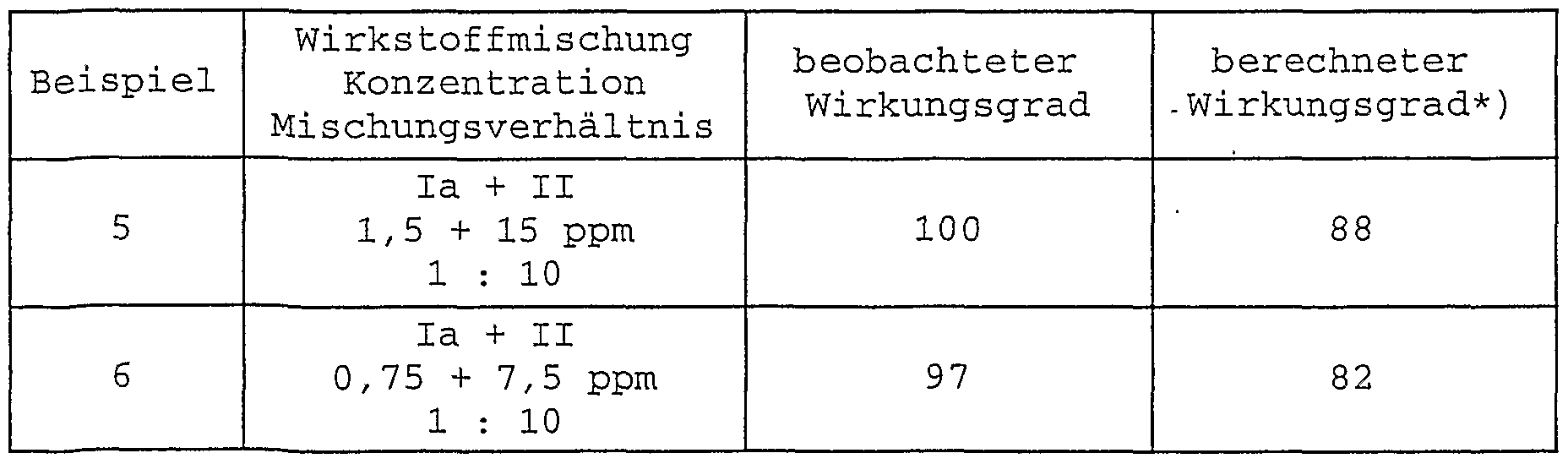
- the fungicidal activity of the compound and the mixtures can be demonstrated by the following tests:
- the active ingredients were prepared separately or together as a stock solution with 0.25% by weight of active ingredient in acetone or DMSO. This solution was 1% by weight emulsifier Uniperol® EL (wetting agent with emulsifying and dispersing action based on ethoxylated Alkylphenols) added and diluted with water according to the desired concentration.
- emulsifier Uniperol® EL wetting agent with emulsifying and dispersing action based on ethoxylated Alkylphenols
- Leaves of potted vines of the "Müller-Thurgau" variety were sprayed with an aqueous suspension in the concentration of active ingredient specified below to the dripping point.
- the plants were placed in the greenhouse for 3 days after the spray coating had dried on. Only then were the leaves inoculated with an aqueous suspension of zoospores from Plasmopara vi ticola.
- the vines were then placed for 48 hours in a steam-saturated chamber at 24 ° C and then for 5 days in a greenhouse at temperatures between 20 and 30 ° C. After this time, the plants were again placed in a moist chamber for 16 hours in order to accelerate the sporangium carrier outbreak. The extent of the development of the infestation on the undersides of the leaves was then determined visually.
- ⁇ corresponds to the fungal attack of the treated plants in%
- ß corresponds to the fungal infection of the untreated (control) plants in%
Landscapes
- Life Sciences & Earth Sciences (AREA)
- Agronomy & Crop Science (AREA)
- Pest Control & Pesticides (AREA)
- Plant Pathology (AREA)
- Health & Medical Sciences (AREA)
- Engineering & Computer Science (AREA)
- Dentistry (AREA)
- General Health & Medical Sciences (AREA)
- Wood Science & Technology (AREA)
- Zoology (AREA)
- Environmental Sciences (AREA)
- Agricultural Chemicals And Associated Chemicals (AREA)
Abstract
Description



Claims


Priority Applications (14)
| Application Number | Priority Date | Filing Date | Title |
|---|---|---|---|
| EA200500131A EA200500131A1 (ru) | 2002-07-18 | 2003-06-30 | Фунгицидные смеси |
| UAA200501406A UA78586C2 (en) | 2002-07-18 | 2003-06-30 | Fungicidal mixture, using thereof, agent and method for controlling pathogenic fungi |
| JP2004522189A JP4704038B2 (ja) | 2002-07-18 | 2003-06-30 | 殺菌混合物 |
| NZ537165A NZ537165A (en) | 2002-07-18 | 2003-06-30 | Fungicide mixtures comprising a phenylhydrazide and dithianon |
| CA002492449A CA2492449A1 (en) | 2002-07-18 | 2003-06-30 | Fungicide mixtures |
| BRPI0312308-1A BR0312308B1 (pt) | 2002-07-18 | 2003-06-30 | Mistura fungicida, agente fungicida, processo para combater fungos nocivos, e, uso dos compostos |
| DK03764924T DK1524904T3 (da) | 2002-07-18 | 2003-06-30 | Fungicide blandinger |
| SI200330643T SI1524904T1 (sl) | 2002-07-18 | 2003-06-30 | Fungicidne mesanice |
| AU2003246636A AU2003246636B2 (en) | 2002-07-18 | 2003-06-30 | Fungicide mixtures |
| US10/518,450 US20050222229A1 (en) | 2002-07-18 | 2003-06-30 | Fungicidal mixtures |
| DE50306392T DE50306392D1 (de) | 2002-07-18 | 2003-06-30 | Fungizide mischungen |
| EP03764924A EP1524904B1 (de) | 2002-07-18 | 2003-06-30 | Fungizide mischungen |
| MXPA05000535A MXPA05000535A (es) | 2002-07-18 | 2003-06-30 | Mezclas fungicidas. |
| IL16567904A IL165679A0 (en) | 2002-07-18 | 2004-12-02 | Fungicide mixtures |
Applications Claiming Priority (2)
| Application Number | Priority Date | Filing Date | Title |
|---|---|---|---|
| DE10232751.3 | 2002-07-18 | ||
| DE10232751 | 2002-07-18 |
Publications (1)
| Publication Number | Publication Date |
|---|---|
| WO2004008855A1 true WO2004008855A1 (de) | 2004-01-29 |
Family
ID=30469003
Family Applications (1)
| Application Number | Title | Priority Date | Filing Date |
|---|---|---|---|
| PCT/EP2003/006890 Ceased WO2004008855A1 (de) | 2002-07-18 | 2003-06-30 | Fungizide mischungen |
Country Status (20)
| Country | Link |
|---|---|
| US (1) | US20050222229A1 (de) |
| EP (1) | EP1524904B1 (de) |
| JP (1) | JP4704038B2 (de) |
| KR (1) | KR20050027112A (de) |
| CN (1) | CN1311743C (de) |
| AT (1) | ATE352203T1 (de) |
| AU (1) | AU2003246636B2 (de) |
| BR (1) | BR0312308B1 (de) |
| CA (1) | CA2492449A1 (de) |
| DE (1) | DE50306392D1 (de) |
| DK (1) | DK1524904T3 (de) |
| EA (1) | EA200500131A1 (de) |
| ES (1) | ES2279169T3 (de) |
| IL (1) | IL165679A0 (de) |
| MX (1) | MXPA05000535A (de) |
| PL (1) | PL373265A1 (de) |
| PT (1) | PT1524904E (de) |
| UA (1) | UA78586C2 (de) |
| WO (1) | WO2004008855A1 (de) |
| ZA (1) | ZA200501409B (de) |
Families Citing this family (5)
| Publication number | Priority date | Publication date | Assignee | Title |
|---|---|---|---|---|
| CN102986668A (zh) * | 2011-09-18 | 2013-03-27 | 深圳诺普信农化股份有限公司 | 一种含有二氰蒽醌的杀菌组合物 |
| CN102626097A (zh) * | 2012-03-28 | 2012-08-08 | 陕西上格之路生物科学有限公司 | 一种含噁唑菌酮的杀菌组合物 |
| CN105815319A (zh) * | 2012-06-21 | 2016-08-03 | 陕西美邦农药有限公司 | 一种含咪唑菌酮与三唑类的高效杀菌组合物 |
| CN105557695B (zh) * | 2014-10-16 | 2018-02-27 | 江苏龙灯化学有限公司 | 一种活性成分组合物 |
| CN108157372A (zh) * | 2018-02-02 | 2018-06-15 | 北京科发伟业农药技术中心 | 含二氰蒽醌的杀菌组合物 |
Citations (2)
| Publication number | Priority date | Publication date | Assignee | Title |
|---|---|---|---|---|
| EP0236689A2 (de) * | 1986-01-27 | 1987-09-16 | Shell Internationale Researchmaatschappij B.V. | Fungizide Mittel |
| EP1023834A1 (de) * | 1999-01-29 | 2000-08-02 | American Cyanamid Company | Fungizide Mischungen |
Family Cites Families (2)
| Publication number | Priority date | Publication date | Assignee | Title |
|---|---|---|---|---|
| JP2002525291A (ja) * | 1998-09-25 | 2002-08-13 | アメリカン サイアナミツド コンパニー | 非水性懸濁液濃縮物 |
| IT1303800B1 (it) * | 1998-11-30 | 2001-02-23 | Isagro Ricerca Srl | Composti dipeptidici aventi elevata attivita' fungicida e loroutilizzo agronomico. |
-
2003
- 2003-06-30 WO PCT/EP2003/006890 patent/WO2004008855A1/de not_active Ceased
- 2003-06-30 JP JP2004522189A patent/JP4704038B2/ja not_active Expired - Fee Related
- 2003-06-30 CN CNB038170108A patent/CN1311743C/zh not_active Expired - Fee Related
- 2003-06-30 ES ES03764924T patent/ES2279169T3/es not_active Expired - Lifetime
- 2003-06-30 EA EA200500131A patent/EA200500131A1/ru unknown
- 2003-06-30 KR KR1020057000815A patent/KR20050027112A/ko not_active Withdrawn
- 2003-06-30 EP EP03764924A patent/EP1524904B1/de not_active Expired - Lifetime
- 2003-06-30 BR BRPI0312308-1A patent/BR0312308B1/pt not_active IP Right Cessation
- 2003-06-30 UA UAA200501406A patent/UA78586C2/uk unknown
- 2003-06-30 PL PL03373265A patent/PL373265A1/xx unknown
- 2003-06-30 DK DK03764924T patent/DK1524904T3/da active
- 2003-06-30 DE DE50306392T patent/DE50306392D1/de not_active Expired - Fee Related
- 2003-06-30 MX MXPA05000535A patent/MXPA05000535A/es unknown
- 2003-06-30 AU AU2003246636A patent/AU2003246636B2/en not_active Ceased
- 2003-06-30 CA CA002492449A patent/CA2492449A1/en not_active Abandoned
- 2003-06-30 PT PT03764924T patent/PT1524904E/pt unknown
- 2003-06-30 AT AT03764924T patent/ATE352203T1/de not_active IP Right Cessation
- 2003-06-30 US US10/518,450 patent/US20050222229A1/en not_active Abandoned
-
2004
- 2004-12-02 IL IL16567904A patent/IL165679A0/xx unknown
-
2005
- 2005-02-17 ZA ZA200501409A patent/ZA200501409B/en unknown
Patent Citations (2)
| Publication number | Priority date | Publication date | Assignee | Title |
|---|---|---|---|---|
| EP0236689A2 (de) * | 1986-01-27 | 1987-09-16 | Shell Internationale Researchmaatschappij B.V. | Fungizide Mittel |
| EP1023834A1 (de) * | 1999-01-29 | 2000-08-02 | American Cyanamid Company | Fungizide Mischungen |
Also Published As
| Publication number | Publication date |
|---|---|
| PT1524904E (pt) | 2007-03-30 |
| JP4704038B2 (ja) | 2011-06-15 |
| ES2279169T3 (es) | 2007-08-16 |
| KR20050027112A (ko) | 2005-03-17 |
| US20050222229A1 (en) | 2005-10-06 |
| CN1668193A (zh) | 2005-09-14 |
| UA78586C2 (en) | 2007-04-10 |
| DK1524904T3 (da) | 2007-05-21 |
| AU2003246636B2 (en) | 2008-08-28 |
| EP1524904B1 (de) | 2007-01-24 |
| BR0312308A (pt) | 2005-04-12 |
| ZA200501409B (en) | 2007-01-31 |
| JP2005538085A (ja) | 2005-12-15 |
| BR0312308B1 (pt) | 2014-02-04 |
| EP1524904A1 (de) | 2005-04-27 |
| AU2003246636A1 (en) | 2004-02-09 |
| PL373265A1 (en) | 2005-08-22 |
| CN1311743C (zh) | 2007-04-25 |
| IL165679A0 (en) | 2006-01-15 |
| CA2492449A1 (en) | 2004-01-29 |
| ATE352203T1 (de) | 2007-02-15 |
| DE50306392D1 (de) | 2007-03-15 |
| MXPA05000535A (es) | 2005-04-19 |
| EA200500131A1 (ru) | 2005-06-30 |
Similar Documents
| Publication | Publication Date | Title |
|---|---|---|
| EP0910948B1 (de) | Fungizide Mischung | |
| EP0989806B1 (de) | Fungizide mischungen | |
| EP1494531A1 (de) | Fungizide mischungen auf der basis von benzamidoxim-derivaten und azolen | |
| EP1039806B1 (de) | Fungizide mischungen auf der basis von pyridinamiden und fenarimol | |
| EP0906017B1 (de) | Fungizide mischungen | |
| EP1521526A1 (de) | Fungizide mischungen auf basis von dithianon | |
| EP1524904B1 (de) | Fungizide mischungen | |
| EP0900019A1 (de) | Fungizide mischungen | |
| WO2004008857A1 (de) | Fungizide mischungen | |
| EP1526772B1 (de) | Fungizide mischungen | |
| EP1345493A1 (de) | Fungizide mischungen auf der basis von amidverbindungen | |
| EP1517608A1 (de) | Fungizide mischungen auf der basis von benzamidoxim-derivaten, benzophenonen und einem azol | |
| EP1524906B1 (de) | Fungizide mischungen | |
| WO1998053691A1 (de) | Fungizide mischungen | |
| EP1521525A1 (de) | Fungizide mischungen auf basis von dithianon | |
| WO2003022053A1 (de) | Fungizide mischungen | |
| WO1997040678A1 (de) | Fungizide mischungen | |
| WO1997040676A1 (de) | Fungizide mischungen | |
| WO1997040675A1 (de) | Fungizide mischungen | |
| WO2004091294A2 (de) | Fungizide mischungen | |
| WO2004091298A1 (de) | Fungizide mischungen | |
| EP1353559A2 (de) | Fungizide mischungen auf der basis von carbamaten | |
| WO1997040677A1 (de) | Fungizide mischungen | |
| WO1998053687A1 (de) | Fungizide mischung | |
| WO1998053685A1 (de) | Fungizide mischungen |
Legal Events
| Date | Code | Title | Description |
|---|---|---|---|
| AK | Designated states |
Kind code of ref document: A1 Designated state(s): AE AG AL AM AT AU AZ BA BB BG BR BY BZ CA CH CN CO CR CU CZ DE DK DM DZ EC EE ES FI GB GD GE GH GM HR HU ID IL IN IS JP KE KG KP KR KZ LC LK LR LS LT LU LV MA MD MG MK MN MW MX MZ NO NZ OM PH PL PT RO RU SD SE SG SK SL TJ TM TN TR TT TZ UA UG US UZ VC VN YU ZA ZM ZW |
|
| AL | Designated countries for regional patents |
Kind code of ref document: A1 Designated state(s): GH GM KE LS MW MZ SD SL SZ TZ UG ZM ZW AM AZ BY KG KZ MD RU TJ TM AT BE BG CH CY CZ DE DK EE ES FI FR GB GR HU IE IT LU MC NL PT RO SE SI SK TR BF BJ CF CG CI CM GA GN GQ GW ML MR NE SN TD TG |
|
| DFPE | Request for preliminary examination filed prior to expiration of 19th month from priority date (pct application filed before 20040101) | ||
| 121 | Ep: the epo has been informed by wipo that ep was designated in this application | ||
| WWE | Wipo information: entry into national phase |
Ref document number: 537165 Country of ref document: NZ |
|
| WWE | Wipo information: entry into national phase |
Ref document number: 10518450 Country of ref document: US |
|
| WWE | Wipo information: entry into national phase |
Ref document number: 2003764924 Country of ref document: EP |
|
| WWE | Wipo information: entry into national phase |
Ref document number: 3101/CHENP/2004 Country of ref document: IN |
|
| WWE | Wipo information: entry into national phase |
Ref document number: PA/a/2005/000535 Country of ref document: MX |
|
| WWE | Wipo information: entry into national phase |
Ref document number: 2492449 Country of ref document: CA |
|
| WWE | Wipo information: entry into national phase |
Ref document number: 20038170108 Country of ref document: CN Ref document number: 2004522189 Country of ref document: JP Ref document number: 1020057000815 Country of ref document: KR |
|
| WWE | Wipo information: entry into national phase |
Ref document number: 373265 Country of ref document: PL Ref document number: 2003246636 Country of ref document: AU |
|
| WWE | Wipo information: entry into national phase |
Ref document number: 200500131 Country of ref document: EA |
|
| WWE | Wipo information: entry into national phase |
Ref document number: 05013210 Country of ref document: CO |
|
| WWE | Wipo information: entry into national phase |
Ref document number: 2005/01409 Country of ref document: ZA Ref document number: 200501409 Country of ref document: ZA |
|
| WWP | Wipo information: published in national office |
Ref document number: 1020057000815 Country of ref document: KR |
|
| WWP | Wipo information: published in national office |
Ref document number: 2003764924 Country of ref document: EP |
|
| WWG | Wipo information: grant in national office |
Ref document number: 2003764924 Country of ref document: EP |