WO2004012835A2 - Adsorbant non homogene et son utilisation dans des procedes de separation diffusionnelle - Google Patents
Adsorbant non homogene et son utilisation dans des procedes de separation diffusionnelle Download PDFInfo
- Publication number
- WO2004012835A2 WO2004012835A2 PCT/FR2003/002220 FR0302220W WO2004012835A2 WO 2004012835 A2 WO2004012835 A2 WO 2004012835A2 FR 0302220 W FR0302220 W FR 0302220W WO 2004012835 A2 WO2004012835 A2 WO 2004012835A2
- Authority
- WO
- WIPO (PCT)
- Prior art keywords
- adsorbent
- homogeneous
- core
- outer layer
- adsorbent according
- Prior art date
- Legal status (The legal status is an assumption and is not a legal conclusion. Google has not performed a legal analysis and makes no representation as to the accuracy of the status listed.)
- Ceased
Links
Classifications
-
- B—PERFORMING OPERATIONS; TRANSPORTING
- B01—PHYSICAL OR CHEMICAL PROCESSES OR APPARATUS IN GENERAL
- B01J—CHEMICAL OR PHYSICAL PROCESSES, e.g. CATALYSIS OR COLLOID CHEMISTRY; THEIR RELEVANT APPARATUS
- B01J20/00—Solid sorbent compositions or filter aid compositions; Sorbents for chromatography; Processes for preparing, regenerating or reactivating thereof
- B01J20/28—Solid sorbent compositions or filter aid compositions; Sorbents for chromatography; Processes for preparing, regenerating or reactivating thereof characterised by their form or physical properties
-
- B—PERFORMING OPERATIONS; TRANSPORTING
- B01—PHYSICAL OR CHEMICAL PROCESSES OR APPARATUS IN GENERAL
- B01J—CHEMICAL OR PHYSICAL PROCESSES, e.g. CATALYSIS OR COLLOID CHEMISTRY; THEIR RELEVANT APPARATUS
- B01J20/00—Solid sorbent compositions or filter aid compositions; Sorbents for chromatography; Processes for preparing, regenerating or reactivating thereof
- B01J20/28—Solid sorbent compositions or filter aid compositions; Sorbents for chromatography; Processes for preparing, regenerating or reactivating thereof characterised by their form or physical properties
- B01J20/28002—Solid sorbent compositions or filter aid compositions; Sorbents for chromatography; Processes for preparing, regenerating or reactivating thereof characterised by their form or physical properties characterised by their physical properties
- B01J20/28004—Sorbent size or size distribution, e.g. particle size
-
- B—PERFORMING OPERATIONS; TRANSPORTING
- B01—PHYSICAL OR CHEMICAL PROCESSES OR APPARATUS IN GENERAL
- B01J—CHEMICAL OR PHYSICAL PROCESSES, e.g. CATALYSIS OR COLLOID CHEMISTRY; THEIR RELEVANT APPARATUS
- B01J20/00—Solid sorbent compositions or filter aid compositions; Sorbents for chromatography; Processes for preparing, regenerating or reactivating thereof
- B01J20/28—Solid sorbent compositions or filter aid compositions; Sorbents for chromatography; Processes for preparing, regenerating or reactivating thereof characterised by their form or physical properties
- B01J20/28014—Solid sorbent compositions or filter aid compositions; Sorbents for chromatography; Processes for preparing, regenerating or reactivating thereof characterised by their form or physical properties characterised by their form
- B01J20/28016—Particle form
- B01J20/28019—Spherical, ellipsoidal or cylindrical
-
- B—PERFORMING OPERATIONS; TRANSPORTING
- B01—PHYSICAL OR CHEMICAL PROCESSES OR APPARATUS IN GENERAL
- B01J—CHEMICAL OR PHYSICAL PROCESSES, e.g. CATALYSIS OR COLLOID CHEMISTRY; THEIR RELEVANT APPARATUS
- B01J20/00—Solid sorbent compositions or filter aid compositions; Sorbents for chromatography; Processes for preparing, regenerating or reactivating thereof
- B01J20/28—Solid sorbent compositions or filter aid compositions; Sorbents for chromatography; Processes for preparing, regenerating or reactivating thereof characterised by their form or physical properties
- B01J20/28014—Solid sorbent compositions or filter aid compositions; Sorbents for chromatography; Processes for preparing, regenerating or reactivating thereof characterised by their form or physical properties characterised by their form
- B01J20/28016—Particle form
- B01J20/28021—Hollow particles, e.g. hollow spheres, microspheres or cenospheres
-
- B—PERFORMING OPERATIONS; TRANSPORTING
- B01—PHYSICAL OR CHEMICAL PROCESSES OR APPARATUS IN GENERAL
- B01J—CHEMICAL OR PHYSICAL PROCESSES, e.g. CATALYSIS OR COLLOID CHEMISTRY; THEIR RELEVANT APPARATUS
- B01J20/00—Solid sorbent compositions or filter aid compositions; Sorbents for chromatography; Processes for preparing, regenerating or reactivating thereof
- B01J20/28—Solid sorbent compositions or filter aid compositions; Sorbents for chromatography; Processes for preparing, regenerating or reactivating thereof characterised by their form or physical properties
- B01J20/28054—Solid sorbent compositions or filter aid compositions; Sorbents for chromatography; Processes for preparing, regenerating or reactivating thereof characterised by their form or physical properties characterised by their surface properties or porosity
- B01J20/28078—Pore diameter
- B01J20/2808—Pore diameter being less than 2 nm, i.e. micropores or nanopores
-
- B—PERFORMING OPERATIONS; TRANSPORTING
- B01—PHYSICAL OR CHEMICAL PROCESSES OR APPARATUS IN GENERAL
- B01J—CHEMICAL OR PHYSICAL PROCESSES, e.g. CATALYSIS OR COLLOID CHEMISTRY; THEIR RELEVANT APPARATUS
- B01J20/00—Solid sorbent compositions or filter aid compositions; Sorbents for chromatography; Processes for preparing, regenerating or reactivating thereof
- B01J20/28—Solid sorbent compositions or filter aid compositions; Sorbents for chromatography; Processes for preparing, regenerating or reactivating thereof characterised by their form or physical properties
- B01J20/28054—Solid sorbent compositions or filter aid compositions; Sorbents for chromatography; Processes for preparing, regenerating or reactivating thereof characterised by their form or physical properties characterised by their surface properties or porosity
- B01J20/28078—Pore diameter
- B01J20/28083—Pore diameter being in the range 2-50 nm, i.e. mesopores
-
- B—PERFORMING OPERATIONS; TRANSPORTING
- B01—PHYSICAL OR CHEMICAL PROCESSES OR APPARATUS IN GENERAL
- B01J—CHEMICAL OR PHYSICAL PROCESSES, e.g. CATALYSIS OR COLLOID CHEMISTRY; THEIR RELEVANT APPARATUS
- B01J20/00—Solid sorbent compositions or filter aid compositions; Sorbents for chromatography; Processes for preparing, regenerating or reactivating thereof
- B01J20/30—Processes for preparing, regenerating, or reactivating
- B01J20/3007—Moulding, shaping or extruding
-
- B—PERFORMING OPERATIONS; TRANSPORTING
- B01—PHYSICAL OR CHEMICAL PROCESSES OR APPARATUS IN GENERAL
- B01J—CHEMICAL OR PHYSICAL PROCESSES, e.g. CATALYSIS OR COLLOID CHEMISTRY; THEIR RELEVANT APPARATUS
- B01J20/00—Solid sorbent compositions or filter aid compositions; Sorbents for chromatography; Processes for preparing, regenerating or reactivating thereof
- B01J20/30—Processes for preparing, regenerating, or reactivating
- B01J20/3028—Granulating, agglomerating or aggregating
-
- B—PERFORMING OPERATIONS; TRANSPORTING
- B01—PHYSICAL OR CHEMICAL PROCESSES OR APPARATUS IN GENERAL
- B01J—CHEMICAL OR PHYSICAL PROCESSES, e.g. CATALYSIS OR COLLOID CHEMISTRY; THEIR RELEVANT APPARATUS
- B01J20/00—Solid sorbent compositions or filter aid compositions; Sorbents for chromatography; Processes for preparing, regenerating or reactivating thereof
- B01J20/30—Processes for preparing, regenerating, or reactivating
- B01J20/3042—Use of binding agents; addition of materials ameliorating the mechanical properties of the produced sorbent
-
- B—PERFORMING OPERATIONS; TRANSPORTING
- B01—PHYSICAL OR CHEMICAL PROCESSES OR APPARATUS IN GENERAL
- B01J—CHEMICAL OR PHYSICAL PROCESSES, e.g. CATALYSIS OR COLLOID CHEMISTRY; THEIR RELEVANT APPARATUS
- B01J20/00—Solid sorbent compositions or filter aid compositions; Sorbents for chromatography; Processes for preparing, regenerating or reactivating thereof
- B01J20/30—Processes for preparing, regenerating, or reactivating
- B01J20/3078—Thermal treatment, e.g. calcining or pyrolizing
-
- B—PERFORMING OPERATIONS; TRANSPORTING
- B01—PHYSICAL OR CHEMICAL PROCESSES OR APPARATUS IN GENERAL
- B01J—CHEMICAL OR PHYSICAL PROCESSES, e.g. CATALYSIS OR COLLOID CHEMISTRY; THEIR RELEVANT APPARATUS
- B01J20/00—Solid sorbent compositions or filter aid compositions; Sorbents for chromatography; Processes for preparing, regenerating or reactivating thereof
- B01J20/30—Processes for preparing, regenerating, or reactivating
- B01J20/3085—Chemical treatments not covered by groups B01J20/3007 - B01J20/3078
-
- B—PERFORMING OPERATIONS; TRANSPORTING
- B01—PHYSICAL OR CHEMICAL PROCESSES OR APPARATUS IN GENERAL
- B01J—CHEMICAL OR PHYSICAL PROCESSES, e.g. CATALYSIS OR COLLOID CHEMISTRY; THEIR RELEVANT APPARATUS
- B01J20/00—Solid sorbent compositions or filter aid compositions; Sorbents for chromatography; Processes for preparing, regenerating or reactivating thereof
- B01J20/30—Processes for preparing, regenerating, or reactivating
- B01J20/32—Impregnating or coating ; Solid sorbent compositions obtained from processes involving impregnating or coating
-
- B—PERFORMING OPERATIONS; TRANSPORTING
- B01—PHYSICAL OR CHEMICAL PROCESSES OR APPARATUS IN GENERAL
- B01J—CHEMICAL OR PHYSICAL PROCESSES, e.g. CATALYSIS OR COLLOID CHEMISTRY; THEIR RELEVANT APPARATUS
- B01J20/00—Solid sorbent compositions or filter aid compositions; Sorbents for chromatography; Processes for preparing, regenerating or reactivating thereof
- B01J20/30—Processes for preparing, regenerating, or reactivating
- B01J20/32—Impregnating or coating ; Solid sorbent compositions obtained from processes involving impregnating or coating
- B01J20/3202—Impregnating or coating ; Solid sorbent compositions obtained from processes involving impregnating or coating characterised by the carrier, support or substrate used for impregnation or coating
- B01J20/3204—Inorganic carriers, supports or substrates
-
- B—PERFORMING OPERATIONS; TRANSPORTING
- B01—PHYSICAL OR CHEMICAL PROCESSES OR APPARATUS IN GENERAL
- B01J—CHEMICAL OR PHYSICAL PROCESSES, e.g. CATALYSIS OR COLLOID CHEMISTRY; THEIR RELEVANT APPARATUS
- B01J20/00—Solid sorbent compositions or filter aid compositions; Sorbents for chromatography; Processes for preparing, regenerating or reactivating thereof
- B01J20/30—Processes for preparing, regenerating, or reactivating
- B01J20/32—Impregnating or coating ; Solid sorbent compositions obtained from processes involving impregnating or coating
- B01J20/3214—Impregnating or coating ; Solid sorbent compositions obtained from processes involving impregnating or coating characterised by the method for obtaining this coating or impregnating
- B01J20/3223—Impregnating or coating ; Solid sorbent compositions obtained from processes involving impregnating or coating characterised by the method for obtaining this coating or impregnating by means of an adhesive agent
-
- B—PERFORMING OPERATIONS; TRANSPORTING
- B01—PHYSICAL OR CHEMICAL PROCESSES OR APPARATUS IN GENERAL
- B01J—CHEMICAL OR PHYSICAL PROCESSES, e.g. CATALYSIS OR COLLOID CHEMISTRY; THEIR RELEVANT APPARATUS
- B01J20/00—Solid sorbent compositions or filter aid compositions; Sorbents for chromatography; Processes for preparing, regenerating or reactivating thereof
- B01J20/30—Processes for preparing, regenerating, or reactivating
- B01J20/32—Impregnating or coating ; Solid sorbent compositions obtained from processes involving impregnating or coating
- B01J20/3231—Impregnating or coating ; Solid sorbent compositions obtained from processes involving impregnating or coating characterised by the coating or impregnating layer
- B01J20/3234—Inorganic material layers
- B01J20/3238—Inorganic material layers containing any type of zeolite
-
- B—PERFORMING OPERATIONS; TRANSPORTING
- B01—PHYSICAL OR CHEMICAL PROCESSES OR APPARATUS IN GENERAL
- B01J—CHEMICAL OR PHYSICAL PROCESSES, e.g. CATALYSIS OR COLLOID CHEMISTRY; THEIR RELEVANT APPARATUS
- B01J20/00—Solid sorbent compositions or filter aid compositions; Sorbents for chromatography; Processes for preparing, regenerating or reactivating thereof
- B01J20/30—Processes for preparing, regenerating, or reactivating
- B01J20/32—Impregnating or coating ; Solid sorbent compositions obtained from processes involving impregnating or coating
- B01J20/3291—Characterised by the shape of the carrier, the coating or the obtained coated product
- B01J20/3293—Coatings on a core, the core being particle or fiber shaped, e.g. encapsulated particles, coated fibers
-
- B—PERFORMING OPERATIONS; TRANSPORTING
- B01—PHYSICAL OR CHEMICAL PROCESSES OR APPARATUS IN GENERAL
- B01J—CHEMICAL OR PHYSICAL PROCESSES, e.g. CATALYSIS OR COLLOID CHEMISTRY; THEIR RELEVANT APPARATUS
- B01J20/00—Solid sorbent compositions or filter aid compositions; Sorbents for chromatography; Processes for preparing, regenerating or reactivating thereof
- B01J20/30—Processes for preparing, regenerating, or reactivating
- B01J20/32—Impregnating or coating ; Solid sorbent compositions obtained from processes involving impregnating or coating
- B01J20/3291—Characterised by the shape of the carrier, the coating or the obtained coated product
- B01J20/3295—Coatings made of particles, nanoparticles, fibers, nanofibers
-
- C—CHEMISTRY; METALLURGY
- C10—PETROLEUM, GAS OR COKE INDUSTRIES; TECHNICAL GASES CONTAINING CARBON MONOXIDE; FUELS; LUBRICANTS; PEAT
- C10G—CRACKING HYDROCARBON OILS; PRODUCTION OF LIQUID HYDROCARBON MIXTURES, e.g. BY DESTRUCTIVE HYDROGENATION, OLIGOMERISATION, POLYMERISATION; RECOVERY OF HYDROCARBON OILS FROM OIL-SHALE, OIL-SAND, OR GASES; REFINING MIXTURES MAINLY CONSISTING OF HYDROCARBONS; REFORMING OF NAPHTHA; MINERAL WAXES
- C10G25/00—Refining of hydrocarbon oils in the absence of hydrogen, with solid sorbents
- C10G25/003—Specific sorbent material, not covered by C10G25/02 or C10G25/03
-
- C—CHEMISTRY; METALLURGY
- C10—PETROLEUM, GAS OR COKE INDUSTRIES; TECHNICAL GASES CONTAINING CARBON MONOXIDE; FUELS; LUBRICANTS; PEAT
- C10G—CRACKING HYDROCARBON OILS; PRODUCTION OF LIQUID HYDROCARBON MIXTURES, e.g. BY DESTRUCTIVE HYDROGENATION, OLIGOMERISATION, POLYMERISATION; RECOVERY OF HYDROCARBON OILS FROM OIL-SHALE, OIL-SAND, OR GASES; REFINING MIXTURES MAINLY CONSISTING OF HYDROCARBONS; REFORMING OF NAPHTHA; MINERAL WAXES
- C10G25/00—Refining of hydrocarbon oils in the absence of hydrogen, with solid sorbents
- C10G25/02—Refining of hydrocarbon oils in the absence of hydrogen, with solid sorbents with ion-exchange material
- C10G25/03—Refining of hydrocarbon oils in the absence of hydrogen, with solid sorbents with ion-exchange material with crystalline alumino-silicates, e.g. molecular sieves
Definitions
- the present invention relates to a non-homogeneous adsorbent consisting of at least one crystal formed by a core and at least one continuous outer layer, used in diffusion separation processes. Diffusion separation processes exploit the property of two molecules to be separated by difference in diffusion kinetics inside solids of different chemical composition.
- An optimal adsorbent to achieve separations on an industrial scale such as the separation of oxygen and nitrogen from the air, the separation of argon from nitrogen and oxygen, the separation of paraffins monobranched dibranched paraffins must have, on the one hand, a significant difference in kinetics of diffusion between the molecules to be separated and, on the other hand, a good adsorption capacity.
- homogeneous adsorbents that is to say made up of the same chemical composition throughout their volume; these homogeneous adsorbents generally have either good performance in terms of separation but have only a low adsorption capacity, this is the case in particular of silicalite of the MFI structural type, or have good adsorption capacities but do not allow not achieve the desired separation. It is also already known in the state of the art of non-homogeneous adsorbents formed by a core and an outer layer (FR-A1-2 794 993, EP-A1-1 080 771).
- a peripheral adsorbent layer generally a zeolite.
- the formulation of such adsorbents does not make it possible to improve the performance of the separation process in terms of adsorption capacity but only to reduce the diffusional resistance of the species adsorbed in the adsorbent particle so as to have adsorbent particles at high kinetics. In this case, it is a thermodynamic separation where the selectivity of the peripheral layer is thermodynamic.
- the present invention proposes to provide a new non-homogeneous adsorbent having a substantially improved adsorption capacity compared to homogeneous adsorbents and non-homogeneous adsorbents whose central part does not play the role of adsorbent. Summary of the invention
- the non-homogeneous adsorbent according to the invention consists of at least one crystal formed by a heart and at least one continuous outer layer and is characterized in that the heart of said adsorbent has a volume adsorption capacity representing at least 35% of the volume of the adsorbent and the outer layer has a diffusive selectivity greater than 5.
- Said non-homogeneous adsorbent consists of crystals grouped in grains, each crystal having a core and at least one continuous outer layer having the characteristics defined above.
- the core has a crystal size of between 0.1 ⁇ m and 0.4 mm and the continuous outer layer has a thickness of between 0.01 and 100 ⁇ m.
- the constitution of the non-homogeneous adsorbent according to the invention into an adsorbent core and a continuous and selective outer layer within the crystal makes it possible to obtain an adsorbent having both a high adsorption capacity while ensuring good selectivity . Also, the adsorption capacity of the non-homogeneous adsorbent being high, the cost of the separation processes in which the non-homogeneous adsorbent is significantly reduced since mass of adsorbent required ⁇ a given separation is inversely proportional to the adsorption capacity. Invention therefore makes it possible to reduce the amount of adsorbent & use to carry out a separation.
- the adsorbent according to the present invention is a non-homogeneous adsorbent consisting of at least one crystal formed from a central core or core and at least one outer layer of chemical composition or of crystalline structure different from that of the core. Said adsorbent being particularly suitable for the diffusional separation of fluids, it is essential that at least one outer layer of the adsorbent is continuous on the surface of the core of the adsorbent so that said core is not in direct contact with the fluid phase to be separated.
- the core of the adsorbent according to the invention makes it possible to guarantee a good adsorption capacity for this adsorbent while at least one continuous outer layer on the surface of the core of the adsorbent ensures good diffusive selectivity.
- the present invention also relates to a non-homogeneous adsorbent formed by a core and at least one continuous outer layer, characterized in that the core of said adsorbent has a volume adsorption capacity representing at least 35% of the volume of the adsorbent. and the layer external has a diffusive selectivity greater than 5.
- the adsorption capacity expressed in the context of the present invention in% volume, can be assimilated as being the volume of adsorbent accessible to the molecule capable of being adsorbed per unit volume of the adsorbent at the temperature considered.
- continuous outer layer is meant a homogeneous covering of uniform thickness on the surface of the core of the adsorbent.
- Said continuous outer layer completely covers the core and is characterized by a significant diffusive selectivity with respect to the desired separation. Also, we can speak of a continuous and selective outer layer. It therefore has a significant diffusional resistance so as to allow only part of the molecules present in the mixture to be separated to pass, that is to say the least congested molecules which diffuse most rapidly.
- Said continuous outer layer having a diffusive selectivity greater than 5, has an adsorption capacity lower than that of the core of the adsorbent according to the invention.
- the core, completely covered by said continuous outer layer with high diffusive selectivity has a diffusive selectivity much lower than that of said layer.
- Neither the core nor the continuous outer layer of the adsorbent according to the invention are catalytically active. They do not contain any catalytically active metal in order to avoid any reaction and / or conversion of the molecules in contact with the adsorbent.
- the adsorbent according to the present invention consists of grains, each grain consisting of crystals.
- each crystal is formed of a core having a volume adsorption capacity representing at least 35% of the volume of the adsorbent and of a continuous outer layer of diffusive selectivity greater than 5.
- the composition of the core of a crystal is different from that of the continuous outer layer of this same crystal.
- the non-homogeneity of the adsorbent according to the invention therefore lies at the level of the crystal (micrometer scale), each crystal having a non-homogeneous composition throughout their volume.
- the adsorbent according to the invention can have several outer layers so as to form a multi-layer adsorbent. According to the invention, at least one of these layers completely coats the core so as to form a continuous outer layer on the surface of the core and such that it has a diffusive selectivity greater than 5.
- the adsorbent according to the invention comprises advantageously a single continuous layer.
- the volume adsorption capacity of the core of the adsorbent represents at least 40% of the volume of the adsorbent and even more preferably, it represents at least 45% of the volume of the adsorbent.
- the diffusive selectivity of the continuous outer layer, completely covering the core of the adsorbent is preferably greater than ⁇ , preferably greater than 50, more preferably greater than 100 and even more preferably greater than 175.
- the core of the adsorbent is partially or completely empty.
- the volume adsorption capacity of the heart represents 100% of the volume of the adsorbent.
- This implementation is particularly suitable for the separation of liquid mixtures.
- the core of the adsorbent having a volume adsorption capacity representing at least 35% of the volume of the adsorbent is formed of an adsorbent material consisting of a microporous crystalline solid having a pore diameter of between 0.1 and 20 nm or of a crystallized mesoporous solid having a pore diameter of 20 to 500 nm.
- crystallized microporous solids it is possible to choose, for example, ceramics, clays, pillar clays, active carbon, silicas, aluminas, silica-aluminas, zeolites such as zeolites belonging to the structural type FAU (zeolite X, zeolite Y), with the structural type BEA (zeolite beta).
- the solids MCM-41 and MCM-48 are particularly preferred.
- any porous, crystalline or amorphous heterostructure having a pore size of between 0.1 nm and 500 nm and having a volume adsorption capacity representing at least 35% of the volume of the adsorbent, preferably at least 40% of the volume of the adsorbent, and very preferably at least 45% of the volume of the adsorbent is suitable for forming the core of the adsorbent.
- the size of the crystals constituting the core of the adsorbent according to the invention is advantageously between 0.1 ⁇ m and 0.4 mm, more advantageously between 0.2 and 50 ⁇ m and even more advantageously between 0.5 and 5 ⁇ m.
- the core of the adsorbent has negligible diffusion resistance.
- the continuous outer layer having a diffusive selectivity greater than 5, consists of a crystalline microporous solid having a pore diameter of between 0.1 and 20 nm, preferably between 0.1 and 10 nm and even more preferably between 0.1 and 5 nm.
- active charcoals for example, active charcoals, silicas, aluminas, aluminophosphates, zeolites exchanged or not with different cations, zeolites treated at the surface or with a surface deposit (organometallic type), metallosilicates such as aluminosilicates , borosilicates and titanosilicates and metallophosphates such as aluminophosphates, gallophosphates and zincophosphates.
- organometallic type metallosilicates such as aluminosilicates , borosilicates and titanosilicates and metallophosphates such as aluminophosphates, gallophosphates and zincophosphates.
- the thickness of the continuous outer layer having a diffusive selectivity greater than 5 and entirely surrounding the core of the adsorbent can be variable depending on the adsorbents and also for an adsorbent determined according to the molecules to be separated and the experimental conditions, in particular temperature, pressure, speed of circulation of the fluid.
- the thickness of said outer layer is between 0.01 and 100 ⁇ m and even more preferably between 0.1 and 10 ⁇ m. It is particularly advantageous for the core to have a size of between 0.2 and 50 ⁇ m and for at least one continuous outer layer to have a thickness of between 0.01 and 100 ⁇ m, ie a maximum size of the crystals of the non-adsorbent. -homogeneous according to the invention of 150 ⁇ m.
- the core of the adsorbent represents at least 10% and at most 99% of the total volume of the non-homogeneous adsorbent according to the invention, preferably it represents between 20 and 90% and even more preferably it represents between 40 and 85% of the total volume of said adsorbent.
- the radius of the core represents at least 40% of the total radius of the adsorbent, more advantageously it represents at least 60% and even more advantageously it represents at least 70% of the total radius of the adsorbent.
- the adsorbent according to the invention is in spherical form.
- the solid which constitutes the core of the adsorbent has a larger pore size than that of the solid which constitutes the continuous outer layer.
- zeolitic solids for the core and the continuous outer layer.
- Said zeolitic solids differ in their structural type and / or in the chemical composition of their crystalline framework and / or in the nature of the compensating cations.
- the zeolites used as constituent of the core of the adsorbent are zeolites of structural type FAU, in particular zeolite Y and zeolite X, zeolites of structural type BEA, in particular zeolite beta, zeolites of structural type EUO , in particular the EU-1 zeolite and the zeolites of the TON structural type, in particular the ZSM-22 zeolite.
- the zeolites used as constituting the continuous outer layer are preferably zeolites having the structural type MFI, in particular the silicalite zeolite. Associations of zeolitic solids to form the whole core / continuous outer layer are very advantageously the associations zeolite Y / silicalite, zeolite X / silicalite, zeolite beta / silicalite, zeolite Y / zeolite EU-1, zeolite X / zeolite EU -1, Y zeolite / ZS-22 zeolite and X zeolite / ZSM-22 zeolite.
- each of the crystals included in the adsorbent according to the invention is not a determining parameter for the implementation of said adsorbent. They can in particular be in the form of a sphere, a cylinder or an ellipsoid.
- the preparation of the non-homogeneous adsorbent according to the invention consists in ⁇ forming one or more layers of solids, at least one of which is continuous and selective, on a solid with a high adsorption capacity constituting the heart of the adsorbent according to the invention or on an organic support material, easily decomposable by thermal or chemical treatment and thus leaving in the case of this decomposition a very large void volume.
- Said organic support material can for example be polystyrene.
- At least one of said layers completely coats the core of the adsorbent so as to form a continuous and selective outer layer having a diffusive selectivity greater than 5.
- This continuous and selective outer layer consists of a crystalline microporous solid, for example of an MFI structural type zeolite.
- the core of the adsorbent can be made from one of the materials mentioned above.
- the non-homogeneous adsorbent according to the invention can, for example, be prepared by a process comprising: a) the adhesion of selective nanocrystals of zeolites to solid crystals constituting the core with optionally chemical bonding agents ( grafting agent) or electrostatic (surface charge reversal agent).
- This adhesion can be carried out in one or more operations, for example in an agitated and aqueous medium, for example after a preliminary treatment of the solid constituting the core with a chemical or electrostatic bonding agent, b) the growth of selective zeolites, with optionally the deposition or the prior formation of nanocrystals playing the role of germs allowing seeding, facilitating growth and adhering for example by the above method.
- This growth can be carried out in one or more operations, for example in an agitated and aqueous medium under hydrothermal conditions with the sources of the elements necessary for the crystallization of the zeolites, for example after the deposition of nanocrystals of the desired zeolite.
- the zeolite nanocrystals can be synthesized by the so-called “clear solution” method as described in the article by V. Valtchev et al (J. Mater. Chem, 2002, 12, 1914-1918).
- the electrostatic bonding agents can be cationic polymers such as those described by V. Valtchev et al, in particular Rediflock 4150® (AKZO Nobel) and Berocell 6100® (AKZO Nobel) (Zeolites and Mesoporous Materials at the Dawn of the 21 st Century ", Proceedings of the 13 International Zeolite ConfInter, France, 8-13 July 2001, Studies in Surface Science and Catalysis, vol 135, p298).
- the solid constituting the core can possibly undergo various treatments before the deposition of the layer.
- modification treatments conventional thermal and chemical known to those skilled in the art can be considered, in particular, calcination operations to remove for example the organic structuring agent and ion exchange operations to bring the zeolites into the desired cationic form.
- Surface treatments may possibly be carried out to extract the elements harmful to the formation of this layer, to promote the reactivity of the core or the anchoring of the crystals of this layer. These treatments can also include the adsorption of specific charge inversion or grafting agents to ensure the adhesion of the crystals of the layer.
- thermal and chemical modification operations can be carried out, for example to decompose the structuring agents, or the organic bonding agents, or the organic support material if one is used, and to put the zeolites in their desired cationic form.
- the non-homogeneous adsorbent can be shaped by techniques known to those skilled in the art, in particular granulation or extrusion, with a binder.
- the shaping is advantageously followed by drying and calcination.
- These shaped solids can undergo thermal and chemical treatments, such as those described above, before use in the adsorption processes.
- the solid constituting the core of the adsorbent is chosen so as to give the adsorbent according to the invention the required dimensions.
- the thickness of the continuous and selective outer layer is ensured by controlling the adhesion conditions, in particular the number of steps.
- the adsorbent according to the invention can be used in all separation processes using diffusive selectivity as the driving force of the separation and using adsorption separation techniques well known to those skilled in the art carried out by pressure effect (PSA or Pressure Swing Adsorption), by temperature effect (TSA or Temperature Swing Adsorption), by a mixture of both temperature and pressure effects (PTSA or Pressure and Temperature Swing Adsorption), by vacuum effect (VSA or Vacuum Swing Adsorption) or CCS (against simulated current), reactive CCS.
- PSA or Pressure Swing Adsorption pressure effect
- TSA or Temperature Swing Adsorption temperature effect
- PTSA or Pressure and Temperature Swing Adsorption a mixture of both temperature and pressure effects
- VSA or Vacuum Swing Adsorption vacuum effect
- CCS against simulated current
- the adsorbent according to the invention is advantageously used in gas or vapor separation processes. It is also successfully used in liquid separation processes. It is preferably used for the separation of paraffinic isomers according to the degree of branching (normal, mono-, di-, tri-branched species) and very preferably for the separation of monobranched paraffins from dibranched paraffins.
- Example 1 preparation of a non-homogeneous adsorbent according to the invention.
- a non-homogeneous adsorbent is prepared in which the core consists of X zeolite (structural type faujasite) and the outer layer consists of silicalite-1 (structural type MFI).
- the layer of silicalite-1 is formed on the crystals of zeolite X by growth after adhesion of nanocrystals of silicalite-1.
- Zeolite X is synthesized according to the method described by R.W. Thompson et al (Zeolites,
- the gel is prepared from a solution of sodium silicate, sodium aluminate and triethanolamine according to the formulation 4.76 Na20 - 1.0 Al2O3 - 3.5 SiO2 - 454 H2O - 2 TEA
- the sodium aluminate solution is prepared by dissolving soda (Aldrich) and then aluminum wires (Aldrich) in deionized water. Triethanolamine (Aldrich) is added to this solution to stabilize it.
- the sodium silicate solution is obtained by diluting sodium metasilicate nonahydrate (Fischer) in deionized water. The two solutions are mixed vigorously to form the gel.
- the gel is introduced into a 125 ml autoclave under autogenous pressure, at 115 ° C for 24 h to ensure crystallization.
- the solid is recovered by filtration, washed abundantly on the filter with deionized water and dried in an oven at 60 ° C for 12 h in air.
- the solid is in the form of X zeolite crystals (FAU type) with a purity of 95% according to the analysis by X-ray diffraction. The average size of the crystals is close to 6 ⁇ m.
- silicalite-1 nanocrystals were synthesized by the so-called "clear solution” method described in the article by V. Valtchev et al (J. Mater. Chem, 2002, 12, 1914-1918).
- the gel is prepared from a solution. tetraethylorthosilicate, tetrapropylammonium hydroxide according to the formulation:
- Tetraethylorthosilicilicate (Merck) is diluted in deionized water. This solution is vigorously mixed with that of tetrapropylammonium hydroxide (Merck, 20% wt) and leave stirring for 14 h at room temperature, to promote hydrolysis of the silicon source, producing ethanol (EtOH).
- the gel obtained is introduced into a 125 ml autoclave at 60 ° C for 3 weeks to ensure crystallization.
- the solid is in the form of crystals of silicalite-1 zeolite (MFI type) with a purity of 99% according to X-ray diffraction analysis and with a size of the order of 100 nm according to microscopy. electronic transmission.
- MFI type silicalite-1 zeolite
- Silicalite-1 nano-crystals are adhered to zeolite X by charge inversion of zeolite X with a cationic polymer according to the method described in the article de V. Valtchev (Zeolites and Mesoporous Materials ConfInterval, France, 8-13 July 2001, Studies in Surface Science and catalysis, vol 135, 298).
- the charge reversal polymer (Rediflock 4150, Akzo) is adsorbed on the zeolite in aqueous solution.
- the dispersion of nanocrystals of silicalite-1 is mixed with that of zeolite X adsorbed with the cationic polymer.
- the growth of the silicalite-1 crystals is carried out by three hydrothermal operations at 95 ° C. for 24 h in a 125 ml autoclave with the gel leading to the nanocrystals of silicalite-1. After each hydrothermal operation, the solid in suspension is recovered by filtration and washed abundantly on a filter with deionized water. The solid resulting from the three hydrothermal growth operations is dried in an oven at 60 ° C.
- the calcination treatment is carried out so as to limit the deterioration of the layer, under a nitrogen-oxygen gas mixture, with 5% vol O2, at 500 ° C. for 2 h.
- the product thus obtained has the two zeolitic phases silicalite-1 and X according to X-ray diffraction and consists of an outer layer of continuous and selective silicalite-1 nanocrystals with a thickness of 1 ⁇ m, on zeolite X crystals, 6 ⁇ m in diameter.
- Example 2 Separation of mono / dibranched paraffins.
- the performances of a homogeneous adsorbent, tested to carry out the separation of 3-methylpentane (3MP) and of 2,2 dimethylbutane (22DMB) are compared with those obtained with the non-homogeneous adsorbent prepared according to example 1, tested for the separation of the same molecules.
- Table 1 adsorption and diffusion properties of 3MP and 22DMB in zeolite X and in silicalite
- Table 1 clearly shows that the X zeolite has a very good adsorption capacity for the molecules which it is desired to separate, but little diffusional selectivity. Conversely, silicalite has very good diffusive selectivity for the two paraffins, but an adsorption capacity more than 3 times lower than that of zeolite X. Finally, the diffusion coefficients of 3MP and 22DMB are much higher in zeolite X than in silicalite.
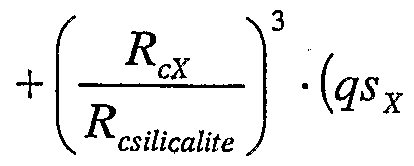
- the adsorption capacity of the non-homogeneous adsorbent is calculated by the formula
- qs - qs siUcaU , e ⁇ -qs smcalite where qs x and qs si , i C aiite are respectively the adsorption capacities of zeolite X and silicalite at 200 ° C and R cX and Rc s ii .c ai . te are the rays of zeolite X and silicalite respectively.
- the radius of the core of the adsorbent represents 75% of the total radius of non-homogeneous adsorbent, which gives a volume adsorption capacity representing 29.4% of the volume of the adsorbent, i.e. an increase in the adsorption capacity 62.7% compared to that of silicalite.
- the adsorption capacity of the non-homogeneous adsorbent is therefore 1.627 times greater than that of the homogeneous adsorbent.
- Table 2 shows the characteristic diffusion times for 3MP and 22DMB in the homogeneous adsorbent consisting of silicalite (not in accordance with the invention) and in the non-homogeneous adsorbent consisting of a core in X zeolite and a outer layer of silicalite (according to the invention). These characteristic times are defined in the case of a sphere
- R 2 by the formula -, where R c is the radius of the sphere and D the diffusion coefficient, and represent the average time required for the molecule to travel the characteristic distance of the solid studied.
- Table 2 characteristic diffusion times of 3MP and 2,2-DMB in the two adsorbents studied.
- the characteristic diffusion times of 3MP and 22DMB are the same in the two adsorbents.
- the diffusion of these molecules in the zeolite X being very fast, the diffusional resistance induced by the presence of this solid in the non-homogeneous adsorbent is negligible.
- the two adsorbents are therefore identical in terms of diffusional separation selectivity. Consequently, the non-homogeneous adsorbent according to the invention makes it possible to maintain the properties of diffusional selectivity while doubling the adsorption capacities of the homogeneous adsorbent.
Landscapes
- Chemical & Material Sciences (AREA)
- Organic Chemistry (AREA)
- Chemical Kinetics & Catalysis (AREA)
- Analytical Chemistry (AREA)
- Engineering & Computer Science (AREA)
- Nanotechnology (AREA)
- Oil, Petroleum & Natural Gas (AREA)
- Inorganic Chemistry (AREA)
- General Chemical & Material Sciences (AREA)
- Thermal Sciences (AREA)
- Physics & Mathematics (AREA)
- Crystallography & Structural Chemistry (AREA)
- Solid-Sorbent Or Filter-Aiding Compositions (AREA)
- Silicates, Zeolites, And Molecular Sieves (AREA)
- Organic Low-Molecular-Weight Compounds And Preparation Thereof (AREA)
- Treatment Of Liquids With Adsorbents In General (AREA)
Abstract
Description



Claims
Priority Applications (4)
| Application Number | Priority Date | Filing Date | Title |
|---|---|---|---|
| EP03753642A EP1531917A2 (fr) | 2002-08-01 | 2003-07-11 | Adsorbant non homogene et son utilisation dans des procedes de separation diffusionnelle |
| US10/522,782 US7435699B2 (en) | 2002-08-01 | 2003-07-11 | Heterogeneous adsorbent and the use for diffusional separation methods |
| AU2003271806A AU2003271806A1 (en) | 2002-08-01 | 2003-07-11 | Heterogeneous adsorbent and the use thereof for diffusion separation methods |
| JP2004525450A JP2005534479A (ja) | 2002-08-01 | 2003-07-11 | 非均一吸着剤および拡散分離工程におけるその使用 |
Applications Claiming Priority (2)
| Application Number | Priority Date | Filing Date | Title |
|---|---|---|---|
| FR02/09841 | 2002-08-01 | ||
| FR0209841A FR2843049B1 (fr) | 2002-08-01 | 2002-08-01 | Adsorbant non homogene et son utilisation dans des procedes de separation diffusionnelle |
Publications (2)
| Publication Number | Publication Date |
|---|---|
| WO2004012835A2 true WO2004012835A2 (fr) | 2004-02-12 |
| WO2004012835A3 WO2004012835A3 (fr) | 2004-07-22 |
Family
ID=30129629
Family Applications (1)
| Application Number | Title | Priority Date | Filing Date |
|---|---|---|---|
| PCT/FR2003/002220 Ceased WO2004012835A2 (fr) | 2002-08-01 | 2003-07-11 | Adsorbant non homogene et son utilisation dans des procedes de separation diffusionnelle |
Country Status (8)
| Country | Link |
|---|---|
| US (1) | US7435699B2 (fr) |
| EP (1) | EP1531917A2 (fr) |
| JP (1) | JP2005534479A (fr) |
| KR (1) | KR100969638B1 (fr) |
| CN (1) | CN100415364C (fr) |
| AU (1) | AU2003271806A1 (fr) |
| FR (1) | FR2843049B1 (fr) |
| WO (1) | WO2004012835A2 (fr) |
Families Citing this family (5)
| Publication number | Priority date | Publication date | Assignee | Title |
|---|---|---|---|---|
| US7947182B2 (en) * | 2008-08-29 | 2011-05-24 | Conocophillips Company | Naphthenic acid removal process |
| US9132410B2 (en) | 2013-12-31 | 2015-09-15 | Algenol Biotech LLC | Compositions, systems and methods for separating ethanol from water and methods of making compositions for separating ethanol from water |
| BR112017009175A2 (pt) * | 2014-12-23 | 2018-01-30 | Exxonmobil Res & Eng Co | materiais adsorventes e métodos de uso |
| CN111699036B (zh) * | 2018-02-15 | 2022-12-20 | 普莱克斯技术有限公司 | 优异的碳吸附剂 |
| KR102834813B1 (ko) * | 2019-06-26 | 2025-07-15 | 차이나 페트로리움 앤드 케미컬 코포레이션 | 복합층 응집성 흡착제 및 이의 제조 방법 |
Family Cites Families (12)
| Publication number | Priority date | Publication date | Assignee | Title |
|---|---|---|---|---|
| US3827989A (en) * | 1972-11-13 | 1974-08-06 | Atomic Energy Commission | Impregnated chemical separation particles |
| US4283583A (en) * | 1979-06-29 | 1981-08-11 | The Standard Oil Company | Alkylation of aromatic hydrocarbons in the presence of coated zeolite catalysts |
| JPS6025369B2 (ja) * | 1981-03-10 | 1985-06-18 | 水澤化学工業株式会社 | 耐摩耗性粒状ゼオライト及びその製法 |
| JPS5916832A (ja) | 1982-07-20 | 1984-01-28 | Agency Of Ind Science & Technol | 複合ゼオライト及びそれを触媒として用いる炭化水素の製造方法 |
| JP2680823B2 (ja) * | 1987-12-09 | 1997-11-19 | 水澤化学工業株式会社 | 白色球状吸着剤及びその製法 |
| JP2587328B2 (ja) * | 1991-06-13 | 1997-03-05 | 株式会社荏原製作所 | 有機塩素化合物の吸着剤および吸着処理法 |
| AU2600295A (en) * | 1994-05-23 | 1995-12-18 | Tda Research, Inc. | Support for chemical sorbents |
| GB9502342D0 (en) * | 1995-02-07 | 1995-03-29 | Exxon Chemical Patents Inc | Hydrocarbon treatment and catalyst therefor |
| JPH0957095A (ja) * | 1995-08-25 | 1997-03-04 | Tetsujiro Minagawa | クリストバル石、鱗珪石及びその混成材等を原材料とする吸着剤に関する製造方法 |
| FR2794993B1 (fr) * | 1999-06-18 | 2001-10-05 | Air Liquide | Utilisation d'un adsorbant particulaire non homogene dans un procede de separation de gaz |
| US6284021B1 (en) * | 1999-09-02 | 2001-09-04 | The Boc Group, Inc. | Composite adsorbent beads for adsorption process |
| FR2813310B1 (fr) | 2000-08-25 | 2002-11-29 | Inst Francais Du Petrole | Procede de separation de paraffines multibranchees utilisant un absorbant zeolitique de structure mixte |
-
2002
- 2002-08-01 FR FR0209841A patent/FR2843049B1/fr not_active Expired - Fee Related
-
2003
- 2003-07-11 JP JP2004525450A patent/JP2005534479A/ja active Pending
- 2003-07-11 EP EP03753642A patent/EP1531917A2/fr not_active Withdrawn
- 2003-07-11 AU AU2003271806A patent/AU2003271806A1/en not_active Abandoned
- 2003-07-11 US US10/522,782 patent/US7435699B2/en not_active Expired - Fee Related
- 2003-07-11 KR KR1020057001628A patent/KR100969638B1/ko not_active Expired - Fee Related
- 2003-07-11 CN CNB038185385A patent/CN100415364C/zh not_active Expired - Fee Related
- 2003-07-11 WO PCT/FR2003/002220 patent/WO2004012835A2/fr not_active Ceased
Also Published As
| Publication number | Publication date |
|---|---|
| EP1531917A2 (fr) | 2005-05-25 |
| WO2004012835A3 (fr) | 2004-07-22 |
| CN1671469A (zh) | 2005-09-21 |
| KR20050026051A (ko) | 2005-03-14 |
| US7435699B2 (en) | 2008-10-14 |
| US20050250641A1 (en) | 2005-11-10 |
| CN100415364C (zh) | 2008-09-03 |
| FR2843049B1 (fr) | 2005-03-25 |
| AU2003271806A1 (en) | 2004-02-23 |
| AU2003271806A8 (en) | 2004-02-23 |
| JP2005534479A (ja) | 2005-11-17 |
| FR2843049A1 (fr) | 2004-02-06 |
| KR100969638B1 (ko) | 2010-07-14 |
Similar Documents
| Publication | Publication Date | Title |
|---|---|---|
| EP2197792B1 (fr) | Materiau cristallise comprenant du silicium a porosite hierarchisee et organisee | |
| EP3140255B1 (fr) | Particules inorganiques individualisées | |
| EP1627853A1 (fr) | Matériau à porosité hierarchisée comprenant du silicium | |
| EP2197791B1 (fr) | Materiau amorphe a porosite hierarchisee et comprenant du silicium | |
| EP0324675B1 (fr) | Procédé de séparation des constituants d'un mélange en phase gazeuse au moyen d'une membrane composite | |
| EP2197793B1 (fr) | Materiau amorphe comprenant du silicium a porosite hierarchisee et organisee | |
| US7253130B2 (en) | Method for making transparent continuous zeolite film and structure of the zeolite film | |
| CA2894606A1 (fr) | Adsorbants zeolithiques, leur procede de preparation et leurs utilisations | |
| FR2794993A1 (fr) | Utilisation d'un adsorbant particulaire non homogene dans un procede de separation de gaz | |
| EP2547440A2 (fr) | Monolithe multicapillaire | |
| WO2004012835A2 (fr) | Adsorbant non homogene et son utilisation dans des procedes de separation diffusionnelle | |
| EP2274236B1 (fr) | Materiau mesostructure a forte teneur en aluminium et constitue de particules spheriques de taille specifique | |
| EP1334066A1 (fr) | Solides inorganiques mesoporeux, leur procede de preparation et leurs utilisations notamment comme catalyseurs et adsorbants | |
| WO2021123662A1 (fr) | Adsorbant zéolithique pour la séparation d'isomères d'hydrocarbures | |
| EP0088006B1 (fr) | Procédé de préparation de produits poreux à base de fluorure de cobalt ou de fluorure de plomb | |
| FR2865663A1 (fr) | Catalyseur sous forme de grains comportant un coeur poreux acide entoure d'une couche externe uniforme | |
| EP2582622B1 (fr) | Utilisation de nanoparticules pour le stockage "sec" longue duree de radicaux peroxydes | |
| CA2297557A1 (fr) | Materiaux siliciques mesostructures et leur procede de fabrication | |
| CN116920805A (zh) | 一种迈科烯/生物质复合吸附材料及其制备方法与应用 | |
| WO2015014808A1 (fr) | Procédé de fabrication d'une colonne de chromatographie en phase gazeuse et colonne obtenue par un tel procédé | |
| WO2005019108A1 (fr) | Particules poreuses submicroniques de silice. | |
| BE674707A (fr) |
Legal Events
| Date | Code | Title | Description |
|---|---|---|---|
| AK | Designated states |
Kind code of ref document: A2 Designated state(s): AE AG AL AM AT AU AZ BA BB BG BR BY BZ CA CH CN CO CR CU CZ DE DK DM DZ EC EE ES FI GB GD GE GH GM HR HU ID IL IN IS JP KE KG KP KR KZ LC LK LR LS LT LU LV MA MD MG MK MN MW MX MZ NO NZ OM PH PL PT RO RU SC SD SE SG SK SL TJ TM TN TR TT TZ UA UG US UZ VC VN YU ZA ZM ZW |
|
| AL | Designated countries for regional patents |
Kind code of ref document: A2 Designated state(s): GH GM KE LS MW MZ SD SL SZ TZ UG ZM ZW AM AZ BY KG KZ MD RU TJ TM AT BE BG CH CY CZ DE DK EE ES FI FR GB GR HU IE IT LU MC NL PT RO SE SI SK TR BF BJ CF CG CI CM GA GN GQ GW ML MR NE SN TD TG |
|
| 121 | Ep: the epo has been informed by wipo that ep was designated in this application | ||
| DFPE | Request for preliminary examination filed prior to expiration of 19th month from priority date (pct application filed before 20040101) | ||
| WWE | Wipo information: entry into national phase |
Ref document number: 2003753642 Country of ref document: EP |
|
| WWE | Wipo information: entry into national phase |
Ref document number: 1020057001628 Country of ref document: KR |
|
| WWE | Wipo information: entry into national phase |
Ref document number: 10522782 Country of ref document: US |
|
| WWE | Wipo information: entry into national phase |
Ref document number: 2004525450 Country of ref document: JP Ref document number: 20038185385 Country of ref document: CN |
|
| WWP | Wipo information: published in national office |
Ref document number: 1020057001628 Country of ref document: KR |
|
| WWP | Wipo information: published in national office |
Ref document number: 2003753642 Country of ref document: EP |