WO2004024143A1 - 医薬組成物 - Google Patents
医薬組成物 Download PDFInfo
- Publication number
- WO2004024143A1 WO2004024143A1 PCT/JP2002/009390 JP0209390W WO2004024143A1 WO 2004024143 A1 WO2004024143 A1 WO 2004024143A1 JP 0209390 W JP0209390 W JP 0209390W WO 2004024143 A1 WO2004024143 A1 WO 2004024143A1
- Authority
- WO
- WIPO (PCT)
- Prior art keywords
- amino
- group
- hydroxymethyl
- benzamide
- pyrrolidinyl
- Prior art date
- Legal status (The legal status is an assumption and is not a legal conclusion. Google has not performed a legal analysis and makes no representation as to the accuracy of the status listed.)
- Ceased
Links
Classifications
-
- A—HUMAN NECESSITIES
- A61—MEDICAL OR VETERINARY SCIENCE; HYGIENE
- A61K—PREPARATIONS FOR MEDICAL, DENTAL OR TOILETRY PURPOSES
- A61K31/00—Medicinal preparations containing organic active ingredients
- A61K31/33—Heterocyclic compounds
- A61K31/395—Heterocyclic compounds having nitrogen as a ring hetero atom, e.g. guanethidine or rifamycins
- A61K31/40—Heterocyclic compounds having nitrogen as a ring hetero atom, e.g. guanethidine or rifamycins having five-membered rings with one nitrogen as the only ring hetero atom, e.g. sulpiride, succinimide, tolmetin, buflomedil
-
- A—HUMAN NECESSITIES
- A61—MEDICAL OR VETERINARY SCIENCE; HYGIENE
- A61P—SPECIFIC THERAPEUTIC ACTIVITY OF CHEMICAL COMPOUNDS OR MEDICINAL PREPARATIONS
- A61P1/00—Drugs for disorders of the alimentary tract or the digestive system
-
- A—HUMAN NECESSITIES
- A61—MEDICAL OR VETERINARY SCIENCE; HYGIENE
- A61P—SPECIFIC THERAPEUTIC ACTIVITY OF CHEMICAL COMPOUNDS OR MEDICINAL PREPARATIONS
- A61P1/00—Drugs for disorders of the alimentary tract or the digestive system
- A61P1/14—Prodigestives, e.g. acids, enzymes, appetite stimulants, antidyspeptics, tonics, antiflatulents
-
- A—HUMAN NECESSITIES
- A61—MEDICAL OR VETERINARY SCIENCE; HYGIENE
- A61P—SPECIFIC THERAPEUTIC ACTIVITY OF CHEMICAL COMPOUNDS OR MEDICINAL PREPARATIONS
- A61P43/00—Drugs for specific purposes, not provided for in groups A61P1/00-A61P41/00
-
- C—CHEMISTRY; METALLURGY
- C07—ORGANIC CHEMISTRY
- C07D—HETEROCYCLIC COMPOUNDS
- C07D207/00—Heterocyclic compounds containing five-membered rings not condensed with other rings, with one nitrogen atom as the only ring hetero atom
- C07D207/02—Heterocyclic compounds containing five-membered rings not condensed with other rings, with one nitrogen atom as the only ring hetero atom with only hydrogen or carbon atoms directly attached to the ring nitrogen atom
- C07D207/04—Heterocyclic compounds containing five-membered rings not condensed with other rings, with one nitrogen atom as the only ring hetero atom with only hydrogen or carbon atoms directly attached to the ring nitrogen atom having no double bonds between ring members or between ring members and non-ring members
- C07D207/10—Heterocyclic compounds containing five-membered rings not condensed with other rings, with one nitrogen atom as the only ring hetero atom with only hydrogen or carbon atoms directly attached to the ring nitrogen atom having no double bonds between ring members or between ring members and non-ring members with hetero atoms or with carbon atoms having three bonds to hetero atoms with at the most one bond to halogen, e.g. ester or nitrile radicals, directly attached to ring carbon atoms
- C07D207/14—Nitrogen atoms not forming part of a nitro radical
-
- G—PHYSICS
- G01—MEASURING; TESTING
- G01R—MEASURING ELECTRIC VARIABLES; MEASURING MAGNETIC VARIABLES
- G01R33/00—Arrangements or instruments for measuring magnetic variables
- G01R33/20—Arrangements or instruments for measuring magnetic variables involving magnetic resonance
- G01R33/28—Details of apparatus provided for in groups G01R33/44 - G01R33/64
- G01R33/32—Excitation or detection systems, e.g. using radio frequency signals
- G01R33/34—Constructional details, e.g. resonators, specially adapted to MR
- G01R33/341—Constructional details, e.g. resonators, specially adapted to MR comprising surface coils
- G01R33/3415—Constructional details, e.g. resonators, specially adapted to MR comprising surface coils comprising arrays of sub-coils, i.e. phased-array coils with flexible receiver channels
-
- G—PHYSICS
- G01—MEASURING; TESTING
- G01R—MEASURING ELECTRIC VARIABLES; MEASURING MAGNETIC VARIABLES
- G01R33/00—Arrangements or instruments for measuring magnetic variables
- G01R33/20—Arrangements or instruments for measuring magnetic variables involving magnetic resonance
- G01R33/44—Arrangements or instruments for measuring magnetic variables involving magnetic resonance using nuclear magnetic resonance [NMR]
- G01R33/48—NMR imaging systems
- G01R33/54—Signal processing systems, e.g. using pulse sequences ; Generation or control of pulse sequences; Operator console
- G01R33/56—Image enhancement or correction, e.g. subtraction or averaging techniques, e.g. improvement of signal-to-noise ratio and resolution
- G01R33/561—Image enhancement or correction, e.g. subtraction or averaging techniques, e.g. improvement of signal-to-noise ratio and resolution by reduction of the scanning time, i.e. fast acquiring systems, e.g. using echo-planar pulse sequences
- G01R33/5611—Parallel magnetic resonance imaging, e.g. sensitivity encoding [SENSE], simultaneous acquisition of spatial harmonics [SMASH], unaliasing by Fourier encoding of the overlaps using the temporal dimension [UNFOLD], k-t-broad-use linear acquisition speed-up technique [k-t-BLAST], k-t-SENSE
-
- G—PHYSICS
- G01—MEASURING; TESTING
- G01R—MEASURING ELECTRIC VARIABLES; MEASURING MAGNETIC VARIABLES
- G01R33/00—Arrangements or instruments for measuring magnetic variables
- G01R33/20—Arrangements or instruments for measuring magnetic variables involving magnetic resonance
- G01R33/28—Details of apparatus provided for in groups G01R33/44 - G01R33/64
- G01R33/38—Systems for generation, homogenisation or stabilisation of the main or gradient magnetic field
- G01R33/3806—Open magnet assemblies for improved access to the sample, e.g. C-type or U-type magnets
Definitions
- the present invention is suitable for active exercise of the digestive tract and, particularly, the stomach to rapidly eliminate abnormal retention of ingested food in the relevant organ, and the action point is peripheral, such as arteritis and the like.
- Compounds that do not have side effects that is, 4-amino-5-coro-2-methoxy-1-N-[(2S, 4S) -2-hydroxymethyl-4-pyrrolidinyl] benzamide or its acid addition salt is effective Human or animal gastrointestinal tract movement function improving agent as a component, further, a pharmaceutical composition comprising this and a pharmaceutically acceptable carrier, and further, a composition comprising an effective amount of the compound is administered to a patient
- the present invention relates to a method for ameliorating digestive tract hypofunction symptoms and to the use of the compound for producing the composition.
- metok oral pramide is widely known as a compound having the property of promoting the motor function of the stomach, but it causes extrapyramidal symptoms and other undesirable symptoms because of its action on the central nervous system. Do. In addition, although a compound whose common name is cisapride has been put to practical use as a digestive tract exercise activator, it has been discontinued due to the induction of ventricular arrhythmia.
- TK S 1 59 which is a representative compound of the invention of the above-mentioned publication, and in experimental animals and in safety tests using beagle dogs, T K S 1 5 9
- T K S 1 5 9 When repeated oral administration was used, we observed signs of symptoms such as thrombus formation, arteritis and encephalomalacia. The onset of such symptoms is a clear indication that it is not suitable for use as a medicine.
- the present inventors have found that these symptoms which never appeared in mice and rats were found to be metabolites of the compound specifically produced in beagle dogs.
- TK S 1 5 9 4 amino-5-croro 1-2-methoxy-N-[(2 S, 4 S)-2-hydroxymethyl 4- pyrrolidinyl] benzamide or its acid adduct is TK S 1 5 9 or It has been found that the compound has an ability to improve the digestive tract motor function equivalent to or better than the acid addition salt. That is, it is possible to avoid the onset of symptoms such as thrombus formation, arteritis, and brain softening.
- the present invention was made based on the above findings, and is 4-amino-5-chloro-2-methoxy-N- (2S, 4S) 2-hydroxymethyl-4-pyrrolidinyl benzamide or its acid addition.
- the present invention relates to an agent for improving gastrointestinal tract motor function which avoids side effects such as arteritis containing a salt as an active ingredient, and further, the 4-amino-5-5 black hole 2-methoxy-1-N- (2S, 4S) (I)
- a new medicine for administering to humans or mammals eg, dogs, cats, cattle, horses, sheep, etc.
- consisting of 2-hydroxymethyl-4-monopyrrolidinyl] benzamide or an acid addition salt thereof and a pharmaceutically acceptable carrier It relates to a composition.
- the agent for improving gastrointestinal tract function according to the present invention or the novel pharmaceutical composition containing the same are provided by: thrombus formation, arteritis, etc. 4_amino-5 -chloro-2 -methoxy-N- [(2S, 4S) 1-1-2- Compounds capable of avoiding the side effects associated with hydroxymethyl-4-monopyrrolidinyl] benzamide or an acid addition salt thereof, ie, 4_amino-5_chloro-2-methoxy-N-[(2S, 4S) -2-hydro
- the present invention relates to a novel pharmaceutical composition comprising xylmethyl-4-pyrrolidinyl] benzamide (sometimes described as TM161) or an acid addition salt thereof or a pharmaceutically acceptable carrier.
- the compound TM161 or the acid addition salt thereof is, in particular, added to beagle dogs as When it is administered Pamino-1 5-chloro-2-methoxy-1-N-[(2S, 4S) -1-ethyl-hydroxymethyl-4-pyrrolidinyl] benzamide compound or an acid addition salt thereof, it is found as a metabolite thereof
- Pamino-1 5-chloro-2-methoxy-1-N-[(2S, 4S) -1-ethyl-hydroxymethyl-4-pyrrolidinyl] benzamide compound or an acid addition salt thereof it is found as a metabolite thereof
- 4-amino-5-chloro-2-methoxy-1-N-[(2S, 4S) _1-ethyl-2-hydroxymethyl-4-pyrrolidinyl] benzamide It has been revealed in the study of the present inventors that they have the property of being able to avoid the onset of side effects such as thrombosis and arteritis
- TKS 159 or its acid addition salt was superior in ability to improve gastrointestinal motor function.
- 4-amino-5-chloro-mono-2-methoxy-N-[(2S, 4S) -hydroxymethyl-4-pyrolizinyl] benzamide or an acid addition salt thereof is capable of receiving serotonin 4 (5HT 4 ). It has also been shown that binding to the body acts as an agonist in preference to binding to other receptors, such as dopamine D 2 receptor.
- the present invention has been made based on such various new findings, and according to the present invention, it has been proposed to use 4-mono-5-chloro-2-methoxyl which is rich in binding affinity to serotonin receptor 4 (5HT 4 ).
- N-[(2S, 4S) 1 / 2-hydroxymethyl-4-pyrrolidinyl] benzamide or an acid addition salt thereof is used as an active ingredient, 4-amino-1-hydroxy-mono-2-methoxy-1-N- [(2S, 4 S) Gastrointestinal tract that can avoid the side effects such as thrombosis and arteritis that inevitably occur during administration of 1-ethyl-2-hydroxymethyl-1-pyrrolidinyl] benzamide or its acid addition salt
- a pharmaceutical composition comprising a motor function improving agent or the same as an active ingredient, and a pharmaceutically acceptable carrier. It is essential as an attribute of pharmaceutical compounds that as extreme as possible the avoidance of side effects is possible. In view of the above, the significance of the present invention is important.
- the present invention relates to an agent for improving the activity of a motor that has been confirmed to be effective and a safe drug without the occurrence of side effects.
- the present invention is a.
- Gastrointestinal motor function improving agent containing [(2S, 4S) mono-hydroxymethyl-4 pyrrolidinyl] benzamide or an acid addition salt thereof as an active ingredient
- a pharmaceutical composition for improving gastrointestinal tract function and function comprising [(2S, 4S) mono-hydroxymethyl-4-pyrrolidinyl] benzamide or an acid addition salt thereof as an active ingredient, and a pharmaceutically acceptable carrier,
- a digestive tract motor function improving agent containing C (2S, 4S) -l-hydroxymethyl-4-monopyrrolidinyl] benzamide or an acid addition salt thereof as an active ingredient, or a digestive tract comprising the same and a pharmaceutically acceptable carrier A therapeutic method for promoting gastrointestinal motility using the pharmaceutical composition for improving motor function,
- the amino group may be protected (2S, 4S)-1 -amino-N-asyl-2-hydroxymethyl pyrrolidine,
- FIG. 1 shows changes in the binding affinity of the test drug to serotonin receptor 4.
- the axis represents the concentration of the sample drug (in terms of molar concentration) and the vertical axis represents the binding ratio of serotonin receptor 4 to [ 3 H] GR 113808.
- -The sample compound obtained in Example 9 is shown in the figure, and the symbol "-" indicates TKS 159 hydrochloride.
- Figure 2 shows the binding affinity of a change in dopamine 0 2 receptor of the analyte drug.
- the horizontal axis shows the concentration of the sample drug (in terms of molar concentration) and the vertical axis shows the binding ratio of dopamine D 2 receptor to [ 3 H] -spiper one.
- ⁇ indicates KS is TKS 159 hydrochloride.
- FIG. 3 shows the degree of relaxation reaction of the sample drug in rat isolated samples.
- the horizontal axis shows the concentration of the sample drug (in terms of molar concentration), and the vertical axis shows the rate of relaxation in rat specimens.
- ⁇ indicates TKS 159 hydrochloride.
- R 1 represents an amino group which may be protected.
- the amino group represented by may be protected.
- R 2 represents a hydrogen atom or a protecting group of an imino group.
- the imino group represented by may be protected (2S, 4S) by reaction with 4-amino-2-hydroxymethyl pyrrolidine Te formula ( ⁇ )
- the compound is produced by optionally removing a protecting group of an amino group or a protecting group of Z and an amino group.
- a compound represented by the formula ( ⁇ ) in which at least one of an amino group and / or an amino group is protected by a protecting group is a novel compound, 4-amino-5-croport-2-methoxy. Not only is it important as a synthetic intermediate of N-[(2S, 4S) -2-hydroxymethyl- 1-pyrrolidinyl] benzamide (TM 1 6 1) or its acid addition salt, but also When the protective group or / and the imino group protective group is removed in vivo after administration of the compound ( ⁇ ) to the living body, as in the case of TM 1 6 1, such as thrombus formation, arteritis, encephalopathy etc.
- TM 1 61 It can be used in the same manner as TM 1 61 because it exerts a gastrointestinal tract motor function improvement effect superior to TKS 1 5 9 while avoiding side effects.
- the protecting group of an amino group and the protecting group of an imino group include, for example, an asyl group (for example, acetyl group), a B ⁇ C group, and a benzyloxy carponil group.
- Protecting groups which can be removed in vivo by protecting an amino group and / or imino group have hitherto been sufficiently established, and also in the present invention, such in vivo removable protecting groups are employed as the protecting group. It is also good.
- examples of protecting groups that can be removed in vivo include an asyl group (for example, a lower alkyl carbonyl group such as acetyl and propionyl), an alkyloxy sulfonyl group (for example, methyloxy carbonyl, hydroxy carbonyl and the like). Lower alkyloxycarboyl groups) and the like are preferable.
- an asyl group for example, a lower alkyl carbonyl group such as acetyl and propionyl
- an alkyloxy sulfonyl group for example, methyloxy carbonyl, hydroxy carbonyl and the like.
- Lower alkyloxycarboyl groups are preferable.
- 2-hydroxymethyl-4-monopyrrolidinyl] benzamide or an acid addition salt thereof is 4-amino-5-chloro-2-methoxy-N-C (2S, 4S) mono-1-ethyl-2-hydroxymethyl-4-pyrrolidinyl
- a benzamide or an acid addition salt thereof is a metabolite, it is more preferably the following: 2 009390
- the resulting compound may be obtained as an acid addition salt depending on the condensation method, but when the base is to be converted to an acid addition salt, it is appropriately dissolved in a solvent and the acid addition is carried out by the addition of the desired acid. It can be induced to salt.
- an appropriate medium to be used for the condensation reaction tetrahydrofuran, dioxane, benzene, toluene, petroleum hydrocarbon (hexane, heptane, octane, petroleum benzene, etc.), dimethylformamide, pyridine, etc. are preferably used.
- Use inert materials such as tolytilamine, fastenitol, croform, etc. as raw materials or condensing agents.
- the acid octalide as a derivative when 4-amino-2, 5-chloro-2-methoxybenzoic acid is used as a reactive derivative is thionyl chloride, acid chloride with phosphorus tribromide or acid bromide, and acid anhydride Is a mixed acid anhydride with chloroethyl ethyl ester, the active ester is an ester with ethyl alcohol or P-nitrophenol, and further, the reaction with N, N-dicarbonyl diimidazole, N, N-dipolar dipyrrole.
- the resulting acid imidazolide and acid pyrrolizolide can be mentioned.
- a base such as pyridine, picolin, N-ethylmorpholine, triethylamine, potassium carbonate and the like.
- a condensing agent refers to the case where it is subjected to a reaction without converting 4-amino-5-chloro-2-methoxybenzoic acid into a reactive derivative, and in such a case, a condensing agent is used.
- N N-dicyclohexylcarbopiimide, 1, 1-sulfinyldiimida- nol, 1, 1 -lulpolinyldiimida
- zole titanium tetrachloride, phosphorus trichloride, oxyhydroxin, ketyl chlorophosphate, o-phenylene chlorophosphate and the like.
- the condensation reaction can be suitably carried out with stirring at room temperature or under heating.
- the thus obtained 4-monoamino-5-chloro-2-methoxymono-N-[(2S, 4S) -1-as-acyl-2-hydroxymethyl-4-monopyrrolidinyl] benzamide is formed as an acid addition salt in some cases. If it is produced as a base, it will lead to an appropriate acid addition salt.
- acid for deriving such an acid addition salt hydrogen chloride, hydrogen bromide, sulfuric acid, hydrogen iodide, carbonic acid, phosphoric acid, formic acid, acetic acid, propionic acid, glycolic acid, glucuronic acid, maleic acid, glutamic acid
- examples include methanesulfonic acid, ethanesulfonic acid, toluenesulfonic acid, benzenesulfonic acid, benzoic acid, salicylic acid, phenylacetic acid, mandelic acid, lactic acid, oxalic acid, tartaric acid, fumaric acid, and citric acid.
- the derivative to the acid addition salt can be formed by using 4-amino-1-chloro-2-methoxy-N-[(2S, 4S) -1-hydroxy-2-hydroxymethyl-monopyrrolidinyl] benzamide formed as a base among the above acids.
- the desired acid addition salt can be obtained by mixing and stirring the desired acid and a suitable solvent.
- the acid addition salts are usually pharmacologically acceptable salts.
- the 4-amino-1, 5-chloro-2-methoxy-1-N-[(2S, 4S) -1-amino-2-hydroxymethyl-4-monopyrrolidinyl] benzamide or the acid addition salt thereof obtained here is an elimination of an acyl group.
- side effects such as arteritis, thrombus formation, and encephalomalacia, which inevitably occur in TK S 1 59 or its acid addition salt, can be avoided.
- elimination of a syl group is achieved by adding sodium hydroxide, potassium hydroxide or the like in an alcohol (methyl alcohol, ethyl alcohol, propyl alcohol or the like) and heating under reflux.
- Gastrointestinal motor function improving agent capable of avoiding side effects such as inflammation and thrombus formation that are concomitantly caused by TKS 159 or an acid addition salt thereof, ie, 4-amino-chloro- 2-methoxy-N- [(2 S, 4 S) Acetyl-2-hydroxymethyl-4-pyrrolidinyl] benzamide or its acid addition salt metabolite 4-aminoamino 5-chloro-2-methoxy-N- [(2S, 4S) -2 -Hydroxymethyl-l-monopyrrolidinyl] benzamide or an acid addition salt thereof can be obtained.
- the amino-protected (2S, 4S) -4-amino-2-hydroxymethylpyrrolidine used in the above production method can be produced by the following method.
- a protecting group is introduced into the amino group of 4-hydroxy-L-proline alkyl ester to produce N-protected 4-hydroxy-L-proline alkyl ester, and thus prepared N-protected 4-hydroxy-L-.
- the hydroxyl group of the proline alkyl ester is converted to a mesyloxy group to produce an N-protected 4-mesoxy L-proline alkyl ester, and thus produced N-protected 4-mesyloxy-L-proline.
- the mesyloxy group of the alkyl ester is converted to an azido group to produce an N-protected — 4-azido-L-proline alkylester, thus producing an N-protected-4-azido-L-proline alkyl ester.
- the above-mentioned amino protective group is used, preferably an acetyl group.
- the alkyl group is preferably a lower alkyl group having 1 to 4 carbon atoms, and examples thereof include a methyl group and an ethyl group.
- the first reduction reaction is preferably performed using sodium borohydride as a reducing agent, and the second reduction reaction is preferably performed by carious reduction. It is rich in binding affinity to the serotonin receptor 4 (5 HT 4 ) obtained here, and can avoid side effects such as arteritis, thrombus formation, etc. that are concomitantly expressed with TK S 1 59 or its acid addition salt.
- Gastrointestinal motor function improving agent 4-amino-5-chloro-2-methoxy-N- [(2 S, 4 S) mono 2-hydroxymethyl-4 monopyrrolidinyl] benzamide or an acid addition salt thereof is pharmaceutically acceptable. It is formulated together with an appropriate carrier and put to practical use as a gastrointestinal motor function improving pharmaceutical composition.
- excipients such as lactose, glucose, potato starch, corn starch, carpoxymethylcellulose, crystalline cellulose, light anhydrous silicic acid, etc., disintegrating agent starch, carpoxymethyl cell Loth calcium etc., lubricants such as magnesium stearate, purified talc, calcium stearate etc., starch pastes such as binders, hydroxy propyl cellulose liquids, hydroxypropyl methyl cellulose liquids 7 to 3 liquids, gum arabic liquids, gelatin liquids Other coloring agents and flavoring agents may be mentioned such as hydroxypropyl methylcellulose solution. These are selected according to the desired dosage form, formulated and formulated.
- a preparation comprising the improver 4-amino-5-chloro-2-methoxy-N-[(2S, 4S) mono-2-hydroxymethyl-4-pyrrolidinyl] benzamide or an acid addition salt thereof and a suitable carrier thereof.
- formulations that are the gastrointestinal motor function improving pharmaceutical composition include tablets, capsules, fine granules, granules, injections, syrups, dry syrups and the like.
- a carrier suitable for each of these agents is selected from the carriers described above and used.
- the formulation is formulated gastrointestinal motility improving the pharmaceutical composition is a tablet, rich in binding affinity for the serotonin emissions receptor 4 (5 HT 4), arteritis, thrombosis, etc.
- the mixture is placed in a fluid bed granulator together with a predetermined amount of water and granulated while spraying an aqueous solution of a binder. Then add disintegrant and lubricant and mix.
- the granulated product obtained here is pressed and formed into tablets of a predetermined size and weight with a tablet machine to produce tablets.
- the agent, 4-amino-5 monochloro-2-methoxy-N- [(2S, 4S) 2-hydroxymethyl-4 monopyrrolidinyl] benzamide or its acid addition salt is TK in oral toxicity test in acute toxicity test. It is less acutely toxic than S 159 or its acid addition salt, and is therefore suitable for oral administration.
- the striatals isolated from Har t 1 ey male guinea pigs are homogenized in 5OmM HEPE S-Na OH buffer (pH 7.4), and then repeated by centrifugation and suspension to obtain a serotonin receptor 4 standard. The product was made. This receptor preparation is reacted with a solution containing the radioactive ligand 0.
- the results are as shown in FIG.
- the IC 50 was 34 M and was higher than 3.8 M of TKS 1 5 9 hydrochloride.
- N-Acetyl 4 1 mesyloxy 1 L-proline ethyl ester
- N-Acetyl-4_Azido_2-Hydroxymethyl pyrrolidine 534 g, Methanol 2.6 L Add 10% Pd-C 92.4 g to the solution and in the container every hour until the raw material disappears under normal pressure Hydrogen was added while exchanging hydrogen gas (30 hours). After filtration, the reaction solution is concentrated under reduced pressure and concentrated (2S, 4S) mono-N-acetyl-4-monoamino-2-hydroxymethylpyrrolidine, more specifically (2S, 4S) mono-mono-acetyl-4-monoamino-2-hydroxymethyl 41 g of pyrrolidine were obtained as an oil.
- the filtrate was concentrated under reduced pressure, n-butyl alcohol (50 ml) and saturated brine (20 ml) were added to the obtained residue and the phases were separated, and reextracted with n-butyl alcohol (30 ml).
- the extract was concentrated under reduced pressure, methyl alcohol (50 ml) was added to the residue to dissolve, and then 18% (w / w) hydrochloric acid-containing methyl alcohol (6.5 g) was gradually added to pH 6 so as to reach pH 6.
- the crystals precipitated on ice were collected by filtration and washed with a small amount of methyl alcohol.
- Example 10 Three beagle dogs were used as a test animal, and 4_amino- 5-chloro-2-methoxy-N- [(2S, 4S) mono 2-hydroxymethyl-4 monopyrrolidinyl] benzamide hydrochloride obtained in Example 9 was administered. It was orally administered once a day for 4 weeks as a dose of 10 Omg Z kg. Then, under anesthesia, the blood was sacrificed from the carotid artery, and the brain, aorta, heart, lung, liver, etc. were excised, fixed macroscopically and fixed with 0.1% phosphate buffered 10% formalin solution, and stored.
- Each organ was paraffin-embedded and sectioned, and after hematoxin-orange stained specimens were prepared, histopathological examination was performed using a light microscope. No gross abnormalities were found in any of the organs. In addition, no abnormality was found in the histopathological examination, and no brain softening, arteritis and thrombus formation were found.
- Sprague-Dawl y male rats 4 weeks old are bred for 8 days while being quarantined and acclimated, and 5 rats each weighing 160.3 to 169.5 g are treated in groups of 300 mg Z kg administration group It was divided into four groups: 1000 mg Zkg dosing group and 200 Omg Zkg dosing group.
- the 4-amino-5-chloro-2-methoxy-N-[(2S, 4S) -2-hydroxymethyl-4-pyrrolidinyl] benzamide hydrochloride obtained in Example 9 was ground in a mortar to obtain the compound.
- An administration sample was prepared by adding 0.5 mg of a 0.5% aqueous solution of methyl cellulose (made by Wako Pure Chemical Industries, Ltd., using water for injection by Japan Post) in 10 ml so as to contain 30 Omg, 1000 mg and 200 Omg.
- the administration samples were prepared once a week for 7 days at a time, stored in a refrigerator and used.
- the dose was determined to be 1 Oml / kg, and the administration route was orally administered once a day from 9 o'clock to 12 o'clock for 28 days by gavage using a rat gastric tube.
- the target area was administered 1 Oml / kg of 0.5% methylcellulose aqueous solution only.
- Example 9 With respect to the drug obtained in Example 9, the degree of gastrointestinal tract exercise promoting action was measured using a rat excision food duct preparation.
- the esophagus in the thoracic cavity was removed from Wi ster male rats, and the esophagus muscle layer including longitudinal running muscle and circular running muscle was removed to prepare a mucous membrane layer specimen of about 2 cm in length.
- the sample was prepared using a nutrient solution (NaCl 1.18.5, KCl 14.3, CaCl 2 1.3, MgSO 4 0. 6, NaHC0 3 25. 0, KH 2 P 1 4 1.2, glucose 11. 1 immersed in.
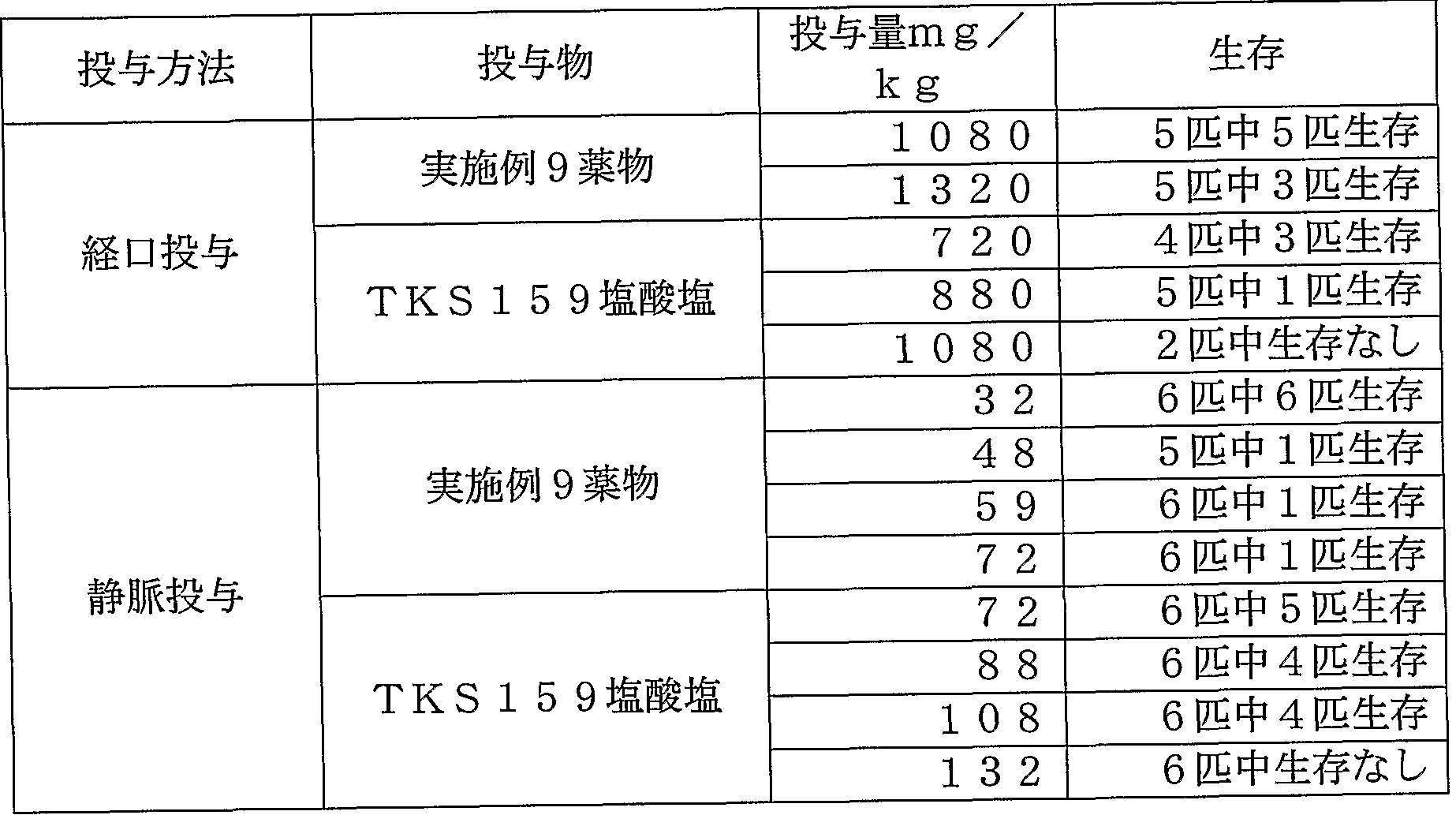
- Example 9 The drug obtained in Example 9 and TKS 159 were obtained using ddy male mice. It was dissolved in 0.5% methylcellulose suspension for oral administration and in physiological saline for intravenous administration. The compound was administered by oral gavage using a sonde and intravenous administration, and acute toxicity was observed.
- Example 9 50 g of the drug obtained in Example 9, 650 g of lactose and 200 g of microcrystalline cellulose are put in a fluid bed granulator, and sprayed with 30 g of a binder, hydroxypropyl cellulose solution, as a 5% aqueous solution. And obtained granulated powder. Next, 50 g of the disintegrant calcium carboxymethyl cellulose and 20 g of the lubricant magnesium stearate were added to the granulated powder and mixed. The obtained granulated powder for tableting was compression-molded so that the weight of one tablet was 10 Omg, to obtain a tablet.
- TKS 159 Oral administration of TKS 159 at doses of 10, 30 and 100 mg Zkg to two male beagle dogs in each group repeatedly for 4 weeks and observation showed that the death case of the 100 mg / kg administration group was pulmonary artery. Thrombus formation in the inner and heart coronary arteries and mild hemorrhage in the perivascular space of the brain parenchyma were noted. In the 10 Omg / kg dose group, large thrombi formation was observed in the left ventricle, and thrombus formation in the arcuate and interlobular arteries of the kidney. In addition, beagle dogs are divided into 4 groups of 6, 4, 4 and 6 for both sexes, 3 of which are TKS 159 at doses of 2.5, 6.0 and 15. Omg Zkg, respectively.
- beagle dogs are divided into 4 groups of 5, 3, 3 and 5 for male and female, of which 3 groups are TKS 159 at doses of 0.25, 0.75 and 2.25 mg Zkg, respectively.
- the group was orally administered vehicle for 52 weeks and observed for general condition and various tests.
- 3 groups are TKS 159 at doses of 0.25, 0.75 and 2.25 mg Zkg, respectively.
- the group was orally administered vehicle for 52 weeks and observed for general condition and various tests.
- 3 groups are TKS 159 at doses of 0.25, 0.75 and 2.25 mg Zkg, respectively.
- the group was orally administered vehicle for 52 weeks and observed for general condition and various tests.
- Similar tests were conducted after a 52 week repeated treatment period followed by a 4-week rest recovery test.
- As a result of examination in the 52-week repeated dose toxicity test, 2. Arthritis in the bone marrow and mediastinal lymph nodes of the femur was found in 1 of 5 males in the 25 mg Z kg administration group, and 1 case was pe
- a serotonin receptor 4 (5 HT 4) 4 one rich in binding affinity for amino-5- chloro-2-methoxy-one N- [(2 S, 4 S ) -2- hydroxymethyl - 4 one-pyrrolidinyl]
- a benzamide or an acid addition salt thereof is used as an active ingredient, 4-amino-5-chloro-mono-2-methoxy-N-[(2S, 4S) -1-monoethyl-2-hydroxymethyl-4-pyrrolidinyl] benzamide or its A gastrointestinal tract motor function improving agent or an active ingredient thereof which can avoid the occurrence of side effects such as arteritis, etc.
- the present invention is an effective and safe drug with the appearance of side effects. Useful as.
Landscapes
- Health & Medical Sciences (AREA)
- Chemical & Material Sciences (AREA)
- Physics & Mathematics (AREA)
- Organic Chemistry (AREA)
- General Health & Medical Sciences (AREA)
- Medicinal Chemistry (AREA)
- Veterinary Medicine (AREA)
- Nuclear Medicine, Radiotherapy & Molecular Imaging (AREA)
- Engineering & Computer Science (AREA)
- Pharmacology & Pharmacy (AREA)
- Life Sciences & Earth Sciences (AREA)
- Animal Behavior & Ethology (AREA)
- Public Health (AREA)
- Condensed Matter Physics & Semiconductors (AREA)
- General Physics & Mathematics (AREA)
- Chemical Kinetics & Catalysis (AREA)
- General Chemical & Material Sciences (AREA)
- Bioinformatics & Cheminformatics (AREA)
- Epidemiology (AREA)
- Radiology & Medical Imaging (AREA)
- Signal Processing (AREA)
- High Energy & Nuclear Physics (AREA)
- Nutrition Science (AREA)
- Pharmaceuticals Containing Other Organic And Inorganic Compounds (AREA)
- Pyrrole Compounds (AREA)
Description


Claims
Priority Applications (7)
| Application Number | Priority Date | Filing Date | Title |
|---|---|---|---|
| CNB028296028A CN100370983C (zh) | 2002-09-12 | 2002-09-12 | 药物组合物 |
| US10/526,780 US7485665B2 (en) | 2002-09-12 | 2002-09-12 | Medicinal composition |
| PCT/JP2002/009390 WO2004024143A1 (ja) | 2002-09-12 | 2002-09-12 | 医薬組成物 |
| AU2002335161A AU2002335161A1 (en) | 2002-09-12 | 2002-09-12 | Medicinal composition |
| JP2004535846A JPWO2004024143A1 (ja) | 2002-09-12 | 2002-09-12 | 医薬組成物 |
| EP02807809A EP1547593A4 (en) | 2002-09-12 | 2002-09-12 | MEDICINAL COMPOSITION |
| US12/318,444 US20090118353A1 (en) | 2002-09-12 | 2008-12-30 | Medicinal composition |
Applications Claiming Priority (1)
| Application Number | Priority Date | Filing Date | Title |
|---|---|---|---|
| PCT/JP2002/009390 WO2004024143A1 (ja) | 2002-09-12 | 2002-09-12 | 医薬組成物 |
Related Child Applications (1)
| Application Number | Title | Priority Date | Filing Date |
|---|---|---|---|
| US12/318,444 Division US20090118353A1 (en) | 2002-09-12 | 2008-12-30 | Medicinal composition |
Publications (1)
| Publication Number | Publication Date |
|---|---|
| WO2004024143A1 true WO2004024143A1 (ja) | 2004-03-25 |
Family
ID=31986098
Family Applications (1)
| Application Number | Title | Priority Date | Filing Date |
|---|---|---|---|
| PCT/JP2002/009390 Ceased WO2004024143A1 (ja) | 2002-09-12 | 2002-09-12 | 医薬組成物 |
Country Status (6)
| Country | Link |
|---|---|
| US (2) | US7485665B2 (ja) |
| EP (1) | EP1547593A4 (ja) |
| JP (1) | JPWO2004024143A1 (ja) |
| CN (1) | CN100370983C (ja) |
| AU (1) | AU2002335161A1 (ja) |
| WO (1) | WO2004024143A1 (ja) |
Families Citing this family (1)
| Publication number | Priority date | Publication date | Assignee | Title |
|---|---|---|---|---|
| US8160761B2 (en) * | 2007-11-05 | 2012-04-17 | GM Global Technology Operations LLC | Method for predicting an operator torque request of a hybrid powertrain system |
Citations (1)
| Publication number | Priority date | Publication date | Assignee | Title |
|---|---|---|---|---|
| JPH0517434A (ja) * | 1990-10-16 | 1993-01-26 | Teikoku Chem Ind Corp Ltd | ベンズアミド誘導体 |
Family Cites Families (1)
| Publication number | Priority date | Publication date | Assignee | Title |
|---|---|---|---|---|
| TW570920B (en) * | 1998-12-22 | 2004-01-11 | Janssen Pharmaceutica Nv | 4-(aminomethyl)-piperidine benzamides for treating gastrointestinal disorders |
-
2002
- 2002-09-12 US US10/526,780 patent/US7485665B2/en not_active Expired - Fee Related
- 2002-09-12 EP EP02807809A patent/EP1547593A4/en not_active Withdrawn
- 2002-09-12 CN CNB028296028A patent/CN100370983C/zh not_active Expired - Fee Related
- 2002-09-12 AU AU2002335161A patent/AU2002335161A1/en not_active Abandoned
- 2002-09-12 JP JP2004535846A patent/JPWO2004024143A1/ja active Pending
- 2002-09-12 WO PCT/JP2002/009390 patent/WO2004024143A1/ja not_active Ceased
-
2008
- 2008-12-30 US US12/318,444 patent/US20090118353A1/en not_active Abandoned
Patent Citations (1)
| Publication number | Priority date | Publication date | Assignee | Title |
|---|---|---|---|---|
| JPH0517434A (ja) * | 1990-10-16 | 1993-01-26 | Teikoku Chem Ind Corp Ltd | ベンズアミド誘導体 |
Also Published As
| Publication number | Publication date |
|---|---|
| CN100370983C (zh) | 2008-02-27 |
| US20090118353A1 (en) | 2009-05-07 |
| CN1668295A (zh) | 2005-09-14 |
| EP1547593A1 (en) | 2005-06-29 |
| AU2002335161A1 (en) | 2004-04-30 |
| US7485665B2 (en) | 2009-02-03 |
| EP1547593A4 (en) | 2009-12-23 |
| US20050239861A1 (en) | 2005-10-27 |
| JPWO2004024143A1 (ja) | 2006-01-05 |
Similar Documents
| Publication | Publication Date | Title |
|---|---|---|
| JP4316794B2 (ja) | イソキノリン誘導体及び医薬 | |
| EP3681862B1 (en) | Beta-hydroxy heterocyclic amines and their use in the treatment of hyperglycaemia | |
| ES2197255T3 (es) | Nuevos compuestos de arilo sustituido utiles como moduladores de los receptores de acetilcolina. | |
| TW200400186A (en) | (S)-4-Amino-5-chloro-2-methoxy-N-[1-[1-[2-tetrahydrofuryl-carbonyl]-4-piperidinylmethyl]-4-piperidinyl]benzamide, process for the preparation thereof , pharmaceutical composition containing the same , and intermediate therefor | |
| BRPI0809579A2 (pt) | Formas cristalinas e seus usos | |
| JPH03504010A (ja) | ジベンゾフランカルボキサミド | |
| TWI822457B (zh) | Dp拮抗劑 | |
| PT855397E (pt) | (r)-5-bromo-n-(1-etil-4-metil-hexa-hidro-1h-1,4-diazepin-6-il)-2-metoxi-6-metilamino-3-piridinocarboxamida processo para a sua preparacao e composicao farmaceutica contendo o referido composto | |
| US10617679B2 (en) | Deuterated compounds and medical uses thereof | |
| JPH0291052A (ja) | 置換アミン類 | |
| WO2023216533A1 (zh) | 一种吲哚生物碱及其制备方法与应用 | |
| JPS63295552A (ja) | 窒素含有複素環式メタノールのアリールオキシメチル誘導体およびそのエーテル | |
| WO2025119390A1 (zh) | P2x7受体拮抗剂 | |
| CN107778336A (zh) | 吡喃葡萄糖基衍生物的结晶形式 | |
| CN108610292B (zh) | 一类3,5-二取代乙内酰脲类化合物及其制备方法与应用 | |
| KR100881040B1 (ko) | 의약 조성물 | |
| US7485665B2 (en) | Medicinal composition | |
| CA2231835A1 (en) | Novel heterocyclic compounds | |
| CN109071518A (zh) | 噁唑啉假二聚体、药物组合物及其用途 | |
| JP2010031063A (ja) | 医薬組成物 | |
| CN116535390B (zh) | pH敏感型4-酰胺哌啶类衍生物、药物组合物及其制备方法和应用 | |
| JP7819298B2 (ja) | Ep4拮抗剤化合物及びその塩、結晶多形並びに使用 | |
| CN102666528A (zh) | 晶体cdc7 抑制剂盐 | |
| JP5156806B2 (ja) | アミド誘導体からなる医薬 | |
| TW201238590A (en) | (1S,5S)-3-(5,6-dichloro-3-pyridinyl)-3,6-diazabicyclo[3.2.0]heptane |
Legal Events
| Date | Code | Title | Description |
|---|---|---|---|
| AK | Designated states |
Kind code of ref document: A1 Designated state(s): AE AG AL AM AU AZ BA BB BR BY BZ CA CN CO CR CU DM DZ EC GD GE HR HU ID IL IN IS JP KG KR KZ LC LK LR LT LV MA MD MG MK MN MX NO NZ OM PH PL RO RU SG SI TJ TM TN TT UA US UZ VC VN YU ZA |
|
| AL | Designated countries for regional patents |
Kind code of ref document: A1 Designated state(s): GH GM KE LS MW MZ SD SL SZ TZ UG ZM ZW AM AZ BY KG KZ MD RU TJ TM AT BE BG CH CY CZ DE DK EE ES FI FR GB GR IE IT LU MC NL PT SE SK TR BF BJ CF CG CI CM GA GN GQ GW ML MR NE SN TD TG |
|
| 121 | Ep: the epo has been informed by wipo that ep was designated in this application | ||
| WWE | Wipo information: entry into national phase |
Ref document number: 2002807809 Country of ref document: EP |
|
| WWE | Wipo information: entry into national phase |
Ref document number: 2004535846 Country of ref document: JP |
|
| WWE | Wipo information: entry into national phase |
Ref document number: 1020057004226 Country of ref document: KR |
|
| WWE | Wipo information: entry into national phase |
Ref document number: 20028296028 Country of ref document: CN |
|
| WWE | Wipo information: entry into national phase |
Ref document number: 10526780 Country of ref document: US |
|
| WWP | Wipo information: published in national office |
Ref document number: 2002807809 Country of ref document: EP |
|
| WWP | Wipo information: published in national office |
Ref document number: 1020057004226 Country of ref document: KR |