WO2004030643A1 - Nouveaux coupleurs 6-alcoxy- 2,3-diaminopyridine dont le radical amino en position 2 est un radical amino disubstitue et utilisation de ces coupleurs pour la teinture des fibres keratiniques - Google Patents
Nouveaux coupleurs 6-alcoxy- 2,3-diaminopyridine dont le radical amino en position 2 est un radical amino disubstitue et utilisation de ces coupleurs pour la teinture des fibres keratiniques Download PDFInfo
- Publication number
- WO2004030643A1 WO2004030643A1 PCT/FR2003/002920 FR0302920W WO2004030643A1 WO 2004030643 A1 WO2004030643 A1 WO 2004030643A1 FR 0302920 W FR0302920 W FR 0302920W WO 2004030643 A1 WO2004030643 A1 WO 2004030643A1
- Authority
- WO
- WIPO (PCT)
- Prior art keywords
- amino
- methoxy
- composition
- ethyl
- pyridine
- Prior art date
- Legal status (The legal status is an assumption and is not a legal conclusion. Google has not performed a legal analysis and makes no representation as to the accuracy of the status listed.)
- Ceased
Links
Classifications
-
- C—CHEMISTRY; METALLURGY
- C07—ORGANIC CHEMISTRY
- C07D—HETEROCYCLIC COMPOUNDS
- C07D213/00—Heterocyclic compounds containing six-membered rings, not condensed with other rings, with one nitrogen atom as the only ring hetero atom and three or more double bonds between ring members or between ring members and non-ring members
- C07D213/02—Heterocyclic compounds containing six-membered rings, not condensed with other rings, with one nitrogen atom as the only ring hetero atom and three or more double bonds between ring members or between ring members and non-ring members having three double bonds between ring members or between ring members and non-ring members
- C07D213/04—Heterocyclic compounds containing six-membered rings, not condensed with other rings, with one nitrogen atom as the only ring hetero atom and three or more double bonds between ring members or between ring members and non-ring members having three double bonds between ring members or between ring members and non-ring members having no bond between the ring nitrogen atom and a non-ring member or having only hydrogen or carbon atoms directly attached to the ring nitrogen atom
- C07D213/60—Heterocyclic compounds containing six-membered rings, not condensed with other rings, with one nitrogen atom as the only ring hetero atom and three or more double bonds between ring members or between ring members and non-ring members having three double bonds between ring members or between ring members and non-ring members having no bond between the ring nitrogen atom and a non-ring member or having only hydrogen or carbon atoms directly attached to the ring nitrogen atom with hetero atoms or with carbon atoms having three bonds to hetero atoms with at the most one bond to halogen, e.g. ester or nitrile radicals, directly attached to ring carbon atoms
- C07D213/72—Nitrogen atoms
- C07D213/73—Unsubstituted amino or imino radicals
-
- A—HUMAN NECESSITIES
- A61—MEDICAL OR VETERINARY SCIENCE; HYGIENE
- A61K—PREPARATIONS FOR MEDICAL, DENTAL OR TOILETRY PURPOSES
- A61K8/00—Cosmetics or similar toiletry preparations
- A61K8/18—Cosmetics or similar toiletry preparations characterised by the composition
- A61K8/30—Cosmetics or similar toiletry preparations characterised by the composition containing organic compounds
- A61K8/49—Cosmetics or similar toiletry preparations characterised by the composition containing organic compounds containing heterocyclic compounds
- A61K8/4906—Cosmetics or similar toiletry preparations characterised by the composition containing organic compounds containing heterocyclic compounds with one nitrogen as the only hetero atom
- A61K8/4926—Cosmetics or similar toiletry preparations characterised by the composition containing organic compounds containing heterocyclic compounds with one nitrogen as the only hetero atom having six membered rings
-
- A—HUMAN NECESSITIES
- A61—MEDICAL OR VETERINARY SCIENCE; HYGIENE
- A61Q—SPECIFIC USE OF COSMETICS OR SIMILAR TOILETRY PREPARATIONS
- A61Q5/00—Preparations for care of the hair
- A61Q5/10—Preparations for permanently dyeing the hair
-
- C—CHEMISTRY; METALLURGY
- C07—ORGANIC CHEMISTRY
- C07D—HETEROCYCLIC COMPOUNDS
- C07D213/00—Heterocyclic compounds containing six-membered rings, not condensed with other rings, with one nitrogen atom as the only ring hetero atom and three or more double bonds between ring members or between ring members and non-ring members
- C07D213/02—Heterocyclic compounds containing six-membered rings, not condensed with other rings, with one nitrogen atom as the only ring hetero atom and three or more double bonds between ring members or between ring members and non-ring members having three double bonds between ring members or between ring members and non-ring members
- C07D213/04—Heterocyclic compounds containing six-membered rings, not condensed with other rings, with one nitrogen atom as the only ring hetero atom and three or more double bonds between ring members or between ring members and non-ring members having three double bonds between ring members or between ring members and non-ring members having no bond between the ring nitrogen atom and a non-ring member or having only hydrogen or carbon atoms directly attached to the ring nitrogen atom
- C07D213/60—Heterocyclic compounds containing six-membered rings, not condensed with other rings, with one nitrogen atom as the only ring hetero atom and three or more double bonds between ring members or between ring members and non-ring members having three double bonds between ring members or between ring members and non-ring members having no bond between the ring nitrogen atom and a non-ring member or having only hydrogen or carbon atoms directly attached to the ring nitrogen atom with hetero atoms or with carbon atoms having three bonds to hetero atoms with at the most one bond to halogen, e.g. ester or nitrile radicals, directly attached to ring carbon atoms
- C07D213/72—Nitrogen atoms
- C07D213/74—Amino or imino radicals substituted by hydrocarbon or substituted hydrocarbon radicals
Definitions
- AMINO IN POSITION 2 IS A RADICAL AMINO DISUBSTITUTED AND USE
- the subject of the invention is a dye composition useful for dyeing keratin fibers containing at least one oxidation base and at least one coupler of the 6-alkoxy-2,3-diaminopyridine type whose amino radical in position 2 is a radical. disubstituted amino, the use of this composition for dyeing keratin fibers as well as the dyeing process using this composition.
- a subject of the invention is also new 6-alkoxy-2,3-diaminopyridine compounds useful as couplers.
- oxidation bases such as ortho or paraphenylenediamines, ortho or para-aminophenols and compounds heterocyclic.
- oxidation bases are colorless or weakly colored compounds which, associated with oxidizing products, can give rise, through an oxidative condensation process, to colored compounds.
- couplers or color modifiers the latter being chosen in particular from aromatic metadiamines, metaaminophenols, metadiphenols and certain heterocyclic compounds. such as indole compounds.
- the dyes must also make it possible to cover the white hair, and finally to be the least selective possible, that is to say allow to obtain the smallest possible color differences throughout the same keratin fiber, which is in general differently sensitized (ie damaged) between its tip and its root.
- Document FR 1397551 describes dye compositions containing oxidation dye precursors of the tri-substituted pyridine derivative type, each of the substituents being able to be a hydroxy, alkoxy, amino, or NR ⁇ radical with R ⁇ representing an H, alkyl, aryl .
- the coloring is obtained either by air oxidation or by an oxidizing medium containing hydrogen peroxide at basic pH. Due to the high oxidizability of these pyridine precursors, the dyes obtained on hair tend to change over time by changing color, which is particularly unattractive.
- These compositions give, in the presence of certain bases such as para-phenylene diamine or para-toluenediamine, dark blue shades which are fragile in light and lack intensity and uniformity between the root and the tips of the hair.
- F ⁇ represents a linear or branched CC alkyl radical optionally substituted by one or more hydroxyl or alkoxy radicals, CrC 2 , NR 7 R 8 where R 7 and R 8 are chosen from a hydrogen atom, a CC alkyl, a (poly) hydroxy-C 2 -C 6 (poly) amino-C 2 -C 6 hydroxyalkyl or an amino C 2 -C 6;
- - R 5 represents a linear or branched alkyl radical in CC 6 optionally substituted by one or more radicals chosen from alkoxy radicals in CC 2 , hydroxy, carboxy, sulfonic (-SO 3 H), NR 9 R 10 ; a 2-acylaminoethyl radical; a 2- (2-hydroxyethyloxy) -ethyl radical;
- - Re represents a linear or branched CC 6 alkyl radical optionally substituted by one or more radicals chosen from CC 2 alkoxy, hydroxy, carboxy, sulfonic, NR ' 9 R' 10 , or acylamino (RCONH- with R being a CC alkyl); a 2- (2-hydroxyethyloxy) -ethyl radical;
- R 9 , R 10 , ⁇ 'and R 10 ' denote, independently of one another, a hydrogen atom; a CC 4 alkyl radical optionally substituted by one or more hydroxy, amino, mono- or di-alkylamino, alkoxy or acylamino radicals.
- alkyl means linear or branched radicals, for example methyl, ethyl, n-propyl, isopropyl, butyl, etc., cycloalkyl radicals such as cyclobutyl, cyclopentyl, cyclohexyl, diazepane radicals etc.
- An alkoxy radical is an alk-O radical, the alkyl radical having the definition given above.
- R 5 and R 5 independently represent a methyl, ethyl, propyl, hydroxyethyl radical, for example 2-hydroxyethyl, aminoethyl for example 2-aminoethyl, carboxyethyl for example 2-carboxyethyl, acylaminoethyl, hydroxypropyl for example 2 -hydr oxypropyl or 3-hydroxypropyl, aminopropyl for example 3-aminopropyl, N, N-dimethylaminoethyl for example 2- N, N-dimethylaminoethyl, N-methylaminoethyl for example 2-N-methylaminoethyl, (2-hydroxyethylamino) -ethyl, ( 2-hydroxyethyloxy) -ethyl.
- hydroxyethyl radical for example 2-hydroxyethyl, aminoethyl for example 2-aminoethyl, carboxyethyl for example 2-carboxy
- R 5 represents a CC 4 alkyl radical optionally substituted by one or more radicals chosen from hydroxy, CC 2 alkoxy, amino, (di) alkylamino CC 2 , carboxy, (di) hydroxyalkylamino radical CC 2 or sulfonic; a 2-acylaminoethyl radical; a 2- (2-hydroxyethyloxy) -ethyl radical.
- R 5 represents an alkyl radical or an alkyl radical substituted by one or more radicals chosen from hydroxy, C 1 -C 2 alkoxy, amino, (di) C r C 2 alkylamino, carboxy, (di) C 6 C alkylalkylamino 2 ; a 2-acylaminoethyl radical; a 2- (2-hydroxyethyloxy) -ethyl radical.
- R 5 represents a methyl, ethyl, propyl, 2-hydroxyethyl, 2-aminoethyl, 2-carboxyethyl, 2-acylaminoethyl, 2-hydroxypropyl, 3-hydroxypropyl, 3-aminopropyl, 2-N radical. , N-dimethylaminoethyl, 2-N-methylaminoethyl, 2- (2-hydroxyethylamino) -ethyl or 2- (2-hydroxyethyloxy) -ethyl.
- Re represents a substituted alkyl radical.
- Re represents a hydroxyethyl, aminoethyl, carboxyethyl, acylaminoethyl, hydroxypropyl, aminopropyl, N, N-dimethylaminoethyl, N-methylaminoethyl, (2-hydroxyethylamino) -ethyl, (2-hydroxyethyloxy) -ethyl radical.
- Re represents a C 1 -C 4 alkyl radical substituted by one or more radicals chosen from hydroxy, C 1 -C 2 alkoxy, amino, CC 2 (di) alkylamino, carboxy, acylamino, (di) hydroxyalkylamino radicals.
- R 6 is a CC alkyl radical substituted by one or more radicals chosen from hydroxy, CrC 2) amino or (di) alkylamino CC 2 , carboxy, acylamino, (di) hydroxyalkylamino; a 2- (2-hydroxyethyloxy) -ethyl radical.
- Re represents a 2-hydroxyethyl, 2-aminoethyl, 2-carboxyethyl, 2-acylaminoethyl, 2-hydroxypropyl, 3-hydroxypropyl, 3-aminopropyl, 2-N, N-dimethylaminoethyl, 2- radical. N-methylaminoethyl, 2- (2-hydroxyethylamino) -ethyl, 2- (2-hydroxyethyloxy) -ethyl.
- R t preferably represents a CC 4 alkyl radical optionally substituted by one or more hydroxyl or C 1 -C 2 alkoxy radicals.
- R 4 preferably represents a CC 4 alkyl radical.
- R 5 is an alkyl radical and R ⁇ is an alkyl radical substituted by one or more hydroxy.
- R 5 and Re represent an alkyl radical substituted by one or more hydroxy.
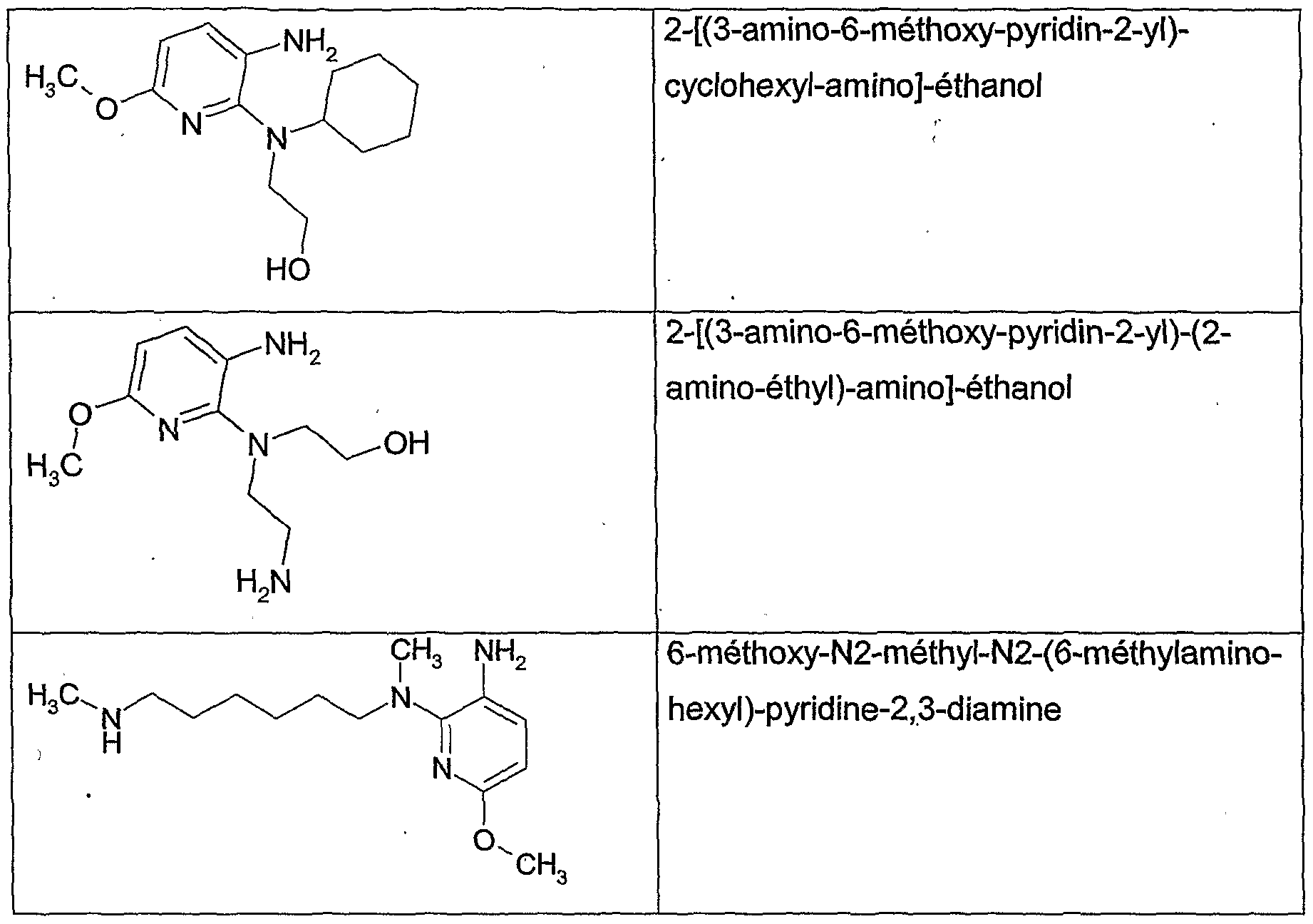
- the compounds of formula (I) are for example the compounds
- the oxidation dye composition of the present invention comprises one or more oxidation bases conventionally used in oxidation dye.
- these additional oxidation bases are chosen from para-phenylenediamines, bis-phenylalkylenediamines, para-aminophenols, bis-para-aminophenols, ortho-aminophenols, heterocyclic bases and their salts. addition.
- para-phenylenediamines there may be mentioned by way of example, para-phenylenediamine, para-toluenediamine, 2-chloro para-phenylenediamine, 2,3-dimethyl para-phenylenediamine, 2,6-dimethyl para -phenylenediamine, 2,6-die hyl para-phenylenediamine, 2,5-dimethyl para-phenylenediamine, N, N-dimethyl!
- para-phenylenediamine N, N-diethyl para-phenylenediamine, N, N-dipropyl para-phenylenediamine, 4-amino N, N-diethyl 3-methyl aniline, N, N-bis- ( ⁇ -hydroxyethyl) para-phenylenediamine, 4-N, N-bis- ( ⁇ -hydroxyethyl) amino 2-methyl aniline, 4-N, N-bis- ( ⁇ -hydroxyethyl) amino 2-chloro aniline, 2- ⁇ -hydroxyethyl para-phenylenediamine, 2-fluoro para-phenylenediamine, 2-isopropyl • para- phenylenediamine, N- ( ⁇ -hydroxypropyl) para-phenylenediamine, 2-hydr oxymethyl para-phenylenediamine, N, N-dimethyl 3-rhethyl para-phenylenediamine, N, N- (ethyl, ⁇ -hydroxyethyl) para-
- para-phenylenediamine para-toluenediamine, 2-isopropyl para-phenylenediamine, 2- ⁇ -hydroxyethyl para-phenylenediamine, 2- ⁇ -hydroxyethyloxy para-phenylenediamine, 2,6-dimé thyl para-pheny lenediamine, 2,6-diethyl para-phenylenediamine, 2,3-dimethyl para-phenylenediamine, N, N-bis- ( ⁇ -hydroxyethyl) paraphenylenediamine, 2-chloro para-phenylenediamine, 2- ⁇ -acetylaminoethyloxy para-phenylenediamine, and their acid addition salts are particularly preferred.
- the bis-phenylalkylenediamines there may be mentioned by way of example, N, N'-bis- ( ⁇ -hydroxyethyl) N, N'-bis- (4'-aminophenyl) 1,3-diamino propanol, N , N'-bis- ( ⁇ -hydroxyethyl) N, N'-bis- (4'-aminophenyl) ethylenediamine, N, N'-bis- (4-aminophenyl) tetramethylenediamine, N, N'-bis- ( ⁇ -hydroxyethyl) N, N'-bis- (4-aminophenyl) tetramethylenediamine, N, N'-bis- (4-methyl-aminophenyl) tetramethylenediamine, N, N'-bis- (ethyl) N, N ' -bis- (4'-amino, 3'-methylphenyl) ethylenediamine, 1,8-bis- (2,
- para-aminophenol there may be mentioned by way of example, para-aminophenol, 4-amino 3-methyl phenol, 4-amino 3-fluoro phenol, 4-amino 3-hydroxymethyl phenol, 4- amino 2-methyl phenol, 4-amino 2-hydroxymethyl phenol, 4-amino 2-methoxymethyl phenol, 4-amino 2-aminomethyl phenol, 4-amino 2- ( ⁇ -hydroxyethyl aminomethyl) phenol, 4- amino 2-fluoro phenol, and their addition salts with an, acid.
- para-aminophenol 4-amino 3-methyl phenol, 4-amino 3-fluoro phenol, 4-amino 3-hydroxymethyl phenol, 4- amino 2-methyl phenol, 4-amino 2-hydroxymethyl phenol, 4-amino 2-methoxymethyl phenol, 4-amino 2-aminomethyl phenol, 4-amino 2- ( ⁇ -hydroxyethyl aminomethyl) phenol, 4- amino 2-fluoro phenol, and their addition salts with an, acid.
- ortho-aminophenols there may be mentioned by way of example, 2-amino phenol, 2-amino 5-methyl phenol, 2-amino 6-methyl phenol, 5-acetamido 2-amino phenol, and their addition salts with an acid.
- heterocyclic bases for example, pyridine derivatives, pyrimidine derivatives and pyrazole derivatives.
- pyridine derivatives mention may be made of the compounds described for example in patents GB 1,026,978 and GB 1,153,196, such as 2,5-diamino pyridine, 2- (4-methoxyphenyl) amino 3-amino pyridine, 2,3-diamino 6-methoxy pyridine, 2- ( ⁇ -methoxyethyl) amino 3-amino 6-methoxy pyridine, 3,4-diamino pyridine, and their addition salts with an acid.
- pyridine oxidation bases useful in the present invention are the 3-amino pyrazolo- [1,5-a] -pyridine oxidation bases or their addition salts described for example in patent application FR 2801308.
- pyrazolo [1,5-a] pyridin-3-ylamine 2-acetylamino pyrazolo- [1,5-a] pyridin-3-ylamine; 2-morpholin-4-yl-pyrazoio [1,5-a] pyridin-3-ylamine; 3-amino-pyrazolo [1,5-a] pyridin-2-carboxylic acid; 2-methoxy-pyrazolo [1,5-a] pyridine-3-ylamino; (3-amino-pyrazolo [1,5-a] pyridine-7-yl) -methanol; 2- (3-amino-pyrazolo [1,5-a] pyridine-5-yl) -ethanol; 2-
- pyrimidine derivatives mention may be made of the compounds described, for example, in patents DE 2359399; JP 88-169571; JP 05-63124; EP 0770375 or patent application WO 96/15765 such as 2,4,5,6-tetra-aminopyrimidine, 4-hydroxy 2,5,6-triaminopyrimidine, 2-hydroxy 4,5,6-triaminopyrimidine, 2 , 4-dihydroxy 5,6-diaminopyrimidine, 2,5,6-triaminopyrimidine, and pyrazolo-pyrimidine derivatives such as those mentioned in patent application FR-A-2750048 and among which mention may be made of pyrazolo- [1, 5-a] pyrimidine-3,7-diamine ; 2,5-dimethyl pyrazolo- [1,5-a] -pyrimidine-3,7-diamine; pyrazolo- [1,5-a] -pyrimidine-3,5-diamine; 2,
- the oxidation base or bases present in the composition of the invention are generally each present in an amount of between 0.001 to 10% by weight approximately of the total weight of the dye composition, preferably between 0.005 and 6%.
- composition according to the invention may contain one or more additional couplers conventionally other than the coupler of formula (I).
- additional couplers mention may in particular be made of metaphenylenediamines, meta- aminophenols, metadiphenols, naphthalene couplers, heterocyclic couplers other than the couplers described above and their addition salts.
- the coupler or couplers are each generally present in an amount of between 0.001 and 10% by weight approximately of the total weight of the dye composition, preferably between 0.005 and 6%.
- addition salts of the oxidation bases and of the couplers which can be used in the context of the invention are in particular chosen from addition salts with an acid such as hydrochlorides, hydrobromides, sulfates, citrates, succinates, tartrates, lactates, tosylates, benzenesulfonates, phosphates and acetates and addition salts with a base such as soda, potash, ammonia, amines or alkanolamines.
- an acid such as hydrochlorides, hydrobromides, sulfates, citrates, succinates, tartrates, lactates, tosylates, benzenesulfonates, phosphates and acetates
- a base such as soda, potash, ammonia, amines or alkanolamines.
- the dye composition in accordance with the invention may also contain one or more direct dyes which can in particular be chosen from nitro dyes from the benzene series, azo direct dyes and methine direct dyes. These direct dyes can be of nonionic, anionic or cationic nature.
- the dye composition of the present invention is particularly useful for dyeing keratin fibers, in particular human keratin fibers.
- the medium is a cosmetic medium suitable for dyeing these fibers.
- This medium suitable for dyeing also called dye support, generally consists of water or a mixture of water and at least one organic solvent to dissolve the compounds which are not sufficiently soluble in water. Mention may, for example, be made, as organic solvent, of alkanols. lower in CC 4 , such as ethanol and isopropanol; polyols and polyol ethers such as 2-butoxy thanol, propylene glycol, propylene glycol monomethyl ether, monoethyl ether and diethylene glycol monomethyl ether, as well as aromatic alcohols such as benzyl alcohol or phenoxyethanol, and mixtures thereof.
- the solvents are preferably present in proportions preferably of between 1 and 40% by weight approximately relative to the total weight of the dye composition, and even more preferably between 5 and 30% by weight approximately.
- the dye composition in accordance with the invention may also contain various adjuvants conventionally used in compositions for dyeing the hair, such as anionic, cationic, nonionic, amphoteric, zwitterionic surfactants or mixtures thereof, anionic polymers, cationic, non-ionic, amphoteric, zwitterionic or mixtures thereof, mineral or organic thickening agents, and in particular associative anionic, cationic, nonionic and amphoteric polymeric thickeners, antioxidant agents, penetration agents, sequestering agents, perfumes, buffers, dispersing agents, conditioning agents such as for example volatile or non-volatile silicones, modified or unmodified, film-forming agents, ceramides, preservatives, opacifying agents.
- the above adjuvants are generally present in an amount for each of them of between 0.01 and 20% by weight relative to the weight of the composition.
- the pH of the dye composition according to the invention is generally between 3 and 12 approximately, and preferably between 5 and 11 approximately. It can be adjusted to the desired value by means of acidifying or basifying agents usually used in dyeing keratin fibers or even using conventional buffer systems.
- the acidifying agents there may be mentioned, by way of example, mineral or organic acids such as hydrochloric acid, orthophosphoric acid, sulfuric acid, carboxylic acids such as acetic acid, tartaric acid, citric acid, lactic acid, sulfonic acids.
- the basifying agents there may be mentioned, by way of example, ammonia, alkali carbonates, alkanolamines such as mono-, di- and triethanolamines as well as their derivatives, sodium or potassium hydroxides and compounds of formula (II) below:
- R a , Rb, Rc and R d identical or different, represent a hydrogen atom, an alkyl radical in C r C or hydroxyalkyl in C ⁇ -C 4 .
- the dye composition according to the invention can be in various forms, such as in the form of liquids, creams, gels, or in any other form suitable for dyeing keratin fibers, and in particular human hair.
- the process of the present invention is a process in which the composition according to the present invention as defined above is applied to the fibers, in the presence of an oxidizing agent for a time sufficient to develop the desired coloration.
- the color can be revealed at acidic, neutral or alkaline pH and the oxidizing agent can be added to the composition of the invention just at the time of use or it can be used from an oxidizing composition containing it , applied simultaneously or sequentially to the composition of the invention.
- the composition according to the present invention is mixed, preferably at the time of use, with a composition containing, in a medium suitable for dyeing, at least one oxidizing agent, this oxidizing agent being present in enough to develop color.
- the mixture obtained is then applied to the keratin fibers. After an exposure time of 3 to 50 minutes approximately, preferably 5 to 30 minutes approximately, the keratin fibers are rinsed, washed with shampoo, rinsed again and then dried.
- the oxidizing agents conventionally used for the oxidation dyeing of keratin fibers are for example hydrogen peroxide, urea peroxide, alkali metal bromates, persalts such as perborates and persulfates, peracids and the oxidase enzymes among which mention may be made of peroxidases, 2-electron oxidoreductases such as uricases and 4-electron oxygenases such as laccases. Hydrogen peroxide is particularly preferred.
- the oxidizing composition may also contain various adjuvants conventionally used in compositions for dyeing the hair and as defined above.
- the pH of the oxidizing composition containing the oxidizing agent is such that after mixing with the dye composition, the pH of the resulting composition applied to the keratin fibers preferably varies between 3 and 12 approximately, and even more preferably between 5 and 11 It can be adjusted to the desired value by means of acidifying or basifying agents usually used in dyeing keratin fibers and as defined above.
- the ready-to-use composition which is finally applied to the keratin fibers can be in various forms, such as in the form of liquids, creams, gels or in any other form suitable for dyeing keratin fibers, and especially human hair.
- the composition of the invention can be in the form of a kit.
- a kit comprises on the one hand a composition as defined above and on the other hand an oxidizing composition.
- the invention also relates to a device with several compartments in which a first compartment contains the dye composition of the present invention defined above and a second compartment contains an oxidizing agent.
- This device can be equipped with a means enabling the desired mixture to be delivered to the hair, such as the devices described in patent FR-2,586,913 in the name of the applicant.
- the present invention finally relates to the 6-alkoxy-2,3-diaminopyridine compounds of formula (I) as well as their corresponding addition salts as defined above with the exception of 2- (N-methyl N- ( ⁇ -hydroxy-ethyl) amino) 3- amino 6-methoxy pyridine.
- the first step is to react a 6-alkoxy-3-nitro-2- derivative
- reaction temperature varies, depending on the pyridine derivatives and the nucleophilic amine, from 75 ° C to 140 ° C.
- the alcohols such as ethanol, isopropanol, butanol, pentanol as well as acetic, formic acid or dioxane and DMF will be chosen as solvent.
- the second step is a reduction reaction carried out either by hydrogenation in heterogeneous catalysis, or by hydrogen transfer or by metal hydrides or by the formic acid-acetic acid couple in the presence of palladium.
- the composition is mixed with an equal weight of hydrogen peroxide at 20 volumes (6% by weight).
- the pH of the final composition is equal to 7.
- the mixture obtained is applied to locks of gray hair containing 90% white hairs. After 30 minutes of laying, the locks are washed with a standard shampoo, rinsed and then dried. Each lock is evaluated before and after dyeing in the L * a * b * system, using a CM 2002 MINOLTA® spectrocolorimeter (Illuminant D65).
- the dye compositions were prepared in the following proportions
- Each mixture obtained is applied to gray hair containing 90% white hair. After 30 minutes of laying, the hair is rinsed, washed with a standard shampoo, rinsed again and then dried.
- the dye compositions were prepared in the following proportions:
- each composition is mixed with an equal weight of hydrogen peroxide at 20 volumes (6% by weight). A final pH of 9.5 is obtained. Each mixture obtained is applied to gray hair containing 90% white hair. After 30 minutes of laying, the hair is rinsed, washed with a standard shampoo, rinsed again and then dried.
- the dye compositions were prepared in the following proportions
- each composition is mixed with an equal weight of hydrogen peroxide at 20 volumes (6% by weight). A final pH of 9.5 is obtained. Each mixture obtained is applied to gray hair containing 90% white hair. After 30 minutes of laying, the hair is rinsed, washed with a standard shampoo, rinsed again and then dried.
- the dye compositions were prepared in the following proportions
- Each mixture obtained is applied to gray hair containing 90% white hair. After 30 minutes of laying, the hair is rinsed, washed with a standard shampoo, rinsed again and then dried.
- the dye compositions were prepared in the following proportions:
- each composition is mixed with an equal weight of hydrogen peroxide at 20 volumes (6% by weight). A final pH of 9.5 is obtained.
- Each mixture obtained is applied to gray hair containing 90% white hair. After 30 minutes of laying, the hair is rinsed, washed with a standard shampoo, rinsed again and then dried.
- the dye compositions were prepared in the following proportions
- each composition is mixed with an equal weight of hydrogen peroxide at 20 volumes (6% by weight). A final pH of 9.5 is obtained.
- Each mixture obtained is applied to gray hair containing 90% white hair. After 30 minutes of laying, the hair is rinsed, washed with a standard shampoo, rinsed again and then dried.
- the dye compositions were prepared in the following proportions
- each composition is mixed with an equal weight of hydrogen peroxide at 20 volumes (6% by weight). A final pH of 9.5 is obtained. Each mixture obtained is applied to gray hair containing 90% white hair. After 30 minutes of laying, the hair is rinsed, washed with a standard shampoo, rinsed again and then dried.
- the dye compositions were prepared in the following proportions
- Each mixture obtained is applied to gray hair containing 90% white hair. After 30 minutes of laying, the hair is rinsed, washed with a standard shampoo, rinsed again and then dried.
- the dye compositions were prepared in the following proportions
- each composition is mixed with an equal weight of hydrogen peroxide at 20 volumes (6% by weight). A final pH of 9.5 is obtained. Each mixture obtained is applied to gray hair containing 90% white hair. After 30 minutes of laying, the hair is rinsed, washed with a standard shampoo, rinsed again and then dried.
- the dye compositions were prepared in the following proportions
- each composition is mixed with an equal weight of hydrogen peroxide at 20 volumes (6% by weight). A final pH of 9.5 is obtained.
- the dye compositions were prepared in the following proportions:
- each composition is mixed with an equal weight of hydrogen peroxide at 20 volumes (6% by weight). A final pH of 9.5 is obtained. Each mixture obtained is applied to gray hair containing 90% white hair. After 30 minutes of laying, the hair is rinsed, washed with a standard shampoo, rinsed again and then dried.
- the dye compositions were prepared in the following proportions
- Each mixture obtained is applied to gray hair containing 90% white hair. After 30 minutes of laying, the hair is rinsed, washed with a standard shampoo, rinsed again and then dried.
- the dye compositions were prepared in the following proportions:
- each composition is mixed with an equal weight of hydrogen peroxide at 20 volumes (6% by weight). A final pH of 9.5 is obtained. Each mixture obtained is applied to gray hair containing 90% white hair. After 30 minutes of laying, the hair is rinsed, washed with a standard shampoo, rinsed again and then dried.
- the dye compositions were prepared in the following proportions
- each composition is mixed with an equal weight of hydrogen peroxide at 20 volumes (6% by weight). A final pH of 9.5 is obtained. Each mixture obtained is applied to gray hair containing 90% white hair. After 30 minutes of laying, the hair is rinsed, washed with a standard shampoo, rinsed again and then dried.
- the dye compositions were prepared in the following proportions
- Each mixture obtained is applied to gray hair containing 90% white hair. After 30 min of exposure, the hair is rinsed, washed with a standard shampoo, rinsed again and then dried.
- the dye compositions were prepared in the following proportions
- Each mixture obtained is applied to gray hair containing 90% white hair. After 30 min of exposure, the hair is rinsed, washed with a standard shampoo, rinsed again and then dried.
- the dye compositions were prepared in the following proportions
- each composition is mixed with an equal weight of hydrogen peroxide at 20 volumes (6% by weight). A final pH of 7 is obtained.
- Each mixture obtained is applied to gray hair containing 90% white hair. After 30 min of exposure, the hair is rinsed, washed with a standard shampoo, rinsed again and then dried. .
- the dye compositions were prepared in the following proportions
- each composition is mixed with an equal weight of hydrogen peroxide at 20 volumes (6% by weight). A final pH of 7 is obtained.
- Each mixture obtained is applied to gray hair containing 90% white hair. After 30 min of exposure, the hair is rinsed, washed with a standard shampoo, rinsed again and then dried.
- the dye compositions were prepared in the following proportions
- each composition is mixed with an equal weight of hydrogen peroxide at 20 volumes (6% by weight). A final pH of 7 is obtained. Each mixture obtained is applied to gray hair containing 90% white hair. After 30 min of exposure, the hair is rinsed, washed with a standard shampoo, rinsed again and then dried.
- the dye compositions were prepared in the following proportions
- each composition is mixed with an equal weight of hydrogen peroxide at 20 volumes (6% by weight). A final pH of 7 is obtained. Each mixture obtained is applied to gray hair containing 90% white hair. After 30 min of exposure, the hair is rinsed, washed with a standard shampoo, rinsed again and then dried.
- the dye compositions were prepared in the following proportions
- each composition is mixed with an equal weight of hydrogen peroxide at 20 volumes (6% by weight). A final pH of 7 is obtained.
- Each mixture obtained is applied to gray hair containing 90% white hair. After 30 min of exposure, the hair is rinsed, washed with a standard shampoo, rinsed again and then dried.
- the dye compositions were prepared in the following proportions
- Each mixture obtained is applied to gray hair containing 90% white hair. After 30 min of exposure, the hair is rinsed, washed with a standard shampoo, rinsed again and then dried.
- the dye compositions were prepared in the following proportions
- Each mixture obtained is applied to gray hair containing 90% white hair. After 30 min of exposure, the hair is rinsed, washed with a standard shampoo, rinsed again and then dried.
- the dye compositions were prepared in the following proportions:
- Each mixture obtained is applied to gray hair containing 90% white hair. After 30 min of exposure, the hair is rinsed, washed with a standard shampoo, rinsed again and then dried.
- the dye compositions were prepared in the following proportions:
- Each mixture obtained is applied to gray hair containing 90% white hair. After 30 min of exposure, the hair is rinsed, washed with a standard shampoo, rinsed again and then dried.
- the dye compositions were prepared in the following proportions
- Each mixture obtained is applied to gray hair containing 90% white hair. After 30 min of exposure, the hair is rinsed, washed with a standard shampoo, rinsed again and then dried.
- the dye compositions were prepared in the following proportions
- Each mixture obtained is applied to gray hair containing 90% white hair. After 30 min of exposure, the hair is rinsed, washed with a standard shampoo, rinsed again and then dried.
- the dye compositions were prepared in the following proportions:
- Each mixture obtained is applied to gray hair containing 90% white hair. After 30 min of exposure, the hair is rinsed, washed with a standard shampoo, rinsed again and then dried.
- the dye compositions were prepared in the following proportions
- Each mixture obtained is applied to gray hair containing 90% white hair. After 30 min of exposure, the hair is rinsed, washed with a standard shampoo, rinsed again and then dried.
Landscapes
- Organic Chemistry (AREA)
- Chemical & Material Sciences (AREA)
- Life Sciences & Earth Sciences (AREA)
- Health & Medical Sciences (AREA)
- Public Health (AREA)
- General Health & Medical Sciences (AREA)
- Animal Behavior & Ethology (AREA)
- Veterinary Medicine (AREA)
- Epidemiology (AREA)
- Birds (AREA)
- Cosmetics (AREA)
- Coloring (AREA)
- Pyridine Compounds (AREA)
Abstract
Description










Claims

Priority Applications (5)
| Application Number | Priority Date | Filing Date | Title |
|---|---|---|---|
| CA002494856A CA2494856A1 (fr) | 2002-10-04 | 2003-10-03 | Nouveaux coupleurs 6-alcoxy- 2,3-diaminopyridine dont le radical amino en position 2 est un radical amino disubstitue et utilisation de ces coupleurs pour la teinture des fibres keratiniques |
| AU2003299183A AU2003299183A1 (en) | 2002-10-04 | 2003-10-03 | Novel 6-alkoxy-2,3-diaminopyridine couplers in which the position 2 amino radical is a disubstituted amino radical and use of said couplers for the dyeing of keratinous fibres |
| JP2004540896A JP4408808B2 (ja) | 2002-10-04 | 2003-10-03 | 2位のアミノ基が二置換されたアミノ基である新規の6−アルコキシ−2,3−ジアミノピリジンカップラー、及びケラチン繊維を染色するための該カップラーの使用 |
| EP03798958A EP1551360B1 (fr) | 2002-10-04 | 2003-10-03 | Coupleurs 6-alcoxy- 2,3-diaminopyridine dont le radical amino en position 2 est un radical amino disubstitue et utilisation de ces coupleurs pour la teinture des fibres keratiniques |
| DE60311498T DE60311498T2 (de) | 2002-10-04 | 2003-10-03 | 2-aminodisubstituierte 6-alkoxy-2,3-diaminopyridin-farbstoffkuppler und ihre verwendung zum färben keratinischer fasern |
Applications Claiming Priority (2)
| Application Number | Priority Date | Filing Date | Title |
|---|---|---|---|
| FR02/12351 | 2002-10-04 | ||
| FR0212351A FR2845280B1 (fr) | 2002-10-04 | 2002-10-04 | Nouveaux coupleurs 6-alcoxy-2,3-diaminopyridine dont le radical amino en position 2 est un radical amino disubstitue et utilisation de ces coupleurs pour la teinture des fibres keratiniques |
Publications (1)
| Publication Number | Publication Date |
|---|---|
| WO2004030643A1 true WO2004030643A1 (fr) | 2004-04-15 |
Family
ID=32011410
Family Applications (1)
| Application Number | Title | Priority Date | Filing Date |
|---|---|---|---|
| PCT/FR2003/002920 Ceased WO2004030643A1 (fr) | 2002-10-04 | 2003-10-03 | Nouveaux coupleurs 6-alcoxy- 2,3-diaminopyridine dont le radical amino en position 2 est un radical amino disubstitue et utilisation de ces coupleurs pour la teinture des fibres keratiniques |
Country Status (9)
| Country | Link |
|---|---|
| EP (1) | EP1551360B1 (fr) |
| JP (1) | JP4408808B2 (fr) |
| AT (1) | ATE352284T1 (fr) |
| AU (1) | AU2003299183A1 (fr) |
| CA (1) | CA2494856A1 (fr) |
| DE (1) | DE60311498T2 (fr) |
| ES (1) | ES2280838T3 (fr) |
| FR (1) | FR2845280B1 (fr) |
| WO (1) | WO2004030643A1 (fr) |
Cited By (1)
| Publication number | Priority date | Publication date | Assignee | Title |
|---|---|---|---|---|
| EP1586303A1 (fr) * | 2004-04-05 | 2005-10-19 | L'oreal | Composition tinctoriale comprenant au moins une base d'oxydation diaminopyrazole et au moins un coupleur 6-alcoxy-2,3-diaminopyridine |
Citations (8)
| Publication number | Priority date | Publication date | Assignee | Title |
|---|---|---|---|---|
| FR1397551A (fr) * | 1963-04-23 | 1965-04-30 | Hans Schwarzkopf | Produit notamment pour la teinture des cheveux |
| DE3233540A1 (de) * | 1982-09-10 | 1984-03-15 | Henkel Kgaa | Haarfaerbemittel |
| DE4115148A1 (de) * | 1991-05-08 | 1992-11-12 | Henkel Kgaa | Haarfaerbemittel |
| EP0728464A1 (fr) * | 1995-02-27 | 1996-08-28 | L'oreal | Composition de teinture d'oxydation des fibres kératiniques comprenant un dérivé de diaminopyrazole et un coupleur hétérocyclique et procédé de teinture |
| FR2779952A1 (fr) * | 1998-06-19 | 1999-12-24 | Oreal | Composition tinctoriale contenant une pyrazolo-[1,5-a]- pyrimidine a titre de base d'oxydation et un coupleur pyridinique, et procedes de teinture |
| DE19936442A1 (de) * | 1999-08-03 | 2001-02-08 | Henkel Kgaa | Neue Entwickler-Kuppler-Kombinationen |
| US20020013973A1 (en) * | 2000-03-30 | 2002-02-07 | Gregory Plos | Compositions for the oxidation dyeing of keratinous fibers comprising at least one oxidation dye and at least one enzymatic oxidizing agent, and dyeing methods |
| FR2835741A1 (fr) * | 2002-02-12 | 2003-08-15 | Oreal | Nouveaux coupleurs 6-alcoxy-2,3-diaminopyridine utiles pour la teinture des fibres keratiniques |
-
2002
- 2002-10-04 FR FR0212351A patent/FR2845280B1/fr not_active Expired - Fee Related
-
2003
- 2003-10-03 ES ES03798958T patent/ES2280838T3/es not_active Expired - Lifetime
- 2003-10-03 EP EP03798958A patent/EP1551360B1/fr not_active Expired - Lifetime
- 2003-10-03 DE DE60311498T patent/DE60311498T2/de not_active Expired - Lifetime
- 2003-10-03 CA CA002494856A patent/CA2494856A1/fr not_active Abandoned
- 2003-10-03 WO PCT/FR2003/002920 patent/WO2004030643A1/fr not_active Ceased
- 2003-10-03 AU AU2003299183A patent/AU2003299183A1/en not_active Abandoned
- 2003-10-03 JP JP2004540896A patent/JP4408808B2/ja not_active Expired - Fee Related
- 2003-10-03 AT AT03798958T patent/ATE352284T1/de not_active IP Right Cessation
Patent Citations (8)
| Publication number | Priority date | Publication date | Assignee | Title |
|---|---|---|---|---|
| FR1397551A (fr) * | 1963-04-23 | 1965-04-30 | Hans Schwarzkopf | Produit notamment pour la teinture des cheveux |
| DE3233540A1 (de) * | 1982-09-10 | 1984-03-15 | Henkel Kgaa | Haarfaerbemittel |
| DE4115148A1 (de) * | 1991-05-08 | 1992-11-12 | Henkel Kgaa | Haarfaerbemittel |
| EP0728464A1 (fr) * | 1995-02-27 | 1996-08-28 | L'oreal | Composition de teinture d'oxydation des fibres kératiniques comprenant un dérivé de diaminopyrazole et un coupleur hétérocyclique et procédé de teinture |
| FR2779952A1 (fr) * | 1998-06-19 | 1999-12-24 | Oreal | Composition tinctoriale contenant une pyrazolo-[1,5-a]- pyrimidine a titre de base d'oxydation et un coupleur pyridinique, et procedes de teinture |
| DE19936442A1 (de) * | 1999-08-03 | 2001-02-08 | Henkel Kgaa | Neue Entwickler-Kuppler-Kombinationen |
| US20020013973A1 (en) * | 2000-03-30 | 2002-02-07 | Gregory Plos | Compositions for the oxidation dyeing of keratinous fibers comprising at least one oxidation dye and at least one enzymatic oxidizing agent, and dyeing methods |
| FR2835741A1 (fr) * | 2002-02-12 | 2003-08-15 | Oreal | Nouveaux coupleurs 6-alcoxy-2,3-diaminopyridine utiles pour la teinture des fibres keratiniques |
Non-Patent Citations (1)
| Title |
|---|
| DATABASE CHEMLIST XP002243965 * |
Cited By (1)
| Publication number | Priority date | Publication date | Assignee | Title |
|---|---|---|---|---|
| EP1586303A1 (fr) * | 2004-04-05 | 2005-10-19 | L'oreal | Composition tinctoriale comprenant au moins une base d'oxydation diaminopyrazole et au moins un coupleur 6-alcoxy-2,3-diaminopyridine |
Also Published As
| Publication number | Publication date |
|---|---|
| DE60311498T2 (de) | 2007-11-08 |
| EP1551360B1 (fr) | 2007-01-24 |
| ES2280838T3 (es) | 2007-09-16 |
| CA2494856A1 (fr) | 2004-04-15 |
| FR2845280A1 (fr) | 2004-04-09 |
| FR2845280B1 (fr) | 2006-06-02 |
| ATE352284T1 (de) | 2007-02-15 |
| JP4408808B2 (ja) | 2010-02-03 |
| JP2006508932A (ja) | 2006-03-16 |
| DE60311498D1 (de) | 2007-03-15 |
| EP1551360A1 (fr) | 2005-07-13 |
| AU2003299183A1 (en) | 2004-04-23 |
Similar Documents
| Publication | Publication Date | Title |
|---|---|---|
| EP1413286A1 (fr) | Composition tinctoriale comprenant au moins une base d'oxydation hétérocyclique et au moins un coupleur 2,3-diaminopyridine substitué | |
| WO2003028688A1 (fr) | Composition tinctoriale comprenant une base d'oxydation du type diaminopyrazole, une base d'oxydation heterocyclique et un coupleur | |
| EP1372586A1 (fr) | Composition pour la teinture d'oxydation contenant 3-amino pyrazolo- 1,5-a]-pyridine et un coupleur aminophenol | |
| EP1372585A1 (fr) | Composition pour la teinture d'oxydation 3-amino pyrazolo- 1,5-a]-pyridine et un coupleur pyrazolotriazole | |
| WO2002045672A1 (fr) | Composition de teinture d'oxydation a base de 1-(4-aminophenyl)pyrrolidines substituees en position 2 et 4 | |
| EP1405628A1 (fr) | Composition tinctoriale comprenant au moins une base d'oxydation pyrazolopyrimidine et au moins un coupleur 6-alcoxy 2,3-diaminopyridimine | |
| EP1417184A1 (fr) | Composition pour la teinture de fibre keratiniques contenant une paraphenylenediamine substituee par un radical diazacycloheptane | |
| EP1396486A1 (fr) | Dérivés bis-paraphénylènediamine à groupement pyrrolidinyle et utilisation de ces dérivés pour la coloration de fibres kératiniques | |
| EP1341507A1 (fr) | Composition de teinture d'oxydation a base de 1-(4-aminophenyl) pyrrolidines substituees en positions 2 et 5 | |
| EP1341510A1 (fr) | Composition de teinture d'oxydation a base de 1-(4-aminophenyl)pyrrolidines substituees en position 3 et 4, et procede de teinture de mise en oeuvre | |
| EP1334713A1 (fr) | Composition tinctoriale comprenant une base d'oxydation du type diaminopyrazole, une base d'oxidation cationique et un coupleur | |
| EP1066263B1 (fr) | Nouveaux 2-acylaminophenols cationiques, leur utilisation a titre de coupleur pour la teinture d'oxydation, compositions les comprenant, et procedes de teinture | |
| EP1518547A1 (fr) | Composition tinctoriale comprenant au moins une base paraphénylènediamine secondaire hydroxyalkylée, au moins un coupleur et de l'octyldodécanol | |
| EP1066264B1 (fr) | 2-sulfonylaminophenols cationiques, leur utilisation a titre de coupleur pour la teinture d'oxydation, compositions les comprenant, et procedes de teinture | |
| EP1551360B1 (fr) | Coupleurs 6-alcoxy- 2,3-diaminopyridine dont le radical amino en position 2 est un radical amino disubstitue et utilisation de ces coupleurs pour la teinture des fibres keratiniques | |
| EP1551806B1 (fr) | Coupleurs 6-alcoxy- 2,3-diaminopyridine et utilisation de ces coupleurs pour la teinture des fibres keratiniques | |
| EP1586302A1 (fr) | Composition tinctoriale comprenant au moins une base d'oxydation pyrazolopyrimidine et au moins un coupleur 6-alcoxy-2,3-diaminopyridine | |
| EP1336606A1 (fr) | Nouveaux coupleurs 6-alcoxy-2,3-diaminopyridine utiles pour la teinture des fibres kératiniques | |
| EP1484049A1 (fr) | Nouveaux composés imidazoles et utilisation de ces composés pour la teinture de fibres kératiniques | |
| EP1518544A1 (fr) | Composition tinctoriale comprenant au moins une base paraphénylènediamine secondaire hydroxyalkylée, au moins un coupleur et l'acide étidronique | |
| EP1586303A1 (fr) | Composition tinctoriale comprenant au moins une base d'oxydation diaminopyrazole et au moins un coupleur 6-alcoxy-2,3-diaminopyridine | |
| FR2841779A1 (fr) | Composition de teinture des fibres keratiniques contenant un precurseur d'aldehyde, une enzyme et une hydrazone et procede mettant en oeuvre cette composition | |
| EP1559412A1 (fr) | Composition de teinture des fibres kératiniques contenant une alcool oxydase et une base d'oxydation cationique | |
| WO2002074267A1 (fr) | Compositions tinctoriales pour la teinture de fibres keratiniques comprenant a titre de base d'oxydation des composes hydrazone heterocycliques a 6 chainons | |
| EP1438949A1 (fr) | Composition pour la teinture des fibres kératiniques comprenant un coupleur acylaminophénol |
Legal Events
| Date | Code | Title | Description |
|---|---|---|---|
| AK | Designated states |
Kind code of ref document: A1 Designated state(s): AE AG AL AM AT AU AZ BA BB BG BR BY BZ CA CH CN CO CR CU CZ DE DK DM DZ EC EE EG ES FI GB GD GE GH GM HR HU ID IL IN IS JP KE KG KP KR KZ LC LK LR LS LT LU LV MA MD MG MK MN MW MX MZ NI NO NZ OM PG PH PL PT RO RU SC SD SE SG SK SL SY TJ TM TN TR TT TZ UA UG US UZ VC VN YU ZA ZM ZW |
|
| AL | Designated countries for regional patents |
Kind code of ref document: A1 Designated state(s): GH GM KE LS MW MZ SD SL SZ TZ UG ZM ZW AM AZ BY KG KZ MD RU TJ TM AT BE BG CH CY CZ DE DK EE ES FI FR GB GR HU IE IT LU MC NL PT RO SE SI SK TR BF BJ CF CG CI CM GA GN GQ GW ML MR NE SN TD TG |
|
| 121 | Ep: the epo has been informed by wipo that ep was designated in this application | ||
| WWE | Wipo information: entry into national phase |
Ref document number: 2003798958 Country of ref document: EP |
|
| ENP | Entry into the national phase |
Ref document number: 2494856 Country of ref document: CA |
|
| WWE | Wipo information: entry into national phase |
Ref document number: 2004540896 Country of ref document: JP |
|
| WWP | Wipo information: published in national office |
Ref document number: 2003798958 Country of ref document: EP |
|
| WWG | Wipo information: grant in national office |
Ref document number: 2003798958 Country of ref document: EP |