WO2004053021A1 - Liquid crystal composition for use in bistable liquid crystal devices - Google Patents

Liquid crystal composition for use in bistable liquid crystal devices Download PDF

Info

Publication number
WO2004053021A1
WO2004053021A1 PCT/EP2003/012953 EP0312953W WO2004053021A1 WO 2004053021 A1 WO2004053021 A1 WO 2004053021A1 EP 0312953 W EP0312953 W EP 0312953W WO 2004053021 A1 WO2004053021 A1 WO 2004053021A1
Authority
WO
WIPO (PCT)
Prior art keywords
liquid crystal
formula
independently
compound
substituted
Prior art date
Legal status (The legal status is an assumption and is not a legal conclusion. Google has not performed a legal analysis and makes no representation as to the accuracy of the status listed.)
Ceased
Application number
PCT/EP2003/012953
Other languages
French (fr)
Inventor
Matthew Francis
Mark John Goulding
Doina Ionescu
Cecile Schott
John Clifford Jones
Steve Beldon
Current Assignee (The listed assignees may be inaccurate. Google has not performed a legal analysis and makes no representation or warranty as to the accuracy of the list.)
Merck Patent GmbH
Original Assignee
Merck Patent GmbH
Priority date (The priority date is an assumption and is not a legal conclusion. Google has not performed a legal analysis and makes no representation as to the accuracy of the date listed.)
Filing date
Publication date
Application filed by Merck Patent GmbH filed Critical Merck Patent GmbH
Priority to AU2003288118A priority Critical patent/AU2003288118A1/en
Priority to DE60313211T priority patent/DE60313211T2/en
Priority to EP03779992A priority patent/EP1570025B1/en
Priority to US10/538,788 priority patent/US7294368B2/en
Priority to JP2004557913A priority patent/JP5436739B2/en
Publication of WO2004053021A1 publication Critical patent/WO2004053021A1/en
Anticipated expiration legal-status Critical
Ceased legal-status Critical Current

Links

Classifications

    • CCHEMISTRY; METALLURGY
    • C09DYES; PAINTS; POLISHES; NATURAL RESINS; ADHESIVES; COMPOSITIONS NOT OTHERWISE PROVIDED FOR; APPLICATIONS OF MATERIALS NOT OTHERWISE PROVIDED FOR
    • C09KMATERIALS FOR MISCELLANEOUS APPLICATIONS, NOT PROVIDED FOR ELSEWHERE
    • C09K19/00Liquid crystal materials
    • C09K19/04Liquid crystal materials characterised by the chemical structure of the liquid crystal components, e.g. by a specific unit
    • C09K19/42Mixtures of liquid crystal compounds covered by two or more of the preceding groups C09K19/06 - C09K19/40
    • C09K19/46Mixtures of liquid crystal compounds covered by two or more of the preceding groups C09K19/06 - C09K19/40 containing esters
    • CCHEMISTRY; METALLURGY
    • C09DYES; PAINTS; POLISHES; NATURAL RESINS; ADHESIVES; COMPOSITIONS NOT OTHERWISE PROVIDED FOR; APPLICATIONS OF MATERIALS NOT OTHERWISE PROVIDED FOR
    • C09KMATERIALS FOR MISCELLANEOUS APPLICATIONS, NOT PROVIDED FOR ELSEWHERE
    • C09K19/00Liquid crystal materials
    • C09K19/02Liquid crystal materials characterised by optical, electrical or physical properties of the components, in general
    • C09K19/0225Ferroelectric
    • CCHEMISTRY; METALLURGY
    • C09DYES; PAINTS; POLISHES; NATURAL RESINS; ADHESIVES; COMPOSITIONS NOT OTHERWISE PROVIDED FOR; APPLICATIONS OF MATERIALS NOT OTHERWISE PROVIDED FOR
    • C09KMATERIALS FOR MISCELLANEOUS APPLICATIONS, NOT PROVIDED FOR ELSEWHERE
    • C09K2323/00Functional layers of liquid crystal optical display excluding electroactive liquid crystal layer characterised by chemical composition

Definitions

  • Liquid crystal composition for use in bistable liquid crystal devices
  • the invention is directed to the use of a liquid crystal composition in a bistable liquid crystal device and especially in a zenithal bistable nematic liquid crystal device, a nematic liquid crystal medium, and a bistable liquid crystal device comprising the liquid crystal composition.
  • Electrooptical devices utilizing liquid crystal media for displaying information are well known and used in a wide variety of technical applications (see, for a review, H. Kawamoto, Proc. IEEE, 90, 460 (2002)).
  • nematic liquid crystal devices are the most prominent; there are, for instance, twisted nematic (TN) liquid crystal devices (M. Schadt and W. Helfrich, Appl. Phys. Lett., 18, 127 (1971)) and super-twisted nematic (STN) liquid crystal devices (see, inter alia, TJ. Scheffer and J. Nehring, Appl. Phys. Lett., 48, 1021 (1984)).
  • TN twisted nematic
  • STN super-twisted nematic
  • the liquid crystal medium is switched to an ON state by application of a suitable voltage, and is allowed to switch to an OFF state when the voltage applied falls below a lower voltage level.
  • electrooptical devices need to comprise a number of picture elements that can be switched independently of each other.
  • the number of elements addressable in nematic liquid crystal displays is limited, in the first case by mere geometrical requirements of the electrical connections and in the second case by the steepness of the device's transmission versus the voltage curve.
  • TFT thin film transistors
  • Such devices also known as active matrix (AM) displays, enable addressing of a high number of picture elements and thus of large area high resolution displays and with relatively low voltage requirements. Some of these devices are also mechanically rather stable and have a wide temperature range. Although this allows the construction of small and portable battery powered displays, for certain applications the techniques have several drawbacks. Manufacturing AM displays is still a complicated process involving the building up of a complex assembly which contributes to rather high costs of production. Since the device has no intrinsic or internal memory, constant update of the display even for static images is required. This causes relatively high power consumption and, hence, rather poor battery life time. This is especially undesired with portable devices displaying information that is changed only from time to time or in a limited part of the display such as mobile phones, personal digital assistants (PDAs), pagers, electronic shelf edge labels, and the like.
  • PDAs personal digital assistants
  • bistable liquid crystal device An approach to avoid the limitations and drawbacks of these nematic liquid crystal devices is to use displays with an internal memory effect, e.g. a bistable liquid crystal device.
  • Bistability means that the molecules of the liquid crystal medium inside the device can adopt two (or more) different stable states. Consequently, by applying a suitable addressing scheme the liquid crystal molecules of the medium are switched into a first stable state which persists even after addressing; utilization of another addressing scheme causes the liquid crystal molecules to adopt a second stable state that likewise persists after addressing.
  • Ferroelectric liquid crystal displays using smectic liquid crystal materials can be made into bistable devices. They have, however, several disadvantages, e.g. lack of shock resistance, narrow operating temperature range, and low cell gap causing manufacturing difficulties. Therefore, these ferroelectric devices are unlikely to fulfill the requirements to displays for the portable devices mentioned above.
  • ferroelectric smectic liquid crystals are capable of being used in bistable devices but also nematic liquid crystals.
  • bistable bulk configurations adopted by nematic liquid crystals see, for instance, I. Dozov et al, "Recent improvements of bistable nematic displays switched by anchoring breaking (BiNem ® )"
  • the director of the liquid crystal molecules in the display having a grating alignment on the surface of one of the display cell's plates (or substrates) will lie parallel to said plate in both stable states; that means that switching between the stable states occurs within the plane of the display cell's plates (see, for instance, WO 92/00546 and WO 95/22077 which describes the use of a substrate having a bigrating alignment layer).
  • reproducing selection of the stable states is found to be difficult and switching generally requires a high switching voltage.
  • zenithal bistability is observed when the zenithal bistable surface is used (see Figure 1 ; the tiny lines represent the local director of the liquid crystal molecules that are oriented by interaction with the surface grating and appropriate alignment layer).
  • the director of the liquid crystal molecules has two possible configurations with different pretilt angles in the same azimuthal plane (i.e. the plane perpendicular to the surface of the display cell's substrate). The first state is the high tilt state while the second state is the low tilt state.
  • the grating of the zenithal bistable surface is defined by its amplitude a and its pitch L; typical values are for L of about 1 ⁇ m and for a of about 0.6 to 0.8 ⁇ m (see WO 97/14990 and, for more details, WO 02/08825; and J.C. Jones, G. Bryan-Brown, E. Wood, A. Graham, P. Brett and J. Hughes, "Novel bistable liquid crystal displays based on grating alignment", in "Liquid Crystal Materials, Devices, and Flat Panel Displays", R. Shashidhar, B. Gnade, eds., Proceedings of SPIE Vol. 3955 (2000), 84).
  • a homeotropic orientation can be, for example, induced by coating the grating with a homeotropic alignment layer; this orientation ensures that the director of the liquid crystal molecules does not lie parallel to the grooves of the grating.
  • the orientation of the director of the liquid crystal molecules is perpendicular to the (local) surface, i.e. varying with the location on the surface along a direction perpendicular to the grooves, the orientation in the "bulk" is very much influenced by the opposite surface alignment in both states.
  • Switching from one stable state to the other may be achieved by applying a simple electrical pulse thereby causing a switch from a black display or picture element to a white one (or vice versa) with the appropriate polariser configuration and retardation, and switching back to the original state occurs upon application of a pulse of opposite polarity thereby causing a switch from white to black (or vice versa).
  • Switching may also be induced by using pulses of same polarity but with much higher voltages (also referred to as "reverse switching"); however, reverse switching is a detrimental effect which limits the operation of a zenithal bistable nematic device in terms of the addressing and so a high a voltage as possible is desired for the reverse switching.
  • the opposite plate may have a surface providing a homeotropic alignment of the liquid crystal director (VAN mode, see Figure 2a)) or a surface inducing planar alignment of the director (twisted mode, see Figure 2b)) thereby causing the twisting of the liquid crystal director around the axis perpendicular to the substrates across the cell for the low tilt state.
  • VAN mode see Figure 2a
  • twisted mode see Figure 2b
  • exact cell parameters, addressing means, assembling of the entire zenithal bistable device (including use of polarisers) and so on see the disclosure of WO 97/14990, E.L. Wood, G.P. Bryan-Brown, P.
  • nematic liquid crystal medium used inside the display's cell.
  • the zenithal bistable device and hence the liquid crystal medium have to meet several requirements more or less depending on the specific use of the device. Since there is no consistent theory so far that might predict the physical variables to be optimized, it turned out to be helpful using a set of (semi-)empirical parameters for evaluating liquid crystal media with respect to their usefulness in zenithal bistable nematic devices. These are illustrated in the so-called ⁇ -V curve for switching voltages of pulse duration ⁇ and for 10 and 90% switching levels with opposite polarities (see figure 3) for a liquid crystal mixture of the prior art, namely MLC-6204-000 of Merck
  • a low switching field and correspondingly a low operating voltage is desirable for switching from one bistable state to the other.
  • the switching field E for a pulse usually a 100 ⁇ s pulse duration
  • V the switching voltage V that gives a transmission change from, e.g., 0 to 90% transmission (black- to-white; B-W) for a particular liquid crystal mixture in a given test cell providing zenithal bistability.
  • _c@ ⁇ oo ⁇ s and so V opt depend on the liquid crystal medium used.
  • the second empirical parameter that needs to be taken into account is the operating window ⁇ V opt corresponding to the optimum cell gap. It describes the effect of reverse switching: When applying a pulse with a given time slot of, e.g. 400 ⁇ s, and a defined pulse polarity, e.g. B-W, one observes the desired switching at a specific value of the switching field and a further reverse switching (e.g. W-B in this case) which is not induced by a pulse of inverse polarity but by a pulse of the same polarity at an increased switching field.
  • said operating window ought to be as wide as possible to permit more flexibility of the driving schemes used and particularly in relation to achieving good grayscale operation (see J. C. Jones, S. M.
  • the optical response time ⁇ opt corresponding to the optimum cell gap describes how fast the liquid crystal medium changes between stable states upon application of an electric pulse. It can be determined by measuring the response time ⁇ for the 10-90% B-W transition using a 100 ⁇ s pulse in the actual test cell; then, in order to normalize the experimental values, ⁇ is multiplied by (d op t/d) 2 giving ⁇ op t (with dop t being the optimum cell gap as calculated above for V opt and d being the actual cell gap of the test cell used).
  • the W-B transition is much faster (less than 1 ms) and so indeed the B-W response time is of most importance when assessing the properties of the liquid crystal medium used.
  • ⁇ opt the faster the optical response of the liquid crystal medium.
  • a small ⁇ opt (of about 40 ms or less) may be desirable for certain electrooptical applications, e.g. displaying moving pictures. It is even more preferred for specific video applications that ⁇ opt is less than about 16ms so as not to observe flash.
  • Still another parameter of great importance is the clearing point T Nt of the liquid crystal medium describing the temperature at which the nematic mixture becomes isotropic.
  • liquid crystal media having a high clearing point, preferably of at least 80 °C or more, are desired.
  • the present invention therefore encounters the problem to provide a liquid crystal composition that is suitable for use in a bistable liquid crystal device and especially in a zenithal bistable nematic device and has improved properties.
  • liquid crystal composition in a bistable liquid crystal device, said device being preferably a zenithal nematic liquid crystal device, whereby said compostion comprises
  • at least 30 weight% (based on the total weight of the composition) of a component ( ⁇ ) containing one or more compounds having a dielectric anisotropy ⁇ of at least 25, whereby at least 25 weight%
  • said component (/?) comprises at least one compound of formula III and/or at least one compound of formula IV and/or at least one compound of formula V and/or at least one compound of formula VI and/or at least one compound of formula VII
  • L 31 is H or F;
  • Z 41 is -CO-O-, -CH 2 0-, -OCH 2 -, -CF 2 0-, -OCF 2 -, -CH 2 CH 2 -,
  • L 32 and L 33 are independently of each other H or F.
  • values of ⁇ for single compounds are obtained by extrapolating ⁇ values determined using a known concentration of the single compound (usually 10 weight%) in a standard host mixture (usually ZLI-4792 of Merck KGaA, Darmstadt, Germany) for which the initial mixture value of ⁇ is also known. Further parameters of single compounds may be obtained similarily.
  • said component (a) comprises at least one compound of formula I and/or at least one compound of formula II
  • Z 11 and Z 21 are independently of each other a single bond or -C ⁇ C
  • a further subject matter of this invention is a bistable liquid crystal device comprising
  • ⁇ electrode structures with alignment layers on the inside of said outer substrates whereby at least one alignment layer comprises an alignment grating that permits the molecules (compounds) of the liquid crystal composition to adopt at least two different stable states whereby the assembly of said electrode structures with said alignment layers being such that a switching between the said at least two different stable states is achieved by applying suitable electric signals to said electrode structures;
  • said liquid crystal composition is said liquid crystal composition as described above and below and that comprises said components (a) and ( ⁇ ).
  • said bistable liquid crystal device is a zenithal bistable nematic liquid crystal device in which said electrode structures with alignment layers on the inside of said outer substrates have at least one alignment layer that comprises an alignment grating that permits the compounds (or the director of the molecules) of said liquid crystal composition to adopt at least two different stable states with different pretilt angles in the same azimuthal plane whereby the assembly of said electrode structures with said alignment layers being such that a switching between the said at least two different stable states is achieved by applying suitable electric signals to said electrode structures.
  • the zenithal bistable nematic device and the liquid crystal composition for use in a zenithal bistable nematic device according to the invention show an improved set of parameters said parameters being, inter alia, operating voltage, operating window, optical response time and, especially, clearing point.
  • the clearing point of the liquid crystal compositions for use in the zenithal bistable nematic devices of the invention is significantly higher than the clearing point of liquid crystal mixtures previously used in zenithal bistable nematic devices.
  • Operating voltage and operating window are both in a range useful for operating of a zenithal bistable nematic device.
  • the cell that is part of the zenithal bistable nematic device according to the invention may be any conventional cell which allows the nematic liquid crystal composition to adopt at least two different zenithal bistable states.
  • Two possible stable states are schematically depicted in Figure 1.
  • the two different zenithal bistable states are characterized by two different pretilt angles that are adopted by the liquid crystal molecules in the same azimuthal plane.
  • the cell comprises a frame and two outer substrates or plates and has electrode structures with alignment layers on the inside of said substrates. At least one of these alignment layers has an zenithal alignment grating known to those skilled in the art and as described, for instance, in WO 97/14990, WO 01/40853, WO 02/08825, and J.C. Jones, et al., Proceedings of SPIE Vol. 3955 (2000), 84.
  • the electrode structures are assembled with the alignment layer(s) in such a way that (in the case of two stable states) switching from one stable state to the other can be achieved by applying suitable electric signals to the electrode structures thereby applying said electric signals to the liquid crystal composition inside the cell. Commonly, single pulses can be used as such suitable electric signals. Details are known to the artisan and described in WO 97/14990, WO 01/40853, WO 02/08825, J.C. Jones, J.R. Hughes, A. Graham, P. Brett, G.P. Bryan-Brown, IDW '00 (2000), 301 , J.C. Jones, et al., Proceedings of SPIE Vol. 3955 (2000), 84, and E. L. Wood, P. J. Brett, G. P. Bryan-Brown, A. Graham, R. M. Amos, S. Beldon, E. Cubero and J. C. Jones, "Large Area, High Resolution Portable ZBD Display", SID 02 Digest (2002), 22-25.
  • the substrate opposite to the substrate having the grating alignment layer may have an homeotropic alignment due to suitable surface treatment (see Figure 2a)).
  • Switching upon application of an electric pulse occurs from the high tilt or vertically aligned state to the low tilt or hybrid aligned state.
  • This switching mode is called VAN mode.
  • Zenithal bistable devices utilizing the VAN mode are very insensitive to cell gap variations. They require additional optical compensators to achieve wide viewing angles.
  • a second switching mode of zenithal bistable devices is called TN mode (see Figure 2b)):
  • the substrate opposite to the substrate having the grating alignment layer has a alignment layer, usually of rubbed polyimide, causing planar alignment of the liquid crystal molecules on said substrate.
  • alkyl means - as long as it is not defined in a different manner elsewhere in this description or the claims - straight-chain and branched hydrocarbon (aliphatic) radicals with 1 to 15 carbon atoms; the hydrocarbon radicals may be unsubstituted or substituted with one or more substituents being independently selected from the group consisting of F, CI, Br, I or CN.
  • This subclass of "alkyl” containing aliphatic saturated radicals may also be designated as "alkanyl”.
  • alkyl is a straight- chain or branched saturated hydrocarbon having 1 , 2, 3, 4, 5, 6, 7 or 8 carbon atoms and being unsubstituted or mono- or poly-substituted with F.
  • alkyl is meant to be methyl, ethyl, n-propyl, i-propyl, n- butyl, i-butyl, t-butyl, n-pentyl, neopentyl, n-hexyl, n-heptyl, n-octyl; CF 3 , CHF 2 , CH 2 F; CF 2 CF 3 .
  • alkyl is a straight-chain hydrocarbon of up to 8 carbon atoms.
  • alkyl also comprises “alkoxy” and "oxaalkyl” moieties.
  • Alkoxy means "O-alkyl” in which the oxygen atom is directly linked to the group or ring being substituted with alkoxy and alkyl is defined as above.
  • alkyl in “O-alkyl” means methyl, ethyl, n-propyl, i- propyl, n-butyl, i-butyl, t-butyl, n-pentyl, neopentyl, n-hexyl, n-heptyl or n- octyl, whereby alkyl is optionally substituted with F.
  • alkoxy is -OCH 3 , -OC2H5, -O-n-C 3 H 7 , -O-n-C 4 H 9 , -0-t-C 4 H 9) -OCF 3 , -OCHF 2 , -OCHF or -OCHFCHF 2 .
  • oxaalkyl comprises alkyl moieties in which at least one non-terminal CH 2 group is replaced by O in such a way that there are no adjacent oxygen atoms.
  • oxaalkyl comprises straight-chain radicals of the formula CtH2t+i-O-(CH 2 ) u - in which t and u are independently of each other 1 , 2, 3, 4, 5 or 6; especially t is 1 or 2 and u is an integer from 1 to 6.
  • thioalkyl comprises alkyl moieties in which at least one terminal or non-terminal CH 2 group is replaced by S (sulfur) in such a way that there are no adjacent sulfur atoms.
  • thioalkyl comprises straight-chain radicals of the formula C t H 2t+ ⁇ -S-(CH 2 ) u - in which t is 1 , 2, 3, 4, 5 or 6 and u is 0, 1 , 2, 3, 4, 5 or 6; especially t is 1 or 2 and u is zero or an integer from 1 to 6.
  • An alkenyl radical may comprise 2 to 15 carbon atoms and may be straight-chain or branched. It can be unsubstituted or mono- or polysubstituted with F, CI, Br, I or CN; one or more of its CH 2 groups may be replaced independently of each other by -0-, -S-, -C- ⁇ C-, -CO-O-,
  • alkenyl contains 2, 3, 4, 5, 6 or 7 carbon atoms and means vinyl, 1 E-propenyl, 1 E-butenyl, 1 E-pentenyl, 1 E- hexenyl, 1 E-heptenyl, 2-propenyl, 2E-butenyl, 2E-pentenyl, 2E-hexenyl, 2E-heptenyl, 3-butenyl, 3E-pentenyl, 3E-hexenyl, 3E-heptenyl, 4-pentenyl, 4Z-hexenyl, 4E-hexenyl, 4Z-heptenyl, 5-hexenyl and 6-heptenyl.
  • More preferred alkenyl is vinyl, 1 E-propenyl, 3E-butenyl. ln the case one or more CH 2 alkyl groups are replaced by -C ⁇ C- an alkinyl radical is obtained. Also the replacement of one or more CH 2 alkyl groups by -CO-O- or -O-CO- is possible.
  • halogen means F, CI, Br and/or !
  • the liquid crystal composition for use in the (zenithal) bistable (nematic) liquid crystal device of the invention contains at least two different components, component (a) and component ( ⁇ ).
  • Component (a) contains one or preferably more compounds having a high dielectric anisotropy ⁇ of 25 or more, especially of 30 or more. At least 25 weight%, preferably 30 weight% or more, (based on the total weight of the composition) of the compounds of component (a) exhibit a dielectric anisotropy ⁇ of 40 or more. At least 30 weight% (based on the whole composition) of component (a) need to be comprised by the liquid crystal composition of the zenithal bistable nematic device according to the invention. It is preferred that the liquid crystal composition comprises 35 weight% or more, even more preferred at least 40 weight%, still more preferred at least 45 weight%, most preferred 50 weight% or more, of said component ( ⁇ ).
  • component (a) preferably comprises either one or more compounds of formula I or one or more compounds of formula II or one or more compounds of both formula I and formula II (besides other compounds having the required high dielectric anisotropy that may be present).
  • component (a) contains at least one compound of formula I but no compound of formula II; in another preferred embodiment component (a) contains at least one compound of formula II but no compound of formula I. If component (a) contains at least one compound of formula I, said compound(s) of formula I may be present in a total amount of at least 5 weight%, preferably at least 10 weight%, more preferred at least 15 weight% or more.
  • component (a) contains one compound of formula II
  • said compound of formula II may be present in an amount of about 5 to 30 weight%, preferably 8 to 25 weight%, more preferred 10 to 20 weight%.
  • the total amount of these compounds is in the range of about 5 to about 55 weight%, preferably about 8 to about 35 weight%, more preferred about 9 to about 25 weight%.
  • compounds of formula I c and d may be independently of each other 0, 1 , 2, 3 or 4, preferably 0, 1 or 2; that means that preferably each of the phenyl rings of formula I may be unsubstituted or mono- or di- substituted with fluorine. If present the F substituent(s) may be in any position of the phenyl ring substituted. It is preferred tha
  • Z 11 can be either a single bond (so that the CN group is directly linked to the phenyl ring) or a C-C triple bond thereby forming a -C ⁇ C-CN substituent of the phenyl ring. It is preferred that Z 11 is a single bond.
  • Preferred compounds of formula I are the following compounds:
  • R 11 in formulas I and I A to I M is a straight-chain alkyl radical, especially an alkanyl radical with 1 , 2, 3, 4, 5 or 6 carbon atoms.
  • compound 11 exhibits a dielectric anisotropy ⁇ of 37.5 whereas compound 13 has a ⁇ of 36.0.
  • compounds of formula II e and f may be independently of each other 0, 1 , 2, 3 or 4, preferably 0, 1 or 2; that means that preferably each of the phenyl rings of formula II may be unsubstituted or mono- or di- substituted with fluorine. If present the F substituent(s) may be in any
  • L 21 and L 22 being independently of one another H or F.
  • F urthermore can be either a single bond (so that the CN group is directly linked to the phenyl ring) or a C-C triple bond thereby forming a -C ⁇ C-CN substituent of the phenyl ring. It is preferred that Z 21 is a single bond.
  • Preferred compounds of formula II are the following compounds:
  • the most preferred compound of formula II is compound II4 which exhibits a dielectric anisotropy ⁇ of 59.5.
  • component ( ⁇ ) said component is present in the liquid crystal composition in the zenithal bistable nematic device of the invention in an amount of at least 5 weight% or more.
  • component ( ⁇ ) is required for a high clearing point of the liquid crystal mixtures used in zenithal bistable nematic devices.
  • Component ( ⁇ ) comprises compounds of formula III and/or formula IV and/or formula V and/or formula VI and/or formula VII.
  • R 31 and R 32 being as defined above.
  • R 31 and R 32 are both independently of each other straight-chain alkyl, more preferred straight-chain alkanyl or alkenyl having 2, 3, 4, 5 or 6 carbon atoms, especially straight-chain alkanyl with 2 to 6 carbon atoms, a is 1 and L 31 is H or F (for formula III).
  • Highly preferred compounds are of formula MID and IIIE.
  • Especially preferred examples of formula III are compounds of formula 1111 to III6:
  • Most preferred compounds of formula III are compounds III2, III4 and III6, and it is especially preferred to have a mixture of all three compounds in the liquid crystal composition.
  • a in formula III is zero.
  • preferred compounds of formula III are of the following formulas:
  • R 31 and R 32 are as defined above and preferably independently of each other straight-chain alkyl, more preferred straight-chain alkanyl or alkenyl having 2, 3, 4, 5 or 6 carbon atoms, even more preferred straight- chain alkanyl with 2 to 6 carbon atoms.
  • R 31 is n-propyl or n- pentyl and R 32 is ethyl.
  • formula IV preferred compounds are of formulas IVA and IVB in which b is 1 as well as of formulas IVC and IVD in which b is zero:
  • R 41 , R 42 and Z 41 being as defined above; Z 41 is preferably -CO-O- or, in case of formula IVD, -OCH 2 -.
  • R 41 and R 42 are both independently of each other straight-chain alkyl, more preferred straight-chain alkanyl or alkenyl having 2, 3, 4, 5 or 6 carbon atoms, especially straight-chain alkanyl with 2 to 6 carbon atoms.
  • Compounds of formula IVB are more preferred.
  • Especially preferred examples of formula IV are compounds of formulas IV1 to IV3 as well as of formulas IV4 and IV5 and of formulas IV6 to IV8:
  • R 51 is straight-chain alkyl, more preferred straight- chain alkanyl or alkenyl having 2, 3, 4, 5 or 6 carbon atoms, especially straight-chain alkanyl with 2 to 6 carbon atoms
  • R 52 is straight-chain alkyl or, more preferred, alkoxy having 1 , 2, 3 or 4 carbon atoms.
  • formula V are compounds of formula V1 to V6:
  • n is an integer from 1 to 6, preferably 2, 3 or 4, especially 3.
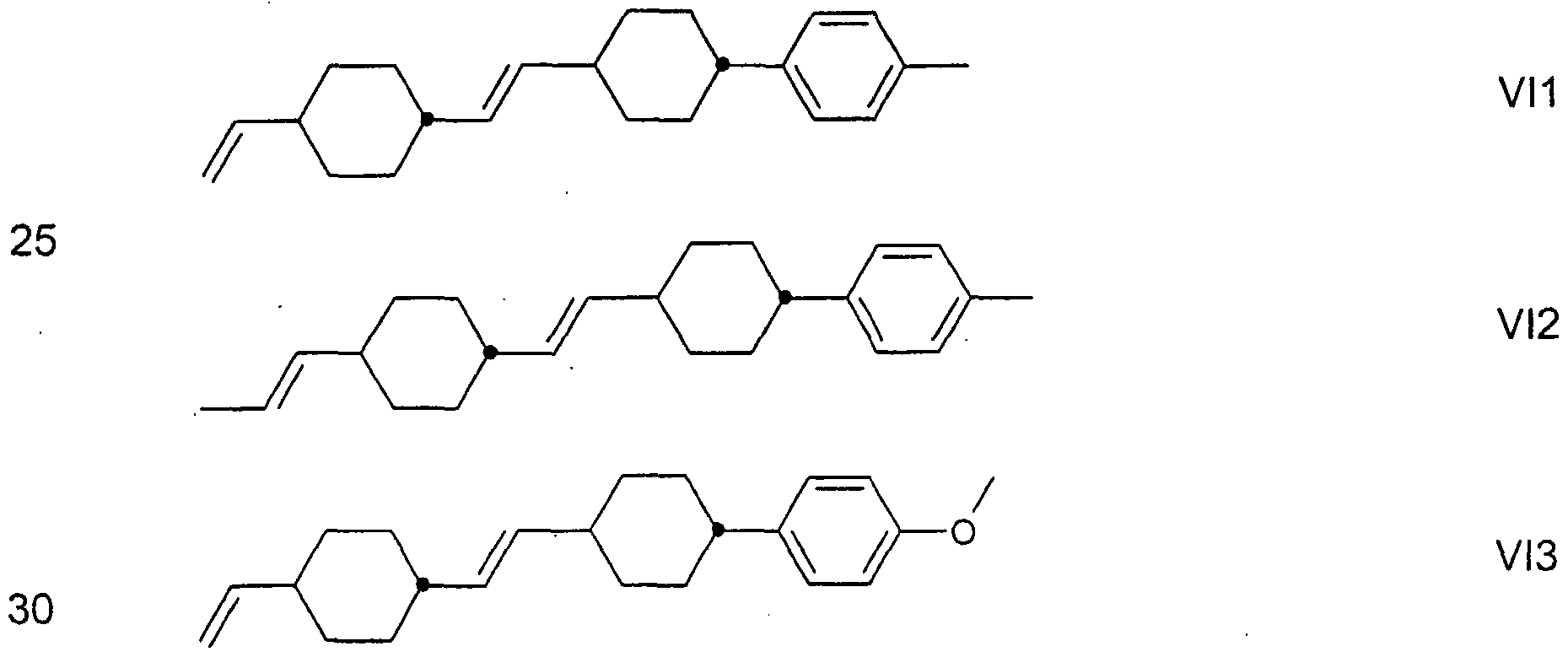
  • Preferred compounds of formula VI are compounds of formula V11 to VI4:
  • R 71 and R 72 being as defined above.
  • R 71 and R 72 are straight-chain alkyl, especially alkanyl, with 1 , 2, 3, 4, 5 or 6 carbon atoms.
  • Preferred compounds of formula VII are:
  • n and m being independently of each other 1 , 2, 3, 4, 5 or 6.
  • n and m being independently of each other 1 , 2, 3, 4, 5 or 6.
  • Component ( ⁇ ) is used in an amount of 5 weight% or more in the liquid crystal composition comprised in the zenithal bistable nematic devices according to the invention.
  • component (a) comprises at least one compound of formula II
  • the liquid crystal composition comprises 8 weight% or more of component ( ⁇ ).
  • an amount of at least 10 weight% of component ( ⁇ ) is even more preferred.
  • a total amount of 15 or 20 weight% or more of component ( ⁇ ) is highly preferred.
  • component ( ⁇ ) may contain one or more compounds of only one of the formulas III or IV or V or VI or VII. It is also possible that it contains one or more compounds of two, three or more of the formulas III to VII. It may contain an equal or a different amount of compounds of each formula used. It is preferred that component ( ⁇ ) contains one or more compounds of one or two of the formulas III, IV, V, VI or VII. If compounds of two of the formulas III to VII are contained, any combination is possible, i.e.
  • component ( ⁇ ) comprises at least one compound of formula II, it is preferred that component ( ⁇ ) comprises compounds of two of the formulas III, IV, V, VI and VII.
  • component ( ⁇ ) may be present in component ( ⁇ ) as long as they have a sufficiently high dielectrical anisotropy ⁇ and are not detrimental to the set of parameters as outlined above.
  • component (a) of the liquid crystal composition used in the zenithal bistable nematic device of the invention also comprises one or especially more compounds of formula VIII
  • Z 81 is a single bond or -C ⁇ C-.
  • compounds of formula VIII g and h may be independently of each other 0, 1 , 2, 3 or 4, preferably 0, 1 or 2; that means that preferably each of the phenyl rings of formula VIII may be unsubstituted or mono- or di-substituted with fluorine. If present the F substituent(s) may be in any
  • L 81 and L 82 being independently of one another H or F.
  • Z can be either a single bond (so that the CN group is directly linked to the phenyl ring) or a C-C triple bond thereby forming a -C ⁇ C-CN substituent of the phenyl ring. It is preferred that Z 81 is a single bond.
  • Preferred compounds of formula VIII are the following compounds:
  • R 81 in formulas VIII and VIIIA to VIIIM is straight-chain alkyl, especially straight-chain alkanyl having 1 , 2, 3, 4, 5, 6, 7 or 8 carbon atoms.
  • Especially preferred compounds of formula VIII are compounds of formula VIII1 to VIH6:
  • the total amount of compounds of formula VIII in the liquid crystal composition for use in the zenithal bistable nematic devices of the invention may be about 10 weight% or more (although even smaller amounts are possible as well), preferably 20 weight% or more, more preferred in the range of about 25 to 60 weight%, still more preferred in the range of about 35 to about 55 weight%.
  • component (a) when used as a mixture different compounds of formula VIII may be contained in component (a) in an almost equal amount. For instance, if compounds of formulas VIII1 to VIII4 are used, they may be contained in an 1 :1 :1:1 ratio.
  • component (a) of the liquid crystal composition for use in the zenithal bistable nematic devices comprises at least one compound of formula IX:
  • Z 91 and Z 92 are independently of each other a single bond or
  • L 91 , i L 92 , i L 93 and , i L 94 are independently of each other H or F.
  • Preferred classes of compounds comprised by formula IX are compounds of formula IXA to IXE in which Z 91 is a single bond:
  • R 91 is defined as above and preferably means a straight-chain alkyl with 1 to 8 carbon atoms, especially a straight-chain alkanyl or alkenyl having 2, 3, 4, 5 or 6 carbon atoms;
  • Z 92 is a C ⁇ C triple bond or preferably a single bond;
  • L 91 , L 92 , L 93 and L 94 are H or F with L 91 and L 92 being preferably H.
  • R 91 is as defined above.
  • component (a) their total amount may range from about 5 to about 45 weight%. It is preferred that only one type of compounds of formulas IXA to IXE are present in the liquid crystal composition for use in the invention for the same time.
  • the liquid crystal composition for use in the bistable liquid crystal device and especially in the zenithal bistable nematic device according to the invention further comprises 3 weight% or more of a component (y) containing one or more compounds having an optical anisotropy ⁇ n of at least 0.20. It has been found that the use of this component (y) may decrease the operating voltage V opt of the liquid crystal composition.
  • component (y) can comprise any (mesogenic) compound exhibiting a ⁇ n of at least 0.20 that is not detrimental to the set of parameters important for use in zenithal bistable nematic liquid crystal devices. It is preferred that component (y) comprises tolanes having a ⁇ n of at least 0.20, especially at least one tolane compound of formula X:
  • k 0, 1 , 2, 3 or 4;
  • n and m are independently of each other 1 , 2, 3, 4, 5 or 6 and k is 0, 1 or preferably 2.
  • Preferred examples are of formula IXA1 with n being 2, 3 or 4 and m being 1 , 2, 3, 4 or 5:
  • IXAIa and IXAIb are most preferred:
  • present component (y) is contained in an amount of at least 3 weight%, preferably at least 5 weight%.
  • the liquid crystal composition for use in the bistable liquid crystal devices and especially in the zenithal bistable nematic liquid crystal devices of the invention may comprise further substances for adjusting several properties of said composition if desired. For example, some of these substances may be used for adjusting the viscosity of the liquid crystal composition.
  • the liquid crystal composition for use in the zenithal bistable nematic devices according to the invention comprises at least one compound of formula XI and/or at least one compound of formula XII and/or at least one compound of formula XIII and/or at least one compound of formula XIV
  • R 121 , R 131 , R 132 and R 14 are independently of each other d-C 15 alkyl which is unsubstituted or mono- or poly-substituted with CN or halogen and in which one or more of the CH 2 groups may be replaced independently of each other by -O-, -S-,
  • R 122 is C- 1 -C 15 alkyl which is unsubstituted or mono- or poly- substituted with halogen and in which one or more of the CH 2 groups may be replaced independently of each other by -0-,
  • Y 111 is F, CI, C Ci 5 alkanyl or C 2 -C 15 alkenyl that are independently of each other mono- or poly-substituted with halogen, or C 1 -C 15 alkoxy which is mono- or poly-substituted with halogen;
  • L 111 and L 112 are independently of each other H or F;
  • Preferred compounds of formula XI are compounds of formula XIA or XIB
  • n 2, 3, 4, 5 or 6 and Y ,111 being selected from F, CI, CF 3 and OCF 3 .
  • Y ,111 being selected from F, CI, CF 3 and OCF 3 .
  • Especially preferred compounds of formula XI are the following compounds:
  • Preferred compounds of formula XII are compounds of formula XIIA, XIIB, XIIC, XIID, XIIE and XHF:
  • Preferred compounds of formula XIII are compounds of formula XIIIA or XIIIB: XIIIA
  • n 1,2,3, 4, 5, 6, 7 or 8 and m being 1,2,3,4,5 or 6.
  • n 1,2,3, 4, 5, 6, 7 or 8 and m being 1,2,3,4,5 or 6.
  • Especially preferred examples of compounds of formula XIII are the following compounds:
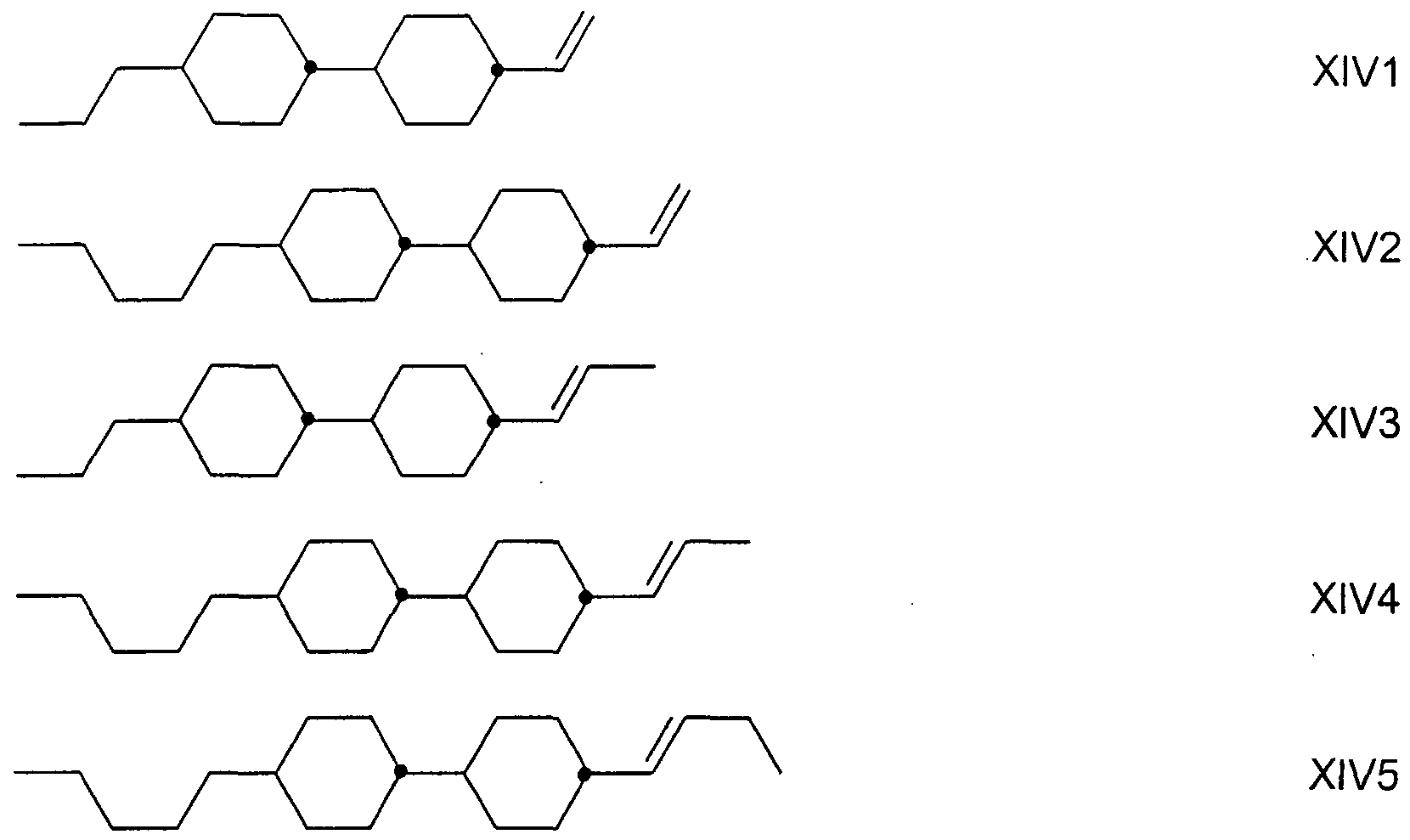
  • Preferred compounds of formula XIV are compounds of formula XIVA
  • the liquid crystal composition for the use according to the invention in the zenithal bistable nematic liquid crystal devices may also comprises mesogenic substances having a medium dielectric anisotropy of ⁇ of about 8 to 10 or more, for instance one or more compounds of formula XV and/or one or more compounds of formula XVI, preferably in an amount of up to 30 weight%, more preferred of up to 20 weight%:
  • Y 151 and Y 161 are independently of each other F, CI, C C 15 alkanyl which is mono- or poly-substituted with halogen, or C 1 -C 1 5 alkoxy, which is mono- or poly-substituted with halogen;
  • L 151 and L 161 are independently of each other H or F;
  • Z 151 is -CO-O-, CH 2 0 or CF 2 0.
  • these compounds are of formulas XVA, XVB and XVIA, respectively:
  • n in all three formulas 1 , 2, 3, 4, 5, 6 or 7. These substances may influence both the operating voltage and the operating window of the liquid crystal composition for use in the zenithal bistable nematic devices of the invention as desired.
  • the liquid crystal composition for the use according to the invention in the zenithal bistable nematic liquid crystal devices may also comprises one or more of the mesogenic substances according to the following formulas XVII to XXII.
  • the exact nature and amount of these compounds within the liquid crystal composition depend on the specific mixture and the desired effect and can be easily chosen by the skilled person.
  • R i7i _ R 172_ R 2n and R 22i gre indepenc i en t
  • y 0 f each other C 1 -C 15 alkyl which is unsubstituted or mono- or poly-substituted with CN or halogen and in which one or more of the CH 2 groups may be replaced independently of each other by -0-, -S-, -CH CH-, - C ⁇ C-, -CO-O-, -OC-O- such that there are no hetero atoms adjacent to each other;
  • R 191 is C 1 -C 1 5 alkyl which is unsubstituted or mono- or poly-substituted with CN or halogen and in which one or more of the CH 2 groups may be replaced independently of each other by -0-, -S-, -C ⁇ C-, -CO-O-, -OC-O- such that there are no hetero
  • R does not represent an alkenyl radical
  • 191 1 192 . 201 . 202 . 203 , 204 . 211 . 212 . 213 . 214 . 215 . 216 . 221 . 222 . 223 and L 224 are independently of each other H or F; and Y 191 , Y 201 , Y 211 and Y 221 are independently of each other F, CI, C C 15 alkanyl or C 2 -C 15 alkenyl that are independently of each other mono- or poly-substituted with halogen, or C1-C15 alkoxy which is mono- or poly-substituted with halogen.
  • Preferred compounds of formula XVII are of the formulas XVIIA to XVIIC
  • n and m being independently of each other 1 , 2, 3, 4, 5, 6 or 7 and p and q being independently of each other 2, 3, 4, 5, 6 or 7. More preferred are compounds of formula XVIIA with n being 2, 3, 4, 5, especially 3, and m being 2, 3, 4, 5, 6, especially 4, as well as of formula XVIIC with q and p being independently of each other 2, 3, 4 or 5; especially preferred both p and q are 2.
  • Preferred compounds of formula XVIII are of the formula XVIIIA
  • Preferred compounds of formula XIX are of the formulas XIXA and XIXB:
  • n 1 , 2, 3, 4, 5, 6 or 7 and Y 191 being F, CI, CF 3 or OCF 3 . More preferred are compounds of formula XIXB with n being 2, 3, 4, 5, 6 or 7 and Y 191 being F.
  • Preferred compounds of formula XX are of the formulas XXA to XXG:
  • n 1, 2, 3, 4, 5, 6 or 7 and Y ,2 ⁇ 0 u 1 ⁇ being F, CI, CF 3 or OCF 3 . More preferred are compounds of formulas XXB, XXC and XXD with n being 2, 3, 4, 5, 6 or 7 and Y 201 being F.
  • Preferred compounds of formula XXI are of the formulas XXIA to XXIJ:
  • n 1 , 2, 3, 4, 5, 6 or 7 and Y ,2 ⁇ 1"1 being F, CI, CF 3 or OCF 3 .
  • More preferred are compounds of formula XXI D with n being 2, 3, 4, 5, 6 or 7 and Y 211 being F.
  • liquid crystal composition for the use of the invention is a nematic liquid crystal composition.
  • liquid crystal composition for the use according to the invention may also comprise further (mesogenic) compounds besides those disclosed in more detail in this specification.
  • mesogenic compounds may be used as long as they are not detrimental to the set of parameters important for the use of the bistable liquid crystal composition according to the invention.
  • a further subject matter of the present invention is a liquid crystal medium comprising
  • Said medium optionally comprises at least one compound of formula VIII as defined above.
  • liquid crystal medium comprising
  • the liquid crystal composition for use in the zenithal bistable nematic devices of the invention may also contain an optically active component ( ⁇ ) as a dopant in an amount of 0 to 3 weight%.
  • the chiral dopant may be useful to remove reverse twist domains in the TN mode.
  • Exemplary substances are cholesterylnonanoate (CN), S-811 , S-1011 and S-2011 and CB15 (Merck KGaA, Darmstadt, Germany). Although S-81 1 might be a preferred dopant, the specific choice of the dopants is not a critical issue.
  • liquid crystal composition for use in the zenithal bistable nematic devices of the invention may also contain one or more light stabilizers and/or additives like pleochromatic dyes known in the state of the art.
  • liquid crystal composition of the bistable liquid crystal devices are either commercially available or can be readily prepared by methods known to those skilled in the art and as described in the standard text books of organic synthesis, for instance, in Houben-Weyl, Methoden der Organischen Chemie, Georg-Thieme-Verlag, Stuttgart.
  • the liquid crystal composition will be prepared by applying standard protocols and techniques. In general, the desired amount of the minor component(s) will be dissolved in the major component, usually under elevated temperature. Alternatively, solutions of components in organic solvents like acetone, chloroform or methanol, can be mixed and afterwards the solvent(s) can be removed, e.g., by distillation. Likewise, manufacturing of the bistable devices according to the invention will follow standard techniques known to the artisan.
  • Table C shows dopants optionally present in the liquid crystal compositions for use in the zenithal bistable nematic devices of the invention (component
  • Table D shows stabilizers optionally present in the liquid crystal compositions for use in the zenithal bistable nematic devices of the invention.
  • Percentages given herein are weight% and generally related to the total amount of a composition or mixture except stated otherwise. Temperatures are given in degree Celsius (°C) unless stated otherwise. T N
  • ⁇ V op t is the corrected operating window at a 400 ⁇ s pulse for B-W-switching and reverse switching (in V); it is calculated from the experimental switching field window ⁇ E L c @4 oo ⁇ s (at 25 °C; 400 ⁇ s pulse) multiplied with d opt defined as given above.
  • Test samples were prepared by weighing out the appropriate weight amounts (percentage weight/weight) of the individual components. The sample was then homogenised by heating into the isotropic phase and thoroughly mixing. The mixture was then stirred with a given concentration of alumina and then filtered (0.2 ⁇ m) to just leave the liquid crystal mixture.
  • the nematic to isotropic transition temperature (or clearing point, TNI), dielectric anisotropy ( ⁇ ), birefringence ( ⁇ n), splay and bend elastic constants (Ki and K 3 ), and rotational viscosities ( ⁇ -i) were determined as described in the Merck brochure "Physical Properties of Liquid Crystals - Description of the measurement methods", ed. W. Becker (1998).
  • the trailing edge (and so polarity) of each pulse therefore determined the final switched state (depending on the duration and voltage).
  • Two signal generators were necessary to ensure that the correct initial state is first selected, with the first signal triggering the second (with an appropriate phase difference). Both signals were amplified by passing the output of the signal generators through an amplifier before being connected to the test cell.
  • the voltages required for 10 and 90% transmission changes and reverse 90 and 10% transmission changes were measured for various pulse durations.
  • the voltages required for 90 and 10% transmission changes only were measured for various pulse durations. These levels were set on the oscilloscope once the 0 and 100% transmission levels were known (i.e. black and white), and they could also be used to determine the optical response time of the transition (for 10 to 90% transmission changes).
  • VAN type test cells were used with cell gaps typically 3-5 ⁇ m, in transmissive mode and with crossed polarisers. Due to the varying cell thicknesses and different mixture ⁇ n values, the retardation was not optimised but this is not crucial as it only decreases the contrast.

Landscapes

  • Chemical & Material Sciences (AREA)
  • Crystallography & Structural Chemistry (AREA)
  • Engineering & Computer Science (AREA)
  • Materials Engineering (AREA)
  • Organic Chemistry (AREA)
  • Liquid Crystal Substances (AREA)

Abstract

The invention is directed to the use of a liquid crystal composition in a bistable liquid crystal device and especially in a zenithal bistable nematic liquid crystal device, a nematic liquid crystal medium, and a bistable liquid crystal device comprising the liquid crystal composition whereby said liquid crystal composition comprises at least 30 weight% (based on the total weight of the composition) of a component (α) containing one or more compounds having a dielectric anisotropy Δϵ of at least 25, whereby at least 25 weight% (based on the total weight of the composition) of said compounds have a dielectric anisotropy Δϵ of at least 40; and at least 5 weight% of a component (β).

Description

Liquid crystal composition for use in bistable liquid crystal devices
The invention is directed to the use of a liquid crystal composition in a bistable liquid crystal device and especially in a zenithal bistable nematic liquid crystal device, a nematic liquid crystal medium, and a bistable liquid crystal device comprising the liquid crystal composition.
Electrooptical devices utilizing liquid crystal media for displaying information are well known and used in a wide variety of technical applications (see, for a review, H. Kawamoto, Proc. IEEE, 90, 460 (2002)). Among these, nematic liquid crystal devices are the most prominent; there are, for instance, twisted nematic (TN) liquid crystal devices (M. Schadt and W. Helfrich, Appl. Phys. Lett., 18, 127 (1971)) and super-twisted nematic (STN) liquid crystal devices (see, inter alia, TJ. Scheffer and J. Nehring, Appl. Phys. Lett., 48, 1021 (1984)). These devices are monostable, i.e. the liquid crystal medium is switched to an ON state by application of a suitable voltage, and is allowed to switch to an OFF state when the voltage applied falls below a lower voltage level. In order to display complex information electrooptical devices need to comprise a number of picture elements that can be switched independently of each other. However, when direct or even multiplex addressing of pixels are used, the number of elements addressable in nematic liquid crystal displays is limited, in the first case by mere geometrical requirements of the electrical connections and in the second case by the steepness of the device's transmission versus the voltage curve.
This limitation can be overcome by incorporating thin film transistors (TFT) into each picture element. Such devices, also known as active matrix (AM) displays, enable addressing of a high number of picture elements and thus of large area high resolution displays and with relatively low voltage requirements. Some of these devices are also mechanically rather stable and have a wide temperature range. Although this allows the construction of small and portable battery powered displays, for certain applications the techniques have several drawbacks. Manufacturing AM displays is still a complicated process involving the building up of a complex assembly which contributes to rather high costs of production. Since the device has no intrinsic or internal memory, constant update of the display even for static images is required. This causes relatively high power consumption and, hence, rather poor battery life time. This is especially undesired with portable devices displaying information that is changed only from time to time or in a limited part of the display such as mobile phones, personal digital assistants (PDAs), pagers, electronic shelf edge labels, and the like.
An approach to avoid the limitations and drawbacks of these nematic liquid crystal devices is to use displays with an internal memory effect, e.g. a bistable liquid crystal device. Bistability means that the molecules of the liquid crystal medium inside the device can adopt two (or more) different stable states. Consequently, by applying a suitable addressing scheme the liquid crystal molecules of the medium are switched into a first stable state which persists even after addressing; utilization of another addressing scheme causes the liquid crystal molecules to adopt a second stable state that likewise persists after addressing.
Ferroelectric liquid crystal displays using smectic liquid crystal materials can be made into bistable devices. They have, however, several disadvantages, e.g. lack of shock resistance, narrow operating temperature range, and low cell gap causing manufacturing difficulties. Therefore, these ferroelectric devices are unlikely to fulfill the requirements to displays for the portable devices mentioned above. However, not only ferroelectric smectic liquid crystals are capable of being used in bistable devices but also nematic liquid crystals. Besides other approaches that utilize bistable bulk configurations adopted by nematic liquid crystals (see, for instance, I. Dozov et al, "Recent improvements of bistable nematic displays switched by anchoring breaking (BiNem®)",
Proceedings SID 01 (2001), 16.1 , 224 and references therewithin), a promising way of achieving bistability in a nematic liquid crystal display is to use a surface alignment which can support two or more stable states. As discussed in literature (see, for instance, J.C. Jones, G. Bryan-Brown, E. Wood, A. Graham, P. Brett and J. Hughes, "Novel bistable liquid crystal displays based on grating alignment", in "Liquid Crystal Materials, Devices, and Flat Panel Displays", R. Shashidhar, B. Gnade, Eds., Proceedings of SPIE Vol. 3955 (2000), 84 and references cited therein) two types, azimuthal and zenithal bistability, can be distinguished.
In the first instance (i.e. azimuthal bistability), the director of the liquid crystal molecules in the display having a grating alignment on the surface of one of the display cell's plates (or substrates) will lie parallel to said plate in both stable states; that means that switching between the stable states occurs within the plane of the display cell's plates (see, for instance, WO 92/00546 and WO 95/22077 which describes the use of a substrate having a bigrating alignment layer). However, reproducing selection of the stable states is found to be difficult and switching generally requires a high switching voltage.
On the other hand, zenithal bistability is observed when the zenithal bistable surface is used (see Figure 1 ; the tiny lines represent the local director of the liquid crystal molecules that are oriented by interaction with the surface grating and appropriate alignment layer). With such a surface, the director of the liquid crystal molecules has two possible configurations with different pretilt angles in the same azimuthal plane (i.e. the plane perpendicular to the surface of the display cell's substrate). The first state is the high tilt state while the second state is the low tilt state. The grating of the zenithal bistable surface is defined by its amplitude a and its pitch L; typical values are for L of about 1 μm and for a of about 0.6 to 0.8 μm (see WO 97/14990 and, for more details, WO 02/08825; and J.C. Jones, G. Bryan-Brown, E. Wood, A. Graham, P. Brett and J. Hughes, "Novel bistable liquid crystal displays based on grating alignment", in "Liquid Crystal Materials, Devices, and Flat Panel Displays", R. Shashidhar, B. Gnade, eds., Proceedings of SPIE Vol. 3955 (2000), 84).
A homeotropic orientation can be, for example, induced by coating the grating with a homeotropic alignment layer; this orientation ensures that the director of the liquid crystal molecules does not lie parallel to the grooves of the grating. Although the orientation of the director of the liquid crystal molecules is perpendicular to the (local) surface, i.e. varying with the location on the surface along a direction perpendicular to the grooves, the orientation in the "bulk" is very much influenced by the opposite surface alignment in both states. Switching from one stable state to the other may be achieved by applying a simple electrical pulse thereby causing a switch from a black display or picture element to a white one (or vice versa) with the appropriate polariser configuration and retardation, and switching back to the original state occurs upon application of a pulse of opposite polarity thereby causing a switch from white to black (or vice versa). Switching may also be induced by using pulses of same polarity but with much higher voltages (also referred to as "reverse switching"); however, reverse switching is a detrimental effect which limits the operation of a zenithal bistable nematic device in terms of the addressing and so a high a voltage as possible is desired for the reverse switching. In general, for obtaining zenithal bistability only one of the two display cell's substrates is provided with a surface grating. The opposite plate may have a surface providing a homeotropic alignment of the liquid crystal director (VAN mode, see Figure 2a)) or a surface inducing planar alignment of the director (twisted mode, see Figure 2b)) thereby causing the twisting of the liquid crystal director around the axis perpendicular to the substrates across the cell for the low tilt state. For details with regard to cell geometry and configuration, exact cell parameters, addressing means, assembling of the entire zenithal bistable device (including use of polarisers) and so on, see the disclosure of WO 97/14990, E.L. Wood, G.P. Bryan-Brown, P.
Brett, A. Graham, J.C. Jones, and J.R. Hughes, "Zenithal Bistable Device (ZBD™) Suitable for Portable Applications, SID 00 Digest (2000), 124, J.C. Jones, J.R. Hughes, A. Graham, P. Brett, G.P. Bryan-Brown, and E.L. Wood, "Zenithal Bistable Devices: Towards the electronic book with a simple LCD", IDW O0 (2000), 301 , J. C. Jones, S. M. Beldon and E .L
Wood, "Grayscale in Zenithal Bistable LCD: The Route to Ultra-low Power Colour Displays", seminar talk on the ASID meeting 2002 of the Society for Information Display, Singapore, September 2002; and the detailed discussion given in J.C. Jones, G. Bryan-Brown, E. Wood, A. Graham, P. Brett and J. Hughes, "Novel bistable liquid crystal displays based on grating alignment", in "Liquid Crystal Materials, Devices, and Flat Panel Displays", R. Shashidhar, B. Gnade, eds., Proceedings of SPIE Vol. 3955 (2000), 84, and references cited therein.
Utilizing zenithal bistability in electrooptical devices offers attractive features:
Image retention on a display without continuous update combined with
High mechanical shock stability Low power consumption since the display only needs addressing when the image changes Infinite multiplexibility for unlimited resolution without the need for TFT elements
Transmissive and reflective modes possible
Suitability for use with plastic substrates
Besides the assembly and make up of the zenithal bistable display, another key issue to the zenithal bistable device technology is the nematic liquid crystal medium used inside the display's cell.
The zenithal bistable device and hence the liquid crystal medium have to meet several requirements more or less depending on the specific use of the device. Since there is no consistent theory so far that might predict the physical variables to be optimized, it turned out to be helpful using a set of (semi-)empirical parameters for evaluating liquid crystal media with respect to their usefulness in zenithal bistable nematic devices. These are illustrated in the so-called τ-V curve for switching voltages of pulse duration τ and for 10 and 90% switching levels with opposite polarities (see figure 3) for a liquid crystal mixture of the prior art, namely MLC-6204-000 of Merck
KGaA, Darmstadt, Germany.
Firstly, in order to minimize power consumption, to allow more flexibility with the addressing of the device's picture elements and to remain within the limits of standard STN drivers a low switching field and correspondingly a low operating voltage is desirable for switching from one bistable state to the other. For material comparison one can determine the switching field E for a pulse (usually a 100 μs pulse duration) from the switching voltage V that gives a transmission change from, e.g., 0 to 90% transmission (black- to-white; B-W) for a particular liquid crystal mixture in a given test cell providing zenithal bistability. (In general, one can also use the 100 to 10% transmission change transition of white-to-black, W-B, where the switching field of which may be higher or lower than the B-W transition depending on the grating's shape and dimensions.) In order to take into account the voltage drop across the grating (which varies for different types of gratings as well as cell thickness) the value of E actually measured is corrected to distinguish the field just across the liquid crystal again for comparison purposes giving the corrected switching field ELc@ιooμs for a 100 μs pulse. Here, an additional factor of 1.5μm is added to the cell thickness d when calculating the field just across the liquid crystal:
E.oo s =
Figure imgf000008_0001
and BLC@l0Oμs = Vl0O/β/(d + 1.5) where d is in μm.
Multiplying E c@ιooμs with optimum cell gap dopt (that can be approximated by using the TN 1st minimum condition dopt = λV3/(2Δn) with λ = 555 nm and Δn being the optical anisotropy of the liquid crystal medium) gives the operating voltage Vopt corresponding to the optimum cell gap for a 100μs pulse for just the liquid crystal. E|_c@ιooμs and so Vopt depend on the liquid crystal medium used. The optimum cell gap is considered only for the twisted mode (see Figure 2b)) here but comparisons can also be made for the VAN mode (see Figure 2a)), where the retardation of the hybrid state will be matched to either a half-wave plate of quarter-wave plate depending on the polariser configuration (dΔn=λ/2 and dΔn=λ/4, respectively).
The second empirical parameter that needs to be taken into account is the operating window ΔVopt corresponding to the optimum cell gap. It describes the effect of reverse switching: When applying a pulse with a given time slot of, e.g. 400 μs, and a defined pulse polarity, e.g. B-W, one observes the desired switching at a specific value of the switching field and a further reverse switching (e.g. W-B in this case) which is not induced by a pulse of inverse polarity but by a pulse of the same polarity at an increased switching field. For technical purposes, obviously said operating window ought to be as wide as possible to permit more flexibility of the driving schemes used and particularly in relation to achieving good grayscale operation (see J. C. Jones, S. M. Beldon and E. L. Wood, "Grayscale in Zenithal Bistable LCD: The Route to Ultra-low Power Colour Displays", seminar talk on the ASID meeting 2002 of the Society for Information Display.) It can be represented by ΔELc@4ooμs. that is the corrected difference between the 90% reverse switching field and the 90% B-W switching field for a 400 μs pulse:
ΔE400 s = Y400μs/d and ΔELC@400 β = ΔV400 s/(d + 1.5) where d is in μm.
Taking into account the optimum cell gap dopt by multiplying with ΔE c@4ooμs eventually gives the operating window ΔVopt (doptΔE c@4ooμs = ΔVopt).
A further parameter, the optical response time τopt corresponding to the optimum cell gap, describes how fast the liquid crystal medium changes between stable states upon application of an electric pulse. It can be determined by measuring the response time τ for the 10-90% B-W transition using a 100 μs pulse in the actual test cell; then, in order to normalize the experimental values, τ is multiplied by (dopt/d)2 giving τopt (with dopt being the optimum cell gap as calculated above for Vopt and d being the actual cell gap of the test cell used). The W-B transition is much faster (less than 1 ms) and so indeed the B-W response time is of most importance when assessing the properties of the liquid crystal medium used. The smaller τopt the faster the optical response of the liquid crystal medium. A small τopt (of about 40 ms or less) may be desirable for certain electrooptical applications, e.g. displaying moving pictures. It is even more preferred for specific video applications that τopt is less than about 16ms so as not to observe flash. Still another parameter of great importance is the clearing point TNt of the liquid crystal medium describing the temperature at which the nematic mixture becomes isotropic. For many technical purposes and for increasing the variability of electrooptical devices utilizing zenithal bistability (and so the possible applications), liquid crystal media having a high clearing point, preferably of at least 80 °C or more, are desired.
Those liquid crystal media the use of which in zenithal bistable devices have been described in the prior art do not meet all the parameter requirements outlined above. Even liquid crystal mixture MLC-6204-000 (available from Merck KGaA, Darmstadt, Germany) that has been used in zenithal bistable devices as the preferred medium (WO 01/40853, Example 6; J.C. Jones, G. Bryan-Brown, E. Wood, A. Graham, P. Brett and J. Hughes, "Novel bistable liquid crystal displays based on grating alignment", in "Liquid Crystal Materials, Devices, and Flat Panel Displays", R.
Shashidhar, B. Gnade, Eds., Proceedings of SPIE Vol. 3955 (2000), 84) has a clearing point TNι of only 62.4 °C that is rather low for use in zenithal bistable device for many possible applications.
The present invention therefore encounters the problem to provide a liquid crystal composition that is suitable for use in a bistable liquid crystal device and especially in a zenithal bistable nematic device and has improved properties.
The problem is solved by the use of a liquid crystal composition in a bistable liquid crystal device, said device being preferably a zenithal nematic liquid crystal device, whereby said compostion comprises
at least 30 weight% (based on the total weight of the composition) of a component (α) containing one or more compounds having a dielectric anisotropy Δε of at least 25, whereby at least 25 weight%
(based on the total weight of the composition) of said compounds have a dielectric anisotropy Δε of at least 40; and at least 5 weight% (based on the total weight of the composition) of a component ( ?); whereby said component (/?) comprises at least one compound of formula III and/or at least one compound of formula IV and/or at least one compound of formula V and/or at least one compound of formula VI and/or at least one compound of formula VII
Figure imgf000011_0001
in which a and b are independently of each other 0 or 1 ;
R31, R32, R41, R42, R51, R52, R61, R62, R71 and R72 are independently of each other C1-C-15 alkyl which is unsubstituted or mono- or poly-substituted with CN or halogen and in which one or more of the CH2 groups may be replaced independently of each other by -0-, -S-, -CH=CH-, -C≡C-, -CO-O-, -OC-O- such that there are no hetero atoms adjacent to each other;
L31 is H or F; Z41 is -CO-O-, -CH20-, -OCH2-, -CF20-, -OCF2-, -CH2CH2-,
-CF2CF2-, -CH2CF2-, -CF2CH2-, -CH=CH- or -C≡C-;
Figure imgf000012_0001
are independently of each other or
Figure imgf000012_0002
in which
L32 and L33 are independently of each other H or F.
(If not measured directly, values of Δε for single compounds are obtained by extrapolating Δε values determined using a known concentration of the single compound (usually 10 weight%) in a standard host mixture (usually ZLI-4792 of Merck KGaA, Darmstadt, Germany) for which the initial mixture value of Δε is also known. Further parameters of single compounds may be obtained similarily.)
It is preferred that said component (a) comprises at least one compound of formula I and/or at least one compound of formula II
Figure imgf000012_0003
Figure imgf000013_0001
c, d, e and f are independently of each other 0, 1 , 2, 3 or 4; R11 is C1-C15 alkyl which is unsubstituted or mono- or poly- substituted with CN or halogen and in which one or more of the CH2 groups may be replaced independently of each other by -O-, -S-, -CH=CH-, -C--C-, -CO-O-, -OC-O- such that there are no hetero atoms adjacent to each other; R21 is C2-C15 alkenyl which is unsubstituted or mono- or poly- substituted with CN or halogen and in which one or more of the CH2 groups may be replaced independently of each other by -0-, -S-, -CH=CH-, -C≡C-, -CO-O-, -OC-O- such that there are no hetero atoms adjacent to each other; Z11 and Z21 are independently of each other a single bond or -C≡C-.
A further subject matter of this invention is a bistable liquid crystal device comprising
two outer substrates which, together with a frame, form a cell;
a liquid crystal composition present in said cell;
electrode structures with alignment layers on the inside of said outer substrates whereby at least one alignment layer comprises an alignment grating that permits the molecules (compounds) of the liquid crystal composition to adopt at least two different stable states whereby the assembly of said electrode structures with said alignment layers being such that a switching between the said at least two different stable states is achieved by applying suitable electric signals to said electrode structures;
whereby said liquid crystal composition is said liquid crystal composition as described above and below and that comprises said components (a) and (β). ln particular, said bistable liquid crystal device is a zenithal bistable nematic liquid crystal device in which said electrode structures with alignment layers on the inside of said outer substrates have at least one alignment layer that comprises an alignment grating that permits the compounds (or the director of the molecules) of said liquid crystal composition to adopt at least two different stable states with different pretilt angles in the same azimuthal plane whereby the assembly of said electrode structures with said alignment layers being such that a switching between the said at least two different stable states is achieved by applying suitable electric signals to said electrode structures.
It will be acknowledged that the invention is described hereinafter primarily with regard to the use of the liquid crystal composition above in a zenithal bistable nematic liquid crystal device although it may be used in other liquid crystal devices as well, for instance, in bistable liquid crystal devices like azimuthal bistable liquid crystal devices as disclosed, inter alia, in WO 92/00546 and WO 95/22077. Thus, details are given for the zenithal bistable nematic liquid crystal device but can easily be adapted to the requirements of other types of bistable liquid crystal devices.
The zenithal bistable nematic device and the liquid crystal composition for use in a zenithal bistable nematic device according to the invention show an improved set of parameters said parameters being, inter alia, operating voltage, operating window, optical response time and, especially, clearing point. It should be noticed that, for instance, the clearing point of the liquid crystal compositions for use in the zenithal bistable nematic devices of the invention is significantly higher than the clearing point of liquid crystal mixtures previously used in zenithal bistable nematic devices. Operating voltage and operating window are both in a range useful for operating of a zenithal bistable nematic device. The cell that is part of the zenithal bistable nematic device according to the invention may be any conventional cell which allows the nematic liquid crystal composition to adopt at least two different zenithal bistable states. Two possible stable states are schematically depicted in Figure 1. The two different zenithal bistable states are characterized by two different pretilt angles that are adopted by the liquid crystal molecules in the same azimuthal plane. The cell comprises a frame and two outer substrates or plates and has electrode structures with alignment layers on the inside of said substrates. At least one of these alignment layers has an zenithal alignment grating known to those skilled in the art and as described, for instance, in WO 97/14990, WO 01/40853, WO 02/08825, and J.C. Jones, et al., Proceedings of SPIE Vol. 3955 (2000), 84.
The electrode structures are assembled with the alignment layer(s) in such a way that (in the case of two stable states) switching from one stable state to the other can be achieved by applying suitable electric signals to the electrode structures thereby applying said electric signals to the liquid crystal composition inside the cell. Commonly, single pulses can be used as such suitable electric signals. Details are known to the artisan and described in WO 97/14990, WO 01/40853, WO 02/08825, J.C. Jones, J.R. Hughes, A. Graham, P. Brett, G.P. Bryan-Brown, IDW '00 (2000), 301 , J.C. Jones, et al., Proceedings of SPIE Vol. 3955 (2000), 84, and E. L. Wood, P. J. Brett, G. P. Bryan-Brown, A. Graham, R. M. Amos, S. Beldon, E. Cubero and J. C. Jones, "Large Area, High Resolution Portable ZBD Display", SID 02 Digest (2002), 22-25.
The substrate opposite to the substrate having the grating alignment layer may have an homeotropic alignment due to suitable surface treatment (see Figure 2a)). Switching upon application of an electric pulse occurs from the high tilt or vertically aligned state to the low tilt or hybrid aligned state. This switch gives a black-to-white (B-W) change if the cell is placed between crossed polarizers (at 45° to the grating direction), with the brightest white state obtained when the vertically aligned state acts as a half-waveplate (dΔn=λ/2). This switching mode is called VAN mode. Zenithal bistable devices utilizing the VAN mode are very insensitive to cell gap variations. They require additional optical compensators to achieve wide viewing angles. A second switching mode of zenithal bistable devices is called TN mode (see Figure 2b)): The substrate opposite to the substrate having the grating alignment layer has a alignment layer, usually of rubbed polyimide, causing planar alignment of the liquid crystal molecules on said substrate.
This in turn causes the twisting of the liquid crystal director around their axis perpendicular to the substrates across the cell. Switching upon application of an electric pulse now occurs from the low tilt or twisted aligned state to the high tilt or hybrid aligned state. This switch gives a black-to-white (B-W) change if the cell is placed between parallel polarizers and using the slightly modified TN 1st minimum condition (as given above) accounting for the influence of the ordinary refractive index of the hybrid state. Due to a high normal incidence contrast ratio additional optical compensators for achieving wide viewing angles are not required in a transmissive display. Therefore the TN mode is preferred for most of the technical applications of zenithal bistable nematic devices. It is also possible to build up a zenithal bistable reflective display and even a zenithal bistable transflective display. For details, also with regard to the polarizers used, it is referred to WO 97/14990, E.L. Wood, G.P. Bryan- Brown, P. Brett, A. Graham, J.C. Jones, and J.R. Hughes, SID 00 (2000), 124, and E. L. Wood, P. J. Brett, G. P. Bryan-Brown, A. Graham, R. M. Amos, S. Beldon, E. Cubero and J. C. Jones, "Large Area, High Resolution Portable ZBD Display" SID 02 Digest (2002), 22-25. ln the context of the present invention and with respect to the compounds contained in the liquid crystal composition for use in bistable liquid crystal devices and especially in zenithal bistable nematic devices of the invention the term "alkyl" means - as long as it is not defined in a different manner elsewhere in this description or the claims - straight-chain and branched hydrocarbon (aliphatic) radicals with 1 to 15 carbon atoms; the hydrocarbon radicals may be unsubstituted or substituted with one or more substituents being independently selected from the group consisting of F, CI, Br, I or CN. This subclass of "alkyl" containing aliphatic saturated radicals may also be designated as "alkanyl". Furthermore, "alkyl" is also meant to comprise unsubstituted or likewise substituted hydrocarbon radicals in which one or more of the CH2 groups are such replaced by -O- ("alkoxy", "oxaalkyl"), -S- ("thioalkyl"), -CH=CH- ("alkenyl"), -C≡C- ("alkinyl"), -CO-O- or -O-CO- that there are no adjacent hetero atoms (O, S). Preferably, alkyl is a straight- chain or branched saturated hydrocarbon having 1 , 2, 3, 4, 5, 6, 7 or 8 carbon atoms and being unsubstituted or mono- or poly-substituted with F. More preferably, alkyl is meant to be methyl, ethyl, n-propyl, i-propyl, n- butyl, i-butyl, t-butyl, n-pentyl, neopentyl, n-hexyl, n-heptyl, n-octyl; CF3, CHF2, CH2F; CF2CF3. Most preferably, alkyl is a straight-chain hydrocarbon of up to 8 carbon atoms.
Since one or more CH2 groups of an alkyl radical may be replaced by -O- as described above, the term "alkyl" also comprises "alkoxy" and "oxaalkyl" moieties. "Alkoxy" means "O-alkyl" in which the oxygen atom is directly linked to the group or ring being substituted with alkoxy and alkyl is defined as above. In particular, "alkyl" in "O-alkyl" means methyl, ethyl, n-propyl, i- propyl, n-butyl, i-butyl, t-butyl, n-pentyl, neopentyl, n-hexyl, n-heptyl or n- octyl, whereby alkyl is optionally substituted with F. Most preferably, alkoxy is -OCH3, -OC2H5, -O-n-C3H7, -O-n-C4H9, -0-t-C4H9) -OCF3, -OCHF2, -OCHF or -OCHFCHF2. In the context of the present invention the term
"oxaalkyl" comprises alkyl moieties in which at least one non-terminal CH2 group is replaced by O in such a way that there are no adjacent oxygen atoms. Preferably, oxaalkyl comprises straight-chain radicals of the formula CtH2t+i-O-(CH2)u- in which t and u are independently of each other 1 , 2, 3, 4, 5 or 6; especially t is 1 or 2 and u is an integer from 1 to 6.
If one or more of the CH2 groups of alkyl are replaced by sulfur a "thioalkyl" radical is obtained. Thioalkyl comprises alkyl moieties in which at least one terminal or non-terminal CH2 group is replaced by S (sulfur) in such a way that there are no adjacent sulfur atoms. Preferably, thioalkyl comprises straight-chain radicals of the formula CtH2t+ι-S-(CH2)u- in which t is 1 , 2, 3, 4, 5 or 6 and u is 0, 1 , 2, 3, 4, 5 or 6; especially t is 1 or 2 and u is zero or an integer from 1 to 6.
In the context of the present invention the term "alkenyl" means an alkyl radical in which one or more -CH=CH- moieties are present. When two -CH=CH- moieties are present the radical may also be designated as "alkadienyl". An alkenyl radical may comprise 2 to 15 carbon atoms and may be straight-chain or branched. It can be unsubstituted or mono- or polysubstituted with F, CI, Br, I or CN; one or more of its CH2 groups may be replaced independently of each other by -0-, -S-, -C-≡C-, -CO-O-,
-OC-O- such that there are no hetero atoms adjacent to each other. If the alkenyl CH=CH moiety is not a terminal CH2=CH group it may exist in two configurations, namely the E-isomer and the Z-isomer. In general, the E- isomer (trans) is preferred. Preferably, alkenyl contains 2, 3, 4, 5, 6 or 7 carbon atoms and means vinyl, 1 E-propenyl, 1 E-butenyl, 1 E-pentenyl, 1 E- hexenyl, 1 E-heptenyl, 2-propenyl, 2E-butenyl, 2E-pentenyl, 2E-hexenyl, 2E-heptenyl, 3-butenyl, 3E-pentenyl, 3E-hexenyl, 3E-heptenyl, 4-pentenyl, 4Z-hexenyl, 4E-hexenyl, 4Z-heptenyl, 5-hexenyl and 6-heptenyl. More preferred alkenyl is vinyl, 1 E-propenyl, 3E-butenyl. ln the case one or more CH2 alkyl groups are replaced by -C≡C- an alkinyl radical is obtained. Also the replacement of one or more CH2 alkyl groups by -CO-O- or -O-CO- is possible. The following of these radicals are preferred: acetyloxy, propionyloxy, butyryloxy, pentanoyloxy, hexanoyloxy, acetyloxymethyl, propionyloxymethyl, butyryloxymethyl, pentanoyloxymethyl, 2-acetyloxyethyl, 2-propionyloxyethyl, 2- butyryloxyethyl, 2-acetyloxypropyl, 3-propionyloxypropyl, 4-acetyloxy butyl, methoxycarbonyl, ethoxycarbonyl, propoxycarbonyl, butoxycarbonyl, pentoxycarbonyl, methoxycarbonylmethyl, ethoxycarbonylmethyl, propoxycarbonylmethyi, butoxycarbonylmethyl, 2-(methoxycarbonyl)ethyl, 2-(ethoxycarbonyl)ethyl, 2-(propoxycarbonyl)-ethyl, 3-(methoxycarbonyl)- propyl, 3-(ethoxy-carbonyl)-propyl oder 4-(methoxycarbonyl)-butyl.
In the context of the present invention "halogen" means F, CI, Br and/or !
The liquid crystal composition for use in the (zenithal) bistable (nematic) liquid crystal device of the invention contains at least two different components, component (a) and component (β).
Component (a) contains one or preferably more compounds having a high dielectric anisotropy Δε of 25 or more, especially of 30 or more. At least 25 weight%, preferably 30 weight% or more, (based on the total weight of the composition) of the compounds of component (a) exhibit a dielectric anisotropy Δε of 40 or more. At least 30 weight% (based on the whole composition) of component (a) need to be comprised by the liquid crystal composition of the zenithal bistable nematic device according to the invention. It is preferred that the liquid crystal composition comprises 35 weight% or more, even more preferred at least 40 weight%, still more preferred at least 45 weight%, most preferred 50 weight% or more, of said component (σ). It has been found by the inventors that component (a) preferably comprises either one or more compounds of formula I or one or more compounds of formula II or one or more compounds of both formula I and formula II (besides other compounds having the required high dielectric anisotropy that may be present). In one preferred embodiment of the invention component (a) contains at least one compound of formula I but no compound of formula II; in another preferred embodiment component (a) contains at least one compound of formula II but no compound of formula I. If component (a) contains at least one compound of formula I, said compound(s) of formula I may be present in a total amount of at least 5 weight%, preferably at least 10 weight%, more preferred at least 15 weight% or more. If component (a) contains one compound of formula II, said compound of formula II may be present in an amount of about 5 to 30 weight%, preferably 8 to 25 weight%, more preferred 10 to 20 weight%. However, if component (a) contains more than one compound of formula II, the total amount of these compounds is in the range of about 5 to about 55 weight%, preferably about 8 to about 35 weight%, more preferred about 9 to about 25 weight%.
Figure imgf000020_0001
With regard to compounds of formula I c and d may be independently of each other 0, 1 , 2, 3 or 4, preferably 0, 1 or 2; that means that preferably each of the phenyl rings of formula I may be unsubstituted or mono- or di- substituted with fluorine. If present the F substituent(s) may be in any position of the phenyl ring substituted. It is preferred tha
and/or
Figure imgf000021_0002
are independently of one another
Figure imgf000021_0001
with
L11 and L12 being independently of one another H or F. Furthermore, Z11 can be either a single bond (so that the CN group is directly linked to the phenyl ring) or a C-C triple bond thereby forming a -C≡C-CN substituent of the phenyl ring. It is preferred that Z11 is a single bond.
Preferred compounds of formula I are the following compounds:
Figure imgf000021_0003
Figure imgf000022_0001
with R11 being defined as above. Preferably, R11 in formulas I and I A to I M is a straight-chain alkyl radical, especially an alkanyl radical with 1 , 2, 3, 4, 5 or 6 carbon atoms. Highly preferred compounds are of general formula IA1 with n = 1 , 2, 3, 4, 5 or 6.
Figure imgf000023_0001
Especially preferred examples of compounds of formula I being present in component (σ) either alone or in combination with each other are the following compounds of formula 11 to 13:
Figure imgf000023_0002
It is preferred to have a mixture of all three compounds 11 , 12 and 13 in the liquid crystal composition. For instance, compound 11 exhibits a dielectric anisotropy Δε of 37.5 whereas compound 13 has a Δε of 36.0.
With regard to compounds of formula II e and f may be independently of each other 0, 1 , 2, 3 or 4, preferably 0, 1 or 2; that means that preferably each of the phenyl rings of formula II may be unsubstituted or mono- or di- substituted with fluorine. If present the F substituent(s) may be in any
position of the phenyl ring substituted. It is preferred tha
and/or
Figure imgf000024_0002
are independently of one another ith
L21 and L22 being independently of one another H or F. F
Figure imgf000024_0001
urthermore, can be either a single bond (so that the CN group is directly linked to the phenyl ring) or a C-C triple bond thereby forming a -C≡C-CN substituent of the phenyl ring. It is preferred that Z21 is a single bond.
Preferred compounds of formula II are the following compounds:
Figure imgf000024_0003
Figure imgf000025_0001
with R21 being defined as above. Preferably, R21 in formulas II and HA to IIM is a straight-chain alkenyl radical, especially with 2, 3, 4, 5 or 6 carbon atoms and most preferred with a terminal C=C double bond. Highly preferred compounds are of general formula IIB1 with n = 2, 3, 4, 5 or 6.
Figure imgf000026_0001
Especially preferred examples of compounds of formula II being present in component (a) either alone or in combination with each other are the following compounds of formula 111 to II4:
Figure imgf000026_0002
The most preferred compound of formula II is compound II4 which exhibits a dielectric anisotropy Δε of 59.5. With respect to component (β) said component is present in the liquid crystal composition in the zenithal bistable nematic device of the invention in an amount of at least 5 weight% or more. Apparently, component (β) is required for a high clearing point of the liquid crystal mixtures used in zenithal bistable nematic devices. Component (β) comprises compounds of formula III and/or formula IV and/or formula V and/or formula VI and/or formula VII.
Figure imgf000027_0001
with a, b, R31, R32, R41, R42, R51, R52, R61, R62, R71, R72, L31, Z41 and the rings indicated by A, B, C, D, E and F being defined as above.
With respect to formula III it is preferred that a is 1. Preferred compounds of formula III are of the following formulas:
Figure imgf000028_0001
with R31 and R32 being as defined above. Preferably, in formulas III and IIIA to IIIG R31 and R32 are both independently of each other straight-chain alkyl, more preferred straight-chain alkanyl or alkenyl having 2, 3, 4, 5 or 6 carbon atoms, especially straight-chain alkanyl with 2 to 6 carbon atoms, a is 1 and L31 is H or F (for formula III). Highly preferred compounds are of formula MID and IIIE. Especially preferred examples of formula III are compounds of formula 1111 to III6:
Figure imgf000029_0001
Most preferred compounds of formula III are compounds III2, III4 and III6, and it is especially preferred to have a mixture of all three compounds in the liquid crystal composition.
In some embodiments of the present invention it may also be preferred that a in formula III is zero. Then, preferred compounds of formula III are of the following formulas:
Figure imgf000030_0001
whereby R31 and R32 are as defined above and preferably independently of each other straight-chain alkyl, more preferred straight-chain alkanyl or alkenyl having 2, 3, 4, 5 or 6 carbon atoms, even more preferred straight- chain alkanyl with 2 to 6 carbon atoms. Especially, R31 is n-propyl or n- pentyl and R32 is ethyl.
With respect to formula IV preferred compounds are of formulas IVA and IVB in which b is 1 as well as of formulas IVC and IVD in which b is zero:
Figure imgf000030_0002
with R41, R42 and Z41 being as defined above; Z41 is preferably -CO-O- or, in case of formula IVD, -OCH2-. R41 and R42 are both independently of each other straight-chain alkyl, more preferred straight-chain alkanyl or alkenyl having 2, 3, 4, 5 or 6 carbon atoms, especially straight-chain alkanyl with 2 to 6 carbon atoms. Compounds of formula IVB are more preferred. Especially preferred examples of formula IV are compounds of formulas IV1 to IV3 as well as of formulas IV4 and IV5 and of formulas IV6 to IV8:
Figure imgf000031_0001
Figure imgf000032_0001
It is especially preferred to have a mixture of compounds IV1 , IV2 and IV3 in the liquid crystal composition.
Preferably, in formula V R51 is straight-chain alkyl, more preferred straight- chain alkanyl or alkenyl having 2, 3, 4, 5 or 6 carbon atoms, especially straight-chain alkanyl with 2 to 6 carbon atoms, and R52 is straight-chain alkyl or, more preferred, alkoxy having 1 , 2, 3 or 4 carbon atoms. Especially preferred examples of formula V are compounds of formula V1 to V6:
Figure imgf000032_0002
Figure imgf000033_0001
in which n is an integer from 1 to 6, preferably 2, 3 or 4, especially 3. Preferred compounds of formula V are compounds of formula V2, V4 and V6 with n = 3 (giving an n-propyl substituent). It is preferred to have a mixture of all three compounds V2, V4 and V6 in the liquid crystal composition.
Preferably, in formula VI R61 is straight-chain alkenyl, especially straight- chain alkenyl having 2, 3, 4 or 5 carbon atoms, and R62 is straight-chain alkanyl or alkoxy both having 1 , 2, 3, 4 or 5 carbon atoms (formula VIA or VIB with n = 1 , 2, 3, 4, 5 and m = 1 , 2, 3, 4, 5).
Figure imgf000033_0002
Preferred compounds of formula VI are compounds of formula V11 to VI4:
Figure imgf000033_0003
Figure imgf000034_0001
Especially preferred are compounds of formula VI1 , VI3 and VI4. They may be used alone or, more preferred, as a mixture of two or three compounds.
Regarding compounds of formula VII specific compounds are of the following formulas
Figure imgf000034_0002
}-c -, VIIC
Figure imgf000034_0003
with R71 and R72 being as defined above. Preferably, R71 and R72 are straight-chain alkyl, especially alkanyl, with 1 , 2, 3, 4, 5 or 6 carbon atoms. Preferred compounds of formula VII are:
Figure imgf000034_0004
with n and m being independently of each other 1 , 2, 3, 4, 5 or 6. Especially preferred examples of compounds of formula VII are
Figure imgf000035_0001
Component (β) is used in an amount of 5 weight% or more in the liquid crystal composition comprised in the zenithal bistable nematic devices according to the invention. When component (a) comprises at least one compound of formula II, it is preferred that the liquid crystal composition comprises 8 weight% or more of component (β). When there is no compound of formula I in component (σ), an amount of at least 10 weight% of component (β) is even more preferred. In certain embodiments of the invention a total amount of 15 or 20 weight% or more of component (β) is highly preferred.
In an actual embodiment of the invention component (β) may contain one or more compounds of only one of the formulas III or IV or V or VI or VII. It is also possible that it contains one or more compounds of two, three or more of the formulas III to VII. It may contain an equal or a different amount of compounds of each formula used. It is preferred that component (β) contains one or more compounds of one or two of the formulas III, IV, V, VI or VII. If compounds of two of the formulas III to VII are contained, any combination is possible, i.e. III+IV or lll+V or lll+VI or lll+VII or IV+V or IV+VI or IV+VII or V+VI or V+VII or VI+VII; both types of compounds may be used in an equal amount, or one of the types may be used in an excess with regard to the other one, for instance, in a ratio of 2:1. It is preferred that an equal amount of both types of compounds is used. In case that compounds of two of the formulas III, IV, V, VI and VII are contained in component (β), it is also preferred that one type of the compounds is of formula III. Thus, especially preferred combinations are lll+IV, lll+V, lll+VI and lll+VII. When component (σ) comprises at least one compound of formula II, it is preferred that component (β) comprises compounds of two of the formulas III, IV, V, VI and VII.
It will be acknowledged that other compounds than those of formulas I and II may be present in component (σ) as long as they have a sufficiently high dielectrical anisotropy Δε and are not detrimental to the set of parameters as outlined above.
Thus, it is preferred that component (a) of the liquid crystal composition used in the zenithal bistable nematic device of the invention also comprises one or especially more compounds of formula VIII
Figure imgf000036_0001
in which g and h are independently of each other 0, 1 , 2, 3 or 4; R81 is C1-C15 alkyl which is unsubstituted or mono- or poly- substituted with CN or halogen and in which one or more of the CH groups may be replaced independently of each other by -0-, -S-, -C=C-, -CO-0-, -OC-O- such that there are no hetero atoms adjacent to each other (which means that R81 does not comprise any alkenyl radical);
Z81 is a single bond or -C≡C-. With regard to compounds of formula VIII g and h may be independently of each other 0, 1 , 2, 3 or 4, preferably 0, 1 or 2; that means that preferably each of the phenyl rings of formula VIII may be unsubstituted or mono- or di-substituted with fluorine. If present the F substituent(s) may be in any
position of the phenyl ring substituted. It is preferred tha
and/or
Figure imgf000037_0002
are independently of one another
Figure imgf000037_0001
with
81
L81 and L82 being independently of one another H or F. Furthermore, Z can be either a single bond (so that the CN group is directly linked to the phenyl ring) or a C-C triple bond thereby forming a -C≡C-CN substituent of the phenyl ring. It is preferred that Z81 is a single bond.
Preferred compounds of formula VIII are the following compounds:
Figure imgf000037_0003
Figure imgf000038_0001
VIIIH
VIIIJ
VIIIK
VIIIL
Figure imgf000038_0002
VIIIM
Figure imgf000039_0001
with R81 being defined as above. Preferably, R81 in formulas VIII and VIIIA to VIIIM is straight-chain alkyl, especially straight-chain alkanyl having 1 , 2, 3, 4, 5, 6, 7 or 8 carbon atoms. Highly preferred compounds are of general formulas VIIIA1 and VIIIB1 with n = 1 , 2, 3, 4, 5 or 6, whereby compounds of formula VIIIA1 are most preferred.
VIIIA1
VIIIB1
Figure imgf000039_0002
Especially preferred compounds of formula VIII are compounds of formula VIII1 to VIH6:
Figure imgf000039_0003
Figure imgf000040_0001
Among these compounds of formulas VII11 (having a dielectric anisotropy Δε of 53.7), VIII2, VIII3 (Δε = 44.9) and VIII4 (Δε = 43.0) are most preferred. If present the total amount of compounds of formula VIII in the liquid crystal composition for use in the zenithal bistable nematic devices of the invention may be about 10 weight% or more (although even smaller amounts are possible as well), preferably 20 weight% or more, more preferred in the range of about 25 to 60 weight%, still more preferred in the range of about 35 to about 55 weight%. When used as a mixture different compounds of formula VIII may be contained in component (a) in an almost equal amount. For instance, if compounds of formulas VIII1 to VIII4 are used, they may be contained in an 1 :1 :1:1 ratio.
In another preferred embodiment of the invention component (a) of the liquid crystal composition for use in the zenithal bistable nematic devices comprises at least one compound of formula IX:
Figure imgf000040_0002
in which j is O or l ;
R91 is C Cis alkyl which is unsubstituted or mono- or poly- substituted with CN or halogen and in which one or more of the CH2 groups may be replaced by -0-, -S-, -CH=CH-, -CsC-, -CO-0-, -OC-O- such that there are no hetero atoms adjacent to each other;
Z91 and Z92 are independently of each other a single bond or
-C≡C-;
Figure imgf000041_0001
in which
L 91 , i L 92 , i L 93 and , i L 94 are independently of each other H or F.
Preferred classes of compounds comprised by formula IX are compounds of formula IXA to IXE in which Z91 is a single bond:
Figure imgf000042_0001
in which R91 is defined as above and preferably means a straight-chain alkyl with 1 to 8 carbon atoms, especially a straight-chain alkanyl or alkenyl having 2, 3, 4, 5 or 6 carbon atoms; Z92 is a C≡C triple bond or preferably a single bond; and L91, L92, L93 and L94 are H or F with L91 and L92 being preferably H. Preferred compounds of formulas IXA to IXE are
Figure imgf000043_0001
Figure imgf000044_0001
in which R91 is as defined above.
Some specific examples of compounds of formula IX are
Figure imgf000044_0002
If these compounds are present in component (a) their total amount may range from about 5 to about 45 weight%. It is preferred that only one type of compounds of formulas IXA to IXE are present in the liquid crystal composition for use in the invention for the same time.
In another preferred embodiment of the invention the liquid crystal composition for use in the bistable liquid crystal device and especially in the zenithal bistable nematic device according to the invention further comprises 3 weight% or more of a component (y) containing one or more compounds having an optical anisotropy Δn of at least 0.20. It has been found that the use of this component (y) may decrease the operating voltage Vopt of the liquid crystal composition. In general, component (y) can comprise any (mesogenic) compound exhibiting a Δn of at least 0.20 that is not detrimental to the set of parameters important for use in zenithal bistable nematic liquid crystal devices. It is preferred that component (y) comprises tolanes having a Δn of at least 0.20, especially at least one tolane compound of formula X:
Figure imgf000045_0001
in which k is 0, 1 , 2, 3 or 4;
R101 and R102 are independently of each other C Cι5 alkyl which is unsubstituted or mono- or poly-substituted with CN or halogen and in which one or more of the CH2 groups may be replaced by -0-, -S-, -CH=CH-, -C≡C-, -CO-0-, -OC-O- such that there are no hetero atoms adjacent to each other; and
Figure imgf000046_0001
Preferred are compounds of formula XA
Figure imgf000046_0002
in which n and m are independently of each other 1 , 2, 3, 4, 5 or 6 and k is 0, 1 or preferably 2. Preferred examples are of formula IXA1 with n being 2, 3 or 4 and m being 1 , 2, 3, 4 or 5:
Figure imgf000046_0003
Among these compounds IXAIa and IXAIb are most preferred:
IXAIa
Figure imgf000046_0004
Figure imgf000046_0005
If present component (y) is contained in an amount of at least 3 weight%, preferably at least 5 weight%.
The liquid crystal composition for use in the bistable liquid crystal devices and especially in the zenithal bistable nematic liquid crystal devices of the invention may comprise further substances for adjusting several properties of said composition if desired. For example, some of these substances may be used for adjusting the viscosity of the liquid crystal composition. In certain embodiments the liquid crystal composition for use in the zenithal bistable nematic devices according to the invention comprises at least one compound of formula XI and/or at least one compound of formula XII and/or at least one compound of formula XIII and/or at least one compound of formula XIV
Figure imgf000047_0001
in which R111 and R142 are independently of each other C2-C15 alkenyl which is unsubstituted or mono- or poly-substituted with CN or halogen and in which one or more of the CH2 groups may be replaced independently of each other by -O-, -S-, -CH=CH-, -C≡C-, -CO-0-, -OC-O- such that there are no hetero atoms adjacent to each other; R121, R131, R132 and R14 are independently of each other d-C15 alkyl which is unsubstituted or mono- or poly-substituted with CN or halogen and in which one or more of the CH2 groups may be replaced independently of each other by -O-, -S-,
-CH=CH-, -C≡C-, -CO-0-, -OC-O- such that there are no hetero atoms adjacent to each other; R122 is C-1-C15 alkyl which is unsubstituted or mono- or poly- substituted with halogen and in which one or more of the CH2 groups may be replaced independently of each other by -0-,
-S-, -CH=CH-, -C≡C-, -CO-O-, -OC-O- such that there are no hetero atoms adjacent to each other; Y111 is F, CI, C Ci5 alkanyl or C2-C15 alkenyl that are independently of each other mono- or poly-substituted with halogen, or C1-C15 alkoxy which is mono- or poly-substituted with halogen; L111 and L112 are independently of each other H or F; and
Figure imgf000048_0001
and are independently of each other
Figure imgf000048_0002
The exact nature and amount of these compounds within the liquid crystal composition depend on the specific mixture and the desired effect and can be easily chosen by the skilled person. Preferred compounds of formula XI are compounds of formula XIA or XIB
Figure imgf000049_0001
with n being 2, 3, 4, 5 or 6 and Y ,111 being selected from F, CI, CF3 and OCF3. Especially preferred compounds of formula XI are the following compounds:
Figure imgf000049_0002
The most preferred compound of formula XI is compound X11.
Preferred compounds of formula XII are compounds of formula XIIA, XIIB, XIIC, XIID, XIIE and XHF:
Figure imgf000050_0001
with n being 1 , 2, 3, 4, 5 or 6 and m being 1 , 2, 3, 4, 5 or 6. Specific examples of compounds of formula XII are the following compounds:
Figure imgf000050_0002
Figure imgf000051_0001
Preferred compounds of formula XIII are compounds of formula XIIIA or XIIIB: XIIIA
XIIIB
Figure imgf000052_0001
with n being 1,2,3, 4, 5, 6, 7 or 8 and m being 1,2,3,4,5 or 6. Especially preferred examples of compounds of formula XIII are the following compounds:
Figure imgf000052_0002
Preferred compounds of formula XIV are compounds of formula XIVA
Figure imgf000052_0003
with n being 1 , 2, 3, 4, 5, 6, 7 or 8 and m being 2, 3, 4, 5 or 6. Specific examples of compounds of formula XIV are the following compounds:
Figure imgf000053_0001
The most preferred compound of formula XIV is compound XIV2.
The liquid crystal composition for the use according to the invention in the zenithal bistable nematic liquid crystal devices may also comprises mesogenic substances having a medium dielectric anisotropy of Δε of about 8 to 10 or more, for instance one or more compounds of formula XV and/or one or more compounds of formula XVI, preferably in an amount of up to 30 weight%, more preferred of up to 20 weight%:
Figure imgf000054_0001
in which
R151 and R161 are independently of each other C1-C15 alkyl which is unsubstituted or mono- or poly-substituted with CN or halogen and in which one or more of the CH2 groups may be replaced independently of each other by -0-, -S-, -CH=CH-, -C≡C-,
-CO-O-, -OC-O- such that there are no hetero atoms adjacent to each other;
Y151 and Y161 are independently of each other F, CI, C C15 alkanyl which is mono- or poly-substituted with halogen, or C1-C15 alkoxy, which is mono- or poly-substituted with halogen;
L151 and L161 are independently of each other H or F; and
Z151 is -CO-O-, CH20 or CF20.
Preferably these compounds are of formulas XVA, XVB and XVIA, respectively:
Figure imgf000054_0002
Figure imgf000055_0001
with n being in all three formulas 1 , 2, 3, 4, 5, 6 or 7. These substances may influence both the operating voltage and the operating window of the liquid crystal composition for use in the zenithal bistable nematic devices of the invention as desired.
The liquid crystal composition for the use according to the invention in the zenithal bistable nematic liquid crystal devices may also comprises one or more of the mesogenic substances according to the following formulas XVII to XXII. The exact nature and amount of these compounds within the liquid crystal composition depend on the specific mixture and the desired effect and can be easily chosen by the skilled person.
Figure imgf000055_0002
Figure imgf000056_0001
wherein Ri7i _ R172_ R2n and R22i gre indepencient|y 0f each
Figure imgf000056_0002
other C1-C15 alkyl which is unsubstituted or mono- or poly-substituted with CN or halogen and in which one or more of the CH2 groups may be replaced independently of each other by -0-, -S-, -CH=CH-, - C≡C-, -CO-O-, -OC-O- such that there are no hetero atoms adjacent to each other; R191 is C1-C15 alkyl which is unsubstituted or mono- or poly-substituted with CN or halogen and in which one or more of the CH2 groups may be replaced independently of each other by -0-, -S-, -C≡C-, -CO-O-, -OC-O- such that there are no hetero
.191 atoms adjacent to each other (i.e. R does not represent an alkenyl radical);
, 191 1 192 . 201 . 202 . 203 , 204 . 211 . 212 . 213 . 214 . 215 . 216 . 221 . 222 . 223 and L224 are independently of each other H or F; and Y191, Y201, Y211 and Y221 are independently of each other F, CI, C C15 alkanyl or C2-C15 alkenyl that are independently of each other mono- or poly-substituted with halogen, or C1-C15 alkoxy which is mono- or poly-substituted with halogen.
Preferred compounds of formula XVII are of the formulas XVIIA to XVIIC
xviiA
XVIIB
Figure imgf000057_0001
Figure imgf000057_0002
with n and m being independently of each other 1 , 2, 3, 4, 5, 6 or 7 and p and q being independently of each other 2, 3, 4, 5, 6 or 7. More preferred are compounds of formula XVIIA with n being 2, 3, 4, 5, especially 3, and m being 2, 3, 4, 5, 6, especially 4, as well as of formula XVIIC with q and p being independently of each other 2, 3, 4 or 5; especially preferred both p and q are 2.
Preferred compounds of formula XVIII are of the formula XVIIIA
XVIIIA
Figure imgf000057_0003
with n being 1 , 2, 3, 4, 5, 6 or 7 and p being 2, 3, 4, 5, 6 or 7. More preferred are compounds of formula XVIIIA with n being 1 , 2, 3, 4 or 5 and p being 2, 3, 4 and 5; especially preferred CnH2n+ι is methyl, ethyl or n- propyl and CpH2p.t is a -CH2-CH2-CH=CH2 or -CH2-CH2-CH=CH-CH3 radical the latter preferably with E-configu ration of the C=C double bond. Preferred compounds of formula XIX are of the formulas XIXA and XIXB:
Figure imgf000058_0001
with n being 1 , 2, 3, 4, 5, 6 or 7 and Y191 being F, CI, CF3 or OCF3. More preferred are compounds of formula XIXB with n being 2, 3, 4, 5, 6 or 7 and Y191 being F.
Preferred compounds of formula XX are of the formulas XXA to XXG:
Figure imgf000058_0002
Figure imgf000059_0001
with n being 1, 2, 3, 4, 5, 6 or 7 and Y ,2^0u1ι being F, CI, CF3 or OCF3. More preferred are compounds of formulas XXB, XXC and XXD with n being 2, 3, 4, 5, 6 or 7 and Y201 being F.
Preferred compounds of formula XXI are of the formulas XXIA to XXIJ:
Figure imgf000059_0002
Figure imgf000060_0001
5 with n being 1 , 2, 3, 4, 5, 6 or 7 and Y ,2^1"1 being F, CI, CF3 or OCF3. More preferred are compounds of formula XXI D with n being 2, 3, 4, 5, 6 or 7 and Y211 being F.
0 Preferred compounds of formula XXII are of the formulas XXIA or XXIIB:
Figure imgf000060_0002
with n being 1 , 2, 3, 4, 5, 6 or 7 and Y211 being F, CI, CF3 or OCF3. More f) preferred are compounds of formula XXIIB with n being 2, 3, 4, 5, 6 or 7 and Y221 being F. It is further preferred that the liquid crystal composition for the use of the invention is a nematic liquid crystal composition.
It will be acknowledged by those skilled in the art that the liquid crystal composition for the use according to the invention may also comprise further (mesogenic) compounds besides those disclosed in more detail in this specification. A wide variety of mesogenic compounds may be used as long as they are not detrimental to the set of parameters important for the use of the bistable liquid crystal composition according to the invention.
A further subject matter of the present invention is a liquid crystal medium comprising
at least one compound of formula I as defined above; and - at least one compound of formula III and/or at least one compound of formula IV and/or at least one compound of formula V and/or at least one compound of formula VI and/or at least one compound of formula VII all being as defined above. Said medium optionally comprises at least one compound of formula VIII as defined above.
Still a further subject matter of the present invention is a liquid crystal medium comprising
■ at least one compound of formula II as defined above; and ■ at least one compound of formula III and/or at least one compound of formula IV and/or at least one compound of formula V and/or at least one compound of formula VI and/or at least one compound of formula VII all being as defined above. Said medium optionally comprises at least one compound of formula VIII as defined above. The liquid crystal composition for use in the zenithal bistable nematic devices of the invention may also contain an optically active component (ζ) as a dopant in an amount of 0 to 3 weight%. The chiral dopant may be useful to remove reverse twist domains in the TN mode. There exists a wide variety of compounds suitable as members of component (ζ) all of which are readily available. Exemplary substances are cholesterylnonanoate (CN), S-811 , S-1011 and S-2011 and CB15 (Merck KGaA, Darmstadt, Germany). Although S-81 1 might be a preferred dopant, the specific choice of the dopants is not a critical issue.
The liquid crystal composition for use in the zenithal bistable nematic devices of the invention may also contain one or more light stabilizers and/or additives like pleochromatic dyes known in the state of the art.
All the compounds used in the liquid crystal composition of the bistable liquid crystal devices are either commercially available or can be readily prepared by methods known to those skilled in the art and as described in the standard text books of organic synthesis, for instance, in Houben-Weyl, Methoden der Organischen Chemie, Georg-Thieme-Verlag, Stuttgart. The liquid crystal composition will be prepared by applying standard protocols and techniques. In general, the desired amount of the minor component(s) will be dissolved in the major component, usually under elevated temperature. Alternatively, solutions of components in organic solvents like acetone, chloroform or methanol, can be mixed and afterwards the solvent(s) can be removed, e.g., by distillation. Likewise, manufacturing of the bistable devices according to the invention will follow standard techniques known to the artisan.
In the present description and the following examples the structures of the mesogenic compounds disclosed are described by using acronyms. Said acronyms can be transformed into chemical formulas according to Tables A and B. In these tables, radicals CnH2n+i and CmH2m+ι are straight-chain alkyl radicals having n and m carbon atoms, respectively. Alkenyl radicals have the trans configuration. The codes according to Table B are self- evident. In Table A, only the acronym for the parent structure is given. In individual cases, the acronym for the parent structure is followed, usually separated by a hyphen, by a code for the substituents R1, R2, L1 and L2 as given below:
Code of R\ R1 R L1 R2, L1, L2
n CnH2n+ι CN H H
Figure imgf000063_0001
nOm CnH2n+ι OCmH2m+ι H H nF CnH2n+ι F H H nN.F CnH2n+1 CN F H nN.F.F CnH2n+1 CN F F
Table A:
Figure imgf000064_0001
PTP CPTP
Figure imgf000064_0002
COO- O V- < HVR:
Figure imgf000064_0003
PCH CCPC
Figure imgf000064_0004
PDX
Figure imgf000064_0005
BCH Table B:
Figure imgf000065_0001
CBC-nm
Figure imgf000065_0002
CBC-nmF
Figure imgf000065_0003
CP-nm
Figure imgf000065_0004
CP-nmF
Figure imgf000065_0005
CC-n-V CCG-V-F
Figure imgf000065_0006
CCP-Vn-m
Figure imgf000066_0001
CCP-V-m PZU-V2-N
Figure imgf000066_0002
PYP-nF PTP-n(O)m
Figure imgf000066_0003
PPTUI-n-m
Figure imgf000066_0004
CVCP-V-Om
Figure imgf000066_0005
CVCP-nV-Om
Figure imgf000066_0006
CVCP-V-m
Figure imgf000066_0007
PYP-n CPTP-n(O)m
Figure imgf000067_0001
PCH-nN.F.F D-n(O)m
Figure imgf000067_0002
BCH-nm PGU-n-F
F F
CnH2rv.1 -< H H >— ( 0 O C C„-.HH 2,n-.+,.1, H H O O
BCH-nF.F CGU-n-F
Figure imgf000067_0003
CCZU-n-F
Figure imgf000067_0004
CCQU-n-F
Figure imgf000067_0005
CCPC-nm
Figure imgf000067_0006
CCGU-n-F
Figure imgf000067_0007
DU-n-N CDU-n-F Table C:
Table C shows dopants optionally present in the liquid crystal compositions for use in the zenithal bistable nematic devices of the invention (component
(0).
Figure imgf000068_0001
C 15 CB 15
Figure imgf000068_0002
CM 21
Figure imgf000068_0003
R/S-811
Figure imgf000068_0004
CM 44
Figure imgf000068_0005
CM 45 CM 47
Figure imgf000068_0006
R S-1011
Figure imgf000069_0001
RS-3011
Figure imgf000069_0002
RS-4011
Figure imgf000069_0003
R/S-5011
Table D:
Table D shows stabilizers optionally present in the liquid crystal compositions for use in the zenithal bistable nematic devices of the invention.
Figure imgf000070_0001
Figure imgf000070_0002
Figure imgf000071_0001
Figure imgf000072_0001
Figure imgf000073_0001
Figure imgf000074_0001
Percentages given herein are weight% and generally related to the total amount of a composition or mixture except stated otherwise. Temperatures are given in degree Celsius (°C) unless stated otherwise. TN| means the clearing point at which a nematic medium becomes isotropic. Δn is the optical anisotropy (birefringence) (at 589 nm, 20 °C). Δε means the dielectric anisotropy (at 1 kHz, 20 °C). Ki is the splay elastic constant, and K3 is the bend elastic constant both given in pN. Electrooptical data has been determined in a VAN zenithal bistable nematic cell. Except stated otherwise the measurements have been performed at 20 °C. Vopt is the corrected operating voltage (in V) derived from the corrected switching field ELC@IOO S (at 25 °C; in zenithal bistable test cells with the actual cell gap d of about 2.8 to about 5 μm; 100 μs pulse) by Vopt = ELc@ιooμs-d0pt (with dopt (in μm) being λV3/(2Δn); λ = 555 nm). ΔVopt is the corrected operating window at a 400 μs pulse for B-W-switching and reverse switching (in V); it is calculated from the experimental switching field window ΔELc@4ooμs (at 25 °C; 400 μs pulse) multiplied with dopt defined as given above. Optical response time τopt (in ms) is calculated from τopt = τ-d2 opt/d2 with τ being the experimental response time, dopt being as defined above and d being the experimental cell gap.
The following Examples should further illustrate the present invention as described above and in the claims but not meant to restrict its scope.
Examples
Test samples were prepared by weighing out the appropriate weight amounts (percentage weight/weight) of the individual components. The sample was then homogenised by heating into the isotropic phase and thoroughly mixing. The mixture was then stirred with a given concentration of alumina and then filtered (0.2μm) to just leave the liquid crystal mixture. The nematic to isotropic transition temperature (or clearing point, TNI), dielectric anisotropy (Δε), birefringence (Δn), splay and bend elastic constants (Ki and K3), and rotational viscosities (γ-i) were determined as described in the Merck brochure "Physical Properties of Liquid Crystals - Description of the measurement methods", ed. W. Becker (1998). Values for single compounds are extrapolated from those determined using a known concentration (usually 10 weight% of the single compound) in a standard host mixture for which the initial mixture values are also known. The electrooptical performance of each mixture in a zentihal bistable nematic device was measured using a simple experimental set-up and the VAN type test cells. This required a transmissive mode micrscope with a mounted photo-detector connected to an oscilloscope. This allowed the transmission through crossed polarisers to be monitored. The test cell was mounted on a heating stage under the microscope to permit measurements at 25°C. Bipolar electrical pulses (of varying duration and voltage) were used to ensure that there was no net d.c. voltage applied to the cell. The trailing edge (and so polarity) of each pulse therefore determined the final switched state (depending on the duration and voltage). Two signal generators were necessary to ensure that the correct initial state is first selected, with the first signal triggering the second (with an appropriate phase difference). Both signals were amplified by passing the output of the signal generators through an amplifier before being connected to the test cell. For the B-W transition, the voltages required for 10 and 90% transmission changes and reverse 90 and 10% transmission changes were measured for various pulse durations. For the W-B transition, the voltages required for 90 and 10% transmission changes only were measured for various pulse durations. These levels were set on the oscilloscope once the 0 and 100% transmission levels were known (i.e. black and white), and they could also be used to determine the optical response time of the transition (for 10 to 90% transmission changes).
VAN type test cells were used with cell gaps typically 3-5μm, in transmissive mode and with crossed polarisers. Due to the varying cell thicknesses and different mixture Δn values, the retardation was not optimised but this is not crucial as it only decreases the contrast.
Example 1
Figure imgf000078_0001
Example 3
Figure imgf000079_0001
Example 5
Figure imgf000080_0001
Example 6
Figure imgf000081_0001
Example 8
Figure imgf000082_0001
Example 9
Figure imgf000083_0001
Example 11
Figure imgf000084_0001
Example 13
Figure imgf000085_0001
Example 14
Figure imgf000086_0001
Example 15
Figure imgf000087_0001
Example 17
Figure imgf000088_0001
Example 18
Figure imgf000089_0001
Example 19
Figure imgf000090_0001
Example 21
Figure imgf000091_0001
Comparative Example
MLC-6204 (Merck KGaA, Darmstadt) was tested under similar conditions as the Examples according to the invention:
Figure imgf000091_0002

Claims

Claims
1. Use of a liquid crystal composition in a bistable liquid crystal device said composition comprising
at least 30 weight% (based on the total weight of the composition) of a component (σ) containing one or more compounds having a dielectric anisotropy Δε of at least 25, whereby at least 25 weight% (based on the total weight of the composition) of said compounds have a dielectric anisotropy Δε of at least 40; and
at least 5 weight% (based on the total weight of the composition) of a component (β);
whereby said component (β) comprises at least one compound of formula III and/or at least one compound of formula IV and/or at least one compound of formula V and/or at least one compound of formula VI and/or at least one compound of formula VII
Figure imgf000092_0001
Figure imgf000093_0001
in which
a and b are independently of each other 0 or 1 ;
R31, R32, R41, R42, R51, R52, R61, R62, R71 and R72 are independently of each other C1-O5 alkyl which is unsubstituted or mono- or poly-substituted with CN or halogen and in which one or more of the CH2 groups may be replaced independently of each other by -0-, -S-, -CH=CH-, -C≡C-, -CO-O-, -OC-O- such that there are no hetero atoms adjacent to each other;
L 31 is H or F;
Z41 is -CO-O-, -CH20-, -OCH2-, -CF20-, -OCF2-, -CH2CH2- -CF2CF2-, -CH2CF2-, -CF2CH2-, -CH=CH- or -C≡C-;
Figure imgf000093_0002
are independently of each other or
Figure imgf000093_0003
Figure imgf000093_0004
Figure imgf000094_0001
in which
L32 and L33 are independently of each other H or F.
2. Use of a liquid crystal composition according to claim 1 whereby said bistable liquid crystal device is a zenithal bistable nematic liquid crystal device.
3. Use of a liquid crystal composition according to any one of claims 1 or 2 whereby said component (a) comprises at least one compound of formula I and/or at least one compound of formula II
Figure imgf000094_0002
in which c, d, e and f are independently of each other 0, 1 , 2, 3 or 4;
R11 is C-ι-C-15 alkyl which is unsubstituted or mono- or poly- substituted with CN or halogen and in which one or more of the CH2 groups may be replaced independently of each other by -0-, -S-, -CH=CH-, -C≡C-, -CO-0-, -OC-O- such that there are no hetero atoms adjacent to each other; >21 is C2-C15 alkenyl which is unsubstituted or mono- or poly- substituted with CN or halogen and in which one or more of the CH2 groups may be replaced independently of each other by -0-, -S-, -CH=CH-, -C≡C-, -CO-O-, -OC-O- such that there are no hetero atoms adjacent to each other; Z11 and Z21 are independently of each other a single bond or -C≡C-.
Use of a liquid crystal composition according to any one of claims 1 to 3 whereby said component (σ) comprises at least one compound of formula VIII
Figure imgf000095_0001
in which g and h are independently of each other 0, 1 , 2, 3 or 4;
R 81 is C1-C15 alkyl which is unsubstituted or mono- or poly- substituted with CN or halogen and in which one or more of the CH2 groups may be replaced independently of each other by -0-, -S-, -C≡C-, -CO-O-, -OC-O- such that there are no hetero atoms adjacent to each other;
78I is a single bond or -C≡C-.
Use of a liquid crystal composition according to any one of claims 1 to 4 whereby said component (a) comprises at least one compound of formula IX
Figure imgf000095_0002
in which j is O or l ; R91 is C1-C15 alkyl which is unsubstituted or mono- or poly- substituted with CN or halogen and in which one or more of the CH groups may be replaced by -O-, -S-, -CH=CH-, -C≡C-, -CO-O-, -OC-O- such that there are no hetero atoms adjacent to each other;
Z91 and Z92 are independently of each other a single bond or
-CsC-;
Figure imgf000096_0001
Figure imgf000096_0002
are independently of each other H or F.
Use of a liquid crystal composition according to any one of claims 1 to 5 whereby said liquid crystal composition further comprises at least 3 weight% (based on the total weight of the composition) of a component (y) containing one or more compounds having an optical anisotropy Δn of at least 0.20. Use of a liquid crystal composition according to claim 6 whereby said component (y) comprises at least one compound of formula X
Figure imgf000097_0001
in which k is 0, 1 , 2, 3 or 4;
R101 and R102 are independently of each other C Cι5 alkyl which is unsubstituted or mono- or poly-substituted with CN or halogen and in which one or more of the CH2 groups may be replaced by -0-, -S-, -CH=CH-, -C≡C-, -CO-0-, -OC-O- such that there are no hetero atoms adjacent to each other; and
Figure imgf000097_0002
8. Use of a liquid crystal composition according to any one of claims 1 to 7 whereby said liquid crystal composition further comprises at least one compound of formula XI and/or at least one compound of formula XII and/or at least one compound of formula XIII at least one compound of formula XIV
Figure imgf000098_0001
in which
R111 and R142 are independently of each other C2-C15 alkenyl which is unsubstituted or mono- or poly-substituted with CN or halogen and in which one or more of the CH2 groups may be replaced independently of each other by -0-, -S-, -CH=CH-, -C≡C-, -CO-O-, -OC-O- such that there are no hetero atoms adjacent to each other;
R121, R131, R132 and R141 are independently of each other C1-C15 alkyl which is unsubstituted or mono- or poly-substituted with CN or halogen and in which one or more of the CH2 groups may be replaced independently of each other by -O-, -S-, -CH=CH-, -C≡C-, -CO-O-, -OC-O- such that there are no hetero atoms adjacent to each other;
R122 is C1-C15 alkyl which is unsubstituted or mono- or poly- substituted with halogen and in which one or more of the CH2 groups may be replaced independently of each other by -0-, -S-, -CH=CH-, -C≡C-, -CO-O-, -OC-O- such that there are no hetero atoms adjacent to each other;
Y111 is F, CI, C1-O5 alkanyl or C2-O5 alkenyl that are independently of each other mono- or poly-substituted with halogen, or C1-C15 alkoxy, which is mono- or poly-substituted with halogen;
L111 and L112 are independently of each other H or F; and
Figure imgf000098_0002
and are independently of each other
Figure imgf000098_0003
9. Use of a liquid crystal composition according to any one of claims 1 to
8 whereby said liquid crystal composition comprises at least 50 weight% (based on the total weight of the composition) of said component (a).
10. Use of a liquid crystal composition according to any one of claims 1 to
9 whereby said liquid crystal composition comprises at least 50 weight% (based on the total weight of the composition) of said component (σ) whereby at least 30 weight% (based on the total weight of the composition) of said compounds have a dielectric anisotropy Δε of at least 40.
11. Use of a liquid crystal composition according to any one of claims 1 to
10 whereby said liquid crystal composition comprises at least one compound of formula II of said component (a) and at least 8 weight%
(based on the total weight of the composition) of said component (β).
12. Use of a liquid crystal composition according to any one of claims 6 to
11 whereby said liquid crystal composition comprises at least 5 weight% (based on the total weight of the composition) of said component (y).
13. Use of a liquid crystal composition according to any one of claims 1 to
12 whereby said liquid crystal composition comprises at least one compound of formula XV and/or of formula XVI and/or XVII and/or of formula XVIII and/or of formula XIX and/or of formula XX and/or of formula XXI and/or of formula XXII: I
Figure imgf000100_0001
in which
R151 ( Rlβ1 f R171 f R172f R181 ( R182> p^ R211 gnd R221 are independently of each other Cι-C15 alkyl which is unsubstituted or mono- or poly-substituted with CN or halogen and in which one or more of the CH groups may be replaced independently of each other by -0-, -S-, -CH=CH-, -C≡C-, -CO-0-, -OC-O- such that there are no hetero atoms adjacent to each other; R191 is Cι-Ci5 alkyl which is unsubstituted or mono- or poly- substituted with CN or halogen and in which one or more of the CH2 groups may be replaced independently of each other by -O-, -S-, -C≡C-, -CO-0-, -OC-O- such that there are no hetero atoms adjacent to each other; Y151, Y161, Y191, Y201, Y211 and Y221 are independently of each other F, CI, C C15 alkanyl or C2-C-ι5 alkenyl that are independently of each other mono- or poly-substituted with halogen, or C1-C15 alkoxy, which is mono- or poly- substituted with halogen;
■ 151 . 161 . 191 1 192 . 201 . 202 . 203 . 204 . 211 . 212 . 213 . 214 , 215 . 216 ^ L222) ,_223 and L224 ^ jndependent|y 0f each other H 0r Fj and
Z151 is -CO-0-, CH20 or CF20.
14. Liquid crystal medium comprising ■ at least one compound of formula I
Figure imgf000101_0001
c and d are independently of each other 0, 1 , 2, 3 or 4; R11 is C1-C-15 alkyl which is unsubstituted or mono- or poly- substituted with CN or halogen and in which one or more of the CH2 groups may be replaced independently of each other by -0-, -S-, -CH=CH-, -C≡C-, -CO-0-, -OC-O- such that there are no hetero atoms adjacent to each other; and
Z11 is a single bond or -C≡C-.
at least one compound of formula III and/or at least one compound of formula IV and/or at least one compound of formula V and/or at least one compound of formula VI and/or at least one compound of formula VII
Figure imgf000102_0001
in which a and b are independently of each other 0 or 1 ;
R31, R32, R41, R42, R51, R52, R61, R62, R71 and R72 are independently of each other C1-C-15 alkyl which is unsubstituted or mono- or poly-substituted with CN or halogen and in which one or more of the CH2 groups may be replaced independently of each other by -0-, -S-, -CH=CH-, -C≡C-, -CO-O-, -OC-O- such that there are no hetero atoms adjacent to each other; and L31 is H or F;
Z41 is -CO-0-, -CH20-, -OCH2-, -CF20-, -OCF2-, -CH2CH2-, -CF2CF2-, -CH2CF2-, -CF2CH2-, -CH=CH- or -C≡C-;
Figure imgf000103_0001
are independently of each other or
~
Figure imgf000103_0002
in which
L32 and L33 are independently of each other H or F.
15. Liquid crystal medium comprising
at least one compound of formula II
Figure imgf000103_0003
in which e and f are independently of each other 0, 1 , 2, 3 or 4; R21 is C2-C15 alkenyl which is unsubstituted or mono- or poly- substituted with CN or halogen and in which one or more of the CH2 groups may be replaced independently of each other by -0-, -S-, -CH=CH-, -C≡C-, -CO-O-, -OC-O- such that there are no hetero atoms adjacent to each other;
Z21 is a single bond or -C≡C-.
at least one compound of formula III and/or at least one compound of formula IV and/or at least one compound of formula V and/or at least one compound of formula VI and/or at least one compound of formula VII
Figure imgf000104_0001
in which a and b are independently of each other 0 or 1 ;
R31, R32, R4\ R42, R51, R52, R61, R62, R71 and R72 are independently of each other C1-C15 alkyl which is unsubstituted or mono- or poly-substituted with CN or halogen and in which one or more of the CH2 groups may be replaced independently of each other by -0-, -S-, -CH=CH-, -C≡C-, -CO-O-, -OC-O- such that there are no hetero atoms adjacent to each other; and L31 is H or F;
I41 is -CO-0-, -CH20-, -OCH2-, -CF2O-, -OCF2-, -CH2CH2-, -CF2CF2-, -CH2CF2-, -CF2CH2-, -CH=CH- or -C≡C-;
Figure imgf000105_0001
are independently of each other or
Figure imgf000105_0002
in which
L32 and L33 are independently of each other H or F.
16. Liquid crystal medium according to any one of claims 14 or 15 characterized in that said medium further comprises at least one compound of formula VIII
Figure imgf000105_0003
g and h are independently of each other 0, 1 , 2, 3 or 4; R81 is C1-C15 alkyl which is unsubstituted or mono- or poly- substituted with CN or halogen and in which one or more of the CH2 groups may be replaced independently of each other by -0-, -S-, -C≡C-, -CO-O-, -OC-O- such that there are no hetero atoms adjacent to each other;
Z81 is a single bond or -C≡C-.
17. Bistable liquid crystal device comprising
two outer substrates which, together with a frame, form a cell; ■ a liquid crystal composition present in said cell;
electrode structures with alignment layers on the inside of said outer substrates whereby at least one alignment layer comprises an alignment grating that permits the compounds of said liquid crystal composition to adopt at least two different stable states whereby the assembly of said electrode structures with said alignment layers being such that a switching between the said at least two different stable states is achieved by applying suitable electric signals to said electrode structures;
whereby said liquid crystal composition comprises • at least 30 weight% (based on the total weight of the composition) of a component (a) containing one or more compounds having a dielectric anisotropy Δε of at least 25, whereby at least 25 weight% (based on the total weight of the composition) of said compounds have a dielectric anisotropy Δε of at least 40; and at least 5 weight% (based on the total weight of the composition) of a component ( ?); whereby said component (β) comprises at least one compound of formula III and/or at least one compound of formula IV and/or at least one compound of formula V and/or at least one compound of formula VI and/or at least one compound of formula VII
Figure imgf000107_0001
in which a and b are independently of each other 0 or 1 ;
R31, R32, R41, R42, R51, R52, R61, R62, R71 and R72 are independently of each other C-1-C15 alkyl which is unsubstituted or mono- or poly-substituted with CN or halogen and in which one or more of the CH2 groups may be replaced independently of each other by -0-, -S-, -CH=CH-, -C≡C-, -CO-O-, -OC-O- such that there are no hetero atoms adjacent to each other; and
31 is H or F;
-.41 is -CO-O-, -CH2O-, -OCH2-, -CF2O-, -OCF2-, -CH2CH2-, -CF2CF2-, -CH2CF2-, -CF2CH2-, -CH=CH- or -C≡C-;
Figure imgf000108_0001
are independently of each other or
Figure imgf000108_0002
Figure imgf000108_0003
Figure imgf000108_0004
Figure imgf000108_0005
in which L32 and L33 are independently of each other H or F.
18. Bistable liquid crystal device according to claim 17 whereby
said device is a zenithal bistable nematic liquid crystal device; and
said electrode structures with alignment layers on the inside of said outer substrates have at least one alignment layer that comprises an alignment grating that permits the compounds of said liquid crystal composition to adopt at least two different stable states with different pretilt angles in the same azimuthal plane.
19. Bistable liquid crystal device according to any one of claims 17 or 18 whereby said component (a) comprises at least one compound of formula I and/or at least one compound of formula II
Figure imgf000109_0001
in which c, d, e and f are independently of each other 0, 1 , 2, 3 or 4;
R 1 is C Cis alkyl which is unsubstituted or mono- or poly- substituted with CN or halogen and in which one or more of the CH2 groups may be replaced independently of each other by -0-, -S-, -CH=CH-, -C≡C-, -CO-O-, -OC-O- such that there are no hetero atoms adjacent to each other;
R21 is C2-C15 alkenyl which is unsubstituted or mono- or poly- substituted with CN or halogen and in which one or more of the CH2 groups may be replaced independently of each other by -0-, -S-, -CH=CH-, -C≡C-, -CO-O-, -OC-O- such that there are no hetero atoms adjacent to each other;
Z11 and Z21 are independently of each other a single bond or -C≡C-.
20. Bistable liquid crystal device according to any one of claims 18 to 19 whereby said component (a) comprises at least one compound of formula VIM
Figure imgf000109_0002
in which g and h are independently of each other 0, 1 , 2, 3 or 4; R 81 is C1-C15 alkyl which is unsubstituted or mono- or poly- substituted with CN or halogen and in which one or more of the CH2 groups may be replaced independently of each other by -0-, -S-, -C≡C-, -CO-O-, -OC-O- such that there are no hetero atoms adjacent to each other; 8I a single bond or -C≡C-.
21. Bistable liquid crystal device according to any one of claims 17 to 20 whereby said component (α) comprises at least one compound of formula IX
Figure imgf000110_0001
in which j is O or l ;
R 91 is C1-C15 alkyl which is unsubstituted or mono- or poly- substituted with CN or halogen and in which one or more of the CH2 groups may be replaced by -0-, -S-, -CH=CH-, -C≡C-, -CO-O-, -OC-O- such that there are no hetero atoms adjacent to each other;
Z9a1ι and Z 9; 2 are independently of each other a single bond or -C≡C-;
Figure imgf000110_0002
Figure imgf000111_0001
in which
L91 ^ L «« L93 and L94 gre jndepencjent|y 0f each other H or F.
22. Bistable liquid crystal device according to any one of claims 17 to 21 whereby said liquid crystal composition further comprises
at least 3 weight% (based on the total weight of the composition) of a component (y) containing one or more compounds having an optical anisotropy Δn of at least 0.20.
23. Bistable liquid crystal device according to claim 22 whereby said component (y) comprises at least one compound of formula X
Figure imgf000111_0002
in which k is 0, 1 , 2, 3 or 4;
R101 and R102 are independently of each other C-1-C15 alkyl which is unsubstituted or mono- or poly-substituted with CN or halogen and in which one or more of the CH2 groups may be replaced by -O-, -S-, -CH=CH-, -C≡C-, -CO-O-, -OC-O- such that there are no hetero atoms adjacent to each other; and
Figure imgf000111_0003
4. Bistable liquid crystal device according to any one of claims 17 to 23 whereby said liquid crystal composition further comprises at least one compound of formula XI and/or at least one compound of formula XII and/or at least one compound of formula XIII and/or at least one compound of formula XIV
Figure imgf000112_0001
in which
R111 and R142 are independently of each other C2-C15 alkenyl which is unsubstituted or mono- or poly-substituted with CN or halogen and in which one or more of the CH groups may be replaced independently of each other by -0-, -S-, -CH=CH-, -C≡C-, -CO-0-, -OC-O- such that there are no hetero atoms adjacent to each other; R121, R 31, R132 and R141 are independently of each other C1-C15 alkyl which is unsubstituted or mono- or poly-substituted with CN or halogen and in which one or more of the CH2 groups may be replaced independently of each other by -O-, -S-,
-CH=CH-, -C≡C-, -CO-O-, -OC-O- such that there are no hetero atoms adjacent to each other; R122 is C1-C15 alkyl which is unsubstituted or mono- or poly- substituted with halogen and in which one or more of the CH2 groups may be replaced independently of each other by -0-, -S-, -CH=CH-, -C≡C-, -CO-0-, -OC-O- such that there are no hetero atoms adjacent to each other;
Y111 is F, CI, C Ci5 alkanyl or C2-C15 alkenyl that are independently of each other mono- or poly-substituted with halogen, or C1-C15 alkoxy, which is mono- or poly-substituted with halogen; L111 and L112 are independently of each other H or F; and
Figure imgf000113_0001
and are independently of each other
Figure imgf000113_0002
25. Bistable liquid crystal device according to any one of claims 17 to 24 whereby said liquid crystal composition comprises at least 50 weight% (based on the total weight of the composition) of said component (σ).
26. Bistable liquid crystal device according to any one of claims 17 to 25 whereby said liquid crystal composition comprises at least 50 weight% (based on the total weight of the composition) of said component (a) whereby at least 30 weight% (based on the total weight of the composition) of said compounds have a dielectric anisotropy Δε of at least 40.
27. Bistable liquid crystal device according to any one of claims 17 to 26 whereby said liquid crystal composition comprises at least one compound of formula II of said component (a) and at least 8 weight% (based on the total weight of the composition) of said component (β).
28. Bistable liquid crystal device according to any one of claims 22 to 27 whereby said liquid crystal composition comprises at least 5 weight% (based on the total weight of the composition) of said component (y).
29. Bistable liquid crystal device according to any one of claims 17 to 28 whereby said liquid crystal composition comprises at least one compound of formula XV and/or of formula XVI and/or XVII and/or of formula XVIII and/or of formula XIX and/or of formula XX and/or of formula XXI and/or of formula XXII:
I
Figure imgf000114_0001
Figure imgf000115_0001
in which R151, R161, R171, R172, R181, R182, R201, R211 and R221 are independently of each other Cι-C1 alkyl which is unsubstituted or mono- or poly-substituted with CN or halogen and in which one or more of the CH2 groups may be replaced independently of each other by -0-, -S-, -CH=CH-, -C≡C-, -CO-0-, -OC-O- such that there are no hetero atoms adjacent to each other; R191 is C1-C15 alkyl which is unsubstituted or mono- or poly- substituted with CN or halogen and in which one or more of the CH2 groups may be replaced independently of each other by -0-, -S-, -C≡C-, -CO-O-, -OC-O- such that there are no hetero atoms adjacent to each other (i.e. R191 does not represent an alkenyl radical); Y151, Y161, Y191, Y201, Y211 and Y221 are independently of each other F, CI, C Ci5 alkanyl or C2-C15 alkenyl that are independently of each other mono- or poly-substituted with halogen, or C1-C15 alkoxy which is mono- or poly- substituted with halogen;
. 151 . 161 . 191 . 192 . 201 . 202 . 203 . 204 , 211 , 212 . 213 . 214 . 215 . 216
L221, L222, L223 and L224 are independently of each other H or F; and
Z151 is -CO-0-, CH20 or CF20.
PCT/EP2003/012953 2002-12-11 2003-11-19 Liquid crystal composition for use in bistable liquid crystal devices Ceased WO2004053021A1 (en)

Priority Applications (5)

Application Number Priority Date Filing Date Title
AU2003288118A AU2003288118A1 (en) 2002-12-11 2003-11-19 Liquid crystal composition for use in bistable liquid crystal devices
DE60313211T DE60313211T2 (en) 2002-12-11 2003-11-19 Liquid crystalline composition for use in bis-bistable liquid crystal displays
EP03779992A EP1570025B1 (en) 2002-12-11 2003-11-19 Liquid crystal composition for use in bistable liquid crystal devices
US10/538,788 US7294368B2 (en) 2002-12-11 2003-11-19 Liquid crystal composition for use in bistable liquid crystal devices
JP2004557913A JP5436739B2 (en) 2002-12-11 2003-11-19 Liquid crystal composition used in a bistable liquid crystal device

Applications Claiming Priority (2)

Application Number Priority Date Filing Date Title
EP02027744.8 2002-12-11
EP02027744 2002-12-11

Publications (1)

Publication Number Publication Date
WO2004053021A1 true WO2004053021A1 (en) 2004-06-24

Family

ID=32479722

Family Applications (1)

Application Number Title Priority Date Filing Date
PCT/EP2003/012953 Ceased WO2004053021A1 (en) 2002-12-11 2003-11-19 Liquid crystal composition for use in bistable liquid crystal devices

Country Status (9)

Country Link
US (1) US7294368B2 (en)
EP (1) EP1570025B1 (en)
JP (1) JP5436739B2 (en)
CN (1) CN100469856C (en)
AT (1) ATE359343T1 (en)
AU (1) AU2003288118A1 (en)
DE (1) DE60313211T2 (en)
TW (1) TWI342330B (en)
WO (1) WO2004053021A1 (en)

Cited By (3)

* Cited by examiner, † Cited by third party
Publication number Priority date Publication date Assignee Title
WO2004099343A1 (en) * 2003-05-08 2004-11-18 Merck Patent Gmbh Liquid crystal composition for use in bistable liquid crystal devices
WO2005081215A1 (en) * 2004-02-24 2005-09-01 Merck Patent Gmbh Liquid crystal composition for bistable liquid crystal devices
JP2014529658A (en) * 2011-09-05 2014-11-13 メルク パテント ゲゼルシャフト ミット ベシュレンクテル ハフツングMerck Patent Gesellschaft mit beschraenkter Haftung Liquid crystal medium and high frequency component including the same

Families Citing this family (11)

* Cited by examiner, † Cited by third party
Publication number Priority date Publication date Assignee Title
FR2851568B1 (en) * 2003-02-26 2007-05-25 Nemoptic NEMATIC LIQUID CRYSTAL MIXTURES FOR BISTABLE DISPLAY DEVICES
TW200743842A (en) * 2006-05-23 2007-12-01 Chunghwa Picture Tubes Ltd Twisted nematic liquid crystal composition and liquid crystal display
JP2008144167A (en) * 2006-12-05 2008-06-26 Merck Patent Gmbh Liquid crystal medium and liquid crystal display
KR101454052B1 (en) * 2007-05-17 2014-10-27 디아이씨 가부시끼가이샤 Nematic liquid crystal composition and bistable nematic liquid crystal display
CN101679868B (en) * 2007-05-17 2013-09-25 Dic株式会社 Nematic liquid crystal composition and bistable nematic liquid crystal display
JP5546771B2 (en) * 2008-02-12 2014-07-09 メルク パテント ゲゼルシャフト ミット ベシュレンクテル ハフツング Liquid crystal medium and liquid crystal display
CN102660298B (en) * 2012-05-16 2014-04-23 河北迈尔斯通电子材料有限公司 Mixed liquid crystal material for electric meter of smart grid
CN106701105B (en) * 2015-11-16 2020-01-17 北京大学 A dual-frequency driven liquid crystal mixture with low critical switching frequency
KR20190076882A (en) * 2017-12-22 2019-07-02 메르크 파텐트 게엠베하 Liquid crystalline medium and liquid crystal display
CN115029142B (en) * 2021-03-04 2023-10-24 北京八亿时空液晶科技股份有限公司 Liquid crystal composition and application thereof
CN218675579U (en) * 2022-12-07 2023-03-21 中强光电股份有限公司 display device

Citations (15)

* Cited by examiner, † Cited by third party
Publication number Priority date Publication date Assignee Title
WO1997014990A1 (en) * 1995-10-16 1997-04-24 The Secretary Of State For Defence Bistable nematic liquid crystal device
WO1999034251A1 (en) * 1997-12-24 1999-07-08 The Secretary Of State For Defence Bistable nematic liquid crystal device
DE10018598A1 (en) * 1999-04-30 2000-11-02 Merck Patent Gmbh Electro-optical liquid crystal display and medium for active matrix display with in-plane switching contains 4-cyanophenyl benzoate and also benzonitrile and/or phenyl ester compounds
DE10020061A1 (en) * 1999-05-04 2000-12-07 Merck Patent Gmbh Supertwist liquid crystal display includes a nematic liquid crystal mixture with different dielectric anisotropies
DE10020059A1 (en) * 1999-05-04 2001-01-11 Merck Patent Gmbh Twisted pneumatic or supertwisted pneumatic liquid crystal display contains a pneumatic liquid crystal mixture comprising compounds of different dielectric anisotropy and an optically active component
DE10027066A1 (en) * 1999-06-30 2001-01-11 Merck Patent Gmbh Twisted pneumatic or supertwisted pneumatic liquid crystal display contains a pneumatic liquid crystal mixture comprising compounds of different dielectric anisotropy and an optically active component
WO2001040853A1 (en) * 1999-11-30 2001-06-07 Qinetiq Limited Bistable nematic liquid crystal device
DE10056323A1 (en) * 1999-12-14 2001-06-21 Merck Patent Gmbh Supertwisted pneumatic liquid crystal displays contain alkadienyl-cyclohexyl-cyclohexyl-benzene, alkenyl-cyclohexyl-cyclohexyl-benzene or alkenyl-cyclohexyl-cyclohexane and cyanophenyl benzoate compounds
GB2358870A (en) * 1997-02-27 2001-08-08 Merck Patent Gmbh Liquid crystalline media having 4,4'-dialk-(1E or 3E)-enyl-1,1'-bicyclohexane & 3,4,5-trifluorophenyl-terminated components, and use in IPS displays
WO2001064814A1 (en) * 2000-02-28 2001-09-07 Merck Patent Gmbh Supertwisted nematic liquid crystal displays, liquid crystal compositions and compounds
DE10112954A1 (en) * 2000-04-18 2001-12-13 Merck Patent Gmbh Liquid crystal media for use in in-plane switching (IPS) electro-optical liquid crystal displays contain a 4-cyanophenyl fluorobenzoate compound
WO2002008825A1 (en) * 2000-07-21 2002-01-31 Qinetiq Limited Liquid crystal device
US20020086120A1 (en) * 2000-04-14 2002-07-04 Thomas Jacob Electro-optical liquid-crystal display
US6440506B1 (en) * 1998-11-19 2002-08-27 Merck Patent Gesellschaft Mit Beschrankter Haftung Supertwisted nematic liquid crystal displays
US20030209691A1 (en) * 2002-01-28 2003-11-13 Merck Patentgesellschaft Mit Beschrankter Haftung Liquid-crystalline medium

Family Cites Families (8)

* Cited by examiner, † Cited by third party
Publication number Priority date Publication date Assignee Title
JPS6178753A (en) * 1984-09-27 1986-04-22 Asahi Glass Co Ltd Trans-ethylene derivative and liquid crystal composition containing the same
JPH101672A (en) * 1996-03-08 1998-01-06 Merck Patent Gmbh Supertwisted liquid crystal display
DE19758941B4 (en) * 1996-10-31 2009-07-16 Merck Patent Gmbh Liquid crystal mixture and their use in TN and STN liquid crystal displays
DE19707807A1 (en) 1997-02-27 1998-09-03 Merck Patent Gmbh Electro-optical liquid crystal display
JP2001226675A (en) * 2000-02-18 2001-08-21 Asahi Denka Kogyo Kk Liquid crystal composition
JP4956861B2 (en) * 2000-04-19 2012-06-20 Dic株式会社 Liquid crystal display element
CN1283750C (en) * 2001-06-13 2006-11-08 默克专利股份有限公司 High-torsion liquid crystalline medium and liquid crystalline display device
FR2851568B1 (en) * 2003-02-26 2007-05-25 Nemoptic NEMATIC LIQUID CRYSTAL MIXTURES FOR BISTABLE DISPLAY DEVICES

Patent Citations (15)

* Cited by examiner, † Cited by third party
Publication number Priority date Publication date Assignee Title
WO1997014990A1 (en) * 1995-10-16 1997-04-24 The Secretary Of State For Defence Bistable nematic liquid crystal device
GB2358870A (en) * 1997-02-27 2001-08-08 Merck Patent Gmbh Liquid crystalline media having 4,4'-dialk-(1E or 3E)-enyl-1,1'-bicyclohexane & 3,4,5-trifluorophenyl-terminated components, and use in IPS displays
WO1999034251A1 (en) * 1997-12-24 1999-07-08 The Secretary Of State For Defence Bistable nematic liquid crystal device
US6440506B1 (en) * 1998-11-19 2002-08-27 Merck Patent Gesellschaft Mit Beschrankter Haftung Supertwisted nematic liquid crystal displays
DE10018598A1 (en) * 1999-04-30 2000-11-02 Merck Patent Gmbh Electro-optical liquid crystal display and medium for active matrix display with in-plane switching contains 4-cyanophenyl benzoate and also benzonitrile and/or phenyl ester compounds
DE10020061A1 (en) * 1999-05-04 2000-12-07 Merck Patent Gmbh Supertwist liquid crystal display includes a nematic liquid crystal mixture with different dielectric anisotropies
DE10020059A1 (en) * 1999-05-04 2001-01-11 Merck Patent Gmbh Twisted pneumatic or supertwisted pneumatic liquid crystal display contains a pneumatic liquid crystal mixture comprising compounds of different dielectric anisotropy and an optically active component
DE10027066A1 (en) * 1999-06-30 2001-01-11 Merck Patent Gmbh Twisted pneumatic or supertwisted pneumatic liquid crystal display contains a pneumatic liquid crystal mixture comprising compounds of different dielectric anisotropy and an optically active component
WO2001040853A1 (en) * 1999-11-30 2001-06-07 Qinetiq Limited Bistable nematic liquid crystal device
DE10056323A1 (en) * 1999-12-14 2001-06-21 Merck Patent Gmbh Supertwisted pneumatic liquid crystal displays contain alkadienyl-cyclohexyl-cyclohexyl-benzene, alkenyl-cyclohexyl-cyclohexyl-benzene or alkenyl-cyclohexyl-cyclohexane and cyanophenyl benzoate compounds
WO2001064814A1 (en) * 2000-02-28 2001-09-07 Merck Patent Gmbh Supertwisted nematic liquid crystal displays, liquid crystal compositions and compounds
US20020086120A1 (en) * 2000-04-14 2002-07-04 Thomas Jacob Electro-optical liquid-crystal display
DE10112954A1 (en) * 2000-04-18 2001-12-13 Merck Patent Gmbh Liquid crystal media for use in in-plane switching (IPS) electro-optical liquid crystal displays contain a 4-cyanophenyl fluorobenzoate compound
WO2002008825A1 (en) * 2000-07-21 2002-01-31 Qinetiq Limited Liquid crystal device
US20030209691A1 (en) * 2002-01-28 2003-11-13 Merck Patentgesellschaft Mit Beschrankter Haftung Liquid-crystalline medium

Cited By (5)

* Cited by examiner, † Cited by third party
Publication number Priority date Publication date Assignee Title
WO2004099343A1 (en) * 2003-05-08 2004-11-18 Merck Patent Gmbh Liquid crystal composition for use in bistable liquid crystal devices
US7335404B2 (en) 2003-05-08 2008-02-26 Merck Patent Gesellschaft Mit Beschrankter Haftung Liquid crystal composition for use in bistable liquid crystal devices
WO2005081215A1 (en) * 2004-02-24 2005-09-01 Merck Patent Gmbh Liquid crystal composition for bistable liquid crystal devices
US7670502B2 (en) 2004-02-24 2010-03-02 Merck Patent Gmbh Liquid crystal composition for bistable liquid crystal devices
JP2014529658A (en) * 2011-09-05 2014-11-13 メルク パテント ゲゼルシャフト ミット ベシュレンクテル ハフツングMerck Patent Gesellschaft mit beschraenkter Haftung Liquid crystal medium and high frequency component including the same

Also Published As

Publication number Publication date
AU2003288118A1 (en) 2004-06-30
DE60313211D1 (en) 2007-05-24
US7294368B2 (en) 2007-11-13
US20060054858A1 (en) 2006-03-16
EP1570025B1 (en) 2007-04-11
CN100469856C (en) 2009-03-18
TW200508365A (en) 2005-03-01
ATE359343T1 (en) 2007-05-15
DE60313211T2 (en) 2007-12-20
TWI342330B (en) 2011-05-21
JP2006509854A (en) 2006-03-23
CN1732245A (en) 2006-02-08
JP5436739B2 (en) 2014-03-05
EP1570025A1 (en) 2005-09-07

Similar Documents

Publication Publication Date Title
JP5451973B2 (en) Liquid crystal composition for bistable liquid crystal device
EP1620527B1 (en) Liquid crystal composition for use in bistable liquid crystal devices
EP1570024B1 (en) Fast switching liquid crystal compositions for use in bistable liquid crystal devices
EP1570025B1 (en) Liquid crystal composition for use in bistable liquid crystal devices
EP0194659B1 (en) Ferroelectric chiral smectic liquid crystal composition and light switching element
JP2002155281A (en) Liquid crystal mixture
JP4896285B2 (en) Super twist nematic liquid crystal display
JP5236140B2 (en) Super twisted nematic liquid crystal display, liquid crystal composition and compound
US4643842A (en) Liquid crystal composition
KR19990014228A (en) Estee Liquid Crystal Display
JP5208376B2 (en) Liquid crystal medium and electro-optic display
US6808763B2 (en) Liquid-crystalline medium
JP2004002676A (en) Liquid crystal medium
WO2018153803A1 (en) Liquid-crystalline medium and liquid-crystal display comprising the same
JP2001294862A (en) Supertwist nematic liquid crystal display
WO2026077921A1 (en) Ferroelectric nematic liquid crystalline medium
Koden et al. Ferroelectric liquid‐crystal mixtures containing new chiral γ‐lactone compounds

Legal Events

Date Code Title Description
AK Designated states

Kind code of ref document: A1

Designated state(s): AE AG AL AM AT AU AZ BA BB BG BR BY BZ CA CH CN CO CR CU CZ DE DK DM DZ EC EE ES FI GB GD GE GH GM HR HU ID IL IN IS JP KE KG KP KR KZ LC LK LR LS LT LU LV MA MD MG MK MN MW MX MZ NI NO NZ OM PG PH PL PT RO RU SC SD SE SG SK SL SY TJ TM TN TR TT TZ UA UG US UZ VC VN YU ZA ZM ZW

AL Designated countries for regional patents

Kind code of ref document: A1

Designated state(s): BW GH GM KE LS MW MZ SD SL SZ TZ UG ZM ZW AM AZ BY KG KZ MD RU TJ TM AT BE BG CH CY CZ DE DK EE ES FI FR GB GR HU IE IT LU MC NL PT RO SE SI SK TR BF BJ CF CG CI CM GA GN GQ GW ML MR NE SN TD TG

121 Ep: the epo has been informed by wipo that ep was designated in this application
WWE Wipo information: entry into national phase

Ref document number: 2003779992

Country of ref document: EP

ENP Entry into the national phase

Ref document number: 2006054858

Country of ref document: US

Kind code of ref document: A1

WWE Wipo information: entry into national phase

Ref document number: 10538788

Country of ref document: US

WWE Wipo information: entry into national phase

Ref document number: 2004557913

Country of ref document: JP

WWE Wipo information: entry into national phase

Ref document number: 20038A80145

Country of ref document: CN

WWP Wipo information: published in national office

Ref document number: 2003779992

Country of ref document: EP

WWP Wipo information: published in national office

Ref document number: 10538788

Country of ref document: US

WWG Wipo information: grant in national office

Ref document number: 2003779992

Country of ref document: EP