ENANTIOSELECTIVE PROCESS FOR THE PREPARATION OF METHYL
DIHYDROEPIJASMONATE
Field of the invention
The present invention relates to a new process for the enantioselective synthesis of methyl dihydroepijasmonate (or (+) cis methyl dihydrojasmonate) of formula (I)
(I) a compound widely used in the cosmetics and perfume industry for its ability to confer an intense floral fragrance. STATE OF THE ART
Methyl dihydroepijasmonate is a compound which has been used for decades in cosmetics and perfume industry as a floral essence. Moreover, its use over the years has expanded to the extent that it is very difficult to find a perfume or a cosmetic formulation on the market which does not include this compound. The fragrant properties of methyl dihydroepijasmonate depend markedly on the relative and absolute configuration of two stereogenic centres on cyclopentanone ring; the four possible stereoisomers of the compound are given hereinafter:
(+)-(1R,2S) (-M1S.2R)
Among the four possible stereoisomers as above reported, the one in which the two side chains are in the cis position and the two chiral centres on the ring are 1R,2S, that is the aforesaid compound of formula (I), has better fragrant properties and stronger perfume intensity. It has been verified that the cis isomers are about 70 times more powerful than the trans isomers, and that even between the two cis isomers, the one responsible for the fragrance is almost exclusively the (+)-(1R,2S) isomer, while the (-)-(1S,2R) isomer confers only a weak fragrance and has a more earthy odour.
A number of methods therefore exist for isolating the enantiomer of formula (I) starting from the racemic mixture, and some enantioselective synthesis methods have also been developed, aimed at selectively obtaining the enantiomer of formula (I).
An example of an enantioselective process which results in the formation of methyl dihydroepijasmonate is that described in European Patent No. EP 585 104 in the name of Japan Tobacco Inc., involving a series of reactions starting from
levoglucosenone having the following formula:
In addition to being largely used in the cosmetics and perfume industry for their fragrant properties, dihydrojasmonates have been recently described as compounds with antitumour properties (P. Kraft et al., Angew. Chem. Int. Ed., 2000, 39, 2980-3010; N. Krause et al., Eur. J. Org. Chem., 2001 , 3837-3841; P. Kraft et al., Tetrahedron, 1998, 54, 7633-7703). The compounds belonging to the dihydrojasmonate family are indeed non-toxic to healthy tissue, but in malignant cells they have been shown to prevent cellular proliferation and to induce apoptosis.
The need is therefore deeply felt for new processes of preparation of methyl dihydroepijasmonate of formula (I), which allow the relative and absolute configuration of the two stereogenic centres to be controlled.
Summary of the invention
The applicant has now found a new enantioselective process which is able to provide the desired compound of formula (I) with absolute control of the relative cis configuration of the two stereogenic centres and with an enantiomeric excess of at least 98% for the absolute configuration desired.
It is therefore subject of the present invention an enantioselective process for the preparation of (1 R,2S)-methyl dihydroepijasmonate of formula (I)
(I) comprising the following steps: a) reacting the (-)-(3aS,4S,6aR)-hydroxymethyl δ-lactone of formula (II) with phenyl disulfide to obtain the sulfide of formula (III)
(II) (III) b) reducing and protecting as methyl ether the compound of formula (III) coming from step a) to obtain the compound of formula (IV)
(III) (IV)
c) selective oxidation of the sulfide of formula (IV) coming from step b) to obtain the sulfone of formula (V)
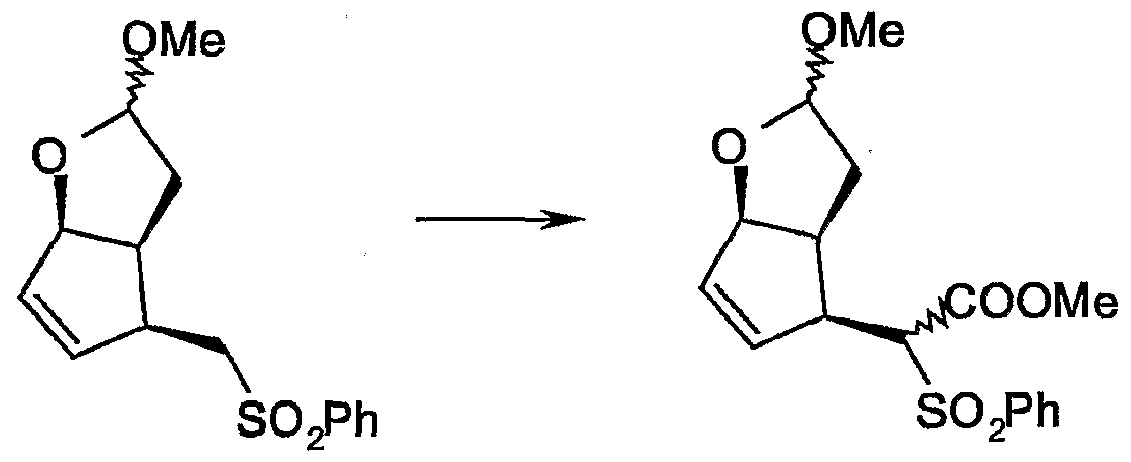
(IV) (V) d) alkylation of the compound of formula (V) coming from step c) to obtain the methyl ester of formula (VI)
(V) (VI) e) desulfonation of the compound of formula (VI) coming from step d) to obtain the compound of formula (VII)
(VI) (VII) f) hydrogenating the compound of formula (VII) coming from step e) to obtain the compound of formula (VIII)
(VII) (VIII) g) reacting the compound of formula (VIII) coming from step f) to obtain the compound of formula (IX)
(VIII) (IX) h) Wittig reaction of compound (IX) coming from step g) followed by hydrolysis and esterification to obtain compound (X)
(IX) (X) i) hydrogenating the compound of formula (X) coming from step h) followed by oxidation, to obtain the desired compound of formula (I)
(X) (I)
Features and advantages of the present invention will be illustrated in detail in the following description.
DETAILED DESCRIPTION OF THE INVENTION
The starting compound used in the present process is (-)-(3aS,4S,6aR)- hydroxymethyl δ-lactone of the aforesaid formula (II), which presents the functional groups in the cis position, and can easily be prepared with up to 95% excess enantiomer using for example the stereoselective synthesis described by G. Zanoni et al. in J. Org. Chem., 2002, 67, 6064-6069.
The reaction in step a) of the present process is carried out by reacting the aforesaid lactone of formula (II) with phenyl disulfide to obtain the corresponding sulfide of formula (III); this reaction can be carried out for example in the presence of Bu3P and pyridine at a temperature of 0°C.
The sulfide of formula (III) thus obtained is then reduced, preferably by reacting with diisobutylaluminium hydride a solution of the sulfide (III), for example a solution in dichloromethane (hereinafter referred to as "DCM"), to obtain the corresponding lactol which is immediately protected as methyl ether, for example by reaction with methanol and p-toluenesulfonic acid at a temperature of -20°C. The protected sulfide of formula (IV) is then subjected in step c) to a selective oxidation reaction, carried out preferably at room temperature with H202 in the presence of catalytic quantities of ammonium molybdate in methanol. Under these conditions, selective oxidation of sulfide to sulfone takes place, while the double bond is untouched by the action of the oxidising agent, thus obtaining the compound of formula (V).
The alkylation reaction in step d) of the present process is carried out with alkylating agents able to introduce a carboxymethyl ester group onto the carbon to which the benzenesulfonic group is also bound. The reaction in step d) is preferably carried out by first reacting the sulfone of formula (V) with BuLi to obtain the corresponding lithiated compound (V), which is then reacted with methyl chloroformate at a temperature of about -55°C, obtaining the desired compound of formula (VI) with almost quantitative yields. . The desulfonation reaction in step e) to obtain the methyl ester of formula (VII) can be carried out for example with methanol in the presence of magnesium at room temperature.
The double bond still present in the desulfonated compound of formula (VII) is thus subjected in step f) to a catalytic hydrogenation reaction, using for example rhodium on activated aluminium as catalyst; the hydrogenation can for example be carried out in methanol.
The compound (VIII) coming from step f) is then subjected to deprotection in step g) to release the hydroxy group in position 2 of the tetrahydrofuran ring, for example by treating a solution of the compound (VIII) in THF/H20 with hydrochloric acid at room temperature.
The compound of formula (IX) is then subjected to a Wittig reaction in step h); preferably the Wittig reagent used in the present process is generated in situ with propyl triphenylphosphonium bromide and potassium bis(trimethylsilyl)amide, the reaction being carried out in toluene at room temperature; under these conditions the present process enables a compound resulting from the Wittig reaction with a 95% yield to be obtained in which the cis/trans ratio of the double bond is 92/8. The ratio between the stereoisomers was evaluated by 1H-NMR and by High Resolution Gas Chromatography (HRGC).
According to the present process, the compound resulting from the Wittig reaction is then subjected to hydrolysis, for example with KOH in methanol at room temperature, and then to an esterification reaction for example with CH2N2 in Et2O, to obtain the methyl ester of formula (X).
In step i) of the present process, the methyl ester of formula (X) as obtained in step h) is subjected to catalytic hydrogenation, preferably using palladium on carbon as catalyst, and carrying out the hydrogenation in ethyl acetate. Finally, oxidation of the allyl alcohol thus obtained results in the formation of methyl dihydroepijasmonate of formula (I). Said oxidation in step i) is preferably carried out with the Dess-Martin reagent (triacetoxy periodinane) at room temperature. With the enantioselective process of the invention as described above, the methyl dihydroepijasmonate of formula (I) can be obtained with a high optical purity. The present process enables absolute control to be exerted on the configuration of the two stereogenic centres present on the cyclopentene ring, so that by starting from a lactone of formula (II) in the form of (-)-(3aS,4S,6aR) isomer having
high chemical and optical purity, which is easily obtainable, the desired final product (I) in the form of the (+)-(1R,2S) isomer having high chemical and optical purity can be obtained.
The present process, passing via the formation of the sulfonated intermediates which comprise the substrate for alkylation and the introduction of the carboxymethyl ester group into the molecule, therefore represents a valid alternative to the process described in the aforesaid European Patent No. 585
104 which follows a completely different synthesis path.
The following examples of the present invention are given by way of non-limiting illustration.
EXAMPLE 1
Preparation of (3aS. 4S. 6affl-4-phenylsulfanylmethyl-3.3a.4.6a-tetrahvdro- cyclopentafblfuran-2-one
Solid phenyl disulfide (1.17 g, 5.36 mmol, 3 eq), was added to a solution of the δ- lactone 4-phenylsulfanylmethyl-3,3a,4,6a-tetrahydro-cyclopenta[b]furan-2-one of
(-)-(3aS,4S,6a/*?) absolute configuration (275 mg, 1,79 mmol) in 7ml of tetrahydrofuran (hereinafter referred to as THF) under stirring and in an argon atmosphere. The reaction mixture was cooled to 0°C in an ice bath, and then tributyl phosphine Bu3P (1.3 ml, 5.36 mmol, 3 eq). was added dropwise. The ice bath was removed and the solution was placed under stirring at room temperature for 4 hours. A saturated aqueous solution of sodium chloride (20 ml) and dichloromethane (hereinafter referred to as DCM) were then added to the reaction mixture and the aqueous phase was extracted with DCM (3 x 50 ml). The organic fractions were pooled, washed with brine and dried over MgS04. By means of evaporation under reduced pressure an oily residue was obtained which was purified using flash chromatography with silica gel (60 g). Elution with hexane-
EtOAc (8:2) enabled the corresponding sulfide of the title to be obtained, in the form of a coloured oil (400 mg, 92%).
[ ]D 20 = -116.55 (c = 1.6, CH2CI2). IR (liquid film) 3057, 2929, 1770, 1171 , 1002,
742, 691 cm-1; 1H-NMR (300 MHz, CDCI3) δ 7.5-7.1 (m, 5H, Ph), 6.02 (dt, J = 5.7,
1.3 Hz, 1H), 5.9 (dt, J = 6.4, 2.4 Hz, 1 H), 5.45 (dd, J = 1.6, 8.0 Hz, 1H), 3.28 (m,
1H), 3.12 (br t, J = 2.14, 6.0 Hz, 1H), 3.05 (d, J = 6.4 Hz, 1H), 2.86 (dt, J = 4.2, 11.8 Hz, 1H), 2.60 (dd, J = 9.6, 18.2 Hz, 1H), 2.45 (dd, J = 8.6, 18.2 Hz, 1H); 13C- NMR (75 MHz, CDCI3) δ 176.6 s, 138.0 d, 135.1 s, 130.0 d, 129.6 d, 129.0 d, 126.7 d, 88.3 d, 45.9 d, 39.4 d, 35.1 t, 29.1 t; EIMS (70 eV) m/z 246 (30) [M4], 123 (100), 108 (20), 91 (10), 77 (30), 65 (20), 52 (12), 45 (25). Elemental analysis calculated for d4Hι4O2S: C, 68.26; H, 5.73. Found: C, 68.34; H, 5.76. EXAMPLE 2
Preparation of 2-methoxy-4-phenylsulfanylmethyl-3.3a,4,6a-tetrahydro-2H- cvclopentafblfuran
An agitated solution of (3aS, 4S, 6af?)-4-phenylsuIfanylmethyl-3,3a,4,6a- tetrahydro-cyclopenta[b]furan-2-one (388 mg, 1.58 mmol) obtained as described above in Example 1 , in 10 ml DCM, was cooled to -78°C, and then diisobutylaluminium hydrate DIBAL-H (1M in hexane, 2.21 ml, 1.4 equiv) was added dropwise. Stirring was maintained for a further hour, then a saturated solution of NH4CI (5 ml) was added at -78°C. The mixture was gradually brought back to room temperature, diluted with DCM (30 ml) and acidified with concentrated HCI. The aqueous phase was extracted with DCM (3 x 15 ml), while the organic phases were pooled, washed with water and brine and dried over MgSO4. By means of evaporation under reduced pressure the corresponding crude lactol was obtained, and was immediately protected by transformation into the corresponding methyl ether. The lactol was dissolved in methanol (40 ml) in an argon atmosphere and the solution obtained was cooled to -20°C. Solid p- toluenesulfonic acid (hereinafter referred to as PTSA) (16 mg) was then added under agitation. The reaction was terminated after 18 hours of stirring at -20°C by adding solid NaHCO3 at 0°C. A saturated solution of NaHCO3 (10 ml) was then added and the aqueous phase was extracted with DCM (3 x 15 ml). The organic phases were pooled, washed with brine, dried over Na2S04 and concentrated under vacuum. Flash column chromatography of the oily residue thus obtained (silica gel, 10 g hexane-EtOAc, 9:1) allows the acetyl of the title (403 mg, yield = 98%) to be obtained in an epimeric mixture. IR (liquid film) 2900, 1580, 1480, 1440, 1100, 1040 cm'1; 1H-NMR (300 MHz,
CDCI3) δ 7.1-7.5 (m, 5H), 5.6-5.9 (m, 2H), 5.1-5.16 (d, J = 7.5 Hz, 1H), 4.96-5.04 (d, J = 4.3 Hz, 1H), 3.3 (s, 3H), 3.1-3.28 (m, 1H), 2.8-3.1 (m, 3H), 2.1 (dd, J = 8.1, 12.2, 1 Hz, 1H), 1.64-1.76 (ddd, J = 4.9, 11.3, 12.2 Hz, 1 H); 13C-NMR (75 MHz, CDCI3) δ 136.1 s, 135.0 d, 134.26 d, 131.6 d, 129.8 d, 129.5 d, 128.9 d, 126.1 d, 105.5 d, 88.0 d, 54.8 q, 45.4 d, 42.2 d, 35.1 t, 34.01; EIMS (70 eV) m/z 262 (65) [M*], 231 (48), 187 (17), 123 (100), 109 (27), 91 (57), 79 (53), 65 (29), 51 (15), 45 (50).
EXAMPLE 3
Preparation of 4-benzenesulfonylmethyl-2-methoxy-3.3a,4,6a-tetrahydro-2H- cyclopentarblfuran
The 2-methoxy-4-phenylsulfanylmethyl-3,3a,4,6a-tetrahydro-2H-cyclopenta[b] furan (403 mg, 1.54 mmol) obtained as described above in Example 2 was dissolved in methanol (15 ml) and cooled to 0°C; to this solution were added solid (NH4)2Mo04 (60 rhg) and 30% H202 (650 μl). The temperature was allowed to rise to room temperature and stirring was maintained for 90 minutes. After a further addition of 30% H202 (1.9 ml) the yellow reaction mixture was stirred for a further 16 hours. The reaction was terminated by the addition of solid Na2SO3; after 40 minutes under stirring at room temperature, the methanol was removed by evaporation under vacuum and the residue was re-dissolved with a saturated solution of NH4CI (10 ml) and DCM (30 ml). The aqueous phase was extracted with DCM (3 x 30 ml), while the organic fractions were pooled, washed with, brine and dried over MgSO4. By means of evaporation under vacuum the crude sulfone (V) (508 g) was obtained and then purified by means of chromatography with silica gel (14 g) using a hexane-EtOAc (6:4) mixture as eluent. The sulfone of the title was obtained in the form of a pale yellow oil (440 mg, yield = 98%). IR (liquid film) 3040, 2900, 1450, 1300, 1150, 1100, 940 cm-1; 1H-NMR (300 MHz, CDCI3) δ 7.5-8 (m, 5H), 5.8-6 (m, 2H), 5.1 (d, J = 4.3 Hz, 1H), 4.9 (d, J = 7 Hz, 1H), 3.4 (s, 3H), 3.1-3.3 (m, 4H), 1.95 (dd, J = 6.3, 12.5 Hz, 1H), 1.5 (ddd, J = 4.6, 11 , 12.5 Hz, 1H); 13C-NMR (75 MHz, CDCI3) δ 139.1 s, 133.4 d, 132.7 d, 132.6 d, 129.3 d, 127.89 d, 127.8 d, 105.02 d, 87.34 d, 56.9 t, 54.2 q, 42.17 d, 39.45 d, 34.15 d.
EXAMPLE 4
Preparation of the methyl ester of benzenesulfonyl-(2-methoxy-3.3a.4.6a- tetrahvdro-2H-cvclopentarblfuran-4-yl)-acetic acid nBuLi (1.32 ml, 1.6 M solution in hexane, 1.2 eq) was added at -78°C in an argon atmosphere to a solution under stirring of 4-benzenesulfonylmethyl-2-methoxy-
3,3a,4,6a-tetrahydro-2H-cyclopenta[b]furan (518 mg, 1.76 mmol), obtained as described above in Example 3, in anhydrous THF (10 ml). The reaction mixture was maintained under stirring for 1 hour at the same temperature. Pure methylchloroformate was then added (185 μl, 1.35 eq) at -78°C and the mixture was stirred for 3.5 hours at -50°C. A saturated NH4CI (15 ml) solution and DCM
(10 ml) were added in succession, while the temperature was allowed to rise again to room temperature. The two phases were separated and the aqueous phase was extracted with DCM (3 x 35 ml). The organic fractions were pooled, washed with brine, dried over Na2SO and concentrated under reduced pressure.
The methyl ester of the title (590 mg, yield = 99%) thus obtained was used directly in the following step without being purified.
IR (liquid film) 2907, 1741 , 1447, 1323, 1201, 1147, 1083, 1035, 946, 688 cm"1.
EXAMPLE 5
Preparation of (2-methoxy-3.3a,4,6a-tetrahvdro-2 -cvclopentarblfuran-4-yl)-acetic acid methyl ester
The benzenesulfonyl-(2-methoxy-3,3a,4,6a-tetrahydro-2H-cyclopenta[b]furan-4- yl)-acetic acid methyl ester (590 mg, 1.74 mmol) obtained as described above in
Example 4 was dissolved in anhydrous MeOH (25 ml) in an argon atmosphere. To this solution Mg (0.422 g, 0.0174 g.atom, 10 eq) was added in a single addition, and the reaction mixture was left under stirring at room temperature for 3 hours.
Solid KH2PO4 (2.6 g, 19.14 mmol, 11 eq) was added and the mixture thus obtained was stirred for a further 15 minutes, then the methanol was removed under reduced pressure. The solid obtained was re-dissolved in Et20 (50 ml), a saturated NH CI (15 ml) solution and H20 (10 ml). The entirety was then transferred to a separating funnel and the aqueous phase extracted with a
Et2O/pentane mixture (1 :1) (3 x 30 ml). The organic phases were pooled, washed
with brine and dried over Na2SO4. The solvent was removed under reduced pressure at 150 mmHg. The residue (563 mg), after being purified on SiO2 (18 g) eluting with Et2O/pentane (from 15:85 to 4:6), resulted in pure methyl ester of the title in the form of a colourless oil (316 mg, yield = 85%) being obtained.
IR (liquid film) 2953, 1732, 1437, 1367, 1320, 1264, 1168, 1100, 1035, 946, 875 cm'1; 1H-NMR (300 MHz, CDCI3) δ 5.7-5.8 (m, 1H), 5.6 (m, 1H), 5.1-5.2 (bd, J = 8.2
Hz, 1H), 4.9-5.0 (d, J = 4.1 Hz, 1H), 3.6 (s, 3H), 3.25 (s, 3H), 3.15-3.2 (m, 2H),
2.3-2.5 (t, J = 14.5 Hz, 2H), 1.8-1.9 (m, 1H), 1.5-1.7 (m, 1H); 13C-NMR (75 MHz,
CDCI3) δ 172.7 s, 134.7 d, 131.4 d, 105.4 d, 88.1 d, 54.3 q, 51.6 q, 41.6 d, 41.63 d, 35.0 t, 33.8 t; EIMS (70 eV) m/z 211 (7) [M-1*], 195 (15), 181 (100), 149 (22),
135 (8), 121 (7), 91 (34), 79 (25), 65 (8), 43 (12).
EXAMPLE 6
Preparation of (2-methoxy-hexahydro-cvclopentarblfuran-4-yl)-acetic acid methyl ester
Rh/AI2θ3 (6 mg, 5% Rh on AI2O3) was added to an agitated suspension of (2- methoxy-3,3a,4,6a-tetrahydro-2r -cyclopenta[b]furan-4-yl)-acetic acid methyl ester
(160 mg, 0.754 mmol) obtained as described above in Example 5, in 15 ml MeOH, and hydrogenated with H2 at 1 atm pressure for 12 hours at room temperature.
The catalyst was removed by filtration and the methanol removed by evaporation under reduced pressure. The reduced compound of the title was thus obtained in an almost pure form as a colourless oil (160.7 mg, yield = 99.5%).
IR (liquid film) 2950, 1738, 1436, 1340, 1204, 1096, 1044, 998, 940, 867 cm'1; 1H-
NMR (300 MHz, CDCI3) δ 5 (d, J = 3.7 Hz, 1H), 4.56-4.64 (t, J = 5.6 Hz, 1 H), 3.7
(s, 3H), 3.25 (s, 3H), 2.8-3 (q, J = 8 Hz, 1 H), 2.2-2.5 (m, 2H), 1.75-1.9 (m, 2H),
1.5-1.75 (m, 3H), 1.2-1.4 (m, 2H); 13C-NMR (75 MHz, CDCI3) δ 173.1 s, 105.5 d,
83.4 d, 54.6 q, 52.0 q, 43.8 d, 39.3 d, 35.6 t, 34 t, 33 t, 28.8 t; EIMS (70 eV) m/z
213 (7) [M-1*l, 199 (20), 183 (66), 164 (25), 151 (93), 139 (16), 122 (37), 112
(22), 94 (72), 81 (100), 71 (62), 67 (44), 59 (34), 53 (32), 39 (77).
EXAMPLE 7
Preparation of 8-pent-2-enyl-2-oxa-bicvclor3.2.noctan-3-one
The (2-methoxy-hexahydro-cycIopenta[b]furan-4-yl)-acetic acid methyl ester (137
mg, 0.64 mmol) obtained as described above in Example 6 was dissolved in a THF/H2O mixture (12 ml, 7:3) at room temperature. A 0.3 N (500 μl) solution of HCI was then added and the resulting mixture was maintained under stirring for 24 hours. The reaction was terminated by adding NaHCO3 (13.6 mg, 0.18 mmol, 0.28 eq). The reaction mixture was diluted with DCM (20 ml) and H2O (4 ml), then transferred into a separating funnel. The two phases were separated and the aqueous one was extracted with DCM (4 x 15 ml). The organic fractions were pooled, washed with H20, brine and then dried over MgSO4. The crude lactol (104 mg, yield = 87%) was isolated by filtration and evaporation of the solvent under reduced pressure, then used directly in the following step without further purification.
A solution of potassium bis(trimethylsilyl)amide (KHMDS) in toluene (5.15 ml, 0.5 M solution, 2.57 mmol, 5 eq) was added dropwise at room temperature to a suspension under stirring of propyl triphenylphosphonium bromide (992 mg, 2.57 mmol, 5 eq) in 4 ml anhydrous toluene and allowed to react for 2 hours. To this red suspension was added a lactol solution in toluene (103 mg, 0.515 mmol in 4 ml toluene) by means of a cannula. The mixture was stirred for 3 hours and then the reaction was terminated by adding a saturated solution of NH CI (15 ml) and H2O (5 ml). The suspension was diluted with Et2O (10 ml) and the two phases were separated; the aqueous phase was extracted with Et20 (3 x 15 ml). The organic fractions were pooled, washed in brine, dried over MgSO and filtered. The volatile components were removed under reduced pressure (at 100 mmHg). Purification by chromatography with silica gel (SiO2, 18 g, pentane/Et2O 8:2) enabled the product of the title (95 mg, yield = 95%) to be obtained as a 92:8 cis:trans mixture (HRGC).
IR (liquid film) 2962, 1736, 1436, 1374, 1217, 1141, 1056, 1003, 971 cm'1; 1 H- NMR (300 MHz, CDCI3) δ 5.3-5.6 (m, 2H), 4.6 (bs, 1H), 2.7-2.81 (ddd, J = 2.4, 5.5, 7.1 Hz, 1H), 1.5-2.5 (m, 9H), 0.95 (t, J = 6.8 Hz, 3H); 13C-NMR (75 MHz, CDCI3) δ 170.6 s, 133.3 d, 125.2 d, 81.7 d, 44.3 d, 36.51, 34.6 d, 32.5 t, 30.4 t, 23.6 t, 21 t, 14.7 q. EXAMPLE 8
Preparation of (IR, 2$. 3ffM3-hvdroxy-2-pent-2-enyl-cvclopentyl)-acetic acid methyl ester
An aqueous solution of KOH (300 μl, 2M solution, 0.6 mmol, 2.13 eq) was added to a solution of the lactone 8-pent-2-enyl-2-oxa-bicyclo[3.2.1]octan-3-one (55 mg.
0.283 mmol) obtained as described above in Example 7, in aqueous methanol
(MeOH 3 ml, H20 1 ml), and the solution thus obtained was stirred for 2 hours at room temperature. The methanol was removed under vacuum and the residue obtained was acidified to pH 4 with 2 N HCI (450 μl). The aqueous phase was extracted with DCM (3 x 15 ml), while the pooled organic phases were washed in brine and dried over MgS04. The crude acid, obtained after filtering off the drying agent and evaporation under reduced pressure, was used in the following step without further purification.
The acid was dissolved in Et02 and cooled to 0°C. Excess CH2N2 in Et2O was added to this solution. After 0.5 hours the excess CH2N2 was eliminated by adding
AcOH (10 μl). By means of evaporation a colourless oil was obtained which proved to be the ester of the title (60 mg, yield = 95%) with a cis:trans ratio of the olefin equal to 92:8 and with a purity (CG) of 98%.
IR (liquid film) 3509, 2958, 1736, 1437, 1172, 1014 cm'1; 1 H-NMR (300 MHz,
CDCI3) δ 5.4 (m, 2H), 4.25 (bs, 1H), 3.7 (s, 3H), 1.5-2.5 (m, 12H), 0.9 (t, J = 6.6, 3
Hz, 3H); 13C-NMR (75 MHz, CDCI3) δ 175.8 s, 133.9 d, 129.0 d, 76.04 d, 52.7 q,
49.0 d, 37.91, 37.7 d, 34.71, 30.71, 24.21, 22.01, 14.0 q.
EXAMPLE 9
Preparation of (1R.2S.3R)-(3-hvdroxy-2-pentyl-cyclopentyl)-acetic acid methyl ester
Pd/C (6 mg, 5% of Pd on carbon) was added to an agitated suspension of the
(1f?, 2S, 3R)-(3-hydroxy-2-pent-2-enyl-cyclopentyl)-acetic acid methyl ester (44 mg, 0.194 mmol) obtained as described above in Example 8, in 4 ml AcOEt and hydrogenated with H2 at 1 atm pressure for 10 hours at room temperature. The catalyst was removed by filtering through celite and the solid was washed with pentane/Et20 (1:1.3 x 10 ml). By evaporating the pooled phases, the pure ester of the title was obtained with a quantitative yield (44 mg).
[ ] 20 = 21.3. (c = 1.96, CH2CI2)
IR (liquid film) 3509, 2928, 1738, 1437, 1175, 1019 cm'1; 1 H-NMR (300 MHz,
CDCI3) δ 4.25 (bs, 1H), 3.75 (s, 3H), 2.25-2.55 (m, 3H), 1.25-2 (m, 13H), 0.9 (t, J =
6Hz, 3H); 13C-NMR (75 MHz, CDCI3) δ 174.25 s, 74.6 d, 51.2 q, 47.6 d, 36.4 t,
36.1 d, 33.51, 32.1 1, 29.31, 28.1 1, 24.91, 22.41, 13.8 q.
EXAMPLE 10
Preparation of (1R.2SH3-oxo-2-pentyl-cvclopentv0-acetic acid methyl ester f(1 R.2S)-methyl dihvdro epi-iasmonatel
Solid Dess-Martin reagent (triacetoxy periodinane) (153 mg, 0.36 mmol, 1.4 equiv.) was added to a solution of (1R,2S,3R)-(3-hydroxy-2-pentyl-cyclopentyl)- acetic acid methyl ester (59 mg, 0.258 mmol) prepared as described above in
Example 9, in 6ml DCM, in a single addition. After agitating the homogenous solution for 3 hours, the reaction was terminated by adding anhydrous Et20 (15 ml) and the suspension was filtered rapidly through celite. The celite layer was then washed with Et2O (3 x 30 ml) and the organic fractions were pooled and concentrated under reduced pressure without heating. The residue was purified by means of flash chromatography with silica gel (SiO2, 7 g); elution with a pentane/Et2O (7:3) mixture enabled a colourless oil, the compound of the title, to be obtained (57 mg, yield = 97%).