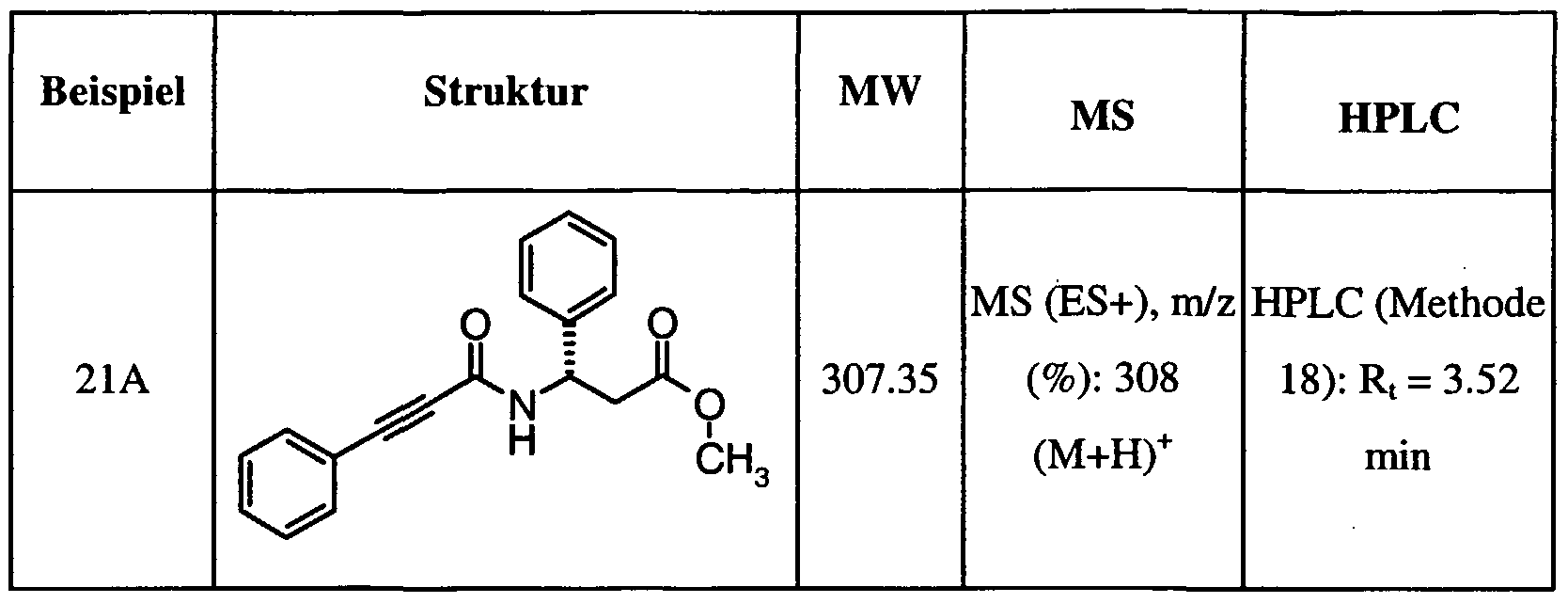
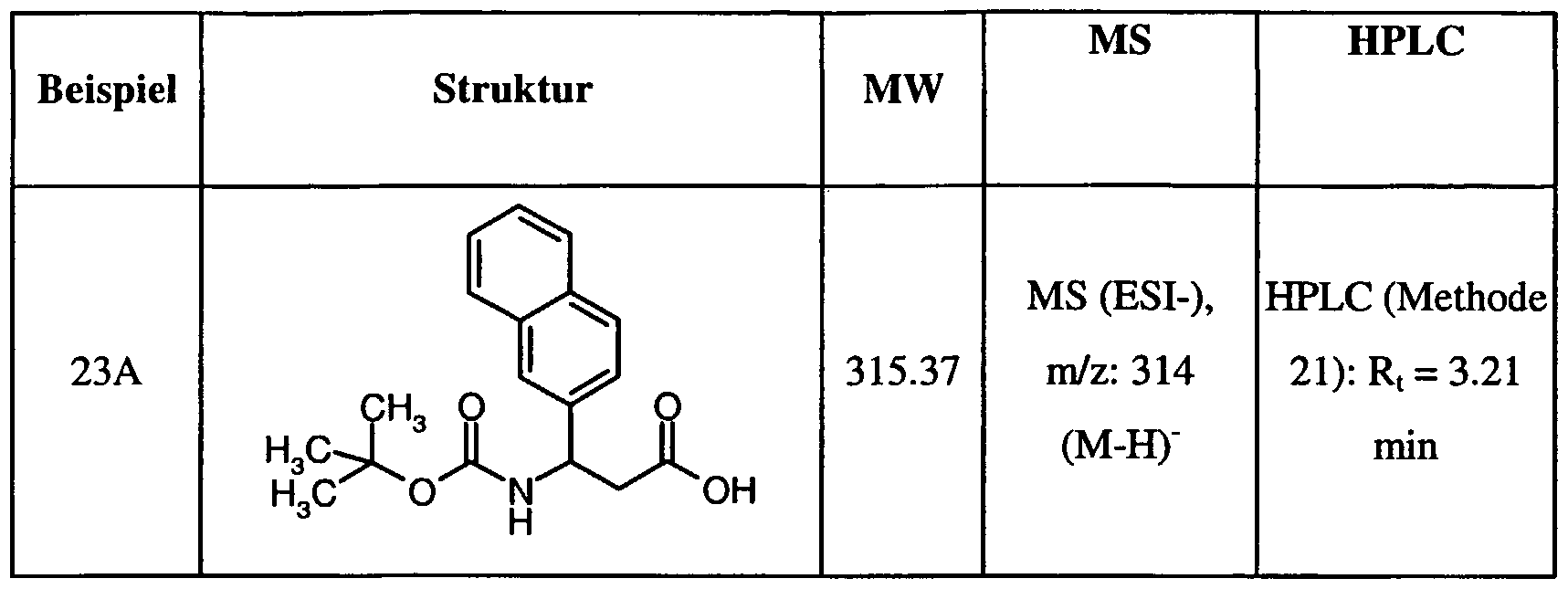
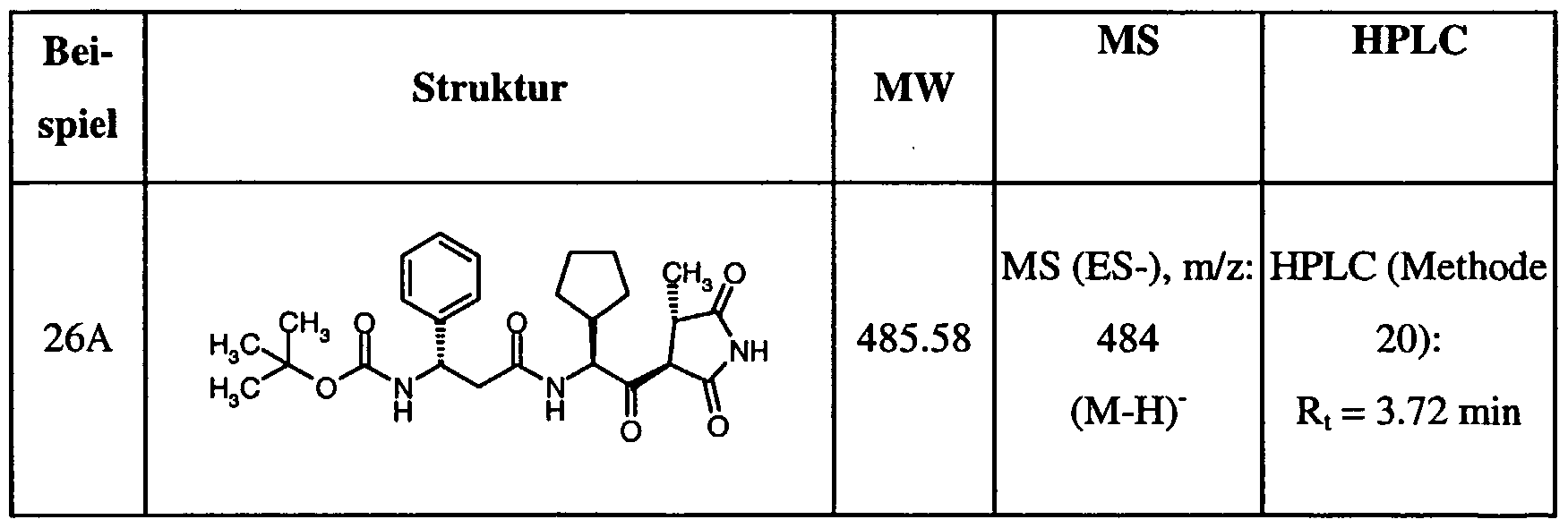
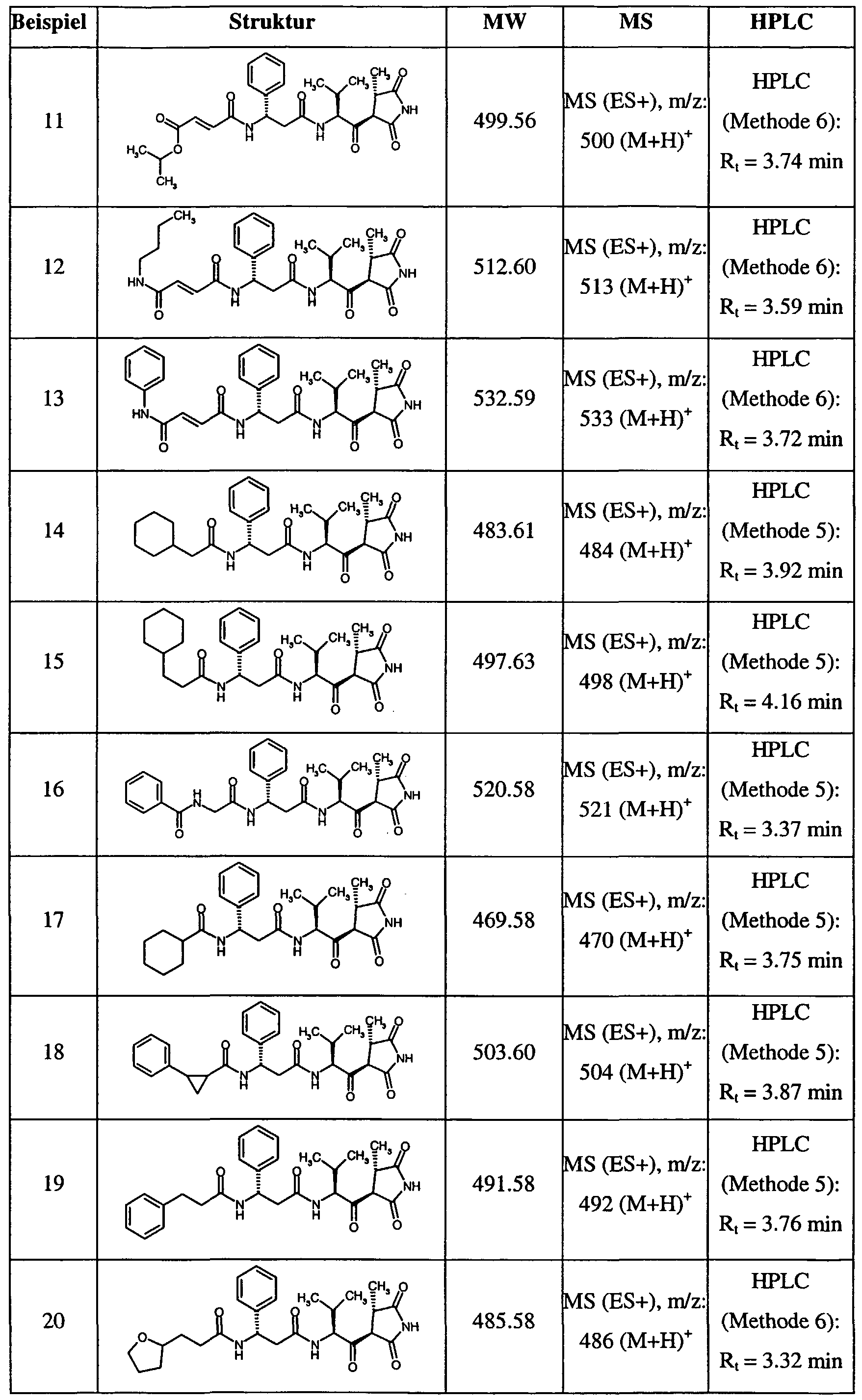
Substituierte Alkylamide
Die vorliegende Erfindung betrifft Verbindungen, Verfahren zur ihrer Herstellung, sie umfassende pharmazeutische Zusammensetzungen sowie ihre Verwendung bei der Behandlung und/oder Prophylaxe von Erkrankungen bei Menschen oder Tieren, insbesondere bakteriellen Infektions- krankheiten.
Die Naturstoffe Moiramid B (Ra = Wasserstoff, Rb = Methyl) und Andrimid (Ra = Wasserstoff, Rb = Propenyl) sind als antibakteriell wirksam beschrieben, während Moiramid C (Ra = Hydroxy, Rb = Propenyl) unwirksam ist. (A. Fredenhagen, S. Y. Tamura, P. T. M. Kenny, H. Komura, Y. Naya, K. Nakanishi, J. Am. Chem. Soc, 1987, 109, 4409-4411; J. Needham, M. T. Kelly, M. Ishige, R. J. Andersen, J. Org. Chem., 1994, 59, 2058-2063; M. P. Singh, M. J. Mroczenski-Wildey, D. A. Steinberg, R. J. Andersen, W. M. Maiese, M. Greenstein, . Antibiot., 1997, 50(3), 270-273). Die Isolierung und antibakterielle Wirksamkeit von Andrimid ist auch in EP-A-250 115 beschrieben. JP 01301657 beschreibt die Verwendung von Andrimid und einiger amidischer Derivate als agrochemische Antibiotika.
Die Synthese von Andrimid wird in A. V. Rama Rao, A. K. Singh, Ch. V. N. S. Varaprasad, Tetrahedron Letters, 1991, 32, 4393^1396 beschrieben, diejenige von Moiramid B und Andrimid in S. G. Davies, D. J. Dixon, . Chem. Soc. Perkin Trans. 1, 1998, 2635-2643.
Auf dem Markt sind zwar strukturell andersartige antibakteriell wirkende Mittel vorhanden, es kann aber regelmäßig zu einer Resistenzentwicklung kommen. Neue Mittel für eine bessere und wirksame Therapie sind daher wünschenswert.
Eine Aufgabe der vorliegenden Erfindung ist es daher, neue und alternative Verbindungen mit gleicher oder verbesserter antibakterieller Wirkung zur Behandlung von bakteriellen Erkrankungen bei Menschen und Tieren zur Verfügung zu stellen.
Überraschenderweise wurde gefunden, dass Derivate dieser Verbindungsklasse, worin der Amid- substituent in der beta-Phenylalanin-Amidgruppe durch substituierte Alkyl, Alkenyl oder Alkinyl Amide oder Cycloalkyl oder Heterocyclyl Amide ersetzt wird, antibakteriell wirksam sind.
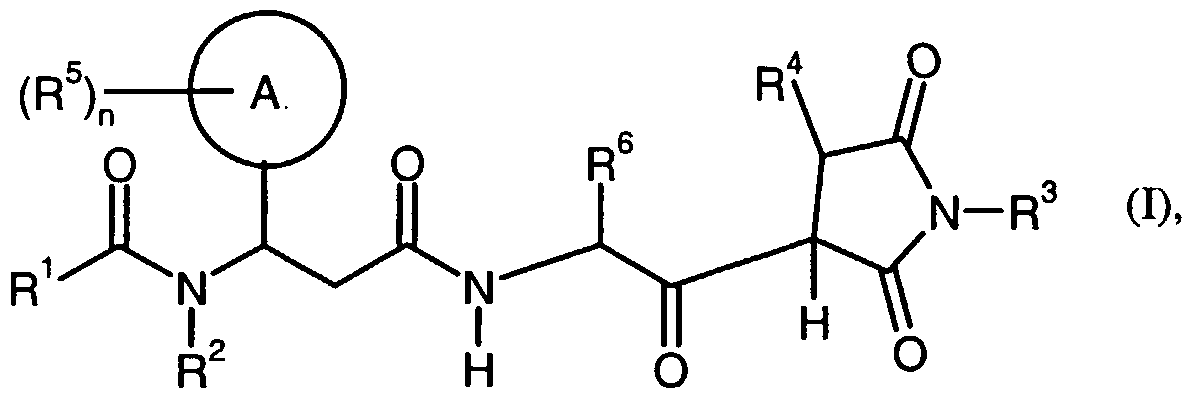
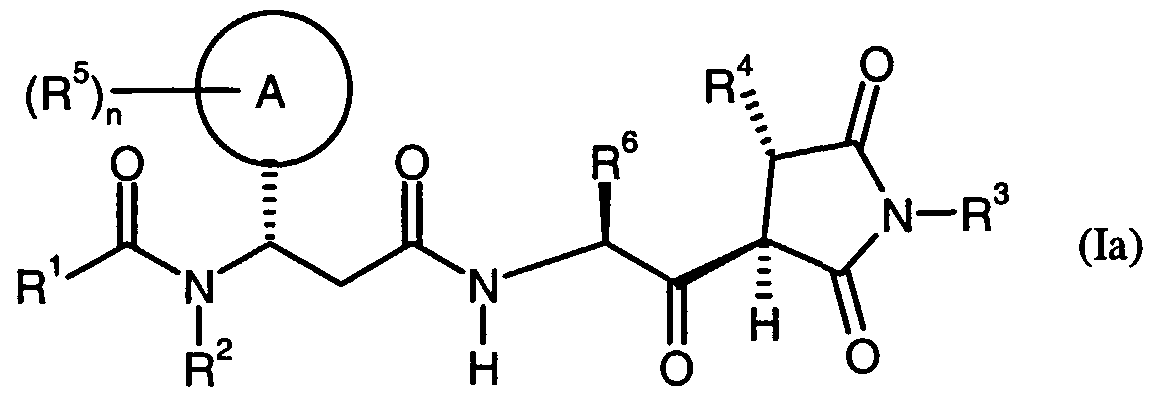
Gegenstand der Erfindung sind Verbindungen der Formel
woπn
R' Alkyl bedeutet,
wobei Alkyl substituiert ist mit 1, 2 oder 3 Substituenten R1"1, wobei die Substituenten R1'1 unabhängig voneinander ausgewählt werden aus der Gruppe bestehend aus Halogen, Nitro, Amino, Alkylamino, Phenylamino, Diphenylamino, Benzylamino, Cyano, Trifluormethyl, Cycloalkyl, Heterocyclyl, Aryl, Hydroxy, Alkoxy, Aryloxy, Benzyloxy, Hydroxycarbonyl, Alkoxycarbonyl, Aminocarbonyl, Alkylcarbonylamino, Phenylcarbonylamino, Alkylaminocarbonyl, Alkenyloxycarbonyl, Alkoxycarbonylamino und Aminosulfonyl,
oder
R1 Alkenyl bedeutet,
wobei Alkenyl substituiert ist mit 1, 2 oder 3 Substituenten R " , wobei die Substituenten R1"2 unabhängig voneinander ausgewählt werden aus der Gruppe bestehend aus Halogen, Nitro, Amino, Alkylamino, Phenylamino, Diphenylamino, Benzylamino, Cyano, Trifluormethyl, Cycloalkyl, Heterocyclyl, Hydroxy, Alkoxy, Aryloxy, Benzyloxy, Hydroxycarbonyl, Alkoxycarbonyl, Aminocarbonyl, Alkylcarbonylamino, Alkylaminocarbonyl, Alkenyloxycarbonyl, Phenylaminocarbonyl, Alkoxycarbonylamino und Aminosulfonyl,
oder
R1 Alkinyl bedeutet,
wobei Alkinyl substituiert ist mit 1, 2 oder 3 Substituenten R1"3, wobei die Substituenten R1"3 unabhängig voneinander ausgewählt werden aus der Gruppe bestehend aus Halogen, Nitro, Amino, Alkylamino, Phenylamino, Diphenylamino, Benzylamino, Cyano, Trifluormethyl, Cycloalkyl, Heterocyclyl, Aryl, Heteroaryl, Hydroxy, Alkoxy, Aryloxy, Benzyloxy, Hydroxycarbonyl, Alkoxycarbonyl, Aminocarbonyl, Alkylcarbonylamino, Alkylaminocarbonyl, Alkenyloxycarbonyl, Alkoxycarbonylamino und Aminosulfonyl,
oder
R1 Cycloalkyl oder Heterocyclyl bedeutet,
wobei Cycloalkyl und Heterocyclyl substituiert sein können mit 0, 1, 2 oder 3 Substituenten RM,
wobei die Substituenten R1"4 unabhängig voneinander ausgewählt werden aus der
Gruppe bestehend aus Halogen, Nitro, Amino, Alkylamino, Phenylamino, Diphenylamino, Benzylamino, Cyano, Alkyl, Trifluormethyl, Cycloalkyl, Heterocyclyl, Aryl, Heteroaryl, Hydroxy, Alkoxy, Aryloxy, Benzyloxy, Hydroxycarbonyl, Alkoxycarbonyl, Aminocarbonyl, Alkylcarbonylamino, Alkylamino- carbonyl, Alkenyloxycarbonyl, Alkoxycarbonylamino und Aminosulfonyl,
oder
zwei Substituenten R1"4 zusammen mit den Kohlenstoff atomen, an die sie gebunden sind, ein Phenyl bilden, wobei dieses Phenyl substituiert sein kann mit 0, 1 oder 2 Substituenten R1"4"1, wobei die Substituenten R1"4"1 unabhängig voneinander ausgewählt werden aus der Gruppe bestehend aus Halogen, Nitro, Amino, Alkylamino, Cyano, Alkyl, Trifluormethyl, Hydroxy, Alkoxy, Alkoxycarbonyl, Aminocarbonyl und Alkylaminocarbonyl,
R2 Wasserstoff oder Methyl bedeutet,
R3 Wasserstoff, Hydroxy, Amino, Cι-C3-Alkyl, Benzyl, -C3-Alkoxy, Benzyloxy, Cr - Alkylamino, Cι-C3-Alkylcarbonylamino, Phenylcarbonylamino, Benzylcarbonylamino oder Benzyloxycarbonylamino bedeutet,
R4 Wasserstoff oder Cj -C3-Alkyl bedeutet,
R5 Halogen, Trifluormethyl, Trifluormethoxy, Nitro, Amino, Alkylamino, Hydroxy, Alkyl, Alkoxy, Hydroxycarbonyl, Alkoxycarbonyl, Aminocarbonyl, Alkylaminocarbonyl, Aryl oder Heteroaryl bedeutet,
oder
zwei Substituenten R5 zusammen mit den Kohlenstoffatomen, an die sie gebunden sind, ein Cycloalkyl oder Heterocyclyl bilden, wobei dieses Cycloalkyl oder Heterocyclyl substituiert sein kann mit 0, 1 oder 2 Substituenten R5"1, wobei die Substituenten R5"1
unabhängig voneinander ausgewählt werden aus der Gruppe bestehend aus Halogen, Nitro, Amino, Trifluormethyl, Hydroxy, Alkyl und Alkoxy,
R6 Alkyl, Cycloalkyl, Cycloalkenyl oder Heterocyclyl bedeutet,
wobei R6 substituiert sein kann mit 0, 1 oder 2 Substituenten R6"1, wobei die Substituenten R6"1 unabhängig voneinander ausgewählt werden aus der Gruppe bestehend aus Halogen,
Nitro, Amino, Trifluormethyl, Hydroxy, Alkyl und Alkoxy,
n eine Zahl 0, 1, 2 oder 3 bedeutet,
wobei bei n gleich 2 oder 3 die Reste R5 gleich oder verschieden sein können,
A Aryl oder Heteroaryl bedeutet,
und ihre Salze, ihre Solvate und die Solvate ihrer Salze.
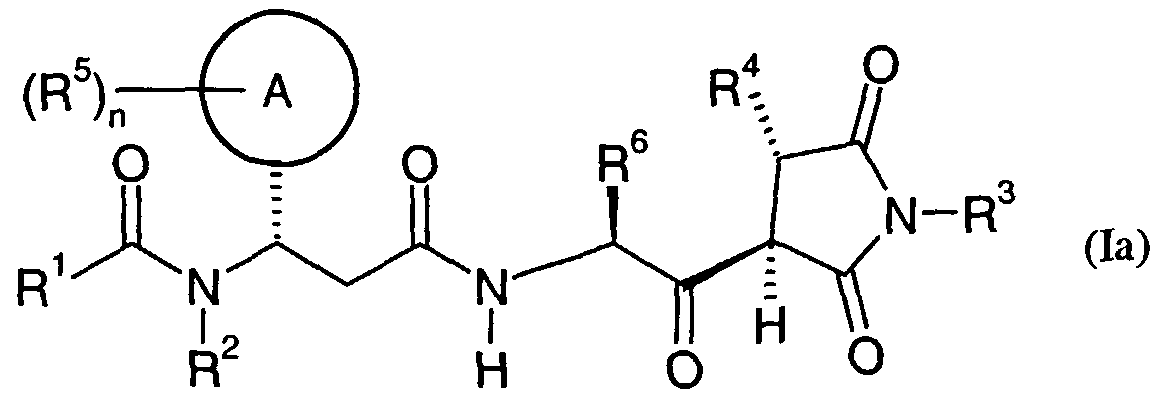
Erfindungsgemäße Verbindungen sind die Verbindungen der Formel (I) und deren Salze, Solvate und Solvate der Salze, die von Formel (I) umfassten Verbindungen der nachfolgend genannten Formel (la) und deren Salze, Solvate und Solvate der Salze sowie die von Formel (I) und/oder (la) umfassten, nachfolgend als Ausführungsbeispiel(e) genannten Verbindungen und deren Salze, Solvate und Solvate der Salze, soweit es sich bei den von Formel (I) und/oder (la) umfassten, nachfolgend genannten Verbindungen nicht bereits um Salze, Solvate und Solvate der Salze handelt.
Die erfindungsgemäßen Verbindungen können in Abhängigkeit von ihrer Struktur in stereoisomeren Formen (Enantiomere, Diastereomere) existieren. Die Erfindung betrifft daher die Enantiomeren oder Diastereomeren und ihre jeweiligen Mischungen. Aus solchen Mischungen von Enantiomeren und/oder Diastereomeren lassen sich die stereoisomer einheitlichen Bestandteile in bekannter Weise isolieren.
Die Erfindung betrifft in Abhängigkeit von der Struktur der Verbindungen auch Tautomere der Verbindungen.
Als Salze sind im Rahmen der Erfindung physiologisch unbedenkliche Salze der erfindungsgemäßen Verbindungen bevorzugt.
Physiologisch unbedenkliche Salze der Verbindungen (I) umfassen Säureadditionssalze von Mineralsäuren, Carbonsäuren und Sulfonsäuren, z.B. Salze der Chlorwasserstoffsäure, Bromwasserstoffsäure, Schwefelsäure, Phosphorsäure, Methansulfonsäure, Ethansulfonsäure, Toluolsulfonsäure,
Benzolsulfonsäure, Naphthalindisulfonsäure, Essigsäure, Propionsäure, Milchsäure, Weinsäure, Äpfelsäure, Zitronensäure, Fumarsäure, Maleinsäure und Benzoesäure.
Physiologisch unbedenkliche Salze der Verbindungen (I) umfassen auch Salze üblicher Basen, wie beispielhaft und vorzugsweise Alkalimetallsalze (z.B. Natrium- und Kaliumsalze), Erdalkalisalze (z.B. Calcium- und Magnesiumsalze) und Ammomumsalze, abgeleitet von Ammoniak oder organischen Aminen mit 1 bis 16 C-Atomen, wie beispielhaft und vorzugsweise Ethylamin, Diethyl- amin, Triethylamin, Ethyldiisopropylamin, Monoethanolamin, Diethanolamin, Triethanolamin, Di- cyclohexylamin, Dimethylaminoethanol, Prokain, Dibenzylamin, N-Methylmorpholin, Dihydro- abietylamin, Arginin, Lysin, Ethylendiamin und Methylpiperidin.
Als Solvate werden im Rahmen der Erfindung solche Formen der Verbindungen bezeichnet, welche in festem oder flüssigem Zustand durch Koordination mit Lösungsmittelmolekülen einen Komplex bilden. Hydrate sind eine spezielle Form der Solvate, bei denen die Koordination mit Wasser erfolgt.
Im Rahmen der vorliegenden Erfindung haben die Substituenten, soweit nicht anders spezifiziert, die folgende Bedeutung:
Alkyl per se und "Alk" und "Alkyl" in Alkoxy. Alkylamino. Alkylaminocarbonyl. Alkylcarbonylamino. Alkoxycarbonyl und Alkoxycarbonylamino stehen für einen linearen oder verzweigten Alkylrest mit in der Regel 1 bis 8, bevorzugt 1 bis 6, besonders bevorzugt 1 bis 4, ganz besonders bevorzugt 1 bis 3 Kohlenstoffatomen, beispielhaft und vorzugsweise für Methyl, Ethyl, n-Propyl, Isopropyl, tert-Butyl, n-Pentyl und n-Hexyl.
Alkenyl steht für einen linearen oder verzweigten Alkenylrest mit in der Regel 2 bis 8, bevorzugt 2 bis 6, besonders bevorzugt 2 bis 4 Kohlenstoffatomen, beispielhaft und vorzugsweise für Vinyl, Allyl, Prop-1-en-l-yl, Isopropenyl, But-1-en-l-yl, But-2-en-l-yl, Buta-l,2-dien-l-yl, Buta-l,3-dien- 1-yl und Penta-l,3-dien-l-yl.
Alkinyl steht für einen linearen oder verzweigten Alkinylrest mit in der Regel 2 bis 8, bevorzugt 2 bis 6, besonders bevorzugt 2 bis 4 Kohlenstoffatomen, beispielhaft und vorzugsweise für Ethinyl, Propargyl (2-Propinyl), 1-Propinyl, But-1-in-l-yl, But-2-in-l-yl.
Alkoxy steht beispielhaft und vorzugsweise für Methoxy, Ethoxy, n-Propoxy, Isopropoxy, tert- Butoxy, n-Pentoxy und n-Hexoxy.
Alkylamino steht für einen Alkylaminorest mit einem oder zwei (unabhängig voneinander gewählten) Alkylsubstituenten, wobei die Alkylsubstituenten unabhängig voneinander in der Regel 1 bis 6, bevorzugt 1 bis 4, besonders bevorzugt 1 bis 3 Kohlenstoffatome aufweisen, beispielhaft und
vorzugsweise für Methylamino, Ethylamino, n-Propylamino, Isopropylamino, tert-Butylamino, n- Pentylamino, n-Hexylamino, N,N-Dimethylamino, NN-Diethylamino, N-Ethyl-N-methylamino, N- Methyl-N-n-propylamino, N-Isopropyl-N-n-propylamino, N-t-Butyl-N-methylamino, N-Ethyl-N-n- pentylamino und N-n-Hexyl-N-methylamino. Cι-C3-Alkylamino steht beispielsweise für einen Monoalkylaminorest mit 1 bis 3 Kohlenstoffatomen oder für einen Dialkylaminorest mit jeweils 1 bis 3 Kohlenstoffatomen pro Alkylsubstituent.
Alkylaminocarbonyl steht für einen Alkylaminocarbonylrest mit einem oder zwei (unabhängig voneinander gewählten) Alkylsubstituenten, wobei die Alkylsubstituenten unabhängig voneinander in der Regel 1 bis 6, bevorzugt 1 bis 4, besonders bevorzugt 1 bis 3 Kohlenstoffatome aufweisen, bei- spielhaft und vorzugsweise für Methylammocarbonyl, Ethylaminocarbonyl, n-Propylaminocarbonyl, Isopropylaminocarbonyl, tert-Butylaminocarbonyl, n-Pentylaminocarbonyl, n-Hexylaminocarbonyl, NN-Dimethylaminocarbonyl, N,N-Diethylaminocarbonyl, N-Ethyl-N-methylaminocarbonyl, N-Me- thyl-N-n-propylaminpcarbonyl, N-Isopropyl-N-n-propylaminocarbonyl, N-t-Butyl-N-methylamino- carbonyl, N-Ethyl-N-n-pentylamino-carbonyl und N-n-Hexyl-N-methylaminocarbonyl. Cι-C3-Alkyl- aminocarbonyl steht beispielsweise für einen Monoalkylaminocarbonylrest mit 1 bis 3 Kohlenstoffatomen oder für einen Dialkylaminocarbonylrest mit jeweils 1 bis 3 Kohlenstoffatomen pro Alkylsubstituent.
Alkenyloxycarbonyl steht beispielhaft und vorzugsweise für Vinyloxycarbonyl, Allyloxycarbonyl, Prop-1-en-l-yloxycarbonyl, Isopropenyloxycarbonyl, But-1-en-l-yloxycarbonyl, But-2-en-l-yloxy- carbonyl, Buta- 1 ,2-dienyloxycarbonyl und Buta- 1 ,3-dienyloxycarbonyl.
Alkylcarbonylamino steht beispielhaft und vorzugsweise für Methylcarbonylamino, Ethylcarbonyl- amino, n-Propylcarbonylamino, Isopropylcarbonylamino, tert.-Butyl-carbonylamino, n-Pentyl- carbonylamino und n-Hexylcarbonylamino.
Alkoxycarbonyl steht beispielhaft und vorzugsweise für Methoxycarbonyl, Ethoxycarbonyl, n- Propoxycarbonyl, Isopropoxycarbonyl, tert-Butoxycarbonyl, n-Pentoxycarbonyl und n-Hexoxy- carbonyl.
Alkoxycarbonylamino steht beispielhaft und vorzugsweise für Methoxycarbonylamino, Ethoxy- carbonylamino, n-Propoxycarbonylamino, Isopropoxycarbonylamino, tert-Butoxycarbonylamino, n- Pentoxycarbonylamino und n-Hexoxycarbonylamino.
Cycloalkyl steht für eine Cycloalkylgruppe mit in der Regel 3 bis 8, bevorzugt 5 bis 7 Kohlenstoffatomen, beispielhaft und vorzugsweise für Cycloalkyl sind genannt Cyclopropyl, Cyclobutyl, Cyclopentyl, Cyclohexyl und Cycloheptyl.
Cycloalkenyl steht für eine Cycloalkenylgruppe mit in der Regel 3 bis 8, bevorzugt 5 bis 7 Kohlenstoffatomen, beispielhaft und vorzugsweise für Cycloalkenyl sind genannt Cyclopropenyl, Cyclobutenyl, Cyclopentenyl, Cyclohexenyl und Cycloheptenyl.
Aryl steht für einen mono- bis tricyclischen aromatischen Rest mit in der Regel 6 bis 14 Kohlenstoffatomen, beispielhaft und vorzugsweise für Phenyl, Naphthyl und Phenanthrenyl.
Aryloxy steht für einen über ein Sauerstoffatom gebundenen mono- bis tricyclischen aromatischen Rest mit in der Regel 6 bis 14 Kohlenstoffatomen, beispielhaft und vorzugsweise für Phenoxy, Naphthyloxy und Phenanthrenyloxy.
Heteroaryl steht für einen aromatischen, mono- oder bicyclischen Rest mit in der Regel 5 bis 10, vorzugsweise 5 bis 6 Ringatomen und bis zu 5, vorzugsweise bis zu 4 Heteroatomen aus der Reihe S, O und N, beispielhaft und vorzugsweise für Thienyl, Furyl, Pyrrolyl, Thiazolyl, Oxazolyl, Oxadiazolyl, Pyrazolyl, Imidazolyl, Pyridyl, Pyrimidyl, Pyridazinyl, Pyrazinyl, Indolyl, Indazolyl, Benzofuranyl, Benzothiophenyl, Chinolinyl, Isochinolinyl.
Heterocyclyl steht für einen mono- oder polycyclischen, vorzugsweise mono- oder bicyclischen, heterocyclischen Rest mit in der Regel 4 bis 10, vorzugsweise 5 bis 8 Ringatomen und bis zu 3, vorzugsweise bis zu 2 Heteroatomen und/oder Heterogruppen aus der Reihe N, O, S, SO, SO2. Die Heterocyclyl-Reste können gesättigt oder teilweise ungesättigt sein. Bevorzugt sind 5- bis 8- gliedrige, monocyclische gesättigte Heterocyclylreste mit bis zu zwei Heteroatomen aus der Reihe O, N und S, wie beispielhaft und vorzugsweise Tetrahydrofuran-2-yl, Tetrahydrothienyl, Pyrroli- din-2-yl, Pyrrolidin-3-yl, Pyrrolinyl, Pyranyl, Piperidin-1-yl, Piperidin-2-yl, Piperidin-3-yl, Piperidin-4-yl, Thiopyranyl, Morpholin-1-yl, Morpholin-2-yl, Morpholin-3-yl, Perhydroazepinyl, Piperazin-1-yl, Piperazin-2-yl.
Halogen steht für Fluor, Chlor, Brom und Jod, vorzugsweise für Fluor und Chlor.
Wenn Reste in den erfindungsgemäßen Verbindungen substituiert sind, können die Reste, soweit nicht anders spezifiziert, ein- oder mehrfach gleich oder verschieden substituiert sein. Eine Substitution mit bis zu drei gleichen oder verschiedenen Substituenten ist bevorzugt. Ganz besonders bevorzugt ist die Substitution mit einem Substituenten.
Bevorzugt im Rahmen der vorliegenden Erfindung sind Verbindungen, welche der Formel
entsprechen, worin R1 bis R6, A und n die gleiche Bedeutung wie in Formel (I) haben, und ihre Salze, ihre Solvate und die Solvate ihrer Salze.
Bevorzugt im Rahmen der vorliegenden Erfindung sind erfindungsgemäße Verbindungen, bei denen
R1 Alkyl bedeutet,
wobei Alkyl substituiert ist mit 1, 2 oder 3 Substituenten R1"1, wobei die Substituenten R1"1 unabhängig voneinander ausgewählt werden aus der Gruppe bestehend aus Halogen, Amino, Alkylamino, Phenylamino, Diphenylamino, Benzylamino, Cyano, Trifluormethyl, Cycloalkyl, Heterocyclyl, Phenyl, Naphthyl, Hydroxy, Alkoxy, Phenoxy, Benzyloxy,
Alkoxycarbonyl, Aminocarbonyl, Alkylaminocarbonyl, Alkenylamino-carbonyl und Alkoxycarbonylamino,
oder
R1 Alkenyl bedeutet,
wobei Alkenyl substituiert ist mit 1, 2 oder 3 Substituenten R1"2, wobei die Substituenten
R1"2 unabhängig voneinander ausgewählt werden aus der Gruppe bestehend aus Halogen, Amino, Alkylamino, Phenylamino, Diphenylamino, Benzylamino, Cyano, Trifluormethyl, Cycloalkyl, Heterocyclyl, Hydroxy, Alkoxy, Phenoxy, Benzyloxy, Alkoxycarbonyl, Aminocarbonyl, Alkylaminocarbonyl, Alkenyloxycarbonyl, Phenylaminocarbonyl und Alkoxycarbonylamino,
oder
Rl Alkinyl bedeutet,
wobei Alkinyl substituiert ist mit 1, 2 oder 3 Substituenten R1"3, wobei die Substituenten
R1"3 unabhängig voneinander ausgewählt werden aus der Gruppe bestehend aus Halogen, Amino, Alkylamino, Phenylamino, Diphenylamino, Benzylamino, Cyano, Trifluormethyl,
Cycloalkyl, Heterocyclyl, Phenyl, Naphthyl, 5- oder 6-gliedriges Heteroaryl, Hydroxy,
Alkoxy, Phenoxy, Benzyloxy, Alkoxycarbonyl, Aminocarbonyl, Alkylaminocarbonyl, Alkenyloxycarbonyl und Alkoxycarbonylamino,
oder
R1 Cycloalkyl oder Heterocyclyl bedeutet,
wobei Cycloalkyl oder Heterocyclyl substituiert sein können mit 0, 1, 2 oder 3
Substituenten R1"4,
wobei die Substituenten R1"4 unabhängig voneinander ausgewählt werden aus der Gruppe bestehend aus Halogen, Amino, Alkylamino, Phenylamino, Diphenylamino, Benzylamino, Cyano, Alkyl, Trifluormethyl, Heterocyclyl, Phenyl, 5- oder 6-gliedriges Heteroaryl, Hydroxy, Alkoxy, Phenoxy, Benzyloxy, Alkoxycarbonyl,
Aminocarbonyl, Alkylaminocarbonyl, Alkenyloxycarbonyl und Alkoxycarbonylamino,
oder
zwei Substituenten R1"4 zusammen mit den Kohlenstoffatomen, an die sie gebunden sind, ein Phenyl bilden, wobei dieses Phenyl substituiert sein kann mit 0,
1 oder 2 Substituenten R1"4-1, wobei die Substituenten R1"4"1 unabhängig voneinander ausgewählt werden aus der Gruppe bestehend aus Halogen, Amino, Alkylamino, Cyano, Alkyl, Trifluormethyl, Hydroxy, Alkoxy, Alkoxycarbonyl, Aminocarbonyl und Alkylaminocarbonyl,
R2 Wasserstoff bedeutet,
R3 Wasserstoff, Hydroxy, Amino, Methyl, Cι-C3-Alkoxy oder Cι-C4-Alkylamino bedeutet,
R4 Methyl bedeutet,
R5 Fluor, Chlor, Trifluormethyl, Trifluormethoxy, Nitro, Amino, Alkylamino, Hydroxy, Alkyl, Alkoxy, Alkoxycarbonyl, Aminocarbonyl, Alkylamino-carbonyl, Phenyl oder 5- oder 6-gliedriges Heteroaryl bedeutet,
oder
zwei Substituenten R5 zusammen mit den Kohlenstoffatomen, an die sie gebunden sind, ein Cycloalkyl oder Heterocyclyl bilden,
R6 C2-C7-Alkyl oder C3-C7-Cycloalkyl bedeutet,
wobei R6 substituiert sein kann mit 0, 1 oder 2 Substituenten R6"1, wobei die Substituenten R6"1 unabhängig voneinander ausgewählt werden aus der Gruppe bestehend aus Halogen, Trifluormethyl, Alkyl und Alkoxy,
n eine Zahl 0, 1 oder 2 bedeutet,
wobei bei n gleich 2 die Reste R5 gleich oder verschieden sein können,
und
A Phenyl, Naphthyl oder 5-, 6-, 9- oder 10-gliedriges Heteroaryl bedeutet.
Bevorzugt im Rahmen der vorliegenden Erfindung sind auch erfindungsgemäße Verbindungen, bei denen
R1 Ci-Cj-Alkyl bedeutet,
wobei Alkyl substituiert ist mit 1 oder 2 Substituenten R1'1, wobei die Substituenten R1"1 unabhängig voneinander ausgewählt werden aus der Gruppe bestehend aus Fluor, Chlor, Amino, -C - Alkylamino, Phenylamino, Cyano, Trifluormethyl, C3-C6-Cycloalkyl, 5- oder 6-gliedriges Heterocyclyl, Phenyl, Naphthyl, Hydroxy, Cι-C3-Alkoxy, Aminocarbonyl und Cι-C -Alkylaminocarbonyl,
oder
R1 C2-C5-Alkenyl bedeutet,
wobei Alkenyl substituiert ist mit 1 oder 2 Substituenten R1"2, wobei die Substituenten R1"2 unabhängig voneinander ausgewählt werden aus der Gruppe bestehend aus Fluor, Chlor,
Amino, Cι-C4-Alkylamino, Phenylamino, Cyano, Trifluormethyl, C3-C6-Cycloalkyl, 5- oder 6-gliedriges Heterocyclyl, Hydroxy, C C3-Alkoxy, Aminocarbonyl und C1-C4- Alkylaminocarbonyl,
oder
R1 C2-C5-Alkinyl bedeutet,
wobei Alkinyl substituiert ist mit 1 oder 2 Substituenten R1"3, wobei die Substituenten R1"3 unabhängig voneinander ausgewählt werden aus der Gruppe bestehend aus Fluor, Chlor, Amino, C C - Alkylamino, Phenylamino, Cyano, Trifluormethyl, C3-C6-Cycloalkyl, 5-
oder 6-gliedriges Heterocyclyl, Phenyl, 5- oder 6-gliedriges Heteroaryl, Hydroxy, C1-C3- Alkoxy, Aminocarbonyl und Cι-C4- Alkylaminocarbonyl,
oder
R1 C3-C6-Cycloalkyl oder 5- oder 6-gliedriges Heterocyclyl bedeutet,
wobei Cycloalkyl oder Heterocyclyl substituiert sein können mit 0, 1 oder 2 Substituenten
R1"4,
wobei die Substituenten R1"4 unabhängig voneinander ausgewählt werden aus der Gruppe bestehend aus Fluor, Chlor, Amino, Cι-C4-Alkylamino, Cyano, Cι-C3- Alkyl, Trifluormethyl, Phenyl, 5- oder 6-gliedriges Heteroaryl, Hydroxy, -C3- Alkoxy, Aminocarbonyl und Cι-C4-Alkylaminocarbonyl,
oder
zwei Substituenten R1"4 zusammen mit den Kohlenstoffatomen, an die sie gebunden sind, ein Phenyl bilden,
R2 Wasserstoff bedeutet,
R3 Wasserstoff, Hydroxy, Amino, Methyl, Methoxy, Ethoxy, Methylamino oder Dimethyl- amino bedeutet,
R4 Methyl bedeutet,
R5 Fluor, Chlor, Trifluormethyl, Trifluormethoxy, Cι-C -Alkyl, Cι-C4-Alkoxy, Phenyl oder Pyridyl bedeutet,
oder
zwei Substituenten R5 zusammen mit den Kohlenstoffatomen, an die sie gebunden sind, ein 1,3-Benzodioxol oder ein 1,4-Benzodioxan bilden,
R6 C3-C6-Alkyl oder C3-C6-Cycloalkyl bedeutet,
n eine Zahl 0, 1 oder 2 bedeutet,
wobei bei n gleich 2 die Reste R5 gleich oder verschieden sein können,
und
A Phenyl, Naphthyl, Pyridyl, Thienyl, Furanyl, Chinolinyl oder Isochinolinyl bedeutet.
Bevorzugt im Rahmen der vorliegenden Erfindung sind auch erfindungsgemäße Verbindungen, bei denen
R1 C C4-Alkyl bedeutet,
wobei Alkyl substituiert ist mit 1 oder 2 Substituenten R1"1, wobei die Substituenten R1"1 unabhängig voneinander ausgewählt werden aus der Gruppe bestehend aus Fluor, Chlor, Amino, Methylamino, Dimethylamino, Phenylamino, Cyano, Trifluormethyl, C3-C6-Cyclo- alkyl, 5- oder 6-gliedriges Heterocyclyl, Phenyl, Naphthyl, Hydroxy, Cι-C3-Alkoxy, Aminocarbonyl und Cι-C4-Alkylaminocarbonyl,
oder
R1 C2-C5-Alkenyl bedeutet,
wobei Alkenyl substituiert ist mit 1 oder 2 Substituenten R1"2, wobei die Substituenten R1"2 unabhängig voneinander ausgewählt werden aus der Gruppe bestehend aus Fluor, Chlor, Amino, Cι-C -Alkylamino, Phenylamino, Cyano, Trifluormethyl, C3-C6-Cycloalkyl, 5- oder 6-gliedriges Heterocyclyl, Hydroxy, Cι-C3-Alkoxy, Aminocarbonyl und -GrAlkyl- aminocarbonyl,
oder
R1 Ethinyl bedeutet,
wobei Ethinyl substituiert ist mit einem Substituenten R1"3, wobei der Substituent R1"3 aus- gewählt wird aus der Gruppe bestehend aus Phenyl und 5- oder 6-gliedrigem Heteroaryl,
oder
R1 C3-C6-Cycloalkyl oder 5- oder 6-gliedriges Heterocyclyl bedeutet,
wobei Heterocyclyl substituiert sein kann mit 2 Substituenten, die zusammen mit den Kohlenstoffatomen, an die sie gebunden sind, ein Phenyl bilden,
R2 Wasserstoff bedeutet,
R3 Wasserstoff, Amino, Methyl, Methylamino oder Dimethylamino bedeutet,
R4 Methyl bedeutet,
R5 Fluor, Chlor, Trifluormethyl, Trifluormethoxy, Cι-C4-Alkyl, Cι-C3-Alkoxy, Phenyl oder Pyridyl bedeutet,
R6 Isopropyl, Isobutyl, Isopentyl, tert.-Butyl oder Cyclopentyl bedeutet,
n eine Zahl 0 oder 1 bedeutet,
und
A Phenyl bedeutet.
Bevorzugt im Rahmen der vorliegenden Erfindung sind auch erfindungsgemäße Verbindungen, bei denen R1 Methyl, Ethyl oder Propyl bedeutet, wobei Methyl, Ethyl und Propyl substituiert sind mit 1 oder 2 Substituenten R1"1, wobei die Substituenten R1'1 unabhängig voneinander ausgewählt werden aus der Gruppe bestehend aus Amino, Phenylamino, Phenyl, Naphthyl, Cyclopentyl, Cyclohexyl und Tetrahydrofuranyl. Ein bevorzugtes Tetrahydrofuranyl ist dabei Tetrahydrofuran- 2-yl.
Bevorzugt im Rahmen der vorliegenden Erfindung sind auch erfmdungsgemäße Verbindungen, bei denen R1 Ethenyl, Buta-l,3-dien-l-yl oder Penta-l,3-dien-l-yl bedeutet, wobei Ethenyl, Buta-1,3- dien-1-yl und Penta-l,3-dien-l-yl substituiert sind mit einem Substituenten R1"2, wobei der Substituent R1"2 ausgewählt wird aus der Gruppe bestehend aus Aminocarbonyl, Cι-C4-Alkyl- aminocarbonyl, Cι-C3-Alkoxycarbonyl, Phenylamino-carbonyl und Cyano.
Bevorzugt im Rahmen der vorliegenden Erfindung sind auch erfindungsgemäße Verbindungen, bei denen R1 Phenylethinyl bedeutet.
Bevorzugt im Rahmen der vorliegenden Erfindung sind auch erfindungsgemäße Verbindungen, bei denen R1 Cyclopropyl, Cyclopentyl oder Cyclohexyl bedeutet, wobei Cyclopropyl, Cyclopentyl und Cyclohexyl mit einem Substituenten Phenyl substituiert sein können.
Bevorzugt im Rahmen der vorliegenden Erfindung sind auch erfindungsgemäße Verbindungen, bei denen R1 1,2,3,4-Tetrahydroisochinolinyl oder Indolinyl bedeutet.
Bevorzugt im Rahmen der vorliegenden Erfindung sind auch erfindungsgemäße Verbindungen, bei denen R2 Wasserstoff bedeutet.
Bevorzugt im Rahmen der vorliegenden Erfindung sind auch erfindungsgemäße Verbindungen, bei denen R3 Wasserstoff oder Amino bedeutet.
Bevorzugt im Rahmen der vorliegenden Erfindung sind auch erfindungsgemäße Verbindungen, bei denen R4 Methyl bedeutet.
Bevorzugt im Rahmen der vorliegenden Erfindung sind auch erfindungsgemäße Verbindungen, bei denen n die Zahl Null bedeutet.
Bevorzugt im Rahmen der vorliegenden Erfindung sind auch erfindungsgemäße Verbindungen, bei denen R6 C3-C6-Alkyl oder C3-C6-Cycloalkyl bedeutet, insbesondere Isopropyl, Isobutyl, 1- Methylpropyl oder Cyclopentyl, ganz besonders Isopropyl oder Cyclopentyl.
Bevorzugt im Rahmen der vorliegenden Erfindung sind auch erfindungsgemäße Verbindungen, bei denen A Phenyl bedeutet.
Bevorzugt im Rahmen der vorliegenden Erfindung sind auch folgende Verbindungen:
(2E,4E)-2-Cyano-N-[(lS)-3-({(lS)-l-cyclopentyl-2-[(3R,4S)-4-methyl-2,5-dioxo-3-pyrrolidinyl]-2- oxoethy 1 } amino)-3-oxo- 1 -phenylpropyl] -2,4-hexadienamid
N-[(lS)-3-({(lS)-l-Cyclopentyl-2-[(3R,4S)-4-methyl-2,5-dioxo-3-pyrrolidinyl]-2- oxoethy 1 } amino)-3 -oxo- 1 -phenylpropyl] -3-phenyl-2-propinamid
(3S)-N-((lS)-2-Methyl-l-{ [(3R,4S)-4-methyl-2,5-dioxo-3-pyrrolidinyl]carbonyl}-propyl)-3-[(2- naphthylacetyl)amino]-3-phenylpropanamid
(3S)-N-((lS)-l-{ [(3R,4S)-l-Amino-4-methyl-2,5-dioxo-3-pyrrolidinyl]carbonyl}-2-methylpropyl)- 3-{ [anilino(phenyl)acetyl]amino}-3-phenylpropanamid
Gegenstand der Erfindung ist weiterhin ein Verfahren zur Herstellung der Verbindungen der Formel (I), wobei
[A] Verbindungen der Formel
worin R2 bis R6, A und n die oben angegebene Bedeutung aufweisen,
mit Verbindungen der Formel
worin R1 die oben angegebene Bedeutung aufweist, wobei diese gegebenenfalls in aktivierter Form vorliegen können, umgesetzt werden,
oder
[B] Verbindungen der Formel
worin R , R und R die oben angegebene Bedeutung aufweisen,
mit Verbindungen der Formel
worin R1, R2, R5, A und n die oben angegebene Bedeutung aufweisen, wobei diese gegebenenfalls in aktivierter Form vorliegen können, umgesetzt werden.
Zur Überführung der Verbindungen in die aktivierte Form in den obengenannten Verfahren sind beispielsweise Carbodiimide wie z.B. N,N'-Diethyl-, N,N,'-Dipropyl-, N,N'-Diisopropyl-, N,N'- Dicyclohexylcarbodiimid, N-(3-Dimethylaminoisopropyl)-N'-ethylcarbodiimid-Hydrochlorid (EDC) (gegebenenfalls in Gegenwart von Pentafluorphenol (PFP)), N-Cyclohexylcarbodiimid-N '- propyloxymethyl-Polystyrol (PS-Carbodiimid) oder Carbonylverbindungen wie Carbonyldi- imidazol, oder 1,2-Oxazoliumverbindungen wie 2-Ethyl-5-phenyl-l,2-oxazolium-3-sulfat oder 2- tert.-Butyl-5-methyl-isoxazolium-perchlorat, oder Acylaminoverbindungen wie 2-Ethoxy-l- ethoxycarbonyl-l,2-dihydrochinolin, oder Propanphosphonsäureanhydrid, oder Isobutylchloro- format, oder Bis-(2-oxo-3-oxazolidinyl)-phosphorylchlorid oder Benzotriazolyloxy-tri(dimethyl-
amino)phosphoniumhexafluorophosphat, oder O-(Benzotriazol- 1 -yl)-N,N,N',N'-tetra-methyl- uronium-hexafluorophosphat (HBTU), 2-(2-Oxo-l-(2H)-pyridyl)-l,l,3,3-tetramethyIuroniumtetra- fluoroborat (TPTU) oder O-(7-Azabenzotriazol-l-yl)-N,N,N',N'-tetramethyluroniumhexafluoro- phosphat (HATU), oder 1-Hydroxybenztriazol (HOBt), oder Benzotriazol-l-yloxytris(dimethyl- amino)-phosphoniumhexafluorophosphat (BOP), oder Mischungen aus diesen mit Basen geeignet.
Basen sind beispielsweise Alkalicarbonate, wie z.B. Natrium- oder Kaliumcarbonat, oder -hydro- gencarbonat, oder organische Basen wie Trialkylamine z.B. Triethylamin, N-Methylmorpholin, N- Methylpiperidin, 4-Dimethylaminopyridin oder Diisopropylethylamin.
Bevorzugt ist die Verwendung von HATU mit Diisopropylethylamin und von EDC mit HOBt und Triethylamin.
Als Lösemittel eignen sich hierbei inerte organische Lösemittel, die sich unter den Reaktionsbedingungen nicht verändern. Hierzu gehören Halogenkohlenwasserstoffe wie Dichlormethan oder Trichlormethan, Kohlenwasserstoff wie Benzol, Xylol, Toluol, Hexan, Cyclohexan, oder Erdölfraktionen, Nitromethan, Dimethylformamid oder Acetonitril oder Ether wie Diethylether, Tetra- hydrofuran oder Dioxan. Ebenso ist es möglich, Gemische der Lösemittel einzusetzen. Besonders bevorzugt sind Dichlormethan oder eine Mischung von Dichlormethan und Dimethylformamid.
Verfahren TA1
Die Verbindungen der Formel (II) sind bekannt oder können hergestellt werden, indem Verbindungen der Formel
worin R2 bis R6, A und n die oben angegebene Bedeutung aufweisen,
mit Säure, insbesondere mit Salzsäure oder Trifluoressigsäure versetzt werden. Die Verbindungen der Formel (II) fallen dabei in Form der entsprechenden Salze an, z.B. in Form ihrer Hydrochloride und können in dieser Form weiter eingesetzt werden oder durch chromatographische Reinigung in ihre salzfreie Form überführt werden.
Als Lösemittel eignen sich hierbei inerte organische Lösemittel, die sich unter den Reaktionsbedingungen nicht verändern. Hierzu gehören Halogenkohlenwasserstoffe wie Dichlormethan oder Trichlormethan, Kohlenwasserstoffe wie Benzol, Xylol, Toluol, Hexan, Cyclohexan, oder Erdölfraktionen, Nitromethan, Dimethylformamid oder Acetonitril oder Ether wie Diethylether, Tetra- hydrofuran oder Dioxan. Ebenso ist es möglich, Gemische der Lösemittel einzusetzen. Besonders bevorzugt ist die Verwendung von Salzsäure in Dioxan oder Trifluoressigsäure in Dichlormethan.
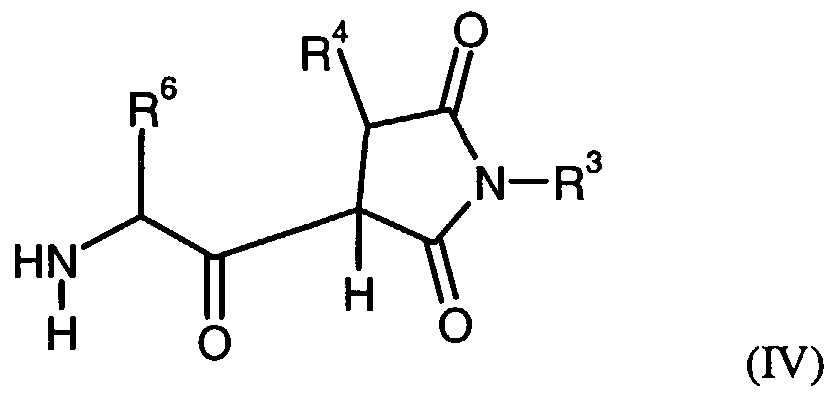
Die Verbindungen der Formel (VI) sind bekannt oder können hergestellt werden, indem Verbindungen der Formel (IV) mit Verbindungen der Formel
worin R2, R5, A und n die oben angegebene Bedeutung aufweisen, wobei diese gegebenenfalls in aktivierter Form vorliegen können, umgesetzt werden.
Zur Überführung der Verbindungen in die aktivierte Form sind beispielsweise Carbodiimide wie z.B. N,N'-Diethyl-, N,N,'-Dipropyl-, N,N'-Diisopropyl-, N,N'-Dicyclohexylcarbodiimid, N-(3-Di- methylaminoisopropyl)-N'-ethylcarbodiimid-Hydrochlorid (EDC) (gegebenenfalls in Gegenwart von Pentafluoφhenol (PFP)), N-Cyclohexylcarbodiimid-N '-propyloxymethyl-Polystyrol (PS- Carbodiimid) oder Carbonylverbindungen wie Carbonyldiimidazol, oder 1,2-Oxazoliumver- bindungen wie 2-Ethyl-5-phenyl-l,2-oxazolium-3-sulfat oder 2-tert.-Butyl-5-methyl-isoxazolium- perchlorat, oder Acylaminoverbindungen wie 2-Ethoxy-l-ethoxycarbonyl-l,2-dihydrochinolin, oder Propanphosphonsäureanhydrid, oder Isobutylchloroformat, oder Bis-(2-oxo-3-oxazolidinyl)- phosphorylchlorid oder Benzotriazolyloxy-tri(dimethylamino)phosphoniumhexafluorophosphat, oder O-(Benzotriazol-l-yl)-N,N,N',N'-tetra-methyluronium-hexafluorophosphat (HBTU), 2-(2- Oxo-l-(2H)-pyridyl)-l,l,3,3-tetramethyluroniumtetrafluoroborat (TPTU) oder O-(7-Azabenzo- triazol-l-yl)-N,N,N',N'-tetramethyl-uroniumhexafluorophosphat (HATU), oder 1-Hydroxybenz- triazol (HOBt), oder Benzotriazol-l-yloxytris(dimethylamino)-phosphoniumhexafluoro-phosphat (BOP), oder Mischungen aus diesen mit Basen geeignet.
Basen sind beispielsweise Alkalicarbonate, wie z.B. Natrium- oder Kaliumcarbonat, oder -hydro- gencarbonat, oder organische Basen wie Trialkylamine z.B. Triethylamin, N-Methylmoφholin, N- Methylpiperidin, 4-Dimethylaminopyridin oder Diisopropylethylamin.
Bevorzugt ist die Verwendung von HATU mit Diisopropylethylamin und von EDC mit HOBt und Triethylamin.
Als Lösemittel eignen sich hierbei inerte organische Lösemittel, die sich unter den Reaktionsbedingungen nicht verändern. Hierzu gehören Halogenkohlenwasserstoffe wie Dichlormethan oder Trichlormethan, Kohlenwasserstoff wie Benzol, Xylol, Toluol, Hexan, Cyclohexan, oder Erdölfraktionen, Nitromethan, Dimethylformamid oder Acetonitril oder Ether wie Diethylether, Tetra- hydrofuran oder Dioxan. Ebenso ist es möglich, Gemische der Lösemittel einzusetzen. Besonders bevorzugt sind Dichlormethan oder eine Mischung von Dichlormethan und Dimethylformamid.
Die Verbindungen der Formel (IV) sind bekannt oder und können hergestellt werden, indem Ver- bindungen der Formel
worin R3, R4 und R6 die oben angegebene Bedeutung aufweisen,
mit Säure, insbesondere mit Salzsäure oder Trifluoressigsäure versetzt werden.
Als Lösemittel eignen sich hierbei inerte organische Lösemittel, die sich unter den Reaktionsbe- dingungen nicht verändern. Hierzu gehören Halogenkohlenwasserstoffe wie Dichlormethan oder Trichlormethan, Kohlenwasserstoffe wie Benzol, Xylol, Toluol, Hexan, Cyclohexan, oder Erdölfraktionen, Nitromethan, Dimethylformamid oder Acetonitril oder Ether wie Diethylether, Tetra- hydrofuran oder Dioxan. Ebenso ist es möglich, Gemische der Lösemittel einzusetzen. Besonders bevorzugt ist die Verwendung von Salzsäure in Dioxan oder Trifluoressigsäure in Dichlormethan.
Die Verbindungen der Formel (VII) sind bekannt oder können nach literaturbekannten Vorschriften hergestellt werden. (Bzgl. der Darstellung von aromatischen beta-Aminosäuren s. z.B. S. Rault, P. Dallemagne, M. Robba, Bull. Soc. Chim. Fr., 1987, 1079-1083; S. G. Davies et al., J. Chem. Soc, Chem. Commun., 1993, 1153-1155; V. A. Soloshonok et al., Tetrahedron Asymmetry, 1995, 1601-1610; bzgl. der Umsetzung zu den tert-Butoxycarbonyl-geschützten Verbindungen s. T. W. Greene, P. G. M. Wuts, Protective Groups in Organic Synthesis, 3rd Edt. 1999, J. Wiley & Sons, Inc.).
Die Verbindungen der Formel (VJJI) sind bekannt oder können nach literaturbekannten Verfahren hergestellt werden. (Vgl. z.B. S. G. Davies, D. J. Dixon, J. Chem. Soc, Perkin Trans. 1, 1998, 17, 2635-2643; A. V. Rama Rao, A. K. Singh, Ch. V. N. S. Varaprasad, Tetrahedron Letters, 1991, 32, 4393-4396).
Die Verbindungen der Formel (III) sind bekannt oder können nach literaturbekannten Verfahren hergestellt werden (Houben-Weyl, Methoden der organischen Chemie, Bd. E5, Carbonsäuren und Carbonsäure-Derivate, Thieme Verlag, Stuttgart, 1985).
Verfahren TBI
Die Verbindungen der Formel (V) sind bekannt oder und können hergestellt werden, indem Ver- bindungen der Formel
worin R1, R2, R5, A und n die oben angegebene Bedeutung aufweisen, und
R7 für einen Alkylrest steht, verseift werden.
Die Verseifung kann nach Standardverfahren durchgeführt werden, z.B. bei Raumtemperatur in einem Gemisch aus Ethanol und Wasser mit 40 %iger Natronlauge oder mit 10 %iger methanolischer Kaliumhydroxidlösung in einem Gemisch aus Dioxan und Wasser.
Die Verbindungen der Formel (LX) sind bekannt oder können hergestellt werden, indem Verbindungen der Formel
worin R , R , R , A und n die oben angegebene Bedeutung aufweisen,
mit Verbindungen der Formel (HI), wobei diese gegebenenfalls in aktivierter Form vorliegen können, umgesetzt werden.
Zur Überführung der Verbindungen in die aktivierte Form in den obengenannten Verfahren sind beispielsweise Carbodiimide wie z.B. N,N'-Diethyl-, N,N,'-Dipropyl-, N,N'-Diisopropyl-, N,N'- Dicyclohexylcarbodiimid, N-(3-Dimethylaminoisopropyl)-N,-ethylcarbodiimid-Hydrochlorid
(EDC) (gegebenenfalls in Gegenwart von Pentafluoφhenol (PFP)), N-Cyclohexylcarbodiimid-N'- propyloxymethyl-Polystyrol (PS-Carbodiimid) oder Carbonylverbindungen wie Carbonyldi- imidazol, oder 1 ,2-Oxazoliumverbindungen wie 2-Ethyl-5-phenyl-l,2-oxazolium-3-sulfat oder 2- tert.-Butyl-5-methyl-isoxazolium-perchlorat, oder Acylaminoverbindungen wie 2-Ethoxy-l- ethoxycarbonyl-l,2-dihydrochinolin, oder Propanphosphonsäureanhydrid, oder Isobutylchloro- format, oder Bis-(2-oxo-3-oxazolidinyl)-phosphorylchlorid oder Benzotriazolyloxy-tri(dimethyl- amino)phosphoniumhexafluorophosphat, oder O-(Benzotriazol-l-yl)-N,N,N',N'-tetra-methyl- uronium-hexafluorophosphat (HBTU), 2-(2-Oxo- 1 -(2H)-pyridyl)- 1,1,3,3 -tetramethyluroniumtetra- fluoroborat (TPTU) oder O-(7-Azabenzotriazol-l-yl)-N,N,N',N'-tetramethyluroniumhexafluoro- phosphat (HATU), oder 1-Hydroxybenztriazol (HOBt), oder Benzotriazol-l-yloxytris(di- methylamino)-phosphoniumhexafluorophosphat (BOP), oder Mischungen aus diesen mit Basen geeignet.
Basen sind beispielsweise Alkalicarbonate, wie z.B. Natrium- oder Kaliumcarbonat, oder -hydro- gencarbonat, oder organische Basen wie Trialkylamine z.B. Triethylamin, N-Methylmoφholin, N- Methylpiperidin, 4-Dimethylaminopyridin oder Diisopropylethylamin.
Bevorzugt ist die Verwendung von HATU mit Diisopropylethylamin und von EDC mit HOBt und Triethylamin.
Als Lösemittel eignen sich hierbei inerte organische Lösemittel, die sich unter den Reaktionsbedingungen nicht verändern. Hierzu gehören Halogenkohlenwasserstoffe wie Dichlormethan oder Trichlormethan, Kohlenwasserstoff wie Benzol, Xylol, Toluol, Hexan, Cyclohexan, oder Erdölfraktionen, Nitromethan, Dimethylformamid oder Acetonitril oder Ether wie Diethylether, Tetra- hydrofuran oder Dioxan. Ebenso ist es möglich, Gemische der Lösemittel einzusetzen. Besonders bevorzugt sind Dichlormethan oder eine Mischung von Dichlormethan und Dimethylformamid.
Die Verbindungen der Formel (X) sind bekannt oder können nach literaturbekannten Verfahren hergestellt werden (Bzgl. der Darstellung von aromatischen beta-Aminosäuren und ihrer Umwandlung in die entsprechenden Alkylester s. z.B. S. Rault, P. Dallemagne, M. Robba, Bull. Soc. Chim. Fr., 1987, 1079-1083; S. G. Davies et al., J. Chem. Soc, Chem. Commun., 1993, 1153-1155;
V. A. Soloshonok et al., Tetrahedron Asymmetry, 1995, 1601-1610; S. J. Faulconbridge et al., Tetrahedron Letters, 2000, 41, 2679-2682).
Die Herstellung der erfindungsgemäßen Verbindungen kann durch folgende Syntheseschemata beispielhaft verdeutlicht werden.
Ausgangsverbindungen:
HCI/Dioxa
Methode A
(3)
HCI/Dioxan
Methode B
Die vorliegende Erfindung betrifft weiterhin Verbindungen der Formel (I) zur Bekämpfung von Erkrankungen, insbesondere bakterieller Erkrankungen, sowie Arzneimittel, enthaltend Verbindungen der Formel (I) und Hilfsstoffe und auch die Verwendung von Verbindungen der Formel (I) zur Herstellung eines Arzneimittels zur Behandlung von bakteriellen Erkrankungen.
Besonders wirksam sind die erfindungsgemäßen Zubereitungen gegen Bakterien und bakterienähnliche Mikroorganismen. Sie sind daher besonders gut zur Prophylaxe und Chemotherapie von lokalen und systemischen Infektionen in der Human- und Tiermedizin geeignet, die durch diese Erreger hervorgerufen werden.
Beispielsweise können lokale und/oder systemische Erkrankungen behandelt und/oder verhindert werden, die durch die folgenden Erreger oder durch Mischungen der folgenden Erreger verursacht werden:
Gram-positive Kokken, z.B. Staphylokokken (Staph. aureus, Staph. epidermidis), Enterokokken (E. faecalis, E. faecius) und Streptokokken (Strept. agalactiae, Strept. pneumoniae); gram-negative Kokken (Neisseria gonorrhoeae) sowie gram-negative Stäbchen wie Enterobakteriaceen, z.B. Escherichia coli, Hämophilus influenzae, Citrobacter (Citrob. freundii, Citrob. divernis), Salmonella und Shigella; ferner Klebsiellen (Klebs. pneumoniae, Klebs. oxytocy), Enterobacter (Ent. aerogenes, Ent. agglomerans), Hafhia, Serratia (Serr. marcescens), Providencia, Yersinia, sowie die Gattung Acinetobacter. Darüber hinaus umfasst das antibakterielle Spektrum strikt anaerobe Bakterien wie z.B. Bacteroides fragilis, Vertreter der Gattung Peptococcus, Peptostreptococcus sowie die Gattung Clostridium; ferner Mykoplasmen (M. pneumoniae, M. hominis, M. urealyticum) sowie Mykobakterien, z.B. Mycobacterium tuberculosis.
Die obige Aufzählung von Erregern ist lediglich beispielhaft und keineswegs beschränkend aufzufassen. Als Krankheiten, die durch die genannten Erreger oder Mischinfektionen verursacht und durch die erfindungsgemäßen Zubereitungen verhindert, gebessert oder geheilt werden können, seien beispielsweise genannt:
Infektionskrankheiten beim Menschen wie z.B. septische Infektionen, Knochen- und Gelenkinfektionen, Hautinfektionen, postoperative Wundinfektionen, Abszesse, Phlegmone, Wundinfektionen, infizierte Verbrennungen, Brandwunden, Infektionen im Mundbereich, Infektionen nach Zahnoperationen, septische Arthritis, Mastitis, Tonsillitis, Genital-Infektionen und Augeninfek- tionen.
Außer beim Menschen können bakterielle Infektionen auch bei anderen Spezies behandelt werden. Beispielhaft seien genannt:
Schwein: Coli-diarrhoe, Enterotoxamie, Sepsis, Dysenterie, Salmonellose, Metritis-Mastitis- Agalaktiae-Syndrom, Mastitis;
Wiederkäuer (Rind, Schaf, Ziege): Diarrhöe, Sepsis, Bronchopneumonie, Salmonellose, Pasteurellose, Mykoplasmose, Genitalinfektionen;
Pferd: Bronchopneumonien, Fohlenlähme, pueφerale und postpueφerale Infektionen, Salmonellose;
Hund und Katze: Bronchopneumonie, Diarrhöe, Dermatitis, Otitis, Harnwegsinfekte, Prostatitis;
Geflügel (Huhn, Pute, Wachtel, Taube, Ziervögel und andere): Mycoplasmose, E. coli-I-nfektionen, chronische Luftwegserkrankungen, Salmonellose, Pasteurellose, Psittakose.
Ebenso können bakterielle Erkrankungen bei der Aufzucht und Haltung von Nutz- und Zierfischen behandelt werden, wobei sich das antibakterielle Spektrum über die vorher genannten Erreger hinaus auf weitere Erreger wie z.B. Pasteurella, Brucella, Campylobacter, Listeria, Erysipelothris, Corynebakterien, Borellia, Treponema, Nocardia, Rikettsie, Yersinia, erweitert.
Der Wirkstoff kann systemisch und/oder lokal wirken. Zu diesem Zweck kann er auf geeignete Weise appliziert werden, wie z.B. oral, parenteral, pulmonal, nasal, sublingual, lingual, buccal, rectal, transdermal, conjunctival, otisch oder als Implantat.
Für diese Applikationswege kann der Wirkstoff in geeigneten Applikationsformen verabreicht werden.
Für die orale Applikation eignen sich bekannte, den Wirkstoff schnell und/oder modifiziert abgebende Applikationsformen, wie z.B. Tabletten (nichtüberzogene sowie überzogene Tabletten, z.B. mit magensaftresistenten Überzügen versehene Tabletten oder Filmtabletten), Kapseln, Dragees, Granulate, Pellets, Pulver, Emulsionen, Suspensionen und Lösungen.
Die parenterale Applikation kann unter Umgehung eines Resoφtionsschrittes geschehen (intravenös, intraarteriell, intrakardial, intraspinal oder intralumbal) oder unter Einschaltung einer Resoφtion (intramuskulär, subcutan, intracutan, percutan, oder intraperitoneal). Für die parenterale Applikation eignen sich als Applikationsformen u.a. Injektions- und Infusionszubereitungen in Form von Lösungen, Suspensionen, Emulsionen, Lyophilisaten und sterilen Pulvern.
Bevorzugt ist die parenterale, insbesondere die intravenöse Applikation.
Für die sonstigen Applikationswege eignen sich z.B. Inhalationsarzneiformen (u.a. Pulver- inhalatoren, Nebulizer), Nasentropfen/-lösungen, Sprays; lingual, sublingual oder buccal zu applizierende Tabletten oder Kapseln, Suppositorien, Ohren- und Augenpräparationen, Vaginalkapseln, wässrige Suspensionen (Lotionen, Schüttelmixturen), lipophile Suspensionen, Salben, Cremes, Milch, Pasten, Streupuder oder Implantate.
Die Wirkstoffe können in an sich bekannter Weise in die angeführten Applikationsformen überführt werden. Dies geschieht unter Verwendung inerter nichttoxischer, pharmazeutisch geeigneter Hilfsstoffe. Hierzu zählen u.a. Trägerstoffe (z.B. mikrokristalline Cellulose), Lösungsmittel (z.B. flüssige Polyethylenglycole), Emulgatoren (z.B. Natriumdodecylsulfat), Dispergiermittel (z.B. Polyvinylpyrrolidon), synthetische und natürliche Biopolymere (z.B. Albumin), Stabilisatoren (z.B. Antioxidantien wie Ascorbinsäure), Farbstoffe (z.B. anorganische Pigmente wie Eisenoxide) oder Geschmacks- und / oder Geruchskorrigentien.
Im Allgemeinen hat es sich als vorteilhaft erwiesen, bei parenteraler Applikation Mengen von etwa 5 bis 250 mg/kg Köφergewicht je 24 Stunden zur Erzielung wirksamer Ergebnisse zu verab- reichen. Bei oraler Applikation beträgt die Menge etwa 5 bis 100 mg/kg Köφergewicht je 24 Stunden.
Trotzdem kann es gegebenenfalls erforderlich sein, von den genannten Mengen abzuweichen, und zwar in Abhängigkeit von Köφergewicht, Applikationsweg, individuellem Verhalten gegenüber dem Wirkstoff, Art der Zubereitung und Zeitpunkt bzw. Intervall, zu welchem die Applikation erfolgt.
Die Prozentangaben in den folgenden Tests und Beispielen sind, sofern nicht anders angegeben, Gewichtsprozente; Teile sind Gewichtsteile. Lösungsmittelverhältnisse, Verdünnungsverhältnisse und Konzentrationsangaben von flüssig/flüssig-Lösungen beziehen sich jeweils auf das Volumen.
A. Beispiele
Reaktionsschemata, die bei Allgemeinen Vorschriften gezeigt werden, zeigen eine Auswahl an Beispielen, sind aber jeweils für alle Beispiele anwendbar, die darauf Bezug nehmen.
Abkürzungen:
Boc tert.-Butoxycarbonyl
CDCI3 Deuterochloroform
DCI Direkte Chemische Ionisation
DIEA N,N-Diisopropylethylamin
DMSO Dimethylsulfoxid d. Th. der Theorie
EDC Ν-(3-Dimethylaminoisopropyl)-Ν'-ethylcarbodiimid-Hydrochlorid eq. Äquivalent
ES Elektrospray-Ionisation (bei MS)
Fmoc Fluorenylmethoxycarbonyl ges. gesättigt
HATU 0-(7-Azabenzotriazol-l-yl)-N,N,N',N'-tetramethyluronium-
Hexafluoφhosphat h Stunde
HOBt 1 -Hydroxybenzotriazol
HPLC Hochdruck-, Hochleistungsflüssigchromatographie
LC-MS Flüssigchromatographie-gekoppelte Massenspektroskopie
MS Massenspektroskopie
MW Molekulargewicht [g/mol]
NMR Kernresonanzspektroskopie
PS-DΓEA N, N-Diisopropylethylamin-Poly styrol (-Harz)
Rf Retentionsindex (bei DC)
RP-HPLC Reverse Phase HPLC
RT Raumtemperatur t Retentionszeit (bei HPLC)
THF Tetrahydrofuran
HPLC und LC-MS Methoden:
Methode 1: Säule: Kromasil C18, L-R Temperatur: 30°C, Fluss = 0.75 mlmin"1, Eluent A: 0.01 M HC104, Eluent B: Acetonitril, Gradient: → 0.5 min 98%A → 4.5 min 10%A → 6.5 min 10%A.
Methode 2: Säule: Kromasil C18 60*2 mm, L-R Temperatur: 30°C, Fluss = 0.75 mlmin"1, Eluent A: 0.01 M H3PO4, Eluent B: Acetonitril, Gradient: → 0.5 min 90%A → 4.5 min 10%A → 6.5 min 10%A.
Methode 3: Säule: Kromasil C18 60*2 mm, L-R Temperatur: 30°C, Fluss = 0.75 mlmin'1, Eluent A: 0.005 M HClO4, Eluent B: Acetonitril, Gradient: → 0.5 min 98%A → 4.5 min 10% A → 6.5 min 10%A.
Methode 4: Säule: Symmetry C18 2.1x150 mm, Säulenofen: 50°C, Fluss = 0.6 mlmin"1, Eluent A: 0.6 g 30%ige Salzsäure/ 1 Wasser, Eluent B: Acetonitril, Gradient: 0.0 min 90%A → 4.0 min 10%A → 9 min 10%A.
Methode 5: Instrument Micromass Quadro LCZ; Säule Symmetry C18, 50 mm x 2.1 mm, 3.5 μm, Temperatur: 40°C, Fluss = 0.5 mlmin'1, Eluent A: Acetonitril + 0.1% Ameisensäure, Eluent B: Wasser + 0.1% Ameisensäure, Gradient: 0.0 min 10% A → 4 min 90% A → 6 min 90% A
Methode 6: Instrument Micromass Platform LCZ; Säule Symmetry C18, 50 mm x 2.1 mm, 3.5 μm, Temperatur: 40°C, Fluss = 0.5 mlmin"1, Eluent A: Acetonitril + 0.1% Ameisensäure, Eluent B: Wasser + 0.1% Ameisensäure, Gradient: 0.0 min 10% A -) 4 min 90% A — *> 6 min 90% A.
Methode 7: Instrument Micromass Quattro LCZ; Säule Symmetry C18, 50 mm x 2.1 mm, 3.5 μm, Temperatur: 40°C, Fluss = 0.5 mlmin"1, Eluent A: Acetonitril + 0.1% Ameisensäure, Eluent B: Wasser + 0.1% Ameisensäure, Gradient: 0.0 min 5% A — > 1 min 5% A — > 5 min 90% A → 6 min 90% A.
Methode 8: Säule: Symmetry C18 2.1 mm x 150 mm, 5 μm, Säulenofen: 70°C, Fluss = 0.9 mlmin" ', Eluent A: Acetonitril, Eluent B: 0.3 g 30%ige Salzsäure/ 1 Wasser, Gradient: 0.0 min 2% A → 2.5 min 95% A → 5 min 95% A.
Methode 9: Säule: Symmetry C18 3.9 mm x 150 mm, Säulenofen: 40°C, Fluss = 1.5 mlmin'1, Eluent A: Wasser + 0.05% H3PO4, Eluent B: Acetonitril, Gradient: 0.0 min 10% B → 0.6 min 10% B → 3.8 min 100% B → 5.0 min 100% B.
Methode 10: Instrument: Waters Alliance 2790 LC; Säule: Symmetry C18, 50 mm x 2.1 mm, 3.5 μm; Eluent A: Wasser + 0.1% Ameisensäure, Eluent B: Acetonitril + 0.1% Ameisensäure; Gradient: 0.0 min 5% B *- 5.0 min 10% B -> 6.0 min 10% B; Temperatur: 50°C, Fluss: 1.0 ml/min, UV-Detektion: 210 nm.
Methode 11: Gerätetyp MS: Micromass ZQ; Gerätetyp HPLC: Waters Alliance 2790; Säule: Symmetry C 18, 50 mm x 2.1 mm, 3.5 μm; Eluent B: Acetonitril + 0.05% Ameisensäure, Eluent A: Wasser + 0.05% Ameisensäure; Gradient: 0.0 min 10%B - 3.5 min 90%B - 5.5 min 90% B; Ofen: 50 °C, Fluss: 0.8 ml/min, UV-Detektion: 210 nm.
Methode 12: Instrument: Waters Alliance 2790 LC; Säule: Symmetry C18, 50 mm x 2.1 mm, 3.5 μm; Eluent A: Wasser + 0.05% Ameisensäure, Eluent B: Acetonitril + 0.05% Ameisensäure; Gradient: 0.0 min 5% B - 4.5 min 10% B - 5.5 min 10% B; Temperatur: 50°C, Fluss: 1.0 ml/min, UV-Detektion: 210 nm.
Methode 13: Instrument: Micromass Quattro LCZ, HP1100; Säule: Symmetry C18, 50 mm x 2.1 mm, 3.5 μm; Eluent A: Wasser + 0.05% Ameisensäure, Eluent B: Acetonitril + 0.05% Ameisensäure; Gradient: 0.0 min 90% A - 4.0 min 10% A -> 6.0min 10% A; Ofen: 40°C, Fluss: 0.5 ml/min, UV-Detektion: 208-400 nm.
Methode 14: Instrument: Micromass Platform LCZ, HP1100; Säule: Symmetry C18, 50 mm x 2.1 mm, 3.5 μm; Eluent A: Wasser + 0.05% Ameisensäure, Eluent B: Acetonitril + 0.05% Ameisensäure; Gradient: 0.0 min 90%A - 4.0 min 10% A - 6.0 min 10% A; Ofen: 40°C, Fluss: 0.5 ml/min, UV-Detektion: 208-400 nm.
Methode 15: Instrument: Waters Alliance 2790 LC; Säule: Symmetry C18, 50 mm x 2.1 mm, 3.5 μm; Eluent A: Wasser + 0.05% Ameisensäure, Eluent B: Acetonitril + 0.05% Ameisensäure; Gradient: 0.0 min 10% B -*» 4.0 min 90% B - 6.0 min 90% B; Temperatur: 50°C, Fluss: 0.0 min 0.5 ml/min *- 4.0 min 0.8 ml/min, UV-Detektion: 210 nm.
Methode 16: Gerätetyp MS: Micromass ZQ; Gerätetyp HPLC: Waters Alliance 2790; Säule: Symmetry C 18, 50 mm x 2.1 mm, 3.5 μm; Eluent B: Acetonitril + 0.05% Ameisensäure, Eluent A: Wasser + 0.05% Ameisensäure; Gradient: 0.0min 5%B 4.5min 90%B 5.5min 90%B; Ofen: 50 °C, Fluss: 1.0ml/, UV-Detektion: 210 nm.
Methode 17: Gerätetyp MS: Micromass ZQ; Gerätetyp HPLC: Waters Alliance 2790; Säule: Uptisphere C 18, 50 mm x 2.0 mm, 3.0 μm; Eluent B: Acetonitril + 0.05% Ameisensäure, Eluent
A: Wasser + 0.05% Ameisensäure; Gradient: 0.0min 5%B - 2.0min 40%B - 4.5min 90%B->
5.5min 90%B; Ofen: 45 °C, Fluss: 0.0min 0.75ml ιnin -> 4.5min 0.75ml min-> 5.5min 1.25ml/min, UV-Detektion: 210 nm.
Methode 18: Instrument: Micromass Platform LCZ mit HPLC Agilent Serie 1100; Säule: Grom- SIL120 ODS-4 HE, 50 mm x 2.0 mm, 3 μm; Eluent A: 11 Wasser + 1ml 50%ige Ameisensäure, Eluent B: 11 Acetonitril + 1ml 50%ige Ameisensäure ; Gradient: 0.0min 100%A - 0.2min 100%A - 2.9min 30%A - 3.1min 10%A -» 4.5min 10%A; Ofen: 55°C, Fluss: 0.8ml/min, UV- Detektion: 208-400 nm.
Methode 19: Instrument: Micromass Quattro LCZ, mit HPLC Agilent Serie 1100 ; Säule: Grom- SIL120 ODS-4 HE, 50 mm x 2.0 mm, 3 μm; Eluent A: 11 Wasser + 1ml 50%ige Ameisensäure, Eluent B: 11 Acetonitril + 1ml 50%ige Ameisensäure; Gradient: 0.0min 100%A - 0.2min 100%A -» 2.9min 30%A - 3.1min 10%A -* 4.5min 10%A; Ofen: 55°C, Fluss: 0.8ml/min, UV- Detektion: 208-400 nm.
Methode 20: Gerätetyp MS: Micromass ZQ; Gerätetyp HPLC: Waters Alliance 2790; Säule: Grom-Sil 120 ODS^l HE 50 x 2 mm, 3.0 μm; Eluent B: Acetonitril + 0.05% Ameisensäure, Eluent A: Wasser + 0.05% Ameisensäure; Gradient: 0.0min 5%B -» 2.0min 40%B -> 4.5min 90%B- 5.5min 90%B; Ofen: 45 °C; Fluss: 0.0min 0.75ml min - 4.5min 0.75ml/min-> 5.5min 1.25ml/min; UV-Detektion: 210 nm.
Methode 21: Gerätetyp MS: Micromass ZQ; Gerätetyp HPLC: Waters Alliance 2790; Säule: Grom-Sil 120 ODS-4 HE 50x2 mm, 3.0 μm; Eluent B: Acetonitril + 500μl 50%ige Ameisensäure / 1; Eluent A: Wasser + 500μl 50%ige Ameisensäure / 1; Gradient: 0.0min 0%B - 0.2min 0%B - 2.9min 70%B- 3.1min 90%B -* 4.5min 90%B, Ofen: 50 °C, Fluss:0.8 ml/min; UV-Detektion: 210 nm.
Methode 22: Instrument: Micromass Quattro LCZ mit HPLC Agilent Serie 1100; Säule: UPTISPHERE HDO, 50 mm x 2.0 mm, 3 μm; Eluent A: 11 Wasser + 1ml 50%ige Ameisensäure, Eluent B: 11 Acetonitril + 1ml 50%ige Ameisensäure; Gradient: 0.0min 100%A - 0.2min 100%A - 2.9min 30%A -» 3.1min 10%A -* 4.5min 10%A; Ofen: 55°C, Fluss: 0.8ml/min, UV- Detektion: 208-400 nm.
Ausgangsverbindungen:
Beispiel 1A
(3S)-l,3-Dimethyl-2,5-pyrrolidindion
600 mg (5.26 mmol) (3S)-3-Methyldihydro-2,5-furandion (Darstellung: S. G. Davies, D. J. Dixon, J. Chem. Soc, Perkin Trans. 1, 1998, 17, 2635 - 2643) werden zusammen mit 559 mg (0.77 ml, 5.52 mmol) Triethylamin in 5 ml Dichlormethan bei 0°C vorgelegt und mit 373 mg (5.52 mmol) Methylamin Hydrochlorid versetzt. Das Reaktionsgemisch wird über Nacht bei Raumtemperatur gerührt und dann portionsweise mit 938 mg (5.78 mmol) N,N-Carbonyldiimidazol versetzt. Es wird 1.5 h bei Raumtemperatur und 30 min bei Rückflusstemperatur gerührt. Nach Abkühlen auf Raumtemperatur wird das Reaktionsgemisch mit 5%iger Salzsäure und Wasser gewaschen, die organische Phase wird über Magnesiumsulfat getrocknet, filtriert und eingeengt und das Produkt wird am Hochvakuum getrocknet. Es werden 605 mg des Produktes erhalten (88 % der Theorie).
MS (ES+): m/z (%) = 128 (M+H)+ (100).
HPLC (Methode 6): Rt = 0.81 min.
Η-NMR (300 MHz, CDC13): δ = 3.10 (dd, 1 H), 2.99 (s, 3 H), 2.90-2.82 (m, 1 H), 2.32 (dd, 1 H), 1.35 (d, 3 H).
Analog zu Beispiel 1A werden folgende Verbindungen durch Umsetzung von (35)-3-Methyl- dihydro-2,5-furandion mit den entsprechenden primären Aminen, Hydroxylamin- oder Hydrazinderivaten erhalten. Die Rohprodukte können durch RP-HPLC (Eluent: Wasser- Acetonitril, Gradient) gereinigt werden.
Beispiel 5A
(3R,4S)-3-[(2S)-2-(tert-Butoxycarbonyl)amino-3-methylbutanoyl]-l,4-dimethyl-2,5-pyrrolidindion
684 mg (3.15 mmol) N-(tert.-Butoxycarbonyl)-L-valin und 561 mg (3.46 mmol) N,N- Carbonyldiimidazol werden in 4 ml Tetrahydrofuran 2 h lang bei Raumtemperatur gerührt. Zu diesem Gemisch werden dann 400 mg (3.15 mmol) (3S)-l,3-Dimethyl-2,5-pyrrolidindion gegeben und die gesamte Mischung wird innerhalb von 30 min zu 6.3 ml einer auf -65°C gekühlten 1 molaren Lösung von Lithium-hexamethyldisilazid in THF getropft. Nach beendeter Zugabe wird weitere 15 min bei -65 °C gerührt, bevor 6 ml gesättigter wässriger Ammoniumchlorid-Lösung zugegeben werden. Nach Erwärmung auf Raumtemperatur wird das Reaktionsgemisch mit Diethylether verdünnt und die organische Phase mit gesättigter wässriger Natriumchlorid-Lösung gewaschen und anschließend eingeengt. Das Rohprodukt wird durch RP-HPLC (Eluent: Wasser-
Acetonitril, Gradient) gereinigt. Es werden 223 mg (22 % der Theorie) des gewünschten Produkts erhalten.
MS (ES-): m/z (%) = 325 (M-H)" (35).
HPLC (Methode 5): R, = 3.99 min.
Η-NMR (200 MHz, CDC13): δ = 5.70 (br. d, 1 H), 4.57 (dd, 1 H), 3.78 (d, 1 H), 3.47-3.30 (m, 1 H), 2.98 (s, 3 H), 2.50- 2.32 (m, 1 H), 1.46 (s, 9 H), 1.32 (d, 3 H), 1.02 (d, 3 H), 0.80 (d, 3 H).
Allgemeine Vorschrift A: Umsetzung von N-tert.-ButoxycarbonvI-geschützten Aminosäuren mit 2,5-Pyrrolidindion Derivaten
Die N-tert.-Butoxycarbonyl-geschützte Aminosäure (1 eq.) und N,N-Carbonyldiimidazol (1.1 eq.) werden in Tetrahydrofuran (ca. 0.1 - 1 mol/1) 2 h lang bei Raumtemperatur gerührt. Zu diesem Gemisch wird dann das 2,5-Pyrrolidindion (1 eq.) gegeben und die gesamte Mischung wird innerhalb von 30 min zu einer auf -65 °C gekühlten 1 molaren Lösung von Lithium-hexamethyldisilazid (2 eq.) in THF getropft. Nach beendeter Zugabe wird weitere 15 min bei -65°C gerührt, bevor gesättigte wässrige Ammoniumchlorid-Lösung zugegeben wird. Nach Erwärmung auf Raumtemperatur wird das Reaktionsgemisch mit Diethylether verdünnt und die organische Phase mit gesättigter wässriger Natriumchlorid-Lösung gewaschen, über Magnesiumsulfat getrocknet, filtriert und anschließend eingeengt. Das Rohprodukt wird durch RP-HPLC (Eluent: Wasser-Acetonitril, Gradient) gereinigt.
Nach der Allgemeinen Vorschrift A können durch Umsetzung der entsprechenden N-tert.-Butoxy- carbonyl-geschützten Aminosäuren (bzgl. der Darstellung von unnatürlichen alpha-Aminosäuren siehe z.B.: A. A. Cordi et al, J. Med. Chem. 2001, 44, 787-805; K. Mai, G. Patil, Tetrahedron Lett. 1984, 25, 4583-4586; N. A. Hassan, E. Bayer, J. C. Jochims, /. Chem. Soc, Perkin Trans. 1 1998, 3747-3757; bzgl. der tert.-Butoxycarbonyl-Schützung siehe z.B.: T. W. Greene, P. G. M. Wuts, Protective Groups in Organic Synthesis, 3
rd Edt. 1999, J. Wiley & Sons, Inc.) mit 2,5- Pyrrolidindionen (bzgl. der Darstellung von (3S)-l-(Benzyloxy)-3-methyl-2,5-pyrrolidindion siehe: S. G. Davies, D. J. Dixon, /. Chem. Soc, Perkin Trans. 1, 1998, 17, 2635-2643) folgende Derivate erhalten werden:
Allgemeine Vorschrift B: Reduktive Entschützung von l-Benzyloxy-2,5-pyrrolidindionen
Die Entschützung erfolgt analog zu S. G. Davies, D. J. Dixon, J. Chem. Soc, Perkin Trans. 1, 1998, 77, 2635 - 2643.
Das l-Benzyloxy-2,5-pyrrolidindion (1 eq) wird in Methanol gelöst (ca. 0.02 mol/1), mit einer katalytischen Menge Palladium-Kohle (10%) versetzt und 1 h unter Wasserstoffatmosphäre
(Normaldruck) gerührt. Dann wird das Reaktionsgemisch filtriert und eingeengt. Der Rückstand wird in Acetonitril gelöst (ca. 0.05 mol 1) und zu einer Lösung von 2-Bromacetophenon (1 eq) in Acetonitril (ca. 0.03 mol/1) bei Raumtemperatur getropft. Danach werden über einen Zeitraum von 2 h 1.5 eq Triethylamin in Acetonitril (ca. 0.35 mol/1) zu der Reaktionsmischung getropft. Das Reaktionsgemisch wird über Nacht bei Raumtemperatur gerührt, eingeengt und das Rohprodukt wird mittels RP-HPLC (Eluent: Acetonitril/Wasser + 0.3 ml 37%ige Salzsäure/1, Gradient) gereinigt.
Nach der Allgemeinen Vorschrift B können folgende Verbindungen erhalten werden:
Beispiel 13A
(3R,45)-3-[(2S)-2-Amino-3-methylbutanoyl]-4-methyl-2,5-pyrrolidindion Hydrochlorid
Zu einer auf 0°C abgekühlten Lösung von 4.40 g (14.09 mmol) (3R,4S)-3-[(2S)-2-(tert- Butoxycarbonyl)amino-3-methylbutanoyl]-4-methyl-2,5-pyrrolidindion (Darstellung: S. G. Davies, D. J. Dixon, J. Chem. Soc, Perkin Trans. 1, 1998, 17, 2635 - 2643) in Dioxan werden 35 ml 4N Salzsäure-Lösung in 1,4-Dioxan getropft. Nach Ende der Zugabe wird die Mischung auf Raumtemperatur erwärmt und 2 h gerührt, bevor die Mischung im Vakuum eingeengt wird. Das
Rohprodukt kann direkt in der nächsten Stufe eingesetzt werden. Gegebenenfalls wird der Rückstand mit Diethylether behandelt und die ausgefallenen Kristalle werden abfiltriert und am Hochvakuum getrocknet.
Ausbeute: 2.99 g (86 % der Theorie).
MS (ES+): m/z (%) = 213 (M+H)+ (100).
HPLC (Methode 4): Rt = 0.41 min.
Allgemeine Vorschrift C: Deblockierung von Boc-geschützten Derivaten
Das tert.-Butyloxycarbonyl (BOC) geschützte Aminderivat (gegebenenfalls als Lösung in Dioxan) wird mit 4N Salzsäure-Lösung in 1,4-Dioxan versetzt (ca. 0.1 mol/1) und 2 - 24 h bei Raumtemperatur gerührt, bevor im Vakuum eingeengt wird. Der Rückstand kann ohne weitere Reinigung weiter umgesetzt werden oder wird gegebenenfalls mit Dichlormethan und Diethylether behandelt. Die ausgefallenen Kristalle werden abgesaugt und am Hochvakuum getrocknet. Man erhält das Produkt als Hydrochlorid.
Nach der Allgemeinen Vorschrift C können folgende Verbindungen erhalten werden:
Allgemeine Vorschrift D: Darstellung der beta-Aminosäuremethylester
Die beta- Aminosäure [Synthese nach literaturbekannten Vorschriften (z.B. S. Rault, P. Dallemagne, M. Robba, Bull. Soc. Chim. Fr., 1987, 1079-1083; L. Läzär, T. Martinek, G. Bernäth, F. Fülöp, Synth. Comm., 1998, 28, 219-224)] wird in Methanol vorgelegt (ca. 0.5 bis 1.0 mol/1) und bei 0°C tropfenweise mit 1.2 eq Thionylchlorid versetzt. Nach beendeter Zugabe wird das Reaktionsgemisch über Nacht bei Raumtemperatur gerührt und anschließend eingeengt. Der Rückstand wird in wenig Methanol gelöst und mit Diethylether wird das Produkt ausgefällt. Der Feststoff wird abgesaugt, mehrfach mit Diethylether gewaschen und im Vakuum getrocknet.
Alternativ kann die Aufarbeitung auch folgendermaßen erfolgen: Nach Eindampfen zur Trockene wird der Rückstand in Wasser aufgenommen und zweimal mit Essigsäureethylester gewaschen. Die organische Phase wird verworfen, die wässrige Phase wird mit gesättigter Natriumhydrogen-
carbonat-Lösung neutralisiert und erneut dreimal mit Essigsäureethylester extrahiert. Die organischen Phasen der letzten Extraktion werden über Natriumsulfat oder Magnesiumsulfat getrocknet, dekantiert und zur Trockene eingedampft.
Gemäß der Allgemeinen Arbeitsvorschrift D kann folgende Verbindung hergestellt werden:
Beispiel 20A
(S)-3-Amino-3-phenylpropionsäuremethylester
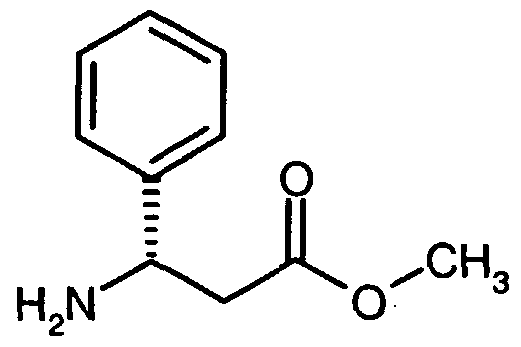
2.3 g (11.65 mmol) (S)-3-Amino-3-phenylpropionsäure werden in 100 ml Methanol vorgelegt und mit einer katalytischen Menge konzentrierter Schwefelsäure (0.02 eq.) versetzt. Das Reaktionsgemisch wird 24 h lang zum Rückfluss erhitzt und anschließend eingeengt. Das Rohprodukt kann ohne weitere Reinigung in der nächsten Stufe eingesetzt werden.
Ausbeute: 2.7 g (65 % der Theorie).
]H-NMR (300 MHz, d6-DMSO): δ = 8.50 (s, 2 H), 7.52-7.37 (m, 5 H), 4.61 (t, 1 H), 3.58 (s, 3 H), 3.13 (dd, l H), 2.98 (dd, 1 H).
MS (ES+): m/z (%) = 180 (M+H)+ (100).
Allgemeine Vorschrift E: Umsetzung von 3-Amino-3-phenyl-propionsäure-alkvIestern mit Carbonsäuren
Die Carbonsäure (1.3 - 1.5 eq) wird in Dichlormethan (ca. 0.1 mol/1) bei 0°C vorgelegt und mit 1.3 - 1.5 eq HATU versetzt. Zu dieser Mischung werden zunächst eine Lösung des 3-Amino-3-phenyl- propionsäure-alkylesters (1 eq.) in einem 1:1 Gemisch aus Dichlormethan und N,N- Dimethylformamid (ca. 0.1 mol/1) und anschließend über einen Zeitraum von lh eine Lösung von Diisopropylethylamin (3.5 eq) in einem 1: 1 Gemisch aus Dichlormethan und N,N-Dimethyl- formamid (ca. 1 mol/1) zugetropft. Es wird 30 min bei 0°C und anschließend über Nacht bei Raum- temperatur gerührt. Dann wird das Reaktionsgemisch eingeengt und mittels RP-HPLC (Eluent: Wasser-Acetonitril, Gradient) gereinigt.
Alternativ kann die Umsetzung auch nach folgendem Verfahren erfolgen:
Zu einer Lösung des 3-Aminopropionsäurealkylesters (1 eq.) in absolutem Dichlormethan oder einer Mischung (5:1 bis 1:1) von absolutem Dichlormethan und N,N-Dimethylformamid (ca. 0.1 bis 0.3 mol/1) werden das Carbonsäurederivat (1.1 - 1.5 eq.), Triethylamin (3 eq.), HOBt (3 eq.) und abschliessend 1.2 eq. EDC gegeben. Die Reaktionsmischung wird bei Raumtemperatur gerührt (2 h bis über Nacht), bevor im Vakuum eingeengt wird. Der Rückstand wird in Essigsäure- ethylester oder Dichlormethan aufgenommen und die organische Phase wird mit Wasser, gesättigter Natriumhydrogencarbonatlösung und gesättigter Kochsalzlösung gewaschen, über Natriumsulfat getrocknet, filtriert und eingeengt. Das Produkt kann durch Chromatographie an Silicagel (Eluenten: Gemische aus Cyclohexan/Essigsäureethylester oder Gemische aus Dichlormethan und Ethanol) oder durch RP-HPLC (Eluenten: variable Gradienten aus Wasser und Acetonitril), alternativ durch eine Kombination beider Verfahren, gereinigt werden.
Nach der Allgemeinen Vorschrift E kann folgende Verbindung erhalten werden:
Allgemeine Vorschrift F: Verseifung der Propionsäurealkylester
Der Propionsäurealkylester wird in einem 3:1 Gemisch aus Ethanol und Wasser vorgelegt (ca. 0.1 - 0.15 mol/1) und mit 5 eq 40%iger Natronlauge versetzt. Das Reaktionsgemisch wird 24 h bei Raumtemperatur gerührt, mit verdünnter Salzsäure angesäuert (ca. pH 3) und eingeengt. Der Rückstand wird in Essigsäureethylester aufgenommen und mit gesättigter wässriger Natriumchloridlösung gewaschen. Die organische Phase wird über Magnesiumsulfat getrocknet, filtriert und eingeengt. Das erhaltene Produkt kann ohne weitere Reinigung in der nächsten Stufe eingesetzt werden.
Alternativ kann auch folgende Methode Verwendung finden:
Der Propionsäurealkylester wird in einem 1:1 Gemisch aus Dioxan und Wasser vorgelegt (ca. 0.1 - 0.15 mol 1) und mit 3 eq einer Lösung von Kaliumhydroxid in Methanol (100 mg/ml) versetzt. Das Reaktionsgemisch wird 2 h bei Raumtemperatur gerührt und anschließend eingeengt. Der Rückstand wird in Wasser aufgenommen und mit verdünnter Salzsäure angesäuert. Die wässrige Phase wird dreimal mit einem 1:1 Gemisch aus Dichlormethan und Essigsäureethylester extrahiert. Die vereinigten organischen Phasen werden über Natriumsulfat getrocknet, filtriert und eingeengt. Das erhaltene Produkt kann ohne weitere Reinigung in der nächsten Stufe eingesetzt werden.
Nach der Allgemeinen Vorschrift F kann folgende Verbindung erhalten werden:
Die so erhaltenen Propionsäurederivate können nach der unten beschriebenen Vorschrift (Acylie- rung von 3-[2-Amino-alkanoyl]-2,5-pyrrolidindion Hydrochlorid Derivaten mit Carbonsäurederi- vaten) umgesetzt werden.
Allgemeine Vorschrift G: Darstellung von N-fert-butoxycarbonyl-geschützten beta-Aminosäuren
Die beta-Aminosäure (1 eq.) [Synthese nach literaturbekannten Vorschriften (z.B. S. Rault, P. Dallemagne, M. Robba, Bull. Soc. Chim. Fr., 1987, 1079-1083; L. Läzär, T. Martinek, G. Bernäth, F. Fülöp, Synth. Comm., 1998, 28, 219-224)] wird in Wasser vorgelegt (Konzentration ca. 0.3 - 1 mol/1) und mit Triethylamin (1.5 - 3 eq.) versetzt. Dann wird eine Lösung von 2-(tert- Butoxycarbonyloximino)-phenylacetonitril (1.1 eq.) in Dioxan (0.3 - 1 mol/1) zugegeben. Das Reaktionsgemisch wird 3 h bei Raumtemperatur gerührt, mit Wasser verdünnt und mit Diethylether gewaschen. Die wässrige Phase wird mit 5 %iger Zitronensäure angesäuert (ca. pH 2) und dreimal mit Essigsäureethylester extrahiert. Die vereinigten organischen Phasen werden mit gesättigter Kochsalzlösung gewaschen, über Natriumsulfat getrocknet, filtriert und eingeengt. Das Rohprodukt kann gegebenenfalls aus Essigsäureethylester/n-Hexan umkristallisiert werden.
Nach der Allgemeinen Vorschrift G kann folgende Verbindung erhalten werden:
Beispiel 24A
(3S)-3-[(tert-Butoxycarbonyl)amino]-3-phenylpropionsäure
2.82 g (17 mmol) (S)-3-Amino-3-phenylpropionsäure werden in 60 ml Dioxan aufgeschlemmt und bei 0°C mit 4.1 g (18.8 mmol) Di-tert-butyl-dicarbonat (Boc-Anhydrid) und 43 ml einer IN Natriumhydroxidlösung in Wasser versetzt. Das Reaktionsgemisch wird noch 30 min bei 0°C und dann 3 h bei Raumtemperatur gerührt. Anschließend wird das Reaktionsgemisch eingeengt und der Rückstand wird in Methylenchlorid aufgenommen. Die organische Phase wird mit IN Salzsäure und gesättigter Kochsalzlösung gewaschen, über Magnesiumsulfat getrocknet und eingeengt. Das Rohprodukt (3.12 g) kann ohne weitere Reinigung weiter umgesetzt werden.
MS (ES-): m/z (%) = 264 (M-H)" (100).
HPLC (Methode 14): R, = 3.89 min.
Allgemeine Vorschrift H: Acylierung von 3-f2-Amino-alkanoyll-2,5-pyrrolidindion Hvdro- chlorid Derivaten mit Carbonsäurederivaten
Zu einer Lösung des Carbonsäurederivates (1.2 - 1.5 eq.) in absolutem Dichlormethan oder einer Mischung (5:1 bis 1:1) von absolutem Dichlormethan und N,N-Dimethylformamid (ca. 0.1 bis 0.3 mol/1) werden bei 0°C zunächst eine äquimolare Menge HATU und dann das 3-[2-Amino- alkanoyl]-2,5-pyrrolidindion Hydrochlorid Derivat (1 eq., gegebenenfalls als Lösung in N,N- Dimethylformamid oder Dichlormethan/N,N-Dimethylformamid Gemischen) zugegeben. Anschließend wird bei 0°C eine Lösung von 2.5 - 3.5 eq. Diisopropylethylamin in einem 1:1 Gemisch von absolutem Dichlormethan und N,N-Dimethylformamid (0.2 - 1 mol 1) über einen Zeitraum von 1 h zugetropft. Nach Ende der Zugabe wird die Reaktionsmischung weitere 30 min bei 0°C und anschliessend über Nacht bei Raumtemperatur gerührt, bevor im Vakuum eingeengt wird. Das Produkt kann durch Chromatographie an Silicagel (Eluenten: Gemische aus Cyclohexan/Ethylacetat oder Gemische aus Dichlormethan und Ethanol) oder durch RP-HPLC (Eluenten: variable Gradienten aus Wasser und Acetonitril), alternativ durch eine Kombination beider Verfahren, erhalten werden.
Alternativ kann die Umsetzung auch nach folgendem Verfahren erfolgen:
Zu einer Lösung des 3-[2-Amino-alkanoyl]-2,5-pyrrolidindion Hydrochlorid Derivates (1 eq.) in absolutem Dichlormethan oder einer Mischung (5:1 bis 1:1) von absolutem Dichlormethan und N,N-Dimethylformamid (ca. 0.1 bis 0.3 mol/1) werden das Carbonsäurederivat (1.1 - 1.5 eq.), Triethylamin (3 eq.), HOBt (3 eq.) und abschließend 1.2 eq. EDC gegeben. Die Reaktionsmischung wird bei Raumtemperatur gerührt (2 h bis über Nacht), bevor im Vakuum eingeengt wird. Der Rückstand wird in Essigsäureethylester oder Dichlormethan aufgenommen und die organische Phase wird mit Wasser, gesättigter Natriumhydrogencarbonaüösung und gesättigter Kochsalzlösung gewaschen, über Natriumsulfat getrocknet, filtriert und eingeengt. Das Produkt
kann durch Chromatographie an Silicagel (Eluenten: Gemische aus Cyclohexan/Ethylacetat oder Gemische aus Dichlormethan und Ethanol) oder durch RP-HPLC (Eluenten: variable Gradienten aus Wasser und Acetonitril), alternativ durch eine Kombination beider Verfahren, gereinigt werden.
Beispiel 25A
((S)-2-{(S)-2-Methyl-l-[l-((3R,45)-4-methyl-2,5-dioxo-pyrrolidin-3-yl)-methanoyl]-propyl- carbamoyl } - 1 -pheny l-ethyl)-carbamidsäure-tert-butylester
Synthese nach Allgemeiner Vorschrift H.
Η-NMR (400 MHz, d6-DMSO): δ = 11.45 (s, 1 H), 7.98 (d, 1 H), 7.31-7.24 (m, 5 H), 7.20 (br. s, 1 H), 4.88-4.82 (br. s, 1 H), 4.69 (br. s, 1 H), 3.98 (d, 1 H), 2.95-2.89 (m, 1 H), 2.77-2.69 (m, 1 H), 2.51-2.44 (m, 1 H), 2.35-2.29 (m, 1 H), 1.10 (d, 3 H), 0.85 (d, 3 H), 0.78 (d, 3 H).
MS (ES+): m/z (%) = 460 (M+H)+ (100).
HPLC (Methode 6): R, = 3.90 min.
Nach der Allgemeinen Vorschrift H können folgende Verbindungen erhalten werden:
Allgemeine Vorschrift I: Deblockierung von Boc-geschützten Derivaten
Das tert.-Butyloxycarbonyl (BOC) geschützte Aminderivat (gegebenenfalls als Lösung in Dioxan) wird bei 0°C oder Raumtemperatur mit 4N Salzsäure-Lösung in 1,4-Dioxan versetzt (ca. 0.1 mol/1) und 2 - 24 h bei Raumtemperatur gerührt, bevor im Vakuum eingeengt wird. Der Rückstand kann ohne weitere Reinigung weiter umgesetzt werden oder wird gegebenenfalls mit Dichlormethan und Diethylether behandelt. Die ausgefallenen Kristalle werden abgesaugt und am Hochvakuum getrocknet. Man erhält das Produkt als Hydrochlorid.
Beispiel 29A
(S)-3-Amino-{(S)-2-methyl-l-[l-((3 ?,4S)-4-methyl-2,5-dioxo-pyrrolidin-3-yl)-methanoyl]-propyl}- 3-phenylpropionamid Hydrochlorid
Synthese nach Allgemeiner Vorschrift I.
Η-NMR (200 MHz, d6-DMSO): δ = 11.49 (br. s, 1 H), 8.5 (br. s, ca. 3 H), 7.54-7.32 (m, 5 H), 4.69-4.55 (m, 2 H), 3.89 (d, 1 H), 3.06-2.80 (m, 3 H), 2.39-2.25 (m, 1 H), 1.01 (d, 3 H), 0.81 (d, 3 H), 0.75 (d, 3 H).
MS (ES+): m/z (%) = 360 (M+H)+ (100).
HPLC (Methode 4): Rt = 1.44 min.
Nach der Allgemeinen Vorschrift I können folgende Verbindungen erhalten werden:
Herstellungsbeispiele :
Allgemeine Vorschrift : Acylierung von acylalkylamino substituierten 3-r2-Amino- alkanovn-2.5-pyrrolidindion Hydrochlorid Derivaten mit Carbonsäurederivaten
Zu einer Mischung aus Aminhydrochlorid (1.0 eq.), Carbonsäure (1.2 bis 1.3 eq.) und HATU (1.2 - 1.4 eq.) gelöst in absolutem N,N-Dimethylformamid oder in einer 1:1 Mischung aus N,N- Dimethylformamid und Dichlormethan (0.02 - 0.2 mol/1) wird bei 0°C eine 0.2 - 1.0 molare Lösung von Diisopropylethylamin (2.5 bis 3.5 eq.) in N,N-Dimethylformamid oder einer 1:1 Mischung aus N,N-Dimethylformamid und Dichlormethan über den Zeitraum von 1 h zugetropft. Nach Ende der Zugabe wird die Reaktionsmischung noch 30 min bei 0°C und über Nacht bei Raumtemperatur gerührt, bevor das Gemisch im Vakuum eingeengt wird. Das Produkt kann durch Chromatographie an Silicagel (Eluenten: Gemische aus Cyclohexan/Ethylacetat oder Gemische aus Dichlormethan und Ethanol) oder durch RP-HPLC (Eluenten: variable Gradienten aus Wasser und Acetonitril), alternativ durch eine Kombination beider Verfahren, erhalten werden.
Alternativ kann die Umsetzung auch nach folgendem Verfahren erfolgen:
Zu einer Mischung aus Aminhydrochlorid (1.0 eq.), Carbonsäure (1.2 bis 1.3 eq.), Triethylamin (2.4 - 3 eq.) und HOBt (2.4 - 3 eq.) in absolutem Dichlormethan oder in einer Mischung aus N,N- Dimethylformamid und Dichlormethan (0.02 - 0.2 mol 1) werden abschließend 1.2 eq. EDC gegeben. Die Reaktionsmischung wird bei Raumtemperatur gerührt (2 h - über Nacht), bevor im Vakuum eingeengt wird. Der Rückstand wird in Essigsäureethylester oder Dichlormethan aufgenommen und die organische Phase wird mit Wasser, gesättigter Natriumhydrogencarbonatlösung und gesättigter Kochsalzlösung gewaschen, über Natriumsulfat getrocknet, filtriert und eingeengt. Das Produkt kann durch Chromatographie an Silicagel (Eluenten: Gemische aus Cyclohexan/Ethylacetat oder Gemische aus Dichlormethan und Ethanol) oder durch RP-HPLC (Eluenten: variable Gradienten aus Wasser und Acetonitril), alternativ durch eine Kombination beider Verfahren, gereinigt werden.
Gemäß den oben beschriebenen Vorschriften zur Acylierung von 3-[2-Amino-alkanoyl]-2,5- pyrrolidindion Hydrochlorid Derivaten oder von acylalkylamino substituierten 3-[2-Amino- alkanoyl]-2,5-pyrrolidindion Hydrochlorid Derivaten mit Carbonsäurederivaten können folgende Verbindungen erhalten werden:
Beispiel 1
(35)-3-[(Cyclopentylacetyl)amino]-N-((15)-2-methyl-l-{ [(3R,45)-4-methyl-2,5-dioxo-3- pyrrolidinyl]carbonyl } propyl)-3-phenylpropanamid
JH-ΝMR (300 MHz, d6-DMSO): δ = 11.32 (s, 1 H), 8.18 (d, 1 H), 8.04 (d, 1 H), 7.32-7.15 (m, 5 H), 5.25-5.15 (m, 1 H), 4.62 (dd, 1 H), 3.94 (d, 1 H), 2.96-2.58 (m, 3 H), 2.34-2.24 (m, 1 H), 2.08 (d, 2 H), 1.72-1.40 (m, 9 H), 1.10 (d, 3 H), 0.85 (d, 3 H), 0.78 (d, 3 H).
MS (ES-): m/z = 468 (M-H)".
HPLC (Methode 5): Rt = 3.92 min.
Beispiel 2
(3S)-N-(( 1 S)-2-Methyl- 1 -{ [(3R,4S)-4-methyl-2,5-dioxo-3-pyrrolidinyl]carbonyl } -propyl)-3-[(2- naphthylacetyl)amino]-3-phenylpropanamid
Η-NMR (200 MHz, d6-DMSO): δ = 11.38 (s, 1 H), 8.60 (d, 1 H), 8.11 (d, 1 H), 7.90-7.15 (m, 12 H), 5.30-5.15 (m, 1 H), 4.66 (dd, 1 H), 3.94 (d, 1 H), 3.60 (s, 2 H), 2.98-2.60 (m, 3 H), 2.39-2.22 (m, 1 H), 1.06 (d, 3 H), 0.82 (d, 3 H), 0.75 (d, 3 H).
MS (ES+): m/z = 528 (M+H)+.
HPLC (Methode 20): Rt = 3.49 min.
Beispiel 3
N-[( 1 S)-3-( { ( 1 S)-l -Cyclopentyl-2-[(3R,4S)-4-methyl-2,5-dioxo-3-pyrrolidinyl]-2- oxoethyl } amino)-3-oxo- 1 -phenylpropyl]-3-phenyl-2-propinamid
•H-NMR (300 MHz, d6-DMSO): δ = 11.31 (s, 1 H), 9.20 (d, 1 H), 8.25 (d, 1 H), 7.60-7.20 (m, 10 H), 5.33-5.21 (m, 1 H), 4.56 (t, 1 H), 3.90 (d, 1 H), 2.91-2.60 (m, 3 H), 2.45-2.30 (m, 1 H), 1.65- 1.12 (m, 8 H), 1.08 (d, 3 H).
MS (ES+): m/z = 514 (M+H)+.
HPLC (Methode 20): R, = 3.52 min.
Beispiel 4
N-{(15)-3-[((l-^-l-{[(3R,4S)-l-(Dimethylamino)-4-methyl-2,5-dioxo-3-pyrrolidinyl]carbonyl}-2- methy lpropyl)amino] -3-oxo- 1 -phenylpropyl } -3-phenyl-2-propinamid
Η-NMR (200 MHz, d
6-DMSO): δ = 9.25 (d, 1 H), 8.16 (d, 1 H), 7.60-7.20 (m, 10 H), 5.34-5.20 (m, 1 H), 4.78 (dd, 1 H), 3.90 (d, 1 H), 2.95-2.60 (m, 3 H), 2.78 (s, 6 H), 2.45-2.28 (m, 1 H), 1.12 (d, 3 H), 0.90 (d, 3 H), 0.80 (d, 3 H).
MS (ES+): m/z = 531 (M+H)+.
HPLC (Methode 20): R, = 3.75 min.
Die Verbindungen Beispiel 26 und Beispiel 28 können durch Behandlung mit Salzsäure in Dioxan analog zur Allgemeinen Vorschrift I zu folgenden Verbindungen umgesetzt werden:
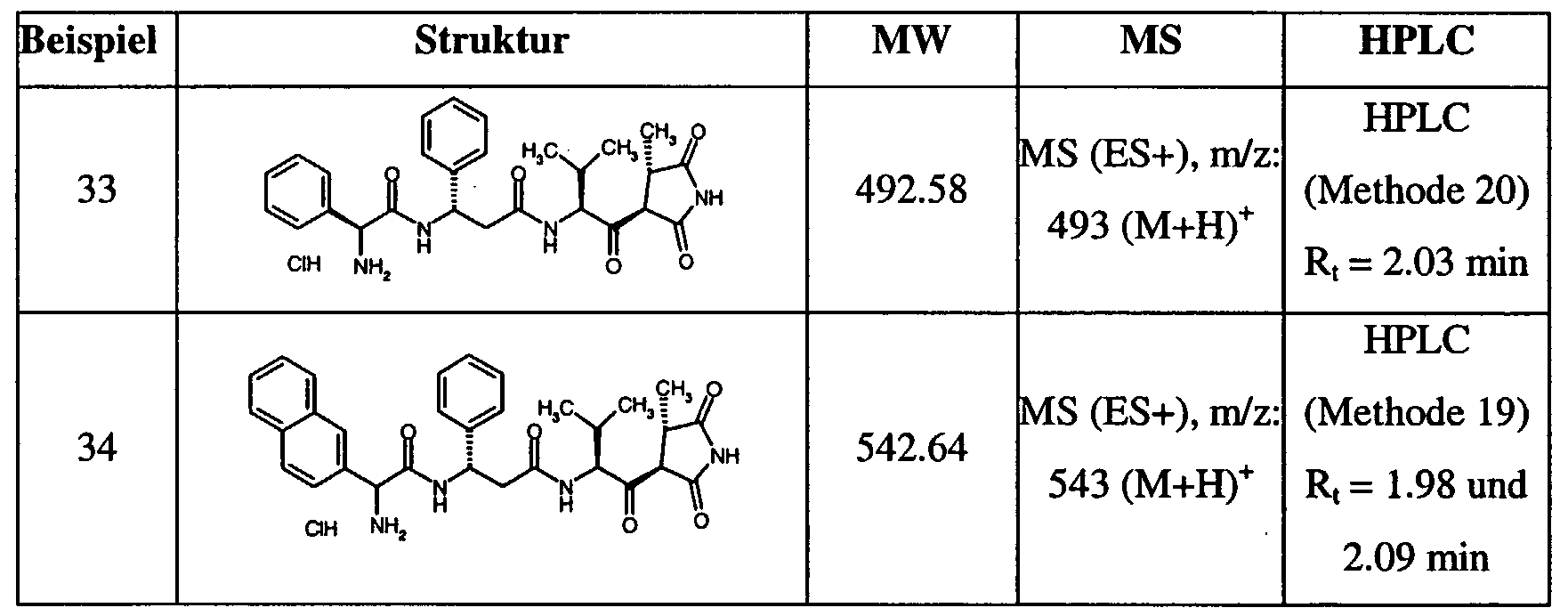
Beispiel 35:
N- { ( 15)-3-[(( 15)- 1 - { [(3R,4S)-1 -Amino-4-methyl-2,5-dioxo-3-pyrrolidinyl]carbonyl } -2- methylpropyl)amino]-3-oxo-l -phenylpropyl } - 1 ,2,3,4-tetrahydro- 1 -isochinolincarboxamid
19 mg (0.03 mmol) Benzyl-(3S,4R)-3-methyl-4-[(25)-3-methyl-2-({(3S)-3-phenyl-3-[(l,2,3,4- tetrahydro- 1 -isochinolinylcarbonyl)amino]propanoyl } amino)butanoyl] -2,5-dioxo- 1 -pyrrolidinyl- carbamat werden in 1 ml Ethanol gelöst, mit 5 mg Palladium auf Kohle (10%) versetzt und 4 h unter Wasserstoffatmosphäre gerührt. Das Reaktionsgemisch wird filtriert und eingeengt. Es werden 16 mg des Produktes erhalten.
MS (ES+): m/z = 534 (M+H)+.
HPLC (Methode 15): Rt = 1.48 und 1.55 min.
B) Bewertung der physiologischen Wirksamkeit
Die Eignung der erfindungsgemäßen Verbindungen zur Behandlung bakterieller Erkrankungen kann in folgenden Modellen gezeigt werden:
Bestimmung der Minimalen Hemmkonzentration (MHK):
Die MHK wird im Flüssigdilutionstest bestimmt. Übernachtkulturen der Testkeime werden auf eine Zellzahl von 105 Keimen pro ml in Isosensitest-Medium (Fa. Difco, Irvine, USA) verdünnt und mit Verdünnungen der Testsubstanzen (Verdünnungsstufen 1:2) inkubiert. Ausnahmen sind die Tests mit S. pneumoniae G9A, die in BHI-Bouillon (Fa. Difco) plus 20 % Rinderserum, und mit H. influenzae, die in BHI-Bouillon (Fa. Difco) plus 20 % Rinderserum, 10 μg/ml Haemin und 1 % Isovitale (Fa. Becton Dickinson, New Jersey, USA) durchgeführt werden.
Die Kulturen werden bei 37°C für 18-24 Stunden inkubiert; S. pneumoniae und H. influenzae in Gegenwart von 8 -10 % CO2.
Ergebnisse:
Die jeweils niedrigste Substanzkonzentration, bei der kein sichtbares Bakterienwachstum mehr auftritt, wird als MHK definiert. Die MHK-Werte in μmol 1 einiger erfindungsgemäßer Verbindungen gegenüber Staphylokokkus aureus sind in der nachstehenden Tabelle beispielhaft aufgeführt.
Systemische Infektion mit S. aureus 133
S. aureus 133 Zellen werden über Nacht in BH-Bouillon (Fa. Oxoid, New York, USA) angezüchtet. Die Übernachtkultur wird 1:100 in frische BH-Bouillon verdünnt und für 3 Stunden hochgedreht. Die in der logarithmischen Wachstumsphase befindlichen Bakterien werden abzentrifugiert und 2 x mit gepufferter, physiologischer Kochsalzlösung gewaschen. Danach wird am Photometer (Modell LP 2W, Fa. Dr. Lange, Berlin, Deutschland) eine Zellsuspension in Kochsalzlösung mit einer Extinktion von 50 Einheiten eingestellt. Nach einem Verdünnungsschritt (1:15) wird diese Suspension 1: 1 mit einer 10 %igen Mucinsuspension gemischt. Von dieser Infektionslösung wird 0,25 ml/20 g Maus i.p. appliziert. Dies entspricht einer Zellzahl von etwa 1 x 10E6 Keimen/Maus. Die i.p.- oder i.v.Therapie erfolgt 30 Minuten nach der Infektion. Für den Ihfektionsversuch werden weibliche CFW1 -Mäuse verwendet. Das Überleben der Tiere wird über 6 Tage protokolliert.
C) Ausführungsbeispiele für pharmazeutische Zusammensetzungen
Die erfindungsgemäßen Substanzen können folgendermaßen in pharmazeutische Zubereitungen überführt werden:
Tablette:
Zusammensetzung:
100 mg der Verbindung des Beispiels 1, 50 mg Lactose (Monohydrat), 50 mg Maisstärke, 10 mg Polyvinylpyrolidon (PVP 25) (Fa. BASF, Deutschland) und 2 mg Magnesiumstearat.
Tablettengewicht 212 mg. Durchmesser 8 mm, Wölbungsradius 12 mm.
Herstellung:
Die Mischung aus der Verbindung des Beispiels 1, Lactose und Stärke wird mit einer 5 %-igen Lösung (m/m) des PVPs in Wasser granuliert. Das Granulat wird nach dem Trocknen mit dem Magnesiumstearat für 5 min. gemischt. Diese Mischung wird mit einer üblichen Tablettenpresse veφresst (Format der Tablette siehe oben).
Orale Suspension:
Zusammensetzung:
1000 mg der Verbindung des Beispiels 1, 1000 mg Ethanol (96 %), 400 mg Rhodigel (Xanthan gum) (Fa. FMC, USA) und 99 g Wasser.
Einer Einzeldosis von 100 mg der erfindungsgemäßen Verbindung entsprechen 10 ml orale Suspension.
Herstellung:
Das Rhodigel wird in Ethanol suspendiert, die Verbindung des Beispiels 1 wird der Suspension zugefügt. Unter Rühren erfolgt die Zugabe des Wassers. Bis zum Abschluss der Quellung des Rhodigels wird ca. 6h gerührt.
Intravenös applizierbare Lösung:
Zusammensetzung:
100-200 mg der Verbindung von Beispiel 1, 15 g Polyethylenglykol 400 und 250 g Wasser für Injektionszwecke.
Herstellung:
Die Verbindung von Beispiel 1 wird zusammen mit Polyethylenglykol 400 in dem Wasser unter Rühren gelöst. Die Lösung wird sterilfiltriert (Porendurchmesser 0,22 μm) und unter aseptischen Bedingungen in hitzesterilisierte Infusionsflaschen abgefüllt. Diese werden mit Infusionsstopfen und Bördelkappen verschlossen.