WO2005016944A1 - Neue metathesekatalysatoren - Google Patents
Neue metathesekatalysatoren Download PDFInfo
- Publication number
- WO2005016944A1 WO2005016944A1 PCT/EP2004/008388 EP2004008388W WO2005016944A1 WO 2005016944 A1 WO2005016944 A1 WO 2005016944A1 EP 2004008388 W EP2004008388 W EP 2004008388W WO 2005016944 A1 WO2005016944 A1 WO 2005016944A1
- Authority
- WO
- WIPO (PCT)
- Prior art keywords
- alkyl
- compounds
- aryl
- formula
- mean
- Prior art date
- Legal status (The legal status is an assumption and is not a legal conclusion. Google has not performed a legal analysis and makes no representation as to the accuracy of the status listed.)
- Ceased
Links
Classifications
-
- C—CHEMISTRY; METALLURGY
- C07—ORGANIC CHEMISTRY
- C07F—ACYCLIC, CARBOCYCLIC OR HETEROCYCLIC COMPOUNDS CONTAINING ELEMENTS OTHER THAN CARBON, HYDROGEN, HALOGEN, OXYGEN, NITROGEN, SULFUR, SELENIUM OR TELLURIUM
- C07F15/00—Compounds containing elements of Groups 8, 9, 10 or 18 of the Periodic Table
- C07F15/0006—Compounds containing elements of Groups 8, 9, 10 or 18 of the Periodic Table compounds of the platinum group
- C07F15/0046—Ruthenium compounds
-
- C—CHEMISTRY; METALLURGY
- C07—ORGANIC CHEMISTRY
- C07C—ACYCLIC OR CARBOCYCLIC COMPOUNDS
- C07C67/00—Preparation of carboxylic acid esters
- C07C67/30—Preparation of carboxylic acid esters by modifying the acid moiety of the ester, such modification not being an introduction of an ester group
- C07C67/333—Preparation of carboxylic acid esters by modifying the acid moiety of the ester, such modification not being an introduction of an ester group by isomerisation; by change of size of the carbon skeleton
-
- C—CHEMISTRY; METALLURGY
- C07—ORGANIC CHEMISTRY
- C07C—ACYCLIC OR CARBOCYCLIC COMPOUNDS
- C07C69/00—Esters of carboxylic acids; Esters of carbonic or haloformic acids
- C07C69/66—Esters of carboxylic acids having esterified carboxylic groups bound to acyclic carbon atoms and having any of the groups OH, O—metal, —CHO, keto, ether, acyloxy, groups, groups, or in the acid moiety
- C07C69/67—Esters of carboxylic acids having esterified carboxylic groups bound to acyclic carbon atoms and having any of the groups OH, O—metal, —CHO, keto, ether, acyloxy, groups, groups, or in the acid moiety of saturated acids
- C07C69/708—Ethers
- C07C69/712—Ethers the hydroxy group of the ester being etherified with a hydroxy compound having the hydroxy group bound to a carbon atom of a six-membered aromatic ring
-
- C—CHEMISTRY; METALLURGY
- C07—ORGANIC CHEMISTRY
- C07C—ACYCLIC OR CARBOCYCLIC COMPOUNDS
- C07C2601/00—Systems containing only non-condensed rings
- C07C2601/06—Systems containing only non-condensed rings with a five-membered ring
- C07C2601/10—Systems containing only non-condensed rings with a five-membered ring the ring being unsaturated
Definitions
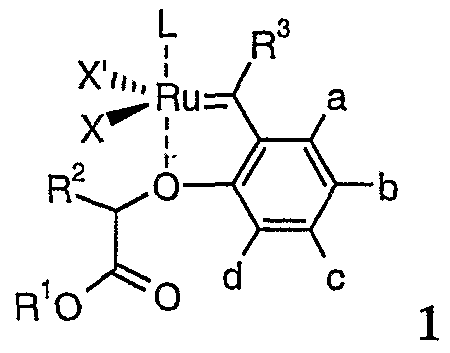
- the present invention relates to new compounds of the formula 1, their preparation, intermediates for the preparation and the use of the compounds of the formula 1 as catalysts in various metathesis reactions
- Ruthenium complexes of the formula A are known from WO 02/14376 A2 and are described as active, air-stable and recoverable metathesis catalysts. Catalysts of this type have also become known (Angew. Chem. 2002, 114, No. 5, 832-834; Angew. Chem. 2002, 114, No. 13, 2509-2511; Angew. Chem. 2002, 114, 21, 4210-4212), which are described by the formulas B, C and D, which have an even higher activity than A.
- the present invention relates to new ruthenium complexes of the formula 1 and their use as metathesis catalysts,
- X and X ' are anionic ligands; preferably halogen, particularly preferably Cl or Br; L neutral ligand; a, b, c, d independently of one another H, -NO 2 , C ⁇ - 12 alkyl, C ⁇ - ⁇ 2 alkoxy or phenyb where phenyl optionally with a residue selected from the group C ⁇ - 6 alkyl and C ⁇ - 6 alkoxy can be substituted; R 1 C ⁇ .i2-alkyl, C 5 - 6 cycloalkyb C 7 - ⁇ 8 aralkyb aryl; R 2 is H, C ⁇ ⁇ -2 -Alkyb C 5 - 6 -Cycloalkyb C 7 - ⁇ 8 -Aralkyb aryl; R 3 H, C M 2 -Al yl, C 2 - ⁇ 2 -alkenyb C 2 . 12 alkynb aryl;
- R 1 , R 2 , R 3 , X, X 'and L can have the meanings mentioned and a, b, c H; and d phenyl can be substituted with a radical selected from the group C ⁇ - 6 alkyl and C ⁇ - 6 alkoxy;
- R 1 , R 2 , R 3 , X, X ', a, b, c and d can have the meanings mentioned and
- X and X 'Cl LL 1 ; a, b, c, d H; R 1 is methyl; R 2 methyl; R 3 H; R 5 and R 6 mesityl R 7 and R 8 H;
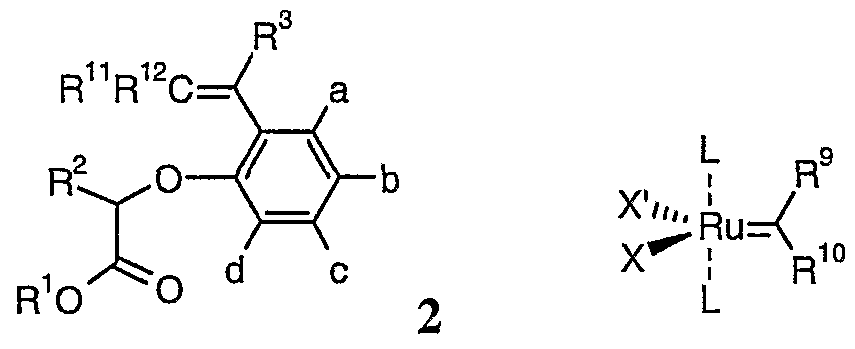
- the new compounds of formula 1 are obtained by reacting preligands of formula 2 with ruthenium complexes of formula 3.
- R 3 , a, b, c and d have the meaning given for formula 1 and
- R 1 C ⁇ ⁇ -2 alkyl, Cs- ⁇ -Cycloalkyb C 7 - ⁇ 8 -Aralkyb aryl; preferably - 6 - alkyl C 5 . 6- cycloalkyb C 7 - ⁇ -aralkyb aryl;
- R 2 is H, C ⁇ - 12 -Alkyb C 5 - 6 -Cycloalkyb C 7 - ⁇ 8 -Aralkyb aryl; C ⁇ - preferably 6 - alkyl, C 5 - 6 -Cycloalkyb C 7 .
- R 11 and R 12 independently of one another are H, Ci- 6 alkyl optionally substituted with one or more halogen, or aryl optionally substituted with one or more halogen or - ö -alkyl; preferably H, -C 6 alkyl or aryl; special and L neutral ligand; preferably L 1 , L 2 , L 3 or L 4
- Another object of the invention is a compound of formula 2,
- R 2 H C 1 -C 2 alkyl C 5 . 6- cycloalkyb C 7 - ⁇ 8 -alkyb aryl;
- R 11 and R 12 independently of one another are H, C 6 alkyl, optionally substituted with one or more halogen, or aryl, optionally substituted with one or more halogen or C 6 alkyl;
- R 1 Ci-ö-alkyl, C 5 - 6 cycloalkyb C 7 - ⁇ aralkyb aryl;
- R 2 H C ⁇ - 6 alkyl C 5 - 6 cycloalkyb C 7 - ⁇ aralkyb aryl;
- 11 1 R and R independently of one another H, -CC alkyl, optionally substituted with one or more halogen, or aryl, optionally substituted with one or more halogen or methyl;
- R 1 is methyl, cyclohexyb benzyb phenyl; R> 2 H, methyl, cyclohexyb benzyb phenyl; R 11 H; R 12 is H or methyl;
- the ligands and complexes shown can occur as pure enantiomers or enantiomeric pairs. In the context of the invention, therefore, in addition to any racemates, the pure enantiomers are also contained, which can transfer the enantiomerism to a substrate during the catalysis through the stereo center.
- An additional aspect of the invention is a method for carrying out metathesis reactions, in which two compounds are reacted, each containing an olefinic double bond or one of the compounds containing at least two olefinic double bonds, and in which one of the compounds of formula 1 mentioned above is used as a catalyst is used, or a method for performing a ring closure metathesis (RCM) or a cross metathesis (CM) in which a compound which contains two olefinic double bonds is involved as a substrate and one of the compounds of formula 1 as a catalyst.
- RCM ring closure metathesis
- CM cross metathesis
- anionic ligand (X or X ') is understood in the context of the invention to mean negatively charged molecules or atoms with electron donor properties. Examples of this include its halogens, such as fluorine, chlorine, bromine or iodine.
- a “neutral ligand” is understood to mean uncharged or charge-neutral molecules or atoms with electron donor properties.
- Examples include its tertiary phosphines, which contain aliphatic, cycloaliphatic and aromatic hydrocarbon radicals such as trioctylphosphine, tridodecylphosphine, tricyclohexylphosphine. Tris (2-methylcyclohexyl) phosphine and tris (o-tolyl) phosphine called.
- NHC ligands such as the compounds described by the formulas L 1 , L 2 , L 3 and L 4 , may be mentioned as particularly preferred neutral ligands: R ° R 7 R 8 YY 'R ° RN HN-R 6 R- NN w ⁇ H NN-R 6 RI ⁇ W / ⁇ HN-R 6 R-, NR 6 L 1 L 2 wo ⁇ n
- R, 5 "and - n R6 independently of one another are H, -C 6 alkyl or aryl,
- R 7 and R 8 independently of one another are H, C ⁇ - 6 alkyl C ⁇ - 6 alkenyl or aryl or together form a 3- or 4-membered alkylene bridge and Y and Y 'represent halogen.
- C 2 alkyl (also insofar as they are part of other radicals) is understood to mean branched and u branched alkyl groups having 1 to 12 carbon atoms
- C 6 alkyl correspondingly means branched and unbranched Alkyl groups with 1 to 6 carbon atoms understood and understood by the term “-C-alkyl” branched and unbranched alkyl groups with 1 to 4 carbon atoms.
- Alkyl groups with 1 to 6 carbon atoms are preferred, particularly preferably 1 to 4 carbon atoms.
- C 2 - ⁇ 2 alkenyl (also insofar as they are part of other radicals) is understood to mean branched and unbranched alkenyl groups having 2 to 12 carbon atoms, provided that they have at least one double bond. Accordingly, the term - understood alkenyl groups having 2 to 6 carbon atoms and by the term “C 2 6 alkenyl,”"C 2 - alkenyl” refers to branched and unbranched alkenyl groups with 2 to 4 carbon atoms. Alkenyl groups having 2 to 6 carbon atoms are preferred, particularly preferably 2 to 4 carbon atoms.
- propenyb butenyb pentenyl and hexenyl include all conceivable isomeric forms of the respective radicals.
- propenyl includes 1-propenyl and 2-propenyl
- butenyl includes 1-, 2- and 3-butenyl, 1-methyl-1-propenyb-1-methyl-2-propenyl etc.
- C 2 - 12 -alkynyl (including those which are part of other groups) are meant branched and un atoms branched alkynyl groups having 2 to 12 carbon, provided that they have at least one triple bond.
- C2- 6 alkynyl alkynyl be accordingly understood and having 2 to 6 carbon atoms, the term “C2.
- Alkynyl refers to branched and unbranched alkynyl groups with 2 to 4 carbon atoms understood by the term. Alkynyl groups with 2 to 6 carbon atoms are preferred, particularly preferably 2 to 4 carbon atoms.
- ethinyl propinyb butinyb pentinyb or hexinyb.
- the definitions propinyb butinyb pentinyl and hexinyl include all conceivable isomeric forms of the respective radicals.
- propynyl includes 1-propynyl and 2-propynyl
- butynyl includes 1-, 2- and 3-butynyl, 1-methyl-1-propynyl, 1-methyl-2-propynyl, etc.
- Ci- ⁇ -alkoxy (also insofar as they are part of other radicals) is taken to mean branched and unbranched alkoxy groups having 1 to 12 carbon atoms, and accordingly the term “C 6 alkoxy” is used to refer to branched and unbranched alkoxy groups 1 to 6 carbon atoms understood and understood by the term “-CC alkoxy” branched and unbranched alkoxy groups having 1 to 4 carbon atoms. Alkoxy groups having 1 to 6 carbon atoms are preferred, particularly preferably 1 to 4 carbon atoms. Examples include: methoxy, ethoxy, propoxy, butoxy or pentoxy. If necessary, the abbreviations MeO, EtO, PrO, etc.
- propoxy includes n-propoxy and zs ⁇ -propoxy
- butoxy includes wo-butoxy, see-butoxy and tert-butoxy etc.
- C5-C6 cycloalkyl (including those which are part of other groups) are meant cyclic alkyl groups with 5 or 6 carbon atoms.
- cyclopentyl or cyclohexyb Unless otherwise described, the cyclic alkyl groups can be substituted by one or more radicals selected from the group consisting of methyl, ethyl, i ' s ⁇ -propyl, tert-butylboxy, fluorine, chlorine, Bromine and iodine.
- aryl (also insofar as they are part of other radicals) is understood to mean aromatic ring systems with 6 or 10 carbon atoms.
- phenyl or naphthyb the preferred aryl radical is phenyb.
- aromatics can be substituted by one or more radicals selected from the group consisting of methyl, ethyl, isopropyl, tert-butyl hydroxy, fluorine, chlorine, Bromine and iodine.
- C 7 - ⁇ 8 aralkyl (also insofar as they are part of other radicals) is taken to mean branched and unbranched alkyl groups having 1 to 8 carbon atoms which are substituted by an aromatic ring system having 6 or 10 carbon atoms, are correspondingly understood under the
- C - ⁇ -aralkyl is understood to mean branched and unbranched alkyl groups having 1 to 4 carbon atoms which are substituted by an aromatic ring system having 6 carbon atoms.
- aromatics can be substituted with one or more radicals selected from the group consisting of methyl, ethylb zso-propyl, tert-butyb hydroxy, fluorine, chlorine, bromine and iodine.
- the reaction of the ruthenium complexes of the formula 3 with the preligands of the formula 2 is carried out in inert solvents, for example CH 2 Cl 2 at about 0 ° to 80 ° C.
- inert solvents for example CH 2 Cl 2 at about 0 ° to 80 ° C.
- the addition of CuCl to the reaction mixture is advantageous.
- the reactants are generally used in equivalent amounts, but the more valuable component can also be used in a deficit to increase the yield.
- the metathesis catalysts of the formula 1 prepared by ligand exchange reaction can be separated from other reaction products which are insoluble in the reaction mixture by filtration of their solution and, after concentration of the solution by chromatography or crystallization, can be obtained in pure form. However, it is also possible to use the crude products or the catalysts generated in situ directly to carry out metathesis reactions.
- the preligands of the formula 2 can be prepared in a manner known per se from aromatic aldehydes which contain corresponding substituents, by olefination reactions, e.g. B. by reaction with phosphorus ylides according to Wittig.
- the alkylation of phenols to alkyl phenyl ethers is well known to the person skilled in the art; it is usually carried out in solvents in the presence of basic substances by reaction with nucleophilic reagents.
- the reaction with ⁇ -halocarboxylic esters proceeds particularly smoothly and with good yields.
- a solvent such as B. alcohols such as ethanol or aprotic polar solvents such as dimethylformamide in question.
- the alkylation can also be carried out under phase transfer conditions.
- Alkali carbonates may be mentioned as basic substances, and the alkali salts of the intermediates which contain a free aromatically bound OH group can also be used for this reaction.
- the compounds of formula 1 are highly active metathesis catalysts which can also be used successfully to carry out difficult metathesis reactions, all types of these reactions (RCM, CM, ROMP etc.) being included.
- Table 1 shows the results of an HPLC analysis, the result being compared with the known catalyst of the formula D. (Angew. Chem. Int. Ed. 2002, 42.4038).
Landscapes
- Chemical & Material Sciences (AREA)
- Organic Chemistry (AREA)
- Catalysts (AREA)
- Organic Low-Molecular-Weight Compounds And Preparation Thereof (AREA)
- Polyoxymethylene Polymers And Polymers With Carbon-To-Carbon Bonds (AREA)
- Nitrogen Condensed Heterocyclic Rings (AREA)
- Low-Molecular Organic Synthesis Reactions Using Catalysts (AREA)
Abstract
Description





Claims


Priority Applications (5)
| Application Number | Priority Date | Filing Date | Title |
|---|---|---|---|
| DE502004007329T DE502004007329D1 (de) | 2003-08-02 | 2004-07-23 | Neue metathesekatalysatoren |
| DK04741285T DK1654266T3 (da) | 2003-08-02 | 2004-07-23 | Nye metatesekatalysatorer |
| EP04741285A EP1654266B1 (de) | 2003-08-02 | 2004-07-23 | Neue metathesekatalysatoren |
| JP2006522282A JP4629040B2 (ja) | 2003-08-02 | 2004-07-23 | 新規なメタセシス触媒 |
| CA2534324A CA2534324C (en) | 2003-08-02 | 2004-07-23 | Ruthenium metathesis catalysts |
Applications Claiming Priority (2)
| Application Number | Priority Date | Filing Date | Title |
|---|---|---|---|
| DE10335416A DE10335416A1 (de) | 2003-08-02 | 2003-08-02 | Neue Metathesekatalysatoren |
| DE10335416.6 | 2003-08-02 |
Publications (1)
| Publication Number | Publication Date |
|---|---|
| WO2005016944A1 true WO2005016944A1 (de) | 2005-02-24 |
Family
ID=34072033
Family Applications (1)
| Application Number | Title | Priority Date | Filing Date |
|---|---|---|---|
| PCT/EP2004/008388 Ceased WO2005016944A1 (de) | 2003-08-02 | 2004-07-23 | Neue metathesekatalysatoren |
Country Status (8)
| Country | Link |
|---|---|
| EP (1) | EP1654266B1 (de) |
| JP (1) | JP4629040B2 (de) |
| CN (1) | CN100455590C (de) |
| AT (1) | ATE397614T1 (de) |
| CA (1) | CA2534324C (de) |
| DE (2) | DE10335416A1 (de) |
| DK (1) | DK1654266T3 (de) |
| WO (1) | WO2005016944A1 (de) |
Cited By (7)
| Publication number | Priority date | Publication date | Assignee | Title |
|---|---|---|---|---|
| WO2008034552A1 (de) * | 2006-09-18 | 2008-03-27 | Umicore Ag & Co. Kg | Neue metathesekatalysatoren |
| WO2009080542A1 (en) * | 2007-12-21 | 2009-07-02 | F. Hoffmann-La Roche Ag | Process for the preparation of a macrocycle |
| WO2009124853A1 (en) | 2008-04-11 | 2009-10-15 | F. Hoffmann-La Roche Ag | New ruthenium complexes as catalysts for metathesis reactions |
| WO2010127964A1 (en) * | 2009-05-07 | 2010-11-11 | F. Hoffmann-La Roche Ag | Process for the preparation of ruthenium metathesis complex catalysts |
| EP2255877A1 (de) | 2009-05-07 | 2010-12-01 | Umicore AG & Co. KG | Verfahren zur Herstellung von rutheniumbasierten Metathesekatalysatoren mit chelatbildenden Alkyliden-Liganden |
| WO2011079799A1 (en) * | 2009-12-30 | 2011-07-07 | Zannan Scitech Co., Ltd. | Highly active metathesis catalysis selective for romp and rcm |
| US9504997B2 (en) | 2001-11-15 | 2016-11-29 | Materia, Inc. | Chelating carbene ligand precursors and their use in the synthesis of metathesis catalysts |
Families Citing this family (7)
| Publication number | Priority date | Publication date | Assignee | Title |
|---|---|---|---|---|
| EP2289623A1 (de) * | 2009-08-31 | 2011-03-02 | LANXESS Deutschland GmbH | Metathese eines Nitrilkautschuks in Gegenwart von Übergangsmetallkatalysatoren |
| EP2289621A1 (de) * | 2009-08-31 | 2011-03-02 | LANXESS Deutschland GmbH | Verfahren zur Herstellung von hydriertem Nitrilgummi mit niedrigem Molekulargewicht |
| EP2289622A1 (de) * | 2009-08-31 | 2011-03-02 | LANXESS Deutschland GmbH | Rutheniumbasierte Katalysatoren zur Metathese von Nitrilgummis |
| EP2361683A1 (de) * | 2010-01-29 | 2011-08-31 | Umicore AG & Co. KG | Verfahren zur Herstellung von rutheniumbasierten Carbenkatalysatoren mit chelatbildenden Alkyliden-Liganden |
| JP5569147B2 (ja) * | 2010-05-27 | 2014-08-13 | Jsr株式会社 | 環状オレフィン系開環重合体の製造方法 |
| CN104169322B (zh) * | 2012-03-16 | 2016-08-31 | 日本瑞翁株式会社 | 开环易位聚合物氢化物的制造方法及树脂组合物 |
| AU2013283680B2 (en) * | 2012-06-29 | 2016-06-16 | Apeiron Synthesis S.A. | Metal complexes, their application and methods of carrying out of metathesis reaction |
Citations (2)
| Publication number | Priority date | Publication date | Assignee | Title |
|---|---|---|---|---|
| JPS59118721A (ja) * | 1982-12-25 | 1984-07-09 | Nippon Zeon Co Ltd | カルボキシル化合物の製造方法 |
| WO2002014376A2 (en) * | 2000-08-10 | 2002-02-21 | Trustees Of Boston College | Recyclable metathesis catalysts |
Family Cites Families (1)
| Publication number | Priority date | Publication date | Assignee | Title |
|---|---|---|---|---|
| DE10137051A1 (de) * | 2001-07-31 | 2003-02-20 | Bayer Ag | Neue Übergangsmetall-Komplexe und deren Einsatz in Übergangsmetall-katalysierten Reaktionen |
-
2003
- 2003-08-02 DE DE10335416A patent/DE10335416A1/de not_active Withdrawn
-
2004
- 2004-07-23 AT AT04741285T patent/ATE397614T1/de not_active IP Right Cessation
- 2004-07-23 EP EP04741285A patent/EP1654266B1/de not_active Expired - Lifetime
- 2004-07-23 DE DE502004007329T patent/DE502004007329D1/de not_active Expired - Lifetime
- 2004-07-23 CN CNB2004800220970A patent/CN100455590C/zh not_active Expired - Fee Related
- 2004-07-23 WO PCT/EP2004/008388 patent/WO2005016944A1/de not_active Ceased
- 2004-07-23 DK DK04741285T patent/DK1654266T3/da active
- 2004-07-23 JP JP2006522282A patent/JP4629040B2/ja not_active Expired - Fee Related
- 2004-07-23 CA CA2534324A patent/CA2534324C/en not_active Expired - Fee Related
Patent Citations (2)
| Publication number | Priority date | Publication date | Assignee | Title |
|---|---|---|---|---|
| JPS59118721A (ja) * | 1982-12-25 | 1984-07-09 | Nippon Zeon Co Ltd | カルボキシル化合物の製造方法 |
| WO2002014376A2 (en) * | 2000-08-10 | 2002-02-21 | Trustees Of Boston College | Recyclable metathesis catalysts |
Non-Patent Citations (9)
| Title |
|---|
| AHMAD-JUNAN, S. ASIAH ET AL: "Aryloxymethyl radical cyclizations mimicking biological carbon-carbon bond formation to methoxy groups", JOURNAL OF THE CHEMICAL SOCIETY, PERKIN TRANSACTIONS 1: ORGANIC AND BIO-ORGANIC CHEMISTRY (1972-1999), vol. 18, 1992, pages 2313 - 2320, XP002302739, ISSN: 0300-922X * |
| AUSTRALIAN JOURNAL OF CHEMISTRY, vol. 19, no. 9, 1966, pages 1667 - 1675, ISSN: 0004-9425 * |
| BULLETIN OF THE POLISH ACADEMY OF SCIENCES, CHEMISTRY, vol. 48, no. 3, 2000, pages 213 - 229, ISSN: 0239-7285 * |
| DATABASE CA [online] CHEMICAL ABSTRACTS SERVICE, COLUMBUS, OHIO, US; "Addition reactions of unsaturated compounds", XP002302743, retrieved from STN Database accession no. 102:8602 * |
| DATABASE CA [online] CHEMICAL ABSTRACTS SERVICE, COLUMBUS, OHIO, US; PANARIN, E. F. ET AL: "Derivatives of o-vinylphenol. Synthesis of .alpha.-(o-vinylphenoxy) carboxylic acids", XP002302744, retrieved from STN Database accession no. 85:20772 * |
| DATABASE CA [online] CHEMICAL ABSTRACTS SERVICE, COLUMBUS, OHIO, US; WYRZYKIEWICZ, ELZBIETA ET AL: "N-(E)-2-stilbenyloxymethylenecarbonyl substituted hydrazones of ortho-, meta-, and para-hydroxybenzaldehydes", XP002302742, retrieved from STN Database accession no. 134:131292 * |
| DATABASE CAPLUS [online] CHEMICAL ABSTRACTS SERVICE, COLUMBUS, OHIO, US; NEWSOROFF, G. P. ET AL: "Nuclear magnetic resonance spectra of .alpha.,.beta.,.beta.- trimethylstyrenes", XP002302838, retrieved from STN Database accession no. 65:90114 * |
| DEPOSITED DOC. , VINITI 5598-73, 5 PP. AVAIL.: BLLD, 1973 * |
| TIETZE, LUTZ F. ET AL: "Intra- and intermolecular hetero-Diels-Alder reactions. 17. Intramolecular hetero-Diels-Alder reaction of alkylidene- and benzylidenepyrazolones and benzylideneisoxazolones. Investigations toward the conformation of the transition state", JOURNAL OF ORGANIC CHEMISTRY, vol. 53, no. 4, 1988, pages 810 - 820, XP002302740, ISSN: 0022-3263 * |
Cited By (21)
| Publication number | Priority date | Publication date | Assignee | Title |
|---|---|---|---|---|
| US9504997B2 (en) | 2001-11-15 | 2016-11-29 | Materia, Inc. | Chelating carbene ligand precursors and their use in the synthesis of metathesis catalysts |
| US8288558B2 (en) | 2006-09-18 | 2012-10-16 | Umicore Ag & Co. Kg | Metathesis catalysts |
| US20100113795A1 (en) * | 2006-09-18 | 2010-05-06 | Dieter Arlt | Novel metathesis catalysts |
| US8536344B2 (en) | 2006-09-18 | 2013-09-17 | Umicore Ag & Co. Kg | Metathesis catalysts |
| WO2008034552A1 (de) * | 2006-09-18 | 2008-03-27 | Umicore Ag & Co. Kg | Neue metathesekatalysatoren |
| WO2009080542A1 (en) * | 2007-12-21 | 2009-07-02 | F. Hoffmann-La Roche Ag | Process for the preparation of a macrocycle |
| US7910728B2 (en) | 2007-12-21 | 2011-03-22 | Roche Palo Alto Llc | Process for the preparation of a macrocycle |
| WO2009124853A1 (en) | 2008-04-11 | 2009-10-15 | F. Hoffmann-La Roche Ag | New ruthenium complexes as catalysts for metathesis reactions |
| CN101970396B (zh) * | 2008-04-11 | 2014-06-18 | 弗·哈夫曼-拉罗切有限公司 | 用作复分解反应催化剂的新的钌配合物 |
| CN101970396A (zh) * | 2008-04-11 | 2011-02-09 | 弗·哈夫曼-拉罗切有限公司 | 用作复分解反应催化剂的新的钌配合物 |
| US7939668B2 (en) | 2008-04-11 | 2011-05-10 | Roche Palo Alto Llc | Ruthenium complexes as catalysts for metathesis reactions |
| CN102421786A (zh) * | 2009-05-07 | 2012-04-18 | 弗·哈夫曼-拉罗切有限公司 | 钌易位复合催化剂的制备方法 |
| US8288534B2 (en) | 2009-05-07 | 2012-10-16 | Roche Palo Alto Llc | Process for the preparation a ruthenium complex |
| EP2255877A1 (de) | 2009-05-07 | 2010-12-01 | Umicore AG & Co. KG | Verfahren zur Herstellung von rutheniumbasierten Metathesekatalysatoren mit chelatbildenden Alkyliden-Liganden |
| US8846938B2 (en) | 2009-05-07 | 2014-09-30 | Umicore Ag & Co. Kg | Method for preparation of ruthenium-based metathesis catalysts with chelating alkylidene ligands |
| CN102421786B (zh) * | 2009-05-07 | 2016-01-20 | 弗·哈夫曼-拉罗切有限公司 | 钌易位复合催化剂的制备方法 |
| WO2010127964A1 (en) * | 2009-05-07 | 2010-11-11 | F. Hoffmann-La Roche Ag | Process for the preparation of ruthenium metathesis complex catalysts |
| US9562116B2 (en) | 2009-05-07 | 2017-02-07 | Umicore Ag & Co. Kg | Method for preparation of ruthenium-based metathesis catalysts with chelating alkylidene ligands |
| WO2011079799A1 (en) * | 2009-12-30 | 2011-07-07 | Zannan Scitech Co., Ltd. | Highly active metathesis catalysis selective for romp and rcm |
| AU2010338707B2 (en) * | 2009-12-30 | 2014-08-14 | Zannan Scitech Co., Ltd. | Highly active metathesis catalysis selective for ROMP and RCM |
| RU2546656C2 (ru) * | 2009-12-30 | 2015-04-10 | Цзаньнань Сайтек Ко., Лтд. | Высокоэффективные метатезистические катализаторы, выбираемые в реакциях romp и rcm |
Also Published As
| Publication number | Publication date |
|---|---|
| JP4629040B2 (ja) | 2011-02-09 |
| ATE397614T1 (de) | 2008-06-15 |
| CN100455590C (zh) | 2009-01-28 |
| CA2534324C (en) | 2012-11-27 |
| CN1829726A (zh) | 2006-09-06 |
| DE10335416A1 (de) | 2005-02-17 |
| EP1654266A1 (de) | 2006-05-10 |
| EP1654266B1 (de) | 2008-06-04 |
| DK1654266T3 (da) | 2008-09-15 |
| CA2534324A1 (en) | 2005-02-24 |
| JP2007501199A (ja) | 2007-01-25 |
| DE502004007329D1 (de) | 2008-07-17 |
Similar Documents
| Publication | Publication Date | Title |
|---|---|---|
| EP2066443B1 (de) | Neue metathesekatalysatoren | |
| DE60306795T2 (de) | Ruthenium-komplexe als (pre)katalysatoren für metathesereaktionen | |
| EP1654266B1 (de) | Neue metathesekatalysatoren | |
| DE69114986T2 (de) | Eine Phosphino-Binapthyl-Verbindung und Übergangsmetall-Komplexe davon. | |
| EP1507783B1 (de) | Hydroxydiphosphine und deren verwendung in der katalyse | |
| EP2459579A2 (de) | Imidazolgruppenhaltige phosphinoboran-verbindungen und verfahren zur herstellung von imidazolgruppenhaltige phosphorverbindungen | |
| EP2254895A1 (de) | Imidazolgruppenhaltige phosphorverbindungen | |
| EP1414833B1 (de) | Neue übergangsmetall-komplexe und deren einsatz in übergangsmetall-katalysierten reaktionen | |
| DE69709883T2 (de) | Chirale ferrocene | |
| EP0751142A2 (de) | Chirale Mangan-triazanonankomplexe und Verfahren zu ihrer Herstellung | |
| DE3148098C2 (de) | ||
| DE60117767T2 (de) | Verfahren zur herstellung von rutheniumverbindungen | |
| DE69623428T2 (de) | Verfahren zur Herstellung von optisch aktiven Benzhydrolverbindungen | |
| EP0570764A2 (de) | Asymmetrische Hydrierung | |
| US7241898B2 (en) | Metathesis catalysts | |
| EP0749953B1 (de) | Herstellung von chiralen alpha-Halogencarbonsäuren | |
| DE10335417A1 (de) | Verfahren zur Herstellung von Metathesekatalysatoren | |
| DE69624417T2 (de) | Phosphin-Phosphinit-Verbindungen und Verfahren zur Herstellung von 4-((R)-1'-Formylethyl)-azetidin-2-on-Derivaten unter Verwendung dieser Verbindungen | |
| EP1082328B1 (de) | Herstellung optisch aktiver phospholane | |
| EP1760055A2 (de) | Eisen-katalysierte allylische Alkylierung | |
| DE102008033164B4 (de) | Verfahren zum Herstellen einer optisch aktiven Allylverbindung | |
| EP1516880B1 (de) | Chirale Phosphane zur Verwendung in asymmetrischen Synthesen | |
| DE19845517A1 (de) | Verfahren zur asymmetrische Hydrierung von beta-Ketoestern | |
| DE2222578C3 (de) | Verfahren zur Herstellung von O1O-Dialkyl-O-phenylthionophosphorsäureestern | |
| WO2002068434A1 (de) | Neue diphosphine and verfahren zu ihrer herstellung |
Legal Events
| Date | Code | Title | Description |
|---|---|---|---|
| WWE | Wipo information: entry into national phase |
Ref document number: 200480022097.0 Country of ref document: CN |
|
| AK | Designated states |
Kind code of ref document: A1 Designated state(s): AE AG AL AM AT AU AZ BA BB BG BR BW BY BZ CA CH CN CO CR CU CZ DE DK DM DZ EC EE EG ES FI GB GD GE GH GM HR HU ID IL IN IS JP KE KG KP KR KZ LC LK LR LS LT LU LV MA MD MG MK MN MW MX MZ NA NI NO NZ OM PG PH PL PT RO RU SC SD SE SG SK SL SY TJ TM TN TR TT TZ UA UG US UZ VC VN YU ZA ZM ZW |
|
| AL | Designated countries for regional patents |
Kind code of ref document: A1 Designated state(s): BW GH GM KE LS MW MZ NA SD SL SZ TZ UG ZM ZW AM AZ BY KG KZ MD RU TJ TM AT BE BG CH CY CZ DE DK EE ES FI FR GB GR HU IE IT LU MC NL PL PT RO SE SI SK TR BF BJ CF CG CI CM GA GN GQ GW ML MR NE SN TD TG |
|
| 121 | Ep: the epo has been informed by wipo that ep was designated in this application | ||
| WWE | Wipo information: entry into national phase |
Ref document number: 2004741285 Country of ref document: EP |
|
| WWE | Wipo information: entry into national phase |
Ref document number: 464/DELNP/2006 Country of ref document: IN |
|
| ENP | Entry into the national phase |
Ref document number: 2534324 Country of ref document: CA |
|
| WWE | Wipo information: entry into national phase |
Ref document number: 2006522282 Country of ref document: JP |
|
| WWP | Wipo information: published in national office |
Ref document number: 2004741285 Country of ref document: EP |
|
| WWG | Wipo information: grant in national office |
Ref document number: 2004741285 Country of ref document: EP |