EP0751142A2 - Chirale Mangan-triazanonankomplexe und Verfahren zu ihrer Herstellung - Google Patents
Chirale Mangan-triazanonankomplexe und Verfahren zu ihrer Herstellung Download PDFInfo
- Publication number
- EP0751142A2 EP0751142A2 EP96110138A EP96110138A EP0751142A2 EP 0751142 A2 EP0751142 A2 EP 0751142A2 EP 96110138 A EP96110138 A EP 96110138A EP 96110138 A EP96110138 A EP 96110138A EP 0751142 A2 EP0751142 A2 EP 0751142A2
- Authority
- EP
- European Patent Office
- Prior art keywords
- alkyl
- aryl
- phenyl
- hydrogen
- pyridyl
- Prior art date
- Legal status (The legal status is an assumption and is not a legal conclusion. Google has not performed a legal analysis and makes no representation as to the accuracy of the status listed.)
- Withdrawn
Links
Classifications
-
- C—CHEMISTRY; METALLURGY
- C07—ORGANIC CHEMISTRY
- C07F—ACYCLIC, CARBOCYCLIC OR HETEROCYCLIC COMPOUNDS CONTAINING ELEMENTS OTHER THAN CARBON, HYDROGEN, HALOGEN, OXYGEN, NITROGEN, SULFUR, SELENIUM OR TELLURIUM
- C07F13/00—Compounds containing elements of Groups 7 or 17 of the Periodic Table
- C07F13/005—Compounds without a metal-carbon linkage
-
- B—PERFORMING OPERATIONS; TRANSPORTING
- B01—PHYSICAL OR CHEMICAL PROCESSES OR APPARATUS IN GENERAL
- B01J—CHEMICAL OR PHYSICAL PROCESSES, e.g. CATALYSIS OR COLLOID CHEMISTRY; THEIR RELEVANT APPARATUS
- B01J31/00—Catalysts comprising hydrides, coordination complexes or organic compounds
- B01J31/16—Catalysts comprising hydrides, coordination complexes or organic compounds containing coordination complexes
- B01J31/18—Catalysts comprising hydrides, coordination complexes or organic compounds containing coordination complexes containing nitrogen, phosphorus, arsenic or antimony as complexing atoms, e.g. in pyridine ligands, or in resonance therewith, e.g. in isocyanide ligands C=N-R or as complexed central atoms
- B01J31/1805—Catalysts comprising hydrides, coordination complexes or organic compounds containing coordination complexes containing nitrogen, phosphorus, arsenic or antimony as complexing atoms, e.g. in pyridine ligands, or in resonance therewith, e.g. in isocyanide ligands C=N-R or as complexed central atoms the ligands containing nitrogen
- B01J31/181—Cyclic ligands, including e.g. non-condensed polycyclic ligands, comprising at least one complexing nitrogen atom as ring member, e.g. pyridine
- B01J31/1815—Cyclic ligands, including e.g. non-condensed polycyclic ligands, comprising at least one complexing nitrogen atom as ring member, e.g. pyridine with more than one complexing nitrogen atom, e.g. bipyridyl, 2-aminopyridine
- B01J31/182—Cyclic ligands, including e.g. non-condensed polycyclic ligands, comprising at least one complexing nitrogen atom as ring member, e.g. pyridine with more than one complexing nitrogen atom, e.g. bipyridyl, 2-aminopyridine comprising aliphatic or saturated rings
-
- B—PERFORMING OPERATIONS; TRANSPORTING
- B01—PHYSICAL OR CHEMICAL PROCESSES OR APPARATUS IN GENERAL
- B01J—CHEMICAL OR PHYSICAL PROCESSES, e.g. CATALYSIS OR COLLOID CHEMISTRY; THEIR RELEVANT APPARATUS
- B01J2231/00—Catalytic reactions performed with catalysts classified in B01J31/00
- B01J2231/70—Oxidation reactions, e.g. epoxidation, (di)hydroxylation, dehydrogenation and analogues
- B01J2231/72—Epoxidation
-
- B—PERFORMING OPERATIONS; TRANSPORTING
- B01—PHYSICAL OR CHEMICAL PROCESSES OR APPARATUS IN GENERAL
- B01J—CHEMICAL OR PHYSICAL PROCESSES, e.g. CATALYSIS OR COLLOID CHEMISTRY; THEIR RELEVANT APPARATUS
- B01J2531/00—Additional information regarding catalytic systems classified in B01J31/00
- B01J2531/02—Compositional aspects of complexes used, e.g. polynuclearity
- B01J2531/0238—Complexes comprising multidentate ligands, i.e. more than 2 ionic or coordinative bonds from the central metal to the ligand, the latter having at least two donor atoms, e.g. N, O, S, P
- B01J2531/0258—Flexible ligands, e.g. mainly sp3-carbon framework as exemplified by the "tedicyp" ligand, i.e. cis-cis-cis-1,2,3,4-tetrakis(diphenylphosphinomethyl)cyclopentane
-
- B—PERFORMING OPERATIONS; TRANSPORTING
- B01—PHYSICAL OR CHEMICAL PROCESSES OR APPARATUS IN GENERAL
- B01J—CHEMICAL OR PHYSICAL PROCESSES, e.g. CATALYSIS OR COLLOID CHEMISTRY; THEIR RELEVANT APPARATUS
- B01J2531/00—Additional information regarding catalytic systems classified in B01J31/00
- B01J2531/70—Complexes comprising metals of Group VII (VIIB) as the central metal
- B01J2531/72—Manganese
Definitions
- the compounds of the invention can be prepared by several methods.
- One method is that the ligand L, dissolved in a polar solvent, is mixed with a 1.1 to 1.5-fold excess of a manganese (III) salt at a pH of 7 to 9, the solution obtained with an acid HX is adjusted to pH 4 to 6 and the target compound is precipitated by adding a non-polar solvent.
- manganese (III) acetate as the manganese (III) salt, a mixture of (C 1 -C 3 ) alcohols and water as the polar solvent, HX HPF 6 as the acid and a hydrocarbon as the non-polar solvent.
- Another method is that ligand L is added to an alcoholic solution of a manganese (II) salt while cooling, an excess of alkali metal alcoholate is added and the complex formed is oxidized with air by adding NaX and isolated by extraction.
- ligand L is added to an alcoholic solution of a manganese (II) salt while cooling, an excess of alkali metal alcoholate is added and the complex formed is oxidized with air by adding NaX and isolated by extraction.
- a 1 liter three-necked flask with mechanical stirrer, reflux condenser, internal thermometer and 1 liter dropping funnel is filled with 115.0 g (0.603 mol) of p-toluenesulfonyl chloride and 300 ml of pyridine.
- the mixture is stirred and heated to 50 ° C. to dissolve the solid.
- the reaction vessel is then immersed in a 30 ° C. water bath.
- a solution of 21.0 g (0.20 mol) of bis-N, N- (2-hydroxyethyl) amine in 30 ml of pyridine is then added, so that the reaction temperature is between 50-60.degree.
- the mixture is stirred at this temperature for a further 90 minutes and then poured into ice water.
- Bis-N, N- (2-tosyloxyethyl) -p-toluenesulfonamide is filtered off in 90% yield.
- a 1 liter three-necked flask with mechanical stirrer, reflux condenser, internal thermometer and 1 liter dropping funnel is filled with 171.9 g (0.90 mol) of p-toluenesulfonyl chloride and 300 ml of pyridine.
- the mixture is heated to 50 ° C to dissolve the solid.
- the reaction vessel is then immersed in a 30 ° C. water bath.
- a solution of 50.0 g (0.438 mol) of trans-1,2-cyclohexyldiamine in 50 ml of pyridine is then added, so that the reaction temperature is between 50-60.degree.
- the mixture is stirred at this temperature for a further 90 minutes and then poured into ice water.
- Bis-N, N-tosyl-1,2-cyclohexyldiamine is filtered off in 90% yield.
- reaction mixture is heated to 100 ° C. and 97 g (0.17 mol) of bis-N, N- (2-tosyloxyethyl) p-toluenesulfonamide in 300 ml of dimethylformamide are added dropwise. When the addition is complete, the mixture is stirred at 100 ° C. for a further hour, then cooled to room temperature. After aqueous work-up and crystallization, the desired product is obtained in 68% yield.
Landscapes
- Chemical & Material Sciences (AREA)
- Organic Chemistry (AREA)
- Inorganic Chemistry (AREA)
- Engineering & Computer Science (AREA)
- Materials Engineering (AREA)
- Chemical Kinetics & Catalysis (AREA)
- Catalysts (AREA)
- Heterocyclic Carbon Compounds Containing A Hetero Ring Having Nitrogen And Oxygen As The Only Ring Hetero Atoms (AREA)
Abstract
Die Erfindung betrifft chirale Mangan-triazanonankomplexe der Formel (I)
[Mnu(L)v(OR)w(µ-O)x(µOAc)y]Xz
worin bedeuten:
u, v gleich 1 oder 2;
w, x, y gleich 0, 1, 2 oder 3;
z gleich 1, 2 oder 3
mit der Maßgabe, daß, wenn u = 1 ist, v = 1, w = 1, 2 oder 3, z = 1, 2 oder 3 sind,
oder, wenn u = 2 ist, v = 2, w = 0 oder 1, x = 1, y = 2, z = 1 oder 2 sind, oder v = 2, w = 0 oder 1, x = 1, y = 2, z = 2 oder 3 sind, oder v = 2, w = 0 oder 1, x = 3, y = 0, z = 1 oder 2 sind;
[Mnu(L)v(OR)w(µ-O)x(µOAc)y]Xz
worin bedeuten:
u, v gleich 1 oder 2;
w, x, y gleich 0, 1, 2 oder 3;
z gleich 1, 2 oder 3
mit der Maßgabe, daß, wenn u = 1 ist, v = 1, w = 1, 2 oder 3, z = 1, 2 oder 3 sind,
oder, wenn u = 2 ist, v = 2, w = 0 oder 1, x = 1, y = 2, z = 1 oder 2 sind, oder v = 2, w = 0 oder 1, x = 1, y = 2, z = 2 oder 3 sind, oder v = 2, w = 0 oder 1, x = 3, y = 0, z = 1 oder 2 sind;
- R
- (C1-C12)Alkyl,
- X
- PF6 ⊖, F⊖, Cl⊖, Br⊖, I⊖, (C6H5)B⊖, ClO4 ⊖ bedeutet und
- L
- für einen chiralen organischen Triazanonan-Liganden der allgemeinen Formel (II) steht,
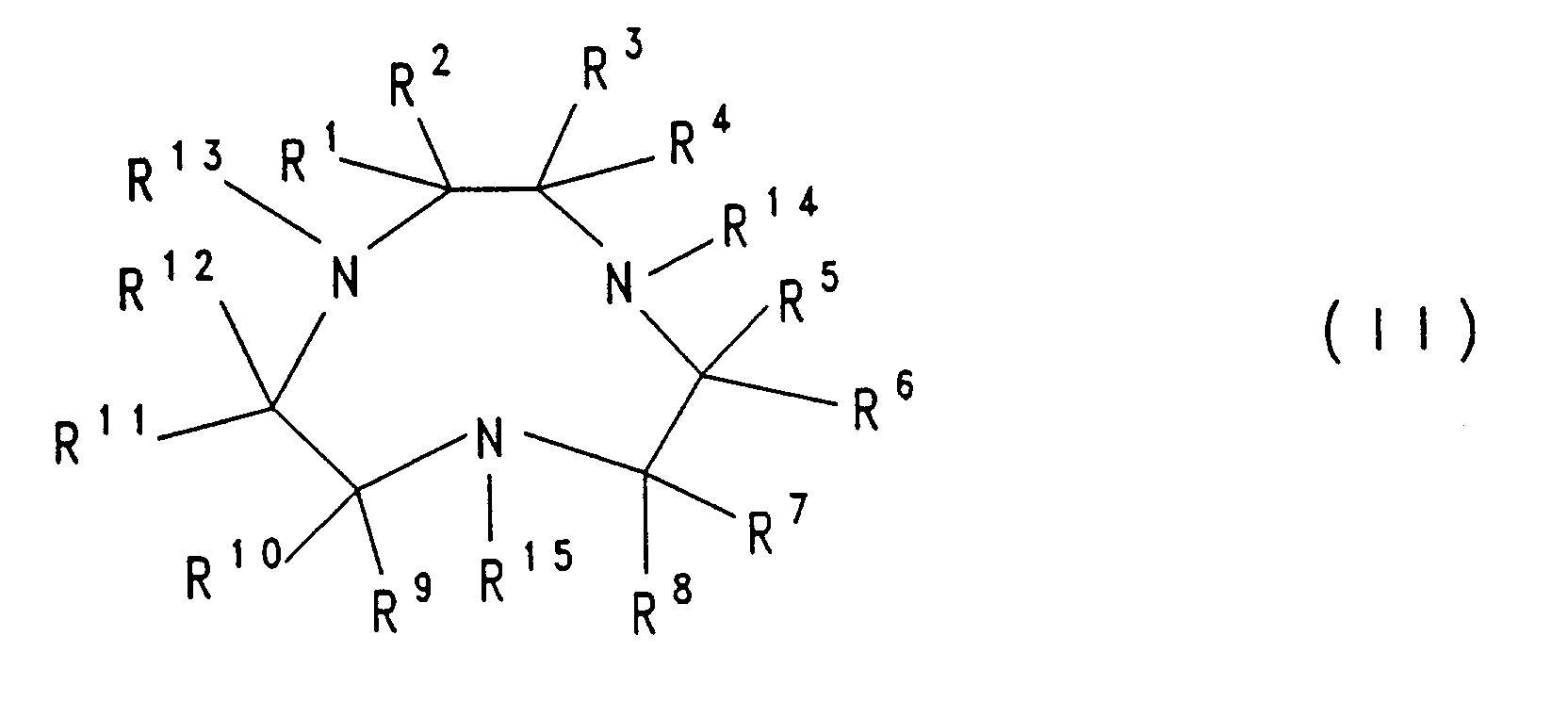
R1 bis R12 unabhängig voneinander Wasserstoff, (C1-C12)Alkyl, (C3-C12)Cycloalkyl, (C1-C12)Alkenyl, (C1-C12)Alkoxy, (C1-C12)Acyloxy, Aryl, Heteroaryl, CH2-Aryl, COOH, COO(C1-C12)Alkyl, COO-Aryl, CN, Halogen, C-(Halogen)3, NH2, NH-(C1-C12)-Alkyl, N(C1-C12-Alkyl)2, NH-Aryl, N(Aryl)2, N-Alkylaryl, S(C1-C12)Alkyl, SO(C1-C12)Alkyl, SO2(C1-C12)Alkyl, P(C1-C12Alkyl)2 und
R13 bis R15 Wasserstoff, (C1-C12)Alkyl, CH2-Aryl, Aryl und Heteroaryl bedeuten.
Description
- Stereoselektive Oxidationsreaktionen sind von zentraler Bedeutung für die Synthese einer großen Anzahl von Wirkstoffen und Wirkstoffzwischenprodukten für Pharmaka und Agrochemikalien. Insbesondere Epoxidationsreaktionen sind eine wichtige Methode zur Darstellung von chiralen Verbindungen aufgrund der vielfältigen Funktionalisierbarkeit der Produkte.
- Bisher gibt es kein generelles Verfahren, das chirale Verbindungen gleichzeitig in hohen Ausbeuten und hohen Enantioselektivitäten zugänglich macht.
- Weiterhin ist es insbesondere aus technischer Sicht unzureichend, daß alle bisher bekannten Katalysatorsysteme nur außerordentlich schlechte Katalysator Turn Over Zahlen besitzen, so daß große Mengen an Katalysator - in der Regel zwischen 5 - 10 mol% - eingesetzt werden müssen.
- Aus den genannten Gründen bestand ein großes industrielles Interesse bessere technisch nutzbare Katalysatorsysteme für die Herstellung chiraler Verbindungen zu entwickeln.
- Die Aufgabe wird gelöst durch chirale Mangan-triazanonankomplexe der Formel (I)
[Mnu(L)v(OR)w(µ-O)x(µOAc)y]Xz (I)
worin bedeuten:
u, v gleich 1 oder 2;
w, x, y gleich 0, 1, 2 oder 3;
z gleich 1, 2 oder 3
mit der Maßgabe, daß, wenn u = 1 ist, v = 1, w = 1, 2 oder 3, z = 1, 2 oder 3 sind,
oder, wenn u = 2 ist, v = 2, w = 0 oder 1, x = 1, y = 2, z = 1 oder 2 sind,
oder v = 2, w = 0 oder 1, x = 1, y = 2, z = 2 oder 3 sind, oder v = 2, w = 0, 1, x = 3, y = 0, z = 1, 2 sind; - R
- (C1-C12)Alkyl,
- X
- PF6 ⊖, F⊖, Cl⊖, Br⊖, I⊖, (C6H5)B⊖, ClO4 ⊖ bedeutet und
- L
- für einen chiralen organischen Triazanonan-Liganden der allgemeinen Formel (II) steht,
- Interessant sind Verbindungen worin Formel (I) für
[Mn(L)(OR)3]X
[Mn2(µO)(µOAc)2(L)2]X2
[Mn2(µO)(µOAc)2(L)2]X3
steht, wobei für Ligand L in Formel (II) R1 bis R12 unabhängig voneinander Wasserstoff, (C1-C6)Alkyl, (C3-C6)Cycloalkyl, (C1-C6)Alkoxy, Phenyl, Naphthyl, Tolyl, Pyridyl, Bipyridyl, Benzyl, COO(C1-C6)Alkyl, N(C1-C6-Alkyl)2 oder NH-Phenyl und R13 bis R15 Wasserstoff, (C1-C12)Alkyl, Phenyl, Tolyl, Benzyl, Pyridyl oder Bipyridyl bedeuten. - Hierbei sind insbesondere die Verbindungen wichtig, bei denen für den Liganden L R1 bis R12 Wasserstoff, (C1-C6)Alkyl, (C3-C6)Cycloalkyl, Phenyl, Benzyl, Pyridyl, Bipyridyl oder N(C1-C6-Alkyl)2 und R13 bis R15 Wasserstoff, (C1-C6)Alkyl, Phenyl, Benzyl oder Pyridyl bedeuten.
- Die erfindungsgemäßen Verbindungen können nach mehreren Verfahren hergestellt werden. Eine Methode besteht darin, daß der Ligand L, gelöst in einem polaren Lösungsmittel, mit einem 1,1 bis 1,5-fachen Überschuß eines Mangen(III)salzes bei einem pH-Wert von 7 bis 9 versetzt wird, die erhaltene Lösung mit einer Säure HX auf pH 4 bis 6 eingestellt wird und die Zielverbindung durch Zugabe eines unpolaren Lösungsmittels ausgefällt wird.
- Hierbei hat es sich bewährt, als Mangan(III)salz Mangan(III)acetat, als polares Lösungsmittel ein Gemisch aus (C1-C3)Alkoholen und Wasser, als Säure HX HPF6 und als unpolares Lösungsmittel einen Kohlenwasserstoff einzusetzen.
- Eine weitere Methode besteht darin, daß Ligand L unter Kühlung zu einer alkoholischen Lösung eines Mangan(II)salzes gegeben wird, mit einem Überschuß Alkalimetallalkoholat versetzt wird und der gebildete Komplex unter Zugabe von NaX mittels Luft oxidiert und durch Extraktion isoliert wird.
- Hierbei hat es sich bewährt, als Alkalimetallalkoholat Natriummethylat, als Salz NaX NaPF6 und als Extraktionsmittel ein Gemisch aus Acetonitril/Heptan zu verwenden.
- Ein 1 I-Dreihalskolben mit mechanischem Rührer, Rückflußkühler, Innenthermometer und 1l Tropftrichter wird mit 115.0 g (0.603 mol) p-Toluolsulfonylchlorid und 300 ml Pyridin befüllt. Die Mischung wird gerührt und auf 50°C erwärmt um den Feststoff zu lösen. Anschließend wird das Reaktionsgefäß in ein 30°C warmes Wasserbad getaucht. Dann addiert man eine Lösung von 21.0 g (0.20 mol) Bis-N,N-(2-hydroxyethyl)-amin in 30 ml Pyridin, so daß die Reaktionstemperatur zwischen 50 - 60°C beträgt. Die Mischung wird weitere 90 Minuten bei dieser Temperatur gerührt und anschließend in Eiswasser gegeben. Man filtriert Bis-N,N-(2-Tosyloxyethyl)-p-toluolsulfonamid in 90 % Ausbeute ab.
- Ein 1 I-Dreihalskolben mit mechanischem Rührer, Rückflußkühler, Innenthermometer und 1l Tropftrichter wird mit 171.9 g (0.90 mol) p-Toluolsulfonylchlorid und 300 ml Pyridin befüllt. Die Mischung wird auf 50°C erwärmt um den Feststoff zu lösen. Anschließend wird das Reaktionsgefäß in ein 30°C warmes Wasserbad getaucht. Dann addiert man eine Lösung von 50.0 g (0.438 mol) trans-1,2-Cyclohexyldiamin in 50 ml Pyridin, so daß die Reaktionstemperatur zwischen 50 - 60°C beträgt. Die Mischung wird weitere 90 Minuten bei dieser Temperatur gerührt und anschließend in Eiswasser gegeben. Man filtriert Bis-N,N-Tosyl-1,2-cyclohexyldiamin in 90 % Ausbeute ab.
- 100 g (0.236 mol) Bis-N,N-Tosyl-1,2-cyclohexyldiamin wurde im 1 l 3-Halskolben in 300 ml Ethanol suspendiert. Nach Erhitzen auf Rückfluß werden 330 ml einer 1.5 N Natriumethanolatlösung schnell zugetropft. Anschließend wird die Lösung in einen Erlenmeyerkolben dekantiert. Nach dem vorsichtigen Eindampfen im Vakuum kristallisiert das Dinatriumsalz von Bis-N,N-Tosyl-1,2-cyclohexyldiamin in 90 % Ausbeute aus. 80 g (0.17 mol) des Dinatriumsalzes werden dann in einem 1 l 3-Halskolben überführt und in 500 ml Dimethylformamid gelöst. Die Reaktionsmischung wird auf 100°C erhitzt und mit 97 g (0.17 mol) Bis-N,N-(2-Tosyloxyethyl)-p-toluolsulfonamid in 300 ml Dimethylformamid tropfenweise versetzt. Nach beendeter Zugabe wird eine weitere Stunde bei 100°C gerührt, dann abgekühlt auf Raumtemperatur. Nach wäßriger Aufarbeitung und Kristallisation erhält man das gewünschte Produkt in 68 % Ausbeute.
- 50 g des chiralen cyclischen Triazanonanderivats wird mit 200 ml konzentrierter Schwefelsäure versetzt. Die Reaktionsmischung wird auf 100°C erwärmt und 70 Stunden bei dieser Temperatur gerührt. Nach Abkühlen auf 0°C gibt man 500 ml Diethylether vorsichtig zu. Das ausgefallene Salz wird unter Stickstoff abfiltriert und mit wasserfreiem Diethylether gewaschen. Das Salz wird dann in 200 ml Wasser gegeben und mit 30 ml einer 50 %igen Natronlauge neutralisiert. Die Lösung wird mit 3 g Aktivkohle auf 80°C erwärmt und über Celte filtriert. Das eisgekühlte Filtrat wird durch Zusatz von Schwefelsäure auf pH 1 eingestellt. Das dabei ausgefallene Produkt wird abfiltriert und zur weiteren Reinigung aus Acetonitril umkristallisiert. Man erhält das gewünschte Produkt in 71 % Ausbeute.
MS (El, 70 eV): M + H + 184 (100 %)Elementaranalyse: berechnet C 65.53 H 11.55 N 22.93 gefunden C 65.41 H 11.32 N 22.58 - In einen 100 ml Dreihalskolben werden 20.0 g (88.4 mmol) 1,2-Cyclohexyl-1,3,7-triazacyclononan in 50 ml Dichlormethan gelöst. Zur Reaktionsmischung werden 25.5 g Methyliodid (266 mmol) innerhalb von 30 Minuten tropfenweise zugesetzt. Die Mischung wird anschließend 12 Stunden refluxiert, abgekühlt und filtriert. Nach Extraktion mit dreimal 100 ml Wasser wird die organische Phase mit Magnesiumsulfat getrocknet. Nach Abdestillieren des Lösungsmittels im Vakuum erhält man das gewünschte Produkt, das durch Chromatographie an Kieselgel mit Ethylacetat/Hexan (1:1) als Laufmittel weiter gereinigt werden kann. Ausbeute: 80 %
MS (El, 70 eV): M + H + 226 (100 %)Elementaranalyse: berechnet C 69.28 H 12.08 N 18.64 gefunden C 68.98 H 11.95 N 18.43 - Unter Inertgas wird eine auf 0°C gekühlte Lösung von 2.25 g (10 Mmol) Ligand L in 50 ml wasserfreiem Methanol zu einer Suspension von 1.26 g (10 mMol) wasserfreiem MnCl2 in 10 ml wasserfreiem Methanol transferiert und etwa 30 Minuten gerührt. Gleichzeitig werden 1.53 g (15 mMol) Natrium in Methanol gelöst, das Methanol eingedampft und die obige Reaktionslösung unter Inertgas und bei 0°C durch eine Fritte zu dem verbleibenden weißen Rückstand transferiert. Man läßt etwa weitere 20 Minuten rühren und gibt dann 3.36 g (20 mMol) Natriumhexafluorphosphat gelöst in 20 ml Methanol zu der Reaktionsmischung, die nun an Luft gebracht, auf Raumtemperatur erwärmt, etwa auf die Hälfte eingedampft und mit etwas n-Heptan versetzt wird. Der ausgefallene Rückstand wird in Acetonitril suspendiert, filtriert und das Filtrat nach Einengen mit etwas n-Heptan versetzt. Dabei fällt ein braunes Pulver aus, das nach Abfiltrieren und Trocknen 1.34 g (26 %) ergibt.
Elementaranalyse: berechnet C 37.0 H 7.0 N 8.1 Mn 10.6 gefunden C 38.1 H 7.3 N 8.0 Mn 9.9 - Schmelzpunkt:
- > 300°C (Zersetzung)
- 2.25 g (10 mMol) Ligand L werden unter Inertgas bei Raumtemperatur in 60 ml einer Mischung aus Ethanol/Wasser (90/10 v/v) gelöst, mit 3.22 g (12 mMol) Mangan(III)acetat-Dihydrat versetzt und zunächst durch Zugabe von Natriumacetat der pH auf 8, danach durch vorsichtiges Zutropfen von konzentrierter HPF6-Lösung auf pH 5 eingestellt. Man läßt etwa 10 Minuten rühren, gibt dann 3.36 g (20 mMol) Natriumhexafluorphosphat in fester Form zu der Reaktionsmischung, die etwa weitere 10 Minuten gerührt und mit etwas n-Heptan versetzt wird. Der ausgefallene Rückstand wird in Acetonitril suspendiert, filtriert und das Filtrat nach Einengen mit etwas n-Heptan versetzt. Dieser Vorgang wird zweimal wiederholt. Dabei fällt ein rotes Pulver aus, das nach Abfiltrieren und Trocknen 0.81 g (16 %) ergibt.
Elementaranalyse: berechnet C 36.7 H 6.2 N 8.6 O 8.2 Mn 10.4 gefunden C 36.1 H 6.3 N 8.3 O 8.5 Mn 10.0 - Schmelzpunkt:
- > 300°C (Zersetzung)
- 200 mg (0.2 mMol) des Mangan-Komplexes aus Beispiel 7 werden in 30 ml einer 0.1 M Lösung von Tetrabutylammoniumhexafluorphosphat (Leitsalz) in Acetonitril gelöst, in den Anodenraum einer durch eine ®Nafion-Membran geteilten Zweielektrodenzelle mit Pt-Anode eingefüllt und bei einer konstanten Stromdichte von 5 mA/cm2 elektrolysiert. Nach Durchgang von 0.96 Faraday/Mol steigt die Zellspannung sehr stark an. Zu diesem Zeitpunkt wird die Elektrolyse unterbrochen, die Farbe des Anolyten hat sich von anfangs dunkelrot nach grünlich-braun verändert. Die Elektrolyselösung wird eingeengt, der Rückstand mit Ethanol/Wasser gewaschen und aus Acetonitril/n-Heptan umkristallisiert. Das Produkt ist mit etwas Leitsalz verunreinigt. Ausbeute: 280 mg.
- 200 mg (0.2 mMol) des Mangan-Komplexes aus Beispiel 2 werden in 30 ml einer Mischung aus Ethanol/Wasser (1/1, v/v) unter Ultrabeschallung gelöst, mit 2 ml Triethylamin und 2 g festem Natriumhexafluorophosphat versetzt, einige Minuten an Luft gerührt. Die Reaktionsmischung wird filtriert und das Filtrat eingedampft. Der verbliebene Rückstand wird in wenig Acetonitril gelöst, filtriert, und das eingedampfte Filtrat nochmals aus Acetonitril/n-Heptan umkristallisiert. Es verbleiben 80 mg rote Nadeln.
Elementaranalyse: berechnet: C 33.8 H 5.9 N 9.1 O 8.7 Mn 11.1 experimentell: C 34.5 H 6.0 N 8.9 O 8.8 Mn 10.7

R1 bis R12 unabhängig voneinander Wasserstoff, (C1-C12)Alkyl, (C3-C12)Cycloalkyl, (C1-C12)Alkenyl, (C1-C12)Alkoxy, (C1-C12)Acyloxy, Aryl, Heteroaryl, CH2-Aryl, COOH, COO(C1-C12)Alkyl, COO-Aryl, CN, Halogen, C-(Halogen)3, NH2, NH-(C1-C12)-Alkyl, N(C1-C12-Alkyl)2, NH-Aryl, N(Aryl)2, N-Alkylaryl, S(C1-C12)Alkyl, SO(C1-C12)Alkyl, SO2(C1-C12)Alkyl, P(C1-C12Alkyl)2 und
R13 bis R15 Wasserstoff, (C1-C12)Alkyl, CH2-Aryl, Aryl und Heteroaryl bedeuten.
Claims (10)
- Chirale Mangan-triazanonankomplexe der Formel (I)
[Mnu(L)v(OR)w(µ-O)x(µOAc)y]Xz
worin bedeuten:
u, v gleich 1 oder 2;
w, x, y gleich 0, 1, 2 oder 3;
z gleich 1, 2 oder 3
mit der Maßgabe, daß, wenn u = 1 ist, v = 1, w = 1, 2 oder 3, z = 1, 2 oder 3 sind,
oder, wenn u = 2 ist, v = 2, w = 0 oder 1, x = 1, y = 2, z = 1 oder 2 sind, oder v = 2, w = 0 oder 1, x = 1, y = 2, z = 2 oder 3 sind, oder v = 2, w = 0 oder 1, x = 3, y = 0, z = 1 oder 2 sind;R (C1-C12)Alkyl,X PF6 ⊖, F⊖, Cl⊖, Br⊖, I⊖, (C6H5)B⊖, ClO4 ⊖ bedeutet undL für einen chiralen organischen Triazanonan-Liganden der allgemeinen Formel (II) steht,
R1 bis R12 unabhängig voneinander Wasserstoff, (C1-C12)Alkyl, (C3-C12)Cycloalkyl, (C1-C12)Alkenyl, (C1-C12)Alkoxy, (C1-C12)Acyloxy, Aryl, Heteroaryl, CH2-Aryl, COOH, COO(C1-C12)Alkyl, COO-Aryl, CN, Halogen, C-(Halogen)3, NH2, NH-(C1-C12)-Alkyl, N(C1-C12-Alkyl)2, NH-Aryl, N(Aryl)2, N-Alkylaryl, S(C1-C12)Alkyl, SO(C1-C12)Alkyl, SO2(C1-C12)Alkyl, P(C1-C12Alkyl)2 und
R13 bis R15 Wasserstoff, (C1-C12)Alkyl, CH2-Aryl, Aryl und Heteroaryl bedeuten. - Verbindungen nach Anspruch 1 der Formel
[Mn(L)(OR)3]X,
worin für Ligand L in Formel (II) R1 bis R12 unabhängig voneinander Wasserstoff, (C1-C6)Alkyl, (C3-C6)Cycloalkyl, (C1-C6)Alkoxy, Phenyl, Naphthyl, Tolyl, Pyridyl, Bipyridyl, Benzyl, COO(C1-C6)Alkyl, N(C1-C6)Alkyl2 oder NH-Phenyl und R13 bis R15 Wasserstoff, (C1-C12)Alkyl, Phenyl, Tolyl, Benzyl, Pyridyl oder Bipyridyl bedeuten. - Verbindungen nach Anspruch 1 der Formel
[Mn2(µO)(µOAc)2(L)2]X2,
worin für Ligand L in Formel (II) R1 bis R12 unabhängig voneinander Wasserstoff, (C1-C6)Alkyl, (C3-C6)Cycloalkyl, (C1-C6)Alkoxy, Phenyl, Naphthyl, Tolyl, Pyridyl, Bipyridyl, Benzyl, COO(C1-C6)Alkyl, N(C1-C6)Alkyl2 oder NH-Phenyl und R13 bis R15 Wasserstoff, (C1-C12)Alkyl, Phenyl, Tolyl, Benzyl, Pyridyl oder Bipyridyl bedeuten. - Verbindungen nach Anspruch 1 der Formel
[Mn2(µO)(µOAc)2(L)2]X3,
worin für Ligand L in Formel (II) R1 bis R12 unabhängig voneinander Wasserstoff, (C1-C6)Alkyl, (C3-C6)Cycloalkyl, (C1-C6)Alkoxy, Phenyl, Naphthyl, Tolyl, Pyridyl, Bipyridyl, Benzyl, COO(C1-C6)Alkyl, N(C1-C6)Alkyl2 oder NH-Phenyl und R13 bis R15 Wasserstoff, (C1-C12)Alkyl, Phenyl, Tolyl, Benzyl, Pyridyl oder Bipyridyl bedeuten. - Verbindungen nach Anspruch 1 der Formel
[Mn2(µO)3L2]X2,
worin für Ligand L in Formel (II) R1 bis R12 unabhängig voneinander Alkyl, (C3-C6)Cycloalkyl, (C1-C6)Alkoxy, Phenyl, Naphthyl, Tolyl, Pyridyl, Bipyridyl, Benzyl, COO(C1-C6)Alkyl, N(C1-C6)Alkyl2 oder NH-Phenyl und R13 bis R15 Wasserstoff, (C1-C12)Alkyl, Phenyl, Tolyl, Benzyl, Pyridyl oder Bipyridyl bedeuten. - Verbindungen nach mindestens einem der Ansprüche 1 bis 5, dadurch gekennzeichnet, daß für den Liganden L R1 bis R12 Wasserstoff, (C1-C6)Alkyl, (C3-C6)Cycloalkyl, Phenyl, Benzyl, Pyridyl, Bipyridyl oder N(C1-C6)Alkyl2 und R13 bis R15 Wasserstoff, (C1-C6)Alkyl, Phenyl, Benzyl, Pyridyl bedeuten.
- Verfahren zur Herstellung von Verbindungen nach Anspruch 1, dadurch gekennzeichnet, daß der Ligand L, gelöst in einem polaren Lösungsmittel, mit einem 1,1 bis 1,5 fachen Überschuß eines Mangan(III)salzes bei einem pH-Wert von 7-9 versetzt wird, die erhaltene Lösung mit einer Säure HX auf pH 4 bis 6 eingestellt wird und die Zielverbindung durch Zugabe eines unpolaren Lösungsmittels ausgefällt wird.
- Verfahren nach Anspruch 7, dadurch gekennzeichnet, daß als Mangan(III)salz Mangan(III)acetat, als polares Lösungsmittel ein Gemisch aus (C1-C3)Alkoholen und Wasser, als Säure HX HPF6 und als unpolares Lösungsmittel ein Kohlenwasserstoff eingesetzt wird.
- Verfahren zur Herstellung von Verbindungen nach Anspruch 1, dadurch gekennzeichnet, daß Ligand L unter Kühlung zu einer alkoholischen Lösung eines Mangan(II)salzes gegeben wird, mit einem Überschuß Alkalimetallalkoholat versetzt wird und der gebildete Komplex unter Zugabe von NaX mittels Luft oxidiert und durch Extraktion isoliert wird.
- Verfahren nach Anspruch 9, dadurch gekennzeichnet, daß als Alkalimetallalkoholat Natriummethylat, als Salz NaX NaPF6 und als Extraktionsmittel ein Gemisch aus Acetonitril/Heptan verwendet wird.
Applications Claiming Priority (2)
| Application Number | Priority Date | Filing Date | Title |
|---|---|---|---|
| DE19523891A DE19523891C1 (de) | 1995-06-30 | 1995-06-30 | Chirale Mangan-triazanonankomplexe und Verfahren zu ihrer Herstellung |
| DE19523891 | 1995-06-30 |
Publications (2)
| Publication Number | Publication Date |
|---|---|
| EP0751142A2 true EP0751142A2 (de) | 1997-01-02 |
| EP0751142A3 EP0751142A3 (de) | 1998-08-19 |
Family
ID=7765700
Family Applications (1)
| Application Number | Title | Priority Date | Filing Date |
|---|---|---|---|
| EP96110138A Withdrawn EP0751142A3 (de) | 1995-06-30 | 1996-06-24 | Chirale Mangan-triazanonankomplexe und Verfahren zu ihrer Herstellung |
Country Status (4)
| Country | Link |
|---|---|
| US (1) | US5756727A (de) |
| EP (1) | EP0751142A3 (de) |
| JP (1) | JPH0920762A (de) |
| DE (1) | DE19523891C1 (de) |
Cited By (10)
| Publication number | Priority date | Publication date | Assignee | Title |
|---|---|---|---|---|
| US6265505B1 (en) | 1999-11-18 | 2001-07-24 | Univation Technologies, Llc | Catalyst system and its use in a polymerization process |
| US6271325B1 (en) | 1999-05-17 | 2001-08-07 | Univation Technologies, Llc | Method of polymerization |
| US6271323B1 (en) | 1999-10-28 | 2001-08-07 | Univation Technologies, Llc | Mixed catalyst compounds, catalyst systems and their use in a polymerization process |
| US6274684B1 (en) | 1999-10-22 | 2001-08-14 | Univation Technologies, Llc | Catalyst composition, method of polymerization, and polymer therefrom |
| US6300439B1 (en) | 1999-11-08 | 2001-10-09 | Univation Technologies, Llc | Group 15 containing transition metal catalyst compounds, catalyst systems and their use in a polymerization process |
| US6300438B1 (en) | 1999-10-22 | 2001-10-09 | Univation Technolgies, Llc | Hafnium transition metal catalyst compounds, catalyst systems and their use in a polymerization process |
| US6380328B1 (en) | 1999-12-10 | 2002-04-30 | Univation Technologies, Llc | Catalyst systems and their use in a polymerization process |
| US6417304B1 (en) | 1999-11-18 | 2002-07-09 | Univation Technologies, Llc | Method of polymerization and polymer produced therefrom |
| US6624107B2 (en) | 1999-10-22 | 2003-09-23 | Univation Technologies, Llc | Transition metal catalyst compounds having deuterium substituted ligand and catalyst systems thereof |
| US6656868B2 (en) * | 1999-12-16 | 2003-12-02 | Univation Technologies, Llc | Polymerization catalyst compositions |
Families Citing this family (2)
| Publication number | Priority date | Publication date | Assignee | Title |
|---|---|---|---|---|
| KR101735087B1 (ko) * | 2010-03-03 | 2017-05-24 | 카텍셀 리미티드 | 표백 촉매 제조방법 |
| CN115501912A (zh) | 2011-09-08 | 2022-12-23 | 卡特克塞尔科技有限公司 | 催化剂 |
Family Cites Families (9)
| Publication number | Priority date | Publication date | Assignee | Title |
|---|---|---|---|---|
| GB8719041D0 (en) * | 1987-08-12 | 1987-09-16 | Parker D | Conjugate compounds |
| DE69125310T2 (de) * | 1990-05-21 | 1997-07-03 | Unilever Nv | Bleichmittelaktivierung |
| EP0522817A1 (de) * | 1991-07-11 | 1993-01-13 | Unilever Plc | Verfahren zur Herstellung von Mangan Komplexen |
| EP0544490A1 (de) * | 1991-11-26 | 1993-06-02 | Unilever Plc | Bleich- und Reinigungsmittelzusammensetzungen |
| US5194416A (en) * | 1991-11-26 | 1993-03-16 | Lever Brothers Company, Division Of Conopco, Inc. | Manganese catalyst for activating hydrogen peroxide bleaching |
| US5256779A (en) * | 1992-06-18 | 1993-10-26 | Lever Brothers Company, Division Of Conopco, Inc. | Synthesis of manganese oxidation catalyst |
| US5280117A (en) * | 1992-09-09 | 1994-01-18 | Lever Brothers Company, A Division Of Conopco, Inc. | Process for the preparation of manganese bleach catalyst |
| US5329024A (en) * | 1993-03-30 | 1994-07-12 | National Starch And Chemical Investment Holding Corporation | Epoxidation of olefins via certain manganese complexes |
| US5462725A (en) * | 1993-05-06 | 1995-10-31 | The Dow Chemical Company | 2-pyridylmethylenepolyazamacrocyclophosphonic acids, complexes and derivatives thereof, for use as contrast agents |
-
1995
- 1995-06-30 DE DE19523891A patent/DE19523891C1/de not_active Expired - Fee Related
-
1996
- 1996-06-24 EP EP96110138A patent/EP0751142A3/de not_active Withdrawn
- 1996-06-28 US US08/671,957 patent/US5756727A/en not_active Expired - Fee Related
- 1996-06-28 JP JP8169940A patent/JPH0920762A/ja not_active Withdrawn
Cited By (19)
| Publication number | Priority date | Publication date | Assignee | Title |
|---|---|---|---|---|
| US6271325B1 (en) | 1999-05-17 | 2001-08-07 | Univation Technologies, Llc | Method of polymerization |
| US6855839B2 (en) | 1999-05-17 | 2005-02-15 | Univation Technologies, Llc, (Us) | Method of polymerization |
| US6841631B2 (en) | 1999-10-22 | 2005-01-11 | Univation Technologies, Llc | Catalyst composition, method of polymerization, and polymer therefrom |
| US6274684B1 (en) | 1999-10-22 | 2001-08-14 | Univation Technologies, Llc | Catalyst composition, method of polymerization, and polymer therefrom |
| USRE41897E1 (en) | 1999-10-22 | 2010-10-26 | Univation Technologies, Llc | Catalyst composition, method of polymerization, and polymer therefrom |
| US6300438B1 (en) | 1999-10-22 | 2001-10-09 | Univation Technolgies, Llc | Hafnium transition metal catalyst compounds, catalyst systems and their use in a polymerization process |
| US7754840B2 (en) | 1999-10-22 | 2010-07-13 | Univation Technologies, Llc | Bimodal high density polyethlyene |
| US6894128B2 (en) | 1999-10-22 | 2005-05-17 | Univation Technologies, Llc | Catalyst composition, method of polymerization, and polymer therefrom |
| US6534604B2 (en) | 1999-10-22 | 2003-03-18 | Univation Technologies, Llc | Catalyst composition, method of polymerization, and polymer therefrom |
| US6624107B2 (en) | 1999-10-22 | 2003-09-23 | Univation Technologies, Llc | Transition metal catalyst compounds having deuterium substituted ligand and catalyst systems thereof |
| US6271323B1 (en) | 1999-10-28 | 2001-08-07 | Univation Technologies, Llc | Mixed catalyst compounds, catalyst systems and their use in a polymerization process |
| US6300439B1 (en) | 1999-11-08 | 2001-10-09 | Univation Technologies, Llc | Group 15 containing transition metal catalyst compounds, catalyst systems and their use in a polymerization process |
| USRE41785E1 (en) | 1999-11-08 | 2010-09-28 | Univation Technologies, Llc | Group 15 containing transition metal catalyst compounds, catalyst systems and their use in a polymerization process |
| US6696537B2 (en) | 1999-11-18 | 2004-02-24 | Univation Technologies, Llc | Method of polymerization and polymer produced therefrom |
| US6417304B1 (en) | 1999-11-18 | 2002-07-09 | Univation Technologies, Llc | Method of polymerization and polymer produced therefrom |
| US6265505B1 (en) | 1999-11-18 | 2001-07-24 | Univation Technologies, Llc | Catalyst system and its use in a polymerization process |
| US6620757B2 (en) | 1999-12-10 | 2003-09-16 | Univation Technologies, Llc | Catalyst systems and their use in a polymerization process |
| US6380328B1 (en) | 1999-12-10 | 2002-04-30 | Univation Technologies, Llc | Catalyst systems and their use in a polymerization process |
| US6656868B2 (en) * | 1999-12-16 | 2003-12-02 | Univation Technologies, Llc | Polymerization catalyst compositions |
Also Published As
| Publication number | Publication date |
|---|---|
| US5756727A (en) | 1998-05-26 |
| DE19523891C1 (de) | 1996-11-21 |
| EP0751142A3 (de) | 1998-08-19 |
| JPH0920762A (ja) | 1997-01-21 |
Similar Documents
| Publication | Publication Date | Title |
|---|---|---|
| DE69634639T2 (de) | Verfahren zur herstellung optische aktive verbindungen | |
| EP2459579B1 (de) | Imidazolgruppenhaltige phosphinoboran-verbindungen und verfahren zur herstellung von imidazolgruppenhaltige phosphorverbindungen | |
| EP0301457A2 (de) | Verfahren zur Herstellung von optisch aktiven sekundären Aminen | |
| DE68916754T2 (de) | Verfahren zur Herstellung von optisch aktiver 3-Hydroxybuttersäure. | |
| DE19523891C1 (de) | Chirale Mangan-triazanonankomplexe und Verfahren zu ihrer Herstellung | |
| EP0583433B1 (de) | Diphosphinliganden | |
| DE69223240T2 (de) | Chirale dreizahnige bis-phospholan-liganden | |
| EP1654266B1 (de) | Neue metathesekatalysatoren | |
| EP0419409A2 (de) | Iridiumkomplexe, Verfahren zu deren Herstellung und deren Verwendung | |
| EP1394168B1 (de) | Verfahren zur Herstellung von Phosphiten und Übergangsmetallkomplexen | |
| DE3148098C2 (de) | ||
| DE60104923T2 (de) | Piperidin- und Pirazinverbindungen zur Verwendung in der Behandlung von Alzheimer | |
| EP1186609B1 (de) | Diphosphine | |
| EP0643052B1 (de) | Verfahren zur enantioselektiven Hydrierung von 2H-Pyran-2-on-Derivaten | |
| EP0553778A1 (de) | Asymmetrische Hydrierung | |
| EP0570764A2 (de) | Asymmetrische Hydrierung | |
| EP0744401B1 (de) | Verfahren zur Herstellung von optisch aktiven 2-Piperazincarbonsäurederivaten | |
| DE4001019A1 (de) | Verfahren zur asymmetrischen hydrierung von (alpha)-ketocarbonylverbindungen zu optisch aktiven (alpha)-hydroxycarbonylverbindungen | |
| EP0104376A2 (de) | Verfahren zur Herstellung von optisch aktiven Aminen und Enaminen | |
| EP0574783B1 (de) | Asymmetrische Hydrierung | |
| DE3889441T2 (de) | Katalytisches Verfahren zur Herstellung von optisch aktivem Threonin. | |
| EP0864576A1 (de) | Neue Amidophosphin-Phosphinit-Verbindungen | |
| EP0992481B1 (de) | Verfahren zur asymmetrische Hydrierung von Beta-Ketoestern | |
| EP0749953A1 (de) | Herstellung von chiralen alpha-Halogencarbonsäuren | |
| EP1409493B1 (de) | Verfahren zur herstellung von nicht-chiralen und optisch aktiven hydroxygruppen enthaltenden organischen verbindungen |
Legal Events
| Date | Code | Title | Description |
|---|---|---|---|
| PUAI | Public reference made under article 153(3) epc to a published international application that has entered the european phase |
Free format text: ORIGINAL CODE: 0009012 |
|
| AK | Designated contracting states |
Kind code of ref document: A2 Designated state(s): AT CH DE FR GB IT LI |
|
| PUAL | Search report despatched |
Free format text: ORIGINAL CODE: 0009013 |
|
| STAA | Information on the status of an ep patent application or granted ep patent |
Free format text: STATUS: THE APPLICATION HAS BEEN WITHDRAWN |
|
| AK | Designated contracting states |
Kind code of ref document: A3 Designated state(s): AT CH DE FR GB IT LI |
|
| 18W | Application withdrawn |
Withdrawal date: 19980805 |