WO2005061761A1 - Zweistufige konversionsbehandlung - Google Patents
Zweistufige konversionsbehandlung Download PDFInfo
- Publication number
- WO2005061761A1 WO2005061761A1 PCT/EP2004/012323 EP2004012323W WO2005061761A1 WO 2005061761 A1 WO2005061761 A1 WO 2005061761A1 EP 2004012323 W EP2004012323 W EP 2004012323W WO 2005061761 A1 WO2005061761 A1 WO 2005061761A1
- Authority
- WO
- WIPO (PCT)
- Prior art keywords
- aqueous solution
- range
- metal
- ions
- organic polymers
- Prior art date
- Legal status (The legal status is an assumption and is not a legal conclusion. Google has not performed a legal analysis and makes no representation as to the accuracy of the status listed.)
- Ceased
Links
Classifications
-
- C—CHEMISTRY; METALLURGY
- C23—COATING METALLIC MATERIAL; COATING MATERIAL WITH METALLIC MATERIAL; CHEMICAL SURFACE TREATMENT; DIFFUSION TREATMENT OF METALLIC MATERIAL; COATING BY VACUUM EVAPORATION, BY SPUTTERING, BY ION IMPLANTATION OR BY CHEMICAL VAPOUR DEPOSITION, IN GENERAL; INHIBITING CORROSION OF METALLIC MATERIAL OR INCRUSTATION IN GENERAL
- C23C—COATING METALLIC MATERIAL; COATING MATERIAL WITH METALLIC MATERIAL; SURFACE TREATMENT OF METALLIC MATERIAL BY DIFFUSION INTO THE SURFACE, BY CHEMICAL CONVERSION OR SUBSTITUTION; COATING BY VACUUM EVAPORATION, BY SPUTTERING, BY ION IMPLANTATION OR BY CHEMICAL VAPOUR DEPOSITION, IN GENERAL
- C23C22/00—Chemical surface treatment of metallic material by reaction of the surface with a reactive liquid, leaving reaction products of surface material in the coating, e.g. conversion coatings, passivation of metals
- C23C22/82—After-treatment
- C23C22/83—Chemical after-treatment
-
- C—CHEMISTRY; METALLURGY
- C23—COATING METALLIC MATERIAL; COATING MATERIAL WITH METALLIC MATERIAL; CHEMICAL SURFACE TREATMENT; DIFFUSION TREATMENT OF METALLIC MATERIAL; COATING BY VACUUM EVAPORATION, BY SPUTTERING, BY ION IMPLANTATION OR BY CHEMICAL VAPOUR DEPOSITION, IN GENERAL; INHIBITING CORROSION OF METALLIC MATERIAL OR INCRUSTATION IN GENERAL
- C23C—COATING METALLIC MATERIAL; COATING MATERIAL WITH METALLIC MATERIAL; SURFACE TREATMENT OF METALLIC MATERIAL BY DIFFUSION INTO THE SURFACE, BY CHEMICAL CONVERSION OR SUBSTITUTION; COATING BY VACUUM EVAPORATION, BY SPUTTERING, BY ION IMPLANTATION OR BY CHEMICAL VAPOUR DEPOSITION, IN GENERAL
- C23C22/00—Chemical surface treatment of metallic material by reaction of the surface with a reactive liquid, leaving reaction products of surface material in the coating, e.g. conversion coatings, passivation of metals
- C23C22/05—Chemical surface treatment of metallic material by reaction of the surface with a reactive liquid, leaving reaction products of surface material in the coating, e.g. conversion coatings, passivation of metals using aqueous solutions
- C23C22/06—Chemical surface treatment of metallic material by reaction of the surface with a reactive liquid, leaving reaction products of surface material in the coating, e.g. conversion coatings, passivation of metals using aqueous solutions using aqueous acidic solutions with pH less than 6
- C23C22/34—Chemical surface treatment of metallic material by reaction of the surface with a reactive liquid, leaving reaction products of surface material in the coating, e.g. conversion coatings, passivation of metals using aqueous solutions using aqueous acidic solutions with pH less than 6 containing fluorides or complex fluorides
-
- C—CHEMISTRY; METALLURGY
- C23—COATING METALLIC MATERIAL; COATING MATERIAL WITH METALLIC MATERIAL; CHEMICAL SURFACE TREATMENT; DIFFUSION TREATMENT OF METALLIC MATERIAL; COATING BY VACUUM EVAPORATION, BY SPUTTERING, BY ION IMPLANTATION OR BY CHEMICAL VAPOUR DEPOSITION, IN GENERAL; INHIBITING CORROSION OF METALLIC MATERIAL OR INCRUSTATION IN GENERAL
- C23C—COATING METALLIC MATERIAL; COATING MATERIAL WITH METALLIC MATERIAL; SURFACE TREATMENT OF METALLIC MATERIAL BY DIFFUSION INTO THE SURFACE, BY CHEMICAL CONVERSION OR SUBSTITUTION; COATING BY VACUUM EVAPORATION, BY SPUTTERING, BY ION IMPLANTATION OR BY CHEMICAL VAPOUR DEPOSITION, IN GENERAL
- C23C22/00—Chemical surface treatment of metallic material by reaction of the surface with a reactive liquid, leaving reaction products of surface material in the coating, e.g. conversion coatings, passivation of metals
- C23C22/05—Chemical surface treatment of metallic material by reaction of the surface with a reactive liquid, leaving reaction products of surface material in the coating, e.g. conversion coatings, passivation of metals using aqueous solutions
- C23C22/06—Chemical surface treatment of metallic material by reaction of the surface with a reactive liquid, leaving reaction products of surface material in the coating, e.g. conversion coatings, passivation of metals using aqueous solutions using aqueous acidic solutions with pH less than 6
- C23C22/40—Chemical surface treatment of metallic material by reaction of the surface with a reactive liquid, leaving reaction products of surface material in the coating, e.g. conversion coatings, passivation of metals using aqueous solutions using aqueous acidic solutions with pH less than 6 containing molybdates, tungstates or vanadates
- C23C22/44—Chemical surface treatment of metallic material by reaction of the surface with a reactive liquid, leaving reaction products of surface material in the coating, e.g. conversion coatings, passivation of metals using aqueous solutions using aqueous acidic solutions with pH less than 6 containing molybdates, tungstates or vanadates containing also fluorides or complex fluorides
-
- C—CHEMISTRY; METALLURGY
- C23—COATING METALLIC MATERIAL; COATING MATERIAL WITH METALLIC MATERIAL; CHEMICAL SURFACE TREATMENT; DIFFUSION TREATMENT OF METALLIC MATERIAL; COATING BY VACUUM EVAPORATION, BY SPUTTERING, BY ION IMPLANTATION OR BY CHEMICAL VAPOUR DEPOSITION, IN GENERAL; INHIBITING CORROSION OF METALLIC MATERIAL OR INCRUSTATION IN GENERAL
- C23C—COATING METALLIC MATERIAL; COATING MATERIAL WITH METALLIC MATERIAL; SURFACE TREATMENT OF METALLIC MATERIAL BY DIFFUSION INTO THE SURFACE, BY CHEMICAL CONVERSION OR SUBSTITUTION; COATING BY VACUUM EVAPORATION, BY SPUTTERING, BY ION IMPLANTATION OR BY CHEMICAL VAPOUR DEPOSITION, IN GENERAL
- C23C22/00—Chemical surface treatment of metallic material by reaction of the surface with a reactive liquid, leaving reaction products of surface material in the coating, e.g. conversion coatings, passivation of metals
- C23C22/73—Chemical surface treatment of metallic material by reaction of the surface with a reactive liquid, leaving reaction products of surface material in the coating, e.g. conversion coatings, passivation of metals characterised by the process
Definitions
- the invention is in the field of anti-corrosion treatment of metal surfaces, for example vehicle bodies or household appliances.
- a corrosion-protective layer is created on ferrous surfaces such as steel surfaces and / or on selected non-ferrous surfaces such as zinc or zinc alloys (e.g. galvanized or alloy-galvanized steel), aluminum, magnesium or their alloys. This improves corrosion protection and adhesion of an applied layer based on organic polymers, such as a varnish or an adhesive.
- a special feature of the invention is that no toxic chromium has to be used.
- Components made of metal sheets can be assembled from metal sheets that do not yet have a permanently corrosion-protective coating.
- a permanently corrosion-protective coating consisting of a conversion layer and a lacquer layer can be produced after the metallic components have been assembled.
- conversion treatment means that components of the treatment solution react chemically with the metal surface, which creates a corrosion protection layer in which both components of the treatment solution and metal atoms from the metal surface are incorporated.
- Vehicle bodies such as automobile bodies are currently assembled from steel and / or other metallic materials such as galvanized steel or aluminum. After assembling, the bodies are cleaned and subjected to a conversion treatment before painting to achieve adequate corrosion protection and sufficient paint adhesion. The bodies are then painted, nowadays usually by cathodic electro-painting. A similar process can be carried out by household appliances containing metallic components such as refrigerators, freezers, washing machines, spin dryers, stoves, microwave ovens or even metallic furniture be subjected. Due to the lower requirements for corrosion protection for such objects, they are usually coated with a powder coating after the conversion treatment.
- Phosphating is widespread as a conversion treatment in household appliances.
- the conversion treatment takes place exclusively as so-called "layer-forming" zinc phosphating.
- the vehicle bodies are brought into contact with an aqueous solution with a pH of about 2.5 to about 3.8, which contains about 0.3 to 2 g / 1 zinc ions and about 10 to about 20 g / l phosphate ions.
- these phosphating solutions additionally contain about 0.3 to 2 g / l of manganese ions and often nickel or copper ions.
- This treatment creates a layer of crystalline zinc iron phosphates on steel surfaces and a layer of crystalline zinc phosphates on zinc or aluminum surfaces.
- the actual phosphating step is accompanied by additional steps so that these crystalline zinc-containing phosphate layers have a sufficient effect for corrosion protection and paint adhesion.
- the metal surfaces are first cleaned - usually in several stages - before phosphating and then activated.
- the metal surfaces are brought into contact with a solution which mainly contains secondary alkali metal phosphates and suspended colloidal titanium phosphates. This step must be checked very carefully to ensure that the subsequent phosphating is of sufficient quality.
- the activation baths use up comparatively quickly in comparison to phosphating baths, so that they have to be renewed in short time intervals of a few days to a few weeks. The monitoring and care of the activation baths therefore represents a significant part of the care and monitoring effort for a phosphating line.
- the actual phosphating step is regularly followed by a so-called post-passivation.
- This post-passivation closes the remaining pores in the crystalline phosphate layer and improves corrosion protection and paint adhesion.
- the phosphated metal surfaces are brought into contact with an aqueous solution, which can contain different components.
- Post-passivation solutions based on hexavalent chromium, complex fluorides of titanium and / or zircon, and reactive are currently in practical use Polymers of vinylphenol derivatives or copper ions. These post-passivation baths must also be checked and adjusted regularly.
- Conversion treatment in the form of phosphating usually requires, in addition to cleaning, at least 3 treatment baths for activation, phosphating and post-passivation, all of which have to be checked regularly and, if necessary, readjusted or renewed.
- These at least 3 required baths and the additional rinsing baths between them lead to a high space requirement and investment costs and thus increase the costs for the production of vehicle bodies and household appliances.
- waste containing heavy metals arises during the phosphating process, which has to be disposed of in a costly manner.
- a treatment solution for producing a conversion layer on bare metal surfaces is known from US Pat. No. 6,193,815, which has the following components: a) 0.01 to 5 parts by weight of dissolved phosphate ions, b) 0.1 to 2 parts by weight of titanium ions, c) 0.05 to 5 Parts by weight of fluoride ions and d) 0.01 to 2 parts by weight of a water-soluble accelerator, which can be, for example, a combination of nitric acid and ammonium heptamolybdate.
- a water-soluble accelerator which can be, for example, a combination of nitric acid and ammonium heptamolybdate.
- tungsten can also be used as an accelerator in addition to heptamolybdate.
- This treatment solution is especially suitable for the treatment of aluminum surfaces.
- WO 03/078682 discloses a method for producing a conversion layer on a metallic surface by treatment with an aqueous solution with the following components: a) a source of tungsten ions and b) a soluble material that contains zircon. The surface is then dried and / or baked. Examples of suitable zirconium compounds are hexafluorozirconic acid and its salts.
- US 5449415 describes a "no rinse" conversion process for cold-rolled steel in particular, “no rinse” means that the treatment solution is not rinsed off after application, but is dried directly.
- This treatment solution contains as essential components: a) an anionic component, which can be, for example, a fluorocomplex of titanium or zircon, b) a cationic component selected from the metals Co, Mg, Mn, Zn, Ni, Sn, Cu, Zr, Fe and Sr, c) a sufficient amount of acid to adjust the pH in the range of 0.5 to 5, d) oxo anions of phosphorus or phosphonate anions, e) an organic polymer.
- an anionic component which can be, for example, a fluorocomplex of titanium or zircon
- a cationic component selected from the metals Co, Mg, Mn, Zn, Ni, Sn, Cu, Zr, Fe and Sr
- a sufficient amount of acid to adjust the pH in the range
- This solution preferably additionally contains a further component selected from tungsten, molybdate, silicon tungstate and silicon molybdate.
- the present invention has as its object the process chain z. B. to make automobile production more economical and ecological.
- the formation of wastes containing heavy metals should be avoided, in particular wastes which contain toxic heavy metals such as chromium or nickel.
- the process sequence should be shortened compared to the usual phosphating. On the one hand, this shortens the length of the production line and, on the other hand, it reduces the number of rinsing steps required, which leads to water savings. Nevertheless, a conversion layer are produced which correspond in their quality with regard to corrosion protection and paint adhesion to a conventional phosphating layer.
- the present invention relates to a method for two-stage corrosion protection treatment of metal surfaces, the metal surfaces a) being brought into contact in a first step with a chromium-free first aqueous solution with a pH in the range from 1.5 to 5, which is at least 0 in total .01 g / l, preferably at least 0.025 g / l, and up to 10 g / l, preferably up to 1 g / l, in particular up to 0.5 g / l Ti and / or Zr and / or Si Contains ions and at least such an amount of fluoride that the atomic ratio Ti to F and / or Zr to F and / or Si to F is in the range from 1: 1 to 1: 6, and thereafter, with or without intermediate rinsing with water, b) in a second step in contact with a chromium-free second aqueous solution with a pH in the range from 1.5 to 5, the total of at least 0.01 g / l,
- this two-stage process sequence is part of the longer treatment chain in the manufacture of painted metal objects such as automobile bodies, household appliances and the like.
- the assembled components are first cleaned and rinsed before they are subjected to the two-stage conversion treatment according to the invention.
- Water can be rinsed between the two sub-steps a) and b) of the two-stage process according to the invention, but need not.
- one or more rinses are generally carried out with water, the last rinsing step preferably being carried out with demineralized water.
- the object can be painted. If the requirements for corrosion protection are low, such as for household appliances, this can be done with a powder coating.
- the layer closest to the metal of which is usually a cathodic electrocoat.
- the process sequence according to the invention is not only capable of to prepare the metal surfaces for painting, but it can also serve as a basis for gluing.
- Sub-steps a) and b) are the only steps (apart from the usual rinsing steps) that have to be carried out between cleaning the parts and applying a layer based on organic polymers such as a varnish or an adhesive for the conversion treatment of the metal surfaces. Additional activation, such as in the case of phosphating, or a further post-pass step is not necessary.
- the two-stage process sequence according to the invention can also be used for the passivation of bare metal spots which arise when the components, such as, for example, the automobile bodies, are completely assembled from pre-coated material.
- the following considerations apply here:
- pre-coated metal strips are already on the market. On the one hand, these can be pre-phosphated, ie they have a phosphate layer, but they do not have any other coating based on organic polymers.
- metal strips are also increasingly being processed, which are already provided with a corrosion protection layer by the manufacturer of the strips. Such materials are known for example under the names Granocoat R , Durasteel R , Bonazinc R and Durazinc R.
- the organic coating consists of polymer systems such as epoxy or polyurethane resins, polyamides and polyacrylates. Solid additives such as silica, zinc dust and soot improve the corrosion protection and, due to their electrical conductivity, allow the metal parts coated with layers of a thickness of about 0.3 to about 10 ⁇ m, preferably up to about 5 ⁇ m, to be electrically welded and electrolytically painted.
- the substrate materials are usually coated in a two-stage process, in which the inorganic conversion layer is first produced and then the organic polymer film is applied in a second treatment stage become. Further information can be found in DE-A-100 22 075 and the literature cited therein.
- Metal sheets provided with a coating based on organic polymers in the belt process are therefore already being used in part in the construction of vehicle bodies, household appliances and furnishings.
- the strictest requirements regarding corrosion protection and adhesion of a subsequently applied paint are made, since vehicles are exposed to the most severe corrosion stresses.
- no vehicle bodies are made exclusively from organically pre-coated metal sheets. Rather, this material is used together with non-pre-coated metal sheets for the vehicle bodies.
- the assembled bodies therefore currently still go through the usual pretreatment process before painting, i. H. they are subjected to the complex process sequence of phosphating.
- the phosphating process could be replaced by a less complex pretreatment process if the vehicle bodies were made exclusively from organically precoated metal substrates.
- the problem must be solved that when assembling bodies made of organically pre-coated metal sheets, there are inevitably places where the organic pre-coating is damaged or missing. This is the case, for example, at cut edges, at welding points and at ground points.
- organically precoated metal substrates are often used in vehicle construction in which electrolytically galvanized or hot-dip galvanized steel is used as the metal substrate.
- the locations mentioned with a damaged organic layer are particularly difficult to treat, since they differ from the conventional metal surfaces with regard to their electrochemical potentials and their chemical reactivity.
- both the steel substrate (i.e. iron) and the zinc coating are usually exposed.
- the corrosion conditions at these border areas which combine zinc and iron, differ from the other conditions on the homogeneous surface.
- the local ratio of zinc to iron at the exposed metal sites creates a different electrochemical potential between the potentials of zinc and iron.
- ground areas that have special conditions and thus special electrochemical potentials. Because the grinding process creates an activated interface of steel (iron) with finely divided reactive zinc.
- the two-stage treatment sequence according to the invention is suitable for producing a sufficient passivation layer for further painting at the problem areas mentioned, where the organic precoating is damaged or missing entirely.
- a special aspect of the present invention consists in a method for producing a component containing painted metal parts, wherein
- Sheets of metal that carry a coating based on organic polymers, cut and / or punch and / or form and assemble the metal parts thus obtained for the production of the component, thereby creating areas of the metal surface of the sheet that are not covered by the coating organic polymers are covered;
- the cleaned, assembled component is subjected to a sequence of processes which produces a passivation layer on the regions of the metal surface which are formed in sub-step I) and which are not covered by the coating based on organic polymers, which is not a zinc phosphate layer, the regions of the metal surface of the Sheets which are not covered by the coating based on organic polymers a) in a first step are in contact with a chromium-free first aqueous solution with a pH in the range from 1.5 to 5, which in total is at least 0.01 g / l, preferably at least 0.025 g / l, and up to 10 g / l, preferably up to 1 g / l, in particular up to 0.5 g / l of Ti and / or Zr and / or Si ions and at least one contains such an amount of fluoride that the atomic ratio Ti to F and / or Zr to F and / or Si to F is in the range from 1: 1 to 1: 6, and thereafter
- the first aqueous solution in sub-step a) preferably contains no compounds of molybdenum or tungsten. Their use has no technical advantage here and would therefore be uneconomical. However, it would not be technically disadvantageous.
- an aqueous treatment solution is used, the total of at least 0.01 g / l, preferably at least 0.025 g / l, and up to 10 g / l, preferably up to 1 g / l, in particular up to 0.5 g / l of Ti and / or Zr and / or Si ions and at least such an amount of fluoride that the atomic ratio Ti to F and / or Zr to F and / or Si to F is in the range from 1: 1 to 1: 6, and which may additionally contain at least 0.005 g / l, preferably at least 0.01 g / l, and up to 20 g / l, preferably up to 1 g / l, of organic polymers got to.
- the Ti, Zr and / or Si ions mentioned can be used completely in the form of hexafluoro complexes such as, for example, hexafluoro acids or their salts which are water-soluble in the concentration range mentioned, such as sodium salts. In this case, the atomic ratio is 1: 6.
- complex compounds can also be used, in each of which less than six fluoride ions are connected to the central elements Ti, Zr or Si. These can form automatically in the treatment solution if both hexafluoro complexes of at least one of the central elements Ti, Zr or Si and at least one further compound of one of these central elements are added to it.
- the treatment solution may contain hexafluorozirconate ions as well as (preferably colloidal) silica (SiO 2 ) or its reaction products. Unreacted silica can be suspended in the treatment solution.
- a treatment solution can also be obtained by using hydrofluoric acid or its (optionally acidic) salts together with those compounds of Ti, Zr and / or Si which can form fluorocomplexes with them. Examples are the nitrates, carbonates, hydroxides and / or oxides already mentioned.
- the central metal It is preferred to use a total of such an amount of Ti, Zr and / or Si as the central metal and such an amount of fluoride that the atomic ratio of central metal to fluoride is less than or equal to 1: 2, in particular less than or equal to 1: 3.
- the atomic ratio can also be less than 1 to 6 if the treatment solution contains more fluoride, for example in the form of hydrofluoric acid or its salts, than is required stoichiometrically to form the hexafluoro complexes of the central metals Ti, Zr and / or Si.
- the atomic ratio can be as small as 1 to 12 or 1:18 or even lower if an appropriate excess of fluoride is used, ie twice or three times or even more than that which is necessary for the complete formation of the hexafluoro complexes.
- treatment solutions can be used which contain combinations of ingredients known in the prior art, for example, according to US Pat. No. 5,129,967, a treatment solution which contains at least the following components in water: a) polyacrylic acid or its homopolymers, b) Hexafluorozirconic acid, c) 0.17 to 0.3 g / l hydrofluoric acid and d) up to 0.6 g / l hexafluorotitanic acid,
- a treatment solution containing a) polyacrylic acid or an ester thereof and b) at least one of the compounds H 2 ZrFg, H 2 TiFg and ⁇ SiFg, the pH of the solution being below 3.5,
- a treatment solution with pH values between € 2.5 and 5 which contains at least three components: a) phosphate ions in the concentration range between 1.1x10 "5 to 5.3x10 " ⁇ mol / l, corresponding to 1 to 500 mg / l, b) at least one fluoric acid of an element from the group Zr, Ti, and Si and c) a polyphenol compound, obtainable by reacting poly (vinylphenol) with aldehydes and organic amines,
- sub-step a) it is also possible to use treatment solutions in which the organic polymers are selected from homopolymers and copolymers of vinylpyrrolidone.
- Suitable homopolymers or copolymers of vinylpyrrolidone are, for example, the polymers listed in Table 1 or the polymers of the monomers listed therein. Copolymers of vinyl pyrrolidone with monomers having caprolactam or imidazole groups are particularly preferred.
- the treatment solution in sub-step a) contains organic polymers, these are preferably present in concentrations of at least 0.005 g / l, in particular at least 0.01 g / l, and up to 20 g / l, in particular up to 1 g / l.
- the treatment solution for sub-step b) is preferably free of organic polymers. Their use in sub-step b) is possible without disadvantage, but it also brings no significant technical advantage and is therefore uneconomical.
- the formulation “soluble anions of oxo acids of molybdenum and / or tungsten in oxidation state VI” means that the compounds, as a rule salts, which contain the anions mentioned, among those described in this disclosure conditions with regard to concentrations, pH values and temperatures are soluble in the treatment solution.
- the anions of the oxo acids of molybdenum and / or tungsten in oxidation state VI can certainly be in a different form than they were introduced. Decisive for this are the pH-dependent protolysis equilibria of the respective anions.
- the anions of the oxo acids of molybdenum and / or tungsten in oxidation state VI can be introduced in the form of the orthometalates, metametalates, parametalates, polymetalates such as, in particular, heptametalates or as heteropolymetalates.
- the term "metallates” here means the molybdates or the tungstates. They are preferably used as salts with cations such as sodium, potassium, lithium, calcium, cerium, barium, magnesium, strontium, ammonium or as corresponding acids.
- the metal surfaces which can be treated with the method according to the invention are preferably selected from surfaces of steel, galvanized or alloy-galvanized steel, aluminized steel, zinc, aluminum, magnesium or alloys which consist of at least 50 atomic percent zinc, aluminum or magnesium , Different metal surfaces can also be present side by side, as is increasingly the case in automobile construction.
- the method according to the invention shows its advantages particularly in the treatment of steel. For these surfaces in particular, there has so far been no suitable process other than phosphating to meet the high corrosion protection and paint adhesion requirements in vehicle construction. When used on steel surfaces, however, the method according to the invention leads to properties with regard to corrosion protection and paint adhesion which are comparable to those of a technically advanced phosphating.
- Both the first and the second treatment solution can contain metal ions which have been removed from the surfaces to be treated. These are in particular iron, zinc and / or aluminum ions. These can be present, for example, in concentrations between 0.001 and 1 g / l, in particular between 0.005 and 0.5 g / l.
- the second aqueous solution can additionally contain complexing agents, for example in amounts of 0.01 to 10 g / l, in particular 0.05 to 5 g / l. With smaller quantities, the technical advantage is increasingly lost. Larger quantities have no further advantage and are therefore uneconomical. However, they don't bother either.
- the complexing agents can be selected, for example, from chelating anions of hydroxycarboxylic acids or from polybasic carboxylic acids such as lactate, oxalate, citrate, tartrate or gluconate. Acetylacetonate is also suitable as a complexing agent.
- Other suitable complexing agents are amino, imino or nitrilocarboxylic acids such as, for example, ethylenediaminetetraacetic acid or nitrilotriacetic acid or their anions.
- Polybasic phosphonates, phosphonocarboxylates or amino, imino or nitriloalkylene phosphonates are also suitable as complexing agents. Examples are 1-hydroxyethane-1, 1-diphosphonic acid, nitrilotri (methylenephosphonic acid), phosphonobutanetricarboxylic acid and other phosphonic acids known to those skilled in the art with similar properties.
- the first and / or the second treatment solution preferably has a pH of at least 1.5, in particular at least 1.7, and up to 5, preferably up to 4.
- the pH values of the first and second treatment solution can of course be different. It is preferred in particular for the second aqueous solution that it contains buffer substances for the pH range mentioned.
- the presence of organic polymers in the second aqueous solution has no significant technical advantage. For economic reasons, it is therefore preferred that it contains no more than 5 mg / l of organic polymers.
- Treatment parameters can be selected to carry out sub-step a), as mentioned in the literature cited for this purpose. This applies in particular to the temperature of the first aqueous solution, the contact time with the metal surface and the type of application.
- the metal surfaces are brought into contact with the aqueous solution, preferably for a period in the range from 5 seconds to 10 minutes, in particular from 10 seconds to 1 minute. As is technically common, this can be done by immersing the metal surfaces in the treatment solution, by spraying with the treatment solution or by combinations thereof.
- the temperature of the second aqueous solution is preferably at least 20 ° C., in particular at least 30 ° C., and preferably not more than 60 ° C., in particular not more than 50 ° C. At lower temperatures, the treatment becomes less effective. Temperatures higher than the upper limits mentioned do not harm, but are not necessary and are therefore economically disadvantageous due to the increased energy requirement.
- Demineralized water demineralized water
- CASS copper accelerated salt spray test
- EG electrolytically galvanized steel
- CRS cold-rolled steel
- Ridoline® and Ridosol® are alkaline cleaners from the applicant.
- Sokalan® HP 56 is a vinylimidazole-vinylpyrrolidone copolymer (from BASF), CAS no
- Molybdate was introduced as the ammonium salt.
- Substrate aluminum AA 6016 Process sequence (spray application):
- Substrate aluminum AA 6016 Process sequence (spray application):
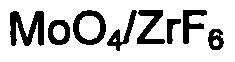
- Substrate EG process sequence (immersion application): 1. Cleaning: Ridoline 1570, 3%; Ridosol 1237, 0.3%; 7 min; 55 ° C 2. Rinse of industrial water 3. Rinse of deionized water 4. Conversion treatment: 180 s; 30 ° C; pH 3.8, with the bath mixture H 2 ZrF 6 acid (corresponding to 150 mg / l) and Sokalan HP 56 (corresponding to 37 mg / l solids content) 5. Rinse deionized water 6. Reactive rinse 60 s, 30 ° C; pH 1.8 Bath composition: H 2 ZrF 6 acid (corresponding to 50 mg / l Zr), MoO 4 2 ' according to the table (example 3a and 3b) 7.
- Substrate EG process sequence (spray application): 1. Cleaning: Ridoline 7163 CF, 1.5%; Ridosol 550 CF, 0.15%; 80 s; 55 ° C 2. Rinse of industrial water 3. Rinse of demineralized water 4. Conversion treatment: 108 s; 30 ° C; pH 3.8 Bath composition: H 2 ZrF 6 acid (corresponding to 150 mg / l Zr) and Sokalan HP 56 (corresponding to 37 mg / l solid) 5. Reactive sink 40 s, 30 ° C; Bath composition: H 2 ZrF 6 acid (corresponding to 50 mg / l Zr) and molybdate (corresponding to 500 mg / l MoO 4 2 " ); pH values adjusted according to Table 4
- Example 5 Process used as post-rinse after conversion treatment
Landscapes
- Chemical & Material Sciences (AREA)
- General Chemical & Material Sciences (AREA)
- Chemical Kinetics & Catalysis (AREA)
- Engineering & Computer Science (AREA)
- Materials Engineering (AREA)
- Mechanical Engineering (AREA)
- Metallurgy (AREA)
- Organic Chemistry (AREA)
- Chemical Treatment Of Metals (AREA)
Abstract
Description



Claims
Priority Applications (3)
| Application Number | Priority Date | Filing Date | Title |
|---|---|---|---|
| EP04791077A EP1692325A1 (de) | 2003-12-11 | 2004-10-30 | Zweistufige konversionsbehandlung |
| CA002548975A CA2548975A1 (en) | 2003-12-11 | 2004-10-30 | Two-stage conversion treatment |
| US11/450,933 US20070017602A1 (en) | 2003-12-11 | 2006-06-09 | Two-stage conversion treatment |
Applications Claiming Priority (2)
| Application Number | Priority Date | Filing Date | Title |
|---|---|---|---|
| DE10358310A DE10358310A1 (de) | 2003-12-11 | 2003-12-11 | Zweistufige Konversionsbehandlung |
| DE10358310.6 | 2003-12-11 |
Related Child Applications (1)
| Application Number | Title | Priority Date | Filing Date |
|---|---|---|---|
| US11/450,933 Continuation US20070017602A1 (en) | 2003-12-11 | 2006-06-09 | Two-stage conversion treatment |
Publications (1)
| Publication Number | Publication Date |
|---|---|
| WO2005061761A1 true WO2005061761A1 (de) | 2005-07-07 |
Family
ID=34683338
Family Applications (1)
| Application Number | Title | Priority Date | Filing Date |
|---|---|---|---|
| PCT/EP2004/012323 Ceased WO2005061761A1 (de) | 2003-12-11 | 2004-10-30 | Zweistufige konversionsbehandlung |
Country Status (6)
| Country | Link |
|---|---|
| US (1) | US20070017602A1 (de) |
| EP (1) | EP1692325A1 (de) |
| CN (1) | CN1890404A (de) |
| CA (1) | CA2548975A1 (de) |
| DE (1) | DE10358310A1 (de) |
| WO (1) | WO2005061761A1 (de) |
Cited By (5)
| Publication number | Priority date | Publication date | Assignee | Title |
|---|---|---|---|---|
| EP1887105A1 (de) * | 2006-08-08 | 2008-02-13 | The Boeing Company | Chrom-freie Konversionsschicht |
| US8993119B2 (en) | 2006-04-19 | 2015-03-31 | Ropal Europe Ag | Process for producing a corrosion-protected and high-gloss substrate |
| WO2016162422A1 (de) * | 2015-04-07 | 2016-10-13 | Chemetall Gmbh | Verfahren zur gezielten einstellung der elektrischen leitfähigkeit von konversionsbeschichtungen |
| US9476125B2 (en) | 2006-08-08 | 2016-10-25 | The Boeing Company | Chromium-free conversion coating |
| WO2019239077A1 (fr) * | 2018-06-14 | 2019-12-19 | Liebherr-Aerospace Toulouse Sas | Procédé de traitement de surface d'une pièce en aluminium ou alliage d'aluminium ou en magnésium ou alliage de magnésium |
Families Citing this family (19)
| Publication number | Priority date | Publication date | Assignee | Title |
|---|---|---|---|---|
| DE102005059314B4 (de) * | 2005-12-09 | 2018-11-22 | Henkel Ag & Co. Kgaa | Saure, chromfreie wässrige Lösung, deren Konzentrat, und ein Verfahren zur Korrosionsschutzbehandlung von Metalloberflächen |
| DE202006019880U1 (de) * | 2006-02-24 | 2007-09-27 | Gerhard Heiche Gmbh | Korrosionsbeständiges Substrat |
| ES2444406T3 (es) | 2007-06-14 | 2014-02-24 | Atotech Deutschland Gmbh | Tratamiento anti-corrosión para capas de conversión |
| US20090242081A1 (en) * | 2008-03-26 | 2009-10-01 | Richard Bauer | Aluminum Treatment Composition |
| CN102191493B (zh) * | 2010-03-17 | 2013-05-22 | 中国科学院金属研究所 | 镁合金无铬转化膜的成膜溶液和用其制备转化膜的方法 |
| US9284460B2 (en) | 2010-12-07 | 2016-03-15 | Henkel Ag & Co. Kgaa | Metal pretreatment composition containing zirconium, copper, and metal chelating agents and related coatings on metal substrates |
| DE102012212598A1 (de) * | 2012-07-18 | 2014-02-20 | Henkel Ag & Co. Kgaa | Verzinnende Vorbehandlung von verzinktem Stahl in Gegenwart von Pyrophosphat |
| CN104718312B (zh) | 2012-08-29 | 2017-03-15 | Ppg工业俄亥俄公司 | 含有钼的锆预处理组合物,用于处理金属基材的相关方法和相关的涂覆的金属基材 |
| SG11201501406SA (en) | 2012-08-29 | 2015-03-30 | Ppg Ind Ohio Inc | Zirconium pretreatment compositions containing lithium, associated methods for treating metal substrates, and related coated metal substrates |
| WO2014136012A1 (en) * | 2013-03-04 | 2014-09-12 | Schlumberger Technology B.V. | Corrosion inhibition |
| KR20150058859A (ko) * | 2013-11-21 | 2015-05-29 | 삼성전자주식회사 | 금속 대상체의 피막 형성 조성물, 피막 및 이의 제조방법. |
| DE102014206407A1 (de) * | 2014-04-03 | 2015-10-08 | Henkel Ag & Co. Kgaa | Zweistufen-Vorbehandlung von Aluminium umfassend Beize und Passivierung |
| CN104018153A (zh) * | 2014-06-18 | 2014-09-03 | 上海大学 | 一种用多步处理钝化热浸镀锌的方法 |
| GB2529852B (en) * | 2014-09-03 | 2017-04-12 | Schlumberger Holdings | A method of corrosion inhibition of duplex steel |
| DE102015206812A1 (de) * | 2015-04-15 | 2016-10-20 | Henkel Ag & Co. Kgaa | Polymerhaltige Vorspüle vor einer Konversionsbehandlung |
| DE102015209910A1 (de) * | 2015-05-29 | 2016-12-01 | Henkel Ag & Co. Kgaa | Vorspüle enthaltend ein quartäres Amin zur Konditionierung vor einer Konversionsbehandlung |
| WO2018031996A1 (en) * | 2016-08-12 | 2018-02-15 | Ppg Industries Ohio, Inc. | Pretreatment composition |
| KR20190043155A (ko) | 2016-08-24 | 2019-04-25 | 피피지 인더스트리즈 오하이오 인코포레이티드 | 금속 기판을 처리하기 위한 알칼리성 조성물 |
| BR112023019649A2 (pt) * | 2021-04-01 | 2023-10-31 | Chemetall Gmbh | Método de pré-tratamento de um substrato metálico, substrato metálico pré-tratado, processo de conformação a frio, e, composição lubrificante aquosa |
Citations (6)
| Publication number | Priority date | Publication date | Assignee | Title |
|---|---|---|---|---|
| EP0492713A1 (de) * | 1990-12-21 | 1992-07-01 | METALLGESELLSCHAFT Aktiengesellschaft | Verfahren zur Nachspülung von Konversionsschichten |
| WO1995020061A1 (de) * | 1994-01-20 | 1995-07-27 | Henkel Kommanditgesellschaft Auf Aktien | Verfahren zur gemeinsamen vorbehandlung von stahl, verzinktem stahl, magnesium und aluminium vor der verbindung mit gummi |
| WO1998047631A1 (en) * | 1997-04-18 | 1998-10-29 | Henkel Corporation | Process for touching up pretreated metal surfaces |
| EP1201788A1 (de) * | 1999-06-04 | 2002-05-02 | Calsonickansei Corp. | Wärmetauscher aus aluminiumlegierung |
| EP1206977A2 (de) * | 2000-10-06 | 2002-05-22 | Chemetall GmbH | Verfahren zur Beschichtung von Metalloberflächen |
| DE10131723A1 (de) * | 2001-06-30 | 2003-01-16 | Henkel Kgaa | Korrosionsschutzmittel und Korrosionsschutzverfahren für Metalloberflächen |
Family Cites Families (7)
| Publication number | Priority date | Publication date | Assignee | Title |
|---|---|---|---|---|
| US5129967A (en) * | 1988-05-03 | 1992-07-14 | Betz Laboratories, Inc. | Composition and method for non-chromate coating of aluminum |
| US4992116A (en) * | 1989-04-21 | 1991-02-12 | Henkel Corporation | Method and composition for coating aluminum |
| DE4317217A1 (de) * | 1993-05-24 | 1994-12-01 | Henkel Kgaa | Chromfreie Konversionsbehandlung von Aluminium |
| US5449415A (en) * | 1993-07-30 | 1995-09-12 | Henkel Corporation | Composition and process for treating metals |
| US6193815B1 (en) * | 1995-06-30 | 2001-02-27 | Henkel Corporation | Composition and process for treating the surface of aluminiferous metals |
| DE10005113A1 (de) * | 2000-02-07 | 2001-08-09 | Henkel Kgaa | Korrosionsschutzmittel und Korrosionsschutzverfahren für Metalloberflächen |
| DE10022075A1 (de) * | 2000-05-06 | 2001-11-08 | Henkel Kgaa | Leitfähige, organische Beschichtungen |
-
2003
- 2003-12-11 DE DE10358310A patent/DE10358310A1/de not_active Withdrawn
-
2004
- 2004-10-30 WO PCT/EP2004/012323 patent/WO2005061761A1/de not_active Ceased
- 2004-10-30 CN CNA2004800369241A patent/CN1890404A/zh active Pending
- 2004-10-30 EP EP04791077A patent/EP1692325A1/de not_active Withdrawn
- 2004-10-30 CA CA002548975A patent/CA2548975A1/en not_active Abandoned
-
2006
- 2006-06-09 US US11/450,933 patent/US20070017602A1/en not_active Abandoned
Patent Citations (6)
| Publication number | Priority date | Publication date | Assignee | Title |
|---|---|---|---|---|
| EP0492713A1 (de) * | 1990-12-21 | 1992-07-01 | METALLGESELLSCHAFT Aktiengesellschaft | Verfahren zur Nachspülung von Konversionsschichten |
| WO1995020061A1 (de) * | 1994-01-20 | 1995-07-27 | Henkel Kommanditgesellschaft Auf Aktien | Verfahren zur gemeinsamen vorbehandlung von stahl, verzinktem stahl, magnesium und aluminium vor der verbindung mit gummi |
| WO1998047631A1 (en) * | 1997-04-18 | 1998-10-29 | Henkel Corporation | Process for touching up pretreated metal surfaces |
| EP1201788A1 (de) * | 1999-06-04 | 2002-05-02 | Calsonickansei Corp. | Wärmetauscher aus aluminiumlegierung |
| EP1206977A2 (de) * | 2000-10-06 | 2002-05-22 | Chemetall GmbH | Verfahren zur Beschichtung von Metalloberflächen |
| DE10131723A1 (de) * | 2001-06-30 | 2003-01-16 | Henkel Kgaa | Korrosionsschutzmittel und Korrosionsschutzverfahren für Metalloberflächen |
Cited By (14)
| Publication number | Priority date | Publication date | Assignee | Title |
|---|---|---|---|---|
| US8993119B2 (en) | 2006-04-19 | 2015-03-31 | Ropal Europe Ag | Process for producing a corrosion-protected and high-gloss substrate |
| US9476125B2 (en) | 2006-08-08 | 2016-10-25 | The Boeing Company | Chromium-free conversion coating |
| US8298350B2 (en) | 2006-08-08 | 2012-10-30 | The Boeing Company | Chromium-free conversion coating |
| WO2008094193A3 (en) * | 2006-08-08 | 2008-10-16 | Boeing Co | Chromium-free conversion coating |
| EP1887105A1 (de) * | 2006-08-08 | 2008-02-13 | The Boeing Company | Chrom-freie Konversionsschicht |
| US10550478B2 (en) | 2006-08-08 | 2020-02-04 | The Boeing Company | Chromium-free conversion coating |
| WO2016162422A1 (de) * | 2015-04-07 | 2016-10-13 | Chemetall Gmbh | Verfahren zur gezielten einstellung der elektrischen leitfähigkeit von konversionsbeschichtungen |
| WO2016162423A1 (de) * | 2015-04-07 | 2016-10-13 | Chemetall Gmbh | Verfahren zur nickelfreien phosphatierung von metallischen oberflächen |
| RU2721971C2 (ru) * | 2015-04-07 | 2020-05-25 | Хеметалл Гмбх | Способ специального регулирования электрической проводимости конверсионных покрытий |
| US10738383B2 (en) | 2015-04-07 | 2020-08-11 | Chemetall Gmbh | Method for nickel-free phosphating metal surfaces |
| RU2746373C2 (ru) * | 2015-04-07 | 2021-04-12 | Хеметалл Гмбх | Способ безникелевого фосфатирования металлических поверхностей |
| US11492707B2 (en) | 2015-04-07 | 2022-11-08 | Chemetall Gmbh | Method for specifically adjusting the electrical conductivity of conversion coatings |
| WO2019239077A1 (fr) * | 2018-06-14 | 2019-12-19 | Liebherr-Aerospace Toulouse Sas | Procédé de traitement de surface d'une pièce en aluminium ou alliage d'aluminium ou en magnésium ou alliage de magnésium |
| FR3082528A1 (fr) * | 2018-06-14 | 2019-12-20 | Liebherr-Aerospace Toulouse Sas | Composition aqueuse et procede de traitement de surface d'une piece en alliage d'aluminium mettant en œuvre une telle composition |
Also Published As
| Publication number | Publication date |
|---|---|
| US20070017602A1 (en) | 2007-01-25 |
| DE10358310A1 (de) | 2005-07-21 |
| EP1692325A1 (de) | 2006-08-23 |
| CA2548975A1 (en) | 2005-07-07 |
| CN1890404A (zh) | 2007-01-03 |
Similar Documents
| Publication | Publication Date | Title |
|---|---|---|
| EP2145031B1 (de) | Metallisierende vorbehandlung von zinkoberflächen | |
| EP1692325A1 (de) | Zweistufige konversionsbehandlung | |
| EP0700452B1 (de) | Chromfreie konversionsbehandlung von aluminium | |
| EP2817434B1 (de) | Vorbehandlung von zinkoberflächen vor einer passivierung | |
| EP2767615B1 (de) | Nass in nass verfahren und chromfreie saure lösung zur korrosionsschutzbehandlung von stahloberflächen | |
| EP2507408B1 (de) | Mehrstufiges vorbehandlungsverfahren für metallische bauteile mit zink- und eisenoberflächen | |
| EP2255026A1 (de) | Optimierte passivierung auf ti-/zr-basis für metalloberflächen | |
| EP3350357B1 (de) | Vorbehandlung von aluminiumoberflächen mit zirkon- und molybdänhaltigen zusammensetzungen | |
| DE19754108A1 (de) | Chromfreies Korrosionsschutzmittel und Korrosionsschutzverfahren | |
| WO2001059181A2 (de) | Korrosionsschutzmittel und korrosionsschutzverfahren für metalloberflächen | |
| DE102010001686A1 (de) | Zusammensetzung für die alkalische Passivierung von Zinkoberflächen | |
| EP1235949B1 (de) | Verfahren zum aufbringen eines phosphatüberzuges und verwendung der derart phosphatierten metallteile | |
| EP0359296B1 (de) | Phosphatierverfahren | |
| EP1402083A1 (de) | Korrosionsschutzmittel und korrosionsschutzverfahren für metalloberflächen | |
| EP2215285B1 (de) | Zirconiumphosphatierung von metallischen bauteilen, insbesondere eisen | |
| DE19933189A1 (de) | Verfahren zur korrosionsschützenden Behandlung oder Nachbehandlung von Metalloberflächen | |
| EP1531012B1 (de) | Ergänzender Korrosionsschutz für Bauteile aus organisch vorbeschichteten Metallblechen | |
| DE102008017523A1 (de) | Optimierte Elektrotauchlackierung von zusammengefügten und teilweise vorphosphatierten Bauteilen | |
| EP1692201A1 (de) | Funktionalisiertes phenol-aldehyd-harz und verfahren zur behandlung von metall-oberfl chen | |
| DE19755349A1 (de) | Chromhaltiges leitfähiges Korrosionsschutzmittel und Korrosionsschutzverfahren | |
| WO2019121036A1 (de) | Verfahren zur korrosionsschützenden und reinigenden vorbehandlung von metallischen bauteilen |
Legal Events
| Date | Code | Title | Description |
|---|---|---|---|
| WWE | Wipo information: entry into national phase |
Ref document number: 200480036924.1 Country of ref document: CN |
|
| AK | Designated states |
Kind code of ref document: A1 Designated state(s): AE AG AL AM AT AU AZ BA BB BG BR BW BY BZ CA CH CN CO CR CU CZ DK DM DZ EC EE EG ES FI GB GD GE GH GM HR HU ID IL IN IS JP KE KG KP KR KZ LC LK LR LS LT LU LV MA MD MG MK MN MW MX MZ NA NI NO NZ OM PG PH PL PT RO RU SC SD SE SG SK SL SY TJ TM TN TR TT TZ UA UG US UZ VC VN YU ZA ZM ZW |
|
| AL | Designated countries for regional patents |
Kind code of ref document: A1 Designated state(s): BW GH GM KE LS MW MZ NA SD SL SZ TZ UG ZM ZW AM AZ BY KG KZ MD RU TJ TM AT BE BG CH CY CZ DE DK EE ES FI FR GB GR HU IE IT LU MC NL PL PT RO SE SI SK TR BF BJ CF CG CI CM GA GN GQ GW ML MR NE SN TD TG |
|
| 121 | Ep: the epo has been informed by wipo that ep was designated in this application | ||
| WWE | Wipo information: entry into national phase |
Ref document number: 2004791077 Country of ref document: EP |
|
| WWE | Wipo information: entry into national phase |
Ref document number: 11450933 Country of ref document: US Ref document number: 2548975 Country of ref document: CA Ref document number: 2059/CHENP/2006 Country of ref document: IN |
|
| WWP | Wipo information: published in national office |
Ref document number: 2004791077 Country of ref document: EP |
|
| WWP | Wipo information: published in national office |
Ref document number: 11450933 Country of ref document: US |