WO2005107776A1 - METHOD OF ADMINISTERING PORCINE B-DOMAINLESS fVIII - Google Patents

METHOD OF ADMINISTERING PORCINE B-DOMAINLESS fVIII Download PDF

Info

Publication number
WO2005107776A1
WO2005107776A1 PCT/US2005/014760 US2005014760W WO2005107776A1 WO 2005107776 A1 WO2005107776 A1 WO 2005107776A1 US 2005014760 W US2005014760 W US 2005014760W WO 2005107776 A1 WO2005107776 A1 WO 2005107776A1
Authority
WO
WIPO (PCT)
Prior art keywords
obi
patient
porcine
ill
hyate
Prior art date
Legal status (The legal status is an assumption and is not a legal conclusion. Google has not performed a legal analysis and makes no representation as to the accuracy of the status listed.)
Ceased
Application number
PCT/US2005/014760
Other languages
French (fr)
Inventor
John S. Lollar
Garrette E. Bergman
Current Assignee (The listed assignees may be inaccurate. Google has not performed a legal analysis and makes no representation or warranty as to the accuracy of the list.)
Emory University
Octagen Corp
Original Assignee
Emory University
Octagen Corp
Priority date (The priority date is an assumption and is not a legal conclusion. Google has not performed a legal analysis and makes no representation as to the accuracy of the date listed.)
Filing date
Publication date
Priority to JP2007511442A priority Critical patent/JP2007536230A/en
Priority to ES05740319.8T priority patent/ES2449044T3/en
Priority to EP05740319.8A priority patent/EP1750733B1/en
Priority to PL05740319T priority patent/PL1750733T3/en
Priority to SI200531828T priority patent/SI1750733T1/en
Priority to HK07108636.6A priority patent/HK1100900B/en
Priority to DK05740319.8T priority patent/DK1750733T3/en
Application filed by Emory University, Octagen Corp filed Critical Emory University
Publication of WO2005107776A1 publication Critical patent/WO2005107776A1/en
Priority to US11/549,049 priority patent/US7576181B2/en
Anticipated expiration legal-status Critical
Priority to US12/496,516 priority patent/US8101718B2/en
Priority to US13/356,437 priority patent/US8501694B2/en
Priority to US13/959,523 priority patent/US20140193441A1/en
Priority to US15/179,343 priority patent/US20170119857A1/en
Ceased legal-status Critical Current

Links

Classifications

    • AHUMAN NECESSITIES
    • A61MEDICAL OR VETERINARY SCIENCE; HYGIENE
    • A61KPREPARATIONS FOR MEDICAL, DENTAL OR TOILETRY PURPOSES
    • A61K38/00Medicinal preparations containing peptides
    • A61K38/16Peptides having more than 20 amino acids; Gastrins; Somatostatins; Melanotropins; Derivatives thereof
    • A61K38/17Peptides having more than 20 amino acids; Gastrins; Somatostatins; Melanotropins; Derivatives thereof from animals; from humans
    • A61K38/36Blood coagulation or fibrinolysis factors
    • A61K38/37Factors VIII
    • AHUMAN NECESSITIES
    • A61MEDICAL OR VETERINARY SCIENCE; HYGIENE
    • A61KPREPARATIONS FOR MEDICAL, DENTAL OR TOILETRY PURPOSES
    • A61K39/00Medicinal preparations containing antigens or antibodies
    • A61K39/0005Vertebrate antigens
    • AHUMAN NECESSITIES
    • A61MEDICAL OR VETERINARY SCIENCE; HYGIENE
    • A61KPREPARATIONS FOR MEDICAL, DENTAL OR TOILETRY PURPOSES
    • A61K47/00Medicinal preparations characterised by the non-active ingredients used, e.g. carriers or inert additives; Targeting or modifying agents chemically bound to the active ingredient
    • A61K47/02Inorganic compounds
    • AHUMAN NECESSITIES
    • A61MEDICAL OR VETERINARY SCIENCE; HYGIENE
    • A61KPREPARATIONS FOR MEDICAL, DENTAL OR TOILETRY PURPOSES
    • A61K47/00Medicinal preparations characterised by the non-active ingredients used, e.g. carriers or inert additives; Targeting or modifying agents chemically bound to the active ingredient
    • A61K47/06Organic compounds, e.g. natural or synthetic hydrocarbons, polyolefins, mineral oil, petrolatum or ozokerite
    • A61K47/08Organic compounds, e.g. natural or synthetic hydrocarbons, polyolefins, mineral oil, petrolatum or ozokerite containing oxygen, e.g. ethers, acetals, ketones, quinones, aldehydes, peroxides
    • A61K47/12Carboxylic acids; Salts or anhydrides thereof
    • AHUMAN NECESSITIES
    • A61MEDICAL OR VETERINARY SCIENCE; HYGIENE
    • A61KPREPARATIONS FOR MEDICAL, DENTAL OR TOILETRY PURPOSES
    • A61K47/00Medicinal preparations characterised by the non-active ingredients used, e.g. carriers or inert additives; Targeting or modifying agents chemically bound to the active ingredient
    • A61K47/06Organic compounds, e.g. natural or synthetic hydrocarbons, polyolefins, mineral oil, petrolatum or ozokerite
    • A61K47/16Organic compounds, e.g. natural or synthetic hydrocarbons, polyolefins, mineral oil, petrolatum or ozokerite containing nitrogen, e.g. nitro-, nitroso-, azo-compounds, nitriles, cyanates
    • A61K47/18Amines; Amides; Ureas; Quaternary ammonium compounds; Amino acids; Oligopeptides having up to five amino acids
    • AHUMAN NECESSITIES
    • A61MEDICAL OR VETERINARY SCIENCE; HYGIENE
    • A61KPREPARATIONS FOR MEDICAL, DENTAL OR TOILETRY PURPOSES
    • A61K47/00Medicinal preparations characterised by the non-active ingredients used, e.g. carriers or inert additives; Targeting or modifying agents chemically bound to the active ingredient
    • A61K47/06Organic compounds, e.g. natural or synthetic hydrocarbons, polyolefins, mineral oil, petrolatum or ozokerite
    • A61K47/26Carbohydrates, e.g. sugar alcohols, amino sugars, nucleic acids, mono-, di- or oligo-saccharides; Derivatives thereof, e.g. polysorbates, sorbitan fatty acid esters or glycyrrhizin
    • AHUMAN NECESSITIES
    • A61MEDICAL OR VETERINARY SCIENCE; HYGIENE
    • A61KPREPARATIONS FOR MEDICAL, DENTAL OR TOILETRY PURPOSES
    • A61K9/00Medicinal preparations characterised by special physical form
    • A61K9/0012Galenical forms characterised by the site of application
    • A61K9/0019Injectable compositions; Intramuscular, intravenous, arterial, subcutaneous administration; Compositions to be administered through the skin in an invasive manner
    • AHUMAN NECESSITIES
    • A61MEDICAL OR VETERINARY SCIENCE; HYGIENE
    • A61KPREPARATIONS FOR MEDICAL, DENTAL OR TOILETRY PURPOSES
    • A61K9/00Medicinal preparations characterised by special physical form
    • A61K9/14Particulate form, e.g. powders, Processes for size reducing of pure drugs or the resulting products, Pure drug nanoparticles
    • A61K9/19Particulate form, e.g. powders, Processes for size reducing of pure drugs or the resulting products, Pure drug nanoparticles lyophilised, i.e. freeze-dried, solutions or dispersions
    • AHUMAN NECESSITIES
    • A61MEDICAL OR VETERINARY SCIENCE; HYGIENE
    • A61PSPECIFIC THERAPEUTIC ACTIVITY OF CHEMICAL COMPOUNDS OR MEDICINAL PREPARATIONS
    • A61P43/00Drugs for specific purposes, not provided for in groups A61P1/00-A61P41/00
    • AHUMAN NECESSITIES
    • A61MEDICAL OR VETERINARY SCIENCE; HYGIENE
    • A61PSPECIFIC THERAPEUTIC ACTIVITY OF CHEMICAL COMPOUNDS OR MEDICINAL PREPARATIONS
    • A61P7/00Drugs for disorders of the blood or the extracellular fluid
    • A61P7/04Antihaemorrhagics; Procoagulants; Haemostatic agents; Antifibrinolytic agents

Definitions

  • Hemophilia A is a disease characterized by a defect in blood clotting which results in a variety of clinical symptoms and is ultimately life-threatening.
  • Standard treatment of the disease is administration of clotting factor VIII (fVIII), a 300 kDa plasma protein missing or deficient in Hemophilia A patients.
  • fVIII clotting factor VIII
  • the therapy does not cure the underlying disease, but it ameliorates the symptoms. Therefore, patients must receive repeated doses of fVIII over their lifetime.
  • OBI-1 is also termed POL-1212 in U.S. Patent No. 6,458,563. Both names, OBI-1 and POL 1212, refer to the same substance, porcine A Ill having the B-domain deleted except for 12 amino acids at the N-terminal part of the B-domain and 12 amino acids at the C-terminal part of the B-domain. Previous studies [Doering, C.B. et al. (2002) J. Biol. Chem. 277:39345-38349] have documented that the B-domain of porcine fVIII can be deleted without loss of activity.
  • 5,763,401 and 5,874,408 disclose a recombinant fVIII composition containing glycine, histidine, sucrose, sodium chloride, and calcium chloride.
  • fVIII compositions having various salts, non-ionic surfactants and antioxidants (US Patent No. 5,962,650, US Patent No. 5,972,885, WO 89/09784, and WO 94/07510).
  • WO 03/080108 describes a stable solid pharmaceutical composition devoid of amino acids which contain fVIII, a surfactant, calcium chloride, sucrose, sodium chloride, trisodium citrate, and a buffer and has a pH of 6-8 prior to lyophilization and after reconstitution in water for injection.
  • the present invention relates to the surprising experimental findings that OBI-1 has 2-6 fold greater bioavailability compared to HYATE:C.
  • Bioavailability refers to the blood levels achieved and maintained after administering a given dose. Bioavailability can be assessed by calculating the area under the curve (AUC) of blood levels plotted as a function of time after administration of a given dose. Consequently, compared to HYATE:C, OBI-1 can be administered at a substantially lower dose, expressed in Units/kg of body weight, to provide equivalent protection against serious bleeding episodes or in the prevention of bleeding episodes for hemophiliac patients who are in non-bleeding state.
  • AUC area under the curve
  • OBI-1 can be provided at the same dose as, or a similar dose to, HYAGE:C, but at a reduced frequency of administration compared to HYATE:C, bringing about more rapid control of bleeding and reducing the inconvenience associated with multiple administrations. Coupled with the fact that OBI-1 is available at a higher concentration in Units/ml than HYATE:C, the findings provide for a new method of administration that is highly advantageous for patients' well-being and quality of life. Current treatments with HYATE:C (100 Units/kg of body weight) typically require intravenous infusion of 280 ml of HYATE:C solution, at a rate of 2-5 ml per minute repeated every 6-8 hrs.
  • OBI-1 can be administered as a single intravenous injection of about 10- 100 Units/kg body wt, e.g. 14 ml, requiring only 5-15 minutes to administer and may be required only one to four times, in order to halt a bleed, in contrast to HYATE:C, which takes a median of eight separate administrations over a two day period to halt a single bleeding episode, according to its package insert.
  • HYATE:C which takes a median of eight separate administrations over a two day period to halt a single bleeding episode, according to its package insert.
  • OBI-1 Using OBI-1 , faster control of bleeding is facilitated because higher fVIII levels can be achieved more rapidly.
  • the actual dose administered to an individual depends on several individual factors including body weight, plasma volume, and residual antibody titer to OBI-1.
  • the methods for calculating individual dosage have been well established from studies with HYATE:C.
  • the methods for calculating OBI-1 dosage will, in addition, require taking into account the newly discovered greater in vivo efficacy and bioavailability of OBI-1.
  • the present invention also provides pharmaceutical compositions and kits containing OBI-1 that are useful for treating a patient in need of fVIII in a more rapid and effective manner.
  • Fig. 1 is a graph of activity recoveries of fVIII (Example 1), corrected for baseline Ill after a single injection of either HYATE:C or OBI-1 into cynomolgus monkeys at the indicated dose as described in Example 1.
  • Fig. 2 is a graph of results obtained from the experiment described in
  • Example 5 Individual patient plasmas are arrayed along the horizontal axis. The vertical axis indicates U/ml of fVIII activity recovered from the individual plasmas after addition of fVIII as described in Example 5. The data for King George Biomedical plasmas are designated as "good” or "bad” based on anomalous behavior of the latter plasma (see Example 5).
  • Fig. 3 is a graph showing the plasma concentrations of fVIII in six human patients after intravenous administration of OBI-1 or HYATE:C.
  • the Y axis indicates U/ml of fVIII activity recovered from the individual plasmas as measured by the one-stage activity assay.
  • Fig. 4 is a graph showing the plasma concentrations of fVIII in six human patients after intravenous administration of OBI-1 or HYATE:C.
  • the Y axis indicates U/ml of fVIII activity recovered from the individual plasmas as measured by the chromogenic assay as described herein.
  • physiologically acceptable carrier is an organic or inorganic composition which serves as a carrier/stabilizer of the active ingredient of the present invention, OBI-1 , in a pharmaceutical composition.
  • physiologically acceptable carriers include but are not limited to water, phosphate-buffered saline, saline, aqueous solvents, where water is mixed with lower alkanols, vegetable oils, polyalkylene glycols, petroleum-based jelly, ethyl cellulose, ethyl oleate, carboxymethyl cellulose, polyvinylpyrrolidine, isopropyl myristate.
  • Physiologically acceptable carriers further include albumin, an amino acid (e.g., glycine, histidine, or its salts), a detergent (ionic and non-ionic) such as polysorbate or TWEEN 80, a high ionic strength media consisting of sodium salts, calcium salts and/or histidine, mono-, di- or polysaccharides (e.g., sucrose) or sugar alcohols, and other diluents, additives or carriers known in the art.
  • a detergent ionic and non-ionic
  • a detergent ionic and non-ionic
  • a high ionic strength media consisting of sodium salts, calcium salts and/or histidine, mono-, di- or polysaccharides (e.g., sucrose) or sugar alcohols, and other diluents, additives or carriers known in the art.
  • a high ionic strength media consisting of sodium salts, calcium salts and/or histidine, mono-, di- or
  • a pharmaceutical composition comprising OBI-1 is preferably a solid composition obtainable by lyophilization of a solution devoid of amino acids comprising OBI-1 , a surfactant or detergent, calcium chloride, sucrose, sodium chloride, trisodium citrate and a buffer.
  • the solution has a pH of 6-8 prior to lyophilization and after reconstitution in water for injection.
  • the surfactant is preferably a non-ionic surfactant such as polysorbates and block copolymers like poloxamers (i.e., copolymers of polyethylene and propylene glycol).
  • a more preferred surfactant is a polysorbate having a mean polymerization degree from 20 to 100 monomer units (preferably about 80).
  • the most preferred surfactant is polysorbate 80 derived from a plant.
  • the buffer is preferably tris(hydroxymethyl)methylamine, commonly known as "tris.”
  • the solid pharmaceutical composition is prepared by lyophilization from the solution containing OBI-1 at a concentration from 50 to 10,000 Units/mL, a surfactant at a concentration ranging from above critical micellar concentration to 1% v/v, calcium chloride at 0.5- 10 mM, sucrose at 5-50 mM, sodium chloride at 0.15-50 0.5 M, trisodium citrate at 1- 50 mM, and a buffer at 1-50 mM.
  • the pH of the pharmaceutical composition prior to lyophilization and after reconstitution in water for injection is preferably about 6.5- 7.5, more preferably about 7.0.
  • the solid pharmaceutical composition containing OBI-1 may be diluted with sterile water optionally containing sodium chloride before administering into a patient in need of fVIII.
  • the administration of such composition is typically carried out intravenously.
  • the optimal dose of composition to be administered will be determined by the treating physician based on the severity of the disease for each patient.
  • WO 03/080108 which is incorporated herein as reference in its entirety, discloses detailed description of a method of preparing the solid pharmaceutical compositions comprising OBI-1 described herein.
  • reducing blood clotting time refers to the reduced length of time for blood clotting to occur in a given patient having fVIII deficiency when OBI-1 is administered compared to when HYATE:C is administered, i.e., the difference in the length of time for blood clotting to occur in patients treated with OBI-1 and those treated with HYATE:C administration.
  • the term, "therapeutically effective level or concentration of factor VIII” as used herein, means the level of fVIII in the plasma of a patient having fVIII deficiency, who has received a pharmaceutical composition of OBI-1 , that is sufficient to exhibit a measurable improvement or protective effect in the patient (e.g., to stop bleeding).
  • the patients having fVIII deficiency are typically hemophilia A patients but also include those subjects diagnosed with "acquired hemophilia", a condition in which those who are not congenital hemophiliacs spontaneously develop inhibitory antibodies to their fVIII, creating a serious fVIII deficiency.
  • the therapeutically effective level is estimated to be about 1 %, preferably about 10%, most preferably about 25-35% and above, of the fVIII level in a normal, non- hemophilia A subject.
  • concentration range of fVIII in normal non-hemophilia A humans is defined as 50% to 200% of the fVIII activity found in a sample plasma pool derived from at least 20 normal donors.
  • the level of fVIII in normal humans fluctuates through this normal range in response to various physiologic and non- physiologic stimuli.
  • antibody-neutralizing dose of OBI-1 is used to indicate the amount of OBI-1 necessary to administer to neutralize the patient's preexisting antibodies directed against OBI-1.
  • the level of a hemophilia A patient's antibody to porcine fVIII is different for each individual.
  • the amount of anti-OBI-1 antibody present can be readily calculated by measuring the antibody titer, using standard methods known in the art, and from this value, the amount of OBI-1 required to neutralize the antibody can be estimated. Because of individually differing binding and inactivating characteristics of each patient's inhibitory antibody, the precise amount of OBI-1 required can only be estimated, and the exact amount to be administered must be empirically determined, (or "titrated")
  • Human fVIII deficiency can be studied in fVIII-deficient mammals because the steps of blood clot formation are shared among all vertebrates, and fVIII proteins of several species are known to have a high degree of sequence homology. Bioavailability can also be assessed in non-hemophilic monkeys. After taking into account species variations in blood volume, basal fVIII levels and the like, results from animal studies are generally predictive of results in humans. The present invention was developed from results of experiments, described in detail below. Studies of four types were conducted: bioavailability studies in monkeys and hemophilic dogs, efficacy studies in hemophilic dogs and hemophilic mice, an in vitro activity recovery study in human plasma, and an in vivo bioavailability studies in six human subjects.
  • Bioavailability was assessed by measuring recovery of activity at a specified time after administering a given dose. Efficacy was assessed by measuring the effect of a given dose on the cuticle bleeding time (CBT) in hemophilic dogs and by mortality in a tail-transection-bleeding model of hemophilic mice. Recoveries of OBI-1 and the HYATE:C were also measured in vitro by adding each substance to human hemophilic plasma samples and human hemophilic-inhibitor plasma samples. Bioavailability was further assessed in six human subjects by measuring recovery of activity at a specified time after administering a standard dose of 100 U/kg.
  • OBI-1 and HYATE:C resulted in greater recovery of OBI-1 than HYATE:C based on a standard /Ill clotting assay.
  • OBI-1 can be administered at a significantly lower effective dose than can HYATE:C, where the activity level of each has been measured by a standard A/Ill assay. It will be understood by those skilled in the art that the effective dose can be calibrated according to individual patient requirements, including residual levels of A/Ill existing in the patient's plasma and the level of inhibitory antibodies in the patient's plasma that must be neutralized.
  • Recoveries of OBI-1 and the HYATE:C also were measured in vitro after adding each to a nominal concentration of 1 U/ml to human plasma samples from hemophilia patients with inhibitors. Recoveries of both OBI-1 and HYATE:C were lower than the nominal concentration, which was due in part to cross-reactive inhibitory antibodies. However, in 25 of 35 samples, recovered OBI-1 activity was greater than recovered HYATE:C activity, and in 18 of the 35 samples, recovered OBI-1 activity was more than 2-fold greater than recovered HYATE:C activity.
  • Bioavailability studies were further carried out in six human subjects, with absent or minimal inhibitory antibodies to OBI-1 , in a randomized, double-blind, double-dummy, parallel-group blinded manner as described in Example 6. As shown in Table 8 and Figs. 3 and 4, the bioavailability of OBI-1 was much greater than HYATE:C when both were administered at 100 U/kg.
  • OBI-1 is a recombinant product
  • HYATE:C is a plasma derived product.
  • human factor IX used in the treatment of hemophilia B
  • the plasma derived product actually showed recoveries about two times greater than the recombinant derived product (1.71+/- 0.73 IU per dL per IU per kg compared to 0.86+/- 0.313 IU per dL per IU per kg [see Ewenstein BM et al. Transfusion (2002), 42:190].
  • OBI-1 and HYATE:C are consistent with the pharmacokinetic data obtained using monkeys, hemophilic dogs, and hemophilic mice. These results further indicate that OBI-1 can be administered at a lower dose or equally important can be administered at a greatly reduced frequency of administration, compared to HYATE:C, to yield equivalent therapeutic effects in patients having A/Ill deficiency. The data also show that OBI-1 reaches peak and therapeutic levels much more rapidly than equivalent doses of HYATE:C, allowing for more rapid control of bleeding.
  • Non-hemophilic cynomolgus monkeys were used to compare bioavailability of OBI-1 and HYATE:C. Groups of 4 monkeys were given one dose of either HYATE:C 100 U/kg, or OBI-1 at doses of either 49 or 77 U/kg. Blood samples were drawn at specified time points thereafter, and the A/Ill levels obtained were used to calculate pharmacokinetic parameters, including the activity levels integrated over time. The integrated value is referred to as area under the curve for the specified time period (AUC 0 ⁇ t).
  • a 77 U/kg dose of OBI-1 provided about 5- fold greater AUC 0 ⁇ 24 than did 100 U/kg of HYATE:C. Similar results were obtained in a separate study using five monkeys receiving 40 U/kg OBI-1 , 5 monkeys receiving 100 U/kg OBI-1 and 6 monkeys receiving 100 U/kg HYATE:C. (Table 2.)
  • EXAMPLE 2 Bioavailability in Hemophilic Dogs [0033] Originally discovered as a spontaneous mutation, dogs with hemophilia A have been maintained in a protected colony for over twenty years. The colony housed at the Queens University in Springfield, Ontario, is in its tenth generation. They have no circulating A Ill activity or protein and their phenotypic picture is analogous to severe hemophilia A in humans, with recurrent severe spontaneous soft tissue and joint bleeds and chronic joint deformities. They require frequent injections of canine-derived plasma or cryoprecipitate to control their bleeding.
  • FVIII levels were determined against a porcine A/Ill standard designated HY98P. Although these hemophilic dogs have no measurable canine Ill activity, and no A/Ill antigen present in their blood, they were found to have measurable A Ill activity at baseline (0.1 to 0.3 U/ml) when tested against a porcine A/Ill standard.
  • This porcine standard was made by adding varying amounts of the actual test product HYATE:C or OBI-1 (in 1 % bovine serum albumin/imidazole buffer) to factor VIII deficient human hemophilic plasma. For purposes of determining pharmacokinetic parameters, therefore, the baseline activity measured was subtracted from the measured activity at each time point and the difference in A/Ill activity was entered for all calculations. For both products tested, there was substantial variability in the pharmacokinetic values obtained from the dogs tested at each dose level.
  • CBT Efficacy in Hemophilic Dogs
  • the time it takes for bleeding to stop after the dog's toenail cuticle is cut is a useful measure of efficacy in hemophilia dogs.
  • the cuticle In the untreated dog with hemophilia, the cuticle usually stops bleeding in approximately 2 minutes, does not bleed for a brief time and then re-bleeds steadily for at least 12 minutes or until the lesion is cauterized.
  • the normal CBT is defined as 5 or fewer minutes of bleeding and no need for cauterization.
  • CBT in dogs with congenital hemophilia has been used widely as a measure of the efficacy of investigational A/Ill products.
  • Table 5 demonstrates the individual changes in the CBT results for each dog for each injection.
  • mice have been created by targeted disruption of exon
  • the E16 mice have undetectable A/Ill activity, occasional spontaneous bleeding, and prolonged bleeding and increased mortality after tail transection or laceration of the tail vein.
  • An efficacy model has been developed in which the ability of A/Ill to decrease the mortality in E16 mice following transection of the distal 2 cm of tail is assessed.
  • mice Male or female hemophilia A mice, aged 9 to 10 weeks, were injected by tail vein with various concentrations of OBI-1 or control buffer. The mice were anesthetized and, 15 min after injection, the distal 2 cm of tail was transected and allowed to bleed freely. This injury reportedly is fatal within 24 h in most E16 hemophilia A mice.
  • Units/kg is effective in preventing death in this model. Combining the data at 0.4 and 1.2 Units/kg, there are 14/14 survivors compared to 6/38 survivors in the control (untreated) group. An estimated dose conferring 50% survival (ED 50 ) was 0.044 U/kg. Furthermore, every mouse receiving at least 0.4 U/kg survived.
  • mice Prior to tail vein injections of HYATE:C (0 to 100 A lll Units/kg), or placebo (saline), mice were warmed under a 60-watt lamp for 2 minutes to dilate the tail veins. Fifteen minutes after injection, mice were anesthetized with Metofane and the distal 2 cm of the tail was amputated. Mice were placed into clean cages with paper towels in place of litter and observed for 24 hours to determine survival. Well- moistened food was placed inside each cage in addition to the usual water bottle and dry pellets. Survivors were terminated after 24 hours using Metofane followed by cervical dislocation.
  • the estimated ED 50 for HYATE:C was 0.2 U/kg, 4-5 times greater than that estimated for OBI-1 , predicting greater efficacy of OBI-1. Overall, the comparative efficacy of HYATE:C and OBI-1 has not been rigorously studied in hemophilia A mice.
  • A/lll-deficient plasma human hemophilia A plasma, product no. 0800
  • Human hemophilia A plasma, product no. 0800 were purchased from George King Bio-medical, Inc. They were stored at -70°C.
  • Activated partial thromboplastin time (aPTT) reagent (product No. 35513) was purchased from Organon Teknika Corp. It was stored in a lyophilized state at 4°C.
  • OBI-1 Vehicle, Lot No. 214-02-001 was reconstituted with 1 ml Water for Injection per vial (60 vials total).
  • Four vials of OBI-1 Lot No. 214-01-001 , were each reconstituted with 1 ml Water for Injection, yielding an expected concentration of 550 U/ml according to the manufacturer's label.
  • OBI-1 was diluted 15.9-fold further by addition of 59.6 ml of reconstituted OBI-1 vehicle, yielding a predicted concentration of 34.6 U/ml.
  • HYATE:C was sub-aliquoted into 120 aliquots of 0.5 ml each and frozen at -70°C.
  • OBI-1 was sub-aliquoted into 127 aliquots of 0.5 ml each and frozen at -70 °C.
  • Citrated plasmas from patients with inhibitory antibodies to A/Ill were shipped on dry ice to Emory University from several hemophilia treatment centers. Samples were frozen at -70°C until used. From 58 plasmas that were obtained, 25 were randomly selected for study.
  • aPTT reagent was solubilized in 3 ml H 2 O according to the manufacturer's instructions and kept at room temperature until used.
  • FACT and A lll-deficient plasma were stored on ice after rapid thawing in a 37 °C water bath.
  • FVIII-deficient plasma 50 ⁇ l was added to sample cuvettes and allowed to warm for 30-45 seconds before addition of the remaining reagents. Dilutions of the A/Ill standard or sample (5 ⁇ l) were added, followed by addition of 50 ⁇ l aPTT reagent and incubation for 250 seconds.
  • Clotting was initiated by addition of 50 ⁇ l pre-warmed CaCI 2 solution using a cabled pipette. The addition activates an internal timer and records the clotting time in seconds.
  • a standard curve was prepared using four dilutions of FACT into Hank's Buffered Saline: undiluted, 1/3, 1/11 , and 1/21.
  • the A/Ill concentration of undiluted FACT is approximately 1 U/ml and ranged from 1.04 to 1.09 U/ml according to the manufacturer.
  • the clotting time was plotted versus the logarithm of the A/Ill concentration and the standard curve was calculated by linear regression.
  • the A/Ill concentration of samples was measured by interpolation on the standard curve, except in the case of analysis of stock solutions of OBI-1 and HYATE:C, for which more extensive measurements were made, as described in Results.
  • HYATE:C was measured in 33 of the available inhibitor plasma samples (Fig. 2). In all cases, the plasmas were spiked to a predicted A Ill activity of 0.9 U/ml. Additionally, two hemophilia A plasmas obtained from George King were included, and are shown at the far right in the figure. "Good” plasma corresponds to commercially available reagent plasma in which recovery of A/Ill in HYATE:C and OBI-1 had previously been found to be in the expected range. "Bad” plasma corresponds to plasma in which recovery of A Ill in HYATE:C had previously been found to be less than 10% of expected at Ipsen.
  • HYATE:C in human subjects, the following randomized, parallel-group blinded comparison study was carried out with nine human patients. Of these 9 patients, five had no detectable anti-porcine inhibitor at baseline (i.e. less than 0.8 Bethesda units) and one (assigned to the OBI-1 group) had a very low inhibitor of 1.0 Bethesda units. Of the six patients with either no preexisting inhibitor or a very low inhibitor to porcine A Ill, three received HYATE:C and three received OBI-1. The three patients with significantly higher levels of inhibitors were excluded from the bioavailability assessment, as the presence of such inhibitors depresses bioavailability, thereby confounding the analysis.
  • OBI-1 was provided in sterile vials containing 535 Units of A/Ill activity per vial. Each vial was reconstituted with 1.0 ml Sterile Water for Injection USP to a final concentration of 535 U/ml.
  • HYATE:C was provided in sterile vials containing 541 IU of A/Ill per vial. Each vial was reconstituted with 20 ml Sterile Water for Injection USP to a final concentration of 27 lU/ml. The dose of each product administered was 100 lU/kg regardless of subject antibody titer.
  • the pharmacokinetic parameters measured in this study include Clearance (CL, ml/h/kg), Area Under the Curve (AUC, U/dL), Maximum Concentration (Cmax, U/ml), Volume of distribution (Vz), mean time to maximum concentration (Tmax, h), and half-time (T 1 2 , h).
  • the AUC values for OBI-1 were about 2-2.5 times greater than that for HYATE:C.
  • the difference in AUC between OBI-1 and HYATE:C was more pronounced in the chromogenic assay than the one-stage activity assay.
  • Maximum concentration (Cmax) in the blood for OBI-1 was about 3 times greater than for HYATE:C (151 vs 53 by the chromogenic assay).
  • the mean time to Maximum Concentration (Tmax) was approximately 2.5 to 3 times shorter for OBI-1 than it was for HYATE:C.
  • OBI-1 has much greater bioavailability compared to HYATE:C. Therefore, OBI-1 can be administered at a lower dose or be administered at a reduced frequency of administration, compared to HYATE:C, to yield equivalent therapeutic effects in A/Ill deficient patients. And OBI-1 at equivalent doses to Hyate:C can bring more rapid control of bleeding.
  • the A/Ill concentration in normal non-hemophilia A subjects is approximately 100 Units/dL.
  • a typical bleeding episode is very likely to be controlled if the plasma level of A/Ill is reached at about 25% and 35% of the normal level and maintained for several hours (Roberts H and Hoffman M, "Hemophilia A and Hemophilia B," Chapter 123 in Beutler E, Lichtman M, Coller B, Kipps T and Seligsohn U (Eds), Williams Hematology, 6 th edition (2001): pages 1639-1657; McGraw-Hill, New York).
  • Example 6 The combined data of Examples 1-6 demonstrate the unexpected finding that OBI-1 behaves differently from HYATE:C in human and animal plasma.
  • OBI-1 recombinant porcine A lll
  • HYATE:C plasma-derived porcine A Ill
  • This surprising result is precisely the opposite of what was seen with factor IX, where the plasma-derived concentrate had significantly greater recovery and bioavailability that the recombinant factor IX product (Ewenstein et al. supra).
  • the greater bioavailability of OBI-1 compared to HYATE:C was also surprising, in light of the report by Kessler et al.
  • OBI-1 may be administered to a patient at as little as 1/6 the standard activity dose in units/kg recommended for HYATE:C.
  • the recommended dose for HYATE:C is 100 lU/kg of body wt in excess of the dose required to neutralize any patient antibody to porcine A/Ill.
  • the level of a patient's antibody to porcine A/Ill is different for each individual.
  • the dose of OBI-1 required to neutralize the patient's antibodies can be estimated from measurement of antibody titer, using standard methods known in the art. Accordingly, for a given patient, one can administer OBI-1 in place of HYATE:C at a dose about as little as 10-20 U/kg of body wt in excess of the neutralizing dose. If a hemophilia A patient has an inhibitory antibody against A/Ill, it would require more OBI to neutralize the inhibitory antibodies.
  • OBI-1 can be administered in a fraction of the volume of solution required for administering a dose of HYATE:C, not only because OBI-1 can be prepared in more concentrated form, but also because a smaller dose of OBI-1 can yield a recovery of activity comparable to a 2 to 6 fold higher dose of HYATE:C.
  • HYATE:C required a median of eight infusions to halt a single bleeding episode over a two day period
  • OBI-1 may require only 1-4 such infusions, a dramatic advance in patient treatment.
  • OBI-1 dosage can bring about more rapid control of bleeding and therefore is likely both more effective and safer than Hyate:C. It is also advantageous for patient comfort and quality of life, as well as providing a reduced risk of infection and of side effects from contaminants. Therapeutic levels of A/Ill can be achieved more rapidly by infusing the concentrated OBI-1 product.
  • Another aspect of the invention provides a therapeutic protocol that includes a step of measuring OBI-1 recovery as part of the process for establishing an optimal dose in an individual patient.
  • OBI-1 recovery can be measured essentially as described in Example 5, by adding a measured amount of OBI-1 activity to a sample of a patient's plasma, then measuring the activity recovered from the sample after a short time interval. A series of such tests can establish an OBI-1 dose suitable for each patient. Alternatively, individual recovery data can be measured directly in a patient.

Landscapes

  • Health & Medical Sciences (AREA)
  • Life Sciences & Earth Sciences (AREA)
  • Chemical & Material Sciences (AREA)
  • General Health & Medical Sciences (AREA)
  • Veterinary Medicine (AREA)
  • Medicinal Chemistry (AREA)
  • Public Health (AREA)
  • Pharmacology & Pharmacy (AREA)
  • Animal Behavior & Ethology (AREA)
  • Epidemiology (AREA)
  • Engineering & Computer Science (AREA)
  • Bioinformatics & Cheminformatics (AREA)
  • General Chemical & Material Sciences (AREA)
  • Chemical Kinetics & Catalysis (AREA)
  • Oil, Petroleum & Natural Gas (AREA)
  • Proteomics, Peptides & Aminoacids (AREA)
  • Immunology (AREA)
  • Hematology (AREA)
  • Gastroenterology & Hepatology (AREA)
  • Dermatology (AREA)
  • Zoology (AREA)
  • Organic Chemistry (AREA)
  • Nuclear Medicine, Radiotherapy & Molecular Imaging (AREA)
  • Mycology (AREA)
  • Biochemistry (AREA)
  • Molecular Biology (AREA)
  • Microbiology (AREA)
  • Inorganic Chemistry (AREA)
  • Diabetes (AREA)
  • Medicines That Contain Protein Lipid Enzymes And Other Medicines (AREA)
  • Medicines Containing Material From Animals Or Micro-Organisms (AREA)
  • Peptides Or Proteins (AREA)
  • Medicinal Preparation (AREA)

Abstract

The present invention provides a method of administering porcine B-domainless factor VIII (OBI-1) to a patient having factor VIII deficiency to provide more rapid and effective protection against bleeding episodes, compared to currently available methods, or to provide more effective protection to such patients during non-bleeding periods. This invention is based on the discovery that the recombinant B-domainless porcine fVIII, termed OBI-1, has greater bioavailability compared to the natural porcine fVIII partially purified from porcine plasma, termed HYATE:C. Therefore, the inventive method employs less unit doses of OBI-1 or has longer intervals between the administration, compared to HYATE:C, to provide equivalent protection in patients having fVIII deficiency. The invention further provides pharmaceutical compositions and kits containing OBI-1 in combination with a pharmaceutically acceptable carrier, that are useful for treating patients in need of fVIII more effectively.

Description

METHOD OF ADMINISTERING PORCINE B-DOMAINLESS fVIII
CROSS-REFERENCE TO RELATED APPLICATIONS
[0001] This application claims benefit of provisional applications No.
60/568,015 filed May 3, 2004, and 60/569,000, filed May 7, 2004, both of which are incorporated herein to the extent not inconsistent herewith.
BACKGROUND OF THE INVENTION
[0002] Hemophilia A is a disease characterized by a defect in blood clotting which results in a variety of clinical symptoms and is ultimately life-threatening. Standard treatment of the disease is administration of clotting factor VIII (fVIII), a 300 kDa plasma protein missing or deficient in Hemophilia A patients. The therapy does not cure the underlying disease, but it ameliorates the symptoms. Therefore, patients must receive repeated doses of fVIII over their lifetime. Although the administration of human fVIII to hemophilia A patients is an effective treatment, long- term therapy results in reduced efficacy for a significant proportion of the patient population. About 20-35% of hemophilia A patients develop inhibitory antibodies to human fVIII, regardless of whether the human A/Ill is plasma-derived or made by recombinant technology. Patients who develop inhibitory antibodies to human fVIII experience reduced efficacy of treatment, and longer bleeding episodes. Such patients have been successfully treated with porcine fVIII, which is a substantially homologous protein. Porcine fVIII is often significantly less reactive to the anti- human fVIII antibodies found in inhibitor patients. HYATE:C, a natural porcine fVIII partially purified from pooled porcine plasma, had long been commercially available. Both human and porcine fVIII purified from plasma pose potential hazards of contamination from virus or prion particles. Such hazards are of special concern for hemophiliacs, who will receive repeated doses over a lifetime of therapy. Recombinant human fVIII, and, more recently, recombinant porcine fVIII, have been developed for their respective indications. More specifically, a recombinant porcine fVIII lacking most of the B-domain has been produced and is currently being tested for clinical application as a substitute for porcine fVIII purified from pooled porcine plasma [U.S. Patent No. 6,458,563 incorporated herein by reference]. The terms applied to these products are HYATE:C (natural porcine fVIII partially purified from pooled porcine plasma; OBI-1 (for recombinant B-domainless porcine fVIII). OBI-1 is also termed POL-1212 in U.S. Patent No. 6,458,563. Both names, OBI-1 and POL 1212, refer to the same substance, porcine A Ill having the B-domain deleted except for 12 amino acids at the N-terminal part of the B-domain and 12 amino acids at the C-terminal part of the B-domain. Previous studies [Doering, C.B. et al. (2002) J. Biol. Chem. 277:39345-38349] have documented that the B-domain of porcine fVIII can be deleted without loss of activity.
[0003] There are several reports of various methods to provide stable fVIII in a pharmaceutical composition or formulation. Albumin has often been used to stabilize these formulations. However, because of the cost and risk associated with using albumin as a stabilizer, there are several albumin-free pharmaceutical compositions containing fVIII in the art. For example, US Patent No. 5,565,427 describes fVIII compositions which contain an amino acid or its salts and a detergent such as polysorbate or TWEEN 80, or an organic polymer such as PEG; US Patent No. 5,605,884 discloses a A/Ill composition in a high ionic strength media consisting of sodium chloride, calcium chloride and histidine; US Patent Nos. 5,763,401 and 5,874,408 disclose a recombinant fVIII composition containing glycine, histidine, sucrose, sodium chloride, and calcium chloride. There are further examples of fVIII compositions having various salts, non-ionic surfactants and antioxidants (US Patent No. 5,962,650, US Patent No. 5,972,885, WO 89/09784, and WO 94/07510). WO 03/080108 describes a stable solid pharmaceutical composition devoid of amino acids which contain fVIII, a surfactant, calcium chloride, sucrose, sodium chloride, trisodium citrate, and a buffer and has a pH of 6-8 prior to lyophilization and after reconstitution in water for injection. SUMMARY OF THE INVENTION
[0004] The present invention relates to the surprising experimental findings that OBI-1 has 2-6 fold greater bioavailability compared to HYATE:C. Bioavailability refers to the blood levels achieved and maintained after administering a given dose. Bioavailability can be assessed by calculating the area under the curve (AUC) of blood levels plotted as a function of time after administration of a given dose. Consequently, compared to HYATE:C, OBI-1 can be administered at a substantially lower dose, expressed in Units/kg of body weight, to provide equivalent protection against serious bleeding episodes or in the prevention of bleeding episodes for hemophiliac patients who are in non-bleeding state. Alternatively, OBI-1 can be provided at the same dose as, or a similar dose to, HYAGE:C, but at a reduced frequency of administration compared to HYATE:C, bringing about more rapid control of bleeding and reducing the inconvenience associated with multiple administrations. Coupled with the fact that OBI-1 is available at a higher concentration in Units/ml than HYATE:C, the findings provide for a new method of administration that is highly advantageous for patients' well-being and quality of life. Current treatments with HYATE:C (100 Units/kg of body weight) typically require intravenous infusion of 280 ml of HYATE:C solution, at a rate of 2-5 ml per minute repeated every 6-8 hrs. Such treatments are tedious, can last 2 hours or more, and severely limit patient mobility and quality of life. By contrast, under the present invention, OBI-1 can be administered as a single intravenous injection of about 10- 100 Units/kg body wt, e.g. 14 ml, requiring only 5-15 minutes to administer and may be required only one to four times, in order to halt a bleed, in contrast to HYATE:C, which takes a median of eight separate administrations over a two day period to halt a single bleeding episode, according to its package insert. When a hemophilia patient in need of such treatment has preexisting inhibitory antibodies to human fVIII that significantly cross-react with OBI-1 , it would require more OBI-1 beyond the dosage given herein to neutralize the antibodies. Using OBI-1 , faster control of bleeding is facilitated because higher fVIII levels can be achieved more rapidly. As will be discussed below, the actual dose administered to an individual depends on several individual factors including body weight, plasma volume, and residual antibody titer to OBI-1. The methods for calculating individual dosage have been well established from studies with HYATE:C. The methods for calculating OBI-1 dosage will, in addition, require taking into account the newly discovered greater in vivo efficacy and bioavailability of OBI-1.
[0005] The present invention also provides pharmaceutical compositions and kits containing OBI-1 that are useful for treating a patient in need of fVIII in a more rapid and effective manner.
BRIEF DESCRIPTION OF THE DRAWINGS
[0006] Fig. 1 is a graph of activity recoveries of fVIII (Example 1), corrected for baseline Ill after a single injection of either HYATE:C or OBI-1 into cynomolgus monkeys at the indicated dose as described in Example 1.
[0007] Fig. 2 is a graph of results obtained from the experiment described in
Example 5. Individual patient plasmas are arrayed along the horizontal axis. The vertical axis indicates U/ml of fVIII activity recovered from the individual plasmas after addition of fVIII as described in Example 5. The data for King George Biomedical plasmas are designated as "good" or "bad" based on anomalous behavior of the latter plasma (see Example 5).
[0008] Fig. 3 is a graph showing the plasma concentrations of fVIII in six human patients after intravenous administration of OBI-1 or HYATE:C. The Y axis indicates U/ml of fVIII activity recovered from the individual plasmas as measured by the one-stage activity assay.
[0009] Fig. 4 is a graph showing the plasma concentrations of fVIII in six human patients after intravenous administration of OBI-1 or HYATE:C. The Y axis indicates U/ml of fVIII activity recovered from the individual plasmas as measured by the chromogenic assay as described herein.
DETAILED DESCRIPTION OF THE INVENTION
[0010] In general, the terms and phrases used herein have their art- recognized meaning, which can be found by reference to standard texts, journal references and contexts known to those skilled in the art. The following definitions are provided to clarify their specific use in the context of the invention. [0011] The term, "physiologically acceptable carrier," as used herein, is an organic or inorganic composition which serves as a carrier/stabilizer of the active ingredient of the present invention, OBI-1 , in a pharmaceutical composition. Examples of physiologically acceptable carriers include but are not limited to water, phosphate-buffered saline, saline, aqueous solvents, where water is mixed with lower alkanols, vegetable oils, polyalkylene glycols, petroleum-based jelly, ethyl cellulose, ethyl oleate, carboxymethyl cellulose, polyvinylpyrrolidine, isopropyl myristate. Physiologically acceptable carriers further include albumin, an amino acid (e.g., glycine, histidine, or its salts), a detergent (ionic and non-ionic) such as polysorbate or TWEEN 80, a high ionic strength media consisting of sodium salts, calcium salts and/or histidine, mono-, di- or polysaccharides (e.g., sucrose) or sugar alcohols, and other diluents, additives or carriers known in the art. For detailed description of various carriers and additives, see US patent No. 5,925,739; US patent No. 5,733,873; US patent No. 5,605,884; US patent No. 5,565,427; US patent No. 5,763,401 ; US patent No. 5,874,408; US patent No. 5,962,650; US patent No. 5,972,885; WO 89/09784 and WO 94/07510, all of which are incorporated by reference in their entirety.
[0012] A pharmaceutical composition comprising OBI-1 is preferably a solid composition obtainable by lyophilization of a solution devoid of amino acids comprising OBI-1 , a surfactant or detergent, calcium chloride, sucrose, sodium chloride, trisodium citrate and a buffer. The solution has a pH of 6-8 prior to lyophilization and after reconstitution in water for injection. The surfactant is preferably a non-ionic surfactant such as polysorbates and block copolymers like poloxamers (i.e., copolymers of polyethylene and propylene glycol). A more preferred surfactant is a polysorbate having a mean polymerization degree from 20 to 100 monomer units (preferably about 80). The most preferred surfactant is polysorbate 80 derived from a plant. The buffer is preferably tris(hydroxymethyl)methylamine, commonly known as "tris." Typically, the solid pharmaceutical composition is prepared by lyophilization from the solution containing OBI-1 at a concentration from 50 to 10,000 Units/mL, a surfactant at a concentration ranging from above critical micellar concentration to 1% v/v, calcium chloride at 0.5- 10 mM, sucrose at 5-50 mM, sodium chloride at 0.15-50 0.5 M, trisodium citrate at 1- 50 mM, and a buffer at 1-50 mM. The pH of the pharmaceutical composition prior to lyophilization and after reconstitution in water for injection is preferably about 6.5- 7.5, more preferably about 7.0. The solid pharmaceutical composition containing OBI-1 may be diluted with sterile water optionally containing sodium chloride before administering into a patient in need of fVIII. The administration of such composition is typically carried out intravenously. The optimal dose of composition to be administered will be determined by the treating physician based on the severity of the disease for each patient. WO 03/080108, which is incorporated herein as reference in its entirety, discloses detailed description of a method of preparing the solid pharmaceutical compositions comprising OBI-1 described herein.
[0013] The term "about" refers to an interval around the considered value. As used in the present application, "about X" means an interval from X minus 10% of X to X plus 10% of X, and preferably an interval from X minus 5% of X to X plus 5% of X.
[0014] The phrase, "reducing blood clotting time" as used herein, refers to the reduced length of time for blood clotting to occur in a given patient having fVIII deficiency when OBI-1 is administered compared to when HYATE:C is administered, i.e., the difference in the length of time for blood clotting to occur in patients treated with OBI-1 and those treated with HYATE:C administration.
[0015] The term, "therapeutically effective level or concentration of factor VIII" as used herein, means the level of fVIII in the plasma of a patient having fVIII deficiency, who has received a pharmaceutical composition of OBI-1 , that is sufficient to exhibit a measurable improvement or protective effect in the patient (e.g., to stop bleeding). The patients having fVIII deficiency are typically hemophilia A patients but also include those subjects diagnosed with "acquired hemophilia", a condition in which those who are not congenital hemophiliacs spontaneously develop inhibitory antibodies to their fVIII, creating a serious fVIII deficiency. In general, the therapeutically effective level is estimated to be about 1 %, preferably about 10%, most preferably about 25-35% and above, of the fVIII level in a normal, non- hemophilia A subject. The concentration range of fVIII in normal non-hemophilia A humans is defined as 50% to 200% of the fVIII activity found in a sample plasma pool derived from at least 20 normal donors. The level of fVIII in normal humans fluctuates through this normal range in response to various physiologic and non- physiologic stimuli. (see Bithell, TC, "The Diagnostic Approach to the Bleeding Disorders", page 1302, Chapter 48 in Lee GR, Bithell TC, Foerster J, Athens JW and Lukens JN (eds), Wintrobe's Clinical Hematology, ninth edition. 1993, Lea & Febiger, Malvern, PA ).
[0016] The phrase, "antibody-neutralizing dose of OBI-1 ," is used to indicate the amount of OBI-1 necessary to administer to neutralize the patient's preexisting antibodies directed against OBI-1. The level of a hemophilia A patient's antibody to porcine fVIII is different for each individual. The amount of anti-OBI-1 antibody present can be readily calculated by measuring the antibody titer, using standard methods known in the art, and from this value, the amount of OBI-1 required to neutralize the antibody can be estimated. Because of individually differing binding and inactivating characteristics of each patient's inhibitory antibody, the precise amount of OBI-1 required can only be estimated, and the exact amount to be administered must be empirically determined, (or "titrated")
[0017] Human fVIII deficiency can be studied in fVIII-deficient mammals because the steps of blood clot formation are shared among all vertebrates, and fVIII proteins of several species are known to have a high degree of sequence homology. Bioavailability can also be assessed in non-hemophilic monkeys. After taking into account species variations in blood volume, basal fVIII levels and the like, results from animal studies are generally predictive of results in humans. The present invention was developed from results of experiments, described in detail below. Studies of four types were conducted: bioavailability studies in monkeys and hemophilic dogs, efficacy studies in hemophilic dogs and hemophilic mice, an in vitro activity recovery study in human plasma, and an in vivo bioavailability studies in six human subjects.
[0018] Bioavailability was assessed by measuring recovery of activity at a specified time after administering a given dose. Efficacy was assessed by measuring the effect of a given dose on the cuticle bleeding time (CBT) in hemophilic dogs and by mortality in a tail-transection-bleeding model of hemophilic mice. Recoveries of OBI-1 and the HYATE:C were also measured in vitro by adding each substance to human hemophilic plasma samples and human hemophilic-inhibitor plasma samples. Bioavailability was further assessed in six human subjects by measuring recovery of activity at a specified time after administering a standard dose of 100 U/kg.
[0019] In initial studies of activity recovery (bioavailability), non-hemophilic monkeys were given OBI-1 or HYATE:C intravenously to raise fVIII levels in their blood. Blood samples were taken periodically to determine fVIII activity and persistence of the product in the animal's bloodstream over time. Bioavailability of OBI-1 was found to be several-fold greater than HYATE:C (see Tables 1 and 2, and Fig.1). Similar differences were observed between HYATE:C and OBI-1 in bioavailability studies in hemophilic dogs as shown in Tables 3 and 4.
[0020] In one efficacy study, hemophilic dogs were tested for bleeding times after a toenail cuticle clip, using a range of OBI-1 or HYATE:C doses. The cuticle bleeding times (CBTs) were measured to evaluate the efficacy of the fVIII products. Both the OBI-1 and HYATE:C reduced CBT towards the normal range observed in non-hemophilic dogs, although the results were variable. Consistent with the mouse studies as described below, OBI-1 , on a comparable unit basis, appeared to be more effective at reducing the CBT than did HYATE:C.
[0021] Efficacy studies were further carried out with a strain of fVIII "knockout" mice: mice in which the gene encoding fVIII was inactivated. Such mice are highly susceptible to hemorrhage following even trivial injury. Transection of the distal 2 cm of the tail will lead to fatal hemorrhage within 24 h for most of the hemophilic mice. By administering a dose range of OBI-1 or HYATE:C to the hemophilic mice 15 minutes before tail transection, it was possible to estimate a dose which protects 50% of the mice from mortality (ED50). In these studies in which OBI-1 and HYATE:C were separately tested, the ED50 (units kg) of OBI-1 appeared to be roughly one-fourth that of HYATE:C as can be seen in Tables 6 and 7.
[0022] In experiments using hemophilic mice and dogs, comparable doses of
OBI-1 and HYATE:C resulted in greater recovery of OBI-1 than HYATE:C based on a standard /Ill clotting assay.
[0023] The accumulated results indicate that OBI-1 can be administered at a significantly lower effective dose than can HYATE:C, where the activity level of each has been measured by a standard A/Ill assay. It will be understood by those skilled in the art that the effective dose can be calibrated according to individual patient requirements, including residual levels of A/Ill existing in the patient's plasma and the level of inhibitory antibodies in the patient's plasma that must be neutralized.
[0024] Recoveries of OBI-1 and the HYATE:C also were measured in vitro after adding each to a nominal concentration of 1 U/ml to human plasma samples from hemophilia patients with inhibitors. Recoveries of both OBI-1 and HYATE:C were lower than the nominal concentration, which was due in part to cross-reactive inhibitory antibodies. However, in 25 of 35 samples, recovered OBI-1 activity was greater than recovered HYATE:C activity, and in 18 of the 35 samples, recovered OBI-1 activity was more than 2-fold greater than recovered HYATE:C activity.
[0025] Bioavailability studies were further carried out in six human subjects, with absent or minimal inhibitory antibodies to OBI-1 , in a randomized, double-blind, double-dummy, parallel-group blinded manner as described in Example 6. As shown in Table 8 and Figs. 3 and 4, the bioavailability of OBI-1 was much greater than HYATE:C when both were administered at 100 U/kg.
[0026] The substantially greater recovery and bioavailability of OBI-1 compared to HYATE:C is surprising and can neither be predicted nor explained by the fact that OBI-1 is a recombinant product and HYATE:C is a plasma derived product. In fact, with human factor IX (used in the treatment of hemophilia B), the plasma derived product actually showed recoveries about two times greater than the recombinant derived product (1.71+/- 0.73 IU per dL per IU per kg compared to 0.86+/- 0.313 IU per dL per IU per kg [see Ewenstein BM et al. Transfusion (2002), 42:190]. Equally important, when the bioavailability of a B-domain deleted recombinant human A/Ill product was compared to that of a plasma derived human A Ill product, the two products were found to be bioequivalent. [See Kessler, CM, et al. Hemophilia (2005), 11 :84.]
[0027] The clinical results for OBI-1 and HYATE:C are consistent with the pharmacokinetic data obtained using monkeys, hemophilic dogs, and hemophilic mice. These results further indicate that OBI-1 can be administered at a lower dose or equally important can be administered at a greatly reduced frequency of administration, compared to HYATE:C, to yield equivalent therapeutic effects in patients having A/Ill deficiency. The data also show that OBI-1 reaches peak and therapeutic levels much more rapidly than equivalent doses of HYATE:C, allowing for more rapid control of bleeding.
EXAMPLES
EXAMPLE 1
Bioavailability study in Monkeys
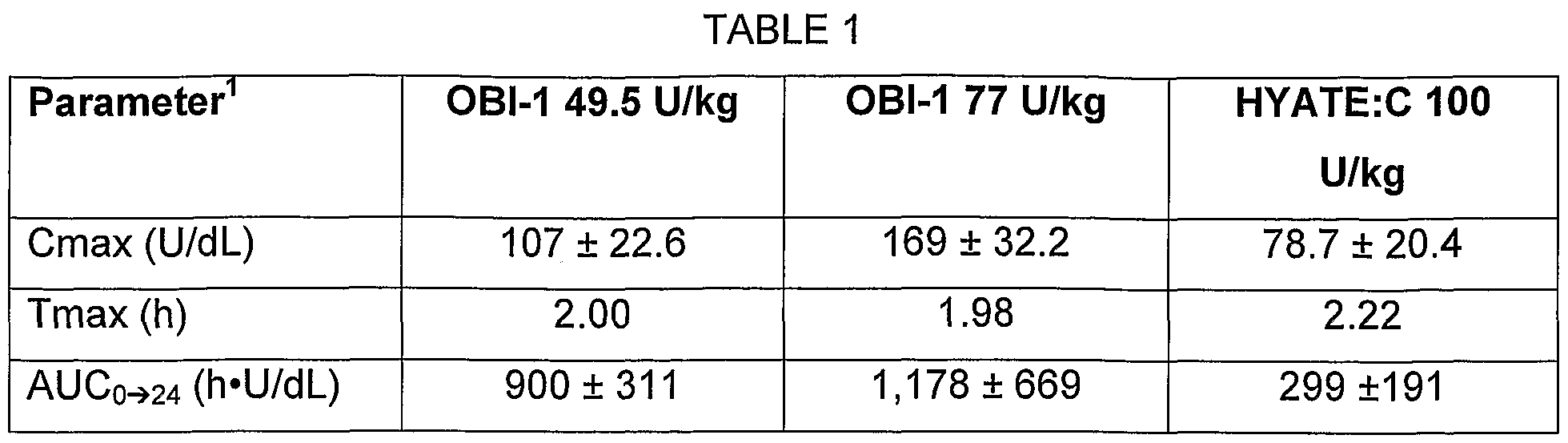
[0028] Non-hemophilic cynomolgus monkeys were used to compare bioavailability of OBI-1 and HYATE:C. Groups of 4 monkeys were given one dose of either HYATE:C 100 U/kg, or OBI-1 at doses of either 49 or 77 U/kg. Blood samples were drawn at specified time points thereafter, and the A/Ill levels obtained were used to calculate pharmacokinetic parameters, including the activity levels integrated over time. The integrated value is referred to as area under the curve for the specified time period (AUC0→t).
[0029] Pharmacokinetic analyses were calculated using non-compartmental methods, corrected for baseline (endogenous A/Ill level in the test animal). The maximum plasma concentration, Cmax, and the time to maximum plasma concentration, Tmax, were taken directly from the data. The area under the curve from time zero to the final sample (AUC0→t) was calculated using the linear trapezoidal method. The results are shown in Fig. 1.
[0030] There was a dose proportional increase in Cmax and AUCo→t between the two doses of OBI-1. Mean plasma A Ill levels for monkeys receiving HYATE:C 100 U/kg were lower than the A/Ill levels of monkeys receiving OBI-1 , at both 49.5 and 77 U/kg, at every time point but one. Biological availability (AUC) of HYATE:C 100 U/kg (299 + 191 h-U/dL), was only approximately 1/3 that of OBI-1 given at a dose of 49.5 U/kg (900 ± 311 h-U/dL) and one-quarter that of OBI-1 given at a dose of 77 U/kg (1178 ± 669 h-U/dL). At one time point, 0.66 hours, the A/Ill levels measured appeared spurious for several animals, likely due to mishandling of the plasma specimens. Calculating the pharmacokinetic values excluding the A/Ill values at 0.66 hours for the analysis resulted only in very minor changes to AUCo→24- [0031] Table 1 sets forth Pharmacokinetic Parameters for Baseline Corrected A lll Levels After iv Administration of HYATE:C and OBI-1 in Monkeys.
Figure imgf000012_0001
Arithmetic mean ± standard deviation except for Tmax for which the median is reported.
[0032] In conclusion, OBI-1 administered to cynomolgus monkeys in a dose of 49.5 U/kg or 77 U/kg, resulted in a much greater area under the time-concentration curve than did a dose of HYATE:C at 100 U/kg. This serendipitous finding reveals an unpredictable difference between OBI-1 and HYATE:C, specifically that OBI-1 displays an enhanced in vivo activity when administered into monkeys, compared with HYATE:C. When the data of Table 1 are compared on an equivalent U/kg basis it can be seen that a 49.5 U/kg dose of OBI-1 provided about 6-fold greater AUCo→24 than did a 100 U/kg dose of HYATE:C. A 77 U/kg dose of OBI-1 provided about 5- fold greater AUC024 than did 100 U/kg of HYATE:C. Similar results were obtained in a separate study using five monkeys receiving 40 U/kg OBI-1 , 5 monkeys receiving 100 U/kg OBI-1 and 6 monkeys receiving 100 U/kg HYATE:C. (Table 2.)
TABLE 2
Pharmacokinetic Parameters for Baseline-Corrected Factor VIII After i.v. Administration of OBI-1 and HYATE:C in Monkeys.
Figure imgf000013_0001
Arithmetic mean ± standard deviation except for Tmax for which the median is reported.
EXAMPLE 2 Bioavailability in Hemophilic Dogs [0033] Originally discovered as a spontaneous mutation, dogs with hemophilia A have been maintained in a protected colony for over twenty years. The colony housed at the Queens University in Kingston, Ontario, is in its tenth generation. They have no circulating A Ill activity or protein and their phenotypic picture is analogous to severe hemophilia A in humans, with recurrent severe spontaneous soft tissue and joint bleeds and chronic joint deformities. They require frequent injections of canine-derived plasma or cryoprecipitate to control their bleeding.
[0034] Eight healthy dogs aged 6 months or greater, weighing at least 6 kg and lacking anti-porcine A/Ill antibody were each administered a single dose of either HYATE:C or OBI-1. Two animals each received 3 U/kg, 25 U/kg, or 100 U/kg of each product. Blood samples were drawn at baseline and at the following time points after the injection of the products: 0.25, 0.5, 1 , 2, 4, 8, 12, 24, 36, 48 and 72 hours. FVIII levels were determined by both one-stage clotting assay and chromogenic assay methods.
[0035] FVIII levels were determined against a porcine A/Ill standard designated HY98P. Although these hemophilic dogs have no measurable canine Ill activity, and no A/Ill antigen present in their blood, they were found to have measurable A Ill activity at baseline (0.1 to 0.3 U/ml) when tested against a porcine A/Ill standard. This porcine standard was made by adding varying amounts of the actual test product HYATE:C or OBI-1 (in 1 % bovine serum albumin/imidazole buffer) to factor VIII deficient human hemophilic plasma. For purposes of determining pharmacokinetic parameters, therefore, the baseline activity measured was subtracted from the measured activity at each time point and the difference in A/Ill activity was entered for all calculations. For both products tested, there was substantial variability in the pharmacokinetic values obtained from the dogs tested at each dose level.
[0036] Mean values for selected pharmacokinetic parameters are shown in Table 3 (Chromogenic Assay) and Table 4 (One-Stage Clotting Assay).
TABLE 3
Bioavailability in hemophilic dogs: Chromogenic Assay
Figure imgf000014_0001
TABLE 4 Bioavailability in Hemophilic Dogs: One-Stage Clotting Assay
Figure imgf000015_0001
[0038] The results of the clotting assay and chromogenic assay were similar. Maximum Concentration (Cmax) in the blood for OBI-1 was greater than for HYATE:C at all doses. The mean Time to Maximum Concentration (Tmax) was shorter for OBI-1 than it was for HYATE:C at 3 and 25 U/kg doses but the opposite was seen at a dose of 100 U/kg. Mean Recovery percentage was greater for OBI-1 than for HYATE:C at all doses: at 25 and 100 U/kg, recovery values for OBI-1 were approximately 2-5 times that of HYATE:C. For Area Under the Curve, regardless of treatment group the geometric mean of AUC increased as the dose increased. Overall the pharmacokinetic values as measured by the two assay methods, the one-stage clotting and the chromogenic assays, followed the same trends across most parameters.
EXAMPLE 3 Efficacy in Hemophilic Dogs [0039] CBT, the time it takes for bleeding to stop after the dog's toenail cuticle is cut, is a useful measure of efficacy in hemophilia dogs. In the untreated dog with hemophilia, the cuticle usually stops bleeding in approximately 2 minutes, does not bleed for a brief time and then re-bleeds steadily for at least 12 minutes or until the lesion is cauterized. The normal CBT is defined as 5 or fewer minutes of bleeding and no need for cauterization. CBT in dogs with congenital hemophilia has been used widely as a measure of the efficacy of investigational A/Ill products.
[0040] The experimental design was that described in Example 2.
Table 5 demonstrates the individual changes in the CBT results for each dog for each injection.
Table 5 Effect of Porcine A/Ill Products on Dog Cuticle Bleeding Times
Figure imgf000016_0001
* In Zoey-2 (second study) the cuticle bleeding was extremely slow after the 2 min point with only 1-2 drops/min up to 8 min when bleeding stopped completely.
[0042] Although there was substantial variation between individual dogs, the data suggest greater in vivo efficacy in dogs given OBI-1. The mean reduction in CBT over all doses in the OBI-1 in HYATE:C dogs was 4.78 min and 1.25 min respectively. This difference was not statistically significant, but there was a trend toward significance (p =0.10, t test). The difference between the efficacy of OBI-1 and HYATE:C was more pronounced at the lower doses of 3 U/kg and 25 U/kg, where OBI-1 reduced the CBT in some dogs but HYATE:C did not.
EXAMPLE 4
Mouse Efficacy Study
[0043] Hemophilia A mice have been created by targeted disruption of exon
16 of the /Ill gene. The E16 mice have undetectable A/Ill activity, occasional spontaneous bleeding, and prolonged bleeding and increased mortality after tail transection or laceration of the tail vein. An efficacy model has been developed in which the ability of A/Ill to decrease the mortality in E16 mice following transection of the distal 2 cm of tail is assessed.
[0044] Research grade OBI-1 was prepared by expressing the OBI-1 cDNA in a baby hamster kidney cell line and purification from serum-free expression medium using a two-step chromatography procedure as described in Doering et al. (2002) J. Biol. Chem. 277:38345-9. The following experiment was designed to test the efficacy of OBI-1 in the tail transection model.
[0045] Male or female hemophilia A mice, aged 9 to 10 weeks, were injected by tail vein with various concentrations of OBI-1 or control buffer. The mice were anesthetized and, 15 min after injection, the distal 2 cm of tail was transected and allowed to bleed freely. This injury reportedly is fatal within 24 h in most E16 hemophilia A mice.
[0046] Survival at 24 h was determined with the following results:
TABLE 6 Efficacy of OBI-1 in Hemophilia A Mice: Tail Transection Model
Figure imgf000018_0001
[0047] The data are consistent with the statement that a dose of A/Ill of 1.2
Units/kg is effective in preventing death in this model. Combining the data at 0.4 and 1.2 Units/kg, there are 14/14 survivors compared to 6/38 survivors in the control (untreated) group. An estimated dose conferring 50% survival (ED50) was 0.044 U/kg. Furthermore, every mouse receiving at least 0.4 U/kg survived.
Efficacy of HYATE:C in hemophilia mice
[0048] Prior to tail vein injections of HYATE:C (0 to 100 A lll Units/kg), or placebo (saline), mice were warmed under a 60-watt lamp for 2 minutes to dilate the tail veins. Fifteen minutes after injection, mice were anesthetized with Metofane and the distal 2 cm of the tail was amputated. Mice were placed into clean cages with paper towels in place of litter and observed for 24 hours to determine survival. Well- moistened food was placed inside each cage in addition to the usual water bottle and dry pellets. Survivors were terminated after 24 hours using Metofane followed by cervical dislocation.
[0049] There was a dose-dependent increase in survival in both treated groups following injection of product (Table 7). TABLE 7 Efficacy of HYATE:C in Hemophilia A Mice
Figure imgf000019_0001
[0050] The estimated ED50 for HYATE:C was 0.2 U/kg, 4-5 times greater than that estimated for OBI-1 , predicting greater efficacy of OBI-1. Overall, the comparative efficacy of HYATE:C and OBI-1 has not been rigorously studied in hemophilia A mice.
EXAMPLE 5
Recovery from Human Plasma
Materials
[0051] Citrated pooled normal human plasma (FACT, product No. 0020-0) and
A/lll-deficient plasma (human hemophilia A plasma, product no. 0800) were purchased from George King Bio-medical, Inc.). They were stored at -70°C. Activated partial thromboplastin time (aPTT) reagent (product No. 35513) was purchased from Organon Teknika Corp. It was stored in a lyophilized state at 4°C. OBI-1 Vehicle, Lot No. 214-02-001 , was reconstituted with 1 ml Water for Injection per vial (60 vials total). Four vials of OBI-1 , Lot No. 214-01-001 , were each reconstituted with 1 ml Water for Injection, yielding an expected concentration of 550 U/ml according to the manufacturer's label. OBI-1 was diluted 15.9-fold further by addition of 59.6 ml of reconstituted OBI-1 vehicle, yielding a predicted concentration of 34.6 U/ml. Three vials of HYATE:C, Lot No. 656, were reconstituted with 20 ml Water for Injection, yielding an expected concentration of 34.6 U/ml, according to the manufacturer's label. HYATE:C was sub-aliquoted into 120 aliquots of 0.5 ml each and frozen at -70°C. OBI-1 was sub-aliquoted into 127 aliquots of 0.5 ml each and frozen at -70 °C.
[0052] Citrated plasmas from patients with inhibitory antibodies to A/Ill were shipped on dry ice to Emory University from several hemophilia treatment centers. Samples were frozen at -70°C until used. From 58 plasmas that were obtained, 25 were randomly selected for study.
FVIII Assays
[0053] FVIII one-stage clotting assays were performed using a Diagnostica
Stago, ST art 4 Coagulation Instrument. Lyophilized aPTT reagent was solubilized in 3 ml H2O according to the manufacturer's instructions and kept at room temperature until used. FACT and A lll-deficient plasma were stored on ice after rapid thawing in a 37 °C water bath. FVIII-deficient plasma (50 μl) was added to sample cuvettes and allowed to warm for 30-45 seconds before addition of the remaining reagents. Dilutions of the A/Ill standard or sample (5 μl) were added, followed by addition of 50 μl aPTT reagent and incubation for 250 seconds. Clotting was initiated by addition of 50 μl pre-warmed CaCI2 solution using a cabled pipette. The addition activates an internal timer and records the clotting time in seconds. A standard curve was prepared using four dilutions of FACT into Hank's Buffered Saline: undiluted, 1/3, 1/11 , and 1/21. The A/Ill concentration of undiluted FACT is approximately 1 U/ml and ranged from 1.04 to 1.09 U/ml according to the manufacturer. The clotting time was plotted versus the logarithm of the A/Ill concentration and the standard curve was calculated by linear regression. The A/Ill concentration of samples was measured by interpolation on the standard curve, except in the case of analysis of stock solutions of OBI-1 and HYATE:C, for which more extensive measurements were made, as described in Results.
[0054] Reconstitution of A/Ill activity from plasmas spiked with OBI-1 or
HYATE:C was measured in 33 of the available inhibitor plasma samples (Fig. 2). In all cases, the plasmas were spiked to a predicted A Ill activity of 0.9 U/ml. Additionally, two hemophilia A plasmas obtained from George King were included, and are shown at the far right in the figure. "Good" plasma corresponds to commercially available reagent plasma in which recovery of A/Ill in HYATE:C and OBI-1 had previously been found to be in the expected range. "Bad" plasma corresponds to plasma in which recovery of A Ill in HYATE:C had previously been found to be less than 10% of expected at Ipsen. The results confirm that the expected recovery of OBI-1 is obtained in the "good" plasma and that the recovery of HYATE:C is close to the expected range. However, recovery of activity from the "bad" plasma spiked with HYATE:C again was observed to be quite poor. Recovery of OBI-1 from this plasma was considerably higher, but lower than expected.
[0055] Recovery of A/Ill activity in the inhibitor patient plasmas was very low, less than 0.1 U/ml in almost every single HYATE:C spiked plasmas. Recovery was significantly higher when these same plasmas were spiked with OBI-1 , but was lower than expected (because of the presence of inhibitor antibodies). Several of the plasmas that had previously been assayed as negative for inhibitory antibodies to HYATE:C were assayed and are shown in Figure 2. The recovery of HYATE:C was poor in most of these samples. This raised the possibility that a longer incubation time of HYATE:C with hemophilia A plasma, such as occurs during the 2 hour incubation in the Bethesda assay, might lead to increased recovery of activity of HYATE:C. However, when HYATE:C was added to one of the HYATE:C-inhibitor negative patient samples, there was no increase of activity over 2 hours.
[0056] In conclusion, when OBI-1 is introduced into human plasma, whether or not it contains an inhibitor antibody to human A/Ill, recovery in vitro is greater than that of HYATE:C The implication of this finding is that one can achieve the same circulating level of A/Ill in a patient by administering a much lower dose of OBI-1 than of HYATE:C. EXAMPLE 6
Pharmacokinetics of OBI-1 versus HYATE:C in human subjects [0057] To evaluate various pharmacokinetic parameters of OBI-1 versus
HYATE:C in human subjects, the following randomized, parallel-group blinded comparison study was carried out with nine human patients. Of these 9 patients, five had no detectable anti-porcine inhibitor at baseline (i.e. less than 0.8 Bethesda units) and one (assigned to the OBI-1 group) had a very low inhibitor of 1.0 Bethesda units. Of the six patients with either no preexisting inhibitor or a very low inhibitor to porcine A Ill, three received HYATE:C and three received OBI-1. The three patients with significantly higher levels of inhibitors were excluded from the bioavailability assessment, as the presence of such inhibitors depresses bioavailability, thereby confounding the analysis. All patients were older than 12 years of age, were clinically diagnosed of hemophilia A, and were currently in the non-bleeding state. OBI-1 was provided in sterile vials containing 535 Units of A/Ill activity per vial. Each vial was reconstituted with 1.0 ml Sterile Water for Injection USP to a final concentration of 535 U/ml. HYATE:C was provided in sterile vials containing 541 IU of A/Ill per vial. Each vial was reconstituted with 20 ml Sterile Water for Injection USP to a final concentration of 27 lU/ml. The dose of each product administered was 100 lU/kg regardless of subject antibody titer. Investigators, patients and Sponsor were blinded to which patient received which active product, in a double- blind, double-dummy design. The patients received either 100 lU/kg of active HYATE:C followed by a placebo (three patients), or a placebo followed by 100 lU/kg of active OBI-1 (three patients), while in a stable, non-bleeding state. Each patient received an infusion over approximately one hour of the first product (HYATE:C or placebo of the same volume) followed by a slow push infusion from a syringe cover over 10 minutes of the second product (OBI-1 or placebo of the same volume).
[0058] Blood samples were drawn at times 0 (pre-injection), 20, 40, 60, 65,
75, 85, 105, and 125 minutes, and 3, 6, 9, 24, 27, 30 and 48 hours after the first infusion for determination of plasma A/Ill activity levels both by one-stage clotting and chromogenic assay methods, using human pooled plasma as a A/Ill standard. From these levels, standard pharmacokinetic analyses were performed and the results are shown in Table 8 and Figs. 3 and 4. The pharmacokinetic parameters measured in this study include Clearance (CL, ml/h/kg), Area Under the Curve (AUC, U/dL), Maximum Concentration (Cmax, U/ml), Volume of distribution (Vz), mean time to maximum concentration (Tmax, h), and half-time (T1 2, h).
TABLE 8 Summary of pharmacokinetic parameters for A/Ill after intravenous administration of OBI-1 or HYATE:C to human patients.
Figure imgf000023_0001
1Mean ± standard deviation except for Tmax for which the median is reported. 2 N = 3 for both products.
[0059] As can be seen in Table 8 and Figs. 3 and 4, the AUC values for OBI-1 were about 2-2.5 times greater than that for HYATE:C. The difference in AUC between OBI-1 and HYATE:C was more pronounced in the chromogenic assay than the one-stage activity assay. Maximum concentration (Cmax) in the blood for OBI-1 was about 3 times greater than for HYATE:C (151 vs 53 by the chromogenic assay). The mean time to Maximum Concentration (Tmax) was approximately 2.5 to 3 times shorter for OBI-1 than it was for HYATE:C. These results are consistent with the previous pharmacokinetic data obtained using monkeys, hemophilic dogs, and hemophilic mice, and further demonstrates that OBI-1 has much greater bioavailability compared to HYATE:C. Therefore, OBI-1 can be administered at a lower dose or be administered at a reduced frequency of administration, compared to HYATE:C, to yield equivalent therapeutic effects in A/Ill deficient patients. And OBI-1 at equivalent doses to Hyate:C can bring more rapid control of bleeding.
EXAMPLE 7
Clinical significance of the differences in recovery values for OBI-1 and HYATE:C [0060] The studies disclosed above demonstrate that the recovery from human plasma, maximum concentration (Cmax), and the area under the curve (AUC) were much higher for recombinant porcine A Ill B-domain-deleted (OBI-1) than for plasma derived porcine A Ill (HYATE:C) after injection of the same doses.
[0061] The A/Ill concentration in normal non-hemophilia A subjects is approximately 100 Units/dL. A typical bleeding episode is very likely to be controlled if the plasma level of A/Ill is reached at about 25% and 35% of the normal level and maintained for several hours (Roberts H and Hoffman M, "Hemophilia A and Hemophilia B," Chapter 123 in Beutler E, Lichtman M, Coller B, Kipps T and Seligsohn U (Eds), Williams Hematology, 6th edition (2001): pages 1639-1657; McGraw-Hill, New York). Using the pharmacokinetic data obtained from those subjects with no or low inhibitor to porcine FVIII (OBI-1 , n=3; HYATE:C, n=3 as described in Example 6), additional calculations were performed to determine the pharmacokinetic values of OBI-1 and HYATE:C administration that correspond to the therapeutic levels of A/Ill (i.e., 25-35%). The results are shown in Table 9.
TABLE 9
Calculated pharmacokinetic values corresponding to therapeutic levels of A/Ill with OBI-1 and HYATE:C administration.
Figure imgf000025_0001
[0062] As shown in the above tables: (1) the AUC above 25% and 35% is approximately 5 times greater for OBI-1 than for HYATE:C (Table 9); (2) peak concentrations (Cmax) are 2-3 fold higher for OBI-1 than for Hyate:C (Table 8); (3) OBI-1 will achieve its peak concentration much more rapidly than will Hyate:C (see Tmax in Table 8, in which the Tmax for OBI-1 was approximately 0.6 hours compared to 1.5-2.0 hours for Hyate:C ); and (4) the length of time FVIII will be in the therapeutic range after administration of OBI-1 at 100 U/kg is greater (1.5 to 2 fold) than for HYATE:C at 100 U/kg.
[0063] In summary, the data presented herein indicate that OBI-1 , unit for unit, will achieve much more rapid, effective, and prolonged control of bleeding than HYATE:C in patients having A/Ill deficiency.
Summary
[0064] The combined data of Examples 1-6 demonstrate the unexpected finding that OBI-1 behaves differently from HYATE:C in human and animal plasma. In particular, the studies described in Example 6 employing human patients establish that recombinant porcine A lll (OBI-1) indeed has far greater bioavailability than plasma-derived porcine A Ill (HYATE:C) in humans. This surprising result is precisely the opposite of what was seen with factor IX, where the plasma-derived concentrate had significantly greater recovery and bioavailability that the recombinant factor IX product (Ewenstein et al. supra). Furthermore, the greater bioavailability of OBI-1 compared to HYATE:C was also surprising, in light of the report by Kessler et al. (Haemophilia (2005) 11 :84-91), in which B-domain deleted recombinant human A/Ill (ReFacto®) was found to be bioequivalent to plasma- derived human A/Ill (Hemofil® M) in various pharmacokinetic parameters measured in a randomized, three-way crossover study.
[0065] The results of all animal and human studies taken together make it possible to devise new protocols for administration of OBI-1 , which differ substantially from conventional methods and dosage used for HYATE:C. One aspect of the invention provides a new dose regimen for OBI-1 , whereby OBI-1 may be administered to a patient at as little as 1/6 the standard activity dose in units/kg recommended for HYATE:C. The recommended dose for HYATE:C is 100 lU/kg of body wt in excess of the dose required to neutralize any patient antibody to porcine A/Ill. The level of a patient's antibody to porcine A/Ill is different for each individual. The dose of OBI-1 required to neutralize the patient's antibodies can be estimated from measurement of antibody titer, using standard methods known in the art. Accordingly, for a given patient, one can administer OBI-1 in place of HYATE:C at a dose about as little as 10-20 U/kg of body wt in excess of the neutralizing dose. If a hemophilia A patient has an inhibitory antibody against A/Ill, it would require more OBI to neutralize the inhibitory antibodies. An effective dose of OBI-1 can be administered in a fraction of the volume of solution required for administering a dose of HYATE:C, not only because OBI-1 can be prepared in more concentrated form, but also because a smaller dose of OBI-1 can yield a recovery of activity comparable to a 2 to 6 fold higher dose of HYATE:C. Alternatively, if 100 U/kg of OBI-1 is employed as a dose, patients can be successfully managed with much fewer infusions required to halt a bleed or much longer intervals between injections of OBI- 1. For example, where HYATE:C, required a median of eight infusions to halt a single bleeding episode over a two day period, OBI-1 may require only 1-4 such infusions, a dramatic advance in patient treatment. In addition, acute bleeding episodes can be treated with fewer and smaller doses of OBI-1 , compared to 8 doses over 2 days, the median dosage of HYATE:C reported in its package insert. The OBI-1 dosage can bring about more rapid control of bleeding and therefore is likely both more effective and safer than Hyate:C. It is also advantageous for patient comfort and quality of life, as well as providing a reduced risk of infection and of side effects from contaminants. Therapeutic levels of A/Ill can be achieved more rapidly by infusing the concentrated OBI-1 product. Another aspect of the invention provides a therapeutic protocol that includes a step of measuring OBI-1 recovery as part of the process for establishing an optimal dose in an individual patient. OBI-1 recovery can be measured essentially as described in Example 5, by adding a measured amount of OBI-1 activity to a sample of a patient's plasma, then measuring the activity recovered from the sample after a short time interval. A series of such tests can establish an OBI-1 dose suitable for each patient. Alternatively, individual recovery data can be measured directly in a patient.
[0066] The foregoing exemplary descriptions and the illustrative preferred embodiments of the present invention have been explained in the drawings and described in detail, with varying modifications and alternative embodiments being taught. While the invention has been so shown, described and illustrated, it should be understood by those skilled in the art that equivalent changes in form and detail may be made therein without departing from the true spirit and scope of the invention, and that the scope of the invention is to be limited only to the claims except as precluded by the prior art. Moreover, the invention as disclosed herein, may be suitably practiced in the absence of the specific elements that are disclosed herein.
[0067] Whenever a range is given in the specification, for example, a temperature range, a time range, or a composition or concentration range, all intermediate ranges and sub-ranges, as well as all individual values included in the ranges given are intended to be included in the disclosure.
[0068] All patents and publications mentioned in the specification are indicative of the levels of skill of those skilled in the art to which the invention pertains. References cited herein are incorporated by reference herein in their entirety to indicate the state of the art as of their filing date and it is intended that this information can be employed herein, if needed, to exclude specific embodiments that are in the prior art. For example, when a compound is claimed, it should be understood that compounds known and available in the art prior to Applicant's invention, including compounds for which an enabling disclosure is provided in the references cited herein, are not intended to be included in the composition of matter claims herein.
[0069] As used herein, "comprising" is synonymous with "including,"
"containing," or "characterized by," and is inclusive or open-ended and does not exclude additional, unrecited elements or method steps. As used herein, "consisting of excludes any element, step, or ingredient not specified in the claim element. As used herein, "consisting essentially of does not exclude materials or steps that do not materially affect the basic and novel characteristics of the claim. In each instance herein any of the terms "comprising," "consisting essentially of and "consisting of may be replaced with either of the other two terms. The invention illustratively described herein suitably may be practiced in the absence of any element or elements, limitation or limitations which is not specifically disclosed herein.
[0070] One of ordinary skill in the art will appreciate that starting materials, reagents, solid substrates, synthetic methods, purification methods, and analytical methods other than those specifically exemplified can be employed in the practice of the invention without resort to undue experimentation. All art-known functional equivalents, of any such materials and methods are intended to be included in this invention. The terms and expressions which have been employed are used as terms of description and not of limitation, and there is no intention that in the use of such terms and expressions of excluding any equivalents of the features shown and described or portions thereof, but it is recognized that various modifications are possible within the scope of the invention claimed. Thus, it should be understood that although the present invention has been specifically disclosed by preferred embodiments and optional features, modification and variation of the concepts herein disclosed may be resorted to by those skilled in the art, and that such modifications and variations are considered to be within the scope of this invention as defined by the appended claims. [0071] All references cited herein are hereby incorporated by reference to the extent that there is no inconsistency with the disclosure of this specification. Some references provided herein are incorporated by reference to provide details concerning sources of starting materials, additional starting materials, additional reagents, additional methods of synthesis, additional methods of analysis and additional uses of the invention.

Claims

CLAIMSWe claim:
1. A method of administering a porcine B-domainless factor VIII (OBI-1) to a patient having factor VIII deficiency, wherein the porcine B-domainless factor VIII is administered intravenously to said patient in combination with a physiologically acceptable carrier at a dose about 10-100 Units/kg of body weight in excess of any antibody-neutralizing dose appropriate for said patient at a frequency sufficient to achieve and maintain a therapeutically effective level of factor VIII in said patient.
2. The method of claim 1 wherein the dose of OBI-1 is at about 10-50 Units/kg of body weight of said patient.
3. The method of claims 1 or 2 wherein the dose of OBI-1 is at about 15 Units/kg of body weight of said patient.
4. The method of claims 1-3 wherein the patient is in the bleeding state.
5. The method of claims 1-3 wherein the patient is in the non-bleeding state, and OBI-1 is administered at a frequency of not more than once per day.
6. A method of administering a porcine B-domainless factor VIII (OBI-1) to a patient having A Ill deficiency, wherein the porcine B-domainless factor VIII is administered in combination with a physiologically acceptable carrier at a dose about 10-100 Units/kg of body weight in excess of any antibody- neutralizing dose appropriate for said patient, not more than four administrations over a period of two days.
7. The method of claim 6 wherein the patient is in the bleeding state.
8. The method of claims 6 or 7 wherein OBI-1 is administered at a frequency of not more than two administrations per day.
9. A method of reducing blood clotting time in a patient having factor VIII deficiency, comprising administering a composition comprising a porcine B- domainless factor VIII (OBI-1) and a physiologically acceptable carrier to the patient in an amount sufficient to reduce the patient's blood clotting time wherein the amount of OBI-1 sufficient to reduce the patient's blood clotting time is 1/2 to 1/10 of the amount of plasma-derived porcine factor VIII sufficient to achieve the same reduction of blood clotting time obtained upon administering a B-domainless porcine A/Ill (OBI-1).
10. The method of claim 9 wherein the plasma-derived porcine A Ill is HYATE:C.
11. The method of claim 9 wherein a first administration of an amount of porcine B-domainless A/Ill (OBI-1) that reduces the patient's blood clotting time to a desired value is followed by a second administration of an amount of porcine B-domainless A/Ill (OBI-1) that reduces the patient blood clotting time to the desired value, the patient's blood clotting time remaining reduced at or near said desired value during such time interval, and said time interval being at least 2-fold greater than the corresponding time interval within which said desired value can be maintained by administration of the same dose of porcine plasma-derived A/Ill.
12. The method of claim 11 wherein the porcine plasma-derived A Ill is HYATE:C.
13. A method of treating a patient having A/Ill deficiency comprising administering a porcine B-domainless A/Ill (OBI-1) in combination with a physiologically acceptable carrier.
14. The method claim 13 wherein the porcine B-domainless A/Ill is administered at a dose about 10-100 Units/kg of body weight in excess of any antibody- neutralizing dose appropriate for said patient at a frequency sufficient to achieve and maintain a therapeutically effective level of factor VIII in said patient.
15. The method of claim 14 wherein the does of OBI-1 is at about 10-50 Units/kg of body weight of said patient.
16. The method claim 15 wherein the dose of OBI-1 is about 15 Units/kg of body weight of said patient.
17. A method of administering a porcine B-domainless A/Ill (OBI-1) to a patient in need of such administration comprising the steps of: a) obtaining a sample of plasma from the patient; b) measuring the A/Ill activity in the sample; c) adding, to aliquots of the plasma sample, varying amounts of the porcine B-domainless A/Ill (OBI-1) activity; d) measuring recovery of A/Ill activity from said aliquots at a desired time after step c); e) using data from step d), calculating a dose of the porcine B-domainless A/Ill sufficient to neutralize any preexisting inhibitors to OBI-1 and then calculating a dose to reduce the patient's blood clotting time by a desired value; and f) administering the doses calculated in step e) to the patient.
18. A solid pharmaceutical composition obtainable by lyophilization of a solution devoid of amino acids comprising OBI-1 , a surfactant, calcium chloride, sucrose, sodium chloride, trisodium citrate and a buffer, wherein the solution has a pH of 6-8 prior to lyophilization and after reconstitution in water for injection.
19. The composition of claim 18 wherein the surfactant is a polysorbate.
20. The composition of claim 19 wherein the surfactant is polysorbate 80.
21. The composition of claims 18-20 wherein the buffer is tris(hydroxymethyl)methylamine.
22. The composition of claims 18-21 wherein the pH range is 6.5 to 7.5.
23. A kit comprising the solid pharmaceutical composition of claims 18-22 and sterile water optionally containing sodium chloride.
4. A pharmaceutical composition for administration to a patient having A/Ill deficiency to achieve and maintain a therapeutically effective level of factor VIII in said patient, wherein the composition comprises OBI-1 at a concentration from 50 to 10,000 Units/mL and a physiologically acceptable carrier.
PCT/US2005/014760 2004-05-03 2005-04-28 METHOD OF ADMINISTERING PORCINE B-DOMAINLESS fVIII Ceased WO2005107776A1 (en)

Priority Applications (12)

Application Number Priority Date Filing Date Title
JP2007511442A JP2007536230A (en) 2004-05-03 2005-04-28 Method for administering porcine B domain deficient fVIII
ES05740319.8T ES2449044T3 (en) 2004-05-03 2005-04-28 Administration procedure of fVIII without porcine B domain
EP05740319.8A EP1750733B1 (en) 2004-05-03 2005-04-28 METHOD OF ADMINISTERING PORCINE B-DOMAINLESS fVIII
PL05740319T PL1750733T3 (en) 2004-05-03 2005-04-28 METHOD OF ADMINISTERING PORCINE B-DOMAINLESS fVIII
SI200531828T SI1750733T1 (en) 2004-05-03 2005-04-28 METHOD OF ADMINISTERING PORCINE B-DOMAINLESS fVIII
HK07108636.6A HK1100900B (en) 2004-05-03 2005-04-28 Method of administering porcine b-domainless fviii
DK05740319.8T DK1750733T3 (en) 2004-05-03 2005-04-28 PROCEDURE FOR SUBMITTING PIG-B DOMAIN WITHOUT VVIII
US11/549,049 US7576181B2 (en) 2004-05-03 2006-10-12 Method of administering porcine B-domainless fVIII
US12/496,516 US8101718B2 (en) 2004-05-03 2009-07-01 Methods of administering porcine B-domainless fVIII
US13/356,437 US8501694B2 (en) 2004-05-03 2012-01-23 Method of administering porcine B-domainless fVIII
US13/959,523 US20140193441A1 (en) 2004-05-03 2013-08-05 Method of Administering Porcine B-domainless fVIII
US15/179,343 US20170119857A1 (en) 2004-05-03 2016-06-10 Method of Administering Porcine B-Domainless fVIII

Applications Claiming Priority (4)

Application Number Priority Date Filing Date Title
US56801504P 2004-05-03 2004-05-03
US60/568,015 2004-05-03
US56900004P 2004-05-07 2004-05-07
US60/569,000 2004-05-07

Related Child Applications (1)

Application Number Title Priority Date Filing Date
US11/549,049 Continuation-In-Part US7576181B2 (en) 2004-05-03 2006-10-12 Method of administering porcine B-domainless fVIII

Publications (1)

Publication Number Publication Date
WO2005107776A1 true WO2005107776A1 (en) 2005-11-17

Family

ID=35320037

Family Applications (1)

Application Number Title Priority Date Filing Date
PCT/US2005/014760 Ceased WO2005107776A1 (en) 2004-05-03 2005-04-28 METHOD OF ADMINISTERING PORCINE B-DOMAINLESS fVIII

Country Status (10)

Country Link
US (5) US7576181B2 (en)
EP (1) EP1750733B1 (en)
JP (1) JP2007536230A (en)
CY (1) CY1114809T1 (en)
DK (1) DK1750733T3 (en)
ES (1) ES2449044T3 (en)
PL (1) PL1750733T3 (en)
PT (1) PT1750733E (en)
SI (1) SI1750733T1 (en)
WO (1) WO2005107776A1 (en)

Cited By (4)

* Cited by examiner, † Cited by third party
Publication number Priority date Publication date Assignee Title
US7560107B2 (en) 1996-06-26 2009-07-14 Emory University Modified factor VIII
US7576181B2 (en) 2004-05-03 2009-08-18 Ipsen Biopharm Limited Method of administering porcine B-domainless fVIII
US8623824B2 (en) 2007-02-23 2014-01-07 Biomethodes VIII factors for the treatment of type A hemophilia
US9150637B2 (en) 2010-11-05 2015-10-06 Baxalta Inc. Variant of antihemophilic factor VIII having increased specific activity

Families Citing this family (1)

* Cited by examiner, † Cited by third party
Publication number Priority date Publication date Assignee Title
US10654911B1 (en) 2019-04-02 2020-05-19 Beijing Neoletix Biological Technology Co., Ltd. Vector co-expressing truncated von Willebrand factor and factor VIII

Citations (2)

* Cited by examiner, † Cited by third party
Publication number Priority date Publication date Assignee Title
US6458563B1 (en) * 1996-06-26 2002-10-01 Emory University Modified factor VIII
WO2003080108A1 (en) * 2002-03-26 2003-10-02 Societe De Conseils De Recherches Et D'applications Scientifiques (S.C.R.A.S.) Stable pharmaceutical composition containing factor viii

Family Cites Families (37)

* Cited by examiner, † Cited by third party
Publication number Priority date Publication date Assignee Title
US4348384A (en) * 1980-10-17 1982-09-07 Dainippon Pharmaceutical Co., Ltd. Pharmaceutical composition for oral administration containing coagulation factor VIII or IX
US4757006A (en) * 1983-10-28 1988-07-12 Genetics Institute, Inc. Human factor VIII:C gene and recombinant methods for production
EP0182448A3 (en) 1984-08-24 1987-10-28 Genetics Institute, Inc. Production of factor viii and related products
ATE72838T1 (en) * 1985-04-12 1992-03-15 Genetics Inst NEW PROCOAGULATION PROTEINS.
JPH0387173A (en) 1987-09-10 1991-04-11 Teijin Ltd Preparation of human active natural type factor viii c and transformant using the same
US5605884A (en) * 1987-10-29 1997-02-25 Rhone-Poulenc Rorer Pharmaceuticals Inc. Factor VIII formulations in high ionic strength media
WO1989009784A1 (en) 1988-04-08 1989-10-19 Commonwealth Serum Laboratories Commission Production of heat-stable factor viii concentrate
DK162233C (en) 1989-11-09 1992-03-16 Novo Nordisk As PROCEDURE FOR INSULATING FACTOR VIII FROM BLOOD PLASMA AND PHARMACEUTICAL PREPARATION CONTAINING THE ASSOCIATED PHATAR VIII
DE4111393A1 (en) * 1991-04-09 1992-10-15 Behringwerke Ag STABILIZED FACTOR VIII PREPARATIONS
US5888974A (en) * 1992-04-07 1999-03-30 Emory University Hybrid human/animal factor VIII
US5744446A (en) * 1992-04-07 1998-04-28 Emory University Hybrid human/animal factor VIII
US6180371B1 (en) 1996-06-26 2001-01-30 Emory University Modified factor VIII
US5364771A (en) * 1992-04-07 1994-11-15 Emory University Hybrid human/porcine factor VIII
US6376463B1 (en) * 1992-04-07 2002-04-23 Emory University Modified factor VIII
US5663060A (en) * 1992-04-07 1997-09-02 Emory University Hybrid human/animal factor VIII
US5859204A (en) * 1992-04-07 1999-01-12 Emory University Modified factor VIII
DE69329795T2 (en) * 1992-10-02 2001-07-05 Genetics Institute, Inc. COMPOSITION CONTAINING COAGULATION FACTOR VIII; METHOD FOR THE PRODUCTION THEREOF AND THE USE OF A SURFACE-ACTIVE SUBSTANCE AS A STABILIZER
US5563045A (en) 1992-11-13 1996-10-08 Genetics Institute, Inc. Chimeric procoagulant proteins
US5348384A (en) * 1992-12-31 1994-09-20 Hull Harold L Apparatus for supporting a title counter cap
SE9301581D0 (en) * 1993-05-07 1993-05-07 Kabi Pharmacia Ab PROTEIN FORMULATION
CA2162497A1 (en) * 1993-06-10 1994-12-22 Sheila Connelly Adenoviral vectors for treatment of hemophilia
SE504074C2 (en) * 1993-07-05 1996-11-04 Pharmacia Ab Protein preparation for subcutaneous, intramuscular or intradermal administration
IL113010A0 (en) * 1994-03-31 1995-10-31 Pharmacia Ab Pharmaceutical formulation comprising factor VIII or factor ix with an activity of at least 200 IU/ml and an enhancer for improved subcutaneous intramuscular or intradermal administration
US6818439B1 (en) * 1994-12-30 2004-11-16 Chiron Corporation Methods for administration of recombinant gene delivery vehicles for treatment of hemophilia and other disorders
AU6291896A (en) 1995-07-11 1997-02-10 Chiron Corporation Novel factor viii:c polypeptide analogs comprising factor v domains or subdomains
WO1997003193A1 (en) 1995-07-11 1997-01-30 Chiron Corporation Novel factor viii:c polypeptide analogs with altered metal-binding properties
US7560107B2 (en) * 1996-06-26 2009-07-14 Emory University Modified factor VIII
US5763401A (en) * 1996-07-12 1998-06-09 Bayer Corporation Stabilized albumin-free recombinant factor VIII preparation having a low sugar content
WO1999029848A1 (en) 1997-12-05 1999-06-17 The Immune Response Corporation Novel vectors and genes exhibiting increased expression
US6200560B1 (en) * 1998-10-20 2001-03-13 Avigen, Inc. Adeno-associated virus vectors for expression of factor VIII by target cells
US6759216B1 (en) * 1998-11-06 2004-07-06 Emory University Glycosylated, low antigenicity low immunogenicity factor VIII
KR100638184B1 (en) * 2000-09-19 2006-10-26 에모리 유니버시티 Modified Factor Ⅷ
WO2003031598A2 (en) * 2001-10-05 2003-04-17 Emory University Nucleic acid and amino acid sequences encoding high-level expressor factor viii polypeptides and methods of use
AU2002364509A1 (en) * 2001-11-30 2003-06-17 Emory University Factor viii c2 domain variants
US7105745B2 (en) * 2002-12-31 2006-09-12 Thomas & Betts International, Inc. Water resistant electrical floor box cover assembly
US20050123997A1 (en) * 2003-10-30 2005-06-09 Lollar John S. Modified fVIII having reduced immunogenicity through mutagenesis of A2 and C2 epitopes
SI1750733T1 (en) * 2004-05-03 2014-03-31 Emory University METHOD OF ADMINISTERING PORCINE B-DOMAINLESS fVIII

Patent Citations (2)

* Cited by examiner, † Cited by third party
Publication number Priority date Publication date Assignee Title
US6458563B1 (en) * 1996-06-26 2002-10-01 Emory University Modified factor VIII
WO2003080108A1 (en) * 2002-03-26 2003-10-02 Societe De Conseils De Recherches Et D'applications Scientifiques (S.C.R.A.S.) Stable pharmaceutical composition containing factor viii

Non-Patent Citations (3)

* Cited by examiner, † Cited by third party
Title
PARKER E.T ET AL: "Comparative Immunogeneticity of Recombinant B Domain-deleted Porcine Factor VIIIand Hyate: C in Hemophilia A Mice Presensitized to Human Factor VIII", J. THROMBOSIS AND HAEMOSTASIS, vol. 2, April 2004 (2004-04-01), pages 605 - 611, XP002992201 *
PARKER E.T. ET AL: "Comparative Immunogenicity of Recombinant B Domain-deleted Porcine Factor VIII and Hyate: C in Hemophilia A Mice Presensitized to Human Factor VIII", J. BLOOD, vol. 102, no. 11, 16 November 2003 (2003-11-16), pages 798A, XP008054758 *
See also references of EP1750733A4 *

Cited By (8)

* Cited by examiner, † Cited by third party
Publication number Priority date Publication date Assignee Title
US7560107B2 (en) 1996-06-26 2009-07-14 Emory University Modified factor VIII
US8951515B2 (en) 1996-06-26 2015-02-10 Emory University Modified factor VIII
US7576181B2 (en) 2004-05-03 2009-08-18 Ipsen Biopharm Limited Method of administering porcine B-domainless fVIII
US8101718B2 (en) 2004-05-03 2012-01-24 Emory University Methods of administering porcine B-domainless fVIII
US8501694B2 (en) 2004-05-03 2013-08-06 Emory University Method of administering porcine B-domainless fVIII
US8623824B2 (en) 2007-02-23 2014-01-07 Biomethodes VIII factors for the treatment of type A hemophilia
US9150637B2 (en) 2010-11-05 2015-10-06 Baxalta Inc. Variant of antihemophilic factor VIII having increased specific activity
US10053500B2 (en) 2010-11-05 2018-08-21 Baxalta Incorporated Variant of antihemophilic factor VIII having increased specific activity

Also Published As

Publication number Publication date
EP1750733B1 (en) 2013-12-11
SI1750733T1 (en) 2014-03-31
US8501694B2 (en) 2013-08-06
US20090270329A1 (en) 2009-10-29
EP1750733A1 (en) 2007-02-14
HK1100900A1 (en) 2007-10-05
EP1750733A4 (en) 2009-06-17
US8101718B2 (en) 2012-01-24
ES2449044T3 (en) 2014-03-18
US20120270788A1 (en) 2012-10-25
CY1114809T1 (en) 2016-12-14
US20070173446A1 (en) 2007-07-26
US7576181B2 (en) 2009-08-18
US20170119857A1 (en) 2017-05-04
JP2007536230A (en) 2007-12-13
US20140193441A1 (en) 2014-07-10
PL1750733T3 (en) 2014-05-30
DK1750733T3 (en) 2014-01-20
PT1750733E (en) 2014-02-14

Similar Documents

Publication Publication Date Title
CA2742328C (en) Factor viii formulations
EP1016673A1 (en) Composition comprising coagulation factor VIII formulation, process for its preparation and use of a surfactant as stabilizer
JP2007262090A (en) Highly concentrated, lyophilized, and liquid factor ix formulation
JP2018505209A (en) Pharmaceutical composition containing plasminogen and use thereof
US20170119857A1 (en) Method of Administering Porcine B-Domainless fVIII
US12016904B2 (en) Treatment of gastrointestinal bleeding in patients with severe von Willebrand disease by administration of recombinant VWF
NO324064B1 (en) Pharmaceutical composition comprising vWF propeptide and method of preparation and use thereof
WO2023246680A1 (en) Activators of coagulation factor x and formulations thereof for treating bleeding disorders
JP2026500069A (en) Formulations Comprising ActRIIA Protein Variants
HK1100900B (en) Method of administering porcine b-domainless fviii
RU2774720C2 (en) TREATMENT OF GASTROINTESTINAL BLEEDING IN PATIENTS WITH SEVERE VON WILLEBRAND DISEASE BY ADMINISTRATION OF RECOMBINANT vWF
HK40115617A (en) Treatment of gastrointestinal bleeding in patients with severe von willebrand disease by administration of recombinant vwf
AU677797C (en) Composition comprising coagulation factor viii formulation, process for its preparation and use of a surfactant as stabilizer
HK40029176B (en) Treatment of gastrointestinal bleeding in patients with severe von willebrand disease by administration of recombinant vwf
HK40029176A (en) Treatment of gastrointestinal bleeding in patients with severe von willebrand disease by administration of recombinant vwf
PL175177B1 (en) A pharmaceutical composition containing recombinant coagulation factor VIII I54) and a method of producing a pharmaceutical composition containing recombinant coagulation factor VIII

Legal Events

Date Code Title Description
AK Designated states

Kind code of ref document: A1

Designated state(s): AE AG AL AM AT AU AZ BA BB BG BR BW BY BZ CA CH CN CO CR CU CZ DE DK DM DZ EC EE EG ES FI GB GD GE GH GM HR HU ID IL IN IS JP KE KG KM KP KR KZ LC LK LR LS LT LU LV MA MD MG MK MN MW MX MZ NA NI NO NZ OM PG PH PL PT RO RU SC SD SE SG SK SL SM SY TJ TM TN TR TT TZ UA UG US UZ VC VN YU ZA ZM ZW

AL Designated countries for regional patents

Kind code of ref document: A1

Designated state(s): BW GH GM KE LS MW MZ NA SD SL SZ TZ UG ZM ZW AM AZ BY KG KZ MD RU TJ TM AT BE BG CH CY CZ DE DK EE ES FI FR GB GR HU IE IS IT LT LU MC NL PL PT RO SE SI SK TR BF BJ CF CG CI CM GA GN GQ GW ML MR NE SN TD TG

121 Ep: the epo has been informed by wipo that ep was designated in this application
WWE Wipo information: entry into national phase

Ref document number: 11549049

Country of ref document: US

WWE Wipo information: entry into national phase

Ref document number: 2007511442

Country of ref document: JP

NENP Non-entry into the national phase

Ref country code: DE

WWW Wipo information: withdrawn in national office

Country of ref document: DE

WWE Wipo information: entry into national phase

Ref document number: 2005740319

Country of ref document: EP

WWP Wipo information: published in national office

Ref document number: 2005740319

Country of ref document: EP

WWP Wipo information: published in national office

Ref document number: 11549049

Country of ref document: US