WO2005117197A1 - 非水電解液およびリチウム二次電池 - Google Patents
非水電解液およびリチウム二次電池 Download PDFInfo
- Publication number
- WO2005117197A1 WO2005117197A1 PCT/JP2005/009900 JP2005009900W WO2005117197A1 WO 2005117197 A1 WO2005117197 A1 WO 2005117197A1 JP 2005009900 W JP2005009900 W JP 2005009900W WO 2005117197 A1 WO2005117197 A1 WO 2005117197A1
- Authority
- WO
- WIPO (PCT)
- Prior art keywords
- group
- hydrogen atom
- carbon atoms
- aqueous electrolyte
- methyl
- Prior art date
- Legal status (The legal status is an assumption and is not a legal conclusion. Google has not performed a legal analysis and makes no representation as to the accuracy of the status listed.)
- Ceased
Links
Classifications
-
- H—ELECTRICITY
- H01—ELECTRIC ELEMENTS
- H01M—PROCESSES OR MEANS, e.g. BATTERIES, FOR THE DIRECT CONVERSION OF CHEMICAL ENERGY INTO ELECTRICAL ENERGY
- H01M10/00—Secondary cells; Manufacture thereof
- H01M10/05—Accumulators with non-aqueous electrolyte
-
- H—ELECTRICITY
- H01—ELECTRIC ELEMENTS
- H01M—PROCESSES OR MEANS, e.g. BATTERIES, FOR THE DIRECT CONVERSION OF CHEMICAL ENERGY INTO ELECTRICAL ENERGY
- H01M10/00—Secondary cells; Manufacture thereof
- H01M10/05—Accumulators with non-aqueous electrolyte
- H01M10/052—Li-accumulators
- H01M10/0525—Rocking-chair batteries, i.e. batteries with lithium insertion or intercalation in both electrodes; Lithium-ion batteries
-
- H—ELECTRICITY
- H01—ELECTRIC ELEMENTS
- H01M—PROCESSES OR MEANS, e.g. BATTERIES, FOR THE DIRECT CONVERSION OF CHEMICAL ENERGY INTO ELECTRICAL ENERGY
- H01M10/00—Secondary cells; Manufacture thereof
- H01M10/05—Accumulators with non-aqueous electrolyte
- H01M10/056—Accumulators with non-aqueous electrolyte characterised by the materials used as electrolytes, e.g. mixed inorganic/organic electrolytes
- H01M10/0564—Accumulators with non-aqueous electrolyte characterised by the materials used as electrolytes, e.g. mixed inorganic/organic electrolytes the electrolyte being constituted of organic materials only
- H01M10/0566—Liquid materials
- H01M10/0567—Liquid materials characterised by the additives
-
- H—ELECTRICITY
- H01—ELECTRIC ELEMENTS
- H01M—PROCESSES OR MEANS, e.g. BATTERIES, FOR THE DIRECT CONVERSION OF CHEMICAL ENERGY INTO ELECTRICAL ENERGY
- H01M4/00—Electrodes
- H01M4/02—Electrodes composed of, or comprising, active material
-
- H—ELECTRICITY
- H01—ELECTRIC ELEMENTS
- H01M—PROCESSES OR MEANS, e.g. BATTERIES, FOR THE DIRECT CONVERSION OF CHEMICAL ENERGY INTO ELECTRICAL ENERGY
- H01M4/00—Electrodes
- H01M4/02—Electrodes composed of, or comprising, active material
- H01M4/36—Selection of substances as active materials, active masses, active liquids
- H01M4/38—Selection of substances as active materials, active masses, active liquids of elements or alloys
-
- H—ELECTRICITY
- H01—ELECTRIC ELEMENTS
- H01M—PROCESSES OR MEANS, e.g. BATTERIES, FOR THE DIRECT CONVERSION OF CHEMICAL ENERGY INTO ELECTRICAL ENERGY
- H01M4/00—Electrodes
- H01M4/02—Electrodes composed of, or comprising, active material
- H01M4/36—Selection of substances as active materials, active masses, active liquids
- H01M4/58—Selection of substances as active materials, active masses, active liquids of inorganic compounds other than oxides or hydroxides, e.g. sulfides, selenides, tellurides, halogenides or LiCoFy; of polyanionic structures, e.g. phosphates, silicates or borates
-
- H—ELECTRICITY
- H01—ELECTRIC ELEMENTS
- H01M—PROCESSES OR MEANS, e.g. BATTERIES, FOR THE DIRECT CONVERSION OF CHEMICAL ENERGY INTO ELECTRICAL ENERGY
- H01M10/00—Secondary cells; Manufacture thereof
- H01M10/05—Accumulators with non-aqueous electrolyte
- H01M10/052—Li-accumulators
-
- H—ELECTRICITY
- H01—ELECTRIC ELEMENTS
- H01M—PROCESSES OR MEANS, e.g. BATTERIES, FOR THE DIRECT CONVERSION OF CHEMICAL ENERGY INTO ELECTRICAL ENERGY
- H01M2300/00—Electrolytes
- H01M2300/0017—Non-aqueous electrolytes
- H01M2300/0025—Organic electrolyte
- H01M2300/0028—Organic electrolyte characterised by the solvent
- H01M2300/0037—Mixture of solvents
- H01M2300/004—Three solvents
-
- H—ELECTRICITY
- H01—ELECTRIC ELEMENTS
- H01M—PROCESSES OR MEANS, e.g. BATTERIES, FOR THE DIRECT CONVERSION OF CHEMICAL ENERGY INTO ELECTRICAL ENERGY
- H01M4/00—Electrodes
- H01M4/02—Electrodes composed of, or comprising, active material
- H01M4/13—Electrodes for accumulators with non-aqueous electrolyte, e.g. for lithium-accumulators; Processes of manufacture thereof
- H01M4/131—Electrodes based on mixed oxides or hydroxides, or on mixtures of oxides or hydroxides, e.g. LiCoOx
-
- H—ELECTRICITY
- H01—ELECTRIC ELEMENTS
- H01M—PROCESSES OR MEANS, e.g. BATTERIES, FOR THE DIRECT CONVERSION OF CHEMICAL ENERGY INTO ELECTRICAL ENERGY
- H01M4/00—Electrodes
- H01M4/02—Electrodes composed of, or comprising, active material
- H01M4/13—Electrodes for accumulators with non-aqueous electrolyte, e.g. for lithium-accumulators; Processes of manufacture thereof
- H01M4/133—Electrodes based on carbonaceous material, e.g. graphite-intercalation compounds or CFx
-
- H—ELECTRICITY
- H01—ELECTRIC ELEMENTS
- H01M—PROCESSES OR MEANS, e.g. BATTERIES, FOR THE DIRECT CONVERSION OF CHEMICAL ENERGY INTO ELECTRICAL ENERGY
- H01M4/00—Electrodes
- H01M4/02—Electrodes composed of, or comprising, active material
- H01M4/36—Selection of substances as active materials, active masses, active liquids
- H01M4/58—Selection of substances as active materials, active masses, active liquids of inorganic compounds other than oxides or hydroxides, e.g. sulfides, selenides, tellurides, halogenides or LiCoFy; of polyanionic structures, e.g. phosphates, silicates or borates
- H01M4/583—Carbonaceous material, e.g. graphite-intercalation compounds or CFx
- H01M4/587—Carbonaceous material, e.g. graphite-intercalation compounds or CFx for inserting or intercalating light metals
-
- Y—GENERAL TAGGING OF NEW TECHNOLOGICAL DEVELOPMENTS; GENERAL TAGGING OF CROSS-SECTIONAL TECHNOLOGIES SPANNING OVER SEVERAL SECTIONS OF THE IPC; TECHNICAL SUBJECTS COVERED BY FORMER USPC CROSS-REFERENCE ART COLLECTIONS [XRACs] AND DIGESTS
- Y02—TECHNOLOGIES OR APPLICATIONS FOR MITIGATION OR ADAPTATION AGAINST CLIMATE CHANGE
- Y02E—REDUCTION OF GREENHOUSE GAS [GHG] EMISSIONS, RELATED TO ENERGY GENERATION, TRANSMISSION OR DISTRIBUTION
- Y02E60/00—Enabling technologies; Technologies with a potential or indirect contribution to GHG emissions mitigation
- Y02E60/10—Energy storage using batteries
Definitions
- the present invention relates to a non-aqueous electrolyte capable of providing a lithium secondary battery having excellent battery characteristics such as cycle characteristics, electric capacity, and storage characteristics of a battery, and a lithium secondary battery using the same.
- a lithium secondary battery mainly includes a positive electrode, a non-aqueous electrolyte, and a negative electrode.
- a lithium composite oxide such as LiCoO is used as a positive electrode, and a carbon material or lithium metal is used as a negative electrode.
- a poled lithium secondary battery is generally used.
- carbonates such as ethylene carbonate (EC) and propylene carbonate (PC) are generally used.
- the conventional lithium secondary battery basically satisfies the required characteristics, it also has the following problems, and in recent years, the lithium secondary battery has been subject to battery characteristics such as cycle characteristics and electric capacity. Further improvements are required.
- part of the solvent in the non-aqueous electrolyte is locally decomposed by oxidation during charging, and the resulting decomposed substance inhibits the desired U of the battery, which lowers the battery performance because the electrochemical reaction is inhibited. It is known. This is considered to be due to electrochemical oxidation of the solvent at the interface between the positive electrode material and the non-aqueous electrolyte.
- Lithium rechargeable batteries that use highly crystallized carbon materials such as natural graphite and artificial graphite as the negative electrode are reductively decomposed on the surface of the negative electrode during charging when the solvent in the non-aqueous electrolyte is charged. It is also known that the parts are reductively decomposed and the battery performance deteriorates. [0004] In order to further improve the battery characteristics (particularly cycle characteristics) of the lithium secondary battery, Patent Document 1 discloses that 1,3 propane sultone is suitably used, and the content in a preferable solvent is 0.1 to 0.1. It is described as 9 mass%.
- Patent Document 2 describes that glycol sulfite is suitably used for the same purpose, and the content in a preferable solvent is 0.05 to 99.99% by volume.
- Patent Document 3 describes that a sultone conjugate is added to a nonaqueous electrolyte of a lithium secondary battery.
- Patent Documents 4 to 8 disclose that a compound containing a triple bond is added to a nonaqueous electrolyte of a lithium secondary battery.
- Patent Document 1 Japanese Patent Laid-Open No. 11 339850
- Patent Document 2 Japanese Patent Application Laid-Open No. 11-121032
- Patent Document 3 Japanese Patent Application Laid-Open No. 2000-3724 (US Patent No. 6033809)
- Patent Document 4 Japanese Patent Application Laid-Open No. 2000-195545 (U.S. Patent No. 6479191)
- Patent Document 5 Japanese Patent Application Laid-Open No. 2001-43895
- Patent Document 6 Japanese Patent Application Laid-Open No. 2001-313072 (U.S. Patent No. 6479191)
- Patent Document 7 JP-A-2002-100399
- Patent Document 8 JP-A-2002-124297
- the present invention solves the above-mentioned problems relating to the nonaqueous electrolyte for a lithium secondary battery, has excellent cycle characteristics of a lithium secondary battery, and further has battery characteristics such as electric capacity and storage characteristics in a charged state. It is an object of the present invention to provide a non-aqueous electrolyte capable of providing a lithium secondary battery having excellent characteristics.
- the present invention relates to a nonaqueous electrolyte for a lithium secondary battery in which an electrolyte salt is dissolved in a nonaqueous solvent, wherein the nonaqueous electrolyte contains 0.01 to 10% by mass of a sulfuric acid ester compound and 0.1 to 10% by mass of a sulfuric acid ester compound.
- a non-aqueous electrolyte solution characterized by containing from 01 to 10% by mass of a triple bond.
- the present invention also relates to a lithium secondary battery comprising a positive electrode, a negative electrode, and a non-aqueous electrolyte, wherein the non-aqueous electrolyte is the above-described non-aqueous electrolyte of the present invention.
- the positive electrode also has a material power including a lithium composite oxide
- the negative electrode has a material power capable of absorbing and releasing lithium. Particularly effective as a liquid.
- a lithium secondary battery using the nonaqueous electrolyte of the present invention is a lithium secondary battery having excellent battery characteristics such as battery cycle characteristics, electric capacity, and storage characteristics.
- the nonaqueous electrolyte obtained by using a specific amount of the sulfuric acid ester compound and a specific amount of the triple bond in the nonaqueous electrolyte is particularly high.
- the liquid dying phenomenon which had been a conventional problem, was also exhibited and excellent cycle characteristics were obtained.
- the mechanism of the effect is not clear, it is assumed that a strong film is formed on the negative electrode by using both the sulfuric acid ester conjugate and the triple bond conjugate. Is done.
- Typical examples of the sulfuric acid ester conjugate used in the present invention include cyclic sulfuric acid esters, but non-cyclic sulfuric acid esters may also be used.
- Examples of the cyclic sulfuric acid ester compound include a sultone compound, a cyclic sulphite ligated product, a cyclic sulphate ligated compound, and the like.
- Examples of the yellow acid ester conjugate include an acyclic sulfite compound, an acyclic sulfate compound, a disulfonate ester compound, and a trisulfonate ester compound.
- sultone compound examples include 1,3 propane sultone, 1,3 butane sultone, 1,4 butane sultone, 1,3 propene sultone and the like, and 1,3 propane sultone is most preferred.
- cyclic sulfite conjugates examples include glycol sulfite, propylene sulfite, butylene sulfite, bilensulfite, catechol sulfite, and the like, and glycol sulfite is most preferred.
- Examples of acyclic sulfite conjugates include dimethyl sulfite, getyl sulfite, dipropyl sulfite, dibutyl sulfite, dipentyl sulfite, dihexyl sulfite, diheptyl sulfite, Dioctyl sulfite, diaryl sulfite and the like.
- cyclic sulfate compound glycol glycol sulfate, propylene sulfate, bi-lens sulfate, catechol sulfate and the like are more preferable.
- acyclic sulfate compound examples include dimethyl sulfate, getyl sulfate, dipropyl sulfate, dibutyl sulfate, dipentyl sulfate, dihexyl sulfate, diheptyl sulfate, dioctyl sulfate, diaryl sulfate, and the like.
- disulfonate compound examples include ethylene glycol dimethane sulfonate, 1,2 propanediol dimethane sulfonate, 1,3 propanediol dimethane sulfonate, 1,3 butanediol dimethane sulfonate, 1, 4 Butanediol dimethanesulfonate, 2,3 butanediol dimethanesulfonate, 1,5 pentanediol dimethanesulfonate, 1,6 hexanediol dimethanesulfonate, 1,7 heptanediol dimethanesulfonate, 1,8 octanedioldi Forces such as methanesulfonate, etc.
- 1,3 propanediol dimethanesulfonate and 1,4 butanediol dimethanesulfonate are preferred, and 1,4 butanediol dimethanesulfonate is most preferred.
- trisulfonic acid ester compound examples include glycerin trimethanesulfonate, 1,2,4 butanetrioltrimethanesulfonate, 1,3,5 pentanetrioltrimethanesulfonate Power such as phonate, etc. Particularly preferred is 1,2,4 butanetrioltrimethanesulfonate.
- Non-aqueous electrolyte containing at least one selected from dimethanesulfonate is preferred.
- 1,3 Propanesultone, glycol sulfite, glycol A non-aqueous electrolyte containing at least one selected from sulfate and 1,4-butanediol dimethanesulfonate is preferred.
- the content of the sulfuric acid ester compound contained in the nonaqueous electrolyte is excessively large, the battery performance may be reduced, and if the content is excessively small, sufficient battery performance expected is obtained.
- the content is preferably 0.01% by mass or more, more preferably 0.05% by mass or more, and most preferably 0.1% by mass or more, based on the mass of the nonaqueous electrolyte. Further, the content is preferably 10% by mass or less, more preferably 5% by mass or less, based on the mass of the nonaqueous electrolyte.
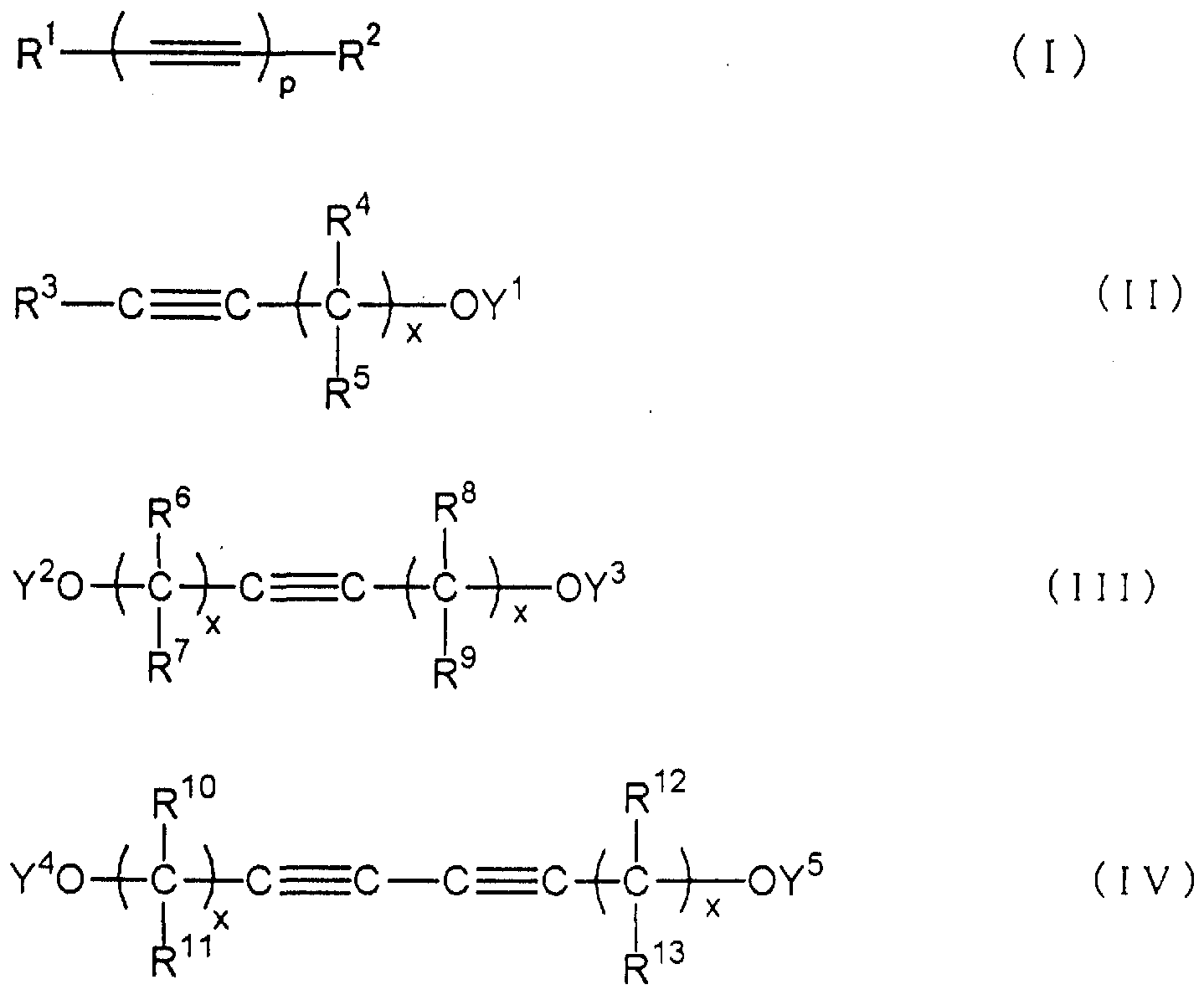
- a triple bond compound is used in combination with the sulfuric acid ester conjugate, and the triple bond compound is represented by the following formulas (1), ( ⁇ ), (III), (IV), (IV)
- An alkyne derivative represented by any one of formulas (V) and (VI) is preferably used.
- R 1 represents an alkyl group having 1 to 12 carbon atoms, a cycloalkyl group having 3 to 6 carbon atoms, or an aryl group
- R 2 represents an alkyl group having 1 to 12 carbon atoms, Represents a cycloalkyl group, an aryl group, or a hydrogen atom having 3 to 6 atoms
- p represents an integer of 1 or 2;
- R 3 to R 19 are each independently an alkyl group having from! To 12 carbon atoms, 6 represents a cycloalkyl group, an aryl group, or a hydrogen atom; provided that R 4 and R 5 , R 6 and R 7 , R 8 and R 9 , R 1Q and R U , R 12 and R 13 , R 15 and R 16 , R 17 and R 18 may be bonded to each other to form a cycloalkyl group having 3 to 6 carbon atoms;
- Y 1 is one COOR 20 , one COR 20 or one SOR 20 ;
- Y 2 is one COOR 21 , one COR 21 or
- R 23 or one SO R 23 Y 5 represents COOR 24 , one COR 24 or one SO R 24 ;
- R 2 °, R 21 , R 22 , R 23 and R 24 each independently represent an alkyl group having 1 to 12 carbon atoms, a cycloalkyl group having 3 to 6 carbon atoms, or an aryl group;
- R 25 , R 26 and R 27 each independently represent an alkyl group having 1 to 12 carbon atoms, a cycloalkyl group having 3 to 6 carbon atoms, an aryl group having 6 to 12 carbon atoms, or a carbon atom having 7 to 7 carbon atoms.
- W represents a sulfoxide group, a sulfone group, or an oxalyl group
- Y 6 represents an alkyl group having 1 to 12 carbon atoms, an alkyl group, an alkyl group, a cycloalkyl group having 3 to 6 carbon atoms, or a carbon atom.
- X represents an integer of 1 or 2]
- Examples of the triple bond conjugate represented by the formula (V) include dipronolgyl carbonate [R "
- the non-aqueous electrolyte containing at least one compound selected from the group consisting of dimethyl-2-probyl) oxalate and phenylacetylene has excellent battery characteristics such as the battery's static characteristics, electric capacity, and storage characteristics. Particularly preferred.
- the content of the triple bond compound represented by the formula (1), (11), (111), (IV), (V) or (VI) is excessively large.
- the conductivity of the electrolytic solution and the like may change, and the battery performance may be reduced. Therefore, the content is preferably 10% by mass or less, more preferably 5% by mass or less based on the mass of the electrolytic solution.
- 0.01% by mass or more based on the mass of the electrolytic solution is preferably 0.05% by mass. The above is more preferable 0.1% by mass or more is most preferable.
- non-aqueous solvent used in the present invention examples include cyclic carbonates such as ethylene carbonate (EC), propylene carbonate (PC), butylene carbonate (BC), and butyl ethylene carbonate (VEC); ⁇ Butyrolataton (GBL), ⁇ GLAT), a Ratatotones such as angelica lactone (AGL), dimethyl carbonate (DMC), methinoolethienolecarbonate (MEC), getinolecarbonate (DEC), methinolepropyl carbonate (MPC), dipropyl carbonate (DPC) ), Methyl butyl carbonate (HMBC), chain carbonates such as dibutyl carbonate (DBC), tetrahydrofuran, 2-methyltetrahydrofuran, 1,4-dioxane, 1,2-dimethoxyethane,
- cyclic carbonates such as ethylene carbonate (EC), propylene carbonate (PC), butylene carbonate (BC), and butyl ethylene carbon
- non-aqueous solvents examples include a combination of a cyclic carbonate and a chain carbonate, a combination of a cyclic carbonate and ratatone, and a combination of a cyclic carbonate and ratatone and a chain ester.
- Various combinations such as combinations are preferred.
- Combinations of cyclic carbonates and chain carbonates or combinations of cyclic carbonates, ratatatones and chain esters are preferred.
- the ratio of the cyclic carbonate to the chain carbonate is preferably 1: 9 to: LO: 0, preferably 2: 8 to 7: 3 by volume! / ,.
- electrolyte salt used in the present invention examples include LiPF, LiBF, LiCIO, LiN (SO C
- LiPF iso-CF
- LiPF iso-CF
- cyclic alkylene chains such as lithium salts and (CF) (SO) NLi and (CF) (SO) NLi.
- Lithium salt Particularly preferred electrolyte salts are LiPF, LiBF, Li
- the salts may be used alone or in combination of two or more.
- Preferred combinations of these electrolyte salts include a combination of LiPF and LiBF, and a combination of LiPF and LiN
- the ratio of the other electrolyte salt used in combination with 6 to the total electrolyte salt in terms of mol% is not less than 0.01%, more preferably not less than 0.05%, further preferably not less than 0.05%. 0.1% or more. Further, it is preferably at most 45%, more preferably at most 20%, further preferably at most 10%, most preferably at most 5%.
- the total amount of these electrolyte salts is usually preferably 0.3 M or more, more preferably 0.5 M or more, further preferably 0.7 M or more, and most preferably 0.8 M or more.
- the concentration of these electrolyte salts is preferably 2.5M or less, more preferably 2.0M or less, further preferably 1.6M or less, and most preferably 1.2M or less.
- the electrolyte solution of the present invention is prepared by mixing a non-aqueous solvent such as ethylene carbonate, propylene carbonate, and methylethyl carbonate, dissolving the above-mentioned electrolyte salt, and adding a sulfuric acid ester compound and a compound represented by the formula (1) ), (N), (III), (IV), (V) and (VI) are obtained by dissolving one or more of the triple bond conjugates.
- a non-aqueous solvent such as ethylene carbonate, propylene carbonate, and methylethyl carbonate
- air or carbon dioxide in the non-aqueous electrolyte of the present invention, for example, gas generation due to decomposition of the electrolyte can be suppressed, and battery performance such as cycle characteristics and storage characteristics can be improved. Can be improved.
- the method of containing (dissolving) carbon dioxide or air in the non-aqueous electrolyte is as follows: (1) Before injecting the non-aqueous electrolyte into the battery, contact it with air or a carbon dioxide-containing gas beforehand. (2) After injection, before or after sealing the battery, air or a gas containing carbon dioxide may be contained in the battery, or a combination of these methods may be used. Air and carbon dioxide-containing gas containing as little moisture as possible have a preferred dew point of 40 ° C or less, and particularly preferably a dew point of 50 ° C or less.
- cyclohexylbenzene a fluorocyclohexylbenzene compound (1 fluoro-2 cyclohexylbenzene, 1 fluoro-3-cyclohexylbenzene, 1-fluoro-4 cyclohexylbenzene), Biphenyl, terphenyl (o-, m-, p-), diphenyl ether, 2-fluorodiethyl ether, 4-diphenyl ether, fluorobenzene, difluorobenzene (o-, m- and p-isomers), 2 fluorobiphenyl, 4 fluorobiphenyl, 2,4 difluoranisole, tert butinolebenzene, 1-funoreolol 4 tert butinolebenzene, te rt-amylbenzene, 4-tert-butyl biphenyl, tert-amylbipheny
- aromatic compounds for example, biphenyl and cyclohexylbenzene, cyclohexylbenzene and tert-butylbenzene, cyclohexylbenzene and tert-amylbenzene, biphenyl and fluorobenzene, cyclohexylbenzene And fluorobenzene, 2,4 difluorodisole and cyclohexylbenzene, cyclohexylbenzene and 1-fluoro-4tertbutylbenzene, cyclohexylbenzene and fluorocyclohexylbenzene compounds, fluorocyclohexylbenzene compounds and fluorobenzene, 2,4 They can be combined like difluoroadisole and fluorocyclohexylbenzene compounds, and the above mixing ratio (mass ratio) is preferably 50:50 to: L0: 90.
- Eighty past eight p.m. Gayori preferably fixture 50: 50 to 25: 75 being most preferred.
- at least one of the aromatic compounds is a fluorine-substituted aromatic compound, More preferably, it contains a fluorocyclohexylbenzene derivative.
- the non-aqueous electrolyte of the present invention is used as a component of a lithium secondary battery.
- the constituent members other than the non-aqueous electrolyte constituting the secondary battery are not particularly limited, and various constituent members conventionally used can be used.
- a composite metal oxide with lithium containing cobalt, manganese, and nickel is used as the positive electrode active material.
- One of these positive electrode active materials may be selected and used, or two or more thereof may be used in combination.
- Such composite metal oxide Examples are LiCoO, LiMn O, LiNiO, LiCo Ni O (0.01 x 1), LiCo N
- LiMnO and LiNiO may be appropriately mixed and used. More than
- a positive electrode active material such as LiCoO, LiMnO, and LiNiO
- Lithium composite metal that can be used with a circuit voltage of 4.3 V or more based on Li is preferred Lithium composite that can be used with a voltage of 4.4 V or more, such as LiCo Ni Mn O and LiNi Mn O
- a lithium composite metal oxide containing Co or Ni is used as the positive electrode material, and a part of the lithium composite metal oxide may be substituted with another element.
- a part of Co of LiCoO is Sn, Mg, Fe, Ti, Al, Zr, C
- Any conductive material for the positive electrode may be used as long as it does not cause a chemical change and is an electron conductive material.
- Examples include graphites such as natural graphite (flaky graphite and the like) and artificial graphite, and carbon blacks such as acetylene black, ketjen black, channel black, furnace black, lamp black and thermal black. Further, graphites and carbon blacks may be appropriately mixed and used.
- the amount of the conductive agent added to the positive electrode mixture is preferably in the range of 1 to 10% by mass, and particularly preferably in the range of 2 to 5% by mass.
- the positive electrode active material is a conductive agent such as acetylene black or carbon black, polytetrafluoroethylene (PTFE), polyvinylidene fluoride (PVDF), or a copolymer of styrene and butadiene (SBR). ), Kneaded with a binder such as acrylonitrile-butadiene copolymer (NBR) and carboxymethylcellulose (CMC) to form a positive electrode mixture, and then used this positive electrode material as an aluminum foil as a current collector. It is manufactured by rolling under a vacuum at a temperature of about 50 ° C. to 250 ° C. for about 2 hours.
- the negative electrode is made of a material capable of occluding and releasing lithium.
- the negative electrode include lithium metal, lithium alloys, and carbon materials (pyrolytic carbons, coats, graphite (artificial graphite, natural graphite, etc.). ), Organic polymer compound combustion body, carbon fiber], tin, suzui conjugate, silicon, and silicon compound.
- the spacing (d) of the lattice plane (002) is preferably 0.340 nm or less, and the force S is preferably 0.335.
- One of these negative electrode active materials may be selected and used, or two or more may be used in combination.
- Powder materials such as carbon materials include ethylene propylene terpolymer (EPDM), polytetrafluoroethylene (PTFE), polyvinylidene fluoride (PVDF), copolymer of styrene and butadiene (SBR), It is kneaded with a binder such as acrylonitrile / butadiene copolymer (NBR) and carboxymethylcellulose (CMC) and used as a negative electrode mixture.
- the method for manufacturing the negative electrode is not particularly limited, and the negative electrode can be manufactured by the same method as the above-described method for manufacturing the positive electrode.
- the structure of the lithium secondary battery is not particularly limited, and a coin-type battery having a positive electrode, a negative electrode, and a single-layer or multi-layer separator, and a cylindrical battery having a positive electrode, a negative electrode, and a roll-shaped separator. Batteries and prismatic batteries are examples.
- the separator a known microporous film of polyolefin such as polypropylene and polyethylene, a woven fabric, a nonwoven fabric and the like are used. Further, the battery separator may have any structure of a single-layer porous film and a laminated porous film.
- the separator for a battery used in the present invention varies depending on the manufacturing conditions, if the air permeability is too high, the lithium ion conductivity is reduced, and the function as a battery separator becomes insufficient.
- the air temperature is preferably 1,000 sq./lOOcc or less, more preferably 800 sq./lOOcc or less, and most preferably 500 s / lOcc or less.
- the air permeability is too low, the mechanical strength is reduced. Therefore, 50 seconds or more are preferred. 100 seconds or more are more preferred. 300 seconds or more are most preferred.
- the porosity is preferably from 30 to 60%, more preferably from 35 to 55%, and most preferably from 40 to 50%.
- the thickness of the battery separator is preferably as thin as possible to increase the energy density. Therefore, the thickness is preferably 50 m or less, more preferably 40 m or less, and most preferably 25 m or less. From the viewpoint of mechanical strength, 5 ⁇ m or more is preferable, 10 m or more is more preferable, and 15 m or more is most preferable.
- the density of the electrode material layer is important.
- the density of the positive electrode mixture layer formed on the aluminum foil from 3.2 to 4.
- a negative electrode mixture formed on copper foil The density of the layer is 1.3-2. More preferably from 1.4 to 1. Most preferred is between 1. 5 ⁇ 1. 8gZcm 3.
- the suitable thickness of the electrode layer of the positive electrode is 30 to 120 ⁇ m, preferably 50 to 100 ⁇ m, and the thickness of the electrode layer of the negative electrode (per one side of the current collector) ) Is from 1 to: LOO ⁇ m, preferably from 3 to 70 ⁇ .
- the configuration of the lithium secondary battery is not particularly limited, and examples thereof include a coin battery, a cylindrical battery, a prismatic battery, and a stacked battery having a positive electrode, a negative electrode, a porous membrane separator, and an electrolyte.
- a coin battery a coin battery, a cylindrical battery, a prismatic battery, and a stacked battery having a positive electrode, a negative electrode, a porous membrane separator, and an electrolyte.
- the lithium secondary battery of the present invention has excellent cycle characteristics for a long period of time even when the end-of-charge voltage is higher than 4.2V, and particularly, when the end-of-charge voltage is higher than 4.3V. In all cases, it has excellent cycle characteristics.
- the discharge end voltage can be 2.5 V or higher, and further 2.8 V or higher.
- the current value is not particularly limited, it is usually used at a constant current discharge of 0.1 to 3C.
- the lithium secondary battery of the present invention is capable of charging and discharging at 40 ° C. or higher, and preferably at 0 ° C. or higher.
- the ability to charge and discharge at 100 ° C or lower is preferably 80 ° C or lower.
- a safety valve can be used for the sealing plate.
- a method of making a cut in a member such as a battery can or a gasket can also be used.
- various conventionally known safety elements at least one of a fuse, a metal, and a PTC element as an overcurrent prevention element.
- a plurality of lithium secondary batteries according to the present invention are assembled in series and Z or in parallel and stored in a battery pack as needed.
- Battery packs include safety elements such as PTC elements, thermal fuses, fuses and Z or current cutoff elements, and safety circuits (monitoring the voltage, temperature, current, etc. Circuit having a function of shutting off).
- LiCoO cathode active material
- acetylene black conductive agent
- Hydrofluoric mildew - isopropylidene were mixed at a ratio of (binder) 3 wt 0/0, a mixture by adding 1-methyl-2-pyrrolidone solvent which was applied onto an aluminum foil, dried, molded under pressure, Heat treatment was performed to prepare a positive electrode.
- the battery was provided with a pressure release port and an internal current interrupt device (PTC element).
- the electrode density of the positive electrode was 3.5 gZcm 3
- the electrode density of the negative electrode was 1.6 gZcm 3
- the thickness of the positive electrode layer (per one side of the current collector) was 65 ⁇ m
- the thickness of the negative electrode layer (per one side of the current collector) was 70 ⁇ m.
- the above battery was charged at a constant current of 2.2A (1C) to 4.2V at a high temperature (60 ° C), and then a final voltage of 4.2V was obtained at a constant voltage for a total of 3 hours. Charged. Next, the battery was discharged to a final voltage of 3.0 V under a constant current of 2.2 A (1 C), and the charging and discharging were repeated for 300 cycles.
- the initial discharge capacity (mAh) is 1M LiPF ECZPCZMEC (volume ratio 30Z5Z65) containing 3% by mass of 1,3 propane sultone and not adding a triple bond compound as a non-aqueous electrolyte.
- Table 1 shows the measured battery characteristics (initial discharge capacity (relative value) and discharge capacity retention rate after 300 cycles).
- di (2 Purobyuru) sulfite 1 mass 0/0, 1, 3-propane sultone except using 3 wt% of a cylindrical 18650 size was prepared in the same manner as a non-aqueous electrolyte solution of Example 1
- a battery was prepared and subjected to a 300-cycle charge / discharge test. Table 1 shows the measured battery characteristics.
- di (2 Purobyuru) sulphate 1 mass 0/0, 1, 3-propane sultone other using 0.1 wt%, 18650 size was prepared in the same manner as a non-aqueous electrolyte solution of Example 1 And a 300 cycle charge / discharge test was performed. Table 1 shows the measured battery characteristics.
- di (2-propyl) oxazalate was used as an additive in 0.1%, 1%, and 5% by weight, respectively, of the non-aqueous electrolyte.
- a non-aqueous electrolyte was prepared to produce an 18650-size cylindrical battery, and a 300-cycle charge / discharge test was performed. Table 1 shows the measured battery characteristics.
- di- (1-methyl-2-propyl) oxalate was used instead of 2-propylmethyl carbonate in an amount of 0.5% by mass based on the non-aqueous electrolyte
- 1,3-propane A non-aqueous electrolyte was prepared in the same manner as in Example 1 except that 1,3 butane sultone (BS) was used in an amount of 3% by mass of the non-aqueous electrolyte in place of the ruton.
- BS 1,3 butane sultone
- Table 1 shows the measured battery characteristics.
- a non-aqueous electrolyte was prepared in the same manner as in Example 1 except that 0.1% by mass of acetylene was used in the non-aqueous electrolyte instead of 2-propylmethyl carbonate as an additive. As a result, a cylindrical battery of 18650 size was manufactured, and a charge / discharge test of 300 cycles was performed. Table 1 shows the measured battery characteristics.
- 2-butyne 1,4-diol diformate was used in an amount of 1% by mass based on the non-aqueous electrolyte in place of 2-propylmethyl carbonate, and glycol sulfate was used in place of 1,3-propane sultone. Except for using 3% by weight of phytate (GSI) with respect to the non-aqueous electrolyte, a non-aqueous electrolyte was prepared in the same manner as in Example 1 to produce an 18650-size cylindrical battery, which was subjected to a 300 cycle charge / discharge test. Was done. Table 1 shows the measured battery characteristics.
- 2-butyne 1,4-diol diformate was used in an amount of 1% by mass based on the non-aqueous electrolyte in place of 2-propylmethyl carbonate, and glycol sulfate was used in place of 1,3-propane sultone. Except for using 3% by weight of (GSA) with respect to the non-aqueous electrolyte, a non-aqueous electrolyte was prepared in the same manner as in Example 1 to produce an 18650-size cylindrical battery, and a 300-cycle charge / discharge test was performed. went. Table 1 shows the measured battery characteristics.
- a non-aqueous electrolyte was prepared in the same manner as in Example 1 except that LiMn O was used instead.
- 2-propylmethylsa As an additive, instead of 2-propylmethyl carbonate, 2-propylmethylsa The same procedure as in Example 1 was repeated except that 0.5 mass% of the graphite was used in the non-aqueous electrolyte and the amount of 1,3 propane sultone (PS) was changed to 2 mass%. A cylindrical battery having a size of 18650 was prepared by the preparation, and a 300-cycle charge / discharge test was performed. Table 1 shows the measured battery characteristics.
- a non-aqueous electrolyte was prepared in the same manner as in Example 1, except that 2 propyl methyl carbonate was not used as an additive and 1,3 propane sultone was used in an amount of 3% by mass based on the non-aqueous electrolyte. In this way, a cylindrical battery of 18650 size was manufactured and subjected to a 300-cycle charge / discharge test. Table 1 shows the measured battery characteristics.
- a non-aqueous electrolyte was used in the same manner as in Example 1, except that 2 propyl methyl carbonate was not used and that 1,4-butane sultone (BS) was used at 3% by mass based on the non-aqueous electrolyte.
- BS 1,4-butane sultone
- a non-aqueous electrolyte was prepared in the same manner as in Example 1 except that 2-propylmethyl carbonate was not used as an additive, and glycol sulfate was used at 3% by mass based on the non-aqueous electrolyte.
- An 18650 size cylindrical battery was fabricated and subjected to a 300 cycle charge / discharge test. Table 1 shows the measured battery characteristics.
- Example 1 The same procedure as in Example 1 was repeated except that 2-propylmethyl carbonate was not used as the additive, and glycol sulfate was used in an amount of 3% by mass based on the non-aqueous electrolyte.
- a non-aqueous electrolyte was prepared in the same manner as in Example 1 except that the sulfuric acid ester compound was not used and 2-propynylmethyl carbonate was used in an amount of 3% by mass based on the non-aqueous electrolyte. In this way, a cylindrical battery of 18650 size was manufactured and subjected to a charge / discharge test of 300 cycles. Table 1 shows the measured battery characteristics.
- 1,3-propane sultone was used in an amount of 3% by mass of the non-aqueous electrolyte without using methyl carbonate.
- This 18650 battery Using this 18650 battery, the battery was charged to 4.2V at a high temperature (60 ° C) and a constant current of 1.6A (1C), and then charged to a final voltage of 4.2V for a total of 3 hours under constant voltage. Next, the battery was discharged to a final voltage of 3.0 OV under a constant current of 1.6 A (1 C), and this charging and discharging was repeated 300 times. Table 1 shows the measured battery characteristics. This 18650 battery has a smaller electrode density and a smaller battery capacity than the battery of Comparative Example 1 and therefore has less deterioration in battery characteristics without loss of the electrolyte.
- the positive electrode is LiMnO.
- LiCoO cathode active material
- graphite conductive agent
- a mixture by adding it to the 1-methyl-2-pyrrolidone solvent was applied onto an aluminum foil, dried, pressure-molded, heat treatment To prepare a positive electrode. It has a graphite-type crystal structure in which the lattice spacing (d) of the lattice plane (002) is 0.335 nm.
- the electrode density of the positive electrode was 3.5 gZcm 3
- the electrode density of the negative electrode was 1.6 gZcm 3
- the thickness of the positive electrode layer (per one side of the current collector) was 65 ⁇ m
- the thickness of the negative electrode layer (per one side of the current collector) was 70 m.
- the above battery was charged at a constant current of 2.2A (1C) up to 4.2V at a high temperature (60 ° C), and then a final voltage of 4.2V was given at a constant voltage for a total of 3 hours. Charged. Next, the battery was discharged to a final voltage of 3.0 V under a constant current of 2.2 A (1 C), and the charging and discharging were repeated for 300 cycles.
- the initial discharge capacity (mAh) is 1M LiPF EC / PC / MEC containing 3% by mass of 1,3 propane sultone as a sulfur acid ester compound without adding a triple bond compound (volume ratio: 30%).
- BP biphenyl
- CHB cyclohexylbenzene
- PS di (2-probyl) oxalate and 1,3-butane pansultone
- BP biphenyl
- CHB cyclohexylbenzene
- PS di (2-probule) oxalate and 1,3-butanepansultone
- tamylbenzene (TAB) and cyclohexylbenzene (CHB) were added by 1% by mass to the non-aqueous electrolyte.
- Examples 1 and 2 were used, except that di (2-probyl) oxalate and 1,3-propane sultone (PS) were used in an amount of 0.3% by mass and 2% by mass, respectively, based on the nonaqueous electrolyte.
- a non-aqueous electrolyte was prepared to produce a cylindrical battery of 18650 size, and a 300-cycle charge / discharge test was performed. Table 2 shows the measured battery characteristics. In the overcharge test, the surface temperature of the battery was below 120 ° C.
- cyclohexylbenzene (CHB) and fluorobenzene (FB) were added to the non-aqueous electrolyte at 1% by mass and 4% by mass, respectively.
- Di (2-probyl) oxalate and And 1,3 propane sultone (PS) were used in the same manner as in Example 1 except that 0.3% by mass and 2% by mass of the nonaqueous electrolyte were used, respectively.
- FCHB 1-fluoro-4-cyclohexylbenzene
- FB 1-fluorohexylbenzene
- FCHB 1-fluoro-4-cyclohexylbenzene
- GSI glycol sulphite
- a non-aqueous electrolyte After dissolving to a concentration of 1 M to prepare a non-aqueous electrolyte, 2,4 difluoro-sol (DFA) and cyclohexylbenzene (CHB) were each added to the non-aqueous electrolyte by 1% by mass. , 1. 5% by mass, as a further additive, a di (2-propynyl) Ogiza rate and glycol sulfite against the nonaqueous electrolytic solution, each 0.3 mass 0/0, in addition to using 2 wt% Then, a non-aqueous electrolyte was prepared in the same manner as in Example 1, an 18650-size cylindrical battery was fabricated, and a 300-cycle charge / discharge test was performed. Table 2 shows the measured battery characteristics. In the overcharge test, the surface temperature of the battery was 120 ° C or lower.
- cyclohexylbenzene (CHB) and 1-fluoro-4 cyclohexylbenzene (FCHB) were added to the nonaqueous electrolyte, respectively. 1% by mass and 2% by mass were added, and as additives, 2-propyl formate and 1,4-butanediol dimethanesulfonate (BDM) were added to the non-aqueous electrolyte.
- a non-aqueous electrolyte was prepared in the same manner as in Example 1 except that 0.5% by mass and 2% by mass were used, respectively, to produce a cylindrical battery of 18650 size, and a charge / discharge test of 300 cycles was performed. .
- Table 2 shows the measured battery characteristics. In the overcharge test, the surface temperature of the battery was below 120 ° C.
- cyclohexylbenzene (CHB) and 1-fluoro-4 cyclohexylbenzene (FCHB) were added to the nonaqueous electrolyte, respectively. 1% by mass and 3% by mass were added, and 2 butyne 1,4-diol diformate and 1,3 propane sultone (PS) were added as additives to the nonaqueous electrolyte at 0.5% by mass, respectively.
- a non-aqueous electrolyte was prepared in the same manner as in Example 1 except that 2% by mass was used, and a cylindrical battery of 18650 size was produced, and a 300-cycle charge / discharge test was performed. Table 2 shows the measured battery characteristics. In the overcharge test, the surface temperature of the battery was below 120 ° C.
- tamylbenzene (TAB) and 1-fluoro-4-cyclohexylbenzene (FCHB) were each added to the non-aqueous electrolyte at 1% by mass, 3% by mass, and as additives, di (2 propynyl) oxalate, di (2 probuyl) sulfite and 1,3 propane sultone (PS) were added in an amount of 0.3% by mass, respectively, to the non-aqueous electrolyte.
- a non-aqueous electrolyte was prepared in the same manner as in Example 1 to produce a cylindrical battery of 18650 size, and a 300-cycle charge / discharge test was performed. Table 2 shows the measured battery characteristics. In the overcharge test, the surface temperature of the battery was 120 ° C or less.
- IMLiPF is used as the electrolyte salt.
Landscapes
- Chemical & Material Sciences (AREA)
- Electrochemistry (AREA)
- General Chemical & Material Sciences (AREA)
- Chemical Kinetics & Catalysis (AREA)
- Engineering & Computer Science (AREA)
- Manufacturing & Machinery (AREA)
- Inorganic Chemistry (AREA)
- Materials Engineering (AREA)
- Physics & Mathematics (AREA)
- Condensed Matter Physics & Semiconductors (AREA)
- General Physics & Mathematics (AREA)
- Secondary Cells (AREA)
- Cell Electrode Carriers And Collectors (AREA)
- Battery Electrode And Active Subsutance (AREA)
- Organic Low-Molecular-Weight Compounds And Preparation Thereof (AREA)
Abstract
Description




Claims


Priority Applications (6)
| Application Number | Priority Date | Filing Date | Title |
|---|---|---|---|
| JP2006513992A JP4678370B2 (ja) | 2004-05-28 | 2005-05-30 | 非水電解液およびリチウム二次電池 |
| US11/597,652 US7629085B2 (en) | 2004-05-28 | 2005-05-30 | Nonaqueous electrolytic solution and lithium secondary battery |
| EP05743834.3A EP1772924B1 (en) | 2004-05-28 | 2005-05-30 | Nonaqueous electrolytic solution and lithium secondary battery |
| ES05743834T ES2406956T3 (es) | 2004-05-28 | 2005-05-30 | Disolución electrolítica no acuosa y batería secundaria de litio |
| CA002568519A CA2568519A1 (en) | 2004-05-28 | 2005-05-30 | Nonaqueous electrolyte solution and lithium secondary battery |
| KR1020067027547A KR101176812B1 (ko) | 2004-05-28 | 2005-05-30 | 비수 전해질 용액 및 리튬 2 차 전지 |
Applications Claiming Priority (2)
| Application Number | Priority Date | Filing Date | Title |
|---|---|---|---|
| JP2004-159283 | 2004-05-28 | ||
| JP2004159283 | 2004-05-28 |
Publications (1)
| Publication Number | Publication Date |
|---|---|
| WO2005117197A1 true WO2005117197A1 (ja) | 2005-12-08 |
Family
ID=35451191
Family Applications (1)
| Application Number | Title | Priority Date | Filing Date |
|---|---|---|---|
| PCT/JP2005/009900 Ceased WO2005117197A1 (ja) | 2004-05-28 | 2005-05-30 | 非水電解液およびリチウム二次電池 |
Country Status (10)
| Country | Link |
|---|---|
| US (1) | US7629085B2 (ja) |
| EP (1) | EP1772924B1 (ja) |
| JP (1) | JP4678370B2 (ja) |
| KR (1) | KR101176812B1 (ja) |
| CN (1) | CN100474688C (ja) |
| CA (1) | CA2568519A1 (ja) |
| ES (1) | ES2406956T3 (ja) |
| TW (1) | TW200603455A (ja) |
| WO (1) | WO2005117197A1 (ja) |
| ZA (1) | ZA200610287B (ja) |
Cited By (15)
| Publication number | Priority date | Publication date | Assignee | Title |
|---|---|---|---|---|
| JP2006344390A (ja) * | 2005-06-07 | 2006-12-21 | Hitachi Maxell Ltd | 非水電解液二次電池 |
| WO2007081151A1 (en) | 2006-01-09 | 2007-07-19 | Cheil Industries Inc. | Nonaqueous electrolyte including diphenyl ether and lithium secondary battery using thereof |
| JP2007207439A (ja) * | 2006-01-30 | 2007-08-16 | Sony Corp | 二次電池用負極及びそれを用いた二次電池 |
| JP2007299543A (ja) * | 2006-04-27 | 2007-11-15 | Mitsubishi Chemicals Corp | 非水系電解液及びそれを用いた非水系電解液二次電池 |
| KR100873270B1 (ko) | 2006-10-25 | 2008-12-11 | 주식회사 엘지화학 | 비수 전해액 및 이를 포함하는 전기화학소자 |
| WO2010007889A1 (ja) * | 2008-07-15 | 2010-01-21 | 宇部興産株式会社 | リチウム電池用非水電解液、それを用いたリチウム電池、及びそれに用いられるホルミルオキシ基含有化合物 |
| JP2010267509A (ja) * | 2009-05-15 | 2010-11-25 | Adeka Corp | 非水電解液及び該電解液を用いた非水電解液二次電池 |
| US7993783B2 (en) * | 2006-01-30 | 2011-08-09 | Sanyo Electric Co., Ltd. | Non-aqueous electrolyte secondary battery having positive electrode with high potential |
| WO2011096450A1 (ja) * | 2010-02-03 | 2011-08-11 | 宇部興産株式会社 | 非水電解液、それを用いた電気化学素子、及びそれに用いられるアルキニル化合物 |
| JP2011175933A (ja) * | 2010-02-25 | 2011-09-08 | Hitachi Vehicle Energy Ltd | リチウムイオン電池 |
| WO2012147818A1 (ja) * | 2011-04-26 | 2012-11-01 | 宇部興産株式会社 | 非水電解液、それを用いた蓄電デバイス、及び環状スルホン酸エステル化合物 |
| WO2017061464A1 (ja) * | 2015-10-09 | 2017-04-13 | 宇部興産株式会社 | 非水電解液及びそれを用いた蓄電デバイス |
| JP2024515977A (ja) * | 2021-10-22 | 2024-04-11 | エルジー エナジー ソリューション リミテッド | 電解液添加剤、これを含むリチウム二次電池用電解液、およびリチウム二次電池 |
| EP4657546A1 (en) * | 2024-05-31 | 2025-12-03 | Prime Planet Energy & Solutions, Inc. | Negative electrode for lithium ion secondary battery and lithium ion secondary battery |
| WO2026070174A1 (ja) * | 2024-09-25 | 2026-04-02 | Muアイオニックソリューションズ株式会社 | 化合物及び組成物、それらの電池への使用及び電池に使用する方法、電解液、電解液の製造方法、電池、電池の製造方法、並びに車両 |
Families Citing this family (18)
| Publication number | Priority date | Publication date | Assignee | Title |
|---|---|---|---|---|
| KR101056441B1 (ko) | 2009-04-01 | 2011-08-11 | 삼성에스디아이 주식회사 | 첨가제를 포함하는 리튬 이차 전지용 전해질 및 이를 포함하는 리튬 이차 전지 |
| WO2011025016A1 (ja) * | 2009-08-31 | 2011-03-03 | 三菱化学株式会社 | 非水系電解液及びそれを用いた非水系電解液電池 |
| EP2571089A4 (en) * | 2010-05-12 | 2017-03-15 | Mitsubishi Chemical Corporation | Non-aqueous electrolytic solution, and non-aqueous electrolyte secondary battery |
| KR20130108286A (ko) * | 2010-09-16 | 2013-10-02 | 미쓰비시 가가꾸 가부시키가이샤 | 비수계 전해액 및 비수계 전해액 2차 전지 |
| US20130330607A1 (en) * | 2011-02-17 | 2013-12-12 | Kabushiki Kaisha Toyota Jidoshokki | Electrolytic solution and lithium-ion secondary battery |
| US20130302701A1 (en) * | 2011-07-29 | 2013-11-14 | Panasonic Corporation | Non-aqueous electrolyte for secondary batteries and non-aqueous electrolyte secondary battery |
| TWI487161B (zh) * | 2011-11-16 | 2015-06-01 | Univ Nat Taiwan Science Tech | 鋰離子電池及其製造方法 |
| EP2768064A1 (en) * | 2013-02-15 | 2014-08-20 | Basf Se | Use of substituted alkynyl sulfonates, carbonates and oxalates as additives in electrolytes of secondary lithium-ion batteries |
| CN103730688B (zh) * | 2014-01-09 | 2016-06-08 | 宁德新能源科技有限公司 | 锂离子电池及其电解液 |
| US10164293B2 (en) * | 2014-05-30 | 2018-12-25 | Ube Industries, Ltd. | Nonaqueous electrolyte and electricity storing device in which same is used |
| EP3231024A4 (en) | 2014-12-12 | 2018-08-08 | Pellion Technologies Inc. | Electrochemical cell and method of making the same |
| MX2019001629A (es) | 2016-08-12 | 2019-09-16 | Pellion Tech Inc | Aditivo que contiene electrolitos para baterías recargables de ánodo de metal de alta eficiencia energética. |
| WO2019027925A1 (en) | 2017-07-31 | 2019-02-07 | Pellion Technologies | ELECTROCHEMICAL CELL WITH GETTER AND METHOD OF FORMING THE SAME |
| CN107658498B (zh) * | 2017-10-24 | 2020-10-20 | 广州天赐高新材料股份有限公司 | 锂二次电池电解液及其锂二次电池 |
| WO2019126360A1 (en) | 2017-12-21 | 2019-06-27 | Pellion Technologies Inc. | Electrochemical cell and electrolyte for same |
| US12272790B2 (en) | 2019-04-11 | 2025-04-08 | Ses Holdings Pte. Ltd. | Localized high-salt-concentration electrolytes containing longer-sidechain glyme-based solvents and fluorinated diluents, and uses thereof |
| US11196088B2 (en) | 2019-04-11 | 2021-12-07 | Ses Holdings Pte. Ltd. | Localized high-salt-concentration electrolytes containing longer-sidechain glyme-based solvents and fluorinated diluents, and uses thereof |
| US12199282B2 (en) * | 2020-09-18 | 2025-01-14 | WATTRII Inc. | Halogenated battery comprising a greenhouse gas |
Citations (17)
| Publication number | Priority date | Publication date | Assignee | Title |
|---|---|---|---|---|
| JPH06223875A (ja) * | 1993-01-21 | 1994-08-12 | Mitsubishi Cable Ind Ltd | リチウム二次電池用電解液 |
| JPH11121032A (ja) | 1997-10-13 | 1999-04-30 | Mitsubishi Chemical Corp | 非水系電解液二次電池 |
| JPH11339850A (ja) | 1998-05-29 | 1999-12-10 | Nec Mori Energy Kk | リチウムイオン二次電池 |
| JP2000003724A (ja) | 1997-08-22 | 2000-01-07 | Ube Ind Ltd | 非水電解液およびそれを用いたリチウム二次電池 |
| US6033809A (en) | 1997-08-22 | 2000-03-07 | Ube Industries, Ltd. | Lithium secondary battery and electrolyte thereof |
| JP2000195545A (ja) | 1998-12-25 | 2000-07-14 | Ube Ind Ltd | リチウム二次電池用電解液およびそれを用いたリチウム二次電池 |
| JP2001043895A (ja) | 1999-05-24 | 2001-02-16 | Ube Ind Ltd | 非水電解液およびそれを用いたリチウム二次電池 |
| JP2001313072A (ja) | 2000-04-28 | 2001-11-09 | Ube Ind Ltd | リチウム二次電池用電解液およびそれを用いたリチウム二次電池 |
| JP2002100399A (ja) | 2000-09-20 | 2002-04-05 | Ube Ind Ltd | 非水電解液およびそれを用いたリチウム二次電池 |
| JP2002110234A (ja) * | 2000-10-02 | 2002-04-12 | Ube Ind Ltd | 非水電解液およびそれを用いたリチウム二次電池 |
| JP2002124297A (ja) | 2000-10-13 | 2002-04-26 | Ube Ind Ltd | 非水電解液およびそれを用いたリチウム二次電池 |
| JP2002134169A (ja) * | 2000-10-30 | 2002-05-10 | Denso Corp | 非水電解液及び該電解液を用いた非水電解液二次電池 |
| JP2002198092A (ja) * | 2000-11-27 | 2002-07-12 | Wilson Greatbatch Ltd | 非水性電解液再充電可能な電池のホスフェート添加剤 |
| JP2003132946A (ja) * | 2001-10-24 | 2003-05-09 | Mitsui Chemicals Inc | 非水電解液およびそれを用いた二次電池 |
| JP2004265848A (ja) * | 2003-01-09 | 2004-09-24 | Mitsubishi Chemicals Corp | 非水系電解液及びそれを用いたリチウム二次電池 |
| WO2005008829A1 (ja) | 2003-07-17 | 2005-01-27 | Ube Industries, Ltd. | リチウム二次電池用非水電解液およびそれを用いたリチウム二次電池 |
| JP2005190754A (ja) * | 2003-12-25 | 2005-07-14 | Sanyo Electric Co Ltd | 非水電解液二次電池 |
Family Cites Families (7)
| Publication number | Priority date | Publication date | Assignee | Title |
|---|---|---|---|---|
| JP3815087B2 (ja) * | 1998-10-26 | 2006-08-30 | 宇部興産株式会社 | 非水電解液及びそれを用いたリチウム二次電池 |
| ATE397296T1 (de) * | 2000-10-20 | 2008-06-15 | Ube Industries | Nichtwässrigen elektrolyten enthaltende sekundärbatterie mit verbesserter entladekapazitätspeicherung |
| EP1202373B1 (en) * | 2000-10-30 | 2012-01-18 | Denso Corporation | Nonaqueous electrolytic solution and nonaqueous secondary battery |
| JP4092618B2 (ja) * | 2001-12-26 | 2008-05-28 | 株式会社ジーエス・ユアサコーポレーション | 非水電解質二次電池 |
| AU2003221334A1 (en) * | 2002-03-08 | 2003-09-22 | Mitsubishi Chemical Corporation | Nonaqueous electrolyte and lithium-ion secondary battery containing the same |
| JP2004022507A (ja) * | 2002-06-20 | 2004-01-22 | Sony Corp | 電極およびそれを用いた電池 |
| JP2004079327A (ja) * | 2002-08-16 | 2004-03-11 | Hitachi Maxell Ltd | 非水二次電池および非水二次電池用正極とその製造方法 |
-
2005
- 2005-05-30 CA CA002568519A patent/CA2568519A1/en not_active Abandoned
- 2005-05-30 ES ES05743834T patent/ES2406956T3/es not_active Expired - Lifetime
- 2005-05-30 TW TW094117690A patent/TW200603455A/zh unknown
- 2005-05-30 KR KR1020067027547A patent/KR101176812B1/ko not_active Expired - Lifetime
- 2005-05-30 CN CNB200580024923XA patent/CN100474688C/zh not_active Expired - Lifetime
- 2005-05-30 EP EP05743834.3A patent/EP1772924B1/en not_active Expired - Lifetime
- 2005-05-30 US US11/597,652 patent/US7629085B2/en not_active Expired - Lifetime
- 2005-05-30 JP JP2006513992A patent/JP4678370B2/ja not_active Expired - Lifetime
- 2005-05-30 WO PCT/JP2005/009900 patent/WO2005117197A1/ja not_active Ceased
-
2006
- 2006-12-08 ZA ZA200610287A patent/ZA200610287B/xx unknown
Patent Citations (18)
| Publication number | Priority date | Publication date | Assignee | Title |
|---|---|---|---|---|
| JPH06223875A (ja) * | 1993-01-21 | 1994-08-12 | Mitsubishi Cable Ind Ltd | リチウム二次電池用電解液 |
| JP2000003724A (ja) | 1997-08-22 | 2000-01-07 | Ube Ind Ltd | 非水電解液およびそれを用いたリチウム二次電池 |
| US6033809A (en) | 1997-08-22 | 2000-03-07 | Ube Industries, Ltd. | Lithium secondary battery and electrolyte thereof |
| JPH11121032A (ja) | 1997-10-13 | 1999-04-30 | Mitsubishi Chemical Corp | 非水系電解液二次電池 |
| JPH11339850A (ja) | 1998-05-29 | 1999-12-10 | Nec Mori Energy Kk | リチウムイオン二次電池 |
| JP2000195545A (ja) | 1998-12-25 | 2000-07-14 | Ube Ind Ltd | リチウム二次電池用電解液およびそれを用いたリチウム二次電池 |
| JP2001043895A (ja) | 1999-05-24 | 2001-02-16 | Ube Ind Ltd | 非水電解液およびそれを用いたリチウム二次電池 |
| US6479191B1 (en) | 2000-04-28 | 2002-11-12 | Ube Industries, Ltd. | Electrolyte having alkyne derivative and lithium secondary battery using the same |
| JP2001313072A (ja) | 2000-04-28 | 2001-11-09 | Ube Ind Ltd | リチウム二次電池用電解液およびそれを用いたリチウム二次電池 |
| JP2002100399A (ja) | 2000-09-20 | 2002-04-05 | Ube Ind Ltd | 非水電解液およびそれを用いたリチウム二次電池 |
| JP2002110234A (ja) * | 2000-10-02 | 2002-04-12 | Ube Ind Ltd | 非水電解液およびそれを用いたリチウム二次電池 |
| JP2002124297A (ja) | 2000-10-13 | 2002-04-26 | Ube Ind Ltd | 非水電解液およびそれを用いたリチウム二次電池 |
| JP2002134169A (ja) * | 2000-10-30 | 2002-05-10 | Denso Corp | 非水電解液及び該電解液を用いた非水電解液二次電池 |
| JP2002198092A (ja) * | 2000-11-27 | 2002-07-12 | Wilson Greatbatch Ltd | 非水性電解液再充電可能な電池のホスフェート添加剤 |
| JP2003132946A (ja) * | 2001-10-24 | 2003-05-09 | Mitsui Chemicals Inc | 非水電解液およびそれを用いた二次電池 |
| JP2004265848A (ja) * | 2003-01-09 | 2004-09-24 | Mitsubishi Chemicals Corp | 非水系電解液及びそれを用いたリチウム二次電池 |
| WO2005008829A1 (ja) | 2003-07-17 | 2005-01-27 | Ube Industries, Ltd. | リチウム二次電池用非水電解液およびそれを用いたリチウム二次電池 |
| JP2005190754A (ja) * | 2003-12-25 | 2005-07-14 | Sanyo Electric Co Ltd | 非水電解液二次電池 |
Non-Patent Citations (1)
| Title |
|---|
| See also references of EP1772924A4 |
Cited By (27)
| Publication number | Priority date | Publication date | Assignee | Title |
|---|---|---|---|---|
| JP2006344390A (ja) * | 2005-06-07 | 2006-12-21 | Hitachi Maxell Ltd | 非水電解液二次電池 |
| WO2007081151A1 (en) | 2006-01-09 | 2007-07-19 | Cheil Industries Inc. | Nonaqueous electrolyte including diphenyl ether and lithium secondary battery using thereof |
| EP1979978A4 (en) * | 2006-01-09 | 2010-03-17 | Cheil Ind Inc | NONAQUEOUS ELECTROLYTE COMPRISING DIPHENYL ETHER AND LITHIUM SECONDARY BATTERY IN WHICH THIS ELECTROLYTE IS USED |
| US7993783B2 (en) * | 2006-01-30 | 2011-08-09 | Sanyo Electric Co., Ltd. | Non-aqueous electrolyte secondary battery having positive electrode with high potential |
| JP2007207439A (ja) * | 2006-01-30 | 2007-08-16 | Sony Corp | 二次電池用負極及びそれを用いた二次電池 |
| US8802286B2 (en) | 2006-01-30 | 2014-08-12 | Sony Corporation | Negative electrode for use with secondary battery and secondary battery using such negative electrode |
| JP2007299543A (ja) * | 2006-04-27 | 2007-11-15 | Mitsubishi Chemicals Corp | 非水系電解液及びそれを用いた非水系電解液二次電池 |
| US9466856B2 (en) | 2006-10-25 | 2016-10-11 | Lg Chem, Ltd. | Non-aqueous electrolyte and electrochemical device comprising the same |
| KR100873270B1 (ko) | 2006-10-25 | 2008-12-11 | 주식회사 엘지화학 | 비수 전해액 및 이를 포함하는 전기화학소자 |
| US8895195B2 (en) | 2006-10-25 | 2014-11-25 | Lg Chem, Ltd. | Non-aqueous electrolyte and electrochemical device comprising the same |
| US8383274B2 (en) | 2008-07-15 | 2013-02-26 | Ube Industries, Ltd. | Nonaqueous electrolyte solution for lithium battery, lithium battery using same, and formyloxy group-containing compound used therein |
| JP5561163B2 (ja) * | 2008-07-15 | 2014-07-30 | 宇部興産株式会社 | リチウム電池用非水電解液、それを用いたリチウム電池、及びそれに用いられるホルミルオキシ基含有化合物 |
| WO2010007889A1 (ja) * | 2008-07-15 | 2010-01-21 | 宇部興産株式会社 | リチウム電池用非水電解液、それを用いたリチウム電池、及びそれに用いられるホルミルオキシ基含有化合物 |
| JP2010267509A (ja) * | 2009-05-15 | 2010-11-25 | Adeka Corp | 非水電解液及び該電解液を用いた非水電解液二次電池 |
| JP5849705B2 (ja) * | 2010-02-03 | 2016-02-03 | 宇部興産株式会社 | 非水電解液、それを用いた電気化学素子、及びそれに用いられるアルキニル化合物 |
| WO2011096450A1 (ja) * | 2010-02-03 | 2011-08-11 | 宇部興産株式会社 | 非水電解液、それを用いた電気化学素子、及びそれに用いられるアルキニル化合物 |
| US9647294B2 (en) | 2010-02-03 | 2017-05-09 | Ube Industries, Ltd. | Non-aqueous electrolytic solution, electrochemical element using same, and alkynyl compound used therefor |
| US8986885B2 (en) | 2010-02-25 | 2015-03-24 | Hitachi Automotive Systems, Ltd. | Lithium ion battery |
| JP2011175933A (ja) * | 2010-02-25 | 2011-09-08 | Hitachi Vehicle Energy Ltd | リチウムイオン電池 |
| WO2012147818A1 (ja) * | 2011-04-26 | 2012-11-01 | 宇部興産株式会社 | 非水電解液、それを用いた蓄電デバイス、及び環状スルホン酸エステル化合物 |
| JP6036687B2 (ja) * | 2011-04-26 | 2016-11-30 | 宇部興産株式会社 | 非水電解液、それを用いた蓄電デバイス、及び環状スルホン酸エステル化合物 |
| US9608287B2 (en) | 2011-04-26 | 2017-03-28 | Ube Industries, Ltd. | Non-aqueous electrolytic solution, electrical storage device utilizing same, and cyclic sulfonic acid ester compound |
| WO2017061464A1 (ja) * | 2015-10-09 | 2017-04-13 | 宇部興産株式会社 | 非水電解液及びそれを用いた蓄電デバイス |
| JP2024515977A (ja) * | 2021-10-22 | 2024-04-11 | エルジー エナジー ソリューション リミテッド | 電解液添加剤、これを含むリチウム二次電池用電解液、およびリチウム二次電池 |
| JP7704329B2 (ja) | 2021-10-22 | 2025-07-08 | エルジー エナジー ソリューション リミテッド | 電解液添加剤、これを含むリチウム二次電池用電解液、およびリチウム二次電池 |
| EP4657546A1 (en) * | 2024-05-31 | 2025-12-03 | Prime Planet Energy & Solutions, Inc. | Negative electrode for lithium ion secondary battery and lithium ion secondary battery |
| WO2026070174A1 (ja) * | 2024-09-25 | 2026-04-02 | Muアイオニックソリューションズ株式会社 | 化合物及び組成物、それらの電池への使用及び電池に使用する方法、電解液、電解液の製造方法、電池、電池の製造方法、並びに車両 |
Also Published As
| Publication number | Publication date |
|---|---|
| JPWO2005117197A1 (ja) | 2008-04-03 |
| EP1772924A4 (en) | 2010-09-01 |
| JP4678370B2 (ja) | 2011-04-27 |
| ES2406956T3 (es) | 2013-06-10 |
| US20070231707A1 (en) | 2007-10-04 |
| ZA200610287B (en) | 2008-10-29 |
| EP1772924A1 (en) | 2007-04-11 |
| EP1772924B1 (en) | 2013-04-10 |
| CA2568519A1 (en) | 2005-12-08 |
| US7629085B2 (en) | 2009-12-08 |
| CN100474688C (zh) | 2009-04-01 |
| KR20070024663A (ko) | 2007-03-02 |
| CN1989647A (zh) | 2007-06-27 |
| TW200603455A (en) | 2006-01-16 |
| KR101176812B1 (ko) | 2012-08-24 |
Similar Documents
| Publication | Publication Date | Title |
|---|---|---|
| WO2005117197A1 (ja) | 非水電解液およびリチウム二次電池 | |
| JP4710609B2 (ja) | リチウム二次電池およびその非水電解液 | |
| US7727677B2 (en) | Nonaqueous electrolyte solution and lithium secondary battery using same | |
| JP4582458B2 (ja) | リチウム二次電池用非水電解液およびそれを用いたリチウム二次電池 | |
| JP4779651B2 (ja) | 非水電解液およびリチウム二次電池 | |
| WO2005091422A1 (ja) | 非水電解液及びそれを用いたリチウム二次電池 | |
| JP4765629B2 (ja) | 非水電解液およびリチウム二次電池 | |
| JP5070780B2 (ja) | 非水電解液及びそれを用いたリチウム二次電池 | |
| JP4826760B2 (ja) | 非水電解液及びそれを用いたリチウム二次電池 | |
| JP4517730B2 (ja) | 非水電解液およびそれを用いたリチウム二次電池 | |
| CN100431217C (zh) | 锂二次电池及其非水电解液 |
Legal Events
| Date | Code | Title | Description |
|---|---|---|---|
| AK | Designated states |
Kind code of ref document: A1 Designated state(s): AE AG AL AM AT AU AZ BA BB BG BR BW BY BZ CA CH CN CO CR CU CZ DE DK DM DZ EC EE EG ES FI GB GD GE GH GM HR HU ID IL IN IS JP KE KG KM KP KR KZ LC LK LR LS LT LU LV MA MD MG MK MN MW MX MZ NA NG NI NO NZ OM PG PH PL PT RO RU SC SD SE SG SK SL SM SY TJ TM TN TR TT TZ UA UG US UZ VC VN YU ZA ZM ZW |
|
| AL | Designated countries for regional patents |
Kind code of ref document: A1 Designated state(s): GM KE LS MW MZ NA SD SL SZ TZ UG ZM ZW AM AZ BY KG KZ MD RU TJ TM AT BE BG CH CY CZ DE DK EE ES FI FR GB GR HU IE IS IT LT LU MC NL PL PT RO SE SI SK TR BF BJ CF CG CI CM GA GN GQ GW ML MR NE SN TD TG |
|
| 121 | Ep: the epo has been informed by wipo that ep was designated in this application | ||
| WWE | Wipo information: entry into national phase |
Ref document number: 11597652 Country of ref document: US Ref document number: 2007231707 Country of ref document: US Ref document number: 2568519 Country of ref document: CA Ref document number: 2006513992 Country of ref document: JP |
|
| NENP | Non-entry into the national phase |
Ref country code: DE |
|
| WWW | Wipo information: withdrawn in national office |
Ref document number: DE |
|
| WWE | Wipo information: entry into national phase |
Ref document number: 2005743834 Country of ref document: EP |
|
| WWE | Wipo information: entry into national phase |
Ref document number: 200610287 Country of ref document: ZA |
|
| WWE | Wipo information: entry into national phase |
Ref document number: 1020067027547 Country of ref document: KR Ref document number: 4771/CHENP/2006 Country of ref document: IN |
|
| WWE | Wipo information: entry into national phase |
Ref document number: 200580024923.X Country of ref document: CN |
|
| WWP | Wipo information: published in national office |
Ref document number: 1020067027547 Country of ref document: KR |
|
| WWP | Wipo information: published in national office |
Ref document number: 2005743834 Country of ref document: EP |
|
| WWP | Wipo information: published in national office |
Ref document number: 11597652 Country of ref document: US |