WO2005119507A1 - 行列の高速高精度特異値分解方法、プログラムおよび装置 - Google Patents
行列の高速高精度特異値分解方法、プログラムおよび装置 Download PDFInfo
- Publication number
- WO2005119507A1 WO2005119507A1 PCT/JP2005/010084 JP2005010084W WO2005119507A1 WO 2005119507 A1 WO2005119507 A1 WO 2005119507A1 JP 2005010084 W JP2005010084 W JP 2005010084W WO 2005119507 A1 WO2005119507 A1 WO 2005119507A1
- Authority
- WO
- WIPO (PCT)
- Prior art keywords
- matrix
- singular value
- singular
- calculating
- transformation
- Prior art date
- Legal status (The legal status is an assumption and is not a legal conclusion. Google has not performed a legal analysis and makes no representation as to the accuracy of the status listed.)
- Ceased
Links
Classifications
-
- G—PHYSICS
- G06—COMPUTING OR CALCULATING; COUNTING
- G06F—ELECTRIC DIGITAL DATA PROCESSING
- G06F17/00—Digital computing or data processing equipment or methods, specially adapted for specific functions
- G06F17/10—Complex mathematical operations
- G06F17/16—Matrix or vector computation, e.g. matrix-matrix or matrix-vector multiplication, matrix factorization
-
- G—PHYSICS
- G06—COMPUTING OR CALCULATING; COUNTING
- G06T—IMAGE DATA PROCESSING OR GENERATION, IN GENERAL
- G06T7/00—Image analysis
- G06T7/50—Depth or shape recovery
- G06T7/55—Depth or shape recovery from multiple images
Definitions
- the present invention relates to a method, a program, and an apparatus for performing singular value decomposition on an arbitrary matrix A with high speed and high accuracy, and more particularly, calculates a singular value of a matrix, and calculates the calculated characteristic.
- the present invention relates to a method, a program, and an apparatus for performing singular value decomposition at high speed and with high accuracy by calculating a singular vector for a value.
- the standard method used for performing singular value decomposition on a computer is the DBDSQR routine published by the international numerical library LAPACK.
- the DBDSQR routine is based on the QR method, and can be divided into three parts: preprocessing, main loop, and postprocessing.
- preprocessing the upper and lower limits of the singular value are calculated, and the accuracy used for convergence determination is calculated.
- main loop the matrix is divided and reduced gradually while repeating the QR method, and the loop ends when the matrix size finally becomes 1. If a 2 X 2 matrix block appears on the way, another process is performed.
- ⁇ is the singular value of ⁇
- ⁇ is the eigenvalue of ⁇ ⁇ ⁇
- v is the eigenvector for the eigenvalue
- B TB is a symmetric tridiagonal matrix.
- the eigenvalues of B T B are all positive, and the singular value ⁇ ( ⁇ ⁇ ⁇ ⁇ ... ⁇ ⁇ ⁇ 0) of B is j 1 2 m
- the singular value decomposition can be replaced with the diagonalization of B T B problem. This principle is based on the fact that at least one singular value and It can also be applied to the case of finding the singular vector.
- the singular value decomposition of a general matrix A comprises diagonalization problems symmetric tridiagonal matrix B T B.
- DBDSQR / Rachin has a very large amount of calculation, and especially in large-scale problems, it has been difficult to perform singular value decomposition at high speed.
- the DLASQ routine is capable of finding singular values at high speed and with high accuracy. Was difficult to do.
- One of the objects of the present invention by executing the diagonalization of symmetric tridiagonal matrix B T B at a high speed and with high precision, high speed and high singular value decomposition of an arbitrary matrix A It is an object of the present invention to provide a method, a program, and an apparatus which can execute the program with high accuracy.
- the matrix B is an upper diagonal matrix obtained by performing a Householder transformation of the matrix A.
- Miura inverse transformation, SdLVvs conversion by performing the O that Twisted ('isutiddo) decomposed into rdLVvs transformation and Miura type conversion, diagonalizing matrix B T B.
- the matrix B is an upper bidiagonal matrix having the same singular value as the matrix A.
- the transformation from matrix A to matrix B can be performed, for example, by the Householder method.
- the diagonalization of the matrix B T B according to the present invention unlike the DBDSQR / Rechin obtaining eigenvalues and eigenvectors simultaneously, as DSTEG R routine, the eigenvalues calculated first, intrinsic then using the computed eigenvalues Ask for a vector.
- a method for performing singular value decomposition on an arbitrary matrix A using a computer comprising: performing upper diagonalization on matrix A; The step of obtaining an angular matrix B, the step of obtaining at least one singular value ⁇ of the matrix B as a singular value of the matrix A, and the step of obtaining a singular vector of the matrix ⁇ ⁇ ⁇ ⁇ with respect to ⁇ .
- the step of finding the singular vector is to perform a twisted decomposition on the matrix ⁇ ⁇ ⁇ — ⁇ 2 ⁇ using Miura-type inverse transform, sdLVvs transform, rdLVvs transform, and Miura-type transform. More, comprising the steps of diagonalized matrix B T B, I is a unit matrix, a method is provided, thereby the objective described above being achieved.
- determining a singular vector of the matrix A, the matrix B T B the after Sutetsu flop diagonalized, Yo ⁇ also include the step of performing an inverse iteration method.
- the step of obtaining the singular vector of the matrix A may include the step of performing the Gram-Schmidt method after the step of performing the inverse iterative method.
- the step of obtaining the singular value ⁇ of the matrix B may include the step of executing a dLVs routine.
- the step of obtaining the singular value ⁇ of the matrix B may include a step of determining whether to execute the dLVs routine or the DLASQ routine according to the required calculation time and accuracy.
- the step of performing upper bidiagonalization on the matrix A and obtaining the upper bidiagonal matrix B includes a step of executing an upper bidiagonalization method (for example, a Novus Holder method). But.
- the step of calculating a matrix M representing the transformation into coordinates is a step of performing upper diagonalization on the matrix D to obtain an upper bidiagonal matrix B of the matrix D.
- the step of obtaining the singular vector of the column D is performed by performing a twisted decomposition on the matrix ⁇ ⁇ ⁇ — ⁇ 2 1 using the inverse Miura transformation, sdLVvs transformation, rdLVvs transformation, and Miura transformation. , And diagonalizing the matrix ⁇ ⁇ , wherein I is an identity matrix, thereby achieving the above object.
- a method for searching for information included in a given document and related to a given keyword comprising: receiving a question vector q corresponding to the keyword; Performs upper diagonalization on the corresponding index word document matrix D, The step of obtaining the upper diagonal matrix B of the matrix D, and the singular value ⁇ of the matrix B as a singular value of the matrix D ( ⁇ ⁇ ⁇ ⁇ ⁇ ⁇ ⁇ ⁇ > 0, r is equal to the rank of the matrix D) And kj 1 2 r
- Matrix D is a matrix ⁇ , ⁇ k 1 2 k k with ⁇ , ⁇ , ⁇ , ⁇ being diagonal elements and other elements being 0
- the step of obtaining the right and left orthogonal matrices U, V of the matrix D is performed by the Miura type inverse transformation. kkk
- a method comprising the step of diagonalizing ⁇ ⁇ , wherein I is an identity matrix, thereby achieving the above object.
- a program for causing a computer to execute singular value decomposition processing for executing singular value decomposition for an arbitrary matrix ⁇ wherein the singular value decomposition processing Performing diagonalization and obtaining an upper bidiagonal matrix B of matrix A; obtaining at least one singular value ⁇ of matrix B as a singular value of matrix A; obtaining a singular vector of matrix ⁇ ⁇ ⁇ ⁇ for ⁇
- the step of obtaining the singular vector of the matrix A is a twisted manner for the matrix B T B— ⁇ 2 1 using the Miura-type inverse transform, the sdLVvs transform, the rdLVvs transform, and the Miura-type transform.
- a program is provided, wherein I is an identity matrix, thereby achieving the above object.
- the step of calculating the matrix ⁇ representing the transformation of the three-dimensional coordinates Si (XY,) and the two-dimensional coordinates into the three-dimensional coordinates of is performed by performing the upper diagonalization on the matrix D, and This is the step of finding the diagonal matrix ⁇ , and the matrix D is
- the step of obtaining the singular vector of the column D is performed by performing a twisted decomposition on the matrix ⁇ ⁇ ⁇ — ⁇ 2 1 using the inverse Miura transformation, sdLVvs transformation, rdLVvs transformation, and Miura transformation.
- I is the identity matrix, the program Is provided, whereby the above object is achieved.
- a program for causing a computer to execute a document search process for searching for information included in a given document and related to a given keyword.
- r is equal to the rank of matrix D), selecting k such that k ⁇ r, and calculating pseudo matrix D of matrix D, D is ⁇ , kk 1 ⁇
- a step defined as U ⁇ V T , that computes the similarity between the matrix D and the query q
- the step of obtaining the right and left orthogonal matrices U and V of the matrix D includes the Miura-type inverse transform and the sdLVvs transform k k k
- an apparatus for performing singular value decomposition on an arbitrary matrix A means for receiving the matrix A as an input, and performing upper diagonalization on the matrix A
- An apparatus including means for diagonalizing ⁇ ⁇ , wherein I is a unit matrix, thereby achieving the above object.
- Means of singular vectors of corresponding D are also arranged in the order of left force, means for calculating matrix C from matrix ⁇ , and means for calculating matrix C from matrix ⁇ , and the three-dimensional coordinates s (X, ⁇ , ⁇ ) And means for calculating a matrix ⁇ representing the transformation, wherein the singular vectors of the matrix D for ⁇ , ⁇ and ⁇
- the means for finding is to perform the twisted decomposition on the matrix B TB — ⁇ 2 1 using the inverse Miura type transformation, the sdLVvs transformation, the rdLVvs transformation, and the Miura type transformation to obtain the matrix ⁇ ⁇ ⁇
- An apparatus is provided, including means for diagonalization, wherein I is a unit matrix, thereby achieving said objective.
- a device for searching for information included in a given document and related to a given keyword and means for receiving a question vector q corresponding to the keyword, Means for performing upper bidiagonalization on the index term document matrix D corresponding to the document to obtain an upper bidiagonal matrix B of the matrix D, and a singular value ⁇ ( ⁇ ⁇ ⁇ ⁇ ⁇ ⁇ ⁇ ⁇ > 0, r is equal to the rank of the matrix D) and k
- the matrix D is a matrix ⁇ in which ⁇ , kk 1 ⁇ ,..., ⁇ are diagonal elements and other elements are 0. , ⁇ , ⁇ ,
- the means for obtaining the right and left orthogonal matrices U and V of the matrix D are Miura-type inverse transform, sdLVvs transform, and rdLVv. kkk
- An apparatus including means for keratinizing, wherein I is a unit matrix, thereby achieving the above object.
- the matrix B T B is diagonalized by executing the inverse decomposition of the Miura type, the sdLVvs conversion, the rdLVvs conversion, and the twisted decomposition by the Miura type conversion.
- the computational flow of determining the eigenvalues and eigenvectors simultaneously or determining the eigenvectors using the calculated eigenvalues Due to this difference, the calculation time can be further reduced for the two-dimensional to three-dimensional image restoration problem and document search problem described below.
- FIG. 1 is a flowchart showing a procedure of processing of an I—SVD routine for singular value decomposition provided by the present invention.
- Figure 2 is a flow chart showing the procedure of sqds and rpqds conversion processing by the method of Parlett et al.
- FIG. 3 is a flowchart showing the processing procedure of Miura-type inverse conversion, sdLVvs conversion, rdLVvs conversion, and Miura-type conversion according to the present invention.
- FIG. 4 is a flowchart showing the procedure of the Miura-type inverse conversion, sdLVvs conversion, rdLVvs conversion, and Miura-type conversion according to the present invention.
- FIG. 5 is a flowchart showing a procedure of Miura-type inverse conversion, sdLVvs conversion, rdLVvs conversion, and Miura-type conversion according to the present invention.
- FIG. 6 is a flowchart showing the processing procedure of Miura-type inverse conversion, sdLVvs conversion, rdLVvs conversion, and Miura-type conversion according to the present invention.
- FIG. 7 is a flowchart showing a procedure of Miura-type inverse conversion, sdLVvs conversion, rdLVvs conversion, and Miura-type conversion according to the present invention.
- FIG. 8 is a flowchart showing the processing procedure of Miura-type inverse conversion, sdLVvs conversion, rdLVvs conversion, and Miura-type conversion according to the present invention.
- FIG. 9 is a diagram showing a difference in a calculation path between the Parlett method and the method according to the present invention, which reduces the error in the present invention.
- FIG. 10 is a diagram showing a computer which is one embodiment of a singular value decomposition device according to the present invention.
- FIG. 11 is a flowchart showing one embodiment of image processing for restoring a plurality of two-dimensional images of an object into a three-dimensional image using the singular value decomposition method according to the present invention.
- FIG. 12 is a flowchart showing one embodiment of a document search method using the singular value decomposition apparatus according to the present invention.
- FIG. 1 shows the procedure of processing an I-SVD routine for singular value decomposition provided by the present invention.
- the process of FIG. 1 may be provided in the form of a computer program.
- step 102 upper diagonalization is performed on the general matrix A using the Householder method.
- the upper diagonalization method used at this time may be the house holder method or another upper diagonalization method.
- an upper diagonal matrix B is obtained.
- the singular value ⁇ ( ⁇ ⁇ ⁇ ⁇ ⁇ ⁇ ⁇ ⁇ ⁇ ⁇ 0, m of the matrix B is the matrix size j 1 2 m of the matrix ⁇ ⁇ ⁇
- the singular value calculation routine dLVs provided by the present invention and the DLASQ routine provided by LAPACK can be used.
- Japanese rice matrix B, etc Sig and the singular values of matrix A equal to the positive square root example 1/2 of the eigenvalues of the matrix B T B.
- the dLVs routine calculates the singular value ⁇ of B with high accuracy. Details of the dLVs routine will be described later.
- the singular values obtained by dLVs are the most accurate compared to conventional LAPCK routines (DBDS QR, DLASQ, etc.). In terms of speed, in most cases it is inferior to the DLASQ routine, but it is very reliable!
- step 104 it is determined whether high accuracy is required. If you want to perform the most accurate singular value decomposition, use dLVs in step 106.If you want to achieve both high accuracy and high speed, use the conventional DLASQ routine in step 108 as the singular value calculation routine. Good. In addition, the DLASQ routine stops after a finite number of operations. Although it is not clear whether to stop, the dLVs routine is guaranteed to converge, so if reliability is important, it is better to use the dLVs routine.
- step 110 the calculated singular value of ⁇ (ie, the singular value of
- step 114 When ⁇ (, 1,0,-, 0) ⁇ is obtained, the singular vector V of the matrix ⁇ is obtained (that is, the diagonalization matrix V of ⁇ ⁇ ⁇ is obtained). That is, ⁇ ⁇ ⁇ is diagonalized.
- ⁇ diag (a) the singular vector V of the matrix ⁇ is obtained (that is, the diagonalization matrix V of ⁇ ⁇ ⁇ is obtained). That is, ⁇ ⁇ ⁇ is diagonalized.
- the left and right orthogonal matrix obtained at this time that is, the result of the singular vector calculation, is inferior in accuracy as compared with the result obtained by the DBDSQR routine. Therefore, by using the inverse iteration method in step 116, it is possible to obtain the same level of accuracy as the DBDSQR routine. If even higher accuracy is required, in step 120, re-orthogonalization by the Gram-Schmitt method can achieve more accurate calculation than DBDSQR. It is understood from Table 2 that the I SVD routine can be significantly reduced in speed as compared to DBDSQR. Also, as can be seen from Table 1, the I-SVD routine can perform singular value decomposition with high accuracy even when extremely poor accuracy due to DSTEGR is observed.
- each step shown in FIG. 1 is realized by software (for example, a program). However, the present invention is not limited to this.
- the function of each step shown in FIG. 1 may be realized by one piece of hardware (for example, a circuit, a board, a semiconductor chip), or may be realized by a combination of software and hardware.
- Table 1 after executing the matrix B T B Taikakui ⁇ routine according to the present invention, is a table comparing the error of the prior art and the present invention when executing the inverse iteration method.
- Table 2 after performing the matrix B T B Taikakui ⁇ routine according to the present invention, is a table comparing the calculation time of the prior art and the present invention when executing the inverse iteration method.
- Section 1.3 explains the reason why the error of the method of the present invention is reduced as compared with the DSTEGR routine.
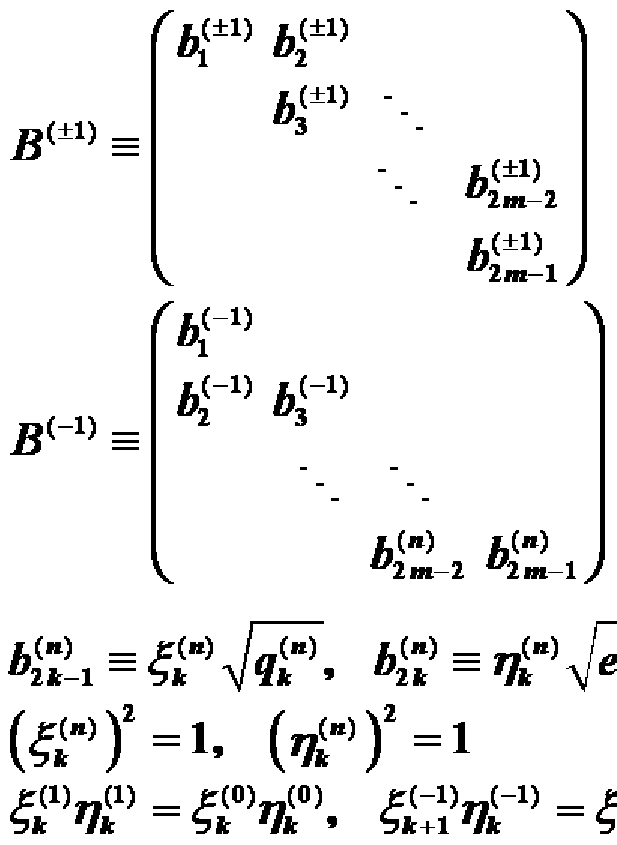
- B (+1) and B ( _1) are upper diagonal and lower bidiagonal matrices, respectively.
- k be the minimum value of (e () + q. (0) - ⁇ ).
- B (0) Given the component ⁇ b (0) , b ( 0) ⁇ of B, that is, given ⁇ q (0) , e (0) ⁇
- the routine according to the present invention employs a new transformation that replaces the st qds and rpqds transformations.
- the routine according to the present invention employs a new transformation that replaces the st qds and rpqds transformations.
- the present invention in order to diagonalize the matrix B TB, performing'isutiddo decomposition for matrix ⁇ ⁇ ⁇ - ⁇ 2 ⁇ using sdLVvs conversion and rdLVvs conversion.
- la the above (1) into the following three steps (la), (lb) and (lc)
- FIGS. 3 to 8 show processing procedures for executing the Miura-type inverse conversion, the sdLVvs conversion, the rdLVvs conversion, and the mirror-type conversion according to the present invention.
- u (1) u (0) > f (l + 6 (0) u (0) ) / (l + 6 (1) u
- Miura-type inverse conversion is called Miura conversion
- Miura-type conversion is called reverse Miura conversion
- sdLVvs conversion is called stLVv conversion
- rdLVv conversion is called rLVv conversion.
- DLVs routine Ri same der as DLASQ routine is the basic framework, (singular vectors or B) eigenvectors only eigenvalues of B T B (or singular values of B) is obtained B T B is determined I can't stop.
- the calculation method used for the core part of the routine is different from DLASQ.
- Y (n) diag (l, ⁇ , ⁇ ⁇ ⁇ , ⁇ ).
- ⁇ is the eigenvalue of ⁇ ⁇ ⁇ .
- ⁇ is the eigenvalue of ⁇ ⁇ ⁇ .
- LAPCAK's singular value calculation routine DLASQ adopts the differential type of the qd method. This is called the dqd method.
- One step is
- s is the origin shift amount, and is the minimum eigenvalue of Y (n ) estimated by the Gersgorin type boundary condition. Therefore, at the core of the main loop of the DLASQ routine, the minimum eigenvalue is estimated. If s> ⁇ ( ⁇ : a positive number that can be regarded as very small), the dq ds method is used. Otherwise, the dqd method is used. Can be Other parts of the main loop (matrix partitioning, reduced order) are almost the same as DBDSQR / Rachin. That is, the DLAS Q routine is obtained by replacing the QR method included in DBDSQR / Rachin with the dqd method and the origin shift QR method with the dqds method. (Because the variables handled by the QR method and the dqd method, and the QR method with the origin shift and the dqds method are different, the judgment formulas are slightly different, but they are essentially the same.)
- the dLVs routine uses the dLV method instead of the dqd method, and the dLVs method instead of the dqds method.
- the dLVs routine is guaranteed to converge, unlike the DLA SQ routine.
- One step is given below.
- the core shift of the main loop determines the origin shift amount s by estimating the minimum singular value, and determines whether to use the dLV method or the dLVs method. However, the point to determine the s After you determine the auxiliary variable V ⁇ different from the DLASQ routine.
- a rounding error As the error due to the computer calculation, a rounding error, an error due to cancellation of a digit, and the like are known.
- the rounding error alone does not result in a large error at the last significant digit that differs at most from the true value. Also, if at least one operation of addition, multiplication, and division of two real numbers having different exponents is performed, a rounding error still occurs, but no further error occurs. Furthermore, even if such a rounding error-producing operation is repeated, if the rounding mode is near (rounding), the error may be rounded up or down unilaterally. Rarely accumulates extremely. Therefore, in many numerical calculation methods, special attention should be paid to the rounding error generated by at least one operation of addition, multiplication, and division. do not do.
- the problem is the cancellation of digits caused by subtraction of real numbers of the same sign and addition of real numbers of different signs. If a value becomes 0 due to an error caused by a digit loss, and division is performed by that value, the result becomes an indefinite form in which 0 comes to the denominator, making it impossible to calculate. In this case, the calculation does not end indefinitely. Since the calculation of subtraction ⁇ division exists in both the method of Parlett and the method of the present invention, it is necessary to pay close attention to the digit cancellation error.
- ⁇ Ql [k], el [k] ⁇ and ⁇ q2 [k], e2 [k] ⁇ can be calculated in various paths. Thus, it is possible to avoid a case where a digit loss occurs.
- the device that executes the singular value decomposition is, for example, a device having the function of each step shown in FIG.
- One embodiment of an apparatus for performing singular value decomposition is a computer that executes a singular value decomposition program. That A program is, for example, a program that causes the CPU to execute the steps shown in Fig. 1.
- FIG. 10 shows a computer 10 that executes the processing of FIG. 1 as a computer program.
- the computer 10 includes a CPU 1001, a memory 1002, an input interface unit 1003, an output interface unit 1004, and a bus 1005.
- the CPU 1001 executes a program.
- the program is a program that executes the processing of FIG.
- the program and data necessary for executing the program are stored in the memory 1002, for example.
- the program may be included in memory 1002 in any manner.
- the program may be stored in the memory 1002 by loading the program from outside the computer 1002.
- the program may be stored in the memory 1002 in a format to be printed on the memory 1002.
- the input interface unit 1003 functions as an interface for receiving a matrix A to be subjected to singular value decomposition as well as an external force.
- the output interface unit 1004 functions as an interface for outputting a calculation result.
- the bus 1005 is used to interconnect the components 1001 to 1004 in the computer 10.
- the singular value decomposition method according to the present invention can be applied to various fields.
- the following shows an example of application to image processing for restoring a 2D image to a 3D image, and an example of application to document retrieval.
- these two application examples are merely examples, and the application of the singular value decomposition method according to the present invention is not limited to these two application examples.
- the application of the singular value decomposition method according to the present invention can be applied to all fields using singular value decomposition.
- FIG. 11 illustrates one embodiment of image processing for restoring a plurality of two-dimensional images of an object into a three-dimensional image using the singular value decomposition method according to the present invention.
- the steps required to perform three-dimensional restoration from a plurality of two-dimensional images include: extracting feature points from the two-dimensional image; Data on coordinate data) and rotation (conversion to 3D data, feature point data) And a step of performing visualization based on shape and rotation data.
- the two-dimensional image to be handled is preferably a weak center projected image.
- j 1 and j 2 are the first and second rotation matrices of the j-th camera coordinate system relative to the object coordinate system, respectively.
- the coordinates of all n points in all m images are arranged as elements of matrix D,
- D has a rank of 3.
- D is given from step 1102.
- data M and shape S relating to rotation are obtained.
- step 1104 in order to calculate the singular value decomposition of the matrix D, the matrix D is upper-diagonalized to obtain an upper-diagonalized matrix B.
- step 1106 the singular value of matrix B, ie, D, is calculated.
- a dLVs routine, a DLASQ routine, another singular value calculation routine, or a combination thereof according to the present invention may be used.
- three or more non-zero singular values appear due to digital errors in the image.
- the fourth and subsequent singular values are due to noise and are much smaller than the first three singular values. Therefore, in step 1108, singular vectors are calculated for the first three singular values.
- Step 1108 may utilize steps 110-120 of FIG. The three equations used are summarized as follows.
- M, L, ( ⁇ ,) 1/2
- step 1112 C is obtained from E.
- the degree of freedom of C (9) is greater than the degree of freedom of E (6).
- r [0, 1, 0]
- the vector space model After extracting index words related to the contents of the document from the document and calculating the weight of the index word, the vector space model expresses the document by a vector having the weight of the index word as an element. Assume that the documents to be searched are D, D,..., D
- d is the weight of the index word w in the document D.
- the entire document set can be represented by the following mXn matrix D.
- the matrix D is called an index document matrix.
- each column of the index word document matrix is a document vector representing information about a document.
- each row of the index word document matrix is a vector representing information about an index word, which is called an index word vector.
- a search query can be represented by a vector that uses the weight of an index word as an element. Assuming that the weight of the index word w included in the search question sentence is q, the search question vector q is expressed as follows. [0092] [Number 26]
- FIG. 12 illustrates one embodiment of a document search method using the singular value decomposition device according to the present invention.
- step 1202 a question vector q is received.
- step 1204 in order to calculate the singular value decomposition of the matrix D, the matrix D is upper-diagonalized to obtain an upper-diagonalized matrix B.
- step 1206 the singular value of the matrix B, that is, the matrix D is obtained.
- a dLVs routine, a DLASQ routine, another singular value calculation routine, or a combination thereof according to the present invention may be used.
- the search is performed by calculating the similarity between the vector q and each document vector d in the index word document matrix D.
- D is used instead of D.
- D is used instead of D.
- LTI Latent semantic indexing
- index term "car” and the index term “automobile” are completely different, and a query using one index term searches for documents containing the other index term. Can not.
- these semantically related index terms can be expected to be reduced to one dimension, so a search query for "car” can be used to force documents containing "car”. It is also possible to search for documents that contain 'automobile'.
- Latent semantic indexing reduces the dimensions of high-dimensional vectors by singular bond decomposition, which is basically the same as principal component analysis in multivariate analysis. Are equivalent.
- a value of k that is kr is selected.
- the value of k may be given in advance, or may be selectable for each calculation.
- V is n k, which consists only of the first k right singular vectors.
- Step 1210 may utilize steps 110-120 of FIG.
- step 1212 the similarity between the matrix D and the question vector q is calculated.
- the j-th document vector of D is represented by De.
- step 1214 a search result is output based on the similarity calculated in step 1212.
- the present invention is useful as a method, a program, an apparatus, and the like that enable high-speed and high-accuracy singular value decomposition of an arbitrary matrix A.
Landscapes
- Engineering & Computer Science (AREA)
- Physics & Mathematics (AREA)
- General Physics & Mathematics (AREA)
- Mathematical Physics (AREA)
- Theoretical Computer Science (AREA)
- Pure & Applied Mathematics (AREA)
- Mathematical Optimization (AREA)
- Mathematical Analysis (AREA)
- Data Mining & Analysis (AREA)
- Computational Mathematics (AREA)
- Computing Systems (AREA)
- Algebra (AREA)
- Databases & Information Systems (AREA)
- Software Systems (AREA)
- General Engineering & Computer Science (AREA)
- Computer Vision & Pattern Recognition (AREA)
- Complex Calculations (AREA)
- Information Retrieval, Db Structures And Fs Structures Therefor (AREA)
Abstract
Description






Claims


Priority Applications (4)
| Application Number | Priority Date | Filing Date | Title |
|---|---|---|---|
| CA2568852A CA2568852C (en) | 2004-06-03 | 2005-06-01 | High-speed high-accuracy matrix singular value decomposition method, program, and device |
| JP2006514122A JP4325877B2 (ja) | 2004-06-03 | 2005-06-01 | 行列の高速高精度特異値分解方法、プログラムおよび装置 |
| EP05746027A EP1752884B1 (en) | 2004-06-03 | 2005-06-01 | High-speed high-accuracy matrix singular value decomposition method, program, and device. |
| US11/569,898 US8306361B2 (en) | 2004-06-03 | 2005-06-01 | High-speed high-accuracy matrix singular value decomposition method, program, and device |
Applications Claiming Priority (2)
| Application Number | Priority Date | Filing Date | Title |
|---|---|---|---|
| JP2004166437 | 2004-06-03 | ||
| JP2004-166437 | 2004-06-03 |
Publications (1)
| Publication Number | Publication Date |
|---|---|
| WO2005119507A1 true WO2005119507A1 (ja) | 2005-12-15 |
Family
ID=35463067
Family Applications (1)
| Application Number | Title | Priority Date | Filing Date |
|---|---|---|---|
| PCT/JP2005/010084 Ceased WO2005119507A1 (ja) | 2004-06-03 | 2005-06-01 | 行列の高速高精度特異値分解方法、プログラムおよび装置 |
Country Status (5)
| Country | Link |
|---|---|
| US (1) | US8306361B2 (ja) |
| EP (1) | EP1752884B1 (ja) |
| JP (1) | JP4325877B2 (ja) |
| CA (1) | CA2568852C (ja) |
| WO (1) | WO2005119507A1 (ja) |
Cited By (5)
| Publication number | Priority date | Publication date | Assignee | Title |
|---|---|---|---|---|
| WO2007066445A1 (ja) * | 2005-12-05 | 2007-06-14 | Kyoto University | 特異値分解装置、及び特異値分解方法 |
| JP2007304801A (ja) * | 2006-05-10 | 2007-11-22 | Nec Corp | 立体性認証方法、立体性認証装置および立体性認証プログラム |
| JP2012069133A (ja) * | 2011-10-24 | 2012-04-05 | Nec Corp | 立体性認証方法、立体性認証装置および立体性認証プログラム |
| JP5017666B2 (ja) * | 2006-08-08 | 2012-09-05 | 国立大学法人京都大学 | 固有値分解装置、及び固有値分解方法 |
| CN115018721A (zh) * | 2022-05-19 | 2022-09-06 | 西安中科立德红外科技有限公司 | 一种基于多尺度分析与奇异值分解的非均匀性校正方法 |
Families Citing this family (28)
| Publication number | Priority date | Publication date | Assignee | Title |
|---|---|---|---|---|
| US7840060B2 (en) * | 2006-06-12 | 2010-11-23 | D&S Consultants, Inc. | System and method for machine learning using a similarity inverse matrix |
| US8959137B1 (en) | 2008-02-20 | 2015-02-17 | Altera Corporation | Implementing large multipliers in a programmable integrated circuit device |
| US8396914B1 (en) * | 2009-09-11 | 2013-03-12 | Altera Corporation | Matrix decomposition in an integrated circuit device |
| US8539016B1 (en) | 2010-02-09 | 2013-09-17 | Altera Corporation | QR decomposition in an integrated circuit device |
| US8539014B2 (en) * | 2010-03-25 | 2013-09-17 | Altera Corporation | Solving linear matrices in an integrated circuit device |
| US8577951B1 (en) | 2010-08-19 | 2013-11-05 | Altera Corporation | Matrix operations in an integrated circuit device |
| JP2012234258A (ja) * | 2011-04-28 | 2012-11-29 | Sony Corp | 画像処理装置と画像処理方法およびプログラム |
| US8812576B1 (en) | 2011-09-12 | 2014-08-19 | Altera Corporation | QR decomposition in an integrated circuit device |
| US9053045B1 (en) | 2011-09-16 | 2015-06-09 | Altera Corporation | Computing floating-point polynomials in an integrated circuit device |
| US8949298B1 (en) | 2011-09-16 | 2015-02-03 | Altera Corporation | Computing floating-point polynomials in an integrated circuit device |
| US8762443B1 (en) | 2011-11-15 | 2014-06-24 | Altera Corporation | Matrix operations in an integrated circuit device |
| US8996600B1 (en) | 2012-08-03 | 2015-03-31 | Altera Corporation | Specialized processing block for implementing floating-point multiplier with subnormal operation support |
| US9207909B1 (en) | 2012-11-26 | 2015-12-08 | Altera Corporation | Polynomial calculations optimized for programmable integrated circuit device structures |
| US9189200B1 (en) | 2013-03-14 | 2015-11-17 | Altera Corporation | Multiple-precision processing block in a programmable integrated circuit device |
| CN104156906B (zh) * | 2013-05-13 | 2017-10-27 | 国家电网公司 | 数字图像处理方法及装置 |
| KR20160021872A (ko) * | 2013-06-29 | 2016-02-26 | 생-고뱅 세라믹스 앤드 플라스틱스, 인코포레이티드 | 조밀한 장벽층을 가지는 고체 산화물 연료전지 |
| US9348795B1 (en) | 2013-07-03 | 2016-05-24 | Altera Corporation | Programmable device using fixed and configurable logic to implement floating-point rounding |
| CN103473769B (zh) * | 2013-09-05 | 2016-01-06 | 东华大学 | 一种基于奇异值分解的织物瑕疵检测方法 |
| US9697177B1 (en) | 2016-10-13 | 2017-07-04 | Sas Institute Inc. | Analytic system for selecting a decomposition description of sensor data |
| CN109241231A (zh) * | 2018-09-07 | 2019-01-18 | 武汉中海庭数据技术有限公司 | 高精度地图数据的预处理装置及方法 |
| WO2020213757A1 (ko) * | 2019-04-17 | 2020-10-22 | 엘지전자 주식회사 | 단어 유사도 판단 방법 |
| US11393127B2 (en) | 2019-09-13 | 2022-07-19 | Toyota Research Institute, Inc. | 2D to 3D line-based registration with unknown associations |
| CN111046299B (zh) * | 2019-12-11 | 2023-07-18 | 支付宝(杭州)信息技术有限公司 | 针对关系网络的特征信息提取方法及装置 |
| CN114088401A (zh) * | 2021-11-03 | 2022-02-25 | 宁波坤博测控科技有限公司 | 一种用于风力发电机的滚动轴承的故障分析方法及装置 |
| CN114756812B (zh) * | 2022-03-02 | 2024-11-19 | 哈尔滨工程大学 | 一种基于奇异值分解与信息熵的证据修正方法 |
| CN115484354B (zh) * | 2022-09-14 | 2024-02-23 | 姜川 | 一种基于四元数矩阵奇异值分解的彩色图像压缩方法 |
| CN115712911A (zh) * | 2022-11-17 | 2023-02-24 | 江苏大道云隐科技有限公司 | 战略性数据数据阴影提取及重建方法 |
| CN116680770A (zh) * | 2023-03-07 | 2023-09-01 | 中国电建集团华东勘测设计研究院有限公司 | 一种保证索网结构水平面投影形状的找形方法 |
Citations (2)
| Publication number | Priority date | Publication date | Assignee | Title |
|---|---|---|---|---|
| JPH1031747A (ja) * | 1996-07-15 | 1998-02-03 | Mitsubishi Electric Corp | 三次元情報抽出装置および三次元情報抽出方法 |
| JP2002202983A (ja) * | 2000-12-28 | 2002-07-19 | Matsushita Electric Ind Co Ltd | 分類への帰属度計算基準作成方法及び装置 |
Family Cites Families (9)
| Publication number | Priority date | Publication date | Assignee | Title |
|---|---|---|---|---|
| US6009190A (en) * | 1997-08-01 | 1999-12-28 | Microsoft Corporation | Texture map construction method and apparatus for displaying panoramic image mosaics |
| US6134541A (en) * | 1997-10-31 | 2000-10-17 | International Business Machines Corporation | Searching multidimensional indexes using associated clustering and dimension reduction information |
| US6314419B1 (en) * | 1999-06-04 | 2001-11-06 | Oracle Corporation | Methods and apparatus for generating query feedback based on co-occurrence patterns |
| US6993179B1 (en) * | 2000-08-07 | 2006-01-31 | Koninklijke Philips Electronics N.V. | Strapdown system for three-dimensional reconstruction |
| US7194112B2 (en) * | 2001-03-12 | 2007-03-20 | Eastman Kodak Company | Three dimensional spatial panorama formation with a range imaging system |
| JP5011545B2 (ja) * | 2005-12-05 | 2012-08-29 | 国立大学法人京都大学 | 特異値分解装置、及び特異値分解方法 |
| JP4649635B2 (ja) * | 2006-08-02 | 2011-03-16 | 独立行政法人科学技術振興機構 | 画像特徴抽出方法および画像圧縮方法 |
| WO2008018188A1 (fr) * | 2006-08-08 | 2008-02-14 | Kyoto University | dispositif de décomposition de valeur propre et procédé de décomposition de valeur propre |
| US8107735B2 (en) * | 2007-04-10 | 2012-01-31 | Denso Corporation | Three dimensional shape reconstitution device and estimation device |
-
2005
- 2005-06-01 JP JP2006514122A patent/JP4325877B2/ja not_active Expired - Lifetime
- 2005-06-01 EP EP05746027A patent/EP1752884B1/en not_active Expired - Lifetime
- 2005-06-01 CA CA2568852A patent/CA2568852C/en not_active Expired - Fee Related
- 2005-06-01 WO PCT/JP2005/010084 patent/WO2005119507A1/ja not_active Ceased
- 2005-06-01 US US11/569,898 patent/US8306361B2/en not_active Expired - Fee Related
Patent Citations (2)
| Publication number | Priority date | Publication date | Assignee | Title |
|---|---|---|---|---|
| JPH1031747A (ja) * | 1996-07-15 | 1998-02-03 | Mitsubishi Electric Corp | 三次元情報抽出装置および三次元情報抽出方法 |
| JP2002202983A (ja) * | 2000-12-28 | 2002-07-19 | Matsushita Electric Ind Co Ltd | 分類への帰属度計算基準作成方法及び装置 |
Non-Patent Citations (7)
| Title |
|---|
| GAPS'' SIAM J. MATRIX ANAL. APPL., vol. 25, no. 3, 30 March 2004 (2004-03-30), pages 858 - 899 |
| IWASAKI M, NAKAMURA Y.: "An application of the arbitrary step-size Lotka-Volferra system to singular value computation.", 21 May 2003 (2003-05-21), pages 1 - 2, XP002994447, Retrieved from the Internet <URL:http://nile.ulis.ac.jp/nas2002/Proceedings03/IWASAKI.pdf> [retrieved on 20050719] * |
| IWASAKI M. ET AL: "A application of the discrete Lotka-Volterra system with variable step-size to singular value computation.", INVERSE PROBLEMS., vol. 20, no. 27, 27 February 2004 (2004-02-27), pages 553 - 563, XP020030649 * |
| LNKD, vol. 9, 1 November 1992 (1992-11-01), pages 137 - 154 |
| NAKAMURA Y ET AL: "A new approach to numerical algorithms in terms of integrable systems.", INFORMATICS RESEARCH FOR DEVELOPMENT OF KNOWLEDGE SOCIETY INFRASTRUCTURE., 1 March 2004 (2004-03-01), pages 194 - 205, XP010709514 * |
| NAKAMURA Y.: "Algorithm to Kasekibunkei-Kasekibunkei ni yoru Algorithm Kaihatsu o Mezashite.", THE INSTITUTE OF SYSTEMS, CONTROL AND INFORMATION ENGINEERS., vol. 43, no. 11, 15 November 1999 (1999-11-15), pages 8 - 15, XP002994448 * |
| NAKAMURA Y.: "Soliton Riron to Suchi Keisanho.", THE INSTITUTE OF ELECTRONICS, INFORMATION AND COMMUNICATION ENGINEERS., vol. 80, no. 11, 25 November 1997 (1997-11-25), pages 1143 - 1146, XP002994449 * |
Cited By (6)
| Publication number | Priority date | Publication date | Assignee | Title |
|---|---|---|---|---|
| WO2007066445A1 (ja) * | 2005-12-05 | 2007-06-14 | Kyoto University | 特異値分解装置、及び特異値分解方法 |
| JP5011545B2 (ja) * | 2005-12-05 | 2012-08-29 | 国立大学法人京都大学 | 特異値分解装置、及び特異値分解方法 |
| JP2007304801A (ja) * | 2006-05-10 | 2007-11-22 | Nec Corp | 立体性認証方法、立体性認証装置および立体性認証プログラム |
| JP5017666B2 (ja) * | 2006-08-08 | 2012-09-05 | 国立大学法人京都大学 | 固有値分解装置、及び固有値分解方法 |
| JP2012069133A (ja) * | 2011-10-24 | 2012-04-05 | Nec Corp | 立体性認証方法、立体性認証装置および立体性認証プログラム |
| CN115018721A (zh) * | 2022-05-19 | 2022-09-06 | 西安中科立德红外科技有限公司 | 一种基于多尺度分析与奇异值分解的非均匀性校正方法 |
Also Published As
| Publication number | Publication date |
|---|---|
| CA2568852C (en) | 2013-01-22 |
| EP1752884A4 (en) | 2010-08-25 |
| US20090028455A1 (en) | 2009-01-29 |
| JP4325877B2 (ja) | 2009-09-02 |
| CA2568852A1 (en) | 2005-12-15 |
| EP1752884A1 (en) | 2007-02-14 |
| EP1752884B1 (en) | 2013-04-03 |
| US8306361B2 (en) | 2012-11-06 |
| JPWO2005119507A1 (ja) | 2008-07-31 |
Similar Documents
| Publication | Publication Date | Title |
|---|---|---|
| WO2005119507A1 (ja) | 行列の高速高精度特異値分解方法、プログラムおよび装置 | |
| US12481886B2 (en) | Calculating device and method for a sparsely connected artificial neural network | |
| CN108846445B (zh) | 一种图像处理方法 | |
| Mongardi et al. | Birational geometry of irreducible holomorphic symplectic tenfolds of O’Grady type | |
| CN111695671A (zh) | 训练神经网络的方法及装置、电子设备 | |
| US11775832B2 (en) | Device and method for artificial neural network operation | |
| Oh et al. | High-performance tucker factorization on heterogeneous platforms | |
| JP2023070746A (ja) | 情報処理プログラム、情報処理装置、及び情報処理方法 | |
| CN116843002B (zh) | 神经网络模型的训练方法、训练系统及可读介质 | |
| CN119895437A (zh) | 用于通过量化压缩生成式预训练语言模型的方法和设备 | |
| Huang et al. | Hardware-friendly compression and hardware acceleration for transformer: A survey. | |
| Zhao et al. | Numerical behavior of mixed precision iterative refinement using the BiCGStab method | |
| CN112596872A (zh) | 任务调度、预处理、处理方法及设备、处理单元、介质 | |
| CN110363713A (zh) | 基于递归样本缩放和双线性因子分解的高光谱图像降噪方法 | |
| Shao et al. | An efficient GCN accelerator based on workload reorganization and feature reduction | |
| CN118710754A (zh) | 基于扩散概率模型的文生图方法、装置、设备及存储介质 | |
| CN119226254A (zh) | 数据处理方法、装置、设备及计算机可读存储介质 | |
| Pietras et al. | FPGA implementation of logarithmic versions of Baum-Welch and Viterbi algorithms for reduced precision hidden Markov models | |
| Feng et al. | A Unified Theoretic and Algorithmic Framework for Solving Multivariate Linear Model with $\ell^ 1$-norm Approximation | |
| Kulkarni et al. | Massive scaling of massif: Algorithm development and analysis for simulation on gpus | |
| Rueda Ramírez | Efficient Space and Time Solution Techniques for High-Order Discontinuous Galerkin Discretizations of the 3D Compressible Navier-Stokes Equations | |
| CN111881408A (zh) | 基于预处理共轭梯度法的并行数据处理方法及处理系统 | |
| Aziz et al. | Self-adaptive physics-informed neural network for forward and inverse problems in heterogeneous porous flow | |
| Zeng | The approximate irreducible factorization of a univariate polynomial: revisited | |
| Granat et al. | A parallel Schur method for solving continuous-time algebraic Riccati equations |
Legal Events
| Date | Code | Title | Description |
|---|---|---|---|
| AK | Designated states |
Kind code of ref document: A1 Designated state(s): AE AG AL AM AT AU AZ BA BB BG BR BW BY BZ CA CH CN CO CR CU CZ DE DK DM DZ EC EE EG ES FI GB GD GE GH GM HR HU ID IL IN IS JP KE KG KM KP KR KZ LC LK LR LS LT LU LV MA MD MG MK MN MW MX MZ NA NG NI NO NZ OM PG PH PL PT RO RU SC SD SE SG SK SL SM SY TJ TM TN TR TT TZ UA UG US UZ VC VN YU ZA ZM ZW |
|
| AL | Designated countries for regional patents |
Kind code of ref document: A1 Designated state(s): BW GH GM KE LS MW MZ NA SD SL SZ TZ UG ZM ZW AM AZ BY KG KZ MD RU TJ TM AT BE BG CH CY CZ DE DK EE ES FI FR GB GR HU IE IS IT LT LU MC NL PL PT RO SE SI SK TR BF BJ CF CG CI CM GA GN GQ GW ML MR NE SN TD TG |
|
| 121 | Ep: the epo has been informed by wipo that ep was designated in this application | ||
| DPEN | Request for preliminary examination filed prior to expiration of 19th month from priority date (pct application filed from 20040101) | ||
| WWE | Wipo information: entry into national phase |
Ref document number: 2005746027 Country of ref document: EP Ref document number: 2006514122 Country of ref document: JP Ref document number: 2568852 Country of ref document: CA |
|
| NENP | Non-entry into the national phase |
Ref country code: DE |
|
| WWW | Wipo information: withdrawn in national office |
Ref document number: DE |
|
| WWP | Wipo information: published in national office |
Ref document number: 2005746027 Country of ref document: EP |
|
| WWE | Wipo information: entry into national phase |
Ref document number: 11569898 Country of ref document: US |