WO2005123729A1 - Lewis acid mediated synthesis of cyclic esters - Google Patents
Lewis acid mediated synthesis of cyclic esters Download PDFInfo
- Publication number
- WO2005123729A1 WO2005123729A1 PCT/US2005/019440 US2005019440W WO2005123729A1 WO 2005123729 A1 WO2005123729 A1 WO 2005123729A1 US 2005019440 W US2005019440 W US 2005019440W WO 2005123729 A1 WO2005123729 A1 WO 2005123729A1
- Authority
- WO
- WIPO (PCT)
- Prior art keywords
- group
- lewis acid
- alkyl
- added
- formula
- Prior art date
- Legal status (The legal status is an assumption and is not a legal conclusion. Google has not performed a legal analysis and makes no representation as to the accuracy of the status listed.)
- Ceased
Links
- 0 CCC(CC)C(C)(C(C1(C(C)C1C)O1)N)O*1=O Chemical compound CCC(CC)C(C)(C(C1(C(C)C1C)O1)N)O*1=O 0.000 description 2
Classifications
-
- C—CHEMISTRY; METALLURGY
- C07—ORGANIC CHEMISTRY
- C07F—ACYCLIC, CARBOCYCLIC OR HETEROCYCLIC COMPOUNDS CONTAINING ELEMENTS OTHER THAN CARBON, HYDROGEN, HALOGEN, OXYGEN, NITROGEN, SULFUR, SELENIUM OR TELLURIUM
- C07F9/00—Compounds containing elements of Groups 5 or 15 of the Periodic Table
- C07F9/02—Phosphorus compounds
- C07F9/06—Phosphorus compounds without P—C bonds
-
- C—CHEMISTRY; METALLURGY
- C07—ORGANIC CHEMISTRY
- C07F—ACYCLIC, CARBOCYCLIC OR HETEROCYCLIC COMPOUNDS CONTAINING ELEMENTS OTHER THAN CARBON, HYDROGEN, HALOGEN, OXYGEN, NITROGEN, SULFUR, SELENIUM OR TELLURIUM
- C07F9/00—Compounds containing elements of Groups 5 or 15 of the Periodic Table
- C07F9/02—Phosphorus compounds
- C07F9/547—Heterocyclic compounds, e.g. containing phosphorus as a ring hetero atom
- C07F9/6564—Heterocyclic compounds, e.g. containing phosphorus as a ring hetero atom having phosphorus atoms, with or without nitrogen, oxygen, sulfur, selenium or tellurium atoms, as ring hetero atoms
- C07F9/6571—Heterocyclic compounds, e.g. containing phosphorus as a ring hetero atom having phosphorus atoms, with or without nitrogen, oxygen, sulfur, selenium or tellurium atoms, as ring hetero atoms having phosphorus and oxygen atoms as the only ring hetero atoms
- C07F9/657163—Heterocyclic compounds, e.g. containing phosphorus as a ring hetero atom having phosphorus atoms, with or without nitrogen, oxygen, sulfur, selenium or tellurium atoms, as ring hetero atoms having phosphorus and oxygen atoms as the only ring hetero atoms the ring phosphorus atom being bound to at least one carbon atom
- C07F9/657181—Heterocyclic compounds, e.g. containing phosphorus as a ring hetero atom having phosphorus atoms, with or without nitrogen, oxygen, sulfur, selenium or tellurium atoms, as ring hetero atoms having phosphorus and oxygen atoms as the only ring hetero atoms the ring phosphorus atom being bound to at least one carbon atom the ring phosphorus atom and, at least, one ring oxygen atom being part of a (thio)phosphonic acid derivative
-
- A—HUMAN NECESSITIES
- A61—MEDICAL OR VETERINARY SCIENCE; HYGIENE
- A61P—SPECIFIC THERAPEUTIC ACTIVITY OF CHEMICAL COMPOUNDS OR MEDICINAL PREPARATIONS
- A61P31/00—Antiinfectives, i.e. antibiotics, antiseptics, chemotherapeutics
- A61P31/12—Antivirals
-
- A—HUMAN NECESSITIES
- A61—MEDICAL OR VETERINARY SCIENCE; HYGIENE
- A61P—SPECIFIC THERAPEUTIC ACTIVITY OF CHEMICAL COMPOUNDS OR MEDICINAL PREPARATIONS
- A61P35/00—Antineoplastic agents
-
- A—HUMAN NECESSITIES
- A61—MEDICAL OR VETERINARY SCIENCE; HYGIENE
- A61P—SPECIFIC THERAPEUTIC ACTIVITY OF CHEMICAL COMPOUNDS OR MEDICINAL PREPARATIONS
- A61P43/00—Drugs for specific purposes, not provided for in groups A61P1/00-A61P41/00
-
- C—CHEMISTRY; METALLURGY
- C07—ORGANIC CHEMISTRY
- C07F—ACYCLIC, CARBOCYCLIC OR HETEROCYCLIC COMPOUNDS CONTAINING ELEMENTS OTHER THAN CARBON, HYDROGEN, HALOGEN, OXYGEN, NITROGEN, SULFUR, SELENIUM OR TELLURIUM
- C07F9/00—Compounds containing elements of Groups 5 or 15 of the Periodic Table
- C07F9/02—Phosphorus compounds
- C07F9/28—Phosphorus compounds with one or more P—C bonds
Definitions
- the present invention is directed towards a process of synthesis of cyclic phosphonic acid diesters from 1,3-diols. More specifically, the invention relates to an improved process wherein diastereoselectivity is increased during coupling a 1 -arylpropane- 1 ,3-diol with an activated phosphonic acid.
- the most commonly used prodrug class is the acyloxyalky ester, which was first applied to phosphate and phosphonate compounds in 1983 by Farquhar et al, J. Pharm. Sci. 72: 324 (1983). This strategy has proven successful in the delivery of phosphates and phosphonates into cells and in the oral absorption of phosphates, phosphonates and phosphinic acids.
- the bis(pivoyloxymethyl) prodrug of the antiviral phosphonate 9-(2- phosphonylmethoxyethyl)adenine (PMEA)
- PMEA 9-(2- phosphonylmethoxyethyl)adenine
- BMS 188494 bis(pivaloyloxymethyl) prodrug of the squalene synthetase inhibitor, BMS 188494 has been evaluated as a treatment of hypercholesterolemia and associated cardiovascular diseases.
- the marketed antihypertensive, fosinopril is a phosphinic acid angiotensin converting enzyme inhibitor that requires the use of an isobutryloxyethyl group for oral absorption.
- a close variant of the acyloxyalkyl ester strategy is the use of alkoxycarbonyloxyalkyl groups as prodrugs. These prodrugs are reported to enhance oral bioavailability.
- suitable phosphonate prodrugs include proester classes exemplified by Krise et al. (Adv. Drug Del. Rev. 19: 287 (1996)); and Biller and Magnin (U.S. Patent No. 5,157,027). Cyclic phosphonate esters have also been shown to decrease serum lipids and treat atherosclerosis (U.S. No. 5,962,440).
- Other examples of phosphonate esters are exemplified by Prisbe et al. (J. Med. Chem. 29: 671 (1986)); and Ozoe et al. (Bioorg. Med. Chem. 6: 73 (1998).
- the present invention is directed towards a Lewis acid catalysis process for the synthesis of a cyclic phosphonic acid diester from a 1,3-diol and an activated phosphonic acid.
- methods are described that enable diastereoselective preparation of these products.
- the methods can also be used to prepare chiral substituted cyclic phosphonic acid (or phosphonate) diesters.
- One aspect of the invention concerns a method of preparing a cyclic phosphonic acid diester via reacting a chiral 1,3-diol and an activated phosphonic acid in the presence of a Lewis acid.
- the Lewis acid is added to the chiral 1,3-diol and the diol-Lewis acid complex is added to the activated phosphonic acid.
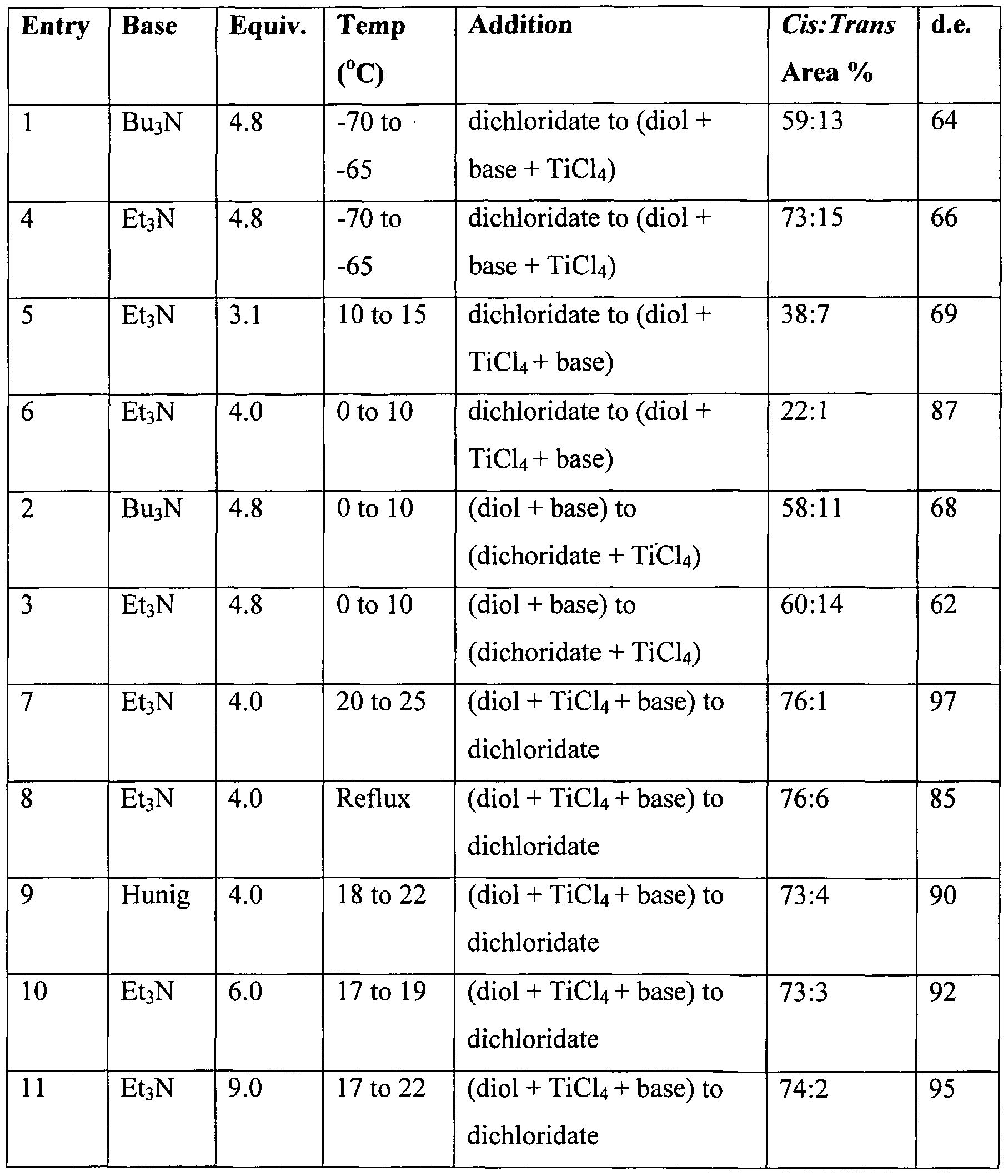
- the ratio of cis- to tram- diastereomers formed is greater than or equal to 3 : 1. Also provided are methods where the Lewis acid contains an element selected from the group consisting of titanium, tin, aluminum, zinc, boron, magnesium, samarium, bismuth, iron, mercury, copper, silver and cobalt.
- the Lewis acid contains an element selected from the group consisting of titanium, boron, aluminum, tin, and samarium.
- the Lewis acid contains a group independently selected from alkoxy, alkyl, aryl, or an inorganic radical. In another aspect, the Lewis acid contains a group independently selected from alkoxy, alkyl, aryl, or an inorganic radical, where the inorganic radical is selected from the group consisting of chloride, iodide, bromide, and fluoride. In a further aspect, the Lewis acid is selected from TiCl 4 , BF 3 , SnCl , Sml 2 , and A1C1 3 . An additional aspect the Lewis acid is TiCl 4 . In a further aspect the Lewis acid is Ti(O-(C ⁇ -C 4 )alkyl) 4 .
- the activated phosphonic acid is phosphonic acid halide, phosphonic acid anhydride, or phosphonic acid carbonate.
- the activated phosphonic acid is phosphonic acid halide.
- the phosphonic acid halide is phosphonyl chloride.
- the method provides for adding a base selected from tertiary alkyl amines, N-containing heterocyclic aromatic bases, and non- nucleophilic inorganic bases.
- the base is triethylamine, tri(n- butyl)amine, pyridine, quinoline or diisopropylethylamine.
- the temperature for the reaction is -78 °C and 60 °C. In another aspect, the temperature is between -20 °C and 50 °C. In a further aspect, the temperature is between 15 °C and 42 °C. In one aspect, the reaction is carried out by adding 0.01 to 5 equivalents of said Lewis acid to 1.0 equivalent of said chiral 1,3-diol. In a further aspect, 0.5 to 2.0 equivalents of said Lewis acid is added.
- One aspect of the invention concerns the method for the preparation of compounds of Formula I:
- V is selected from group consisting of phenyl, allyl, alkynyl, and monocyclic heteroaryl, all optionally substituted with 1-4 substituents;
- R 2 is hydrogen or lower alkyl;
- R 3 is alkyl;
- R 4 is alkyl or acyl;
- p is 2 or 3;
- r is 0 or 1 ; and
- s is 0 or 1.
- the hydroxy groups present in the formula Ar'-G-Ar 2 may be protected.
- said 1 -(aryl)- 1,3 -propane diol is added to the Lewis acid and then the diol-Lewis acid complex is added to R 1 (alk 1 ) r Y s (alk 2 )P(O)Cl 2 in the presence of said base.
- the method of preparation for compounds of Formula I provides for an increased ratio of cis to trans diastereomers.
- the ratio of cis- to trans- diastereomers formed is greater than or equal to 3 : 1.
- the Lewis acid contains an element selected from the group consisting of titanium, tin, aluminum, zinc, boron, magnesium, samarium, bismuth, iron, mercury, copper, silver and cobalt.
- the Lewis acid contains an element selected from the group consisting of titanium, boron, aluminum, tin, and samarium.
- the Lewis acid contains a group independently selected from alkoxy, alkyl, aryl, or an inorganic radical.
- the Lewis acid contains a group independently selected from alkoxy, alkyl, aryl, or an inorganic radical, where the inorganic radical is selected from the group consisting of chloride, iodide, bromide, and fluoride.
- the Lewis Acid is selected from TiCl 4 , BF 3 , SnCl 4 , Sml 2 , and A1C1 .
- the Lewis acid is TiCl 4 .
- the Lewis acid is Ti(O-(C ⁇ -C 4 )alkyl) 4 .
- the method provides for adding a base selected from tertiary alkyl amines, N-containing heterocyclic aromatic bases, and non- nucleophilic inorganic bases.
- the base is triethylamine, tri(n- butyl)amine, pyridine, quinoline or diisopropylethylamine.
- the temperature for the reaction is -78 °C and 60 °C. In another aspect the temperature is between -20 °C and 50 °C. In a further aspect, the temperature is between 15 °C and 42 °C. In one aspect, the reaction is carried out by adding 0.01 to 5 equivalents of said Lewis acid to 1.0 equivalent of said chiral 1 ,3-diol.
- the invention relates to a method for the preparation of compounds of Formula II:
- V is selected from group consisting of aryl, and monocyclic heteroaryl, all optionally substituted with 1-4 substituents
- W and W are independently selected from the group consisting of H, optionally substituted alkyl, optionally substituted alkenyl, optionally substituted alkynyl, optionally substituted monocyclic aryl, and optionally substituted monocyclic heteroaryl
- Z is selected from the group consisting of halogen, -CN, -COR , -
- T is selected from the group consisting of H and lower alkyl;
- R is hydrogen or lower alkyl;
- R 3 is alkyl;
- R 4 is alkyl or acyl;
- p is 2 or 3;
- r is 0 or 1 ; and
- s is O or 1;
- R is a monovalent amine protecting group, and R 6 is hydrogen; or, R 5 and R 6 taken together are a divalent amine protecting group.
- the method of preparing a compound of Formula II includes combining a l-(V)-l,3-propane diol with a compound of Formula III in the presence of a Lewis acid: Formula III
- the method of preparation for compounds of Formula II provides for an increased ratio of cis to trans diastereomers.
- the ratio of cis- to trans- diastereomers formed is greater than or equal to 3 : 1.
- the Lewis acid contains an element selected from the group consisting of titanium, tin, aluminum, zinc, boron, magnesium, samarium, bismuth, iron, mercury, copper, silver and cobalt.
- the Lewis acid contains an element selected from the group consisting of titanium, boron, aluminum, tin, and samarium. In a further aspect, the Lewis acid contains a group independently selected from alkoxy, alkyl, aryl, or an inorganic radical. In another aspect, the Lewis acid contains a group independently selected from alkoxy, alkyl, aryl, or an inorganic radical, where the inorganic radical is selected from the group consisting of chloride, iodide, bromide, and fluoride. In a further aspect, the Lewis Acid is selected from TiCl 4 , BF 3 , SnCl 4 , Sml 2 , and A1C1 3 .
- the Lewis acid is TiCl 4 .
- the Lewis acid is Ti(O-(C ⁇ -C 4 )alkyl) 4 .
- the method provides for adding a base selected from tertiary alkyl amines, N-containing heterocyclic aromatic bases, and non- nucleophilic inorganic bases.
- the base is triethylamine, tri(n- butyl)amine, pyridine, quinoline or diisopropylethylamine.
- the temperature for the reaction is -78 °C and 60 °C. In another aspect the temperature is between -20 °C and 50 °C.
- the temperature is between 15 °C and 42 °C.
- the reaction is carried out by adding 0.01 to 5 equivalents of said Lewis acid to 1.0 equivalent of said chiral 1,3-diol. In a further aspect, 0.5 to 2.0 equivalents of said Lewis acid is added.
- R 5 is tert-butyloxycarbonyl, .benzyloxycarbonyl, trifluoroacetyl or benzyl; and R is hydrogen; or, R 5 and R taken together are phthalimidoyl, phenylmethylidene, dimethylaminomethylidene and diethylaminomethylidene; and T is selected from the group consisting of H and lower alkyl.
- R 5 is tert-butyloxycarbonyl, benzyloxycarbonyl, trifluoroacetyl or benzyl; and R 6 is hydrogen; or, R 5 and R 6 taken together are phthalimidoyl, phenylmethylidene, dimethylaminomethylidene and diethylaminomethylidene; T is selected from the group consisting of H and lower alkyl; comprising: combining (./?)- 1 -(3 -chlorophenyl)-l,3-propanediol with a compound of Formula III in the presence of a Lewis acid.
- the Lewis acid contains an element selected from the group consisting of titanium, boron, aluminum, tin, and samarium.
- the Lewis acid contains a group independently selected from alkoxy, alkyl, aryl, or an inorganic radical.
- the Lewis acid contains a group independently selected from alkoxy, alkyl, aryl, or an inorganic radical, where the inorganic radical is selected from the group consisting of chloride, iodide, bromide, and fluoride.
- the Lewis Acid is selected from TiCl , BF 3 , SnCl 4 , Sml2, and A1C1 3 .
- the Lewis acid is TiCl 4 .
- the Lewis acid is Ti(O-(C ⁇ -C 4 )alkyl) 4 .
- the method provides for adding a base selected from tertiary alkyl amines, N-containing heterocyclic aromatic bases, and non- nucleophilic inorganic bases.
- the base is triethylamine, tri(n- butyl)amine, pyridine, quinoline or diisopropylethylamine.
- the temperature for the reaction is -78 °C and 60 °C. In another aspect the temperature is between -20 °C and 50 °C. In a further aspect, the temperature is between 15 °C and 42 °C.
- the reaction is carried out by adding 0.01 to 5 equivalents of said Lewis acid to 1.0 equivalent of said chiral 1,3-diol. In a further aspect, 0.5 to 2.0 equivalents of said Lewis acid is added.
- Some of the compounds of Formula IV have asymmetric centers where the stereochemistry is unspecified and the diastereomeric mixtures of these compounds are included as well as the individual stereoisomers when referring to a compound of Formula IV generally.
- a further aspect the invention provides a method for the preparation of compounds of Formula V:
- the Lewis acid contains an element selected from the group consisting of titanium, boron, aluminum, tin, and samarium. In a further aspect, the Lewis acid contains a group independently selected from alkoxy, alkyl, aryl, or an inorganic radical. In another aspect, the Lewis acid contains a group independently selected from alkoxy, alkyl, aryl, or an inorganic radical, where the inorganic radical is selected from the group consisting of chloride, iodide, bromide, and fluoride. In a further aspect, the Lewis Acid is selected from TiCl 4 , BF 3 , SnCl 4 , Smh, and A1C1 3 .
- the Lewis acid is TiCl 4 . In a further aspect, the Lewis acid is Ti(O-(C ⁇ -C 4 )alkyl) 4 .
- the method provides for adding a base selected from tertiary alkyl amines, N-containing heterocyclic aromatic bases, and non- nucleophilic inorganic bases. In a further aspect, the base is triethylamine, tri(n- butyl)amine, pyridine, quinoline or diisopropylethylamine. In one aspect, the temperature for the reaction is -78 °C and 60 °C. In another aspect, the temperature is between -20 °C and 50 °C.
- the temperature is between 15 °C and 42 °C.
- the reaction is carried out by adding 0.01 to 5 equivalents of said Lewis acid to 1.0 equivalent of said chiral 1 ,3-diol. In a further aspect, 0.5 to 2.0 equivalents of said Lewis acid is added.
- hexanes refers to commercially available HPLC reagent solutions which contains approximately 95% hexane, methylcyclopropane, and methylpentane.
- dialkyl refers to a compound containing two alkyl groups.
- alkyl refers to saturated aliphatic groups including straight-chain, branched chain and cyclic groups. Suitable alkyl groups include methyl, ethyl, isopropyl, and cyclopropyl.
- alkylene refers to a divalent straight chain, branched chain or cyclic saturated aliphatic group. In one aspect the alkylene group contains up to and including 10 atoms. In another aspect the alkylene chain contains up to and including 6 atoms. In a further aspect the alkylene groups contains up to and including 4 atoms.
- the alkylene group can be either straight, branched, unsaturated, or cyclic. The alkylene may be optionally substituted with 1-3 substituents.
- aryl refers to aromatic groups which have 5-14 ring atoms and at least one ring having a conjugated pi electron system and includes carbocyclic aryl, heterocyclic aryl and biaryl groups, all of which may be optionally substituted.
- Heterocyclic aryl or heteroaryl groups are groups which have 5-14 ring atoms wherein 1 to 4 of the ring atoms are heteroatoms with the remainder of the ring atoms being carbon atoms. Suitable heteroatoms include oxygen, sulfur, nitrogen, and selenium.
- Suitable heteroaryl groups include furanyl, thienyl, pyridyl, pyrrolyl, N-lower alkyl pyrrolyl, pyridyl-N-oxide, pyrimidyl, pyrazinyl, imidazolyl, adeninyl, thyminyl, cytosinyl, guaninyl, uracilyl, and the like, all optionally substituted.
- the term "monocyclic aryl” refers to aromatic groups which have 5-6 ring atoms and includes carbocyclic aryl and heterocyclic aryl. Suitable aryl groups include phenyl, furanyl, pyridyl, and thienyl.
- Aryl groups may be substituted.
- the term "monocyclic heteroaryl” refers to aromatic groups which have 5-6 ring atoms wherein 1 to 4 heteroatoms are ring atoms in the aromatic ring and the remainder of the ring atoms being carbon atoms. Suitable heteroatoms include oxygen, sulfur, and nitrogen.
- the term monovalent nitrogen protecting group refers to a protecting group that is attached to nitrogen by a single bond. Examples include but are not limited to tert-butyloxycarbonyl, benzyloxycarbonyl, trifluoroacetyl and benzyl.
- the term divalent nitrogen protecting group refers to a protecting group that is attached to nitrogen either by two single bonds or by a double bond.
- Examples include but are not limited to phthalimidoyl, phenylmethylidene, dimethylaminomethylidene and diethylaminomethylidene.
- the term "optionally substituted” or “substituted” includes aryl groups substituted by one to four substituents, independently selected from lower alkyl, lower aryl, and halogens. In one aspect these substituents are selected from the group consisting of halogens.
- the term 'chiral' refers to an object or molecule that is not superimposable upon its mirror image.
- the term 'diastereoselective' refers to a reaction in which two or more diastereomers may be formed wherein unequal amounts of the diastereomers are obtained.
- the term 'Lewis acid' refers to any species that can accept a pair of electrons and form a coordinate covalent bond.
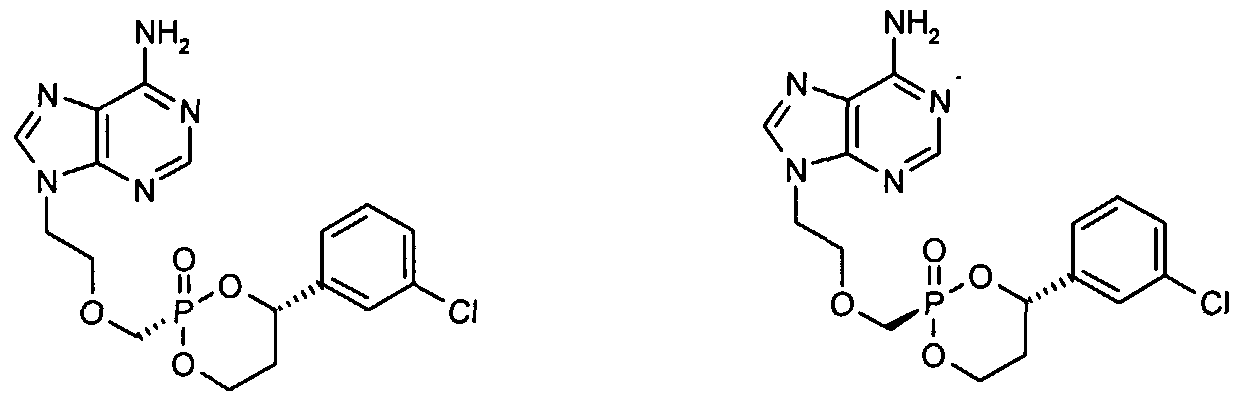
- the term "cis" stereochemistry refers to the relationship of the V group and M group positions on the six-membered ring. V and M are said to be located cis to each other if they lie on the same side of the plane. The formula below shows a cis stereochemistry.
- trans stereochemistry refers to the relationship of the V group and M group positions on the six-membered ring. V and M are said to be located trans to each other if they lie on opposite side of the plane. The formula below shows a trans stereochemistry.
- N ⁇ -substituted refers to the substitution at the amine attached at the 6-position of a purine ring system. N6- is generally substituted with an amine protecting group. Examples include the dialkylaminomethylene group, BOC, CBz, trityl as well as divalent groups like phthalimidoyl.
- N,N-dialkylaminomethyleneimine refers to the functional group or substitution of the following structure
- R groups include but are not limited to C1-C4 acyclic, alkyl , C5-
- C6 cyclic alkyl, benzyl, phenethyl, or R groups together form piperdine, morpholine, and pyrrolidine.
- nitrogen protecting group refers to R group and includes but is not limited to BOC, CBz, trityl, , N,N-dialkylaminomethylidene, phthalimidoyl, or other monovalent and divalent groups.
- phosphonic acid halide refers to a phosphonic acid wherein the two OH groups have been replaced by halogen atoms.
- the formula below shows this structure O II R-P-X X
- phosphonic acid anhyride refers to a compound that is formed by combining two moles of phosphonic acid with the removal of one mole of water.
- the formula below shows an example of this structure
- phosphonic acid carbonate refers to a phosphonic acid wherein one OH groups has been replaced by a carbonate group.
- the formula below shows an example of this structure
- d.e refers to diastereomeric excess. It is obtained by using the following formula: ⁇ cisl - ⁇ trans!
- X 100 %[cis] - %[trans] [cis] + [trans]
- diastereoisomer refers to compounds with two or more asymmetric centers having the same substituent groups and undergoing the same types of chemical reactions wherein the diasteroismers have different physical properties, have substituent groups which occupy different relative positions in space, and have different biological properties.
- racemic refers to a compound or mixture that is composed of equal amounts of dextrorotatory and levorotatory forms of the same compound and is not optically active.
- enantiomer refers to either of a pair of chemical compounds whose molecular structures have a mirror-image relationship to each other.
- halogen refers to chloride, bromide, iodide, or fluoride.
- prodrug refers to any M compound that when administered to a biological system generates a biologically active compound as a result of spontaneous chemical reaction(s), enzyme catalyzed chemical reaction(s), and/or metabolic chemical reaction(s), or a combination of each.
- Standard prodrugs are formed using groups attached to functionality, e.g., HO-, HS-, HOOC-, R 2 N-, associated with the drug that cleave in vivo.
- Standard prodrugs include but are not limited to carboxylate esters where the group is alkyl, aryl, aralkyl, acyloxyalkyl, alkoxycarbonyloxyalkyl as well as esters of hydroxyl, thiol and amines where the group attached is an acyl group, an alkoxycarbonyl, aminocarbonyl, phosphate or sulfate.
- the groups illustrated are exemplary, not exhaustive, and one skilled in the art could prepare other known varieties of prodrugs.
- Such prodrugs of the compounds of formula A fall within the scope of the present invention.
- Prodrugs must undergo some form of a chemical transformation to produce the compound that is biologically active or is a precursor of the biologically active compound. In some cases, the prodrug is biologically active, usually less than the drug itself, and serves to improve drug efficacy or safety through improved oral bioavailability, pharmacodynamic half- life, etc.
- cyclic phosphate ester of 1,3-propanediol refers to the following:
- non-nucleophilic inorganic base refers to an inorganic base that has low potential to react with electrophiles. Examples of non-nucleophilic inorganic bases include sodium bicarbonate, sodium carbonate, and potassium carbonate.
- activated phosphonic acid refers to a phosphonic acid wherein the two OH groups have been replaced by leaving groups, such as halogen atoms.
- This invention is directed to the discovery that the utilization of Lewis acid catalysis in the coupling process during the synthesis of cyclic 1,3-propanyl esters of phosphonyl compounds enhanced the ratio of diastereomers of the resultant product.
- the invention is directed towards the utilization of Lewis acid catalysis in the coupling process during the synthesis of cyclic 1- aryl-l,3-propanyl esters of phosphonyl compounds.
- Compounds synthesized by the process of the present invention are directed towards cyclic esters of phosphonic acids as shown in the following formula: Formula W
- Cyclic ester prodrugs of phosphonic acids have been demonstrated to be useful in improving the oral bioavailability of drugs containing a phosphonic acid moiety, and in increasing the concentration of the active drug in the liver (U.S. Patent No. 6,312,662).
- the cyclic 1,3-propanyl-l-aryl phosphonate cyclic esters of PMEA and related analogs having cis relative stereochemistry have been shown to be able to treat diseases of the liver (U.S. PreGrant Published Application 2003/0229225 Al). These compounds enhance the oral delivery and/or prolong the pharmacodynamic half-life of PMEA and like analogs. In addition, the compounds achieve targeted delivery of PMEA to the liver and increase the therapeutic index of the drug.
- the aforementioned prodrugs have been made in a modestly stereoselective manner by coupling a chiral 1,3-diol with a phosphonic acid dichloridate at low temperature (U.S. PreGrant Published Application
- the dichloridate of PMEA is readily prepared using standard chlorination conditions.
- the coupling reaction with the dichloridate at low temperature was complicated by the poor solubility of the dichloridate. It was found that by adding a protected form of the dichloridate to the diol at low temperatures a diastereoselectivity of 50 % could be achieved.
- Lewis acids have been used to improve the diastereoselectivity of chemical reactions.
- titanium tetrachloride has been used to enhance the diastereoselectivity of enolate aldol reactions (Evans et. al, J. Am. Chem. Soc. 112: 8215 (1990); Evans et. al., J.
- the process for the synthesis of cyclic 1,3-propanyl esters with the desired stereochemistry is via a convergent synthetic sequence.
- the final resultant compound contained two stereocenters, (1) the methine carbon which is identified as C4' in the steroisomeric structures and (2) the phosphorus of the cyclic phosphonate ring.
- the phosphorus chirality was the result of the diastereoselective coupling of the parent phosphonic acid and the chiral diol.
- a further aspect of workup involves use of a chelating agent to remove materials derived from the Lewis acid.
- the chelating agent could be a bifunctional organic compound (e.g., TMEDA, tartaric acid, EDTA) that renders the salts derived from the Lewis acid water-soluble, and hence removable by extraction.
- the chelating agent could also be a functionalized solid support (e.g. , a polymeric resin containing amine or carboxylic acid functional groups capable of chelation), in which case removal of salts is accomplished by filtration.
- Crystallization of cis Prodrug Salt Deprotection of the N6 position of the coupled phosphonic acid and chiral diol is accomplished under mild acidic conditions. The isolated coupling mixture was treated with refluxing acetic acid in ethanol to effect nitrogen deprotection. Crystallization of the resultant product using methanesulfonic acid gave rise to the cis prodrug as a mesylate salt (Formula C) with 94-98% chemical purity. The trans isomer is the major impurity and a second crystallization of the final material from an alcohol such as methanol gave greater than 96% diastereomeric purity (d.e. from 96 to 99%).
- the diol was prepared as described in U.S. PreGrant Published Application No. 20030225277A1.
- a 12 L, 3-neck round bottom flask was equipped with a mechanical stirrer and addition funnel (2 L).
- the flask was flushed with nitrogen and charged with diisopropylamine (636 mL) and THF (1.80 L).
- the stirred contents were cooled to -20 °C.
- n-Butyllithium (1.81 L of a 2.5 M solution in hexanes) was added slowly with stirring, and the temperature was maintained between -20 and -28 °C. After the addition was complete (30 min), the addition funnel was rinsed with hexanes (30 mL) and the stirred solution was then cooled to -62 °C.
- Trimethylsilyl acetate 300 g was added slowly with stirring, maintaining the temperature at ⁇ -60 °C. After the addition was complete (about 30 min), the solution was stirred at -60 °C for 15 min.
- 3-Chlorobenzoyl chloride (295 mL) was added slowly with stirring, maintaining the temperature at ⁇ -60 °C. After the addition was complete (about 65 min), the cooling bath was removed and the reaction solution was stirred for approximately 1.25 h, with gradual warming to 0 °C.
- the reaction flask was cooled with an ice bath, then water (1.8 L) was added to the stirred solution. The reaction mixture was stirred for 10 min, and then diluted with t-butyl methyl ether (MTBE) (1.0 L).
- MTBE t-butyl methyl ether
- the lower aqueous phase was separated and transferred to a round bottom flask equipped with a mechanical stirrer.
- MTBE was added (1.8 L) and the stirred mixture was cooled to ⁇ 10 °C in an ice bath.
- Concentrated HC1 solution 300 mL of 12 M solution was added and the mixture was vigorously stirred.
- the layers were separated and the aqueous phase was further acidified with concentrated HC1 (30 mL) and extracted again with MTBE (1.0 L).
- the combined MTBE extracts were washed with approximately 10% NaCl solution (1 L), dried (MgSO 4 , 70 g), filtered and concentrated under reduced pressure to give 827 g of a yellow solid.
- Example 2 Preparation of (S)-3-(3-Chlorophenyl)-3-hydroxypropanoic acid (2) The 3-hydroxypropanoic acid was prepared as described in U.S. PreGrant Published Application No. 20030225277A1. A 12 L, 3-neck round bottom flask was equipped with a mechanical stirrer and addition funnel (1 L).
- the solution was warmed to ice bath temperature (2-3 °C) and stirred. After approximately 4 h of stirring an in-process NMR analysis indicated the starting material 1 was ⁇ 4%.
- the residual starting material 1 was measured by proton NMR as follows: removing a 0.5 mL sample of the reaction mixture and quenching with water (0.5 mL) and 3 M NaOH solution (0.5 mL). The quenched mixture was stirred and the layers separated. The aqueous phase was acidified with 2 M HCl (1 mL) and extracted with ethyl acetate (1 mL). The organic phase was separated, filtered through a plug of MgSO 4 and concentrated with a stream of nitrogen.
- the diol was prepared as described in U.S. PreGrant Published Application No. 20030225277 Al.
- a 12 L, 3-neck round bottom flask was equipped with a mechanical stirrer, addition funnel (2 L) and thermometer.
- the flask was flushed with nitrogen and charged with (S)-3-(3-chlorophenyl)-3-hydroxypropanoic acid 2 (206.7 g) and THF (850 mL), and the stirred solution was cooled to 5 °C. (ice bath).
- a I M borane in THF solution (2.14 L) was charged to the addition funnel, and then added slowly with stirring maintaining the temperature at ⁇ 10 °C.
- Example 4.2 Coupling Reaction A 250 mL, 3-neck round bottom flask was equipped with a mechanical stirrer, a cooling bath, nitrogen inlet, thermocouple, and addition funnel (25 mL). The flask was flushed with nitrogen and charged with (S)-(-)-(3-chlorophenyl)- 1,3-propanediol 3 (10.6 g) and methylene chloride (150 mL). The solution was cooled to ⁇ 10 °C. Titanium tetrachloride (6.2 mL) was added and a heavy precipitate formed after approximately 5 min. Triethylamine (31 mL) was added, the precipitate dissolved, and the solution turned purple.
- the diol solution containing the titanium tetrachloride was added to the dichloridate solution 8 over a 90 min. period. The initial temperature was 19 °C and the final temperature was 24 °C.
- the reaction was stirred at ambient temperature for 1 h and then quenched with methanol (90 mL). The in situ yield of the cis coupled product was 91%.
- the reaction mixture was washed with water (165 mL) and the layers were separated.
- the aqueous phase was extracted with chloroform (3 x 150 mL).
- the combined organic phases were washed with 5% sodium chloride (300 mL).
- the resultant brine layer contained additional product and was extracted with chloroform (6 x 50 mL).
- HPLC analysis samples were dissolved in methanol.
- Example 4.4 Recrystallization of 9- ⁇ 2-[2,4-c s-(S)-(+)-4-(3-chlorophenyl)-2- oxo-l,3,2-dioxaphosphorinan-2-yl]methoxyethyl ⁇ adenine methanesulfonate (9)
- a I L, 3-neck round bottom flask was equipped with a mechanical stirrer, condenser, heating mantle and thermometer. The flask was charged with the crude mesylate salt 9 and ethanol (400 mL). The stirred mixture was heated at reflux (pot temperature was 78 °C) until all solids dissolved (approximately 10 min.).
- Example 5 Coupling of iodomethylphosphonic acid with (S)-(-)-l-(3- chlorophenyl)-l,3-propanediol
- (S)-(-)-l-(3- chlorophenyl)-l,3-propanediol A 500 mL 4-neck round bottom flask equipped with a heating mantle, mechanical stirring, an addition funnel, thermocouple, and a condenser with nitrogen inlet was charged with methylene chloride (80 mL), iodomethylphosphonic acid (9.88 g, 44.5 mmol), and N,N-diethylformamide (0.4 mL, 5.0 mol).
- the oxalyl chloride (9.0 mL, 103 mmol) was added via the addition funnel at such a rate as to maintain control over the gas evolution (0.25 h).
- the slurry was heated to reflux for 4 h during which time all of the solids had dissolved.
- the solution was cooled to room temperature.
- a 100 mL 3-neck round bottom flask equipped with a cooling bath, mechanical stirring, nitrogen inlet, thermocouple, and tubing adapter was charged with methylene chloride (70 mL), S(-)-l-(3-chlorophenyl)-l,3-propanediol 3 (8.85 g, 44.6 mmol).
- the solution was cooled to ⁇ 10 °C.
- Titanium tetrachloride (4.9 ml, 45.6 mmol) was added, and a heavy precipitate formed after approximately 5 min. Triethylamine (25 ml, 178 mmol) was added. The precipitate dissolved, and the solution turned to a purple color. After a few minutes, a light precipitate was observed forming.
- the diol/titanium tetrachloride solution was added to the dichloridate solution over 15 min; the initial temperature was 20 °C and the final temperature was 25 °C. The reaction was stirred at ambient temperature for 1 h, and then quenched with methanol (10 mL) and water (50 mL).
- Oxalyl chloride (115 mmol) is added via the addition funnel at a rate to control the gas evolution (0.5 h). The slurry is heated to reflux for 4 h. The solution is cooled to room temperature. A 250 ml 3-neck round bottom flask equipped with a cooling bath, mechanical stirring, nitrogen inlet, thermocouple, and tubing adapter is charged with methylene chloride (150 ml) and S(-)-l -(3 -chlorophenyl)- 1,3-propanediol (55.1 mmol). The solution is cooled to ⁇ 10 °C. Titanium tetrachloride (56.0 mmol) is added, and a heavy precipitate forms after approximately 5 min.
- Triethylamine (222 mmol) is added. The precipitate dissolves, and the solution changes to a purple color. After a few minutes, a light precipitate forms.
- the diol/titanium tetrachloride solution is added to the dichloridate solution over 90 min. The reaction is stirred at ambient temperature for 1 h, and then is quenched with methanol (90 ml). The cis: trans ratio is approximately 3 to 1.
- the solution is poured into water (165 ml). The mixture is transferred to a separatory funnel, and the layers are separated. The organic phase is washed with 5% sodium chloride solution (300 ml) and is dried over MgSO 4 . The methylene chloride is removed by vacuum distillation.
- Example 7 Preparation of 4- ⁇ 4-[2,4-c s-(S)-4-(3,5-dichlorophenyl)-2-oxo-2 ⁇ 5 - [1 ,3,2] dioxaphosphinan-2-ylmethoxy] -2,6-dimethylbenzy l ⁇ -2- isopropylphenol
- a 500 ml 4-neck round bottom flask equipped with a heating mantle, mechanical stirring, an addition funnel, thermocouple, and a condenser with nitrogen inlet is charged with methylene chloride (190 ml), [4-(3-isopropyl-4- triisopropylsilanyloxy-benzyl)-3,5-dimethyl-phenoxymethyl]-phosphonic acid (55.1 mmol), and N,N-diethylformamide (5 mmol).
- Oxalyl chloride (115 mmol) is added via the addition funnel at a rate to maintain control over the gas evolution (0.5 h). The slurry is heated to reflux for 4 h. The solution is cooled to room temperature. A 250 ml 3-neck round bottom flask equipped with a cooling bath, mechanical stirring, nitrogen inlet, thermocouple, and tubing adapter is charged with methylene chloride (150 ml) and S(-)-l-(3,5-dichlorophenyl)-l,3- propanediol (55.1 mmol). The solution is cooled to ⁇ 10 °C. Titanium tetrachloride (56.0 mmol) is added, and a heavy precipitate forms after approximately 5 min.
- Triethylamine (222 mmol) is added. The precipitate dissolves, and the solution exhibits a color change to purple. After a few minutes, a light precipitate forms.
- the diol/titanium tetrachloride solution is added to the dichloridate solution over 90 min. The reaction is stirred at ambient temperature for 1 h, and then quenched with methanol (90 ml). The cis: trans ratio is approximately 3 to 1.
- the solution is poured into water (165 ml). The mixture is transferred to a separatory funnel, and the layers are separated. The organic phase is washed with 5% sodium chloride solution (300 ml) and dried over MgSO 4 . The methylene chloride is removed by vacuum distillation.
Landscapes
- Chemical & Material Sciences (AREA)
- Organic Chemistry (AREA)
- Health & Medical Sciences (AREA)
- Life Sciences & Earth Sciences (AREA)
- General Health & Medical Sciences (AREA)
- Molecular Biology (AREA)
- Biochemistry (AREA)
- Medicinal Chemistry (AREA)
- Chemical Kinetics & Catalysis (AREA)
- Pharmacology & Pharmacy (AREA)
- Nuclear Medicine, Radiotherapy & Molecular Imaging (AREA)
- Animal Behavior & Ethology (AREA)
- General Chemical & Material Sciences (AREA)
- Public Health (AREA)
- Veterinary Medicine (AREA)
- Bioinformatics & Cheminformatics (AREA)
- Engineering & Computer Science (AREA)
- Virology (AREA)
- Communicable Diseases (AREA)
- Oncology (AREA)
- Organic Low-Molecular-Weight Compounds And Preparation Thereof (AREA)
- Catalysts (AREA)
- Pharmaceuticals Containing Other Organic And Inorganic Compounds (AREA)
- Low-Molecular Organic Synthesis Reactions Using Catalysts (AREA)
Abstract
Description






Claims


Priority Applications (7)
| Application Number | Priority Date | Filing Date | Title |
|---|---|---|---|
| CA002565966A CA2565966A1 (en) | 2004-06-08 | 2005-06-03 | Lewis acid mediated synthesis of cyclic esters |
| EP05758526.7A EP1753762B1 (en) | 2004-06-08 | 2005-06-03 | Lewis acid mediated synthesis of cyclic esters |
| JP2007527592A JP5142716B2 (en) | 2004-06-08 | 2005-06-03 | Lewis acid mediated synthesis of cyclic esters |
| CN200580018611.8A CN1964967B (en) | 2004-06-08 | 2005-06-03 | Lewis acid mediated synthesis of cyclic esters |
| MXPA06014013A MXPA06014013A (en) | 2004-06-08 | 2005-06-03 | Lewis acid mediated synthesis of cyclic esters. |
| AU2005254940A AU2005254940A1 (en) | 2004-06-08 | 2005-06-03 | Lewis acid mediated synthesis of cyclic esters |
| BRPI0511948-0A BRPI0511948A (en) | 2004-06-08 | 2005-06-03 | lewis acid mediated cyclic ester synthesis |
Applications Claiming Priority (2)
| Application Number | Priority Date | Filing Date | Title |
|---|---|---|---|
| US57846704P | 2004-06-08 | 2004-06-08 | |
| US60/578,467 | 2004-06-08 |
Publications (1)
| Publication Number | Publication Date |
|---|---|
| WO2005123729A1 true WO2005123729A1 (en) | 2005-12-29 |
Family
ID=35509614
Family Applications (1)
| Application Number | Title | Priority Date | Filing Date |
|---|---|---|---|
| PCT/US2005/019440 Ceased WO2005123729A1 (en) | 2004-06-08 | 2005-06-03 | Lewis acid mediated synthesis of cyclic esters |
Country Status (13)
| Country | Link |
|---|---|
| US (1) | US7582758B2 (en) |
| EP (1) | EP1753762B1 (en) |
| JP (1) | JP5142716B2 (en) |
| KR (1) | KR20070029196A (en) |
| CN (2) | CN1964967B (en) |
| AU (1) | AU2005254940A1 (en) |
| BR (1) | BRPI0511948A (en) |
| CA (1) | CA2565966A1 (en) |
| MX (1) | MXPA06014013A (en) |
| RU (1) | RU2006138907A (en) |
| TW (1) | TWI370819B (en) |
| WO (1) | WO2005123729A1 (en) |
| ZA (1) | ZA200609429B (en) |
Cited By (10)
| Publication number | Priority date | Publication date | Assignee | Title |
|---|---|---|---|---|
| WO2006128056A3 (en) * | 2005-05-26 | 2007-05-10 | Metabasis Therapeutics Inc | Novel phosphinic acid-containing thyromimetics |
| US7514419B2 (en) | 2003-11-19 | 2009-04-07 | Metabasis Therapeutics, Inc. | Phosphorus-containing thyromimetics |
| EP3105238A4 (en) * | 2014-02-13 | 2017-11-08 | Ligand Pharmaceuticals, Inc. | Prodrug compounds and their uses |
| US9908908B2 (en) | 2012-08-30 | 2018-03-06 | Jiangsu Hansoh Pharmaceutical Co., Ltd. | Tenofovir prodrug and pharmaceutical uses thereof |
| US10130643B2 (en) | 2005-05-26 | 2018-11-20 | Metabasis Therapeutics, Inc. | Thyromimetics for the treatment of fatty liver diseases |
| WO2019183004A1 (en) | 2018-03-22 | 2019-09-26 | Viking Therapeutics, Inc. | Crystalline forms and methods of producing crystalline forms of a compound |
| US11202789B2 (en) | 2016-11-21 | 2021-12-21 | Viking Therapeutics, Inc. | Method of treating glycogen storage disease |
| US11707472B2 (en) | 2017-06-05 | 2023-07-25 | Viking Therapeutics, Inc. | Compositions for the treatment of fibrosis |
| US11752161B2 (en) | 2020-03-27 | 2023-09-12 | Gannex Pharma Co., Ltd. | Pharmaceutical compositions, method of making and method of using thereof |
| US12102646B2 (en) | 2018-12-05 | 2024-10-01 | Viking Therapeutics, Inc. | Compositions for the treatment of fibrosis and inflammation |
Families Citing this family (24)
| Publication number | Priority date | Publication date | Assignee | Title |
|---|---|---|---|---|
| US6312662B1 (en) * | 1998-03-06 | 2001-11-06 | Metabasis Therapeutics, Inc. | Prodrugs phosphorus-containing compounds |
| WO2003095665A2 (en) * | 2002-05-13 | 2003-11-20 | Metabasis Therapeutics, Inc. | Pmea and pmpa cyclic producing synthesis |
| EP2223927B1 (en) * | 2002-05-13 | 2014-10-15 | Metabasis Therapeutics, Inc. | Salts of a phosphonic acid based prodrug of PMEA |
| CA2892332C (en) | 2004-05-21 | 2017-03-21 | President And Fellows Of Harvard College | Synthesis of tetracyclines and analogues thereof |
| JP5335664B2 (en) * | 2006-04-07 | 2013-11-06 | プレジデント アンド フェロウズ オブ ハーバード カレッジ | Synthesis of tetracycline and its analogs. |
| WO2008127361A2 (en) | 2006-10-11 | 2008-10-23 | President And Fellows Of Harvard College | Synthesis of enone intermediate |
| US7635773B2 (en) | 2008-04-28 | 2009-12-22 | Cydex Pharmaceuticals, Inc. | Sulfoalkyl ether cyclodextrin compositions |
| CN101475594B (en) * | 2009-02-06 | 2012-05-30 | 廖国超 | Liver-targeting antiviral prodrug cyclic phosphate ester and application thereof |
| WO2010126607A2 (en) | 2009-04-30 | 2010-11-04 | President And Fellows Of Harvard College | Synthesis of tetracyclines and intermediates thereto |
| CN101659676B (en) * | 2009-09-07 | 2012-06-20 | 徐奎 | Sulfo-Adefovir and Tenofovir liver targeting ester prodrug |
| CN102850402B (en) * | 2011-06-28 | 2016-08-03 | 李勤耕 | Acyclonucleosides cyclic phosphate esters derivative, its preparation method and medical usage |
| WO2013123254A1 (en) | 2012-02-15 | 2013-08-22 | Cydex Pharmaceuticals, Inc. | Manufacturing process for cyclodextrin derivatives |
| RU2615385C2 (en) | 2012-02-28 | 2017-04-04 | Сидекс Фармасьютикалс, Инк. | Alkylated cyclodextrin compositions and processes for preparing and using the same related applications |
| CN102827206B (en) * | 2012-09-17 | 2015-06-17 | 西安新通药物研究有限公司 | Pradefovir crystal |
| KR102112119B1 (en) | 2012-10-22 | 2020-05-19 | 사이덱스 파마슈티칼스, 인크. | Alkylated Cyclodextrin Compositions and Processes for Preparing and using the same |
| CN103333209B (en) * | 2013-07-05 | 2015-09-30 | 西安新通药物研究有限公司 | The new crystal of tynofovir prodrug (HTS) |
| CN106687118A (en) | 2014-07-02 | 2017-05-17 | 配体药物公司 | Prodrug compounds and uses thereof |
| PT3183295T (en) | 2014-08-22 | 2023-11-03 | Cydex Pharmaceuticals Inc | Fractionated alkylated cyclodextrin compositions and processes for preparing and using the same |
| CA3087932A1 (en) | 2018-01-09 | 2019-07-18 | Ligand Pharmaceuticals, Inc. | Acetal compounds and therapeutic uses thereof |
| JP2023500794A (en) | 2019-10-17 | 2023-01-11 | エーアイ‐バイオファーマ | antiviral and liver-targeting drugs |
| CN113336792B (en) * | 2020-02-18 | 2024-07-16 | 甘莱制药有限公司 | Preparation method of cyclic phosphonate compound |
| WO2021223398A1 (en) * | 2020-05-07 | 2021-11-11 | 西安新通药物研究股份有限公司 | Crystal form for treating liver disease and use thereof |
| CN112028940B (en) * | 2020-05-07 | 2021-09-24 | 西安新通药物研究股份有限公司 | Tenofovir phosphate crystal form and its preparation and application |
| CN113620993A (en) * | 2020-05-07 | 2021-11-09 | 西安新通药物研究股份有限公司 | Paratafovir mesylate D crystal form and its application |
Family Cites Families (42)
| Publication number | Priority date | Publication date | Assignee | Title |
|---|---|---|---|---|
| NL222157A (en) | 1956-12-20 | |||
| CS233665B1 (en) | 1983-01-06 | 1985-03-14 | Antonin Holy | Processing of isomere o-phosphonylmethylderivative of anantiomere racemic vicinal diene |
| US4590269A (en) * | 1984-03-29 | 1986-05-20 | Syntex (U.S.A.) Inc. | Process for preparing the cyclic phosphate ester of substituted 9-(1,3-dihydroxy-2-propoxymethyl)purines |
| US4579849A (en) | 1984-04-06 | 1986-04-01 | Merck & Co., Inc. | N-alkylguanine acyclonucleosides as antiviral agents |
| FR2562543B1 (en) | 1984-04-10 | 1987-09-25 | Elf Aquitaine | NOVEL CYCLIC PHOSPHONITES, THEIR PREPARATION AND APPLICATIONS |
| NL8403224A (en) | 1984-10-24 | 1986-05-16 | Oce Andeno Bv | DIOXAPHOSPHORINANS, THEIR PREPARATION AND THE USE FOR SPLITTING OF OPTICALLY ACTIVE COMPOUNDS. |
| CS263952B1 (en) | 1985-04-25 | 1989-05-12 | Holy Antonin | Remedy with antiviral effect |
| CS263951B1 (en) | 1985-04-25 | 1989-05-12 | Antonin Holy | 9-(phosponylmethoxyalkyl)adenines and method of their preparation |
| CS264222B1 (en) | 1986-07-18 | 1989-06-13 | Holy Antonin | N-phosphonylmethoxyalkylderivatives of bases of pytimidine and purine and method of use them |
| EP0338372A3 (en) | 1988-04-22 | 1991-10-09 | American Cyanamid Company | Solubilized pro-drugs |
| CA1334752C (en) | 1988-08-02 | 1995-03-14 | Ryozo Sakoda | Drug effect-enhancing agent for antitumor drug |
| US5658889A (en) | 1989-01-24 | 1997-08-19 | Gensia Pharmaceuticals, Inc. | Method and compounds for aica riboside delivery and for lowering blood glucose |
| EP0533833B1 (en) | 1990-06-13 | 1995-12-20 | GLAZIER, Arnold | Phosphorous produgs |
| CS387190A3 (en) | 1990-08-06 | 1992-03-18 | Ustav Organicke Chemie A Bioch | (2r)-2-/di(2-propyl)phosphonylmethoxy/-3-p-toluenesulfonyloxy -1- trimethylacetoxypropane and process for preparing thereof |
| EP0481214B1 (en) | 1990-09-14 | 1998-06-24 | Institute Of Organic Chemistry And Biochemistry Of The Academy Of Sciences Of The Czech Republic | Prodrugs of phosphonates |
| US5157027A (en) | 1991-05-13 | 1992-10-20 | E. R. Squibb & Sons, Inc. | Bisphosphonate squalene synthetase inhibitors and method |
| GB9205917D0 (en) | 1992-03-18 | 1992-04-29 | Smithkline Beecham Plc | Pharmaceuticals |
| US5514798A (en) | 1993-06-02 | 1996-05-07 | Gilead Sciences, Inc. | Method and cyclic carbonates for nucleotide analogues |
| ATE199906T1 (en) | 1993-06-29 | 2001-04-15 | Mitsubishi Chem Corp | PHOSPHONATE NUCLEOTIDE ESTER DERIVATIVES |
| EP0719273B1 (en) | 1993-09-17 | 2010-11-03 | Gilead Sciences, Inc. | Nucleotide analogs |
| US5567592A (en) | 1994-02-02 | 1996-10-22 | Regents Of The University Of California | Screening method for the identification of bioenhancers through the inhibition of P-glycoprotein transport in the gut of a mammal |
| DE69520360T2 (en) | 1994-07-04 | 2001-08-09 | Takeda Chemical Industries, Ltd. | PHOSPHONIC ACID COMPOUNDS IN PRODUCTION AND USE |
| US5716928A (en) | 1995-06-07 | 1998-02-10 | Avmax, Inc. | Use of essential oils to increase bioavailability of oral pharmaceutical compounds |
| US5665386A (en) | 1995-06-07 | 1997-09-09 | Avmax, Inc. | Use of essential oils to increase bioavailability of oral pharmaceutical compounds |
| ATE253920T1 (en) | 1995-07-17 | 2003-11-15 | Cephalon Inc | PHOSPHORUS CONTAINING INHIBITORS OF CYSTEIN AND SERINE PROTEASES |
| US5962440A (en) | 1996-05-09 | 1999-10-05 | Bristol-Myers Squibb Company | Cyclic phosphonate ester inhibitors of microsomal triglyceride transfer protein and method |
| US6284748B1 (en) | 1997-03-07 | 2001-09-04 | Metabasis Therapeutics, Inc. | Purine inhibitors of fructose 1,6-bisphosphatase |
| DE69819311T2 (en) | 1997-03-07 | 2004-07-29 | Metabasis Therapeutics Inc., San Diego | NEW BENZIMIDAZOL INHIBITORS OF FRUCTOSE-1,6-BISPHOSPHATASE |
| US6054587A (en) | 1997-03-07 | 2000-04-25 | Metabasis Therapeutics, Inc. | Indole and azaindole inhibitors of fructose-1,6-bisphosphatase |
| TR200000224T2 (en) | 1997-07-25 | 2000-07-21 | Gilead Sciences, Inc. | Nucleotide analog compositions. |
| US5962522A (en) | 1997-09-05 | 1999-10-05 | Avmax, Inc. | Propyl gallate to increase bioavailability of orally administered pharmaceutical compounds |
| US6180666B1 (en) | 1997-09-05 | 2001-01-30 | Anmax, Inc. | Use of gallic acid esters to increase bioavailability of orally administered pharmaceutical compounds |
| CA2322487C (en) | 1998-03-06 | 2010-07-20 | Metabasis Therapeutics, Inc. | Novel prodrugs for phosphorus-containing compounds |
| US6312662B1 (en) * | 1998-03-06 | 2001-11-06 | Metabasis Therapeutics, Inc. | Prodrugs phosphorus-containing compounds |
| KR100818845B1 (en) | 1998-09-09 | 2008-04-01 | 메타베이시스 테라퓨틱스, 인크. | Heteroaromatic Inhibitors of Novel Fructose 1,6-bisphosphatase |
| MXPA01008937A (en) | 1999-03-05 | 2004-04-05 | Metabasis Therapeutics Inc | Novel phosphorus-containing prodrugs. |
| AU7361400A (en) | 1999-09-08 | 2001-04-10 | Metabasis Therapeutics, Inc. | Prodrugs for liver specific drug delivery |
| US20020119443A1 (en) | 2000-07-21 | 2002-08-29 | Gilead Sciences, Inc. | Prodrugs of phosphonate nucleotide analogues and methods for selecting and making same |
| WO2003095665A2 (en) | 2002-05-13 | 2003-11-20 | Metabasis Therapeutics, Inc. | Pmea and pmpa cyclic producing synthesis |
| EP2223927B1 (en) | 2002-05-13 | 2014-10-15 | Metabasis Therapeutics, Inc. | Salts of a phosphonic acid based prodrug of PMEA |
| BR0315795A (en) | 2002-10-31 | 2005-09-13 | Metabasis Therapeutics Inc | Cytarabine Monophosphate prodrugs |
| ATE478082T1 (en) | 2003-12-30 | 2010-09-15 | Gilead Sciences Inc | PHOSPHONATES, MONOPHOSPHONAMIDATE, BISPHOSPHONAMIDATE FOR THE TREATMENT OF VIRAL DISEASES |
-
2005
- 2005-06-03 CA CA002565966A patent/CA2565966A1/en not_active Abandoned
- 2005-06-03 EP EP05758526.7A patent/EP1753762B1/en not_active Expired - Lifetime
- 2005-06-03 CN CN200580018611.8A patent/CN1964967B/en not_active Expired - Lifetime
- 2005-06-03 KR KR1020067026296A patent/KR20070029196A/en not_active Ceased
- 2005-06-03 AU AU2005254940A patent/AU2005254940A1/en not_active Abandoned
- 2005-06-03 JP JP2007527592A patent/JP5142716B2/en not_active Expired - Lifetime
- 2005-06-03 CN CN201310268311.1A patent/CN103374041B/en not_active Expired - Lifetime
- 2005-06-03 BR BRPI0511948-0A patent/BRPI0511948A/en not_active IP Right Cessation
- 2005-06-03 WO PCT/US2005/019440 patent/WO2005123729A1/en not_active Ceased
- 2005-06-03 RU RU2006138907/04A patent/RU2006138907A/en not_active Application Discontinuation
- 2005-06-03 US US11/144,348 patent/US7582758B2/en active Active
- 2005-06-03 MX MXPA06014013A patent/MXPA06014013A/en not_active Application Discontinuation
- 2005-06-08 TW TW094118835A patent/TWI370819B/en not_active IP Right Cessation
-
2006
- 2006-11-13 ZA ZA200609429A patent/ZA200609429B/en unknown
Non-Patent Citations (3)
| Title |
|---|
| FUREGATI S. ET AL., HELVETICA CHIMICA ACTA., vol. 81, 1998, pages 1127 - 1138, XP002990467 * |
| PRISBE E. ET AL., JOURNAL MEDICAL CHEMISTRY., vol. 29, no. 5, 1986, pages 671 - 675, XP002035409 * |
| SCHLACHTER S. ET AL., BIOORGANIC & MEDICINAL CHEMISTRY LETTERS., vol. 8, 1998, pages 1093 - 1096, XP004137026 * |
Cited By (16)
| Publication number | Priority date | Publication date | Assignee | Title |
|---|---|---|---|---|
| US7514419B2 (en) | 2003-11-19 | 2009-04-07 | Metabasis Therapeutics, Inc. | Phosphorus-containing thyromimetics |
| US7829552B2 (en) | 2003-11-19 | 2010-11-09 | Metabasis Therapeutics, Inc. | Phosphorus-containing thyromimetics |
| US10130643B2 (en) | 2005-05-26 | 2018-11-20 | Metabasis Therapeutics, Inc. | Thyromimetics for the treatment of fatty liver diseases |
| US10925885B2 (en) | 2005-05-26 | 2021-02-23 | Metabasis Therapeutics, Inc. | Thyromimetics for the treatment of fatty liver diseases |
| WO2006128056A3 (en) * | 2005-05-26 | 2007-05-10 | Metabasis Therapeutics Inc | Novel phosphinic acid-containing thyromimetics |
| US9908908B2 (en) | 2012-08-30 | 2018-03-06 | Jiangsu Hansoh Pharmaceutical Co., Ltd. | Tenofovir prodrug and pharmaceutical uses thereof |
| EP3105238A4 (en) * | 2014-02-13 | 2017-11-08 | Ligand Pharmaceuticals, Inc. | Prodrug compounds and their uses |
| US11202789B2 (en) | 2016-11-21 | 2021-12-21 | Viking Therapeutics, Inc. | Method of treating glycogen storage disease |
| US11707472B2 (en) | 2017-06-05 | 2023-07-25 | Viking Therapeutics, Inc. | Compositions for the treatment of fibrosis |
| WO2019183004A1 (en) | 2018-03-22 | 2019-09-26 | Viking Therapeutics, Inc. | Crystalline forms and methods of producing crystalline forms of a compound |
| US20210024554A1 (en) * | 2018-03-22 | 2021-01-28 | Viking Therapeutics, Inc. | Crystalline forms and methods of producing crystalline forms of a compound |
| EP3768690A4 (en) * | 2018-03-22 | 2021-11-24 | Viking Therapeutics, Inc. | CRYSTALLINE FORMS AND PROCESSES FOR THE PRODUCTION OF CRYSTALLINE FORMS OF A COMPOUND |
| US11787828B2 (en) * | 2018-03-22 | 2023-10-17 | Viking Therapeutics, Inc. | Crystalline forms and methods of producing crystalline forms of a compound |
| US12227533B2 (en) | 2018-03-22 | 2025-02-18 | Viking Therapeutics, Inc. | Crystalline forms and methods of producing crystalline forms of a compound |
| US12102646B2 (en) | 2018-12-05 | 2024-10-01 | Viking Therapeutics, Inc. | Compositions for the treatment of fibrosis and inflammation |
| US11752161B2 (en) | 2020-03-27 | 2023-09-12 | Gannex Pharma Co., Ltd. | Pharmaceutical compositions, method of making and method of using thereof |
Also Published As
| Publication number | Publication date |
|---|---|
| CN103374041A (en) | 2013-10-30 |
| EP1753762A1 (en) | 2007-02-21 |
| CA2565966A1 (en) | 2005-12-29 |
| RU2006138907A (en) | 2008-07-20 |
| KR20070029196A (en) | 2007-03-13 |
| TWI370819B (en) | 2012-08-21 |
| CN1964967B (en) | 2014-04-16 |
| CN103374041B (en) | 2017-05-10 |
| AU2005254940A1 (en) | 2005-12-29 |
| TW200617008A (en) | 2006-06-01 |
| ZA200609429B (en) | 2008-07-30 |
| MXPA06014013A (en) | 2007-03-15 |
| JP5142716B2 (en) | 2013-02-13 |
| EP1753762A4 (en) | 2011-05-04 |
| JP2008501799A (en) | 2008-01-24 |
| EP1753762B1 (en) | 2014-03-19 |
| CN1964967A (en) | 2007-05-16 |
| US7582758B2 (en) | 2009-09-01 |
| BRPI0511948A (en) | 2008-01-29 |
| US20050282782A1 (en) | 2005-12-22 |
Similar Documents
| Publication | Publication Date | Title |
|---|---|---|
| EP1753762B1 (en) | Lewis acid mediated synthesis of cyclic esters | |
| JP4332496B2 (en) | PMEA and PMPA ring formation synthesis | |
| JP4476811B2 (en) | New phosphonic acid prodrugs of PMEA and its analogs | |
| CA2195262C (en) | Phosphonate nucleotide compounds | |
| JP4534185B2 (en) | Method for producing gem-like bisphosphonic acid | |
| SK279601B6 (en) | METHYLENEISPHOSPHONE ACID DERIVATIVES, METHOD ICH | |
| CN107286190A (en) | The preparation of oxyl benzylamino phosphoric acid/phosphate derivatives of nucleosides and its medical usage | |
| WO2011147038A1 (en) | Heterocyclyl-pyridinyl-based biphosphonic acid, pharmaceutically acceptable salt thereof, composition thereof and method of use thereof | |
| JPH05500949A (en) | Gem-diphosphonic acid, its production method, and pharmaceutical compositions containing the same | |
| CA2778015A1 (en) | Bisphosphonate compounds for treating bone metabolism disorders | |
| HU211204A9 (en) | Novel methylenebisphosphonic acid derivatives | |
| KR101195631B1 (en) | Improved preparation of VIII- [2- (phosphonomethoxy) ethyl] adene | |
| JP3385208B2 (en) | Novel process for the production of heterocyclic bis (phosphonic acid) derivatives | |
| Chachlaki et al. | Synthesis of heterocyclic phosphonic acids | |
| EP1673377B1 (en) | Process for the preparation of 3-amino-2-hydroxypropylphosphinic acid derivatives | |
| JP2002510698A (en) | Prodrugs of phosphorus-containing drugs | |
| HK1174040B (en) | Bisphosphonate compounds for treating bone metabolism disorders | |
| HK1174040A (en) | Bisphosphonate compounds for treating bone metabolism disorders |
Legal Events
| Date | Code | Title | Description |
|---|---|---|---|
| AK | Designated states |
Kind code of ref document: A1 Designated state(s): AE AG AL AM AT AU AZ BA BB BG BR BW BY BZ CA CH CN CO CR CU CZ DE DK DM DZ EC EE EG ES FI GB GD GE GH GM HR HU ID IL IN IS JP KE KG KM KP KR KZ LC LK LR LS LT LU LV MA MD MG MK MN MW MX MZ NA NG NI NO NZ OM PG PH PL PT RO RU SC SD SE SG SK SL SM SY TJ TM TN TR TT TZ UA UG US UZ VC VN YU ZA ZM ZW |
|
| AL | Designated countries for regional patents |
Kind code of ref document: A1 Designated state(s): BW GH GM KE LS MW MZ NA SD SL SZ TZ UG ZM ZW AM AZ BY KG KZ MD RU TJ TM AT BE BG CH CY CZ DE DK EE ES FI FR GB GR HU IE IS IT LT LU MC NL PL PT RO SE SI SK TR BF BJ CF CG CI CM GA GN GQ GW ML MR NE SN TD TG |
|
| 121 | Ep: the epo has been informed by wipo that ep was designated in this application | ||
| WWE | Wipo information: entry into national phase |
Ref document number: 2565966 Country of ref document: CA |
|
| WWE | Wipo information: entry into national phase |
Ref document number: 2006/09429 Country of ref document: ZA Ref document number: 200609429 Country of ref document: ZA |
|
| WWE | Wipo information: entry into national phase |
Ref document number: 2005254940 Country of ref document: AU |
|
| WWE | Wipo information: entry into national phase |
Ref document number: PA/a/2006/014013 Country of ref document: MX |
|
| ENP | Entry into the national phase |
Ref document number: 2005254940 Country of ref document: AU Date of ref document: 20050603 Kind code of ref document: A |
|
| WWE | Wipo information: entry into national phase |
Ref document number: 200580018611.8 Country of ref document: CN Ref document number: 4482/CHENP/2006 Country of ref document: IN |
|
| WWP | Wipo information: published in national office |
Ref document number: 2005254940 Country of ref document: AU |
|
| WWE | Wipo information: entry into national phase |
Ref document number: 2007527592 Country of ref document: JP Ref document number: 2005758526 Country of ref document: EP |
|
| NENP | Non-entry into the national phase |
Ref country code: DE |
|
| WWW | Wipo information: withdrawn in national office |
Ref document number: DE |
|
| WWE | Wipo information: entry into national phase |
Ref document number: 1020067026296 Country of ref document: KR |
|
| WWE | Wipo information: entry into national phase |
Ref document number: 2006138907 Country of ref document: RU |
|
| WWP | Wipo information: published in national office |
Ref document number: 2005758526 Country of ref document: EP |
|
| WWP | Wipo information: published in national office |
Ref document number: 1020067026296 Country of ref document: KR |
|
| ENP | Entry into the national phase |
Ref document number: PI0511948 Country of ref document: BR |