CHARGE-TRANSPORT MATERIALS, METHODS OF FABRICATION THEREOF, AND METHODS OF USE THEREOF
CROSS-REFERENCE TO RELATED APPLICATION
This application claims priority to copending U.S. provisional patent application entitled "Electron Deficient Materials For Use In Organic Electronics And Optoelectronics" filed on June 14, 2004 and accorded serial number 60/579,308, which is entirely incorporated herein by reference.
STATEMENTREGARDINGFEDERALLYSPONSORED RESEARCHORDEVELOPMENT
The U.S. government may have a paid-up license in embodiments of this disclosure and the right in limited circumstances to require the patent owner to license others on reasonable terms as provided for by the terms of grants awarded by the Office of Naval Research (NOOO 14-04- 1-0120) and the National Science Foundation (DMR 0120967 and ECS-0309131) of the U.S. Government.
BACKGROUND
Charge-transport molecular and polymeric materials are semiconducting materials in which charges can migrate under the influence of an electric field. These charges may be present due to doping with oxidizing or reducing agents, so that some fraction of the transport molecules or polymer repeat units is present as radical cations or anions. More usually, charges are introduced by injection from another material under the influence of an electric field. Charge-transport materials may be classified into hole- and electron-transport materials. In a hole-transport material, electrons are removed, either by doping or injection, from a filled manifold of orbitals to give positively charged molecules or polymer repeat units. Transport takes place by electron-transfer between a molecule or polymer repeat unit and the corresponding radical cation; this can be regarded as movement of a positive charge (hole) in the opposite direction to this electronic motion. In an electron-transport material, extra electrons are added, either by doping or injection; here the transport process includes electron-transfer from the radical anion of a molecule or polymer repeat unit to the
corresponding neutral species. In addition, some material - ambi-polar materials — may transport both holes and electrons.
SUMMARY
Briefly described, embodiments of this disclosure include charge-transport materials; polymers, co-polymers, and homopolymers, including charge-transport materials; polymer layers including charge-transport materials, and devices including charge-transport materials.
One exemplary charge-transport material, among others, includes a hexaazatrinaphthylene (HATNA)-[X]6 monomer having a structure:
wherein X
1, X
2, X
3, X
4, X
5, and X
6 each are independently selected from: Br; F; I; CN; NO
2; CHO; linear or branched, alkyl groups with from 2 to 25 carbons; linear or branched, perfluoronated alkyl groups with up to 25 carbons; fused aromatic rings; donor groups; acceptor groups; aryl groups; polymerizable groups; -(CH2CH2θ)
α-(CH2)βORai; -(CH2CH2θ)
α-(CH2)βNR
a2Ra3; -(CH2CH
2O)
α-(CH2)
βCONR
a2Ra3; -(CH2CH2θ)
α-(CH2)
βCN; -(CH2CH2θ)
γ-(CH2)δF; -(CH2CH2θ)
γ-(CH
2)
δNO
2; -(CH2CH
2O)
α-(CH2)βCl; -(CH2CH2θ)
α-(CH2)βBr; -(CH2CH2θ)
α-(CH2)βI; -(CH
2CH2θ)
α-(CH2)β-Phenyl; -(CH
2)β -(OCH
2CH
2)αRai; -(CH
2)P -(OCH
2CH
2)
αNRa2Ra3; -(CH
2)β -(OCH
2CH2)
αCONRa2Ra3; -(CH
2)β -(OCH
2CH
2)
αCN; -(CH
2)β -(OCH
2CH
2)
αF; -(CH
2)
β -(OCH
2CH
2)
αNO
2 ; -(CH
2)
β -(OCH
2CH
2)
αCl; -(CH
2)
β -(OCH
2CH
2)
αBr; -(CH
2)p -(OCH
2CH
2)J; -(CH
2)β -(OCH
2CH
2)αPhenyl; -(CF
2)
βOR
ai; -(CF
2)βCH
2NRa2Ra3;-(CF2)βCF3; -O(CF
2)
βOR
ai; -OCH
2CH
2(CF2)βORai; -OCH
2CH
2(CF
2)PCH
2NRa
2RaS; -O(CF
2)pCH
2NR
a2R
a3; -OCH
2CH
2(CF
2)
βCF
3; -(CH
2)
β-(OCH
2CH
2)
αPhenyl; -(CF
2)
β-(OCH
2CH
2)
αPhenyl; -(CH
2)P -(OCH
2CH
2)
αAryl; -(CF
2)
β-(OCH
2CH
2)
αAryl
; -(OCH
2CH
2)
α-(CF
2)
β Aryl;
-(OCH
2CH
2)
Cc(CH
2)P Aiyl; -O(CH
2)βAiyl; and -O(CF
2)pAiyl; and combinations thereof; wherein R
ai, R
a2, and R
a3 can each be independently selected from, but not limited to, the following groups: H; linear or branched, alkyl groups with up to 25 carbons; a functional group derived from amino acids, nucleic acids, biotin, ferrocene, ruthenocene, cyanuric chloride, methacryloyl chloride, and derivatives thereof; wherein subscript α is an integer number from 0 to 25, wherein subscript β is an integer number from 0 to 25; and with the proviso that X
1, X
2, X
3, X
4, X
5, and X
6 are not an alkoxy group, -OR, where R = C
nH
21H-
U where n = 6, 8, 10, or 12; an alkylthio, -SR, where R = C
nH
2n+1, where n = 6, 8, 10, or 12; H; Cl; or a methyl (-CH
3) group. Another exemplary charge-transport material, among others, includes a hexaazatrinaphthylene (HATNA)-[CO
2Y]
3 monomer having a structure:
wherein Y1, Y2, and Y3 each are independently selected from: H; linear or branched, alkyl groups with up to 25 carbons; linear or branched, perfluoronated alkyl groups with up to 25 carbons; fused aromatic rings; donor groups; acceptor groups; aryl groups; polymerizable groups; -(CH2CH2O)α-(CH2)βCH2-ORai; -(CH2CH2O)a-(CH2)pCH2-NRa2Ra3; -(CH2CH2O)a-(CH2)PCH2-CONRa2Ra3; -(CH2CH2O)α-(CH2)βCH2-CN; -(CH2CH2O)γ-(CH2)δCH2-F; , -(CH2CH2O)γ-(CH2)δCH2-NO2; -(CH2CH2O)α-(CH2)βCH2-Cl; -(GH2CH2θ)α-(CH2)βCH2-Br; -(CH2CH2O)0-(CH2)PCH2-I; -(CH2CH2O)α-(CH2)β-Phenyl; -CH2-(CH2)β -(OCH2CH2)αRai; -CH2-(CH2)β -(OCH2CH2)αNRa2Ra3; -(CH2)P CH2-(OCH2CH2)αCONRa2Ra3; -CH2-(CH2)β -(OCH2CH2)αCN; -CH2-(CH2)β -(OCH2CH2)αF; -CH2-(CH2)β -(OCH2CH2)αNO2 ; -CH2-(CH2)β -(OCH2CH2)αCl;
-CH2-(CH2)β -(OCH2CH2)αBr; -CH2-(CH2)β -(OCH2CH2)J; -CH2(CH2)β -(OCH2CH2)αPhenyl; -CF2-(CF2)βORai; -CF2-(CF2)βCH2NRa2Ra3;-(CF2)βCF3; -(CF2)βORai; -CH2CH2(CF2)βORal; -CH2CH2(CF2)βCH2NRa2Ra3; -(CF2)βCH2NRa2Ra3; -CH2CH2(CF2)βCF3; -CH2-(CH2)β-(OCH2CH2)αPhenyl; -CF2-(CF2)β-(OCH2CH2)αPhenyl; -CH2-(CH2)β -(OCH2CH2)αAryl; -CF2-(CF2)β-(OCH2CH2)αAryl; -CH2CH2-(OCH2CH2)α-O(CF2)β Aryl; CH2CH2-(OCH2CH2)α-O(CH2)β Aryl; -CH2O(CH2)βAryl; and -(CF2)pAryl; and combinations thereof; and wherein Rai, Ra2, and Ra3 can each be independently selected from, but not limited to, the following groups: H; linear or branched, alkyl groups with up to 25 carbons; a functional group derived from amino acids, nucleic acids, biotin, ferrocene, ruthenocene, cyanuric chloride, methacryloyl chloride, and derivatives thereof; wherein subscript α is an integer number from 0 to 25, and wherein subscript β is an integer number from 0 to 25.
Another exemplary charge-transport material, among others, includes a hexaazatrinaphthylene (HATNA)-[CO2Y']3 monomer having a structure:
wherein V
1, Y'
2, and Y'
3 each are independently selected from: H; linear or branched, alkyl groups with up to 25 carbons; linear or branched, perfluoronated alkyl groups with up to 25 carbons; fused aromatic rings; donor groups; acceptor groups; aryl groups; polymerizable groups; -(CH
2CH
2O)
α-(CH
2)βCH
2-OR
ai; -(CH
2CH
2O)
α-(CH
2)βCH
2-NR
a2R
a3; -(CH
2CH
2O)
α-(CH
2)
βCH
2-CONR
a2R
a3; -(CH
2CH
2O)
α-(CH
2)βCH
2-CN; -(CH
2CH
2O)
γ-(CH
2)
δCH
2-F; -(CH
2CH
2O)γ-(CH
2)
δCH
2-NO
2; -(CH
2CH
2O)
α-(CH
2)
βCH
2-Cl; -(CH
2CH
2O)
α-(CH
2)βCH
2-Br; -(CH
2CH
2O)
α-(CH
2)βCH
2-I; -(CH
2CH
2O)
α-(CH
2)
β-Phenyl; -CH
2-(CH
2)
β -(OCH
2CH
2)
αR
ai;
-CH
2-(CH
2)P -(OCH
2CH
2)CxNRa
2Ra
3; -(CH
2)
β CH
2-(OCH
2CH
2)
αCONR
a2R
a3; -CH
2-(CH
2)β -(OCH
2CH
2)
αCN; -CH
2-(CH
2)
β -(OCH
2CH
2)
αF; -CH
2-(CH
2)P -(OCH
2CH
2)
αNO
2 ; -CH
2-(CH
2)p -(OCH
2CH
2)
αCl; -CH
2-(CH
2)P -(OCH
2CH
2)
αBr; -CH
2-(CH
2)
β -(OCH
2CH
2)J; -CH
2(CH
2)P -(OCH
2CH
2)
αPhenyl; -CF
2-(CF
2)
βOR
ai; -CF
2-(CF
2)
βCH
2NR
a2R
a3; -(CF
2)pCF
3; -(CF
2)p0R
ai; -CH
2CH
2(CF
2)
βOR
ai; -CH
2CH
2(CF
2)
βCH
2NR
a2R
a3; -(CF
2)
βCH
2NR
a2R
a3; -CH
2CH
2(CF
2)pCF
3; -CH
2-(CH
2)
β-(OCH
2CH
2)
αPhenyl; -CF
2-(CF
2)p-(OCH
2CH
2)
αPhenyl; -CH
2-(CH
2)p -(OCH
2CH
2)
αAryl; -CF
2-(CF
2)
β-(OCH
2CH
2)
αAryl; -CH
2CH
2-(OCH
2CH
2)
α-O(CF
2)p Aryl; CH
2CH
2-(OCH
2CH
2)
α-O(CH
2)
β Aryl; -CH
2O(CH
2)pAryl; and -(CF
2)pAryl; and combinations thereof; and wherein R
ai, R
a2, and R
a3 can each be independently selected from, but not limited to, the following groups: H; linear or branched, alkyl groups with up to 25 carbons; a functional group derived from amino acids, nucleic acids, biotin, ferrocene, ruthenocene, cyanuric chloride, methacryloyl chloride, and derivatives thereof; wherein subscript α is an integer number from O to 25, and wherein subscript β is an integer number from O to 25.
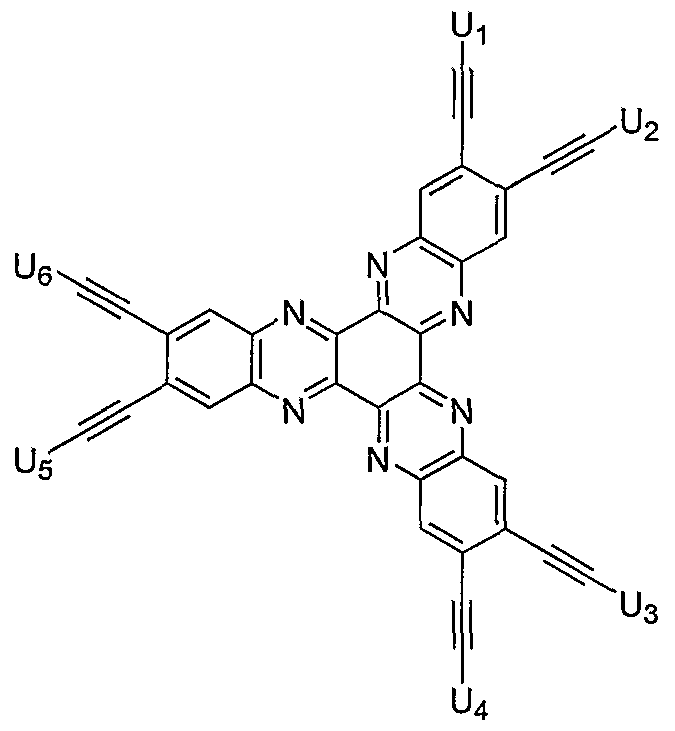
Another exemplary charge-transport material, among others, includes a hexaazatrinaphthylene (HATNA)-[CCU]6 monomer having a structure:
wherein U
1, U
2, U
3, U
4, U
5, and U
6 each are independently selected from: H; halogens; CN; NO
2; CHO; linear or branched, alkyl groups with up to 25 carbons; linear or branched, perfluoronated alkyl groups with up to 25 carbons; fused aromatic rings; donor groups; acceptor groups; aryl groups; polymerizable groups; -(CH2CH
2O)
α-(CH
2)pOR
ai; -(CH
2CH
2O)
α-(CH
2)
βNR
a2R
a3;
-(CH
2CH
2O)
α-(CH
2)βCOMl
a2Ra3; -(CH2CH2θ)
α-(CH2)βCN; -(CH
2CH2θ)
γ-(CH2)
δF; -(CH
2CH2θ)
γ-(CH2)δNO
2; -(CH
2CH2θ)
α-(CH2)βCl; -(CH
2CH2θ)
α-(CH2)βBr; -(CH2CH
2O)
α-(CH2)βI; -(CH
2CH2θ)
α-(CH
2)
β-Phenyl; -(CH
2)
β -(OCH
2CH
2)
αR
ai; -(CH
2)p -(OCH
2CH
2)
αNR
a2Ra3; -(CH2)
β -(OCH
2CH
2)OcCONRa
2Ra
3; -(CH
2)
β -(OCH
2CH
2)αCN; -(CH
2)β -(OCH
2CH
2)
αF; -(CH
2)p -(OCH
2CH
2)
αNO
2; -(CH
2)
β -(OCH
2CH
2)
αCl; -(CH
2)β -(OCH
2CH
2)
αBr; -(CH
2)β -(OCH
2CH
2)J; -(CH
2)
β -(OCH
2CH
2)αPhenyl; -(CF
2)pORai; -(CF
2)
PCH2NRa2R
a3;-(CF2)
PCF
3; -O(CF
2)
βOR
ai; -OCH
2CH
2(CF
2)βOR
ai; -OCH
2CH
2(CF
2)
pCH
2NR
a2R
a3; -O(CF
2)
βCH
2NR
a2R
a3; -0OH
2CH
2(CF
2)PCF
3; -(CH
2)β-(OCH
2CH
2)
αPhenyl; -(CF
2)β-(OCH
2CH
2)
αPhenyl; -(CH
2)P -(OCH
2CH
2)
αAiyl; -(CF
2)p-(OCH
2CH
2)
αAryl; -(OCH
2CH
2)
α-(CF
2)
β Aryl; -(OCH
2CH
2)
α-(CH
2)β Aryl; -0(CH
2)pAryl; and -O(CF
2)pAryl; and combinations thereof; and wherein R
ai, R
a2, and R
a3 can each be independently selected from, but not limited to, the following groups: H; linear or branched, alkyl groups with up to 25 carbons; a functional group derived from amino acids, nucleic acids, biotin, ferrocene, ruthenocene, cyanuric chloride, methacryloyl chloride, and derivatives thereof; wherein subscript α is an integer number from O to 25, and wherein subscript β is an integer number from O to 25.
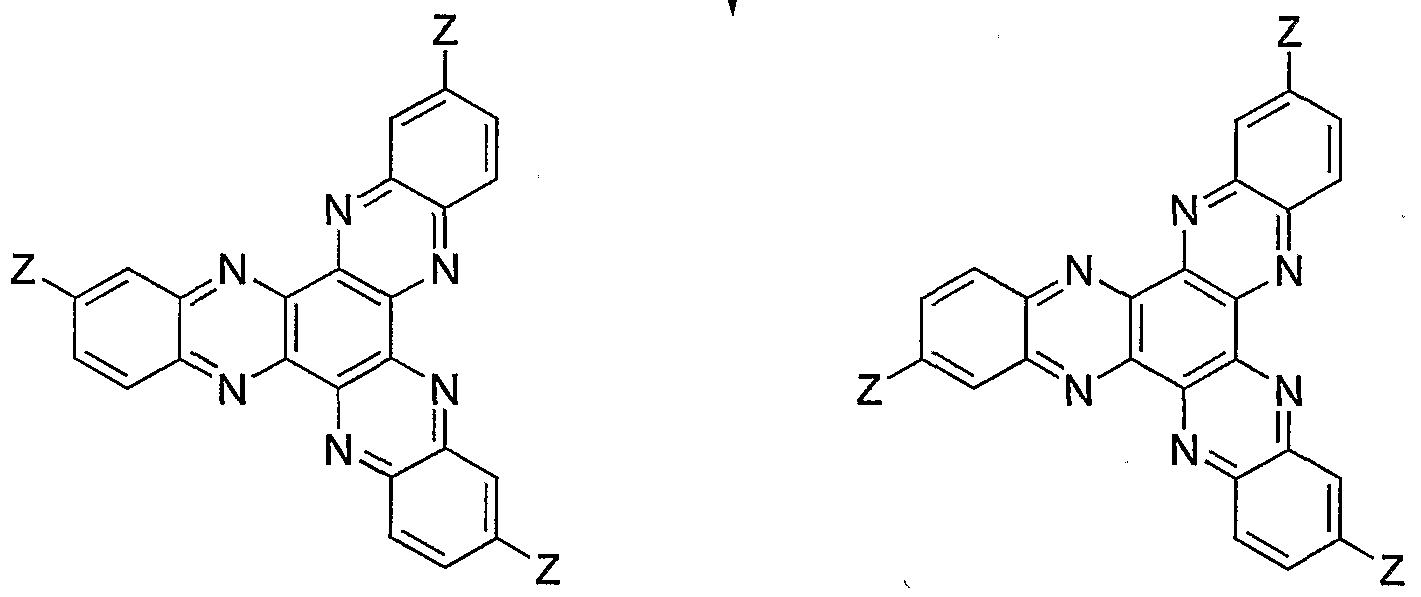
Another exemplary charge-transport material, among others, includes a hexaazatrinaphthylene (HATNA)-[Z]3 monomer having a structure:
wherein Z1, Z 2, and Z3 each are independently selected from: H; halogens; CN; NO2; CHO; CO2HaI, where Hal is a halogen selected from F, Cl, Br; linear or branched, alkyl groups with up to 25 carbons; linear or branched, perfluoronated alkyl groups with up to 25 carbons; fused aromatic rings; donor groups; acceptor groups; aryl
groups; polymerizable groups; -(CH2CH2θ)α-(CH2)βORai;
-(CH2CH2θ)α-(CH2)βNRa2Ra3; -(CH2CH2θ)α-(CH2)βCONRa2Ra3; -(CH2CH2θ)α-(CH2)βCN; -(CH2CH2θ)γ-(CH2)δF; -(CH2CH2θ)γ-(CH2)δNO2; -(CH2CH2O)a-(CH2)PCl; -(CH2CH2O)0-(CH2)PBr; -(CH2CH2θ)α-(CH2)βI; -(CH2CH2O)a-(CH2)p-Phenyl; -(CH2)β -(OCH2CH2)αRai; -(CH2)β -(OCH2CH2)αNRa2Ra3; -(CH2)β -(OCH2CH2)αCONRa2Ra3; -(CH2)β -(OCH2CH2)αCN; -(CH2)β -(OCH2CH2)αF; -(CH2)p -(OCH2CH2)αNO2; -(CH2)β -(OCH2CH2)αCl; -(CH2)p -(OCH2CH2)αBr; -(CH2)p -(OCH2CH2)J; -(CH2)P -(OCH2CH2)αPhenyl; -(CF2)βORai; -(CF2)βCH2NRa2Ra3;-(CF2)βCF3; -O(CF2)βORai; -OCH2CH2(CF2)βORai; -OCH2CH2(CF2)βCH2NRa2Ra3; -O(CF2)βCH2NRa2Ra3; -OCH2CH2(CF2)PCF3; -(CH2)p-(OCH2CH2)αPhenyl; -(CF2)β-(OCH2CH2)αPhenyl; -(CH2)β -(OCH2CH2)αAryl;
-(CF2)p-(OCH2CH2)αAryl; -(OCH2CH2)α-(CF2)β Aryl; -(OCH2CH2)a-(CH2)p Aryl; -O(CH2)βAryl; and -O(CF2)βAxyl; and combinations thereof; and wherein Rai, Ra2, and Ra3 can each be independently selected from, but not limited to, the following groups: H; linear or branched, alkyl groups with up to 25 carbons; a functional group derived from amino acids, nucleic acids, biotin, ferrocene, ruthenocene, cyanuric chloride, methacryloyl chloride, and derivatives thereof; wherein subscript α is an integer number from O to 25, and wherein subscript β is an integer number from O to 25.
Another exemplary charge-transport material, among others, includes a hexaazatrinaphthylene (HATNA)-[Z5J3 monomer having a structure:
wherein Z'i, Z'
2, and Z'
3 each are independently selected from: H; halogens; CN; NO
2; CHO; CO
2HaI where Hal is a halogen selected from F, Cl, Br; linear or branched, alkyl groups with up to 25 carbons; linear or branched, perfluoronated alkyl
groups with up to 25 carbons; fused aromatic rings; donor groups; acceptor groups; aryl groups; polymerizable groups; -(CH2CH2θ)
α-(CH2)
βOR
ai;
-(CH2CH2θ)α-(CH2)βNRa2Ra3; -(CH2CH2θ)α-(CH2)βCONRa2Ra3; -(CH2CH2θ)α-(CH2)βCN; -(CH2CH2θ)γ-(CH2)δF; -(CH2CH2O)γ-(CH2)δNO2; -(CH2CH2θ)α-(CH2)βCl; -(CH2CH2θ)α-(CH2)βBr; -(CH2CH2θ)α-(CH2)βI; -(CH2CH2O)α-(CH2)β-Phenyl; -(CH2)β -(OCH2CH2)αRai; -(CH2)P -(OCH2CH2)αNRa2Ra3; -(CH2)β -(OCH2CH2)CcCONRa2Ra3; -(CH2)β -(OCH2CH2)αCN; -(CH2)p -(OCH2CH2)αF; -(CH2)p -(OCH2CH2)αNO2; -(CH2)P -(OCH2CH2)αCl; -(CH2)p -(OCH2CH2)αBr; -(CH2)β -(OCH2CH2)J; -(CH2)P -(OCH2CH2)αPhenyl; -(CF2)βORai; -(CF2)βCH2NRa2Ra3;-(CF2)βCF3; -O(CF2)βORai; -OCH2CH2(CF2)βORai; -OCH2CH2(CF2)βCH2NRa2Ra3; -O(CF2)pCH2NRa2Ra3; -OCH2CH2(CF2)pCF3; -(CH2)p-(OCH2CH2)αPheαyl; -(CF2)β-(OCH2CH2)αPlienyl; -(CH2)β -(OCH2CH2)αAryl;
-(CF2)p-(OCH2CH2)αAryl; -(OCH2CH2)a-(CF2)p Aryl; -(OCH2CH2)a-(CH2)p Aryl; -O(CH2)βAryl; and -0(CF2)βAryl; and combinations thereof; and wherein Rai, Ra2, and Ra3 can each be independently selected from, but not limited to, the following groups: H; linear or branched, alkyl groups with up to 25 carbons; a functional group derived from amino acids, nucleic acids, biotin, ferrocene, ruthenocene, cyanuric chloride, methacryloyl chloride, and derivatives thereof; wherein subscript α is an integer number from O to 25, and wherein subscript β is an integer number from O to 25.
Another exemplary charge-transport material, among others, includes a hexaazatrinaphthylene (HATNA)-[T]12 monomer having a structure:
wherein T
1, T
2, T
3, T
4, T
5, T
6, T
7, T
8, T
9, T
10, T
11, and T
12, each are independently selected from: H; halogens; CN; NO
2; CHO; linear or branched, alkyl groups with up to 25 carbons; linear or branched, perfluoronated alkyl groups with up to 25 carbons;
fused aromatic rings; donor groups; acceptor groups; aryl groups; polymerizable groups; -(CH
2CH
2O)
α-(CH2)βOR
ai; -(CH
2CH
2O)
α-(CH
2)βNR
a2R
a3; -(CH
2CH
2O)
α-(CH
2)
βCONR
a2R
a3; -(CH
2CH
2O)
α-(CH
2)βCN; -(CH
2CH
2O)
γ-(CH
2)
δF; -(CH
2CH
2O)
γ-(CH
2)
δNO
2; -(CH
2CH
2O)
α-(CH
2)
βCl; -(CH2CH
2O)
α-(CH
2)βBr; -(CH
2CH
2O)
α-(CH
2)
βI; -(CH
2CH
2O)
α-(CH2)β-Phenyl; -(CH
2)
β -(OCH
2CH
2)
αR
ai; -(CH
2)
β -(OCH
2CH
2)
αNR
a2R
a3; -(CH
2)
β -(OCH
2CH
2)
αCONR
a2R
a3; -(CH
2)
β -(OCH
2CH
2)
αCN; -(CH
2)
β -(OCH
2CH
2)
αF; -(CH
2)
β -(OCH
2CH
2)
αNO
2 ; -(CH
2)
β -(OCH
2CH
2)
αCl; -(CH
2)
β -(OCH
2CH
2)
αBr; -(CH
2)
β -(OCH
2CH
2)J; -(CH
2)
β -(OCH
2CH
2)
αPhenyl; -(CF
2)βORai; -(CF
2)βCH
2NR
a2R
a3; -(CF
2)
βCF
3; -O(CF
2)
βOR
ai; -OCH
2CH
2(CF
2)
βOR
ai; -OCH
2CH
2(CF
2)
βCH
2NR
a2R
a3; -O(CF
2)
βCH
2NR
a2R
a3; -OCH
2CH
2(CF
2)
βCF
3; -(CH
2)
β-(OCH
2CH
2)
αPhenyl; -(CF
2)
β-(OCH
2CH
2)
αPhenyl; -(CH
2)
β -(OCH
2CH
2)
αAryl; -(CF
2)β-(OCH
2CH
2)
αAryl; -(OCH
2CH
2)
α-(CF
2)
β Aryl; -(OCH
2CH
2)
α-(CH
2)β Aryl; -O(CH
2)βAryl; and -O(CF
2)βAryl; and combinations thereof; and wherein R
ai, R
a2, and R
a3 can each be independently selected from, but not limited to, the following groups: H; linear or branched, alkyl groups with up to 25 carbons; a functional group derived from amino acids, nucleic acids, biotin, ferrocene, ruthenocene, cyanuric chloride, methacryloyl chloride, and derivatives thereof; wherein subscript α is an integer number from 0 to 25, and wherein subscript β is an integer number from 0 to 25.
Another exemplary charge-transport material, among others, includes a dodecaazatrianthracene (DATAN)-[W]12 monomer having a structure:
wherein W
1, W
2, W
3, W
4, W
5, and W
6, each are independently selected from: H; halogens; CN; NO
2; CHO; linear or branched, alkyl groups with up to 25 carbons;
98
linear or branched, perfluoronated alkyl groups with up to 25 carbons; fused aromatic rings; donor groups; acceptor groups; aryl groups; polymerizable groups; -(CH2CH2θ)α-(CH2)βORai; -(CH2CH2θ)α-(CH2)βNRa2Ra3; -(CH2CH2θ)α-(CH2)βCONRa2Ra3; -(CH2CH2θ)α-(CH2)βCN; -(CH2CH2θ)γ-(CH2)δF; -(CH2CH2O)γ-(CH2)δNO2; -(CH2CH2θ)α-(CH2)βCl; -(CH2CH2θ)α-(CH2)βBr; -(CH2CH2θ)α-(CH2)βI; -(CH2CH2O)α-(CH2)β-Phenyl; -(CH2)β -(OCH2CH2)αRai; "(CH2)P -(OCH2CH2)αNRa2Ra3; -(CH2)β -(OCH2CH2)αCONRa2Ra3; -(CH2)β -(OCH2CH2)αCN; -(CH2)β -(OCH2CH2)αF; -(CH2)β -(OCH2CH2)αNO2; -(CH2)β -(OCH2CH2)αCl; -(CH2)β -(OCH2CH2)αBr; -(CH2)β -(OCH2CH2)J; -(CH2)β -(OCH2CH2)αPhenyl; -(CF2)β0Rai; -(CF2)βCH2NRa2Ra3;-(CF2)βCF3; -O(CF2)βORai; -OCH2CH2(CF2)βORai; -OCH2CH2(CF2) βCH2NRa2Ra3; -O(CF2)pCH2NRa2Ra3; -OCH2CH2(CF2)βCF3; -(CH2)β-(OCH2CH2)αPhenyl; -(CF2)β-(OCH2CH2)αPhenyl; -(CH2)β -(OCH2CH2)αAryl; -(CF2)β-(OCH2CH2)αAryl; -(OCH2CH2)U-(CF2) β Aryl; -(OCH2CH2)α-(CH2)β Aryl; -O(CH2)βAryl; and -O(CF2)βAryl; and combinations thereof; and wherein Rai, Ra2, and Ra3 can each be independently selected from, but not limited to, the following groups: H; linear or branched, alkyl groups with up to 25 carbons; a functional group derived from amino acids, nucleic acids, biotin, ferrocene, ruthenocene, cyanuric chloride, methacryloyl chloride, and derivatives thereof; wherein subscript α is an integer number from O to 25, and wherein subscript β is an integer number from O to 25.
Another exemplary charge-transport material, among others, includes a hexaazatrinaphthylene (HATNA)-[Imide]3 monomer having a structure:
wherein V
1, V
2, and V
3, each are independently selected from: H; linear or branched, alkyl groups with up to 25 carbons; linear or branched, perfluoronated alkyl groups with up to 25 carbons; fused aromatic rings; donor groups; acceptor groups; aryl groups; polymerizable groups; ; -(CH2CH2θ)
α-(CH2)βCH2-OR
ai;
-(CH2CH2θ)α-(CH2)βCH2-NRa2Ra3; -(CH2CH2O)α-(CH2)βCH2-CONRa2Ra3; -(CH2CH2θ)α-(CH2)βCH2-CN; -(CH2CH2θ)γ-(CH2)δCH2-F; -(CH2CH2O)γ-(CH2)δCH2-NO2; -(CH2CH2θ)α-(CH2)βCH2-Cl; -(CH2CH2O)0-(CH2)PCH2-Br; -(CH2CH2O)0-(CH2)PCH2-I; -(CH2CH2O)a-(CH2)p-Phenyl; -CH2-(CH2)β -(OCH2CH2)αRai; -CH2-(CH2)β -(OCH2CH2)αNRa2Ra3; -(CH2)p CH2-(OCH2CH2)αCONRa2Ra3; -CH2-(CH2)β -(OCH2CH2)αCN; -CH2-(CH2)β -(OCH2CH2)αF; -CH2-(CH2)β -(OCH2CH2)αNO2 ; -CH2-(CH2)β -(OCH2CH2)αCl; -CH2-(CH2)β -(OCH2CH2)αBr; -CH2-(CH2)β -(OCH2CH2)J; -CH2(CH2)β -(OCH2CH2)αPhenyl; -CF2-(CF2)β0Rai; -CF2-(CF2)βCH2NRa2Ra3;-(CF2)βCF3; -(CF2)βORai; -CH2CH2(CF2)PORai; -CH2CH2(CF2)PCH2NRa2Ra3; -(CF2) PCH2NRa2Ra3; -CH2CH2(CF2)βCF3; -CH2-(CH2)β-(OCH2CH2)αPhenyl; -CF2-(CF2)β-(OCH2CH2)αPhenyl; -CH2-(CH2)β -(OCH2CH2)αAryl; -CF2-(CF2)β-(OCH2CH2)αAryl; -CH2CH2-(OCH2CH2)U-O(CF2)P Aryl; CH2CH2-(OCH2CH2)a-O(CH2)β Aryl; -CH2O(CH2)βAryl; and -(CF2)βAryl; and combinations thereof; and wherein Rai, Ra2, and Ra3 can each be independently selected from, but not limited to, the following groups: H; linear or branched,, alkyl groups with up to 25 carbons; a functional group derived from amino acids, nucleic acids, biotin, ferrocene, ruthenocene, cyanuric chloride, methacryloyl chloride, and derivatives thereof; wherein subscript α is an integer number from O to 25, and wherein subscript β is an integer number from O to 25.
Another exemplary charge-transport material, among others, includes a polymer, co-polymer, or a homopolymer, among others that can include one or more of a monomer such as, but not limited to, a HATNA-[X]6 monomer, a HATNA- [CO2Y]3, a HATNA-[CCU]6 monomer, a HATNA-[Z]3 monomer, a DATAN-[W]12 monomer, a HATNA-[Imide]3 monomer, a HATNA-[CO2Y']3 monomer, a HATNA- [Z']3 monomer, a HATNA-[T]12 monomer, and combinations thereof.
5 020998
A device, among others, that can include one or more of a monomer such as, but not limited to, a HATNA-[X]6 monomer, a HATNA-[CO2Y]3, a HATNA-[CCU]6 monomer, a HATNA-[Z]3 monomer, a DATAN-[W]12 monomer, a HATNA-[Imide]3 monomer, a HATNA-[CO2Y' ]3 monomer, a HATNA-[Z']3 monomer, a HATNA- [T]12 monomer, and combinations thereof.
A polymer layer, among others, that can include one or more of a monomer such as, but not limited to, a HATNA-[X]6 monomer, a HATNA-[CO2Y]3, a HATNA-[CCU]6 monomer, a HATNA-[Z]3 monomer, a DATAN-[W]12 monomer, a HATNA-[Imide]3 monomer, a HATNA-[CO2Y']3 monomer, a HATNA-[Z']3 monomer, a HATNA-[T]12 monomer, and combinations thereof.
A device, among others, that includes a first electrode and a second electrode. The first electrode includes: a hole-transport layer disposed adjacent the first electrode; and an electron-transport layer disposed adjacent the hole-transport layer, and wherein the electron-transport material is selected from: HATNA-[X]6 of claim 1, HATNA-[CO2Y]3 of claim 4, HATNA-[CO2Y']3 of claim 7, HATNA-[CCU]6 of claim 10, HATNA-[Z]3 of claim 13, HATNA-[Z']3 of claim 16, HATNA-[T]12 of claim 19, DATAN-[W]12 of claim 22, HATNA-[Imide]3 of claim 25, and combinations thereof. The second electrode is disposed adjacent the electron- transport layer.
An organic photovoltaic cell, among others, that includes a first electrode and a second electrode. The first electrode includes a hole-transport layer disposed adjacent the first electrode; an electron-transport layer disposed adjacent the hole- transport layer, and wherein the electron-transport material is selected from: HATNA- [X]6 of claim 1, HATNA-[CO2Y]3 of claim 4, HATNA-[CO2Y']3 of claim 7, HATNA-[CCU]6 of claim 10, HATNA-[Z]3 of claim 13, HATNA-[Z']3 of claim 16, HATNA-[T]12 of claim 19, DATAN-[W]12 of claim 22, HATNA- [Imide]3 of claim 25, and combinations thereof; and an exciton blocking layer disposed adjacent the electron-transport layer. The second electrode is disposed adjacent the exciton blocking layer.
An organic field-effect transistor, among others, that includes: a substrate; a gate electrode disposed on a first side of the substrate; a gate insulator disposed on a second side of the substrate; a source electrode disposed on a first portion of the gate insulator; a drain electrode disposed on a second portion of the gate insulator; and an electron-transport layer disposed on a third portion of the gate insulator, the source
electrode, and the drain electrode, and wherein the electron-transport material is selected from: HATNA-[X]6 of claim 1, HATNA-[CO2Y]3 of claim 4, HATNA- [CO2Y']3 of claim 7, HATNA-[CCU]6 of claim 10, HATNA-[Z]3 of claim 13, HATNA-[Z']3 of claim 16, HATNA-[T]i2 of claim 19, DATAN-[W]12 of claim 22, HATNA-[Imide]3 of claim 25, and combinations thereof.
BRIEF DESCRIPTION OF THE DRAWINGS
Many aspects of the disclosure can be better understood with reference to the following drawings. The components in the drawings are not necessarily to scale, emphasis instead being placed upon clearly illustrating the principles of the present disclosure. Moreover, in the drawings, like reference numerals designate corresponding parts throughout the several views.
FIG. 1 illustrates a chemical structure of hexaazatrinaphthylene (HATNA) compound.
FIG. 2 illustrates general chemical structures of HATNA and dodecaazatrianthracene (DATAN) compounds.
FIG. 3 illustrates the X-ray structure of HATNA (reproduced from references 10, 11, and 12).
FIG. 4 illustrates the DSC of BK2_93, HATNA_[NO2]6.
FIG. 5 illustrates the train purification system; sublimation of HATNA, BK2_73.
FIG. 6 illustrates the sublimation OfHATNA-Cl6, BK2_67.
FIG. 7 illustrates the 1H NMR of sublimed HATNA, BK2_73C.
FIG. 8 illustrates the 1H NMR OfHATNA-Cl6, BK2_67, (a) before and (b) after sublimation.
FIG. 9A illustrates the ORTEP OfHATNA-Cl6, BK2_67C.
FIG. 9B illustrates the molecular packing of sublimed HATNA-Cl6, BK2_67C.
FIG. 10 illustrates the crystals in tubes 2.3 and 2.4 upon the sublimation of HATNA-[Me]6 (refer to BRK_III_92 for details).
FIG. 11 illustrates the TGA (thermal stability) of BK2_67C (sublimed HATNA_C16) andBK2_73C (sublimed HATNA).
98
FIG. 12 illustrates the normalized absorption of BK2_73C and BK2_67C in CH2Cl2. The sample was filtered before acquiring the data because of the low solubility; therefore, the concentration was not determined.
FIG. 13 illustrates the cyclic DC voltammogram of HATNA, BK2_73C, in dichloromethane with 0.1 M TBAPF6 (vs Ag/AgCl ); E1^ = -1.442 V; E2 red = -1.793 V; E3 red = -1.870 V; E4 red = -2.203 V. The reduction potentials are calculated vs. Fc +/Fc
FIG. 14 illustrates the cyclic DC voltammogram OfHATNA-Cl6, BK2_67C, in dichloromethane with 0.1 M TBAPF6 (vs Ag/AgCl ); E/60 = -1.286 V; E2 rcd = - 1.514 V; E3 red = -2.022 V. The reduction potentials are calculated vs. Fc +/Fc.
FIG. 14A illustrates the proposed design of an OFET based on HATNA F12 and a HT material.
FIG. 15 illustrates the thermal stability of BK2J71E, BK2_99B, and BK3_3E.
FIG. 16A illustrates the DSC of HATNA_[SC12H25]6, BK2_71E; first cycle of heating and cooling.
FIG. 16B illustrates the DSC of HATNA_[SC12H25]6, BK2_71E; second cycle of heating and cooling.
FIG. 16C illustrates the DSC of HATNA_[SC12H25]6, BK2_71E; first cycle of heating (till 200 °C) and cooling.
FIG. 16D illustrates the DSC of HATNA_[SC12H25]6, BK2_71E; second cycle of heating (till 200 °C) and cooling.
FIG. 17A illustrates the DSC of HATNA_[SC8H17]6, BK2_99B; first cycle of heating and cooling.
FIG. 17B illustrates the DSC of HATNA_[SC8H17]6, BK2_99B; second cycle of heating and cooling.
FIG. 17C illustrates the DSC of HATNA_[SC8H17]6, BK2_99B; first cycle of heating (till 200 °C) and cooling.
FIG. 17D illustrates the DSC of HATNA_[SC8H17]6, BK2_99B; second cycle of heating (till 200 0C) and cooling.
FIG. 18 illustrates the cyclic DC voltammogram of HATNA_[SC12H25]6, BK2_71E, in dichloromethane with 0.1 M TBAPF6 (vs. a Ag/AgCl pseudoreference); half-wave reduction potentials OfE1 1* = -1.449 V; E2 red = -1.881 V; E1 = -2.026 V are calculated vs ferrocenium/ferrocene.
FIG. 19 illustrates the cyclic DC voltarnmogram of HATNAJSC8Hn]6, BK2_99B, in dichloromethane with 0.1 M TBAPF6 (vs a Ag/ AgCl pseudoreference); half-wave reduction potentials of Ei"*1 = -1.468 V; E2 τed = -1.708 V; E3 - -1.980 V are calculated vs ferrocenium/ferrocene.
FIG. 20 illustrates the absorbance of HATNA_[SC8H17]6, BK2_99B, HATN_[SC12H25]6, BK2_71E, and HATNA JOC12H25]6, BK3-3E, in CH2Cl2.
FIG. 21 illustrates the textures of HATNAJSC12H25]6, BK2_71E, between cross-polarizers.
FIG. 22 illustrates the textures of HATNA JSC8H17]6, BK2_99B, between cross-polarizers.
FIG. 23 illustrates the cyclic DC voltammogram of HATNA JOC12H25]6, BK3_3G in dichloromethane with 0.1 M TBAPF6 (vs. a Ag/ AgCl pseudoreference); half-wave reduction potentials of Ei1*1 = -1.775 V; E2 red = -2.020 V are calculated vs ferrocenium/ferrocene.
FIG. 24A illustrates the DSC of HATNA JOC12H25]6, BK3_3G; first cycle of heating and cooling.
FIG. 24B illustrates the DSC of HATNA JOC12H25]6, BK3_3G; second cycle of heating and cooling.
FIG. 25 illustrates the textures of BK3_3E between cross-polarizers.
FIG. 26 illustrates the absorbance of HATNA-OxC6, BK2_91B, HATNA _OxCs, BK2_83C, HATNAJDxC12, BK1_47D, in CH2Cl2.
FIG. 27 illustrates the polarized optical photos of BK1_47D between cross- polarizers; (a) 1OX magnification; (b) 2OX magnification; (c) & (d) 5OX magnification.
FIG. 28A illustrates the DSC of HATNA JOx(PhOC12H25)3]3, BK2_27B; the first cycle of heating and cooling.
FIG. 28B illustrates the DSC of HATNAJOx(PhOC12H25)3]3, BK2_27B; the second cycle of heating and cooling.
FIG. 29A illustrates the DSC of HATNA JOx(PhOC8H17)3]3,BK2_83D; the first cycle of heating and cooling.
FIG. 29B illustrates the DSC of HATNAJOx(PhOC8H17)3]3,BK2_83D; the second cycle of heating and cooling.
FIG. 30 illustrates the textures of BK2_83C; (a) & (c) between cross- polarizers; (b) and (d) between non-cross-polarizers.
FIG. 31 illustrates the textures of BK1_91D; (a) between cross-polarizers; (b) between non-cross-polarizers.
FIG. 32 illustrates the 300 1H MHz of HATNA_[Ox(PhOC12H25)3]3, BK1_47D.
FIG. 33 illustrates the MALDI-TOF of HATNAJOx(PhOC12H25)3]3, BK1_47D.
FIG. 34 illustrates the cyclic DC and AC (OSWV) voltammograms of BK1_21H in dichloromethane with 0.1 M "BuN+PF6 " (relative to ferrocenium/ferrocene).
FIG. 35 illustrates the powder XRD pattern for BK3_27B assumed to be in the Colhd phase at room temperature.
FIG. 36 illustrates the MALDI-TOF of BK1_31 (BK2_9F).
FIG. 37 illustrates the HPLC traces of HATNAJCO2CH2PhFs]3, BRK_III_78C, BRK_III_83B_T9, BRK_III_78E1, BRK_III_78E4, BRK_m_78E3, and BRK_iπ_78F2.
FIG. 37A illustrates the 1H 500 MHz NMR of BRK_III_78E1 in CDCl3. The inset is the corresponding analytical HPLC traces analysis.
FIG. 37B illustrates the 1H 500 MHz NMR of BRK_III_78F2 in CDCl3. The inset is the corresponding analytical HPLC traces analysis.
FIG. 37C illustrates the 1H 500 MHz NMR of BRK_III_78E3 in CDCl3. The inset is the corresponding analytical HPLC traces analysis.
FIG. 37D illustrates the 1H 500 MHz NMR of BRK_III_78F2, BRK_III_78F2, and BRK_III_78F2 in CDC13; (a) aliphatic region; (b) aromatic region.
FIG. 37E illustrates the 1H NMR (CDCl3, 500 MHz) of concentrated (24.03 mg/0.8 ml) and dilute (3.93 mg/0.8 ml) solutions of BRK_III_78E4- 2,8,15 isomer ((a) and (c) 1H NMR of concentrated solution of aliphatic and aromatic regions, respectively; and (b) and (d) 1H NMR of dilute solution of aliphatic and aromatic regions, respectively).
FIG. 37F illustrates the 19F (CDCl3, 376 MHz) of the isomers of HATNAJCO2CH2PhF5]S- (a) 2,8,15-isomer, BRKJII_78F2; (b) 2,8,14-isomer, BRKJII_78E1; (c) mixture of isomers, BRKJII_78E3. F0:F,n:Fp = 2:2:1 for all three spectra. The chemical shifts are relative to trifluoromethylbenzene, which was used as an external standard.
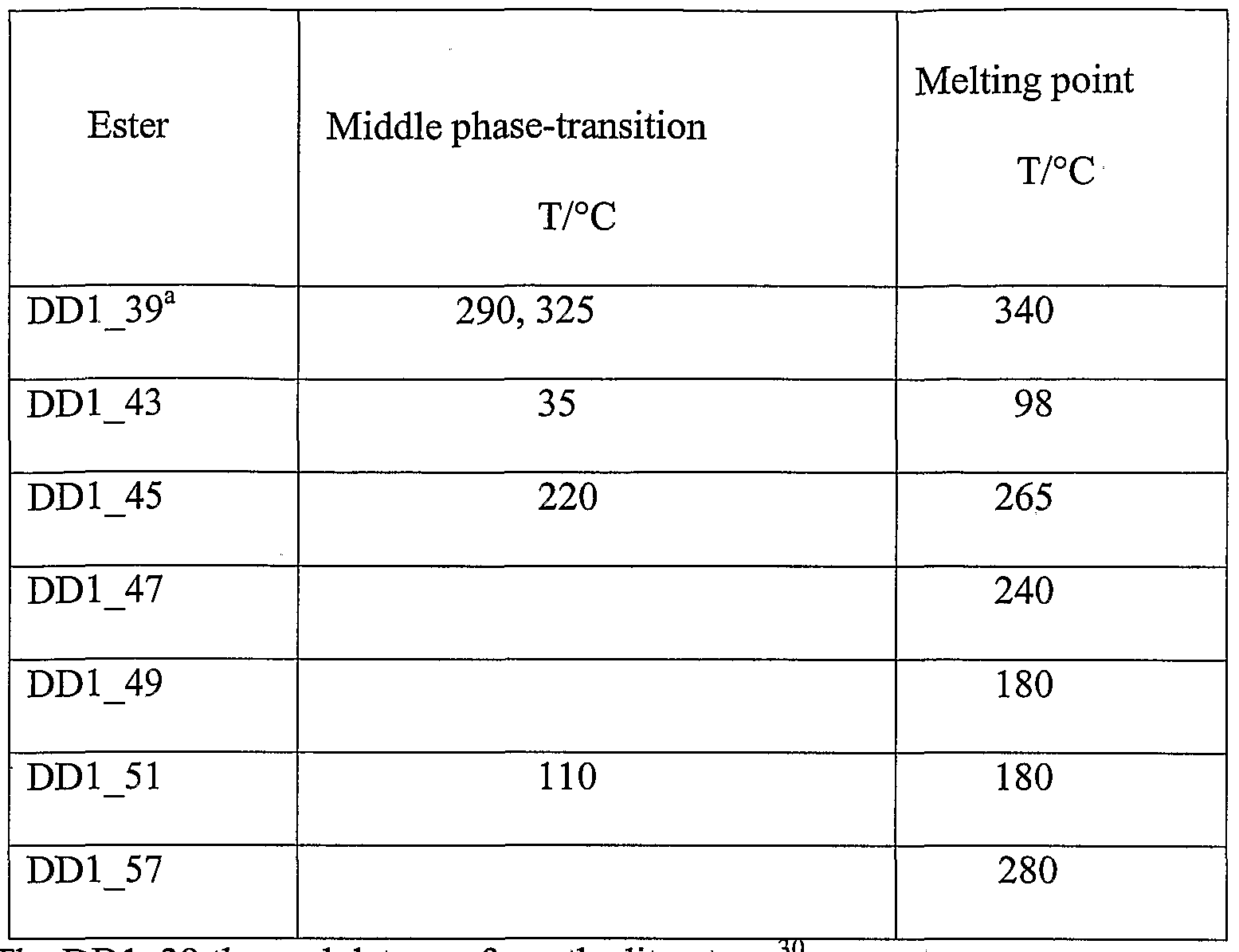
FIG. 38 illustrates the POM micrograph of DD1_43 at t = 108.8 °C upon heating.
FIG. 39 illustrates the POM micrograph of DD1_45 ester at t = 62 0C upon cooling.
FIG. 40 illustrates the CV graphs of HATNA esters in CH2C12/O.l M "BuN+PF6 " (relative to ferrocenium/ferrocene).
FIG. 41 illustrates the UV-vis spectrum of DD1_43 in CH2Cl2.
FIG. 42 illustrates the 1H NMR (300 MHz, CDCl3) of BRK_III_63A.
FIG. 43 illustrates the MALDI-TOF of BRK_III_67A.
FIG. 44 illustrates the 300 MHz 1H NMR of BRK_III_41 A in DMSO.
FIG. 45 illustrates the FAB of BRK_III_57B.
FIG. 46 illustrates the MALDI-TOF of DATNA BRK_III_87C.
FIG. 47 illustrates the energy levels of the ITO-BRK_III_59-A1 device.
FIG. 48 illustrates the linear (left) and log-log (right) plots of I- V curve for 5- μm thick HATNA-[CO2CH2PhFs]3, BRK_III_59, device at room temperature, the dotted red lines are the linear and quadratic fitting at different voltage range.
FIG. 49 illustrates the I-V curve for 5 μm thick HATNA-[CO2CH2PhF5J3 device at room temperature after 10 days storage, the dotted red line is I-V curve is that of the fresh sample.
FIG. 50 illustrates the Arrhenius plot of the zero-field mobility versus temperature. The solid line is according to Eq. (3).
FIG. 51 illustrates the relation of coefficient γ and temperature T. The solid line was obtained from Eq. (3). This empirical dependence of γ and T was initially suggested by Gill for PVK system.46
FIG. 52 illustrates the linear (left) and log-log (right) plots of the transient photocurrents for 104 μm thick HATNA_[SC12H25]6 device at room temperature.
FIG. 53 illustrates the field dependence of the electron mobility of HATNA_[SC12H25]6 film at room temperature.
FIG. 54 illustrates the linear (left) and log-log (right) plots of I-V curve for 5 μm thick HATNA-[SC12H2S]6 device at room temperature, the dotted red line is quadratic fitting at 6.5-10.3V range.
98
FIG. 55 illustrates the I-V curve for 5 μm thick HATNA_[SC12H25]6 device at room temperature after three days storage, the solid black line is that of the I-V curve of the fresh sample.
FIG. 56 is a schematic of an organic light-emitting diode.
FIG. 57 is a schematic of an organic photovoltaic cell.
FIG. 58 is a schematic of an organic field-effect transistor with bottom electrodes.
FIG. 59 is a schematic of the electrical output characteristic of an organic field-effect transistor. The curves show the current measured between source and drain electrodes as a function of the voltage between source and drain electrodes.
FIG. 60 is a schematic of an organic field-effect transistor with top electrodes.
FIG. 61 A is a schematic of an organic field-effect transistor with a surface modifier and with bottom electrodes.
FIG. 61B is a schematic of an organic field-effect transistor with a surface modifier and top electrodes.
FIG. 62A illustrates the chemical structure OfHATNA-Cl6.
FIG. 62B illustrates the output characteristic of a transistor comprised of HATNA-Cl6 as the organic semiconductor.
FIG. 62C illustrates the transfer curve of a transistor comprised of HATNA- Cl6 as the organic semiconductor.
FIG. 63A illustrates the chemical structure OfHATNA-F12.
FIG. 63B illustrates the output characteristic of a transistor comprised of HATNA-F12 as the organic semiconductor.
FIG. 63 C illustrates the transfer curve of a transistor comprised of HATNA- F12 as the organic semiconductor.
FIG. 64 illustrates HPLC traces of (a) compound Ia, (b) mixture of compounds la/b, and (c) compound Ib'.
FIG. 65 illustrates 19F-NMR (CDC13, 376MHz) of compound Ia, a mixture of compounds la/b, and compound Ib'.
FIG. 66 illustrates cross-polarized optical microscopy images of compound Ib', (a) solidification with 95 °C/min cooling rate; (b) with 60 °C/min; (c) with 30 °C/min; (d) with 10 °C/min from isotropic phase. AU samples were solidified between two glass slides or ITO glasses.
DETAILED DESCRIPTION
In accordance with the purpose(s) of the present disclosure, as embodied and broadly described herein, embodiments of the present disclosure, in one aspect, relate to charge-transport material, methods of making charge-transport materials, and methods of using charge-transport materials. In particular, the charge-transport materials include, but are not limited to, compounds having hexaazatrinaphthylenes (HATNA) cores and dodecaazatrianthracenes (DATAN) cores, and having side chains (groups or mesogens) attached to the core. HATNA and DATAN charge-transport materials have strong intermolecular overlap and low reorganization energies, coupled with the tunability of redox potentials, of glass-, crystal-, and liquid-crystal-forming abilities, of the derealization of electronic structure, and of the degree of molecular and materials anisotropy. hi particular, the side chains of HATNA and DATAN cores can be selected to provide charge-transport materials having various volatilities, solubilities, crystallinity, and charge transport ability, as well as being a hole-transport material or an electron-transport material. In other words, the side chains can be selected to tune the characteristics of the charge-transport material as necessary.
The charge-transport materials described herein can be used in a wide variety of electronic applications that include, but are not limited to, electroluminescent (EL) devices (e.g., organic light emitting devices (OLEDs)), photovoltaic cells, light- emitting diodes, field-effect transistors, phototransistors, radio-frequency ID tags, semiconductor devices, photoconductive diodes, metal-semiconductor junctions (e.g., Schottky barrier diodes), p-n junction diodes, p-n-p-n switching devices, photodetectors, optical sensors, phototransducers, bipolar junction transistors (BJTs), heterojunction bipolar translators, switching transistors, charge transfer devices, thin film transistors, organic radiation detectors, infra-red emitters, tunable microcavities for variable output wavelength, telecommunications devices and applications, optical computing devices, optical memory devices, chemical detectors, combinations thereof, and the like. m addition, the charge-transport materials may also be used to modify the surfaces of other material components with the aim of improving mechanical contact between materials and/or to improve charge-transport from one material to another.
The charge-transport materials may exist as crystals, mesoscopic phases, polymers, glasses, liquids, gases, and combinations thereof. The state of charge- transport materials can be altered by processing the charge-transport materials, mixing
the charge-transport materials with other materials, using different side chains in the charge-transport materials relative to other charge-transport materials, and the like. One skilled in the art could modify embodiments of the present disclosure to alter the state of the charge-transport materials.
The charge-transport materials can be processed to produce a highly ordered mesophase morphology. When the charge-transport materials are used to form a layered thin film, the molecules have a preferential orientation in space. In particular, the charge-transport materials can have a certain degree of long-range orientational molecular order and long-range translational molecular order. The mesophase ordering allows close packing of molecular pi-electron systems (e.g., closely packed conjugated aromatic rings, in which very close pi-pi stacking can occur). Pi-pi stacking allows intermolecular charge transport to occur more easily, leading to high charge carrier mobilities, which increases intermolecular charge transfer that occurs through a hopping mechanism between adjacent molecules, hi particular, the charge- transport material compounds can stack in the form of well-defined columns (e.g., the aromatic cores in one layer are substantially aligned with the aromatic cores in adjacent layers) forming one dimensional paths for charge transport along the stacked conjugated cores due to the good intermolecular overlap within the stacks.
This ordered, and oriented microstructure can be made substantially permanent by polymerizing the charge-transport materials, which can also create a structure with long-range order, or a "monodomain." Formation of a monodomain , also maximizes charge transfer by eliminating charge trap sites at grain boundaries, while the polymerization also improves the mechanical properties of the film. Further, by cross-linking the charge-transport material compounds, a highly stable structure results, which has an additional advantage of being substantially impervious to subsequent processing solvents during device fabrication, thus allowing a wider range of solvents to be used in deposition of the next layer of the device by solution techniques. In addition, the cross-linking may increase the density of the film, leading to smaller intermolecular distances and improved charge transport.
The charge-transport materials may be in a liquid crystalline phase, may show liquid crystal phase behavior in mixtures with other compounds, or when the compounds or materials, or the mixtures thereof, are polymerized, they are in a liquid crystalline phase. As used herein, a "liquid crystalline phase" or "liquid crystal phase" includes a phase that is intermediate to a liquid phase and a crystalline phase.
In the liquid crystalline phase, the orientations of a portion of the charge-transport material compounds are correlated to each other (e.g., the orientation of each individual charge-transport material compound is affected and is affecting the orientation of the neighboring charge-transport material compound), and the correlation can extend to a large scale (e.g., equal to or larger than 1 micron so that a substantial portion of the charge-transport material compounds are orientated (e.g., the central aromatic cores are substantially aligned in subsequent layers to form a one dimensional column for charge transport)). The orientation-correlation in the liquid crystals allows one to control the orientations of the charge-transport material compounds with the aid of an electrical field, a magnetic field, or a pre-treated surface, so that one can switch the orientation or dimmish the unwanted effect of the local environment (e.g., impurities). This is unlike an isotropic phase where the orientations of charge-transport material compounds in solution are random.
The alignment of the molecules of the liquid crystals is conventionally regarded as being alignment with respect to a vector called the director. Unlike in the solid phase, in the crystalline state the positions of the molecules in the liquid crystal phase do not have long range order in at least one direction. For example, discotic liquid-crystalline mesophases include quasi-two-dimensional molecules, which include a rigid conjugated core and flexible side chains (e.g., HATNA and DATAN charge-transport molecules). The charge-transport material compounds in the discotic liquid-crystalline mesophase can stack in the form of well-defined columns, forming one-dimensional paths for charge transport along the stacked conjugated cores due to the good intermolecular overlap within the stacks.
Alignment of the liquid crystal material can be achieved for example by application of a magnetic and/or electric field (e.g., oscillating electro-magnetic radiation), by treatment of the substrate onto which the material is coated, by shearing the material during or after coating, by application of a magnetic and/or electric field (e.g., oscillating electro-magnetic radiation) to the coated material, or by the addition of surface-active compounds to the liquid crystal material. Reviews of alignment techniques are given for example by I. Sage in "Thermotropic Liquid Crystals", edited by G. W. Gray, John Wiley & Sons, 1987, pages 75-77, and by T. Uchida and H. Seki in "Liquid Crystals— Applications and Uses Vol. 3", edited by B. Bahadur, World Scientific Publishing, Singapore 1992, pages 1-63. A review of alignment materials
and techniques is given by J. Cognard, MoI. Cryst. Liq. Cryst. 78, Supplement. (1981), pages 1-77.
As mentioned above, the charge-transport materials includes HATNA or DATAN cores. The following structures illustrate the HATNA core and the DATAN core:
HATNA CORE DATAN CORE
The HATNA or DATAN can be monomer units in a polymer of the charge- transport material, such as a homopolymer or a copolymer {e.g., block copolymers, random copolymers, alternating copolymers, periodic copolymers, and combinations thereof). The monomer units in embodiments of the copolymers can include the HATNA and/or DATAN core {e.g., see various structures below), as well as other monomer units consistent with the purposes and characteristics of the charge-transport materials described herein.
Various groups {e.g., atoms and compounds) or mesogenic units can be bonded to the HATNA core and/or the DATAN core to form a variety of charge- transport materials. The type of group and/or the combinations of groups and/or the location of the groups bonded to the HATNA core and/or the DATAN core can be selected to tune or manipulate the volatility, solubility, crystallmity, melting point, phase transitions, shelf life, and charge transport ability, of the charge-transport material, hi addition, the type of group and/or the combinations of groups that can be bonded to the HATNA core and/or the DATAN core can be selected to form a hole- transport material or an electron-transport material. For example, see the discussion corresponding to Scheme 7 in Example 1.
The following structures describe non-limited embodiments of the charge- transport material compounds having the HATNA core or the DATAN core:
In HATNA-[X]
6, HATNA-[CO
2Y]
3, HATNA-[CO
2Y']
3, HATNA-[CCU]
6, HATNA-[Z]
3, HATNA-[Z']
3, HATNA-[T]
12, HATNA- [Imidefc, and DATNA-[W]
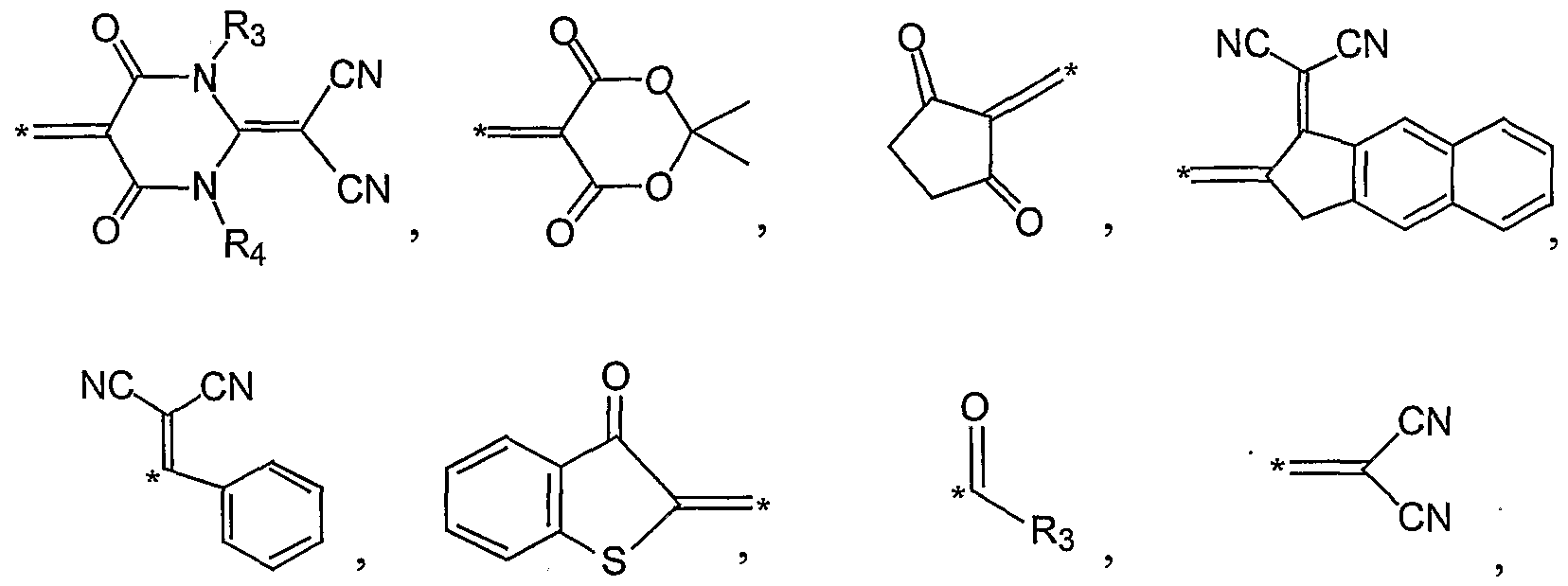
6, an asterisk (*) in the structures shown below identifies the atom of attachment to a functional group and implies that the atom is missing one hydrogen that would normally be implied by the structure in the absence of the asterisk. Also note the following: "-" indicates a single bond between 2 atoms, "=" indicates a double bond between 2 atoms, and "≡" indicates a triple bond between 2 atoms.
In HATNA-[X]6, HATNA-[CO2Y]3, HATNA-[CO2Y']3, HATNA-[CCU]6, HATNA-[Z]3, HATNA-[Z']3, HATNA-[T]12, HATNA-[Imide]3, and DATNA-[W]6, the groups can include from one type of group to up to twelve types of groups depending on the particular charge-transport material (e.g., HATNA-[CO2Y]3 as compared to HATNA-[T]12). For example, X1, X2, X3, X4, X5, and X6, could be the same type of group, two types of groups, three types of groups, four types of groups, five types of groups, or six types of groups. It should also be noted that the configuration (e.g., position on the molecule) of the groups on the molecules can vary depending on the number of different groups bonded to the molecules to produce charge-transport materials having a particular characteristic.
Groups R3, R4, T1, T2, T3, T4, T5, T6, T7, T8, T9, T10, T11, T12, U1, U2, U3, U4, U5, U6, W1, W2, W3, W4, W5, W6, X1, X2, X3, X4, X5, X6, Z1, Z2, Z3, Tx, T1, and Z'3, can each be independently selected from, but not limited to, the one or more of following groups: H; halogens; CN; NO2; CHO; linear or branched, alkyl groups with up to 25 carbons (e.g., O, 1, 2, 3, 4, 5, 6, 7, 8, 9, 10, 11, 12, 13, 14, 15, 16, 17, 18, 19, 20, 21, 22, 23, 24, and 25 carbons in all isomer forms such as normal, secondary, iso- and neo- isomers); linear or branched, perfluoronated alkyl groups with up to 25 carbons (e.g., 0, 1, 2, 3, 4, 5, 6, 7, 8, 9, 10, 11, 12, 13, 14, 15, 16, 17, 18, 19, 20, 21, 22, 23, 24, and 25 carbons in all isomer forms such as normal, secondary, iso- and neo- isomers); fused aromatic rings (e.g., two to four rings); donor groups (e.g., those having low ionization potentials, see discussion below); acceptor groups (e.g., those having high electron affinity, see discussion below); aryl groups (see discussion below); and polymerizable groups (see discussion below). hi addition, groups R3, R4, T1, T2, T3, T4, T5, T6, T7, T8, T9, T10, T11, T12, U1, U2, U3, U4, U5, U6, W1, W2, W3, W4, W5, W6, X1, X2, X3, X4, X5, X6, Z1, Z2, Z3, T1, T 2, and Z'3, can each be independently selected from, but not limited to, one or more
of the following groups: -(CH2CH2θ)α-(CH2)βORai;
-(CH2CH2O)α-(CH2)βNRa2Ra3; -(CH2CH2θ)α-(CH2)βCONRa2Ra3;
-(CH2CH2θ)α-(CH2)βCN; -(CH2CH2θ)γ-(CH2)δF; -(CH2CH2O)γ-(CH2)δNO2;
-(CH2CH2O)α-(CH2)βCl; -(CH2CH2θ)α-(CH2)βBr; -(CH2CH2θ)α-(CH2)βI;
-(CH2CH2O)α-(CH2)β-Phenyl; -(CH2)β -(OCH2CH2)αRai;
-(CH2)P -(OCH2CH2)αNRa2Ra3; -(CH2)p -(OCH2CH2)αCONRa2Ra3;
-(CH2)P -(OCH2CH2)αCN; -(CH2)P -(OCH2CH2)αF; -(CH2)β -(OCH2CH2)αNO2 ;
-(CH2)P -(OCH2CH2)αCl; -(CH2)p -(OCH2CH2)αBr; -(CH2)p -(OCH2CH2)J;
-(CH2)P -(OCH2CH2)αPhenyl; -(CF2)βORai; -(CF2)pCH2NRa2Ra3;-(CF2)pCF3;
-0(CF2)p0Rai; -OCH2CH2(CF2)pORai; -OCH2CH2(CF2)pCH2NRa2Ra3;
-O(CF2)βCH2NRa2Ra3; -OCH2CH2(CF2)βCF3; -(CH2)p-(OCH2CH2)αPhenyl;
-(CF2)p-(OCH2CH2)αPhenyl; -(CH2)β -(OCH2CH2)αAryl; (see discussion below);
-(CF2)β-(OCH2CH2)αAryl (see discussion below); -(OCH2CH2)α-(CF2)β Aryl (see discussion below); -(OCH2CH2)α-(CH2)β Aryl (see discussion below);
-O(CH2)βAryl; (see discussion below); and -O(CF2)βAryl (see discussion below).
Groups V1, V2, V3, Y1, Y2, Y3, Y'i, Y'2, and Y'3 each are independently selected from: H; linear or branched, alkyl groups with up to 25 carbons; linear or branched, perfluoronated alkyl groups with up to 25 carbons; fused aromatic rings; donor groups; acceptor groups; aryl groups; polymerizable groups; -
(CH2CH2O)α-(CH2)βCH2-ORai ; -(CH2CH2O)a-(CH2)pCH2-NRa2Ra3;
-(CH2CH2θ)α-(CH2)βCH2-CONRa2Ra3; -(CH2CH2θ)α-(CH2)βCH2-CN;
-(CH2CH2O)γ-(CH2)δCH2-F; -(CH2CH2O)γ-(CH2)δCH2-NO2;
-(CH2CH20)α-(CH2)pCH2-Cl; -(CH2CH20)o-(CH2)pCH2-Br;
-(CH2CH20)a-(CH2)pCH2-I; -(CH2CH20)o-(CH2)p-Phenyl;
-CH2-(CH2)β -(OCH2CH2)αRai; -CH2-(CH2)β -(OCH2CH2)αMRa2Ra3;
-(CH2)P CH2-(OCH2CH2)αCONRa2Ra3; -CH2-(CH2)β -(OCH2CH2)αCN;
-CH2-(CH2)β -(OCH2CH2)αF; -CH2-(CH2)p -(OCH2CH2)αNO2 ;
-CH2-(CH2)p -(OCH2CH2)αCl; -CH2-(CH2)β -(OCH2CH2)αBr;
-CH2-(CH2)β -(OCH2CH2)OtI; -CH2(CH2)β -(OCH2CH2)αPhenyl; -CF2-(CF2)βORai;
-CF2-(CF2)βCH2NRa2Ra3;-(CF2)βCF3; -(CF2)βORai; -CH2CH2(CF2)pORai;
-CH2CH2(CF2)PCH2NRa2RaS; (CF2)pCH2NRa2Ra3; -CH2CH2(CF2)βCF3; -CH2-(CH2)β-(OCH2CH2)αPhenyl; -CF2-(CF2)β-(OCH2CH2)αPhenyl; -CH2-(CH2)β -(OCH2CH2)αAryl; -CF2-(CF2)p-(OCH2CH2)αAryl; -CH2CH2-(OCH2CH2)α-O(CF2)p Aryl; CH2CH2-(OCH2CH2)α-O(CH2)β Aryl; -CH2O(CH2)ρAryl; and -(CF2)pAryl; and combinations thereof. In addition, groups V1, V2, V3, Y1, Y2, Y3, Y'i, Y'2, and Y'3 can each be independently selected from, but not limited to, one or more of the following groups: -(CH2CH2O)α-(CH2)βCH2-ORai; -(CH2CH2O)α-(CH2)βCH2-NRa2Ra3; -(CH2CH2O)α-(CH2)βCH2-CONRa2Ra3; -(CH2CH2O)α-(CH2)pCH2-CN; -(CH2CH2O)γ-(CH2)δCH2-F; -(CH2CH2O)γ-(CH2)δCH2-NO2; -(CH2CH2O)α-(CH2)βCH2-Cl; -(CH2CH2O)α-(CH2)pCH2-Br; -(CH2CH2O)α-(CH2)pCH2-I; -(CH2CH2O)α-(CH2)p-Phenyl; -CH2-(CH2)p -(OCH2CH2)αRai; -CH2-(CH2)p -(OCH2CH2)αNRa2Ra3; -(CH2)β CH2-(OCH2CH2)αCONRa2Ra3; -CH2-(CH2)p -(OCH2CH2)αCN; -CH2-(CH2)β -(OCH2CH2)αF; -CH2-(CH2)β -(OCH2CH2)αNO2 ; -CH2-(CH2)β -(OCH2CH2)αCl; -CH2-(CH2)P -(OCH2CH2)αBr; -CH2-(CH2)p -(OCH2CH2)J; -CH2(CH2)β -(OCH2CH2)αPhenyl; -CF2-(CF2)βORai; -CF2-(CF2)pCH2NRa2Ra3;-(CF2)βCF3; - (CF2)p0Rai; -CH2CH2(CF2)βORai; -CH2CH2(CF2)βCH2NRa2Ra3; (CF2)βCH2_ NRa2Ra3; -CH2CH2(CF2)PCF3; -CH2-(CH2)β-(OCH2CH2)αPhenyl; -CF2-(CF2)β-(OCH2CH2)αPhenyl; -CH2-(CH2)β -(OCH2CH2)αAryl; -CF2-(CF2)p-(OCH2CH2)αAryl (see discussion below); -CH2CH2-(OCH2CH2)α-O(CF2)β Aryl (see discussion below); CH2CH2-(OCH2CH2)α-O(CH2)β Aryl (see discussion below); -CH2O(CH2)βAryl (see discussion below); and -(CF2)pAryl (see discussion below).
Ral, Ra2, and Ra3 can each be independently selected from, but not limited to, one or more of the following groups: H; linear or branched, alkyl groups with up to 25 carbons {e.g., 0, 1, 2, 3, 4, 5, 6, 7, 8, 9, 10, 11, 12, 13, 14, 15, 16, 17, 18, 19, 20, 21, 22, 23, 24, 25 carbons in all isomer forms such as normal, secondary, iso- and neo- isomers); and a functional group derived from amino acids, nucleic acids, biotin, ferrocene, ruthenocene, cyanuric chloride, methacryloyl chloride, and derivatives thereof. Subscript α is an integer number from 0 to 25 {e.g., 0, 1, 2, 3, 4, 5, 6, 7, 8, 9, 10, 11, 12, 13, 14, 15, 16, 17, 18, 19, 20, 21, 22, 23, 24, and 25). Subscript β is an
integer number from O to 25 (e.g., 0, 1, 2, 3, 4, 5, 6, 7, 8, 9, 10, 11, 12, 13, 14, 15, 16, 17, 18, 19, 20, 21, 22, 23, 24, and 25).
The aryl group can include aromatic ring systems having up to 20 carbons in the aromatic ring framework (e.g., 0, 1, 2, 3, 4, 5, 6, 7, 8, 9, 10, 11, 12, 13, 14, 15, 16, 17, 18, 19, and 20 carbons in all isomer forms), (e.g., does not include carbons on the substituents). The aryl group can include, but is not limited to the following structures:
It should be noted that Ch can be an atom such as, but not limited to, Se, S, O, and a combination thereof when more than one Ch is present in the aryl ring system. RAU RA2, R-A3, RA4, RA5, RA6, RA7, can each be independently selected from, but not limited to, the following groups: H; a linear or branched alkyl group with up to 25 carbons (e.g., 0, 1, 2, 3, 4, 5, 6, 7, 8, 9, 10, 11, 12, 13, 14, 15, 16, 17, 18, 19, 20, 21, 22, 23, 24, and 25 carbons in all isomer forms such as normal, secondary, iso- and neo- isomers); -(CH2CH2O)γ-(CH2)δOCH3; -(CH2CH2O)γ-(CH2)δN(CH3)2; -(CH2CH2O)γ-(CH2)δCON(CH3)2; -(CH2CH2O)γ-(CH2)δCN; -(CH2CH2O)γ-(CH2)δF; -(CH2CH2O)γ-(CH2)δNO2; -(CH2CH2O)γ-(CH2)δCl; -(CH2CH2O)γ-(CH2)δBr; -(CH2CH2θ)γ-(CH2)δI; -(CH2CH2O)γ-(CH2)δ-Phenyl; -(CH2)δ -(OCH2CH2)γCH3; -(CH2)δ -(OCH2CH2)δN(CH3)2; -(CH2)δ -(OCH2CH2)γC(O)N(CH3)2; -(CH2)δ -(OCH2CH2)γCN; -(CH2)δ -(OCH2CH2)γF; -(CH2)δ -(OCH2CH2)αNO2 ; -(CH2)δ -(OCH2CH2)γCl; -(CH2)δ -(OCH2CH2)γBr; -(CH2)δ -(OCH2CH2)γI; -(CH2)δ-(OCH2CH2)γPhenyl; -(CF2)βOCH3; -(CF2)βOCH3; -(CF2)βCH2N(CH3)2;-(CF2)βCF3; -O(CF2)βOCH3; -OCH2CH2(CF2)βOCH3; -OCH2CH2(CF2)βCH2N(CH3)2;-O(CF2)βCH2N(CH3)2; -OCH2CH2(CF2)βCF3; -(CH2)β-(OCH2CH2)αPhenyl; and -(CF2)β-(OCH2CH2)αPhenyl.
The subscript γ is an integer number from 0 to 25 (e.g., 0, 1, 2, 3, 4, 5, 6, 7, 8, 9, 10, 11, 12, 13, 14, 15, 16, 17, 18, 19, 20, 21, 22, 23, 24, and 25). The subscript δ is
an integer number from 0 to 25 (e.g., 0, 1, 2, 3, 4, 5, 6, 7, 8, 9, 10, 11, 12, 13, 14, 15, 16, 17, 18, 19, 20, 21, 22, 23, 24, and 25). The subscript r is an integer number from 0 to 6 (e.g., 0, 1, 2, 3, 4, 5, and 6). The subscript s is an integer number from 0 to 3 (e.g., 0, 1, 2, and 3).
The polymerizable group (functionalities) can include, but is not limited to, vinyl, allyl, 4-styryl, acroyl, epoxide, oxetane, cyclic-carbonate, methacroyl, and acrylonitrile, each of which may be polymerized by either a radical, cationic, atom transfer, or anionic polymerization process.
In addition, the polymerizable group can include, but is not limited to, isocyanate, isothiocyanate, and epoxides, such that they can be copolymerized with difunctional amines or alcohols such as HO(CH2)χOH, H2N(CH2)χNH2, where χ is an integer number from 0 to 25 (e.g., 0, 1, 2, 3, 4, 5, 6, 7, 8, 9, 10, 11, 12, 13, 14, 15, 16, 17, 18, 19, 20, 21, 22, 23, 24, and 25).
Also the polymerizable group can include, but is not limited to, strained ring olefins such as, but not limited to, dicyclopentadienyl, norbornenyl, and cyclobutenyl. Such monomers can be polymerized via ring opening metathesis polymerization using an appropriate metal catalyst as would be known to those skilled in the art.
Further, the polymerizable group can include, but is not limited to, (-CH2)ηSiCl3, (-CH2)ηSi(OCH2CH3)3, or (-CH2)ηSi(OCH3)3,where the monomers can be reacted with water under conditions known to those skilled in the art to form either thin film or monolithic organically modified sol-gel glasses, or modified silicated surfaces, where η is an integer number from 0 to 25 (e.g., 0, 1, 2, 3, 4, 5, 6, 7, 8, 9, 10, 11, 12, 13, 14, 15, 16, 17, 18, 19, 20, 21, 22, 23, 24, and 25).
Furthermore, the polymerizable group can include, but is not limited to, polymerizable groups that can be photochemically dimerized or polymerized, and these include the following structures:
The donor groups (donors) can include structures such as, but not limited to, the following:
The acceptor groups (acceptors) can include structures such as, but not limited ollowing:
It should also be noted that X1, X2, X3, X4, X5, and X6, can each be independently selected from, but not limited to, one or more of the following groups: a halogen or an alkyl chain bonded directly to the core or via a linking group such as, but not limited to, a methylene, an oxygen, a sulfur, or a selenium linkage. In addition, X1, X2, X3, X4, X5, and X6 can each be independently selected from, but not limited to, one or more of the following groups: substituted or unsubstituted alkyl, aryl (including aromatic and heteroaromatic groups, which are explained in J. March, "Advanced Organic Chemistry: Reactions, Mechanisms and Structure", Fourth edition, Wiley-Interscience, New York, 1992, Chapter 2, which is included herein by reference in its entirety), cycloalkyl, or heterocyclic groups which are bonded to the carbon atom either directly or via a linking group. Also, X1, X2, X3, X4, X5, and X6 can each be independently selected from, but not limited to, one or more of the following groups: donors and/or acceptors such as those described herein and in US Patent 6,267,913, which is included herein by reference in its entirety. Further, X1, X2, X3, X4, X5, and X6 can each be independently selected from, but not limited to, the following groups: any of the groups described above linked through a pi-conjugated linking group as described in US Patent 6,267,913. In one embodiment of HATNA- [X]6, X1, X2, X3, X4, X5, and X6 are not an alkoxy (-OR, where R = CnH2n+1, where n = 6, 8, 10, or 12)), an alkylthio (-SR, where R = CnH2n+1, where n = 6, 8, 10, or 12)), H5 Cl, or methyl (-CH3).
It should also be noted that C2X2 (e.g., X1 and X2, X3 and X4, and X5 and X6) could also be, but is not limited to, a part of a heterocyclic group such as, but not limited to, naphtyl, phenanthryl, and benzo[&]triphenylene. In addition, C2X2 (e.g., X1 and X2, X3 and X4, and X5 and X6) could also include polymerizable groups including, but not limited to, acrylates, epoxides, oxetanes, chalcones, cinnamates, alkynes, and olefins.
It should also be noted that Y1, Y2, Y3, Y\, Y'2, and Y'3, can each be independently selected from, but not limited to, one or more of the following groups: an alkyl chain, perfluro aliphatic chain, aryl group, or heterocyclic group, hi addition, Y1, Y2, Y3, Y'ls Y'2, and Y'3, can each be independently selected from, but not limited to, one or more of the following groups: substituted or unsubstituted alkyl, aryl (including aromatic and heteroaromatic groups, which are explained in J. March, "Advanced Organic Chemistry: Reactions, Mechanisms and Structure", Fourth edition, Wiley-Interscience, New York, 1992, Chapter 2), cycloalkyl, or heterocyclic groups which are bonded to the carbon atom either directly or via a linking group. Y1, Y2, Y3, Y\, Y'2, and Y'3, can each be independently selected from, but not limited to, the following polymerizable groups: acrylates, epoxides, oxetanes, chalcones, cinnamates, alkynes, and olefins. Y1, Y2, Y3, Y\, Y'2, and Y'3, can each be independently selected from, but not limited to, the following groups: donors and /or acceptors as described herein and in US Patent 6,267,913. Y1, Y2, Y3, Y'1} Y'2, and Y'3, can each be independently selected from, but not limited to, the following groups: any of the groups described above linked through a pi-conjugated linking group as described in US Patent 6,267,913. Y1, Y2, Y3, V1, V2, and V3, can each be independently selected from, but not limited to, one or more of the following groups: a part of a heterocyclic group such as naphtyl, phenanthryl, and benzo[6]triphenylene.
It should also be noted that Z1, Z2, Z3, Z'i, Z'2, and Z'3, can each be independently selected from, but not limited to, one or more of the following groups: an aryl group substituted with alkoxy chains, thiol chains, selenium chains, linked directly to the core or via a spacer of alternative phenyl and oxadiazole rings. Z1, Z2, Z3, Z'1} Z'2, and Z'3, can each be independently selected from, but not limited to, CO2HaI, where Hal is a halogen selected from F, Cl, or Br. Z1, Z2, Z3, Z'ls Z'2, and Z'3, can each be independently selected from, but not limited to, one or more of the following groups: substituted or unsubstituted alkyl, aryl (including aromatic and
heteroaromatic groups, which are explained in J. March, "Advanced Organic Chemistry: Reactions, Mechanisms and Structure", Fourth edition, Wiley- Interscience, New York, 1992, Chapter 2), cycloalkyl, or heterocyclic groups, which are bonded to the carbon atom either directly or via a linking group. Z1, Z2, Z3, Z\, Z'2, and Z'3, can each be independently selected from, but not limited to, one or more of the following polymerizable groups: acrylates, epoxides, oxetanes, chalcones, cinnamates, alkynes, and olefins. Z1, Z2, Z3, Z\, Z'2, and Z'3, can each be independently selected from, but not limited to, one or more of the following groups: donors and /or acceptors as described herein and in US Patent 6,267,913. Z1, Z2, Z3, Z'i, Z' 2, and Z'3, can each be independently selected from, but not limited to, one or more of the following groups: any of the groups described above linked through a pi-conjugated linking group as described in US Patent 6,267,913.
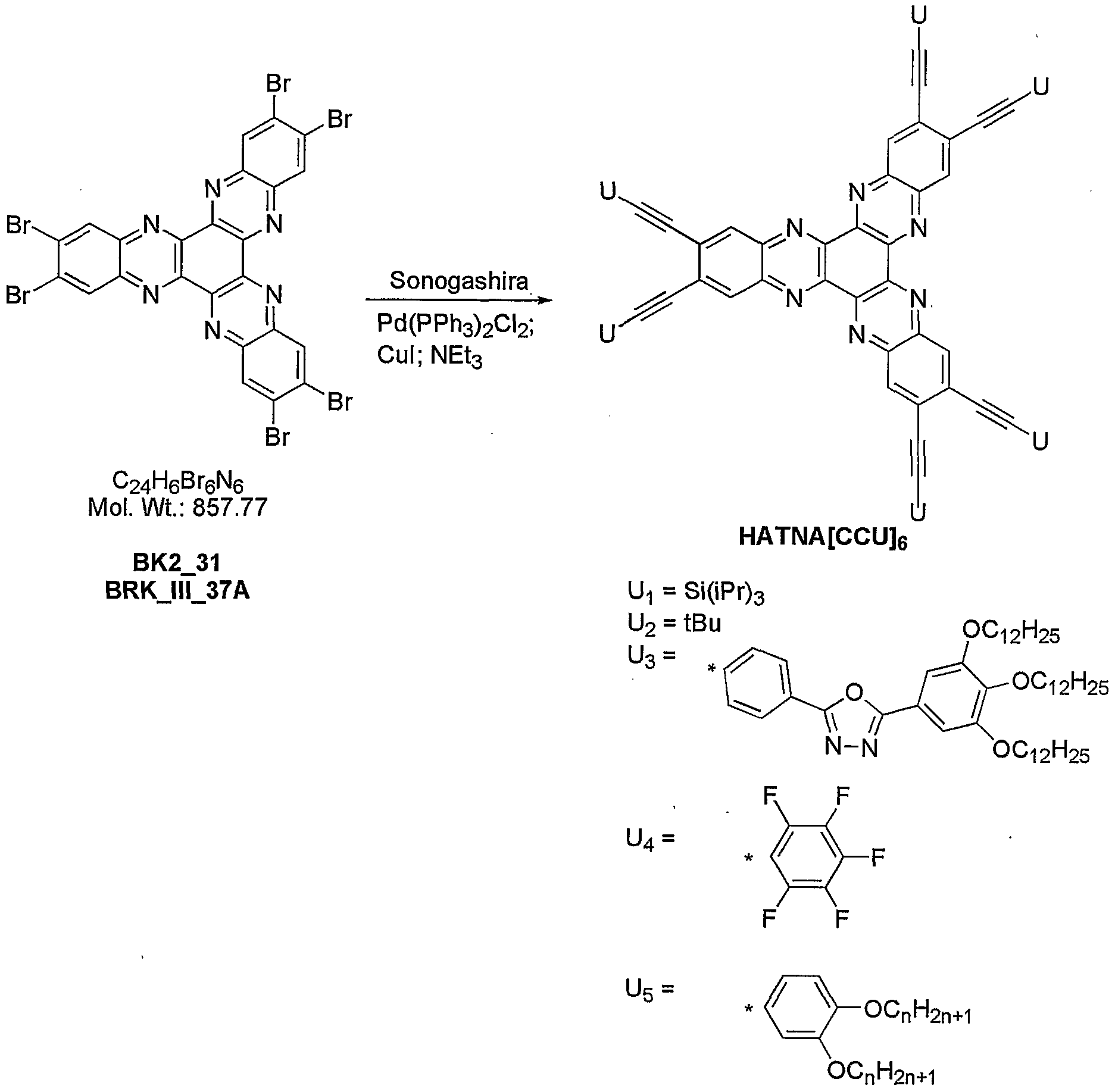
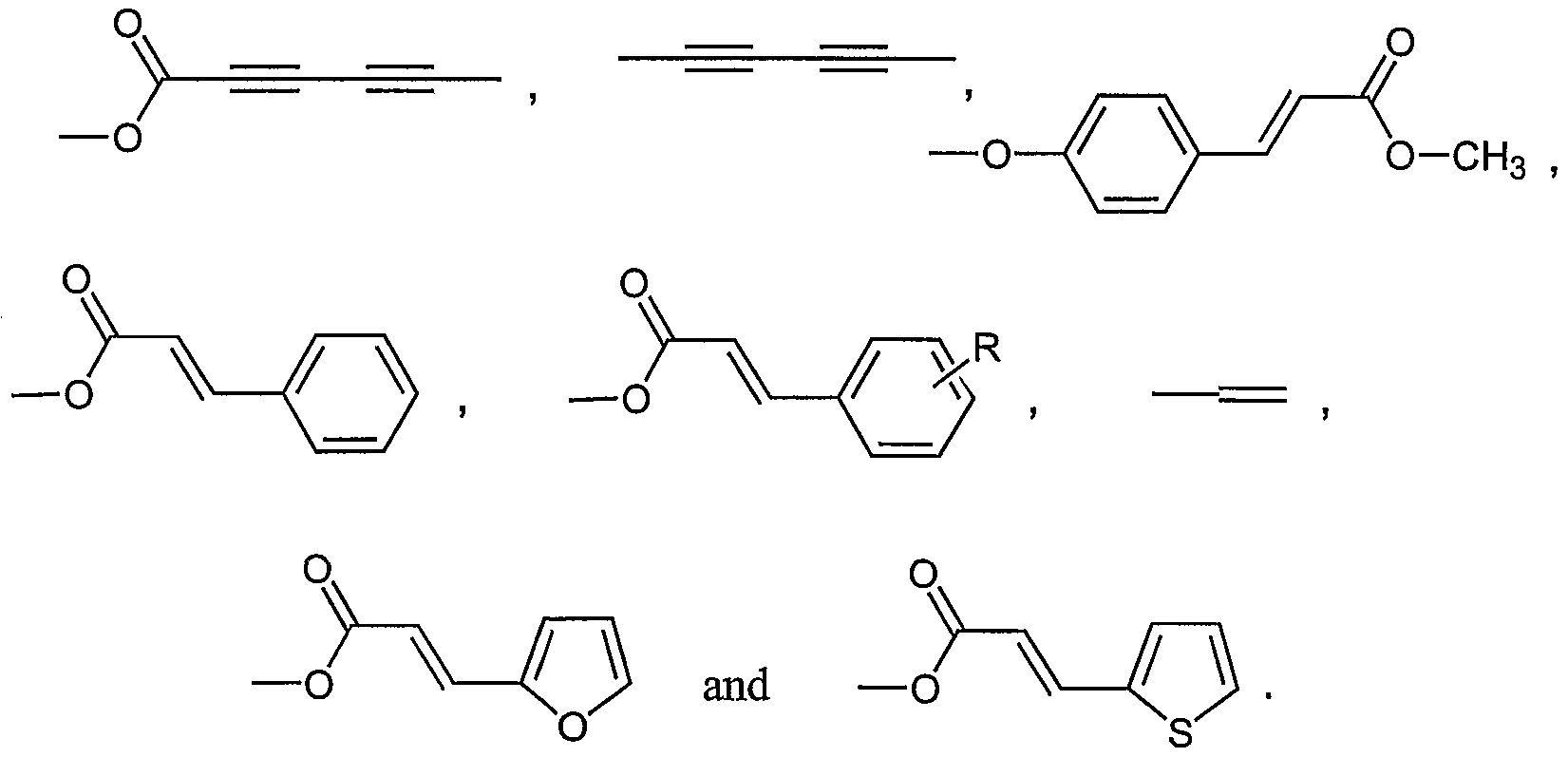
It should also be noted that U1, U2, U3, U4, U5, and U6, can each be independently selected from, but not limited to, one or more of the following groups: an aryl group substituted with alkoxy chains, thiol chains, selenium chains connected directly to the acetylene or via a spacer of alternative phenyl and oxadiazole rings. U1, U2, U3, U4, U5, and U6, can each be independently selected from, but not limited to, the following groups: triisopropyl silane and t-butyl. U1, U2, U3, U4, U5, and U6, can each be independently selected from, but not limited to, the following groups: substituted or unsubstituted alkyl, aryl (including aromatic and heteroaromatic groups, which are explained in J. March, "Advanced Organic Chemistry: Reactions, Mechanisms and Structure", Fourth edition, Wiley-hiterscience, New York, 1992, Chapter 2), cycloalkyl, or heterocyclic groups, which are bonded to the carbon atom either directly or via a linking group. U1, U2, U3, U4, U5, and U6, can each be independently selected from, but not limited to, the following polymerizable groups: acrylates, epoxides, oxetanes, chalcones, cinnamates, alkynes, and olefins. Ui, U2, U3, U4, U5, and U6, can each be independently selected from, but not limited to, the following groups: donors and /or acceptors as described herein and in US Patent 6,267,913. Ui, U2, U3, U4, U5, and U6, can each be independently selected from, but not limited to, the following groups: any of the groups described above linked through a pi-conjugated linking group as described in US Patent 6,267,913.
It should also be noted that Vi, V2, and V3, can each be independently selected from, but not limited to, one or more of the following groups: an alkyl chain, an aryl
group, an aryl group substituted with alkoxy chains, thiol chains, selenium chains, linked directly to the core or via a spacer of alternative phenyl and oxadiazole rings. V1, V2, and V3, can each be independently selected from, but not limited to, the following groups: substituted or unsubstituted alkyl, aryl (including aromatic and heteroaromatic groups, which are explained in J. March, "Advanced Organic Chemistry: Reactions, Mechanisms and Structure", Fourth edition, Wiley- Interscience, New York, 1992, Chapter 2), cycloalkyl, or heterocyclic groups which are bonded to the carbon atom either directly or via a linking group. V1, V2, and V3, can each be independently selected from, but not limited to, the following polymerizable groups: acrylates, epoxides, oxetanes, chalcones, cinnamates, alkynes, and olefins. V1, V2, and V3, can each be independently selected from, but not limited to, the following groups: donors and /or acceptors as described herein and in US Patent 6,267,913. V1, V2, and V3, can each be independently selected from, but not limited to, the following groups: any of the groups described above linked through a pi-conjugated linking group as described in US Patent 6,267,913.
It should also be noted that W1, W2, W3, W4, W5, and W6, can each be independently selected from, but not limited to, one or more of the following groups: alkyl chain, aryl group, aryl group substituted with alkoxy chains, thiol chains, selenium chains, linked directly to the core or via a spacer of alternative phenyl and oxadiazole rings. W1, W2, W3, W4, W5, and W6, can each be independently selected from, but not limited to, one or more of the following groups: substituted or unsubstituted alkyl, aryl (including aromatic and heteroaromatic groups, which are explained in J. March, "Advanced Organic Chemistry: Reactions, Mechanisms and Structure", Fourth edition, Wiley-Merscience, New York, 1992, Chapter 2), cycloalkyl, or heterocyclic groups, which are bonded to the carbon atom either directly or via a linking group. W1, W2, W3, W4, W5, and W6, can each be independently selected from, but not limited to, the following groups: donors and /or acceptors as described herein and in US Patent 6,267,913. W1, W2, W3, W4, W5, and W6, can each be independently selected from, but not limited to, the following groups: any of the groups described above linked through a pi-conjugated linking group as described in US Patent 6,267,913.
It should also be noted that C2W2 (e.g., W1 and W2, W3 and W4, and W5 and W6) could also be, but is not limited to, a part of a heterocyclic group such as, but not
limited to, naphtyl, phenanthryl, and benzo[ό]triphenylene. In addition, C2W2 could also include polymerizable groups including, but not limited to, acrylates, epoxides, oxetanes, chalcones, cinnamates, alkynes, and olefins.
It should also be noted that T1, T2, T3, T4, T5, T6, T7, T8, T9, T10, T11, and T12, can each be independently selected from, but not limited to, one or more of the following groups: a halogen or an alkyl chain bonded directly to the core or via a linking group such as, but not limited to, a methylene, an oxygen, a sulfur, or a selenium linkage. In addition, T1, T2, T3, T4, T5, T6, T7, T8, T9, T10, T11, and T12, can each be independently selected from, but not limited to, the following groups: substituted or unsubstituted alkyl, aryl (including aromatic and heteroaromatic groups, which are explained in J. March, "Advanced Organic Chemistry: Reactions, Mechanisms and Structure", Fourth edition, Wiley-friterscience, New York, 1992, Chapter 2, which is included herein by reference in its entirety), cycloalkyl, or heterocyclic groups which are bonded to the carbon atom either directly or via a linking group. Also, T1, T2, T3, T4, T5, T6, T7, T8, T9, T10, T11, and T12, can each be independently selected from, but not limited to, the following groups: donors and/or acceptors such as those described herein and in US Patent 6,267,913, which is included herein by reference in its entirety. Further, T1, T2, T3, T4, T5, T6, T7, T8, T9, T10, T11, and T12, can each be independently selected from, but not limited to, the following groups: any of the groups described above linked through a π-conjugated linking group as described in US Patent 6,267,913.
The charge-transport materials have a room temperature, zero field electron mobility of at least about 10"6 to 102 cm2/Vs, 10'4to 102 cm2/Vs, and 10"2to 102 cm2/Vs.
The distance between adjacent molecules in adjacent layers is about 3.6A and 3.1A.
The charge-transport materials should be capable of reduction by a metalless reducing agent other than sodium.
In an embodiment, a polymer layer of the charge-transport material can be formed by disposing a layer of a polymerizable material including monomers, oligomers, and/or polymers of the charge-transport material, onto a surface. The molecules of the charge-transport material can be optionally aligned into a substantially uniform orientation or a patterned orientation such that in each pattern
the orientation is substantially uniform. Then, a polymerization reaction is initiated and the monomers, oligomers, and/or polymers of the charge-transport material form a layer of polymerized charge-transport material. The polymerization process can be repeated to produce a plurality of layers. In addition, cross-linking processes can also be performed to cross-link the molecules in adjacent layers. One skilled in the art could perform a polymerization process in a manner different than described here and obtain the polymer layer of the charge-transport material, and such processes are intended to be included herein.
A plurality of layers of charge-transport material can be produced to form a charge-transport layer that can have a thickness of about 0.01 to 1000 μm, 0.05 to lOOμm, 0.05 to lOμm. The length and width of the charge-transport layer can vary depending on the application, but in general, the length can be about 0.01 μm to 1000 cm, and the width can be about 0.01 μm to 1000 cm.
It should be noted that in some embodiments is it advantageous to have the aromatic core aligned parallel to the substrate materials (e.g., in photovoltaic cells and others devices where a perpendicular alignment may be more preferable (e.g., transistor configurations)).
It should also be noted that the charge-transport materials could be used as mixtures with other electron transport materials including those described herein, as well as others. Likewise the charge-transport materials could be used in combination with other hole transport materials, sensitizers, emitters, chromophores, and the like, to add other functionality to devices.
The polymerization and cross-linking of the charge-transport material molecules can be performed using methods understood by those skilled in the art. hi general, polymerization may take place by exposure to heat or actinic radiation in the presence of an initiator. In general, cross-linking may occur due to internal reactions and/or by the addition of a cross-linking additive. Additional details regarding preparation of the charge-transport materials are described in Example 1.
Actinic radiation means irradiation with radiation (e.g., UV light, IR light or visible light, irradiation with X-rays or gamma rays or irradiation with high-energy particles, such as ions or electrons), hi an embodiment, a polymerization initiator can be used that decomposes when heated to produce free radicals or ions that start the polymerization, hi another embodiment, the polymerization can be carried out in the presence of an initiator absorbing at the wavelength of the actinic radiation. For
example, when polymerizing using UV light, a UV initiator can be used that decomposes under UV irradiation to produce free radicals or ions which start the polymerization reaction.
The UV initiator can include chemicals such as, but not limited to, a free radical initiator, a cationic initiator, or combinations thereof. The free-radical initiator includes compounds that produce a free radical on exposure to UV radiation. The free-radical is capable of initiating a polymerization reaction among the monomers and/or oligomers present.
Examples of free-radical initiators include, but are not limited to, benzophenones (e.g., benzophenone, methyl benzophenone, Michler's ketone, and xanthones), acylphosphine oxide type free radical initiators (e.g., 2,4,6- trimethylbenzoyldiphenyl phosphine oxide (TMPO), 2,4,6- trimethylbenzoylethoxyphenyl phosphine oxide (TEPO), and bisacylphosphine oxides (BAPO's)), azo compounds (e.g., AIBN), benzoins, and benzoin alkyl ethers (e.g., benzoin, benzoin methyl ether and benzoin isopropyl ether).
In addition, the free radical photoinitiator can include, but is not limited to: acyloin; a derivative of acyloin, such as benzoin ethyl ether, benzoin isobutyl ether, desyl bromide, and α-methylbenzoin; a diketone, such as benzil and diacetyl; an organic sulfide, such as diphenyl monosulfide, diphenyl disulfide, desyl phenyl sulfide, and teframethylthiuram monosulfide; a thioxanthone; an S-acyl dithiocarbamate, such as S-benzoyl-N,N-dimethyldithiocarbamate and S-(p- chlorobenzoyl)-N,N-dimethyldithiocarbamate; a phenone, such as acetophenone, α-α- α-tribromoacetophenone, o-nitro-pt-α-α-tribromoacetophenone, benzophenone, and p,p'-tetramethyldiaminobenzophenone; a quinone; a triazole; a sulfonyl halide, such as p-toluenesulfonyl chloride; a phosphorus-containing photoinitiator, such as an acylphosphine oxide; an acrylated amine; or mixtures thereof.
The free-radical initiator can be used alone or in combination with a co- initiator. Co-initiators are used with initiators that need a second molecule to produce a radical that is active in UV-systems. For example, benzophenone uses a second molecule, such as an amine, to produce a reactive radical. A preferred class of co- initiators are alkanolamines such as, but not limited to, triethylamine, methyldiethanolamine, and triethanolamine
Suitable cationic initiators include, but are not limited to, compounds that form aprotic acids or Brønsted acids upon exposure to UV light sufficient to initiate polymerization. The cationic initiator used may be a single compound, a mixture of two or more active compounds, or a combination of two or more different compounds (e.g., co-initiators).
The cationic photoinitiator can include, but is not limited to, onium salt, such as a sulfonium salt, an iodonium salt, or mixtures thereof. In addition, the cationic photoinitiatior can include, but is not limited to, an aryldiazonium salt, a bis- diaryliodonium salt, a diaryliodonium salt of sulfonic acid, a triarylsulfonium salt of sulfonic acid, a diaryliodonium salt of boric acid, a diaryliodonium salt of boronic acid, a triarylsulfonium salt of boric acid, a triarylsulfonium salt of boronic acid, or mixtures thereof. Examples of cationic photoinitiatiors include, but are not limited to, diaryliodonium hexafluoroantimonate, aryl sulfonium hexafluorophosphate, aryl sulfonium hexafluoroantimonate, bis(dodecyl phenyl) iodonium hexafluoroarsenate, tolyl-cumyliodonium tetrakis(pentafluorophenyl) borate, bis(dodecylphenyl) iodonium hexafluoroantimonate, dialkylphenyl iodonium hexafluoroantimonate, diaryliodonium salts of perfluoroalkylsulfonic acids (such as diaryliodonium salts of perfluorobutanesulfonic acid, perfluoroethanesulfonic acid, perfluorooctanesulfonic acid, and trifluoromethane sulfonic acid), diaryliodonium salts of aryl sulfonic acids (such as diaryliodonium salts of para-toluene sulfonic acid, dodecylbenzene sulfonic acid, benzene sulfonic acid, and 3 -nitrobenzene sulfonic acid), triarylsulfonium salts of perfluoroalkylsulfonic acids (such as triarylsulfonium salts of perfluorobutanesulfonic acid, perfluoroethanesulfonic acid, perfluorooctanesulfonic acid, and trifluoromethane sulfonic acid), triarylsulfonium salts of aryl sulfonic acids (such as triarylsulfonium salts of para-toluene sulfonic acid, dodecylbenzene sulfonic acid, benzene sulfonic acid, and 3 -nitrobenzene sulfonic acid), diaryliodonium salts of perhaloarylboronic acids, triarylsulfonium salts of perhaloarylboronic acid, or mixtures thereof.
The visible radiation initiator can include, but is not limited to, diketones (e.g., camphorquinone, 1,2-acenaphthylenedione, lH-indole-2,3-dione, 5H- dibenzo[a,d]cycloheptene-10, and 11-dione), phenoxazine dyes (e.g., Resazurin, Resorufm), acylphosphine oxides, (e.g., diphenyl (2,4,6-trimethylbenzoyl) phosphine oxide), and the like.
5 020998
In an embodiment, the polymerization of the charge-transport materials can be carried out as in-situ polymerization of a coated layer of the material, possibly during fabrication of the device of interest that includes the charge-transport material. In the case of liquid crystal materials, these are preferably aligned in their liquid crystal state into honieotropic orientation prior to polymerization, where the conjugated pi-electron systems are orthogonal to the direction of charge transport. This ensures that the intermolecular distances are minimized and hence the energy required to transport charge between molecules is minimized. The molecules are then polymerized and/or cross-linked to fix the uniform orientation of the liquid crystal state. Alignment and curing are carried out in the liquid crystal phase or mesophase of the material. This technique is known in the art and is generally described for example in D. J. Broer, et al., Angew. Makromol. Chem. 183, (1990), 45-66.
The polymers including the HATNA core and/or the DATAN core can have a molecular weight from about 3000 to 300,000 daltons, and about 2000 to 200,0000 daltons.
Example 1
Now having described the embodiments of the charge-transport materials in general, Examples 1-3 describe some specific embodiments of the charge-transport materials. While embodiments of charge-transport materials are described in connection with Examples 1-3 and the corresponding text and figures, there is no intent to limit embodiments of the charge-transport materials to these descriptions. On the contrary, the intent is to cover all alternatives, modifications, and equivalents included within the spirit and scope of embodiments of the present disclosure.
It should also be noted that in each Example, in particular Example 3, one skilled in the art of organic chemistry would understand that esters of carboxylic acids could be converted to their corresponding carboxylic acids. In his manner either pure 5,6,11, 12,17, 18-Hexaaza-trinaphthylene-2,8,15-tricarboxylic acid 1 ester or 5,6,11, 12,17, 18-Hexaaza-trinaphthylene-2,8,15-tricarboxylic acid can be synthesized from the Ia and Ib'. This pure acid can therefore be used as starting point to synthesize any isomerically pure compounds described herein that would be derived from this acid.
Organic semiconducting materials having high carrier mobility are used for a wide range of electronic applications such as, light-emitting diodes, solar cells, and field- effect transistors.1'2'3'4'5'6 Discotic liquid-crystalline mesophases are typically quasi-two- dimensional molecules, which are often constituted of a rigid central aromatic core and extended flexible chains. These molecules usually pack in the form of well-defined columns forming one-dimensional paths for charge transport along the stacked conjugated cores due to good intermolecular orbital overlap within the stacks.7 Only a limited number of electron mobility measurements in columnar discotic liquid crystals have been so far reported. '
Hexaazatrinaphthylene, HATNA, FIG. 1, has been investigated for electron- transport materials applications. Because of the nitrogen presence in HATNA, these compounds are anticipated to be electron-poor relative to all-hydrocarbon analogues. It should be relatively easy to inject electrons into these compounds from other materials. Therefore, HATNA derivatives are likely to act principally, although not necessarily exclusively, as electron-transport materials.
The HATNA cores and the dodecaazatrianthracenes, DATAN, cores are shown in FIG. 2. Small Molecules With HATNA Core:
A series of HATNA compounds with different substitutions, Scheme 1, have been synthesized. These compounds have low solubility in most organic solvents. HATNA, BK2_73, is the model core. A previous X-ray structure investigation of HATNA*CHC13, BK2_73, showed that this compound stacked in the solid state, FIG. 3.10>n
HATNA-Cl6, BK2_67, HATNA-Me6, BK2_25, and HATNA-Br6, BK2_31, can be used in the synthesis of other HATNA compounds, which are described herein. No further purification is needed for these syntheses. An investigation has been conducted in regard to the effect of core size of hexaazatrianthracene, HATAN, BK3_25, and hexaazatristriphenylene HATT (also referred to as "Mickey-Mouse" HATNA), BK3_31, on their mobility and, in cases where suitable crystals can be obtained, their solid state packing. The substitution with six nitro groups in HATNA_(NO2)6, BK2_93, further increases the electron acceptor capability of this compound due the strong electron withdrawing effect of the nitro-substituent. Doping HATNA_(NO2)6, BK2_93, with the strong electron donor tetrathiofulvalene TTF is anticipated to generate a charge transfer complex. DSC investigation of HATNA_[NO2]6, BK2_93, showed that this compound is potentially explosive at 398 0C (ΔH = -658 KJ/mol), FIG. 4.
HATNA, BK2_73, HATNA_C16, BK2_67, HATNA_Br6, BK2_31, and HATNA-[Me]6, BK2_25 were purified by high-power vacuum train sublimation (ca. 10"6 torr), FIGS. 5 and 6. There are three zones in the sublimation tube whilst two tubes are in zone one and labeled as 1.1 and 1.2 tubes, four tubes are present in zone two and are labeled as tubes 2.1, 2.2, 2.3, and 2.4, and two tubes are present in zone three and are labeled as tubes 3.1 and 3.2. The sublimation step has resulted in isolating pure compounds. The elemental analysis for the sublimed HATNA, HATNA-Cl6, and HATNA-Br6 passed; however, that of sublimed HATNA-Me6 passed on N, H but not C (low by 0.75 %). 300 MHz 1H NMR of sublimed BK2_73 and BK2_67 are shown in FIGS. 7 and 8, respectively. The sublimation of HATNA-Cl6, BK2_67 has resulted in yellow crystals that were suitable for X-ray structure determination. The X-ray structure and molecular packing of HATNA-Cl6 are shown in FIGS. 9 A and 9B, respectively. The
distance between the different molecules is ca. 3.21 A. Such columnar packing in HATNA-Cl6 may be attributed to effective electronic coupling and intermolecular coulombic interactions between the different molecules. The X-ray data and parameters of HATNA_C16 are shown in Tables 1-6.
Scheme 1. Structures OfHATNA-[X]6 compounds.
Table 1. Crystal data and structure refinement for z29b, HATNA-Cl6.
Identification code z29b (HATNA-Cl6)
Empirical formula C42H38Cl4N2O4
Formula weight 776.54
Temperature 293(2) K
Wavelength 0.71073 A
Crystal system Monoclinic
Space group P2(l)/c
Unit cell dimensions a = 10.964(2) A α= 90°. b = 26.634(5) A β= 108.91(3) c = 8.0160(16) A γ= 90°.
Volume 2214.5(8) A3
Z 3
Density (calculated) 1.747 Mg/m3
Absorption coefficient 0.459 mm'1
F(OOO) 1212
Crystal size ? x ? x ? mm3
Theta range for data collection 1.96 to 30.21°.
Index ranges -15<=h<=15, -37<=k<=36, -IK=K=Il
Reflections collected 26555
Independent reflections 6532 [R(int) = 0.0592]
Completeness to theta = 30.21° 99.3 %
Absorption correction None
Refinement method Full-matrix least-squares on F^
Data / restraints / parameters 6532 / 0 / 349
Goodness-of-fit on F^ 0.909
Final R indices [I>2sigma(I)] Rl = 0.0518, wR2 = 0.1176
R indices (all data) Rl = 0.0841, wR2 = 0.1273
Largest diff. peak and hole 1.034 and -0.494 e. A"3
Sublimation OfHATNA-Me6 has resulted in blue crystals in zones 2.3 and 2.4. The HR-FAB MW indicated that the crystals in tubes 2.3 and 2.4 as well as the powder in tube 3.2 correspond to the same compound. The presence of the compound in different zones may be attributed to the nucleation effect since there is formation of crystals in the earlier tubes. Cheesman and Cookson13 originally reported the tautomerization of dimethyl quinoxaline, Scheme IA. Aumiller, W. D. et al.u reported oxidation of hexamethylheazatriphenylene. Alternatively, the compound in different zones may be due to tautomerization OfHATNA-Me6 as shown in Scheme IA. Crystals could be the result of intermolecular H-bonding in one of the tautomer's isomers. 1H NMR spectra of BRK_III_92D and BRK_III_92B, with low solubility in DMSO, are shown in FIGS. 1OA and 1OB, respectively. The two doublets in the aromatic region of the 1H NMR of BRK_III_92D, FIG. 1OA, could be associated with vinyl H's, i.e. evidence for tautomerism in this compound.
Dimethylquinoxaline tautomeric equilibrium
HATNA_Me
6_Tautomer_3 HATNA_Me
6_Tautomer_2
HATNA_Me6_Tautomer_4 - HATNA_Me6_Tautomer_5 ===^ HATNA_Me6_Tautomer_6 Scheme IA. Possible tautomirism of HATNA_Me6.
The TGA plots of BK2_67C (sublimed HATNA_C16) and BK2_73C (sublimed HATNA) are shown in FIG. 11. HATNA-Cl6 did not decompose up to 450 0C; the after- heating crystals were of the same quality as they were before. HATNA seems to decompose at ca. 413°C; however, sublimation of this compound cannot be ruled out. The chlorine substitution in HATNA_C16 has increased its thermal stability relative to HATNA. The absorbance of HATNA_C16 is red-shifted with respect to that of HATNA, FIG. 12. HATNA_C16 has three distinctive absorbing bands at Xx = 307, λ2 = 392, and λ3 = 414 nm. HATNA has three distinctive absorbing bands at Xx = 297, λ2 ' = 379, and λ3 ' = 399 nm. The ratio X2I Xi = 1.41, λ3/ λ3 ' = 2.04. The cyclic DC voltammograms of HATNA and HATNA-Cl6 are shown in FIGS. 13 and 14, respectively.
In the course of the synthesis of hexaazatristriphenylene HATT (also referred to as "Mickey-Mouse" HATNA), BK3_31, a different product was observed, Scheme 2. The three-fold condensation of hexaketocyclohexane octahydrate SM4 with 9,10- diaminophenanthrene SM7 in acetic acid/ethanol under air resulted in an orange solid phenanthrazine BK2_97E, which was sublimed under high vacuum. Phenanthrazine was confirmed by 1H NMR and EI mass analysis. In this regard, 9,10-diaminophenanthrene SM7 may have been partially oxidized to phenanthrene-9,10-dione SM34 under air. The double bond (9=10) in 9,10-diaminophenanthrene SM7 behaves more like a single double bond rather than one in an aromatic system, i.e. it can be oxidized more easily. Condensation of SM7 and SM34 led to BK2_97E. To give evidence for the proposed mechanism, two control experiments were performed. 9,10-diaminophenanthrene SM7 was refluxed in acetic acid/ethanol for 24 hours. EI mass analysis showed the presence of phenanthrazine, BK3_29. Hexaazatristriphenylene HATT, BK3_31 was obtained when the condensation was performed in acetic acid under nitrogen (MALDI TOF measurement confirmed the presence of HATT).
Glacial acetic
C6H16O14 C14Hi2N2 C4SH24NQ MoI, Wt.: 312.18 MoI. Wt.: 208.26 MoI. Wt: 684.74
SM4 SM7 HATT
SM34 028H16N2 C, 88.40; H, 4.24; N, 7.36
BK2 97E
Scheme 2. Proposed mechanism for the formation of BK2_97E.
The synthesis of HATNA_F12 and fabrication of an OFET as shown in FIG. 14A is proposed. 3,4,5,6-tetrafluoro-l,2-phenylenediamine can be synthesized according to a literature procedure reported by Heaton, A. et al.X6 and upon its condensation with hexaketocyclohexane octahydrate, HATNA_F12 could be obtained. Perfluorophenyl- phenyl interactions have been reported in the case of alkenes,17 diynes,18 and ene- diynes.19 Such stacking interactions is anticipated, upon mixing HATNA and HATNA_F12. It is worth noting that co-sublimation of HATNA and HATNA_F12 could lead to a crystal formed of a stack of alternate molecules of HATNA and HATNA-F12. l,2-diamino-4,5-dicyanobenzene could be synthesized according to a literature procedure. Upon its condensation with hexaketocyclohexane octahydrate,
HATNA-[CN]6 was obtained. The seven membered ring in compound BK1_53 is expected to disturb its planarity; thμs, affecting its mobility.
C6H6CI2N2 CCuN C8H6N4
MoI. Wt.: 177.03 MoI. Wt.: 89.56 MoI. Wt.: 158.16
SM11 SM 12 BK1 41 5 HATNAJCN]6
C6H16O14 C6H6CI2N2 C36H1SN6 MoI. Wt.: 312.18 MoI. Wt.: 177.03 MoI. Wt.: 534.57
SM4 SM16 BK1 53
Scheme 2A. Synthetic approaches to HATNA-[CN]6 and BK1_53. HATNA With Thiols and Alkoxy Chains
Discotic thermotropic liquid crystals are generally constituted of a rigid disk-like core substituted with extended flexible chains. Five different types of discotic liquid crystals are yet known. The five different discotic structures are the nematic discotic, the disordered columnar, the tilted disordered columnar, the ordered columnar, and the tilted columnar phases.
20 Kestmont, G. et. al.'s
21 reported the synthesis of HATNA-[SR]
6. The authors reported that HATNA-[SR]
6 showed mesophase behavior, Table 2.
C6H16O14 C6H6CI2N2 C24H6CI6N6 MoI. WL: 312.18 MoI. Wt.: 177.03 MoI. Wt.: 591.06
SM4 SM11 BK2 67
BK2_71. R = C12H25 BK2_99. R = C8H17
Scheme 3. Synthetic Scheme of HATNA_[SC12H25]6, BK2_71, and HATNAJSC8H17]6, BK2 99.
The synthesis of HATNAJSR]6 for R = Ci2H25 (BK2_71) and R = C8Hn (BK2_99). HATNA-Cl6 was repeated, BK2_67, was used in the synthesis of BK2_71 and BK2_99 without the sublimation step, Scheme 3. The thermal stability of BK2_71 and BK2_99 is shown in FIG. 15. BK2J71 decomposes at ca. 320 °C, while BK2_99 decomposes at ca. 330 0C. The DSC data of BK2_71E and BK2_99B are shown in FIGS. 16 and 17, respectively. The data is summarized in Table 8. The results are not in agreement with Kestmont, G. et. al. 's.21 The CV data of BK2_71E and BK2_99B are
shown in FIGS., 18 and 19, respectively. The UV-vis spectra of BK2_71 and BK2_99 are shown in FIG. 20. The chain length does not affect the absorbance OfHATNA-[SR]6, which has three distinctive absorbance bands at 255, 363, and 479 nm. Polarized optical microscope investigation of BK2J71 and BK2_99 showed their textures as depicted in FIG. 21 and 22, respectively. It was observed that upon HATNA-[SC12H25]6 solution in CH2Cl2 exposure to a latex glove, the color changes immediately from yellow to red. Week et al.22 reported the increase of the clearing temperature of triphenylene upon mixing it in 1 : 1 ratio with perfluorotriphenylene due to intermolecular coulombic interactions between these molecules. Mixing it in 1:1 ratio of HATNA_F12 and HATNA_[XR]6 where X= O, S could lead to such a behavior.
Table 2. Literature mesophase assignment, transition temperatures (0C), and transient enthalpies (kJ/mol). 21
Cr 77 <5-6>, X1 142 (14-?} X2 178 (13^ LC ^ decomp. at ca. 250 °C
HATNA_(SC8H17)6
43 (-7.6)
Cr X1 ψ (-12-5) LC
χ 99 (31.7) LC →- decomp. at ca. 250 C
HATNAJSC12H2S)6 79 (-32.4)
X LC
Table 3. Mesophase assignment, transition temperatures (°C), and transient enthalpies (kJ/mol).a
BK2_71 E 1 St Cyde X 95 (91 -4.) X1 109 (9-6l LC 268 C1 -?) I
HATNA_(SC12H25)6 .. 80 (-18.O) 236 (-2.0)
X LC
o . , γ 100 (20.5) I r 242 (2.3) . 2nd cycle X * ^ LC *■ ' χ 61 (-5.5) Lc203 (-0.6) ,
1st cycle χ 149(34.4) χ 180 (12.3) LC 289 (9.0)
BK2_99B
HATNAJSC8H17)6 87 (-4.7) ' 244 (-0.74) •* LO ■*
o j i Y 131 (4.8) i 2nd cycle X — ^ • a X is unknown phase; LC = liquid crystalline; I = isotropic (liquid).
Recently, Ong, C. W. et al. reported that HATNA_[0R]6 exhibited liquid-crystalline behavior.23 HATNAJOR]6 BK3_3 having 6 arms Of OC12H25 extended chains (Scheme 4) was synthesized. 4,5-Bis-dodecyloxy benzene- 1,2-diamine BK3_1 was synthesized according to a literature procedure.24 Three-fold condensation of BK3_1 with hexaketocyclohexane octahydrate afforded BK3_3 (Scheme 4).
The TGA plot of BK3_3 is shown in FIG. 15. HATNAJOC
12H
25]
6 decomposes at ca. 350 °C. The UV-vis spectrum of BK3_3 is shown in FIG. 20. BK3_3 has four distinctive absorbance bands at 228, 303, 341, and 433 nm in addition to a shoulder at 409 nm. The cyclic DC voltammogram of BK3_3 is shown in FIG. 23. DSC data of BK3_3 is shown in FIG. 24. Preliminary polarized optical microscope photos of the textures of BK3_3 are shown in FIG. 25. The sample was dissolved in CH
2Cl
2 and was slowly evaporated on a glass slide, and it was then heated on an aluminum block for 5 min at 280 °C.
44 % 70 %
SM23 BK2 7 BK2 13
Scheme 4. Synthetic Scheme of HATNA_[OC12H25]6, BK3_3.
Table 4. Mesophase assignment, transition temperatures (°C), and transient enthalpies (kJ/mol).a χ op (2.5)> χi 69 (6.4) LC 203 (2.2) ,
BK3_3G 1 St Cyde - 50
HATNA_(OC12H25)6 χ 39 (-6.8) LC 192 (-1.O) ,
2nd cycle X 37(5.7), LC 20° (1 -1j I
42 (-4.2)
X —- ^ LC a X is μnknown phase; LC = liquid crystalline; I = isotropic (liquid).
Oxadiazole Based HATNA
Organic electron-transport materials based on 1,3,4-oxadiazoles,9 having mobilities as high as ca. 10~3 Cm2V^1S"1, have been reported.27 Furthermore, 1,3,4- oxadiazoles have been proven to be effective as electron-transport agents in organic light- emitting diodes.28 A series of columnar discotic liquid-crystalline (LC) oxadiazoles with benzene core were synthesized and their mobility was studied for potential applications in electron-transport materials.29 Since HATNA core is larger in size than the benzene core, the oxadiazole-based HATNA is anticipated to show higher mobility. Oxadiazole-based
HATNA's are synthesized according to Scheme 5. Upon refluxing the hydrizide in POCl3, excess POCl3 was distilled off till ca. 20 ml remained. The reaction mixture is then slowly added to a large volume of ice-water. This step results in the formation of a solid, which can be filtered off. The first purification step involves dissolving the solid in minimum amount Of CH2Cl2 (or CHCl3) and subsequent precipitation in methanol. This step is followed by flashing the compound over a bed of silica using hexanes as an eluent (these compounds do not run on TLC using solvents of wide range of polarity). Evaporating the solvent results in a black sticky solid that can be reprecipitated into methanol, resulting in brown powder suspended in the solution. This process is reproducible and reversible. It was observed that recrystallizing these compounds from toluene/ethanol results in dark reddish solid. The UV- vis absorption data of BK1_47, BK2_83, and BK2_91 are shown in FIG. 26. These compounds have two distinctive absorption bands at 302 and 437 nm. The difference in molar extinction coefficient of BK1_47 from BK2_83 and BK2_91 might be due to inaccuracy of the concentration of BK1_47 solution. However, preliminary polarized optical microscope investigation of BK1_47D showed discotic columnar-like texture, FIG. 23. The sample was melted and was then cooled down to room temperature. Textures of BK2_83 and BK2_91 are shown in FIGS. 30 and 31, respectively.
Scheme 5. Synthetic Scheme of HATNAJOxPh(OC8H17)3]3, BK2_83, HATNAJOxPh(OCi 2H25)3]3, BK2_91, and HATNA_[OxPh(OC12H25)3]3, BK1_47.
1H NMR (CDCl3, 300 MHz) of BK1_47D shows the distinctive aromatic peaks as well as those of the elongated chains, FIG. 32. MALDI-TOF MS measurement indicated the presence of BK1_47D as the only large MW (2476) compound, FIG. 33. The MALDI showed that the compound is relatively pure.
Cyclic voltammetry studies of BK1_21H (BK1_47D) in CH2C12/O.l M "BuN+PF6- showed reversible reduction with Ey2 = -1.5 V and a nonreversible reduction with Ey2 = - 1.1 V (vs Ferrocene in CH2Cl2), FIG. 34.
The HATNA molecules with oxadiazole side-chains were heated to 250 °C and cooled to room temperature before recording the PXRD patterns. All showed only one low-angle reflection; this was assigned to the (100) reflection of a Colhd phase by analogy with compounds based on the same core for which only one reflection was observed.23 The PXRD pattern for the dodecyloxy-substituted material (BK3-27B) is shown in FIG. 35 and the data obtained for all the liquid-crystalline materials is collated in Table 5.
Table 5: PXRD data for (assumed) Colhd phases of oxadiazole-HATNAs at room temperature.
The unit cell parameter increases with increasing substituent size, as might be expected. The values for αo are larger than observed for Colhd phases of phenazine complexes in the literature, consistent with a bigger molecule due to the oxadiazole spacer; the wide-angle halos are similar, however, presumably reflecting comparable intrachain π-stacking distances, although with no significant long-range order.
MALDI-TOF measurement of BK1_31 showed its MW (2908), FIG. 36. However, the 1H NMR showed broad peaks; this may be attributed to aggregation of the compound in solution. HATNA Based Esters
A series of esters having the HATNA core, Scheme 6, have been synthesized. A wide range of R groups have been selected to examine the substitution effect on their mobility and mesophase behavior.
DD1_39. R = C2H5 DD1 49. R = T CHo- DD1_43. R = C12H25 DD1_45. R = CH2CF2CF2CF3
DD1 51. R = DD1 47 R = DD1 57 R =
Scheme 6. HATNA esters.
Perfluorophenyl-phenyl interactions have been discussed and upon mixing DDl 47 and DD1 57 their stacking interactions are anticipated, between the pentafluorophenyl arms of DD1_47 and the phenyl arms of DD1_57. Such stacking would tend to align the cores of the two compounds. Accordingly, stacking of DD1_47 and DD1_57 can be studied by mixing different molar ratios of these two compounds and can determined by DSC and 1H NMR measurements. The mobility along the aromatic core can be affected if such stacking occurs.
Bock et al.30 reported that that three fold condensation of SM4 and SM5 lead exclusively to the isomer 3,4,15- rather than the 3,4,14-isomer or the statistical isomer mixture (3:1; 3,4,15- isomer: 3,4,14-isomer), Scheme 7. The authors made this conclusion based on the 2:1 ratio of the aromatic peaks, which is consistent with the 3,4,15-isomer.
The results reported here, however, suggest that condensation of SM4 and SM5 lead to a mixture of approximate 3:1 ratio of 3,4,15-isomer: 3,4,14-isomer. HPLC traces
OfHATNA-[Z1J3 compounds, Scheme 7, showed two peaks of approximate relative area 3:1, which may be attributed to the statistical isomer mixture-cyano normal phase column was used for both analytical and preparative HPLC; HPLC grade CH2Cl2 and hexanes were used; the initial % flow Of CH2Cl2 was 20% till 2 min; at 15 min the % flow of CH2Cl2 was 100 %. Both peaks have identical UV-vis spectra. The 2,8,15-isomer of HATNA-[Z1J3 has been isolated by preparative HPLC. It was discovered that the 2,8,14 and 2,8,15 isomers OfHATNAJCO2CH2PhFs]3 could be separated by column chromatography using CH2Cl2:ethyl acetate (9:1) as eluent. FIG. 37 shows the HPLC traces of HATNA_[CO2CH2PhF5]3 before separation, BRK_III_78C, the 2,8,15-isomer separated by HPLC, BRK_III_83B_T9, and the two isomers separated by column chromatography, BRK_III_78E1 and BRK_III_78E4. BRK_III_78E3 is the fraction where the two isomers eluted together. BRK_III_78E4 was then run through a column using CH2Cl2: ethyl acetate (9:1) as eluent and was dissolved in small amount OfCHCl3 and was reprecipitated in ethanol, BRK_III_78F2. The 1H NMR (500 MHz, CDCl3) of BRK_III_78E1, BRK_III_78F2, and BRK_III_78E3 along with their corresponding analytical HPLC traces are shown in FIGS. 37A, 37B, and 37C, respectively. Comparison of the 1H NMR (500 MHz, CDCl3) of BRK_III_78E1, BRK_III_78F2, and BRK_III_78E3 is shown in FIG. 37D. The methylene group in the symmetrical 2,8,14- isomer BRK_III_78E1, FIG. 37Da, is a singlet, hi the unsymmetrical 2,8,15-isomer BRK_iπ_78F2, FIG. 37Da, the three methylene groups appear as two singlets of approximate ratio 2:1. In the mixture of isomers BRK_III_78E3, FIG. 37Da, the three methylene groups overlap. Whilst the methylene groups have the same chemical shift in the mixture as that in the pure isomer, the aromatic region appears at a different chemical shift. This may be attributed to intermolecular interactions between the two isomers in the mixture BRK_III_78E3. 1H NMR (500 MHz, CDCl3) of different concentrations (24.03 mg and 3.93 mg in 0.8 ml of CDCl3) of BRK_III_78E4, FIG. 37E, shows possible intermolecular interactions in this compound. The C NMR (125 MHz, CDCl3) of BRK_III_78F2- 2,8,15-isomer- shows only one methylene peak at 54.68 ppm whilst that of BRK_III_78E3- mixture of isomers- shows two methylene peaks at 58.69 and 58.45 ppm (13C NMR were not acquired on BRK_III_78E1- 2,8,14-isomer- solution was dilute). 19F NMR (CDCl3, 376 MHz) of BRK_III_78F2, BRK_III_78E1, and
BRK_III_78E3 are shown in FIG. 37F. In the 2,8,14-isomer, BRK_III_78E1, the Fp's appear as triplets because they are coupled to two Fm, whilst F0 appear as doublet of doublets. In the 2,8,15-isomer, BRK_III_78F2, the F^ appear as two overlapped triplets of approximate ratio 2:1 corresponding to two different set of fluorinated aromatic rings. The NMR data is consistent with the assignment of the HPLC traces to the corresponding isomer, i.e. the more dominant compound is the unsymmetrical 2,8,15-isomer.
2,8,15 HATNA-(COOH)
3 isomer 2,8,14 HATNA-(COOH)
3 isomer
2,8,15 HATNA_(Z)3 isomer 2,8,14 HATNAJZ)3 isomer
Z3 = CO2C12H25 Scheme 7. Isomers of HATNA-[Z]3 upon condensation of SM4 and SM5.
To isolate the pure isomers of oxadiazole substituted HATNA' s, the synthesis of the appropriate ester HATNA-[CO2R]3 was proposed, where the two isomers can easily be separated by sublimation, recrystallization, or chromatography- HATNA_[CO2CH2PliF5]3 isomers were separated by column chromatography as shown above. A subsequent saponification can lead to the isomer pure HATNA-[COOH]3 which can be used to get to isomer pure HATNA-[Z]3.
MALDI-TOF measurements confirmed the presence of all HATNA esters (DD1_39, DD1_41, DD1_43, DD1_45, DD1_47, DD1_49, DD1_51, and DD1_57). Differential scanning calorimetry (DSC) measurements showed for the ester DD1_43 two phase transitions at 35 and 98 °C. Polarized optical microscope (POM) investigation suggests that this compound is polycrystalline (FIG. 38).
The DD1_45 thermogram showed (in the second heating) two transitions at 220 and 265 °C; this ester showed two different phase-transitions upon cooling. POM investigations confirmed that the 220 0C transition is a solid-liquid crystalline first order phase transition while the 265 0C transition is the liquid crystalline-isotropic phase transition (FIG. 39).
The DD1_47 thermogram showed a single transition at 240 °C and no phase- transition was observed upon cooling; this behaviour is characteristic of metastable glassy materials. The DD1_49 thermogram showed a single transition at 180 0C as well as upon cooling. The DD1_51 thermogram showed two phase-transitions at 110 and 180 °C and only one on cooling. POM studies on DD1_51 have not been performed yet. The thermal behaviour of the HATNA esters is summarized in Table 6.
Table 6: First order phase transitions according to DSC observation
aThe DDl 39 thermal data are from the literature.
The electrochemistry studies showed two well-structured reversible reduction peaks at approximately - 1.2 eV and - 1.4 eV (relative to ferrocene). Two more reductions were observed (except for the DD1_43 ester where we observed only one reduction). Detailed overview of the CVs graphs of the HATNP esters are presented in FIG. 40. The results are summarized in Table 7.
Table 7. Summary of CV data of HATNA esters.
aΔp is the difference between the anodic and cathodic peaks for a given redox process.
The UV spectra of HATNA esters were collected in dichloromethane. The shapes and the frequencies of the UV-vis spectra are the same for all the esters. The UV spectrum of DD1_43, FIG. 41, is a representative for all the esters.
Sonogashira31 couplings of HATNA-Br6, BK2_31 or more preferably with HATNA_I6, with the appropriate acetylene should to lead to the corresponding HATNAJCCU]6, Scheme 8. Synthesis of HATNAJCCU]6 whilst U1 = Si(iPr)3 and U2
= tBu could be accomplished with of HATNA_Br6.
Scheme 8. Proposed synthetic Scheme OfHATNA-[CCU]6.
Three fold condensations of SM4 and diamine SM39 proceeded in low yield (9%) to lead to the unsymmetric isomer BRK III 41 A, Scheme 9, which was confirmed by 1H NMR as shown in FIG. 42. MALDI TOF measurement showed the MW 571.2 (M+ 1)
but it also showed high MW peak 1196.2, which does not correspond to the dimer of BRK_III_41A.
Scheme 9. Synthesis of BRK_III_41A.
The synthesis of BRK_IH_75 was performed as shown in Scheme 10. Three-fold condensation of BRK_III_57. FAB of BRK_III_57B shows M+l of the compound, FIG. 45, with SM4 was performed to lead to 2,4,8, 10, 13,15-hexakis-dodecyloxy- 1,3,5,6,7,9,11,12,14,16,17,18-dodecaazatrinaphthylene DATNA BRK_III_75. DATNA is anticipated to be of higher electron deficiency than HATNA due to the presence of six extra N's. MALDI-TOF indicated the presence of BRKJII 75, FIG. 46.
H2O
C28H54N4O2
MoI. Wt.: 478.75
Glacial acetic acid/ethanol
BRK_III_87C
Cgo H15oN1206 MoI. Wt.: 1496.23
Scheme 10. Synthesis of DATNA BRK_III_87C.
HATNA_C16 was converted to HATNAJSR]6 by its reaction with HSR. Microwave synthesis was used for this conversion, Scheme 11. The reaction to BRK_III_45 was successfully carried out in 30 min in 59 % yield.
BRK_I11_45. X1 = SC12H25
HATNA-CI6 BRK_III_51. X2 = OC12H25 BRK_III_47. X3 = SF5Ph
Scheme 11. Microwave synthesis of HATNA_X6.
Mobility Measurements HATNA-[CO2CH2PhF5J3
Current amorphous organic molecular glasses and doped polymers have low mobility (10"8 to 10"2 cm2/Vs).40 Electron mobility in organic materials is generally orders of magnitude lower than hole mobility. Very few useful materials with high electron mobilities have been developed. There is paucity for developing new organic materials with high charge mobility, and particularly with high electron mobility. Charge transport in disordered molecular solids occurs by "hopping," which is essentially a one- electron oxidation-reduction process between neutral molecules and their charged derivatives.41'42 The mobility is known to be influenced by the effects of disorder on the charge transporting sites. Thus, enhanced molecular order or reduction in disorder represents a possible way of enhancing mobility. Among the transporting materials, HATNA esters are good transport materials candidates; furthermore, due to their high electron deficiency they may show electron transport properties. Conventional time-of- flight measurements were performed but no signal was detected. The current- voltage characteristic of HATNA esters-based devices was investigated at room temperature and as a function of temperature. The occurrence of space-charge limited current (SCLC) enables a direct determination of the electron mobility.43 A bulk heterojunction, consisted of a three dimensional interpenetrating donor-acceptor network, sandwiched
between two electrodes with different work functions, was used. The relative energetic diagram and molecular structure of the three work functions of the electrodes and the organic material BRK_III_59 in the device are shown in FIG. 47.
The SCLC method was used to determine the electron mobility of this compound. The current-bias voltage (I- V) curve of the 5 μm thick film between two ITO electrodes is shown in FIGS. 48 and 49.
By combining the SCLC with the field-dependent charge mobility expressed by Eq. (1) and numerical fitting the experimental results of the I- V curve, the I-V characteristics could be described by the modified SCLC equation. μ(E) = μ(E = O)exp(yJE) (1)
I = ^ -CCMμ{£E = = O 0)) e exxpp((00..88449955r J J^^)÷-2 (2) o X a a
where μ (E = 0) is the charge mobility at zero electric field, and coefficient γ is comparable to the Poole-Frenkel effect.44 A prefactor 0.8495 instead of 0.891 was obtained,45 since the simulation was performed further on the modified equation and found that a prefactor 0.8495 fits the experimental data better. Fitting of this curve according to the procedure described above yields an electron mobility of
// = 0.01124exp(0.001718VE) (3)
The unit for μ in this Eq. is cm2/Vs, in other Eqs in this report the unit is mKs if not pointed out. Assuming an the electric field of 2.8xlO4 and 105 V/cm, the electron mobility for HATNA-[CO2CH2PliF5]3 could attain to 0.016 and 0.021 cm2/Vs, respectively. To the best of our knowledge, the mobility of HATNA-[CO2CH2PhFs]3 (at the same electric field) is among the highest reported electron transport mobility for amorphous molecular materials in the range of this electric field at room temperature. This result was reproducible. In order to obtain further information concerning the stability of this material, the I-V curve of this device was measured after 10 days storage in air. The I-V curve characteristic after 10 days is shown FIG. 38, whilst the initial I-V curve of the same fresh sample was also included for comparison.
The current of the HATNA-[CO2CH2PhF5J3 device has slightly decreased after 10 days storage in air. The HATNA-[CO2CH2PhF5J3 device is, therefore, stable and reproducible after storage in air. The I- V curve, after 10 days storage, was also measured of a 5 μm HATNA-[CO2CH2PhFs]3 device between 293 K and 338 K. The zero-field electron mobility and the coefficient γ are shown in Table 8.
Table 8. Zero-field electron mobility and the coefficient γ at different temperature of 5 μm HATNA-(COOCH2PhF5)3 device.
293 K 318 K 328 K 338 K μ (E=O) (Cm2AVs) 1.05xl0"2 1.217xlO'2 1.254xlO"2 1.34xlO"2 γ (cm/V)1/2 1.823xlO'3 1.004xl0'3 6.5xlO'4 1.78xlO'4
The zero-filed electron mobility is shown in FIG. 50 in an Arrhenius plot between 293 K and 338K. It exhibits a thermally dependent behavior as depicted in Eq. 3 with activation energy Δ = 0.045 eV and prefactor μ0 = 0.062 cm2/Vs as a function of temperature. Such a phenomenon was previously observed in molecular doped polymers44'46 and in PPV polymer.47
The relation of γ and 1/T has linear dependence, FIG. 51, according to Eq. 4 whilst B = 3.05x 10"4 eV(cm/V)1/2 and T0 = 346 K. The experimental I-V characteristics as a function of temperature can be expressed by Eqs (1), (3) and (4) using the following parameters: Δ = 0.045 eV and prefactor μ0 = 0.062 cm2/Vs, B = 3.05x 10'4 eV(cm/V)1/2 and T0 = 346 K.
y = B{— — ) (4)
K- T K- T
1^B1 1^B1 O
HATNA_[SC12H25]6
The mobility of HATNA_[SC12H25]6 was determined using time of flight (TOF) method. The transient photocurrents for 104 μm thick HATNA_[SC12H25]6 sample were measured as a function of time at room temperature for different values of the electric
field, FIG. 52. The transient time and charge mobility at different electric field of HATNA_[SC12H25]6, BK2J71E, at room temperature, are summarized in Table 9. The electron mobility of HATNAJSC12H25J6 is in the order of 10"3 cm2/Vs at the electric field from 2.4x10⁵ to 4x10⁵ V/cm, which is consistent with the results obtained for the 20 μm thick sample. The field dependence of the electron mobility for 104 μm thick HATNA_[SC12H25]6 sample is shown in FIG. 53.
Table 9. Summary of the Transient time and electron mobility of 104 μm thick HATNA_[SC12H25]6 device at different bias voltages.
Bias Voltage Transient time Electron mobility
(V) (μs) (cm2/Vs)
2500 8.71 0.0050
3000 6.45 0.0054
3200 5.67 0.0060
3400 5.15 0.0062
4000 4.2 0.0066
The electron mobility increases with the increasing electric field, i.e., in Eq. (5), γ is positive, FIG. 62. The reason for this phenomenon is unclear until now. //(£) = //(£ = 0)exp(rVE) (5) where μ(E=0) is the charge mobility at zero electric field, and coefficient γ is comparable to the Poole-Frenkel effect.44
The most widely used method to measure the carrier mobility of organic materials included liquid crystal (LC), amorphous, and crystalline firms is time of flight (TOF) technique. However, TOF is generally applied to thick samples (in the order of several μm or thicker) and this is disadvantageous. However, OLEDs and OFETs are comprised of films that have a thickness of around 100 nm. In many cases, carrier mobility in thick films may be different from that in thin films due to different morphologies that can result from different film preparation techniques. TOF experiments are particularly difficult to carry out in thin films when significant charge gets injected into the films under bias. Therefore, different methods such as the space-charge-limited conduction (SCLC) technique should be applied to such films. Here, the mobility values obtained in the same materials using the TOF and SCLC methods are compared. The purpose of this is that the mobility values that are extracted from two independent measurements are in
good agreement. The current-bias voltage (I- V) curve of the 5 μm thick HATNAJSC12H25J6 film between two ITO electrodes is shown in FIG. 54. By combining the conventional SCLC equation with the field-dependent charge mobility and numerical fitting the experimental results of the I- V curve, the I- V characteristics could be described by the modified SCLC Eq. 6.
Upon simulation studies, a modified equation was used to fit the experimental data in the broader bias voltage range. The electron mobility can be calculated according to Eq. 7. μ = 1.169 x l
(T
3 exp(4.3
(7)
The unit for μ in Eq. (7) is cm2/Vs. Assuming at the electric field of 2x10⁴ and 105 V/cm, the electron mobility for HATNA_[SC12H25]6 could attain to 2.15xlO"3 and 4.5x10" cm /Vs, respectively. Comparison of the electron mobility using TOF and SCLC of HATNA_[SC12H25]6, BK2_71E, is shown in Table 10.
Table 10. Comparison of electron mobility of HATNA JSC12H25]6 using TOF and SCLC.
The stability of HATNAJSC12H25]6 was tested by measuring the I-V curve of the same device after 3 days storage in air (the stability measurement is still under way). The comparison of the I-V curves of a fresh sample and that of the sample stored for three- days are shown in FIG. 55. This indicates that the current of the HATNAJSC12H25]6 device has decreased after three-days storage in air. The reason for this phenomenon is
still unclear. One of the tentative explanations could be the different interfacial property of the ITO and organic layer, which are hydrophilic and hydrophobic, respectively. This causes the organic layer to delaminate from the ITO electrodes and the current to decrease.
The preliminary results, therefore, show good agreement between the TOF technique and the SCLC method. This also verifies that both TOF and SCLC are reliable for the characterization of the carrier mobility.
Synthesis.
2,3,8,9,14,15-Hexamethyl-5,6,ll,12,17,18-hexaazatrinaphthylene [BK2_25].
This compound was synthesized according to a modified literature procedure, which incorporated herein by reference.30 Cylcohexane octahydrate SM4 (7.64 g, 24.5 mmol), 4,5-dimethyl benzene- 1,2-diamine SM27 (10.0 g, 73.4 mmol) were refluxed in 200 ml of glacial acetic acid for 24 hours at 140 0C. The solution was then filtered and the obtained green powder was washed with 200 ml of hot glacial acetic acid and was then refluxed in 200 ml of 30 % nitric acid for 2 hours. The solution was filtered to yield 9.71 g (84 %) of orange powder. 1H (300 MHz, DMSOd6) δ 8.12 (s, 6H), 2.56 (s, 18H). HRMS-EI (w/z): [M]+ calcd. for C30H24N6, 468.20624; found, 468.20630.
C6H16O14 CβH12N2 C30H24N6 MoI. Wt.: 312.18 MoI. Wt: 136.19 MoI. Wt.: 468.55
SM4 SM27 BK2 25
2,3,8,9,14,15-Hexabromo-5,6,ll,12,17,18-hexaazatrinaphthylene [BK2_31].
This compound was synthesized according to a modified literature procedure.30 Cylcohexane octahydrate SM4 (1.17 g, 3.76 mmol), 4,5-dibromo benzene- 1,2-diamine QZ-IB-8 (3.00 g, 11.3 mmol) were refluxed in 450 ml of glacial acetic acid (additional volume of glacial acetic acid was added because the solution was hard to stir), for 24 hours at 140 °C. The solution was then filtered and the obtained powder was washed with 120 ml of hot glacial acetic acid and was then refluxed in 200 ml of 30 % nitric acid for 23 hours. The solution was filtered to yield 3.06 g (95 %) of greenish powder. 1H (300 MHz, DMSO-d6) δ 8.97 (s, 6H). MALDI-TOF MS (MH+H): mlz 853.5, 855.5, 857.5, 859.5, 861.5, 863.5; calcd for C24H7Br6N6, 858.8. An amount of 1 g was sublimed
under high vacuum {ca. 10"6 torr) at ca. 400 0C. An amount of 252 mg of yellow solid was isolated. Anal. Calcd. for C24H6Br6N6: C, 33.61, H, 0.71, Br, 55.89, N, 9.80. Found:
C, 33.74, H, 0.75, Br, 55.66, N, 9.55.
C6H-|g0i4 CgHgBr2N2 C24H6Br6N6 MoI. Wt: 312.18 MoI. Wt.: 265.93 MoI. Wt.: 857.77
SM4 QZ-lB-8 BK2 31
4-Nitro-benzoic acid N'-{4-[5-(3,4,5-tris-dodecyloxy-phenyl)-[l,3,4]oxadiazoI- 2-yl]-benzoyl}-hydrazide [BK2_23]. This compound was synthesized according to a modified literature procedure.
29 4-nitro-benzoyl chloride SM22 (941 mg, 5.07 mmoi) was dissolved in 75 ml of freshly dried THF (over Na) and was placed in a three-neck round bottom flask. 4-[5-(3,4,5-Tris-dodecyloxy-phenyl)-[l,3,4]oxadiazol-2-yl]-benzoic acid hydrazide SM9 (4.23 g, 5.07 mmol) was dissolved in 150 ml dry THF and was placed in a dropping funnel. The set-up was placed in an ice-water bath and was degassed with argon. SM9 solution was dropped slowly. The reaction mixture was stirred at 0 °C for 2.5 hrs. Pyridine (10 ml) was then added and the reaction mixture was stirred at room temperature for 20 hrs. The reaction mixture was then poured over 500 ml of water and the white solid was filtered and was washed with 750 ml of water to yield 3.25 g of white powder (65 %). This compound was used for next step without further purification.
C5IH84N4O5 C7H4CINO3 C58H87N5O8 MoI. Wt.: 833.24 MoI. Wt.: 185.56 MoI. Wt.: 982.34
SM9 SM22 BK2 23
[BK2_27]. This compound was synthesized according to a modified literature procedure.29 4-Nitro-benzoic acid N'-{4-[5-(3,4,5-tris-dodecyloxy-phenyl)- [l,3,4]oxadiazol-2-yl]-benzoyl}-hydrazide BK2_23 (3.25 g, 3.31 mmol) was heated in 140 ml OfPOCl3 at 120 °C overnight. Excess POCl3 was distilled off till around 25 ml are left (the complete distillation OfPOCl3 lead to tarr and no product was detected, experiment BK2_5). The solution was then poured slowly over 1 L of ice- water (excess POCl3 reacts with water). The greenish solid was filtered off and was recrystallized from CHCl3/ethanol to yield 2.92 g (92 %) of greenish solid. 1H (300 MHz, CDCl3) δ 8.44- 8.34 (m, 4H), 8.32 (s, 4H), 7.33 (s, 2H), 4.10-4.058 (t, J= 12.6 Hz, 4H), 4.06-4.02 (t, J= 12 Hz, 2H), 1.89-1.80 (pentet, J= 7.8 Hz, 4H), 1.78-1.71 (pentet, J= 6.9 Hz, 2H), 1.54- 1.43 (m, 6H), 1.39-1.19 (m, 48H), 0.88-0.84 (t, J= 6 Hz, 9H). 13C (CDCl3, 75 MHz) δ 165.16, 164.51, 163.17, 163.11, 153.52, 149.56, 141.61, 128.96, 127.85, 127.62, 127.49, 127.11, 125.72, 124.40, 117.91, 105.49, 73.66, 69.44, 32.00, 30.42, 29.78, 29.73, 29.66, 29.40, 29.45, 29.40, 26.18, 22.78, 14.22 ppm. MALDI-TOF MS (M): mlz 964.5; calcd for C58H85N5O7, 964.3.
C58H87N5O8 C58H85N5O7 MoI. Wt.: 982.34 MoI. Wt.: 964.32
BK2 23 BK2 27 l,2-Dibromo-4,5-dinitro benzene [BK2_39]. This compound was synthesized according to a literature procedure.51 1,2-Dinitrobenzene SM31 (2.17 g, 16.0 mmol), bromine (7.66 g, 47.9 mmol), silver sulfate (10.0 g, 32.1 mmol), 24 ml of concentrated sulfuric acid were placed in a 200 ml round bottom flask equipped with a condenser and magnetic stirrer. The reaction mixture was heated to 155 °C and was kept at this
temperature for 15 min. The solution was left to cool down to room temperature and was then dropped over 500 ml of water. The formed yellow solid was filtered off and was then refluxed in 200 ml of hexanes and hot filtration was then performed. White solid formed upon filtration. The solution was put in the freezer and was then filtered off to yield 2.23 g (43 %) of white solid. 1H (300 MHz, CDCl3) showed a singlet at 8.19 (s, 2H) which is consistent with literature. However, other peaks were present. Attempts to purify this compound by column chromatography failed. This compound may be used for the next step with no further purification.
C8H12N2 Br2 Ag2O4S C6H2Br2N2O4
MoI. Wt: 136.19 MoI. Wt: 159.81 MoI. Wt.: 311.80 MoI. Wt.: 325.90
SM31 BK2_39
5,6,11,12,17,18-Hexaazatrinaphthylene [BK2 73]. The title compound was synthesized according to a modified literature procedure. Hexaketocyclohexane octahydrate (10.0 g, 32.0 mmol) and 1,2-phenylenediamine SM17 (10.4 g, 96.0 mmol) were refluxed in 500 ml of glacial acetic acid:ethanol (1:1) at 140 °C for 24 hours. The reaction mixture was then filtered and washed with ca. 200 ml of hot glacial acid. The solid was then refluxed with 200 ml of 30% nitric acid for 3 hours at 140
0C. The yellow solid (12.6 g) was filtered and dried under vacuum. An amount 2.O g was sublimed at high vacuum (3.2 x 10
"6 torr and t = 350 °C) to yield 0.77 g (estimated extrapolated yield = 40 %) of yellow solid. The yield could be increased with prolonged sublimation time. This compound is slightly soluble in CHCl
3.
1H NMR (CDCl
3, 300 MHz) (58.73-8.69 (dd, J
1 = 6.6 Hz; J
2 = 3.6 Hz, 6H), 8.08-8.043 (m, 6H).
13C NMR (CDCl
3, 75 MHz) £ 143.57, 132.30, 130.65, 119.05, 98.58. Anal. Calcd. for C
24Hi
2N
6: C, 74.99, H, 3.15, N, 21.86. Found: C, 74.76, H, 3.11, N, 21.66.
C6Hi6°14 C6H8N2 C24H12N6 MoI. Wt.: 312.18 MoI. Wt.: 108.14 MoI. Wt.: 384.39
SM4 SM 17 BK2_73
2,3,8,9,14,15-Hexachloro-5,6,ll,12,17,18-hexaazatrinaphthylene [BK2_67].
The title compound was synthesized according to a modified literature procedure.30 Hexaketocyclohexane octahydrate (5.29 g, 17.0 mmol) and 4,5-dichloro-l,2- phenylenediamine SMl 1 (9.00 g, 50.8 mmol) were refluxed in 110 ml of glacial acetic acid:ethanol (1 : 1) at 140 0C for 24 hours. The reaction mixture was then filtered and washed with ca. 150 ml of hot glacial acetic acid. The solid was then refluxed with 150 ml of 30% nitric acid for 3 hours at 140 0C. The yellow solid (10 g, 100%) was filtered and dried under vacuum. This compound can be used without further purification for further synthesis. An amount of 2.37 g was sublimed under high pressure (P = 2 x 10"6 torr and t = 450 °C) to yield 1.40 g of pure yellow shining crystals (estimated extrapolated yield = 59%). This compound has low solubility in most organic solvents. 1R NMR (CDCl3, 300 MHz) δ(s, 6H). Anal. Calcd. for C24H6Cl6N6: C, 48.77, H, 1.02, Cl, 35.99, N, 14.22. Found: C, 48.80, H, 1.00, Cl, 36.12, N, 14.24.
facial acβBc
C6Hi6O14 C6H6CI2N2 C24H6CI6N6 MoI. Wt: 312.18 MoI. Wt: 177.03 MoI. Wt: 591.06
SM4 SM11 BK2 67
2,3,8,9,14,15-Hexanitro-5,6,ll,12,17,18-hexaazatrinaphthylene [BK2_93].
The title compound was synthesized according to a modified literature procedure.30 Hexaketocyclohexane octahydrate (2.63 g, 8.41 mmol) and 4,5-dinitro-l,2- phenylenediamine SM29 (5.00 g, 25.2 mmol) were refluxed in 150 ml of glacial acetic acid:ethanol (1:1) at 140 °C for 24 hours. The reaction mixture was then filtered and washed with ca. 150 ml of hot glacial acid. The solid was then refluxed with 145 ml of 30% nitric acid for 1.5 hours at 140 °C. The yellow solid (4.62 g, 84%) was filtered and dried under vacuum. This compound has very low solubility in most organic solvents. 1H NMR (DMSO-d6, 300 MHz) £9.47 (s, 6H). MALDI-TOF MS (M+H): mlz 655.1; calcd for C24H7N12O12, 655.5.
C6H6N4O4 C24H6Ni2Oi2
MoI. Wt: 312.18 MoI. Wt: 198.14 MoI. Wt: 654.38 SM4 SM 29 BK2 93
2,3,8,9,14,15-Hezaazatristriphenylene [BK2 97]. The title compound was synthesized according to a modified literature procedure.30 Hexaketocyclohexane octahydrate (422 mg, 1.35 mmol) and 9,10-diaminophenanthrene SM7 (845 mg, 4.06 mmol) were placed in a Sclenck tube. The system was degassed with nitrogen. Free-O2 100 ml of glacial acetic acid was transferred to the Sclenck tube under nitrogen. The reaction mixture was refluxed at 140 °C for 24 hours. The reaction mixture was then filtered and washed with ca. 50 ml of ethanol. An amount of 922 mg (99%) of yellow- orange solid was collected. This compound has very low solubility in most organic solvents. Attempts to purify this compound by high vacuum train sublimation have yet failed. MALDI-TOF shows the presence of the compound. MALDI-TOF MS (M+H): mlz 686.2, calcd for C48H26N6, 686.7.
C6Hi6O14 C^H12N2 643H24N6 MoI. Wt.: 312.18 MoI. Wt: 208.26 MoI. Wt.: 684.74
SM4 SM7 BK3_31
2,3,8,9,14,15-Hexakis-dodecylsulfanyI-5,6,ll,12,17,18-hexaazatrinaphthylene
[BK2_71]. This compound was synthesized according to a literature procedure.21 hi a Schlenk tube, 2,3,8,9,14,15-hexachloro-5,6,ll,12,17,18-hexaazatrinaphthylene BK2_67 (2.00 g, 3.38 mmol), 1-dodecanethiol SM30 (9.00 g, 44.4 mmol), K2CO3 (17.0 g, 123 mmol) were placed. The tube was degassed with argon under which ca. 60 ml of DMF were transferred. After 72 hours of heating at 80 °C, the reaction was dense and hardly stirring. The reaction mixture was transferred to a 300 ml round bottom flask and 80 ml of DMF were added. The reaction mixture was then poured over 1 L of water. The solution was neutralized with concentrated HCl (15 ml) and was then filtered. The
obtained green sold was washed with copious amount of water. The obtained solid was dried and was then recrystallized twice from toluene/ethanol to yield 4.18 g (77 %) of yellow solid. An amount of 1.57 g was run through a column of silica using CH2Cl2 as eluent. An amount of 1.23 g was isolated (estimated extrapolated yield: 61%). 1H (300 MHz, CDCl3) £8.22 (s, 6H), 3.26-3.21 (t, J= 7.5 Hz, 12H), 1.94-1.84 (pentet, J= 7.5 Hz, 12H), 1.64-1.54 (m, 12H), 1.46- 1.26 (m, 96H), 0.89-0.85 (t, J= 6.3 Hz, 18H). 13C (CDCl3, 75 MHz) £ 144.38, 142.21, 141.36, 123.10, 33.24, 31.98, 29.72, 29.60, 29.43, 29.31, 28.20, 22.77, 14.21 ppm. MALDI-TOF MS (M+H): mlz 1587.2, calcd for C96Hi57N6S6, 1587.7. Anal. Calcd. for C96H156N6S6: C, 72.67, H, 9.91, N, 5.30, S, 12.13. Found: C, 72.59, H, 9.77, N, 5.33, S, 12.02.
C12H26S CgβHisβNeSg MoI. Wt.: 591.06 MoI. Wt.: 202.40 MoI. Wt: 1586.70
BK2 67 SM30 BK2 71
2,3,8,9,14,15-Hexakis-dodecylsulfanyl-5,6,l 1 ,12,17,18-hexaazatrinaphthylene [BK2_99]. This compound was synthesized according to a literature procedure, which is incorporated herein by reference.21 hi a Schlenk tube, 2,3,8,9,14,15-Hexachloro- 5,6,11,12, 17,18-hexaazatrinaphthylene BK2_67 (2.00 g, 3.38 mmol), 1-octanethiol SM35 (7.00 ml, 40.3 mmol), K2CO3 (16.7 g, 121 mmol) were placed. The tube was degased with argon under which ca. 120 ml of DMF were transferred. The reaction mixture was stirred at 80 °C for a week. The reaction mixture was then poured over 1 L of water. The solution was neutralized with concentrated HCl {ca. 20 ml) and was then filtered. The obtained green solid was washed with copious amount of water. The obtained solid was dried and was then recrystallized twice from toluene/ethanol to yield 3.01 g (71%) of yellow solid. 1H (300 MHz, CDCl3) £8.27 (s, 6H), 3.28-3.23 (t, J= 7.2 Hz, 12H), 1.97- 1.86 (pentet, J= 7.2 Hz, 12H), 1.64-1.55 (pentet, J= 7.5 Hz, 12H), 1.46- 1.26 (m, 48H),
0.93-0.89 (m, 18H). 13C (CDCl3, 75 MHz) £144.87, 141.81, 141.25, 122.83, 33.27, 31.90, 29.31, 29.25, 28.19, 22.75, 14.22 ppm. MALDI-TOF MS (M+H): mlz 1251.7, calcd for C72H109N6S6, 1251.1. Anal. Calcd. for C72H108N6S6: C, 69.18, H, 8.71, N, 6.72, S, 15.39. Found: C, 69.24, H, 8.61, N, 6.67, S, 15.50.
Cj4HgCIgNg C8Hi8S C7^HiO8NgSg
MoI. Wt.: 591.06 MoI. Wt.: 146.29 MoI. Wt.: 1250.06 BK2 67 SM35 BK2 99
1,2-Bis-dodecyIoxy benzene [BK2_7]. This compound was synthesized according to a literature procedure.24 Catechol SM23 (10.0 g, 90.1 mmol), 1- bromododecane (45.3 g, 182 mmol), and potassium carbonate (25.0 g, 182 mmol) were heated in 300 ml DMF at 80 °C for 6 days. The reaction mixture was added to 600 ml water, and was extracted with chloroform. The chloroform extracts were combined and were washed with water, brine solution, dried over MgSO4, and the solution was then filtered. The solvent was evaporated, and the obtained solid was recrystallized from ethanol to yield 18.0 g (44.4 %) of grayish solid. EI (m/z): [M]+ calcd. for C30H54O2, 446.8; found, 446.5. This compound was used for the next step with no further purification.
C6H6O2 MoI. Wt.: 110.11 C30H54O2 MoI. Wt.: 446.75
SM23 BK2_7 l,2-Bis-dodecyloxy-4,5-dinitro benzene [BK2 13]. This compound was synthesized according to a literature procedure, which is incorporated herein by reference. 24 To 1,2-Bis-dodecyloxy benzene BK2_7 (5.00 g, 11.2 mmol) in a 500 ml round bottom flask placed in an ice bath, 80 ml Of CH2Cl2 and 80 ml of acetic acid were
added. Concentrated HNO3 (50 ml) was added slowly. The color changed from orange- brown to green then back to orange-brown. The solution was stirred at 0 0C for 10 min then at room temperature for 30 min. The setup was placed again in the ice bath and 100 ml of concentrated HNO3 were added. The reaction mixture was stirred at 0 0C for 10 min then at room temperature for 6 days. The solution was poured over 500 ml of ice- water and was then extracted with CH2Cl2, dried over MgSO4, filtered. The solvent was evaporated. The obtained solid was recrystallized from acetone to yield 4.21 g (70 %) of yellow solid. 1H (300 MHz, CDCl3) δ 7.27 (s, 2H), 4.10-4.05 (t, J= 6.3 Hz, 4H), 1.90- 1.80 (pentet, J= 7.2 Hz, 4H), 1.50-1.41 (pentet, J= 7.2 Hz, 4H), 1.40-1.20 (m, 32H), 0.88-0.83 (t, J= 6.3 Hz, 6H).13C (CDCl3, 75 MHz) £ 143.20, 128.20, 106.69, 70.67, 32.00, 29.78, 29.73, 29.67, 29.55, 29.45, 26.17, 22.78, 14.22 ppm. HRMS-EI (m/z): [M]+ calcd. for C30H52N2O6, 536.38254; found, 536.38397.
OC12H25 glacial acetic acid
OC
12H
25 Cone
, nitric acid
C30H54O2 C3()H52N2θg
MoI. Wt.: 446.75 MoI. Wt: 536.74
BK2_7 BK2_13
4,5-Bis-dodecyloxy benzene-l,2-diamine [BK2 13; BK3 1]. This compound was synthesized according to a literature procedure.
24 In a Schlenk tube, 1,2-Bis- dodecyloxy-4,5-dinitro benzene BK2_13 (2.36 g, 4.39 mmol), hydrazine monohydrate (8.25 ml, 48.5 mmol), 131 mg of Pd/C, and 65 ml of absolute ethanol were placed. The reaction mixture was refluxed under argon for 22 hours. Hot filtration under argon was then performed. Upon cooling, a white solid formed. The solid was washed with O
2-free methanol and was dried overnight under nitrogen to yield 1.57 g (75%) of white solid.
1H (300 MHz, CDCl
3) δ 6.353 (s, 2H), 3.880-3.835 (t, J= 6.6 Hz, 4H), 3.062 (br s, 4H, NH
2), 1.767-1.673 (pentet, J= 7.2 Hz, 4H), 1.43-1.36 (m, 4H), 1.358-1.080 (m, 32H), 0.878-0.833 (t, J= 7.2 Hz, 6H).
13C (CDCl
3, 75 MHz) £ 143.20, 128.20, 106.69, 70.67, 32.00, 29.78, 29.73, 29.67, 29.55, 29.45, 26.17, 22.78, 14.22 ppm. HRMS-EI (m/z): [M]
+ calcd. for C
30H
56N
2O
2, 476.43418; found 476.43449.
Absolute Ethanol
C30H52N2O6 H6N2O C3θHδ6N202 MoI. Wt.: 536.74 MoI. Wt.: 50.06 MoI. Wt.: 476.78
BK2_13 SM29' BK3 1
ZjSjSjPjl^lS-Hexakis-dodecyloxy-Sjόjlljπjπjlδ-hexaazatrinaphthylene [BK2_37; BK3_3]. This compound was synthesized according to a modified literature procedure.30 Cylcohexane octahydrate SM4 (347 mg, 1.11 mmol), 4,5-Bis-dodecyloxy benzene- 1,2-diamine BK3_1 (1.57 g, 3.29 mmol) were refluxed in 150 ml of glacial acetic acid: ethanol (1:1) at 140 °C for 24 hours. The solvent was then evaporated. The dark solid was recrystallized from toluene/ethanol to yield 1.50 g (92%) of reddish solid. The compound was flashed over a column of silica using CH2Cl2 as eluent. The solvent was evaporated and the obtained solid was recrystallized three times from toluene/ethanol to yield 811 mg (49%). 1H (300 MHz, CDCl3) £7.95 (s, 6H), 4.32-4.28 (t, J= 12.3 Hz, 12H), 2.02-1.93 (pentet, J= 7.2 Hz, 12H), 1.61-1.51 (pentet, J= 7.2 Hz, 12H), 1.43- 1.22 (m, 98H), 0.88-0.84 (m, 18H). 13C (CDCl3, 75 MHz) £ 154.91, 140.98, 107.15, 69.68, 32.00, 29.75, 29.72, 29.49, 29.46, 28.85, 26.15, 22.78, 14.22 ppm. MALDI-TOF MS (M+H): mlz 1492.3, calcd for C96Hi58N6O6, 1492.3. Anal. Calcd. for C96H158N6O6: C, 77.37, H, 10.55, N, 5.64. Found: C, 76.88, H, 10.72, N, 5.67.
C6Hi6°14 C30H56N2O2 C96H156N6O6
MoI. Wt.: 312.18 MoI. Wt.: 476.78 MoI. Wt.: 1490.30 SM4 BK3 1 BK3 3
9,14-Bis-[N'-(3,4,5-tris-octyIoxy-benzoyI)-hydrazinocarbonyl]- 5,6,Hjl2,17,18-hexaazatrinaphthyIene-2-carboxylic acid N'-(3,4,5-tris-octyloxy- benzoyl)-hydrazide [BK2_77]. The title compound was synthesized according to a
modified literature procedure.29 It should be noted that a mixture of the 2,8,14 and 2,8,15 isomers are formed. BK2_43 (3.00 g, 5.43 mmol) was dissolved in 80 ml dry THF and placed in a 500 ml three neck round bottom flask. 3,4,5-Tris-octyloxy-benzoic acid hydrazide SM21 (8.47 g, 16.3 mmol), dissolved in 150 ml THF, was placed in a dropping funnel. The setup was placed in an ice-bath (ice+H2O). The setup was degassed with argon. At a steady rate, SM21 solution was added slowly dropwise. The reaction mixture was stirred at 0 °C for 5 hours, after which 15 ml of pyridine were added and the solution was further stirred at room temperature overnight. Water (500 ml) was added to the reaction mixture upon, which a green solid formed (9.80 g, 92 %). This solid was filtered and dried. This compound was used with no further purification.
C
27H
9CI
3N
6O
3 C
31H
56N
2O
4 MoI. Wt: 571.76 MoI. Wt.: 520.79
BK2 43 SM21 BK2_77
2,8,15-Tris-[5-(3,4,5-tris-octyloxyl-phenyl)-[l,3,4]oxadiazol-2-yl]- 5,6,ll!.12,17,18-hexaazatrinaphthylene [BK2 83]. The title compound was synthesized according to a modified literature procedure.29 It should be noted that a mixture of the 2,8,14 and 2,8,15 isomers are formed. BK2_77 (9.80 g, 8.84 mmol) was refluxed in 150 ml of POCl3 at 110 °C for 12 hours. The excess POCl3 (100 ml) was distilled off. The remaining solution was added to 600 ml of water and ice, upon which a brown solid forms. This latter was filtered and dried. The dark brown solid was passed through a column of silica using hexanes as eluent. The solvent was evaporated to yield 5.49 g of black shining crystals, which were dissolved in minimum amount Of CHCl3 and were precipitated with 200 ml of methanol. The brown solid was filtered off and was
then recrystallized from toluene/ethanol to yield 2.82 g (30 %) of brown solid. 1H (300 MHz, CDCl3) δ 9.41-9.40 (m, IH), 9.34 (d, J= 1.2 Hz, IH), 9.32-9.31 (d, J= 1.5 Hz, IH), 8.87-8.76 (m, 6H), 7.40-7.39 (m, 6H), 4.18-4.07 (m, 18H), 1.98-1.87 (pentet, J= 6.3 Hz, 12H), 1.85-1.76 (pentet, J= 7.5 Hz, 6H), 1.62-1.49 (m, 18H), 1.48-1.15 (m, 72H), 0.98-0.85 (m, 27H). 13C (CDCl3, 75 MHz) £ 153.59, 144.03, 143.18, 141.59, 127.42, 117.68, 105.26, 73.68, 69.43, 32.01, 31.95, 31.92, 30.49, 29.64, 29.52, 29.43, 26.27, 26.20, 22.81, 22.77, 14.24 ppm. MALDI-TOF MS (MH+H): mlz 1972.4, calcd for C120H170Ni2O12, 1972.7. Anal. Calcd. for C120H168N12O12: C, 73.14, H, 8.59, N, 8.53. Found: C, 72.28, H, 8.63, N, 8.53.
9,14-Bis-[N'-(3,4,5-tris-hexyloxy-benzoyl)-hydrazmocarbonyl]- 5,6,ll512,17,18-hexaaza-trinaphthyIene-2-carboxylic acid N'-(3,4,5-tris-hexyloxy- benzoyl)-hydrazide [BK2_87]. The title compound was synthesized according to a modified literature procedure, which is incorporated herein by reference.29 It should be noted that a mixture of the 2,8,14 and 2,8,15 isomers are formed. BK2_43 (3.00 g, 5.25 mmol) was dissolved in 100 ml dry THF and placed in a 500 ml three neck round bottom flask. 3,4,5-Tris-hexyloxybenzoic acid hydrazide SM35 (7.10 g, 16.3 mmol), dissolved in 150 ml THF, was placed in a dropping funnel. The setup was placed in an ice-bath (ice+H2O). The setup was degassed with argon. At a steady rate, SM35 solution was slowly added dropwise. The reaction mixture was stirred at 0 °C for 7.5 hours, after which 15 ml of pyridine were added and the solution was further stirred at room
temperature overnight. Water (1 L) was added to the reaction mixture upon which a green solid formed (9.1 g, 98 %). This solid was filtered and dried. This compound was used with no further purification.
BK2 43 SM35 BK2.87
2,8,15-Tris-[5-(3,4,5-tris-hexyloxyI-phenyl)-[l,3,4]oxadiazol-2-yl]- 5,6,11,12,17,18-hexaazatrinaphthylene [BK2 91]. The title compound was synthesized according to a modified literature procedure.29 It should be noted that a mixture of the 2,8,14 and 2,8,15 isomers are formed. BK2_77 (9.10 g, 5.14 mmol) was refluxed in 150 ml OfPOCl3 at 120 °C for 24 hours. The excess POCl3 (ca. 120 ml) was distilled off. The remaining solution was added to 1 L of water and ice, upon which a brown solid forms. This solid was filtered and dried. The dark brown solid was passed through a column of silica using hexanes as eluent. The solvent was evaporated to yield 1.09 g (12 %) of black shining crystals. Recrystallization from toluene/ethanol led to 640 mg (7%) of brown powder. MALDI-TOF MS (MH+H): mlz 1720.2, calcd for Ci02H134N12O12, 1720.2. Anal. Calcd. for Ci02H132N12O12: C, 71.30, H, 7.74, N, 9.78. Found: C, 70.15, H, 7.78, N, 9.79.
BK2 87 BK2 91
N2,N8,N14-Tris [3,4,5-tris(dodecyloxy)benzoyl] diquinoxalino [2,3-a:2 ',3 '- c]phenazine-2,8,14-tricarbohydrazide [BK1_17]. The title compound was synthesized according to a modified literature procedure. It should be noted that a mixture of the 2,8,14 and 2,8,15 isomers are formed. 5,6,11,12,17,18-Hexaazatrinaphthylene 2,8,14- tricarbonyl trichloride BK1_17 (2.28 g, 3.99 mmol) was dissolved in 80 ml dry THF and placed in a 100 ml three neck round bottom flask. 3,4,5-
Tris(dodecanyloxy)benzoichydrazide SM6 (9.07 g, 13.2 mmol), dissolved in 200 ml THF, was placed in a dropping funnel. The apparatus was placed in a dewar flask (ice + H
2O). The apparatus was degassed with argon. At a steady rate, SM6 solution was slowly added dropwise. The reaction mixture was stirred at O °C for two hours, after which 3 ml of pyridine were added and the solution was further stirred at room temperature overnight. Water (200 ml) was added to the reaction mixture upon which a dark solid formed. This solid (10.0 g, 99 %) was filtered and dried. This compound was used with no further purification.
BK1 17 SM6 BK1 19
2,8,14-Tris{5-[3,4,5-tris(dodecyloxy)phenyl]-l,3,4-oxadiazol-2- yl}diquinoxalino[2,3-a:2',3'-c]phenazine [BK1 21]. The title compound was synthesized according to a modified literature procedure.
29 It should be noted that a mixture of the 2,8,14 and 2,8,15 isomers are formed. N
2,N
8,N
14-Tris[3,4,5- tris(dodecyloxy)benzoyl]diquino-xalino[2,3-a:2',3'-c]phenazine-2,8,14-tricarbohydrazide BK1_19 (10.0 g, 3.95 mmol) was heated in 120 ml OfPOCl
3 at 120 °C for 10 hours. The excess POCl
3 was distilled off. Water (200 ml) was added and repetitive extraction from CH
2Cl
2 (3 x 100 ml) was performed. The extract solutions were combined, dried over MgSO
4, and the solvent was then evaporated. The product was then dissolved in minimum amount Of CH
2Cl
2 and precipitated in 600 ml MeOH to yield 6.04 g (61.7 %) of yellow-brown solid. A small sample of the solid was further purified by column chromatography on silica, using hexanes as eluent.
1H NMR (CDCl
3, 300 MHz) S9Λ5- 9.37 (m, 3H), 8.91-8.81 (m, 6H), 7.42 (s, 6H), 4.17-4.07 (m, 18H), 1.96-1.49 (m, 18H), 1.59-1.24 (m, 162H), 0.89-0.84 (m, 27H).
13C NMR (CDCl
3, 75 MHz) «5165.74, 163.01, 153.71, 144.54, 144.14, 143.28, 141.77, 130.01, 128.61, 127.48, 117.7 5, 105.23, 73.65, 69.38, 31.94, 30.43, 29.80, 29.71, 29.53, 29.43, 29.39, 26.19, 26.14, 22. 69, 14.12. MALDI-TOF MS (MH+H): m/z 2477.34, calcd for C
156H
241N
12O
12, 2477.67. Anal. Calcd for C
156H
240N
12O
12: C, 75.68; H, 9.77, N, 6.79. Found: C, 75.34; H, 9.78, N, 6.72.
CisβH246Ni2015 Ci56H240Ni2O12 MoI. Wt.: 2529.69 MoI. Wt.: 2475.65
BK1 19 BK1_21 Patch: BK1 47D
8,14-Bis-(N'-{4-[5-(3,4,5-tris(dodecyloxy))-phenyl)-[l,3,4]oxadiazol-2-yl]- benzoyl}-hydrazinocarbonyl)-5,6,H
?12,17,18-hexaaza-trinaphthyIene-2-carboxylic acid N'-{4-[5-(3,4,5-tris(dodecyIoxy))-phenyl)-[l,3,4]oxadiazol-2-yl]-benzoyl}- hydrazide [BK1_29]. The title compound was synthesized according to a modified literature procedure.
29 It should be noted that a mixture of the 2,8,14 and 2,8,15 isomers are formed. 5,6,11,12, 17,18-Hexaazatrinaphthylene 2,8,14-tricarbonyl trichloride BK1_17 (2.00 g, 3.50 mmol) was dissolved in 50 ml dry THF and placed in a 500 ml three neck round bottom flask. 3',4',5'-tris-dodecyloxy-biphenyl-4-carboxylic acid hydrazide SM9 (8.74 g, 11.4 mmol), dissolved in 150 ml THF, was placed in a dropping funnel. The setup was placed in a dewar flask (ice+H
2O). The setup was degassed with argon. At a steady rate, SM9 solution was dropped slowly. The reaction mixture was stirred at O °C for 2.5 hours, after which 5 ml of pyridine were added and the solution was further stirred at room temperature overnight. Water (300 ml) was added to the reaction mixture upon which a green solid formed. This solid was filtered and dried. This compound was used with no further purification.
C27H9CI3N6O3 C49H84N2O4 MoI. Wt.: 571.76 MoI. Wt.: 765.20 BK1 17 SM9
THF
2,8,14-Tris-(5-{4-[5-(3,4,5-tris(dodecyloxy))-phenyl)-[l,3,4]oxadiazol-2-yl]- phenyl}-[l,3,4]oxadiazol-2-yl)-5,6,ll,12,17,18-hexaaza-trinaphthylene [BKl_31].
The title compound was synthesized according to a modified literature procedure.29 It should be noted that a mixture of the 2,8,14 and 2,8,15 isomers are formed. BK1_29 (9.56 g, 3.23 mmol) was heated in 150 ml OfPOCl3 at 120 °C for 24 hours. The excess
POCl3 was distilled off. Water (200 ml) was added and repetitive extraction from CHCl3 was performed. The extract solutions were combined, and the solvent was then evaporated. The solid formed was dissolved in minimum amount of CHCl3 and precipitated in 600 ml of MeOH to yield 6.13 g (65.3 %) of green solid. MALDI-TOF MS (MH+H): mlz 2909.49, calcd for C180H253N18O15, 2908.97.
POCI3
BK1 31
Sjβ-Bis-lZ-CS^-bis-dodecyloxy-pheny^-vinyy-lljll-dinitro- dibenzo[a,c]phenazine [BRK III 63A; BRK_III_71A]. This compound was synthesized according to a modified literature procedure.30 4,5-Dinitro-l,2- phenylenediamine SM29 (689 mg, 3.48 mmol), 3,6-bis-[2-(3,4-bis-dodecyloxy-phenyl)- vmyl]-phenanthrene-9,10-dione JYC_III_067-A (4.00 g, 3.48 mmol) were refluxed in 200 ml of glacial acetic acid/ absolute ethanol (1:1) in a 500 ml round bottom flask at 130 °C for 24 hours. The solution was then cooled down to room temperature and was then filtered to yield 4.3 Ig (94 %) of red powder. This compound was used for next step with no further purification. 1H (300 MHz, CDCl3) δ 8.92-8.90 (d, J= 8. 7 Hz, 2H), 8.52 (s, 2H), 8.81 (s, 2H), 7.74-7.71 (d, J= 8. 7 Hz, 2H), 7.22-7.17 (d, J= 16.2 Hz, 2H), 7.13 (s, 2H), 7.10-7.07 (d, J= 8.4 Hz, 2H), 7.03-6.98 (d, J= 16. 2 Hz, 2H), 6.91-6.88 (d, J= 8.4 Hz, 2H), 4.14-4.09 (t, J= 6.6 Hz, 4H), 4.08-4.04 (t, J= 6.6 Hz, 4H), 1.96-1.84 (sextet, 8H), 1.60-1.48 (m, 8H), 1.47-1.20 (m, 72H), 0.92-0.86 (two overlapped triplets, 12H). 13C (CDCl3, 75 MHz) £ 149.98, 149.18, 144.91, 141.39, 141.15, 140.98, 132.42, 131.64, 129.20, 126.79, 125.09, 124.80, 120.73, 113.23, 111.59, 69.46, 69.18, 32.03, 29.84, 29.79, 29.69, 29.61, 29.57, 29.49, 29.43, 26.29, 26.20, 22.81, 14.24 ppm.
C6H6N4O4 c78Hne°6 Cs4H1IeN4Og MoI. Wt.: 198.14 MoI. Wt.: 1149.75 MoI. Wt.: 1311.86
SWl 29 JYC_lll_036-A BRKJII 63A JYC III 067-A BRK III 71A
3,6-Bis-[2-(3,4-bis-dodecyloxy-phenyl)-vinyl]-dibenzo[a,c]phenazine-ll,12- diamine [BRK_III_67A]. This compound was synthesized according to a modified literature procedure.52 A Schlenk tube was charged with 3,6-Bis-[2-(3,4-bis-dodecyloxy- phenyl)-vinyl]-ll,12-dinitro-dibenzo[a,c]-phenazine BRK_III_63A (564 mg, 0.43 mmol) and (970 mg, 4.30 mmol) of SnCl2.2H2O and was subjected to vacuum. Under N2, 30 ml of O2-free ethanol was transferred to the reaction mixture, which was heated at 70 °C.
The color of the reaction mixture did not change after one hour and TLC did not show the conversion of the starting material. Additional 50 ml of O2-free ethanol was adde,d and the mixture was refluxed for 23 hours. The reaction was allowed to cool down to room temperature and was then dropped over ice. The solution was extracted with 3x150 ml of ether. The ether extracts were combined and were dried over MgSO4 and was filtered. The solvent (solution is blue fluorescent) was evaporated under vacuum to yield 122 mg (23% yield) of brown solid. HRMS-MALDI-TOF (M+H): mlz 1251.9535; calcd for C84H123N4O4, 1251.9539.
CI
2H
4O
2Sn C
84H
122N
4O
4
oI. Wt.: 225.65 MoI. Wt.: 1251.89
BRK_III_63A SM41 BRK_lll_67A
5,6,11,12,17,18-Hexaazatrinaphthylene 2,8,14-tricarboxyIic acid [BK1 5; BKl-Il]. The title compound was synthesized according to a literature procedure.
30 It should be noted that a mixture of the 2,8,14 and 2,8,15 isomers are formed. Hexaketocyclohexane octahydrate (5.00 g, 16.0 mmol) and 3,4-diaminobenzoic acid (18.0 g, 118 mmol) were refluxed in 600 ml of glacial acetic acid at 150
0C for 5 hours. The reaction mixture was then filtered and washed with 5 x 60 ml of hot glacial acid. The solid was then refluxed with 100 ml of 30% nitric acid for 3 hours at 120
0C (this step was done for BK1_11 but not BK1_5). The yellow solid (6.07 g, 73.4%) was filtered and dried under vacuum (the solid BK1_11 turns green after 3 days storage in a vial; BK1_5 was originally green). Mp>390
0C. This compound was used with no further purification.
1H NMR (DMS0-d
6, 300 MHz) £8.76 (s, 2H), 8.67 (s, IH), 8.48-8.32 (m, 6H). MALDI-TOF MS (M+H): mlz 518.175, calcd for C
27H
13N
6O
6, 517.428.
C6HiβOi4 C7H8N2O2 C27H12N6O6 MoI. Wt.: 312.18 MoI. Wt.: 152.15 MoI. Wt: 516.42
SM4 SM5 BK1 5
5,6,11,12,17,18-Hexaazatrinaphthylene 2,8,14-tricarbonyl trichloride [BK1_9; BK1_17]. The title compound was synthesized according to a literature procedure.30 It should be noted that a mixture of the 2,8,14 and 2,8,15 isomers are formed. 5,6,1 l,12,17,18-Hexaazatrinaphthylene 2,8,14-tricarboxylic acid BKl_5 (1.7 g, 3.29 mmoles) was refluxed in 30 ml SOCl2 at 115 0C for 24 hours. Excess SOCl2 was evaporated to yield 1.76 g (93.6 %) of brownish powder. Mp>390 °C. This compound was used with no further purification. 1H NMR (CDCl3, 200 MHz) «59.52-9.49 (m, 3H), 8.74-8.73 (d, J= 1.6 Hz, IH), 8.71-8.70 (d, J= 1.4 Hz, 2H), 8.63-8.56 (m, 3H). MALDI-
TOF MS: mlz 570.898, calcd for C27H9Cl3N6O6, 571.76.
C27H12N6O6 C27H9CI3N6O3 MoI. Wt.: 516.42 MoI. Wt.: 571.76
BK1_5 BK1_9
5,6,ll,12,17,18-Hexaaza-trinaphthylene-2,8,15-tricarboxylic acid triethyl ester [DD1_39]. The title compound was synthesized according to a literature
procedure.30 It should be noted that a mixture of the 2,8,14 and 2,8,15 isomers are formed. 5,6,1 l,12,17,18-Hexaaza-trinaphthylene-2,8,14-tricarbonyl trichloride DD1_21 (1.00 g, 1.75 mmol) was suspended in 15 ml of ethanol. Pyridine (15.0 ml) was slowly added to the reaction mixture, which was stirred at room temperature for 24 hours. Dichloromethane was then added and the resulting solution was passed through a short silica column using dichloromethane as eluent. The solvent was evaporated and the yellow solid was boiled in ethanol and filtered. The yellow solid was further purified by column chromatography using dichloromethane: ethyl acetate (1:1) as the eluent mixture. The obtained yellow solid was dissolved in the minimum amount of dichloromethane and precipitated with 30 ml of ethanol to yield 60 mg (5.7 % yield) of yellow solid. 1H NMR (CDCl3, 300 MHz) (59.36- 9.35 (d, J = 1.80 Hz, 3H), 8.69-8.66 (d, J = 9.00 Hz, 3H), 8.61-8.58 (dd, J0 = 8.59 Hz, J1n = 1.50 Hz, IH), 4.59-4.52 (quartet, J= 7.2 Hz, 6H), 1.56- 1.51 (t, J= 6.9 Hz, 9H). 13C NMR (CDCl3, 75 MHz)
£165.33, 145.24, 144.61, 143.94, 142.96, 133.99, 133.30, 132.03, 130.91, 62.23, 14.56. MALDI-TOF MS (M+H): m/z 601.22, calcd for C33H25N6O6, 601.59.
C27H9CI3N6O3 C2H6O C33 H24N6O6 MoI. Wt.: 600.58 MoI. Wt.: 571.76 MoI. Wt.: 46.07
DD1 21 SM9 DD1 39
5,6,Hjl2,17,18-Hexaaza-trinaphthylene-2,8,15-tricarboxylic acid tridodecyl ester [DD1 43, DD1_53]. The title compound was synthesized according to a modified literature procedure.30 It should be noted that a mixture of the 2,8,14 and 2,8,15 isomers are formed. 5,6,1 l,12,17,18-Hexaaza-trinaphthylene-2,8,14-tricarbonyl trichloride DD1_21 (2.00 g, 3.50 mmol) was suspended in 15 ml of THF and 1-dodecanol SM 10 (15.0 g, 80.5 mmol) was added. Pyridine (15.0 ml) was slowly added to the reaction
mixture, which was stirred at 50 °C for 72 hours. Dichloromethane was added to the suspension and the resulting solution was passed through a short silica column using dichloromethane as eluent. The solvent was evaporated and the green solid was dissolved in the minimum amount of dichloromethane and precipitated with 40 ml of ethanol. The resulting green solid was further purified by column chromatography using dichloromethane: ethyl acetate (1:1) as eluent mixture.. The obtained green solid was dissolved in the minimum amount of dichloromethane and precipitated with 60 ml of ethanol to yield 1.58 g (44 % yield) of green solid. 1H NMR (CDCl3, 300 MHz) δ 9.36- 9.34 (m, 3H), 8.70-8.67 (d, J= 9.3 Hz, IH), 8.68-8.65 (d, J= 9.3 Hz, 2H), 8.62-8.56 (m, 3H), 4.51-4.45 (t, J= 6.9 Hz, 6H), 1.92-1.82 (m, 6H), 1.88-1.16 (m, 45H), 0.90-0.84 (m, 9H). 13C NMR (CDCl3, 75 MHz)
165.83, 145.11, 145.06, 144.45, 144.40, 144.27, 144.23, 143.98, 143.94, 143.74, 143.7, 142.75, 142.80, 142.86, 142.89, 134.04, 134.00, 133.99, 133.90, 133.14, 133.06, 1,32.00, 131.91, 130.91, 130.85, 66.41, 32.12, 29.90, 29.88 (m), 29.83, 29.61, 29.57, 29.00, 26.36, 22.89, 14.32. MALDI-TOF MS (M+H): m/z 1022.75, calcd for C63H85N6O6, 1022.37. Anal. Calcd for C63H84N6O6: C, 74.08, H, 8.29, N, 8.23, O, 9.40. Found: C, 74.01, H, 8.28, N, 8.26, 0, 9.45.
SO 0C
C27H9CI3N6O3 ^12^26^ 063H84N6O6 MoI. Wt.: 571.76 MoI. Wt.: 186.33 MoI. Wt.: 1021.38
DD1 21 SM10 DD1_43 DD1 53
5,6,11,12,17,18-Hexaaza-trinaphthylene-2,8,15-tricarboxylic acid tris- (2,2,3,3,4,4,4-heptafluoro-butyl) ester [DD1_45]. The compound was synthesized according to a literature procedure.30 It should be noted that a mixture of the 2,8, 14 and 2,8,15 isomers are formed. 5,6,1 l,12,17,18-Hexaaza-trinaphthylene-2,8,14-tricarbonyl
trichloride DD1_21 (2.00 g, 3.50 mmol) was suspended in 15 ml of 2,2,3,3,4,4,4- heptafluoro-butan-1-ol SM 11. Pyridine (15.0 ml) was slowly added to the reaction mixture, which was stirred at room temperature for 72 hours. Dichloromethane was added to the suspension and the resulting solution was passed through a short silica column using dichloromethane as eluent. The resulting solution was evaporated and the yellow-green solid was boiled in ethanol and filtered. The resulting yellow-green solid was further purified by column chromatography using dichloromethane:ethyl acetate (1 : 1) as an eluent mixture. The obtained yellow-green solid was dissolved in a minimum amount of dichloromethane and was precipitated with 50 ml of ethanol to yield 120 mg (yield 3 %) of yellow green solid. 1H NMR (CDCl3, 300 MHz) δ 9.461- 9.431 (m, 3H), 8.79-8.76 (d, J= 8.7 Hz, IH), 8.77-8.74 (d, J= 8.7 Hz, 2H), 8.65-8.61 (m, 3H), 5.09-4.95 (t, J= 13.2 Hz, 6H). MALDI-TOF MS (MH+H): m/z 1064.44, calcd for C39H17F21N6O6, 1064.56.
C27H9CI3N6O3 C4H3F7O C39H15F21N6O6 MoI. Wt.: 571.76 MoI. Wt: 200.05 MoI. Wt.: 1062.54
DD1_21 SM11 DD1_45
5,6,11 ,12,17,18-Hexaaza~trinaphthylene-2,8,l 5-tricarboxylic acid tripentafluoro-phenylmethyl ester [DD1 47]. The title compound was synthesized according to a modified literature procedure.30 It should be noted that a mixture of the 2,8,14 and 2,8,15 isomers are formed. 5,6,1 l,12,17,18-Hexaaza-trinaphthylene-2,8,14- tricarbonyl trichloride DD1_21 (2.00 g, 3.5 mmol) was suspended in 15 ml of THF and pentafluorophenyl-methanol (15.0 g, 75.7 mmol ) SM 12 was added. Pyridine (15.0 ml) was slowly added to the reaction mixture, which was stirred at 50 °C for 72 hours. Dichloromethane was added to the suspension and the resulting solution was passed through a short silica column using dichloromethane:ethyl acetate (1 : 1) as eluent. The solvent was evaporated and the green solid was dissolved in the minimum amount of chloroform and precipitated with 30 ml of ethanol. The resulting green solid was further
purified by column chromatography using dichloromethane: ethyl acetate (1:1) as eluent. The obtained green solid was dissolved in the minimum amount of dichloromethane and was precipitated with 60 ml of ethanol to yield 1.29 g of green solid (yield 35 %). 1H NMR (CDCl3, 300 MHz) δ 9.29- 9.27 (m, 3H), 8.67-8.64 (d, J = 9.30 Hz, 3H), 8.58-8.55 (m, 3H), 5.60 (s, 6H). 13C NMR (CDCl3, 75 MHz) £164.53, 147.75 (m), 145.29, 144.66, 144.46, 144.08, 143.89, 142.76, 139.64 (m), 136.23 (m), 133.70, 133.55, 132.86, 132.82, 132.76, 132.70, 131.87, 131.74, 131.20, 131.14, 119.28, 109.21 (m), 54.90. 19F NMR (CDCl3, 282 MHz) δ (-142.32)-(-142.49) (m, 6F), (-152.37)-(-152.62) (quartet, J= 27.4 Hz, 3F), (-161.74)-(-161.98) (m, 6F). MALDI-TOF MS (MH+H): m/z 1058.22, calcd for C48H17F15N6O6, 1058.67. Anal, calcd. for C48H15Fi5N6O6: C, 54.56, H, 1.43, F, 26.97, N, 7.95. Found: C, 54.28, H, 1.43, F, 26.92, N, 7.95.
C27H9CI3N6O3 C7H3F5O C4SHi5Fi5NeO6 MoI. Wt: 571.76 MoI. Wt: 198.09 MoI. Wt.: 1056.65
DD1 21 SM 12 DD1 47 BRK lll_59 BRK III 71
5,6,ll512,17,18-Hexaaza-trinaphthylene-2,8,15-tricarboxyIic acid tripentafluoro-phenylmethyl ester [BRK_III_78]. Modified Procedure. The title compound was synthesized according to a modified literature procedure.30 It should be noted that a mixture of the 2,8,14 and 2,8,15 isomers are formed. 5,6,11, 12,17,18- Hexaaza-trinaphthylene-2,8,14-tricarbonyl trichloride BRK_III_56D (11.6 g, 20.2 mmol) was suspended in 100 ml of THF and pentafluorophenyl-methanol (75.0 g, 379 mmol ) SM 12 was added. Pyridine (20.0 ml) was slowly added to the reaction mixture, which was stirred at 50 °C for 72 hours. Solvent was evaporated. Dichloromethane: ethyl acetate (1:1) was added to the suspension and the resulting solution was passed through a short alumina column using dichloromethane:ethyl acetate (1:1) as eluent. The solvent
was evaporated and the green solid was dissolved in the minimum amount of chloroform and precipitated with 300 ml of ethanol. The resulting green solid was further purified by column chromatography using dichloromethane: ethyl acetate (1 : 1) as eluent. The obtained green solid was dissolved in the minimum amount of dichloromethane and was precipitated with 300 ml of ethanol to yield 4.76 g of green solid (yield 22 % over two steps). The compound was then recrystallized from CHCl3/EtOH. To separate the 2,8,14- and 2,8,15-isomers, the compound was run through a column of silica using DCM:ethyl acetate (9:1). Amounts of 45 mg of the 2,8,14-isomer, BRK_III_78E1, 2.417 g of 2,8,15-isomer, BRK_III_78E4, 534 mg and 1.246 g of mixture of isomers, BRK_III_78E2 and BRK_III_78E3, respectively, were isolated. BRK_III_78E4 was run again through a column of silica using DCM:ethyl acetate (9:1). After solvent evaporation, the compound was dissolved in 10 ml of CHCl3 and was then reprecipitated in 300 ml MeOH. An amount of 2.389 g of BRK_III_78F2 was isolated.
[BRK_III_78F2]. 1H NMR (500 MHz, CDCl3) £9.23-9.21 (two quasi-doublets, J= 1.5 Hz, 3H), 8.60 & 8.59 (two br singlets, 3H), 8.53-8.48 (m, 3H), 5.59 & 5.58 (two br singlets, 6H). 13C NMR (CDCl3, 125 MHz) £164.32, 146.88 (m), 145.17, 144.87 (m), 144.54, 144.37, 144.35, 143.99, 143.80, 143.09 (m), 142.67, 142.62, 141.15 (m), 138.69 (m), 136.71 (m), 136.57, 133.55, 133.51, 132.68, 132.64, 132.52, 131.71, 131.59, 131.02, 130.96, 109.09, 108.96, 54.68 ppm. 19F NMR (CDCl3, 376 MHz) δ (-141.86H-142.01) (m, 6F), (-152.02)-(-152.18) (quartet, J= 19.6 Hz, 3F), (-161.41)-(— 161.59) (m, 6F). 19F NMR Chemical shifts are relative to trifluoromethylbenzene which was used as an external standard. MALDI-TOF MS (M+H): m/z 1057.0983, calcd for C48H16F15N6O6, 1057.0886. Anal, calcd. for C48Hi5Fi5N6O6: C, 54.56, H, 1.43, F, 26.97, N, 7.95. Found: C, 53.81, H, 1.46, F, 26.83, N, 7.73.
[BRK_III_78E1]. 1H NMR (500 MHz, CDCl3) £9.42-9.41 (m, 3H), 8.78 & 8.76 (two br singlets, 3H), 8.66-8.65 (quartet, J= 2 Hz, 2H), 8.64-8.63 (quartet, J= 1.5 Hz, IH), 5.59 & 5.58 (two br singlets, 6H). 19F NMR (CDCl3, 376 MHz) δ (-141.86M-141.93) (dd, Ji = 21.4 Hz, J2 = 6 Hz, 6F), (-151.95)-(-152.06) (t, J= 21.4 Hz, 3F), (-161.37H-161.48) (sextet, J= 9.0 Hz, 6F). 19F NMR Chemical shifts are relative to trifluoromethylbenzene which was used as an external standard. MALDI-TOF
MS (M+H): m/z 1057.0643, calcd for C48H16F15N6O6, 1057.0886. Anal, calcd. for C48H15F15N6O6: C, 54.56, H, 1.43, N, 7.95. Found: C, 53.65, H, 1.48, F, N, 7.77.
[BRK_III_78E3]. 1H NMR (500 MHz, CDCl3) £9.272-9.269 (d, J= 1.5 Hz, 1.5 H), 9.259-9.262 (d, J= 1.5 Hz, 1.5H), 8.65 & 8.63 (two br singlets, 3H), 8.56-8.52 (m, 3H), 5.59 & 5.58 (two br singlets, 6H). 13C NMR (CDCl3, 125 MHz) δ 164.37, 146.87 (m), 145.26, 145.23, 144.87 (m), 144.65, 144.62, 144.46, 144.43, 144.08, 143.89, 142.74 (m), 142.69, 138.71 (m), 136.67 (m), 133.57, 133.71, 132.68, 132.60, 132.57, 131.75, 131.63, 131.05, 131.01, 108.97, 58.45, 54.69 ppm. 19F NMR (CDCl3, 376 MHz) , δ (-141.78H-141.93) (m, 6F), (-151.89)-(-152.10) (m, 3F), (-161.31)-(-161.52) (m, 6F). 19F NMR Chemical shifts are relative to trifluoromethylbenzene which was used as an external standard. MALDI-TOF MS (M+H): m/z 1057.0850, calcd for C48H16F15N6O6, 1057.0886.
2,8,15-isomer + 2,8,14-isomer +
BRK_III_78E2; BRK_III_78E3
BRK III 78E1
5,6,ll,12,17,18-Hexaaza-trinaphthylene-2,8,15-tricarboxylic acid tris-(2- methyl-butyl) ester [DD1_49]. The title compound was synthesized according to a literature procedure.
30 It should be noted that a mixture of the 2,8,14 and 2,8,15 isomers are formed. 5,6, 11 , 12, 17, 18-Hexaaza-trinaphthylene-2,8, 14-tricarbonyl trichloride DD1_21 (2.00 g, 3.50 mmol) was suspended in 15 ml of 2-Methyl-butan-l-ol SM 13. Pyridine (15.0 ml) was slowly added to the reaction mixture, which was at room , temperature for 72 hours. Dichloromethane was added to the suspension and the resulting solution was passed through a short silica column using dichloromethane:ethyl acetate (1:1) as eluent mixture. The solvent was evaporated and the yellow-green solid was dissolved in the minimum amount of dichloromethane and precipitated with 30 ml of ethanol. The resulting yellow-green solid was further purified by column chromatography using dichloromethane:ethyl acetate 1:1 (as eluent mixture). The obtained yellow-green solid was dissolved in the minimum amount of dichloromethane and precipitated with 50 ml of ethanol to yield 407 mg (yield 16 %) of yellow green solid.
1H NMR (CDCl
3, 300 MHz) S 9.36- 9.35 (m, 3H), 8.72-8.69 (d, J= 8.7 Hz, IH), 8.70-8.67 (d, J= 8.9 Hz, 2H), 8.62-8.56 (m, 3H), 8.64-8.60 (dd, J
0 = 8.70 Hz, J
m = 2Λ Hz, IH), 4.42-4.36 (dd, J
v= 10.8 Hz, J
g= 6.3 Hz, 3H), 4.33-4.28 (dd, J
v = 10.8 Hz, J
g = 6.9 Hz, 3H), 2.03-1.96 (sextet, J= 6.9 Hz, 3H), 1.72-1.64 (m, 3H), 1.46-1.36 (m, 3H), 1.16-1.03 (m, 18H).
13C NMR (CDCl
3, 75
MHz)£ 165.26, 133.99, 133.96, 133.91, 133.88, 132.98, 132.95, 131.98, 131.91, 130.82, 130.5, 145.01, 144.98, 144.33, 144.27, 144.19, 144.13, 143.88, 143.83,
143.73, 143.69, 141.90, 142.02, 142.79, 142.50, 70.81, 34.51, 26.35, 16.75, 11.53 ppm. MALDI-TOF MS (MH+H): m/z 728.46, calcd for C42H44N6O6, 728.84.
DD1_21 SM12 DD1_49
5,6,ll,12,17,18-Hexaaza-trinaphthyIene-2,8,15-tricarboxyIic acid tris-(2- naphthalen-1-yl-ethyl) ester [DD1_51]. The title compound was synthesized according to a modified literature procedure.30 It should be noted that a mixture of the 2,8,14 and 2,8,15 isomers are formed. 5,6,1 l,12,17,18-Hexaaza-trinaphthylene-2,8,14-tricarbonyl trichloride DD1_21 (2.00 g, 3.50 mmol) was suspended in 15 ml of THF. 2-Naphthalen- 1-yl-ethanol (15.O g, 87.1 mmol) SM 14 was added. Pyridine (15.0 ml) was slowly added to the reaction mixture, which was stirred at 75 °C for 24 hours. Dichloromethane was added to the suspension and the resulting solution was passed through a short silica column using dichloromethane: ethyl acetate (1:10) as eluent. The solvent was evaporated and the dark green solid was dissolved in the minimum amount of chloroform and was precipitated with 30 ml of ethanol. The resulting green solid was further purified by column chromatography using dichloromethane-ethyl acetate 1 : 1 as eluent. The obtained dark green solid was dissolved in the minimum amount of dichloromethane and was precipitated with 40 ml of ethanol. Yield 14%. NMR (CDCl3, 300 MHz) δ 9.30- 9.35 (m, 3H), 8.64-8.61 (d, J = S.7 Hz, IH), 8.62-8.59 (d, J= 8.7 Hz, 2H), 8.53-8.49 (m, 3H), 8.20-8.17 (d, J = 8.1 Hz, 3H), 7.88-7.85 (d, J= 7.8 Hz, 3H), 7.79-7.76 (d, J= 7.8 Hz, 3H), 7.61-7.42 (m, 12H), 4.82-4.78 (t, J= 7.5 Hz, 6H), 3.66-3.61 (t, J= 7.5 Hz, 6H). 13C NMR (CDCl3, 75 MHz)^ 165.33, 145.30, 144.70, 144.01, 142.95, 142.98, 134.13,
133.89, 133.80, 133.51, 133.4, 132.24, 132.04, 131.00, 129.15, 127.90, 127.28, 126.61, 1 26.00, 125.82, 123.71, 66.11, 32.49. MALDI-TOF MS (M+H): m/z 980.52, calcd for C63H43N6O6, 980.05.
DD1 21 SMU DD1 51
5,6,ll
?12,l7,18-Hexaaza-trinaphthylene-2,8,15-tricarboxylic acid tribenzyl ester [DD1_57]. The title compound was synthesized according to a literature procedure.
30 It should be noted that a mixture of the 2,8,14 and 2,8,15 isomers are formed. 5,6,1 l,12,17,18-Hexaaza-trinaphthylene-2,8,14-tricarbonyl trichloride DD1_21 (2.00 g, 3.50 mmol) was suspended in 15 ml of phenyl-methanol SM 16. Pyridine (15.0 ml) was slowly added to the reaction mixture, which was stirred at room temperature for 24 hours. Dichloromethane was added to the suspension and the resulting solution was passed through a short silica column using dichloromethane: ethyl acetate (1:1) as eluent. The solvent was evaporated and the green solid was dissolved in the minimum amount of dichloromethane and precipitated with 30 ml of ethanol. The resulting yellow-green solid was further purified by column chromatography using dichloromethane: ethyl acetate (1:1). The obtained green solid was dissolved in the minimum amount of dichloromethane and was precipitated in 50 ml of ethanol. Only traces of product were recovered.
1H NMR (CDCl
3, 300 MHz) δ 9.38- 9.40 (m, 3H), 8.70-8.67 (d, J= 8.7 Hz, 3H), 7.57-7.41 (m, 15H), 5.51 (s, 6H). MALDI-TOF MS (M+H): m/z 787.28, calcd for C
48H
31N
6O
6, 787.80 (other peaks were present).
C27H9CI3N6O3 C7H8O C-|8H3oNgOg MoI. Wt.: 571.76 MoI. Wt.: 108.14 MoI. Wt.: 786.79
DD1 21 SIW15 DD1 57
Benzo[/]bisbenzo[6,7]qumoxalmo[2,3-a:2',3'-c]phenazine [BK1_49]. The title compound was synthesized according to a literature procedure.30 Hexaketocyclohexane octahydrate (534 mg, 1.71 mmoles) and 2,3-diaminonaphthalene SM13 (1.00 g, 5.65 mmoles) were reflux ed in 200 ml of glacial acetic acid at 140 0C overnight. The reaction mixture was then filtered and washed with 6x50 ml of hot glacial acetic acid. The solid was then refluxed with 200 ml of 30% nitric acid for 3 hours at 120 0C. The dark brown solid (1.55 g, theoretical yield is 915 mg; therefore, impurities present) was filtered and dried under vacuum. This compound is insoluble in most organic solvents. MALDI- TOF MS (M+H): mlz 535.16, calcd for C36H19N6, 535.58.
C6H16°14 C6H6CI2N2 C3θH18N6
MoI. Wt: 312.18 MoI. Wt.: 177.03 MoI. Wt.: 534.57 SM4 SM13 BK1 49
4-Bromomethyl-benzoic acid Nf-(3,4,5-tris-octyloxy-benzoyI)-hydrazide
[BK1_77]. In an atomsbag, SM21 (2.04 g, 7.34 mmol) was transferred into a 100 ml round bottom flask and was dissolved in 30 ml freshly dried THF. SM21 solution was transferred with a double tipped needle under argon to a three neck round bottom flask equipped with a dropping funnel filled with SM19 (3.47 g, 6.67 mmol), dissolved in 125 ml THF. The setup is placed into an ice-water bath. SMl 9 solution was dropped at a steady rate under argon. The reaction mixture was stirred at 0 °C for 6 hours and then at room temperature overnight. The solvent was evaporated and the compound (white solid) was used for next step with no further purification.
C31H56N2O4 C8H6Br2O
MoI Wt • 520 79 MoI. Wt.: 277.94 C39H61BrN2O5
MoI. Wt.: 717.82 SM19 SM21 BK1 77
2-(4-Bromomethyl-phenyl)-5-(3,4,5-tris-octyloxy-phenyl)- [1 ,3,4] oxadiazole [BK1_79]. BK1_77 was refluxed in 125 ml POCl
3 at 130 °C for 24 hours. The excess POCl
3 (100 ml) was distilled off. The remaining solution was added to 600 ml of water and ice, upon which a white-brown oily solid forms. The solid was run through a column of silica using hexanes:ethyl acetate (10:1) as eluent to yield 2.08 g (45 %) of white solid.
1H NMR (CDCl
3, 300 MHz) J8.065-8.038 (d, 2 H, J
7 = 8.1 Hz), 7.491-7.463 (d, 2H, J= 8.4 Hz), 7.25 (s, 2H), 4.57 (s, 2H), 4.04-3.97 (m, 6H), 1.85-1.68 (m, 6H), 1.56-1.43 (m, 6H), 1.40-1.05 (m, 24 H), 0.86-0.82 (t, J= 6.6 Hz, 9H).
13C NMR (CDCl
3, 75 MHz) £164.71, 163.78, 153.49, 141.35, 140.84, 129.03, 127.09, 123.80, 118.26, 105.31, 77.42, 76.99, 76.57, 73.50, 69.26, 45.28, 31.80, 31.73, 30.25, 29.42, 29.27, 29.19, 25.99, 22.57, 13.99.
C39H61 BrN2O5 C39H59BrN2O4 MoI. Wt.: 717.82 MoI. Wt.: 699.80
BK1_77 BK1_79
2-(4-HydroxymethyI-phenyl)-5-(3,4,5-tris-octyloxy-phenyI)-[l,3,4]oxadiazole [BK1_81]. This reaction was done on a preparatory scale. BK1_79 (45 mg, 64.1 x 10"3 mmol) was stirred in 20 ml of water at room temperature for 96 hours. The reaction mixture was extracted in 3 x 30 ml OfCHCl3 and the combined solvent was dried over MgSO4 and was then filtered. The solvent was evaporated to yield a yellowish solid. 1H NMR (CDCl3, 300 MHz) £8.15-8.11 (d, J= 8.4 Hz, 2H), 7.58-7.55 (d, J= 8.4 Hz, 2H), 7.32 (s, 2H), 4.65 (s, 2H), 4.11-4.03 (m, 6H), 1.90-1.73 (m, 6H), 1.62 (s, IH), 1.56-1.48 (m, 6H), 1.41-1.32 (m, 24H), 1.30-0.87 (t, J= 6.6 Hz, 9H).
C39H59BrN2O4 C39HgON2O5 MoI. Wt.: 699.80 MoI. Wt.: 636.90
BK1 79 BK1 81
The following references are all incorporated herein by reference.
(1) Adam, D.; Closs, F.; Frey, T.; Funhoff, D.; Haarer, D.; Ringsdorf, H.; Schumacher, P.; Siemensmeyer, K. Phys. Rev. Lett. 1993, 70, 457-460.
(2) Boden, N.; Bushby, R. J.; Clements, J.; Movghar, B.; Donovan, K. J.; Kreouzis, T. Phys. Rev. 1995, B52, 13274-113280.
(3) Simmerer, J.; Gluesen, B.; Paulus, W.; Kettner, A.; Schuhmacher, P.; Adam, D.; Etzbach, K. H.; Siemensmeyer, K.; Wendorff, J. H. Adv. Mater. 1996, 8, 815-819.
(4) Schmidt-Mende, L.; Fechtenkδtter, A.; Mullen, K.; Moons, E.; Friend, R. H.; MacKenzie, J. D. Science 2001, 293, 1119-1122.
(5) Tang, C. W.; VanSlyke, S. A. Appl. Phys. Lett. 1987, 51, 913.
(6) Dodabalapur, A.; Torsi, L.; Katz, H. E. Science 1995, 268, 270-271.
(7) Cornil, J.; Lemaur, V.; Calbert, J.-P.; Bredas, J.-L. Adv. Mater. 2002, 14, 726- 729.
(8) Magin, E. H.; Borsenberger, P. M. J. Appl. Phys. 1993, 73, 787.
(9) Tokuhisa, H.; Era, M.; Tsutsui, T.; Saito, S. Appl. Phys. Lett. 1995, 66, 3433- 3435.
(10) Alfonso, M.; Stoeckli-Evans, H. Acta Crystallogr. 2001, E57, o242-o244.
(11) Du, M.; Bu, X.-H.; Biradha, K. Acta Crystallogr. 2001, C57, 199-200.
(12) Bu, X.-H.; Biradha, K.; Yamaguchi, T.; Nishimura, M.; Ito, T.; Tanaka, K.; Shionoya, M. Chem. Commun. 2000, 1953-1954.
(13) Cheesman, G.; Cookson, R.;; John Wiley and Sons: New York, 1979.
(14) Aumiller, W. D.; Dalton, C. R.; Czarnik, A. W. J. Org. Chem. 1995, 60, 728-729.
(15) Sakamoto, Y.; Suzuki, T.; Kobayashi, M.; Gao, Y.; Fukai, Y.; rnoue, Y.; Sato, F.; Tokito, S. J. Am. Chem. Soc. 2004, 126, 8138-8140.
(16) Heaton, A.; Hill, M.; Drakesmith, F. Journal of Fluorine Chemistry 1997, 81, 133-138.
(17) Coates, G. W.; Dunn, A. R.; Henling, L. M.; Ziller, J. W.; Lobkovsky, E. B.; Grubbs, R. H. J. Am. Chem. Soc. 1998, 120, 3641-3649.
(18) Coates, G. W.; Dunn, A. R.; Henling, L. M.; Dougherty, D. A.; Grubbs, R. H. Angew. Chem., Int. Ed. Engl. 1997, 36, 248-251.
(19) Kaafarani, B. R.; Pinkerton, A. A.; Neckers, D. C. Tetrahedron Lett. 2001, 42, 8137-8139.
(20) Dierking, I. Textures of Liquid Crystals; Wiley-VCH: Manchester, 2003.
(21) Kestemont, G.; de Halleux, V.; Lehmann, M.; Ivanov, D. A.; Watson, M.; Geerts, Y. H. Chemical Commun. 2001, 2074-2075.
(22) Week, M.; Dunn, A. R.; Matsumoto, K.; Coates, G. W.; Lobkovsky, E. B.; Grubbs, R. H. Angew. Chem., Int. Ed. Engl. 1999, 38, 2741-2745.
(23) Ong, C. W.; Liao, S.-C.; Chang, T. H.; Hsu, H.-F. J. Org. Chem. 2004, 69, 3181- 3185.
(24) Antonisse, M. M. G.; Snellink-Ruel, B. H. M.; Yigit, L; Engbersen, J. F. J.; Reinhoudt, D. N. J. Org. Chem. 1997, 62, 9034-9038.
(25) Craats, A. M. v. d.; Waraian, J. H. Adv. Mater. 2001, 13, 130-133.
(26) Lemaur, V.; Filho, D. A. d. S.; Coropceanu, V.; Lehmann, M.; Geerts, Y.; Piris, J.; Debije, M. G.; Craats, A. M. v. d.; Senthilkumar, K.; Siebbeles, L. D. A.; Warman, J. H.; Bredas, J.-L.; Cornil, J. J. Am. Chem. Soc. 2004, 126, 3271-3279.
(27) Tokuhisa, H.; Era, M.; Tsutsui, T. Adv. Mater. 1998, 10, 404-407.
(28) Adachi, C; Tsutsui, T.; Saito, S. Appl. Phys. Lett. 1989, 55, 1489-1491.
(29) Zhang, Y.-D.; Jespersen, K. G.; Kempe, M.; Kornfield, J. A.; Barlow, S.; Kippelen, B.; Marder, S. R. Langmuir 2003, 19, 6534-6536.
(30) Bock, H.; Babeau, A.; Seguy, L; Jolinet, P.; Destruel, P. CHEMPHYSCHEM 2002, 532-535.
(31) Sonogashira, K.; Tohda, Y.; Hagihara, N. Tetrahedron Lett. 1975, 4467-4470.
(32) Ong, C. W.; Liao, S.-C; Chang, T. H.; Hsu, H.-F. Tetrahedron Lett. 2003, 44, 1477-1480.
(33) Becke, A. D. Phys. Rev. 1988, A38, 3098-3100.
(34) Becke, A. D. J. Chem. Phys. 1993, 98, 5648-5652.
(35) Frisch, M. J.; A. 11 ed.; Gaussian Inc.: Pittsburgh, 2001.
(36) Frisch, M. J.; Trucks, G. W.; Schlegel, H. B.; Gill, P. M. W.; Johnson, B. G.; Robb, M. A.; Cheeseman, J. R.; Keith, T.; Petersson, G. A.; Montgomery, J. A.; Raghavachari, K.; Al-Laham, M. A.; Zakrzewski, V. G.; Ortiz, J. V.; Foresman, J. B.; Cioslowski, J.; Stefanov, B. B.; Nanayakkara, A.; Challacombe, M.; Peng, C. Y.; P.Y.Ayala; Chen, W.; Wong, M. W.; Andres, J. L.; Replogle, E. S.; Gomperts, R.; Martin, R. L.; Fox, D. J.; Binkley, J. S.; Defrees, D. J.; Baker, J.; Stewart, J. P.; Head-Gordon, M.; Gonzalez, C; Pople, J. A.;; Gaussian hie: Pittsburgh PA, 1995.
(37) Gruhn, N. E.; da Silva, D. A.; Bill, T. G.; Malagoli, M.; Coropceanu, V.; Kahn, A.; Bredas, J.-L. J. Am. Chem. Soc. 2002, 126, 3271-3279.
(38) Malagoli, M.; Bredas, J.-L. Chem. Phys. Lett. 2000, 327, 13.
(39) Lin, B. C; Cheng, C. P.; Lao, Z. P. M. J. Phys. Chem. A 2003, 107, 5241-5251.
(40) Borsenberger, P. M.; Weiss, D. S. Organic photoreceptors for imaging systems; Marcell Dekker: New York, 1993.
(41) Bassler, H. Phys. Stat. Sol. 1993, Bl 75, 15-56.
(42) Abkowitz, M. A. Philos. Mag. B 1992, 65, 817.
(43) Meyer, E. M.; Gambarotta, S.; Floriani, C; Chiesi-Villa, A.; Guastini, C. Organometallics 1989, 8, 1067 - 1079.
(44) Pai, D. M. J. Chem. Phys. 1970, 52, 2285.
(45) Murray, M. M.; Kaszynski, P.; Kaisaki, D. A.; Chang, W. H.; Dougherty, D. A. J Am. Chem. Soc. 1994, 116, 8152-8161.
(46) Gill, W. D. J. Appl. Phys. 1972, 43, 5033.
(47) Byers, B. P.; Hall, M. B. Inorg. Chem. 1987, 26, 2186-2188.
(48) Rumi, M.; Ehrlich, J. E.; Heikal, A. A.; Perry, J. W.; Barlow, S.; Hu, Z.; McCord- Maughon, D.; Rδckel, H.; Thayumanavan, S.; Marder, S. R.; Beljonne, D.; Bredas, J.-L. J. Am. Chem. Soc. 2000, 122, 9500-9510.
(49) Rapta, P.; Hatermann, H. Electrochim. Acta 1994, 39, 2251.
(50) Goerlitz, G.; Hartmass, H. Heteroatom Chem. 1997, 8, \A1.
(51) Ma, L.; Hu, Q.-S.; Vitharana, D.; Wu, C; Kwan, C. M. S.; Pu, L. Macromolecules 1997, 30, 204-218.
(52) Bellany, F. D.; Ou, K. Tetrahedron Lett. 1984, 25, 839-842.
Synthesis of 2,3,8,9,14,15-Hexafluoro-5,6,ll,12,17,18-hexaaza-trinaphthylene [(HATNA)F6]
4,5-Difluoro-2-nitro-phenylamine is a known compound. It was reduced with tin (II) chloride dihydrate in ethanol to give the 4,5-difluoro-benzene-l,2-diamine. The diamine was reacted with hexaketocyclohexane octahydrate to give [(HATNA)F6]. The product was purified by train purification (sublimation). The compound is yellow needle like crystal. It is slightly soluble in chloroform. It is very soluble in chloroform/TFA (3:1) mixture.
Ill
Synthesis of 2,3,8,9, 14, 15-Hexafluoro-5,6, 11 , 12, 17, 18-hexaaza-trinaphthylene [(HATNA)(CF3),]
2-Nitro-4-trifluoromethyl-phenylamine was purchased from Aldrich. It was reduced with tin (II) chloride dihydrate in ethanol to give 4-trifluoromethyl-benzene-l,2- diamine (Scheme 3). The diamine was reacted with hexaketocyclohexane octahydrate to give [(HATNA)(CF3)3]. The product contains two isomers (from HPLC). The product is a yellow solid. It is soluble in common organic solvent including dichloromethane, THF and hot methanol. It was purified by flash chromatography on silica gel eluting with dichloromethane.
Synthesis of 2,3, 8,9,14,15-Hexaiodo-5, 6,11,12, 17,18-hexaaza-trinaphthylene [(HATNA)I6] l,2-di-iodo-4,5-dinitrobenzene was prepared by the literature procedure.7 It was reduced with tin (II) chloride dihydrate in ethanol to give 4,5-Diiodo-benzene-l,2- diamine. The diamine was reacted with hexaketocyclohexane octahydrate to give [(HATNA)In]. The compound is a green solid. The structure was confirmed by MALDI-TOF MS and NMR. Synthesis of [(HATNA)I3] 2,8,14 and 2,8,15 isomer mixture
4-Iodo-benzene-l,2-diamine was prepared by the literature procedur.10 The diamine was reacted with hexaketocyclohexane octahydrate to give [(HATNA)I3]. The compound is a green colored solid. It is slightly soluble in a mixture of chloroform/TFA. The structure was confirmed by MALDI-TOF MS.
Synthesis of Hexaazatriisothianaphthene Compound A
2,5-Bis- (3,5-bis-trifluoromethyl-phenyl)-3,4-dinitro-thiophene was made by Stille coupling reaction of 2,5-dibromo-3,4-dinitro-thiophene and 3,5-bis-trifluoromethyl- phenyl-tributyl-stannane. It was reduced with tin (II) chloride dihydrate in ethanol to give 2,5-bis-(3,5-bis-trifluoromethyl-phenyl)-thiophene-3,4-diamine. The diamine was reacted with hexaketocyclohexane octahydrate to give compound A. The product is a red-brown solid. It is soluble in common organic solvents such as dichloromethane and THF. It was purified by flash chromatography on silica gel and crystallization in ethanol. The purified product had elemental analysis data consistent with the formula for the desired compound.
Synthesis of 2,3 ,8 ,9, 14, 15-Hexakis-decylsulfanyl-5 ,6, 11 , 12, 17, 18-hexaaza-trinaphthylene [(HATNA)(SC
10H
21)
6]
2.3,8,9,14, 15-hexakis-decylsulfanyl-5,6, 11 , 12, 17, 18-hexaazatrinaphthylene HATNA(S C10H2 \)β can be synthesized analogously to other related compounds.11 We teach that these kinds compounds could be purified easily by washing them in a Soxhlet extraction apparatus with acetone for 12 hrs. In general the compunds are soluble in hexane but not in acetone.
2,3,8,9,14,15-[HATNA]I6, A mixture of hexaketocyclohexane octahydrate (2.17 g, 6.95 mmol) and 4,5-Diiodo-benzene-l,2-diamine (7.50 g, 20.84 mmol) was added to a degassed acetic acid (175 niL). The mixture was heated to 99 °C for 12 hrs under nitrogen. After cooled to room temperature, the solid was collected by filtration and was washed with acetic acid to give a green solid (7.39 g, 93 % yield). 1H (300 MHz, CD3C1/CF3COOD) δ 9.11 (s, 6 H). HRMS MALDI-TOF (with CHCA as matrix), 1140.5066; calcd. For C24H7N6I6 (M+H), 1140.4995.
[HATNA]I3, 2,8,14 and 2,8,15 isomer mixture. A mixture of hexaketocyclohexane octahydrate (2.21 g, 7.08 mmol) and 4-Iodo-benzene-l,2-diamine (4.97 g, 21.24 mmol) was added to a degassed acetic acid (140 mL). The mixture was
heated to 110 °C for 3 hrs under nitrogen. After cooled to room temperature, the solid was collected by filtration and was washed with acetic acid to give a green solid (5.35 g, 99 % yield). 1H (300 MHz, CD3C1/CF3COOD) δ 9.11 (br, 3H), 8.54 (br, 3H), 8.32 (br, 3 H). HRMS EI: m/z calcd for C24H9I3N6 761.8023, Found 761.8087.
HATNA(CF3)3, mixture of 2,8,14 and 2,8,15 isomers. A mixture of hexaketocyclohexane octahydrate (1.39 g, 8.90 mmol) and 3,4-Diaminobenzotrifluoride (4.70 g, 26.71mmol) was added to a degassed acetic acid (250 mL). The mixture was refluxed for 15 hrs under nitrogen. After the mixture cooled down to room temperature, solvent was removed under reduced pressure. The solid was purified by flash chromatography on silica gel eluting with dichloromethane to give a yellow solid (3.66 g, 70% yield). The product was washed with hexane in Soxhlet for 3 hrs before sending for elemental analysis. 1H (300 MHz, CD3Cl) δ 8.95 (d, J- 0.82 Hz, 3 H), 8.72 (dd, J- 9.0, 0.82 Hz, 3 H), 8.19 (m, 3 H); 13C NMR (75 MHz, CD2Cl2): 144.45, 144.32, 144.13, 143.99, 143.85, 142.43, 142.39, 134.92, 134.50, 134.43, 134.03, 133.99, 133.58, 131.90, 128.74, 128.68, 128.32, 125.13, 121.52, 117.91. 19F NMR (376.3 MHz, CDCl3): δ -89.18. HRMS EI: m/z calcd for C27H9 F9N6 588.0745, Found 588.0734. Anal. Calcd. For C27H9 F9N6: C, 55.11; H, 1.54; N, 14.28. Found: C, 54.92; H, 1.49; N, 14.09.
2,3,8,9,14,15-Hexakis-decylsulfanyl-5,6,ll,12,17,18-hexaazatrinaphthylene. A mixture of 2,3,8,9,14,15-hexachloro-5,6,l l,12,17,18-hexaazatrinaρhthylene (3.00 g, 5.08 mmol), 1-decanethiol (13.74 mL, 66.75 mmol) and K2CO3 (25.55 g, 185.00 mmol) in DMF (250 mL) was stirred at 80 0C for 72 hrs under nitrogen. After cooled down to room temperature, solvent was removed in vacuo. To the solid residue, water and dichloromethane was added. The organic layer was separated and the aqueous layer was extracted with dichloromethane (100 mL) twice. The combined organic layer was dried over magnesium sulfate and filtered. Solvent was evaporated under reduced pressure to
give a yellow solid. The yellow solid was purified by flash chromatography on silica gel eluting with hexane: dichloromethane (1: 1) to give a solid (4.00 g, 56% yield). The yellow product was washed with hot acetone in a Soxhlet extractor for 12 hrs before sending for elemental analysis. 1H (300 MHz, CD2Cl2) δ 7.49 (s, 6 H), 2.81 (t, J= 6.8 Hz, 12 H), 1.55 (p, J= 6.6 Hz, 12 H), 1.50-1.25 (m, 84H), 0.93 (t, J= 6.3 Hz, 18 H). 13C NMR (75 MHz, CD2Cl2): 143.36, 141.84, 140.42, 122.26, 33.22, 32.36, 30.14, 30.07, 29.91, 29.82, 28.24, 23.13, 14.32. HRMS MALDI-TOF (with CHCA as matrix), 1417.8975; calcd. For C84H133N6S6 (M+H), 1417.8911. Anal. Calcd. For C84H132N6S6: C, 71.13, H, 9.38, N, 5.93. Found: C, 70.92, H, 9.38, N, 5.90. l,2,3,4,7,8,9,10,13,14,15,16-Dodecafluoro-5,6,ll,12,17,18-hexaaza- trinaphthylene. A mixture of hexaketocyclohexane octaliydrate (2.50 g, 9.25 mmol) and 3,4,5,6-Tetrafluoro-benzene-l,2-diamine (5.00 g, 27.76 mmol) was added to a degassed acetic acid (150 mL). The mixture was refluxed for 12 hrs under nitrogen. After cooled down to room temperature, the solid was collected by filtration and was washed with acetic acid to give a yellow solid (4.05 g, 73% yield). 19F NMR (376.3 MHz, CDCl3): δ -123.53, -138.35. HRMS EI: m/z calcd for C24F12N6: 599.9993, Found 599.9981. Anal. Calcd. C24FnN6: C, 48.02, H, 14.00. Found: C, 48.03, H, 14.10.
2,3,8,9,14,15-Hexafluoro-5,6,ll,12,17,18-hexaaza-trinaphthylene. A mixture of hexaketocyclohexane octahydrate (2.78 g, 8.90 mmol) and 4,5-Difluoro-benzene-l,2- diamine (3.85 g, 26.71 mmol) was added to a degassed acetic acid (250 mL). The mixture was refluxed for 16 hrs. The solid was collected by filtration and was washed with acetic acid to give a yellow solid (2.88 g, 58% yield). 1H (300 MHz, CDCl3) δ 8.42 (t, J= 8.5 Hz, 6 H). 19F NMR (376.3 MHz, CDCl3): δ -121.26 (t, J= 8.5 Hz). HRMS EI: m/z calcd for C24H6F6N6 492.0558, Found 492.0585. Anal. Calcd. For C24H6F6N6: C, 58.55; H, 1.23; N, 17.07; F, 22.34. Found: C, 56.98; H, 1.39; N, 16.81; F, 22.36.
Compound B. A mixture of 2,5-dibromo-3,4-dinitro-thiophene (6.00 g, 18.08 mmol), (3,5-Bis-trifluoromethyl-phenyl)-tributyl-stannane (16.52 g, 36.15 mmol),
tris(dibenzylideneacetone) dipalladium (0.66 g, 0.72 mmol) and triphenylarsine in toluene (100 mL) was heated to 80 °C for 12 hrs under nitrogen. The mixture was cooled down to room temperature, and then a solution of potassium fluoride (30 mL, 2.0 M) was added. The mixture was stirred for one hour. The organic layer was collected and aqueous layer was extracted with ether. The combined organic layer was dried over magnesium sulfate and filtered. Solvent was removed under reduced pressure. The residue was crystallized in methanol to give a yellow solid (7.25 g, 67% yield). 1H (300 MHz, CDCl3) δ 8.08 (br, 2H), 8.01 (br, 4H). 13C NMR (75 MHz, CD2Cl2): 138.41, 133.90, 133.45, 132.99, 132.54, 129.91, 129.64, 128.09, 125.21, 125.16, 124.48, 120.87. HRMS EI: m/z calcd for C20H6F12N2O4S 597.9857, Found 597.9843. Anal. Calcd. For C20H6F12N2O4S, C, 40.15; H, 1.01; N, 4.68; Found: C, 39.95; H, 0.88; N, 4.72.
Compound C. A mixture of 2,5-bis- (3,5-bis-trifluoromethyl-phenyl)-3,4-dinitro- thiophene (2.22 g, 5.00 mmol) and tin (II) chloride dihydrate (11.28 g, 50.00 mmol) in ethanol (50 mL) was heated to reflux for 30 min under nitrogen atmosphere. After the mixture cooled down to room temperature, it was poured onto ice. The pH of the solution was made slight basic by addition of 5% of sodium hydroxide solution. The solution was extracted with ethyl acetate 3x. The combined organic layer was dried over magnesium sulfate. Solvent was removed under reduced pressure to give a solid. The solid was purified by flash chromatography on silica gel eluting with hexane: ethyl acetate (10: 1) to give 1.60 g of product in 59% yield.
1H (300 MHz, benzene-d
6) δ 7.72 (brs, 4H), 7.59 (brs, 2H), 7.12 (brs, 4H), 2.62 (brs, 4H).
13C NMR (75 MHz, CD
2Cl
2): 136.61, 135.01, 133.19, 132.75, 132.31, 131.87, 129.00, 127.03, 127.06, 125.39, 121.78, 120.12, 120.08, 120.02, 118.16, 114.52. HRMS EI: m/z calcd for C
20H
10F
12N
2S 538.0373 Found 538.0379.
Compound A. A mixture of hexaketocyclohexane octahydrate (0.296 g, 0.95 mmol) and 2,5-bis-(3,5-bis-trifluoromethyl-phenyl)-thiophene-3,4-diamine (1.58 g, 2.85 mmol) was added to a degassed acetic acid (50 niL). The mixture was heated to 99 0C for 12 hrs under nitrogen atmosphere. After cooled down to room temperature, the solid was collected by filtration and was washed with acetic acid to give the product. The product was purified by flash chromatography on silica gel eluting with hexane: ethyl acetate (10: 2) to give 1.00 g of purified product in 63% yield. 1H (300 MHz, CD2Cl2) δ 8.81 (br, 12 H), 7.96 (br, 6H). HRMS MALDI-TOF (with CHCA as matrix): 1674.0167; calcd. For C66H18F36N6S3, 1674.0180. Anal. Calcd. For C66H18F36N6S3: C, 47.32, H, 1.08, N, 5.02. Found: C, 47.35, H, 0.99, N, 5.14.
2,3,8,9,14,15-Hexabromo-5,6,ll,12,17,18-hexaaza-trinaphthylene. QZ-IB-51. A mixture of hexaketocyclohexane octahydrate (1.00 g, 3.20 mmol) and 4,5-dibromo- benzene-l,2-diamine (2.56 g, 9.61 mmol) was added to a degassed acetic acid (50 mL). The mixture was heated to 140 °C for 12 hrs under nitrogen atmosphere. After cooled down to room temperature, the solid was collected by filtration and was washed with acetic acid to give a green product (2.09 g, 76% yield).
3,4,5,6-Tetrafluoro-benzene-l,2-diamine2. A mixture of 2,3,4,5-tetrafluoro-6- nitro-phenylamine (9.72 g, 46.26 mmol) and tin(II) chloride dihydrate (52.00 g, 231.30 mmol) in ethanol (100 mL) was heated to reflux under nitrogen atmosphere for 30 min. After mixture was cooled down to room temperature, it was poured into a K2CO3 solution. The solution was extracted with ethyl acetate. The combined organic layer was dried over magnesium sulfate. Solvent was removed under reduced pressure and the residue was crystallized in hexane to give a white solid (5.20 g, 62%). 1H (300 MHz,
CD2Cl2) δ 3.12 (s, 4H). 13C NMR (75 MHz, CD2Cl2): 139.55, 136.30, 133.02, 120.71, 100.12. HRMS EI: m/z calcd for C6H4F4N2 180.0311 Found 180.0318.
2,3,4,5-Tetrafluoro-6-nitro-phenyIamine.2 Dry ammonia gas was passed slowly through a diethyl ether (500 mL) solution of l,2,3,4,5-pentafluoro-6-nitro-benzene (25.00 g, 117.33 mmol) at room temperature for 3 hrs. The reaction was stirred for another 18 hrs. The mixture was filtered to remove white solid ammonia fluoride. Solvent was removed under reduced pressure. Residue was purified by flash chromatography on silica gel eluting with hexane: diethyl ether (10: 1) to give 16.00 g of orange solid in 65% yield. 1H (300 MHz, CD3Cl) δ 5.80 (s, 2H). [A yellow solid was also isolated as 2,3,5,6,- tetrafluoro-4-nitroaniline.]
4,5-Difluoro-benzene-l,2-diamine, QZ-IIIB-94. A mixture of 4,5-difiuoro-2- nitro-phenylamine (10.00 g, 57.46 mmol) and tin(II) chloride dihydrate (64.83 g, 287.32 mmol) in ethanol (100 mL) was heated to reflux under nitrogen atmosphere for 30 min. After mixture was cooled down to room temperature, the pH of the solution was made basic (10 to 12) by addition of 5% of sodium hydroxide solution. The solution was extracted with ethyl acetate. The combined organic layer was dried over magnesium sulfate. Solvent was removed under reduced pressure and the residue was crystallized in hexane to give a white solid (6.05 g, 62%). 1H NMR (300 MHz, CDCl3): δ 6.53 (t, J= 8.5 Hz, 2H), 3.38 (br, 4H). HRMS: Calcd. For C6H6F2N2 144.0499, Found 144.0500.
4,5-Difluoro-2-nitro-phenylamine. 4,5-Difluoro-2-nitro-phenylacetamide (51.00 g, 235.96 mmol) was added to a solution of hydrochloric acid (100 mL) in ethanol (300 mL). The mixture was refluxed for 2 hrs. After the mixture was cooled down to room temperature, it was poured onto ice (1000 g). The precipitate was filtered and was washed with cold water to give a solid. 1H NMR (300 MHz, CDCl3): δ 8.02-7.96 (m, IH), 6.70-6.64 (m, IH), 6.15 (br, 2H).
4,5-Difluoro-2-nitro-phenylacetamide. Nitric acid (56 mL) was added dropwise to a solution of N-(3,4-difluoro-phenyl)-acetamide (48.00 g, 282.28 mmol) in surfuric acid in ice bath. The temperature of the solution was controlled at 1 to 3 °C. After the addition, the mixture was stirred for 1.5 hrs at 0 to 16 °C, and was poured onto ice (1000 g). The precipitate was filtered and washed with cold water to give a solid (51.00g, 84% yield).
N-^-Difluoro-phenyO-acetamide.1 Acetyl chloride (82.61 niL, 774.50 mmol) was added slowly to a solution of 3,4-Difluoro-phenylamine (100 g, 774.50 mmol) in pyridine (250 mL) in ice bath. The mixture was stirred at 0 °C for 45 min then was kept at room temperature for 3 hrs. Solvent was removed under reduced pressure. The residue was crystallized in acetone/ water to give a solid. 1H NMR (300 MHz, CDCl3): δ 7.86 (br, IH), 7.62 - 7.55 (m, IH), 7.07 (m, 2H), 2.16 (s, 3H).
The following references are all incorporated herein by reference.
(1) Christopher R. Newman, C. R.; Frisbie, C. D.; Silva Filho, D. A.; Bredas, J. L.; Ewbank, P. C; Mann, K. R. Chem. Mater. 2004, 16, 4436-4451
(2) Dimitrakopoulos, C. D.; Malenfant, P. R. L. Adv. Mater. 2002, 14, 99
(3) Katz, H. E.; Johnson, J.; Lovinger, A. J.; Li, W. J. Am. Chem. Soc. 2000, 122, 7787
(4) Heaton, A.; Hill, M.; Drakesmitrh, F. J. Fluorine Chem. 1997, 81, 129
(5) Bock, H.; Babeau, A.; Seguy, L; Jolinat, P.; Destruel, P. CHEMPHYSCHEM. 2002, 6, 532
(6) Rademacher, J. T.; Kanakarajan, K.; Czarnik, A. W. Synthesis, 1994, 378
(7) Arotsky, J.; Butler, R.; Darby, A. C. J. Chem. Soc. 1970, 1480
(8) Kotovskaya, S. K.; Charushin, V. N.; Chupakhin, O. N.; Kozhevnikova, E. .0. Russ. J. Org. Chem. 1998, 34, 369
(9) Mitzel, F.; FitzGerald, S.; Beeby, A.; Faust, Rudiger Chem. Commun. 2001, 2596
(10) Dirk, S. M.; Tour, J. M.; Tetrahedron 2003, 59, 287
(11) Kestemont, G.; Halleux, V. D.; Lehmann, M.; Ivanov, D. A.; Watson, M.; Geert, Y. H. Chem. Commun. 2001, 2074
Example 2
The HATNA and/or DATAN charge-transport materials can be used in organic electronic devices, including, but not limited to, organic light-emitting diodes, lasers, photovoltaic cells, photodetectors, active and passive electronic devices, and memories. Active electronic devices include, but are not limited to, diodes and transistors. Passive electronic devices include, but are not limited to, resistors, capacitors, and inductors. Active and passive electronic devices can be combined to form electrical circuits with properties tailored to the need of specific applications. For example, transistors can be combined to form inverters and ring oscillators. Likewise, passive elements can be combined to form resonant circuits and various filters. Electronic devices and circuits are the foundation of modern electronics and are well known in the art. Examples of applications can be found for instance in P. Horowitz and W. Hill, The Art of Electronics, Cambridge University Press, Cambridge, 1989.
Organic electronic devices typically include one or several organic semiconductors that can conduct electrical charge. In devices, such as organic light- emitting diodes, transistors and memories, charges are injected into the organic semiconductor through electrical contacts formed with conductive electrodes such as metals and conductive oxides, hi photovoltaic cells and photodetectors, electrical charges are produced by the optical absorption of light. These charges are then collected through electrical contacts formed with conductive electrodes such as metals and conductive oxides, hi some devices and circuits it is important to combine two different organic semiconductors, one of which conducts electrons, and the other of which conducts holes. Preferably, the two semiconductors should have hole and electron mobilities that are comparable. Interfaces formed between such semiconductors are often called heteroj unctions. hi an embodiment, the HATNA and/or DATAN charge-transport materials are used as electron-transport materials in organic light-emitting devices. An example of a geometry structure for such a device is shown in FIG. 56. hi this device a hole transport organic semiconductor 20 and an electron transport organic semiconductor 30 are sandwiched between an anode 10 and a cathode 40. When a voltage is applied by a power supply 50 with positive electrode applied to anode 10 and negative electrode
applied to cathode 40, holes get injected into hole transport semiconductor 20 and electrons get injected into electron transport semiconductor 30. Holes and electrons form excited states at the heterojunction 60, the recombination of which leads to emission of light through at least one of the electrodes (10 or 40) that is semitransparent. The hole transport semiconductor 20 can be a triphenyldiamine (TPD) derivative thin film or other hole transport materials known in the art, the anode 10 can be indium tin oxide (ITO), the electron-transport semiconductor 30 can include of one or more of the HATNA and/or DATAN charge-transport materials described herein, and the cathode 40 can be a metal including, but limited to, Ca, Ag, Mg, Al, Au, or mixtures thereof.
In another embodiment, the HATNA and/or DATAN charge-transport materials are used as electron transport materials in photovoltaic cells. In an embodiment, a possible geometry for such a device is shown in FIG. 57. In this device a hole-transport organic semiconductor 200 and an electron-transport organic semiconductor 300 are sandwiched between a first electrode 100 and a second electrode 400. When the device is exposed to light, optical absorption in the organic semiconductors 200 and 300 leads to the formation of excited states that diffuse to the heterojunction 600 where they separate into electron-hole pairs. Holes are transported in the semiconductor layer 200 and get collected by the electrode 100. Electrons are transported in the layer 300 and are collected by the electrode 400. The transport of the charges created optically leads to a current that can be measured by an ampmeter 500.
The hole transport semiconductor 200 can be a thin film of triphenyldiamine (TPD), a phthalocyanine, an oligoacene, an oligothiophene or any other organic hole transport material with high hole mobility known in the art. The electrode 100 can be indium tin oxide (ITO) or any other conducting oxide known in the art, the electron transport semiconductor 300 can be comprised of one or more of the HATNA and/or DATAN charge-transport materials described herein. The second electrode 400 can be a metal including, but limited to, Ca, Ag, Mg, Al, Au, or mixtures thereof. In some cases, an additional layer can be added between 300 and 400 to prevent the dissociation of excited states (also referred to as excitons) near the electrode 400. This layer may be called an exciton blocking layer.
In another embodiment, the HATNA and/or DATAN charge-transport materials are used as electron transport materials in organic field-effect transistors. Li an embodiment, a possible structure for such a device is shown in FIG. 58. The organic electron-transport semiconductor 16 is deposited on top of a structure that is comprised of a conductive substrate 11 such as highly doped silicon, an insulator layer 13 such as a thermally grown silicon oxide layer, a gate electrode 12, a source electrode 15 and a drain electrode 14. A positive voltage applied to the gate electrode changes the density of electrons in the organic semiconductor 16 and will influence the current voltage characteristics measured between the source electrode 15 and the drain electrode 14. The typical electrical output characteristic of a field-effect transistor is shown in FIG. 59. When a low voltage is applied between the source electrode 15 and the drain electrode 14 a small current is measured, as shown by curve 21. hi contrast, when a larger gate voltage is applied between the source electrode 15 and the drain electrode 14, a large current is measured, as shown by curve 22. For a given gate voltage, the electrical characteristics 21 and 22 have a linear regime 23 and a saturation regime 24. These electrical characteristics are similar to those measured for MOSFET transistors including inorganic semiconductors including silicon and germanium.
At low drain voltage where the response is linear (as shown by region 23 in FIG. 59), the current -voltage response is given by:
_ WC0Xμ V^ , (1)
1D ~ L VG T 2 VD
Where W is the channel width, L the distance between source and drain electrodes (channel length), C0x is the capacitance per unit area of the insulator, VT is the threshold voltage and μ is the "effective" field-effect mobility, which can be calculated in this regime from the transconductance gm defined by:
For large drain voltages (as shown by region 24 in FIG. 59), the saturated drain current Iϋsat is given by the so-called "square-law":
In this regime, mobility can be extracted from the slope of the plot of the square root of the drain current versus gate voltage. Such a curve is called a transfer curve.
Another geometry for an organic field-effect transistor is shown in FIG. 60. The organic electron-transport semiconductor 36 is deposited on top of a structure that includes a conductive substrate 31 such as highly doped silicon, an insulator layer 33 such as a thermally grown silicon oxide layer, and a gate electrode 32. In this geometry, source electrode 35 and a drain electrode 34 are deposited on top of the semiconductor layer 36.
Another geometry for an organic field-effect transistor is shown in FIGS. 61 A and 6 IB. In this geometry, an additional layer is introduced between the gate insulator 43 and the organic semiconductor 46. This layer modifies the properties of the surface of the gate insulator and improves its compatibility with the organic semiconductors. The surface modifier 47 can be a self-assembled monolayer leading to a thin layer. It can be deposited on top of the gate insulator 43 after the deposition of the source and drain electrodes, 45 and 44, respectively, and before the deposition of the organic semiconductor 46, as shown in FIG. 6 IA. Alternatively, layer 47 can be deposited on top of the gate insulator 43 before deposition of the organic semiconductor 46, as shown in FIG. 6 IB.
An example of the performance of an organic field-effect transistor in which the organic electron transport semiconductor was a HATNA compound is shown in FIG. 62 A. The chemical structure of the HATNA molecule used in this device is shown in FIG. 62 A. The geometry of this device is similar to that described in FIG. 61 A. The HATNA compound was purified by thermal gradient zone sublimation prior to device fabrication. Following the device structure of FIG. 61A, the substrate 41 was doped silicon and the gate insulator 43 was a 200 nm-thick thermally grown SiO2 layer. The
back gate electrode 42 was formed by evaporating a thin layer of titanium followed by gold on the back side of the silicon substrate that was previously etched to remove the thermal oxide. The source and drain electrodes, 45 and 44 were formed by depositing a thin layer of titanium followed by gold on top of the gate insulator 43. The width W of the electrodes and the length L of the channel formed between the source and drain electrodes was 500 μm and 50 μm, respectively. These electrodes were defined by standard photolithography after the deposition of gold. The surface modifier 47 used was diphenyldimethoxysilane (DPMS). This material was processed into a film by implementing the following steps: first, the hydroxyl derivative of the silane compound was formed by dispersing 0.1 wt.% of DPMS into an acidic solution of 1 : 1 EtOHZH2O (pH = 4 to 5); then, the SiO2 dielectric surface was activated using an atmospheric plasma treatment (60 s, 750 W) to produce hydroxyl groups at the interface; finally, the wafer was dipped into the solution and upon heating (12O0C, 20 min) the silane compound reacted with the hydroxyl groups of the surface and formed a thin layer that covered the surface of the gate insulator 43. The HATNA derivative (HATNA-Cl6 shown in FIG. 62A) was deposited by physical vapor deposition under a vacuum below 10"7 Torr. The thickness of the HATNA semiconductor film was controlled by crystal quartz monitors and evaluated to be 40 nm. The electrical output characteristics and the transfer curves of these devices are shown in FIGS. 62B and 62C, respectively. From the transfer curve shown in FIG. 62C, a field-effect mobility of 5.85 x 10"4 cni2/Vs can be extracted.
Another example of a HATNA compound that can be used in an organic field- effect transistor is shown in FIG. 63 A. The geometry of this device is similar to that of the device described in FIG. 62A, except that the organic semiconductor (46 in FIG. 61 A) includes HATNA-F12 (see FIG. 63A). The device fabrication procedures are identical to those used in the fabrication of the device described in the example above. The electrical output characteristics and the transfer curves of these devices are shown in FIGS. 63B and 63C, respectively. From the transfer curve shown in FIG. 63C, a field- effect mobility of 2.7 x 10"3 cm2/Vs can be extracted.
Example 3
Sjθjll^ljlTjlS-Hexaaza-trinaphthylene-ljSjlS-tricarboxylic acid tripentafluoro-phenylmethyl ester (Ia) and 5,6,11,12,17,18-Hexaaza-trinaphthylene- 2,8,15-tricarboxylic acid tripentafluoro-phenylmethyl ester (Ib) 5,6,11,12,17,18- Hexaaza-trinaphthylene-2,8,14-tricarbonyl trichloride 3 (2.0 g, 3.5 tnmol) was suspended in 15 ml of THF and pentafluorophenyl-methanol (15.0 g, 75.7 mmol ) was added. Pyridine (15.0 ml) was slowly added to the reaction mixture, which was stirred at 50 °C for 72 hours. Solvent was evaporated. The clued solid was passed through a short column chromatography by used dichloromethane as eluent. The solvent was evaporated and the resulting solid was further purified by column chromatography using dichloromethane: ethyl acetate (9:1) as eluent, and then solvent was evaporated completely. To isolate the 2,8,14- isomers from the crude product, recrystallizations were carried out three times by using dichloromethane and cooling the sample in a freezer to yield the yellow solid Ia. The filtrate of the first recrystallization was evaporated, and then the solid that was obtained was dissolved in the minimum amount of chloroform and was precipitated with 300 mL of MeOH to yield the yellow solid (la/b). An amount of 0.7 g of Ia, 0.9g of la/b were obtained.
To obtain pure Ib', column chromatography was performed on the crude product of another reaction prepared according the procedure above batch using dichloromethane: ethyl acetate (9:1) as eluent by using the crude product of another reaction batch. After solvent evaporation, the compound was dissolved in 10 ml Of CHCl3 and was then reprecipitated in 300 ml MeOH. In this manner the 2,8,15- isomer, late fraction Ib', was isolated from the crude product.
[Ia]. 1H NMR (300 MHz, CDCl3) £9.38-9.40 (two quasi-doublets, J= 1.5 Hz, 3 H), 8.73 & 8.76 (two br singlets, 3 H), 8.59-8.62 (m, 3 H), 5.61-5.63 (two br singlets, 6 H). 13C NMR (CDCl3, 125 MHz) £ 164.35, 146.89 (m), 145.17, 144.87 (m), 144.54, 144.37, 144.35, 143.99, 143.80, 143.09 (m), 142.67, 142.62, 141.15 (m), 138.69 (m), 136.71 (m), 136.57, 133.55, 133.51, 132.68, 132.64, 132.52, 131.61, 131.49, 131.11, 130.89, 109.15, 108.94, 54.65 ppm. 19F NMR (CDCl3, 376 MHz) δ (-141.71M-141.90) (dd, J1 = 21.4 Hz, J2 = 6 Hz, 6F), (-151.86)-(-152.02) ( t, J= 21.4 Hz, 3F), (-161.26H-161.44) (sextet, J= 9.0 Hz, 6F). 19F NMR Chemical shifts are
relative to trifluoromethylbenzene, which was used as an external standard. MALDI-TOF MS (M+H): m/z 1058.1.
[la/b]. 1H NMR (300 MHz, CDCl3) £9.42-9.41 (m, 3 H), 8.78 & 8.76 (two br singlets, 3 H), 8.66-8.65 (quartet, J= 2 Hz, 2 H), 8.64-8.63 (quartet, J= 1.5 Hz, 1 H), 5.59 & 5.58 (two br singlets, 6 H). 19F NMR (CDCl3, 376 MHz) δ (-141.72H-141.92) (m, 6F), (-151.82)-(-152.12) (m, 3F), (~161.22)-(-161.50) (m, 6F). 19F NMR Chemical shifts are relative to trifluoromethylbenzene, which was used as an external standard. MALDI-TOF MS (M+H): m/z 1057.1, calcd for C48H16F15N6O6, 1057.0886.
[Ib']. 1H NMR (SOO MHZ, CDCl3) £9.23-9.21 (two quasi-doublets, eachJ= 1.5 Hz, 3H), 8.60 & 8.59 (two br singlets, 3H), 8.53-8.48 (m, 3H), 5.59 & 5.58 (two br singlets, 6H). 13C NMR (CDCl3, 125 MHz) £164.32, 146.88 (m), 145.17, 144.87 (m), 144.54, 144.37, 144.35, 143.99, 143.80, 143.09 (m), 142.67, 142.62, 141.15 (m), 138.69 (m), 136.71 (m), 136.57, 133.55, 133.51, 132.68, 132.64, 132.52, 131.71, 131.59, 131.02, 130.96, 109.09, 108.96, 54.68 ppm: 19F NMR (CDCl3, 376 MHz) δ (-141.70M-141.92) (m, 6F), (-151.70)-(-152.10) (quartet, J= 19.6 Hz, 3F), (-161.20M-161.52) (m, 6F). 19F NMR Chemical shifts are relative to trifluoromethylbenzene which was used as an external standard. MALDI-TOF MS (M+H): m/z 1057.0, calcd for C48H16F15N6O6, 1057.0886. Anal, calcd. for C48H15F15N6O6: C, 54.56, H, 1.43, F, 26.97, N, 7.95. Found: C, 53.81, H, 1.46, F, 26.83, N, 7.73.
Thus, a mixture of 2,8,14-isomer and 2,8,15-isomer of 1 can be separated to the individual isomers by using the recrystallization with dichloromethane. This method utilizes the differential solubility between two isomers toward dichloromethane; the solubility of the planer symmetrical 2,8,14-isomer is lower than that of the asymmetrical 2,8,15-isomer. The recrystallization with dichloromethane can yield pure 2,8,14-isomer (Ia). Consequently, the filtered solution after the recrystallization should contain the 2,8,15-isomer (Ib') or mixture (la/b). FIG. 64 shows the HPLC traces of Ia separated by the recrystallization with dichloromethane, and la/b precipitated from the filtered solution. Also the 2,8,15-isomer can be further purified by column chromatography and HPLC trace of Ib' is shown. A cyano normal phase column and HPLC grade CH2Cl2
and hexane; the initial % flow Of CH2Cl2 was 20 % until 2 min; at 15 min CH2Cl2 was 100 %, were used for HPLC analysis. Both isomer peaks had indistinguishable UV- vis spectra.
19F-NMR (CDC13, 376MHz) of Ia, la/b, and lb'are shown in FIG. 65. In the 2,8,14-isomer, Ia, the F/s appear as triplets because they are coupled to two Fn, whilst F0 appear as doublet of doublets. In the 2,8,15-isomer, Ib', the Fp appear as two overlapped triplets of approximate ratio 2:1 corresponding to two different set of fluorinated aromatic rings.
Table 1 : Summary of carrier mobility characteristics at room temperature. Mobility determinations of samples by SCLC method.
(1) the product from first reaction batch
(2) the product from second reaction batch
(3) the product from third reaction batch