WO2006013071A1 - Stabilisatorzusammensetzung aus flüssigen und festen uv-absorbern - Google Patents

Stabilisatorzusammensetzung aus flüssigen und festen uv-absorbern Download PDF

Info

Publication number
WO2006013071A1
WO2006013071A1 PCT/EP2005/008271 EP2005008271W WO2006013071A1 WO 2006013071 A1 WO2006013071 A1 WO 2006013071A1 EP 2005008271 W EP2005008271 W EP 2005008271W WO 2006013071 A1 WO2006013071 A1 WO 2006013071A1
Authority
WO
WIPO (PCT)
Prior art keywords
component
stabilizer composition
alkyl
cyano
polymer
Prior art date
Legal status (The legal status is an assumption and is not a legal conclusion. Google has not performed a legal analysis and makes no representation as to the accuracy of the status listed.)
Ceased
Application number
PCT/EP2005/008271
Other languages
English (en)
French (fr)
Inventor
Simon Schambony
Hubert Trauth
Alban Glaser
Current Assignee (The listed assignees may be inaccurate. Google has not performed a legal analysis and makes no representation or warranty as to the accuracy of the list.)
BASF SE
Original Assignee
BASF SE
Priority date (The priority date is an assumption and is not a legal conclusion. Google has not performed a legal analysis and makes no representation as to the accuracy of the date listed.)
Filing date
Publication date
Application filed by BASF SE filed Critical BASF SE
Priority to JP2007523027A priority Critical patent/JP2008508379A/ja
Priority to MX2007000994A priority patent/MX2007000994A/es
Priority to EP05772510A priority patent/EP1773929A1/de
Priority to BRPI0513962-7A priority patent/BRPI0513962A/pt
Priority to US11/658,884 priority patent/US20090264566A1/en
Publication of WO2006013071A1 publication Critical patent/WO2006013071A1/de
Anticipated expiration legal-status Critical
Ceased legal-status Critical Current

Links

Classifications

    • CCHEMISTRY; METALLURGY
    • C09DYES; PAINTS; POLISHES; NATURAL RESINS; ADHESIVES; COMPOSITIONS NOT OTHERWISE PROVIDED FOR; APPLICATIONS OF MATERIALS NOT OTHERWISE PROVIDED FOR
    • C09DCOATING COMPOSITIONS, e.g. PAINTS, VARNISHES OR LACQUERS; FILLING PASTES; CHEMICAL PAINT OR INK REMOVERS; INKS; CORRECTING FLUIDS; WOODSTAINS; PASTES OR SOLIDS FOR COLOURING OR PRINTING; USE OF MATERIALS THEREFOR
    • C09D175/00Coating compositions based on polyureas or polyurethanes; Coating compositions based on derivatives of such polymers
    • C09D175/04Polyurethanes
    • C09D175/06Polyurethanes from polyesters
    • CCHEMISTRY; METALLURGY
    • C08ORGANIC MACROMOLECULAR COMPOUNDS; THEIR PREPARATION OR CHEMICAL WORKING-UP; COMPOSITIONS BASED THEREON
    • C08KUse of inorganic or non-macromolecular organic substances as compounding ingredients
    • C08K5/00Use of organic ingredients
    • C08K5/0008Organic ingredients according to more than one of the "one dot" groups of C08K5/01 - C08K5/59
    • C08K5/005Stabilisers against oxidation, heat, light, ozone
    • CCHEMISTRY; METALLURGY
    • C08ORGANIC MACROMOLECULAR COMPOUNDS; THEIR PREPARATION OR CHEMICAL WORKING-UP; COMPOSITIONS BASED THEREON
    • C08KUse of inorganic or non-macromolecular organic substances as compounding ingredients
    • C08K5/00Use of organic ingredients
    • C08K5/16Nitrogen-containing compounds
    • C08K5/315Compounds containing carbon-to-nitrogen triple bonds
    • CCHEMISTRY; METALLURGY
    • C09DYES; PAINTS; POLISHES; NATURAL RESINS; ADHESIVES; COMPOSITIONS NOT OTHERWISE PROVIDED FOR; APPLICATIONS OF MATERIALS NOT OTHERWISE PROVIDED FOR
    • C09KMATERIALS FOR MISCELLANEOUS APPLICATIONS, NOT PROVIDED FOR ELSEWHERE
    • C09K15/00Anti-oxidant compositions; Compositions inhibiting chemical change
    • C09K15/04Anti-oxidant compositions; Compositions inhibiting chemical change containing organic compounds
    • C09K15/20Anti-oxidant compositions; Compositions inhibiting chemical change containing organic compounds containing nitrogen and oxygen
    • CCHEMISTRY; METALLURGY
    • C08ORGANIC MACROMOLECULAR COMPOUNDS; THEIR PREPARATION OR CHEMICAL WORKING-UP; COMPOSITIONS BASED THEREON
    • C08GMACROMOLECULAR COMPOUNDS OBTAINED OTHERWISE THAN BY REACTIONS ONLY INVOLVING UNSATURATED CARBON-TO-CARBON BONDS
    • C08G2290/00Compositions for creating anti-fogging

Definitions

  • the present invention relates to a stabilizer composition consisting of mindes ⁇ least a solid under standard conditions UV absorber from the group of diphenylcyanoacrylates having a molecular weight of at least 500 g / mol and least min ⁇ a liquid at 50 0 C and standard pressure UV absorber and their use for the stabilization of polymer compositions.
  • the present invention relates to a process for the preparation of polyisocyanate polyaddition products by reacting polyisocyanates with isocyanate-reactive polyvalent compounds, the reaction taking place in the presence of such a stabilizer composition.
  • UV radiation ultraviolet radiation
  • plastics can be stabilized with at least one UV absorber.
  • suitable UV absorbers a large number of different solid and liquid compounds are known, for example from the group of the benzotriazoles, diphenylcyanoacrylates, cinnamic acid esters, hydroxybenzophenones or hydroxyphenyltriazines.
  • liquid UV absorbers have the technical disadvantage of a relatively high volatility.
  • they since they are only partially compatible with many plastics, they tend to migrate, in particular under the influence of heat, and exhibit exudation effects. This leads to a loss of stabilization and an unwanted release of the UV absorber.
  • the substances emerging from the plastic strike, for example, as a misty coating on the inside of windshields. This effect is called "fogging".
  • the precipitation affects the transparency, especially in direct sunlight or at night by glare from headlights of oncoming vehicles. There is therefore a need for UV stabilizer compositions which avoid the disadvantages mentioned above.
  • WO 96/15102 describes high molecular weight 2-cyanoacrylic acid esters, which u. a. for the stabilization of plastics. Quite generally, without a sample Ausry ⁇ example, a possible combination of high molecular weight 2-cyanoacrylic acid esters with other light stabilizers such as derivatives of ⁇ -cyanocinnamic acid, 2-hydroxybenzophenones and 2- (2'-hydroxyphenyl) benzotriazoles is mentioned.
  • US Pat. No. 6,297,300 describes carbonate polymers which contain as light stabilizer composition at least two UV light stabilizers selected from various groups and having a molecular weight of at least 400 g / mol in each case.
  • Suitable groups are cyanoacrylates, hydroxyphenylbenzotriazoles and hydroxyphenyltriazines.
  • As a suitable high molecular weight cyanoacrylate there is cited 1,3-bis - [(2 1 -cyano-3 ', 3'-diphenylacryloyooxyj ⁇ to bis'-cyano-S'.S'-diphenylacryloyooxy ⁇ methylpropane.
  • WO 01/57125 describes a benzotriazole-stabilized candle wax.
  • UV stabilizers such as s-triazines, benzoates, ⁇ -cyanoacrylates, benzophenones, malonates, oxanilides and salicylates.
  • No. 5,821,292 describes the use of 3-arylacrylic acid esters as light stabilizers. These can be used in combination with other light stabilizers such as 2- (2-hydroxyphenyl) benzotriazoles, 2-hydroxybenzophenones, aryl esters of hydroxybenzoic acids, derivatives of ⁇ -cyanocinnamic acid, benzimidazolecarboxanilides, nickel compounds and oxanilides. Among other things, they find use for stabilizing polyurethanes.
  • EP 1 323 743 describes a resin composition containing a mixture of UV absorbers comprising a cyanoacrylate and a benzotriazole.
  • EP 0 992 533 describes polyisocyanate polyaddition products which contain a covalently bonded dye and at least one UV absorber selected from the group of benzotriazoles, cinnamic acid esters, diphenylcyanoacrylates and benzophenones, at least one antioxidant and at least one radical scavenger.
  • a preferred UV absorber is u. a. 2-ethylhexyl-p-methoxycinnamate.
  • US Pat. No. 4,935,275 discloses a stabilizer composition for stabilizing polyurethanes, the stabilizer composition being a ternary system comprising a sterically hindered amine, a C 2 -C 8 -alkyl 2-cyano-3,3-diphenylacrylic acid such as 2-ethylhexyl-2 cyan-3,3-diphenyl acrylate and a hindered phenol.
  • the object of the present invention is to provide a novel stabilizer composition having good performance properties.
  • the composition should have a high protective effect against the damaging effect of light and be present in a form which can be easily incorporated into the material to be stabilized and homogeneously distributed.
  • the specifically mentioned disadvantages, in particular the fogging from the plastic should be avoided.
  • the stabilizer composition should be particularly effective for stabilizing polyisocyanate polyaddition products and polyvinyl chloride.
  • the object is surprisingly achieved by a stabilizer composition (S) consisting of:
  • the present invention therefore provides a stabilizer composition (S) as defined above and its use in a polymer composition containing at least one polymer which is preferably selected from polyesters, polycarbonates, polyamides, polyolefins, polyvinyl acetals, polystyrene, copolymers of styrene or ⁇ - Methylstyrene with dienes and / or acrylic derivatives, halogen-containing polymers, polyisocyanate polyaddition products and mixtures thereof.
  • a polymer composition containing at least one polymer which is preferably selected from polyesters, polycarbonates, polyamides, polyolefins, polyvinyl acetals, polystyrene, copolymers of styrene or ⁇ - Methylstyrene with dienes and / or acrylic derivatives, halogen-containing polymers, polyisocyanate polyaddition products and mixtures thereof.
  • Another object of the present invention is a process for the preparation of polyisocyanate polyaddition products by reacting polyisocyanates with isocyanate-reactive compounds, wherein the reaction in Ge the presence of the stabilizer composition (S), as defined above takes place.
  • polyisocyanate polyaddition product is understood to mean oligomeric and polymeric compounds which are obtained in the reaction of di- or polyfunctional isocyanates with compounds which have at least two groups which are reactive toward NCO groups.
  • the resulting oligomeric and polymeric compounds may thus contain polyurethane and optionally polyisocyanate structures, polyurea structures, polyalphanate structures and polybiuretstructures.
  • liquid is understood to mean rheological properties which range from low-viscosity over pasty / ointment-like to gel-like.
  • Gel-like consistency show compounds or compositions which have a higher viscosity than a liquid and which are self-supporting, i. However, in contrast to solid compounds or compositions, gel-like compounds or compositions can be deformed by the application of shear forces.
  • the term “flowable” can also be used in the context of the present invention.
  • alkyl includes straight or branched chain hydrocarbon radicals.
  • these are straight-chain or branched Ci-C 20 -AlkyI and particularly preferably C r C 12 alkyl groups.
  • alkyl groups are in particular methyl, ethyl, propyl, isopropyl, n-butyl, isobutyl, sec-butyl, tert-butyl, n-pentyl, 2-pentyl, 3-pentyl, 2-methylbutyl, 3-methylbutyl, 1 , 2-dimethylpropyl, 1, 1-dimethylpropyl, 2,2-dimethylpropyl, n-hexyl, 2-hexyl, 2-methylpentyl, 3-methylpentyl, 4-methylpentyl, 1, 2-dimethylbutyl, 1, 3-dimethylbutyl, 2 , 3-Dimethylbutyl, 1, 1-dimethylbutyl, 2,2-dimethylbutyl, 3,3-dimethylbutyl, 1, 1, 2-trimethylpropyl, 1, 2,2-trimethylpropyl, 1-ethylbutyl, 2-ethylbutyl, 1-ethyl 2-methylpropyl,
  • alkyl also includes alkyl whose carbon chain is replaced by one or more nonadjacent groups selected from -O-, -S-, -NR 10 - (wherein R 10 is hydrogen or C 1 -C 4 -alkyl), -CO- and / or -SO 2 - may be interrupted, ie the termini of the acyl group are formed by carbon atoms.
  • alkenyl in the context of the present invention comprises straight-chain and branched alkenyl groups which, depending on the chain length, can carry one or more double bonds. Preference is given to C 2 -C 2O- , particularly preferably C 2 -C 10 -alkenyl groups, such as vinyl, allyl or methallyl.
  • alkenyl also includes substituted alkenyl groups which are e.g. B. 1, 2, 3, 4 or 5 substituents formerly ⁇ NEN. Suitable substituents are, for. Cycloalkyl, heterocycloalkyl, aryl, heteroaryl, cyano, halo, amino, mono- or di- (C 1 -C 20 -alkyl) -amino.
  • cycloalkyl in the context of the present invention comprises unsubstituted or substituted mono- or polynuclear cycloalkyl groups, preferably C 3 -C 10 -cycloalkyl groups such as cyclopropyl, cyclobutyl, cyclopentyl, cyclohexyl, cycloheptyl, cyclooctyl, cyclononyl, cyclodecyl, Hydrindanyl, decalinyl, bicyclo [2.2.1] hept-1-yl, bicyclo [2.2.1] hept-2-yl, bicyclo [2.2.1] hept-7-yl, bicyclo [2.2.2] oct-1 yl, bicyclo [2.2.2] oct-2-yl, bicyclo [3.3.0] octyl and bicyclo [4.4.0] decyl.
  • the cycloalkyl groups may have one or more, spielmud one
  • cycloalkenyl in the context of the present invention comprises unsubstituted as well as substituted mono- or polynuclear cycloalkenyl groups, preferably C 3 -C 10 -cycloalkenyl groups such as cyclopropenyl, cyclobutenyl, cyclopentenyl, cyclohexenyl, cycloheptenyl, cyclooctenyl, cyclononenyl, cyclodecenyl, indenyl or tetralinyl.
  • the cycloalkenyl groups may contain one or more, for example 1, 2, 3 or 4 double bonds.
  • the cycloalkenyl groups can in the case of a substitution or more, for example one, two, three, four or five support a group selected from C r c o 2 alkyl and C 1 -C 6 -alkoxy substituents.
  • aryl in the context of the present invention comprises mononuclear or polynuclear aromatic hydrocarbon radicals, for example mono-, di- or tri-nuclear aromatic hydrocarbon radicals which may be unsubstituted or substituted.
  • the aryl group may generally bear 1, 2, 3, 4 or 5, preferably 1, 2 or 3, substituents selected from C 1 -C 20 -alkyl and C 1 -C 6 -alkoxy.
  • aryl preferably phenyl, ToIyI, XyIyI, Mesi tyl, duryl, naphthyl, fluorenyl, anthracenyl, phenanthrenyl or naphthyl, more preferably phenyl or naphthyl.
  • Aryl is unsubstituted or which bears one or more radicals which are independent of one another selected from C r C 20 alkyl and C 1 -C 6 -alkoxy, represents, for example 2-, 3- and 4-methylphenyl, 2, 4-, 2,5-, 3,5- and 2,6-dimethylphenyl, 2, 4,6-trimethylphenyl, 2-, 3- and 4-ethylphenyl, 2,4-, 2,5-, 3,5 and 2,6-diethylphenyl, 2,4,6-triethylphenyl, 2-, 3- and 4-propylphenyl, 2,4-, 2,5-, 3,5- and 2,6-dipropylphenyl, 2,4 , 6-tripropylphenyl, 2-, 3- and 4-isopropylphenyl, 2,4-, 2,5-, 3,5- and 2,6-diisopropylphenyl, 2,4,6-triisopropylphenyl, 2-, 3- and 4-butylphenyl, 2,4-
  • heterocycloalkyl in the context of the present invention comprises non-aromatic, unsaturated or fully saturated, cycloaliphatic groups having generally 5 to 8 ring atoms, preferably 5 or 6 ring atoms, in which 1, 2 or 3 of the ring carbon atoms by heteroatoms selected from Oxygen, nitrogen, sulfur and a group -NR 10 - (wherein R 10 has the abovementioned meaning) and are unsubstituted or with one or more, for example 1, 2, 3, 4, 5 or 6 CrC 2 o-alkyl and C 1 -C 6 -alkoxy is substituted.
  • heterocycloaliphatic groups are pyrrolidinyl, piperidinyl, 2,2,6,6-tetramethylpiperidinyl, imidazolidinyl, pyrazolidinyl, oxazolidinyl, morpholidinyl, thiazolidinyl, isothiazolidinyl, isoxazolidinyl, piperazinyl, tetrahydrothiophenyl, dihydrothienyl, tetrahydrofuranyl, dihydrofuranyl Tetrahydropyranyl, isoxazolinyl, oxazolinyl and dioxanyl.
  • heteroaryl in the context of the present invention comprises unsubstituted or substituted, heteroaromatic, mononuclear or polynuclear groups having in general 5 to 14 ring atoms, preferably 5 or 6 ring atoms, in which 1, 2 or 3 of the ring carbon atoms Heteroatoms selected from oxygen, nitrogen, sulfur and a group -NR 10 - (wherein R 10 has the aforementioned meaning importance) replaced and which is unsubstituted or with one or more, for example 1, 2, 3, 4, 5 or 6 C r C 2 o-alkyl and C 1 -C 6 -alkoxy is substituted.
  • the groups furyl, thienyl, oxazolyl, isoxazolyl, thiazolyl, isothiazolyl, benzofuranyl, benzothiophenyl, pyridyl, quinolinyl, acridinyl, pyridazinyl, pyrimidinyl, pyrazinyl, pyrryl, imidazolyl, pyrazolyl, indolyl, puryl, indazolyl, benzotriazolyl are examples of such heteroaryl groups , 1, 2,3-triazolyl, 1, 2,4-triazolyl and carbazolyl, these heterocycloaromatic groups in the case of a substitution generally 1, 2 or 3 substituents, may carry called.
  • the substituents are selected un ⁇ ter d-Ce-alkyl, and C r C 6 alkoxy.
  • acyl encompasses alkanoyl, heteroaryl and aroyl groups having generally 1 to 11, preferably 2 to 8, carbon atoms, for example the formyl, acetyl, propionyl, butyryl, Pentanoyl, hexanoyl, heptanoyl, 2-ethylhexanoyl, 2-propylheptanoyl, benzoyl or naphthoyl group.
  • halogen includes fluoro, chloro, bromo and iodo, preferably chloro and bromo.
  • the stabilizer composition (S) according to the invention is preferably present under standard conditions as a viscous liquid and can therefore easily be incorporated into the material to be stabilized and distributed homogeneously.
  • the stabilizer composition (S) which is liquid under standard conditions according to the invention may be a solution or dispersion. Preferred are solutions.
  • component i) comprises only those compounds which have a molecular weight of at least 650 g / mol, in particular at least 800 g / mol and very particularly preferably at least 1000 g / mol.
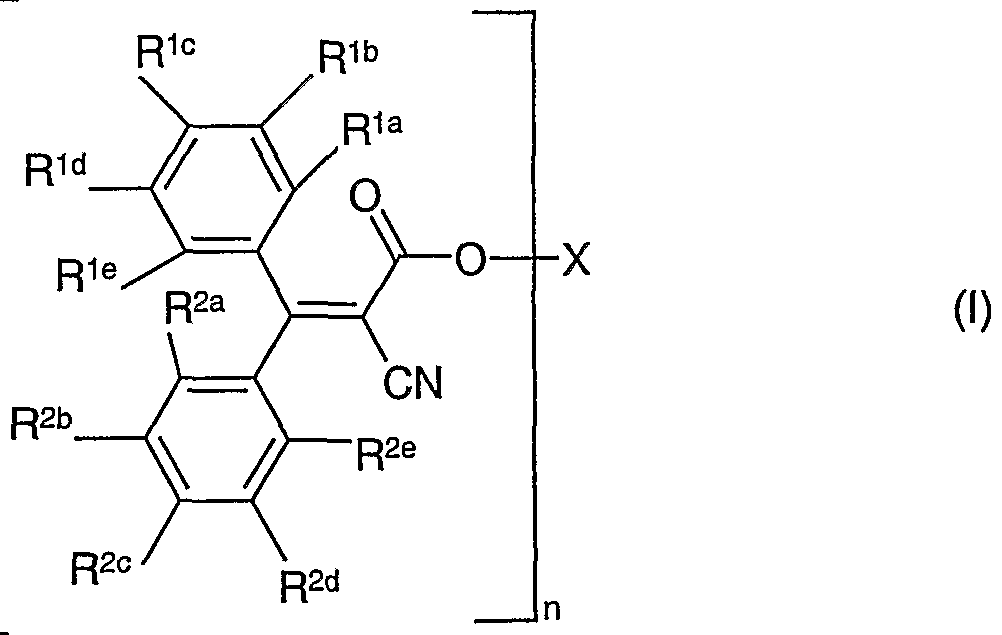
  • Preferred UV absorbers which are suitable as component i) of the stabilizer composition (S) according to the invention have the general formula (I): wherein
  • R 1a , R 1b , R 1C , R 1d , R 1e , R 2a , R 2b , R 2c , R 2d and R 2e are each independently hydrogen, alkyl, alkenyl, halo, cyano, nitro, amino, monoalkylamino, dial - kylamino, hydroxy, acyl, acyloxy, alkoxy, alkoxycarbonyl, cycloalkyl, cycloalkoxycarbonyl, cycloalkenyl, aryl, heteroaryl or heterocycloalkyl;
  • n is an integer from 3 to 10;
  • X is an n-valent aliphatic or cycloaliphatic radical having 3-20 Kohlen ⁇ atoms, wherein a cycloaliphatic radical is also by 1 to 2 and an aliphatic radical by 1, 2, 3, 4, 5, 6, 7, 8 or 9 non-adjacent oxygen atoms, sulfur atoms, imino or C 1 -C 4 -alkylimino groups may be interrupted
  • R 1a , R 1b , R 1c , R 1d , R 1e , R 2a , R 2b , R 2c , R 2d and R 2e is alkyl, it is preferably dC 2 o-alkyl.
  • Alkenyl is preferably C 2 -C 10 -alkenyl.
  • Halogen is preferably chlorine or bromine.
  • Monoalkylamino is preferably mono (C 1 -C 4 -alkyl) amino.
  • Dialkylamino is preferably also di (C 1 -C 4 -alkyl) amino.
  • Acyl is preferably C 1 -C 8 -acyl.
  • Acyloxy is preferably C 1 -C 8 acyloxy.
  • Alkoxy is preferably C 1 -C 18 -alkoxy.
  • Alkoxycarbonyl is preferably C 1 -C 4 -alkoxycarbonyl.
  • Cycloalkyl is preferably C 3 -C 10 -cycloalkyl which is unsubstituted or carries one, two, three, four or five substituents selected from C 1 -C 6 -alkyl and C 1 -C 6 -alkoxy.
  • Cycloalkoxycarbonyl is preferably Ca-C ⁇ -cycloalkoxycarbonyl which is unsubstituted or carries one, two, three, four or five substituents selected from C 1 -C 10 -alkyl and C 1 -C 6 -alkoxy.
  • Cycloalkenyl is preferably C 3 -C 10 cycloalkenyl which is unsubstituted or carries one, two, three, four or five substituents selected from (C 1-4 alkyl and C 1 -C 6 alkoxy)
  • Aryl is preferably phenyl or naphthyl , the unsubstituted or carries one, two, three, four or five substituents selected from C 1 -C 10 -alkyl and C 1 -C 6 -alkoxy.
  • X is an n-valent aliphatic or cycloaliphatic radical.
  • X is derived from the corresponding n-valent aliphatic or cycloaliphatic alcohols by removal of the OH group. These alcohols may be linear or branched, and their carbon chains may be interrupted by one or more oxygen or sulfur atoms, by imino groups or by C 1 -C 4 -alkylimino groups.
  • the group X is preferably derived from the following known polyols:
  • diphenylcyanoacrylates are known, for example, from WO 96/15102 and DE 44 40 055, to the disclosure of which reference is hereby fully made.
  • Diphenylcyanoacrylates of the formula (I) in which R 1a , R 1b , R 1c , R 1d , R 1e , R 2a , R 2b , R 20 , R 2d and R 2e have a different meaning can be prepared by corresponding processes become.
  • a particularly preferred diphenylcyanoacrylate is 1-bis-bis-cyano-S, S, S-diphenylacryloyl, oxy! -2,2-bis ⁇ [2 1- cyano-3 ', 3'-diphenylacryloyl) oxy] methyl ⁇ propane (CAS No. [178671-58-4], which is commercially available, for example, as Uvinul® 3030 from BASF AG, Ludwigshafen.
  • component ii) are in principle all UV absorbers are suitable, which are liquid at 50 0 C under standard pressure.
  • component ii) is selected from the group of benzotriazoles, diphenylcyanoacrylates, cinnamic acid esters, hydroxybenzophenones, hydroxyphenyltriazines and mixtures thereof.
  • component ii) comprises only those UV absorbers which are liquid under standard conditions.
  • the component ii) comprises UV absorbers of the general formula (II)
  • R 3 is hydrogen or a group A stands
  • # is the point of attachment to the acrylic backbone
  • R 3a , R 3b , R 3c , R 3d and R 3e are each independently hydrogen, alkyl, alkenyl, halogen, cyano, nitro, amino, monoalkylamino, dialkylamino, hydroxy, acyl, acyloxy, alkoxy, alkoxycarbonyl, cycloalkyl, Cycloalkoxycarbonyl, cycloalkenyl, aryl, heteroaryl or heterocycloalkyl;
  • R 4a , R 4b , R 4c , R 4d and R 4e are each independently of one another hydrogen, alkyl, alkenyl, halogen, cyano, nitro, amino, monoalkylamino, dialkylamino, hydroxy, acyl, acyloxy, alkoxy, alkoxycarbonyl, cycloalkyl, cycloalkoxycarbonyl, Cycloalkenyl, aryl, heteroaryl or heterocycloalkyl;
  • R 5 is hydrogen or cyano
  • R 6 is OR 7 or NR 8 R 9 ,
  • R 7 is hydrogen, alkyl, alkenyl, cycloalkyl, cycloalkenyl, aryl, heteroaryl, heterocycloalkyl or (CH 2 CH 2 -O) 0 -R ";
  • R 8 , R 9 are each independently of one another hydrogen, alkyl, alkenyl, cycloalkyl,
  • R 3 , R 4a , R 4b , R 40 , R 4d , R 4e and R 5 have the abovementioned meaning aufwei ⁇ sen;
  • o stands for an integer from 1 to 10.
  • R 3a , R 3b , R 3c , R 3d , R 3e , R 4a , R 4b , R 4c , R 4d and R 4e is alkyl, it is preferably C 1 -C 20 - -alkyl.
  • Alkenyl is preferably C 2 -C -alkenyl.
  • Halogen is preferably chlorine or bromine.
  • Monoalkyl amino is preferably mono (C r C 4 alkyl) amino.
  • Dialkylamino is preferably also di (C 1 -C 4 -alkyl) amino.
  • Acyl is preferably Ci-C 8 -Acyl.
  • Acyloxy is preferably C 1 -C 8 acyloxy.
  • Alkoxy is preferably C 1 -C 18 -alkoxy.
  • Alkoxycar- carbonyl is preferably C r C 2 alkoxycarbonyl.
  • Cycloalkyl preferably is C 3 -C 10 cycloalkyl which is unsubstituted or which bears one, two, three, four or five selected from C r C 10 alkyl and C 1 -C 6 -alkoxy substituents.
  • Cycloalkoxycarbonyl is preferably C 3 -C 6 cycloalkoxycarbonyl which is unsubstituted or carries one, two, three, four or five under CRCI ⁇ alkyl and -C 6 alkoxy substituents selected.
  • Cycloalkenyl is preferably C 3 -C 10 cycloalkenyl which is unsubstituted or one, two, three, four or five under -C 10 alkyl and -C 6 alkoxy selected substituents.
  • Aryl is preferably phenyl or naphthyl, which is ated unsubstitu ⁇ or one, two, three, four or five sub-Ci-Ci o alkyl, and Ci-C 6 alkoxy transmits easily ⁇ selected substituents.
  • R 7 or at least one of R 8 or R 9 is alkyl, it is preferably C 1 -C 20 -alkyl whose carbon chain is replaced by one or more nonadjacent groups selected from -O-, -S-, -NR 10 - (wherein R 10 is hydrogen or C r C 4 alkyl), -CO- and / or -SO 2 - may be interrupted.
  • Alkenyl is preferably C 2 -C 10 alkenyl.
  • Cycloalkenyl stands preferably C 3 -C 10 -cycloalkenyl which is unsubstituted or carries one, two, three, four or five substituents selected from C 1 -C 10 -alkyl and C 1 -C 6 -alkoxy.
  • Aryl is preferably phenyl or naphthyl which is unsubstituted or carries one, two, three, four or five substituents selected from C 1 -C 10 -alkyl and C 1 -C 6 -alkoxy.
  • R 3 is a radical of the formula A in which up to three, particularly preferably one of the radicals R 3a , R 3b , R 30 , R 3d and R 3e is C 1 -C 4 -alkyl, C 1 -C 12 -alkoxy or di (C 1 -C 4 -alkylamino) and the remaining of these radicals are hydrogen.
  • R 3c is C r C 4 alkyl, C r C 4 alkoxy or di (C 1 -C 4 alkyl) amino, especially methyl, ethyl, methoxy or dimethylamino and the remaining of these radicals for hydrogen ,
  • R 3a , R 3b , R 3c , R 3d and R 3e are each hydrogen.
  • R 4a, R 4b, R 4c, R 4d and R 12 alkyl, C r C 4e -C 12 alkoxy or di (C 1 -C 4 alkylamino ) and the rest of these radicals are hydrogen.
  • R 40 is C r C 4 alkyl, C 1 -C 4 -alkoxy or di (CrC 4 alkyl) amino, especially methyl, ethyl, methoxy or dimethyl amino and the remainder of these radicals are hydrogen.
  • R 4a , R 4b , R 4c , R 4d and R 48 are each hydrogen.
  • R 5 is cyano. Equally preferred are compounds II, wherein R 5 is hydrogen.
  • R 6 is OR 7 or NR 8 R 9 wherein R 7 and R 8 and R 9 are each independently preferably C 4 -C 8 alkyl, in particular C 4 -C 12 alkyl whose carbon chain can be interrupted by one, two, three, four, five, six or seven non-adjacent oxygen atoms, imino groups or C 1 -C 4 -alkylimino groups.
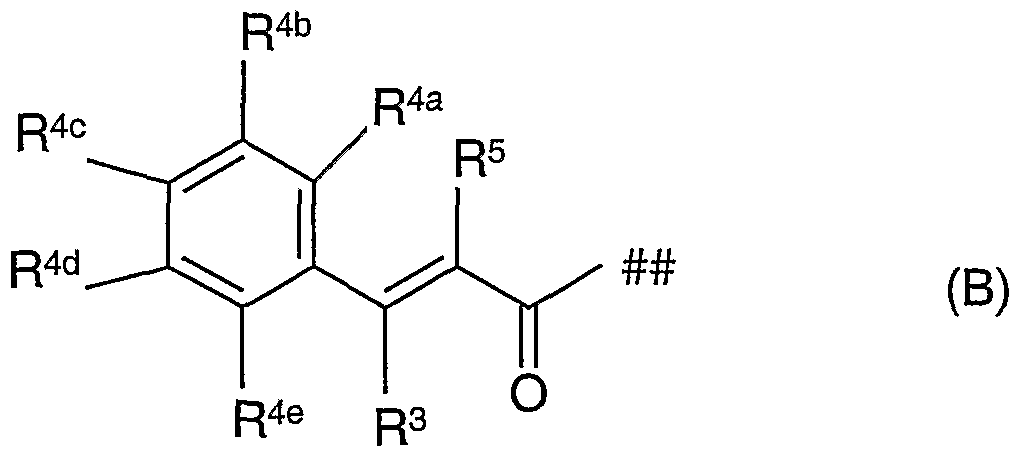
  • Particularly preferred are branched C 4 -C 18 -alkyl groups and chains, which are described by the general formula (CH 2 CH 2 -O) 0 -R ", wherein R" is hydrogen, alkyl, preferably CrC 18 alkyl or a radical of the formula B,
  • R 3 , R 4a , R 4b , R 4c , R 4d , R 4e and R 5 have the abovementioned and in particular the preferred meanings, and o is a number of 1 to 10, preferably 2 to 8 stands.
  • R 7 is 3 -C 8 -cycloalkyl, which may optionally bear one or two among C r C 4 -AlkyI or -C 4 alkoxy substituents selected C.
  • Such diphenylcyanoacrylates or amides or phenylacrylic acid esters or amides are known, for example, from US Pat. Nos. 5,821,292, DE 10058290, EP 1323743 and US Pat. No. 4,935,275 or can be prepared on the basis of the processes described therein.
  • R 4a, R 4b, R 4d and R 4e each represent hydrogen, R 4c is methoxy, R 3 is hydrogen, if is preferably p-methoxycinnamate (compound II, R 5 is hydrogen and R 6 is isoamyl)
  • 2-cyano-3,3-diphenylacrylic acid 2'-ethylhexyl ester is commercially available as Uvinul® 3039 from BASF AG.
  • p-methoxycinnamic acid 2-ethylhexyl ester is commercially available as Uvinul® 3088 from BASF AG, Ludwigshafen.
  • isoamyl p-methoxycinnamate is available from Symrise as Neo Heliopan® E1000.
  • the stabilizer composition (S) according to the invention may also comprise benzotriazoles as component ii).
  • a suitable benzotriazole is, for example, 2- (2H-benzotriazol-2-yl) -6-dodecyl-4-methylphenol, which is commercially available as Tinuvin® 571 from Ciba Specialty Chemicals, Inc.
  • the stabilizer composition (S) according to the invention may also comprise 2-hydroxybenzophenones as component ii).
  • a suitable 2-hydroxybenzophenone is, for example, 2-hydroxy-4-octoxybenzophenone, which is commercially available as Uvinul® 3008 from BASF AG, Ludwigshafen.
  • the solid component i) is brought into intimate contact with the liquid component ii), for example by mixing.
  • suitable mixing devices for the preparation of mixtures of liquid / solid educts or solid starting materials under standard conditions are known to the person skilled in the art. These include, for example, mixing devices based on static or dynamic mixers, such as stirred tanks, dispersing machines, ultrasonic or high-pressure homogenizers.
  • mixing devices based on static or dynamic mixers such as stirred tanks, dispersing machines, ultrasonic or high-pressure homogenizers.
  • one of the components i) or ii) present partially and the remaining component (s) added by conventional methods.
  • the liquid component ii) is at least partially vorge ⁇ sets.
  • the addition of the solid component i) can then be carried out, for example, continuously or in portions.
  • the bringing into contact can take place, for example, at ambient temperature or with the supply of heat.
  • the components i) and ii) can be heated together and then allowed to cool, or the component ii) is heated and then the solid component i) is added to the liquid component ii).
  • the Her ⁇ position of the stabilizer composition (S) is generally carried out at a Tempera ⁇ tur above ambient temperature, preferably at temperatures ranging from 25 0 C to 200 0 C, preferably between 100 0 C and 180 0 C.
  • solutions or dispersions are formed.
  • component i) is completely soluble in component ii)
  • the use of auxiliaries in the preparation of the stabilizer composition (S) according to the invention can as a rule be dispensed with.
  • This also generally applies to the preparation of stable stabilizer dispersions.
  • it is generally sufficient to expose components i) and ii) to sufficiently strong shearing forces in order to produce stable disperse mixtures, preferably molecular disperse mixtures.
  • At least one solvent is used as auxiliary for preparing the stabilizer composition (S) according to the invention.
  • Preferred solvents are those which are more volatile than the most volatile component of the stabilizer composition (S). These include aliphatic, cycloaliphatic or aromatic hydrocarbons, such as pentane, hexane, petroleum ether, cyclohexane, toluene, ethers, such as diethyl ether, tert-butyl methyl ether, tetrahydrofuran, ketones, such as Acetone, diethyl ketone or methyl ethyl ketone, carboxylic acid alkyl esters such as ethyl acetate or halogenated hydrocarbons such as dichloromethane or trichloromethane. Solvents used in the preparation can be removed by conventional methods known to those skilled in the art after preparation of the stabilizer composition (S), for. B. by evaporation under reduced pressure.
  • the finished stabilizer compositions (S) according to the invention preferably contain essentially no solvent, ie. H. the proportion of solvent is less than 1% by weight, based on the total weight of the stabilizer composition (S).
  • Further suitable auxiliaries in the preparation of the stabilizer composition (S) according to the invention are emulsifiers, protective colloids and dispersants.
  • the stabilizer compositions (S) according to the invention contain no additional auxiliaries.
  • stabilizer compositions wherein the Kompo ⁇ component i) 1, 3-bis - [(2-cyano-I 3 1, 3 1 -diphenylacryloyl) oxy] -2,2-bis ⁇ [2'-cyano -3 1 , 3 1 -diphenyl-acryloyl) oxy] methyl ⁇ propane and component ii) is selected from 2-cyano-3,3-diphenylacrylic acid 2'-ethylhexyl ester, p-methoxycinnamic acid 2-ethylhexyl ester, Hydroxy-4-octoxybenzophenone, p-Methoxycinnamic acid isoamyl ester and
  • stabilizer compositions (S) in which component i) 1, 3-bis - [(2 1 -cyano-3 ', 3 1 -diphenylacryloyl) oxy] -2,2-bis ⁇ [2 1 -cyano -3 I , 3 is 1 -diphenylacryloyl) oxy] methyl ⁇ propane and component ii) is 2-cyano-3,3-diphenyl-2-ethylhexyl acrylate.
  • stabilizer compositions (S) in which component i) contains 1, 3-bis - [(2'-cyano-3 ', 3'-diphenylacryloyOxyJ ⁇ - bisJP'-cyano-S'.S' -diphenylacryloyoxy methyl-propane and component ii) is 2-ethylhexyl p-methoxycinnamate.
  • stabilizer compositions (S) in which component i) 1, 3-bis - [(2 l -cyano-3 ', 3 l -diphenylacryloyl) oxy] -2,2-bis ⁇ [2 l -cyano -3 ', 3 l -diphenyl-acryloyl) oxy] methyl ⁇ propane and component ii) is 2- (2H-benzotriazol-2-yl) -6-dodecyl-4-methylphenol.
  • stabilizer compositions (S) in which component i) 1, 3-bis - [(2'-cyano-3 ', 3'-diphenylacryloyl) oxy] -2,2-bis ⁇ [2' cyano-3 1 , 3 l -diphenylacryloyl) oxy] methyl ⁇ propane and component ii) is 2-hydroxy-4-octoxybenzophenone.
  • the stabilizer composition (S), based on the total weight of the components i) and ii) is preferably from 0.001 to 50 wt., In particular 0.1 to 40 wt .-% and most preferably 1 to 30 wt .-% of component i ) and from 50 to 99.999% by weight, in particular 60 to 99.9% by weight and very particularly preferably 70 to 99% of component ii).
  • the stabilizer composition (S) according to the invention is suitable for stabilizing inanimate organic and revived organic material, in particular for stabilizing inanimate organic material, such as plastics.
  • a further subject of the present invention therefore relates to a polymer composition
  • a polymer composition comprising a stabilizer composition (S) as defined above and at least one polymer selected from polyesters, polycarbonates, polyamides, polyolefins, polyvinyl acetals, polystyrene, copolymers of styrene or ⁇ -methylstyrene with dienes and / or acrylic derivatives, halogen-containing polymers, polyisocyanate polyaddition products and mixtures thereof.
  • S stabilizer composition
  • the polymer composition contains 0.005 to 10 wt .-%, preferably 0.01 to 5 wt .-%, in particular 0.05 to 2 wt .-% of the stabilizer composition (S), based on the weight of the polymer composition.
  • the weight of the polymer composition is understood as meaning the weight of the polymer composition, including added additives, stabilizers, auxiliaries or additives.
  • the polymer composition contains, as polymer, at least one polyester, preferably at least one linear polyester.
  • polyesters and copolyesters are described in EP-A-0678376, EP-A-0 595 413 and US 6,096,854, to which reference is hereby made.
  • Polyesters are known to be condensation products of one or more polyols and one or more polycarboxylic acids.
  • the polyol is a diol and the polycarboxylic acid is a dicarboxylic acid.
  • the polymer composition contains a polycarbonate as polymer.
  • Polycarbonates are formed z. B. by condensation of phosgene or carbonic acid esters such as diphenyl carbonate or
  • Dimethyl carbonate with dihydroxy compounds are aliphatic or aromatic dihydroxy compounds.
  • aromatic dihydroxy compounds are bisphenols, such as 2,2-bis- (4-hydroxyphenyl) -propane (bisphenol-A), tetraalkylbisphenol-A, 4,4- (meta-phenylenediisopropyl) diphenol (bisphenol M), 4,4 - (para-phenylenediisopropyl) diphenol, 1, 1-bis (4-hydroxyphenyl) - 3,3,5-trimethylcyclohexane (BP-TMC), 2,2-bis (4-hydroxyphenyl) -2-phenylethane, 1, 1-bis (4-hydroxyphenyl) -cyclohexane (bisphenol-Z) and optionally their Called Gemi ⁇ cal.
  • the polycarbonates can be branched by using small amounts of branching agents.
  • the polymer composition contains at least one polyamide as polymer.
  • Polyamides can be prepared, for example, by polycondensation from diamines, for example hexamethylenediamine, and dicarboxylic acids, such as adipic acid. Polyamides are also by polycondensation of amino acids or by ring-opening polymerization of lactams, eg. B. caprolactam available.
  • the polymer composition contains at least one polyolefin as polymer.
  • polyolefin encompasses all polymers which are synthesized from olefins without further functionality, such as low or high density polyethylene, polypropylenes, linear polybutene-1 or polyisobutylene or polybutadiene and also copolymers of monoolefins or diolefins , Preferred polyolefins are the homopolymers and copolymers of ethylene, as well as the homopolymers and copolymers of propylene.
  • the polymer composition as polymer contains at least one polyvinyl acetal.
  • Polyvinyl acetals are the reaction products of polyvinyl alcohol with aldehydes.
  • the polymer composition as polymer contains at least one copolymer of styrene or of ⁇ -methylstyrene with dienes and / or acrylic derivatives.
  • Suitable copolymers of styrene or of ⁇ -methylstyrene are, for example, styrene-butadiene copolymers, styrene-acrylonitrile copolymers (SAN), styrene-ethyl methacrylate copolymers, styrene-butadiene-ethylacrylate copolymers, styrene-acrylonitrile-methacrylate copolymers, Acrylonitrile-butadiene-styrene copolymers (ABS) or methyl methacrylate-butadiene-styrene copolymers (MBS).
  • the polymer composition contains as polymer at least one halogen-containing polymer such as copolymers of ethylene and chlorinated ethylene, polymers of halogenated vinyl compounds such.
  • halogen-containing polymer such as copolymers of ethylene and chlorinated ethylene, polymers of halogenated vinyl compounds such.
  • polyvinyl chloride, polyvinylidene chloride, polyvinyl fluoride, polyvinylidene fluoride and their copolymers such as vinyl chloride / ethylene / vinyl acetate graft copolymers, acrylic ester / vinyl chloride graft copolymers, vinyl chloride / vinyl acetate copolymers, vinyl chloride RID / styrene copolymers, vinyl chloride / acrylonitrile copolymers, vinyl chloride / vinylidene copolymers.
  • the halogen-containing polymer is polyvinyl chloride (PVC).
  • PVC is formed by free-radical polymerization of vinyl chloride.
  • Polyvinyl chloride is usually prepared by the emulsion polymerization, suspension polymerization and bulk polymerization processes. The polymerization is often initiated by peroxides.
  • Polyvinyl chloride is used with different content of plasticizers, with a content of plasticizers of 0 - 12% as rigid PVC, of more than 12% as soft PVC or with a very high content of plasticizers as PVC paste.
  • the stabilizer composition (S) according to the invention can be added to the finished polyvinyl chloride. The addition is done in the usual way. Alternatively, the stabilizer composition (S) according to the invention can be added to the monomer and the mixture of monomer and stabilizer composition (S) according to the invention polymerized or the stabilizer composition (S) according to the invention added during the polymerization of the polyvinyl chloride. Furthermore, the addition of the stabilizer composition (S) according to the invention can be carried out together with a plasticizer. If appropriate, it may be advantageous to heat the mixture before addition, for example to temperatures above 50 ° C.
  • polymer compositions in which the polymer is selected from polyisocyanate polyaddition products (polyurethanes).
  • Suitable polyisocyanate polyaddition products are, for example, cellular polyurethanes, eg. As hard or soft polyurethane foams, compact polyurethanes, thermoplastic polyurethanes (TPU), thermosetting or elastic polyurethanes or polyisocyanurates. These are well known and their preparation is described many times. It is usually carried out by reacting dihydric and higher isocyanates or corresponding isocyanate analogues with isocyanate-reactive compounds. The preparation is carried out by customary processes, for example by the one-shot process or by the prepolymer process, eg. B. in forms, in a reaction extruder or a belt system.
  • a special manufacturing process is the reaction injection molding (RIM) process, which is preferably used for the production of polyurethanes having a foamed or compact core and a predominantly compact, non-porous surface.
  • the stabilizer compositions (S) according to the invention are advantageously suitable for all these processes.
  • Polyurethanes are generally composed of at least one polyisocyanate and at least one compound having at least two groups reactive toward isocyanate groups per molecule. Suitable polyisocyanates preferably have 2 to 5 NGO groups.
  • the isocyanate-reactive groups are preferably selected from hydroxyl, mercapto, primary and secondary amino groups. These preferably include di- or higher polyols.
  • Suitable polyisocyanates are aliphatic, cycloaliphatic, araliphatic and aromatic isocyanates.
  • Suitable aromatic diisocyanates are, for example, 2,2'-, 2,4'- and / or 4,4'-diphenylmethane diisocyanate (MDI), 1, 5-naphthylene diisocyanate (NDI), 2,4- and / or 2,6-toluene diisocyanate (TDI), diphenylmethane diisocyanate, 3,3'-dimethyl-diphenyl-diisocyanate, 1, 2-diphenylethane diisocyanate and / or phenylene diisocyanate.
  • MDI 2,2'-, 2,4'- and / or 4,4'-diphenylmethane diisocyanate
  • NDI 1, 5-naphthylene diisocyanate
  • TDI 2,6-toluene diisocyanate
  • Aliphatic and cycloaliphatic diisocyanates include, for example, tri-, tetra-, penta-, hexa-, hepta- and / or octamethylene diisocyanate, 2-methyl-pentamethylene-1,5-diisocyanate, 2-ethylbutylene-1,4-diisocyanate, 1-isocyanato - SS ⁇ -trimethyl- ⁇ -isocyanatomethyl-cyclohexane (isophorone diisocyanate, IPDI), 1, 4- and / or 1, 3-bis (isocyanatomethyl) cyclohexane (HXDI), cyclohexane-1, 4-diisocyanate, 1-methyl- 2,4- and / or 2,6-cyclohexanediisocyanato and / or 4,4'-, 2,4'- and / or 2,2'-dicyclohexylmethane diisocyanate ,
  • Preferred diisocyanates include hexamethylene diisocyanate (HMDI) and isophorone diisocyanate.
  • HMDI hexamethylene diisocyanate
  • isophorone diisocyanate examples of higher functionality isocyanates are triisocyanates, e.g. B. Triphenylmethan- 4 j 4 1 j 4 "triisocyant, furthermore the cyanurates of the abovementioned diisocyanates, as well as the oligomers obtainable by partial reaction of diisocyanates with water, eg the biurets of the abovementioned diisocyanates, furthermore oligomers obtained by specific order - Setting of semi-blocked diisocyanates with polyols having an average of more than 2 and preferably 3 or more hydroxyl groups are available.
  • Polyol components used for rigid polyurethane foams which may optionally have isocyanurate structures, are highly functional polyols, in particular polyether polyols based on high-functional alcohols, sugar alcohols and / or saccharides as starter molecules.
  • polystyrene foams or RIM materials For flexible polyisocyanate polyaddition products, for example flexible polyurethane foams or RIM materials, 2- and / or 3-functional polyether polyols based on glycerol and / or trimethylolpropane and / or glycols as starter molecules are polyols and 2- and / or 3-functional Polyetherherpolyols based on glycerol and / or trimethylolpropane and / or glycols as alcohols to be esterified are preferred as polyols.
  • Thermoplastic polyurethanes are usually based on predominantly difunctional polyester polyalcohols and / or polyether polyalcohols which preferably have an average functionality of from 1.8 to 2.5, particularly preferably from 1.9 to 2.1.
  • the preparation of the polyether polyols is carried out according to a known technology.
  • Suitable alkylene oxides for the preparation of the polyols are, for example, 1,3-propylene oxide, 1,2- or 2,3-butylene oxide, styrene oxide and preferably ethylene oxide and 1,2-propylene oxide.
  • the alkylene oxides can be used individually, alternately in succession or as mixtures.
  • alkylene oxides are used which lead to primary hydroxyl groups in the polyol.
  • Particularly preferred polyols used are those which have been alkoxylated with ethylene oxide to complete the alkoxylation and thus have primary hydroxyl groups.
  • Further suitable polyetherols are polytetrahydrofurans and polyoxymethylenes.
  • the polyether polyols have a functionality of preferably 2 to 6 and in particular 2 to 4 and molecular weights of 200 to 10,000, preferably 200 to 8,000.
  • Suitable polyester polyols may be prepared, for example, from organic dicarboxylic acids having 2 to 12 carbon atoms, preferably aliphatic dicarboxylic acids having 4 to 6 carbon atoms, and polyhydric alcohols, preferably diols having 2 to 12 carbon atoms, preferably 2 to 6 carbon atoms.
  • the polyester polyols preferably have a functionality of 2 to 4, in particular 2 to 3, and a molecular weight of 480 to 3000, preferably 600 to 2000 and in particular 600 to 1500.
  • the polyol component may also include diols or higher alcohols. Suitable diols are glycols preferably having 2 to 25 carbon atoms. Hier ⁇ to count 1, 2-ethanediol, 1, 2-propanediol, 1, 3-propanediol, 1, 4-butanediol, 1, 5-pentanediol, 1, 6-hexanediol, 1, 10-decanediol, diethylene glycol, 2, 2,4-trimethylpentanediol-1, 5, 2,2-dimethylpropanediol-1,3,3,4-dimethylolcyclohexane, 1,6-dimethylolcyclohexane, 2,2-bis (4-hydroxyphenyl) -propane (bisphenol A), 2 , 2-bis (4-hydroxyphenyl) butane (bisphenol B) or 1,1-bis (4-hydroxyphenyl) -3,3,5-trimethylcyclohexane (bisphenol C).
  • Suitable higher alcohols are for.
  • pentavalent alcohols pentoles. They usually have 3 to 25, preferably 3 to 18 carbon atoms. These include glycerol, trimethylolethane, trimethylolpropane, erythritol, pentaerythritol, sorbitol and their alkoxylates.
  • chain extenders e.g., a molecular weight of 40 to 300.
  • Suitable examples include aliphatic, cycloaliphatic and / or araliphatic diols having 2 to 14, preferably 2 to 10 carbon atoms, such as ethylene glycol, 1, 3-propanediol, 1, 2-propanediol, 1, 10-decanediol, 1, 2 , 1, 3, 1, 4-dihydroxycyclohexane, diethylene glycol, dipropylene glycol and preferably ethylene glycol, 1,4-butanediol, 1,6-hexanediol and bis (2-hydroxyethyl) hydroquinone, triols, such as 1, 2,4-, 1, 3,5-trihydroxycyclohexane, glycerol, trimethylolpropane, triethanolamine and low molecular weight hydroxyl-containing polyalkylene oxides based on ethylene and / or 1, 2-propylene oxide and the aforementioned diols and / or triols as starter molecules.
  • Suitable stoppers include, for
  • Another object of the present invention is therefore a process for the preparation of polyisocyanate polyaddition by reaction of isocyanates with isocyanate-reactive compounds, wherein the reaction in the presence of a stabilizer composition (S), as defined above takes place.
  • S stabilizer composition
  • the isocyanates and the isocyanate-reactive compounds are preferably reacted in amounts such that the equivalence ratio of NCO groups of the isocyanate to the sum of the reactive hydrogen atoms of the isocyanate-reactive compounds 0.85 to 1, 25: 1, preferably 0.95 to 1, 15: 1 and in particular 1 to 1, 05: 1, is. If in particular the rigid polyurethane foams contain at least partially bound isocyanurate groups, a ratio of NCO groups to the sum of the reactive hydrogen atoms of from 1.5 to 60: 1, preferably from 1.5 to 8: 1, is usually used.
  • the stabilizer composition (S) may be added to the isocyanate component, the isocyanate-reactive component or both the isocyanate component and the isocyanate-reactive component.
  • the stabilizer composition (S) according to the invention is preferably added in the process according to the invention to the isocyanate-reactive component, the so-called polyol component.
  • heating the stabilizer composition (S) prior to the addition for example, to a temperature above 50 0 C.
  • the Stabilisatorzu ⁇ composition can be easily homogeneously dispersed in the isocyanate-reactive component there are suitable split by a rule.
  • the mixing of the stabilizer composition (S) with the poly-ol component can be carried out, for example, in a stirred tank.
  • Suitable additional stabilizers comprise at least one antioxidant, the is selected from the group of phosphites, sulfites, phenothiazine, aromatic amines, benzofuranones and / or dilauryl-3,3'-thiodipropionate and mixtures thereof.
  • Suitable phosphites are trisnonylphenyl phosphite, triphenyl phosphite, didecylphenyl phosphite and tris- (2,4-di-tert-butylphenyl) phosphite and mixtures thereof.
  • a suitable aromatic amine is, for example, di- (4- (1,1,3,3-tetramethylbutyl) phenyl) amine (available, for example, as Irganox® 5077 from Ciba Specialty Chemicals, Inc.).
  • Suitable benzofuranones are, for example, 3- [4- (2-acetoxyethoxy) phenyl] -5,7-di-tert-butylbenzofuran-2-one, 5,7-di-tert-butyl-3- [4- (2 -stearoyloxyethoxy) phenyl] -benzofuran-2-one, 3,3'-bis [5,7-di-tert-butyl-3- (4- [2-hydroxyethoxy] phenyl) benzofuran-2-one], 5, 7-di-tert-butyl-3- (4-ethoxyphenyl) benzofuran-2-one, 3- (4-acetoxy-3,5-dimethylphenyl) -5,7-di-tert-butylbenzofuran-2 -on, 3- (3,5-dimethyl-4-pivaloyloxyphenyl) -5,7-di-tert-butylbenzofuran-2-one and mixture
  • antioxidants are trisnonylphenyl phosphite, triphenyl phosphite, phenothiazine, tris- (2,4-di-tert-butylphenyl) phosphite, didecylphenyl phosphite and / or dilauryl-3,3'-thiodipropionate, and mixtures thereof.
  • the proportion of antioxidant, based on the weight of the polymer composition is from 0.0001 to 10% by weight, preferably from 0.01 to 1% by weight.
  • the reaction between the polyol component and the isocyanate component may additionally be carried out in the presence of at least one further component which is selected from costabilizers, blowing agents, catalysts, colorants and additives.
  • Suitable costabilizers include sterically hindered amines and sterically hindered phenols.
  • Suitable sterically hindered amines are diphenylamine, bis (4-octylphenyl) amine, bis (2,2,6,6-tetramethylpiperidyl) sebacate, bis (1, 2,2,6,6-pentamethylpiperidyl) sebacate, bis (1 , 2,2,6,6-pentamethylpiperidyl) ester, N, N'-bis (formyl) -bis (2,2,6,6-tetramethyl-4-piperidyl) -1, 6-hexanediamine, the Kondensati ⁇ onsomme of 1, 4-dihydroxy-2,2,6,6-tetramethylpiperidine and succinic acid, the condensation product of N, N '- (2,2,6,6-tetramethylpiperidyl) hexamethylenediamine and 4-tert-octylamino-2,6- dichloro-1, 3,5-s-triazine, poly [3- (eicosyl / tetracosyl) -1 -
  • Bis- (2,2,6,6-tetramethyl-1-octoxypiperidyl) sebacyt (commercially available, for example, under the name Tinuvin® 123 from Ciba Specialty Chemicals, Inc.), the condensate of 4-amino-2,2 , 6,6-tetramethylpiperidines and tetramethylolacetylenediureas and mixtures thereof.
  • the amount of sterically hindered amine is 0.0001 to 10% by weight, preferably 0.01 to 1% by weight.
  • reaction is carried out both in the presence of at least one sterically hindered amine and in the presence of at least one antioxidant.
  • Suitable sterically hindered phenols are, for example
  • Triethylene glycol bis [3- (5-tert-butyl-4-hydroxy-m-tolyl) propionate] available, for example, as Irganox® 245 from Ciba Specialty Chem., Inc.) bis- (2- [3- ( 3,5-di-tert-butyl-4-hydroxy-phenyl) -propionyloxy] -ethyl) -sulfide (for example, available as Irganox® 1035 from Ciba Specialty Chemicals, Inc.), octadecyl-3- (3,5 di-tert-butyl-4-hydroxyphenyl) -propionate (available, for example, as Irganox® 1076 from Ciba Specialty Chemicals, Inc.), N, N-hexamethylene-bis- (3,5-di-t-butyl) 4-hydroxyphenyl) propionamide (for example, available as Irganox® 1098 from Ciba Specialty Chemicals, Inc.
  • the proportion of sterically hindered phenol, based on the weight of the polymer composition is 0.0001 to 10% by weight, preferably 0.01 to 1% by weight.
  • blowing agents in particular for the production of polyurethane foams, conventional chemical, for example water, and / or physically acting blowing agents be used.
  • physical blowing agent makes suitable as such physical blowing agent prises ⁇ fluids, which cyanates toward the organic, modified or unmodified polyisobutylene, are inert and have boiling points below 100 0 C, preferably below 50 0 C, more particularly sondere between -50 0 C and 30 0 C in Standard pressure, so that they evaporate under the influence of the exothermic polyaddition reaction.
  • alkanes such as heptane, hexane, n- and iso-pentane, preferably technical mixtures of n- and iso-pentanes, n- and iso-butane and propane, cycloalkanes, such as cyclopentane and / or cyclohexane, Ethers, such as furan, dimethyl ether and diethyl ether, ketones, such as acetone and methyl ethyl ketone, carboxylic acid alkyl esters, such as methyl formate, dimethyl oxalate and ethyl acetate, and halogenated hydrocarbons, for example customary fluorohydrocarbons and / or chlorohydrocarbons, for example dichloromethane.
  • alkanes such as heptane, hexane, n- and iso-pentane, preferably technical mixtures of n- and iso-pentanes,
  • low-boiling liquids with one another and / or with other substituted or unsubstituted hydrocarbons.
  • organic carboxylic acids such as. For example, formic acid, acetic acid, oxalic acid, ricinoleic acid and carboxyl group-containing compounds.
  • the blowing agents are usually added to the isocyanate-reactive compounds. However, they may be added to the isocyanate component or as a combination of both the polyol component and the isocyanate component or premixes of these components with the other constituent components.
  • the amount of physical blowing agent used is preferably 0 to 25 wt .-%, particularly preferably 0 to 15 wt .-%, each based on the weight of the total isocyanate-reactive compounds.
  • water is used as the blowing agent, preferably in an amount of 0.1 to 10% by weight of water, more preferably in an amount of 0.1 to 7% by weight of water, in each case based on the weight of the total used Isocyanate-reactive compounds, it is preferably added to the polyol component, wherein water is preferably used in combination with at least one of said physical blowing agents, for example cyclopentane, n- and / or iso-pentane.
  • catalysts it is possible to use generally known compounds which greatly accelerate the reaction of isocyanates with the compounds reactive toward isocyanates, preferably having a total catalyst content of from 0.001 to 0.1% by weight, based on the weight of the total isocyanate-reactive compounds Connections, is used.
  • the following compounds can be used: triethylamine, tributylamine, dimethylbenzylamine, dicyclohexylmethylamine, dimethylcyclohexylamine, N, N, N ', N'-tetramethyl-diaminodiethylether, bis (dimethylaminopropyl) -urea, N-methyl- or N Ethylmorpholine, N-cyclohexylmorpholine, N 1 N 1 N ', N'-tetramethylethylenediamine, NNN'.N'-tetramethylbutanediamine, N, N, N 1 , N'-tetramethylhexanediamine-1, 6, Pentamethyldiethylenetriamine, dimethylpiperazine, N-dimethylaminoethylpiperidine, 1,2-dimethylimidazole, 1-azabicyclo [2.2.0] octane, 1,4-diazabicyclo [2.2.2] octtan
  • colorant is understood in the context of the present invention, both dyes and inorganic and organic pigments.
  • the proportion of colorant, based on the Intelge ⁇ weight of isocyanate-reactive compounds is usually 1 to 6% by weight.
  • Suitable additives are, for example, surface-active substances, foam stabilizers, cell regulators, fillers, flame retardants, hydrolysis protectants, fungicidal and bacteriostatic substances and mold release agents.
  • z. B. compounds which serve to assist the homogenization of the starting materials and optionally are also suitable to regulate the cell structure of the plastics. Mention may be spielvati emulsifiers, such as the sodium salts of castor oil or of fatty acids and salts of fatty acids with amines, eg. As diethylamine, stearic acid diethanolamine, ricinolsaures diethanolamine, salts of sulfonic acids, eg. B.
  • Foam stabilizers such as siloxane-oxalkylene copolymers and other organopolysiloxanes, ethoxylated alkylphenols, ethoxylated fatty alcohols, paraffin oils, castor oil or ricinoleic acid esters, turkey red oil and peanut oil, and cell regulators, such as paraffins, fatty alcohols and dimethylpolysiloxanes.
  • the above-described oligomeric acrylates having polyoxyalkylene and fluoroalkane radicals are also suitable as side groups.
  • the surface-active substances are usually used in amounts of 0.01 to 5 wt .-%, based on 100 wt .-% of the total used gegen ⁇ isocyanate-reactive compounds.
  • Fillers, in particular reinforcing fillers are to be understood as meaning the conventional organic and inorganic fillers, reinforcing agents, hardening agents, agents for improving the abrasion behavior in paints, coating agents, etc., which are known per se.
  • inorganic fillers such as carbon and in particular carbon fibers, silicate minerals, for example phyllosilicates such as antigorite, serpentine, hornblende, amphiboles, chrysotile and talc, metal oxides such as kaolin, aluminum oxides, titanium oxides and iron oxides, metal salts, such as Chalk, barite and inorganic pigments, such as cadmium sulfide and zinc sulfide, as well as glass, etc.
  • silicate minerals for example phyllosilicates such as antigorite, serpentine, hornblende, amphiboles, chrysotile and talc
  • metal oxides such as kaolin, aluminum oxides, titanium oxides and iron oxides
  • metal salts such as Chalk
  • barite and inorganic pigments such as cadmium sulfide and zinc sulfide, as well as glass, etc.
  • kaolin China Clay
  • aluminum silicate and coprecipitates of barium sulfate and aluminum silicate and natural and synthetic fibrous minerals such as wollastonite, metal fibers and in particular glass fibers of various lengths, which may optionally be sized.
  • Suitable organic fillers are, for example: melamine, rosin, cyclopentadienyl resins and graft polymers and cellulose fibers, polyamide, polyacrylonitrile, polyurethane, polyester fibers based on aromatic and / or aliphatic dicarboxylic esters.
  • the inorganic and organic fillers can be used individually or as mixtures and are advantageously added to the reaction mixture in amounts of from 0.5 to 50% by weight, preferably from 1 to 40% by weight, based on the weight of the isocyanates and the weight of the total isocyanate-reactive compounds incorporated, whereby, however, the content of mats, nonwovens and woven fabrics of natural and synthetic fibers can reach values of up to 80% by weight.
  • Suitable flame retardants are, for example, tricresyl phosphate, tris (2-chloroethyl) phosphate, tris (2-chloropropyl) phosphate,
  • Suitable mold release agents are, for example, silicones, waxes, metal salts of fatty acids such as calcium, lead, magnesium, aluminum, zinc stearate, fats, talc or mica.
  • the optionally used antioxidant and the optionally used further component (s) may in principle be added to the isocyanate component and / or the polyol component.
  • the addition can be made simultaneously with the addition, before addition, or after the addition of the stabilizer composition (S) to the isocyanate component and / or polyol component.
  • the polyisocyanate polyaddition products are advantageously prepared by the one-shot process, for example by means of the high-pressure or low-pressure technique in open or closed molds, for example metallic molds or reaction extruders, in particular for the production of thermoplastic polyurethanes. Also customary is the continuous application of the reaction mixture on suitable strip conveyors for the production of panels.
  • the starting components A and B are, depending on the application, at a temperature of 0 to 100 0 C, preferably from 20 to 60 ° C, mixed and introduced into the open or optionally under increased pressure in the closed Formwerk ⁇ convincing or in a continuous workstation on a tape which receives the reaction mass applied.
  • the mixing can be carried out mechanically by means of a stirrer or a stirring screw.
  • the temperature of the mold or, if no mold is used of which temperature at which the reduction takes place Um ⁇ is usually at least 30 0 C, preferably 35 to 110 0 C.
  • the present invention also provides the use of a stabilizer composition (S), as defined above, for stabilizing polymer compositions which contain at least one of polyesters, polycarbonates, polyamides, polyolefins and polyesters.
  • S stabilizer composition
  • polymer compositions which contain at least one of polyesters, polycarbonates, polyamides, polyolefins and polyesters.
  • NEN polyvinyl acetals, polystyrene, copolymers of styrene or ⁇ -methyl styrene with dienes and / or acrylic derivatives, polyisocyanate polyaddition products, halogen-containing polymers and mixtures thereof contain polymer, against the action of light.
  • the stabilizer composition (S) according to the invention is well-suited for stabilizing moldings made from polyisocyanate polyaddition products, since it can be readily dissolved or dispersed in the isocyanate-reactive component and thus a homogeneous distribution of the stabilizer composition in the polyisocyanate polyaddition product can be achieved.
  • Equally suitable is the stabilization of moldings made of polyvinyl chloride. Moldings of polyisocyanate polyaddition products, polyvinylamide or polyvinyl chloride are used, for example, as housings, covers or dashboards in means of transport.
  • the means of transport include, for example, means of transport such as passenger cars, lorries, buses, rail vehicles such as trams, levitation trains, railways, rack railways, water transport such as ships and air kiosk, as well as aviation equipment such as aircraft and helicopters.
  • means of transport such as passenger cars, lorries, buses, rail vehicles such as trams, levitation trains, railways, rack railways, water transport such as ships and air kiosk, as well as aviation equipment such as aircraft and helicopters.
  • the molded parts stabilized according to the invention are used in the interior of means of transport.
  • the stabilized using the Stabilizerzu ⁇ composition according to the invention (S) moldings of polyvinyl chloride or a polyisocyanate polyaddition product are preferably used for the production of dashboards for passenger and trucks, for aircraft or ships, especially for passenger cars and trucks.
  • the polymer compositions stabilized according to the invention have low fogging values in comparison to polymer compositions stabilized with the stabilizers or stabilizer compositions known from the prior art.
  • the fogging value is determined at 100 0 C over a period of 16 hours in accordance with DIN 75201, at a present invention stabili ⁇ classified polymer composition to 1, 5 mg, preferably 1 0 mg, and in particular less than 0.8 mg , at a stabilizer concentration of 0.5 wt .-% based on the weight of the polyol component.
  • the stabilizer composition (S) according to the invention is distinguished by good compatibility and solubility in the abovementioned polymer compositions. They are usually weakly yellowish and in the usual plastic processing temperatures stable and non-volatile.
  • the polymer compositions stabilized according to the invention and the moldings produced therefrom are characterized by a longer service life since the stabilizer composition (S) according to the invention evaporates more slowly from the polymer composition or from the moldings produced therefrom than those known from the prior art Light stabilizers.
  • the 0.5% by weight of stabilizer or 0.5% by weight of stabilizer composition (S1) was dissolved in the polyol component (polyesterpolyol) of the polyurethane to be prepared and subsequently afterlaid together with an aliphatic isocyanate as a mixture with a spray gun the spray technology process into a black colored skin.
  • the polyurethane does not contain a stabilizer.
  • Comparative Examples 3 stabilizer is
  • the fogging value of the stabilized polyurethane skins from Examples 3, 4 and 6 was determined.
  • the specimen was placed on the bottom of a standard cup made of glass.
  • the beaker is covered with a glass plate on which volatiles can condense out of the sample. This glass plate is cooled.
  • the thus prepared beaker is placed 16 hours in a structure located on educatempera ⁇ of 100 0 C (+ 0.3 0 C) bath thermostat.
  • the amount of fogging precipitate on the glass plate is measured by measuring the 60 ° reflectometer values. Reference is made to the 60 ° reflectometer values of the same glass plate without precipitate, which was thoroughly cleaned before the experiment. Table 2 shows the measured fogging values. Table 2:
  • a stabilizer mixture (S) according to the invention has a significantly lower fogging than stabilizers from the prior art. Accordingly, the polymer compositions stabilized using the stabilizer composition (S) according to the invention show markedly improved quality properties in comparison to polymer compositions which are stabilized with conventional UV absorbers.
  • the stabilizer evaporates from the stabilized polymer according to the invention to a significantly lower extent than the stabilizers known from the prior art.

Landscapes

  • Chemical & Material Sciences (AREA)
  • Organic Chemistry (AREA)
  • Engineering & Computer Science (AREA)
  • Materials Engineering (AREA)
  • Health & Medical Sciences (AREA)
  • Chemical Kinetics & Catalysis (AREA)
  • Medicinal Chemistry (AREA)
  • Polymers & Plastics (AREA)
  • Life Sciences & Earth Sciences (AREA)
  • Wood Science & Technology (AREA)
  • Compositions Of Macromolecular Compounds (AREA)
  • Polyurethanes Or Polyureas (AREA)

Abstract

Die vorliegende Erfindung betrifft eine Stabilisatorzusammensetzung (S), bestehend aus (i) wenigstens einem, unter Standardbedingungen festen UV-Absorber aus der Gruppe der Diphenylcyanacrylate mit einem Molekulargewicht von wenigstens 500 g/mol und (ii) wenigstens einem, bei 50 °C und Standarddruck flüssigen UV-­Absorber. Die vorliegende Erfindung betrifft außerdem eine Polymerzusammenset­zung, enthaltend eine solche Stabilisatorzusammensetzung (S) sowie ein Verfahren zur Herstellung von Polyisocyanat-Polyadditionsprodukten durch Umsetzung von Polyisocyanaten mit gegenüber Isocyanaten reaktiven Verbindungen, wobei die Umsetzung in Gegenwart einer solchen Stabilisatorzusammensetzung (S) erfolgt.

Description

Stabilisatorzusa'mmensetzung aus flüssigen und festen UV-Absorbern
Beschreibung
Die vorliegende Erfindung betrifft eine Stabilisatorzusammensetzung, die aus mindes¬ tens einem, unter Standardbedingungen festen UV-Absorber aus der Gruppe der Diphenylcyanacrylate mit einem Molekulargewicht von wenigstens 500 g/mol und min¬ destens einem, bei 50 0C und Standarddruck flüssigen UV-Absorber besteht und deren Verwendung zur Stabilisierung von Polymerzusammensetzungen. Außerdem betrifft die vorliegende Erfindung ein Verfahren zur Herstellung von Polyisocyanat-Polyad- ditionsprodukten durch Umsetzung von Polyisocyanaten mit gegenüber Isocyanaten reaktiven mehrwertigen Verbindungen, wobei die Umsetzung in Gegenwart einer sol¬ chen Stabilisatorzusammensetzung erfolgt.
Die mechanischen, chemischen und/oder ästhetischen Eigenschaften von unbelebtem organischem Material, insbesondere Kunststoffen, werden bekanntermaßen durch die Einwirkung von Licht, insbesondere dem in Tageslicht enthaltenen Anteil an ultraviolet¬ ter Strahlung (UV) verschlechtert. Damit der UV-Anteil des Sonnenlichts nicht zu einer Versprödung, Verblassung der Farbe oder Vergilbung führt, können Kunststoffe mit mindestens einem UV-Absorber stabilisiert. Als geeignete UV-Absorber sind eine gro¬ ße Anzahl verschiedener fester und flüssiger Verbindungen bekannt, beispielsweise aus der Gruppe der Benzotriazole, Diphenylcyanacrylate, Zimtsäureester, Hydroxy- benzophenone oder Hydroxyphenyltriazine.
Es ist bekannt, feste UV-Absorber, z. B. 2-Cyanacrylsäureester mit hohem Molekular¬ gewicht zur Stabilisierung organischer Materialien, wie Kunststoffe, einzusetzen. Es hat sich gezeigt, dass das Einarbeiten und die homogene Verteilung fester UV-Absorber in Kunststoffformmassen bisweilen schwierig ist. Flüssige UV-Absorber weisen diese Nachteile in der Regel nicht auf.
Allerdings weisen flüssige UV-Absorber den anwendungstechnischen Nachteil einer relativ hohen Flüchtigkeit auf. Da sie außerdem mit vielen Kunststoffen nur bedingt verträglich sind, neigen sie insbesondere unter Wärmeeinwirkung zur Migration und zeigen Ausschwitzeffekte. Dies führt zu einem Verlust an Stabilisierung und einer un- gewollten Freisetzung des UV-Absorbers. Die aus dem Kunststoff austretenden Sub¬ stanzen schlagen sich beispielsweise als nebliger Belag auf der Innenseite von Wind¬ schutzscheiben nieder. Dieser Effekt wird als "Fogging" bezeichnet. Der Niederschlag beeinträchtigt die Durchsicht, insbesondere bei direkter Sonneneinstrahlung oder nachts durch Blendwirkung von Scheinwerfern entgegenkommender Fahrzeuge. Es besteht daher Bedarf an UV-Stabilisatorzusammensetzungen, welche die zuvor ge¬ nannten Nachteile vermeiden.
Die WO 96/15102 beschreibt hochmolekulare 2-Cyanacrylsäureester, die sich u. a. zur Stabilisierung von Kunststoffen eignen. Ganz allgemein, ohne Beleg durch ein Ausfüh¬ rungsbeispiel, wird auch eine mögliche Kombination der hochmolekularen 2-Cyanacryl- säureester mit weiteren Lichtstabilisatoren wie Derivate der α-Cyanozimtsäure, 2-Hydroxybenzophenonen und 2-(2'-Hydroxyphenyl)-benztriazolen erwähnt.
Die US 6,297,300 beschreibt Carbonatpolymere, die als Lichtstabilisatorzusammenset¬ zung mindestens zwei, aus verschiedenen Gruppen ausgewählte UV-Lichtstabilisa¬ toren mit einem Molekulargewicht von jeweils wenigstens 400 g/mol enthalten. Geeig¬ nete Gruppen sind Cyanacrylate, Hydroxyphenylbenzotriazole und Hydroxyphenyltria- zine. Als geeignetes hochmolekulares Cyanacrylat wird 1 ,3-Bis-[(21-cyano-3',3'-diphe- nylacryloyOoxyj^^-bisIß'-cyano-S'.S'-diphenylacryloyOoxyJmethylJpropan genannt.
Die WO 01/57125 beschreibt ein mit Benzotriazolen stabilisiertes Kerzenwachs. Zu¬ sätzlich können weitere UV-Stabilisatoren wie s-Triazine, Benzoate, α-Cyanacrylate, Benzophenone, Malonate, Oxanilide und Salicylate eingesetzt werden.
Die US 5,821 ,292 beschreibt die Verwendung von 3-Arylacrylsäureestern als Lichtsta¬ bilisatoren. Diese können in Kombination mit weiteren Lichtstabilisatoren wie 2-(2-Hydroxyphenyl)-benzotriazolen, 2-Hydroxybenzophenonen, Arylestern von Hydroxybenzoesäuren, Derivaten der α-Cyanozimtsäure, Benzimidazolcarboxaniliden, Nickelverbindungen und Oxaniliden eingesetzt werden. Sie finden unter anderem Ver¬ wendung zur Stabilisierung von Polyurethanen.
Die EP 1 323 743 beschreibt eine Harzzusammensetzung, die ein Gemisch von UV- Absorbern enthält, das ein Cyanacrylat und ein Benzotriazol umfasst.
Die EP 0 992 533 beschreibt Polyisocyanat-Polyadditionsprodukte, die einen kovalent gebundenen Farbstoff und mindestens einen UV-Absorber, ausgewählt aus der Grup¬ pe der Benztriazole, Zimtsäureester, Diphenylcyanacrylate und Benzophenone, min- destens ein Antioxidans und mindestens einen Radikalfänger, enthalten. Ein bevorzug¬ ter UV-Absorber ist u. a. 2-Ethylhexyl-p-methoxycinnamat.
Die DE 100 58 290 beschreibt die Verwendung von unter Cyanacrylaten, Diphenylbu- tadienen, Benzophenonen und Zimtsäureestem ausgewählten Lichtstabilisatoren zum Stabilisieren von Polyolefinen. Ausführungsbeispiele für eine Kombination von mehre¬ ren Lichtstabilisatoren fehlen.
Die US 4,935,275 offenbart eine Stabilisatorzusammensetzung zur Stabilisierung von Polyurethanen, wobei die Stabilisatorzusammensetzung ein ternäres System aus ei¬ nem sterisch gehinderten Amin, einem 2-Cyan-3,3-diphenylacrylsäure-C2-C8-alkylester wie 2-Ethylhexyl-2-cyan-3,3-diphenylacrylat und einem sterisch gehinderten Phenol ist.
Der vorliegenden Erfindung liegt die Aufgabe zugrunde, eine neue Stabilisatorzusam- mensetzung mit guten anwendungstechnischen Eigenschaften zur Verfügung zu stel¬ len. Die Zusammensetzung soll insbesondere eine hohe Schutzwirkung gegen die schädigende Einwirkung von Licht aufweisen und in einer Form vorliegen, die leicht in das zu stabilisierende Material eingearbeitet und homogen verteilt werden kann. Dabei sollen die speziell zuvor genannten Nachteile, insbesondere das Fogging aus dem Kunststoff, vermieden werden. Die Stabilisatorzusammensetzung soll besonders wirk¬ sam zur Stabilisierung von Polyisocyanat-Polyadditionsprodukten und Polyvinylchlorid geeignet sein.
Die Aufgabe wird überraschenderweise gelöst durch eine Stabilisatorzusammenset- zung (S), bestehend aus:
(i) wenigstens einem, unter Standardbedingungen festen UV-Absorber aus der Gruppe der Diphenylcyanacrylate mit einem Molekulargewicht von wenigstens 500 g/mol und
(ii) wenigstens einem, bei 50 0C und Standarddruck flüssigen UV-Absorber.
Gegenstand der vorliegenden Erfindung ist daher eine Stabilisatorzusammensetzung (S) wie zuvor definiert und deren Verwendung in einer Polymerzusammensetzung, die wenigstens ein Polymer enthält, das vorzugsweise ausgewählt ist unter Polyestern, Polycarbonaten, Polyamiden, Polyolefinen, Polyvinylacetalen, Polystyrol, Copolymeren des Styrols oder α-Methylstyrols mit Dienen und/oder Acrylderivaten, halogenhaltigen Polymeren, Polyisocyanat-Polyadditionsprodukten und Mischungen davon.
Ein weiterer Gegenstand der vorliegenden Erfindung ist ein Verfahren zur Herstellung von Polyisocyanat-Polyadditionsprodukten durch Umsetzung von Polyisocyanaten mit gegenüber Isocyanatgruppen reaktiven Verbindungen, wobei die Umsetzung in Ge¬ genwart der Stabilisatorzusammensetzung (S), wie zuvor definiert, erfolgt. Im Rahmen der vorliegenden Erfindung versteht man unter dem Begriff "Polyisocyanat- Polyadditionsprodukt" oligomere und polymere Verbindungen, die bei der Umsetzung von zwei- oder mehrwertigen Isocyanaten mit Verbindungen erhalten werden, die min¬ destens zwei gegenüber NCO-Gruppen reaktive Gruppe aufweisen. Die erhaltenen oligomeren und polymeren Verbindungen können somit je nach eingesetzten Aus¬ gangsmaterialien und Reaktionsführung, Polyurethan- und gegebenenfalls Polyisocya- nuratstrukturen, Polyharnstoffstrukturen, Polyallophanatstrukturen und Polybiuretstruk- turen enthalten.
Im Rahmen der vorliegenden Erfindung versteht man unter dem Begriff "Standardbe¬ dingungen" eine Standardtemperatur von 25 0C = 298,15 K und einen Standarddruck von 101325 Pa.
Im Rahmen der vorliegenden Erfindung versteht man unter dem Begriff "flüssig" rheo- logische Eigenschaften, die von dünnflüssig über pastös/salbenartig bis hin zu gelför- mig reichen. "Gelförmige Konsistenz" zeigen Verbindungen oder Zusammensetzun¬ gen, die eine höhere Viskosität als eine Flüssigkeit aufweisen und die selbsttragend sind, d.h. die eine ihnen verliehene Form ohne formstabilisierende Umhüllung behal¬ ten. Im Gegensatz zu festen Verbindungen oder Zusammensetzungen lassen sich gel- förmige Verbindungen oder Zusammensetzungen jedoch unter Anwendung von Scher¬ kräften deformieren. Synonym für den Begriff "flüssig" kann im Rahmen der vorliegen¬ den Erfindung auch der Begriff "fließfähig" verwendet werden.
Für den Zweck der Erläuterung der vorliegenden Erfindung umfasst der Ausdruck "Al- kyl" geradkettige oder verzweigte Kohlenwasserstoff reste. Vorzugsweise handelt es sich dabei um geradkettiges oder verzweigtes Ci-C20-AlkyI und besonders bevorzugt CrC12-Alkylgruppen. Beispiele für Alkylgruppen sind insbesondere Methyl, Ethyl, Propyl, Isopropyl, n-Butyl, Isobutyl, sec.-Butyl, tert.-Butyl, n-Pentyl, 2-Pentyl, 3-Pentyl, 2-Methylbutyl, 3-Methylbutyl, 1 ,2-Dimethylpropyl, 1 ,1 -Dimethylpropyl, 2,2-Dimethylpropyl, n-Hexyl, 2-Hexyl, 2-Methylpentyl, 3-Methylpentyl, 4-Methylpentyl, 1 ,2-Dimethylbutyl, 1 ,3-Dimethylbutyl, 2,3-Dimethylbutyl, 1 ,1-Dimethylbutyl, 2,2-Dimethylbutyl, 3,3-Dimethylbutyl, 1 ,1 ,2-Trimethylpropyl, 1 ,2,2-Trimethylpropyl, 1 -Ethylbutyl, 2-Ethylbutyl, 1-Ethyl-2-methylpropyl, n-Heptyl, 2-Heptyl, 3-Heptyl, 4-Heptyl, n-Octyl, 2-Ethylhexyl, 2-Propylheptyl, 1 ,1 ,3,3-Tetramethylbutyl, Nonyl, Decyl, n-Undecyl, n-Dodecyl, n-Tridecyl, iso-Tridecyl, n-Tetradecyl, n-Hexadecyl, n-Octadecyl und n-Eicosyl.
Der Ausdruck Alkyl umfasst auch Alkyl, dessen Kohlenstoffkette durch eine oder meh¬ rere nicht benachbarte Gruppen, die ausgewählt sind unter -O-, -S-, -NR10- (worin R10 für Wasserstoff oder C1-C4-AlKyI steht) , -CO- und/oder -SO2- unterbrochen sein kann, d.h. die Termini der Aikylgruppe werden durch Kohlenstoffatome gebildet.
Die vorstehenden Ausführungen gelten auch für alle Alkylteile in Alkoxy, Alkoxycarbo- nyl, Cycloalkoxycarbonyl, Alkylamino und Dialkylamino.
Der Ausdruck "Alkenyl" umfasst im Sinne der vorliegenden Erfindung geradkettige und verzweigte Alkenylgruppen, die in Abhängigkeit von der Kettenlänge eine oder mehrere Doppelbindungen tragen können. Bevorzugt sind C2-C2O-, besonders bevorzugt C2-C10- Alkenylgruppen, wie Vinyl, AIIyI oder Methallyl. Der Ausdruck "Alkenyl" umfasst auch substituierte Alkenylgruppen, welche z. B. 1 , 2, 3, 4 oder 5 Substituenten tragen kön¬ nen. Geeignete Substituenten sind z. B. Cycloalkyl, Heterocycloalkyl, Aryl, Heteroaryl, Cyano, Halogen, Amino, Mono- oder Di-(CrC20-alkyl)amino.
Der Ausdruck "Cycloalkyl" umfasst im Rahmen der vorliegenden Erfindung unsubstitu- ierte als auch substituierte ein- oder mehrkernige Cycloalkylgruppen, vorzugsweise C3-C10-Cycloalkylgruppen wie Cyclopropyl, Cyclobutyl, Cyclopentyl, Cyclohexyl, Cyclo- heptyl, Cyclooctyl, Cyclononyl, Cyclodecyl, Hydrindanyl, Dekalinyl, Bicyclo[2.2.1]hept-1 -yl, Bicyclo[2.2.1]hept-2-yl, Bicyclo[2.2.1]hept-7-yl, Bicyclo[2.2.2]oct-1-yl, Bicyclo[2.2.2]oct-2-yl, Bicyclo[3.3.0]octyl und Bicyclo[4.4.0]decyl. Die Cycloalkylgruppen können im Falle einer Substitution einen oder mehrere, bei¬ spielsweise eine, zwei, drei, vier oder fünf unter CrC20-Alkyl und C1-C6-AIkOXy ausge¬ wählte Substituenten tragen.
Der Ausdruck "Cycloalkenyl" umfasst im Rahmen der vorliegenden Erfindung unsubsti- tuierte als auch substituierte ein- oder mehrkernige Cycloalkenylgruppen, vorzugswei¬ se C3-Cio-Cycloalkenylgruppen wie Cyclopropenyl, Cyclobutenyl, Cyclopentenyl, Cyclohexenyl, Cycloheptenyl, Cyclooctenyl, Cyclononenyl, Cyclodecenyl, Indenyl oder Tetralinyl. Die Cycloalkenylgruppen können eine oder mehrere, beispielsweise 1 , 2, 3 oder 4 Doppelbindungen enthalten. Die Cycloalkenylgruppen können im Falle einer Substitution einen oder mehrere, beispielsweise eine, zwei, drei, vier oder fünf unter Crc2o-Alkyl und C1-C6-AIkOXy ausgewählte Substituenten tragen.
Der Ausdruck "Aryl" umfasst im Rahmen der vorliegenden Erfindung ein- oder mehr- kernige aromatische Kohlenwasserstoffreste, beispielsweise ein-, zwei oder dreikerni¬ ge aromatische Kohlenwasserstoffreste, die unsubstituiert oder substituiert sein kön¬ nen. Im Falle einer Substitution kann die Arylgruppe im Allgemeinen 1 , 2, 3, 4 oder 5, vorzugsweise 1 , 2 oder 3 Substituenten tragen, die unter CrC20-Alkyl und C1-C6-AIkOXy ausgewählt sind Der Ausdruck "Aryl" steht vorzugsweise für Phenyl, ToIyI, XyIyI, Mesi- tyl, Duryl, Naphthyl, Fluorenyl, Anthracenyl, Phenanthrenyl oder Naphthyl, besonders bevorzugt für Phenyl oder Naphthyl.
Aryl, das unsubstituiert ist oder einen oder mehrere Reste trägt, die unabhängig von- einander ausgewählt sind unter CrC20-Alkyl und C1-C6-AIkOXy, steht beispielsweise für 2-, 3- und 4-Methylphenyl, 2,4-, 2,5-, 3,5- und 2,6-Dimethylphenyl, 2 ,4,6-Trimethylphenyl, 2-, 3- und 4-Ethylphenyl, 2,4-, 2,5-, 3,5- und 2,6-Diethylphenyl, 2,4,6-Triethylphenyl, 2-, 3- und 4-Propylphenyl, 2,4-, 2,5-, 3,5- und 2,6-Dipropylphenyl, 2,4,6-Tripropylphenyl, 2-, 3- und 4-lsopropylphenyl, 2,4-, 2,5-, 3,5- und 2,6-DiisopropylphenyI, 2,4,6-Triisopropylphenyl, 2-, 3- und 4-Butylphenyl, 2,4-, 2,5-, 3,5- und 2,6-Dibutylphenyl, 2,4,6-Tributylphenyl, 2-, 3- und 4-lsobutylphenyI, 2,4-, 2,5-, 3,5- und 2,6-Diisobutylphenyl, 2,4,6-Triisobutylphenyl, 2-, 3- und 4-sec-Butylphenyl, 2,4-, 2,5-, 3,5- und 2,6-Di-sec-butylphenyl, 2,4,6-Tri-sec-butylphenyl, 2-, 3- und 4-tert-Butylphenyl, 2,4-, 2,5-, 3,5- und 2,6-Di-tert-butylphenyl und 2,4,6-Tri-tert-butylphenyl; 2-, 3- und 4-Methoxyphenyl, 2,4-, 2,5-, 3,5- und
2,6-Dimethoxyphenyl, 2,4,6-Trimethoxyphenyl, 2-, 3- und 4-EthoxyphenyI, 2,4-, 2,5-, 3,5- und 2,6-Diethoxyphenyl, 2,4,6-Triethoxyphenyl, 2-, 3- und 4-PropoxyphenyI, 2,4-, 2,5-, 3,5- und 2,6-Dipropoxyphenyl, 2-, 3- und 4-lsopropoxyphenyl, 2,4-, 2,5-, 3,5- und 2,6-Diisopropoxyphenyl und 2-, 3- und 4-Butoxyphenyl.
Der Ausdruck "Heterocycloalkyl" umfasst im Rahmen der vorliegenden Erfindung nicht¬ aromatische, ungesättigte oder vollständig gesättigte, cycloaliphatische Gruppen mit im Allgemeinen 5 bis 8 Ringatomen, vorzugsweise 5 oder 6 Ringatomen, in denen 1 , 2 oder 3 der Ringkohlenstoffatome durch Heteroatome, ausgewählt unter Sauerstoff, Stickstoff, Schwefel und einer Gruppe -NR10- (worin R10 die zuvor genannten Bedeu¬ tungen aufweist) ersetzt sind und das unsubstituiert ist oder mit einer öder mehreren, beispielsweise 1 , 2, 3, 4, 5 oder 6 CrC2o-Alkyl und C1-C6-AIkOXy substituiert ist. Bei¬ spielhaft für solche heterocycloaliphatischen Gruppen seien Pyrrolidinyl, Piperidinyl, 2,2,6,6-Tetramethyl-piperidinyl, Imidazolidinyl, Pyrazolidinyl, Oxazolidinyl, Morpholidi- nyl, Thiazolidinyl, Isothiazolidinyl, Isoxazolidinyl, Piperazinyl-, Tetrahydrothiophenyl, Dihydrothienyl, Tetrahydrofuranyl, Dihydrofuranyl, Tetrahydropyranyl, Isoxazolinyl, Oxazolinyl und Dioxanyl genannt.
Der Ausdruck "Heteroaryl" umfasst im Rahmen der vorliegenden Erfindung unsubstitu- ierte oder substituierte, heteroaromatische, ein- oder mehrkernige Gruppen mit im All¬ gemeinen 5 bis 14 Ringatomen, vorzugsweise 5 oder 6 Ringatomen, in denen 1 , 2 oder 3 der Ringkohlenstoffatome durch Heteroatome, ausgewählt unter Sauerstoff, Stickstoff, Schwefel und einer Gruppe -NR10- (worin R10 die zuvor genannten Bedeu¬ tungen aufweist) ersetzt sind und das unsubstituiert ist oder mit einer oder mehreren, beispielsweise 1 , 2, 3, 4, 5 oder 6 CrC2o-Alkyl und C1-C6-AIkOXy substituiert ist. Bei- spielhaft für solche Heteroarylgruppen seien die Gruppen Furyl, Thienyl, Oxazolyl, Isoxazolyl, Thiazolyl, Isothiazolyl, Benzofuranyl, Benzothiophenyl, Pyridyl, Chinolinyl, Acridinyl, Pyridazinyl, Pyrimidinyl, Pyrazinyl, Pyrryl, Imidazolyl, Pyrazolyl, Indolyl, Puri- nyl, Indazolyl, Benzotriazolyl, 1 ,2,3-Triazolyl, 1 ,2,4-Triazolyl und Carbazolyl, wobei die- se heterocycloaromatischen Gruppen im Falle einer Substitution im Allgemeinen 1 , 2 oder 3 Substituenten, tragen können, genannt. Die Substituenten sind ausgewählt un¬ ter d-Ce-Alkyl und CrC6-Alkoxy.
Der Ausdruck '"Acyl" umfasst im Rahmen der vorliegenden Erfindung Alkanoyl-, Het- aroyl- und Aroylgruppen mit im Allgemeinen 1 bis 11 , vorzugsweise 2 bis 8 Kohlen¬ stoffatomen, beispielsweise die Formyl-, Acetyl-, Propionyl-, Butyryl-, Pentanoyl-, Hexanoyl-, Heptanoyl-, 2-Ethylhexanoyl-, 2-Propylheptanoyl-, Benzoyl- oder Naphthoyl-Gruppe.
Der Begriff "Halogen" umfasst Fluor, Chlor, Brom und lod, vorzugsweise Chlor und Brom.
Die erfindungsgemäße Stabilisatorzusammensetzung (S) liegt vorzugsweise unter Standardbedingungen als viskose Flüssigkeit vor und kann daher leicht in das zu stabi- lisierende Material eingearbeitet und homogen verteilt werden. Vorzugsweise handelt es sich bei der erfindungsgemäßen Stabilisatorzusammensetzung (S) um eine bei Standardbedingungen viskose Flüssigkeit, die eine kinematische Viskosität im Bereich von 10'6 m2s"1 bis etwa 200 000 mmV, insbesondere 10 mmV bis 150 000 mm V, ganz besonders bevorzugt 1 000 mmV1 bis 120 000 mm V, wie beispielsweise 50 000 bis 110 000 mmV, bestimmt mit einem Kapillarviskosimeter nach
DIN 51562-1 bei 20 0C, aufweist. Bei der erfindungsgemäßen, unter Standardbedin¬ gungen flüssigen Stabilisatorzusammensetzung (S) kann es sich um eine Lösung oder Dispersion handeln. Bevorzugt sind Lösungen.
Als Komponente i) eignen sich prinzipiell alle Diphenylcyanacrylate mit einem Moleku¬ largewicht von wenigstens 500 g/mol. In einer bevorzugten Ausführungsform der vor¬ liegenden Erfindung umfasst die Komponente i) nur solche Verbindungen, die ein Mo¬ lekulargewicht von wenigstens 650 g/mol, insbesondere wenigstens 800 g/mol und ganz besonders bevorzugt wenigstens 1000 g/mol aufweisen.
Bevorzugte UV-Absorber, die als Komponente i) der erfindungsgemäßen Stabilisator¬ zusammensetzung (S) geeignet sind, weisen die allgemeine Formel (I) auf:
Figure imgf000009_0001
worin
R1a, R1b, R1C, R1d, R1e, R2a, R2b, R2c, R2d und R2e jeweils unabhängig voneinander für Wasserstoff, Alkyl, Alkenyl, Halogen, Cyano, Nitro, Amino, Monoalkylamino, Dial- kylamino, Hydroxy, Acyl, Acyloxy, Alkoxy, Alkoxycarbonyl, Cycloalkyl, Cycloalko- xycarbonyl, Cycloalkenyl, Aryl, Heteroaryl oder Heterocycloalkyl stehen;
n für eine ganze Zahl von 3 bis 10 steht; und
X für einen n-wertigen aliphatischen oder cycloaliphatischen Rest mit 3-20 Kohlen¬ stoffatomen steht, wobei ein cycloaliphatischer Rest auch durch 1 bis 2 und ein aliphatischer Rest durch 1 , 2, 3, 4, 5, 6, 7, 8 oder 9 nicht benachbarte Sauer¬ stoffatome, Schwefelatome, Imino- oder C-|-C4-Alkyliminogruppen unterbrochen sein kann
Wenn wenigstens einer der Reste R1a, R1b, R1c, R1d, R1e, R2a, R2b, R2c, R2d und R2e für Alkyl steht, so handelt es sich vorzugsweise um d-C2o-Alkyl. Alkenyl steht vorzugs¬ weise für C2-Cio-Alkenyl. Halogen steht vorzugsweise für Chlor oder Brom. Monoalkyl- amino steht vorzugsweise für Mono(C-ι-C4-alkyl)amino. Dialkylamino steht vorzugswei¬ se für Di(C1 -C4-alkyl)amino. Acyl steht vorzugsweise für C1-C8-ACyI. Acyloxy steht vor¬ zugsweise für C1 -Cs- Acyloxy. Alkoxy steht vorzugsweise für C1-C18-AIkOXy. Alkoxycar¬ bonyl steht vorzugsweise für CrC^-Alkoxycarbonyl. Cycloalkyl steht vorzugsweise für C3-C1O-CyClOaIk^, das unsubstituiert ist oder ein, zwei, drei, vier oder fünf unter CrC-io-AIkyl und C1-C6-AIkOXy ausgewählte Substituenten trägt. Cycloalkoxycarbonyl steht vorzugsweise für Ca-Cβ-Cycloalkoxycarbonyl, das unsubstituiert ist oder ein, zwei, drei, vier oder fünf unter CrC10-Alkyl und C1-C6-AIkOXy ausgewählte Substituenten trägt. Cycloalkenyl steht vorzugsweise für C3-C10-Cycloalkenyl, das unsubstituiert ist oder ein, zwei, drei, vier oder fünf unter (VC^-Alkyl und C1-C6-AIkOXy ausgewählte Substituenten trägt. Aryl steht vorzugsweise für Phenyl oder Naphthyl, das unsubstitu- iert ist oder ein, zwei, drei, vier oder fünf unter C1-C10-AIkYl und C1-C6-AIkOXy ausge¬ wählte Substituenten trägt.
Ganz besonders bevorzugt sind solche Diphenylcyanacrylate (I), worin R1a, R1b, R1c, R1d, R1e, R2a, R2b, R2C, R2d und R2e jeweils für Wasserstoff stehen.
In Formel (I) steht X für einen n-wertigen aliphatischen oder cycloaliphatischen Rest. Dabei leitet sich X von den entsprechenden n-wertigen aliphatischen oder cycloalipha¬ tischen Alkoholen durch Entfernen der OH-Gruppierung ab. Diese Alkohole können linear oder verzweigt sein, und ihre Kohlenstoffketten können durch ein oder mehrere Sauerstoff- oder Schwefelatome, durch Iminogruppen oder CrC4-Alkyliminogruppen unterbrochen sein.
Die Gruppierung X leitet sich vorzugsweise von folgenden bekannten Polyolen ab:
CH2_OH CH2-OH CH2-OH
CH-OH HO-H2C-C -OH HO-H2C-C - CH2-OH
CH5-OH CH5-OH CH9-OH
'2
Figure imgf000010_0001
CH2-OH CH2-OH CH2-OH CH2-OH
I l I l
HO-H2C-C -O C -CH2-OH HO-H2C-C -O C -CH2 — OH
CH2-OH C I H2-OH C I H3 C i H3 2
CH2-OH CH2-OH CH2-OH CH2-OH
I l > I
HO-H2C-C -O C -CH2-OH HO-H2C-C -O C -CH2 — OH
C9H, C2H5 CH2 CH2
'2M5 C2H5
Figure imgf000011_0001
Derartige Diphenylcyanacrylate sind beispielsweise aus WO 96/15102 und DE 44 40 055 bekannt, auf deren Offenbarung hiermit im vollen Umfang Bezug ge- nommen wird. Diphenylcyanacrylate der Formel (I), in denen R1a, R1b, R1c, R1d, R1e, R2a, R2b, R20, R2d und R2e eine andere Bedeutung aufweisen, können nach entspre¬ chenden Verfahren hergestellt werden.
Ein besonders bevorzugtes Diphenylcyanacrylat ist 1 ^-Bis-^'-cyano-S'.S'- diphenylacryloyl)oxy]-2,2-bis{[21-cyano-3',3'-diphenylacryloyl)oxy]methyl}propan (CAS- Nr. [178671-58-4], das im Handel beispielsweise als Uvinul® 3030 der Fa. BASF AG, Ludwigshafen erhältlich ist.
Als Komponente ii) sind prinzipiell alle UV-Absorber geeignet, die bei 50 0C unter Standarddruck flüssig sind. Vorzugsweise ist die Komponente ii) ausgewählt aus der Gruppe der Benzotriazole, Diphenylcyanacrylate, Zimtsäureester, Hydroxybenzophe- none, Hydroxyphenyltriazine und Gemischen davon. In einer weiteren bevorzugten Ausführungsform der vorliegenden Erfindung umfasst die Komponente ii) nur solche UV-Absorber, die bei Standardbedingungen flüssig sind.
In einer bevorzugten Ausführungsform der vorliegenden Erfindung umfasst die Kom¬ ponente ii) UV-Absorber der allgemeinen Formel (II)
Figure imgf000011_0002
worin
R3 für Wasserstoff oder für eine Gruppe A
Figure imgf000012_0001
steht,
worin # die Verknüpfungsstelle mit dem Acrylgerüst ist und
R3a, R3b, R3c, R3d und R3e jeweils unabhängig voneinander für Wasserstoff, Alkyl, Alkenyl, Halogen, Cyano, Nitro, Amino, Monoalkylamino, Dialkylami- no, Hydroxy, Acyl, Acyloxy, Alkoxy, Alkoxycarbonyl, Cycloalkyl, Cycloalko- xycarbonyl, Cycloalkenyl, Aryl, Heteroaryl oder Heterocycloalkyl stehen;
R4a, R4b, R4c, R4d und R4e jeweils unabhängig voneinander für Wasserstoff, Alkyl, Alkenyl, Halogen, Cyano, Nitro, Amino, Monoalkylamino, Dialkylamino, Hydroxy, Acyl, Acyloxy, Alkoxy, Alkoxycarbonyl, Cycloalkyl, Cycloalkoxycarbonyl, Cycloal¬ kenyl, Aryl, Heteroaryl oder Heterocycloalkyl stehen;
R5 für Wasserstoff oder Cyano steht;
R6 für OR7 oder NR8R9 steht,
worin
R7 für Wasserstoff, Alkyl, Alkenyl, Cycloalkyl, Cycloalkenyl, Aryl, Heteroaryl, Heterocycloalkyl oder (CH2CH2-O)0-R" steht;
R8, R9 jeweils unabhängig voneinander für Wasserstoff, Alkyl, Alkenyl, Cycloalkyl,
Cycloalkenyl, Aryl, Heteroaryl, Heterocycloalkyl oder (CH2CH2-O)0-R" ste¬ hen,
worin
R" für H, Alkyl oder eine Gruppe B
Figure imgf000013_0001
steht
worin . ## das terminale Sauerstoffatom der Polyetherkette kennzeichnet;
R3, R4a, R4b, R40, R4d, R4e und R5 die zuvor genannten Bedeutung aufwei¬ sen; und
o für eine ganze Zahl von 1 bis 10 steht.
Wenn wenigstens einer der Reste R3a, R3b, R3c, R3d, R3e, R4a, R4b, R4c, R4d und R4e für Alkyl steht, so handelt es sich vorzugsweise um C1-C20-AIkYl. Alkenyl steht vorzugs¬ weise für C2-C-ιo-Alkenyl. Halogen steht vorzugsweise für Chlor oder Brom. Monoalkyl- amino steht vorzugsweise für Mono(CrC4-alkyl)amino. Dialkylamino steht vorzugswei¬ se für Di(Ci -C4-alkyl)amino. Acyl steht vorzugsweise für Ci-C8-ACyI. Acyloxy steht vor¬ zugsweise für Ci -C8- Acyloxy. Alkoxy steht vorzugsweise für Ci-C18-AIkOXy. Alkoxycar- bonyl steht vorzugsweise für CrCi2-Alkoxycarbonyl. Cycloalkyl steht vorzugsweise für C3-C10-Cycloalkyl, das unsubstituiert ist oder ein, zwei, drei, vier oder fünf unter CrC10-Alkyl und C1-C6-AIkOXy ausgewählte Substituenten trägt. Cycloalkoxycarbonyl steht vorzugsweise für C3-C6-Cycloalkoxycarbonyl, das unsubstituiert ist oder ein, zwei, drei, vier oder fünf unter CrCiθ-Alkyl und CrC6-Alkoxy ausgewählte Substituenten trägt. Cycloalkenyl steht vorzugsweise für C3-C10-Cycloalkenyl, das unsubstituiert ist oder ein, zwei, drei, vier oder fünf unter CrC10-Alkyl und CrC6-Alkoxy ausgewählte Substituenten trägt. Aryl steht vorzugsweise für Phenyl oder Naphthyl, das unsubstitu¬ iert ist oder ein, zwei, drei, vier oder fünf unter Ci-CiO-Alkyl und Ci-C6-Alkoxy ausge¬ wählte Substituenten trägt.
Des Weiteren, wenn R7 oder wenigstens einer der Reste R8 oder R9 für Alkyl steht, so handelt es sich vorzugsweise um CrC2o-Alkyl, dessen Kohlenstoffkette durch eine oder mehrere nicht benachbarte Gruppen, die ausgewählt sind unter -O-, -S-, -NR10- (worin R10 für Wasserstoff oder CrC4-Alkyl steht) , -CO- und/oder -SO2- unterbrochen sein kann. Alkenyl steht vorzugsweise für C2-C10- Alkenyl. Cycloalkyl steht vorzugswei¬ se für C3-C1 o-Cycloalkyl, das unsubstituiert ist oder ein, zwei, drei, vier oder fünf unter CrC10-Alkyl und C1-C6-AIkOXy ausgewählte Substituenten trägt. Cycloalkenyl steht vorzugsweise für C3-C10-Cycloalkenyl, das unsubstituiert ist oder ein, zwei, drei, vier oder fünf unter C1-C10-AIkVl und C1-C6-AIkOXy ausgewählte Substituenten trägt. Aryl steht vorzugsweise für Phenyl oder Naphthyl, das unsubstituiert ist oder ein, zwei, drei, vier oder fünf unter CrC10-Alkyl und C1-C6-AIkOXy ausgewählte Substituenten trägt.
Vorzugsweise steht R3 für einen Rest der Formel A, worin bis zu drei, besonders be¬ vorzugt einer der Reste R3a, R3b, R30, R3d und R3e für CrC^-Alkyl, C1-C12-AIkOXy oder Di(CrC4-alkylamino) stehen und die übrigen dieser Reste für Wasserstoff stehen. Ins¬ besondere steht R3c für CrC4-Alkyl, CrC4-Alkoxy oder Di(C1 -C4-alkyl)amino, speziell Methyl, Ethyl, Methoxy oder Dimethylamino und die übrigen dieser Reste für Wasser¬ stoff. In einer weiteren bevorzugten Ausführungsform der vorliegenden Erfindung ste¬ hen R3a, R3b, R3c, R3d und R3e jeweils für Wasserstoff .
Gleichermaßen bevorzugt sind Verbindungen II, worin R3 für Wasserstoff steht.
In Formel Il stehen bevorzugt bis zu drei, besonders bevorzugt einer der Reste R4a, R4b, R4c, R4d und R4e für CrC12-Alkyl, CrC12-Alkoxy oder Di(C1 -C4-alkylamino) und die übrigen dieser Reste stehen für Wasserstoff. Insbesondere steht R40 für CrC4-Alkyl, C1-C4-AIkOXy oder Di(CrC4-alkyl)amino, speziell Methyl, Ethyl, Methoxy oder Dimethyl- amino und die übrigen dieser Reste stehen für Wasserstoff. In einer weiteren bevor¬ zugten Ausführungsform der vorliegenden Erfindung stehen R4a, R4b, R4c, R4d und R48 jeweils für Wasserstoff.
In einer bevorzugen Ausführungsform der vorliegenden Erfindung steht R5 für Cyano. Gleichermaßen bevorzugt sind Verbindungen II, worin R5 für Wasserstoff steht.
In einer weiteren bevorzugten Ausführungsform der vorliegenden Erfindung steht R6 für OR7 oder für NR8R9, worin R7 beziehungsweise R8 und R9 unabhängig voneinander vorzugsweise für C4-Ci8-Alkyl, insbesondere C4-C12-Alkyl steht, dessen Kohlenstoffket- te durch ein, zwei, drei, vier, fünf, sechs oder sieben nicht benachbarte Sauerstoffato¬ me, Iminogruppen oder CrC4-Alkyliminogruppen unterbrochen sein kann. Besonders bevorzugt sind verzweigte C4-C18-Alkylgruppen sowie Ketten, die durch die allgemeine Formel (CH2CH2-O)0-R" beschrieben werden, worin R" für Wasserstoff, Alkyl, vorzugs¬ weise CrC18-Alkyl oder einen Rest der Formel B,
Figure imgf000015_0001
steht, worin ## das terminale Sauerstoffatom der Polyetherkette kennzeichnet, R3, R4a, R4b, R4c, R4d, R4e und R5 die zuvor genannten und insbesondere die bevorzugten Be- deutungen aufweisen und o für eine Zahl von 1 bis 10, vorzugsweise 2 bis 8 steht.
In einer weiteren bevorzugten Ausführungsform der vorliegenden Erfindung steht R7 für C3-C8-Cycloalkyl, das gegebenenfalls ein oder zwei unter CrC4-AlkyI oder CrC4-Alkoxy ausgewählte Substituenten trägt.
Derartige Diphenylcyanacrylsäureester oder -amide beziehungsweise Phenylacrylsäu- reester oder -amide sind beispielsweise aus der US 5,821 ,292, DE 10058290, EP 1323743 und US 4,935,275 bekannt oder können in Anlehnung an die darin beschriebenen Verfahren hergestellt werden.
Als Phenylacrylsäureester der allgemeinen Formel Il sind
2-Cyan-3,3-diphenylacrylsäure-2'-ethylhexylester (Verbindung II, worin R4a, R4b, R4c, R4d und R4e jeweils für Wasserstoff, R3 für Phenyl, Rs für Cyano und R6 für 2-Ethylhexyloxy stehen und p-Methoxyzimtsäure-2-ethylhexylester (Verbindung II, wor- in R4a, R4b, R4d und R4e jeweils für Wasserstoff, R4c für Methoxy, R3 für Wasserstoff, R5 für Wasserstoff und R6 für 2-Ethylhexyloxy stehen) ganz besonders bevorzugt. Eben¬ falls bevorzugt ist p-Methoxyzimtsäureisoamylester (Verbindung II, worin R4a, R4b, R4d und R4e jeweils für Wasserstoff, R4c für Methoxy, R3 für Wasserstoff, R5 für Wasserstoff und R6 für Isoamyl stehen)
2-Cyan-3,3-diphenylacrylsäure-2'-ethylhexylester ist beispielsweise im Handel als Uvinul® 3039 der BASF AG erhältlich. p-Methoxyzimtsäure-2-ethylhexylester ist bei¬ spielsweise im Handel als Uvinul® 3088 der Fa. BASF AG, Ludwigshafen erhältlich. p-Methoxyzimtsäureisoamylester ist beispielsweise als Neo Heliopan® E1000 von Symrise erhältlich.
Die erfindungsgemäße Stabilisatorzusammensetzung (S) kann als Komponente ii) auch Benzotriazole umfassen. Ein geeignetes Benzotriazol ist beispielsweise 2-(2H-Benzotriazol-2-yl)-6-dodecyl-4-methylphenol, das im Handel als Tinuvin® 571 der Ciba Specialty Chemicals, Inc. erhältlich ist. Die erfindungsgemäße Stabilisatorzusammensetzung (S) kann als Komponente ii) auch 2-Hydroxybenzophenone umfassen. Ein geeignetes 2-Hydroxybenzophenon ist beispielsweise 2-Hydroxy-4-octoxybenzophenon, das im Handel als Uvinul® 3008 der Fa. BASF AG, Ludwigshafen erhältlich ist.
Zur Herstellung der Stabilisatorzusammensetzung (S) bringt man die feste Komponen¬ te i) in innigen Kontakt mit der flüssigen Komponente ii), beispielsweise durch Mischen. Geeignete Mischvorrichtungen zur Herstellung von Gemischen aus flüssigen/festen Edukten bzw. unter Standardbedingungen festen Edukten sind dem Fachmann be¬ kannt. Dazu zählen beispielsweise Mischvorrichtungen auf Basis von statischen oder dynamischen Mischern, wie Rührkessel, Dispergiermaschinen, Ultraschall- oder Hochdruckhomogenisatoren. Hierzu kann man beispielsweise eine der Komponenten i) oder ii) teilweise vorlegen und die übrige(n) Komponente(n) nach üblichen Verfahren zugegeben. Vorzugsweise wird die flüssige Komponente ii) zumindest teilweise vorge¬ legt. Die Zugabe der festen Komponente i) kann dann beispielsweise kontinuierlich oder portionsweise erfolgen.
Das in Kontakt bringen kann beispielsweise bei Umgebungstemperatur oder unter Zu- fuhr von Wärme erfolgen. Beispielsweise kann man die Komponenten i) und ii) ge¬ meinsam erwärmen und danach abkühlen lassen oder man erwärmt die Komponente ii) und fügt dann zu der flüssigen Komponente ii) die feste Komponente i) zu. Die Her¬ stellung der Stabilisatorzusammensetzung (S) erfolgt in der Regel bei einer Tempera¬ tur oberhalb Umgebungstemperatur, vorzugsweise bei Temperaturen im Bereich von 25 0C bis 200 0C, insbesondere zwischen 100 0C und 180 0C. Je nach Löslichkeit der Komponente i) in der Komponente ii) entstehen Lösungen oder Dispersionen.
Sofern die Komponente i) vollständig in der Komponente ii) löslich ist, kann auf den Einsatz von Hilfsstoffen bei der Herstellung der erfindungsgemäßen Stabilisatorzu- sammensetzung (S) in der Regel verzichtet werden. Das gilt im Allgemeinen auch für die Herstellung von stabilen Stabilisatordispersionen. Hierzu reicht es in der Regel aus, die Komponenten i) und ii) ausreichend starken Scherkräften auszusetzen um stabile disperse Mischungen, vorzugsweise molekulardisperse Mischungen zu erzeugen.
In einer geeigneten Vorgehensweise wird zur Herstellung der erfindungsgemäßen Sta¬ bilisatorzusammensetzung (S) wenigstens ein Lösungsmittel als Hilfsmittel eingesetzt. Bevorzugte Lösungsmittel sind solche, die leichter flüchtig sind als die flüchtigste Kom¬ ponente der Stabilisatorzusammensetzung (S). Dazu zählen aliphatische, cycloalipha- tische oder aromatische Kohlenwasserstoffe wie Pentan, Hexan, Petrolether, Cyclohe- xan, Toluol, Ether wie Diethylether, tert-Butylmethylether, Tetrahydrofuran, Ketone wie Aceton, Diethylketon oder Methylethylketon, Carbonsäurealkylester wie Ethylacetat oder halogenierte Kohlenwasserstoffe wie Dichlormethan oder Trichlormethan. Bei der Herstellung eingesetzte Lösungsmittel können durch übliche, dem Fachmann bekannte Verfahren nach Herstellung der Stabilisatorzusammensetzung (S) entfernt werden, z. B. durch Verdampfen unter vermindertem Druck.
Vorzugsweise enthalten die fertigen erfindungsgemäßen Stabilisatorzusammensetzun¬ gen (S) im Wesentlichen kein Lösungsmittel, d. h. der Anteil an Lösungsmittel liegt un¬ ter 1 Gew.-%, bezogen auf das Gesamtgewicht der Stabilisatorzusammensetzung (S). Weitere geeignete Hilfsstoffe bei der Herstellung der erfindungsgemäßen Stabilisator¬ zusammensetzung (S) sind Emulgatoren, Schutzkolloide und Dispergiermittel. Bevor¬ zugt enthalten die erfindungsgemäßen Stabilisatorzusammensetzungen (S) keine zu¬ sätzlichen Hilfsstoffe.
Insbesondere bevorzugt sind Stabilisatorzusammensetzungen (S), worin die Kompo¬ nente i) 1 ,3-Bis-[(2I-cyano-31,31-diphenylacryloyl)oxy]-2,2-bis{[2'-cyano-31,31-diphenyl- acryloyl)oxy]methyl}propan ist und die Komponente ii) ausgewählt ist unter 2-Cyan-3,3-diphenyIacrylsäure-2'-ethylhexylester, p-Methoxyzimtsäure-2-ethylhexylester, 2-Hydroxy-4-octoxybenzophenon, p-Methoxyzimtsäureisoamylester und
2-(2H-Benzotriazol-2-yl)-6-dodecyl-4-methylphenol und Gemischen davon.
Ganz besonders bevorzugt sind solche Stabilisatorzusammensetzungen (S), worin die Komponente i) 1 ,3-Bis-[(21-cyano-3',31-diphenylacryloyl)oxy]-2,2-bis{[21-cyano-3I,31- diphenylacryloyl)oxy]methyl}propan und die Komponente ii) 2-Cyan-3,3-diphenyl- acrylsäure-2'-ethylhexylester ist. Gleichermaßen besonders bevorzugt sind solche Sta¬ bilisatorzusammensetzungen (S), worin die Komponente i) 1 ,3~Bis-[(2'-cyano-3',3'- diphenylacryloyOoxyJ^^-bisJP'-cyano-S'.S'-diphenylacryloyOoxyJmethylJpropan und die Komponente ii) p-Methoxyzimtsäure-2-ethylhexylester ist. Gleichermaßen besonders bevorzugt sind solche Stabilisatorzusammensetzungen (S), worin die Komponente i) 1 ,3-Bis-[(2l-cyano-3',3l-diphenylacryloyl)oxy]-2,2-bis{[2l-cyano-3',3l-diphenyl- acryloyl)oxy]methyl}propan und die Komponente ii) 2-(2H-Benzotriazol-2-yl)-6-dodecyl- 4-methylphenol ist. Gleichermaßen besonders bevorzugt sind solche Stabilisatorzu¬ sammensetzungen (S), worin die Komponente i) 1 ,3-Bis-[(2'-cyano-3',3'- diphenylacryloyl)oxy]-2,2-bis{[2'-cyano-31,3l-diphenylacryloyl)oxy]methyl}propan und die Komponente ii) 2-Hydroxy-4-octoxybenzophenon ist. Gleichermaßen besonders bevor¬ zugt sind solche Stabilisatorzusammensetzungen (S), worin die Komponente i) 1 ,3-Bis-[(2'-cyano-3I,3l-diphenylacryloyl)oxy]-2,2-bis{[2l-cyano-3l,3'-diphenyl- acryloyl)oxy]methyl}propan und die Komponente ii) p-Methoxyzimtsäureisoamylester ist. Die Stabilisatorzusammensetzung (S) besteht, bezogen auf das Gesamtgewicht der Komponenten i) und ii) vorzugsweise aus 0,001 bis 50 Gew., insbesondere 0,1 bis 40 Gew.-% und ganz besonders bevorzugt 1 bis 30 Gew.-% an Komponente i) und aus 50 bis 99,999 Gew.-%, insbesondere 60 bis 99,9 Gew.-% und ganz besonders bevor¬ zugt 70 bis 99 % an Komponente ii).
Die erfindungsgemäße Stabilisatorzusammensetzung (S) eignet sich zur Stabilisierung von unbelebtem organischen und belebtem organischen Material, insbesondere zur Stabilisierung von unbelebtem organischen Material wie Kunststoffe.
Ein weiterer Gegenstand der vorliegenden Erfindung betrifft daher Polymerzusammen¬ setzung, enthaltend eine Stabilisatorzusammensetzung (S), wie zuvor definiert, und wenigstens ein Polymer, das ausgewählt ist unter Polyestern, Polycarbonaten, PoIy- amiden, Polyolefinen, Polyvinylacetalen, Polystyrol, Copolymeren des Styrols oder α-Methylstyrols mit Dienen und/oder Acrylderivaten, halogenhaltigen Polymeren, PoIy- isocyanat-Polyadditionsprodukten und Mischungen davon.
Üblicherweise enthält die Polymerzusammensetzung 0,005 bis 10 Gew.-%, vorzugs- weise 0,01 bis 5 Gew.-%, insbesondere 0,05 bis 2 Gew.-% der Stabilisatorzusammen¬ setzung (S), bezogen auf das Gewicht der Polymerzusammensetzung. Unter dem Ge¬ wicht der Polymerzusammensetzung versteht man das Gewicht der Polymerzusam¬ mensetzung, einschließlich zugefügter Additive, Stabilisatoren, Hilfs- oder Zusatzstoffe.
In einer Ausführungsform der Erfindung der vorliegenden Erfindung enthält die Poly¬ merzusammensetzung als Polymer wenigstens einen Polyester, vorzugsweise wenigs¬ tens einen linearen Polyester. Geeignete Polyester und Copolyester sind in der EP-A-0678376, EP-A-O 595 413 und US 6,096,854 beschrieben, worauf hiermit Bezug genommen wird. Polyester sind bekanntermaßen Kondensationsprodukte aus einem oder mehreren Polyolen und einer oder mehreren Polycarbonsäuren. In linearen Poly¬ estern ist das Polyol ein Diol und die Polycarbonsäure eine Dicarbonsäure.
In einer weiteren Ausführungsform der vorliegenden Erfindung enthält die Polymerzu¬ sammensetzung ein Polycarbonat als Polymer. Polycarbonate entstehen z. B. durch Kondensation von Phosgen oder Kohlensäureestern wie Diphenylcarbonat oder
Dimethylcarbonat mit Dihydroxyverbindungen. Geeignete Dihydroxyverbindungen sind aliphatische oder aromatische Dihydroxyverbindungen. Als aromatische Dihydroxyver¬ bindungen seien beispielsweise Bisphenole wie 2,2-Bis-(4-hydroxyphenyl)-propan (Bisphenol-A), Tetraalkylbisphenol-A, 4,4-(meta-Phenylendiisopropyl)diphenol (Bisphenol M), 4,4-(para-Phenylendiisopropyl)diphenol, 1 ,1-Bis-(4-hydroxyphenyl)- 3,3,5-trimethylcyclohexan (BP-TMC), 2,2-Bis-(4-hydroxyphenyl)-2-phenylethan, 1 ,1- Bis-(4-hydroxyphenyl)-cyclohexan (Bisphenol-Z) sowie gegebenenfalls deren Gemi¬ sche genannt. Die Polycarbonate können durch Verwendung geringer Mengen an Verzweigern verzweigt werden.
In einer weiteren Ausführungsform der vorliegenden Erfindung enthält die Polymerzu¬ sammensetzung wenigstens ein Polyamid als Polymer. Polyamide können beispiels¬ weise durch Polykondensation aus Diaminen, beispielsweise Hexamethylendiamin, und Dicarbonsäuren wie Adipinsäure hergestellt werden. Polyamide sind ebenfalls durch Polykondensation aus Aminosäuren oder durch ringöffnende Polymerisation aus Lactamen, z. B. Caprolactam, erhältlich.
In einer weiteren Ausführungsform der vorliegenden Erfindung enthält die Polymerzu¬ sammensetzung wenigstens ein Polyolefin als Polymer. Im Rahmen der vorliegenden Erfindung umfasst der Begriff "Polyolefin" alle Polymere, die aus Olef inen ohne weitere Funktionalität aufgebaut sind, wie Polyethylen niedriger oder hoher Dichte, Polypropy¬ len, lineares Polybuten-1 oder Polyisobutylen oder Polybutadien sowie Copolymerisate von Mono- oder Diolefinen. Bevorzugte Polyolefine sind die Homopolymere und Copo- lymere des Ethylens, sowie die Homopolymere und Copolymere des Propylens.
In einer weiteren Ausführungsform der vorliegenden Erfindung enthält die Polymerzu¬ sammensetzung als Polymer wenigstens ein Polyvinylacetal. Polyvinylacetale sind die Umsetzungsprodukte von Polyvinylalkohol mit Aldehyden.
In einer weiteren Ausführungsform der vorliegenden Erfindung enthält die Polymerzu¬ sammensetzung als Polymer wenigstens ein Copolymer des Styrols oder des α-Methylstyrols mit Dienen und/oder Acrylderivaten. Geeignete Copolymere des Sty¬ rols oder des α-Methylstyrols sind beispielsweise Styrol-Butadien-Copolymere, Styrol- Acrylnitril-copolymere (SAN), Styrol-Ethylmethacrylat-Copolymere, Styrol-Butadien- Ethylacrylat-Ccopolymere, Styrol-Acrylnitril-Methacrylat-Copolymere, Acrylnitril- Butadien-Styrol-Copolymere (ABS) oder Methylmethacrylat-Butadien-Styrol- Copolymere(MBS).
In einer weiteren Ausführungsform der vorliegenden Erfindung enthält die Polymerzu- sammensetzung als Polymer wenigstens ein halogenhaltiges Polymer wie Copolymere von Ethylen und chloriertem Ethylen, Polymere aus halogenierten Vinylverbindungen wie z. B. Polyvinylchlorid, Polyvinylidenchlorid, Polyvinylfluorid, Polyvinylidenfluorid sowie deren Copolymere wie Vinylchlorid/Ethylen/Vinylacetat-Propfcopolymere, Acryl- ester/Vinylchlorid-Propfcopolymere, Vinylchlorid/Vinylacetat-Copolymere, Vinylchlo- rid/Styrol-Copolymere, Vinylchlorid/Acrylnitril-Copolymere, Vinylchlorid/Vinyliden- Copolymere.
In einer besonders bevorzugten Ausführungsform der vorliegenden Erfindung ist das halogenhaltige Polymer Polyvinylchlorid (PVC). PVC entsteht durch radikalische Poly¬ merisation von Vinylchlorid. Polyvinylchlorid wird üblicherweise nach dem Emulsi¬ onspolymerisations-, Suspensionspolymerisations- und die Massepolymerisationsver¬ fahren hergestellt. Die Polymerisation wird häufig durch Peroxide initiiert.
Polyvinylchlorid wird mit unterschiedlichem Gehalt an Weichmachern eingesetzt, mit einem Gehalt an Weichmachern von 0 - 12 % als Hart-PVC, von mehr als 12 % als Weich-PVC beziehungsweise mit sehr hohem Gehalt an Weichmachern als PVC- Paste. Die erfindungsgemäße Stabilisatorzusammensetzung (S) kann dem fertigen Polyvinylchlorid zugefügt werden. Das Zufügen erfolgt in üblicher weise. Alternativ kann man die erfindungsgemäße Stabilisatorzusammensetzung (S) dem Monomer zufügen und die Mischung aus Monomer und erfindungsgemäße Stabilisatorzusam¬ mensetzung (S) polymerisieren oder die erfindungsgemäße Stabilisatorzusammenset¬ zung (S) während der Polymerisation des Polyvinylchlorid zufügen. Weiterhin kann die Zugabe der erfindungsgemäßen Stabilisatorzusammensetzung (S) zusammen mit ei- nem Weichmacher erfolgen. Gegebenenfalls kann es von Vorteil sein, die Mischung vor der Zugabe zu erwärmen, beispielsweise auf Temperaturen oberhalb 50 0C.
Besonders bevorzugt sind Polymerzusammensetzungen, worin das Polymer ausge¬ wählt ist unter Polyisocyanat-Polyadditionsprodukten (Polyurethanen).
Geeignete Polyisocyanat-Polyadditionsprodukte sind beispielsweise zellige Polyu¬ rethane, z. B. harte oder weiche Polyurethanschaumstoffe, kompakte Polyurethane, thermoplastische Polyurethane (TPU), duromere oder elastische Polyurethane oder Polyisocyanurate. Diese sind allgemein bekannt und ihre Herstellung ist vielfach be- schrieben. Sie erfolgt üblicherweise durch Umsetzung von zwei- und höherwertigen Isocyanaten oder von entsprechenden Isocyanatanaloga mit gegenüber Isocyanaten reaktiven Verbindungen. Die Herstellung erfolgt nach üblichen Verfahren, beispielswei¬ se im one-shot-Verfahren oder nach dem Prepolymerverfahren, z. B. in Formen, in einem Reaktionsextruder oder auch einer Bandanlage. Ein spezielles Herstellverfahren stellt das Reaction-Injection-Moulding- (RIM-) Verfahren dar, das bevorzugt zur Her¬ stellung von Polyurethanen mit einem geschäumten oder kompakten Kern und einer überwiegend kompakten, nichtporösen Oberfläche angewandt wird. Die erfindungsge¬ mäßen Stabilisatorzusammensetzungen (S) eignen sich in vorteilhafterweise für alle diese Verfahren. Polyurethane sind im Allgemeinen aufgebaut aus wenigstens einem Polyisocyanat und wenigstens einer Verbindung mit wenigstens zwei gegenüber Isocyanatgruppen reakti¬ ven Gruppen pro Molekül. Geeignete Polyisocyanate besitzen vorzugsweise 2 bis 5 NGO-Gruppen. Die gegenüber Isocyanatgruppen reaktiven Gruppen sind vorzugswei- se ausgewählt unter Hydroxyl-, Mercapto-, primären und sekundären Aminogruppen. Dazu zählen vorzugsweise zwei- oder höherwertige Polyole.
Geeignete Polyisocyanate sind aliphatische, cycloaliphatische, araliphatische und aro¬ matische Isocyanate. Geeignete aromatische Diisocyanate sind beispielsweise 2,2'-, 2,4'- und/oder 4,4'-Diphenylmethandiisocyanat (MDI), 1 ,5-NaphthyIendiisocyanat (NDI), 2,4- und/oder 2,6-Toluylendiisocyanat (TDI), Diphenylmethandiisocyanat, 3,3'-Dimethyl-diphenyl-diisocyanat, 1 ,2-Diphenylethandiisocyanat und/oder Phenylen- diisocyanat. Aliphatische und cycloaliphatische Diisocyanate umfassen beispielsweise Tri-, Tetra-, Penta-, Hexa-, Hepta- und/oder Oktamethylendiisocyanat, 2-Methyl-pentamethylen-1 ,5-diisocyanat, 2-Ethylbutylen-1 ,4-diisocyanat, 1 -Isocyanato- S.S.δ-trimethyl-δ-isocyanatomethyl-cyclohexan (Isophoron-diisocyanat, IPDI), 1 ,4- und/oder 1 ,3-Bis(isocyanatomethyI)cyclohexan (HXDI), Cyclohexan-1 ,4-diisocyanat, 1 -Methyl-2,4- und/oder 2,6-cyclohexandiisocyanato und/oder 4,4'-, 2,4'- und/oder 2,2'-Dicyclohexylmethan-diisocyanat,. Zu den bevorzug- ten Diisocyanaten zählen Hexamethylendiisocyanat (HMDI) und Isophorondiisocyanat. Beispiele für höherfunktionelle Isocyanate sind Triisocyanate, z. B. Triphenylmethan- 4j41 j4"-triisocyant, weiterhin die Cyanurate der vorgenannten Diisocyanate, sowie die durch partielle Umsetzung von Diisocyanaten mit Wasser erhältlichen Oligomere, z. B. die Biurethe der vorgenannten Diisocyanate, ferner Oligomere, die durch gezielte Um- setzung von semiblockierten Diisocyanaten mit Polyolen, die im Mittel mehr als 2 und vorzugsweise 3 oder mehr Hydroxy-Gruppen aufweisen, erhältlich sind.
Als Polyolkomponenten werden dabei für Polyurethanhartschaumstoffe, die gegebe¬ nenfalls Isocyanuratstukturen aufweisen können, hochfunktionelle Polyole, insbeson- dere Polyetherpolyole auf Basis hochf unktioneller Alkohole, Zuckeralkohole und/oder Saccharide als Startermoleküle eingesetzt. Für flexible Polyisocyanat-Polyadditions- produkte, z.B. Polyurethanweichschaumstoffe oder RIM-Werkstoffe, sind 2- und/oder 3-funktionelle Polyetherpolyole auf Basis von Glyzerin und/oder Trimethylolpropan und/oder Glykolen als Startermoleküle als Polyole und 2- und/oder 3-funktionelle PoIy- estherpolyole auf Basis von Glyzerin und/oder Trimethylolpropan und/oder Glykolen als zu verestemde Alkohole als Polyole bevorzugt. Thermoplastische Polyurethane basie¬ ren üblicherweise auf überwiegend difunktionellen Polyesterpolyalkoholen und/oder Polyetherpolyalkoholen, die bevorzugt eine mittlere Funktionalität von 1 ,8 bis 2,5, be¬ sonders bevorzugt 1 ,9 bis 2,1 , aufweisen. Die Herstellung der Polyetherpolyole erfolgt dabei nach einer bekannten Technologie. Geeignete Alkylenoxide zur Herstellung der Polyole sind beispielsweise 1 ,3-Propylenoxid, 1 ,2- bzw. 2,3-Butylenoxid, Styroloxid und vorzugsweise Ethylenoxid und 1 ,2-Propylenoxid. Die Alkylenoxide können einzeln, alternierend nacheinander oder als Mischungen verwendet werden. Bevorzugt werden Alkylenoxide verwendet, die zu primären Hydroxylgruppen im Polyol führen. Besonders bevorzugt werden als Polyole solche eingesetzt, die zum Abschluss der Alkoxylierung mit Ethylenoxid alkoxy- liert wurden und damit primäre Hydroxylgruppen aufweisen. Weitere geeignete PoIy- etherole sind Polytetrahydrofurane und Polyoxymethylene. Die Polyetherpolyole besit- zen eine Funktionalität von vorzugsweise 2 bis 6 und insbesondere 2 bis 4 und Molekulargewichte von 200 bis 10000, vorzugsweise 200 bis 8000.
Geeignete Polyesterpolyole können beispielsweise aus organischen Dicarbonsäuren mit 2 bis 12 Kohlenstoffatomen, vorzugsweise aliphatischen Dicarbonsäuren mit 4 bis 6 Kohlenstoffatomen, und mehrwertigen Alkoholen, vorzugsweise Diolen, mit 2 bis 12 Kohlenstoffatomen, vorzugsweise 2 bis 6 Kohlenstoffatomen, hergestellt werden. Die Polyesterpolyole besitzen vorzugsweise eine Funktionalität von 2 bis 4, insbesondere 2 bis 3, und ein Molekulargewicht von 480 bis 3000, vorzugsweise 600 bis 2000 und ins¬ besondere 600 bis 1500.
Weiterhin kann die Polyol-Komponente auch Diole oder höherwertige Alkohole umfas¬ sen. Geeignete Diole sind Glykole mit vorzugsweise 2 bis 25 Kohlenstoffatomen. Hier¬ zu zählen 1 ,2-Ethandiol, 1 ,2-Propandiol, 1 ,3-Propandiol, 1 ,4-Butandiol, 1 ,5-Pentandiol, 1 ,6-Hexandiol, 1 ,10-Decandiol, Diethylenglykol, 2,2,4-Trimethylpentandiol-1 ,5, 2,2-Dimethylpropandiol-1 ,3, 1 ,4-Dimethylolcyclohexan, 1 ,6-Dimethylolcyclohexan, 2,2-Bis(4-hydroxyphenyl)-propan (Bisphenol A), 2,2-Bis(4-hydroxyphenyl)butan (Bisphenol B) oder 1 ,1 -Bis(4-hydroxyphenyl)-3,3,5-trimethylcyclohexan (Bisphenol C). Geeignete höherwertige Alkohole sind z. B. dreiwertige (Triole), vierwertige (Tetrole) und/oder fünfwertige Alkohole (Pentole). Sie weisen in der Regel 3 bis 25, vorzugswei- se 3 bis 18 Kohlenstoffatome auf. Hierzu zählen Glycerin, Trimethylolethan, Trimethy- lolpropan, Erythrit, Pentaerythrit, Sorbit und deren Alkoxylate.
Zur Modifizierung der mechanischen Eigenschaften, z. B. der Härte, kann sich jedoch der Zusatz von Kettenverlängerungsmitteln, Vernetzungsmitteln, Abstoppern oder ge- gebenenfalls auch Gemischen davon als vorteilhaft erweisen. Die Kettenverlänge- rungs- und/oder Vernetzungsmittel weisen beispielsweise ein Molekulargewicht von 40 bis 300 auf. In Betracht kommen beispielsweise aliphatische, cycloaliphatische und/oder araliphatische Diole mit 2 bis 14, vorzugsweise 2 bis 10 Kohlenstoffatomen, wie z.B. Ethylenglykol, 1 ,3-Propandiol, 1 ,2-Propandiol, 1 ,10-Decandiol-, 1 ,2-, 1 ,3-, 1 ,4-Dihydroxycyclohexan, Diethylenglykol, Dipropylenglykol und vorzugsweise Ethy¬ lenglykol, 1 ,4-Butandiol, 1 ,6-Hexandiol und Bis-(2-hydroxyethyl)-hydrochinon, Triole, wie 1 ,2,4-, 1 ,3,5-Trihydroxycyclohexan, Glycerin, Trimethylolpropan, Triethanolamin und niedermolekulare hydroxylgruppenhaltige Polyalkylenoxide auf Basis Ethylen- und/oder 1 ,2-Propylenoxid und den vorgenannten Diolen und/oder Triolen als Starter¬ moleküle. Geeignete Abstopper umfassen beispielsweise monofunktionelle Alkohole oder sekundäre Amine.
Ein weiterer Gegenstand der vorliegenden Erfindung ist daher ein Verfahren zur Her¬ stellung von Polyisocyanat-Polyadditionsprodukten durch Umsetzung von Isocyanaten mit gegenüber Isocyanaten reaktiven Verbindungen, wobei die Umsetzung in Gegen- wart einer Stabilisatorzusammensetzung (S), wie zuvor definiert, erfolgt.
Bezüglich geeigneter Isocyanate und geeigneter gegenüber Isocyanaten reaktiven Verbindungen wird auf das zuvor Gesagte Bezug genommen.
Zur Herstellung der Polyisocyanat-Polyadditionsprodukte werden die Isocyanate und die gegenüber Isocyanaten reaktiven Verbindungen bevorzugt in solchen Mengen zur Umsetzung gebracht, dass das Äquivalenzverhältnis von NCO-Gruppen der Isocyana¬ te zur Summe der reaktiven Wasserstoffatome der gegenüber Isocyanaten reaktiven Verbindungen 0,85 bis 1 ,25 : 1 , vorzugsweise 0,95 bis 1 ,15 : 1 und insbesondere 1 bis 1 ,05 : 1 , beträgt. Falls insbesondere die Polyurethanhartschaumstoffe zumindest teil¬ weise Isocyanuratgruppen gebunden enthalten, wird üblicherweise ein Verhältnis von NCO-Gruppen zur Summe der reaktiven Wasserstoffatome von 1 ,5 bis 60 : 1 , vor¬ zugsweise 1 ,5 bis 8 : 1 , angewandt.
In dem erfindungsgemäßen Verfahren kann die Stabilisatorzusammensetzung (S) der Isocyanat-Komponente, der gegenüber Isocyanat reaktiven Komponente oder sowohl der Isocyanat-Komponente als auch der gegenüber Isocyanat reaktiven Komponente zugesetzt werden. Die erfindungsgemäße Stabilisatorzusammensetzung (S) wird in dem erfindungsgemäßen Verfahren vorzugsweise der gegenüber Isocyanaten reakti- ven Komponente, der sogenannten Polyol-Komponente zugefügt. Vorteilhaft erwärmt man die Stabilisatorzusammensetzung (S) vor der Zugabe, beispielsweise auf eine Temperatur oberhalb 50 0C. Auf diese Weise lässt sich in der Regel die Stabilisatorzu¬ sammensetzung problemlos homogen in der gegenüber Isocyanaten reaktiven Kom¬ ponente verteilen. Das Vermischen der Stabilisatorzusammensetzung (S) mit der PoIy- ol-Komponente kann beispielsweise in einem Rührbehälter erfolgen.
Zusätzlich zu der erfindungsgemäßen Stabilisatorzusammensetzung (S) kann man der Polyol-Komponente oder der Isocyanat-Komponente weitere Stabilisatoren zufügen. Geeignete zusätzliche Stabilisatoren umfassen wenigstens ein Antioxidans, das aus- gewählt ist aus der Gruppe der Phosphite, der Sulfite, Phenothiazin, aromatischen Amine, Benzofuranone und/oder Dilauryl-3,3'-thiodipropionat und Gemischen davon.
Geeignete Phosphite sind beispielsweise Trisnonylphenylphosphit, Triphenylphosphit, Didecylphenylphosphit und Tris-(2,4-di-tert-butylphenyl)-phosphit und Gemische da¬ von.
Ein geeignetes aromatisches Amin ist beispielsweise Di-(4-(1 ,1 ,3,3-tetramethylbutyl)- phenyl)amin (beispielsweise als Irganox® 5077, der Fa. Ciba Specialty Chemicals, Inc., erhältlich).
Geeignete Benzofuranone sind beispielsweise 3-[4-(2-Acetoxyethoxy)phenyl]-5,7-di- tert-butyl-benzofuran-2-on, 5,7-Di-tert-butyl-3-[4-(2-stearoyloxyethoxy)phenyl]- benzofuran-2-on, 3,3'-Bis[5,7-di-tert-butyl-3-(4-[2-hydroxyethoxy]phenyl)benzofuran-2- on], 5,7-Di-tert-butyl-3-(4-ethoxyphenyl)benzofuran-2-on, 3-(4-Acetoxy-3,5-dimethyl- phenyl)-5,7-di-tert-butyl-benzofuran-2-on, 3-(3,5-Dimethyl-4-pivaloyloxyphenyl)-5,7-di- tert-butyl-benzofuran-2-on und Gemische davon.
Besonders bevorzugte Antioxidantien sind Trisnonylphenylphosphit, Triphenylphosphit, Phenothiazin, Tris-(2,4-di-tert.-butylphenyl)-phosphit, Didecylphenylphosphit und/oder Dilauryl-3,3'-thiodipropionat und Gemische davon.
Bei Mitverwendung wenigstens eines Antioxidans beträgt der Anteil an Antioxidans, bezogen auf das Gewicht der Polymerzusammensetzung 0,0001 bis 10 Gew.-%, vor- zugsweise 0,01 bis 1 Gew.-%.
Die Umsetzung zwischen der Polyol-Komponente und der Isocyanat-Komponente kann zusätzlich in Gegenwart wenigstens einer weiteren Komponente, die ausgewählt ist unter Costabilisatoren, Treibmitteln, Katalysatoren, Farbmitteln und Zusatzstoffen, er- folgen.
Geeignete Costabilisatoren umfassen sterisch gehinderte Amine und sterisch gehin¬ derte Phenole.
Geeignete sterisch gehinderte Amine sind beispielsweise Diphenylamin, Bis-(4-octylphenyl)amin, Bis(2,2,6,6-tetramethylpiperidyl)sebacat, Bis(1 ,2,2,6,6-pentamethylpiperidyl)sebacat, Bis(1 ,2,2,6,6-pentamethylpiperidyl)ester, N,N'-Bis(formyl)-bis(2,2,6,6-tetramethyl-4-piperidyl)-1 ,6-hexandiamin, das Kondensati¬ onsprodukt von 1 ,4-Dihydroxy-2,2,6,6-tetramethylpiperidin und Bernsteinsäure, das Kondensationsprodukt von N,N'-(2,2,6,6-Tetramethylpiperidyl)hexamethylendiamin und 4-tert-Octylamino-2,6-dichlor-1 ,3,5-s-triazin, Poly[3-(Eicosyl/Tetracosyl)-1 -(2,2,6,6- tetramethyl-4-piperidinyl)-2,5-pyrrolidindion], Tris(2,2,6,6-tetramethylpiperidyl)nitrilo- triacetat, Tetrakis(2,2,6,6-tetramethyl-4-piperidyl)-1 ,2,3J4-butantetracarbonsäure, 1 ,1 '-(1 ,2-Ethandiyl)bis(3,3,5,5-tetramethylpiperazinon),
Bis-(2,2,6,6-tetramethyl-1 -octoxypiperidyl)sebacyt (beispielsweise im Handel unter dem Namen Tinuvin® 123 der Fa. Ciba Specialty Chemicals, Inc. erhältlich),das Kondensat von 4-Amino-2,2,6,6-tetramethylpiperidinen und Tetramethylolacetylenediharnstoffen und Gemische davon. Bei Mitverwendung wenigstens eines sterisch gehinderten Amins beträgt der Anteil an sterisch gehindertem Amin, bezogen auf das Gewicht der Polymerzusammensetzung 0,0001 bis 10 Gew.-%, vorzugsweise 0,01 bis 1 Gew.-%.
In einer weiteren bevorzugten Ausführungsform der vorliegenden Erfindung führt man die Umsetzung sowohl in Gegenwart wenigstens eines sterisch gehinderten Amins als auch in Gegenwart wenigstens eines Antioxidans durch.
Geeignete sterisch gehinderte Phenole sind beispielsweise
2,6-Di-tert.-butyl-4-methylphenol, n-Octadecyl-ß-(3,5-di-tert.-butyl-4-hydroxyphenol)- propionat, 1 ,1 , 3-Tris-(2-methyl-4-hydroxy-5-tert.-butylphenyl)-butan, 1 ,3,5-TrimethyI- 2,4,6-tris-(3,5-di-tert.-butyl-4-hydroxybenzyl)-benzol, 1 ,3,5-Tris-(3,5-di-tert.-butyl-4- hydroxybenzyl)-isocyanurat, 1 ,3,5-Tris-[ß-(3,5-di-tert.-butyl-4-hydroxyphenyl)-propionyI- ethyl]-isocyanurat, 1 ,3,5-Tris-(2,6-di-methyl-3-hydroxy-4-tert.-butylbenzyl)-isocyanurat und Pentaerythrit-tetrakis-[ß-(3,5-di-tert.-butyl-4-hydroxy)-propionat]. Bevorzugte ste¬ risch gehinderte Phenole sind
Triethylenglykol-bis[3-(5-tert-butyl-4-hydroxy-m-tolyl)propionat] (beispielsweise als Irganox® 245 der Fa. Ciba Specialty Chem., Inc. erhältlich) Bis-(2-[3-(3,5-di-tert-butyl-4-hydroxy-phenyl)-propionyloxy]-ethyl)-sulfid (beispielsweise als Irganox® 1035 der Fa. Ciba Specialty Chemicals, Inc. erhältlich), Octadecyl-3-(3,5-di-tert-butyl-4-hydroxyphenyl)-propionat (beispielsweise als Irganox® 1076 der Fa. Ciba Specialty Chemicals, Inc. erhältlich), N,N-Hexamethylene-bis-(3,5-di-t-butyl-4-hydroxyphenyl)-proprionamid (beispielsweise als Irganox® 1098 der Fa. Ciba Specialty Chemicals, Inc. erhältlich), lsooctyl-3-(3,5-di-tert-butyl-4-hydroxyphenyl)-propionat (beispielsweise als Irganox® 1135 der Fa. Ciba Specialty Chemicals, Inc. erhältlich),
2',3-Bis-[[3-(3,5-di-tert-butyl-4-hydroxyphenyl)propionyl]]propionohydrazid (beispiels¬ weise als Irganox® MD 1024der Fa. Ciba Specialty Chemicals, Inc. erhältlich) Bei Mit- Verwendung wenigstens eines sterisch gehinderten Phenols beträgt der Anteil an ste¬ risch gehindertem Phenol, bezogen auf das Gewicht der Polymerzusammensetzung 0,0001 bis 10 Gew.-%, vorzugsweise 0,01 bis 1 Gew.-%.
Als Treibmittel, insbesondere zur Herstellung von Polyurethanschaumstoffen, können übliche chemisch, beispielsweise Wasser, und/oder physikalisch wirkende Treibmittel verwendet werden. Geeignet sind als solche physikalisch wirkenden Treibmittel Flüs¬ sigkeiten, welche gegenüber den organischen, gegebenenfalls modifizierten Polyiso- cyanaten, inert sind und Siedepunkte unter 100 0C, vorzugsweise unter 50 0C, insbe¬ sondere zwischen -50 0C und 30 0C bei Standarddruck aufweisen, so dass sie unter dem Einfluss der exothermen Polyadditionsreaktion verdampfen. Beispiele derartiger, vorzugsweise verwendbarer Flüssigkeiten sind Alkane, wie Heptan, Hexan, n- und iso- Pentan, vorzugsweise technische Gemische aus n- und iso-Pentanen, n- und iso¬ Butan und Propan, Cycloalkane, wie Cyclopentan und/oder Cyclohexan, Ether, wie Furan, Dimethylether und Diethylether, Ketone, wie Aceton und Methylethylketon, Car- bonsäurealkylester, wie Methylformiat, Dimethyloxalat und Ethylacetat und halogenier- te Kohlenwasserstoffe wie beispielsweise übliche Fluorkohlenwasserstoffe und/ oder Chlorkohlenwasserstoffe, wie beispielsweise Dichlormethan. Auch Gemische dieser niedrigsiedenden Flüssigkeiten untereinander und/oder mit anderen substituierten oder unsubstituierten Kohlenwasserstoffen können verwendet werden. Geeignet sind ferner organische Carbonsäuren, wie z. B. Ameisensäure, Essigsäure, Oxalsäure, Ricinolsäu- re und carboxylgruppenhaltige Verbindungen. Die Treibmittel werden üblicherweise den gegenüber Isocyanaten reaktiven Verbindungen zugesetzt. Sie können jedoch der Isocyanatkomponente oder als Kombination sowohl der Polyolkomponente als auch der Isocyanatkomponente oder Vormischungen dieser Komponenten mit den übrigen Aufbaukomponenten zugesetzt werden. Die eingesetzte Menge des physikalischen wirkenden Treibmittels liegt bevorzugt bei 0 bis 25 Gew.-%, besonders bevorzugt 0 bis 15 Gew.-%, jeweils bezogen auf das Gewicht der insgesamt eingesetzten gegenüber Isocyanaten reaktiven Verbindungen. Wird Wasser als Treibmittel verwendet, bevor¬ zugt in einer Menge von 0,1 bis 10 Gew.-% Wasser, besonders bevorzugt in einer Menge von 0,1 bis 7 Gew.-% Wasser, jeweils bezogen auf das Gewicht der insgesamt eingesetzten gegenüber Isocyanaten reaktiven Verbindungen, so wird es bevorzugt der Polyolkomponente zugesetzt, wobei Wasser bevorzugt in Kombination mit mindes¬ tens einem der genannten physikalischen Treibmittel, beispielsweise Cyclopentan, n- und/oder iso-Pentan, verwendet wird.
Als Katalysatoren können allgemein bekannte Verbindungen eingesetzt werden, die die Reaktion von Isocyanaten mit den gegenüber Isocyanaten reaktiven Verbindungen stark beschleunigen, wobei vorzugsweise ein Gesamtkatalysatorgehalt von 0,001 bis 0,1 Gew.-%, bezogen auf das Gewicht der insgesamt eingesetzten gegenüber Isocya- naten reaktiven Verbindungen, verwendet wird. Beispielsweise können folgende Ver¬ bindungen verwendet werden: Triethylamin, Tributylamin, Dimethylbenzylamin, Dicyclohexylmethylamin, Dimethylcyclohexylamin, N,N,N',N'-Tetramethyl-diamino- diethylether, Bis-(dimethylaminopropyl)-harnstoff, N-Methyl- bzw. N-Ethylmorpholin, N-Cyclohexylmorpholin, N1N1N', N'-Tetramethylethylendiamin, N.N.N'.N'-Tetramethylbutandiamin, N, N, N1, N' -Tetramethylhexandiamin-1 ,6, Pentamethyldiethylentriamin, Dimethylpiperazin, N-Dimethylaminoethylpiperidin, 1 , 2-Dimethylimidazol, 1-AzabicycIo-[2.2.0]-octan, 1 ,4-Diazabicyclo-[2.2.2]-octan (DABCO) und Alkanolaminverbindungen, wie Triethanolamin, Triisopropanolamin, N-Methyl- und N-Ethyl-diethanolamin, Dimethylaminoethanol, 2-(N,N-Dimethylaminoethoxy)ethanol, N,N^N-Tris-(dialkylaminoalkyl)hexahydrotriazine, z. B. N1N1, N-Tris-(dimethylaminopropyl)-s-hexahydrotriazin, Eisen(ll)-chlorid, Zinkchlo¬ rid, Bleioctoat, Titansäureester und vorzugsweise Zinnsalze, wie Zinndioctoat, Zinn- diethylhexoat, Dibutylzinndilaurat und/oder Dibutyldilaurylzinnmercaptid, 2,3-Dimethyl- 3,4,5,6-tetrahydropyrimidin, Tetraalkylammoniumhydroxide, wie Tetramethylammoni- umhydroxid, Alkalihydroxide, wie Natriumhydroxid, Alkalialkoholate, wie Natriummethy- lat und Kaliumisopropylat, und/oder Alkalisalze von langkettigen Fettsäuren mit 10 bis 20 C-Atomen und gegebenenfalls seitenständigen OH-Gruppen.
Unter dem Begriff "Farbmittel" versteht man im Rahmen der vorliegenden Erfindung sowohl Farbstoffe als auch anorganische und organische Pigmente. Bei Mitverwen¬ dung eines Farbmittels beträgt der Anteil an Farbmittel, bezogen auf das Gesamtge¬ wicht der gegenüber Isocyananten reaktiven Verbindungen in der Regel 1 bis 6 Gew.- %.
Geeignete Zusatzstoffe sind beispielsweise oberflächenaktive Substanzen, Schaum¬ stabilisatoren, Zellregler, Füllstoffe, Flammschutzmittel, Hydrolyseschutzmittel, fungi- statische und bakteriostatisch wirkende Substanzen und Formtrennmittel.
Als oberflächenaktive Substanzen kommen z. B. Verbindungen in Betracht, welche zur Unterstützung der Homogenisierung der Ausgangsstoffe dienen und gegebenenfalls auch geeignet sind, die Zellstruktur der Kunststoffe zu regulieren. Genannt seien bei¬ spielsweise Emulgatoren, wie die Natriumsalze von Ricinusölsulfaten oder von Fett¬ säuren sowie Salze von Fettsäuren mit Aminen, z. B. ölsaures Diethylamin, stearinsau¬ res Diethanolamin, ricinolsaures Diethanolamin, Salze von Sulfonsäuren, z. B. Alkali- oder Ammoniumsalze von Dodecylbenzol- oder Dinaphthylmethandisulfonsäure und Ricinolsäure; Schaumstabilisatoren, wie Siloxanoxalkylen-Mischpolymerisate und an¬ dere Organopolysiloxane, oxethylierte Alkylphenole, oxethylierte Fettalkohole, Paraf¬ finöle, Ricinusöl- bzw. Ricinolsäureester, Türkischrotöl und Erdnussöl, und Zellregler, wie Paraffine, Fettalkohole und Dimethylpolysiloxane. Zur Verbesserung der Emulgier- Wirkung, der Zellstruktur und/oder Stabilisierung des Schaumes eignen sich ferner die oben beschriebenen oligomeren Acrylate mit Polyoxyalkyien- und Fluoralkanresten als Seitengruppen. Die oberflächenaktiven Substanzen werden üblicherweise in Mengen von 0,01 bis 5 Gew.-%, bezogen auf 100 Gew.-% der insgesamt eingesetzten gegen¬ über Isocyanaten reaktiven Verbindungen, angewandt. Als Füllstoffe, insbesondere verstärkend wirkende Füllstoffe, sind die an sich bekann¬ ten, üblichen organischen und anorganischen Füllstoffe, Verstärkungsmittel, Beschwe¬ rungsmittel, Mittel zur Verbesserung des Abriebverhaltens in Anstrichfarben, Beschich- tungsmittel usw. zu verstehen. Im einzelnen seien beispielhaft genannt: anorganische Füllstoffe wie Kohle und insbesondere Kohlefasern, silikatische Mineralien, beispiels¬ weise Schichtsilikate wie Antigorit, Serpentin, Hornblenden, Amphibole, Chrisotil und Talkum, Metalloxide, wie Kaolin, Aluminiumoxide, Titanoxide und Eisenoxide, Metall¬ salze, wie Kreide, Schwerspat und anorganische Pigmente, wie Cadmiumsulfid und Zinksulfid, sowie Glas u.a.. Vorzugsweise verwendet werden Kaolin (China Clay), AIu- miniumsilikat und Copräzipitate aus Bariumsulfat und Aluminiumsilikat sowie natürliche und synthetische faserförmige Mineralien wie Wollastonit, Metall- und insbesondere Glasfasern verschiedener Länge, die gegebenenfalls geschlichtet sein können. Als organische Füllstoffe kommen beispielsweise in Betracht: Melamin, Kollophonium, Cyclopentadienylharze und Pfropfpolymerisate sowie Cellulosefasern, Polyamid-, Polyacrylnitril-, Polyurethan-, Polyesterfasern auf der Grundlage von aromatischen und/oder aliphatischen Dicarbonsäureestem. Die anorganischen und organischen Füll¬ stoffe können einzeln oder als Gemische verwendet werden und werden der Reakti¬ onsmischung vorteilhafterweise in Mengen von 0,5 bis 50 Gew.-%, vorzugsweise 1 bis 40 Gew.-%, bezogen auf das Gewicht der Isocyanate und dem Gewicht der insgesamt eingesetzten gegenüber Isocyanaten reaktiven Verbindungen, einverleibt, wobei je¬ doch der Gehalt an Matten, Vliesen und Geweben aus natürlichen und synthetischen Fasern Werte bis 80 Gew.-% erreichen kann.
Geeignete Flammschutzmittel sind beispielsweise Trikresylphosphat, Tris-(2-chlorethyl)phosphat, Tris-(2-chlorpropyl)-phosphat,
Tris(1 ,3-dichlorpropyl)phosphat, Tris-(2,3-dibrompropyl)phosphat, Tetrakis-(2-chlorethyl-ethylendiphosphat, Dimethylmethanphosphonat, Diethanol- aminomethylphosphonsäurediethylester sowie handelsübliche halogenhaltige Flamm- schutzpolyole. Außer den bereits genannten halogensubstituierten Phosphaten können auch anorganische oder organische Flammschutzmittel, wie roter Phosphor, Alumini¬ umoxidhydrat, Antimontrioxid, Arsenoxid, Ammoniumpolyphosphat und Calciumsulfat, Blähgraphit oder Cyanursäurederivate, wie z. B. Melamin, oder Mischungen aus min¬ destens zwei Flammschutzmitteln, wie z. B. Ammoniumpolyphosphaten und Melamin sowie gegebenenfalls Maisstärke oder Ammoniumpolyphosphat, Melamin und Bläh- graphit und/oder gegebenenfalls aromatische Polyester zum Flammfestmachen der Polyisocyanat-Polyadditionsprodukte verwendet werden. Im Allgemeinen hat es sich als zweckmäßig erwiesen, 5 bis 50 Gew.-%, vorzugsweise 5 bis 25 Gew.-%, der genannten Flammschutzmittel, bezogen auf das Gewicht der insgesamt eingesetzten gegenüber Isocyanaten reaktiven Verbindungen, zu verwenden. Geeignete Hydrolyseschutzmittel sind beispielsweise Carbodiimide und Epoxide.
Geeignete Formtrennmittel sind beispielsweise Silikone, Wachse, Metall-Salze von Fettsäuren wie Calcium-, Blei-, Magnesium-, Aluminium-, Zinkstearat, Fette, Talk oder Glimmer.
Bei dem erfindungsgemäßen Verfahren können das gegebenenfalls mitverwendete Antioxidans und die gegebenenfalls mitverwendete(n) weitere(n) Komponenten prinzi¬ piell der Isocyanat-Komponente und/oder der Polyol-Komponente zugesetzt werden. Die Zugabe kann gleichzeitig mit der Zugabe, vor der Zugabe oder nach der Zugabe der Stabilisatorzusammensetzung (S) zu der Isocyanat-Komponente und/oder Polyol- Komponente erfolgen.
Die Polyisocyanat-Polyadditionsprodukte werden vorteilhafterweise nach dem one- shot- Verfahren, beispielsweise mit Hilfe der Hochdruck- oder Niederdruck-Technik in offenen oder geschlossenen Formwerkzeugen, beispielsweise metallischen Formwerk¬ zeugen oder Reaktionsextrudern, insbesondere zur Herstellung von thermoplastischen Polyurethanen, hergestellt. Üblich ist auch das kontinuierliche Auftragen des Reakti¬ onsgemisches auf geeigneten Bandstraßen zur Erzeugung von Paneelen.
Als besonders vorteilhaft hat es sich erwiesen, nach dem Zweikomponentenverfahren zu arbeiten und die gegenüber Isocyanaten reaktiven Verbindungen, die Stabilisator¬ zusammensetzung (S) und gegebenenfalls das (die) Antioxidans (Antioxidantien), das oder die Treibmittel, Katalysatoren, sterisch gehinderte(n) Amin(e), sterisch gehinder- te(n) Phenol(e), Farbmittel und Zusatzstoffe in der Komponente (A) zu vereinigen und als Komponente (B) die Isocyanate oder Mischungen aus den Isocyanaten und gege¬ benenfalls Treibmittel zu verwenden.
Die Ausgangskomponenten A und B werden in Abhängigkeit vom Anwendungsfall bei einer Temperatur von 0 bis 100 0C, vorzugsweise von 20 bis 60 ° C, gemischt und in das offene oder gegebenenfalls unter erhöhtem Druck in das geschlossene Formwerk¬ zeug eingebracht oder bei einer kontinuierlichen Arbeitsstation auf ein Band, das die Reaktionsmasse aufnimmt, aufgetragen. Die Vermischung kann mechanisch mittels eines Rührers oder einer Rührschnecke durchgeführt werden. Die Temperatur des Formwerkzeug bzw. falls keine Form verwendet wird, die Temperatur, bei der die Um¬ setzung erfolgt, beträgt üblicherweise wenigstens 30 0C, bevorzugt 35 bis 110 0C.
Gegenstand der vorliegenden Erfindung ist auch die Verwendung einer Stabilisatorzu¬ sammensetzung (S), wie zuvor definiert, zur Stabilisierung von Polymerzusammenset- zungen, die wenigstens ein unter Polyestem, Polycarbonaten, Polyamiden, Polyolefi- nen, Polyvinylacetalen, Polystyrol, Copolymeren des Styrols oder α-Methylstyrols mit Dienen und/oder Acrylderivaten, Polyisocyanat-Polyadditionsprodukten, halogenhalti- gen Polymeren und Gemischen davon ausgewähltes Polymer enthalten, gegen die Einwirkung von Licht.
Die erfindungsgemäße Stabilisatorzusammensetzung (S) eignet sich gut zur Stabilisie¬ rung von Formteilen aus Polyisocyanat-Polyadditionsprodukten, da sie sich problemlos in der gegenüber Isocyanaten reaktiven Komponente lösen oder dispergieren lässt und so eine homogene Verteilung der Stabilisatorzusammensetzung im Polyisocyanat- Polyadditionsprodukt erzielt werden kann. Gleichermaßen geeignet ist die Stabilisie¬ rung von Formteilen aus Polyvinylchlorid. Formteile aus Polyisocyanat-Polyadditions- produkten, Polyvinylamid oder Polyvinylchlorid finden zum Beispiel als Gehäuse, Ab¬ deckungen oder Armaturenbrettern in Transportmitteln Verwendung. Zu den Trans¬ portmitteln gehören beispielsweise Straßenverkehrsmittel wie Personenkraftwagen, Lastkraftwagen, Omnibusse, Schienenverkehrsmittel wie Straßenbahnen, Schwebe¬ bahnen, Eisenbahnen, Zahnradbahnen, Wasserverkehrsmittel wie Schiffe und Luftkis¬ senboote sowie Luftverkehrsmittel wie Flugzeuge und Hubschrauber. In einer bevor¬ zugten Ausführungsform der vorliegenden Erfindung werden die erfindungsgemäß sta¬ bilisierten Formteile im Innenraum von Verkehrsmitteln eingesetzt.
Vorzugsweise werden die unter Verwendung der erfindungsgemäßen Stabilisatorzu¬ sammensetzung (S) stabilisierten Formteile aus Polyvinylchlorid oder einem Polyiso- cyanat-PoIyadditionsprodukt zur Herstellung von Armaturenbrettern für Personen- und Lastkraftwagen, für Flugzeuge oder Schiffe, insbesondere für Personen- und Last- kraftwagen eingesetzt.
Die erfindungsgemäß stabilisierten Polymerzusammensetzungen weisen niedrige Fog- ging-Werte im Vergleich zu Polymerzusammensetzungen auf, die mit den aus dem Stand der Technik bekannten Stabilisatoren oder Stabilisatorzusammensetzungen sta- bilisiert sind. Bei der Bestimmung des Foggingverhaltens einer Polymerzusammenset¬ zung wird ermittelt, in welchem Anteil flüchtige Bestandteile einer Polymerzusammen¬ setzung kondensieren. In der Regel liegt der Foggingwert, bestimmt bei 100 0C über einen Zeitraum von 16 Stunden gemäß DIN 75201 , bei einer erfindungsgemäß stabili¬ sierten Polymerzusammensetzung unter 1 ,5 mg, vorzugsweise unter 1 ,0 mg und ins- besondere unter 0,8 mg, bei einer eingesetzten Stabilisatorenkonzentration von 0,5 Gew.-% bezogen auf das Gewicht der Polyolkomponente.
Die erfindungsgemäße Stabilisatorzusammensetzung (S) zeichnet sich durch eine gute Verträglichkeit und Löslichkeit in den oben genannten Polymerzusammensetzungen aus. Sie sind in der Regel schwach gelblich und bei den üblichen Kunststoffverarbei- tungstemperaturen stabil und nicht flüchtig. Die erfindungsgemäß stabilisieren Poly¬ merzusammensetzungen und die daraus hergestellten Formteile zeichnen sich durch eine längere Lebensdauer aus, da die erfindungsgemäße Stabilisatorzusammenset¬ zung (S) langsamer aus der Polymerzusammensetzung bzw. aus den daraus herge- stellten Formteilen ausdampft als die aus dem Stand der Technik bekannten Lichtstabi¬ lisatoren.
Die Erfindung wird durch die nachfolgenden Ausführungsbeispiele näher erläutert.
Beispiele
Beispiel 1 : Herstellung der Stabilisatorzusammensetzung (S1 )
4 Teile 2-Cyan-3,3-diphenylacrylsäure-2'-ethylhexylester, das beispielsweise als Uvinul® 3039 der Fa. BASF AG, Ludwigshafen erhältlich ist, wurden auf 70 0C er¬ wärmt. Anschließend gab man 1 Teil 1 ,3-Bis-[(2'-cyano-3l,3'-diphenylacryloyl)oxy]-2,2- bis{[2'-cyano-3')31-diphenylacryloyl)oxy]methyl}propan, das beispielsweise im Handel unter dem Namen Uvinul® 3030 der Fa. BASF AG, Ludwigshafen erhältlich ist, zu und erwärmte das Gemisch auf 125-130 0C. Die Suspension wurde gerührt, bis sich die festen Teile aufgelöst hatten und eine klare Lösung entstanden war. Man erhielt eine amberfarbene, viskose Stabilisatorzusammensetzung (S1). Die kinematische Viskosi¬ tät, bestimmt mit einem Kapillarviskosimeter bei 20 0C nach DIN 51562-1 , betrug 98 200 mmV.
Beispiele 2-6: Einarbeitung der Stabilisatoren in Polyurethan
Der 0,5 Gew.-% Stabilisator bzw. 0,5 Gew.-% Stabilisatorzusammensetzung (S1) wur¬ de in der Polyolkomponente (Polyestherpolyol) des herzustellenden Polyurethans ge¬ löst und anschließend zusammen mit einem aliphatischen Isocyanat als Mischung mit einer Spritzpistole nach dem Spray Technology Verfahren zu einer schwarz gefärbten Haut verarbeitet. In Beispiel 2 (Kontrolle) enthält das Polyurethan keinen Stabilisator. In den Vergleichsbeispielen 3 (Stabilisator ist
2-(2H-Benzotriazol-2-yl)-4,6-di-tert-pentylphenol, das beispielsweise im Handel als Uvinul® 3028 der Fa. BASF AG, Ludwigshafen erhältlich ist) und 5 (Stabilisator ist ein hochmolekulares Diphenylcyanacrylat, 1 ,3-Bis-[(21-cyano-3',3'-diphenylacryloyl)oxy]- 2,2-bis{[2'-cyano-3',31-diphenylacryloyl)oxy]methyl}propan, das beispielsweise im Han¬ del unter dem Namen Uvinul® 3030 der Fa. BASF AG, Ludwigshafen erhältlich ist) ist der Stabilisator unter Standardbedingungen fest und im Vergleichsbeispiel 4 (Stabilisa¬ tor ist 2-Cyan-3,3-diphenylacrylsäure-2'-ethylhexylester, das beispielsweise im Handel als Uvinul® 3039 der Fa. BASF AG, Ludwigshafen erhältlich ist) ist der Stabilisator unter Standardbedingungen flüssig. Die Photostabilität der stabilisierten sowie einer unstabilisierte Haut wurden bestimmt (6 Monate Florida, hinter Glas). Die Ergebnisse sind in Tabelle 1 zusammengefasst.
Tabelle 1 :
Figure imgf000032_0001
* bezogen auf die Polyol-Komponente
** Erklärung der Symbole: +: gut geeignet, 0: geeignet, -: ungeeignet. *** Erklärung der Symbole: +: Photostabilität ausreichend, -: ungenügende Photosta- bilität.
Wie man Tabelle 1 entnehmen kann, sind alle UV-Absorber geeignet, die Photostabili¬ tät der Polyurethane zu erhöhen. Allerdings lassen sich nur flüssige UV-Absorber bzw. flüssige Stabilisatormischungen sehr gut verarbeiten.
Beispiele 7-9: Foggingverhalten der stabilisierten Polyurethane
Gemäß DIN 75201 wurde der Fogging-Wert der stabilisierten Polyurethan-Häute aus den Beispielen 3, 4 und 6 bestimmt. Dazu wurde der Probekörper auf den Boden eines Normbechers aus Glas gebracht. Der Becher wird mit einer Glasplatte abgedeckt, an der flüchtige Bestandteile aus dem Probekörper kondensieren können. Diese Glasplat¬ te wird gekühlt. Der so vorbereitete Becher wird 16 Stunden in einen auf Prüftempera¬ tur von 100 0C (+ 0,3 0C) befindlichen Badthermostaten gestellt. Die Menge des Fog- ging-Niederschlages auf der Glasplatte wird durch Messung der 60°-Reflektometer- werte erfasst. Als Bezug dienen dabei die 60°-Reflektometerwerte derselben Glasplatte ohne Niederschlag, die vor dem Versuch sorgfältig gereinigt wurde. In Tabelle 2 sind die gemessenen Foggingwerte angegeben. Tabelle 2:
Figure imgf000033_0001
* bezogen auf die Polyol-Komponente
Die Beispiele zeigen, dass eine erfindungsgemäße Stabilisatormischung (S) ein deut¬ lich geringeres Fogging aufweist als Stabilisatoren aus dem Stand der Technik. Die unter Verwendung der erfindungsgemäßen Stabilisatorzusammensetzung (S) stabili¬ sierten Polymerzusammensetzungen zeigen demnach deutlich verbesserte Qualitäts¬ merkmale im Vergleich zu Polymerzusammensetzungen, die mit herkömmlichen UV- Absorber stabilisiert sind. Der Stabilisator dampft aus dem erfindungsgemäß stabilisier¬ ten Polymer in einem deutlich geringeren Ausmaß aus als die aus dem Stand der Technik bekannten Stabilisatoren.

Claims

Patentansprüche
1. Stabilisatorzusammensetzung (S), bestehend aus:
(i) wenigstens einem, unter Standardbedingungen festen UV-Absorber aus der Gruppe der Diphenylcyanacrylate mit einem Molekulargewicht von we¬ nigstens 500 g/mol und
(ii) wenigstens einem, bei 50 0C und Standarddruck flüssigen UV-Absorber.
2. Stabilisatorzusammensetzung (S) nach Anspruch 1 , wobei die Komponente ii) ein Molekulargewicht von weniger als 400 g/mol aufweist.
3. Stabilisatorzusammensetzung (S) nach Anspruch 1 oder 2, wobei die Kompo- nente i) wenigstens ein Diphenylcyanacrylat der Formel (I)
Figure imgf000034_0001
enthält, worin
R1a, R1b, R1c, R1d, R1e, R2a, R2b, R20, R2d und R2e jeweils unabhängig voneinander für Wasserstoff, Alkyl, Alkenyl, Halogen, Cyano, Nitro, Amino, Monoalkyl- amino, Dialkylamino, Hydroxy, Acyl, Acyloxy, Alkoxy, Alkoxycarbonyl, Cyc- loalkyl, Cycloalkoxycarbonyl, Cycloalkenyl, Aryi, Heteroaryl oder Heterocyc- loalkyl stehen;
n für eine ganze Zahl von 3 bis 10 steht; und X für einen n-wertigen aliphatischen oder cycloaliphatischen Rest mit 3-20 Kohlenstoffatomen steht, wobei ein cycloaliphatischer Rest auch durch 1 bis 2 und ein aliphatischer Rest durch 1 , 2, 3,
4,
5,
6, 7, 8 oder 9 nicht be¬ nachbarte Sauerstoff atome, Schwefelatome, Imino- oder Ci-C4-Alkylimino- gruppen unterbrochen sein kann.
Stabilisatorzusammensetzung (S) nach einem der vorhergehenden Ansprüche, worin die Komponente i) 1 ,3-Bis-[(2'-cyano-31,31-diphenylacryloyl)oxy]-2,2-bis{[21- cyano-3',3'-diphenylacryloyl)oxy]methyl}propan ist.
Stabilisatorzusammensetzung (S) nach einem der vorherigen Ansprüche, worin die Komponente ii) aus der Gruppe der Benzotriazole, Diphenylcyanacrylate, Zimtsäureester, Hydroxybenzophenone, Hydroxyphenyltriazine und Gemischen davon ausgewählt ist.
Stabilisatorzusammensetzung (S) nach einem der vorherigen Ansprüche, worin die Komponente ii) wenigstens eine Verbindung der Formel (II),
Figure imgf000035_0001
enthält, worin
R3 für Wasserstoff oder für eine Gruppe A,
Figure imgf000035_0002
steht,
worin # die Verknüpfungsstelle mit dem Acrylgerüst ist und R3a, R3b, R3c, R3d und R3e jeweils unabhängig voneinander für Wasser¬ stoff, Alkyl, Alkenyl, Halogen, Cyano, Nitro, Amino, Monoalkylamino, Dialkylamino, Hydroxy, Acyl, Acyloxy, Alkoxy, Alkoxycarbonyl, Cyclo- alkyl, Cycloalkoxycarbonyl, Cycloalkenyl, Aryl, Heteroaryl oder Hete- rocycloalkyl stehen;
R4a, R4b, R4c, R4d und R48 jeweils unabhängig voneinander für Wasserstoff, Alkyl, Alkenyl, Halogen, Cyano, Nitro, Amino, Monoalkylamino, Dialkylamino, Hydroxy, Acyl, Acyloxy, Alkoxy, Alkoxycarbonyl, Cycloalkyl, Cycloalkoxycarbonyl, Cycloal- kenyl, Aryl, Heteroaryl oder Heterocycloalkyl stehen;
R5 für Wasserstoff oder Cyano steht;
R6 für OR7 oder NR8R9 steht,
worin
R7 für Wasserstoff, Alkyl, Alkenyl, Cycloalkyl, Cycloalkenyl, Aryl, Hetero¬ aryl, Heterocycloalkyl oder (CH2CH2-O)0-R" steht;
R8, R9 jeweils unabhängig voneinander für Wasserstoff, Alkyl, Alkenyl, Cyc¬ loalkyl, Cycloalkenyl, Aryl, Heteroaryl, Heterocycloalkyl oder (CH2CH2-O)0-R" stehen,
worin
R" für H, Alkyl oder eine Gruppe B,
Figure imgf000036_0001
steht,
worin
## das terminale Sauerstoffatom der Polyetherkette kenn¬ zeichnet; R3, R4a, R4b, R4c, R4d, R4e und R5 die zuvor genannten Bedeu¬ tung aufweisen; und
o für eine ganze Zahl von 1 bis 10 steht.
7. Stabilisatorzusammensetzung (S) nach einem der vorhergehenden Ansprüche, worin die Komponente ii) ausgewählt ist unter 2-Cyan-3,3-diphenylacrylsäure-2'- ethylhexylester, p-Methoxyzimtsäure-2-ethylhexylester, p-Methoxyzimtsäure- isoamylester und Gemischen davon.
8. Stabilisatorzusammensetzung (S) nach einem der Ansprüche 1 bis 5, worin die Komponente ii) ausgewählt ist unter 2-(2H-Benzotriazol-2-yl)-6-dodecyl-4- methylphenol, 2-Hydroxy-4-octoxybenzophenon und Gemischen davon.
9. Stabilisatorzusammensetzung (S) nach einem der vorhergehenden Ansprüche, die unter Standardbedingungen flüssig ist.
10. Stabilisatorzusammensetzung (S) nach einem der vorhergehenden Ansprüche, wobei die Komponente i) in einem Anteil von 0,001 bis 50 Gew.-% und die Kom- ponente ii) in einem Anteil von 50 bis 99,999 Gew.-%, bezogen auf das Gesamt¬ gewicht der Komponenten i) und ii) enthalten ist.
11. Polymerzusammensetzung, enthaltend eine Stabilisatorzusammensetzung (S), wie in einem der Ansprüche 1 bis 10 definiert, und wenigstens ein Polymer, das ausgewählt ist unter Polyestern, Polycarbonaten, Polyamiden, Polyolefinen, Po- lyvinylacetalen, Polystyrol, Copolymeren des Styrols oder α-Methylstyrols mit Dienen und/oder Acrylderivaten, halogenhaltigen Polymeren, Polyisocyanat- Polyadditionsprodukten und Mischungen davon.
12. Polymerzusammensetzung nach Anspruch 11 , worin das Polymer ausgewählt ist unter Polyisocyanat-Polyadditionsprodukten und Homo- und Copolymeren des Vinylchlorids.
13. Verfahren zur Herstellung von Polyisocyanat-Polyadditionsprodukten durch Um- setzung von Polyisocyanaten mit gegenüber Isocyanaten reaktiven Verbindun¬ gen, wobei die Umsetzung in Gegenwart einer Stabilisatorzusammensetzung (S), wie einem der Ansprüche 1 bis 10 definiert, erfolgt.
14. Verfahren nach Anspruch 13, wobei die Umsetzung zusätzlich in Gegenwart von mindestens einem Antioxidans, ausgewählt aus der Gruppe der Phosphite, der Sulfite, Phenothiazin, aromatischen Amine, phenolischen Antioxidantien, Benzo- furanone und/oder Dilauryl-3,3'-thiodipropionat, erfolgt.
15. Verfahren nach Anspruch 13 oder 14, wobei die Umsetzung zusätzlich in Ge- genwart wenigstens einer weiteren Komponente, ausgewählt unter Costabilisato- ren, Treibmitteln, Katalysatoren, Farbmitteln, Füllstoffen, Formtrennmittel und Zu¬ satzstoffen, erfolgt.
16. Verwendung einer Stabilisatorzusammensetzung (S), wie in einem der Ansprü- che 1 bis 10 definiert, zur Stabilisierung von Polymerzusammensetzungen, die wenigstens ein unter Polyestern, Polycarbonaten, Polyamiden, Polyolefinen, Po- lyvinylacetalen, Polystyrol, Copolymeren des Styrols oder α-Methylstyrols mit Dienen und/oder Acrylderivaten, Polyisocyanat-Polyadditionsprodukten, halo- genhaltigen Polymeren und Gemischen davon ausgewähltes Polymer enthalten, gegen die Einwirkung von Licht.
17. Verwendung nach Anspruch 16, wobei die Polymerzusammensetzung in Form eines Formteils für Transportmittel vorliegt.
PCT/EP2005/008271 2004-07-30 2005-07-29 Stabilisatorzusammensetzung aus flüssigen und festen uv-absorbern Ceased WO2006013071A1 (de)

Priority Applications (5)

Application Number Priority Date Filing Date Title
JP2007523027A JP2008508379A (ja) 2004-07-30 2005-07-29 液状のuv吸収剤と固体のuv吸収剤とからなる安定剤組成物
MX2007000994A MX2007000994A (es) 2004-07-30 2005-07-29 Composicion estabilizadora hecha a partir de absorbedores de uv liquidos y solidos.
EP05772510A EP1773929A1 (de) 2004-07-30 2005-07-29 Stabilisatorzusammensetzung aus flüssigen und festen uv-absorbern
BRPI0513962-7A BRPI0513962A (pt) 2004-07-30 2005-07-29 composição estabilizante, composição polimérica, processo para a preparação de produtos de poliadição de poliisocianato, e, uso de uma composição estabilizante
US11/658,884 US20090264566A1 (en) 2004-07-30 2005-07-29 Stabiliser composition made from liquid and solid uv-absorbers

Applications Claiming Priority (2)

Application Number Priority Date Filing Date Title
DE102004036965.8 2004-07-30
DE102004036965A DE102004036965A1 (de) 2004-07-30 2004-07-30 Stabilisatorzusammensetzung aus flüssigen und festen UV-Absorbern

Publications (1)

Publication Number Publication Date
WO2006013071A1 true WO2006013071A1 (de) 2006-02-09

Family

ID=35310905

Family Applications (1)

Application Number Title Priority Date Filing Date
PCT/EP2005/008271 Ceased WO2006013071A1 (de) 2004-07-30 2005-07-29 Stabilisatorzusammensetzung aus flüssigen und festen uv-absorbern

Country Status (8)

Country Link
US (1) US20090264566A1 (de)
EP (1) EP1773929A1 (de)
JP (1) JP2008508379A (de)
CN (1) CN101031613A (de)
BR (1) BRPI0513962A (de)
DE (1) DE102004036965A1 (de)
MX (1) MX2007000994A (de)
WO (1) WO2006013071A1 (de)

Cited By (1)

* Cited by examiner, † Cited by third party
Publication number Priority date Publication date Assignee Title
WO2009068492A3 (de) * 2007-11-28 2009-10-15 Basf Se Flüssige stabilisatormischung

Families Citing this family (5)

* Cited by examiner, † Cited by third party
Publication number Priority date Publication date Assignee Title
GB2523756B (en) * 2014-03-03 2017-01-11 Addivant Switzerland Gmbh Antioxidant compositions
WO2015175014A1 (en) * 2014-05-14 2015-11-19 The University Of Akron Method for the production of poly(2-octyl cyanoacrylate)-polyisobutylene co-network, and super initiators therefor
US9603868B1 (en) 2015-11-13 2017-03-28 The University Of Akron Polymer adhesives comprising a low boiling point biocompatible solvent, high molecular weight multi-arm star cyanoacrylate-telechelic polyisobutylene and 2-octyl cyanoacrylate
US9782433B2 (en) 2015-11-13 2017-10-10 The University Of Akron Co-network of high and low molecular weight 3-arm star cyanoacrylate-telechelic polyisobutylene and 2-octyl cyanoacrylate
CN106243747B (zh) * 2016-08-02 2019-02-19 柳小军 一种高寒改性沥青及其制备方法

Citations (4)

* Cited by examiner, † Cited by third party
Publication number Priority date Publication date Assignee Title
US6441071B1 (en) * 1999-09-01 2002-08-27 Dow Global Technologies Inc. Polycarbonate resin compositions comprising cyanacrylic acid ester stabilizer compounds
US20030069338A1 (en) * 2001-08-20 2003-04-10 General Electric Company Flame retardant polycarbonate compositions with improved weathering performance containing cyanoacrylic esters
US20030130390A1 (en) * 2000-05-29 2003-07-10 Rudiger Gorny Transparent thermoplastischic composition
US20040018895A1 (en) * 2000-10-06 2004-01-29 Bulpett David A. Urethane elastomers with improved color stability

Family Cites Families (6)

* Cited by examiner, † Cited by third party
Publication number Priority date Publication date Assignee Title
US3560447A (en) * 1967-12-08 1971-02-02 Minnesota Mining & Mfg Method for forming elastomeric particles and particles produced thereby
US4935275A (en) * 1987-04-27 1990-06-19 Toyoda Gosei Co., Ltd. Polyurethane material for decorative parts
DE4440288A1 (de) * 1994-11-11 1996-05-15 Basf Ag Verwendung von 3-Arylacrylsäureestern als Lichtschutzmittel und Stabilisatoren für nicht lebendes organisches Material
IT1318478B1 (it) * 2000-04-20 2003-08-25 Great Lakes Chemical Europ Miscele stabilizzanti liquide per polimeri organici.
US6297300B1 (en) * 2000-05-19 2001-10-02 The Dow Chemical Company Carbonate polymer compositions comprising low volatile UV absorbers
DE10161864A1 (de) * 2001-12-14 2003-07-03 Basf Ag Stabilisatorzusammensetzung III

Patent Citations (4)

* Cited by examiner, † Cited by third party
Publication number Priority date Publication date Assignee Title
US6441071B1 (en) * 1999-09-01 2002-08-27 Dow Global Technologies Inc. Polycarbonate resin compositions comprising cyanacrylic acid ester stabilizer compounds
US20030130390A1 (en) * 2000-05-29 2003-07-10 Rudiger Gorny Transparent thermoplastischic composition
US20040018895A1 (en) * 2000-10-06 2004-01-29 Bulpett David A. Urethane elastomers with improved color stability
US20030069338A1 (en) * 2001-08-20 2003-04-10 General Electric Company Flame retardant polycarbonate compositions with improved weathering performance containing cyanoacrylic esters

Cited By (3)

* Cited by examiner, † Cited by third party
Publication number Priority date Publication date Assignee Title
WO2009068492A3 (de) * 2007-11-28 2009-10-15 Basf Se Flüssige stabilisatormischung
JP2011504953A (ja) * 2007-11-28 2011-02-17 ビーエーエスエフ ソシエタス・ヨーロピア 液体安定剤混合物
US8680183B2 (en) 2007-11-28 2014-03-25 Basf Se Liquid stabilizer mixture

Also Published As

Publication number Publication date
DE102004036965A1 (de) 2006-02-16
BRPI0513962A (pt) 2008-05-20
CN101031613A (zh) 2007-09-05
JP2008508379A (ja) 2008-03-21
US20090264566A1 (en) 2009-10-22
EP1773929A1 (de) 2007-04-18
MX2007000994A (es) 2007-04-16

Similar Documents

Publication Publication Date Title
DE3875284T2 (de) Gegen gammastrahlung bestaendige polycarbonatzusammensetzungen.
EP2860211B1 (de) Phosphorsäureester-zubereitungen mit verringerter hygroskopie
DE1201349B (de) Stabilisierung von organischen Stoffen
DE1214686B (de) Stabilisieren von organischen Stoffen gegen Zersetzung durch Sauerstoff und Hitze
DE2424474C2 (de) Verfahren zur Herstellung von Mischungen bromhaltiger Pentaerythrite und bromhaltiger Neopentylester und deren Verwendung
DE102004038980A1 (de) Antibeschlagmittel für Kunststoffe
EP1773929A1 (de) Stabilisatorzusammensetzung aus flüssigen und festen uv-absorbern
DE3118797A1 (de) Polyester und verfahren zu seiner herstellung
EP1672013A1 (de) Estermischungen
EP3388480A1 (de) Poly(alkylenphosphate) mit verringerter hygroskopie
DE3332794A1 (de) Verwendung von poly-hydroxyalkyl-mono-harnstoffen fuer pu-schaumstoffe, dispersionen der poly-hydroxyalkyl-mono-harnstoffe in polyolen, sowie neue tris-hydroxyalkyl-mono-harnstoffe
DE3786567T2 (de) Stabilisierte aromatische polyesterzusammensetzungen.
EP0271649B1 (de) Ester von 3-tert.-Butyl- bzw. 3-tert.-Butyl-5-alkyl-4-hydroxylphenyl-(alkan)-carbonsäuren mit Oxethylaten von Bis-(4- bzw. 2-hydroxyphenyl)-alkanen, -oxiden, -sulfiden und -sulfonen, von Tris-(4-hydroxyphenyl)-alkanen und von 1,3,5-Tris-(4-hydroxyphenyl-isopropyliden)-arylen, Verfahren zu ihrer Herstellung und ihre Verwendung als Stabilisatoren
EP3059222A1 (de) Verfahren zur Herstellung von Estergemischen durch Umesterung
EP3050890A1 (de) Hydroxylgruppen-haltige Poly(alkylenphosphate)
DE2226011A1 (de) Tns (hydroxyalkylphenyl) derivate von Thiopropionylhexahydrotnazin und deren Verwendung
DE2659756A1 (de) Gegen thermische oxidation stabile polycarbonatzusammensetzung
EP0461072B1 (de) Verfahren zur Herstellung von Polyurethanstoffen unter Verwendung von spezifischen Stabilisatorsystemen
DE2633392C3 (de) Neue, hydrolysestabile Phosphite von Polyalkoholen, ihre Herstellung und Verwendung
EP1672014B1 (de) Estermischungen
DE2021088A1 (de) Hydroxyalkylalkanoate und Hydroxyalkylbenzoate
DE4213326A1 (de) Recycelbarer thermoplastschaum mit hoher glastemperatur
DE4122765A1 (de) Ungesaettigte ester, ein verfahren zu ihrer herstellung und ihre verwendung
DE2117509C2 (de) Thermisch stabile Polycarbonatformmasse
DE2165892A1 (de) Polycarbonat-Zusammensetzung

Legal Events

Date Code Title Description
AK Designated states

Kind code of ref document: A1

Designated state(s): AE AG AL AM AT AU AZ BA BB BG BR BW BY BZ CA CH CN CO CR CU CZ DE DK DM DZ EC EE EG ES FI GB GD GE GH GM HR HU ID IL IN IS JP KE KG KM KP KR KZ LC LK LR LS LT LU LV MA MD MG MK MN MW MX MZ NA NG NI NO NZ OM PG PH PL PT RO RU SC SD SE SG SK SL SM SY TJ TM TN TR TT TZ UA UG US UZ VC VN YU ZA ZM ZW

AL Designated countries for regional patents

Kind code of ref document: A1

Designated state(s): GM KE LS MW MZ NA SD SL SZ TZ UG ZM ZW AM AZ BY KG KZ MD RU TJ TM AT BE BG CH CY CZ DE DK EE ES FI FR GB GR HU IE IS IT LT LU LV MC NL PL PT RO SE SI SK TR BF BJ CF CG CI CM GA GN GQ GW ML MR NE SN TD TG

121 Ep: the epo has been informed by wipo that ep was designated in this application
WWE Wipo information: entry into national phase

Ref document number: MX/a/2007/000994

Country of ref document: MX

WWE Wipo information: entry into national phase

Ref document number: 2005772510

Country of ref document: EP

WWE Wipo information: entry into national phase

Ref document number: 11658884

Country of ref document: US

Ref document number: 2007523027

Country of ref document: JP

NENP Non-entry into the national phase

Ref country code: DE

WWE Wipo information: entry into national phase

Ref document number: 430/CHENP/2007

Country of ref document: IN

WWE Wipo information: entry into national phase

Ref document number: 200580033022.7

Country of ref document: CN

WWP Wipo information: published in national office

Ref document number: 2005772510

Country of ref document: EP

ENP Entry into the national phase

Ref document number: PI0513962

Country of ref document: BR