WO2006027140A1 - Gebrannter feuerfester keramischer formkörper - Google Patents
Gebrannter feuerfester keramischer formkörper Download PDFInfo
- Publication number
- WO2006027140A1 WO2006027140A1 PCT/EP2005/009305 EP2005009305W WO2006027140A1 WO 2006027140 A1 WO2006027140 A1 WO 2006027140A1 EP 2005009305 W EP2005009305 W EP 2005009305W WO 2006027140 A1 WO2006027140 A1 WO 2006027140A1
- Authority
- WO
- WIPO (PCT)
- Prior art keywords
- sio
- mgo
- shaped body
- cao
- body according
- Prior art date
- Legal status (The legal status is an assumption and is not a legal conclusion. Google has not performed a legal analysis and makes no representation as to the accuracy of the status listed.)
- Ceased
Links
Classifications
-
- C—CHEMISTRY; METALLURGY
- C04—CEMENTS; CONCRETE; ARTIFICIAL STONE; CERAMICS; REFRACTORIES
- C04B—LIME, MAGNESIA; SLAG; CEMENTS; COMPOSITIONS THEREOF, e.g. MORTARS, CONCRETE OR LIKE BUILDING MATERIALS; ARTIFICIAL STONE; CERAMICS; REFRACTORIES; TREATMENT OF NATURAL STONE
- C04B35/00—Shaped ceramic products characterised by their composition; Ceramics compositions; Processing powders of inorganic compounds preparatory to the manufacturing of ceramic products
- C04B35/01—Shaped ceramic products characterised by their composition; Ceramics compositions; Processing powders of inorganic compounds preparatory to the manufacturing of ceramic products based on oxide ceramics
- C04B35/03—Shaped ceramic products characterised by their composition; Ceramics compositions; Processing powders of inorganic compounds preparatory to the manufacturing of ceramic products based on oxide ceramics based on magnesium oxide, calcium oxide or oxide mixtures derived from dolomite
- C04B35/04—Shaped ceramic products characterised by their composition; Ceramics compositions; Processing powders of inorganic compounds preparatory to the manufacturing of ceramic products based on oxide ceramics based on magnesium oxide, calcium oxide or oxide mixtures derived from dolomite based on magnesium oxide
- C04B35/043—Refractories from grain sized mixtures
- C04B35/0435—Refractories from grain sized mixtures containing refractory metal compounds other than chromium oxide or chrome ore
-
- C—CHEMISTRY; METALLURGY
- C04—CEMENTS; CONCRETE; ARTIFICIAL STONE; CERAMICS; REFRACTORIES
- C04B—LIME, MAGNESIA; SLAG; CEMENTS; COMPOSITIONS THEREOF, e.g. MORTARS, CONCRETE OR LIKE BUILDING MATERIALS; ARTIFICIAL STONE; CERAMICS; REFRACTORIES; TREATMENT OF NATURAL STONE
- C04B35/00—Shaped ceramic products characterised by their composition; Ceramics compositions; Processing powders of inorganic compounds preparatory to the manufacturing of ceramic products
- C04B35/622—Forming processes; Processing powders of inorganic compounds preparatory to the manufacturing of ceramic products
- C04B35/626—Preparing or treating the powders individually or as batches ; preparing or treating macroscopic reinforcing agents for ceramic products, e.g. fibres; mechanical aspects section B
- C04B35/62605—Treating the starting powders individually or as mixtures
- C04B35/62645—Thermal treatment of powders or mixtures thereof other than sintering
- C04B35/62665—Flame, plasma or melting treatment
-
- C—CHEMISTRY; METALLURGY
- C04—CEMENTS; CONCRETE; ARTIFICIAL STONE; CERAMICS; REFRACTORIES
- C04B—LIME, MAGNESIA; SLAG; CEMENTS; COMPOSITIONS THEREOF, e.g. MORTARS, CONCRETE OR LIKE BUILDING MATERIALS; ARTIFICIAL STONE; CERAMICS; REFRACTORIES; TREATMENT OF NATURAL STONE
- C04B2235/00—Aspects relating to ceramic starting mixtures or sintered ceramic products
- C04B2235/02—Composition of constituents of the starting material or of secondary phases of the final product
- C04B2235/30—Constituents and secondary phases not being of a fibrous nature
- C04B2235/32—Metal oxides, mixed metal oxides, or oxide-forming salts thereof, e.g. carbonates, nitrates, (oxy)hydroxides, chlorides
- C04B2235/3205—Alkaline earth oxides or oxide forming salts thereof, e.g. beryllium oxide
- C04B2235/3206—Magnesium oxides or oxide-forming salts thereof
-
- C—CHEMISTRY; METALLURGY
- C04—CEMENTS; CONCRETE; ARTIFICIAL STONE; CERAMICS; REFRACTORIES
- C04B—LIME, MAGNESIA; SLAG; CEMENTS; COMPOSITIONS THEREOF, e.g. MORTARS, CONCRETE OR LIKE BUILDING MATERIALS; ARTIFICIAL STONE; CERAMICS; REFRACTORIES; TREATMENT OF NATURAL STONE
- C04B2235/00—Aspects relating to ceramic starting mixtures or sintered ceramic products
- C04B2235/02—Composition of constituents of the starting material or of secondary phases of the final product
- C04B2235/30—Constituents and secondary phases not being of a fibrous nature
- C04B2235/32—Metal oxides, mixed metal oxides, or oxide-forming salts thereof, e.g. carbonates, nitrates, (oxy)hydroxides, chlorides
- C04B2235/3205—Alkaline earth oxides or oxide forming salts thereof, e.g. beryllium oxide
- C04B2235/3208—Calcium oxide or oxide-forming salts thereof, e.g. lime
-
- C—CHEMISTRY; METALLURGY
- C04—CEMENTS; CONCRETE; ARTIFICIAL STONE; CERAMICS; REFRACTORIES
- C04B—LIME, MAGNESIA; SLAG; CEMENTS; COMPOSITIONS THEREOF, e.g. MORTARS, CONCRETE OR LIKE BUILDING MATERIALS; ARTIFICIAL STONE; CERAMICS; REFRACTORIES; TREATMENT OF NATURAL STONE
- C04B2235/00—Aspects relating to ceramic starting mixtures or sintered ceramic products
- C04B2235/02—Composition of constituents of the starting material or of secondary phases of the final product
- C04B2235/30—Constituents and secondary phases not being of a fibrous nature
- C04B2235/32—Metal oxides, mixed metal oxides, or oxide-forming salts thereof, e.g. carbonates, nitrates, (oxy)hydroxides, chlorides
- C04B2235/3217—Aluminum oxide or oxide forming salts thereof, e.g. bauxite, alpha-alumina
-
- C—CHEMISTRY; METALLURGY
- C04—CEMENTS; CONCRETE; ARTIFICIAL STONE; CERAMICS; REFRACTORIES
- C04B—LIME, MAGNESIA; SLAG; CEMENTS; COMPOSITIONS THEREOF, e.g. MORTARS, CONCRETE OR LIKE BUILDING MATERIALS; ARTIFICIAL STONE; CERAMICS; REFRACTORIES; TREATMENT OF NATURAL STONE
- C04B2235/00—Aspects relating to ceramic starting mixtures or sintered ceramic products
- C04B2235/02—Composition of constituents of the starting material or of secondary phases of the final product
- C04B2235/30—Constituents and secondary phases not being of a fibrous nature
- C04B2235/32—Metal oxides, mixed metal oxides, or oxide-forming salts thereof, e.g. carbonates, nitrates, (oxy)hydroxides, chlorides
- C04B2235/3217—Aluminum oxide or oxide forming salts thereof, e.g. bauxite, alpha-alumina
- C04B2235/3222—Aluminates other than alumino-silicates, e.g. spinel (MgAl2O4)
-
- C—CHEMISTRY; METALLURGY
- C04—CEMENTS; CONCRETE; ARTIFICIAL STONE; CERAMICS; REFRACTORIES
- C04B—LIME, MAGNESIA; SLAG; CEMENTS; COMPOSITIONS THEREOF, e.g. MORTARS, CONCRETE OR LIKE BUILDING MATERIALS; ARTIFICIAL STONE; CERAMICS; REFRACTORIES; TREATMENT OF NATURAL STONE
- C04B2235/00—Aspects relating to ceramic starting mixtures or sintered ceramic products
- C04B2235/02—Composition of constituents of the starting material or of secondary phases of the final product
- C04B2235/30—Constituents and secondary phases not being of a fibrous nature
- C04B2235/32—Metal oxides, mixed metal oxides, or oxide-forming salts thereof, e.g. carbonates, nitrates, (oxy)hydroxides, chlorides
- C04B2235/3231—Refractory metal oxides, their mixed metal oxides, or oxide-forming salts thereof
- C04B2235/3232—Titanium oxides or titanates, e.g. rutile or anatase
-
- C—CHEMISTRY; METALLURGY
- C04—CEMENTS; CONCRETE; ARTIFICIAL STONE; CERAMICS; REFRACTORIES
- C04B—LIME, MAGNESIA; SLAG; CEMENTS; COMPOSITIONS THEREOF, e.g. MORTARS, CONCRETE OR LIKE BUILDING MATERIALS; ARTIFICIAL STONE; CERAMICS; REFRACTORIES; TREATMENT OF NATURAL STONE
- C04B2235/00—Aspects relating to ceramic starting mixtures or sintered ceramic products
- C04B2235/02—Composition of constituents of the starting material or of secondary phases of the final product
- C04B2235/30—Constituents and secondary phases not being of a fibrous nature
- C04B2235/32—Metal oxides, mixed metal oxides, or oxide-forming salts thereof, e.g. carbonates, nitrates, (oxy)hydroxides, chlorides
- C04B2235/3231—Refractory metal oxides, their mixed metal oxides, or oxide-forming salts thereof
- C04B2235/3244—Zirconium oxides, zirconates, hafnium oxides, hafnates, or oxide-forming salts thereof
- C04B2235/3248—Zirconates or hafnates, e.g. zircon
-
- C—CHEMISTRY; METALLURGY
- C04—CEMENTS; CONCRETE; ARTIFICIAL STONE; CERAMICS; REFRACTORIES
- C04B—LIME, MAGNESIA; SLAG; CEMENTS; COMPOSITIONS THEREOF, e.g. MORTARS, CONCRETE OR LIKE BUILDING MATERIALS; ARTIFICIAL STONE; CERAMICS; REFRACTORIES; TREATMENT OF NATURAL STONE
- C04B2235/00—Aspects relating to ceramic starting mixtures or sintered ceramic products
- C04B2235/02—Composition of constituents of the starting material or of secondary phases of the final product
- C04B2235/30—Constituents and secondary phases not being of a fibrous nature
- C04B2235/32—Metal oxides, mixed metal oxides, or oxide-forming salts thereof, e.g. carbonates, nitrates, (oxy)hydroxides, chlorides
- C04B2235/327—Iron group oxides, their mixed metal oxides, or oxide-forming salts thereof
-
- C—CHEMISTRY; METALLURGY
- C04—CEMENTS; CONCRETE; ARTIFICIAL STONE; CERAMICS; REFRACTORIES
- C04B—LIME, MAGNESIA; SLAG; CEMENTS; COMPOSITIONS THEREOF, e.g. MORTARS, CONCRETE OR LIKE BUILDING MATERIALS; ARTIFICIAL STONE; CERAMICS; REFRACTORIES; TREATMENT OF NATURAL STONE
- C04B2235/00—Aspects relating to ceramic starting mixtures or sintered ceramic products
- C04B2235/02—Composition of constituents of the starting material or of secondary phases of the final product
- C04B2235/30—Constituents and secondary phases not being of a fibrous nature
- C04B2235/34—Non-metal oxides, non-metal mixed oxides, or salts thereof that form the non-metal oxides upon heating, e.g. carbonates, nitrates, (oxy)hydroxides, chlorides
- C04B2235/3418—Silicon oxide, silicic acids or oxide forming salts thereof, e.g. silica sol, fused silica, silica fume, cristobalite, quartz or flint
-
- C—CHEMISTRY; METALLURGY
- C04—CEMENTS; CONCRETE; ARTIFICIAL STONE; CERAMICS; REFRACTORIES
- C04B—LIME, MAGNESIA; SLAG; CEMENTS; COMPOSITIONS THEREOF, e.g. MORTARS, CONCRETE OR LIKE BUILDING MATERIALS; ARTIFICIAL STONE; CERAMICS; REFRACTORIES; TREATMENT OF NATURAL STONE
- C04B2235/00—Aspects relating to ceramic starting mixtures or sintered ceramic products
- C04B2235/02—Composition of constituents of the starting material or of secondary phases of the final product
- C04B2235/30—Constituents and secondary phases not being of a fibrous nature
- C04B2235/34—Non-metal oxides, non-metal mixed oxides, or salts thereof that form the non-metal oxides upon heating, e.g. carbonates, nitrates, (oxy)hydroxides, chlorides
- C04B2235/3427—Silicates other than clay, e.g. water glass
- C04B2235/3436—Alkaline earth metal silicates, e.g. barium silicate
- C04B2235/3454—Calcium silicates, e.g. wollastonite
-
- C—CHEMISTRY; METALLURGY
- C04—CEMENTS; CONCRETE; ARTIFICIAL STONE; CERAMICS; REFRACTORIES
- C04B—LIME, MAGNESIA; SLAG; CEMENTS; COMPOSITIONS THEREOF, e.g. MORTARS, CONCRETE OR LIKE BUILDING MATERIALS; ARTIFICIAL STONE; CERAMICS; REFRACTORIES; TREATMENT OF NATURAL STONE
- C04B2235/00—Aspects relating to ceramic starting mixtures or sintered ceramic products
- C04B2235/65—Aspects relating to heat treatments of ceramic bodies such as green ceramics or pre-sintered ceramics, e.g. burning, sintering or melting processes
- C04B2235/656—Aspects relating to heat treatments of ceramic bodies such as green ceramics or pre-sintered ceramics, e.g. burning, sintering or melting processes characterised by specific heating conditions during heat treatment
-
- C—CHEMISTRY; METALLURGY
- C04—CEMENTS; CONCRETE; ARTIFICIAL STONE; CERAMICS; REFRACTORIES
- C04B—LIME, MAGNESIA; SLAG; CEMENTS; COMPOSITIONS THEREOF, e.g. MORTARS, CONCRETE OR LIKE BUILDING MATERIALS; ARTIFICIAL STONE; CERAMICS; REFRACTORIES; TREATMENT OF NATURAL STONE
- C04B2235/00—Aspects relating to ceramic starting mixtures or sintered ceramic products
- C04B2235/70—Aspects relating to sintered or melt-casted ceramic products
- C04B2235/72—Products characterised by the absence or the low content of specific components, e.g. alkali metal free alumina ceramics
-
- C—CHEMISTRY; METALLURGY
- C04—CEMENTS; CONCRETE; ARTIFICIAL STONE; CERAMICS; REFRACTORIES
- C04B—LIME, MAGNESIA; SLAG; CEMENTS; COMPOSITIONS THEREOF, e.g. MORTARS, CONCRETE OR LIKE BUILDING MATERIALS; ARTIFICIAL STONE; CERAMICS; REFRACTORIES; TREATMENT OF NATURAL STONE
- C04B2235/00—Aspects relating to ceramic starting mixtures or sintered ceramic products
- C04B2235/70—Aspects relating to sintered or melt-casted ceramic products
- C04B2235/80—Phases present in the sintered or melt-cast ceramic products other than the main phase
Definitions
- the invention relates to a fired refractory ceramic molded body, for example in the form of a stone or prefabricated in special formats, such as so-called "pot stones.”
- pot stones are used, for example, in regenerator grids of glass tank furnaces , Vessels for melting or treating metallurgical melts.
- the requirements for the refractory material are constantly increasing. It is required, inter alia, a temperature resistance above 1,500 ° C, sometimes over 1,600 ° C.
- the refractory moldings should moreover be as resistant as possible to attacks from the gas phase or the melt.
- good thermal shock resistance or thermal shock resistance can be added.
- the state of the art includes DE 37 20 460 C2. It describes a process for the production of a fired refractory magnesia brick with a forsteritic matrix and low porosity on the basis of sintered magnesite and finely divided zirconium (zirconium silicate - ZrSiO 4 -).
- invariant point which is the temperature at which the first melt is formed in the course of heating, is frequently inadequate with a maximum of 1502 ° C.
- invariant point see: Refractories Handbook, ISBN 4-925133- 01-2, Japan, 1998, page 54.
- the object of the invention is to provide a refractory ceramic shaped body which satisfies the aforementioned criteria in an advantageous manner or at least for the most part.
- the starting point of the invention is a fired Feuer ⁇ solid ceramic body based on magnesia (MgO).
- MgO forms the prerequisite for high fire resistance and resistance to chemical / metallurgical attacks.
- magnesia used for fired refractory products contains different MgO contents.
- Iron-rich varieties often contain> 91% by weight of MgO
- low-iron varieties often contain> 95% by weight of MgO.
- SiO 2 can be introduced in addition to MgO as further offset components in the production of the moldings, for example via a proportion of quartz sand or fused silica.
- the invention has recognized that fired refractory ceramic shaped bodies having the desired advantageous properties are obtained when the product has the following characteristics:
- Such a shaped body may have an invariant point above 1,500 0 C depending on the composition.
- the invention has recognized that the invariant point can be increased to temperatures of up to 1,800 ° C. and above by matching the individual offset components or the corresponding phases in the fired product, taking into account the C / S ratio and the condition of a proportion of forsterite mixed crystal, especially if no further silicate phases are present.
- the basic system of said product is the system CaO-MgO-SiO 2 .
- the mass fraction of these oxides is>77,>80,>85,>90,> 99 percent according to various embodiments.
- the state of the art sees For example, for sulphate-resistant products to adjust the C / S ratio ⁇ 0.93, since then the phase Forsterit occurs, which is particularly resistant to sulfate. Usually, however, then there is still Monticellit. The invariant point is 1,502 ° C. Monticellit reduces the sulfate resistance.
- the addition of further offset components is virtually excluded since, according to previous findings, this leads to a further lowering of the invariant point. For example, an addition of Al 2 O 3 in such a product would bring about a lowering of the invariant point to about 1425 ° C.
- the invariant point in the system periclase forsterite monticellite is 1502 ° C., even with very small amounts of free monticellite.
- the invariant point can be significantly increased by avoiding free Monticellit, while reducing the C / S ratio in said extent.
- the C / S ratio can be ⁇ 0.2.
- a C / S ratio of 0.05 to 0.15 is the basis for achieving a combination of high hot strength with high corrosion resistance to sulfates and good thermal shock resistance by means of a corresponding product composition. While the first two Characteristics are mainly ensured by the Forsteritmischkristall, the latter property can be achieved for example by a granular addition of corundum to the offset.
- a C / S ratio of 0.11 + 0.02 has been found to be beneficial insofar as some symbiosis has been observed with respect to the criteria mentioned above.
- the CaO content can be limited to ⁇ 2.5, ⁇ 1.5 or ⁇ 1.0 wt .-%.
- the SiO 2 content can be ⁇ 12, ⁇ 10, ⁇ 8 or ⁇ 5% by weight.
- the use of calcined clay or other fine-grained alumina carrier leads to a spinel bond in addition to the silicate bond, whereby the sulfate resistance is favored.
- the Al 2 O 3 content is, for example, 1 to 10% by weight.
- the Al 2 O 3 component can also be present as an offset spinel (MgAl 2 CM)
- the offset can contain other spinels, for example hercynite, galaxite, Jacobsite, individually or in combination or as a mixed spinel.
- the inventive offset and the products produced therefrom are essentially Cr 2 O 3 -free, that is, the Cr 2 O 3 content is ⁇ 1, better ⁇ 0.5 wt .-%. This is due to the intended use of the product.
- the product is said to be sulphate-resistant and is often exposed to attack by alkali or alkaline earth sulphates. In aus ⁇ reaching oxidizing conditions, it comes in the presence of Cr 2 ⁇ 3 -containing compounds, especially in the presence of chromite spinels, to form alkali or Erdalkalichromatsulfaten. These contain hexavalent chromium and are therefore toxic. It is therefore desirable chromium-free products.
- the composition of the silicate phase in a targeted manner so that the product enables the desired properties, such as hot strength and sulfate resistance.
- the selection of the mentioned C / S ratio also contributes to this.
- refractory components may be included in the offset, for example based on ZrO2 in at least one of the following forms:
- MgO can be introduced as MgO sinter, for example in a grain fraction ⁇ 5 mm, whereby a so-called "flour fraction" (main fraction ⁇ 100 ⁇ m) can improve the overall properties.
- the system CaO-MgO-SiO 2 -Fe 2 O 3 behaves as far as possible analogously to the system CaO-MgO-SiO 2 , insofar as it can be assumed that the iron dissolves before reaching the invariant punk in MgO. This can be achieved by tuning the iron content and the C / S ratio. It is thus possible to produce products in which an iron content of 2% by mass at a C / S ratio ⁇ 0.25 does not cause any further reduction of the invariant point compared to an iron-free system.
- the shaped body can be produced as follows:
- the raw materials are mixed with the addition of a binder, for example a lignosulfonate solution (alternatively: detrin, molasses or a sulfate such as magnesium sulfate).
- a binder for example a lignosulfonate solution (alternatively: detrin, molasses or a sulfate such as magnesium sulfate).
- moldings are molded in a known manner on a press from the batch mixture and then fired at temperatures of mostly over 1500 ° C.
- the firing temperature will generally be ⁇ 1676 ° C and typically in the range 1530-1660 ° C.
- Shaped body with a total content of MgO, CaO, SiO 2 , Al 2 O 3 , Fe 2 O 3 , MnO> 98 mass% and a C / ⁇ ratio ⁇ 0.19.
- Shaped body with a total content MgO, CaO, SiO 2 , ZrO 2 , Fe 2 O 3 , MnO> 98 mass% and a C / S ratio ⁇ 0.25.
- Formed body as before, with a) a total content of MgO, CaO and SiO 2 > 98.0% by weight, b) a ratio CaO / SiO 2 less than 0.20, c) an invariant point above 1600 ° C.
- Shaped body as before, with a) a total content of MgO, CaO and SiO 2 > 98.0% by weight, b) a CaO / SiO 2 ratio of less than 0.13, c) an invariant point above 1700 ° C.
- Shaped body as before, with a) a total content of MgO, CaO and SiO 2 > 98.0% by weight, b) a CaO / SiO 2 ratio of less than 0.05, c) an invariant point above 1,800 ° C.
- Shaped body as before, with a) a total content of MgO, CaO, SiO 2 and Al 2 O 3 > 98.0% by weight, b) a ratio CaO / SiO 2 less than 0.05, c) an invariant point over 1,650 0 C.
- Shaped body as before, with a) a total content of MgO, CaO, SiO 2 and Al 2 O 3 > 98.0% by weight, b) a ratio CaO / SiO 2 less than 0.01, c) an invariant point over 1,700 0 C.
- Shaped body as before, with a) a total content of MgO, CaO, SiO 2 and ZrO 2 > 98.0% by weight, b) a CaO / SiO 2 ratio of less than 0.16, c) an invariant point above 1600 ° C.
- Shaped body as before with a) a total content of MgO, CaO, SiO 2 and ZrO 2 > 98.0% by weight, b) a ratio CaO / SiO 2 less than 0.05, c) an invariant point above 1700 0 C.
- Shaped body as before, with a) a total content of MgO, CaO, SiO 2 and Fe 2 O 3 > 98.0% by weight, b) a ratio CaO / SiO 2 less than 0.02, c) an invariant point over 1,700 0 C.
- the MgO may be partially present in the fired product as free MgO.
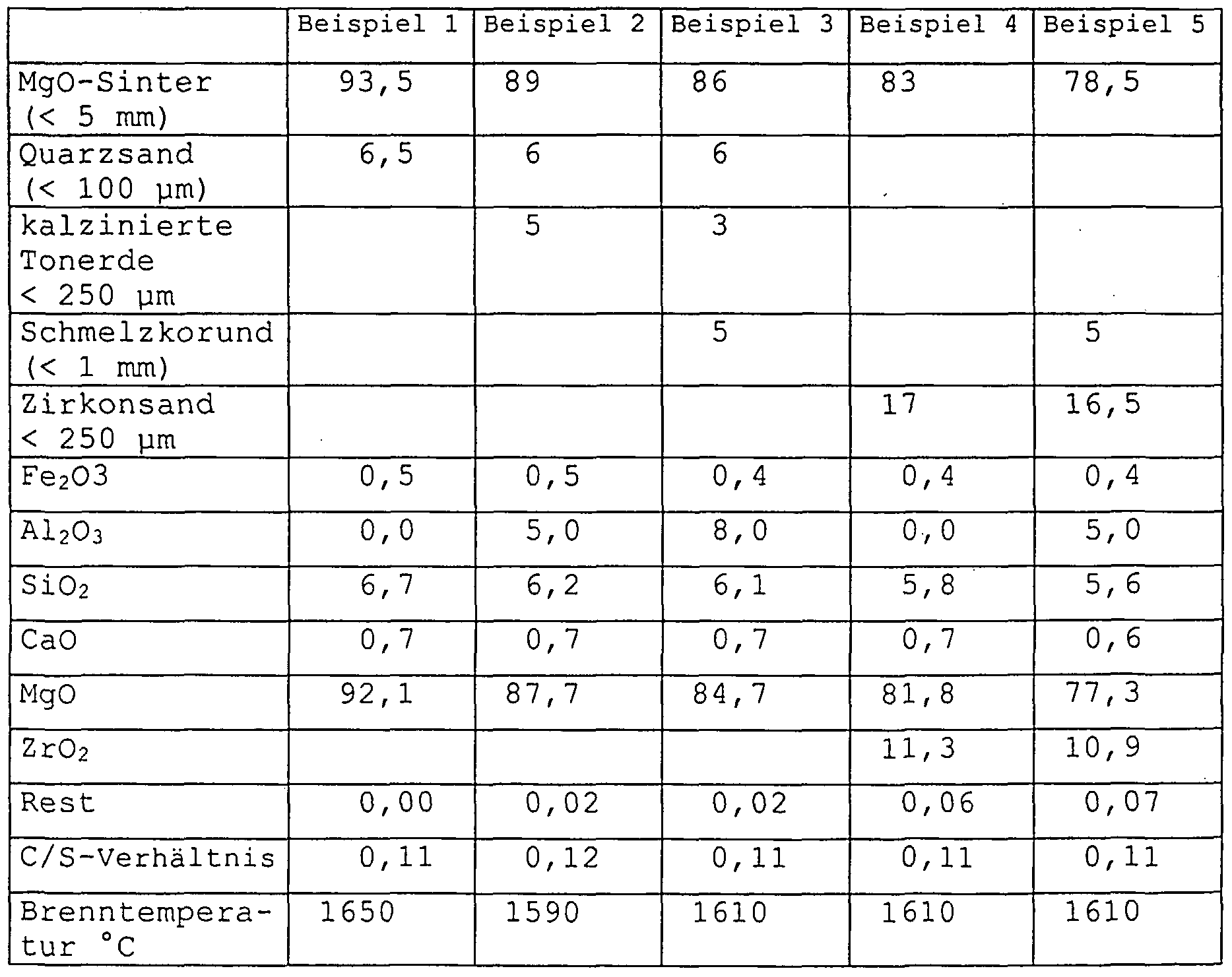
- the table below shows the five examples with their respective offset (raw material components) and their oxide analysis.
- the table also contains the respective C / S ratio and the associated firing temperature.
- the table shows that the molding according to Example 1 has the highest firing temperature. This is because this offset also produces the highest invariant point of all the examples.
- the offset consists exclusively of MgO sinter and quartz sand. The proportion of MgO is over 92 wt .-%, on SiO 2 + CaO ⁇ 8 wt .-%.
- the temperature at which the first melt is formed is slightly lower in the examples which contain an addition of Al 2 O 3 or ZrO 2 .
- the sulfate resistance of the molding according to Example 2 is particularly high, while Examples 3 and 5 are characterized by an above-average thermal shock resistance.
- the examples shown can be varied by selecting the C / S ratio, the MgO used and variants of further components.
- Monticellit is not present in the fired product.
- the only silicate phase consists of forsterite mixed crystal.
Landscapes
- Engineering & Computer Science (AREA)
- Chemical & Material Sciences (AREA)
- Ceramic Engineering (AREA)
- Manufacturing & Machinery (AREA)
- Materials Engineering (AREA)
- Structural Engineering (AREA)
- Organic Chemistry (AREA)
- Physics & Mathematics (AREA)
- Plasma & Fusion (AREA)
- Thermal Sciences (AREA)
- Inorganic Chemistry (AREA)
- Compositions Of Oxide Ceramics (AREA)
Abstract
Description
Claims
Applications Claiming Priority (2)
| Application Number | Priority Date | Filing Date | Title |
|---|---|---|---|
| DE102004042742.9 | 2004-09-03 | ||
| DE200410042742 DE102004042742A1 (de) | 2004-09-03 | 2004-09-03 | Gebrannter feuerfester keramischer Formkörper |
Publications (1)
| Publication Number | Publication Date |
|---|---|
| WO2006027140A1 true WO2006027140A1 (de) | 2006-03-16 |
Family
ID=35116134
Family Applications (1)
| Application Number | Title | Priority Date | Filing Date |
|---|---|---|---|
| PCT/EP2005/009305 Ceased WO2006027140A1 (de) | 2004-09-03 | 2005-08-30 | Gebrannter feuerfester keramischer formkörper |
Country Status (2)
| Country | Link |
|---|---|
| DE (1) | DE102004042742A1 (de) |
| WO (1) | WO2006027140A1 (de) |
Cited By (1)
| Publication number | Priority date | Publication date | Assignee | Title |
|---|---|---|---|---|
| WO2007096246A3 (de) * | 2006-02-20 | 2008-01-17 | Refratechnik Holding Gmbh | Grobkeramischer feuerfester versatz sowie feuerfestes erzeugnis daraus |
Families Citing this family (4)
| Publication number | Priority date | Publication date | Assignee | Title |
|---|---|---|---|---|
| AU2012279874A1 (en) | 2011-07-07 | 2014-01-23 | Saint-Gobain Centre De Recherches Et D'etudes Europeen | Regenerator |
| FR2977660B1 (fr) * | 2011-07-07 | 2013-07-05 | Saint Gobain Ct Recherches | Regenerateur |
| FR2988168B1 (fr) * | 2012-03-15 | 2014-03-14 | Saint Gobain Ct Recherches | Regenerateur |
| USD1103702S1 (en) | 2021-06-16 | 2025-12-02 | Craft Irish Distilling Co., Limited | Drinking glass |
Citations (6)
| Publication number | Priority date | Publication date | Assignee | Title |
|---|---|---|---|---|
| US3192059A (en) * | 1963-06-28 | 1965-06-29 | Harbison Walker Refractories | Volume stable refractory and method of making same |
| DE3720460A1 (de) * | 1987-06-20 | 1988-12-29 | Didier Werke Ag | Verfahren zur herstellung eines gebrannten, feuerfesten magnesiasteins auf der grundlage von sintermagnesia und feinverteiltem zirkonsilikat |
| JPH04198058A (ja) * | 1990-11-28 | 1992-07-17 | Ube Chem Ind Co Ltd | マグネシアクリンカー及びその製造方法 |
| US5204298A (en) * | 1990-11-28 | 1993-04-20 | Harima Ceramic Co., Ltd. | Basic monolithic refractories |
| JPH07315913A (ja) * | 1993-10-20 | 1995-12-05 | Harima Ceramic Co Ltd | マグネシア質耐火煉瓦 |
| DE10054125A1 (de) * | 2000-10-31 | 2002-05-23 | Refratechnik Holding Gmbh | Feuerfester Förmkörper sowie Versatz und Verfahren zu seiner Herstellung |
Family Cites Families (5)
| Publication number | Priority date | Publication date | Assignee | Title |
|---|---|---|---|---|
| US3360387A (en) * | 1966-08-09 | 1967-12-26 | Bethlehem Steel Corp | Magnesia chrome ore refractory |
| US3864136A (en) * | 1973-11-05 | 1975-02-04 | Gen Refractories Co | Direct bonded refractory brick having improved hot strength and its method of manufacture |
| DE4336269C2 (de) * | 1993-10-23 | 1995-09-21 | Veitsch Radex Ag | Verwendung einer feuerfesten keramischen Masse |
| SK279732B6 (sk) * | 1995-01-19 | 1999-03-12 | Kerametal | Žiaruvzdorné periklas-forsterito-spinelitické stav |
| DE10010918B4 (de) * | 2000-03-06 | 2005-04-14 | Refractory Intellectual Property Gmbh & Co. Kg | Versatz zur Herstellung eines feuerfesten keramischen Formkörpers, daraus gebildeter Formkörper und dessen Verwendung |
-
2004
- 2004-09-03 DE DE200410042742 patent/DE102004042742A1/de not_active Ceased
-
2005
- 2005-08-30 WO PCT/EP2005/009305 patent/WO2006027140A1/de not_active Ceased
Patent Citations (6)
| Publication number | Priority date | Publication date | Assignee | Title |
|---|---|---|---|---|
| US3192059A (en) * | 1963-06-28 | 1965-06-29 | Harbison Walker Refractories | Volume stable refractory and method of making same |
| DE3720460A1 (de) * | 1987-06-20 | 1988-12-29 | Didier Werke Ag | Verfahren zur herstellung eines gebrannten, feuerfesten magnesiasteins auf der grundlage von sintermagnesia und feinverteiltem zirkonsilikat |
| JPH04198058A (ja) * | 1990-11-28 | 1992-07-17 | Ube Chem Ind Co Ltd | マグネシアクリンカー及びその製造方法 |
| US5204298A (en) * | 1990-11-28 | 1993-04-20 | Harima Ceramic Co., Ltd. | Basic monolithic refractories |
| JPH07315913A (ja) * | 1993-10-20 | 1995-12-05 | Harima Ceramic Co Ltd | マグネシア質耐火煉瓦 |
| DE10054125A1 (de) * | 2000-10-31 | 2002-05-23 | Refratechnik Holding Gmbh | Feuerfester Förmkörper sowie Versatz und Verfahren zu seiner Herstellung |
Non-Patent Citations (2)
| Title |
|---|
| PATENT ABSTRACTS OF JAPAN vol. 016, no. 524 (C - 1000) 28 October 1992 (1992-10-28) * |
| PATENT ABSTRACTS OF JAPAN vol. 1996, no. 04 30 April 1996 (1996-04-30) * |
Cited By (1)
| Publication number | Priority date | Publication date | Assignee | Title |
|---|---|---|---|---|
| WO2007096246A3 (de) * | 2006-02-20 | 2008-01-17 | Refratechnik Holding Gmbh | Grobkeramischer feuerfester versatz sowie feuerfestes erzeugnis daraus |
Also Published As
| Publication number | Publication date |
|---|---|
| DE102004042742A1 (de) | 2006-03-23 |
Similar Documents
| Publication | Publication Date | Title |
|---|---|---|
| DE69006270T2 (de) | Feuerfeste, monoklines Zirkon enthaltende Zusammensetzungen und daraus geformte Gegenstände, die mechanische Festigkeit bei erhöhter Temperatur und eine verbesserte Wärmeschockbeständigkeit aufweisen. | |
| EP0210458B1 (de) | Grobkeramischer Formkörper, sowie dessen Verwendung | |
| DE10117029B4 (de) | Material für feuerfeste Formkörper oder Massen, feuerfestes Produkt hieraus sowie Verfahren zur Herstellung eines feuerfesten Produkts | |
| AT400329B (de) | Verwendung eines feuerfesten, keramischen steins zur auskleidung von zement-drehrohröfen | |
| DE10160366C2 (de) | Gebranntes feuerfestes keramisches Formteil, seine Verwendung und Versatz zur Herstellung des Formteils | |
| EP2119684B1 (de) | Verfahren zur Herstellung feuerfester Formkörper sowie feuerfester Formkörper | |
| WO2006027140A1 (de) | Gebrannter feuerfester keramischer formkörper | |
| DE10117026B4 (de) | Feuerfester Versatz, feuerfester Formkörper daraus und Verfahren zu deren Herstellung | |
| EP4077239B1 (de) | Versatz zur herstellung eines grobkeramischen feuerfesten basischen erzeugnisses, derartiges erzeugnis sowie verfahren zu seiner herstellung, zustellung eines industrieofens und industrieofen | |
| DE2235199B2 (de) | Verfahren zur Herstellung eines basischen, feuerfesten Formkörpers | |
| DE102016109258B4 (de) | Zur Elastifizierung von grobkeramischen Feuerfesterzeugnissen geeignetes feuerfestes Spinellgranulat, Verfahren zu dessen Herstellung, Feuerfesterzeugnis mit dem Spinellgranulat, Verwendung des Feuerfesterzeugnisses, Auskleidung eines Industrieofens mit dem Feuerfesterzeugnis | |
| DE19859372C1 (de) | Feuerfeste keramische Masse und deren Verwendung | |
| EP1051369A1 (de) | Feuerfeste keramische masse und deren verwendung | |
| DE4337916A1 (de) | Geformte und ungeformte Feuerfestzusammensetzungen auf Magnesiabasis | |
| DE2745461B1 (de) | Hochfeuerfester Stein,Verfahren zur Herstellung und Verwendung | |
| AT393832B (de) | Geformte oder ungeformte feuerfestzusammensetzungen auf magnesitbasis und ihre verwendung zum ausmauern von oefen | |
| DE2643475C3 (de) | Verfahren zur Herstellung von gebrannten feuerfesten Steinen | |
| DE102004010740C5 (de) | Feuerfester keramischer Versatz und dessen Verwendung | |
| WO2008019787A1 (de) | Versatz zur herstellung eines feuerfesten keramischen produktes und daraus hergestelltes gebranntes feuerfestes keramisches produkt | |
| DE2452472B2 (de) | Verfahren zur Herstellung von direkt gebundenen feuerfesten Formkörpern | |
| DE3527788A1 (de) | Grobkeramischer formkoerper der schamotte-, tonerdereichen und hochtonerdehaltigen werkstoffgruppe, verfahren zu seiner herstellung sowie seine verwendung | |
| DE2556626A1 (de) | Hoch gebrannter, direkt gebundener, basischer magnesit-chrom-formstein |
Legal Events
| Date | Code | Title | Description |
|---|---|---|---|
| AK | Designated states |
Kind code of ref document: A1 Designated state(s): AE AG AL AM AT AU AZ BA BB BG BR BW BY BZ CA CH CN CO CR CU CZ DK DM DZ EC EE EG ES FI GB GD GE GH GM HR HU ID IL IN IS JP KE KG KM KP KR KZ LC LK LR LS LT LU LV MA MD MG MK MN MW MX MZ NA NG NI NO NZ OM PG PH PL PT RO RU SC SD SE SG SK SL SM SY TJ TM TN TR TT TZ UA UG US UZ VC VN YU ZA ZM ZW |
|
| AL | Designated countries for regional patents |
Kind code of ref document: A1 Designated state(s): GM KE LS MW MZ NA SD SL SZ TZ UG ZM ZW AM AZ BY KG KZ MD RU TJ TM AT BE BG CH CY CZ DE DK EE ES FI FR GB GR HU IE IS IT LT LU LV MC NL PL PT RO SE SI SK TR BF BJ CF CG CI CM GA GN GQ GW ML MR NE SN TD TG |
|
| 121 | Ep: the epo has been informed by wipo that ep was designated in this application | ||
| 122 | Ep: pct application non-entry in european phase |