WO2006064853A1 - ネマチック液晶組成物及びこれを用いた液晶表示素子 - Google Patents
ネマチック液晶組成物及びこれを用いた液晶表示素子 Download PDFInfo
- Publication number
- WO2006064853A1 WO2006064853A1 PCT/JP2005/022972 JP2005022972W WO2006064853A1 WO 2006064853 A1 WO2006064853 A1 WO 2006064853A1 JP 2005022972 W JP2005022972 W JP 2005022972W WO 2006064853 A1 WO2006064853 A1 WO 2006064853A1
- Authority
- WO
- WIPO (PCT)
- Prior art keywords
- group
- general formula
- liquid crystal
- carbon atoms
- groups
- Prior art date
- Legal status (The legal status is an assumption and is not a legal conclusion. Google has not performed a legal analysis and makes no representation as to the accuracy of the status listed.)
- Ceased
Links
Classifications
-
- C—CHEMISTRY; METALLURGY
- C09—DYES; PAINTS; POLISHES; NATURAL RESINS; ADHESIVES; COMPOSITIONS NOT OTHERWISE PROVIDED FOR; APPLICATIONS OF MATERIALS NOT OTHERWISE PROVIDED FOR
- C09K—MATERIALS FOR MISCELLANEOUS APPLICATIONS, NOT PROVIDED FOR ELSEWHERE
- C09K19/00—Liquid crystal materials
- C09K19/04—Liquid crystal materials characterised by the chemical structure of the liquid crystal components, e.g. by a specific unit
- C09K19/42—Mixtures of liquid crystal compounds covered by two or more of the preceding groups C09K19/06 - C09K19/40
-
- C—CHEMISTRY; METALLURGY
- C09—DYES; PAINTS; POLISHES; NATURAL RESINS; ADHESIVES; COMPOSITIONS NOT OTHERWISE PROVIDED FOR; APPLICATIONS OF MATERIALS NOT OTHERWISE PROVIDED FOR
- C09K—MATERIALS FOR MISCELLANEOUS APPLICATIONS, NOT PROVIDED FOR ELSEWHERE
- C09K19/00—Liquid crystal materials
- C09K19/04—Liquid crystal materials characterised by the chemical structure of the liquid crystal components, e.g. by a specific unit
-
- C—CHEMISTRY; METALLURGY
- C09—DYES; PAINTS; POLISHES; NATURAL RESINS; ADHESIVES; COMPOSITIONS NOT OTHERWISE PROVIDED FOR; APPLICATIONS OF MATERIALS NOT OTHERWISE PROVIDED FOR
- C09K—MATERIALS FOR MISCELLANEOUS APPLICATIONS, NOT PROVIDED FOR ELSEWHERE
- C09K19/00—Liquid crystal materials
- C09K19/04—Liquid crystal materials characterised by the chemical structure of the liquid crystal components, e.g. by a specific unit
- C09K19/06—Non-steroidal liquid crystal compounds
- C09K19/08—Non-steroidal liquid crystal compounds containing at least two non-condensed rings
- C09K19/30—Non-steroidal liquid crystal compounds containing at least two non-condensed rings containing saturated or unsaturated non-aromatic rings, e.g. cyclohexane rings
- C09K19/3001—Cyclohexane rings
- C09K19/3066—Cyclohexane rings in which the rings are linked by a chain containing carbon and oxygen atoms, e.g. esters or ethers
-
- C—CHEMISTRY; METALLURGY
- C09—DYES; PAINTS; POLISHES; NATURAL RESINS; ADHESIVES; COMPOSITIONS NOT OTHERWISE PROVIDED FOR; APPLICATIONS OF MATERIALS NOT OTHERWISE PROVIDED FOR
- C09K—MATERIALS FOR MISCELLANEOUS APPLICATIONS, NOT PROVIDED FOR ELSEWHERE
- C09K19/00—Liquid crystal materials
- C09K19/04—Liquid crystal materials characterised by the chemical structure of the liquid crystal components, e.g. by a specific unit
- C09K19/0403—Liquid crystal materials characterised by the chemical structure of the liquid crystal components, e.g. by a specific unit the structure containing one or more specific, optionally substituted ring or ring systems
- C09K2019/0407—Liquid crystal materials characterised by the chemical structure of the liquid crystal components, e.g. by a specific unit the structure containing one or more specific, optionally substituted ring or ring systems containing a carbocyclic ring, e.g. dicyano-benzene, chlorofluoro-benzene or cyclohexanone
-
- C—CHEMISTRY; METALLURGY
- C09—DYES; PAINTS; POLISHES; NATURAL RESINS; ADHESIVES; COMPOSITIONS NOT OTHERWISE PROVIDED FOR; APPLICATIONS OF MATERIALS NOT OTHERWISE PROVIDED FOR
- C09K—MATERIALS FOR MISCELLANEOUS APPLICATIONS, NOT PROVIDED FOR ELSEWHERE
- C09K2323/00—Functional layers of liquid crystal optical display excluding electroactive liquid crystal layer characterised by chemical composition
Definitions
- the present invention relates to a nematic liquid crystal composition having a negative dielectric anisotropy ⁇ useful as an electro-optical liquid crystal display material, and a liquid crystal display device using the same.
- Liquid crystal display elements are used in various electric appliances for home use, measuring instruments, panels for automobiles, word processors, electronic notebooks, printers, computers, televisions, etc., including watches and calculators.
- Typical LCD display methods include ⁇ (twisted nematic) type, STN (super twisted nematic) type, DS (dynamic light scattering) type, GH (guest 'host) type, I PS (In-plane switching) type, OCB (optical compensation birefringence) type, ECB (voltage controlled birefringence) type, VA (vertical orientation) type, CSH (color super homeo pick) type, or F LC (ferroelectric) Liquid crystal).
- the conventional static drive has become a multiplex drive, and a simple matrix system, recently an active matrix (AM) system driven by TF ⁇ (thin film transistor), TFD (thin film diode), etc. It becomes mainstream.
- AM active matrix
- the IPS type, ECB type, VA type, and CSH type have negative dielectric anisotropy ( ⁇ ⁇ ).
- the liquid crystal material is used.
- the VA type display driven by AM in particular is currently the most promising for application to a display element that requires a high speed and a wide viewing angle, such as a television.
- Liquid crystal materials used for VA type display systems are required to have low voltage driving, high speed response, and a wide operating temperature range. That is, a low viscosity with a negative dielectric anisotropy and a large absolute value, and a high nematic phase isotropic liquid phase transition temperature (Tni) are required.
- the refractive index anisotropy of the liquid crystal material is adjusted to an appropriate range according to the cell gap from the setting of ⁇ n X d which is the product of the refractive index anisotropy ( ⁇ n) and the cell gap (d). There is a need. In order to achieve high-speed response, the cell gap of the display element is also reduced.
- liquid crystal material having a negative dielectric anisotropy As a liquid crystal material having a negative dielectric anisotropy, a liquid crystal compound having the following 2,3-difluorophenylene skeleton (see Patent Documents 1 and 2) is disclosed.
- R and R ′ represent an alkyl group or an alkoxy group having 1 to 10 carbon atoms.
- these patent documents include a compound having a 1-hydroxy-2,3-difluorine-4-substituted benzene skeleton, which is the basic skeleton of the liquid crystal compound constituting the present invention.
- the compounds described in the cited documents are wide-ranging, and there is no specific disclosure regarding compounds having an alkenyl group in the side chain.
- Liquid crystal compositions having a negative dielectric anisotropy using the described compounds are disclosed. In liquid crystal compositions that require high-speed response, such as liquid crystal televisions, they are sufficiently low and viscous.
- Patent Document 1 JP-A-60-199840
- Patent Document 2 JP-A-2-4725
- Patent Document 3 JP-A-8_104869
- Patent Document 4 JP 2000-96055
- Patent Document 5 European Patent Application Publication No. 0474062 (page 14)
- Patent Literature 6 Special Table 2-2 503568
- Patent Document 7 German Patent Application Publication No. 3906058
- Non-Patent Document 1 Hiroshi Numata, Monthly Display, Vol. 4, No. 3 pp. 1-7, (1998) (Table 4 on page 5)
- a problem to be solved by the present invention is to provide a liquid crystal composition having a negative dielectric anisotropy having a large absolute value and a low viscosity without reducing or increasing the refractive index anisotropy. Furthermore, it is to provide a VA type liquid crystal display element using the same.
- R 1 represents an alkenyl group having 2 to 10 carbon atoms, and one CH group present in these groups or a non-adjacent one, and two or more CH groups are 0 and / or Or may be replaced by S
- One or more hydrogen atoms present in these groups may be substituted with F or C1, and R 2 represents an alkyl group having 1 to 10 carbon atoms or an alkoxyl group having 1 to 10 carbon atoms. , M represents 0, 1 or 2. )
- R 3 and R 4 each independently represent an alkyl group having 1 to 10 carbon atoms, an alkenyl group having 2 to 10 carbon atoms, an alkoxyl group having 1 to 10 carbon atoms, or an alkyl group having 3 to 10 carbon atoms. Represents an alkenyloxy group
- B 1 and B 2 are each independently
- the group (a), group (b) or group (c) may be substituted with CN or halogen.
- Y 1 and Y 2 are independently
- _CH CH-, -CH (CH) CH-, -CH CH (CH)-, _CH (CH) CH (CH to, _C
- F CF-,-CF CF-,-CH O-,-OCH-,-OCH (CH)-,-CH (CH) 0-,-(CH)-,-(C
- Y 2 and B 2 may be the same or different
- p 0, 1 or 2.
- a nematic liquid crystal composition having one or more compounds represented by the formula, the content of which is 20 to 70% by mass, and a negative dielectric anisotropy, and a liquid crystal display device using the liquid crystal composition provide.
- R a represents a hydrogen atom or a linear alkyl group having 1 to 3 carbon atoms
- R b represents a linear alkyl group having 1 to 7 carbon atoms
- pi is 0,
- the difluorobenzene derivative represented by 1 or 2 is provided.
- liquid crystal composition having a low viscosity and a negative dielectric anisotropy was obtained while the refractive index anisotropy was substantially maintained.
- a highly reliable liquid crystal display element capable of maintaining a high voltage holding ratio up to a high temperature range is provided, and this display is very useful as a liquid crystal display of VA, ECB, IPS, etc. In particular, it is effective for high-speed response without reducing the cell gap.
- liquid crystal composition according to the present invention 1 to 20 kinds of compounds containing one or more compounds represented by the general formula (I) as the first component are preferred. 1 to 10 species are more preferred 1 to 10 species are more preferred 1 to 8 species are particularly preferred.
- the compound represented by the general formula (I) has a negative dielectric anisotropy having a large absolute value, but if the content is large, it tends to increase the viscosity, or a smectic-nematic phase. Since the transition temperature may be increased, if the low viscosity is important, or if the low relativity and smectic-nematic phase transition temperature is important, it is preferable that these contents are low in absolute value. When importance is attached to a large negative dielectric anisotropy, it is preferable that these contents are large.
- R 1 preferably represents an alkenyl group having 2 to 10 carbon atoms or an alkenyl group having 2 to 7 carbon atoms substituted by an alkoxyl group having 1 to 5 carbon atoms. More specifically, it is more preferable to represent an alkenyl group having 2 to 7 carbon atoms. Specifically, the following structures (1) to (5) are particularly preferable.
- R 2 preferably represents an alkyl group having 1 to 7 carbon atoms and an alkoxy group having 1 to 7 carbon atoms.
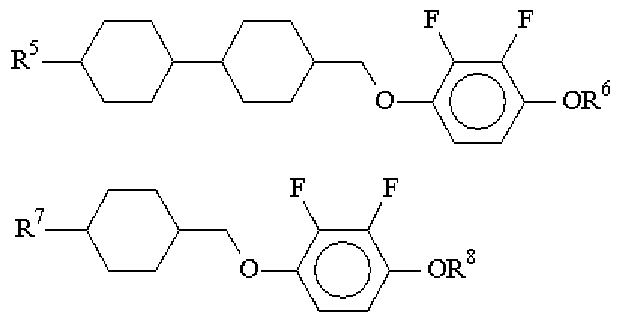
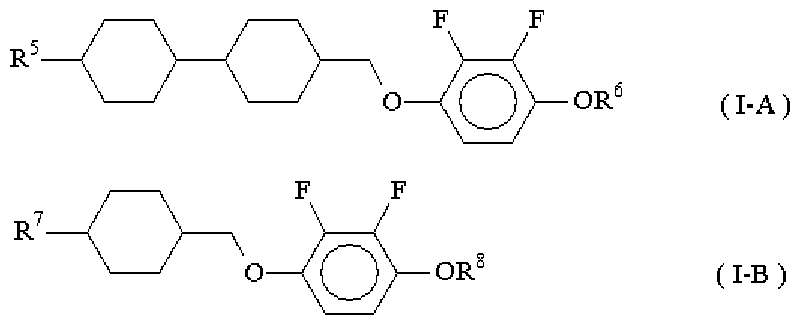
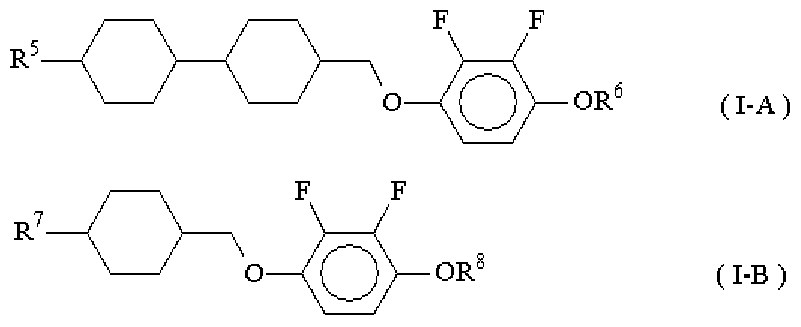
- the general formula (I) is preferably a compound represented by the following general formula (I-A) or general formula (I-B) as a specific structure.
- R 5 and R ′ each independently represent the same meaning as R 1 in formula (I), and R 8 each independently represents an alkyl group having 1 to 10 carbon atoms.
- R 6 and R 8 each independently represents an alkyl group having 1 to 7 carbon atoms.
- one or more of the compounds represented by the general formula ( ⁇ ) are contained, but 1 to 12 are preferred 1 to 8 are more preferred 1 to 6 Species are more preferred.
- the compound represented by the general formula (II) has almost the effect of increasing the absolute value of the dielectric anisotropy, and has the effect of lowering the viscosity of the product. If the emphasis is on increasing the absolute value of the dielectric anisotropy, which is preferable, the content of these is preferably low.
- R 3 and R 4 are each independently an alkyl group having 1 to 10 carbon atoms.
- R 3 represents an alkyl group having 1 to 10 carbon atoms, an alkyl group having 1 to 10 carbon atoms, or an alkyl group having 1 to 10 carbon atoms or an alkyl group having 2 to 10 carbon atoms.
- R 4 represents an alkyl group having 1 to 10 carbon atoms
- R 3 may represent an alkenyl group ⁇ Rukokishiru group or a C 2 to 10 from 10 1 carbon atoms 1 -C
- R 3 represents an alkyl group having 5 to 5 carbon atoms or an alkenyl group having 2 to 5 carbon atoms
- R 4 represents an alkyl group having 1 to 5 carbon atoms, an alkoxyl group having 1 to 5 carbon atoms, or an alkenyl group having 2 to 5 carbon atoms. More preferably, at least one of R 3 and R 4 represents an alkenyl group.
- B 1 and B 2 are each independently a trans-1,4-cyclohexylene group (one CH group present in this group or two non-adjacent CH groups are oxygen atoms).
- 1,4-phenylene group (including one or more CH groups present in this group substituted with nitrogen atoms), 1,4 -Cyclohexenylene, 1,4-bicyclo [2.2.2] octylene, piperidine-1,4-diyl, naphthalene-2,6-diyl, decahydronaphthalene-2,6-diyl or 1 1,2,3,4-tetrahydronaphthalene-2,6-diyl group or a trans-1,4-cyclohexylene group, preferably a hydrogen atom substituted by a fluorine atom, 1 It is more preferable to represent a 1,4-phenylene group, a fluorine-substituted 1,4-phenylene group, or a 1,4-bicyclo [
- the general formula ( ⁇ ) is preferably a compound represented by the following general formula ( ⁇ - ⁇ ) to general formula (II-G) as a specific structure. ,.
- R 3a , R 3b , R 3c , R 3e , R 3f and g are _CH, -CH CH,-(CH) CH,-(CH) CH,
- R 9 , R 1Q and R 11 each independently represents an alkyl group having 1 to 10 carbon atoms, and one CH group present in these groups or adjacent thereto. Two or more CH groups which are not present may be substituted with 0 and / or S, and one or more hydrogen atoms present in these groups may be substituted with F or C1.
- R 9 ,. And R 11 are -CH, -CH CH,-(CH) CH,-(CH) CH,-(CH) CH,-(CH) CH,-(CH)
- -0 (CH) CH, -0 (CH) CH, _0 (CH) CH or -0 (CH) CH is preferably represented
- -CH, -CH CH,-(CH) CH,-(CH) CH,-(CH) CH are more preferred.
- R 12 , R 13 , R 14 , R 15 , R 16 , and R 17 each independently represents an alkyl group having 1 to 10 carbon atoms and is present in these groups
- 1 CH group or non-adjacent, 2 or more CH groups may be substituted with 0 and / or S, and one or more hydrogen atoms present in these groups are F or C1 may be substituted.
- __ (CH) CH, -0 (CH) CH, -0 (CH) CH, - ⁇ (CH) CH or - ⁇ (CH) CH is preferred to represent -CH, -CH CH, It is more preferable to represent-(CH) CH,-(CH) CH,-(CH) CH.
- One or two or more hydrogen atoms present in these groups may be substituted with F or C1.
- R 21 and R 22 are -CH -CH CH-(CH) CH-(CH) CH-(CH) CH-(CH) C
- R 27 and R 28 each independently represents an alkyl group having 1 to 10 carbon atoms, and one CH group present in these groups or two adjacent ones, These CH groups are 0 and / or
- One or two or more hydrogen atoms present in these groups may be substituted with F or C1.
- R 27 and R 28 are -CH, -CH CH,-(CH) CH,-(CH) CH,-(CH) CH,-(CH) C
- -CH, -CH CH,-(CH) CH,-(CH) CH,-(CH) CH are more preferred.
- the nematic liquid crystal composition of the present invention contains one or more compounds selected from the group of compounds consisting of general formula (IA) and general formula (IB), and has the general formula ( ⁇ - ⁇ ) ), General formula (I IB), general formula (II-C) or a compound represented by general formula (II-F) It is preferable to contain one or two or more compounds selected from the group of compounds and a compound represented by the general formula (II-A) or the general formula (II-F).
- it contains one or more compounds selected from the group consisting of general formula (IA) and general formula (IB), and is represented by general formula (II-A-1), general formula ( ⁇ - ⁇ -2) or a compound represented by formula (II-A-3) is also preferable.
- it contains one or more compounds selected from the group of compounds consisting of general formula (IA) and general formula (IB), and includes general formula (II_C-1), general formula (I-to-C- It is also preferable to contain a compound represented by 2) or the general formula (nC-4).
- the nematic liquid crystal composition of the present invention contains 10 to 80% by mass of one or more compounds selected from the group of compounds having the general formula (IA) and the general formula (IB) force, and the general formula ( ⁇ - ⁇ -1) to one or more compounds selected from the group consisting of general formulas ( ⁇ - ⁇ -8), or Z and general formula ( ⁇ - ⁇ -1) to general formula (II- B-7) selected from the group of compounds selected from the group consisting of one or more compounds selected from the group consisting of general formulas (II-C-1) to (II-C-6) It is preferable to contain 20 to 70% by mass of one or more compounds, or one or more compounds selected from the group consisting of Z and a compound group consisting of general formula (n-D_5).
- R 29 and R 3 ° each independently represents an alkyl group having 1 to 10 carbon atoms or 2 carbon atoms
- One or more hydrogen atoms present therein may be substituted with F or C1
- R 31 represents an alkyl group having 1 to 10 carbon atoms, and one CH present in these groups
- a group or non-adjacent, two or more CH groups may be substituted with 0 and / or S, and one or more hydrogen atoms present in these groups may be F or C1 It will be replaced with.
- R 29 is _CH, -CH CH,-(CH) CH,-(CH) CH,-(CH) CH,-(CH) CH,-(CH) CH,-(CH) CH,
- the compound represented by F) is more preferred.
- the nematic phase-isotropic liquid phase transition temperature (Tni) is preferably 70 ° C or higher, more preferably 75 ° C or higher. More than 80 ° C Power S More preferable.
- the dielectric anisotropy ( ⁇ ⁇ ) at 25 ° C is preferably _2 or less, more preferably -2.5 or less, and further preferably -3.0 or less.
- the refractive index anisotropy ( ⁇ ) at 25 ° C. is preferably 0.10 or more when dealing with a thin cell gap, more preferably 0.12 or more. When dealing with a thick cell gap, 0.095 or less is more preferable, and 0.085 or less is more preferable.
- the viscosity is preferably 30 mPa's or less, more preferably 25 mPa's or less, and even more preferably 20 mPa-s or less.
- the dielectric anisotropy ⁇ ⁇ at 25 ° C is in the range of -2.0 to -8.0
- the refractive index anisotropy at 25 ° C ⁇ ⁇ is in the range of 0.06 to 0.16
- 20 ° C A liquid crystal composition having a viscosity in the range of 10 to 30 mPa's and a nematic phase-isotropic liquid phase transition temperature Tni in the range of 70 ° C to 130 ° C is preferred.
- the nematic liquid crystal composition is useful for a liquid crystal display device, particularly useful for a liquid crystal display device for active matrix driving, and can be used for a liquid crystal display device for VA mode, IPS mode, or ECB mode. .
- the nematic liquid crystal composition of the present invention may contain a normal nematic liquid crystal, a smectic liquid crystal, a cholesteric liquid crystal and the like in addition to the above compounds.
- the diketone compound represented by the formula (10) is reacted with an ylide prepared from methoxymethyl triphenylphosphonium chloride.
- [0073] is obtained.
- the obtained compound of the formula (12) is reduced using a reducing agent such as sodium borohydride to reduce the formula (13).
- a compound represented by the following formula is obtained.
- the resulting compound of formula (18) is reduced using a reducing agent such as sodium borohydride to reduce the formula (19).
- [0101] is obtained.
- the obtained compound represented by the formula (25) is reduced with a reducing agent such as lithium aluminum hydride, sodium bis (2-methoxyethoxy) aluminum hydride, and the like.
- Tni Nematic phase isotropic liquid phase transition temperature (° C)
- the solvent of the reaction mixture was distilled off under reduced pressure, 600 mL of hexane was added, and the mixture was stirred at room temperature for 30 minutes. After the precipitate was filtered off, the precipitate was suspended and washed again with 600 mL of hexane, and the hexane filtrate was combined with a methanol-water (1: 1) mixture. , Water and saturated brine. After drying over anhydrous sodium sulfate, the solvent was removed under reduced pressure to obtain 103 g of methyl 4-methoxymethylidenecyclohexanecarboxylate as an oil.
- methyl 4-methoxymethylidenecyclohexanecarboxylate was dissolved in 350 mL of THF, and lOOmL of 10% hydrochloric acid was added dropwise at 11 to 13 ° C. over 10 minutes. After further stirring at room temperature for 3 hours, 80 mL of hexane was added. The aqueous layer was extracted with ethyl acetate, and the organic layers were combined and washed with water and saturated brine in this order. After drying over anhydrous magnesium sulfate and concentrating, 92.4 g of methyl 4-formylcyclohexanecarboxylate was obtained as an oil. As a result of gas chromatographic analysis, the obtained product was a 64:36 mixture of cis isomer and trans isomer.
- trans-4-butylcyclohexanecarboxylic acid was dissolved in 120 mL of methanol, trimethylsilyl chloride O.lg was added, refluxed for 6 hours, cooled to room temperature, and concentrated under reduced pressure. After adding 150 mL of hexane and separating the methanol layer, the methanol layer was extracted with hexane, and the organic layers were combined and washed with saturated brine. After drying over anhydrous sodium sulfate and concentrating, 29.5 g of methyl trans-4-vinylcyclohexanecarboxylate was obtained as an oily substance.
- Lithium aluminum hydride (5.7 g) was dispersed in THF (50 mL), and the total amount of trans-4-bielsic acid methyl hexanecarboxylate was dissolved in THF (75 mL) and added dropwise at 15 to 16 ° C over 40 minutes. The mixture was further stirred at 10 to 20 ° C for 30 minutes, and then slowly removed. About 70 mL of 10% hydrochloric acid was added, and sludge-like insoluble matter was removed with a decanter while rinsing with hexane, and the obtained organic layer was washed with 10% hydrochloric acid, saturated aqueous sodium hydrogen carbonate, and saturated brine in this order. The extract was dried over anhydrous sodium sulfate and concentrated to obtain 26 g of (trans-4-vinylcyclohexyl) methanol.
- 2,3-Difluoro-4-butoxyphenol was prepared in the same manner as the synthesis of 2,3-difluoro-4-ethoxyphenol described in Example 1, except that butyl iodide was used instead of iodide chill. Synthesized.
- the solvent in the organic layer was distilled off, hexane and toluene were added, and the mixture was washed with 50% aqueous methanol. After drying over anhydrous magnesium sulfate, the solvent was distilled off under reduced pressure to obtain 60.1 g of an almost colorless solid.
- Trans-4- (trans-4-butylcyclohexyl) cyclohexylmethanol 15.1 g, pyridine 8.2 mL, and 4-dimethylaminopyridine 0.41 g were dissolved in dichloromethane 50 mL. Under ice-cooling, a solution of 6.3 mL of methanesulfuryl chloride in dichloromethane (6 mL) was added dropwise over 30 minutes, the mixture was warmed to room temperature, stirred for 6 hours, and allowed to stand overnight. The reaction solution was poured into 10% hydrochloric acid, the organic layer was separated, and the aqueous layer was extracted with dichloromethane.
- Example 5 a liquid crystal composition (No. 1) represented by the following structure was prepared using the compounds produced in Examples 1 and 2, and the physical properties thereof were measured.
- Example 5 is characterized in that only a compound having an alkyl group as a side chain in the general formula ( ⁇ ) is used, and its characteristics are Tni: 79.8 ° C, ⁇ : 0 ⁇ 073, ⁇ ⁇ : -4.7, ⁇ : 20.3 mPa's.
- a liquid crystal composition (R-1) represented by the following structure was prepared by adjusting the physical properties of the liquid crystal composition (R-1) represented by the following structure having a composition similar to that of Example 1 and not including the compound represented by the general formula (I) The value was measured.
- R-1 The characteristics of R-1 were Tni: 80.0 ° C, ⁇ : 0.073, ⁇ : -4.8, ⁇ : 23.0 mPa's. [0128] These characteristics are summarized in Table 1.
- (III) represents a compound represented by general formulas ( ⁇ - ⁇ ) to (m-j). The same applies to the following table.
- a liquid crystal composition (No. 2) represented by the following structure was prepared and measured for physical properties.
- No. 2 is a liquid crystal composition having a slightly larger ⁇ than No. 1 described in Example 5, and its characteristics are Tni: 90.8 ° C, ⁇ : 0 ⁇ 096, ⁇ : -3.0, ⁇ : 17.0 mPa's.
- the compound represented by the general formula (II) has a similar composition, but does not include the compound represented by the general formula (I), and the liquid crystal composition represented by the following structure (R— 2) was adjusted and the physical properties were measured.
- R-2 The characteristics of R-2 were Tni: 91.2 ° C, ⁇ : 0 ⁇ 095, ⁇ : -2.6, ⁇ ]: 18.0 mPa's.
- a liquid crystal composition (No. 3) represented by the following structure was prepared and measured for physical properties.
- a liquid crystal composition (No. 4) represented by the following structure was prepared and measured for physical properties.
- No. 3 and No. 4 use a compound having an alkenyl side chain in the compound represented by the general formula (II), and particularly have both a high absolute value of ⁇ and a low viscosity.
- R-3 The characteristics of R-3 were Tni: 76.3 ° C, ⁇ : 0.074, ⁇ : _4 ⁇ 8, and ⁇ : 20.0 mPa's.
- R-4 The characteristics of R-4 were Tni: 76.5 ° C, ⁇ : 0 ⁇ 074, ⁇ : -4.8, and ⁇ : 20.2 mPa's.
- R_4 The characteristics of R_4 were Tni: 82.0 ° C, ⁇ : 0.082, ⁇ : _2 ⁇ 5, and ⁇ : 22.3 mPa's.
- Comparative Example 6 a liquid composition (R-6) represented by the following structure not containing the compound represented by the general formula (I) was prepared, and the physical properties thereof were measured.
- R-6 The characteristics of R-6 were Tni: 49.5 ° C, ⁇ : 0.076, ⁇ : _3 ⁇ 0, and ⁇ : 23.1 mPa's.
- R_ 3 has higher viscosity and slightly lower Tni.
- R_3 is characterized in that in No. 3, a compound in which the alkenyl side chain of the general formula (I) is substituted with an alkyl side chain is used.
- R-4 has a composition in which the compound having an alkyl side chain in R-3 is partially substituted with the general formula (I) having an alkenyl side chain.
- the substitution amount is as small as 6%, which is outside the scope of the present invention.
- R—4 is all It is physically equivalent to R_3, and its viscosity is higher than that of No. 3 and slightly lower than Tni.
- R_5 is a liquid crystal composition mainly composed of a compound having a negative ⁇ ⁇ having no linking group, which is currently widely used in liquid crystal display elements.
- R_5 has a small absolute value of ⁇ and high viscosity.
- R-6 is a liquid crystal composition composed mainly of a compound having a negative ⁇ ⁇ without a linking group and a general formula ( ⁇ ) having an alkyl group.
- Tni is also significantly reduced. is doing.
- a liquid crystal composition (No. 5) represented by the following structure was prepared and measured for physical properties.
- No. 5 is a liquid crystal composition having a large ⁇ , and the characteristics were Tni: 91.2 ° C, ⁇ : 0.122, ⁇ : -3.0, and ⁇ : 19.0 mPa's.
- R-7 The characteristics of R-7 were Tni: 91.2 ° C, ⁇ : 0 ⁇ 123, ⁇ 2.6, and ⁇ : 23.6 mPa's.
- a liquid crystal composition (No. 6), a liquid crystal composition (No. 7) and a liquid crystal composition (No. 8) represented by the following structures were prepared and their physical properties were measured.
- liquid crystal compositions are mainly composed of a compound having an alkenyl side chain, and it can be seen that both large ⁇ and low viscosity are compatible.
- the liquid crystal composition of the present invention is very practical as a constituent member of a liquid crystal display of the VA method, ECB method, IPS method or the like.
Landscapes
- Chemical & Material Sciences (AREA)
- Crystallography & Structural Chemistry (AREA)
- Engineering & Computer Science (AREA)
- Materials Engineering (AREA)
- Organic Chemistry (AREA)
- Liquid Crystal Substances (AREA)
Description




Claims




Priority Applications (4)
| Application Number | Priority Date | Filing Date | Title |
|---|---|---|---|
| KR1020077013106A KR101157124B1 (ko) | 2004-12-15 | 2005-12-14 | 네마틱 액정 조성물 및 이것을 사용한 액정 표시 소자 |
| US11/793,132 US7670504B2 (en) | 2004-12-15 | 2005-12-14 | Nematic liquid crystal composition and liquid crystal display device using the same |
| CN2005800422765A CN101072847B (zh) | 2004-12-15 | 2005-12-14 | 向列型液晶组合物及使用该组合物的液晶显示元件 |
| EP05816651A EP1835009B1 (en) | 2004-12-15 | 2005-12-14 | Nematic liquid crystal composition and liquid crystal display utilizing the same |
Applications Claiming Priority (6)
| Application Number | Priority Date | Filing Date | Title |
|---|---|---|---|
| JP2004-362719 | 2004-12-15 | ||
| JP2004362719 | 2004-12-15 | ||
| JP2004-362720 | 2004-12-15 | ||
| JP2004362720 | 2004-12-15 | ||
| JP2005-019600 | 2005-01-27 | ||
| JP2005019600 | 2005-01-27 |
Publications (1)
| Publication Number | Publication Date |
|---|---|
| WO2006064853A1 true WO2006064853A1 (ja) | 2006-06-22 |
Family
ID=36587908
Family Applications (1)
| Application Number | Title | Priority Date | Filing Date |
|---|---|---|---|
| PCT/JP2005/022972 Ceased WO2006064853A1 (ja) | 2004-12-15 | 2005-12-14 | ネマチック液晶組成物及びこれを用いた液晶表示素子 |
Country Status (6)
| Country | Link |
|---|---|
| US (1) | US7670504B2 (ja) |
| EP (1) | EP1835009B1 (ja) |
| KR (1) | KR101157124B1 (ja) |
| CN (1) | CN101072847B (ja) |
| TW (1) | TWI405841B (ja) |
| WO (1) | WO2006064853A1 (ja) |
Cited By (3)
| Publication number | Priority date | Publication date | Assignee | Title |
|---|---|---|---|---|
| CN101407719B (zh) * | 2008-03-28 | 2012-12-12 | 河北迈尔斯通电子材料有限公司 | 负介电各向异性液晶材料组合物及使用该组合物的液晶显示元件 |
| CN104788275A (zh) * | 2009-11-20 | 2015-07-22 | Dic株式会社 | 液晶材料的制造方法 |
| WO2017090384A1 (ja) * | 2015-11-24 | 2017-06-01 | Dic株式会社 | 液晶性化合物、液晶組成物および表示素子 |
Families Citing this family (23)
| Publication number | Priority date | Publication date | Assignee | Title |
|---|---|---|---|---|
| TWI378139B (en) * | 2005-01-27 | 2012-12-01 | Dainippon Ink & Chemicals | A difluorobenzene derivative and a nematic liquid crystal composition using the same |
| TWI429732B (zh) * | 2005-03-17 | 2014-03-11 | Dainippon Ink & Chemicals | 二氟苯衍生物及用它之向列液晶組成物 |
| US7976910B2 (en) | 2008-12-30 | 2011-07-12 | Samsung Electronics Co., Ltd. | Liquid crystals and liquid crystal display apparatus employing the same |
| EP3260518B1 (de) * | 2011-03-29 | 2019-12-25 | Merck Patent GmbH | Flüssigkristallines medium |
| KR101522949B1 (ko) * | 2011-09-27 | 2015-05-26 | 디아이씨 가부시끼가이샤 | 네마틱 액정 조성물 및 이것을 사용한 액정 표시 소자 |
| KR20130050625A (ko) * | 2011-11-08 | 2013-05-16 | 삼성디스플레이 주식회사 | 액정 표시 장치 및 이의 제조방법 |
| US9828548B2 (en) * | 2012-06-06 | 2017-11-28 | Dic Corporation | Liquid-crystal composition |
| KR20140014990A (ko) * | 2012-07-27 | 2014-02-06 | 삼성디스플레이 주식회사 | 액정 조성물 및 액정 표시 장치 |
| TWI535828B (zh) | 2012-09-11 | 2016-06-01 | Dainippon Ink & Chemicals | A nematic liquid crystal composition, and a liquid crystal display device using the same |
| TW201412950A (zh) * | 2012-09-26 | 2014-04-01 | Chi Mei Corp | 液晶組成物、液晶晶胞以及液晶顯示裝置 |
| JP5668895B2 (ja) * | 2012-10-24 | 2015-02-12 | Dic株式会社 | ネマチック液晶組成物及びこれを用いた液晶表示素子 |
| KR101687594B1 (ko) * | 2013-03-25 | 2016-12-19 | 디아이씨 가부시끼가이샤 | 액정 표시 소자 |
| JP5904312B2 (ja) * | 2013-10-02 | 2016-04-13 | Dic株式会社 | 液晶配向膜の製造方法およびそれを使用した液晶表示素子 |
| CN105683830B (zh) * | 2013-10-30 | 2018-12-28 | Dic株式会社 | 液晶显示元件 |
| KR102272215B1 (ko) * | 2015-01-13 | 2021-07-02 | 삼성디스플레이 주식회사 | 액정 조성물, 이를 포함하는 액정 표시 장치 및 그 제조 방법 |
| US20180187079A1 (en) * | 2015-07-01 | 2018-07-05 | Dic Corporation | Composition and liquid crystal display device using the same |
| TW201723153A (zh) * | 2015-11-11 | 2017-07-01 | Dainippon Ink & Chemicals | 組成物及使用其之液晶顯示元件 |
| WO2017150056A1 (ja) * | 2016-02-29 | 2017-09-08 | Jnc株式会社 | 液晶組成物および液晶表示素子 |
| CN108659855B (zh) * | 2017-03-30 | 2020-09-11 | 北京八亿时空液晶科技股份有限公司 | 一种负介电液晶组合物及其应用 |
| CN108659860A (zh) * | 2017-03-31 | 2018-10-16 | 北京八亿时空液晶科技股份有限公司 | 一种含有氟代乙氧基化合物的液晶组合物及其应用 |
| CN109207158A (zh) * | 2017-06-29 | 2019-01-15 | 北京八亿时空液晶科技股份有限公司 | 一种含烯类负介电各向异性的液晶化合物及其应用 |
| CN113789184B (zh) * | 2021-10-12 | 2023-11-10 | 重庆汉朗精工科技有限公司 | 一种负性大折光率液晶组合物及其应用 |
| CN115806466B (zh) * | 2022-12-28 | 2024-12-24 | 北京燕化集联光电技术有限公司 | 一种负性液晶化合物及应用 |
Citations (8)
| Publication number | Priority date | Publication date | Assignee | Title |
|---|---|---|---|---|
| WO1989008689A1 (fr) | 1988-03-10 | 1989-09-21 | MERCK Patent Gesellschaft mit beschränkter Haftung | Derives de 2,3-difluorobenzene et leur utilisation comme composants de substances a cristaux liquides |
| EP0474062A2 (de) | 1990-09-04 | 1992-03-11 | MERCK PATENT GmbH | Matrix-Flüssigkristallanzeige |
| JPH10120600A (ja) | 1996-10-18 | 1998-05-12 | Dainippon Ink & Chem Inc | 新規アルケニルトラン誘導体 |
| JPH11106357A (ja) | 1997-10-01 | 1999-04-20 | Chisso Corp | トランスポリエン部位を持つ新規液晶性化合物および液晶組成物 |
| JPH11241068A (ja) | 1997-12-22 | 1999-09-07 | Dainippon Ink & Chem Inc | ネマチック液晶組成物及びこれを用いた液晶表示装置 |
| EP0969071A1 (en) | 1998-06-02 | 2000-01-05 | Chisso Corporation | Alkenyl compound having a negative delta epsilon value, liquid crystal composition and liquid crystal display device |
| JP2001039906A (ja) | 1999-07-28 | 2001-02-13 | Dainippon Ink & Chem Inc | テトラヒドロナフタレン骨格を有する化合物、およびそれを含有する液晶組成物 |
| US20040146662A1 (en) | 2001-06-01 | 2004-07-29 | Melaine Klasen-Memmer | Liquid crystalline medium |
Family Cites Families (9)
| Publication number | Priority date | Publication date | Assignee | Title |
|---|---|---|---|---|
| EP0133489B1 (de) | 1983-08-04 | 1988-01-20 | MERCK PATENT GmbH | Nematische Verbindungen |
| JP2503443B2 (ja) | 1986-10-01 | 1996-06-05 | カシオ計算機株式会社 | ポインティング装置 |
| JP2503568B2 (ja) | 1988-02-15 | 1996-06-05 | 株式会社ニコン | 投影露光装置 |
| DE3906058C2 (de) | 1988-03-10 | 1998-08-27 | Merck Patent Gmbh | 2,3-Difluorphenolderivate und deren Verwendung |
| CH678334A5 (ja) | 1988-03-10 | 1991-08-30 | Merck Patent Gmbh | |
| DE3807957A1 (de) * | 1988-03-10 | 1989-09-21 | Merck Patent Gmbh | Derivate des 2,3-difluorphenols |
| US5599480A (en) | 1994-07-28 | 1997-02-04 | Merck Patent Gesellschaft Mit Beschrankter Haftung | Liquid-crystalline medium |
| JP2000096055A (ja) | 1998-09-12 | 2000-04-04 | Merck Patent Gmbh | ネマティック液晶組成物およびこの組成物を含有する液晶ディスプレイ |
| TWI378139B (en) * | 2005-01-27 | 2012-12-01 | Dainippon Ink & Chemicals | A difluorobenzene derivative and a nematic liquid crystal composition using the same |
-
2005
- 2005-12-13 TW TW094143976A patent/TWI405841B/zh not_active IP Right Cessation
- 2005-12-14 CN CN2005800422765A patent/CN101072847B/zh not_active Expired - Lifetime
- 2005-12-14 WO PCT/JP2005/022972 patent/WO2006064853A1/ja not_active Ceased
- 2005-12-14 US US11/793,132 patent/US7670504B2/en active Active
- 2005-12-14 KR KR1020077013106A patent/KR101157124B1/ko not_active Expired - Fee Related
- 2005-12-14 EP EP05816651A patent/EP1835009B1/en not_active Expired - Lifetime
Patent Citations (9)
| Publication number | Priority date | Publication date | Assignee | Title |
|---|---|---|---|---|
| WO1989008689A1 (fr) | 1988-03-10 | 1989-09-21 | MERCK Patent Gesellschaft mit beschränkter Haftung | Derives de 2,3-difluorobenzene et leur utilisation comme composants de substances a cristaux liquides |
| JPH02503443A (ja) * | 1988-03-10 | 1990-10-18 | メルク・パテント・ゲゼルシヤフト・ミツト・ベシユレンクテル・ハフツング | 2,3‐ジフルオロベンゼン誘導体 |
| EP0474062A2 (de) | 1990-09-04 | 1992-03-11 | MERCK PATENT GmbH | Matrix-Flüssigkristallanzeige |
| JPH10120600A (ja) | 1996-10-18 | 1998-05-12 | Dainippon Ink & Chem Inc | 新規アルケニルトラン誘導体 |
| JPH11106357A (ja) | 1997-10-01 | 1999-04-20 | Chisso Corp | トランスポリエン部位を持つ新規液晶性化合物および液晶組成物 |
| JPH11241068A (ja) | 1997-12-22 | 1999-09-07 | Dainippon Ink & Chem Inc | ネマチック液晶組成物及びこれを用いた液晶表示装置 |
| EP0969071A1 (en) | 1998-06-02 | 2000-01-05 | Chisso Corporation | Alkenyl compound having a negative delta epsilon value, liquid crystal composition and liquid crystal display device |
| JP2001039906A (ja) | 1999-07-28 | 2001-02-13 | Dainippon Ink & Chem Inc | テトラヒドロナフタレン骨格を有する化合物、およびそれを含有する液晶組成物 |
| US20040146662A1 (en) | 2001-06-01 | 2004-07-29 | Melaine Klasen-Memmer | Liquid crystalline medium |
Non-Patent Citations (1)
| Title |
|---|
| See also references of EP1835009A4 |
Cited By (3)
| Publication number | Priority date | Publication date | Assignee | Title |
|---|---|---|---|---|
| CN101407719B (zh) * | 2008-03-28 | 2012-12-12 | 河北迈尔斯通电子材料有限公司 | 负介电各向异性液晶材料组合物及使用该组合物的液晶显示元件 |
| CN104788275A (zh) * | 2009-11-20 | 2015-07-22 | Dic株式会社 | 液晶材料的制造方法 |
| WO2017090384A1 (ja) * | 2015-11-24 | 2017-06-01 | Dic株式会社 | 液晶性化合物、液晶組成物および表示素子 |
Also Published As
| Publication number | Publication date |
|---|---|
| TW200628593A (en) | 2006-08-16 |
| US20080111107A1 (en) | 2008-05-15 |
| CN101072847B (zh) | 2013-09-11 |
| EP1835009B1 (en) | 2011-05-25 |
| EP1835009A4 (en) | 2009-03-25 |
| EP1835009A1 (en) | 2007-09-19 |
| CN101072847A (zh) | 2007-11-14 |
| US7670504B2 (en) | 2010-03-02 |
| KR20070087601A (ko) | 2007-08-28 |
| KR101157124B1 (ko) | 2012-06-22 |
| TWI405841B (zh) | 2013-08-21 |
Similar Documents
| Publication | Publication Date | Title |
|---|---|---|
| TWI405841B (zh) | 向列液晶組成物及使用它之液晶顯示元件 | |
| JP6552254B2 (ja) | 4,6−ジフルオロジベンゾチオフェン誘導体 | |
| KR100333020B1 (ko) | 액정화합물,이러한화합물을함유하는액정조성물및이러한조성물을사용하여제조된액정표시소자 | |
| JP5509852B2 (ja) | 液晶性化合物、液晶組成物および液晶表示素子 | |
| JP4947339B2 (ja) | ネマチック液晶組成物及びこれを用いた液晶表示素子 | |
| US20090264683A1 (en) | Chlorofluorobenzene liquid crystal compound, liquid crystal composition, and liquid crystal display device | |
| KR101158485B1 (ko) | 디플루오로벤젠 유도체 및 이를 사용한 네마틱 액정 조성물 | |
| JP4876420B2 (ja) | ジフルオロベンゼン誘導体 | |
| JP4947342B2 (ja) | ジフルオロベンゼン誘導体及びこれを用いた液晶組成物 | |
| KR101212083B1 (ko) | 디플루오로벤젠 유도체 및 이를 사용한 네마틱 액정 조성물 | |
| JP5488514B2 (ja) | ベンゼン誘導体、液晶組成物および液晶表示素子 | |
| JP4940626B2 (ja) | ベンゼン環にアルキル基を有する化合物、この化合物を含有する液晶組成物およびこの液晶組成物を含有する液晶表示素子 | |
| JP5077621B2 (ja) | ジフルオロベンゼン誘導体及びこれを用いた液晶組成物 | |
| JP2005314385A (ja) | ベンゼン誘導体、液晶組成物および液晶表示素子 | |
| KR102077868B1 (ko) | 액정성 화합물, 액정 조성물 및 액정 표시 소자 |
Legal Events
| Date | Code | Title | Description |
|---|---|---|---|
| AK | Designated states |
Kind code of ref document: A1 Designated state(s): AE AG AL AM AT AU AZ BA BB BG BR BW BY BZ CA CH CN CO CR CU CZ DE DK DM DZ EC EE EG ES FI GB GD GE GH GM HR HU ID IL IN IS KE KG KM KN KP KR KZ LC LK LR LS LT LU LV LY MA MD MG MK MN MW MX MZ NA NG NI NO NZ OM PG PH PL PT RO RU SC SD SE SG SK SL SM SY TJ TM TN TR TT TZ UA UG US UZ VC VN YU ZA ZM ZW |
|
| AL | Designated countries for regional patents |
Kind code of ref document: A1 Designated state(s): BW GH GM KE LS MW MZ NA SD SL SZ TZ UG ZM ZW AM AZ BY KG KZ MD RU TJ TM AT BE BG CH CY CZ DE DK EE ES FI FR GB GR HU IE IS IT LT LU LV MC NL PL PT RO SE SI SK TR BF BJ CF CG CI CM GA GN GQ GW ML MR NE SN TD TG |
|
| 121 | Ep: the epo has been informed by wipo that ep was designated in this application | ||
| DPE1 | Request for preliminary examination filed after expiration of 19th month from priority date (pct application filed from 20040101) | ||
| WWE | Wipo information: entry into national phase |
Ref document number: 200580042276.5 Country of ref document: CN |
|
| WWE | Wipo information: entry into national phase |
Ref document number: 1020077013106 Country of ref document: KR |
|
| WWE | Wipo information: entry into national phase |
Ref document number: 11793132 Country of ref document: US |
|
| NENP | Non-entry into the national phase |
Ref country code: DE |
|
| WWE | Wipo information: entry into national phase |
Ref document number: 2005816651 Country of ref document: EP |
|
| WWP | Wipo information: published in national office |
Ref document number: 2005816651 Country of ref document: EP |
|
| WWP | Wipo information: published in national office |
Ref document number: 11793132 Country of ref document: US |