WO2006114364A1 - Synthese von phenylsubstituierten polyfluoranthenen und ihre verwendung - Google Patents

Synthese von phenylsubstituierten polyfluoranthenen und ihre verwendung Download PDF

Info

Publication number
WO2006114364A1
WO2006114364A1 PCT/EP2006/061282 EP2006061282W WO2006114364A1 WO 2006114364 A1 WO2006114364 A1 WO 2006114364A1 EP 2006061282 W EP2006061282 W EP 2006061282W WO 2006114364 A1 WO2006114364 A1 WO 2006114364A1
Authority
WO
WIPO (PCT)
Prior art keywords
substituted
dihalo
alkyl
formula
bis
Prior art date
Legal status (The legal status is an assumption and is not a legal conclusion. Google has not performed a legal analysis and makes no representation as to the accuracy of the status listed.)
Ceased
Application number
PCT/EP2006/061282
Other languages
English (en)
French (fr)
Inventor
Florian DÖTZ
Simon Nord
Horst Weiss
Joachim Roesch
Current Assignee (The listed assignees may be inaccurate. Google has not performed a legal analysis and makes no representation or warranty as to the accuracy of the list.)
BASF SE
Original Assignee
BASF SE
Priority date (The priority date is an assumption and is not a legal conclusion. Google has not performed a legal analysis and makes no representation as to the accuracy of the date listed.)
Filing date
Publication date
Application filed by BASF SE filed Critical BASF SE
Priority to KR1020077027609A priority Critical patent/KR101295394B1/ko
Priority to AT06743236T priority patent/ATE458795T1/de
Priority to US11/912,998 priority patent/US8137822B2/en
Priority to CN2006800233946A priority patent/CN101208406B/zh
Priority to DE502006006249T priority patent/DE502006006249D1/de
Priority to EP06743236A priority patent/EP1877518B1/de
Priority to JP2008508187A priority patent/JP5021626B2/ja
Publication of WO2006114364A1 publication Critical patent/WO2006114364A1/de
Anticipated expiration legal-status Critical
Ceased legal-status Critical Current

Links

Classifications

    • HELECTRICITY
    • H05ELECTRIC TECHNIQUES NOT OTHERWISE PROVIDED FOR
    • H05BELECTRIC HEATING; ELECTRIC LIGHT SOURCES NOT OTHERWISE PROVIDED FOR; CIRCUIT ARRANGEMENTS FOR ELECTRIC LIGHT SOURCES, IN GENERAL
    • H05B33/00Electroluminescent light sources
    • H05B33/12Light sources with substantially two-dimensional [2D] radiating surfaces
    • H05B33/14Light sources with substantially two-dimensional [2D] radiating surfaces characterised by the chemical or physical composition or the arrangement of the electroluminescent material, or by the simultaneous addition of the electroluminescent material in or onto the light source
    • CCHEMISTRY; METALLURGY
    • C07ORGANIC CHEMISTRY
    • C07CACYCLIC OR CARBOCYCLIC COMPOUNDS
    • C07C13/00Cyclic hydrocarbons containing rings other than, or in addition to, six-membered aromatic rings
    • C07C13/28Polycyclic hydrocarbons or acyclic hydrocarbon derivatives thereof
    • C07C13/32Polycyclic hydrocarbons or acyclic hydrocarbon derivatives thereof with condensed rings
    • C07C13/62Polycyclic hydrocarbons or acyclic hydrocarbon derivatives thereof with condensed rings with more than three condensed rings
    • C07C13/66Polycyclic hydrocarbons or acyclic hydrocarbon derivatives thereof with condensed rings with more than three condensed rings the condensed ring system contains only four rings
    • C07C13/68Polycyclic hydrocarbons or acyclic hydrocarbon derivatives thereof with condensed rings with more than three condensed rings the condensed ring system contains only four rings with a bridged ring system
    • CCHEMISTRY; METALLURGY
    • C07ORGANIC CHEMISTRY
    • C07CACYCLIC OR CARBOCYCLIC COMPOUNDS
    • C07C229/00Compounds containing amino and carboxyl groups bound to the same carbon skeleton
    • C07C229/52Compounds containing amino and carboxyl groups bound to the same carbon skeleton having amino and carboxyl groups bound to carbon atoms of six-membered aromatic rings of the same carbon skeleton
    • C07C229/68Compounds containing amino and carboxyl groups bound to the same carbon skeleton having amino and carboxyl groups bound to carbon atoms of six-membered aromatic rings of the same carbon skeleton with amino and carboxyl groups bound to carbon atoms of six-membered aromatic rings being part of the same condensed ring system
    • C07C229/72Compounds containing amino and carboxyl groups bound to the same carbon skeleton having amino and carboxyl groups bound to carbon atoms of six-membered aromatic rings of the same carbon skeleton with amino and carboxyl groups bound to carbon atoms of six-membered aromatic rings being part of the same condensed ring system the carbon skeleton being further substituted by doubly-bound oxygen atoms
    • C07C229/74Compounds containing amino and carboxyl groups bound to the same carbon skeleton having amino and carboxyl groups bound to carbon atoms of six-membered aromatic rings of the same carbon skeleton with amino and carboxyl groups bound to carbon atoms of six-membered aromatic rings being part of the same condensed ring system the carbon skeleton being further substituted by doubly-bound oxygen atoms the condensed ring system being formed by at least three rings, e.g. amino anthraquinone carboxylic acids
    • CCHEMISTRY; METALLURGY
    • C08ORGANIC MACROMOLECULAR COMPOUNDS; THEIR PREPARATION OR CHEMICAL WORKING-UP; COMPOSITIONS BASED THEREON
    • C08GMACROMOLECULAR COMPOUNDS OBTAINED OTHERWISE THAN BY REACTIONS ONLY INVOLVING UNSATURATED CARBON-TO-CARBON BONDS
    • C08G61/00Macromolecular compounds obtained by reactions forming a carbon-to-carbon link in the main chain of the macromolecule
    • C08G61/02Macromolecular compounds containing only carbon atoms in the main chain of the macromolecule, e.g. polyxylylenes
    • C08G61/10Macromolecular compounds containing only carbon atoms in the main chain of the macromolecule, e.g. polyxylylenes only aromatic carbon atoms, e.g. polyphenylenes
    • CCHEMISTRY; METALLURGY
    • C09DYES; PAINTS; POLISHES; NATURAL RESINS; ADHESIVES; COMPOSITIONS NOT OTHERWISE PROVIDED FOR; APPLICATIONS OF MATERIALS NOT OTHERWISE PROVIDED FOR
    • C09KMATERIALS FOR MISCELLANEOUS APPLICATIONS, NOT PROVIDED FOR ELSEWHERE
    • C09K11/00Luminescent materials, e.g. electroluminescent or chemiluminescent
    • C09K11/06Luminescent materials, e.g. electroluminescent or chemiluminescent containing organic luminescent materials
    • HELECTRICITY
    • H10SEMICONDUCTOR DEVICES; ELECTRIC SOLID-STATE DEVICES NOT OTHERWISE PROVIDED FOR
    • H10KORGANIC ELECTRIC SOLID-STATE DEVICES
    • H10K50/00Organic light-emitting devices
    • H10K50/10OLEDs or polymer light-emitting diodes [PLED]
    • H10K50/11OLEDs or polymer light-emitting diodes [PLED] characterised by the electroluminescent [EL] layers
    • HELECTRICITY
    • H10SEMICONDUCTOR DEVICES; ELECTRIC SOLID-STATE DEVICES NOT OTHERWISE PROVIDED FOR
    • H10KORGANIC ELECTRIC SOLID-STATE DEVICES
    • H10K85/00Organic materials used in the body or electrodes of devices covered by this subclass
    • H10K85/60Organic compounds having low molecular weight
    • H10K85/615Polycyclic condensed aromatic hydrocarbons, e.g. anthracene
    • CCHEMISTRY; METALLURGY
    • C09DYES; PAINTS; POLISHES; NATURAL RESINS; ADHESIVES; COMPOSITIONS NOT OTHERWISE PROVIDED FOR; APPLICATIONS OF MATERIALS NOT OTHERWISE PROVIDED FOR
    • C09KMATERIALS FOR MISCELLANEOUS APPLICATIONS, NOT PROVIDED FOR ELSEWHERE
    • C09K2211/00Chemical nature of organic luminescent or tenebrescent compounds
    • C09K2211/14Macromolecular compounds
    • C09K2211/1408Carbocyclic compounds
    • C09K2211/1416Condensed systems
    • HELECTRICITY
    • H10SEMICONDUCTOR DEVICES; ELECTRIC SOLID-STATE DEVICES NOT OTHERWISE PROVIDED FOR
    • H10KORGANIC ELECTRIC SOLID-STATE DEVICES
    • H10K85/00Organic materials used in the body or electrodes of devices covered by this subclass
    • H10K85/10Organic polymers or oligomers
    • H10K85/111Organic polymers or oligomers comprising aromatic, heteroaromatic, or aryl chains, e.g. polyaniline, polyphenylene or polyphenylene vinylene
    • HELECTRICITY
    • H10SEMICONDUCTOR DEVICES; ELECTRIC SOLID-STATE DEVICES NOT OTHERWISE PROVIDED FOR
    • H10KORGANIC ELECTRIC SOLID-STATE DEVICES
    • H10K85/00Organic materials used in the body or electrodes of devices covered by this subclass
    • H10K85/10Organic polymers or oligomers
    • H10K85/151Copolymers
    • YGENERAL TAGGING OF NEW TECHNOLOGICAL DEVELOPMENTS; GENERAL TAGGING OF CROSS-SECTIONAL TECHNOLOGIES SPANNING OVER SEVERAL SECTIONS OF THE IPC; TECHNICAL SUBJECTS COVERED BY FORMER USPC CROSS-REFERENCE ART COLLECTIONS [XRACs] AND DIGESTS
    • Y10TECHNICAL SUBJECTS COVERED BY FORMER USPC
    • Y10STECHNICAL SUBJECTS COVERED BY FORMER USPC CROSS-REFERENCE ART COLLECTIONS [XRACs] AND DIGESTS
    • Y10S428/00Stock material or miscellaneous articles
    • Y10S428/917Electroluminescent

Definitions

  • the present invention relates to a process for the preparation of Polyfluoranthende- derivatives, Polyfluoranthenderivate producible by the novel process, films containing or consisting of at least one polyfluoroantrance derivative according to the invention, organic light-emitting diodes (OLEDs) containing at least one polyfluorantender according to the invention, a light-emitting layer containing or consisting of at least one Polyfluoranthenderivat invention, an O-LED containing the light-emitting layer according to the invention, devices containing an inventive OLED, and the use of polyfluoroanthene derivatives according to the invention as emitter substances in OLEDs.
  • OLEDs organic light-emitting diodes
  • OLEDs organic light emitting diodes
  • the property of materials is used to emit light when excited by electrical current.
  • OLEDs are of particular interest as an alternative to cathode ray tubes and liquid crystal displays for the production of flat panel displays.
  • OLEDs An overview of OLEDs is disclosed, for example, in M.T. Bernius et al., Adv. Mat. 2000, 12, 1737.
  • the requirements for the compounds used are high and it usually does not succeed with the known materials to meet all the requirements.
  • inorganic and low molecular weight organic electroluminescent materials the use of polymeric electroluminescent materials in OLEDs is also described in the prior art.
  • the application of inorganic and low molecular weight organic electroluminescent materials as light-emitting layer in OLEDs is generally carried out by vapor deposition of the inorganic or low molecular weight organic material in vacuo.
  • a vapor deposition process is unsuitable for mass production of OLEDs and is subject to limitations in the manufacture of large area display devices.
  • polymeric electroluminescent materials have the advantage that they can be applied in the form of a film from solution, for example by spin coating or dipping, which makes it possible to produce large-area displays simply and inexpensively.
  • WO 90/13148 relates to OLEDs containing polymers based on poly (p-phenylene-vinylene) (PPV). Such polymers are particularly suitable for electroluminescence in the red and green spectral range.
  • PPV and PF derivatives usually have satisfactory optical properties such as emission color and quantum efficiency of emission, they generally lack the required long-term stability. The reasons for this range from morphological instability via excimer formation to oxidative degradation of the chromophore.
  • L. Dunsch et al., Angew. Chem. 2002, 114, 12, 2187 to 2190 relates to fluoranthenopyriazylene oligomers which are obtained by repetitive Diels-Alder reaction and subsequent aromatization.
  • the dienes used are cyclopentadienone derivatives which react under suitable conditions with cheleotropic carbon monoxide eliminations with suitable dienophiles.
  • the monomers used are cyclopentadienone derivatives which simultaneously have a diene and a dienophile unit in the same molecule. These Monomers react by Diels-Alder polycycloaddition with carbon monoxide elimination to the desired ladder polymers.
  • R.A. Gaudiana et al., Macromolecules 1995, 28, 368-389 relates to polymethacrylates and polysiloxanes having side luminescent groups.
  • a polymethacrylate having fluoranthene side groups poly [2- (3-fluoroanthenylureido) ethyl methacrylate] is disclosed. These polymers can be used in OLEDs.
  • DE-A 102 11 648 relates to polymers based on fluoranthene and their use in OLEDs.
  • functionalized fluoranthenes are polymerized.
  • the functionalization of the fluoranthenes according to DE-A 102 11 648 is carried out by halogenation of fluoranthene or by nitration of fluoranthene and corresponding further reaction to give the desired monomers.
  • the object of the present invention is to provide further polyfluoroanthene derivatives which are suitable for use in OLEDs, in particular as emitter molecules, have a long service life, are highly efficient in OLEDs, have an emission maximum in the blue region and a high quantum yield. Furthermore, it is an object of the present invention to provide a process for the preparation of such polyfluoroanthenes.
  • Fluorantenderivats of formula IIa or the groups X 3 and X 4 of the fluoroanthene derivative of formula IIb polymerizable groups X 5 and X 6 have;
  • Y is acryloyl, methacryloyl, ortho- or para-methylstyryl, -O-
  • CH CH 2 or glycidyl
  • step a) of the process according to the invention the polymerisable groups X 1 and X 2 are, therefore, by rebuilding the Fluoranthengerüsts, wherein said polymerizable groups are inserted already in the first stage of the synthesis is selectively introduced into the phenyl-substituted fluoranthene.
  • Key reaction is the Diels-Alder reaction of Diencyclopentaacenaphthenon, which is substituted with the polymerizable groups X 1 and X 2 , with an acetylene derivative as a dienophile with cheleotropic elimination of carbon monoxide.
  • AI M means a linear, branched or cyclic substituted or unsubstituted d- to C 20 -, C r to C preferably 0 -
  • Particularly preferred alkyl group is a linear or branched C 3 -.
  • the alkyl groups may be unsubstituted or with aromatic radicals, halogen, nitro, ether or carboxyl xyl phenomenon substituted alkyl groups are particularly preferred unsubstituted or substituted by aromatic radicals.
  • one or more non-adjacent carbon atoms of the alkyl group may be replaced by Si, P, O or S, preferably O or S.
  • Halo groups are preferably understood as meaning F, Cl or Br.
  • alkynyl means a linear, branched or cyclic substituted or unsubstituted C 2 - to C 20 -, preferably C 2 - to C 1-0 -alkynyl group, more preferably a linear or branched C 2 -bis C 8 -, very particularly preferably C 2 - to C 6 -alkynyl
  • the alkynyl groups may be unsubstituted or substituted by aromatic radicals, halogen, nitro, ether or carboxyl groups, more preferably the alkynyl groups are unsubstituted or substituted by aromatic radicals. Preferred aromatic radicals are mentioned below.
  • aryloxy means an -O-Ar group.
  • the aaryl group in the aryloxy group is preferably a C 6 -aryl group (phenyl group) or naphthyl group, more preferably a phenyl group.
  • This aryl group may be unsubstituted or with linear, branched or cyclic C r to Ci 0 - preferred C 1 to C 6 alkyl groups may be substituted, which in turn may be substituted by halogen, nitro, ether or carboxyl groups.
  • one or more carbon atoms of the alkyl group may be replaced by Si, P, O, S or N, preferably O or S.
  • Halogenic groups are preferably understood as meaning F, Cl or Br.
  • the aryl group in the aryloxy radical is particularly preferably a C 6 -aryl group which is optionally halogen, preferably Br, Cl or F, amino groups, preferably NAr 1 Ar ", where Ar 'and Ar" independently of one another are C 6 -aryl groups which, as defined above, unsubstituted or substituted and / or substituted nitro groups. Most preferably, this aryl group is unsubstituted in the aryloxy group.
  • aromatic radical generally denotes an aryl group, preferably a C 6 -aryl group (phenyl group) or naphthyl group, particularly preferably a phenyl group.
  • This aryl group may be unsubstituted or substituted by linear, branched or cyclic C r to Ci 0 -, preferably d- to Cg- alkyl groups, which in turn may be substituted by halogen, nitro, ether or carboxyl xyl groups.
  • one or more carbon atoms of the alkyl group may be replaced by Si, P, O, S or N, preferably O or S.
  • aryl groups may be substituted by halogen, nitro, carboxyl groups, amino groups or alkoxy groups or C 6 - to C 4 -, preferably C 6 - to Cio-aryl groups, in particular phenyl or naphthyl groups.
  • Halogen groups are preferably understood as meaning F, Cl or Br.
  • aromatic radical means a C 6 aryl group, optionally substituted with halogen, preferably Br, Cl or F, amino groups, preferably NAr 1 Ar 'where Ar' and Ar "independently of each other C 6 - aryl groups, which, as can be defined above, unsubstituted or substituted, and / or nitro groups is substituted, very particularly preferably this aryl group is unsubstituted or substituted by NAr 'Ar ".
  • fused aromatic ring system means a fused aromatic ring system having generally from 10 to 20 carbon atoms, preferably from 10 to 14 carbon atoms
  • fused aromatic ring systems may be unsubstituted or substituted by linear, branched or cyclic C 1 to C 20 , preferably C r to Cio-alkyl groups may be substituted, which in turn may be substituted by halogen, nitro, ether or carboxyl groups.
  • one or more carbon atoms of the alkyl group may be replaced by Si, P, O, S or N, preferably O or S.
  • fused aromatic groups with halogen, nitro, carboxyl groups, amino groups or alkoxy groups or C 6 - to Ci 4 -, preferably C 6 - to Cio-aryl groups, in particular phenyl or naphthyl groups may be substituted.
  • "fused aromatic ring system” means a fused aromatic ring system optionally with halogen, preferably Br, Cl or F, amino groups, preferably NAr'Ar ", wherein Ar and Ar 'are independently C 6 aryl groups, as above may be defined, unsubstituted or substituted or nitro groups substituted.
  • the fused aromatic ring system is unsubstituted.
  • Suitable fused aromatic ring systems are, for example, naphthalene, anthracene, pyrene, phenanthrene or perylene.
  • heteroaryl radical is a C 4 - to C 4 -, preferably C 4 - to C 0 -, more preferably C 4 -.
  • C 6 heteroaryl group containing at least one N or S atom These Heteroar ⁇ loli may be unsubstituted or substituted with linear, branched or cyclic C r to C 20 -, preferably C 1 - to C 9 - alkyl groups, which in turn may be substituted with halo, nitro, ether or carboxyl groups tuiert
  • one or more carbon atoms of the alkyl group may be replaced by Si, P, O, S or N, preferably O or S.
  • heteroaryl groups having halogen, nitro, carboxyl, amino or alkoxy groups or C 6 - to C 4 -, preferably C 6 - to CIO aryl groups, be substituted halogen groups are preferably F to understand Cl or Br is particularly preferred
  • "heteroaromatic radical" means a hetero represents aryl optionally substituted with halogen, preferably Br, Cl or F,..
  • radicals R 4 and R 5 in the compounds of the formulas I, IIa, IIb and III are preferably H, alkyl, alkynyl, aryloxy, particularly preferably R 4 and R 5 are H.
  • the radicals R 3 and R 6 in the compounds of the formulas I, IIa, IIb and III are preferably H, alkyl, alkynyl, aryloxy, particular preference is given to R 3 and R 6 H.
  • the radicals R 1 and R 2 in the compounds of formulas I, IIa, IIb and IV are preferably alkyl groups, more preferably C 3 -C 0 -alkyl, very particularly preferably C 5 -C 9 - alkyl radicals.
  • the alkyl radicals can be linear or branched, in particular they are linear.
  • X 1 and X 2 are each preferably halogen, selected from F, Cl, Br or I, or NO 2 ; X 1 and X 2 are particularly preferably Cl or Br.
  • X 3 and X 4 are preferably halogen, selected from F, Cl, Br and I, particularly preferably Cl or Br, esterified sulfonate or a boron-containing radical of the formula -B (O- [C (R 7 ) 2 ] n - O), wherein R 7 is the same or different are independently H or -C 2 -alkyl and n is an integer of 2 is 10 th importance are particularly preferred X 3 X 4 us para-toluenesulfonate (tosylate),
  • Triflate F 3 -SO 3
  • para-nitrophenylsulfonate nosylate
  • para-bromosulfonate brosylate
  • very particularly preferably triflate or boron-containing radicals of the formula -B (O- [C (R 7 ) 2 ] n - O), where
  • R 7 is identical or different and is hydrogen or C r C 20 alkyl, for example methyl, ethyl, n-propyl, isopropyl, n-butyl, isobutyl, sec-butyl, tert-butyl, n-pentyl iso-pentyl, sec-pentyl, neo-pentyl, 1,2-dimethylpropyl, iso-amyl, n-hexyl, iso-hexyl, sec-hexyl, n-heptyl, iso-heptyl, n-octyl, n Decyl, n-dodecyl, or n-octadecyl; preferably C r C 2 - alkyl such as methyl, ethyl, n-propyl, iso-propyl, n-butyl, iso-butyl, sec-butyl, ter
  • X 5 and X 6 are preferably halogen, selected from F, Cl, Br or I, more preferably Cl or Br; or esterified sulfonate or a boron-containing radical of the formula -B (O- [C (R 7 ) 2 ] n -O), where R 7 is identical or different and independently of one another is H or C 1 -C 20 -alkyl and n is an integer of 2 is 10, particularly preferred are X 5 and X 6 para-toluenesulfonate (tosylate), triflate (F 3 -SO 3 ), para-nitrophenylsulfonate (nosylate), para-bromosulfonate (brosylate), very particularly preferably triflate, or boron-containing radicals of the formula -B (O- [C (R 7 ) 2 ] n -O), where
  • R 7 is identical or different and is hydrogen or -C 2 o-alkyl means for example methyl, ethyl, n-propyl, iso-propyl, n-butyl, iso-butyl, sec-butyl, tert-butyl, n-pentyl, iso-pentyl, sec-pentyl, neo-pentyl, 1,2-dimethylpropyl, iso-amyl, n-hexyl, iso-hexyl, sec-hexyl, n-heptyl, iso-heptyl, n-octyl, n- Decyl, n-dodecyl, or n-octadecyl; preferably C 1 -C 12 -
  • Alkyl such as methyl, ethyl, n-propyl, iso-propyl, n-butyl, iso-butyl, sec-butyl, tert-butyl, n-pentyl, iso-pentyl, sec-pentyl, neo-pentyl, 1 , 2-dimethylpropyl, iso-amyl, n-hexyl, iso-hexyl, sec-hexyl or n-decyl, more preferably CrC 4 alkyl such as methyl, ethyl, n-propyl, iso-propyl, n-butyl, iso Butyl, sec-butyl or tert-butyl, most preferably methyl; and n is an integer of 2 to 10, preferably 2 to 5. Very particular preference is given to boron-containing radicals of the formula -B (O- [C (CH 3 ) 2 ] 2
  • radicals X 1 and X 2 or X 3 and X 4 and X 5 and X 6 are selected with the following dimensions:
  • X 1 and X 2 are each halogen or X 3 and X 4 halogen, esterified sulfonate or a boron-containing radical
  • X 5 and X 6 are also halogen, esterified sulfonate or a boron-containing radical, wherein the radicals X.
  • X 1 and X 2 or X 3 and X 4 , and X 5 and X 6 are selected so that the molar ratio of halogen and esterified sulfonate to Boron-containing radical 0.8 to 1 to 2.1 to 1, preferably 0 9 is from 1.1 to 1.1 to 0.9, preferably 1: 1; or in that the radicals X 1 and X 2 in the monomeric fluoranthene derivative of the formula IIa are each halogen, and optionally reacted with further comonomers, the radicals X 5 and X 6 are likewise each halogen.
  • the preparation of the fluoranthene derivatives of the general formula IIa is carried out by reacting cyclopentanacenaphthenone derivatives (referred to below as acecyclone derivatives) of the formula III with alkynyl compounds of the formula IV.
  • acecyclone derivatives cyclopentanacenaphthenone derivatives
  • the preparation is carried out in analogy to the methods described in Dilthey et al., Chem. Ber. 1938, 71, 974 and Van Allen et al., J. Am. Chem. Soc, 1940, 62, 656.
  • the halogen-substituted acecyclone derivative of the formula III is prepared according to methods known in the art. Halogenated acecyclone derivatives are disclosed, for example, in JP 2000-007587.
  • Acecyclone derivatives of the formula III, the radicals X 1 and X 2 carry, whose preparation is not disclosed in the prior art, the prior art can be obtained in analogous procedure to process
  • the alkynyl compounds of the formula IV can likewise be prepared by processes known to the person skilled in the art. Suitable methods are described, for example, in Hagihara et al., Synthesis (1980), 627 and L. Cassar, J. Organometh. Chem. 93 (1979), 253.
  • the molar ratio of the acecyclone derivative of the formula III to the alkynyl compound of the formula IV is generally from 1: 1 to 1.3: 1, preferably from 1: 1 to 1.1: 1.
  • reaction according to step a) of the process according to the invention is a Diels-Alder reaction with subsequent carbon monoxide elimination.
  • the reaction is generally carried out in a solvent, preferably in an organic non-polar solvent, particularly preferably in an organic non-polar solvent with a boiling point above 100 ° C in general, preferably above 140 0 C, particularly preferably above 260 0 C.
  • Suitable solvents are, for example, toluene, xylene, diphenyl ether, methylnaphthalene, mesitylene, glycols and their ethers, decalin and mixtures of the solvents mentioned.
  • Acecyclonderivat of formula Ml and the alkynyl compound of the formula IV are added together in the organic solvent and heated to temperatures of generally from 140 to 260 0 C, preferably 140 to 170 0 C or 240 to 260 0 C. heated. The temperature is dependent on the reactivity of the starting materials.
  • Terminal alkynes generally react at lower temperatures, preferably at 140 to 190 0 C, particularly preferably at 140 to 170 0 C, completely more preferably 140 to 160 ° C, while internal alkynes (R 2 ⁇ H in formula IV) generally react at higher temperatures, preferably at 190 to 260 ° C, more preferably 220 to 260 0 C, most preferably 240 to 260 0th C.
  • the reaction time is generally 8 to 30 hours.
  • the reaction time depends on the steric demand of R 1 and R 2 in formula IV.
  • the reaction time is preferably 8 to 18, particularly preferably 10 to 16, very particularly preferably 14 to 16 hours.
  • the resulting reaction mixture is precipitated in a polar solvent, for example in methanol, ethanol, or optionally in a nonpolar solvent such as cyclohexane.
  • a polar solvent for example in methanol, ethanol, or optionally in a nonpolar solvent such as cyclohexane.
  • the precipitation step may be omitted.
  • the product obtained is worked up by methods known to the person skilled in the art. The work-up is preferably carried out by column chromatography.
  • any suitable solvent or solvent mixture can be used. Very particular preference is given to using an ethyl acetate / cyclohexane mixture.
  • halogenated fluoranthene derivatives of the formula IIa can be used either directly in the polymerization in step c), or be converted to fluoranthene derivatives of the formula IIb in step b), depending on which po- lymerisierbaren groups X 1, X 2 or X 3 , X 4 are desired.
  • Step b) is optional and is only carried out if fluoranthene derivatives of the formula IIb are used in the subsequent polymerization (step c)).
  • fluoranthene derivatives of the formula IIb in which X 3 and / or X 4 is a boron-containing radical of the formula -B (O- [C (R 7 ) 2 ] n -O) is carried out, for example, by metallation of compounds of the formula Formula IIa, wherein X 1 and X 2 is halogen, preferred Chlorine or bromine, more preferably bromine.
  • a reaction is carried out with at least two or at least four equivalents of a strong organometallic base, which is metallated once or twice, and then with one or two equivalents of a boron compound of the general formula X 7 -B (O- [C (R 7 ) 2] n -O) implemented, where R 7 are identical or different and are independently H or Ci-C2o-alkyl, n is an integer from 2 to 10 and X 7 C r C 6 alkoxy such as methoxy, ethoxy, n-propoxy, iso -propoxy, n-butoxy, iso-butoxy, sec-butoxy, tert-butoxy, n-penthoxy, iso-pentoxy, n-hexoxy and iso-hexoxy, preferably methoxy, ethoxy, n Propoxy, iso-propoxy and n-butoxy, particularly preferably iso-propoxy mean.
  • Preferred radicals R 7 and definitions for n have already been
  • Suitable solvents are high-boiling solvents such as toluene, ortho-xylene, metha-xylene, para-xylene, ethylbenzene or mixtures thereof.
  • suitable solvents are non-cyclic or cyclic ethers, such as 1,2-dimethoxyethane, tetrahydrofuran, dioxane or diethyl ether.
  • the reaction time of the metallation is generally from 1 to 10 hours, preferably 2 to 5 hours.
  • the temperature conditions are generally not critical, preferably the metallation takes place at temperatures of -90 0 C to -20 0 C.
  • the singly or doubly metallated compound is reacted with at least one or two equivalents of the abovementioned boron compound.
  • the two components are mixed together in a suitable solvent such as benzene, toluene, ethylbenzene, ortho-xylene, meta-xylene or para-xylene, chlorobenzene, cyclohexane, acetonitrile, tetrahydrofuran, 1,2-dimethoxyethane, dioxane or diethyl ether or Mixtures thereof.
  • This reaction is generally carried out at temperatures of -100 0 C to 150 0 C, preferably -78 0 C to + 100 0 C. It is important that the reaction is carried out in the absence of oxygen and moisture.
  • the pressure conditions are generally not critical, preferably the reaction is carried out at atmospheric pressure.
  • the reaction time is generally 10 minutes to 2 days, preferably 1 hour to 24 hours.
  • the workup and purification of the monomeric fluoranthene derivatives IIb, wherein X 3 and / or X 4 is a boron-containing radical can be carried out by conventional methods, for example by extraction, perforation, crystallization, chromatography, reprecipitation or sublimation.
  • the abovementioned boron compounds of the formula X 7 -B (O- [C (R 7 ) n ] -O can be prepared by processes known to the person skilled in the art, and some derivatives are commercially available.
  • fluoranthene derivatives of the formula IIb in which X 3 and / or X 4 ve restertes sulfonate can be made of fluoranthene derivatives of the formula IIa starting, wherein X 1 and / or X 2 are a nitro group.
  • reducing of the nitro group to the amino group, diazotization of the amino group with NaNO 2 / HCl or amyl nitrite, and boiling of the diazonium salts and subsequent reaction of the resulting phenolic OH groups with the corresponding chlorosulfonic acid groups, for example CF 3, can be used to convert the nitro group to an esterified sulfonate group SO 2 Cl (to give a triflate) or para-CH 3 -C 6 H 4 -SO 2 Cl (to give a tosylate).
  • the monomeric fluoranthene derivatives of the formulas IIa and / or IIb are, optionally together with at least one further comonomer, selected from the group consisting of a further from the first fluoroanthone derivative of the formula IIa or IIb fluoranthene derivative of formula IIa or IIb, aromatic, fused aromatic and heteroaromatic compounds which each have two groups X 5 and X 6 which are polymerizable with the groups X 1 and X 2 of the fluoranthene derivatives of the formula IIa or the groups X 3 or X 4 of the fluoranthene derivatives of the formula IIb.
  • the polymerization can in step c) as a function of the polymerizable groups of the monomeric fluoranthene derivatives of X 1 and X 2 or X 3 and X 4 or the polymerizable groups of the optionally used other comonomers re X 5 and X 6 using take any suitable polymerization.
  • Suitable polymerization processes and the polymerizable groups required for this purpose are listed, for example, in EP-A 1 245 659 (pages 26 to 31).
  • the polymerization of the fluoroantiene derivatives of the formula IIa and / or IIb, optionally with at least one further comonomer, z is Yamamoto coupling or Suzuki reaction in the presence of nickel or palladium compounds.
  • X 1 and X 2 are each halo selected from F, Cl, Br and I; respectively.
  • X 3 and X 4 are halogen selected from F, Cl, Br and I, esterified sulfonate or a
  • R 7 is the same or different independently of each H or CrC 2 o-alkyl; n is an integer from 2 to 10; where the radicals X 1 and X 2 or X 3 and X 4 and X 5 and X 6 are selected so that the molar ratio of halogen and esterified sulfonate to boron-containing residual 0.8 to 1 to 2.1 to 1 , preferably 0.9 to 1.1 to 1.1, is 1 to 0.9, preferably 1: 1; or in that the radicals X 1 and X 2 in the monomeric fluoranthene derivative of the formula IIa are each halogen, and optionally reacted with further comonomers, the radicals X 5 and X 6 are likewise each halogen.
  • endcapers In the case of “endcapping", in which only the end groups of a polymer have to be introduced, far smaller amounts of polymerizable groups are sufficient (10-20 mol% based on the total amount of monomer used.) However, these endcapers are monofunctionalized to give to terminate the chain growth, ie, they are compounds of formula IIa or IIb, each containing only one group X 1 or X 2 (in the case of the compounds of formula IIa) or X 3 or X 4 (in the case of the compounds of Formula IIb);
  • radicals X 1 and X 2 in the monomeric fluoranthene derivative are each halogen and these are reacted, if appropriate together with further comonomers in which the radicals X 5 and X 6 are likewise each halogen. That is, preferably, either a reaction of monomeric fluoranthene derivatives takes place optionally with further comonomers, which all polymerisable groups X 1, X 2, and optionally X 5 and X 6 denote halogen.
  • a nickel compound is preferably used as the catalyst.
  • the polymerization in step c) in this embodiment of the process according to the invention is preferably carried out in the presence of a nickel or palladium compound which is present in particular in the oxidation state O.
  • a nickel or palladium compound which is present in particular in the oxidation state O.
  • the polymerization is usually carried out in an organic solvent, for example in toluene, ethylbenzene, meta-xylene, ortho-xylene, dimethylformamide (DMF), tetrahydrofuran, dioxane or mixtures of the abovementioned solvents.
  • organic solvent for example in toluene, ethylbenzene, meta-xylene, ortho-xylene, dimethylformamide (DMF), tetrahydrofuran, dioxane or mixtures of the abovementioned solvents.
  • the solvent or solvents are freed of traces of moisture before the polymerization by conventional methods.
  • the polymerization is usually carried out under protective gas. Suitable are nitrogen, CO 2 or noble gases, in particular argon or CO 2 .
  • the polymerization is usually carried out in the presence of a base, for example organic amines are suitable; triethylamine, pyridine or collidine are particularly suitable.
  • the polymerization may also be carried out in the presence of solid basic salts, for example, alkali metal carbonate or alkali metal bicarbonate, optionally in the presence of a crown ether such as 18-crown-6. It is likewise possible to carry out the polymerization as a two-phase reaction with aqueous solutions of alkali metal carbonate, if appropriate in the presence of a phase transfer catalyst. In this case, it is not necessary to free the organic solvent from the reaction of moisture.
  • solid basic salts for example, alkali metal carbonate or alkali metal bicarbonate
  • a crown ether such as 18-crown-6
  • the polymerization lasts between 10 minutes and up to 2 days, preferably 2 hours to 24 hours.
  • the pressure conditions are not critical, atmospheric pressure is preferred.
  • the polymerization is carried out at elevated temperature, preferably between 80 ° C. and the boiling point of the organic solvent or solvent mixture, more preferably between 100 ° C. and the boiling point of the organic solvent or solvent mixture.
  • the molar ratio of the sum of halogen and esterified sulfonate on the one hand and boron-containing radicals on the other hand in the monomeric fluoranthene derivatives used of the formula IIa and / or IIb or the other comonomers used is 0.8 to 1 to 1.2 to 1, preferably 0.9 to 1, 1 to 1.1 to 0.9, preferably 1: 1.
  • Suitable further comonomers selected from the group consisting of aromatic, condensed aromatic and heteroaromatic compounds, each having two with the groups X 1 and X 2 of the fluoranthene derivative of the formula IIa or the groups X 3 and X 4 of Fluorantehnderivats of formula IIb polymerizable groups X 5 and X 6 , in particular the corresponding phenylene compounds, (E) or (Z) ethylene compounds, acetylene compounds, naphthylene compounds, anthrylene compounds arylamino compounds, fluorene derivatives, carbazole derivatives, dibenzofuran derivatives, pyrene derivatives, phenanthrene derivatives and / or Thiophenverbin- fertilize, the already mentioned radicals X 5 and X 6 have.
  • aromatic, fused aromatic and heteroaromatic compounds are suitable for carrying solubilizing addition to the polymerizable groups X 5 and X 6 alkyl or alkoxy side chains as further monomers, for example one or two C 3 -C 0 -alkyl and / or C 3 - Ci 0 -alkoxy side chains.
  • Particularly preferred further comonomers selected from the group consisting of aromatic, fused aromatic and heteroaromatic compounds, each polymerizing two with the groups X 1 and X 2 of the fluoranthene derivative of the formula IIa or the groups X 3 and X 4 of the fluoranthene derivative of the formula IIb groups X 5 and X 6 , and which are suitable for use in the abovementioned preferred embodiment of the polymerization step c) of the process according to the invention, are:
  • Phenylenebisboronic acids or their esters preferably 1,4-phenylenebisboronic acids or their esters, and their alkyl- or alkoxy-substituted derivatives, dihalogen-substituted benzenes, preferably 1,4-dihalogeno-substituted benzenes, and their alkyl- or alkoxy-substituted derivatives,
  • Anthracenbisboron Acid or their esters preferably 1,5- or 9,10-anthracene bisboronic acids or their esters, and dihaloanthracene, preferably 1,5- or 9,10-
  • the at least one further comonomer is selected from the group consisting of phenylenebisboronic acids, phenylenebisebomosäureestem and dihalo-substituted triarylamines.
  • Suitable alkyl or alkoxy substituents are C 3 -C 0 -alkyl or C 3 -C 0 - alkoxy side chains, wherein the above compounds preferably optionally bear one or two alkyl or alkoxy substituents.
  • the polyfluoranthenes according to the invention can optionally be further crosslinked, in particular if they have at least one radical R 1 , R 2 , R 3 , R 4 , R 5 or R 6 which has one of the following meanings:
  • -CH CH 2 , -C ⁇ CH
  • the crosslinking can be carried out photochemically in the presence of an initiator or thermally.
  • a thermal crosslinking is preferably carried out so that the polyfluoranthenes according to the invention, wherein at least one radical R 1 to R 6 has the abovementioned meanings, in bulk or in a solvent under the action of heat, preferably 40 to 100 ° C under inert gas, in general Nitrogen or inert gas, to be heated.
  • the crosslinking takes place in the course of the OLED preparation, after the Polyfluoranthen für.
  • the polyfluoranthenes according to the invention are particularly preferably applied in bulk or in a solvent as a film, preferably on one of the electrodes (on a hole transport layer such as PEDOT on ITO anode) of the OLED, and over a period of generally 45 minutes to 90 minutes under nitrogen or noble gas heated.
  • the preferred temperature range is already given above.
  • the implementation of thermal polymerizations is known to the person skilled in the art.
  • the photochemical crosslinking is preferably carried out in which the polyfluoroanthene derivative according to the invention in which at least one of the radicals R 1 to R 6 has the meanings given above, in bulk or in solution in the presence of a common photoinitiator resulting from the photopolymerization of, for example, acrylic acid derivatives or methacrylic acid derivatives or unsaturated ethers known to those skilled in the art, exposed to a radiation source, for example a UV lamp.
  • Crosslinking preferably takes place in the course of the OLED preparation after application of the polyfluoranthene layer.
  • the polyfluoroanthenes according to the invention are particularly preferably applied in bulk or in a solvent as a film, preferably on one of the electrodes (on a hole transport layer such as PEDOT on ITO anode) of the OLED, and in the presence of a conventional photoinitiator, with a radiation source, for Example of a UV lamp, exposed.
  • a radiation source for Example of a UV lamp.
  • the reaction conditions of photopolymerizations are known to the person skilled in the art and disclosed, for example, in EP-A 0 637 889.
  • Another object of the present invention are polyfluoranthenes prepared by the novel process.
  • - depending on the embodiment of the invention - different Polyfluoranthene accessible.
  • Common to all polyfluoroanthenes are their electroluminescent properties, so that the polyfluoranthenes are suitable for use in OLEDs.
  • Preferred embodiments of the process according to the invention and of the radicals of the compounds used have already been mentioned above.
  • Another object of the present invention are thus films containing or consisting of the polyfluoroanthenes or polyfluoranthenes according to the invention, which are prepared according to the inventive method.
  • the present invention relates to organic light-emitting diodes (OLEDs) containing at least one polyfluoranthene according to the invention.
  • OLEDs Organic light-emitting diodes
  • Electron-transporting layer 5 Electron-transporting layer 5.
  • the polyfluoroanthenes according to the invention are preferably used in the light-emitting layer as emitter molecules.
  • a further subject of the present application is therefore a light-emitting layer containing or consisting of at least one polyfluoranthene according to the invention.
  • the polyfluoroanthenes according to the invention are generally present in bulk in the light-emitting layer-without any further additives.
  • further compounds are present in the light-emitting layer.
  • a fluorescent dye may be present to alter the emission color of the polyfluoroanthene used as the emitter substance.
  • a diluent material can be used. This diluent material may be a polymer, for example, poly (N-vinylcarbazole) or polysilane.
  • the diluent material may further be a small molecule, for example 4,4'-N, N'-dicarbazolebiphenyl (CDP) or tertiary aromatic amines.
  • CDP 4,4'-N, N'-dicarbazolebiphenyl
  • the proportion of the polyfluoranthenes of the present invention in the light-emitting layer is generally less than 20% by weight. Usually, no diluent material is used.
  • the individual of the abovementioned layers of the OLED can in turn be composed of 2 or more layers.
  • the hole-transporting layer may be constructed of a layer into which electrodes are more preferably injected from the electrode, and a layer that transports the holes away from the hole-injecting layer into the light-emitting layer.
  • the electron-transporting layer may also consist of several layers, for example a layer in which electrons are injected through the electrode and a layer which receives electrons from the electron-injecting layer and transports them into the light-emitting layer.
  • These mentioned layers are each selected according to factors such as energy level, temperature resistance and charge carrier mobility, as well as the energy difference of said layers with the organic layers or the metal electrodes.
  • the skilled person is able to choose the structure of the OLEDs so that it is optimally adapted to the polyfluoranthenes used according to the invention as emitter substances.
  • the HOMO (highest occupied molecular orbital) of the hole-transporting layer should be aligned with the work function of the anode and the LUMO (lowest unoccupied molecular orbital) of the electron-transporting layer should be aligned with the work function of the cathode.
  • a further subject of the present application is an OLED containing at least one light-emitting layer according to the invention.
  • the further layers in the OLED may be constructed of any material commonly employed in such layers and known to those skilled in the art.
  • the anode (1) is an electrode that provides positive charge carriers.
  • it may be constructed of materials including a metal, a mixture of various metals, a metal alloy, a metal oxide, or a mixture of various metal oxides.
  • the anode may be a conductive polymer. Suitable metals include the metals of groups Ib, IVa, Va and VIa of the Periodic Table of the Elements and the Group VIII transition metals. If the anode is to be transparent, mixed metal oxides of Groups IIb, IMb and IVb of the Periodic Table of the Elements are generally used. for example indium tin oxide (ITO).
  • ITO indium tin oxide
  • the anode (1) contains an organic material, for example polyaniline, as for example in Nature, Vol. 357, pages 477 to 479 (June 11, 1992). At least either the anode or the cathode should be at least partially transparent in order to be able to decouple the light formed.
  • Suitable hole transport materials for the layer (2) of the OLED according to the invention are disclosed, for example, in Kirk-Othmer Encyclopedia of Chemical Technology, 4th Edition, Vol. 18, pages 837 to 860, 1996. Both hole transporting molecules and polymers can be used as hole transport material.
  • Commonly used hole transporting molecules are selected from the group consisting of 4,4'-bis [N- (1-naphthyl) -N-phenyl-amino] biphenyl ( ⁇ -NPD), N, N'-diphenyl-N, N '- bis (3-methylphenyl) - [1, 1'-biphenyl] -4,4'-diamine (TPD), 1,1-bis [(di-4-tolylamino) -phenyl] -cyclohexane (TAPC), N , N'-bis (4-methylphenyl) -N, N'-bis (4-ethylphenyl) - [1,1'- (3,3'-dimethyl) biphenyl] -4,4'-diamine (ETPD), Tetrakis (3-methylphenyl) -N, N, N ', N'-2,5-phenylenediamine (PDA), ⁇ -phenyl-4-N, N-
  • hole-transporting polymers are selected from the group consisting of polyvinylcarbazoles, (phenylmethyl) polysilanes and polyanilines. It is also possible to obtain hole transporting polymers by doping hole transporting molecules into polymers such as polystyrene and polycarbonate. Suitable molecules transporting molecules are the molecules already mentioned above.
  • Suitable electron transporting materials for the layer (4) of the OLEDs according to the invention comprise chelated metals with oxinoid compounds such as tris (8-quinolinolato) aluminum (Alq 3 ), phenanthroline-based compounds such as 2,9-dimethyl, 4,7-diphenyl-1, 10-phenanthroline (DDPA) or 4,7-diphenyl-1, 10-phenanthroline (DPA) and azole compounds such as 2- (4-biphenylyl) -5- (4-t-butylphenyl) -1,4,4-oxadiazole ( PBD) and 3- (4-biphenylyl) -4-phenyl-5- (4-t-butylphenyl) -1,2,4-triazole (TAZ).
  • oxinoid compounds such as tris (8-quinolinolato) aluminum (Alq 3 )
  • phenanthroline-based compounds such as 2,9-dimethyl, 4,7-diphenyl-1, 10-phen
  • the layer (4) can serve both to facilitate the electron transport and as a buffer layer or as a barrier layer in order to avoid quenching of the exciton at the interfaces of the layers of the OLED.
  • the layer (4) improves the mobility of the electrons and reduces quenching of the exciton.
  • the cathode (5) is an electrode which serves to introduce electrons or negative charge carriers.
  • the cathode may be any metal or non-metal that has a lower work function than the anode.
  • Suitable materials for the cathodes are selected from the group consisting of Group 1 alkali metals, for example Li, Cs, Group 2 alkaline earth metals, Group 12 metals of the Periodic Table of the Elements comprising the rare earth metals and the lanthanides and actinides. Furthermore, metals such as aluminum, indium, calcium, barium, samarium and magnesium and combinations thereof can be used. Furthermore, lithium-containing organometallic compounds or LiF can be applied between the organic layer and the cathode to reduce the operating voltage (Operating Voltage).
  • Group 1 alkali metals for example Li, Cs, Group 2 alkaline earth metals, Group 12 metals of the Periodic Table of the Elements comprising the rare earth metals and the lanthanides and actinides. Furthermore, metals such as aluminum, indium, calcium, barium, samarium and magnesium and combinations thereof can be used. Furthermore, lithium-containing organometallic compounds or LiF can be applied between the organic layer and the cathode to reduce
  • the OLED according to the present invention may additionally contain further layers which are known to the person skilled in the art.
  • a layer can be applied between the layer (2) and the light-emitting layer (3), which facilitates the transport of the positive charge and / or adapts the band gap of the layers to one another.
  • this further layer can serve as a protective layer.
  • additional layers may be present between the light-emitting layer (3) and the layer (4) to facilitate the transport of the negative charge and / or to match the band gap between the layers.
  • this layer can serve as a protective layer.
  • the OLED according to the invention contains at least one of the further layers mentioned below: a hole injection layer between the anode (1) and the hole-transporting layer (2); a block layer for electrons between the hole-transporting layer (2) and the light-emitting layer (3); a block layer for holes between the light-emitting layer (3) and the
  • Electron-transporting layer (4) an electron injection layer between the electron-transporting
  • each of the mentioned layers of the OLED according to the invention can be developed from two or more layers. Further, it is possible that some or all of the layers (1), (2), (3), (4) and (5) are surface treated to increase the efficiency of charge carrier transport. The selection of materials for each of said layers is preferably determined by obtaining an OLED having a high efficiency.
  • the preparation of the OLEDs according to the invention can be carried out by methods known to the person skilled in the art.
  • the OLED is fabricated by sequential vapor deposition of the individual layers onto a suitable substrate.
  • Suitable substrates are, for example, glass or polymer films.
  • vapor deposition conventional techniques can be used such as thermal evaporation, chemical vapor deposition and others.
  • the organic layers can be coated from solutions or dispersions in suitable solvents, using brush techniques known to those skilled in the art.
  • no vapor deposition is required for applying the Polyfluoro ranthene invention.
  • the polyfluoroanthenes are generally polymerized either directly on the preceding layer to form the desired film (s) comprising or consisting of at least one polyfluoranthene of the invention.
  • the polyfluoroanthenes of the formula I according to the invention are applied from solution, suitable organic solvents being, for example, ethers, chlorinated hydrocarbons, for example methylene chloride, and aromatic hydrocarbons, for example toluene.
  • suitable organic solvents being, for example, ethers, chlorinated hydrocarbons, for example methylene chloride, and aromatic hydrocarbons, for example toluene.
  • the application itself can be carried out by conventional techniques, for example spin coating, dipping by film-forming knife coating (screen printing technique), by application with an ink jet printer or by stamp printing, for example by PDMS, which is stamping by means of a silicone rubber stamp which was photochemically structured.
  • the various layers have the following thicknesses: anode (2) 500 to 5000 ⁇ , preferably 1000 to 2000 ⁇ ; Hole-transporting layer (3) 50 to 1000 ⁇ , preferably 200 to 800 ⁇ , light-emitting layer (4) 10 to 2000 ⁇ , preferably 30 to 1500 ⁇ , Electron-transporting layer (5) 50 to 1000 ⁇ , preferably 200 to 800 ⁇ , cathode (6) 200 to 10,000 ⁇ , preferably 300 to 5000 ⁇ .
  • the location of the recombination zone of holes and electrons in the OLED according to the invention and thus the emission spectrum of the OLED can be influenced by the relative thickness of each layer.
  • the thickness of the Electron transport layer should preferably be chosen so that the electron / holes recombination zone is located in the light-emitting layer.
  • the ratio of the layer thicknesses of the individual layers in the OLED depends on the materials used.
  • the layer thicknesses of optionally used additional layers are known to the person skilled in the art.
  • OLEDs By using the invention in the light-emitting layer of the inventive OLEDs OLEDs can be obtained with high efficiency.
  • the efficiency of the OLEDs according to the invention can be further improved by optimizing the other layers.
  • highly efficient cathodes such as Ca, Ba or LiF can be used.
  • Shaped substrates and new hole-transporting materials, which cause a reduction in the operating voltage or an increase in the quantum efficiency, can also be used in the inventive OLEDs.
  • additional layers may be present in the OLEDs to adjust the energy levels of the various layers and to facilitate electron luminescence.
  • the OLEDs according to the invention can be used in all devices in which electroluminescence is useful. Suitable devices are preferably selected from stationary and mobile screens. Stationary screens are e.g. Screens of computers, televisions, screens in printers, kitchen appliances and billboards, lights and signboards. Mobile screens are e.g. Screens in mobile phones, laptops, vehicles and destination displays on buses and trains.
  • the invention can be used in OLEDs with inverse structure.
  • the polyfluoranthenes according to the invention are preferably used in these inverse OLEDs again in the light-emitting layer, particularly preferably as a light-emitting layer without further additives.
  • the construction of inverse OLEDs and the materials usually used therein are known to the person skilled in the art.
  • the polyfluoroanthenes of the formula I according to the invention are suitable as emitter substances in organic light-emitting diodes.
  • a further subject of the present invention is therefore the use of the polyfluoranthenes of the formula I according to the invention as emitter substances in organic light-emitting diodes.
  • the polymer syntheses were prepared by methods known to those skilled in the art. Suzuki polymerizations with palladium (0) are described, for example, in WO 00/22026 and WO 00/53656, Yamamoto polymerizations with nickel (0) in US 5,708,130.

Landscapes

  • Chemical & Material Sciences (AREA)
  • Organic Chemistry (AREA)
  • Engineering & Computer Science (AREA)
  • Materials Engineering (AREA)
  • Physics & Mathematics (AREA)
  • Medicinal Chemistry (AREA)
  • Chemical Kinetics & Catalysis (AREA)
  • Polymers & Plastics (AREA)
  • Health & Medical Sciences (AREA)
  • Spectroscopy & Molecular Physics (AREA)
  • Optics & Photonics (AREA)
  • Organic Low-Molecular-Weight Compounds And Preparation Thereof (AREA)
  • Electroluminescent Light Sources (AREA)
  • Polyoxymethylene Polymers And Polymers With Carbon-To-Carbon Bonds (AREA)

Abstract

Verfahren zur Herstellung von Polyfluoranthenen enthaltend Wiederholungseinheiten der allgemeinen Formel (I) umfassend: a) Herstellung eines monomeren Fluoranthenderivats der Formel IIa; b) gegebenenfalls Umsetzung des monomeren Fluoranthenderivats der Formel IIa zu einem weiteren monomeren Fluoranthenderivat der Formel IIb; 15 c) Polymerisation des monomeren Fluoranthenderivats der Formel IIa oder IIb, gegebenenfalls gemeinsam mit mindestens einem weiteren Comonomeren; Polyfluoranthene herstellbar nach dem erfindungsgemäßen Verfahren; Filme und eine Licht-emittierende Schicht enthaltend oder bestehend aus mindestens einem erfindungsgemäßen Polyfluoranthen, OLEDs enthaltend mindestens ein erfindungsgemäßes Polyfluoranthen, OLEDs enthaltend eine erfindungsgemäße Licht-emittierende Schicht, eine Vorrichtung enthaltend ein erfindungsgemäßes OLED und die Verwendung der erfindungsgemäßen Polyfluoranthene Emittersubstanzen in OLEDs.

Description

Synthese von phenylsubstituierten Polyfluoranthenen und ihre Verwendung
Beschreibung
Die vorliegende Erfindung betrifft ein Verfahren zur Herstellung von Polyfluoranthende- rivaten, Polyfluoranthenderivate herstellbar nach dem erfindungsgemäßen Verfahren, Filme enthaltend oder bestehend aus mindestens einem erfindungsgemäßen Polyfluo- ranthenderivat, organische Leuchtdioden (OLEDs) enthaltend mindestens ein erfin- dungsgemäßes Polyfluoranthenderivat, eine Licht-emittierende Schicht enthaltend oder bestehend aus mindestens einem erfindungsgemäßen Polyfluoranthenderivat, ein O- LED enthaltend die erfindungsgemäße Licht-emittierende Schicht, Vorrichtungen, enthaltend ein erfindungsgemäßes OLED, sowie die Verwendung der erfindungsgemäßen Polyfluoranthenderivate als Emittersubstanzen in OLEDs.
In organischen Leuchtdioden (OLEDs) wird die Eigenschaft von Materialien ausgenutzt, Licht zu emittieren, wenn sie durch elektrischen Strom angeregt werden. OLEDs sind insbesondere interessant als Alternative zu Kathodenstrahlröhren und Flüssigkristalldisplays zur Herstellung von Flachbildschirmen.
Es wurden zahlreiche Materialien vorgeschlagen, die bei Anregung durch elektrischen Strom Licht emittieren.
Eine Übersicht über OLEDs ist zum Beispiel in M. T. Bernius et al., Adv. Mat. 2000, 12, 1737 offenbart. Die Anforderungen an die verwendeten Verbindungen sind dabei hoch und es gelingt mit den bekannten Materialien üblicherweise nicht, alle gestellten Anforderungen zu erfüllen.
Neben anorganischen und niedermolekularen organischen Elektrolumineszenzmateria- lien wird im Stand der Technik auch der Einsatz von polymeren Elektrolumineszenzma- terialien in OLEDs beschrieben. Die Aufbringung von anorganischen und niedermolekularen organischen Elektrolumineszenzmaterialien als Licht-emittierende Schicht in OLEDs erfolgt im Allgemeinen durch Dampfabscheidung des anorganischen oder niedermolekularen organischen Materials im Vakuum. Ein Dampfabscheidungsverfahren ist jedoch zur Massenproduktion von OLEDs ungeeignet und unterliegt Einschränkungen im Hinblick auf die Herstellung von Vorrichtungen mit großflächigen Displays. Des Weiteren ist es problematisch, aus niedermolekularen organischen Elektrolumineszenzmaterialien durch Beschichtung einen dünnen Film herzustellen, wenn diese Materialien ohne Matrixmaterialien verwendet werden. Demgegenüber haben polymere Elektrolumineszenzmaterialien den Vorteil, dass sie in Form eines Films aus Lösung aufgebracht werden können, beispielsweise durch Spin- coating oder Tauchen, was es ermöglicht, großflächige Displays einfach und kosten- günstig herzustellen.
WO 90/13148 betrifft OLEDs, die Polymere auf der Basis von Poly(p-phenylen-vinylen) (PPV) enthalten. Derartige Polymere sind besonders für die Elektrolumineszenz im roten und grünen Spektralbereich geeignet.
Im blauen Spektralbereich werden meist Derivate des Poly(fluoren)s (PF) verwendet. Poly(fluoren)derivate, die Spirozentren aufweisen, sind zum Beispiel in EP-A 0 707 020 offenbart.
Die vorstehend erwähnten PPV- und PF-Derivate verfügen zwar meist über zufrieden stellende optische Eigenschaften wie Emissionsfarbe und Quantenausbeute der Emission, es mangelt Ihnen jedoch im Allgemeinen an der erforderlichen Langzeitstabilität. Die Gründe hierfür reichen von morphologischer Instabilität über Excimerbildung bis zu oxidativem Abbau des Chromophors.
Polymere und Copolymere enthaltend Wiederholungseinheiten auf Basis von Fluor- anthen und dessen Derivaten sind aus dem Stand der Technik bekannt.
R. J. Waltmann et al., J. Electrochem. Soc. 1985, 132, 631 bis 634 betrifft Polymere, die durch die Elektropolymerisation von Fluroanthen erhalten werden. Es werden strukturell sehr uneinheitliche Polymere erhalten, deren schlechte Löslichkeit und Prozes- sierbarkeit eine eingehende Charakterisierung verhindert. Filme aus den durch Elektropolymerisation von Fluoranthen erhaltenen Polymeren sind brüchig und weisen eine geringe Leitfähigkeit auf.
L. Dunsch et al., Angew. Chem. 2002, 114, 12, 2187 bis 2190 betrifft Fluoranthenopy- razylen-Oligomere, die durch repetitive Diels-Alder-Reaktion und anschließende Aro- matisierung erhalten werden. Als Diene werden Cyclopentadienonderivate eingesetzt, die unter cheleotroper Kohlenmonoxideleminierung mit geeigneten Dienophilen reagie- ren.
In J. K. Stille et al., J. Polym. Sei. Part A 1970, 8, 2245 bis 2254 ist die Herstellung von aromatischen Leiterpolymeren durch Diels-Alder-Homopolycycloaddition beschrieben.
Als Monomere werden Cyclopentadienonderivate eingesetzt, die gleichzeitig eine Dien- und eine Dienophil-Einheit in demselben Molekül aufweisen. Diese Monomere reagieren durch Diels-Alder-Polycycloaddition unter Kohlenmonoxid- Eliminierung zu den gewünschten Leiterpolymeren.
R. A. Gaudiana et al., Macromolecules 1995, 28, 368 bis 389 betrifft Polymethacrylate und Polysiloxane, die lumineszierende Seitengruppen aufweisen. Beispielsweise ist ein Polymethacrylat mit Fluoranthenseitengruppen, Poly[2-(3-fluoranthenylureido)ethyl- methacrylat], offenbart. Diese Polymere können in OLEDs eingesetzt werden.
DE-A 102 11 648 betrifft Polymere auf Basis von Fluoranthen und ihre Verwendung in OLEDs. Zur Herstellung dieser Polymere werden funktionalisierte Fluoranthene poly- merisiert. Die Funktionalisierung der Fluoranthene gemäß DE-A 102 11 648 erfolgt durch Halogenierung von Fluoranthen oder durch Nitrierung von Fluoranthen und entsprechende weitere Umsetzung zu den gewünschten Monomeren.
Aufgabe der vorliegenden Erfindung ist es weitere Polyfluoranthenderivate bereitzustellen, die zum Einsatz in OLEDs, insbesondere als Emittermoleküle, geeignet sind, eine lange Lebensdauer aufweisen, in OLEDs hocheffizient sind, ein Emissionsmaximum im blauen Bereich und eine hohe Quantenausbeute aufweisen. Des Weiteren ist es Auf- gäbe der vorliegenden Erfindung, ein Verfahren zur Herstellung solcher Polyfluo- ranthene bereit zu stellen.
Diese Aufgabe wird gelöst durch ein Verfahren zur Herstellung von Polymeren enthaltend Wiederholungseinheiten der allgemeinen Formel I
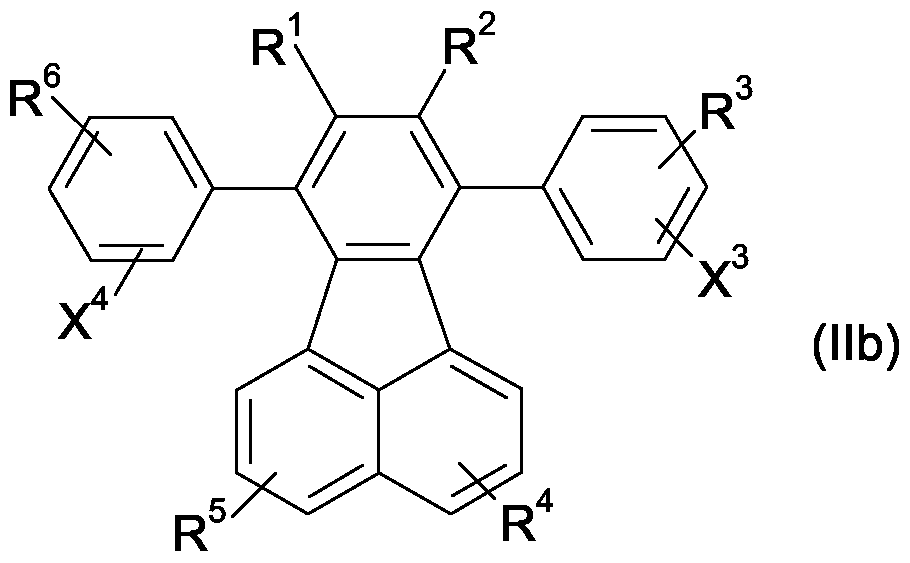
Figure imgf000004_0001
umfassend folgende Schritte: a) Herstellung eines monomeren Fluoranthenderivats der Formel IIa
Figure imgf000005_0001
durch Reaktion einer Verbindung der Formel
Figure imgf000005_0002
mit einer Alkinylverbindung der Formel IV
(IV)
und anschließender Kohlenmonoxid-Eliminierung;
b) gegebenenfalls Umsetzung des monomeren Fluoranthenderivats der Formel IIa zu einem monomeren Fluoranthenderivat der Formel IIb
Figure imgf000006_0001
Polymerisation des monomeren Fluoranthenderivats der Formel IIa oder IIb, gegebenenfalls gemeinsam mit mindestens einem weiteren Comonomeren ausgewählt aus der Gruppe bestehend aus einem weiteren von dem ersten Fluoranthenderivat der Formel IIa oder IIb verschiedenen Fluoranthenderivat der Formel IIa oder IIb, aromatischen, kondensierten aromatischen und heteroaro- matischen Verbindungen, die jeweils zwei mit den Gruppen X1 und X2 des
Fluoranthenderivats der Formel IIa bzw. den Gruppen X3 und X4 des Fluoranthenderivats der Formel IIb polymerisierbare Gruppen X5 und X6 aufweisen;
wobei die Symbole die folgenden Bedeutungen aufweisen:
R1, R2, R3
R4, R5, R6 unabhängig voneinander H, ein Alkylrest, ein Alkinylrest, ein Aryloxy- rest, ein aromatischer Rest, ein kondensiertes aromatisches Ringsys- tem, ein heteroaromatischer Rest, -CH=CH2, (E)- oder (Z)-CH=CH-
C6H5, Acryloyl, Methacryloyl, Methylstyryl, -0-CH=CH2 oder Glycidyl,
Figure imgf000006_0002
bedeuten, wobei Y Acryloyl, Methacryloyl, Ortho- oder para-Methylstyryl, -O-
CH=CH2 oder Glycidyl bedeutet;
X1, X2,X3, X4
X 5ö, X V6 miteinander polymerisierbare Gruppen. Derart ausgedehnte, Phenyl-substituierte Fluoranthenderivate gemäß Formel IIa oder IIb sind in definierter, strukturtreuer Weise auf herkömmlichem Wege nicht mit polymerisationsfähigen Gruppen X1 und X2 bzw. X3 und X4 zu versehen. Beispielsweise ergibt die Bromierung von 7,8,9, 10-Tetraphenylfluoranthen Isomerenmischungen und die selektive Einführung von Bromäquivalenten gelingt nicht. In Schritt a) des erfindungsgemäßen Verfahrens werden die polymerisierbaren Gruppen X1 und X2 daher durch Neuaufbau des Fluoranthengerüsts, wobei die polymerisierbaren Gruppen bereits auf der ersten Stufe der Synthese eingefügt werden, selektiv in das Phenyl- substituierte Fluoranthen eingeführt. Schlüsselreaktion ist dabei die Diels-Alder- Reaktion des Diencyclopentaacenaphthenon, das mit den polymerisierbaren Gruppen X1 und X2 substituiert ist, mit einem Acetylenderivat als Dienophil unter cheleotroper Eliminierung von Kohlenmonoxid.
Im Sinne der vorliegenden Anmeldung bedeutet „AI M" eine lineare, verzweigte oder cyclische substituierte oder unsubstituierte d- bis C20-, bevorzugt Cr bis Ci0- Alkylgruppe. Besonders bevorzugt handelt es sich um eine lineare oder verzweigte C3- bis Cio-, ganz besonders bevorzugt C5- bis C9- Alkylgruppe. Die Alkylgruppen können unsubstituiert oder mit aromatischen Resten, Halogen-, Nitro-, Ether- oder Carbo- xylgruppen substituiert sein. Besonders bevorzugt sind die Alkylgruppen unsubstituiert oder mit aromatischen Resten substituiert. Bevorzugte aromatische Reste sind nachstehend genannt. Des Weiteren können ein oder mehrere nicht benachbarte Kohlenstoffatome der Alkylgruppe durch Si, P, O oder S, bevorzugt durch O oder S, ersetzt sein. Unter Halogengruppen sind bevorzugt F, Cl oder Br zu verstehen.
Im Sinne der vorliegenden Anmeldung bedeutet „Alkinyl" eine lineare, verzweigte oder cyclische substituierte oder unsubstituierte C2- bis C20-, bevorzugt C2- bis Ci0- Alkinylgruppe. Besonders bevorzugt handelt es sich um eine lineare oder verzweigte C2- bis C8-, ganz besonders bevorzugt C2- bis C6- Alkinylgruppe. Die Alkinylgruppen können unsubstituiert oder mit aromatischen Resten, Halogen-, Nitro-, Ether- oder Carboxylgruppen substituiert sein. Besonders bevorzugt sind die Alkinylgruppen unsubstituiert oder mit aromatischen Resten substituiert. Bevorzugte aromatische Reste sind nachstehend genannt.
Im Sinne der vorliegenden Anmeldung bedeutet Aryloxy eine -O-Ar-Gruppe. Die A- rylgruppe in dem Aryloxyrest ist bevorzugt eine C6-Arylgruppe (Phenylgruppe) oder Naphthylgruppe, besonders bevorzugt eine Phenylgruppe. Diese Arylgruppe kann unsubstituiert oder mit linearen, verzweigten oder cyclischen Cr bis Ci0-, bevorzugt Cr bis Cg-Alkylgruppen substituiert sein, die wiederum mit Halogen-, Nitro-, Ether- o- der Carboxylgruppen substituiert sein können. Des Weiteren können ein oder mehrere Kohlenstoffatome der Alkylgruppe durch Si, P, O, S oder N, bevorzugt O oder S, er- setzt sein. Des Weiteren können die Arylgruppen mit Halogen-, Nitro-, Carboxylgruppen, Aminogruppen oder Alkoxygruppen oder C6- bis Ci4-, bevorzugt C6- bis Ci0- Arylgruppen, insbesondere Phenyl- oder Naphthylgruppen, substituiert sein. Unter Ha- logengrupen sind bevorzugt F, Cl oder Br zu verstehen. Besonders bevorzugt ist die Arylgruppe in dem Aryloxyrest eine C6-Arylgruppe, die gegebenenfalls mit Halogen, bevorzugt Br, Cl oder F, Aminogruppen, bevorzugt NAr1Ar", wobei Ar' und Ar" unabhängig voneinander C6-Arγlgruppen bedeuten, die, wie vorstehend definiert, unsubsti- tuiert oder substituiert sein können und/oder Nitrogruppen substituiert ist. Ganz besonders bevorzugt ist diese Arylgruppe in dem Aryloxyrest unsubstituiert.
Im Sinne der vorliegenden Anmeldung bedeutet "aromatischer Rest" im allgemeinen eine Arylgruppe, bevorzugt eine C6-Arylgruppe (Phenylgruppe) oder Naphthylgruppe, besonders bevorzugt eine Phenylgruppe. Diese Arylgruppe kann unsubstituiert oder mit linearen, verzweigten oder cyclischen Cr bis Ci0-, bevorzugt d- bis Cg- Alkylgruppen substituiert sein, die wiederum mit Halogen-, Nitro-, Ether- oder Carbo- xylgruppen substituiert sein können. Des Weiteren können ein oder mehrere Kohlenstoffatome der Alkylgruppe durch Si, P, O, S oder N, bevorzugt O oder S, ersetzt sein. Des Weiteren können die Arylgruppen mit Halogen-, Nitro-, Carboxylgruppen, Aminogruppen oder Alkoxygruppen oder C6- bis Ci4-, bevorzugt C6- bis Cio-Arylgruppen, insbesondere Phenyl- oder Naphthylgruppen, substituiert sein. Unter Halogengrupen sind bevorzugt F, Cl oder Br zu verstehen. Besonders bevorzugt bedeutet „aromatischer Rest" eine C6-Arylgruppe, die gegebenenfalls mit Halogen, bevorzugt Br, Cl oder F, Aminogruppen, bevorzugt NAr1Ar", wobei Ar' und Ar" unabhängig voneinander C6- Arylgruppen bedeuten, die, wie vorstehend definiert, unsubstituiert oder substituiert sein können und/oder Nitrogruppen substituiert ist. Ganz besonders bevorzugt ist diese Arylgruppe unsubstituiert oder mit NAr' Ar" substituiert.
Im Sinne der vorliegenden Anmeldung bedeutet „kondensiertes aromatisches Ringsystem" ein kondensiertes aromatisches Ringsystem mit im Allgemeinen 10 bis 20 Kohlenstoffatomen, bevorzugt 10 bis 14 Kohlenstoffatomen. Diese kondensierten aromati- sehen Ringsysteme können unsubstituiert oder mit linearen, verzweigten oder cyclischen Cr bis C20-, bevorzugt Cr bis Cio-Alkylgruppen substituiert sein, die wiederum mit Halogen-, Nitro-, Ether- oder Carboxylgruppen substituiert sein können. Des Weiteren können ein oder mehrere Kohlenstoffatome der Alkylgruppe durch Si, P, O, S oder N, bevorzugt O oder S, ersetzt sein. Des Weiteren können die kondensierten aromatischen Gruppen mit Halogen-, Nitro-, Carboxylgruppen, Aminogruppen oder Alkoxygruppen oder C6- bis Ci4-, bevorzugt C6- bis Cio-Arylgruppen, insbesondere Phenyl- oder Naphthylgruppen, substituiert sein. Besonders bevorzugt bedeutet „kondensiertes aromatisches Ringsystem" ein kondensiertes aromatisches Ringsystem, das gegebenenfalls mit Halogen, bevorzugt Br, Cl oder F, Aminogruppen, bevorzugt NAr'Ar", wobei Ar und Ar' unabhängig voneinander C6-Arlygruppen bedeuten, die, wie vorstehend definiert, unsubstituiert oder substituiert sein können oder Nitrogruppen substituiert ist. Ganz besonders bevorzugt ist das kondensierte aromatische Ringsystem unsubstituiert. Geeignete kondensierte aromatische Ringsysteme sind zum Beispiel Naphthalin, Anthracen, Pyren, Phenanthren oder Perylen.
Im Sinne der vorliegenden Anmeldung bedeutet „heteroaromatischer Rest" eine C4- bis Ci4-, bevorzugt C4- bis Ci0-, besonders bevorzugt C4- bis C6-Heteroarylgruppe, enthaltend mindestens ein N- oder S-Atom. Diese Heteroarγlgruppe kann unsubstituiert oder mit linearen, verzweigten oder cyclischen Cr bis C20-, bevorzugt d- bis C9- Alkylgruppen, die wiederum mit Halogen-, Nitro-, Ether- oder Carboxylgruppen substi- tuiert sein können, substituiert sein. Des Weiteren können ein oder mehrere Kohlenstoffatome der Alkylgruppe durch Si, P, O, S oder N, bevorzugt O oder S, ersetzt sein. Des Weiteren können die Heteroarylgruppen mit Halogen-, Nitro-, Carboxylgruppen, Aminogruppen oder Alkoxygruppen oder C6- bis Ci4-, bevorzugt C6- bis Cio- Arylgruppen, substituiert sein. Unter Halogengruppen sind bevorzugt F, Cl oder Br zu verstehen. Besonders bevorzugt bedeutet „heteraromatischer Rest" eine Hetero- arylgruppe, die gegebenenfalls mit Halogen, bevorzugt Br, Cl oder F, Aminogruppen, bevorzugt NArAr', wobei Ar und Ar' unabhängig voneinander C6- Arlygruppen bedeuten, die, wie vorstehend definiert, unsubstituiert oder substituiert sein können, oder Nitrogruppen, substituiert ist. Ganz besonders bevorzugt ist die He- teroarγlgruppe unsubstituiert.
Bevorzugt sind die Reste R4 und R5 in den Verbindungen der Formeln I, IIa, IIb und III H, Alkyl, Alkinyl, Aryloxy, besonders bevorzugt sind R4 und R5 H.
Die Reste R3 und R6 sind in den Verbindungen der Formeln I, IIa, IIb und IM bevorzugt H, Alkyl, Alkinyl, Aryloxy, besonders bevorzugt sind R3 und R6 H. Die Reste R1 und R2 in den Verbindungen der Formeln I, IIa, IIb und IV sind bevorzugt Alkylreste, besonders bevorzugt C3-Ci0-Alkylreste, ganz besonderes bevorzugt C5-C9- Alkylreste. Die Alkylreste können linear oder verzweigt sein, insbesondere sind sie Ii- near.
X1 und X2 bedeuten bevorzugt jeweils Halogen, ausgewählt aus F, Cl, Br oder I, oder NO2; besonders bevorzugt sind X1 und X2 Cl oder Br.
X3 und X4 bedeuten bevorzugt Halogen, ausgewählt aus F, Cl, Br und I, besonders bevorzugt Cl oder Br, verestertes Sulfonat oder einen Bor-haltigen Rest der Formel -B(O-[C(R7)2]n-O), wobei R7 gleich oder verschieden unabhängig voneinander H oder CrC2o-Alkyl und n eine ganze Zahl von 2 ist 10 bedeu- ten, besonders bevorzugt sind X3 uns X4 para-Toluolsulfonat (Tosylat),
Triflat (F3-SO3), para-Nitrophenylsulfonat (nosylat), para-Bromsulfonat (Brosylat), ganz besonders bevorzugt Triflat, oder Bor-haltige Reste der Formel -B(O-[C(R7)2]n-O), wobei
R7 gleich oder verschieden ist und Wasserstoff oder CrC20-Alkyl bedeutet, zum Beispiel Methyl, Ethyl, n-Propyl, iso-Propyl, n-Butyl, iso-Butyl, sec- Butyl, tert-Butyl, n-Pentyl, iso-Pentyl, sec.-Pentyl, neo-Pentyl, 1,2- Dimethylpropyl, iso-Amyl, n-Hexyl, iso-Hexyl, sec.-Hexyl, n-Heptyl, iso- Heptyl, n-Octyl, n-Decyl, n-Dodecyl, oder n-Octadecyl; bevorzugt CrCi2- Alkyl wie Methyl, Ethyl, n-Propyl, iso-Propyl, n-Butyl, iso-Butyl, sec.-Butyl, tert.-Butyl, n-Pentyl, iso-Pentyl, sec.-Pentyl, neo-Pentyl, 1,2-Dimethylpropyl, iso-Amyl, n-Hexyl, iso-Hexyl, sec.-Hexyl oder n-Decyl, besonders bevorzugt CrC4-Alkyl wie Methyl, Ethyl, n-Propyl, iso-Propyl, n-Butyl, iso-Butyl, sec.-Butyl oder tert.-Butyl, ganz besonders bevorzugt Methyl; und n eine ganze Zahl von 2 bis 10, bevorzugt 2 bis 5 bedeutet. Ganz besonders bevorzugt sind Bor-haltige Reste der Formel -B(O-[C(CH3)2]2)-O);
X5 und X6 bedeuten bevorzugt Halogen, ausgewählt aus F, Cl, Br oder I, besonders bevorzugt Cl oder Br; oder verestertes Sulfonat oder einen Bor-haltigen Rest der Formel -B(O- [C(R7)2]n-O), wobei R7 gleich oder verschieden unabhängig voneinander H oder Ci-C20-Alkyl und n eine ganze Zahl von 2 ist 10 bedeuten, besonders bevorzugt sind X5 und X6 para-Toluolsulfonat (Tosylat), Triflat (F3-SO3), para-Nitrophenylsulfonat (nosylat), para-Bromsulfonat (Brosylat), ganz besonders bevorzugt Triflat, oder Bor-haltige Reste der Formel -B(O-[C(R7)2]n- O), wobei
R7 gleich oder verschieden ist und Wasserstoff oder CrC2o-Alkyl bedeutet, zum Beispiel Methyl, Ethyl, n-Propyl, iso-Propyl, n-Butyl, iso-Butyl, sec- Butyl, tert-Butyl, n-Pentyl, iso-Pentyl, sec.-Pentyl, neo-Pentyl, 1,2- Dimethylpropyl, iso-Amyl, n-Hexyl, iso-Hexyl, sec.-Hexyl, n-Heptyl, iso- Heptyl, n-Octyl, n-Decyl, n-Dodecyl, oder n-Octadecyl; bevorzugt C1-C12-
Alkyl wie Methyl, Ethyl, n-Propyl, iso-Propyl, n-Butyl, iso-Butyl, sec.-Butyl, tert.-Butyl, n-Pentyl, iso-Pentyl, sec.-Pentyl, neo-Pentyl, 1,2-Dimethylpropyl, iso-Amyl, n-Hexyl, iso-Hexyl, sec.-Hexyl oder n-Decyl, besonders bevorzugt CrC4-Alkyl wie Methyl, Ethyl, n-Propyl, iso-Propyl, n-Butyl, iso-Butyl, sec.-Butyl oder tert.-Butyl, ganz besonders bevorzugt Methyl; und n eine ganze Zahl von 2 bis 10, bevorzugt 2 bis 5 bedeutet. Ganz besonders bevorzugt sind Bor-haltige Reste der Formel -B(O-[C(CH3)2]2)-O).
Die Reste X1 und X2 bzw. X3 und X4 und X5 und X6 werden mit den folgenden Maßga- ben ausgewählt:
- wenn X1 und X2 jeweils Halogen bzw. X3 und X4 Halogen, verestertes Sulfonat oder einen Bor-haltigen Rest bedeuten, bedeuten X5 und X6 ebenfalls Halogen, verestertes Sulfonat oder einen Bor-haltigen Rest, wobei die Reste X1 und X2 bzw. X3 und X4, und X5 und X6 so ausgewählt werden, dass das molare Verhältnis von Halogen und verestertem Sulfonat zu Bor-haltigem Rest 0,8 zu 1 bis 2,1 zu 1, bevorzugt 0,9 zu 1,1 bis 1,1 zu 0,9 beträgt, bevorzugt 1 : 1; oder, dass die Reste X1 und X2 in dem monomeren Fluoranthenderivat der Formel IIa jeweils Halogen bedeuten und gegebenenfalls mit weiteren Comonomeren umgesetzt werden, deren Reste X5 und X6 ebenfalls Halogen bedeuten. Im Fall eines „endcapping", bei dem nur die Endgrup- pen eines Polymers eingeführt werden müssen, reichen weit geringere Mengen an polymerisierbaren Gruppen aus (10-20 mol% bezogen auf die gesamte Monomerstoffmenge). Diese Endcapper sind allerdings monofunktionalisiert, um das Kettenwachstum zu beenden, d.h., es handelt sich um Verbindungen der Formel IIa oder IIb, die jeweils nur eine Gruppe X1 oder X2 (im Falle der Verbindungen der Formel IIa) bzw. X3 oder X4 (im Falle der Verbindungen der Formel IIb) tragen. Schritt a)
Die Herstellung der Fluoranthenderivate der allgemeinen Formel IIa erfolgt durch Um- Setzung von Cyclopentanacenaphthenon-Derivaten (im Folgenden Acecyclonderivate genannt) der Formel IM mit Alkinylverbindungen der Formel IV. Die Herstellung erfolgt in Analogie zu den in Dilthey et al., Chem. Ber. 1938, 71, 974 und Van Allen et al., J. Am. Chem. Soc, 1940, 62, 656 offenbarten Verfahren. Das Halogen-substituierte Ace- cyclonderivat der Formel IM wird gemäß dem Stand der Technik bekannten Verfahren hergestellt. Halogenierte Acecyclonderivate sind zum Beispiel in JP 2000-007587 offenbart. Acecyclonderivate der Formel IM, die Reste X1 und X2 tragen, deren Herstellung nicht im Stand der Technik offenbart ist, können in zu Verfahren gemäß dem Stand der Technik analogen Verfahren erhalten werden.
Die Alkinylverbindungen der Formel IV können ebenfalls nach dem Fachmann bekannten Verfahren hergestellt werden. Geeignete Verfahren sind zum Beispiel in Hagihara et al., Synthesis (1980), 627 und L. Cassar, J. Organometh. Chem. 93 (1979), 253 offenbart. Das molare Verhältnis des Acecyclonderivats der Formel IM zu der Alkinylver- bindung der Formel IV beträgt im Allgemeinen 1 : 1 bis 1,3 : 1 , bevorzugt 1 : 1 bis 1 ,1 : 1.
Bei der Umsetzung gemäß Schritt a) des erfindungsgemäßen Verfahrens handelt es sich um eine Diels-Alder-Reaktion mit anschließender Kohlenmonoxid-Eliminierung.
Die Umsetzung erfolgt im Allgemeinen in einem Lösungsmittel, bevorzugt in einem organischen unpolaren Lösungsmittel, besonders bevorzugt in einem organischen unpolaren Lösungsmittel mit einem Siedepunkt oberhalb von im Allgemeinen 100 °C, bevorzugt oberhalb von 140 0C, besonders bevorzugt oberhalb von 260 0C.
Geeignete Lösungsmittel sind zum Beispiel Toluol, XyIoI, Diphenylether, Methylnaph- thalin, Mesitylen, Glykole und ihre Ether, Dekalin und Mischungen der genannten Lösungsmittel.
In einer bevorzugten Ausführungsform des erfindungsgemäßen Verfahrens werden das Acecyclonderivat der Formel Ml und die Alkinylverbindung der Formel IV in dem organischen Lösungsmittel zusammen gegeben und auf Temperaturen von im Allgemeinen 140 bis 260 0C, bevorzugt 140 bis 170 0C bzw. 240 bis 260 0C erhitzt. Die Temperatur ist dabei abhängig von der Reaktivität der Ausgangsstoffe. Terminale Alkine (R2 = H in Formel IV) reagieren im Allgemeinen bei niedrigeren Temperaturen, bevorzugt bei 140 bis 190 0C, besonders bevorzugt bei 140 bis 170 0C, ganz besonders bevorzugt 140 bis 160 °C, während interne Alkine (R2 ≠ H in Formel IV) im Allgemeinen bei höheren Temperaturen reagieren, bevorzugt bei 190 bis 260 °C, besonders bevorzugt 220 bis 260 0C, ganz besonders bevorzugt 240 bis 260 0C.
Die Reaktionsdauer beträgt im Allgemeinen 8 bis 30 Stunden. Die Reaktionsdauer hängt von dem sterischen Anspruch von R1 und R2 in Formel IV ab. Bevorzugt beträgt die Reaktionsdauer 8 bis 18, besonders bevorzugt 10 bis 16, ganz besonders bevorzugt 14 bis 16 Stunden.
Das erhaltene Reaktionsgemisch wird in einem polaren Lösungsmittel, zum Beispiel in Methanol, Ethanol, oder gegebenenfalls in einem unpolaren Lösungsmittel wie Cyclo- hexan gefällt. Bei besonders löslichen Fluoranthenderivaten kann der Fällungsschritt entfallen. Das erhaltene Produkt wird nach dem Fachmann bekannten Methoden auf- gearbeitet. Bevorzugt erfolgt die Aufarbeitung durch Säulenchromatographie. Als Laufmittel kann jedes geeignete Laufmittel oder Laufmittelgemisch eingesetzt werden. Ganz besonders bevorzugt wird ein Essigester/Cyclohexangemisch eingesetzt.
Die erhaltenen halogenierten Fluoranthenderivate der Formel IIa können entweder direkt in der Polymerisation in Schritt c) eingesetzt werden oder zu Fluoranthenderivaten der Formel IIb in Schritt b) umgesetzt werden, in Abhängigkeit davon, welche po- lymerisierbaren Gruppen X1, X2 bzw. X3, X4 gewünscht sind.
Schritt b)
Schritt b) ist optional und wird nur dann durchgeführt, wenn Fluoranthenderivate der Formel IIb in der darauf folgenden Polymerisation (Schritt c)) eingesetzt werden.
Die Überführung der Halogenidreste X1 und X2 in dem monomeren Fluoranthenderivat der Formel IIa in die Reste X3 und X4 ausgewählt aus Halogen, verestertem Sulfonat und Bor-haltigem Rest, wie vorstehend erwähnt, gemäß Formel IIb, erfolgt nach dem Fachmann bekannten Verfahren. Es ist darauf hinzuweisen, dass X3 oder X4 in den Fällen Halogen sein können, wenn der jeweils andere Rest nicht Halogen ist. Fluoranthenderivate, worin beide polymerisierbaren Gruppen gleichzeitig Halogen sind, sind bereits von den Fluoranthenderivaten der Formel IIa umfasst.
Die Herstellung von Fluoranthenderivaten der Formel IIb, worin X3 und/oder X4 einen Bor-haltigen Rest der Formel -B(O-[C(R7)2]n-O) bedeuten, erfolgt zum Beispiel durch Metallierung von Verbindungen der Formel IIa, worin X1 und X2 Halogen, bevorzugt Chlor oder Brom, besonders bevorzugt Brom, bedeuten. Zunächst erfolgt eine Umsetzung mit mindestens zwei oder mindestens vier Äquivalenten einer starken metallorganischen Base, wodurch einfach bzw. zweifach metalliert wird, und anschließend mit einem bzw. zwei Äquivalenten einer Borverbindung der allgemeinen Formel X7-B(O- [C(R7)2]n-O) umgesetzt wird, wobei R7 gleich oder verschieden und unabhängig voneinander H oder Ci-C2o-Alkyl, n eine ganze Zahl von 2 bis 10 und X7 CrC6-Alkoxy wie Methoxy, Ethoxy, n-Propoxy, iso-Propoxy, n-Butoxy, iso-Butoxy, sec.-Butoxy, tert.- Butoxy, n-Penthoxy, iso-Penthoxy, n-Hexoxy und iso-Hexoxy, bevorzugt Methoxy, E- thoxy, n-Propoxy, iso-Propoxy und n-Butoxy, besonders bevorzugt iso-Propoxy, bedeuten. Bevorzugte Reste R7 und Definitionen für n wurden bereits vorstehend genannt.
Als Base können die in der metallorganischen Chemie gängigen Metallalkyle verwendet werden, zum Beispiel Methyllithium, Ethyllithium, n-Butyllithium, sec-Butyllithium, tert-Butyllithium oder Hexyllithium; oder Grignard-Verbindungen, zum Beispiel Ethyl- magnesiumbromid. Als Lösungsmittel sind hochsiedende Lösungsmittel wie Toluol, ortho-Xylol, metha-Xylol, para-Xylol, Ethylbenzol oder Mischungen davon geeignet. Des Weiteren sind als Lösungsmittel nicht-cyclische oder cyclische Ether wie 1,2- Diemethoxyethan, Tetra hydrofu ran, Dioxan oder Diethylether geeignet.
Die Reaktionsdauer der Metallierung beträgt im Allgemeinen von 1 bis 10 Stunden, bevorzugt 2 bis 5 Stunden. Die Temperaturbedingungen sind im Allgemeinen unkritisch, bevorzugt erfolgt die Metallierung bei Temperaturen von -90 0C bis -20 0C.
Anschließend setzt man die einfach oder zweifach metallierte Verbindung mit mindestens einem bzw. zwei Äquivalenten der vorstehend genannten Borverbindung um. Dazu mischt man die beiden Komponenten miteinander in einem geeigneten Lösungsmittel wie Benzol, Toluol, Ethylbenzol, ortho-Xylol, meta-Xylol oder para-Xylol, Chlorbenzol, Cyclohexan, Acetonitril, Tetrahydrofuran, 1,2-Dimethoxyethan, Dioxan oder Di- ethylether oder Mischungen davon. Diese Umsetzung wird im Allgemeinen bei Temperaturen von -100 0C bis 150 0C, bevorzugt -78 0C bis +100 0C durchgeführt. Wichtig ist, dass die Umsetzung unter Ausschluss von Sauerstoff und Feuchtigkeit durchgeführt wird. Die Druckbedingungen sind im Allgemeinen unkritisch, bevorzugt erfolgt die Umsetzung bei Atmosphärendruck. Die Reaktionsdauer beträgt im Allgemeinen 10 Minu- ten bis 2 Tage, bevorzugt 1 Stunde bis 24 Stunden.
Die Aufarbeitung und Reinigung der monomeren Fluoranthenderivate IIb, worin X3 und/oder X4 einen Bor-haltigen Rest bedeuten, kann nach konventionellen Methoden erfolgen, beispielsweise durch Extraktion, Perforation, Kristallisation, Chromatographie, Umfallen oder Sublimation. Die vorstehend genannten Bor-Verbindungen der Formel X7-B(O-[C(R7)n]-O können nach dem Fachmann bekannten Verfahren hergestellt werden, einige Derivate sind kommerziell erhältlich.
Eine weitere Möglichkeit, halogenierte Aromaten in die entsprechenden Boronester zu überführen, ist die Umsetzung mit den Diboronen (OR)2B-B(OR)2 unter Einsatz eines Palladiumkatalysators wie PdCI2(dppf) nach Miyaura, z.B. beschrieben in J. Org. Chem. 1995, 60, 7508.
Die Herstellung von Fluoranthenderivaten der Formel IIb, worin X3 und/oder X4 ve- restertes Sulfonat bedeuten, kann ausgehend von Fluoranthenderivaten der Formel IIa erfolgen, worin X1 und/oder X2 eine Nitrogruppe sind. Zur Umwandlung der Nitrogruppe in eine veresterte Sulfonatgruppe kann zum Beispiel eine Reduktion der Nitrogruppe zur Aminogruppe, Diazotierung der Aminogruppe mit NaNO2/HCI oder Amylnitrit und Verkochen der Diazoniumsalze und abschließende Umsetzung der erhaltenen phenolischen OH-Gruppen mit den entsprechenden Chlorsulfonsäuregruppen, zum Beispiel CF3SO2CI (wobei sich ein Triflat ergibt) oder para-CH3-C6H4-SO2CI (wobei ein Tosylat erhalten wird), durchgeführt werden.
Eine weitere Möglichkeit ist die Umsetzung eines aromatischen Diazoniumsalzes, das wie vorstehend synthetisiert wurde, mit einem halogenierten Aromaten wie beispielsweise von Wegner et al. beschrieben in Chem. Eur. J. 2004, 10, 2681. In Chem. Eur. J. 2004, 10, 2681 ist die Synthese eines aromatischen Diazoniumsalzes und die Bedin- gungen einer C-C-Knüpfung eines solchen Diazoniumalzes mit einem aromatischen Boronester beschrieben.
Schritt c)
Die monomeren Fluoranthenderivate der Formeln IIa und/oder IIb werden, gegebenenfalls gemeinsam mit mindestens einem weiteren Comonomeren, ausgewählt aus der Gruppe bestehend aus einem weiteren von dem ersten Fluoranthenderivat der Formel IIa oder IIb verschiedenen Fluoranthenderivat der Formel IIa oder IIb, aromatischen, kondensierten aromatischen und heteroaromatischen Verbindungen, die jeweils zwei mit den Gruppen X1 und X2 der Fluoranthenderivate der Formel IIa oder den Gruppen X3 oder X4 der Fluoranthenderivate der Formel IIb polymerisierbare Gruppen X5 und X6 aufweisen. Grundsätzlich kann die Polymerisation in Schritt c) in Abhängigkeit von den polymeri- sierbaren Gruppen der monomeren Fluoranthenderivate X1 und X2 bzw. X3 und X4 bzw. den polymerisierbaren Gruppen der gegebenenfalls eingesetzten weiteren Comonome- re X5 und X6 mit Hilfe jedes geeigneten Polymerisationsverfahrens erfolgen. Geeignete Polymerisationsverfahren und die dazu erforderlichen polymerisierbaren Gruppen sind zum Beispiel in EP-A 1 245 659 (Seiten 26 bis 31) aufgeführt.
In einer bevorzugten Ausführungsform erfolgt die Polymerisation der Fluoranthenderi- vate der Formel IIa und/oder IIb, gegebenenfalls mit mindestens einem weiteren Co- monomeren, z. B. durch Yamamoto-Kupplung oder durch Suzuki-Reaktion, in Gegenwart von Nickel- oder Palladiumverbindungen.
In dieser Ausführungsform bedeuten
X1 und X2 jeweils Halogen, ausgewählt aus F, Cl, Br und I; bzw.
X3 und X4 Halogen, ausgewählt aus F, Cl, Br und I, verestertes Sulfonat oder einen
Bor-haltigen Rest der Formel -B(O-[C(R7)2]n-O und X5 und X6 Halogen, ausgewählt aus F, Cl, Br und I, verestertes Sulfonat oder einen Bor-haltigen Rest der Formel -B(O-[C(R7)2]n-O;
R7 gleich oder verschieden unabhängig voneinader H oder CrC2o-Alkyl; n eine ganze Zahl von 2 bis 10; wobei die Reste X1 und X2 bzw. X3 und X4 sowie X5 und X6 so ausgewählt werden, dass das molare Verhältnis von Halogen und verestertem Sulfonat zu Bor-haltigem Rest 0,8 zu 1 bis 2,1 zu 1, bevorzugt 0,9 zu 1,1 bis 1 ,1 zu 0,9 beträgt, bevorzugt 1 : 1 ; oder, dass die Reste X1 und X2 in dem monomeren Fluoranthenderivat der Formel IIa jeweils Halogen bedeuten und gegebenenfalls mit weiteren Comonomeren umgesetzt werden, deren Reste X5 und X6 ebenfalls Halogen bedeuten. Im Fall eines „endcap- ping", bei dem nur die Endgruppen eines Polymers eingeführt werden müssen, reichen weit geringere Mengen an polymerisierbaren Gruppen aus (10-20 mol% bezogen auf die gesamte Monomerstoffmenge). Diese Endcapper sind allerdings monofunktionali- siert, um das Kettenwachstum zu beenden, d.h., es handelt sich um Verbindungen der Formel IIa oder IIb, die jeweils nur eine Gruppe X1 oder X2 (im Falle der Verbindungen der Formel IIa) bzw. X3 oder X4 (im Falle der Verbindungen der Formel IIb) tragen;
oder, dass die Reste X1 und X2 in dem monomeren Fluoranthenderivat jeweils Halogen bedeuten und diese gegebenenfalls gemeinsam mit weiteren Comonomeren umgesetzt werden, worin die Reste X5 und X6 ebenfalls jeweils Halogen bedeuten. D. h., bevorzugt erfolgt entweder eine Umsetzung von monomeren Fluoranthenderivaten gegebenenfalls mit weiteren Comonomeren, worin alle polymerisierbaren Gruppen X1, X2 und gegebenenfalls X5 und X6 Halogen, bedeuten. In diesem Fall wird als Katalysator bevorzugt eine Nickelverbindung eingesetzt. Oder es erfolgt eine Umsetzung von monomeren Fluoranthenderivaten und gegebenenfalls weiteren Comonomeren, wobei die polymerisierbaren Gruppen X1, X2 bzw. X3, X4 und gegebenenfalls X5 und X6 Halogen oder veresters Sulfonat auf der einen Seite und Bor-haltige Reste auf der anderen Seite in den angegebenen molaren Verhältnissen bedeuten. Bei dieser Umsetzung wird jeweils Halogen oder verestertes Sulfonat mit einem Bor-haltigen Rest umgesetzt. In diesem Fall wird bevorzugt eine Palladiumverbindung als Katalysator eingesetzt.
Bevorzugte Definitionen für X1, X2, X3, X4, X5, X6, R7 und n wurden bereits genannt.
Bevorzugt erfolgt die Polymerisation in Schritt c) in dieser Ausführungsform des erfin- dungsgemäßen Verfahrens in Gegenwart einer Nickel- oder Palladiumverbindung, die insbesondere in der Oxidationsstufe 0 vorliegt. Bevorzugt werden das kommerziell erhältliche Tetrakis(triphenylphosphan)-palladium [Pd(P(P6H5)S)4] sowie kommerziell erhältliche Nickelverbindungen, zum Beispiel Ni(C2H4J3, Ni(1,5-cyclooctadien)2 (,,Ni(COD)2"), Ni(1,6-cyclodecadien)2 oder Ni(1,5,9-all-trans-cyclododecadien)2 einge- setzt. Ganz besonders bevorzugt werden [Pd(P(C6H5)3)4] und Ni(COD)2 eingesetzt. Zur Durchführung der Polymerisation kann man einen Überschuss an P(C6H5)3 bzw. 1 ,5- Cyclooctadien, in Abhängigkeit des eingesetzten Katalysators, zugeben.
Bei der Durchführung der Polymerisation in Gegenwart von Palladiumverbindungen reichen üblicherweise katalytische Mengen, das heißt 0,1 bis 10 mol-% Pd, bezogen auf das monomere Fluoranthenderivat der Formel IIa bzw. IIb. Erfolgt die Polymerisation in Gegenwart von Nickel-Verbindungen, so werden üblicherweise stöichiometrische Mengen an Ni, bezogen auf die Summe der monomeren Fluoranthenderivate der Formel IIa oder IIb, gegebenenfalls gemeinsam mit weiteren Comonomeren, eingesetzt.
Die Polymerisation wird üblicherweise in einem organischen Lösungsmittel durchgeführt, zum Beispiel in Toluol, Ethylbenzol, meta-Xylol, ortho-Xylol, Dimethylformamid (DMF), Tetrahydrofuran, Dioxan oder Mischungen der vorstehend genannten Lösungsmittel. Das oder die Lösungsmittel werden vor der Polymerisation nach üblichen Methoden von Spuren von Feuchtigkeit befreit.
Die Polymerisation wird üblicherweise unter Schutzgas durchgeführt. Geeignet sind Stickstoff, CO2 oder Edelgase, insbesondere Argon oder CO2. Üblicherweise führt man die Polymerisation in Gegenwart einer Base durch, zum Beispiel sind organische Amine geeignet, besonders geeignet sind Triethylamin, Pyridin oder Collidin.
Die Polymerisation kann auch in Gegenwart von festen basischen Salzen, zum Beispiel Alkalimetallcarbonat oder Alkalimetallbicarbonat, gegebenenfalls in Gegenwart eines Kronenethers wie 18-Kronen-6 durchgeführt werden. Es ist ebenfalls möglich, die Polymerisation als Zweiphasenreaktion mit wässrigen Lösungen von Alkalimetallcar- bonat, gegebenenfalls in Gegenwart eines Phasentransferkatalysators, durchzuführen. In diesem Falle ist es nicht nötig, das organische Lösungsmittel vor der Reaktion von Feuchtigkeit zu befreien.
Üblicherweise dauert die Polymerisation zwischen 10 Minuten und bis zu 2 Tagen, bevorzugt 2 Stunden bis 24 Stunden. Die Druckbedingungen sind unkritisch, bevorzugt ist Atmosphärendruck. Im Allgemeinen führt man die Polymerisation bei erhöhter Temperatur durch, bevorzugt zwischen 80 °C und dem Siedepunkt des organischen Lösungsmittels bzw. Lösungsmittelgemisches, besonders bevorzugt zwischen 100 °C und dem Siedepunkt des organischen Lösungsmittels bzw. Lösungsmittelgemisches. Das Molverhältnis der Summe von Halogen und verestertem Sulfonat einerseits und Bor-haltigen Resten andererseits in den eingesetzten monomeren Fluoranthenderiva- ten der Formel IIa und/oder IIb bzw. den eingesetzten weiteren Comonomeren beträgt 0,8 zu 1 bis 1,2 zu 1, bevorzugt 0,9 zu 1 ,1 bis 1,1 zu 0,9 beträgt, bevorzugt 1 : 1. Im Fall eines „endcapping", bei dem nur die Endgruppen eines Polymers eingeführt wer- den müssen, reichen weit geringere Mengen an polymerisierbaren Gruppen aus (10-20 mol% bezogen auf die gesamte Monomerstoffmenge). Diese Endcapper sind allerdings monofunktionalisiert, um das Kettenwachstum zu beenden, d.h., es handelt sich um Verbindungen der Formel IIa oder IIb, die jeweils nur eine Gruppe X1 oder X2 (im Falle der Verbindungen der Formel IIa) bzw. X3 oder X4 (im Falle der Verbindungen der Formel IIb) tragen.
Geeignete weitere Comonomere ausgewählt aus der Gruppe bestehend aus aromatischen, kondensierten aromatischen und heteroaromatischen Verbindungen, die jeweils zwei mit den Gruppen X1 und X2 des Fluoranthenderivats der Formel IIa bzw. den Gruppen X3 und X4 des Fluorantehnderivats der Formel IIb polymerisierbare Gruppen X5 und X6 aufweisen, sind insbesondere die entsprechenden Phenylen-Verbindungen, (E-) oder (Z)-Ethylenverbindungen, Acetylenverbindungen, Naphthylenverbindungen, Anthrylenverbindungen Arylaminoverbindungen, Fluorenderivate, Carbazolderivate, Dibenzofuranderivate, Pyrenderivate, Phenanthrenderivate und/oder Thiophenverbin- düngen, die die bereits erwähnten Reste X5 und X6 aufweisen. Insbesondere sind als weitere Monomere aromatische, kondensierte aromatische und heteroaromatische Verbindungen geeignet, die neben den polymerisationsfähigen Gruppen X5 und X6 solubilisierende Alkyl- oder Alkoxyseitenketten tragen, zum Beispiel eine oder zwei C3-Ci0-Alkyl- und/oder C3-Ci0-Alkoxyseitenketten.
Besonderes bevorzugte weitere Comonomere ausgewählt aus der Gruppe bestehend aus aromatischen, kondensierten aromatischen und heteroaromatischen Verbindungen, die jeweils zwei mit den Gruppen X1 und X2 des Fluoranthenderivats der Formel IIa bzw. den Gruppen X3 und X4 des Fluoranthenderivats der Formel IIb polymerisier- bare Gruppen X5 und X6 aufweisen, und die zum Einsatz in der vorstehend aufgeführten bevorzugten Ausführungsform des Polymerisationsschritts c) des erfindungsgemäßen Verfahrens geeignet sind, sind:
Phenylenbisboronsäuren bzw. ihre Ester, bevorzugt 1,4-Phenylenbisboronsäuren bzw. ihre Ester, und ihre alkyl- oder alkoxysubstituierten Derivate, dihalogensubstituierte Benzole, bevorzugt 1,4-dihalogensubstituierte Benzole, und ihre alkyl- oder alkoxysubstituierten Derivate,
Anthracenbisboronsäuren bzw. ihre Ester, bevorzugt 1,5- oder 9,10-Anthracen- bisboronsäuren bzw. ihre Ester, und Dihaloanthracen, bevorzugt 1,5- oder 9,10-
Dihaloanthracen, dihalogensubstituierte Triarylamine und ihre Bisboronsäuren bzw. ihre Ester und ihre alkyl- oder alkoxysubstituierten Derivate, dihalogensubstituierte Naphthaline und ihre Bisboronsäuren bzw. ihre Ester und ihre alkyl- oder alkoxysubstituierten Derivate, im besonderen 1,5-Dialkoxy-2,6- dibromonaphthalin, dihalogensubstituierte Fluorene und ihre Bisbomosäuren bzw. ihre Ester und ihre alkyl- oder alkoxysubstituierten Derivate, dihalogensubstituierte Carbazole und ihre Bisboronsäuren bzw. ihre Ester und ihre alkyl- oder alkoxysubstituierten Derivate, dihalogensubstitueirte Dibenzofurane und ihre Bisboronsäuren bzw. ihre Ester und ihre alkyl- oder alkoxysubstituerten Derivate, dihalogensubstituierte Pyrene und ihre Bisboronsäuren bzw. ihre Ester und ihre alkyl- oder alkoxysubstituierten Derivate, dihalogensubstituierte Phenanthrene und ihre Bisboronsäure bzw. ihre Ester und ihre alkyl- oder alkoxysubstituierten Derivate.
Besonders bevorzugt ist das mindestens eine weitere Comonomer ausgewählt aus der Gruppe bestehend aus Phenylenbisboronsäuren, Phenylenbisbomosäureestem und dihalogensubstituierten Triarylaminen. Geeignete Alkyl- oder Alkoxysubstituenten sind C3-Ci0-Alkyl- oder C3-Ci0- Alkoxyseitenketten, wobei die vorstehend genannten Verbindungen bevorzugt gegebenenfalls einen oder zwei Alkyl- oder Alkoxysubstituenten tragen.
Die erfindungsgemäßen Polyfluoranthene können gegebenenfalls weiter vernetzt werden, insbesondere, wenn Sie mindestens einen Rest R1, R2, R3, R4, R5 oder R6 aufweisen, der eine der nachfolgenden Bedeutungen aufweist:
-CH=CH2, -C≡CH, (E)- oder (Z)- CH=CH-C6H5, Acryloyl, Methacryloyl, ortho- Methylstyryl, para-Methylstyryl, -0-CH=CH2, Glycidyl,
Figure imgf000020_0001
wobei Y Acryloyl, Methacryloyl, Ortho- oder para-Methylstyryl, -0-CH=CH2 oder Glycidyl bedeutet.
Die Vernetzung kann photochemisch in Anwesenheit eines Initiators oder thermisch durchgeführt werden.
Eine thermische Vernetzung wird bevorzugt so durchgeführt, dass die erfindungsgemäßen Polyfluoranthene, wobei mindestens ein Rest R1 bis R6 die vorstehend genannten Bedeutungen aufweist, in Substanz oder in einem Lösungsmittel unter Einwirkung von Wärme, bevorzugt 40 bis 100 °C unter Inertgas, im Allgemeinen Stickstoff oder Edelgas, erhitzt werden. Bevorzugt erfolgt die Vernetzung im Zuge der OLED- Präparation, nach Aufringen der Polyfluoranthenschicht. Besonders bevorzugt werden die erfindungsgemäßen Polyfluoranthene in Substanz oder in einem Lösungsmittel als Film aufgetragen, bevorzugt auf eine der Elektroden (auf eine Lochtransportschicht wie z.B. PEDOT auf ITO-Anode) des OLEDs, und über einen Zeitraum von im Allgemeinen 45 Minuten bis 90 Minuten unter Stickstoff oder Edelgas erhitzt. Der bevorzugte Temperaturbereich ist bereits vorstehend angegeben. Die Durchführung von thermischen Polymerisationen ist dem Fachmann bekannt.
Besonders bevorzugt sind die Reste R1, R2, R3, R4, R5 oder R6 bei Durchführung einer thermischen Vernetzung unabhängig voneinander (E)- oder (Z)- CH=CH-C6H5, ortho- Methylstyryl, para-Methylstyryl oder
Figure imgf000021_0001
und Y ist bevorzugt (E)- oder (Z)- CH=CH-C6H5, ortho-Methylstyryl oder para- Methylstyryl.
Die photochemische Vernetzung wird bevorzugt durchgeführt, in dem das erfindungsgemäße Polyfluoranthenderivat, worin mindestens einer der Reste R1 bis R6 die vorstehend angegebenen Bedeutungen aufweist, in Substanz oder in Lösung in Gegen- wart eines gängigen Photoinitiators, der aus der Photopolymerisation von zum Beispiel Acrylsäurederivaten oder Methacrylsäurederivaten oder ungesättigten Ethern dem Fachmann bekannt ist, mit einer Strahlenquelle, zum Beispiel einer UV-Lampe, belichtet. Bevorzugt erfolgt die Vernetzung im Zuge der OLED-Präparation, nach Aufbringen der Polyfluoranthenschicht. Besonders bevorzugt werden die erfindungsgemäßen Po- lyfluoranthene in Substanz oder in einem Lösungsmittel als Film aufgetragen, bevorzugt auf eine der Elektroden (auf eine Lochtransportschicht wie z.B. PEDOT auf ITO- Anode) des OLEDs, und in Gegenwart eines gängigen Photoinitiators, mit einer Strahlenquelle, zum Beispiel einer UV-Lampe, belichtet. Die Reaktionsbedingungen von Photopolymerisationen sind dem Fachmann bekannt und z.B. in EP-A 0 637 889 of- fenbart.
Bevorzugt sind die Reste R1, R2, R3, R4, R5 oder R6 bei Durchführung einer photochemischen Polymerisation oder Photopolymerisation unabhängig voneinander Acryloyl, Methacryloyl, -0-CH=CH2, Glycidyl oder
Figure imgf000021_0002
und Y bedeutet Acryloyl, Methacryloyl, -0-CH=CH2 oder Glycidyl.
Ein weiterer Gegenstand der vorliegenden Erfindung sind Polyfluoranthene herstellbar nach dem erfindungsgemäßen Verfahren. Dabei werden - je nach Ausführungsform der Erfindung - unterschiedliche Polyfluoranthene zugänglich. Allen Polyfluoranthenen gemeinsam sind deren Elektrolumineszenzeigenschaften, so dass die Polyfluoranthene zum Einsatz in OLEDs geeignet sind. Bevorzugte Ausführungsformen des erfin- dungsgemäßen Verfahrens sowie der Reste der eingesetzten Verbindungen wurden bereits vorstehend genannt. Dadurch, dass es möglich ist, Filme aus den erfindungsgemäßen Polyfluoranthenen zu bilden, ist eine Aufbringung der Polyfluoranthene auf Elektroden in einem OLED aus Lösung möglich, zum Beispiel durch Spincoating oder Tauchen, was es ermöglicht, großflächige Displays einfach und kostengünstig herzustellen.
Ein weiterer Gegenstand der vorliegenden Erfindung sind somit Filme enthaltend oder bestehend aus den erfindungsgemäßen Polyfluoranthenen bzw. Polyfluoranthenen, die gemäß dem erfindungsgemäßen Verfahren hergestellt werden.
Des Weiteren betrifft die vorliegende Erfindung organische Leuchtdioden (OLEDs) enthaltend mindestens ein erfindungsgemäßes Polyfluoranthen.
Organische Leuchtdioden (OLEDs) sind grundsätzlich aus mehreren Schichten aufge- baut:
1. Anode
2. Löcher-transportierende Schicht
3. Licht-emittierende Schicht
4. Elektronen-transportierende Schicht 5. Kathode
Die erfindungsgemäßen Polyfluoranthene werden bevorzugt in der Licht-emittierenden Schicht als Emittermoleküle eingesetzt. Ein weiterer Gegenstand der vorliegenden Anmeldung ist daher eine Licht-emittierende Schicht enthaltend oder bestehend aus mindestens einem erfindungsgemäßen Polyfluoranthen.
Die erfindungsgemäßen Polyfluoranthene liegen im Allgemeinen in Substanz - ohne weitere Zusätze - in der Licht-emittierenden Schicht vor. Es ist jedoch ebenfalls möglich, dass neben den erfindungsgemäßen Polyfluoranthenen weitere Verbindungen in der Licht-emittierenden Schicht vorliegen. Beispielsweise kann ein fluoreszierender Farbstoff anwesend sein, um die Emissionsfarbe des als Emittersubstanz eingesetzten Polyfluoranthens zu verändern. Des Weiteren kann ein Verdünnungsmaterial eingesetzt werden. Dieses Verdünnungsmaterial kann ein Polymer sein, zum Beispiel Po- ly(N-vinylcarbazol) oder Polysilan. Das Verdünnungsmaterial kann jedoch des Weite- ren ein kleines Molekül sein, zum Beispiel 4,4'-N,N'-Dicarbazolbiphenyl (CDP) oder tertiäre aromatische Amine. Wenn ein Verdünnungsmaterial eingesetzt wird, beträgt der Anteil der erfindungsgemäßen Polyfluoranthene in der Licht-emittierenden Schicht im Allgemeinen weniger als 20 Gew.-%. Üblicherweise wird kein Verdünnungsmaterial eingesetzt. Die einzelnen der vorstehend genannten Schichten des OLEDs können wiederum aus 2 oder mehreren Schichten aufgebaut sein. Beispielsweise kann die Löchertransportierende Schicht aus einer Schicht aufgebaut sein in die aus der Elektrode Lö- eher injiziert werden und einer Schicht, die die Löcher von der Loch injizierenden Schicht weg in die Licht-emittierende Schicht transportiert. Die Elektronentransportierende Schicht kann ebenfalls aus mehreren Schichten bestehen, zum Beispiel einer Schicht, worin Elektronen durch die Elektrode injiziert werden, und einer Schicht, die aus der Elektronen-injizierenden Schicht Elektronen erhält und in die Licht- emittierende Schicht transportiert. Diese genannten Schichten werden jeweils nach Faktoren wie Energieniveau, Temperaturresistenz und Ladungsträgerbeweglichkeit, sowie Energiedifferenz der genannten Schichten mit den organischen Schichten oder den Metallelektroden ausgewählt. Der Fachmann ist in der Lage, den Aufbau der OLEDs so zu wählen, dass er optimal an die erfindungsgemäß als Emittersubstanzen verwendeten Polyfluoranthene angepasst ist.
Um besonders effiziente OLEDs zu erhalten, sollte das HOMO (höchstes besetztes Molekülorbital) der Loch-transportierenden Schicht mit der Arbeitsfunktion der Anode angeglichen sein und das LUMO (niedrigstes unbesetztes Molekülorbital) der Elektronen-transportierenden Schicht sollte mit der Arbeitsfunktion der Kathode angeglichen sein.
Ein weiterer Gegenstand der vorliegenden Anmeldung ist ein OLED enthaltend mindestens eine erfindungsgemäße Licht-emittierende Schicht. Die weiteren Schichten in dem OLED können aus einem beliebigen Material aufgebaut sein, das üblicherweise in solchen Schichten eingesetzt wird und dem Fachmann bekannt ist.
Die Anode (1) ist eine Elektrode, die positive Ladungsträger bereitstellt. Sie kann zum Beispiel aus Materialien aufgebaut sein, die ein Metall, eine Mischung verschiedener Metalle, eine Metalllegierung, ein Metalloxid oder eine Mischung verschiedener Metalloxide enthält. Alternativ kann die Anode ein leitendes Polymer sein. Geeignete Metalle umfassen die Metalle der Gruppen Ib, IVa, Va und VIa des Periodensystems der Elemente sowie die Übergangsmetalle der Gruppe VIII. Wenn die Anode lichtdurchlässig sein soll, werden im Allgemeinen gemischte Metalloxide der Gruppen IIb, IMb und IVb des Periodensystems der Elemente eingesetzt, zum Beispiel Indium-Zinn-Oxid (ITO). Es ist ebenfalls möglich, dass die Anode (1) ein organisches Material, zum Beispiel Polyanilin enthält, wie beispielsweise in Nature, Vol. 357, Seiten 477 bis 479 (11. Juni 1992) beschrieben ist. Zumindest entweder die Anode oder die Kathode sollten mindestens teilweise transparent sein, um das gebildete Licht auskoppeln zu können.
Geeignete Lochtransportmaterialien für die Schicht (2) des erfindungsgemäßen OLEDs sind zum Beispiel in Kirk-Othmer Encyclopedia of Chemical Technologie, 4. Auflage, Vol. 18, Seiten 837 bis 860, 1996 offenbart. Sowohl Löcher transportierende Moleküle als auch Polymere können als Lochtransportmaterial eingesetzt werden. Üblicherweise eingesetzte Löcher transportierende Moleküle sind ausgewählt aus der Gruppe bestehend aus 4,4'-Bis[N-(1-naphthyl)-N-phenyl-amino]biphenyl (α-NPD), N,N'-Diphenyl- N,N'-bis(3-methylphenyl)-[1 , 1 '-biphenyl]-4,4'-diamin (TPD), 1 , 1 -Bis[(di-4-tolylamino)- phenyl]cyclohexan (TAPC), N,N'-Bis(4-methylphenyl)-N,N'-Bis(4-ethylphenyl)-[1,1'- (3,3'-dimethyl)biphenyl]-4,4'-diamin (ETPD), Tetrakis-(3-methylphenyl)-N,N,N',N'-2,5- phenylendiamin (PDA), α-Phenyl-4-N,N-diphenylaminostyrol (TPS), p-(Diethylamino)- benzaldehyddiphenylhydrazon (DEH), Triphenylamin (TPA), Bis[4-(N,N-diethylamino)- 2-methylphenyl)(4-methyl-phenyl)methan (MPMP), 1-Phenyl-3-[p-(diethylamino)styryl]- 5-[p-(diethylamino)phenyl]pyrazolin (PPR oder DEASP), 1 ,2-trans-Bis(9H-carbazol-9- yl)cyclobutan (DCZB), N,N,N',N'-Tetrakis(4-methylphenyl)-(1,1'-biphenyl)-4,4'-diamin (TTB) und Porphyrinverbindungen wie Kupferphthalocyanine. Üblicherweise eingesetzte Löcher transportierende Polymere sind ausgewählt aus der Gruppe bestehend aus Polyvinylcarbazolen, (Phenylmethyl)polysilanen und Polyanilinen. Es ist ebenfalls möglich, Löcher transportierende Polymere durch Dotieren Löcher transportierender Moleküle in Polymere wie Polystyrol und Polycarbonat zu erhalten. Geeignete Löcher trans- portierende Moleküle sind die bereits vorstehend genannten Moleküle.
Geeignete Elektronen transportierende Materialien für die Schicht (4) der erfindungsgemäßen OLEDs umfassen mit oxinoiden Verbindungen chelatisierte Metalle wie Tris(8-chinolinolato)aluminium (AIq3), Verbindungen auf Phenanthrolinbasis wie 2,9- Dimethyl,4,7-diphenyl-1 ,10-phenanthrolin (DDPA) oder 4,7-Diphenyl-1 ,10- phenanthrolin (DPA) und Azolverbindungen wie 2-(4-Biphenylyl)-5-(4-t-butylphenyl)- 1 ,3,4-oxadiazol (PBD) und 3-(4-Biphenylyl)-4-phenyl-5-(4-t-butylphenyl)-1 ,2,4-triazol (TAZ). Dabei kann die Schicht (4) sowohl zur Erleichterung des Elektronentransports dienen als auch als Pufferschicht oder als Sperrschicht, um ein Quenchen des Exci- tons an den Grenzflächen der Schichten des OLEDs zu vermeiden. Vorzugsweise verbessert die Schicht (4) die Beweglichkeit der Elektronen und reduziert ein Quenchen des Excitons. Die Kathode (5) ist eine Elektrode, die zur Einführung von Elektronen oder negativen Ladungsträgern dient. Die Kathode kann jedes Metall oder Nichtmetall sein, das eine geringere Arbeitsfunktion aufweist als die Anode. Geeignete Materialien für die Katho- de sind ausgewählt aus der Gruppe bestehend aus Alkalimetallen der Gruppe 1 , zum Beispiel Li, Cs, Erdalkalimetallen der Gruppe 2, Metallen der Gruppe 12 des Periodensystems der Elemente, umfassend die Seltenerdmetalle und die Lanthanide und Akti- nide. Des Weiteren können Metalle wie Aluminium, Indium, Calcium, Barium, Samarium und Magnesium sowie Kombinationen davon eingesetzt werden. Weiterhin können Lithium enthaltende organometallische Verbindungen oder LiF zwischen der organischen Schicht und der Kathode aufgebracht werden, um die Betriebsspannung (Opera- ting Voltage) zu vermindern.
Das OLED gemäß der vorliegenden Erfindung kann zusätzlich weitere Schichten ent- halten, die dem Fachmann bekannt sind. Beispielsweise kann zwischen der Schicht (2) und der Licht emittierenden Schicht (3) eine Schicht aufgebracht sein, die den Transport der positiven Ladung erleichtert und/oder die Bänderlücke der Schichten aneinander anpasst. Alternativ kann diese weitere Schicht als Schutzschicht dienen. In analoger Weise können zusätzliche Schichten zwischen der Licht emittierenden Schicht (3) und der Schicht (4) vorhanden sein, um den Transport der negativen Ladung zu erleichtern und/oder die Bänderlücke zwischen den Schichten aneinander anzupassen. Alternativ kann diese Schicht als Schutzschicht dienen.
In einer bevorzugten Ausführungsform enthält das erfindungsgemäße OLED zusätzlich zu den Schichten (1) bis (5) mindestens eine der im Folgenden genannten weiteren Schichten: eine Loch-Injektionsschicht zwischen der Anode (1) und der Löchertransportierenden Schicht (2); eine Blockschicht für Elektronen zwischen der Löcher-transportierenden Schicht (2) und der Licht-emittierenden Schicht (3); eine Blockschicht für Löcher zwischen der Licht-emittierenden Schicht (3) und der
Elektronen-transportierenden Schicht (4); eine Elektronen-Injektionsschicht zwischen der Elektronen-transportierenden
Schicht (4) und der Kathode (5).
Dem Fachmann ist bekannt, wie er (zum Beispiel auf Basis von elektrochemischen Untersuchungen) geeignete Materialien auswählen muss. Geeignete Materialien für die einzelnen Schichten sind dem Fachmann bekannt und z.B. in WO 00/70655 offenbart. Des Weiteren kann jede der genannten Schichten des erfindungsgemäßen OLEDs aus zwei oder mehreren Schichten ausgebaut sein. Des Weiteren ist es möglich, dass einige oder alle der Schichten (1), (2), (3), (4) und (5) oberflächenbehandelt sind, um die Effizienz des Ladungsträgertransports zu erhöhen. Die Auswahl der Materialien für jede der genannten Schichten ist bevorzugt dadurch bestimmt, ein OLED mit einer hohen Effizienz zu erhalten.
Die Herstellung des erfindungsgemäßen OLEDs kann nach dem Fachmann bekannten Methoden erfolgen. Im Allgemeinen wird das OLED durch aufeinander folgende Dampfabscheidung (Vapor deposition) der einzelnen Schichten auf ein geeignetes Substrat hergestellt. Geeignete Substrate sind zum Beispiel Glas oder Polymerfilme. Zur Dampfabscheidung können übliche Techniken eingesetzt werden wie thermische Verdampfung, Chemical Vapor Deposition und andere. In einem alternativen Verfahren können die organischen Schichten aus Lösungen oder Dispersionen in geeigneten Lösungsmitteln beschichtet werden, wobei dem Fachmann bekannte Besen ichtungs- techniken angewendet werden. Zur Aufbringung der erfindungsgemäßen Polyfluo- ranthene ist keine Dampfabscheidung erforderlich. Die Polyfluoranthene werden im Allgemeinen entweder direkt auf der vorhergehenden Schicht polymerisiert, wobei sich der gewünschte Film (die gewünschte Schicht) enthaltend oder bestehend aus mindestens einem erfindungsgemäßen Polyfluoranthen bildet. In einer weiteren Ausführungsform erfolgt die Applikation der erfindungsgemäßen Polyfluoranthene der Formel I aus Lösung, wobei als organische Lösungsmittel beispielsweise Ether, chlorierte Kohlenwasserstoffe, zum Beispiel Methylenchlorid, und aromatische Kohlenwasserstoffe, zum Beispiel Toluol, geeignet sind. Die Applikation selber kann durch konventionelle Techniken erfolgen, zum Beispiel Spincoating, Tauchen durch filmbildendes Aufrakeln (Siebdrucktechnik), durch Auftragen mit einem Tintenstrahldrucker oder durch Stempeldruck, zum Beispiel durch PDMS, das ist Stempeldruck mittels einem Silikonkautschukstempel der photochemisch strukturiert wurde.
Im Allgemeinen haben die verschiedenen Schichten folgende Dicken: Anode (2) 500 bis 5000 Ä, bevorzugt 1000 bis 2000 Ä; Löcher-transportierende Schicht (3) 50 bis 1000 Ä, bevorzugt 200 bis 800 Ä, Licht-emittierende Schicht (4) 10 bis 2000 Ä, bevorzugt 30 bis 1500 Ä, Elektronen transportierende Schicht (5) 50 bis 1000 Ä, bevorzugt 200 bis 800 Ä, Kathode (6) 200 bis 10.000 Ä, bevorzugt 300 bis 5000 Ä. Die Lage der Rekombinationszone von Löchern und Elektronen in dem erfindungsgemäßen OLED und somit das Emissionsspektrum des OLED können durch die relative Dicke jeder Schicht beeinflusst werden. Das bedeutet, die Dicke der Elektronentransportschicht sollte bevorzugt so gewählt werden, dass die Elektronen/Löcher Rekombinationszone in der Licht-emittierenden Schicht liegt. Das Verhältnis der Schichtdicken der einzelnen Schichten in dem OLED ist von den eingesetzten Materialien abhängig. Die Schichtdicken von gegebenenfalls eingesetzten zusätzlichen Schichten sind dem Fachmann bekannt.
Durch Einsatz der erfindungsgemäßen in der Licht-emittierenden Schicht der erfindungsgemäßen OLEDs können OLEDs mit hoher Effizienz erhalten werden. Die Effi- zienz der erfindungsgemäßen OLEDs kann des Weiteren durch Optimierung der anderen Schichten verbessert werden. Beispielsweise können hoch effiziente Kathoden wie Ca, Ba oder LiF eingesetzt werden. Geformte Substrate und neue Löchertransportierende Materialien, die eine Reduktion der Operationsspannung oder eine Erhöhung der Quanteneffizienz bewirken, sind ebenfalls in den erfindungsgemäßen OLEDs einsetzbar. Des Weiteren können zusätzliche Schichten in den OLEDs vorhanden sein, um die Energielevel der verschiedenen Schichten einzustellen und um E- lektrolumineszenz zu erleichtern.
Die erfindungsgemäßen OLEDs können in allen Vorrichtungen eingesetzt werden, wor- in Elektrolumineszenz nützlich ist. Geeignete Vorrichtungen sind bevorzugt ausgewählt aus stationären und mobilen Bildschirmen. Stationäre Bildschirme sind z.B. Bildschirme von Computern, Fernsehern, Bildschirme in Druckern, Küchengeräten sowie Reklametafeln, Beleuchtungen und Hinweistafeln. Mobile Bildschirme sind z.B. Bildschirme in Handys, Laptops, Fahrzeugen sowie Zielanzeigen an Bussen und Bahnen.
Weiterhin können die erfindungsgemäßen in OLEDs mit inverser Struktur eingesetzt werden. Bevorzugt werden die erfindungsgemäßen Polyfluoranthene in diesen inver- sen OLEDs wiederum in der Licht-emittierenden Schicht, besonders bevorzugt als Licht-emittierende Schicht ohne weitere Zusätze, eingesetzt. Der Aufbau von inversen OLEDs und die üblicherweise darin eingesetzten Materialien sind dem Fachmann bekannt.
Somit sind die erfindungsgemäßen Polyfluoranthene der Formel I als Emitterubstanzen in organischen Leuchtdioden geeignet. Ein weiterer Gegenstand der vorliegenden Er- findung ist somit die Verwendung der erfindungsgemäßen Polyfluoranthene der Formel I als Emittersubstanzen in organischen Leuchtdioden.
Die nachfolgenden Beispiele erläutern die Erfindung zusätzlich. Beispiele
Die Nomenklatur der Fluoranthene im Sinne der vorliegenden Erfindung erfolgt nach dem untenstehenden Schema:
Figure imgf000028_0001
Monomersynthesen
7,9-Bis-(4-promo-phenyl)-cvclopentara1acenaphthylen-8-on:
Figure imgf000028_0002
12,3 g 1 ,3-[Di(-4-bromophenyl)]propanon (synthetisiert nach Collman et al., J. Am. Chem. Soc. 1972, 94, 1788) und 9,06 g Acenaphthenchinon wurden in 250 ml Ethanol unter Rückfluß erhitzt. Danach gab man 2,7 g einer 20% Kaliumhydroxidlösung in Ethanol zu, wobei sich die Lösung sofort dunkelviolett führte. Nach 16 h unter Rückfluß gab man 1500 ml Ethanol zu und ließ eine weitere Stunde rühren. Die ausfallenden schwarz-grauen Kristalle (16,7 g) wurden abfiltriert und mehrmals mit Ethanol gewaschen. Substituierte Cyclopentaacenaphthylenone sind bereits in JP 10-169992 beschrieben.
7,10-Bis-(4-bromo-phenyl)-8,9-diphenyl-fluoranthen:
Figure imgf000029_0001
0,65 g Diphenylacetylen (darzustellen nach Herwig et al., Adv. Mater. 1996, 8, 510) und 1 ,9 g 7,9-Bis-(4-bromo-phenyl)-cyclopenta[a]acenaphthylen-8-on wurden in 10 g Diphenylether gelöst und 14 h unter Rückfluß erhitzt. Abdestillieren des Lösungsmittels und Chromatographie an Kieselgel (Merck Kieselgel 60, Essigester/Cyclohexan) ergaben 0,12 g eines beigen Feststoffs.
7,10-Bis-(4-bromo-phenyl)-8,9-bis-(4-octyl-phenyl)-fluoranthen
Figure imgf000029_0002
1 g 4,4'-Dioctyl-diphenylacetylen (darzustellen nach Herwig et al., Adv. Mater. 1996, 8, 510) und 1 ,9 g 7,9-Bis-(4-bromo-phenyl)-cyclopenta[a]acenaphthylen-8-on wurden in 10 g Diphenylether gelöst und 14 h unter Rückfluss erhitzt. Abdestillieren des Lösungsmittels und Umfallen in Methanol ergaben 0,5 g eines beigen Feststoffs. 7,10-Bis-(4-bromo-phenyl)-8-nonyl-9-octyl-fluoranthen:
Figure imgf000030_0001
2 g 1-Nonadecin und 4 g 7,9-Bis-(4-bromo-phenyl)-cyclopenta[a]acenaphthylen-8-on wurden in 15 g Diphenylether gelöst und 16 h unter Rückfluß erhitzt. Abdestillieren des Lösungsmittels und Chromatographie an Kieselgel (Merck Kieselgel 60, Essigester/Cyclohexan) ergaben 3 g eines gelblichen Feststoffs.
Polymersynthesen
Die Polymersynthesen wurden nach dem Fachmann bekannten Verfahren hergestellt. Polymerisationen nach Suzuki mit Palladium (0) sind beispielsweise in WO 00/22026 und WO 00/53656 beschrieben, Polymerisationen nach Yamamoto mit Nickel (0) in US 5,708,130.
Polymerisation von 7, 10-Bis-(4-bromo-phenyl)-8,9-bis-(4-octyl-phenyl)-fluoranthen
Figure imgf000030_0002
0,55 g 7,10-Bis-(4-bromo-phenyl)-8,9-bis-(4-octyl-phenyl)-fluoranthenJ 0,39 g Bis (1 ,5- cycloocdadien)-nickel (0), 0,22 g 2,2'-Bipyridin und 0,1 g 1,5-Cyclooctadien wurden in 20 ml Dimethylformamid 3 Tage bei 80°C unter Argon erhitzt. Die Reaktionsmischung wird in einem Aceton/Methanol/Salzsäure-Gemisch gefällt, anschließend mehrmals in Methanol. Man erhält einen beige-braunen Feststoff. Mw = 13100, λmaχ,Θm (Toluol) = 472 nm
Polymerisation von 7, 10-Bis-(4-bromo-phenyl)-8-nonyl-9-octyl-fluoranthen
Figure imgf000031_0001
0,51 g 7,10-Bis-(4-bromo-phenyl)-8-nonyl-9-octyl-fluoranthenJ 0,19 g Bis (1,5- cycloocdadien)-nickel (0), 0,11 g 2,2'-Bipyridin und 0,05 g 1 ,5-Cyclooctadien wurden in einem Gemisch aus 15 ml Dimethylformamid und 5 ml Toluol 3 Tage bei 80°C unter
Argon erhitzt. Die Reaktionsmischung wird in einem Aceton/Methanol/Salzsäure-
Gemisch gefällt, anschließend mehrmals in Methanol. Man erhält einen gelblichen
Feststoff.
Mw = 4400, λmaχ,Θm (Toluol) = 466 nm
Polymerisation von 7, 10-Bis-(4-bromo-phenyl)-8-nonyl-9-octyl-fluoranthen und Phenylen 1 ,3- bis(pinacolato boronat)
Figure imgf000031_0002
0,2 g 7,10-Bis-(4-bromo-phenyl)-8-nonyl-9-octyl-fluoranthen, 0,09 g Phenylen-1,3- bis(pinacolato boronat) (synthetisiert aus 1,3-Dibrombenzol und Bis(pinacolato boronat) nach Miyaura et al., J. Org. Chem. 1995, 60, 7508) und 0,03 g Tetra- kis(triphenylphosphino)palladium (0) wurden in einem Gemisch aus 10 ml Toluol und 5 ml 40%-Kaliumcarbonatlösung 3 Tage bei 800C unter Argon erhitzt. Die Reaktionsmischung wird anschließend mehrmals in Methanol gefällt. Man erhält einen gelblichen Feststoff. Mw = 11100, λmaχ,Θm (Toluol) = 468 nm
Polymerisation von 7,10-Bis-(4-bromo-phenyl)-8-nonyl-9-octyl-fluoranthen und 2,5- Bis(hexyl)-1 ,4-phenylenbisboronsäure
Figure imgf000032_0001
0,2 g 7,10-Bis-(4-bromo-phenyl)-8-nonyl-9-octyl-fluoranthen, 0,31 g 2,5-Bis(hexyl)-1,4- phenylenbisboronsäure (synthetisiert aus 2,5-Bis(hexyl)-1,4dibronnbenzol und Bis(pinacolato boronat) nach Miyaura et al., J. Org. Chem. 1995, 60, 7508) und 0,1 g Tetrakis(triphenylphosphino)palladium (0) wurden in einem Gemisch aus 20 ml Toluol und 50 ml 40%-Kaliumcarbonatlösung 3 Tage bei 80°C unter Argon erhitzt. Die Reaktionsmischung wird anschließend mehrmals in Methanol gefällt. Man erhält einen beige- braunen Feststoff.
Mw = 8500, λmax,em (Toluol) = 469 nm, λmax,em (Film) = 469 nm
Polymerisation von 7, 10-Bis-(4-bromo-phenyl)-8-nonyl-9-octyl-fluoranthen
Figure imgf000032_0002
0,26 g 7,10-Bis-(4-bromo-phenyl)-8-nonyl-9-octyl-fluoranthen, 0,19 g Bis (1,5- cycloocdadien)-nickel (0), 0,14 g 2,2'-Bipyridin, 0,014 g Bis-(4-bromo-phenyl)-phenyl- amin und 0,06 g 1 ,5-Cyclooctadien wurden in einem Gemisch aus 5 ml Dimethylfomnamid und 5 ml Toluol 3 Tage bei 80°C unter Argon erhitzt. Die Reaktionsmischung wird in einem Aceton/Methanol/Salzsäure-Gemisch gefällt, anschließend mehrmals in Methanol. Man erhält einen gelblichen Feststoff. Mw = 7300, λmaχ,Θm (Toluol) = 467 nm

Claims

Patentansprüche
1. Verfahren zur Herstellung von Polyfluoranthenen enthaltend Wiederholungseinheiten der allgemeinen Formel I
Figure imgf000034_0001
umfassend folgende Schritte:
a) Herstellung eines monomeren Fluoranthenderivats der Formel IIa
Figure imgf000034_0002
durch Reaktion einer Verbindung der Formel
(III)
Figure imgf000034_0003
mit einer Alkinylverbindung der Formel IV
(IV)
und anschließender Kohlenmonoxid-Eliminierung;
b) gegebenenfalls Umsetzung des monomeren Fluoranthenderivats der Formel IIa zu einem monomeren Fluoranthenderivat der Formel IIb
Figure imgf000035_0001
c) Polymerisation des monomeren Fluoranthenderivats der Formel IIa oder IIb, gegebenenfalls gemeinsam mit mindestens einem weiteren Comono- meren ausgewählt aus der Gruppe bestehend aus einem weiteren von dem ersten Fluoranthenderivat der Formel IIa bzw. IIb verschiedenen Fluoranthenderivat der Formel IIa oder IIb, aromatischen, kondensierten aromatischen und heteroaromatischen Verbindungen, die jeweils zwei mit den Gruppen X1 und X2 des Fluoranthenderivats der Formel IIa bzw. den Gruppen X3 und X4 des Fluoranthenderivats der Formel IIb polymerisierbare Gruppen X5 und X6 aufweisen;
wobei die Symbole die folgenden Bedeutungen aufweisen:
R1, R2, R3 R4, R5, R6 unabhängig voneinander H, ein Alkylrest, ein Alkinylrest, ein Aryloxyrest, ein aromatischer Rest, ein kondensiertes aromatisches Ringsystem, ein heteroaromatischer Rest, -CH=CH2, (E)- oder (Z)-CH=CH-C6H5, Acryloyl, Methacryloyl, Methylstyryl, -O- CH=CH2 oder Glycidyl,
Figure imgf000036_0001
bedeuten, wobei Y Acryloyl, Methacryloyl, Ortho- oder para-Methylstyryl, - 0-CH=CH2 oder Glycidyl bedeutet; X1, X2,X3
X4, X5, X6 miteinander polymerisierbare Gruppen.
2. Verfahren nach Anspruch 1 , dadurch gekennzeichnet, dass R4 und R5 H sind.
3. Verfahren nach Ansprüche 1 oder 2, dadurch gekennzeichnet, dass R3 und R6 H sind.
4. Verfahren nach einem der Ansprüche 1 bis 3, dadurch gekennzeichnet, dass R1 und R2 Alkylreste, bevorzugt C3- bis Cio-Alkylreste, besonders bevorzugt C5- bis Cg-Alkylreste, die insbesondere linear sind, bedeuten.
5. Verfahren nach einem der Ansprüche 1 bis 4, dadurch gekennzeichnet, dass die Polymerisation in Schritt c) in Gegenwart von Nickel- oder Palladiumverbindungen durchgeführt wird.
6. Verfahren nach Anspruch 5, dadurch gekennzeichnet, dass X1, X2 bzw. X3 und X4, X5 und X6 die folgenden Bedeutungen aufweisen:
X1 und X2 jeweils Halogen, ausgewählt aus F, Cl, Br und I; bzw.
X3 und X4 Halogen, ausgewählt aus F, Cl, Br und I, verestertes Sulfonat oder einen Bor-haltigen Rest der Formel -B(O-[C(R7)2]n-O und
X5 und X6 Halogen, ausgewählt aus F, Cl, Br und I, verestertes Sulfonat oder einen Bor-haltigen Rest der Formel -B(O-[C(R7)2]n-O;
R7 gleich oder verschieden unabhängig voneinader H oder CrC20-Alkyl; n eine ganze Zahl von 2 bis 10;
mit der Maßgabe, dass
die Reste X1 und X2 bzw. X3 und X4 sowie X5 und X6 so ausgewählt werden, dass das molare Verhältnis von Halogen und verestertem Sulfonat zu Bor-haltigem Rest 0,8 zu 1 bis 2,1 zu 1 beträgt, oder
die Reste in dem monomeren Fluoranthenderivat jeweils Halogen bedeuten und diese gegebenenfalls gemeinsam mit weiteren Comonomeren umgesetzt werden, worin die Reste X5 und X6 ebenfalls jeweils Halogen bedeuten.
7. Verfahren nach Anspruch 5 oder 6, dadurch gekennzeichnet, dass das mindestens eine weitere Comonomere ausgewählt ist aus der Gruppe bestehend aus Phenylbisboronsäuren, Phenylenbisboronsäureestem, den alkyl- oder alkoxy- substituierten Derivaten der Phenylenbisboronsäuren bzw. Phenylenbisboron- säureester; dihalogensubstituierten Benzolen, alkyl- oder alkoxysubstituierten Derivaten der dihalogensubstituierten Benzole; Anthracenbisboronsäuren, Anthracenbisboronsäureestern, Dihaloanthracen, dihalogensubstituierten Triarγ- laminen, den Bisboronsäuren von dihalogensubstituierten Triarylaminen, den Estern der Bisboronsäuren von dihalogensubstituierten Triarylaminen, den alkyl- oder alkoxysubstituierten Derivaten der dihalogensubstituierten Triarylamine, ihrer Bisboronsäuren, ihrer Bisboronsäureester, dihalogensubstituierten Naphthali- nen, den Bisboronsäuren der halogensubstituierten Naphthaline, den Bisboron- säureestem der dihalogensubsituierten Naphthaline, ihren alkyl- oder alkoxysubstituierten Derivaten; dihalogensubstituierten Fluorenen, den Bisboronsäuren der dihalogensubstituierten Fluorene, den Estern der Bisboronsäuren der dihalogensubstituierten Fluorene, ihren alkyl- oder alkoxysubstituierten Derivaten; dihalogensubstituierten Carbazolen, den Bisboronsäuren der dihalogensubstituierten Carbazole, den Bisboronsäureestem der dihalogensubstituierten Carbazole, ihren alkyl- oder alkoxysubstituierten Derivaten; dihalogensubstituierten Dibenzofu- ranen, den Bisboronsäuren der dihalogensubstituierten Dibenzofurane, den Bisboronsäureestem der dihalogensubstituierten Dibenzofurane, ihren alkyl- oder alkoxysubstituierten Derivaten; dihalogensubstituierten Pyrenen, den Bisboron- säuren der dihalogensubstituierten Pyrene, den Bisboronsäureestem der dihalogensubstituierten Pyrene, ihren alkyl- oder alkoxysubstituierten Derivaten, dihalogensubstituierten Phenanthrenen, den Bisboronsäuren der dihalogensubstituierten Phenanthrene, den Estern der Bisboronsäuren der dihalogensubstituierten Phenanthrene und deren alkyl- oder alkoxysubstituierten Derivaten.
8. Verfahren nach Anspruch 7, dadurch gekennzeichnet, dass das mindestens eine weitere Comonomere ausgewählt ist aus der Gruppe bestehend aus Phenylenbisboronsäuren, Phenylenbisboronsäureestem und dihalogensubstituierten Triarylaminen.
9. Polyfluoranthene herstellbar nach einem Verfahren gemäß einem der Ansprüche 1 bis 8.
10. Filme enthaltend oder bestehend aus mindestens einem Polyfluoranthen gemäß Anspruch 9.
11. Organische Leuchtdioden enthaltend mindestens ein Polyfluoranthen gemäß Anspruch 9.
12. Licht-emittierende Schicht enthaltend oder bestehend aus mindestens einem Polyfluoranthen gemäß Anspruch 9.
13. Organische Leuchtdiode enthaltend eine Licht-emittierende Schicht gemäß An- spruch 12.
14. Vorrichtung ausgewählt aus der Gruppe bestehend aus stationären Bildschirmen wie Bildschirmen von Computern, Fernsehern, Bildschirmen in Druckern, Küchengeräten sowie Reklametafeln, Beleuchtungen, Hinweistafeln und mobilen Bildschirmen wie Bildschirmen in Handys, Laptops, Fahrzeugen sowie Zielanzeigen an Bussen und Bahnen, enthaltend ein OLED gemäß Anspruch 11 oder 13.
15. Verwendung von Polyfluoranthenen gemäß Anspruch 9 als Emittersubstanzen in organischen Leuchtdioden.
PCT/EP2006/061282 2005-04-28 2006-04-03 Synthese von phenylsubstituierten polyfluoranthenen und ihre verwendung Ceased WO2006114364A1 (de)

Priority Applications (7)

Application Number Priority Date Filing Date Title
KR1020077027609A KR101295394B1 (ko) 2005-04-28 2006-04-03 페닐 치환된 폴리플루오란텐의 합성 및 이의 용도
AT06743236T ATE458795T1 (de) 2005-04-28 2006-04-03 Synthese von phenylsubstituierten polyfluoranthenen und ihre verwendung
US11/912,998 US8137822B2 (en) 2005-04-28 2006-04-03 Synthesis of phenyl-substituted polyfluoroanthenes and the use thereof
CN2006800233946A CN101208406B (zh) 2005-04-28 2006-04-03 合成苯基取代的聚荧蒽的方法及其用途
DE502006006249T DE502006006249D1 (de) 2005-04-28 2006-04-03 Synthese von phenylsubstituierten polyfluoranthenen und ihre verwendung
EP06743236A EP1877518B1 (de) 2005-04-28 2006-04-03 Synthese von phenylsubstituierten polyfluoranthenen und ihre verwendung
JP2008508187A JP5021626B2 (ja) 2005-04-28 2006-04-03 フェニル置換ポリフルオランテンの合成及びその使用

Applications Claiming Priority (2)

Application Number Priority Date Filing Date Title
DE102005019880.5 2005-04-28
DE102005019880A DE102005019880A1 (de) 2005-04-28 2005-04-28 Synthese von phenylsubstituierten Polyfluoranthenen und ihre Verwendung

Publications (1)

Publication Number Publication Date
WO2006114364A1 true WO2006114364A1 (de) 2006-11-02

Family

ID=36600741

Family Applications (1)

Application Number Title Priority Date Filing Date
PCT/EP2006/061282 Ceased WO2006114364A1 (de) 2005-04-28 2006-04-03 Synthese von phenylsubstituierten polyfluoranthenen und ihre verwendung

Country Status (8)

Country Link
US (1) US8137822B2 (de)
EP (1) EP1877518B1 (de)
JP (1) JP5021626B2 (de)
KR (1) KR101295394B1 (de)
CN (1) CN101208406B (de)
AT (1) ATE458795T1 (de)
DE (2) DE102005019880A1 (de)
WO (1) WO2006114364A1 (de)

Cited By (10)

* Cited by examiner, † Cited by third party
Publication number Priority date Publication date Assignee Title
WO2009075203A1 (ja) * 2007-12-11 2009-06-18 Idemitsu Kosan Co., Ltd. 高分子化合物及びそれを用いた有機エレクトロルミネッセンス素子
GB2463040A (en) * 2008-08-28 2010-03-03 Cambridge Display Tech Ltd Light emitting polymer
WO2013013753A2 (en) 2011-07-25 2013-01-31 Merck Patent Gmbh Polymers and oligomers with functionalized side groups
US9200156B2 (en) 2006-07-25 2015-12-01 Merck Patent Gmbh Polymer blends and their use in organic light emitting devices
WO2018095381A1 (zh) 2016-11-23 2018-05-31 广州华睿光电材料有限公司 印刷油墨组合物及其制备方法和用途
US10323180B2 (en) 2014-12-04 2019-06-18 Guangzhou Chinaray Optoelectronic Materials Ltd. Deuterated organic compound, mixture and composition containing said compound, and organic electronic device
US10364316B2 (en) 2015-01-13 2019-07-30 Guangzhou Chinaray Optoelectronics Materials Ltd. Conjugated polymer containing ethynyl crosslinking group, mixture, formulation, organic electronic device containing the same and application therof
US10573827B2 (en) 2014-12-11 2020-02-25 Guangzhou Chinaray Optoelectronics Materials Ltd. Organic metal complex, and polymer, mixture, composition and organic electronic device containing same and use thereof
WO2020039708A1 (ja) 2018-08-23 2020-02-27 国立大学法人九州大学 有機エレクトロルミネッセンス素子
US11555128B2 (en) 2015-11-12 2023-01-17 Guangzhou Chinaray Optoelectronic Materials Ltd. Printing composition, electronic device comprising same and preparation method for functional material thin film

Families Citing this family (9)

* Cited by examiner, † Cited by third party
Publication number Priority date Publication date Assignee Title
US8129039B2 (en) * 2007-10-26 2012-03-06 Global Oled Technology, Llc Phosphorescent OLED device with certain fluoranthene host
US8076009B2 (en) * 2007-10-26 2011-12-13 Global Oled Technology, Llc. OLED device with fluoranthene electron transport materials
WO2010079051A1 (de) * 2009-01-07 2010-07-15 Basf Se Silyl- und heteroatom-substituierte verbindungen ausgewählt aus carbazolen, dibenzofuranen, dibenzothiophenen und dibenzophospholen und ihre anwendung in der organischen elektronik
JP5684589B2 (ja) * 2010-01-29 2015-03-11 住友化学株式会社 高分子化合物、その製造方法及び該高分子化合物を用いた発光素子
JP5708022B2 (ja) * 2010-02-25 2015-04-30 住友化学株式会社 ベンゾフルオランテン系高分子化合物
CN103298850B (zh) 2011-03-03 2015-03-25 同济大学 荧蒽共聚物及其制备和使用方法
WO2012122699A1 (en) 2011-03-14 2012-09-20 Tongji University Oligofluoranthenes and methods and apparatuses for detecting nitroaromatics using the same
CN102746090B (zh) * 2011-04-22 2014-04-02 同济大学 一种齐聚荧蒽超敏铁离子荧光探针及其合成方法
CN114456033B (zh) * 2022-02-16 2023-11-24 复旦大学 一种荧蒽衍生物的制备方法

Citations (3)

* Cited by examiner, † Cited by third party
Publication number Priority date Publication date Assignee Title
DE10211648A1 (de) * 2002-03-15 2003-09-25 Basf Ag Polymere auf Basis von Fluoranthen und ihre Verwendung
WO2004095888A1 (ja) * 2003-03-28 2004-11-04 Tdk Corporation 有機el素子及び有機elディスプレイ
WO2005033051A1 (de) * 2003-09-29 2005-04-14 Basf Aktiengesellschaft Synthese von phenylsubstituierten fluoranthenen durch diels-alder-reaktion und ihre verwendung

Family Cites Families (6)

* Cited by examiner, † Cited by third party
Publication number Priority date Publication date Assignee Title
GB8909011D0 (en) 1989-04-20 1989-06-07 Friend Richard H Electroluminescent devices
DE4436773A1 (de) 1994-10-14 1996-04-18 Hoechst Ag Konjugierte Polymere mit Spirozentren und ihre Verwendung als Elektrolumineszenzmaterialien
KR100528323B1 (ko) * 2001-11-16 2005-11-15 삼성에스디아이 주식회사 청색 전계발광 고분자 및 이를 이용한 유기 전계발광 소자
DE10342340A1 (de) * 2003-09-11 2005-04-14 Basf Ag Verbindungen auf Basis von Fluoranthen und ihre Verwendung
KR100773522B1 (ko) * 2003-10-02 2007-11-07 삼성에스디아이 주식회사 사이클로펜타페난트렌계 화합물 및 이를 이용한 유기 전계발광 소자
JP4002277B2 (ja) * 2005-04-28 2007-10-31 出光興産株式会社 有機エレクトロルミネッセンス素子

Patent Citations (3)

* Cited by examiner, † Cited by third party
Publication number Priority date Publication date Assignee Title
DE10211648A1 (de) * 2002-03-15 2003-09-25 Basf Ag Polymere auf Basis von Fluoranthen und ihre Verwendung
WO2004095888A1 (ja) * 2003-03-28 2004-11-04 Tdk Corporation 有機el素子及び有機elディスプレイ
WO2005033051A1 (de) * 2003-09-29 2005-04-14 Basf Aktiengesellschaft Synthese von phenylsubstituierten fluoranthenen durch diels-alder-reaktion und ihre verwendung

Non-Patent Citations (1)

* Cited by examiner, † Cited by third party
Title
GHOSH K ET AL: "SYNTHESIS OF ARYLATED FLUORANTHENE DERIVATIVES", INDIAN JOURNAL OF CHEMISTRY, JODHPUR, IN, vol. 16B, no. 2, 1 February 1978 (1978-02-01), pages 152 - 153, XP000570586 *

Cited By (15)

* Cited by examiner, † Cited by third party
Publication number Priority date Publication date Assignee Title
US9200156B2 (en) 2006-07-25 2015-12-01 Merck Patent Gmbh Polymer blends and their use in organic light emitting devices
EP2223949A4 (de) * 2007-12-11 2011-11-23 Idemitsu Kosan Co Polymerverbindung und organische elektrolumineszenzvorrichtung damit
WO2009075203A1 (ja) * 2007-12-11 2009-06-18 Idemitsu Kosan Co., Ltd. 高分子化合物及びそれを用いた有機エレクトロルミネッセンス素子
GB2463040A (en) * 2008-08-28 2010-03-03 Cambridge Display Tech Ltd Light emitting polymer
DE112009002093T5 (de) 2008-08-28 2011-07-07 Cambridge Display Technology Ltd. Lichtemittierendes Material und Vorrichtung
JP2012500886A (ja) * 2008-08-28 2012-01-12 ケンブリッジ ディスプレイ テクノロジー リミテッド 発光性の材料およびデバイス
GB2463040B (en) * 2008-08-28 2012-10-31 Cambridge Display Tech Ltd Light-emitting material
WO2013013753A2 (en) 2011-07-25 2013-01-31 Merck Patent Gmbh Polymers and oligomers with functionalized side groups
US10323180B2 (en) 2014-12-04 2019-06-18 Guangzhou Chinaray Optoelectronic Materials Ltd. Deuterated organic compound, mixture and composition containing said compound, and organic electronic device
US10573827B2 (en) 2014-12-11 2020-02-25 Guangzhou Chinaray Optoelectronics Materials Ltd. Organic metal complex, and polymer, mixture, composition and organic electronic device containing same and use thereof
US10364316B2 (en) 2015-01-13 2019-07-30 Guangzhou Chinaray Optoelectronics Materials Ltd. Conjugated polymer containing ethynyl crosslinking group, mixture, formulation, organic electronic device containing the same and application therof
US11555128B2 (en) 2015-11-12 2023-01-17 Guangzhou Chinaray Optoelectronic Materials Ltd. Printing composition, electronic device comprising same and preparation method for functional material thin film
WO2018095381A1 (zh) 2016-11-23 2018-05-31 广州华睿光电材料有限公司 印刷油墨组合物及其制备方法和用途
US11248138B2 (en) 2016-11-23 2022-02-15 Guangzhou Chinaray Optoelectronic Materials Ltd. Printing ink formulations, preparation methods and uses thereof
WO2020039708A1 (ja) 2018-08-23 2020-02-27 国立大学法人九州大学 有機エレクトロルミネッセンス素子

Also Published As

Publication number Publication date
EP1877518A1 (de) 2008-01-16
JP2008539189A (ja) 2008-11-13
CN101208406B (zh) 2012-06-06
JP5021626B2 (ja) 2012-09-12
US8137822B2 (en) 2012-03-20
EP1877518B1 (de) 2010-02-24
CN101208406A (zh) 2008-06-25
KR101295394B1 (ko) 2013-08-09
US20080213623A1 (en) 2008-09-04
ATE458795T1 (de) 2010-03-15
DE502006006249D1 (de) 2010-04-08
DE102005019880A1 (de) 2006-11-09
KR20080013947A (ko) 2008-02-13

Similar Documents

Publication Publication Date Title
EP1877518B1 (de) Synthese von phenylsubstituierten polyfluoranthenen und ihre verwendung
EP1504075B1 (de) Polymere, ihre herstellung und verwendung
US5728480A (en) Poly(4,5,9,10-tetrahydropyrene-2,7-diyl) derivatives and their use as electroluminescence materials
CN1867528B (zh) 基于荧蒽的化合物及其用途
JP2003338375A (ja) 有機el素子
JP2008519140A (ja) 新しい種類の架橋ビフェニリンポリマー
EP3677606B1 (de) Polymer, beschichtungszusammensetzung damit und organische lichtemittierende vorrichtung damit
DE102004040005A1 (de) In Polymermatrices eingebettete Übergangsmetallcarbenkomplexe zur Verwendung in OLEDs
CN102695707A (zh) 化合物以及使用其的有机电致发光元件
EP1768465B1 (de) Organischer lumineszenter Stoff und organisches lichtemittierendes Bauelement
EP1345477B1 (de) Polymere auf Basis von Fluoranthen und ihre Verwendung
EP1603963B1 (de) Polymere, ihre herstellung und verwendungen
JP2020536162A (ja) 重合体、これを含むコーティング組成物およびこれを用いた有機発光素子
DE102004043497A1 (de) Synthese von Polynaphthalinen und ihre Verwendung
WO2006062323A1 (en) Electroluminescent polymer having 9-fluoren-2-yl-9-aryl-2,7-fluorenyl unit and electroluminescent device manufactured using the same
JP5059410B2 (ja) 光学装置
KR20050073075A (ko) 색 순도 및 발광효율을 개선하기 위한 불규칙적 구조의유기 발광고분자의 제조방법

Legal Events

Date Code Title Description
121 Ep: the epo has been informed by wipo that ep was designated in this application
DPE1 Request for preliminary examination filed after expiration of 19th month from priority date (pct application filed from 20040101)
WWE Wipo information: entry into national phase

Ref document number: 2008508187

Country of ref document: JP

WWE Wipo information: entry into national phase

Ref document number: 11912998

Country of ref document: US

NENP Non-entry into the national phase

Ref country code: DE

WWW Wipo information: withdrawn in national office

Ref document number: DE

WWE Wipo information: entry into national phase

Ref document number: 1020077027609

Country of ref document: KR

NENP Non-entry into the national phase

Ref country code: RU

WWE Wipo information: entry into national phase

Ref document number: 2006743236

Country of ref document: EP

WWW Wipo information: withdrawn in national office

Ref document number: RU

WWE Wipo information: entry into national phase

Ref document number: 200680023394.6

Country of ref document: CN

WWP Wipo information: published in national office

Ref document number: 2006743236

Country of ref document: EP