WO2006128805A1 - Material für elektrochrome schichten - Google Patents
Material für elektrochrome schichten Download PDFInfo
- Publication number
- WO2006128805A1 WO2006128805A1 PCT/EP2006/062524 EP2006062524W WO2006128805A1 WO 2006128805 A1 WO2006128805 A1 WO 2006128805A1 EP 2006062524 W EP2006062524 W EP 2006062524W WO 2006128805 A1 WO2006128805 A1 WO 2006128805A1
- Authority
- WO
- WIPO (PCT)
- Prior art keywords
- dye
- redox
- chromophore
- electrochromic
- polymeric
- Prior art date
- Legal status (The legal status is an assumption and is not a legal conclusion. Google has not performed a legal analysis and makes no representation as to the accuracy of the status listed.)
- Ceased
Links
Classifications
-
- C—CHEMISTRY; METALLURGY
- C09—DYES; PAINTS; POLISHES; NATURAL RESINS; ADHESIVES; COMPOSITIONS NOT OTHERWISE PROVIDED FOR; APPLICATIONS OF MATERIALS NOT OTHERWISE PROVIDED FOR
- C09K—MATERIALS FOR MISCELLANEOUS APPLICATIONS, NOT PROVIDED FOR ELSEWHERE
- C09K9/00—Tenebrescent materials, i.e. materials for which the range of wavelengths for energy absorption is changed as a result of excitation by some form of energy
- C09K9/02—Organic tenebrescent materials
-
- G—PHYSICS
- G02—OPTICS
- G02F—OPTICAL DEVICES OR ARRANGEMENTS FOR THE CONTROL OF LIGHT BY MODIFICATION OF THE OPTICAL PROPERTIES OF THE MEDIA OF THE ELEMENTS INVOLVED THEREIN; NON-LINEAR OPTICS; FREQUENCY-CHANGING OF LIGHT; OPTICAL LOGIC ELEMENTS; OPTICAL ANALOGUE/DIGITAL CONVERTERS
- G02F1/00—Devices or arrangements for the control of the intensity, colour, phase, polarisation or direction of light arriving from an independent light source, e.g. switching, gating or modulating; Non-linear optics
- G02F1/01—Devices or arrangements for the control of the intensity, colour, phase, polarisation or direction of light arriving from an independent light source, e.g. switching, gating or modulating; Non-linear optics for the control of the intensity, phase, polarisation or colour
- G02F1/15—Devices or arrangements for the control of the intensity, colour, phase, polarisation or direction of light arriving from an independent light source, e.g. switching, gating or modulating; Non-linear optics for the control of the intensity, phase, polarisation or colour based on an electrochromic effect
- G02F1/1514—Devices or arrangements for the control of the intensity, colour, phase, polarisation or direction of light arriving from an independent light source, e.g. switching, gating or modulating; Non-linear optics for the control of the intensity, phase, polarisation or colour based on an electrochromic effect characterised by the electrochromic material, e.g. by the electrodeposited material
- G02F1/1516—Devices or arrangements for the control of the intensity, colour, phase, polarisation or direction of light arriving from an independent light source, e.g. switching, gating or modulating; Non-linear optics for the control of the intensity, phase, polarisation or colour based on an electrochromic effect characterised by the electrochromic material, e.g. by the electrodeposited material comprising organic material
Definitions
- the invention relates to a material for electrochromic layers based on an activated by redox reaction color change.
- Electrochromic displays based on organic materials normally comprise an active electrochromic layer, which in the case of a display is located between electrodes arranged perpendicular to one another.
- Essential components of the active layer are a redox system and a pH-active dye.
- a voltage By applying a voltage, the concentration ratio of the redox partners to one another in the material is shifted. In this reaction protons and / or ions are released or bound in the material, which has an effect on the pH.
- a voltage is applied to the material, the shift in the equilibrium of the redox partners on the two electrodes is in the opposite direction. As a result, the pH of one of the electrodes rises while it sinks on the counter electrode. Via a pH dye, the change in the pH value is then converted into a color change of the material and the application of the voltage is made visible.
- a pasty formulation which represents the electrochromic system, is located between the electrodes.
- the composition of this electrochromic system comprises as essential components a polymer as a solid electrolyte, a conductive salt, a redox system, TiO 2 as a white pigment, a solvent and a dye. This is usually a pH indicator.
- the disadvantage of this formulation is the free, low molecular weight chromophore.
- its solubility in the other components is a prerequisite. This makes the selection of chro- restricted to mophores.
- Another problem is that the low molecular weight redox system and / or the low molecular weight dye tend in principle to diffusion and migration. As a result, it comes z. B. on pixel edges to their blurring, resulting in a blurred image impression after prolonged presentation of an image.
- the object of the present invention is therefore to specify a material for an electrochromic formulation which on the one hand manages without a redox system based on hydroquinone / quinone and on the other hand has a not so limited coloration as the electrochromic formulations based on Viologens or polythiophenes.
- the object of the invention and solution of the problem is a material for an electrochromic formulation comprising at least one polymer as a solid electrolyte, a conducting salt, a redox system, a white pigment, a solvent and a chromophore, wherein the functionalities of the polymeric solid electrolyte, the redox -System and the chromophore are contained in one component.
- the polymer present component comprises an organic redox chromophore such as the merocyanine and / or polymethine dyes.
- organic polymer-bound redox chromophores used according to the invention are all dyes of the so-called merocyanine and polymethine dye type.
- a structural element in these dye types is basically quinoidal. This quinoid structural element can be reduced chemically as well as electrically (cathodically) to the leuco form of the dye. In this process, the quinoid substructure is hydrogenated and converted into an aromatic compound that is conjugatively decoupled from the rest of the system. Conversely, both chemically and electrically (anodically), the dye (the fully conjugated form) can be oxidatively recovered.
- Such chromophores used in an electrochromic arrangement are thus a redox couple and a coloring structure in one.
- A is a donor substituent
- B is an acceptor substituent which carries a positive or negative charge in the case of a polymethine dye
- R 1 and R 1 * independently of one another are H, alkyl (branched or unbranched Cl to ClO), aryl (preferably phenyl) or both are connected via an oxygen atom or sulfur atom,
- merocyanines derived from 1,3-diketones or from their cyclic ureides are of interest, such as the donor-substituted barbituric acid derivatives and thiobarbituric acid derivatives
- substituents A, B, R n or a substituent on any aromatic structural element of the defined redox dye is designed as a structural element for chemical attachment to a polymeric matrix, this may be a hydroxy function, a be organic or inorganic acid function or optionally also an amine function.
- polymers On the side of the polymers, a wide range of commercially available polymers with appropriate functional groups are available. However, suitable polymers can also be synthesized for the specific application.
- redox chromophores from the classes of merocyanines and methine dye betaines are known in principle, they are not the specific representatives of the respective chromophore classes that are suitable for use as electrochromes.
- the known methine dye betaines usually lack the required te solubility and stability in specific solvents for the preparation of the formulations.
- suitable for use redox chromophores from the above classes can not be easily prepared from the known and commercially available dyes, but can be prepared only from previously synthesized, appropriately substituted synthons by condensation.
- the following components are mixed in the amount indicated: TiC> 2 (Ig), polyethylene oxide (Ig), tetrabutylammonium tetrafluoroborate (0.06 g), propylene carbonate (3 ml) and the polymer prepared bound redox chromophore (0.06g). All ingredients are mixed thoroughly after mixing together using a speed mixer.
- the paste-like formulation obtained is applied according to the prior art in the case of a display between intersecting electrodes.
- a voltage is applied, a color change from blue to colorless (white) is achieved.
- the prior art formulation is improved in that the redox system becomes part of the electroactive chromophore and the polymeric solid electrolyte. Since here the solid electrolyte contains the organic chromophore and the redox system itself, can be dispensed with the addition of a redox system based on quinone / hydroquinone. This can reduce the number of components in the formulation. It is of particular advantage that the elimination of the chlorine / hydroquinone system improves the long-term stability of the electrodes compared to the now neutral formulation.
- the electrochromic material (the redox chromophore) carried out together in one component of the formulation thereby the number of components of the formulation is reduced whereby the long-term stability of the formulation and the life of the display can be improved. Since the redox chromophore is polymer-bound, diffusion can no longer occur. As a result, color changes are permanently restricted to the active pixel area. This allows edge-to-edge imaging of pixels and thus improved image reproduction with improved lifetime.
- the advantage of the redox chromophores according to the invention is that a large variety of structural changes is available in the coloring part of the molecule, whereby a large selection of different colors can be represented.
Landscapes
- Physics & Mathematics (AREA)
- Nonlinear Science (AREA)
- Chemical & Material Sciences (AREA)
- General Physics & Mathematics (AREA)
- Optics & Photonics (AREA)
- Engineering & Computer Science (AREA)
- Materials Engineering (AREA)
- Organic Chemistry (AREA)
- Electrochromic Elements, Electrophoresis, Or Variable Reflection Or Absorption Elements (AREA)
Abstract
Die Erfindung betrifft ein Material für elektrochrome Schichten auf der Basis eines durch Redox-Reaktion aktivierten Farbumschlags. Nach der Erfindung werden die Funktionalitäten des Redoxystems, des elektroaktiven Chromophors und des polymeren Festelektrolyten in einer Komponente zusammengelegt. Durch die Zusammenlegung der Funktionalitäten werden einzelne Komponenten der elektrochromen Formulierung eingespart und die Lebensdauer der elektrochromen Formulierung erhöht.
Description
Beschreibung
Material für elektrochrome Schichten
Die Erfindung betrifft ein Material für elektrochrome Schichten auf der Basis eines durch Redox-Reaktion aktivierten Farbumschlags .
Elektrochrome Displays auf Basis organischer Materialien um- fassen im Normalfall eine aktive elektrochrome Schicht, die sich im Falle eines Displays zwischen senkrecht zueinander angeordneten Elektroden befindet. Wesentliche Bestandteile der aktiven Schicht sind ein Redox-System und ein pH-aktiver Farbstoff. Durch das Anlegen einer Spannung wird das Konzent- rationsverhältnis der Redox-Partner zueinander im Material verschoben. Bei dieser Reaktion werden im Material Protonen und/oder Ionen freigesetzt bzw. gebunden, welches sich auf den pH-Wert auswirkt. Wenn eine Spannung an das Material angelegt wird, dann läuft die Verschiebung des Gleichgewichts der Redox-Partner an den beiden Elektroden in entgegen gesetzter Richtung. Dies führt dazu, dass an der einen Elektrode der pH-Wert steigt, während er an der Gegenelektrode sinkt. Über einen pH-Farbstoff wird die Änderung des pH- Wertes dann in eine Farbänderung des Materials umgesetzt und das Anlegen der Spannung sichtbar gemacht.
Aus WO 02/075441A2 und WO 02/075442 Al ist bekannt, dass sich zwischen den Elektroden eine pastöse Formulierung, die das elektrochrome System darstellt, befindet. Die Zusammensetzung dieses elektrochromen Systems umfasst als essentielle Bestandteile ein Polymer als Festelektrolyt, ein Leitsalz, ein Redox-System, TiÜ2 als Weißpigment, ein Lösungsmittel und einen Farbstoff. Dieser ist in der Regel ein pH-Indikator.
Als Nachteil dieser Formulierung ist der freie, niedermolekulare Chromophor zu nennen. Im Falle eines der Formulierung zu gemischten Chromophors ist dessen Löslichkeit in den anderen Komponenten Vorraussetzung. Dadurch ist die Auswahl an Chro-
mophoren eingeschränkt. Eine weitere Problematik besteht darin, dass das niedermolekulare Redoxsystem und/oder der niedermolekulare Farbstoff prinzipiell zur Diffusion und Migration neigen. In Folge davon kommt es z. B. an Pixelrändern zu deren Verwaschung, wodurch nach längerer Darstellung eines Bildes ein unscharfer Bildeindruck entsteht.
Aufgabe der vorliegenden Erfindung ist es daher, ein Material für eine elektrochrome Formulierung anzugeben, das zum einen ohne ein Redox-System auf der Basis von Hydrochinon/Chinon auskommt und zum anderen eine nicht so stark eingeschränkte Farbgebung hat wie die elektrochromen Formulierungen auf der Basis von Viologenen oder Polythiophenen.
Gegenstand der Erfindung und Lösung der Aufgabe ist ein Material für eine elektrochrome Formulierung, zumindest ein Polymer als Festelektrolyt, ein Leitsalz, ein Redox-System, ein Weißpigment, ein Lösungsmittel und einen Chromophor umfassend, wobei die Funktionalitäten des polymeren Festelektroly- ten, des Redox-Systems und des Chromophors in einer Komponente enthalten sind.
Durch die Zusammenlegung der Funktionalitäten polymerer Festelektrolyt, Chromophor und Redoxpaar in einer Komponente, al- so in einer chemischen Verbindung, wird die Anzahl der Komponenten der Formulierung verringert und so die Langzeitstabilität der Formulierung sowie die Lebensdauer des Displays verbessert. Da Chromophor und Leitsalz polymer-gebunden sind, kann keine Diffusion, Aggregation und/oder Ausfallen dieser Funktionalitäten mehr erfolgen. Dadurch bleiben Farbänderungen dauerhaft auf der aktiven Pixelfläche gebunden. Dies erlaubt die kantenscharfe Abbildung von Pixeln und damit eine verbesserte Bildwiedergabe mit verbesserter Lebensdauer. Nach einer vorteilhaften Ausführungsform des Materials nach der Erfindung umfasst die polymer vorliegende Komponente ein organisches Redox-Chromophor wie die Merocyanin- und/oder Po- lymethinfarbstoffe .
Erfindungsgemäß verwendete organische polymer gebundene Re- dox-Chromophore sind prinzipiell alle Farbstoffe des so genannten Merocyanin- und Polymethinfarbstofftyps . Ein Strukturelement in diesen Farbstofftypen hat grundsätzlich chinoi- den Charakter. Dieses chinoide Strukturelement lässt sich chemisch wie auch elektrisch (kathodisch) zur Leukoform des Farbstoffes reduzieren. Dabei wird die chinoide Teilstruktur hydriert und in einen vom restlichen System konjugativ abgekoppelten Aromaten umgewandelt. Umgekehrt kann man ebenso chemisch wie elektrisch (anodisch) den Farbstoff (die vollständig konjugierte Form) oxidativ zurückgewinnen.
Auf diese Weise kann man Farbstoffe der genannten Typen im elektrischen Feld kathodisch „entfärben" und anodisch die je- weilige Farbe des Chromophors wieder zurückbilden.
Solche, in einer elektrochromen Anordnung genutzten Chro- mophore sind also Redoxpaar und farbgebende Struktur in Einem.
Typische allgemeine polymer-gebundene Redox-Farbstoff- struktur :

Farbstoff Leukoform
Für die gilt:
A ist ein Donorsubstituent, B steht für einen Akzeptorsubstituent, der im Falle eines Polymethinfarbstoffes eine positive bzw. negative Ladung trägt,
R1 und R1* stehen unabhängig voneinander für H, Alkyl (verzweigt oder unverzweigt Cl bis ClO) , Aryl (bevorzugt Phenyl)
oder beide sind über ein Sauerstoffatom oder Schwefelatom verbunden,
X1 und X2 stehen unabhängig voneinander für -0-, -S-, -Se-, eine Vinylengruppierung (-CH=CH-) oder eine benzanelierte Vi- nylengruppierung,
Y und Y stehen unabhängig voneinander für -CH=, - (C- Alkyl)= (verzweigt oder unverzweigt Cl bis ClO), -C-Aryl= (bevorzugt Phenyl) oder -N=,
Z steht für a) eine Monomethingruppierung, beispielsweise -N= , -CH= oder -(C-R2)= , mit R2 beispielsweise CN, Alkyl (verzweigt oder unverzweigt Cl bis ClO), Aryl (bevorzugt Phenyl)
b) eine Trimethingruppierung, beispielsweise -CH=CH-CH= oder

c) eine Pentamethingruppierung, beispielsweise
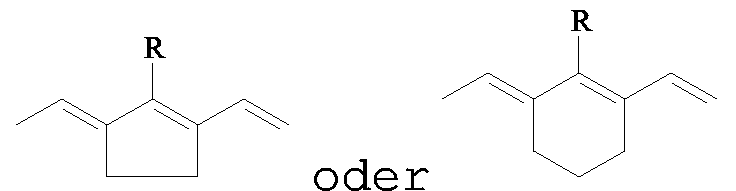
Darüber hinaus sind Merocyanine von Interesse die von 1,3- Diketonen bzw. von ihren cyclischen Ureiden abgeleitet sind, wie die donorsubstituierten Barbitursäurederivate und Thiobarbitursäurederivate
Außerdem ist zwingend notwendig, dass einer der Substituenten A, B, Rn oder ein Substituent an einem beliebigen aromatischen Strukturelement des definierten Redoxfarbstoffes als ein Strukturelement zur chemischen Anbindung an eine polymere Matrix ausgeführt ist, dies kann eine Hydroxyfunktion, eine
organische bzw. anorganische Säurefunktion oder gegebenenfalls auch eine Aminfunktion sein.
Zur chemischen Anbindung der Redox-Chromophore an polymere Matrices müssen diese ebenfalls entsprechende chemische
Funktionen aufweisen, die mit den zur Verfügung stehenden funktionellen Gruppen der Chromophore reagieren können. Es steht eine große Auswahl funktioneller Gruppen zur Verfügung, die, entsprechend kombiniert, mit in der Syntheseche- mie grundsätzlich bekannten Methoden zur Reaktion gebracht werden können. Es sind dies z. B. Veresterungen, Verethe- rungen oder Amidisierungen. Im ersten Fall reagieren eine Carboxlgruppe und eine alkoholische OH-Gruppe miteinander. Je eine dieser funktionellen Gruppen kann sich entweder im Chromophor befinden, die entsprechende andere Gruppe im Polymer. Bei der Veretherung tragen sowohl der Chromophor wie das Polymer eine Hydroxylgruppe, die aromatisch und / oder aliphatisch gebunden sein kann. Im Falle der Amidisierung reagieren eine Carboxygruppe und eine Aminogruppe miteinan- der.
Auf der Seite der Polymere steht eine große Auswahl kommerziell verfügbarer Polymere mit entsprechenden funktionellen Gruppen zur Verfügung. Für den speziellen Anwendungsfall können aber auch geeignete Polymere synthetisiert werden.
Im Folgenden wird die Erfindung noch anhand ausgewählter Bei- spiele, die Ausführungsformen der Erfindung wiedergeben, näher beschrieben.
Es sind zwar Redoxchromophore aus den Klassen der Merocyanine und Methinfarbstoffbetaine prinzipiell bekannt, jedoch nicht die speziellen Vertreter der jeweiligen Chromophorklassen, die zur Anwendung als Elektrochrome tauglich sind. Den bekannten Methinfarbstoffbetainen fehlt gewöhnlich die benötig-
te Löslichkeit und Stabilität in spezifischen Lösungsmitteln zur Herstellung der Formulierungen.
Deshalb können zur Anwendung geeignete Redoxchromophore aus den oben genannten Klassen nicht einfach aus den bekannten und kommerziell verfügbaren Farbstoffen hergestellt werden, sondern sind nur aus zuvor synthetisierten, entsprechend substituierten Synthonen durch Kondensation herstellbar.
Beispielhafte Herstellung eines polymer gebundenen Modell- Redoxchromophors a) Redox-Chromophorsynthese

- aus Heptylbromid, 3-Aminophenol und NaHCC>3 b) N-Heptyl-N-2-hydroxyethyl-amino-phenol-3
- aus N-Heptylaminophenol-3 und Oxiran c) 4- (N-Heptyl-N-2-hydroxyethyl-amino) -2-hydroxy- nitrosobenzen-hydrochlorid
- aus N-Heptyl-N-2-hydroxyethyl-amino-phenol-3, propan- olischer HCl und Isoamylnitrit d) l-Naphthylammonium-N-4-butylsulfonat - aus 1-Naphthylamin und Butansulton e) Phenoxazinsynthese
- aus 4- (N-Heptyl-N-2-hydroxyethyl-amino) -2-hydroxy- nitrosobenzen-hydrochlorid und 1-Naphthol
b) Synthese des polymer-gebundenen Redox-Chromophor mit n/m=3/7 f) Polyimid-Co-polymer
- durch Copolymerisation aus Maleinsäureanhydrid und Allyl- trimethylsilan und anschließender Imidisierung mittels 4- Hydroxyanilin g) Chromophoranbindung
- durch Mitsunobu-Reaktion aus 3 Teilen PoIy- [N- (4- Hydroxyphenyl) -maleinsäureimid-co-allyltrimethylsilan] und einem Teil hydroxyethyl-substituierten Oxazinonfarbstoff

2. Herstellung einer elektrochrom aktiven Formulierung
Zur Herstellung der Formulierung werden die folgenden Kompo- nenten in der jeweils angegebenen Menge gemischt: TiC>2 (Ig) , Polyethylenoxid (Ig) , Tetrabutylammonium-tetrafluoro-borat (0.06 g) , Propylencarbonat (3 ml) und der hergestellte poly- mer gebundene Redox-Chromophor (0.06g). Alle Bestandteile werden nach dem Zusammenmischen intensiv mittels eines Speed- Mixers vermischt.
3. Herstellung einer elektrochromen Zelle
Die erhaltene pastöse Formulierung wird nach dem Stand der Technik im Falle eines Displays zwischen sich kreuzende E- lektroden appliziert. Beim Anlegen einer Spannung wird ein Farbumschlag von blau nach farblos (weiß) erzielt.
Mit Hilfe der vorliegenden Erfindung wird die Formulierung nach dem Stand der Technik insofern verbessert, als das Re- dox-System Bestandteil des elektroaktiven Chromophors und des polymeren Feststoffelektrolyten wird. Da hier der Feststoffelektrolyt den organischen Chromophor und das Redox-System selbst enthält, kann auf den Zusatz eines Redox-Systems auf Basis Chinon/Hydrochinon verzichtet werden. Dadurch kann die Anzahl der Komponenten in der Formulierung verringert werden. Von besonderem Vorteil ist, dass durch den Wegfall des Chi- non/Hydrochinon-Systems die Langzeitstabilität der Elektroden gegenüber der nun neutralen Formulierung verbessert ist.
Nach der Erfindung werden die Komponenten - polymere Matrix und
- das elektrochrome Material (der Redox-Chromophor) gemeinsam in einer Komponente der Formulierung ausgeführt, dadurch wird die Anzahl der Komponenten der Formulierung verringert wodurch die Langzeitstabilität der Formulierung sowie die Lebensdauer des Displays verbessert werden. Da der Redox- Chromophor polymer-gebunden ist, kann keine Diffusion mehr erfolgen. Dadurch bleiben Farbänderungen dauerhaft auf die aktive Pixelfläche beschränkt. Dies erlaubt die kantenscharfe Abbildung von Pixeln und damit eine verbesserte Bildwiederga- be mit verbesserter Lebensdauer. Gegenüber Formulierungen auf Basis von Viologenen bzw. Polythiophenen besteht der Vorteil der erfindungsgemäßen Redox-Chromophore darin, dass eine große Vielfalt von strukturellen Veränderungen im farbgebenden Teil des Moleküls zur Verfügung steht, wodurch eine große Auswahl verschiedenster Farben dargestellt werden kann.
Claims
1. Material für eine elektrochrome Formulierung, zumindest ein Polymer als Festelektrolyt, ein Leitsalz, ein Redox- System, ein Weißpigment, ein Lösungsmittel und einen
Chromophor umfassend, wobei die Funktionalitäten des po- lymeren Festelektrolyten, des Redox-Systems und des Chromophors in einer Komponente verbunden sind.
2. Material nach Anspruch 1, wobei die polymere Komponente ein organisches Redox-Chromophor umfasst.
3. Material nach einem der Ansprüche 1 oder 2, wobei die
Komponente eine chemische Verbindung mit einem chinoiden Strukturelement umfasst, das chemisch und/oder elektrisch zur Leukoform des Farbstoffes reduzierbar ist.
4. Material nach einem der vorstehenden Ansprüche, wobei die polymere Komponente ein Merocyanin- und/oder Polymethin- farbstoff umfasst.
5. Material nach einem der vorstehenden Ansprüche, wobei die, die chinoide Struktur umfassende Komponente eine Komponente des folgenden Typs ist

Farbstoff Leukoform
für die gilt:
A ist ein Donorsubstituent,
B steht für einen Akzeptorsubstituent, der im Falle eines Po- lymethinfarbstoffes eine positive Ladung trägt, R1 und R1* stehen unabhängig voneinander für H, Alkyl (verzweigt oder unverzweigt Cl bis ClO) , Aryl oder beide sind ü- ber ein Sauerstoffatom oder Schwefelatom verbunden, X und X stehen unabhängig voneinander für -0-, -S-, -Se-, eine Vinylengruppierung (-CH=CH-) oder eine benzanelierte Vi- nylengruppierung,
Y1 und Y2 stehen unabhängig voneinander für -CH=, - (C- Alkyl)= (verzweigt oder unverzweigt Cl bis ClO), -C-Aryl= oder -N=, Z steht für d) eine Monomethingruppierung, beispielsweise -N= , -CH= oder -(C-R2)= , mit R2 beispielsweise CN, Alkyl (verzweigt oder unverzweigt Cl bis ClO) , Aryl
e) eine Trimethingruppierung, beispielsweise -CH=CH-CH= oder

f) eine Pentamethingruppierung, beispielsweise

6. Material nach Anspruch 5, wobei zumindest einer der A- rylreste ein Phenylrest ist.
7. Material nach Anspruch 5 oder 6, wobei für den Fall, dass der polymere Redox-Farbstoff einen Polymethinfarbstoff darstellt, das zusätzliche Anion, das zur Ladungsneutralisation notwendig ist, betainisch am Farbstoffkation substituiert ist.
8. Verwendung eines Betain-Chromophors in einem elektrochro- men elektronischen Bauelement.
9. Verwendung eines Materials nach einem der vorstehenden An- sprüche 1 bis 7 zum Aufbau einer elektrochromen Schicht in einem Display.
10. Display, zumindest zwei sich kreuzende Elektroden und eine dazwischen befindliche elektrochrome Schicht umfassend, wobei die elektrochrome aktive Schicht ein polymeres Be- tainchromophor nach einem der Ansprüche 1 bis 7 umfasst.
Applications Claiming Priority (4)
| Application Number | Priority Date | Filing Date | Title |
|---|---|---|---|
| DE102005024948 | 2005-05-31 | ||
| DE102005024948.5 | 2005-05-31 | ||
| DE102005031636 | 2005-07-06 | ||
| DE102005031636.0 | 2005-07-06 |
Publications (1)
| Publication Number | Publication Date |
|---|---|
| WO2006128805A1 true WO2006128805A1 (de) | 2006-12-07 |
Family
ID=36838520
Family Applications (1)
| Application Number | Title | Priority Date | Filing Date |
|---|---|---|---|
| PCT/EP2006/062524 Ceased WO2006128805A1 (de) | 2005-05-31 | 2006-05-23 | Material für elektrochrome schichten |
Country Status (1)
| Country | Link |
|---|---|
| WO (1) | WO2006128805A1 (de) |
Citations (5)
| Publication number | Priority date | Publication date | Assignee | Title |
|---|---|---|---|---|
| DE2534713A1 (de) * | 1975-08-04 | 1977-02-17 | Dirk Dr Basting | Farbstofflaser |
| WO1996007487A1 (en) * | 1994-09-10 | 1996-03-14 | The University Of Liverpool | Method of synthesising materials having controlled electronic, magnetic and/or optical properties |
| WO2001027690A2 (en) * | 1999-10-11 | 2001-04-19 | University College Dublin | Electrochromic device |
| WO2002075441A2 (en) * | 2001-03-19 | 2002-09-26 | Dow Global Technologies Inc. | Electrochromic display device and compositions useful in making such devices |
| WO2006056550A1 (de) * | 2004-11-24 | 2006-06-01 | Siemens Aktiengesellschaft | Elektrochromes bauelement mit elektrolyt-gefülltem hydrogel |
-
2006
- 2006-05-23 WO PCT/EP2006/062524 patent/WO2006128805A1/de not_active Ceased
Patent Citations (5)
| Publication number | Priority date | Publication date | Assignee | Title |
|---|---|---|---|---|
| DE2534713A1 (de) * | 1975-08-04 | 1977-02-17 | Dirk Dr Basting | Farbstofflaser |
| WO1996007487A1 (en) * | 1994-09-10 | 1996-03-14 | The University Of Liverpool | Method of synthesising materials having controlled electronic, magnetic and/or optical properties |
| WO2001027690A2 (en) * | 1999-10-11 | 2001-04-19 | University College Dublin | Electrochromic device |
| WO2002075441A2 (en) * | 2001-03-19 | 2002-09-26 | Dow Global Technologies Inc. | Electrochromic display device and compositions useful in making such devices |
| WO2006056550A1 (de) * | 2004-11-24 | 2006-06-01 | Siemens Aktiengesellschaft | Elektrochromes bauelement mit elektrolyt-gefülltem hydrogel |
Similar Documents
| Publication | Publication Date | Title |
|---|---|---|
| DE60218814T2 (de) | Stabile, konjugiertes polymer enthaltende elektrochrome vorrichtungen mit ionischen flüssigkeiten | |
| DE60226221T2 (de) | Elektrochemische pixel-einrichtung | |
| EP0467846B1 (de) | Neue elektrochrome Stoffzusammensetzungen auf der Basis von Diketopyrrolopyrrolen | |
| DE69315331T2 (de) | Elektroabscheidungsverfahren zum anbringen von mikroverkapseltem fluessigkristallmaterial auf elektroden | |
| DE2823523A1 (de) | Reversible elektrochromische anzeigevorrichtung | |
| CN1498357A (zh) | 可矩阵寻址的电致变色显示装置 | |
| CH643074A5 (de) | Elektrochrome masse und deren verwendung zur herstellung einer elektrochromen anzeigevorrichtung. | |
| EP1103842B1 (de) | Elektrochrome Vorrichtung | |
| DE102009023309A1 (de) | Elektrochrome Formulierung, Herstellungsverfahren dazu und elektrochromes organisches Bauelement | |
| DE2612039C2 (de) | Anzeigevorrichtung | |
| EP2150598A1 (de) | Organisches elektrochromes bauelement für daueranzeigen | |
| EP2276821B1 (de) | Elektrochrome formulierung und organisches elektrochrom schaltbares elektronisches bauteil | |
| DE69810776T2 (de) | Elektrochrome vorrichtung | |
| DE69311061T2 (de) | Copolymere, Verfahren zu deren Herstellung und dieses Polymer verwendende Material zur Färbung/Verfärbung | |
| WO2010000615A1 (de) | Elektrochrome formulierung, herstellungsverfahren dazu und elektrochromes organisches bauelement | |
| WO2006128809A1 (de) | Material für elektrochrome schichten | |
| WO2006128806A2 (de) | Material für elektrochrome schichten | |
| WO2006128818A1 (de) | Material für eine elektrochrome formulierung, verwendung davon und display | |
| EP2328993A1 (de) | Elektrochromes organisches bauelement | |
| DE102006045307A1 (de) | Elektrochrome Formulierung, Herstellungsverfahren dazu und elektrochromes organisches Bauelement | |
| DE102008049546A1 (de) | Elektrochrome Formulierung, Herstellungsverfahren dazu und elektrochromes organisches Bauelement | |
| WO2007036561A2 (de) | Elektrochrome pasten mit neuen farbstoffen | |
| WO2006128820A1 (de) | Elektrochromes display | |
| WO2007107475A1 (de) | Zwischenprodukt zur herstellung einer elektrochrom aktiven formulierung, elektrochrom aktive formulierung und verwendungen davon | |
| DE102008024259A1 (de) | Elektrochrome Formulierung und Verfahren zur Herstellung einer elektrochromen Formulierung; Verwendung der Formulierung und organisches elektronisches elektrochromes Bauteil |
Legal Events
| Date | Code | Title | Description |
|---|---|---|---|
| 121 | Ep: the epo has been informed by wipo that ep was designated in this application | ||
| NENP | Non-entry into the national phase |
Ref country code: DE |
|
| WWW | Wipo information: withdrawn in national office |
Country of ref document: DE |
|
| NENP | Non-entry into the national phase |
Ref country code: RU |
|
| WWW | Wipo information: withdrawn in national office |
Country of ref document: RU |
|
| 122 | Ep: pct application non-entry in european phase |
Ref document number: 06755291 Country of ref document: EP Kind code of ref document: A1 |